
Join us for a special episode featuring the father/daughter duo Ryan and Scout Fisher. Ryan, known for his work as a Book of Mormon defender and host of The Nephite Explorer series, shares his journey, including working closely with Tim Ballard and his experiences as a missionary in Poland, where he was kidnapped and locked in a jail cell. Ryan’s patriarchal blessing foretold that millions would know his name, leading him to embark on Heartland tours and excursions with his daughter Scout to prove the truth of the Book of Mormon. As Ryan became a hard-core prepper, Scout witnessed her parents’ faith transition while she continued attending church.
Trigger Warning: This episode covers topics such as kidnapping, suicide and suicidal ideation.
You can donate to Ryan and Carah’s cause to help the victims of Tim Ballard
Buy Scout Fisher’s book of poems: “Not All Sheep Who Wander Have Lost Him”
Episode Transcript
Host: John Dehlin · Guests: Ryan Fisher, Scout Fisher
This transcript is machine-generated and lightly edited for readability. The audio is authoritative. Please excuse occasional errors in names and spelling.
Introducing Ryan and Scout Fisher
John Dehlin [00:01:01] Hello, everyone, and welcome to another edition of Mormon Stories podcast. I'm your host, John Dehlin. It is August 26, 2024, and today we are super excited because not only are we interviewing fantastic people, but we're interviewing a father daughter duo about kind of their Mormon faith journey. And the father, the dad, Ryan Fisher that we're interviewing today also has a fascinating story in and of himself because he was not only sort of a prominent YouTube Mormon apologist, book of Mormon defender for many years, he also worked very closely with Tim Ballard. So there's so much that we're going to try and cover in a fixed amount of time today. But we want to welcome to Mormon Stories, Ryan Fisher. Hey, Ryan. Hi. Hi.
Ryan Fisher [00:01:53] How's it going?
John Dehlin [00:01:54] Thanks for coming.
Ryan Fisher [00:01:55] Glad to be here.
John Dehlin [00:01:56] And his daughter, Scout. Hey, Scout.
Scout Fisher [00:01:58] Hey.
John Dehlin [00:02:00] And if that weren't enough, cool. We've got Kara Burrell guest co hosting Kara's back in the Mormon Story studio. Hey, Kara.
Carah Burrell [00:02:07] Hey, John.
John Dehlin [00:02:08] It's good to have you.
Scout Fisher [00:02:10] Thank you.
Ryan's Background as a Mormon Apologist
John Dehlin [00:02:11] Okay, Ryan, tell everybody just really quickly what you did as a Book of Mormon apologist and what you did for Tim Ballard, just so people kind of have a sense for that.
Ryan Fisher [00:02:22] Sure. Yeah. I started a TV show called Nephite Explorer back in 2011, 2012, which went into Book of Mormon geography, church history, American covenant, American exceptionalism from a scriptural perspective. That was on air on KJAZZ Channel 14 from 2012 to 2016 and every Sunday, twice Sundays. I think it was like their highest rated program at the time. And I featured a lot of researchers, including Tim Ballard and some of his research, and it was a pet project of mine that I was passionate about, that was really in line with my beliefs and I felt was a really good endeavor to do. And I was heavy into apologetics, trying to use archeology and history to prove the validity of the Book of Mormon, the Book of Mormon message, and Mormon theology and all of that stuff. So in that process, I platformed Tim Ballard, who was an aspiring author at the time, and became good friends with him, became business partners with him, ran church history American history tours on the east coast, where we take busloads of people to all these sites in American history. And I'd film that for part of my TV show and featured researchers like that and had a lot of fun doing that. It was basically a 10 year research project that. That dove into all of those subjects.
John Dehlin [00:03:54] And when. When was the last kind of year that you and Tim were on good terms? Like, how were you?
Ryan Fisher [00:04:00] 2017.
John Dehlin [00:04:01] Okay. So about seven years ago, y', all. For. We'll find out. Whatever reason was, y' all stopped collaborating, but. Yeah, but y' all worked together for how long?
Ryan Fisher [00:04:12] Six, seven years? Yeah, pretty closely. I was around for the founding of. I knew Tim before he left Department of Homeland Security, became friends with his. Himself and his family, and collaborated on my TV show on several other tv. I was the producer for other TV projects with Tim. Some of them involved Elder Ballard and the LDS Church. And so I was involved in that. I was there for the founding board of our. And kind of had a front row seat to the rise of this whole endeavor and tried to put it Behind Me in 2017. But the story kind of hit the headlines and so.
John Dehlin [00:04:55] And I think I learned about you. You were on Kara's podcast. Right. Nuanceau, as it was once called.
Carah Burrell [00:05:01] It's now the very professional Cara Braille podcast.
John Dehlin [00:05:03] But yeah, but this is more. So the focus today is more on your faith journey.
Ryan Fisher [00:05:09] Yeah.
John Dehlin [00:05:09] And on your relationship with your daughter Scout, as how she experienced the faith crisis of her parents. Is that right, Scout?
Scout Fisher [00:05:18] Yeah.
John Dehlin [00:05:19] Is that why you're here?
Scout Fisher [00:05:19] Yeah, totally.
John Dehlin [00:05:20] Okay. But along the way, we'll talk about your experiences with Elder M. Russell Ballard, Apostle the Mormon Church Tim Ballard, and your experiences as an apologist. Right.
Ryan Fisher [00:05:31] Yeah, just from. As it affected me in my own faith journey. Right.
John Dehlin [00:05:35] Yeah. Okay, cool. And we may decide to do a separate episode diving deeper on either the apologetics or the Tim Ballard stuff. But sure, this will be your story. And Scout, anything you want to say about why you're here?
Scout Fisher [00:05:49] Just here to be part of I'm part of my dad's story, and it was really fun getting to grow up, going to all of his nephite explorer things and even putting papers in the CD cases. And he'd pay me like $5 to do that for like 20 DVDs. And I would go on all the tours with him and everything. And then. And then it all stopped and I was by myself at church for a couple years. And so it's a pretty crazy story and it was a pretty big thing for us to navigate together, but I think it's. We've come out better in the end, and that's pretty cool. And it's pretty fun that now we can have gone through that together and be stronger in our relationship.
Ryan Fisher [00:06:29] Yeah, she was my sidekick all along the way. Some of the people that watch my show and are familiar with that will recognize Scout. Little 11 year old Scout, 12 year old, 13 year old Scout in the episodes, either carrying a tripod or acting in some way as my assistant. And so we've been on this faith journey together since the beginning.
John Dehlin [00:06:50] Beautiful.
Ryan Fisher [00:06:51] So it makes sense to talk about it now together.
John Dehlin [00:06:54] All right, Carrie, anything you want to say before we dive in?
Carah Burrell [00:06:56] No, it just for listeners, this is kind of like a reformed Rod Meldrum story when you're talking about the heartland stuff. So this is like a family that was really all in on believing, Book of Mormon geography, you know, dedicating your life to it, and then what that journey is like to, I guess, be convinced by other evidence and then be going a different way. Even if your family and your, you know, different familial ties are pulling you in different directions, whether towards, you know, no God, some God, a mixed faith kind of family story from being all in. So I'm excited to get into it.
Growing Up in the LDS Church
John Dehlin [00:07:30] All right, well, let's dive in. So, Ryan, were your parents LDs?
Ryan Fisher [00:07:35] Yep. Born, raised in the church.
John Dehlin [00:07:36] Where. Where do they kind of, you know, grow up and. And meet?
Ryan Fisher [00:07:41] Well, we should probably play the. The Mormon connection game because I think you were part of it actually. You don't. You probably don't know. I grew up in the Issqua Third Ward. What, and you were part of the Isqua Third Ward?
John Dehlin [00:07:54] I was. That's Klahani.
Ryan Fisher [00:07:56] Yeah.
John Dehlin [00:07:57] In Washington.
Ryan Fisher [00:07:58] I lived in Kahani.
John Dehlin [00:07:59] Huh?
Ryan Fisher [00:07:59] Yeah, I lived in Kahani.
John Dehlin [00:08:00] You grew up there?
Ryan Fisher [00:08:01] Yeah.
John Dehlin [00:08:03] So when I. When I went through my faith crisis, I was working for Microsoft, living in Seattle. The area is the Sammamish Plateau, and Kalahani was this massive developed subdivision with kind of smaller houses and really teeny plots of land. But imagine just like a couple thousand houses all in this big super planned development. You grew up there?
Ryan Fisher [00:08:26] Yeah, I grew up there, yeah. In fact, I've been told that you were in my ward and. And my. Phil Bussy. Yeah, Bishop Phil Bussey, you know him?
John Dehlin [00:08:36] He was my bishop.
Ryan Fisher [00:08:37] Yeah, he was my bishop too. He sent me on my mission, so.
John Dehlin [00:08:39] Oh, wait a minute. So we would have been there. I was there from about 98 to 2004. When were you there?
Ryan Fisher [00:08:44] Oh, I left on my mission in 97.
John Dehlin [00:08:47] So you would have left right before we. Right as we arrived.
Ryan Fisher [00:08:52] That's why I don't remember you.
John Dehlin [00:08:53] Okay.
Ryan Fisher [00:08:54] It's not.
John Dehlin [00:08:55] Yeah.
Ryan Fisher [00:08:55] Not because.
John Dehlin [00:08:55] Did your family stay there after you?
Ryan Fisher [00:08:57] Yeah, in fact, I came back. I still went to the chapel up on sm.
John Dehlin [00:09:01] So I would have known your family. They would have known me.
Ryan Fisher [00:09:03] Yeah. Fisher. Okay. Yeah, yeah.
John Dehlin [00:09:05] Okay. And so did they raise you pretty devout?
Ryan Fisher [00:09:08] Yeah, yeah. Totally orthodox, very devout, very dedicated. My mom was released society president and our ward and had a big impact on me and she'd take me to deliver food and service oriented outings to members of the ward and things like that. So. Yeah, very devout, very committed family and I was too.
John Dehlin [00:09:34] Yeah.
Speaker A [00:09:35] Okay.
John Dehlin [00:09:35] Anything unique about your Mormon upbringing in terms of stuff we would or wouldn't have covered on with other people on Mormon stories? Any big things happened in your. Your childhood or adolescence?
Ryan Fisher [00:09:46] Yeah. So I. The biggest monumental shift for me growing up, it was a great ward, a lot of really good people, a great, great friend group, great youth leaders. And when I was 16, I got my patriarchal blessing like most people do, which is, as many of your viewers probably already know, is a blessing. There's a person set apart as a patriarch in the Mormon Church that receives a revelation from God that outlines kind of the life plan for your entire life and gives guidance at various steps along the way. When I got that at 16, I had quite the patriarchal blessing that really blew my mind.
John Dehlin [00:10:32] This is like Mormon fortune telling.
Ryan Fisher [00:10:33] Yeah.
John Dehlin [00:10:34] But basically a road map for your life, allegedly directly from God and Jesus. That's, you know, they put their hands on your head, they channel God's inspiration and they tell you you're going to go on a mission, you're going to get married in the temple, you're going to rise in the morning of the first resurrection and be exalted, you know, if you're righteous. Right. Yeah, it's that kind of thing.
Ryan Fisher [00:10:53] Yeah, that kind of thing. And mine went even further by outlined to me that I had a really important mission on the Earth that I was going to go to nations around the world to find God's children. My name would be known by millions of people as somebody that would be revered, and my name would be blessed in these circles. And it was this very grand vision that led me to believe at the time that I must. I'm going to end up a general authority because of what I'm going to be traveling the world. People are going to call my name blessed. I'm going to cast out devils. I'm going to do all these major, major roles to bring about the establishment of Zion and the second coming of Jesus Christ, and that I'm going to actually witness the establishment of Zion on Earth and play important roles in that. So that blew my mind. And my patriarchal blessing really set the stage for how I viewed everything and everyone in small ways and big ways. And I set my life in order in a way to make sure that those prophecies came to pass, that I fulfilled those prophecies about being basically a general authority, as I supposed. In fact, I later on tried to get work with the church, applying for jobs, and it was hard to even get an interview. And I wanted to show him my patriarchal blessing. Like, hey, listen, this is who I am. I'm a big freaking deal right here. This is what God says about me anyways. But when I was 16, that left a huge imprint on me.
John Dehlin [00:12:48] What type of teenage Mormon boy did that make you in terms of following the rules? Just, you know, demonstrating your righteousness, demonstrating your commitment? What did that? How did that play out and how you acted as a Mormon teenage boy?
Ryan Fisher [00:13:04] I was so afraid of doing or anything that would disrupt that plan that it had for me. So all the way. And I didn't know this word at the time, but it was religious scrupulosity. I would go so far as, like, there's a line in my patriarchal blessing that says, you will soon resolve to never frequent or be associated with people where Satan's evil influence is anticipated or sensed. So I looked at everybody I came across as, all right, are you part of Satan's evil influence? Like, is anything you say or do could be construed as maybe having an influence from Satan? And this would manifest itself in ways like, I went out with this, on this date with this girl. She was a cheerleader, super cool, super cute, excited to go out with her. And on the first date, um, we talked about Friends, the TV show in the 90s, you know, which everybody watched. She was A super big fan of Friends, I thought, hmm, Friends in that show, there's promiscuous sex. They're sleeping around. She likes that show. That Satan's evil influence. No second date. I'm out. I'm out. And I'm in Georgia, if you're watching. I'm so sorry. Like, that was what was going on. She was really mad that I dropped her, but. But that I'm embarrassed about it now, but I really was trying to live every line of my patriarchal blessing to a tee and make sure that I fulfilled this grand destiny in ushering in the second coming of Jesus Christ that it told me I had a huge role to play in doing. And so it even manifests. I tried to be a missionary as much as possible. I even got to baptize one of my high school friends that I helped bring into the church. Um, and so I. I was all in. I was all in. This was what I was dedicating my life to.
Speaker B [00:14:55] And.
Ryan Fisher [00:14:57] And that reflected itself in. In the friends I chose, which are all great people. Really striving to be surround myself with good LDS kids, which isn't always easy to do in Seattle. Cause there's not a lot of Mormons up there at the time. And really bonded me to my ward, my family, and especially my church leaders. They were all like this safety net for me to help guide me. And I was really striving to get myself on a mission and do whatever I could to make sure that I maintained my virtue as my patriarchal blessing told me to, so that I would get on a mission and drive my whole existence towards going on that mission. And that would start this chain of events that would have all these grand implications for the world as a whole.
Preparing for and Entering the Mission Field
John Dehlin [00:15:49] So were there any obstacles in the way or did you just make it on your mission?
Ryan Fisher [00:15:54] No, there was tons of obstacles. Maintaining my virtue morally with girls and things was a constant struggle, as it is for most people in high school. But it really felt like a life or death situation for me. And so, you know, I had desires and sexual desires just like anyone else. And so it was like really the fight of my life to maintain even just. I was so afraid of even like having impure thoughts that would cause me to lose the spirit, to fall out of favor with God, and then not fulfill what the prophecies of my patriarchal blessing were about. And so the religious scrupulosity in my youth absolutely dominated everything I did and said and acted upon. And it made me into. Probably I would look back and be like, A shining example of what a good Mormon Latter Day Saint boy was aspiring to be. And so I rode that.
John Dehlin [00:17:03] Did you have any unpleasant or uncomfortable interactions with your bishop? Like worthiness interviews?
Ryan Fisher [00:17:10] Yeah, I had to do worthiness interviews. And I would confess anything and everything that I ever did, and with so much fear that I was going to, like, disrupt my life's plan and not make it on a mission. Really awkward, terrible experiences. But I wanted to make sure that I was on the right side of God. And I had really good bishops in my youth, Phil Bussey being one of them, that helped guide me through that path and. And help make sure that I made it on a mission. But I was so focused on being worthy to get on that mission because that would set the stage for doing all these miraculous things that was laid out in my. In my patriarchal blessing.
Serving a Mission in Poland
John Dehlin [00:17:59] So where'd you go on your mission?
Ryan Fisher [00:18:01] Poland.
John Dehlin [00:18:02] Poland, yeah. Oh, okay. And is that. That's after the fall of the Berlin Wall, right?
Ryan Fisher [00:18:08] Yeah, not long after.
John Dehlin [00:18:10] Because this was Waleska. What was the guy's name?
Ryan Fisher [00:18:12] Yeah, Lech Waleska.
John Dehlin [00:18:13] Yeah. Say it again.
Ryan Fisher [00:18:14] Valeska. Yeah, yeah.
John Dehlin [00:18:16] Was he the leader of Poland when you.
Ryan Fisher [00:18:18] No, he had this. So I got called on a mission to Poland in 97. Left in October of 97. So this was about eight years after the fall of communism. It was pretty new mission. Very Catholic country, very devout, very pious, devout Catholic country. And even though it had transitioned to democracy at that time, the mentality and the people that had lived under the Cold War, Soviet kind of mindset was still in full force.
John Dehlin [00:18:56] Okay.
Ryan Fisher [00:18:57] Yeah. So it was walking into a very, very foreign country.
John Dehlin [00:19:02] And how was your mission for your faith?
Ryan Fisher [00:19:07] Well, you know, Mike Tyson famously said, once, everybody has a plan until they get punched in the face. Arriving in Poland was a big punch in my face. When I got there. I got there in December, right before Christmas. It was a cold, dark place. I was sent to cities in the mountains of southern Poland that had never seen missionaries before. And me and my companion were. Would walk the streets every day, trying to find people to talk to just at random or track department buildings, trying to find people to talk to. The mission, to say it was difficult, every mission is difficult, but this one has some specific challenges. For one, the weather was harsh. There was no cars, no bicycles. We lived in very poor, drafty apartments. I slept in a North Face sleeping bag every night. And everywhere we went, there were. Alcoholism was a huge problem. It was a huge problem in Poland at that time. And there would be people laying in the Ditches getting buried by snow, and they'd frequently die from exposure or sometimes survive. And we'd have to walk by and see that and think, can we help this person? Like, what do we do? And people didn't like foreigners then. Well, I should say the young men who are called hooligani or hooligans didn't like foreigners. So we got beat up frequently and rocks thrown at us and. And it was a scary, scary time. Even though the. Poland was a democratic, you know, came out of the Soviet era as a democracy, the mentality of the government, police and things like that was still very KGB esque. So I would frequently get stopped and I even got arrested. I got kidnapped on one occasion.
John Dehlin [00:21:13] Kidnapped?
Ryan Fisher [00:21:14] Yeah, yeah. I. Somebody that I met had tickets to a volleyball game in another neighboring city. They invited me and we never got to do anything socially because we really didn't have any friends very often. And so I went to the volleyball game with my companion and two other missionaries. And I love volleyball. I played in high school, I played in college. And so at the volleyball game, we were sitting watching the volleyball game, and I was on the end of this bench and a guy came up to me, tapped me on the shoulder and said, hey, can I see your ticket? And I was like, sure. So I showed him my ticket. He's like, here, come with me. I thought, you know, being a stupid American, I thought, hey, maybe I won something. Maybe I was like selected out of a. Of some sort of lottery or something. So I got up, my companion got up with me because we're supposed to go everywhere in twos. And the guy sat him back down. He's like, nope, just him. I'm like, all right, well, go see what this is about. I'll be right back. As I suppose. So I walked with him. He's like, follow me. He followed. I followed him outside the state, outside of this arena and around the corner where. Where a couple guys grabbed me and threw me in back of a van.
Speaker A [00:22:35] Whoa.
Ryan Fisher [00:22:36] Yeah. Without explanation. And drove off into the mountains. So I demanded like, what's going on? And they didn't give me any explanation. They absolutely silently just took me off into the mountains to a compound up in the mountains that this was part of a government facility, I could tell, very secure. And at that compound, they interrogated me. They made me strip, lay my. All my belongings out on the floor, and then use some pretty ruthless tactics to try and break me into telling them everything, who I was and what I was doing. And I think somebody heard us Speak in English at that stadium, alerted. What was the Polish KGB equivalent? And that's how they investigate those things. So, yeah, so I spent the night in this jail cell, basically naked. And they interrogated me every two hours, asking me the same questions, asking for my contacts, trying to get me, trip up my story. So thankful they took me and not my companion, who had just gotten to the country and couldn't even speak Polish. That would have been even worse. But I told them my story. I'm a missionary for the Church of Jesus Christ of Latter day Saints. I'm here for this purpose, and this is what I'm doing. And I stuck to my story because it was the truth. And by the next morning, they were getting really frustrated. I could tell they wanted to get violent, but they were unsure whether I was telling the truth or not. And they asked for all my contacts, everybody I was associated with. And so I gave them names and addresses of my investigators and things like that. And they finally got frustrated enough where they. They weren't getting anywhere. And I'm like, I'll tell you and take you anywhere you want to go. Please just let me go. I was really scared.
John Dehlin [00:24:44] You saw your mission president.
Ryan Fisher [00:24:45] No, I couldn't have. I couldn't. They wouldn't let me call anybody.
John Dehlin [00:24:48] I mean, after you were done.
Ryan Fisher [00:24:50] No, I didn't. What
John Dehlin [00:24:53] my.
Ryan Fisher [00:24:54] We were in the mountains of southern Poland. I only saw mission president, like, every other month for, like, a brief interview. It really wasn't part of our mission, and I had just. Yeah. And so I. Yeah, I chose. I didn't know if I was going to get in trouble for any of that.
Speaker A [00:25:13] Wow.
Carah Burrell [00:25:15] Can I ask, how did that, like, affect your faith on your mission? Because you're either, like, praying to get
Ryan Fisher [00:26:21] Yeah. I was literally in a jail cell, naked in a jail cell, thinking about Alma in the Book of Mormon, thinking about the prophets in the Book of Mormon, thinking, all right, I need to muster the faith right now to shake the walls of this jail cell so I can be freed and trying for hours begging for the kind of faith to, like, get out of the situation. The next morning, I told them something. I. I told them, like, that I would take them to meet the person that brought me to that volleyball match. And I said, I know where they're parked. I'll bring you to them. And they're like, and he. He's in that town. And they're like, okay, we're gonna do that. And so they put me back in a car and drove back to the city. And this was the next morning. I had no idea where my companions or the other missionaries were. I had no idea. Like, I can take you to where they parked their car the previous night, but that's all I can offer at this point. And so we drive back into town, and we go to the arena, and the parking lot's empty, and. And they. They're like, where's the car? I'm like, I don't know where he's at. I have no contact with him. Like, what do you want from me? And they flipped the car around and started driving back to the mountains. And at that point, I knew I was going to get beaten. And so there I was in a regular car at this point. And the door is unlocked, and there's a stop sign on the edge of town where they hit the dirt road going back up into the mountains. And I. The door is unlocked. And so I'm like, all right, when we hit that stop sign, I'm going to jump and. And run into the mountains and survive. And I'm not going back to that facility because it's going to get violent, and it's going to be really awful. And as we're driving up this stop sign, I'm, like, psyching myself up. I'm like, just get out. You can outrun these guys. I was in track. I'm fast. I'm going to run in the woods, and I'm just not going to stop for miles and miles and miles until I'm out of. Out of. Out of their grasp. And we're pulling up to the Stop sign. And I have my hand on the. On the door handle, ready to run. And as we're pulling up, all of a sudden, these people come running up to the car and start banging on the windows. The guy that brought me to the volleyball game and my companion and the other missionaries had been out all night looking for me. And I had driven by, and they saw me in the back of the car. They chased the car down and stopped it right before we got out of town. And the officers, KGB agents, whatever they were, got out. They talked to the guy for, like, 60 seconds. And then they came over to my door, opened my door, dropped my clothes and stuff on the ground and drove away. Let me out. And so you didn't.
John Dehlin [00:29:30] You didn't tell your mission president? Did you tell your family?
Ryan Fisher [00:29:33] I don't think I did.
Scout Fisher [00:29:35] I'm curious, dad. So when you've told me this story before, you said that you were afraid that you were being punished for, like, doing something fun on your mission, that the volleyball game, like, maybe you weren't supposed to be there some morning. Is that part of the reason why you didn't tell your mission president is because you were afraid that going to volleyball games wasn't allowed?
Ryan Fisher [00:29:53] Yeah. I think we had switched our P day from a Wednesday to a different day.
John Dehlin [00:29:59] So you were doing something you shouldn't have been doing by admission standards?
Ryan Fisher [00:30:03] Yeah. Oh, yeah.
John Dehlin [00:30:04] Okay.
Ryan Fisher [00:30:05] I forgot.
Carah Burrell [00:30:05] Anything can happen.
John Dehlin [00:30:07] Yeah, that makes sense. And then. Then you would. With that scrupulosity. Then you would feel like it was your fault. And so that if God didn't rescue you, it would be. Why?
Ryan Fisher [00:30:17] Yeah. Yeah.
John Dehlin [00:30:18] Because you weren't worthy.
Ryan Fisher [00:30:19] Yeah.
Faith Tested by Mission Hardships
John Dehlin [00:30:20] What did that do to your faith
Ryan Fisher [00:30:22] overall, that experience in Poland? Well, it was. It was so difficult, and nobody wanted us there. Nobody was receptive to the message. I can count on one hand the number of times I taught all six standard discussions. Most missionaries don't ever see a baptism. I barely saw one. And so in that situation, just wrestling with the question of how do you manage finding meaning in a place where people don't want you? You're not accomplishing anything. You don't get to preach the gospel that you came here for. And my entire life in high school was built up for this moment, for being this missionary that would convert the nation, to convert people to Mormonism in droves. That's what I expected to do. My dad served a mission in Guatemal, and he had tons of success. In fact, here are my scriptures. Hold that up a little bit. And all of these tabs I don't know if you can see. I've gone through all of the standard works and created this quick flip chart of topics. I was ready to go to war with Catholicism, and I had prepared for years for this moment and then to get there and nobody wanted to talk with us. Trying to find meaning in all of that was really, really difficult.
John Dehlin [00:32:10] Did you say how many baptisms by the end?
Ryan Fisher [00:32:13] One.
John Dehlin [00:32:13] One?
Ryan Fisher [00:32:14] Yeah, the day. The day before I left.
John Dehlin [00:32:17] I mean, that's better than zero.
Ryan Fisher [00:32:18] Yeah. A lot of missionaries saw zero.
Carah Burrell [00:32:21] I have a question. So a lot of people, when they go into a mission kind of like that, either really dangerous or there's not a lot of investigators or people to talk to. Were you prepared in any. That that's how Poland was going to be? Or did you feel like this is just a unique trial of where God's sending me? Like, how did you interpret it?
John Dehlin [00:32:37] Or it's your fault?
Carah Burrell [00:32:38] Yeah. Like, did you know what to expect going in? Or was it just.
Ryan Fisher [00:32:42] No, no. Totally, totally unprepared. The MTC in Provo that I went to built us up, like, my patriarchal blessing that you are going to accomplish great things. There are going to be countless people that are going to thank you for generations into the spirit world for what you've done on their behalf.
Carah Burrell [00:32:59] There's crickets when you get there, like,
Ryan Fisher [00:33:01] giving us such a grand vision of what we could do with our lives that I'm excited, I'm ready to go. I'm ready to, like, do this thing and then to get there and not be able to do anything. Like, that was such a huge, huge disappointment. And it's just like. Like it didn't make sense. It was. It just, like, was. There's cognitive dissonance in my own mind. We're like, wait, I'm this great missionary. I prepared my whole life for this, and now I'm just wandering the streets trying to get people to talk to me for five minutes. And. And at that time, also John Paul II was Pope of the Catholic Church. He's Polish. Yeah, yeah. So he's like, there's a super loved, beloved, super loved. There's a huge revival going on in Poland at that time. Huge revival.
John Dehlin [00:33:53] They're not having those Mormons.
Ryan Fisher [00:33:55] No, no. In fact, rejecting was an affirmation of their rededication to the faith, which was
John Dehlin [00:34:02] happening throughout because I'm sure the USSR hadn't allowed overt religiosity. So the. The country would have been in a fever of. Of, like you said, reaffirming. Their faith in Catholicism, maybe.
Ryan Fisher [00:34:14] Yeah, absolutely. I had a turning point on my mission. I was. I became convinced early on that there's no way I could do this for two years. There's no way I could wander these streets trying to be this missionary when there wasn't missionary work happening. And all of the buildup that I had done to become this amazing missionary fell so flat on its face. And the reality of the situation was I could not fulfill what my patriarchal blessing was telling me to do, to find God's children among the nations of the world. And I was absolutely convinced that there's no way I could continue to do this for two years. So what options am I left with? Well, the only option. There's only two options. One was return home, tell my mission president I'm sorry, I can't do this for two years. I can't do this even another day or another week. It's destroying me inside, and it's pointless, and it's unfruitful. And so I need to go home. But I had such amazing youth leaders and parents and friends, and my entire existence in the church was all built towards being this missionary, that going home and facing the disappointment of. Of those people who loved me and built me up. And throughout teachers, deacons, teachers, priests, quorum and facing their disappointment was something that I absolutely could not bear. I could not bear facing that disappointment. And I remember it was a zone conference in Wroclaw that I went to, and we did this zone conference, and on the way back, we had to walk to the train station. And in Wrocaw, southern Poland, there's lots of rivers and bridges. This was in the winter. And I left that zone conference thinking, there's no way I can go back to Vabczyk. I could. There's no way I can go back down to these mountains and keep doing this, but there's no way I can go home. There's no way I can face the disappointment of these people that I love, have built me up to it. And we were approaching this bridge,
Carah Burrell [00:36:53] and
Ryan Fisher [00:36:54] all of a sudden it dawned on me that there's another way out. And so I went to the edge of this bridge, and I was like, there is a way out. If I jump off this bridge, all of this ends. The mission ends. I won't have to face disappointment. And it was like such a feeling of relief that I had found a way out. I found a way out of this impossible situation. And so I sat there on the edge of this bridge. The other missionaries kept walking and there's ice, big icebergs floating in this river. And so then I'm like, okay, now I just need to figure out how to do this with the least amount of pain and have it be over as quickly as possible. And so I figured I need to time it to where I land on one of those icebergs, and then I won't have to suffer with drowning, and it'll just be over.
John Dehlin [00:37:59] And my, my,
Ryan Fisher [00:38:01] my parents don't even know this story. And as I'm sitting there waiting to time it for one of these icebergs to come, I saw one coming. Like, all right, that one. That's a big one. I could hit that one. I'm sitting there just waiting for that iceberg to get here, feeling so much relief that there's a way out. Then one of the missionaries yells from the other side of the bridge, hey, there's poni here. And pony are. These, like, jelly filled donuts were really good and delicious and I love them. It's like one of the few things that brought me joy in Poland. And there's a car, there's somebody selling pony on the other side of the bridge. And I thought, yeah, maybe that actually sounds really good right now. So I walked to the other side of the bridge, had Ponch key, and figured I'd. I'd cross this bridge metaphorically later. And so I was saved in that moment by jelly filled donut, I guess you could say. But it was an impossible situation that I could not fulfill what was expected of me. And that's what led me to the edge of that bridge. And that was a hard place to be.
John Dehlin [00:39:25] I think you also. I'm so sorry that happened. And I don't think, you know, people see like the Book of Mormon musical or they see these missionaries going door to door that look happy, shiny white shirt tie. They think, oh, they must be having a great time. But a surprising number of Mormon stories podcast interviewees contemplated death by suicide on their missions. So it's, it's way more common. So I'm really sorry that happened.
Ryan Fisher [00:39:53] Yeah. And I know that my church youth leaders and my parents and everything would be shocked to hear that story. And they were building me up to and praising me for my pious devotion to the church. But what I've realized in looking back upon this is that we have to be very careful in tying somebody's worth to their devotion to the church, and especially, like, things like their morality or their sexual morality or their willingness to do the callings or anything like that. When you Tie the youth and their worth to fulfilling what the church wants them to do. And they're not able to, as I was in that situation, I was not able to fulfill what was expected of me. But I love these people and they loved me and they revered me. It put me in a corner where it felt like there's no way out. And as I've gotten to know, like family and friends that are have come out as gay members of the church, they are painted in the same corner where there isn't a way out. And that's, I think, one of the reasons why suicide is contemplated so highly among gay and trans members of the church. Because there isn't a way out for them to be accepted in a way that's. That they're capable of. That makes sense.
Loss and Trauma During the Mission
John Dehlin [00:41:21] Do you want to talk about the friend you lost while you were on your mission?
Ryan Fisher [00:41:23] Sure, yeah. I had one of my good friends in high school. He was very devout, lds and we went on a backpacking trip right before I left on my mission. And he was a year younger than me, so he was leaving later. He ended up taking his own life. That back to backpacking trip was the last time I saw him. And I'm sure I know he suffered from mental health, as everybody does mental health issues. Everyone that takes their own life is suffering mentally somehow. And I can't help but wonder if his. If this same process of being expected to live out what the church expects you to do and not being able to do that, and the disappointment that comes from that, I just wonder. I don't know because I can't ask him if that played a role in his suicide.
Carah Burrell [00:42:24] So thank you for sharing all that, Ryan. I mean, we worked together and I didn't even know that your mission was so traumatic and had a kidnapping and all of the suicidal ideation and stuff. I'm so glad you're around. First of all, thank you. And second of all, so just timeline wise, I'm curious. So like between the kidnapping and then feeling like you were gonna throw yourself off of a bridge, like in your two year mission, like, where were those pinpointed? Because you could have just said to your family, hey, I got kidnapped, I wanna come home. But you were like, I can't disappoint them even by telling them that much.
Ryan Fisher [00:43:57] No.
Carah Burrell [00:43:58] The
Ryan Fisher [00:44:01] near suicide attempt was early on, just a few months into my mission. And so I wrestled with that for that entire time. And trying to find meaning in being there was the entire mission. It was very apparent a few months into my mission that there's no way I could do this for. For two years.
John Dehlin [00:44:24] And yet you did last. Yeah. All 24. You made it through okay.
Carah Burrell [00:44:28] And then the kidnapping hit happened when?
Ryan Fisher [00:44:30] About halfway through. Yeah. So it just kind of got worse. Kind of got worse from there. But we try and find meanings by in things like we play baseball, tracking where we knock on a door. If somebody answers, that's like, you know, a hit. And if you got in and stuff. And so we'd come up with games to play because teaching actual discussions wasn't something that we did.
John Dehlin [00:44:59] Yeah, no, it makes sense.
Ryan Fisher [00:45:00] So, yeah.
John Dehlin [00:45:02] So is it okay if we move to post mission? Is that all right? Thank you for sharing that very difficult stuff. And I'm really curious now. So you come home from your mission, where does that leave you psychologically and spiritually?
Ryan Fisher [00:45:17] It was really hard to assimilate back into society. That was actually just as hard as going to Poland, being so dedicated and trained to do something every day. And now it's like, okay, now you can do whatever you want. That was really difficult. So I threw myself into sports to have structure. I walked on to Bellevue College basketball team and went back to my patriarchal blessing. Like, okay, now the next phase. I got through my mission. I completed that. What's next? And next is to find a career that would fulfill this lofty aspirations and goals of my patriarchal blessing of converting people around the world to the church, bringing them to knowledge of the gospel. And so I wanted to be a musician. That's my love. But I couldn't see how that would fulfill what My patriarchal blessing was about. So I pursued documentary film or narrative film and ended up in a documentary film and set my next site on that. On becoming this amazing missionary tool for God.
John Dehlin [00:46:38] Were you inspired by like Ken Burns or who are you inspired by?
Ryan Fisher [00:46:40] Yeah, I love Ken Burns. PBS guy. Yeah, he was kind of the OG right, Of film. In fact, Richard Dutcher came and did a fireside in our stake, I think, right after I got back or something. And so I'm like narrative film, documentary film, like telling stories like that is the way forward to sharing the message of the church and the gospel and being a missionary.
John Dehlin [00:47:07] So you wanted to become a filmmaker to spread the gospel?
Ryan Fisher [00:47:09] Yeah.
Marriage, Family, and Early Adulthood
John Dehlin [00:47:10] All right. So how'd that go? Well, I guess you met your wife along the way.
Ryan Fisher [00:47:14] Yeah, I met my wife. I moved to Utah, met my wife, we started family. In fact, Scout has a twin brother. Scout and Hudson were born the day. The week that I graduated from University of Utah Film school.
John Dehlin [00:47:30] What year was that?
Ryan Fisher [00:47:32] Two weeks.
Scout Fisher [00:47:35] I was born in 2005.
John Dehlin [00:47:37] Okay, there you go.
Ryan Fisher [00:47:38] 2005.
John Dehlin [00:47:38] So you all married when?
Ryan Fisher [00:47:40] 2003.
John Dehlin [00:47:41] Okay.
Ryan Fisher [00:47:41] And my wife is from Alaska. She sheltered a lot of the outdoor love and pursuits that I had as well. We actually lived up Mount Air Canyon, right out of Parley's Canyon. We had a snowmobile four miles up to our house every day and four miles out just to get in and out of our house while I was going to school.
Carah Burrell [00:48:04] Was she pregnant too?
Ryan Fisher [00:48:05] No, she. We didn't have kids and she wasn't pregnant at that time. Fortunately, we couldn't do that. Like. Yeah. So I would be going to classes at University of Utah till like 10 o' clock at night. And then we'd drive to Mount Air Canyon, up Parlors Canyon, hop on our snowmobile. Snowmobile four miles up to about 9,000ft elevation to where we lived.
John Dehlin [00:48:25] Oh, wow.
Ryan Fisher [00:48:26] And kind of got to live as much of the Alaska lifestyle as we could.
John Dehlin [00:48:31] What happens next? You graduate from the U. Yeah.
Ryan Fisher [00:48:34] And since they were twins, boy, girl, twins, they were in the newborn ICU for weeks. Long time. We call them our hundred thousand dollar kids because that's kind of what they cost. And I needed health insurance right away. See, having a family and kids with complications. So I took a job in Alaska working for a news station up there in network news. Right away we moved to Alaska.
Carah Burrell [00:49:03] Oh, and you guys got married in the temple, right? I don't know if we skipped over that.
Ryan Fisher [00:49:08] We were married in the Salt Lake Temple. Yeah. And the temple. The temple never made sense to Me, I really felt like when I went through the temple to get my endowment for the first time, that I was totally unprepared, totally shocked at what was happening there and the lifelong commitments I was told to make about devoting all my time, talents, and all the Lord has blessed me with to building up the kingdom to the Church of Jesus Christ of Latter Day Saints and building up the Kingdom of God. And I was like, whoa, this isn't. Nobody told me about that part, but everybody's around me saying, yeah, do the symbols and signs and make these oaths. And I went through it, and I remember being like, hey, I needed some time to think about that. Like, yeah, I'm okay doing that. I'm already doing that. But it really felt like it was shoved in my face at. In a way, put on the spot and made lifelong commitments in the temple at that time.
John Dehlin [00:50:07] Yeah. Like a normal. Let's say an average Mormon is going to go through that temple, the endowment ceremony, you know, covenant, to literally give their whole life to building up the church, and they'll just go on and do whatever they're going to do. But if you happen to have scrupulosity.
Ryan Fisher [00:50:23] Yep.
John Dehlin [00:50:24] Then you're literally going to say, how do I rebuild my whole life? If you hadn't already made those commitments, then for sure you're going to literally dedicate the rest of your life to building up the corporation of the President of the Church of Jesus Christ of Latter Day Saints. Yeah, that's how. So you're saying that's how you.
Ryan Fisher [00:50:42] Yeah, that's exactly the covenant. Like, I didn't. I didn't feel prepared to make those commitments, but I was already emotionally and spiritually there. I'm like, okay, all right, let's just, like, let's seal the deal. Let's sign the papers, make the contract right now. And that's exactly the effect it had on me with religious scrupulosity. I was like, all right, now everything that I do and say has to be towards that goal of building up the Church of Jesus Christ of Latter Day Saints and establishing the kingdom, Kingdom of God on earth, everything has to be towards that focus.
John Dehlin [00:51:15] Yeah.
Ryan Fisher [00:51:16] And. And so. And everything was. I was all in. Yeah. But when I moved to Alaska and I was making, I think, like, $18,000 a year in a place where milk was like, $8 a gallon, we were
John Dehlin [00:51:33] like, but there's no state income tax, so it's okay.
Ryan Fisher [00:51:36] Yeah, there's no state tax. Yeah. So we're supposed to be able to make that work.
Carah Burrell [00:51:39] But see a moose. That's priceless.
Ryan Fisher [00:51:42] Y problem with that situation, though, was I couldn't provide for all of our needs with two little twins and a wife. And so we were forced with making this decision that Amber would have to go to work in addition to me. Now, this came at a time when the proclamation of the family came out not too long ago. A wife's purpose and main role was in the home. Right. And a couple problems arose from that in our own marriage. One, Amber was at home with newborn twins in Alaska, where it's dark all winter long, cooped up in a little house, and that was destroying her. That's hard on anybody. Second of all, we couldn't make enough money to make ends meet. And so she was going to have to go back to work, in addition to me working full time just to put food on the table. And knowing what you know about me now, that was not an option because the brethren and the church said the woman's place is in the home, and it's the man's purpose and place to provide for the family. And I literally could not make enough money to provide for the family. We were, like, so poor and so broke that, I mean, we were on wic. We were getting food from the government. And so, again, I was faced with an impossible situation. Where do I obey what the church says about traditional gender roles or do I put food on the family table? And we were forced to. We had to put food on the table, and we had to make our. So we decided that Amber would work just a little bit, just until I figured something out. Well, it also surfaced in this time in our marriage that Amber was a closet feminist and has been repressed and pushed down for her entire life. There's things about the patriarchy in the church that had bothered her, but she was absolutely 100% faithful to the church and obedient, absolutely 100% devout. And so that was another impossible situation, that we could not live what the church was asking us to and still put food on the table. And so that started conversation between me and her about traditional gender roles. That was tough. She wanted to be obedient. I wanted to be obedient. But we couldn't make that work in our life. She did not want to be a trad wife, a traditional wife that stays at home. She preferred to be in the workplace. And so we were discussing maybe even flipping our roles where I stay home and she works. She's a speech pathologist. She works in schools. And she had already had a career that had been, she's a little bit older than me, established. And so we struggled with that for a long time. This theme of traditional gender roles took a long time to work out, but we finally came to the conclusion that it was best for us in our marriage in order to save our marriage. Because being a traditional stay at home wife was destroying her soul. Absolutely destroying her soul. Having to take care of kids and the duties of house cleaning and stuff was really hard for her. And she suffered greatly with feelings of inadequacy and depression because she was raised to be that person. And in the same way that I became so depressed and so saddened with the difficulties of not being able to fulfill my role as a missionary in Poland, she began going through that same process of feeling inadequate for not fulfilling the role that was laid out for her as a traditional stay at home mom. And it had enormous impact on her mental health. You know, there's postpartum depression in there. And so those things were a real struggle. And so we were faced with the decision, do we change and go against the council of the church to like preserve our marriage and preserve the mental health of my wife? That was the impossible choice that we had to make. And ultimately we made the choice for her to go back to work, for me to share in the responsibilities of a stay at home dad and try and make that transition for her mental health and also for what she really excels at, you know, and it's so crazy because she's working in schools with the most difficult kids on the planet that all have special needs, all sorts of, you know, autism and mental challenges. And she's working and, and she's so good at loving the kids that are really hard to love. That's like, she's built in a way to be able to do that. Not many people are. She's one of those special people that can do that.
John Dehlin [00:56:57] And you think that kind of aligns with Christ's message?
Ryan Fisher [00:57:01] Yeah, right.
John Dehlin [00:57:02] Like that's actually consistent with what Christ said we should spend our time doing, helping others, serving others.
Ryan Fisher [00:57:09] Yeah, absolutely, yeah. Reaching out to the poor and the needy, the sick and the afflicted. And not many people can, day in, day out, work with these kids that are violent, that are problems, that are the difficult people of society, and try and mold them in a way where they're healthy, happy and productive members of society. Right. But she's one of those amazing people. And all the women that are in special ed, like, they're some of the most amazing people in our society doing like the greatest service to humanity. And so to think that I struggled, that we struggled with her doing that instead of being a traditional wife, stay at home wife, is kind of crazy to me now that. Because that's obviously her calling in life. It's obviously what she's so good at. And she's making the greatest contribution to society and to. To the whole world by doing that. But it went against the plan that the church had for us.
Carah Burrell [00:58:09] You know, with all that being said and your fulfillment of your patriarchal blessing and not living up to that standard that the Church had out for you, did you, you know, get more lax in your testimony or did you double down and go into, let's say, I don't know, Book of Mormon geography to try to prove everything is extra, extra true and that anybody who has any questions about your wife putting on her pants suit and walking out the door, the Fisher house, has it under wraps.
Ryan Fisher [00:58:36] Yeah.
Carah Burrell [00:58:37] Because we're actually really Mormon over here.
Ryan Fisher [00:58:39] Yeah.
John Dehlin [00:58:39] What'd you do?
Building a Career Around Book of Mormon Apologetics
Ryan Fisher [00:58:41] So my next effort, I work for the News, and we moved to Salt Lake because the winters just absolutely killed us. Having little newborn kids totally kicked our butts. And so we left Alaska, came back to Utah to decide to raise our family here and also fulfill what was prophesied in my patriarchal blessing. I tried to work for the church, I tried to get interviews, and it wasn't getting me anywhere. And so, all right, I'm like, I need to call myself on a mission. I need to make myself my own general authority, I guess, and do something to advance the cause of Mormonism. And so I began the Nephite Explorer project.
John Dehlin [00:59:28] Okay, what year was that?
Ryan Fisher [00:59:30] That was 2010, 2011.
John Dehlin [00:59:33] Had you had exposure to Book of Mormon apologetics as sort of a primer to your interest in Book of Mormon exploration?
Ryan Fisher [00:59:40] Yeah. So my dad served a mission in Guatemala. He came back with trunk loads of artifacts from his mission. I think. You served in Guatemala too, right?
John Dehlin [00:59:49] I sure did.
Ryan Fisher [00:59:50] What year were you there?
John Dehlin [00:59:50] 88 to 90.
Ryan Fisher [00:59:52] I don't know what year he was there. It was probably, I don't know, a little bit after that. Anyways, he came back with stories of converting the Lamanites to, you know, the truth and tell it, giving them the record of their ancestors.
John Dehlin [01:00:09] And everyone back then believed that the Book of Mormon happened in Guatemala. It was like, yeah, it was undisputed. It was like, you know, Tikal and Payton, that was their amla. The waters of Mormon were Lake Atitlan.
Ryan Fisher [01:00:21] Yeah.
John Dehlin [01:00:22] And Guatemala was Book of Mormon Central. Not to, you know, Pun. Pun intended.
Carah Burrell [01:00:28] The website don't reference them. They don't pay us.
Ryan Fisher [01:00:31] Yeah, well. And there's pictures in the chapels showing Chichen Itza with Christ appearing, depicting a scene of Christ's visitation to the Nephites that has Chichen Itza's temples in the background that's hanging in the foyers of LDS meeting houses. And my dad, working for Microsoft, would take me and my sister on business trips to Central America. He was over Latin America for Microsoft Press, and he'd do his meetings, and then we'd go visit Mayan Inca, Olmec temples on our free time. And so I would wander those temples as a teenager, thinking, wow, this is Nephite stuff. This is Book of Mormon stuff. This is so cool. And we'd search for. I would search for parallels to the Book of Mormon that could be found in the archaeological remnants of Mesoamerica.
Speaker B [01:01:21] Yeah.
Ryan Fisher [01:01:22] And it actually ended up being really disappointing that we could not find any parallels. Like, I'd be like, okay, there's this stone hoop on the side of this temple that's kind of like a game, like basketball. I'm like, it's basketball in the Book of Mormon. I'm like, I'm not seeing basketball. All right, well, what about this? And I'm like, oh, Quetzalcoatl, that might be something.
John Dehlin [01:01:42] Yeah. The Great White. Yeah. We were taught that in Guatemala that Quetzalcoatl was the great white God. It was basically Jesus called a feathered serpent, you know, and that whole deal.
Ryan Fisher [01:01:53] Yeah. Anyways, he was already looking on his mission for archeological evidence in the Book of Mormon. He tell me and share with me some of this stuff. It really piqued this, like, Indiana Jones type of fun crusade that we could go on and we did in Mesoamerica. But I was greatly disappointed to find that there really weren't any connections to the Book of Mormon on these trips that we would take down there. Like, that's all right. Book of Mormon is still true. I'm good. Like, I must just gotta take it on faith. I'm sure the evidence is out there. It's just a matter of time before we find it.
John Dehlin [01:02:28] Yeah.
Ryan Fisher [01:02:29] So Fast forwarding to 2011, I come across researchers that are making connections to the archaeology of North America in a culture called the Hopewell, or mound builders, in the eastern half of the United States. And their research is a million times more compelling than the dearth of information that's coming out of Mesoamerica. And all of those unanswered questions. I Could not find. In my search of Mesoamerica with my dad, all of a sudden they're like, oh yeah, banks of earth and deep ditches and temple complexes and all these things. Like. Yeah, we got evidence of. Of all this stuff in North America right here.
John Dehlin [01:03:16] So this is the emergence of the heartland theory, right?
Ryan Fisher [01:03:19] Yeah. And. And so I.
John Dehlin [01:03:22] Which is that the Book of Mormon didn't take place in Central America, but instead took place in North America. Is that right?
Ryan Fisher [01:03:29] Right.
John Dehlin [01:03:30] Which made sense because Joseph Smith, you know, Hill Cumorah was in upstate New York. So if that's where Moroni buried the plates, then it would have happened in upstate New York. The reason why it shifted to Central America and Scott, I don't know if you know any of this, you probably know more than me, but is because, like the distances that people travel from, like the narrow neck of land, from one, you know, to the other. Where is a narrow neck of land? North America doesn't necessarily easily see that, but you look at Central America and the Panama isthmus or whatever, you're seeing a narrow neck of land and then you. It talks about the travel distance from like the east to the west.
Ryan Fisher [01:04:10] Yeah.
John Dehlin [01:04:10] And it having be in a narrow restricted geography made a lot more sense than the whole North America. And so that's why. But then. Then they had to come up with the two hill Cumorus theory.
Ryan Fisher [01:04:23] Yeah.
John Dehlin [01:04:24] Which is that somehow Moroni buried. Either Moroni buried the plates in a hill Cumorah in Central America and somehow they like got Star Trek, you know, beamed. Beamed to a second Kimura, which is what I believed growing up. That they were actually.
Ryan Fisher [01:04:39] That made sense to you at the time.
John Dehlin [01:04:40] Oh, that's. Well, there was no other option.
Ryan Fisher [01:04:43] Yeah.
Speaker A [01:04:43] Or.
John Dehlin [01:04:44] Or that somehow Moroni hauled these massive gold plates all the way from Guatemala up to New York to then bury them. Which. Why would he do that? And could he even get there hauling those plates? But I mean, these are. This is the craziness of where Book of Mormon geography and archeology and lore, you know, that's how they were playing out for me. So by the time you are thinking about these things more deeply, they're. They're trying to move the goal posts and shift the location to North America.
Ryan Fisher [01:05:19] Yeah. Mesoamerica made absolutely no sense. And the archeology about the cultures and the languages and everything, like they're grasping at straws so hard to try and fit some sort of shred of connectivity between the Book of Mormon story and the cultures of Mesoamerica.
John Dehlin [01:05:38] And they Must have done that because Central America wasn't working out. I mean, there's the story of who's the archaeology. Byu, anthropologist, archaeologist that went to Central America in the first place.
Ryan Fisher [01:05:50] Millions of dollars lost his testimony over Howard Stewart Ferguson.
John Dehlin [01:05:53] Check that story out. There's a whole book about the guy. Byu, he was an attorney, but also anthropologist, archaeologist, spends decades. Michael Koh talks about this, spends decades in Central America, ends up losing his faith and leaves the church. So they had to. They realized that the evidence wasn't emerging in Central America. So that's why the shift to North America.
Ryan Fisher [01:06:15] Yeah, And I, I knew about that guy's story and I read a bit it and I'm like, okay, well, it's because he's looking in the wrong place. Yep, that's what I surmised. And. And that these researchers in North America were connecting the dots with the mound builders. That. And really they align. The mound building culture aligns with references in the Book of Mormon like 100 to 1 compared to Mesoamerica for sure.
John Dehlin [01:06:43] Because that's what Joseph Smith was exposed to. So either it was the North American mound builders and the church is true, or Joseph Smith was just literally just looking around, seeing what he was seeing of the Native Americans that were around him and writing that into the Book of Mormon. But there's no way it was Central America, right?
Ryan Fisher [01:07:02] Yeah, no way. No way it could be Central America. Especially with statements from Joseph Smith, like the Zelf Mound occurrence where they're on Zion's camp march, they come across this ancient burial mound, and Joseph Smith gets the shovel, they start digging into it, they find the bones of somebody. And Joseph Smith has a revelation on the spot saying this was Zelph, a white Lamanite who fought in the last great war between the Nephites and Lamanites who served under the prophet Onondagus. And this is who this guy is. He had a revelation on the spot that's well recorded, well documented. And so according to Joseph Smith's testimony, the Book of Mormon took place in the heartland of the United States by most accounts. And that's a problem for the generation of. My dad grew up on a Mesoamerican diet of book moron geography. So I come across these researchers. I'm like, this is amazing stuff. This answers so many questions that were left open in the dead end that Mesoamerica was for my investigation. I'm like, this is it. This is the apologetics that the world needs to once and for all settle the debate of whether the Book of Mormon is actual historical document or biblical fan fiction.
John Dehlin [01:08:14] And you can fulfill your patriarchal blessing by pursuing this.
Ryan Fisher [01:08:18] Yeah, yeah. And so I dedicated my life and turned it over to making this TV show. And YouTube wasn't as huge as it was at that time. And I worked in tv, so which
John Dehlin [01:08:29] could you say, what channel you worked for?
Ryan Fisher [01:08:31] Yeah, I worked for Fox 13 News when I moved to Utah. I was photojournalist for them.
John Dehlin [01:08:36] Okay.
Ryan Fisher [01:08:37] And then I worked for. I built UAV unmanned aerial vehicles for a startup company for a short period of time, which went bust in 2008 with the financial crisis. So then I'm left jobless and I'm like, all right, I'm going down the wrong path. By pursuing a career in aviation. I was building remote control helicopters and UAVs to do aerial filming and surveillance and reconnaissance. A really cool job that I. That I loved, but that wasn't going to get me in front of people to change the opinions of nations towards the Mormon Church. Anyways, that's a tangent. So I had to do something with this Book of Mormon geography. And so I started following these researchers around. I went to one of the first research conferences that Rod Meldrum held in orem, Utah in 2011. And at that.
John Dehlin [01:09:39] Triggering for you yet, Kara?
Carah Burrell [01:09:40] No.
Ryan Fisher [01:09:41] Is it getting triggering for you?
Carah Burrell [01:09:43] You haven't seen this beautiful face in here in a while. You're like Rod Meldrum, the one who's got carried to run away now. I love Rod.
Ryan Fisher [01:09:49] I love him. We can refer to him as he who should not be named.
Carah Burrell [01:09:52] I love Rod.
John Dehlin [01:09:54] No, we're kidding. Hi, Rod. We love you. Okay, keep going.
Ryan Fisher [01:09:56] Yeah, Rod's a good guy.
John Dehlin [01:09:57] So you get connected with Rod in 11.
Producing Faith-Based Media and Meeting Tim Ballard
Ryan Fisher [01:09:59] Yeah, yeah, 2011. The researchers that I started featuring my show, Rod became part of that also. We're at that conference, and one of the speakers at the conference is also our little friend, Tim Ballard. So I met Tim there as an aspiring author.
John Dehlin [01:10:16] So why was he there?
Ryan Fisher [01:10:17] He was an aspiring author. He had wrote a book called the American Covenant. Just like this historical book that connected Book of Mormon themes to American history. He cherry picked tidbits from American history to support this Book of Mormon narrative. That America is a promised land with a covenant upon that land, and if you disobey that covenant in any way, shape or form, then bad things are going to happen.
John Dehlin [01:10:40] Now was this while he was working for the Department of Homeland Security? This is before he started our. He was already connected up with the Heartlanders and Rod Meldrum.
Ryan Fisher [01:10:49] Yeah, he was just Actually, I think that conference was the first time he was exposed to the Book of Warren geography theory at that time. And he was there. He had signed a book deal with a no name, small publisher that was printing books on demand. They wouldn't even like give him a print run because they're like, well, this is extreme far right wing word comes to mind propaganda. But that's demeaning far right wing theories. We won't even like, we don't want to spend money on a print run, but we'll do it on demand. If anybody orders it, then we'll print it. And so he was speaking there to promote his new book and some of his revisionist history ideas about Abraham Lincoln reading the Book of Mormon, becoming like prophet about the Book of Mormon, playing this huge role in identifying the covenant on the land and that all the founding fathers knew this and they were all doing what they needed to do to establish freedom so that temples could be established and all of mankind could be saved. It's a short version of it.
John Dehlin [01:11:56] And it's. This is, you know, you mentioned the term American exceptionalism, right. Like, and it's very consistent with Joseph Smith and the Doctrine and Covenants, just that basically God led the Israelites to America as Levi, Nephites and Lamanites, that it's God's chosen blood lineage that we're going to be, you know, developing civilization here and that someday God would call a prophet. And the Book of Mormon magically predicts a guy named Joseph is going to restore the true gospel in God's chosen land being America, Constitution and you know, and all that.
Ryan Fisher [01:12:37] And Joseph will be named after his father who's also named Joseph.
John Dehlin [01:12:41] Like, how did Joseph know?
Speaker B [01:12:42] How do you know?
Ryan Fisher [01:12:44] Yeah, Joseph Smith came up with a narrative that put wrote him into the history of the world himself as establishing Zion as gathering the 12 tribes, wrote him into himself. He was in the story of the Book of Mormon and through the Doctrine and Covenants, it tells this narrative story about America and the exceptionalism that is and the role America will play in ushering in the second coming of Jesus Christ. Tim Ballard picked up that message and then cherry picked Old Testament sympathetic beliefs from founding fathers that believe something sort of similar and use that as proof that the Book of Mormon narrative is true, that the mission of Joseph Smith is true, and that the Book of Mormon is an actual historical document that gives us a roadmap for the future. And he wove that into presentation at this conference. And at the time my mind was blown. I'm like, Whoa. I had no idea there was a connection between American history and the Book of Mormon and that everything Joseph Smith was saying actually could be verified by you.
Ryan Fisher [01:14:52] American history. And as the words are reiterated in the words of our Founding Fathers, I'm like, this is awesome stuff. I'm starting a TV show that was exclusively about Book of Mormon archeology, but this, like, supported all of that and brought in the American history aspect of it. So I approached him like, hey, dude, I love your stuff. Like, I'm doing a TV series and I want to feature you in this. And he was thrilled.
John Dehlin [01:15:21] So who'd you sell the series to?
Ryan Fisher [01:15:23] I didn't sell it, but I had distribution rights with kjazz.
John Dehlin [01:15:28] Kjazz? Larry Miller's channel?
Ryan Fisher [01:15:30] Yeah, yeah. So, yeah, yeah. The Miller family owned Kjazz, and when I ran into Dead End with BYUtv, I brought the show to Kjazz and they picked it up and they loved it and wanted to air it. They're already airing History of the Saints, and so. And they didn't have this worldwide or this nationwide PR campaign. They're just a local channel that aired in Idaho, Utah, and Arizona a little bit.
John Dehlin [01:15:59] So you pitched it as, like, how many episodes a year?
Ryan Fisher [01:16:02] I just showed them the pilot, and they're like, yeah, this is awesome.
John Dehlin [01:16:05] What was it?
Ryan Fisher [01:16:06] Just the pilot was. I think I was in Israel talking about the Covenant of Israel and how that applies and shows up in American history. I think the pilot actually had Tim in it.
John Dehlin [01:16:19] Were you the main spokesman?
Ryan Fisher [01:16:21] Yeah, yeah, I hosted the show.
John Dehlin [01:16:22] Okay.
Ryan Fisher [01:16:22] And I produced it.
John Dehlin [01:16:23] Oh.
Ryan Fisher [01:16:24] And I edited it.
John Dehlin [01:16:25] Oh, wow.
Ryan Fisher [01:16:26] Everything I just is all a one man band at the beginning, before Scout became my assistant.
John Dehlin [01:16:33] And again, you sold it. The purpose, the show is. And the purpose is.
Ryan Fisher [01:16:37] Yeah. Is to defend the Book of Mormon as a historical record. There was a hunger for apologetics of this kind at that time.
John Dehlin [01:16:51] Yeah.
Ryan Fisher [01:16:51] The Mesoamerica DNA evidence had recently.
John Dehlin [01:16:55] Oh, yeah.
Ryan Fisher [01:16:55] Coming out.
John Dehlin [01:16:56] Yes.
Ryan Fisher [01:16:57] Proving that Native Americans in North America had Asiatic organ origins. Nothing to do with Israel, the Middle east, like all of that was hitting the church really hard. It was looking really bad. And Mesoamerican people didn't have an answer for that. They kind of just hunkered down. Well, no, it's still true. It's still true. It's still true. It happened down here. Like nothing's changed. Nothing's changed. Like ignore science. Like, you know, and so I thought I was doing the church huge service, like they were afraid to touch this stuff. But as an independent TV producer, like, all right, this is it. I'm going. I'm going to show the world that there's validity to the Book of Mormon and through this heartland model. And I really believed it, that this was. Was proof, the proof that the world had been waiting for that Joseph Smith was a real prophet, that the Book of Warren was true. And so I went heavy into proving that in this TV show. And I got an outlet through KJAZZ to Ehret twice on Sundays and they ran with it, thankfully. But I didn't get paid for it. I mean, side note, I. It gave them the show and if I. I really hardly made any money doing it. If I. The only money that I made was they gave me some half of the advertising to sell. So if I could sell advertising the commercial time slots on my show, then I could make some money. And I wasn't able to sell a lot. It was a controversial show and I'm not a advertising salesman, but that's the hat I had to wear there. So did it run four years?
John Dehlin [01:18:38] So four seasons.
Ryan Fisher [01:18:40] Yeah. I ended up doing six seasons after Kjazz got bought in 2016 by a national chain. So all local programming went away. But I continued, I mean, to this day, like I continued on Living Scriptures and I launched my own streaming service, True north tv, that streamed it with a subscription and so it continued.
John Dehlin [01:19:01] You maintained ownership of the ip. Okay. And give us a sense of five of your biggest or most popular, most important episodes just to color it.
Ryan Fisher [01:19:10] Well, anything with Tim Ballard in it like was. Did really well, people. He was a rising star at that time. I Contributed to that. Shortly after I started airing my shows with him featured in it and some of his research. Elder Ballard and the church took an interest in him before that.
John Dehlin [01:19:30] Just tell us some of those episodes, what they were about.
Ryan Fisher [01:19:33] Tim found in his research that Abraham Lincoln had checked out a Book of Mormon in the midst of the Civil War. He had signed his name in the Library of Congress that he checked out of the Book of Mormon. And so he started speculating, like, what role did that play in Abraham Lincoln's life? He kept it for months right after he turned the Book of Mormon back in. Then he issued the Emancipation Proclamation. Could the Book of Mormon had inspired Abraham Lincoln to issue the Emancipation Proclamation to free the slaves?
John Dehlin [01:20:00] I'm guessing you haven't seen our episode about this, is that right?
Ryan Fisher [01:20:03] I have. Well, I've seen what Julia's done.
John Dehlin [01:20:06] Spoiler alert.
Carah Burrell [01:20:07] I salivated Julia, when you did that.
John Dehlin [01:20:10] Spoiler alert. Like, Lincoln and. Or his staff checked out like six books. Five of them were anti Mormon, and one of them was the Book of Mormon. And the one Book of Mormon that we think is the one he checked out, the only part that we've been able to find that was underlined was the part about polygamy. And what it was likely about was Brigham Young's opposition to polygamy and that sort of research that was going on in parallel to what he was doing with the Civil War. So Tim Ballard wants to write into that history the Book of Mormon inspiring the Emancipation Proclamation. Check out the episode with Julia where we actually demonstrate that it was likely his concern about the plague of polygamy that was sweeping the country at the time. Anyway, so the beginnings of the Lincoln hypothesis.
Ryan Fisher [01:20:59] Yeah. Started on your.
John Dehlin [01:21:00] On your show.
Ryan Fisher [01:21:01] Yeah. Yeah. In fact, no shame in his.
John Dehlin [01:21:06] You know, when you know better, you do better.
Ryan Fisher [01:21:07] Kara.
John Dehlin [01:21:07] Yeah.
Ryan Fisher [01:21:08] Your episode hadn't come out. I mean, you're like years behind the curve here, John. Like, come on, you gotta get. Get me some information. But beforehand. Yeah. So Lincoln hypothesis, then he also went into. We covered a lot about the pilgrims coming to this land, believing that they were coming to a new promised land, just like the Nephites. And we interviewed non Mormon historical actors and pastors that also believe that. And so indirectly, the. The pilgrims believing that they were coming to no promised land validates the Book of Mormon. Tim had all the research to make those connections. And so I hit that really hard and heavy, and people loved it. Like, it had a huge. We got a really huge following and response.
John Dehlin [01:22:06] Okay. And this is all before Operation Underground Railroad. Even.
Ryan Fisher [01:22:10] Yeah, it all started before that. Yeah, Operation Underground Railroad really got started in 2013, but my show started airing in 2012.
John Dehlin [01:22:18] Okay, so you had a good year too with, with Timmy, as you like to call him, before our was even founded. Okay.
Ryan Fisher [01:22:27] Yeah.
John Dehlin [01:22:28] And I can totally see that just orthodox faithful Mormons ate up this nexus of Founding fathers American exceptionalism with Book of Mormon historicity and the Mormon Church being true with like a alpha male faithful Mormon superhero character.
Speaker A [01:22:46] Yeah.
Carah Burrell [01:22:47] Thanksgiving dinner with them. Yeah, those are the ones who eat it up.
Ryan Fisher [01:22:49] Yeah, yeah. And this came right after like Mormon polygenics had just been beat to death by. By DNA and by archaeological evidence to
John Dehlin [01:23:00] the point where the Mormon Church changed the heading or the title page of the Book of Mormon.
Ryan Fisher [01:23:05] Yeah, Just recently even, they just made another change completely omitting the sections about the Book of Mormon. The Nephites and Lamanites in the Book of Mormon were the principal ancestors of the American Indians. That's now gone.
John Dehlin [01:23:19] Yeah, that happened in the decade I think prior to what you're talking about. So the heat was on the Church. This was a godsend. Okay. And you weren't making any money during this time. Was Tim making any money?
Ryan Fisher [01:23:32] Well, when he got into Desire book. Yeah, he started making a lot of money.
John Dehlin [01:23:36] Okay. And. And wasn't that tied to M. Russell Ballard? So tell us real quickly how M. Russell Ballard got involved with Nephite Explorer. Is that what it was called?
Ryan Fisher [01:23:46] Yeah.
John Dehlin [01:23:46] And Tim Ballard.
Ryan Fisher [01:23:48] Yeah. So Elder Ballard was enamored with Tim's message in his book. He got a copy. I know the person that gave him a copy. And up until that point I was kind of de facto Tim's right hand man, like speaking engagements and these TV projects which I was developing a TV show called the series called the Abolitionists for National Geographic Channel. That was you that would feature Tim? Yeah, that was my concept. It ended up being stolen or hijacked by Tim and he gave and he. He did it under his own production company so that he could control the money. And you turn it into a fundraiser movie rather than an anti trafficking television outreach. I had Natural Geographic channel lined up to air it in I think over 120 countries around the world.
John Dehlin [01:24:48] So you were the original partner on the Abolitionists? Yeah, yeah, I did hear it gotten taken away by Tim and redirected for his own monetary goals. But you're the one that got ripped off by that.
Ryan Fisher [01:24:58] I created the concept of the show. I have all the treatments. Treatment. And I was working with Department of Homeland Security and ICE while Tim was still there to film this show while he still worked for the government. And I had my contacts with National Geographic Channel. The program development people that I had already worked with were on board with airing this TV series in over 100 countries around the world for National Geographic International. And I was like, so excited. I'm like, this is a slam dunk because we are going to get Tim out there conducting raids, busting bad guys, striking fear in the hearts of traffickers around the world. So you're asking like, and this is a really good question that how does Book of Mormon geography, American history, saving kids from sex trafficking? What's the connection?
John Dehlin [01:25:49] And was Ballard involved?
Ryan Fisher [01:25:51] Yeah, well, Carol, you tell us the connection with that because I've heard your explanation of how this all ties together
John Dehlin [01:25:56] and how did it migrate?
Carah Burrell [01:25:59] How M. Russell Ballard?
Ryan Fisher [01:26:00] No, how did his Book of Mormon geography, American history, Tim Ballard stuff have to do with saving kids? Saving kids. Like, what's. Those are completely separate things.
Carah Burrell [01:26:10] Tim was, he wanted to play big shot. And in his time in, you know, Department of Homeland Security, he's able to do that. But along the way he was able to find different contacts like you or other people to start this, like, founder's myth of these other bigger things that he could do. And like, thus the founding of our. But how does it all connect together of like, but when he's talking to a Mormon audience and it's like, hey, Mormons, I need your money. Because I, Tim Ballard, need to go save these sex trafficked kids. And I am the one person who can do that. It's primarily because he believes that, you know, America is this chosen land, this second Israel, and that we will not prosper as a nation unless we restore this country back to, you know, its original promised covenant land that the Native Americans were not able to fulfill when, like the Nephites and the Lehigh, like Nephites and Lehi's family came over and they fought all these wars and their skin turned dark. And that, that is literally the consequence for them not living up to the American covenant of this new chosen land and America will have the same fate. And so this like, sexually perverse world, everything that's wrong with our politics, that is if you give me, Tim Ballard, your money to go out and do this work that I've been called of God to do that will restore the balance with the American covenant and overall this like American exceptionalism so that we can live up to what we need to be. And Tim Ballard has literally said, you know, when he's giving speeches that you know, he ties everything back to angels, the atonement and his spiritual calling. And I have quotes from him at Book of Mormon evidence conferences, like things that you have filmed where he has said that you cannot. I have the exact quote right in front of me. It's he said the atonement of the Mormon Jesus Christ. The atonement is the only way to truly heal a child after being sex trafficked. So that is the pitch that he's giving Mormon audiences bring this all together and how he fundraises and how he has the savior like complex within the church.
Ryan Fisher [01:28:13] Yeah, well said.
John Dehlin [01:28:14] That's great. But you were there too.
Carah Burrell [01:28:15] Yeah.
John Dehlin [01:28:16] So like how did you see it migrate? Right?
Ryan Fisher [01:28:20] Yeah, I mean, yeah, it's well said. He identified the problem, that of the moral decay of America that the Book of Mormon says if you are in violation of the covenant, not being a righteous nation, then God's wrath is going to come down upon you. We're going to have things like the Civil War, plagues, famines, whatever, really bad things are going to happen, gets people in a state of fear and says but I have a solution. I can single handedly go and put in jail the traffickers of children. And if you give me money and support my cause, then you are restoring the covenant by doing something righteous on this land.
John Dehlin [01:29:05] But if you're with them all this time in 11 and 12, you would have witnessed the pivot for how he pivots to child sex trafficking away from founders stuff.
Ryan Fisher [01:29:17] Yeah, he realized that he couldn't become a household name, wouldn't receive fame and money for just being a right wing fringe book author advancing American historical ideas. But people did react to the religious message of saving kids from human trafficking and they would open up their wallets at that point. So he blended this religious message of I'm supporting the Book of Mormon beliefs and theology and I'm also going to save our nation by going and taking out the bad guys. And that's the, I don't know, would you call it a genius sales pitch by Tim Ballard that worked really well. And people flocked to like the religious side of the message and saving kids. I mean supporting your beliefs and who doesn't want to save kids when you've been presented with all these kids that are suffering in cages in third world countries being raped daily.
John Dehlin [01:30:24] Now didn't this start with that kid in. Was it Jamaica, Haiti, Haiti?
Ryan Fisher [01:30:29] Garthy, Marty.
John Dehlin [01:30:29] So were you like was that just. Did it start with that story?
Ryan Fisher [01:30:34] Yeah, that. And that's also where Elder Ballard Came in because Elder Ballard was aware of this kid in Haiti that was the son of two year old of a bishop who was kidnapped from church by some people in the community who thought that because his father Gizmo was a bishop, he obviously had a lot of money and connections and if they kidnapped this kid, they could command a ransom and get a lot of money for doing that. The sad part of that story is Gizmo didn't have money, he wasn't able to pay the ransom and the kid disappeared. Elder Ballard knew about this story. He knew about Tim's connections. He was enamored with Tim's book ideas and American history. But he also brought Tim in to try and find this kid that went missing a few years earlier and gave Tim that assignment to find Garthy. Tim heard that story and that's, I mean, the most tragic story that every Mormon parent absolutely fears that your kid's in nursery at church and somebody comes in, lures him outside in the parking lot and kidnaps him. That is a story that is going to absolutely elicit emotional reaction from parents, especially Mormon parents. It's their worst nightmare. Right. And so that became the founder story of why Tim started our and why he dedicated his life to saving kids. After hearing that story, spoiler alert, he was already playing on started our before he even knew anything about that. And I was part of that. But that's a great founder story. That is a great emotional story that's going to pull the heartstrings of people, especially Mormon moms and dads that are now in a state of fear that they don't want their kids to get kidnapped from nursery by these nefarious people out there. And Tim is like, well, I'm gonna stop them. I'm your guy. Like, support me and my cause, give me money and I'll make sure that that doesn't happen to you and your family. It's kind of.
Speaker B [01:32:43] So.
John Dehlin [01:32:44] So I'm just trying to really make sense of this.
Ryan Fisher [01:32:46] So good try. Good luck.
John Dehlin [01:32:50] No. So, okay, first of all, when you were running around the country with him, were there any signs of him being shady that you're comfortable sharing or did he look just. Did you buy into it hook, line and sinker and just think this guy is literally God's modern prophet to save the Constitution and save Mormonism and you know, or, you know, were there any signs before our even got started?
Growing Doubts About Tim Ballard
Ryan Fisher [01:33:17] Yeah. So things that I saw at the time that were concerning. Well, for one, one, one example was when Tim was writing the Lincoln Hypothesis, he Told me that he was. He. He would work late into the night researching and writing and coming up with this stuff. And he says, I feel that Abraham Lincoln is in the room with me, telling me what he wants, telling me his story and what he wants out there.
Speaker B [01:33:51] Really?
Ryan Fisher [01:33:52] Yeah, he was. He was. He's like, I gotta put in historical evidence, because, you know, that's what people expect in a historical book that's claiming to be nonfiction, but really the story I'm getting directly from Abraham Lincoln and proof that that's the case to him. What he told me is that his son, I don't remember which one, who was a toddler or very, very young at the time, saw a picture of Abraham Lincoln and a book that Tim had on his desk. And he identified that. He's like, I've seen that. I know that person. And Tim was like, how do you know that person? He's like, oh, he comes and. He comes and talks to me at bedtime sometimes. I was like, really? This person, this guy with the beard, he's like, yeah. And he said that he probed a little bit further. He's like, what does he tell you? And one of the things he told him was that he fought. He was in charge of an army and a war, which used these things that would throw stuff. And he's like. He probed a little bit further, figured out he's talking about a trebuchet or catapult. Is like kind of like this thing. He's like, yeah, thing to throw things. And so Tim went and looked up, when was the last time that trebuchets or catapults were used in war? And he's like, and it was the Civil War. They used catapults in there. So Tim believed based on that. And I don't know if he was. I don't. This is just what he told me. That. That. That proved to him that Abraham Lincoln was at his home when he was up late at night writing. He'd come and he'd appear and talk to his kid. And then he would also be there inspiring Tim with the true story of the Civil War in Abraham Lincoln. And that was his source, this metaphysical, spiritual Abraham Lincoln that was standing by his side, putting the true story in his head.
Carah Burrell [01:35:53] Wow. Deseret Books number one author, huh?
Ryan Fisher [01:35:56] Yeah. That was his source. And so. But at the time, I'm like, okay, is that possible? Like, I'm a believing Latter day saint, Like Moroni appeared to Joseph Smith by his bedside and told him all about the Nephites. Tim's getting visitations from Abraham Lincoln. Maybe. Maybe. And so I made allowance for that. But now looking back on it, seeing that he was going to strictly spiritual visitations as a sole source of intel, as we now know, fast forwarding down the road that we're all drug induced by ketamine and psychics by Janet Rustin, things that me and Kara talk about on our podcast, that's was happening early on with his research.
John Dehlin [01:36:42] Yeah.
Ryan Fisher [01:36:42] And so I'm like, well, can you make these bold claims in the Lincoln hypothesis that really don't have any historical precedents? And that was his defense. Like, well, Abraham Lincoln told me the real story.
Carah Burrell [01:36:57] So.
Ryan Fisher [01:36:58] Yeah.
Carah Burrell [01:36:59] So are you saying that you feel like he was probably doing ketamine to get visions like that?
Ryan Fisher [01:37:03] I don't know. Then I don't know.
Speaker B [01:37:05] He.
Carah Burrell [01:37:05] Speculation.
Ryan Fisher [01:37:06] He seemed mostly sober. He's. If any. Yeah. I don't know. I don't want to speculate on drug use. That I can't. That I can't say.
Carah Burrell [01:37:18] But he at least was having like visions where that are similar to the ones that are being alleged right now.
Ryan Fisher [01:37:23] Oh, yeah, yeah. Like when I heard that he was claiming to talk to the dead prophet Nephi or dead relatives or elder Maxwell and these visions and stuff like. Oh, yeah, that's Tim. That's.
Carah Burrell [01:37:33] That's where he goes, oh, Timmy.
Ryan Fisher [01:37:34] Oh, Timmy.
Carah Burrell [01:37:36] So were you around during the times in which he did get like connected with a psychic and was doing things that were a little bit out outside of.
Ryan Fisher [01:37:44] Oh yeah, there's another. Yeah. Interesting red flag on one of our tours. He told me to. That he had met somebody who had the special ability to see beyond the veil, that the veil didn't exist for this person. And that he wanted to bring her on the tour and he wanted me to book her airfare and flights and everything. Bring her on the tour. And I'm like, well, can't she pay for. He's like, no, no, she's our special guest. I'm like, well, why would we bring her on the tour? He's like, just think about it. We're going to be at John Adams house and if he's there, she can talk to him and think of what John Adams could tell us. And so he brought her on the tour specifically to be able to be a medium between dead historical figures at historical sites and give Tim more intel on what the real story is. So then he could write those into his books.
Carah Burrell [01:38:37] That's like going to Disneyland and being like in line with us. Mickey Mouse is gonna be Hanging out and telling us about It's a Small World and how he's built this since the 1930s or something. Like he's going on Book of Mormon evidence kind of tours, American history tours, right?
Ryan Fisher [01:38:53] Yeah.
Carah Burrell [01:38:53] And like saying that he can't just do a regular tour. He has to bring a Mormon psychic.
Speaker A [01:38:59] Right.
Carah Burrell [01:38:59] To come in and make these connections between the earthly realm and the spirit realm and put these two together. Is that you're saying? Yeah, that's so wild.
Ryan Fisher [01:39:09] They're mediums for him to get the real history.
John Dehlin [01:39:12] Is it okay if I back up just a tiny bit?
Ryan Fisher [01:39:14] Yeah.
John Dehlin [01:39:15] So, okay, so you're working with him on American history, Constitution stuff in your TV show. Then at some point, M. Russell Ballard, the Mormon Apostle, gets him involved in this Haiti thing to try and rescue a kid. You filmed that? Because I've seen the footage of. I mean, I imagine you were there in Haiti.
Ryan Fisher [01:39:37] No, I wasn't on that operation. So.
John Dehlin [01:39:39] Okay.
Ryan Fisher [01:39:40] Prior to that, right before that happened, I was doing a training exercise with our. And for the. We were formulating the jump team to go on those operations. And at that training exercise, I was on a firing line. We were shooting a lot of guns. Elizabeth Smith, Elizabeth Smart was there and a guy next to me was Tim's brother. Then right next to him was another guy that was involved in founding? Oor. He had an accident. He got shot in the leg. An accidental discharge and really horrible accident. Shot him through the calf while he was getting bandaged up. Because we had a combat medic on scene while he was getting bandaged up. Tim pulled me and Dutch and a few other people aside and said, hey, does that guy know about the holster? And we're like, what holster? And he's like, well, we gave him a holster that didn't match that gun. And holsters are designed so that when you grab them, you can't get your finger in the trigger.
John Dehlin [01:40:41] Well.
Ryan Fisher [01:40:41] And accidentally discharge and shoot yourself in the leg. Well, they gave him the wrong holster for the gun. And that may have contributed to that accident. It's, you know, it's just an accident. But what was really concerning in that moment is Tim told me and the other instructors there, make sure the sheriff's coming, make sure the holster and the gun are separated. Make sure nobody knows about that. We need to keep that under wraps. Tim was more concerned with what that could do to damage his reputation and the image of Oyard than the guy that was bleeding on the ground with a life altering injury. And so at that moment I saw where Tim's allegiance lies and it scared the hell out of me. I'm like, what if I go into another country and I get shot or something bad happens to me? Does Tim have my back? It was very, very, very clear in that moment to me where his allegiance lies. It was him and his reputation. And he would. He didn't care if people got hurt if it meant that he was able to preserve his reputation and his image.
John Dehlin [01:41:49] And what year was that?
Ryan Fisher [01:41:51] 2013 probably.
John Dehlin [01:41:52] Okay, so that. And that was before Haiti.
Ryan Fisher [01:41:56] Yeah, that was before Haiti. And from that moment on, I did not. I had real hard reservations about being involved in oer and I just phased myself out.
John Dehlin [01:42:06] Okay, so just so I get the story right, Apostle and Russell Ballard asks him to get involved in Haiti. And that's o you are sprouts out from that. He kind of pivots away from Mormon slash American history programming and sees a gold mine in creating the appearance of rescuing trafficked children. And that's also when you guys parted ways.
Ryan Fisher [01:42:37] No, we were still worked together for years after that. But he didn't pivot from the American Covenant message because that was tied. The problem was human trafficking. The American Covenant says if we don't solve this human trafficking thing, the wrath of God is going to come down upon us in horrible ways. So to avoid that fate, we need to combat human trafficking. You need to give me money and support my organization so that I can keep the wrath of God from coming down upon the whole nation. So they were. He wasn't pivoting at all. In fact, he was leaning into the American Covenant even more because that was the driving force on why he needed to do the anti human trafficking efforts. And so our really is a religious message organization more than it is anti human trafficking organization. Because all the donors and all the people that supported him, most of them were convinced by the religious message to be involved and combat the human trafficking problem from a religious moral perspective rather than just a societal perspective, if that makes sense. Yeah, and Elder Ballard was absolutely involved from the very beginning. So Elder Ballard got involved before our was even formulated. And what was told to me is every. And I remember this clear as day because my association with Tim and working on this and trying to help him get our off the ground all changed once Elder Ballard got involved. It was a struggle before then, but once Elder Ballard got involved, he did a whole bunch of things to help get our off the ground. He connected Tim with the donors and founders of Steve Young's organization. He got them involved to help charter the nonprofit he Gave Tim access to tithing wealthy tithing donors in the LDS church. He gave Tim connections to Glenn Beck and Glenn Beck. There's no way Glenn Beck would have got on board and provided the first million for our. And supported Tim wholeheartedly from the very beginning without the endorsement of Elder Ballard. So everything changed. And OER got started and founded because of Elder Ballard's involvement from the very beginning.
John Dehlin [01:45:05] Yeah. Okay.
Carah Burrell [01:45:06] And weren't you witness to like book deals and like any way that the church was able to amplify the message? They did.
Ryan Fisher [01:45:13] Yeah. Elder Ballard took loved Tim's message. He helped facilitate the Deseret book taking Tim on as an author.
John Dehlin [01:45:21] Was there like four or five books Tim Ballarder ended up selling through Deseret book?
Ryan Fisher [01:45:25] Yeah, yeah. And. And there's one conversation I overheard where Elder Ballard and Tim were talking. Elder Ballard asked if Tim had closed signed the contract with Deseret book. Tim was like, yeah, yeah. He asked. And Elder Ballard asked, well, what they give you for royalties? And he said 10%. And Elder Ballard scoffed. He's like, you deserve 12%. He's like, don't worry about it. I'll take care of it.
Carah Burrell [01:45:48] It.
Ryan Fisher [01:45:49] And I assume he took care of it. So that's. So Elder Ballard was business mentor for Tim from the very beginning.
John Dehlin [01:46:01] Okay.
Ryan Fisher [01:46:01] From my perspective.
John Dehlin [01:46:02] Okay. So you kept working with Tim.
Ryan Fisher [01:46:05] Yeah.
John Dehlin [01:46:06] On your side, but you didn't really get involved in ou I. Yeah, I
Ryan Fisher [01:46:09] was around for the founding board member meeting of our. But after the National Geographic Channel project Crash and Burn because Tim wouldn't get paid money and it was also going to air internationally, not domestically. That didn't align with Tim's ambitions of being made an American hero domestically. And it also wasn't going to make him a lot of money. So he took just flat out stole the whole show concept and gave it to a couple of other guys to make and they turned it into a fundraising video which played throughout megaplex theaters in Utah and raised a lot of money for our and Tim. So I had moved out of that, but I still ran and created the American Covenant tours in which we take busloads of people to American history sites. And I continued to feature him in. In my shows.
John Dehlin [01:47:06] And was. Do you think you had cause to kind of sever your relationship with him based on his problematic ethical behavior? But you know, I guess I'd say why did you keep working with him once you knew he'd kind of ripped you off?
Falling Out With Tim Ballard
Ryan Fisher [01:47:21] Yeah, that's a good question. So I was always in conflict between the Person which was very narcissistic and self aggrandizing. But he was going to go out and save kids and he was going to get the message of the American Covenant to the nation. And those are like bigger picture stuff. And he's so good at making sure that people focus on the big picture stuff and ignore the unethical, immoral behavior of him personally. And if he can get you to do that, then you're gonna fall in line and continue to be on the bandwagon. Tim BALLARD and and I did that for years.
John Dehlin [01:48:06] So at what point did you start to get a sense that he might be abusing or assaulting or harassing, you know, victims? Is that something that you just learned about recently or did or while you were still working with him, did you start the or. Or that he wasn't really rescuing children, that it was all kind of for show and that there was all the drinking and the abuse and even the creating of the appearance of the problem for film. You know, basically fraud. Do you remember when you started getting a sense that with his. Our stuff he was committing fraud and abuse?
Carah Burrell [01:48:51] Yeah. Or said another way, when did you hear the sound of fraud?
Ryan Fisher [01:48:55] Yeah, well, that is a good question. This is this evolved over years. I saw him character assassinate anybody that, that, that turned on him or questioned his, you know, some of the allegations that you just mentioned. Anybody that questioned those things, he would turn on and go through the most vicious character assassination. In fact all the way to the point to where he would call clients of the people that some of these people worked for and alleged that they were involved in ass assassination plots or that they had their wife tied up in the basement and were abusing her.
Carah Burrell [01:49:36] Wild stuff.
Ryan Fisher [01:49:37] Wild, wild stuff.
Carah Burrell [01:49:39] Just the smears of the smears before
Ryan Fisher [01:49:40] the smears got to him.
Carah Burrell [01:49:42] Like he just.
Ryan Fisher [01:49:42] Yeah. And so seeing how viciously he turned on people over, over perceived in loyalties. Perceived in loyalties by him. I was scared of him. Like, I did not. I was like, okay, I know how he operates. I need to make sure that I don't cross him in any way, shape or form. And so I continued to do the American Covenant tour all the way till 2016, 2017. And that was also an important source of income for me. That was actually really the only source of income for me from this whole project. My wife was off in the summers and so I would do the American Tor. Covenant, American Covenant tours in the summers and make enough money for us to survive while she got had the summers off working for the schools. So I knew if I crossed him that I'd lose that income source. And so I was very careful not to cross him. But ultimately he. He did not want me to make any money doing this because he. And you have to understand that, that the Tim Ballard we see today is an evolution over many years of somebody that was became Deseret Books number one author. That didn't happen overnight. Endorsed by Elder Ballard, raised millions of dollars for his cause, became a really highly sought after speaker and a passionate defender of the faith, and evolved into becoming what he perceived as a prophet of the American covenant. And then all of this stuff built this guy's ego up into what we see now as the Tim Ballard of the day. And so the sexual assault allegations, the allegations of fraud, and the misrepresentation of what he's actually doing in anti sex trafficking endeavors, that all has grown out of these conditions, you know, and so I was a witness to the conditions of this and, and the trajectory he was on, but I wasn't aware of the. I didn't personally witness the drug and alcohol abuse that's alleged and all the sexual assaults that have since surfaced. Those have all happened pretty much mostly 2017 onward after I cut ties with him.
John Dehlin [01:52:07] So did y' all have a falling out that led to you not working with him anymore? What was that like?
Ryan Fisher [01:52:14] Well, it all happened around the same time that I got a special calling from Elder Ballard.
John Dehlin [01:52:22] Oh, tell us about that.
Ryan Fisher [01:52:24] So in 2016, I was invited to do another television project with Tim, but this one came at the request of Elder Ballard. I had a meeting with Tim, Elder Ballard and John Moreland, the new president of our. And in this meeting, it was identified that Elder Ballard's wish for Tim and his career was to make Tim an American hero in the evangelical Christian world by making him an American hero, using the vehicle of child sex slavery and conducting these raids to turn him into a Jason Bourne type American hero so that he could then talk about the message of the American Covenant and steer people towards Mormonism.
John Dehlin [01:53:13] I mean, knowing now all the allegations of abuse and a fraud, I guess, you know, Mormons would believe that their apostles are kind of prophets, seers and revelators, that they talk to God, they talk to Jesus, and that they might be surprised that M. Russell Ballard wouldn't kind of see around the corner to know what type of individual he was likely setting up to be a savior of the Mormon Church. I think people would find that kind of odd.
Ryan Fisher [01:53:43] Yeah. Yeah, that. That is a good question.
John Dehlin [01:53:47] That fair?
Ryan Fisher [01:53:47] Yeah, that's. That's fair. He, he was already involved in, he had our. By 2016 was already conducted a lot of operations of very highly unethical, questionable operations. And a lot of people had been hurt already by that point by how he was conducting business. But I don't know what's in Elder Ballard's head. And so I went into this meeting in good faith giving and I was given the unofficial calling or assignment to make a TV series featuring Tim for national audience to try and advance the primary efforts and wishes of the Mormon Church. And this wasn't the first time. I mean this had been, this had been an ongoing discussion for the last four years, three or four years, ever since Elder Ballard got involved. He saw Tim celebrity status as a vehicle for getting the Mormon Church accepted in evangelical spaces. Like that's the overall goals. They want to be accepted as Christians. Right. I mean, the most recent example of this is meeting houses on Google Maps has been changed from little statue, so the angel Moroni with the trumpet to crosses. They want to be viewed as Christians. And that has been a thorn in the side of members of the Church of Jesus Christ Latter Day Saints forever. And so Tim Ballard was going to be a vehicle for doing that. That's what Elder Ballard's wish is for his career. And in fact, just two weeks ago, we watched an interview, me and Kara, with Katherine Ballard, who admitted, she said that the whole point of our and conducting the raids and sex trafficking circles was so that Tim would become famous and then he could steer people towards the message of the American covenant. Now, now I know in discussions I've had you you're like, well, okay, that's what Tim says. That's what Catherine says. Tim's not a reliable source, that he's doing the bidding of the church. And that's a fair assessment. But I'm here to say that I was in those meetings. I received the special calling from Elder Ballard. I was present with other general authorities and Tim in which I heard these conversations happening. The church wanted to use Tim's sex trafficking efforts, anti sex trafficking efforts, to make himself an American hero. That would reflect well on the Mormon Church.
John Dehlin [01:56:25] So what? So Ballard calls this meeting, you're there, then what happens?
Ryan Fisher [01:56:29] Yeah, so I get my assignment. Tim wanted to start shooting the very next week, which was not possible. I was assigned to basically pull a TV show out of a hat with no funding, no resources. I asked for the church's resources. This is, I mean, they gave me this, this assignment. They have a lot of money. I can do this. But, but not without any sort of funding or resources. That's really difficult. And Elder Ballard's counsel to us was like, well, we just need to think hard. You need to pray, you need to figure out the Lord's way. Because what the reality is is they did not want to see this show as Mormon propaganda. They needed to be produced by an independent producer like myself so that it wouldn't be traced back as an effort of the LDS Church because that would be immediately rejected by evangelical Christianity. Right.
John Dehlin [01:57:20] So Ballard, Elder Apostle M. Russell Ballard was kind of wanting to deceive people. I don't know how else to say it. He wanted to create content or programs that would influence people, but hide the fact that he was directly behind it and try to hide the fact that at least at first blush it was even related to the church.
Ryan Fisher [01:57:44] Yeah, that's a fair statement.
John Dehlin [01:57:46] It feels like not the type of honesty I was taught from the church to avoid even the appearance of evil to do it is right. Let the consequence follow. You know, that just doesn't feel honest to me.
Ryan Fisher [01:58:01] And it wasn't just Elder Ballard. There's a lot of people in the church involved in this. And one of the first conversations where this was brought up to me back in 2012, 2013 was the church PR wanted to scrub the Internet, came up with a plan and we're discussing possibility of scrubbing the Internet of Tim Ballard's Mormon connections and then publishing a non Mormon book version of his book so that he could rise faster without the hindrance of his Mormon connections. In the evangelical churches culture they wanted to scrub the Internet of Tim Ballers Mormon connections so they could rise to stardom faster. And in so doing it was determined that it'd probably be too cost effect, too costly and probably wouldn't work if they did that. So that's even more decept. That's on a whole other level of deception to hide Tim Ballard's warm connections. And I remember this specifically because Tim talked to me about this, like here's what they want to do and if they do that, they're going to probably need you to take down your TV show which is very clearly Mormon. I was like dang, that would really suck. But I was willing to go along with it if it was for the greater good of the Mormon church. So yeah, from the very beginning it was a PR campaign to try and assimilate into the family of evangelical churches, be considered Christian through the vehicle of Tim Ballard stardom as a anti sex trafficking hero, American hero. And that was the primary interest the church had in him, from my perspective.
John Dehlin [01:59:40] Okay, so you were there, you were excited. Then what happened with your involvement over time?
Ryan Fisher [01:59:45] Yeah, well, we had a. A tour. I actually probably blame our falling out on Tim's mom, who. His family came on a tour, and his mom was really unhappy with how I ran the tour. She was unhappy with the hotels I picked, the restaurants, and she tried to commandeer the bus and tell the bus driver, here's where we want to go, here's what we want to do. And I had to shut her down. So I go, this isn't your tour. This is.
Carah Burrell [02:00:12] This isn't Rancho Cucamonga. Sister Ballard.
Ryan Fisher [02:00:15] Yeah. And he has a interesting relationship with his mom, let me just put it that way, who's very controlling. We also had a tour after that that didn't. Had about half as many people that were on the tour as regular. And so Tim, who I split the profits with, didn't get the usual $10,000 that he was used to on the tour. I think it was like $6,500 or something because we didn't generate enough renew that tour. And he was mad about the money. He demanded that I turn over all my. He wanted to audit me, turn over my itinerary, the tour contacts, all my business documents, budgets, and demanded that I give him all the money in my bank account from that tour.
John Dehlin [02:01:05] Were you making decent money from these tours at the time?
Ryan Fisher [02:01:07] I'd make about $10,000 a summer.
John Dehlin [02:01:10] Okay.
Ryan Fisher [02:01:11] Personally, like, yeah. And which was an important. That was a big part of the income for my family. Like, we couldn't survive without that.
John Dehlin [02:01:22] So how would you describe him as a business partner in terms of finances
Ryan Fisher [02:01:28] up until that point? It was fine. It was smooth saving. And I give him about ten grand for coming on the tour. He'd just have to show up, speak on the bus, you know, stay in nice hotels, and all expenses paid. But at that point, he really wanted to consolidate his power and control over all the money. And that's what the whiteboard meeting, if you've been following the Tim Ballard saga, was all about, is him taking control of all the. In the revenue streams.
John Dehlin [02:01:57] Were you at the whiteboard meeting?
Ryan Fisher [02:01:58] No, I wasn't, but my friends were people that I know, and we're going to talk about this on our podcast. We got. We have actually somebody from the whiteboard meeting that we're going to interview. Yeah.
Carah Burrell [02:02:08] Anyways, it's like meeting an original 12 apostle.
Ryan Fisher [02:02:10] Yeah. It's like the Last Supper. The big part of. The big part of the Story. So he, he just flat out hijacked the whole business from me because he wanted control and wanted all the money. And I had seen him viciously character assassinate so many people by that point. And it was kind of like the last straw. Like I didn't want to work with this guy anymore anyways. So I gave him everything I want, just hoping that he'd leave me alone. And he took what year? 2017. It was right after, it was really shortly after. May have been 2016. I'd have to look. Exactly. It was shortly after I got my calling and assignment from Elder Ballard. So that project never happened. And I had a falling out with Tim. He.
John Dehlin [02:03:05] Did you follow up with Elder Ballard and say, hey, this is what happened?
Ryan Fisher [02:03:08] Or you know, no, all my, all my, everything went through Tim. I didn't have direct access to Elder Ballard.
John Dehlin [02:03:15] Okay, okay. So did you feel disappointed?
Ryan Fisher [02:03:19] Oh, yeah. It was. No, it was the biggest stab in the back for me personally that I have ever experienced. I had platformed this guy from the beginning. I had been a loyal friend. I had been passionate about his message. I had put him on tv and I mean, I didn't make any money from my TV show. This was all a passion project for like five, six years. I was filming him and putting his research out, then platforming him. He was making millions of dollars, six figures. And this was really just a service oriented endeavor for me. And I had put up with so much crap over the years in giving a pass so many times and still like trying to have faith in this guy that he was still up to, to good endeavors. And I had really worked so hard to stay out of his firing line and support him far longer than I should have. And then for him to turn on me, steal my business, cut me off. It was, it was the biggest stab in the back that I have ever experienced. And it really hurt really bad.
John Dehlin [02:04:31] Like a smart business person wants number one to compensate people fairly because that's how businesses succeed and grow. And you also don't want to create a reputation for yourself as being someone who's really bad to do business with. How do you explain his greediness and his unwillingness to help you share in the profits of how you were helping him?
Ryan Fisher [02:04:55] Well, this also coincided with my TV show went off air and all of a sudden he didn't need me for anything.
John Dehlin [02:05:02] Why did your show go off air?
Ryan Fisher [02:05:03] Because KJAZZ got sold to a national chain. And so I stopped promoting him twice on Sundays on TV because my, the TV channel got sold to national chain. And so he didn't need me for anything and he tossed me out and took the business so he could have control over all the money. Just like that. It's just like there was absolutely. I can't believe that there wasn't even a single conversation like, hey, I appreciate all the loyal support over the years. You've really helped me get this message out, but I'm going to go a different direction. No, it was like an angry phone call of him screaming and yelling that he demanding money and trying to accuse me. Him trying to accuse me of, of not of stealing profits from him through this tour or something. He's just grasping at anything. I saw him do this to at least a half a dozen our founders and directors where as soon as he suspected that their loyalty was shifting or they were calling him out on something
John Dehlin [02:06:17] or maybe he didn't need them or
Ryan Fisher [02:06:19] he didn't need them, then he would go into full on character assassination mode. I mean he will go at no lengths to character assassinate and demean somebody if it will preserve his founder story or his narrative or his reputation in any way, shape or form. It's, and it's so shocking to see this happen from somebody that is revered as one of the most righteous American heroes. Elder Ballard, Deseret book's number one author. It's so shocking that when people see it happening, they are completely dumbfounded and like don't even know how to respond.
John Dehlin [02:07:05] So really quickly, you had done now six years of Nephite explorer buttressing and trying to support the validity of the Book of Mormon. I'm sure a lot of people were grateful for that show. It seems weird that it would just end. I know the TV station sold, but I would imagine people would say, hey, how do we make this continue? How do we support the show? The idea that it would just end after it had helped so many people for so long seems weird to me.
Ryan Fisher [02:07:32] Yeah, I continued doing it for another couple of years. I did six seasons like almost 70 episodes because I still had a streaming online service. However, Elder Ballard's continued support of Tim really, really bothered me because he continued to support him all the way. In 2019, Elder Ballard went on the American Covenant tour with Tim. He's. Elder Ballard spoke at BYU Idaho calling Tim as like the best source for Nephi's vision and pilgrims to promote his book and stuff. Elder Ballard like had this guy's back all along the way, whereas I'm seeing him, he's leaving a trail of carnage in people's lives that he's taking people that are very passionate about anti human trafficking, bringing them to the organization and using them, and then spitting them out and character assassinating everybody's work with, like, you talked about good business practices. This was the absolute opposite. He has created an army of people that hate him because he turned on them. And they thought they were getting involved in something. A good cause, a righteous cause, a religious cause. And then once they worked with Tim long enough, they came to an opposite conclusion, that this guy is a narcissistic monster that is in it for fame and money. And they feel very used and betrayed.
John Dehlin [02:09:08] I'm so sorry.
Ryan Fisher [02:09:09] There's. There's just an army of people, like, I could. I could name a dozen people's names right now of people that feel the exact same way as me. But again, everybody's afraid to oppose Tim Ballard because he's this star and he's conflated himself attacking him with attacking the Mormon Church. And people don't want to be seen as attacking the Mormon Church. I'm not. I don't want to be seen as somebody that's just out there attacking the Mormon church either. But these things need to be brought to light. The truth of all this needs to be brought to light. And I was ashamed at the time that promoting Tim through the leadership of the church, their efforts and stuff, was, like you said, deceptive. And I don't think that's the best way of handling this. I think you can be a missionary, more effective missionary, by being examples of integrity and honesty and openness and transparency and stuff, rather than trying to do things through the back door in a deceptive way, unfortunately.
John Dehlin [02:10:16] Okay, so by 2015, 16, you part ways with him. Nephite Explorer lasts a couple more years at the most. Should we switch to your faith journey now a little bit?
Ryan Fisher [02:10:30] Sure.
John Dehlin [02:10:30] And talk about when that started. And by the way, let's bring Scout in here a little bit. Scout.
Scout's Childhood and Faith in the Church
John Dehlin [02:11:36] How old are you by 20?
Scout Fisher [02:11:39] 15?
John Dehlin [02:11:39] 16.
Scout Fisher [02:11:41] Like you're 11?
Ryan Fisher [02:11:42] Yeah. 11.
Scout Fisher [02:11:43] Yeah.
John Dehlin [02:11:43] And you had gone with your dad on a lot of these shoots?
Scout Fisher [02:11:46] I went on a bunch of tours. I'd go on shoots. I'd go to, like, conferences.
John Dehlin [02:11:50] What's that like for you?
Scout Fisher [02:11:52] I was super into it. I. I mean, I'm my father's daughter. I'm just like him. And so I was. I loved going on the tours. Those were super, super fun. It was a lot of, like, the people on tours, like, totally loved me. So I felt like, very, like, cool and loved on the train.
Ryan Fisher [02:12:09] She was in charge of the roll call on the bus.
Scout Fisher [02:12:11] Yeah, I would do roll call. I got to do all the fun little jobs and things and I would. I was pretty young to understand, like, a lot of the stuff that was being talked about, but the things that I could grasp I found fascinating. I remember sometimes I would go to Sunday school and we'd be talking about something and I'd be like, oh my gosh, they talk about this in one of the conferences. And my dad talked about and I would try to tell it to like, my Sunday school class. And then the Sunday school teachers would be like, yeah, so we can talk to you about that after, after class, if that's all right. And I would be like, oh. And I was so excited to, like, share all this knowledge that I gained from my dad and from the stuff that he was doing. But it was kind of controversial within the church and especially as an 11 year old, people were like, what is she talking about? And so I thought it was great, but I remember kind of slowly realizing that it wasn't something that I could be super open about, like what my dad was doing and things like that, because people didn't receive it as well as I thought they would. But I loved it. And I remember we would, whenever we were driving to conferences and things like that, we would talk for hours and hours about the Book of Mormon and just kind of like we're doing right now, like, we would have big discussions about theology and the possibilities of the church and I was all for it. I thought it was pretty amazing.
Ryan Fisher [02:13:29] So, yeah, I found total kindred spirit in her. From a really young age, she. She was super fascinated with the complexities of spirituality and theology and scripture and trying to prove it's right. And what does this mean and how does this apply to your life and stuff? And. And so she. She became my sidekick. Like, early on, I'd take her on all the film shoots that I could to all the. All the Nephite explorers, as well as the tours. And she was my one kid that wanted to come on all the tours, all the Book of Mormon heartland geography tours and the American Covenant tours. And she just. I don't know, was a really strange kid where she'd sit on the bus with all these old people where we talk about American history and scriptures, and she'd eat it up. She just ate it up and loved it.
Scout Fisher [02:14:21] I'd bring a notebook. I'd take notes.
Carah Burrell [02:14:22] Notes.
Ryan Fisher [02:14:23] Yeah.
Scout Fisher [02:14:23] Yeah.
Ryan Fisher [02:14:24] I wish I could be in your young women's class when you'd start talking about, yeah, Joe Smith found these bones in a mound, and he said this about him, and they're probably like, what is she smoking?
Scout Fisher [02:14:36] Yeah, seriously.
John Dehlin [02:14:38] So you. So, Scott, you probably felt like you had a really strong testimony of the Book of Mormon.
Scout Fisher [02:14:43] I read the Book of Mormon for the first time, like, cover to cover when I was probably, like, yeah, like 11 or 12. And then I think I've probably read it cover to cover, like, eight times more than that.
John Dehlin [02:14:54] Okay.
Scout Fisher [02:14:55] I read it every single day. I would read a chapter every single night before bed.
Ryan Fisher [02:15:00] And I caught her once reading the Book of Mormon in Spanish. I'm like, why are you reading in Spanish? Like, you don't speak Spanish? She's like, well, I have a dictionary. So I'm just, like, going word by word with a dictionary to see if I can glean some sort of. Sort of extra meaning out of it from reading it in a different language. And I was like, all right, that's. Yeah, that's cool.
John Dehlin [02:15:23] Wow.
Scout Fisher [02:15:23] Yeah.
John Dehlin [02:15:24] Okay.
Scout Fisher [02:15:24] I was really into it and that. And, like, my dad was a huge spiritual leader for me, too. Like, I, like, hung on to every word that he said, and I would ask him my questions about the gospel. And I, like. I feel like I learned more about the church from my dad even than, like, my Sunday school teachers a lot of the time. Yeah. So I really looked up to him. I mean, I still do.
Ryan Fisher [02:15:47] Okay.
Scout Fisher [02:15:47] But that's not a past tense thing. But specifically in regards to, like, the church, like, I really, really looked up to him as a spiritual, like, leader in my life.
John Dehlin [02:15:59] Sure. Okay. And did you feel like, you had spiritual confirmations that the church was true, if the Book of Mormon was true, et cetera. Scout?
Scout Fisher [02:16:09] Yeah, it's an interesting question, because that was something that I really, really wanted. I wanted to have a powerful spiritual experience telling me that the Book of Mormon was true. And so I prayed for that all the time, right? And then I never had a big emotional spiritual moment confirming that the church or the Book of Mormon was true. And I remember every time, the answer that I felt like I got from God was, well, you know, it's true. It was just super soft. And it was just a thought that I would always come to mind where I'd be like, well, is this really, really true? And then I would just think, well, you know, it's true. And that was kind of all I got. And it wasn't really like a big confirmation about the church or the Book of Mormon. It was kind of just like this subtle thing. But I'm someone who loves stories. And so when I finally started to understand the Book of Mormon, like, the second time I read it, I was just fascinated by the stories and. Because there's some, like, pretty interesting stuff that goes on and in the stories. And so that, I think, is kind of what hooked me, is I didn't have a big moment where I was like, oh, this is true. But I did have lots of moments where I was like, whoa, this is a good story. I want to keep reading this. I want to, like. I want to be like, these characters in the Book of Mormon. I want.
Ryan Fisher [02:17:22] And so going on the tours and seeing the archaeological evidence just kind of spent your mind that this is a historical book, like, without question. Did it have that kind of effect on you?
Scout Fisher [02:17:34] Yeah, I don't think I really grasped history at that point yet. And so it was more like I had heard the stories and I knew that they happened, but I don't think I fully understood that, you know, like, history stuff that had happened in the past and, like, real people and things like that. And I feel like the church history tours were really fun, but they. It was really fun to see the mounds and stuff, but I don't think I ever had a moment where I, like, really grasped, like, oh, these were real people who really lived here. I think that I just thought it was, like, it was cool stories, cool people, and then I got to kind of walk around, but I don't know if I ever had a moment.
Ryan Fisher [02:18:17] You know what I just realized I did. I took you on archeology, Book of Mormon, archeology excursions. The same way my dad took me to Mesoamerica.
Scout Fisher [02:18:30] Oh yeah, Totally.
John Dehlin [02:18:32] Kind of passing down the. So maybe do we go to now the unraveling of you and. Or your wife's faith?
Seeds of a Faith Crisis Take Root
Ryan Fisher [02:18:40] Sure, yeah. The elder Ballard experience was very troubling because he was supporting somebody that was not worthy of praise. Caused me to have questions and doubts about the validity of the calling of apostleship. Obviously I began to deconstruct the message of the American Covenant after being a supporter for years because of the effect I saw it had in my life and in the lives of. Of those people that I knew took the message to heart. And that effect, what do you mean by that? The effect was this. It's a very simple world. God is a God that wants us to be righteous. If we're not, he's going to come down and destroy us, kill us, Wrath of God, stuff like that. The same way that the Nephites, when Jesus Christ announced his arrival to the Nephites in the Book of Mormon, he came down by first genocidally killing off, who know hundreds of thousands of Nephites through causing cities to be burned. He buried alive some, he drowns others in sea. So that's the kind of God that, that Tim Ballard was in his book saying is the God today that's ruling over us. And it's one based in fear. It's one that sets us to fear God in a way that we need to be righteous or he's going to destroy us. I mean, it's the same God that's identified in DC132 where Emma, you need to obey polygamy or God's going to destroy you. When people take that message to heart, they live in a state of fear that manifests itself in a number of different ways. One, this becomes a huge prepper mantra I became. I started going down the road. Scout shaking her head of hardcore prepping for the wrath of God to come down upon the world, the nation, guns, ammo, gas masks, food storage, trying to come up with contingency plans for every sort of inevitable disaster, nuclear, biological, chemical, civil war, unrest. All the stuff that. That's where your mind goes when you start fearing the wrath of God, come down on nation collectively. Now the bigger problem though, with taking this message to heart and what I saw in myself that I wasn't, that I'm not proud of, is if you fear that God's going to destroy you and come down and do awful things to you, your family and your nation, if, if the nation isn't Righteous. Then you start looking around the nation. All right, so who, who among us is the unrighteous fellow countrymen? Who among in our society is unrighteous and the default for Christian extremism or Mormon extremism, whatever you want to call it, it is to go after people that have a different viewpoint or lifestyle sexually than what's very defined and non conforming from the Bible. The lightning rod that often that I saw come out on this is the finger pointing towards lgbtq, homosexual, transgender people as being identified as well. That's unrighteous people and that seems like low hanging fruit for Christian extremism, is to point the finger at them. They're going to bring the wrath of God down upon us. And being in the state of fear, you then want to do something to oppose what you see as immorality. And I saw myself going down the path of speaking out. And I did an episode on Nephite Explorer discussing this about opposing gay marriage and seeing people that were living in what was determined a non Christian lifestyle as the problem and the reason the wrath of God is going to come down upon all of us. And so can you see how that would elevate the importance of opposing them? It's a matter of life and death when you're in this mental space.
John Dehlin [02:23:17] Yeah, menace. They're going to bring calamity and destruction to the world. That's basic evangelical Christianity and it's the logical outgrowth of the Mormon lgbt, anti LGBTQ policies. So, yeah, he came by it honestly.
Ryan Fisher [02:23:33] But. But Tim Ballard took it to a whole nother level. He's saying this is going to happen today. Like, like destructions are imminent if we don't solve the moral decay of society. So he would. He not only when I knew him, he was attacking, you know, the gay rights, gay marriage, political efforts. And now more recently, he's.
John Dehlin [02:23:55] Well, he was doing the couple's ruse.
Ryan Fisher [02:23:57] Yeah, yeah. There's no moral depravity there. Don't look the other way. But then he's also pivoted to now the transgender movement, opposing people with transgender identities as identifying them as part of the moral decay. And so all of its followers, like, okay, yeah, that's part of the moral decay that's going to bring down the wrath of God upon us. If we don't stop that, then, then the wrath of God in some horrible way, natural calamities, famine, pestilence. Something's horrible is going to happen to me and my family if I don't oppose that.
John Dehlin [02:24:33] It's kind of a little Bit contradictory because on the one hand, all those preppers want Jesus to come to trying to fight off the coming of Jesus by stopping the gay trans menace, then they're delaying the coming of Jesus. So it's a little bit schizophrenic maybe.
Ryan Fisher [02:24:49] Yeah, totally. I know.
John Dehlin [02:24:51] Which is it? You want him to come or not? If you want them to come, let the LGBTQ menace flourish. Right?
Ryan Fisher [02:24:56] Yeah. Well, here's the reality of it. When I got totally ammo'd up and I had all my guns and ammo and my house in the mountains and everything, and my food storage, I'm like, all right, bring it on. I'm ready for this. It's almost like it's along the same lines. Is the zombie apocalypse. Why are so many people, like, into the zombie apocalypse? And I believe it's because in that scenario, fantasizing about the scenario. Zombies are these slow moving creatures that you can totally become Bruce Lee over and you can just. They just like cut down left and right, they shoot them up. They like can take on 100 zombies. And so it's like if you're in a life right now where you are not the alpha and you're being forced to conform to society and everything, and you don't, you don't, you're not a standout anything. Well, in the zombie apocalypse world, you could be amazing. You could like totally dominate this whole zombie society.
Carah Burrell [02:25:57] Right?
John Dehlin [02:25:57] It's like a video game. I know, but like among us or something.
Ryan Fisher [02:26:00] I know it's weird, but I'm telling you, the prepper community is the same way. A lot of them are wanting and almost encouraging the destruction of society because they're the ones prepared. And now before, currently, they're the outcasts of society. They're looked down upon. But if everything goes down and society is destroyed, they will become the alphas. They will become the most most successful members of society. And so it's almost like they have the secret hope and ambition that it all comes to pass soon within their lifestyle lifetime so that they can have the societal status that everybody hopes and wants. And I saw that. I saw that in myself. I'm like, I'm ready for this thing. Like, bring it on. I got my AR15 in my food storage. I'm gonna, I'm gonna crush it. It's kind of like this, this egocentric, self aggrandizing fantasy world that we all live in. But the thing that I learned about COVID is that man cutting me off from just having friends and hanging out for a Couple of months, I got super depressed. I wouldn't survive the societal collapse like I thought I would. Having all the preps that I would. But getting back to how this affected me and my. My faith crisis is I started deconstructing this American Covenant message. Because.
John Dehlin [02:27:29] Let me ask really quickly, Scout, were you aware of him, like, buying guns and all the food storage and, like, into the. What's that like growing up as a kid when your dad or your parents are preppers, terrified, trying to fight the gay menace, gathering weapons and ammo, anticipating the calamitous return of Jesus? What's that like?
Scout Fisher [02:27:50] Yeah, I mean, I knew about a lot of it. You would tell us all of your plans and different things like that. It was kind of scary. I mean, like, as a kid, like, you don't want the world to end. That's a scary thing. But there's a lot of scriptures that we learn, like in the church, about how, like, the righteous are going to be preserved, the righteous are going to be saved. So that's kind of. I feel like what I held onto when you were talking about the end of the world and preparing for it, I kind of was just like, okay, but I'm gonna be okay. Right? Because I'm part of the righteous. Those scriptures are gonna be about me, where I'm gonna be saved and protected by God throughout the calamity, and it's gonna be the evil who are cut down. And so I think that I was. I was pretty freaked out, but also had a lot of just faith that I was gonna be protected by God, and I think also faith that my dad was preparing in the right ways and things like that.
Ryan Fisher [02:28:46] Yeah, the reality of it was all of my preparations were to compensate for fear and a lack of faith. Like, if I had 100% faith that God would protect us, then why wouldn't we just rely on God? Why would I need all these guns and ammo and food storage and everything else? So it was really a compensation for a lack of faith more than anything. But it's a message of. Based in fear. And it bothers me even today. Like, not too long ago, President Nelson reiterated in a conference talk that tithing is fire insurance because of the statement that if you pay your tithing, then you'll be preserved at the last day of burning. He's reiterating kind of just one little concept, this whole idea that you pay your tithing, you do what's righteous, and you're not going to be destroyed. I don't like that message. I didn't like the results. It was. I didn't like living in fear. I didn't like how. What it was doing to me and how I viewed my, my, my family that were gay. And I didn't like the, what it was doing to my heart. And so I had to. I was in an impossible situation again where I needed to either abandon this message or live in a state of fear.
John Dehlin [02:30:09] And it just wasn't working for you.
Ryan Fisher [02:30:10] It wasn't working.
John Dehlin [02:30:11] It was starting to wear. Wear you out.
Ryan Fisher [02:30:14] Yeah, it was wearing me out. Absolutely.
John Dehlin [02:30:16] I also think there's a, probably a strong correlation between disenfranchised Mormons who are disempowered financially, power wise, socially. I think it seems like those who get involved in the prepper movement tend to not be the ones who have successful, you know, Wall street jobs and who are elders, quorum president and bishops and moving up the ladder. It seems to be kind of less educated, less lower ses, kind of rural Mormons. Is that fair? Not fair. I mean I know you had your
Ryan Fisher [02:30:54] bachelor's degree that are living on, that are living close to the edge of not making it.
John Dehlin [02:31:02] Yeah.
Ryan Fisher [02:31:02] That's when poverty, any, any disruption to the economy or to lifestyle that becomes an absolute devastating blow to not being able to put food on the table
John Dehlin [02:31:13] like paycheck to paycheck. Yeah.
Ryan Fisher [02:31:15] So people like you're talking about, I don't think they're people like you're talking about that have lots of money, have a lot of cushion and they can absorb in any sort of fluctuations in the economy or society. But when you're on the cusp of not making it, then you're. That amplifies the threat and the risk and the fear and you're more gravitated towards. I need to like buy two things of rice on my grocery run instead of one because this, and honestly the prepper movement, when you really go down this path and believe this, you start spending any, any extra income that you have on preparations which further acrobates this cycle of poverty or living close to the edge of sinking or swimming financially.
John Dehlin [02:32:05] Plus if you're so stressed all the time, financially, socially, you want an end and Jesus coming represents an end to your suffering because life isn't great.
Ryan Fisher [02:32:17] Yeah, right. Yeah. And also on the political level, like if you believe that the coming of Jesus Christ is eminent and society is about to collapse, you no longer have to work with solving problems on the community, societal or national level because it's all about to implode anyways.
John Dehlin [02:32:37] Yeah.
Ryan Fisher [02:32:38] And so it Completely. It completely is against the efforts of reconciliation. Take gay marriage for instance. A lot of people, if they believe that society is about to collapse, we don't need to solve this problem. It's going to resolve itself. Global warming or global warming or anything. Nothing, nothing matters because it's all sort, it's all going to implode. So I'm just going to hunker down with my preps and, and we'll put up walls and, and wait for the eventual society societal collapse that's imminent and not engage in any sort of resolution for solving our issues today.
John Dehlin [02:33:17] So once the prepper lifestyle wore you down, where do you go from there? Faith wise?
Ryan Fisher [02:33:23] Yeah. So I, my belief in the American Covenant dramatically shifted because of the results that that message had.
John Dehlin [02:33:35] The fruits were not good.
Ryan Fisher [02:33:39] Fruits were not good in my life. Yeah, absolutely. And I didn't see, and I see the same happening with people completely upending their lives, moving to the mountains of Montana or buying property elsewhere and dedicating their lives to this eventual, this imminent threat. And I've seen families break up over it where spouses start disagreeing on how much they should prepare and kids like in Arizona recently, that kid, that family that abducted, abducted, took their kids up to that didn't want to go to Idaho to, you know, usher in the second Coming. Like it's, it's a problem.
John Dehlin [02:34:20] Also people cash in their 401ks their life savings.
Ryan Fisher [02:34:23] Yeah, I know. Yeah, it's a problem. And it has some, some harmful results in society as a whole. So that was deconstructed. Book of Mormon geography. As I'm going along in the last 10 years, amassing research and looking into everything I can possibly find out about the Hopewell and the Mound Builders and Joseph Smith and what he knew and what he said and stuff, I'm amassing documents and research and books and stuff.
John Dehlin [02:34:56] Stuff.
Ryan Fisher [02:34:58] I saw that the correlations between the Book of Mormon and the Mound Builders culture are real and they're solid. And there's a very real, real, what we called parallels between the Mound Builder culture and the society civilization described in the Book of Mormon. Those parallels are there. They are very convincing and they were persuasive to me for many years. But as I started to dig a little bit deeper, the possibility of a different narrative and origin for the Book of Mormon started to come into focus. And it's this is the Book of Mormon true because it reflects the accurately the Hopewell culture and mounds or were the Hopo culture and mounds inspiration for the Book of Mormon?
John Dehlin [02:35:58] Exactly. Which direction does it go, which way it was?
Ryan Fisher [02:36:00] And so I started working on that problem. And were you buds with Meldrum and
John Dehlin [02:36:06] the Heartland movement and all those people?
Ryan Fisher [02:36:08] Yeah, totally. I was. I had spoke at Rod's conferences multiple times. Yeah, multiple times.
John Dehlin [02:36:14] Were you feeling good about that community and Rod and. And how those conferences were working out?
Ryan Fisher [02:36:22] I was conflicted. I never was fully. Rod wanted me and my show to be part of his firm foundation. He wanted me to bring it into his streaming service and stuff. And I just wanted to keep an arm's distance from that. Mostly because I saw that the firm foundation, which really isn't a firm foundation, isn't a foundation. It's a for profit organization, is primarily motivated by profit and it's created a church within a church. Yeah, some people would say a cult within a cult.
John Dehlin [02:37:00] Any objections, Kara?
Carah Burrell [02:37:02] No.
Ryan Fisher [02:37:04] A church within church and with Rod as its leader.
John Dehlin [02:37:10] Prophet. Come on.
Ryan Fisher [02:37:11] Yeah, I don't think he would claim to be a prophet.
John Dehlin [02:37:15] No.
Ryan Fisher [02:37:16] President. I mean, yeah, Spokesman. Spokesperson for. Yeah, we'll leave that alone. Okay. But I.
Carah Burrell [02:37:26] Smells like something.
Ryan Fisher [02:37:27] Smells like it's. It's actually a mirror image of the LDS Church. They've got a publishing arm.
John Dehlin [02:37:34] No cult leader says, I'm. I'm a cult leader, you know?
Ryan Fisher [02:37:37] Yeah, that's true. Publishing Army Media distribution arm. He has conferences and tours and everything. And. And he invited me multiple times to be part of this. And I didn't want any of my content or I didn't want to be controlled at all. I. I wanted the Nephite Explorer project to be an authentic investigation into searching for truth. And I knew if I was financially tied to him and part of his organization, then I wouldn't have creative control whatsoever over any of that. And a lot of the research that they put out was highly dubious. I mean, he went down the path of the universal model.
Carah Burrell [02:38:23] I was about to say creative control. Like if you wanted to say that the earth had like lava and magma in it, and he said, no, we can't do that. It has to have a water core. You might butt heads over something like that. Like creative control to follow science on certain things.
Ryan Fisher [02:38:38] Yeah. I couldn't get behind the universal model of the Book of Mormon that says the earth is our universal model of the earth, which says it's only 6,000 years old, things like that. He went off into a lot of strange theological ideas that I was just focused on what I wanted to be focused on, so I didn't want to be part of that. But we did work closely. I Spoke at his conferences, he advertised and appeared on my TV show alongside others. And so he supported me early on. But when it was clear that I wouldn't turn over my content and be part of his revenue generating machine, then I stopped getting invitations to conferences and it really had a, it really took a turn for the worse, that relationship. When around this whole time, while I was having doubts about certain aspects of Book of Mormon geography and American history and everything, my wife was going through a faith crisis for her own based around polygamy and the patriarchy.
John Dehlin [02:39:49] And do you have just a couple examples of what was.
Ryan Fisher [02:39:52] Yeah. So Scout, Scout has a twin brother and he's an awesome kid, Love him to death. But as we watch boy girl twins grow up in the church, they are treated very differently. There's leadership opportunities and priesthood expectations being offered to our son and that aren't being offered or extended to Scout. Is that fair? Say yeah.
Scout's Experience of Church Gender Policies
John Dehlin [02:40:20] Was that bugging you, Scout?
Scout Fisher [02:40:21] As you're going to. But I like, was always like the president of Young Women's and like all of the things. And so I feel like I got a lot of leadership opportunities, but I didn't get the priesthood, which was kind of a little bit of a struggle. But I also very much felt like I was the type of person that was like, well, I'll just go to God myself, I don't need to go through a man or through anybody. And I feel like that was just kind of something that I felt intuitively since I was very young was I'll just pray myself, I don't need to go to someone else. And so it wasn't something that I noticed particularly growing up, because I feel like I was kind of, I was a golden Mormon child. And so I was getting a lot of praise for what I was doing anyways. And so I didn't feel like I lacked a lot, but.
John Dehlin [02:41:11] So maybe your parents were more bothered than you were.
Ryan Fisher [02:41:14] Yeah, we definitely were because we saw the differences in how her brother was treated. And I mean even on simple things like the budget and award for young men's activities was four times of what a girl's was. So they can go on these awesome high adventure activities and stuff. Meanwhile, the girls are doing crafts in the release sighting room. Yeah, that was pretty frustrating, things like that. But there's clearly a leadership path and a ladder to climb for boys. Meanwhile, in this twin relationship, you know, she has the amplitude and the interest in being a leader and holding something like the priesthood more than the interests of her brother, which is totally fine. And so it felt like to us, they are extending the priesthood to the wrong twins. Not that he's like a great kid and he's got his own spiritual path and stuff, but she has those ambitions, but there's a dead end road for her, and that road only leads to being a traditional wife and homemaker.
Scout Fisher [02:42:18] I do remember wanting to be, like, a prophet or a general authority, because that is kind of like the highest up you can go in the church. And I was an ambitious person. I wanted to serve God in really big ways. And I remember thinking, like, so what do I do then? Like, because I can't be a prophet or a general authority. And I was like, maybe leave society president, like, you know, like something like that. And. Yeah, and I think it was kind of similar to you where I kind of was like, maybe I'm gonna have to make myself some sort of spiritual leader if the church won't do that for me.
Ryan Fisher [02:42:54] Yeah. And it was so sad to me because we work together. I know Scout and all that she has to offer, and she's so good at finding the hard in trying to reconcile spirituality and morality and religion. It's just a hard thing to wrap your head around, no matter who you are. And she thrives being in that hard place, and she loves working through it. And she has, like, so much to offer that I'm like. Like, they are, like, missing the talents of so many amazing women that I know, and Scout being one of them that have so much to offer, and there's no pathway for them to offer. Make that offering and stuff. And I mean, not to go off on a tangent, but that's how I feel the same way about gay and transgender people as well. Like, I have several family members that are gay and. And or transgender, and they are some of the most amazing people in my life. Like, absolutely. I mean, they. To be in the church and gay or transgender, like, you've gone. You've put your faith through the ringer, and they've come out like some of the most amazing people in the world that I've ever met. And this new policy that just came out is one of my family members is a transgender teacher in the church, and she's going to have to. Who she's being released from her calling because of this new policy. And again, it's just like, it's the wrong take to take this talent pool of amazing people and try and push them out. It just seems so counterproductive to me because they have so much to offer, and there's really Some of the most amazing people I've ever met. And so I feel the same way about Scout, watching her grow up in the church. Like she has so much to offer, but there isn't a ladder, a vehicle for her to be able to magnify her talents and abilities. Her road leads to being a wife and a mother. And from. She's programmed to do that from the very beginning. And they're just missing such opportunity to capitalize on somebody that has so much more to offer than that.
Scout Fisher [02:45:10] Yeah.
John Dehlin [02:45:12] So you and your wife were both noticing that.
Ryan Fisher [02:45:14] Yeah. So her faith crisis is stemmed around watching this, all this suppressed patriarchal problems. And it came to a head with. She finally decided that she's going to. She needs to do something about polygamy that's bothered her from the very beginning. She's never been able to make sense of it. And so I was actually on one of our tours and she calls me in tears being like, I have to figure this stuff about DC 132 out. It's bothering me so bad.
John Dehlin [02:45:47] For those who don't know the history, we've done several episodes on this, but basically Joseph had married like 22 women behind Emma's back and didn't tell her. And then she found out. And he hadn't received any revelations justifying the polygamy yet, so he had to figure out, well, I got to come up with a revelation now and I got to find a way to put Emma in her place. So he works with his brother Hiram to come up with the quote revelation that becomes 132D and C.132. And in it, God, through Joseph Smith's mouth, coincidentally threatens Emma that if she doesn't become okay with not only his previous 22 wives that he kept from her, but also the subsequent 10 plus wives that he will take on after Emma falls in line that Jesus, the Prince of Peace, will do what?
Ryan Fisher [02:46:43] Destroyer. Yeah, Physically. Like you're gonna get assassinated or something. No, he literally gonna destroy her.
John Dehlin [02:46:53] Jesus tells Emma she'll be destroyed if she doesn't let Joseph.
Ryan Fisher [02:46:56] Yeah.
John Dehlin [02:46:57] Continue to practice. So that was bugging your wife.
Ryan Fisher [02:46:59] Yeah, that was a problem with her. Like that was problem. And I mean, that sounds so messed up that it's actually led recently to polygamy denier movement, anti polygamy. Which is a whole other topic I'd love to talk about sometime, but that
John Dehlin [02:47:14] only because in the first time in the history of the Mormon Church has people actually read DNC132 and yeah.
Ryan Fisher [02:47:20] Raise their eyebrows and Be like, wait, this does not seem okay.
John Dehlin [02:47:23] Somehow for like 150 years nobody read it, paid attention to what it actually said.
Ryan Fisher [02:47:28] Yeah. And.
John Dehlin [02:47:29] Or they were cool with it. One of the two. Yeah.
Ryan Fisher [02:47:31] One of the two other problems with polygamy was it gives my wife no say in the matter. If I wanted a second wife. It really doesn't.
John Dehlin [02:47:44] Well, it does. It's got the law of Sarah, which Joseph defied, which basically said, you can't take a second wife unless the, the first wife approves the second wife. Right.
Ryan Fisher [02:47:53] But if you get, if you receive this, this commandment and don't obey it, you'll be destroyed.
John Dehlin [02:47:59] Right. So it's. There's really not a choice.
Ryan Fisher [02:48:02] There's not a choice. Yeah. And that's how.
John Dehlin [02:48:04] Why are you shaking your head, Scout?
Scout Fisher [02:48:06] Oh, just. There's not a choice. I was agreeing with you.
Ryan Fisher [02:48:07] Yeah, yeah. And.
John Dehlin [02:48:10] And really, by the way, how's DNC132 sounding to you, Scout? Just your perspective, your 18 year old perspective.
Scout Fisher [02:48:16] Oh, yeah. I mean,
Ryan Fisher [02:48:20] did you hear us talking about it?
Scout Fisher [02:48:21] Yeah, I heard all the conversations. There's a portion of my life where I started to intentionally tune it out and try not to listen, but it was kind of difficult because you guys would talk about it very openly all the time in all the spaces. So I did hear a lot about this and pretty much I agreed. I was like, yeah, that sounds like pretty crazy. There's no part of me that thinks that that could be. Be right in any way. But yeah, I agree.
John Dehlin [02:48:49] Okay.
Scout Fisher [02:48:50] Yeah.
Ryan Fisher [02:48:51] Yeah. And when you don't have a choice like that. DNC132, really, the foundation for polygamy is the same as slavery because the women are identified in, in DNC132 as commodities that can be given. If God can give a wife to a person, the woman is a commodity. So it sets the basis for women to be commodities, which is the foundation
John Dehlin [02:49:16] of slavery, which talks about God again in DC132, God's like, and if they keep their covenants, they'll be given to the men, but if they don't keep their covenants, they'll be taken from them. So it's literally cattle, right?
Ryan Fisher [02:49:30] Yeah, it's literally cattle. It's literally slaves. The foundation of polygamy as identified is the same foundation, justification, and as slavery. Which makes it so crazy that Tim would try and ident use Mormon theology and group Mormons in the same camp as slaves because they were oppressed when really. And we'll get into this hopefully in
John Dehlin [02:49:52] another discussion Women, in some ways, are the real.
Ryan Fisher [02:49:55] Yeah. Are actually more closely aligned with slaves.
John Dehlin [02:49:59] Yeah. Yeah.
Ryan Fisher [02:50:00] And possibly. Yeah, possibly. Anyway, so this is all. This is all very troubling to my wife Amber. And when President Nelson came to power and authority of the Mormon Church, in one of his first conference talks, he actually quotes from DNC132, and I think he identified that as saying, now listen to these words of God to his prophets.
Scout Fisher [02:50:31] It.
Ryan Fisher [02:50:31] And he quoted something from 132 that wasn't really polygamy related, but it was. It showed that he is in support and beliefs in 132, which is no surprise because he's living spiritual polygamy by being sealed to more than one wife and all his counselors. Elder Oaks is also doing the same thing. And so we had a Pro132 Pro Polygamous First Presidency come into power. And hearing people testify in church of the divinity of President Nelson's calling was too much for her, and I agreed with her.
John Dehlin [02:51:09] So your wife was the first domino.
Ryan Fisher [02:51:11] She was working. Yeah. She was falling faster than I was. I was clinging on to any shred of faith in some of the things I believe with my fingernails for as long as I could.
Speaker A [02:51:25] Could.
The Whole Family Navigates Doubt and Deconstruction
John Dehlin [02:51:26] So, Scott, do you remember when your mom kind of lost her faith over this stuff? Was she talking to you about it? Were you in the loop, or was this kind of hidden from you?
Scout Fisher [02:51:35] Yeah. So some of, like, my core memories are road trips. My family does a lot of road trips, and I always sat in the row closest to my parents. They were in the front driving. And I remember you guys would have really intense discussions about polygamy on these road trips. And I would listen because I'd always listen to your conversations and the different things that you guys had to say. And it was pretty heavy stuff. And I was like, this is really intense. This is really big. But it felt like one of the first times that I didn't really want to be a part of the conversation that my dad was having. I always wanted to be at all the conferences. I wanted to be in the room. I wanted to be listening, and I wanted to be talking to my dad about certain things.
Speaker A [02:52:21] Things.
Scout Fisher [02:52:21] But then he started going down this path of, like, denying a lot of the things that he had taught me my whole life about Joseph Smith's, you know, like, righteousness and things like that. And that was one of the first times where I was like, maybe I like, do I want to be listening anymore? Maybe I, like, should tune this out. And sometimes I would put Headphones in. I'd be like, this probably isn't something that I should be listening to. And it's like what we're taught from a very young age in the church to, you know, like, shun any, like, anti Mormon, like, information whatsoever. Unless it's by divinely appointed sources, you shouldn't be listening. And so I had this moment where I was like, wait, should I be listening to my dad and my mom having these conversations about Joseph Smith and things that I've never even heard of Joseph Smith doing? Like, I thought he was great. I thought he was like this righteous guy. Right. And so sometimes I'd put headphones in and I'd try to, like, not listen to what you guys were saying, but I gathered enough information to realize that this was something that was going to change our family's life.
John Dehlin [02:53:25] What's it like to be a faithful, devout Mormon, even a Mormon apologist kid? And to see your parents slowly declining into apostasy? Well, what was that like?
Ryan Fisher [02:53:37] You want to read a poem? Yeah.
Scout Fisher [02:53:39] Yeah. That's actually so part of my deconstruction process after I left the church was to go back through my whole experience and write a poetry book about it and publish it on show.
John Dehlin [02:53:50] The book?
Speaker A [02:53:50] Yeah.
John Dehlin [02:53:51] What's it called?
Scout Fisher [02:53:52] It's called Not All Sheep who Wander have Lost Him.
John Dehlin [02:53:54] And we'll include a link in the show notes. Please buy this book support Scout. And it's a great poetry book. But you're gonna read us? What are you gonna read us?
Scout Fisher [02:54:03] I'm gonna read you guys a poem right in the beginning about what it was like having my parents leave the church. It's called Like a country. On page 16, it says, My parents tell me that my home country is a lie. They hop on a ship and wave goodbye. I stand on the shore not understanding how the religion I had grown up with my whole life could be left behind. My culture, my friends, my life. They leave the church like a country they no longer belong to. So for me, what was going on in my head.
John Dehlin [02:54:31] How old are you when you wrote that?
Scout Fisher [02:54:33] I wrote this when I was 18, so I'm 19 now. Wrote this about a year ago.
John Dehlin [02:54:36] Okay.
Scout Fisher [02:54:37] And I used. Yeah. So thank you. But what it felt like for me was it was like they were abandoning me on this island of Mormonism. And I.
John Dehlin [02:54:50] It's like they were. They raised you as Americans and then moved to.
Scout Fisher [02:54:53] Yeah.
John Dehlin [02:54:53] Germany.
Scout Fisher [02:54:54] Yeah. Because, I mean, Mormonism is a whole culture. I didn't have a single friend who wasn't Mormon. And most of Our family, like, extended family. And everyone was a member of this church, and then they were hopping on a ship and leaving that all behind. And I had this.
John Dehlin [02:55:09] Leaving you there.
Scout Fisher [02:55:10] Right. And leaving me. Well, I had this moment where I had to decide if I was gonna hop on the ship, too, or if I was gonna stay. And that is a difficult position to be in where you have to listen to your parents, my spiritual role model, the people who have raised me, like, the people that I love so much or every single other person that I knew. And so I was. And it's like in the poem said, I'm on the shore. Like, I was right. Like. Like, where do I go? And that ended up being the position I was in for most of high. For all of high school.
Speaker A [02:55:41] Where?
John Dehlin [02:55:42] In Utah County. Where were you?
Scout Fisher [02:55:43] Yeah, in Heber, so.
John Dehlin [02:55:45] Oh, wow.
Scout Fisher [02:55:45] Yeah.
John Dehlin [02:55:46] Not. Not super liberal, kind of religiously very conservative. Right?
Scout Fisher [02:55:51] Yeah. And so I. That was the first rabbit hole that I didn't want to follow my dad down, because following him down rabbit holes is so fun, all the different things we talk about. And for the first time, I was like, oh, maybe I need to figure this out for myself, because I don't want to go down there. I didn't want to abandon everybody. And there's people who were, you know, who talk about ex Mormons and people like my dad and are saying, wow, I'm so impressed that you're still showing up to church even though your parents aren't here. And I started being put on this pedestal for being this high schooler who isn't forced to go to church but goes anyways. And so it was really confusing because I was being glorified for, like, leaving my parents and not following them to this foreign country that they were going to.
Ryan Fisher [02:56:42] Yeah. My wife got to a point it's
John Dehlin [02:56:44] parental alienation from children. It's basically the society and the culture encouraging a child to kind of view their parents as dark or evil.
Scout Fisher [02:56:54] Yeah.
John Dehlin [02:56:54] And then reinforcing the kid to think that they're better than their parents.
Scout Fisher [02:56:59] Oh, yeah.
John Dehlin [02:56:59] And to trust other authority outside of themselves or their parents, but instead to trust the church. And that's how families get divided, Right.
Scout Fisher [02:57:08] Yeah.
Ryan Fisher [02:57:08] Yeah. We stopped. We stopped attending church. My wife. It was causing hurt when she would go and certain things would be said. This also came at the same time that her sister, who is gay and transgender, she had attempted suicide.
John Dehlin [02:57:30] Your wife's sister?
Ryan Fisher [02:57:30] My wife's sister. And so the patriarchy, polygamy, and the homophobic rhetoric in the church all made it too hard for her to. She was so scared walking into sacrament meeting, especially testimony meeting, with what kind of things people would say and critical things like that she just takes to heart really hard. And so we was like, all right, well, we can take a break. We don't need to attend church. That's fine. But by doing so, we abandoned Scout and her siblings, who all still wanted to go. And, yeah, I feel really horrible. That's how it ended up. But she would go with. She would drive her siblings to church every Sunday for a long time without us. And what was also so hurtful is she would be told by her young women's leaders that she shouldn't listen to her parents anymore because they had lost the spirit. They had gone apostate. And that's. That's what you're told. Right.
John Dehlin [02:58:40] And it's weird because the Old Testament says, honor thy father and thy mother. Right. And so here, Mormon leaders who supposedly believe in the Bible are literally teaching children to dishonor their parents, which is a tricky place to be, right?
Scout Fisher [02:58:57] Yeah. Yeah, it was a really tricky place to be. And I remember, like, the first couple months of going to church without you guys was really hard. Like, I would. I would cry during church services, but I really. I really wanted to hold on to it because it's where my friends are. It's where God was. I was like, this is where I can learn about spirituality. This is where I can learn about Jesus and all the things. And so I really hung on. But I remember that people. I specifically remember one time when someone got up in testimony meeting and was telling their testimony of, like, why they hadn't left the church. They were like, I am staying. And then they specifically said that the only reason. They said the only reason people leave the church is because they want to sin. Like, they want to drink alcohol and, like, not follow the word of wisdom and things like that, or because they can't handle the callings and the commandments and all these things. And I was sitting there, and I felt embarrassed because I knew that everybody around me knows my parents don't go to church anymore. And this, like, person was up there saying that my parents left the church because they are sinners, because they want to sin, and because they can't handle the callings and the commandments and the pressure of being a religious person. And I knew that that was not true. Like, I looked at you, who done
John Dehlin [03:00:21] more than your dad, Right?
Speaker A [03:00:23] Right.
Scout Fisher [03:00:23] Yeah.
Carah Burrell [03:00:23] You started to.
Scout Fisher [03:00:25] Yeah. He had committed his entire life to this gospel, and there was People in the church while I was sitting by myself without him saying that, like, horrible things about my dad. And it was a hard place to be, to be in the church. And while everyone is saying things about my parents that I didn't, I knew weren't true.
John Dehlin [03:00:46] And Ryan, what kept you from sitting all your kids down, telling them the church was a lie and forbidding them from attacking? What kept you from doing that? I'm not saying that would have been the right thing to do. Yeah, we didn't do that either. But I'm curious why you didn't do that.
Ryan Fisher [03:00:58] Knowing how dedicated I was to devoting my life to upholding, defending the church and its doctrines and everything, having these doubts and coming across these questions that start, that unravel that belief is the most excruciating experience of my life. And it's an awful place to be. It hurts so bad. And I didn't want my kids to go through that, especially at such a young and tender age. But I had, I knew a long time to figure out my faith journey was taking a turn on what I believed and what I believed was true and, and I didn't know what to do. It's with them, like you say, it's like leaving a country. It's like leaving your culture and everything. And me and my wife were hurting a lot, and I just wanted to spare them from that experience. I wouldn't want anybody to go through this kind of gut wrenching transformation of beliefs at the time because it hurt so bad. And I also didn't want to control them. And so we had lots of conversations like, what do we do? Do we sit them down, tell them what we knew? Like instill faith crisis in them, like have them go through hell also, like, Scout writes about this in some of her poems, about how hard, hard a faith crisis is and how just gut wrenching it is to go through it. And there's like no clear way out of it. It's. It instills anger, betrayal, animosity. Like, it really is hard. I mean, you guys know, you've been through it. And so we decided that we are going to let them go on their own faith journey, whatever that looks like. And if they want to be active, faithful members of the church, then I don't want to take control of her life and say, you have to do it my way. That's just where we ended up.
John Dehlin [03:03:24] And Scout, from your perspective now looking back, was that the right decision for them to let you have your own journey or, you know, because there's a lot of parents right now that are in this boat, if they're questioning their doubting or they don't believe, leave their PMO physically and mentally out. And they're trying to figure out, all my kids, they're in school, all their friends, although, you know, it'll be disruptive, it'll be hard. What do you. Do you have an opinion about what the, quote, right approach for a parent should be when they've raised their kids to be faithful Mormons and then they stop believing?
Scout Fisher [03:03:56] Yeah, it's a tricky question because I know, like, everyone's circumstances are different, but for me, I think that that was 100 the right decision to let you, to let me do my own thing, because I feel like to the extent that it could, it preserved our relationship. I think knowing that my parents loved and supported me no matter what I did, like, that's really powerful, just having that kind of unconditional love. And so I feel like that really preserved our relationship in a lot of ways. And also being someone who's, like, in college now and watching so many people who, like, my friends and people in my classes and stuff who have left home for the first time, everyone goes through a faith crisis of some point. And I think that for a lot of people, and especially kids in Utah, that happens when they graduate. And I think that all of my friends, my whole community, everything that I grew up with, would have been taken from me if I had left the church. And I'm really glad that it wasn't, because I love my Mormon friends, and I. I loved the things that I did in the church, and it was a really great upbringing. Deconstructing it was really, really hard, but it would have been harder to do that in high school than it was when I graduated, because when I graduated, I was able to leave the church pretty, like, easily because I no longer had young women's leaders and people who knew me and were inviting me places. I had just moved, and it was like a clean slate. And so for me, it was a perfect time for me to leave the church was after I graduated, like, officially leave, because before then, everybody I knew was Mormon. And I would have had to just, like, my parents, leave all of that behind to go to who knows where. And so it was a good idea for me personally and our family, in my opinion, because it showed me that my parents would love me no matter what and support me no matter what. And then it also helped me preserve the really beautiful life that I had in the church. Until there was a time where I could come out of that with the least amount of damage.
John Dehlin [03:06:06] So is this just a year or two ago?
Scout Fisher [03:06:08] Yeah. So it's a little bit. Yeah, it's a little bit of like a faded line because I did.
Ryan Fisher [03:06:16] You're going through your own question?
Speaker B [03:06:18] Yeah.
Scout Fisher [03:06:18] For all of high school I questioned really heavily.
John Dehlin [03:06:21] So wait, let's talk about that. That. So what, what were your questions? How did that evolve?
Scout Fisher [03:06:25] Yeah, there I. Like I said, my parents would have these deconstructing conversations within earshot of me. So I'd heard lots of different things that they were struggling with about the church. And for me, what I struggled with was that pieces didn't line up. There was a lot of like contradictions within the church that didn't really make sense. And so I started just exploring a lot of things that just didn't make sense. Something that was difficult for me was the plan of salvation and baptisms for the dead. I felt like if this is God who created the heavens and the earth and the smallest thing and the biggest thing, and it was so like powerful and like smart came up with this plan where the way that people are going to get saved is for a couple Mormons, which Mormons, like, on the scope of the entire world are not that many people, you know, for a couple of them to hurry and baptize a bunch of dead people before Jesus comes again. And that is how. That is God's plan for saving the world. That didn't line up for me. There was a lot of loopholes in this plan that I was taught my whole life where I was like, that's not a good plan. To save the entire world is to do nothing. And then right towards the end of the times, baptize millions of Mormons, have
John Dehlin [03:07:54] to do billions of baptisms for the dead and billions of marriage ceremonies and billions of endowment ceremonies. That's just a colossal investment of money and time. When you'd think a super all powerful God could come up with a different way so that those people could be like, I don't know, curing cancer or malaria or getting water, clean water to people that need it or dealing with famines. Like.
Scout Fisher [03:08:23] Yeah.
John Dehlin [03:08:23] Are you saying it was a colossal waste of time and money for an all powerful, all knowing God?
Scout Fisher [03:08:29] Yeah, 100. And also it did not at all reflect the character of Jesus in the Bible either. For me to get dressed up, super cute in a nice dress, go into the temples, I was kind of like uncomfortable with how like fancy and nice the temples were. I would go there, get dunked Underwater a couple times in a warm, like, I don't know, font type thing. And then I would go home and I would have saved souls. That did not reflect Jesus in the Bible who would, like, go in the dirt, go to the dark places. He would get hurt for people. All these different things. He put in work, and he went to the sinners, and he ate with the sinners and all these different things. And I was just going to this super fancy building in my nice clothes. Yeah. That did not reflect my idea of God and of the service that we were supposed to be doing if we were supposed to be like Jesus.
Ryan Fisher [03:09:29] There's a lot of subjects that I couldn't talk to her about when we were go because this caused a huge rift in us. And I didn't know at the time that she was questioning the validity of the temple and the whole purpose of it until after. Till recently last year, when she started writing these poems and I. And I. I read them for the first time. You want to read this one? This is something I didn't know you were going through at the time. When you're going to the temple.
Scout Fisher [03:09:57] Yeah. So this one is called Temple. It says, I sit in the temple lobby and cry, avoiding contact with the eyes of the women dressed in white. I watched my best friends go right on ahead. The front desk told me my recommend wasn't valid, as if I didn't already feel distant from my friends battling all these doubts in a foreign country, too scared to let the truth come out, as if they wouldn't want to be friends with me or instead try to convince me to stay in a place that feels like poison. Sometimes the lobby chairs are comfortable, but not as comfortable as sitting in a room with your friends doing what they say will save millions without breaking a sweat. I wish I wouldn't let it get to me, but there are tears on my cheeks and I'm lonely sitting in the lobby, just thinking Jesus would let me in.
John Dehlin [03:10:39] Now, wait, you could have gone in, right? First of all, that's beautiful, but you is at that point, you were choosing not to go.
Scout Fisher [03:10:45] So that was a point where I had a temple recommend, but I had. I hadn't renewed it that year, and I hadn't been in the temple in a really long time because I was struggling with the temple. I was like, I don't know if this is legit, but all my friends are going. And I was like, okay, I might as well go with my friends. I as like, kind of also, like, little act of faith, like, okay, like, maybe the temple is legit. I'll try it. I'll try it. And then I get there, and I hadn't been to the temple in so long that my recommend wasn't valid anymore. And they were like, sorry, we can't let you in unless your recommend is valid. And. And I had driven there with my friends. I didn't have a ride home. So I just sat in the lobby chairs for, like, two hours while they went through the temple. And this was at a time when I was feeling this drift between me and my friends where I was trying to talk to them sometimes about my parents and about these questions that I was having, and they weren't getting it, and they weren't receptive to it. And so I started to kind of feel a little bit alienated. And then I go to the temple, and I'm not allowed to continue on the Mormon path with them into the temple. And that felt like a huge representation of what I was going through internally.
Carah Burrell [03:11:48] Poetic.
John Dehlin [03:11:49] Yeah.
Scout Fisher [03:11:50] You could say I'm poet.
Speaker A [03:11:51] Yeah.
Speaker B [03:11:51] Yeah.
John Dehlin [03:11:52] Those poems are great.
Scout Fisher [03:11:53] Thank you. Thank you.
John Dehlin [03:11:54] Okay, so the temple becomes a problem for you.
Scout Fisher [03:11:57] Yeah.
John Dehlin [03:11:58] What? Anything else, like, in your faith journey?
Scout Fisher [03:12:02] Yeah, the temple, the plan of salvation being a plan. That doesn't make a lot of sense. Also, the things that I heard my parents talk about, something that was really difficult for me, actually, was the fact that everything my parents said made sense. And I was like, you're supposed to be wrong. You're supposed to be like. Like, not supposed to make sense. It's supposed to be something that I can be like, oh, yeah. But he doesn't really know what he's talking about. He doesn't really know God. They don't really believe. But I was sitting here listening, thinking, no, my. My dad knows the Book of Mormon. He knows church history. He knows the Doctrine and Covenants in the Bible all better than I do. And he's talking, saying these things, and it all makes sense. And I was like, so if my dad is right, then the church is wrong? If the church is right, then my dad is wrong. So who. Who do I believe?
Ryan Fisher [03:12:59] And I was so scared this whole time that I know I took a huge left turn with my faith journey that it went down a path that you did not want to go down. I mean, we had been so joined at the hip in our religious journey from the beginning. Like, even all through the Nephite explorer stuff.
John Dehlin [03:13:20] You were apologists together. You're like a father daughter.
Ryan Fisher [03:13:23] She was my sidekick everywhere. And then I took a huge left turn and she's like, where are you going? That's not the path we're supposed to be on. I was so scared that our differences in our religious beliefs were going to destroy our relationship. We had such a special bond, and I do with all my other kids, too. And I was so afraid that. That if I tried to push her in any way, like even a smallest nudge towards something that she did down a path she did not want to go down, she would begin to resent me, and it would destroy our relationship, our bond. And so this whole time, I didn't know what to do. I didn't know these things that I was learning, these realizations I was having. I didn't know what to do with my kids, but I did know that I did not want this to come in between us. And so the only thing that was on my mind the entire time was don't let this drive a wedge in between us.
John Dehlin [03:14:26] Nice.
Ryan Fisher [03:14:27] That was like, my biggest fear, my biggest concern. And for years, I knew I couldn't bring up subjects. I knew I couldn't talk with her. But at the same time, I'm like, damn, Scout is really smart. Like, if I figured this out, then she's going to apply herself. She's going to figure some things out. And. And I kind of had to, like, trust. Trust her process, like, leave it in God's hands, because I knew if I tried to, like, meddle in her faith journey and try and push her in one direction or another, that it would go bad. That's. That's the only thing that I. That I believed at. At that time.
John Dehlin [03:15:05] Good thinking, dad. It's good thinking. Oh.
Ryan Fisher [03:15:08] Like, it was touch and go for a really long time.
Scout Fisher [03:15:11] It was difficult, though, because. Because such a key part of our relationship was talking about religion. And then that got taken away, and I feel like we didn't connect as much anymore because we didn't have opportunities to talk about religion. I was afraid to talk to him
John Dehlin [03:15:27] about religion and any religion that separates parent from child. Red flag fair.
Ryan Fisher [03:15:34] Yeah.
Scout Fisher [03:15:34] Yeah.
Ryan Fisher [03:15:35] Red flag.
Scout Fisher [03:15:36] Yeah.
Ryan Fisher [03:15:37] Yeah. And it's like knowing what she went through and what her church leaders were telling her against us. I mean, we just, like. We, like. It's not like we're going out and partying and drinking and, like, we're still basically living the temple worthiness lifestyle and stuff. We just. Just by stopping our attendance to church, put us in a box of apostate, lost the spirit. Don't listen to anything they're saying. That's what Scout's being Told. And now her siblings, who are still in. Are going through that same process right now. And it's really difficult to just sit back and trust my kids and trust that they will be okay and not just, like, want to just yank them out, be like, forget this. Like, you're not having access to my kids anymore, and yank them out of church. That's a. That's a really hard urge to not follow through with. And I'm not saying that that's the right answer for anybody in. Everybody's situation is totally different. It's just. As me and Scout have worked through this process, it's been a huge blessing to take the position that no matter what we believe, that's different. We're not going to let that be a wedge in between our relationship.
Scout Fisher [03:17:01] Yeah.
Ryan Fisher [03:17:02] That's all I can say definitively. That's been a blessing to us.
Scout Fisher [03:17:07] Yeah.
Leaving the Church and Finding a New Path
John Dehlin [03:17:07] So how did this resolve for me? Yeah.
Scout Fisher [03:17:13] So I
Ryan Fisher [03:17:18] started opening up to us a little bit after years of being totally closed book.
Scout Fisher [03:17:25] Yeah. Because I. I wanted to know the truth, and I thought maybe you guys had it. And so I started asking questions to my parents again as I was asking questions to my seminary leaders and to my church leaders, comparing the two answers, seeing which one I wanted to keep, which one I wanted to discard.
Speaker A [03:17:46] Right.
Scout Fisher [03:17:47] And my book plays a lot on the parable of the lost sheep in the Bible. And that's what I feel like I was for all of my high school experience. My parents left the church when I was, like, a freshman. So for the whole rest of high school, I felt like I was a lost sheep deep. Where here's the flock and here's me, and I'm just going all over. All over the place. And I also, like, I'm. I'm a big metaphor person. And so I like to compare my experience different things. And it also reminded me, I was telling dad in the car on the way here, of the children of Israel. So in the Bible, Moses comes, frees the people.
Speaker A [03:18:28] Right.
Scout Fisher [03:18:28] Let my people go. And the children of Israel go from Egypt to the desert, and they have this moment when they're in the desert where they go. Egypt was kind of better. They're like, at least in Egypt, we had food. At least in Egypt, we had shelter. And I felt like I had been freed from Mormonism. Right. I was in the process of being freed from, you know, these not truths. But then I was just in the desert, and I was like, at least in Mormonism, I had good friendships. At least in Mormonism, I had a Community and truth to hang on to. And now I'm walking into this desert and I, like, I don't know how to survive here. I don't know how to survive outside of this Mormon community. And I felt so alone because I didn't want to talk to the Mormon community because they seemed wrong and they disagreed with my parents. And I didn't want to talk to my parents because they made the entire Mormon community seem wrong. And so I felt so alone. And. And I like the children of Israel example, because the only way that they survived was because of God. He gave them manna. He part of the Red Sea for them. He, like, led them by fire and clouds and all these different things. And so what I did was I turned to God because I. I have a. Like, I've had a hard time, like, letting go of the idea of God. Like, I. I really believe that there's a God, and I wanted to hold on to that, and I didn't want to just abandon all religion. And so I just held on to the idea that there is a God who will listen to my prayers, answer my questions. And I. I prayed and let God and Jesus be the only person who. Who didn't leave me and who I could talk to. And that became my journey through the desert. And that's why I like the story of the lost sheep. Because if you think about it, actually, I can read my poem because it says it better.
Carah Burrell [03:20:31] Poetry.
Scout Fisher [03:20:32] Poetry, yeah.
John Dehlin [03:20:35] What's this one called?
Scout Fisher [03:20:36] This one's called Rome. It's kind of the theme, thesis poem of the whole book. And it's in. So the book is separated into three sections. The first is called the Chaos, and it's just about the chaos of leaving. The rug's been ripped out from under you. It's. It's absolute chaos. The second part is about being a lost sheep and wandering. And then third part is about finding. Finding, like, a place to. To land. So this is a thesis poem for the second part. It says the wandering sheep was the one closest to Christ. So next time someone acts like questioning is wandering away from God, remember where God was when one of his sheep was struggling? He was not watching them leave, shaking his head and checking them off the list as if they just didn't fit in his flock. No, Jesus ran to be a part of the adventure to keep the sheep safe until he could bring it back to a place of belonging. He loves you through the questioning. He wants to be with you in the doubting. He'd rather follow you up treacherous cliffs and Sit in graves without any conflict. So doubt God. God with God. Question him as he carries you. Take him far away to where the views are great. And then when it is late and you are tired, let him lead you home. Notice how close you have become. Notice how much stronger your relationship is because you let him in on the doubting, because you let him climb over your mountains, because you asked him all your questions. And when you get back to the flock, have a celebration, not because you're home, but because you got to roam with Jesus. So that became, like, my mantra. Mantra for my whole faith crisis was I was like, I'm doing this with God. It's gonna be me and him in the wilderness. We're gonna go all over. But I want to. I want to keep Jesus because that felt like the only part of the church that was true, and that was hopeful. And so I wanted to keep that. So I. I became a wandering sheep far away from the flock. But at least God chose to be with me as I was wandering. And so that's how I survived the wilderness. That's how I feel like I made it through. And how I got over any anger towards my parents and towards the church leaders was just focusing on. On the love of God.
Carah Burrell [03:22:41] Say the name of your book one more time.
Scout Fisher [03:22:43] Not all sheep who wander have lost him. So I was wandering sheep, but I didn't wander to become a sinner. I wandered so that I could come closer to Christ.
Ryan Fisher [03:22:52] So it's kind of the opposite of doubt your doubts. Like. No, go into your doubts.
Scout Fisher [03:22:58] Yeah.
Ryan Fisher [03:22:59] It doesn't mean that you're a bad person having doubts. It doesn't mean that you're striving to follow the adversary by wandering. It doesn't mean that you're not trying to find spirituality and. And religion and a purpose for your life by wandering away. Like, I think Scout's just, like, an amazing example of somebody that set out in the opposite direction of all of her friends who are right now on missions. And she's like, I'm going to take a different path and see where this takes me. And that's, I'm sure, scary. And the exception to the rule. So many people follow the conveyor belt of Mormonism because they're so scared to step off of that path. And I was, too. And it's interesting to me now that. That I. You know, I think, John, you've said that it takes, like, a decade for every. It takes a year for every decade you were in the church to work, work through it. And so Scout has become, like, an inspiration for me on somebody that has worked through the hurt and the pain and the anger and arrived at a really good place. And so I feel like our roles of spiritual leaders have totally flipped now. And, like, I, I, I can see that. Yeah, I draw inspiration from her. And this has become like our family scripture.
Scout Fisher [03:24:29] Maybe don't call it scripture, but.
Ryan Fisher [03:24:31] Yeah, I know, but it's inspiring, at least to me.
Scout Fisher [03:24:34] Yeah.
John Dehlin [03:24:36] Wow. Okay. So how'd you tell them that you just weren't in it anymore? And.
Scout Fisher [03:24:45] Yeah.
John Dehlin [03:24:45] Did y' all decide to attend other churches or how did that work?
Scout Fisher [03:24:49] It's kind of interesting. So I.
Ryan Fisher [03:24:52] This is probably the only, like, interference that I probably did in your faith journey was just expose you to other ideas. Right. Is that fair to say?
Scout Fisher [03:25:02] Yeah. And answer my questions and different things when I wanted to talk about.
Ryan Fisher [03:25:05] Yeah, go ahead.
Scout Fisher [03:25:06] So my parents got invited to a church, a Christian church, Centerpoint, for the Christmas service. And they brought us there. And I was like, whoa, there's another, like, Jesus who isn't the one that I was taught in Mormonism, and there's another religion that still has this God that, that I want to cling to and that I've clung to. And so that was pretty impactful, going to Centerpoint for the first time. And I. But I still was in the Mormon Church because you're, you're trained to trust it no matter what. So I had all of these things telling me that I shouldn't trust it, but I was like, what? Gotta have faith, you know? So I wanted to stay. But my dad, he's a really religious person, like, or a very spiritual person. And I could see how much he was struggling. And I was like, dad needs community. He needs God. He needs church. And this is what he built his entire life on, and it's lost, and he doesn't have anything like that to turn to. So I actually started going to the Christian church almost as a way to help my parents, because I was like, if I can get my parents to go to this church, maybe they'll be able to find healing. So I kind of. I was still in the Mormon church, but I wanted. My parents couldn't go to Mormon church, so maybe they could go to Christian church. So I started taking them to Christian church and my siblings to Mormon church on Sundays. And I kind of became, like, this little mediator. I was trying to, like, make sure that everyone in my family was, like, like, happy and had, like, good spiritual lives and had God and all these things. And so, So I Started going to Christianity with them or going to Christian churches with them. And so then I kind of was in, like this, in between where there was a moment, because your question was, when did I tell them? I had my foot in both doors for most of high school. And then it wasn't until I graduated high school that I realized I could. That I. I wanted to leave and I wanted to be Christian. That that was what I felt like was the most true thing that I had been exposed to, and that's what I wanted. And. And I was graduating and all my friends were leaving on their missions and they were all doing their own personal things. So I didn't have a lot of those ties and people in my life who were keeping me in the church. I feel like all those ties were being cut and so were you tempted
John Dehlin [03:27:42] to go on a mission at all?
Scout Fisher [03:27:44] I want. I really wanted to, like, I want to serve God in big ways. Right. And that was a really, like, easy option in the sense that everybody's doing it. I could do it. I wanted to, you know, spread the gospel and, and spread hope. But I knew that the church wasn't true, and I didn't want to do that for a church that wasn't true. So I definitely, like, even sometimes still feel a little bit jealous of my friends who are on missions right now who get to have all this glory for being a missionary and serving God. And then I kind of feel like I look like the one who just didn't want to serve God, wasn't really into that sadness.
Carah Burrell [03:28:24] Wanted to publish a book about poetry, about faith journey, Mormon stories. Thousands of people. Don't shoot yourself short there, Scott.
Scout Fisher [03:28:32] Yeah, thanks, Kara. But, but yeah, so I definitely felt like just. I felt left out, and I still sometimes, like, a little bit feel left out. But I'm really grateful for the journey that I'm on, obviously, and all those things.
Ryan Fisher [03:28:44] But if I can interject that going to, to that Christmas program at Centerpoint in Orem, I. I walked in there. Me and my wife walked in there. Severely damaged and hurt by religion.
John Dehlin [03:29:03] Because you'd given everything.
Ryan Fisher [03:29:05] Yeah, I had literally given everything. I absolutely had to try and, and for it to not work was very traumatizing, very damaged. But sitting, sitting in, in that congregation and realizing, wait, there is a version of Jesus that isn't a genocidal maniac like in the Book of Mormon killing people off. There's a version of Jesus that isn't going to be the American covenant wrath of God going to come down upon us. And there is a Christian church here that I don't have to sort out polygamy and try and force it to make sense in my brain. I mean, I can drop all of these things and just listen to good music and talk about the good aspects of Christ's ministry. I just like broke down and just wept. I'm like, why have I been like putting myself through all this torture and trying to do this mental gymnastics and make this Joseph Smith Book of Mormon polygamy temple story, like, fit, like for so long, Like, I don't have to, I don't have to do that. That I don't have to do that. You can have a religious life, whether it's evangelical Christianity or Buddhism or whatever, where you don't have to try and force those things down your own throat to accept. And that's the first time that I realized that I don't have to actually accept these things. I don't have to make them work. And that was, that was mind blowing to me. And I basically just cried through the entire Christmas.
Scout Fisher [03:30:44] We cried through every church service that I went to for quite a while after leaving. There was a lot of tears at Centerpoint for us.
John Dehlin [03:30:55] So y' all have been attending Centerpoint for a while now?
Ryan Fisher [03:31:00] Yeah, not necessarily. So that's an orem. We've bounced around to different non denominational churches and, and scouts made the transition a lot easier than me and my wife. We're still trying to come out of it, like I said, fairly damaged by organized religion. And so I hang on to some things that are from Mormonism that are good and I let go of things that are harmful. And that's about all I can say about my faith journey right now. Just trying to sort, sort through that.
Carah Burrell [03:31:40] So.
John Dehlin [03:31:41] So for my Christian audience, you know, they're always writing me saying, oh, all these ex Mormons end up leaving God and Christianity altogether. So on and on. The one sense, I'm happy for my Christian listeners that they're getting a Christian finale somewhat for this faith journey, at least in the form of Scout, and maybe a little bit with, you know, with Ryan and, and his wife. And I do have to ask though, like, there are some who start out, like my friend Clinton, Jenny Martin, they were big Centerpoint fans for a while, but then they found out as an example that While churches like K2 or Mount what is it, the one in
Ryan Fisher [03:32:32] Draper, South Mountain or South Mountain Fellowship
John Dehlin [03:32:36] or Center Point, while they're not maybe as overtly anti LGBT if you really ask, they still believe it's a sin. But then they just say, oh, well, we're all sinners, you know, so they sometimes these evangelical Christian, non denominator, non denominational Christian churches still have some problems. Either they believe that the Bible's perfect, which it clearly isn't, or, you know, it's not as affirming of LGBT stuff. Sometimes there are scandals in those churches, and then sometimes you can use the same tools that deconstruct the Book of Mormon as you can the Bible. And so have y' all even had thoughts about. Have y' all confronted some of those questions or doubts that often confront people, Mormons who move from Mormonism to more general Christianity, or has that not even come up yet? And if someone finds happiness in Christianity, I'm thrilled. I just want people, because I don't think ex Mormonism has all the answers. And I think sometimes Christian churches or churches do a better job than ex Mormonism at providing meaning and community and morals and support. So I celebrate it. I'm just curious if any of those doubts or questions have come up for y' all yet.
Ryan Fisher [03:33:53] Yeah, that's totally valid. In fact, I mean, you have a poem about that about.
Scout Fisher [03:33:58] I do, yeah.
Ryan Fisher [03:33:58] You want to read that one?
Scout Fisher [03:33:59] Yeah, you can read that one, too. And probably before I read it. Also, I think that there is also a big difference between Christianity and Mormonism, just in the sense that, like, so before, like, Mormonism is a cult. And I think that in Christianity there's a lot of more freedom to where if I do have a question, I can, you know, go to the sources I want to go to. I can ask different people. If I decide not to go to Centerpoint anymore and to go to a different Christian church, I'm not rejected by my community. Different things like that.
Ryan Fisher [03:34:37] You're not labeled as following Satan.
Scout Fisher [03:34:38] I'm not labeled as following Satan. All these different things. So it is a lot different.
Ryan Fisher [03:34:44] Let's cultish.
Scout Fisher [03:34:45] Yeah, it's. It's a lot. It's a lot less cultist. Yeah. And so that's something that is really helpful when you're coming into Christianity to realize, oh, I. I have the freedom and, and I'm not going to be put in a calling and like, I'm not going to be tied down to the church in any way and things like that. So that's really helpful. And I think also with the Bible specifically and comparing it to the Book of Mormon too, just the fact that there is actual evidence for the Bible being valid as a historical document and the fact that there isn't any for The Book of Mormon. That's really encouraging. As someone who's coming from Mormonism into Christianity to be like, oh, like there is evidence that these things actually took place.
Ryan Fisher [03:35:30] At least Jerusalem's a real place. At least Jerusalem exactly knows where that is. I'm very adverse to anybody telling anybody what the right way is, that they
John Dehlin [03:35:40] haven't figured it out in any direction.
Ryan Fisher [03:35:42] In any direction.
John Dehlin [03:35:43] Ex Mormons included.
Speaker A [03:35:43] Right.
Ryan Fisher [03:35:44] And ex Mormons and evangelicals also. Like, there's people in every religion, in every social group, in every church that will tell people, this is what you are supposed to do, this is the right way. And that's just like absolutely appalling that to me, that anybody has anything figured out so definitively they can tell somebody else what they should do with their life. That's kind of one of my big takeaways from this whole faith journey. The problem with coming out of Mormonism is you do give up so much community and it's so hard to replace. And I've just. We've found that in Utah, at least some of these non denominational evangelical churches have become a gathering place for people like me that are looking for community. And there's been like a Tuesday night class that we've gone to where we just meet other people that are wrestling with the same questions.
John Dehlin [03:36:41] South Mountain has that in Draper as well.
Ryan Fisher [03:36:44] Yeah. And that is incredibly healing and helpful. And, and, and everybody needs community to work through this, this hard project. And, and wherever you can find that community, that's. That's wonderful. Like you need that. People need that. And, and so I'm not on here to say everybody should be Christian. You should join an evangelical church. No, please don't take it that way. It's just we're hurting and we need to find community and therapy and help through all of this. And that's one place, but there are others.
John Dehlin [03:37:20] I love it. Those churches have helped a lot of Mormons transition and needed help. Scout, what do you got?
Scout Reads Her Poem on Religion and Trust
Scout Fisher [03:37:26] Yeah. Okay. This is a poem dad wants me to read. It's called Trust Issues. So it says, I'm going into a new relationship with religion and it would be foolish to pretend I don't have baggage from the last one. It would be foolish to ignore the trust issues that come after washing up on shore. I'm afraid of believing not truths and having the floor they build crumble under my feet again. I'm afraid of believing in anything but God because he is the only one who hasn't let me down. I'm afraid of organized religion will betray me again. It will. People will make mistakes again. I will be offended again. Things will confuse me. I will doubt and question and bring up concerns. But organized religion will surround me with people surrounding themselves with God. Organized religion will help me become things I could not on my own. Organized religion will give me a home, a place to rest when I no longer want to roam. A place to learn more about the God I want to know. Organized religion gives me someone to walk home with. And the truth of it is, is walking home by yourself sucks.
Carah Burrell [03:38:25] So organized religion gives you someone to walk home with.
Scout Fisher [03:38:29] Yeah.
Carah Burrell [03:38:29] I think we're all just walking each other home. Yeah.
Scout Fisher [03:38:32] Yeah.
Carah Burrell [03:38:33] And it's a lifelong journey of different systems, different people interacting with one another. Who would have known? I would have met you guys and started working with Ryan and stuff. We're all just kind of walking each other home sometimes.
Scout Fisher [03:38:45] Exactly.
Carah Burrell [03:38:45] It's so hard. But. But thank you for sharing so much from your heart. It's beautiful.
John Dehlin [03:38:52] Yeah. That's a beautiful poem. Yeah.
Scout Fisher [03:38:55] So that's what Christianity does for me. A lot of it is it gives me, you know, community to come into after having my community kind of crumble under my feet.
Ryan Fisher [03:39:06] And one thing that's been amazing for us to watch as our parents is she is part of a youth group at UVU that has chosen her to be the president of Chi Alpha of Ministry. And that there's actual real leadership positions for women in this student led youth
Scout Fisher [03:39:35] group at UVU is a woman.
Carah Burrell [03:39:39] How does that make you feel?
Speaker A [03:39:41] Great.
Scout Fisher [03:39:41] I'm like, maybe I should be a pastor, you know, really? And it's possible, you know, like I can, if I want to, I can get the education and. And go places with Christianity if I want to that I couldn't have gone to with Mormonism. So that's. It's pretty exciting. It's really cool.
Ryan Fisher [03:39:57] Yeah. So there's opportunities for girls that have amazing talents and abilities, like Scout outside of the Mormon Church, that just weren't available in. In the Mormon Church. And so. So I don't know where it's going to go. I don't know where she's going to go, but at least she's not tied down.
John Dehlin [03:40:13] What's your major?
Scout Fisher [03:40:15] Right now it's art and English education. So I'll be like a middle school or high school English or art teacher.
John Dehlin [03:40:20] Nice.
Scout Fisher [03:40:20] That's where it's headed.
John Dehlin [03:40:22] And Kara, how impressed are you with Scout? 0 to 10. 0 to 10?
Carah Burrell [03:40:26] A thousand. I've gotten to know your parents over the last few months and Stuff. So, so nice to meet you today. And they've talked you up a lot, and. And they could even talk you up more because you're great.
Scout Fisher [03:40:37] Thanks, Karen.
John Dehlin [03:40:37] Is this your first time to meet her?
Speaker B [03:40:38] Yes, first time.
John Dehlin [03:40:39] Oh, fun.
Carah Burrell [03:40:40] I met your younger siblings, though. I've been up to your house.
Scout Fisher [03:40:42] I know I was gone.
Ryan Fisher [03:40:43] Yeah.
Scout Fisher [03:40:44] That when that happened.
Carah Burrell [03:40:45] It's a great family now.
John Dehlin [03:40:46] We've had a few very sharp children on Mormon stories with their parents, like, you know, Leah Young's daughter Brinley, and the Langs, Kelly and Heather.
Carah Burrell [03:40:58] Oh, I love them. And just remember, those are, like, always my favorites. Yeah. I think Scout, there's one I did by myself, too.
John Dehlin [03:41:06] What's that? Yeah.
Carah Burrell [03:41:07] I can't remember their names right now, though.
John Dehlin [03:41:08] No. But, yeah, Scout. Scout holds her own.
Speaker A [03:41:11] Yeah.
Carah Burrell [03:41:11] You do.
Ryan Fisher [03:41:12] Yeah.
John Dehlin [03:41:12] Super impressive, Scout.
Scout Fisher [03:41:13] Thank you. Thank you.
John Dehlin [03:41:14] Yeah. Thanks for sharing your story.
Speaker A [03:41:16] Yeah.
The Timmy Did What Documentary Project
John Dehlin [03:41:17] All right, so before we talk about Timmy did what, anything else you want to say? Just about your concluding reconstruction. Deconstruction. Reconstruction. Well,
Ryan Fisher [03:41:31] I just hope. I know as I've been working through challenges with my own faith journey, as I still am, it's an ongoing process continually. Some of your guests have been very helpful, and I found a lot of comfort in just knowing that there's others that have seen the same things, are going through the same challenges. And so I hope that sharing our story will help other parents, other kids know that, because I remember being back when Scout was sophomore, junior, and into her senior year, just being like, this is so horrible. Our relationship is not the same. We are taking our belief systems in different directions. And I just did not see that anything hopeful could come out of this situation. Like, I was really just in a place of really, a lot of despair because what was so, like, special and wonderful just kind of got yanked out. And I did it. I yanked out the rug from this relationship by going down this path with me and my wife. And. And I just hope that this, like, that this gives a little bit of hope to other parents and families that you don't have to let religion get in between you.
Scout Fisher [03:42:53] Yeah.
Ryan Fisher [03:42:54] You don't have to. You can preserve. As long as it's based on mutual respect and love for wherever they're at, then it can still survive and actually thrive. And I feel like we're closer now after walking through this valley of darkness together, closer than we've ever been. So I hope that's takeaway.
Scout Fisher [03:43:19] And what did it was the unconditional love. Right. Of I'm going to love you and support you and my arms are always open to you, whether you go on a mission and become, like, a really big name in the church or what, like, whatever happens. I know that, like, my parents were going to love me no matter what, and. And having that kind of safety when a lot of other places didn't feel very safe, as I was deconstructing, I think really helped preserve our relationship. And I was still angry a lot, and I was. Still felt abandoned and all these things, but I knew that my parents weren't trying to hurt me, and I knew that they really did love me, and they were willing to drive me to church on Sundays when I couldn't drive myself and things like that. And so, yeah, just not letting religion come above loving each other is. Yeah.
John Dehlin [03:44:17] Yeah.
Scout Fisher [03:44:17] Is a really important.
Ryan Fisher [03:44:19] Yeah. To your credit. Like, she didn't let her angered resentment for what we were doing to really destroy our family as she saw it at the time, stop her. She could have checked out, be like, all right, I'm done with you guys, and I'm gonna do what God wants me to do and be righteous, and I'm leaving you behind. But she stayed in it and didn't let her anger and resentment dominate our relationship. And I just, like, just couldn't be more grateful for that. So.
John Dehlin [03:44:55] Yeah, but you didn't try and force your new discoveries down her throat and try to take away her agency. You trusted her to let her figure things out, however, so you both showed respect to each other.
Ryan Fisher [03:45:09] Yeah. And arriving at a place where I'm like, wherever she lands, she's my daughter, and I'm gonna love her wherever she lands is like, the sooner you can get there, the better. Because as soon as I got to that place in my heart and mind that whether she's active, member of the Mormon church, evangelical atheist, whatever, wherever she lands, it doesn't change our relationship that the sooner you can get there, the better. And once I got to that place, everything got a lot easier and the fear went away.
Scout Fisher [03:45:48] And everyone is on such journeys too, you know? Like, there's never a place that you should get to where you lose hope for people either. Like, this is a good example of it where our. Our relationship was strained for a while, and dad never thought that I was gonna end up on his side in the end, but I did. And so I think that also just recognizing there's still time to heal relationships and there's still hope until we're not here anymore, you know, so never, like, giving up on relationships or giving up on people, especially when it's you know, like your dad and things like that.
Carah Burrell [03:46:24] There's still time.
Scout Fisher [03:46:25] Yeah.
Carah Burrell [03:46:26] Don't give up.
Scout Fisher [03:46:27] Yeah.
John Dehlin [03:46:27] Especially when it's your dad or your daughter.
Ryan Fisher [03:46:30] Yeah.
John Dehlin [03:46:31] Or your mom.
Scout Fisher [03:46:32] Yeah. If you can, like, preserve the relationship and still love them and have hope for them, then 100. Do that. That's carrying that instead of carrying anger. Like, there's a. I think it might even be Shakespeare. The quote, that's anger is drinking poison and expecting the other person to die. Like, you're just drinking poison. That's all you're doing. You know, it's not. There's nothing good that comes out of that. And so carrying, like, hope for your family members instead of carrying anger towards them. 100%. 10 out of 10 recommend. 5 stars, you know, got me through.
John Dehlin [03:47:05] Because hope implies they'll change to where you are.
Scout Fisher [03:47:08] Oh, yeah. True.
John Dehlin [03:47:09] Yeah. Kind of unconditional love, right.
Speaker B [03:47:10] Yeah.
Scout Fisher [03:47:11] Yeah. 100.
John Dehlin [03:47:11] Right.
Scout Fisher [03:47:12] Yeah.
Ryan Fisher [03:47:12] Yeah. That's better.
Carah Burrell [03:47:13] Yeah. I like how you said, you know, the line in your poem about this feeling of leaving a country and that religion can be a place where you feel like you're somebody who's there to walk you home. And, like, that can always be our family. Or then if you don't have anyone else, it can be, you know, your concept of God or your concept of self. Like, there's just so many different iterations of, like, how we get from point A to point B. And, like, who are the people in our lives who are going to be there with us? Hopefully always going to be our family. And so not to spoil those relationships over something like religion or, you know, having an egocentric thing, like needing to steal an entire thing from Ryan and go off in his own way. You know, I'm just bringing Tim Ballard back into this. Just, like, there's always going to be, you know, people in your circle that you can either count on or rely on or not. And finding those things.
John Dehlin [03:47:59] This last beautiful segment with Tim Ballard.
Carah Burrell [03:48:01] Well, I have to bring it back to remember everything they've been through.
Ryan Fisher [03:48:04] We've moved on. We've healed from that.
Carah Burrell [03:48:07] After everything you've been through. No, just finding the right people to actually walk you to the places that, like, you want to be.
Scout Fisher [03:48:13] Yeah.
Carah Burrell [03:48:13] And that's hopefully always going to be your family.
Scout Fisher [03:48:15] Yeah.
Ryan Fisher [03:48:16] Yeah.
John Dehlin [03:48:17] Beautiful. Beautiful. Well, y' all are gonna probably save some families, so I hope.
Carah Burrell [03:48:24] I hope so.
John Dehlin [03:48:25] You know how grateful we are that you would come and tell your story.
Ryan Fisher [03:48:29] Well, thanks. Thanks for having us.
John Dehlin [03:48:31] Yeah.
Ryan Fisher [03:48:32] Glad to do it.
John Dehlin [03:48:34] All right, so what's this Timmy did what thing y' all want to. Y' all want to plug some stuff you're working on? Kara, Nuance disappeared. Nuance. So has died and is resurrecting in
Carah Burrell [03:48:44] the form of something else. Very silly. No, I'm just kidding.
John Dehlin [03:48:47] Is there a book you wanted to show? What do you want to. How are you going to promote this?
Carah Burrell [03:48:50] Oh, well, Ryan and I have become business partners and we made a no stabbing each other in the back roll and started a podcast called Timmy Dip. What? So I'm just super excited.
John Dehlin [03:49:02] What's it about?
Carah Burrell [03:49:03] Get started on. Ryan, do you want to go ahead and tell them what our podcast is about and what our projects are?
Ryan Fisher [03:49:07] Sure. Well, I platformed Tim in 2012 with my TV show and advanced all these ideas that, like we've talked about, I don't feel have good results in the lives of the people that take them into their heart as well as he's hurt a lot of people along the way that are friends of mine, that are. Are close friends of mine. And so in this narrative, in this entire saga, I going back to my journalistic roots, and for whatever reason, I had a front row page to the rise of this guy. And a lot of people in my circle of friends have come to me and told me their stories of what has happened in our. With their association with Tim, but they're too afraid to publicly come out and talk about it. So I was itching to talk about it because after the church made their announcement denouncing him and things like that, I knew the rest of the story. And for whatever reason, I reached out to Kara because she's been talking about this and had been on this beat from the beginning, and she has the amazing ability to see through BS for.
John Dehlin [03:50:25] She's okay. She's all right.
Carah Burrell [03:50:27] I'm gonna get on your BS if you don't. If you compliment me higher.
John Dehlin [03:50:30] Higher than that.
Ryan Fisher [03:50:31] She's got a BS meter that is so sensitive that if you slightest me
John Dehlin [03:50:36] though she somehow I fooled her.
Carah Burrell [03:50:38] I was in my. Every year out of the church. You have to decade equals a year of deconstruction. So I'll be sniffing around here.
Ryan Fisher [03:50:46] Yeah, she's gonna turn on you. But I was really thankful to find Kara's podcast and that she was diving deep into the Tim Ballard story and revealing some of the things that people really need to know about if they want to be informed on whether they should support this guy in this endeavor at all. So I reached out to her and was like, hey, I want to tell my story. On her podcast. So I did. And. And right in the very first couple of minutes, she's like, we should just do an entire podcast talking about Tim Ballard. And I think my response to like, that would be kind of obsessive.
Carah Burrell [03:51:25] No, I think I actually said, like, I've been wanting to make a documentary and I've been like toying around making like these YouTube Y documentaries, and I haven't wanted to release them because I was like, it's too big. And I was like, you have a documentary film background. And you know, Tim, I was like, hypothetically speaking, would you like to work together and then try to sell something to Hulu one day and actually make a real documentary together? And then, yeah, I was thinking big already.
Ryan Fisher [03:51:47] I was like, yeah, I was thinking of just setting the record straight because I platformed this guy and I helped contribute. I was just one of the cogs that contributed to his rise, which is something that I obviously regret because he's hurt a lot of people and done a lot of damage for the cause of anti human trafficking. So I thought I'd go on her podcast and just put my testimony out there. Turns out after that, some lawyers contacted me, wanted my testimony for some of the cases that are going on right now, cases from international cases, in case of Kelly Soares down in Columbia. And once I started talking to them and meeting all of the women that have been hurt by him, I just became blown away at how huge this story is, at how much damage has been done, how many. Just a wake of carnage from around the world that he has left. And so it just evolved into the Timmy did what? Podcast where we're just going to bring those stories to you on a weekly basis. And yeah, me and Kara are partnering to tell those stories on that podcast. And she's like pivoted her whole channel towards exposing what's really going on. And that's what we're doing now.
Carah Burrell [03:53:15] Yeah, it's a really interesting time I think, right now in Mormonism. It's something that I've been covering for maybe what, last three years since I started working here with John at Mormon Stories, and at first kind of doing things more like this with helping people through their faith deconstruction and stuff. And the Tim Ballard project that we're working on, to me is like a nexus. It's like a. A center point church note. It's a thing where so many aspects of all the things about church history and different parts of corruption and like spiritual manipulation and abuse and then like sex abuse to the like most severe degrees all kind of converge in this one central place. And so with your, like, lending your testimony of going down to Columbia and actually testifying at this Kelly Suarez trial, and the verdict of this trial is going to have gigantic implications for, you know, how the church responds and what it means to have Apostles of the Lord, you know, like, you know, M. Russell Ballard, uplift this person and platform them for so long. And it's just, it's going to not just go away with Tim Ballard trying to smear victims and do all these different kind of horrible things that he's alleged of doing. But I just, it's so cool to have this project that we're working on with you, you lending your voice. And then the more that we talk about this and, you know, raise a voice for the victims, like, it. It's just this really interesting point in history right now where everyone's going to be kind of looking at this Tim Ballard stuff. So I just wanted to cover it with all of my time and energy more than ever right now.
Ryan Fisher [03:54:50] Yeah. There was a Chad and Laurie Daybell, Lori Valo, Chad Dabel murder trial that just went on that implicates Mormonism. This is like, even bigger than that to me.
Carah Burrell [03:55:01] I agree. Yeah.
Ryan Fisher [03:55:01] Tim was Deseret Book's number one author. Yeah. The endorsement of an apostle, it implicates so much more. Mormon royalty in Utah that were involved in supporting our. And now everybody's like, oh, crap, what is this all about? What does this mean for me and my organization? And he was even scheduled to was on tap to take Mitt Romney's political seat. He's still seeking an appointment in the Trump administration should he be elected. And so this is a really pivotal moment in this whole story. And where it goes, I don't know. But you're going to want to stay tuned because it is a fascinating story and I'm a witness on the inside. I'm testifying this Friday in the Kelly Suarez case in Columbia, Cartagena. And that's the first one that's going to trial that we're going to get a verdict on. And so there's just like so much of this story that people don't know about that we've become informed on, that I think people really know about because he's affected a lot of people's lives. He's really tied himself to the reputation of the Mormon Church and the culture of Mormonism, especially in Utah. So how this shakes out is, you know, going to be a wild ride and an interesting story.
Carah Burrell [03:56:26] It's something that needs a weekly podcast.
Ryan Fisher [03:56:28] Yeah, yeah.
Carah Burrell [03:56:29] Because we need to know what Timmy did on a weekly podcast daily basis almost. So we started Timmy did what? So on my Carabella YouTube channel, it used to be called New on, so now it's called Cara Barrel. So that's where me and Ryan decided to partner up and we put out weekly podcasts and then have a Patreon for other exclusive stuff. So we're kind of doing this as like a part time job and again, just making as much noise for the, the women that we've also become close friends with and heard their stories. And it's really shaken both of us to, to even be able to have people this close to Tim that have been victimized and you can see it in their, their body language, but also knowing that we're also making a difference. And when you go down to Columbia and you testify and you have, you know, some sway in how an actual trial turns out, like, these are really big things that are on the, on the table right now. So hopefully your head's not on like the chopping block for putting yourself out there. But I really appreciate you reaching out. I always like to go back to the first email that Ryan sent me says, hey, Kara, I don't know if you know who I am, but if you do, you probably despise me. Which is always a fun way to start an email and look at it. I really, really. No, I love your guys's integrity for. Yeah, following what you feel is right and no matter what, like all the other parts of society and culture and religion have to say, like, you definitely are a family that goes with your intuition on what is right and wrong and like it's going to become hell or high water, but I can tell you guys are going to stick together and, and really happy to be working with you and be close to your family now.
Ryan Fisher [03:58:04] Thanks.
Carah Burrell [03:58:05] Come join my Mormon stories family.
Ryan Fisher [03:58:07] Yeah. Well, when I started the Nephite Explorer Project, I was just committed to being a journalist to explore truth. And I still have that commitment. Like the American Covenant Message has turned out to be something else than when I first started Book of Mormon. Geography has exposed me to different ideas and the Persona of Tim Ballard has turned out to be something different than what I set out thinking it was. And so I'm really still just involved in the same thing that I started out. It's a commitment to telling the truth as I see it the best way I know how and not pulling any sort of agenda over people.
Carah Burrell [03:58:49] Right on.
Ryan Fisher [03:58:49] Hopefully we bring that into the podcast. Timmy did what also?
John Dehlin [03:58:55] And do y' all want to let people know how they can support the documentary?
Ryan Fisher [03:59:01] Yeah, well, we're seeking, I guess, supporters for the documentary. It's a long ways off because these trials are going to take some time to work their way out. But, man, there are stories that of people in Haiti and Colombia and around the world that we want to tell that have a really important story to tell with their association with our and how it's destroyed their lives. And so, yeah, if anybody would be interested in helping us fund that, which
Carah Burrell [03:59:31] how much money are we still trying to raise?
Speaker A [03:59:32] I have.
Carah Burrell [03:59:32] I don't know if you'd be comfortable with leaving the donor box link, but that's the link to support like the podcast. And then the. We try to not call it a sizzle reel for the documentary because Tim ruined. But working with other like LDS and non LDS filmmakers to kind of get things plugged in. But we have a lot of interest and a lot of like, exclusivity to having Ryan and I having the context of this story and who to contact and who to interview and who to tell. But we do need some donations and some funding to get it started. And then also just doing this podcast to keep up to date on the weekly stuff that we want to do. Well, also there's certain things that we just. We can't talk about yet until the trials conclude.
Ryan Fisher [04:00:17] Yeah, yeah. But we'd appreciate any support that anybody feels inclined to give if they feel that the Tim Ballard story is relevant and important. We do too. And we'd love to partner with you and help telling that story.
John Dehlin [04:00:31] Yeah, and they can support you. Go where? To support you.
Ryan Fisher [04:00:36] Well, Care Burrell on YouTube has links in the description of our podcasts on where you can support us.
Carah Burrell [04:00:45] Okay, yeah, I'll pass off the the donor box links to the funding all donations. I'm a non profit now, by the way, John, just like the osf.
John Dehlin [04:00:53] Nice.
Carah Burrell [04:00:54] All donations are non or tax deductible in the United States.
John Dehlin [04:00:58] Brilliant. Well, good luck on that project.
Ryan Fisher [04:01:00] Thanks. And Scout self published her poetry book, so.
Carah Burrell [04:01:04] Yeah, where can people pick that up?
Scout Fisher [04:01:06] It's on Amazon.
John Dehlin [04:01:07] Show them again.
Scout Fisher [04:01:09] And the name is not all sheep who wander have lost him. And then Scout Fisher.
Ryan Fisher [04:01:14] So you have an Instagram too, right?
Scout Fisher [04:01:17] Not a public one, but okay, maybe. Maybe in the future sometime we'll see.
Carah Burrell [04:01:22] But yeah, guys are incredible.
Closing Reflections and Farewell
John Dehlin [04:01:26] All right, well, Ryan and Scout, thank you so much for joining us today on Mormon Stories. It's been beautiful, it's been powerful. Thank you so much. Thanks for having us.
Scout Fisher [04:01:38] Yeah.
John Dehlin [04:01:38] Yeah. And Kara, it's good to have you back in saddle.
Scout Fisher [04:01:42] I love it.
John Dehlin [04:01:43] Yeah.
Carah Burrell [04:01:43] I'm so happy when you all like my. It's like my old family and my new family kind of together. This is like my new podcast partner and co host and you're my. You know, didn't we already talk about this when my very first Mormon Stories interview that, like, you're the grandfather and then you make grand. And then I'm like a grandkid, and then I make other grandkids and like,
John Dehlin [04:02:03] this is like, wait, why am I a grandfather? But you're a grandkid. You skipped a generation, basically.
Carah Burrell [04:02:09] Yeah, well, there's people that you give birth to and then in the middle there's. And then I learn and it's a whole, like, content creating.
John Dehlin [04:02:15] All this ends up with me being super old. That's all I gotta say.
Carah Burrell [04:02:19] You're really. Isn't Ryan a young dad, too? I'm like 19 year old.
John Dehlin [04:02:23] I'll just embrace it.
Carah Burrell [04:02:24] But I'm like, this is my. It's so fun to bring you guys all together here. So thank you Mormon Stories audiences for letting me come back in. I've been here for a while, so please support my new projects as we make a lot of noise for these victims of Tim Ballard and let them know that they're not alone as they go through so many different devastating, like, upheavals just to be able to go through this trial that's coming up.
John Dehlin [04:02:45] I thought Jesus told him to run for Senate and then he didn't run for Senate. What happened?
Ryan Fisher [04:02:49] Not only that, but he was also prophesied to be president of the church.
John Dehlin [04:02:53] That's going to be hard.
Ryan Fisher [04:02:54] Wait, it's going to be hard now?
Carah Burrell [04:02:56] What? Yeah, See, it's so natural.
John Dehlin [04:03:00] All right. All right, well, thanks, y'. All. Thanks for joining us today on Mormon Stories. Hope you've enjoyed this episode. We couldn't do this without your donations as well. So thanks to everyone who donates to the Omen Stories foundation and Mormon Stories to make this possible. And if you value this content as well and want to see it continue, you can go to mormonstories.org we have a brand new website, High Performance, Way faster, Way better designed. Thanks Gerardo and Dave Biesinger and all those who supported it. Check it out. Become a supporter, go to, click on the donate button. Become a monthly donor, and we'll keep providing this type of content. All right, you guys take care. See you soon. Good luck. All right.
Transcript © 2026 John P. Dehlin. All rights reserved. Brief quotations are welcome with attribution and a link to mormonstories.org; all other use requires written permission.
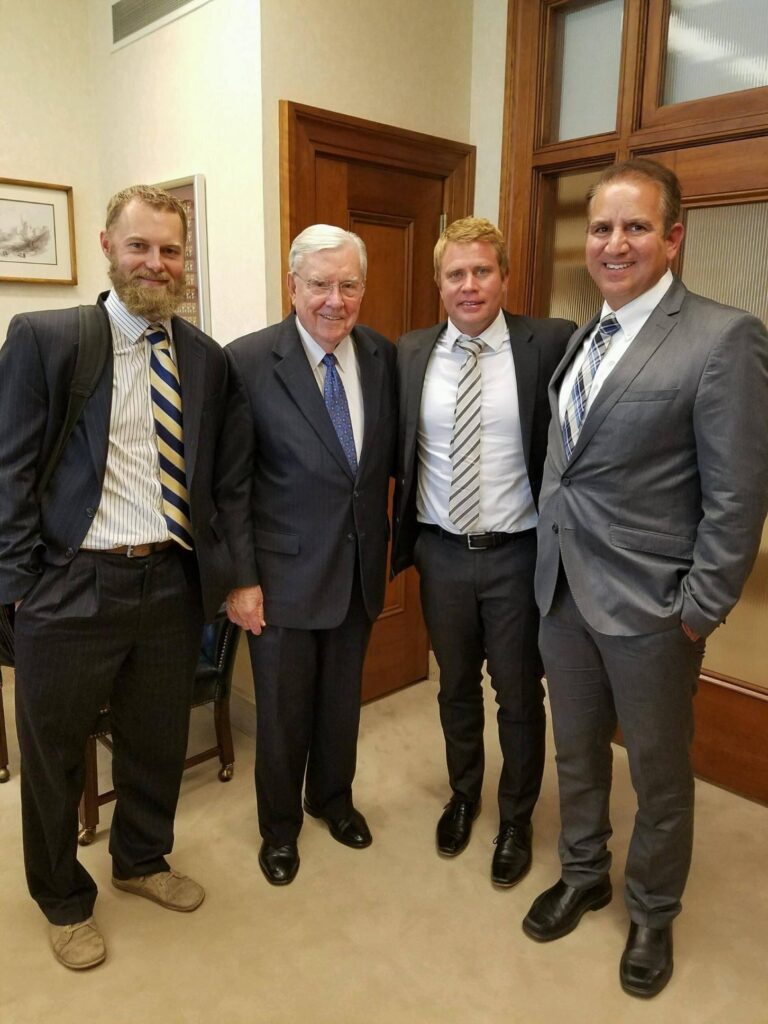
Pictured above: Ryan Fisher, M. Russell Ballard (Mormon Apostle), Tim Ballard (founder of O.U.R.) and John Moreland (President of O.U.R.)
Thumbnail Credits: Main images provided by Ryan and Scout Fisher; Background image of the Salt Lake Temple from High Country News


One Response
Scout’s poems are beautiful. I just bought her book. Many thanks for sharing.