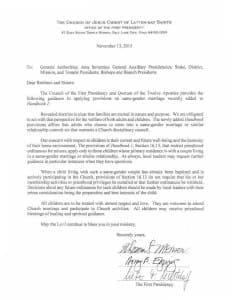
The day the LDS Church issued a clarification to its new policies on same-gender marriage and children, John Dehlin assembled a panel to read the statement line by line: John Hamer, Deborah Jensen, and Daniel Parkinson, later joined by James Ord. In part one, they work through the clarification against the original new policies on same-gender marriage and children, debating whether the wording suggests the handbook change actually came from a different source than the people now explaining it, and whether it truly softens the exclusion of children of same-gender parents from baby blessings, baptism, priesthood advancement, and missionary service. Daniel argues that public sympathy for affected kids scales with how visibly innocent they seem, Deborah talks about the prospect of a second generation of children inheriting rejection their parents already lived through, and the group debates whether the church ever meant the original policy to reach children of mixed-orientation marriages at all, or only children being raised by same-gender couples.
In part two, James Ord takes a more sympathetic reading of the church’s position, laying out a First Amendment legal strategy he believes sits behind the policy, tied to the Hobby Lobby ruling and aimed at entrenching the church’s stance against future gay-marriage litigation. The panel reads through the clarification’s closing language about treating all children with respect, then reacts to Michael Otterson’s church memo, Understanding the Handbook, with Deborah drawing on her public-relations background to size up its framing. Deborah also talks about telling her bishop she can no longer sit in the pews in silent support of the policy, while Daniel argues that stepping away doesn’t help the kids who need support and that allies should stay and speak up for them. They close by naming the human cost they see sitting underneath the church’s legal and public-relations maneuvering, and by thanking James and John Hamer for joining.
What’s covered
- Part 1 (Ep. 586)
- 00:54 Welcome and panel introductions
- 08:54 Reading the First Presidency clarification
- 11:25 Panel reacts to the policy statement
- 31:06 Impact of the exclusivity policy on LGBT families
- 47:39 Children required to disavow same-gender parents
- 1:00:00 Did the clarification actually change anything
- 1:09:35 Mixed-orientation marriages and the new policy
- Part 2 (Ep. 587)
- 00:54 James Ord joins for a legal perspective on the policy
- 26:29 Best interests of children under the policy
- 29:05 Personal responses and decisions about church attendance
- 33:25 First Amendment strategy and religious liberty
- 40:03 Responding to the church’s public relations memo
- 50:15 Broader context and future of progressive Mormonism
- 1:10:43 Closing reflections and farewell
Related episodes: 1063-1065: The Book of Mormon’s 19th Century Context – John Hamer · 422-423: John Hamer on Returning to Mormonism Through the Community of Christ · 526-527: John Hamer on Community of Christ as a Church Home for Transitioning Mormons
Episode Transcript
Full text · 25,000 words · 16 chaptersHost: John Dehlin · Guests: Daniel Parkinson, Deborah Jensen, James Ord, John HamerRead transcriptHide transcript
This transcript is machine-generated and lightly edited for readability. The audio is authoritative. Please excuse occasional errors in names and spelling.
Introduction and Sponsor Message
Part 1 of 2 · Ep. 586
John Dehlin [00:00:00] Mormon Stories is a production of the Open Stories foundation and relies solely upon the support of people like you, its listeners to help keep the podcast alive or to become a member of the community. Please become a monthly subscriber by visiting MormonStories.org and clicking on the Donate button on the right side of the page under Support. All contributions to Mormon Stories are completely tax deductible and go towards producing the podcast and building communities and programs of support for Mormons like you. Thanks for your support.
Deborah Jensen [00:00:36] The kindly light amid encircling gloom
John Hamer [00:00:43] Lead
Deborah Jensen [00:00:43] thou me on the night is dark and I am far from home.
Welcome and Panel Introductions
John Dehlin [00:00:54] Hello and welcome to another edition, a special edition of Mormon Stories podcast. It is November 13, 2015. This is John Dehlin and I have assembled an all star panel to review some breaking news. So today, again, November 13th, we know that last week the LDS Church came out with a very controversial set of policies around naming same gender marriage or cohabitation as a mandatory offense requiring a disciplinary counsel. And they added sort of insult to injury by stating that children who have parents who either in the same gender as they called it marriage, or cohabitating in a same gender relationship couldn't have baby blessings, couldn't get baptized, couldn't advance in the priesthood if they're men, and could only serve missions or join the Church once they were 18 if they had first presidency approval. So that was sort of the policy. As of last week, this policy was leaked. I'm not sure who leaked it, but it was leaked and it caused a huge international crisis and the Internet has exploded and it's a week later and the Church has come out with basically two things. They've come out with a clarification by the First Presidency, signed by the First Presidency, and they've come out with a statement by Michael Otterson, the Managing Director of Church Public Affairs. And so I've assembled an all star cast to review and analyze these changes. So I have with us basically three panelists and I'll have each of you introduce yourselves first. Returning to Mormon Stories is John Hamer. John, do you want to introduce yourself a little bit?
John Hamer [00:03:08] Hey John, I'm happy to be back, although not given the circumstances of all of this news, to comment on it. It's really some heartbreaking news this last ongoing I've been on your show a bunch of different times. I love coming on. I'm a past president of the John Whitmer Historical association, so I do a bunch of research in Mormon history and also blogging and podcasting. And I'm Also a member of Community of Christ, where I am the pastor of the Downtown Toronto congregation, which is super exciting.
John Dehlin [00:03:43] And if my editors ever finish, we'll be releasing my interview with Prophet President Stephen Veazey very soon.
John Hamer [00:03:51] So we're looking forward to it.
John Dehlin [00:03:53] Yeah, that's super exciting. And we gotta mention Infants on Thrones. Right.
John Hamer [00:03:59] I am also one of the Infants on Thrones. All right. And we've been doing a lot of episodes on this same topic because it's obviously just. Well, I guess I heart heartbreaking. So.
John Dehlin [00:04:11] Yeah. But including singing. They got you singing on this list.
John Hamer [00:04:15] They got. Well, you don't have to twist my arm too much. I enjoy. I'm not great. I'm not a great singer, but I'm enthusiastic.
John Dehlin [00:04:21] Right. All right. Also joining. Well, welcome. John Hamer. Welcome back. Also joining us is my cousin, certainly one of my favorite cousins. Definitely in the top five favorite cousins, Daniel Parkinson. Daniel, why don't you introduce yourself a bit?
Daniel Parkinson [00:04:39] Hello, I'm Daniel Parkinson. I am a gay Mormon, although I am only Mormon in name. I haven't resigned, but I'm not active or participating. I'm a psychiatrist in Minnesota. I've been involved in activism with the LGBT Mormon issue. And I was highly involved with running the Gay Mormon Stories podcast, the no More Strangers blog. And me and a team of people were the main force behind the LDS Walk with youh project where we videoed parents of lgbt. And we subsequently created an organization of parents that's mainly a Facebook page, but it's really a force that is parallel to the well known Mama Dragon force. But as the LDS Walk with youh parents, who are specifically active LDS Mormons who are supporting their LGBT children. So as parents of LGBT and it's important group because even though they have been real high profile, they've been a critical presence in the wards and stakes where they reside. And since they're active LDs, they've been able to really do some effective advocacy and not just among members, but among their church leaders. So my collaboration with them has been, you know, incredibly rewarding to me and they're really, really great people. And it's given me a new appreciation for active Mormons. And so that's my main involvement in the issue presently is with parents. But I also help with the affirmation program, also mainly facilitating parents involvement and the youth programs there. We had. We've had two youth conferences so far that I sort of instigated and ran, so. Or at least helped run.
John Dehlin [00:06:36] Well, have you ever been on Mormon Stories? I'm Trying to remember.
Daniel Parkinson [00:06:41] I did an interview that was published on Mormon Stories. It wasn't me being interviewed. It was me interviewing the Abhouse.
John Dehlin [00:06:48] That's right. I've never interviewed you. Is that right?
Daniel Parkinson [00:06:51] Well, I was on a panel like this that got screwed up, so it never got published.
John Dehlin [00:06:56] So this is your Mormon Stories debut. As a guest. As a guest.
Daniel Parkinson [00:07:00] As a guest, yeah.
John Dehlin [00:07:01] Well, welcome, cousins. It's good to have you.
John Hamer [00:07:04] Yeah.
John Dehlin [00:07:05] And also rounding out our panel for now is Deborah Jensen. Deborah, this is your first time on Mormon Stories, right?
Deborah Jensen [00:07:13] No, I was on once two years ago. I can't believe you don't remember.
John Dehlin [00:07:17] Wait, wait, let me think. Ordained Women.
Deborah Jensen [00:07:21] Of course.
John Dehlin [00:07:22] Okay.
John Hamer [00:07:22] Yeah.
John Dehlin [00:07:22] When we had that panel, right, With. With. Was it with Nylan? And when was it? What was it?
Deborah Jensen [00:07:27] It was with Kimberly Brinkerhoff and Nadine Hansen. There were quite a few of us. I can see how I would. I was clearly not the coolest one on that panel, and I would have also agreed with that.
John Dehlin [00:07:39] Oh, well, it makes me happy to know you've been on because it would seem egregious if you hadn't, but introduce yourself a bit for us.
Deborah Jensen [00:07:48] I'm Deborah Jensen. I am the current board chair of Ordain Women. I've been a member of the church since I was 8 and baptized by my grandparents. Because neither of my parents were active Mormons, one of them was excommunicated. So I find this policy incredibly interesting that no one cared about protecting me from what was being taught in my home when I was baptized. But I also, I've been active as an ally to lgbtqia, Mormons and non Mormons alike. But my particular interest and what I think I can add to this conversation today is that, as many of your listeners probably know, Ordained Women advocates for the expansion of priesthood to women who are worthy inside the LDS Church. And we find it especially troublesome that we are seeing a retraction or a contraction of priesthood authority with this policy and are 100% opposed to that.
John Dehlin [00:08:49] Right. Well, welcome. Welcome back to Mormon Stories.
Deborah Jensen [00:08:53] Thank you.
Reading the First Presidency Clarification
John Dehlin [00:08:54] All right, so here's. And we may have Jane James Orb join us later. So we'll just let you guys know that that's a possibility. But the format I want to use is I want to just, you know, these are kind of short enough changes and statements that I think we can just kind of read them and process them, you know, line by line. And so I did this with interview I did last week. I'm going to just start reading, and then I'm going To ask you guys to stop me when you hit a problem. And. And, you know, really, if there's a. Right mid sentence, if there's a word, you stop me and we'll talk about it. Does that sound all right? Yeah, and I just don't want to jump to your immediate reactions just because I'm going to assume that it's not super good. And I want to be able to talk about things as they come up in context with the statements. Is that all right?
John Hamer [00:09:50] Sounds good.
John Dehlin [00:09:50] Okay. So First Presidency clarifies church handbook changes. And again, stop me at any time. The Church of Jesus Christ of Latter Day Saints, Office of the First Presidency has the address there. November 13, 2015. Now, this letter is directed to General Authorities, Area 70s, General Auxiliary Presidencies, Stake district, mission and temple presidents, bishops and branch presidents.
John Hamer [00:10:21] So even though it's making that direction, though, that this is just. This was generally released, right?
John Dehlin [00:10:26] Yes, that's right.
John Hamer [00:10:27] So unlike the other, which they sent out to all, the handbook goes out to everybody, too. But they were still massively surprised that one of these thousands of people leaked it. But in this case, they leaked this even though they're saying it's only to
John Dehlin [00:10:41] that same group, right? Yeah. I mean, they're trying to get ahead of it this time instead of be behind. Yeah. All right. Dear Brethren and Sisters. They don't say sistren. Brethren and Sisters. What's that?
John Hamer [00:10:57] Oh, yeah, okay. Yeah. General Auxiliary presidencies. Okay.
Deborah Jensen [00:11:00] I like that we're thrown in there. Thanks.
John Dehlin [00:11:03] The Auxiliary Presidency.
Deborah Jensen [00:11:05] Yeah, sure. That sounds great.
John Dehlin [00:11:06] I was expecting you to jump in when I said that. All right. Dear Brethren and Sisters, the Council of the First Presidency and Quorum of the Twelve Apostles provides the following guidance in applying provisions on same gender marriage, recently added to Handbook 1.
Panel Reacts to the Policy Statement
Deborah Jensen [00:11:25] So I have a question right off the bat.
John Dehlin [00:11:26] All right.
Deborah Jensen [00:11:27] I can't tell in this language, and I actually. Because I don't know the inner workings of the church office building and how all this works. It almost. I can't tell if they're trying to. That language almost suggests that they didn't write the policy, but they're talking about how to apply it.
John Dehlin [00:11:46] Hmm. I see what you're saying.
John Hamer [00:11:49] So Handbook one just came out of nowhere, but now the First Presidency and the Apostles are going to explain to you something about how to apply it. And this is actually coming from us.
Deborah Jensen [00:11:59] Yeah, that's what I'm saying. Because I don't. I mean, I guess every other sentence that I'm reading in here, it's like they have Rubber gloves on. When they're talking about the handbook provisions. These were newly added. They're very passive sentences. I teach rhetorical grammar sometimes in my writing classes. And so I think that for me, it seems very purposeful that they're talking about these things that sort of just appeared in the handbook.
John Dehlin [00:12:29] Right? Yeah.
Deborah Jensen [00:12:30] And if they really wanted to own it, they would say, we recently released a policy change for the handbook or whatever. Anyway. So that was one thing that it seemed odd to me.
John Dehlin [00:12:41] It's kind of like mistakes were made, but not by me. Is that kind of right?
Deborah Jensen [00:12:44] Yeah, yeah, yeah. And I don't know if anybody knows who's in charge, if there's an apostle that's in charge of that or how changes get put into the handbook. Does anybody know?
John Dehlin [00:12:57] Do either of you guys know?
John Hamer [00:12:59] Well, there's just been all kinds of rumors of people have been trying to, you know, figure out or piece together who in the leadership is responsible for this whole thing or which one, you know. But I think it's. And I've heard all kinds of different rumors, but I think it's a bunch of tea leaves as far as I'm concerned. In other words, it could be any number of things where those rumors are coming from. Wishful thinking on the part of liberal members who want to ascribe it to somebody who maybe is not going to live very long, or maybe somebody on the inn who would rather have it have a scapegoat in one of their really conservative friends or whatever on their
Daniel Parkinson [00:13:42] council with them, or even someone who just recently died. And maybe this was put into place. Kind of lined up, huh?
John Hamer [00:13:49] Yeah.
Deborah Jensen [00:13:49] Yeah. Or even I've seen lots of people saying they naming names of apostles that they feel like didn't want anything to do with this. Hoping that there are people who are struggling with it, too. But it just. Yeah, the language in that sentence very much seems like we don't know how this got there, but we're going to tell you how to apply it now.
John Dehlin [00:14:08] And just in talking about that, I've heard those theories, too. I've even talked to international reporters who heard that not all the apostles knew about this, that somehow it was jammed through. And part of me just wants to feel like that's sort of wishful thinking, that we're just sort of in denial that things are the way they are. And like you said, maybe John Hamer or Daniel said this, that we're still holding out hope that maybe Christofferson or maybe Holland or, you know, maybe Uchtdorf would never have allowed this to happen and so they, you know, weren't involved. But you know, isn't it also just possible that they mean what they say and that we should just.
Daniel Parkinson [00:14:54] I guess it all comes down to what we know about how the quorum of the 12 work. And so we don't really know that much. If we're assuming that the upper six have a lot more power than the lower six and the lower six have to go along, then there might be some logic to that. My grandfather was general authority. It doesn't mean I know very much about what goes on, but I do know that there's some amount of assigning and I think that sometimes people are going to get assigned to do exactly what they don't want to do and will have to do to show loyalty to the group. That's a guess. That's only a guess. But I think there is room to hold out hope that there are some apostles who are more sympathetic than others and who are doing their job of respecting the group and their more senior peers.
John Dehlin [00:15:49] Okay, so do you think it's possible that maybe there isn't unanimity in the quorum on this?
Daniel Parkinson [00:15:56] Well, if one or 12 people actually unanimous on anything.
John Dehlin [00:16:00] Right. But that's one of the perceptions is that for anything to really one of the reasons why the church is sort of so slow in changing is because it requires unanimity to make a significant change.
Deborah Jensen [00:16:14] It's not a perception. One of the general authorities actually claimed it I think in April general conference. That was a whole talk that nothing happens without all 15 of them being unanimous.
John Dehlin [00:16:28] Daniel, what do you think about that?
Deborah Jensen [00:16:29] That's depressing.
Daniel Parkinson [00:16:30] Well, I mean it's just conjecture and I guess what are we doing to hold on to hope? Well, we are kind of holding on to hope that some of these, you know, more contrary. These are the word contrary. Apostles will move along to preach to spiritual in spirit prison and the other ones with bigger hearts are going to have more say. I'd like to hope for that.
John Dehlin [00:17:00] Sure, sure.
Daniel Parkinson [00:17:01] Not hope from anybody.
John Dehlin [00:17:02] Right, right.
Daniel Parkinson [00:17:03] I can't say if that's true and I'm not positive that even the best hearted ones were filtered out long before they became apostles so that anyone who was going to be more favorable was probably weeded out before they would have become an apostle. So it's hard to know.
John Hamer [00:17:21] I don't think there's any reason to hold out any hope. So I mean I think that in fact there's no hope and that all the hopes that people have that they're making themselves are not good hopes, I'm sorry to say. I mean, I don't want to be. I hate to be stark on this, but I think that in this case that this clarification, for example, which is this. They spend an entire week, actually more than a week, trying to. Trying to arrest this meme or all this stuff, this Internet firestorm that has happened, this media firestorm. And they came out essentially, as we're going to read, a clarification that essentially confirms that this is their intention. So I think that, in fact, people are wanting to have hopes because they have those hopes, but that there shouldn't be any. I don't think we should hold out any hopes for the leadership here. I think that this is true colorism they're showing him.
John Dehlin [00:18:17] Yeah, yeah. I mean, I just. And there's been allusions to this. You know, I think we all just sort of expected that when President Packard died that there would be rainbows and butterflies and jelly beans and lollipops and unicorns, you know, and this is like, this is a real double take for me because this is something I wouldn't have even put on President Packer overall, you know.
John Hamer [00:18:47] But I mean, I mean, I don't want to say, you know, top myself off here as a history prophet, but I said, before Packer died, I said, it doesn't. It will not matter if he be. Everybody was like, oh, if he becomes the president of the church, everything will be horrible and we're going to dodge a bullet if he doesn't. And it doesn't make any. I said, it doesn't make any difference at all if he were to become the president or not, or die as he did, because the institution doesn't allow for any dynamism anyway. It's all 15 of them. It is going on in this endless bureaucratic way that it works, in this oligarchic thing of the aging geriatocracy. And it doesn't matter. Matter. By the time you get old enough to be the person in the hot seat anyway, you're most likely to be vegetative or requiring angels to hold you up in conference or whatever it is. You're not able to do something dynamic because you're not young enough to do it. You've been in this quorum for 30, 40 years of your life where you've been agreeing to all of this, and any individuality and dynamism is all ripped out. I mean, it's all going to be the same. It's a bureaucracy. It's going to go forward. There's no turning the ship. The ship is going this way. It's never going to stop. Yeah, that's my take.
John Dehlin [00:20:03] Yeah. All right. Well, John's raining down hope and optimism upon us.
Deborah Jensen [00:20:08] Right. I need a Xanax for this podcast. All right.
Daniel Parkinson [00:20:13] I mean, I have a different perspective. And what's your stage that it's going to be less relevant or possibly be less relevant? What the church leaders decide if the church body starts to behave differently. That's also something that this might have triggered. So I think that so far, the positions of church leaders have been the number one factor on this issue. But it might possibly change within the culture of Mormonism. It's very conceivable that it will change within the culture of Mormonism, but that the members of the church have a different relationship to their church leaders. And there's other religions that are good examples of that. So how it plays out in the lives of people could be very, very different. Even if the church leaders fully intended to do exactly what they did in a unanimous way.
John Dehlin [00:21:11] You're kind of saying if the members express concern or aren't supportive that it can lead, it could lead to change that the brethren don't foresee. Is that kind of what you're saying?
Daniel Parkinson [00:21:23] I'm just saying that. I mean, both John and I right now are commenting on global Mormonism more than about this policy. So it might not be the best time to super evolve these ideas. But I'm just saying that if there's more people who are attending church who are willing to kind of openly say that they're not in agreement with everything the brethren say, there's going to become more room for that. Now, obviously they're going to want to prevent that, but the question is, can they prevent it? And a lot of that's up to what the sort of questioning Mormons do. If they all leave, of course, they will effectively prevent it with a much smaller group. But this is, like I say, this is conversation about global Mormonism. It's a conversation about every issue in Mormonism, not just this one. So I don't know if that's what we want to.
John Dehlin [00:22:12] No, it's good, it's good. Now we'll jump back into the essay. All right, so revealed doctrine is clear that families are eternal in nature and purpose. We are obligated to act with the perspective, with that perspective for the welfare of both adults and children. The newly added handbook provisions affirm that adults who choose to enter into a same gender marriage or similar relationship Commit sin that warrants a church disciplinary council. Any reactions to that?
Daniel Parkinson [00:22:53] Can I just say one thing right here?
John Dehlin [00:22:55] Yeah.
Daniel Parkinson [00:22:55] This is. Once again, it's a global criticism of Mormonism, but here it is super highlighted when they talk about eternal families in Mormonism. Unfortunately, they turned that idea into an oxymoron. The eternal family is something that they are creating a situation where the eternal family can't exist. So they can tell us they exist, but then they tell us who's excluded from the eternal families. And this is just an example where we're forcing someone out of that eternal family and they're removing them at the level of the church records from the family ceilings. And so, you know, it's hard. It's sort of, you know, to put it in a really bad light. It's sort of 1984 Newspeak. You know, it's. Eternal family is a complete oxymoron from this perspective when you throw people out of the family, throw away their ceilings. So this applies to anyone who is excommunicated, not just gay people, but unfortunately applies to every single gay person who enters a relationship, which is the majority of gay people. Right. Believing or not.
John Dehlin [00:24:09] Yeah. Like, I grew up thinking that the church was awesome because we helped families be together forever until I realized that most other religions just sort of just assume that. And what we actually do is we put a lot of limits on who gets to be in the celestial kingdom or not, which then in essence breaks up families. Not. Not unites them, but.
Daniel Parkinson [00:24:32] But it eliminates ceilings. I mean, it literally eliminates ceilings.
John Dehlin [00:24:37] Yeah.
Daniel Parkinson [00:24:38] What are they. What are they trying to say with that? Yeah, that's family. Is this my fault? My parents. Is it my parents fault that I apostatized? Do my parents not want to be unsealed from me? Well, I don't know, but I know a lot of parents of gay people who do not want to be unsealed from their children and who are super strong, faithful, wonderful Mormons. And this is a huge cognitive distance for them. They just can't find this idea that they're not an eternal family. But that's what they're being taught. And this is driving this nail into that coffin of an idea. You know, the church is supporting the idea that they're an eternal family.
John Dehlin [00:25:26] Deborah, were you going to say something?
Deborah Jensen [00:25:29] I actually. Well, I have two thoughts on this paragraph and I mean, I probably have multiple thoughts on it. The nature and purpose of that phrase. I don't. I have such a hard time with our claim that we know what eternal Families are supposed to look like and act like when our definition of what, what eternal families look like and act like has changed so much. And I just, like, I have a really hard time with a church that claims to have a living, breathing canon and theology that can change and evolve, slamming the door in this way and claiming that they're doing it, then I have a problem with them claiming that they're doing this with perspective for the welfare of both adults and children. And I mean, we can talk about this at any time. But it infuriates me that the church is behaving and claiming that they need to step in and protect children from their parents because their parents are gay. Because that's the unspoken, that's the implication here, that even if parents, even if
John Hamer [00:26:47] two gay parents, you don't need too many dot line, the dots are there.
John Dehlin [00:26:52] Right?
Deborah Jensen [00:26:52] But even, I mean, when they say, when they're doing this for the welfare of both adults and children, I mean, what they're saying is even if these gay parents do everything right by bringing their kids to church, letting you know, teaching them that they should get baptized, that when their kids want to get baptized, the church is going to have to step in and say, whoa, gay parents. Well, the church wouldn't say that. They would say same gender attracted parents. We're not going to let you do this because it's really bad for your kids and you just don't know that yet. So that to me is offensive as an adult and as a parent. So that's a problem. I think that I don't know how, I don't know, I don't know how many Mormons would actually be okay with the church coming in and saying this thing that you're, I mean, I guess they would, that you're allowing your, your children to do, or this choice that you're allowing your children to make is wrong. And we're going to actively step in and not allow you to let them do that. Does that make sense?
John Dehlin [00:27:49] Yeah.
Deborah Jensen [00:27:50] Yeah. And then also I have a serious problem with the idea that being in a same gender marriage or similar relationship is a sin that warrants a church disciplinary council. Particularly when you consider all the sins that don't warrant or require a disciplinary council. That's incredibly offensive.
John Dehlin [00:28:12] Yeah, this came out last week that like, as I understand it, murder, rape, child sexual abuse, spousal abuse, do none of those mandatorily trigger a disciplinary council? Am I wrong on that or is that what you guys have read as well?
John Hamer [00:28:28] You've already, you've Already found from your own circumstances, John, in being excommunicated, that the only thing that the LDS hierarchy cares about is whether or not you obey the LDS hierarchy. And so here is the thing that they're most excited about, which is attacking gay people. And you are defying them. So that requires a council. They haven't made any pronouncements against murdering people or anything.
Deborah Jensen [00:28:56] Yeah, I mean, I guess if you consider it, like when I pointed out to someone.
John Hamer [00:29:01] So we're fighting this battle, this culture battle. That's what we've decided to do, and you're not obeying us.
Deborah Jensen [00:29:06] It's just. It boggles the mind to me that people can look at this and not be terribly bothered that you can have two houses on a street, and in one house you have two lesbians who have been married and went out and adopted or were artificially inseminated. I don't care. They have three kids, and they're. These women are going to be subject to church discipline without. Without any recourse. Right. And it's required. Meanwhile, the neighbor next door could be a perfectly horrifying pedophile, but that's up to local leadership, what they're going to do with that.
John Dehlin [00:29:51] And you hear all the time about, you know, some Scoutmaster or elders quorum president or whatever, that young men's leader that sexually molests a kid, and the bishop, for some reason pushes for that person to be maybe informally disciplined. But it seems like historically there's been a lot of hesitance to excommunicate people for things like that.
Deborah Jensen [00:30:16] Yeah. And I think this speaks volumes. It sends a message. I mean, even if in a perfect world with this policy still intact. So it wouldn't be a perfect world, but even in a perfect world where this policy was never actually applied, the fact that it exists and that we've written it down and codified it, that we are now declaring this to be a sin that warrants church discipline and requires it above any of these other sins. That's going to change the culture and how we look at and speak to and speak about our LGBTQIA brothers and sisters. That's a huge problem. And that's going to change what children hear as they're growing up gay in this church, and it's going to cause irreparable harm.
Impact of the Exclusivity Policy on LGBT Families
Daniel Parkinson [00:31:06] Yeah, I wanted to speak to that. I don't know if we're ready for that in the format of this. What you have intended, John, but I want to comment on the impact of the modification, the clarification that came out today, but in the context of the impact on all young LGBT people. So would this be an okay time to sort of go that direction? So to me, there's sort of different levels of sympathy among everyone who's concerned about these issues. We have a teeny tiny bit of sympathy for LGBT adults. Right. We feel bad a little bit, but not enough to like, you know, get too riled up about it. Right. We have a slightly higher, or possibly substantially higher level of sympathy for LGBT youth. The church, of course, doesn't acknowledge that that is a thing that that even exists. But we know that there's LGBT youth and they're a very at risk population of suicide. We know that they have higher suicides. We know that family rejection increases the risk of suicide by Eightfold. And we know that Mormon families have historically been very rejecting to these youth. And so that brings us to another level of sympathy. But now we're sort of going into two more categories of how far of sympathy that's getting closer to home for people. And the next level is LGBT people, sorry, children raised in the same sex households. And so that kind of gets a new level of sympathy. But then we have this even bigger group who is children who have an LGBT parent who divorced but now has a straight parent who's an active lds. Okay. So it's actually that last group that got the biggest amount of sympathy. And in a way, it's justifiable because that was the biggest group impacted by this particular decision. In a direct way, we're talking about the people who were in mixed orientation marriages who did what the church leader said, but then subsequently got divorced. The straight spouse is raising the children in the church. The policy last week made it look like those children were going to be discriminated against. So now the circle has drawn them back into the fold, this group. But this is the group that really, really got the sympathy of the masses. And I'm glad it did. I'm glad that it woke people up to the arbitrary nature of this hatred that the church has towards gay people. But we're still, you know, I think that the church will still look bad because I think the people who have sympathy for those kids, who are now included again, are still going to be angry at the church for some reason, still excluding these other kids in an arbitrary way because their gay parent happened to enter into a same sex relation and they have primary custody. And it's also leading to a bunch of potential questions, oh, what if just one day they don't have custody, but the next day they do, and they get baptized on that day. But there's these other things that just are really, really hateful. Just the fact that they have to disavow their parents marriage before they can join the church, and that this is a sort of a requirement that's above and beyond what's required of anybody else to disavow your parents. And so it is a cruel policy, but it's going to affect a very small number of people. Because the gay people are so hated. Obviously there aren't very many who are going to raise their children in the church. So the impact of that exclusion is on a small group of people. But it's still a hateful policy. It'll still hopefully maintain the level of anger that's out there now, because the anger is justified. I don't want to see it go away. But my most important point is that the people who are at greatest risk of harm from this policy were already at the greatest risk of harm from prior church policies. And that didn't really change, it only worsened. And that's the actual LGBT youth. And so I want to ask everybody who's up in arms about this, why weren't they up in arms two weeks ago when these children who know that they're gay were in church hearing all these messages, demeaning something that's very essential to their person and trying to eliminate them and offering them no dream for the future. When these children hear week after week that the only thing worthwhile in life and the only thing the church membership is oriented towards is, is marrying in the temple, and they know they're excluded from that. When these children are offered not a single alternative that has any possible social status within our church, all they're offered is celibacy. But celibacy in Mormonism is a horribly ostracized place to be, or else entering into a mixed orientation marriage. And some people can perfectly do that because they're bisexual enough to be able to. But there's a lot who just simply can't marry someone that they know that they're ever going to be sexually attracted to. Not to mention the victims, but I'm talking about from the perspective of teen. And on top of that, they have parents who are believing in this tough love concept and kicking these kids out of the home, or not allowing them to call themselves gay, or not allowing them to have gay friends, or not allowing them to have any possible role model and giving them the message that they can never pursue their dreams, they can't do anything that they want to do. And it's a highly rejecting message. And that is the part of it that kills the kids. That is the part that is proven to have an eight fold increase in suicide in children who have these rejecting messages. And also a similar increase in the rate of HIV infections because their self esteem is so low that they go out and they do dangerous things. An Eightfold increase in drug abuse and alcohol use. And these risks don't stop at 18. The people, the gay men and the lesbian women and the trans people, etc. Who kill themselves at age 25, 30, 35 is in a large part because of their experiences as youth and when their identity formation and their self esteem were being developed. And this is a deadly thing that the church has done and they're not accepting the responsibility for that. And then they go and do this and it's making it worse. And I really, really want the people who are angry about this to extend their compassion to the gay and lesbian youth. I frankly, I'm okay with giving more compassion to children than adults, even though I think the adults deserve compassion too. But I know the Mormons aren't quite ready for that. Can we at least include the lesbian and gay youth in our compassion? In addition to the children of same sex couples who I'm not as worried about because they at least have loving parents, right? They have parents who love them. They aren't at risk. They aren't at risk by missing church. They're not risk losing their lives. And in a way, I'm kind of glad the church won't let them come because that'll just make the decision clear for them. So from my point of view as a non Mormon, or at least not a practicing Mormon, I think it's better for those kids. So that little piece of the policy I'm kind of glad is there, even though it shows an open blatant discrimination. But anybody who believes in the church should be extremely saddened by that policy, obviously, because if the children really are benefiting from baptism and from church membership, then it shouldn't be withheld from them. Since I don't believe that, I don't care about that as much because I care about their mental health. So I don't want to get into that. But the point is, there's these LGBT youth. Those are the ones who are dying. Those are the ones who are going to continue to die. Those are the ones who are going to kill themselves 10 years from now as adults. Those are the ones who are going out and having drug overdoses because Their self esteem isn't there. They aren't taught any life path that will help them survive as adults. They're only taught to hate themselves. They aren't giving any alternative messages and their families aren't prepared for this. Their families reject them. And fortunately I know a lot of families who aren't rejecting them. And I'm happy to see that. But I need to see it come pushed by the institution so that all families within Mormonism can do something for their teens. And I want to see the anger be just as strong. Even if the church completely reverses this decision because the part of it about lgbt, same sex marriage being apostates automatically, that's the message. That's the most important message that is going to go into the heads of these 12 year olds and they are going to kill themselves and the church leaders. I'm just saying to you, if one of you hears this, you need to repent for the blood that's on your hands, because there is blood. And every person who's all involved with this issue knows lots of gay people who have attempted suicide personally. And we know of many more who have attempted suicide and many more who have succeeded in suicide. And these cases are famous and you can't deny that these are happening. And you haven't. The governments haven't allowed us to gather statistics on it so that we can get the exact numbers. But we know what's happening and we can't deny it because it's so ubiquitous. Every gay person I've talked to a group in the church, virtually all of them have attempted suicide or at least thought of it, and most of them have actually attempted. This isn't just us making up a problem.
John Dehlin [00:41:17] Yeah, I think you make a really good point that what caused the outrage, it was really unfair treatment to straight children. That we weren't outraged two weeks ago when gay children and gay adults were depressed and suicidal. We were only outraged when the straight children got unfairly treated. John Hamer, I want to bring you in. Go ahead and either speak to this paragraph or to Daniel's response.
John Hamer [00:41:51] Well, I think Daniel's absolutely right. I mean when he's talking about. Yeah, that's what we made the. That's where everybody's sympathy came from or not came from. But anyway, that caused this to be a firestorm. I was just, I spent yesterday, I'm in Indiana, I'm on a little bit of a road trip right now and I spent yesterday with mentor of mine Jan Shipps, who's a historian of Mormonism. She's not a member, but has been a longtime researcher and student of Mormon history, studying Mormon studies. And she made that point just yesterday to me where she was just saying that she just in some ways can't believe that they came out with it because from what she's always thought, the idea of Mormonism is that people are punished for their own actions. And so just even looking at it, the idea that you are denying blessings and sacraments to children based on their parents is like she said, that's not Mormon. And so that much of it I think is what, what really made this all light up. But like Daniel points out, in some ways still the thing that's ongoing, that's a bigger tragedy is all people who are just regular Mormon straight couple who is just having a regular Mormon life. And you have a lot of kids, you may have say five, six kids or something like that. Your odds of having one gay kid at this point is pretty good. Once you start having a lot of kids and you're never going to know when out of that you're raising your kids, you're thinking it's one.
Daniel Parkinson [00:43:51] And let me throw in real quick, that Big Brother effect means that you will actually have a higher rate of gay because the more Big Brothers you have, the more likely you are to have a gay outcome. So there's even, even higher.
John Hamer [00:44:04] And so here it is, you love your kids and not only just about your eternal perspective on families and forever and everything like that, but just like Daniel is saying, the potential you have for just causing this damaging effect on your own kids completely without not intending it because you put them into this environment without knowing any better yourself and they're so much more likely to take their own lives and have bad self esteem issues forever. And so it's just hard to even. We're getting to a point where it's hard for a person of good conscience. They have to be thinking about whether this environment, with all of the issues that it is, is a place where people can even raise kids. And not even, let's even take it to the broader perspective of just not even worrying about LGBT kids, but just raising kids in an environment that is so inherently and triumphantly sexist and giving sexist messages to both boys and girls. And that's also, I mean, anyway, so in other words, it's getting to be very difficult. And I know several people who are very even been liberal, you know, my age, let's say liberal Mormon leaders who are saying, well, they're not sure that they can feel like they can justify Raising their kids in the environment anymore, even though they've been committed to the church and they've had all this hope for reform and this kind of a thing.
John Dehlin [00:45:37] Yeah. Deborah, any quick responses before we jump back to the essay?
Deborah Jensen [00:45:42] Just like devastating to listen to Daniel's comments. I mean, it's not like there was any question inside the Mormon Church. The rhetoric was there, the harm was already being inflicted. And to codify it in this way is just. It was unnecessary. Which is why I think so many people feel like it's mean spirited.
John Dehlin [00:46:11] Right.
Deborah Jensen [00:46:12] That's all just like a slow clap, though. The whole time Daniel was talking, I was like, oh my gosh, this is.
John Dehlin [00:46:18] Yeah, it's.
Deborah Jensen [00:46:19] I can't imagine as, as an ally. Like my job is to listen to that and to sit with you in it. And it's heartbreaking.
Daniel Parkinson [00:46:29] Thank you, Deborah.
John Dehlin [00:46:30] Yeah, it is. I mean, and it's. And it's worth noting, you know, Daniel, you were. I think you referred a lot to Caitlin Ryan's research with the Family Acceptance Project. And it's worth noting that, you know, we know that family rejection is at the core of the drug use, the. The acting out sexually and the suicidality. And codified into this policy from last week is a requirement that family reject family as a way to gain entrance into the church. In other words, the children having to reject the choices of their parent to be able to become baptized. Am I right on that?
Daniel Parkinson [00:47:15] Yeah, you're right. I mean, that's the part that, you know, looks really awful on paper. I mean, the outcome of that isn't as bad as the other part, in my opinion, which is calling people in marriage as apostates. But from the looks of it, that's just. Yeah, blatantly. The unjustice of that is blatantly obvious.
Children Required to Disavow Same-Gender Parents
Deborah Jensen [00:47:39] I have a question about that too. I mean, again, speaking from. I didn't. I've never had to like, come out to my family in any way and having to deal. It seems like once you've reached a point in your life that you've. You're now living an open and happy life as a gay man or a lesbian woman or a trans person. Once you've reached that and you've kind of, I don't want to say put it behind you, but you've learned to live with the rejection you may have experienced earlier in your life, then to have the possibility that your children might inflict that again seems like. I don't know. When you were just talking, it made me think of that. Like, it seems like we are now asking a whole second generation to inflict this on people who are already probably have had to go through that. So again, it just seems mean.
Daniel Parkinson [00:48:37] It's mean. But I think, like I say, I think how many gay people with this policy in place are gonna expose their kids to Mormonism? Not very many. There's a few. And yeah, for them, I'm really sad. But how many gay people have other primary family members who are gonna see this policy in place? And if this policy in place for them, it's not hard to draw the line that maybe you should be doing the same if you're gonna be a zealous Mormon. And then what exactly does disavow mean? I mean, there's. Disavow could have a variety of meanings, but none of them sound good to me. And so how many parents are going to feel the need to disavow their children? I mean, I have my siblings disavow me, my marriage already, you know, and that has not worked out because I can't have a relationship with my siblings who don't recognize my marriage equally. And that's where I'm at with it. And they just simply don't. And I have to be loyal to the family. The person which is my primary family, which is my husband. And so, you know, that has caused a huge separation in my own family. And this was prior to all this. But how much more will people have to stand on their and hold their ground and diminish the families that are part of their families? I mean, a lot of gay people will tolerate being second class citizens within their own families, but it's not healthy for any of them. And, but then a lot of people are simply flat out rejected. They're not included in family photos, they're not invited to all the family events, they're not allowed to have relationships with nieces and nephews because they're considered bad influences. So this is just an extension of the same idea. So we have the first group of people who were required to disavow their own family members, their primary family members. But it always makes you wonder who's next. But even if no one else is required to do that, how many people would just do it anyway? And even like my family, they don't feel like they're disavowing me. But, and functionally they are, you know, they, they have to hold so strongly to their follow the prophet idea of Mormonism that they can't be nice to my husband, they can't embrace him, they can't talk about our marriage out loud to me. You know, there's all these things that are just have really alienated me as being part of my own family.
John Dehlin [00:51:13] Yeah. So, yeah, heavy stuff. All right, let's jump back to the essay for a bit, if that's all right. And I'm loving everything said so far. I think we're up on one of the most important paragraphs in this whole deal today. It's the clarification around. Well, I should say it's not the most important if we think about what Daniel and John have just told us, but in terms of changing, sort of rolling back or making a change, you know, what we just read was basically the church saying if you're same gender cohabitating or same gender marriage, still apostate. And so there wasn't, in terms of today's announcement, relative to last week, there, there wasn't much of a change there, if any. They're still sort of holding that ground. And as Daniel and John make the point, that's probably one of the most damaging things that that remains because it doesn't solve the problem of it means there's no change.
John Hamer [00:52:20] So in other words, that paragraph shows they are affirming their position.
John Dehlin [00:52:25] Right.
John Hamer [00:52:25] Openly. And these are their true colors. And they're flying them. They're proud to fly them. That's where.
John Dehlin [00:52:30] That's right. That's right. Yep. So in terms of LGBT members, no change. They're basically saying, we don't want you here. Stay out. And we're going to hunt down those of you who who choose to have a healthy, loving, same, you know, committed relationship. We're going to hunt you down and excommunicate you. So where, where I think they're making a significant change from last week is in this next paragraph, which reads, our concern with respect to children, and I think they mean heterosexual children, is their current and future well being and the harmony of their home environment. The provisions of Handbook 1, Section 16.13 that restrict priesthood ordinances for minors apply only to those children whose primary residence is with a couple living in a same gender marriage or similar relationship. As always, local leaders may request further guidance in particular instances when they have questions. All right, who wants to respond to this? Let's have John Hamer respond to this first.
John Hamer [00:53:41] Well, like you say, so the damage control here is because there's this final group that Daniel had outlined where straight kids who have a divorced family situation, where maybe the church had originally encouraged a gay man to marry a straight woman, and they tried to live it out. And they have a bunch of kids, they've gotten divorced, and the father has now left the church and he is able to accept who he is and everything like that. And he's gotten married and now he is in a loving gay marriage and the mother is still in the church and she is raising the kids. So now as of last week, the policy was like, well, she can't have her kids baptized, she can't have their kids in the priesthood, any of those kind of things, because they have a dad who is married to another man. So now what we're saying here is if the mother here has primary custody, I guess it doesn't actually say that. They're saying the primary household. And so it isn't entirely clear primary residence, because there's a lot of joint custody situations where the kid is going back and forth. And so it really doesn't actually clarify it. But the effect or the attempt here in a PR sense is to say, just because the kid has a dad who is doing this or whatever, if that is a minor custody situation where you're seeing him on the weekends or something like that, then no, that's fine, they can still baptize those kids.
John Dehlin [00:55:25] And that would have been, I think that could have been relatively fatal for the church if they had let that stand. I mean, it's ironic enough that they were encouraging, you know, mostly their gay men to enter into mixed orientation marriages and also they're lesbian women for decades. And so these children were born to marriages of, in many ways, the church's own creation. But besides that, I can just see there were just too many people who would have been affected by seeing these children be treated so poorly. I think it would have been disastrous to the church. So I see this change as sort of self preservation. And if the church hadn't made this change, it could have really been disastrous, even more disastrous than it already is. But again, we're speaking from the context of making sure that the heterosexual Mormons stay happy and healthy in the church, sort of totally ignoring the lgbt. Do you guys agree that this was like a crucial, probably the most important paragraph for this whole change today?
Daniel Parkinson [00:56:43] Well, that obviously this is going to vastly diminish the number of immediate victims because, yeah, the children involved who are really impacted, were those children, the ones with the mixed orientation marriage. So that clarification, yeah, it brought 99%, possibly of the children who were going to be impacted by this back into, you know, whatever, decent standing, even though they still have to live in this environment where they're having cognitive dissonance. What was it? Because they still supposedly love their other parent. But anyway, they're not being required to disavow that other parent. So they're lucky they can still affirm their same sex parents marriage. But it is the most. And there's a lot of people who are breathing a sigh of relief because this was putting a huge strain and a lot of marriages immediately. So I'm really, really, really glad that this change happened because in the real lives of people, there's thousands and thousands of people who today can sleep better because they don't have to deal with this major issue that they have to involve their ex spouses, their children. They have to do major revisions of their whole life plans. And so for them, I'm super happy and super relieved.
John Dehlin [00:58:01] Yeah, I mean, I'm thinking of like my friend Devin Gibbe and his wife Ashley, where they had children. Then Devin, you know, wasn't able to stay in the marriage and he now has a partner. And we were speculating that this would likely be the change that the church would make, you know, a couple days ago. And Devin's response as a gay man was, I hope they make this change because otherwise my children, who my wife takes to church all the time, are going to be traumatized when they can't get baptized and they can't advance in the priesthood. And. And as a gay man who probably doesn't have much belief left in the church, he certainly was happy for his own children's sake that this change was being contemplated.
Daniel Parkinson [00:58:46] Yeah. And why should his wife have to leave the church, you know, be forced to kind of leave the church for her children or at least be forced to live this marginal position within the church. So, yeah, so I'm super glad for her. I'm super glad for him. Yeah, everyone in his family is way better off today.
John Dehlin [00:59:03] But those who want to see the church self destruct, I think what this does is it basically it bandages up the hemorrhaging gash and it's going to allow the church to continue existing in a relatively similar state. Because you made this point, Daniel, that the number of like gay couples or lesbian couples that have a child by surrogacy or adopted that are going to raise their kids in the Mormon church are very few. And so what, what this change does is it makes it. So this whole set of changes between last week and this week ends up affecting very little children. And only, you know, in the end really only affects the fact that LGBT Mormons are going to have disciplinary councils if they decide to commit to a loving partner. Am I wrong?
Did the Clarification Actually Change Anything
Daniel Parkinson [01:00:00] Well, I would say that is partly true because all the people who were angry last Thursday are probably still angry because they haven't totally removed the issue of children paying for the sins of their parents. And so there's still a demonstratable group of people who are in that category. And so at least the damage that was done last week is as far as the part that impacts a lot of people who suddenly care about this issue, who didn't care before, I think that the vast majority of them will still care. I'm hoping so, because there still is a group of children, and presumably straight children who are being denied a normal relationship with the church. So if you believe in the church, you have to believe that the best thing for anybody is to be in the church. Right. And they're being denied. And so yeah, it's true that what you say, that there'll be less people who are so directly impacted in front of them and in their present in their wards of state. So in a long term way, yeah, it might not be as damaging. But this huge soar that came today, anyone who's bothered by it is still probably going to be bothered. That's my opinion.
John Dehlin [01:01:22] And that's mostly progressive and liberal Mormons. Were you going to say something? Deborah?
Daniel Parkinson [01:01:25] People are saying it's true believing Mormons, that a lot of true believing Mormons are very bothered by it too. That's kind of the rumors I've been hearing.
John Dehlin [01:01:33] I'm not in my impression is the true believing Mormons are mostly bothered by the impact on the children, especially the straight children. And this lifts that. Deborah, were you going to say something?
Deborah Jensen [01:01:47] Well, I was going to say I think this paragraph is really important when you look at who this letter was sent to. I think this paragraph is really important to mission presidents because and ward mission leaders because if you're out, it's not just children who are born to gay parents, who those gay parents decide to raise their kids in the church. You're talking about the kids that my kids go to school with and they what do you teach your kids to do from the moment they're just tiny and primary? Invite your friends to church. Share. Bring your friends to girls camp. It'll be fun. And like this is how I became active in the church. Come to girls camp with us. And then I came to girls camp and I liked it and then they invited me to church. So we're talking about if one of the arms of the church's threefold mission is to share the gospel. And we're teaching this to kids and we're encouraging our kids to fellowship and bring other kids into the church. You're looking at a whole mess of kids. Maybe not a whole lot, maybe not, you know, statistically significant numbers, but enough that we're going to have to start asking some fairly awkward questions by the time you get to like the third missionary discussion with a kid who's under 18. And last week a friend of mine from outside Utah sent me a private message saying, I have a friend who's a lesbian and her daughter's been taking the missionary discussions and they just canceled on her and won't tell her why they can't come back. Can you talk to her?
John Dehlin [01:03:20] Right.
Deborah Jensen [01:03:21] So I feel like, you know, I mean, there are those anecdotes out there. My sister is a lesbian and had kids and they grew up in Utah and they were invited to church all the time. And my niece dated a returned missionary for a while. What happens there? You're still talking about not just children. And so I think that this paragraph is important to mission presidents and ward mission leaders and primary presidents. When you start fellowshipping kids into your ward like we're talking about in Utah. It is. It is for Utah. But I think also I would say that while this is a substantive change to the policy members who were upset about the policy initially, while this may help them feel better about it, it's still, I think it opens your eyes to some things that you probably didn't see before with the church.
John Hamer [01:04:16] I think, like you say, it's removing, let's say unwilling. Some. Some unwilling martyrs, maybe.
John Dehlin [01:04:22] Yeah.
John Hamer [01:04:24] So people who wouldn't have wanted to be martyrs. People who may be, let's say, the straight parent that is resentful of their gay spouse and that kind of thing. And now they're not going to be martyred for it. But for all of the people of good conscience who are raising kids and they may not have been affected by this in any other way except for their conscience, this policy, this little, this little change doesn't affect it at all because substantively the issue is still the same. So in other words, people have good conscience.
Daniel Parkinson [01:04:54] There's also the issue, like I mentioned, of Utah families. I mean, in Utah being labeled an outcast, even if you're not a member of the ward, you might. There might not be any other non Mormon kids in your neighborhood to play with. And if suddenly you are somehow blacklisted from the whole society. So these kids of same Sex, marriage. And we know the statistics. Utah has the highest rate of same sex couples with children. And so all of those children are going to be impacted by the social ostracism that will come from these kind of attitudes.
John Dehlin [01:05:39] Yeah, yeah, I just. Yeah, I think that's all right. And I just, I think that the church, I think this is damage control. I mean, I think we're going to hear, and I think we'll see this when we read Otterson's response that the church is likely to claim that this was always the intent. It's just that nasty bloggers and Facebookers, you know, took it out of context when, when, if they had given us a chance to train everybody and explain it properly, they would know that this policy was always supposed to apply to only to kids who were primarily living with the same gender couple. Can you, can you guys see that happening?
Deborah Jensen [01:06:26] Oh, yeah. Oh, yeah. And, you know, I just feel really bad for them because if only they had had, you know, the means to, I don't know, record like a 10 minute video with a general authority explaining in detail what the policy was, or if, you know, only they owned their own media conglomerate in Salt Lake City, that could report on it accurately, that would just have been so much easier for them. None of this would have happened.
Daniel Parkinson [01:06:49] But I have to think in part, they just didn't realize what they were saying, that somehow it didn't occur to anybody that kind of problems that a policy like that would cause that would immediately become apparent. Either that or they really, from the beginning, didn't mean to include such a broad number of children into that policy. So it's hard to know. It's hard to know who wrote it. It's like a bill in Congress. You know, a lot of the congressmen never even read it.
John Dehlin [01:07:19] Okay, so are you sort of saying, Daniel, that when this was originally drafted, their intent was not to punish children of mixed orientation marriages, Only kids who were, let's just say, adopted or surrogacy or foster kids of same sex couples where the children primarily live with the same sex couple, because that's a very different thing. It's a lot less sinister. Right.
Daniel Parkinson [01:07:46] I think it's highly possible that they just weren't thinking about all these children in mixed orientation marriages. It didn't occur to them. They're so obsessed with same sex marriage right now that they didn't occur to, you know, what the Mormons they're actually dealing with in that moment, and those are the Mormons they're dealing with in this moment.
John Dehlin [01:08:04] It's just, it's hard to believe they could be that out of touch. I mean, that's so out of touch.
Daniel Parkinson [01:08:10] It could be out of touch or just an oversight. I mean, I think it's possible, it's conceivable that they just, you know, just didn't stop and think about it. You know, the people who wrote it and the idea was this and they didn't extrapolate it beyond. Yeah, but really, you know, when the Mormon Church deals with mixed orientation marriages, when someone leaves that marriage, they're thrown under the bus. So the Mormon Church doesn't do much to try to accommodate the people who don't make it so succeed or even the spouses of them. So it's not surprising that they're not on the, you know, that they're not on the radar. Those people are left out in the cold big time. And there's not ministered to, they're not given any assistance, neither couple in how to formulate a workable divorce and how to let their children grow up happily after their divorce. No, they're just thrown on the bus, they're excluded, they're, you know, given impediments and even the spouses, they face ostracism. You know, they're trying to stay in the church and they're shunned to some extent and they're asked to do things that are unreasonable when it comes to trying to raise healthy children and coordinate a co parenting relationship with the children's father or mother. So it's not surprising that they just were completely left off their list of concerns.
Mixed-Orientation Marriages and the New Policy
John Dehlin [01:09:35] So John, what do you think? Do you think it's possible that the church never intended this original policy to apply to children in mixed orientation marriages, but that the intent was always for this to be targeted to children, you know, who either surrogate, surrogate married with gay or lesbian parents, or adopted or foster children, that sort of thing.
John Hamer [01:10:03] Well, I think they absolutely didn't have any idea that it was going to have this kind of reaction, that there would be a media storm and everything like that. And so I think that that was totally unexpected. But then I think that now once such a thing happens, we all tend to try to, we tend to speculate a lot about it based on when something becomes huge, huge thing, then we kind of go back and say, well wait a second, were they just doing this to create this storm to try to get rid of liberals? Maybe that was like the first thing that people kind of were saying or whatever it is. I guess my feeling about it is that they didn't. That this damage control thing that's come out today is that they spent a week trying to figure out how can they, they walk this thing back and you want to do something to show, oh, you guys all misunderstood it and they need to come out with something that they think is substantively different enough in order to try to make that claim. So I actually think that this is a change. So they did what they were going to do originally. It had a reaction that they completely never anticipated. And having had that reaction, they had to do damage control. And so they made what they consider to be a substantive change, which will probably work for them in their most loyalist circles, but I think actually isn't a substantive change in terms of the actual effects on its own people.
John Dehlin [01:11:36] Well, it's substantive in that all those mixed orientation marriage children of mixed orientation marriages are not going to be affected as much.
John Hamer [01:11:43] Not all of them, but anyway, some of them when, when the kid has a primary or depending on, I mean, obviously it's going to be on a case by case basis since the local bishop is going to decide, well, you are still living with them sometimes or something like that. So the local official is going to decide what's the primary residence and everything like that. So it is going to affect them. But yeah, I agree some of the people are going to be out of it and that will have that change for that group of people. But what I'm saying, it's not substantively different. It's not any different in terms of what it says about the Mormon leaders, about what it says about where they're coming from and all that kind of thing. It's still exactly the same in terms of their callousness and their relationship with, I don't know, just being good, decent people or whether they're Christian or not and all that kind of thing. So it's the same that way.
John Dehlin [01:12:36] Yeah. And I thought about this. I thought, okay, so if we reduce the number of people harmed, but there's still a group of people seriously harmed, isn't it more beholden on us as people who profess to be Christians to care about the one you're only supposed
John Hamer [01:12:52] to care about the 90 and 90, as I recall, the parable ghosts.
John Dehlin [01:13:02] Thanks for joining us today on Mormon Stories. If you enjoyed this episode, please help us make more like it by becoming a monthly subscriber@mormonstories.org music for this episode was provided by the Lower Lights.
John Hamer [01:13:25] When with a wounded heart, anger or
Daniel Parkinson [01:13:32] mouth I draw myself apart searching my soul.
Legal Perspectives on the Church's Policy
Part 2 of 2 · Ep. 587
John Dehlin [00:00:00] Mormon Stories is a production of the Open Stories foundation and relies solely upon the support of people like you, its listeners to help keep the podcast alive or to become a member of the community. Please become a monthly subscriber by visiting MormonStories.org and clicking on the Donate button on the right side of the page under support. All contributions to Mormon Stories are completely tax deductible and go towards producing the podcast and building communities and programs of support for Mormons like you. Thanks for your support.
Deborah Jensen [00:00:36] The kindly light a myth encircling gloom Lead thou me on. The night is dark and I am far from home.
James Ord [00:00:54] Well, I, I would, I would. I'm going to kind of take a slightly more defensive position of the Church in that regard, I think.
John Dehlin [00:01:03] Oh wait, wait, let me introduce you. So this is. James Ord has joined us. Some of you will have heard James on his interview with Gina Colvin on a thoughtful faith. James, why don't you just introduce yourself to our audience really quick.
James Ord [00:01:17] Okay. Well, my name is James Ord. I am an attorney. I do family law work, but I've also worked in politics and PR and policy and that sort of thing. And I also worked in Hollywood for 10 years and I practice family law in Salt Lake City. And I come. I'm married, I'm gay. My husband and his ex wife are still best friends. We co parent four wonderful children and we have the opportunity. We're very lucky in that she met her husband at the Straight Supportive Spouses Network. So his ex wife is lesbian. And so we have a unique situation and a unique family because we are actively together. We co parent and we're close friends. We vacation together. So we have a little bit different. We're affected by these policies, but we also have a different take on co parenting and cooperative parenting. And our kids are being raised multi denominational. My husband and I attend the Episcopal Cathedral and then their mother attends her LDS ward. And so our kids have been raised in both places and that's relatively new. The kids have only been going to the Episcopal Church for about three years now. I've been involved with the gay rights movement here in Salt Lake and also in California going back even before Prop 8. I went to law school at Brigham Young University and my husband and I just recently withdrew our membership from the LDS Church because we were asked to by our state president over the period of the last six months.
John Dehlin [00:02:54] Right. Okay. Well, welcome.
John Hamer [00:02:57] You're about to be defensive of the church.
James Ord [00:02:59] I am, I am. I'm going to defend the Church a little bit and the reason why I say that is because this. So the church, you know, I was in a CLE with Bill Atkin, who's the church's international council, and something that he said that really kind of stood out to me, and that's this. The church is. It's not. It doesn't just wear one hat. It is a large multinational conglomerate that has tons of different LLCs and just for its ecclesiastical structures and also various different corporate structures in order to accomplish the various purposes that it has. So in some regards it's a corporation. Some regards it's a multinational corporation. Some regards, it's just an association of people who have a common set of beliefs. In other ways, it's an ecclesiastical structure that is a church, like a traditional church that we would know throughout anywhere else in the United States. And yet it's none of those exclusively. And so the church has to straddle and wear different hats. And many of the policies that it comes out with, it has to come out with those policies in order to satisfy one of the hats that it wears. And this particular policy seems to have been legal in nature. And what that would tell me is that it was responding. The church was responding to various legal concerns that the corporate entities had. And that's important because that's a very different thing than an ecclesiastical designation. Does that make sense?
Deborah Jensen [00:04:38] So are you suggesting that this is somehow like, in preparation or to prevent somebody from being able to sue Bonneville Communications for partner benefits?
James Ord [00:04:50] Absolutely. And not just Bonneville Communications, see the next big case and actually have been consulting and looking for plaintiffs myself in that is an action against BYU for familial discriminating against families, because gay people are now families under the Civil Rights Act. And we are also families under Health and Human Services and also families under Department of Urban Development Development and Federal Housing Authority. So the way that works for those federal determinations is that we now count discriminating against us on our familial status is a violation of federal policy and can render institutions like BYU, who don't yet have a waiver to that, they can render those universities unable to receive Pell Grant funds, which that accounts for about a quarter of BYU's entire budget. In fact, if you notice, BYU sets its budget or sets its tuition price at the Pell Grant amount, primarily because most Mormon families qualify for a Pell Grant. So even, even wealthy Mormon families who send their kids to BYU because they have so many kids, they find themselves qualifying for a Pell Grant for those children. So if BYU were to no longer be able to accept Pell Grants. They'd be in the same situations they were in 78. So you have a very clear reason and rationale for policy making. And in order to craft a First Amendment defense to that, the church had to come up with something that was fundamental and key to its doctrine in order to craft a strong First Amendment defense to any kind of lawsuit in that regard. And those kinds of things were talked about during Education Week this year amongst all the lawyers that were there for Education Week this year in August.
Deborah Jensen [00:06:41] Wow.
John Dehlin [00:06:44] So, James, your view is that this was largely a legal decision?
James Ord [00:06:48] Oh, yeah.
John Dehlin [00:06:50] The whole thing was sort of to protect the church from being susceptible to lawsuits.
James Ord [00:06:56] Oh, absolutely. And you don't just have that kind of lawsuit. There's another situation which I spoke with briefly with Gina, and that is that the courts have recently. So litigators have started to go after religious organizations who have. So let me explain a little bit about tort liability. There's four key elements to a tort right. You have duty, breach, cause, and damages. And you have to prove that the tort fieser had a special relationship or a duty to the person who they committed the tort against. And traditionally, third parties owe a duty to nobody in the law. In tort law, however, if you have a special relationship with somebody, then you owe them a duty. And the argument has been made that the church has a special relationship with all of the children that it baptizes, and that the duty then is to not alienate is to indoctrinate the child in their religious belief, but not alienate them from the other parent. And so what you get is that doesn't mean that the church teaching that gays are bad, sick and wrong or whatever is necessarily going to alienate the child. However, a parent who is predisposed to use parental alienation is going to use whatever tools are available to them. And so you might have a mom. Let's just give you an example. Let's just assume for a second that my spouse's ex wife were hostile. She isn't. But if she were now, we'd have a situation where she could then use the church's doctrine to alienate the children from my spouse. And that particular situation has not only been happening in many places throughout the country, but it's also now coming into the courts, and the courts are having to make decisions on that. And so the arguments are being made that the church has a special relationship with these children. And you can't argue with that because the church has baptized them, is training them and so on and so forth. And having them as members of the organization necessarily legally creates a special relationship. So from, you know, if you're a liability lawyer and your job is to mitigate liability, your counsel to the brethren would be just don't have a special relationship with these kids. And in fact, you know, I had a very similar situation when I had a run in with Curtin. My own kid was being bullied at church and he asked the bishop out in Herriman if his dad could come with them to the father son camp out. And the bishop called my house at 10 o' clock at night to talk to my husband and told him if he showed up that the bishop couldn't guarantee his safety, that boys will be boys, and that the church isn't going to change any of its policies to accommodate my husband. And in the course of that conversation, we learned that our son was being bullied, which he had told us that he was, but we were a little bit leery about it. But the bishop admitted that he knew that my son was being bullied and he was doing nothing about it. And I the next day placed a call to curtain because I wanted to follow up and say, look, you know, we're not antagonistic to the church. Let's work our way through this together. And what I got from Curtin was the standard response.
John Dehlin [00:10:19] Do you mean Curtin McConkie, the law firm?
James Ord [00:10:21] Yes.
John Dehlin [00:10:21] Okay.
James Ord [00:10:22] And I talked to two different attorneys at Curtin and the response I got was, if you don't like it, don't bring your kid to church. We're not going to change our policy. And you know, from a lawyer standpoint, that's a bit of posturing. I can't say that the brethren would have said the same thing, but it's understandable, right? You know, that's Curtin's standard responses. Don't have a relationship with us in. And then you just don't have that problem. And so I think it's a little naive though to think that one parent, particularly if you're in a co parenting situation where a lot of gay, the majority of gay people who are the majority of children of gay people that are in this church are the result of mixed orientation marriages. And so I think it's a little naive to say that you don't have a relationship with the church when one of your parents is a faithful Mormon and is going to take you to church and indoctrinate you.
John Dehlin [00:11:18] Right. So the relationships.
Daniel Parkinson [00:11:21] But James, then this policy today doesn't really support that that was a big motivation, or at least if that was a motivation, they have changed their mind because they are now exempting all the children of mixed orientation marriages who are the most likely ones to be caught up in this kind of a crossfire. So if the motivation was protect from, from this sort of scenario that you created, it seems like the exemptions they outlined today are undermining that massively to a degree.
James Ord [00:11:51] Yes and no. I think what you see, and here's the key part, it's up to local leaders. See this is the thing. A stake president that interviews a family and meets with the gay father, whatever, that stake president and that bishop, it's their job, at least pastorally, to have their thumb on the pulse of that relationship. And if they know that the father is antagonistic or let's say the gay parent is antagonistic to the church or antagonistic in any way, shape or form, they can then simply pull the plug and say we're not going to allow this child to progress because we don't want to create an alienation relationship for the church.
Deborah Jensen [00:12:27] Except.
Daniel Parkinson [00:12:28] But they aren't mentioning that scenario in the policy.
Deborah Jensen [00:12:31] No.
James Ord [00:12:32] And they never do. That's not the way training works out.
Daniel Parkinson [00:12:35] But our people are local leaders trained in that way to not alienate the gay parent in that situation.
James Ord [00:12:41] You know, in this particular instance, I don't think they have yet. And this is, this is what, you know, I think that the church came up with the policy. It was ill conceived in that they normally mold these things over for months and months before they roll anything out. Then when they do, they generally have a training on whatever new policy they're going to roll out. And that didn't happen this time. And I don't know why. But what broke down there within the church decision making process, I don't know. But normally that's the way these things work. So when this didn't happen and now they're realizing, oh we have to, I would expect that in the future you're gonna see some sort of pastoral training for bishops and stake presidents, particularly in Utah, that's going to teach them how to discern or to some criteria for discernment in terms of whether or not to damn that relationship. You know, like whether or not to stop the progression of a progression of a child on the grounds of whether or not that parent is antagonistic to the church or not.
John Dehlin [00:13:46] Interesting.
James Ord [00:13:46] I can't see it any other way because the policy, the new, the new policy rollback or excuse me, clarification states explicitly that it's going to leave that discretion up to local leaders. Well, that's great, but lawyers don't like for local leaders to not have a grip on things. It creates too much volatility. So from a legal perspective, they're going to have to have some kind of training in order to be able to teach the bishops of state presidents how to have that discretion. Otherwise, what you end up with is the Wild west, and no lawyer wants to see their client open themselves to that kind of liability.
Deborah Jensen [00:14:26] It's so interesting that our response to this scenario is to cut these kids out of the church instead of change the rhetoric that's harming them and creating a negative experience.
James Ord [00:14:41] Well, yeah, but you do. Mormons are. So there's two things that we get to know about the LDS Church. We're really good at policy making, but we're not good at pastoral relationships. The LDS Church, we tried to create this pastoral system through home teaching, visiting teaching. The sisters are way better at it than the brethren, which is probably why Kate Kelly should have gotten the priesthood, because she probably her and the rest of the system would have probably been better ministers at pastoral outreach. But the reality is that we're good at policy and we're not good at pastoral.
Daniel Parkinson [00:15:13] But, James, your initial comment that we're going to defend the church's stance. You're not really defending their stance. You're just defending that they have a rationale, but they're actually just defending their ability to keep on saying hateful things, which is basically what they're defending. And they have themselves doing that in reason for it. But it's not that they're doing something for any noble reason. They're just doing it to save their asses, if that's true. But it's saving their asses so that they can keep on discriminating. As good as ever.
James Ord [00:15:46] I would agree with that to a degree. But again, when I say defending the church, I think. I think what I'm defending is there's a lot of misconception out there about how they make policy and the reasons behind why they make policy. And sometimes a policy is absolutely ecclesiastical in nature and sometimes it's just legal in nature. And it would appear that this policy was probably a little bit of both. Primarily legal, but it had to be ecclesiastical in order to create the shield of a first. A strong First Amendment defense.
John Dehlin [00:16:23] Right. Well, let's. If it's all right. Oh, John, were you going to respond?
John Hamer [00:16:29] Well, I was just going to say, which is one of the ways that think the church or the LDS Church has always been operating right from the beginning where the law firm had a big hand in writing the proclamation because the church wants to get involved in the, the Hawaii same sex marriage case. And they're advised by their lawyers that they don't have any ecclesiastical policies. So they got to, in order to deal with all of this stuff, they have to have all of their legal issues. So, like, I agree with this, you know, anyway, with this idea that it's all wrapped up in their own liability and all that kind of things.
John Dehlin [00:17:09] Let's. And James, we're really glad he could join us. John Hamer's got a bolt soon, so I want to try and cover a couple major points while we still have him and then.
James Ord [00:17:20] Absolutely.
John Dehlin [00:17:21] And then we can come back to just kind of broader discussions. There's a lot of people that interpret this as sort of just punting to the bishops and basically saying, you know, it says, as always, local leaders may request further guidance in particular instances when they have questions. Did any of you take away from this the feeling that now the brethren are sort of pushing the decision down to the bishops more than they were before and that that is either a good thing or a bad thing? Anyone have a thought about that?
John Hamer [00:18:02] Well, the one thing that seemed like it was clearly now on the bishops is deciding who counts as a mixed gender people where there's a primary residence, because that's before it was very clear all kids. And so it was all kids who had a gay parent who was in a same gender relationship. Now the local leader has to determine that that's an important enough.
John Dehlin [00:18:28] Do we envision like, okay, four days with the straight parents, three days with the gay parents? Okay, they're good.
John Hamer [00:18:37] But once it's a local leader, they can decide whatever they want. Right? I mean, in other words, they can just say, oh, that's a primary enough residence. They have shared custody.
John Dehlin [00:18:48] I mean, Jay Nelson Seawright made this point last week that what he hopes is the bishops just ignore this policy. And doesn't this give bishops enough leeway now to just ignore the policy? Because really, who wants to tell a kid they can't get baptized? Who wants to tell a kid they can't advance in the priesthood? Few are going to want that. Right?
John Hamer [00:19:10] Can't bishops always ignore anything they want to? They can do whatever they want.
John Dehlin [00:19:13] Yeah.
Daniel Parkinson [00:19:14] So this modification.
John Dehlin [00:19:16] Sorry, go ahead, go ahead, Daniel.
Daniel Parkinson [00:19:17] Yeah, so this modification clearly gives the bishops more leeway on that issue, but much less leeway on the other parts that are still intact. For example, those who are clearly raised by same sex parents, such as adopted children or parents who. Children who were conceived after the marriage by whatever means. But also the bigger group that it's going to affect is the apostasy issue because right now we do have lots of bishops who allow same sex couples to attend in their wards without being bothered. And they're given callings. They're not giving advancement in the priesthood, they're not giving tough arrangements, but they are welcome in the wards and they're given callings and they get full fellowship and they're not feeling that they're threatened to be excommunicated. So it seems to me, I mean, they might ignore that one too, but it seems to me that that is going to change for these wards and that bishops, it seems pretty clear. I don't know if they can justify not doing it because it says this is a call for discipline. So this is an automatic trigger if you're married. Automatic trigger for discipline.
John Dehlin [00:20:29] Yeah.
Daniel Parkinson [00:20:29] So it seems like there's much less.
John Dehlin [00:20:32] But it is going to be a headache for bishops to try and figure out what primary residence means. And they'll likely just punt, I'm guessing, right, that part.
James Ord [00:20:44] I don't see them punting. I see them. I see hardline bishops playing this out and being hard nosed, and I see softer, kinder bishops, you know, erring in favor of child participation. But I think that this is going to be. It's going to be laid out subjectively, which is why I think they're going to have to come out with some sort of training.
John Dehlin [00:21:08] Yeah. And I think they already are. But it could lead to a big mess. Right. Do we agree that that could get really messy?
John Hamer [00:21:16] Sure. And it also, it'll be. Because when you have it that way, you're back down to that arbitrary thing where you could well be having a wonderful relationship with this wonderful, compassionate bishop that you have and he gets released and you get a new hardline bishop and bump, you're out. And that can happen pretty arbitrarily at a drop of a hat, not only for this, but for all kinds of things like that.
Deborah Jensen [00:21:39] Right. And doesn't this actually, I mean, these kinds of questions, when you leave them up to local leadership, particularly with something like a baptism, you're not just talking about a bishop, you're also talking about like a stake primary president that's gonna have to be on board with this and that's. And then that's probably gonna get passed to a stake president if that stake primary president's not on board with it. Because the mechanics of the way we operate these ordinances socially and culturally bring in a lot of people. So it's not just a bishop you have to worry about. If you have one local leader, and I'm putting that in air quotes, even though you can't see me, who doesn't like this, that can get moved up the chain pretty quickly. And I'm nervous whenever we leave something up to local leaders, because you have no way to predict what happens for your family and your life. Like, if it's dependent on who's in an office for five years, well, that could change between one sibling and another.
James Ord [00:22:47] Well, isn't that kind of the point, Deborah? I mean, if they keep us on our toes, then we can't be vocal. And if we can't be vocal, then they get us to shut up, pray, pay and obey, and then we don't cause dissension in the ranks. But that's what it boils down to, that obedience is more important than anything else.
Deborah Jensen [00:23:06] Yeah,
John Dehlin [00:23:08] yeah, I think that's. Yeah, I think that's consistent. Okay, let's keep going. So when a child living with such a same gender couple has already been baptized and is actively participating in the church, provisions of Section 16.13 do not require that his or her membership activities or priesthood privileges be curtailed or that further ordinances be withheld. Decisions about any future ordinances for such children should be made by local leaders with their prime consideration being the preparation and best interests of the child. Okay, what do you guys make of that? Deborah, you want to start on that one?
Deborah Jensen [00:23:50] I mean, so the way. I'm not a lawyer, so the way it reads though, is that whatever you're at currently, child person participating, you can stay there. So if you're a deacon and you're already passing the sacrament, you get to continue doing that. But in order to advance to a teacher, the office of teacher, we may have to have some conversations. Is that what I'm seeing here?
James Ord [00:24:16] What do you guys think that would appear from what I'm here, you know, reading? That would appear to be the case. You know, I would like to put point out on the best interest of the child kind of language that seems to be pulled straight out of the statute. And that is also the statutory. That's the statutory language that every jurisdiction uses in determining child custody. And as I was saying to several people earlier, now we're in a position where not only are we mimicking the civil government and trying to, you know, create that as a doctrine or a policy. But we're also creating a situation where. We now have a situation where, you know, the, the parent child statute, at least in Utah, divides custody on a 70, 30 basis as the default. And so now if, let's just say dad is straight and Mormon and has custody of kids and mom's a lesbian and. Dad has primary physical custody, now we have a situation where the LDS policy could be used to say for alienating purposes on the grounds that, well, look, if the child, what's in the best interest of the child is remaining with 70% of that child's life, their social relationships, everything else, and then you use that to alienate further alienate the gay parents. So that's a concern that I have. And a lot of legal practitioners
John Hamer [00:25:45] I
James Ord [00:25:46] just set at a tape.
John Dehlin [00:25:48] James, you broke up on us. Can you repeat that?
James Ord [00:25:52] Lunch with five other attorneys. And they all said, oh, we have that same concern. And they were all active LDs and they asked me how is this policy going to play? And I just had. And they asked me how the policy was going to play out, and I just didn't have any. And I said, I don't know. We're going to have to see.
John Dehlin [00:26:08] Yeah. Yep. Right. Any other, any other comments about that paragraph? I mean, it's basically just. It's basically just trying to. Trying to undo the damage about the kids of mixed orientation marriages, I think.
Best Interests of Children Under the Policy
John Hamer [00:26:29] Yep.
John Dehlin [00:26:30] All right, last paragraph. All children are to be treated with utmost respect and love. They are welcome to attend church meetings and participate in. So it should say all children are to be treated with utmost respect and love. They are welcome to attend church meetings and participate in church activities. All children may receive priesthood blessings of healing and spiritual guidance. Any, you know, is that good? I mean, it's just, it's just reiterating the love.
John Hamer [00:26:55] They've already said. We've. We just. Because before we were telling you that we exclude some children and we said, still are excluding some children. In other words, we're excluding them from some children, from some things. But we're reminding you now, wait a second. But all children have love and respect. And so then they can do. We forgot to mention before that they all can go to church. They can all go to church activities. They can all have healing and blessings and that kind of blessings. They just can't have these other kind of blessings. You know, and so, and so in a way, it's like saying, you know, when we were telling you about all of the negative stuff that we're doing, we, we forgot to mention how Good. We are in terms of being inclusive, but it's not inclusive because they're being exclusive.
John Dehlin [00:27:37] Okay, so you're not seeing that as super.
John Hamer [00:27:41] It's like they were used to before. We had a list of the things that people are excluded from. And then somebody said, but wait a second, you're forgetting all the things that we're still including these kids that we're marginalizing. And so, yeah, we're marginalizing them and we're excluding them from all these things, but we still include them in other places so they'll feel really good because they can go to some kind of a church activity, even if they're being denied baptism. And so they're with all their friends in this church activity that we're being so nice and inclusive of them of. But they're the only one that isn't baptized because they can't be. So I just don't think that this is. Anyway, I'm not too impressed with this last parable.
Deborah Jensen [00:28:22] It doesn't ring true. This paragraph would be easier to read if it didn't come after the previous four.
John Dehlin [00:28:33] Right.
Deborah Jensen [00:28:34] Because it seems to be trying to cancel out the message that was previously communicated. And it just doesn't do it because. Yeah. I mean, you send a kid to primary, and then what happens when all their friends get baptized? But. And also, I don't know. It doesn't make any sense to me. The more that I think about this as a legal maneuver, the more furious I get and the more this last paragraph irritates me.
Personal Responses and Decisions About Church Attendance
John Dehlin [00:29:05] Now, Deborah, and I hope you don't mind me sharing this, I had heard you say that as of yesterday, you know, you were thinking about maybe not attending church as long as this policy stands. And I'm just curious if you're comfortable talking about whether this makes it right for you or not.
Deborah Jensen [00:29:30] Oh, no. So the clarification. The clarification did not. Before you brought the lawyer in, the clarification made me frustrated because drawing, you know, excluding just a smaller number of people doesn't make me feel any better. But to look at it as a legal maneuver is. I guess I look at that explanation as. Isn't this the whole reason Jesus overturned the tables at the temple? Right. Because that's why you don't tangle up your religious and spirituality with your business. Right. And so when you. The fact that they have to do this and make it harder to minister and fellowship people and children in order to protect our business, making endeavors that are connected to the church, just. I don't have words for like it's very frustrating for me. And so. Yeah, that.
James Ord [00:30:31] Well, it's okay, Deborah. Lawyers turn my stomach too.
Deborah Jensen [00:30:37] I don't have a problem with lawyers. I'd like to make that clear. But I have a problem with my church enacting policy and claiming it's based on doctrine in order to cover themselves and protect themselves from future lawsuits in their profit making endeavors. Does that make sense?
James Ord [00:30:57] It makes absolute sense. But it's not just their profit making endeavors that they're protecting. It's all of their legal entities.
Deborah Jensen [00:31:06] Yeah. So which of their legal entities are not profit making endeavors?
James Ord [00:31:13] Some of those are profit making endeavors and some of them aren't. That's just. It's just. That's the lay of the land. It's the way the church is structured. And it didn't happen that way by design. It really has grown up organically over the years. Two thirds of the old school corporation soul that exists as some of the church's entities existed because the church was subject to persecution and had to form those entities in order to circle its wagons.
Deborah Jensen [00:31:58] It's really hard when you're this reasoned and intelligent about it. I just want to be emotionally angry.
John Dehlin [00:32:03] Yeah. Yeah.
Deborah Jensen [00:32:05] And it's not. Yeah. Sorry.
Daniel Parkinson [00:32:08] But I wanted to go back to the idea of the idea.
James Ord [00:32:11] That was me. That was me two days ago.
Daniel Parkinson [00:32:18] So I want to speak to the idea that the church is concerned about children. Maybe they should say we're concerned about straight children because none of this is showing concern for gay children. They haven't started ever doing anything to help gay and lesbian teens. And now we have an identifiable group of them who are identifying as such before they could even say they didn't exist. But now they just can't deny it. They're there. They're telling us they're there and they're suffering. But only a tip of the iceberg is telling us how bad they're suffering. So the church doesn't care about these children. They only seem to care about the straight ones.
Deborah Jensen [00:32:57] That's a good point. I do have a question regarding that caring about the children. And the legal argument that you brought forward was making this, participating in a. I'm trying to get their language, same gender marriage or similar relationship, something that mandated church discipline and apostasy. Was that required for this legal protection that they're trying to seek out?
First Amendment Strategy and Religious Liberty
James Ord [00:33:25] My answer is yes. And the reason why I say that is because what they're trying to do is create a First Amendment strategy for protection based on the Hobby Lobby ruling. And that ruling was actually pretty paramount because it swung the pendulum all the way in the other direction after some previous rulings that the court had given in the early 1900s. And so this First Amendment strategy that Curtin is coming up with is. I think that's the. That's the short and long of it. I think realistically what it is is that they had to come up with a First Amendment strategy, and in order to make that work, they had to declare homosexuals apostates, requiring discipline, being in a homosexual marriage, so that they could really entrench themselves against gay marriage. And, you know, this is the thing about that entire. The whole gay marriage thing. It's kind of obsolete. It was obsolete five years ago, but they hadn't realized it. And I think that the church is, you know, they're going to be 20 years behind on this issue.
John Hamer [00:34:42] Yeah, I'm going to have to sign off with you guys. But I guess my. I agree with you that, anyway, that this is their legal strategy, but I think that ultimately, even piggybacking onto Hobby Lobby, that this is something that's a direction that isn't ultimately going to go anywhere and that legally, this has about as much. It's going the same place that Prop 8 went ultimately. So, anyway, I think that they're pursuing this with the same level of vision that they pursued when they threw all of this money and they went all in on Prop 8 and they got all the success out of it. They got out of that and exactly the same thing. And they're going to go and they're going to reap the exact same rewards that they're sowing. Anyway, thank you, guys. John, can't stay with you.
John Dehlin [00:35:26] Thanks for joining us, John. It's been great to have you.
John Hamer [00:35:29] All right, bye. Bye.
John Dehlin [00:35:30] Yeah, I mean, when I think about Jesus and how I understand him in the New Testament, it's about love, it's about inclusion, it's about those who were downtrodden and less fortunate. It's about bringing everyone together. And the people that he was most critical of, you know, the Sadducees, the Pharisees, the legalists, even the lawyers, you could say. And so I do think it's just kind of weird. I do think it's kind of weird that if James is right, that lawyers are kind of running the church, that almost seems conspiratorial, like it's just too much conspiracy. What would you guys say?
James Ord [00:36:14] Hold on. I didn't say lawyers were running the church. I didn't say that at all. Elder Oaks is A lawyer. But aside from that, I'm not saying that lawyers are running the church. What I'm saying is that the way these things are normally crafted is that, you know, if the church wants, the church will say, we're kind of going in this direction and they'll go back to Curtin and ask Curtin to craft some policy options for them, some legal language, and then that'll come back to the Brethren and then they mull that over and then they send it back to Curtin and then they come back and they mull it over again and then they finally roll something out that didn't happen here. And so I think what happened is that the first time Curtin molded over was probably the way that it got enacted. And so just, just to clarify, I'm not saying that the lawyers are running the church. I'm saying that this had, it had Curtain's thumbprint all over it. But that's not to say that Curtin was making the decision. I think the Brethren absolutely made the decision. And I think that they made the decision, although probably short sighted insofar as that they didn't understand their own core population and how repugnant this would be to most members of the church.
John Dehlin [00:37:33] But you are saying it was primarily driven, your theory is that it's primarily driven by legal concerns?
James Ord [00:37:39] Absolutely. But that doesn't mean that it was. The Curtin's not making policy. The Brethren are rolling out policy after they've asked Curtin to consult and give them policy ideas.
Deborah Jensen [00:37:53] Yeah, I would say that's a very. I mean, so basically what you're saying is that the Brethren are listening to the Council of Lawyers as they make policy.
Daniel Parkinson [00:38:04] Yeah, that would be.
James Ord [00:38:05] Yes. Yeah, that would be better.
Deborah Jensen [00:38:08] I would argue that based on my completely anecdotal non scientific experiences having conversations with Mormons in explaining to them the history behind the proclamation, they are often distressed, at least initially, when they learn that that's the way these decisions occasionally are made. The, the way we tend to mythologize and mysticize the processes in the church are that everything comes directly through the prophet from God. And then this stuff goes out for a reason. I would say most regular run of the mill sitting in the pews every Sunday Mormons are, would be a little uncomfortable or at least distressed or surprised to hear that it doesn't. Often it's that there are other people at play there and people that they don't know that don't sit in the red velvet chairs at conference.
John Dehlin [00:39:17] Right? Yeah, I mean, definitely. But I mean, yeah. And a multinational corporation, that's billions of dollars of assets. And, you know, it's going to be complicated and messy at times, right? So, I mean, it'll be surprising, but, you know, Jesus's church has gotten really successful and it's got to take care of its assets. Right? Okay, so, all right, should we jump to Otterson's handbook? Little thing, really quick? What do you guys think? Is that even worth doing?
Deborah Jensen [00:40:01] Well, maybe not line by line. It's pretty long.
Responding to the Church's Public Relations Memo
John Dehlin [00:40:03] All right. So, Daniel, why don't you start by giving us your response to Otterson's memo.
Daniel Parkinson [00:40:11] That would require me to have read it.
John Dehlin [00:40:13] Okay. All right, you go read it. Deborah, have you read it?
Deborah Jensen [00:40:19] Yeah.
John Dehlin [00:40:20] Okay, so you are in public relations communication sort of stuff. Do you feel like you have some responses to it?
Deborah Jensen [00:40:32] I feel like it's somebody on Facebook.
John Dehlin [00:40:36] Tell the listeners what it is. Tell the listeners what it is.
Deborah Jensen [00:40:38] Well, it seems to be Michael Otterson, who is the head of Managing Director of Church Public Affairs. I want to get his title correct. And he is the gentleman who interviewed Elder Christofferson in the church video statement last Friday. It's a commentary. So it's a blog post in the newsroom titled Understanding the Handbook. And it's his explanation. It seems to me to be his explanation and defense of why this was released the way it was and why people didn't understand it. To summarize it, it's largely blaming the media for mischaracterizing what's happening and blaming members who were upset by it for listening to the media and reading it on social media before they heard from the church. My response to it is largely, oh, how do I say this? It demonstrates to me that someone in the church office building is completely out of touch with how the membership was going to react to this. Not only the membership's reaction to it, but that someone was going to leak it. I really think they were completely caught off guard that somebody read this and thought, well, this people are going to want to know about this. So it seems that they were caught on, you know, rocked back on their heels with both of those.
John Dehlin [00:42:07] Well, I, you know, the Nyla McBain spoke at Utah State yesterday, and she admitted that they had no idea, Right? Yeah, they were. So this was just jammed through by the priesthood committee or whatever, and PR had no idea.
Deborah Jensen [00:42:24] Yeah. So it seems as though he even
John Dehlin [00:42:25] says that in his little memo. He's like, we didn't know, you know,
Deborah Jensen [00:42:30] well, and he says, you know, it went out to the leadership. And I think what it points out is that even leaders, the church, church leaders in Salt Lake didn't expect that leaders, local leaders might have a problem with this. Yeah, so this seems to be, and I'm not well versed in the history of church policy, but this seems to be like the first time that they've had to deal with a leak like this of a policy and they just didn't know how to handle it. I think they expect, I think, and most people probably expect that if you are in a leadership calling that gives you access to church Handbook of instruction number one, that you're probably fairly in the boat as is something we're fond of saying now, but come on, that's
Daniel Parkinson [00:43:15] thousands of thousands of people there. The local leaders, bishoprics, entire bishopric, second counselors, executive secretaries, high councilmen, all. There's a ton of people have access to that. It's hard for me to believe that they wouldn't expect a leak.
Deborah Jensen [00:43:32] I think that they didn't. I really do. I think that what we've seen is that people in the church office building expect that. I don't think they understand the diversity that's out in the ward houses.
John Dehlin [00:43:48] I think they do now.
Deborah Jensen [00:43:49] I really don't. I think. Yeah, and I think they were, I think they were rocked back on their heels. And Otterson is in this statement saying basically there's a paragraph in here where he says shame on you for, you know, people who are upset about this, for listening to the media and the way they talked about this before. You know, shame on you for getting upset before you let us defend ourselves. It's fairly convenient that he ignores the fact, even though they put a link and a picture to the, to the video that they gave us, a 10 minute video wherein they could have explained all of this a week ago and it didn't. And they didn't mention any of these clarifications a week ago. So I mean, those are, that's two things. It seems to me to use PR terms that are super technical. You know, watch out, the lawyer's going
John Dehlin [00:44:42] to be really concerned here, intimidated.
Deborah Jensen [00:44:44] It's a failure to understand and know your audience. And it's also, you know, to blame poorly written headlines when the headlines and the stories quoted pretty extensively from the actual policy. Yeah, it's not great media relations either.
Daniel Parkinson [00:45:07] But on the other hand, I just managed to read through it and I have to say, whether or not it's true that they're doing this because they care about these children being in a conflicted situation, the fact that they said it actually, I'm kind of glad they did, or they're at least claiming to care about the children because that also gives a message. And if people, if the members of the church, for example, the parents I'm working with, are trying to stay in the church, and I hope they do, because the church really needs these people and the LGBT teens in the church really need these people. And so for my advocacy for saving lives, I want as many of these people to stay in the church as possible. And if they can sort of, if this helps them stay in the church, those people anyway, I think that's good. But also if it sort of gives a message that, yeah, we aren't excluding these children because they're bad, we're just excluding them because we don't want them to have a conflict, then that will hopefully give a message to the neighborhoods in Utah that they can let their children play with these children of same sex couples and that cousins can play with cousins, and that it's not because they're intrinsically bad, but it's because we just want to protect them because their parents have a right to parent them without interference. Now, that's a great message, if that's what the message is. If they're saying, if the church says to me, you can't be in the church, but I'm going to leave you alone and let you live your life, that's not what they've said so far. They tried to avoid my right to get married. But if this is saying, okay, you can't be part of the church, but we're not going to interfere anymore with your family, families, in fact, we're going to make sure nothing interferes with families. I mean, it's hard to say that that's really their priority, but if it is like they say it is, then I think that's awesome. And I think that gives a good message to cousins, to neighbors, to ward members, I guess maybe I'm putting just a nice spin on it, but.
James Ord [00:47:15] Well, you know, I would have to say that the. I've been silent for a minute, but I think that, look, the policy in and of itself was probably about the most honest thing that they've come out with recently. And that was to say that this was a direct admission that their policy of exclusion and the way that they treat gay people and the gay parents of children in the church is harmful to those children. And so in order to stop harming those kids, they were going to exclude them. That's probably the most honest thing that the church has said about their relationship with gays in years. And I don't mean to be antagonistic towards the church, but I'm just kind of laying that out. It seems to have been an admission, and that admission seems to have been probably the most honest relationship that they've had with gay people in years and years and years. And so that's just kind of the way I see it.
John Hamer [00:48:12] And.
James Ord [00:48:13] And I don't. I think that this rollback is simply going to harm children further, and it's going to allow bishops to harm children further, and it's going to allow hardliners to harm children further. And realistically, the answer to this is Christ like love. And gay people just aren't feeling that Christ like love from the church. And we haven't for a very long time. And that's kind of the short and long of it. But it doesn't make this policy any less legal, and it's certainly doesn't make this policy any less necessary for the church to achieve its legal objectives. And I think that's. Sometimes we just have to accept that that's because the church wears multiple hats, that that's just what we get. It's the row we have to hoe.
Daniel Parkinson [00:48:54] But I kind of think sometimes I just wish the church would just let us go and wish us a fond farewell, but let us go in peace. And if they could just recognize, yeah, there's gay people in the church, some of them are teenagers. Let's just tell them, look, you're not going to make it in this church, but, you know, let's prepare you for life outside of church. Just admit it, the church is frustrating and let's just go forward that way without harming the gay people. Let them go in peace. And I know that's wildly unrealistic, but in a way, if this is their attitude, rather have them say that, yeah, this is cognitive dissonance is hard. Let's recognize it and avoid it by preventing it happening. And if that means once you realize you're gay, maybe you should stop, even if you're a teenager, and start.
James Ord [00:49:45] Hey, guys, I don't mean to cut you. I just had a family emergency come up. I'm gonna have to drop out of this call.
John Hamer [00:49:49] But
James Ord [00:49:51] yeah, I think there's a lot been said and I agree with a lot of it. And thank you guys for letting me to participate in this and, you know, I'd like to maybe come back to have future discussions on it, but totally. James, thank you so much.
John Dehlin [00:50:06] Thanks for joining us. We appreciate your feedback. And your appreciation.
Deborah Jensen [00:50:09] Hope everything's okay.
James Ord [00:50:11] I hope so, too. We'll find out, but thank you.
John Dehlin [00:50:13] Thanks.
James Ord [00:50:14] Okay, bye. Bye.
Broader Context and Future of Progressive Mormonism
John Dehlin [00:50:15] Yeah, just as a side note, I just saw on Huffington Post that there's been an explosion in Paris that's killed like 30 plus people and their hostage hostages are being taken. Yeah. So.
Deborah Jensen [00:50:28] Oh, geez.
Daniel Parkinson [00:50:31] Yeah, I think it's about religious extremism by chance. I don't know.
John Dehlin [00:50:35] We'll see.
Daniel Parkinson [00:50:35] Probably most of these things tend to be. So anyway, let's deal with our religious extremism and be grateful that it's not that kind of just extremism. But there are deaths. We've had more than 30 deaths this year on this issue. So let's not ignore the blood that is happening, flowing in our midst.
John Dehlin [00:50:56] James made an interesting point because when I, when I told Margi about this, she's usually not interested in the church these days, but when I told her about the policy, she goes, this policy is really, you know, this is. Last week she said, this policy is really good because it is the church being honest. There are all these progressives that are hopeful the church is going to change and all these people hanging on. And it's the church actually being consistent and acting in a way that it believes and letting everybody know we're drawing these lines. And if you don't, if you're not in it, you know, if you're not in the line, you're out of the line. And it's, it's protecting a bunch of children from being subjected to what is really probably unhealthy for them. And so from her perspective, it was a great policy.
Deborah Jensen [00:51:43] That's an interesting.
Daniel Parkinson [00:51:44] I mean, that is a good point. But it still doesn't help. There's always going to be teenagers growing up in Mormonism and it's going to get worse and worse for those who are sort of there without any choice in the matter.
John Dehlin [00:52:00] Yeah.
Daniel Parkinson [00:52:00] And so in that way, those people are going to be damaged even more. But maybe there'll be less people damaged. Certainly the ones who aren't in the church because of this. Yeah. They won't be damaged by the church if they're not in it, that's for sure. But I think that the ones who really are the most victimized right now will just become more victimized.
Deborah Jensen [00:52:19] Yeah, that's the message that it sends. It may not actually affect anybody. Boots on the ground. Or very few people. Boots on the ground. Because so many people will just say, all right, clearly not the place for me. But the message that it Sends to kids who don't get to make that choice yet is. I mean, it's just gotta be devastating. And I would say it probably is the most. I wouldn't say honest thing that the church has done, but I would say it's the most revealing thing that the church has done in relationship to LGBTQIA people. And to me, that's disappointing. And here's why. As somebody who sits in the pews and was sitting in the pews three weeks ago and was really trying to make my Mormonism and my progressivism and my activism jive, right? This is just. It's an example of why were we saying so many things, why were we being. Sending so many messages that you're welcome here and we love you and you can make this work to gay and lesbian and trans people in the church. Why have we been doing that for the last seven years, since Prop 8, if we're going to do this right, if this is where we were actually going to move in 2015? And again, as somebody who sat in the pews, because I really do believe in the foundational tenets and in the gospel and in continuing revelation, it just makes me wonder, like, how did they not know that this was coming? Where is the prophecy? In the Mormons and gays website and in the outreach that's been conducted, if we're just gonna slap them.
Daniel Parkinson [00:54:09] There has been hardly an outreach. The gays and Mormons site was not publicized at all. I think what you're mixing up goes back to my very earlier point, is that the body of the church is. Who's changing the body of the church. The people in the church wanted to extend that invitation. And those are the ones. Those are the people right now who are hurting a lot because they need to do this. The Mormons who strongly believe in their church, but strongly believe in Christlike love, they really do need to extend that invitation to gay people. And they also need to care about their gay teens. And they do. And so they've been doing that and it's made a difference. And there's been, you know, I keep talking about all the deaths, but I should also talk about all the lives saved. There's been so many lives saved by the different posture that people are taking in our church congregations where that's happening, especially parents, especially people who are identifying themselves as allies, especially the young people who don't want to exclude LGBT people. This is indeed right now saving lives in the church. So this didn't really come from above. This came from grassroots level. This came with the help of organizations like Mormon Building Bridges with the Mama Dragons, with. I'm hoping the I'll Walk with youh project that I was involved would helped with that, with affirmations efforts. But it also came with what happened in our society with the broader acceptance of gay and lesbian people. But it is saving lives, and hopefully it still will. And I, as an activist who cares about gay and lesbian teens, to me, the biggest thing I can do to save their lives is to try to convince more progressive people to actually stay in the church and stay longer and to convince some gay and lesbian adults who can, you know, handle the difficulties to also do so. Because even if only a few of them stay, but if they stay, even as excommunicated members, they're still going to make a difference in the local attitudes and those differences are going to spill over and save lives of teens who they don't even realize they're saving. And so, you know, one thing is what the church office building is doing, but it's nothing what the Mormons are doing. And the Mormons are moving in amazing direction. And I just hope that they have come far enough down that road that this, that they won't allow it to push back by this policy change.
John Dehlin [00:56:32] Although who's moving in a wonderful direction?
Daniel Parkinson [00:56:35] The Mormon community.
John Dehlin [00:56:37] Yeah, the people.
Daniel Parkinson [00:56:38] The people, the young, the millennial Mormons, the parents, the ones who really are starting to accept and advocate for their LGBT children. The Mormon community has changed in a much better direction than it was.
John Dehlin [00:56:54] I don't know. So I just, I have an emotional reaction to your statement, Daniel, because it may be true, but I just asking people who maybe don't believe the church is true or don't really love it, asking them to stick around. I think there are a lot of problems with that.
Daniel Parkinson [00:57:12] I'm not doing that. I'm asking those who are on the fence, those who love the gospel, have a testimony, or want to stay active for some reason, and they want to leave because of the LGBT issue. No, if the LGBT issue is the reason for your leaving, that should be the reason for you staying. Because if you care about the LGBT people, we need you there. And so if this is the straw that's breaking the camel's back, it should actually be the straw that's holding up the camel's back, because that's the best way you can. But I don't want to criticize people who leave the church at all. I'm. And I don't want anyone to hear that from me because I have total Respect for people who are doing what they need to do to help themselves, tell their families to help their gay teens. If they need to leave the church for that, that's their first priority. But I'm just talking about those who are on the fence and where this and where they're putting that straw, whether it's breaking their back or where they're putting it to hold up their back. And I tell them, put it there and let it hold up your back a little longer, at least.
John Dehlin [00:58:12] Got it.
Daniel Parkinson [00:58:13] For the sake of the lives that are being lost.
Deborah Jensen [00:58:16] It is. I mean, you do bring up a really good point that I think a lot of progressive Mormons were. Spent the last few years looking at Mormons building bridges and Mormons for equality. And I think we might have read a lot into the absence of church discipline for more vocal LGBTQ allies in the church. Like the fact that you could march in the Pride parade and nobody got excommunicated for it. I think we all took that as some sort of sign that the church as an institution might have been evolving with us.
Daniel Parkinson [00:58:51] Me too.
Deborah Jensen [00:58:52] And that's clearly not the point. But I would also point out to some fairly substantive things that the church as an institution did. And most of them, though, were local in Utah. So supporting a non discrimination law, that actually wasn't super helpful if you read it in detail, but supporting it publicly and making a donation, a donation of money to the Utah Pride Center. So a lot of people, I think
Daniel Parkinson [00:59:22] specifically for homeless youth.
Deborah Jensen [00:59:24] For homeless youth. Right.
Daniel Parkinson [00:59:26] That's incredible. That's a super amazing message to send to the membership. Even if it was so those.
Deborah Jensen [00:59:36] Sorry, go ahead.
Daniel Parkinson [00:59:37] So you just said that you're seeing that none of those steps forward, that they're all reversed by this. I don't necessarily agree with you.
Deborah Jensen [00:59:45] I don't think they're reversed by it, But I think that it's a message. I think that they created a sense of comfort for people in the church. I think they created a sense of comfort and hope for LGBTQ members who maybe saw those as signs that. Not that the church was going to change its doctrine anytime soon. Okay, don't, don't. I don't think anybody thought that, but I think that people thought that they would find a way to walk that line and to be in the church, but also be openly gay and living, maybe even living in a committed relationship and be able to be in the church in a way that wasn't as difficult as now this policy seems to make it right.
Daniel Parkinson [01:00:31] Those people are suffering right now.
Deborah Jensen [01:00:34] Absolutely, absolutely.
Daniel Parkinson [01:00:36] But if you look at. Well, did you finish? I'm sorry if I interrupt you.
Deborah Jensen [01:00:40] No, no, go ahead.
Daniel Parkinson [01:00:42] But if you. In my sort of framework of the thing, I do think that the leaders have softened in some ways that are obvious and that this actual thing is coming out as a posturing against same sex marriage. And they may not realize how essential same sex marriage might feel to any gay Mormon. Not any gay Mormon, but a really large group of gay Mormons. And they're not. That hasn't sunk into them. But I don't see that they see themselves as changing track. And I do think that the things that have moved forward were looking pretty good. And I don't think that we should ignore them or think that they're totally being erased by this, the discrimination thing, the donation to the Utah Pride center, which was some sort of gesture towards the homeless gay teen problem, and the fact that there most recent General conference was the first time ever that they didn't say something that was totally, you know, awful towards gay people. And then they even addressed the World Conference of Families, which we were expecting to be really horrible. And it turned out that the Mormons were the. Appeared relatively tolerant there. And the apostle speech there was actually appreciated relatively by the gay Mormons. So there's. There were some things that. There is some call for inclusion. There was a call by Dallin Oaks to, you know, to stop letting this be divisive. And he did not support Kim Davis. There's a lot of things that the church has done lately that of course, this, they are being overshadowed right now because of this huge thing that, that is causing a lot of despair to a lot of people. But if we look at an overall trend, it's still. Yeah, it's a setback, but I'm still not really clear. Well, yeah, I guess I'm hugely disappointed that this happened, but I think that I'm not totally deprived of any hope that they're sort of thinking about the issues and making some abysmally slow changes to them.
John Dehlin [01:02:52] So you think that there's still a way they can become progressive on this issue?
Daniel Parkinson [01:02:59] Well, I just, we'd all like them to just get that revelation, like, please pray, you know, please.
Deborah Jensen [01:03:07] Right. There's always a way. Because the Knights are vertical of faith. There's always a way.
Daniel Parkinson [01:03:12] Well, we know there's a way. We've seen it happen. We, you know, but in the meantime, you know, I would have hoped for some compassionate messages. I mean, they just came out with a doozy. I would love to Hear the first compassionate message. There's nothing holding them back from doing that. A compassionate message. Maybe they'll give it to us the next conference. I mean, these kind of things save lives. And so I'm still really, really hoping, you know, last time they at least didn't have a negative message and there was some semi compassionate message from Dr. Holland. So I guess I still hope for a real life compassionate message and a general conference.
Deborah Jensen [01:03:55] What would they have to say? What do you think? I mean, like, what would a real
Daniel Parkinson [01:03:58] life giant compassion, Just anything showing concern for LGBT people, saying, we love you, we want you to thrive, we know God has a plan for you. Anything like that. I mean, it's, you know, it's not for me. I don't believe in them. But it's for the people who are hanging on, you know, who are trying, who are suffering and, you know, yeah, most gay people are going to leave the church, but they can leave with their self esteem intact, with their families intact. I just wonder.
Deborah Jensen [01:04:31] Oh, sorry.
Daniel Parkinson [01:04:31] Just any nice message would be. It'd be a first in a general conference.
Deborah Jensen [01:04:37] Yeah. Is there a message that would be nice enough to cancel this out?
Daniel Parkinson [01:04:44] Well, obviously, if they just cancel this one out, that would do it.
Deborah Jensen [01:04:48] Yeah. A reversal would be nice.
Daniel Parkinson [01:04:49] Or if they just said, you know, I'm not expecting that.
Deborah Jensen [01:04:55] Right.
John Dehlin [01:04:56] Real quick, just going back to Ottison's essay. I just wanted to, you know, one thing that would be nice with them, to just sort of say, we kind of. We kind of botched this one. Or, you know, we're making a clarification here, or we didn't think this through. It's maybe expected, but a little bit sad that instead it's like, well, those dang leakers and you members jump to conclusions and you shouldn't have speculated, you should have waited. But wouldn't it have been refreshing for them just to say, hey, we should have thought this through better, or, hey, we've taken your feedback and we're making a change. Can you do that, Deborah? Or do corporations sort of have to sort of never accept responsibility?
Deborah Jensen [01:05:43] Oh, no, you can totally do that. And it's one of the things, the first things that we teach you is if you messed up, you go out and you say, we messed up, and here's how we're gonna change in the future.
John Dehlin [01:05:56] That's good pr.
Deborah Jensen [01:05:58] It's the best pr, because the number one thing is people have to be able to trust you. Which is why I think this is so distressing, because it's very difficult to Send mixed messages. All right? It's very difficult on your publics, your audiences, when you send these mixed messages. And that's why when we tell people for six months, through our actions and through our talks at other places, that we're softening our stance and that we're being more welcoming, and then we issue a policy like this that seems to
John Hamer [01:06:34] be
Deborah Jensen [01:06:36] such a. I described it as like, two steps forward and then a violent drag backward. Right. That's what it feels like to so many people when we do that. It really damages your brand or your credibility. And I think that's why so many members were reeling from this. And this should not be. Let me be clear. This should not be about, you know, allies and parents of gay members or anything like that, because this directly hits at LGBTQ members. But for one second, I think that's why people who. We're starting to feel permission to be more open and accepting and we're actually feeling encouraged were feel so blindsided by this, because it does. You know, the church was evolving, it seemed. And then this feels so out of character. It's off brand in a way. It's completely off message from what we've been saying.
Daniel Parkinson [01:07:37] Well, not completely. They just did a. They just did an amicus brief this year. They came out with a statement in July of this year. They came out. At least the publicity department sort of had us feeling about the Boy Scouts, but at least they decided to stay with the Boy Scouts. You know, not everything has been pretty lately.
Deborah Jensen [01:07:59] Yeah. And I wouldn't say it's been pretty. I think you're totally right. And all of those have to be considered. In fact, I remember being, like, really frustrated with the church because In January of 2014, they said, we're not going to issue an amicus brief on marriage equality cases. And then they turned around six weeks later and did. And I was like, how did we not see this coming? Coming? If we're prophet seers and revelators, how did we not know we were going to change our mind? But members in the pews who've been looking for a way to make this work don't. You know, sometimes they don't follow that kind of stuff. But, yeah, that's what's frustrating about the Otterson thing is it's very much a. Nowhere in his essay or his blog post do you see a. We just didn't release this the right way. We should have released it with all of this clarification intact. Or we should have. We should have worded the policy better. But Our lawyers said we needed to do this. In some ways, I think it would be easier for members to take if it was just a, hey, our lawyer said we need to do this or that. The language needs to look like this, but here's some depth you need.
Daniel Parkinson [01:09:04] They're never going to do it. They already said we don't apologize and they never have. And it's not. It's not what we're used to. So it's not. It's just on this and everything. I mean, this is. You're right, but it's not what I'm holding my breath for.
Deborah Jensen [01:09:17] Right.
Daniel Parkinson [01:09:18] Any issue with that attitude and that would be. Well, that's a whole different issue about the church works.
Deborah Jensen [01:09:24] Right.
John Dehlin [01:09:25] And we're already seeing it. We're seeing members. I'm seeing it on Facebook. People are saying things like, oh, well, yeah, this was just a misreading of the original statement. And the clarification isn't a clarification, it's just. Just explaining the context better, you know, And I think it's whatever they released today is totally consistent with what they released last week. And the problem was with the leakers and the spinmeisters and all the anti Mormons that are trying to make the church look bad. You know, that's what the believers are saying now.
Daniel Parkinson [01:10:00] Right. Which isn't necessarily what the church publicity department is saying, but. But yeah, that's what Mormon believers will. The kind of spins they will usually put on it, and they reinforce each other doing that. And that's just a deep part of Mormon culture that ain't going anywhere.
Deborah Jensen [01:10:19] True.
John Dehlin [01:10:20] Yeah. All right, well, I think we've had a good, good exploration of this stuff. I appreciate everyone's feedback. Deborah, why don't we let you give us a final thought or feeling about. About this whole thing and kind of what it means for you and what you think it might mean for the church. And then, Daniel, we'll let you have the last word.
Closing Reflections and Farewell
Deborah Jensen [01:10:43] Okay. I mean, I don't even know because especially listening to Daniel and you know, this is something that for a week now, I have, and I've already spoken to my bishop and said I just can't sit in the pews and have this be and give my silent support to this. But I think this conversation is one of the reasons we need to hear from less from allies and more from LGBTQ people. Because I do think you raise an important point that leaving or not being there doesn't do anything to support the kids who really need support. So. So first of all, My first thing would be to say, I still am just sick that I'm affiliated with an organization that would label my brothers and sisters this way and that seeks to cut them out. The fact that it's. Or the idea that it's something done for legal justification actually makes me more upset, not less. But it does. But this conversation has made me rethink that idea of whether or not I should be sitting there on Sunday. I don't know if it will change my mind, but it has given me some things to think about and has made me really recommit to being very vocal about being a safe space for people. If they don't feel they have it in the church, they have it with me.
John Dehlin [01:12:19] Right. Beautiful. Thank you.
Daniel Parkinson [01:12:23] Well, thank you, Deborah. And I'm glad I helped influence you that way, and I hope I influence other people that way. But let me tell you, not all LGBT people agree with that idea. And I get a huge amount of pushback against the idea of trying to help people stay in the church. So just so you're aware.
John Dehlin [01:12:47] So, Daniel, your final thoughts?
Daniel Parkinson [01:12:49] Yeah, I just. For me, it's all about the lives that are lost. That's why I'm involved in this. And I don't want anyone to be in despair, but I don't want any more lives lost. And this. There's already been lives lost in the past week because of this. And so I would want everyone to just scream out that all children matter. But let's remember that the biggest damage being done right now is to the actual LGBT teens in the church. But let's also think about the adults, too. I get criticized for leaving out the adults because they have been damaged by decades of mistreatment and policies that were far more barbaric in the past. And there's still people living among us who underwent aversion therapies of BRU shock therapies and lived in a climate like that where ostracism was guaranteed and prescribed. And so I just want to speak out for people to please. When you have your anger, can you. You please expand your anger to include these real live victims, which is the LGBT people who are losing their lives or have lost their lives, and make that anger sit with you long beyond. Even if this issue goes away, about the children of same sex families. And, you know, I don't want to downplay them in, but I just don't want to forget that this problem was a problem before all this started.
Deborah Jensen [01:14:31] Amen.
John Dehlin [01:14:33] Beautiful.
Daniel Parkinson [01:14:34] And I do want to reiterate, I love the active Mormons I work with, and they've given me a new hope for the capacity of Mormons. And the church belongs to you. The church is yours. And that was a meme going around Lake V. I wish I could remember the quote, but Brigham Young, someone in an interchange with Brigham Young, said, this church is mine, too. The church is yours, too. You own it. You have every right to care what happens. You have every right to speak up about what happens in your church. You have every right to influence what happens in your church. And you are not an apostate. And I'm not talking about just the LGBT people. I'm talking about the people who are defending, the people who are worried about going against the counsel of the brethren. This church can be your church and should be your church. And a lot of us are going to leave. And I respect and admire you do. But I'm just speaking for those, like I say, who are on the fence. And if this is a straw that's breaking your camel's back, turn that straw into a support that will help your back last a little longer. If your primary concern is saving the lives of teens, and there's a lot of you out there who that is. And so that's just my plea to you, not as a guilt trip to those who do leave, because a lot of you are gonna have to leave, but for those who are in that point where they can stay and can be a voice, we need those voices there desperately.
John Dehlin [01:16:06] Yeah. Beautiful. All right, well, I want to thank Daniel Parkinson for joining us. Deborah Jensen, thanks to you both for joining us.
Closing Thanks
Daniel Parkinson [01:16:17] Thank you.
Deborah Jensen [01:16:20] Thank you.
John Dehlin [01:16:21] And we'll thank James Ord and John Hamer as well, and thank all the listeners who keep us going, those who support us financially. Your financial support keeps us alive. And please, please join us@mormonstories.org if you want to ask questions or make comments or give feedback. We'd love to see your perspective there, but Deborah and Daniel, hope to have you back on Mormon Stories soon. Thanks so much.
Daniel Parkinson [01:16:47] Thank you.
Deborah Jensen [01:16:48] Thank you.
John Dehlin [01:16:49] All right, you guys take care.
Deborah Jensen [01:16:51] Bye. Bye.
John Dehlin [01:16:57] Thanks for joining us today on Mormon Stories. If you enjoyed this episode, please help us make more like it by becoming a monthly subscriber@mormonstories.org music for this episode was provided by the Lower Lights.
John Hamer [01:17:20] When with the wounded heart, anger or
Deborah Jensen [01:17:28] malice,
Daniel Parkinson [01:17:31] I draw myself apart searching my soul.
Transcript © 2026 John P. Dehlin. All rights reserved. Brief quotations are welcome with attribution and a link to mormonstories.org; all other use requires written permission.
46 Responses
So should we expect ANOTHER revision on this policy here in a few days?? Without trying to sound harsh or offend anyone’s opinion on the matter, I really don’t think they know what the hell they’re doing…
or.. maybe, they are super smart. t’s the old bait and switch.. After it all settles down and the TB Mormon is so frikiin” relieved it’s not WORSE, the TBM’s dig in even more. I can just hear it now, “Why are you upset still, they fixed it?” Nope, didn’t fix it enough for me.
The Church of Jesus Who?
The ‘Straight’ Church of JC of LDS.
Thank you x a million Daniel Parkinson. The leaders of the church do have blood on their hands.
Have many older brothers did B. K. Packer have? I’m just curious, not trying to be snarky.
Boyd Packer was the 10th of 11 children. Don’t know the # of brothers and sisters.
ok….let me get this straight. JD talks about “oxymorons” here. So we have a minister of another church outraged about internal Mormon policy. Then we have director of OW as a panelist who, in her words, is a faithful, worthy Mormon women (but apparently could not stomach current LDS leadership….ok!). Then there was another guy who really barely spoke. John – I’m a fan and long-time listener but your podcasts are getting so predictable. Just a bunch of folks who agree with you now. I am looking for more…let’s shake it up a little and have some opposing POV’s in the discussion. No arguing, but thoughtful diverse perspectives.
In John’s defense… We know that he keeps in touch with active “members”…So, why can’t apologists or active members discuss anything on John’s podcasts? Because they would face church court and/or losing their temple recommends for associating with known apostates.
In fairness, fgh, the church has pretty much insured that no one representing the church will be associating with a terrible “apostate”. So, if you think it should be otherwise you might address your concerns to the church.
It doesn’t matter if any one or 11 of the Apostles disagreed with these changes to the handbook, these documents and proclamations are published in the name of the full twelve and the First Presidency. This is smoke blowing.
When I first heard about the “clarification,” I was happy that God had finally gotten right this week. Or at least right-er. Who knew the Handbook 1 additions would cause such a kerfuffle? Not God, it seems.
James’ “defense” of the church bothered me. It amounted to, “Don’t get too ruffled, guys. LDS, Inc. isn’t necessarily being malicious, they’re just covering their corporate arse, making sure that their various ventures and entities aren’t unnecessarily exposed to litigation as a result of their ecclesiastical policies and practices.” This is an extension of the old line people have used for millennia when screwing somebody else over, “Hey, it’s not personal, it’s just business. You understand.” The assumption being that whatever is done in honor of the Almighty Dollar is OK and excusable as long as it was done for purely fiscal reasons without particular malice toward anyone. James seemed to be telling us not to worry, if Mormon LGBT families get run over by a bus, the driver may simply have been wearing a different hat that day. When he explained that the policy changes were simply legal maneuvering probably written by lawyers right out of tort law textbooks and thus completely understandable, the air seemed to just go out of the discussion. There was sort of a collective, “Oh.”
I would suggest that the actions of a corporation run by robots in white shirts and power ties might act in ways that are perfectly legal and totally sound financially and yet still morally unconscionable. In fact, that might be worse than we originally thought.
You didn’t hear it in his tone, but James is very much against the church’s policy. He was just talking as if he was a church lawyer in that situation. If you listen closely, he is actually against the church on this, and he even stated that he is looking for people to press lawsuits against BYU on their discrimination. When the other panelists (myself included) were also coldly discussing his points, our collective ‘oh’ was in that same spirit. None of us are ok with the policy for any reason including blaming it on legal wrangling. However, to all of us, it seemed like some of the ‘same old, same old’.
In the end, I don’t know if legal issues were a primary motivation, nor if the legal issues James mentioned are their primary concern. I don’t know how the apostles make these decisions. We are all only guessing why these men (who seem like they ought to be nice people) would do something so horrible, damaging and un-Christlike, and so it becomes easy to entertain any theory that might explain it.
Whatever you were doing during the podcast was very, very distracting, rude and inattentive. It sounded like you were making dinner at the same time and really couldn’t be bothered by the conversation.
The sound problems in the audio were my fault, and I should know better since I do podcasts too…but I am a restless guy and can only talk while I pace. I did choose the wrong headset as well.
Yup…I was using the wrong headset, and I pace when I talk (I am a restless person). I should know better, since I have podcasted in the past. Sorry
Is Ordain Women still interested in being a part of the church in light of recent revelations of what the church really is?
Most members do view Policy and organizational decision make process as a prophetic process in the LDS Church and I believe that this misconception is purposefully taught in the Church. I can count how many times I have sat in Church listening to the lessons about how every choice in picking a person for a calling is divinely influenced by god, and that the Church will never ask anything of you that god is not god will and that god will always provide a way for you to do what the LDS Church ask of you and that you will be eternal blessed for it.
On another note As an LBGTQ person who was born and raised in the LDS Church and have been inactive for about 5 years. This new policy has motivated me to reflect and restructure how I see the church. The church’s conduct toward LGBTQ community and members is damaging and destructive but I have now reclassified it now as abusive. I grew up with a father who an active priesthood was holding abusive alcoholic. All the bishops of my wards growing up knew he was up to a certain extent. He regularly meet with the bishop once a month and attended the LDS Church 12 step program, and he never had to meet with a disciplinary council, he was allowed to baptized me and my four sisters, and he constantly held callings. Even after the State of Utah removed my youngest sister form the home and filled charges against him for abuse. His behavior towards me, my sister and my mother’s was always mixed. One day he would be telling us that he loved, supported and cared very deeply for us and later that night he would tell us that we were the most awful horrible people in his life. That we ruined his life and that we don’t deserve happiness for what we had done. This is how I feel the church treats LBGTQ people. God love you we are all his children. The worst threats to the church is feminist, intellectuals, and homosexuals. You welcome to come to church, but you must promise to deny yourself one of the most basic of human needs. The reason god created you was to get married in the temple become a wife to a man and give him children and be the mother of his children. If you do not do this you will not spend eternity with you family in the celestial kingdom. We are going to support a non-discrimination bill but we are going to exclude ourselves from having to obey it. We are making a donation to the pride center for homeless teens. We are not going to allow those homeless teens in our church as members , and we are going to excommunicate and label the adults apostates which is the most awful and worst thing in the eyes of the church that you can be and that they can do to you.
To me as an LBGTQ person and technically a member of the LDS Church my Relationship with the Church and its effect on my life looks and feel a lot like the relationship I had with my father.
A few days ago my advice would have been “Leave! Get out of this church as fast as you can!” Daniel has convinced me otherwise. (As has Eric Reeves.) I will not fault any family that leaves in order to minimize harm to their children, but at the same time I now believe that those who feel strongly about this issue should stay and fight.
Let’s look a decade or two into the future. TBM’s cannot stop having gay babies. These children will find no love in a church that has been distilled down to a more conservative version of the present day church. Teens will continue to be cast out like the Lost Boys of the FLDS. Those who manage to live the Mormon god’s plan until they can’t anymore will create even more marginalized children of mixed-orientation divorcées. Conditions that create suicidal ideation persist. It seems to me to be cycle from which there is no exit.
Stay. Fight.
I’m a non-Mormon who occasionally follows links to this podcast that get posted to Facebook by my friends. Over the years, I’ve heard a lot of stuff here that seemed kinda archaic for the 2010s, but hey, every culture is different. Still, my jaw dropped when James talked about his son’s bishop telling his husband he would not being able to “guarantee his safety” at a church event. Seriously?!?! In 2015, a church leader in the USA is basically implying a lynching should a gay man and his young son show up to an event?
I’m speechless.
Dear “ps” the bishop did not say lynching, I believe it was most likely thinking of the terrible way that children verbally harass one another. A Bishop can be in all places at all times, so he can not stop all cruel comments that might be made. Of course a bishop would stop any lynching of anyone for any reasons.
I don’t know what I heard from the church but lets not get so carried away that we stretch the truth. The truth is bad enough.
Alan
The background noise in this podcast was REALLY distracting. Please tell your future panel members to push the mute button if they are going to be filling up water bottles or stuff like that. In addition, they should use some sort of headset rather then a speaker phone, which I am assuming they were using, because the audio kept going loud then quiet then loud.
I kept missing important points and really am struggling to listen to this.
Great discussion, thank you.
What was the “more than 30 deaths this year” reference? Have there been 30+ suicides related to LGBTQ issues in the LDS community this year? Can anyone provide sources or more information on this please?
That number is estimated based on my conversations with the local experts, who deal with this constantly in Utah. We have not been allowed to gather hard data, so exact numbers are impossible to come up with. I just wanted to point out that if we add up all the deaths from suicide of LGBT Mormons that could be prevented, it would be way more than 30. If we include a few years, and the entire church (instead of just Utah) then the numbers are easily more than the 129 who died in Paris with that incident. I make that point to give perspective on the tragedy going on around us that we ignore.
l’m glad that we are trying to bring up difficult issues in the church, we need to face and discuss more church history issues and understand the ideas and reasoning behind them, polygamy and other hard issues so we can all perhaps begin to understand why these things happened and how the revelations came about and discuss more, jon, you are doing a really great job helping all kinds of people everywhere, god bless you in all your endevours,
‘qui est en droit de vous rendre absurde est en droit de vous rendre injuste’ – Voltaire
Absolute truth –– Yes, those who believe absurdities will commit atrocities.
The plan of salvation is all part of the Mormon Moment which carries on and on to be sorted out in the end.
Had Joseph Smith read a little about The Enlightenment Voltaire would have popped up as a salient thinker.
“. . . those who believe absurdities will commit atrocities.”
Boy, ain’t that the truth. (Oh, yeah, I guess you said it was . . .)
Many interesting comments. However, “just leave the Church” may seem reasonable to commentators who aren’t active members, but many people — including youth — truly believe that the Gospel is The path to Eternal Life. I believe there are large numbers of faithful Gays & Lesbians who have been excluded themselves, but would like the blessings of the Church for their children. In other words, the new policy inflicts pain on larger numbers than suggested here.
Another thought: Labeling gays & lesbians “apostates” moves them to Question 7 for Temple Recommends. If a faithful straight member has any contact with gays, lesbians, LGBT advocacy groups, or sympathy for LGBT people will now have to answer “Yes” — leading to possible exclusion from the temple.
Surely it’s time for the liberal Christians among the LDS Community, whether resigned or not, to look at what the CofC has to offer. At least those who still value their Restoration heritage. Not sure why John’s interview with Steven Veazey has not yet made it to Podcast status: I would have thought it would be very relevant to the issue at hand .A caveat: unfortunately I’m not a Christian, so I personally will not be joining.
Great discussion! I really enjoyed all the panelists. Daniel’s comment about the community not being enraged until the policy affected straight children was very poignant. All of this “we love you and your children, BUT…” Is like Margaret Toscono’s perfect metaphor or being “raped by the Care Bears”. I’m so glad I left the church and do nOt have to do any mental gymnastics anymore to make it work. Good riddance! You should do a mormon story on Daniel Parkinson. We stood with each other at the ordain women movement, and i thought he was such an amazing man. I would love to hear his life story as well as the other panelists you have not yet interviewed. A really bright group.
Finally!! I sustain James for the next vacancy of the Twelve!!!. Besides being upset, stomach aching and “well I’n not in anymore..I don’t care but for certain people I do care” the only guy makin’ sense was James. He clearly explained that there is risk in being all accepting as well as being all rejecting. He himself said if you’re out of the Church in HIS situation………you’re better off and so is your family. He said clearly that THERE IS NO CHANGE but only a risk assessment exercise and policy implementation [ultimately bungled by the Snowdens of this world]………. There is really no surprises here…….. James, like any lawyer is quite careful in what he states and covers his 6. I will recommend that folks go listen to James in Gina Colvert’s podcast. For some time I was wondering about the upheaval and rather acrid back and forth on LGBT issues. John stated in that podcast that the population in Utah has certain significant margin over other rest of US population in LGBT teens. He did state that in light of that situation the Church was doing due diligence. He compared that due diligence in the same light of the steps taken to defuse the Polygamy issue as far as Church liability. That makes more sense to me that all the “I don’t feel quite good with this”. According to Gina, John has co-authored the largest appraisal in LGBT mental issues in Utah. Does that statistic sound kosher John?……….never heard you mention that, so far.
Clarification: James stated that Utah has a significant deviation in teen LGBT issues. John Delin has co-authored the largest study in LGBT mental health issues in Utah. The question is: Is James statement accurate in John’s experience John?
What happened at BYU in ’78?
I am not sure what you are refering to exactly, but 1978 was the year the church changed its policy on Priesthood ban for blacks. At the time at BYU they were doing electro-aversion therapy to try to cure homosexuality which was very damaging to the participants.
Loved what Daniel said in the middle of episode 586, hence I would like to share a part of an e-mail I got from a TBM in-law when the news broke, a week ago:
“Homosexuality is not an OK way to live. And it has consequences. Little ones like having your kids jump through hoops to make sure the ‘lifestyle’ didn’t screw them up permanently. Bigger consequences like an epidemic to call your own or a hailstorm of fire and brimstone just over your little city. (No doubt the media thought these were harsh punishments.) But God calls people home all the time for all sorts of reasons. (And apparently it is really hard to leave behind a life of being gay, because He cuts short the life of many a gay – not that he hates them !! No! He always loves them, but he sees that they are wasting this life-test and are just bringing more condemnation on themselves. The kinder thing is to bring them home.)”
Part of my response was then:
“I was born with a heterosexual biochemical setup; I did not choose to be born that way. My sexuality is not my “lifestyle”; my preference for brunettes is not my “lifestyle”. Regardless of our sexual orientations, humans are social creatures who need to live in loving relationships to feel complete. If homosexuality was the norm I would break the norm to be with a woman rather than to suffer in solitude. People get “screwed up” in all kinds of family constellations, but they are more likely to need psychotherapy if we use bigotry and condemnation – to mold them into our image – then if we love them for who they are. By doing so, we can even prevent drug-abuse and suicide.”
Wow, so sorry you have to deal with that kind of attitude from family. It has been said that perhaps a believer never does more disservice to religion than to support the truth with bad arguments. The listener spots the obvious errors, becomes impatient, often “throws out the baby with the bath,” and turns away, even from true religion.
I am interested in James’ suggestion that the motivation behind all this is for legal reasons was to keep the Church from being sued by homosexual parents for creating conflict between them and their children. If this was their reason, haven’t they just eliminated any benefits they get from this policy by their new “clarification”? If the policy, as newly clarified, was what was intended all along, what legal benefits did this policy ever provide for them? It seems they are no “better-off” now than they were before the whole change.
What took so long to resign? The church’s stance really hasn’t changed as a whole, just altered slightly.
Addressing “what took so long…..” This year I ended a 13 year marriage due to spousal abuse on her part towards the children and I. When it is done very slowly you never really noticed it until someone who was an outsider said LEAVE. When I was gone and took time away from her I saw what so many were scared to tell me. I was horrified that I would stand for that for so long. What is sad is the our bishop did nothing as well and he saw it as well.
Thank the participants of the podcast. I as a heterosexual active LDS temple married member have major concerns with the new church policy, its revision, and the two public affairs explanations. The policies seem inconsistent with standard church doctrine and precedents. Requiring a religious test involving a person’s support for the concept of same sex marriage and a test of a person’s willingness to affirm their disavowal of the relationship commitment their parent has chosen and a test involving where a person is residing for 18 year olds wishing to be baptized because of the actions of their parents and not requiring any of these three tests for other perspective members wishing to joint the Church is illogical, unfair, and inconsistent. In addition, each of these tests not only have nothing to do with the intentions of the perspective member to abide by the teachings or commandments affirmed by the Church which may be a valid basis for the assessment for baptism. The tests seem to violate the principle of agency and personal responsibility rather than being held accountable for the actions of another. The tests/conditions seem to divide families and promote conflict rather than prevent. The ban and subsequent tests are unnecessary as the Church already has a provision requiring parental consent for baptism. The language used by public affairs was blaming and did not acknowledge the problems with the policy or how it was disseminated. The point made that promiscuous same sex encounters do not require mandatory disciplinary action or qualify as apostasy but same sex marriage does. One could argue that participation in a same sex marriage states ones intention to continue same sex sexual “transgressions” so therefore shows intent but it still seems odd that commitment to a monogamous committed legal marriage draws the label of apostasy whereas promiscuous behavior and other serious crimes do not. I was very moved by the last speaker’s encouragement of active members considering withdrawing from the Church on a matter of principle, to consider staying involved to retain a needed tolerant voice advocating for LGBT teens. I respected his statement of support for those who resign and those who stay. It seemed balanced, understanding, respectful, and compassionate. It may make a difference in my response to these events. I was very grateful to hear the perspective that legal issues may have been a component of the creation of the new policies. That potential perspective is the first explanation that I could understand that might have prompted such policy.
I must add that it is easy for us when outraged by what we see as injustice and harm to lose our balance, understanding, respect and compassion. We are convinced by our moral stance that others with differencing perspectives or beliefs or evaluations are wrong, evil, unenlightened, or immoral. When atheists or individuals who reject organized religion criticize those who profess religious faith focusing on one particular form of belief, the basis of their objections often are leveled at all forms of belief but not stated in that way. Lets be careful to apply our conclusions to how we choose to live and believe or not believe rather than tear at another’s beliefs or integrity. I was concerned that a church leader of another faith seemed to find amusement in condemning an LDS church leader. It is fine to state our opinion that a particular policy may cause division and grief in the lives of those effected, yet we should watch when our opinions become expressed in ways that hurt, belittle, and offend. John, I agree with some of the perspectives presented above that diversity of opinion and perspective is helpful. The voices of active committed members of the LDS Church are needed here, else this site does not “Celebrate” Mormon experiences it merely finds fault with it and becomes less valuable and respectful of individuals and their experiences.
I work in public education.. I am the Dean of Students at a very large high school. The school has over 2000 students. The institution of public education, the demanding expectations that it brings and the requirement it demands that is students fall in line with the status quo causes many suicides every year. How many of you have blood on your hands because you support and pay taxes to an educational system does that does not fit the needs of every student and ultimately causes the death by suicide of thousands of kids a year?
The church’s current message to LDS homosexuals seems to be, “If you can’t be celibate, please go away, and if you have children, take them with you until they turn 18, so they will not be confused by hearing one thing at home and another at church. Beware that if they attend, they will feel isolated and stigmatized when they are not eligible for baptism at 8 like everyone else is, and the boys cannot advance through the priesthood from age 12 to 18 as other boys do. Keep in mind that if they want to return and be a member of the church at age 18, they will have to move out from under your roof and denounce what you do in the privacy of your own bedroom.”
I find it extremely troubling that the general church membership would not have known about this new policy if it had not been leaked to the media. If you are signed on with the church, I think it should be your right to know the fine print in the contract.
There are many gay men in the church who spent most of their lives trying to do what they were taught was right, trying very hard to not be gay, including going through psychologically harmful sexual reorientation programs that were recommended by the church. Often these men did everything asked and expected of them, hoping that in doing so, God would reward them by transforming them into what their families and the church wanted them to be. Many served missions, married faithful LDS girls in the temple, and accepted callings. Most of them eventually came to a state of despair, some suicidal, from the strain of years and years of trying to be what they weren’t. By the time they finally gave up the charade, they often already had children, so their coming out was not only a marital crisis, and a faith crisis, but also a family crisis. I find it extremely troubling that the church is now rubbing salt into the wounds of these families who have already suffered much because of the mess that the church itself through its teachings and culture was instrumental in creating.
In his media interview, Apostle Todd Christofferson made the statement that no mind control is involved here. That seemed to come from out of the blue. Whatever the reason he said that, I have to differ. As in most religions, the imposition of a lot of fear, guilt, and family and peer pressure goes a long way toward gaining an individual’s compliance. The decision to stay in the church or to go is heart wrenching for an active, believing homosexual member. He needs to be free from the church in order to find a support group where he can truly feel equal, accepted, whole, good about himself, and can be who he really is. Yet in doing so, he has too much to lose. The church has dominated his life and become a huge part of his identity. It has been completely entwined in his family life, served as his spiritual pinnings, social network, and community of support. Yet remaining as an adult requires him to live an unmarried, celibate existence which is the exact opposite of what he has been taught all his life about marriage and family as the central goal and purpose of Mormon life and afterlife.
I understand that the church leaders must cling to the Biblical condemnation of homosexuality as a serious sin akin to rape and murder, because the church teaches the scriptures as the literal and unchanging word of God. I understand the obligation leaders must feel to protect and defend the faith, to keep its teachings intact as much as possible, to not change anything too much or too often for fear of losing credibility with the faithful and undermining their own authority. My wish is that they would keep in mind that the Bible was written 1,816 or more years ago when people thought the Earth was flat and men generally explained the world and human existence by way of superstition, myths, tall tales, allegories. Clinging today to ancient judgments on homosexuality only serves to promote, perpetuate, and justify the shunning, condemning, and loathing of homosexuals by religious conservatives and society. I had hoped that a latter-day church with modern prophets could be bold and brave enough to bring religion into the 21st century, to find a way to be supportive and inclusive of all children, all kinds of families, and the many faces of love. I would think that a church that bears Christ’s name and speaks for him would put foremost above all scripture, prophets, revelations, policies, traditions, and attitudes the unconditional love of Christ and the Golden Rule.
After hearing about this policy change, I decided to pull my head out of the sand and start researching and learning. What I have learned is that my father raised me in a Church that ultimately will never accept me, just tolerate me. I returned to Church after being inactive and openly gay 5 years ago. From that point till last year, I progressed spiritually and loved being a part of the Church. I was even given the calling of Elders Quorum Teacher. Thats the first calling I had had since 1997, when I was a missionary. I loved my ward and the support of my bishop. I was celibate and trying my hardest to be the good member Heavenly Father wanted me to be. Then, my bishop was released and my own personal hell began with the new Bishop.
I stopped going and didnt meet with the bishop for 3 months. I absolutely dreaded meeting him, even though I knew and respected him as one of our former sunday school teachers. There was a 50/50 chance he was either going to help me like the last bishop, or push me out like other bishops had done. It was to be the latter. While trying to tell him about my struggles with homosexuality and trying to do what was right, he would roll his eyes and then shift the conversation to some 7 point exercise about faith. He wasn’t listening to me. He didn’t care. The whole thing just disgusted him and he wanted me out of his office as quickly as possible. I tried this a couple more times before I stopped altogether.
When I lost my home, the bishop said he would pray for me, as he left me in my car to sleep for the night. After a couple weeks I found a place and moved to the southern part of the valley. Then i started getting incessant text messages from the Elder’s Quorum for my new address, they wanted my records moved immediately. Still not sure why. I got 7 text messages in one week.
My dilemma is this: If the Church is true, what is in store for me? If this has been one big lie, where do I go now? I’ve been a member since I was 16, I’m now 40. I don’t know anything else. It is important for me to have and continue my relationship with Heavenly Father. To simply stop praying and pretend he is not there was repercussions that I am unwilling to explore.
As I told one of my sisters, your acceptance and spiritual welfare is determined by the bishop that is over you. I had a great bishop for 5 years. Within one year, I lost everything, including my testimony and my 100% certainty in what I believed in.
Hi Tristan,
You’re story really touched me. I think we are about the same age. I hope you’re in better circumstances since losing your house. I left the church about 8 years ago. My life is SOOOO much happier since leaving. I know the church trains us to hinge our sense of value on the acceptance of the ward and leadership. For me once I realized how much power I gave over to other people and came to understand that I don’t owe my life– or any debt– to this community of people (Though well intending they may be) i found it easier to let go. I found a deep peace in deciding my own value. I identify a great deal with your feelings about Heavenly Father. My concept of Heavenly rathe and Christ was of a deeply sacred, best friend that was always there for me. The more I came to understand the nature of compassion and wisdom, I knew that if there is a benevolent god He or She would have infinitely more wisdom and love than I could imagine. The character of the god the church portrays is tribal, jealous, and lacking in foresight. Were the church led by a god of such profound love and wisdom, it would be leading the world in an explosion of love and kindness. As you go through this phase, pray to the God you feel in your heart– The one you know that loves and accepts you and is in your corner. Don’t let ANYONE tell you God has conditions on His love for you. The world needs you. The fact that you are gay and raised LDS means you have a vital and unique perspective of the world that will help the rest of us understand the nature of the dramatic change our culture is going through. We need brave people like you that can articulate your heart, your bravery, and insight. Thank you for sharing your feelings. I hope you find peace soon. I really do wish you well, brother.
I am touched by the stories and concerns brought forth here. An update for me as an active, heterosexual, cis-gendered, married member of the LDS Church, this last Sunday in the first fast and testimony meeting since the policy change, I felt compelled by my conscience to stand and share a prepared statement of belief, hope and concern with my ward family. I recounted my history with the church and feelings of faith and inspirations in many of teachings of the restoration, then I shared my concerns with and dissent from the recent policy changes that I felt were unfair and hurtful to LGBTQ individuals and couples and to children with a parent who is LGBTQ. I stated that in my opinion these policies were inconsistent with the second article of faith and other canonized teachings of the Church and Jesus Christ. I stated that my conscience required me to speak out at this time and that I wanted my future posterity to know that I did have the courage to speak for the fair treatment of LGBTQ individuals and children by the Church. I expressed my hope in the promised further revelation on the subject of the laws governing the eternal nature of relationships given in D&C 132:66. I gave a written copy of my statement to the second counselor in the stake presidency who was on the stand and concluded by stating that if the Church could tolerate a person such as myself to speak according to his conscience then I would remain involved at present and hope to be a support to members of the Church who are LGBTQ. My baptismal covenants ask me to morn with those who morn and comfort those who stand in need of comfort and to promote Christ like behavior, Perhaps that can be my focus.