
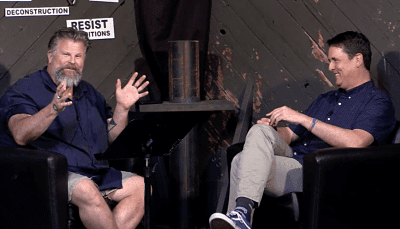
 Heart of the Matter’s Shawn McCraney sits down with John to have a discussion about:
- (Part 1) John’s Mormon story,
- (Part 2) The history of Mormon Stories and how his motivation behind the podcast has transformed over time, and
- (Part 3) An interesting back-and-forth as John gives his take on Christian concepts including God, sin, redemption, and much more.
Continuing a theme this year of capturing updates from some of our most impactful past interviews, in the coming weeks John will interview Shawn again to see what life has been like since his Mormon Stories interview released February 2010!
Part 1: This transcript is machine-generated and lightly edited for readability. The audio is authoritative. Please excuse occasional errors in names and spelling. Guest [00:00:00] We like to throw rocks at the people who don't see the world in the way we do. John Dehlin [00:00:11] Mormon Stories is a production of the Open Stories foundation and relies solely upon the support of people like you, its listeners to help keep the podcast alive or to become a member of the community. Please become a monthly subscriber by visiting MormonStories.org and clicking the donate button on the top right side of the page. All contributions to Mormon Stories are completely tax deductible and go towards producing the podcast and building communities and programs of support for Mormons like you. Thanks for your support. Shawn McCraney [00:00:58] Okay, welcome our very special guest, brother maestro, Dr. John Delenn. I can't tell you how grateful I am that John has taken time out of his busy schedule. He's very busy man. Didn't have to do this, but he elected to. We go back a long way. John interviewed me on his Mormon stories back. We've been talking, I think, 2009 numbers 221 and 222. And so we have some history between ourselves before we hear John. I just want to explain how we're going to do our time together so you'll know about tonight and the next week and the following here on Heart of the Matter. First Part one. I've asked John to just tell us his history. People are interested in the person and. And he's very well known, especially in Mormon circles and then outside of it, too. So just asked him to talk about his upbringing, parents, brothers and sisters, interests, growing up, sports, whatever, college, mission. Get past the mission and to right up to where he does his first Mormon stories. That's what we would like to hear from you. And if something comes up that I think is interesting, I interject. John Dehlin [00:02:14] All right? Shawn McCraney [00:02:15] Otherwise, it's all yours, brother. John Dehlin [00:02:16] I'm just gonna monologue. Shawn McCraney [00:02:18] You're gonna monologue? And I'll say, well, wait. And what do you think of this, sir? John Dehlin [00:02:22] Well, I have to say first, Sean, it's so nice to be on Heart of the Matter. Shawn McCraney [00:02:27] Thanks. John Dehlin [00:02:28] You've been doing great work for so long and I consider you a friend and I respect your work and your persistence and your integrity. And so I'm just thrilled to be here. Shawn McCraney [00:02:39] Thanks, John. Yeah, I really appreciate it. John Dehlin [00:02:41] Thanks for likewise. So I just start going, huh? Shawn McCraney [00:02:46] Just start going. I was born. John Dehlin [00:02:48] I was born a poor child. I was born in Boise. My dad was born in Salt Lake here. And he was the son of, like, a ditch digger, Great Depression father. And my dad probably quit high school early, you know, and never graduated from from college or high school. My mom was born in Franklin, Idaho. She was more of your blue blood Mormon type. She. She was a Benson and a Parkinson. So Samuel Rose Parkinson, one of the early LDS Church leaders, is one of her ancestors ours. And she was a cousin of Esther Jeff Benson. So she grew up on a farm in Franklin, Idaho, went to Preston High School, which is where Napoleon Dynamite was filmed. Shawn McCraney [00:03:41] Wow. John Dehlin [00:03:43] And so. And she was the. My mother's mother was the. Was the daughter of a third wife. So my. So my grandmother, who I knew was actually in a polygamous Mormon family in Idaho. So that's certainly got the Mormon pioneer credentials, as we all do. But I was the youngest of four. So my parents were married. Actually. My dad, my mom was gonna marry kind of a basketball star from the University of Utah. And my dad, who was kind of this young, rough, kind of up and comer, stole her away from this kind of blue blood University of Utah basketball star guy who, who became like a doctor. So I think my mom wanted a little bit of danger and excitement in her life, and so that's what she got with my dad. So anyway, yeah, I was the youngest of four and my parents spaced out. Gina's my oldest sibling. She would be 60. She's passed away. Then Julie, 55, my brother 50. And then I'm 48. Joel's maybe 51, but. But yeah, I was born in Boise, Idaho and lived in Boise, in San Francisco for two years and then it was all Texas. So five years in Dallas and 12 years in Houston, specifically Katy, Texas. Shawn McCraney [00:05:13] I had no idea. John Dehlin [00:05:15] Yeah, so I'm a Houstonian mostly and Texan, and my dad was a policeman and then he got into kind of government bureaucrat jobs and he worked his way up and that's what took us to Houston. He became an entrepreneur in Houston and so, yeah, grew up there. And the church meant everything to our family. We were. You know, I can remember the days when sacrament meeting and Sunday school primary were kind of. You'd go multiple times and throughout the Sunday. I can remember starting out at a branch and then we built a ward in Katy. And it was back in the time when the members would all help build the. Build the chapels. And I remember the days when like to print the program, you'd have the purple mimeographs that you'd have to hand crank. And I'm sounding really old, but do you find. Shawn McCraney [00:06:18] Do you look on those days with some fondness? John Dehlin [00:06:21] Oh, yeah, yeah. I mean, you moved to a place like Katy, Texas, that was this kind of Suburban sprawl. The big oil boom of Houston brought all these people from all over the world to this kind of sleepy, rice, you know, farming community outside of Houston. And you don't know anyone when you move there and all the subdivisions are just sprouting up and you all of a sudden have this instant community. And I remember the Chudley family that was from, like, Waller, Texas, and he was literally a rice farmer and he was branch president and all his sons were kind of hicks and tall and strong and sturdy and, you know, the Laytons and brother Layton, you know, grew up with general authorities in Salt Lake. And so he could tell you about his stories with Heber J. Grant or George Albert Smith or David O. McKay. And he acted super spiritual and like, he talked directly to God. And you just meet these really cool people and they cared about you and you cared about them, and you'd grow up with their kids and. Yeah, Mormonism was awesome back then. Shawn McCraney [00:07:26] Yeah, yeah. And I sense in you something I've always sensed in you. You had a love for people since I've met you. You love people talking, obviously with them, and that comes out from your youth. You're talking about the Laytons and you're talking about the rice farmer and you're talking about the building, the buildings. You love that interaction with people. You just carried it to a different place. John Dehlin [00:07:47] But still, for sure, for sure. And it grew. But, you know, I just. I can't believe I've never really gotten over how wonderful my adolescence was going to, you know, war dances and steak dances and regional dances and steak scripture chase and regional scripture chase and dance festivals and road shows and temple trips. We actually chartered like three buses and drove from Houston, Katy, all the way to Mesa, Arizona, because that was the closest temple. It was like a two or three day drive. Crazy. And the kids are all bonding and. Shawn McCraney [00:08:24] Yeah. John Dehlin [00:08:25] And there'd be like, you know, teachers who would get up on the bus and teach about the signs of the times and the second coming and Joseph Smith and the Book of Mormon and you'd eat it all up, you know, and Lex de Azevedo published that book on pop music and morality, and you, you felt like you were better than everybody else. We were in this town of Baptist, the Southern Baptist. So. Katie, Katy, Texas was a Baptist town. So they would hold, you know, once a year, a seminar on Mormons and other cults. Right. And so they'd show the God makers and all these kids would come to high school, you know, asking me questions. Is it true that you believe that, you know, Satan is God's son. And is it true you do these weird things in the temple? And I'm like, no, that's. None of that's true. You know, and the Fellowship of Christian Athletes, which was very kind of Christian, they weren't sure they wanted a Mormon, you know, as a part of their group. And, you know, girls, when they. We'd start dating, their dads wouldn't let me date them. And there's this weird vibe of, like, being super proud to be a Mormon but being persecuted in a battle Baptist town. But that makes you more jazzed to be a Mormon. And I got off on never drinking alcohol and never, never smoking, you know, never touching, you know, a girl where you shouldn't touch a girl. And it kind of. It gave me this identity. I felt like I was better than everybody. I loved it. And I was part of God's chosen people. I mean, who doesn't want to be part of God's chosen people? So it was just. And. And I guess parallel to that, my parents got divorced when I was in sixth or seventh grade. And that could be devastating. But for me, it was just like the church was right there to raise me. When my dad was busier off with his second wife or third wife or whatever. My mom was trying to get a job and earn a living because she was having a fetus. The church was just right there. I'd go to scouts, I'd go to mutual. I'd go to, you know, seminary. And I have leaders that love me and who looked after me and challenged me to be better and kept me on the straight and narrow and kept me out of trouble. And I just. I wish everybody could have that upbringing without, I guess, the things that aren't true and without, you know, I guess the arrogance and the exceptionalism became a burden. But it sure felt empowering at the time. Shawn McCraney [00:10:57] Do you think that same environment exists today for the youth? John Dehlin [00:11:01] No. I mean, maybe. Maybe in pockets, but they do track. I know that that means a lot to a lot of people, but I get the sense that the dances are. I mean, the dances were just like everything. You were in California, right? Shawn McCraney [00:11:16] Southern California, everything. John Dehlin [00:11:17] Do you ever dance? Do you remember your dance cards? We didn't have dance cards, but I heard you guys just imagine an entire stakescreen center, wooden floor, chapel filled with youth, and everybody's hopping and dancing and the lights and the music, and nobody's sitting on the sidelines. Everybody's dancing together. It was joyous. I don't know that dances are like that. When I talk to my daughters about, like, going to the institute or the. You know, back when we were in the church, they're just like. Everyone stood around and looked at each other, and it wasn't that fun. I don't know. I don't know. I. I don't. I know they don't do road shows anymore. Shawn McCraney [00:11:56] They don't. John Dehlin [00:11:56] I don't think they do dance festivals unless there's, like, a temple that's being launched somewhere. I don't know. It feels like some of that magic has been lost, but I can't speak for. Shawn McCraney [00:12:07] Well, maybe it's been lost in our society in general in some sense. John Dehlin [00:12:10] You know, I do get the sense that when Boyd K. Packer kind of took control, he wanted simplify, simplify, simplify. He actually. He's quoted as being very sensitive to people having spent too much time at church and taking that away from the family or whatever. So I think they've tried to simplify and minimize all those activities, but for me, they were just marvelous and. Yeah. Anyway, I wish everybody could have that type of upbringing. Shawn McCraney [00:12:37] Yeah, it's idyllic. John Dehlin [00:12:39] It felt that way. Until it didn't. Shawn McCraney [00:12:42] Yeah, until it didn't. Mom and dad divorced. Sixth grade, you say? John Dehlin [00:12:47] Seventh. Sixth. Seventh. I mean, it was like an on and off, you know, it was kind of on and off again. My dad was disfellowshipped. That was super hard to go through the shaming of that. I don't think he was. And I think he was always a good man, but he wasn't allowed to ordain me a deacon, and I had to have, like, brother Leighton ordain me a deacon punitive. It just feels kind of yucky like that, you know? And that was, like, probably my first crack in my testimony. It was. I didn't. I didn't conceptualize it as a crack at the time, but, you know, there's this plan which is like, hey, families can be together forever. And you're singing. You know, families can be together forever. And you're seeing that in primary, and you're super excited about how you have an eternal family. And then all of a sudden, you don't. Shawn McCraney [00:13:38] Yeah. John Dehlin [00:13:38] And you're like, oh, so I'm. Every time that's harped on, well, that's not me. And then you're like, well, then will I be with mom or will I be with dad? Will I have. Will there be visitation? And you start. You start wondering, like, how that works and how much does it apply to you. And you you come, you compartmentalize it, but it's always in the back of your head. Even if you get married, you're still wondering, well, who am I with in heaven? And it makes heaven all of a sudden a sad place. It does, yeah. Sad heaven. I'm not a big fan of sad heaven. Shawn McCraney [00:14:11] No. Sad heaven is not really nice. John Dehlin [00:14:13] Yeah. Shawn McCraney [00:14:14] The siblings. John Dehlin [00:14:15] Yeah. Shawn McCraney [00:14:16] Still active. John Dehlin [00:14:19] So that was interesting. My oldest sister, Gina, she. She was not able to find her Mormon boy, and so she married a non Mormon. And I was really worried about her for so many years. I was like, oh, poor Gina, Poor Gina. She married a non Mormon. What's going to happen to her? She ended up, after she having her first kid, becoming this super orthodox Mormon. She moved up to Canada, and she was really devout for many years. Raised three kids in the church, and she was devout until her dying day. And she passed away just about a year and a half ago, colon cancer. Shawn McCraney [00:14:58] Oh, sorry. John Dehlin [00:14:59] And she was just like, up until the end, she's like, I pay my tithing, got my temple recommend. I'm ready to go. Guest [00:15:07] Wow. John Dehlin [00:15:07] I'm like, aren't you a little sad? You know? She's like, nope, I'm ready. I'm like, okay. Shawn McCraney [00:15:13] Did her husband ever join? John Dehlin [00:15:15] No, he never joined. Shawn McCraney [00:15:16] No, he stayed together. John Dehlin [00:15:18] He smoked. Shawn McCraney [00:15:18] Darn it. Darn smoking. John Dehlin [00:15:21] You can't. Yeah, you know, he smoked. Shawn McCraney [00:15:25] Nothing else needs to be said. Yeah. John Dehlin [00:15:28] Can't follow, you know, the Lord if you smoke. I don't think he's too weak. No, I. I don't. You know, he was also like, he never. I don't think he was kind of a common sense. He's a common sense guy. And I just think he's like, you guys think you're better than everyone and one true church, and you're all kind of weird and a little bit judgy. I think he just never. It wasn't just that. I think he just kind of never bought it. That makes sense. But he was really good to my sister. He's been a loyal, faithful husband and father. Shawn McCraney [00:15:58] You mean that's possible? John Dehlin [00:15:59] I know. Not just that, but we were all. We all in the family, kind of looked down on him, like, oh, well, he's, you know, maybe someday, you know, like, he's like, he's not good enough. So that was my. My second. My second sister Julie. She. She lives in Kentucky. She's had four kids, and she's the most orthodox of probably all of us. And she, you know, all her sons served missions and they were all temple married. But you know, it's hard to keep your kids in the church these days. It is. And in some ways, I think, you know, my oldest sister, I only think one of her two kids are still active of the three. And then. Yeah. I think my second sister, too, her kids. One of her kids converted to Orthodox Christianity. Shawn McCraney [00:16:54] Wow. John Dehlin [00:16:55] After serving his mission and whatever. Shawn McCraney [00:16:57] As in Russian or Eastern. John Dehlin [00:16:58] Yeah, Eastern Orthodox. From Mormonism. Shawn McCraney [00:17:00] Yeah. John Dehlin [00:17:01] Really smart guy. Really great guy. And. Yeah. But I think sometimes the church sets people up. You give all your life to it, and it's about the missions and the temple, marriage and families. And then the kids fall away, and all of a sudden you're like, well, then I failed. Shawn McCraney [00:17:18] Yeah. John Dehlin [00:17:19] Because how, you know, if you've given everything to the church and the eternal family and then the family falls apart, what. What was your life for? And then you got sad heaven again. Shawn McCraney [00:17:31] That's right. Sad heaven. John Dehlin [00:17:33] Sad heaven. So I've, you know, I love my sisters. I respect them, I admire them. Shawn McCraney [00:17:39] Is it reciprocated? John Dehlin [00:17:40] Yeah. Shawn McCraney [00:17:41] Oh. John Dehlin [00:17:41] They've always been nice to me. My sister Julie started volunteering for Fair Fair Mormon several years ago, doing podcasts. Shawn McCraney [00:17:52] Wow. John Dehlin [00:17:54] Working with Michael Ash. You know, Michael Ash is. And I think. I don't know, but I. I have to think that she's like, well, John's doing all this work that isn't perceived as faithful. The world needs another delin to kind of counterbalance. Shawn McCraney [00:18:10] It sounds like that. John Dehlin [00:18:11] So she kind of filled in and. And. But, you know, we don't see the world the same. But I've always felt loved by her and supported, even though she could easily see me as an enemy to goodness. But she's never treated me that way, so that's been really good. My brother Joel, awesome. Seven kids. He was the chief information officer for the LDS Church for like, six or seven years. First name basis with the First Presidency, quorum of the 12. Yeah, he. I think, you know, I don't want to totally talk for him, and he's in a sensitive position, but I think, you know, I think he's kind of, you know, not engaged like he once was, but. But still very supportive of his family and still a great guy and is still amazing, a huge support and friend to me. He lives here, so I'm closest to him. Fantastic. But maybe someday he'll tell a story because he's seen. He's seen the church from the inside, close up. Yeah. Shawn McCraney [00:19:28] He'd be a fascinating guy to spend an evening with. John Dehlin [00:19:30] Yeah. But he's just. He's a great guy. Shawn McCraney [00:19:33] Did Mom. You stay with mom or go with dad or jump around? John Dehlin [00:19:38] So I. So I started with mom, and then mom moved out and dad moved in. And then I see mom on the weekends, and then I'd see Dad on the weekends, and it was kind of a hopping around sort of situation. My mom's on her third marriage. My dad's on his 50s, fifth marriage, and that made it a little bit turbulent. One of the things I'm really grateful for is that my parents never fought, so there was never this notion of custody. There was never a battle over possessions. They. They were just like, no, there's gonna be no drama in this divorce. That doesn't mean there wasn't sadness or betrayal or whatever, but there was just no conflict. They'd both come to soccer basketball games or soccer games. They. They both come to church events. They bring their spouses. No drama, no negativity. Neither would ever criticize or talk bad about the other. I'm super grateful for that. Shawn McCraney [00:20:30] Yeah. The proof seems to be in the pudding because your siblings all have been married and stayed married, and they haven't had disastrous lives. The way it goes when parents who divorce are selfish. John Dehlin [00:20:40] That's right. Shawn McCraney [00:20:40] Yeah. John Dehlin [00:20:41] Yeah. I think that that made a big difference, and that's true. I have the shortest duration marriage, and I'm about to hit 25 years. Shawn McCraney [00:20:48] Wow. John Dehlin [00:20:49] And all my siblings. Shawn McCraney [00:20:50] Look at that. John Dehlin [00:20:50] Yeah. So we're proud of that. Shawn McCraney [00:20:52] Yeah. John Dehlin [00:20:53] I. In certain terms of high school, I did. I did, you know, basketball. I did track and, you know, I played soccer and tennis and football and different years. Shawn McCraney [00:21:02] Were you good? John Dehlin [00:21:03] But I was a. I think I was a good athlete. Best sport, it was basketball. Yeah. You know, I could dunk. By my freshman year of high school, I was six, four as a freshman, eventually six, six, and. And I played with guys who went on to play college baller in the NBA. I could have played college ball, but I wanted to go to Zion. I wanted to go to BYU because I had, you know, had a scant pickings of Mormon girls growing up. Although I did date Renee Zellweger in high school. I don't know if you know that story. Shawn McCraney [00:21:32] I don't know that story. John Dehlin [00:21:33] Yeah, it's a good story. I've told it before, but I'll tell it again. Shawn McCraney [00:21:37] Let's hear it. John Dehlin [00:21:37] Do you wanna hear it? Shawn McCraney [00:21:38] Oh, yeah. John Dehlin [00:21:38] You'll love the story. Shawn McCraney [00:21:39] I love it because she was married to Jack Watt, too. John Dehlin [00:21:41] Who's that? Shawn McCraney [00:21:42] Oh, he's a musician. My favorite. One of my favorites, but go ahead. John Dehlin [00:21:45] She Married him after Kenny Chesney? Shawn McCraney [00:21:46] Yeah, she married him before for a very short time. Yeah. John Dehlin [00:21:49] Okay, well, so I met Renee as a freshman in high school at Katy High School. And we were all four years together. Became close friends over time. And, you know, she'd have me over late at night. She. I, you know, I wasn't like her, the guy she'd take to promote or homecoming, but I was the guy that she would call when she wanted to just hang out. So she'd call me over to her house and we'd sing Beatles songs together and drive around and have picnics and we went to the beach a lot and it was just fun. She was a really sweet girl. This is a. She's a famous actress now. She's won an Academy Award. And for people who don't know, but my junior year, you know, I was king of the state. I thought myself as king of the steak dances. Right. I DJ a lot of these dances and, and these were really fun things. Shawn McCraney [00:22:40] Yeah. John Dehlin [00:22:41] So I'm like, this is my chance with Renee. I am going to invite her to a Mormon Steak New Year's Eve dance. So it was, it was New Year's Eve, 1986. Shawn McCraney [00:22:56] Wow. John Dehlin [00:22:56] Okay. And so I, you know, in a semi formal, so I'm wearing like khaki pants and a blue blazer and a white shirt and tie. My standard outfit. And then Renee wears this black velvet dress. And she's really petite, you know, really. She's a modest girl. Just so happens her dress was kind of right off the shoulder. And I'm just this 16 year old boy. I'm not thinking about that. I'm just thinking how cute she looks and how excited I am that she's going with me to a dance. So I pick her up in my Buickless saber and we drive, you know, like 45 minutes to bear Creek, you know, and we go to the steak Dance and we walk in and I'm just so pumped to like. Because she's a great dancer. She, you know, this. She was a cheerleader and they did all these dances and she was fun. She knew all the music and we were gonna have the best time. We walk into the Stake center and this, this young women's leader immediately spots us. And remember, Renee's not a member of the church, right? So she says, oh, oh, sorry, you can't come in here wearing that dress. Your. Your shoulders, we can see your shoulders. And I, and I'm, I, I'm like, oh, I got this, I got this. So I'm like, oh, just one second. So I pulled the lady aside and I'm like, she's not a member. You know, she's not a member. It's okay. You know, she's not a member. She's like, oh, that doesn't matter. Like all the other girls are going to feel kind of jealous and envious that she's showing her shoulders, that, you know. So here's the deal. She says either she goes home and changes and remember it's a 45 minute drive or she can wear your blue blazer the whole dance, but she has to. And I'm like looking around and Renee's like gone. And I'm like. So I go out to the parking lot and she's walking in the car crying and she's like, take me home. Shawn McCraney [00:24:53] Wow. John Dehlin [00:24:55] So I drove her all the way home. Shawn McCraney [00:24:57] Wow. John Dehlin [00:24:59] One of the worst nights of my life. By far. Shawn McCraney [00:25:03] Another crack in the. John Dehlin [00:25:04] She could have been our. She could have been Mormonism's Tom Cruise. She could have been Mormonism's John Travolta. Guest [00:25:10] Yeah. John Dehlin [00:25:11] Leah, reminisce. You know, they blew it. They blew it. They could have had their celebrity. So Mormon church, you blew it with Renee Zelliger. Shawn McCraney [00:25:21] So I'm hearing two stories already and I'm adding them up. One with your dad's disfellowship, a little crack maybe. And now Renee, it's there. It adds to the pile. It has to. It makes me so angry to hear these stories. So it must have had some kind of. John Dehlin [00:25:36] Really, that was super disappointing because I really loved Renee, or at least I thought I did. As much as a 16 year old could love anyone. I also remember when blacks got the priesthood and I remember polygamy, just that never making sense to me. And then I remember once dividing the number of Mormons in the world. And this had to have been when I was getting all this adversity from my Baptist friends. Dividing the number of Mormons in the world by the number of people in the world. And I got like less than one half of 1%. And we were so orthodox back then that, you know, Bruce, Armor, Conkie, seminary, kind of like orthodoxy. I was like, man, if this is God's one true plan for all his children, he's super inefficient, he's really ineffective and has, you know, if my Baptist friends know that they're true, and then my other, you know, what's the charismatic, you know, my friend who's Pentecostal, they know they're true. We think we're true. So I mean, I never ever at that point ventured to the point of asking, is it really true and could it not be true? That wasn't even. I didn't allow my mind to go there. But certainly I had those items that I started putting on the shelf, by the way. I had this crazy Elder Layton as my seminary teacher. He keeps coming, coming back. Shawn McCraney [00:27:02] He. John Dehlin [00:27:03] This is a guy who told me once that he had special spiritual powers that he could. Sometimes he would sit in the back in sacrament meeting and tap people on the shoulder spiritually where they wouldn't know. So they would kind of. He would tap them on the shoulder and they would kind of look around, you know, he would. He would tell us he had these kind of powers. And then he once did two object lessons for us. And maybe you've done this. He once brought a life size cross into the seminary and he asked me to play Jesus. Shawn McCraney [00:27:35] Whoa. John Dehlin [00:27:38] And he drove a nail and he nailed me to the cross. And he asked me to writhe in pain in front of my fellow seminary students while he nailed me to the cross. And I was stoked that he picked me to play Jesus, you know what I mean? But it was super awkward to writhe in pain. Pain in front of my fellow s. Like, you know, as, as, as Elder Leighton's nailing me to the cross. Shawn McCraney [00:28:05] Religious people are crazy. Keep going. John Dehlin [00:28:08] Yeah. Have you ever done that? Shawn McCraney [00:28:09] No. John Dehlin [00:28:10] It's an object lesson. Shawn McCraney [00:28:11] Oh, it is an object lesson. It's an objective, objectionable lesson. But go ahead. John Dehlin [00:28:17] The other, the other thing he, the other object lesson he did that I'll never forget is he cleared out. He put us. He put our seats in a semicircle and he put like eight stones in the middle of the room, like in front of us. And he's like. So I know that at some point I've probably offended some of you. I've probably hurt your feelings. I probably said something that was hurtful. And I want you to know that I've. I'm not worthy. And so I invite you all to stone me. Shawn McCraney [00:28:54] Stone me. John Dehlin [00:28:55] And he like kneels down in front of us and just like kind of lowers his head and we're all just like, you know. And then he starts weeping uncontrollably and he starts sobbing. Guest [00:29:11] Wow. John Dehlin [00:29:13] And this is like 10, 15 minutes. You know how long that is, right? And then finally, you know, he kind of just wipes his tears off and stands up. And that was the lesson. You know what I mean? It's just super intense, you know what I mean? But like, you get your patriarchal blessing, and it tells you you're going to rise in the morning of the first resurrection, and you get ready for your mission and you feel like you're going to convert the world and all that Bruce Armaconkie orthodoxy, Mormon doctrine just makes you feel like you're chosen. So it sounds weird. It sounds kind of cultish in some ways. And I was like. I graduated, you know, like, 11th in my class of 400 kids. Honor society, student body president, captain of the varsity basketball team. I was actually. Received a scholarship. The Elks Lodge, for the entire state of Texas, had a scholarship program where you'd like, if. You know, if you won for your school, you'd get a $200 scholarship, and then if you won. If your county, you'd get a $500 scholarship, and then if you won for the state, you'd get, like, a. And I was actually selected as the student of the year for the entire state of Texas for the Elks Lodge. I mean, that's not like it's money. Texas is huge, you know, and it was several thousand dollars. And I got, you know, a full tuition scholarship to BYU for two years. And, like, I was on cloud nine. I just. I kind of ruled the high school and kind of ruled the stake, and I just. I felt like I. Nothing could stop me. Shawn McCraney [00:30:55] You were the guy. I got the picture. Did you? Just really quickly, as deacon. Teachers. Deacon, teachers, priests. Were you in leadership with that? John Dehlin [00:31:04] Yeah. Shawn McCraney [00:31:05] Participate in ward council and all that stuff, too. John Dehlin [00:31:08] All that stuff. So you have seminary president. Shawn McCraney [00:31:11] Seminary president, yeah. Steak dance king. John Dehlin [00:31:15] Yeah. Yeah. Shawn McCraney [00:31:16] Byu. John Dehlin [00:31:17] Living the dream. Yeah. And then I. Yeah, I didn't even apply. You know, I could have gotten into lots of colleges, universities, scholarships, University of Texas, Texas A and M, whatever. Didn't even apply. Just byu, was it? Shawn McCraney [00:31:30] Where'd you live? John Dehlin [00:31:32] I lived in Healman Halls, in Chipman hall, back when Chipman hall was a male. Now it's a female dorm. But back then it was a. And it was the honors dorm in Heelman Halls. And. And it was such a cool ward that Elder Holland's daughter, Mary Holland, attended that ward because she lived with him in his, like, mansion. Like, yeah, President's residence on campus. But. But this was the ward that she would attend. So I. I actually dated Mary Holland as a freshman at byu, and I played tennis with Jeff because she set it up. And so. Wow. So I've actually played a full set of tennis with Elder Jeffrey R. Holland. Shawn McCraney [00:32:11] Did you beat him? John Dehlin [00:32:12] I beat him bad. Shawn McCraney [00:32:13] Good. Good job. John Dehlin [00:32:14] Now he. He had he told me that his Achilles had ruptured or something? So he wasn't. Shawn McCraney [00:32:19] So he was lying even then? Just kidding. John Dehlin [00:32:21] But no, I think he had. I think it had. I think I beat him like six hours. Shawn McCraney [00:32:25] Awesome. John Dehlin [00:32:26] Yeah, it was kind of. Shawn McCraney [00:32:27] So your friends with his daughter? John Dehlin [00:32:28] Yeah, she was great. She's still around here. Yeah. Yeah. Shawn McCraney [00:32:33] So byu, how long did you go before the mission? One year. John Dehlin [00:32:37] Just one year. And it was amazing. And, you know, Elder Holland was like my Book of Mormon teacher. I did honors, you know, Book of Mormon. And. Yeah, it was. It was like I was, you know, I. I went to Temple Square just like Dorothy when she goes to Oz. I remember I, like, drove to Temple Square and parked my car and walked around and saw the Christus and, you know, went to general conference in the tabernacle before the mechanical was built and heard the Mormon Tabernacle Choir and saw the prophets and apostles speak from the podium. And I just was like, sopping, you know, Marvin Jay, Ashton L. Tom Perry and Neil A. Maxwell, and you know what I mean? I knew all the names I could tell you the apostles in order, their order of succession, and I wrote down their quotes and, like, marked my scriptures and, like, I was in it, you know, just fascinating edge to have. Benson, I think, had become prophet by that point. He was my cousin, and so, you know, that was super cool. Yeah. Shawn McCraney [00:33:41] Sold out. John Dehlin [00:33:43] Heady time. It was a heady time. Shawn McCraney [00:33:45] Yeah. And a lot of it pointed to your ego. John Dehlin [00:33:48] To what? Shawn McCraney [00:33:49] Your ego. John Dehlin [00:33:50] Oh, well. Shawn McCraney [00:33:51] I mean, when you look back, wasn't it ego driven? John Dehlin [00:33:54] Oh, yeah. To this day, I still haven't tried beer and I. It's ego. It's just like. Well, it's something I've never done. And I can tell people I've never tried alcohol. I've never tried cigarettes. I've never tried drugs. You know, like, I'm better, you know, there. It makes you feel like you're better than people. Guest [00:34:10] Yeah. John Dehlin [00:34:11] And that gives you a sense of confidence and security in a. You know, in a world that can be scary. Shawn McCraney [00:34:19] Are there vestiges of that and you still. John Dehlin [00:34:21] There's got to be. Shawn McCraney [00:34:22] Yeah. John Dehlin [00:34:23] Yeah, it's got to be. Shawn McCraney [00:34:24] So the mission, where was the call to Guatemala? John Dehlin [00:34:28] Got called to Guatemala and didn't know where Guatemala was. I thought it was like South America. And isn't it basically everything south of Texas was Mexico to a Texan? Shawn McCraney [00:34:41] Texan, yeah. John Dehlin [00:34:42] It's just all Mexico. I didn't even know that they spoke Portuguese in Brazil at that point, you know what I mean? It's just all Mexico. So. No, not that bad. But I had to look it up on a map. Yeah. But my dad didn't really want me to go. That was really interesting because my dad, he's just like, you could get hurt. Like, why aren't you just going to, like, Winnemucca, Nevada? Like, why do you need to go to a third world country? By this time, he was struggling with parts of the church because of that disciplinary council and just how he was treated. He would just say to me, he would say things like, the temple's weird. You know what I mean? And this is before they made the changes. So this is when you do the penalties and the signs and the tokens and the. You know, and he's just, you know, I'm like, what, dad? You can't say the devil's weird. You know what I mean? But he's like, I just. I'm just telling you, I've never really gotten much out of the temple and it kind of freaks me out. And then, like, there was Benson's big push in the MTC for, like, Book of Mormon. Flood the earth with the Book of Mormon. And I remember for some reason I had to talk to my dad on the phone in the mtc, and he's like, I've always been a New Testament guy. Like, the Book of Mormon's just never really spoken to me. I'm like, dad, you can't say that. That's the. I'm in the mtc. You know what I mean? He's just like, it's about Jesus. It's about service. It's about love. He's still that way. He. He's your kind of Mormon. He's just a Jesus Mormon. Shawn McCraney [00:36:07] Wow. John Dehlin [00:36:08] You know, and he's. He's always been that way. It's like, service. My dad. For my dad, religion was stopping to see someone whose car is broken down on the side of the road and fixing their flat tire, taking them to get help with their car. It was, someone needs help moving, you go help them move. Shawn McCraney [00:36:27] He's still that way. John Dehlin [00:36:28] Totally that way. Shawn McCraney [00:36:29] Is he still LDs? John Dehlin [00:36:30] Still LDs. Shawn McCraney [00:36:31] Wow. John Dehlin [00:36:32] But not. Shawn McCraney [00:36:34] Not the way LDs are LDs. John Dehlin [00:36:36] He's not orthodox at all. Shawn McCraney [00:36:37] Yeah. John Dehlin [00:36:38] Not orthodox. He's like. He would probably just say, I'm a savior Mormon now. It's just. It's about the Savior. Shawn McCraney [00:36:43] Yeah. John Dehlin [00:36:44] It's like Joseph Smith, Book Mormon, Temple Jesus. Shawn McCraney [00:36:49] I really liked him when I met him. John Dehlin [00:36:50] Yeah. Shawn McCraney [00:36:51] He was nice to me and he knew what I did and he was very respectful. John Dehlin [00:36:53] Oh, yeah. Yeah, he's super open minded in some ways. Yeah, yeah. So that was weird to have my dad, like, kinda. Shawn McCraney [00:37:02] No. John Dehlin [00:37:03] You know, but I was just like, well, dad, you know, he's, you know, he made mistakes and. Shawn McCraney [00:37:07] Yeah, yeah. Oh, you had that a little bit. John Dehlin [00:37:09] Oh yeah, yeah, yeah. It's like poor dad, you know, again, that ego. Yeah, I think that. Shawn McCraney [00:37:15] So good to hear. John Dehlin [00:37:16] Oh, for sure, for sure, for sure. Yeah. Shawn McCraney [00:37:20] You had gone to the temple when we did all this. John Dehlin [00:37:24] Yeah, yeah, yeah, yeah, yeah, yeah, yeah. I slit my throat and I just. Shawn McCraney [00:37:27] Disemboweled yourself. John Dehlin [00:37:28] And you know, they mocked Christians and you know, they had a, a pastor with a collar and, and mocked the crap out of him and, and yeah, and you know, and Bruce Armacock had said the Catholic Church was the great abominable. And there was a lot of pride, Mormon pride and judgment. But yeah, the temple freaked me out. I went, my brother took me through. I don't know why. It was the Jordan River Temple and I got into it because you have to. That's just what you do. But it was just like, why are we. Why am I slitting my throat? Shawn McCraney [00:38:02] So you had some questions for sure. John Dehlin [00:38:04] But, but more, more. Shelf. Shawn McCraney [00:38:06] Yeah. John Dehlin [00:38:07] Shelf. Yeah. Guest [00:38:10] Who? Shawn McCraney [00:38:10] The mission president? John Dehlin [00:38:11] Yeah, my mission president was Gordon Romney. He's a, you know, he would have grown up with ancestors in the, in the, in the colonies of Mexico. So Mitt Romney and his dad, the governor. What was his name? The other Romney. Yeah, they all would have come from Mexico. It was like the way the Mormon church could avoid the laws outlawing polygamy by sending their members to Canada and Mexico. So anyway, he spoke fluent Spanish and he had worked for like IBM. He was this kind of corporate businessman type and he was just all about becoming the highest baptizing mission in the world. So very quick into my mission, there'd be like companionships who are getting 10 baptisms a month, 20 baptisms a month. And I'm like, this is cool. We're baptizing like a, you know, and we started 400 is a mission. 400 baptisms a month, 500 baptisms a month. And I'm like, it's a miracle. You know, and. But then you find out, you know, oh, well, they baptized a drunk or they baptized a 7 year old or they baptized and you start going, well, that's kind of weird. Or they baptized little kids, little 8 year olds, 9 year olds, and, and immediately that was like this disconnect because it felt like, oh. And he implemented these incentive techniques to convince missionaries to get, you know, so it was like if you had seven baptisms a month at Zone Conference, you'd stand up in front and get a little certificate with your name on it and seven baptisms a month, so you get to take that home and you've got the little certificate. He had a. If you got 10 baptisms a month or more, you got a Janice Cat Perry cassette tape, serving with joy. And, you know, and then. And then every month, he'd have a party for all the companionships that had 10 baptisms a month or more. So you'd all. Wherever you are, you'd come to the capitol, you'd have like a nice lunch, a party, you know, and a steak dinner or whatever. And it was just like these sales incentives. And then he had a monthly newsletter that had, you know, all the top baptizing companionships and their numbers. And slowly you'd see these numbers. 10amonth, and then 20amonth and then 30amonth. And by like a year into my mission, there were companionships getting 40 baptisms a month. I want you to think about that for a second. Shawn McCraney [00:40:42] Oh, yeah. John Dehlin [00:40:43] That's more than one a day. Shawn McCraney [00:40:44] Yeah. John Dehlin [00:40:45] How do you baptize more than one a day on your mission? Shawn McCraney [00:40:47] Wow. John Dehlin [00:40:48] And then, so I would. I would ask around. I'm like. Because I want, like, you got these stories of, like, Mormon missionaries in England baptizing entire towns or congregations, like, how Shawn McCraney [00:40:58] do we do this? John Dehlin [00:40:59] You know, and. But then I'd have. It's like, oh, you don't. You don't want to know. You know, I talked to someone who was in one of these zones where they'd have 40 baptisms in one companionship. And it'd be like, we went to a soccer field. Field. We played soccer with the poorest, poorest part of town with the, you know, kids with. Without teeth and, like, bare, barefooted parents were working in the finca. Play soccer with 10 kids for an hour, get them super hot and dusty, and then say, let's go back to the chapel and cool off. Right. Guest [00:41:33] Wow. John Dehlin [00:41:34] So they take them no back. No. No lessons, never been to church, no parental consent. Shawn McCraney [00:41:41] Wow. John Dehlin [00:41:42] Right? Shawn McCraney [00:41:42] Amazing. John Dehlin [00:41:43] And then they baptize them, you know, just ten at a time. I had a companion. I had a companion who told me that kids were literally doing cannonballs in the baptismal farm. Shawn McCraney [00:41:55] I'm sorry I'm laughing, but it's just a humorous side to this. John Dehlin [00:41:59] And then. So they'd get their 10 for, you know, that Saturday, and then they'd party all week. They Traveled other countries with the mission car. They would, you know, go to movies, they would watch tv, they would listen to pop music, and then the next Saturday, do it again. And so it was just total fraud. And I even pulled my mission president aside at different points. I'm like, president, it feels like we're not always getting converts and it feels like we're not always, you know, really building the kingdom. Sometimes it feels like we're just like focusing on numbers. And he's like, elder, you don't understand. Like, if you baptize them, as soon as you baptize them, they get the gift of the Holy Ghost. And once you give them the gift of the Holy Ghost, it can activate in them and it can transform their lives. And even if they fall inactive, they have the gift of the Holy Ghost so it can reawaken in them later. Whereas if you don't baptize them, they don't have the gift of the Holy Ghost. And by placing a Book of Mormon in their home, who knows if a family member will stumble on it later and then get re baptized later. So we're planting seeds by baptizing them that can sprout and who knows what ways later. And then he said, and even if they never are active during their lifetime, if they die, we won't need to do their temple work for them because we will have already baptized them. So there's no downside. So baptize, baptize, baptize. You know what I mean? Shawn McCraney [00:43:39] What did you think of the explanation? John Dehlin [00:43:41] I felt sick inside. I feel like I was doing it for the right reasons. Like, I was like, these are sacred ordinances and people need to be converts. And you know, you don't just, you know, you don't just pervert God's holy ordinances for statistics. I mean, it felt like my mission president, Gordon Romney, was trying to become a general authority and he wanted to do that by having the highest baptizing mission in the world. We reached something like 750 baptisms a month. Shawn McCraney [00:44:11] Unbelievable. John Dehlin [00:44:12] And you know, at the time, like only Chile Vinha del Mar, you know, had over a thousand. And it turns out they were doing beach party baptisms where they would like have parties at the beach and baptize people. And Elder Holland closed over 30 stakes in Chile alone in the aftermath of those 80s years. Wow. Where it was just kind of like coked up fraudulent baptisms. So that was the first major, major break to my testimony because I finally confronted my mission president about it as his own leader. I was like on the track. I'd been branch president twice on my mission. I had opened up areas, I had grown. I had opened up an area with no members and by the time I left we had 40 people attending church every week. Then I went to an area with 40, 40 members and by the time I left there were like 80 or 100 people attending every week. I was growing these areas, serving as branch president, zone leader. But I confronted him and I just said, this feels wrong. And this is about 20 months into my mission. And he screamed at me, you know, and he just said, don't ever challenge your priesthood leaders. How dare you question what we're doing. If you ever do this again, I'm going to demote you from zone leader. And then he exiled me to Uspantan Kiche, which was not even technically like in our mission. It was like it was a five hour bus ride to the nearest telephone and then a six hour bus ride. So like 11 hour bus ride to the mission home. And it was clearly to exile me so that I wouldn't mess up the good thing that he had going, that I wouldn't spread the word and that I would feel punished for forever crossing him. And that put a dark sort of like spot in my heart that lasted up until my excommunication, like, cause that never, that felt like deep abuse and fraud. And I came home from my mission. They actually came home. They gave me a chance to end early, honorably because I got sick in that last area. I said, president, I'm sick in this area. And he's like, okay, I'll send you home. So he sends me home four months early and I'm like, you know, but I'm like Nephi, like I'm not gonna end my mission early. So I'm like, no, send me freaking back out, like. So I ended up in Arizona, Phoenix, Mesa, Gilbert, Chandler, Tempe, served my four months there. They made me as own leader again over Spanish speaking missionaries and finished my mission honorably. But while I was there, I'm like, this is my chance. I'm gonna tell church headquarters that Gordon Romney was doing this stuff and they're gonna like helicopter into Guatemala and like excommunicate him and fix everything. So I like tell my mission president, who is an outgoing mission president who had just been called as a general authority, Daryl Woolsey, he's going to the Philippines about like Elder Woolsey, I have to tell you what happened on my mission. So I tell him the whole story, you know what I mean? And he's like, you know, jaws open, like, oh, I'll tell Salt Lake, don't worry, I'll take care of this. You know. And then weeks go by and I'm like, did you ever talk to Salt Lake? Did you ever work that out? And he's just like, you know what, Elder Dehlin? I talked to Salt Lake, told him the story, and they feel like it would cause a big stir if they did anything. So they've just decided to let President Romney finish out his mission. And then later when he got home, he was called to serve on the missionary committee for the church. And he was called to preside over the sesquicentennial celebration that the church had back then. Shawn McCraney [00:48:06] That was huge. John Dehlin [00:48:07] And he was in charge of it. And that's what I'm just like, does the fish rot from the head? Guest [00:48:13] Wow. John Dehlin [00:48:14] That was the first time I'm like. And the way I justified it was like, well, the church is perfect, but the leaders aren't. You know what I mean? That's how I put all that on my shelf. But I always had this dark space in my heart. And even Elder Oaks, I wrote a letter to Elder Oaks telling all on my mission. Wrote like this eight page letter included like proof of all the certificates, you know, photocopies of the newsletters and the certificates and all that stuff. And he called me personally, Elder Oaks and Apostle, to apologize for what happened. But they never, you know, like, you know, I still hear that these things continue to go on. They've never made a policy denouncing these type of tactics. They've never, you know, and you know, I think the, the activity rates in Latin America are like 10%. Yeah, yeah. 5% in some places. So it's a Potemkin town. It's a total fraud. Our numbers, you know, you know, we, sure we claim 16 million Mormons or whatever, but we've probably got five on the books and a huge millions. Are these fraudulent baptisms in Brazil, South America, Chile, Argentina, Guatemala, Mexico and the Philippines. And I'm sure we're backing it up in Africa right now. And I'm sure that's the only way that our membership looks like it's not declining. Shawn McCraney [00:49:38] Yeah. John Dehlin [00:49:38] Is we're gonna make up statistically in Africa for, you know, for where we're losing in, in Western Europe and in North America, you know what I mean? Shawn McCraney [00:49:48] So what happened to Romney up besides the centennial on the. John Dehlin [00:49:52] He ended up as an adjunct faculty at BYU teaching computer science and he's an entrepreneur and he came to my wedding reception. Shawn McCraney [00:50:00] Wow. John Dehlin [00:50:01] It's Kind of awkward. I hadn't done the podcast by that point, so he would have had no reason to. Yeah. So anyway, I. I was grateful that he never was made a general authority like that. For me, if I think if he had been made a general authority and he was gunning for it, yeah, I think I would have lost my testimony. But he didn't, and Elder Oaks apologized, and so that allowed me to kind of hang on. But at byu, I always had this dark. That's when the criticism I, like, learned about Sunstone. I Learned about the September 6th. That was my senior year at BYU, 1993. Joanna Brooks was marching with feminists, and they were marching for abortion and for women's rights and against rape and sexual assault. So I kind of had this intellectual awakening at BYU, of all places, from, like, 1990 to 1993. And that's when I learned about a little bit more about church history, a little bit more about intellectual dissent. But. But it was all framed within faithful, because back then, you could be a Sunstone Mormon and still be a believer. That's probably still true. So you learn about lol, Bennion or Eugene England, and it's like, oh, well, you can be like an intellectual, edgy, progressive Mormon and still be active. Oh, well, that's what I'll be. And so BYU radicalized me, but at the same time liberalized me. So I just was like a kind of a liberal Mormon where I got married in the temple and stayed faithful and would stay super active, but it would, you know, I wasn't gunning for bishop. I was like, you know, I might wear a different colored shirt sometimes to church, or I might. Shawn McCraney [00:51:52] A little radical. John Dehlin [00:51:53] I might ask harder questions, you know, or teach Sunday school or elders quorum lessons that push the envelope a little bit, and you know what I mean? Or where Birkenstucks at church or whatever. It was just as a way to say, hey, I'm in the program, but I'm not a lackey. You know what I mean? Shawn McCraney [00:52:13] I do. John Dehlin [00:52:14] And that's how I dealt with that dark spot in my heart. I'm just like, I can't give everything, but I'm going to still be committed. Does that make sense? Shawn McCraney [00:52:23] Total sense. What'd you study at BYU? John Dehlin [00:52:27] Political science. Shawn McCraney [00:52:28] Graduate from BYU. John Dehlin [00:52:30] I graduated summa cum laude with a 3.96 GPA. Shawn McCraney [00:52:34] Holy cow. John Dehlin [00:52:35] And got, you know, full rides. And it was, you know, I applied to Harvard Law, and I applied to University of Texas Law and BYU Law. I was gonna. I did a congressional internship on Capitol Hill. So I, you know, went back to D.C. and I rubbed shoulders with senators and congressmen and I. I think I wanted to be a politician at the time. So I was gonna go to law school, become a politician. And that was, you know, and so I. I was. I was. Graduated from BYU prep to do whatever I wanted and married. Married. I married right at the end. So right like the month I graduated, December of 1993. Margi and I got married in the Washington D.C. temple. I dated Elder Hatch's daughter, you know, Senator Hatch's daughter, Alyssa, you know, and I, you know, I was just like. I was poised to like, be a big Mormon deal. Well, whatever that means. Shawn McCraney [00:53:30] Why's our time, Seth? Okay, we got just a few three minutes or so before we wrap this. John Dehlin [00:53:42] People aren't too totally bored. Shawn McCraney [00:53:44] No, no, no. This is, this is all I. I am telling you. I can't believe. I mean, I believe it, having talked to you and you're eloquent and, and you're a very good interviewer and everything, but I can't believe how much integrity you have coming into the story. I mean, you were sold out. I know the guys like you. David Tuckfield was the guy in our stake. You were the David Tuckfield. He's in Washington D.C. lawyer now. He was the king of this and he has the smarts. You were that guy. So that lends to such integrity and credence to who you are as a person. Really makes a lot of sense in what you're doing now. So you married Margi. Then what did you do? John Dehlin [00:54:28] I went to work for Bain and Company. So that was this elite management consulting firm that Mitt Romney started. He started it in Boston after he went to Harvard Law. Shawn McCraney [00:54:36] You say Banyan, Bain, Bain. Oh, yeah. John Dehlin [00:54:39] So Mitt Romney became rich and famous by starting Bain and Company. And, you know, they were a Fortune 500 management consulting firm. So that was my first real job out of college. You know, every. It was like byu, guy, Harvard guy, Harvard guy, Stanford guy, Stanford guy, you know, MIT guy, MIT guy. You know, that's Chicago guy. Like, that's who Bain hired, was elite undergraduates from Ivy League universities. So that, you know. And so I was immediately consulting Continental Airlines. I was. I helped in the merger of Lockheed and Martin Marietta, these two defense contractors. And it was the golden ticket to, you know, to wealth. And so I did Bain for a year. But I hated. Felt like, you know, it was like, you know, Harvard, CEO of Fortune 500 company wants to have this arbitrage opportunity of like swooping in and fixing 12 things to increase the market cap of the corporation and then sell it for this big differential and bail with this parachute and get rich. And so we as consultants would be brought in to like downsize and like fire a bunch of people or like privatize this or that, you know, so that we could claim this sort of superficial gain in profitability so that someone could cash out with the differential. You know what I mean? Shawn McCraney [00:56:09] I do. John Dehlin [00:56:10] And it felt, it felt dirty, you know, it didn't feel like we're creating real value, we're firing people. And it just felt gimmicky. And I'm not, that's not to disparage the management consulting industry. Shawn McCraney [00:56:22] Yeah. John Dehlin [00:56:23] But for me it just, I'd watched too many Frank capra movies at BYU. Probably my favorite class of all at BYU was this theater and film, like 117 with Charles Menton. Shawn McCraney [00:56:35] I had it with Meton. John Dehlin [00:56:36] Yeah. So you see like It's a wonderful life and Mr. Smith goes to Washington and you can't take it with you and, and, and freaking man for all seasons. Shawn McCraney [00:56:46] Sure. John Dehlin [00:56:46] Right. And you learn about Sir Thomas More and how he stood up against King Henry VIII and was executed for it. And, and you, you, you see this, it's, you know, you can't take it with you. And it's like nothing matters in life if you haven't led a meaningful life. And I bought it. It was like that was my religion. And Christianity bolsters that, you know, like, so, like what? It should, it should. So it's Bane. I'm just like, this feels, this just feels gross guy. Shawn McCraney [00:57:16] It seems like Bane was just the corporate example of what you experienced in your mission President. John Dehlin [00:57:20] Totally. I mean, Romney, it was another Romney. Yeah, yeah. And I'm sure Mitt Romney's a great guy, but it just felt, it felt gross. It felt dirty. So the Internet had, you know, 19, we're talking 1994, 95 now. The Internet had just come onto the scene and I'm like, that's going to be a big deal, that Internet thing. I'm following that. So I left Bain after one year. Nobody leaves Bain after one year. What you do is you do Bain two years. Then you go to Harvard, Stanford, mit, Chicago or Northwestern, get your mba, and then you get your six figure salaried job that takes you to million millions of dollars within five, 10 years. Like that's everyone who works at Bain or McKinsey goes on that track. I left that track after one year and went to Arthur Andersen. In Chicago, which was an accounting firm, the top accounting firm in the world at that time, to learn technology because Bain didn't want to follow technology at the time. So I did a year at Arthur Andersen, learned technology, left Arthur Andersen, became a programmer, computer programmer, because at least I felt it was creative. And I felt like I was automating processes. I was helping businesses be more efficient. It felt more tangible and fun than management consulting. And then, interestingly, I was hired by the LDS Church as a contractor to do computer programming for the Mormon Church. So in like 1996, 97, I moved to Salt Lake City from Chicago and did, did programming for the church for a year. And the coolest project that I worked on was a general authority candidate tracking system. Shawn McCraney [00:58:59] Wow. I thought it was all by inspiration. John Dehlin [00:59:03] Well, it may be, but they needed some, you know. Shawn McCraney [00:59:07] So you create it? John Dehlin [00:59:08] Well, no, I maintained it. I maintained it and improved it. So basically you would have general authorities that would travel to missions and interview mission presidents. They would travel to stakes and interview stake presidents and call new stake leaders. And then they would travel to temples and visit temple presidencies. And so those were the candidates for general authority, former stake presidents, mission presidents, and temple presidents. But when, let's just say Marvin J. Ashton goes to Nebraska and meets with the, the mission president there, they would need some sort of organizational memory. Like, because they had all this criteria for becoming general authority. Do they have a lot of debt? Are they successful in their business? Are they in a happy marriage? Do they have any, like, troublesome spouse? Do they have a troublesome child? Have they gotten into debt? Would they be an embarrassment for the church? Have they committed infidelities? Shawn McCraney [00:59:58] Wow. John Dehlin [00:59:59] You know, are they, you know, successful? Shawn McCraney [01:00:02] Yeah. John Dehlin [01:00:02] And so you'd need to write all that down as a general authority so that future general authorities that come could know over time how this person was progressing in their candidacy for general authority. Shawn McCraney [01:00:14] Amazing. John Dehlin [01:00:15] So this computer system tracked all that. And I was, I was. That was one of the main things I did. Shawn McCraney [01:00:22] We're going to stop this for. I am so excited to continue on with part two to see what happens with, with John in his life. We know what happens, actually, but I don't know how it happened. And then we will hit part three following thereafter. Thank you so much and we'll see you next week. John Dehlin [01:00:44] Thank you for joining us today on Mormon Stories. If you enjoyed this episode, please help us make more like it by becoming a monthly subscriber@mormonstories.org. Rocks is a featured single on Angela Soph's upcoming album Second Wind, inspired by her struggle with the faith journey out of Orthodox religion. You can find and follow her on social media as Angela Sofbam. That's s o f f e on Spotify or angelasof.com. Guest [01:01:25] To Let Them down so judge me cast me your stones I will lay them back at your feet Take my hand let's walk among we like to throw at the people who don't see the world in the way we do I don't know why we all stand in a circle and point a finger or two Tell me how can you see what is buried beneath a mountain of smiles we're all thrown in the same blue wall Water of the unknown so leave your rocks alone. The truth is not what it seems we are told to just be believing the story has never been told and we all need someone to listen to hold our hearts is there beating with so much more than we see. John Dehlin [00:00:00] We like to throw rocks at the people who don't see the world in the way we do. John Dehlin [00:00:11] Mormon Stories is a production of the Open Stories foundation and relies solely upon the support of people like you, its listeners to help keep the podcast alive or to become a member of the community. Please become a monthly subscriber by visiting MormonStories.org and clicking the donate button on the top right side of the page. All contributions to Mormon Stories are completely tax deductible and go towards producing the podcast and building communities and programs of support for Mormons like you. Thanks for your support. Shawn McCraney [00:00:58] Hey, we're with John Dehlin. This is part two. Founder of Mormon Stories, Ph.D. cEO and co originator of Open Stories foundation. And if you didn't see part one, you should take the time to watch it because you'll see a side of John that is really fascinating and it lends to a tremendous foundation of personal integrity in my estimation. And that's important when you balance what he has continued to do, just to see how that plays into who he is. So right now we want to spend some time going forward from the time that you graduated byu, married, did your time with the church for their general authority, and then what started to happen from there. John Dehlin [00:01:52] So I got my dream job, I thought, in 1997ish, I went to work for Microsoft in Seattle. So it's like at the time that was every tech guy's dream was to work for Microsoft, get the stock options, go, you know, go to the Mecca with Bill Gates and Steve Ballmer and dominate the world through software. So we moved to Seattle and were active in our ward there in Issaquah and was really having a great time, was starting to make really, really good money and travel the world. I had a very meteoric rise in the company, had back to back double promotions two years in a row and was a director just a few years into my time there and was really on the fast track. But, but there was just that dark sort of space that I referred to in the last episode. Just wouldn't go away and Frank Capra wouldn't go away. Just this like, you have to live a meaningful life. You have to live a meaningful life. And so it was cool to have stock options and no Bill Gates and to make a ton of money, but I felt empty inside and it wasn't, it wasn't filling me so, but I didn't, you know, have words to put to it. And I was, you know, we were having kids, we had, we ended up having four Kids and really busy. So Microsoft can just consume your life. So what happened was just, you know, like the bishop asked, ended up asking me to teach Sunday school. So I taught Sunday school and I taught the bishop's daughter in Sunday school. And she really liked me as a teacher. So she recommended to the bishop that I teach seminary. So around 2000, 2001, I was called to teach early morning seminary. And so I started just, I'm going to be the best seminary teacher I could be. I had a, you know, Elder Layton, president. Elder Layton was my seminary teacher. And I'm going to be like, you know, Lawrence Layton, but for these students. And so I just thought, I'm going to really dig into the Book of Mormon. That was the first year was Book of Mormon and then the second year was Doctrine and Covenants. So I did a full year of Book of Mormon and really read the Book of Mormon in depth and was just starting to hit things. I was starting to notice some inconsistencies. I was starting to notice some problems with, with the narrative. But at the time, it was all about, like, inspiring these young students and motivating them and helping them be the best that they could be, to give them a great experience. But I was throwing in a little polygamy. I was throwing in a little bit of uncorrelated materials. I wanted to inoculate them so that they wouldn't be surprised with some of the church history. And I thought I knew church history. I thought I knew there was polygamy and Brigham practiced it and, you know, that sort of thing. Right. So somewhere along this time period, Margi and I make a trip to Utah to visit my cousin who's a dermatologist down in Orem. His name's Ricky Parkinson. And he. I think I probably mentioned to him that I was teaching seminary by this point. And this is again, like 2000, 2001. And he's like, did you ever hear the story about the Book of Abraham? I was like, no. What do you mean? Well, you know those hieroglyphics that are in the Book of Mormon and the papyru? Yeah, I've heard about that. He's like, did you know that they were discovered, you know, in the 60s, that we thought that they were burned? I didn't know any of this. He's like, they were burned in a fire and they thought they were thought to be lost, and then they were discovered. And then the church was super stoked to have Egyptologists translate the papyru to show that the Book of Abraham was scripture. And I'm just, like, on the edge of my seat thinking, this can't be real, you know, and he's like, yeah. And then the Egyptologists found out that the word Abraham doesn't even appear anywhere in the scrolls, let alone have anything to do with the text that Joseph Smith produced. And at first I was just like, oh, he's just being controversial. And, oh, that's. But then that just, like, really sunk in me. I'm just like, oh, my gosh, that is one of the most interesting stories I've ever heard. And I'm 31 and I've never heard that story before. So I was like, well, what else don't I know? And so I started really studying church history in depth. So I got the Church History in the Fullness of Times Institute Manual, this big, green, thick book. And. And I read through it, you know, and Kirtland Bank Scandal and Hans Mill Massacre and Mountain, you know, and it didn't meant. It didn't mention, I don't think Mountain Meadows. I could have it wrong. But, like, in my memory, it left out some stuff, but it. It certainly was open about certain things. And so I was like, I need more. So after that, it was like Richard Bushman. I got Joseph Smith in the Beginnings of Early Mormonism, which was the predecessor to Rough Stone Rolling, where he talks about kind of everything that led up to Joseph Smith's kind of early ministry. And I didn't know a lot of that stuff. And I had heard about Michael Quinn's, you know, Mormonism in the Early Magic Worldview or whatever it was called, but I never read it. So I started reading Michael Quinn and I read his series on power, the. The Origins of Power and the Extensions of Power. And I, you know, I read in there things like David O. McKay or Hubie Brown tried to get blacks the priesthood in the 60s, and then it was scuttled last minute. And, like, we could have, like, saved, like, 10 years of racism if, like, the Brethren hadn't outvoted, like, Hubie Brown. And I started learning all these things, and it was like this rabbit hole. I just. And then I started reading, you know, Richard, I started reading Grant Palmer, and I started reading Simon Sotherton his book Losing a Lost Tribe and Grant Palmer's An Insider's View of Mormon Origins. And then I also, finally, kind of the pinnacle of my studies was Fawn Brody's no Man Knows My History. And of course, I always viewed that book as evil and dark and as scary and as, you know, anti Mormon. And then I'm reading it, and it's like, one of the most entertaining books I've ever read. It's just this gripping page turner. And it's accurate and it's fun and it's interesting, and it's actually, in some ways, kind of Joseph Smith. But it just. It peeled the covers back on who Joseph really was. And that was like. I'm just like. By the time I got done with that book, I just remember sitting at my kitchen table in Seattle, and it was the first time where I allowed myself to just. I allowed myself to think the thought, is it possible that it's not true? And that was like, the big switch. Because I'm like, if it's true, if the church is true, then this is super complex and fraught. But if it's not true, everything immediately makes perfect sense. Everything. Kind of that Occam's Razor moment, right? And so I remember, like, pulling Margi aside and just saying, margie, I know I've been, like, depressed for two years and obsessed about reading things and, like, distracted and unavailable as a husband and a father in some ways. But I just want you to know that the culmination of all this pain and suffering, and I had to resign as seminary teacher. I resigned mid semester. Like, DNC, I'm getting into sections 10, 15, and I'm just like, this is not gonna work. And I started teaching the real history. And the CES would send monitors to watch me teach. And then like, you can't say that. You can't say that. You can't do. And I'm just like, I'm teaching, like, truth. This is real. These kids need to know. And they weren't having any of it. So I resigned my calling as seminary teacher a year and a half into it. And I told Margi I didn't believe the church is true anymore. And she just starts crying, you know, but she really gathered a composure quickly. And I said, will you just read? No man knows my history. I said, that's all I ask. Just read this book. And she. To her credit, she's a reader. She reads like two or three books a week sometimes. She read it, she comes back to me and she says, okay, what are we gonna do now? Wow. So I didn't have to deal with any of this mixed faith marriage stuff or I never worried that she would leave me. I was really. I picked her knowing that she would choose me over the church. And so that was never a problem we had to deal with. It was more, what do we do. But because BYU had primed me for liberal Mormonism, I said, well, what did Eugene England do and what did Lowell Bennion do and what did TE Edgar Lyon do and what did Leonard Arrington do? So I started reading more and more about this progressive Mormonism that I discovered at byu. And then I, like on the Internet, stumbled on Sunstone, saw that the September 6th, it just had like a 15 or 20 year anniversary. And heard, found out that like Lavina Fieldy Anderson still attends church. You know, you know, Maxine Hanks ends up getting rebaptized. Avraham Gileadi gets rebaptized like four or five of the September six either got rebaptized or are still attend. I'm like, we could do this. We could do this. Michael Quinn still believes. You know what I mean? Like, to this day, Michael Quinn still believes. So I'm like, well, I don't have to leave. I'll just like, I'll help lead a transformation within the church. And I'd read Caim Potok's books. So Kaim Potok is this famous Jewish author who was writing books in the 50s and 60s and 70s and it was all about how Judaism used to be Orthodox and they used to view the Bible, the Old Testament literally, and the Talmud and the Torah and every word's perfect, right? And then the Holocaust happens and Jews are like, if this is what it means to be God's chosen people, we're not interested. And they start leading the forefront of art and Hollywood and science and academia and becoming atheists and questioning God. But then you know what the Jews do? They form a new branch of Judaism called Reformed Judaism. And in Reformed Judaism, you could be an atheist. You don't even have to believe that Moses, the founder of your religion existed. And you can still be a Jew. You can be an atheist rabbi, you could be a lesbian or a gay rabbi, like. And I'm like, whoa, what if Mormonism. What if we could do a Reform Mormonism movement where you can not take the Book of Mormon literally. You don't have to follow the brethren, obey them blindly, but you can still have all the tradition, all the dance festivals and youth conferences and temple trips and stake dances and youth programs and seminary and like, I don't want to give all that awesome stuff up, you Shawn McCraney [00:13:52] know, Your kids to have all that. John Dehlin [00:13:54] Yeah, I want my kids to have it. I wanted the world to have it. So let's just make Mormonism honest and cool, you know, like, that was like, that's how I came Out. So I didn't leave the church. We stayed active. I grew some facial hair. I started wearing Birkenstocks to church. But, you know, I looked a little bit disheveled, but I'm like, we're gonna fix this. So I got more and more depressed in my job, more and more feeling this urge to do something. And by 2004, I'm just like, I can't do this anymore. So I literally just resigned my position at Microsoft. Shawn McCraney [00:14:31] Wow. John Dehlin [00:14:32] Top of my game. I had made over $200,000 that year. And you only increase. You don't decrease at Microsoft, you increase. And I just walked away. We had paid off our cars, and we were coming close to paying off our house. And I just, like. I just resigned and moved to Logan in 2004, and I enrolled in a PhD program in instructional technology, which at the time was kind of educational technology. And that was right when Web 2.0 was emerging. So in 2004, podcasts would have first been invented, blogs would have just, right, been invented. And the precursor to MySpace, which was the precursor to Facebook, was all erupting in that kind of 2004 timeframe. The iPods were just getting rolled out. The iPhones were kind of a gleam in Steve Jobs eyes. And I learned about social media and Web 2.0 that year, the first year of my master's PhD program in structural technology. And by the end of that, and I attended Sunstone again. So in 2004, first thing I do when I move to Salt Lake that summer is I seek out Sunstone, and I meet Dan Witherspoon, who is the head of Sunstone. I meet Armand Moss. I meet Michael Quinn. I meet, you know, Greg Prince. I meet all the kind of celebrity, you know, intellectual Mormons that I had been reading about that were still alive. I mean, Leonard Arrington was dead by then. Little Benyan was dead. Tierra Lyon was dead. But there was still all the September Six were there. Maxine Hanks and, you know, Paul and Margaret Toscano. They're all milling around Sunstone, and I'm like, it is time to whoop up. It's time to whoop up on Mormonism and whip things into shape. So I met with the dialogue board. I met with the Sunstone board. I'm like, how do I help out? We have to transform Mormonism. And everybody's like, this guy's crazy. Who is this guy? And so I'm like, all right, I'll do it myself. So in 2005, I learned about podcasts. There were A couple podcasts out there, even Mormon themed. There was the Church is Not True podcast with Mike Norton. Shawn McCraney [00:16:48] Oh, really? John Dehlin [00:16:49] He was an early podcaster. And then there was a Catholic Mormon podcast, which is about a Mormon that converted to Catholicism. There was this Mormon life. There were just a few emerging podcasts out there. And I was like, I, I'm going to do this. This is a great way. And I thought I was very strategic. I picked more. I could have picked anything. The first domain I bought, I think was called A Thoughtful Faith, after a book that I'd read about progressive Mormonism. But I could have chose any domain name, because back then you could buy any domain name. But I picked Mormon stories because I thought instead of being a pundit, instead of like preaching to people, which is only going to alienate them, which is only going to create resistance, what's a sort of sneaky way I can hook people into wanting to learn about something that usually is threatening and scary? And I thought, stories, we are engineered biologically to sit around a campfire and listen to stories. That's how we evolved over millennia. And stories are very pernicious or insidious in the sense that they're engaging. Once someone starts telling the story, you want it, you want to hear the ending. And they, they don't just inform, but they inspire and they pull the emotion. Because I think I knew by then that that, you know, from the Bible bashing days, making intellectual arguments was never going to move the needle. You have to move people emotionally to move the needle. And so stories are like Trojan horses. You can deliver the, the thinking and the information. When it's wrapped in a story that moves someone emotionally, you captivate their attention, you move them emotionally, then they're open to the information. And that's. That was the strategy behind Mormon stories. And so bought that microphone in 2005 and recorded my first episode, which was telling my mission story. I didn't interview anyone. I just told my mission story. And that was my very first episode. And I just, I remember, like, got it all ready and bought the microphone, but, you know, used Audacity to edit it. Like, figured out how to use WordPress and the blog got it, already got a logo. And I just remember, like, sitting there as I'm about to push that button. You know what I mean? It was like, do I buy the microphone? And then like, do I. Do I release this episode? And for me, the range of possibilities was really wide. It could have been nothing. No one could have cared. I mean, this was. Podcasts are just now getting super popular in 2005, no one had ever heard of a podcast. And that was true for years after we started. But I thought this could be nothing, or it could be really small, or it could grow, like, super big and make a huge difference and maybe even make a dent in the church somehow. And I'm like. But what's for sure is I'm at heavy risk of being excommunicated if I do this. But I thought to myself, the faith crisis I went through was too painful. And I'd met enough people going through a faith crisis. I'd seen how it can wreck a marriage. I saw how it could lead to suicide. I saw how it could just really destroy people. And. And I thought, number one, the church not being honest about its history, that's unacceptable. And number two, people committing their lives to something that isn't what they think it is, that's unacceptable. And if we can just bring it all out in the open, sunlight is the best disinfectant. We can own up to our problems, own up to the weaknesses, talk about it in public, and one of two things will happen. I'll get excommunicated. And that'll free me from something that, you know, was. Was beautiful, but it was also vexing. Or we'll change the church. We'll freaking change the church. And we'll turn Mormonism into progressive reform Mormonism. And then the church will be honest and people will know what they're a member of, and we'll be a more humane, honest, informed, educated church. So push that button. And launched my first episode. And we've been going for 13 years. John Dehlin [00:21:23] Wow. John Dehlin [00:21:24] It is one of the longest running podcasts in the world. Wow. And with the most episodes, because, as you know, we have, like over 910. Wow. Episodes now. Shawn McCraney [00:21:36] Amazing. John Dehlin [00:21:37] Yeah. So. Shawn McCraney [00:21:40] Second guest. John Dehlin [00:21:43] Yeah. So I, Greg Prince, the author of the book, the book, David O. McKay and the Rise of Modern Mormonism, had just come out. Have you read that book? Shawn McCraney [00:21:52] Yeah. John Dehlin [00:21:52] It's a groundbreaking book where it, like, admits that, like, when Bruce Armaconki came out with Mormon doctrine, a lot of the other apostles hated it. And someone did a commission on the book and they found like hundreds of errors and. And told Bruce not to publish it again, and he got rebuked. But then Joseph Fielding Smith, his father in law, got more power and ended up publishing it without the church's permission or something weird like that. And you know what? Good book. Interesting book. Yeah. And it talked about Fawn Brody and. And how David O. McKay, you know, struggled with his own niece and whether or not to excommunicate her. It talks about, you know, Juanita Brooks and how they punished her with the Mountain Meadows Massacre and even Sterling McMurran and how David O. McKay said, Leave him alone. You know, and it just tells all these amazing stories about intellectual, thoughtful Mormonism and the dark side. And I thought Greg was a great guest, so I didn't. I had him tell the story of David O. McKay. It wasn't until a year or two ago that I actually had Greg tell his own story. But that was my first interview. I also, like, my second interview was with Mike, was with Hiram, the fake name of Mike Norton's podcast companion. Oh. So I interviewed the co host of the Church Is Not True podcast and you know, Greg Prince told me, don't do it. Don't ever interview an ex Mormon. Like, that'll ruin your credibility. But I was just like, we are going to interview both sides. We're going to tell the full story. So I'd interview, you know, the church not true guy. But then I'd interview John lynch from fair. So I'd have the apologists, you know, give their side. And then I interviewed Grant Palmer, which was really groundbreaking at the time. But then I also interviewed Richard Bushman and Richard Bushman was willing to come on. Yeah. And then I interviewed like Margaret and Paul Toscano in the September 6and it just started rolling. We covered feminism in those early years. We covered racism. I interviewed Darius Gray and Margaret Young about blacks in the priesthood. I interviewed this guy named Buckley Jepsen about how he was gay but entered into a mixed orientation marriage, but then wanted to kill himself so he had to get divorced from his wife. And then he had a partner. And you know, this was back in 2005, 2006. This is the first time on such a large scale that these very controversial topics were being discussed. There had always been dialogue, you know, well, not always, but since the 60s there had been dialogue. And then since the mid-70s there had been Sunstone magazine and Sunstone Symposium. But those, you know, at the height of Sunstone Symposium, maybe 10,000 people were attending. At the height of it, the zenith, you know, I don't know what, you know, I don't know what the max publication sort of subscription levels of dialogue was, but I'm guessing it was in the thousands. And so, you know, once we started picking up, first it was dozens, then it was hundreds, then it was thousands, but it eventually got to tens of thousands. And even, you know, some of my Episodes have been downloaded and listened to well over a hundred thousand times. So it was the first time that I was aware of that these very controversial issues started really penetrating the skin of mainstream Mormonism. And that. That was a really exciting thing. And at the time, if you had asked me, what's your motivation with Mormon stories, I would have said is to keep people in the church. It's to. It's to. There's all these people leaving the church because they're learning about this history, and there's a way to stay, and I'm going to help them stay. Shawn McCraney [00:25:44] Yeah. John Dehlin [00:25:45] And so, yeah, I wanted to change the church, but also wanted to keep people in it, and that fueled me for those first few years. Shawn McCraney [00:25:52] I remember people contacting me and saying, you ought to talk to John up in Logan. He talks openly, but he wants to show people they can stay. So what you're saying, I remember a firsthand experience of people calling and telling me, he wants to help people stay. So I knew that about you before I ever met you. When did you start to see. And is it. Was it from word of mouth? Just John Dehlin [00:26:18] when did I start what? Shawn McCraney [00:26:20] When did you start to see the numbers start to grow into the thousands? John Dehlin [00:26:24] Oh, within. You know, within. It was so bizarre. Within that first year, you know, people started coming out of the woodworks. It was like I had punctured this huge water balloon of pain in the sky. And the podcast was cool. We definitely were getting thousands of downloads in our first year. But what was crazy is how many people reached out to me. I started getting 1, 2, 3, 4, 5 emails a day, sometimes dozens of emails a week. And these would be, like, five page emails, epistles that were like, their faith journey and their mission and their marriage and their struggles. And they talk about masturbation and pornography. They talk about, you know, eating disorders and trauma and sexual abuse and ecclesiastical abuse from their leaders and doubting issues and divorce problems and depression and cutting and suicide and, you know, closeted gay men who had married women and their kids didn't know and their wives didn't know, and they were reaching out to me. And it was really humbling. And it was depressing because I saw. I had a sense. I'm like, I can't be the only guy who's going through this. And, okay, I've met a few people, but, like, how big is this problem? And all of a sudden I realized, because Fawn Brody's book was published in, like, 45, it's not, you know, and the Tanner started in the 60s, like, it's not like this information hasn't been available, right? Shawn McCraney [00:28:07] Yeah. John Dehlin [00:28:07] But somehow before the Internet, they were able to label it and ghettoize it in a way to where no one would dare look at it. Or if you did, you could marginalize those people, run them out of the church and smear them so that, you know, you could keep people innocent and blind and kind of ignorant and following, obedient. So when all these people come out of the woodwork, I got overwhelmed. I felt there's a scene in a Superman movie where, like, Superman is, like flying up into space and he can, like, hear and see all the pain in the world all at once. And there's even kind of a Christ sort of reference where he's floating and his arms are kind of out to the side as if he's on a crucifix, because you feel like he's kind of taking upon him. And I don't mean to lift myself in that way at all, other than to say, in our own little Rincon, in our own little tribe, I started to feel that tens of thousands of people were suffering in their marriage, in their self esteem, in their sexuality, in their mental health. And I'm just like, this is. This is incredibly unacceptable. But I was like, what do I do when somebody comes to me and is addicted to drugs or sex or cutting or about to get divorced? Like, I don't know how to help these people. So that's when I started thinking I. Maybe instructional technology wasn't the career for me. So I got a job with MIT to kind of make the bills. Got my master's. I started to stop the podcast a couple times early. I was super excited. But then I'd have people tell me that they left the church over the podcast. You know, first they'd write and say, oh, I'm so excited. You've given me a way I can stay. And then I'd wait nine months or 12 months, and then they'd be like, I'm like, hey, how's that staying going? And they'd be like, I couldn't keep hanging on. I couldn't keep it up. It just. It got too taxing. It got too hard. And then sometimes those people would, like their marriage would end up unraveling after they left the church. And my immediate reaction was, I'm ruining families. I'm taking people out of the church and I'm ruining families. And I. Probably twice or three times I shut the podcast down. Couple times, I think I took it off the Internet completely. Just like so freaked out that I was like really impacting people's lives in very tangible ways. I love the positive emails and there were thousands of people saying, I'm active now and I'm faithful and I'm happy. But it was the, the ones where that didn't work out that I just would, would really take responsibility for. Shawn McCraney [00:31:06] Yeah. John Dehlin [00:31:07] And. And so it was a little bit back and forth for those, you know, between 2005 and 2010. It was a little bit off and on stop and start couple. It was so alienating. Can you imagine? Maybe you've done this. It's just like everybody, I'm not doing this anymore, so go away and leave me alone and I'm done. Thank you very much. And just. Shawn McCraney [00:31:28] I do it every week. John Dehlin [00:31:30] Alienate your listeners. Shawn McCraney [00:31:32] Yes. John Dehlin [00:31:32] Clothes shop. Shawn McCraney [00:31:33] Yes. John Dehlin [00:31:34] Say I want to walk away. That's hilarious. Yeah, it was. Shawn McCraney [00:31:37] Do you guys hear that? I'm not alone in this. He gets it. So keep going. John Dehlin [00:31:42] Yeah. Shawn McCraney [00:31:43] So first, what was the one Margi in the family? They're like, hey, dad, great. John Dehlin [00:31:49] Well, the kids were kind of young at this point. It was always uncomfortable in the family because, you know, it's controversial and Margi's private and it's a very public thing. People started coming to our house. People started to want to have lunch and dinner with me all the time. And Margi's just like, what is this? And you know, and I. And Margi's been very supportive, but there were just times where it just wore. I was always obsessed about it. I was waking up at 2 and 3am to what's my next episode and what's got to read books and study and figure out this web stuff and take it to the next level. I was obsessed. I mean, if. If you've ever known someone who's obsessed or seen a movie or been obsessed yourself for many, many years. I couldn't sleep past three and I'd be up working and I'd work all day long into the night and never stop thinking about it. Be it dinner, eating and people are telling me these great stories and I'd just be like, you know, who's I can interview and how do I move the needle? How do I make a bigger difference? And. And so that was hard on the family. But then there was a point where Margi was just like, can you just move on? Like get over it, get over it. Like, there's a huge, big. Like Margi, when she stopped believing the church was true, she would still attend. But for her, you know, she's like, Yoga and Buddhism and mindfulness and Brene Brown and, you know, inspirational books. And she just moved on. So intellectually she was dead to Mormonism, but. But she was still attending, so she was just like, can't you just get over this? Can we just move on? And I just. I was like a rottweiler. I was like a pit bull. I was not gonna let my. Open my jaws. I was gonna, you know, I was just gonna. I was gonna. I was gonna take it wherever it went. I wasn't gonna let go. So that was hard. Shawn McCraney [00:33:56] First guess that caused some notice from the church. John Dehlin [00:34:00] You know, the Grand Palmer was the first guest that really shook things because he was so hated. Yeah, he was so hated by him, super vilified. And I thought his book, it wasn't like, you know, Yale level history, but I thought it was good enough to give you a really good sense for how the Book of Mormon was put together. You finish that book and you're like, oh, forever. I've been taught the Book of Mormon. So magical and powerful and mysterious. There's no way anyone could have ever put it together, let alone an ignorant farm boy. And he just lays out the case really clearly about the different, you know, the five main sources of inspiration for the Book of Mormon. And you read through that and you're like, okay, the Book of Mormon could have been created. And if you actually understood the soup or the milieu that was the 1830s, this is sort of what you would have gotten. If you just sort of thrown all that into a little stew and mixed it up, you kind of would have predicted a book like that. But, yeah, Dan Peterson and the in the Fair crowd really demonized me after that point. And there's been a certain level of hatred and animosity, you know, between me and apologists from that point on. Fortunately, I was always able to do a Michael Quinn or a Grant Palmer, but then counterbalance it with a Richard Bushman or a Terrell Givens. And I worked really hard to always balance the challenging, you know, the challenging ones with the faithful ones. So I do. I do, you know Todd Compton about polygamy, but then I do Brian Hales, you know, the apologist on polygamy. And I would always just be very careful to do Margaret Triscano, feminist, but then Claudia Bushman, feminist. And that was my. My shtick was to just ride that middle line for as long as I could write it, because you would maximize the audience. The non believers would be super excited because you were giving exposure to talking about controversial topics. But you do enough faithful stuff so that the believers feel safe and they feel like you're balanced, smart, and you can draw the biggest audience. So I'd get grief from, like, you know, Jeff Ricks of, like, Post Mormon, and there'd be these dudes that just didn't get it. Yeah, well, you're. You're shilling for the church and you're a hypocrite and you're lying. And I'm like, I think it's called strategy. Shawn McCraney [00:36:35] Yeah. John Dehlin [00:36:35] I think it's called effectiveness. I think it's called reach and penetration. These were the things that I was most loyal to. Effectiveness was my goal, and I was going to have build the biggest audience I could possibly build. John Dehlin [00:36:51] Yeah. Shawn McCraney [00:36:52] And is that still. John Dehlin [00:36:54] Yeah, I mean, obviously, you know, whenever, you know, at some point. So. So the first time, you know, Bishop Farmer, this probably would have been a year or two into it, you know, my first bishop started, you know, questioning me. All I did was freaking go to my listeners and say, write me a letter if I've helped you stay in the church. And I got like a thousand letters. John Dehlin [00:37:17] Wow. John Dehlin [00:37:18] And so I literally printed them all out, bound them into a packet, said, here, Bishop Farmer, here are a thousand people who say I've helped them stay in the church. Shawn McCraney [00:37:28] Wow. John Dehlin [00:37:29] Do you want to, you know, do you want to have more discussions? And he was like, we're good, you know, going to leave you alone. So that. That was the first time I was never he. In fact, he said to me, I'm like, do you know any of this stuff that I've been taught? Do you know about the Book of Mormon, Book of Abraham, polygamy, polyandry? He's like, honestly, John, I feel like if I got into this stuff, it might challenge my testimony. So if it's all the same to you, I'd rather not learn or know anything that you've been studying. And he took a very conscious, ignorant approach, which is fine. But, yeah, we never got into it then. It wasn't until 2011, 2012, when I started really becoming sort of flirting with atheism and agnosticism, angry at the church, because the more I learned, the more problematic. It's just the rabbit hole goes deeper and deeper. And church, when I learned about the LGBT suicides and the mixed orientation marriages and the way. Learned about feminism and misogyny, learned about how racist the Book of Mormon is and how, you know, racist the church has been even today, I just started, and then I just had all this Superman level pain that I kept Being exposed to all these divorces, all these lives being thrown in chaos, all these people discovering this stuff at 40 and 50 and 60 and saying what, what is, what has become of my life? I would have made very different life choices if I hadn't have been caught in this thing under false pretenses. And it just started to overwhelm me to the point where I just said, I gotta turn up the heat. So I started being more strident, more honest about my lack of belief, about my skepticism. I started being willing to criticize the brethren more. I started being, you know, because that was my rule forever. Just never criticize the brethren and never personally own up to challenging the church's truth claims. And if I never challenge the church's truth claims and if I never criticize the brethren, they'll leave me alone. And that worked for like nine years. But then the church did Prop 8 and I was so angry at the church for intervening in a sovereign state with their legislative process. And I. So I became a public advocate for same sex marriage. And then I supported Kate Kelly in the ordain women movement. And I started just openly saying, I don't know if there's a God. I don't know if Jesus really lived. I don't know. I'm not sure. I think I like the church's version of atonement. For me, the church's version of the atonement is actually distasteful. And I don't think this is the one and only true church anymore. And I think the Book of Mormon is not historical. And as I started being more open about my own disbeliefs and being more of an activist, instead of just trying to play that neutral ground, the church started to be really concerned. And so that's when in kind of 2013, 2014, the final disciplinary council sort of thing was kicked into motion. Yeah. Shawn McCraney [00:41:02] And at that. Can you talk about that at all? John Dehlin [00:41:04] Yeah, yeah. Shawn McCraney [00:41:05] Did you defend, did you let them know your thoughts? What was the. John Dehlin [00:41:10] Interestingly so in 2012, my marriage almost fell apart. It I just going back just a tiny bit. So by 2012, we were holding conferences all over the United States. We had Boise, we had, you know, Phoenix, you know, California, San Diego. We were, we were taking a roadshow of workshops. Mormon Stories was at its zenith. You know, it was starting to become a really big thing with tens of thousands of listeners. And I was starting to like. And I was having this really deep faith crisis where I wasn't sure if God existed and my morality was tied to my church beliefs. And all of a sudden, if God didn't exist, is it bad? Is it wrong to cheat on your wife? Because if there's not a God or angels watching and if your wife doesn't know and you're healthy about it, is it immoral? Does anyone care? And I, you know, because my morality wasn't intrinsic. Shawn McCraney [00:42:15] Yeah. John Dehlin [00:42:16] And, you know, I'm here about my friends, like having all these. They get divorced and then they're dating again and they're in their 40s and they're having great sex and they're starting to try weed and alcohol and having a lot of fun. And I'm like, wow, that kind of looks fun a little bit. And I didn't do any of that stuff ever. Shawn McCraney [00:42:34] And. John Dehlin [00:42:36] And I had this real dark night of the soul where I just felt completely lost. And that's when My son was 8, Winston turned 8, and I wanted to baptize my son. And the stake president said no. And that was like my, that was like disciplinary council threats, part two, where he's like, I'm not going to let you baptize your son and I'm really concerned about your beliefs. And so for about a year I had to meet with my stake president every week where he tried to rehabilitate me. And part of that was I had almost lost my marriage. I started making bad decisions, kind of like maybe you did at one point in your life. Definitely did, Yeah. I had that experience that many teenagers have. I had that experience and I started to just lose myself. And so interestingly, I repented to the stake president and he wanted to rehabilitate me. So he spent a year with him, meeting with me weekly to convert me back to. And by the end he felt good about it. And I think the church was pressuring him to excommunicate me, but he wouldn't do it. And so ultimately he let me baptize my son. By 2012, I was back in full fellowship and I was active again because I'd gone out of the church a couple times for about a year at a time each time. So that. And then interestingly, he's released before his full 10 year mark. And then L. Whitney Clayton and Elder Ballard come to our stake twice in a six month period and train the church leaders on how to deal with apostates. And they talk to them about ordained women and they talk to them about Mormon stories and they show this bubble chart that I didn't learn until a year or two later existed. They show the members of my stake this bubble chart that lists John de Lynn as one of the enemies of the church along with Denver snuffer and ordained women. And then all of a sudden he won't. You know, my stake president won't let me renew my temple recommend. And I'm like, why? I want to go to the temple. They just made changes. I want to see what the new changes are. He's like, I'm not comfortable giving you a temple recommend. He gets released and then they call a new stake president. Brian King is his name. And he was literally called to excommunicate me. And that's why they chose him. And it's like, it's like Mark Jensen, if you won't excommunicate John Dehlin, we will release you and we will choose a stake president who will. And so that's kind of how things happen. So that's. I gave my TED talk supporting same sex marriage in 2013. I signed the ordained women thing. And by January, February of 2014, I was summoned to a disciplinary council. And so, yeah, the disciplinary council, it took them. It was really weird because Kate Kelly and I got our letters within a day of each other, both notified of a disciplinary council. And we went directly to the New York Times and it was a national international story. And the church got freaked out about that because it made it look like it was a coordinated oh purge. And so they literally delayed my disciplinary council for like six or eight months. That's why they did, so they could excommunicate Kate and then have this big breathing room before they. They didn't want this big momentum and this big media firestorm. They wanted to kind of let that die down and then hopefully people would lose interest. So I met with my stake president three times and tried to reason with him. It was a kangaroo court. He knew what the orders were. He had no interest in listening to my point of view. He cherry picked statements from the past to put together. You know, I'd repented of all the mistakes. I had confessed to the stake president. I had become more faithful again. But he cherry picked statements I had made years before to try and build this case. And what it came down to was, you know, obviously my bishop told me that ordained women and my public support of same sex marriage were what kicked off the, this final disciplinary council. They told me that, but I started. That's the first thing I told the media is that they're excommunicated me because I'm supporting gays and women. Well, that looks really awful for the church. So immediately the conversation changed with My stake president, to my past statements about not believing necessarily in an anthropomorphic God or not necessarily in a resurrection or an atonement like the church teaches, or not necessarily in a historical Book of Mormon. But it was all a ruse. What it was really about was the Reach of Mormon Stories podcast. And the way I know that's true is because. And by that time, I'd been on Good Morning America. I'd been on VH1. You know, I'd been covered in the Wall Street Journal, the New York Times. They were asking me to comment on Mitt Romney's candidacy for presidency. Like I. Npr. Like I had. I've been on Radio West. I've probably been on Radio west like, 11 times. Like, I was having this huge. Tens to hundreds of thousands of people listening. Way too many people were being impacted. And what it came down to, he just basically said, shut down Mormon stories and don't ever speak up in public again. And that's what it came down to. He didn't really care about what I believed. Oh. And he said, stop supporting causes that run counter to the church's teachings. And I said, what do you mean by that? He said, ordained women and same sex marriage. And I'm like, okay, am I going to sell out the women? No. Am I going to sell out my LGBT brothers and sisters that are killing themselves? No. And then I'm like, can I. Am I going to go quiet? And I thought back to that man for All Seasons movie with Sir Thomas Moore and Henry vii. And I'm like, I'd rather march to the gallows than sell out my integrity. You know, Do I want to be excommunicated? No. Do I want to get kicked out of my tribe? No. Do I love this church? Absolutely. But, but. But selling out my integrity was just. Was a bridge too far. So I told him no. And they waited those five or six months, and then the Discipline Council, which was February 2015. And what. What did you ask about that? Shawn McCraney [00:49:26] I was just on our break. You summarized it really well. That's not what I was saying. John Dehlin [00:49:30] Oh, yeah, yeah, yeah. How do you summarize it? So those last couple years between 2012 and 2015, I attended church. We were active. When they called the disciplinary council on me for the final time. My second. My. My. My first daughter was planning to go to byu. She had graduated from seminary. My second daughter was Laurel's president. My third daughter was beehive president. Like, we were in it up until the very end. I wasn't, you know, believing everything I wasn't doing everything, but we were still very engaged. So anyway, sitting in the pews was very tormenting for me because I'd hear misstatements about Joseph Smith. I'd hear, you know, false teachings. I'd hear them refer to Lamanites and dark skin or how LGBT people are the sign of the times, or I'd hear them sing praise to the man about a guy who was, like, propositioning. He was a sexual predator. I mean, there's. What else is a sexual predator than what Joseph Smith was? He was. He was not only approaching other men's wives, he was approaching young women. You know, he was having sex with multiple people and using his power to manipulate and coerce people to have sex with him. And then he was smearing and maligning anyone who crossed him. Like classic cult sexual predator behavior. And we don't like to use those terms cult or sexual predator, but any objective reading of history is going to acknowledge that that's what's going on. So I'm sitting there in church on the one hand, getting my PhD in psychology, where I'm seeing the LGBT suicides. I'm seeing the divorce. I'm seeing how these young youth are tormented over masturbation to the point of wanting to cut their penises off because they can't stop masturbating. It is that serious to the really scrupulous, highly, you know, conscientious Mormons. And then I'm seeing the church deceive people. But I'm also enjoying how what the great influence it is in my life. So I'm thrashing back and forth, and it was really starting to kind of rip me apart. And so did I want to be excommunicated? No. But, you know, calling a disciplinary council on me was in some ways a very fortunate and charitable act, because as barbaric as it is, as mean spirited and as impersonal and as unchristlike as it was, it cut the cord that I wasn't able to cut myself. So it's kind of one of the worst things that's ever happened to me. I would have never chose it. And I'm super grateful that they did it because life's been amazing since then. But the disciplinary council itself, 15 men around a table, me and Margi, and it was just a kangaroo court. I had five witnesses. My mom, my dad, my brother Bill Bradshaw, and Mike Cuband a guy in my ward. They testified on my behalf. I testified they were just, like, picking their teeth and, like, scratching their rear and looking at their watches. There was no 6, 4 and 6 against. It was a kangaroo court and they were just there to get the job done. They didn't even want to look me in the eye and, and they, they pulled the trigger and, and they did. They did us a huge favor. But that labeled Mormon Stories as an apostate entity and me as an apostate. And you know, there, there is an impact to that and we can talk about that if you want, but we're Shawn McCraney [00:53:16] going to talk about it next week when we do our third part and, and the most engaging part probably between with John and I, and so join John Dehlin [00:53:24] us next week for that. Thank you for joining us today on More Mormon Stories. If you enjoyed this episode, please help us make more like it by becoming a monthly subscriber@mormonstories.org. Rocks is a featured single on Angela Soph's upcoming album Second Wind, inspired by her struggle with the faith journey out of Orthodox religion. You can find and follow her on social media as Angel Angela Sof Band. That's S O F F E on Spotify or angelasof.com. John Dehlin [00:54:17] So judge me Cast me your stones I will lay them back at your front Daisy, take my hand let's walk among we like to throw rocks at the people who don't see the world in the way we do I don't know why we all stand in a circle and point a finger or two Tell me how can you see what is buried beneath our mouth? 10 of smiles we're all thrown in the same blue water of the unknown so leave your rocks alone. The truth is not what it seems we are told to just be believing the story has never been told and we all need someone to listen to hold our hearts Is there. Guest [00:00:00] We like to throw rocks at the people who don't see the world in the way we do. John Dehlin [00:00:11] Mormon Stories is a production of the Open Stories foundation and relies solely upon the support of people like you, its listeners to help keep the podcast alive or to become a member of the community. Please become a monthly subscriber by visiting MormonStories.org and clicking the donate button on the top right side of the page. All contributions to Mormon Stories are completely tax deductible and go towards producing the podcast and building communities and programs of support for Mormons like you. Thanks for your support. Shawn McCraney [00:00:59] All right, part three the part I I've been excited about all of it, but really have enjoyed this. There's been like a 10 year or more span, well about between John and I sitting down and talking and so I've of course he's been in the news and things and I've watched things that have come up and seen how he's grown and changed and so it was really good to hear his backstory and and I was just telling him how much I think of his integrity that he has that warp and weft integrity, by the way, did you know is a clothing and textiles term and you would throw out the fabric and little Indians would go and look and they'd say it has integra. If the warp and weft were together and then with their slub yarns and stuff, they would say no, no, no, you got to get rid of this, it's no good. And I see this man as having integra. I'm sure there's issues in John's life like there is in every human but his story so far, it really, I mean even his pushing to stay Mormon and just up to the very end his daughters are in leadership and he's still wanting to do it that way. I think it's been really good, really smart. A number of months ago we did a show and I said boldly, I don't get any respect in this state, especially anymore. But I said boldly that there are three religious leaders in this state, true religious leaders. And I said Denver Snuffer was one. I don't agree with Denver Snuffer and I think he's just another form of Joseph Smith's type of thing. I said, John Dehlin is one. You are a religious leader. Your religion is of a different ilk, but it is a religion in a sense. And I said, I am too. My form is the at least I have a map that we use. We don't call it A manual, a map, which is the Bible. And we say it's up to the person to read that, hear it preach, and decide what it means to them. We don't say, you must believe this in order to be in fellowship. You have to believe how we're teaching it. You're fine. We don't care. You can come as an atheist. It doesn't matter to us. You have that right. So in our. We believe that's religious leadership in respect to the rest of the evangelical churches that play the church game, they say this is what this is, and this is what you must do to belong here. So that's why we think that we're somewhat of a religious leader, though much smaller than you. I want to, I want to talk to you. This might be a little more dicey, but with all respect, someone sent to me a YouTube or not a YouTube Facebook thing that you said. As for me and my house, we will serve tacos. Now, I was in Pennsylvania on the mission, and those, those Amish farmers would take great Pennsylvania Dutch on the side of their barns. That, that, that passage from Joshua. As for me and my house, we will serve the Lord. Right. And of course, there's a play on words. What do you, what does John Dolan mean when you put that up there under your name? And the people who see you as a religious leader not going to believe me. John Dehlin [00:04:10] But I will tell you the 100% truth. Shawn McCraney [00:04:11] Yeah. John Dehlin [00:04:12] What that means is I love tacos. Shawn McCraney [00:04:14] Tacos. John Dehlin [00:04:15] I, I. Tacos are my favorite food. Tacos are my favorite food. I love, you know, taqueria 27 or whatever. I love Del Taco. I went there yesterday. I love tacos. So it really was fish tacos. Yeah, it is that. I love tacos. It. In that case, I'm, I'm actually, I. How could I not have Only fond feelings for religion. Shawn McCraney [00:04:38] Yeah. John Dehlin [00:04:39] Given how much I, number one, loved my upbringing and then spent so many years trying to reform a church that I love so much. Shawn McCraney [00:04:50] Yeah. John Dehlin [00:04:50] So you don't. You know, I'm concerned about cults. Shawn McCraney [00:04:53] Yeah. John Dehlin [00:04:53] I'm concerned about David Koresh and Jim Jones and Bhagwan Shree Rajneesh. You know, I'm concerned about people who hurt other people. Shawn McCraney [00:05:03] Okay. John Dehlin [00:05:04] But I'm not concerned about people who are people of faith who are trying to do good in the world. So I don't have. And that's why I've been willing to have Denver Snuffer people come on Mormon stories or South Mountain Church or bring you on or others, because I'M not hostile to religion or faith. I just, I'm hostile to abuse and to manipulation and to cult like tactics. Okay, so I'm anti cult, but I'm not anti religion. Shawn McCraney [00:05:37] Okay. And just for our argument's sake, not argument, but our discussion's sake, we believe religion is almost a seven letter bad word. We just do not appreciate what religion does to people. Even the most seemingly benign religions, when they say, I'm the pastor, this is my interpretation of this. You must agree with this with me. If you don't, you aren't part of us. That's tough for me. So we distinguish just for us to understand the difference between a relationship, we see the billboards and a religion. So I'm going to do word association with you and just hear from your heart what John Dehlin thinks when he hears God. John Dehlin [00:06:29] The word that came to my mind was unknowable. Shawn McCraney [00:06:32] Okay. I would agree. Okay. And just the word that comes to your mind is unknowable. Would you. But not extinct or not a reality unknowable. John Dehlin [00:06:47] Like I want there to be a meaning and purpose to the world and to our existence. I want there to be this divine power. I want there to be a loving father and even mother in heaven. I want there to be an afterlife. I want there to be eternal life. Who doesn't want that? I think it's a great, I think it's a great story. Shawn McCraney [00:07:07] Do you see evidence of it? John Dehlin [00:07:09] Well, I think I can see how. Well, I believe that existence is miraculous. Shawn McCraney [00:07:18] Okay. John Dehlin [00:07:18] The fact that, that we exist, that language exists, that our brains exist, our eyes exist, complex civilizations. It's a freaking mind blowing miracle every day. I can't believe there are advanced animals and humans on this earth doing flying around with wireless Internet and flying jumbo planes across continents. Like, how is, how is this not amazing? Like I don't look at this life as bad or like the earth is coming to an end. I look at like our human existence in 2018 as miraculous. So, but I don't know what's behind it. I think, you know that there was a little comic strip that I put up the other day. It was like, to me, yeah, it was like man worships stone, then man worships animal, then man worships, you know, plethora of gods and then man simplifies to one God. And then man worships someone who comes saying they're the son of God. And then, you know, and there's the whole. Yeah, yeah, right. And like where religion is believing now, what it's believing now but if you go back a thousand years, it was believing something different. And so that's why I just say unknowable is I sometimes. Well, I believe that there's something amazing going on. And so even in my darkest times as a doubter, I'm like, I can call that God, whatever it is making all this wonderful stuff happen. I'm okay calling that God, but is it a bearded dude? Is it a Mormon thing? Is it a force? Is it just energy? Is it just existence? Is evolution a part of that? Like, all unknowable? Yeah, unknowable. So I don't know. Like, I don't know. And it's very convicted. I'm aware enough to know that it's very convenient to, like, fill in those gaps with really good stories. Shawn McCraney [00:09:23] Sure. John Dehlin [00:09:23] Like, I get to resurrect with the perfect body and be with my family again and be happy and live forever. And those are great stories. Then Mormonism take. You could even become a God someday. And like, yeah, we can fill in those gaps with really high. And there's a lot of incentive. Well, we can be sad and depressed and miserable and lonely and feel like everything's meaningless, or we can believe that there's a God who loves us with a loving son who came to die for us, and we get to go to heaven and be happy. Well, that sounds a lot better. Shawn McCraney [00:09:53] Yeah. John Dehlin [00:09:53] And I'm just aware enough to know that, you know, we've had myths all along, and that's the myth now. Okay, maybe that's real, but maybe we created it. And ultimately I was manipulated in an organization that used my emotions to get me to believe a narrative. And so does that narrative give me good feelings? Yeah, but then that's the same feelings that made those dudes fly that plane into the Twin Towers and that made those people drink Jim Jones's little Kool Aid on Guyana. Like, they really believed in that narrative that they were believing in. So I guess I've been tainted enough or jaded enough or misled enough or deceived enough to where I'm just like, I'm never going to let anyone tell me kind of like, how it is on the afterlife. Like, and I've said this before, if God. Like, if God wants to talk, I'm here. And I've prayed and I've asked and I've really been committed to this stuff. And I'm no longer going to accept a model where he talks to some other dude, but he won't talk to me. Shawn McCraney [00:11:02] Good. John Dehlin [00:11:04] So in some sense, I Feel like either I'm following God's will by following my conscience and my character, my integrity, or I'm just living the best life that I can and when I die, I'll find out either way, or. But hopefully I still feel like I'm moral. I still feel like I'm living in integrity. I still feel like I'm serving my fellow man. Shawn McCraney [00:11:25] Sure. John Dehlin [00:11:25] So, like, God will be a bonus if. If that's what it is when I die. Shawn McCraney [00:11:29] Not to make this a protracted thing, but the manual I read daily and study, it tells us that God reveals himself. Doesn't have to be through missionaries or the Bible or even his spirit. He'll reveal himself through the cosmos. That the Aborigine can look up and say, there's something bigger than me, Boom, it's fine, it's good enough. That's what their witnesses in John Dehlin's life do. The cosmos say, there's something bigger than me. I don't know what it is. It's unknowing. He or she, it. But there's something bigger than me. John Dehlin [00:12:02] Absolutely. Shawn McCraney [00:12:02] Okay. Yeah. John Dehlin [00:12:03] Yeah. Shawn McCraney [00:12:03] That absolutely tells me a lot about you. John Dehlin [00:12:06] Well, but. But I. What I don't like is divisive language. So, like, I don't. I'm torn. I don't like. If I do God talk or Jesus talk, then there's a bunch of people that get alienated by that. But if I do atheist or agnostic talk, then there's a bunch of people. I don't think it matters. Does it matter if you call the energy or the cosmos God? And I'm like, I don't know what to call it, but I sure love this thing and want to do good in it. Does it matter? Shawn McCraney [00:12:37] No. John Dehlin [00:12:38] Does it matter? If you say believer, I say agnostic? Shawn McCraney [00:12:41] No. John Dehlin [00:12:41] Does it matter? Shawn McCraney [00:12:42] No, it doesn't matter. What does matter is when you put something that says to a people who read a passage that says, as for me, in my house, we will serve the Lord. When a man who. And I'm just talking from the people who talk to me about you, says, as for me, in my house we will serve tacos. And. And I. Now I know the background story, and I could write the same thing. John Dehlin [00:13:02] I. I love tacos. Shawn McCraney [00:13:03] I really do, too. John Dehlin [00:13:04] Not lying. Shawn McCraney [00:13:04] I love talking. Right. So we agree on that. But coming from you, people would say, he's just an atheist. John Dehlin [00:13:11] No, I've never. I've literally never referred to myself as an atheist or an agnostic ever. Shawn McCraney [00:13:18] You did get to the brink of an Agnosticism and atheism. John Dehlin [00:13:21] Yeah, yeah, yeah. Shawn McCraney [00:13:22] But you've never referred to yourself. John Dehlin [00:13:23] I don't like the terms because they're divisive, they're unnecessarily divisive. And they don't. They don't. I mean, I believe everyone's agnostic. I think even religion would say people walk by faith. Yeah. So faith means you don't know. Shawn McCraney [00:13:38] Absolutely. John Dehlin [00:13:39] So we're all agnostic. And so what does that term even mean? An atheist is like a negative identity. Denying something that you don't, you can't ever prove a negative. Shawn McCraney [00:13:49] Right. John Dehlin [00:13:50] So why. Why would I want to define myself with a negative identity? I'm someone who doesn't believe something. That's dumb. It's like, what are you for? What do you believe? Well, I'm for love, I'm for truth. I'm for service, I'm for kindness. I'm for. Yeah, but I'm not anti anything. So anyway, anyway, I did not think anything sacrilegious when I put that banner on Facebook because I respect people of faith. Shawn McCraney [00:14:13] Yeah. And like it's said by some when someone says, not you, but when someone says, I'm an atheist, what they might be saying is, I don't agree with the God that you're describing to me. So it may not have anything to do with them saying there is no. It might just be with everything you presented me, I am out of this and I can respect it. I really can. John Dehlin [00:14:35] And you know what? There are so many post Mormons that leave religion and are disenchanted, but then they feel like they need something more. And that's. I've been trying to show that leaving Mormonism isn't necessarily the end of one's journey or even spiritual journey. And there are, there are. You know, you find post Mormons who believe in, you know, foot zoning and seances and all sorts of stuff where you're like, whoa, I thought you were a skeptic. I thought you were science based. And people need. We have in us a need for something bigger, something more. And so, you know, I love people being on a quest to find something more. Yeah, awesome. Shawn McCraney [00:15:24] Just when you said in our earlier interview together, you said how it was so daunting, you felt like the Superman figure going up with the weight of the world with the emails you were getting. I just have to share a similar story on our Heart of the Matter. We, of course are trying to preach the real Jesus, not religion, to people, the Mormons specifically, who have scorched earth, who who have been burned. And we want to let them know it doesn't have to be that way. But I went to an event of yours and I had a number of people who came up. Sean, Sean, Sean, how you doing? I said, good. How you doing? They said, great. They said, I loved your show. Your show helps so much. Great. What's up? I'm an atheist now, so I bear that thing too. I mean, it is really tough. You don't know what to do. You feel like you're ruining people's lives. You're uprooting their marriages. You get the emails. It is really tough. So I understand what you were saying. I couldn't. I didn't want to say it while you were talking about it. Saved the word saved thoughts. John Dehlin [00:16:30] Oh, wow. You know, I never understood that term growing up in Baptist Katy, Texas. I'm like, wait a minute. So I can just like, have this experience, Sam saved and then screw anyone and drink and do drugs and whatever. And it doesn't matter because, like, that just never made sense for me. Now, of course, I was raised in a church where works was also very much emphasized. So saved is the word. Right. The way that I would like embrace that term is that all are unconditionally loved. That we are irredeemably loved in the. In. Shawn McCraney [00:17:13] In the universe, you know, here and there. John Dehlin [00:17:15] Yeah. Just. Shawn McCraney [00:17:17] Just on earth and afterlife. Unconditionally loved. John Dehlin [00:17:22] Just worthy. All. Yeah, everyone's worthy. Shawn McCraney [00:17:26] Okay. So I just want. I just want to get up because I agree with you. You might not know that, but I agree. I think when Jesus, you might agree with that, but I agree. When he saved the world, he saved the world. Not the just those who believed on him. He reconciled the world to God. So that's my religious thing. But would you agree that a lying false prophet in the Mormon church, Joseph Smith, is loved and unconditionally brought back to God after this life? If there is an afterlife. John Dehlin [00:18:01] I mean, okay, if there's an afterlife. I. I can't believe in a sad heaven and I can't believe in a burning hell. Yeah. Or in a God that doesn't want everyone. You know, I would ask these questions as a Mormon back when I really was caring about doctrine, like, eternally, I'm going to be in the celestial kingdom, like, forever and ever and ever, in outer darkness. And God's okay with this. And then you would get, well, maybe there's progression between kingdoms. And I'm like, okay, well, if that's true, then what does the judgment mean? And what's the. Why have three levels of heaven if there's. Okay, I'll wait a millennia or 12 and then. Okay, I'm moving levels like so. So, yeah, for me, the only type of God I'm willing to believe in is that an unconditionally loving, kind God who wants everybody back at the table. Shawn McCraney [00:18:58] Not only wants, but will have them back at the table. John Dehlin [00:19:02] Yeah, yeah. And will never stop having his children, you know, do everything they could to return page. Right? Shawn McCraney [00:19:11] Absolutely not. Otherwise he's a failure. John Dehlin [00:19:14] Otherwise, Jesus and a jerk. Shawn McCraney [00:19:16] And a jerk. Sure. John Dehlin [00:19:17] Can I say sure? Shawn McCraney [00:19:18] You can say anything you want. If you heard some of the shows, you sure can. John Dehlin [00:19:22] Yeah, I, I, if I. If there's a God, he's he and she. It is unconditionally loving. Okay. And never gives up. Shawn McCraney [00:19:28] Never gives up. John Dehlin [00:19:29] Yeah. Shawn McCraney [00:19:30] A follow through to that, would you. You don't care about afterlife. Do you not believe in it? You're not knowing. John Dehlin [00:19:36] I want afterlife. Shawn McCraney [00:19:37] You do want one. Yeah. John Dehlin [00:19:38] I love life. Shawn McCraney [00:19:39] Yeah. John Dehlin [00:19:40] So why I don't want it to end. Shawn McCraney [00:19:41] Well, these things are important to hear from you. John Dehlin [00:19:43] Yeah. Shawn McCraney [00:19:44] I mean, I'm sure you've said them in along the way, but people can't watch 900. Yeah. Yeah. John Dehlin [00:19:48] So I want there to be an afterlife for sure. I don't want this life to end. Shawn McCraney [00:19:52] Okay. Anyone? So I'm just going back to it. IDI Amin, Pol Pot. Nobody is going to. We're gonna. Pol Pot's gonna be as good as John. I mean, brother Pol Pot and IDI Amin and Hitler and everybody else, hey, God is love. So what about justice then? What are your ideas on justice? Do you have any? When human beings decide to tap into that dark spot that was in your heart and instead of just pursuing it through Mormon stories, go down and shoot up a stake center, I mean, do you see any reason for justice? John Dehlin [00:20:29] So one of the real benefits of my faith crisis, you know, prior to like 2011, I don't think of myself as ever having made a big mistake. Like, I was Nephi in my mind. I was Nephi for 31, you know, 38, 39, 40 years. Then when everything fell apart, I made a big mistake and really hurt, you know, my wife and kids. And it was awful. And it's the one big regret of my life. And it was really important for my growth as a person because I did something that I never thought I could ever possibly do. Shawn McCraney [00:21:17] Wow. John Dehlin [00:21:18] That, you know, because, you know, my parents have been divorced and so, like, when you do something that you would have loathed just a year prior. I'll never do that. People like that are bad. And then you do really changes you. And you just realize, wow. Like, it gives you humility. You know, that pride that you referred to in the early parts of my interview, that jerky exceptionalism. Having the benefit of making a huge mistake humbles you and makes you see everyone differently. And you think, well, if I can make a huge mistake when I knew better and I'm a good person, then what is it that we don't get about other people's behavior? And, you know, all the cliches about don't judge someone till you walk in there moccasins or, you know, everyone's fighting a battle, you just don't know what it is. You know, there are all these quotes. And so if you take that, that we're all capable of doing, making mistakes, and then you add to it the, you know, the study, the Milgram study on obedience to authority. Do you know about that study? Shawn McCraney [00:22:29] That's amazing. John Dehlin [00:22:30] Where they, you know, where they get people to believe that they're electrocuting people across the wall and they're screaming and writhing in pain on the other side of the wall, and it's like, oh, what should I do? Oh, the experiment must continue. What I need to continue. And you realize, oh, my gosh, people will do terrible things under the spell of authority. It's almost like this ape brain that lives in these little clans of apes with the alpha male persists into human existence. And we can do. We are capable of doing horrible things purely if we're in a system that's ruled by authority. And it's not. If you study the Milgram experiment, and in Nazi Germany, it wasn't like every SS agent or whatever was an evil person. These were Christian people who cared about their family and loved their kids. They just had a leader that was despotic, you know? Shawn McCraney [00:23:29] Yeah, I do know. John Dehlin [00:23:30] And then. And then you add the reality of mental illness. Like, there are people who don't have a conscience, that you and I feel guilt or sorrow or sadness and that, you know, just like some people can't see, some people can't hear, some people don't feel remorse. And we would like to think that we know what it's like to never feel remorse, but we don't, because we. We feel it all the time. We feel it deep. So what would it be like to have that part of your brain broken? Could a human do horrific things if their brain. Someone's diabetic, someone's got heart Disease, somebody, you know, has cancer. Someone, somebody has no conscience. And, and I'm not justifying behavior. I'm just saying once you, once you can look at humans from a 360 dimensional perspective, it kind of explains almost everything really. And then you just realize that everybody gets their genetics, they gets their, they get their upbringing. You know, they get the context in which they were raised, the situations they've been dealt with, and then they get their current situation and pretty much all of us. If I were you, I would pretty much act like you. And if you were me, you'd act like me. And if we had been raised with Hitler's DNA and Hitler's upbringing and Hitler's social conditioning and the period of Nazi Germany and whatever his conscience lacked, are we really, can we really say we would act differently? Shawn McCraney [00:25:06] It's a phenomenal response because it sounds like through your experience with your being humbled by life that you become more merciful, that you sound like you carry with you a great deal of mercy, which is something the God I believe in loves. Loves mercy. In fact, James says mercy triumphs over justice. Remember as a Mormon, they said, no, they can't rob each other. No, it robs mercy. John Dehlin [00:25:36] It has to, it has to. It has. Shawn McCraney [00:25:37] Phenomenal. John Dehlin [00:25:38] I'm not a, I'm not a, I'm more of a mercy guy, for sure. I, I believe it. I don't believe in. I don't know how you'll like this. Maybe you said this, I don't know. I don't like the word sin. Shawn McCraney [00:25:50] That was the next on the list. John Dehlin [00:25:51] I like learning. It's not, it's not sinning, it's learning. That's for me, that's a much more positive framing. Okay, now, yes, yes, you can do bad things. You can violate, in your words, God's law. You can break God's law and do bad things and hurt people. But for me, I'm a sinner. For some, that might be useful. For me, that, that, that's discouraging. It's demotivating for me. What I want to do is say, okay, I screwed up. I'm not going to beat myself up about it too long. I will for a bit, but then I'm going to dust myself up, stand up, learn from my mistakes and then do better. Shawn McCraney [00:26:33] Why do you beat yourself up for a bit? John Dehlin [00:26:36] You know, you just have this idea that if you suffer a little bit, you'll, you'll learn the lesson. Shawn McCraney [00:26:40] Self atoning, you kind of learn the John Dehlin [00:26:42] lesson a little bit. Shawn McCraney [00:26:43] I learned it better. Okay. John Dehlin [00:26:44] I think so. If you. Yeah. And usually life gives you the consequence, you don't need to punish yourself. Shawn McCraney [00:26:51] So this is this. And I'm with you. I'm really with you, John. And I say that with all my honesty. Having said these things, how practical is it in your life, for instance, when you drive out right now and someone cuts you off, you get and they break on you and flip you off, and then they come and cuss your wife out. Are you able to still maintain that view? Have you got to that place where you're able to say, look, the guy's defective, he's had a bad childhood, he's choosing badly today. He'll feel remorse later and this will be a learning experience for him. John Dehlin [00:27:23] I, you know, I went through that period in 2011, 12 where I was questioning everything and I was in a really dark place. And then I made a huge mistake. And it was in that moment where I realized that I didn't have to throw away all the good that I had been taught, that there was a lot of really good things that I had learned as a Christian, as a Mormon. Sure. And the difference was I let it all fall to the ground. And then I picked up everything that I wanted to keep. And by having that ability to let it all go and then pick it up myself, it was mine for the first time. And ironically, I'll tell you something really ironic. You know how the Bible talks about a lustful heart or whatever, Right. I was always girl crazy. And I, you know, never had premarital sex. And I, you know, I bathe the law of chastity with like, one super teeny minor slip up, you know, bathe a lot of chastity. But I always was like, you know, like, I was always noticing cute women. I was always like, what would it be like to be with her? You know? Oh, my gosh. Well, you know, I'm married, but, like, let me develop these other relationships so that, like, if anything ever happened, you know, and, and I was always kind of pushing that envelope of, like, getting to know someone and not crossing, you know, inappropriate sexual boundaries, but like, getting emotionally, you know, as close to someone as I could. Because I was always, like, I was always, like, longing for more, Right? Sure. Female intimacy. Sure. And. And yeah, what was super weird was once I, you know, once it all fell to the ground and I realized how much is at stake. What happens when you, when you hurt the person you love most, what that does to your kids when they look at you and they, they see that. And then I Said, you know what? Okay, I want. I want fidelity. I want monogamy. But I'm choosing it. I'm choosing it not because there's. And this is for me. I'm not choosing it because I'm worried about this God up there that's gonna judge me. And in the books and the angels and, like, the scale, it's like, there may be nothing there. It may be just me, but I'm choosing it for me. All that, like, lustful went away, of course. And I've had, like. Like, you could give me several decades of kind of a wandering eye lustfulness. And, like, from that moment in 2012 today to today, I don't have that kind of lustful, wandering heart anymore. And it's just weird that it took me losing those defective religious misconceptions that I was raised with in Mormonism to kind of turn my heart towards actual, inherent goodness. Shawn McCraney [00:30:33] You're preaching the core of the Christian faith, that it is our. You don't like the word sinfulness. It's our fallenness. It's our humbling experiences that cause us to be liberated from things. It's by the weak things of the world that victory is had, not through the strength of. Of your ego. Where before you were strong, but your eye was looking. Now, when you were finally broken, so to speak, or humbled, you were able to be free of it. John Dehlin [00:31:01] Yeah, the broken heart and contrite spirit. I believe that worked for me when Mormonism fell apart. Which was ironic, right? It is ironic, but I feel like I'm more honest than ever. I'm more service oriented than ever. All the Christian virtues. I would think I'm a better father now. I'm a better husband now. Shawn McCraney [00:31:21] You're a better Christian now, John. That's what Christianity is. That's what it is. John Dehlin [00:31:27] Okay, When. When it's time, I want to talk to you about that. Shawn McCraney [00:31:29] We'll talk about that then. John Dehlin [00:31:30] Yeah. About the word Christian. Shawn McCraney [00:31:32] Yeah, we'll talk about that. Gladly. I got to bring this up because you're known. You're. You're wearing a rainbow thing. I'm assuming that's lgbtq. What is the Q Queer? Broken heart, contrite spirit. This is a little tough. No problem. Someone wants to be LBGBQT welcome here. Whatever. No problem. That's your life. Do it. I'm driving down for south several years ago on a Sunday to go teach, and five men stepped into this crosswalk, and two or three of them turned to me, and they did several sexually aggressive homosexual things. It was The Pride Parade. And so I'm watching this and I'm thinking, they don't know if I have my children in the car or not. And they're. They're doing things to themselves while they look at me and stuff. I see a huge difference between being gay, being lesbian, being transgender, being queer being, and losing the broken heart and contrite spirit. I see that if we were in Vegas, if you were driving through Vegas and a prostitute, female prostitute, entered the crosswalk and started doing things in front of you with your kids scene, that is taking her own thing between her and God, and she's promoting it publicly in a way that throws away contrite spirit and broken heart. It says, I'm proud. The reason those men were there was because it was the Pride Parade. I didn't know it. I'm not making this up. It affected me greatly. Do you see a difference in your support of the LGBTQ and the opposition that comes sometimes with the pride that's exhibited through that I don't have to be proud that I can bang chicks. You know, I don't care that you like men or women, but why does that have to come with it? And do you support that end of the. Hey, it's so I celebrate in your outlandish sexuality. Good for you. That's what I'm curious to know about you. Whatever you answer is fine with me. That's your choice. But I'm curious about that side. John Dehlin [00:33:48] Well, that's like a 10 hour conversation. Shawn McCraney [00:33:51] Is it? John Dehlin [00:33:52] Yeah, there's so much there like. Okay, there's just a very basic level Shawn McCraney [00:33:56] where John Dehlin [00:33:58] there are, there are people in the world that aren't respectful or that aren't whole or that aren't, you know, in a good place or that are ill mannered. Shawn McCraney [00:34:07] Okay. John Dehlin [00:34:08] That's just. That's just the human experience. Guest [00:34:11] Okay. John Dehlin [00:34:11] So just like, I wouldn't say all heterosexuals are like, you know, a prostitute that is acting in a vulgar, inappropriate way. I wouldn't say that all LGBT people are like those dudes at the crosswalk. So that's kind of the first pass over that problem is you don't second pass over that problem is for me, you know, when I just. Let's talk about the Gay Pride parades for a second. When you've been a marginalized, you know, group that's been punished and stigmatized for so long, you know, Carolyn Pearson, you know, I grew up in the AIDS crisis, right. Magic Johnson was one of my heroes, along with Larry Bird. And then he gets aids. And you learned about, you know, and you see all these people, you know, LGBT people dying of aids. You know, obviously growing up Mormon, it's like, oh, well, you know, that's sin, and blah, blah, blah. But, you know, I once interviewed Carolyn Pearson for Mormon Stories, and she gave me this wonderful quote. You know, we throw them in the gutter, and then we expect them not to get dirty. If you read this really important research called the Family Acceptance Project, what you find out is that LGBTQ youth who are highly rejected by their family of origin are three times more likely to engage in risky sexual behavior. They're three times more likely to engage in. In risky drug use, and they're eight times more likely to attempt suicide. And you realize that there's dysfunction everywhere. And some of the dysfunction in the LGBT community, if there's dysfunction, comes from these people who are literally thrown in the gutter by their own mother and father, by their own religious faith community, which didn't say, come here, we love you, we accept you. They said, you're dirty, you're broken, you're gross and vile, and you're, you know, you're one of the signs of evil in existence. And when you're rejected by your family, by your friends, by your faith community, you know, that's going to cause you to act in ways that aren't healthy. Shawn McCraney [00:36:33] I understand that. John Dehlin [00:36:34] So that's another level. There's another level. Just a Pride parade. Some of that isn't so much like, I can bang dudes. Some of that is just like, we're sick of being viewed as dirty and secret and as bad. So we are, you know, and even the term queer used to be a slur. And they said, we're sick of people slurring us. We're going to take that term back, use it in Pride. So even the term queer, when someone identifies as queer, they're basically saying, you can call me dirty and bad, but I'm gonna own my awesomeness. And so I'm not gonna say that I love, love it when anybody in public is acting in a distasteful way. And that can be heterosexuals or straight people, but I get some of that. Pride is just. And I've marched in the Pride Parade four or five years in a row. You know, I have members of my family who are in the LGBT community, and a lot of that is just saying, we're not going to be beat down and marginalized and denigrated anymore. We're going to be proud for who we are. Now, if I go to a whole other level I got my PhD in, you know, my dissertation was on the LGBT Mormon experience. What I know with very high levels of certainty is that, and you may not agree with this, and this is totally fine, this is just my reading of the data. Most people don't choose to be lgbt. No problem. It's. Science has pretty much demonstrated that it's heavily influenced by the gestational period in the womb and the, the hormones and the chemicals that influence your brain. It's a biological phenomenon where, let's just say 80 to 90% of those who end up identifying as LGBT, that was determined from before they came out. Shawn McCraney [00:38:22] No problem. John Dehlin [00:38:23] And so if it's not a choice, and if that's how they're wired, you could even argue that's how God makes them. Shawn McCraney [00:38:30] Sure. John Dehlin [00:38:31] Then the question is, do they deserve love? Do they deserve intimacy? Do they deserve companionship? I know I don't want to be without intimacy. Shawn McCraney [00:38:39] They do. John Dehlin [00:38:40] Or companionship. Shawn McCraney [00:38:41] You deserve intimacy. No problem. John Dehlin [00:38:43] And so I want, I want them to have that right. And so I don't want to impose my religious views or secular views and limit whatever love and joy and peace they could have. Shawn McCraney [00:38:54] I only brought that situation up with that story to show our audience and those who are critical to say, just to draw the line, that you aren't. You understand why there might be acting out. You understand why the parade, because they've been under the. And they've been thrown in the gutter and all those things. But sometimes from the more conservative side, the view is you just want to the whole world to be rainbow and you're just out against. You're just for anything they do. And I don't mean to speak of it. I'm just trying to talk in terms of how they would say it. And I don't think that's your objective. I think your objective is equality, fairness, love, acceptance, healing for everybody, hetero, homo, whatever. John Dehlin [00:39:33] And I don't think you can make someone gay just like you can't make someone heterosexual. We studied over a thousand Mormons who tried to change their sexual orientation for religious motivations, found that attempting to use God and Jesus to change your sexual orientation was actually the most dangerous form of attempting to change. And it led to suicidality. God and Jesus don't make people straight. And there's a whole cottage industry based on fraud, in my view, of charlatans who try and sell healing in the name of Christ to gay people. And it's caused generations of deep damage. And so I, and I'll just say this, I Don't think alcohol is wrong. I don't think, you know, responsible marijuana use is wrong. I don't think, I'm not even like going to categorically say that like open marriages or you know, responsible sexuality in a non monogamous state. I'm not even going to go far as to say that's wrong. But I will say that I haven't tried beer. I haven't, you know, I've tried to be sexually responsible and I, I tend to think monogamy is kind of, I don't want to say it's the best, but like I'm still a big fan of monogamy and I'm also like not judgy of those who aren't right. But I, you know, what I want for a gay couple personally and is just a committed, loving, monogamous, you know, maybe they don't want that for themselves or straight people, whatever. Again, I want to leave room for people that aren't monogamous and not judge them and say it's bad. I don't think it's bad. But for me, I'm still very much a monogamy guy. I'm still very much a one, one spouse, one sexual partner. You know, I mean, that's just what I think. That's just what I'm most comfortable with. Okay, so I'm very conservative in that way. Yeah, right, yeah. Shawn McCraney [00:41:33] Knowing the Christian story that we believe Adam and Eve and so you don't like the word sin and I don't like it either. I've made mistakes with that word. But I do like the word lesser. And I don't mean lesser in terms of equality or human value. I mean lesser in terms of the optimum. If Adam and Eve were the optimum for the human race and without heterosexuality, we wouldn't have a human race. The way I see it, if we're going to go with the Christian story, and I'm talking from my perspective, then if someone operates outside of that, I realize they're operating outside of that in all probability because they came into the world that way. I believe that they're operating outside of that because that's who they are. And I believe that God loved the world so much he sent his son to die and save them in their way. In my way, in your way. He saved all of us in our way. We didn't repent first, we didn't come holy first. He saved us as we are. I think it helps people. You like to help people. I think it helps people to say That I don't think my status is optimum. I think that it is lesser than what maybe should or could have been, but can't be because it keeps that humility and that broken heart and that contrite spirit within us. And it doesn't mean you can't be gay. We have gay couples who support the ministry and they know this view and they themselves have told me, I wouldn't choose this, but this is what I am. And we say, as you are, you're welcome, but if there, if it becomes a this is the way, it seems to me like there is more harm being done to their psyche than if they could see it in what I just described. What do you think on that? John Dehlin [00:43:23] What I hear you saying is that we all need to be humble. Shawn McCraney [00:43:27] Yes. John Dehlin [00:43:28] And we never, we never arrive. We never, you know, in this life, we never arrive. We never reach that point. And we're going to be open to growth and progress if we're humble and not prideful or. And so in that sense. And honestly. And I'm not trying to secularize your comment. Yeah, I love that about science. Shawn McCraney [00:43:51] Yeah. John Dehlin [00:43:52] The scientific method would say you never arrive. You don't. Just like, this is now truth. This needs to be tested, retested. If there's new information, it can override and trump the. You know, I find a lot of humility in the scientific method. Even though there are people who love empiricism and science that like club everyone over the head with it. I find science to be inherently humble in that sense. And I love, I guess I love that about what I'm hearing you put down, which is let's none of us think that we're perfect or arrived because then we won't learn and we won't grow. Shawn McCraney [00:44:27] Right. John Dehlin [00:44:27] Why learn and grow if you're, if you're already there? Shawn McCraney [00:44:30] That was the problem with Mormonism. We knew that. John Dehlin [00:44:32] I hated that. Guest [00:44:33] Yeah. John Dehlin [00:44:34] Yeah. Shawn McCraney [00:44:34] That's awesome. John Dehlin [00:44:35] So, yeah, I don't like to frame it in terms of fallenness or inferiority, but I'm just like, let's keep growing. Growth mindset. Shawn McCraney [00:44:41] Growth mindset. Okay. By the way, you spoke of emotionalism, how it preys upon people. Well, I am really anti emotional in every way. We have such dead services here. Not many people come because they're so. They want the rocks. And it does prey upon people. And we'll talk about that maybe someday when we talk about other churches, how they pray. John Dehlin [00:45:01] I want to have that conversation. Shawn McCraney [00:45:02] Yeah. Really quick. The personal. I think you've told us so Just reiterate why you do what you do now. It is so that we can get it again. Clearly, John Dellen Dillon does this because. John Dehlin [00:45:19] So my work with Mormon Stories podcast and the Open Stories foundation, our mission statement is to provide information, resources, and community for people experiencing or impacted by a religious transition. So we find that a religious transition, especially away from a fundamentalist religion, can be so traumatic that people need support. So that's kind of our mission statement. A lot of people think I'm anti either religion or anti Mormonism, and I don't. I do not think of myself this way. This is what I would do if I had a magic wand today. I would wave it. And what I would wish for was that every Mormon and every Christian and every religious person and every person in the world could. Could see reality as closely as possible. So with Mormonism, that would mean, you know, what Joseph Smith did, you know, you know, what the Book of Mormon is and isn't, you know, what the Book of Abraham is and isn't, you know, the harm the church does to women and minorities and people of color and LGBT people and society and, you know, the good, you know, all of it. Right. And if you're a Christian, that's. I had Bart Ehrman on, you know, all stories, you know, that the Bible. Yeah, Matthew didn't necessarily write Matthew and Luke didn't necessarily write Luke, and it was handed down. And that there are, you know, and for my view, there might be problems or contradictions and, you know, and there are other faiths and there are other traditions, and everyone would know, see the world clearly, and then be able to make an informed decision based on not only the evidence, but also a weighing of the harm and benefit. And if everybody could just have that full information and make an informed decision that came from their heart, that wasn't coerced, that wasn't manipulative, then I don't care if you're Christian, if you're atheist, if you're Mormon. I don't care. Because at that point, you have full information, full disclosure, and you're making a decision from your own heart, not from. Because your dad won't give you a truck when you serve your mission or your wife will leave you, or you'll be ostracized, or you're fearing that God's going to punish you. You're doing things because they're centered in who you are with all the information. That's all I want. Shawn McCraney [00:47:44] We are on the same path. I want information. And you do not hold back on and that's what I've experienced in the Christian world. I stepped out of Mormonism, thought the evangelical thing was it, and then I realized the Christian thing has as many warts and delusions as the Mormon thinks that the Mormons do it better. So I agree with you. So you really. You're an educator. You want to inform. John Dehlin [00:48:10] Yeah, totally. I. Yeah. I want people to make informed choices. Shawn McCraney [00:48:15] I have gained. We're out of time. I've gained such renewed respect for you. I really have. John Dehlin [00:48:22] And I want to have you on Mormon stories. Shawn McCraney [00:48:25] We'll do part two. John Dehlin [00:48:26] Yeah. So we've been doing updates. Oh, we did Michael Kirk co. We brought him back. We've been bringing back people that were kind of early classics. So I want to freaking interview you, Sean McCraney. Shawn McCraney [00:48:36] Let's do it. John Dehlin [00:48:37] And I want to talk about what your journey's been like since then. Shawn McCraney [00:48:40] Oh, my gosh. Bring. Bring that beer. You haven't drank. John Dehlin [00:48:43] Yeah. And. And I. And we just interviewed South Mountain, and, you know, we've been exploring spiritual paths after Mormonism. Shawn McCraney [00:48:51] Yeah. John Dehlin [00:48:52] And, you know, I know. I know you've got thoughts on better and maybe suboptimal and better paths, and I'm open to having that conversation. Shawn McCraney [00:49:01] I would love. When you have the time. I'm honored. Really appreciate it. Final words for our audience. We have a lot of seekers around the world, and we have people who are many people who are still or were lds. You ended our show, I think. Give me your pitch. That's what you said. Give me your pitch. John Dehlin [00:49:20] I hate that question. Shawn McCraney [00:49:21] That's what you said. That's what you said to me. John Dehlin [00:49:24] Give me the pitch so I won't Shawn McCraney [00:49:26] use it on you. But what would you say? All that you've seen, John, I mean, all the pain and everything you've gone through, what would you say to a general audience? Not even to the Mormon, just the general audience. John Dehlin [00:49:42] I'd say, above all, be kind. Kindness trumps everything. I think. I think Jesus would support that. Shawn McCraney [00:49:54] I do, too. John Dehlin [00:49:57] So kindness trumps everything. I would say. Don't hold back. Living your truest, authentic life out of fear. It was scary to, you know, in my. In my case, it was scary to question. It was scary to speak out. It was even scary to be, you know, excommunicated. I didn't want to be kicked out of the church and shamed in that way. I was terrified that I couldn't raise good, healthy kids without the church. I was terrified that I couldn't be a moral, honest person, even though I was Less honest as a Mormon than I am now. I feel like I was terrified that I couldn't be a decent human without being Mormon. And I'm not even saying leave Mormonism, but I am saying that when Christ talks about being saved, when Buddhism talks about enlightenment, there's sort of this level of teachings that we all get as a child from our parents, from our culture. And at some point, what I consider being rebirthed, you know, born again, is allowing all of that to fall to the ground and really going inside. And instead of outsourcing your morality, outsourcing your authority, you go inside. And I think Jesus said, the kingdom of God is within, right? And what I think prayer is about is having you do that, introspection, and even connecting with. You know, because I. I think of Mormon stories as being an inspired act. Like, I was on a walk and I felt this thing, this energy that's saying, do this. And I'm like, it wasn't a voice, and I don't know if it came from a supreme being, but it felt like something was pushing me on to do this. And so it's a combination of knowing yourself really well and then tuning in around you to what's needed to what's needed for you and your own growth, for your family, for your community, for the world. And if you can put that fear away, get tuned into who you are, what you care about, and then pay attention to what's around you and to the motivation that can come. My testimony is that whether it's God or energy or the universe or whatever forces will rise up to support your righteous endeavors. And the more that you put your shoulder to the wheel, the more that you spend your life in the service of others, alleviating suffering, promoting information and joy and wellness. It'll be scary, but you will be supported. You'll be supported by motivation. You'll be supported by surrounding influences. People will step up to support you that you wouldn't have ever guessed. And you will be supported and empowered for as many steps into the darkness as. As you're willing to take or into the light. And so don't let fear ruin your life. Don't outsource your authority and your power. Plug into the power that's available to you, and you'll never regret it. I don't regret giving up $200,000 a year. I don't regret being publicly shamed and kicked out of a church. It's all been incredibly positive in the end. It's been. Been painful. There's been adversity. There's been people trying to just, you know, hurt me and others, and there have been critics, but I. I could die today and feel like I. I made a contribution, and there's nothing better than that. And I think you're. I think you probably could have made a little more money doing something else. Shawn McCraney [00:54:08] I think so. John Dehlin [00:54:09] I think you could have. Yeah, I think you could have, you know, had a lot more fun or a lot more ease. But I. I guess one of the things I appreciate about you is I feel like we're both kind of in the trenches a bit, doing a little bit of the dirty work, trying to see what good we can do and. And there are lots of people doing it. I don't. I don't think we're anything special, but I do feel a solidarity with you, even though we may be coming at it from a different. Shawn McCraney [00:54:37] Sure. But I agree with angle. I agree with everything you said. John Dehlin [00:54:41] I don't think there's much of a difference between us. Just maybe we use a little bit different adjectives to describe what we're doing. Shawn McCraney [00:54:47] I think so, too, my friend. John Dehlin [00:54:48] Yeah. So. Shawn McCraney [00:54:49] Sean craney, John deland, mormon Stories. John Dehlin [00:54:52] The website's MormonStories.org if anybody wants to check it out. Shawn McCraney [00:54:55] MormonStories.org and we'll see you next week here on heart of the matter. John Dehlin [00:55:00] Thanks, everybody. Shawn McCraney [00:55:01] Thank you. John Dehlin [00:55:05] Thank you for joining us today on mormon stories. If you enjoyed this episode, please help us make more like it by becoming a monthly subscriber@mormonstories.org. Rocks is a featured single on angela soph's upcoming album second window. Inspired by her struggle with the faith journey out of orthodox religion. You can find and follow her on social media as angelasof band. That's S O FFE on Spotify or angelasof.com. Guest [00:55:54] Me Cast me your stones I will lay them back at your feet Take my hand let's walk among us we like to throw rocks at the people who don't see the world in the way we do I don't know why we all stand in a circle and point a finger or two Tell me how can you see what is buried beneath a mountain of smiles we're all thrown in the same blue water of the unknown so leave your rocks at. The truth is not what it seems we are told to just be believing the story has never been told and we we all need someone to listen to hold our heart is there reading we're so much more than we see but we like to throw. Transcript © 2026 John P. Dehlin. All rights reserved. Brief quotations are welcome with attribution and a link to mormonstories.org; all other use requires written permission.
Episode Transcript
Host: John Dehlin · Guest: Shawn McCraneyIntroduction and Welcome
Part 1 of 3 · Ep. 913
John Dehlin's Background and Early Life
Youth, Family, and the Church Environment
High School, Early Relationships, and Faith
BYU, Mission to Guatemala, and Early Doubts
Faith Crisis and Leaving the Church
Marriage, Career, and Founding Mormon Stories
Part Two: The Growth of Mormon Stories Podcast
Part 2 of 3 · Ep. 914
Notable Guests and the Podcast's Impact
Church Discipline and the Disciplinary Council
Musical Interlude and Part Three Introduction
Part 3 of 3 · Ep. 915
Personal Beliefs About God and Religion
Faith Crisis, Mistakes, and Personal Growth
LGBTQ Issues, Secularism, and Christianity
Part 2:
Part 3:
Part 1
Part 2
Part 3



12 Responses
In the past, and again upon watching this Podcast; I have to wonder, is Joseph Smith the only *free thinker* Mormonism has ever allowed? A teaching that has puzzled me forever is the doctrine of eternal families. Don’t get me wrong. If there’s a heaven, there has to be eternal families, but that’s my point. What is the opposite? Are we to suppose that God, the eternal father, may have had an earthly mother or son whom he loved dearly but because they only made it to the telestial kingdom, He is allowed to only visit them occasionally and they can never come and see him? Is that eternal glory?
In the end, Mormonism became too much about forcing me to believe what Joseph’s *free thinking* led him to believe. I want the same freedoms Joseph embraced but fully realize that within group associations, there is always a leader and always a limit on *free thinking*.
Thank you John for this exciting really great interview you had with shawn maccraney, l really hope that you will have shawn back on to Mormon stories and have a really good discussion about where shawn is at now, it was really great to hear your honest feelings on joseph smith and Mormonism and where you are actually at now within your spirituality, thank you for sharing with us all, l am thoroughly enjoying listening you have some great catch ups with scholars and historians and other people from the past, do keep them coming, its absolutely great, so interesting and enjoyable and l loved seeing shawn again, l hope it won’t be long before you bring him back on Mormon stories for a good catch up, thanks john for all your hard work,
As for me and my house, we will serve the interests of lovingkindness wherever it takes us. Thank you both. You know that you have the same first names, don’t you? Good men, both. From a faraway Irish granny.
Could some one help me on the movies that John watched while he was in BYU? Very interested to watch. Very sorry for my English and culture barrier.
Hey Wei! The movies are:
You Can’t Take it With You: https://www.imdb.com/title/tt0030993/
A Man for All Seasons: https://www.imdb.com/title/tt0060665/?ref_=nv_sr_1
Mr. Smith Goes to Washington: https://www.imdb.com/title/tt0031679/?ref_=nv_sr_1
It’s a Wonderful Life: https://www.imdb.com/title/tt0038650/?ref_=nv_sr_1
Thanks for asking!!!
John
Part 3 was great Loved it !
Love what you both do
An idea: All meaning all are loved by God! Where does that leave justice? Any person that was destructive has a penance to pay but will never be lost. The penance is that eternal joy may be obtained only when and after the destructiveness has been made whole. Thus, a person committing an unjust act upon another must use their eternal life awaiting or making whole the injustice act. So, a hypothetical example is that a person such as Hilter may have to endure an external time extent until the millions of affected persons are made whole. Then and only then a continuance on the path to joy may be pursued further.
That’s so cool you answered Wei’s question about which films you had referred to. The wife and I are confirmed cinephiles and were elated to hear how film affected and changed you. We definitely know what you mean. We have looked forward to and immensely enjoyed these episodes the last three weeks and are sorry to see them end. I said, how cool would it be if you two did a weekly show together outside of your own respective shows?! Thank you John Dehlin for being another Light shining into the darkness. We appreciate you.
Great interview, so interesting that even John D. wouldn’t have chosen to get ex-ed, In Utah its the culture not just religion. Its at school, work, sports games etc, so it makes sense why so many just stay for the social aspect of it. I think very similar to both of you, I have looked back and forth, in and out, and read many books about our bodies, the biology of our cells, the workings of the universe and why our planet it like it is. I just always come back to this, its for a purpose and energy is real, there is no way we are just gone after this life. In-fact our billion of body cells are like computer chips and they are not just randomly put together. When you keep your faith in human beings and our amazing planet and universe, its so much easier to look at even the most judgmental in our wards and high and mighty church just as part of the universal plan to have us choose for ourselves which path is good. It is so freeing though, to not have it to have anything to do with thinking, am I keeping all the commandments. Its all about the energy from nature and the universal being or energy that gave us life, Its amazing! It is also very cool to see that no matter what religion you belong to when you follow the teachings of Christ in the NT your a pretty darn good person and you just dont worry about all the stuff. Whether he is real or not doesn’t matter, the teaching just kick butt.
Love this interview! Shawn and you are so funny, and delightful to watch!
I like Shawn McCraney – I served a mission with his brother Beau in Hawaii, I understand the McCraney family. John and Shawn are both doing great work. John could learn some interviewing skills from Shawn. For those of you who don’t know, Shawn was a Huntington Beach lifeguard and paddle board raced to Catalina Island 26 miles in open water – kind of a big deal if you grew up in southern California.
“Who is Jack White?” Seriously John……are you really in that much of a bubble?????