
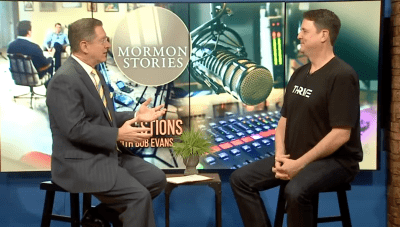
 John recently sat down with Bob Evans of Fox 13 News in Salt Lake City for his “3 Questions” segment, and we have put the full interview onto our feed for our listeners.
From Fox 13:
“It has been five years since Mormon Stories Podcast host John Dehlin was excommunicated from The Church of Jesus Christ of Latter-day Saints. It was a very difficult episode for him and his family, who also either left the church or are no longer active. The podcast began 15 years ago and has become a place where Latter-day Saints having a faith crisis can go for support and understanding. Now it has sparked a community of both former and current believers who look to Dehlin for camaraderie.”
Episode Transcript
Host: John Dehlin · Guest: Bob Evans
This transcript is machine-generated and lightly edited for readability. The audio is authoritative. Please excuse occasional errors in names and spelling.
Introduction and Origins of Mormon Stories Podcast
Bob Evans [00:00:00] Sa. John Dehlin Host of Mormon Stories Podcast thank you so much for being part of three questions.
John Dehlin [00:00:32] It's my pleasure. It's an honor.
Bob Evans [00:00:34] You were excommunicated from the Church of Jesus Christ of Latter Day Saints about five years ago. And at the time you said that you still consider yourself a Latter Day Saint. Where are you now in your faith journey? Do you still consider yourself a Latter Day Saint?
John Dehlin [00:00:52] During the time of my excommunication, it was still okay to use the term Mormon. And I'm guessing that what I said is I still consider myself Mormon. And I think that's still true. I've always loved the church. I had a very positive experience growing up in the church. I feel like so many positive qualities that make up me are associated with my upbringing in the church and I just love Mormons and I love the Mormon people. So. So in all those ways, I still consider myself very Mormon. I've still never tried alcohol, I've still never tried drugs. I'm faithful to my wife and I believe in being honest and optimistic. So I feel very Mormon. But my beliefs probably aren't orthodox. And in that way I'd be different than most mainstream Mormons.
Bob Evans [00:01:43] I'd say, how do your core beliefs now differ from what they were as you were growing up?
John Dehlin [00:01:51] I think growing up Mormon, there's a lot of focus on the past and on the future. So the past being our history and what's happened and doctrine and theology and then a real focus on heaven and the afterlife and trying to make it and the nature of heaven and God. And I would say the biggest change in my beliefs is that my core focus is on living the best life that I can right now and making the biggest difference that I can in the world today.
John Dehlin [00:02:25] And I used to know everything and now I feel like when it comes to cosmic things or existential things, I don't know very much. But I'm content to live in the present moment. And whereas before it was always like I got to get to the celestial kingdom, so I got to obey all the commandments, now if I do good or live cleanly, it's because I want to, not because I'm gunning for some position or that sort of thing. But I think I'm the most Mormon ex Mormon on the planet in terms of my behavior.
Bob Evans [00:03:01] Have you ever had a desire to reassociate with the church to become re baptized?
John Dehlin [00:03:07] So the way that that would have to happen, unfortunately, you know, someone who's excommunicated requires first presidency approval and we've seen just recently, some people reapply for membership and have that turned down. So I guess. I guess I don't have a lot of optimism that in 2020, the church would want to rescind my excommunication, you know, but. But there'd probably need to be a few changes before I. I'd be willing to do that, but I haven't closed that door.
Bob Evans [00:03:41] A few changes? What do you mean?
John Dehlin [00:03:45] I think the church has come a long way. There are a lot more. You know, when I. When I really struggled with the church, it was probably because I had learned all this history that I. That I wasn't taught that was true about the church. And the church tended to hide that and punish people who talked about it.
John Dehlin [00:04:04] In 2020, the church is far more open and honest about its history than it ever was. So that's no longer a problem for me. But I think the church still struggles to find a place for unorthodox believers, people who maybe don't believe everything the church teaches, literally. People who maybe can't say it's the one true church or the only true church, or who maybe don't view the Book of Mormon as a historical document, but still find metaphorical or mythical value. I think the church is still struggling to find a place for people like that. I would want to make sure the church was okay with someone like that.
John Dehlin [00:04:44] And then I would want, you know, I have LGBTQ family members who probably would feel betrayed if I just jumped back in and became a Mormon again. I would need to make sure that the church was a safe place for them so that they didn't feel betrayed by my reaffiliation.
John Dehlin [00:05:06] You know, I would love to see the church maybe put women on a bit more of an equal status. You know, there's some things I'd like to change. I'd like to see the church stop excommunicating people, but I still love so much about the church, so that's true.
John Dehlin [00:05:23] Why did you start Mormon stories podcast in 2001? When I went through my own faith crisis, the Internet was just kind of gaining steam, but there was nothing to support someone who. A Mormon who's going through a faith crisis. And I saw so many people suffering with depression, with anxiety, marital distress, even suicidality over going through kind of a dissolution of everything they believed and held dear.
John Dehlin [00:05:57] So after I realized a few years beyond that you're absolutely alone when you go through a faith crisis, and that the church has no resources for people who go through that, I started Mormon Stories to be a support to people who are going through a faith crisis or who had important things to talk about, but that they couldn't talk about them at church. So if they're gay or lesbian, if they're a feminist, if they have concerns about the church's history with race or questions about its doctrine or theology, in 2004, you couldn't talk openly about that stuff, and the church wasn't open about that stuff, and the church excommunicated you if you talk too openly about it.
John Dehlin [00:06:35] So I started Mormon Stories naively with this idea that if we just talk openly about things, we can figure it all out and stay faithful, but also well informed. And the thing that makes me most happy is when somebody says, I no longer feel so alone. I no longer feel like I'm crazy. And mostly I can find friends and community to go through this journey with. And so that's why I do Mormon Stories is to help people in that situation.
Bob Evans [00:07:06] At the time of your excommunication, your local leaders accused you of. Of apostasy and of trying to draw people away from the church. Is that what you were trying to do? Is that what you're trying to do with the podcast?
John Dehlin [00:07:23] There's never been truth to that claim. I've always interviewed faithful Mormons on Mormon Stories. Even last week I interviewed a faithful Mormon, someone who resigned from the church but then came back. It's a great interview, and I've always been able to produce for my priesthood leaders reams of letters from Mormons who actually felt that they were able to stay in the church because of Mormon stories. It helped them feel like they had a place. So I've never been trying to pull people out of the church.
John Dehlin [00:07:54] I have had as a goal to talk openly about problems in the church and to educate Mormons about the factual history. And sometimes becoming aware of factual church history does lead people out of the church. But that's not my fault, and that's never been my intent.
John Dehlin [00:08:13] And to this day, I have dear, close friends who are in the church. My parents are still in the church, my sister's still in the church, and my in laws are in the church. And I'm very happy and I'm happy for them. If someone can find this life is so hard, so crazy, so difficult, that if somebody can find healing and community, and in this crazy world, I'm for it in or out of the church. So there's no truth to that.
Bob Evans [00:08:40] On the Sunday night that you were excommunicated, you said you needed to Find a quote, new truth, new community, new growth and new joy. Have you been able to do that since you were excommunicated five years ago? And what does that look like?
John Dehlin [00:08:54] Yeah, yeah, I have been able to find that there are tens of thousands. You know, one of the great things about Utah is that it's got so many Mormons, but it's got so many post Mormons. And so there's so many amazing post Mormons in Utah who are thoughtful and kind and loving and sophisticated and intelligent. So my wife Margi and I have found great families that we hang out with, that we connect with, that we talk about family and relationships and even spiritual things with. So that's been great. The Thrive communities that I've started with some friends have really started to spread that. So there's 50 thrive communities now all over the country.
Bob Evans [00:09:38] Explain what Thrive is.
John Dehlin [00:09:39] Thrive is just simply a community of post Mormons looking to heal and grow. So it's not about. It's explicitly not about criticizing the church, not about even talking about the church, not about tearing the church down. It's basically saying if you're going through a faith crisis and you need support, you can find a local Thrive group to help you. And if you want to heal and grow beyond orthodox Mormonism, find a Thrive group. And we'll do book clubs and we'll do get togethers and just have a social engagement that makes you happy and healthy. Mormons of all people know how important community is. And I loved my association with the Mormon community.
John Dehlin [00:10:21] I miss it sometimes. I wish I could go back. But post Mormons deserve community too, and they're healthier when they have it. So thrive is simply a way for post Mormons to find the types of friendships and community that they enjoyed as Mormons.
Navigating Faith Crisis and Excommunication
Bob Evans [00:10:37] When someone has a faith crisis, and because you've had so much experience, not only with your own, but with others who have had faith crises. When they go through a faith crisis and the tenants, the Church of Jesus Christ of Latter Day Saints no longer work for them, they don't feel like they work for them any longer. Describe what that does psychologically, emotionally, spiritually, to someone who goes through that, what is it that they are feeling? Because I would imagine that active Latter Day Saints are sitting there going, oh, I couldn't imagine that being married to my wife forever or having my children as part of our family forever, that kind of thing. What happens when you go through a crisis and those tenants no longer work?
John Dehlin [00:11:29] The best way I can describe it is imagine if a house had Feelings. And then imagine if the entire foundation of the house was pulled out from under the house. How would the house feel? The house would feel terrified.
John Dehlin [00:11:43] The house would feel like everything that had been built upon had crumbled. And that's how it is. When you lose your orthodox faith in Mormonism, you lose your identity. You lose your sense of meaning and purpose in the world. You can lose your morality, you can lose your source for spirituality. You can lose your friends, you can lose your community, you can lose your marriage. And just the way that you make sense of everything, not to mention the way you make sense of death in the afterlife. So it's pretty much like losing everything that matters to you. And I'm fortunate to have been able to study this as a psychology PhD.
John Dehlin [00:12:22] And what I've learned is that faith crisis is closely associated with depression, anxiety, divorce, and even suicidality. It's a very serious thing. People don't understand how serious it is because we're uncomfortable talking about it, but it basically feels like you've lost everything, and you're, as a naked adult child, having to rebuild your identity, your community and morality, your spirituality, your sense of the world and your friends and family, and it's just completely disorienting and scary.
John Dehlin [00:12:58] And so since the church hasn't really been able to help people, these people, that's what we do in Mormon stories with the Open Stories foundation with Thrive is we say, hey, these people are still loved. If you believe in God, God still loves these people. They deserve health and happiness and community. So we'll pick up. We'll gladly pick up that baton and help those who need it.
Bob Evans [00:13:19] There must have come a time when you realize that when you look back, you thought you realized, okay, well, this is where my faith crisis began. If you could go back and make the small or maybe even big decisions that. That led you down that path to a faith crisis. If you could go back and make a different decision that didn't lead you through everything that you just described to us, would you do that?
John Dehlin [00:13:50] Definitely not. I'm very, very. I'm very, very happy with where I am today and with the path I've gone down. It has been super hard to. To be publicly excommunicated, to lose friends, to lose family, to carry kind of public shaming about that. But everything I learned was factual and true, and in so many ways, I've been vindicated.
John Dehlin [00:14:14] The things that concerned me back in 2001 or 2005, the way the church treated LGBT people, the way that the church taught about the way the church taught me about race and racism, the things that they hid about the church's history. If you Fast forward to 2020, the church has acknowledged all of those problems and they've even started trying to fix it. So I almost feel like I was just a little bit early and maybe we helped kind of shine a light on these issues to the point where the church would actually start feeling like they needed to address the changes. And in that way, I'm even proud.
John Dehlin [00:14:50] I'm proud that I've been a small part of helping the church improve because I still love the church and its people and I could not have even helped the church improve if I hadn't have gone down this road. So I'm healthier. I've helped a lot of other people in their lives and I feel like I've helped the church. So how could I dial that back? I just, I just, I wouldn't want to undo all the good that, that we've done, honestly.
Bob Evans [00:15:15] Tell me how you have been treated since your excommunication, both socially, emotionally, spiritually. How have your friends and family treated you and your family?
John Dehlin [00:15:28] When we lived in Cache Valley, we had lived in this tight knit Mormon community in North Logan for 12 years and we pretty much lost all those friends. And it's not that they were, were bad people, it's just that when the church brands you as an apostate, everybody's afraid of you.
John Dehlin [00:15:47] And so most of those people just disappeared. It was like we were in a ghost town. And we stayed there a couple more years, but that just became unhealthy for my family to just constantly live amongst people that used to care about you and that just kind of erased you from their memories.
John Dehlin [00:16:05] So we moved to Hollywood Holiday in Salt Lake City and we've loved it. We've made so many dear friends here. We do have LDS neighbors. They've treated us very kindly and. But it is very jarring. You know, when I got excommunicated, my number two child was Laurel's president. My number three child was Beehive's president. You know, we were in it. And so it's really disorienting to your whole family and not only to have them ripped out of their community, but to have them be treated as bad and then to have to recreate our infrastructure as a family and create new friends and new friendships. I'm not going to lie.
John Dehlin [00:16:50] I think it's been really brutal and it's an awful thing for a family to go through. Excommunication is Awful enough. A public excommunication where you're branded an evil apostate when you're literally trying to help the church. That's super hard. And I think all my family now would say they're glad we did it, but it was painful, and at times it feels very dark. It feels very alone. It feels very scary. But it's been amazing too. So it's just one of those very difficult things that has a lot of blessings associated with it.
Bob Evans [00:17:24] I take it that your wife and your children follow you out of the church as well.
John Dehlin [00:17:28] We were very careful with our children to let them have their own journey. So we didn't say leave the church. The church is bad. In fact, there was a part of me that my heart that probably still wanted my kids to stay active and faithful just because I had such a great experience growing up in the church. My wife attended my excommunication with me, and it was such a horrific experience for her that she resigned the day after I was excommunicated, sort of just because of how bad that experience was. My kids have. Have not remained active in the church.
John Dehlin [00:18:04] I have close lg. Close family members that are LGBT and including within my own family. And so I don't think that at least those members of the family feel very welcome right now at church. And then the others just. It just wasn't working. But we still look upon the church and Mormons with a lot of love and affection.
Bob Evans [00:18:31] The Church of Jesus Christ of Latter Day Saints teaches that faith is to hope for things which are not seen but which are true. How would you define faith, and how does it manifest itself in your life?
John Dehlin [00:18:47] I still consider myself a person of faith in this way. There are all sorts of things that I do to try and make the world a better place, but you never know if you're actually making the world a better place, or even if you do make the world a better place for a short amount of time, will it matter in the long run?
John Dehlin [00:19:04] And for me, faith motivates all my activities. It's just basically saying I'm not sure that I'm doing the right thing. I'm not sure that I'm helping people in the long run. Or even if I know I'm helping people, I'm not sure It'll matter in 100 or 500 years. But I have faith that it somehow will make a difference. And I've traded certainty about God in an afterlife for a real focus on the here and now.
John Dehlin [00:19:30] But I still. Even if there isn't a God or an afterlife. I still have faith and hope in humanity that some somehow we're building towards something more important. And if there is a God and, or an afterlife, that's kind of a bonus to me.
John Dehlin [00:19:46] But I'm finding life to be so satisfying now that can be meaningful to me, whether or not any of those other things are knowable.
Spiritual Experiences and Religious Feelings
Bob Evans [00:19:57] Active Latter Day Saints watching and listening to this interview will to know about the spiritual witnesses that they, and many of the guests on your podcast say they have had about the fundamental tenets of the Church of Jesus Christ of Latter Day Saints, namely the divinity of Jesus Christ, the truthfulness of the Book of Mormon, and those kinds of things. When they say that I've had a spiritual witness that, that these things are true, what do you say to them?
John Dehlin [00:20:34] My personal belief is that everyone's spiritual experiences are sacred. And so in the tens of thousands of people that I've talked to about their faith crises, almost all of them say, but I've had these spiritual experiences I don't know what to do with. My response is always, hey, those are sacred.
John Dehlin [00:20:54] Their meaning for you may change over time, but you don't have to throw out those experiences. And if I ever meet a missionary or a faithful Mormon that comes to me and bears their testimony, I have no interest in trying to argue with them or dissuade them or pollute or reinterpret the experiences that they hold most dear. I just say, man, life has so many hard moments. If you've got some special moments that mean a lot to you, you hold onto them. Now there are people that genuinely feel like they can't both leave the church and still believe the same way that they did. And so they have to make sense of that.
John Dehlin [00:21:29] And everybody's got to do that work for themselves. And there's all sorts of explanations for why people believe things. Very sincere believers flew airplanes into the Twin Towers, and I think they were very devout in their beliefs. Now, did God tell them to do that? It's hard to say, but for me,
Bob Evans [00:21:48] the most hard to imagine.
John Dehlin [00:21:49] It's hard to imagine, but for me, it's never been important for me to try and tear people's faith down or take it away from them. I think that might be evil to have that intent. I still believe in doing wrong and trying to take away something that's sacred to somebody. I view that as wrong.
Bob Evans [00:22:08] Did you ever have that kind of an experience in regard to Jesus Christ or the Book of Mormon or the power and authority of the priesthood? Did you ever Have a spiritual experience that would lead you to say, I know these things are true.
John Dehlin [00:22:24] So I went to Early Morning seminary in Texas, Kitty, Texas, as a devout Mormon. And I had a very orthodox, kind of Bruce Armaconkie, literalistic seminary teacher. And he taught me that miracles were real and that you could pray and that God would answer in very literal ways. So I remember going to the Mesa Temple in Arizona, my very first time, and praying to, like, see an angel or to see the spirit of the person I was getting baptized for. And I fasted and I was worthy and I had. And nothing happened. And I remember later, when I was about 16, I read the Book of Mormon cover to cover.
John Dehlin [00:22:58] I was faithful and committed and seminary president. And I prayed. I followed Moroni's promise to get that answer. And. And it didn't come. And I actually remember praying, not getting an answer, getting up and then getting back down on my knees and praying again, thinking. And it never came the way that I was taught it would come. Now, did I have very meaningful, moving experiences growing up Mormon? Absolutely. I served a mission. I was branch president twice.
John Dehlin [00:23:31] And I remember, like, certain general conferences where I just felt this overwhelming feeling of inspiration and energy. And at the time, I associated that with receiving a witness that the church was true. Now, I probably look at it differently because I've realized that Baptists and Lutherans and Methodists and Catholics and Jews and even atheists have incredibly positive, uplifting experiences that are very emotional. And sometimes I think it's the people around us or the conditioning that influences how we interpret those experiences. I still hold them as special and sacred.
John Dehlin [00:24:12] But now maybe that experience doesn't mean that the Mormon Church is true. It just means that whatever I was learning at the time or whatever I was experiencing at the time was a meaningful, positive thing. But to have these incredible feelings and to then interpret well, that means the Mormon Church is the one and only true church on the face of the earth. For me, I realized that that might have been a leap to draw that conclusion, but that was kind of the conclusion I drew at the time. And that's. Again, I don't like to disassemble those meaningful experiences, but I do think that feelings are more complicated than sometimes we treat them within a church context.
Bob Evans [00:24:51] You now have your PhD in psychology?
John Dehlin [00:24:53] I do.
Bob Evans [00:24:54] To what degree are religious feelings, feelings of the spirit? To what degree does psychology say, well, that's just a chemical reaction in your brain or some kind of chemical or hormonal reaction in your body that is telling you or making you feel that way?
John Dehlin [00:25:16] That's a great question. So I really appreciate that the ethical code within the field of psychology teaches psychologists what I just told you, which is that people's closely held sacred religious experiences are to be treated as sacred. And it's never a psychologist's job to try and mess with people's sacred beliefs. No. Or worse, you could lose your license for trying to take people's faith away from them. And I've just never been into that now, having read some books like Mistakes Were Made, but not by Me or the Demon Hunted World by Carl Sagan. There is a neuroscience to brain chemistry. And there are certain parts of the brain where if they're stimulated, things like spiritual experiences happen.
John Dehlin [00:26:01] And the frontal lobe is the part that I'm aware of. If you get hit in the brain in just the right way, you're going to have kind of an epiphany of a spiritual experience. And people have it and believe in UFOs, and people have it and believe in, you know, all sorts of things. And so it would be really hard. And I've never met anyone who can really tease out the difference between neurochemistry and a spiritual experience. And sometimes LDS people that I've talked to have said no. There's a real difference between feeling positive emotion and feeling the Holy Ghost. But when I was in the church, I couldn't tell the difference between being inspired by a movie that I saw and the feeling that I got at General Conference.
John Dehlin [00:26:43] The content may have been slightly different, but that feeling of emotion and uplift was very similar. And I think that's just a universal experience that does generate in the brain. But having said that, I don't think we know everything. So I have some humility about my conclusions and I'm open to further information as it comes, but I think the brain is much more powerful than we give it credit for. And I mean, the wiring and the chemicals in the brain, it's a very powerful thing.
Bob Evans [00:27:13] Yeah, well, we know of it now. I mean, certainly we'll know more in the future about that very kind of thing. Considering all of the controversy that surrounds some of the policies and procedures and even doctrines of the Church of Jesus Christ of Latter Day Saints, the social furor that gets going over those kinds of things. Considering that, and then juxtaposing it with all of the good that the church does in not only the world, but in the individual lives of its members, is there not a point at which you go, you know, for all of the issues that I have with this church, I think this, the good things that are coming out of it and my involvement in it is worth putting up with all of that other stuff
John Dehlin [00:28:11] for me or just for you?
Bob Evans [00:28:13] For you and mankind?
John Dehlin [00:28:15] Well, my situation is different because the church kicked me out and I didn't want to. I didn't necessarily want to leave it, so. So I don't have maybe the same option that other people would have. But generally speaking, I make ex Mormons sometimes really mad when I basically take the position that I believe that the Mormon Church, warts and all, still does a lot of good for humanity and can still be really positive for people if they have the right leadership and in the right time and if they have the right traits. So, obviously, if someone's gay or lesbian or transgender, I'm not going to say, go be Mormon.
John Dehlin [00:28:53] You'll have a great experience, right? And if somebody's a feminist and they really believe, you know, in education and that a mother should work outside the home, I'm not going to say Mormonism is your place, you know, but for so many people, I see the church providing them with community and meaning and purpose and spirituality and connection and a thriving family network. And so I am the first to call out the church when it makes mistakes or hurts people. But I still believe that the church is a net positive for many, many people who are in it. And I applaud and celebrate that. They love it and enjoy it.
John Dehlin [00:29:34] And most importantly, in 2020, when you see. And again, post Mormons may be angry at me for saying this. When you see the incredibly positive steps the church has made in the past five or 10 years, whether it's being more open about its history, the Joseph Smith Papers Project, you know, promoting rough stone rolling, the gospel topics essays that it's come out with, to rolling back the November 15 policy with LGBT members, even that Utah is now willing to support the banning of conversion therapy for youth.
John Dehlin [00:30:09] The church is renouncing its past racist policies regarding blacks and race. You know, it's still in the Book of Mormon, so there's still. I don't know how the church is going to deal with that, but how can you not say that? The church has made incredible progress in the past 10 years, and if it's able to continue into the next 10 years with the same rate of positive change that it's made in the past 10 years, I think. I think the future can be really bright for the Mormon Church and the Mormon people.
Bob Evans [00:30:37] Look into your crystal ball. What do you see as the future of the Mormon Stories podcast and your involvement in this new community in which you find yourself.
John Dehlin [00:30:49] So we've been doing Mormon stories now for 15 years. I think it's the longest running podcast, one of the longest running podcasts in the world ever, of any type. And we just keep doing the same thing. We cover current events, we interview people going through a faith transition. Something that's interesting is it turns out that only about a third of the people in the world who are baptized LDS remain active in the church. So even though a lot of so Mormon stories will always cover people in the church, but it often covers people who are struggling with the church or leaving. But the fact is that's the average LDS experience is to join the church, have some struggles with it, and sometimes to leave it.
John Dehlin [00:31:31] So we'll always cover people's faith journey, but we'll always try and have a good balance and to be fair. And most importantly, the focus on Mormon stories going forward is about healing and growth. How do we heal as a people, how do we heal as progressive and post Mormons, how do we help the church heal and how do we grow and move beyond it? Because no one's served by constant attacking, constant negativity. It's bad for the church, it's bad for Mormons, Latter Day Saints, it's bad for post Mormons to just live in constant criticism and negativity. And most of my post Mormon friends have just gone on to live happy, healthy lives.
John Dehlin [00:32:08] But sometimes you can get sucked into this controversy and really get trapped in it. And I never want to symbolize sort of like trapped in negativity and criticism. So part of the THRIVE initiative and part of the mission of Mormon stories going forward is really just how do we make sense of the world, how do we form beautiful community? How do we build bridges between believers and non believers, how do we keep families together? How do we keep families from separating? How do we help the church improve? And then how do we form communities outside of Mormonism that promote positive, healthy, pro family behaviors? And that's all I want to be associated with. And I really appreciate the chance to kind of share a little bit of my world with you.
Bob Evans [00:32:59] Well, John Dehlin, host of Mormon Stories Podcast, thank you so much for being part of three questions.
John Dehlin [00:33:06] My pleasure. Thanks, Bob.
Transcript © 2026 John P. Dehlin. All rights reserved. Brief quotations are welcome with attribution and a link to mormonstories.org; all other use requires written permission.
Audio

10 Responses
Great job, John. I’m not from Utah, so I’m not familiar with the host, but he sure seemed TBM, as he could not/would not say “Mormon” during the interview. He has been schooled very well. Anyway, you came off as very authentic, cordial, and informative.
I think LDS growth rates have been declining basically because of a continued cultural shift away from structured religious experience and toward extremely subjective personal religious experience. This is affecting other faiths besides LDS as well.
Great job John. I applaud Fox 13 for being open about having you on, even though I think Bob Evans might just be a TBM. It speaks highly of him.
Is it just me or did he REALLY want to emphasize you were excommunicated? That, and the full and authorized name of the (NOT Mormon) church. I’ll give him credit for asking questions that allowed you to open up a bit on things he looked a little uncomfortable hearing. I thought you came off great, John. Well done.
I agree with DB…good segment and representative of how many of us feel. With warts and all, even if I chose not to believe the entire Mormon story, I applaud the good the church can do even with knowing some of the Skeletons being exposed. The whole gospel of christ is about repentance and doing better…right!
Non-Mormon here. Members of the church blame everything on Jesus and God with what the Mormon church says and does… do NOT blame God and Jesus for the decisions of these men. …if Joseph Smith is the bar that you measure everyone else by, oh God help you all…. he was a ConMan, a pedophile….. get your heads out of the sand and just research it’s all there. I think nonmembers know more about Mormonism than you all that are in the church, born in the covenant, all this other jazz ….wake up, do research. A lot of you have college degrees and are supposed to be smart people for heaven sake ….there’s no way in the world that you can justify a ConMan telling Emma that an Angel’s is going to smite him with a sword if he can’t take other women, this ridiculous…. wake up people ….he drank coffee, alcohol, smoked. I blame all of you for being so shadowed and naïve. This is definitely a cult by definition, no wonder from the beginning you were told not to read anything that wasn’t Mormon, because they don’t want you to find out the freaking truth… so you will be told to tithe,tithe,tithe so the fat cats in Salt Lake can hoard up money. I don’t feel sorry for any of you ….quit being so SHEEPISH! I have attended your sacrament meetings and everyone gets up and chants the same cultish thing…. I know the church is true, I know Joseph was a prophet… well if you have to keep repeating it and chanting it week to week so it will brainwash people, what does that tell you !!!!!!!!
Hey Karen, Don’t sugar coat how much you hate the church,
Hi John,
Do you happen to have any thrive groups in Brazil? I currently live in Curitiba.
Great job John. You represent the rest of us with such intelligent grace and eloquence that we all wish we had. You are such an effective and honest voice. So comforting to know you’re there.
Why why you have Bob Evans on tv???