
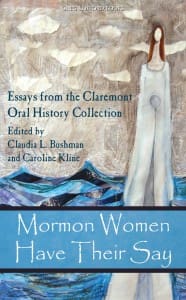
 In this podcast, Heather Olson Beal interviews three essayists who contributed to the book Mormon Women Have Their Say: Essays from the Claremont Oral History Collection: Caroline Kline (who also co-edited the book with Dr. Claudia Bushman), Anna Rolapp, and Elizabeth Mott. In this podcast, we discuss the Claremont Women’s Oral History Project in general and then discuss four essays in greater depth: Caroline’s essay on Mormon women’s conceptions of the self, Anna’s essay on Mormon women and California’s Proposition 8, Elizabeth’s essay on Mormon single women, and Caroline’s essay on Mormon women’s attitudes towards and feelings about patriarchy.
From amazon.com:
The Claremont Women’s Oral History Project has collected hundreds of interviews with Mormon women of various ages, experiences, and levels of activity. These interviews record the experiences of these women in their homes and family life, their church life, and their work life, in their roles as homemakers, students, missionaries, career women, single women, converts, and disaffected members. Their stories feed into and illuminate the broader narrative of LDS history and belief, filling in a large gap in Mormon history that has often neglected the lived experiences of women. This project preserves and perpetuates their voices and memories, allowing them to say share what has too often been left unspoken. The silent majority speaks in these records. This volume is the first to explore the riches of the collection in print. A group of young scholars and others have used the interviews to better understand what Mormonism means to these women and what women mean for Mormonism. They explore those interviews through the lenses of history, doctrine, mythology, feminist theory, personal experience, and current events to help us understand what these women have to say about their own faith and lives.
Other essays address important topics, such as fertility, motherhood, adversity, womanliness, callings, revelation, missions, agency, the Relief Society, and Heavenly Mother.
Please support Mormon Stories by purchasing the book through this link.
Episode Transcript
Guests: Anna Rolapp, Caroline Kline, Heather Olson Beal
This transcript is machine-generated and lightly edited for readability. The audio is authoritative. Please excuse occasional errors in names and spelling.
Introducing the Book and Its Contributors
Heather Olson Beal [00:00:00] 1, 2, 3.
Anna Rolapp [00:00:07] Mormon Stories Podcast is a production of the Open Stories Foundation.
Heather Olson Beal [00:00:11] All donations to Mormon Stories are fully
Anna Rolapp [00:00:13] tax deductible and go directly towards keeping
Heather Olson Beal [00:00:16] the podcast alive and towards building a community of support for Mormons like you.
Anna Rolapp [00:00:21] To support the podcast or to join
Heather Olson Beal [00:00:23] the community, please become a monthly subscriber today@mormonstories.org. hello, everybody, and welcome to another edition of Mormon Stories Book Club. I'm Heather Olson Beale, and I'm very excited to be here tonight with several women, two of whom I've never met until just a few minutes ago on Skype to discuss the book. Mormon Women have their essays from the Claremont Oral History Collection. So with us tonight are Caroline Klein, Anna Rollap. Is that right, Anna?
Anna Rolapp [00:00:57] That's correct.
Heather Olson Beal [00:00:58] Rolapp Rolapp, and Liz Mott, and they are all contributors. This is a series of essays that have to do with a big database or collection of oral histories of women, and I'm going to ask Caroline to do a better description of it than that. But Liz, Caroline and Anna each wrote a chapter or two and in the book. So we're going to talk a little bit about the project in general and then in more detail about each of their chapters. And I just want to thank each of them because I contacted Caroline months ago. I don't know how many. I thought about trying to find my first sent email, and then I decided not to because I thought it would be too shameful. It was a long time ago asking her if she would be willing to do this. And we've had several scheduled and rescheduled appointments to do this. So I'm excited that we're finally getting able to do it. So you guys take just a minute or two, each of you, and introduce yourselves a little bit to the Mormon Stories audience. Tell us who you are and what you do and where you're from and whatever you think is important. Anna, you want to start?
Guest [00:02:08] Sure.
Anna Rolapp [00:02:08] Since I'm a senior member of this group, I certainly will. As you said, my name is Anna Rollap. I actually grew up in northern Utah, but married in Colle before I finished my undergrad work and moved to Southern California, where I have lived for the last, oh, probably 35 years. My husband and I raised a family in the Los Angeles area, and I'm now working on a master's program at University of Nebraska in Lincoln, Distance learning program. So I've done most of it from home, but the program requires that I spend one semester on campus, so I'm doing that now. It is a textile history Program and my emphasis is quilt studies. Great program, very dynamic. My only complaint about the program is it takes time away from my quilting because it's just an academic study of quilting. So I'm a quilter. That's what I consider myself more than anything at this point in my life. And I like to make quilts that tell stories. Historic quilts is kind of my focus right now. And I'm moving from cotton into silks at the moment, so. So that's, I guess, in a nutshell who I am and what I do.
Heather Olson Beal [00:03:18] Wow. I've never even heard of that or thought of that. I'm always fascinated when I hear something and think. I didn't even know that was a thing. I didn't know you could get a graduate degree. And what did you say in quilt studies? Quilt studies.
Anna Rolapp [00:03:32] It's the only program in the world and it's built around a quilt museum, a fairly new quilt museum on campus that now has 4,000 quilts in it. So that's my playground.
Heather Olson Beal [00:03:42] Wow.
Anna Rolapp [00:03:43] Quite an exciting program.
Heather Olson Beal [00:03:44] Okay, that's really cool. So tell us a little bit about your Mormonism.
Voices From the Oral History Project
Anna Rolapp [00:03:51] I'm a pretty traditional Mormon with a very non traditional family. My husband and I decided we wanted to raise all of our kids in the church and they all said, no, thank you. Each of our children, as they left high school and approached college, left the church for various reasons. Probably the main reason was when our oldest son announced that he was gay at the age of 14 and experienced a fair amount of prejudice within the church, which was quite painful for us. And all of our family and the kids, all to various degrees, say that they left the church because of that. I think there are other reasons involved in it, but anyway, at this point I would only say that having a gay son has been the most wonderful blessing in my life. It has opened up my mind to a whole new culture, as it were, and has opened up and broadened the minds of all of our children and my husband as well. I got off on a tangent. I'm still an active member of the LDS Church. Okay, great.
Heather Olson Beal [00:04:53] Okay, Caroline, what about you?
Caroline Kline [00:04:56] My name is Caroline Klein. I was raised in a Mormon family headed by a widowed mother in Southern California. I decided to attend a women's college when I graduated from high school, which was absolutely formative in shaping my dedication to exploring women's issues. In 2007, I was a high school Latin teacher by day and a Mormon feminist blogger by night. I'm a co founder of the Mormon feminist blog, the Exponent but when I heard that Claudia was coming to Claremont Graduate University. And this is Claudia Bushman, which was an hour from where I was living, I quit my job and immediately enrolled to take classes with Claudia to study Mormon women. Two babies. And about five or six years later, I have finished my coursework for my PhD in religious studies. My main field is women's studies and religion, and I focus on Mormon feminist theology and Mormon feminist communities. I now have three children, seven and under, and I split my time between parenting and taking classes.
Heather Olson Beal [00:06:09] Wow. Okay.
Caroline Kline [00:06:11] Fascinating.
Heather Olson Beal [00:06:12] You quit your job to study under Claudia Bushman?
Caroline Kline [00:06:16] Yeah, I did. I decided that this was a once in a lifetime opportunity. And, you know, Mormon women's issues is my passion. I just, you know, gender issues is my passion, and I decided I just had to go for it.
Anna Rolapp [00:06:29] Wow.
Heather Olson Beal [00:06:30] Okay. That's really cool. All right, Liz.
Caroline Kline [00:06:34] Oh, do you want to hear a little bit about my Mormonism, too?
Guest [00:06:37] Yes, sorry.
Caroline Kline [00:06:42] You know, I am an active Mormon, though I sort of do it on my own terms. I am raising my children within the tradition. I'm currently a gospel doctrine teacher in my ward. But, you know, I'm also not ashamed to say that I pick, you know, I pick the things I love about Mormonism and I hold them up and I embrace them. And the things that are disturbing to me and distressing to me, I have learned to reject. So I am one of those Mormons that is sort of doing it on her own terms and doing it her way, and so far, it's working for me.
Anna Rolapp [00:07:27] Great. Heather, it should be mentioned that Carolyn is the co editor of the book.
Heather Olson Beal [00:07:32] You're right. You're right, Carolyn. With Claudia.
Anna Rolapp [00:07:35] With Claudia.
Caroline Kline [00:07:36] Yeah.
Heather Olson Beal [00:07:36] So, Caroline, that's pretty cool since you just told us that you quit your job to go do this thing with Claudia Bushman, and now you co edited a book with her.
Caroline Kline [00:07:44] Yeah, that was super awesome. I mean, this was her. And we'll talk more about this later, but this is totally her baby. You know, she had the vision, and. And she knew she wanted this book. And, you know, at certain points in the development of, you know, while we were getting these essays, you know, she was ready to give up because we weren't getting enough essays. And I was continually begging her, claudia, please, let's just do it. Please do it. And so she eventually brought me on as co editor, I think, because she knew how much I wanted this to turn into a book.
Heather Olson Beal [00:08:17] Great. Cool. Very cool. All right, Liz, give us your story.
Guest [00:08:23] Okay, my story. So I grew up in Chandler, Arizona, which is near Phoenix. And I'm actually home right now while I am studying for my qualifying exam, like Caroline and Anna, I'm also a student at Claremont Graduate University, and so I am working on a PhD in History of Christianity and religions of North America. My emphasis is North American religion, but more specifically, I'm interested in gender and history of the family in Christianity. And so that's what I'm studying. And hopefully in a few months, I will get the green light when I pass my exams to be able to start getting some teaching experience under my belt. So that's what I'm up to right now. And let's see, what else. As far as my Mormonism goes, I consider myself fairly traditional. I born and raised in the tradition, and definitely as I. I mean, I went to BYU for my bachelor's degree and master's degrees, and then when I. And then I went to Claremont for my doctorate. So I definitely do think that it has broadened my mind, and I have found a lot of, I guess, validation and all these things that I thought about but didn't know other people thought about and wondered about as well. And it's been very affirming to me and encouraging. So I really appreciate. Have appreciated being able to go to Claremont and study there.
Heather Olson Beal [00:10:10] Wow, you guys are an intimidating bunch.
Guest [00:10:15] Not really. Not really.
Heather Olson Beal [00:10:18] I'm like, oh, dang, I should have made more bullet points on my outline.
Caroline Kline [00:10:22] Okay, okay.
Heather Olson Beal [00:10:24] No, really cool. Very exciting. Okay, so let's just dive in now that we know a little bit about each of you, a very little bit. And Caroline talked to us about. I have to say that as I was reading the setup, the introduction of the book, I felt like the heavens were opening. I could hear the hallelujah chorus. I was like, oh, my gosh, this is the coolest thing that there's this whole project, this whole repository of interviews, and my dissertation had to do with a school in Baton Rouge, but I did a lot of interviews, and so I just was feeling like, oh, my gosh, this is the coolest thing, and why haven't I heard about it until now? Anyway? So it's very, very exciting, and it was a little bit humbling to me. I'll just say this. And most of the people who listen to Mormon stories know a lot about me because I've been on numerous Mormon stories podcasts and other places and stuff. So I'm sort of like the rogue woman among you, I guess, in terms of my Mormonism, because just gender issues. As we talked a little bit before we started the call, are A really, really, really tough issue for me in Mormonism. But I found myself throughout the book feeling like, sometimes like, oh, but why aren't they saying this? Or, but why aren't they talking about this? Or how could they be saying this? And then I would have to, like, take a deep breath and tell myself, oh, Heather, this isn't your story. These are the stories of all these other Mormon women. And there's such a wide range of viewpoints offered that that's really cool. I mean, it was neat to me and affirming for me to look and just be like, wow, there's so many different perspectives and so many different experiences, even though there are patterns, you know, but that was something that kind of happened to me throughout. I'd have to be like, oh, yeah, yeah. No, this is a wide range of Mormon women's experience. And in my. From my knowledge, and Carolyn or any of you guys can correct me if I'm wrong, I don't know that there is another thing out like this that is Mormon women's story, current, you know, contemporary Mormon women's stories, a collection of essays, of oral histories like this. I mean, is this unique?
Caroline Kline [00:12:37] I think it is. I mean, maybe the closest thing to it would be Nylan McBain's project, the Mormon Women Project, which I think is online, but it does not. I don't think it comes close to the depth and the breadth of the interview process, you know, that we engaged in, in doing these oral histories. I mean, each of these oral histories, maybe 30 pages, single spaced, typed, you know, it's a lot of stuff. So I. Yeah, and there are over 175 of them now of these oral histories. So it's this enormous amount of material that someday, you know, when scholars in the future want to know what Mormon women's lives were like in the 20th century, this will be the place they go to. I really think that this is going to be the collection that they go to. So it is. I think it is unique in its breadth and in its depth.
Heather Olson Beal [00:13:30] Yeah, that's just incredible. So I said too much. But I want you to tell me about the project. I was just excited to say how cool I thought it was.
Documenting Mormon Women's Stories
Guest [00:13:38] So tell us.
Heather Olson Beal [00:13:39] There's 175 interviews, but tell us kind of how it started and what that process was like so we can know a little bit more about it.
Caroline Kline [00:13:46] Well, this was the brainchild of Claudia Bushman.
Guest [00:13:50] She.
Caroline Kline [00:13:51] So plenty has been written about the institutional Mormon Church, its leaders, you know, changes in practice and so forth, which is all very important and interesting. There's even been some stuff written about Mormon women, usually elite women in the church, but usually in the 19th century. And so Claudia, what she wanted to do was capture the ideas and experiences of contemporary Mormon women, everyday women, non elite women. And like I said before, she saw this as being this treasure trove that future scholars will go to to learn about the lives of Mormon women in the 20th century. And she deliberately aimed for a very wide variety of women. I mean, the only requirements were, you know, femaleness and some kind of connection to the Mormon church, you know, self identifying as Mormon. And so we have excommunicated women, we have non active women, we have totally active women. We've got career women, you know, stay at home moms. We've got different ethnicities, though I wish we had more of that. And, you know, we've got women from different, you know, globally, from countries around the world. And so I think that the variety of women's voices that we have been able to put into this collection is one of its strengths. And I hope moving forward, we can make it even more broad.
Heather Olson Beal [00:15:17] Yeah, so that was my next question. So are these the people doing the interviews? These are graduate students in the program at Claremont?
Caroline Kline [00:15:25] You know, one core of interviewers were graduate students at Claremont Graduate University. Pretty much for every class Claudia taught, the final project, or one of the main projects was that they do one of these interviews and transcribe it. So she got a ton of grad students to do these interviews. But not only these grad students, also just Mormon women from the community, absolutely rallied behind Claudia and her vision and volunteered their services and went out and interviewed the most interesting Mormon women they knew. And then those women in turn interviewed their friends or family members. And so it was kind of a snowball process. Anna, who's on the call with us right now, she is one of these women from the Mormon community who heard about the project and just wanted to be involved.
Heather Olson Beal [00:16:19] Okay, so is it something. Where are there still efforts to interview people?
Caroline Kline [00:16:26] I think that it has majorly slowed down. I believe Claudia is still tromping forward and might still be doing a few, but in general, I think it is very much slowed down. I think we can still add to the collection if people are doing oral histories. The collection is still open and we can still add to it, but the main push is no longer there now that Claudia has gone back to the East Coast.
Heather Olson Beal [00:16:51] Okay, but say, like, if I wanted to interview somebody, could I. Or are there constraints that would make it so that Just anybody couldn't do an interview.
Caroline Kline [00:16:58] No, you could totally do it. I would send you a page. We have like a one page, like a one sheet of questions, like maybe 30 questions, very broad questions. And that's what every single one of us used to base our interviews off of. And so we would just email that to you. And then if you could just go down and talk to these women and kind of go through a lot of these questions and then transcribe it, that would be the process we would love to add to the collection.
Heather Olson Beal [00:17:23] Wow. Very cool. Okay, so, Anna, can you tell us a little bit about how that Caroline said you just heard about it through word of mouth, I guess, and decided you wanted in?
Anna Rolapp [00:17:34] Yes. I wasn't considering studying at Claremont. I didn't know that Claudia was there, though. I had been actually a financial supporter of getting the Mormon studies program started at Claremont. Several years ago. I heard about the oral history program through my sister in law in Orange County, California. Louise Jones got involved with some friends of hers that had heard about it. So I contacted Claudia to see if I could participate in the oral history project, and she told me about the classes that she was teaching. Well, I had been a fan of Claudia's for 30 years. I'm one of those. I'm in my mid-50s. But 30 years ago, I was reading everything that just a handful of female Mormon scholars were writing on LDS Church history. And I just couldn't get enough of it. And of course, Claudia was at the forefront of that movement. So I decided to take her two classes and ended up getting published twice, which was so exciting. She just teaches these dynamic classes and loved the oral history project. I think I probably did six or seven of the oral histories in the project. But, you know, when I wrote my paper, there were less than 130 oral histories that I had to work with. But now that there are 175, I'm wondering if Carolyn would consider doing a second volume of the book where we could look at a broader group of oral histories. You know, of course.
Caroline Kline [00:18:58] No, that is a great idea. And I think maybe in five years, especially if we have snowballed this project even further, which I hope happens, I think it would be fantastic to do, yes, a follow up and gather a whole new crop of essays and see what else we can say about them about these oral histories.
Anna Rolapp [00:19:14] Seems like the goal was to have 200 essays in the collection. So we still got a little ways to go. And I have dozens of women that I would love to interview. And you all do you know, we're just surrounded by the most interesting and normal women that have the most amazing stories to tell. So a lot more to do.
Heather Olson Beal [00:19:34] Yeah, it's a great, it's a treasure. Liz, what about you? How did you get involved in this?
Guest [00:19:41] So when I was thinking about going to Claremont for my graduate degree, I gotten my acceptance letter and I flew out to California to check out the program and it was actually that weekend that also Claudia and Caroline were putting on, I think it was Sunstone west and they were putting on presentation of some of their essays about based on the oral histories that they collected so far. So I was able, that weekend that I was there I was able to sit in on some classes and also I went to hear the presentations on the oral history collection and it was one of the things that got me interested in, helped me make the decision that I was going to attend at attend school there. So I, the following year, fall when I started, actually started coursework then I took a class from Claudia and like Caroline said it was one of the, one of the requirements for the course was to contribute to the collection. So I did a few interviews and transcribed the transcribe them for that class and I took a class from Claudia both semesters that year. That first year I was there, it was the Bushman's last year at Claremont. So I got there in the nick of time. Ok, great.
Anna Rolapp [00:21:01] We're all Claudia groupies. Is that obvious?
Heather Olson Beal [00:21:03] I know, I love it. You guys are like Claudia, Claudia. You're on a first name basis. That's awesome. No, that's really cool. Very exciting. Okay, so let's dig into the book a little bit. I just wanted to start by saying that the book is organized into three, three parts. Part one is called Life Cycle and talks about self, fertility, singlehood, motherhood and adversity. Part two, and we don't have anybody on the call that wrote one of these, but it's called Life as a Latter Day Saint. And those chapters are called Womanliness, Callings, Revelation and Missions. And then part three, which is where Anna's chapter and one of Caroline's chapters come from or are in. It's called Relationships with the Institutional Church. And there's a chapter on agency, Patriarchy, the Relief Society, Heavenly Mother and California's Proposition 8. So a really wide range of topics. So we're going to start tonight and we're going to talk about Caroline's first chapter that is called Self and Other. Caroline, I wanted us to read, either you or I to read the little part at the beginning that has Carolyn Pearson's little snippet of her poem in it. Do you want me to do that or would you like to do it?
Caroline Kline [00:22:24] Oh, you go ahead.
Heather Olson Beal [00:22:25] Okay, I'm just going to read the first paragraph. In 1975, Mormon poet Carolyn Pearson published a poem entitled Millie's Mother's Red Dress. I just want to interject, this is not in Caroline's chapter that my mom had this book growing up and then I remember reading it as a teenager and being just really, I mean that it really, really, really, really struck me. In this poem, she describes a woman whose self sacrifice and self abnegation were so extreme that she ul taught her family that a woman doesn't even exist except to give. As she lies dying, she tells her daughter Millie. This is from the poem. I always thought that a good woman never takes her turn, that she's just for doing for somebody else. Always keep everybody else's wants tended and make sure yours are at the bottom of the heap. Oh, Millie, Millie, it was no good for you, for him. Don't you see I did the worst of wrongs. I asked nothing for me. Her last words to her daughter Millie are, do me the honor, Millie, of not following in my footsteps. Promise me that. So this essay talks about Mormon women's conception of self and sort of the degree of self sacrifice or self abnegation that some Mormon women experience, I guess. Is that a fair recap, Caroline?
Caroline Kline [00:23:57] Yeah, I wanted to see how do they conceive of themselves and their responsibilities, you know, to themselves and to others. And do they engage in. Yeah, like a self obliterating sort of self sacrifice mentality, or do they find other ways to think about themselves and their choices and their relationships with other people?
Heather Olson Beal [00:24:18] And you found all of the above, right? A wide range.
Caroline Kline [00:24:23] I did find a wide range, though, happily, the self sacrificing dynamic that's being highlighted in this Carolyn Pearson poem. I did find snippets of that, but luckily I would say dominantly women did not exist in that mentality. Maybe women did for some amount of time, but always they found a way out of it. There was always in their stories a trajectory out of this kind of self sacrificing mode where they were just disappearing as people.
Heather Olson Beal [00:25:01] That's great. So tell us, you're going to have to sort of speak to a layperson's audience a little bit, but I wanted you to try to summarize the. You talk about two feminist scholars and sort of two paradigms that they talk about and how those fit or don't fit within what you found in the interview. So can you kind of summarize that for us?
Self-Sacrifice as a Theme in Women's Lives
Caroline Kline [00:25:22] Yeah, sure, Yeah, I kind of. As my theoretical frame in this essay, I was bouncing off of a couple of scholars. One is named Valerie Saving, and she wrote this extremely important article in 1960. So this is extremely early in the women's. I mean, the women's movement. I don't even think it really existed at this point. I mean, it is very, very early in the history of women's studies. But she had this idea. Well, she talked about this. Traditional Christianity had posited that mankind's greatest sin was selfishness and pride. Valerie Saving comes along in 1960 and says, wait a second, that may be man's greatest sin, but that is not woman's or women's greatest sin. In fact, I think women greatest sin is the opposite. It is a tendency to self sacrifice to such a degree that you disappear into nothingness. It's like she saw this tendency to self obliterate, to give and give and give until nothing is left. So that was Valerie Savings contention that women are particularly prone to the sin of extreme self sacrifice. And so I was using that as one of the kind of ideas I was bouncing off of. Now another person comes along later by the name of Sarah Hoagland, and she says, you know what? I don't really like this framework. I don't like the way we're opposing selfless versus selfish. That's not the right lens. When we think about our lives and our relationships, why are we assuming that our needs are opposed to other's needs? Why am I assuming that if I fulfill this course that nourishes me, I'm automatically harming someone else? And so she says, let's just throw this whole thing out and instead look at it this way. Every action we take, every choice we make is an opportunity to create, you know, to create relationships, to create whatever, you know, these are our choices, our opportunities for creation. It is not self sacrifice, it is not selfishness. Whatever we choose. Whatever we choose. Stay at home, mom, becoming a lawyer, whatever, you know, helping our friend fix furniture, whatever it is, these are choices that have meaning in them. And let's find that meaning in these choices. So these were the two kind of scholars I was bouncing off of as I was looking at Mormon women's lives and the way they talked about their choices and their experiences.
Heather Olson Beal [00:28:07] Okay, that's great. So tell us a little bit then about what you found as you were digging through this huge pile of interview Data. In terms of those perspectives, did you say that you found more that fit that more extreme self sacrifice perspective than the other?
Caroline Kline [00:28:27] The other, yeah. I did not find as many instances of total self obliterating though there were little moments that shone through in some women's lives. And maybe I can like read little snippets out of a couple of these women's oral histories that highlight this. One woman who got married in the, in the 1950s said this, you know, after, when she got married, she said I was living the life I had always been told to look forward to and yet I had this sense that I was disappearing. I had felt that upon marriage a woman should give up her life and become part of her husband's life. They were to share everything, spend time together. I was willing to give up my own interests in life which were not that great. But I found that my husband had little interest in sharing his life. He had no time for me. He was plainly bored by our occasional Sunday outings. We had little to discuss. I began to feel that I only existed in his mind and that he very seldom thought about me. I went to an occasional student party with him and I found myself completely ignored, looked through. Although that would not have happened when I myself was a single student. Even at church, I felt that I had lost status by becoming a married woman instead of a single student. What to do? I did a lot of thrashing around. What I eventually did was go back to school. These classes helped me a lot as they gave me something to think about, books to read, places to go. I was much more cheerful. But I still spent a lot of time crying. And so I thought that was a perfect anecdote that sort of bounced off of savings ideas of a woman feeling like she's disappearing, she's self obliterating, she's trying to meld her existence into her husband's. Her husband, she doesn't really want her there. And the way she finds to deal with it is to go to school and take classes. And so like I said, there is this trajectory out of the self sacrificing, self obliterating mind frame and towards something healthier. And then I found a couple of other women talk about experiences where they saw. Maybe one woman saw women around her being really upset by some instructions from church leaders in the 1980s about kind of quitting jobs and staying home and not doing anything else and just, you know, home, home, home. And this woman was really upset when she saw these women around her crying and quitting their jobs and you know, really, really changing the lives they had been leading, which had been making them happy. And she actually writes to the General Relief Society president and calls her to account for these messages and says, what is going on here? And she has a lengthy conversation with the Relief Study general president and forces this General Relief Society president to kind of rethink some of these messages that had been promulgated at this particular meeting. And so I just loved this moment of a woman kind of shepherding these other women out of a kind of self sacrificing mind frame and saying, look, this isn't healthy, like we need to fix this. And actually calling the General Relief Study President to account for those, you know, what she found, harmful messages.
Heather Olson Beal [00:31:37] Yeah, that's a great. That's a great story. When I was reading that part, I actually wrote in the margin and said, but now this isn't allowed because we have this, you know, it's a policy now where if you write a letter, although maybe not to the Relief Society president, if you write a letter to one of the church leaders, they're supposed to route it back to your stake president or to your bishop, I think.
Caroline Kline [00:31:57] Yeah.
Heather Olson Beal [00:31:58] So I read it and I was thinking, oh, no, that sort of, that really cool loop that she was able to, you know, that feedback loop that she was able to use, I think is. And that's probably due to the just growth of the church that has made that less possible.
Caroline Kline [00:32:13] Yeah, but you're right, it is a tragedy that regular people don't have access to. To leaders that are promulgating certain messages. I think there's a chance you're right, that with the Relief Society presidency, I have heard rumors that if you put personal and confidential on an envelope and mail it to the General Relief Society President, it will actually get through to her. I don't know if that's true, but this is what I've heard.
Heather Olson Beal [00:32:37] Really? Yeah, that was a great story.
Anna Rolapp [00:32:40] If I could just interject. Heather. I still write letters all the time, all the time to the first presidency. And, you know, whether or not they're getting sent back to my stake president, I don't know and I really don't care. I feel like I have enough rapport with them, but I get answers from time to time. Well, twice recently I've gotten answers back, which has been very satisfying to know that somebody's reading my letters.
Heather Olson Beal [00:33:02] Yeah, that is.
Caroline Kline [00:33:03] Well, Anna, who are you writing? Who exactly are you writing to?
Anna Rolapp [00:33:07] I've written letters addressed to the first presidency and those are generally answered by the secretary to the first presidency. Those have not been very satisfying answers. I've written directly to Elder Holland and gotten a direct answer back. A recent letter to their General Relief Society presidency. I did not get a response from, but I will continue to write.
Heather Olson Beal [00:33:29] I just.
Anna Rolapp [00:33:30] I just think it's so important that they hear the voices of women. So important. We've just been. We just have not been in, in any history for millennia and we need to be heard from. And it just, you know, makes me angry that we have been silenced for so long. I know I can. I can't make up for all this travesty, but I certainly do my part. Right.
Heather Olson Beal [00:33:50] That's great. That's great.
Caroline Kline [00:33:53] Anna, you are inspiring. Yeah, I am totally going to keep that in mind. I've never written a letter, mainly because I thought it would just get shuffled back to my local leadership. But boy, if there's even a chance it can get through to someone, you know, it is worth writing letters. So I'm so glad you shared that.
Anna Rolapp [00:34:08] Oh, worth it. Do, do write your letters. Don't let them intimidate you in any way.
Heather Olson Beal [00:34:13] Yeah, that's great. So, okay, so you shared a story of someone who was self sacrificing and then someone who was kind of pushing back a little bit, I guess. Right?
Caroline Kline [00:34:27] Yeah, right, right. Yeah. Those stories were meant to like, illustrate that there are. There is present, you know, in some women, a dynamic to kind of self sacrifice to an unhealthy degree. But like, you know, but I love the fact that in both those stories there are forces pushing against that that are trying to get women beyond that.
Heather Olson Beal [00:34:48] Yeah, I mean, I definitely see that. And I see, you know, I've got. I have two teenage daughters, so I see that trend or where it sort of becomes, you know, we have this sort of scripted life path that we are telling teenagers, boys and girls alike. I think this is what you're going to do, you know, graduate from high school. If you're a boy, you're going on a mission, and now maybe more girls will be doing that too, but that hasn't always been the case. That's relatively recent. Right. Since the missionary age change. And then you'll come back from your mission if you went on one and then you get married. I mean, it's kind of like step one, step two, step three. And I see that with my girls, a big focus on marriage, so much to the exclusion of kind of what is talked about in this chapter about embracing the whole self and developing yourself at the same time. I also see in the young Women's program. So much potential that I'm sure is met and exceeded in many places for really discussing all these things. We have divine nature, we have knowledge. The young women values. Some of those really are places where the young women should be realizing, oh,
Anna Rolapp [00:35:54] I have all this potential.
Heather Olson Beal [00:35:55] I can be and do all these amazing things in my life. So there's kind of almost a tension there where it doesn't make sense to, to me in a way or where we're not taking advantage of all the goodness that could come from that by focusing so much, I think, on marriage. I don't know, do you guys think I'm off on that?
Caroline Kline [00:36:14] No, I think you are completely right on the overwhelming focus on marriage in a young women program. Yeah, I find this very disturbing. I don't have a young woman yet. Someday I will. But it is going to be a really hard thing for me to navigate. If I see any activities where young women are dressing up in wedding dresses or planning their weddings or whatever, this is going to be a real problem.
Heather Olson Beal [00:36:42] Yeah, I mean, it starts early. You know, my daughter, my oldest, when she turned 12, and both my girls really liked primary. They weren't even when they were almost 12, they weren't feeling like I hate this and rolling their eyes and stuff. I was the primary chorister at that time and I like to think that I made it pretty fun. And my girls were singing and thinking it was fun. So anyway, I mean, they were happy to go into young women too, but they weren't disgruntled, you know, 11 year olds. But after a few weeks, maybe my daughter being in young women, my daughter said, mom, so in young women's we only talk about chastity and marriage. And I was like, wait, what? No, like, what are you talking about? And she was like, well, every lesson we've had, of course it could have been one of these things where like, you know, her birthday's in January, so maybe the whole month of lessons was on chastity and marriage, you know what I mean? If. According to those themes. But in her mind she was like, whoa, this is young women. And then she said, I'm just, I'm really not thinking a lot about getting married right now.
Guest [00:37:45] That's a good thing when you're 12.
Heather Olson Beal [00:37:47] Exactly. And I was like, yes, she's 12. Like a training bra. I mean, you know what I mean? She's just so little. It seemed like such a huge disconnect. And then later she said, she said, we don't talk about Jesus that much. So for her, there was a huge contrast from primary into young women that she noticed without my prodding. That just seemed really strange. So I like to remember that there are in those young women values, some really cool, just defined nature. What does that mean? That's a unique part of Mormonism, I think that we believe we're children of heavenly parents.
Anna Rolapp [00:38:27] That's cool.
Heather Olson Beal [00:38:28] That's unique, I think, to Mormonism. I wish we could see more focus on that.
Anna Rolapp [00:38:35] This is Anna. My daughters both went through the young women program. They were both still active in the church then in various degrees, but they did not take issue with talks of marriage and family, that sort of thing. One of my daughters recently told me that she had an issue with having to talk to the bishop about really sacred, I would guess, intimate things. And she felt like it would have made a big difference in her life had she had a female person that would have been appropriate for her to talk to, you know, other than her mother, a female leader without having to go to the bishop with issue. She found that just to be so invasive. Yeah, I know that's an issue that's been talked about in the Exponent magazine in recent years. Not to get off track a little bit. That's just a topic that young women have take issue with today.
Heather Olson Beal [00:39:26] Yeah, that was a weird issue for my daughter too. And it wasn't even, you know, she was just sort of whisked away for the first of these interviews after she was 12, and she didn't know about it and we didn't know about it. I mean, I guess if I had thought about it, I would have known that it was coming, but been more
Anna Rolapp [00:39:42] proactive too, had I realized it was an issue for her. And, you know, but she.
Heather Olson Beal [00:39:48] She didn't like it. And they weren't even talking about anything that had to do with sexuality. She just didn't like the whole sex setup. She said, you know, I had this interview with brother so and so. And she said, I didn't like it. She said, we were just in this one of the empty classrooms and the door was closed. And I was kind of like listening to her thinking, this story is sounding really weird. Although I knew what was happening, but as she was describing it to her, it was worrisome to her. And she said, then he just asked me all these questions and I was like. Like what? You know, I was kind of like freaking out. And she was like, well, he just wanted me to, like, say my testimony. And he. I mean, so even. It wasn't even the. It wasn't even chastity and modesty, questions that made her uncomfortable. She was like, I just didn't want to, like, say my testimony in front of him. It was weird. It made me really uncomfortable, you know. And then he asked one question about chastity and she, you know, do you obey the law of chastity? And she's 12, she was in sixth grade. And she said, yeah. And he said, do you know what that means? And she said, yeah. She said, I think it means you're not really supposed to date people. I mean, that's what she said when she was 12. And mostly she was just trying to like, end the conversation, you know. But yeah, after that, we actually did go and talk to our bishopric and say, you know, I know that this is the, this is the script, but we're not really comfortable with you doing these interviews without one of us there.
Anna Rolapp [00:41:06] So good for you.
Heather Olson Beal [00:41:08] Yeah, we. And that was a little bit uncomfortable. And we were like, look, it's nothing against you personally. We would be saying this to whoever it is, but we've just taught our kids that they shouldn't be in a room behind a closed door with people asking personal questions. And so. And so we have done that over the last. Over the last five years. And I know it's unorthodox, but we felt like. And when our kids got older, then I started saying, okay, well, there is going to be an interview coming up. Do you want for one of us
Caroline Kline [00:41:33] to be there or not?
Heather Olson Beal [00:41:34] Because I feel like once they got older, they should be able to have some agency in having us be there or not. And so far they have said, yeah, yeah, I do want you to be there. And so I'm like, okay, I don't say anything. I just sit in the corner. But yeah, anyway, that is hard. That is hard. So, Caroline, what else can you share with us about this chapter? There's so much good stuff here.
Choices Beyond Self-Sacrifice
Caroline Kline [00:41:59] Well, the rest of the chapter is spent exploring other forms or other kinds of choices women made other than self sacrificing choices. And so one of the things I found is that Mormon women tend to take kind of a flexible approach to a lot of these issues of women's roles and gender roles. One of the things particularly I found is that there was a trend where women embraced principles. Principles like family is supremely important. They were totally willing to embrace that idea, but they were not so hot on the prescriptions. And thus you must stay at home while your children are young. They were much more flexible on that score while at the same time still embracing these principles that family is really important. And so I have in the chapter, you know, a few anecdotes that kind of highlight their flexible approach to gender roles and to navigating issues like motherhood and career. I like one woman, you know, I thought she kind of turned things on their head in a really cool way. She said, it is extremely important to nurture the next generation, whether they are your own kids or other people's kids. I see no virtue in staying at home if you're not using your time well to nurture your children or others. None at all. In fact, it seems selfish when there are so much that needs to be done in the world and so much suffering to take care of. And so I thought that was a wonderful kind of flipping around the usual narrative we hear that, in fact, it is selfish to stay home if you're not spending your time wisely and that there's so much that needs to be done in the world. That was a wonderful little anecdote I did see in the women's stories. Also, a lot of women who kind of went to that Hoagland paradigm of choices creation, whether it was deciding to stay home or whether it was working. These were women who were embracing their choices and saying, what I have done with my life is meaningful. I quote, a single woman who never married and has of course, been a career woman. And she's saying, look, the choices I've made, obviously to be a career woman, and don't diminish that I have learned, I have progressed through my job. I know motherhood's really important, and I know you progress like that, too. But don't diminish what I'm doing, because this is my path and I am progressing at point this as a person. And I thought that was a really great point to be making. In general, a lot of women were just really supportive of other women's choices. They would say, yeah, I chose to stay at home, but other women have to do what's right for them. And I support them in these choices. And probably, finally, I know we need to move on to another chapter, so I'll probably end by reading to you. I think one of the most powerful anecdotes in the chapter, I put it under the title of embracing the whole self. And it's a woman who has decided to kind of eliminate this toxic relationship that has been in her life. And I'm going to read this to you because I think it's really powerful. She says, When I was 10 years old, my stepdad sexually molested me. And it continued for at least six years and overshadowed our relationship pretty much forever. It overshadowed how he treated my husband, it overshadowed how he treated my mother. And it finally resulted in him disowning me. I forgave him. I went through the whole forgiveness process. But after my mother died in 1994, he wanted me to tell him that what had happened was okay. He wanted me to acknowledge that my mother approved, and I knew she did not. I would not say what he wanted me to say. It was the final blow. I would not let him influence me. I did not need him, nor did I need that toxic relationship in my life. And so that crisis actually led to a wonderful thing in my life. Freedom. Rejecting this brought freedom. I didn't have to tiptoe around like I was walking on eggshells. I became my own person. And so I thought this was such a powerful anecdote. You know, it is this woman moving forward with power and agency and absolutely refusing to, you know, be manipulated by her abuser anymore and embracing her own self as a person. You know, this refrain, I became my own person, I think is a wonderfully empowering moment in her life. And so these are the sorts of anecdotes I explored in this chapter as women balanced out. How do I honor my own needs? How do I honor the needs of others? And I'm happy to say that for the most part, in the anecdotes I highlighted, there's a very nice flexibility and a nice balance between their own needs and others needs too. Wow, that's great.
Heather Olson Beal [00:47:07] Okay, we can move on to the next one. But everyone really does need to just get the book because all you're getting is just a little taste here, right? I'm like, we can't move on because we didn't read the whole thing out loud and share it with everyone. Okay, great. That's a really good intro. And it does really show a lot of a wide range, like we said earlier, a wide range of experiences. Okay, Liz, are you ready to talk about your chapter on singlehood? Okay, I just wanted to read. There's some data in your opening chapter that I was going to read just for some background. This says, is it possible to emphasize a theology based on eternal kinship relationships without alienating unmarried LDS Church members or married church members for that matter? 47% of the respondents in a 2011 survey of 3,000 Mormons who had left the faith indicated that women's issues were a significant reason for their decision. I actually hadn't seen that data before. So I thought that was really interesting and sad. 47% among female respondents. That percentage increased to 63% and to 70% for single Mormon women. These numbers suggest that unmarried Mormon women may not always feel valued in their local congregations. So tell us, give us kind of a recap of what's in your chapter, kind of. What's the setup?
Single Women's Experiences in the Church
Guest [00:48:33] Yeah. Okay. So I'm looking at the experience of women in the church who are not married, either because they were widowed or divorced or had not married. And so I have three sections. I look at the experiences of each of those groups of women that were in the oral history collection. And. And so basically what I argue is that they do talk about feeling marginalized to a certain degree, and because it was hard for them to not see themselves based on some of these assumptions about marital status. And so if you have experiences where you feel rejected at a really society activity, or someone doesn't know you're a member of the ward because you're divorced and so you weren't coming, and then you go to an activity and someone asks, you know, are you visiting? And just there was one woman who talked about that and that she. It was right after her divorce. And so she felt. She felt she was really sensitive at the time. And so just things like that that can be disarming to people or unsettling to them. And they. So a lot of women had to come to the point where they could say that this is my church just as much as it's the church for married women. Like, there's nothing they have to see as an inclusive organization, that it's not just for women who are married with children, that it's not for. It's a church for everyone, regardless of whether you're married or not. And so that's basically what my chapter is about. And I draw on a lot of sermons by Chieko Kazaki, who was in the General Relief Society presidency back in the 1990s. And she really seemed to anticipate these concerns, or she understood them and she gave voice to them. And she really spoke. She really spoke to women of the church in a way that emphasized how much she wanted it to be an inclusive church because she valued family. And I think it's unfortunate that we have this dichotomy of married or not married, because family life can be hard. And she found a lot of mothers had all this guilt about not being good enough mothers. And so she. She was all about building up women, regardless of what challenges they were facing in their lives. And so some of those challenges were being had to do with being mothers, some of the challenges had to do with not being married. And she, she just admitted life is hard for everyone and we need a place where people can come and feel valued and needed and know that God is aware of them and loves them. And so I finish with talking about Chieko Kazakhe and her sermons. So that's what my chapter is about.
Anna Rolapp [00:51:56] Yes.
Heather Olson Beal [00:51:57] I love Chieko Okazaki. There's so much, so much, so much wisdom there.
Caroline Kline [00:52:03] Yeah, this is really fast. This is Caroline. Yeah, for me, like Chieko Okazaki, she is my go to woman whenever I am teaching a lesson or giving a talk on anything. Like I have every single one of her books and she has something brilliant to say on every topic and it is inclusive and it is empowering. And for me, she is scripture. I mean, and I think that like, you know, women in the Mormon church, we don't have, you know, women authored scripture. But boy, I mean, Chieko Kazaki, to me this is Mormon scripture. And so I would love to see her just, you know, raised up and embraced by the Mormon population as a whole. Because there is a lot of good, good stuff and all these books she published.
Heather Olson Beal [00:52:44] Yeah. Well, I've got a story then, Caroline, that you'll hate about a BYU religion professor that I have.
Caroline Kline [00:52:50] Oh no, I don't even remember what
Heather Olson Beal [00:52:53] class it was and I don't remember who it was and I don't even remember what we were talking about. But I raised my hand to interject and say, well, but Chieko Okazaki. And I was, I graduated from high school early, So I was 17 or 18, maybe 19, really young, and said, well, but Shiek Okazaki said and said something that didn't agree with what he had said. And the professor just scoffed and said, last time I checked, Chieko Okazaki doesn't have the priesthood.
Guest [00:53:23] Yes.
Heather Olson Beal [00:53:23] And I remember being just cowed by that. I mean, and just physically sort of slumping in my seat. And just like, because like you said, I remember thinking, well, but, but she's
Guest [00:53:35] in the Relief Society. But like this is as close as it gets.
Heather Olson Beal [00:53:37] Like Chieko Kazaki is awesome. Like, how can you possibly be shooting her down now? The older, the 41 year old me wishes, you know, I'm like, why didn't you say, you know, why didn't you kick back? Why didn't you say, are you kidding me?
Guest [00:53:52] You know, this is.
Heather Olson Beal [00:53:53] But instead I just was sort of like wow. Okay. Well, that settled that. We're not talking about Chiyoko Kazaki in here, but, yeah, I feel the same way. Really amazing, amazing stuff.
Caroline Kline [00:54:05] Yeah, but, you know, that is so. I am so angry at your professor. I mean, what kind of messages are you promulgating, you know, when we have. I mean, is he saying that we can lift up no women in our tradition as spiritual authorities? This seems to be what he's saying, like, you need to have priesthood to be spiritual authority. I mean, this is. That is heinous and that is really scary if that. The message that is getting put across.
Heather Olson Beal [00:54:31] Well, so it was. It was 20 years ago, and I hope that even then it was unusual, but that's why I said, now I look back and I think, heather, why did you just let that go? But I know I let it go because I was, you know, like 18 years old. I just was a kid and a much older man, you know, who pretty much just shut me down. But I remember, I mean, I didn't hear what he said and think, oh, yeah, you're right. I just remember thinking, no, you're crazy. Priesthood or not, this is Chieko Okazaki.
Anna Rolapp [00:54:56] Like, don't go there.
Heather Olson Beal [00:54:57] You know, don't mess with that.
Anna Rolapp [00:54:59] Yeah, a lot of really powerful, powerful stuff.
Heather Olson Beal [00:55:03] Liz, you mention in the book that. I think it's in the first couple pages in the early 90s that as many as 40% of the adult women in the church were single at any given time, whether widowed, divorced, or unmarried, with divorce being the greatest cause. So, you know, it's curious to me in looking. I don't know if I would have guessed that 40% or not, but it's curious then just to think. I mean, that's a huge percentage of the church. And if you consider also that in terms of activity, that women are more, you know, have higher activity rates.
Anna Rolapp [00:55:38] Right.
Heather Olson Beal [00:55:38] Than men, that it's such a large percentage of the church that it's somewhat baffling then to see kind of how those perspectives don't have a bigger place or aren't honored more than they currently are.
Guest [00:55:53] Sorry, go ahead.
Heather Olson Beal [00:55:54] No, I just was saying, isn't it. I mean, it's puzzling to me.
Guest [00:55:58] Yeah, it's really puzzling to me as well. I was actually really surprised when I encountered that number. It's in Marie Hafen and Elder Hafen's book the Belonging Heart. So that was published in 1994. And so I would wager that it's actually a higher percentage now because it's, you know, almost 20 years later, and with all the talk and concern that we hear coming down about people delaying marriage, I would suspect that it's even a higher percentage now. So it's. And so it makes me wonder, like, I look around at church on Sundays, for instance, and I. And I know of a number of women who are not married, for instance, but I think, by and large, I don't see a lot of them at church. And that I think it's really unfortunate.
Anna Rolapp [00:56:58] And I.
Guest [00:56:58] You know, and I felt the. I felt that pull toward. Well, I'm not sure I want to go today just because. Because I do. You know, it's like I'm not in a pew wrestling with children to keep them to sit still and that kind of thing. And so. Or I go to my meetings and the lessons are about family and being a good mother and things like that. And so it is hard sometimes. And I think, yeah, it's interesting to me. I'm not sure I have a good answer to that, like, why, if it's Almost, what, maybe 50% of women who are on the records of the church who do not currently have a spouse, and I think, what's going through their heads when they go to these meetings, and they don't feel like the messages speak to them in any way. And so I just think. I do think it's a problem.
Caroline Kline [00:57:57] I'll say that.
Heather Olson Beal [00:57:58] I mean, I wonder if you or if Caroline or Anna see, you know, kind of a way forward or a way out of that, because in some
Guest [00:58:07] ways, I think that we're.
Heather Olson Beal [00:58:08] I mean, it's a problem of our theology because of the importance in Mormonism of marriage. So.
Guest [00:58:18] Yeah, this is.
Anna Rolapp [00:58:18] Anna, like, comment on that?
Heather Olson Beal [00:58:20] Yeah, please.
Anna Rolapp [00:58:23] Oh, gosh. Released society president maybe a decade ago, I was so aware that most of the women in my ward at the time were single women. I've been a member of the Los Angeles state for probably almost 30 years. And we're told in our state that we have a higher percentage of single women in our stake than most any other stake in the church. So I've wondered, why is Salt Lake not visiting our stake ever to study this, to look at the women, ask how they can serve their needs better, find out why the young women are leaving in droves. You know, the Los Angeles stake would be a perfect place for Salt Lake City to come and study this phenomenon of single women. Virtually all of my girlfriends are single women in the Los Angeles stake. Yet they still feel like they're kind of the silent majority, that they're kind of the overlooked majority. There are no easy answers.
Guest [00:59:19] Yeah.
Anna Rolapp [00:59:20] So I felt like my mission was. Was for those single women, and that's who I focused on the entire time. I made sure lessons were focused towards the single women. I made sure activities were focused toward the single women. I didn't really care that I was ignoring the married women because the single women needed extra care, extra attention, and they needed to know that they were loved and valued.
Guest [00:59:43] What did you do differently that would not have been the case had you not been aware of that or had you had a group of women that was mostly married, like, what kind of
Anna Rolapp [00:59:55] specific things did you do differently in Relief Society lessons? I looked at them in advance if they were the typical lessons that catered to the married women. I asked the teachers on every case to specifically include the single women in whatever the topic was, not make the lessons centered on, you know, motherhood and family in ways that would alienate the single sisters. I just made a real concerted effort toward that. As women aged out of the singles program into our ward, where traditionally women of whatever age that is feel like they have failed, they left the singles ward without finding a mate. And that's a devastating thing for single women to do. Along with my presidency, we grabbed these women, we enveloped these women as much as we possibly could. We had them in our homes constantly, especially during that year that they were transitioning from a singles ward to a family ward, to know that they were coming to a place that was safe and they were loved, regardless of marital status. And we made such a concerted effort. And I tell you, some of these single women that came into my ward at that time are some of my dearest friends right now, even though they're a couple decades younger than I am. I developed a very close bond with these women.
Heather Olson Beal [01:01:14] Yeah.
Caroline Kline [01:01:14] And if I can throw in my two cents here, like, you know, Heather, I agree that, you know, we have. I mean, it is a major problem theologically, you know, that marriage is so, so emphasized in Mormonism. And it's even a part, you know, a part of our exaltation. It's a requirement for exaltation, you know, and this is a problem. However, it seems to me like there are alternate traditions or ideas we could embrace or emphasize that would actually be inclusive. For instance, I. If we could just focus on discipleship and being followers of Jesus, this is a message that would envelop married and non married, and it would be inclusive. If we looked at the New Testament. Marriage is not emphasized in the Gospels. And look at These people from our past that we look up to. We look up to these people in the New Testament, these disciples. I think we just need to of shift the discourse, focus on discipleship and just stop having all these lessons on marriage and motherhood. I mean, everyone knows that, you know, that it's part of our, you know, part of our theology and it's important, but goodness knows, we can emphasize other things instead.
Anna Rolapp [01:02:28] And we need to use the single women in LDS Church history as role models. I mean, I bring Eliza Arsenault, I tell you, into every Relief Society lesson I ever teach because she was such a woman of great strength and was single. Sherry Dew is another one that I turn to when I'm talking to single women. Her recent book on the priesthood, if you haven't read it, it's marvelous to listen to her insights on the priesthood and how she fit into the church as a single woman. I mean, there are role models out there, but we just need to familiarize our sisters with her. I was recently asked to speak to a group of women in Bountiful, just asked me to do a little snippet on Eliza R. Snow, as it were. And at the end of the lesson, the majority of the women thought that she was Lorenzo's wife. Had no clue that she was this amazing woman in her own right. She wasn't attached to Lorenzo Snow other than that she was, you know, the sister.
Heather Olson Beal [01:03:26] Wow. We just need to turn to these
Anna Rolapp [01:03:29] female single role models as often as we can.
Heather Olson Beal [01:03:33] So are you guys familiar with the Daughters of My or Daughters in My Kingdom of My Kingdom book? So are there stories in there? I'm not familiar with that? I've most recently, I've spent almost my entire adult life in primary. So does that book have, you know,
Anna Rolapp [01:03:50] I would love to speak to that. I have actually spoken on that manual on three different occasions. Spicy in the Los Angeles state but Society and once at a conference at Claremont. I can't remember if it was what the context of the conference was. Anyway, I read and studied that book quite thoroughly and I love it. But the tragedy is that book is not being used. It's a supplement that we can use as Relief Society lessons, and I think I'm the only person that ever uses it. It's marvelous. It's such a great book and it's not being used as far as I can see.
Heather Olson Beal [01:04:24] Does it talk about Eliza R. Snow, your favorite, Anna?
Anna Rolapp [01:04:26] It does talk about Eliza. It talks about many, many women in the church. And when I teach a lesson on one of the presidents of the church in Sunday school. I turn to Daughters in My Kingdom first, figure out who the Relief Society president, the General Relief Society president was at the time. And I start all my lessons with saying what the women were doing during that time period.
Guest [01:04:46] Hooray.
Anna Rolapp [01:04:48] That we're doing this time. We've had these profits.
Heather Olson Beal [01:04:52] That's great.
Anna Rolapp [01:04:53] Get from Daughters in My Kingdom.
Heather Olson Beal [01:04:54] It's a great resource, you know, it's exciting, you know, just what the Internet, the opportunities of the Internet brings to us. So, you know, you guys have had access to all this interview data, but I'm thinking now too, you're talking about this book, Daughters in My Kingdom. Is it In My Kingdom? Am I using the right word?
Anna Rolapp [01:05:11] I call it Dimk.
Heather Olson Beal [01:05:13] Okay. And then as Caroline mentioned, the Mormon Women Project has really great pieces where they've interviewed women and highlighted their stories. So that's growing. That's kind of an ever expanding resource of stories about women. And then I recently was alerted to a new blog in 2013 called Aspiring Mormon Women. And they have a neat thing that they're doing maybe every week or every two weeks where they're highlighting. I mean, it's to try to encourage Mormon women to think about careers. They have a thing where they're doing, I think weekly or bi weekly where they're highlighting a Mormon woman who has a different career. And I just glanced at it recently because I didn't know about it. And they have a really a wide range. There's a cosmetologist, there's a chemist, there's a professor. And it's just a little short interview with a woman about that job. And so that's another really neat resource that's, you know, hopeful that'll hopefully be expanding because I agree, that's the really great thing about this book. We just need more stories, more Mormon women's voices, in my opinion. We just don't. We don't get enough. We don't get enough in general conference. We get, you know, two speakers and they're. And they're short. I'm sorry, what was that?
Anna Rolapp [01:06:34] I just see the women are to blame as much as anything. My case in point is this amazing Daughters in My Kingdom, this amazing resource
Heather Olson Beal [01:06:43] that we have that tells the stories
Caroline Kline [01:06:44] of women and it's not being used.
Anna Rolapp [01:06:46] It drives me crazy.
Heather Olson Beal [01:06:47] Yeah.
Anna Rolapp [01:06:48] There's also the seven series book.
Guest [01:06:51] What is it called, Liz?
Anna Rolapp [01:06:52] We both contributed articles to it. That's being done by Brittany.
Guest [01:06:56] Oh, Women of Covenant is that.
Heather Olson Beal [01:06:58] Or Women of Faith.
Anna Rolapp [01:07:00] Women of Faith in the Latter Days.
Guest [01:07:02] Those days in the latter days. Yeah.
Caroline Kline [01:07:04] Yeah.
Anna Rolapp [01:07:04] And I contributed an article on that. It's just Histories of women.
Heather Olson Beal [01:07:08] Rick Turley, who is the assistant church
Anna Rolapp [01:07:10] historian, is a close friend of mine, and one of the goals of
Heather Olson Beal [01:07:17] his
Anna Rolapp [01:07:18] work within the church historian's office is to tell the stories of women. He's very, very dedicated to that. Very dedicated to that. So in time, things are starting to change.
Caroline Kline [01:07:27] But we as women have to be
Anna Rolapp [01:07:28] the ones to get the word out there. The men aren't going to. You know, it's us as women.
Heather Olson Beal [01:07:32] It's on us.
Anna Rolapp [01:07:33] Huh?
Guest [01:07:34] Well, we have to take. I don't know. I think sometimes there's a tendency to sit back and wait for authorization because there's. I mean, that's quite a tradition of that. And so I think that might be part of why we're not drawing on these resources as much, because it's not advocated. I mean, it's like, oh, yeah, it's there, but we're not hearing from, like, state presidents or general authorities saying that you need to put this in your curriculum. That's why we made it. You know, it's an optional thing.
Anna Rolapp [01:08:10] Yeah, I know.
Guest [01:08:11] And I just wanted to throw in that when I was at the Mormon History association conference last summer, I went to a session that was about basically, women's history in the church. And, I mean, they had all these big names in the room. There was Laurel Thatcher Ulrich. There was. Sally Gordon was the moderator. She's written on the Mormon question about polygamy. And Matt Groh was there. He does the publications division for the church history department. So he came to talk about the documentary history of the Relief Society, which is coming out, I don't know, in a few years, but there's all these projects underway. And something that Laurel Ulrich said that I was really struck by afterward was that there wasn't anything new in all these publications that are forthcoming. They kept saying, so what's new about it? And they said, see, as a generation of scholars of women's histories, we know all this stuff. And so. So they were really. She was just really mourning the fact that all this research has kind of been forgotten, and it's like it's being done all over again. And so I don't. That's another problem is that why does women's stories keep getting forgotten? Hopefully we're turning the corner on that, and hopefully we can give them the prominent place that they deserve. So that's my two cents there. But specifically, one. One presenter talked about she was kind of giving biographies of some of These feminist church leaders in the 19th century. And there was one woman, and I don't remember her name, but she was widowed fairly young and she never remarried and she served in the relief side of the presidency and general presidency. And she did all this stuff with the church and she was given great respect and she never remarried. So she was a widow for the majority of her adult life. And I just thought. I didn't know that there was a woman like that in the church history. And I just think it really, like, why don't we know these stories? Because it would help a lot of women and it certainly helped me.
Heather Olson Beal [01:10:27] Yeah. So, Anna, I think you're right. We can't. We shouldn't be waiting around for someone else to authorize it. We've just got to do it. We've got to do it for ourselves.
Anna Rolapp [01:10:37] Stories. We need to, you know, teaching. Right now we're studying the life of Joseph Fielding Smith. Well, he had three wives. They all have great stories. Their stories don't come up once in the manual.
Heather Olson Beal [01:10:51] But you know what?
Anna Rolapp [01:10:51] If I'm given an opportunity to teach one of those lessons, you bet we're going to talk about Jesse. And I can't think of the names of the other two right now, but those women stories are so important to the life of that prophet.
Heather Olson Beal [01:11:03] I had someone ask recently whether anyone in a group could name the first names of any of the apostles wives. And that was pretty telling. Someone was like, Francis. I think President Uchtdorf's wife is Francis. But people were just grasping at Seurat. And I thought, this is. And of course they don't seek the limelight. You know, I'm not suggesting that they are trying to do that, but it was just sort of sobering to realize we just really don't know. You know, I was in a young women's presidency for one year. That's the only time in my adult life that I haven't been in primary. And I found this little. I don't know if you guys have seen it, and I can't remember what it's called, but it was on a VHS tape, actually. And there were interviews of Sister Hinckley, Sister Monson and one other. And how terrible that I can't even remember who it was. It's been probably 10 years since I've seen it, but it was just a whole video on them. And then there was another little panel they had done maybe like at Education Week or for a Fireside or whatever, where their daughters had interviewed them. And it was the coolest Thing because, you know, and Sister Hinckley was just such a delight. Just so funny.
Guest [01:12:13] You've seen it? Yeah. Yeah.
Heather Olson Beal [01:12:15] And I showed it to the young women, and we talked about it, you know, But I remember thinking, wow, I'm, you know, 30, whatever years old, and I've never. I just don't know anything about these women. And we should, because they're amazing women.
Anna Rolapp [01:12:26] They've got great stories to tell.
Caroline Kline [01:12:28] Right. And even more sadly, I think, is that we don't know the names of our General Release Society presidency. Like, even me. And I love Mormon women, and I study Mormon women. I can't even name the General Relief Society president right now. And I think that is a travesty.
Anna Rolapp [01:12:47] The new three, they all have the same haircut. Yeah.
Caroline Kline [01:12:55] The problem. I mean, they don't have a platform for speaking, you know, I mean, I guess I know there's, like, the women's broadcast, but, I mean, I would love it if they would publish, like, a newsletter every couple months or something where they could. Yes, you're right. I need to write a letter.
Heather Olson Beal [01:13:16] Yeah, you're right. That would be great. Just a greater. A greater presence.
Anna Rolapp [01:13:20] Yeah. My big beef. And that I. The one that I've been writing letters about recently. It drives me. Me crazy. Why do female auxiliary leaders not have office spaces in churches and stake centers? That drives me crazy.
Heather Olson Beal [01:13:34] Okay, Anna, I'm ashamed to say that I've never even thought of that.
Anna Rolapp [01:13:40] Oh, it's gonna bug. It's gonna bug.
Heather Olson Beal [01:13:43] It is gonna bug me. I mean, I was waiting. I was waiting for you to say
Guest [01:13:48] that you were bugged.
Heather Olson Beal [01:13:49] I've heard people say that. They don't like that. We say, like, president so and so to the elders quorum. But we call.
Anna Rolapp [01:13:54] But we say.
Heather Olson Beal [01:13:55] You know, we don't say president to president. So that's what I was expecting you to say. I was not expecting that. And that's a whole new thing and whole new. Be in my bonnet.
Anna Rolapp [01:14:06] You're doing food orders, and you're sitting on a bench in the hall. You know, it's just. It's. It's crazy. Anyway, we got way off the top. That's okay.
Heather Olson Beal [01:14:14] I told you guys this was gonna happen. Okay, I'm gonna read one little thing that's in Liz's chapter from Chiego Okazaki, because I just love it too much. And then we can talk about.
Caroline Kline [01:14:23] About patriarchy.
Anna Rolapp [01:14:24] Okay?
Heather Olson Beal [01:14:26] This is in Liz's chapter on singlehood. So if you love Chieko Okazaki, you've got to read. Says Given the example of two quilts, Okazaki taught that both were handmade, beautiful and warm. The difference was that the Hawaiian quilt had a strong, predictable pattern, while the quilt, crazy quilt was unpredictable and irregular. Her point was that sometimes our lives are unpredictable, unpatterned, not neat or well ordered. This is a snippet from one of her books, from an Enzyme article. Excuse me. Well, there's not one right way to be a quilt. As long as the pieces are stitched together firmly. Both of these quilts will keep us warm and cozy. Both are beautiful and made with love. There's not just one right way to be a Mormon woman either, as long as we are firmly grounded in faith in the Savior, make and keep covenants with the commandments, and work together in charity. So I thought that was a great little. Great little excerpt. The crazy quilt. Okay, should we segue? Caroline has another chapter called Patriarchy, which makes me feel like I dun, dun, dun. You start out in the beginning of this, Caroline, and talk about how Mormon women have to contend with two different types or two different levels of patriarchy. One within their homes, some Mormon women, and then another layer is within the institutional church structure. And then you talk about some categories that are. What's her name? Beaman. Lori Beaman. What are the three categories that she talks about?
How Women Navigate Patriarchy
Caroline Kline [01:16:07] Well, she found this is kind of a sociological study she did where she interviewed, like, 30 Mormon women and a particular stake somewhere. And she found after doing a bunch of interviews that she was able to divide these women up into three different categories. Submissive Mormon women, who she defined as embracing motherhood and seeing it as the equivalent of priesthood, male priesthood. She found another category to be moderates, who saw priesthood as a mechanism to raise men up to the same level as already great women. And then another category she saw was the feminists. And she saw these women who looked at priesthood in terms of power and rejected gender roles.
Heather Olson Beal [01:17:04] Okay, so do you find that that categorization, I mean, does that work? Do you feel like that sort of takes in most of the women, at least that are in this oral history collection?
Caroline Kline [01:17:19] You know, I actually found, as I was sort of delving into the way women talked about priesthood and patriarchy, I actually found that those two categories of submissive and moderate to be pretty combined? In most of the women who were interviewed, I would see women simultaneously embracing motherhood, simultaneously embracing it as the equivalent to male priesthood, but also saying that men have it in order to be raised up to women's spiritual level. So I saw women really kind of Melding those two categories. And also, I might take issue with the designation submissive, too. That didn't really seem to me to categorize the way these women were thinking about themselves, because these women were not only melding those different ideas I just talked about, but they were also simultaneously very firmly talking about women as equal partners. So they were embracing all sorts of different discourses. Equal partnership, men having priesthood because they need it to be more spiritual and loving motherhood, and seeing it as a complement to priesthood. So this is all going on. And probably the majority of Mormon women that were interviewed would fall into this, like, lumped in submissive, moderate category that I would actually rename. I would rename it to complementarian. I think that's probably a better word for the way they would talk about things. And then, of course, I did also see. But I did see this feminist category wonderfully. This oral history collection was able to gather the stories of a handful of feminist women. And so that. And they certainly did see priesthood in terms of power and were concerned with issues of patriarchy and lack of women's visibility in the church and making it more inclusive in terms of women's leadership and so forth.
Heather Olson Beal [01:19:20] Okay, so you kind of saw more two categories than three.
Caroline Kline [01:19:24] Yeah, I would probably play up the two categories more than three, just because I saw those first two being so melded together and women embracing all these different discourses.
Heather Olson Beal [01:19:35] Okay. And so one of the things you talk about is that some of the Mormon women downplayed the distinctions between those male and female gender roles.
Caroline Kline [01:19:44] Right.
Heather Olson Beal [01:19:45] That was sort of a strategy that women used to work through that.
Caroline Kline [01:19:50] Yeah, yeah. I found a number of strategies that Mormon women used in order to kind of cope with this, you know, patriarchy. I mean, the Mormon Church is an unapologetic, unapologetically patriarchal institution. And so they. In their minds, they were doing a number of things to deal with it. And the first thing I found was that there was a tendency to downplay gender distinctions. And so there were a number of women that would talk about how they really loved that moment when, oh, I don't know, maybe President Hinckley talked about men and women walking side by side and not in front of or behind each other. Or they would talk about moments in their homes where they saw both their moms and dads kind of blessing their families. I don't think that happens in a whole lot of Mormon homes, but I guess in some Mormon homes, it did happen. I saw Mormon women kind of flipping things sometimes in an interesting way. And Maybe I'll read this chunk because I think it's really cool. One woman who I put in this category of downplaying gender distinction does it strategically. Okay, she does this. She says, I take the scripture that God is no respecter of persons very literally. I don't think that God gives a damn whether we are male or female. I think that he sees us as individuals, not as sexed bodies. And this is where she kind of goes to the other side, though. And then she says this. But also I think, and this is so interesting because I'm informed by the church in this belief that women and men are different. They church leaders insist on this. There's no room for us to argue that. In my mind, if women and men are different inherently, then we need to have both elements in leadership in order to have a full, functioning, healthy body. We need it in leadership in every aspect of church body. So I thought that was a great point. Like, yeah, if the church is going to emphasize gender difference and how we are so incredibly different, then we better get women into all these meetings and all these decision making bodies.
Heather Olson Beal [01:21:53] Yeah, very interesting.
Caroline Kline [01:21:55] Okay.
Anna Rolapp [01:21:56] Yeah.
Heather Olson Beal [01:21:56] And to me, it seems like we have an even greater focus on gender roles, at least than I remember when
Anna Rolapp [01:22:01] I was a kid.
Heather Olson Beal [01:22:01] So in the last 20 years, that seems like something that we have downplayed. So I was interested in reading this that you found women doing the opposite of that.
Caroline Kline [01:22:12] I think as a coping strategy. This is one thing, you know, this is a coping strategy to deal with patriarchy. And one thing is to say, yeah, there is this discourse of gender roles, but we also have a lot of statements to talk about how women and men are equal and should be equal.
Heather Olson Beal [01:22:29] Right. Okay, so tell us about another coping strategy.
Caroline Kline [01:22:34] Another one would be kind of just dismissing, just kind of brushing off problematic teachings. I found this in a few women who were able to just kind of look at the decisions of their leaders and say, you know what, these are fallible human beings. They are trying their best, God bless them. But I just totally disagree with them and I think they're totally wrong. And they were able to just kind of brush them off whatever their leaders were saying and move on and say, whatever. I disagree and I'm not going to do it. And so this was a strategy that they were able to pull out now and again. Another one that I saw was, and this is, I think from my perspective, sad, because it's sad for me when women leave the church over these issues of gender. But last coping mechanism was to retreat spiritually and Emotionally, some women became so hurt by some of the discourses and so disillusioned, particularly when they saw the church violating what they considered its own core teachings about equality and compassion and agency. They became so disillusioned that they just retreated. And I think there are some very sad moments in my chapter that talk about women having to retreat because they can no longer, with integrity, support these stances that they totally disagreed with.
Heather Olson Beal [01:23:59] Very interesting.
Anna Rolapp [01:24:01] Can I just say that that saddens me as well? You and I have mutual friends that have left the church for those reasons, and that pains me because they can't bring about change from outside of the church, whereas they could within the church. Our oldest daughter, who's now 30, is a very outspoken feminist and has issues with a lot of church policy. And I'm constantly saying to her, you could be an agent for change inside the church much better than you can from the outside. So, like you, Caroline, I'm saddened when women leave the church. So I understand it. I mean, sometimes there's just too much pain, right?
Caroline Kline [01:24:34] Absolutely. I mean, I have so many friends that have decided to no longer provide, participate, and, you know, and I affirm that choice with every fiber of their being. Like, they need to take care of themselves and they need to follow their conscience. But, yeah, you know, selfishly, selfishly, I want them there because it makes it that much easier for me to go next week if I know that my friend is there too. And good vibing me when I raise my hand and release society. So, yeah, I'm with you. I'm with you, Anna.
Heather Olson Beal [01:25:02] Yeah, I see myself reflected in. In all of those categories, probably in a, like, kind of a chronological way. Like, I can see, like, oh, yeah, okay. I've downplayed gender distinctions. Okay. I think I spent most of my life dismissing things that were troublesome and my parent. That's a strategy that I think my parents maybe not explicitly, but maybe explicitly taught me to do. And I remember my sister calling home from BYU the Sunday that Ezra Taft Benson gave his mother's come home speech talk. And I was, okay, I can't remember how old I was, but my sister was at byu and she called just sobbing. And I remember hearing her on the phone and, you know, wondering what was going on. And my dad, you know, she was just saying, what, what can I do? I'm pre med. I want to be a doctor. You know, what does all this mean? And he just said, you know, I just don't worry about it. You know, you. You make the decisions that you need to make. And make it a matter of prayer and then just move forward. And that's kind of. That's just sort of what we always were taught to do. But then I also see myself, you know, I have retreated. So, you know, for a long time I felt like you said, Anna, like, I need to stay. And, you know, you definitely do lose some of your. All of your ability to enact or to promote change once you get sort of outside of that. But for me, it feels like recently this is a matter of self preservation. Like, I can't.
Anna Rolapp [01:26:32] And as Carolyn said, I mean, we certainly respect that decision. Absolutely. Respect your decision. But it's sad.
Caroline Kline [01:26:40] It's a tragedy for the Mormon Church. We are the losers. The church is the loser. Absolutely.
Guest [01:26:46] Or.
Heather Olson Beal [01:26:46] And I look at my daughter and she's young, so I don't know what's going to happen with her, but she's not attending lately. And I mean, I feel more that way about her than I do about myself because, I mean, maybe that's just the mom, you know, the protector in me, but I look and I think, wow, that's just a really sad loss for her and for the church. It really is, because she could be, you know, a contributor. But right now she just feels like she can't. So, yeah, that to me does seem
Anna Rolapp [01:27:17] like, oh,
Heather Olson Beal [01:27:20] we need more people, not fewer. More voices, more experiences. Yeah, yeah. So, Caroline, talk a little bit about. You have a section in here about what kinds of things the women talked about doing when they disagreed with male church leaders. Talk a little bit about that.
Caroline Kline [01:27:40] Yeah, yeah. So the first part of the chapter is more about sort of internal strategies, like inside their head. How did they deal with these things internally? And the second half is more focused on external action, like what did they do with the dissonance when they were faced with male leadership that they disagreed with? And so I found a number of strategies there as well. One of which was what I would call halfway measures. Like they would half accommodate whatever their male priesthood leader was telling them and then they would half subvert it or do their own thing. And there were some really fun examples. Do you want me to read the one about the ladies in Hawaii?
Heather Olson Beal [01:28:23] Yes. I love it a thousand times.
Caroline Kline [01:28:26] This is so awesome. So, as many of you listeners probably know, the Relief Society lost its financial autonomy in the 1970s. And this was a kind of traumatic moment, I think, for some relief societies when they lost this financial autonomy. This is an anecdote about one woman experience in Hawaii when this decision came down. And this is how it goes. It goes when the announcement was made. After. When the announcement was made about turning all Relief Society accounts over to the bishop, there was great consternation due to our earnings. We had a substantial bank account, but no particular needs for it. So it just built up to a large balance. The sisters said, no, that is our money. We are not going to do that. I told them we had to turn it over. The reply, alright, then, we'll spend it. They decided to go into Honolulu to a nice restaurant and have an expensive buffet lunch. Two sisters were appointed to look over the restaurants in Honolulu to find the best buffet with large servings. I rounded up enough faculty, women with cars who are willing to drive in and eat with us. The auto trip to the city was in itself a rare treat for most of the sisters who had no cars to take them anywhere. They dressed up in their colorful muumus with large hibiscus flowers behind their ears and draped with many strands of heavy shell lays. It was a truly great event for them. They had the time of their lives. Personally, I was embarrassed because they stacked up their plates so high that I
Anna Rolapp [01:29:55] feared the food would fall off, but
Caroline Kline [01:29:57] they ate every bite. They each had some of everything, spent every dollar, and were very happy. And so isn't that just a great moment of negotiation? Like, you know, the bishop is saying, you got to get rid of this account. And they're like, okay, fine, we'll get rid of it, but you're not getting the money. And so I, you know, what a great strategy. What a great strategy in this situation.
Heather Olson Beal [01:30:18] Okay, let me just interject and ask you guys. What do you think would happen if you'd shared this story in a Relief Society? Would the sisters love it or would it make them nervous? Because, I mean, it is. It was sort of an act of defiance. I mean, you call it a halfway measure, but. But I'm guessing that was not what the bishopric had in mind. What do you guys think?
Caroline Kline [01:30:41] I think women love this story. What do you guys think?
Anna Rolapp [01:30:44] Oh, my gosh, my ward would love that. They would laugh.
Heather Olson Beal [01:30:48] Liz, what do you think? Oh, sorry, Liz, I couldn't read it.
Guest [01:30:53] I think that. I think they would eat it up. I think they would love it.
Caroline Kline [01:30:55] Yeah, I think women dig this stuff. I mean, you know, these. Yeah, it's so, like, obviously unfair for them to turn their own money that they earn painfully earned over to these men that had nothing to do with earning it. I mean, I think almost any woman could see that and could see why this is a great solution.
Anna Rolapp [01:31:17] It would go to a Boy Scout troop instead of the young women.
Heather Olson Beal [01:31:24] Okay, that's great.
Anna Rolapp [01:31:25] That's. That.
Heather Olson Beal [01:31:26] Oh, I just laughed out loud when I read that. Okay, tell us about another one of the strategies, Caroline.
Caroline Kline [01:31:33] Okay. Another strategy was just to be really innovative when faced with kind of patriarchal practice or dogma. So there was a woman. This is great. She just decided she was going to get married in the temple, and she decided she did not want a man giving her wedding talk in the temple. And so she went to the, I don't know, temple sealer, temple president's home, knocked on the door and said, I want to have a woman give this talk in my wedding. And the guy was like, oh, all right. I don't see why not. And so she managed to get a woman into the temple giving that wedding sermon, and she was able to have the experience she wanted because she did not want anyone talking about the patriarchal order. That's what she. I mean, she just did not want anyone to do that, and she knew that her friend was going to give the kind of talk she wanted to hear. So I love this moment of creativity and proactivity. I mean, this is sort of this like, you know, Mormon women. We just got to start knocking on doors and asking and telling people what we want. I think if we are proactive and, you know, start pounding on the door and being frank about our needs, I think, you know, often. Often our leaders won't care that much and might try to accommodate. So I wish more women would try things like this a decade about the
Anna Rolapp [01:32:56] offices for female auxiliaries. I've asked countless stake presidents, and I'm not getting the right answer yet, but I will persevere.
Caroline Kline [01:33:03] Oh, Anna. Yeah. You know, I've heard other women talk about this problem of Relief Society presidents not having any kind of office. And I know in my ward, there was a woman that actually got a classroom. She hounded them to the point that they finally gave her a classroom.
Anna Rolapp [01:33:20] If I was in a position of leadership, and when I'm in a position of leadership again, I will. I'll keep at it.
Caroline Kline [01:33:25] It's just so necessary. Mm.
Guest [01:33:28] Yeah.
Caroline Kline [01:33:29] Enough people complain, you know, that's when. That's when you sometimes get some traction.
Anna Rolapp [01:33:33] But I want to celebrate temple president, and I want to know what temple that was in that is fabulous that he didn't turn her down and that he honored her request. Yeah.
Caroline Kline [01:33:43] You know, she says in the anecdote, the only thing this temple president cared about was the time he was just, like, just don't let her go over. Just don't let her go over the time. And so that was his main concern. He didn't care that it was a woman.
Anna Rolapp [01:33:56] That's a great story. I had not heard that one, Anna.
Heather Olson Beal [01:34:00] It says it was in the St. George temple.
Anna Rolapp [01:34:02] Oh, that's so good to know.
Guest [01:34:04] I'm going there when I get married.
Anna Rolapp [01:34:10] Carolyn's gonna be your speaker.
Guest [01:34:12] That's right. Oh, Caroline. In fact, I'm asking you right now, Caroline, I would love to.
Caroline Kline [01:34:17] I would be there.
Guest [01:34:20] Okay.
Heather Olson Beal [01:34:20] And so what's the last. What's the last strategy? We already just talked about it a little bit.
Caroline Kline [01:34:25] Yeah. You know, the last one was outright rejection, which was, you know, which was great, because, you know, the two anecdotes I picked out for this section were from women. Like, totally, totally active women. These weren't, like, dissident women or anything. And I love some of these examples. Like, I particularly love this one woman who was a Stake Relief Study president, and she decided she wanted Barbara Winder, the General Relief Society president, to talk at their women's conference, their stake women's Conference. And she, I guess, as is the requirements, you know, submitted this request through the stake presidency. And it went to an area authority. And the area authority just kind of arbitrarily denied it. And the Stake Relief Society president was like, what? Like, this makes no sense whatever. And she just, like, independently reached out to Barbara Winder, asked Barbara Winder to come, and Barbara Winder said yes, and she got her speaker. So this is like, let's just go around him. He's obviously, like, you know, coming up with ridiculous reasons, and I'm just not going to listen to him. So I just thought that was a wonderful example of kind of not giving up and not being cowed when priesthood leadership makes arbitrary decisions that make no sense.
Heather Olson Beal [01:35:41] Yeah, that's great. That's great. I love that creativity. That feels very Mormon to me, actually. The creativity and the doggedness and determination. Don't those seem like good Mormon traits?
Caroline Kline [01:35:54] Absolutely.
Heather Olson Beal [01:35:55] Pioneer stuff, right? Like, just sticking with.
Guest [01:35:59] I love it.
Caroline Kline [01:35:59] Yeah.
Mormon Women and California's Proposition 8
Heather Olson Beal [01:36:00] All right. Okay, Anna, we've made it to you.
Anna Rolapp [01:36:05] I feel like I haven't spoken enough tonight.
Heather Olson Beal [01:36:09] Meanwhile, I can't keep my mouth shut. Okay, so Anna's chapter is about California's Proposition 8. Anna, why don't you just tell us, you know, just kind of give us. Give us sort of the recap of your chapter. Tell us what it's about and what you learned.
Caroline Kline [01:36:28] Sure.
Anna Rolapp [01:36:29] I want to start by saying that a lot went into the thought process of choosing to write on this chapter. When I first joined Claudia's class, gosh, it's been a few years ago now. I can't remember the year she started one of my first classes. She was teaching the other class members how to conduct these oral interviews. And she used me as a guinea pig and had the class interview me, me and write down my life story, write down my oral history. They recorded it. It was a good experience. And I found that as I was telling my history, a lot of the questions kept coming back to what it was like to be the mother of a gay son. I guess we were post Prop 8 at that point, just by a year or two, and there was still so much interest in Prop 8 and what women had to say about it. So when I started looking at the oral histories that I was doing and the oral histories that the other women had done, I saw quite often women wanted to talk about gay rights within the church. They wanted to talk about Prop 8. And even though on the list of questions that Caroline mentioned that we would use conducting oral histories, there was not initially a question on asking the women how they felt about gay rights, Women still wanted to talk about it. And now the second round of questions that Claudia and or Carolyn wrote, they did include a question about that. When I wrote my paper, there was no question on our list of questions about Prop 8, but I found that of the 128 interviews that I looked at, a full 30% wanted to talk about gay rights. So that's what I chose as my topic and looked very closely at these oral histories and found that the majority of the women that did talk about a rights were pro gay marriage, which was a bit of a surprise given the. Given the reputation of the conservative nature of our church, people assumed that we're all very, very conservative. So anyway, it was interesting that more of the women spoke out on behalf of gay rights. Let's see, of those. So anyway, I divided my paper into three topics. I talked about those that approved of LDS Church involvement in Prop 8 and all the politics that were attached to it. The second section was quoting the women that were opposed to the church's involvement in it. And then the third section was one woman's rationale for not wanting to take a stand either way.
Heather Olson Beal [01:38:53] Anna, can I interject and just ask you to. I mean, I know this probably sounds silly, but in case there's somebody listening that doesn't even know what that is, can you just tell us what that is and when it was sure it
Anna Rolapp [01:39:04] started with Proposition 22 in California in the year 2000. What I was writing specifically on Prop 8 in 2008, when the church took a very, very vocal and political stand in support of Prop 8, which was against gay marriage in the state of California. And the church asked members to be very involved in this proposition, to give up their money and of their time to go out canvassing in support of Prop 8. It divided many, many congregations, as I found out as well. So many women wanted to talk about how their congregations were so divided over this. I know as I talked to my bishop and my stake president and made certain that they were very clear that I would not be involved in any of these campaigns. I got full empathy from my stake president and bishop both who said they couldn't wait until it was over. They hated being involved in this public campaign. It was just a very, very divisive and difficult time, I think, within the church in California. And I found that women from around the country in these oral histories were commenting on Prop 8 and they felt like they were even more objective by not being in California, by just looking at what was happening and thinking it was just such a difficult situation. Anyway, so there were a majority, as I was saying, that spoke out against the Church's involvement in Prop 8. So the women that were opposed, I divided them into three categories. I first mentioned the ones that were outside, from outside of California, that they felt they could be more objective in their opposition the proposition. And then the second category of women were those that thought the church should avoid all involvement in politics. And that's based upon a quote by a general authority in the 1920s. And I don't have my notes in front of me to give you his name, but it's in the book who issued a statement saying that the church will never be involved in politics. So that was their rationale. And then the third group of women had had many personal experiences with gays and lesbians that gave them they felt a particular tolerance for gay men marriage just because they've had such close personal experiences with the homosexual community. And then the third category was the woman who wrote extensively in her oral history about being the mother of a married gay son. And of course, that's my story. I don't divulge in the book, but that's my story. But that is all from my personal oral history. And the statement that I made or that I quoted, not telling the audience that it was my own statement is called It's a good thing I have
Caroline Kline [01:41:51] two hands and I'm Going to read
Anna Rolapp [01:41:52] just a brief excerpt from that. I also don't know which side of the debate I am on. On the one hand, I believe that our son's marriage is good for him and good for society. His gay marriage will in no way undermine my straight marriage or female male marriage in general. On the other hand, I believe that a prophet stands at the head of our church and has spoken out against gay marriage. It's a good thing I have two hands. I have a particular gift of being able to just compartmentalize those things and moving on with my life. It doesn't make me particularly crazy.
Heather Olson Beal [01:42:25] Anyway, that's kind of how the end
Anna Rolapp [01:42:27] of the paper was with this woman who was somewhat on the fence. I would have to say I'm no longer on the fence and I have leaned more and more on behalf of gay rights and have become certainly more of an outspoken advocate than I was at the time that I wrote this.
Heather Olson Beal [01:42:44] Okay, so how many years ago was it that you wrote this?
Anna Rolapp [01:42:47] When did we write these? Was it maybe three years ago?
Heather Olson Beal [01:42:50] Carolyn?
Caroline Kline [01:42:51] Yeah, I think two or three years ago. Uh huh.
Anna Rolapp [01:42:54] About 2009.
Caroline Kline [01:42:56] It was just fresh on the heels
Anna Rolapp [01:42:57] of Proposition 8 in California. And that was in 2008, right? That was in 2008. And the feelings that I had afterwards was at the church has realized that they made a tremendous mistake. And I don't expect them to come out with an actual apology for the chaos that was caused with Proposition 8. But there have been two brief statements by general authorities that my kids have actually picked up on that have hinted at an apology. The first one was Marlon Jensen spoke to a group of of gay men in the Oakland area soon after Prop 8. And with tears in his eyes, he said, I apologize. I'm so sorry for the hurt that we have caused so many of you. So that was one little local incident. In the most recent General Conference, Elder Uchtdorf said something monumental and my son picked up on this because it was covered in the New York Times. He said, we have made mistakes in the church and for this we are sorry. And you know, one can read many, many things into that statement. But in my mind, the church in a way is saying, you know, Prop 8 was a bit of a mistake. It was one of the first things that President Monson did after he was called. And I asked my recently I asked my bishop who was going to a regional meeting what they were being told about being involved in subsequent defense of marriage initiatives because they're taking place all over the country in various states and he said that the church is quietly refusing to get involved since Prop 8. But the problem is church members are still getting themselves involved. In the recent debate in Hawaii, it was the church members that rallied themselves working against marriage for all individuals. But the church, I have noticed, is not doing it as an institution, although that's hard.
Heather Olson Beal [01:44:55] I have a hard time faulting members for doing that because they're doing it out of a desire to, you know, to demonstrate obedience. I think they're feeling like, well, the church took the lead. You know what I mean? I mean, I understand. Yeah, that's sort of an impossible situation because, you know, I don't think the people. You know, I don't think the people that are doing that are, you know, I definitely don't think they're hateful. I think they're just feeling like, well, this is, you know, this is what we need to do. And absent stronger statements from the church telling them specifically not to. I mean, yeah, we do have the statement saying we don't get involved in politics, but absent anything stronger, I think they're just trying to follow the leaders lead, even though the leaders aren't doing that anymore. So it's. I mean, I have some empathy for church members, even though, I mean, I definitely wish they weren't doing that. Don't get me wrong. What.
Guest [01:45:49] What about in Utah recently? Do you have any sense of what's going on there? Yeah. In terms of the church's involvement with the Supreme Court, with the federal judge ending the ban and then. And then people appealing that rule, that ruling.
Anna Rolapp [01:46:09] But as I understand that the church did not get involved in Utah in it, they left. They stayed out of what the state was doing. But even in that little brief window when gay marriage was allowed, 1200 couples managed to get married. In that brief, brief window, the church.
Heather Olson Beal [01:46:26] There was a newsroom statement, I believe, after that, wasn't there?
Guest [01:46:29] Yeah, there was.
Heather Olson Beal [01:46:30] I think.
Anna Rolapp [01:46:31] I think there was. That's right. Just reaffirming the church's position.
Heather Olson Beal [01:46:36] Right. Yeah. Which is. Which is different from them saying. I mean, they basically just said, this is what we think. They didn't say, this is what we think, therefore goes out and lobby and vote. I mean, that they didn't do that.
Anna Rolapp [01:46:47] Their public stand in Salt Lake City has actually been quite progressive. It was about 18 months ago, maybe two years ago, when the church stood up on behalf of gays. Having rights within the workplace, I thought was a big step for the church to take.
Heather Olson Beal [01:47:03] Yeah, you know, it's an issue that's
Anna Rolapp [01:47:05] not going Away, you know, with Oregon passing gay rights laws in Colorado recently passing it. And, you know, it's just rolling forward, I think, at a very quick pace. And the church will have to deal with it in more ways in the future. And I don't know what that's going to bring.
Heather Olson Beal [01:47:25] I thought one of the women that you interviewed said something that I thought was just really powerful. She said, I am more impressed all the time that the center of the gospel is simply love. The gospel is being decimated right now by certain political factions in reference to Prop 8. And I have some family members that live in California too, and I know that they just felt really, just really torn up about that. Being told, you need to go vote this certain way, and then feeling like that's going against my conscience. And I know one person that went and voted against her conscience, but following the church leaders and then afterwards kind of felt some sense satisfaction because she had followed what her leaders had told her to do, but then also feeling like, oh, that just really didn't. That just still didn't feel right, you know. So, yeah, I remember thinking, I'm really glad I don't live in California because that would just be really, really hard to, you know, to deal with.
Anna Rolapp [01:48:25] Yeah, that's a direct quote from many, many women said, I'm so glad I didn't live in California at the time because you would have been so torn.
Caroline Kline [01:48:35] It was miserable. I mean, I was in California at this time, and I tried. I went to church during the campaigning and I valiantly wore my little rainbow ribbon pinned to my chest every week. But eventually, I mean, it became too painful to go. I mean, I think in one Sunday school class, someone referred to people who opposed the church's stance on gay marriage as the tares that needed to be separated from the wheat. You know, so basically I was a tare, you know, that needed to be shucked out. And so, you know, there are things like that where I was just like, you know what? No, more like, I'm not going anymore. And so I actually decided to attend a United Congregational Church for about three or four months because it. It just, you know, I just could not do it anymore in my own congregation. And then after the election, I went right back to my congregation. But, boy, that was probably. I have never been so angry as a Mormon, so angry at my leaders as I was during those months when Prop 8 was going on.
Anna Rolapp [01:49:43] Well, you've given yourself away because I've quoted you extensively, anonymously, paper. And now you're out. You've been outed, Terrell.
Heather Olson Beal [01:49:55] I didn't recognize that. So maybe now if I go back and reread it, I will.
Anna Rolapp [01:49:58] But I. Caroline. Yeah, in my paper.
Heather Olson Beal [01:50:01] That's too funny.
Guest [01:50:03] So.
Heather Olson Beal [01:50:04] Wow, we need a wrap up. I told you guys.
Anna Rolapp [01:50:07] I mean, I would love to go back and look at these subsequent oral histories that I haven't seen. There have been 50 more that have been done since I wrote this and see what else women had to say about it, because women certainly are wise.
Heather Olson Beal [01:50:21] Yeah. So that's another, you know, kind of 50% on top of what you guys had, more or less. I mean, a significant chunk of more interviews. Yeah. Well, I want the details on how to. How to do interviews. And that's something that I'm interested in doing if I would be allowed to, because I just thought. I just think it's. We need, you know, we just only need more. More of this. So. Well, let's wrap up. I told you guys we were going to go over whatever silly time limit I had suggested. I want to end on a positive note, though. So I'm going to ask each one of you guys to just sort of wrap up, either saying what you learned or what this means to you now that you're a couple years out, or kind of what it means to you moving forward as a Mormon. And then we'll wrap up. We'll tell everyone you've got to go get the book and read it. So, Anna, you want to start?
Why Women Must Tell Their Own Stories
Anna Rolapp [01:51:15] Yeah, I will. I learned from Claudia that if we don't tell our own stories, we disappear in history. It's our own fault if our story isn't told down the line. Claudia has volume after volume after volume that she has written about herself. She's a diarist, and a day doesn't go by that she doesn't write down some. And I learned so much about that. But my life will fade in history if I don't record it. And as we interviewed women, we found out that the majority of them would say, oh, I have nothing to tell. My life isn't at all interesting. But yet we would find the most amazing gems, these amazing stories that came out of every woman's life. Women have amazing stories to tell, and they need to be told by themselves. We need to record our own personal histories. There's no reason not to it.
Heather Olson Beal [01:52:05] All right, that's great. That's great. All right, Caroline.
Caroline Kline [01:52:10] Yeah. You know, I learned a lot from this project. I think one thing just as a whole, looking back on when I was reading these hundreds of oral histories is this struck me that often Mormons have this idea that you're like, either 100% in the church, and if you're not 100% in and totally agreeing, then you're out. But to me, like, as I was reading these oral histories, it showed me that in the lived lives of Mormon women, there's actually a lot of negotiation going on, a lot of choice to embrace these principles that uplift and then sort of dismissing ones that don't work for them. And I saw that there was a lot of room to choose their path in life, even with these very heavy discourses going on about what their life life is supposed to be like. Also, in looking back at this project, I'm just increasingly impressed with Claudia's vision and the importance of a project like this. And as a feminist and as someone who kind of dabbles with feminist theory a little bit, I mean, I just love this project. One principle of feminist methodology is that personal experience and is important, and from personal experience arises insight and knowledge and personal conceptions of truth. And a project like this takes women's personal experiences seriously as a site of important knowledge about the world and women's place in it. And so I think this project is a testament to women's knowledge and insight in the way we come to find
Heather Olson Beal [01:53:49] truth in the world.
Caroline Kline [01:53:49] And I love that.
Heather Olson Beal [01:53:51] Great. All right, Liz, you want to bring us home?
Guest [01:53:54] I'll try, yeah. I would echo what Anna and Caroline have just said. I think that there's so much that women have to say, and I think that oftentimes we discount our own experiences or we downplay them, or we think they're really not that important. And I really liked how I've heard Claudia say that she. I think she's writing a memoir right now, and I think she says that she's going to title it. I, Claudia, without any apologies. She'll say, women will always apologize and say, oh, I'm sorry. If they do put themselves forward or assert themselves in some kind of way, it's always laden with all these apologies. And she's saying, no, none of that. Just be assertive and tell your story and take ownership of your life. I think that, like Caroline was saying, theory is one thing and reality, lived experience is sometimes a completely different thing. Especially when you look at religious history. That's something I'm really fascinated in, is how we have all these variations of Christian theology over the past two millennia, and where is Mormonism situated within all these variations? And I think that you look at the authoritative teachings that we get. And then you talk to women about how they understand those teachings and how they make sense of them. And I think that there's a lot of negotiation that we do in our personal lives, because what we're hearing doesn't always square very well with what we've actually experienced. And I think that by actually looking at what women have to say, we get a much fuller picture of what religion is. It's not some abstract belief about the afterlife. It has to do with things that affect very deeply how we see our own lives and how we cope with what happens and how we decide to handle things that. That make decisions for the future. So that's what I have to say, and that's what I learned from doing this project.
Heather Olson Beal [01:56:11] Great. Awesome. Okay, I'm only going to add just one more exhortation to get the book. Mormon women have their say. You can get it on Amazon and read some of these Mormon stories, Mormon women stories. And maybe think about doing as Anna said and recording your own and so that we can. We can tell these stories. We need to get them out there. So a huge thank you to Liz, Caroline, and Anna. You guys have been patient and long suffering while I planned this very badly, but it was very uplifting reading the book was. And having this conversation with you guys. So a huge, huge thank you for me and for Mormon stories.
Caroline Kline [01:56:52] Thank you, Heather.
Heather Olson Beal [01:56:55] Good night. Night.
Caroline Kline [01:56:56] Good night. Come, come, you saints.
Heather Olson Beal [01:57:19] No toil nor labor fe here but
Caroline Kline [01:57:24] with joy
Heather Olson Beal [01:57:27] when you're.
Transcript © 2026 John P. Dehlin. All rights reserved. Brief quotations are welcome with attribution and a link to mormonstories.org; all other use requires written permission.
8 Responses
Thank you for sharing about this book. I loved the conversation and hearing confident women talking about strategies for change is empowering. I currently serve as a ward Relief Society president and I constantly struggle with many similar issues, but often don’t know how to approach them. Thank you for what you are doing to help mentor those of us who aren’t quite as brave or strong.
One correction…one of the women talked about Eliza R. Snow being a single woman. She was married to Joseph Smith and Brigham Young. So I’m confused why she was held up as a model of single womanhood. Could someone clarify for me? Thank you.
I was thinking the same thing about Eliza being married to both Joseph and Brigham.
But she did live an essentially single lifestyle, which is pertinent to the discussion.
Eliza R Snow wasn’t single. She was married to Joseph Smith and Brigham Young. I was disturb that the point was made that she was single and no one disputed it. Clarify please. Thanks.
I enjoyed and appreciated this podcast (and as a result bought a few copies of the book for Mother’s Day gifts for family!). So, thank you for making it available to all of us.
I’m sorry to make this thread sound like a broken record, but that was my one nit-picky point as well: That Eliza Snow was a married woman. It could be as simple as the panel members saying, “Eliza R. Snow, who was married to Joseph Smith and Brigham Young, but who essentially lived her day to day life as a single woman…”
Enjoyed this conversation very much. Thank you, ladies!
Research shows women to be better communicators and CEOs. It does not make sense that priesthood authority is based on anatomy. Some people are born with a mixed anatomy. Others have a male body but psychologically, are a woman.
Historically, female-centered religion, the goddess, was wiped out by male hierarchy and weaponry. In Old Testament times, non-virgins were killed and virgins were divided among the warriors and priests, with God getting His ten percent.
Then too, when you think of it seriously, priesthood power comes from designated authority and role playing rather than spiritual. The spiritual power comes from the imagination. The actual power of the priesthood comes not from God but from a well-organized male hierarchy with a chain-of-command.
Mormons should capitalize on one of their unadvertised, un-talked about beliefs, which would give them a reason for ordaining women. They have the Mother in Heaven. What a terrific religion this would be. A modern main-stream religion with a Goddess. Indeed, life-renewal is the theme of Christianity. And think about this. It is women who carry the life-renewing mechanism. Men can only worship from the outside.