
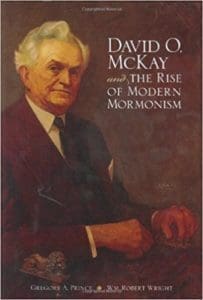
Recorded in 2005 as one of the podcast’s first episodes, this is the second half of John Dehlin’s interview with historian Gregory Prince, co-author of “David O. McKay and the Rise of Modern Mormonism,” devoted entirely to chapter four of that book: David O. McKay’s handling of the priesthood and temple ban on Black members. Prince starts with the ban’s origins, noting that Elijah Abel was ordained to the office of Seventy by Joseph Smith and kept that office for life even after the restriction began under Brigham Young, whose exact reasoning and timing Prince says remain unclear to historians.
Prince then traces McKay’s presidency against the civil rights movement, including an episode in which McKay had a Deseret News editorial revised so it would not endorse school integration after Brown v. Board of Education. He describes how, in 1963, the Salt Lake NAACP’s threat to picket General Conference reached McKay through Hugh B. Brown, who won permission for a defusing statement, one McKay insisted not be official. Prince recounts that Brown then had Sterling McMurrin quietly draft that statement, and that two years later the church republished it as the church’s official 1965 position. Prince also describes McKay’s displeasure that Brown offered a brief condolence after Martin Luther King Jr.’s assassination, saying McKay would rather no mention had been made at all.
Prince closes with his broader conclusion about McKay’s presidency: that revelation, here as elsewhere, functioned as a slow process rather than a single event, built on research, questioning, and what he calls “sweat equity.” On the priesthood ban specifically, Prince argues McKay treated it as an intensely personal matter, repeatedly rebuffing pressure to act from people both outside and inside the church hierarchy.
What’s covered
- 0:10 Introduction and overview of the two issues
- 7:21 Historical origins of the priesthood restriction
- 16:56 McKay, civil rights, and the Nigeria situation
- 38:26 McKay’s legacy on race and priesthood policy
- 54:23 Revelation as process and closing reflections
Related episodes: Gregory Prince and David O. McKay and the Rise of Modern Mormonism | Ep. 2 · Dr. Greg Prince – The Life of a Faithful Mormon Scientist and Historian | Ep. 658-660 · 889-891: Greg Prince – Leonard Arrington and the Writing of Mormon History
Episode Transcript
Host: John Dehlin · Guest: Gregory Prince
This transcript is machine-generated and lightly edited for readability. The audio is authoritative. Please excuse occasional errors in names and spelling.
Introduction and Overview of the Two Issues
John Dehlin [00:00:10] Hello and welcome to the Mormon Stories podcast. My name is John Dehlin. It's exciting to have you with us today. We'd like to thank you all for your listenership because we just recently were entered into the iTunes directory. We actually have had a dramatic increase in subscriptions. We've had over 40 people subscribe to this podcast sort of in its first week of being made available more broadly, and we're excited about that. We'd like to encourage you all to give us your feedback@mormonstoriesmail.com thanks so much again for being with us. Today. We have part two of an interview with Gregory Prince, the co author of the book entitled David O. McKay and the Rise of Modern Mormonism. A lot of you very much enjoyed the interview with Gregory and we promised you in the last interview that we would actually try and dedicate an entire episode to chapter four in his book, which is Blacks, Civil Rights, and the Priesthood. So, Greg, thanks for coming on Mormon Stories podcast.
Gregory Prince [00:01:20] You're welcome.
John Dehlin [00:01:22] It's great to have you. And I'm glad to know you don't have to leave early in the morning, so it won't be as painful as it was last time.
Gregory Prince [00:01:29] That's good.
John Dehlin [00:01:30] Yes. So I'd like to begin just a sort of level set. A lot of times when people learn church history, the toughest part to reconcile is what their common understanding was or what the myths were or the prevalent teachings were within the mainstream church versus what the history ends up revealing. So I'd like to start with the question regarding black civil rights and the priesthood. If you could sort of give us your view of what the. What the common average understanding about these issues is for the average LDS person.
Gregory Prince [00:02:10] I think you've got two issues here. One is civil rights and where was the church on the issue of civil rights. The other was blacks and priesthood. And it turned out that I didn't understand either of those questions as well as I thought I would. And I probably was representative of most Latter Day Saints who probably thought that we were okay on civil rights and understood, or thought they understood that on the issue of blacks and priesthood, it really was not a burning issue until Spencer Kimball and the revelation of 1978. But I was wrong on both. And I suspect that most people in the church were as well. And it wasn't until I dug deeply into the McKay records that I began to be able to sort it out.
John Dehlin [00:03:04] So, you know, sort of maybe you can start by telling us what the average LDS person might think on both counts.
Gregory Prince [00:03:12] Well, I think that Most people felt that the ban on ordination of blacks went all the way back to Joseph Smith. Some of the better read people would have realized on the basis of Lester Bush's article in 1973, that that wasn't the case, that the policy actually started with Brigham Young.
John Dehlin [00:03:30] That was in Dialogue magazine. That was in Dialogue, right?
Gregory Prince [00:03:33] In Dialogue, yeah. And that it was basically left untouched, unchallenged until Spencer Kimball. And then on the issue of civil rights, because of some statements that Joseph Smith had made in the Missouri period, which seemed to be fairly tolerant of the issue of civil rights, I think that the general feeling was that we were okay. We were pretty good, probably better than the rest of the country on that issue.
John Dehlin [00:04:03] Okay. So the ban, the ban on blacks in the priesthood started with Joseph Smith. And the LDS Church has been, if not in line with the mainstream on the civil rights issue. Maybe even slightly bit progressive, probably.
Gregory Prince [00:04:19] Yeah.
John Dehlin [00:04:20] Okay.
Gregory Prince [00:04:20] And that, I think, would be representative of where most people have been on this. And it's where I was until I got into this. Now, let me tell you how I put the book together. And when it started to become apparent to me that I had it wrong. I spent eight years collecting data which amounted to about 15,000 pages in the computer of primary source material. About half of that was from The David O. McKay diaries. Those diaries were kept by his secretary, Claire middlemass, from about 1936 until his death in 1970. They're voluminous, about 40,000 pages of typescript. So anyway, I took the 15,000 pages of material, and when I had gathered all of the data that I could, then I started to separate it by subject matter. And so I created probably 100 different subject files. One of those files was Black civil rights and priesthood, all lumped together. So I went through the 15,000 pages line by line and did a cut and paste on the computer, just building all of these subject files. That file was one of the larger ones. It was probably, oh, six to 800 pages of typescript just on that subject.
John Dehlin [00:05:39] Wow.
Gregory Prince [00:05:40] When I got all of the cutting and pasting done, then I stepped back and said, what are the important, important files now? And it became obvious which ones were. And those became the chapters of the book. Within each chapter, I then took the master file and started to go through it once again and subdivide it. When I did that with the file on black civil rights and priesthood, the material sorted out basically in three directions. One was civil rights. The second was Nigeria because of the church's missionary initiative there. And the third was the issue of blacks and ordination to the priesthood. Once I started to do that, I was astounded at the way the data sorted out. But it wasn't until that time that I realized that I'd had it wrong. That in fact the church was not progressive on civil rights, nor was President McKay as an individual progressive. That we were basically in with the rest of the country that couldn't crow about a good record on civil rights, no matter how you cut it. On the other hand, on the issue of blacks and priesthood, I found to my surprise that President McKay was very progressive on the issue, that he departed from his conservative colleagues on it, but that he was very tight lipped about what he was thinking and what he was doing. So that up until just a short time before his death, not even his closest colleagues really knew where he was on this, nor what initiatives he had taken to try to change it.
Historical Origins of the Priesthood Restriction
John Dehlin [00:07:21] So if it's okay, let's start chronologically, if you don't mind. Tell us, you know, 1830s, 1840s, what have you learned? What should we know about the data or the facts surrounding the blacks in the priesthood issue? Then as we Progress into the 1900s, we can talk about the other things as they sort of appear chronologically.
Gregory Prince [00:07:43] In the early years of the church, there were very few black converts. I'm not sure that anybody knows the exact number, but we do know that at least one Elijah Abel, was ordained to the priesthood by Joseph Smith. He was ordained to the office of 70, and he retained that office for the rest of his life, even after the ban on ordination was imposed. Now, that ban came after Joseph Smith's death. It was during the administration of Brigham Young, and the reasons for it and the exact timing still remain rather fuzzy. What's clear is that it was not a discrete revelation. It was a policy that was instituted probably in response to something going on in the local environment. Not sure on that, but that became accepted as doctrine the longer it remained in effect. So by the time you got into the 20th century, everybody just assumed that this was based on revelation, that it was doctrinal and that wouldn't change.
John Dehlin [00:08:46] I've also read that.
Gregory Prince [00:08:48] Go ahead.
John Dehlin [00:08:48] I've also read that it really didn't come up very much.
Gregory Prince [00:08:52] No, it didn't. David O. McKay was called to be an apostle in 1906. He recorded later that the first time he became aware that this policy even existed was on his trip around the world, which was 1921. So he'd been an apostle for 15 years, didn't even know that there was a policy, and if he didn't know, you can imagine what the level of knowledge was in the general church membership.
John Dehlin [00:09:18] Right. So take us to where David O. McKay began his apostleship and how the issue progressed.
Gregory Prince [00:09:27] Well, when he was going around the world in 1921, at the request of President Grant, he encountered a couple in Hawaii, I believe the wife was Hawaiian and the husband was African American. That's when he first became aware of the policy. And he wrote President Grant asking if it might be changed, and was told by Grant by return letter that no, that there was nothing that he could do about it. And so he basically accepted the status quo and just lived with it until he became church president. Now, shortly after he became church president, in response to the plea of the president of the South African Mission, he became the first general authority to visit that mission. That happened in 1954. And the main reason that he wanted to visit it was that the mission president had just been tied up in knots because of this policy and because of an addendum to the policy that came in the late 1940s, where the mission president was told that from that point on, no male in South Africa was to be ordained to the priesthood until all of his ancestral lines could be traced back to Europe. That was almost an impossible task. And so they wound up with a situation that they had very few local men who were able to be ordained to the priesthood. And as a result, the church was just crippled. So he went down there specifically to look at that policy. He changed it on the spot. In a conference of the missionaries, he got up and announced that as of that point, that that policy would no longer hold and that unless there was firm evidence to the contrary, that the male members would be assumed not to have black blood and could be ordained without any further documentation. When he got back from that trip, apparently it was the first time that he began to question the policy himself. There's no indication from any of his records of any questioning prior to then. So it probably was a result of what had happened on that trip and his consciousness being raised by actually being on the ground in South Africa and seeing what the effect of the policy had been.
John Dehlin [00:11:55] And again, what year was this? Approximately?
Gregory Prince [00:11:58] This was 1954.
John Dehlin [00:11:59] And this was before or after he was prophet?
Gregory Prince [00:12:02] He became prophet three years earlier.
John Dehlin [00:12:05] Okay, so this was as prophet.
Gregory Prince [00:12:07] Yes.
John Dehlin [00:12:08] So tell us. There's a bit in your book, and I've seen some unfair reviews on this small part of your book, where some people have alleged that you were indirectly calling David O'. Conne a racist. And I. I haven't appreciated those comments, but there is a point in the book where you reference a journal article about some of his early thinkings. Can you talk a little bit about where his mindset was coming from? A small town, Huntsville, Utah.
Gregory Prince [00:12:39] Well, that brings the other issue in, and that's the issue of civil rights. And you have to be able to separate those two to understand the complexity of where this man was coming from. He made an entry in his missionary diary in 1898, I believe, where he referred to a group of black singers from the United States that he had met on the ship going over, and then met them again a year later when they were giving a concert in Glasgow. And he attended the concert, spoke with them, he remembered them from the ship PA passage, but made a comment in his diary that he didn't particularly like blacks. And I think that that was probably about par for that part of the country at that time. He certainly would have had some contact with blacks, perhaps more than many people in Utah, because he grew up in Huntsville and went to school in Ogden. And Ogden, being a railroad town, had the highest number of blacks in the state, albeit probably not very large.
John Dehlin [00:13:48] Right. So he was sort of with the mainstream maybe a little bit ahead of the time in terms of civil rights,
Gregory Prince [00:13:54] maybe a little ahead of the time, but probably just right in there with the mainstream now. It didn't really become much of an issue through the teens, the twenties, the thirties. It poked its head up again for him during World War II, and the incident was that there was a USO center in Salt Lake City, and they had asked if the servicemen might use the Deseret Gymnasium, including the swimming pool. So the matter was brought to President McKay, who was then a counselor in the first presidency. He said, by all means that this would be fine, that their uniform would be their admission ticket. But later it was brought to his attention that some of the businessmen in town were upset about this because some of the soldiers were black and they didn't want them swimming in the same swimming pool.
John Dehlin [00:14:45] Right.
Gregory Prince [00:14:45] Well, he pulled back from his position and wouldn't allow that swimming pool to become integrated. A member of a study group that met during that time remarked to me how disappointed he and other members of the study group were that President McKay had not stood up for the blacks at this point, when he easily could have done so. From the mid-40s on, the issue of civil rights gradually gained momentum within the United States, certainly much more so by the mid-50s. But even in the early 50s. Certainly after he became president, he had other chances to be more progressive on the subject, and each time chose not to be. One example was shortly after he became president of the church. Ralph Bunche, a Nobel laureate and an African American, visited Salt Lake City to speak and initially was denied a room in the Hotel Utah, which was owned by the church. There was an appeal to President McKay to reverse that decision. And finally he allowed that he would stay there, but that he had to take his meals in his room. So you have several incidents such as this where he could have taken a progressive stand, but each time he didn't. And that was a chain that he didn't break throughout the rest of his life.
John Dehlin [00:16:20] It's hard to crawl. It's impossible to crawl inside his head. But I sometimes get the feeling that he was trying to play the role of peacemaker, to sort of find some type of acceptable balance between both sides. Does that seem at all possible?
Gregory Prince [00:16:33] It's possible. Again, you can't climb inside of his head. And I've shied away from doing that on any subject in the biography. It's possible he was trying to do that, but if he was trying to do it on that issue, he probably would have tried to do it on the issue of priesthood. And on that, he took a very different approach to it. So I'm not sure that that one holds water.
McKay, Civil Rights, and the Nigeria Situation
John Dehlin [00:16:56] Okay, so when's the next major event that sort of started having a significant effect on the prominence of this issue in the church and in his administration?
Gregory Prince [00:17:09] Well, it gradually just gained momentum. With Brown versus Board of Education in 1954, you had the beginning of desegregation of schools. There was an occasional editorial in the Deseret News, which was the church's own newspaper. There was an opportunity for him to take a progressive stance on integration of the schoolroom. He backed away from that and, in fact, instructed the editor of the newspaper to revise an editorial so that it would not advocate integration of the classroom. As we moved into the 1960s, the civilization civil rights movement really picked up steam. And in 1963, the Salt Lake chapter of the NAACP was very upset at the church's backward stance on civil rights. And in an effort to try to get them to change, they threatened to picket General Conference. This came to the attention of Sterling McMurran, and he brought it to the attention of Hugh Brown of the First Presidency, who brought it to the attention of President McKay. President McKay was not about to concede anything to the NAACP, but he least agreed that Hugh Brown could read a statement in General Conference in 1963 to try to defuse the situation. He would not let him make it, however, as an official First Presidency statement. It was just to be a statement that he would read without making it official. What President McKay didn't know was that Brown went to Sterling McMurran and asked him to write the statement, which McMurran did, that at least diffused the situation. And ironically, that unofficial statement two years later was republished by the church and now labeled the official statement. And it was progressive because it was written by McMurran at the request of Brown. Both of those men were progressive on that subject. And because it was written by them, it had a much more moderate tone than it would have had it been written by the President McKay. Right.
John Dehlin [00:19:23] So I'm going to break for just one second and ask you to do something that may or may not make you feel uncomfortable. One of the things I try and do is for LDS folks who are confronted with tough historical facts but still love the church and have a testimony and want to stay in it, I like to try and provide, where possible, coping mechanisms to deal with tougher issues. And this may seem like a personal question, and if you're not comfortable answering it or don't have insight into it, no problem. But my question would be if you were to try and console an LDS person who came across this understanding that the church wasn't maybe progressive on the issue of civil rights, maybe even lagged behind the norm in spite of the fact that they might have expectations that God was on the side of the civil rights movement and that maybe the leader should have seen it. Is there any consolation or coping mechanism that you can provide that person to say, hey, you know, this has nothing to do. This should have nothing to do necessarily with whether the church is true or not or the strength of your testimony.
Gregory Prince [00:20:35] I think that the most important thing for people to keep in mind is the section in the Doctrine and Covenants that talks about line upon line. Now, that refers to formal revelation, but it also refers to the progress both within the church and within the lives of individual church members. We don't get from point A to point Z in one leap, and we certainly don't start at point Z. It's incremental. There's a lot of sweat equity involved in it. There's a lot of struggle. And what you're dealing with is a divine church that has mortal people running it. So there's that constant tension between those two. Ultimately, it moves in the right direction. Sometimes it doesn't move as fast as we want. And you wonder, why isn't it moving faster? Is it because of God or is it because of us? And more likely than not, it's because of us. That helps me. I hope it helps other people who are wrestling with it. What you don't want to do is to deny history. That doesn't get us anywhere except into trouble. You have to look at the data points, and if they're valid, and in this case they are, then you say, all right, how do we deal with this, with the reality of the situation as it was?
John Dehlin [00:21:53] Right. I take consolation in knowing that there were also times in the church where many of the prophetic statements were far ahead of the norm. If you look at a lot of Joseph Smith's statements, I believe he even ran as a president on an abolition sort of platform and openly courted free persons of color to join the saints in Missouri. So, you know, that's encouraging to me. Maybe we weren't ahead of the time in the 40s, 50s and 60s, in the 1900s, but in the 30s and 40s, in the 1830s and 40s, we actually were kind of progressive.
Gregory Prince [00:22:30] Yeah. Now, if you look at President McKay, if you wanted to put a good side to it, you can say, well, he was as progressive as the people around him when it came to civil rights. That's not a very good way of looking at it, because none of them were progressive on it. On the other hand, if you look at the other side of that coin that he was dealing with, and that's the issue of priesthood ordination, he was remarkable, and it's all the more so because of his stand on civil rights, that there was this divergence within his own mind where he treated one issue in one manner and treated the other issue in an entirely different manner and a very progressive one.
John Dehlin [00:23:19] So tell me if this is a good point to introduce the story of Nigeria as a way to sort of deal with those two issues.
Gregory Prince [00:23:30] Well, Nigeria really comes in the middle of it. I think that the entry point for him was that 1954 trip to South Africa. When he came back from it, two things happened that I think were very significant. One is that he met with Sterling McMurran on another issue. But in the course of a private conversation with him, Sterling said that he disagreed with the church on that issue and was surprised when President McKay responded that that was a policy and not a doctrine and that it would change. That's the first that Sterling had ever heard of that.
John Dehlin [00:24:10] And this is in the mid-1950s. Right.
Gregory Prince [00:24:13] This was in 1954, in March. He hoped that President McKay would make that known, but he never did. He just chose, for whatever reason, to keep that private.
John Dehlin [00:24:26] And is there any validation other than Sterling McMurran's word that David O. McKay said that to him, or do we kind of have to take Sterling McMurray at his word?
Gregory Prince [00:24:36] There is validation, because in 1968, in order that this be preserved, he wrote the whole thing down in a letter to Llewelyn McKay, one of David O's sons, and sent copies to the other three sons just for their own family records. Llewellyn took the letter to his father, read it to him, and his father said, yes, that's exactly what I said. So we don't just have to take Sterling's word on it.
John Dehlin [00:25:03] And where do we learn about that from Llewellyn?
Gregory Prince [00:25:08] It first came to the forefront when Stephen Taggart, a graduate student, got wind of this, found out that there was such a letter, went to Sterling and asked permission to include it in his paper. And Sterling referred him to Llewellyn McKay, who allowed him to do it.
John Dehlin [00:25:27] Oh, wow. Okay. That's excellent.
Gregory Prince [00:25:32] Stay back in 1954 just a little bit longer, because at the same time that he came back from South Africa, President McKay organized a committee within the quorum of the 12th. I don't know all of the members on it, but one of them was Adam Bennion. In Leonard Arrington's autobiography, he says that Banion spoke to their study group just a couple of months later in 1954, said that President McKay had organized this committee and given them the mandate to research the whole topic historically, to find out anything that they could on it, and told them that he had taken the matter to the Lord, but there had not been an answer. That's significant because it's the first instance that I have been able to find where President McKay took it to the source. That was not the last one. There were several times between then and about a year before his death that we know he did take it to the Lord. And sometimes there was no answer. Sometimes the answer was not yet, and that second answer happened later on in his life. But that's where the real questioning started. Not only him questioning himself, but taking it to the Lord and saying, is it time that we can reverse this thing? Now, Nigeria came along in about 1958. Even though there had been a couple of inquiries a decade earlier. 1958 is when it got serious. And what happened was that some people in Nigeria had gotten hold of church literature Devoured it, wanted more, and got in touch with the missionary department, asking that more literature be sent over and eventually that missionaries be sent over. Because of the political structure of Nigeria at the time, there were tribes where the entire tribe would be influenced by the tribal leader who was impressed by Mormonism, so that you had thousands and thousands of people who were over there declaring that they were Mormons waiting to be baptized. Well, this was something that was not taken lightly in Salt lake. And from 1958 until about 1963, there were multiple attempts to try to establish a foothold of the church in Nigeria.
John Dehlin [00:27:59] Just to sort of restate this for the listeners. There were thousands of spontaneous members of the church in Nigeria without a missionary having ever been sent there, without any priesthood, without any priesthood leadership, without any satellites or TV communication. Thousands of spontaneous Nigerian Mormons.
Gregory Prince [00:28:19] There was a gentleman in the missionary department by the name of Lamar Williams who would send materials over to them each month. That, at that time, the Improvement Era was the magazine of the church where there were production overruns. He would just bundle them up and ship them to Nigeria. So they were getting a lot of literature, but they weren't getting any bodies on the ground. Nonetheless, they were calling themselves the Church of Jesus Christ of Latter Day Saints. They didn't attempt to baptize each other because they never felt that they had the authority, but they were going through the motions as well as they could, constantly pleading with Salt Lake to send missionaries over. It was in the context of those pleas that the church was trying to get permission from the Nigerian government to establish a mission there. And it was during that time that on at least two occasions within the first presidency, the issue of priesthood ordination came up. And Hugh Brown raised the issue of whether it would be possible to ordain these men to the Aaronic priesthood. That would have been of practical significance because that would have allowed them, without constant missionary support, to do the weekly chores of the church and to baptize. They hold sacrament meetings to baptize and to bless the sacrament. And President McKay took the issue very seriously, but said ultimately that, no, if you give them the Aaronic priesthood, you're still giving them the priesthood. And so he refused to go down that road and said, until there's a revelation, it has to stay the way that it is now. But they tried for about five years. They even called Williams as a mission president. They called two couples as missionaries, but they never were able to get the visas from the Nigerian government. And in the middle of those attempts, a Nigerian transfer or a Nigerian student who was going to school in California, got hold of some literature on the subject, saw that there was this ban on priesthood ordination, and just blew the whole thing up.
John Dehlin [00:30:33] Now, this was.
Gregory Prince [00:30:33] He sent letters back to Nigeria and the Nigerian government backed away. And as a result, we were not able to get in.
John Dehlin [00:30:40] I believe the book was Mormonism and the Negro. Is that right?
Gregory Prince [00:30:43] Yes.
John Dehlin [00:30:45] And this is around 1962.
Gregory Prince [00:30:48] Yes.
John Dehlin [00:30:48] Okay.
Gregory Prince [00:30:51] Now, ironically, shortly after they finally just gave up, the Biafran civil war broke out, and it was going on right in the middle of the area where the Mormon missionaries would have been. So you have to wonder, was there another agenda being pursued that we just didn't understand at the time?
John Dehlin [00:31:11] Yeah, and that's a. I love that part in the book because even the mission president, who never got to actually go to Nigeria, said that in the end he was. He felt like that decision must have been inspired.
Gregory Prince [00:31:24] Yeah, that was just dropped right in the middle of this whole other saga. But nonetheless, it was certainly a catalyst. And you wonder how close it may have brought them. The answer is probably not very close, because Hugh Brown never really understood where President McKay was on this. He assumed that if he put pushed that it might happen. Whereas President McKay always said that it would take a revelation to do it. Even though he called it a policy, he meant that it was a policy that could only be changed if the Lord said change it.
John Dehlin [00:32:04] Right. And if you don't mind, I think I remember in your book about a particular meeting with the First Presidency and the quorum of the 12 that happened around 1965, that where the Nigerian Mission was considered, it was discussed openly, opinions were sort of voiced, and then that sort of final decision was made. Am I remembering correctly? And if so, can you tell us a little bit about what happened there and what the voices were saying?
Gregory Prince [00:32:31] I believe it was 1963.
John Dehlin [00:32:32] Okay.
Gregory Prince [00:32:34] And there were some strong voices of dissent, one of the primary ones being Harold B. Lee, who was consistently against any. Any challenge to the status quo on that issue. As a result of that meeting, they sent word to Williams, who had gotten a temporary visa and was in Nigeria at the time, that he was to come home immediately. And that was the end of the Nigerian Mission initiative.
John Dehlin [00:33:00] And weren't there some other voices that also were expressed?
Gregory Prince [00:33:05] There were other people who spoke to the same subject, but all of them who spoke up were of the same opinion that they wanted the whole thing shut down.
John Dehlin [00:33:14] But I found two other.
Gregory Prince [00:33:16] There was one voice that wasn't raised, and that was Spencer Kimball.
John Dehlin [00:33:20] Right.
Gregory Prince [00:33:21] And you're just left wondering what was he thinking while this discussion was going on. And the answer is, we don't know.
John Dehlin [00:33:28] For me, the two of the voices or the justifications that I also found interesting were from Ezra Taf Benson, who's actually a cousin of mine. And so I paid particular attention to him. I was surprised to learn that he viewed the civil rights movement itself as a communist plot and so wanted to make sure that this black in the priesthood issue would do nothing to help further the cause of the civil rights movement and somehow saw a connection between the Nigerian mission and his attempts to stall or thwart the civil rights movement.
Gregory Prince [00:34:03] That's correct.
John Dehlin [00:34:04] And also, I believe you said that Gordon B. Hinckley spoke up and expressed concern about the South African mission, which, as you mentioned, was one of the oldest missions in the church, and what might happen to the church there and the members there if in another part of Africa the priesthood was granted to blacks, that that might end up shutting down the church in South Africa. Am I remembering that correctly as well?
Gregory Prince [00:34:30] I don't recall if it was Gordon Hinckley or somebody else, but yes, that sentiment was expressed in that meeting. And it tells you that South Africa at that time was not a cakewalk, that the church was walking a tightrope there. They were not doing proselytizing among blacks. Apartheid was in full swing. And there certainly were concerns that if the status quo were tipped because of something going on in Central Africa, that there might be dire consequences for continuing the South African mission.
John Dehlin [00:35:07] Now, as an aside, once I started reading that there were minutes of these discussions where the brethren were all deciding these issues, it really blew open my conception of how decisions might get made. Naively have always sort of envisioned that when an important decision needs to get made from the church, the prophet goes up to the holy of holies. He prays, a light comes down from above, and he gets out his pen and pencil and writes down what the new policy or instruction is. But when I read a little bit more about the history, I see that the way that things are discussed and dealt with are very real and make a lot more sense to me. But if you can't just talk a little bit about what an average LDS person hearing, that even this topic was debated and that there were various issues, what do you come away with about how decisions are made and how different parties and personalities play in these types of important decisions for the church?
Gregory Prince [00:36:17] Different decisions are made differently. That's not a way of sidestepping the issue. It's just stating the reality and that is, you have the personality of the President and how he may approach a topic, and then you have what the topic is. And in some cases, it will be a matter of open discussion within the first presidency and the quorum of the 12. In other cases, it may be very private. It in the case, for instance, of the Provo and the ogden temples, President McKay made that decision without ever taking it to the quorum of the 12. They found out about it after the fact.
John Dehlin [00:36:52] What were those decisions?
Gregory Prince [00:36:55] This was to build the Provo and the Ogden Temples, Right. Now, there were other cases, such as this, where it became a matter of open discussion with divergent opinions. And on that particular one, the sentiment of the quorum of the 12 carried the day. So it depends on who it is, who is the President at the time, and it depends on what the issue is now. The example that you gave of the President retiring to the temple alone is exactly what happened when Spencer Kimball went over to the temple and ultimately got the revelation that changed the policy on blacks and priesthood ordination. So it can go either way, depending on the person and depending on the issue.
John Dehlin [00:37:45] Very interesting. As a coping mechanism. I sometimes do feel, I agree, that the decision can come straight from God to the prophet. But I hold it open to the possibility that God sometimes needs the. Needs the apostles also to be on board, not just intellectually, but spiritually and emotionally as well. And that it's possible that the Lord can even allow things to wait until he feels like the apostles are all of one heart and one mind. That's just my personal editorial opinion. Sorry for inserting it. Okay, so where do we go from here?
McKay's Legacy on Race and Priesthood Policy
Gregory Prince [00:38:26] Where we go from here is that on the first issue of civil rights, President McCain never really changed up to the end of his life. He was always suspicious of the civil rights movement. Once it really gained a head of steam, he never made a progressive step on it. The very small concessions that the Church made, such as the 1965 statement that Hugh Brown read in General Conference, were done really against his will. He was not happy about them. Another minor thing that happened was that when Martin Luther King was assassinated, there was no mention of it in General Conference except that Hugh Brown, in conducting one of the scenes sessions, made a comment of condolence to the family and emphasizing what a tragedy this had been. President McKay was not happy that he made that statement. He would rather that no mention of it had been made at all. So he had a consistent track record on the issue of civil rights that if it's put up against a backdrop of the times and the places, at least you say, well, he was in there with the rest of his colleagues. By today's standards, it's not a good track record. It's not something that we feel comfortable with. Now, on the issue number two of priesthood ordination, he was very progressive. He took it to the Lord on multiple occasions. And as pointed out in the book, a story that was told to me by a church architecture who said that President McKay came into the building department one day in the late 1960s and was distraught when they asked him what the source of his feelings was. He said that this issue had been brought to him multiple times and he had taken it to the Lord multiple times. And he said, I took it again late last night. And the issue, or the answer with no discussion was not yet, and it won't happen in your time. He was trying. Yeah, he was trying. He was pushing as hard as he could. In spite of his aversion to the civil rights movement, he was going way farther on this issue than any of his predecessors had been willing to go. But he never told his counselors about it, nor members of the quorum of the 12, for reasons that we just don't understand.
John Dehlin [00:41:15] And how, in his final years, were there any final episodes or issues around this issue that are noteworthy leading up to his death
Gregory Prince [00:41:28] in the late months of his life? The McMurran letter to Llewellyn McKay ignited a firestorm. Because up until the time that that letter became public, even President McKay's counselors had no idea that President McKay had had that conversation with McMurran in 1954. Once that became known and once President McKay affirmed the accuracy of that account, the account saying that it is a policy and the time will come when the policy will change. Then you had two groups that formed around President McKay, who was in poor health and was not really in command of the situation. On the one hand, you had Hugh Brown, who felt that if it was indeed a policy, and it's the first time he had been made aware of that nomenclature, that it would just take an administrative action to change it. On the other hand, you had Alvin Dyer, who was an extra counselor in the First Presidency, and Harold B. Lee, who was the acting President of the Quorum of the Twelve and later became church president, both of whom feared that because it was called a policy, that in fact, it could be changed administratively. And so Brown, on the one hand, tried to change it. Dyer and Lee, on the other hand, tried to block him from changing it. Ultimately, they prevailed and were able to neutralize Brown's initiative. The tragedy is that this caused a great deal of hurt feelings amongst these men. And it was all for naught because neither side understood that even though he had called it a policy, President McKee would not have changed it had unless there had been revelation to that effect. So you had this enormous flurry of activity, a division between these men going all the way up to the top. And it was all superfluous because it wouldn't have resulted in change no matter what they had tried.
John Dehlin [00:43:46] There's a. I think I mentioned this to you before, but there's a passage or two I read in Michael Quinn's book Extensions of Power, where he tells a story that basically gives the impression that, you know, Harold B. Lee's out of town. David O. McKay is ailing, not really actively at the helm of the church. Hubie Brown leads a discussion of this topic in the late 1960s, rallies the quorum to sort of agree that the priesthood ban on black should be lifted. But then with a black hat, Harold B. Lee swoops into town, catches wind of the vote and kills it before, you know, before it's allowed to take effect. Is there anything you've read that validates that? Is that just totally pulled out of the sky?
Gregory Prince [00:44:39] I'm not sure how valid that account is. I think in its essence, there may be some validity to it because in the McKay diaries, there are some journal entries of Alvin Dyer that he gave to Claire Middlemiss, and she included them in the McKay record where Dyer says that Brown had tried to change it but didn't give any details. So of that much I'm confident. But since I wasn't confident of the others, I didn't put those details into the book. It's possible that there's more out there than I was able to gather.
John Dehlin [00:45:16] Sure. Okay. So one of the. Probably the saddest moments I experienced in the book was what happened upon David O. McKay's death with regard to Hughie Brown. But before we jump to that it. Is there anything else of note about David O. McKay's involvement in this issue before we move to sort of how that concluded for Brother Brown?
Gregory Prince [00:45:42] No, I think we can move to the conclusion.
John Dehlin [00:45:44] Tell us about that.
Gregory Prince [00:45:45] The conclusion is that for the first time in a century since the death of Brigham Young, that a member of the First Presidency, a counselor in the First Presidency, was not retained by the succeeding president, and Brown was the one. Now, as an asterisk, you had Thorpe, Isaacson and Alvin Dyer, who were extra counselors in the First Presidency. And neither of them was retained in the new first presidency. But either first or a second counselor, ever since 1877, had always been retained by the succeeding president until it came to Hugh Brown. And in fact, that's been the case ever since President McKay's death as well, with that single exception that the new president has retained the counselors of his predecessor.
John Dehlin [00:46:39] So for the listeners, when Joseph Feeling Smith became president, he decided not to keep Hubie Brown.
Gregory Prince [00:46:47] Right. And you write he kept the second counselor, who was Eldon Tanner, and then he brought Harold B. Lee in as his other counselor.
John Dehlin [00:46:56] And is there any. What are the connections. Do you think there are any connections between the two,
Gregory Prince [00:47:02] Between.
John Dehlin [00:47:03] Between the events regarding the history, the blacks and the priesthood and that decision?
Gregory Prince [00:47:09] Well, my source for that is Ed Furmage, who is the grandson of Hugh Brown. And he said that both he and the Brown family were convinced that the reason that his grandfather was not retained in the first Presidency was the conflict between him and Harold B. Lee over the issue of civil rights and blacks and priesthood. And it was for that reason, according to Furmage, that Brown was released.
John Dehlin [00:47:37] Right. Last episode. One of the things I really liked that you mentioned was that there were no black hats and no white hats. There were no clear sinister, evil people in the stories, and there were no clear white knights who were purely altruistic and doing good with relation to this issue. Do you hold that position or do you actually decide that there were some that had as close to white as can be or as close to dark as can be? As you sort of reflect on the main character surrounding the civil rights and
Gregory Prince [00:48:15] the black priesthood issue, it's still shades of gray. They're lighter gray, and they're darker gray. None of these people were evil people. They were all, from everything that I've seen, trying to do their job and do it the best that they could. I had a conversation with a member of the McKay extended family a few weeks ago, and he said he was talking to Harold B. Lee at one point, and Lee, in reacting to somebody who had gone inactive in the church because he got too close to some of the brethren and saw some of the things were going on, Lee's response was, doesn't he understand that we're human beings trying to do the best that we can? And I think that's a marvelous statement that carries validity across the board that these men and women are trying to do the best that they can. They're deeply committed to this church. They're deeply committed to moving it forward, though they don't necessarily agree on all the fine points of where to go with it and how to get there and how long it's going to take. And that's where the conflicts tend to come in.
John Dehlin [00:49:43] Right. And towards the other end of the spectrum, any one you want to hold up is a lighter shade.
Gregory Prince [00:49:54] I don't think that it's necessary to name names and try to figure out where on the spectrum they are. That's part of the challenge and perhaps the enjoyment for the reader. I haven't tried to connect all of the dots in the biography, and I've done it intentionally because on some issues there isn't a definitive answer and different people will look at the data points and draw different conclusions. I want to allow them to do that. And in other cases, even if I could draw the conclusion, I've left a couple of dots unconnected just so the reader will have the joy of making that connection.
John Dehlin [00:50:36] Well, I think that's fair. So do me a quick favor. We talked a little bit about this today and a little bit about it last time, but would you mind then just sort of listening to the best of your memory with regard to the actual blacks in the priesthood issue? The areas where David O. McKay actually did move the ball forward and people might say, how could he move the ball forward? You mentioned a little bit about what he did in South Africa, but you know, just one more time list for us the areas where in his world, in a, in a, in a tough context in the late 50s and 60s, he actually was able to make some policy decisions that did, in effect, move the ball forward.
Gregory Prince [00:51:20] While he was alive, the basic policy remained intact because he felt, as did Spencer Kimball, that it would take revelation to change it. And in fact, it did take revelation to change it.
John Dehlin [00:51:31] Right.
Gregory Prince [00:51:32] The first time that President McKay nibbled at the policy was 1954, when he went down to South Africa and on the spot changed the rules for genealogical research. The impact worldwide was not great at all, but it was a major effect on the South African mission. Subsequently, on occasion, he would do other things that, though they didn't change the policy, indicated that he was certainly willing to stretch it. For instance, on occasion there would be a proposed temple marriage and the issue would be raised that one of the couple apparently had African blood. And on those occasions he would err on the side of leniency and say that he was prepared to defend that decision before the Savior and let the marriage go through. On at least one occasion, he more than stretched the rule because there was a young man, 11 year old, in Cincinnati, whose mother was from Barbados and clearly had African ancestry. The bishop, feeling that this was such an outstanding young man, prevailed upon the stake president, at least to write to the First Presidency to see if anything could be done, because he was shortly going to turn 12. To the stake president's surprise, the letter that came back from the First Presidency presidency said, ordain the young man. Not understanding what this really meant, the stake president wrote a second letter and gave even greater detail than he had in the first letter, saying, I don't think you understood the first time. And a second letter came back from the First Presidency and it said, ordain the young men. And he was ordained. So, no, he did not change the policy, and it took another eight years after his death for that policy to change. But you have to believe that he was preparing the ground that later proved fertile for Spencer Kimball so that that revelation could take place.
John Dehlin [00:53:54] Fascinating. Well, why don't we go ahead and. And sort of summarize. I'd love to get a sense for, you know, after writing this chapter, after doing the research, how do you come out on the issue of revelation and how, you know, how revelation works through prophets and specifically what revelation looked like and how it worked for President mc
Revelation as Process and Closing Reflections
Gregory Prince [00:54:23] I think that the overriding conclusion in this and in other areas, when you look at President McKay's administration, is that revelation is process. It's not event. True, there may be events involved in it, but this is a long haul. There's a lot of work involved, there's a lot of questioning, a lot of research, a lot of sweat equity. And so you have to take it in over the long haul and say, yeah, it really is a process that's punctuated by occasional events. In the case of blacks in Priesthood, for President McKay, this was an intensely personal issue. He didn't solicit much in the way of input from outsiders, and in fact, he rebuffed repeated attempts from those outside the church, from those outside the hierarchy, and occasionally even from those inside the hierarchy who tried to force his hand on the issue. This is in sharp distinction to other areas, such as the development of the international Church, where he welcomed and readily appropriated suggestions from all over the world that allowed the church to advance internationally. So you can't just draw a single model that would govern the way revelation occurs in the church. It's like a multifaceted gemstone. What you see depends on the vantage point from which you're observing it, and the mode of revelation that may come into play in a particular subject is going to be a combination of what the subject is, what the timing is, and quite importantly, what the nature of the president of the church is. Well, the same thing is applicable on an individual level. As you face dilemmas in your own life and you're seeking inspiration to try to guide you, it's not likely that there's going to be a single discrete event that suddenly is going to give you the answer. Yeah, it can happen, but generally it doesn't. And this is why I think it's so important to look at the administration of President McKay, because we have so much detail in the way that we can understand it and apply that to the individual's lives. Because I think that the rules are the same. So that's really the take home lesson on this. You understand what happened during the McKay years. You can understand what's happening in the church today because the process is the same and you can apply that to your own life.
John Dehlin [00:57:00] Well, excellent. Well, I just want to thank you again for coming on this podcast. I want to thank you for this, as you say, ten year labor of love. And Mr. Wright as well. We've certainly enjoyed hearing about the book. I'd like to encourage all the listeners out there to go out and get yourself a copy. Again, the name of the book is David O. McKay and the rise of Modern Mormonism is. It's published by University of Utah Press. You can get it probably at your local bookstore, but definitely on Amazon or on the many websites or bookstores that specialize in LDS books. Anyway, thanks so much Greg for coming.
Gregory Prince [00:57:42] You're welcome, John.
John Dehlin [00:57:44] And to all you listeners out there, please send us your feedback and comments@mormonstoriesmail.com we would love to hear how you enjoyed this podcast. Please let us know and I'll forward that on to Greg so he can know how much we appreciate his time. In addition, if any of you have stories that you think you'd like to share with our audience, please email me and let me know. And we'd like to get you on and have you share your experiences. It doesn't matter if you're ultra right wing, conservative, Mormon fundamentalist, somewhere in the middle. Wherever you stand on the spectrum, we just care about providing a forum for open, honest, candid discussion from the heart. So again we leave you, we thank you and we hope you join us next time on the Mormon Stories podcast. Thank you very much.
Gregory Prince [00:58:45] The depth of your dreams, the height of your wishes.
Transcript © 2026 John P. Dehlin. All rights reserved. Brief quotations are welcome with attribution and a link to mormonstories.org; all other use requires written permission.
7 Responses
I’m suprised nobody has commented on the interviews with Prince yet. After your highlight on Millenial Star I decided to check your podcasts out. I’ve listened to both the Prince interviews, as well as the Masonry interview. I have enjoyed them all very much–enough that I volunteered to do the dishes so I could listen in peace.
Keep up the good work!
Refreshing to hear such honesty regarding the humanity of the Leaders of the church, warts and all, as they wrestled with the Blacks/Priesthood issue. Very interesting revelations on the background maneouverings of the players as each pushed their own agenda. And to think that President McKay said that the Blacks/Priesthood matter was policy, NOT doctrine! How correct that sounds.
I just got my nano, and am finally catching up to some backlogged listening. I found this to be an excellent interview. I learned quite abit (I’m only on Chapter 2 of his book).
I do have one major criticism: what was the deal with trying to get Prince to label certain apostles as villains? Not cool.
Thanks for listening, Jonathan.
That wasn’t my intent…but I was trying to ask a question that many would want asked. Many try to label folks as villains, and I like what Prince says about no white hats, and no black hats….so I wanted him to give that perspective.
Keep the comments coming!!!
John
John,
I enjoyed your recent interview with Prince on the David O McKay book and the blacks and the Priesthood. I liked how you asked the question about how Harold B. Lee came back and stopped a change to the policy. I remember in podcast #026 – Interview with Darius Gray; that he mentioned that it was almost passed until 2 Apostles came back from an overseas trip and did not agree. That delayed it another few years.
A few years ago, I helped a friend of mine, who is black, get baptised in Kuwait while we were deployed for OIF. He had questions about this and I could not answer as I did not have the info that you brought to light in these podcasts. I got him in touch with Don Harwell of the Genesis group and he felt better. Maybe you can have a podcast interview with the Genesis Group leader(s) as well. Too bad the church does not educate the members better.
Keep up the great work!
Dan
Dan,
I love your comments, especially the last one. This issue almost kept me from joining the Church, mainly because the members did not know it. On August 15, 2007 that will all change. Darius Gray and I are launching a DVD with 4 hours of scriptural and brief historical coverage on Blacks in the Bible, skin color, curses, equality and Priesthood. Soon all members will be about to simply go to their scriptures to become well versed on these issues.
Sincerely,
Marvin