
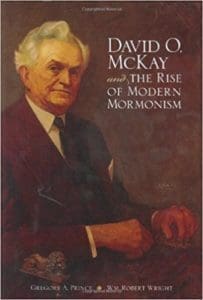
David O. McKay presented a dramatic contrast to his predecessors: an athletic, movie-star-handsome, clean-shaven figure who often wore a white double-breasted suit; contrasted to the dark-suited, bearded polygamists (or, in the case of George Albert Smith, son of a polygamist) who preceded him as Church President ever since Joseph Smith. In an age prior to professional image-makers, he instinctively grasped the importance of appearance, and coupled it to the substance of a professional educator to become an icon of Mormonism whose persona did much to change the negative image of the Church in much of the world. Link to podcast
Full Transcript of the episode:
Hello and welcome to this inaugural edition of A Thoughtful Faith, a podcast from and for Mormons who try and reconcile their thought with their faith and bring the two together in some type of meaningful way. My name is John Dehlin. I’m very happy that you’ve tuned in today to this podcast. And today I have with me A. Prince. Some of you may have heard of Greg. He is the author of a brand new book that has come out by the University of Utah Press called David O. McKay and the Rise of Modern Mormonism. He’s also, as I understand it, and you can correct me if I’m wrong, Gregory, the chairman of the board of the Dialogue Foundation. Is that right, Greg? Yes. All right. Well, welcome. Thanks for being on our podcast today. We love having you. Thank you.
And our readers — I shouldn’t say readers — our listeners will not be surprised to know that our topic is going to be your book on David O. McKay. I have to tell you that I’ve loved reading it. I think it’s a phenomenal asset to our history as a people. So I just want to start off by thanking you for this labor of love. A 10-year labor of love. Yes.
And I wanted to begin with sort of a question that may seem almost heretical to our listeners. I know that as LDS folk, we’re by default supposed to care about our past prophets. But in reality, a lot of our past prophets to many of us are just names and little more, in spite of the priesthood manuals that we learn from each Sunday. So the first question I wanted to ask you is, why should a modern 25, 30-year-old or adult care about David O. McKay?
Well, I think they should for two reasons. One is that the church that we have today is very much a product of David O. McKay and his era. The second is, just as a personality, this was an extraordinary man whose reach extends beyond the generations. And I think that there’s a lot that the current generation of Mormondom could learn by going back and reexamining his life.
Okay. So let’s sort of maybe split this conversation into two parts. The first would be sort of personality traits from David O. McKay that maybe we can learn from that may have been unique to him versus other prophets. And then we’ll talk a little bit about the actual impact that he made on the church and how that affects us. So if there was one — oh, go ahead. Did you have something to say?
Well, I think if there was one thing that really appeals to me, looking back at him, it would be his breadth. That this was a man who, even though he was born and raised in a very small town in Utah — Huntsville, which is to the east of Ogden up the canyon — nonetheless, by the time he became church president, he had a very broad worldview. He had a very broad education. And I think this had a lot to do with the way that he managed the church and led it in a new direction.
Now, if he grew up in Huntsville and was sort of a Utah-by-birth kind of guy, how in the world did he gain sort of this broad international perspective? Well, the first way that he did was just through his love of literature. As a boy, he used to deliver mail to a mining camp that was north of Ogden, and he would do it by riding a horse several hours in each direction. He knew the route by heart, and so as he was riding, he would carry books with him and read them. He memorized a lot of poetry that way, and those poems remained with him for the rest of his life. But that love of literature came early. He continued to devour literature throughout his life, and he saw in literature the great things of the world. Literature to him became scripture. When he became church president, he would quote literature more often than he would quote Mormon scripture, or even biblical scripture. It was that important to him. So that was the first way, I think, that he broadened himself beyond what his contemporaries would have been.
The second, I think, came through his travels. He hadn’t traveled beyond Utah until he got a mission call in 1897. But that mission call took him to Scotland. And for two years, he was exposed to a great deal in Scotland that was very foreign to what he’d known in Huntsville, and it was an eye-opener. After he became apostle, he was called on two subsequent missions that gave him really a unique perspective on the world compared to any of his predecessors as president of the church. One was that in 1920, President Grant asked him to travel to all of the foreign missions of the world and come back and give a status report and be a resource from that point on, so that when discussions came up amongst the First Presidency and the Twelve about foreign affairs, they would have somebody there who’d actually seen it firsthand. That trip took him more than a year. He succeeded in visiting all of those missions except the South African, and when he became president, that was one of the first missions that he visited. A couple of years later, he was called to preside over the European mission, and really wore two hats over there. As president of the European mission, he was the highest-ranking church officer in Europe, and then he simultaneously served as president of the British mission. So those three missions put together gave him unprecedented exposure, not only to the church throughout the world, but to the world itself.
Yeah, that sounds like an incredible international experience. Was that uncommon relative to other apostles of his day, or was that sort of what it was like to be an apostle? Well, it was unprecedented for anybody who became the president of the church to have had that much on-the-ground experience in foreign countries. It wasn’t until well into his administration that general authorities had any type of regular travel schedule. The foreign missions could go decades. In the case of the South African mission, it went a century before the first general authority ever visited it. Wow. So it’s not anything like you have now where these men are going out every week all over the world. When they traveled, generally it was domestically because it was essentially a great base in church.
So how did this breadth affect how he treated people or the decisions he made? How did this international experience end up shaping either who he was or how he led the church? It gave him a lot more tolerance because he understood how diverse the world was, and he understood the importance of that diversity well before his contemporaries would have done that. Simply by being out there and seeing all of this. As an example, when he went down to Uruguay while he was president of the church very early in his administration, he told the mission president, when we send materials to the other South American countries, we have trouble getting them through, but when we send materials to your mission, they always get through. And the mission president kind of looked at the ground a little bit and said, come with me, drove him down to the docks, pointed to a man sitting in a pickup truck, and he said, Antonio over there helps us out with this, and we pay him a little bit of money, and he makes sure that things get through. Obviously, what was going on is they were bribing the official in the customs office. But it worked. And the president thought for a minute and said, well, I guess that’s how they do things down here. So there was an understanding that not everything in the world functioned the way that it did within the Great Basin. And that understanding came from actually being out there and seeing it.
Fascinating. Now, as I’m thinking a little bit about the 60s and realizing that other prophets like maybe Ezra Taft Benson also maybe had similar degrees of international travel and experience, but it might be fair to say that somehow he didn’t somehow arrive at the same level of openness. I mean, I’m not trying to cast dispersions on general authorities, but I guess it’s not necessarily a given that that level of travel or international exposure would lead to tolerance. Is that fair to say? No, that’s right. You can’t guarantee it. You can just open the door and then see who walks through it, and that’s what happened. So in some ways, you might even be saying that his heart was predisposed to be open in a way that might have been even unique to him as an apostle. Oh, I think so. I think that the overall package is very complex at the same time that it’s very compelling. This was in no way a simple man. Right.
So let’s talk about some of the other traits that you mentioned. One that really comes through for me when I read the book was free agency and tolerance. Maybe you can tell us a few stories that illustrate that. Well, he often said in sermons that free agency was a gift of God, second in importance only to life itself. That’s a pretty strong statement. But he essentially put his money where his mouth was. That was bedrock for him, that he was willing to go to extraordinary lengths to protect people’s ability to exercise their free agency. He was as protective of people on the left end of the spectrum as he was of people on the right end of the spectrum. And there were times during his administration when either one would come into play, and he treated them in the same manner. Any examples?
Well, one of the most interesting, I think, was with Sterling McMurrin. McMurrin was a very liberal thinker. He was also a very religious man. But because of his unorthodox thinking, there were some church officials who thought that maybe he shouldn’t be in the church and tried to take steps to make that happen. He served as a commissioner of education to Kennedy. Is that right? That’s right. A brilliant man. He spent most of his life in higher education. He was a vice president of the University of Utah. And then for a year in the John F. Kennedy administration, he was the commissioner of education, which today would have been the secretary of education. So a very distinguished educator with an international reputation.
Now, when President McKay became aware of the fact that some people were trying to unchurch him, he stepped in personally, which means he called Sterling on a Sunday morning at home and said, I’m coming over to see you. Think about that happening today. It’s just not a likely scenario. Well, the two of them agreed to meet up at the University of Utah and spend about an hour and a half together, just the two men in a private room. Now, do you mind telling us real quick what some of the views were that were viewed as controversial? I’m not exactly sure what they thought the views were that allowed them to think that he shouldn’t be in the church. One of the things that he told President McKay was that he didn’t agree with the church’s policy on excluding blacks from the priesthood. And in the course of the interview, President McKay said, well, that’s a policy, and it’s not a doctrine, and someday it will change, which was news to Sterling. He didn’t agree with the views of some church leaders on evolution. There were other issues as well, but I think it was just the conglomerate that his issues were unorthodox enough that it made some people uncomfortable.
And what President McKay said was basically, you can believe whatever you want to believe. In fact, the way Sterling told it to me was that President McKay asked a couple of rhetorical questions. He said, what is it that a man must believe to be a member of the church? Or what is it that a man is not allowed to believe to stay a member of the church? He didn’t answer either question. He was just raising them rhetorically. And when McMurrin finally said, well, it looks like they’re going to try to throw me out, President McKay said, well, if they do, I will be the first witness in your defense. When word of that got back, the whole issue died immediately. And this was as president of the church? Yes, this was as president of the church. This was in 1954.
So that was one of the most dramatic examples. Another example involved Juanita Brooks, who was one of the brightest intellects ever to come out of the state of Utah. She did a monumental work in her treatment of the Mountain Meadows Massacre that was published in 1950 and that’s still in print. But there were some who didn’t like that work and who didn’t like her later biography of the chief protagonist of the story, John D. Lee. And so there was a suggestion on the part of one of the apostles to President McKay that this lady be excommunicated from the church. He had never met her. And I don’t think he ever did for the rest of his life. But his reply to this man was, leave her alone. And as a result, the issue died right there.
Now that’s on the more liberal side. If you go over to the other side of the spectrum, he was as defensive of Joseph Fielding Smith as he had been of Sterling McMurrin. Joseph Fielding Smith in 1954 published a book called Man, His Origin and Destiny, which had a very strong anti-evolution thrust to it. Even though it upset President McKay that Joseph Fielding Smith was publishing this, he still defended his right to have these opinions of his own, so long as he didn’t advance them as official church policy. So he was defending people on both ends of the spectrum who were in good faith exercising their free agency. That was extraordinary, particularly that he would do it with such high-profile people. Now, he never came out in a public statement and made a big deal of it, but it became a big deal as it became known. Right. Yeah, that’s an exceptional story. It sort of ties in the notion of breadth, which you talked about earlier, with this notion of free agency. He was extremely tolerant. He supported free agency over a very broad and deep spectrum of philosophies. Yeah, think of the church as a tent. He pitched a very broad tent, and he essentially invited everybody to come inside the tent. Yeah. That is remarkable.
Let me ask you about a term that I’ve referred to or thought about or read about as the rhetorical presidency. I was a political science major, and I once read an article about how FDR sort of brought in a new era of U.S. presidents. Before FDR, there really hadn’t been television or even as much radio. He brought media and rhetoric into the presidency in a way that sort of had never been done before. When you think about David O. McKay’s image and what he did with PR and other things, could you argue that he brought a charisma and an image to the presidency of the church that maybe we’d never seen before?
Well, he certainly brought charisma to the job. And charisma is impossible to find. It’s like one of the Supreme Court justices said once about pornography, I know it when I see it. Well, when you see somebody who is charismatic, you don’t have to be instructed as to it being there, but to try to define it and to try to figure out how this guy has it and the next guy doesn’t is probably not possible. So he brought some of the raw materials that were just inborn, but he then took them and he burnished them. Part of it probably was due to his experience as a missionary in Scotland, because that was Victorian Great Britain at that time, and dress and grooming and mannerisms were very important. He brought some of those back with him, and for the rest of his life, he took great pains to groom himself well, to dress himself well, and he stood out from a crowd just because of the way that he appeared when he walked in a room. When he became president of the church, he would frequently wear a pure white double-breasted suit, whereas everybody else around him would be dressed in black or dark blue. That set him apart. I also remember you mentioning his hair a little bit in the book, how he wore his hair. Again, it was part inborn in that he had a mane of gorgeous white hair, but he also took pains to groom himself, and his wife took pains to make sure that the barber didn’t cut the hair too short. So it was left longer than the traditional style, but it gave an appearance that was striking.
Now, that’s what he brought to it. You mentioned FDR. He was also a product of his times, and the times were favorable towards that type of a personality, meaning that he was really the first television president of Mormonism. He came along at a time when international travel became much, much easier. The passenger jet airplane came into being in the mid to late 1950s, but even prior to that, after World War II, it became possible to travel all over the world in a much easier fashion than it had before. So he had the tools, and then he had the means to take these tools all the way around the world. And he did. He became by far the most traveled church president of the time. Now, subsequent presidents have gone much farther than that, but here he was breaking the ground.
Interesting. Now, there’s one other chapter in your book that sticks out in my mind. It’s the one on ecumenism. Today, it seems like the church is trying really hard to build strong bridges with other faiths, particularly sort of the — not fundamentalists, but the — what do you call them? Well, I think the strongest ties that are being forged are with Roman Catholicism, which is ironic because that’s the church that President McKay had the most difficulty with. Tell us a little bit about that.
Well, he had great relationships with Protestants. He had great relationships, particularly within the Salt Lake area, with the Jewish community and also with the Greek Orthodox community. With Roman Catholicism, he had a suspicion and aversion that went all the way back to his years as president of the European Mission, where in his diary he made some very cutting remarks about Roman Catholicism. He kept those with him well into the time when he became church president. And even though on the surface he would be cordial towards Roman Catholics, he was very, very suspicious and in private would say derogatory things about Roman Catholicism as a church.
Like racism that may have been prevalent among all Americans back in that day, was it common for there to be sort of an anti-Catholic sentiment among LDS leaders at the time? Was that pretty common? It was common, and some of it came from their interpretation of passages in the Book of Mormon that never said Roman Catholicism, but it was easy for somebody who already was moving in that direction to make that linkage if he wanted to. It was also accentuated by the fact that Roman Catholicism was the largest church in the United States and the largest church in most of the countries where we were trying to establish missionary work. So in some ways it was sort of the competition, maybe. Yeah, all of that set it up as being an adversary if you wanted it to be. It was accentuated by the publication of Bruce McConkie’s book, which stepped over a threshold that nobody at that level had stepped over before and made an explicit connection between the two. Well, that book caused a backlash, and I think that it was the effect of that book that caused President McKay to re-examine his own feelings on the subject, and he backed off. From that point, for the rest of his life, he was very measured, even in private, in what he said about Roman Catholicism. And just for the benefit of our listeners, this is the 1958 version of Mormon Doctrine. Yes. Where if you look under the term Catholicism, it says, see church of the devil. Is that right? Yes, something like that. I don’t remember the exact words.
Yeah. And he was actually — that’s surprising because even though he had a bit of antipathy towards Catholics, he was upset by that phrase. He was upset not only by the phrase, but by what it caused. As one example, the first visitor that newly elected Congressman David King had was Dwayne Hunt, who was the Catholic Bishop of Salt Lake City. And David told me that Hunt came in to congratulate him, but he also had a copy of McConkie’s book in his hands and tears rolling down his face, saying, in essence, why did you do this to us? We’re your friends. Well, this type of message got back to President McKay and he could see that this was not doing favors to anybody. I think it was when he saw the effect of the words, more than just the words themselves, that he realized that we had to back off from this. And in subsequent years, we have become, on an institutional basis, a fairly strong ally with the Catholic Church on certain moral issues that have entered the political arena. So it’s interesting to see how we have gone almost 180 degrees from where we were when he became president and how he personally made that journey from antipathy to at least tolerance, if not affection. And he certainly did have affection for certain Roman Catholic leaders, including Dwayne Hunt.
And what did he do? Did he do anything in the 60s to try and turn that around and strengthen those ties or strengthen that relationship? What he did was not on an institutional basis. It was on an individual basis that he reined in as much as he could at the time the reach of that book, at the same time that on a personal basis he quit saying negative things about Roman Catholicism. He also reached out specifically to Bishop Hunt and became a very close friend of him, such that when Bishop Hunt died two years later, President McKay attended his Mass, and it was the only time in his life that he had attended a Catholic Mass. So he really was able to bring it to a personal closure and do 180 degrees from what he had been before. Subsequently, then the two churches got into league with each other on moral issues, and work quite closely on those issues to this day. Very, very interesting.
Well, let’s shift gears a bit now. We’ve talked a little bit about some of the traits that David O. McKay exhibited. Let’s talk about his impact. If you had to sort of list the one single biggest imprint that he left on the church programmatically or operationally or prophetically, what would you say that was? We can take his lead on this one. A reporter from the New York Times, about a year before he died, asked him what he felt his most important accomplishment was. And without hesitation, he said the church has become truly international. And it was the development of the international church — taking Mormonism out of the Great Basin, out of its provincial mindset, and making it a permanent and significant presence all over the world. That was a huge accomplishment. Others certainly have built on that since that time, but that’s where it really began.
And does that just accrue towards growth, that we’ve had a bunch of international growth, and that’s why that’s important, or are there other reasons why that’s important? Well, there are several elements that all work together. It’s not as if he had a master blueprint from the outset. He was feeling his way along. He used an analogy that I think is very apt for many things, both institutionally and personally for us, and that is that the church was like a locomotive going down the tracks at night with its lantern casting a light out 100 yards ahead of the train. He said, we can see out 100 yards, we can’t see beyond that. But by the time we reach that 100-yard marker, we will see another 100 yards. And that’s how he treated the International Church.
One of the most significant things that he did, and he did it early in his presidency, was to take temples where they had never been before. Never before or since in the history of the Church had a temple been built where there was not already an existing stake. He took a chance, but he realized that until he was able to give the European and later the Polynesian saints a temple that would give them what they could have had in Utah, he couldn’t in good conscience ask them to stay there and build the church in their homeland. So he announced the construction first of the Swiss and British temples and then later the New Zealand temple in an effort to plant something there that would attract the people to stay in their homelands. And it worked. He also beefed up the missionary program so that the numbers would be adequate to grow a native church. And by the time that the New Zealand temple was dedicated in 1958, they were turning the corner, and a year later, the first stake outside of North America was created, 1959. So you’re talking now 129 years after the church was founded, we finally got a single stake outside of North America. That’s rather extraordinary.
Now, when you say beef up the missionary program, what did he do to beef it up? Part of it was calling more missionaries, but a larger part of it was putting visionary men, such as Henry Moyle and Alvin Dyer and T. Bowering Woodbury, in leadership positions. Woodbury became the president of the British mission, and even though there were some excesses that led to some tragic stories, Woodbury revolutionized what was going on in Europe in missionary work. Some of those numbers went in the wrong direction, but many of those baptisms, thousands of them, were authentic, and that formed the foundation for what became the British Church. Up until that time, you’d had decades and decades of the Church saying the righteous will come to Zion, when Zion meant Utah. So the best and the brightest, the ones who could have strengthened the church there, all left. They went to Utah. And so it became a question not just of putting a temple there. You had to reconstitute leadership potential in these countries where all the leadership had already left. So it had to be a combination of putting the temples there, of getting a new approach to missionary work, getting the numbers in place. And then other things such as building chapels in foreign countries, where prior to that often they met in rented beer halls. Well, once you build a church-constructed chapel, you’re signaling to the population, hey, we’re here to stay and we’re significant. So all of those things work together so that by the end of the 50s, you had real strength and permanent strength in these areas. The first foreign stake outside of North America was in New Zealand, but within a year, other stakes were formed first in the British Isles and then on the continent.
I must say, I remember with fondness this last Sunstone Symposium that I was at where I heard you speak, and when you talked about a particular chapel being built, I believe it was in Scotland, there was a young man in the audience who talked about how important that building was to the early members of the church there in Scotland. Yeah, it’s important to the members themselves. It gives them a pride in their church, a desire to go out and share it with others. And then when they do share it with others, they’ve got something to bring them to that they don’t have to apologize for. We had this problem in Brazil when I was there. Most of the cities I worked in did not have church-constructed chapels. And so we had these very mediocre places that we rented. And it was often embarrassing for us as missionaries or for the members bringing their friends to take them to this place and try to convince them that we were something that they would want to become affiliated with. Beyond any of the religious content, they would walk into these places and kind of take a step backwards and say, is this something that I should even be involved in? Right.
Now this sort of makes me want to ask you one follow-up question. I’ve talked a little bit about and written and blogged a little bit about my mission experience in Guatemala, and there’s been quite a bit written in Dialogue and Sunstone about what you sort of referred to, which was sort of the baseball baptisms that happened early in the 60s. And I’ve read a little bit from Michael Quinn who talked about how Henry D. Moyle sort of did the, if you build the chapel they will come sort of philosophy. And there’s been much criticism about how too many baptisms happened, too many quickly, too much investment was weighed in churches, and sort of the church started going into the red a little bit. But what I hear you saying is that the cost was worth the benefit, even though the excesses happened, that maybe they knew what they were doing or did it consciously because they felt confident that the benefits would outweigh the costs.
Well, there were still some costs along the way that in retrospect you wonder about. Did we have to do some of the things that we did that went to an extreme that caused heartache in order to get the result that we did? I don’t think so, but it’s much easier to do the 20-20 hindsight. I think that some of this probably could have been monitored more closely at the time it was happening, so that if things started to get out of control, you can rein them in fairly easily. Once they’ve spun out of control for a while, it’s very difficult to get them back, and that’s what happened. But it was a situation we hadn’t seen in the church before, and it caught them off guard because it was so new. And some of the stuff I’ve read said that Woodbury and even Moyle, towards the end of their career, sort of received some disgrace for these aberrations or whatever. But you’re saying that their net contribution was overall very positive, and that’s something that we should maybe all remember? Well, I think that you have to look at both sides of it, and that’s what I try to do in the biography with any of the people, including President McKay, is to paint them as three-dimensional figures, not to try to dwell too much on any particular aspect, but to try to present the whole picture and say these are all complex people. They were trying to do the best they could, and generally the outcome was benign, and look where we are today because of it. Yeah, there were mistakes made, and there were tragedies along the way, and I think you need to understand those, in part to understand the cost that it took to get us where we are, and in part so that we hope we don’t repeat those mistakes. But as you know from your experiences in Guatemala, that’s a mistake that can easily be repeated because there’s always the tendency to want to go out there and produce so that somebody will pay more attention to you. Right.
Well, that’s a very important perspective. That’s actually very helpful to me to hear you give more of a three-dimensional view because I had, in my mind, demonized a bit Moyle and Woodbury and others and sort of blaming them for this trend that I sometimes see happening. So that’s helpful to me. None of these men in the biography wore black hats. Right. And none of them wore pure white hats. But that’s the same with all of us. We all are shades of gray. Right. And what I’ve tried to do is to paint them in as accurate a manner as possible so that you can try to understand who they are and what they were trying to do and how we got to be where we are now as a result of it. Yes.
Tell us real quickly about education, what impact David O. McKay made with reference to education — specifically, I assume you mean church education? Well, he was an educator by trade. He was the principal of the Weber Academy, which now is Weber State University. His degree was in education from the University of Utah, and he never put aside his love of education, even when he became president of the church. It helped that at the same time he became church president, Ernest Wilkinson became president of Brigham Young University. Ernest Wilkinson is another one that some people want to paint in dark colors, and yet he did an enormous amount of good in making that university a world-class university. It was a provincial, small college when he got there, but not when he left. So the two men working in tandem really are responsible for Brigham Young University being what it is, and to a lesser extent for Ricks College, which is now BYU-Idaho, and the Church College of Hawaii, which is now BYU Hawaii, becoming what they are. Yeah, I mean, I think the business and the law schools of BYU were both around ranked 25th in the nation. Yeah. And that’s sort of a result of their initiative.
Did David O. McKay do anything with reference to the church education system? Not that much, not nearly as much as he did with the colleges and universities. Eventually, the church education system became of more prominence when it became apparent that there was a limit to what we could do in building colleges and universities. There was the hope on the part of Wilkinson that he could establish a large network of church-owned junior colleges that would feed upper division students into BYU. That never got very far off the ground. The church purchased land in several areas in the West, but there was never ground broken for a college, and eventually they either sold off those pieces of land or converted them to other purposes. In some cases, for instance, temples now exist on those plots of land that were originally purchased with the idea of building colleges. So when it became apparent that we just didn’t have the financial resources to continually expand the number of colleges that we had, then they turned to the church education system and said, well, wherever these students are, we will provide a religious education for them through the institutes of religion. So that’s really how that came to be as strong as it is today. The numbers today are huge in the church education system, meaning the seminaries and institutes, versus the number of students that are enrolled at the church colleges. Right.
That’s interesting because from the people I’ve talked to, it’s clear that many — let’s say intellectual Mormons, for lack of a better term — sort of view David O. McKay as their sort of prophet. And in many ways, it’s because of his heavy emphasis on thinking and on education. But it surprised me to learn that correlation sort of — did it start with David O. McKay? And it sort of seems like a paradox that he would also be viewed as sort of the father of correlation, which many of those same, quote, intellectuals sort of view with disdain in many circles.
Correlation really started in 1906, when Joseph F. Smith got up in general conference and basically said, look, we’re not going to do business the way we’ve done it now. That’s when he said the day will come when the priesthood quorums will do what they’ve been intended to do all the way along, but that’s been done by the auxiliary organizations. In two years, he organized a committee on which David O. McKay sat that attempted to do what correlation in the 60s later did, but without much success. There were repeated attempts in the teens, in the 20s, in the 30s, even in the 40s, to try to correlate the bureaucracy. We had very strong auxiliary organizations that had lives of their own. We had a church that was growing both in numbers and complexity as it became more international. And there was a need to bring all of this under one organizational tent. That’s what the whole point of correlation was all the way along. But those attempts went clear back to the beginning of the 20th century. It’s just that by the time he finally got it to stick, he was the president.
And nowadays when people talk about correlation, they often sort of talk about the dumbing down. They refer to some of the church curriculum oftentimes as being pablum. As correlation matured, was there ever a sense that he caught wind of that and was discouraged by that or was excited by that? Did he ever get a sense that correlation had led to sort of a dumbing down of the curriculum? Well, none of that had occurred during his presidency. His original charge to the correlation committee was let’s coordinate all of this so we don’t have overlap. You had instances where the Sunday school and the mutual may have produced a manual the same year on the same subject because they weren’t talking to each other. They had their own curriculum writing committees. They didn’t have to clear it with any other committee above them, so they just went off on their own. That’s what really started it as far as he was concerned. And so his instructions to Harold B. Lee were, let’s streamline it and make sure that there isn’t this duplication. Lee took it in a much broader direction, even though he accomplished that task as well. And then even after Lee’s death, I think it went into a third generation of development. And for whatever it is today, that’s when that occurred. So correlation in David O. McKay’s time was simply that — correlation. The other sort of issues about level of discourse and topics being covered, it sounds like those changes happened subsequent to David O. McKay. They did. Even though for the last decade of his life the correlation movement was going on, it took much longer than that for it to turn into what it is today. Right.
Another question comes to mind. I know that around 72, Leonard Arrington sort of started what many have referred to as the Camelot years, where the church archives were opened up, scholars were hired, and much of the best research and many of the best works that we have today, and maybe much of the material that your book is based on, maybe might have come out of those Camelot years. I’m really curious to know, how did David O. McKay feel about openness and candor with our church history, and specifically with sort of the more difficult elements of our church history?
He had mixed feelings about that. On the one hand, he did protect people’s free agency to write about things, as with Juanita Brooks. On the other hand, he would occasionally express his displeasure in some of the outcomes. And his greatest displeasure, I think, was with his niece’s book. His niece was Fawn McKay Brody, who wrote No Man Knows My History. That resulted in her excommunication, not through his means. Just for our readers, that’s a book on Joseph Smith, a biography of Joseph Smith. Published in 1945 and still in print after 60 years. He was not in favor of her having published that. It caused a strained relationship that lasted for many years that eventually was reconciled between the two. An internal tug-of-war, I think, within him as to having people exercise their free agency on the one hand, but protect the institution on the other hand from non-sympathetic histories. So it was sort of both sides of the spectrum. Yeah.
And is it fair to say that the openness that started in 1972 was somehow influenced by him in any way, or is it too much of a stretch to draw that connection? Oh, I think there is a direct connection there simply because of the effect that David O. McKay had on Leonard Arrington personally. I interviewed Leonard just a couple of years before his death, and he was very forceful in talking about the positive influence that President McKay had on his own life and on his own career. So I think that’s where the connection was. And is it also true that A Journal of Mormon Thought began in the David O. McKay administration? It did, in 1966. Okay.
Very good. Well, I should tell our listeners — and I keep referring to them as readers, I apologize for that, I’m kind of new to this podcasting thing — they can read our lips. Yeah. I should tell our listeners that it’s actually midnight in Maryland, where you live, and so you’re being a very good sport by doing this so late. We’re speaking over Skype, which is an internet application that allows for voice conversation over TCP/IP. So that’s sort of an interesting dynamic.
I’m going to ask you one final — maybe two final — questions before we go, if that’s okay. One of the, for me, the most powerful parts of the book and the most revealing parts of the book, because I thought I had read most of the issues surrounding sort of the blacks or the Negroes and the priesthood. I sort of thought that I knew it all. And after reading your chapter on the blacks, I realized that there was a lot of very interesting things that I sort of knew nothing about. So I would love you to just tell us what you feel comfortable, or have the time or the voice or the energy, to tell us about sort of that whole story in that chapter. We’ll leave the listeners hanging on that one because you can’t do that one in five minutes. Oh, okay. We’ll come back for a second one on that. And maybe have its own dedicated program? I think so. Okay.
So to close, I have one final question, and that’s one thing that we didn’t talk about is his temperament. David O. McKay’s — you know, if you were in the room with him, if you had to deal with him — what was he like? What was his personality like? What was it like to be in the room with him? And if we could just sort of end, I’d love you to sort of give us a sense for the man in terms of his warmth or his personality or his sense of humor, whatever sort of you think would sort of help capture, to the best that you can, who he was in person.
Well, I have to do it secondhand because I never met him, even though I grew up in the church over which he presided. I grew up in Los Angeles. And so I just never had the chance to meet him personally. So based on your interviews — from all of the accounts, this was a man of enormous integrity, of enormous physical presence, who when he walked into a room would often make the room go silent simply by having walked in without saying a word. And yet in spite of that presence, he was extremely cognizant of the people who were in the room. He treated them with respect. If there was a lady who would walk into a room where he was seated, he would never stay seated. He would always rise when she walked in the room. He was a true gentleman in the old sense of that term. He could be sharp. If it were a council meeting and you were expected to make a presentation and you weren’t well prepared, he would let you know that that was not acceptable. So he wasn’t a pushover by any means. And yet overriding all of this was his profound love of humanity, his respect of the individual, and his absolute dedication to the principle of free agency. That’s a pretty good combination. Yeah. Well, it sounds like he was an amazing man. I think so.
Well, I just want to, on behalf of our listeners and the readers out there, I just want to once again thank you. And is it William Robert Wright? Yes. And thank you both for this wonderful book. I want to thank you so much for the time, especially how late it is there, the time you’ve given us for this podcast. And I want to hold you to the fact that you’ve sort of promised our listeners maybe a follow-up interview at least dealing with that chapter that we haven’t talked about yet. Is that fair? Okay. I’d be happy to do it. All right.
Well, I want to thank all of our listeners for tuning in to A Thoughtful Faith. We will have subsequent episodes at whatever frequency we’re able to muster. Because Gregory Prince is the chairman of the Dialogue Foundation, I want to encourage you all to consider checking out Dialogue. The website, I believe, is dialoguejournal.com. Yes. You can go up there, and much of the history that I’ve read and that sort of we all benefit from comes from that wonderful publication. So I just wanted to give a quick shameless plug for Dialogue. Thank you, Gregory, once again for this interview, and thank the listeners for tuning in. Please join us next time. You guys all take care out there. Thanks, Greg. You’re welcome.

Our Platforms:
Social Media:
Contact us:
MormonStories@gmail.com
PO Box 171085, Salt Lake City, UT 84117
Episode Transcript
Host: John Dehlin · Guest: Gregory Prince
This transcript is machine-generated and lightly edited for readability. The audio is authoritative. Please excuse occasional errors in names and spelling.
Introduction to the Podcast and Episode
John Dehlin [00:00:00] Foreign. Hello and welcome to this inaugural edition of A Thoughtful Faith, a podcast from and for Mormons who try and reconcile their thought with their faith and bring the two together in some type of meaningful way. My name is John Dehlin. I'm very happy that you've tuned in today to this podcast. And today I have with me Gregory A. Prince. Some of you may have heard of Greg. He is the author of a brand new book that has come out by the University of Utah Press called David O. McKay and the rise of Modern Mormonism. He's also, as I understand it, and you can correct me if I'm wrong, Gregory, the chairman of the board of the Dialogue Foundation. Is that right, Greg?
Gregory Prince [00:01:07] Yes.
John Dehlin [00:01:08] All right, well, welcome. Thanks for being on our podcast today. We love having you.
Gregory Prince [00:01:12] Thank you.
John Dehlin [00:01:14] And our readers probably won't be surprised that today the topic of. I shouldn't say readers or listeners. We'll be not surprised to know that our topic's going to be your book on David O. McKay. I have to tell you that I've loved reading it. I think it's a phenomenal asset to our history as a people. So I just want to start off by thanking you for this labor of love.
Gregory Prince [00:01:41] A 10 year labor of love.
John Dehlin [00:01:43] Yes. And I wanted to begin with sort of a question that may seem almost heretical to our listeners. I know that as LDS folk, we're by default supposed to care about our past prophets, but in reality, a lot of our past prophets to many of us are just names and little more, in spite of the priesthood manuals that we learn from each Sunday. So the first question I wanted to ask you is why should a modern 25, 30 year old or adult care about David O. McKay?
David O. McKay's Legacy and Leadership Style
Gregory Prince [00:02:21] Well, I think they should for two reasons. One is that the church that we have today is very much a product of David O. McKay and his era. The second is just as a personality. This was an extraordinary man whose reach extends beyond the generations. And I think that there's a lot that the current generation of Mormondom could learn by going back and re examining his life.
John Dehlin [00:02:47] Okay, so let's sort of maybe split this conversation into two parts.
Gregory Prince [00:02:53] Okay.
John Dehlin [00:02:53] The first would be sort of personality traits from David O. McKay that maybe we can learn from that may have been unique to him versus other prophets. And then we'll talk a little bit about the actual impact that he made on the church and, and how that affects us. So if there was one. Oh, go ahead. Did you have something to say?
Gregory Prince [00:03:13] Well, I think if there was one thing that really Appeals to me. Looking back at him, it would be his breadth, that this was a man who, even though he was born and raised in a very small town in Utah, Huntsville, which is to the east of Ogden, up the canyon, that nonetheless, by the time he became church president, he. He had a very broad worldview. He had a very broad education. And I think this had a lot to do with the way that he managed the church and led it in a new direction.
John Dehlin [00:03:46] Now, if he grew up in Huntsville and was sort of a Utah by birth kind of guy, how in the world did he gain sort of this broad international sort of perspective?
Gregory Prince [00:03:57] Well, the first way that he did was just through his love of literature. As a boy, he used to deliver mail to a mining camp that was north of Ogden, and he would do it by riding a horse several hours in each direction. He knew the route by heart. And so as he was riding, he would carry books with them and read them. He memorized a lot of poetry that way, and those poems remained with him for the rest of his life. But that love of literature came early. He continued to devour literature throughout his life, and he saw in literature the great things of the world. Literature to him became scripture when he became church president, why, he would quote literature more often than he would quote Mormon scripture or even biblical scripture. It was that important to him. So that was the first way, I think, that he broadened himself beyond what his contemporaries would have been. The second, I think, came through his travels. He hadn't traveled beyond Utah until he got a mission call in 1897. But that mission call took him to Scotland. And for two years, he was exposed to a great deal in Scotland that was very foreign to what he'd known in Huntsville. And it was an eye opener. After he became apostle, he was called on two subsequent missions that gave him really a unique perspective on the world compared to any of his predecessors as president of the church. One was that in 1920, President Grant asked him to travel to all of the foreign missions of the world and come back and give a status report and be a resource from that point on. So that when discussions came up amongst the first presidency and the 12 about foreign affairs, they would have somebody there who had actually seen it firsthand. That trip took him more than a year. He succeeded in visiting all of those missions except the South African. And when he became president, that was one of the first missions that he visited. A couple of years later, he was called to preside over the European mission and really wore two hats over there. As president of the European mission.
John Dehlin [00:06:14] He.
Gregory Prince [00:06:14] He was the highest ranking church officer in Europe, and then he simultaneously served as president of the British mission. So those three missions put together gave him unprecedented exposure, not only to the church throughout the world, but to the world itself.
John Dehlin [00:06:33] Yeah, that sounds like incredible international experience. Was that uncommon relative to other apostles of his day, or was that sort of what it was like to be an apostle?
Gregory Prince [00:06:44] Well, it was unprecedented for anybody who became the president of the church to have had that much on the ground experience in foreign countries. It wasn't until well into his administration that general authorities had any type of regular travel schedule. The foreign missions could go decades. In the case of the south African mission, It went a century before the first general authority ever visited it.
John Dehlin [00:07:11] Wow.
Gregory Prince [00:07:12] So it's not anything like you have now where these men are going out every week all over the world when they travel. Generally, it was domestically because it was essentially a great basin church.
John Dehlin [00:07:23] So how did this breath affect how he treated people or the decisions he made? How did this intellectual experience end up shaping either who he was or how he led the church?
Gregory Prince [00:07:38] It gave him a lot more tolerance because he understood how diverse the world was and that he understood the importance of that diversity. Well before his contemporaries would have done that Simply by being out there and seeing all of this. As an example, when he went down to Uruguay while he was president of the church, very early in his administration, he told the mission president, when we send materials to the other south American countries, We have trouble getting them through, but when we send materials to your mission, they always get through. And the mission president kind of looked at the ground a little bit and said, come with me. Drove him down to the docks, Pointed to a man sitting in a pickup truck, and he said, antonio over there helps us out with this, and we pay him a little bit of money, and he makes sure that things get through. Obviously, what was going on is they were bribing the official in the customs office, but it worked. And the president thought for a minute and said, well, I guess that's how they do things down here. So there was an understanding that not everything in the world functioned the way that it did within the great basin. And that understanding came from actually being out there and seeing it.
John Dehlin [00:08:58] Fascinating now, as I'm thinking a little bit about the 60s and realizing that Ezra Taft, you know, other prophets, like maybe Ezra taf Benson, also maybe had similar degrees of international travel and experience. But it might be fair to say that somehow he didn't somehow arrive at the same level of openness. I mean, I'm not trying to cast dispersions on general authorities, but I guess it's not necessarily a given that that level of travel or international exposure would lead to tolerance. Is that fair to say?
Gregory Prince [00:09:29] No, that's right. You can't guarantee it. You can just open the door and then see who walks through it. And that's what happened.
John Dehlin [00:09:37] So in some ways you might even be saying that his heart was predisposed to be open in a way that might have been even unique to him as an apostle.
Gregory Prince [00:09:47] Well, I think so. I think that the overall package is very complex at the same time that it's very compelling.
John Dehlin [00:09:55] Interesting.
Gregory Prince [00:09:56] This was in no way a simple man.
John Dehlin [00:10:00] Right. So let's talk about some of the other traits that you mentioned. One that really comes through for me when I read the book was free agency and tolerance. Maybe you can tell us a few stories that illustrate that.
Gregory Prince [00:10:16] Well, he often said in sermons that free free agency was a gift of God, second in importance only to life itself. That's a pretty strong statement. But he essentially put his money where his mouth was. That was bedrock for him, that he was willing to go to extraordinary lengths to protect people's ability to exercise their free agency. He was as protective of a people on the left end of the spectrum as he was on people of the right end of the spectrum. And there were times during his administration when either one would come into play and he treated them in the same manner.
John Dehlin [00:10:57] Any examples?
Gregory Prince [00:10:59] Well, one of the most interesting, I think, was with Sterling McMurran. McMurran was a very liberal thinker. He was also a very religious man. But because of his unorthodox thinking, there were some church officials who thought that maybe he shouldn't be in the church and tried to take steps to make that happen.
John Dehlin [00:11:25] He served as Commissioner of Education to Kennedy, is that right?
Gregory Prince [00:11:29] That's right. A brilliant man. He spent most of his life in higher education. He was a vice president of the University of Utah. And then for a year in the John F. Kennedy administration, he was the Commissioner of Education, which today would have been the Secretary of Education. So a very distinguished educator with an international reputation. Now, when President McKay became aware of the fact that some people were trying to un church him, he stepped in personally, which means he called Sterling on a Sunday morning at home and said, I'm coming over to see you. Think about that happening today. It's just not a likely scenario. Well, the two of them agreed to meet up at the University of Utah and spend about an hour and a half together. Just the two men in a private room.
John Dehlin [00:12:21] Now, do you mind telling us real quick what some of the views were that were viewed as controversial?
Gregory Prince [00:12:29] I'm not exactly sure what they thought the views were that allowed them to think that he shouldn't be in the church. One of the things that he told President McKay was that he didn't agree with the church's policy on excluding blacks from the priesthood. And in the course of the interview, President McKay said, well, that's a policy and it's not a doctrine, and someday it will change. Which was news to Sterling. He didn't agree with the views of some church leaders on evolution. There were other issues as well, but I think it was just a conglomerate, that his issues were unorthodox enough that it made some people uncomfortable.
John Dehlin [00:13:11] Yes.
Gregory Prince [00:13:12] And what President McKay said was, basically, you can believe whatever you want to believe. In fact, the way Sterling told it to me was that President McKay asked a couple of rhetorical questions. He said, what is it that a man must believe to be a member of the church? Or what is it that a man is not allowed to believe to stay a member of the church? He didn't answer either question. He was just raising them rhetorically. And when McMurran finally said, well, it looks like they're going to try to throw me out, President McKay said, well, if they do, I will be the first witness in your defense. And we. When word of that got back, the whole issue died immediately.
John Dehlin [00:13:55] This was as president of the church?
Gregory Prince [00:13:57] Yes, this was as president of the church. This was in 1954. So that was one of the most dramatic examples. Another example involved Juanita Brooks, who was one of the brightest intellects ever to come out of the state of Utah. She did a monumental work in her treatment of the Mountain Meadows Massacre that was published in 1950, and that's still in print. But there were some who didn't like that work and who didn't like her later biography of the chief protagonist of the story, John D. Lee. And so there was a suggestion on the part of one of the apostles to President McKay that this lady be excommunicated from the Church. He had never met her, and I don't think he ever did for the rest of his life. But his reply to this man was, leave her alone. And as a result, the issue died right there. Now, that's on the more liberal side. If you go over to the other side of the spectrum, he was as defensive of Joseph Fielding Smith as he had been of Sterling McMurray. Joseph Fielding Smith in 1954, published a book called Man His Origin and Destiny, which had a very strong anti evolution thrust to it. Even though it upset President McKay that Joseph Fielding Smith was publishing this, he still defended his right to have these opinions of his own, so long as he didn't advance them as official church policy. So he was defending people on both ends of the spectrum who were in good faith exercising their free agency. That was extraordinary, particularly that he would do it with such high profile people. Now, he never came out in a public statement and made a big deal of it, but it became a big deal as it became known, Right?
John Dehlin [00:16:01] Yeah. That's an exceptional story. It sort of ties in the notion of breadth, which you talked about earlier with this notion of free agency. He was extremely tolerant. He supported free agency over a very broad and deep spectrum of philosophies.
Gregory Prince [00:16:20] Yeah. Think of the church as a tent. He pitched a very broad tent and he essentially invited everybody to come inside the tent.
John Dehlin [00:16:30] Yeah. That is remarkable. Let me ask you about. A term that I've referred to or thought about or read about as the rhetorical presidency. I was a political science major, and I once read an article about how FDR sort of brought in a new era of US Presidents. Before fdr, there really hadn't been television or even as much radio. And FDR sort of brought media and rhetoric into the presidency in a way that sort of had never been done before. When you think about David O. McKay's image and what he did with PR and other things, could you argue that he brought a charisma and an image to the presidency of the church that maybe had never we'd seen before?
Gregory Prince [00:17:25] Well, he certainly brought charisma to the job, and charisma is probably impossible to find. It's like one of the Supreme Court justices said once about pornography. I knows it when I sees it. Well, when you see somebody who is charismatic, you don't have to be instructed as to it being there, but to try to define it and to try to figure out how this guy has it and the next guy doesn't is probably not possible. So he brought some of the raw materials that were just inborn, but he then took them and he burnished them. Part of it probably was due to his experience as a missionary in Scotland, because that was Victorian Great Britain at that time, and dress and grooming and mannerisms were very important. He brought some of those back with him, and for the rest of his life, he took great pains to groom himself well, to dress himself well, and he stood out from a crowd just because of the way that he appeared when he walked in a room. When he became president of the church, frequently he would wear a pure white double breasted suit, whereas everybody else around him would be dressed in black or dark blue. That set him apart.
John Dehlin [00:18:43] I also remember you mentioning his hair a little bit in the book, how he wore his hair.
Gregory Prince [00:18:49] Again, it was part inborn and that he had a mane of gorgeous white hair. But he also took pains to groom himself and his wife took pains to make sure that the barber didn't cut the hair too short. So it was left longer than the traditional style, but it gave an appearance that was striking. Now that's what he brought to it. You mentioned fdr. He was also a product of his times and the times were favorable towards that type of a personality. Meaning that he was really the first television president of Mormonism. He came along at a time when international travel became much, much easier. The passenger jet airplane came into being in the mid to late 1950s. But even prior to that, after World War II, it became possible to travel all over the world in a much easier fashion than it had before. So he had the tools and then he had the means to take these tools all the way around the world. And he did. He became by far the most traveled church president of the time. Now, subsequent presidents have gone much farther than that, but here he was breaking the ground.
John Dehlin [00:20:08] Interesting. Now, there's one other chapter in your book that sticks out in my mind. It's the one on ecumenism. Today it seems like the church is trying really hard to build strong bridges with other faiths, particularly sort of the. Sort of the. Not the fundamentalists, but the. What do you call them, the Southern.
Gregory Prince [00:20:37] Well, I think the strongest ties that are being forged are with Roman Catholicism, which is ironic because that's the church that President McKay had the most difficulty with.
John Dehlin [00:20:50] Tell us a little bit about that.
Gregory Prince [00:20:51] Well, he had great relationships with Protestants. He had great relationships, particularly within the Salt Lake area, with the Jewish community and also with the Greek Orthodox community, with Roman Catholicism. He had a suspicion, an aversion, that went all the way back to his years as president of the European Mission, where in his diary he made some very cutting remarks about Roman Catholicism. He kept those with him well into the time when he became church president. And even though on the surface he would be cordial towards Roman Catholics, he was very, very suspicious and in private would say derogatory things about Roman Catholicism as a church.
John Dehlin [00:21:38] Now, like racism that may have been prevalent among all Americans back in that day. Was it common for there to be sort of an anti Catholic sentiment among sort of LDS leaders at the time? Is that pretty common?
Gregory Prince [00:21:54] It was common, and some of it came from the. Their interpretation of passages in the Book of Mormon that never said Roman Catholicism, but it was easy for somebody who already was moving in that direction to make that linkage if he wanted to. It was also accentuated by the fact that Roman Catholicism was the largest church in the United States and the largest church in most of the countries where we were trying to establish missionary work.
John Dehlin [00:22:21] So in some ways it was sort of a competition. Yeah.
Gregory Prince [00:22:24] All of that set it up as being an adversary, if you wanted it to be. It was accentuated by the publication of Bruce McConkie's book, which stepped over a threshold that nobody at that level had stepped over before and made an explicit connection between the two. Well, that book caused a backlash, and I think that it was the effect of that book that caused President McKay to re examine his own feelings on the subject. And he backed off from that point for the rest of his life. He was very measured, even in private, in what he said about Roman Catholicism.
John Dehlin [00:23:05] And just for the benefit of our listeners, this is the 1958 version of Mormon doctrine.
Gregory Prince [00:23:13] Yes.
John Dehlin [00:23:13] Where if you look under the term Catholicism, it says, see Church of the Devil. Is that right?
Gregory Prince [00:23:20] Yes, something like that. I don't remember the exact words. Yeah.
John Dehlin [00:23:24] And he was actually. That's surprising because even though he had a bit of antipathy towards Catholics, he was upset by that phrase.
Gregory Prince [00:23:33] He was upset not only by the phrase, but by what it caused. As one example, the first visitor that newly elected Congressman David King had was Dwayne Hunt, who was the Catholic bishop of Salt Lake City. And David told me that Hunt came in to congratulate him, but he also had a copy of McConkie's book in his hands and tears rolling down his face, saying, in essence, why did you do this to us? We're your friends. Well, this type of message got back to President McKay, and he could see that this was not doing favors to anybody. I think it was when he saw the effect of the words, more than just the words themselves, that he realized that we had to back off from this. And in subsequent years, we have become, on an institutional basis, a fairly strong ally with the Catholic Church on certain moral issues that have entered the political arena. So it's interesting to see how we have gone almost 180 degrees from where we were when he became president and how he personally made that journey from antipathy to at Least tolerance, if not affection. And he certainly did have affection for certain Roman Catholic leaders, including Dwayne Hunt.
John Dehlin [00:24:55] And what did he do? Did he do anything in the 60s to try and turn that around and strengthen those ties or strengthen that relationship?
Gregory Prince [00:25:05] What he did was not on an institutional basis. It was on an individual basis that he reigned in as much as he could at the time, the reach of that book. At the same time that on a personal basis, he quit saying negative things about Roman Catholicism. He also reached out specifically to Bishop Hunt and became a very close friend of him, such that when Bishop Hunt died two years later, President McKay attended his Mass. And it was the only time in his life that he had attended a Catholic mass. So he really was able to bring it to a personal closure and do 180 degrees from what he had been before. Subsequently, then the two churches got into league with each other on moral issues and work quite closely on those issues to this day.
John Dehlin [00:25:57] Very, very interesting. Well, let's shift gears a bit now. We've talked a little bit about some of the traits that David O. McKay exhibited. Let's talk about his impact. If you had to sort of list the one single biggest sort of imprint that he left on the church programmatically or operationally or prophetically, what would you say that was?
Gregory Prince [00:26:24] We can take his lead on this one. A reporter from the New York Times, about a year before he died asked him what he felt his most important accomplishment was. And without hesitation he said, the church has become truly international. And it was the development of the international church, taking Mormonism out of the Great Basin, out of its provincial mindset, and making it a permanent and significant presence all over the world. That was a huge accomplishment. Others certainly have built on that since that time, but that's where it really began.
John Dehlin [00:26:59] And does that just accrue towards growth? That we've had a bunch of international growth and that's why that's important, or there are other reasons why that's important?
Gregory Prince [00:27:08] Well, there are several elements that all work together. It's not as if he had a master blueprint. From the outset, he was feeling his way along. He used an analogy that I think is very apt for many things, both institutionally and personally for us. And that is that the church was like a locomotive going down the tracks at night with its lantern casting a light out 100 yards ahead of the train. He said, we can see out 100 yards. We can't see beyond that, but by the time we reach that hundred yard marker, we will see another hundred yards. And that's how he treated the international church. One of the most significant things that he did, and he did it early in his presidency, was to take temples where they had never been before. Never before or since in the history of the church had a temple been built where there was not already an existing stake. He took a chance, but he realized that until he was able to give the European, and later the Polynesian saints a temple that would give them what they could have had in Utah, he couldn't in good conscience ask them to stay there and build the church in their homeland. So he announced the construction first of the Swiss and British temples, and then later the New Zealand temple in an effort to plant something there that would attract the people to stay in their homelands. And it worked. He also beefed up the missionary program so that the numbers would be adequate to grow a native church. And by the time that the New Zealand temple was dedicated in 1958, they were turning the corner. And a year later, the first stake outside of North America was created. 1959. So you're talking now, 129 years after the church was founded, we finally got a 6 single stake outside of North America. That's rather extraordinary.
John Dehlin [00:29:06] Now, when you say beef up the missionary program, what did he do to beef it up?
Gregory Prince [00:29:11] Part of it was calling more missionaries, but a larger part of it was putting visionary men such as Henry Moyle and Alvin Dyer and T. Bowering Woodbury in leadership positions. Woodbury became the president of the British Mission. And even though there were some excesses that led to some tragic stories, Woodbury revolutionized what was going on in Europe in missionary work. Some of those numbers went in the wrong direction, but many of those baptisms, thousands of them, were authentic. And that formed the foundation for what became the British Church. Up until that time, you'd had decades and decades of the church saying the righteous will come to Zion when Zion meant Utah. So the best and the brightest, the ones who could have strengthened the church there, all left. They went to Utah. And so it became a question not just of putting a temple there. You had to reconstitute leadership potential in these countries where all the leadership had already left. So it had to be a combination of putting the temples there, of getting a new approach to missionary work, getting the numbers in place, and then other things, such as building chapels in foreign countries where, prior to that, often they met in rented beer halls. Once you build a church, constructed chapel, you're signaling to the population, hey, we're here to stay, and we're Significant. So all of those things work together so that by the time, by the end of the 50s, you had real strength and permanent strength in these areas. The first foreign stake outside of North America was in New Zealand. But within a year, other stakes were formed, first in the British Isles and then on the continent.
John Dehlin [00:31:01] I must say I remember with fondness this last Sunstone symposium that I was at where I heard you speak. And when you talked about a particular chapel being built, I believe it was in Scotland, there was a young man in the audience who talked about how important that building was to the early members of the church there in Scotland.
Gregory Prince [00:31:21] Yeah, it's important to the members themselves. It gives them a pride in their church, a desire to go out and share it with others. And then when they do share it with others, they've got something to bring them to that they don't have to apologize for. We had this problem in Brazil when I was there. Most of the cities I worked in did not have church constructed chapels. And so we had these very mediocre places that we rented. And it was often embarrassing for us as missionaries or for the members bringing their friends to take them to this place and try to convince them that we were something that they would want to become affiliated with. It went beyond any of the religious content. They would walk into these places and kind of take a step backwards and say, is this something that I should even be involved in right now?
Missionary Work, Education, and Church History
John Dehlin [00:32:11] This sort of makes me want to ask you one follow up question. I've talked a little bit about and written, blogged a little bit about my mission experience in Guatemala. And there's been quite a bit written in dialogue in Sunstone about what you sort of referred to, which was sort of the baseball baptisms that happened early in the 60s. And I've read a little bit from Michael Quinn who talked about how Henry D. Moyle sort of, sort of did the if you build the chapel, they will come sort of philosophy. And there's been much criticism about how too many baptisms happened, too many quickly, too much investment was weighed in churches and sort of the church started going into the red a little bit. But what I hear you saying is that the cost was worth the benefit, even though the excess has happened. That maybe that they knew what they were doing or did it consciously because they felt confident that the benefits would outweigh the costs.
Gregory Prince [00:33:11] Well, there were still some costs along the way that in retrospect you wonder about, did we have to do some of the things that we did that went to an extreme that caused heartache in order to get the result that we did? I don't think so, but it's much easier to do. The 2020 hindsight, I think that some of this probably could have been monitored more closely at the time it was happening. So that if things started to get out of control, you can rein them in fairly easily. Once they spun out of control for a while, it's very difficult to get them back. And that's what happened. But it was a situation we hadn't seen in the church before. And so perhaps it caught them off guard because it was so new.
John Dehlin [00:33:58] And some of the stuff I've read said that Woodbury and even Moyle, towards the end of their career sort of received some disgrace for these aberrations or whatever. But you're saying that their net contribution was overall very positive. And that's something that we should maybe all remember.
Gregory Prince [00:34:15] Well, I think that you have to look at both sides of it, and that's what I try to do in the biography with any of the people, including President McKay, is to paint them as three dimensional figures, figures. Not to try to dwell too much on any particular aspect, but to try to present the whole picture and say, these are all complex people, they were trying to do the best they could and generally the outcome was benign and look where we are today because of it. Yeah, there were mistakes made and there were tragedies along the way. And I think you need to understand those in part to understand the cost that it took to get us where we are, and in part so that we hope we don't repeat those mistakes. But as you know from your experiences in Guatemala, that's a mistake that can easily be repeated because there's always the tendency to want to go out there and produce so that somebody will pay more attention to you.
John Dehlin [00:35:14] Right. Well, that's a very important perspective. That's actually very helpful to me to hear you give more of a three dimensional view, because I had in my mind demonized a bit Moyle and Woodbury and others and sort of blaming them for this trend that I sometimes see happening. So that's helpful to me.
Gregory Prince [00:35:30] None of these men in the biography wore black hats and none of them wore pure white hats. But that's the same with all of us. We all are shades of gray. And what I've tried to do is to paint them in as accurate a manner as possible so that you can try to understand who they are and what they were trying to do and how we got to be where we are now as a result of it.
John Dehlin [00:35:56] Yes. Tell us real quickly about education. What impact David Owenkay made with reference to education system specifically. I assume you mean church education.
Gregory Prince [00:36:10] Well, he was an educator by trade. He was the president of the Weber Academy or the principal of the Weber Academy, which now is Weber State University. His degree was in education from the University of Utah. And he never put aside his love of education, even when he became president of the church. It helped that at the same time he became church president, Ernest Wilkinson became president of Brigham Young University. Ernest Wilkinson is another one that some people want to paint in dark colors. And yet he did an enormous amount of good in making that university a world class university. It was a provincial small college when he got there, but not when he left. So the two men working in tandem really are responsible for Brigham Young University being what it is, and to a lesser extent for Ricks College, which is now BYU Idaho and the Church College of Hawaii, which is now BYU Hawaii becoming what they are.
John Dehlin [00:37:15] Yeah, I mean I think the business and the law schools of BYU are both around ranked 25th in the nation.
Gregory Prince [00:37:20] Yeah.
John Dehlin [00:37:21] And that's sort of a result of their initiative. Did David O. McKay do anything with reference to the church education system?
Gregory Prince [00:37:34] Not that much. Not nearly as much as he did with the colleges and universities. Eventually the church education system became of more prominence when it became apparent that there was a limit to what we could do in building colleges and universities. There was the hope on the part of Wilkinson that he could establish a large network of church owned junior colleges that would feed upper division students into byu. That never got very far off the ground. The church purchased land in several areas in the west, but there was never ground broken for a college. And eventually they either sold off those pieces of land or converted them to other purposes. In some cases, for instance, temples now exist on those plots of land that were originally purchased with the idea of building colleges. So when it became apparent that we just didn't have the financial resources to continually expand the number of colleges that we had, then they turned to the church education system and said, well, wherever these students are, we will provide a religious education for them through the institutes of religion. So that's really how that came to be. As strong as it is today, the numbers today are huge in the church education system, meaning the seminaries and institutes versus the number of students that are enrolled at the church colleges.
John Dehlin [00:39:01] Right. That's interesting because from the people I've talked to, it's clear that many, let's say intellectual Mormons, for lack of a better term, Sort of view David O. McKay as their sort of prophet. And in many ways it's because of his heavy emphasis on thinking and on education. But it surprised me to learn that correlation sort of did it start with David O. McKay. And it sort of seems like a paradox that he would also be viewed as sort of the father of correlation, which many of those same quote intellectuals sort of view with disdain in many circles.
Gregory Prince [00:39:39] Correlation really started in 1906 when Joseph F. Smith got up in General Conference and basically said, look, we're not going to do business the way we've done it now. That's when he said the day will come when the priesthood quorums will do what they've been intended to do all the way along, but that's been done by the auxiliary organizations. Within two years he organized a committee on which David O. McKay sat that attempted to do what correlation in the 60s later did, but without much success. There were repeated attempts in the teens, in the twenties, in the thirties, even in the forties to try to. Well, to try to correlate the bureaucracy. We had very strong auxiliary organizations that had lives of their own. We had a church that was growing both in numbers and complexity as it became more international. And there was a need to bring all of this under one organizational tent. That's what the whole point of correlation was all the way along. But those attempts went clear back to the beginning of the 20th century. It's just that by the time he finally got it to stick, he was the president.
John Dehlin [00:40:57] And nowadays when people talk about correlation, they often sort of talk about the dumbing down. You know, they refer to some of the church curriculum oftentimes as being pablum. As correlation matured, was there ever sense that he caught wind of that and was discouraged by that or was excited by that? Did correlation ever become. Do you ever get a sense that he felt what many are feeling now? That correlation has led to sort of a dumbing down and a boring. A boring down of boring up of the curriculum.
Gregory Prince [00:41:32] Well, none of that had occurred during his presidency. His original charge to the correlation committee was let's coordinate all of this so we don't have overlap. You had instances where the Sunday school and the Mutual may have produced a manual the same year on the same day subject because they weren't talking to each other. They had their own curriculum writing committees. They didn't have to clear it with any other committee above them. So they just went off on their own. That's what really started it as far as he was concerned. And so his instructions to Harold B. Lee were, let's streamline it and make sure that there isn't this duplication. Lee took it in a much different direction, even though he accomplished that task as well. And then even after Lee's death, I think it went into a third generation of development. And for whatever it is today, that's when that occurred.
John Dehlin [00:42:26] So correlation In David O. McKay's time was simply that correlation. The other sort of issues about level of discourse and topics being covered. It sounds like those changes happened subsequent to David O. McKay.
Gregory Prince [00:42:40] They did. Even though for the last decade of his life, the correlation movement was going on. It took much longer than that for it to turn into what it is today.
John Dehlin [00:42:51] Right. Another question comes to mind. So I know that around 72, Leonard Arrington sort of started what many have referred to as the Camelot years, where the church archives were opened up, scholars were hired, and. And many of the best, much of the best research and many of the best works that we have today, and maybe much of the material that your book is based on maybe might have come out of those Camelot years. I'm really curious to know, you know, how did David O. McKay feel about openness and candor with our church history and specifically with sort of the more difficult elements of our church history?
Gregory Prince [00:43:32] For some, he had mixed feelings about that. On the one hand, he did protect people's free agency to write about things, as with Juanita Brooks. On the other hand, he would occasionally express his displeasure in some of the outcomes. And his greatest displeasure, I think, was with his niece's book. His niece was Fawn McKay Brody, who wrote no Man Knows My History. And that resulted in her excommunication. And that's a book, sorry, just for our readers.
John Dehlin [00:44:01] That's a book on Joseph Smith, a
Gregory Prince [00:44:03] biography of Joseph smith published in 1945 and still in print after 60 years. He was not in favor of her having published that. It caused a strained relationship that lasted for many years that eventually was reconciled between the two. So there was an internal tug of war, I think, within him as to having people exercise their free agency on the one hand, but protect the institution on the other hand from non sympathetic histories.
John Dehlin [00:44:41] So it was sort of both sides of the spectrum.
Gregory Prince [00:44:45] Yeah.
John Dehlin [00:44:46] And is it fair to say that the openness that started in 72 somehow was influenced by him in any way, or is it too much of a stretch to draw that connection?
Gregory Prince [00:44:59] Oh, I think there is a direct connection there, simply because the effect that David O. McKay had on Leonard Arrington personally. I interviewed Leonard just a couple years before his death. And he was very forceful in talking about the positive influence that President McKay had on his own life and on his own career. So I think that's where the connection was.
John Dehlin [00:45:23] And is it also true that A Journal of Mormon Thought began in The David O. McKay administration?
Gregory Prince [00:45:29] It did in 1966.
John Dehlin [00:45:31] Okay, very good. Well, I should tell our listeners, and I keep referring to them as readers, I apologize for that. I'm kind of new to this podcasting thing.
Gregory Prince [00:45:40] They can read our lips.
John Dehlin [00:45:41] Yeah, I should tell our listeners that it's actually midnight in Maryland, where you live, and so you're being a very good sport by. By doing this so late. We're speaking over Skype, which is an Internet application that allows for voice conversation over tcpip. So that's sort of an interesting dynamic. I'm going to ask you one final, maybe two final questions before we go, if that's okay. One of the. For me, the most powerful parts of the book and the most revealing parts of the book, because I thought I had read most of the issues surrounding sort of the blacks or the Negroes and the priests, I sort of thought that I knew it all. And after reading your chapter on the blacks, I realized that there was a lot of very interesting things that I sort of knew nothing about. So I would love you to just tell us what you feel comfortable or have the time or the voice or the energy to tell us about sort of that whole story in that chapter.
Gregory Prince [00:46:41] We'll leave the readers, the listeners hanging on that one, because you can't do that one in five minutes.
John Dehlin [00:46:48] Oh, okay.
Gregory Prince [00:46:49] We'll come back for a second one
John Dehlin [00:46:51] on that and maybe have our own. Its own dedicated program.
Gregory Prince [00:46:56] I think so.
McKay's Temperament and Closing Reflections
John Dehlin [00:46:57] Okay, so to close, I have one final question, and that's one thing that we didn't talk about is his temperament. David O. McKay's. You know, if you were in the room with him, if you had a deal with him, you know, what was he like? What was his personality like? What was it like to be in the room with him? And if we could just sort of end, I'd love you to sort of give us a sense for the man in terms of his warmth or his personality or his sense of humor, whatever sort of you think would sort of help capture to the best that you can who he was in person.
Gregory Prince [00:47:31] Well, I have to do it second hand because I never met him, even though I grew up in the church over which he presided. I grew up in Los Angeles, and so I just never had the chance to meet him personally.
John Dehlin [00:47:42] So based on your interviews, from all
Gregory Prince [00:47:45] of the accounts, this was a man of enormous integrity, of enormous physical presence, who, when he walked into a room, would often make the room go silent simply by having walked in without saying a word. And yet, in spite of that presence, he was extremely cognizant of the people who were in the room. He treated them with respect. If there was a lady who would walk into a room where he was seated, he would never stay seated. He would always rise when she walked in the room. He was a true gentleman in the old sense of that term. He could be sharp. If it were a council meeting and you were expected to make a presentation and you weren't well prepared, he would let you know that that was not acceptable. So he wasn't a pushover by any means. And yet overriding all of this was his profound love of humanity, his respect of the individual, and his absolute dedication to the principle of free agency. That's a pretty good combination.
John Dehlin [00:48:52] Yeah. Well, sounds like he was an amazing man.
Gregory Prince [00:48:58] I think so.
John Dehlin [00:49:00] Well, I just want to, you know, on behalf of our listeners and the readers out there, I just want to once again thank you and. Is it William Robert Wright?
Gregory Prince [00:49:08] Yes.
John Dehlin [00:49:11] And thank you both for this wonderful book. I want to thank you so much for the time, especially how late it is there, the time you've given us for this podcast. And I want to hold you to the fact that you've sort of promised our listeners maybe a follow up interview at least dealing with that chapter that we haven't talked about yet. Is that fair?
Gregory Prince [00:49:33] Okay, be happy to do it.
John Dehlin [00:49:35] All right, Well, I want to thank all of our listeners for tuning in to a thoughtful faith. We will have subsequent episodes at whatever frequency we're able to muster. Because Gregory Prince is the chairman of the board of the Dialogue Foundation, I want to encourage you all to consider checking out Dialogue. The website, I believe, is Dialogue Journal. Yes, you can go up there. And much of the history that I've read and that that sort of we all benefit from comes from that wonderful publication. So I just wanted to give a quick, shameless plug for dialogue. Thank you, Gregory, once again for this interview and thank the listeners for tuning in. Please join us next time. You guys all take care out there. Thanks, Greg.
Gregory Prince [00:50:23] You're welcome. So far, since the war was won, in fact, you have become all of
John Dehlin [00:50:36] the things you've always.
Gregory Prince [00:50:45] The ascent of ST with.
Transcript © 2026 John P. Dehlin. All rights reserved. Brief quotations are welcome with attribution and a link to mormonstories.org; all other use requires written permission.
2 Responses
I love this podcast.
I very much enjoyed listening to this podcast on David O McKay. I am no longer a member of the LDS faith; however, he was my mothers favorite prophet and it was wonderful to learn about his character and his accomplishments.