
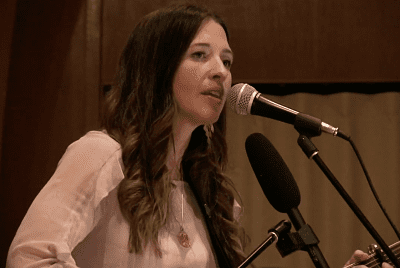
 Live from the Salt Lake City Community of Christ, we welcome singer/songwriter Angela Soffe to Mormon Stories Podcast. No doubt you have heard her song “Rocks” in our bumper music for many episodes this year, and we were honored to have her in Salt Lake City in front of a live audience to hear her faith transition story and listen to songs that were born from that period in her life.
- Part 1: Angela shares her experience growing up as a Mormon and what eventually led her to experiencing a faith transition as a young mother with small children, and in a period of life where she was feeling intense isolation from being in a new city and having few friends outside of her local LDS ward. In this segment of the interview, Angela gives great advice and hope for those who may be in their darkest moments during a faith transition.
- Part 2: Angela performs songs from her album “Second Wind,” and then continues the conversation with John about her faith journey, particularly the joy she feels now as she makes authentic choices in her life.
Part 1: This transcript is machine-generated and lightly edited for readability. The audio is authoritative. Please excuse occasional errors in names and spelling. Angela Soffe [00:00:00] We like to throw rocks at the people who don't see the world in the way we do. John Dehlin [00:00:11] Mormon Stories is a production of the Open Stories foundation and relies solely upon the support of people like you, its listeners. To help keep the podcast alive or to become a member of the community, please become a monthly subscriber by visiting MormonStories.org and clicking the donate button on the top right side of the page. All contributions to Mormon Stories are completely tax deductible and go towards producing the podcast and building communities and programs of support for Mormons like you. Thanks for your support. Hello everyone, and welcome to another edition of Mormon Stories Podcast. I'm your host, John Dehlin. It is May 17, 2018. We are recording this interview in front of a live audience at Community of Christ in Salt Lake City, Utah. We're so grateful for Community of Christ for hosting this event, and we are here to celebrate a really important and talented artist within Mormonism, and her name is Angela Pey. Soph, can we give Angela a round of applause? A warm welcome to Mormon Stories Podcast. Angela Soffe [00:01:37] Thank you. John Dehlin [00:01:38] For those who don't recognize the name, if you've been listening to Mormon Stories at all for the past several weeks or months, you would have heard Angela's song Rocks in the intro and the outro, the bumpers to the podcast. But we're here because Angela is cool. She has a cool Mormon story. And also she is a. Is a talented singer, songwriter, artist. She's a classically trained pianist, but she also is a guitar player and a songwriter and singer. And she was inspired during her journey to author an album which was inspired in many ways by her Mormon faith crisis. And so we just thought it would be wonderful to have her here tonight and to bring her to Salt Lake and to get to know her, to celebrate her and to learn about her story. And what I'm really excited about. I grew up. My favorite artists growing up besides the Beatles were, you know, Dan Fogelberg and James Taylor. I'm a huge fan of kind of the singer songwriter genre. I loved Indigo Girls. Just the whole singer songwriter acoustic guitar is just. It's my jam and our family loves that stuff too. So I'm just excited to enjoy some really good music and to hear a good story. Thanks to all of you who are joining us live today and everyone who's joining us asynchronously on the Internet. So without any further ado, Angela Soph, welcome to Mormon Stories Podcast. Angela Soffe [00:03:15] Thank you. Thank you so much for having me. I'm honored. John Dehlin [00:03:18] How are you Feeling. Be honest. Angela Soffe [00:03:19] I am so nervous. John Dehlin [00:03:20] Why are you nervous? Angela Soffe [00:03:22] Well, we haven't gotten to that part of the story yet. John Dehlin [00:03:25] Okay. But we grabbed a little bit of lunch earlier today, and we were trying to decide. Exactly. You know, you can't please all audiences, so you kind of have to target an audience or you kind of mix things up. And by trying to please everyone, you please no one. So I thought it would be useful for you to just sort of state right now kind of who you're targeting, you know, who you were really mindful of when you decided to write this album and do this interview. And that'll just sort of be a disclaimer and a fair warning for whoever else who doesn't fit in that audience, you know, for them to know ahead of time kind of who this is for. Angela Soffe [00:04:11] Yes. So before I start, I want to say that my remarks tonight will be geared toward the person that I felt that I was at the time that I was going through my faith journey. So if you find yourself alone or raising kids and feeling really isolated. I was a mom of a new baby and two small children in a new city, and I didn't really know many people outside of my ward, and I felt extremely alone and isolated. And this podcast was my only outlet, my only lifeline, and nobody knew how I was feeling inside. And so I binge listened to Mormon stories every day for about two years. And so that's why this is important for me is because. And why I'm nervous is because I felt like it all is coming, I guess, full circle for me, because this is where I found so much peace and a community of people that I didn't know, but I felt that they were there somewhere in the cosmos, and I wasn't alone. So my remarks are for that person who feels alone or feels that there's no one like them and there's no way out. John Dehlin [00:05:33] Beautiful. Well, with that, let's begin. So we always like to start with a little bit of Mormon cred. Do you have the typical pioneer heritage or something different than that? Angela Soffe [00:05:47] I do. In fact, I just did the 23andMe, you know, the DNA testing, and I was shocked because I'm 100% European. Surprise. And all of my ancestors come from some sort of pioneer crossing the plains story. I don't even think I have any, like, random Italian immigrant. They're all British or. Or some. Some German in there. John Dehlin [00:06:18] There's always a little bit of Neanderthal in there, isn't there? Angela Soffe [00:06:20] Yeah, actually, I have higher. I shouldn't say this on here. But I have like abnormally high Neanderthal DNA, which makes me. John Dehlin [00:06:28] So there's no shame in that. We love everyone here. Angela Soffe [00:06:33] Yeah. So I come from a very strong pioneer ancestry. Polygamous on both sides of. Sides of my family. I'm a descendant of Levi Savage, and yeah, just. I'm really strong pioneer stock. John Dehlin [00:06:48] Okay. And so where were you born? Angela Soffe [00:06:51] I was born in Chicago, Illinois. And soon after my family moved to Boston, Massachusetts, where my father was studying at Harvard and he got his MBA from Harvard and we lived in Boston about five years. So that's my first. Those are my earliest memories are from Boston. And then after that he got a job working in China, in Hong Kong. And so my little family, my big family by that point we moved to Hong Kong for a year. And then the company he was working for moved him to Manila in the Philippines. So I grew up mostly in Makati, which is like the business district of Manila. John Dehlin [00:07:36] Do you. What, what language? Remind us. What language? Angela Soffe [00:07:38] Tagalog. John Dehlin [00:07:39] And did you learn that growing up? Angela Soffe [00:07:41] Yes. John Dehlin [00:07:41] Can you bear your testimony and. Angela Soffe [00:07:43] No. Angela Soffe [00:07:44] No, I can't. My. My Tagalog is like. It's like, it's called Taglish. So it's like English and. Yeah, it's like a mixture. John Dehlin [00:07:53] It's mangled. Angela Soffe [00:07:54] It's mangled English. Yeah. I have like a five year old's vocabulary, so I can, I can get whatever I want out of people. John Dehlin [00:08:01] Give us a sentence. Angela Soffe [00:08:02] I sang the national anthem at my graduation, so I can say that. John Dehlin [00:08:07] Okay, go ahead. And what was that? Angela Soffe [00:08:16] Land of the Morning. It's the anthem about the beauties of the Philippines. But I mostly did Filipino accents growing up, like prank calling people. Did you wash your hair today? I have my Filipino friends here. They know what I'm talking about. Don't you? John Dehlin [00:08:37] How many siblings? Angela Soffe [00:08:38] Four siblings. John Dehlin [00:08:39] So there are five of you? Angela Soffe [00:08:40] There were five of us, and I was the middle child. John Dehlin [00:08:42] And to what extent was your kind of Mormon childhood typical versus atypical? Angela Soffe [00:08:50] I think because we grew up in a country that was not our own. My parents were quite, I guess, forced to be atypical because, you know, during like a coup, like we had a military coup and so we had to have church in our living room. Like all the. The branch would meet at our house and seminary was like in my living room. My mom taught it for several years. Some of her students are here. And so it was atypical. You know, we didn't have youth conference. We didn't have all those typical things. You know, there Was no track or anything. And conference, like the general conference arrived on VHS tapes like months later. So we would have to sit and watch, you know, the tapes long after it had happened. So things like that, logistical, religious things, customs were not very typical. But I would say my upbringing was fairly strict. We were very obedient. We read the scriptures every night and had prayers and, you know, we stayed in our Sunday clothes on Sunday and fasted and all of that. John Dehlin [00:10:07] What, what did the kind of, what types of memories do you have in terms of kind of what the church meant to you as a child and as a, as an adolescent? Good memories? Angela Soffe [00:10:19] Yeah, really good memories. You know, my childhood was incredible. It was, it was something that I like, wish that I could give to my own children. It was amazing. My parents are wonderfully loving and kind and forgiving and so when they taught us doctrines of the church, it was always, it always made sense and it was always couched in so much love and acceptance that I felt like it was a really positive experience for me. I heavily leaned on their testimonies. I wouldn't say that I had my own, but I wanted to, and I really wanted to be a good girl and be obedient. And you know, I read the Book of Mormon when I was 12 because I couldn't get my ears pierced until I had read it. John Dehlin [00:11:07] So that's extortion. Angela Soffe [00:11:10] That's my mom. Anyway, so we, we were really quite, you know, know, quite faithful and did the things that we were supposed to do. And I, I, I feel like our family culture surrounding the church was always positive. I don't have any negative associations or, or memories. I do remember being, I'm, I'm, I don't know if this is typical of, of artists, but I was highly analytical. So I would talk a lot with my dad about, we talk about the doctrines and what made sense and what didn't and cross referencing and I would pick things apart. And I do remember as a child, when I was really young, you know how you have like little snapshots of memories. It's never like a movie playing, it's like a picture in your mind. And I remember standing in the chapel as a little girl and this thought crossed my mind. What if this is all made up by the grownups? What if this is like, you know, like they're putting on a play for the kids. Let's, let's play church, you know. But those were just like random things that would pop in my mind. John Dehlin [00:12:23] Do you remember your favorite primary songs? Angela Soffe [00:12:27] Yes. So Confession. I Actually hated singing time. John Dehlin [00:12:32] You're a singer. Angela Soffe [00:12:33] I know. John Dehlin [00:12:33] And a musician. Angela Soffe [00:12:36] I just didn't like doing it. I didn't like sitting there all as kids and. And singing. I don't know, it just bothered me. But my favorite one was the I Like to look for Rainbow song. John Dehlin [00:12:49] That's a good one. Angela Soffe [00:12:50] I really liked that one. John Dehlin [00:12:51] Shout out to Carolyn Pearson, who we've had a few times on Mormon Stories podcast. She wrote that one. Oh, she's not here. It's a cyber shout out. Angela Soffe [00:12:59] Oh, thanks, Carolyn. John Dehlin [00:13:03] Was your family musical? Angela Soffe [00:13:05] No, not. Not a whole lot. I was the token performer, so whenever people came over, my dad would tell me to sit at the piano and play something for guests, so. Not really. My mom plays the. The Paraguayan harp because she grew up in Argentina, so she learned to play the folk harp, and that was really fun. We would dance around while she was playing. John Dehlin [00:13:29] And so she grew up in Argentina. Your mom's Argentine? Angela Soffe [00:13:35] No, so she. She was like. I was. Her parents moved to Argentina when she was really small, and then she was born there and raised there until she was an adult. John Dehlin [00:13:47] Okay, so what is it like growing up in the Philippines? What, in the 90s, as a Mormon, Are you in a branch? Are you in a ward? Is it all expats? Is it all gringos? Is it mixed with natives? How does that work? And how do the people get along? And what are your memories of your branch, ward experiences? Angela Soffe [00:14:20] That's a really good question. Now, it's different when I've been back home. Much more integrated. But at the time we were in this. It was called the Makari villages branch, and it was all of the foreigners, basically, because there were people from different countries that all came, and we spoke English at that branch. So we all met in this chapel. And it was also like temple, you know, visiting. Visiting General authorities would stay at our house all the time. And all the temple workers that were missionaries, there were probably 20 or more couples that were always in our branch. And. And because we were so small, we had a really close youth group. We were really, really close as friends. And some of my, you know, most cherished friendships come from that time period where we were all just kind of stuck together. And, you know, we. We found, I think, comfort in each other because there were so few of us. John Dehlin [00:15:22] And again, were these. Was this a mix of people from the States and. Angela Soffe [00:15:26] Yeah, a lot of them were American, but some were British and some from, you know, Polynesian. I mean, they were just from all over. They were. They were, you know, children of expats that would come. Because the area that I lived in was if you spoke English and you were, you know, at the international school that I went to, you were either a diplomat or you were, you know, your parents worked for a foreign company. And so it was very international, I would say. John Dehlin [00:15:56] So they wouldn't have many locals. And was it kind of segregated then? Angela Soffe [00:16:00] It was, yes, it was completely segregated. John Dehlin [00:16:02] Did you have thoughts about that at the time? Like, why. Why is it segregated? Why is it kind of the expats and separated from the locals? Angela Soffe [00:16:11] Yes, yes. But I think because I moved there when I was 8 or 9, I didn't think very long about was later that I really paid attention. And we would start to go to some of the youth activities as a stake, and the stake included other young women from other branches or wards. And there was a difference, a cultural difference, too, you know, But I don't know, there was a lot of, I guess, segregation in other areas of my life, too, because I went to a school that was international. And, you know, right outside my home were street beggars, children my age that were, you know, pressing their faces to the glass of the car as we drove by. And, you know, there's this constant reminder that you're. You don't know why, and you don't know why you can't change it, why you can't make it better, but there's a constant reminder that you are in a different world or different reality than the people around you. And I think that extended to church as well. John Dehlin [00:17:19] Were you ever, as a child or teen, able to make friends with just like, close friends with just a local, or was it just that segregated that you never had that chance? Angela Soffe [00:17:30] The friends I did, we did have. My parents were friends with a family that lived in Palawan, which is like a group of islands off anyway, in the Philippines. And we became close friends with the children of that family, and some of them came to stay, and we sort of, you know, kept in touch. But I would say, as a general rule, you know, we were. We were really not super connected with, like, the everyday local person that you would meet, except for at school. We had scholars that were awarded scholarships. And so, you know, a lot of my Filipino classmates were, you know, fairly lower to middle class, and they would, you know, we'd get to know them, John Dehlin [00:18:12] just not at church. Interesting. I never thought about that. Angela Soffe [00:18:17] Perhaps it's different from my classmates. I mean, maybe or my other friends in from the branch, but I don't. I did not get to know Anyone from the other branches. John Dehlin [00:18:29] That's so interesting. So, As far as music goes, I understand you said that you were classically trained as a pianist before you learned guitar. How did that go? Like, we had, you know, we had several of our kids learn piano, and none of them reached that level. What was it that drove you in that direction to. To play piano, become kind of classically trained? Yeah. Angela Soffe [00:18:58] Well, again, it's my mom. She gets all the credit. She. Apparently she had a dream. She's told me this before, that she had a dream and something happened in the dream and she woke up and felt like I needed to learn to play the piano. But I was also really interested in it. I liked it and I liked making up my little songs. And so when we got to Hong Kong, my mom signed me up with this teacher that was really intense and then just more and more intense teachers. And so I just started really diving into it and I got, you know, decent. I was okay. I wouldn't say I'm like a classical concert pianist. I never got to that level, but it was something that I was, you know, considering doing in college. And the guitar thing was totally unexpected and random. That happened later. So. John Dehlin [00:19:50] So did you write songs as a teen or is it just practicing the piano? Angela Soffe [00:19:56] Yeah, well, I found my dad's old, like, college guitar that he bought at a yard sale. And I knew like one. I just would play one string and go up and down and make these little songs. But no, I mean, I was writing music on the piano mostly. I didn't know anything about guitar. John Dehlin [00:20:13] You were composing pianos, music? Angela Soffe [00:20:16] Yeah, in. In. In high school, I would make up pieces and. John Dehlin [00:20:22] Okay. Was there anything about your adolescent teen years that you want to make sure to mention as a part of your story that were kind of important parts of. Of what leads to the. The way this narrative is going to go? Angela Soffe [00:20:36] I think the only thing to mention is that I came from a. I came from a really blissful, beautiful childhood. Like, there's nothing I would change. There was something, and it's not my story to tell, so I won't tell it, but there was something that I would call a thorn in the flesh for my family. It was one of those things where we looked like this picture perfect family, but there was something underneath the surface that was there and caused a lot of pain. John Dehlin [00:21:13] And about what age? Angela Soffe [00:21:15] It started when I was about. I started to know about it when I was about 15, and I would talk to my branch president regularly about it and. But it was. It was a big trial for My family and kind of kept under the rug for many, many more years. John Dehlin [00:21:34] I imagine that would be really traumatic for a teenage girl to have to make sense of the future with that type of turbulence at home. Angela Soffe [00:21:47] Yeah. And it wasn't something I thought about a whole lot, but it was definitely there. And I think, you know, like anything in life, like nothing just falls on you. It's like planted. It's like seeds that grow and take many, many years to germinate. John Dehlin [00:22:04] So by the time you're graduating from high school, what is your testimony, your Mormon testimony look like? Angela Soffe [00:22:09] So I went to EFY one year, which was. John Dehlin [00:22:12] Is there a Filipino efy? Angela Soffe [00:22:14] No. Angela Soffe [00:22:14] And that's why it was just. It was like a cultural bombshell. Like I. John Dehlin [00:22:20] You came to Salt Lake? Angela Soffe [00:22:21] I came to Provo. John Dehlin [00:22:22] Provo. Angela Soffe [00:22:23] To Provo. John Dehlin [00:22:24] Around zero. Angela Soffe [00:22:25] Yes. John Dehlin [00:22:25] All right. Angela Soffe [00:22:26] And. And I did. John Dehlin [00:22:27] Did you see John, by the way? Angela Soffe [00:22:30] Probably. I don't know. It was like this. I felt like I had gone to Disney with all these like Mormons and I couldn't believe it. I'd never seen so many Mormons and cute Mormon boys. John Dehlin [00:22:39] Right? Angela Soffe [00:22:40] Yeah. But I had braces and. John Dehlin [00:22:42] Oh, okay. Angela Soffe [00:22:44] I was just like kind of shell shocked. Like it was crazy. So I remember working really hard that summer on my testimony because it was really driven home. Like you need to read the Book of Mormon and gain a testimony. It's not enough to just read it. And so I worked really, really hard to really internalize and own it and have it not be my parents anymore. Right. Have it be mine and something that I can get up in testimony meeting and I can declare the truth. So I worked on that and I feel like I always felt good, you know, I always felt like that peace, you know, when I would try and pray a lot and. But I was fairly faithful. Like I was a really good kid. I didn't, you know, go out and party and I mean, I did hang out with friends at parties, but I was not a bad girl. John Dehlin [00:23:40] But no big faith crisis or dark night of the soul or. No, just never smooth sailing. Angela Soffe [00:23:46] Yeah. John Dehlin [00:23:46] Okay. So you graduate from high school, what you do? Angela Soffe [00:23:49] So all my friends went to Ivy League schools. Cuz that's what you do when you John Dehlin [00:23:52] from one of those international school. Angela Soffe [00:23:54] Yep. Because it's, you know. Yeah, it's one of the best educations you could get, you know, in the country. And so. But my brother was at byu and my sister, I think was on a mission or something at the time and had been at byu. So I went to BYU and That was another massive culture shock for me because I was like a white girl with a Asian mind. I did not feel like I fit in at all. So that was super hard. John Dehlin [00:24:34] I don't get that. Because you were kind of in a segregated. A bit of a segregated environment, but I guess not. Angela Soffe [00:24:40] Yeah, but not everyone was white. John Dehlin [00:24:41] Yeah. So why would that be hard? You were though. So why would that be hard for a. I'll just say a white girl to go to BYU when she's white and everyone else is white. Help me understand why that would be hard because. Angela Soffe [00:24:54] Well, there were, there were cultural differences. Like, I didn't, I didn't know a lot of things. I didn't know a lot of, like the, like the TV shows and pop culture references. Yeah. And also the kids that I went to school with. I mean, there were some white kids, but it was very diverse. And I found that, like, it was suddenly hard for me to be like, so homogenized. Like, I felt like, like a guy would ask me out and I wouldn't remember his face because they all looked at the same. John Dehlin [00:25:28] We all look alike. Angela Soffe [00:25:29] And I do remember a guy coming to and I was like, I don't remember what he looks like. And I don't, I don't. Anyway, so. And then there was also that I had like, you know, some. Some cultural, like, like I would sit right next to people. I remember going to the library, the BYU library with my roommate and we were going to go study and I sat down next to her and I sat down right next to her and she was like, what are you doing? And I was like, oh, I'm just sitting. She was like, can you sit over there? And I was like, why? And she's like, because you're my space. And I was like, I'm sitting in a chair. You're sitting in a chair. So I couldn't understand, like spatial rules that Americans have and just all that. I didn't know that like jam needed to be refrigerated and stuff like that. John Dehlin [00:26:22] Interesting. And what was dating like? I mean, you mentioned dating, you know, the one boy. But was that a cultural shock at all? Angela Soffe [00:26:29] Yeah, it was everything. I actually had never worn closed toed shoes either, so I had massive blisters. I had never been cold. So I borrowed my sister's coat. She had this turquoise coat that had a burn on the bum. And I didn't know that there was like such a thing as style when it came to coats. So I actually just finished reading Tara Westover's book. I was telling you. And when she talks about feeling like a fish out of water at byu, I so related in a totally different way. But just feeling like maybe your roommates are watching you because you're doing something odd and you don't know what you're doing. That's odd, you know, so there was definitely that. And dating was. I don't know, I felt like it was very flippant. John Dehlin [00:27:14] You were. Angela Soffe [00:27:15] I felt like dating was flippant. John Dehlin [00:27:17] Oh, okay. Angela Soffe [00:27:17] Yeah. John Dehlin [00:27:18] Now you ended up. Am I right, that you served a mission? I did. Okay. So back then, it wasn't like it is now, where kind of pretty much mostly young women are expected. So talk about how that decision kind of got made. Angela Soffe [00:27:36] Well, I turned 21, and I felt the pressure to go because I wasn't married and I wasn't, you know, I was in school. I wasn't. Didn't have a job, a great job lined up. John Dehlin [00:27:51] You're a menace to society. Angela Soffe [00:27:52] I was starting to be a menace at the early age of 21, but I intentionally did that because I didn't want to go, just because it was expected of me. So I waited and I felt this pressure. But then as soon as I, you know, turned 21 and I was 21 in a few months, and. And people stopped asking me because they ask you when you're 20, but then when you turn 21 and you haven't gone, then they stop asking you. They're like, oh, she's really not going. So after that, I felt like now I had the room and the space to make a decision because it wasn't out of pressure. So I just did a lot of thinking and praying, and I felt like this is something that a. I think would be really great for me, like, as a person to experience. And what better way to, like, serve than give of your time? Like, that was the ultimate thing, was to give of your time to help people. And I really thought that I would be, like, really rescuing souls, like I would be going and helping save people. And I thought that was incredibly noble. So what better way to spend my time than to do that? So I went. John Dehlin [00:29:10] Where'd you get called? Angela Soffe [00:29:12] Campinas? Brazil. John Dehlin [00:29:13] Brazil. So now you're learning a third language. Angela Soffe [00:29:18] Yeah. John Dehlin [00:29:18] And how was that experience overall, your mission experience? Angela Soffe [00:29:25] My mission was not what I expected. And it's actually where I think everything started to break down, was on my mission, I was exposed to, I think, the. The other side of. Of the church that I didn't know that existed. And I think before then, I had always Seen it as like this warm, fuzzy thing. It was like this beautiful, you know, soft cushion and it was just. How could there ever be anything uncomfortable about it? But when I got to the mission and I for the first time learned the doctrine because I was going to be teaching it, I didn't bother to learn these things before, like how the priesthood was given. I think I knew these things, but I wasn't, I wasn't paying attention when I was a teenager. But once I got to the mission in MTC and I'm teaching these things and I'm learning and I'm reading DNC and I'm, I'm reading all the texts and I should have read that before I went. But I'm discovering things and I'm seeing the way the church is run and I'm seeing the way people are behaving and the focus of the mission and the way that it's number. It was numbers driven and just, it was a different view of my church. And that's not to say it wasn't also awesome in some ways, but just as a background that that's where the breakdown began for me. John Dehlin [00:30:57] So kind of the emphasis on numbers and on baptisms and on the more corporate kind of stuff and there was Angela Soffe [00:31:06] a lot of shaming and guilting and of who of the missionaries. John Dehlin [00:31:12] If what for what? Angela Soffe [00:31:14] There were just a lot of rules. And then if we didn't, if we didn't follow the rules, we were not worthy and our baptisms would drop. And I was one of those 100% obedient missionaries. And so I was the one, you know, standing outside the gate until 9 o' clock or 9:30, whenever it was, and trying to be so obedient to the rules so that don't come home John Dehlin [00:31:42] early, you gotta stay out until the Angela Soffe [00:31:45] 9:30 so that we would have success, so that souls would be saved. Yeah. John Dehlin [00:31:50] And the dark side of that is if, if souls don't, if you don't have the baptisms you expect, then what? Angela Soffe [00:31:57] Then I'm doing something wrong. So I, I guilted myself quite a bit. And, and then we also had, you know, zone conferences where this was just really forcefully talked to us. John Dehlin [00:32:11] So you're trying to be diplomatic, aren't you? You're trying super hard to not hurt anyone's feelings. Angela Soffe [00:32:17] Yeah. John Dehlin [00:32:17] That's good. Yeah. Yeah. Okay. So was there, did that come to a head in any way or was it just this 18 months of a slow burn of some dissonance, if I'm honest. Angela Soffe [00:32:34] And I'm going to I want to be honest about myself in this interview. I think I developed depression, some sort of temporary depression, because it went away really fast when I got home. I really felt like I was watching the clock after my first area, and that was pretty traumatic for me. I would stare at calendars on the wall and just think, okay, only like. Only like 10 more months. And. And I felt so much guilt about that that I wanted it to be over because I felt like this isn't what I signed up for. I don't know that we're really helping anybody. We're coercing, we're begging, we're knocking doors, we're bothering people that don't want to be bothered. And there was a time that I was just so down, and I think that something shut off so that I wouldn't feel, and I became really numb, and I was just kind of robotic. They're calling you. John Dehlin [00:33:39] No. So you became robotic? Angela Soffe [00:33:42] I felt like I became robotic. I almost became like. I felt like I wasn't even female anymore. My mission president called me in because I had stopped my period, and my companion was kind enough to tell him that. So, John Dehlin [00:34:05] yeah, president, I have something to tell you about my companion. Angela Soffe [00:34:09] So we met regularly about that, which was great. John Dehlin [00:34:12] About your menstrual cycle. Angela Soffe [00:34:14] Yep. So. But that, you know, I think that's an indication of stress. Right. You know, know, I was under a lot of stress, and I was trying to just endure to the end. And also my. My. My anthem hymn for the mission was I'll go where you want me to go. And I would sing that. That hymn to myself, like, at night in my head, so that I would, you know, just continue to be so faithful because I felt like even if the Lord knew that I didn't want to be there, that I would be somehow less in his eyes, John Dehlin [00:34:54] taking deep breaths because I'm feeling a little bit overwhelmed for you and sad for you. Sometimes I do these little timeouts where I do this kind of therapist coach moment, but I've been studying the practices of unethical organizations, I'll say it that way. And two of the things that are listed as no nos are a purity culture where perfectionism is sort of expected, and then some type of system where if things don't work out the way the leaders promise, that people blame themselves for those things not working out. And those are two very damaging things. A perfectionist culture, and then all the self blame and the shame that goes along with it. So that's hard stuff. So did you make it through? Angela Soffe [00:35:45] Yeah. I decided I was, you know, it wasn't an option to go home because that was, that would be me failing myself. So I knew that I was just going to stay and just muster through. And to be fair, the last six months of my mission, I had a companion. I was training. I ended up training multiple sisters. But the last one that I had was just like my best friend, she was from the north and we just like had a blast. And I finally like north of Brazil. Yeah. And we, we just had so much fun and she was relaxed and it was, it was finally. There were some fun moments, I'll put it that way. John Dehlin [00:36:30] Two things that surprised me. Number one is our listeners may or may not remember this, but there was this time where, let's just say early 90s, when the church realized that this crazy baptism numbers of the late 80s wasn't sustainable and they were seeing like 10 to 15% activity rates in Latin America and the Philippines, that they actually sent Jeffrey R. Holland to Chile for three years and they sent Dallina H. Oaks to the Philippines for three years to try and figure out what's going on. Why do we have crazy baptisms and like very few wards and stakes relative. And so you would have grown up in a country where these crazy numbers sort of missions, you know, were going on, but were you sheltered from all that? I guess, yeah. I mean, in your expat ward. Angela Soffe [00:37:20] Right. We had the missionaries over for dinner, but we had no idea what was going on. Angela Soffe [00:37:24] Yeah. John Dehlin [00:37:25] And then the other thing that surprised me, I guess would be because I was in a crazy baptizing mission and obviously those who know my story know that that was a big crack in my shelf when, you know, companionships were baptizing 40amonth and that's only 30 days in a month and they're having 40 baptisms. But even so, even if I was only doing 10 and felt like I was a relative failure a month, I was still seeing people join the church and seeing families positively changed by their associations in the branch. And so I was concerned about all the fraud that I was seeing around me and the pressure, but I was still seeing the gospel positively affect lives. Were you not able to see that much or were you. Angela Soffe [00:38:10] You mean growing up on a mission? John Dehlin [00:38:12] No, no, no. On your mission in Brazil? Angela Soffe [00:38:13] Oh, yeah, yeah, okay, I did. John Dehlin [00:38:15] But that, but just the bad outweighed that good in terms of. Angela Soffe [00:38:21] Yeah, I think I saw that it was benefiting people, particularly people who didn't have much. It brought something to their lives. It brought community, it brought, you Know, I mean, all these things that it brought to them, which I think was really helpful, and that was really rewarding. And I don't want to make it sound like it was this miserable thing. I think that's just an expression of what was really underneath the surface, was feeling that way. But I was able to cover it up and smile and enjoy myself, you know, at least on the surface when I was, you know, having lunch with the members or whatever or. Or teaching people, that was really rewarding, was seeing people, you know, change their lives and become better. John Dehlin [00:39:04] But something about the missionary work was off for you emotionally? Angela Soffe [00:39:07] Yes, very off. John Dehlin [00:39:09] Yeah. Okay, so you finished your mission, made it through, and tell us what happened next. I'm on the edge of my seat, metaphorically. Angela Soffe [00:39:19] So. Angela Soffe [00:39:20] An important part of my mission, though, was that I. John Dehlin [00:39:25] You made ap. Oh, wait, sorry. Angela Soffe [00:39:27] Well, almost Angela Soffe [00:39:31] the AP in my mission was the guy that I ended up marrying. Oh, yes. John Dehlin [00:39:39] I don't know whether to congratulate you or shame you. Angela Soffe [00:39:41] I know. I'm. Yeah, so. And there's a really long story behind that. But. But I. When I came into the mission, he was leaving and we crossed paths and I had done some music, like, BYU before my mission, and he had. Oh. Anyway, I think I gave him a CD or something. I gave him a CD because he wanted some music to take home, and some of it was church related. So he took it home. And then, you know, like nine months later, I got a letter from him. And, you know, as a missionary, like, anything anyone that writes you a letter, you're like desperate to just get mail, right? So we wrote for maybe 10 months before I came home, and then we started dating when I got home. John Dehlin [00:40:33] Okay, and how long did you guys date? Eight months. Angela Soffe [00:40:38] Okay. Angela Soffe [00:40:39] Long. Eight months. John Dehlin [00:40:39] That's a lot of restraint. Angela Soffe [00:40:41] I know. John Dehlin [00:40:41] That's like a. That's like a 98 percentile for Mormons. Were you at BYU? Provo. Angela Soffe [00:40:48] I was at Provo, and he was working as a janitor at Draper City Hall. He bought my rain cleaning toilets. John Dehlin [00:41:01] That's a Mormon love story right there. Okay, so tell us how your. Your journey continues. Angela Soffe [00:41:10] And so we. We got married and I had plans to graduate. I graduated like three days before we got married. Something like that. John Dehlin [00:41:21] What were you studying? Angela Soffe [00:41:22] I studied journalism and music. I minored in music, and so I. I had these plans to go to John Dehlin [00:41:32] business school, by the way. BYU's music programs. Intense. So even getting a minor in that must have been a pretty intense experience, I'm guessing. Angela Soffe [00:41:40] Yeah, it was. It was A lot of classes. I. I joined the folk music ensemble and Playing. Playing guitar? John Dehlin [00:41:48] No. Okay, so I know you start learning Angela Soffe [00:41:50] the guitar in college. John Dehlin [00:41:52] Okay. Angela Soffe [00:41:53] So I was really into, you know, classical music, and I would hang out in the H vac and I had done this, like, classical audition. And on my way out from the audition, I saw and, like, the mezzanine, these people playing, like, string instruments. And they looked like they were having a lot more fun than what I had just done. And so I stopped and asked them what they were doing. They're like, oh, we're the folk music ensemble. It's great. We, like, tour around with the folk dancers, and it's, like, super cool. So I went to the director, and I was like, hey, can I join? He's like, you can audition, but you have to play a string instrument. John Dehlin [00:42:27] Piano's a string instrument. Angela Soffe [00:42:28] That's what I said. And he's like, no. And I was like, oh. Okay. So that summer, I. I borrowed my dad's guitar and I learned three chords, and I auditioned G and A. John Dehlin [00:42:42] What were they? Angela Soffe [00:42:43] They were G, C and D, because you can do a song with that. So I think I did, like, you know, amazing Grace or something like that. And I auditioned for him, and, oh, man, I don't even know how I made it, but somehow I made it in. And I started playing with them and started touring with them, and I just, like, watched and learned. I was just, like, the silent, you know, guitarist. And I would try to sing and do harmonies and stuff. So that's where the guitar started, was with the folk music ensemble. Okay, folk band. John Dehlin [00:43:16] And you just started playing more and Angela Soffe [00:43:17] more guitar, started playing more. And I started playing in bands like I played in. Played with that. And then I played with another band called Sass Frass and another one called Marigold. Anyway, they were all girl bands. They were super cool. We were like the. The cool chicks on campus with our, like, banjos. And it was good times. Glory days. John Dehlin [00:43:40] They rocked byu. Angela Soffe [00:43:42] Yeah. John Dehlin [00:43:42] They're some former bandmates. Maybe you guys can sing a song. No. Angela Soffe [00:43:48] Back up and push, baby. John Dehlin [00:43:51] Okay, so along the way, you're playing Angela Soffe [00:43:53] guitar, you get married, got married, continued playing with bands apply or I started doing prereqs to do business school. I got a job at Nu Skin as a writer. So that's where the journalism comes in. So I started copywriting and editing for magazines. And then my first son came along, so kind of halted that and, like, all my school plans and focused on working and supporting my husband. And then he got into Grad school. John Dehlin [00:44:31] Sometimes we gloss over that. And as Margi and I have kind of had our awakenings over the years, we've realized how significant that is for sort of this Mormon model of like, husband graduates, gets job, wife ends school before she's done with her education, stops whatever ambitions or hopes she has, and then kind of gets thrown into the mommy slot for sometimes decades. Was that. How was that for you? I don't want to gloss over that now that I know so many people are confronted by that. Angela Soffe [00:45:08] Yep, that's a really significant piece. I think it's what led me to making this album and led me to where I am right now is because when you set yourself aside, even just subconsciously, it's like that, that real you inside, just. It festers and it just. It needs to grow and get out. And. And that's exactly what happened. I sort of put myself on the altar of motherhood and supporting, which I was happy to do because I was trained to do that, you know. And so when we went to grad school and I. I did do during that time, I was starting to. To try to work on some of my own solo stuff because I'd done music with bands and I wanted to do something on my own. So I did put out my first record right before we moved to grad school. So I recorded half of it when I was expecting my second child. And it was kind of a now or never thing. It was like, if I don't do this now, I don't know how many kids I'm going to have. I don't know how, you know, how much I'm going to be drowning in this motherhood thing. I better just do it now then. And then I can leave it. It's like my one self expression. So I did it and I put it out and we immediately, you know, the next month moved to Washington D.C. so my husband could go to grad school. John Dehlin [00:46:32] What was the name of the album? Angela Soffe [00:46:35] Sand and Rain. It's on my website. You can buy it. John Dehlin [00:46:38] What was the genre? Angela Soffe [00:46:39] It was similar. It was like folk, you know, modern folk, contemporary folk. John Dehlin [00:46:46] So, yeah. So at some point you decided you wanted to be a folk performer, singer, songwriter, right? Angela Soffe [00:46:52] Yeah, that was much later, I think. John Dehlin [00:46:54] But you put out an album? Angela Soffe [00:46:56] I did, but it was not with the intent to really pursue it. John Dehlin [00:47:00] What? Angela Soffe [00:47:01] Explain that I wanted to put out an album because I felt like, like I said, it was like now or never. Like I'm. I want to do this thing before I die sort of thing. Like I. I Have songs that I want to record, and I don't know where motherhood's going to take me. I don't know what I'm going to end up doing. So I'm just going to do this thing, you know, it's like I'm going to climb, you know, Mount Everest once, sort of thing. John Dehlin [00:47:24] So were the songs personal? Yeah, any. What were the themes, kind of in that first album? Angela Soffe [00:47:29] That first album was. I called it sand and Rain because it was sort of. I felt like at that time I was. I had, like, left my childhood life and then this new life of being married and being in the United States and. And so it was kind of a merging of both of those. But the songs were really random. They were all things that I just, like, wrote for different reasons. Like, one was written because of my son that. Anyway, I witnessed a child that had drowned. And so I wrote a song about that. It was really traumatic for me. And then, you know, another one was about someone that I knew who had gone off to war. So there was actually no theme, really. John Dehlin [00:48:10] And sand and rain. Some think of sand as, like, gritty and uncomfortable, and some think of rain as kind of depressing. Was there any mood in those. Kind of Mood references in those choices or. Angela Soffe [00:48:21] Yeah, the name is taken from the song. I have a song called sand and Rain and it's about losing someone to war. And so it's a contrast of, like, the person who's. Who's at home in the rain and the person who's at war. Like, you know, Afghanistan. This person was in Afghanistan, you know, so it was kind of a, like, duality of both of those. John Dehlin [00:48:43] Okay, okay, so then. And did it sell? Did it. Angela Soffe [00:48:48] No, it didn't. It was just. John Dehlin [00:48:51] Was it good? Were you proud of it? Angela Soffe [00:48:53] I was proud of it, but. But mostly just because I did it and I did it while I was pregnant and, you know, I was like, hurrah. You know, I did this thing and I had plans when we got to D.C. to like, play at little clubs Angela Soffe [00:49:05] or, Angela Soffe [00:49:07] you know, just like, pedal around and maybe join another band, maybe. But no, it wasn't like. I don't know. It was okay. It wasn't like a smashing hit. John Dehlin [00:49:21] So what was the post album life like? Angela Soffe [00:49:25] Well, I was moving. It was boxes. And so we arrive in D.C. and, you know, I'm selling a few albums here and there and, you know, but I don't even think I had a website at that time. Maybe I did. It was not. I was not. I didn't. I didn't have a mailing list. Like, there was really no way for fans to connect with me. I had a big release party and it was like all my friends and family that came and supported, supported. And that was awesome. John Dehlin [00:49:48] And so then it was diving head first into motherhood. Is that basically so how many kids. Angela Soffe [00:49:53] So my daughter was. We had a baby and then a three year old. And then we lived in this tiny little apartment in D.C. and my daughter had a medical problem and so we had to sell the piano to make room for her equipment. And so that was really hard because. John Dehlin [00:50:10] Had you bought the piano? Angela Soffe [00:50:11] We brought it with us from Utah. John Dehlin [00:50:14] Had you bought it here, used or new? Angela Soffe [00:50:16] It was given to us by. It was like an Osmond piano or something. Yeah, it was. Yeah, it was cool. But we sold it and in D.C. so I had, I had my guitars. But that's kind of where I started to realize that it wasn't going to be possible or I thought it wasn't going to be possible for me to be doing music. And so I just put my guitar in the storage unit. John Dehlin [00:50:47] There's probably some symbolism there, right? Because probably other things went in the storage unit too. Like what? Angela Soffe [00:50:54] Yeah, my free time. I developed a. I developed insomnia during that time because I was really stressed about my daughter's health and I was up all the time in the night with her and I put a lot of things just like away just to survive. John Dehlin [00:51:19] Yeah. And tell us what some of those things are because I think we're culturally really insensitive to the sacrifices women make when they become moms in a Mormon context or a traditional family context. Angela Soffe [00:51:31] Right. Well, I was no longer studying for myself and I'm. I really enjoy learning and studying, educating myself. And so it was no longer about me anymore. That was really hard, was to watch my husband. And this is still. I mean, it's great that he was able to do this, but to watch him progress and ace his exams and go to clinical sites and. And I would just say, oh, it's awesome. You know, I changed 5,000 diapers today, you know, and watch him enjoy those things while I was kind of on the back burner supporting. And I remember feeling like a little bit like, you know, like a prairie wife. I often, you know, was. We didn't have money either, so I couldn't like, you know, get my hair cut or buy new clothes or go out with friends or do some of the things that I like, I think would have. Would have been helpful for me to feel like I was you know, my own person again. And I don't mean to, you know, it's not my husband's fault. It's just the way that life was at that time, being the caretaker. My sister ended up moving in with me to help because of, you know, my daughter. And I felt like I couldn't handle it all on my own. I was developing, like, major anxiety. And I'm not really, like, a stressed out person. So, yeah, there were a lot of things that suffered at that time. And so I did a lot of, like, praying. And just like, when we get there, you know, it was all about, like, someday, someday, and I would dream about what I was going to study. John Dehlin [00:53:12] And anyway, what did the church mean to you and your husband during these times? Angela Soffe [00:53:21] We had a great ward, and so I felt like they were a big support to us. But I felt like actually at that point was where my husband became so involved with school that he was really disengaged from church. And I began to, like, resent that because I wanted to be there on time and I wanted to, like, you know, do scriptures and prayers with the kids. And that wasn't happening. So there was some, like, discord between us over what his priesthood role should be, and I was all shooting on him, you know, shit all over him. Yes, I did. And we would spend Sundays in the foyer because what's the point of going in, you know, they've already passed the sacrament. And so I felt like church was pointless a lot of the time, you know, just a, just a pretend thing. But spiritually I felt like, you know, I did a ton of praying because I couldn't sleep at night. And so I was just begging for, you know, relief and help and, you know. John Dehlin [00:54:29] And did you feel at the time your prayers were answered and you were getting the comfort and support you needed? Angela Soffe [00:54:34] No. John Dehlin [00:54:35] What do you mean, no? Angela Soffe [00:54:36] No. And that's where, like, I think a lot of the frustration began with me is that I felt like I was reaching out and asking for help and, and at a time when I, like, really, really needed it. And I, I wouldn't get anything. I wouldn't get any warm fuzzies. I wouldn't feel anything. I felt like there was a disconnect between me and heaven. John Dehlin [00:55:01] So how did that play out? Angela Soffe [00:55:03] Well, I, I, you mean the, just John Dehlin [00:55:06] the relationship, the everything, like, take us from there to the album and take as much. Okay, so much time as you. Angela Soffe [00:55:14] We ended up moving to Richmond, Virginia, and all along the way I had been doing more reading, you know, in scriptures, actually Trying. I was trying to, like, improve my relationship with the Lord. So I was like, if I read more and I study more, then I'm. It's going to improve it. And so I was reading things that I was, you know, like, little things that would just stick out to me that I didn't like, or I felt like, oh, that doesn't sound like what we teach, or whatever. And we moved to Richmond, and I remember feeling like we were later and later to church. I was more frustrated with my husband. I was trying really hard. He wasn't. And I was praying more and I was fasting all the time. And I was just so intense on, like, answer me, answer me, answer me. And nothing would come. And I got really mad. And I remember this one time stopping on the side of the freeway in Richmond. Spencer had the kids, and I was like, lord, I'm gonna walk in my heels until you answer me. And I had this, like, church skirt on, and I just, like, walked on this, like, frontage road for maybe, like, two hours. And my feet were sore and blistered. And I was, like, determined. And I was so mad because I felt nothing. And the more angry I got, I felt like I was making it worse. So then again, I was shaming myself because I was obstructing. Anyway, I had this whole episode with God on the side of the freeway. John Dehlin [00:56:44] What were you looking for? What type of answer were you looking for? Angela Soffe [00:56:47] I wanted him to tell me he was there, that he was hearing me, because it had been years before since I had felt like he heard me, like he was responding. And there was no response, like, vacancy. And I. And I kept blaming myself, like, oh, maybe it's me. But I just kept trying harder, you know, going to temple more. Oh, maybe it's because my husband doesn't come with me. Okay, well, I'm just going to pray for my husband while I'm there, and then I'm going to shame him when I get home because he's not there with me. Right. So anyway, all that was going on in the meantime. I was up late at night and I saw a PBS documentary. I think it's like, a famous one. Is it a famous one? John Dehlin [00:57:38] All the Mormons. Angela Soffe [00:57:39] The. Yes. John Dehlin [00:57:40] Yeah. Angela Soffe [00:57:40] Is that the one? John Dehlin [00:57:41] It's called the Mormons. Angela Soffe [00:57:42] Okay. John Dehlin [00:57:42] Helen Whitney. Angela Soffe [00:57:44] I saw pieces of that, and it just, like, freaked me out. And I called my mom and I was like, did you know about this? Like, this isn't even. And she's like, ah, it's not true. John Dehlin [00:57:55] Do you remember any of the Pieces. Not true. Do you remember any of the pieces? Angela Soffe [00:57:59] Yeah, like polygamy. And. Well, the. Joseph smith had, like, 30 wives. That had never been. I was. I was like, 28, and I had never heard that he had a billion wives and other people's wives, too, and young girls. And I immediately thought, you know what? I wonder who runs pbs. I bet they hate Mormons. Like, I bet this is a conspiracy. Like, everyone in the world hates Mormons, right? So I bet there. I bet someone evil is behind this. Totally. So I convinced myself that, like, PBS didn't know what the heck they were talking about. They did not do their research appropriately. So I wrote that off, you know, but then just the more. More things kept coming up, and then I was praying about those. And why, you know, why is it okay for a man to be sealed to all, you know, multiple women, but a woman can only marry once? And anyway, lots and lots of things. And then learning that polygamy was still our doctrinal practice, just not temporally practiced, that was new to me as well. So fast forward, we leave Richmond, and I said to my husband and myself, I was like, this is great. We're going to have a fresh start. We are going to your first job. Let's just, like, wipe the slate clean. Let's forget about all of our arguments about church and let's really dive in and be just 100. And he was like, yep, you're tripling John Dehlin [00:59:33] down by this point. Angela Soffe [00:59:34] We are tripling down. We're going to be, like, ultra righteous. So we get to Yakima, Washington, where I live now, and he got called immediately into the Elders Quorum presidency, and I was the choir director and I worked in their Relief Society. And it was great. You know, we were just immediately welcomed and loved and, you know, we had three small kids, and it was so great and friends. And I was so happy that my husband had a calling that would require him to be faithful. Right. Like, I don't mean to me, I mean, it would require him to, like, you know, read his scriptures and fulfill his priesthood duties. Right. John Dehlin [01:00:16] Did he ever say why he wasn't. Angela Soffe [01:00:18] He was just really tired and, like, super busy, and he's like, I'm just, like, you know, so overwhelmed. He was just surviving. And it's true, his residency stuff, his, like, clinical was crazy. John Dehlin [01:00:29] Was he a psychologist? Angela Soffe [01:00:31] No, he's a nurse anesthetist. John Dehlin [01:00:33] Okay. Angela Soffe [01:00:34] So he had a. Like a didactic and then a clinical portion. So anyway, we. We are really doing great on our faithful, you know, commitments to be 100%. And I'm loving, you know, leading the choir. And one Sunday, I get this, like, moment sitting in church again. This, like, feeling like my inner self is screaming at me. And I was so upset, and I was like, why? Just, like, go away. Like, I don't need you anymore. Like, just let me be happy here. Like, don't. Don't bother me while I'm in church. Like, I want to just be here, and I want to be a 100%, and I want to believe 100%, because this is where I belong. And I remember just going to the bathroom and sobbing. And I had to leave church early. And I thought I was having, like, a. Like, an episode. John Dehlin [01:01:37] And there was nothing external. It was just your. Angela Soffe [01:01:39] No, it was. It was just talks and people, you know, saying, you know, I think it was a talk about modesty. And I have my own views on, like, what's modest? And I was, like, getting mad in my head. There was a lot of, like, swearing in my head. You know, I think they know what I'm talking about. So just being disagreeing with what's being said, but feeling like I should be agreeing. Why am I not? What's wrong with me? And this just dissonance. Just, like, broke. And I went home, and I was like, I don't know what I'm gonna do. Like, I can't even go to church without disagreeing, like, every 30 seconds. And so I called, but you weren't John Dehlin [01:02:22] at the time milking these doubts. You were just. You were totally in it. Angela Soffe [01:02:26] No. John Dehlin [01:02:28] Yeah. I'll just say it's another one of those little timeouts that unhealthy organizations sometimes don't encourage us to flourish and develop our authentic self. And so either our authentic self gets stunted or we fork into this sort of double life where you've got this fate, you know, this hidden authentic self and then this public self. And it sounds like you had been silencing some authentic concerns for a long time. And when you just. It's a law of nature. You tamp something down, you suppress it. When you least expect it, it kind of can explode on you. And it sounds like that's what it was doing emotionally. Angela Soffe [01:03:07] Yeah. Angela Soffe [01:03:07] Well, also, I think to make things worse, I thought that that voice inside of me that was my true self was Satan. John Dehlin [01:03:17] So now you're identifying yourself as evil. Angela Soffe [01:03:21] I am basically just Satan. Right. So I thought that that was the devil speaking to me while I'm sitting in church. And I'm mad at it, and I'm mad At God. And I'm mad at the person speaking, and I'm just angry. And I'm not a typically angry person. And I just found that I was so upset and so racked with, like, torment over this thing that I went home that day and I called my cousin, who is a psychologist, and I hadn't told anyone. I mean, Spencer knew that I was, you know, in turmoil over some church thing, but he didn't quite understand. And I called her and I said, I think that I'm crazy because I have this thing going on. And she just laughed at me. And she was like, you're not crazy. She said, if you were my client, I would tell you, find the thing that. What is it that's bothering you and explore it. Like, don't. Don't hush it, but ask yourself why it's bothering you. And, you know, follow that, because at the end of it, you'll find out what it is at the root that's bothering you. And when she said that, I think what happened next was the closest thing I've ever had to, like, a spiritual. Spiritual experience. I felt like something had just been like. Like almost like a sound effect was just, like, ripped from me. And I just felt suddenly so free. Like, it's okay. It's going to be okay. Like, you can ask yourself why. And I was like, oh, my gosh, I thank you. And I hung up with her, and I marched in the other room and I said to my husband, I'm going to the library right now, because the library is open on Sunday, and I'm going to read books, anything I can find, good or bad, about my church. And I need to do this because I'm going to discover that, you know, all these negative things that are being said about the church are not true. And then I can return to my normal church activity. I'm just going to put this to rest. So I did that, and I went to the library and I got this huge stack of books, and I ordered what was on backorder or whatever that they didn't have. And I looked online, but very sparingly, because you can't trust the Internet. You cannot trust the Internet. So I read the books first, and I read some by Richard Bushman. I made sure that there were LDs authors and non. And. And about the time I got to Fawn Brody's book, no man knows My history is. I think when there was sort of this aha moment, this download of like, oh, no, I think maybe they're right. I think maybe. Maybe I'VE been wrong, and there's some validity to this. And I just broke down and it was a really rough time because, you know, as, you know, everything. Everything falls when that happens. So at that point, I. I just decided to grieve and I went looking for support online, and I found a bunch of, you know, really, like, angry people. And then. And then I found this guy who had this video about some study he had done on, like, members who had left. I think his name was John de Lynn. And I was like, who is this guy? Anyway, I found out he had a podcast, and I just, like, ate it up completely. And I didn't stop. I just on repeat all the time, doing dishes, anywhere I went. I was seeking the voice of people who had some information that I didn't have and could tell me then what to do with my life, because it all was falling apart. And at this point, my husband said that I, you know, I was reading trash and reading anti Mormon literature. And so he was not super happy about that, but I would. He was still supportive of my journey. And so I would say, oh, my goodness, did, you know, whatever? And he'd say, like, what is that? What are you reading? And he'd grab it and he'd, you know, he. He was really, like. Would always try to rec. Remind me of my testimony. Just remember how you feel when you do this. Remember how you feel when you're in the temple. Don't you feel peace? Okay, so you're good. Stop stressing. You're making everyone nervous. And so I kept going to church, and I stayed at church for, you know, know, probably a year and a half as choir director. And I made sure that we sang songs that were just, like, very benign. So, like, no Praise to the Man. And I even incorporated, like, some. Some hymns from other faiths, you know, anyway, and. And then I found my husband reading a book one night, and he read through the night, and in the morning, he told me that he wasn't going back to church anymore. John Dehlin [01:09:07] What was the book? Angela Soffe [01:09:09] It was Fawn Brody's book. And I think for him, you know, it's a different story completely because he has a different experience. But for him, he was pretty, I think, damaged by. By the church. And so it was very easy for him to just, like, exhale and let it go. Like, he just needed a reason, I think, to let it go. And so he was done really soon after that. He has to be released. And I stayed for a while because I'm such a valiant mother, and I take my kids to church without my husband, because I'm just so good, right? Like, I felt like I needed my ward to tell me how amazing I was, even though inside I was like, I don't believe any of this anymore. But eventually, the dissonance became too great. And what I was listening to in Sunday school, it was just too hard. And I told my bishop that, you know, where I was at, and I said, is there any room for me, like, can I still come? Because these are my people is what I want to do and. And be here. And he was like, well, you just can't say anything. And I was like, well, if I can't participate and I'm, you know, and I don't believe in it, then what am I doing here? So I asked to be released. And that was maybe two, three years ago. John Dehlin [01:10:49] So just really quickly, for those who are orthodox or, you know, traditional believers in the church, you might think, oh, who's this Fawn Brody person? That book is must be anti Mormon literature. Number one, it was written by David O. McKay's niece, Prophet David O. McKay's niece. But secondly, you know, Richard Bushman, stake patriarch, stake president, foremost scholar in, you know, the life of Joseph Smith. She's probably the source that he cites most in Rough Stone Rolling because her history was so solid, so accurate, and she did it as a woman in the 40s. It's an incredible story, but it's an incredibly, you know, credible book. And all the stuff that's now coming out in the essays, the church Gospel topics essays, all the things that now apologists are. Are making explanations about that the church is acknowledging. Fawn Brody got it right 60, 70 years ago as a woman in a man's world, and it's still too much of a man's world, but it's not anti Mormon literature. It's just good history, and it's factual history. And for those of you who are thinking, oh, well, Mormon stories is anti Mormon, you know, there were years ago, you know, we went 10, 10 years where I was faithful in the church, and we were interviewing Terrell Gibbons and Richard Bushman and, you know, Spencer W. Kimball's son and all the faithful people that we could that would come on, and we were trying to make it work. So, you know, I think one thing that believers don't understand is how offensive that term anti Mormon, you know, is, because what it really is is learning factual history that's been hidden from us, but instead it's labeled in a way to keep people from learning. And as we talk about Organizations. Healthy organizations versus unhealthy organizations. Healthy organizations say, learn everything. We'll tell you everything. Learn everything. We're very confident, and we want you to have all the information. And they encourage their, you know, people involved in the organization to learn as much as they can with no fear. Organizations that aren't as healthy try and keep information from people, try and scare people away from information, and try and label information as dangerous or satanic so that people won't learn the information that they need to have an authentic self versus a split self that is feeling inside something's not quite right, but is trying to live the life externally. Angela Soffe [01:13:28] So, yeah. Yeah. And I felt, like, pretty dirty, you know, I felt like I'm sinning, doing this reading, you know, like someone was gonna watch me and call me out on it and. Yeah. Yes. John Dehlin [01:13:42] Yeah, I agree. So you and your husband. So just a few. Couple years ago, you and your husband stopped going to church. Angela Soffe [01:13:48] Yeah. Yep. And that was really hard. And just to bring us up to speed because I know we're running out of time. My mom came to visit, and I felt like it would be a good time to tell her. I was about to go on a trip with my husband, and I had stopped going for a while, but I wanted to tell her in person. And my mom and I are pretty close, and my parents. I mean, my family's always been so amazing and so loving and so accepting. But I was really nervous about it, and I sat her down and I told her, and, you know, she cried, and it was really hard. But I think what happened to me was that I. I went seeing her face, you know, seeing that I had harmed her by. That my decision to leave had damaged her in some way. I formed this, like, dual. There's probably a psychological term for it. It's like two people inside of me. And we went on a trip right after we went to Mexico. It was supposed to be our big, like, graduation trip, right, that we hadn't done yet. Went to Mexico, this amazing place, and I was tormented. I couldn't enjoy myself because I felt like my. My old self was coming back inside and shaming me and telling me, you're. You are so terrible. You should be ashamed of yourself. Like, look at you. You're not even wearing garments. Like, you are despicable. And, like, how low have you stooped? You know? Like, you have. Like. I just was railing on myself in my mind, and I would flip flop back and forth like, no, like, this is what you chose, and this is. This is healthy for You. And then the other side would come back. And I don't know. I'm sure there's a psychological disorder for it, but it went on for a really long time. And that's why I would listen to the podcast, because. Because it would. It would, like, help my. My real self, like, survive. It's almost like I didn't even have a real self. Like, I hadn't. I had ignored it for so many years that it had. It was like Voldemort, right? It had, like, no life, no host, and I had to, like, bring it to life. And it's taken so much work. I went to the. To the library again to look up books on being happy. Like, how do you be happy? I found a book called Happiness is a Habit. And I was like, no, it's not. It's the plan of salvation. Like, all this stuff was new to me. Like, oh, I should. I should exercise. I should, like, do something I like. Who does that? All of these things were new to me, and I trained myself. I started to train myself to nurture that, like, little Voldemort, that little, like, person inside of me that had squashed starting with my mission. And I feel like she slowly, like, came to life. And as I grieved, it's like my love and my joy in music, like, just came billowing out. Like, I would just want so badly to write a song. And I got all my music out, and it was just, like, this frenzy. And I just started writing, like, tons. I wrote poetry, and I wrote stories, and I had dreams, and I'm writing piano pieces, and I'm writing violin pieces and quartets. Like, stuff I had never even thought was in my mind, because it wasn't. It was like. It was like I had killed myself, you know, inside. And when I finally, like, allowed that voice to just come out, it's like. It was incredible. And I started. I started running. I started doing triathlons and, like, races. Like, I had never done anything like that before. And I decided I was going to, for the first time, like, ask myself, is this something that I want to do or something I feel like I should do? And if it's something I want to do, I'm gonna do it. If it's a should, I'm not gonna do it. If it's like, can you babysit my kid? And I don't want to do it, I'm gonna say no. Like, I had never done that. John Dehlin [01:18:01] You can't do that. Angela Soffe [01:18:02] I always said yes. I was on the altar of motherhood. Truly, like, I would do anything. I would bring any casserole, and I would. Like, I was last. I was dead last. And on this, like, whole journey of, like, okay, who am I? Who am I? I wrote all this music, and I never intended for anyone to hear it ever. It just was like, this is in me, and it needs to come out. And I started playing gigging with some people in my town and playing more shows and playing some of the stuff that I had written, and they were like, oh, this is cool. Cool. This should be, like, a bluegrass song. And so it just kind of all came out. And then when I heard. I don't remember what episode it was, but I remember listening to one of your episodes, and there were, like, thousands of people who. I realized that there were thousands of people that were just like me and that were struggling in silence and committing suicide and breaking up their families and their homes and their kids are suffering, and the pain is enormous. And I thought, if I can help someone with my music, if this speaks to anyone, then it's worth putting out. Save it. Be one soul. I can still quote scripture. Then it's worth it for me. And so I held a fundraiser in the fall. You were a part of that. You helped get the last few thousand dollars I needed to do this fundraiser. And it was just like, okay, ready, aim, fire. You know, it's just like, go. And I recorded this album with an amazing producer in Seattle. And, yeah, the rest is just history. And here I am. And here I am, you know, on this podcast that I feel like has been so instrumental to me. And I just want to say thank you publicly to John, Mr. John Dehlin, for being that voice in the darkness for me and for so many thousands of people. John Dehlin [01:20:30] What I want to do is ask you guys how you feel about how that story just ended. Do you guys feel the same way I am about that? Angela Soffe [01:20:39] Meaning. John Dehlin [01:20:44] That burst of creativity that you. It's just like the walls went down, and the joy and the creativity just bursts out of you when it was dammed up for over a decade. Like, isn't that. I just. It's such an amazing story, and it's such a. Another thing on healthy organizations do is they. They send the message that if you ever leave the organization, you can't find health and happiness. You can't raise good kids, you can't have a good marriage, and you're not going to find joy. And what's so ironic is, and there are lots of people who stay in religions and are healthy. That's not what we're saying here, but there's some people who, they need a break or they need to leave. And so for them, it's the ironic thing is the message they get is wickedness never was happiness. And yet for you, that's where you found your healing and joy. Angela Soffe [01:21:43] So much joy. John Dehlin [01:21:44] Yeah. Angela Soffe [01:21:44] Yeah. John Dehlin [01:21:45] Are you guys ready to hear some music? Yeah. Okay, so this ends part one of our amazing interview with Angela. So if you can go to Angela Sof, that's s O-F-F-E.com and you can check out her website there. Does your album have a website? Angela Soffe [01:22:05] No, it's just my website. John Dehlin [01:22:06] Okay. You can get it on Spotify, but it's best to buy the album. You can buy the album. We have CDs out here. It's a great Christmas present. It's a great birthday present, a great graduation present. It's a great present for yourself. But also you can buy it where else? On itunes. Angela Soffe [01:22:23] Yeah, it's on all the platforms. Amazon, itunes. Yeah. The best way you can support would be to follow me on all the platforms like Instagram, Facebook. I'm Angela Stokeband on Facebook and yeah, on Spotify. And then if you go to my website and enter in your email address, you'll get a free download of the song rocks. And then you can stay in touch with me. John Dehlin [01:22:50] Newsletter. Angela Soffe [01:22:50] Yeah, newsletter and where I'm playing. I'm coming back to Salt Lake City in the summer, but don't go away John Dehlin [01:22:57] because we are going to take a five minute break and we're going to come right back and what Angela's going to do is she's going to treat us to seven or so of her songs and she's going to tell little side sidebar stories or, you know, little contextual fun stories as she sets up each song. So thank you for joining us for part one of this interview with Angela Soph and come right back for part two. Thanks. Let's give Angela a round of applause. Angela Soffe [01:23:27] Thank John Dehlin [01:23:31] you. Thank you for joining us today on Mormon Stories. If you enjoyed this episode, please help us make more like it by becoming a monthly subscriber@mormonstories.org. Rocks is a featured single on Angela Soph's upcoming album, Second Wind. Inspired. Inspired by her struggle with the faith journey out of orthodox religion. You can find and follow her on social media as AngelAsoFBAN. That's S O F F E on Spotify or AngelAsoaf.com. Angela Soffe [01:24:23] Me. Cast me your stones I will lay them back at your feet Take my hand let's walk among we like to throw rocks at the people who don't see the world in the way we do I don't know why we all stand in a circle and point a finger or two Tell me how can you see what is buried beneath a mountain of smiles? We're all thrown in the same blue water of the unknown so leave your rocks at. The truth is not what it seems we are told to just be believing the story has never been told and we need someone to listen to hold our heart is there Beating with so much more than we see Angela Soffe [01:25:54] but we like to throw. Angela Soffe [00:00:00] We like to throw rocks at the people who don't see the world in the way we do. John Dehlin [00:00:11] Mormon Stories is a production of the Open Stories foundation and relies solely upon the support of people like you, its listeners. To help keep the podcast alive or to become a member of the community. Please become a monthly subscriber by visiting MormonStories.org and clicking the Donate button on the top right side of the page. All contributions to Mormon Stories are completely tax deductible and go towards producing the podcast and building communities and programs of support for Mormons like you. Thanks for your support. Hello everyone and welcome back to Part two of our Interview with Angela Soph. Singer songwriter Angela Soph. We are so excited to have you back. We had our wonderful first hour with her where she shared with us her wonderful Mormon journey and what inspired her to write this amazing album. If you haven't listened to that episode, you really want to hear it. Just to get the context again. I'm John Dehlin and we're so grateful to have you here. Now what we're going to do we're in front of a live audience in Holiday, Utah. We're so grateful to Community of Christ in Salt Lake City for hosting us. And now we're going to have the special treat where we're going to have Angela Soph play several of her songs for us from an album that she is going to introduce. So Please now enjoy 7ish 6 or 7 songs from Angela Soph. Take it away Angela. Let's give her a round of applause. Angela Soffe [00:02:23] I don't know much about anything But I know something is tearing me down I wake up thinking about all the ways I don't measure up and it hurts to let them down so judge me, cast me o stones I will lay them back at your feet Take my hand let's walk a mile we like to throw rocks at the people who don't see the world in the way we do I don't know why we all stand in a circle and point a finger or two Tell me how can you see what is buried beneath a mountain of smiles we're all thrown in the same blue water of the unknown so leave your rocks at John Dehlin [00:03:44] home Angela Soffe [00:03:48] the truth is not what it seems we are told to just be believing the story has never been told and we all need someone to listen to hold our hearts as they're beating with so much more than we seem but we like to throw rocks at the people who don't see the world in the way we do I don't know why we all stand in a circle and point a finger or two Tell me how can you see what is buried beneath a mountain of smiles? We're all thrown in the same blue water of the unknown so leave your rocks at home Moving parts We're all the same, you and me the only defeat when we don't ask to see we like to throw rocks at the people who don't see the world in the way we do I don't know why we all stand in a circle and point a finger or two Tell me how can you see what is buried beneath a mountain of smiles we're all thrown in the same blue water of the unknown so leave your rocks at home so leave your rocks at home. Thank you. Angela Soffe [00:06:22] This next one has to do with a dream that I had. And I'm. I'm not a dreamer. I don't have visions like biblical people do. But I had this dream that I was trapped inside what seemed to be a church. And this took place before I, you know, even told anyone how I was feeling. But I was on this side of the church and there was this huge panel of stained glass windows. And on it was the first vision in my dream. And. And it was dark inside and I felt like the air was getting really thin and I was starting to panic in my dream. And there was this, like, sledgehammer or something on the ground. And I remember I had this choice and my dream to break the glass. And I knew it was like this precious huge panel in a church, and I shouldn't do that, but anyway, in this dream, I, like, crushed the glass and it all came shattering on top of me and it cut me everywhere. Like I was bleeding all over and I would, like, hurt so bad. And I looked up and there was, like, smoke and, like, lights coming in, like sunlight where it had been cloudy and. And I woke up and I remember thinking, wow, I wonder what that dream was about. And. And I closed my eyes again. And the next thing I saw was this. This wall of trees. And this melody just, like, came to mind. And I've. I'm starting to obey when music comes to me and I. So I get out of bed and I do what I need to do to write it down and. And this song came out of that, and it was called the Forest. And it's about how sometimes we can't see what we're in because it's a massive wall of trees. And that's often how I felt coming out of. Angela Soffe [00:09:02] Once I was lost in a forest made of gold and I thought I had found happiness. There was a bird who knew my name he said that I would always be safe no need to look beyond the forest walls. I didn't know what I didn't know Though I saw the blue up above and freedom came in Small arrivals lie between the the leaves and I couldn't see the forest for the trees. There I lay down on the golden mossy ground I fell asleep in the forest of my dream. When I woke I saw the sky Climbed a tree up to the top and I cried to see the world from so high. I didn't know what I didn't know Though I saw the blue up above and freedom came in Small rivals lie between the leaves and I couldn't see the forest for the trees. Bless my little soul I found a place to rest my head the hardest part about waking up is remembering the dream. Angela Soffe [00:13:13] All right, anyone here ever been through a breakup? Nope. Everyone? Oh, one. Angela Soffe [00:13:21] Sorry. Angela Soffe [00:13:21] I'm going to treat you guys like it's a show. I forgot that this is recorded. Raise your hand. Just kidding. All right, so I call this my breakup song. I was really upset when I wrote this song, and so I wrote it in a minor key. That's how you know. And I don't think I need to explain why. Maybe I was upset. There were too many to enumerate. But I felt like I had this very visceral reaction to this almost parental figure that was the church to me. And I felt like I had been betrayed. I felt like I had been lied to. And because I made the choice to leave out of integrity, I felt that I was dealt with less than integrity from my church, and that really made me angry. And keep in mind also that because some people have asked me about this song, the songs that I've written for this album were written years ago. So I no longer feel the same things that I felt so intensely. And I've let a lot of these things go. But if you are. If you are someone who is in this current phase of being angry, just know that it's very normal. And you will have waves of them as. And they'll come and they'll go, and they'll come and they'll go. And it will get more and more. More and more time between the fits of anger, but you continue to have them and. And finding ways to cope and deal with that, I think is really, really healthy. So this was my way of coping. This song is called Deep. Angela Soffe [00:15:36] Come on and say you're sorry. Cause I don't need this anymore. Too many days go by and I've heard it all before? I'm weary of the answer. No, they don't speak to my soul? You taught me how to love you and made me pay the toll. No. Deep in the river the water's rising And I hope you're realizing it's sink or swim And I'm not going in to save you. We're deep in the ocean, waves are crashing over. If only words could keep us from going under. It started as a whisper like a breeze in the night? I didn't want to believe them they said to choose the ride? But shadows from the past came to live like ghosts in my house? They took my floor and my family and showed me the way out? Oh, we're deep in the river, the water's rising And I hope you're realizing it's sink or swim? And I'm not going in to save you. We're deep in the ocean, waves are crashing over. If only words could keep us from going under. Sam, Angela Soffe [00:19:12] Thank you. Looking back, I think that I may have bad mouthed my husband and I'm going to pay for it when I get home. So I need to redeem him a little bit. I have the greatest husband, and I can say that because I think he's actually my second husband. John informed me that we have three spouses in our lifetime. So I married a man, and when we left the church, I got to choose a new man, and that was my husband. And during this period of transition, he. He dealt with things a little differently than I did. And he, for whatever reason, withdrew from me. And for a long time I was alone in every way except he was in our house. And so that was really isolating. And I think that was probably the most difficult piece was that I had lost the respect of my family. And though I still had their love, I felt like I had failed them. And I lost my church and I also lost my husband. And this was a really, really challenging time for me. And I wrote this song for my husband and it's called Going. Angela Soffe [00:20:57] Did you think you could wake up without awaken me too I know when your feet hit the ground like they always do the morning is cold with no words to break the ice Here in the dark I hold the great divide. I wish I could reach out Angela Soffe [00:21:35] and Angela Soffe [00:21:36] show you what's real. Caught in a landslide though so I dig in my heels in desperate times you walk the barren fields and though I am here My voice you cannot hear. These are the words you don't wanna hear when it all comes out Running away is not gonna fix what is going down don't let your mind lie to you I've been here the whole time Waiting for you to take me home when you're going south. Love, can you see me? Cause I'm looking at you Thinking it over now not sure what to do Cradle my heart so I can't feel it too Rock me to sleep and wake me when it's through these are the words you don't wanna hear when it all comes out Running away is not gonna fix what is going down don't let your mind lie to you I've been here the whole time Waiting for you to take me home when you're going sound. Angela Soffe [00:24:27] I spend a lot of time doing dishes. And this song I wrote actually, like, in between dishwashing sessions, I was washing dishes in my sink, and I was thinking about my mission, and I started to kind of, like, laugh because I thought suddenly how ridiculous I was for thinking that I was responsible for the salvation of all these people and that I. I gave myself that kind of power. I don't know who I thought I was, that my obedience would impact the eternal salvation of another soul. So I actually thought it was pretty funny that I was so deluded. And I wrote this song. It's a little bluegrass tune called Kitchen S. Angela Soffe [00:25:28] So many trials and troubles on the face of those I meet I'm keeping a watchful eye on every lost sheep Still I fix my gaze on heaven for the prize that I will the good Lord knows I paid my dues to wash away my sin Hallelujah I have risen from my sleep Washed in the water of my own kitchen sink thank God above for all that I don't know Love is enough for the Bible tells me so. Then I found straight and narrow in the fall of 2010 saved by the information and you know John Dwam Dylan. Now the waters of Jordan have swept my chains away Heaven be kind to all us doubters we pray Hallelujah I have risen from my sleep Washed in the water of my own kitchen sink thank God above for all that I don't know Love is enough for the Bible tells me so in this world of tribulation seeking ye shall find Go to the mountain Tell him all the lambs are blind I hope angels are watching the day I fly away Caught up to glory Peter, can you clear my name? Hallelujah I have risen Risen from my sleep Washed in the water of my own kitchen sink thank God above for all that I don't Know love is enough for the Bible tells me so. John Dehlin [00:28:32] Thank you. Angela Soffe [00:28:39] All right, I'm going to play one Angela Soffe [00:28:39] more song for you. This song I wrote to myself, and I wrote it maybe two years ago when I decided that I was going to try to find happiness in a new way. And when I did, and I realized that I had the power to change my thoughts, to change what I thought of myself, what I thought I was capable of, I felt like I was standing on the top of this enormous mountain, and I could do anything. And I still feel that way. I feel like I had these chains, and now I can do whatever it is that my heart wants to do do. And I love that. So this song is proudly dedicated to myself. It's called Second Wind, and it's the title song of the album, which I think is significant because I do feel like I have been given a second wind, and I'm really, really grateful for that. Grateful that I have been given this second chance to choose myself and help others in the best way I can. So this is second Wind. Angela Soffe [00:30:03] Let us speak of daytime dreams and those forbidden things that you dare not tell one another they will say it can't be done but you've already won Put your shoulder to the wheel and start walking if you can dream it up it's yours to keep these walls made of sand Wasted all my time being not enough and I hardly know where I have been Traveling on a second window Callous minds now don't be shy you're afraid and so am I Of the fire that burns just beneath us if you can dream it up it's yours to keep these walls made of sand Wasted all my time being not enough and I hardly know where I have been Traveling on a second wind. Whoa, whoa Wasted all my time being not enough and I hardly know where I have been Whoa, whoa Wasted all my time being not enough and I hardly know where I hide have been traveling on a second wind. Angela Soffe [00:32:45] Thank you. Angela Soffe [00:32:53] It's. Angela Soffe [00:33:35] I used to, like, put in earbuds. I'm embarrassed to admit this, but I will. I would put in earbuds and crawl into bed and listen to you and everybody that has been on here because I had. I felt really alone, and so I just feel so grateful that I'm here. And thank you for that. That was so grateful. Kind. John Dehlin [00:33:54] Thank you. That was beautiful. All right. Well, that was gorgeous. That was beautiful. And you don't want to think you've had the full experience because you have some wonderful musicians on that album, and I've met it's David, right? I've met him a few times. Can you talk a little bit about just the band? Angela Soffe [00:34:26] Yeah, I have an awesome band. They were in Washington, kind of spread out all over, but we get together and rehearse sometimes. We do a lot of shows. And my kind of. My right hand guy is David Owens and he's going to be with us this summer when we're here. And he's a fantastic guitarist and mandolin player and he makes me look good. I don't have him here to make me look good. John Dehlin [00:34:51] He's got his own journey, doesn't he? Angela Soffe [00:34:53] He does, he does. He's coming up on one year of sobriety from all his experimentation. Yeah, yeah. He's. He's drug and alcohol free. John Dehlin [00:35:07] So shout out to David, right? Angela Soffe [00:35:08] It's pretty awesome. John Dehlin [00:35:09] Yeah. And he's a great musician, really fun. So let's just kind of end by talking about. Do you want to sit down? Are you awkward? You okay? Okay. So kind of. Where are you going? How is it now? How's the family? How's, you know, married life? How's your healing going? A lot of people, because we've been conditioned to think we can't find joy and happiness if we take a little bit of a different path. There's a lot of people out there like you, listening to the earbuds in their bed, fearful to make authentic choices. Is there joy after making. Angela Soffe [00:35:51] Yes. A person who has their earbuds in and alone and crying, it gets so much better. Like, just trust your inner voice, trust your intuition, the real you that you are. Angela Soffe [00:36:02] Yeah. Angela Soffe [00:36:03] I am so happy in my life. I feel like not only have I regained, like the creative side of me, like that's just one aspect in so many other ways, like, my marriage is healthier. I felt like we had to kind of break up and then choose each other again. And I really like the guy I chose. He's pretty awesome and he's amazing to me and he's great and he's there and he's present and we've done a lot of healing. So also, if your marriage is not doing so great, you know, there are success stories and I think that that's true that we hear a lot of the pain and the suffering, but we don't get to hear, like, we don't get to hear the other side and we don't get to hear that, you know, maybe things are awesome somewhere else. And it doesn't mean that there aren't bad days. Like I have terrible days a lot, but it has less to do with me feeling bad about myself. It has more to do with events that are going on in my life or stuff that doesn't work out. So. Yeah. And as far as you asked about the future plans, so one of the awesome things about like being back in music again is that I feel like I'm. I have this like second wind and I want to do everything. So I'm trying everything and I'm trying to still be a good mom, but I'm getting involved in a lot of really awesome projects, working with fantastic musicians and I'm actually working on a brand new project that's completely out of my comfort zone, which is how I like it. I'm making electronic dance music like edm. Can you guys picture it? No, you can't. I know they can't, but I'm working with an awesome engineer and musician and he goes by Milo Craft. And we're making, we're making a dance record and I wanted it to be. I felt like Second Wind was kind of a grieving record. And this new thing I'm doing is going to be like, with really positive and upbeat and it's going to be fun and I'm really excited to just kind of leave all the trash in the past and like dive into something positive and awesome that people can love and dance to and feel like, you know, they're understood, they're valuable, they, they're who they are. Is. Is as good enough as you are. Like, I just love that messaging. John Dehlin [00:38:28] Tell us about this track I'm about to play. Angela Soffe [00:38:30] Okay, so this, this is a sample track. It's a remix of the song Deep that I played. But it's in that style and it's in no way like complete. It's just a demo and we just started, just started working together like a month ago. So be kind. We're working on it, but if you want to get behind it, we would love it. It's going to be. We're going to put out like one song at a time and kind of just grow that way. And you can follow us or join us on our Patreon page. So if you go to my website, angelasof.com there's a link to our Patreon project. It's called Be Moved. And you can like donate or you can, I think for a dollar you can like get inside access to everything we're doing. You're going to get every draft of what we're making and I'm writing all the songs and Myla Craft is Crafting. Angela Soffe [00:39:21] With me. Angela Soffe [00:39:22] So it's going to be awesome. John Dehlin [00:39:24] So this is Angela. So, featuring Mylocraft. Is that how you're saying it? Something like that. Angela Soffe [00:39:28] No, it's just a duo thing. I don't know. John Dehlin [00:39:30] Let's play a little bit of it. Is that all right? Angela Soffe [00:39:33] Yeah, John Dehlin [00:39:49] Cody's digging it. Angela Soffe [00:39:59] Come on and say sorry Cuz I don't need this anymore Too many days go by and. You taught me how to love you and make me pay the to. Angela Soffe [00:40:41] You Guys like dancing? John Dehlin [00:40:43] Get up and dance. Mar wants to dance right now. All right, what do you guys think? So really quickly, normally artists need to get paid, and it looks like they bought all your CDs. Is that right? Are they out? There's still some left. So I always like to challenge my. My audience to leave the table empty. That would be a nice way to thank Angela for coming. We did not offer her an honorarium to come. In fact, she. She used a. A flight voucher to even pay her own airfare to come out here. So if any of you here in the audience or in the listening, viewing audience just want to express your thanks to Angela, please do just go to angelasoff S-O-F-F e.com and hit the PayPal button and throw her some bones. I think art deserves to be supported. Tell us the story about the email you received that you told me about at lunch. Angela Soffe [00:41:52] Oh, I had someone tell me not too long ago that they were going to end their life. They heard one of my songs and they decided to stick with it. And I was like, ah, don't do it. So, yeah, I mean, it's. I never expect that my music will have that kind of an impact, but when it does, it's super rewarding. Especially, you know, when you think that it doesn't matter. And then hearing that, maybe to someone it does. And I just wanted to add, anyone who's listening and needs someone to reach out to, you can reach out to me. Like, I. I didn't reach out to anyone in particular, but I think that helps. Rather than just maybe having an anonymous online profile just talking to one person that you know will hear you, I think that's. That's so valuable. John Dehlin [00:42:43] All right, so the way that we always like to end our Mormon stories, interviews is with a final testimony, we call it. It doesn't have to be a religious one. It can be religious or spiritual or secular or a combination. So as you're thinking about those of us that are here and anyone in the listening and viewing audience who might Be listening. What are some parting words of wisdom or encouragement or just vulnerability or authenticity that you would want to close with? Angela Soffe [00:43:17] I think it's important to realize that the natural man is not an enemy to God. I believed that about myself. And I guess I would just like to say that, you know, whatever you're going through, it's not going to last forever. And you as an individual hold worth that cannot be described or quantified by something external outside of you. So I feel like the best thing that I have done for myself is to go inside of my, my own self and figure that out, who I was. So these are really bad parting words. I think. Self, love, learning how to love yourself, only better is the world. And by being the best version of yourself, whatever that looks like, that's going to be better than a million casseroles because you are going to be happy and shed that light on everyone else. So by being your very best, you're going to make the world a better place. And that's what I intend to do, is just be my best version of myself, make sure I'm happy and keep the people in my life happy. John Dehlin [00:44:39] Beautiful. What do we want to say? Let's give her a warm Mormon Stories. Thank you, Angela, for a wonderful, lovely evening. Angela Soffe [00:44:49] Thank you. John Dehlin [00:44:53] Good luck. Thank you. Stay in touch for sure. All right. We want to thank everyone who has joined us tonight. It's so nice to have a live audience. It just makes it much more fun and enjoyable. I want to thank everyone who's joined us. Also online and asynchronously. We have so many people to thank. Again, want to thank Tim Corey and Cody Layton for handling our audio visual stuff. I want to thank Community of Christ for offering their beautiful building here, always being such great hosts. I want to thank Shami Price and Amy Grubbs for planning this event and all that they do to keep the Open Stories foundation going. Thank our board of directors. And most importantly, we have to thank those of you who support the Open Stories foundation and Mormon Stories literally. Your donations keep us alive and make all this possible. So thank you for making this possible. If you are not yet a supporter, we would welcome your Support. Go to MormonStories.org and you can make a monthly donation that would make a great difference. Please check out angelasof.com s O-F-F-E angelasof.com support her. We hope to feature other artists in the coming months and years as well. So if you are an artist and you want to be featured, let us know because we want to support Mormon and post Mormon artists all over the place. So with that, please hope you'll join us again for another live event or online. You guys take care. Check us out@mormonstories.org share the love if you like Angela's music or today's episode or any episode, please share it with family and friends. Post it on social media. Everyone loves it when when you post things related to Mormon stories or John Dehlin online. Never causes any problem. No, only do it if you feel safe to do that. But we really appreciate it when you can. All right everybody, thanks so much. Take care and have a great night. Angela Soffe [00:46:55] Thank you. John Dehlin [00:47:03] Thank you for joining us today on Mormon Stories. If you enjoyed this episode, please help us make more like it by becoming a monthly subscriber@mormonstories.org. Rocks is a featured single on Angela Soph's upcoming album Second Wind, inspired by her struggle with the faith journey out of Orthodox religion. You can find and follow her on social media as Angela Sofban. That's S O F F E on Spotify or AngelAsof.com. Angela Soffe [00:47:52] Cast me your stones I will lay them back at your feet Take my head lets walk among us we like to throw rocks at the people who don't see the world in the way we do I don't know why we all stand in a circle and point a finger or two Tell me how can you see what is buried beneath Beneath a mountain of smiles we're all thrown in the same blue water of the unknown so leave your rocks at home. The truth is not what but it seems we are told to just be believing the story has never been told and we all need someone to listen to hold our hearts is there. More than we see but we like to throw. Transcript © 2026 John P. Dehlin. All rights reserved. Brief quotations are welcome with attribution and a link to mormonstories.org; all other use requires written permission.
Episode Transcript
Host: John Dehlin · Guest: Angela SoffeIntroduction and Mormon Stories Welcome
Part 1 of 2 · Ep. 933
Mormon Heritage and Pioneer Ancestry
Growing Up in the Church in the Philippines
Musical Beginnings and Classical Training
Faith Through the Teen Years
Mission Experiences and Early Marriage
BYU, Marriage, and Early Songwriting
Doubts, Disillusionment, and Faith Crisis
Coming Out and Navigating Family Relationships
Live Performance of Original Songs
Part 2 of 2 · Ep. 934
Final Reflections and Closing Testimony
Part 2:
Part 1
Part 2



5 Responses
I am for some reason terrified of posting on here; probably because it acknowledges the reality of where I am at. But I feel like I just have to say thank you to both John and Angela. For the last few months I have felt alone and scared at the bottom of the rabbit hole. A couple weeks ago I found and started devouring Mormon stories podcasts. I have been the one with one earbud in, sobbing, trying to get through my days, trying to take care of my little kids and unsure of what happens next. It has been so relieving to find some validation that I am not alone or crazy. When I first heard the song “Rocks” at the beginning of a podcast I was so moved and I started crying. It literally felt like a spiritual answer to me that I am not getting through prayer. Angela, I’ve been listening to your songs non stop over the last week and they have been bringing me so much peace. Thank you to both John and Angela for willing to stand up and speak out because it has meant so much to me. Thank you.
Beautiful music. Healing. Thank you, I went to sleep at 4 am after a difficult day, and woke up with these songs dancing around in my head. 🎶🎵💫💚❤️
Angela,
Thanks for sharing all of you and for your honesty. The song Rocks brings me back 35 years ago after leaving a fundamental evangelical church. I was so alone and so afraid of the own thoughts in my head. I had no music that spoke to me and podcasts were not even imagined back then. So healing to have you and John and Mormon stories to support all kinds of folks. Strange how music can bring me back to emotions of long long ago. It is so true we are all on our own valid unique journey and life gets so much better. Thanks for all you do. I live in Oregon so may try to see Angela live sometime. Thanks for being the best you.
Carol Lynn Pearson wrote “I’ll Walk With You,” not “When I am Baptized,” the song your guest was referring to when she quoted the lyrics “I like to look for rainbows.”
Beautiful story, beautiful songs. Amazing courage.