
Historian Richard Bushman tells the 2012 Mormon Stories New York City Conference why he agreed to do his first Mormon Stories interview years earlier, and why he thinks even the most damning facts about Joseph Smith, from money digging to the Book of Abraham, tend to look different as the interpretation of history moves on. He is followed by Andrew Kimball, a grandson of Spencer W. Kimball, who describes 22 years away from the church and the midlife crisis that sent him looking for an answer to whether God exists.
Teresa Sheffield conducts the session and thanks the volunteers who put the conference together. Bushman recalls his nephew urging him to sit down with John Dehlin, and says he was sympathetic because John wanted room for questioning and doubt among active Mormons, something Bushman had needed himself decades earlier when Phil Barlow asked him to sum up his beliefs. He then works through the money-digging stories to show how a new interpretation puts old facts in a new light, and asks whether magic really shaped Joseph Smith’s worldview. His reading of the pre-1830 sources is that when Joseph and his friends wrote about what was on their minds, they talked religion, not magic.
Kimball opens by apologizing to Bushman, his former stake president, for what he is about to say. He describes walking out of his own dinner party when a friend called Joseph Smith a charlatan, surprised at how much the attack felt like an attack on his parents and grandparents. He then traces his midlife crisis at 40, a visit to an astrologer, a self-realization seminar where he recognized he had been measuring himself against three generations of Kimball church leaders, and the teenage memory of his grandfather reading his patriarchal blessing and calling it “normal.”
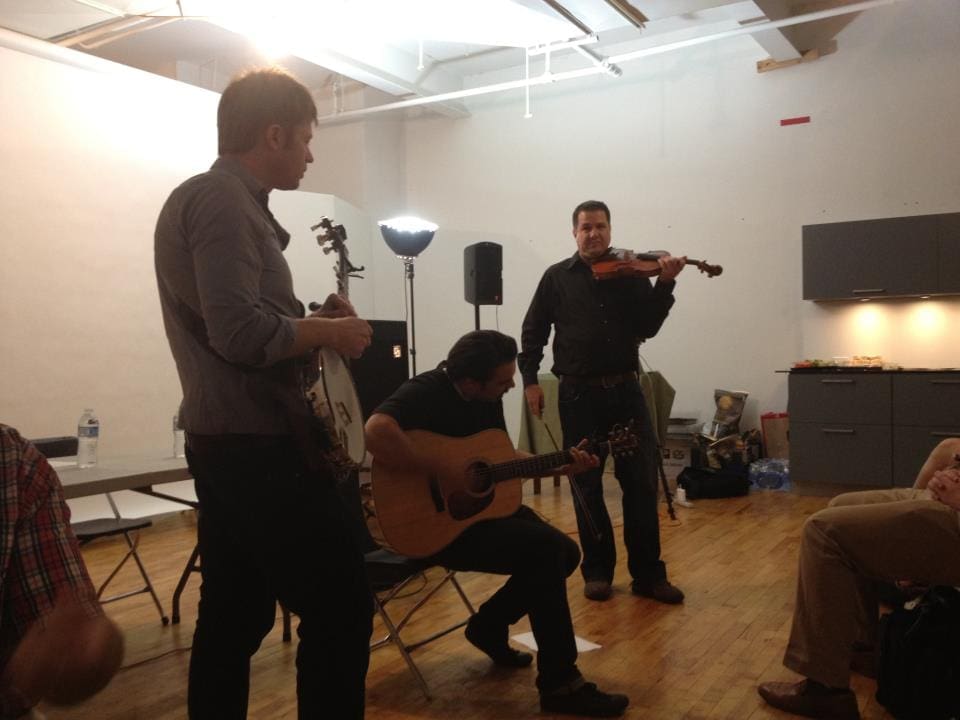
The episode closes with music from the Sabre Rattlers.
What’s covered
- 00:00 Welcome and conference introduction
- 13:13 Richard Bushman on faith and historical problems
- 30:44 Reinterpreting early Mormon history
- 40:14 Magic and Joseph Smith’s worldview
- 44:33 Andrew Kimball on personal faith transitions
- 1:00:42 Closing credits and Sabre Rattlers music
Related episodes: 1441: Questions I Would Ask Richard Bushman · Top Mormon Historian Admits Issues Raised in CES Letter – Richard Bushman | Ep. 1934 · 380: 2012 New York City Conference Pt. 2 with Elna Baker
Episode Transcript
Host: John Dehlin · Guests: Richard Bushman, Teresa Sheffield
This transcript is machine-generated and lightly edited for readability. The audio is authoritative. Please excuse occasional errors in names and spelling.
Welcome and Conference Introduction
Richard Bushman [00:00:00] 1, 2, 3.
John Dehlin [00:00:07] Mormon Stories Podcast is a production of the Open Stories Foundation. All donations to Mormon Stories are fully tax deductible and go directly towards keeping the podcast alive and towards building a
Richard Bushman [00:00:18] community of support for Mormons like you.
John Dehlin [00:00:21] To support the podcast or to join the community, please become a monthly subscriber
Richard Bushman [00:00:26] today@mormonstories.org hello everyone and welcome.
Teresa Sheffield [00:00:31] Very happy to see such a good turnout. My name is Teresa Sheffield and I will be conducting this first session. Before we begin, I'd like to give a few thank yous. I know a lot of hard work went into making this conference come together, so first and foremost, I'd like to thank Carrie Sheffield and Christy Pleg for all of their hard work and making sure everything was coming together. If we can give it a round of applause.
Teresa Sheffield [00:01:01] I'd also like to thank Tara Brown for her help with the registration and the beautiful sounds, courtesy of Jared Moody. He came in from Boston to do the sound for this conference. I'd also like to thank all of the speakers and performers who will be helping us out today and thank you everyone for coming. It's such a good turnout. I know a lot of people flew in from all over the country to come to this conference, so thank you for doing that.
Teresa Sheffield [00:01:28] This year's theme is exploring Personal and institutional Faith transitions in the Information Age. I know that we all have our own stories that have led us to this conference today. For me personally, Mormonism permeated every part of my life. That when I began to question its truth, I was literally in shock.
Teresa Sheffield [00:01:53] To leave Mormonism wasn't just to stop attending church on Sunday. It was to change my entire being. It changed what I did when I woke up in the morning. It changed my interactions with friends and family. It changed my very thoughts. It was a very hard transition, and for me, it was one that I had to make.
Teresa Sheffield [00:02:12] We're here today to say that it's okay to have those questions. We're not here to tell you where those questions will lead you. Whether it leads to a stronger belief in Mormonism or to finding another faith. We're just here to say that you're not alone.
Teresa Sheffield [00:02:26] My journey is different from your journey, and all of our paths are different. We each have our own story. But today we are united by the desire to share them and draw strength from each other and hopefully to get on the path of knowing the answer. When we ask ourselves, what do I believe?
Teresa Sheffield [00:02:45] It's usually traditional to read a few of the shared values. You can see them printed in your program. The shared values of the Mormon stories. I'm just going to read a few of them. With this organization, we acknowledge the richness of Mormon heritage, teachings and community in all of its diversity.
Teresa Sheffield [00:03:05] We believe that one can self identify as Mormon based on one's genealogy, upbringing, beliefs, relationships and other life experiences regardless of one's adherence or non adherence the teachings or doctrines of any religious organization. And we seek spaces where we as Mormons can live lives of intellectual and spiritual integrity, individual conscience, and personal dignity.
Teresa Sheffield [00:03:31] Those are just three of them. The rest are printed in your program. I won't take up all of your time by reading them. We're going to get things started by a poem. And there's a Moment of Silence by Lisa Soares Hubble.
Teresa Sheffield [00:03:45] She will unit in American Sign Language and there won't be a translator. So please keep your eyes open and watch as she gets in. Thank you. Thank you very much, Lisa. We're going to have a musical number. It's going to be a trio with Mark Abernathy, Nate Olson and Nathan Keller.
Teresa Sheffield [00:04:04] Mark he's working with the Sable Rattlers. It's the current project and features a rotating cast of contributing musicians and friends. Nate Olson has been playing the fiddle for over 30 years. He played in his family's band, the Olson Family Fiddlers, and he played in the folk music ensembles at byu. He has toured, performed and recorded internationally with several groups and is currently pursuing a doctorate in music education at Columbia. And Nathan Keller is the musical director and banjo player for the Worldwide association of Performing Artists. He has performed all over the world and hosts a monthly concert series in Orem, Utah. And he is the CEO of Keller Capital.
Richard Bushman [00:04:58] How's everybody doing? This is called the View of Israel. Ram. Give my
Guest [00:05:54] blessing.
Richard Bushman [00:05:56] We call.
Teresa Sheffield [00:06:23] D.
Richard Bushman [00:07:26] La. Sam. To. Holy. Sam. Sat
Teresa Sheffield [00:10:41] o.
Richard Bushman [00:11:11] You.
Guest [00:11:37] To be.
Teresa Sheffield [00:12:00] Thank you very much. That was just fantastic. As you see, he does have CDs for sale. After we'd like see to grab one, we're going to move on to our keynote speaker. It's Mr. Richard Bushman. Richard Bushman retired as Governor Morris professor of History at Columbia University in 2001 and then came out of retirement in 2008 to accept a position as visiting Howard W. Hunter Chair of Mormon Studies at Claremont Graduate University. He is the author of Joseph Smith, Rough Stone Rolling and Copy, co general editor of the Joseph Smith Papers. He chairs the Board of Directors of the Mormon Scholars foundation, which fosters the development of young LDS scholars. With his wife, Claudia Bushman. He is the father of six children and 20 grandchildren. He has been a bishop, stake president and patriarch, and is currently a sealer in the Manhattan Temple. Please help me in welcoming Richard Bushman.
Richard Bushman on Faith and Historical Problems
Richard Bushman [00:13:13] It's a great pleasure to be here. We've attended Mormon Stories conferences in various parts of the country. I'm glad that the long arm of John Dehlin has reached New York City. Some years ago, my nephew, Casey Kern. Is Casey here today, intending to come down from Boston. He may not have made it, but he urged me to do an interview with John Glynn when he was developing his famous podcast.
Richard Bushman [00:13:47] And I was going to oblige because I really was sympathetic with John's intentions as I understood them. One of them, I believe, was to allow for questioning and doubt, even among people who consider themselves active Mormons. I knew this was a problem because I had an experience along those lines myself.
Richard Bushman [00:14:12] Nearly 30 years ago, Phil Barlow asked me to sum up my beliefs for a collection of essays he was doing called the Thoughts of Faith. It was the first of a genre of books of that kind. There are lots of them around now.
Richard Bushman [00:14:31] The response to the essay, which I titled My Belief, surprised me. People didn't react so much to the reasons I gave for believing as for my acknowledgement that I had questions and had even gone into the mission field without a testimony.
Richard Bushman [00:14:51] It seemed a relief to them that someone who was deeply involved in the church could also be a questioner. And John seemed to be ministering to the people who were in that position. I also felt a kinship with people who had reservations about saying I know rather than I believe.
Richard Bushman [00:15:14] There are some very solid Latter Day Saints who live by faith, faith rather than perfect knowledge. They have reservations about saying bluntly, I know the gospel is true. I am certainly a believing Mormon myself, but for some reason I have stumbled at the use of the word no began in the mission field, where I started with no testimony, as I said.
Richard Bushman [00:15:43] And my mission president, Howard Maughan, hearing this from me, did not panic, but simply handed me the Book of Mormon and said, see if you can find an explanation for this book. For three months in my first assignment, which was in Halifax, Nova Scotia, I labored away on the book's authenticity. What about the witnesses? Were they hoodwinked by Joseph Smith? Did he hypnotize them or talk them into their beliefs? Were they just seeing a vision? Could Joseph have made up the book himself? Did he copy it from something? I asked every question I could think of at the time, praying away as we're always told to do.
Richard Bushman [00:16:26] And when President Maughan came to Halifax for a mission conference, he called on me to bear my testimony. I said, I know the book is right. I didn't say I know it is true, only that it was right.
Richard Bushman [00:16:43] To this day, I cannot explain why I chose right or true. Perhaps one explanation is that there are actually two models for gaining a testimony resulting in two kinds of knowledge. One is the first vision model. In this case, you may begin with doubts and questions. You may be deeply troubled. And so go the Lord with your problems. There you received an epiphany. Something supernatural happens and your doubts and questions disappear. From then on, you know you have encountered God and you never falter.
Richard Bushman [00:17:29] That is Jim Faulkner's experience and Clayton Christensen and that of many others. These people say I know. The other model is to plant a seed on the pattern of Alma 32. Here you begin with uncertainty, but must have just enough faith to plant the word of God in your heart. You water and cultivate the seed until it begins to grow.
Richard Bushman [00:17:58] That does not give you a complete testimony of everything. But you know the seed is good because it expands and enlarges you. This encourages you to go on watering and cultivating. And tree sprouts. And the tree sprouts and grows beside you. But in this model, you never arrive at perfect knowledge of everything.
Richard Bushman [00:18:21] You only know the seed has brought light and enlarge your soul. You know it is good. During my first semester at Claremont, a colleague invited me to lunch. He was soon become dean of the School of Religion. Catholic theologian, very distinguished scholar. I thought he wanted to get better acquainted. Tell me more about the school's prospects and problems.
Richard Bushman [00:18:51] If you're having trouble hearing me, I'll stand a little closer. To my surprise, we had hardly put in our lunch orders. Then he turned to me and asked, richard, how can you believe in Joseph Smith? Without a second thought, I replied that when I lived in the Mormon way, I found I was the kind of man I wanted to be.
Richard Bushman [00:19:16] This I certainly do know. This does not mean I believe only in the goodness of Mormonism while entertaining doubts about its truth. Quite the opposite. I believe Joseph Smith had gold plates. I believe the witnesses saw them. I believe in Nephites.
Richard Bushman [00:19:37] I've always lived a Latter Day Saint life. I've been tithing and obeyed in wisdom. I've accepted all the callings I've received. I go to the Temple, even work in the Temple. I see the world in the way Mormon scripture describes it. I find those ideas the best way to think about good and evil and the purpose of life. That I know I can't think of. Any way I hold back, save that I am a Democrat.
Richard Bushman [00:20:13] When it comes to the fruits of Mormonism. I'm perfectly willing to use the word no because I have direct personal experience. I know there's goodness in Mormonism. I experience it in my own life, in the lives of people around me. I planted the seed long ago and has continually grown ever since. I have no intention of ever uprooting the seed and casting it aside. This would not only be foolish, but it would contradict my deepest personal knowledge that I know the rest. I believe One insoluble puzzle in my life experience is why I believe in others do not.
Richard Bushman [00:20:55] I've always made a practice of facing up to all the historical, moral and theological problems I run across. I've not resolved them all, but I don't hide from them. Yet none of the conundrums and contradictions that exist have dislodged my faith. While others who have come across these same problems give up their belief and leave the church. Why is it that some people feel that the facts compel them to reject Joseph Smith's claims while others in possessions of the same facts? Hold on.
Richard Bushman [00:21:34] I think that probably people on the two sides have explanations for those who follow a different course. Disbelievers feel that believers have too many vested interests to follow where reason leads. They don't want to disappoint family, friends and fellow ward members.
Richard Bushman [00:21:56] Rather than cut all ties. Painful process. They persuade themselves they have a reason to go on believing. And so we have a Kathleen Flake, a Don Bradley, a Terrell Gibbons, a Laurel Ulrich, a Clayton Christensen, who are well informed but can't bring themselves to renounce the faith of their fathers and mothers and friends.
Richard Bushman [00:22:22] There may be some truth in this hypothesis, but I have another explanation for my belief in the face of knowledge that destroys faith in others. Perhaps because of my training as a historian, perhaps because of my native temperament, I have never thought in black and white terms.
Richard Bushman [00:22:44] Things never seem as certain and obvious to me as they do to others. Some people are absolutely certain the church is true when they are on the inside, and then just as certain it is false when they move to the outside.
Richard Bushman [00:23:02] Such people say that historical facts make it impossible to believe that Joseph Smith is a prophet. How could it be if he thought he was translating the words of Abraham from scrolls when he was actually looking at a conventional breathing permit?
Richard Bushman [00:23:21] Or they believe a prophet God would never have taken a 14 year old girl as a plural wife. To some people, such facts, or an accumulation of such facts, seem to make it logically impossible to believe Joseph Smith was inspired by God. They feel compelled by the facts to leave.
Richard Bushman [00:23:42] To me, it is not at all obvious. It is quite possible to think of a prophet who both heard from God and was mistaken on many things. To me, the seemingly damning facts are a matter of interpretation. The same facts take on another aspect when viewed from another angle.
Richard Bushman [00:24:08] Facts do not compel us to certain conclusions. They have to be interpreted. There is a good example in historical debates about Joseph Smith's prophethood. Forty years ago, when I began writing Joseph Smith and the Beginnings of Mormonism, the number one criticism of Smith was that his family practiced magic.
Richard Bushman [00:24:33] The practice of money digging in prophethood seemed mutually contradictory. Critical biographies thought it obvious that Joseph was a treasure seeker and so could not possibly have been a prophet, while apologetic biographies denied the charge categorically, implicitly admitting the two clashed. To both parties, magic and divine inspiration seemed totally antithetical.
Richard Bushman [00:25:03] The defenders of Smith made their case by claiming evidence for money digging was untrustworthy. There were a number of documents to support the charge. It turned up in accounts of General Smith's 1826 trial for disturbing the peace by looking for lost objects. Glass looking, as it was called then.
Richard Bushman [00:25:25] In addition, the affidavits collected in Palmyra by Frascis Hurlbut Pearl Button in 1833 described many instances of the Smith family searching by night for treasure, sacrificing lambs, and drawing magic circles. The evidence was there, but more apologists dismissed it out of hand. They argued that the evidence for the 1826 trial was discovered 50 years after the event and was likely fabricated by the province enemies who only pretended to have discovered it.
Richard Bushman [00:26:03] The Hurlbut affidavits were collected by a man who had been hired to gather damaging evidence and who detested Joseph Smith. How could statements assembled by a known enemy be trusted? Mormon historians admitted that Joseph dabbled in treasure seeking when he worked for, but as a sideline, had no taste for it. The rest of the evidence had no credibility.
Richard Bushman [00:26:31] When I began work on Joseph Smith and the beginnings of Mormonism, I realized that as a professional historian, I could not simply dismiss the Hurlbut affidavits with a wave of the hand. It had to be evaluated like every other form of evidence.
Richard Bushman [00:26:49] Moreover, while I was writing, Wesley Walters, a relentlessly critical researcher, came out with an ingenious proof that the 1826 trial had taken place based on evidence from a contemporaneous court record. The new evidence made it seem highly likely that the trial had occurred and the charges had been made.
Richard Bushman [00:27:13] Taking the hurlbut affects into account as well, I decided that money digging and magic were indeed a part of Smith family culture. Perhaps they were exaggerated and shaped by the disdain of the neighbors, but they were not baseless. Something was going on.
Richard Bushman [00:27:32] I was helped in my research by pathbreaking scholarship on the subject of magic in Europe and America. It was published, as I wrote Keith Thomas in Religion and the Decline of Magic Found magical practices were deeply ingrained in English culture at all levels. Through the end of the 17th century, members of Parliament used seer stones.
Richard Bushman [00:27:55] Not long after, the Yale historian John Butler discovered a strata of magical practices in American popular culture. Through the 18th and well into the 19th century, all this work shed a new light on the Smith family's participation. It came to appear much less toxic than it had earlier. As treasure seekers, they were not outliers caught up in bizarre marginal culture. They were indulging in practices that were commonplace among ordinary New Englanders, like playing cards or reading astrological charts are today.
Richard Bushman [00:28:33] The evidence in the hurlbut affidavits themselves show that treasure seeking was commonly used pursued in the Smiths neighborhood. Magic was questioned and even scorned by the enlightened upper classes, but was part of the life of planned people. Moreover, magic did not replace Christianity. The two were practiced together as they had been for hundreds of years. In the early 19th century, one could embrace Protestantism and magic simultaneously. The Smith's participation did not indicate the rejection of religion. It was possible to be a Christian, even a Christian prophet and dabbling magic. So it came about that Smith family money digging today is no longer on the top 10 of logical objections to Joseph Smith's claims.
Richard Bushman [00:29:26] It once ranked up as high as the book of Abraham and contradictions in the first vision accounts do today. But no more. We now interpret magic differently. It seems like an innocent feature of the Smith's family culture, not a black mark that disqualifies Joseph Smith from prophethood.
Richard Bushman [00:29:47] Now, the role of magic and money digging in Dan Vogel's biography of Joseph Smith is not far removed from mind. In Rough stone Rolling, Vogel thinks Joseph was more deeply involved and for a longer time. But I even go so far as to speculate that magical practices prepared Joseph Smith for his role as translator. As I say, at one point, looking in the seer stone for lost objects prepared him to look in the stone for lost words.
Richard Bushman [00:30:17] Magic may have been a vital part of his spiritual education. The historiography of money dicking then, is an example of how interpretation puts facts in new light nowadays, no less treasure seeking. Among the leading criticisms of Joseph Smith, Mormon historians have found a way to tell the Joseph Smith story that includes both money digging and divine inspiration.
Reinterpreting Early Mormon History
Richard Bushman [00:30:44] A few new facts contributed to this new outline, but they are not what matters most. We've hit upon a new interpretation that puts the facts in a new light. The money digging stories helps us see that even the most damning facts assume new guises. As historiography evolves, what is obvious at one point becomes less obvious at another. The interpreted mills grind on and our understanding of the past takes new forms. That is why, as a gray person rather than black and white, I think it likely that apparent certainties now like the Book of Abraham problem, will seem less destructive later on.
Richard Bushman [00:31:32] Underlying this take on the facts is the widely accepted realization these days that reality is humanly constructed. Facts are not facts until someone makes them. Such things may exist, but we don't recognize them as fact until someone brings them to our attention.
Richard Bushman [00:31:56] Interpretation precedes fact necessarily. Jared Farmer's luscious account of Mount Timpanogra's On Zion's Map as a case in point. When Mormon settlers first came to Utah Valley, they paid little attention to the mountain range lining the eastern edge of their settlement. What attracted their attention was the lake. It contained precious water and fish. It was a means of transportation.
Richard Bushman [00:32:26] The native population built the villages along the lake, and the Mormons were not far away. Only gradually over the 19th century did timpanogos emerge as a feature of a landscape worthy of their attention. It was eastern tourists and tour guides who drew attention to this massive mountain. It was eventually given a name and carefully measured and then turned into an object that everyone noticed. But settler and tourist size had to be trained to look at the mountain.
Richard Bushman [00:33:03] The attention to Smith family treasure seeking followed the same course. More recently, re examining the original sources, I realized that the Smith's money digging was not a fact that jumped out at anyone living in Palmyra in 1830 as relevant to the Gold Bible project.
Richard Bushman [00:33:26] When the Gold Bible was reported in the Palmyra press for the first time in June 1829, nothing was said about Smith and the treasure secret. The Book of Mormon was presented as an imposition, that is the duplicitous attempt to force the book off on the public as a way to make money, it seemed as a branch of priesthood making money through religion. For an entire year after this treasure seeking, no one said anything about treasure seeking or the Smith's magical practices.
Richard Bushman [00:34:05] Someone had to interpret the facts to make them relevant. Not until the summer of 1830, a year later, did Abner Cole, a local newspaper editor, suggest the novel idea that Joseph Smith had been a member of a band of treasure seekers.
Richard Bushman [00:34:24] Cole was not taken seriously at first. He was a feisty lawyer who published a sheet called the Palmer Reflector and received little respect in the village. A fellow editor asked him to refer to the reflector as a sarcastical, obscene little paper.
Richard Bushman [00:34:42] For a year after news of the Bible began to circulate, Cole vacillated about what to make of the Book of Mormon. Over a ten month period, he switched from being scornful about the book to insisting on respect when he was pirating passages and publishing them in his paper, and then back to scorn again. When Joseph insisted, he stopped. When he did get his money digging hypothesis, it first took a whimsical form. He wrote in a pseudo biblical style, with many exotic flourishes, such as saying the Nephites came to America in bark canoes, where they died of the small pox, as if his account was only given in fun.
Richard Bushman [00:35:27] Apparently no one took Cole seriously at first. For the next six months, from July 1830 to February 1831, the newspaper reports from the vicinity continued to speak of the Book of Mormon as an imposition, with no mention of Smith family.
Richard Bushman [00:35:45] Then in the winter of 1831, almost a year after the book was published, Cole found he had a national podcast. Mormons were moving to Kirtland, Ohio, and Eber D. Howe, editor of the nearby Primison Telegraph, wanting more information, wrote Cole for copy. Cole, recognizing that he was in a better position than anyone to construct a narrative, published a series of essays about Palmyra money digging in February and March 1831, which Howe immediately republished. In these essays, Cole wrote in sober tones about one Newman Walters, a hierarchist and magician, anointing Joseph Smith to take over the band of money diggers and write a book. According to Cole, Walters pretended to read from a copy of Cicero's orations, uttering an unintelligible jargon which he would afterwards pretend to interpret and explain as a record of the former inhabitants of America.
Richard Bushman [00:36:48] It seemed obvious to Cole that Walters had given Smith the idea of a holy history. On Cole's account, the gold plate story evolved out of the Smith's earlier treasure seeker. The guardian of the treasure became an angel, and gold coins and gold mines became a gold book.
Richard Bushman [00:37:09] That was the story Cole pulled together a year and a half after he first heard of the gold plates. After that, more and more commentators Came to see folk magic as part of the story once Cole had noticed and named it. Treasure seeking seemed obviously important to everyone, although no one had said a word about it for a year after the book was published. Cole was the guy who put treasure seeking on everyone's map of Smith family history.
Richard Bushman [00:37:42] So where do we stand then? Were the Smiths actually money diggers? And did the magical worldview shape their thinking? To get this narrative straight, I lined up all the contemporaneous sources that Joseph Smith spoke of. Joseph Smith and the gold plates. That is sources produced at the time, not created afterward. When all sorts of other influences come into play, I looked at the sources produced by non Mormons and those by Smith, his trans in his family.
Richard Bushman [00:38:17] Two things became apparent from examining these sources. The first is that the Smith family was definitely involved in treasure seeking. We learned that from the 1826 trial transcript that I personally believe is authentic. During a court hearing on March 20, Joseph testified while working at Josiah Stowell's farm and going to school, he had been employed looking for mines. Then he went on to say this and I'm going to read you his testimony as it was recorded by the clerk that he had a certain stone which he occasionally looked at to determine where hidden treasures in the bowels of the earth were.
Richard Bushman [00:38:59] That he professed to tell in this manner where gold mines were at a distance underground and had looked for Mr. Stoal several times and had informed him where he could find those treasures. And Mr. Stowell had been engaged in digging for them that at Palmyra he go back to Joseph now had pretended to tell by looking at this stone where coined money was buried in Pennsylvania. And while at Palmyra he had frequently ascertained in that way or lost property of various kinds that he had occasionally been in the habit of looking through this stone to find lost property for three years, but of late had pretty much given it up on account of injuring his health.
Richard Bushman [00:39:44] Especially his eyes made him sore that he did not solicit business of this kind and always rather declined having anything to do with this business. To my mind, that count leaves little doubt a sniff family involvement. But it makes Joseph a reluctant participant. Treasure seeking was something he was pressed into rather than undertaking with enthusiasm at his own initiative.
Magic and Joseph Smith's Worldview
Richard Bushman [00:40:14] The second conclusion from my reading of all these sources takes the form of a question. Did magic shape Joseph Smith's worldview? Looking at the earliest sources from Joseph and his associates, documents written before 1830, magic and money digging are not much in evidence. It turns up here and there as in the 1826 trial transcript which I just read, the agreement among the Josiah Stowell Money Digging Company signed by Joseph Smith Sr. And the reference to Oliver Cowdery's wrought of errand. But there is little else at this time.
Richard Bushman [00:40:58] When it came to texts where writers revealed what was in their mind, Joseph and his friends talked only religion. They speak of the second coming, divine visions in Christ. The first words of Joseph smith, recorded in July 1828 and now in the Doctrine of Covenants is Section 3.
Richard Bushman [00:41:22] Speak in this. Speak in the voice of God. The works and the designs and purposes of God cannot be frustrated, neither can they come to naught. For God doth not walk in crooked paths, neither did he turn to the right hand, nor to the left. Neither doth he vary from that which he hath said. Therefore his paths are straight and his course is one eternal run. And so the revelation goes on in that vein. The 1829 correspondence with Oliver Cowg was all on religious themes with not a speck of magic in them. In the Book of Mormon, of course, as the first commentators agreed, was a gold Bible.
Richard Bushman [00:42:07] It was God centered, saturated with biblical language and filled with Christian theology. Everything we had from the early Mormons in their own words was religious. The moment. I doubt that folk magic was ever dominant in Joseph Smith's personal culture, the evidence is too thin.
Richard Bushman [00:42:33] The neighbors did not automatically think of him as a money digger until Cole showed them how. Smith's own first words, the revelation he dictated in 1828, seem deeply conversant with biblical language. The low frequency magical references, plus the Palmyrans failure at first to speak of Joseph Smith as a trickster who moved from treasure seat into the Book of Mormon makes me wonder how important magic was to Joseph.
Richard Bushman [00:43:08] The magic of Set, says Joseph Smith, may have been Abner Cole's creation. We must recognize that history is always a project under construction. It is not just there. It is a made object, constructed both by participants and later distortions long after the events happen. They take new forms as new evidence and new views come along.
Richard Bushman [00:43:40] That is why I don't feel that hard facts compel us to believe one way or the other. We cannot escape the responsibility of interpreting facts for ourselves. Hard facts have a way of softening over the years, and what seems self evident at one point becomes a matter of interpretation at another. That is the best explanation I can offer for why I am less unsettled by disruptive facts than others. Thank you.
Andrew Kimball on Personal Faith Transitions
Teresa Sheffield [00:44:33] Thank you very much, Dr. Bushman. Our final speaker will be Dr. Andrew Kimball. Andrew was raised a Mormon in the East. He is a grandson of Camille and Spencer Kimball and co authored a biography of his grandfather. In 1977, he attended BYU, where he married Katharine Bush. They had six children, five of them by the time he earned his English Ph.D. at Harvard, diploma in hand. He concluded he was not cut out to teach after all, and instead he joined a bank. After six years of banking, he moved to Moody's Investor Service, a bond rating agency from which he retired earlier this year. He is currently dealing with the trauma of sudden idleness. Andrew and Katherine live in Manhattan. Please welcome Dr. Kimball.
John Dehlin [00:45:33] While I was in graduate school, Richard Bushman was my beloved stake president. So I feel somewhat sheepishly, I must apologize to him in advance for what I'm about to say. I have been uninvolved in the church for 22 years now.
John Dehlin [00:45:55] Recently, a friend and former Mormon began to criticize, then vilify Joseph Smith at our dinner table with venom as a charlatan, sex pervert, cheat. I had to stand up abruptly and walk out to the kitchen and start dishes to avoid the scene.
John Dehlin [00:46:19] I wasn't to the point of scaling the embassy walls, but I was upset. I was actually surprised by the depth of my emotion. Such talk seemed to defame my parents, my grandparents and my own past. My midlife crisis came 23 years ago, on cue, age 40.
John Dehlin [00:46:47] Cliche. Appropriately, it was entangled in my unsettled business, lifelong confusion about God. I had lived through four decades, every permutation of testimony and doubt, but still not reached a resting point. Now, at midlife, wondering what I am mounted to. If anything, I craved an answer. An answer, even if not the answer.
John Dehlin [00:47:24] I complained about my confusion to a few close friends. One of them referred me to an astrologist, intuitive. This woman began her reading by asking, why did you come? I said, I want to know. Does God exist? Ah, she said with approval. Does any other question matter?
John Dehlin [00:47:53] But her answers did not satisfy her. Next, my friend referred me to a self realization seminar. Over the course of that seminar, I realized I was living with an unspoken assumption that I must measure up to my grandfather and his father and his father.
John Dehlin [00:48:18] By that yardstick, I was failing. I lacked their faith, their righteousness, their position, their status. A branch of the Kimball family tree seemed to grow.
Richard Bushman [00:48:35] Church leaders.
John Dehlin [00:48:37] I never doubted that I was obligated to be among them, but I never felt able. When I was a teenage, my Grandpa Kimball eagerly asked to read my patriarchal blessing. When he handed it back, he told me it was normal.
John Dehlin [00:49:00] I caught the disappointment anyway. Within A year or two of midlife, the question about God simply seemed to resolve itself. I did not. I became inactive in the church and I went into a personal tailspin that lasted a decade and lingers with me. Yet the key scripture in my Mormon story has always been James 1:6.
John Dehlin [00:49:34] If any of you lack wisdom, let him ask of God. And so on. As a teenager one evening, I paired with the missionaries to deliver a first discussion to local investigators. To my amazement, the family we taught that night was my principal at the high school.
John Dehlin [00:49:54] At some point, the missionary turned to me and asked would I recount the Joseph Smith story? I did proudly at the story center, I placed that scripture in Joseph's test of its promise and the assurance that each of us can and ought to do likewise.
John Dehlin [00:50:21] To me, the promise meant quite literally that any good and sincere person could pray like Joseph and be answered. When that failed for me, and I felt for decades that it did, I concluded that I must be neither good nor sincere.
John Dehlin [00:50:45] My sense of unworthiness increased because my prayers failed. Or perhaps it was the self doubt that preceded and contributed to that failure of prayer. The scripture promise is peculiarly circular. About that time in high school, I self diagnosed my testimony problem as lack of real intent.
John Dehlin [00:51:16] Why should God answer when I lacked the fervor of Enos in the Book of Mormon? So when my family planned a day of the beast, I declined to go. No explanation. As the station wagon drove off, I taped do not despair on my bedroom door.
John Dehlin [00:51:36] Then I locked it. I wedged it shut with a dresser. I pulled the shades, I knelt and I prayed literally in my closet for about 13 hours. I wanted some indication from God that he existed. I spoke repetitiously, lost concentration, probably dozed off a few times.
John Dehlin [00:52:04] When my family returned home before I felt done, I ignored the knocks on my door. I never did explain myself to anyone. But that prayer went unanswered. I felt some part of me that day must have interpreted no answer as no God.
John Dehlin [00:52:30] But I was not ready or able to conclude that. Instead I blamed my doubt and weakness, which compromised the results. Disqualified disqualified me from the miracle of an answer. James promise had not been tested. Rather I had and found wanting. At BYU came first love.
Richard Bushman [00:52:59] There was an initial euphoria.
John Dehlin [00:53:01] I felt strong, self sufficient. First time in my life in that bold frame of mind, I simply stopped believing in a personal God. Then my girlfriend left. My confidence collapsed. I fell into a year of depression and decided it made more sense after all to believe than to doubt.
John Dehlin [00:53:27] In the months that followed, I more or less willed myself to believe again. That evolved over a year from something forced into something that eventually felt natural and real. A year and a half later, now a senior at byu, again an active believer, again in love, I phoned my grandfather, Kim.
John Dehlin [00:53:56] I asked to visit him in New York. I was wondering, now that I have a testimony again upon graduating, should I serve a mission or marry? My grandparents knew Kathryn and knew we were serious. I sat with Grandpa in his study on a Sunday afternoon, asked my question, listened to his advice.
John Dehlin [00:54:23] A half hour later we rejoined my grandma fixing supper in the kitchen. My Kimball grandparents represented complementary approaches to religion. Spencer Kimball exemplified unquestioning loyalty to duty in church. Kimballs did not engage in disputation about religion. These matters had been settled.
John Dehlin [00:54:49] Camilla and the Eyrings were open to a more interactive setting. A particularly tough issue would be put on a back shelf, unresolved, and left to sit for another time. Well, Grandma asked, what did you tell him? Grandpa summarized his advice.
John Dehlin [00:55:13] Do both serve the mission, then marry Katherine. Probably she would wait. Also, he said, a few years older than most missionaries, I would bring extra maturity to the work. Then he paused. I don't agree, grandma said with conviction.
John Dehlin [00:55:44] There are ways to serve the church other than a mission. She felt fiercely the importance of marrying well and thought I hit the jackpot with Catherine. For her socially awkward grandson, the odds seemed stacked against a repeat. On reflection, I cited a grandma and married Catherine.
John Dehlin [00:56:11] Between ages 20 and 40, I was an active church member. I held various positions. We raised six children. Periodically I tried with private prayer and fasting to anchor my testimony in a witness, or at least a firmer certainty.
John Dehlin [00:56:30] But each effort invariably led back into the hopeless and endless loop of how to know when the trial was over and how to interpret the results. For those 20 years, the church enterprise monopolized my allegiance. Sometimes I participated intensely with conviction, sometimes with little more than hope and habit.
John Dehlin [00:57:02] But at some core level, I felt a strange from Religion's Bible Center. Then, at age 40, things just resolved without drama or incident. I simply settled into a realization. I did not believe in a personal God. I soon disassociated from church activity.
John Dehlin [00:57:29] No heartbreak, just a different path. I never had any interest in a middle way. Religion for me was never about seeking community. Nor was Mormonism about finding a best of kind religious practice. For me, it has always been a matter of this literal truth.
John Dehlin [00:57:54] Did God speak to Joseph Smith? Did Moroni deliver golden plates containing ancient writings? Were the witnesses who signed statements credible and truthful? I tried many times for many years to believe it happened without satisfactory witness. Finally, the continuation of the effort in the face of failure seemed a mockery of the process and its integrity.
John Dehlin [00:58:34] I had gripes about the Church, of course, just as one does about one's family, but I wouldn't leave over gripes. My question always was, is there a God? I laughed, I think, because I failed to receive, or at least recognize receiving, a convincing witness.
John Dehlin [00:59:00] So here I am today with my Mormon story. I am skeptical by philosophy of coherent personal narrative. The idea of a Mormon story seems at best a convenient fiction. But that fiction, or this 15 minute summary version of it, I've given as honestly as I could.
John Dehlin [00:59:25] Maybe I am too involved in my sense of personal unworthiness to feel God, to ever feel God. Maybe in actuality God stands like the Christus, arms extended no unseen, seen by me. Or maybe, as I believe, there is no God in any sense consistent with traditional Christian worship. Either way, here for now, I must stand. Thank you.
Teresa Sheffield [01:00:13] Thank you all very much. Dr. Kimball, this concludes the first session of this conference. We'll take a 30 minute break. In those 30 minutes, if you have not registered with Tara for the back table there, please register. We also have refreshments here. Please feel free. Make yourself. We will reconvene at 2 o'. Clock. See you all then.
Closing Credits and Sabre Rattlers Music
John Dehlin [01:00:42] Thank you for joining us today on Mormon Stories. Music today was provided by the Saber Rattlers. Check them out@sabre-rattlers.com the Mormon Stories logo was generously donated by StudioCase.com thanks for listening.
Guest [01:00:57] Come come you see saints no toil nor labor fear but with joy wend your way though hard to you this journey may appear Grace shall be as your day Tis better far for us to strive Our useless cares from us to drive to the San Jo Hearts will swell oh, all is well all is well. Why should we mourn? I think our lot is high T not so all is right why should we think to earn a great reward Lord, if we now shun the fight Gird up your lo fresh courage take Our God will never us forsake soon we'll have let's tell the tale oh all is well all is well oh, all is well all is well.
Richard Bushman [01:03:07] Sam.
Guest [01:03:51] And should we die before our journey is through Happy day All is well we that are free from toil and sorrow too with the just we shall dwell but if our lives lives are spared again to see the saints the rest obtain I will make this chorus well oh, all is well all is well all is well well all is well all is well oh, all is well.
Teresa Sheffield [01:05:07] All
Guest [01:05:09] is well all in the way Ra.
Transcript © 2026 John P. Dehlin. All rights reserved. Brief quotations are welcome with attribution and a link to mormonstories.org; all other use requires written permission.
7 Responses
I loved these two addresses. Thank you for sharing them. As an active, believing member who has embraced the Mormon Stories ethos, I gravitate to anyone who models the notion of a thoughtful faith and few do that with the grace and humility of Richard Bushman. The notion of ‘truth’ losing some of it’s hard edges over time is priceless.
I also thoroughly enjoyed Andrew Kimball’s articulate, self-aware story. I genuinely sympathize with his experience of having lost connection with deity and feeling the weight of his family history bearing down on him.
Hi Kevin,
As a member I’m having a hard time with the fact that Joseph Smith “married” teenagers such as Helen Mar Kimball etc. How are you able to deal with that ?
Fantastic addresses. I listen to the whole think twice in a row.
A very interesting session. I did like Richard Bushman’s point about how facts can be created. Things seem obvious after the first person points them out. I don’t agree with him that Joseph Smith’s involvement in magic is a non-issue now because historians like him have come up with a good justification. I think it is still a very important aspect of his time. To me it shows that the people of the time were extremely credulous so I can see how Mormonism could flourish in that environment. I also don’t like the line of thinking that goes that because one thing was explained that means everything at some point will be explained away. I think it was Quentin Cook who used that same argument in this last conference. Because it was discovered that the Hoffman documents were a forgery that means any evidence against the church will eventually be shown to be a fraud. There are stronger and weaker pieces of evidence against the claims of Mormonism but on the whole I think they are quite damning. I don’t feel obligated to leave but I don’t see any reasons to continue to participate if I am not sure it is true. The church asks to much and gives to little for me to do that. It doesn’t make me a better person. In fact it makes me miserable. It is certainly possible that someday we will find some additional papyrus fragments that translate exactly into the Book of Abraham or that archaeologists will discover a city called Zarahemla with lots of chariots and horse fossils and a lot of writing in reformed egyptian. But in the meantime I am not going to stick around.
David,
Without knowledge we continually walk in faith. If you want to find equally misleading information on Jesus Christ, Abraham, Moses etc., you can, it’s out there. If irrefutable evidence where available, you would have pure knowledge.
At some point you have to find truth through the spiritual core of your being. It’s just how God plays this game.
dang that autocomplete!!!…..The above should read:
“If irrefutable evidence were available, you would have pure knowledge.”
In response to Bushman’s remarks, of course all facts are subject to interpretation. It just so happens that most dispassionate observers look at the facts and conclude that it is more likely than not that Mormonism is not what it claims to be. I think the real question is, when considering Mormonism’s top 10 most problematic issues, do we stay or do we leave? Sure, some issues might be resolved in the future and others will not. But why grant Mormonism special patience that Bushman has given it? All faiths have problematic issues. Should the Jehovah Witness patiently wait and hope that his faith’s historical problems will one day be resolved? It cannot be the good in Mormonism that requires special patience above other faiths — many churches promote good that equals or exceeds what we find in Mormonism. I think there are deeply rooted psychological reasons (of which even the most intelligent are not immune) that explain why smart people grant Mormonism special status.