
Re-Recorded Version with Commentary (Less angry, less unhinged, de-caffeinated – Take 2):
Episode Transcript
Host: John Dehlin
This transcript is machine-generated and lightly edited for readability. The audio is authoritative. Please excuse occasional errors in names and spelling.
Introduction and Context for the Fireside
John Dehlin [00:00:00] Hello everyone, and welcome to another edition of Mormon Stories podcast. I'm your host, John Dehlin. It's March 17, 2021, and I am cautiously excited for today's episode. Just to give you a little bit of background, a couple days ago I received a video file of a fireside given on February 28, 2021 at the Logan, Utah Cache Valley west stake in Logan, Utah. G given by Patrick Mason, who is a Utah State University professor of Religious studies. And Patrick has been on Mormon Stories in the past and he's a noted author. This fireside that Patrick gave in Logan is dedicated to helping members in this Logan Stake deal with the faith crisis and or deal with loved ones who are experiencing a faith crisis. And and I just want to say at the outset, I think that this is a groundbreaking, important moment in Mormon history. And overall, I could not be more thrilled and proud of Patrick as a friend for what he's doing here and what he does. I think this is a real act of courage and integrity in so many ways. It's also a very triggering episode for post Mormons. Many people who have seen this have been very upset by it. And I actually recorded an episode of of my reactions to this presentation yesterday and I felt like I came across as too angry, as a bit unhinged, and I blamed it on the coffee. But I think there's more to it than that. But I won't bore you with any of that. I will just say that this is a re recording of my reaction to this presentation and my goal is to be as kind and as fair and as diplomatic and as. As balanced as possible. I will have a lot of compliments for Patrick and I will have some feedback for Patrick or for other Mormon apologists and I may express some concerns. But I hope to do it in a very balanced and compassionate and wise way. I apologize in advance to those of you who caught it yesterday and really liked the Passion because there are so many struggling Mormons or ex Mormons in pain. And sometimes if, if there's a lot of anger expressed on a podcast, there's a lot who are in pain that really resonate with that. I just want to be really clear about my intentions. Of course I want people to enjoy the podcast and value it, but my goal has always been to have Mormon Stories podcast be and feel as safe as possible for a Mormon who's questioning. And if I come across as super angry or unhinged or as venomous, it defeats the goal of what I want Mormon Stories to. And honestly, I want to be a kind, loving, compassionate, wise person. And I fail a lot, but I also try and I'm going to keep trying. And so with that, I also want to do a quick shout out. I want to give a huge thanks and a shout out to Angelina, who leads a company called Grove Trove Getaways. It was Angelina that provided me with this video. I asked her if it was okay to give her a shout out and she said yes. But I want to thank Angela for providing this video. And you can, if you want to thank Angelina herself, you can find her on Instagram at a Grove Trove A G R O V E T R O V E. So I just wanted to thank her. I also want to let people know at the outset that at the end of this presentation that Patrick Mason gives, there's a Q and A. And screenshots of the questions that were asked in the Q and A have been included on the MormonStories.org website and the names have been redacted. But you will, you will find I think those questions to be interesting and I'll probably touch on them at some point. And again, I want to just to close this opening to express my sincere love and affection and respect for Patrick Mason. And I really hope I can do my respect for him justice in this interview by being objective, but also by being kind and also by being thoughtfully critical in a way that doesn't feel demeaning or unfair to Patrick. So without any further ado, first I'm going to play an opening clip that has nothing to do with Patrick's presentation. And then I'm going to play Patrick's presentation and I'm going to pause it and give some responses to it. And that's how this session's going to go. I'm also live streaming this and I want to welcome any of you listeners or viewers on YouTube or on Facebook to provide your comments, your reactions, your feedback. And I will do my best to share your thoughts and feelings as well, because I think that's kind of interesting. I think that many of you have really important feedback and insight. And so I want to make sure I can give a voice to you as well. So that's how it's going to go. And let me go ahead and begin by playing you a clip of a video of Richard Bushman. So several years ago, Richard Bushman, who is the noted Mormon scholar, author of Rough Stone Rolling, Columbia University professor, Harvard graduate, one of the most well respected historians in the world and or Mormon historians in the world, he gave a fireside to a group of liberal and progressive Mormons in Salt Lake City. I think the group is called Faith Again. And in that presentation, he did a Q and A, and he was asked a question about church history and the church's presentation of church history. And in it, he gives a really candid response that has been much discussed. And I want to play that and then discuss it a bit as my opening. So to begin, this is Richard Bushman's presentation, and I just want to begin here.
The Dominant Narrative and Church History
▶ Video Clip 1Video Clip 1 [00:05:57] Yes, sir. So to me, a lot of the incongruity that exists now that is giving rise to a lot of practice of faith and doubt situations seems to be caused, in my view, by. By the disparity between the dominant narrative, the dominant. What I would call the orthodox narrative, which is what we learn as missionaries, what we teach, you know, investigators, what we learn in Sunday school. And then as you get older, you kind of start to experience Mormonism in different ways, and those ways become very important to you and dear to you, but sometimes they may not jive some elements of the orthodox narrative. And so what I'm wondering is, like, in your view, do you see room within Mormonism for several different narratives, multiple narratives of a religious experience, or do you think that in order for the church to remain strong, they would have to hold to that dominant narrative? I think for the church to remain strong, it has to reconstruct its narrative. The dominant narrative is not true. It can't be sustained. So the church has to absorb all this new information or it'll be on very shaky grounds. And that's what it's trying to do.
Video Clip 1 [00:07:19] And it'll be a strain for a
Video Clip 1 [00:07:20] lot of people, older people especially. But I think it has to change. Elder Packer had the sense of protecting the little people. He felt that the scholars were an enemy to this faith, and it was the grandmothers living in San Pete County. And that was a very lovely pastoral image. But the price that tackled the grandmothers was the loss of the grandsons. They got a story that didn't work, so we just had to change our. It seems to me, because, like, what you're saying, I agree with you wholeheartedly. I just wonder. We have such a strong tradition of identifying the dominant orthodox narrative. And so, you know, how does the church do that without, like you say, like, pushing some people away while also introducing, you know, the idea that it's okay to experience Mormonism in different ways?
Video Clip 1 [00:08:26] Yeah, yeah.
Video Clip 1 [00:08:28] The question is, will we leave room to experience Mormonism in different ways, or is our strength the fact that we all hold on to the same tree. Huggers. I actually am concerned about that. And I think people who have a more progressive view or who are up to date on what's going on and they know truer version have to be very sympathetic. For people who are having trouble letting go, there just has to be many ways to grow the church. We want them to be sympathetic of us as we struggle along, but it has to be a brotherly and sisterly act. We don't want to break up our community, which is our, our great strength, in the beauty of the church, in the name of finding some abstract truth that works better for each one of us. So it's going to be a struggle for the next, I don't know, two or three decades anyway, as we go through this process.
Audio Quality Note and Fireside Setup
John Dehlin [00:09:39] Okay, so the audio isn't great in that presentation and I just want to acknowledge that up front and apologize for that. Hopefully you heard enough of it to get a sense of Richard Bushman basically saying that, you know, much has been made of the fact that Richard Bushman said that the dominant narrative that the church has been teaching for decades is not true and it's not sustainable. And there are a lot of people when that clip gets played who these are mostly orthodox or believing Mormons that feel like that statement has been taken out of context. And let me just be clear. I don't believe that Richard Bushman is saying that the church isn't true. I don't believe that he's saying that he doesn't believe the church is true. And he's been on record several times as saying that he believes that there were literal gold plates and that he does believe that the Book of Mormon is historical. And I believe Richard Bushman has a testimony of the Mormon Church. But what I believe he is acknowledging there, and I don't think there's any way to reinterpret it, he is saying that the church taught an untrue narrative, a historical narrative to its members for a long, long time. I do think he says that and I think that's fair. And I think the evidence of that is when he goes on to talk about Boyd K. Packer and where he basically says that the elder Boyd K. Packer wanted to protect what Elder Packer called the little people. And then he goes on to say that Elder Packer was protecting the grandmothers and the, and the cost of that was the loss of the grandsons. And I'm guessing he would also mean granddaughters and gender non binary grandchildren. But the larger point is I interpret that, and I think this is fair to say that Richard Bushman was acknowledging that Elder Packer was one of the main driving forces behind the church, not giving a factual or a true historical narrative to its members for decades and decades. We know this. We know that Elder Packer's on the record as having said in the early 80s that not all things that are true are useful and that historians have a greater allegiance to the Church than they do to truth. And he called gays, feminists and intellectuals the three great enemies of the church. And whether it's the secret Mormon meetings of 1922 that Shannon Caldwell Montez taught us about on Mormon stories, where we learned that B.H. roberts discovered deep problems with both the Book of Abraham and the Book of Mormon very, very early on in the early 1900s, and they chose to kind of do their best to downplay and then hide that from the membership. Whether it's Fawn Brody being excommunicated, whether it's Juanita Brooks in the Mountain Meadows Massacre, you know, research being, you know, her being intimidated and threatened with excommunication, whether it's demonizing Fawn Brody as an anti Mormon and telling no one to read her groundbreaking biography on Joseph Smith called no Man Knows My History, whether it's the intimidation and shutting down of the Leonard Arrington administration with the Church history department from 1972 to 1982, whether it's the excommunication of the September six and many who followed for just doing honest scholarship, whether, you know, it's the demonizing of sunstone and dialogue and labeling them as dangerous and telling their church employees that they couldn't participate in these forums, whether it's correlating the historical narrative, Joseph Fielding Smith ripping pages out of Joseph Smith's diary that had the 1832 account of Joseph Smith's first vision that didn't jive with the version of the 1838 version of Joseph Smith's first vision, the one that we're all familiar with. And so Joseph Ealy Smith hides it so that the members won't know about it or see it. You know, whether it's the excommunication of people like me and Bill Real and Sam Young and Kate Kelly and others, I think it's a matter of objective fact that for the past 100 to 120 years, the brethren have known the significant problems with the Church's truth claims around the Book of Mormon, the Book of Abraham, Joseph Smith's treasure digging, the Seer Stone in the Hat, the Masonic Connections they have known. The Brethren have known about these problems for over a century. That's number one. Number two, they have done their best to distort or hide the factual history. I think that's a matter of objective fact. And they've done their best to silence and intimidate and punish anyone who talks about it. Those things are all, I think, objectively true. And I would love anyone who disagrees with me to kind of come on the show and talk about this or meet me for lunch and talk about this. But, um, that's a problem for. That's only a problem for a second reason. A second and a third reason. The, The. The second. The first reason why that is all super problematic is because I believe in informed consent. I believe very deeply, very passionately that when people are giving their lives to a religion, 10% of their income for life, two years of mission service, their reputation, their five to 20 hours of service a week, indoctrinating their own children, when they're giving their lives to something they. They deserve to know what it is they're a part of and to. To participate in it with fully informed consent. It's kind of like if I know that a car is. Is deeply defective, if I know that the pistons are broken, if I know that the transmission is about to go out and I sell it to you at full market value and withhold information about that car, and then the car breaks down catastrophically while you're on a vacation, that's dishonest and it's harmful and it's potentially lethal. And so because I believe in informed consent and because I believe, especially when the stakes are high, and because I believe that the Church has intentionally, knowingly deceived its members for over a century, I believe that's wrong and harmful. And honestly, that was Richard Bushman admitting that Boyd K. Packer and others have done that. Now, Richard Bushman would use different words. People could argue about how much the brother knew and when they knew it. But if you want to do that, I just want you to encourage to go read B.H. roberts analysis of the view of the Hebrews in the Book of Mormon. Go read Shannon Caldwell Montez's thesis on the secret Mormon meetings. Go read B.H. roberts analysis of the Book of Mormon and the historical problems. Read Greg Prince's David O. McKay and the Rise of Modern Mormonism. Read David O. McKay's book on Leonard Arrington. I think a fair reading will tell you that the Church has misrepresented its history forever and that that's not honest. The final reason why this matters is because the stakes are so high, not just for one's individual investment in the church, but because of the very real and meaningful ways that the church has either has probably unintentionally, really harmed large, large groups of people. When you think about the epidemic of LGBTQ deaths and suicides, when you think of the large number of mixed orientation marriages among LGBTQ people and lives of celibacy that ended up in really harmful places for the individuals who trusted the church, that the church, you know, knew what they were saying and doing around LGBTQ people. When you think about all the racist teachings that were taught within Mormonism for well over 100 years, the Black skin is a dark curse because of wickedness and less valiance in the pre existence and all the racism that's come with that. When you think about all the sexism and how women have been demoted and the patriarchy has made it so women aren't valued and aren't appreciated and don't live up to their full potential, and that's still the case. And then of course, when you think about all the divorces and all the families that have been destroyed and broken apart by people, once they lose their faith, once they discover the factual narrative, try to talk about it with family members, try to talk to church leaders, and they're either disfellowshipped or excommunicated or. Or they're just cut off from the family, cut off from their kids, alienated from their children, alienated from their parents, from their siblings, from their communities. Way too much harm and damage has been caused as a result of the church's hiding and deceiving. And so that's why the stakes are so high. That's why I'm so sensitive. That's why I've dedicated my life to these issues. And that's partly why I'm sharing this presentation for you today. Some people are going to think or feel that it's just wrong to, to share a recording of, you know, a fireside that was given to a stake and that wasn't intended for the general public. And I just want to address that. I understand that there are some ethical questions there, and I just want to say I'm going to respectfully disagree because I believe that silence is the killer. I believe that it is when people hide things and are silent about things and suppress things and keep things secret that more LGBTQ deaths and suicides happen. More families are broken apart. Part more people give their lives to a church that they wouldn't give their lives to in the same way if they had all the information. And so I believe that the only way to address this is through transparency. And so if this video is good enough for an entire stake, it's good enough for the world, as far as I'm concerned. But I understand that some are going to disagree. But I mean this with full respect, but because silence is the killer, we need more transparency. And so when it's appropriate, as much as we can do to redact names and protect innocent, private people, Mormon Stories is going to stand for transparency. So what I'm going to do now is play Patrick Mason's really important presentation, and then I will pause it at different points and just give some commentary. I'm either going to express where Patrick, I'm sure, unintentionally might not be giving a full picture. In other words, living in the full spirit of transparency that I think is so important, and. Or when Patrick might be saying things that are really hurtful or offensive to ex Mormons or questioning Mormons or doubting Mormons or struggling Mormons. But overall, I think what Patrick did is laudable and truly historic. So without any further ado, I give to you Patrick Mason's presentation.
Speaker C [00:20:32] Thank you, Sister Porter. Appreciate that.
John Dehlin [00:20:35] Well, this is a.
Speaker C [00:20:37] One of the blessings of working at Utah State University is being able to associate with Patrick Mason, who has been at the university how long, Patrick? About two years. Two years. Came in from California. You were at Claremont Graduate College, Graduate University, and then he was offered the Arrington Chair at usu. And so here he is. And so we. We get to have him here. This is a very timely message. In recent years, virtually no member of the church has been unaffected by faith crises, whether they're on or among someone they love. So how can we faithfully, honestly and lovingly meet the questions and doubts that often arise both for ourselves and for others? So that's what Patrick Mason will speak to today. Patrick Mason is the author of the book Belief and Belonging in an Age of Doubt, published by Deseret Book. He's professor of Religious Studies and History at Utah State University. And Patrick and his wife, Melissa, live in Logan with their four children. So we'll turn the time now over to Brother Mason after I clean up the microphone.
Patrick Mason Begins His Presentation
Speaker D [00:22:05] Thank you, Tom. Didn't know when you recalled in the Stake Presidency that you'd also be on janitorial duty up here, too. But it's great to see those of you who are here, but especially all those who are with us remotely, and these are interesting times we're in. We're all hoping and praying that things are getting better, of course. And hopefully in a few months, we'll be able to do this kind of thing with a packed house all in person. But for those of you who are at home in your pajamas, you know, eat some Cheetos for me while we're here in the building. So I'm thrilled to be here tonight. And it's like President Williams said, I moved to Logan with my family a couple years ago. We've had just a fantastic experience here. It's been a great place for us to be with our family, to raise our kids, to be part of the community. And as time goes on, we look forward to associating. We'll probably bump into a lot of you in the grocery stores and at other places around town. So I look forward to getting to know you here as fellow Loganites. But the topic that I wanted to talk about tonight is not necessarily an easy one for us.
Patrick Mason [00:23:27] Oh.
Speaker D [00:23:29] So I need to share my screen. I need to be given permission to do that, if I can get that. Let's try again.
Patrick Mason [00:23:36] No.
John Dehlin [00:23:39] And while Patrick's doing this, I'm just going to restate that this is a presentation given February 28, 2021. Panelist or something at the Logan, Utah Cache Valley West Stake. For those of you don't know, Logan,
Speaker D [00:23:53] Cash Valley, what they told me to
John Dehlin [00:23:54] is in north, north northern Utah, kind of almost on the Idaho border. It's where I lived for 12 years, and it's actually where I was excommunicated. So, you know, this is actually an area that's near and dear to my heart. So this presentation is called Faith, Doubt and Discipleship.
Speaker D [00:24:13] Okay. People in the room can see it. I hope the people at home.
John Dehlin [00:24:15] And if you want to watch it on YouTube or.
Speaker D [00:24:18] So tonight we're going to talk about a topic that can be difficult to talk about, and specifically the issue of doubt, of faith crisis, as it's commonly called. And as President Williams noted, I doubt that there's anyone in the church, very many, at least, that have not been personally affected either in their own lives or somebody they know and love, a family member, a close friend, a ward member, somebody who in recent years has had serious questions about their testimony, serious doubts about the church, and really struggling with whether or not they want to stay with the church or maybe step away from it. So this has affected all of us in a way. And so it's important for us to talk about, even though it's hard to Talk about. And so that's what we're going to do tonight. I want to start with this scripture from the New Testament from the Savior in Luke chapter 18. It's a passage that might be easy to miss, but I think it really speaks to the issue today. And he asks, when the Son of man cometh, shall he find faith on the earth? So when the Savior returns, which we believe and know he will, will he find faith? Now, it used to be that I think we could take this as a foregone conclusion. Of course he'll find people who are faithful. I mean, there's always been people who have believed. There's always been good, strong, faithful disciples of Jesus on the earth. Even during the time when our church wasn't on the earth, there were always people who believed in Jesus and worshiped him. So it seemed like kind of a foregone conclusion. But if you look at some of the recent statistics and some of the recent numbers that have come out, it doesn't seem like such a foregone conclusion. So I'm going to start with some of these numbers, which I'm just going to warn you that the bad news is coming up front here. All right? So it's going to be a little rocky here for a few minutes, but then things will get better. So trust me. There was this study that came out a couple of years ago by a group called the Pew Forum. And the Pew Forum is one of the most respected and largest institutions that studies religion in the United States and around the world. Widely respected, quoted and cited by scholars, also by church leaders. Actually, Elder Anderson, in a general conference talk, recently referred to some of these numbers. And so these are well respected numbers. They published a report a couple of years ago in October of 2019, which, as you can see here, talked about the decline of Christianity in the United States. And so I want to give you some of these numbers. Again, it's a bit of a bleak picture. Now, I know it's going to be hard for you to see, especially maybe here in the room. So let me talk through some of these charts, you'll get a sense of it just from looking at the direction of some of these lines. So in 2007, if you look at the chart on the left in 2007, 2008, when Pew called people up or surveyed people, however they did on the phone or on the Internet or whatever, and asked people, what religion are you? And this is people in the United States, about 77, 78% of people responded that they were Christian 10 years later in 2018, 2019, when Pew asked the exact same question, only 65% of people in America said they were Christian. So in the space of a decade, there was about a 12 or 13 percentage point drop in the number of people saying that they were Christian. When asked during that same decade, from about 2007, 2008 until 2018, the percentage of people who, when they were asked, what religion are you said, none of the above, or I don't go to church, or I don't have a church. I don't have a religion. We call them the unaffiliated. There were about 16 or 17% who identified that way in 2007, 2008. A decade later, it was up to 26%. On the right hand side, you can see charts. They asked people, how often do you go to church? In 2007, about 54, 55% of Americans said they went to church at least monthly. Ten years later, those numbers had flipped exactly to where the number of people who said they attended church at least monthly was only about 45%. And the number of people who said they attended church less regularly than that, which could be not at all, was about 54%. So those numbers flipped exactly. Well, you could say, well, those are just percentages. What about actual numbers that could be explained by immigration or any number of things? Well, here's the actual numbers of people. So in that same decade, about 2009 to about 2019, the total, the actual number of Christians the United States declined from about 178 million to 167 million. So a drop of 11 million actual people in the space of a decade who self reported being Christian. Now, the amazing number is the line at the bottom, and that traces the number of people who again, say that they're not affiliated with any religion. This isn't people who are in other religions, like they're Jewish or they're Muslim or Hindu or something like that. These are people who claim no religious identity at all in the United States. That jumped from 39 million people in 2009 to 68 million Americans a decade later. 30 million more Americans in the space of only a decade said that they no longer affiliated with any religion at all. That's unbelievable. I mean, we never see those kinds of changes that kind of jump in such an important thing like religious identity in the space of only a decade. Okay. And I know this will be impossible for you to see here in the room, but you might say, oh, that's just certain kinds of people. But actually, the studies show that this is true of every demographic group. So men and women, every generational cohort, every racial group, people who have a college education, people who don't have a college education, people in every region of the country. Democrats, Republicans, liberals, conservatives. In every single demographic group in the United States, we're seeing a significant decline in the number of Christians and a significant increase in the number of people who do not affiliate with any religion. So all of that just goes to say that this is kind of the overall trend. Sometimes when it happens in your family or in your ward, you might think like, we're the only ones. You might think we're alone in this. But in fact, this is not just an issue for the Church of Jesus Christ of Latter Day Saints. This is not just about our church. This is about all churches in America right now. This is the water we're swimming in right now. And if you're a religious person, if you care about religion, times are tough, and we're increasingly swimming against the stream. Now, this chart shows retention rates among Latter Day Saints for different generational cohorts. When we're talking about retention here, we're not talking about. About convert retention, the number of adults who get baptized who then stay with the church, like a year later or five years. This is about people who are raised in the church who then stay with the church into adulthood. Okay, so for people who were in the style generation or the boomer, the baby boomers, the church retained about 72 to 75% of those folks. That is phenomenal. I mean, this is one of the reasons why the church grew so quickly in the last part of the 20th century, is because it kept all the kids who were born into the church. And there were a lot of kids born into the church during that time period. And just phenomenal compared to other churches to retain three quarters of the people who were born into your church. You can see it dropped off a little bit in my generation. I'm a Gen Xer to about 62%. But then among millennials, fell off the cliff. And according to this study, different studies show different things, but these numbers show that the church retains only about 46% of millennials. Again, these are people who are born in the church, raised in the church, who then choose not to stick with the church into adulthood. So less than half, according to this particular study. So we're seeing big changes.
Decline of Religion and Church Membership Trends
John Dehlin [00:32:58] So I'm just going to jump in at first and say a couple things. When I grew up in the, it was all about Daniel's prophecy that the stone was cut out of the mount without hands as a metaphor for the Church of Jesus Christ of Latter Day Saints, that it was going to roll forth and consume all nations. And we often, it seemed like the church leaders often like to say that this is the fastest growing religion in the world and that soon it was going to be tens of millions and hundreds of millions, and temples were going to dot the globe. Temples are certainly dotting the globe now. But. But, you know, what Patrick is acknowledging is what's true, which is the church is experiencing relatively flat growth. As I understand it, the church is growing at less than 1% that it's losing so many people. As he said, less than half of millennials are staying in the church. And this doesn't even count for all the people that have gotten active. But the point is to say that the church is hemorrhaging. That's a fact. Marlon Jensen recently said that we're experiencing the greatest apostasy since Kirtland, where like a third left the church. But what's groundbreaking about this is I've never been in a church meeting where it was really. This was really acknowledged and acknowledged to the entire stake in a very serious and significant way. So the fact that even statistics talking about the church moving, moving, you know, slowing growth and potentially moving to be in decline is a really significant thing. And it's kind of jarring for me to see Patrick, you know, have. Have the courage to kind of say this to an entire stake. More Mormons like to feel like they're part of this cool, growing, expanding thing. It's a totally different mindset if Mormons start to feel like the church is. Is dying and shrinking, and it kind of is. And it's true that lots of Christian churches are, but it's also true that the Mormon church is. And projections are that within 10 or 20 years, the church will literally be in decline. That of the 16 million members that it claims right now, at the most, 4 to 5 million are actually active. And of those, only about a third are tithe paying, and it's in decline. So kudos to Patrick for being willing to talk about this openly in a stake. This is a different church, and this leads to a very different mindset. And so kudos to Patrick for doing this. The other thing, Patrick's going to skip over this next slide, but I want to just go into a little bit of detail on it, because he's not going to read it. But what it talks about is the table is called Mormon certainty about traditional Christian teachings by generation and what it's basically showing is by cohorts, by boomers, by Gen X, by millennials, what percentage of Mormons retain orthodox beliefs. And these numbers are pretty startling. And I'm only going to read the millennials because they're the. They're the future of the church. It basically says that, you know, only 57% of millennials who are still members of the church and who still identify as Mormons believe that Jesus Christ was literally resurrected and rose from the dead. So almost half of Mormon millennials today don't believe Jesus resurrected from the dead. So only 68% believe that God is real. Only 62% believe in life after death. Only 60% believe that God has a plan in their lives. Only 40% believe that God created Adam and Eve in the last 10,000 years, which has been Mormon doctrine forever. And there are other quotes about the Book of Mormon being historical, about Joseph Smith being a prophet. And, you know, 51% of millennials believe that Joseph Smith was the prophet of God. So you've got. Just think about that for a second. You've got half of, you know, active, faithful millennial Mormons who believe that Joseph Smith was not a prophet of God. Think about that for a second. And these numbers aren't going to, you know, they're going back up. They're not even flatlining. They're going down. And so this. This report, you know, Patrick couches it in a broader context, which is that Christianity is in decline. And that's true in the United States. That softens a bit of the blow to understand just how severe and stark things are in the Mormon Church today. And the fact that they're doing this Fireside shows that they see this as a really urgent, critical issue. And the fact that the Brethren, I think in the most recent Ensign, there were articles about faith crises that. In one of the recent ensigns, there were, like, seven articles on crises of faith. So this is an epidemic. It's ironically like a virus. And the Brethren are trying to contain the virus and inoculate its members from the virus. And I think Patrick's this presentation is the latest iteration of the church experimenting with different ways to inoculate its members. All right, so I'll roll the tape.
Speaker D [00:38:26] I'm going to skip over this because this is going to be impossible for you to see, but basically, not only are we seeing fewer people staying with the church, but actually lower levels of confidence in some of the church's basic teachings in terms of how strongly do you feel about such and such a doctrine? That across the generations, it's getting less and less so. So what do we do with this? How do we deal with this? So at once, it's a broader, general pattern. And I'm sure you've all seen this, right? I mean, you've seen this in the broader culture. You've maybe seen this among neighbors and other kinds of things. A general pattern in American society of fewer people going to church, fewer people identifying as Christians of all sorts, and more and more people being willing to publicly say they don't affiliate with religion at all, especially among younger people, especially among millennials and Gen Z. Okay? And at the same time, though, lots of people are staying with religion, right? And a lot of people feel as strongly about it as ever. And so how do we navigate this? How do we deal with this new reality? And that's what it is. It's a new reality. It's not something we can just wish away. It's not something we can pretend it isn't happening because again, it's happening within our families, it's within our marriages, among. With our friends, among our ward members, right? The people that we love. So this isn't just a theoretical problem. This isn't just a theoretical issue. This is the people that we love. And what happens when somebody that you love decides to leave the church? What do you do? And so this is exactly what led me to think about this, to write about this a little bit. And so that's what I want to talk about tonight is to think about, first of all, what is going on. And so we'll shift now from the kind of general American situation and now talk specifically about our church, the Church of Jesus Christ of Latter Day Saints. So what is going on? How do we understand it? Why do people leave the church or struggle with doubts and so forth? And how can we minister effectively and honestly and lovingly with compassion, with honesty, when people have questions and when people have doubts? Again, it's not just something we can wish away. Now, one thing that I found is I've talked to lots and lots of people, is that every story is different. Of course, every person is different. No two people, no two situations are the same. But with that said, I've talked to enough people at this point that I begin to see some general patterns of some reasons why people struggle with doubts about the church, and sometimes to such a point that they choose to walk away. I put these in three different buckets or categories. Again, this is overly generalizing because every person is different. But sometimes it helps just to think in terms of general patterns, I want to talk tonight about people who feel switched off, people who feel squeezed out, and people who feel tuned out. So switched off, squeezed out and tuned out. Okay, so what do I mean by these? All right, so first of all, switched off, what I mean here is generally people who struggle with their testimonies, struggle with the church because of doctrinal or historical or intellectual issues. They find some aspect of the church's history that troubles them, some aspect of the Church's doctrine taught, either present or past, that really troubles them. So it's kind of a. It's a struggle with them in terms of how they think about the church. And let me give you again, every story is different, but let me give you an example of what this might look like for a lot of folks. It begins actually quite innocently. I mean, they are firmly grounded in the church. They're active, serving in callings and so forth. And they. I've talked to lots of people. It begins just with searching on the Internet sometimes to prepare a lesson, you know, young women's lesson or something like that. And they want to find out additional information about the topic. And so they go start going to do some research, and they stumble across something on the Internet that troubles them, which is a little maybe different from what they've heard at church, something they've never heard about maybe at all. And at first, the impulse might be to simply dismiss it as anti Mormon garbage, right? Because there's plenty of anti Mormon garbage on the Internet, right? But this particular thing, as they start to look into it a little bit more, they realize, wait a minute, there's something to this. It isn't just garbage. It's not just made up. There's actually something here. And we know what these issues are. There's. There's a long list, but there's about a dozen or so issues that come up pretty consistently for people. And we know what those issues are because actually the church knows what those issues are because of its own research and from listening to people. And so a few years ago, the church published a series of essays on the church's website, lds.org, now churchofjesuschrist.org, called the Gospel Topics essays. And probably a lot of you are familiar with these essays. Probably a lot of you have seen these, okay? But the Church knew exactly what these issues that consistently came up among people, what they were. And so they wrote a series of essays. Now, these essays were written by historians, people who are professional historians who had spent years studying that topic, most of them were not employees of the church. So members of the church, but not employees of the church. So the church commissioned these outside historians to work on these issues, to write, to come up with the best research. What are the facts about this particular issue? And then they worked alongside the church history department. And then each of these essays, when they were written, then it was sent through the correlation process and went all the way up to the first presidency in quorum of the 12 for approval. So every one of these essays, when you go look at them on churchofjesuschrist.org, every single one of these has been written by professional historians who are experts on the topic and approved by the First Presidency and Quorum of the Twelve Apostles. Now, what are these issues?
Host Responds to Mason's Opening Observations
John Dehlin [00:44:58] So let me go ahead and just jump in and respond to a couple things there. I really think, first of all, just in the spirit of constructive feedback, switched off. I don't want to nitpick, but there were some who feel like this term switched off is a little bit invalidating. Some would rather it be characterized as waking up or, you know, becoming enlightened or learning the truth. You know, switch switched off. The connotation there for some maybe isn't great. I don't think Patrick means anything mean spirited by that. When I, when I want, you know, I, I'll say as a disclaimer that I understand that Patrick had like 40 minutes, 50 minutes to give this presentation. So he had a time limit. And I think even at that, he went over by quite a lot. And so it's almost impossible to give any of these Topics justice in 50 minutes or 40 minutes. So a lot of my feedback isn't fair to give, given the brevity of this presentation. But having said that, in the spirit of that idea of informed consent, what I really wish Patrick would have done here is to give a little bit of context that I gave at the beginning of the presentation, which is that for a long, long time the church leaders knew that there were deep problems and they chose to either hide or dismiss them or apologize for them in somewhat disingenuous ways. And they punished a lot of the truth tellers who tried to speak openly about these issues. And they helped create a climate where doubting and questioning was discouraged and even punished. Because what I worry about is that Patrick kind of skips over that which prevents One of the things that I think is probably most central to this entire conversation, which is the Mormon Church taught me as a young child the steps of repentance that when you do something wrong, you have to confess it, you have to admit it, you have to change your behavior, you have to make restitution the best you can, and then you have to not do it again. And there are lots of youth who do innocent things or sometimes bad things or adults, and they have to go through sometimes a very shaming and painful process of following those steps of repentance. And I think, you know, what's good for the goose is good for the gander. What steps that the Church is encouraging us to take to repent. The Church needs to take its own medicine. The Church needs to follow those steps, too. The Church has offered no apology for hiding and deceiving information from its members. That stuff about Boyd K. Packer wanting to protect the grandmothers, you know, Richard Bushman's acknowledgment that the Church has been teaching an untrue true narrative that's false and unsustainable. The. The Brethren know they haven't been open and honest and that they've hid things and punished people that have talked about it, but they haven't owned up to that. And so until they apologize, until they make restitution, until they stop doing it, they. They really haven't followed the steps that they. That they teach to the rest of us. And that's just not. That doesn't have integrity. And so, of course, Patrick is not going to be able to criticize the Brethren. In fact, built into the temple ceremony is a covenant that you'll never speak ill of the Lord's Anointed, which Mormons interpret as meaning, you can't ever criticize the Brethren. And of course, you can't stand up in church and criticize the Brethren. So of course Patrick can't. So I don't think you're ever going to hear in the whole presentation, Patrick doing anything to hold the Brethren accountable. And not only is that hypocritical, but also it's problematic because what the Brethren have done for over 100 years is use people that we call apologists as shields, as human shields. So whether it's B H Roberts or Hugh Nibley or John Gee or Daniel Peterson, or some of the more modern neo apologists like Patrick, like Richard Bushman, like Terrell and Fiona Givens and others, the Church doesn't want to go on the record of saying, hey, you know, Spencer B. Kimball made a mistake, or, you know, Bruce Armaconki made a mistake, or Joseph Fielding Smith made a mistake. And. And the Church doesn't even want to admit mistakes. So what they do is they get spokespeople who are unofficial, often funded by non profits to try to come up with recontextualizations or spin or explanations that try to help the members continue to believe in the church, oftentimes with explanations that don't make sense or that are insulting or inaccurate or even sometimes people feel gaslighting in their responses, but the brethren just aren't fundamentally owning their mistakes, apologizing for them, making restitution, and then standing up and saying, we'll do better and here's what the truth is and you should all know the truth now and let's all get on the same page and then those of you who want to stay can stay. Those of you who have problems, we'll help you. Those who want to leave, leave the brother not doing any of that. And my biggest concern about NEO apologists like Patrick and others, I worry that they become enablers in sort of a codependent good cop, bad cop kind of relationship where there's never really any accountability. You've got the apologists saying very progressive things, but then you've got the Brethren still saying very orthodox things and there's just never any accountability. And I think that's a problem. And then of course, if an apologist falls out of favor, whether it's John Geese apologetics around the Book of Abraham become kind of ridiculous at some point, or Kwaku comes out and does these YouTube videos where he goes too far, always the. Or Daniel Peterson that's no longer really, by many people's estimation, respected in his own field as a scholar. These apologists become kind of like collateral damage. They get put out to pasture, they lose their reputations, they lose their academic credibility. In many instances they're forgotten and the brethren kind of emerge untainted, unscathed, and again without any accountability. And I just think that's not healthy. So I wish that Patrick could incorporate into his presentation and acknowledgement of the history and acknowledgement of the accountability. And frankly, I think Patrick's more a victim in this sense than he is the perpetrator. It's really the Brethren that are creating this environment, and it's really the Brethren's job to fix it. Patrick's just doing the best he can here with, I believe, believe, really, really good intentions and a lot of wisdom and grace. But I think that's something that kind of needs to be said. And so I just, I wanted to share that. And then also the final thing that isn't acknowledged here is the actual process that leads to The Gospel Topics essays. Again, Patrick doesn't have time to explain this, but if you know anything about the background, prior to 2004, the church, the way they dealt with, with historic critic, critical historians, was to excommunicate them or punish them or marginalize them or label them as anti Mormon. And that's the way the Church dealt with it until the Internet, and then when the Internet came on board. Blogs in 2004, Mormon stories in 2005, Mormon think in 2006 or 7, eventually, John Larsen's Mormon Expression podcast, We had Bill Reel's podcast podcast, we had rfm. Now we have Lindsay Hansen park and Year of Polygamy. We. We've had all of these vocal Internet people speak up. And even when we've been excommunicated, like Sam Young, me, Bill Real, Jeremy Runnels, even when we've been excommunicated, we've refused to go away. And because we have stayed tenaciously shining a spotlight on the church and its historical problems and its dis. Frankly, it's deceptions and it's dishonesty and, you know, other social and cultural issues as well. Because we forced the church into a corner. We, as Sandra Tanner said, we dragged them kicking and screaming to a point where there were hemorrhaging members and the apologetic denials of yesteryear and the excommunications of past years. And the intimidation of past years just wasn't working. The church was hemorrhaging its members. That was when the church decided to do these Gospel topics essays. And even then, I helped the church. Travis Stratford helped the church. Hans Mattson helped the church. We all got together and actually did a study and provided that study to the church. That helped Marlon Jensen get the capital and the ammunition that he needed to convince the brethren to do the essays. None of that backstory. There's not time for Patrick to tell this backstory, but none of that backstory gets told. In the spirit of full disclosure. What Patrick probably unintentionally does is he leaves the impression, oh, the Church is being transparent here. It's being open, it's being honest, and look how good it is. It decided to do the Joseph Smith's Papers project, and it decided to do the Gospel topics essays, which is true, but it's not the full truth. It's not the full story. And I think it's an important story. Because it's one thing if. If. If a thief apologizes after they've gotten caught. It's another thing if a thief voluntarily returns the thing he stole and admits that he had done wrong of his own volition. Those are two very different scenarios. And as Sandra Tanner said, it was almost as if the church got caught with its hand in the cookie jar. And it doesn't want to let go of the cookie. It wants to have its cake and eat it, too. And so that's a critique that I have of Patrick, again, trying to have compassion for the fact that he's got 40 minutes and frankly, if he criticizes the brethren, if he holds the brethren accountable, he won't be invited back. That's just plain and simple. He likely won't be because you don't do that in the modern Mormon Church. So that's an important critique that I have. Okay, let's roll the T. Continue.
Gospel Topics Essays and Their Significance
Speaker D [00:56:27] Again, there's about, I think there's 12 or 13 of these essays. They range on a whole range of topics from race and the priesthood to Joseph Smith translating the Book of Mormon using seeder stones, to Joseph Smith's translation of the Book of Abraham, the Mountain Meadows Massacre, questions about polygamy, some more questions about polygamy, and some more questions about polygamy. A lot of questions about polygamy. Me, and then several that I'm forgetting off the top of my head. But these were the issues that consistently came up for people that they had questions. And so the church addressed these in the best way they could. I mean, now the essays aren't perfect. They're short. There's a lot more to be said about all of these issues, but these are honest, forthright attempts to talk about these issues in a way that, that, that, that actually is not destructive of faith. And what.
John Dehlin [00:57:24] Okay, so a couple really important points here. I think it's groundbreaking that Patrick is kind of going through a laundry list of problems with Mormon church history. You know, when we talk about a faith crisis being a virus, you know, he, he is at risk of infecting other members by mentioning polygamy, by mentioning Book of Abraham, by mentioning, you know, Mountain Meadows Massacre, because obviously people that listen are going to go and potentially look those things up. And so this is groundbreaking for me. You know, I used to do it in some of my elders quorum lessons, but you know, how common. How often in the history of Mormonism during a stake meeting has someone gone through a laundry list of the top historical problems in the church? And frankly, this is what a lot of ex Mormons have been wanting. Make members more aware of the essays, make members more aware of the problems and talk about them. Open, honestly and Hear open and honestly. And here Patrick Mason is doing that. So for me, this is a really important point. Hats off to Patrick. Kudos to him. Kudos to the stake president who allowed this. Kudos to the church if they approve this. This is big and. And it needs to be applauded and recognized. I do want to say one thing about his comment about the essays. He did acknowledge that they don't, and that's true. But he also said that they're honest. And I can see why he says that. I can see, you know, there are great historians that wrote these, and I do think it's the church's best attempt at being honest. But to call these essays honest, I think there are a lot of even or, you know, questioning Mormons or ex Mormons. There's a lot of people in and out of the church that feel like the essays are not honest, that they are. That they. That they leave out really critical information intentionally. They're not signed by the brethren. They don't have dates. They've been sort of intentionally hid from the mass membership. And we have Elder Stephen Snow acknowledging that. But the content of the essays themselves leave out very, very important things. And more importantly, an apologetic spin, or as others call it, contextualization occurs in these essays where the story is told in a way that to many feels very manipulative. That doesn't give a fair reading of what happened, a fair explanation of what happened, and that leaves people not with a full, real clear sense of what happened. So, again, a lot of people disagree in calling those essays honest. And I think more needs to be said about the essays
Speaker D [01:00:34] in which the church puts these things into context. But still, if we go back to that person who found that fact on the Internet, okay, found that thing on the Internet and again discovered that, wait a minute, this isn't just a lie. There's something to this. Walk with me and think with me through the thought process, or oftentimes the emotional process of finding that. And so a lot of people say, okay, I found that. And as I dug into it, I realized that there was something to it. And I began to wonder, how come nobody ever told me about this? I've spent my life in the church. I've spent years in the church. I went on a mission, I've served in callings, I went to seminary, I went to institute. I've been going to gospel doctrine for years and years and years, right? How come nobody ever told me about this? And then some people say, well, what else aren't they telling me? And There can be. And so you can see here what the of thought process is and what it becomes is a loss of trust, even a sense of betrayal that I've spent years and years going to church or going to church classes, and nobody ever told me about this particular thing. Why not? What are they hiding? And so this loss of trust. Faith is nothing if not trust. Right. It's just like any relationship. It's really easy to break trust, but it's really hard to build it. And once somebody feels like their trust has been broken, it's reor or is kind of borderline, it's hard to rebuild that. So a lot of people feel like their trust has been lost. And so what do we do when that happens? Okay. For those. And so this is what I mean by people who feel switched off. These are people who at one point felt switched on.
Patrick Mason [01:02:23] On.
Speaker D [01:02:24] Right.
John Dehlin [01:02:24] Let me just say that. That I also just want to quickly applaud Patrick for being able to capture in a very cogent way the experience of. Of feeling disillusioned and of feeling betrayed and. And of losing a sense of trust and confidence in church leaders. I do think that the. The. The sense of betrayal ends up being much more devastating than any. For many. Than any particular historical tidbit. And how often have I wanted these sorts of sentiments to be conveyed in church, and Patrick is conveying them. And it's a powerful and a beautiful thing, and I really appreciate it. And I think if this catches on and more and more leaders are able and willing to talk like Patrick about it, I think that it will help create a better environment where people who go through a faith crisis aren't shunned and dehumanized. And so, so kudos to Patrick for doing kind of a masterful job at. At conveying the dilemma of the breach of confidence and the loss of trust in church leaders.
Speaker D [01:03:39] But then something happens. They learn about something or a constellation of things, and that leads them to feel switched off. They don't feel the same way they used to. They're not sure if they can listen to and trust the leaders of the church, the materials that the church puts out, etc. So what do we do when somebody feels switched off? Well, a couple of things that I tell to people who are struggling with this, who are encountering this. So first of all, we don't argue with the facts. Right? The facts are what the facts are. And this is exactly what the church tried to address in these gospel topics essays, right? So we don't argue with the facts. We don't try to argue them away. But those facts, whatever they are, those facts do not compel disbelief. And here's what I mean by that. There's a whole lot of people who know all of those facts. All of those things that you just read on Google, right? Or all of those things that you just read on some blog or listened to on a podcast or, or discovered in a book somewhere, all of those things. There are lots and lots of people who have also read those same things and they haven't lost their testimony and they've worked through it and they've found a way actually for their testimony to come out stronger on the other side. And I can say that with confidence because I'm one of those people, right? I mean, I've spent years studying these kinds of things. My first book was on Anti Mormonism. I've read, I think, pretty much what there is to read out there. And not only have I come through with my faith intact, but actually my faith in the Gospel of Jesus Christ and in the Church of Jesus Christ of Latter Day Saints and its leaders has never been stronger. There is a way to deal with these things constructively and productively and to put them within a context and a framework of faith. It does not have to lead to the destruction of one's testimony. Now, again, I understand how tough it is to wrestle with some of these things. Some of these, these things are hard to wrestle with, but there is light at the end of the tunnel. There is a way through. And it's important that we recognize that there is hope. And one of the things that we can do is we can disaggregate. We can separate the things that we know, the experiences that we've had, the witness of the Spirit that we've had from these kinds of questions that we have. It's not that those questions don't matter, but there's a way that we can also hold on to the things that we've felt and the experiences that we've had within the church and so that we can discern not only truth from error, but also the things that are most important to us and the things that are going to lead us in a life of Christ.
Do the Facts Compel Disbelief or Belief
John Dehlin [01:06:12] I'll just say really quickly that this idea that the facts do not compel disbelief, I think that's partly true. I think it's also partly untrue. I think that for many, if the facts are given in an open and honest and objective way, when you're told that Joseph speaks Smith married 14 year olds, that he married other people's wives and lied about it when he, you know, lied to Emma about it when he married sister pairs and mother, daughter pairs and, you know, shamed, horribly shamed women who denied his polygamous advances and then spoke publicly about it. When you understand all the significant problems with the Book of Mormon's historicity, the anachronisms, the horses, the steel, the King James version errors, even the existence of Jesus Christ in Nephite America prior to Jesus even being born, and ancient Americans prior to Jesus's birth baptizing in the name of Christ or the book of Abraham and the fraught translation of the Papyrus, yes, there's ways to, you know, to retain your belief, but for many people, and I would say the majority of people, if they're given an honest and objective presentation of the facts in a reasonable context and they're in a position to no longer believe, you know, social pressures, financial pressures, family pressures allow them to not believe any longer. I think for many people, the facts do compel disbelief. Not all, but. But many. And I would say most. And. And the flip side of that is that there are so many people that, that, yeah, you. You can believe they're flying saucers, you can believe that there's a spaghetti monster on the other side of the moon, you can believe that Jim Jones is a prophet, you can believe in Scientology and that aliens spirit bodies in a volcano and that the volcano blew up and now thetans are invading our bodies. Like, yes, people can believe all sorts of things, but that's not. That's not a reflection of anything laudable or even noteworthy. That's actually a problem. If people continue to believe things that are bad or harmful or fraudulent or untrue, that's not necessarily good. And so, and the final thing is, we all know the power of confirmation bias. You know, you read Jonathan Heights, a Righteous mind. You just take a basic psychology 101 class. You know, that. That psychologically we tend to notice the evidence that that confirms our beliefs, and we tend to not even notice and. Or completely discredit evidence that goes against our beliefs. And it's largely an emotional thing.
Patrick Mason [01:09:20] Thing.
John Dehlin [01:09:22] So the fact that, you know, the fact that what's being said here is that people can still believe and remain loyal in the church. It's fraught, it's problematic. What he's basically saying, you know, in addition to whatever he's saying, he's also basically telling us that confirmation bias is real, that people can believe a lot of things and sometimes a lot of really harmful things. In addition to what he's saying about there still being a way to reconcile thought and faith. But I just want to say that for so many people, you know, a factual, non spun, non gaslighting presentation of the evidence of the church's history does compel disbelief for I'd say the majority of people. And that that's, that's probably fair and healthy. And sometimes it's a matter of privilege that allows you to maintain your belief, or it's social pressures that are so oppressive, your spouse is going to leave you, your children are going to no longer respect you, your parents are going to disinherit you, your friends and community are going to leave you, you're going to be disowned, your family's going to be destroyed, you're going to lose your income, your livelihood. The fact that people can continue believing in spite of the evidence, there could be a lot of reasons, a lot of reasons behind that. So I just feel like I kind of had to say that
Patrick Mason [01:10:57] now.
Speaker D [01:10:58] There's lots more to say there. But I want to move on and I want to talk about what about those who are still switched on, Right? What if you're the person who's still in the church and your testimony is still intact and you're still going strong, but that somebody you love is really struggling? What do you do? And I think this is the million dollar question for those of us who are still in the church. What do we do to minister and to love those who are struggling with faith crisis? Well, it seems to me the first thing we do is we go back to our baptismal covenant. And remember, the baptismal covenant is sketched out in a few different places in the scripture. My favorite place is in Mosiah, chapter 18. You remember this one when, when they're baptizing people in the waters of Mormon and it talks about the covenant that they made as they went into those waters. And it said that they were. They covenanted, that they were willing to bear one another's burdens, that they might be light and to mourn with those who mourn, to comfort those who stand in need of comfort. That was the first thing that they covenanted to do. Now, I can tell you, and you've probably had these conversations too, for people who are going through faith crisis, it is oftentimes the hardest thing they've gone through in their entire life. It often came uninvited. It often came, you know, in ways that people didn't expect. It is affecting their relationships, it's affecting their marriages. Their relationship with their parents, with other ward members, with other people. There's a kind of bewilderment that can happen with this. And for a lot of people, it is the hardest thing, the most painful thing they've ever gone through. And so we've covenanted to mourn with those who mourn and comfort those who stand in need of comfort. We don't get to choose, oh, I'm going to mourn with certain kinds of people and certain kind of mourning, or I'm going to comfort people who are in need of certain kind of. You know, when somebody breaks their leg, I'm going to take him a casserole. But faith Christ says, no, sorry, not doing that right. We don't get to make that choice. Our covenant was to mourn with people, whatever is causing them mourning, to comfort them, whatever they need comfort with, to bear, whatever their burdens look like. Now the covenant goes on. There will be a time to stand as a witness at all times, in all places, in all things. There will be a time. But for whatever reason. And this covenant was written in such a way that the first thing we do is to mourn with those who mourn and comfort those who stand in need of comfort. We don't relinquish our testimony. We don't have to give an inch on our testimony. We can remain firm in the things that we believe and that we know, even when the people around us are struggling. But we are called to love. And why? Because that is exactly what Jesus does with us. In whatever our burdens are, whatever our form of mourning, whatever we need comfort. Jesus stands first in love, not in judgment. Remember, we love God because he loved us first. So for all of us, whether people who are feeling switched off or whether for those of us who are still in the church and feeling switched on, for all of us, the Christian virtues still apply. That we show love to one another, that we try to exercise hope for better relationships and a better future, that we're generous towards one another, that we forgive when needed, all of those things. That we are humble, recognizing that we don't know everything. We certainly don't know what's in other people's hearts and heads. We don't know everything in history. We don't know everything about anything. So humility. So all these things that were taught in the church, all these Christian virtues apply both as we minister to those who are in faith crisis and as people go through. Through faith crisis themselves.
How to Love and Support Those in Faith Crisis
John Dehlin [01:14:59] For me, this is one of the strongest things that Patrick does. I do think that, you know, the extent to which I still believe in Jesus. I believe in kindness and love and mourning with those who mourn. And Patrick just does a masterful job at encouraging, you know, Mormons in the church to kind of follow its own teachings here, and it's incredibly powerful and beautiful. I'm really grateful to Patrick for doing this.
Patrick Mason [01:15:25] It.
John Dehlin [01:15:25] And I really think this is an essential message that I've wanted to be communicated for a very long time. I, I, I, I said this yesterday. I made the comment that, that this makes Patrick the most dangerous, you know, Mormon in the church. And, and, and I, I wasn't trying to be flippant, but, but I do think it's a really courageous. And from the standpoint of the breed, what's changed hearts and minds about LGBTQ issues or racial issues? Oftentimes what it is is it's meeting one of these people. It's getting to know them. When I got to know my cousin Scott, who came out to me as gay and told me he was suicidal about it, and I had known Scott before and loved him, but then I opened my heart to just love and listen to him, I became really empathetic of Scott and went from being kind of a, you know, I don't want to say a bigot or homophobe, but I was kind of bigoted and homophobic in, in many ways, I'm sure I went to be. I went to an ally, and it was empathy that was listening. There was that bridge, and there was no way for me to, like, hold on to my Mormon beliefs that homosexual homosexuality was evil and sinful and still love and embrace Scott. What I had to conclude is that the church got it wrong on homosexuality and that they're actually harming people. And that's one of the main reasons I ended up losing my faith and becoming an activist. And so when I joked that I said that Patrick. This makes Patrick one of the most dangerous Mormons in the church, it's because, you know, I think the brethren had fear, had reason to fear here. If members start showing love and compassion to others who doubt, if members who doubt, feel, feel safe and comfortable coming out at church, coming out in elders quorum, coming out in Relief Society, coming out in Sunday school, talking about their faith crises and the things they're struggling with in testimony meeting, if home teachers come and you're sharing with them all the things you don't believe and why you're doubting, and if all the members are being empathetic and showing a listening ear, I just want you to think about for a second what that's going to do to Mormonism now, Maybe. I mean, this is a real act of courage and faith on Patrick's part. It's basically saying love wins and truth wins in the end. And if this turns Mormonism into this beautiful church where everybody's open and honest and the truth is told and everybody's embraced, then I might be the happiest person around, because I still have love for Mormons and I still love the Mormon people, and I still have a lot of love for the church, although it's ambivalent because I still have a lot of anger and frustration, which came out yesterday. So if Patrick's leap of faith here, of trusting in love and Christ, like love, bears positive fruit, I'm going to be the first to applaud. I do think it's risky, and I do think it's courageous, and I do think that the brethren may not like this. And what you'll see at the end is that. But if you go to mormonstories.org on the post for this episode, you'll read the Facebook post where the Stake President takes back his commitment to share this video with members of the Stake. I don't know why the Stake President decided not to share this video with members of the Stake, but I have to feel like this approach on Patrick's part is courageous and laudable and Christlike, but it's super respectable.
Patrick Mason [01:19:06] Whiskey.
John Dehlin [01:19:06] And I'll be curious to see if the church is willing to continue to carry this message that Patrick puts forward. But huge kudos and sincere kudos to Patrick for encouraging the church to live its teachings of Christlike love and empathy. Roll the tape.
Speaker D [01:19:28] Okay, so that's a little bit about switched off. Let me move on and talk about these other two categories, and then I'll close and we'll have a few minutes for questions. Okay, so if that was switched off, so what about squeezed out? So here. What I mean by this is people who are struggling with the church because of social or cultural issues, and they're not sure if there's a place for them in this church. They wonder if they feel constrained or they feel squeezed out, and they're not sure that this is a place where they can worship Christ. Now, this can be all kinds of things, but the things that most directly confront the issue today or confront the church today are issues around women's equality and women's leadership in the church, and then LGBTQ issues. And in a lot of ways, actually, in recent years, these issues in Some ways have eclipsed some of the issues that. The kind of switched off type issues, but all of them are still in play. Well, you know, these are tough issues. These are tough issues because as a community, we're still learning and we're still growing. Now, think just how much we've learned and grown as a community, as a church, in the past few years around women's leadership and about women's roles. Think about what we've learned in recent years about the relationship of women and the priesthood and the way that women exercise priesthood in the temple, in the home, in the church. Think about everything that President Oaks and others of the Brethren and Sisters have taught us about this. We have learned so much. We are growing in our understanding of what priesthood is and what priesthood means and how it is exercised by men and by women. That's great thing. So we still. We're still growing. We're still learning. Think how much we've grown in terms of incorporating women in leadership positions and actually respecting and listening to their voices in ward councils, in stake councils, in all kinds of settings. Right. Have we figured it all out yet? Heavens no. Right. We're still wrestling with this. There's still a lot of women who feel like their voices are unheard and their experiences are not validated. We have a long way to go. Okay? But we are learning so much as a church, and I think we're better now than we were 10 years ago or 20 years ago or 50 years ago. And so we're still learning. And I think the Lord is teaching us, and hopefully we're listening what it means and what the proper relationship between men and women are within the church and how priesthood is for all of God's children in the various ways that it's exercised. Okay. So we're learning there LGBTQ issues. I mean, these things, these issues have raised up just in my lifetime for sure. Really, in my adult lifetime over the past 20, 25, 30 years. Right. And we. I think we can all admit we are all learning and growing and stretching here in an area that just wasn't on our radar in any significant way a generation or two ago. And there are a lot of people who are struggling. There is a lot of pain in the church right now. There is a lot of people with a lot of questions right now about whether this church can be a place for them to find Christ and to worship Christ. Now, I don't have all the answers. I sustain the brethren, the prophets and apostles whose prerogative it is to receive revelation and declare doctrine for the church, but what can we do at a local level?
Women's Leadership and Institutional Concerns
John Dehlin [01:23:14] So I, I do think there's, there's some really important points to be discussed here. If I were to give Patrick some loving feedback, I, I wish he would add a few bullets to this slide. I, I know that he cares deeply about the issues, I'm about to say, and he probably addresses them in other parts of the presentation. He probably most certainly does. But racial issues should definitely be there, I think. I think basically anti intellectualism should be on there because I think, you know, there's kind of a heavy anti science, anti intellectual kind of viewpoint as well. So there's, there's, there's racism and, and homophobic racism and anti intellectuality that, that are really important. I also want to say that one of the things, things that Patrick is kind of not mentioning here, he uses terms like we're learning, the brethren are learning. We're learning to hear what God, you know, has. Has to tell us. And I, I understand he's using thoughtful language and enlightened language. I, I really understand that. But there really is a fundamental problem here that's kind of, in my opinion, not being addressed, and that's that, that we all know kind of what we were taught about the role of prophets. It's, it's in every missionary lesson. We start getting this lesson in, in, you know, primary and nursery, that the model is that God talks to prophets, and the prophets tell us what God says and that, that, you know, that that's what revelation is, and that's what it means to be a prophet, seer, and revelator. And prophet. A prophet, it means to prophesy, it means to kind of predict the future. Right. A seer is someone who sees things that other people can't see. A revelator is someone who reveals things that are new, that are important, that are informed by that communication with God. And all of that implies this direct connection that's inspired, that's enlightened, that's ahead of the rest of us and that we can trust and that can guide us. And unfortunately, on all these social issues, on racism, on sexism, on homophobia, on anti intellectualism, what we see is not only have our prophet seers and revelators, you know, been. Been super late to the game, you know, not only have they not, you know, what is their value if they weren't seeing the LGBTQ issues before the rest of the world, what is their value if they weren't seeing the odiousness of slavery and of racism before the rest of the world. If they weren't seeing the problems of patriarchy and sexism before the rest of the world, if they weren't. If they weren't understanding that science is important and that the age of the earth is billions of years old and that Noah's ark couldn't have possibly happened and that the book of Abraham, papyru weren't really. Weren't really translated. If the prophet, seers and revelators can't see such important things ahead of time and sort of put the church's membership ahead of the curve, then that really begs the question of what is their value as prophets, seers and revelators? Why should we respect and revere them at all? And we're taught to obey them, to stand up when they come in the room, to obey them blindly, to never criticize them. And that's a really broken model. And I would love to see Patrick, in future presentations, start to address that. And he does. He'll say things like, they're not perfect, that the Old Testament has, you know, he'll go on to say that the Old Testament shows us the prophets are imperfect. But. But it's not just that. The prophets, seers and revelators, the Mormon prophets and revelators haven't just trailed the rest of the world consistently on every major human rights or civil rights issue. They've actually opposed them. They've actually fought them. So whether it's Brigham Young literally owning slaves when he moves into the Utah territories, whether it's. Whether it's church leaders fighting the civil rights movement, you know, Ezra Top Benson and others demonizing Martin Luther King Jr. As a communist and fighting the civil rights movement and supporting segregation, whether it's the Mormon Church leaders literally rallying to defeat the Equal Rights Amendment in the 70s, which literally all it was saying is that men and women are equal. I mean, read the Equal Rights Amendment. It's really brief, but they've got all these paranoid fears about bathrooms being used by men and women and unisex bathrooms and all sorts of awful things. The Mormon Church helped defeat and played an instrumental role in, in defeating the Equal Rights Amendment. And of course, we all know about Proposition 8 and the church defeating and canceling same sex marriage in California and in other states and in lobbying, spending millions of dollars and all of its power and influence to lobby against LGBTQ rights and support. And of course, the November 2015 policy which had to be repealed two years later, like, this is egregious behavior that isn't just, oh, they're not Perfect. And it isn't just, oh, they're. They're egregiously behind the times. They've been on the forefront. The Mormon Church and its leaders have been on the forefront of overt bigotry and opposition to civil rights for decades, for a century, really. And that's a deep problem that goes undiscussed here in any meaningful, deep way. Again, I know Patrick doesn't have the full time to explore that, but they, the church leaders, the prophet seers and revelators are the ones who set us this expectation. They taught us to obey them, they taught us we couldn't criticize them, and they told us they spoke to God. So this is an elegant. But it comes across to ex Mormons as a bait and switch. It's like, hey, why would you ever think the prophets were perfect? The Bible clearly shows us that prophets are imperfect. And again, I'm not trying to say Patrick is trying to gaslight us here, but I'm just expressing to the church, to apologists, to those who want to have empathy, I just want to express that it's much more significant and sincere and severe than Patrick is communicating here. There have been deep problems and, you know, outrageous problems. If you look at just Joseph Smith, if you look at the actions of Joseph Smith with young girls and with women and with married women, his behavior borders on, or just flat out qualifies for the behavior of a sexual predator in any other context. And so I don't love this idea of kind of putting up a strawman, of talking about the perfection of church leaders, because we're not asking church leaders to be perfect. And, you know, and it's a disappointment that they are behind the times on every major, major civil rights issue. But it's egregious and outrageous that they have been fighting all of these issues. That leads to the dehumanization of people of color, that leads to racist thoughts. That leads to. It encourages the de. You know, the, The. The degree. The downgrading of women in our society and women not living their full potential. And of course, most notably, all the LGBTQ suicides, the depression, the anxiety, all the mixed orientation marriages that ended in divorce. If ever there was an opportunity for revelation, for seeing ahead of time, for prophesying ahead of time, for revealing ahead of time, it was these issues. And frankly, the church leaders catastrophically blew it. And that needs to be talked about. And I would love to see Patrick and others talk about that. And I know I'm asking too much, but I think that that's an important issue that needs to be addressed more
Speaker D [01:32:32] fully, even while we're still growing and learning and figuring things out. Well, the one thing we're all called to do is to be Christians, to love. My wife and I, we've lived in lots of different places. We've lived around the world. We've lived in branches and wards, not only throughout the United States, but also in places like Egypt and Romania. And one of the things that we've loved about the wards and branches that we've been in, especially outside the Western United States, where the church is sparser, and especially in places like Romania and Egypt, where it's really sparse. But when you walk into one of those wards and branches, and maybe some of you have been in those kinds of branches and wards as well, when you walk in, the feeling is, or when anybody walks in those doors, the feeling is, thank you for being here. We're glad you're here. We don't care what you're wearing. We don't care what you look like. You know, we don't care. I mean, just thank you for being here. We're glad that you've come and want to worship with us. And we're going to figure this out. And we're one big happy family or one small happy family in some of those places, right? But the ethos is just, we're just glad you're here. And that's what each one of us can do in our ward, in our branches, in our relief societies, in our elders quorums, in our young women's classes, in our young men's classes, in all of these places, we can create space for everyone who wants to worship the Savior alongside us if they want to walk in those doors or watch on Zoom right now. But if people want to be with us, we need to make space for them to be with us. That's what the Lord calls us to do. We may not have all the answers. We may still be figuring stuff out, but we do know how to love people. And that's what God calls us to do. That's how we create space for the people who feel squeezed out to maybe breathe a little bit and to find a little space for them to feel comfortable in our community. And why do we do this? Because we are all God's children. I am convinced that God rejoices in the diversity he has made. Paul talks about the body of Christ with all of its different parts, right? The heart, the hands, the fingers, the toes, the head, all these kinds of things. Why? Because we all have different Gifts. God has given all of his children different gifts, and we need all those gifts in the church. We don't just need a whole bunch of hands. We don't just need a whole bunch of toes or a whole bunch of livers. Right? We want the whole thing. We want all of those gifts. And when the church looks like just a whole bunch of one body part, it's not as rich. It's not what God has called it to be. God calls us to bring in all of his children, the entire body, the entire family of God, so that we can be blessed by their gifts. And so I'm convinced, brothers and sisters, that we can make space for anybody who wants to be with us. We can do that, but it requires us to be anxiously engaged. We can't just be passive in this. We have to create space. That is an active thing that we have to do. We can't ask people who are feeling marginalized and alienated to make their own space. That's too much of a burden right now. They've got some decisions to, you know, and it's hard that they already have enough on their plate if they're feeling squeezed out. So we need to do all we can to create space for as many people as we can. That's what we're called to do.
John Dehlin [01:36:26] Love. Again, the message of diversity. It's a beautiful message. Patrick does this so well. And a huge shout out to Patrick for. For spreading the love of diversity. It's important. It's a great message.
Three Reasons People Are Leaving the Church
Speaker D [01:36:39] All right. Finally, as I move towards wrapping up third category, people who feel tuned out. There's a lot of people who just feel kind of bored, and maybe you're feeling that way right now. I apologize. Okay. But there's a lot of people who are not sure that this church, there's that much to it. They're not sure that there's much fire here. There's much going on here, here. And there's a lot of people who just feel tuned out. They're not spiritually on fire. They're not sure that this is a place where they can give or that their greatest energies will be rewarded. Now, this is not new, this kind of feeling within religion. It's not unique to our church. One of the great figures in 20th century American religion was a guy named Abraham Joshua Heschel. He was a Jewish rabbit, one of the great leaders of 20th century Judaism. And he wrote a book in 1955 called God in Search of Man. And we normally think of the 1950s as, like, the high point of religion in America. And in fact, during that decade, more people attended church than any other decade in American history. Okay, so it was a high water mark in lots of ways. But even then, Rabbi Heschel looked around and he saw that not everything was right. And he wrote this book that opens with this passage, which is really strong stuff. It's powerful stuff. Rabbi Heschel says it is customary to blame secular science and anti religious philosophy for the eclipse of religion in modern society. In other words, we blame Darwin and Freud and Marx and all those anti religious people for all the problems we have. But Rabbi Heschel says it would be more honest to blame religion for its own defeats. Religion declined not because he was refuted, not because Darwin came up with some argument that proved that religion was wrong. Religion declined not because it was refuted, but because it became irrelevant, dull, oppressive, and insipid. When faith is completely replaced by creed, worship by discipline, love by habit, when the crisis of today is ignored because of the splendor of the past, when faith becomes an heirloom rather than a living fountain, when religion speaks only in the name of authority rather than with the voice of compassion, its message becomes meaningless. Those are strong words, but I think more than a half century later, they still speak to us because I think there's too many among us, too many in the broader Christian world. Those charts with Christians going like this and unaffiliated going like this. There are too many people for whom their religion is irrelevant, dull, oppressive, and insipid. Well, I'm convinced brothers and sisters.
John Dehlin [01:39:36] And I just want to say that is one of my favorite quotes. I discovered that when I was in. In my progressive Mormon phase, trying to stay in the church kind of phase. And I just have to say, you know how bold it is for Patrick to be reading this quote, because I don't think he's overtly calling the church irrelevant, dull, oppressive and insipid. I think he's basically just saying that this is a risk and a problem and that the church may be suffering from this to some extent. But I just have to say to, you know, to basically use those words in the context of discussing the church and to say, to use the words, you know, to say that sentence religion declined not because it was refuted, but because it became irrelevant, dull, oppressive and insipid. And to say that in the context of a Mormon chapel, a Mormon setting, in a presentation about why people are leaving the church, in a section about tuning out, it's clearly basically saying that the church has a problem. Here I Think that's. That's as close as maybe one can get to criticizing the brethren without actually stating it. And I think it's a bold, courageous move. So huge kudos to Patrick for showing that really important quote. It's great.
Speaker D [01:41:02] It doesn't have to be that way. I am convinced that the restoration does not have to be that way, that we can offer something better than that. And we do offer something better than that to people. It is the task of every generation of the church to rediscover the gospel anew. Every generation has to do it. We cannot. We talk about not just leaning on other people's testimonies, but we can't rely on the past generation successes. The Pioneers church was for the Pioneers, your grandparents. Church was for your grandparents. Today we have been called to have this church. It is our church. It's not the Pioneers Church anymore. They fought the good fight. They've met their heavenly reward. It is our church, and we have to rediscover it and breathe new life into it for a new generation. For today, for 2021, we cannot rely just on the same old, same old. This is what President Nelson is teaching us. He's invigorating the church at what, 90? What is he, 95 or whatever? Right. He is breathing new life into the church and telling us that we can't just do the same things the same way all the time. We have to breathe new life into this thing. It's what it means to believe in an ongoing restoration. We also believe, why bother sticking with this church? Why bother coming to church? Why bother with any of it? Well, I am convinced that the church is one of the great gifts, gifts that God has given us to learn how to love. The two great laboratories that God has given us to learn how to love are the family and the church. Why those two things? Because they're the two communities, especially in terms of the Latter Day Saint understanding of church. They're the two things where you're surrounded by people that you didn't choose. You didn't choose which family. You get to choose who you marry. So there's one thing, but after that, right? You don't choose the family you're born into. You don't choose the kids who come into your family unless you adopt. But even then, you can't choose what they do after that, right? You don't get to choose your family. You're just told to love. Same thing in the church. I think one of the most beautiful things about the restored church is the way we organize Ourselves, we take a map, we draw a line, and we say, love everybody inside that line. That's your job. So, yeah, the person next to you who has political signs that drive you crazy, love that person. The person down the road whose kids drive too fast down the road, love that person. The person who gets up and speaks in church and drives you crazy, love that person. You don't get to choose which church you go to. You don't get to go to a liberal church or a conservative church or know, a fancy church or. I mean, you don't get to choose any of that stuff. This is the church you go to. Figure it out. Learn to love people. It is a beautiful. It is the only way to make Christians. It's the only way to make Christians because it's easy to love the people you like. It's hard to love the people that you're stuck with. And that's exactly what the Lord calls us to do. And then over time, we realize, oh, maybe it's not so bad being stuck with them. Maybe actually they have something to teach me. And so the church is a laboratory of love. And it is exciting when we think about it that way. When we think about the challenge that's associated with being part of the church, it's anything but irrelevant and oppressive and insipid. It's actually transformative. Last thing I want to to say here is to think about our identity as Christians, what our mission is. And I want to go back to the original statement of Christianity and what I mean by that is what really quickly.
John Dehlin [01:45:05] I just want to note that there's a really good presentation by Eugene England. Eugene England, beloved BYU English professor, called why the Church Is as True as the Gospel. It's something I read at BYU when I was an honor student there in 1990, but it basically really lays out beautifully this point that Patrick's making that the church is a laboratory of love, or at least it can be. And so if you want kind of a really in depth and elegant description of what Patrick is talking about, check out that. Check out that essay called why the Church Is as True as the Gospel by Eugene England.
Speaker D [01:45:50] Jesus said the first time he got up to publicly preach, when he announced his public ministry as the Messiah. Remember he got up in the synagogue in Nazareth and he went up and he opened the scroll to what we understand as Isaiah, chapter 61. And he read these words, the spirit of the Lord is upon me because he has anointed me to preach the gospel to the poor. He has sent me to heal the brokenhearted to preach deliverance to the captives and recovering of sight to the blind, to set at liberty them that are bruised. We know this because we know what Jesus did over the next three years in terms of his ministry. This was his mission statement. This is exactly what he did. He fulfilled to a T what he said when he got up in that synagogue in Nazareth. He was surrounded by people who were poor. Not only poor in spirit, but actually poor. And his ministry was to them. He was surrounded by the brokenhearted. Not just people who had broken hearts and contrite spirits and chose to follow him, but people whose hearts had been broken because of life. The same is true of us today. Think about the people who surround you, whose hearts are broken because of global pandemics or divorces or deaths or financial setbacks or a million other things that break our hearts. Jesus came for them. Think about all those who were captive not only spiritually in bondage, but actually in bondage in lots of different ways. We know that slavery still exists in some places in this world. We know people who are in bondage financially or captive to bad marriages or all kinds of things. Jesus came for them. Think about those who are blind. Yes, spiritually blind, but also actually blind and deaf and disabled. Jesus ministered to them. And who among us isn't bruised just by going through this life in a million different ways? Jesus is the Messiah of the poor. He's the Messiah of the brokenhearted. He's the Messiah of the captive. He's the Messiah of the blind. He's the Messiah of the bruised. And if we're followers of Jesus, he asks us to do the same. His mission statement becomes our mission statement. This is what we're called to do. He did it in a unique way that none of us can replicate, of course, but he calls us to do it right alongside Him. I can't think of anything more exciting, more meaningful, more transformative, the opposite of irrelevant and oppressive and dull and insipid. I cannot think of anything more transformative than this. This is what I want to do with my life. I want to minister to the poor, the broken hearted, the captive, the blind, the bruised. I'm not very good at it, but I'm in a place that teaches me and gives me opportunities to get better. That's what Jesus calls us to do. So for people who feel tuned out, maybe what we need to do is actually do what Jesus asked us to do and invite them to do it alongside us. And I'm convinced, brothers and sisters, that we can do that. The church is exactly the gift that he's given us to do that. In Ephesians chapter two, it talks about Christ's ministry, talks about what Christ was called to do. But now, in Christ Jesus, you who were once far off have been brought near by the blood of Christ, for He is our peace in his flesh. He has made both groups into one and has broken down the dividing wall. That is the hostility between us. He came and proclaimed peace to you who were far off and peace to those who were near. In the church today, in our families, in our communities, in our wards, there are people who feel far off because they're switched off or they're squeezed out or they're tuned out. There are people who are feeling far off. Jesus proclaims peace to them. They're feeling pain, they're feeling betrayal, they're feeling alienation. Jesus proclaims peace. There are also people who are near who are still in the church, who are as active as ever, but whose hearts are also broken because the people they love are struggling and they're not sure what to do, and they're confused and they're struggling, and Jesus proclaims peace to them. Jesus isn't concerned so much with our categories of who's far off and who's near, and he certainly not interested in the walls that we sometimes build between us, except to break down those walls. What Jesus cares about is calling each one of us to return and proclaiming peace to each one of us. We talk about being part of a restored church. Brothers and sisters, we're also participants in a restoring church, a church that is still working to restore our Heavenly Father and Mother's children to wholeness. That's what we're called to do. Whatever the issues are, whether it be faith crisis or whether it be a million other ways in which people are broken and bruised in this world, we are called to a ministry of healing and to a ministry of peace, just like Jesus is. And we can do this with confidence in our Savior. And I say this in his holy name, Jesus Christ. Amen. All right. All right.
Peace, Acceptance, and Staying in Community
John Dehlin [01:52:13] And again, this is where Patrick Mason shines. Anytime you're talking about peace, acceptance, love, I'm. I'm on board, so I just want to shout Amen. This is the type of Christianity I can get behind, and I think Patrick's a really effective communicator with it. And I'm really grateful that Patrick's in the church, and I'm really grateful that he's able to say these types of things and help urge and move the church in a more positive direction. There's really nothing negative to say about that. If I were to express, you know, one concern I have with the model of these apologists or neo apologists and Patrick may take umbrage. A lot of, you know, people do take umbrage with, with that term apologist and it just technically means a defender of the faith. That's how I mean it. So when I say Patrick apologist, I mean defender of the faith. I think he is. And I, I say neo apologist to distinguish between the old school apologists, Mormon apologists who used to attack people that arguments and use that homonym and back specious science and do fraudulent or non credible scholarship to try and bolster a faith and gaslight the people. Patrick's not that apologetic, seems to be dying in many places within Mormonism. It's still living, but it seems to be on decline, at least right now. Neo apologists are people like Terrell, Fiona Givens, Richard Bushman, Patrick Mason, Spencer Fluman, others that are basically defenders of the faith, but in a pastoral way, from a sense of being compassionate, of being kind of being loving, of acknowledging the problems and then just doing the work to recontextualize faith. There is a problem with that model that I just want to highlight one last time and that's that it's one thing for apologists to say things like this, accept and embrace and ask questions in love until it's being said by the First Presidency, by the quorum of the 12, by the quorum of the 70, until it's filtering down to the stake presidents and the bishops, until all members know about the Gospel topics essays, until all members have learned the factual history. You know, right now the overwhelming number of members of the Church don't even know the essays exist. And I'm talking about bishops and stake presidents. They don't know the essays exist. They have it. And if they do, they haven't read them. And if they haven't read them, they've been too busy to really think about it. It's a very small percentage of Mormons that are actually walking around with kind of an informed view. And so it is really up to the Brethren to do their own work, to step up and educate the membership and to make sure that it's not just these neo apologists in these private, you know, Terrell and Fiona Givens going around and giving these secret firesides, Patrick Mason doing them, other people doing them. The Brethren have to step up and convey these messages for them to be Real. Otherwise, the neo apologist, as I mentioned before, risk fitting in sort of this good cop, bad cop dynamic where the church is harming people and conveying an orthodox, fundamentalist, harmful narrative. But to make sure the believers, the progressives and the liberals feel like they still have a place. Oh, well, okay. Patrick is saying these good things, so maybe I can stick around. There's a bit of a duplicity there. And so I really hope to see the church really move aggressively in this direction of informing its members, not gaslighting them, making sure there's broad awareness, discussion about it and the conveyance of these themes that Patrick is conveying to the church, broadly or otherwise, it's window dressing, and it's a good cop, bad cop dynamic. Having said that, kudos to Patrick for saying what's right and baby steps. Right? Right. These organizations don't change. I mean, and that's again, the problem. We, we have all been led to believe that it's top down, that God reveals things to the prophets and the prophets reveal things to us. But what too often seems to be happening is activists criticize the church, and activists get lots of negative public, you know, media exposure to the church, which causes a lot of members to start being angry and doubting and questioning and starting to protest, which then leads the brethren to all of a sudden, oh, tithing's down or membership's down or, oh, I'm hearing a lot of complaints. Oh, wow, we're getting really embarrassed in the media. So we need to respond to this. And whether it's polygamy as being forced by the federal government to shut it down, whether it's all the protests, the civil rights protests that led to us changing our black priesthood and temple ban, whether it's all the outrage for the LGBT outrage that's led to the church becoming softer, whether it's Kate Kelly and ordained women that forced the church to be more kind with women,
Patrick Mason [01:57:55] what we
John Dehlin [01:57:55] need to also do is back off of the celebrate and follow the brethren, follow the prophet, obey with the exactness the brother. Need to back off of that. And we need to back off this narrative that they have the special gift of discernment. They clearly often don't, if they ever do. And we have to back off this narrative that they're receiving revelation. If Kate Kelly or Bill Real or RFM or John Dehlin or the September Six or Sam Young force the church to make a change, that's our revelation. And I'm getting passionate here, so I'm going to come back down so that I'm not spewing anger and vitriol because that's not effective. It is authentic feeling and it's valid feeling, but it's not always effective when you're trying to reach people. So I'm going to tone it down, take a deep breath, and I'm just going to say that it's not revelation if activists force you to make a change. And so we need to stop calling it revelation, and we just need to sort of like start teaching. We're just brethren. We don't really have special access to God or Jesus. We don't have a bat phone to Jesus. We're figuring this out like you. Sometimes we're more wrong than the rest of you. Sometimes we fight things that we shouldn't fight. Sometimes we hold the church back and we're behind the times. We need that type of open acknowledgment judgment for there to be full informed consent and disclosure. And so apologists risk being in a good cop, bad cop, codependent enabling role if the brethren never held accountable and if the brethren never have to change. And then the final thing is Patrick mentioned early on that he's been able to remain a believer and that a lot of people like Fiona Givens or Patrick Mason or Spencer Fluman have been able to remain believers, knowing all the things they know. Know. What they're not telling you is, is that for many of these people, their Mormonism is very, very much reconstructed to a point that it wouldn't even be recognizable by many orthodox Mormons and in fact would be viewed as heretical. And what I mean is a lot of the progressive liberal, you know, neo apologetic Mormons, they don't believe in an anthropomorphic God, that God has a body.
Patrick Mason [02:00:21] Body.
John Dehlin [02:00:22] You know, many of them think that that's just Joseph Smith getting it wrong. They may not believe that Jesus Christ really resurrected or in a historical Jesus Christ, just like the millennials are all coming to awareness of now. The neo apologists are just kind of right where the millennials are in many cases, they literally. Many of them don't believe there were ever golden plates. Many of them don't believe that Joseph Smith translated the golden plates by any reasonable definition of the term translation. Instead, they would say the Book of Mormon was a revelation, that it was Joseph Smith channeling something but not really translating. And that is not what Joseph Smith said he did. But that's what neo apologists now believe. They don't believe the Book of Abraham was a. Many of them don't believe the Book of Abraham is scripture, but many of them believe it's Scripture, but only by redefining what the term scripture means. And they call it a revelation, not a translation. Which, again, Joseph told us he was translating Egyptian hieroglyphics. The Doctrine and Covenants said that Joseph Smith had a gift of translation and of seership, which meant using a seer stone and a hat in his case, and the ability to translate languages. So if Joseph Smith told us he was translating golden plates and translating the papyrus, but he wasn't, that's a problem. But what neopologists do is they redefine the terms of what is a translation really? What is revelation really? What is a prophet really? What is Scripture really? And that's okay. That's their prerogative. That is progressive religion. That's what Catholics have done. That's what Protestants have done. But what many fairly argue as a response is that's not Mormonism. That's not what we were taught. That's a bait and switch. That's not only unrecognizable to orthodox Mormonism, but it's basically contradicting the Mormonism that Joseph and Brigham Young left us and the scriptures that we're all following. Many neo apologists, progressive liberal Mormons, don't believe in major sections of the Scripture, so they throw out many sections of D&C.132. They say that Joseph Smith was in apostasy and that his polygamy was a big mistake. I, I know Fiona Givens has been, you know, heard to say that many, many times that she doesn't believe in polygamy. She doesn't believe in section, you know, major sections of, of what? Section 132 of the Doctrine and Covenants. And if that's true, you know, what does any of this mean anymore? What is scripture if you can just throw it out or, or, or, or pull the pages out. So these, you know, respectful critiques that I want to give kind of structurally to these types of neo apologetic private presentations. I think there's more work that needs to be done for us to get to the place where I started at the beginning, where there is true reconciliation, restitution, repentance on the part of the church, and true informed consent on the part of the members, not to mention all the ways the church needs to change its structures and policies so that women are more valued, the church is less racist, the church is less homophobic, and that LGBTQ people have a place that isn't toxic and sometimes deadly to them. So the Final, really important part of today's presentation is the ending where Patrick opens things up to a Q and A. And what I'm going to do is I'm going to play the beginning of this and what you're going to see is Patrick starts to scroll through comments that are being sent by members of the stake to Patrick for him to vet and screen and respond to. I've posted screenshots of these questions with the names redacted to the MormonStories.org website. If you want to go to MormonStories.org right now, click on this episode. You will see the names redacted questions that are being asked of Patrick. And in just a few minutes I'm going to share with you what many of those questions were because it's kind of shocking and alarming what those were. But let me just start kick off the Q and A section now.
Audience Q&A with Patrick Mason
Speaker D [02:04:44] Screen share. We've got time for a few questions and I'm going to try and moderate this myself, but I think you're looking at it too. So let me know if I miss anything. Okay? All right. Okay, so I've got the one in Q and A here and we'll just take a few minutes. And people here, I know you're not on your phones, but you can ask questions too. So I mean you're. That's all right too. Okay, so this question is, given the recent media interest in people like David Koresh, you know, Warren Jeffs, et cetera, how do we respond to those who see parallels in Joseph Smith's leadership? I think that's a great question. And you know, we in our church and in our community, we love and respect Joseph Smith as the prophet of the restoration. Right. We know all the things that God did through him to bring about this church and to bring about restored scriptures and priesthood and ordinances and covenants and all the things that we love. Right? But it doesn't take take very much as a student or of church history to know that Joseph Smith was not perfect, never claimed to be perfect. And actually one of the things I like about the church's new series, the, the multi volume history of the Church is I think it's actually quite honest about many of Joseph Smith's foibles and flaws and he had many. In Section 1 of the Doctrine and Covenant, the Lord talked about how he called Joseph Smith to speak to this age and to restore the gospel. But he says he called him not because Joseph Smith was anything special, but he said he called him in his weakness. And so the Lord was as aware, more aware than anyone of Joseph Smith's many flaws. But this is the remarkable thing. We're not members of the church of Joseph Smith. We respect him. We love him, just like we love one another. Despite our flaws, Joseph Smith was not a perfect vessel. We don't have to claim that he was a perfect vessel. It does not diminish the restoration, to be honest, about Joseph Smith's flaws. Now, as a historian and as a scholar of religion, I think we can weigh people flaws. You know, I mean, it's. Everybody's scale and balance is going to be a little bit different in terms of what really matters to them. I think on the whole, Joseph Smith comes out pretty well in balance. But it's not my job to weigh Joseph Smith in the balance. He has an eternal judge who's going to do that. But what I do weigh in the balance are the things that came through Joseph Smith. And I find those to be true and compelling. And so, no, Joseph Smith is not Warren Jeffs. He's not some. He's not David Koresh. He's not a cult leader. But he's also not perfect. We don't have to claim that he was perfect. In fact.
Joseph Smith's Humanity and Historical Context
John Dehlin [02:07:59] So I just need to kind of. I kind of address this, and I hit this pretty hard in yesterday's presentation. I appreciate that Patrick Mason is introducing this idea that Joseph Smith was flawed, that he made big mistakes, and I think that's really, really groundbreaking. I mean, how many of you have been to church where they've talked openly about Joseph Smith's problems and mistakes? So on the one sense, I really see what he's doing here, and I don't want to misrepresent what he's trying to say. I do want to say that I. In response to people who have been through this faith crisis and who are on the other side of it, one of the things that we sometimes really get frustrated with, with apologists is when they. They use what's called a straw man argument, which is to put up an argument that no one's making, a false argument, a specious argument, and then knock it down when it's really not a claim anyone's making. And so you can convey the appearance of a victory without ever having made any positive ground. And so whenever you talk about any human being perfect, you know, Joseph Smith wasn't perfect. That's. That's basically saying we breathe air and the sun rises and sets and the earth revolves around the sun. And by the way, nobody was ever claiming that he was perfect. And so, you know, that's, that's a, that's something that sometimes comes across as, as a bit disingenuous, a bit of a disingenuous form of argumentation. I also want to say that, you know, it was interesting that Patrick raised this question of David Koresh or, you know, Jim Jones or other cult leaders. Warren Jeffs, I would really love to have, have a thoughtful Mormon apologist come on Mormon stories and explain to me the differences between Joseph Smith, you know, David Koresh, Jim Jones and, you know, David, David Miscavige or L. Ron Hubbard. You know, pick any of your, your cult leaders. I think by any objective, reasonable standard, you know, the model for a cult is to what extent are they controlling your behavior? To what extent are they controlling the information that you receive? To what extent are they trying to control your thoughts? And to what extent are, do they manipulate you and others through emotion? And I've talked to the world's greatest cult leaders. You know, sorry, I've, I've talked to the world's, you know, leading cult experts. Okay, Stephen Hassan, who literally wrote four books on cults, right? He, you know, to, to people, yes, there's worse. Yes, Jim Jones was worse because everybody ended up dying. Yes, Scientology is worse in many ways. Yes, Warren, Jess was worse in many ways. But I, I just want to tell you that anybody who isn't mortal Mormon, who believes that, that occult can exist, who would identify as Scientology as a cult, Jehovah's Witnesses as a cult, you know, Jim Jones as a cult leader, FLDS as a cult. Anyone who's not Mormon, I would say 99 of the scholars who are not Mormon, who believe that cults exist and who believe those other cults qualify, you know, Nexium and, and Keith Rainier. Those scholars would also put the Church of Jesus Christ of Latter Day Saints in that same category and especially the church that Joseph Smith founded. Now, of course, in the past 50 years, the church has started making moves to be less cult like, but if we're going by that bite model definition of controlling behavior, how you dress, what you look like, how many earrings, how long is your hair? What color is your shirt? Can you have tattoos? You know, what can you drink? Who can you have sex with? Who can you not have sex with? Do you touch yourself? Where do you touch yourself? Do you masturbate? You know, massive behavioral controls, information controls. This whole podcast is a memorial. Patrick Mason's own presentation is like a memorial to the church's long, centuries long history of, of hiding and withholding information from its membership and of controlling members thoughts by punishing people who speak out openly and warning people by labeling honest scholars as anti Mormons and as dangerous and as bad in excommunicating them and then labeling all of their factual historical research as anti Mormons, Mormon, such that Mormons are afraid to read anything that isn't correlated. So they stay away from these people and they stay away from the information so they can never have the thoughts that there are problems with the Book of Mormon or the Book of Abraham or Joseph Smith or polygamy. And that has led us to the problem that Patrick Mason talks about at the beginning of his presentation, which is the sense of feeling betrayed. That's real. That didn't, that didn't, that wasn't just made up. That was because the church for over a century or two engaged in cult like behavior of withholding and denying information, of controlling thoughts, of manipulating through emotion, of controlling behavior. So I just, whether it's Joseph smith having over 30 wives, sleeping with people's wives, sleeping with teenage girls, having 30 lying about it, how is that not the behavior of a cult leader? That's what David Kresh did, That's what Jim Jones did. That's what Warren Jeffs did. Just because Joseph Smith, you know, died before there could be a Jim Jones like death spiral. Just because he was killed before he could drive all the saints into oblivion, you know, just because he, maybe he doesn't put people in, didn't put as many people in jail like you know, David Miskovich and the Scientologists, doesn't mean it wasn't a cult. And it wasn't. And I know this is offensive and hard for people to think about and I'm not even technically saying the Mormon Church is a cult, but I am asking you as listeners matters when I'm asking Patrick Mason or any neo apologist that has the ability, I don't want to say courage, I'll say have the ability to come on Mormon stories or the privilege to come on Mormon stories. I want to have that conversation about how this church, how Joseph Smith wasn't a cult leader, how he doesn't meet the criteria, why he doesn't meet the criteria. Is it just because you like him, because you have good feelings about him, because you were raised to like him? Guess what? The people raised in the FLDS church had super warm feelings for Warren Jeffs and cried when he got it came in the room. The people who believed in Jim Jones were willing to die for him. They loved him so much. So warm, positive feelings about a leader doesn't mean he wasn't a cult leader. It just means you were raised to have those warm feelings about that leader. So open invitations if you are an orthodox believing Mormon, a neo apologist, an apologist, a liberal, progressive Mormon, please come on Mormon Stories and have this conversation with me about how the church hasn't acted cult like and how Joseph Smith didn't act like a cult leader. Because I really want to have that conversation. I think Joseph Smith's behavior, as I said at the beginning, borders on being fraudulent. In the case of the Book of Mormon and the Book of Abraham and the Kinderhook plates and the Doctrine and Covenants, basically all the scripture he produced shows major signs of plagiarism and, or fraud. And that's true about all of it. And the Book of Mormon is the worst offender in many cases. And I think Joseph Smith's behavior with women by any standard qualifies us as being sexual predation, as being a sexual predator by any standard. And so I think we need to acknowledge that. And so when we sort of in defense of Joseph Smith, say, oh, he wasn't perfect. Prophets make mistakes. We're not a cult that doesn't take seriously the gravity of what Joseph Smith did. And I would like to respectfully challenge Patrick to craft some new language around Joseph Smith if he's willing to consider that feedback. Let's continue with Patrick's defense of Joseph Smith.
Speaker D [02:17:09] When we claim that Joseph Smith is probably perfect, it diminishes the work, the redemptive work of Jesus Christ. Right? Think about the Bible, the story of the Bible and the prophets in the Bible. The Bible is littered with prophets who are deeply flawed. I mean, read the Old Testament, okay? These are, it's like, read the Testament, but the Old Testament. But don't let your kids read the whole, the whole Testament. I mean, there's some scary stuff in there, right? Okay. And there's some bad characters in there, and some of them are prophets. But the whole story of the Old Testament is of God working through imperfect people, God redeeming his people despite their imperfections. God doesn't abandon his people even when they turn their back on him. The same model is true of Joseph Smith and any of our modern prophets. They are not perfect. They don't claim to be perfect. We don't claim that they're perfect. But we do claim that Jesus is working through them. And so I think, yeah, we can take into account and we can study and we can look at Joseph Smith's character, again, on the whole, I find him to be an admirable character, but he's not perfect. And we don't have to claim to. We are members of the Church of Jesus Christ, not the Church of Joseph Smith. Okay, so I'm going to go to chat now to some of these, and. And this is going to be a little bit random. I'm going to go through and see what I can.
Difficult Questions from Audience Members
John Dehlin [02:18:43] Okay, so really, so really quickly, I want to now share with you a screenshot of the questions that Patrick is rifling through, because these are some intense questions, and I think it's courageous and respectable for the church to be willing to. To take open questions. But I'm wondering whether, you know, I'm kind of wondering whether that's sustainable in the long run as you see these questions. So I'm going to just read now for those who are listening, some of the questions. So somebody writes, number one, can we get a recording of this? And they're going to answer that later. So some of the other questions, if God rejoices in diversity, why would he ask LGBTQ plus to give up happiness and deny their love? Then somebody else responds, yeah, it seems unfair for God to alienate an entire group of people. In the case of blacks before 1978 and now LGBT, is it possible some of this is from man's doing, you know, rather. Rather than God's? And then somebody else writes, also, people without temple recommends are seen as second class. So that's a criticism. Criticism. Then somebody else says, how do you respond to members who see media coverage of abusive group leaders like David Koresh, Warren Jeffs, and Keith Rainier, and note parallels to Joseph Smith's polygamy? I think that is a very fair question that I would have loved to hear Patrick explain, although I admit he didn't have time to do that. Another question, or how do you respond to members who see what happened to Sam Young being excommunicated for trying to prevent improper temple questions from being asked? Another fair question somebody else asked. Is there a way for faithful members to validate others who cannot reconcile historical issues and choose to leave? Is it compassionate to say you were right to leave the church, or should we call them to repentance? A very good question. I think Patrick did answer that in his presentation. If the purpose of the church and Jesus is to minister to the poor, how come the church does not use its $100 billion to help people? This troubles me. And again, the church is now up to like, $130 $140 billion in cash and real estate and stock market and bond investments that we now know. It's used to bail out a failed insurance company. It's been used to build City Creek Mall. But that's a fair question. Why is the church sitting on over $100 billion and not using that for more charitable purposes? Here's another question Patrick Mason commented. If my conscience tells me Joseph Smith's polygamy, polygamy was nothing short of sexual abuse, is it right for me to deny my conscience? That's a great question. You know, what do we do with polygamy? Another one is, if the book of Abraham is an incorrect translation, doesn't that call into question his prophetic claims? And of course, Patrick can't answer any of these questions in the few minutes that remain, but they're great questions. Another panelist writes, sorry. Another member of the stake writes, I served a mission in the South. People day in and day out brought up very troubling questions and issues. At the time, it was easy to dismiss and I was taught by my leaders that it was all anti Mormon garbage. I was very excited when the essays came out because they were finally addressing these issues. However, it had the opposite effect I was hoping for. It showed that the church was the one. In fact, that was not being honest. The church website has all the stuff that we use to dismiss as anti Mormon trash. It's all there. What was anti 20 years ago is now on the church's website and acknowledged. How do you work through this heartbreaking process? There's just not much left that's really compelling anymore. More. And again, I think that's really significant because these are active believing members that are showing up during COVID to Fireside. And if this is the type of questions that the members are having, it's, it's in it. You know, the church might be in real serious trouble. Another person writes, you have gone. You, you mentioned that you have gone through this. What did you do? How did you do it?
Patrick Mason [02:23:10] It.
John Dehlin [02:23:12] And I've addressed that a bit. Another person write, it sounds like you're suggesting we teach children that it's okay and normal to make private sexual commitments to men as long as God tells the man to do it. Is that inoculation? Please clarify. You know, so children be making sexual commitments to men in private if they claim that the spirit has told them are for their priesthood leaders. Another one writes, but if he lied about polygamy, couldn't he have lied about the golden plate rights? Great question. If Joseph Smith was a liar to Emma, to the church. Could he have been lying about the scriptures? Another one writes, I won't raise my children in this environment. And that's a fair assertion. Another person says, I appreciate the fireside. Thank you for being open. Someone else says, just come out and say it. Joseph Smith did disgusting things. We all know this. He told people that God made him do it. How do we come back from that? If anyone tells my kids that God told them to commit a sexual act and keep it secret, I don't want them to pray about it. I want them to run. Another person writes, I'm an RM BYU grad, sealed in the temple. I prayed and got the answers that the church is in apostasy. The church does not follow its own scriptures. Another writes, but they don't have access to ordinances of salvation. Someone else says, joseph, just come out and say, say it. No, I've already read that. And so you can go ahead and go to MormonStories.org and read these comments. And one thing I will mention is that somebody noted to me that a lot of these questions were made by the same person. So I don't want to necessarily give an inaccurate view that all of these questions were each by different people. It could be that many or most of them were by the same person. And so to be fully honest, it might not. You know, this might not represent the average person who's sitting in the seats. So that. But also, you know, this does show how fraud it is. Because on the one hand, Patrick is saying, we need to be open, we need to ask questions, we need to be honest, we need to be loving, we need to have empathy and understand. But when are these questions going to be answered? When and how? Patrick's not going to answer them. He doesn't end up really answering many of them. It's not his fault. He doesn't really have time. Time. But are these going to be discussed in Elders quorum? Are they going to be discussed in priesthood and Relief Society and Sunday school, in seminary? And are they going to be discussed in a way where people can really object or express concern or argue? Or is it going to be in this patriarchal seminary setup where everybody's afraid to be shamed by their peers and there's this authoritative leader that claims to know everything life? Like, I wonder if it's going to be a long time before the church is able to really allow questioners to ask these questions in an open forum where it's not just in these secret, private little one on one meetings or these special invite firesides that have been happening over the past several years. We're getting there, but we're a long way away. And of course, how is the church going to deal with these open Q&As as they're getting more and more bold and more and more transparent and more and more, you know, if they're anonymous, it's a real problem for the church. And I wonder if this type of stuff is just going to go away. So anyway, those are some of the things that I wanted to share. Let's go ahead and have more from Patrick on the rest of his presentation and then we'll have some closing comments.
Speaker D [02:26:54] So here's person says that their faith crisis started after reading the church approved sources. And that's the gospel topics books and saints. And I know that you're not alone. This is one of the things I'm privy a little bit to some of the process that went behind those gospel topics essays and to saints. And this was one of the big conversations that happened among the leadership of the church. They said, said we want to be transparent. We want to be honest about our history. We feel like we've got nothing to hide. We're not gonna run from the truth, we're not gonna run from the facts. So we're not afraid of those things. I mean, the Joseph Smith Papers project, it's amazing. I mean they're pouring tons of resources in publishing literally every document that Joseph Smith ever wrote or ever touched. I mean, so talk about an effort in transparency, right? But they also need knew that in doing so and in putting these things on the church website, in talking about the imperfections and weaknesses and challenges and these things and doing it in official church sources, that there were going to be some people whose testimonies were shaken by that, not by what they found on some random Google site, but what they found on the church website. And I know that there were some really tough and hard conversations about the this. And we do know that for some people it's precisely those things that they encountered on approved church resources that led to questions that they didn't have before. But the calculation was this. They said, we know that this is going to be tough and we know that it's going to be difficult for some people, but in the long term it's going to pay off when people are raised in the church, when somebody, because a lot of these things are finding their way into church curriculum, into seminary and institute and to other kinds of things. And so especially for people who are raised in the church hearing about these kinds of things. Then when they go to college or when they go and encounter some of the stuff on Google, it's not going to be, what, how come nobody ever told me this? Instead, it's going to be, oh, I learned that in practice. Primary. So we are in that moment of transition where we're still. This is hard for a lot of us who were raised sometimes with one narrative of church history, and now we're getting a different. A slightly different narrative of church history from the church itself. There's this moment of transition, which isn't easy for some people in the long run. The church has made its bet with being honest and forthright and talking about all these things. Things. And with the confidence that we can do so in a context of faith that, again, the whole is greater than the sum of the parts, that this is the church of Jesus Christ.
John Dehlin [02:29:50] And again, I'm just going to. I'm going to repeat myself. Something I said earlier in the spirit of full transparency, in the spirit of informed consent. What Patrick is unintentionally doing here, I fear, and this is just friendly feedback. He's kind of. He risks giving the impression that, oh, look how. Look how honest and open our church leaders are. They've made a bet with honesty and transparency and they'll suffer some blows, but they just got to be honest and true. And so that's kind of what the church is going to do, is they're going to be honest and open and face the consequences. What he's not telling is the backstory of all the activists, all the historians, all the excommunicated people, all the scholars that have been demonized, excommunicated, punished, marginalized, smeared, gas lit, all the people that literally push the church into the corner and drug them kicking and screaming to the point where the church felt like it had to become open and transparent. And that would be a full telling of the story. And I wish Patrick would. I'm asking Patrick and others to consider including that narrative because it's just more. It's more honest, I think.
Speaker D [02:31:20] So for whoever is struggling, if it is those resources that have caused you just to struggle. And I'm sorry. And again, those are things that the brethren were aware of and knew could be the case, but they obviously felt confident enough that they felt like the church is still true. Right. But we can still talk about these things. Let me. I'm just scrolling through the Q and A. Sorry. It's hard to do two things at once here. If I have friends that now don't belong to any organized religion. How do we have conversations with them? Do we tiptoe around religion or do we open up about how we feel? I think this is a great question, and this is going to be more and more the case as more and more people aren't part of organized religion. Religion. Right. I think we're honest about who we are. I mean, being a member of the Church of Jesus Christ of Latter Day Saints is a huge part of who I am and for the people I care about, for my friends and others. I'm not gonna hide that part of it any more than I'm gonna hide that I'm a huge Notre Dame football fan right now. In the long run, one of those things is more important than the other. On any given Saturday afternoon. I'm not sure which is the most. The most important, but it's who we are, right? And so why would we hide that from them now? I think we have to sometimes get better at how we talk with people about religion. A lot of people don't like religion. A lot of people have left religion because they felt like it's been shoved down their throats or they've been harmed by it. And we have to be sensitive to that. We don't want to be the cause of any greater alienation. We don't want to be the cause of any more harm or people feeling further pushed away from religion. We want to be the Catholic St. Francis of Assisi. He said, preach the gospel at all times and if necessary, use words. That the quality of our example would be the greatest testimony that we give to the nature of our Christianity. But we should use words too, especially among our friends. We want to talk honestly about the things that we. That are important to us, but we don't want to shove it down people's throats. We want to have the conversations that they want to have. And one of the things that we need to do better as Latter Day Saints is listen to other people's questions. We sometimes get caught in kind of a game of Jeopardy where we give, you know, where the only good answers are the ones where people are. The only good questions are the ones where the is answer are already given. You know, because we feel like we have so many answers, and so we want to force that on people as if, you know, we know what their questions are. But a lot of times people aren't asking the questions that we think they are. We sort of constructed a set of questions that we think people have, but they don't always have Those questions. We need to actually listen to people. And this is not just missionaries. Missionaries need to do this, but we all need to do this. We need to look, what do people care about? What are they concerned about? What are they afraid of? What are they anxious about? And are there things that the restoration can speak to? And so we have to speak their language. And again, in love, but also in confidence, but without arrogance. One question is, can you name something specific that you think Joseph Smith did write? Hearing they aren't perfect is not really addressing the issue for me. No one is perfect, of course. That's right. So, okay, so what did Joseph Smith do wrong? I mean, we can talk about specific things. I think that he was not always fully honest, especially in public, about the practice of polygamy. We know. And again, the church's Gospel topics essay is very open about this. When it was, when the practice was introduced in Nauvoo, it was practiced in secret. It was practiced among a very small group of people that slowly expanded, but that most members of the church in Nauvoo and certainly the members of the church in England and other places outside of Nauvoo, were not aware of what was going on. When Joseph Smith was challenged about some of these things, he gave statements that I think as a, as a historian, I would say at best they were misleading and obfuscating. And he was, he was in a. He was in a. He was in a pickle. And he, and he was not always fully forthright. He wasn't always fully honest about his practice, including to his own wife. And so, so as I look at that, that's, that's one of the hard things for me, me, when I look at Joseph. And so, yeah, we can talk about specific things and Saints talks about that.
Patrick Mason [02:36:33] Right?
Speaker D [02:36:34] So again, we don't need Joseph Smith to be perfect. And so again, it's not about being perfect.
John Dehlin [02:36:42] It's about sexual predation.
Speaker D [02:36:45] A little bit tough. Let me do one thing and then I think we're about out of time. Is there one? Which one?
Trust, Broken Faith, and Moving Forward
Patrick Mason [02:37:00] Address this one right here.
Speaker D [02:37:04] How do I trust again when I was broken? Okay, so the question is, how do I trust again when that trust was broken? That's a million dollar question. I think that's a really good place to end because it is, like I said, it's just like relationships, it is really hard to rebuild that trust. A couple of things that I would say. So first of all, it is important to. One of the constant messages in the Book of Mormon especially, but throughout Scripture is to Remember if it is essential for us to remember the Lord's mercies in our lives, to remember the times, remember the spiritual witnesses that we've had, to remember the times when the Spirit has touched us, when reading the Book of Mormon, or when preaching the gospel, or when sitting in church and hearing the gospel, when listening to General Conference, when listening to the prophets and apostles, it's really important to remember that and hold on to those things. It's also really important, I think, to hold on to relationships. And so here I'm not just talking about the relationship with the church, but relationships with people inside the church, with our family members and others. That's one of the key things, is that even in these relationships that have been predicated in so many ways upon the church and membership, and this is especially true in marriage, right, where two people get married and they get sealed in the temple and the understanding is they're going to be faithful members of the church. And then if one changes their mind, that can be really difficult. But there are ways to hold on to that relationship even while one person is struggling with their relationship to the church. So holding on to people and holding on to the love and the relationships we have, I. I had a friend tell me once who had left the church. He said, you know, I could win the Nobel Prize and my mom would still be disappointed in me because I don't go to church on Sunday.
Patrick Mason [02:39:15] Right?
Speaker D [02:39:16] Now, on the one level, I get that. I understand that, you know, the kind of no empty seats at the table in the celestial kingdom and so forth. But here's the thing. Our heavenly Mother and Heavenly Father care her and love for us in ways that go so far beyond what we understand, right? So whatever feelings of loss or hurt or other things we're feeling, we can trust that we have heavenly parents who are reaching out after each one of their children. So that's for the people who are struggling. But still, the question is about the people whose trust has been broken in the church. How do we rebuild that? I think it's done bit by bit, little by little. It's finding a foothold wherever we can. It may not all come at once. It may come by having to separate some things. And it has to come also through reworking some of our ideas about what that relationship may be. It's probably going to look a little bit different, differently on the other side than it did before somebody went through a faith crisis. And that's okay, right? It is okay for our religion to grow up with us. It is okay for our Religion to survive some bumps and bruises and some scrapes along the way. That's called growing up. We do this in every other area of our life, right? No marriage is perfect, but it survives, right? And we learn to forgive. And then we're generous and we accept the other person even with all of their flaws. Now, it means that sometimes we have to reconsider what that means, right? That the person isn't as perfect as we thought they were on the day we got married. But we learn and grow. And so rebuilding trust in the church can look a lot the same way. Way is that we learn that we're not in relationship with a perfect thing, a perfect institution, a perfect. But we are in relationship as part of a community that is striving to follow Christ and striving to come to Christ and so finding footholds wherever we can. So if you're struggling with the church, but love the Book of Mormon, dive into the Book of Mormon. If you're struggling with the Book of Mormon but love the church, come and keep coming to church, right? Find whatever footholds you can and build upon that. The Lord talked about in section 93 and in other places that we go grace from grace. And a lot of times this is exactly what it means to have a testimony as we go from grace to grace. We don't know all things, and oftentimes in the church, we use this language of knowledge a lot, especially from a pulpit like this. I know, I know, I know. That's beautiful. It's powerful. It is rich. It is one of the great spiritual gifts that we've been given as Latter Day Saints, that we know so many things and that so many of us feel like we've been given a witness of the Spirit in such a way that we can say, I know, X, Y or Z, but we can't always say that all the time. And not everybody among us can say that. And so it's okay. Remember what in Alma chapter 32 he talks about? If you have even a desire for these things, that's good. If you have a desire to know these things. So if somebody is asking the question, my trust is broken, but how do I rebuild it? That is great because that shows desire. That's what the Lord wants. And so if somebody can't say, I know, but they can say, I hope or I wish or I believe or I want or I desire, that's pretty good stuff too. The Lord can take that. The Lord is pleased with that, even with the smallest seed of desire. And so build on that build on that, build wherever you can find a handhold or a foothold, whatever that looks like. Keep the relationships you have. Keep talking about with people. Read the scriptures, pray, hold on to Jesus, who will always hold on to you. There's so much more to talk about. I'm sorry we couldn't get to everything, brothers and sisters, but let me just leave with my testimony. First of all, I'm available. I live right here in Logan. You can find me very easily if you want to email me about any specific questions about church history or just want to find somebody friendly to talk to. The fact that you've got a stake president who set this up shows that you've got leaders who care and are happy to talk about these things and who are not afraid of talking about hard things. This is what it means to minister to each other. We're not, you know, we don't love it when people get cancer, but we're not afraid of it, right? We don't, you know, when people struggle with various things, we mourn with them, we comfort with them. This is what we do in the church. And so feel free to reach out, feel free to do whatever can be done. But let me just leave with, with my final testimony. I'm 44 years old and which is not very old, but older than some. Like it's almost, it's like almost perfectly middle aged, right? I'm like so stereotypically middle aged in so many ways. I've got the bald patch, I've got, you know, the paunch, like so many things. So I've had some experiences, I haven't had others. I'm still waiting for others. I'm still raising kids. I'm still in the thick of it, all these things, you know, in the middle of mid career, all these kinds of things. But I also feel like that over the past several years and last couple decades that I've grown in my testimony the more that I have focused on Jesus Christ. And it has become more and more meaningful to me to be a member of the Church of Jesus Christ. I am growing grateful that President Nelson has reminded us that this is the Church of Jesus Christ of Latter Day Saints. We are part of a restored and restoring church. We are grateful for the restoration of so many things. We're grateful for the restoration of priesthood and of covenants and of ordinances and of doctrine and of all kinds of things. But ultimately I've become convinced that those things were always just a means to an end and that our heavenly Father and mother, what they want more than anything else in the world is the restoration of their family. They want to bring us all back. They've given us the church to help do this. They've given us families to help do this. But they've mostly called us to do this in whatever way we can. Can. There's nothing I want more in this life in my middle age than to simply be a Christian, to be a follower of Jesus. And the Spirit has witnessed to me and a million experiences have witnessed to me that this church is an extraordinary place to become a Christian. There are other good places to do it, too. I got lots of good friends and lots of other churches who are amazing Christians who put me to shame. But this is a church where God has called me and has placed me to learn how to love. And I'm grateful for that. I am grateful to have prophets and apostles and scriptures and bishops and Relief Society presidents and all kinds of things around me to teach me how to love and to help me learn how to love, because that's all I want to do. I'm not very good at it, but I want to. And I think the church, I know the church can help us do that, that. And so for me, it's worth holding on to with everything I've got. Even as we love every single one of our heavenly father and mother's children who are struggling because that's what we're called to do. I witness that Jesus is the Christ, that he is our peace. And I say that in the name of Jesus Christ. Amen.
Host's Final Reflections and Listener Reactions
John Dehlin [02:47:25] All right, so just a couple final thoughts, and I want to, I want to share some of your reactions as well. Well, I had somebody write, I like the caffeinated version of John. That was Eric. He's basically saying he liked it when I was angry and spirited. I, I, I know that I'm disappointing some of my many, many of my listeners because I got overwhelmingly positive feedback for yesterday. And all I just want to say is my, my allegiance is to trying to be as kind and compassionate, as fair as I can be, and to being as effective as I can be, particularly with people who are questioning. And I really do never want to be angry to the point of turning people off who are interested in listening. And I think my presentation yesterday was that it was a little bit too angry and heated for the people that I want most to make sure we reach. And so I apologize if I've disappointed you for rerecording this episode, but I still feel like it was the right thing to do. There are a Lot of people that are kind of saying some really mean things about Patrick, that he's a stooge, that he's dishonest, that he's a phony. And I just want to say I, I really don't, I really don't like those characterizations of Patrick. I don't think they're fair and I don't think they're true. I, I do know Patrick. I think he's smart, I think he's kind. I think he believes what he's saying. I think he's sincere and I think he's a major force for good in the church and the church is really lucky to have him. And I don't think it's good when ex Mormons go too far, you know, are insulting and rude and disrespectful. I want to stand up for Patrick and say, I love the guy, I respect the guy. In some ways. I want to be like the guy. And, and I, you know, and I see things differently. And he's, he would acknowledge that with me as well. And what if we have a place where we can see things differently but still respect each other? And I just want to encourage my audience to try and grow with me because clearly I've got a lot of work to do in that regard as well. And I want to encourage my audience to kind of be there with me and try and be respectful in your responses, try and give perspective on ideas or critiques, but not insults to people. I think that the last thing I want to basically do is basically say that Patrick talked about knowing a lot of good Christians and saying that there's a lot of Christians that are not Mormon that are better Christians than he is. I do appreciate that, that and I would love have to have him and people like him add that there are a whole lot of agnostic and atheist and just not totally non religious people who are also amazing humans. And that that while church can be a laboratory for goodness and kindness, you don't need a church or religion to be good and kind. And so I would love to see that acknowledgement because I know that more than half of you have stopped affiliation or attending of any church. And I think we deserve that same respect. And I don't mean to nitpick Patrick, but I would like to see that. And again, overall, I just want to give a huge round of applause and congratulations to Patrick for his courage, for his honestness, for his honesty, for his opening this, because I think this is a groundbreaking presentation and I want to, you know, even though I believe the Church was forced in many ways. I want to give the Church and the Stake Presidency here credit for doing their best now to tackle these problems. Because whether we want the Church to exist or not, whether we want to see it die or thrive, what we can all agree is that there's way too many deaths, there's way too many, many divorces, way too many suicides, way too many broken families, way too much unkindness. So why can't any of us get behind messages or people who are trying to do that? I also want to say that one of the moves that, well, one of the expressions that Patrick conveys here is a move that neo apologists are making in the church and that the church is starting to make, which is more towards mainstream non denominational Christianity. They're taking Moronis off the temples, as I understand it, or they're, or they are not including Moronis in new temples. They're saying that, that Joseph Smith didn't so much translate the Book of Mormon or the Book of Abraham as he did channel them as revelation. And you know, if you heard Patrick say it, he says focus on Christ, focus on Christianity. And while we've always been the Church of Jesus Christ, this does represent a real shift. And I think many, many would feel like it's a bait and switch because as you get more general, you know, Christianity, because the founding truth claims, many of them are so untenable or distasteful when they're broadly known. And discuss if you make that change just because it's a heartfelt change, that's one thing. But if you're making that change because your teachings were, were embarrassing and untenable or downright racist or sexist or homophobic, and then you just say we're going to now focus on Christ, but you don't acknowledge why you're making that change and you don't atone for it. Number one, it's, it's in many ways, you know, some would say it's not Mormonism. And also, you know, some would say it's not, it's not honest, it's not following the Church's teachings of repentance and contrition and admitting your mistakes and making them right and not doing them again. And so for some, Patrick, I think you can come off as a bit of a kind of sleight of hand. Let's redirect your attention over here. I don't think that's your intention tension. But I think when some, some listeners hear you do that, they feel like it's a bit of a kind of a redirection without accountability. And I'm just going to keep coming back to that. We need, the church needs, Church members need. Mormon investigators need informed. They need full disclosure so that they can have informed consent when they join, including the mistakes the church has made made. And then the church needs to atone for and repent for its mistakes for this to be, in my view, a really credible, worthy enterprise. And so we've got a ways to go, but congratulations, Sincere, heartfelt congratulations, Patrick, to you and indirectly to the church for making these changes. I do want to end I'm going to go ahead and play the last few minutes and I what I think you're going to hear is the stake president say that he's going to share this video with the members through the Facebook page. And then I'm going to show you the, the footage where they retract that, which I think is again, problematic. But, you know, baby steps. But here's the final closing of the conference.
Fireside Closing Remarks
Speaker C [02:55:31] We appreciate Brother Mason very much for being with us tonight. We had, I don't know, in excess of 20 questions come in. We apologize, we're not able to get to those. But that would add probably another hour to the Fireside beyond what we have allotted. We have recorded it and we'll likely have this up on our Facebook page, Cash West Stake Facebook page later on if you missed something. So we thank Patrick Mason very much. Thank you for attending tonight as well. Brother Brian Fowler will give us our closing prayer.
John Dehlin [02:56:11] So in all fairness, he doesn't say it will be up. He says it will likely be up. So. So, you know, it's important to recognize that I do want to share what, what was shared on Facebook because many of the members heard that and expected it to be up. And so what what you'll see is names redacted, comments on the Facebook page, the stake Facebook page. Where can we get a copy of the recording of the Fireside with Patrick Mason? I heard there would be a recording available, but I haven't seen one. Thanks. And somebody else that then the admin for the, for the Stake Facebook page says I can send you a copy. I'll have president so and so get ahold of you to make sure your email is correct. Then somebody else says, I would love a copy, was not able to participate due to work. And then somebody else says I would like one. Thanks. And me, me too, please. Me too, please. So a bunch of me toos. Then somebody else says I remember them saying on the webinar that they would post it on Facebook. Is there a way you could do that? And then the admin responds, great question. I feel better to send you the video instead of posting it on Facebook. And then somebody says, why did they change their mind about posting it on Facebook? They said several times that they would. And up until the point that this was shared, there was no answer to that. And so, you know, I hope that they do end up sharing it. I'm sure they have the reasons why if they do, I don't. But, you know, one of the big questions coming out of this is, hopefully this will not negatively impact Patrick's ability to be an ambassador in the church. I sincerely would want more Patrick Mason in the church and not less. I hope they call him to be an apostle because he would be good for the church in so many ways. I also wonder how this is going to impact whether they're willing to do more firesides. Will they, will they not? Will they continue to record them? Will they never record them again? And will they allow open Q and A and how will they deal with it? These are some of the major questions that are coming about as a result. But. But we'll see. But to close, I appreciate everyone's comments and questions. I appreciate everyone listening. I appreciate people's positive feedback. We are getting. I am getting some feedback back that people are grateful. Some are disappointed in my tone. Others are grateful in my tone. I'm never going to please everybody. So I've got to stick to my values and the mission of the Open Stories foundation to reach people who are in need and to thank the listeners that are giving us the feedback, positive and negative. I guess I'll close by basically. I'll close by basically thanking everyone who's joined us today for your questions and comments. Thank Patrick Mason. Thank the church. And again, I really want to thank. Thank the. The courageous person or couple that shared this, this video with us. And so to end as well, I'm going to give that acknowledgment. This podcast episode was shared to us by Angelina, who runs a company called Grove Tree, Grove Trove Getaways. You can, if you want to thank Angelita for sharing with us this video, you can find her on Instagram at a Grove Trove a G R O V E T R O V e on Instagram. You can follow her. Let's. Let's thank people that are willing to share information that should be transparent. I think that's important. And I want to thank everyone who donates to Mormon Stories and the Yoga Stories Foundation. Your donations make this possible. Possible. So thank you. I. I also want to acknowledge that less than one out of a thousand people that listen to or view Mormon stories in the Open Stories foundation actually do donate. And we've had several people drop out as donors because of COVID And so it's been. It's been. We had a great year last year, but this year we've lost some donors. And so. So if you are in a position to support this programming, if you find it valuable, if you found today valuable, if you want to see this type of work, continue, please become a monthly donor. You can go to MormonStories.org, you can click on the donate button at the top of the page and you can become a monthly donor. 10 bucks a month, 50 bucks a month, 100 bucks a month, 20 bucks a month. Whatever you can afford. It'll keep us going. We'll continue to be financially transparent as we have been from day one, financially and otherwise. We will continue to talk about these things. We will continue to spend every dollar helping with the cause and doing all the good that we can do. So please, please support us if you can. There are other ways you can support us. One way is you can give me feedback. So I want to thank personally those close friends that wrote me and criticized me. I got some harsh criticism. I got some really direct criticism. And, you know, a lot of people think that I can't handle criticism or I can't take it. I can. I actually love criticism. And as you notice, I will change based on feedback. And this one was hard because honestly, the positives and negatives were like 1000 to 1, but the negatives were credible enough and important enough that I listened. And so please email me@mormonstoriesmail.com with your candid feedback. I really appreciate it. If you hate this and love the previous one and you want to tell me why I want to hear that. So please give us feedback. You can give us positive reviews on Apple podcast app or on the Mormon Stories Podcast Facebook page. You can share this with a friend. You can tweet about this. You can TikTok about this, you can Instagram about this. Share these things on your stories. Anytime you share, it's helpful. Give me ideas for new programs or episodes. Come on the program. If you've got a straight A great story to tell, email me@mormonstoriesgmail.com I'd love to hear your story and just keep being great and doing great and I'll keep doing this for as long as I can. And then when I get beat down too bad or run out of steam, I'll move on and other people will take my place and good things will happen. Thanks so much for all the feedback. I love you guys. Keep up. Doing great things. And by the way, I've got some mind blowing Mormon Stories episodes, really important episodes coming out in the next few weeks that you will not want to miss. Including. I'm interviewing John Hamer tomorrow. He's going to be talking about the Mark Hoffman documentary, but specifically his account of instances when the Mormon Church has overtly, explicitly misled people. That's going to be a great episode. And then next week I've got an episode I that that is going to blow your socks off. And I mean that. And I don't say that lightly. So thank you so much for your support. Love you guys. Thanks to Gerardo that does my lighting and cinematography. He's amazing. Thanks to Brooklyn Alden that does my video editing. Thanks to my board of directors that keeps us ethical and honest and on track. And again, love you guys. Thanks to Margi, my wife and family, for their support. See you guys all again soon on another episode of Mormon Stories podcast. Take care, everybody.
Transcript © 2026 John P. Dehlin. All rights reserved. Brief quotations are welcome with attribution and a link to mormonstories.org; all other use requires written permission.
Original, Un-edited Fireside. No Commentary.
Today I share (and provide reactions to) a recent fireside given on February 28, 2021 by faithful Mormon scholar and Utah State University professor Patrick Mason given at the Logan Utah Cache West Stake.
This is a re-recording. I decided to re-record because I felt as though my reactions were too angry. Honestly, I felt a bit unhinged. I know that many of you valued the passion. I’m sincerely sorry to disappoint you. My overall goal has always been for the podcast to feel “safe” for questioning Mormons, and I don’t want to lose that for this important episode.
Below I have included screen shots of the questions that were submitted by questioning stake members during the Q&A. I have also included the stake president statement that they decided NOT share Patrick’s presentation on the stake Facebook page as they had said they would during the presentation.
Finally, a HUGE thanks to Angelina at GroveTrove Getaways for supplying us with this video. If you want to thank Angelina, you can find her on Instagram @agrovetrove.
Re-Recorded Version with Commentary (Less angry, less unhinged, de-caffeinated – Take 2):
Original, Un-edited Fireside. No Commentary.
Questions from the Q&A:
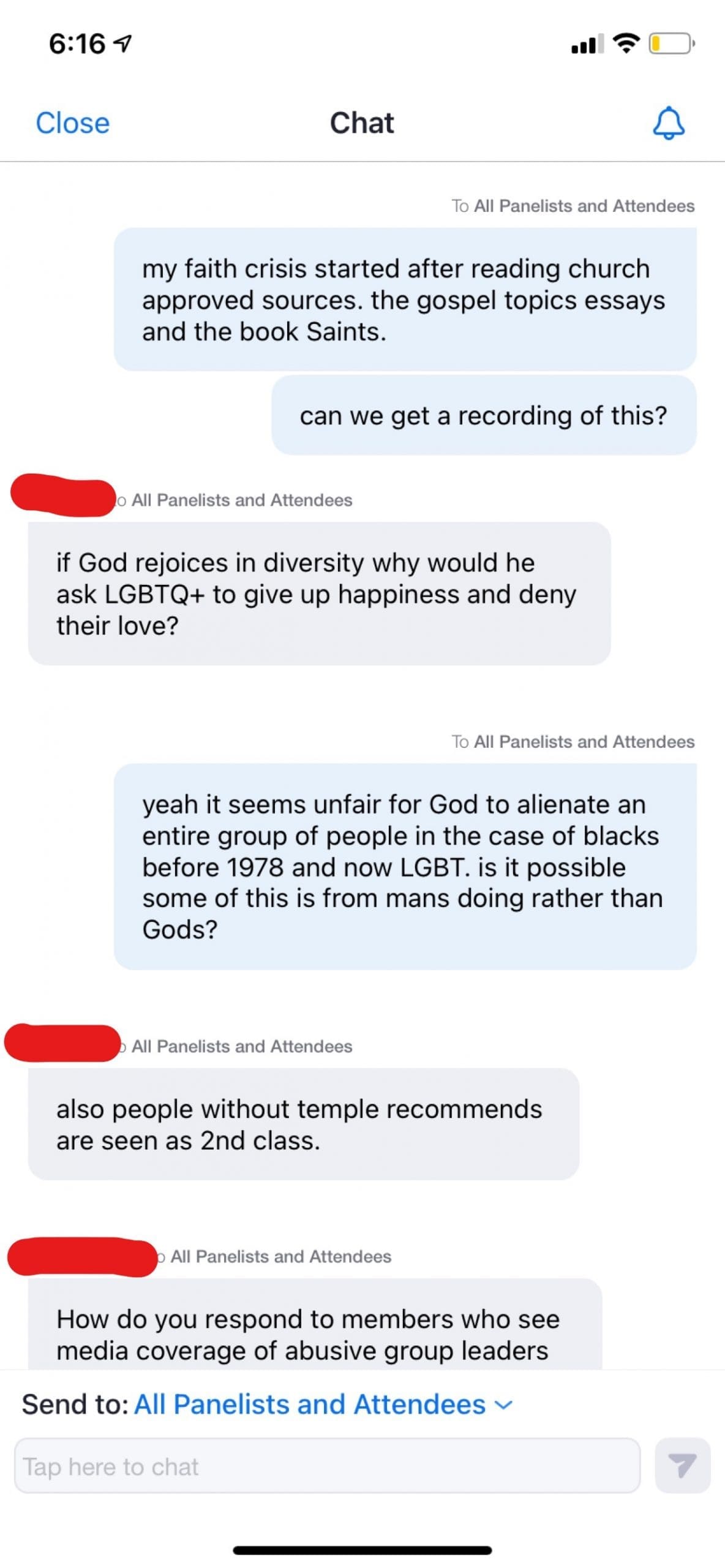
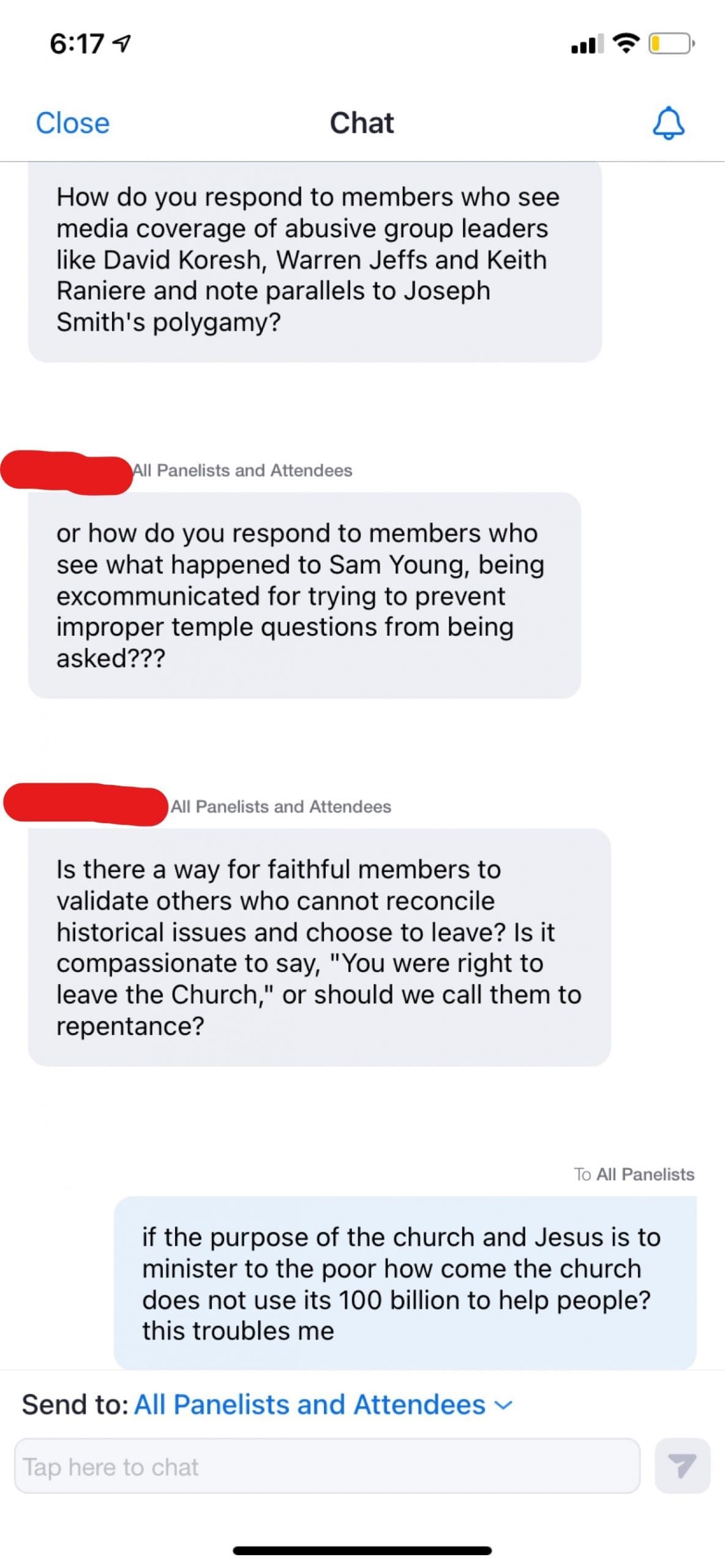
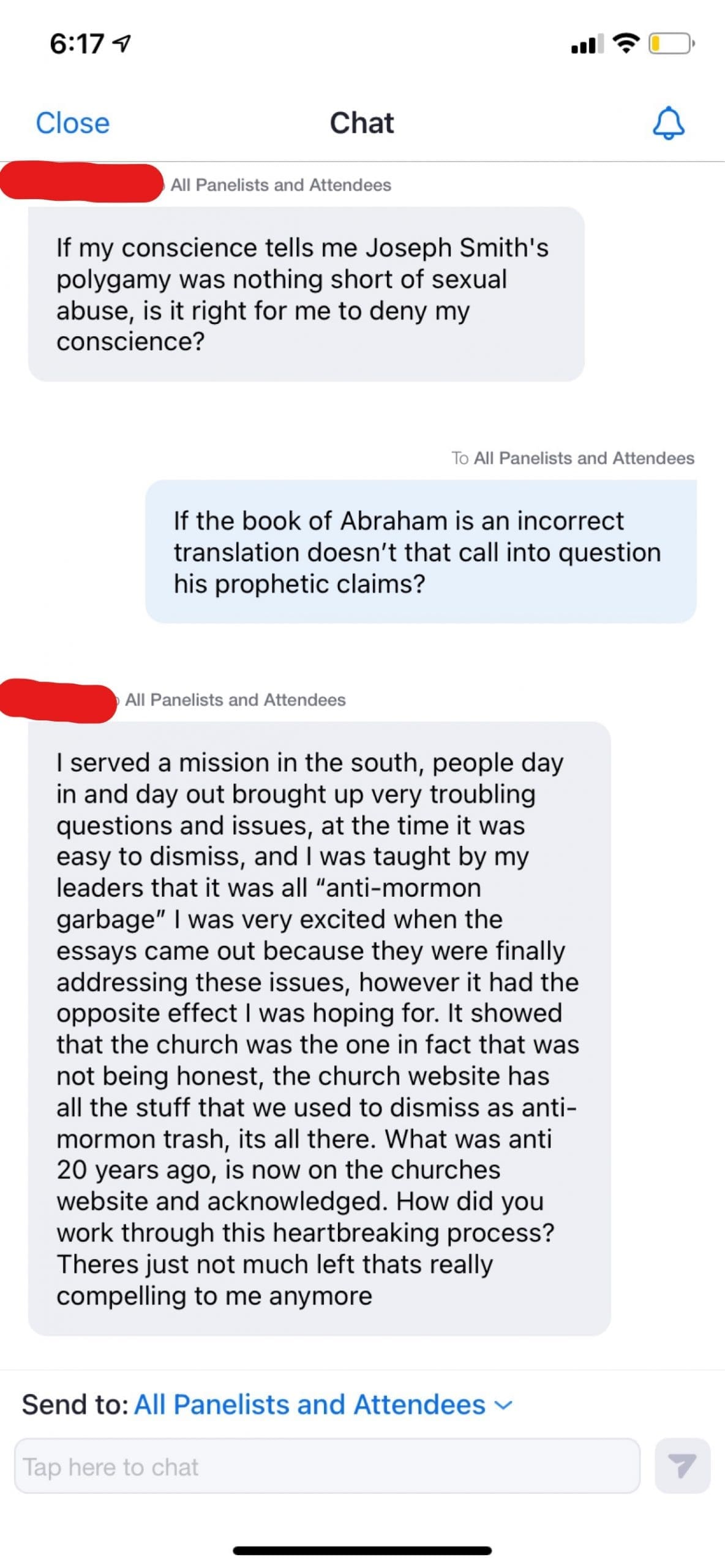
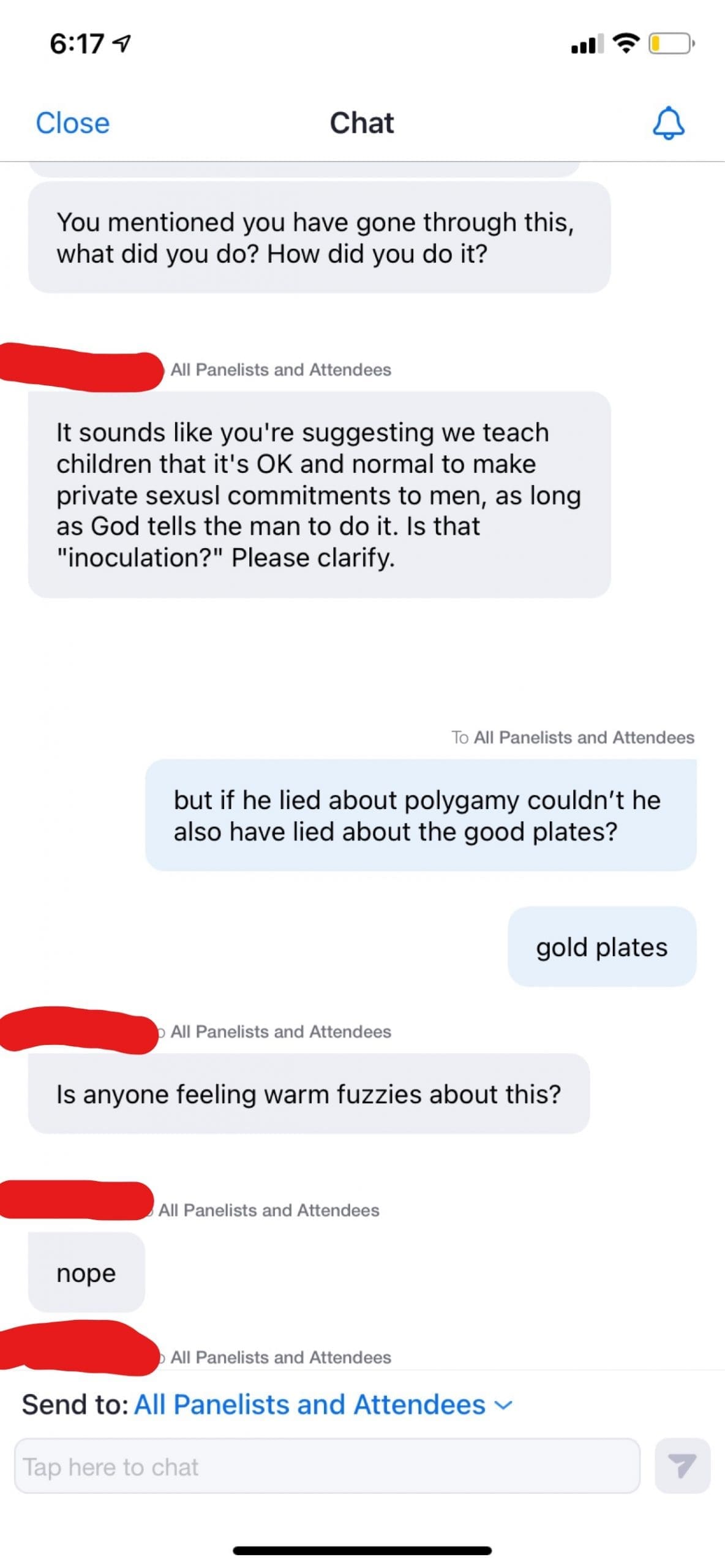
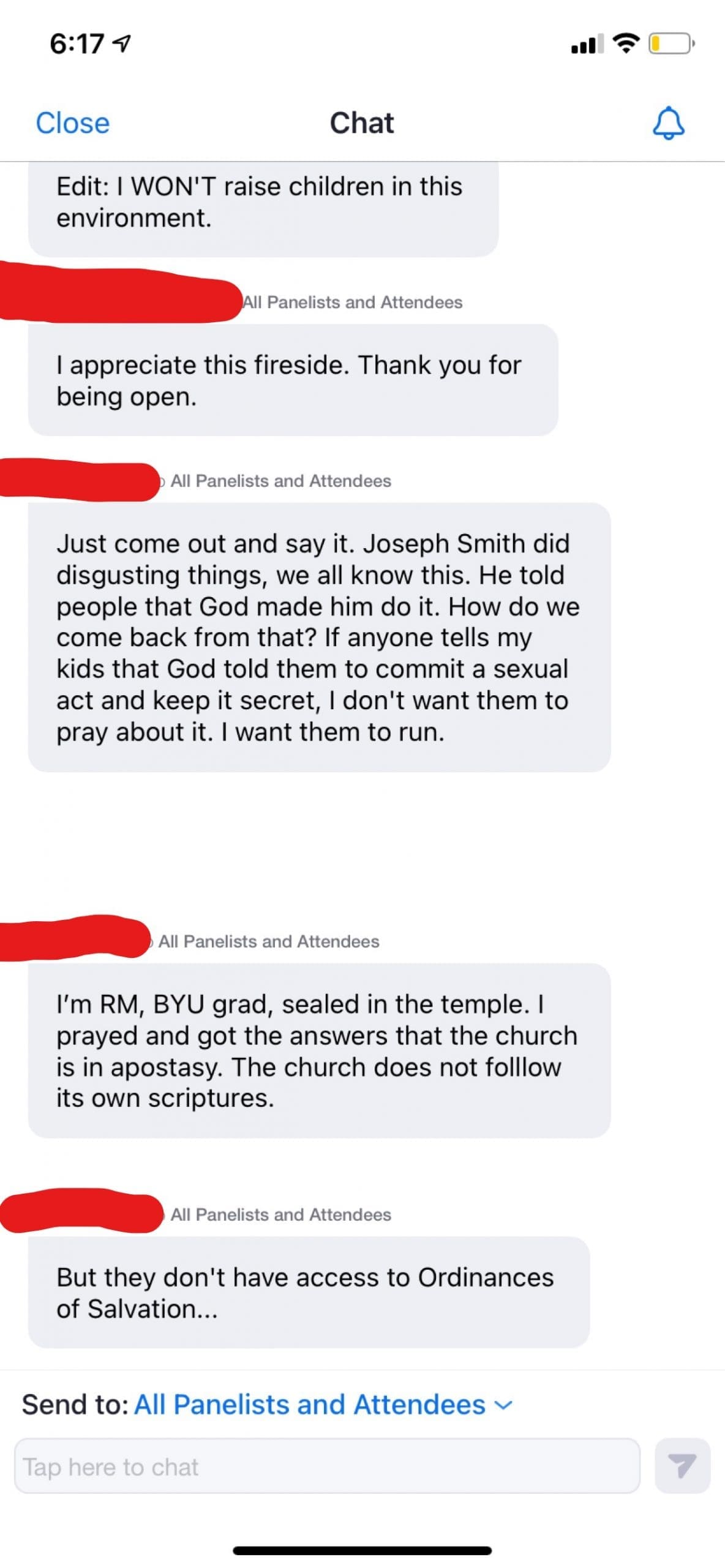
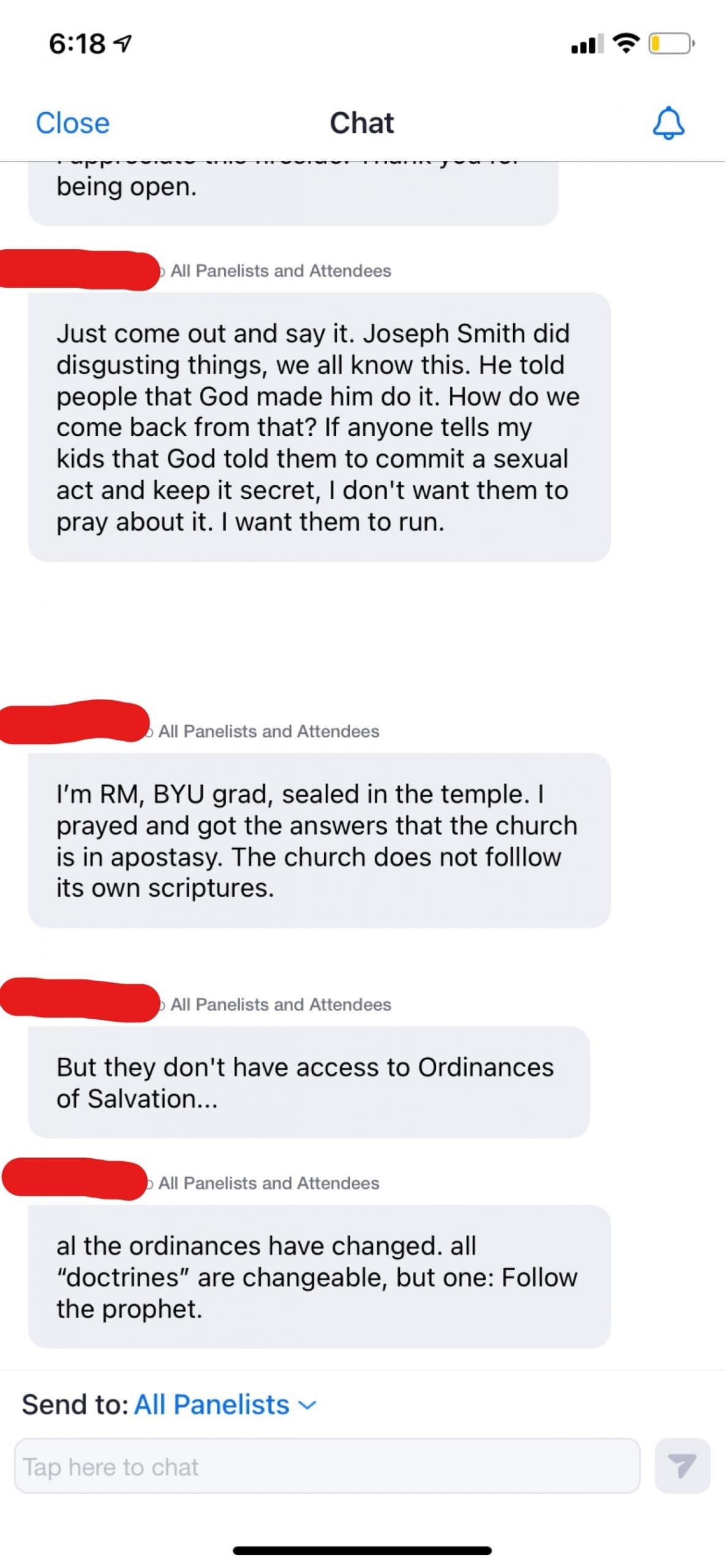
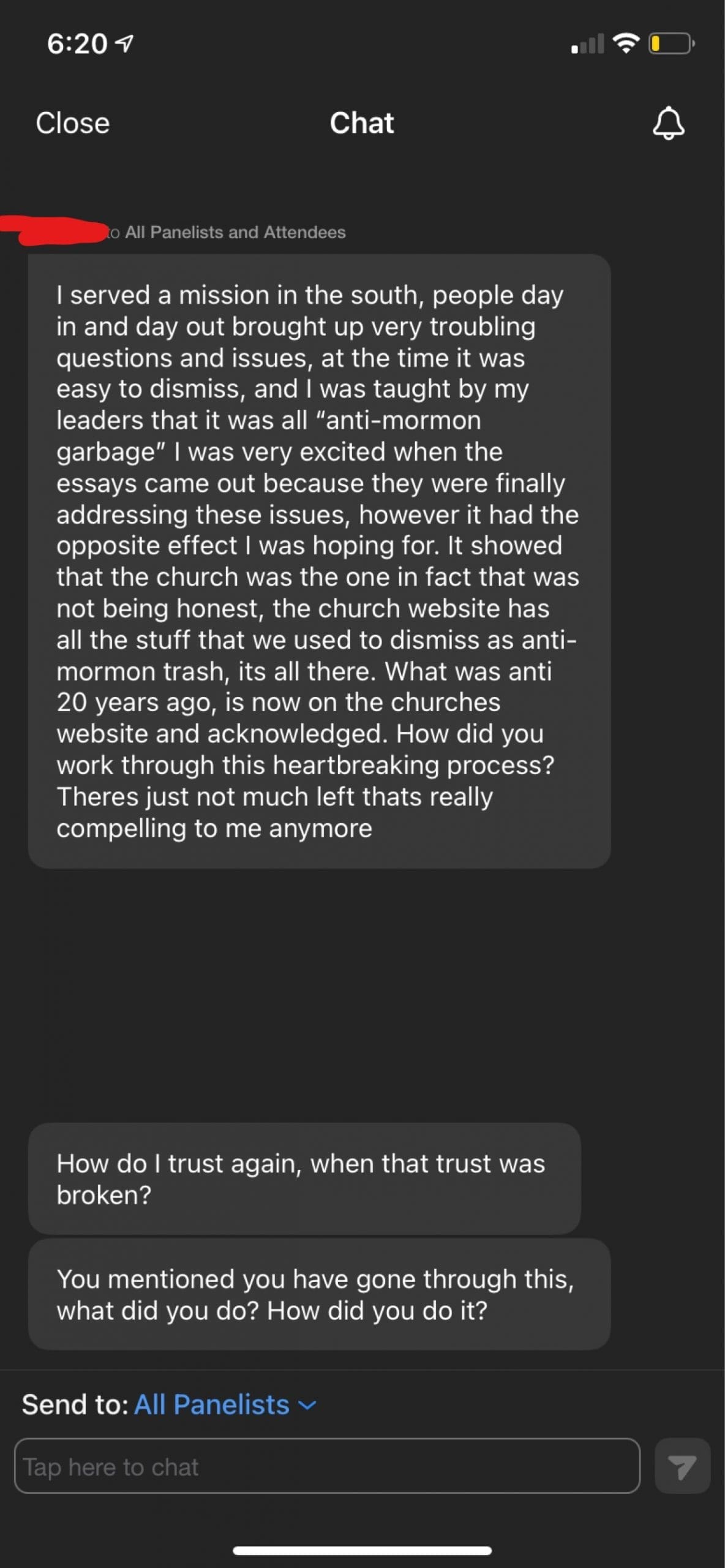
Announcement on the Stake Facebook Page that they will NOT be sharing the presentation to the Facebook group as they had said they would.
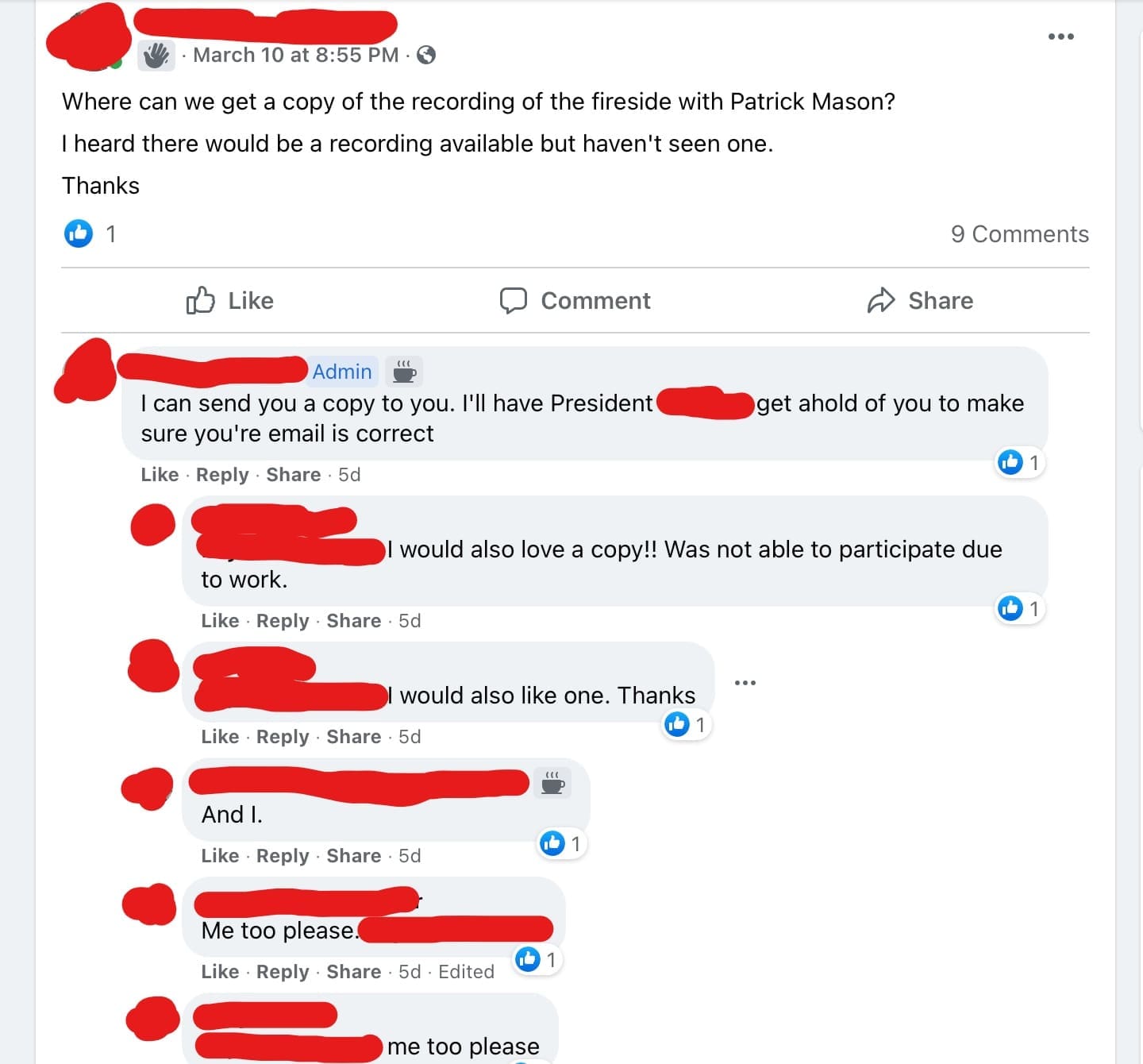
34 Responses
Whenever I watch something that is considered an apologetic view all I can think is why? Why is there any explanation necessary? If this is “God”we are talking about why wasn’t his gospel set up the right way to begin with. It wouldn’t matter what the “times”are or who he is “revealing” himself to, he God would have said racism is wrong, sexism is wrong, sex with children is wrong! And so many other things!He would have seen the future, God knows all thing s right. He wouldn’t have cared what man cared about or thought. If a God were communicating with his children he would do the greater good from the beginning so that his present chosen leadership wouldn’t have to apologize for the past leadership. And so that thousands or millions of souls wouldn’t be lost in the process! Just saying!!!
Lisa, you have just said wonderfully that which I have been mulling over in my head for years. Every time I hear some one say, “Give Joseph a break,” “Brigham was just a man of his times,” “Our leaders are just trying to get things right.” and other excuses why the church is in the mess it’s in, I, too, wonder where was god in all this? I nearly died as the result of a breakdown some 60 years ago on my mission. There was no one there to help me, and I, not knowing at that time what had happened to me, was too ashamed to tell anyone how I was feeling for fear of what my missionary peers and mission president might think of me. Years later, when trying to explain to my wife how much I felt let down by the leader called to protect and care for me, she responded, but, Honey, you know they were only men and had no idea what was wrong with you or how to help you if they did. She was right, but I had been taught that they were men of inspiration with the power of discernment. In fact, as I am writing, I am remembering a question put to me by the visiting AP,s, asking me if I believed that our mission president was inspired. By that time, I no longer knew if he was, but I lied and said, “Yes.” Today, I feel no ill will to those who couldn’t know about or understand the excruciating pain and agony I was experiencing. As far as I know, I had done nothing in god’s eyes to be punished so severely, so I wasn’t suffering from much guilt for something that deserved repentance or discipline, but my mental anguish was such that I needed serious help, including hospitalization and a great deal of rest and recuperation, probably at home in the states. But I have since come to know that my mission and church leaders are only human beings, not inspired, not prophets, not seer , not revelators. Oh my, how I wish that they had been. I was so seriously ill from my breakdown experience that I still suffer from PTSD and its repercussions today. Thanks Lisa. I am going to save your words because they express better that I can how I feel about prophets and otherwise supposedly inspired church leaders.
You friend,
Barry Richins
Based on the stake admin’s “feel[ing]better to send it privately to individuals rather than on their stake FB page as previously announced, I’ll venture that this kind of presentation, be it by Patrick Mason or someone else, is not going to be repeated.
If we don’t need Joseph Smith to be “perfect,” don’t we need him to be “worthy” for the same reasons church leaders want the membership to be worthy?
Occasionally church leaders will say they are leaving some issues in God’s hands to sort out. Why not leave issues about LGBTQ married couples in God’s hands so LGBTQ married couples can fully participate in all church activities?
If “it’s wrong to criticize leaders of the church, even if the criticism is true” then it’s also wrong to criticize members and non-members of the church, even if the criticism is true. Or, do different rules apply to different classes of people, and are the brethren exempt? If the Holy Ghost will never reveal anything critical of a church leader then how can the Holy Ghost ever reveal anything critical of a church member to church leaders if God’s laws are consistent, just, unwavering, and eternal? To me, pointing out where leaders err is part of sustaining a church leader, especially when church leaders council members where they are going wrong. If general church leaders expect members to allow the “mistakes of men” then general church leaders should do the same with all other members. When leaders of the church err, it’s not the members of the church that point it out that causes impairment of the leader’s influence and usefulness, rather it’s the church leader that causes his own impairment, especially when the leaders fail to make wrong things right. Honest mistakes are simply just that, except when any member refuses to correct them, including leaders, which then become willful unrepentant mistakes. Claiming to be accountable to only God sets up church leaders to be beyond reproach and accountability to the membership, which isn’t healthy. An organization needs to be humble where it’s okay to criticize things that are wrong and to talk about it, change it, and make a better place for the future.
No one asking church leaders to be perfect. But it is reasonable to ask church leaders to have a proven track record that demonstrates that they are both reliable and trustworthy. Unfortunately, they are not reliable nor trustworthy, which has been shown again and again. For example, given Joseph botched the Book of Abraham facsimile translations by “the gift and power of God”, then I don’t have any need nor use for that gift and power. I’ll look elsewhere, thanks!
Also, I think it’s telling that nuanced believers’ testimonies vary greatly from standard orthodox testimonies. You don’t find a lot of church being true, nor the Book of Mormon being true, nor Jesus rising on the third day.
This. Patrick’s testimony was basically that the church is good and he believes in Jesus. Not exactly Holland’s over or under the book of mormon. These rescue firesides always turn out to be a cluster *** for the church because they lose control of the conversation.
No surprise they are suppressing the recording. And about Mason’ voiced problem about Joseph Smith’s faults. Really? You wish he would have been more honest about polygamy?? That’s what bothers you??? You know, I wish the prophet of the restoration didn’t marry a 14 year old, or boink his teenage maid, or marry living men’s wives, or….. but yeah, honesty was a failing of Joseph’s in more ways than one Patrick, that is certain.
My journey through Mormonism is a lifetime. It was my framework and my foundation. I learned and I grew . Many of us have done just that. And in doing all that was asked of us , missions, tithing, Sunday’s, friends, our very lives , as told in the temple ceremony for the building up of the kingdom of god here on earth. All these things I have done , and what lack I yet ? My bishop gave me Patrick’s book after he and the e q p in our ward barged into my home one ministering night and basically told me that I was the problem and that it was a test that I needed to endure in order to become perfected . Again I ask what lack I yet? What mr mason is missing is the church puts such a high price on us as members being honest true chaste benevolent. Exactness in our belief is our life trajectory and our pattern, it is the leadership that not only asks this of us but demands it . And we tolerate it we bow down we worship at the alters of dominance and ambiguity. Because we have no other reference point . Mr Phillips suing the office of the president in England over his lifetime of abuse and mental trauma brought on by his experiences and the church’s reluctance to excommunicate him has been the separation point for me . We need our community we need our relationships and our families mr madsen in Sweden,Has had more experience in the church by far than mr mason and yet I ask again the savior s becon call what lack I yet? We lack the truth. And to some it is not important obviously it is not important to apostle oaks who has spent his lifetime making a mockery of his education and his stature as an attorney, by showing that the truth is irrelevant as long as you pay with your life and all of its nuances, you too can share in the endless possibilities that the modern church has to offer . Like the rich man of the New Testament ,mr mason ,my current bishop and many others turn away sorrowful but a few , and a then a many , will come follow the savior. David Bockovoy nearly took my faith. His interview s with John and r f m are way more shocking to me and my tiny little bit of hope . And I love the man for his bravery and courage, as do I for madsen and Phillips. We really don’t know what happens after we die . But in the guilded streets of the celestial kingdom do you really want brother Joseph making advances on your wife and daughters? Or do you want the honorable dallin oaks sending you letters as to why your trash can ended up in the street on the day of trash collection. I scream at the top of my lungs go on a mission mr oaks . Do the things the rest of us had to do in order to qualify for these apologists idiotic explanations. I have a beautiful oak tree in my yard when daylight comes I will be near it planting the book by mr mason , given to me by my priesthood leadership as a token of the love they have for me as I go through this terrible test maybe it will provide some nutrients to the oak that will outlive me , or possibly it will kill it because of the type of ink it was printed on. I doubt it . But it will do what it does . Planted was in fact a fine name for a book chock full of ideas on how to ignore reality. Where is my shovel? .
It is sort of funny… watching the ‘decaffeinated’ version I thought, “Wow. John is nailing this.” I didn’t realize there was an angry, disrespectful rant version he had taken down. I didn’t watch the ‘caffeinated’ version but I’m sure I would have been turned off by it. I donated in support of this version. I believe this earnest, thoughtful approach is going to be the most effective way to communicate true information about the church. I think displaying calm sincerity is the most likely way to have a positive, meaningful impact on those affected by the church. I support you. I know it is a hard and vulnerable role you fill as a vocal advocate for truth on social media. IMO, ranting is not passion. It is unchecked emotion. People can be passionate without being ugly. That is just my take… Others will disagree.
I LOVE THIS FEEDBACK! THANK YOU BRENT!!!!
He does a good job recognizing issue but then he goes back to all the old tropes. The worst one being “well I know all these things and a lot of others know this and our faith is stronger than ever.” Your willful denial of logic and truth does not compel me to follow you, Patrick.
Well said. For some reason it bothers me when “apologists” say things like “Iknow all the problems and my faith is stronger than ever” without addressing the problems in any kind of detail. Like I said in my other comment in this thread, they don’t really want to talk about the problems. Talks like this are about reassuring members without having to go into the details. This happened with my ex while I was leaving the Church and she refused to see what was clearly in front of her face and focused instead on reading books like Planted. So frustrating.
I left the church in 2002. At that time, the internet was in its infancy and the traditional church historical narrative was still predominant. It took countless hours of research and reading to to gain a more open and honest understanding of the church truth claims.
I well remember the pain and mental cognitive dissonance I felt in first learning that so many of the so called anti-mormon lies had in fact been truths all along. That it had actually been the church that had facilitated the deception and not its enemies. This was a very difficult and painful conclusion to both accept and come to. How could an organization that presented itself as the one true church of Jesus Christ on the earth in actuality be the one caught telling the lies and half truths? Why would this church that I loved and had dedicated my life to be motivated to manufacture a completely fictional narrative built on half truths and out right lies? I concluded that they were motivated just like any other lair is…they wanted to deceive me.
Knowing what has taken place since 2002 is like watching a train wreck in slow motion. The church seems to be imploding under the weight of its lies before our very eyes. Truth does have a way of cutting its own path. The century long whitewashed faith promoting church narrative has come back to bite the church in its collective arse.
Can we get the original recording of the fireside? I feel like it’s as far non-Mormon as my mom is willing to listen to hahaha and that even your kind and thoughtful comments will put her hackles up. Thanks in advance!
I have listened to hundreds of Mormon Stories episodes over the years, and this is one my favorites. It covers such a broad range of topics and perspectives in a kind and respectful way. I am grateful for John and Patrick sharing their life experiences and knowledge. Even though their views are different, they both are helping people in unique ways. After experiencing a faith crisis 14 years ago and remaining in the church all these years, Mormon Stories has provided an outlet for my sanity. When I needed to feel justified in my frustration and anger and not feel alone, this was a place for me. When I needed to view things differently, reevaluate, or reconstruct my faith, this was a place for me. Ultimately, my views have changed dramatically over the years, and from my experience I know that it may never be possible for people with a literal faith, a deconstructed faith, and a reconstructed faith to fully understand each other. However, we can be patient and kind with each other as we go through these experiences. The biggest obstacle to overcome is the environment of fear to express ourselves, and ultimately we all can learn a lot from Patrick and John on being vulnerable enough to express thoughts and emotions publicly for the benefit of others. I will always be grateful for John and the many people who have shared their struggles and have been vulnerable enough to share them here. Thank you!
This makes me super happy to hear, Nolan.
In addition to the idea of JS being perfect deflecting from the real issue of sexual predation, I think it’s important to also examine why we are asked to honor these men even in their imperfection but to dishonor those like Lavina Fielding Anderson (whose “imperfections” seem pale in comparison to JS or King David). Why is imperfection overlooked in some and excoriated in others? Why is sexual predation and dishonesty dismissed as human fallibility in JS while Lavina’s truth telling is called apostate? If we are going to use the idea that the imperfections of those who are most influential in the Church can be dismissed as mortal flaws, then it needs to be a unilaterally applied principle–to prophets, scholars, members, nonmembers, men, women, cisgender, lgbtqia alike. If the imperfections of JS are forgivable, then being in pain from harm caused by those in power and speaking up about said pain is also forgivable. If we cannot openly acknowledge and collectively process the pain that stems from various abuses by the leadership–from JS down to contemporary local bishops–then the Church can’t really stand by its claim that it disavows abuse of any kind. Trust comes when we can speak against abuse without sanction. Also, I think the question, “How do we regain trust when it has been broken?” presupposes that the responsibility for restored trust rests on us. Trust is earned it isn’t given. We don’t give our trust to the Church. The Church earns our trust, and we regain trust when it has been restored through trustworthy behavior such as consistent and enduring honesty, openness, transparency, and unilateral inclusion and equality. Trust cannot exist without these pillars. And love, without these pillars, is lackluster. Love without inclusion–what even is that?
I love this comment! This is exactly what I was thinking at the end of the episode, but you have stated it more eloquently than I could. This line of apologetic thinking is what helped me to move from scared, doubting, but still active member to full ex-mormon. I figured if Joseph Smith gets a pass for sexual predation, I’ll get a pass for drinking coffee, not wearing garments, and giving my money to actual charities! Ha!
Thanks so much for your commentary John. I especially connected with what you said about that the church was not only behind the curve on racism, civil rights, LGBT rights, sexism, etc. they openly fought against these things (even though they’re supposed to be politically neutral?). Again your commentary is great where you said “what value does a prophet have if they are not ahead of the world on social, political, and other human rights issues?” If they receive special revelation for the church (and the world) then they should support these issues long before society gets on board. Thanks again John.
Wanted to point out something that, at least to my knowledge, you wouldn’t have heard said at an event like this even a couple years ago. At 2:41:45, Mr. Mason declares:
“We learn that we’re not in a relationship with a perfect thing, a perfect institution, but we are in a relationship as part of a community that is striving to follow Christ.”
For me, this was a big “whoa” moment given how many times we’ve been told “the Church is perfect, but its members aren’t”. Pretty sure this would not go down well with the leadership.
Waiting for a Patrick Mason style general conference talk. I expect I’ll be waiting for a long long looooong time. Now that would cause people’s head to explode. It’s one thing to have stake rescues on the down low, quite another to admit this stuff in general conference, as Elder Uchtdorf was instructed.
I appreciate you not being belligerent and ranting. It’s not helpful to those of us who are struggling with coming to terms with all the deception of the church leaders, but who still miss church and the relationships we had there.
I have another out to add to Patrick Mason’s list–burned out.
I’ve noticed this in my own experience, and that of others I’ve talked to. I felt like I was running very fast on the Mormon treadmill, but not getting anywhere. The church just seemed to want more time, money, effort, obedience, etc. But I wasn’t feeling like I was drawing any closer to God or becoming a better person as a result. I was just guilty, anxious, and stressed out. The Mormon dream and the reality of my life were not syncing up at the time I began to seriously question the LDS Church’s truth claims. It took a bit of reflection, but I realized this emotional frustration opened my mind to the possibility that it could be untrue. Then I saw something about polyandry, the rock in the hat, and the Book of Abraham–it was off to the races…er…library from there.
I agree with Harold Huff’s comment about Joseph Smith and “perfection” but want to expound a bit. First, we were taught with the exception of Jesus no man has done more for the salvation of mankind than Joseph Smith. Other prophets have taught we would meet Mr. Smith alongside God and Jesus at the judgement bar. But by the church’s own standard he would not even be worthy to bless or pass the sacrament, bless an infant, or maybe even pray in church. But this is all just passed of as making “mistakes.” Personally, whether he measures up to Mormon “worthiness” standards isn’t that important. Where his character is relevant is trustworthiness, and whether Joseph Smith’s is a life worthy of honor, respect, and emulation. Given the amount of time, money, and emotional labor demanded by the LDS Church I would hope that it would be affording such honor as it gives Joseph Smith to someone we could at least consider a decent person. Alas, someone engaged in brining forward scriptures under false pretenses, abusing his position as a spiritual leader to gain sexual favors and marriages, engaging in counterfeiting and bank fraud, the secretive violence of the Danites, burning the Nauvoo Expositor, and running parallel secret shadow governments for the church and city of Nauvoo (Council of 50 etc), and general self-aggrandizement leads me to think he’s not particularly worth my time to honor or seek to emulate in any way. With a list like that, I’m just not going to organize my life around the guy’s teachings anymore.
Even though I would not have been offended by a more “ranty” episode, I think your point comes across better to all audiences when you are more balanced. Keep up the good work!
Good podcast John, thank you. I appreciate Patrick’s candor and openness. But I think he’s missing a point about the current transparency. For people like me who were taught A for decades and then read B in the church sources, the shock and betrayal is the crux of the issue. I care more about not being able to trust the church than about the underlying historic issues, and won’t trust the church again unless the organization earns it back from me (unlikely).
But he overly simplifies how it will be for people who are taught the issues young. My kids were told by a seminary teacher that JS married a 14 year old. So they won’t be shocked later to find out the actual true information. However, they will make their own assessment of the validity of JS, BY and ultimately the organization based upon those facts. And while lying or hiding the facts is terrible, the factual information is bad enough on its own. Leaving people to judge things based upon the merits of the facts is not going to be good for the church, there’s a reason these facts were hidden in the first place – because they are crazy crazy.
While I’m sure Patrick is a great guy what he does frustrates me. I feel that what is presented in talks like this is somewhat dishonest, if not largely dishonest. While I understand why they don’t get into the nitty gritty of Church historical problems, because he doesn’t and others don’t it doesn’t present the entire story to the audience. It’s the new story line “Hey, no one is perfect, the Church isn’t perfect, the leaders aren’t perfect (no discussion of specifics)….but you should and can continue to believe because of x, y and z.” Frustrating because I assume many Mormons hear these kinds of talks and just dismiss the issues. I think all members deserve to know the depth of the truth claim problems. Patrick Mason isn’t going to do that.
Thanks for a good podcast jon, I feel the same way as you jon that the church needs to face up to its wrong doings from the very beginning, essentially be cleansed and ask forgiveness for hurting so many people for so many wrong doings to its members, I add that truth is truth, you can’t escape the truth, the kids church included. It is what it is built upon untruth blended with some goodness, but that doesn’t make it truth.
Another category that I want added and addressed is : Spiritual Abuse.
Patrick needs to admit all these problems stem from the top decision makers. The Q15 need to stop blaming members for a culture that they and their predecessors created. It is time for new leadership…….but since it will not happen…..Ballard we are finding true happiness and peace by getting off your boat.
I started recognizing the problems of the church on the Mission, with an abusive MP (literally like Hitler) and such. Then dealing with multiple “bad” Bishops and SP’s for 25+ years. I did not want my kids to participate in 5:30 AM seminary, and spoke up. I was ignored and then shunned within my Stake.
I finally woke up and no longer apologized for the church, and ultimately realized I do not want to continue the legacy (although my kids are still in). Yes, many church leaders are like David Koresh, Jim Jones………The church has covered up for MANY of them………those of us that are victims of their spiritual rape, deserve an apology and see that the church makes real change in this category.
This happens due to the nepotism in the church and the upper leaders recommending their friends for the callings. I have lived in East/Central time zones and actually have had worst leadership then when living in the Jello belt……but theese leaders are transplants from the West who are closed minded, worship Bednar, and honor obedience over love.
God is NOT involved in LDS membership callings !!!. Any honest observer or member knows that LDS leadership is only a game. Those who won leadership roulette, consider yourselves lucky to have not been spiritually abused.
John…any way we can get the original fireside audio available for download for those who’d like to share it without any commentary? Several of us have requested it. Thnx!
A recent article describing the new revelation of sexual abuse by the late Christian apologist, Ravi Zacharias, titled, “Don’t Diminish Ravi Zacharias’s Abuse With ‘We’re All Sinners,’ published in Christianity Today, really resonated with me when Patrick Mason was talking about Joseph not being “perfect.” It was discovered that Zacharias was secretly preying on young massage therapists all over the world for decades. There is a difference between a person who makes bad moral decisions vs. someone who is a sexual predator. Smith falls in the second category. No one will be quoting Zacharias ever again and his ministry is closing up shop for good. This seems the natural and appropriate response for those who once revered him in any way. And yet, we are supposed to overlook Smith’s predatory behavior as someone who was imperfect like the rest of us, when we should be throwing out his books and closing up shop. It’s nonsensical and infuriating.
I’ve learned since leaving the church that faith is hard and trust is nearly impossible. There are charlatans everywhere and no religion is excluded. Even in my struggles, I agree with Patrick’s message of loving people and following Christ. However, in Mormonism, as John said so well, that is not what the leaders are saying. Just showing Christlike love to everyone and making people feel needed is a great idea, but it ultimately leads people to tithing settlement, Bishop’s interviews, lessons about temple worthiness, and revering Joseph Smith, the man who’s “Confused with Jehovah,” as we used to sing it.
I really appreciate your message and I agree with you.😊
John. the credibility of the Church’s truth claims past and present rest ultimately on the credibility of Joseph Smith. In law there is a latin phrase that comes to mind. “Falsus in uno, falsus in omnibus.” for those who have forgotten their latin, it means false in one thing false in everything. You point out in your discussion that Smith lied about his polygamy. (see “History of the Church” vol 6 page 411, BH Roberts The doctrine of eternal marriage being central to it’s theology, one can rationally apply the latin phrase to project his error to the whole of his teachings. This concept is often included in jury instruction to assist jurors in determining the credibility of witnesses.
That was probably the single greatest talk ever given in a church meeting. Honestly.
I think it is wildly naïve for anyone to expect Patrick Mason, who is a believing member, to get up and give a talk the way an exmormon would or would want. If every time a member like Mason goes in the right direction, exmormons just get mad at them for not hitting all the exmormon talking points and top 10 complaints, people like Mason may feel better just retreating to the TBM old standard views. He will end up being ostracized from the church for being about as open as a still believing member could possibly be, but then still bashed by exmormons for not being exmormon in his views basically, which he isn’t.
I applaud Patrick Mason. If the views he shared were actually shared by the church, it would be such a better place and on its way to huge improvement in all areas. As an exmormon that really despises the church as a whole, I recognize I was a member for a long time and sat in those pews trying my best. It is shortsighted to now criticize and beat down all those that are doing what I was doing only several years back. I am so grateful too those kind exmormon friends I had that did not insult, mock, or attempt to break my faith back then. They simply took the fork in the road a little ahead of me and walked it as good examples, and now many of us that have taken it can be okay with those that don’t or are still making their way there.
“Slightly.different.narrative.of.church.history.” Oh it’s more than slightly different bro.