
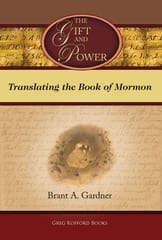
 In our 5-part conversation with Brant Gardner about his new book entitled “The Gift and Power: Translating the Book of Mormon,” we discuss most of the major issues with the Book of Mormon including: Joseph Smith’s use of folk magic, the Book of Mormon translation process (including the peep stone in the hat), Book of Mormon anachronisms, DNA and race. This interview attempts to address many of the issues discussed in our interviews with Grant Palmer and Dr. Michael Coe.
For a limited time Greg Kofford Books is offering The Gift and Power: Translating the Book of Mormon at a 20% discount. To get the discount, type in “MSTORIES” (all in caps) as the discount code.
Brant A. Gardner earned his M.S. in anthropology (specializing in Mesoamerican ethnohistory) from the State University of New York at Albany. He is the author of the six-volume Second Witness: Analytical and Contextual Commentary on the Book of Mormon. He has presented papers at the Foundation for Apologetic Information and Research (FAIR), the Book of Mormon Archaeological Symposium, and Sunstone. His other published works include chapters in Estudios de Cultura Nahuatl and Symbol and Meaning beyond the Closed Community: Essays in Mesoamerican Ideas, and articles in the FARMS Review, Sunstone, and Meridian Magazine. Brant and his wife, Valerie, have four children and eleven grandchildren.
Episode Transcript
Host: John Dehlin · Guest: Brant Gardner
This transcript is machine-generated and lightly edited for readability. The audio is authoritative. Please excuse occasional errors in names and spelling.
Introduction and Brant Gardner's Background
Part 1 of 5 · Ep. 307
Brant Gardner [00:00:00] 1, 2, 3.
John Dehlin [00:00:07] Mormon Stories Podcast is a production of the Open Stories Foundation. All donations to Mormon Stories are fully tax deductible and go directly towards keeping the podcast alive and towards building a community of support for Mormons like you. To support the podcast or to join the community, please become a monthly subscriber today@mormonstories.org hello and welcome to another edition of Mormon Stories Podcast. I'm your host, John delind and as always, I'm very excited to have with me a very special guest today. My guest is a man by the name of Brant Gardner. Hi Brant.
Brant Gardner [00:00:43] Hello.
John Dehlin [00:00:44] Thanks for joining us.
Brant Gardner [00:00:45] Thank you for the opportunity.
John Dehlin [00:00:47] Now, Brant is interesting from my perspective for a couple reasons. Many of you will know that I've interviewed Grant Palmer on this podcast about his book and an Insider's View of Mormon Origins where he talks about his theories on the origins of the Book of Mormon. I've also interviewed Richard Bushman who's talked a lot about kind of his views of the Book of Mormon. And I've interviewed Terrell Givens. When I originally planned to interview Grant Palmer, I always, I worked really hard with Fair and Farms to try and get someone who I believed would be sort of credible, kind of a scholar or a really thoughtful person to respond to the Grant Palmer interview. Lots, I asked lots of people and no one was willing to do the interview. Brett Gardner, as far as I can tell, is one of the better people that I could ever hope for to, to respond to the critics attacks on the Book of Mormon. He also has a lot to say about archaeology and, and I think would be one of the better people that I could find as well to, to speak to the Michael Coe interview where we talked about Book of Mormon archeology and in his, you know, Dr. Coe's outsider's view. Those are all podcasts that I strongly recommend you guys listen to. But let me just go ahead Brant, and read your bio if that's okay.
Brant Gardner [00:02:24] Yes.
John Dehlin [00:02:25] From your book it says Brent Gardner earned his Ms. In Anthropology specializing in Mesoamerican ethnohistory from the State University of New York at Albany. You are the author of a six volume series published by Cofer Books called Second Witness Analytical and Contextual Commentary on the Book of Mormon. You are also the author of the main book that we're going to be featuring today called the Gift and Translating the Book of Mormon by Brant A. Gardner again brought to you by Greg Coford Books. And you've presented lots of papers for Fair Farms Sunstone. You've written articles for Meridian magazine. And you and your wife Valerie have four children and 11 grandchildren. Is there anything I've left out of that bio?
Brant Gardner [00:03:19] I think that covers it.
John Dehlin [00:03:21] Okay. And also I want to note this, this, this maybe is going to seem a little bit self serving, but it's, it's not really. I've become relatively good friends with a man by the name of Greg Coford. Some of you may know who he is, but my guess is that most of you don't. Greg Crowford is a publisher. He publishes books and he publishes good books, really high quality books. And he's a thoughtful, I'm going to say, you know, sophisticated Mormon in his own right and his books deserve attention. And so I had some talks with Greg and we sort of made this deal that I would help promote some of his better books and, and he would offer our listeners a discount. And then finally, you know, for every book that's bought, you know, using the code that I'm about to give you, you know, maybe a small amount of that is going to come to Mormon Stories to help us fund the podcast, etc. So the, the website is gregkofer.com that's G R E G K O F f o r d.com and the promotion code is M stories, all in caps, M S T O R I S O all in caps. So I want you to, I want to encourage you guys, if you like what we talk about today with, with Brent Gardner, to go up onto Greg Coford books and to type in that code and to buy this book, the Gift and Power Translating the Book of Mormon and any other books that Greg offers. And we're just going to see if we can help drive some sales to Greg because his books are good and also see to what extent, you know, we can help out Mormon stories with, with projects like this. So, so that's my, that's my disclaimer and all the news items and now I'm ready to jump into the book. Is that all right?
Brant Gardner [00:05:14] Fine. Here.
John Dehlin [00:05:15] Okay, so, so first and foremost, Brant, let's talk a little bit about your history. That's something we always do with Mormon stories and we don't have to go into lots of detail, but just tell us a bit about your upbringing in the church and what are the things that kind of led you to want to study Mesoamerican archaeology and what led you to the route of writing scholarly books about Mormonism?
Brant Gardner [00:05:46] I grew up in the Church, so I don't have any great conversion story to tell. What I have is sort of the process that I went through. I was always interested in things like archaeology. I had somebody give me a book when I was somewhere around 12 that covered archeology of the world in a mode that was appropriate for 12 years old and 12 year olds. And I was absolutely fascinated with it. Went on my mission to Spain.
John Dehlin [00:06:15] Were you raised in Utah?
Brant Gardner [00:06:18] I spent a little bit of time in Utah. I was raised in probably California more often than Utah.
John Dehlin [00:06:25] And born in the church.
Brant Gardner [00:06:26] Born in the church.
John Dehlin [00:06:27] Pioneer ancestry, all that?
Brant Gardner [00:06:30] Yeah.
Brant Gardner [00:06:30] Actually, if you've got any listeners that are in the Utah area and they've heard of Gardner Mill in West Jordan, that's. And how many greats grandfather of mine founded that. And my father remembers working in it when it was a working flour mill. And now it's a restaurant. So.
John Dehlin [00:06:47] Nice. Okay. All right. So raised mostly in California. Right. Served a mission where.
Brant Gardner [00:06:55] Served a mission in Spain. And it turned out that that sort of had one of the two major influences in the direction that I was interested in going. Because obviously, if you're going to serve in Spain, one of the languages that you're going to learn is going to be Spanish. So I remember being on my mission and teaching all of these things about the Great White God and how it really how that related to the Book of Mormon. And when I got back from my mission, I was going to BYU and decided that what I really needed to do was to read up on this Great White God, because now that I spoke the language, I could actually read the sources. And then when somebody said, is that really true? I could say, well, yes, of course it is, because I read it and now I know that it's true.
John Dehlin [00:07:46] Right.
Brant Gardner [00:07:46] And then I went to BYU and got into the library and started doing the research and found out that the sources didn't say what everybody said that they were saying. And you know, the very short version of that very long story is that I really don't see any connection between the Great White God, Quetzalcoatl and Jesus Christ at all. Those are all. All of the things that make it appear that there is something connected are all related to much later Spanish interpretations of native myth, rather than anything that the Indians believed or talked about. But that also got me to the point where I said, wow, this is absolutely fascinating stuff. And although it doesn't relate directly to the Book of Mormon, I am now in love with it. And so that fostered my desire to learn more about Mesoamerica and traipsed off to Albany, New York to do Graduate work.
John Dehlin [00:08:48] Okay, real quick. Was that a. Was that at all disconcerting to you? That. I mean, I remember those film strips that I used to show, you know, as a missionary. I think it was called Ancient America Speaks, but I don't remember. But we'd show these. Oh, yeah, these film strips. And, you know, we would tell Native Americans or Latin Americans that they were descendants of Laman and Lemuel, and we would talk about the Popol Vuh in Guatemala, and we would show, you know, we would basically say that Jesus was the great white God, that that was in the Popol Vuh, just because that's kind of. That's the material the church was putting out.
Brant Gardner [00:09:31] Oh, yeah. And went back to John Taylor, who said that, you know, from all of the evidence he could see, it looked like Castle coat was a remembrance of Jesus Christ. And the key idea there isn't that John Taylor was, by revelation, saying this. He said, from all the evidence. I see. Well, what evidence was he reading? And again, it was the evidence that made it look similar. But a lot of what we are able to know about that kind of mythology simply wasn't available at the time. Now, was it disconcerting to me, not really. Specifically about that video, Ancient America Speaks. While I was at byu, I got to know some of the BYU professors, archaeologists, and the people who were doing work. And I was sitting around talking to them one day, and that film strip came up and one of them said, oh, yeah, we usually put that on for a good laugh. We consider it a comedy.
John Dehlin [00:10:33] But, yeah, so how can that not. I mean, maybe you were just more sophisticated than me, but how can that not cause you to, you know, some concern, at least from the standpoint that, you know, the church is putting out this curriculum that it's giving to missionaries that's saying stuff that you find to not be, you know, maybe accurate or relevant. How do you avoid. I'm not saying that that should destroy your testimony, but how do you avoid not having some cognitive dissonance about it or concern or a feeling like we can't be misleading people? How do you avoid not feeling those things?
Brant Gardner [00:11:18] I guess a part of it is to understand what the nature of revelation is and sort of the human side of inspiration. I can believe that prophets are inspired. I really have a hard time believing that they're inspired in what they choose for breakfast. It is entirely possible that you can have a church that's led by God and have real human beings that are involved in it doing the best they can with the best information that they have. And so they come up with some of these things, and they're popular for a time because it's the best information they have. And then typically, when they learn that there is something better going on, then they kind of move those things away and, you know, learn something else. And that's what happened, of course, with Ancient America Speaks. We don't show that anymore, and it's been replaced with things that have a much better scholarly foundation. So.
John Dehlin [00:12:18] Okay, so, you know, what you just articulated, I think, is a. I don't want to sound condescending, but that sounds like a more mature, informed view on Mormonism and spirituality. But it's not necessarily a point of view that is encouraged by ces. It's not the type of point of view that you would come out of four years of seminary or four years of institute or BYU and just sort of have. Naturally, people who usually have that perspective have to kind of earn it and fight for it, and many people get lost along the way. Were you raised with that perspective? Did it just come to you through reading? How did you arrive there?
Brant Gardner [00:13:02] I suppose it was just reading. I certainly wasn't raised with that kind of understanding. I was raised in the same church that pretty much everybody else was. And, you know, when I was younger, I would smile when they talked about people coming across the Bering Strait, because, of course, I knew better and everybody came across. With Lehigh, it was a process of simply learning more and understanding and probably just continuing to learn. I find that the more I read and the more I understand, the less I have those problems of cognitive dissonance.
John Dehlin [00:13:40] But you had this perspective as a. As a college student at byu.
Brant Gardner [00:13:46] Certainly by the time I got back from my mission, I did exactly what it might have been like before that I'm not sure.
Studying Mesoamerica and the Book of Mormon
John Dehlin [00:13:52] Okay, okay. All right. Well, good. So. All right. So you. You decided to go off to grad school to study this stuff more in depth, is that right?
Brant Gardner [00:14:02] I did, and at that particular point in time, pretty much gave up the idea of studying it with any relationship to the Book of Mormon. I really wanted to do Mesoamerican research because I was in love with the field and fascinated with it, and my particular specialty was sort of Central America, Central Mexican religion. And all of that comes much, much later than the Book of Mormon. So the things that I was really terribly interested in at the time had to do with the fact that when I was going through graduate school in the early 70s, that's where we had the texts. That's where we had the largest amount of material where you could learn something. The decipherment of the Maya hieroglyphs has altered that perspective within the last 40 years. But in the early 70s, if you wanted to know something about Mesoamerican religion, you were required to go to Central Mexico because that's where we had the information. So that's what I was interested in. There is a smaller piece of that story, however, which is while I was at Brigham Young University, I did meet John Sorensen. And in one of my conversations with him, I told him that I had kind of come to the conclusion that I just wasn't going to find a real world location for the Book of Mormon. And I was pretty convinced that I'd have to take it on faith and wasn't ever going to really see any that would convince me that it had really taken place in any location that I was going to be able to find and know anything about. And at that point in time, this was prior to the publication of his book, An Ancient American Setting of the Book of Mormon. And he gave me a manuscript to go through. I read that.
John Dehlin [00:15:55] What year would this have been about?
Brant Gardner [00:15:57] This would have been, let's say, 72, 73, somewhere in there. And the book was published in 85.
John Dehlin [00:16:07] Okay.
Brant Gardner [00:16:08] So I had the manuscript prior to that time.
John Dehlin [00:16:11] Okay. So Sorensen was doing research to try and establish some type of what Central American setting for the Book of Mormon.
Brant Gardner [00:16:18] He'd been working on it for a number of years. I'm sure that probably by at least 1950, the outlines of the geography that he favored were probably reasonably well set. And it was a question of sort of defining it and refining it between, like, 1950 and the 1970s.
John Dehlin [00:16:39] Okay.
Brant Gardner [00:16:40] And then maybe a little bit more by the time of the publication of this book. But as I remember it, there weren't huge differences between the manuscript and the actual published text.
John Dehlin [00:16:50] And what were your thoughts about the manuscript at the time you read it?
Brant Gardner [00:16:54] I was thoroughly excited. I said, gog on it. The guy's done it. He's giving me a way of seeing the Book of Mormon where I could relate it to real people. And part of the reason that that could happen is because I understood that area of the world. And one of the major things that it allowed me to do was to reconceptualize the Book of Mormon so that I was no longer in my mind picturing a Book of Mormon that happened in Jerusalem with everybody wearing clothes from the Middle east and everybody acting like what we understand the world of the ancient near east to have been, But I could see it occurring with the people that I understood. A very different culture, a very different background, and it made all the difference in the way I read the Book of Mormon.
John Dehlin [00:17:46] Okay, and so you still see. Do you still. Do you still view his theories as plausible or viable in terms of geography and the Book of Mormon?
Brant Gardner [00:18:01] Yes. And then I should probably qualify that, because he and I probably disagree on several things, even though there's probably a major amount of agreement. Okay. I've been through, for instance, every geographical theory that I can think of, and his is the only one I've been able to find that actually makes sense in the real world. So from that standpoint, his basic geography backing away, perhaps on some of the identifications of specific cities, but that general relationship seems to work, seems to describe, you know, locations and interconnectedness in ways that I've not seen anywhere else. And then what I did when I was going through the commentary on the Book of Mormon was to say, if I take that location and read the Book of Mormon against it, does that tell us something about the Book of Mormon that we would not otherwise learn? The result of that process is I am quite convinced that the Book of Mormon took place in that area, and I have a very hard time reading it without seeing it in that cultural area.
John Dehlin [00:19:14] Again, in which area?
Brant Gardner [00:19:18] The area that John Sorensen has located would have the land of Nephi, probably in highland Guatemala, and then in the Grijalva River Valley would be where Zarahemla had been located, and then Jaredite lands, probably up along the Gulf coast to the north.
John Dehlin [00:19:41] Okay. And maybe we'll get into the different theories in a bit, but I guess in your timeline, it's just good to know you were, in some ways, contemporaries with John Sorensen, were familiar with his work, and what that informed your graduate studies?
Brant Gardner [00:19:57] It informed my sort of religious understanding as I was going through the graduate studies. So in my graduate studies, I was not doing anything overtly related to the Book of Mormon. Most of what I was trying to do is nail down that Qetzalcoat character and try to figure out what was going on, but that, by then, had nothing to do with the Book of Mormon.
John Dehlin [00:20:21] Got it. Okay, so take us from getting your master's degree to now just in terms of what track you followed in terms of Book of Mormon scholarship For a
Writing the Commentary and the Gift and Power
Brant Gardner [00:20:37] long time, probably relatively dormant in that I had to actually go work for a living. My wife became addicted to having food on the table and a roof over her head. So we, we had to feed that particular need. So it was, oh, I don't know, 20 years plus, I guess that I really didn't do much except read both in Mesoamerican archaeology and sort of thinking a little bit in the Book of Mormon. The real change occurred after we had moved to Albuquerque and I got online and you know, by that time, this is 15, 16 years ago, by that time, the Internet was a little bit easier to manipulate than it had been earlier. And there was a list that discussed LDS doctrine and scripture. And the guy who ran the list contacted me and said, you know, I'd really like you to do sort of a magazine article once a week. And I knew that one of the biggest problems I would possibly have with that is coming up with a topic every week. So I said, well, here's what we'll do. We'll do a nice slow commentary on the Book of Mormon and I can do that once a week and we'll just go and see what happens. And then I became addicted to that process and that turned into the six volume commentary that Covert has published. So that's kind of what got me back into thinking about the Book of Mormon and Mesoamerica and writing on those topics.
John Dehlin [00:22:12] So you did that six volume series before you did the Gift and Power?
Brant Gardner [00:22:15] That's correct.
John Dehlin [00:22:16] Okay, when did you publish those?
Brant Gardner [00:22:20] The first one came out. I think it was December of 2007.
John Dehlin [00:22:24] Okay.
Brant Gardner [00:22:24] And then the rest of them early in 2008. That was the last time we as a church were doing the Book of Mormon. So we were trying really hard to get it out. So that, as Greg Kofert has said, the wonderful LDS buying market doesn't buy those kinds of things except when gospel doctrine comes around.
John Dehlin [00:22:41] Right.
Brant Gardner [00:22:42] So.
John Dehlin [00:22:43] So you try to get them, get them ready. Okay, well that, that makes it, that makes good sense. And so anything else about your background or history before we dive into your views on Joseph Smith and the in the Book of Mormon?
Brant Gardner [00:22:58] No, I think that probably covers it. I'm not even sure that was interesting, but everything else is even less.
John Dehlin [00:23:03] Okay, all right, well, well, let's start with Joseph Smith and your book the Gift and Power. Translating the Book of Mormon goes into all this stuff in reasonable depth. And so what I'm going to do is present the typical, let's just say non faithful view of Joseph Smith in the Book of Mormon. And then I want just to have you talk about your perspective so that those who desire to believe in the Book of Mormon and Joseph Smith or who are Struggling can maybe hear. I don't want to put you up as a role model, but maybe just alternative approaches to ones that would necessarily preclude faith. Does that make sense?
Brant Gardner [00:23:49] Sure it does.
John Dehlin [00:23:50] Okay. So, you know, most people, when they start studying church history, realize that Joseph Smith. Well, that there was an environment of folk magic, you know, divining for water, treasure seeking, treasure digging, you know, in the New York area and probably in other states in the early 1800s that Joseph Smith and his father and many of his friends and associates all participated in. And so there would be rumors of gold mines, Spanish gold mines, or buried treasure. And Joseph would either take part in or lead expeditions to help people try and find this buried treasure. And he would often do it using some type of stone that could be called a seer stone or a peep stone or something else to search for that buried treasure. Now, tell me if I've got that right and if you would add anything to that narrative.
Brant Gardner [00:25:00] I guess what I'd add to the narrative is that we know the basic outlines that are there. And the question is, what is really going on with all of that? Because as soon as we hear that Joseph Smith was involved with even divining rods, we're kind of wondering what was going on. But there's enough of a tradition of, you know, the witching stick or the divining rod that that one doesn't sound terribly strange. But when you get into a seer stone that were sometimes more derogatively called a peep stone, boy, that just sounds strange. And so what I was hoping to do in about the first third of the book is try to understand what was going on. What was that culture like? Why would Joseph Smith get involved in doing some of these things? And then part of it is also trying to understand why we tell the stories that we do. Because one of the very important pieces of information is that as the historians learn more about that part of Joseph's life, we understand that he translated the Book of Mormon using a seer stone. But there have been a lot of stories since then that a couple of. Well, even Joseph Fielding Smith, who said, no, he would never have used the seer stone. A couple of other people denied that that would have ever happened. Certainly, when artists depict the translation of the Book of Mormon, that's not typically the way LDS artists will depict it. And so there is a question of, you know, if we know something about the history, how is it that we get these other questions? And so the history of the history is probably, you know, another one of those things. That's kind of interesting. But if we go back to Joseph Smith and we try to understand what he was doing, one of the really important things is to understand that the world that Joseph Smith lived in is a different kind of world than the one we lived in. And things that we call magic would not have had that label at the time. They would simply be, this is the way people do things. When I was looking at that history, I looked at the history of those kinds of practices in England. And prior to the time that people would have police forces, one of the ways that they would try to find out, you know, who the thief was or where something was lost, they'd go to somebody who used a stone to find things. And it was part of the tradition coming out of England that if you had something that was lost, you would go to this person who would consult their seer stone, and they would tell you where the thing was that was hidden, or they would say, this is the person who stole it. So it was a very long history of these things that continued in the new world and in America. And what was interesting is it's about that time that there begins to be a kind of a dichotomy between the people who would believe those things and a more educated populace that was moving off of the eastern seaboard and populating more and more of the territory that once had been a frontier, but now was even less so. And so you get places like Palmyra that had a distinct population of people who had some of these older, more rural beliefs, and then the newer people coming in that were more highly educated. And in addition to the question of seer stones, you have a population where some people believe and other people say, oh, that's just terrible. And it's that sort of division in perspective that explains a lot of the stories that we hear about Joseph Smith and what he was doing with the seer stone. One of those things, for instance, everybody knows, or like, I guess everybody knows is the wrong way to put it, but most of us have heard that there was something about Joseph Smith and using a seer stone for treasure hunting. And all of that just seems terribly weird. And one of the things you mentioned is that maybe Joseph Smith had led some of these things. As you look at what Joseph Smith was doing, the majority of people, and it wasn't just Joseph Smith. There were other people in the area that used seer stones. There were other people in other states who use seer stones. The whole idea of the seer stone in popular usage was that it's something that would help you find something that was lost or not easily visible. So people who were looking for buried treasure would go to someone who was a user of a seer stone and request their help, hoping that this person could help them find something. And that's kind of what we find with Joseph Smith, at least in every case that we know of. Joseph never solicited business with the seer stone. People always came to him and said, I want your services, and basically hired him to do what it was that he did. So that whole world about how you use them and what you use them for was very, very different from. From what we expect. And certainly not in the definitions of magic and certainly not occult magic, like we tend to think.
Seer Stones, Folk Magic, and Sacred Power
John Dehlin [00:30:43] Okay, what power do you think people assumed was driving, you know, the stones or those who were fighting things?
Brant Gardner [00:30:55] You know, I'm not sure that they would have known much about power. I think all of those, you know, what power is it that makes it happen? Our modern definitions, where we're trying to say, you know, it's either God or the devil doing it, I don't think those are definitions that those people would have understood. Pardon me. If they would have thought about it, it certainly would have been, you know, some good, divine, angelic power that was helping them out, but in a very generalized way. This was very much simply a talent that someone had. And there would be someone in the village who was talented with herbs and healing. There was somebody else, you know, who was talented with seer stone, somebody else with finding water with the witching stick. And these communities that had to rely on themselves would have these local specialists. And in most cases, they were considered to be people who had a good power. Now, where it came from, I'm not sure any of them ever wondered or cared as long as it worked.
John Dehlin [00:32:12] Got it. Okay, so it seems like you're saying that this was certainly something that that wasn't uncommon, that that happened, you know, in Europe and in America. Maybe it happened mostly among. Maybe the less educated you got, the more common this would be. But there were certainly still educated, affluent people who engaged in these types of behaviors. Is that all a fair summary of what you're saying?
Brant Gardner [00:32:40] Yes, all of that's true. There was certainly a continuum, and there would be educated people who would still believe just like. And you get it even less now. But certainly, you know, when I was growing up in the early 50s, you'd find well educated people that, you know, would not walk under a ladder or would worry about a black cat. Crossing their path.
John Dehlin [00:33:04] Okay, and so. So you're also sort of saying that it's not. It wasn't necessarily some dark art, occult kind of thing, or maybe not at all.
Brant Gardner [00:33:15] Not at all. Nobody who was involved in it would have thought that it was a dark art at all.
John Dehlin [00:33:21] What about those who would say, well, if Joseph had his first vision at age 14 or 13 or 12, whenever, you know, whenever he had it, that he would have had better sense than engage in this kind of stuff because, you know, he would have the access of God. He would have been inspired and, you know, been serious about preparing to form the church, and he just wouldn't have engaged in such silliness or nonsense.
Brant Gardner [00:33:51] Yeah, that's kind of an interesting way of doing history. You've got multiple options of how to understand history. And unfortunately, one of the ones that we usually take is, well, if I were to do it, this is how I would have done it. Or the other correlation. If I were God, this is what I would have had happen. None of those things explain history because they presume that people in history or 100 years ago, 200 years ago, must have been in a world just like ours and thought exactly the way that we do. And therefore we have to come up with some excuse as to why they didn't act the way we think they should have. And that's the wrong approach to take. You don't go back in history and say, why wasn't that person modern? You look at the influences that that person was under and you say, okay, let me understand how they lived, when they lived, how that influenced their development, and how they moved from point to point. So, you know, the idea of, you know, if Joseph Smith had really seen God, he must have done something differently, begs the question, because it presumes that we can be this omniscient God and decide how things should have happened.
John Dehlin [00:35:10] So it says more about the questioner than it does anything else.
Brant Gardner [00:35:13] Yeah, absolutely.
John Dehlin [00:35:15] Okay. Okay. So. So the. So the answer is, we don't know. Like, you know, maybe God was okay with maybe, you know, God never had an opinion about it. Maybe, maybe Joseph was just learning as he went and bumbled along the way. I mean, lots of different theories about,
Brant Gardner [00:35:34] you know, if Moses is going to get water out of a rock and taps it with his rod. There are some really good reasons why he would use his rod to do that. But most of us today would never think of saying, you know, if I had this big wooden stick, I think I'll go pound on that rock until water comes out. It just. It is a completely different way of looking at things. And the only reason we accept those things in the Bible is because they're old enough that we say, oh, well, way back then, the world must have been different. And this is how God did things. God has always worked with the understanding of the people in the time and the place where they were. And I don't see any reason for God to have changed his method of dealing with humans when he got to Joseph Smith. And I don't see any reason why he has to change, because I'm different than Joseph Smith was.
John Dehlin [00:36:33] Okay, well, is it true? Have you ever found any indication that any. You know, it's clear that people went to Joseph to find treasure. Is there any indication that any treasure was ever found?
Brant Gardner [00:36:48] Oh, not that I know of, no.
John Dehlin [00:36:49] So why did people keep coming to him if he wasn't finding anything? And why did he keep entertaining expeditions if he was never finding anything? Isn't that odd? A little bit.
Brant Gardner [00:37:01] Oh, yeah. And the odd part isn't in what happened with Joseph. It's the specific question you asked me because you said, did they find treasure? I know very, very few people ever found treasure, ever. And there's one well documented case where Joseph was hired to help find treasure. And perhaps out of that entire thing, the best treasure he found was his wife when he was off trying to find this mine. But most of the time, people came to him. They weren't looking for treasure. They were looking for something else. Somebody came to Joseph and were looking for a lost horse, and he told him where the horse was, and the guy went out and found the horse. A judge had lost his pocketbook and came to Joseph and said, you know, I've lost it. Can you help me figure out where it was? And Joseph gave him an answer. And oddly enough, we've got about two or three stories, not a lot, but two or three stories that place Joseph in the context of the typical village seer person who found lost things. And what's really fascinating about the stories that have been preserved is they're all stories where Joseph was successful. There are stories preserved about Sally Chase, who was also one who used a seer stone to find things that were lost. And oddly enough, the stories that are preserved for her have her succeeding. I think the reality is, if you look at, you know, anybody in that world, anybody who would have used a seer stone would have successes and then probably some misses if they didn't have some success, nobody would come back to them twice.
John Dehlin [00:38:52] So do you believe that Joseph had a power to. Do you personally believe that he had the power to find stuff, hidden stuff, or do you even have a position?
Brant Gardner [00:39:06] That one's complicated. Because as soon as you say, well, yes, he had a power, now we're making him mystical. You know, I think there was something that was going on, and that's part of why I spend time in the third part of the book looking at what you might call scientific reasons to explain how seer stones work. The only thing I can tell you about some of those things is that there are people who have claimed to have some similar capabilities in the modern world and have inexplicable success. There's a story that I read. I believe it was Elizabeth Meyer who was. Who ended up writing a book because of the experience that she had. Her daughter had a very expensive. I believe it was a cello, you know, and we're talking, you know, vintage and lots of money here. Not hundreds, but thousands, probably tens of thousands of dollars. And somebody had stolen it. Nobody could find it. And so she finally went to someone who wasn't using a seer stone, but was someone who professed to be able to find lost things. He was in a completely different state and was able to tell her exactly where it was and what was happening with it, and she was able to recover it. So she writes her book talking about the fact that this thing is inexplicable and that there are inexplicable things that happen, none of which invoke the divine. They just something happens. And I think in many cases, that's kind of what was happening with Joseph Smith. There was something there, and exactly what it was, I'm not sure.
John Dehlin [00:40:57] Yeah, you'd be speculating. What do you think about the Richard Bushman theory, or at least the one that I've attributed to him, that this was Joseph's way of practicing accessing God's power. These behaviors.
Brant Gardner [00:41:11] That's certainly one of the theories that I've seen people use. Not really the idea that I would have behind it. I think that rather than see Joseph using that to practice, I see God using what Joseph was doing to help him become something else. So there is an idea that Joseph was in training to become the prophet, and I guess I don't subscribe to that one. I think God took a more active hand in it and said, joseph, you're going to be the prophet. And if you put yourself in Joseph's position, how in the world is Joseph going to translate the Book of Mormon? He knows it's In a language he can't read, he doesn't understand it. He knows he doesn't have a dictionary. How in the world is he ever going to do this? The only way he's ever known to be able to do something that other people can't is through the Seer Stone. So God says, use what you know, which I think is what God does with all of us, is he said, you know, use who you are and become better than what you've been.
John Dehlin [00:42:20] Okay, we'll talk more about the Book of Mormon translation in a bit. But what would you say to people who just say, look, Joseph was a con man. He just, you know, and your book talks about this. I'm actually. I'm quoting one of the chapters of your book in terms of the use of that word. Right, right. What would you say about the fact that instead of him receiving the first vision, you know, being righteous, receiving the first vision, doing some. Some cultural stuff that then leads to his fulfilling of God's prophecies, instead, he started out doing this. This goofy folk magic stuff, realized that he could convince people that he had power, and then from that said, well, heck, why don't I invent a book and invent a religion? Because people clearly will believe that I have power, so I may as well capitalize on that.
Joseph Smith's Court Trials and Credibility
Brant Gardner [00:43:20] Yeah. I mean, he was even brought to court and basically accused of being a con man prior to the time of the Book of Mormon. This is involved with the Seer Stone and the silver mine. So there were people who certainly thought that he was a con man. The question is, people believe that Joseph Smith was a prophet, and people still believe that he is not. It isn't a question of what do we believe, but what kind of evidence do we have? So we know that people believed he was a con man. The question is, you know, was he? Is there any evidence for it? And if you look at what con men did, particularly those who used things like Seer Stones, they'd come into a town and they promise, you know, find great treasure. All you have to do is buy shares. And then once they collect the money, the guy would skedaddle out of town, take the money and run.
John Dehlin [00:44:19] Kind of like the Music Man.
Brant Gardner [00:44:20] Yeah, exactly like the Music Man. That is, the Music man is the quintessential con man. And all of the evidence that we have for Joseph Smith is that he didn't do any of that. He lived in the community, he stayed in the community. People would consult him, People came back to him. The person who actually took him to Trial wasn't a member of the community. It was a nephew of Josiah Stowell who had hired Joseph. And, you know, his Josiah stole is the one who came and said, you don't know. Joseph is upright and upstanding and testified in his behalf. Even though they didn't find the silver, the guy who hired him to find it stood behind him. So there really isn't any indication that there was ever anything in Joseph's character that would have qualified for the definition of con man.
John Dehlin [00:45:18] A lot of this is in a later time period, but a lot of people would call the Kirtland bank stuff that would come to their mind as something that might approximate this type of fraud or deception for some. Is that fair to make that association or maybe not for you,
Brant Gardner [00:45:37] that people would look at it that way? Certainly. Whether or not that's evidence that you would take of that? No, I don't think so. Because you. Again, it's a question of understanding history. What the banks were and how they operated was significantly different then than they are now. And in the historical context, you really can't again say that there was any conning going on there. Everybody knew what was happening. Certainly a financial disaster and certainly not one where you'd want to say there was a lot of great inspiration in it seemed to have been a pretty human endeavor and failed very humanly. But not as a means of deception, I thought.
John Dehlin [00:46:25] I remember reading something about there being gold and then bricks, fake bricks underneath, something that would show deception in terms of the financial backing behind the deposits in the bank. Are you familiar with any of that?
Brant Gardner [00:46:42] Yeah, I remember that, you know, those were methods they were trying to do to stop a panic. And again, it's a question of, you know, what are they trying to do? And if you're trying to stop a run on the bank, people have tried all kinds of things. You know, if it would have worked, maybe things might have turned out differently. But you're saying.
John Dehlin [00:47:06] You're saying that that's different than setting up a con from the start in your mind.
Brant Gardner [00:47:11] Right.
John Dehlin [00:47:11] They set up a bank and it went bad, and then maybe they tried to cover it up. But that's different from setting up a bank for the purposes of defrauding people.
Brant Gardner [00:47:21] Exactly. And I'm not even sure that I'd say covering up as much as trying to bolster, you know, trying to salvage whatever it was. You know, it was a failed bank, and it was a failed bank at a time. Lots of banks failed. So, okay. Certainly in modern history, we've seen Banks fail. So none of that should be surprising to us.
John Dehlin [00:47:44] So in all those instances where Joseph. This is something that really got me, you know, I remember in Sunday school and primary hearing about Joseph, you know, being brought to court. And, you know, the way it was always painted was, you know, Satan inspires wicked people to fight against the Lord's anointed. And so people brought Joseph to court on spurious matters. And there were never any grounds for anything he was brought to court on. And it was all because they were trying to fight God's righteous plan. When in reality, what were these trials and what were these courts about, from your perspective?
Brant Gardner [00:48:31] Well, Joseph was involved in so many of them that we probably shouldn't sort of over generalize from any particular one. But in many cases, people had various beefs with Joseph. In the case of the one that we've already talked about, the Bainbridge trial, when he was brought up for being basically a con man, for using a seer stone, the person who brought the suit, I'm sure, sincerely believed that Joseph Smith was a con man. So I suspect that there's a very complicated history. I suspect that they get simplified when you get into Sunday school classes. And then again, the more you understand of history, the more complex things become. And I doubt there were very many satanic people trying to bring him to court. Might have been a few. Of course, I doubt that was the major reason.
John Dehlin [00:49:31] Okay, but he was brought to court, and was he ever actually prosecuted for any of that behavior or ever found to be a conversation to your knowledge?
Brant Gardner [00:49:44] That depends on how you read the information coming out of the courts.
John Dehlin [00:49:50] Was you ever find or put in jail for any of that behavior? Found guilty?
Brant Gardner [00:49:55] Not that I'm aware of, no. There were no guilty verdicts rendered, although some of the history on some of these was muddy enough that there, you know, might have been something where they said, okay, you know, cease and desist. Don't use that thing anymore. But not so much that he was convicted of being a disorderly person, which at that time would have been the con man.
John Dehlin [00:50:18] Okay, okay. And if I understand the history right, you get this sense that he was torn about participating in a lot of this stuff. And you even get a sense that at times he swore that he would stop and then start it again. Is that right?
Brant Gardner [00:50:39] I think what happened, at least in the way I read the history, is that Joseph was a village seer who performed these functions of finding things. And then Moroni comes along and says, you got something much more important to do than finding lost horses. You need to translate, you know, a lost book. And that process took him four years before, you know, from the time when Moroni came and said, this is your mission, to the time that he did it. The trial in Bainbridge came in between those times. I think what happened is in those four years, Moroni said, you have to learn how to do something else, you know, with this particular talent. And in that Bainbridge trial, Joseph Smith Sr. Said of his son, it's too bad he was doing this. He was doing it for the money because he was hired to do it. But he really needs to take his talent and dedicate it to the Lord. So I think there was a learning process going on, and it took Joseph a few years to do it. So I don't really see him vacillating back and forth as much as all of us. Take a while to actually learn something. I don't know of any time after he received the plates where he ever went back to finding lost things.
How Stories Evolve and Change Over Time
John Dehlin [00:52:04] Okay, okay, let's jump back just for a second, and we're going to treat this really quickly. But it's such a common criticism of Joseph and of the early, you know, beginnings of Mormonism that I just wanted to get your take. There's this. Well, as I understand it, there are few, if anyone, that Joseph ever told about the first vision sort of in the years leading up to the founding of the church. And then the telling of the first vision story as it is told today is sort of conspicuously, for some, absent for many of the early years of the founding of the church. And then when people sort of compound that with the multiple versions of the first vision story and how when he first writes it down or dictates it, only the Lord appears to him, not God and Jesus. In some accounts, there was a satanic force, and others there weren't. And in some accounts, there were angels swirling around. And there are a lot of people who just sort of say, that's just all. Why didn't he tell people from the start? Why did the story change over time? Why did the story not get fully developed until 1838 when there was a crisis? And you could argue for a need for that story to get sort of embellished upon. What's your take, just your brief take on the first vision and that sort of telling of the first vision story and the critics take on it.
Brant Gardner [00:53:46] That's actually one of the things that I tried to treat in the book, although not mentioning that one in particular, but this whole idea of how do stories develop? How do we tell what we tell, and why do we decide to tell them? And a lot of the answer to that has nothing to do with, you know, what's true and what's not true, but in how we tell our own stories. It's a question of folklore research. How do stories change over time? And in the case of Joseph Smith, his original story was probably very similar to pretty much anybody else who'd had one of these great conversion stories. He wasn't the only one claiming to have seen God in a vision when he was a young man. And Bushman treats this indicating it's much more likely that the reason he wasn't believed was because it was common, not because it was uncommon. The early church didn't think much of the first vision because what was really spectacular was the Book of Mormon, and they had that. And there really wasn't anything they were terribly interested in in the first vision. So when you get into why are there so many different stories of the first vision? It's because it didn't interest them until later. And then, you know, why are there different versions? All you have to do is look at pretty much any history and any development of folk history, and you see that it's very common to have those different things because different audiences will want something different. So hardly surprising at all. It's just, again, part of normal history.
John Dehlin [00:55:25] But some are going to go, now, wait a minute. You know, if you're talking about, like, what you had for breakfast last Thursday, that's one thing. But when you're talking about a visit from God Almighty and His son, and you know, something that's unforgettable and would clearly leave major impressions, then you wouldn't, you know, leave out one of those two major members of the Godhead in your recounting?
Brant Gardner [00:55:52] You know, as I said, that's that great perspective. If I were God, I would have done it this way. If I were Joseph, this is how I would have written my history. It's the modern perspective taking what we expect ought to have happened and then saying, because what I expect to have happened didn't happen, then something's wrong. It's the wrong question to ask of any history in any history. You have to ask what's happening in the history, not why didn't something happen differently? Because I wish it would have, or I expect it to have been differently, done differently.
John Dehlin [00:56:28] Okay, I understand that, and I think that's reasonable. But would you also concede that if we were talking about the history of Jim Jones in Guyana and Jonestown And I were to. We were evaluating the claims of Jim Jones as a religious leader, and we were to find out. Or even L. Ron Hubbard in Scientology. We were to find out that, you know, stories that he told in World War II turned out to be not true. And does that strike to the heart of the credibility. My guess is you wouldn't have as charitable of a take on those changes in history or those variances in recollection as you would on Joseph. Is that fair to say?
Brant Gardner [00:57:16] No, not really. There's just way too much information about how we remember and why we remember. One of the things they found out about the process of memory is that your memory of the past is conditioned by the experiences of the present. So there are a lot of things that, you know. For instance, my daughter is infamous for this. She remembers any number of things that we will have to inform her. Nope, didn't happen that way at all. She lived through them and is absolutely positive she remembers things in certain ways, and it's a memory that's formed from something else. And the problem is this fragile thing that we call our memory is just developed in so many different ways that to presume that memory is going to be absolutely true and never changing is just completely against the human condition, against all science of memory.
John Dehlin [00:58:20] Right. And as I'm talking to you, I'm recalling an argument I had with my wife yesterday where we remembered exactly opposite.
Brant Gardner [00:58:29] Oh, yeah.
Brant Gardner [00:58:30] But.
Brant Gardner [00:58:30] But it's just.
John Dehlin [00:58:31] Okay, but I'm just gonna. I'm gonna push this point one last time. And that's just that with something so important, you know, there is such thing as fraud. There is such thing as deception. There is such thing as, you know, mental illness where people do make things up and people do lie and people do deceive and. And we have to, you know, we have to, in some sense, be discerning and be willing to call fraud. You know, if things don't add up, right, we can't just say everyone's speaking the truth all the time, you know, so when do you draw the line, and how do you draw the line?
Brant Gardner [00:59:12] Well, you draw the line by not accepting, you know, any single thing. And what the early church did is it said, you know, the place where we draw the line is the Book of Mormon. I can't explain it any other way. And here's this tangible thing. So the Book of Mormon would be the cane that they would lean on if they had a question about something else. They go back and say, well, there's at least the Book of Mormon I can't do anything about that. So everything else has to be true. And when you talk about the Book of Mormon, some of those things are the same kind of thing where you have to say, well, okay, this is questionable, but what else is there? So it's always a process. You don't accept. And you know, the word we would use these days is swallow. You know, you don't swallow everything. You work hard to understand it and you work hard to understand what all of the ramifications are. And you don't accept one single thing. You build a case. And I think that's where Joseph Smith and his experience is. You build the case with Joseph Smith. That's where it gets stronger rather than looking at some of these individual pieces.
John Dehlin [01:00:21] And that's, I'll throw you a softball here, but I can hear Fair Farm saying you can pick apart and find holes in the narrative. How do you explain the fact that thousands and eventually tens of thousands of people were willing to die for this man? Certainly over, oh, let's just say a 20 to 24 year period, he established a record of doing a lot of things that led a lot of people to believe and follow him. And you can't, if you're going to be fair, you can't just dismiss all that and only fish for the holes and inaccuracies. Is there anything you'd add to that?
Brant Gardner [01:01:12] Probably just that in order to be fair, it's also true that lots of people have followings. And so even the fact that there's a following doesn't prove anything. And that's why eventually what any good missionary would tell someone is you just have to understand for yourself. It has to be something that you feel and that you understand. That's a reflection of your communication with God. There isn't any way to absolutely prove. And if you're looking for proof, it's almost guaranteed that you won't find. Is something that we require of faith. And I don't see that as a bad thing, certainly not a comfortable thing. I would really like to have my world defined a little bit more black and white than that. But we're not given that kind of a world.
John Dehlin [01:02:16] Thank you for joining us today on Mormon Stories. Music today was provided by the Saber Rattlers. Check them out@sabre-rattlers.com the Mormon Stories logo was generously donated by StudioCase.com thanks for listening.
Brant Gardner [01:02:31] Come, come ye saints. No toil nor labor fear but with joy wend your way Though hard to you this journey may appear Grace shall be as your day Tis better far for us to strive Our useless cares from us to drive to the San Jo. Your hearts will swell oh, I'll. All is well all is well. Why should we mourn? I think our lot is hard Tis not so all is right why should should we think to earn a great reward if we now shun the fight Gird up your lo Fresh courage take our God will ever us forsake soon we'll have tale to tell oh, all is well all is well oh, all is well all is well. We die before our journey's through Happy days All is well we that are free from toil and sorrow too with the just we shall dwell. But if our lives are spared again to see the sa the rest obtain I will make this chorus swell oh, all is well I live well all is well
John Dehlin [01:06:24] all is well
Brant Gardner [01:06:27] all is well oh, all is well. In the.
Moroni's Visit and the Gold Plates
Part 2 of 5 · Ep. 308
John Dehlin [00:00:00] 1, 2, 3.
John Dehlin [00:00:07] Mormon Stories Podcast is a production of the Open Stories Foundation. All donations to Mormon Stories are fully tax deductible and go directly towards keeping the podcast alive and towards building a community of support for Mormons like you. To support the podcast or to join the community, please become a monthly subscriber today@mormonstories.org. all right, everyone. Well, welcome back to Mormon Stories Podcast. We're now in hour two with author Brant Gardner. His book is entitled the Gift and Power Translating the Book of Mormon. You can get this book at Greg Coford Books. It's Greg Coford. K-O-F-F-O-R-D.com. you can purchase the book there along with lots of other good books. And if you use the code M Stories, I believe, is the code, you can get 20% off your purchases there. That code needs to be all in caps. M Stories, all in caps. And again, if you buy a book through us, you'll get a discount and a little bit will come to warm stories. So in our first hour, we learned a little bit about books. Brant. And then we dove into Joseph Smith. We talked about the first vision. We talked about the folk magic and treasure digging stuff and his use of a seer stone or a stone to do some of that treasure seeking. And now we're going to dive into what. What really is the core of your book, Brett. And that's the translation of the Book of Mormon, is that right?
Brant Gardner [00:01:50] Yes.
John Dehlin [00:01:51] Okay, so.
Brant Gardner [00:01:54] So I. I don't know.
John Dehlin [00:01:55] Let me just see if I can remember what I know about church history, which is little, but. But basically, there was no mention of the Book of Mormon in the first vision, right?
Brant Gardner [00:02:07] Correct.
John Dehlin [00:02:07] Okay, so it was 18. 1820. What, 3, 4. When did Barana first appear to Joseph?
Brant Gardner [00:02:16] You see, now you're gonna get me.
John Dehlin [00:02:18] Oh, I'm sorry. I shouldn't put you on the spot with the.
Brant Gardner [00:02:20] Yeah, really. Come on.
John Dehlin [00:02:22] Sorry.
Brant Gardner [00:02:23] Now that we have all these computer tools to remember things like dates, we don't have to have them on the tongue anymore.
John Dehlin [00:02:30] Okay, so sometime within, what, five years after the first vision, Moroni appears. Right, Right. Okay. And. And what does he say to Joseph, basically?
Brant Gardner [00:02:45] Well, the gist of it is that there is a record on golden plates and that Joseph is to translate that and bring its message to the world. And then it takes him four years of trying to be, at least in the terms of the story, to be worthy enough to be able to receive the plates. And then after he has the plates in his possession, there is some period of time where he has the plates and has not yet begun the translation. And the story of Martin Harris taking some of the characters to Charles Anthon comes during that period of time that seems to be before any real translation had begun.
John Dehlin [00:03:31] Okay, so let's. Let's go ahead. I guess this is as good a time as any. Let's go ahead and back up and talk about the Book of Mormon and these gold plates for a second. Everyone's gonna, you know, unless you're just never learned anything about Mormonism, they're gonna know that the Book of Mormon claims to begin around what, 600 BC where, where there's a family in Jerusalem. It's presumed that they're Jews or Israelites in some fashion. And, you know, there's a prophet named Lehi who's told by God to leave Jerusalem and come to America or to leave Jerusalem and that he'll be. That he'll take his family to New World to inhabit it and to, you know, perpetuate and multiply and replenish the earth, I guess you could say. And so, and I don't know exactly when we would think that plates started being engraved upon or whether for the first several years of that history, the history is recorded in some other way. But what we do know from the Book of Mormon is that Lehi and his family leave Jerusalem, wander somewhere, you know, through the Middle east for a while, eventually build a boat and sail over to the Americas. At least that's what we're taught now. Any corrections you want to make to the story up to that point, Brant?
Brant Gardner [00:05:02] That's the basic story. Just the only thing we know about the engraving on the plates is that it was occurring by at least 30 years after they had been in the New World. Whether or not they would do anything earlier than that, we don't have direct evidence for it.
John Dehlin [00:05:19] Okay. And so, and we know, well, the story is that the plates were engraved on little sheets of gold and. Or leaves of gold, and that the language that they were written in is reformed Egyptian. Is that right?
Brant Gardner [00:05:37] That it was called reformed Egyptian by the time the compiler of the plates Mormon is writing. It wasn't called reformed Egyptian when the Nephi, who was the first one who was writing on it, was writing at that point in time. The only thing it says indicates somehow that it was Egyptian. And then by the time Mormon is writing, something has changed so that they say, well, it's reformed Egyptian. It's something different.
John Dehlin [00:06:06] So why Egyptian? Like, first of all, how likely is it that a family of Israelites would know Egyptian.
Brant Gardner [00:06:17] You know, that's kind of an interesting question. And Hugh Nibley had answered that by saying that this was when 600 BC was a time of tremendous Egyptian influence in Jerusalem, and positing that Lehi would have been some sort of a traitor that would have therefore known something about Egyptian. I recently did some more work looking at the figure of Nephi, and based on a book I was reading talking about what scribes were like in that area of the world, it struck me that Nephi had to have been trained as a scribe. And in that kind of a training, one of the languages that the scribes would have learned even in Jerusalem was Egyptian. So if you look at that background and the evidence that there might be for Nephi having had scribal training, then it makes perfect sense that he would have known and perhaps written something in Egyptian due to that training.
John Dehlin [00:07:20] So do we have documents from 600 BC written in or around Jerusalem that are written in Egyptian?
Brant Gardner [00:07:28] Like, you certainly have documents that are written in Egyptian. And some of the more interesting ones are those that are written with Egyptian script but Hebrew words.
John Dehlin [00:07:39] Really?
Brant Gardner [00:07:40] Yeah. And that's one of the reasons why the people at the Maxwell Institute will say that it is highly likely that what's happening is you have Nephi, who is writing in his language, which would be Hebrew, but in a vocabulary, or not a vocabulary, but in a written style that borrowed the characters from Egyptian. And we certainly should not think of what we see from like, you know, temple Egyptian, Egyptian hieroglyphics, more the. Probably the Demotic, the Meroitic, one of those, you know, more freehand, quicker types of scripts than the ones that we see that have all of those wonderful pictures on them whenever we see things in Egyptian temples.
John Dehlin [00:08:31] So again, why not Hebrew?
Brant Gardner [00:08:35] There isn't any really good evidence for that, except that for some reason it appears that the brass plates that they took with them that were so important that they went back to get them, those appear to have been in. And again, the text says Egyptian. And whether it means Egyptian language and Egyptian characters or Egyptian characters in Hebrew language, we really don't know. I strongly suspect that it was the brass plates influence that dictated Nephi's choice of what he would do, because he was imitating those scriptures that they had. Now, why were the brass plates there? It's because they were a remnant of the house of Joseph. And Joseph, of course, has traditional history going back into Egypt.
John Dehlin [00:09:23] Okay, so the brass plates were in some form of Egyptian, and so it makes sense that they would just keep
Brant Gardner [00:09:31] with that same language, that would be his model. And although it doesn't say so in the Book of Mormon, it makes sense that because the brass plates, you know, had this golden sheen and they were on plates, that that's what inspires Nephi to find the ability to create some sort of metal plates that, again, have that sheen to them and to record his history. And again, although it's pure speculation, I would guess that since Nephi had to make them himself, that he used the brass plates size, you know, as his model. And that's why the plates ended up in the size they were, because they were, again, intentional imitations of those brass plates.
Egyptian Writing, Reformed Egyptian, and Mesoamerica
John Dehlin [00:10:14] Okay, and is there. Is there. Has there ever been Egyptian writings found in Mesoamerica that would indicate from an external source that Egyptian was known commonly in ancient America?
Brant Gardner [00:10:35] None that I'm aware of. But of course, you also have to understand that there is sort of limited understanding of what the multiple writing systems might have been. There are some hints of a large number of them, but so few representative characters that we know there were a lot of writing systems around, and we just don't have enough of them that we know what they were. And most of the writing systems we have are coming from post Christian era, so somewhere after the time of Christ. And one of the reasons for that is that by that time, that's when the Maya started carving all of their writings in stone. And we still have those. It wasn't until probably three or four years ago that they uncovered a temple in San Bartolo where they found this marvelous paintings inside the temple. And they had hieroglyphic texts in a form that was much earlier than the later glyphic texts, enough that they cannot yet read all of it. They can see that, you know, it's similar. They know that this was, you know, that these were Maya writing, but they can't read it because it was some earlier form of the script and not one that anybody had seen before or could even have anticipated because it was painted. So apparently they were writing for a long time. We just lost it, unfortunately.
John Dehlin [00:12:09] Okay, so you're saying on the one hand, no, no, they've never found Egyptian in Mesoamerica, but at the same time, there's probably lots of languages that we don't have that would have been destroyed or deteriorated or that we haven't yet discovered.
Brant Gardner [00:12:22] Yeah. Or that we have, you know, two or three characters of them and, you know, we can guess that there was a writing system there, but we cannot discern what it was like.
John Dehlin [00:12:32] If I were to pick your random PhD Egyptologist and ask them if they're aware of anything called reformed Egyptian, would. What would they say, do you think?
Brant Gardner [00:12:40] Oh, they'd laugh. There isn't anything like reformed Egyptian. And in their world, that would be absolutely true. The only place that a reformed Egyptian exists is in the Book of Mormon. And then only as an indication that whatever it is that they were writing was no longer what was considered Egyptian. So exactly what it might have been like, no one knows. The only thing you can guarantee is that it couldn't have been anything like anything that you would have in the old world because you've got a separation of over a thousand years between them, and there's no way that you'd have parallel development in the way scripts are created and changed.
John Dehlin [00:13:25] What would a skeptic say, like, did Joseph ever produce characters from the Book of Mormon?
Brant Gardner [00:13:33] The only copies that you know, the only indication that we have is what has become known as the Anthon transcript, which is somewhat in debate, because when Charles Anthon described the paper that Martin Harris gave him, that description doesn't fit the piece of paper that we have now that we call the Anthon transcript. So there is a piece of paper that has some characters on it, and it has the label characters. Excuse me, at the top. And that's all we have. There isn't. For those who have looked at it, it has no relationship that anybody currently knows to any known script.
John Dehlin [00:14:19] Okay, so. Okay, so what you're. So there is. There is a. Well, we know that Joseph did take these characters to someone to be validated. Right, Right. And we do have a piece of paper that is allegedly reported to be a remnant from that. Right.
Brant Gardner [00:14:39] Either from that or certainly some characters that were from the plates. So we do have a few lines that appear to represent characters that were
John Dehlin [00:14:50] on the plates, and it's reasonable to think that those were the characters that Joseph showed Anton. Right.
Brant Gardner [00:14:57] Possible. The only reason for saying it might not have been is that Anton gave a description that doesn't match that piece of paper.
John Dehlin [00:15:06] Okay, but you've said yourself that memory can be faulty and.
Brant Gardner [00:15:09] Oh, exactly.
John Dehlin [00:15:10] Okay, so very well could be. Right?
Brant Gardner [00:15:11] Yes.
John Dehlin [00:15:12] Okay. And so if that. And we don't have any reason to believe that it's not from sources other than Anton. Right. I mean, where did that. Where did that remnant come from? Do we know?
Brant Gardner [00:15:26] That's. I'm trying to remember.
John Dehlin [00:15:27] Wasn't it ever reproduced in the, you know, one of the church newspapers or publications?
Brant Gardner [00:15:31] Oh, it was. It was reproduced in broadsides and handed out. So it was certainly recognized as a representative of what the characters would have been.
John Dehlin [00:15:41] Okay. So, I mean, chances are the church published this because they. It was what Joseph showed Anthon. Right. Okay. And so if an Egyptologist looked at that today, would he go, oh, yeah, that's totally Egyptian, or what would he say?
Brant Gardner [00:15:57] He would look at it and say, no, that's not Egyptian.
John Dehlin [00:16:01] Would it resemble anything?
Brant Gardner [00:16:04] I haven't seen any script that it resembles. Basically, what happens is when you look at a script that you don't know, you compare it to everything that you do know, and it always resembles something and then doesn't resemble anything. So I have seen people who have said they have some training in some of these Egyptian scripts, and they say, yeah, it looks similar to that. Some people say it looks similar to shorthand. And when you really get into looking at any of those, you know, it isn't any of them. Basically, it is a unique script that we have no copy of anywhere else. And of course, from the standpoint of Egyptian, that's hardly surprising because we've got well over a thousand years of separation between whatever script it was that they started with and the one that later was somehow changed and sufficiently changed that Mormon would say, hey, this is reformed Egyptian. It's not Egyptian anymore.
John Dehlin [00:17:03] Okay, let me flip the tables just for a second and ask you to play the role of a critic. If Joseph was making up the Book of Mormon and trying to convince people that this was credible or trying to even create a plausible story, would he have had an incentive to claim that it was reformed Egyptian? He was translating from, you know, in other words, some language that no one would possibly know.
Brant Gardner [00:17:38] Well, at the time he produced the Book of Mormon, nobody knew Egyptian. They had seen various characters, and certainly Egyptian was on. Egyptian was popular, but nobody could read it at the time. So this is before Champollion came along and used the Rosetta Stone to be able to translate it. So at this point in time, you know, if. If again, I were trying to come up with a reason why Joseph would choose that out of thin air, it would be because the idea of exotic things being Egyptian was certainly in the air at the time. And if you were going to come up with something that nobody could read, Egyptian was as good as anything else because everybody knew you couldn't read it.
John Dehlin [00:18:24] Okay. And reformed Egyptian would be one step further beyond the unreadable. Right?
Brant Gardner [00:18:31] Exactly.
John Dehlin [00:18:32] Okay. So he would want to say it was some text that he would have a good chance of. Well, he would want to produce Characters that would have a very low probability of ever being declared a fraud. And so he would do that by creating. By saying that there are in some language that theoretically, you know, 600 B.C. israelis would have access to, but in a derivation that no one would ever be able to then determine as fraudulent later. Is that right?
Brant Gardner [00:19:02] That puts a really heavy weight on Joseph's understanding. But yeah, you could make that case. Okay, I don't think you could hold that case, but you can certainly make it.
John Dehlin [00:19:15] What would keep that case from holding.
Brant Gardner [00:19:19] That's a pretty sophisticated understanding of both the nature of what you're trying to produce fraudulently and kind of a pretty sophisticated way of putting it together. There's no indication that Joseph had training or sufficient imagination to be able to come up with anything that was quite that slick.
John Dehlin [00:19:42] Right?
Brant Gardner [00:19:43] I mean, Orson Scott Card might be able to come up with some story like that, but I'm not even sure I've seen anything in his imagination that has been quite like that one.
John Dehlin [00:19:54] But wasn't Joseph brilliant? I mean, a lot of the time it seems like a classic and I'm just gonna say apologetic technique, but on the one hand we want to sing praise to the man. On the other hand, we want to say he was an uneducated yokel. You know, and the truth is, even the most hardened skeptics of Joseph will claim that he was brilliant.
Brant Gardner [00:20:17] It depends. It depends on what the popular view is. Certainly at the time, he was not considered brilliant. He was a spindle shanked ignoramus. Most people were pretty certain that the Book of Mormon couldn't be true because Joseph was an idiot. And the best evidence of it was this terrible Book of Mormon. And then the more people have had to deal with Joseph Smith and what his life was like and what he was able to accomplish have had to say, okay, well, the evidence of his life suggests something else. So you've got this wild variation between the village idiot and maybe the idiot savant. But certainly when you look at what Joseph Smith accomplished, it is unusual for anyone. And then the question is, okay, how do we explain the fact that that was unusual? Do we explain it because he had this innate brilliance for invention or because there was some inspiration involved or is, you know, there's some combination. And I'm probably leaning to the combination. I think he was a very intelligent person who wasn't given credit for it, but I still don't see him having the sophistication to be able to come up with at that point in his life, something that was, you Know that sophisticated, and particularly when you start looking at the Book of Mormon itself and what he produced, It would require an incredible genius to have been able to come up with that.
John Dehlin [00:22:02] Right, well, let's. I'm going to come to that in just one second, but I'm just going to go back. If he had manufactured the, The. The characters of supposedly reformed Egyptian, what was he do? What was he taking those to Anthon for? If, if he knew, if he had made those up and knew that no one would be able to validate them because he didn't want anyone to be able to uncover his fraud, why would he be taking those characters to a professor?
Brant Gardner [00:22:33] Yeah, Another part of the theoretical genius. If Joseph is going to be putting it together. And I think your question is an astute one. You know, if it were a fraud, trying to have someone vindicate the fraud would be really kind of crazy. The actual story, you know, based on what we see of it, is that the function of that was to convince Martin Harris. Joseph at the time may not have understood how to translate the Book of Mormon, may not have known what the method was going to be. There seems to be some indication that he was floundering, trying to figure out how the Book of Mormon would be translated, and took some of those characters off, or had Martin Harris go do it, just to be able to see if there was someone that would be able to translate them. And of course, the end of that story is Joseph Smith begins translating and Martin Harris becomes a believer. Exactly how all those events work out is again part of history.
John Dehlin [00:23:34] So it was Harris that took the Remnant.
Brant Gardner [00:23:37] Right. Martin Harris is the one who took the script and was the one who. See, is it Williams that he went to first? There were two people he visited in Anthem was the second.
John Dehlin [00:23:50] And somehow. Well, either Harris was part of the scheme, which would make you wonder why took the remnants there, or he. He was duped, but somehow left that interview believing in the fraud. Right?
Brant Gardner [00:24:08] Yeah. And that's again, one of those really interesting things, because Martin Harris is a skeptic. Everything that we see about Martin is that he does not believe easily. He certainly comes to believe. But he tells Joseph, you know, I have to see, I have to understand. I can't just believe you at your word. You need to show me something. So there were several times when there was something that occurred because Martin Harris was a skeptic and needed to have some sort of confirmation. And this, whatever else happened with Charles Anton, the result of it was that Martin Harris became convinced that Joseph Smith not only had the plates but was to translate them.
John Dehlin [00:24:55] Okay, okay. All right.
Brant Gardner [00:24:58] So.
John Dehlin [00:25:04] There's part of me trying to debate whether to tackle this now or later, but I'm going to go and tackle it now. When you read Grant Palmer's book, An Insider's View of Mormon Origins, he basically has a theory which many find to be pretty plausible about how Joseph came up with the book. And I'll just recite what I remember about it.
Brant Gardner [00:25:24] Okay.
John Dehlin [00:25:24] He basically would say that, let's just say a fifth or a sixth of the book comes from Joseph Smith's own narrative. You know, he had older brothers, he had a father who was a visionary. There's evidence that Lehi's dream is very similar to a dream that Joseph Smith Sr. Had. And, you know, maybe Joseph saw himself in the Nephi figure who was more righteous than his older brothers. And, you know, whatever else, you know, let's just say a sixth is Joseph's own narrative. Another sixth is just direct copying from the King James version of the Bible that Joseph had, which as I understand there were errors. We know what version of the King James Bible Joseph Smith had. That version had errors in it. And those errors make it into the Book of Mormon in the places where the Book of Mormon is supposedly recounting what's in the Bible. So that then accounts for a fifth or sixth of the Book of Mormons directly copied out of Joseph Smith's own Bible. Then you have a fifth or sixth that come from sermons that would have been given with some level of frequency at, you know, at the burned over district. These Evangelical Presbyterian or Methodist or whatever ministers that would come through would give these big old long sermons on basic traditional, you know, Christian thought, you know, King Benjamin's sermons and whoever else gave sermons in the Book of Mormon you could say very much resemble those speeches given on the frontier. And I think Grant Palmer tries to demonstrate those similarities. Then you have all these wars that were happening and the writings about the wars that I guess Grant Palmer would link to whatever warfare was happening in the early 1800s. I'm not familiar enough or I don't remember exactly what he was tying that to. And then you've got just this whole Masonic sort of stuff going on in New York where some people got murdered and they blamed it on the Masonic Lodge. And the Masonic Lodge was this sort of secret combination. And so you'd see a lot of this talk about secret combinations, et cetera, maybe coming from all that talk about the Masons and secret combinations in New York. I don't know you can tell me if I'm missing some other sources that Grant Palmer would allege, but in Grant Palmer's. Oh, and then you. Then you've got the view of the Hebrews, which is, you know, a book that Oliver Cowdery would have had access to that was written apparently by Oliver Cowdery's preacher or minister, which basically is this narrative that Native Americans have a Hebrew origin. And as I understand it, in the view of the Hebrews, there's this family that comes over in a boat, comes to America and settles here, and there's a good group and a bad group, and eventually the bad group kills off the good group. I could have it all wrong, but that's my understanding of a basic narrative in the view of the Hebrews that again, people in the 1820s and early 1830s would have had access to, would have been thinking about. And if you just sort of take Joseph or maybe he collaborated with Oliver Cowdery and Signe Rigdon or others, if you just sort of assume that they had these sources for inspiration, the Book of Mormon becomes not this miraculous, amazing text, but instead it becomes this hodgepodge of synthesis that you. You can trace to some very specific or not, if not specific, you know, some extant sources that are reasonable to then lead to the manufacturing of the book or the creation of the Book. Like, you know, on the one hand, you've got to believe that God exists and that he works with angels and that they're, you know, having these golden plates manufactured and hidden and produced to Joseph. You know, that's a pretty. That's a pretty big stretch on reason right there. Then you've got this other version, which you might say is a stretch, but maybe this other version is a bit less of a stretch than the idea that Occam's razor might invoke, which is that it was all manufactured.
Brant Gardner [00:30:13] Well, what we need to do, though, is kind of look at some of the specifics and. And I do have to correct. Kind of.
John Dehlin [00:30:21] Please do, please, because I'm wrong.
Brant Gardner [00:30:23] Well, the view of the Hebrews piece, we'll get to that one in a second. But, you know, if. If you begin with a dichotomy of saying, well, on the one hand you have to believe in God, and the other you don't need to have God invoked. I agree that you're not going to get anywhere with the Book of Mormon. If you say there is no God and therefore there are no angels, that sort of predisposes you to say that you've got to Find some explanation for the Book of Mormon that doesn't involve God or angels. And so you'll find something. The question is, does this one, using your synopsis of Grant Palmer, does that actually explain anything? So let's start kind of backwards view of the Hebrews. The synopsis you gave was actually of Solomon Spalding's manuscript found. And the synopsis that you gave really wasn't even of that book. It was of what people said about that book when they were reminded of what the Book of Mormon was. And they said, oh yeah, I seem to remember that that's what this manuscript found.
View of the Hebrews and Alternative Origin Theories
John Dehlin [00:31:26] So the view of the Hebrews,
Brant Gardner [00:31:30] is
John Dehlin [00:31:30] there anything in the narrative of the view of the Hebrews that I'm not saying is Nephi in the view of the Hebrews? Is there anything in the view of the Hebrews that mirrors what's in the Book of Mormon?
Brant Gardner [00:31:44] What would be in view of the Hebrews would be the use of Isaiah to support an Israelite presence in the new world and using that to explain Native Americans and I think probably more civilized and less civilized version those kinds of the Native Americans.
John Dehlin [00:32:09] Would there be a light and a dark skinned people in the view of Hebrews?
Brant Gardner [00:32:12] Nope. Of course I don't think there is one in the Book of Mormon either. So.
John Dehlin [00:32:19] Okay, we can talk about that later. Okay. But definitely a Hebrew origin for Native Americans or at least some Native Americans.
Brant Gardner [00:32:26] Right. And that idea that and what it
John Dehlin [00:32:30] really was a family that comes over on a boat, right?
Brant Gardner [00:32:32] No, no, that wasn't there. That's not in view of the Hebrews. That is only in the unsupported recollections about Solomon Spalding's manuscript that after his manuscript was found and you could read it, wasn't there another one of those sort of faulty memory kinds of things that was primed by someone saying, don't you remember it being similar to this? And they're going, oh yeah, yeah, I think so. It was one of those where it, the evidence really appeared damaging to the Book of Mormon until they actually found the manuscript and read it and they said, oh wait a minute, those people, you know, we're not remembering it correctly.
John Dehlin [00:33:09] Yeah. I mean even, even Fon Brodie doesn't give much credence to the Spalding theory, right?
Brant Gardner [00:33:14] No, no. And you can BYU published the book and certainly if they were going to publish it, they didn't think that it had anything damaging in it to the Book of Mormon.
John Dehlin [00:33:27] Okay, so we don't know. We don't know. Okay, wait, I'm sorry. I'm just. I just. I Googled view of the Hebrews and Wikipedia. It says, the peopling of the new world from the old via a long journey northward which encountered seas of many waters.
Brant Gardner [00:33:43] Yep.
John Dehlin [00:33:44] Now that. So there is water. But you're saying what, it's not necessarily a naval migration or what?
Brant Gardner [00:33:53] Oh, I'm sure it was, but there aren't that many similarities.
John Dehlin [00:34:01] Okay.
Brant Gardner [00:34:04] What you have to look at in any of these things is this whole concept of what do you do with parallels? And one of the problems with using parallels as a methodology is you can probably draw parallels with just about anything. And depending on who it is that you're trying to influence, you can construct a parallel that says, wow, doesn't this look similar? And the way you do it is by always pulling out the things that look similar and never pulling out the things that say, well, wait a minute, this is completely different.
John Dehlin [00:34:32] But isn't that what apologists do?
Brant Gardner [00:34:35] Oh, there certainly have been a lot who did. I mean, isn't that what chiasmus is?
John Dehlin [00:34:38] I mean, you find these patterns in the Book of Mormon and you say, oh, well, that really seems ancient, you know.
Brant Gardner [00:34:46] Oh, no, I mean, chias. There. There have been people who've done statistical analysis to try to find out intentionality of a chiasm. You know, the. The literary form of chiasm is absolutely authentic. It was surprising to find it in the Book of Mormon. What happened at one point in time is too many people thought that it actually proved something. The only thing it proved is you can find that literary form in the Book of Mormon. But it's absolutely true that you can find it there and that you can perform statistical analysis that will indicate that it's intentional. I think that it's gone over the top. I think that there are times when people find certain chiasms that are more in the eye of the beholder than in the text.
John Dehlin [00:35:36] Right.
Brant Gardner [00:35:37] But that doesn't mean that they're not there.
John Dehlin [00:35:40] And this technique of finding parallels, I mean, that's what critics would use to tear down the Book of Mormon. And that's really the technique that FARMS or the Maxwell Institute would use to build it up to say, oh, this with B's or oh, that with certain names, and you would find parallels and then say, that gives evidence. Right. And what you're saying is either attempts to either tear down or build up based on drawing these parallels really says more about the person doing it than reality.
Brant Gardner [00:36:14] Oh, absolutely, yeah. I remember going through a particular passage in Sagon. Who's One of the really important Spanish fathers writing about Aztec culture. And he says, here is how all of these gods are like the Greek gods. Well, of course, Aztec gods aren't like the Greek gods at all, but he certainly makes it sound like they are. Burkhody Brundage did the same kind of thing. He says, you know, here's why Sahagun might have thought that Quetzalcoatl would look like Heracles. And he goes through this list, and if you know something about the mythology, you know that he's only putting together the list that says this is why it might seem similar, but there isn't any real similarity at all. And many of the things that appear similar superficially aren't similar at all. And so that's part of the problem of, you know, any of these kinds of discussions that say, you know, this is parallel to that, and therefore it proves something. It's not a good methodology, whether you use it for the Book of Mormon or against the Book of Mormon.
John Dehlin [00:37:23] Okay, okay, that. I think that makes sense. I agree. I think. I agree mostly especially with apologetic attempts to prove the Book of Mormon's true. But let me just go back to the view of the Hebrews really quickly and just read what Wikipedia says. So it's got extensive quotations from Isaiah, right? And Israelite origins of the American Indian. It talks about the gathering of Israel and the restoration of the 10 tribes. It's got the peopling of the new world from the old via a journey and many waters. It's got a religious motive for the migration. It's got a division of those migrants into a civilized and an uncivilized group. And eventually it says the destruction of the civilized by the uncivilized. It talks about the burial of a lost book with yellow leaves. It talks about extensive military fortifications with watchtowers. It talks about a change from monarchy to republican forms of government. And it talks about the preaching of the gospel in ancient America. Now, that's all according to Wikipedia, which, you know, may or may not be true. But I mean, now, can you be fair to say that that would sound like it could at least inform the narrative of the Book of Mormon? Well, at least the arc, kind of the narc. The narrative arc a little bit.
Brant Gardner [00:38:58] Yes and no. And again, you're looking at something where, hearing that, I can almost guarantee that whoever wrote that tried very hard to make it sound like that Hebrews sounded like the Book of Mormon, because it doesn't sound that much like the Book of Mormon.
John Dehlin [00:39:12] You've probably read. I've never read it.
Brant Gardner [00:39:14] Oh yeah, of course, I wouldn't be able to say much about the Book of Mormon if I hadn't read it. Here's just a couple of things that are important. One of them is it talks about the old world, Hebrews coming to the new world. In view of the Hebrews, this is an explanation for the lost 10 tribes. And there was a number of books, there was a whole idea at this particular point in time that if you're trying to explain where the Native Americans came from, because in the biblical world you could only be a descendant of Noah, you didn't have a place for them. So people found a good place in the lost 10 tribes. So native Americans became the remnant of the lost 10 tribes. And so everybody is pretty certain that that's parallel to the Book of Mormon. Except the Book of Mormon starts 100 years after the loss of the 10 tribes. Happens with a completely different war, a completely different people. Has nothing to do with the ten tribes, except that Lehi is a descendant of one of them. But there's, you know, the Book of Mormon has nothing to do with the loss of the ten tribes. So yeah, there's a parallel in that something has been lost, but it isn't a direct parallel. And the next one is the same kind of thing. You know, both of them quote Isaiah a lot. Absolutely true. All of the proof texts that Ethan Smith did in view of the Hebrews, the proof tests he used from Isaiah to prove this is what's happening, don't show up in the Book of Mormon. So yeah, they both cite Isaiah, but they don't cite the same thing. You can't look at it and say, aha, this idea came from here.
John Dehlin [00:41:04] Different parts of Isaiah.
Brant Gardner [00:41:05] Yeah, it's completely different things and for different reasons. And if you go through all of it, it's that kind of thing. The fact that, I mean, if you read View of the Hebrews without being primed to think that it has any relationship to the Book of Mormon, I would defy anybody to come up with one.
John Dehlin [00:41:25] Yeah, I tried to read it once and I just, I couldn't read it.
Brant Gardner [00:41:30] No, it's. Well, and that's the other thing is it's, you know, early 1800s literature and that's really pretty boring stuff.
John Dehlin [00:41:39] Yeah, it was pretty thick for me at the time. Maybe I just wasn't motivated enough. I should say that Wikipedia says Mormon apologists argue that the parallels between the works are weak, over emphasized or non existent.
Brant Gardner [00:41:51] Yep. And that that sentence itself verifies what I told you before where it sounded like somebody was pulling those things out to make it sound parallel. It's exactly the thing that they're complaining about in the Mormon apologists. Yeah, it's the, the fallacy of parallels. It's. You construct it by making it sound better than it is, but that it
John Dehlin [00:42:14] sounds like you're making an argument against Fair and Farms, or at least they're, they're or the maximalists to kind of their primary mode of operation. And I don't, I don't mean I. Okay. I want to be honest. I'm not trying to get you to denounce them. I'm not trying to get you in trouble.
Brant Gardner [00:42:34] I know pretty much all of the people that are writing for them. So, yeah, you wouldn't get me to denounce them. Many of them are friends of mine.
John Dehlin [00:42:41] But are you saying that what they're doing is maybe not useful or counterproductive or problematic or helpful? What would you say about the fact that they're relying on this parallelism that you say is, is not necessarily to be trusted?
Brant Gardner [00:43:00] Well, I'd say two things. One of them is the Maxwell Institute is, you know, not a single entity. That's a lot of different people. So you really can't answer that question without saying, how about this particular article? What's it doing?
John Dehlin [00:43:14] Okay.
Brant Gardner [00:43:15] But secondly, I think in many cases I don't see what the majority of them are doing as being that kind of parallelism. Some of it is, and when it is, I'm not overly fond of it, and I'll say so. But there are a lot of the things that they're doing that, you know, are not really relying on that kind of parallels.
John Dehlin [00:43:34] Okay. All right. Well, I honestly not trying to get you in trouble there, but that's a fair question, right? I mean.
Brant Gardner [00:43:41] Oh, of course. And one of the questions that anybody would have to ask of anything I've written is how do I avoid the fallacy of parallels? And the problem there is you cannot write anything in history without trying to make some sort of a connection. If you're going to do a biblical history, you have to draw some sort of parallel somewhere. And the question is, you know, are you drawing a parallel that is completely superficial or one that has some validity? And when William Deaver was looking at that same problem, what he said was, you know, let's use a different word. Rather than parallel, let's talk about a convergence. And in his vocabulary, a convergence was when two or three different things start pulling together at the Same time period, in the same place. What I would say for the Book of Mormon, what you have to do is start making sure that if you're looking at parallels, it's not so much that it's parallel lines as it is intersecting lines at a point where you've got multiple things that are all pointing to the same place, same time. Where parallels get really bad is when you say, let me take the fact that they use Isaiah in view of the Hebrews and the Book of Mormon uses Isaiah and therefore it's parallel and therefore it's borrowed. That one doesn't hold up because they're not the same. When you actually examine it, the connection doesn't work. There are other places where you start looking at them and you say, oh well, wait a minute, something else is happening here. And they're converging in time and place and culture and in non random ways. And those are much more important than there's a chiasm in Greek and there's a chiasm of the Book of Mormon. That certainly doesn't tell us that the Book of Mormon was written in Greek.
John Dehlin [00:45:36] Right. Okay, so let's go back to the overall Grant Palmer thesis we talked about view of the Hebrews and why we need to be careful between. We make too much of that connection. Although it is fair to say that this idea of Native Americans having a Hebrew origin, it would have been a milieu that Joseph was swimming in. Right. It would have been popular notion or at least a notion that some would have been considering.
Brant Gardner [00:46:09] Right? Oh yeah. It was certainly well understood at the time. The difference of course, being that they would have expected it to have something to do with the 10 tribes. And the fact that the Book of Mormon expressly has nothing to do with the 10 tribes is a little strange for somebody who's trying to, if you will, pander to that.
John Dehlin [00:46:31] Okay, what about just the other? So just address real quickly the other elements of the Palmer thesis. Maybe not in particular, just overall or whatever you want to say about it.
Brant Gardner [00:46:45] Again, it's one where if you look very carefully at what the correlations are, you'll find that they're at a very, very high level and that they are written in such a way to make them look more parallel than they are. For example, you were talking about the Masonic.
John Dehlin [00:47:04] Right. Stories or Rumble.
Brant Gardner [00:47:05] Yeah, they. Okay, come on. Why am I forgetting the specific conspiracy word there?
John Dehlin [00:47:13] Secret combination.
Brant Gardner [00:47:14] Secret combinations. You would think I would know that. You know, that whole idea of the Masons as a secret combination would probably work until you Go through the Book of Mormon and you can't find it. There is very, very little that you would say is Masonic about what's happening. Secret combinations in Book of Mormon, their function in the text is completely different. Where they show up is completely different. It again, is one of those correlation that looks better from 30,000ft than it does when you make the direct comparisons.
John Dehlin [00:47:50] And you'd say that about the evangelical sermons. You'd say that about.
Brant Gardner [00:47:58] Well, actually with the evangelical sermons, the two things that, you know, again, go back to the book, the gift and the power, which we kind of haven't talked about as much as we might have, but.
John Dehlin [00:48:08] Oh, we will, I promise.
Brant Gardner [00:48:09] Yeah, but the two things that go back to that are what we, what do we do with all of the texts that show up that are in the Bible, that appear to be copied out of the Bible and these sermons? And one of the things that happens with the sermons is that you get a lot of the same language coming out. So to sing the song of redeeming love, which is put in the mouth of Alma in the Book of Mormon is something that is part of the rhetoric of those sermons that all gets to the question of translation. And again, if you begin by positing that the translation has to be word for word, perfectly accurate, then you don't have any way of explaining those things. And that's why one of the reasons that sort of the second third of the book goes through the nature of translation isn't just what kinds of translations might it be, which the possibilities run the gamut from an absolutely perfect to a completely conceptual, tangentially related, but not the same words kind of translation like the Good News Bible. So, you know, with that range of possibilities, then you have to start looking at the evidence. You know, what does the evidence say about the kind of translation that we have? And one of the things that I think it clearly shows in the evidence is that Joseph vocabulary strongly influenced the vocabulary that you have in the Book of Mormon. And sometimes we have places where we know that the vocabulary in the Book of Mormon is a direct reflection of not only the Bible that he had, but in some cases, even when we know that the source that would have been quoted would have been on the brass plates and would have been part of the Old Testament. The particular translation of that is the version out of the New Testament that's translating, you know, that's quoting that rather than the version that you find in the Old Testament. So I think that tells us something about the nature of translation, but it doesn't tell us whether it was a translation. It just says, here's some of the evidence you have to take into account when you look at what kind of translation was.
John Dehlin [00:50:32] So we'll get into it. We'll put a pin in this. But if I could just restate what I think I heard you say, it's that, you know, let's say that Joseph had a sermon of, you know, of King Benjamin. To translate, you need to first agree upon what it means to translate. And if he's trying to convey some sentiments that he's translating, he very well might, according to a certain version of what it means to translate, invoke the vocabulary and maybe even the phraseology of sermons that he might have heard on the frontier and incorporate them as the way to express what he's translating.
Brant Gardner [00:51:16] Exactly.
John Dehlin [00:51:16] Is that what you're saying?
Brant Gardner [00:51:17] That's what I'm saying. And I'll give you sort of a very personal example of that kind of thing. I was taking a class in Greek at Brigham Young University, and the teacher happened to give us a passage out of Matthew to translate. And when we started, we didn't really know what. What it was, but, you know, working our way into the passage, the entire class recognized that verse and almost to a person, translated exactly the way we have memorized that in the King James Version. And of course, that was what the teacher had expected us to do and then went on to say, you know, here's why. The actual vocabulary is slightly different. But as soon as we recognized what it was, you know, every one of us translated it exactly the way we had always translated before. So that's, you know, that's such a natural process that I certainly see that as one of the explanations for how some of these vocabulary items end up in the Book Mormon.
Digging Into the Translation of the Book of Mormon
John Dehlin [00:52:14] Okay. All right. So you've been very patient. I just. I couldn't help but address some of these things before we dig into the book, just because I think you're a unique individual who can speak to these in, let's just say, as credible as a way as I've ever heard. And so I didn't want to let you go without addressing them. So I'm going to throw you this last question just at a high level, and it's really a chance for you to just bear your testimony about the Book of Mormon. But I'm going to just. I'll just summarize it in this way, and then I promise we'll go right to your book. Well, we've been talking about your book, but we'll go specifically to the translation part of your book. So somebody might say, look, I've had people say this. The Book of Mormon is not that amazing. I mean, in the church, we've got this culture of saying how amazing the book is. But in reality, if you take these five or six sources that Grant Palmer posits, if you take the fact that maybe it wasn't just Joseph that wrote it, but instead Joseph collaborated with Sidney Rigdon or Oliver Cowdery or others over a period of years, instead of unnecessarily constraining it to a matter of weeks or months, JRR Tolkien came up with much better. Lots of people could come up with, through fiction, something that would equal to or even surpass the marvel of the Book of Mormon. It's just not that amazing. And these sources, using Occam's Razor, provide a much more credible explanation for how the book was manufactured than something supernatural. How would you just summarize your feelings as a response to that argument?
Brant Gardner [00:54:05] I think the argument has validity if and only if you put as your beginning point that there cannot be anything supernatural. So once you've said that the supernatural isn't possible, anything that allows you to come up with an explanation that isn't supernatural becomes plausible, all based on the fact that you can't accept anything else. Now, if you say, I believe that there is a God and that some of these things are possible. Now the question is, what kind of text is the Book of Mormon? From my experience, the more I have really delved into the Book of Mormon and looked at it very, very closely. The picture that's painted of these external sources and these proposed parallels that are supposed to explain the text don't reflect the text at all. It isn't the same book that I see. There are two kinds of things that will kind of tell you that the Book of Mormon is probably more marvelous than we actually understand it. And one of them is the nature of its construction. It's not only pretty complex, but there's some really unusual and interesting things going on in it. But the second and most important is the kinds of things that are going on and the kinds of things that it's interested in have direct connections not only to historical places in time, but to the events and the concerns and the reasons why human beings would do the things that they did that are absolutely relevant to the particular place and time, and they change through time. So, you know, the things that Nephi is worried about and the reason he writes his record have a lot to do with traditions from the old world. By the time you get to King Benjamin, who is giving his discourse, there isn't a connection to the old world anymore, and references that he gives become explicable only in the context of this new world that he's in. One of the examples, just to give you one, he spends time at the beginning of his sermon talking about what kind of king he is not. That is a really strange way to begin a sermon unless you are contrasting yourself to other kings that they would know about. And when you look at the kinds of things where he says I'm not that kind of guy, those are the qualifications that you begin to see in the Mesoamerican kings that would have been around him. So when you put it into an historical context, it becomes richer in ways that Joseph Smith didn't even have access to, let alone come up with some of these 30,000 foot parallels.
John Dehlin [00:57:02] Got it. So you strike me as a bright guy. You've spent a lot of time with the Book of Mormon, and for you, the Book of Mormon is every bit as sophisticated and as intricate and as marvelous as many believers would testify.
Brant Gardner [00:57:24] And probably more so because I suspect that most of the people who read it read it with modern eyes and you know, what they are seeing as complex or interesting are probably completely different kinds of things than what I'm seeing in the text.
John Dehlin [00:57:40] I see. Okay, thank you for joining us today on Mormon Stories. Music today was provided by the Saber Rattlers. Check them out@sabre-rattlers.com the Mormon Stories logo was generously donated by StudioCase.com thanks for listening.
John Dehlin [00:58:00] Come, come ye saints no toil nor labor fear but with joy wend your way Though hard to you this journey may appear Grace shall be as your day Tis better far for us to strive Are you useless cares from us to drive to the San Jo your hearts will swell oh, all is well, all is well. Why should we mourn? I think think our lot is hard Tis not so all is right why should we think to earn a great reward if we now shun the fight Good up your l fresh courage take our God will ever us forsake soon we'll have tell the tales oh, all is well, all is well oh, how is well? All is well. Sam. And should we die before our journey is through Happy day All is well we, we that are free from toil and sorrow too with the just we shall dwell but if our lives are spared again to see the saints, the rest obtained I will make this chorus well. Oh, all is well all is well all is well all is well all is well. Away. All
John Dehlin [01:02:12] is away.
Part 3 of 5 · Ep. 309
John Dehlin [00:00:00] 1, 2, 3.
John Dehlin [00:00:07] Mormon Stories podcast is a production of the Open Stories Foundation. All donations to Mormon Stories are fully tax deductible and go directly towards keeping the podcast alive and towards building a community of support for Mormons like you. To support the podcast or to join the community, please become a monthly subscriber today@mormonstories.org all right, Brent. Well, we're now at part three of this interview. We've covered your history. We've covered a bit about Joseph Smith, and then we've covered quite a bit about, you know, kind of maybe a secular theory for the Book of Mormon and Grant Palmer's view and what it is about the Book of Mormon at a high level that you find, you know, valuable or miraculous or special that, that, that secular views just can't quite explain. We haven't dug much into that, but we've, you know, touched on it a little bit now, now, given that we're gonna, I, I, it's kind of funny Terell Givens used this word, go down the rabbit hole. Have you heard that phrase before?
Brant Gardner [00:01:11] Right.
What Kind of Translation Is the Book of Mormon?
John Dehlin [00:01:12] So what we're going to do now, and I don't mean this in a disrespectful way, I'm, I'm lovingly invoking Terrell Givens when I say that we're going to go down the rabbit hole a bit and we're going to talk about if you are to believe that there's a God and if you are to believe that God works, as Richard Bushman said, if you want to believe in a world where God works, you know, through prophets in this world, and that God chose to work with Joseph Smith to bring about the Book of Mormon through gold plates, then you have to ask some other questions because, you know, we talk about the Book of Mormon being viewed as, you know, the most correct book on the face of the earth. I think that's a quote that's been used about it. And yet, and so we expect it, we sort of maybe are raised to expect it to have never been changed, to have never had any flaws to represent the fullness of the gospel and to sort of stand on its own in many ways, where Joseph would have just been someone who facilitated it, but in no way would his own personal opinions or vocabulary or anything have influenced it in any way. And all that sort of presumes or presupposes a certain view on what it means to translate. Is that right?
Brant Gardner [00:02:45] Yes.
John Dehlin [00:02:46] And so in your book, the Gift and Power, Translating the Book of Mormon, again, Greg Coford Books Greg K-O-F-F-O R-.com in this book, you tackle head on what it does and does it mean to translate. Now, I'm going to start by giving you what I understood the process to be with the Book of Mormon. And that's. Well, there's a couple things. First of all, we have this perception that Joseph obtained this thing called a Urim and Thummim, okay? And what I think of when I think of Urim and Thummim is some Old Testament like breastplate with some type of goggles or glasses where Joseph sitting in front of the plates, he's got the glasses on, he's got the breastplate. And so that's part one and then part two is that somehow he's looking at these characters in reformed Egyptian. And I don't know where I get this, but I think it's from someone's quote. He's actually watching the English appear before his eyes or his mind's eye or spiritual eyes.
Brant Gardner [00:04:05] And.
John Dehlin [00:04:05] And then he's simply dictating whatever these, you know, the English that emerges from this process to the scribe who's in the room. And, you know, he's separated by a curtain and the scribe is simply writing down the English that Joseph is saying or speaking. And so it's a very literal thing using these sort of ancient relics that he got when he grab the plates out of the ground. Now, based on the historical record, and we've talked about this before, but tell us how this, just based on historical accounts might not be factually accurate in terms of the mechanics of the translation. Then we'll talk about the theories on the spiritual nature of the translation. But let's talk about the mechanics.
Brant Gardner [00:04:59] Yeah.
John Dehlin [00:04:59] How did I get it wrong?
Brant Gardner [00:05:01] Well, let me start with one other sort of background piece because I kind of had to do this in the text of the book, it seems to put the cart before the horse to try to talk about whether or not what kind of translation the Book of Mormon is, if we haven't settled the fact that it is a translation. So one of the things you have to posit in the book in order to move on is that it is a translation. So all these questions about historicity and everything are, you know, in volume two, I guess at one point in time I had hoped to put it all together and it just wasn't going to work. So you begin with that, you know, saying that this is a translation. So the next thing is mechanically what happened. And the best information that we have is that Joseph, who Is this village seer. And who understood what a seer stone was, got hold of the interpreters in the Book of Mormon which were delivered with the plates, and he understood them as though they were seer stones and thought they were wonderful and apparently used them to translate the 116 pages that were lost. It appears that they were returned with the plates and that Joseph, after that point in time, no longer had those interpreters that had been delivered with the plates. And it appears that all of the texts of the Book of Mormon that we have was translated with a seer stone. And the way you use a seer stone is to put it in the crown of a hat and to put your head in the hat to exclude all light. And that that process, mechanically, is how you use them, no matter how you're going to use them or what you're going to use them for, and that somehow that's how you're getting the translation. And, of course, what that pretty much precludes is Joseph Smith reading any manuscript. It pretty much precludes him reading, you know, putting his finger on the plates, as Thomas Coe had indicated, from an 1836 story that the Saints had told. Yet really appears that the plates themselves weren't being consulted at the time. So mechanically, it certainly doesn't look like any translation that we know about. Again, no dictionaries around, no scholars sitting in dusty rooms trying to figure out the meaning of certain characters in verb tenses. It was a process that came through inspiration. And again, you go back to the fact that none of that works without positing the presence of God in the process.
John Dehlin [00:07:50] Right, okay, okay. That. That I hear. I hear that. Let me just. Let me just go back and. Well, let me just ask you then, to say what we do know about the mechanics of how he translated it, the versions that we have now.
Brant Gardner [00:08:15] Do you mean the way people tend to think of it?
John Dehlin [00:08:18] Yeah.
Brant Gardner [00:08:19] Oh, I mean, you get all kinds of ways that people will.
John Dehlin [00:08:22] No, I mean, like, I'm talking about the hat and the stone. We have an account of people that were in the room with him describing what physical artifacts were used and how. And I just want to make sure that that version gets told.
Brant Gardner [00:08:39] Yeah. Joseph appears to sit with his seer stone on the crown of the hat and puts his head in the hat and dictates the text. What people who saw it. You know, you mentioned the curtain. It appears that the curtain that had been hung was actually hung at the door to keep people from bothering Joseph and his scribe, rather than between Joseph and the Scribe. But you know, Joseph is dictating and he is dictating, according to Royal Skousen's examination of the original manuscript, about 20 some odd words at a time. And then the scribe would write them down and Joseph would continue. And the descriptions of the process were Joseph would give the sentence, these 20 or so words, they'd say they were written and then they'd go on to other ones. Every once in a while, typically at the beginning, the first time you come up with an unusual name, Joseph would spell it out. The witnesses to the process saw that you could hear that there were times when Joseph was spelling words. So that process is what was described later on. And then in some cases, the people who were describing it were trying to imagine what Joseph might have seen with his head and hat. And that's where we get, you know, the words would appear on parchment and we don't know for certain where that came from. Whether someone decided that that's what happened or Joseph had mentioned that's what happened. That part we don't know.
John Dehlin [00:10:20] Okay. And again, we're not going to dig too much more into this, but you can imagine how difficult it is for people to hear this count. On the one hand, it's true that Elder Russell M. Nelson, I guess there's an article in the ensign from 10 or 20 or 30 years ago that sort of lets you know, that sort of conveys this account that the plates probably weren't in the room, or at least there's no evidence that the plates were in the room. That this Urim and Thummim that we thought was being used really wasn't used, but instead it was a stone in a hat with Joseph's face in the hat. And then as I understand it, it's one of the same stones that Joseph would have used in his previous treasure digging expeditions. Is that possible? Is that likely?
Brant Gardner [00:11:14] Sure.
John Dehlin [00:11:14] Okay.
Brant Gardner [00:11:15] Yes. So. And then I would only qualify it to say that by limiting it to treasure digging, you've artificially limited what it was really used for.
John Dehlin [00:11:24] Horse finding.
Brant Gardner [00:11:26] It was the process of trying to find things that were lost.
John Dehlin [00:11:29] Okay. Now I'm only. I'm not trying to stack the deck. I'm just. This is what people get hung up on. And so, you know, this is something I was never taught in seminary. It's something I was never taught at byu. It's something I've never heard mentioned over the pulpit or a general conference. And I would say 95% of the church is still unaware of this. And whenever the church depicts the translation, they. I've never once seen the church depict a picture with Joseph with his head in a hat.
Brant Gardner [00:12:05] Well, let's just make sure that we understand that it's artists that are depicting it, not the church.
John Dehlin [00:12:11] Well, the church shows the artists renderings.
Brant Gardner [00:12:13] The church shows the artist renderings, and
John Dehlin [00:12:15] they publish the church's. The artist renderings.
Brant Gardner [00:12:18] Well, and they published Arnold Freeberg, and believe me, there are very few men that look like those guys.
John Dehlin [00:12:23] No, no, I know, I know. But we know that the translation happened in a way different than the way the church is choosing to depict it. And the church at any time could commission an artist to do a more accurate depiction in the way that's historically accurate. And they choose not to.
Brant Gardner [00:12:43] Well, frankly, that's one of the questions that I had in the first third of the book is why do we tell the stories? One of the things that I point out in the first chapter is here's what the story is and the best information we have for how it occurred. But very, very soon, you know, within three years, or, excuse me, six years of the church being published, that was the story the Mormons were telling. You know, Presbyterian minister Thomas Coe gives us the quotation that talks about Joseph translating by looking through the spectacles with his, you know, as he traces the. The characters on the plates with his finger. It's a question of why did that story become the one that got circulated and why did it change so rapidly? And I think that's, you know, one of the interesting questions. And it has to do with the nature of history and the nature again of. Of how folk histories are created and how communities pass stories around. And in many ways, it's because it was more understandable to them than, you know, when they were trying to figure out how Joseph Smith would have done it, that story made more sense to them. And so that's the one they told. I suspect that that's the reason why it continues to be told is it just makes more sense to people. And, you know, the historical accuracy, frankly, wasn't anything that people were terribly concerned with until recently.
John Dehlin [00:14:08] Right. This is a. This is an instance where I'm not gonna. Are you okay?
Brant Gardner [00:14:14] Sorry. Yeah, I'm fine.
John Dehlin [00:14:16] Bless you. It's going to sound like I'm trying to put you at odds with the church, but I'm really not. But someone would say, dang, don't you think it would be responsible of the church to clarify this now and. And to just start teaching the story accurately? And do you ever feel frustration that they haven't done it because apologists will all acknowledge that it's the feeling of being betrayed or deceived by that always stings more than the actual evidence, because it's all down the rabbit hole. Whether he's using, you know, breastplates and goggles or a seer stone, it's all supernatural. So are you, you know, how do you feel about the fact that we're still not depicting this accurately?
Brant Gardner [00:15:02] I guess I'm too much of a historian to worry about that. My questions are always, how did we get to this point? I'm always surprised that people feel betrayed because somebody else hasn't taught them something where there's information that they could easily go learn something about. And perhaps one of the reasons why I wrote the book was so that there was another source out there that people could go to to learn about this kind of thing and to do it with some understanding of what the historical process is. But, you know, things don't happen in vacuums. They happen historically. They happen because of the people who were there. We tell the stories that we tell for lots of different reasons. Frankly, I'm really surprised at this entire idea of someone assuming that the church was betraying them because, again, it. It seems to say that somebody else is responsible for telling me things that are going to shock me. If you look at a worldwide church, that's really pretty irrelevant. The information about what the Book of Mormon is and what it teaches is really significant to people's eternal salvation. The way it was translated. That's a historical question.
John Dehlin [00:16:27] Hmm.
John Dehlin [00:16:29] I guess I just feel like, given the fact that we do seminary and institute and Sunday school for so many years, it just feels like the responsible thing to do. If we know now which we do, that this is a problem for lots of people, it just feels to me like the responsible thing to do to set the record straight, given that the Church is going to be producing this curriculum, they're going to be talking about the translation and they're going to be showing pictures of just. I can understand your point that we've gotten where we are, however we've gotten here. I can even understand that. Let's not blame people or be negative about it. But don't you think setting the record straight is the responsible thing to do, given where we are now?
Brant Gardner [00:17:28] Well, let me tell you about a conversation I had with my wife when she was teaching early morning seminary. We started talking about the nature of things that you teach, and then we started talking about what those kids needed and what was important in their lives. And the kinds of things that she would perceive that they needed to learn had to do with how are they going to live their lives, how are they going to take principles of the Gospel and, and do something with them? You know, at that level. There were very, very few of the students in her class that were at the point where you said, you know, let's delve into history and get history right. They didn't know much history to know that they had any of it wrong. Sunday school classes, I've taught them. You have the same kind of thing. You know, what, what is it that you're trying to teach in a Sunday school class? It's, you know, the things that they are interested in teaching. It's not that you're misrepresenting any of it. It's you're skipping entirely because you're on to something else in the short amount of time that you have that is deemed to be more important. Now, if we don't start teaching it when we get into institute, into college level classes, then I'm going to be terribly disappointed. But Sunday school, you know, there's just a different purpose for them. Something else is happening there.
John Dehlin [00:18:53] And seminary, too?
Brant Gardner [00:18:55] Seminary too. You know, most of the experience I've seen with them is that most of them are young enough and inexperienced enough in the gospel that what they're still learning how to do is to, you know, apply those things to their lives. What does it really mean? I doubt very many of them are terribly interested in, in any kind of history, let alone specifics of LDS history.
John Dehlin [00:19:21] So what I hear you saying is maybe not appropriate for Sunday school or seminary. By the time we get to BYU Religious Education and Institute, you think that it would be responsible for this to be covered?
Brant Gardner [00:19:36] That's where I would see it. And I think it is going to take perhaps some changes in the philosophy of some of the people who teach there. I suspect that many of them would use that same argument to say that the college kids still need it. But I would certainly like to see much more of the history taught more accurately at the institute and college level.
John Dehlin [00:20:04] And you do see that this is tripping people up, right? I mean.
Brant Gardner [00:20:08] Oh, of course. Yeah.
John Dehlin [00:20:09] Lots of people, right?
Brant Gardner [00:20:11] Oh, yeah. I mean, you don't read things on the Internet without noticing that there are people who get disturbed about that. I would certainly wish that people who come up with that idea of betrayal might talk to some other people before they allow that sentiment to influence the way they feel about the church.
John Dehlin [00:20:35] Right. And that's, and that's Why I wanted to bring you on, to provide role models for belief that didn't only lead to disaffection, you know.
Brant Gardner [00:20:44] Yeah.
John Dehlin [00:20:45] So that's why I'm really glad. I can imagine that the curriculum committee is just thinking, well, if we depicted this new way, the biggest problem is it's different from the old way. And then it gets people saying, well, that's weird. It's even weirder. And it means that I should start questioning what's been taught in the past. Do you imagine that that might be the conversations that happen at the curriculum level about introducing this stuff, that they don't know how to do it without introducing more problems and questions?
Brant Gardner [00:21:19] I suppose it's possible that there would be that kind of a question. I have limited experience with the curriculum committee, but I know that one of the real problems they have is that they can only begin work on a new manual for either seminary, institute or even Sunday school periodically. That thing's going to be around for several years. So even if they're in the process of making some changes right now, we're not going to see them for a few years. So they may have decided to make certain changes a couple of years ago. And, you know, just in the nature of how things work, it'll come out more slowly. Unfortunately, the nature of sort of any kind of religious organization is that things tend to be pretty conservative and change relatively slowly. It's just, you know, it's kind of the nature of what we expect from a church.
John Dehlin [00:22:16] But you do imagine that the day that they do roll all that out, it will cause some people to start asking more questions. Right. It could be a trigger for further questioning and potential doubt. Right.
Brant Gardner [00:22:30] You know, certainly anytime something like that is done, if it's done correctly, it should be able to prevent doubt rather than introduce it. You know, it's all in the presentation. I think the biggest problem that we have in the church is that it's a lay church and that when we teach seminary and institute and Sunday school, you know, the person who's teaching us next week is sitting in the class the week before and doesn't know any more about it than we do.
John Dehlin [00:22:58] Unless it's ces.
Brant Gardner [00:23:00] Unless it's ces, and, you know, that's again, a different kind of process. And I guess you see that a lot in Utah. But I've lived most of my life away from the mothership.
John Dehlin [00:23:12] Right.
John Dehlin [00:23:14] And do you like this idea of inoculation that if we can just teach the history accurately in the early years, will likely have less Disillusionment later. Do you believe that?
Brant Gardner [00:23:25] I certainly believe that education is always good. So, yes, I would like to see it. I guess part of my problem is I would love to start teaching the high school students perhaps a little bit more sophisticated course than the kinds of things they get. And that's the reason I had the conversation with my wife. Some of the things I would have loved to start teaching to them. She's saying, you know, they're just not ready for it. And that's, you know, it's a legitimate concern as to what, you know, what is your goal in teaching the various ages. Certainly I'd like to see better instruction in the church all the way around, including Sunday school. I'm not sure I've got the right answer on how to do that.
John Dehlin [00:24:11] Yeah, and I'll just confirm. I taught seminary for a couple years in Seattle, and I was all eager to get into these issues. And the youth just. That's not where they were. They were like, help me, you know, help me survive high school.
Brant Gardner [00:24:27] Yeah, really?
John Dehlin [00:24:28] Really. They did not want to talk about historical details at all.
Brant Gardner [00:24:32] No. And I think it's an important reality to be able to understand that effective teaching understands the people that we're teaching and teach us what they need rather than what we need to think they need.
John Dehlin [00:24:45] Yeah, it's true. It was hard for me, but it was totally true. I realized how selfish I was being and potentially destructive to be bringing all my concerns into that classroom when it's not where the kids were, it's not what they wanted, it's not what they want needed, and it usually didn't help, you know, So I. Yeah, yeah, yeah, I can. I can confirm that. Okay, so now let's talk about what. So I've set up this expectation or what I've been taught or this certain vision of the translation, and it's a very literal one, and I think there's even some historical backing. You talked about Royal Skousen of this sort of dictation model, but your book talks about several theories of the translation process, and these are theories that might help prevent us from a lot of the pitfalls that were explored during the Michael Koh interview and maybe even in the Grant Palmer interview. And so talk to us about. And I know you've already started touching on it, but do it again and maybe in more depth. Talk about other theories or views of translation that aren't as literal, that are still credible, and that might be helpful in people's understanding of the Book of Mormon and in preventing Concerns about the Book of Mormon.
Tight vs. Loose Translation and the Seer Stone Process
Brant Gardner [00:26:21] Okay, there are sort of two different parallel issues here. One of them is, what kind of translation might the Book of Mormon be? And then the next one is, is there any evidence that we can discern from the Book of Mormon that would tell us of the options which type it is? So for the first question, you have, again, a range that would say there is a type of translation that is absolutely literal, this is absolutely perfect, and every word is exactly the way it's supposed to be. That's kind of the inerrant philosophy. It's really very evident that the early members of the church believed that, which is hardly surprising because they had kind of an inerrant understanding of the Bible that was their religious heritage. One of the things that has happened with Skousen's examination of the manuscript is he can show that that inerrant concept, where you could not make a mistake, does not describe the evidence. So one of the things that we can say is we know that whatever else happens in the translation of the Book of Mormon, it was not absolutely inerrant and perfect. Even without that, though, there is a type of translation that is what you might call literal, which means that it takes the language and tries to replicate as much as possible the precise vocabulary and the syntax of the original. Then there is another that moves a little bit farther away from that that you would call functional. And a functional translation says, okay, I'm going to translate as closely as I can to what's there. But sometimes in order to create understanding, I have to translate slightly differently. For example, if I'm translating a text into another language than English, and somebody has said, boy, that is more fun than a barrel of monkeys, I'm going to have to find some other way to translate that into the other language. If I'm lucky, there's a parallel idiom. But translating that idiom about a barrel of monkeys is going to get somebody terribly confused, because I have no idea why a barrel of monkeys is fun. Or as many people have said, if I'm happy as a clam, how happy is a clam? So certain things don't work. Idioms are really only going to translate well if you do them in a functional translation. And then the last type of translation is one that, you know, sort of conceptual, where you're saying, well, I'm taking the general idea, but I'm retelling it. And the one that most people will be familiar with, there might be the Good News Bible that retells the story of the Bible, but in A completely different syntax and vocabulary than what the original Greek or Hebrew might have been. And when I look at the text of the Book of Mormon, trying to find places where the data will tell me what kind of translation it is, most of the evidence that I see would put it in a functional translation where you're not getting an absolute representation of whatever the vocabulary is. And one of the ways that you can look at that, everybody knows the horse and the steel and all of those terms. If you believe that the Book of Mormon is a translation, those vocabulary items that we spend all of our time worrying about, can I find a horse? Become a very different issue, because the horse may or may not have been a horse. And the example I use is the King James version, where everybody knows that you shouldn't put a candle under a bushel. Very famous. We know that example is there. We quote it all of the time. It never occurs to us that a candle is an anachronism. In the King James Version, they had oil lamps, they didn't have candles. Candles came much later.
John Dehlin [00:30:30] Doesn't it say light? It doesn't say candle, does it?
Brant Gardner [00:30:33] I think there's a place where I think it's a candle under the bushel.
John Dehlin [00:30:37] So there's references to candle in the King James vers. That would be anachronistic.
Brant Gardner [00:30:43] That's correct. And you'll get other kinds of vocabulary like that. Now, when you look at a translation, does that mean that the King James Version has to be thrown away because it's therefore anachronism and can't be true? Well, heavens, no. It's a translation. That vocabulary item is anachronistic, but it's related to giving light and putting the light under the bushel, that kind of thing. So the meaning is clearly there. They just happen to use, you know, the translators used an anachronism, you know, in the vocabulary.
John Dehlin [00:31:18] And I'm just. I'm just going to confirm this. So even Job, as far back as Job, in Psalms, there are references to candle. And you're saying candles didn't exist back in.
Brant Gardner [00:31:28] Right. They came much later. Yeah, they would have had oil lamps. So in the New Testament time, the parable of the 10 virgins who need the oil for the lamps, that's accurate because it's talking about the lamp and the oil.
John Dehlin [00:31:46] Got it.
Brant Gardner [00:31:47] The candle is an anachronism of vocabulary. And again, if you go back to the original, it's not going to say candle, it's going to say lamp. But the translator put it in. So once you Understand that the Book of Mormon is translated. Translation. And that there are many reasons why the text. And again, positing that it is a translation, the evidence suggests that it is functionally translated rather than literally.
John Dehlin [00:32:21] Okay.
Brant Gardner [00:32:22] You know, then you start looking at the vocabulary and what does it mean? But that's the place where you say, you know, there was meaning on the plate. And Joseph's understanding of that was influenced by his understanding of the King James New Testament. And so King James vocabulary for New Testament passages shows up in the Book of Mormon because that's the way he understood it. Vocabulary from the revivals, which show up because that's vocabulary that was quite familiar to him. We do that all the time. The reason that we tend to toss out cliches is because we've heard them so many times that in a context where that becomes applicable, that's just this phrase that comes out because it's easier to come up with something that we've heard before than to come up with something that's completely new.
John Dehlin [00:33:18] And just to sort of extend your theory. One of the early critiques that I read of the Book of Mormon was when somebody finds all these names of Book of Mormon characters and of Book of Mormon places around, you know, in Joseph's, you know, in books Joseph would have had, or in maps of towns near Palmyra, you know, according to your theory, you know, there might have been some ancient word for Nephi or Laban or whatever. But how do you make that into English? It very well could have been that Joseph just had to arbitrarily draw on names from maps and literature around him to fill in the blank, to put it into English. Would that sort of be an example of extending your theory or this theory?
Brant Gardner [00:34:16] Or more likely, what would happen in the case of names would be that the particular form, if it was close to something he knew, then it would end up being the name that he was familiar with. So it may not have been exactly like that, but somewhat similar, and it reminded him of that name. Although I have to say, with the specific example you were giving of the vernal Hawley, Joseph Smith saw these names. A lot of the names that Hawley comes up with, you know, did not exist at Joseph Smith's time. So he was still a little bit prescient, but still.
John Dehlin [00:34:56] But. But I mean, you. You probably could find some of those parallels, right?
Brant Gardner [00:35:01] Oh, yeah.
John Dehlin [00:35:02] As we talked about parallels before.
Brant Gardner [00:35:04] Right. And, you know, no matter what you come up with with Joseph Smith in rendering these names, he renders them according to his understanding of the, the sound structure of English. You know, we don't tend to get accurate phonetic representations of, you know, foreign words. Whenever the foreign word is represented, it's represented in, you know, something that would represent vowels and syllable combinations that he would understand.
John Dehlin [00:35:39] Yeah, I know people from China who just don't even bother trying to explain how to pronounce their name to people in America. They just adopt an American name. Because to try and get American people to even pronounce their name correctly after multiple efforts is usually in vain.
Brant Gardner [00:35:56] Right.
John Dehlin [00:35:56] So they just go with like Lucy or Bill, you know.
Brant Gardner [00:36:01] Yeah, that, that kind of thing happens when we tend to only hear the things that we've grown up hearing. That's language acquisition theory and what happens and changes after puberty and all those kinds of things. But yeah, definitely in the Book of Mormon, you're going to get Joseph rendering even unfamiliar words in syllabic patterns that are not completely foreign to the way he would understand it.
John Dehlin [00:36:34] Okay, so, so let me ask it. Let me back up and ask you just a higher level question. Did Joseph ever describe the mechanics by which he translated or the, you know, did he ever describe his process?
Brant Gardner [00:36:50] Joseph basically said one thing. He translated by the gift and power of God. That's it, folks.
John Dehlin [00:36:55] That's all he said.
Brant Gardner [00:36:56] That's all he says.
John Dehlin [00:36:57] Okay.
Brant Gardner [00:36:58] At one point in time, his brother said, you know, we might want to know something more about the coming forth of the book Mormon. And you know, here's Joseph. Joseph, would you explain it? And Joseph says, no, it's not something we need to know now. So the only thing he's really ever on record saying about the process is that he translated through the gift and power of God. And, you know, he never makes that so use to tell us.
John Dehlin [00:37:21] He did use the word translate.
Brant Gardner [00:37:24] Yeah, he would certainly use the word translate. I strongly suspect he meant the word translate in a very different term than we do. For him, translate wasn't the way we think of a linguist going through a text for him, something that was translated, if it was made understandable. So when he translated the Bible, it was not from an original language. It was from English to a version of English. That made things more understandable. So his concept of translation was even different than we believe it to be.
John Dehlin [00:38:02] Yeah, because this is a real flexible interpretation of the word translate. Right. But that's not just created out of necessity. Are you saying that that word in even non Mormon context can have similar meanings to what you're ascribing to it?
Brant Gardner [00:38:22] In Webster's 1823, Dictionary. That is the more common meaning of the word.
John Dehlin [00:38:28] Repeat it again or just give us
Brant Gardner [00:38:30] a sense for it making sense of something. So it wasn't necessarily changing the language. It was making sense, making it more comprehensible.
John Dehlin [00:38:42] So there's meaning in the plates. And then he's trying to say, what's the best way with my vocabulary and with my audience and with the human English language, what's the best way I can convey the meaning that will be maximally or optimally understood by the reading audience.
Brant Gardner [00:39:05] Yeah, as a quick thing. Yes.
John Dehlin [00:39:07] Okay. Okay. And you're saying that using the word translate is a reasonable choice of words. There's probably no better choice of words that could have describe that process, even though it's different from the word for word type of thing that we usually associate with it.
Brant Gardner [00:39:25] And based on the way he and his contemporaries would have understood the word, it worked perfectly. What's happened is that our concept of that word has shifted since that time, which is really not surprising at all. Words change in their meaning and their context all the time. But this is one where the word that we use has a set of connotations that are more limited than they were for Joseph Smith.
John Dehlin [00:39:52] Got it. Okay, so why. Okay, so again, this notion that I've read some quotes somewhere where the words would appear, he would say the words, and then they would erase. Tell me again where that comes from.
Brant Gardner [00:40:10] And.
John Dehlin [00:40:12] And how we synthesize that with this other, more functional view of translation.
Brant Gardner [00:40:23] That's one of the witness accounts, which means that this is what somebody came up with as what they thought Joseph was doing. And all of us, including myself, who come up with some explanation for what Joseph were doing are using our best guesses. Because Joseph Smith said, I did it through the gift and power of God. And when we say anything else, we're going beyond what the only person who really knew could have told us. What I believe happened is that Joseph, in his process of using a seer stone, had a visual memory. So that when he was using the seer stone, back in the days as a village seer, and someone would say, you know, where is my wallet? He would see a picture that would say, this is where the wallet was and that it was a visual process to him. There is, you know, a sort of scientific explanation for how that process works. All of us have dreams where we see things in our dreams. Some people are more visual than others, and we always have this concept of imagination where we can close our eyes and imagine the picture. Some people are much better at it than others. And some people have what's called an eidetic memory, which means that they're able to sort of capture pictures and review pictures better than most. In some of the examples, there was one man who had this just phenomenal memory. And people would say, well, you know, how do you do this? And they would describe a large matrix of numbers totally at random. And even years later, he could, you know, repeat series, you know, the diagonal and the horizontal and the vertical. And they asked him how to do it. He said, well, I see a picture of it and I just read it off the board. And I think that's the kind of memory that Joseph had. Where the pieces all get put together is looking at sort of language theory and where language comes from. Steven Pinker examined sort of where we get our words and how do we create sentences. And what he said was, pretty much everybody has had the experience of saying, you know, well, that wasn't what I meant to say. What I meant to say was, and if we can say something and be able to understand that the words that came out of our mouth did not reflect what we meant to say, that we have to have some meant to say, that is prior to the time that it's encoded into words. And his term for that is mentalese. And he says, you know, this is sort of the pre language of the brain. We think in mental ease. You know, these processes occur in mental ease. And then we apply vocabulary and language to that meaning as we speak. And I think what happens is the understanding of what was on the plates. And again, this is where you invoke the divine is given to Joseph Smith, but it's given to him in this pre language. And what happens is it's Joseph's mind that is taking that meaning, clothing that meaning with vocabulary that he understands, vocabulary that's familiar to him, vocabulary that is certainly in English, that is reflective of the King James version, because that's the language of scripture. And then the mental process translates that into a visual process. And to him, it looks like he's reading a text off of the seer stone. I was doing a lot of reading in, you know, what people did with seer stones, and found an interesting example from the late. I think it was, must have been early 1800s. Andrew Lang, a British anthropologist, decided that he wanted to see what would happen with people who used crystal balls or seer stones or any of these kinds of things. And so he took one. He says, you know, here's a crystal ball, and he would hand it to his friends, to see if they could see something in it. And, you know, totally without assuming that they could. And it was just the experiment, hardly rigorous, but, you know, he passed this thing out. And one of the examples of someone who saw it was this young girl who said what she saw was writing on a paper that was so real, she turned the ball over to see the paper on the other side. So there's. There's actually, you know, anecdotal information that someone is able to generate a vision of words on a page. So I think putting all of the pieces together to explain what happens with Joseph Smith, you have a very naturalistic explanation of everything except the content of the Book of Mormon. You can explain why he puts his head in the hat to exclude light. That's so that he and everybody else knows that when he sees something, it is seeing with something beyond sight, because you're not seeing with your natural eyes. And that gives him an explanation as to where this is coming from, the information about words on a page that he can see. The Doctrine Covenants talks about this translation of a papyrus from John. That's exactly that kind of thing. It's all part of this process where he can see things. And to him, it looks like he's seeing on the stone, but he's actually, you know, his brain is generating the words and he's reading them off. So I think he really was reading the text, but I think he was reading a text that his brain was translating. And again, the place where you put the divine content in is, you know, here's the content of the Book of Mormon, which means, okay, now we have an explanation for the translation. Now we're left with the text, and we have to, again, look at the text and say, well, is it really a translation? And that, of course, is a different and much longer discussion.
John Dehlin [00:46:33] Right, okay, so this, this. This approach, which seems reasonable, you know, once. Once you're. Once you. If you stipulate that. That God, you know, works with prophets, this seems reasonable. But it really does beg the question, why have plates at all? Right? I mean, a tremendous amount of effort would have gone into writing, you know, scratching into these gold leafs of passing them down from generation to generation, of protecting them. I'm sure Moroni went to a lot of effort to bury them, and then Joseph had to unbury them and wait years to actually obtain them and then hide them and run around, you know, with them to keep people from stealing them. And then when it comes time to actually use them, they're not in the room. According to the accounts we have of, of the Book of Mormon that we currently have, the version of the Book Mormon we currently have. So I'm sure you've. I'm sure you've thought about that question. Why were plates even necessary?
Brant Gardner [00:47:47] Well, and if you're talking about the translation, perhaps the plates weren't necessary for the translation. But were the plates necessary? Absolutely. How else would Joseph Smith believe that there was something to translate? How would Martin Harris believe that there was something real? How would any of them have been able to produce them, to believe that something was happening, that that physical presence of the plates became a touchstone of belief even for people who did not see them and did not touch them because they had the testimony of the witnesses who did so that physicality of the plates as plates was very important to what everybody was able to believe about the translation of the text. Now, would the story have been any different if the plates had been used? The translation process might have been exactly the same. Having the plates there wouldn't, in my opinion, have made, you know, a significant difference. Would it have made a difference if someone other than Joseph Smith had been the one chosen to do the translation? Brigham Young certainly thought so. He said if somebody else other than Joseph had translated, that our translation would be substantially different. So Brigham's opinion was that there was a lot of Joseph as part of that translation. And I would certainly agree with him. But I certainly believe that the plates were absolutely essential. People needed to have that physical touchstone to be able to know that there was a real connection to real people.
John Dehlin [00:49:28] But they weren't necessary for the production of the version of the Book of Mormon we have today, right?
Brant Gardner [00:49:36] No, and probably couldn't have been. I mean, if, you know, if we had the plates today and someone put them down in front of me and said, brant, you translate that. I would look at it and say, okay, where's the dictionary? You know, who's going to teach me the language? I can see characters, but I don't know what they mean. You know, I assume that you have, you know, looked at Chinese and Japanese characters and they look beautiful. The calligraphy is wonderful. I have no clue what's going on in them. So having that text in front of me, if I were to translate, that wouldn't do me any good.
John Dehlin [00:50:16] Right. So they were necessary as part of the story, as part of the building of faith and of the sort of the achieving buy in among Joseph's peers and associates less relevant to the actual translation. Although apparently he did use them earlier.
Brant Gardner [00:50:39] He Certainly had perused them and certainly had copied some characters off. Whether or not that led to any translation, that part of it's not known. And certainly by having the physical plates, Joseph and anyone else who is part of the process of translation would have reason to believe that there was a connection between what Joseph Smith dictated and those physical plates. It just wasn't the one where you said this character means the word the.
John Dehlin [00:51:13] Right, right. Well, this obviously reminds me of the theories around the Book of Abraham, because I don't know if you want to tell the story or if you want me to really briefly, but basically, do you want to tell or you want me to?
Book of Abraham and Theories of Inspired Translation
Brant Gardner [00:51:28] Oh, you can.
John Dehlin [00:51:29] Well, just that Joseph purchased apparently some papyru from some mummies that showed up, I think it was in Kirtland. Right, right. And claimed to have translated them into what we now have as the Book of Abraham. But when Egyptologists have reviewed the remnants of the papyru that we still have that survived the fire in the museum, whenever that fire was, they apparently it
Brant Gardner [00:52:03] was a great Chicago fire.
John Dehlin [00:52:04] Right. Whatever is written in Egypt on these papyra, according to Egyptologists, bears no resemblance to. To what we have in the Book of Abraham. There's nothing about Abraham or of Abraham at all in the papyrus. And so, again, this is another instance where we're basically saying that what Joseph did was there would be some text that might stand as a source of inspiration, but in no sense was it a translation in any sense of the word that we would assume today.
Brant Gardner [00:52:47] You know, I can't speak directly to that issue of the papyri because we have, as you mentioned, the remnants of what was there in the fire, which means that you cannot say with absolute certainty that what we have in the Book of Abraham intended to translate that portion. Now, let's say that it did and that what we have is a revelatory translation that doesn't bear any relationship to the words on the papyrus. And then we get the Book of Abraham out of it. We are left then with the Book of Abraham, just as we're left with the Book of Mormon, where we have to say, does this text actually reflect an understanding of the ancient world? And that's the part where, again, my understanding of the Book of Abraham is that it does. It's certainly my understanding and experience with the Book of Mormon that it certainly reflects the ancient world. So translation of something, whether it was those particular pieces of papyrus, some other piece, or conceptual translation, revelatory translation like we have in the Book of Moses, however those things happen we have the mind and will of God being translated for us and to us.
John Dehlin [00:54:19] Right. And so again, in theory, the actual plates or the actual papyra weren't even necessary mechanically for the translation to be produced. They might have only just served as inspiration or, you know, something of that nature for the process that occurred.
Brant Gardner [00:54:51] Right, that would be correct. And again, the question then becomes, you know, is the resulting translated text reflective of the culture that it says it should be? And that, again, becomes a different question.
John Dehlin [00:55:05] Right. Because the most extreme example is the one of the Kinderhook plates that sort of, some would say is a factual expose of Joseph as fraud. Do you have. Do you have a take on the Kinderhook plates?
Brant Gardner [00:55:25] I think the best answer to that is to refer everybody to Don Bradley's discussion of the Kinderhook plates from a fair conference. And I can't remember whether it was last year or the year before. I think it was last year, but he has some really, really good historical information on them that I think is absolutely the best discussion on them available. And I know that. I know that it's supposed to be available on the fair conference website. I actually don't know if it's up yet.
John Dehlin [00:56:00] And the basic gist is what, if you remember, is it just that it never happened or that Joseph never claimed to have translated or.
Brant Gardner [00:56:12] Yeah, basically that it. Yeah, actually, I can't remember what it is now. Whatever it is, it's one of those things where you read it and you go, oh, yeah, that's what was going on, of course, and certainly doesn't come across as an expose of Joseph as a translator. The actual historical context reads very, very differently.
John Dehlin [00:56:37] Okay, so. So as we kind of wrap up this. This section, well, is there anything else that you talk about in your book? What we're going to do in our last section, we're going to spend a little bit of time on the co. On the co interview and the whole anachronism thing. My guess is that's going to go pretty quickly because you've. You've seemed to have laid out. You seem to have laid out of an approach to what translation means that would allow for almost anything, you know, to be written in the book and still not necessarily undermine the claim. But is there any other fundamental points that you make in the book that you want to make sure, get conveyed in this part of the discussion, or do we cover the main things?
Brant Gardner [00:57:32] Yeah, I think we've covered pretty much the main things. One of the things that I try to do at the end of the book is to take that theory of translation and use it to see if we can explain historical information or events that otherwise might not have some explanation. So one of the questions would be, how do you know whether or not this is an accurate representation? And of course you don't, because it's an hypothesis, it's a theory. The only advantage that it has is that it does serve to explain certain features. And that's kind of how the book ends, is saying, here's how you apply that theory to these other things. And the fact that it works as an explanatory theory suggests that something other than just totally out of the blue.
John Dehlin [00:58:27] Okay, right, right. So you're saying that why I want to make sure I understood what you. What you just said, but you're basically saying that there, there's more. There's more meat and credibility to the text. If you, if you look at. Can't be that. That this was just total Joseph shooting from the hip. Is that what you're saying?
Brant Gardner [00:58:51] Well, not exactly, because that statement would have to do with the historicity. And I'm actually talking about the theory of the translation. So the idea is, if it is a functional translation and this is the way it happened, and if this really is an explanation for the process that Joseph used, can we take that information, begin to explain other facets of history? So in other words, is. Is the theory productive in being able to explain things rather than simply, you know, a wild theory that.
John Dehlin [00:59:25] Oh, right, right.
Brant Gardner [00:59:27] Is it useful?
John Dehlin [00:59:29] Gotcha. So when you talk about how do we get the Isaiah passages, how do we get New Testament influence passages, how do we get revival language, you're basically testing the theory, right? By. By explaining all these things that some people would list as problems. And you're saying, well, it depends on how you start with your assumptions. If you start with assumptions of a more functional type of translation, then all these things actually make perfect sense.
Brant Gardner [00:59:59] Right?
John Dehlin [00:59:59] Is that, Is that what you mean?
Brant Gardner [01:00:00] That's correct.
John Dehlin [01:00:01] Okay, got it. Okay, so let me think.
Brant Gardner [01:00:14] So
John Dehlin [01:00:18] is there a sense that this more literalistic view that many people have has been encouraged by church leaders over time?
Brant Gardner [01:00:30] Oh, absolutely, yeah. I mean, again, looking at things historically, you know, they certainly began with that very literalistic view and a very, I would say, simplistic view of the Book of Mormon and where it took place and how it explained things. And as I mentioned much earlier now, you know, when I'm growing up in, you know, the 1950s and the early 60s, I'm sitting in classes, you know, all smug, because I know how the Indians came to the New World and this Bering Strait thing was just scientific fiction. So, yeah, it's certainly been taught that way and understood that way. It has been much more recently that there's been more research done into the Book of Mormon, and I think that we've had a more solid foundation for understanding it than we had in the traditional way that everybody grew up with.
John Dehlin [01:01:27] Okay, so presidents of the church and members of the quorum of the 12 would probably have been encouraging this type of view, this more literalistic view of the translation, Is that fair to say?
Brant Gardner [01:01:46] Oh, certainly. And some. Certainly more than others. You know, for as much as we like to say that the quorum of 12 is always unanimous in thought, certainly we know historically that that hasn't been true. And there have been differences of opinion and differences of personalities and understandings. So, you know, there are going to be some who are going to be very adamant that the Book of Mormon is, boy, just exactly this way, the way tradition says, and others that would have been more open to, you know, different kinds of geography or different interpretations of the text. I think things are in the process of changing over the last 40 years. I expect to see more change in the next 20 to 30, although, again, not as fast as some of us would like to see change, but it's going to happen.
John Dehlin [01:02:38] So how much. How much of. How much of this. We'll just. What do you like to call it? A functionality theory of translation? What do you like to call it?
Brant Gardner [01:02:46] That'll do. Yep.
John Dehlin [01:02:47] How much of this can we find? You know, like you said, 40, 50, 100 years ago, like, do we have any evidence of this? Or is this your thinking? Is this just more modern thinking? Do we have a sense for when this emerges? And. And if there's a trend, is this a 21st century thing?
Brant Gardner [01:03:08] Like, oh, no, it's something that has sort of wandered in and out. As I mentioned, Brigham Young pretty much had. Brigham Young, I don't think ever articulated a theory of the Book of Mormon or what it was like, but his statement that if someone other than Joseph Smith had translated, it would be substantially different tells us that he understood that Joseph had a role and that it couldn't have been, you know, an absolute dictation word for word, or else it couldn't have changed or been substantially different. So we'll see that in Brigham Young. You see it certainly in BH Roberts, his understandings, and he was quite vocal on the process of translation, and that was probably his conclusion, was that it would be more functional.
John Dehlin [01:04:02] Do we know how that was received?
Brant Gardner [01:04:05] Oh, it was printed in Sunday school manuals. It was sort of the explanation that was kind of the official stuff.
John Dehlin [01:04:13] And yet somehow he fell out of favor in the history books, in the official church narrative, it seems. Would he have had people who, like, let's just say, the classic Joseph Fielding Smith, B H Roberts, you know, rivalry. Would he have had members of the quorum of the 12 who are uncomfortable with this functional translation approach and who would have fought with them about it or published alternative views or even denounced this functional translation theory
Brant Gardner [01:04:49] without having any historical evidence to say so? It certainly wouldn't be surprising.
John Dehlin [01:04:55] But no one's researched this that you're aware of. You know, we know about the evolution debates between B.H. roberts and Joseph Fielding Smith. Are there any similar debates around Book of Mormon translation that you're aware of?
Brant Gardner [01:05:10] Not that I'm aware of, no.
John Dehlin [01:05:12] Okay, so this has never been. This hasn't been an issue of debate.
Brant Gardner [01:05:17] Not really. And mostly because, again, the final statement from Joseph Smith is that it's by the gift and power of God. And, you know, it's really hard to prove any theory other than that because you just. You don't have much to go on. And what's tended to happen is that people have therefore said, this is the way I think it should be. And, you know, my attempt was to say, well, okay, you know, what does the evidence tell me? So, you know, one of the things that's somewhat different about the approach I'm taking is I'm actually looking at the evidence rather than making presumptions about what I think the evidence should be. So probably the most controversial thing from a orthodox viewpoint that I've got in the book is that I am not fond of Hebrewisms as evidence of the Book of Mormon. I think they're evidence of the influence of the King James Version. But I don't. I don't see any conclusive evidence that there was any process of translation that authentically replicated Hebrewisms, apart from those that would naturally show up by imitating the King James Version.
John Dehlin [01:06:32] But isn't that a big thrust of what the Maxwell Institute does these days?
Brant Gardner [01:06:36] Sure.
John Dehlin [01:06:37] Oh, yeah.
Brant Gardner [01:06:38] And I have a good friend, David Bacavoy, who. We are good friends, and we respect each other. And on this one, we agree to disagree.
John Dehlin [01:06:47] Okay. Okay, got it. Thank you for joining us today on Mormon Stories. Music today was provided by the Saber Rattlers. Check them out@saber rattlers.com the Mormon Stories logo was generously donated by StudioCase.com thanks for listening.
John Dehlin [01:07:09] Come, come, you saints. No toil nor labor fear but with joy wend your way though hard to you this journey may appear Grace shall be as your day Tis better far for us to strive Our useless cares from us to drive to the San Jo Hearts will swell oh, all is well all is well. Why should we mourn? I think our lot is hard Tis not so all is right why should we think to earn a great reward if we now, now sh the fight Gird up your lo fresh courage take our God will ever us for sake soon we'll have tal talent well, all is well oh, all is well all is well. Sam. And should we die before our journey is through happy days all is well we then are free from toil and sorrow too with the just we shall dwell but if our lives are spared again to see the saints the rest obtain I will make this chorus swell. Oh, all is well all is well all is well
John Dehlin [01:11:01] all is well
John Dehlin [01:11:04] all
Brant Gardner [01:11:05] is well
John Dehlin [01:11:09] oh, all is well. All is well all is away. Sa.
Anachronisms: Horses, Elephants, and Steel
Part 4 of 5 · Ep. 310
John Dehlin [00:00:00] 1, 2, 3.
John Dehlin [00:00:07] Mormon Stories Podcast is a production of the Open Stories Foundation. All donations to Mormon Stories are fully tax deductible and go directly towards keeping the podcast alive and towards building a community of support for Mormons like you. To support the podcast or to join the community, please become a monthly subscriber today@mormonstories.org Alrighty. Well, we're back with the fourth hour of this marathon discussion with Brant Gardner. Again, I'm just going to repeat this for a number of reasons. Because it's an excellent book, because Greg Kofer deserves our support, and because it's a special offer that we want to offer to you. We're talking about the Gift and power Translating the Book of Mormon by Brant Gardner. You can purchase this book at a discount at Greg Coford Books. That's Greg. K dash O dash F dash. F dash O dash R dash. You can type in M stories, all in caps, M stories. And if you do, you'll get a discount on the book. The book definitely covers a lot more in depth than what we've been able to discuss, even in three hours so far. Is that right, Brant?
Brant Gardner [00:01:15] Oh, yes.
John Dehlin [00:01:16] Yeah. So even if. Even if you've enjoyed this conversation, the book goes into much more depth. So, anyway, if you want to support Brant, or if you want to support Greg Coford, or if you want to support Mormon Stories or just Mormon scholarship in general, I would really encourage you to purchase the book. Okay, so my guess is this part's going to go really quickly. But again, just for our listeners, I did an interview with Richard with Michael Kohler, who is a Yale archaeologist specializing in Mesoamerican archaeology. And we basically covered. We basically covered all the different issues with the Book of Mormon that critics have found. And so I'm going to just. I'm going to really just rifle through them. And, Brant, if you want to, you can just invoke concepts that we've already discussed in just a few words to say, well, that one I would ascribe to this, and that one I ascribe to this. You know, we don't necessarily need to spend a lot of time on any one of these things. Okay.
Brant Gardner [00:02:28] Okay.
John Dehlin [00:02:29] Is that all right if we do it? Sure. Okay. So animals, you know, the classic example is horses. The Book of Mormon. You know, we have no evidence that Native Americans had horses, but instead that the Spaniards brought horses over with them when they explored and worked with Latin America, such that we wouldn't expect to find people between 600 BC and what, a thousand AD in the Americas with horses. Is that all fair so far?
Brant Gardner [00:03:10] Sure.
John Dehlin [00:03:11] So why do horses exist in the Book of Mormon?
Brant Gardner [00:03:15] And that's probably a good one to take just, you know, a fraction longer with, because then we can say, yeah, you remember the horse. It applies to everything else.
John Dehlin [00:03:24] Right.
Brant Gardner [00:03:25] The first thing is the concept of a functional translation where the word that we have may or may not be the precise representation of what was in the plate text. Again, going back to the concept of a candle being translated into the King James Version, we have the word candle. It isn't in the original text. It's an anachronism and doesn't belong there, but it relates to some source of light. So there's every reason to believe that there was a source of light on the plates or not on the plates, but, you know, in the original text and we just happen to have the wrong vocabulary. The question is, then, you know, if it is possible that the word horse is an anachronistic translation, can we tell that by looking at the text? And so you've got two ways of approaching something, and the first one would be to say, oh, well, I'm going to invoke anachronism of text and therefore I don't have to deal with a horse. That's really quite unfair because it could have been a horse. What you have to do in any text like that is examine it to see what the text says. That will let you know whether or not the word horse is an accurate translation of whatever that translator was translating. And when you do that for the Book of Mormon, you find out that whatever the animal was, that was a horse, it never does anything horse like except eat and move.
John Dehlin [00:04:52] So we don't have people riding horses or going into battle on horses in the text.
Brant Gardner [00:04:57] Never happens in the text. The horse never pulls anything. We assume that it does because they say the word chariot. But that's an assumption. It's not in the text. In the text, a horse moves and it eats. And the only context where we have it, where there's a list of things that are, you know, being moved along its context is in a set of animals that are eaten. So maybe it was a food animal, who knows? The point is, regardless of whatever we say about the horse, the text never has a horse doing a horse like thing. So when you say that we don't know, you know, we've never seen a horse there, I would say, sure, I know that. That's very different from the way, you know, most apologists answer that question, which is to say, well, they found horse bones. In my philosophy, they could find absolutely authentic horse bones and it wouldn't change my reading of the Book of Mormon because the horse never does anything horse. Like, even if they had a real horse, it never altered their civilization or altered anything that happened in the Book of Mormon because of it.
John Dehlin [00:06:11] Yeah. You don't have Nephi riding around on a horse, right? He's always walking.
Brant Gardner [00:06:16] Yeah, nobody does. Nobody ever runs.
John Dehlin [00:06:20] And there's no Lamanites on horseback going into battle, huh?
Brant Gardner [00:06:24] No, no. The only time that the horse is mentioned in the context of battle is in the scorched earth policy when all of their possessions are being gathered up so the Gadianton robbers don't get them. And then you have a horse as one of the things that's being moved so that somebody doesn't get it, but never shows up in any context. Like I said, never pulls anything. It never does any work. The only thing we know is that Ammon feeds the darn thing. That's all that it says. So there is nothing in the text that would tell us that we have to translate as a horse, that we understand whatever word was there. Now does that mean that there was or was not a horse? What it means is the text does not give us any information, which means that as a, as an item where you would say this is against the Book of Mormon, you really can't say that because it's possible that it's only a translation and you have to go to something else to decide whether there's a reason to believe in the Book of Mormon and then come back to the horse question later.
John Dehlin [00:07:37] Okay. All right.
Brant Gardner [00:07:42] So
John Dehlin [00:07:44] that's horses. Do you have a. I mean, one of the things that people make fun of and that some would argue gives apologetics a bad name is the attempt to explain horses as tapirs or something to that effect. Do you have an opinion on that?
Brant Gardner [00:08:03] Oh, yeah. It's a different translation philosophy than mine. It's the same general concept. The idea is that when you have cross cultural labeling of animals and you have somebody who comes in and finds a new animal, it is not unusual for them to apply a name that they understand to this new animal where the label doesn't particularly fit. So we have buffalo, that we know exactly what they are, except they are not buffalo, they are bison. We have the hippopotamus, which is a river horse, and that's the literal translation of the word hippopotamus is river horse. And of course, a hippo doesn't look at all like a horse. But it was called a horse. So that is a known cross cultural phenomenon. And what John Sorensen came up with is he said, okay, this is a known phenomenon that could have happened. And if that happened, perhaps the animal they saw was a tapir and they used horse as a label. And then in his understanding of translation, the Nephites would have done the cross labeling and Joseph would have accurately translated their cross labeling. My understanding would be that regardless of what the Nephites called the thing, it was Joseph's culture that saw this animal and in his mind ended up with the translation of horse. So where the word comes from would be very different in Sorensen's translation than it would be in mine. I'm amused at all of the people who talk about writing tapers and taking them into war and everything else, because it unfortunately shows that they have no understanding of what the actual linguistic principle is like. It's actually a debating tactic called reductio ad absurdum. You make fun of something and you can make it sound like a bad argument, even if it's a good one, if you just make fun of it enough.
John Dehlin [00:10:07] Right. And to depict Daniel Peterson on a taper, you know, with the sword is actually not being at all true to the text of the Book of Mormon.
Brant Gardner [00:10:20] No.
John Dehlin [00:10:20] Because the Book of Mormon never claims that.
Brant Gardner [00:10:22] No, no. And it's, It's. It's a process that's intended to discount the argument by using ridicule and not a particularly good way to engage in discussion.
John Dehlin [00:10:36] Okay, all right. What about elephants?
Brant Gardner [00:10:41] Same thing. I'd say it's a translation issue.
John Dehlin [00:10:45] Okay.
Brant Gardner [00:10:45] Certainly they've seen that, you know, those animals were around and they, you know, the textual information is at the oldest level of the Book of Mormon, back into the Jaredite times. And so there's a theoretical possibility it might have carried through. But again, you have so little evidence in the text of what this elephant does that you cannot say for certain whether or not it's an accurate translation of the term or not.
John Dehlin [00:11:14] Okay, how about cattle and.
Brant Gardner [00:11:17] Same kind of thing. Okay.
John Dehlin [00:11:19] Goats and swine? All the same.
Brant Gardner [00:11:22] All the same, Yeah. I mean, anything that is vocabulary based, you have to go to the text and say, you know, what was it? Is there anything in the text that can give me a clue as to what it was? And the answer is pretty much on anything that's based in vocabulary. We just don't have a lot of good information for it. The one place where it does differ, though, is in metals. It is absolutely true, as Michael Coe pointed out, that we don't have evidence for metalworking as early as the Book of Mormon says it was there. I don't have a good answer for that one. That's one where I'm waiting for more information. But that's also one where I cannot say that's a labeling anachronism because we have the metal plates. There's absolute indication that there was something metal there. So that's one where I cannot invoke that because the evidence says it really was metal plates.
John Dehlin [00:12:20] Okay, so just. Just to go back, so goats and swine all the same, right?
Brant Gardner [00:12:25] Yep.
John Dehlin [00:12:26] Barley and wheat and pollen, all the same.
Brant Gardner [00:12:30] All of those kinds of things. Exactly the same. And. And what I would say on every one of them is that because it's a potential question of translation, it is one of those where you cannot make a determination on that basis. I'm not saying there aren't other reasons why you have to look at the Book of Mormon against history, but using those particular vocabulary terms doesn't allow you to say either yea or nay. And the fact that they found barley doesn't mean that the barley in the Book of Mormon is exactly what we think it might be.
John Dehlin [00:13:08] Right. Okay. So sometimes I'm slow. So if we jump to metallurgy now, what's different about metallurgy from all these other things is the detail in which they go into about how they're used.
Brant Gardner [00:13:24] Yeah. You have him creating plates out of ore, you have them engraving plates. You know, all of those kinds of things, again, are actions that are telling you that they really are interacting with metal. And then you have the fact of the golden plates that are delivered to Joseph, some of which, you know, according to what the Book of Mormon tells us, were actually original plates that Nephi had made. So although I can agree that we don't have the evidence for metallurgy, I also have to agree that that's, you know, a point where the archaeology doesn't support what we understand of the text. And, you know, the faithful part of me has to add yet and cross my fingers and hope we find something.
John Dehlin [00:14:12] Okay, so steel swords are a problem as the archaeology current exists.
Brant Gardner [00:14:21] If you're talking about steel swords, frankly, I doubt that. Yeah, I'll refer people to the book. I talk about steel swords in the book, and, you know, whether or not they might have been there and if they were there, you know, the reasons why they might not have continued. I don't think that was. We assume that if you had steel swords, that therefore it would have been a revolution. And you would have had steel swords all the way along. And I. I actually don't see that happening.
John Dehlin [00:14:54] But all these battles of hundreds of thousands of people fighting with swords, that's what the Book of Mormon asserts, right?
Brant Gardner [00:15:01] It asserts steel swords only if you look at the sword of Laban as the precise model that's going to happen for Nephi, and you see it only early on, later on, you have swords, and we presume that they're steel just because of habit.
John Dehlin [00:15:21] The text doesn't claim that.
Brant Gardner [00:15:23] No, the text says swords, which means it could have been something made of something entirely different. And the sword that was eventually used in Mesoamerica was a wooden club with, you know, lined with obsidian, which actually had a much sharper blade than the steel did and was apparently much more flexible as an instrument of war. Because if the steel sword ever got dulled, it was hard to sharpen with these other ones. You just pull the one blade out and put a new one in and you're on your way.
John Dehlin [00:15:57] Okay, so I'm finding here in ether. When's ether?
Brant Gardner [00:16:01] Aether is very, very early. It's prior to anything with Nephi.
John Dehlin [00:16:06] Okay, so when it says made swords out of steel ether, that's. That's brother of Jared kind of stuff, Right?
Brant Gardner [00:16:17] Right, That's.
John Dehlin [00:16:18] Yeah, but that's a problem, right, because it's earlier.
Brant Gardner [00:16:22] Oh, yeah. I mean, as far as far as metallurgy, we don't have good evidence for metals prior to 700 AD.
John Dehlin [00:16:28] You're just saying. You're saying that's a problem. But to assume that all the sword battles with hundreds of thousands of soldiers, to assume that those were all steel swords, is to make a leap beyond what the text actually says.
Brant Gardner [00:16:42] That's correct.
John Dehlin [00:16:44] Okay, got it, got it. And the only mention of steel swords is sort of Nephi and earlier, no mention of steel swords after Nephi.
Brant Gardner [00:16:56] Right. And whether or not even at that time, you know, it's whether or not they would have continued or whether they would have created them, whether they would have, you know, whether that's just. This is what we did, and then we gave it up. You know, it never says that. So the real problem, of course, from an archaeological standpoint, is that there isn't any indication of metallurgy. So even if they made them and gave them up, we have no indication that that's what happened.
John Dehlin [00:17:27] Okay. Okay. And what about coins? Any, any, any. Any showing up of metal coins that you're aware of?
Brant Gardner [00:17:37] Metal coins don't show up, but they also don't show up in the text. The only time you have a coin in the Book of Mormon is when you read the header of that chapter, and that header has since been replaced because it was misleading. So there. There are no coins in the Book of Mormon at all.
John Dehlin [00:17:55] Okay, so I'm reading in Alma 11, and it says Alma 11 4. Now, these are the names of the different pieces of their gold and of their silver according to their value.
Brant Gardner [00:18:10] Yep.
John Dehlin [00:18:11] Is that not coins?
Brant Gardner [00:18:13] No. Doesn't have to be. If you remember, even when they had coins and they would use the Spanish doubloon, they would use pieces, and they would put it into eight pieces and have a piece of eight. So even when they were using coins, at some point in time, they would use a piece. So piece simply says, this is some version of this metal and only refers to coins because we assume that rather than because the text requires it.
John Dehlin [00:18:46] So when it says a sinine of gold, a scion of gold, a shum of gold, a limnah of gold.
Brant Gardner [00:18:52] Yeah, it's some kind of a measure.
John Dehlin [00:18:55] You're using gold, though, right?
Brant Gardner [00:18:57] Oh, yeah, yeah.
John Dehlin [00:18:58] And silver. So, okay, so what you're saying is the text is claiming that metal was used for currency, but not necessarily in the shape of a coin.
Brant Gardner [00:19:13] You know, look at the way you phrased the sentence. I didn't say that it was used as currency. I said it was used as a medium of exchange. Later on, the Aztecs used cacao beans as a medium of exchange. And some people, in order to let us understand how they used that, have said that the cacao bean was a currency. And so, you know, you might be able to say that and use the analogy, but nobody would ever say that a cacao bean was a coin. So all of these things are mediums of exchange that are used because they have some value where someone would be able to say, I'll trade you this for that.
John Dehlin [00:19:51] Right. That's. You can call that currency. Right. You can call the calbenes currency. Right.
Brant Gardner [00:19:57] Many people have. Yeah. And calling them currency still, although it gives you the concept of the way they were used, Saying that they were therefore coins, you know, makes a jump. So coins are currency, but, you know, cacao bean is currency as well.
John Dehlin [00:20:12] Okay, so you're saying gold and silver used as currency, not necessarily as coin.
Brant Gardner [00:20:17] Right.
John Dehlin [00:20:18] And what shape would they have taken if not in coin shape?
Brant Gardner [00:20:22] Well, the Aztecs used a copper. They called it a copper axe, but it was actually, if you think of maybe what a long, skinny mushroom, a chisel that has a really thin slice Taken off of it. You know, that's what they used as a copper currency. In fact, I've got two of them sitting on my wall that I'm staring at that I was given as a gift. But, yeah, so, I mean, they're not shaped like coins at all. And, you know, here you have. Of course, Much later, but here is a copper currency that. Let's see. One of them, I'm guessing, is about 8 inches long and about inch and a half wide and extremely thin. So has nothing to do with the coin. But it was a metal currency.
John Dehlin [00:21:14] But were gold and silver even being shaped and smelted during Book of Mormon times?
Brant Gardner [00:21:21] There is no archaeological evidence that they were during that time period.
John Dehlin [00:21:25] Okay. All right. Okay. Got it. So metal is a potential problem.
Brant Gardner [00:21:31] Yes.
John Dehlin [00:21:32] And you're holding out hope that. Well, I guess you. For a believer, it doesn't matter because God. God's purposes will all come to pass whether or not evidence ever shows up to support any of this. Right. But from a. From an archaeological standpoint, it would be nice if.
Brant Gardner [00:21:51] It would be nice. It's not, you know, essential. And certainly at some point in time, if they ever do find evidence of this, everybody's going to say, wow, isn't that great? And nobody will say that proves the Book of Mormon. They'll just say, well, we have metal earlier than we thought in Mesoamerica.
John Dehlin [00:22:08] Well, people at Farron Farms might say that, right?
Brant Gardner [00:22:10] Oh, yeah, I'm sure they will. Yeah, absolutely.
John Dehlin [00:22:14] Yeah. How about the wheel?
Brant Gardner [00:22:17] Wheels are never mentioned in the Book of Mormon. Don't have any wheels in the Book of Mormon. You have a chariot.
John Dehlin [00:22:23] Okay.
Brant Gardner [00:22:24] And by implication, the chariot has a wheel, but it never says that. And since we don't know how a chariot moves, we're simply taking our assumption and putting it into the text when we talk about a wheel.
John Dehlin [00:22:41] Okay, so wheels are never mentioned.
Brant Gardner [00:22:44] Nope.
John Dehlin [00:22:45] Okay. All right. Well, let's see. Any other. I guess we could talk. We're not going to talk about food, because that's kind of similar. What about the argument that a lot of things that should be there, like turkeys and cocoa beans and jaguars aren't there, that it's all domesticated New England stuff? I guess you're going to say that that goes to Joseph.
Brant Gardner [00:23:14] Same kind of thing. Yeah. It's all in the vocabulary. And it's one of those points where you say, because it's a translation. I don't know how to take any of those terms, so I can't use them either for or against the Book of Mormon. I have to kind of set them aside and say, I've got to judge the Book of Mormon on something more substantial than vocabulary. Just like I can't say that the Book of Mormon can't be true because the French word adieu is in there. It's translation, folks. English wasn't the original language. So vocabulary is something that we can't use either for or against until you've gone and done something else. So you've got to judge the Book of Mormon on something other than that before you deal with those particular issues.
Book of Mormon Geography and the Cumorah Question
John Dehlin [00:24:04] Okay, all right, so geography. Where in the heck did it take place? You know, a lot of people say there's just no geography that maps to the geography that's described in the Book of Mormon.
Brant Gardner [00:24:22] Yeah. And half of the people, I suppose, that say that haven't really looked. Half of the other half, I suppose, have competing geographies. There's only one that I've been able to see that that actually fits with a very stringent reading of both the text, the nature of the geography, the topography, so that all of the ups and downs are in the same places, the hydrology, so that, you know where the rivers are and the rivers are in the right places. Getting all of those pieces together, the only place that that fits is in the area that we call Mesoamerica. And the part of the Book of Mormon that fits that region would cover from kind of the bottom third, let's say, of Guatemala, up into the Chiapas area of southern Mexico, up into the Gulf of Mexico, and probably no further north than that, with the River Sidon being probably the Nephite name for what we call the Grijalva River. And that geography actually works quite well.
John Dehlin [00:25:38] And then what do you do about Cumorah?
Brant Gardner [00:25:42] Cumorah is one of those interesting issues because it becomes a battle cry for so many people. There is a Cumorah in the Book of Mormon, and there is a Cumorah from which Joseph took plates. And the real question is, you know, are they the same hill? Well, there is a hill Cumorah in the Book of Mormon. And so, you know, certainly there's a hill Cumorah. The question is, is that Drumlin in New York, the very hill Cumorah around which the Nephites died and around which there were so many Jaredite battles? And the answer to that one is there certainly isn't any evidence for it. There is certainly evidence that the early Saints called that hill Cumorah, but they called it that hill after the fact. And based on the fact that plates were taken out of it. Which is kind of ironic because the textual reason that you would talk about Cumorah as the place that have the plates is because Mormon says that he put plates into the hill Cumorah. What's really ironic is he says, save these that I'm giving to Moroni. In other words, there were plates put in to hill Cumorah except the ones that Joseph Smith got. So the ones that Joseph Smith received were never in Cumorah to be taken from Cumorah. So are you saying that.
John Dehlin [00:27:10] Are you saying that the plates Joseph received were different than the ones Moroni buried?
Brant Gardner [00:27:14] Moroni had source plates and then he created his record on a set of plates and he took the sources that he read and buried them in Cumorah. He took the book that he wrote and that Moroni finished, gave it to Moroni. And the plates that Moroni have, you know, that he worked with are the ones that Joseph Smith got. And those, according to the text, were never buried in Cumorah.
John Dehlin [00:27:44] What happened to them?
Brant Gardner [00:27:47] Don't know. Moroni probably took them up to some Drumland in New York and buried them there.
John Dehlin [00:27:53] Okay, so. Okay, so one of the things people mock is the idea that Moroni would bury the plates in one Cumorah and then God would like move them to a different Cumorah.
Brant Gardner [00:28:05] Yeah, I'd probably mock that one too. I wouldn't believe that.
John Dehlin [00:28:09] So what do you think happened?
Brant Gardner [00:28:12] The most parsimonious explanation is that at some point in time, good old Moroni walked a long way and buried the plates in this hill in New York because God told him that's where they needed to be so Joseph could find them?
John Dehlin [00:28:27] What about the argument that they would have been too heavy for a man to carry and he could have made that big long journey and survived?
Brant Gardner [00:28:34] Joseph carried them around and the information was about £60. I don't see a problem with anybody carrying a 60 pound pack or a 60 pound worth of anything. One of the things that John Sorensen found was a record of a person who actually made that trek in, I think it was the 1700s who came from somewhere around Central America and walked basically toward New York. So we know that not only can it happen, somebody has actually done it. So knowing that someone has done it makes it much more logical that Moroni could have done it as well.
John Dehlin [00:29:12] So again, I'm sorry if I'm asking you to repeat yourself. So nowhere in the Book of Mormon does it say Moroni buried the plates in the same Hill, Cumorah, that everyone fought around.
Brant Gardner [00:29:24] No, the one statement. You are correct. That's what I'm saying. The one statement that we have about burying things in the Hill, Cumorah, is that Mormon buried records in the Hill, except the ones that have become our Book of Mormon.
John Dehlin [00:29:41] Huh?
Brant Gardner [00:29:44] Yeah. It very clearly says that, you know, the plates that Joseph Smith got were not buried in Cumorah. Now somebody will say, of course, that he went back and buried them. And the text doesn't preclude that. It just doesn't say that.
John Dehlin [00:30:00] Okay, so there's all this talk of a large. What is it? Large geography versus small geography kind of theories. Is that right?
Brant Gardner [00:30:10] Yeah. Hemispheric versus limited. Yeah.
John Dehlin [00:30:13] And why are people battling over this? What's the nature? What's the nature of the battle?
Brant Gardner [00:30:20] The nature of the battle is, I guess everybody would really like to know where the Book of Mormon took place. And everybody has different theories. And, you know, there are lots of them. One of them is this hemispheric theory that is probably the oldest one, which says that there were Nephites probably over all of North America and all of South America. I'm reasonably certain that that was the idea that most of the early church had. Even when they looked at the Stevens and Catherwood book that described all of the wonderful things they were finding in Central America, and people like Joseph Smith and even Orson Pratt would look at those and go, wow, those must have had something to do with the Nephites. They would still believe that the Nephites were in north and South America. It was a time period when they kind of accepted anything and everything pretty much uncritically because the Book of Mormon was wonderful. Therefore, it wonderfully happened everywhere and explained everything. Since that time, there have been other people that have been trying to figure out where the Book of Mormon took place. You will find traditionalists who will say that because Joseph Smith believed, at least at one point in time, that it happened all over the entire hemisphere, that that's what we must believe. You'll find other people that say, well, I can find a way to make it look like it happened all in the Great Lakes area. Somebody else in Baja California, the really fascinating one in the Malay Peninsula.
John Dehlin [00:31:58] Is it fascinating or are you saying that tongue in cheek?
Brant Gardner [00:32:01] Oh, fascinating in the way the argument is presented. It's another one of those where, if you look at specifics, the model cannot survive close scrutiny. But fascinating in the attempt that was made to put it there.
John Dehlin [00:32:21] Is that true about the Baja theory and the Great Lakes theory as well, as far as your opinion is none of those can survive.
Brant Gardner [00:32:29] Yeah, none of them survive. There's all kinds of problems that they have just with the geography, topography, distances between. But then when you try to put cultural information with them, then they really
John Dehlin [00:32:43] fall apart and then large versus limited. Does large stand up at all in your estimation?
Brant Gardner [00:32:56] My understanding is that Sorensen's calculation of the distances involved in the Book of Mormon is probably as rigorous as what we have, and of course cannot be precise, but gives us a ballpark of something that in its largest extent, north to south would have been about 600 miles. And what I find fascinating is that gives us about the same area as Palestine. So, you know, the Book of Mormon is taking place in a number of square miles. That's very, very similar to the Bible, but, yeah, limited, because, you know, in all of the travels from place to place, you've got human beings who have to make that trek, and we've got a certain number of days that they've done it in, and that appears to necessarily limit the distances.
John Dehlin [00:33:48] Okay, okay. But it's fair to say that church leaders, prophets, apostles, for what, 100 and whatever years seem to kind of favor the large geography theory, right?
Brant Gardner [00:34:09] Certainly that's the theory that was the most traditional, the one that most people believed. If you look very carefully, what you'll find is that, oh, I guess it was somewhere around the late 1800s to early 1900s, there was a resurgence of people looking at the geography of the Book of Mormon, and the Brethren were basically saying, nobody's agreeing on this stuff, so it's interesting, but not doctrine. And their caution was we don't know where it's taken place. So if you look at official pronouncements, where they're trying to be specific, the only specific thing they say is there is nothing specific. If you look at the generalities and the rhetoric, it's going to follow the traditional lines.
John Dehlin [00:34:54] Right. But I mean, you get the sense with Joseph that he thinks everybody, every. Every Native American is a Lamanite, right?
Brant Gardner [00:35:03] Oh, certainly. And if you read Armand Moss's book, All Abraham's Children, he has a really good discussion of what that word Lamanite meant in the church and how it's changed its meaning over time. So that would be a good source for people to look at if they're interested in that. But Joseph certainly would have used the term Lamanite for anybody that was a Native American. And then after the publication of the Stevenson Catherwood Book, that's when he got excited about things in Central America and started saying that some of those cities must have been Lamanite or Nephite.
John Dehlin [00:35:49] Okay, okay. So as far as you're concerned, the time it takes to travel distances in the Book of Mormon alone really only leaves us with the limited geography theory. And Central America is about the only place that makes sense geographically and culturally for you.
Brant Gardner [00:36:08] Right? Limited because of the time. So no matter where you place it on the world, it has to be in a more limited geography. And then when you're looking for a specific geography, the one that fits best with all of the features is going to be the one that Sorensen's come up with down in Central America. Now, of course, there are competing Mesoamerican theories as well. You know, people who've lined up things in slightly different ways. And having gone through those, I still lean to Sorenson's.
John Dehlin [00:36:44] Okay, why. Why don't we find credible, or do we credible remnants of Hebrew in the languages that survive in Mesoamerica? And why don't we find references to Christ in Christianity and Christian doctrine? And why doesn't any of this show up in the history books?
Brant Gardner [00:37:10] Okay, certainly valid questions. And the problem really isn't even in the answer. The problem is in the question itself. Because there's a presumption that we should see Hebrew in the New World or that we should see Christian doctrines or Christian artifacts. And when you look at the actual history of how populations come together, you're not going to find that that's the expectation that we ought to have. And a lot of it is related back to the time when we assumed that the Book of Mormon explained everybody's everything. So we assume that if the Book of Mormon people spoke Hebrew, that everybody would speak Hebrew. And in fact, there were books in the early 1700s. Josiah, priests being one of them, was passing along the information. Oh, Boudinot was one of the guys that did it, where they would say there is remnants of Hebrew in these native Indian languages. At the time of Joseph Smith, there were people who were saying that, yeah, we find Hebrew all over the place. No modern linguist would believe that. And it wasn't true then and isn't true now. It was, you know, kind of the result of what they were looking for and, you know, sort of finding something because they really didn't know what they were looking at. But when you have a really small population that enters a larger established population, history tells us that it's really, really unusual for that smaller population to dominate the language of the larger population. Even if you retain it for a while, the larger population language is going to continue. So just as one example, you've got the Norman kings in France or in England. So you have a French speaking court in England. And we speak English, we don't speak French. Now, of course, there's a lot of vocabulary that came from the French, So it's not exactly the same thing. But still, that general idea where a small group of people is mixing in with a larger group of people, with the number of people who came across the boat with Lehi, you've got maybe 40 people. And if they're landing on, let's say, the coast of Guatemala, 600 B.C. archaeologically, we know of at least six sites in the foothills along the coast of Guatemala that had a thousand people each. So you take 40 people, mix them in with a minimum of 6,000 people whose language is going to prevail, even though they kept whatever they knew of Hebrew and whatever they knew of Egyptian. And some of those things were certainly scholarly languages. I can't imagine that they would have been the lingua franca that would have been the language of the people. So I'm not shocked at all that the languages that we find don't have any remnant of Hebrew, because I wouldn't expect them to find one. The question of Christianity is a little different because obviously.
John Dehlin [00:40:24] Wait, wait, wait. I'm sorry, let me.
Brant Gardner [00:40:25] Sorry.
John Dehlin [00:40:26] Okay, sorry, I don't mean to interrupt. I had, I had you on mute. So I tried to interject earlier. So is there anything in the Book of Mormon that suggests or that emphasizes that Lehi and Nephi joined a much larger population?
Population, DNA, and Archaeological Evidence
Brant Gardner [00:40:50] There is no direct text that says Lehi and Nephi met up with thousands of people. What you have to do is read the text and kind of read between the lines and look at the history to find out, you know, what's happening. The clearest text that's there is when Nephi is separating from his brothers and he's saying, you know, here are the people who came with me, and of course Laman and Lemuel are staying behind. And he names Sam and Jacob and Joseph and names a sister or two and, you know, names pretty much, you know, between the ones we know left with Laman and Lemuel and the ones that he names. He pretty much names everybody that we could possibly think of who would have come over on the boat and was still alive. And then he says, and everybody else who would come. So a whole bunch of people went with him that we don't know anything about. Because he never tells us. So there's an indication that, you know, they must have merged with someone else. The rest of it is, again, inference. Very soon after, Nephi goes up into the mountains and again, in Sorensen's correlation, up into highland Guatemala, as soon as they arrive there, they start building a city, and very, very quickly they're building a temple. When you're putting a city together, if you don't have very many people at all, you don't build public monuments. You've got to build your houses, you've got to make sure that you've got food, you don't get to have public buildings until you have a reasonably large population. So that's another indication that there must have been a much larger population that early. There are other indications that you have where, again, if you're reading the text and looking at what's happening and what the background would be, where the only reasonable explanation is that there were other people there that were present, but the text never specifically says that.
John Dehlin [00:42:46] Doesn't that feel a little bit like a stretch, though? Like, I mean, shouldn't the book say, you know, I mean, you know, yeah, we built this city, but then these weirdos that spoke a totally different language, these savages that, you know, used clubs or. And had turkeys or whatever, you know, shouldn't it give some. Indicate, give us something that speaks to these massive populations that likely existed, millions of people.
Brant Gardner [00:43:21] And there is again, the sort of the problem of imposing our assumptions of what something should have been like on an ancient text. You know, we assume, obviously, that they should have mentioned that. Now, the real question is, that's fair, right?
John Dehlin [00:43:39] It's fair. Isn't that fair?
Brant Gardner [00:43:40] It's certainly a fair question to ask. The question then becomes, is it a fair requirement? Can we say, because it is not there, that there's something wrong with the Book of Mormon? And in that case, you have to look at it and look at a couple of things. One of them is the beginning that we have in the Book of Mormon is this Book of Nephi. According to the story that the text tells us about the Book of Nephi, it isn't the first book that Nephi wrote. He wrote a history. And then he specifically says, what I'm writing now isn't a history. Now, there's all kinds of reasons for going through one Nephi and looking at its structure and what it's doing and why it's written the way it is. But back to the question of, you know, should he have mentioned something if he did it should have been in those other plates, and isn't the reason why he wrote this one. So the fact that it's not there doesn't really tell us much, because that wasn't the reason why Nephi wrote the text that we have. He wrote another book that was specifically about history, which, if he were going to mention it, would have been the place. We don't even have that. The second thing is the 116 pages that were lost weren't what Nephi wrote. They were what Mormon wrote. And so the question would then be, would it have been something that Mormon thought was really important? And the answer to that is probably not, because he's been in the, you know, his people have been in the New World for a thousand years. He doesn't have to explain to anybody else that there are people around because they know it. So Mormon has no reason to do it. Nephi has no reason to do it. We really wish it were there, but modern scholars wish lots of things were in ancient documents. And unfortunately, we don't get what we want. We get what they gave us.
John Dehlin [00:45:36] Hmm. Well, I see your point, and I guess you. You concede that the questions are. Are fair ones, right?
Brant Gardner [00:45:46] Oh, they're absolutely fair. What. What would not be fair is to say, because I don't get the answer that I think I should have had, that that's an indictment on the Book of Mormon, because then that's taking a fair question and presuming that there's only one possible answer to it, which would not be fair.
John Dehlin [00:46:05] Right. I posted on Facebook, I asked people to offer questions, and one guy just wrote in, ask him if he can name any other civilizations that have simply disappeared off the face of the earth without at least leaving some trace of their existence. What would you say to Craig?
Brant Gardner [00:46:23] Can I tell you that somebody has disappeared and we don't know anything about them and tell you exactly who it is that we don't know anything about? No. Now, let's go back to the rest of the question, though. What the question is asking is, it is presuming that I cannot find anything that materially describes a Nephite. And that goes back to the question of expectations. What would a Nephite city look like? What would a Nephite house look like? What does a Nephite pot look like? We started earlier with the question of Christianity, and it's a really important one because we know that there is Christianity being taught in the Book of Mormon, and yet we don't seem to find it. Now, of course, if you Read the early Spanish Fathers and you read the right ones, they were finding it all over the place. But I think there's a different reason for that. But archaeologically, that's the parallel fallacy you talked about. Yeah, exactly. But archaeologically, we don't find, you know, this evidence of Christianity. And the real problem there is, what would New World Christianity look like? Well, the question then is, what does Old World Christianity look like? Well, artistically, it pulled themes that were already available in the art of the time and incorporated them and adopted them. So Old World Christianity, although we have come to understand it as Christian art, began as adopted pagan art. So the earliest representations of Jesus Christ looked a lot like Apollo, not like the, you know, the beatific bearded man that we see in pictures now, which some people think might have been, you know, based on Zeus in the Temple of Zeus, but early on it was Apollo even so much that you'd have the image of Apollo with the sheep on the shoulder, and that would become an image of Christ. Other things that become an image of Christ are loaves and fishes, which you would understand if and only if you know that story in the Bible. But if you're not sure about that story and you just see a picture of bread and fish, you're looking at dinner. So the problem is, when we start looking for Christianity, all of the symbols that we would recognize as Christian post date the Book of Mormon's departure from the old world by 600 years. So you've got 600 years where there's a complete separation in iconographic representation at a time when, if you're going to borrow something. Now, what you're borrowing from is coming from a completely different iconographic system than it is from the Old World. So you might have pictures of Christ in some mural somewhere, and you might look at it and say, boy, that looks like the God, so? And so. And the Nephites would have said, well, no, that's a picture of Christ. How would we know? Well, how did you know when you looked at a picture of Apollo, if it was Apollo or Christ? So we're making assumptions about what should be there rather than understanding what the actual historical situation would have been. So do we have Nephites that have vanished without leaving trace? Oh, I doubt it. I'm pretty sure that we've got people who have dug up Nephite cities. The problem is we can't say that they were Nephite cities, but just like if someone were to dig up Albuquerque a thousand years from now, I'm not sure they could Tell that Mormon lived in my house and a non Mormon lived in the house next door. They couldn't do it by the shape of the house. They couldn't do it by the car I drive. They couldn't do it by the pans I cook in. There's just a lot of things that are going to survive that are built on material culture that is indistinguishable from my neighbors.
John Dehlin [00:50:35] And so it's fair for people to
Brant Gardner [00:50:37] say
John Dehlin [00:50:40] that those things should, there should be traces that show up. And it's also. You're saying it's fair to also say that it's unfair to expect that always to be the case.
Brant Gardner [00:50:52] No, what I'm saying is it is always fair to say that we expect that people will leave traces. What is not fair is to say that because the trace doesn't look like we think it should look, that therefore it doesn't represent any fight.
John Dehlin [00:51:09] And that that would probably be the way that you would handle the DNA concerns the fact that, the fact that you, you don't find DNA in Native Americans that, that scholars would, would tie back to, you know, to Jerusalem. Instead you find markers that would tie back to Asia or Mongolia or, you know, people that would have come over the Bering Strait. A typical apologist response would be, how do we know what, you know, you know, Hebrew or Israelite DNA would have looked like in 1600 B.C. right, right. And why would we expect Native Americans now to have Israel DNA when they would have been subsumed by the larger population anyway?
Brant Gardner [00:52:01] Right. And all of the, what people forget about the DNA studies is that they are reductive. You know, the more you go back into the past, the more they reduce variations into consistency. And so you had people that came up with, oh, we found the mitochondrial Eve, and you know, we found this one woman and we go back to that one woman. Well, that sounds like you've got one woman and everybody's descended from her. That one woman, at the time she lived would have been surrounded by thousands, maybe tens of thousands of other women. It's just that their DNA or their mitochondrial DNA did not survive. So, you know, all these things do is tell you where the trends are of the surviving DNA. It doesn't tell you about anybody whose DNA didn't survive. And so, you know, using it again as a negative saying, you know, I'm not finding anything that's really obviously Israelite, therefore there were no Israelites, goes far, far beyond the evidence and what the evidence was even designed to do right now, I do have to come back to one thing because we were talking about Michael coe. There were two things in the things that Dr. Koh was talking about. You know, one of them, we're not finding these specific things. And of course we've talked about vocabulary, you know, anachronisms as the reason why I'm not terribly worried about those. But there is something else that he was very strong about and I think important for everyone to understand because it's a shift in, again, perception of the Book of Mormon. What he was talking about is we can go back to the Maya and for as far back as we can understand, they were Maya. We go back to the Olmec, and for as far back as we go, they're Olmec. We never see a time when the Olmec, you know, were once Hebrew and became Olmec. And I think that's an important distinction in first of all, the nature of the evidence and secondly, the way we perceive the Book of Mormon. I know of many people who've done work on the Book of Mormon who, if not explicitly, implicitly, still believe that all of New World civilization was caused because these sophisticated Nephites came over and gave them culture. And Coe is reacting against that idea. And I would agree with him. I don't think there's any evidence of it. I don't see any need for it. I don't think that suggests that there were no Nephites or were no Lamanites. What it does is say that we have to understand that there were cultural processes and material culture and intellectual culture that was already in place when the peoples of the Book of Mormon showed up. And what I've done when I was working on the six volume commentary was take that background and say, you know, can we see those historical pressures and those cultures reflected in the concerns and the issues that the Book of Mormon talks about? And I think we do see them there. So if you want to talk about archaeology, I guess I see sort of textual archaeology in the Book of Mormon that says that the Book of Mormon took place in Mesoamerica. I don't necessarily see material artifacts that say Hebrews were in Mesoamerica, but then again, I don't expect to find them,
John Dehlin [00:55:40] but it would make sense that they would be there. The probabilities would be that artifacts or DNA or markers or cultural markers, the probabilities would lead us to expect remnants and artifacts. Right.
Brant Gardner [00:55:59] What the probabilities tell you is that whoever the Nephites were, they left some indication where they lived. You know, there was they had houses, and the houses left remnants. They had pots and they left pots. But as a people who was coming from a different climate, a different set of natural resources, and coming to a new world where there were different foodstuffs, different animals, different dangers, different climates, different sources of pots, different fashions, and certainly all of us have been in the situation where something that, you know, we originally think is a little bit strange a couple of years later, after seeing it becomes high fashion, we wish we had one. You know, that's what's happening with the Nephites. They become enculturated into Mesoamerica and their material culture, the kinds of things that you leave on the ground, would be very similar to what everybody else had. So did they leave any remnants of who they were? Sure. Can you look at them and say, well, that certainly wasn't appropriate to the area. It must have come from the old world? No. Heavens, no. And particularly when we start looking at things after the Book of Mormon's been in the new world for four or five hundred years, there's every reason to believe that the cultural pressures would have had similar material culture, particularly with. With the trades. Just like, you know, wherever I go in the United States, houses look, you know, regionally similar to each other and are not differentiated by religion.
John Dehlin [00:57:43] I hear you. And there's still a part of me that. That realizes that somehow, you know, Latin, Latin shows up in English today, and Greek, I don't know that the English that we have today, you can trace it back and find remnants of other civilizations aggregating into the English that we use today. And you can, you know, they're just. And you can go to other historical sites and find plates or tablets or. Or weapons or buried fossils that match whatever history that we have. And so while theoretically and philosophically I think I can get what you're saying, it just feels like there's a material difference between what the Book of Mormon claims and asserts and what the archaeological evidence show. You're just. It seems like you're. You're relying on those exceptions to a much larger degree, and you're sort of discounting the probabilities to a much larger degree than you would under other, let's say, neutral or scientific circumstances. Isn't that fair to say?
Brant Gardner [00:59:04] No, not at all. And the reason is, again, if you go back to, you know, the people who came over in the ship with Lehi, let's say there's 40 people, and soon after they arrived, those 40 people, let's make a nice even division split into Lamanites and Nephites, and there were 20 of them in each group. How influential are 20 people going to be if they're in an area where we know archaeologically that in the immediate vicinity there were a minimum of 6,000 and probably a lot more. And by the time the 20 that were Nephites went up into highland Guatemala, certainly a much larger population. You know, exactly how much influence are those 20 people going to have? How much is their language going to be retained for a thousand years and influence other languages? You know, you're putting really, really heavy weight on some really thin threads. If you're expecting 20 people to have, you know, immaterial and linguistic influence that's going to last that long. It just. I know why people expect it because we're so excited about the Book of Mormon. We assume that it should have done all these things, but again, pretty dispassionately from the nature of history, you're not going to get 20 people that are going to cause that kind of cultural revolution, particularly when they come from the wrong place, don't know the material culture, and have to learn how to deal with this new world. They're in the mode of. Of receiving, not giving.
John Dehlin [01:00:40] Okay, all right. Well, I think. I think. I think we've covered this point, and it leads me to a question that, that I think touches on what I'm trying to get at, but maybe looking at it from a different angle. I mean, if you go to reputable non LDS archaeologists, right, they may grant philosophically and theoretically everything you're saying about what we should or shouldn't expect from archaeology or linguistics or DNA, but at the same time, if you said read the Book of Mormon and how credible is this? What do you think the response would be for most PhDs in archaeology, anthropology, linguistics, the focus of Mesoamerica, what do you think their response would be?
Brant Gardner [01:01:32] Well, the immediate response would be, I don't have time to read that thing.
John Dehlin [01:01:35] And then let's say that they actually read it.
Brant Gardner [01:01:37] Then what do they say if they read it again? It would depend on sort of the way that you read it. If I read it in English and I read horse and I choke on the word horse, excuse me. You know, I'm going to say, yep, horse, yep, not there. And it's. And they're going to reject it. What I am hoping would happen is if someone goes through, you know, sort of the historical way that I put things together in the commentary that says this is how it fits into that area, what I would Expect someone to say at some point in time is, okay, I can see why you would believe that. I certainly doubt that anybody would say, okay, therefore I believe the Book of Mormon is true. I think the best statement that we would ever get from a non Mormon specialist would be, okay, I understand why you believe that, and that's probably as good as it'll ever get.
John Dehlin [01:02:33] But the likely response, if you forced 100 anthropologists to sit down and read the book and you didn't let them get up until they were done and then they got done, what do you think the distribution of responses would be? Where would the mean fall? Like wouldn't it be, this is ridiculous. You just wasted X hours of my time. This is a fantasy fairytale. And I see, I can see through plausible deniability why you could say this is theoretically possible. But would any of the responses be or would any significant number of the responses be, wow, I'm going to start incorporating Book of Mormon stuff into my research because it's so this is really fascinating and probable. You know, this provides new data to help us understand Mesoamerican archaeology better. How much of that would there be, do you think?
Brant Gardner [01:03:27] Well, I mean, one of the questions is you would have to ask me whether I think that understanding the Book of Mormon this way helps me understand Mesoamerican archaeology better. And I would say, no, it doesn't. You know, I think the Nephite record is a record just like that of the Jews of sort of a little bit more of a bywater in the cultural history. The Bible is a history of the people that were the doormats to the Egyptians and the Hittites and, you know, Assyrians and Babylonians. So it doesn't surprise me at all that the record that we have of the Nephites was not of an influencing group of people, but one that was on the receiving end of the major trends. And archaeologists are going to be following the major trends. We don't have enough information to follow the minor ones. We simply don't have the data available. The rest of it is. It's kind of a loaded question because if you start with the presumption that there is no God and that this couldn't have happened, how many are going to be convinced? Well, those who are convinced are probably going to believe the Book of Mormon and be baptized and therefore not be qualified as non Mormon archaeologists anymore. And so you're probably going to find ideological divisions. So yeah. Is there anything about this that will compel anybody's belief? No. Is There enough information in the Book of Mormon that when you read it against that area, you can see how the Book of Mormon fits into that area, that time period, those cultures, those cultural trends that are happening in exactly the time period that the Book of Mormon states. Yeah, you can certainly never enough to compel belief.
John Dehlin [01:05:09] Right. But if you were to ask a hundred anthropologists, is the Book of Mormon credible? Is the text of the Book of Mormon credible or probable or probably historical, based on what you know about anthropology and archaeology, don't you think the overwhelming response would be, no, not credible?
Brant Gardner [01:05:31] You know, if you put the question that way, I could also say what would happen if I asked, you know, a few hundred airline pilots what they thought of it. They'd also think it wasn't credible. It's not necessarily the correct question to ask because of the prejudices going into it and in many cases the difficulty of reading the text without prejudice.
John Dehlin [01:05:53] Okay, so you agree that they would probably come back overwhelmingly as saying not credible, but you say that, that is.
Brant Gardner [01:06:03] You really want me to say that, don't you?
John Dehlin [01:06:05] Well, no, I just, I, you know, this, this, this comes not from a place of trying to do gotcha. This comes from a place of like, being taught that the age of the earth is 6,000 years and the dinosaurs were put on the earth by Satan to deceive mankind. I guess I've got a little bit of a frustration that I was raised to hold science in low regard and to dismiss science and to look on scientists with suspicion and ill intent on their part, because so often what science has discovered, age of the earth, fossil record, whatever, you know, conflicts with traditional religious narratives. And so let's throw the scientists under the bus instead of reflect back on our narratives. Now, I have to give you credit because you've looked hard at the science and I don't see you throwing scientists under the bus at all. I see you respecting science. But at the same time, I think that if we're going to respect science, we need to, you know, it's a fair question to say, you know, there's a lot. There's this rumor that the Book of Mormon is so awesome that, you know, the National Geographic Institute or the Smithsonian used to send their archaeologists out with the Book of Mormon to help them find archaeology digs. Right. In other words, the Book of Mormon is so awesome that scientists use it to help, you know, do better science. And that's obviously been proven to be ridiculous. But the flip side is also, you know, worth exploring. And that's that let's Take credible scientists who understand linguistics and archaeology and anthropology and DNA and let's have them read the Book of Mormon and say, what's the probability that this bears any resemblance to the data? And see what their response would be. I'm not trying to, like, trap you, but can you see why people would want to sort of say, does it pass the smell test? Forget plausible deniability. Does the book. Is the book credible from an archaeological, historical, linguistic, you know, anthropological sort of point of view? It's a fair question, right?
Brant Gardner [01:08:30] Yeah, it's a fair question, but one that almost requires that I sort of stand outside of history and anything I know of human populations to answer it. For example, Einstein comes along and has this theory of relativity. If within five or six years, the publication of the theory of relativity, you were to line up physicists and ask them to review it and tell you whether or not they thought that was any good, do you know what the answer would have been? They'd have dismissed it entirely and did and required, you know, some proof that they. That took a long time coming before they were able to accept it. So, you know, the fact that based on the way we understand the world, if we come up against something new, you know, what's our response going to be? You know, history tells us that you're going to interpret the world the way you understand it and not according to this new information. So, yeah, if they were to read the text in English and not have any other coaching on how to look at the text or to read it as translation literature. Yeah, I can't imagine very many of them saying that sounds like a Mesoamerican book. Nevertheless, I think if they would look at some of the kinds of things that I'm pointing out in the text, they'd say, well, yeah, okay, that does. But it still isn't going to be anything where they'd say, oh, therefore I'm going to change the way I do archeology. Because again, there's nothing in the Book of Mormon that dictates that mainstream of the flow of history in Mesoamerica. What was happening in the Book of Mormon was reactive to that mainstream, not causative of it.
John Dehlin [01:10:28] Thank you for joining us today on Mormon Stories. Music today was provided by the Saber Rattlers. Check them out at saber-rattlers.com the Mormon Stories logo was generously donated by StudioCase.com thanks for listening.
John Dehlin [01:10:43] Come, come, ye saints no toil nor labor fear but with joy wend your way Though hard to you this journey may appear grace shall be as your day Tis better far for us to strive Are you useless cares from us to drive to the San Jo your hearts will swell oh, all is well all is well. Why should we mourn? Think our lot is hard Tis not so all is right why should we think to earn a great reward if we now shun the fight Good up your lo Fresh courage take our God Will ever us forsake soon we'll have this tale of tales oh, all is well all is well oh, is well all is well. Sam. And should we die before our journey is through Happy day All is well we that are free from toil and sorrow too with the just we shall dwell but if our lives are spared Again to see the saints there is best obtain Or I will make this ch swell oh, all is well all is well all is well all is well all is well oh, all is well. All is away all is away. It.
Part 5 of 5 · Ep. 311
John Dehlin [00:00:00] 1, 2, 3.
John Dehlin [00:00:07] Mormon Stories Podcast is a production of the Open Stories Foundation. All donations to Mormon Stories are fully tax deductible and go directly towards keeping the podcast alive and towards building a community of support for Mormons like you. To support the podcast or to join the community, please become a monthly subscriber today@mormonstories.org all right, well, we're back for an epic fifth hour. Hopefully it won't go a full hour, but we're. We're back with Brant Gardner, author of the Gift and Power Translating the Book of Mormon. Again, go to GregCofford.com to buy the book and type in M Stories all in caps if you want a discount on this book or on any other books. But Grant, I just want to. Brant, I just want to thank you for standing up to the tough. I don't know if these are tough questions, maybe my listeners could come up with tougher ones, but I want to thank you for facing the questions and doing it with a lot of interesting insight.
Race, Skin Color, and Problematic Passages
Brant Gardner [00:01:11] No, thank you.
John Dehlin [00:01:12] Yeah. Now I would like to kind of maybe just end talking about just faith and scripture and the church in general, kind of the implications for some of the things you're saying and then end with your testimony. Is that okay?
Brant Gardner [00:01:31] Yes.
John Dehlin [00:01:32] All right.
Brant Gardner [00:01:33] So
John Dehlin [00:01:37] something that I didn't bring up because I wanted to save it towards the end is if Joseph can get horse wrong or if he can get steal wrong or whatever, then what's to say he didn't get faith wrong or repentance wrong or, you know, other important parts of the Book of Mormon? And I'll even extend that one bit further. If we're willing to grant so many possible exceptions, so many possible interpretations,
Brant Gardner [00:02:15] doesn't
John Dehlin [00:02:15] at some point it become kind of absurd or ridiculous to just sort of say that anything is possible, any. Anything goes, you know, because it seems like this line of reasoning that you might be taking could be taken to the extreme to where any word can mean anything and anything is possible and we don't have to ground any of our thoughts or beliefs in language or history or anthropology. You know, anything's possible. What would you say to those two sort of lines of thought, both on a micro level, about the words and the language in the Book of Mormon and then the implications for these more liberal interpretations or theories or approaches?
Brant Gardner [00:03:01] Certainly one of the things that people have mentioned looking at concepts of translation of the Book of Mormon is this slippery slope theory, which says that once you've backed away from an absolute literal definition, that you get to the point where, you know, anything is free form and, you know, you can do anything you want. And I certainly understand that as a problem. And the question then becomes, what do you do to sort of counteract that so that you're not simply saying, well, this is what works in this position and this is what works over here. And you just sort of pull one from column A and one from column B, and you answer everything by, you know, some diversion or sleight of hand. And the actual answer to that is, no matter what you're doing, you have to have some sort of regulation to it. So that if I say I don't know whether or not a horse is a horse, I have to have something that tells me, you know, can I make that distinction if it's possible, that it's different, does the text tell me what it's like? And so I actually have to go to the text and I have to say, you know, does the horse behave like a horse? If it does, then I have to believe that it's a horse. So you get the contrast between, you know, metal plates and the horse, where the text does not have the horse ever acting like a horse or doing anything like a horse. But I do have to say that there are metal plates because, you know, that's very obvious from the nature of the plates. So you have to be grounded in what the text says. Now, as far as what happens in archeology, you have to ask the right questions. I cannot be held, you know, to a theory that says I don't see any Christian artifacts in the New world, when everything we know about Christian artifacts is absolutely dependent on artistic traditions of the old world. So something there has to be different. What I can do is I can do what is done with any text of any kind of questionable provenance. I can take it back to the time period and I can say, does this text reflect or what the time period says should be reflected? Does it tell me, you know, does it describe the political tensions? Does it describe, you know, all other kinds of developments? And, you know, we've gone on long enough that I'm certainly not going to try to come up with any. But one of the things that I was doing in the commentary, that six volume set was to go through and look at the historical background, assuming that the Book of Mormon would have taken place in Mesoamerica and say, you know, is what we know of Mesoamerica based on what's something that, you know, Michael Coe would recognize, does that inform the Book of Mormon? And I think there's some very important ways that it does. So there are controls that absolutely have to be put in place. If you come up with a theory that explains things by saying anything is possible, and then you're no better off than saying it's true because I said so.
John Dehlin [00:06:25] Okay, all right. And again, how do we trust the spiritual or the doctrinal parts of the Book of Mormon
Brant Gardner [00:06:37] as opposed to vocabulary that can't be there or that may or may not be different, as opposed
John Dehlin [00:06:43] to all the other potential errors or.
Brant Gardner [00:06:46] Yeah, again, spiritual things. How do you trust that the people in the Bible got the religious content correct based on other things? I may believe that Christ's teachings on baptism actually accurately reflect what he believed. I probably do not. Well, probably I do not believe in Balaam's talking ass. You know, there are some places that are story and that does not preclude that I can learn a lesson from Balaam, but I don't have to believe that his ass was actually talking to him. So you know what happens in the Book of Mormon? Can you believe those things because it's a religious document? Ultimately the spirit is what's going to tell you what you can and cannot believe. But as far as an historical document or the nature of translation, one of the things that I found in my examination of the information there is that what it is is a functional translation, which means that it's close. It's just changing vocabulary. But, but content certainly seems to come from the Book of Mormon. And because it was the content that was there, and it's the content of those spiritual things that is really important rather than the vocabulary in which they're described, I think we can still have tremendous faith that those religious teachings are accurate and useful for us.
John Dehlin [00:08:20] You say that you don't, do you not, do you not believe that there's dark skinned and light skinned people in the Book of Mormon? Did I hear you say that?
Brant Gardner [00:08:30] You did hear me say that and that is true. I went through the Book of Mormon trying to figure out what the text said about that. Because again, what we have is vocabulary. And the question is, what does that vocabulary mean in the Old Testament when it talks about skin and color, it's talking about emotion and sinfulness and not talking about pigmentation. So if we have a tradition of color being used to describe a state of righteousness rather than pigmentation, the question is, is that what we're seeing in the Book of Mormon or are we seeing pigmentation? And it's all part of, you know, the analysis is in the Commentary. But I went through everything that I could possibly look at in all the places where a change in pigmentation should have shown up or should have been important and wasn't there. The only conclusion I can come up with is that the way color is used with relationship to skin in the Book of Mormon is the same way that it is in the Bible, and it refers to a state of righteousness and has nothing to do with pigmentation.
John Dehlin [00:09:48] Okay, so I wasn't prepared to talk about this, but help me understand a little bit further. So the Book of Mormon talks about people's skin being turned dark. Right, right. And that they were dark and loathsome.
Brant Gardner [00:10:02] Yep, yep. And that simply by becoming a, you know, just by changing from political affiliation of Lamanite to Nephite, all of a sudden they're white and delightsome. You know, there is no known process that takes somebody from, you know, a dark pigment to a white pigment simply because you've changed political parties. You know, doesn't happen. So first of all, scientifically, we know those things don't happen. Secondly, you know, is though, you know, is the use of those terms something that can be supported where you can find cases where, oh yeah, I know you're a Nephite because you're white and I'm black. None of that ever happens. And in fact, you have Nephites who very easily infiltrate all of the Lamanites and nobody can tell the difference. So it's pretty clear that there is no pigmentation difference in the Book of Mormon that has. It's an artifact of the way we read it based on unfortunate prejudices we have in American culture. If the Book of Mormon had been printed originally in England, I would not expect people to have assumed that it would have been skin color that was the difference. That's unfortunately an American prejudice that's been around for too long and is long overdue to be gone.
John Dehlin [00:11:29] Okay, so I'm going to just. I'm going to confess that I'm not understanding. And so what I want to do, I'll just read a couple verses and I just need you to explain to me what you think it's saying versus what I think it's saying. So. Third Nephi 2:15. And their curse was taken from them and their skin became white, like unto the Nephites.
Brant Gardner [00:11:49] What do you think that's saying in the Old Testament? It talks about, you know, my face became black. Or, you know, what that means is it's a state of righteousness. If you change and adopt the gospel and you Say, okay, it's sort of like you're saying, the scales have fallen from my eyes. Well, nobody has scales on their eyes. But that image of the scales following means that now you're seeing something you hadn't seen before. And so this change where the outer person is reflective of the inner person uses the color to represent that contrast between gospel acceptance and unacceptance.
John Dehlin [00:12:36] So even though it says their skin became white, it doesn't mean their skin became white?
Brant Gardner [00:12:42] No, no. It does not mean that there was a physical change in the pigmentation. Just like in the Bible, when it says my face became black, it doesn't mean that their face was black. It meant that they were, you know, be sad or in mourning or, you know, depressed or whatever.
John Dehlin [00:13:00] Even though it's saying skin.
Brant Gardner [00:13:03] Sure, yeah. Just like the Old Testament said face.
John Dehlin [00:13:09] Yeah. But the difference is that Native Americans had dark skin, you know, and Europeans have light skin. And every. Every prophet, an apostle from, like, Joseph Smith to, like, last year, if you ask them, did God turn Nephi's skin dark, Nephite's skin dark, when they became wicked in terms of pigment, they would all say, yes, right?
Brant Gardner [00:13:38] Oh, yeah. I'm not saying that that hasn't been a way to read the Book of Mormon for a long time.
John Dehlin [00:13:45] Been read, really.
Brant Gardner [00:13:46] What I'm saying is that that is an artifact of our cultural predisposition that we've brought to the text. And that isn't what the text means, isn't supportable by the text itself.
John Dehlin [00:13:58] Isn't it what this text is saying? No. Aren't you saying that it's metaphorical, even though the text is saying that? You're saying you read it metaphorically, but the text clearly says that in, like, six places at least, right?
Brant Gardner [00:14:14] Oh, yeah. I mean, it says that. Now the question is, what does it mean when it says it?
John Dehlin [00:14:19] Okay.
Brant Gardner [00:14:20] And again, just like the question of a horse, how do you know whether or not the word horse means horse? Well, you have to look at the text to see what it says. And because you cannot see the horse doing anything, horse like, you are not forced to say that. That has to be the only possible meaning. So when you take this idea of a skin color changing and you take it to the text and you ask the text to show you examples, you cannot find any example anywhere where anybody has any reaction to anybody that is based on pigmentation. It just never happens. And in places where you have a spy that is sent in and you've got a white laymanite going into a black lamanite, they don't know who they are. Now, if you've ever seen. There was a wonderful picture a long time ago of basketball teams, and they were showing sort of these profiles of certain teams. And I say, you know, here's such and such a team. And, you know, it'd be all black silhouettes with one white guy. And then they showed the Boston Celtics, and it's all white guys and one black guy. And you look at that and you. Oh, yeah, I can. I can see there's a difference. And we all laugh because we knew that there was a difference. But it's just like that. You can tell that there's a difference. You cannot say, gee, I wonder if that guy's white or black. You know, it's pretty easy to tell in the Book of Mormon. It never makes a difference.
John Dehlin [00:15:45] Okay, so when it says, wherefore a commandment I give unto you, which is the word of God, that ye revile no more against them because of the darkness of their skins, it's not referring there to reviling them because of the darkness of their skins?
Brant Gardner [00:16:02] No, it's an idiom coming out of the Bible, and it doesn't mean it any differently in the Book of Mormon than similar Semitic idioms meant, you know, in the old world.
John Dehlin [00:16:15] Do you concede that it could mean pigment?
Brant Gardner [00:16:18] No, I do.
John Dehlin [00:16:19] You're just. You're just that. You're just. You're choosing to, you know, to ascribe a different meaning, but that God very well could be changing pigment. I mean.
Brant Gardner [00:16:31] Nope, nope, don't admit that one at all. And again, because I read very closely in the Book of Mormon and I look for all of the occasions when you would have a situation of Lamanite and Nephite interaction, and skin color is not only not there, but in places where it should have made a difference. It does not. The text itself does not support the literal interpretation of the pigment color there. I admit that it's traditional, but the text does not support it. There is no place where you can find any action that ever occurs that is based on skin pigmentation. It is always in the context of righteousness.
John Dehlin [00:17:16] Hmm. Well, on this one, I'm just gonna have to say I'm not as smart as you are, because I don't know. This part I don't understand. But I also.
Brant Gardner [00:17:26] Some somewhere it's second Nephi 5 something, I think. Anyway, there's. I've got a long discussion of it in the. The second Nephi volume, so find someone to borrow it from.
John Dehlin [00:17:38] Another reason to Buy your books. Okay.
Brant Gardner [00:17:40] Somebody else can buy it. You're welcome to borrow it.
John Dehlin [00:17:42] No, I've got it. Greg sent me a free copy, so.
Brant Gardner [00:17:45] Oh, well, hey, you're in good shape then. Go to Second Nephi, go to the index and look up Blacknesskin or something like that. You'll find it.
John Dehlin [00:17:54] Okay.
Brant Gardner [00:17:54] It's not too hard to find.
John Dehlin [00:17:55] Okay. All right. So what should we take from the fact that prophets, seers and I mean, there are implications to this, and this is my biggest concern with traditional apologetics, because so often, where do we as members get these ideas? Well, we get it from prophets and apostles. You know, Spencer B. Kimball says, you know, the Lamanites will blossom and their skin will get turned light. Well, that's why we think about pigmentation, because that's what Spencer W. Kimball said. And he was a prophet, seer and revelator. So, you know, and Brigham Young, you know, you could read a thousand, you know, a lot of quotes from him, talking all about skin color and pigmentation and curses and the pre existence and Bruce Armaconkie and, you know, a lot of these notions. It's not just we're a bunch of dummies who are bringing a bunch of biases. It's we believe in our prophets, seers and revelators. They tell us stuff and then we believe it and teach it and follow it. And so what apologists do is they, on the one hand they want to say, oh, well, that's just the opinions of men. That's just men, you know, and prophets and apostles have opinions and you need to take what they say with a grain of salt. Yet if I stood up in soccer meeting and said, everyone here, you know, Brent Gardner gave you permission to take what Thomas S. Monson says with a grain of salt, you'd be invited to step down from the podium. I mean, culturally there's not a tolerance for the type of liberties that you and other apologists seem to be encouraging us to take because it's a non trivial thing to say, oh well, Joseph Smith just got it wrong and Spencer W. Kimball got it wrong And Bruce R. McConkie got it wrong. And not only did they get it wrong on skin color, they got it wrong on Book of Mormon geography. And they went down to Mexico and Central America and called everybody Lamanites, and now we don't know whether they really are descendants or not. And as soon as you apply this to Book of Mormon stuff and race stuff, you can apply it to birth control and you can apply it to abortion and you can apply it to gay rights, and it becomes a real slippery slope. Yet if I asked an apologist, should I follow the Brethren? They'd say yes. And should I obey Thomas S. Monson now? They'd say yes. And if I said, well, I don't like Proposition 8 and I don't want to go take marriage away from people, they'd say, well, follow the prophet, and it's just a real mess. If I extend out the implications and if I tried to bring what you're saying into traditional Mormonism, I swear they would disfellowship, excommunicate me. And I bet none of you would be as courageous to teach a lot of these things over the pulpit that you're willing to say in your books. How do you make sense of. Do you concede what I'm saying, at least in part? And if so, how do you. How do you make sense of it in a way that doesn't lead all of us, you know, towards disbelief or discrediting of the brethren?
Brant Gardner [00:21:16] Well, that's a lot to respond to real quick.
John Dehlin [00:21:19] But they're fair questions, right? Can you at least acknowledge the issue?
Brant Gardner [00:21:24] Sure. And one of the reason that it's a fair question is that it has always been easier for people in religion to believe the simplest version of faith rather than anything that's more complex. And so it is much easier to say, I believe in the prophet absolutely and unequivocally than it is to say, wait a minute, the prophet is also a human being. And, you know, the church has had history. And if I understand history, I understand that things have not always been uniformly exactly the same. That's, you know, more difficult. So I certainly understand that there are lots of reasons why people would like to say, you know, I follow the prophet, and therefore any prophet who has ever said anything, I believe them. And unfortunately, the people who would do that don't actually read very many different people. And so they'll pick the one prophet that they want to follow and say, you see, this is the one, this is what he said. And then they don't have to figure out, well, wait a minute, that isn't what the next one said. And so now what do I do? So the reality of religion, if you actually are going to be an historian and you're going to try to understand how, you know, any religion has occurred through history, one of the things you have to do is to be able to say, you know, God reveals things through human beings, and, you know, through any period of time in history, we have received what we are able to receive according to the knowledge and the understanding that we have at that time. And as we learn more, we are able to receive more. And sometimes the reason that you have a living profit is, is so that you can respond to different changing times. So on the issue of pigmentation, does it bother me that I'm reading things in a different way than some of the prophets have? No, because I know why they read theirs the way they did. It doesn't bother me that Bruce R. McConkey would have written so many of the things that he did that he later stood up and said, excuse me, those are wrong. Revelation comes on and changes our opinion of some things sometimes when we were absolutely adamant about them. If you really understand the history, even going back to Old Testament, New Testament, and certainly from the history of this church, you have to realize that it has been a process of continual revelation and that things have not been always exactly the same. And that prophets, like anybody else, speak in the vocabulary of their times. Just like when Joseph Smith translated, he translated in vocabulary and phraseology that he knew and understood. Everybody does the same thing. So it's hardly surprising and certainly not an indictment of the prophets.
John Dehlin [00:24:21] Right. But are you at all bothered by the way that. That people who have chosen to speak up about some of these issues or discrepancies? Let's just say, you know, Juanita Brooks or Fawn Brody or Lowell Bennion or Eugene, England, or, you know, take dozens and dozens of people who have stood up to say there are problems here. I don't totally buy all this, BH Roberts, etc. It seems like they're so often met by church leaders with punishment and with marginalization and with scorn and derision. And that seems terribly tragic to me given that there are so many problems with what so many of our prophets, seers and revelators have taught us. Does that bother you at all that
Brant Gardner [00:25:20] there have been some tragic instances and very good people have been maligned? Yeah. I don't know if bother is the right word. Saddened by it, certainly. I wish it would have been different. But you know, my intellectual life has spanned a time period when the church was pretty adamantly anti intellectual. And I'm saying that statistically, not necessarily theologically, it wasn't necessarily that God said, by the way, we shouldn't believe intellectuals anymore. But absolutely statistically there was a strong anti intellectual feeling. I was really quite uncomfortable with that because that was kind of the way I was going. And I was saying, wait a minute, I'm Seemed to be one of the ones that is understanding things in the way that I'm being told shouldn't happen. And then there was, you know, the Camelot Leonard Arrington period, when a lot of us sort of breathed a sigh of relief and said, oh, wow, okay, that's over, and now it's changed. And then there was a bit of retrenchment from that. And frankly, I think the pendulum is swinging again. And because I certainly believe in inspiration, but inspiration to humans, the fact that there are these human aspects of the way people deal with their life in the church, yes, I find it sad. I don't find it terribly surprising, and I certainly don't find it definitive of the way the Lord works with his prophets.
John Dehlin [00:26:56] So there's just some inspiration with a bunch of messages and that we shouldn't expect otherwise. But it's sad when the mess happens
Brant Gardner [00:27:04] is that, you know, I probably wouldn't put it that way. Let me give you an analogy. I worked for a while on a petroleum plant. Not one of the times when I was doing what I really think I should have been doing, but I was working in a petroleum plant. And they put me in the control booth for a while, and the guy said to me, okay, to learn how to make product, you have to open these valves. And everything about producing petroleum products was controlling the temperature in all of these different towers that were distilling the crude oil into all these various products. And he said, here, I want you to practice, and I want you to practice by trying to control the temperature of the water. And so he said, here you are, go ahead. And we had these electrical valves where you just turned. Turn this little dial and that would open the valve out on this, what they called the skid. And, boy, I would open it up. I'd see it getting too hot, and I'd open up the thing, but I'd open it so far that water would come crashing in, and all of a sudden the temperature just dropped. And then I'd react to it and go, no, man, that was too bad. Now I've got to put heat in. And I was having these huge swings in the temperature. And he was allowing me to do that because it was a time when, for other reasons, they couldn't make good product anyway, because he knew I was going to blow it and mess everything up. What I learned from that is that what you had to do to really make good product out of crude oil was to make very, very small and finite changes and wait for them to take effect and then continually make small changes that if you try to make big rapid changes, it would really throw things out of whack. That has become my analogy for how the Lord works with all of his prophets, way he works with his people. He makes small tweaks and waits for things to calm down and see what the reaction is and then change it again. I have never seen a period of time in history other than those miraculous ones where he's leading Israel out of Egypt and where he really gets in there and interferes and makes big changes. Most of the time it's just small tweaks and you change something and you wait for it to happen. And I think that's how it happens with the prophets. I believe that they're inspired. I believe that small changes occur and sometimes we have to wait for us to catch up. Look what happened after the priesthood was given to the blacks. For as much as that was considered overdue by many, there were still members of the church who left the church because of it, because they were absolutely certain that there was no inspiration anymore. And I think that was an incorrect position. And again, I was one of those that wished it would have happened earlier, but it did, and I'm certainly glad that it did. It just took time.
Faith, Doubt, Criticism, and Final Reflections
John Dehlin [00:30:00] Okay, well, I appreciate you sharing that perspective and I guess we could go into a whole discussion about theodicy and your views on God and stuff. But I'll just say this is a two part question. What would you say to someone? Well, a typical approach by, let's say, classic Mormon apologists is almost to what I would say to blame the victim. To say things like, you know, you should have been studying books on your own. You know, why did you, why would you rely on CES alone in Sunday school to teach you your Mormonism? And the church doesn't hide anything. There's almost a sense that if someone struggles with the church, it's because they're weak or they want to sin, or they're just evil or dumb. And you don't feel a lot of compassion in a lot of the writings and reactions of Farron Farms for people who struggle, for people who lose their faith, for people who lose their testimony, for people who look at the same Book of Mormon as you do and say, I'm sorry, you know, Brent Gardner, but this is incredible. There's just too much. It's just too much. Your explanations are straining and, you know, laborious and. And I'm going to choose Occam's Razor. It's just made up. That's just easier it's more probable. So I guess my question is, you know, do you have. Do you see credibility and empathy for people who look at the same evidence as you and decide that it's just too much, it's not credible? And then what would you say about the type of apologetics that seems to disparage people who arrive at those conclusions?
Brant Gardner [00:32:06] I guess for the first part of the question, what do I think of somebody who sees things differently than I do? Certainly I have empathy for them. I understand that I have a particular perspective. And even among faithful members, there are people who certainly do not agree with my opinions on things. And so I don't expect it. And, you know, if you're a good, faithful member of the church and you say, boy, Gardner, you're all wet and you're crazy, and I know people online who have said that, welcome to their opinion. And, you know, we don't share it, but, you know, that's fine for those who have also said, gardner, you're crazy, and I don't believe in the Book of Mormon, you know, I understand those, too. My position is that I explain things the way I understand them, and if that helps someone, it helps someone. And if it doesn't, you know, maybe somebody else will have an approach that will. Or if, you know, they've already got to the point where they, you know, just. Just can't find a way to believe, then again, that's the, the way things have shaken out. And I have to hope that, you know, from the faithful side that it's temporary and somewhere at some point in time that'll change around. But I certainly can't denigrate anybody for the decisions they've made. As far as, you know, the apologetic position, again, we really shouldn't talk about either Fair or the Maxwell Institute, as, you know, anything. Yeah. And because what'll happen is you get into specifics and you say, well, okay, tell me where this person said that. And you go, well, it wasn't that person. It was so and so. And so you're into personalities. And, you know, is it true that there are some personalities that are more soft spoken or more strident than others? Yeah, there are. Am I uncomfortable with the most strident positions? Yeah. Although I can understand why they say it sometimes I would prefer more diplomacy. The question is, you know, what are the points and the issues? If anybody is attacking the person rather than, you know, the issues and the points, then I'm uncomfortable with it. I believe that there are any number of us that can share completely different opinions and if we sit down to dinner with each other, can have, you know, absolutely wonderful conversation and respect each other. So, yeah, that's kind of what I hope will happen at some point is that that becomes the nature of the conversation. Now. I have to also admit that every once in a while, when I see somebody who takes particular shots at my character and talks about what kind of crazy idiot I am, I have to admit to being human and wishing that they would say something else or nothing at all. But, you know, I understand that's part of it as well.
John Dehlin [00:35:09] Right. So the ad hominem and the negative attacks go both ways, right?
Brant Gardner [00:35:15] Yeah, they do, and they're not effective in either case. We really shouldn't be talking about, you know, who we are. You know, it's not the person, it's the ideas that we should be talking about. And unfortunately, it's way too easy to cross that line. And again, that's part of human tendency that I wish we were better at.
John Dehlin [00:35:39] Okay, and again, do you feel. Do you empathize with the disaffected point of view? Can you look at people who look at all the evidence and leave the church and say, I totally get why you do this? This is a credible. This is a credible conclusion to reach based on the evidence. I choose to take a different conclusion, but I see why you would arrive at that. And I think it's an understandable, credible conclusion that the church isn't what it claims to be.
Brant Gardner [00:36:22] Again, I've got to qualify that one, because if I were to agree with that completely, I'd be saying that I thought it was credible, and therefore I'm incredible for believing what I believe. So what I would have to say to qualify that is that I can empathize and say based on what I see, the influences are that people have, what their exposure to the evidence is and to their backgrounds. I can see why they come to the conclusions that they do. So, you know, I can see why, you know, in their mind, it would be justified without saying that I agree with that justification.
John Dehlin [00:36:59] How about just from an objective standpoint, if you were just to, like, step outside the believing point of view and just say, I'll just pretend to be objective for a second, look at the evidence and make a conclusion.
Brant Gardner [00:37:11] You have to understand what you're saying here. You're saying that if I say yes to the objective, that therefore I can't be objective and I'm unobjective from my standpoint, I am objectively looking at the information and making a conclusion.
John Dehlin [00:37:26] You really Are you're not taking a leap of faith? You're not just saying, you know what, I've had spiritual experiences, or I'm in a situation culturally where belief is really what I want. I choose to believe. And so I'm going to work really hard to either find evidence or interpret evidence that supports my desire to believe. You can't sort of step out and say that that's what you're doing?
Brant Gardner [00:37:53] Oh, heavens, no.
John Dehlin [00:37:54] Okay, so from your standpoint, if you found evidence tomorrow that ran counter to the Church's truth claims, you'd be willing to abandon it all?
Brant Gardner [00:38:07] Sure, I have to. I cannot take any other position than that.
John Dehlin [00:38:11] So what type of evidence in the Book of Mormon or otherwise, would be an example of something that would be enough for you to change your belief?
Brant Gardner [00:38:22] Well, you know, that's sort of. Oh, heavens. Yeah, I mean. Yeah, I mean, there have been several times where I've looked at the things that I believe and I've said, gee, I wonder if I really do believe in the Church. I wonder if I can continue. I wonder if, you know, I'm required, based on my understanding, to sever my ties with the Church. And, you know, I've given that serious consideration and obviously decided that that's not the case. In several cases that I can think of, it was only after a lot more understanding and a lot more study. Now, what kinds of things would cause me to disbelieve in the Book of Mormon? Really a difficult question, sort of like asking me, can I find evidence of somebody that doesn't exist? It's the same question where you say to someone who doesn't believe in the Book of Mormon, well, what evidence could you find that would make you believe similarly, they can't come up with that. You just can't commit yourself. In my case, it's the sum of all of the evidence and not one particular thing that makes the difference. And then it's the question of, do I, again, objectively, seriously, with any kind of intellectual rigor, examine the data? And the best example I can give you of that is when I got back from my mission and we talked about the Quetzalcoatl stuff. I went through that, and the answer was, it just isn't what people were telling me. And I was not only more than willing to abandon it, I've been on a personal crusade to try and get that removed from the rhetoric of the Church, and cross my fingers, it's slowly happening, but really, really slowly.
John Dehlin [00:40:06] Have you ever caught any heat for. For your interpretations or your Writings or your scholarship or opinions from church leaders or from peers?
Brant Gardner [00:40:15] No, I have not. I've had certainly people who disagree with me, but I haven't had anybody officially say that. I mean, the place where I get it more often than anything else is on the Internet, where everything goes. Then I'll have good, faithful members who are pretty sure that I'm in league with the devil. Because I suggest that Mormon might have been a human historian who invented conversations rather than faithfully recording what the spirit told him. Somebody actually said five or six hundred years before. So there are those people that aren't too fond of some of the things I've said, but I've never had any kind of official criticism of which I am aware.
John Dehlin [00:41:05] Okay. Okay, cool. All right. Well. Dang it. This is really.
Brant Gardner [00:41:15] Well, I.
John Dehlin [00:41:17] So have you ever wondered. Okay, so if we. This is going to be another theoretical. But I. It's really a fair question. I think it's important. If we got a hundred, you know, college educated, you know, north, you know, us Mormons, and we gave them the full historical record, peep stones, polyandry, you know, DNA, Book of Mormon anachronisms, race stuff, just all the difficult issues of Mormon history and doctrine, What do you think the percentages will be of. Of members who would ultimately leave the church versus have stronger testimonies than they ever had? In other words, do you think that more often than not, a full exposure to these tough issues leads people away from the church?
Brant Gardner [00:42:15] I would not think so, no. I would think that if you took that population that at some point in time you'd end up with a statistical bell curve. And exactly how high the bell part would be, I don't know. But I think you're going to find some whose testimony is stronger and some whose testimony leads them away from church, and you'll find the vast majority of people go, oh, okay, then that's about all the reaction they'd have to it.
John Dehlin [00:42:41] So in your mind, we need as much exposure as possible to the general membership on all these issues because it will more often than not lead to stronger testimonies and. And stronger commitment to the church.
Brant Gardner [00:42:58] Yeah, I really do believe that. I believe that anytime somebody asks a question and you can get an honest and sincere response that says, you know, here's how I understand it. Most of the people who are asking the questions would go, oh, okay. And frankly, that's been my experience. It has also been my experience that when somebody has a question and they ask it and the reaction is, oh, why are you asking? That question, you must be on your way to apostasy. That. That isn't a good response to any question. It never helps the person. And whether or not it would lead them away from the church, it certainly doesn't strengthen them. So that whole idea that we fear certain answers, I really would like a better way of responding than that. The more information we have and the more we have faithful responses to things, so that when someone says, oh, what about. And we can say, well, here's the information. My experience has been that most of the people, at least that I've had the experience with, are saying, oh, okay,
John Dehlin [00:44:07] so I've heard Tarell Givens and maybe even Marlon Jensen quoted as saying, you know, it hasn't been since Kirtland, since the church has experienced such an apostasy or defection of membership. And it just seems from the Internet that exposure to these issues is leading to a hemorrhage in church membership. Now, that may be overblown. I don't know. Do you not see that right now? Do you not see that happening?
Brant Gardner [00:44:43] Well, one of the problems with the Internet is that you see things that you might not normally have seen. I have not been in very many wards where I've had very many compatriots in my studies of the Book of Mormon or in scholarship of the church. But on the Internet, there are a lot of people out there. And all of a sudden when I found it, I said, oh, wow, there's a community out there. And all of a sudden there's more of us than I thought, not having seen it in a ward. And I think that kind of thing happens on both ends of the scale. The Internet allows people who have similarities of ideas to get together. Now, is it true that. That, you know, wide availability of information is changing people's perception of the church? Sometimes for ill? Yeah, I think that's happening. And I think that's one of the reasons why the church is embracing, you know, the Internet and this kind of a media as a more positive way of putting its message out there. It's. It is changing our statistical perceptions. If you go into any given ward, however, you know, the wards look like they've looked for a long time. And, you know, there's a couple of scholars on one end and a couple of really adamant people on the other, and every once in a while, somebody on the fence and the vast majority of people who function in the ward are just salt of the earth and making things go and don't ask the questions that the rest of us get all hot and bothered about, you know, I know with my wife, I'll come up with something in the Book of Mormon and I'll say, wow, here's this great idea. And she looks at me, she says, why would anyone care? It just, you know, isn't anything that she thinks is terribly important at all.
John Dehlin [00:46:36] So I'm going to take that as you saying you don't see a hemorrhage or a crisis in the church.
Brant Gardner [00:46:43] I certainly don't see a crisis. I certainly am well aware that this more rapid dissemination of information allows more people to find fellow travelers than they ever had before. And certainly for those people that are finding more and more people like them, it may seem like a hemorrhage. I suspect that it's not statistically hugely different than any other time, depending on, you know, how you're going to count people in the church and whether or not you count, you know, just the United States or you count worldwide. And, you know, I think that, again, statistically, if you start looking at things, you're going to find that there's probably the good old standard bell curve and that if we find ourselves among those on one smaller side of the bell curve, the Internet makes it appear that there's a lot more of us than there ever has been before. I've certainly come to meet a lot more LDS scholars than I ever did when I was just attending wards and before the Internet ever introduced me to them.
John Dehlin [00:47:54] Okay, so again, what I'm hearing you say is that there's not a significant. A statistically significant crisis based on your perceptions that.
Brant Gardner [00:48:05] Yeah, I don't think it's a statistically important one. What I do believe is that it is a humanly important one, and that for each individual who's going through these things, it's a very real and a very important crisis, and one that affects them deeply. I honestly believe that that happens.
John Dehlin [00:48:26] Okay. All right. Interesting, because that's just a totally different perspective. But I actually don't have the data to argue with you, so it could be true.
Brant Gardner [00:48:36] Neither do I. So we get to. We get to both pretend that statistics are on our side.
John Dehlin [00:48:42] Okay. Are you willing at all to offer a final set of recommendations to or critiques of traditional Mormon apologetics or of ces what's education done wrong versus education done right? What's apologetics done wrong versus apologetics done right so that we can have a guide for the future on maybe how to handle these questions more appropriately?
Brant Gardner [00:49:13] Yeah, I think when it comes to teaching in the church, it really is A difficult thing to figure out because it so much depends on the people that we get to teach. And again, as we talked about earlier, the nature of the people we're teaching, in many cases, what the people need that we're teaching has nothing to do with all these other issues that some of us love to play with, and even with all the things that I really enjoy about the Book of Mormon and its cultural context. If I were teaching a gospel doctrine class on the Book of Mormon, you know, although I would be tempted to spend a long time on it, I can see the reasons why I should spend it on something other than these historical things. From the standpoint of teaching, it's, you know, it's a Gordian knot that I don't know how to cut. As far as apologetics, I think the right way to do apologetics is with data, with information, with insight. What I would love for the writers of apologetics to do is to also do it with compassion. I certainly see every reason to propose information with, you know, with firmness, if you believe something, but certainly with compassion for somebody who might not believe that.
John Dehlin [00:50:33] So a call for compassion, certainly.
Brant Gardner [00:50:37] Yeah. All of us could use that. Okay. I would like some of the people who think I'm an idiot to have a little bit more compassion on me.
John Dehlin [00:50:43] Totally, totally.
Brant Gardner [00:50:44] Yeah.
John Dehlin [00:50:45] Yeah.
Brant Gardner [00:50:46] Including my children.
John Dehlin [00:50:48] Right. All right. Well. Well, Bram, let's end in traditional. You've been wonderful. I really appreciate it.
Brant Gardner [00:50:56] I.
John Dehlin [00:50:56] You know, when I. When I interviewed Taro Givens, I said, it's hard for me to imagine a better hope at credible apologetics and Tarot Givens, but I think you just. You belong in his class, which I
Brant Gardner [00:51:10] was just never placed there.
John Dehlin [00:51:12] What's that said?
Brant Gardner [00:51:13] I would never place myself there.
John Dehlin [00:51:14] Well, I'm placing you there from my perspective. And, I mean, that was a compliment. Let's. Let's end before we plug your book one final time. I would just. In typical Mormon stories fashion, I'd love to just give you a chance to bear your testimony and share whatever you'd like to with our audience about. Well, let me frame it a little bit differently. A big chunk of my audience, you know, some still believe, some maybe don't believe that the Book of Mormon is literally a historical document, but still find metaphorical or spiritual value in it. And then there's a big chunk of my audience who just don't believe the Church is what it claims to be at all. And so I would love to hear you bear your testimony in a way that speaks to those people who either can't view the Book of Mormon as historical or even believe the church is true anymore. That would be your best attempt at saying, here's why I believe, and maybe you ought to consider giving belief another shot. What would you say to these people?
Brant Gardner [00:52:21] You know, I think what I would say is that for many of the reasons that I've heard people say that they can't believe in the Book of Mormon, that for many of those reasons, I agree with them. You know, as I look at history and I look at some of the traditional beliefs of the Book of Mormon, where somebody says, you know, the Book of Mormon has to explain everybody that's ever been here. You know, I can't believe that one either. I look at somebody who says, you know, I can't believe in the, you know, the literal pigmentation changing. You know, I've looked through the Book of Mormon. I can't believe that one either. You know, I think in a lot of cases there are a number of things that people have looked at in the Book of Mormon and said, you know, I just can't believe that. And when I look at the same things, I said, by golly, you're right, I can't believe that either. I think the difference is I have a different perspective and I come from a different place. I'm not assuming that I am required by my Mormon ness to believe in a traditional definition of what the Book of Mormon is that has occurred only by historical accident and not by revelation. I believe that the Church allows me to use my brain to look at the Book of Mormon and try to understand it, and that the more I take principles that I would have used as an ethnohistorian to look at any kind of ancient document cross culturally, something describing the ancient world. If I look at the Book of Mormon and apply those principles and allow the Book of Mormon the same kind of leeway I would allow some of these other texts, the Book of Mormon really looks a lot better than it did when I was looking at it through those sort of much more traditional eyes. So, you know, I'm not saying that there is anything that would ever compel belief. I'm not sure that that's even a doctrine that we ought to espouse. But there are ways of looking at the Book of Mormon that are enriching, that make it more human, that make the people come alive and that can be seen in a real place, in a real time, and, you know, do not violate the sort of archaeological information we know, but rather go hand in hand with it. Close enough.
John Dehlin [00:54:52] Yeah. That's good. And ultimately your testimony is rooted in what?
Brant Gardner [00:54:57] You know, actually, ultimately my testimony is rooted in the place where it's supposed to be, which is in sort of, you know, personal communication, you know, spiritual feelings, you know, you know, who I am and what I understand the world to be like. But when I talk about revolves a lot around the Book of Mormon because that's where I spend my time. So, you know, I have probably a more spiritual testimony, but the one where, you know, I really work on it and try to understand it is the Book of Mormon.
John Dehlin [00:55:31] Got it. Well, Brent Gardner, I just want to thank you so much for coming on Mormon Stories. I'm going to plug your book books one more time. The Gift and power Translating the Book of Mormon. And then you've got what's it called? Second Witness. What's that series called?
Brant Gardner [00:55:50] Second Witness. An Analytical and contextual Commentary on the Book of Mormon. Nothing like a short title, right?
John Dehlin [00:55:57] And you can get all these books and more at Greg Coford. That's G R E G K O F f o r d dot com. If you put in the code M stories all in caps, M stories for Mormon stories, you'll get a 20% discount and your purchases will help support Mormon Stories and what we're trying to do. So, Brant, thank you again for coming on Mormon Stories. I just can't thank you enough.
Brant Gardner [00:56:20] Thank you for having me.
John Dehlin [00:56:21] All right, take care.
Brant Gardner [00:56:22] Thanks.
John Dehlin [00:56:27] Thank you for joining us today on Mormon Stories. Music today was provided by the Saber Rattlers. Check them out at sabre rattles rattlers.com the Mormon Stories logo was generously donated by StudioCase.com thanks for listening.
John Dehlin [00:56:43] Come, come ye saints no toil nor labor fear but with joy wend your way though hard to you this journey may appear Grace shall be as your day Tis better far for us to strive Our useless cares from us to drive to the San Jose your hearts will swell. Oh, all is well all is well. Why should we mourn? I think our Lord is hard Tis not so all is right why should we think to earn a great reward if we now shun the fight? Gird up your lo fresh courage take Our God will help us for sake soon we'll have let's tell it tales oh, all is well, all is well oh, all is well all is well. Sam. Sa. And should we die before our journey's through happy day all is well we that are free from toil and sorrow too with the justice we shall dwell but if our lives are spared again to see the saints the rest obtain. I will make this chorus swell. Oh, I'll is aware well, all is well all is well all is well all is well oh, is well.
Brant Gardner [01:00:55] In the.
Transcript © 2026 John P. Dehlin. All rights reserved. Brief quotations are welcome with attribution and a link to mormonstories.org; all other use requires written permission.
174 Responses
Interesting. I need to reserve some time to listen to this. Does it address the problem with the BOM quoting nearly word-for-word the KING JAMES version of the Bible?
Scott – We definitely discuss that point.
*All* that evidence? What you stated is not “evidence”, bless your little heart. If you look at the historical context of Joseph’s life and also listen to some other podcasts you will find that the few “evidences” you provided, particularly to the translation, it was not an unbelievable and miraculous story that couldn’t have been staged. And to you we might ask the same question on the flip side of the coin… what about all the evidence against Joseph and the BoM? Ignore it? Apparently so.
As usual, great stuff. Excellent job on both ends.
Do all G Kofford books support Mstories?
if you use the code?
Am I the only one having trouble downloading? I haven’t been having any trouble and then today I seem to be experiencing “technical difficulties”. I click on download and I am directed to the page where the podcast plays and I have to right click on that page and select “save as”. I normally don’t have any problem. I was having trouble from my Kindle (nothing would happen, or I would get a message “page not available) and so I came to the computer and I am able to download in that really annoying way that I just described.
Sometimes the first day things are overloaded. Let me know if it’s not better by tomorrow, k?
John-
Non-topic curiosity question. It’s common to put if someone has a family in bios. Question: does this give the person more credibility, even if family status has nothing to do with the topic? If so, if someone is single with no family, does a PhD, especially one in the topic area being covered, make up for the lost credibility earned by family status?
Towards the end of hour four the author tries to use Einstein’s theory of relativity as an example of something that was reluctantly and belatedly accepted by the scientific community. There were two theories (the special and the general) with the special theory published in 1905 and the general theory published in 1915. Here you will find a description of One Hundred Authors Against Einstein:
https://en.wikipedia.org/wiki/Criticism_of_relativity_theory
The general theory immediately explained anomalous precession of the perihelion of Mercury, and was experimentally confirmed in a famous expedition by Eddington three years later.
https://outreach.atnf.csiro.au/education/senior/cosmicengine/einstein.html
“The predicted curvature of light around a massive object was dramatically verified by the British astrophysicist, Sir Arthur Eddington in 1919. Observations made by his teams in Brazil and West Africa measured the apparent shift in light from a star close to the Sun during a solar eclipse, fitting Einstein’s predictions. This successful confirmation was largely responsible for the rapid acceptance of Einstein’s work and his global fame.”
Here is the relevant part of the wikipedia entry concerning criticism of relativity:
“A collection of various criticisms can be found in the book “Hundert Autoren gegen Einstein” (Hundred authors against Einstein), published in 1931. It contains very short texts from 28 authors, and excerpts of publications from other 19 authors. The rest consists of a list that also includes people who only for some time were opposed to relativity. Besides philosophic objections (mostly based on Kantianism), also some alleged elementary failures of the theory were included, however, as some commented, those failures were due to the misunderstand of the relativity by the authors. For example, Hans Reichenbach described the book as an “accumulation of naive errors”, and as “unintentionally funny”. Albert von Brunn interpreted the book as a backward step to the 16th and 17th century, and Einstein is reported to have said with irony, that one author alone would have been sufficient to refute him.”If I were wrong, it would only have taken one.” –Albert Einstein, commenting on the book 100 Authors Against Einstein[citation needed]According to Goenner, the contributions to the book are a mixture of mathematical-physical incompetence, hubris, and the feelings of the critics of being suppressed by the modern physicists. The compilation of the authors show, Goenner continues, that this was not a reaction within the physics community – only one physicist (Karl Strehl) and three mathematicians (Jean-Marie Le Roux, Emanuel Lasker and Hjalmar Mellin) were present – but an inadequate reaction of the academic educated citizenship, which didn’t know what to do with relativity. As regards the average age of the authors: 57% were substantially older than Einstein, one third was around the same age, and only two persons were substantially younger. Two authors (Reuterdahl, von Mitis) were antisemitic and four others were possibly connected to the Nazi movement. On the other hand, no antisemitic expression can be found in the book, and it also included contributions of some authors of Jewish ancestry (Salomo Friedländer, Ludwig Goldschmidt, Hans Israel, Emanuel Lasker, Oskar Kraus, Menyhért Palágyi).[A 50][A 51][C 34]
John,
First – love your podcasts and appreciate all you do here. I am an active mormon who struggles from time to time working my way through these trials of faith.
My question is this – Do you ever find yourself listening to your interviews with Bushman, Givens, Peterson, Gardner and overcoming some of your issues and find yourslef coming back into the realm of the LDS faith being completely believable?
I have read the smae things you have and my story is very similar yet I find myself just on falling on the other side of the fence. As with any of us who encounter these issues we have to change our ideal and allow for the frailities of humans and their imperfections but do you ever find these interviews causing you think twice and re-evaluate whether there might have actually been metal plates and a translation by the gift and power of God?
I’m interested in your response to this, also, John. Also from others if they’re so inclined.
I just listened to the first part of this podcast and it actually convinced me further that the Church is not what it pretends to be. The fact that the Church doesn’t portray the BOM translating process truthfully. Who has seen Church illustrations depicting Joseph Smith translating the plates with the Urim and Thummim with the plates nearby?
And Joseph F. Smith claiming that Joseph Smith would have never used a seerstone. Man isn’t perfect but Jesus is. I know that the Lord would not support and inspire a man who lies on His behalf.
Although, Brant makes the best possible case for his position, I personally find it weak and not credible, especially when considering the cumulative effect of so many unlikely explanations on various issues.
Made it through the first 3 hours and I am struck by the similarity of translating to how philip pulman describes translating with the alethometer in his dark materials. Despite the novels being pushed as antireligion it helped strengthen my testimony and understanding of the book of mormon and other subsequent “translations”/revelations of joseph smith at the time.
I appreciate gardner’s analysis and a few years ago this would have been much more heartening to my testimony and understanding of revelation.
PS listening to part 4 look forward to a podcast on competing mormon land theories.
Thank you John for providing the podcast of your interview with Brant Gardner. You are an amazing person and very kind in your interview. Excellent work.
After listening to Gardner’s interview, I had quite a startling experience. A vicar from the Church of England knocked on my door last night and informed me that because of my Irish ancestry, I was a chosen race. He explained that because my early Irish ancestors had fallen from grace and became Catholic, they had turned to savage and cruel ways. But if I would repent and become Anglican, I might be a pure and delight-some person and bring great joy to my family. He explained that the Catholic Irish had degraded themselves and that the potato famines had been God’s punishment for falling away from the Church of England. Even the economic downturn in Ireland today is part of God’s punishment.
I am serious considering the vicars comments. I had always thought my Irish ancestry had pre-dated the Church of England, but the vicar explained that this was all a miss reading of the translations that had been done previously. He also explained that “translation” can be tricky and I should be careful what has been written about the Irish culture. I thanked him for his help in these matters and told him I would continue reading his literature.
I am convinced Gardner’s podcast came at the right time to help me through these issues.
“If you got 100 archaeologists and asked them if the BoM is historical, what would they say?”
Obviously, unless they are Mormon, they are going to say “no”.The problem with this question is that: 1)it supposes archaeologists and archaeology are capable of discerning everything that ever happened. 2)that the standard of evidence and religious faith is the same3)that 100 people, of any profession, can be objective about a text that came to us through a boy wizard, who eventually became a polygamist and his angel friends.4)that the Book of Mormon can be divorced from its provenance(see above)
1) Archaeology is great when it comes to populations and material culture, it’s weak when it comes to historical personalities. To test whether or not someone like Nephi, Benjamin or Mormon existed you would need written texts from that period or later that would allow us to reconstruct some kind of history, outside the BoM.
“[O]ur knowledge of ancient Maya thought must represent only a tiny fraction of the whole picture, for of the thousands of books in which the full extent of their learning and ritual was recorded, only four have survived to modern times (as though all that posterity knew of ourselves were to be based upon three prayer books and ‘Pilgrim’s Progress’).” (Michael D. Coe, The Maya, London: Thames and Hudson, 4th ed., 1987, p. 161.)
Here is a nice experiment to try, most Mormon scholars put Nephite cities in the central depression of Chiapas(200bc – 400ad). What were the original names of sites like Santa Rosa and Chiapa de Corzo? What are the names of the people who lived there, kings, priests? In other words, mesoamerican archaeology and ancient near eastern archaeology are two different animals. If Santa Rosa is Zarahemla and someone like Alma lived there, how would we know?
2) For an archaeologist to say: “yes, the Book of Mormon is historical but I’m going to stay Episcopalian” we would have to find at least two unmolested tombs in the central depression, with a translatable text saying: “Mosiah, son of Benjamin, son of Mosiah, translator of the plates of Ether”, dating to about 100BC and another tomb in the Olmec area, dating to around 1200 bc, saying: “Lib, son of Kish, hunter and city builder”. The problem is: when does this happen for anyone in that region, from the time period? We don’t know the name of one Olmec king, so why should we expect to find Jaredites?
What Gardner, Sorenson, Wright and Clark do with the BoM is not archaeology; it’s apologetics and they admit as much. There is enough evidence for the Book of Mormon, from mesoamerica, to be Mormon and not be brain dead. There isn’t enough to compel belief. The kind of evidence that compels belief is required for science, not for religion.
3)No one would have a problem with the Book of Mormon if it was discovered and translated by ordinary means. If the book was discovered in a dig by Yale archaeologists and translated hundreds of different times by scholars around the world, it would be hailed as the greatest discovery in religion and would lead to a spike in Christian baptisms, at least for a while.
4)The challenge of the BoM is that it was brought to us by a boy wizard and his angel friends. There is no way, absolutely no way, anyone can objectively look at the book and not have strong opinions as to whether or not the God of the Bible is real and that he sends angels to talk to boy wizards. Most people would say: seer stones, later polygamist, angels, Jesus…..FRAUD. It wouldn’t matter if the book were historical or not, just those things alone, how the book came to us would be enough to reject it. And yet, how the book came to us should say nothing about it’s historicity. Yet, the question of whether or not a man named Nephi and his small clan of 30 Judeans reached Guatemala and established a ruling lineage, who’s last members produced a book, CANNOT be separated from the discovery and translation of that book. You can’t pick up one end of that stick without picking up the other end also. That is why it’s impossible for someone to accept the historicity of the book without becoming some kind of Mormon.
The fact that most archaeologists reject the book actually says more about their theological views and the justifiably correct standards of evidence required in archaeology than it does about whether or not Jesus Christ visited a site in Mexico and that this visitation was recorded by a prophet-historian who descended from an Israelite , in about 34AD. That’s just something that can’t be tested.
What can be tested is the movements of people and the rise and decline of populations within the BoM’s internal map and compare that with the movements of people and the rise and decline of populations within the areas proposed by Sorenson as Book of Mormon lands. The Book of Mormon gets more than passing marks in that area.
Sorry if my post is kinda long and disjointed. It’s a first draft and I typed it kinda fast. Thanks for having Brant on. I have more to say but I gotta bail.
enjoy your posts, pedro.
Let me do a point-by-point injection of comments.
1) Do we even need to go to the detailed level of “historical personalities” when at the more general level of “populations and material culture” there are already plenty of conflicts between the BoM narrative and the picture put together by current archeology?
2) Totally agree that what these guys are doing is apologetics, but I don’t think this means they aren’t doing archeology. Are the two necessarily exclusive? I would say there’s plenty of archeology built into Sorenson’s argument for the limited Tehuantepec geography.
3) Interesting speculation, but I would go a completely different direction with it. I agree that if the gold plates were discovered by a Yale archeologist it would be hailed as a great discovery. However, the archeologists would write it off as ancient religious tradition just the same and not an ancient history. The same way experts address the Bible which is widely accepted as an ancient document and is assumed to have come to us by un-supernatural means.
You see, I think it really doesn’t matter that the BoM is come to us by supernatural means. The real problem experts have with the BoM is the substance and comments. The fact that it came by such unusual ways just makes it easier for them to dismiss. (You point this out in your #4.)
4) You claim that how the book came to us is immaterial to its authenticity. Then you say its impossible to accept the historicity without becoming some sort of Mormon. I can’t tell what side of the argument you are on.
Experts accept ancient documents as ancient all the time without adopting the propositional truths contained in them. I believe the two great epic poems, the Iliad and Odyssey, were written thousands of years ago, but I’m not about to adopt the ancient Greek religion.
So what does it say about the theological views of a Mormon archeologist if he rejects the BoM as historical? There is an alternative non-literal perspective that works equally well for believers and non-believers. Some 19th-century author(s) could have made up the BoM. Still believers may find truth in it while others don’t find truth. So is all this archeology pointless or not?
I am shocked Brother Gardner is shocked that people like me are disturbed to find out details about things I have been learning in church for years everywhere BUT church. Sure, people like me go look into it and dig in but when we find these things and come back to share in class we are ostracized! I am 100% with Johns prodding’s that learning about disturbing things should be presented by church early on. What better place?? I mean, that is why I am no longer a member because I was presented and prayed about and KNEW things were true that weren’t and the LDS church choses to perpetuate this process. Changing things would add integrity to the organization beyond anything but a business. I could never go back even if it all were redone to my satisfactory due to the life long indoctinization I endured and endorsed whole heartedly! It’s 2011 and honesty is still the best policy. I agree with Brother Gardner, “its all in the presentation.” I appreciate and value his work and hope members like him continue to write, and influence change for these Latter Days. As for me and my house, we will remain studying the freethinking secular heretics curriculum for now that encompasses all world religious influences.
Same old apologetics. Words don’t mean what they say or how they are used. Translation does not mean translation, horse does mean horse, elephant does not mean elpehant, etc… Evidence, eh, who cares. Being honest about the translation process with the youth, eh. they don’t really care about history. Those paintings hanging in visitor centers and printed in the Ensign were not painted by a GA so who cares if they are accurate or not.
Integrity, isn’t it about time for some?
Just finished all 5 parts. My hat is off to Brant with his well thought out and empathetic answers. He also did well in avoiding some of the traps you laid out to him with your some of your questions. He did so politely acknowledging the merits and set out to answer as best he could on his own terms. My big lament is that there are not more people like him or that we had an atmosphere across the church that would allow such tolerance and a more rational approach.
I did appreciate the hard questions asked and more that you allowed brant the freedom and time to answer those questions fully.
I am grateful for an online community though I would love some more stats on disaffection. Best I heard was greg prince extrapolating that we only keep 1 in 10 of new converts.
Here in calgary with so many mormons last year the institute director lamented on diminishing enrollment at institute. There’s also fewer missionaries and fewer teens it seems. Eg. My brother’s scout troop is made up of 3 wards to have less boys than when I was his age.
I am trying figure out how the following propositions might be harmonized.
1. The literal change in skin color is not the proper interpretation of the Book of Mormon passages mentioned.
2. Joseph Smith’s translation was functional and therefore not beholden to ancient metaphors that contemporary readers would misinterpret as literal.
To this may be added the apparent conflict between following related propositions.
3. God’s divine interventions in these latter days included micromanaging the construction of a boarding house in Nauvoo (D&C 124).
4. God’s latter day interventions did not include the preventing or ending the racist “policy” that denied His most sacred ordinances to generations of African Americans – a policy perpetuated in large part by scriptural misinterpretation.
Any suggestions?
Check out https://blacksinthescriptures.com or better yet get Marvin Perkins to interview on this site for the best answers I have ever heard about the meaning of “skin of blackness” and other phrases we have interpreted as racial that he claims never meant what we thought they did. He is black in skin color, a believing Latter-day Saint and one of the best speakers I have ever heard.
brilliant comment
Here is a short example of how the BoM does well with the bigger issues of that can be tested by archaeology. The following is not the result of any original scholarship on my part. It’s more of a mental exercise to relieve bordedom. So, here we go. The Jaredites are a dynastic lineage described in the Book of Mormon and not a unique nation or civilization. In my view, the Jaredites were “Olmec”; but almost no Olmec were Jaredites. I believe this is the case because, in my mind, Jaredite history and Olmec archeology seem to converge upon each other.
To know when the Jaredites lived we must first deduce an end date for the dynastic lineage, look at the Jaredite lineage history and then count backward, from Ether to Lib. If Ether’s ominus prophesy to Coriantmr, recorded in Ether 11:20-21, was declared just before the arrival of Lehi’s group then the last Jaredite king, Coriantumr would have died at around 600 B.C. If Coriantmr died just one day before Mosiah’s group arrived, then he could not have lived later than 200bc. This gives us an end date for the dynastic lineage at 400bc, plus or minus 200 years. The following, are the generations of a Jaredite dynastic lineage, from Ether down to Lib, as found in Ether 1:17-30.
Ether*
Coriantor
Moron
Ethem
Ahah
Seth
Shiblon
Com
Coriantum
Amnigaddah
Aaron*
Heth
Hearthom
Lib
Kish
Corom
Levi
Kim
Morianton*
Riplakish
Shez
Heth
Com
Coriantum
Emer
Omer
Shule
Kib
Orihah
Jared
Now, some Jaredite kings lived very long lives. Several kings are described as being “exceedingly old” and having children in their old age, with at least one king living past 100 years(Ether 7:7 and 9:23,24). So, how many years were in 14 generations? We don’t know; we will have to approximate about 65 years(3). Our safest bets end at the 14th generation mark because Morianton does not seem to be a son of Riplakish. He might have been a son, but he also might have been a grand son, or even great-grand son(4). After counting back 14 generations, 65 years for each generation, we get the following major dates for the Jaredite dynastic lineage, followed by corresponding dates in Olmec archaeology:
JAREDITE DATES(+/- 200 Years)
2350BC:Jaredites land in New World(5).
1310BC:King Lib builds a great city by the narrow neck of land, by the place where the sea divides the land.Jaredites continue to avoid settlement south of the narrow neck of land, but now begin to enter sporadically in search of game(Ether 10:19-21).
855BC:There began to be wars and contentions in all the land, and also many famines and pestilences, insomuch that there was a great destruction, such an one as never had been known upon the face of the earth; and all this came to pass in the days of Shiblom(Ether 11:5-7).
400BC:End of the Jaredite ruling lineage.
OLMEC DATES(6)
2500-1500BC:The first farming villages in Mesoamerica appear. Settlers raise maize, chili peppers, squash and cotton.
1500-1200BC:Olmec build San Lorenzo. San Lorenzo was excavated by a Yale expedition between 1966 and 1969, “fully developed Olmec culture, represented typically by gigantic basalt sculptures fashioned in a distinctive style, proved to date back to 1400BC”(7).
1100BC:By this time, La Venta becomes a major Olmec site.
900BC:The Olmec site of San Lorenzo is destroyed. Olmec monuments are attacked, defaced and buried(8).
900BC:Olmec settlement spreads into areas east of Tehuantepec(9).
400 BC:The Olmec site of La Venta is destroyed(10).
Sources
(1)Ether 11: 23, “And it came to pass that Coriantor begat Ether, and he died, having dwelt in captivity all his days.”
(2)Ether 10:29-31, “And he begat Heth, and Heth lived in captivity all his days. And Heth begat Aaron, and Aaron dwelt in captivity all his days; and he begat Amnigaddah, and Amnigaddah also dwelt in captivity all his days; and he begat Coriantum, and Coriantum dwelt in captivity all his days; and he begat Com.”
(3)
Assuming the Jaredite ruling lineage arrived at 2500bc and died out at 400bc. Take 2100years and divide it my 30 listed kings, giving us an average generation of 70 years.
(4)Ether 10:8-9, “And when he had reigned for the space of forty and two years the people did rise up in rebellion against him; and there began to be war again in the land, insomuch that Riplakish was killed, and his descendants were driven out of the land. And it came to pass after the space of many years, Morianton, (he being a descendant of Riplakish) gathered together an army of outcasts, and went forth and gave battle unto the people; and he gained power over many cities; and the war became exceedingly sore, and did last for the space of many years; and he did gain power over all the land, and did establish himself king over all the land.”(5)We have a minimum of 23 Jaredite kings, maybe more.(6)Charles Phillips, Complete Illustrated History of the Aztec and Maya; Lorenz Books (June 25, 2007), pg 24(7)Michael Coe, The Maya 7th Edition, pg 50.(8)Charles Phillips, Complete Illustrated History of the Aztec and Maya; Lorenz Books (June 25, 2007), pg 29.(9)John Clark has noted:”Given what little is known of Jaredite settlement, we need to be careful not to imagine that we know more than we do. Second, the text states that the land southward was opened up during the days of King Lib. It is worth pointing out that the explosion of Olmec influence east of Tehuantepec (Sorenson’s land southward) occurred after 900 BC, with only spotty influence before. I think the text can be read as indicating that the south lands opened up at this time, with colonization being part of the package.” https://farms.byu.edu…?…um=2&id=545(10)Charles Phillips, Complete Illustrated History of the Aztec and Maya; Lorenz Books (June 25, 2007), pg 292.
Pedro-
I read
Pedro-
Read Gardner’s “Second Witness” BoM commentary specifically on the dating of Ether. Brant forwards the theory that the “tower” that the Jaredites came from is NOT the same tower as the tower of Babel. He postulates that Mosiah1, while translating the book of Ether that the Nephites had, added in the detail the the tower was specifically the Tower of Babel in order to link the book into the Nephite Brass Plates tradition. His theory is that the Jaredites came from a ziggurat “tower” in the Near East, but not the Tower of Babel. I was blown away by this new thinking- I emailed Brant about it and he told me that I was the first person to react to that. That makes a Jaredite migration date of 1200BC with Coriantumr dying with the Mulekites shortly before Mosiah1 arrives. It fits the text better, for sure, but it is speculative. In light of Grant Hardy’s idea that Moroni “christianized” the book of Ether to make it fit the BoM theme better, this is a fascinating line of inquiry. This all suggests that Ether might have originally been much more alien to our Judea-christian canon than we realize.
I’m afraid I found some of Brant’s claims very hard to swallow. He over stretches the text of the Book of Mormon to fit his sense of reality.
I didn’t find many of Brant’s claims very hard to swallow. I don’t think, given the constraints of the data under consideration, he over-stretches the text of the Book of Mormon to fit his sense of reality anymore than you or I do, and he’s quite explicit as to the rules governing his methodology. I’d rather hear criticisms of his methodology than easy dismissals of individual (and unmentioned) points.
I downloaded the first podcast but I don’t feel I could sit through another believer who knows far more then the average Mormon, so has to compartmentalize his beliefs and knowledge in a way that they never have to conflict.
Only 12 minutes passed before the first intimation that church leaders made mistakes because they were speaking as men at the time. I’m sorry, but if my boss – an individual who claims far less authority than these church leaders – makes a statement even once in a public fora where he speaks in his appointed capacity, I can assume he isn’t making flippant remarks, joking, or speaking in some other capacity. Why are we expected to believe church leaders who make public statements in their capacity as leaders of a church led by Christ are always just making off-the-cuff small talk when they err? This is such a lazy apologist excuse.
Even if one leader made a remark that could be considered to be him speaking “just as a man” (as if men never make any great and profound statements themselves), you simply can’t apply that same excuse across all leaders who make the same statement. To do so is to claim each of them did not have the presence of mind, inspiration, or connection with God to identify the original statement as one just made by a man, and to oppose that statement. The apologist only derides the men he/she claims to defend.
Such apologist excuses are an insult to my intelligence and I refuse to accept them. It is a juvenile and pathetic as stating “he really didn’t mean it”. Adults in leadership roles just don’t make important statements about fundamental beliefs – in public! – if they are just bouncing ideas around. There are no modifiers used such as ‘perhaps’ in the statements attributed to men speaking alone. These statements are often quite adamant, which is why those who heard them in person believed they were inspired of God.
To say these leaders were just speaking as men speaks far more truth than the apologists think. If the adamant and authoritative statements made by church leaders are considered to be them speaking as men every time these statements are discovered to be false, through science, true history and any other discovery of truth, then it appears more and more that the leaders of the church ALWAYS speak just as men and have no contact with deity at all. Apologists should be careful not to overuse this sad excuse.
Well said Michael,
If we are to excuse the prophets as constantly making mistakes on a grand scale regarding things that are taught to be critically important, like the priesthood, and rarely receiving divine correction, what is the value of having phrophets? It seems to me thier dogma is as dangerous as the dogma of any other Chuch which LDS prophets have taught are just organizations of men.
Thanks,
Zack
The main reason I listen to Mormon Stories is because John Dehlin tries to present both sides of the story on Mormon issues, and he usually tries to provide a positive perspective on the Church. A positive perspective of the Church is important to me because I no longer believe in the Church, but my family is still part of the Church. I’ve listened to other LDS apologists on Mormon Stories recently and found their interviews very helpful in maintaining a positive view of the Church. I almost didn’t listen to Daniel Peterson because he usually comes across to me in his writing as arrogant and mean spirited. I enjoyed Dr. Peterson’s Mormon Stories interview because he seemed genuine and kind-hearted. Terryl Givens was also very helpful because he seemed so sincere and Christ-like.
Brant Gardner’s interview was not so helpful. At about 11:55 into the third segment of the podcast, the following exchange takes place:
John Dehlin
Whenever the Church depicts the translation [of the Book of Mormon], they . . I’ve never once seen the Church depict a picture with Joseph with his head in a hat.
Brant Gardner
Well, let’s just make sure that we understand that it’s artists that are depicting it and not the Church.
[My observation inserted]
I think it’s very pedantic of Mr. Gardner to point out that technically it is the artists making the depiction. I think it is disingenuous of Mr. Gardner because I believe he knows that John is trying to communicate that the Church chooses to use these depictions even though they could have artists portray the translation in a much more historically accurate way.
John Dehlin
They publish the Church’s . . . the artists’ renderings.
Brant Gardner
Well, and they published Arnold Friberg and believe me there are very few men that look like those guys.
[My observation inserted]
Perhaps some small children misunderstand Arnold Friberg’s portrayal of Book of Mormon men as realistic, but I think it’s safe to assume that the rest of us did not believe the men of the Book of Mormon had the physiques of body builders. I think this comparison is a disingenuous week analogy.
John Dehlin
No no, I know, I know. But, but we know that, we know that the translation happened in a way different than the way the Church is choosing to depict it and the Church at any time could commission an artist to do a more accurate depiction in a way that’s historically accurate and they choose not to.
I stopped listening at this point. I refuse to listen to what I consider to be a dishonest approach to the Church. This is the kind of dishonest in the Church in and in LDS apologetics that I find so repugnant.
I do not see this as a reflection of the work of John Dehlin or Mormon Stories. John – Please keep doing the great work you’re doing!Thanks,Zack
What is “repugnant” is YOUR lying and misrepresentation of the Church.
The “translation method” didn’t ONLY occur with a head in the hat. It included many methods, including with nothing at all. The purpose of the Church showing the Translation the way it does is to show a “general” image that imply’s translation. That is showing Plates, Joseph, etc. sitting at a table. That’s the most common sense way to show what is trying to be shown.
Don’t blame the Church for YOUR OWN ignorance and stupidity of both the history AND how Artists generally portray events.
Allen,
I understand your point. However, do you think there is a way to make it without belittling Zack?
The artists usually take Oliver’s discription of the translation process with as him sitting side by side with Joseph.
According to Samuel W. Richards, Oliver Cowdery gave him the following description of the translation of the Book of Mormon:
He represented Joseph as sitting at a table with the plates before
him, translating them by means of the Urim and Thummim, while he
(Oliver) sat beside him writing every word as Joseph spoke them to him.
This was done by holding the “translators” over the hieroglyphics, the
translation appearing distinctly on the instrument, which had been
touched by the finger of God and dedicated and consecrated for the
express purpose of translating languages. Every word was distinctly
visible even to every letter; and if Oliver omitted a word or failed to
spell a word correctly, the translation remained on the “interpreter”
until it was copied correctly.3
This comes from the maxwell institute. And this interpretation is missed by the critics or by those who leave the church because of an artist depiction of the event.
Hi Allen,
You have me at a bit of a disadvantage in that I’m not sure what you think I lied about or misrepresented. It seems that you think I’ve been dishonest in something I said about the translation of the Book of Mormon. Sorry for being slow on the pick-up on this, but could you tell me exactly what it is that I said or implied that you believe is a lie or misrepresentation?
Thanks,
Zack
Allen, I think you could accuse Zach of being petty, but I think you’re way out of line to accuse him of “lying and misrepresenting.” The church has not been honest or accurate on this point of history.
Zach is right.
Allen,
You mentioned a “common sense” way of depicting a translation that never happened, so I had to laugh. How should the church depict the translation of the Book of Abraham? What is the common sense way of depicting a lie?
In what universe do you think “common sense” means presenting church members with a picture of golden plates that never existed?
In what universe does “common sense” mean lying about the three and eight witnesses accounts of those gold plates? Lying about the fact that not a single one of the witnesses ever touched, felt, or hefted the plates except in a spiritual vision with “spiritual eyes” looking through peep stones. How does “common sense” mean lying about what kind of people the witnesses were and hiding the story of the religions they went off to create (peep stones, plates, translations, and all).
In what universe does “common sense” mean hiding the fact that those plates (according to Joseph Smith, Brigham Young, and nearly every witness) came from a large cave (not a small box) in the side of the hill Cummorah where was found the plates, along with records, swords, urim and thumim, and historical artifacts–a large cave that has never been and cannot be substantiated.
How does “common sense” mean lying about nearly every single aspect about the plates?
How “common sense” is the Book of Mormon language where sword does not mean sword, horse does not mean horse, chariot does not mean chariot, elephant does not mean elephant? What does elephant mean in the BoM? Is it an anteater? Is that “common sense?” Maybe we should paint a picture of a “common sense” anteater and put it in the Book of Mormon along with Ammon tending the King’s stable of fine “common sense” llamas.
Why don’t you tell us the “common sense” way to describe how Joseph Smith had sexual relations with wives that lawfully belonged to other faithful members of the church (one of them an apostle on his mission to Israel). Tell me please the “common sense” way of presenting that. I would like to see what “common sense” adultery looks like? Is it like real adultery? A picture is worth a thousand words.
How should we present the “translation” of the Book of Abraham in a common sense way? If common sense means lying, then we’ll just continue to say that Joseph translated the Book of Abraham even though we know that to be false in light of the actual translation done by real egyptologists.
These are just a few of the many “common sense” problems that so many people can’t make sense of.
I agree Allen. You tell them. After all, there are a lot of different ways Joe S translated those plates.
But I think the LDS Church should depict the translation when Joe S was up in the loft John Whitmer home. You remember… the part where Joe S dictated text down from the loft to the scribe below. Of course, since Joe S couldn’t be seen, we don’t know what hat or stone he was using. So that might be a bit tricky to depict?It do find it interesting that this is where a lot of the Isaiah stuff comes from. But I am sure Joe S wan’t dictating scripture right out of his KJV of the Bible.
I, like many members, have attended church weekly for 30+ years, took about 8 religion classes at BYU (and got As in all of them), regularly read church magazines, attended seminary daily for four years, read several books written by church leaders and prominent members, watched many church videos, have done personal study, etc., etc., etc. I ALWAYS got the impression that the translation was through the urim and thumim and gold plates. It wasn’t until I was in my 30’s did I discover that Joseph Smith used a seer stone looking into his hat.
It is insulting to many members like me to say that it is our own ignorance and stupidty that we did not know about some very bizarre aspects of church history. It is not because we are ignorant or stupid or didn’t study. It’s because the church portrays its history in a specific way that is not completely accurate. I can accept that people have a different opinion on whether the Church is justified in doing so, but I cannot accept that it is the members’ ignorance and stupidty that causes them to misunderstand church history.
Whoa!
Let’s back up a bit.You are saying Friberg’s interpretations aren’t historical? Nephi wasn’t all ripped and built and tough?
It’s too bad you stopped listening because, though rigid in his ability to grant opposing viewpoints the time of day, I found Gardner ultimately FAR more compelling and credible that D. Petersen.
I’ll also mention, as an LDS artist with many, many LDS artist friends: 1) Most of the artists are no more educated than the average church member. 2) It takes a certain type of person to even want to paint something like the Joseph Smith translation. 3) The church rarely commissions any of the art they publish nowadays. 4) Most of the art is selected from already completed, popular work, or from pieces that have won some church-sponsored contest. 5) The judges of these contests are not General Authorities 6) Further, I’d go out on a limb to say that many church leaders aren’t completely familiar with the history 7) Let alone those who are in charge of aggregating art.
It’s a shame and it would be awesome if someone like Elder Jensen would pass the idea of the church commissioning a more honest portrayal of church history, but it would almost take something of that magnitude. Otherwise, you have to find an artist that is aware of all the complexities of LDS history and is still interested in painting it. I don’t think you’ll find an active ember like that. May an anti-Mormon.
the closest thing I’ve seen recently was when active LDS filmmaker Christian Vuissa consulted with Richard Bushman on his new Joseph Smith movie “Plates of Gold” to try to get some of the details right. To my knowledge you never see Joseph simply dictating from the plates. You don’t see a hat either…but you do see the plates covered by a cloth and Joseph looking out the window as he dictates. You also see an attempt at a seer stone and urim and thummim. Got to hand it to Vuissa for going outside the box when his audience is almost exclusively TBM. You’re just not going to see much of that around.
OK, I’m further into the first podcast. I am astounded that Mr Gardner believes Joseph Smith’s actions as a user of a seer stone simply represented a normal and popular method for finding stuff. He was a con artist – and was found as such by the courts who labeled him an impostor, or someone pretending to be something he is not. Smith must have been reported to the authorities by someone who was defrauded of money. You don’t find people are required to stand before a judge for engaging in old rituals that are fading out of use. Does Mr Gardner really believe Smith’s fraudulent actions were part of a frontier community’s self reliance? Really?
As for Smith not engaging in occult practices, I would think sacrificing a black dog and bleeding it in a circle would be considered occultism then as it would be now.
“Joseph [Smith] never solicited business with a seer stone”. He also, as far as we know, never refused business from those who were led to believe he could do what he claimed. Smith was a fraud. If someone comes to me and asks me to find something with a seer stone, and I agree, I am a fraud. This is NO talent Mr Garder. Seer stones are not something you learn like building a house. It is however a method of stealing from the gullible – people such as Martin Harris.
I really can’t listen any more. I have too much self respect now I have left the church to sit here and put up with such nonsense.
There is a difference between being a sincere believer in, what we might today call, folk magic and intentionally deceiving people. It may be hard for modern, net surfing, sophisticants to imagine how someone not far removed from our time and culture could believe in such things, but they actually did. Some people back then actually believed you could find lost objects with seer stones and water with rods.
If people are going to level the charge that Joseph thought seer stones were bunk, but used them to hustle people out of time and money then they need to back it up with evidence. If Joseph really did believe seer stones could be used effectively for such purposes then that doesn’t make him a con man. Call him hokey, naive, backward, superstitious; but to level the charge of con-artist requires proof of criminal intent.
Smith claimed that each time he came close to retrieving buried treasure the items that were just outside his grasp slipped away into the earth. That’s some very cavernous country around the Smith farm. Do you believe this is what happened each time – the earth inexplicably opened up and the treasure fell away? A rational explanation would be that Smith lied about the falling treasure. That’s criminal intent.
Smith took money for a service he had never delivered on. Smith was fined and a conviction recorded for taking money for his treasure seeking activities. Smith continued to engage in his fraudulent scam even when he could never deliver. Do you really believe Smith was such a fool?
Smith’s father-in-law asked Smith to stop his seer stone cons. Obviously this man could see the disreputable nature of what Smith was doing. Smith promised to end his activities but lied and continued them. The fact Smith never delivered but took payment just for pretending to try is criminal, which is why he was convicted as an impostor – literally a person pretending to be someone he is not. In this case he was pretending to be someone who could find lost or hidden objects.
Joseph Smith was not stupid or naive. He knew he could not do what he claimed to be able to do. History showed him he could not, yet he continued to take money for this activity. Many people around him saw what he was doing as a fraud, including his future father-in-law and the State of New York. Smith was not fined for being hokey or superstitious. He was fined for being a fraud, so he must have taken money. People don’t get sent to court for wild goose chases.
As I listen to this podcast and read posts, the problem isn’t Joseph’s belief in folk magic or any other historical fact, the problem is fundamentalist assumptions that are taught in family home evenings, Primary etc. When I say fundamentalism, I don’t mean polygamous sects. I mean religious fundamentalism in the broader context of all religions. These fundamentalist assumptions all center around the idea of PERFECTION.
– perfect prophets
-perfect scripture
-perfect founders
-perfect interpretations
-perfect conference talks
-perfect organizations
-perfect rituals
The only thing or beings that are perfect are the Gods. Everything else is in need of change. So if people are thought from an early age that the Church, it’s scriptures, it’s Presidents, it’s structures, it’s rituals or anything else besides God is perfect, we are setting people up for possible intellectual apostasy, we might also be engaging in a soft idolatry.
It’s easy to dismiss perfection as an unreasonable standard.
It’s tougher to set standards of misbehavior.
It seems that some believers can indefinitely reset the bar for Joseph Smith at lower and lower levels.
How low can you go?
Your are right that the Church mythologizes its leaders and its past … but don’t forget what we are dealing with here… it’s a religion.
It will only keep it as real as it has to.
“It’s easy to dismiss perfection as an unreasonable standard.”
The scriptures actually demand that we do. The Bible and Book of Mormon are filled with flawed, yet heroic, people. Setting up a standard of perfection is contrary to scripture.
Pedro,
I think you missed the point I was making.
Tell me how bad Joseph Smith’s behavior could have been (imagine some new credible evidence turned up), before you would count that as evidence that he either was a fraud from the beginning or was a “fallen” prophet.
For those who are convinced that the Book of Mormon is authentic, I think a very good case could be made that Joseph Smith “went off the rails” shortly afterwards.
Perhaps it was the day he changed that revelation that restricted his calling to translating scripture.
Perhaps it was the day he rolled in the hay with Fanny
Perhaps ….
On the other hand, it’s hard to put boundaries on bad behavior when you have God telling Nephi to cut the head off an drunk and incapacitated Laban – or a God who brutally destroys women and children just before his arrival in the New world.
From my point of view, I’m kind of encouraged to hear that prophets can be superstitious, racist, ignorant, arrogant or ______(insert your human failing here). I look up to these men for their good qualities and their humanity reminds me that I still have a shot at being useful to God despite my own crazy imperfections.
I’m tired of the “blame the victim” attitude from the apologist corner. The “members should take responsibility for what they learn in church” is extremely irritating.
I’m not even sure what is meant by the expression “members should take responsibility for what they learn in church.” Shouldn’t teachers acknowledge responsibility for what they teach, and shouldn’t everyone acknowledge responsbility for what he or she believes?
“Members should take responsibility for what they learn in church.”
Maybe it means that members shouldn’t allow themselves to be spoon fed and uncritically accept as true everything they hear in Church but rather should “search, ponder and pray” and come to their own conclusions.
One hour into the fourth part (Episode 310) Mr. Gardner says the following to support the absence of Hebraic language residue in Mesoamerica:
“You’re putting really really heavy weight on some really thin threads if you are expecting 20 people to have material and linguistic influence that’s going to last that long.”
This feels to me like a misdirection that looks past the central claim of the Book of Mormon. This can be made apparent by simply changing two words in this statement:
You’re putting really really heavy weight on some really thin threads if you are expecting 20 people to have RELIGIOUS and POLITICAL influence that is going to last that long.
Heavy weight on thin threads indeed.
I’d be genuinely interested in his or anyone else’s apologetic response
.JT
Like all ancient histories, the BoM isn’t the comprehensive history of a nation but rather the history of one particular royal/priestly lineage that dominated a population in antiquity. The prophets and rulers the history centers around are all direct descendants of Nephi and keep the sacred bundle of sword, plates, liahona within that dynasty.
Their political and religious influence waned from strong to weak at various times and was maintained precisely because Nephi’s descendants were the priestly/royal lineage that ruled those populations. Like the House of Saud, they were numerically a minority, but a powerful minority. There was no such thing as a separation of Church and State in antiquity, so whoever controlled the state controlled the state religion.
When it comes to language, John brought up the example of French words in English, approximately 40% of our vocabulary, because of William the Conqueror. The problem with that example is that France and England are only separated by a channel and have had constant intercourse with each other for the past 1000 years, through war and trade.
To expect some kind of spoken Hebrew to survive the 2600 years since Lehi’s arrival is to expect that this initial population of 30-60 Hebrews could not only rule but changed the spoken language of the host population, and that a hypothetical patois existed despite a complete disconnect from Judea and it’s environs.
I guess what I’m trying to say in my own, long winded, way is that there is a difference between having a mesoamerican ruling lineage who’s founders originated in Judea AND expecting that same ruling lineage change the linguistic landscape of the area they rule, despite being completely disconnected from the source of the language you expect to find, Hebrew.
If mesoamerica were somehow connected to the near east geographically, this would be a reasonable assumption, but since it isn’t I don’t see why Hebrew as a spoken language would not have been dropped within one or two generations.
You missed my point again.
The language issue is a red herring.
Have you read the Book of Mormon? The Nephite and Lamanite Religious and Political cultures impacted and influenced the entire population.
I have a feeling if we read our own Mormon history of all the wars since the founding of Mormonism they would be told from the view point that God did such and such to spread the gospel etc… Think how many times you’ve heard that the Berlin wall came down to spread the gospel there etc…
People of faith have a way of interpreting the events through their own prism
Yes, good thought
Gets me thinking … religious solipsism … a Wiki-riff
Metaphysical solipsism is the “strongest” variety of
solipsism. Based on a philosophy of subjective idealism, metaphysical solipsists maintain that the self is the only existing reality and that all other reality, including the external world and other persons, are representations of that self, and have no independent existence.
Switching in a few words …
RELIGIOUS solipsism is the “strongest” variety of SOCIAL solipsism. Based on an INTUITION of THEOLOGICAL idealism, RELGIOUS solipsists maintain that THEIR OWN THEOLOGY is the only existing FRAMEWORK FOR INTERPRETING reality
and that all other reality, including the external world and other persons, are representations of that THEOLOGY, and have no independent MEANING.
Source:https://en.wikipedia.org/wiki/Solipsism#Epistemological_solipsism
Pedro,
“Their political and religious influence waned from strong to weak … Like the House of Saud, they were numerically a minority, but a powerful minority… state religion.”
Even if this were not a groundless and implausible ad hoc explanation that strains to fill gaping holes in the Book of Mormon narrative, it doesn’t explain why the pervasive Religious and Political cultural influences of the Nephites disappeared.
Did 20 members of the Saud family immigrate to the Middle East from another continent and take political and religious control of that kingdom. Do they secretly write in a different language?
AMEN. On one hand Brant is saying the Nephites and Lamanites are quickly subsumed into the larger, then-existing population, which explains the lack of evidence regarding DNA, hebrew language, materials, etc., etc. BUT, in the Book of Mormon text, the Nephites and Lamanites have massive wars, prophets, kings, missions amongst each other, cities, cities destroyed at Christ’s death, judges, courts, voyages, expeditions causing the loss of populations, etc., etc. All without ever once mentioning the existence of an outside culture.
Plus, you have the problem that the Book of Mormon used to say that lamanites are the “principal ancestors” of native americans. Although that has recently been changed, you still have the fact that one of the main stated purposes of the Book of Mormon is to bring the gospel to the Lamanites. It seems like that purpose is impossible to achieve if the Lamanites were subsumed into the mesoamerican society shortly after Nephi’s boat lands in America.
Just finished listening. Very interesting perspectives. I agree with Pedro’s general sentiment (and John pointed this out In the podcast). When compared to the correlated LDS view, Brant takes huge liberties in what “translation” means, what JS taught the BoM to be, what words actually mean (ie skin color), what “prophets, seers and revelators” have told us about the to the BoM, and what we learn in the standard curriculum. That’s all fine. I might not agree with everything Brant said, but he has at least thought very thoroughly through this stuff. The problem I have is that starting on Sunday, for the next year and beyond, the BoM will be portrayed in church as a near perfect book, brought forth by a near perfect prophet, looking at gold plates through spectacles. An essentially false representation of the way the BoM came to be will be taught – and people will develop a spiritual foundation on these historical representations. That’s why getting this stuff right is important, and I tire of the cop outs of why we can’t do better. Better history exists – more thoughtful approaches are available, but the church continues – whether through art, manuals or formalized instruction – to blast horses*%#, where maybe they should leave open the possibility that it was actually tapirs*#%. And then I’ll hear in conference about how I must be a jackass to believe that there are any issues with the BoM at all (ala Elder Holland).
According to Samuel W. Richards, Oliver Cowdery gave him the following description of the translation of the Book of Mormon:
He represented Joseph as sitting at a table with the plates before
him, translating them by means of the Urim and Thummim, while he
(Oliver) sat beside him writing every word as Joseph spoke them to him.
This was done by holding the “translators” over the hieroglyphics, the
translation appearing distinctly on the instrument, which had been
touched by the finger of God and dedicated and consecrated for the
express purpose of translating languages. Every word was distinctly
visible even to every letter; and if Oliver omitted a word or failed to
spell a word correctly, the translation remained on the “interpreter”
until it was copied correctly.
This is usually the artists interpretation of the book of mormon. It just wasn’t done with a head in a hat. But very few people know of this description by oliver cowdery. The antimormons refuse to acknowledge this statement by oliver.
Thanks for providing this… twice actually in this thread. I’ve always asked for a reference to supper the standard artwork, but never could get it.
This quote of course does go against the type of translation talked about by Gardner and if used as the way the translation happened, then it pretty much refutes most all of the conclusions presented in the podcast. This quote is a VERY literal translation with every letter being provided by God.
I think that the translation process happened in various of ways. However, the critics usually like to focus on the head in the hat and why there are no artist rendition of it. Most haven’t seen the description given by oliver. And if they have seen it, they tend to ignore it because it no longer fits into their new belief system.
You have posted this quote twice, but you have failed to provide a reference. I’m not saying you are wrong, I’ve heard the quote before, but a reference or a link would be helpful.
I found a citation that may be the one of which you speak.
https://maxwellinstitute.byu.edu/publications/jbms/?vol=2&num=2&id=41
Personal statement of Samuel W. Richards, 25 May 1907, in Harold B. Lee
Library, BYU, Special Collections, cited in Anderson, “By the Gift and
Power of God,” 85.
If this is the one, I don’t doubt Samuel Richards did remember being told this by Oliver Cowdery, but there are a few problems with it. First, it is a statement given in 1907, nearly 80 years after the events took place. Second, it is a second hand account. I would put far more faith in this quote if it was by Oliver himself, or in a contemporaneous journal or record.
I do not think anti-Mormons, or Mormon historians the likes of Richard Bushman in “Rough Stone Rolling”, fail to use this quotation as a primary reference because they don’t know about it, but because it is weak.
My thoughts exactly Ella. When it comes to this point I am often frustrated because those defending the use of the art do it with weak evidence and don’t acknowledge that while there may be various accounts of the translation, that doesn’t mean that all should be treated as if they all have the same amount of supporting evidence.
Example: A crime is committed in front of a 20 person crowd. Police investigate 10 people who witnessed a crime and ask what color the criminal’s shirt was:
6 say it was red
2 say it was blue
1 says it was green
A reporter then asks 6 people a week later.
3 said it was red
2 said it was blue
1 said it was yellow
Then 20 years later a reporter asks the son’s and daughters of 5 of the witnesses what color their parents said his shirt was.
2 said red
2 said yellow
1 said orange
In this example, while there are accounts or various different color shirts, you cannot tell me that Orange or Yellow are JUST AS VALID, in terms of evidence, as Red.
I agree with your point that the citation is weak, but it the church uses these quotes all the time. I did a search on LDS.org to and my first click was on an article by elder maxwell:
“Sight and Power to Translate”
The
Prophet Joseph alone knew the full process, and he was deliberately
reluctant to describe details. We take passing notice of the words of
David Whitmer, Joseph Knight, and Martin Harris, who were observers, not
translators. David Whitmer indicated that as the Prophet used the
divine instrumentalities provided to help him, “the hieroglyphics would
appear, and also the translation in the English language … in bright
luminous letters.” Then Joseph would read the words to Oliver (quoted in
James H. Hart, “About the Book of Mormon,” Deseret Evening News,
25 Mar. 1884, 2). Martin Harris related of the seer stone: “Sentences
would appear and were read by the Prophet and written by Martin” (quoted
in Edward Stevenson, “One of the Three Witnesses: Incidents in the Life
of Martin Harris,” Latter-day Saints’ Millennial Star,
6 Feb. 1882, 86–87). Joseph Knight made similar observations (see Dean
Jessee, “Joseph Knight’s Recollection of Early Mormon History,” BYU Studies 17 [Autumn 1976]: 35).
Oliver Cowdery is reported to have testified in court that the Urim and Thummim enabled Joseph “to read in English, the reformed Egyptian characters, which were engraved on the plates” (“Mormonites,” Evangelical Magazine and Gospel Advocate,
9 Apr. 1831). If these reports are accurate, they suggest a process
indicative of God’s having given Joseph “sight and power to translate” (D&C 3:12).The church promotes the idea of a much more tight translation.
I agree, JG. The church uses quotes such as this one all the time. The problem is not that they use them, per se, but that no one bothers to recognize the weakness. I am a person who doesn’t take every purported piece of evidence at face value, but that takes a lot of work on my part. How many gospel doctrine teachers will go track down the references given in the lesson manual and only teach those that are strong? How many believing members will question an apostle’s sources in a conference talk? I dare say, most will gloss over them and then refer to that quote as gospel when teaching to other members. This, I believe, is part of the reason the membership stays in the dark so long regarding some of these issues. The evidences of all the stranger stuff is buried in footnotes that no one bothers to check. When they do finally check and are disillusioned those in charge can blame the members for not taking the time to research the obscure reference.
I have not read the book yet so i don’t know if Mr. Gardner promotes this kind of scholarship, but he comes across as someone genuinely interested in the stronger evidences. That being said, it seems that he does some pretty amazing mental gymnastics when confronted with some of the questions asked by John.
It makes no difference if one thinks that the citation is weak. It is out there in the public domain. And that is the point. The artist can use that interpretation freely and no one can say that it is misleading the members. An artist can use any decription that he or she wants to to depict the event. And so can the church.
The strength or weakness of a reference does make a difference in terms of scholarship and evidence. They chose to use this one and perpetuate an inaccurate depiction of the events because they liked it better. Fine. They can do that if they want to. Should they? Probably not. If they have better evidence they should use that and damn the consequences.
I mentioned this elsewhere, but I wanted to join your conversation.
I am an LDS artist myself and I know many others.
1) Most of the artists are no more educated than the average church member. 2) It takes a certain type of person to even want to paint something like the Joseph Smith translation. 3) The church rarely commissions any of the art they publish nowadays. 4) Most of the art is selected from already completed, popular work, or from pieces that have won some church-sponsored contest. 5) The judges of these contests are not General Authorities. 6) I’d go out on a limb to say that many church leaders aren’t completely familiar with the history–let alone those who are in charge of aggregating art.
It’s a shame and it would be awesome if someone like Elder Jensen would pass the idea of the church commissioning a more honest portrayal of church history, but it would almost take something of that magnitude to see a change. Otherwise, you have to find an artist that is aware of all the complexities of LDS history and is still interested in painting it. I don’t think you’ll find an active member like that. Maybe an anti-Mormon.
The closest thing I’ve seen recently was when active LDS filmmaker Christian Vuissa consulted with Richard Bushman on his new Joseph Smith movie “Plates of Gold” to try to get some of the details right. To my knowledge you never see Joseph simply dictating from the plates. You don’t see a hat either…but you do see the plates covered by a cloth and Joseph looking out the window as he dictates. You also see an attempt at a seer stone and urim and thummim. Got to hand it to Vuissa for going outside the box when his audience is almost exclusively TBM.
Unless you all want to learn to paint at a professional level (and can remain in good standing with the church), you’re never going to see this happen. That, or introduce an artist friend to the MS podcast!
You make some very valid points. It would be difficult to find a TBM artist who both knows the issues and would be willing to paint something the Church may or may not agree with. It is a conundrum.
I am refering to how artist draw the translation process. Critics say that the artist and the church are misleading the members. However, if an artist wishes to use this interpretation he or she is free to do so. And that was my point. The church tells of the urim and thummin every chance they get. Nothing is hidden. But the artists usually use Richards interpretation of the event.
Yes, artist can do whatever they want, but the Church chooses what art to use to represent it… So don’t pass off the buck to the artist like Gardner did in the podcast. The church chooses what art to use/commission, so they are the one we are talking about, they are responsible.
Has an image like this ever been used in church publications/manuals/art kits?
https://tinyurl.com/4vwgp8k
Because this is the process by which MOST of the evidence points to in how the translation happened. The
Since the translation process occured in various of ways and Joseph Smith himself did not give much detail, it is rather difficult to choose which translation process should be the dominant choice. For the lds church when it comes to an artist depiction they choose what Richard’s decribes. For after all, Oliver was a scribe. Martin had a curtin between him and Joseph.
The hat description was in the ensign several years ago as were the other descriptions. However the common denominator is that the translation process was done by the power of god.
And that is where the debate should be.
I don’t think one can really debate “the power of god”. That is not in the realm of scholarly inquiry, it is a matter of faith which cannot be validated or invalidated by scientific examination. You either “believe” it was “the power of god” or not. Until god actually comes down and says it was done that way it cannot be proven. So we are left with what we have by way of evidence. Real evidence not “belief”. That is where the debate really should be. Without it, the debate goes nowhere.
I agree. An artist is free to use any interpretation they want. A church can use whatever references they want. Neither claims to be a scholarly interpretation based on evidence, really. Unfortunately, that interpretation is used in semi historical discussion in church classes and by missionaries attempting to convert people.
So, the bretheren like this interpretation the best, despite there being much better and more historically accurate references that could be used. Those references are knowingly hidden in plain sight. The bretheren and apologists can say the average member should have known this is only an interpretation. They should have studied the real history more, then they wouldn’t be confused when the real evidence points away from the preferred story.
We should hold the church responsible for what it teaches as historically accurate when there are questionable bits. When we know there are misleading quotations being used we should correct those misinterpretations. There is no reason we should allow a church that claims to have the truth to teach shoddy history. That starts with people being willing to stand up in favor of real scholarship.
I think that the problem has much to do with the confusion that exists in the translation process. Who to believe? For example, here is an article from the ensign in 1977.
https://lds.org/ensign/1977/09/by-the-gift-and-power-of-god?lang=eng&query=book+mormon+translation+process
In this article the hat is mentioned.
I typed in how the book of mormon was translated in the search engine from lds.org. And got quite a few articles.
True. Who to believe, indeed. They sure didn’t leave much by way of solid evidences, did they. Oliver and Joseph were rather tight lipped and we have been left with little by way of tangible items to examine. As for me, I prefer the more scholarly evidence as provided by those close in time and proximity to the actual process while the church appears to prefer a more aesthetically pleasing vision. Scholars and apologists will likely continue sparring over the issue for years to come.
Even when the artists use Richards interpretation of the event, they don’t use ALL of the information of Richard’s account. The artwork the church uses does NOT have a Urim & Thummin in it as I can see. Only a note on the artwork that the Urim & Thummin was used.
So… not only are they using a “weak” account of the process, they aren’t even really using that account, but a further simplified version of that account with is “less weird” to the viewer. If the church wants to use Richard’s account, that’s their choice, but at least include the Urim & Thummin.
This is what I seemed to be hearing over and over in the podcast:
Gardner: Let’s keep it to the text. It’s all about the text. Don’t add anything that’s not there in the text itself.
Dehlin: Okay. Let’s look at the text.
Gardner: Well… we can’t really know what the text means.
Dehlin: uuhhh. Excuse me?
Seriously, how can Gardner believe in anything about the BOM because by his standard ANYTHING can be argued as credible.
As always, thanks to John for this interesting discussion. But I heard the same thing as you, Brian.
If Mr. Gardner brings anything new, it is a sort of postmodern view of Mormonism. Rather than trying to reconcile Mormonism’s truth claims with the world we experience, he tries to reinvent (a postmodernist might say “reconstruct” or “reinterpret”) the world to be consistent with Mormonism.
I don’t mean to be too harsh, but the essence of Mr. Gardner’s approach is not historical documentation or reasoned argument. He relies instead on misdirection (banks sometimes go under, so the Kirtland Bank failure must not have been due to any fraud on Joseph’s part), dismissal (those unsophisticated people in the pews simply don’t understand what they’re hearing), and redefinition of terms to the point at which they become meaningless (prophets speak for God, except when they don’t).
The conceit of postmodernism is its implicit premise that objective reality does not exist, or that it at least doesn’t matter, and that we can somehow become dominant over reality by “deconstructing” it intellectually. The polite word for this is sophistry. The more common word for it is nonsense.
Just finished all of them. Brilliant journey as always. Heated and interesting conversation.
John Dehlin, you are an amazing interviewer. You did a great Job. Pressing constantly and respectful always. That balance is not usually done well by most. Thanks.
Brant, Thanks for coming on. Your approach and style is refreshing after Dan Peterson.
I think it is fair to say that Brant makes a case that is as compelling as one possibly can be, if one is compelled to acknowledge and honor the historical record. However, I find that case unbelievable.
I leave this and most FAIR/FARMS apologetics thinking: if Mormonism and its founding stories are true, God is either very cruel or very funny.
BTW, for future ref by all apologists: those that struggle to believe are often turned off by some of the standard apologetic tactics. Three of the especially irritating ones that that come to mind that Brant used in these podcasts were:
1. It isn’t the churches fault you bought into their false and/or inaccurate teachings.
2. In response to a reasonable and sincere question: “You’re not asking the right question. The real question is…”
3. The shell game. Early on you mentioned that reformed egyptian was used as the langauge of the BOM because lehi started writing in that language and it is reasonable to assume it would be preserved. Then later, you mention that no hebrew remnants are to be expected because a language of a new minority will be subsumed by the already established majority. This is a small example, but found myself thinking in several places that Brant was talking out both sides of his mouth. That said, Brant did a better job than most apologists at being consistent.
1) Reductio ad absurdum.
2) Sometimes the wrong question is asked because it is based on a factually wrong set of assumptions.
3) On the issue of language, there is a difference between having a spoken language and a liturgical language. Coptic Christians in Egypt retain Coptic(Egyptian) as a liturgical language but speak Arabic in their homes and in the street. The same goes for Jews with Hebrew and Latin for Roman Catholics, wherever they live.
Liturgical languages are less susceptible to change and abandonment than spoken languages are.
Sorry to pick on you Pedro, but there is one itch that I finally must scratch. Number one on your list is not “reductio ad absurdum.” I keep hearing on MS and ME and reading it in comments of both podcasts, and it is being used to describe any comment that a person considers, for whatever reason, to be absurd. Reductio ad absurdum is a perfectly valid technique of logical deduction, not a logical fallacy (like ad hominem). In fact, it is useful in establishing the logical soundness (or not) of a contention. Thank you and goodnight.
Linguistic links take generations to establish, but I think Brian Stubbs will get a Hebrew/Egyptian-Uto Aztecan link documented. It’ll be submitted to a refereed journal. I won’t go into it too much lest ex-Mormons piss on it.
After reading these posts, there seems to be an insistence by ex-believers that believers retain the flawed fundamentalists assumptions the ex-believers themselves have abandoned. This seems to be because the ex-believers confused the fundamentalist assumptions to be part and parcel with the thing they abandoned.
In other words, the non-believers throw the baby out with the bath water and insist that the believers do the same. There also seems to be an unwillingness to separate the institutional Church from the Gospel of Jesus Christ. The Church is not the Gospel. The Church is like a deserted island in the middle of shark infested waters; the restored Gospel of Jesus Christ that was revealed through the Prophet Joseph Smith is like a beautiful, 20 star, resort on that island. The island maybe filled with sand and fiddler crabs, but you can’t enjoy the beautiful resort without it. It seems that some people gave up on the resort because the island sand wasn’t replaced by grass and the crabs weren’t replaced by bunnies..
Interesting visual. Unfortunately, it doesn’t really do a disbeliever’s plight justice. In order for it to work, one would have to divorce the institutional church from the gospel. I don’t know if that can really be done. For example, is the temple part of the gospel? If it isn’t, fine. One can live a worthy life without attending the temple. If it is, though, the institutional church is the gatekeeper making sure to keep the rabble out. So, good people who are trying to live the gospel but who may not believe everything the institutional church trys to tell them will never be able to live the whole gospel.
The church is the bath water.
Oh my! “The Church is not the Gospel.”
Please check out this:
https://puremormonism.blogspot.com/2010/02/best-conference-talk-you-never-read_13.html
I have never added a comment before but feel I must say it is my opinion that this guest goes to incredible lengths to find evidence to support what he obviously wants to be true. This is a good example of the mental gymnastics one can engage in when trying to find evidence to support a hypothesis instead of applying the scientific method.
This would be the case when it comes to the any religious experience. For catholics it would be contained in the visitations of Mary. And for mormons, it is the book of mormon and how it came to be. However, what we do have in mormonism is a book called the book of mormon. It was created by someone. Someone had to write it. The 11 witnesses claim to have either seen it in a vision or felt the book with their hands, turning the leafs over as they looked at the letterings. And then we have the Whitmers mother claiming to have seen the plates too.
This is quite compelling evidence in favor of Joseph Smith having a devine experience. Plus, the fact that no witness ever denied their testimony of their experience.
There is more to the story of the eleven witnesses than their statements in the Book of Mormon.
Please read this: https://exmormon.org/d6/drupal/file9
the “spiritual eyes” thing again, how lame.
If it is, as you say, lame, please provide a better point of view. A drive by defamation without explanation is also pretty lame.
“Spiritual eyes” has been discussed ad nauseum in the Bushman and Givens podcasts.
Mr. Gardner argues that Book of Mormon “horses” are not actual horses because the text does not explicitly show them “doing what horses do.”
The following pairing of horses and chariots strongly suggest that horses pulled chariots. To imagine they are unrelated is absurd.
* Alma 18:12 …when Ammon had made ready the horses and the chariots for the king…
* Alma 20:6 … make ready his horses and his chariots.
* 3 Nephi 3:22 …and they had taken their horses, and their chariots…
* 3 Nephi 21:14 ….saith the Father, that I will cut off thy horses out of the midst of thee, and I will destroy thy chariots;
Note that the pairing of “horse(s)” and “chariot(s)” are paired in the same verse 51 times in the Old Testament (OT) using similar language.
Note also that horse “rider(s)” and “horsemen” appear in the OT about 60 times (and never in the Book of Mormon).
So, score one point for Mr. Gardner.
But how many points score against thim? Here are some.
1. We cannot ignore the chariots! Something was pulling something!
At least John Sorenson accepts the burden of accounting for
these things (via tapirs pulling litters?) Mr. Gardner uses “vocabulary problem”
as a dodge. Remember, the burden is on Book of Mormon defenders to
account for Joseph’s textual impositions.
2. What can “make ready” mean? Butcher and cook? I don’t think so.
3. Joseph Smith imagination simply did not generate horseback riders. Perhaps because the local “Lamanites” did not have a horse culture.
4. Gardner wants to dismiss Book of Mormon problems with false assertion that we should not project our expectations onto the text. This is a ridiculous narrowing of the argument-space. Granted, not all expectations are reasonable. But developing expectations based on relevant evidence/experience is at the very heart of rational analysis.
What Mr. Gardner is doing is delimiting/creating a context that discounts and cuts off relevant information. He is leveraging the human tendency to settle on simple narratives bolstered by the “What You See is All Their Is” cognitive illusion. These likely unconscious moves that serve his own faith as much as those for whom this works.
Daniel Kahneman (2002 Nobel Prize in Economics) recently authored “Thinking, Fast and Slow.”
Its illuminating, humbling, empowering and relevant to how we arrive at our beliefs. An extraordinary work by an extraordinary person.
A review/summary of the book is here: https://www.guardian.co.uk/books/2011/dec/13/thinking-fast-slow-daniel-kahneman
Kahneman’s Nobel Prize Lecture, is here:
https://www.nobelprize.org/nobel_prizes/economics/laureates/2002/kahnemann-lecture.pdf
Check this out: https://www.saveourwildhorse.com/PDF/Articles/AboriginalNorthAmericanHorse.pdf
Nellie,
Thanks for the reference.
Let the research continue!
Perhaps they will discover that the aboriginal Americans use the horses to pull chariots.
I wonder whether evidence of indigenous peoples riding horses would pose a problem for the Book of Mormon given that only speaks of chariots.
I wonder if there is evidence of ancient horses being eaten rather than used for riding. Perhaps this accounts for their extinction.
Does their being the size of a donkey (12-13 hands) alter the conception of how these horses may have served these people?
JT
I read that report and did not find it convincing. The chief arguments were
1. Native Americans say they had horses earlier. (Based on oral history)
2. This tribe was really good at riding horses (that had been genetically preselected over millenia to be good riding animals)
3. There shouldn’t be any evidence anyway.
On the other hand, there isn’t any evidence besides these old stories. The technology apparently wasn’t transferred to other groups over the 11500 years since the archealogically accepted extinction, despite the apparent advantages of doing so and the speed, skill, and permanance with which the Native Americans adapted to the horse when it was introduced. When the archeological evidence for something should be massive if it occurred, and is non-existent. . . yah.
Can we use the code for all Greg Kofford books or just this one?
Nellie,
My understanding is that the code will work for any Kofford book.
John
thanks
Mr Gardner mentions that steel was only mentioned by Nephi as having a steel sword and the Brother Jared, thus it is possible that they were only a select few who had steel, thus steel was not used in war, thus we don’t have the mounds of metal deposits we could expect to find through archeology. I don’t know where I read it in the BoM, and maybe its only a false memory, but I seem to recall that the Nephites had an edge ( excuse the pun) in battle due to their steel and armor as opposed to the lamanites who weren’t as well equipped. Does this ring a bell?
maybe this,
Alma 43:2121 But they were not armed with breastplates, nor shields—therefore, they were exceedingly afraid of the armies of the Nephites because of their armor, notwithstanding their number being so much greater than the Nephites.
The Book of Mormon says nothing about the composition of the armor. Ancient Maya and Azteca used armor made of skins filled with sand or salt. This armor could withstand their weapons, which were composed of wood edged with obsidian. These same weapons could decapitate a horse with one good, direct blow but the armor made of skins and filled would protect from these weapons.
Come to thinnk of it, one description of the kind of armor used in the Book of Mormon did involve use of “thick clothing.”
And when the armies of the Lamanites saw that the people of Nephi, or that Moroni, had aprepared his people with bbreastplates and with arm–shields, yea, and also shields to defend their heads, and also they were dressed with thick clothing—
(Book of Mormon, Alma 43:19)
Yet, there is nothing that would imply the use of steel technology in the armor. Yax K’uk Mo’ used an arm-shield. Notwithstanding this individual came many years after Book of Mormon times, his weapons and armor technology was so superior that the king married off his daughter to him and he ended up becoming the legendary ruler of a Maya city. Yet, steel was not part of said technology.
I’m afraid a horse is a horse of course of course.
Alma 18:99 And they said unto him: Behold, he is feeding thy horses. Now the king had commanded his servants, previous to the time of the watering of their flocks, that they should prepare his horses and chariots, and conduct him forth to the land of Nephi; for there had been a great feast appointed at the land of Nephi, by the father of Lamoni, who was king over all the land.So Ammom was preparing the horses (which weren’t horses) and chariots (which weren’t chariots because there were no horses to pull them) so the king could be conducted to the land of Nephi via some other means? So the words “horse” and “chariot” appearing right next to each other in the sentence are giving lazy readers the false impression that Ammon was preparing the horses and chariots to carry the king?.
If a person can be so easily misled by this simple paragraph what hope is there that they can understand anything in the Book of Mormon?
Simon,
Let me explain.
First let’s carefully consider what the text actually says. I capitalize the key words for clarity.
“And they said unto him: Behold, he is FEEDING thy horses. Now the king had commanded his servants, previous to the time of the WATERING THEIR FLOCKS, that they should PREPARE HIS HORSES and chariots, and CONDUCT him forth to the land of Nephi; for there had been a GREAT FEAST appointed at the land of Nephi, by the father of Lamoni, who was king over all the land.”
The meaning is quite clear.
Watering the flocks and preparing the horses refer to cooking ’em! These animals were to be the main dishes at the feast. The king’s servants CARRIED (conducted) the chariot to the feast.
https://static.imvu.com/imvufiles/DevTutorial/Faire/Fabric_RomanLitter.jpg
JT
P.S. I appreciate your book
Horses pull chariots to feasts.
Then again, maybe you would like to argue that they were preparing his horses AND chariots to be eaten at the feast? Yum, chariots.
Today Salami is made up of a large amount of horse meat so if horses are eaten today, and Salami tast good I can assure you, then there is no reason to not believe that horses wheren’t a food source back then for the Nephites.
I don’t think you really get it. When Brother Joseph used the word(s) “chariots” he really meant “platters”! Go figure: There were no ‘chariots’ in Brother Joseph’s environment, otherwise he would have used a transliterated word such as ‘buggy’. Hence, the true meaning is “PREPARE HIS HORSES (horse roasts) and PLATTERS”. And you must know that the humble potato came from the Americas. Hence, again, came the common notion of ‘meat and potatoes’ served together on a platter. Or we can reflect further on the imagery of this scripture to discern that the king was just a ‘meat and potatoes’ kind of fellow, i.e., not puffed up in pride. You really do begin to see how rich in meaning these inspired scriptures are! You just have to know how to read them with the correct spirit of interpretation like Brother Gardner.
If we are considering the text as you are doing, you have to also say, like Paul says, that they are preparing the chariots to eat.
You say “Watering the flocks and preparing the horses refer to cooking ’em”
IF “preparing” refers to cooking them, then you can’t simply ignore that chariots is in that same sentence right after the “and”.
“prepare his horse and chariots, …”
If just looking at the text is what you want, and if you deduct “prepare” means “cook” then you can’t simply IGNORE that chariots are also being “prepared.”
Unless you are trying to tell me that the verb “prepare” means one thing when acting on the “horses” and another thing when acting on the “chariots”. A claim that would be a stunning feat of grammatical gymnastics.
Thank you for the compliment!
JT
P. S. My above horse comment was supposed to be a joke. But perhaps it was actually too close to real apologetics.
I posted a serious response to Mr. Gardner’s horse argument
Earlier
HA. Yeah. Your response felt like a real apologetic answer. Funny how a real apologetic response and a joke can sound so similar.
For me if the BoM says horse then it probably was a ‘horse’, maybe a small type and not a thoroughbread however it was probably some type for Equus ferus caballus….Also horses where known to midleestestern people from about 3000BC so it is to be expected that Lehi and family knew what a horse was.
The deep dark secret of the homosexual community is the high percentage of its members that seek out sex with underage boys. Consider the following:
” * The Gay Report, published by homosexual researchers Jay and Young in 1979, revealed that 73 percent of homosexuals surveyed had at some time had sex with boys 16 to 19 years of age or younger.
* Although homosexuals account for less than two percent of the population. they constitute about a third of child molesters. Further, as noted by the Encino, Calif.-based National Association for research and Therapy of Homosexuality (NARTH), “since homosexual pedophiles victimize far more children than do heterosexual pedophiles, it is estimated that approximately 80 percent or pedophile victims are boys who have been molested by adult males.
* A nationwide investigation of child molestation in the Boy Scouts from 1971 to 1991 revealed that more than 2,000 boys reported molestations by adult Scout leader.
* A study of Canadian pedophiles has shown that 30 percent of those studied admitted to having engaged In homosexual acts as adults, and 91 percent of the molesters of non-familial boys admitted to no lifetime sexual contact other than homosexual!” (Source) https://www.moneyteachers.org/pedophileutah.html
those horses in the BoM were perhaps reindeers. in Joseph Smith times the idea that something is pulled by reindeers was not common knowledge (the propapility is not high that he heard of the reindees sleighs in russia, norway and maybe canada). even Santa was not travelling in a sleigh (that story started with a poem in 1823). so Joe had to use horses instead of reindeers. it was the only carriage drive he was familiar with. moreover during the last ice age reindeers were even found on the mexican border. it’s possible that some survived and got caught by some Lamanite guy.
so the text actually says:
“And they said unto him: Behold, he is feeding thy reindeers. Now the king
had commanded his servants, previous to the time of the watering of their flocks, that they should prepare his reindeers and (Santa’s sleigh) chariots, and conduct
him forth to the land of Nephi; for there had been a great feast
appointed at the land of Nephi, by the father of Lamoni, who was king
over all the land.”
now I also understand why the Lamanites and Nephites had so many wars. they argued over who brings the christmas gifts.
Santa won!
Paid subscriber here.
Thank you John and Brant for the podcast. I appreciate the civil discourse as well as the tough questioning.
Brant’s positions may be philosophically sound on each point. But it’s the combination of adding up all of those alternative explanations that reduces the over all probability of its truth to almost zero. I can take a strained alternative explanation here and there, but when such explanations are compounded and add up, things turn absurd very quickly. There’s no way that I can see any other reading of the BofM to read that a horse is not a horse, that a chariot is not a chariot, and that dark skins are not referring to pigmentation without my internal b.s.-meter going crazy. When viewing the totality of the evidence, including the fact that 19th century Americans were trying to figure out the origin of dark-skinned natives in the context of Biblical creationism as well as having little to no knowledge of pre-Columbian flora and fauna, BY FAR, the most reasonable conclusion is that the BofM is of 19th century origin and not historical.
Would it be too much to ask for church leaders and apologists to drop the requirement that the BofM be historical and instead focus on its spiritual value? At this point, since so many things that Joseph said or did was obviously not quite on the mark concerning the traditional narrative (as conceded by apologists), wouldn’t it be just one small additional step in that general direction to admit that in all likelihood the BofM is not historical? It certainly would solve a huge number of problems and dispose of the necessity of coming up with a multitude of seemingly-bizarre explanations. If God channeled the BofM to Joseph through inspiration, why can’t it just be viewed as a fictional parable in a sense and call it good? Does that in any way undermine the truthfulness of the spiritual message?
“If God channeled the BofM to Joseph through inspiration, why can’t it
just be viewed as a fictional parable in a sense and call it good? Does
that in any way undermine the truthfulness of the spiritual message?”
Well, yes and no.
It would in no way undermine any truths within the story if the Book of Mormon is fiction (inspired or not). The fictional story “Les Miserables” has plenty of truths in it, and the fact that it is fictional poses no threat to any of the truths that it conveys.
The Book of Mormon is different though. If it is fiction, and Joseph knew so, even if it was inspired fiction dictated by God, then Joseph deceived his followers, telling them it was an historical record, when it was not.
And if it is fiction and inspired by God, and Joseph did NOT know so, then it is either 1) purposeful deception by God, or 2) incompetence on the part of Joseph to recognize it as fiction. If the second option is true, it also means that God has so far been powerless or unwilling to correct Joseph’s original error.
None of those options paint Joseph or God in a very good light.
I think Paul is right. Not having it historical but still from God get’s tricky… at least while trying to maintain a position that the Restoration of God’s true church and God’s true Priesthood authority also happened.
The implications of a non-historical BOM causes a LOT of hard questions:
– Why where there Golden Plates?
– Who was Angel Moroni?
– Why did Joseph lie about it origins? (If Joseph did know it was non-historical)
– Why did God let Joseph think it was historical, and lead him down that path with plates, Angel Moroni, Etc? (If Joseph did believe it was historical)
– If it is non-historical, with no Jesus visitation, how it is a second witness? Is Jesus historical?
Having a non-historical BOM can definitely help in the problems a historical BOM has. But a non-historical BOM brings up a whole new set of problem (that are in my mind more overpowering than the problems of a historical BOM)
Paul and Brian make very good points. Also, any backpedaling on the historicity of the BoM would require the prophets, seers, and revelators to say the one thing that would fatally undermine the church: “We were wrong.”
I’ve heard many TBMs say that the church’s main strength is its living prophet. But I think that the church’s claim to have a living prophet is its principal weakness. And it is a weakness that grows weaker over time.
More errors pile up that must be either buried, painfully and embarrassingly explained away (as Mr. Gardner tries to do), or put on the infamous “shelf.” But the errors cannot be corrected, because they cannot be acknowledged to be erroneous. Eventually the structure must come tumbling down.
These types of apologetic podcasts are becoming little more than amusing. If you enjoy watching a guilty convict do an interview from prison, providing amusing confabulations to fabricate a story of innocence, then these podcasts may be your cup of tea because that’s exactly what they’ve become—a bunch of really creative fabrications. Amusing, but mostly a waste of time.
LDS Scholarship is currently in a phase of denial and refutation—a phase of refuting its own historical facts and refuting the conclusions to be drawn from those facts. Every mode of intellectual dishonesty has been employed to turn our heads away from the frightening reality that the Book of Mormon is a counterfeit. Rilke said, “Religion is a direction of the heart.” This may be the case with Mormonism, and if so, its direction is away from the truth; toward belief, yes, but most certainly away from the truth. Eventually, Mormon scholarship and an attendant cultural awareness will move past this phase of denial and refutation and into a period of authenticity and honesty. Unfortunately for Mormonism, the rest of the world, and many Mormons as well, have already moved into the age of authenticity, and the church, as with most other cultural movements, is always 10-20 years behind.
Jonah,
You say: “These types of apologetic broadcasts are becoming little more than amusing. [Like] guilty convict[s] do an interview from prison… every mode of intellectual dishonesty has been employed …”
I understand … but I do not share this feeling. Perhaps it is precisely because I do NOT perceive apologists as expressing dishonesty that I am very interested in listening.
I try to separate the evidence and analysis from the person. This is not to say that I do not respond emotionally to what I see as strained arguments. But that’s what motivates me to try to counter them with intellectually honest and more plausible rebuttals.
And I can also think about the person – about what people are capable of – about how much alike we may be, or in what ways different. I assume we are more alike than not because we are both human beings. I might learn something from that.
You quoted Rilke: “Religion is a direction of the heart.”
And you say: “its direction is away from the truth; toward belief, yes, but most certainly away from the truth.”
Is the direction of the heart untrue? Isn’t apostasy a direction of the heart too?
Can one’s means of moving toward the heart (or preserving what is most heartfelt) involve appropriating and defending false propositions?
One thing that is “true” is the extraordinary motivation and effort that Mr. Gardner applies in “the direction of his heart.”
This is worth stepping back and appreciating.
But I also understand the damage it can do. So I am torn … I remember the crazy claims about Lamanite archeology that misinformed my life-changing decisions as a naive teenager.
But if a person can successfully counter arguments generated by such motivation and energy that Mr. Gardner brings to Mormon apologetics, she can be all that more confident in her own “honestly” held approximation of truth (or at least untruth). I personally want to earn my disbelief – cheap disbelief is no better than cheap belief.
You say: “Eventually, Mormon scholarship and an attendant cultural awareness will move past this phase of denial and refutation and into a period of authenticity and honesty.”
I agree … but it will only happen when Mormon apologetics works itself to death.
I personally wish it will do so sooner than later. My guess is it will take it will be later … certainly after I’m dead and gone. But maybe not. So let them work as hard and fast as they can to that hoped for eventuality.
JT
Not all dishonesty implies an explicit intent to deceive. Apologists may be unaware of their dishonesty. So what makes them dishonest? It is precisely the direction of the heart—and that direction is inward. They value what belongs to them, to their group, and to their theological system. They devalue what is outside their belief system, and consequently, they cannot esteem the external world it for what it truly is. This is a form of concealment, a form of blinding oneself to the world and to the frightening realities it unfolds. It is as if the apologist’s eyes were inverted inward upon the skull to a view only of what is inside, what is personal, what belongs to their belief system, but blind to the world around them. This grotesque disfigurement is a concealment that prevents external realities from threatening the inner world of the belief system. The problem is that this grotesque disfigurement–the eyes turned inward, the inverted vision, the vacant gaze–is an unbearable price to pay, for the apologist walks around like a zombie, bumbling and stumbling in broad daylight, bruising himself, threatening his life, and falling into grotesque errors of judgment and perception. But ask him a question of doctrine and listen to the subtle nuances of his perception! To the apologist, this voluntary disfigurement is a small price to pay for the promise of the inner world asks the question: “what is at stake?” Everything! If the belief system is everything—salvation, eternal life—then everything is at stake. What is to be feared? The admission of despair, the abandonment of hope, the destruction of faith, the uprooting of the personal paradise, one’s inner Garden of Eden. The overvaluation of what is inward, what is private, means that the belief system is more important than reality and this is dishonest.
I think I understand your points and they are philosophically attractive – sounds like Plato’s cave, etc.
And there seems to be some valid psychology here, though the language is hardly technical.
I feel I have benefitted from moving toward a more outward looking life stance – one that does not “overvalue” what is inward – what is delineated by dogma. And this movement seems to be accompanied by an evaporation of existential fears and worldly ambitions.
These are my first impressions of what you wrote. They are worth more refection. I appreciate you sharing them.
Cheers
JT
JTurn,
Yes! That’s the irony of it, right? The external world is not frightening. It may threaten the belief system, but it cannot harm the great soul. A great soul seeks to understand the world as it really is and finds joy in it. There is more joy outside the false constructs of our theology. Our decrepit towers of babel will ultimately fall–ironically, as we witness the apologists climbing and cloistering themselves inside.
Mark my word, time will not bear them out. They are killing their cause in the long run.
To be clear, I believe the Mormon religion will survive, but we must ask ourselves, what will survive? The apologists are unwittingly reinventing the Mormon religion in their creative defenses of it. The tragedy: never trust an apologist to create anything. They are the lawyers; they are not the creators. Their creation will crumble.
When it comes to the science of the Book of Mormon, the apologists are so far in left field. I always wonder why we don’t call them out on this stuff. They get asked the questions and then they get a ton of time to ramble on nonsensically.
I would like to continue to see the apologist come on, but I would like to see more of a debate setting. I feel like the counterpoints need to be made while the apologists are saying the stuff that should be questioned and proven wrong.
John/Brant, This is quite a marathon to listen to, let alone produce. I appreciate both of your time. I’m listening to # 4 and the exchange about Hill Cumorah, plates, etc. Why doesn’t anyone ever talk about “Cave Cumorah”? I’m scratching my head a bit as to your “spins” regarding the plates, and where they are. Give me a large piece of excavation equipment, a couple of hours, and a permit from The Church of Jesus Christ of Latter Day Saints to dig, (good luck with the last one) and I can put all this plate business to rest. I normally don’t do this, but here is the source:
JOD 19:40, Brigham Young, June 17, 1877
You hear a great deal said about finding money. There is no
difficulty at all in finding money, but there are a great many people
who do not know what to do with it when they do find it. This is the
great defect with the human family. I could relate many very singular
circumstances. I lived right in the country where the plates were found
from which the Book of Mormon was translated, and I know a great many
things pertaining to that country. I believe I will take the liberty to
tell you of another circumstance that will be as marvelous as anything
can be. This is an incident in the life of Oliver Cowdery, but he did
not take the liberty of telling such things in meeting as I take. I tell
these things to you, and I have a motive for doing so. I want to carry
them to the ears of my brethren and sisters, and to the children also,
that they may grow to an understanding of some things that seem to be
entirely hidden from the human family. Oliver Cowdery went with the
Prophet Joseph when he deposited these plates. Joseph did not translate
all of the plates; there was a portion of them sealed, which you can
learn from the Book of Doctrine and Covenants. When Joseph got the
plates, the angel instructed him to carry them back to the hill Cumorah,
which he did. Oliver says that when Joseph and Oliver went there, the
hill opened, and they walked into a cave, in which there was a large and
spacious room. He says he did not think, at the time, whether they had
the light of the sun or artificial light; but that it was just as light
as day. They laid the plates on a table; it was a large table that stood
in the room. Under this table there was a pile of plates as much as two
feet high, and there were altogether in this room more plates than
probably many wagon loads; they were piled up in the corners and along
the walls. The first time they went there the sword of Laban hung upon
the wall; but when they went again it had been taken down and laid upon
the table across the gold plates; it was unsheathed, and on it was
written these words: “This sword will never be sheathed again until the
kingdoms of this world become the kingdom of our God and his Christ.” I
tell you this as coming not only from Oliver Cowdery, but others who
were familiar with it, and who understood it just as well as we
understand coming to this meeting, enjoying the day, and by and by we
separate and go away, forgetting most of what is said, but remembering
some things. So is it with other circumstances in life. I relate this to
you, and I want you to understand it. I take this liberty of referring
to those things so that they will not be forgotten and lost. Carlos
Smith was a young man of as much veracity as any young man we had, and
he was a witness to these things. Samuel Smith saw some things, Hyrum
saw a good many things, but Joseph was the leader.
Now, you may think I am unwise in publicly telling these things,
thinking perhaps I should preserve them in my own breast; but such is
not my mind. I would like the people called Latter-day Saints to
understand some little things with regard to the workings and dealings
of the Lord with his people here upon the earth. I could relate to you a
great many more, all of which are familiar to many of our brethren and
sisters.
Bring this one up in Sunday School next week as we talk about the origins of the Book of Mormon!!! My grandfather had no idea I would actually read the set of JOD’s that he bequeathed to me. Thanks grandpa, your gift was more valuable than you know!!!
Funny, I just mentioned it last night in response to Allen D. Lee’s comment (see below). I’ve often wondered why more people don’t bring that up. It was one of the more salient inconsistencies I found in my studies because a cave full of artifacts could be found–unless it was taken to heaven!
John –
He was the best apologist you have had on yet. Maybe I am accustomed to far-fetched explanations, but the only time I found myself wincing (as opposed to being amused) was when Brant stated that his belief was based on the evidence as opposed to faith. Before that, I assumed that his goal was to present reasonable doubt I enjoy the issues that you bring up, but I wonder why you don’t delve into evolution more like you did with Peterson. Specifically, how does Book of Mormon doctrine about the fall of Adam and Eve jive with modern evolutionary and geological evidence in the mind of an apologist? If it is allegorical, how do you explain modern prophets like Joseph Fielding Smith stating that the doctrine is incompatible with evolution? If they are just men with opinions as Brant says, what do we do with the teachings that God will never allow the prophet to lead us astray? How does Brant view the Jaredite story of descending from the tower of Babel? Was that just a local event like the flood or something allegorical? If God is the same yesterday, today, and forever, why doesn’t he speak to his prophets today like he did with Joseph (“thus saith the Lord”), why don’t we have miracles like the Book of Mormon, etc. Another question was how do you explain Samuel the Lamanite who was by all measure more righteous than the Nephites, but still classified as a Lamanite if he skin wasn’t dark?
I enjoy hearing the best the apologists have to offer because my priesthood leaders and wife would never even acknowledge the issues, much less discuss them. Kudos to Brant for coming on Mormon stories and subjecting his views to scrutiny. After being bored to death week after week at church, it is nice to hear a stimulating conversation about the issues.
Thanks Johnboy,
Just a quick thought prompted by your comments – they probably won’t “multiply” up to much – but here goes.
There are layers of evidentiary support required for Mormon propositional beliefs to be rationally warranted. Each has an independent probability. Because they are independent they multiply to give an over probability of its objective truth.
With regard to the Book of Mormon alone these layers of evidence are:
Textual (literary and historical criticism)
Archeological
Biblical (literary and higher criticism)
Biological (Evolution)
Cosmological
Assigning a 10% chance (in my mind generous) of each of these levels supporting the objective truth of the Book of Mormon, we must take the cumulative probability to be.
0.1 x 0.1 x 0.1 x 0.1 x 0.1 = 0,00001 or one 1/1000th of 1% probability of being true.
Note that I may not be 100% correct about the “independence” claim. Either way, as I said, they don’t multiply up to much :)
Of course, personal revelation makes all this moot… at least for those who experience it.
I think this is a somewhat rational approach. Of course *your* weighting is completely arbitrary as well as your scores. And the whole point of this interview is a unification of 3 or 4 of those. Not certain where the cosmology fits in. I certainly add a lot more variables to my odds-making.
Spirituality certainly can and i believe ought to be one of those variables for every rational person at points in their lives. I think it’s a very much to create a straw man to state that believers are .0001% rational and 99.999% spiritual. Also, with such an extreme tilt you create a false dichotomy of effectively forcing a choice to be a “spiritual” person or a “rational” person.
I also think there are literally billions of examples in the history of the universe where it has been wrong to dismiss the highly improbable as impossible. As I understand it, under some models, the very existence of the universe is mathematically extremely improbable (as in billions of a fraction of a %) – which has necessitated for many the creation of a multiverse.
That’s also one reason why the overemphasis on occam’s razor as “the ultimate argument settler” by the both the lay and paid atheist bothers me. It’s such a relatively lightweight (doesn’t mean it’s not useful at all) and often lazy tool – it certain never has been an end in and of itself. Think of all of the legal injustice and medical misery is causes, for example.
I keep thinking about the podcast even though I finished it days ago. Great work.
One of the problems I keep coming back to is how Gardner isn’t really applying his own standards to his analysis. He keeps saying over and over to not apply our modern mindset of what we would expect and to just look at the text for what it is.
Then he goes on about how “horses” aren’t horses and many other things where he discounts the text. And why does he do this? Because he’s applying his modern mindset of what he would expect to see…
There isn’t good evidence for horses in BOM times, but he believes the BOM to be true, so he applies that bias and looks at the text of horses in a way to see if there is a way that these “horses” were not actually “horses.”
He’s NOT just looking at the text.
If he did his textual analysis of the BOM and had NO knowledge of archeological evidence (or lack thereof), if he was completely unaware of what modern day scientists believe and know about BOM time Mesoamerica, and he was just looking at the text… wouldn’t he think a horse is a horse? Why wouldn’t he?
The only reason he’s seeing the text of a horse not being a horse is because he is applying his own modern perspective (the lack of evidences of horses) onto the text. This is something he keeps warning about over and over throughout the podcast.
Though Gardner does some of the usual strained apologetic stretching (especially around topics like peep stones) and is a little rigid (for my taste) on what leeway he is willing to grant opposing viewpoints, I thought he made some EXTREMELY interesting and valuable points–particularly in the last two episodes.
Gardner largely lays waste to a lot of Grant Palmer and Michael Coe’s criticisms. He also has some major divergences from Givens, Bushman, Hardy, and FAIR.
No matter your views on horses or gold plates or Spalding, I love the way that Gardner always refers dispassionately back to the historical record and/or text of the Book of Mormon and makes some pretty compelling arguments for DNA, reformed Eqyptian, etc.
Being willing to step into Gardner’s world and take the Book of Mormon on it’s own terms just for the sake of argument opens up a lot of interesting possibilities that will continue to stump you once you return to a secular way of thinking.
I was also glad to hear someone else mention that the mound we call Cumorah is clearly not the Book of Mormon Cumorah. That detail has bothered me since my mission. I can’t believe how many people use the modern name of that hill as an argument against the church and limited geography when it is just one of those dumb cultural things that we has survived due to intellectual laziness. It’s the equivalent of demanding that Bountiful Utah is the Book of Mormon’s Land Bountiful.
It’s nice to see an apologist who so values intellectual honesty. I just blew my entire book budget at Christmas, but this gives me some new things to add to my birthday wish list.
Thanks, John!
Re: skin colour and pigmentation.
What Brant says made sense to me especially considering what happens here in Argentina and some other latin american countries.
For example, people who live in shanty towns, or ‘villas’ , are generally the same race as working class people however they are universally referred to as “Negros” -even though they aren’t African at all. They are called ‘negros’, in a derogatory way, because of cultural biases and the fact that they don’t have access to running water and usually work in the sun all day so their skin is darker than the average working class person.
However, once they leave the shanty towns and start having access to running water and showers etc, they soon become like most working class people who are mainly italian and spanish decent. Then they are racially white southern european race but people will simply refer to them as white.
So, in a way, they become now “white and delitesome’ as the BoM states but all they have done is left a shanty town, obtained access to running water and modern facilities, like washing machines etc, but they haven’t changed pigmentation or race per sa just changed their social environmnet and living standards.
Maybe that is what the BoM, and Brant, was trying to get to, ie, not a change in race or pigmentation but in living standards which simply result in a ‘becoming white and delighsome’ stage once you have access to better facilities. In BoM itmes it meant going from Lamanite culture of just a rag around their privates, in the bush all day, under the sun etc etc to living in a city which was, relatively speaking, modern and had baths and clean running water through canals and that.
just my opinion though.
I disagree. The Book of Mormon referred to a physical change in the appearance of skin colour. This was never a metaphor. It was literal.
To claim a metaphoric change from dark and loathesome to white and delightful is inconsistent.
Since there were no wheels or horses in the New World during the time that the Nephites were riding around in chariots waging warfare, FAIR has the ultimate explanation . . .
. . . turn language on its head, as FAIR’s Michael R. Ash) attempts to do
First, redefine a “chariot” as a “sled,” thus removing the need for wheels:
“The Arabic cognate of one of the Hebrew terms for ‘chariot’ refers not to any kind of wheeled vehicle, but can refer to a ship or a boat. In most instances, the word refers to a device that can move a person or object, but not necessarily a wheeled device. The Welsh cognate to the English ‘chariot,’ signifies, among other things, a ‘dray’–which Webster’s defines as ‘any of several wheelless land vehicles used for haulage,’ and for which it gives as a synonym nothing less than ‘travois’; ‘dray’ is obviously cognate with the verb ‘to drag’–or a ‘sledge’ (which term is, itself, related to words like ‘sleigh’ and ‘sled’–which also plainly denote wheelless vehicles).”
Next, redefine a “horse” as a “deer,” thus removing the need for, well, horses:
” . . . [I]f Nephite chariots were not wheeled . . ., why are chariots mentioned in conjunction with Nephite ‘horses’? First, Nephite chariots (wheeled or not) may have been pulled by deer or tapirs (which may have been included in the Nephite term ‘horse’). Several ancient Eastern and Near Eastern pieces of art and petroglyphs depict chariots drawn by deer. Early Hindus had chariots pulled by deer. We find deer-pulling chariots in Asian art. The Greek goddess Artemis supposedly rode a chariot pulled by deer.”
(Michael R. Ash, “Horses in the Book of Mormon,” paper based on talk and PowerPoint presentation given by Ash to Book of Mormon Lands Conference, 20 October 2007, at: https://www.fairlds.org/Book_of_Mormon/AshHorse/)
In other words (so to speak), take the wheels off the “chariots” in order to turn them into “sleds,” then change a “horse” into a “deer” and–behold!–you have the true order of battle as it gloriously unfolded in the Book of Mormon: Nephites sledding around the theater of combat operations being pulled by deer
IcarusArt: You posted: “I was also glad to hear someone else mention that the mound we call
Cumorah is clearly not the Book of Mormon Cumorah. That detail has
bothered me since my mission. I can’t believe how many people use the
modern name of that hill as an argument against the church and limited
geography when it is just one of those dumb cultural things that we has
survived due to intellectual laziness. It’s the equivalent of demanding
that Bountiful Utah is the Book of Mormon’s Land Bountiful.”
Unfortunately, if this is what Brant Gardner asserts, he is at odds with quite a few prophets, seers and revelators, who unequivocally indicated that the Cumorah near Palmyra is the same as the BOM Cumorah / Ramah:
“The great and last battle, in which several hundred thousand
Nephites perished was on the hill Cumorah, the same hill from which
the plates were taken by Joseph Smith, the boy about whom I spoke
to you the other evening.” (Talk given by Apostle Orson Pratt, Feb.
11, 1872 Journal of Discourses Vol. 14, pg. 331)
“Thirty-six years prior to this time his nation was destroyed
in in what we term the State of New York, around about a hill, called
by that people the Hill of Cumorah, when many hundreds of thousands
of the Nephites-men, women and children, fell, during the greatest battle
that they had had with the Lamanites.” (Talk given by Apostle Orson
Pratt, Aug. 25, 1878 Journal of Discourses Vol. 20, pg. 62)
“It will be, next Thursday night, 54 years since the Prophet
Joseph Smith, then but a lad, was permitted by the angel of the Lord
to take the gold plates of the Book of Mormon from the hill Cumorah,
as it was called in ancient times, located in the State of New York.
” (Talk given by Apostle Orson Pratt, Sept. 18, 1881 Journal of Discourses
Vol. 22, pg. 224)
“Finally, they became so utterly wicked, so fully ripened for
destruction, that one branch of the nation, called the Nephites, gathered
their entire people around the hill Cumorah, in the State of New
York , in Ontario County; and the Lamanites, the opposite army,
gathered by millions in the same region. The two nations were four
years in gathering their forces, during which no fighting took place;
but at the end of that time, having marshalled all their hosts, the fighting
commenced, the Lamanites coming upon the Nephites, and destroying all
of them, except a very few, who had previously deserted over to the Lamanites.”
(Talk given by Apostle Orson Pratt, April 6, 1874 Journal of Discourses
Vol. 17, pg. 24)
“The passages which I have quoted from the Book of Mormon
and the more extended discussion of this subject by Elder B. H. Roberts
which was published in The Deseret News of March 3, 1928, definitely
establish the following facts: That the Hill Cumorah, and the Hill Ramah
are identical; that it was around this hill that the armies of both the
Jaredites and Nephites, fought their great last battles; that it was
in this hill that Mormon deposited all of the sacred records which had been
entrusted to his care by Ammaron, except the abridgment which he had made
from the plates of Nephi, which were delivered into the hands of his’ son,
Moroni. We know positively that it was in this hill that Moroni deposited
the abridgment made by his father, and his own abridgment of the record
of the Jaredites, and that it was from this hill that Joseph Smith obtained
possession of them. ” (President Anthony W. Ivins, Conference Report,
April 1928-Morning Session)
“The hill, which was known by one division of the ancient peoples
as Cumorah, by another as Ramah, is situated near Palmyra in the
State of New York .” (Apostle James E. Talmage, Articles of Faith
, chapter 14)
“It is known that the Hill Cumorah where the Nephites were
destroyed is the hill where the Jaredites were also destroyed.
This hill was known to the Jaredites as Rama. It was approximately near
to the waters of Ripliancum, which the Book of Ether says, “by interpretation,
is large, or to exceed all.” Mormon adds: “And it came to pass
that we did march forth to the land of Cumorah, and we did pitch our tents
round about the hill Cumorah; and it was in a land of many waters, rivers,
and fountains; and here we had hope to gain advantage over the Lamanites. It must be conceded that this description fits perfectly
the land of Cumorah in New York, as it has been known since the visitation
of Moroni to the Prophet Joseph Smith, for the hill is in the proximity
of the Great Lakes and also in the land of many rivers and fountains.
Moreover, the Prophet Joseph Smith himself is on record, definitely
declaring the present hill called Cumorah to be the exact hill spoken
of in the Book of Mormon. Further, the fact that all of his associates from the beginning
down have spoken of it as the identical hill where Mormon and Moroni
hid the records, must carry some weight. It is difficult for a reasonable
person to believe that such men as Oliver Cowdery, Brigham Young, Parley
P. Pratt, Orson Pratt, David Whitmer, and many others, could speak frequently
of the Spot where the Prophet Joseph Smith obtained the plates as the Hill
Cumorah, and not be corrected by the Prophet, if that were not the fact.
That they did speak of this hill in the days of the Prophet in this
definite manner is an established record of history….” (Joseph Fielding
Smith, Doctrines of Salvation , Vol.3, Bookcraft, 1956, p.232-43.)
Perhaps they were speaking as men and not as prophets, seers and revelators?
Regards
This is a very intresting interview. I give Bro. Gardner credit for his extensive work on the subject and have a measure of respect for what he is trying to accomplish. While I would like to comment on many aspects of the interview, I will keep my comments to a few brief points. The first item that caught my attention was the comment that members of the church should not feel lied to or betrayed by the Church’s lack of disclosure of the actual historical facts conncernng foundational events such as the first vision or the traslation of the Book of Mormon. He indicated that it was the member’s responsibility to search out the truth. I must admit that I lost my cool when I heard this. Wow! After my initial reaction, it suddenly made sense. Under no circumstances was Bro. Gardner EVER going to admit that the prophet or church were wrong on any non-trivial matter. I suddenly felt sorry for him and lost a great measure of respect. He seems to feel that determining actual historical accuracy of the founding events is mutually exclusive from whether the church is true or Joseph Smith is a prophet. They are each different spheres on a never -ntersecting venn diagram. While this approach seems to work for him, I doubt that the masses would ever buy it if given the facts. The only hope the church has is that they will continue to be successfull in keeping the masses from the knowledge of the truth. Why would I care if I had ben taught an accurate account of church history?
(continued from previous post)
Why would I want to have been taught an accurate version of church history? Why would I feel betrayed or lied to if I found out that what I was taught was not accurate? Because I taught the lies as a full-time missionary! I spent two years of my life misrepresenting the truth to hundreds of people. Bro. Gardner, how should I feel about that? Should I be upset at all that I was purposely given false information to preach to other people? Should it bother me that I boldly stood in front of a young lady and told her that what I was telling her was true? She and her mother became estranged because of her joining the church. We ruined a family relationship by teaching falsehoods! The church has a duty to tell the truth about it’s history.
Ancient America Speaks…(around the 10 minute mark) so the professors at BYU used to sit around laughing about this and considered it comedy because of all its errors. As Brant Gardner explains, this was not disconcerting to him because of his view of revelation allowing for human error and “real human beings doing the best they can”. Fair enough. The film isn’t shown anymore and it has been replaced with better scholarship.
Yet I can still go to the church website and do a search on Quetzalcoatl and read all sorts of articles that link the Great White God and Christ. Where can I find on the church website a correction for all these clearly misleading ideas?
Brant,
I am astounded that you say that you are entirely objective, and that you are not subjective. I, as a “fellow believer” say you are not objective, and that you should not be claiming such a thing. I think this hurts the case of apologetics, and you have absolutely no basis for this claim. You are biased just as I am. I am also astounded that you say that there is no conceivable way to interpret the skin color text the original, traditional way. I agree with your reading of the text on that issue, but I disagree that there is absolutely no chance that it could mean what traditionally it has been read to say. Similarly, you already know my take on Cumorah in the text, and you already know that I think the Mesoamericanist reading for Cumorah in the Book of Mormon is strained. Not that it is not a plausible reading of the text. It is ideologically based, without acknowledgement of other plausible options, and that it is not a “careful” or parsimonious examination of the parts of the text dealing with the Land Northward as if it is something that can be sustained without question, as if scrutinity of the text would not yeild any other possible explanation on that point. I appreciate what you have said in these interviews. But I think that on several points such as these, you are very off base, and are ideologically led. An apologist should acknowledge his subjectivity, and I am sad that you did not acknowledge your biases. Similarly, I disagree and have always disagreed on the point that Quetzalcoatl is not reasonably interpreted as a survival of the memory of Jesus Christ. Your reductionist interpretation of that, dispensing with accounts from Catholic Fathers is just that. Reductionist.
Your Friend,
Ed Goble
If Mr. Gardner’s “functional translation” theory was credible in the slightest, he wouldn’t be so hesitant to put the Book of Mormon to the test with trained anthropologists and linguists. Surely those trained in understanding translations of ancient documents would be just as aware of “functional translation” and the considerations one must make when dealing with them.
Furthermore, if this “functional translation” theory is correct, then Mr. Gardner should have no problem identifying what animals and plants Joseph Smith was referring to now that we have a complete understanding of the Americas. Mr. Gardner claims that a parcel of land in Meso-America is the location of the Book of Mormon events. So please show me the animal that lived/lives in that part of the Americas that Joseph Smith and/or the general population of the US at the time didn’t know existed when the Book of Mormon was translated, leading Joseph to call an it an elephant when saw it during the translation process. What indigenous plant was Joseph unable to identify when he decided to use the term “wheat”? Yams? Chilis? Cocoa Beans? What I’m getting at is now that we have a clear understanding of the indigenous plants and animals of the Americas, we should be able to find plausible correlations to understand what Joseph saw / learned about while he was “translating” the Book of Mormon.
Lastly, I was shocked at Mr. Gardner’s claims about horses and wheels in the Book of Mormon. Those claims make him lose all credibility in my mind. At that point I began to question whether or not he actually believes what comes out of his mouth. Show me another animal that is A) indigenous to Meso-America, B) capable of pulling chariots (that apparently don’t have wheels) and C) Joseph Smith wouldn’t have been able to identify based on his understanding of the animals of the Americas — leading him to call them horses. It strains credulity. Surely Mr. Gardner can’t look at himself in the eyes in the mirror and claim to believe a undiscovered phantom animal pulled wheel-less chariots in ancient American battles.
“Surely those trained in understanding translations of ancient documents would be just as aware of “functional translation” and the considerations one must make when dealing with them.”
They are aware of them–if they indeed do work on translations regularly. Many translations of ancient texts are functional translations. How to represent an animal unknown to us in a text? One way is to transliterate. Another is to provide a functional translation. In some translations both methods are used. In others it is one or the other. In either case it is a “functional translation” process.
Mr. Gardner asserts that JS made use of his “idetic” / photographic memory in the process of translating the Book of Mormon (3rd podcast at 42:00 or so), yet in the 1st podcast he attributes the variation in Josephs different accounts of the “First Vision” to a faulty memory. So the same person who has outstanding memory skills in 1828-29 with regard to 20 words or so appearing in the seer stone at a time can’t remember from year to year whether he saw one personage or two personages or other details of a visit from Deity? I guess, as Gardner says, the science of memory is inexact at best.
I haven’t read any of the comments, as I’m still listening, but I wanted to get this concern out there while it’s fresh on my mind. I don’t know that I can buy the “functional translation” model when I consider that Joseph wasn’t really translating — he was dictating what appeared to him. The word choice clearly wasn’t up to him. So to say that Joseph used the word “horse” for something that would have been ridden on, but really wasn’t a horse as we know it, doesn’t seem to work at all. It would have been God himself, working through the seer stone, choosing that word.
Revelation = Communication from God (Mind and Will of God to guide the church)
What is our pattern for receiving revelation in the modern church? The D&C provides the pattern, God spoke the prophet Joseph in absolute clarity….mentions names, times, locations, and then says “I am Jesus Christ”….our LDS model of receiving revelation through Prophets. Clear and Distinct!! Black and White…right?
How are we as members of Gods true church suppose to receive the Prophets Word?
Here is the definition of prophets off LDS.org
Like the prophets of old, prophets today testify of Jesus Christ and teach His gospel. They make known God’s will and true character. They speak boldly and clearly, denouncing sin and warning of its consequences. At times, they may be inspired to prophesy of future events for our benefit.We can “always” trust the living prophets. Their teachings reflect the will of the Lord, who declared: “What I the Lord have spoken, I have spoken, and I excuse not myself; and though the heavens and the earth pass away, my word shall not pass away, but shall all be fulfilled, whether by mine own voice or by the voice of my servants, it is the same” (D&C 1:38).Our greatest safety lies in strictly following the word of the Lord given through His prophets, particularly the current President of the Church. The Lord warns that those who ignore the words of the living prophets will fall (see D&C 1:14-16). He promises great blessings to those who follow the President of the Church:“Thou shalt give heed unto all his words and commandments which he shall give unto you as he receiveth them, walking in all holiness before me;
There we have it!!! Spoken on the churches website. We must give heed to all the prophets words… THAT IS REVELATION!! End of discussion…according to the church.
The only problem with this view on revelation is….LDS history does not support that this is the way God speaks….which makes me wonder if God really “spoke” like that to Joseph Smith in the DC…why would God set a precedent that he would not follow with later prophets leaving them in the dark to grovel to find the modern truth. David O McKay had to form a committee to see if our African brothers was really a curse (Per Brigham Young) or just a social curse (racism) Why did God just not provide the answer? After all the prophets are speaking the “will” of God or is it just really the will of a man?
A few quotes from Prophet Young:
“Now hear it, O inhabitants of the earth, Jew and Gentile, Saint and sinner! When our father Adam came into the garden of Eden, he came into it with a celestial body, and brought Eve, one of his wives, with him. He helped to make and organize this world. He is Michael, the Archangel, the Ancient of Days! about whom holy men have written and spoken — He is our Father, and our God, and the only God with whom we have to do. Every man upon the earth, professing Christians or non professing, must hear it, and will know it sooner or later.” (Journal of Discourses, vol. 1, p. 50).
Here is another quote from a prophet of God that we can trust and lean on for our spiritual safety
“There is not a man or woman, who violates the covenants made with their God, that will not be required to pay the debt. The blood of Christ will never wipe that out, your own blood must atone for it . . . ” (Journal of Discourses, vol. 3, p. 247; see also, vol. 4, p. 53-54, 219-220).
Yet when I listen to Brant speak about revelation, he, as mormon scholar treats revelation as a subjective, can always be reversed when needed type of process. Not the the cut and dry revelation in the D&C. I guess I just dont know the meaning “fullness of the gospel”, or restored in its fullness…
It is clear to me as I have studied the history of the church that religion is a power grabbing influence on people. There is safety in living a good life, but it does not come any more by following “revelation” of the quorum of the 12 than by any other path that leads people to peace and happiness in this life.
This guy wants to have it both ways, revelation from God….but subjective enough for mans weakness and frailties to reverse it if needs be!!
If you made it through my rant, congrats….I am I feel in the final stages of mental separation from the church mind control machine and needed to rant. Good luck all of you that are healing from the “church is true, no matter what” mentality. It takes a while to get through.
I was suprised that John was so surprised that Lamanites were classified as political groups and not racial groups. In 1975, Hugh Nibley published SINCE CUMORAH and made the same point. I thought before and during my mission that they were political groups. So I was surprised after my mission when I went to an Institute class. The Institute instructor showed an ancient meso-american picture of light and dark skinned people as proof for the Book of Mormon.
John keeps talking about Occams Razor. What I see is the historian who doesn’t believe in the divine/supernatural for him Occams Razor is to look for the simplest naturalistic way to explain the Book of Mormon. For believing historians Occams Razor means the simplest way to explain the Book of Mormon is based on what the witnesses and people closest to the translation process say. Those close to the translation process say Joseph Smith had actual metal plates which he translated from through divine power, without any hidden manuscripts. Of course if you don’t believe in the divine/supernatural you will never accept this explanation as Occams Razor.
bingo
Occam’s Razor does not always work as expected when it comes to religious matters, either. Yet, people work feverishly to use it to try to explain certain elements connected with religious faith and as the coming forth of the Book of Mormon. The problem is that it often either breaks down under closer scrutiny or points another direction and people often do not realize it. Here is an example of such a breakdown or otherwise.
People notice that substantial portions of the Book of Mormon contain entire sections of King James Bible text, “translation errors” and all. Thus, they conclude, one of two things:
1. That Joseph Smith copied verbatim from a KJV Bible in “crafting” his Book of Mormon.
2. That Joseph Smith had a Bible sitting nearby, which he consulted while translating portions of the gold plates and decided in the interest of time to use either because it was easier than translating the passages anew or because it was to retain some degree of respectibility for the Book of Mormon scriptural passages because the verbiage of the KJV was used in the passages as is.
Here is where that breaks down or points another direction:
1. Some so-called “translation errors” are not translation errors at all, but rather they are legitimate alternative renderings of the same words. A prime example of this is the use of the word “Lucifer” in both the Book of Mormon and KJV texts. In Joseph Smith’s time–and until just after the 1920s–the word Lucifer actually was a Latin name given to the planet Venus, and that was the primary definition in English for the word. Over time that changed for us. Yet, Hebrew hyll and Latin/English Lucifer BOTH refer to the planet Venus in the Hebrew text. Joseph Smith may have chosen to use the common KJV rendering but in both cases the translation was at the time correct. There are other examples of this kind of situation.
2. Worse for this use of Occam’s Razor, a host of eyewitnesses must be ignored that all state that Joseph Smith never had books, other manuscripts, or other papers with or near him during translation and dictation of the Book of Mormon text.
3. Worse still for this use of Occam’s Razor, Joseph Smith did not even have a Bible of his own during that time in Harmony, Pennsylvania, so he did not have one to consult easily during the translation process. Both eyewitnesses and the evidence of the fact that he did not take the family Bible with him when he moved to Harmony, and the fact that he had to send someone down the road to borrow a Bible during a period when they had stopped translating the Book of Mormon to settle an argument that occurred between Oliver Cowdery and Joseph Smith, when Joseph Smith had dictated the portion of 3 Nephi that mentioned John and the three Nephites and had paused the translation. All of these indicate that he had no Bible of his own at the time, later buying one for himself and Oliver Cowdery in October 1829, months after the Book of Mormon was finished in translating and was being printed at that time.
No record exists, no eyewitness testimony exists, that Joseph Smith was using a Bible except to borrow one from down the road to settle an argument while pausing the translation process. Joseph Smith did not own a Bible at the time, buying one AFTER the Book of Mormon already was finished and was being printed. The evidence of the purchase of the Bible after the Book of Mormon was finished is on the flyleaf of the Bible itself.
So, how does Occam’s Razor explain the existence of KJV passages in the Book of Mormon when it breaks down or points elsewhere on that point? It doesn’t really work the way that critics and adherents of the Book of Mormon claim that it does. In fact, the claim that he was using a KJV during that time is NOT the simplest explanation for the coming forth of those portions of the Book of Mormon, and it either breaks down or it points in another direction that some may not want to go.
An alternative explanation that is simpler is necessitated, and the simplest explanation is NOT that he used a KJV while translating and dictating the Book of Mormon.
I find Brant’s offhand dismissal of the value of “parallels” between the BofM and “View of the Hebrews” troubling. For instance, when I was a teaching assistant in graduate school (electrical engineering) one of my jobs was grading the exams of undergraduates. There were two reasons for “parallels” in the answers on the tests. When their answer was correct, they paralleled the other students because, well, it was true. When their answer was incorrect and yet matched someone else’s answer, it raised suspicions of copying. The complexity of engineering derivations on tests made coincidence an unlikely explanation for “parallel” errors. Referencing the seating chart from the exam would reveal necessary corroboration for the copying.
So with that understanding in mind I ask myself, and wished that John had thought to ask, just why then is the “View of the Hebrews” so parallel to the BofM at all? Is it because they both have their origin in “truth”? Or is it because the BofM copied its plot structure from the “View of the Hebrews”? I can see no other reasonable explanation. Since the author of the “View of the Hebrews” admits that he invented the story, I can’t accept the former explanation. I am left with the latter. And since the logistics of the circumstance supports the opportunity for the latter (eg. date of publishing, geography of circulation, connection through the Cowdery family) I would reluctantly have to indict Smith of structural plagiarism from an avowed fictional piece. B.H.Roberts admitted to the same troubling conclusion in “A Book of Mormon Study”.
It was this logic that resulted in my student being officially disciplined by the university once I revealed his wrong answer. By the way, his error matched the wrong answer of the student seated in the row in front of him. Theirs were the only two answers that erred in the same, identically convoluted fashion. And due to their “geography”, it was the guy in back who took the heat. As should Joseph Smith.
Have you actually read “View of the Hebrews” all the way through from cover to cover? I have. While there were, in my opinion, some interesting parallels of a few ideas on first glance there is far, far more at variance with the Book of Mormon in that book. I also have copies of B.H. Roberts’ notes which I consulted while reading the book.
There is, in fact, no plot in “View of the Hebrews” from which to draw the plot of the Book of Mormon text. “View of the Hebrews” is not the source of the Book of Mormon and the arguments made in that book actually are contradicted at many turns by the Book of Mormon. The Book of Mormon hews its own course, in the main.
If Joseph Smith were merely cribbing the text of “View of the Hebrews”, one would expect far more parallels and exact matches than appear on first glance. It’s just my opinion but that is the way I see it after having read “View of the Hebrews” twice from cover to cover.
I love the podcasts and I love what you are doing, John. But you completely flubbed up this interview. I think if you had read Brant’s stuff, you would have been a much better interviewer. Brant thinks and approaches the BoM differently than most LDS scholars and you have to read him to “get” his angle. But I’m a huge fan of his and I’m very biased- I feel his Second Witness books are the best ever written on the BoM.
Brant, I was fully intrigued and stirred by your in-depth interview. I’m inspired by your perspective and scholarship.
My question regarding most responders on this site is, “at what point does faith, personal revelation, and confirmed testimony prevail over speculative conjecture?” For me, the more I exercise faith, the more the mysteries are revealed. If God presented all the facts, without question, knowledge would replace faith. Was that not the Adversaries plan?
Well said Living and Learning. The longer I live and the more I experience I gain through trial, Faith is not just believing in things that are not seen, it is a deistic language. It is a concept – a noun. It is a gift which some construe as naiivity and cannot handle. It has become blatantly clear through my recent trial of faith, that faith and love are very probably one and the same.
The comments on this podcast are testament to that. I am shocked by the lack of love by some commenters. Those with faith are accepting of others views and are generally kind, and those who are angry have faith proportionate to their anger. You test it. It works in all forums. It is as if they are pointing and mocking, with no consideration when they should otherwise be trying to empathically help those who are taken to be deluded. It is this that has been a real tell-tale sign to me which way to go. You really do loose the spirit when you are angry and open yourself to all sorts of other attacks on character. I don’t want to be like that.
For a few moments here and there in my trial of faith, I have felt a little decieved by the church, but when I get over myself, I find it easy to let it go. I conclude, ‘How else is the church supposed to deal with it? How would I do it, not just thinking of myself but the vast impact it will have on millions of families now and into the future?’ There are so many would-be leaders who simply do not know how to lead.
Given that it is not clear how the BOM came to be, the church has to depict it somehow. Why not take the clean cut of all images painted by Oliver, Joseph, Lucy etc. Why put an ambiguous foot forward? We have not been decieved by depictions of Joseph reading the plates. That’s how Oliver said it happened. It is only those who live a literal life who have trouble with it and become enangered. Perhaps those who have to continually be told what is right and wrong.
I don’t understand the whole history behind “occam’s razor” but I think it’s used very poorly by atheists.
I approach the “translation” of the Book of Mormon as not a translation at all. I see it as a collaboration between Joseph Smith, Oliver Cowdery and Sidney Rigdon (and others?) that was several months, if not a year or two in the making.
Joseph, with his charisma, along with Sidney and Oliver, who had the brains and education, created it together. The drama and staging of the translating was just the culmination of their collaboration, not a spontaneous translation at all.
Brant Gardner argues that the Book of Mormon translation was functional but then proceeds to argue that “horse” doesn’t mean “horse” because the animal doesn’t function as a horse within the text. He thereby refutes his own thesis that the translation was functional. Another example: he says that “dark skins” don’t literally mean “darks skins,” but rather this is a Hebrew idiom meaning something else (he was a little vague as to what it meant). If that’s true, then this is an example of a literal rather than a functional translation which led to confusion on the part of most of the readers who don’t recognize the idiomatic meaning. So, Brant Gardner’s work could benefit from taking a more consistent approach. Is the translation literal or functional? Does he have any criteria for determining which, other than to choose the one that best accommodates his faith and evidence external to the Book of Mormon?
Here’s a way to recast the question that John kept asking Brant Gardner. Suppose we were to revise the Book of Mormon by deleting the title and all the supernatural parts (including prophecies about America), so as to minimize induction of prejudice. If we were to give this revised version to 100 scholars and ask them to tell us where and when the story probably takes place, what would most of them say? Does anyone really think that any of them would say Mesoamerica?
From listening and reading Brant Gardner’s works, I have come to the conclusion that his scholarship is very poor. The man needs a few courses on formal logic. I find him making many logical fallacies that it is hard to take him seriously.
Brant makes some really creative points but there are just way, way too many “horse doesn’t really mean horse” arguments to take him too seriously.
Thanks John for another great podcast. I really admire the work you create.
Great interview and I enjoyed listening to a different perspective. There is so much that could be discussed and reading other comments there are some interestingcomments. However i am going to basic and focus on one thought. Brant suggested that the translation of horses was not a literal translation because the bom does not portray them doing horses things, other than eating grass. But in Alma chap 18 and 20it states getting the horses and chariots ready or preparing them. What are the horses being preapered for if it is not to pull the I chariots, which is what horses carried out as a task . in the 19th centuary the word would have been wagon not chariot. if they weren’t being preapered to pull the chariots then what were they being prepared for?
As a preface, I’m not a Latter-day Saint and I do not believe the Book of Mormon to be an historical text. John, I appreciate that you gave Brant the opportunity to talk about his work. But I can see why other LDS scholars don’t want to come on- you were pretty aggressive at times, even approaching outright rudeness. I’m sure this isn’t what you intended but the contrast between your interviewing style with someone like Brant and someone like Michael Coe is clear. I really enjoyed your recent interview with Dr. Coe, but you would have never let a believing Mormon get away with saying what he did in his comparison between Islamist terrorism and his interlocutors. In this case, there were times when it was clear that Brant had a reasonably coherent argument but that you simply differed in your considered judgment as to its strength- but you repeatedly pressed him to call it a weak argument, which he obviously did not think it was. I have no problem with this kind of stuff in a debating context, but here when the forum is meant to be reasonably neutral, I think it was out of place.
BRANT A. GARDNER earned his M.S. in anthropology (specializing in Mesoamerican ethnohistory) from the State University of New York at Albany. He is the author of the six-volume Second Witness: Analytical and Contextual Commentary on the Book of Mormon (Kofford Books, 2007). He has presented papers at the Foundation for Apologetic Information and Research (FAIR), the Book of Mormon Archaeological Symposium, and Sunstone. His other published works include chapters in Estudios de Cultura Nahuatl and Symbol and Meaning beyond the Closed Community: Essays in Mesoamerican Ideas, and articles in the FARMS Review, Sunstone, and Meridian Magazine. Brant and his wife, Valerie, have four children and eleven grandchildren.
By the way! The best essay writing service – https://www.easyessay.pro/
And Happy New Year!
In Kirtland, Joseph did purposely defraud others by filling chests with wrought iron, then covering them with a 2″ layer of fifty cent coin, to give the appearance their anti-bank was solvent.
This and land fraud led to such public rage that when discovered, he and Sidney Rigdon fled by night on horseback to Missouri.