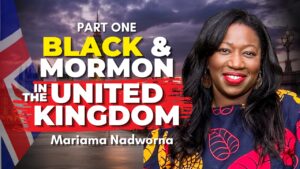
What does it mean to grow up Black and Mormon in a predominantly white church?
In Part Two of our conversation with Mariama Nadworna, she continues her Mormon story with her decision to serve a mission in Leeds, England. She describes her first experience in the London Temple, the loss of her African identity she felt when receiving her temple name, and the racism she encountered during her mission.
After returning home, Mariama moved to Utah to attend BYU, where she experienced both the appeal of being at the center of Mormonism and the challenges of being Black in a predominantly white community. She discusses segregation in Utah wards, interracial dating, and eventually meeting her husband and marrying in the temple.
Her faith began to change after discovering Mormon Stories and reading the CES Letter. Mariama describes feeling betrayed as she learned more about Joseph Smith’s polygamy, conflicting accounts of the First Vision, and the history of racism in the LDS Church. She began sharing her experiences on social media and eventually wrote an open letter calling on the church to take greater responsibility for educating its members about its racial history.
Mariama and John also discuss the “Curse of Cain,” missionary work in Africa, the church’s relationship with African communities, and the broader questions of cultural colonialism and religious conversion. For Mariama, speaking openly about these issues has become part of her own healing—and a way to help others who may be asking similar questions about their faith and identity.
Episode Transcript
Full text · 21,900 words · 13 chaptersHost: John Dehlin · Co-host: Margi Dehlin · Guest: Mariama NadwornaRead transcriptHide transcript
This transcript is machine-generated and lightly edited for readability. The audio is authoritative. Please excuse occasional errors in names and spelling.
Welcome Back and Episode Introduction
John Dehlin [00:00:00] Hello everyone and welcome back to another episode of Mormon Stories podcast. I am your co host for today, John Dehlin. It's September 18, 2026. I'm here with my partner and co host, Margi. Hey, Margi.
Margi Dehlin [00:00:13] Hello.
John Dehlin [00:00:14] And this is part two of our interview with Mariama Nadworna. Hi, Mariama, thanks for joining us again.
Mariama Nadworna [00:00:22] Hello. Thank you for having me again.
John Dehlin [00:00:24] Yeah, we're so thrilled to have part two of our interview. For those of you who didn't join us for part one, Mariama was born in Sierra Leone in Africa and she and her family moved to the UK in 1988. And the whole first part of Mariama's interview was dedicated to her family joining the LDS Church in the UK and what it was like to be an immigrant in the UK as a Mormon being raised in a predominantly white church. All the good and bad of what that was like for her and for her family all the way up through high school. Modesty lessons and teachings about race and Mormonism and mixed race marriages and purity culture.
John Dehlin [00:01:13] It's a great discussion. If you haven't heard that first, we strongly recommend you go back and watch part one of our interview with Mariama before we, before you enjoy part two. We ended with her talking about trying to date in the UK in a non LDS school with non Mormons and the difficulties that was and the awkwardness that was of trying to date as a Mormon, trying to live the law of chastity while you're dating non LDs British men. And what that was like. That was part one. Mariama, welcome back to Mormon Stories. We're excited for part two. Anything you want to say about part one before we kick off part two?
Mariama Nadworna [00:02:00] I don't think so. I think that's a really good summary of our conversation then. That was good.
John Dehlin [00:02:05] Okay, well, today we're going to be for part two, we're going to be talking about her move to the United States where she tries to date in the United States in Utah with Mormon men and what that was like. We'll talk about her marriage and then we'll talk about her faith journey since marrying and becoming an adult in the church. And we're going to end with a really important open letter that she's written. It's called an open letter to leadership of the Church of Jesus Christ of Latter Day Saints from a formerly active black member. And then we're going to talk about race, you know, race in the church from Mariama's perspective. So we've got a lot to cover today. In two hours and we are thrilled to have you here. Margi, anything you want to say before we jump in?
Margi Dehlin [00:03:00] No, I'm just really anticipating this interview with enthusiasm. So excited.
John Dehlin [00:03:08] All right, so, Mariama, where did we leave off and what's the next step of your amazing Mormon story?
Mariama Nadworna [00:03:14] Yeah, so I think we finished off around university. And I'd gone to university in Bristol and had tried to date and pretty much dated, as you said, non Mormons at the time, which was proving rather tricky. I was like, I'd either have to convert one or try and focus on dating within the church. But finished university in 2007, and I'd moved back just before graduation and then obviously went back to Bristol for graduation itself later in the year. And then I met my now husband. At the time, he was 23, I think I was 21, turning 22. And he's Polish and he was investigating the church at the time.
Mariama Nadworna [00:03:59] I thought he was hilarious, very handsome and just like, just fun to be around. So we connected, gotten really well and started dating now, mind you. So he got baptized that year. And I'd had conversations with my bishop at the time we're talking. I can't remember if it was. Maybe it might have been part of interview meetings I'd had with him. And the topic of marriage came up. And I'd been open and honest about struggling at university. And now I'm sort of dating this Polish guy. Wasn't too serious at the time.
Mariama Nadworna [00:04:32] We talked a lot about it and I wasn't sure. So, you know, for people that grew up in the church as well, there's this huge conversation about marrying a returned missionary. And this Polish guy wasn't a returned missionary.
Mariama Nadworna [00:04:45] And that was part of the conversation. And that I feel like that was quite heavily influenced, like, how I felt dating him, because there was somewhat of this sort of. At least I could sense this sort of hesitation, like, oh, he's great, but he's a convert. And is that quite right for you? And you have been so active within the church, you should probably maybe focus on trying to find someone that's had a bit more length of time in the church or return missionary in that sense. And that was honestly some of the conversation that we had.
Mariama Nadworna [00:05:21] And I just wasn't sure. I was 21, 22 years old, so young. And I wasn't really sure what I wanted to do. And this is the time that my bishop actually suggested going on a mission. So I, at the time, again, two thoughts were going through my mind. Maybe that's the right thing to do at this time when I'm not so sure. And I don't want to break the law of chastity or do something wrong that I'll end up doing. So maybe it is the right time to serve a mission and maybe that will lead me down the path of meeting someone that is a returned missionary and et cetera, et cetera at the time.
Mariama Nadworna [00:06:00] So I put my papers and I had a really good job. I graduated. I did my degree in marketing. I was working for Microsoft. I was in the Xbox marketing team and it was a phenomenal role. Absolutely enjoyed it. I was there for a year and then I handed in my papers. And I remember, I think he was a member of the ward who was a man and he said to me, are you sure you want to leave Microsoft? I mean, admission is great, but it's really tough company to get into.
Mariama Nadworna [00:06:30] So to walk away after just a year of being there. You sure that's what you want to do? And I was like, absolutely. You know, this is a mission. I'm serving the Lord and therefore I'm going to be blessed afterwards, probably get a job back. I just literally assumed I'd get a job back at Microsoft like that. Like it would be a quick thing and I'm doing what God wanted me to do. And if you remember, in the last episode, I talked a lot about what was going in my mind at the time was very much about disobedience and wanting to be this extra obedience, obedient young girl because I thought that that's the way that God was going to forgive me.
Mariama Nadworna [00:07:08] And I thought that's the way that God was going to bless me going forward. So I said to him, I remember saying to him, you know, yeah, that's absolutely what I'm going to do. And it came from my bishop, so it must have been inspired from God. And so that's what I'm going to do. Put in my papers. I got my call to serve in Leeds and I remember being a little bit disappointed at the time because I'm from the south, from Reading and it's four hours on the motorway.
Mariama Nadworna [00:07:33] But I. It was fine. I said, well, obviously there's people there that I need to find as people there that I need to teach. So Leeds it is. And that was in 2000, I remember now, 2009 in the spring.
Mariama Nadworna [00:07:49] And just to rewind a little bit. So obviously before going on a mission, you, One of the things that you have to do is get a temple recommend to go to the temple and get your endowments and I did the temple prep classes. And I remember during that time that people said, you know, the temple is interesting, just remember that. But like, it's interesting, but just remember it's, you know, it's God's place. It's. It's. It's like heaven and you're going to feel the spirit and it's going to be wonderful, even though it is a little bit. I remember two words, interesting and strange were the two words that people described.
Mariama Nadworna [00:08:27] I was like, what does that mean? I don't know. And I'm doing these lessons and nothing. You're not. There's nothing coming out of these lessons that sounds odd, other than the terminology, obviously, covenant that you're going to make. That's kind of some of the language that's used, but nothing else that's out of the ordinary for the temple. For temple prep classes. So I did those. It was March 2009 or February 2009, and I went to the temple. So I was. My mum and I was with my brother. My brother had already served a mission before me. He'd gone earlier because at this time I'm 22, and I remember.
Mariama Nadworna [00:09:06] So it was my mum and my brother and then a few members from my ward who had come for the day. And I went through. I went through the. I'm trying to remember the order, the initiatory, thinking, this is interesting, this is different.
Mariama Nadworna [00:09:21] They didn't tell me this was going to happen. So I think I bought the garments down in the. I'm thinking of the London temple, bought the garments. We walked through and obviously get ready to go through the initiatory. The first bit and then the new name section. I remember.
Mariama Nadworna [00:09:36] I don't remember if I'd had that in the lessons. I think I've heard about it. And I got my name and I was like, oh, wait, my name is Mariama and that's the name I'm going to be known by when I die. That's okay.
The Temple Endowment and Identity
Mariama Nadworna [00:09:54] And I remember a flashing thought of losing identity because Mariama is a West African name. And I remember at that time I was like, oh, that feels a bit of. Lost was kind of the word that I felt. I was like, my name actually is quite English name. And like, oh, that feels a little bit like I'm losing who I am, right?
John Dehlin [00:10:16] Oh, my gosh, I've never thought about that. But the names, you know, we all know the list of names they draw from. And it's basically either like, names of people Joseph Smith knew or names of people in the Bible or the Book of Mormon, but it's certainly not, you know, names of people from other languages or other parts of the world. That's a great point. I never thought of that. Yeah, thanks for sharing that.
Mariama Nadworna [00:10:42] It was a flash thought. And, you know, at that time, if you're active and I remember pushing it aside, thinking, it's fine, you know, God knows best. I don't understand that, but God knows best. So I went through that. We sat down in the waiting area and then obviously were sent up to the endowment room for the first session.
Mariama Nadworna [00:11:00] And then you go in, you sit down, a bunch of stuff happens. I'm sure a lot of listeners know, but there's a moment where you're invited to. If you're. I think. I can't remember the language exactly, but if you don't feel that you can make or keep the promises you make today, then this is the opportunity to leave. And I was like, I'm not leaving. I don't know what's happening. And I'm. This is weird. But I'm not like, who's going to leave? I'm not going to leave. My mum's here, my brother's here, loads of people from my ward are here. I'm not going to walk out.
Mariama Nadworna [00:11:33] I know. It just. I found. I found that interesting. I thought. I didn't even know I'd have an option to walk away, but I won't. So I. We sat through. I've obviously sat through the rest of it. Gosh. The. The part that everything else was really. With the swapping and the things you have to put on and put off and swapping around. That was odd. But I. I kind of went through it. It's fine. I don't understand all of what's happening. I don't understand how this connects. I don't understand how it connected to being Christian. But I carried on.
Mariama Nadworna [00:12:05] It's the moment where, so as a new person or going through the temple for the first time, you're invited to go into the prayer circle. And I went into the prayer. I didn't. I was really nervous. I was like, I don't know what I'm doing, but okay, I'll go. I'll go in. I went into the prayer circle and it started. I thought. And that is the first time the term. The term cult came to mind. I'd never. Prior to my life in the church, I'd never thought about it like that, heard about it. I'd heard people saying it was a cult, but that's the first time it came to me very uncomfortable internally, I thought, because I didn't know what was going on.
Mariama Nadworna [00:12:46] I didn't know what I was expecting. This is the first time I'm going through. I don't know what I'm expected to do. And it wasn't click. It wasn't making sense. I was struggling to connect the Christian part of this experience, and I couldn't connect it. I was struggling with that internally, but externally, you wouldn't have known. I carried on.
John Dehlin [00:13:08] And then for those who don't know, there's this part where people form a circle and they're wearing their veils or their hats, weird white baker hats, and their robes and their aprons. And there's this part where everybody chants in a circle, where they say a chant and their arms are raising and lowering. And for all the culty things they did take out that were Masonic relics, that's something they left in. And it still feels very culty. Or at least it did to you.
Mariama Nadworna [00:13:41] It did to me, absolutely. So that part finished in that main room. And then you go through. You do more signs to get through a veil. And this is all to represent, I suppose, entering heaven, which kind of made sense to me a little bit, but the signs were really throwing me off. And then I went through to the celestial room and that my mum and my brother were already through and members of the ward who had attended were already there.
Mariama Nadworna [00:14:06] And I remember there's one particular lady who kind of came up to me. She's like, it's weird, isn't it? But isn't it just wonderful inside? I was like, no, it's not. It's really strange. And I wasn't prepared for any of this. And.
Mariama Nadworna [00:14:21] Okay. And then I remember it clicked because all this time in the preparation, the way my mum talked about the temple and others, and in the preparation towards it, I remember thinking, I thought I was going to learn more about Jesus Christ.
Mariama Nadworna [00:14:34] That. That. The idea that I was gonna get closer to Jesus Christ during this thing. And I was gonna. This is the. The point of the temple and this is the journey. And then it clicked in my head in a celestial room. Wait, I do this on repeat each time that I'm coming. That. That's what. That's what I'm. I'm not. There's not learning. I'm not learning. It's not a discussion or a conversation or a lesson. It's this.
Mariama Nadworna [00:14:57] And that was a surprise to me because I didn't. I didn't expect that. I thought it was going to be similar to a Sunday school lesson, or at least a psych lesson, where we are conversing and having a conversation and learning more about Jesus Christ. The fundamental part of what it should have been in my mind.
Mariama Nadworna [00:15:16] But I knew that I had to do that in order to be able to go serve a mission. Because all this time I'm thinking God, if my bishop had advised me to go on a mission, I felt that came from God. So I need to continue doing that and continue down this path. So that was the temple experience. I thought it was very quick fire explanation of what happened, but that was what was. Had gone through my mind as I went through.
John Dehlin [00:15:38] I'll just say really quickly. We did a really good episode on our LDS discussion series about the Masonic Lodge ceremony and how Joseph Smith incorporated that into the Mormon Temple ceremony and how cultique that makes it and how as bad as it might feel now, it was even worse when I went through and when people went through before me. So we'll have Brooklyn include in the show notes a link to that episode for those who are curious. The only other two things I'd say, number one is almost everyone we've ever interviewed on Mormon stories felt exactly as you did, Mariama. Almost 100%. It's very few. Including my parents, including me. Like, that's just the standard. And then, Mark, you can speak for you.
Margi Dehlin [00:16:31] Oh, I was relating hard.
Mariama Nadworna [00:16:33] Yeah.
Margi Dehlin [00:16:34] To your experience.
Mariama Nadworna [00:16:35] Yeah, yeah.
Margi Dehlin [00:16:37] And I just think it's interesting too how, you know, these things start happening and you're kind of. It's just interesting. What sticks out as, like, what penetrates your brain is like, cult like. What is the manifestor of like, wait a minute now, this is cult like. Because there were so many things as I was going through where it was like, this is really weird. I am confused. I don't know what's happening.
Mariama Nadworna [00:17:03] Yeah.
Margi Dehlin [00:17:04] And then those moments where whatever it is impacts you, where you're like, no, that feels actually, that feels like a cult.
Mariama Nadworna [00:17:13] Yeah, yeah, absolutely. Absolutely. So I finished the temple. I think it was maybe two to three weeks before I was to leave to go seven missions. So I got ready and prepared and I went to the Preston mtc. I was there for three weeks.
Mariama Nadworna [00:17:30] That in itself was also. You mean you don't do your sort of mission prep classes again? You kind of have an idea of what's happening. But all this time I'm thinking, I'm going to miss home. I miss home already. But I'm doing what God has sort of people have been inspired to encourage me to do. I feel like I have to do that, you know, see it through.
Serving a Mission in England
Mariama Nadworna [00:17:53] And that's in. Yes. In Preston. We spent some time proselyting in Manchester City, which is terrifying as someone who, you know, never really gone out and been outspoken about the church in that way prior to that. I landed in Leeds Mission in early April and I. So this is one thing that I talk a lot about on my. And it's related to race on my social media is around this experience in my trainer. So I arrived in the mission and I was assigned to a sister missionary from Zimbabwe. She was white and I served with her. We were whitewashing in central Leeds and I served with her for two transfers and in the first transfer she was really hostile towards me and I was so confused.
Experiencing Racism on the Mission
Mariama Nadworna [00:18:42] Like short tempered, snappy. Just didn't want to help me, didn't want to guide me as I was on, as I was proselytizing. I remember in City center sometimes she'd ignore me and not answer questions like literally just turn her, turn her back.
Mariama Nadworna [00:18:57] I remember being. I was so confused because I was like, I don't know, I just met you, I don't know you. I don't know why you're being so. What's the hostility about? Like, I don't understand what's going on. And she was, she was pleasant enough to me in front of other people, but it was, this was when we were alone at home.
Mariama Nadworna [00:19:15] Just. It felt like she just couldn't stand to be around me and would lose patience if I didn't get something right. And was very huffed, huffing, huffing and puffing when I'd have to. We'd have to do scripture study together in the morning. I just felt irritated and I was really confused by that. And I could, I put it down to she's probably quite stressed. She's whitewashing and training at the same time. That probably is quite stressful.
Mariama Nadworna [00:19:42] That's what I put it down to. I didn't say a word to anyone. I didn't tell anybody what was. What I was going through. I thought it was normal. I thought this is maybe my cross to bear and maybe other companions experienced this sort of thing as well. So there's, you know, I push through it. This isn't something I need to complain about. That's how I saw it at the time, complaining.
Mariama Nadworna [00:20:04] So I didn't say anything. I would have my mission president interviews. I didn't say a word. I just cracked on and I'm, I'm fairly like positive I tried to be anyway, for the most part. So I just, Yeah, I didn't say anything. What I did notice was that my mission president, whenever we would be in his presence, that he was kind of like, he didn't ignore me as such, he'd greet me, but he was very much more attentive to my companion. So he would, like. I felt like he was checking in more on her, like, how are you? How are you getting on?
Mariama Nadworna [00:20:36] And I was like, oh, maybe it's because I'm new and I'm a greenie and he doesn't know me. She's been on the mission longer than I have. So maybe that's why I feel. I felt again, I put that on myself that I wasn't getting it. And I'm sensitive and I'm reading too much into it. I'm seeing too much into it.
Mariama Nadworna [00:20:55] And I will fast forward a little bit just to explain the situation. So it wasn't until I was living in Utah and I bumped into someone who I'd served as a suspicioner, I'd served around. And she explained that the sister, my trainer, was racist. She didn't like black people.
Mariama Nadworna [00:21:13] And at the time, before I came into the mission, members had complained about the way she had been responding to black members or black investigators. And other missionaries had also complained and they had raised concerns about knowing that I was coming into the mission for people that did know and that the missionary, the mission president, was going to assign me to her.
Mariama Nadworna [00:21:34] And. But the mission president, for my understanding, is that he felt that was the right thing to do. He felt inspired to put her with me to help her overcome her racism. Like that was the intention. And I didn't know. I had no idea.
Mariama Nadworna [00:21:50] There was no safe space. I had nowhere to go. There was no one for me. He didn't tell me. He didn't give me heads up. And she had her. Her own reasons for being that way and not that they're justified, but I was. I was really deeply hurt by that. And I was like, he. He not only not warned me, so didn't protect, like, he didn't protect me either while I was there.
Margi Dehlin [00:22:17] Right.
Mariama Nadworna [00:22:19] And that hurts a lot. So I have. So I have feelings towards him and her, but both of them.
Margi Dehlin [00:22:24] Yeah.
Mariama Nadworna [00:22:27] Yeah. It's just. It brings up. It was painful because I was. I was so new. I didn't know. I didn't know. You know, you're brand new on a mission, you're trying to find your feet homesick and trying to teach people, you know, in Leeds and it's in England and you know, people aren't that receptive to the gospel and don't really want to know. And I'm also arguing with. We had Seventh Day Adventist, I think, or another domination that would be on the same high street as us proselyte and who would always come and want to, you know, be have. I'd call it Bible bashing, but have those kind of conversations on the high street which you're not prepared for. Jehovah's Witnesses would have some interactions with them which weren't great. So, you know, you have all of this going on, you're whitewashing. And then I had that layer on top of that.
Margi Dehlin [00:23:14] Absolutely, yes.
John Dehlin [00:23:15] And just for those who are joining for the first time or don't know the history of the Mormon Church and racial issues, just I'll say it briefly. The Mormon Church has a long history of racist doctrine, racist theology and racist practices. And black members of the church really didn't gain full equal status in the church even structurally until 1978. And some would argue it's still very. Racism still very much lives within the church. And so there's a series we did with historian Matt Harris called Second Class Saints. We just created a website called secondclasssaints.com where like 19 episodes with Matt, we cover the church and its racist past in depth. We, we strongly recommend you check that out and stay for the second half of today's episode because Mariama is going to hit it very directly as well.
Margi Dehlin [00:24:08] So anyway, but so it's honestly heart wrenching to hear because I feel like the vulnerability, it's already a vulnerable spot. You being so young, what you're asked to hold and to get that background and your experience and the lack of just being seen, considered, cared for, supported. So sorry, so sad.
Mariama Nadworna [00:24:37] Yeah, yeah. I, as I say I have they're not very good feelings towards it. I just, I'm sorry, hurt and disappointed in that experience. But the rest of my mission was generally fine and I made amazing friends with some of the other sister missionaries that I served with and the members were amazing and supportive and great and I had good positive experiences after that. So you know, the mission itself was generally fine rest of it and because of that, so I remember talking to, so I'd finished my mission, I came home and I remember talking to you was my bishop was now my stake president and I was like, oh, I'm finding it, it's tough.
Mariama Nadworna [00:25:18] And I'm sure you've other people might have covered this but coming from an environment where you're not really exposed to the outside world in the sense of you're not watching tv, you're not on the Internet or social media, you're not listening to the. Literally, you're so cut off from everything and it is a bubble to then plant you back home is with nothing to nowhere to land in that sense. Like you've got all these mission prep classes and all these things that are provided to you prior to.
Mariama Nadworna [00:25:46] And I remember talking to my stake president, I was like, why doesn't the church do more to help people who come home? Because it's really tough to kind of. And I'd already been to university, so I was a little bit older than everybody there, but I was struggling so much to just mentally to come home and trying to adjust back into regular life. So this is kind of what led me to come out to Utah. So I had.
John Dehlin [00:26:11] Yes, really quickly before we. I want to get to that transition, but just really quickly. I'm curious. Once you're a missionary and you're a representative for the church, it's a different deal because you're not just a member who might be quiet or kind of keep to yourself, but you're going door to door and publicly representing the church. I'm wondering if whether with white investigators or black investigators, you were ever asked.
Confronting the Church's Racist Past
John Dehlin [00:26:39] It's like I hear about missionaries who are black who go to serve in areas with black people and the black non members are like, why are you Mormon? Don't you know the church's history with black people or with black or white investigators? Sometimes missionaries get asked, do you know about the church's racist past? Were you ever asked to explain the church's racist past? What was that like? And did you feel equipped to be able to answer those types of questions if they ever came?
Mariama Nadworna [00:27:17] Interestingly, no, I wasn't asked specifically on that. I do recall though, a door we'd knocked on in one of the areas in Leeds and it was a couple, an older couple who handed myself my companion printouts of church history. And I don't. I don't remember. I don't even remember what it looked like because we put it straight in the. Literally walked out of their, like their front door area and put it straight in the bin. And.
Mariama Nadworna [00:27:43] But they had handed it to us and said, you, you guys should really read this and learn about your church. And I remember that happening. And we were like, no way are we gonna. I'm not even curious because that's anti Mormon and that, you know, the language around the church and around literature that is. Turns out to be true. And just the history was framed as anti Mormon literature. So we were like, there's no way I'm gonna read that. We're gonna put it in the bin. And we did. We didn't even look at it. That's the. And that's the only time that I recall anything like that happening.
John Dehlin [00:28:12] I'm guessing Mormons are so relatively unknown in the UK that people barely know what a Mormon is, let alone its racist past. So you kind of got off a little bit easier on that one little point.
Mariama Nadworna [00:28:26] Yeah, absolutely. And you're right. There were people that we talked to who did have no idea what a Mormon was. Like, didn't know.
Margi Dehlin [00:28:33] Yeah.
John Dehlin [00:28:33] Okay. Okay, back to your. Your move to Utah.
Mariama Nadworna [00:28:38] Yes. So it was one of my companions I saw in the spring of 2011. I came out to Utah for mission reunion, and I was there for a week. I was like, wow, this is wonderful. And obviously, because it was the mission reunion, I was like, this makes me feel like my mission. That feeling that I'd been missing, that sort of, like, at the time, I framed it as warmth and, like, belonging. I was like, this is what I need to do. And I'd only spent a week, and I was like, I'm. I'm going to move to Utah. That was.
Mariama Nadworna [00:29:10] That was the. That was the thing. That was. Literally all it took was for me to go to this mission reunion and meet back up with my favorite mission companion. I love my others. I love the others, but she knows who she is. Star, I love you.
Mariama Nadworna [00:29:21] I met with her. I stayed with her family, and it was just such a wonderful experience that I knew that I had to come back. And I thought, you know, Utah is Zion, right? It's. It's what I grew up to. To understand. It's. It's what the center of the church.
Mariama Nadworna [00:29:38] I think that's where I need to be. And if I'm thinking about marriage as well, I think that's where I need to be. That's probably the right place for me to be if I'm going to marry and return missionary. So those are some of the things that were going through my mind as I was making that decision.
John Dehlin [00:29:53] And I'm dying to ask Mariama, and this may not fit at all. So I don't mean to put this on you. Have you seen the musical Wicked or the movie Wicked?
Mariama Nadworna [00:30:02] I have, yes.
John Dehlin [00:30:05] Because in my mind, I've always had this idea of somebody raised outside of, let's say, Oz and In Elphaba's case, she's literally a different color than everybody else. She goes to Oz as a different color and just has this idea that in Oz she'll be understood and loved and supported and validated unlike anybody else and maybe even cured. Did you relate to that even indirectly?
Mariama Nadworna [00:30:33] A thousand percent. I weeped. I cried during that film because I'd seen the stage, I'd seen the West End show, but I hadn't seen part two. And yeah, it was very emotional and I related so much to Elphaba's experience.
John Dehlin [00:30:51] How so?
Mariama Nadworna [00:30:53] It's. It's thinking going to Utah, and I'll come into the detail of that a little bit, but going to Utah thinking it was going to be this mission adjacent experience and feeling and warmth and belonging and community. And I didn't quite feel that when I got there. And it was actually very eye opening to the point that when I came home I was there for about two and a bit years. And when by the time I came home, I remember speaking to members in my wardrobe going, if I'd stayed in Utah a little bit longer, I think I may have left the church. And it was, and that wasn't a testimony thing, that was just a.
Mariama Nadworna [00:31:25] I really struggled a bit with some of the culture, the LDS culture in some instances. And it might have been just, you know what, I. I suppose some of the social circles, circles I was in or some of the things that I saw that made me really struggle. But I. And I'll get into it.
Margi Dehlin [00:31:43] Okay.
Mariama Nadworna [00:31:44] So I applied. I'd already got my bachelor's degree. I was like the best way to do it probably at the moment as a student. So I can. So it's not a permanent move, but it's a move at least to get me there and then I can live there and see if I like it and then perhaps try and apply for a green card or something else if I feel that that's what I want to do. So that's the route I took. So I applied to be what was then LDS Business college. And I got in onto it was business with entrepreneurship and that I would say the business college was phenomenal.
Mariama Nadworna [00:32:16] I absolutely loved it. There were students from all over the world and I really thrived in that environment. It's very diverse and I loved, I was like, oh gosh, you know, some of us are from Europe, there are some people from South America. It was so diverse. Absolutely brilliant experience.
Mariama Nadworna [00:32:31] Loved it. I did that for a year and a half and then I ended up finding a job Afterwards on the. And I loved, I loved. It's the first time that I properly been in America in that way.
Mariama Nadworna [00:32:44] I love the mountains. I loved Park City. I loved like the American side of it and like the drive in movies. Baseball's my favorite to go to. I loved the vibe at a baseball game in the summer and then the fireworks in the evening, the food, the ice cream, the desserts.
Mariama Nadworna [00:33:03] And I remember laughing, saying, I'm coming home. I was like, I'm surprised I didn't roll me off the plane because I ate so much. But it was, it was, you know, I really had fun in that sense. And then socially there was observations that I made that I think I was a bit surprised by. I don't know what I was expecting, I don't know. But from the church's perspective. So you have, you know, YSA wards which were fine but not super diverse, like predominantly white.
John Dehlin [00:33:30] And then those are young single adult wards for those who've never been Mormon, meaning single people, adults who go to church together mostly as a way to meet other single people to get married. Right?
Mariama Nadworna [00:33:42] Yeah, right, exactly. And I was so astounded, like coming from England where there aren't. There's not. There's only one YSA ward in London that 12. I think at the time it was 12 stakes in Salt Lake City, that was 12 YSA stakes. And I remember thinking, that is so many people and so many young single adults. It was great socially, like to be able to try and come and meet people. But there was something that I. So I noticed that there was a. At least in downtown Salt Lake, I think there was a African ward. I can't remember if that was the exact term that people would call it, but most of the members in that ward were African.
John Dehlin [00:34:18] And Genesis, I think it's called the Genesis group.
Mariama Nadworna [00:34:20] Okay.
John Dehlin [00:34:21] And I think they, there is a ward historically that the church created. I don't know if it was to segregate the black people, Mormons, or to give them a sense of community in our, you know, we've talked about it. The Darius Gray, Margaret Young interview early on in Mormon Stories talks about it. The, the Matt Harris series talks about it as well. I think it's double edged. I think it's, it's meant a lot to black Mormons in Utah over the years. And I also think it's been a place for segregation.
Mariama Nadworna [00:34:52] Honestly, I agree that. And that's the conclusion that I kind of came to at the time. I was like, I understand the need for perhaps black people to be together in the space and have that community. But also it felt segregated. I remember understanding there were some wards that are predominantly Tongan and Samoan as well in Salt Lake. And I was like, why is it so separated like that? Or like the Spanish speaking wards? And I get that's like, okay, they speak Spanish, but it also feels quite sacred. Like, why are there such separation in Salt Lake City where there is a lot of diversity in, in, you know, compared to broad outside of Salt Lake? Remember that being. I was quite curious and then.
John Dehlin [00:35:35] And sorry, just. We refer to this last episode. But for those who are new or joining us, the. The church taught that interracial marriage was bad up until a few years ago. So for almost 200 years, one of the most terrifying things to a, a top level Mormon church leader would be that a, A, a white member would marry a black person. And even to this day, I think the church leaders generally would advise against that happening. And that's got to be a core driver for why there were racially focused wards all throughout the church, but also in Utah, at least partly. And I just had to name that because it's real.
Dating, Career, and Life After the Mission
Mariama Nadworna [00:36:20] Yeah, I think that's very, very fair. And I. From a dating perspective. So interestingly, I never actually, I think I set up. I was set up on a couple of blind dates with active LDs. But again, I found myself in a position where I didn't get asked out by anybody that was from my, from memory. I didn't get asked out by anybody that was from active in the church. The people that I did go on dates with were either never Mormon or less active. And that was, I was like, oh, it's happening here as well. Okay.
Mariama Nadworna [00:36:53] And there was one guy, he was white, I went on a date with. He was a divorced dad. And I remember finishing the day and I was walking. He had tattoos and I wasn't. I'm not fussed by that. You know, I was walking back. I can't remember where I was, but it was downtown, salt lurking. I bumped into someone I'd gone to the college LDS business college with and he was very, very Mormon. And he pulled me aside and he was like, are you all right? Are you safe? Are you okay? And I was like, yeah, but I don't know. And you know, walking away from that interaction, I was like, did he just judge a guy by his appearance because he has tattoos?
Mariama Nadworna [00:37:31] Did he just check in if I was okay? Because I've, I literally had just finished a conversation ending the date and I thought that was okay. I feel like he's just judged someone based on an appearance. And then I, Another guy dated. He wasn't lds, had never, had never joined the church.
Mariama Nadworna [00:37:50] We kind of dated like for three months. And he, he told me he was bullied in school, in high school because he wasn't lds. And I was like, really? They, they bullied you because you weren't a member? That's interesting. I don't know how often that happened. He was, we'd have been about the same age, so mid-20s by then.
Mariama Nadworna [00:38:10] But I, I recognized quite quickly when this was happening. I was like, ah, this, this idea of interracial relation, like marriage. I, I think this might be just within the church in general. I don't think this is exclusive to being in the UK because I'm experiencing the same thing here. And I, There were, there were some people that I knew who were couples that were interracial couples, but not many.
Mariama Nadworna [00:38:37] And I just didn't see that it was happening. And there was just some people weren't outrightly racist and I never experienced that. But there was just some things that were. I would say how I, how I saw it that I think one guy did say to me, I'm, I'm going on a date with you because you are British. And I think that I, because the social circles I ended up being in were predominantly white.
Mariama Nadworna [00:39:05] And I would tell you how I feel that it was, they're hanging out with me because I'm British. Had I been African American or black, I don't think I would have been as invited into the space. That's how I felt at the time.
Mariama Nadworna [00:39:20] And just from some of the things that were said out loud, oh, you know, we love your accent. You know, we hang out with you because of your accent. Like some of that stuff was said. I was like, oh, I wonder. I remember at the time I was thinking, oh, I wonder if I would have been welcomed or this would have been happening. I'd have been in these social circles if I didn't, if I wasn't British. And to that point in, in the business college I was brought up to the front of. It was one of the sales classes. I was brought up to the front by the, the lecturer at the time and he said, you know, you know, here's Mariama.
Mariama Nadworna [00:39:49] She's more likely to get, being really embarrassed. He's like, she's more likely to get a job post the school because of her accent, a sales job if. Because she speaks well and might be perceived a certain way. And so some of those Things were sort of clocking, like ticking around in my head thinking, I think I might be getting treated a certain way because I'm British. So, yes, I remember having those thoughts.
John Dehlin [00:40:15] Yeah, even in the United States, there is a tiered difference probably between African Americans and Africans and even British or European black people. And I think the lowest in the rung might be African Americans in terms of treatment. But most importantly, I'm sad you didn't get a great experience of kind of equal valuing and treatment in Utah. And there's a part of me that wishes you could have even been told straight up why you were not being chosen or selected or valued. But I just feel bad that our culture made you feel like you weren't desired or valued as someone to date,
Mariama Nadworna [00:41:11] you know, And I think it's probably also it was a trickle effect from what I'd experienced at home and recognizing that within Mormonism, especially where I think back then in the early 2000 and tens, perhaps from a church literature and church marketing materials, we were starting to see a little bit more diversity within the materials. But I don't necessarily recall seeing mixed marriages, mixed ethnicity marriages as such.
Mariama Nadworna [00:41:38] And I remember that being something in the back of my mind as maybe this isn't quite, you know, the likelihood of me marrying a black guy. There aren't many black men in the church. And so I. I knew that was the possibility of me marrying outside my race is more likely because I'm lds.
Mariama Nadworna [00:41:55] But yes, it was just an interesting, I will say, like, from my mission companion and her family. I felt so loved and welcomed and it was a home from home in that regard. And, you know, just they gave me the best experience in that way. Like I could just be part of their family and attend games and have fun on that side. But I think from the other aspect of socially, and it wasn't quite as. As what I thought or hoped it would be.
Margi Dehlin [00:42:20] Yeah.
Mariama Nadworna [00:42:22] And so I remember. So that was coming up to the end of the two years of me living there. I started to think about, do I. I was really homesick. I was like, do I want to go home? I think I might. Dwight. I was working for a company. I was doing marketing. They were willing to pay for my H1B, which is the working visa. I believe they were willing to pay for that. And I was just questioning, I don't know if I want to stay here long term.
John Dehlin [00:42:47] Is it worth checking in with you about you not getting a job with Microsoft after your mission and whether you feel like your career really took A hit for serving your mission?
Mariama Nadworna [00:42:59] It did, I would say. So I applied. I came back after my mission. I applied to Microsoft. I didn't even get an interview. I remember. So that's sort of some of the things that sort of made me think about actually, what's my next step, what do I want to do? I came home after living in Utah. I applied again and I was thinking perhaps this, you know, getting a business and entrepreneurship mini degree associates might help boost my eligibility or like, criteria for getting a job. I didn't. I didn't. And I applied. I think I remember getting an interview, but I didn't get past that.
Mariama Nadworna [00:43:34] And I was gutted. I was gutted because. And then what was going through my mind was I thought. I thought I was doing what God wanted me to do. So why wasn't he blessing, like, the decision to go on a mission felt inspired by this bishop and I felt like I'd made an inspired choice. So why didn't it feel like God could bless me with getting. Being able to try and get back into. Actually try to get back into the team I was in. And it just. And it has never panned out. It has never. I've never been able to get back back into Microsoft.
Mariama Nadworna [00:44:05] I thought about what had crossed my mind was if I want to extend and get a second bachelor's degree, that maybe I wouldn't go to Provo and I wouldn't want to go to ido. I tried to get into Hawaii, perhaps where there would have been a higher number of. A higher level of diversity, then perhaps I would be more comfortable. But no, I knew fairly quickly afterwards. I thought actually maybe the best decision for me at the moment is to probably go back home. And so that's what I did. It was 2014, in the March.
Mariama Nadworna [00:44:34] I moved back to the UK and around that time my mum had bumped into my husband at the time or the boyfriend. I dated this Polish guy. She bumped into me. He hadn't been attending church at the time, but he'd asked about me, how I was getting on and I'd forgotten about him, really. And I was like, oh, maybe I'll just reconnect with him getting home. So we. We actually ended up speaking a couple of times on Skype before I left. And then I came home and we pretty much picked up where we left off. And by that time I was like, I don't know why I'm so worried that he's not a return missionary.
Mariama Nadworna [00:45:07] Like, we get on so well. I'm attracted to him and Actually, the language I use a lot when I talk about him is he feels like home. I can be myself around him, and I just love that. So why am I worried about some of the other aspects of, oh, he's not a returned missionary or he hasn't been super active, it's fine, like, as long as we get on and we like each other. And I feel like there's some, like, just fundamental things outside of that that I wanted to, like, didn't. I didn't want to worry about all the other boxes, like to try and tick other boxes, if that makes sense.
Mariama Nadworna [00:45:44] So we dated for about a year, a year and a bit. It's quite a bit of a long time, but we just wanted to get to know each other again and kind of spend some time together. And he ended up coming back, back into church and getting active again.
Mariama Nadworna [00:45:56] And we got engaged and got married. Ended up being 2017, actually, is when we got married. And he went through the temple as well. And he equally thought it was very interesting and a bit strange, but we did that and then we got married in the temple and we were able to do that.
Mariama Nadworna [00:46:16] And then by the time it got to 2018, I can't recall what started it necessarily in terms of this journey with my faith, but at the beginning of 2018, we were struggling a little bit as a newlywed couple, as many do with just financially. And we had decided to. We were living in a different town. We decided to come back to my hometown. And the rent is just because we're a little bit closer to London. Rent prices are a little bit higher. So we knew our outgoing costs were going to increase. And then I ended up then also having to commute for work.
Mariama Nadworna [00:46:50] So I remember in January 2018, we jointly made a decision to stop paying our tithing. And I was like. I held my breath, like, mentally held my breath, because I thought, we're making a decision. It's best for our family at the moment. It's just a situation. We don't know how long we'll go for not paying, but we just literally cannot afford it at the moment.
Mariama Nadworna [00:47:14] I felt like I was waiting for our world to completely crumble and my life to completely fall apart because we're disobeying the law of the law of the tithing. Like, we're not doing it, we're not going to pay. And I waited. A couple of months went by.
Mariama Nadworna [00:47:29] Life didn't change. It wasn't any worse or any better. It was just life. We had some good times and some more Difficult times. But nothing changed. And I logged that as an experience. I was like, huh? And I didn't feel judged by God. I didn't feel like we were going to get eventually. I was like, I don't feel like we're going to get punished like I thought we were.
Mariama Nadworna [00:47:50] So we carried on and we didn't from that time, from the January 2018, we didn't, we didn't pay tithing and nothing happened then in the August of that year. So at the time I was working in my ward, I was serving as, I think I was first counsellor in Relief Society Presidency, first or second counsellor. And it was fine. Like, it was a bit tough, but just because I was commuting five days a week, it's a four hour round trip, I'm exhausted by the time I get home. And then on the weekends, I'm either trying to prepare for a lesson or an activity or there's a meeting or something is going on church related.
Mariama Nadworna [00:48:28] And we were already, my husband and I were already talking about trying for a baby. So we wanted to wait a year after getting married just to sort of obviously settle into marriage and then try for a baby. So we'd all that year, this autumn, August, September time was when I was starting to have the conversation.
Mariama Nadworna [00:48:43] And in the August, I remember I got a call from a member of the State presidency and he came, he says, can I come over to come and see you? And I was like, oh, no, is this a calling?
Mariama Nadworna [00:48:53] So he came, came round and I was extended to an invitation to be on the Stake Young Women's Presidency. And I was like, oh, thank you. Can I think about it and can I come back to you? He said, fine. And then I wrestled with the thought, with the idea, what was going through my mind at the time I'm commuting for. Literally at that time, everyone was in the office five days a week. I say it takes me about two hours there, two hours to come back. I'm exhausted already. I'm already exhausted from my current calling.
Turning Down Callings and Questioning Tithing
Mariama Nadworna [00:49:24] I'm now. And you know, in the uk, our stakes are quite spread out. You know, the furthest away is Oxford, which is about an hour away. That means I'd have to dedicate some of my weekends to be commuting to Newbury or Oxford or Bracknell or wherever else within the stake to do youth activities because they're frequent or it's a ward conference or it's something else. I remember all of these thoughts going through my mind. Am I really ready to commit to that and do I want to. I already know I'm not going to enjoy it. And then I was like, yeah, but then this is coming from God, so maybe God, you know, maybe he'll support me in that.
Mariama Nadworna [00:49:56] But I really struggled with that thought because I knew as much as, like, I'd like to think that God would support me with that, actually, the reality was I'm going. I. I was going to find it hard. I knew that. I knew that I was going to. So it took about, I think, two or three weeks of me going back and forth, but knowing deep down I didn't want the calling, I didn't want to do it.
Mariama Nadworna [00:50:17] So I. It was. It was a. I think it was a ward conference or a special occasion. We were in Hyde Park Chapel in London, and I pulled aside the member of the state presidency who had come to talk to me and I said, look, I was crying. I was so emotional because at this point I'd been thinking, this comes from God and I'm disappointing God because I'm saying no. I knew that I didn't want to do it, and I knew I had to just. This is the first time in my life, in my adult life that I was turning a calling down. And I generally was taught not to do that.
Mariama Nadworna [00:50:48] And so here I am doing it now. And I told him, I can't do it. I was like, thank you so much for the opportunity. I thanked the young WINS president for thinking of me. And I was so sorry. I was so, like.
Mariama Nadworna [00:51:05] I remember just bawling my eyes out, trying to get it out to say thank you, but no. And then again, I waited for some sort of punishment or some sort of, like, I was going to get, you know, struck down in some way. My life was going to completely fall apart because I just said no to God and nothing happened.
Mariama Nadworna [00:51:26] And then I started thinking about the same thing happened with my tithe in. And actually, not only has nothing happened, as soon as the words came out of my mouth that I didn't want to do the calling, I felt a wave of peace.
Mariama Nadworna [00:51:40] I was like, huh? I didn't expect that. I thought I was going to feel turmoil. The turmoil I was feeling was trying to decide, knowing I didn't want to do it and knowing I had to say no and how that was going to feel. But as soon as I did, a wave of peace came over, like literal, I can breathe and I feel really good, actually, in saying no. And I remember coming back to the ward sighted president saying, you know, I was invited. I was extended a calling here. She'd known about it because I had obviously asked her and I was like. And I said no, but.
Mariama Nadworna [00:52:13] And I feel really peaceful about it actually. I'm quite surprised. And she's like, well, you know, I think God's probably happy with your decision. We don't always have to say yes to these things. I logged that in my mind. I thought, huh, that's interesting.
Mariama Nadworna [00:52:27] I didn't expect to feel that way. Okay. So I ended up falling pregnant in the September, in the late September. And I went throughout pregnancy and it was, it was a little bit, it was generally fine. I had a bit of sick morning sickness, although that lasted throughout the entire pregnancy itself. And then I remember thinking, I think I'm, you know, I'm going on maternity leave from work and in the UK I got to have 12 months and I was thinking am I going to get released from my calling? Am I going to. They going to release me to allow me to be a new mum, a first time mum to allow me that time to actually settle into motherhood.
Mariama Nadworna [00:53:06] I remember just waiting on that, thinking that that might happen. I thought clearly they can see that this is the first time that I'm having a baby. So I parked that thought. I then I'm thinking of the timeline. So it would have been my son was born in June 2019.
Mariama Nadworna [00:53:24] And I remember being in hospital looking at this brand new baby and just this beautiful newborn and thinking and I'd already had prior thoughts and I can't remember if I mentioned this in my last interview but when I was going to seminary, my mom was taking us at 6, 5:30, 6 o' clock in the morning, five days a week.
Mariama Nadworna [00:53:48] I remember that thought as a 14, 15 year old thinking, this is a lot, this is a lot to ask of parents to drop off every day before you go to school. I don't know if I can do that as a 14, 15 year old. And those thoughts came back to me as I was holding my baby and I looked down at him and I was like, I'm already. I've had a couple of incidents where I thought my life was gonna. I've said no to things or I've pushed back on something and my life didn't disrupt, it didn't completely fall apart.
Mariama Nadworna [00:54:18] And these questions just start getting more and more questions I've had over the years or things I put on my shelf. I better figure this out, I better. It's what it's one thing if it was just my husband and I who wanted to be in the church. It's another thing to raise a whole nother being another human.
Mariama Nadworna [00:54:33] They wouldn't have had a choice in that. And actually, I remember the thought that crossed my mind. Mormonism is an intense commitment. It's not just going to church on a Sunday for an hour. It's a lifetime of lots of different things. And am I ready to bring my child into that? So that was the moment that I thought I better just figure out if this is the right thing for me and our family and for my son in particular.
Mariama Nadworna [00:54:57] And that's when I started listening to things or just. I wouldn't say I necessarily sought lots of things out. So I'd not heard about Mormon stories at all at the time. The first time I heard about Mormon stories podcast was on a different podcast. I think it was Listen, Learn, Love. I can't remember, but it was someone I knew who'd been interviewed on that podcast and mentioned Mormon stories and mentioned the CS letter. So this was in a few months of my son being born. And I can't remember what I started with, whether it was a CS letter or Mormon stories. But I just. It's around that time that I started sort of listening.
Mariama Nadworna [00:55:34] And I wasn't. Don't know what I was looking for as such, but I was trying to figure out if this was the right path for me and particularly for our son. So I read the CES letter would have been closer to December of 2019.
Mariama Nadworna [00:55:52] And I actually paid attention. It was the PDF document and I was just sort of flicking through. I was reading it on my phone and then I can't remember what page I was on or what part I'd got to, but I got to a part. And it's like I felt it physically from the top of my head, the tips of my toe, like just this. If I was a cartoon, it'd be like the color just drained. Because the realization for me at the time that time was the church is. None of it is true.
Mariama Nadworna [00:56:21] Prior to that, where I'm having all these, like, sort of hesitations about continuing with my calling, with having a newborn, and I wasn't released, obviously I had to continue in that calling. And I really struggled with that. With a newborn, I was like, I feel like I just want to take a break. I just want to take a step back from church and just take a break for a few months.
Mariama Nadworna [00:56:40] In early 2020, I was due to have an operation. So I thought maybe I'll just. Sadly, I thought I'd just use that as an opportunity To. I've got to rest anyway, so I'll use that as an opportunity to take a break from it and take a step back and maybe I'll just do that and. Sorry, I will just go back a step just to give.
Mariama Nadworna [00:57:02] To illustrate my mindset and why I had wanted to take a break and why I felt it's part of the reason. So I had an emergency C section. And on the way I'd been raised is we go to church every Sunday. You do not miss a church unless you are literally at death's door. You go to church every single Sunday. There's no excuse. We'd be at family parties at till 4am on a Saturday in London. We come home by 5am and would be up for church on Sunday for 8:30, 9 o'. Clock. We'd be at the chapel 10 o'. Clock. Whatever time the start time was.
Mariama Nadworna [00:57:32] That's the home. That's the environment I was raised in. I gave birth on the Friday, that first Sunday. I didn't attend because I'd obviously just literally come out of hospital. The following Sunday I was at church. And I remember, actually, I'll take this as a positive that there were. Some of the women came up to me like, what are you. What are you doing here? Go home, go and rest. Why are you here? You just hadn't. Not just. Just had a baby, you had an emergency C section, you should be resting.
Mariama Nadworna [00:58:02] And I was. And I remember thinking I didn't. I didn't know I could. I thought that no matter what, I had to be here and I had to be present and I had to be at church. I didn't know I could have. I had the option to not be at church for a couple of weeks because I'd just given birth and I just had an emergency C section. All of these things had been going through my mind where I felt like I needed to take a break. Then I read the CES letter and then it dawned. Literally from the head of the top of my head to the tip of my toes, it dawned on me, the church isn't true.
Mariama Nadworna [00:58:38] What. What have I been believing the last 30 years of my life? I was about 34 at the time. What does that even mean? Like, what? What, what? And then it. Different things just started hitting me that I've been carrying so much that now felt that for nothing.
Mariama Nadworna [00:59:02] And that was. I couldn't sleep for probably two to three weeks after reading this year's letter again. That was December, in the January. I remember going to a state conference and Then I ended up, I think I was such a.
Mariama Nadworna [00:59:16] Didn't know what was going on and in such a zone. I just completely threw me off. And then by the time, you know, again, it's Covid time. So it was actually everything shut down anyway. So I didn't go to church and I had an operation. Everything happened after that. But it was such gosh, the feelings that I had in those early days of, for me, realizing the church isn't. They aren't who they say they are.
Mariama Nadworna [00:59:48] Just feelings of betrayal, feeling very deeply hurt and feeling that I've been carrying so much that I didn't need to carry and that. That was really hard to work through and have that going through my mind in those early days. And that was just. It's hard. It's really hard for me to articulate, you know, some of the things that I felt then.
John Dehlin [01:00:19] Mariama, thank you so much for sharing. This is really powerful and really gripping. And if it's okay, really quickly, I want to note something. I was listening with my orthodox brain to your story, and you talk about not paying tithing and then being surprised you weren't punished and then turning down a calling and being surprised that you weren't punished by God. And my orthodox brain thinking you shouldn't be paying tithing or not paying tithing, accepting a calling or not accepting a calling based on a fear of punishment. You should be doing those things because you're commanded it, because it's the right thing to do. And you shouldn't even be doing it because you'll get blessings.
John Dehlin [01:01:02] You should be doing it out of obedience. That's what part of my brain is saying. But then the other part of my brain is saying, okay, Mariama clearly has been carrying so much discrimination for so long. She's not desired in the dating pool. She's not in the uk.
John Dehlin [01:01:20] She's got all these racist teachings that she's trying to reconcile or putting on her shelf. She comes to Utah like Elphaba, thinking she's coming to Oz and she'll be valued. She's not desired here. She gives up a job, very valuable job, thinking she's going to be blessed. She serves a mission and then she can't get the good job again, just so much. You've been carrying so much baggage and you haven't been given all the information.
John Dehlin [01:01:55] It kind of makes sense that maybe what that means is part of the way to explain the miracle of how long you lasted as a black Mormon immigrant was because you were indoctrinated with fear. Because how else can you explain how long you were able to remain a faithful, committed member if it weren't partially by the fact that you didn't have informed consent? You weren't taught a lot of the problems, but then you were also taught to have fear if you just decided to follow your conscience or to follow what felt right. I don't know. I don't mean to project it on you, but.
Mariama Nadworna [01:02:42] Oh, that's a really good observation. And I've talked about this in counseling, and it's because I've got two layers of obedience. Level of obedience that comes, I think, when I reflect on it. Is fear rooted. So I am. I've got the church and I've got the. You've got to be obedient no matter what and have faith and believe, and that's what drives the obedience. But also, I come from a culture where you obey your parents no matter what. You do not ask questions. You're not inquisitive, you're not. You're not to even say no to what your parents are telling you to do. So those. That double layer of two levels of obedience and strict obedience, I think probably led to the why I was.
Mariama Nadworna [01:03:22] It was fearful and I was raised in a home that we were to obey every commandment. Every single commandment was. Was to be obeyed. And if you didn't obey, your life wouldn't be great. Like, you would suffer because you're not listening to the prophets, you're not listening to the apostles, you're not basically not listening to God if you dec. To not follow a particular rule. So you better listen because that's the only way that you're going to get blessed. So in my mind, I think because I'm not listening, I'm not obeying or doing the thing that I've been told that I need to do, my life will go the opposite.
Mariama Nadworna [01:03:54] I will be. I won't be blessed and I will be punished because I'm not following a rule that I've been given. And that. That's where my mindset was. And again, it's. It's that double layer of culture and religion both.
Margi Dehlin [01:04:09] Yeah, that makes sense to me. I was going to say, I mean, I feel like it's actually quite integral to the church experience that it's transactional, that you. This idea of obedience and doing all the right things, they're part of the reason why you do that is because there's this sense or belief that you'll be protected. Right. You're chosen. And so by doing Those things, you get something. So as Mariama is talking about reflecting on her actual experience of, like, wait, I'm not really noticing a difference. It totally makes sense to me that this is like, okay. This feels kind of foundational, though, because if I, you know, it's.
Margi Dehlin [01:04:49] It asks so much of you. The religion asks so much of you. So even if it's this pretend kind of reality, you do feel like you get something out of it. You get the chosenness. You're. You're supposed to get protection. And this idea with your kids, too, as you become a parent, protect your kids. Like, the world is scary. You need us.
Mariama Nadworna [01:05:14] Yes, yes, absolutely. World is scary. Is very much. You don't step a foot outside to the point that I wasn't super actively involved in the ceremonial community growing up here because it was, well, that's the world. And yes, they're lovely people, but maybe we need to focus more on church community because that is God. That's where you're going to find God, and that's where you're going to find your blessings, and that's where you're going to stay safe. So you stay within that social.
John Dehlin [01:05:45] And then. Mariama, I don't want to spend too much time on this just because I really want to focus on your letter and your observations around race in the church. But when you talk about the CES letter, and some may not know what that is, but more importantly, would you mind just describing three to five of the biggest things you learned that shook you? And we can provide references for people to go deeper, but I do want to just give people a sense for what you learned, what information was withheld from you and how it landed for you and why you felt betrayed or hurt just to kind of put some meat on those bones.
The CES Letter and Faith Crisis
Mariama Nadworna [01:06:30] Sure. I think what a big one for me was Joseph Smith's vision. So as a missionary, I was going and telling people one version of Joseph Smith's vision that he'd had where he saw God and Jesus Christ and they directed him. You know, there isn't a one true church on the earth anymore. So actually, you need to come and establish that. I remember I felt very betrayed by the fact there are multiple versions that historians know exist and that I had been on the streets of Leeds telling people one version when there are more than one. So I felt like I'd lied for the church. So that's where some of that betrayal came from, because I was like, I sacrificed my life and my time to go and teach people about something that actually wasn't a reality. That wasn't the truth. And that's, that's where some of that betrayal came from.
John Dehlin [01:07:24] And your job at Microsoft.
Mariama Nadworna [01:07:27] Exactly that. Yeah, exactly. My job as well.
John Dehlin [01:07:30] Yeah.
Mariama Nadworna [01:07:31] And giving up that and to this day, not being able to have that opportunity back again or something. That has been lost for me.
John Dehlin [01:07:38] Yeah.
Mariama Nadworna [01:07:40] Joseph Smith's polyandry.
John Dehlin [01:07:43] What's that?
Mariama Nadworna [01:07:44] So it's my understanding that he had been marrying women who were already married, like their husband. They already had husbands who existed. Husband had died or anything. And he is that. Was that right? I think 12 women.
John Dehlin [01:07:59] Yeah.
Mariama Nadworna [01:08:00] Yeah. And I was like, that's news to me. I didn't know. I didn't know the depth of his polygamy. I didn't know how many. It was like 30 something. Is it that he'd married. I didn't know that. And about Emma, and I remember a particular thought as I was reading it was that I had grown up thinking that Emma was like, I think she left the church after Joseph Smith died or she'd. And I was like, they painted her as this. What's the word I'm thinking of? Like a woman scorned. I don't know, like, upset that her son hadn't been picked to be the next prophet and that she was bitter. What I'm thinking of. That's how I was.
John Dehlin [01:08:38] Yeah.
Mariama Nadworna [01:08:38] I thought, oh, no wonder she, like, no wonder she walked away afterwards. Like, that's a lot to put someone through. And I've been quite shocked and surprised. That stood out to me quite a bit. Gosh, the, the, the.
Mariama Nadworna [01:08:54] Those parts of the Book of Mormon and the translations, I, I wasn't aware of so much. And I was like, this is all, like, it's. How could they hide all of this? I actually remember emailing two women that I had taught on my mission to apologize. I felt guilty. I was like, I just, I've just gone to pedal incorrect information to people in Leeds thinking that this was truth and it wasn't. And I. And one of them actually, she don't want to sort of laugh and said, don't worry, I've already left the church for those reasons. And I found out, you know, not, not long ago, but I felt so much.
Mariama Nadworna [01:09:29] I felt guilt that I'd participated in that. And I thought, you know, we talk about truth, we talk about honesty. And the church hasn't been honest about this. And then has also then curated this story, this storyline of Joseph Smith and the foundations of the church, which aren't correct. And then, and then you're teaching young people to go out and teach other people that. To bring that. To bring them into the church. You're not giving people all of the information. Why would you do that? Why would you cover up so much? Why don't you just be honest about. You know, we talk about honesty, we talk about truth.
Mariama Nadworna [01:10:05] I. Those are all of the things that were going through my mind as I was reading this. Like the betrayal was. It felt huge. Felt really, really big.
John Dehlin [01:10:13] And I really appreciate you listing those. And I don't mean to be cheeky, but this might be a good segue at some point to the next part of our conversation. You did not mention race in any of the things you just said. And that says something to me just about how controlled your mind was around the church and issues of race.
Discovering the Depth of LDS Racial History
Mariama Nadworna [01:10:42] Yes. John, I've got to be very honest with you. I didn't know the depth of the racism until I read I started what was audio version of Second Class Saints, which is earlier this year.
John Dehlin [01:11:00] Wow.
Mariama Nadworna [01:11:01] And I am six years out of the church. I had no idea. Some of the language that was used, some of the words used to describe black members and the language that was used to describe being in relations with that I had to like literally only this year.
John Dehlin [01:11:20] Yeah. And where would you have learned it? Because the church doesn't provide that information. And if it weren't for the great work of Matt Harris, Dr. Matt Harris, and his book Second Class Saints, they're certainly not in church curriculum. It's certainly not in the CES curriculum. It's not in Sunday school, It's not in your BYU courses. There would be no way to know it.
Mariama Nadworna [01:11:42] Not. Not at all. Yes, absolutely. Unless you come across it. And I hadn't. Not that level of detail.
John Dehlin [01:11:49] I didn't know. So I don't mean to be cheeky, but, you know, I think that's interesting.
Mariama Nadworna [01:11:55] Yeah. Yeah. I think the race part of me leaving wasn't. I don't think it played that huge of a part at that time yet. Until, as I said, I call my account Unravel with Mariama. It's literally been years of like, I'm not necessarily searching for things, but things will come up in counseling or therapy and then I'll go back and I'll might come across something or I'll find a podcast episode from Women's Stories that will a bit more of a history and it uncovers things. I'm like, oh, I didn't know. And that's why maybe certain way the church is structured and the language that's used for certain things. It all has been a very slow discovery of who the church actually is, like who they are and the history. Very slow.
John Dehlin [01:12:39] And really quickly, what was it like for your marriage to lose your faith in the church? And more importantly, maybe what was it like for your extended family, especially knowing that your family immigrated to the UK and that Mormonism, the Mormon Church was a really important part of them assimilating and let's just say possibly I don't want to project this onto you, but thriving and advancing within the British culture and I'm guessing a lot of your family member might even remain faithful to this day. I imagine that wasn't a simple transition.
Margi Dehlin [01:13:15] No.
Mariama Nadworna [01:13:17] We can laugh about it now, but I remember right at the beginning when I told my husband of the things that I didn't know about Joseph Smith marrying the. Or did he marry the 14 year old, was it Fanny Alger?
John Dehlin [01:13:32] Yes.
Mariama Nadworna [01:13:32] I didn't know that. And I remember, I remember saying, he's a pedophile. I said, I said those words and my husband very offended, of course. And I look back on that and I think it's the shock of those early days and some of the things I was saying that he had, he had no clue about.
Mariama Nadworna [01:13:49] And that was really tough for me because I was very much on my own and he had still, he was still trying to be active at the time and he had his, has. He has his own relationship with, with God and, and religion in general. But it was really like, it was, it was kind of tough.
Mariama Nadworna [01:14:07] And it was because I was coming out to say things like, no, no one was asking me. I was just, I was just saying, I was like, this is, I've just found this out. I've just found. I was, gosh, such a difficult time. I was just coming out with the things that I was discovering. And then I quickly realized I probably need to pull back quite a bit and keep those things closer to my heart and find somewhere else and another place to be and other people to talk about it and perhaps. And that's where the social media sort of came in. It was that year afterwards, after I'd left that I started to just put all of these thoughts.
Mariama Nadworna [01:14:39] I talked to my friends who were never Mormon. They were amazing at the time and very, very supportive. But I knew that I needed to put some of these thoughts out, some find somewhere to. Just for them to land. And that's where I started the account and that felt better. And then I started getting in touch with people I'd grown up with people I'd served a mission with, people I just knew who'd also left for the very same reasons that most of them had read the CS letter to. Most of them felt the same level of betrayal. And we talked about growing up and some of the things.
Mariama Nadworna [01:15:08] And that gave me that sense of community and that sense of, I'm not crazy, I'm not on my own Mormon Stories podcast was a huge part of that. I'm going to probably try and remember some of the episodes that really stood out to me and made me feel less alone because. Is it Tom?
John Dehlin [01:15:26] Tom Phillips?
Mariama Nadworna [01:15:27] Yes. Huge. And he was British, and it can. I connected with his story so much, and I. Oh, I'm completely forgetting their names. I'm so sorry. It was a couple. And their daughter also came onto the podcast as well.
John Dehlin [01:15:40] I remember Leah and Cody Young, maybe.
Mariama Nadworna [01:15:42] Yes, the Young. I emailed Leah Young and just said how much I so appreciated her coming on and just how much I. I just really loved listening to their story and for them to be able to come and share their experience.
Mariama Nadworna [01:15:55] And she messaged me back. And I just grateful for these. These are. These are resources that I didn't know were available to me until much later. And so to properly be able to have the opportunity to listen to other people's stories and to be able to recognize that I wasn't alone. And actually, the journey or path that I. That led me out is so similar to so many other people's stories that I. I felt comforted in that. And then I wanted to add on the layer, like, with, you know, race became quite a big forefront of that conversation eventually. And I started reflecting on some of my experiences growing up black and Mormon and how I felt about myself, how I saw myself.
Mariama Nadworna [01:16:33] And it's not just, you know, it wasn't just the church. It was outside of that. And some of the messaging that I was hearing or receiving as a young child, a young black child, and how that made me feel. And I started talking about all of that, and I think that's. So sorry. I think that's, you know, at the time, it was what I needed, and I was able to have that, and I didn't feel alone. And so my marriage, like, we got better, and we're in a better place right now. And, you know, my husband, he chooses not to attend church, and that's his.
Mariama Nadworna [01:17:04] His choice and his decision, but still sort of believes my mom. And my mom is very active. She sort of, at this point, it's got to a point of respecting they Were disappointed at the time, of course, but come to respect my decision and still will sometimes want to share some of her experiences with me, with the church. And I, you know, welcome, that's fine. But she knows where I stand. And my brother's the same. He's still active with his family.
Mariama Nadworna [01:17:31] They were disappointed at the beginning and they expressed that to me and felt that I had lost my testimony and lost my faith and I needed to be guided back. And I tried to explain it was actually less about that and more about church history and the church that I thought it was. It isn't quite what I thought it was.
Mariama Nadworna [01:17:50] And now it, you know, to be honest, it just, it doesn't come up in conversation a lot. And I think that's what helps with our relationship is that we just try and focus on the things that bring us together as a family rather than anything else. And that's, that's where we're focused on at the moment.
John Dehlin [01:18:04] Yeah, that's great.
Margi Dehlin [01:18:05] Lovely.
John Dehlin [01:18:07] Well, I'm sure there's a lot we could talk about in your multi year journey to learn after you lost your faith about the church's frankly, terrible history with race and with racism. I went ahead and just pulled up the statistics on where Utah ranks in terms of percentage of black people in its overall population.
John Dehlin [01:18:39] And you may or may not be surprised to hear that Utah is 46th out of 52% of Utah identifies as black or as black. The only other states that are more white than Utah are Wyoming, which is heavily Mormon, and Idaho, which is heavily Mormon, and Montana, which is heavily Mormon. So weirdly, it's the most Mormon states that are also the most white and the least black.
John Dehlin [01:19:16] And yeah, of course, highest Mormon population is number one, Utah. Number two, Idaho, number three, Wyoming, number four, Nevada, number seven, Montana. And so we're, we're literally one of the widest states and, and the widest churches. And I just, I, I don't mean to, to be ham fisted about that, but I just wanted to close that loop and just show how white Utah really is. And, and, and all the Utah, all the Mormon states are just super white. But anyway.
Mariama Nadworna [01:19:50] Yeah, yeah.
Writing a Letter on Race to the Church
John Dehlin [01:19:52] Do you, do you, you did write a letter to kind of distill your learnings and your feedback around the, the Church of Jesus Christ of Latter Day Saints and race. Do you want to tell us about what led to you writing this letter? And then if you want, I'd love you to read it and then we could spend the remaining 30 or so minutes talking about your observations?
Mariama Nadworna [01:20:17] Yes, of course. So, as I mentioned, you know, me understanding the depth of the racism within Mormon theology and just within the church culture really dawned on me this. This year, really, to be very, very honest. And I spent a bit of time on my social media this year sort of reflecting on some of that and also thinking about the. It's interesting to me that the churches that now, you know, putting a lot of effort into missionary work in Africa, given that the scripture in Second Nephi Chapter five, I think it is, that talks about black skin being a curse, is still there, that there's never been an apology, that there's never been, you know, reconciliation of any meaningful reconciliation or education with our members, nothing.
Mariama Nadworna [01:21:06] And so I've been reflecting on that all year and thinking, you know, if I had the opportunity to sit down with the leaders of the church, the president and his Counselors and the 12 and anybody else who would listen, what would I want to like, how do I want to demonstrate the real impact of this existing theory? I would call it existing. They might not. I say it all the time. They might not say the N word. They might not necessarily preach it from the pulpit anymore, but it exists. And because they haven't dismantled it, because 1 hasn't been addressed and 2 hasn't been dismantled, the thinking that black skin becomes lighter the more righteous people are, for example, or that, you know, black people might be less than within the church, that still exists.
Mariama Nadworna [01:21:50] And I. I've seen it before I left the church. I saw it within, you know, some leadership within war. My ward, who didn't want to give certain black members callings because even though there have been members for 10 or 15 years, they said they weren't worthy enough or they didn't know enough to have a calling, a state calling especially, but even to have callings within the ward or overhearing a. A white sister who was, you know, known not to be the most inclusive, be upset that the primary president at the time was black and African, and she who had been a member again for over 10 years, and she would say, you know, I don't want my grandchildren being taught by someone who's.
Mariama Nadworna [01:22:31] Her term. Term terminology was new to the church, didn't know much. Why would we put someone who didn't know much about the church in that calling, in that position and teaching children, our children. You know, there were some members who were upset where my home ward was becoming increasingly more ethnically diverse, who didn't want munch and mingle. They wanted munch and mingle to be crisps and sandwiches. They didn't want to have ethnic food. They didn't want the rice and the chicken and the noodles, or we had, you know, Vietnamese members. They didn't want any of that. They just wanted, you know, English food there. And that was vocalized.
Mariama Nadworna [01:23:06] You know, I heard that. So luckily, the bishop at the time completely ignored the people that would mention that or complain about it. And it's like, we live in a diverse town. This is representative of the town that we live. And these are members who've been members for years, and they're part of our ward community, and we want to share that culture with each other. So let's, you know, it was. Yeah, luckily it was. It was ignored. But, you know, this isn't that long ago. I. Since I've been posting on social media, I have messages of people in Utah who have or are related to people who are white and have adopted black children.
Mariama Nadworna [01:23:38] And some grand. They're hearing grandparents say, oh, you know, look, their skin's getting lighter because they're going to church regularly and they're, you know, being right, you know, acting righteous or whatever the term might be. So it still exists.
Mariama Nadworna [01:23:52] These conversations or these attitudes still exist in the church. And the leaders have a responsibility. While it might not have been them directly, President Oaks would have been alive before the lifting of the ban in 1978 and within some sort of leadership position. They would have seen that. And I think it's their responsibility to ensure, if they really care, and they really care about it, to ensure that their members are educated on what that meant and educated on what that means, looking forward and how God is a God for everybody and actually mean it in what they're saying. That's. That's quite a long winded way of saying. That's what I came to before I wrote the letter.
John Dehlin [01:24:33] Beautiful. Thank you. That's powerful. We're really grateful you would share your observations and your feelings and. Yeah, we'd love to hear the letter if you feel like reading it. We'd love to hear you read the letter.
Mariama Nadworna [01:24:47] Yes, I'd love to. An open letter to the leadership of the Church of Jesus Christ of Latter Day Saints. From a formerly black, an active black member, to the president of the Church of Jesus Christ of Latter Day Saints, his counselors and the quorum of the twelve apostles. You don't know me personally, but your decisions and doctrines shaped my life for over 30 years. I was a black woman in your church, watching many of you rise through the ranks while I live. The impact of your teachings for generations Your prophets and apostles taught that black people were cursed, less valiant and unworthy of full participation in your priesthood and temples.
Mariama Nadworna [01:25:22] Your leaders said things like Brigham Young in 1852 Any man having one drop of the seed of Cain in him cannot hold the priesthood. First presidency in 1949 the Negro is not entitled to the priesthood. The conduct of the spirits of the premortal in the premortal existence has some determining effect on the conditions under which these spirits take on mortality. Spencer w. Kimball in 1960 the dark skin is evidence of a curse. Joseph fielding Smith in 1931 because of his wickedness, Kane's posterity was cursed with black skin.
Mariama Nadworna [01:25:57] These weren't fringe or one off opinions. They were official teachings that were printed in manuals, taught in lessons and repeatedly defended in General Conference. I grew up believing my skin was a curse and that baptism and continued commitment to the Church would bring me closer to being the white and delightsome the Book of Mormon talks about. And this isn't just about history. It still shows up today. It shows up when leaders still make harmful comments about Black people. In February 2022, Brad Wilcox told a youth fireside, but black people weren't ready for the priesthood, repeating the same racist logic your prophets taught for generations.
Mariama Nadworna [01:26:35] In June 2026, Carl McKay made remarks that were hurtful enough that he had to apologize publicly. These are not isolated slips. They are symptoms of a culture built on doctrines you have never dismantled. It showed up when my mission president paired me with a racist trainer so she could overcome her racism in 2009. He used me as the tool without support, protection or awareness. I was left to face her cruelty alone, while the person responsible for my well being was the same person putting me in harm's way, believing he was directed by God to do so.
Mariama Nadworna [01:27:12] It shows up in the way black members are still expected to move on without the Church ever taking responsibility. You may not preach the curse doctrine anymore, but you have never dismantled the theology behind it. And I have lived the consequences of that silence. In 2013, your gospel topics essay said the Church disavows past theories. But these teachings were not theories or merely taught by men of their time. They were doctrine that was enforced, repeated, defended and institutionalized. And in reality, that essay was simply a way to hide behind selective language and PR safe statements that frame your own history as a misunderstanding or worse, imply your leaders were following God's commands.
Mariama Nadworna [01:27:53] If that is the claim, then you are asking members to accept that God is racist. Stopping a teaching is not the same as correcting it and Ending a policy is not the same as repairing it. Disavowing the teaching is not the same as dismantling the racist theology.
Mariama Nadworna [01:28:09] You can't disavow teachings while keeping canonized scripture. You can't keep that same canonized scripture while relying on Africans to keep your church membership and wealth growing. The very people you say are cursed. So with all that said, I'm publicly asking you to acknowledge that your teachings about black people were doctrinal, intentional, and most importantly, harmful. To apologize without a PR spin, deflection, or corporate phrasing to educate your members about the history you have minimized, repair the damage you caused through meaningful action, and note, a donation to the NAACP is not that model. The repentance you require from everyone else. President Oaks, you have said, I know that the history of the church is not to seek apologies or to give them.
Mariama Nadworna [01:29:00] We sometimes look back on issues and may say and say, maybe that was counterproductive for what we wish to achieve, but we look forward and not backward. But the thing is, as an organization, you cannot demand members to confront their own sins while refusing to confront your own. In the age of information, your history is not going to go away. Tell the truth and take responsibility. Regards, Mariama.
Margi Dehlin [01:29:23] Wow. So powerful. Wow.
John Dehlin [01:29:28] Brilliant. Brilliant. Thank you, Mariama. So well said.
Mariama Nadworna [01:29:34] Thank you.
Margi Dehlin [01:29:34] What was the process like of writing that letter for you?
Mariama Nadworna [01:29:39] It took a couple of weeks. I. You know, I remember thinking, how can I demonstrate what their theology, what it actually meant to me and someone like people like me.
Margi Dehlin [01:29:53] Right.
Mariama Nadworna [01:29:54] And then how can I explain the impact? Because it's not just saying sorry. It's. It's so much more than, like, coming around and acknowledging, for one, what. What it was. I'm being honest about that, apologizing. But also, education is a huge part of that conversation and not to shy away from that and that I thought that, you know, if I'm ever gonna get an opportunity to sit down in front of them, this is part of what this is. You know, there's more and more, I would say, a lot more that I would say, but this is where I'd begin.
John Dehlin [01:30:23] Yeah, that's right, Mariama. This will be a little bit, I don't know, eye opening for some. But what I'd like to do really quick is play the role of a church apologist or a church leader and give you some responses of what I expect the church's response would be in an anticipatory way and give you a chance to respond directly. Is that okay?
Mariama Nadworna [01:30:48] Yeah, that's fine.
John Dehlin [01:30:49] We'll give it a try. So here's the first thing I'd say. I'd say, oh, listen, yeah, we don't know why God did what God did. We're leaders now and we can't speak for what, you know, David O. McKay or Spencer Kimball or Joseph Ealing Smith or Brigham Young. We don't know why God said what he said to them.
John Dehlin [01:31:13] We're not responsible because we weren't alive. So all we can do is move forward. But it's not our place to speak for or even correct or apologize for what past leaders did because they did it then for whatever reasons they and God know. We can't know that now. All we can do is just move forward. But we don't want to throw God and former leaders under the bus.
John Dehlin [01:31:40] So we just. The best we can do is just move forward and let it all come out in the afterlife when we all meet with God someday. What would your response to that be?
Mariama Nadworna [01:31:52] I would say it would be something along the lines of, you know, I acknowledge that it wasn't you. Like, it wasn't present day leaders. It's not present day leaders that made those choices, but it's their responsibility as leaders of people. They have black members and they, those black members are still in 2026, experiencing the impact of that racist theology. They might not teach it and it might not have come from their mouths, but I do feel that they have a responsibility to ensure that that is not. Doesn't repeat itself, that that theology doesn't continue, those thinkings don't continue, and that they stop it. Just, you know, turning away from it and saying, yeah, we'll just move on.
Mariama Nadworna [01:32:36] That does not solve the problem at all. And I think it's. I don't know if I would say that. I think it's lazy to do that. I think it's very lazy. I don't know if I would say that to them, but in that way I'd find it probably other language and
John Dehlin [01:32:53] thanks for role playing. So what if they say we don't know why God did these things? We've asked. He hasn't told us. So until God tells us why, we don't want to be presumptuous and make assumptions or even apologize for something that God had a good reason for. So we're kind of just waiting for God. If God tells us to apologize or explains to us why we would clarify or apologize, but God's just not telling us.
Mariama Nadworna [01:33:28] I'd have to think about a response to that one because I don't they may say something like that. If I ever, if I ever had an opportunity, they may say, yeah, I just think it's, it's just, it's. What's the word? It's not taking ownership of anything. And to say that God is racist, that's quite a big. Yeah, like to say that God decided that quite a big. Especially as a. If you're going to claim to be God's one true church in terms of Christianity and leading the way, that is if the Catholic Church can come out and apologize, which they have done. And prostitute. Prostitutes. I don't know if I've pronounced that correctly. Sorry. Denominations have also come out to apologize for their relations to racial issues. Why can't the LDS Church, who claims to be God's one true church, why can't they do the same? Yeah, why can't they lead the way?
John Dehlin [01:34:21] Very fair. Yeah, that's a great answer. Thank you. I know I'm putting you on the spot here. A couple more. So, hey, you know, as far as mixed race dating and mixed race marriage, don't we deserve kudos for taking that out of our curriculum in the past couple years? Like, where's the credit? Like, we took it out of the curriculum.
Mariama Nadworna [01:34:44] Yeah. Like, I don't know if, I don't know how recent that was, but you know, I think, okay, it's, it's not, it's just not good enough. It's not good enough for me. No.
John Dehlin [01:34:53] Because culturally people still believe those things and parents teach it to their kids.
Mariama Nadworna [01:34:57] Yeah.
John Dehlin [01:34:57] So removing it from the curriculum doesn't go far enough. The church could and should make an announcement saying all that garbage we said about mixed race marriage and mixed race dating, it was wrong and we're sorry for it. They could correct it by general conference statements and articles. So but just like no longer teaching it and no longer including it in the curriculum.
Mariama Nadworna [01:35:23] That's not, it's not enough. Yeah, it's not. Yeah, absolutely. It's not enough. And that's exactly where I call on saying like, you know, you can take it out or you can stop teaching it, but that doesn't take away. Because there are generations of people that believe that was from God, like generations to today. So it doesn't stop. The, the culture of that still having an impact.
Margi Dehlin [01:35:44] That's right.
John Dehlin [01:35:45] And, and again, arguing on your behalf, a huge problem is the Book of Mormon today, as you noted, still has racist teachings that God curses wicked people with dark skin. That's in the Book of Mormon. And Joseph Smith wrote the curse of Cain into every other piece of scripture he produced. Doctrine and Covenants has Curse of Cain. Book of Moses has Curse of Cain, Book of Abraham has Curse of Cain. Joseph just couldn't create scripture without. That wasn't racist. He couldn't do it. And that puts the church leaders in this difficult position of having to face the possibility of changing scripture, which I know they don't want to do, but it seems like. Mariana, you tell us it could be, that would be the right thing to do, would be to amend the scripture and take the racist garbage out of Mormon scripture.
The Book of Mormon, DNA Evidence, and Missionary Work in Africa
Mariama Nadworna [01:36:44] Absolutely. If they have the ability to change. I think. I know it's the introduction when, you know, once the DNA evidence of the Native Americans coming out, knowing it's not. They don't have Jewish DNA. If they have the ability to change bits like that. They can. I know it's quite a big part of their theology, but that can absolutely change. And actually, I wanted to call out on one thing that I forgot to mention.
Mariama Nadworna [01:37:05] It wasn't until I left the church a triggered a thought at the time, and I was like, oh, let me just check in the Old Testament what it says about this curse of Cain. Let me. I did. I did actually do that. I thought, let me just check in my King James Version, which is the version of the Bible that the church holds. And I went to it and I read like two to three times. I read Genesis, the first few chapters. I was like, it's not in there.
John Dehlin [01:37:33] Yeah.
Mariama Nadworna [01:37:33] So right up until I'd left the church, I still thought the curse of Cain and. And that being related to dark skin, to black skin. I thought that was a common Christian belief.
Margi Dehlin [01:37:43] Yeah, that's right.
Mariama Nadworna [01:37:44] Like in the Bible. In the Bible. But that was. It was. I hated it. I didn't love the idea of that, but it came from God and it was in the Bible until I read Genesis and I. The cut. It doesn't actually say what the curse was.
John Dehlin [01:37:58] No.
Margi Dehlin [01:37:58] Right.
Mariama Nadworna [01:37:59] It just says a mark.
John Dehlin [01:38:00] Yeah.
Mariama Nadworna [01:38:00] Doesn't say what it is. And I was like, oh, my goodness. All this time.
John Dehlin [01:38:05] Yeah.
Mariama Nadworna [01:38:05] I've fought with myself that this was a common. And then I talked to other friends who are other denominations, and they're like, oh, yeah, no, we absolutely do not have that as a belief. That's not Christian.
John Dehlin [01:38:16] Yeah. It turns out, as I understand it, that teaching developed mostly in the United states in the 17 and 1800s as a way for Christians to justify their slavery. And because Joseph Smith was swimming in that cultural milieu, he literally absorbed it and then imported it into all the scriptures he produced, which, by the way, were supposed to be revelations from God and Jesus to Joseph Smith. So why are cultural artifacts from racist slave owning Protestant Christianity somehow intermingling into the scripture Joseph Smith is producing? But that's what that was.
Mariama Nadworna [01:38:57] Yeah, absolutely.
John Dehlin [01:38:58] And I agree with you. I just realized that relatively recently. And I also just will say the Book of Mormon has undergone thousands of changes from its original publishing and the Doctrine and Covenants, from the Book of Commandments to the 1835 version of the Doctrine and Covenants. They've literally taken Revelations out, added new ones, changed Revelations and amended it even into the late 1800s. There is precedent for changing and amending Mormon scripture. So it just, the, the church leaders just need the courage to do it because they've done it before many times. Right. And Joseph Smith rewrote the Bible. There's a Joseph Smith translation of the Bible, right?
Mariama Nadworna [01:39:46] Yeah, absolutely. It does make me question why they haven't done it yet and why that hasn't been. And I, I, and in a question, in a way of what's their mindset? How do they themselves see black people? Like, if they haven't, if they're able to change other parts for whatever reasons, other parts of the Book of Mormon or the Doctrine Covenants, why has that particular thing not been taken out really quickly?
John Dehlin [01:40:09] I want to ask your opinion about the church's increased missionary work to African countries. I know you feel passionately about that, but I'm going to kick it off with one last roleplay question. Mariama. Mormons aren't racist. We've got more missions in Africa than anywhere. And we're growing in Africa like gangbusters. We love African people. We love black people. There's even black members of the Mormon Tabernacle Choir or the choir on Temple Square. But that's where all our growth is, is in Africa. We can't be racist. Yeah.
Mariama Nadworna [01:40:46] I'd like to ask, like, are you teach it. Because I'm aware that there are copies of the Book of Mormon that are ending up in Africa on African missions that don't have that in it, that don't have, I don't know how it's broken up the Book of Mormon, but they're slimmed down versions that don't have the racist doctrine in it. I'm aware of that. So I'm like, are you, like, if you're able to take a copy to the Book of Mormon over to Africa and take that out, you must know it's problematic. And you must know that that is something you don't want African members finding out.
John Dehlin [01:41:19] I don't know about that. I want to see a copy of an edited version of the Book of Mormon given to modern African investigators. I didn't know about that.
Mariama Nadworna [01:41:28] I'm trying to get one that is. I'm aware that the Book of Mormon is slimmed down and that particular scripture is taken out.
Margi Dehlin [01:41:34] Wow.
Mariama Nadworna [01:41:36] So. And then, you know, there's also, okay, you're caring about Africans. But I know I'm going to use the term. Is it stipends? Is that. But I am aware it's happening in Sierra Leone and I know it's happening in Congo, that they are giving members six or investigators up to six months worth of financial support for rent, groceries, etc. Etc. And that entices them to join the church. So my mum has mentioned this and has. She's. She spends a lot of time in Sierra Leone throughout the year in Freetown.
Mariama Nadworna [01:42:14] And the confusion is. But that is. That just feels like you're just buying their membership because they don't last. I don't stay. They don't stay beyond maybe a couple of months, maybe it might stretch out to a year. But they're struggling with retention because people are joining because the conversation locally is, oh, this white American church will give you money, they'll help you pay, they'll help pay for your rent, they'll help pay for your groceries, they'll help pay for your food and living costs. So join the church to get that. And then the members may be joining that for that. They may find some peace and light as part of it on the journey.
Mariama Nadworna [01:42:50] But are they staying? I think the retention rate is around 20%. The last time I look around, something in the 20 percentage not high. So my conversation back is. But you're not being upfront about what the church is and the doctrine and theology with the members is one thing. You also.
Mariama Nadworna [01:43:08] There is, you know, money is part of that conversion. It comes part of it. So I get that you're financial as financial aid, but that is part of that enticing, you know, members might feel, or investigators will feel drawn to the church because of that. That's not a real truthful picture of bringing people closer to Christ. Not in my opinion.
John Dehlin [01:43:29] Yeah, there's also. I've heard it's as low as 10% retention or less.
Mariama Nadworna [01:43:35] Okay.
John Dehlin [01:43:36] And you know, I'm torn because again, sometimes ex Mormons don't like anything the church does because the church could argue, oh, you've got a problem with us you tell us we've got all this wealth, you tell us we need to use it for a good cause. What's wrong with financially supporting poor people in Africa? We can't win with UX Mormons. Or they might say, what about pathways? We're providing really super cheap education to Africans and we deserve credit for helping provide them with low cost, cheap education. So on the one hand, I want to try and be fair and say, hey, at least the church is trying to do something.
Mariama Nadworna [01:44:19] Yeah.
John Dehlin [01:44:19] On the other hand, I mean, one of the most shocking things I learned in Second Class Saints with Matt Harris is the church did not want its missionary work to go to black people in the 60s, 70s and 80s. Like literally, they chose South Africa because it had white people. And that's why that's one of the earliest African missions for the church. And when they went to Cuba, they looked for where are the white people in Cuba? Because they didn't want to bring the missionary work to black people at all. And now that we know that the church is hemorrhaging in the United States and in Western Europe and they're losing wards and they're using losing stakes and they're collapsing wards and stakes and closing chapels.
John Dehlin [01:45:10] The only thing literally that's keeping alive any semblance of Mormon church growth worldwide is its expansion in Africa. So it's almost like it's emphasizing Africa and buying baptisms in Africa as a way to inflate its membership statistics and its conversion rates, because otherwise it's going to look like a dying, dead church.
Mariama Nadworna [01:45:44] That latter part, that's exactly how I see it. And further, I have had pushback on that when I have challenged vocally on social media around the charitable donations, particularly within the global south and Africa, and the church doing that on a bigger scale in terms of maternal health. But, you know, I work in the charity sector and one of the things that's a huge part of funding when it comes to charitable causes is the reporting and like, what is the money actually doing for people? And I always say Africa especially, it's not, I don't think it's poor, it's resource rich. And it's.
Mariama Nadworna [01:46:22] The word I use is over. I've completely forgotten the term now. But you know, there are many countries and companies that are taking resources from Africa and the minerals, and that is what's causing some of this poverty. So what's the, what's the real way organizations and charities are really, what are they really doing to help these countries to build back what has been taken and you know, structurally, I think, I think about Sierra Leone. I think I touched on this before it was colonized by the British. The language in Sierra Leone is English, the national language officially, even though Creole and there's other tribal languages.
Mariama Nadworna [01:47:00] And actually the education system was even then, like how England is structured in primary school, secondary school. That education system was then imported to Sierra Leone. And you know, there is so much that has changed as a result of outside influence.
Mariama Nadworna [01:47:18] So what, what is it? Yes, they might be helping on a surface level, but what actual change are they? Like, what is that they're actually doing to help the people of Africa, you know, individual countries within. Within Africa. That's sort of my, always my pushback. What's the actual change? And I don't think the church reports on those donate. I don't think there's reporting done really. I don't know. I'm not, to be honest, I haven't looked into it, so I'm not sure. But I haven't seen any sort of detailed reporting of people's lives being changed or the affecting the economy or, or supporting housing in any particular way at all. I haven't seen it.
Margi Dehlin [01:47:50] So. Well said.
Cultural Colonialism and Exported Mormon Theology
John Dehlin [01:47:52] What are your thoughts on cultural colonialism and, and sort of the United States and the Mormon Church exporting honestly its racist doctrines and theologies to a country like Africa and trying to say, we've got, we've got the truth for you and we've got the best way to live your life. Listen to us white people from Utah and Idaho and Wyoming.
Mariama Nadworna [01:48:19] And you know, it's interesting because that's one of. So I consider myself atheist and agnostic because I this, I don't know how other people's journeys have been, but this journey out of Mormonism and the deconstruction led to thinking a little bit around colonization and Christianity and how when we talk about my, when my parents talk about our family, our ancestors is a really big part of who we are. So there's always, I've grown up with always a language around, oh, you have your personality or you think like that because this is how your grandpa was or your, the way that you move and the way that you are is because of how your grandmother, your grandmother came from this tribe and this is how this tribe.
Mariama Nadworna [01:49:02] There's a lot of conversation around culture, ancestors. And I'll try the individual tribes and that culture. And so I think when it comes to Christianity, for example, and that colonial effect and impact, it's stripping people of what the. Like, I don't believe that a White Jesus was what is going to bring peace to Sierra Leoneans, for example. It's not that and, but it's, you know, our traditions were taken away. I talk a lot around some of the things, even just our clothing that we're wearing, Western clothing. It's not traditional African garments that we're wearing, you know, or African print. You, you might see it now.
Mariama Nadworna [01:49:43] You know, I've seen it in the pictures of the LDS Church, and you might find some of the women coming in more traditional wear, but the men are still wearing white shirt and tie. And that is a requirement in order to pass the sacrament or to be a bishop or a state president. You don't get to have the men dressed in their traditional wear as such. And that's something I notice. It's, it's, it's.
Mariama Nadworna [01:50:05] I just, I feel for. I think I always say to, when I talk to my parents about it, like, I think West. I can only speak about West Africans. The religion and faith and hope is so important to them, and I think it's because so much has been taken away that there is that vulnerability of wanting peace and hope for the future and for better lives for yourselves and for your community.
Mariama Nadworna [01:50:28] And when a religion outside religion comes, comes and says, we're going to provide that for you, follow this path, and this is the path that's going to give you the peace. Without addressing the systemic issues that are in the country, without addressing levels of corruption or levels of greed in which countries and organizations are coming to mine minerals in diamonds or gold in Sierra Leone at the level that they're doing at same in Congo, when it comes to technology and the way that children and women are mining, it's like you're bringing religion and saying, this is the thing that's going to solve all your problems.
Mariama Nadworna [01:51:04] Ignore the rest of this, you know, ignore all of this that's going on here. Let's. This is the religion and this is the thing that's going to bring you closer to God. This is the thing that's going to give you peace. Never mind your traditions, never mind your ways of your communities or your tribes and the languages. All of that gets lost through generations. Actually, we're going to focus on this one particular Western way of worship because that's the way that that's right for you. That. It blows my mind, you know, the more I've thought about it.
John Dehlin [01:51:32] Yeah.
Margi Dehlin [01:51:33] And we would just add too. And by the way, pay 10%. 10%.
John Dehlin [01:51:38] Even if you can't afford shoes or food. Pay your tithing which is what our Mormon leaders have told people in Africa and Latin America.
Mariama Nadworna [01:51:46] Yeah, yeah, absolutely.
John Dehlin [01:51:48] Yeah.
Mariama Nadworna [01:51:49] And that, you know, and then they do. They do. Right. So it triggered a thought. I can't remember if it was President Hinckley or someone. I don't know if it was a conference. It was somewhere that I was listening to about the growth of the church in Africa. This is back in early 2000s, it would have been. And this cultural thing has never really left me because I remember always thinking, why does this feel American?
Mariama Nadworna [01:52:14] Like, why. Even as a. As a black and British, but even on the British element, we have Trunk and Treat. But at the time, England didn't really celebrate. We don't really celebrate Halloween like that back then. Like, it wasn't really a holiday that we would, you know, I didn't go trick or treating that often. We didn't. You'd never. You rarely see it. We see it now, but you'd rarely see anything. Halloween in the shops. But we had Trunk and treat at the chapel. I never went, but it would be at the chapel every year.
Mariama Nadworna [01:52:40] And there were other elements. And I remember old, like, leaders often saying, oh, it's a bit. General conference can be a bit tricky sometimes because a lot of the language or a lot of the lessons actually feel very Utah centered. They don't feel very global. And I remember some leaders complaining about that when I was growing up as a teen. And those thoughts, again, these are some things that, you know, I shelved and had thought about. But even as a Brit, that conversation came up still.
Reflections, Advice, and Closing Thoughts
John Dehlin [01:53:09] Well, Mariama, you know, you've been through enough. I mean, on the one hand, I love it that you and your family have. Feel like, at least in some ways, you've benefited from your association with the church to the extent that you would claim that.
John Dehlin [01:53:28] I also am so grateful. Margi and I are both so grateful and our audience, that you're willing to share things that you're frustrated about, ways that you're hurt, ways that you feel angry and betrayed in ways that you feel like the church has harmed you and. Or harm others. Because with all you've carried and with all you've experienced, it's an extra tax. It's an extra burden for you to have to help us all understand better and help the church, frankly, understand better, especially when they may not even be interested in getting better or learning. It is a real act of love and courage and sacrifice for you to be raising your voice on social media to the benefit of all of us who are willing to Listen.
John Dehlin [01:54:13] So on behalf of Margi and our audience, first of all, and the church and the members, I want to thank you for your courage and your voice and your commitment to speaking up about these things.
Mariama Nadworna [01:54:27] Thank you. I appreciate that a lot. And if there is one person I can help with what I'm speaking about, if it's someone it triggers a conversation with a bishop who might come across my content, then that's. That's the purpose of it. And it helps me heal. Like, it helps me to be able to verbalize all of these things that I had been carrying for so many years and to put it out there. And I've had. Have message of support and I've had a young, young man reach out to me from Kenya who is.
Mariama Nadworna [01:54:58] I'm so sorry, I've forgotten the name of the church education program that pays for or perpetual education. He's part of that. And he's like, I've got. I've got two semesters left and I've lost my faith. What do I do? I actually pointed him to one of your recent podcast episodes, John. On. I think it was a young man from BYU who had lost his faith. Right towards the end. I said, listen to this. I can't tell you what to do, but have a listen and hopefully that will help you in your education. Because he was. He's saying, I want to leave the church, but I know if I leave and if I stop playing tithing, I won't be able to continue having an education because I can't afford it otherwise. And, you know, it's. It's for those things, those reasons that I continue to speak up.
John Dehlin [01:55:36] Well, we adore your message and you. And you're such a thoughtful, wise advocate for, for all the things that you are passionate about. And so, Mariama, not only do we want to. Again, thank you for these two episodes and for all your work. Would you take a second to tell people how they can follow you? And most importantly, if there are ways people can donate to Your Venmo or PayPal or, you know, a way that they can financially support your important efforts.
Mariama Nadworna [01:56:13] Thank you so much. Thank you for having me. I appreciate being provided the platform to be able to share my journey and my story. So I want to say thank you for that and it's an absolute pleasure to be able to talk to you as well.
Mariama Nadworna [01:56:26] And, you know, I will continue to speak up for as long as I can. And I am so willing to have these honest and open conversations with active leadership and to. With those in leadership in the church and to open up that, like it's okay for us to. It's uncomfortable. It might be uncomfortable, but it's okay for us to talk about it and to talk about the realities of the impact of some of the racism within the church. So I, you know, I'm always willing to do that.
Mariama Nadworna [01:56:53] And I'm on Instagram and TikTok as unravel with Mariama at one word and I have a Kofi. It's like you can buy a coffee. Ko Fi. I have got the link on my profile. If anybody would like to support me in that way, I, you know, I'd appreciate that as well. And it's just that all the likes and shares, pushing out some of the content that I have, I appreciate that as well.
John Dehlin [01:57:16] All right, well, I know Brooklyn is writing down those links and we'll include those in the show notes. Please send Mariama some financial support. She deserves it. But mostly, Mariama, keep up the great work. We're honored to be a witness to your story and to be a small part of helping you share it. But mostly just what a delightful and an enlightening four hours to spend with you. I hope we get to meet you in person someday. And we're just happy to have gotten to know you and to meet you. So thank you.
Mariama Nadworna [01:57:54] Thank you so much. That would be wonderful. Thank you so much.
John Dehlin [01:57:56] All right, Mariama, thanks for joining us today on Mormon Stories. And thanks to everyone for who's joined us today. Be good to each other. Be kind to each other. We exist through the donations of others, so if you want to support us, MormonStories.org donate if you want to apply to be on the show, MormonStories.org apply is how you would apply. Liking and subscribing and following and commenting help. We love your feedback@mormonstoriesgmail.com and mostly we're just happy to do what we do. Margi, thank you for being my co host. It's always better when you're here.
Margi Dehlin [01:58:27] Oh, thank you.
John Dehlin [01:58:28] Yeah, yeah. And a huge thanks to Brooklyn and Julia and our board and everyone who makes it possible behind the scenes. So thanks for joining us. We'd love to have more international voices. We'd love to do a series on African converts or ex Mormons, either one or faithful members. So if you value this series and you want to share your Mormon story as an African convert or as an African ex member or as an African lifetime member, whatever, please go to mormonstories.org apply and apply to be on the show. We would love to hear your perspective. Thanks again. Take care, everyone, and we'll see you all again soon on another episode of Mormon Stories podcast. Take care, everybody.
Transcript © 2026 John P. Dehlin. All rights reserved. Brief quotations are welcome with attribution and a link to mormonstories.org; all other use requires written permission.