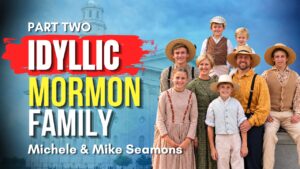
Today we welcome Michele and Mike Seamons to the podcast. Michele and Mike are a married couple who were both raised in the LDS faith and experienced what they describe as an “idyllic” Mormon upbringing.
In Part 1, we begin with each of their backgrounds and what it was like to grow up in faithful LDS homes with supportive families, wards, and communities surrounding them. Michele was raised in Sandy, Utah, while Mike grew up outside of Los Angeles, California. We also discuss Michele’s mission experience and how the two eventually met at the MTC.
In Part 2, we pick up with Mike’s mission story before moving into their early marriage and family life, business pursuits, and increasing involvement in the church. Mike serves in youth leadership and eventually becomes a bishop, while Michele serves in various roles, including Young Women’s president. Eventually, Michele becomes more interested in mainstream Christianity through music and podcasts, leading her to begin viewing her Mormon faith differently.
Then be sure to come back for Part 3, where we conclude their Mormon story and discuss where they stand with their faith today.
Episode Transcript
Full text · 19,600 words · 12 chaptersHost: John Dehlin · Co-host: Margi Dehlin · Guests: Michele Seamons, Mike SeamonsRead transcriptHide transcript
This transcript is machine-generated and lightly edited for readability. The audio is authoritative. Please excuse occasional errors in names and spelling.
Welcome and Guest Introductions
John Dehlin [00:00:00] Hello, everyone, and welcome to another Mormon Stories podcast episode. My name is John Dehlin. It is September 10, 2026, and as requested, we have an interview with an everyday Mormon couple. Except every person we interview on Mormon Stories is extraordinary, and they can also be ordinary. But today, we have a couple with us. And the main themes that we're going to be talking about today, at least for starters, are being a Mormon couple in it to win it, experiencing various levels of leadership, including, for Mike, being bishop or bishoprics or stake presidencies, for Michele, being in all the various auxiliaries, being the parents of six children, and then experiencing faith questions or challenges or transitions in your mid to late 40s while you have six kids and even adult children, and then navigating that faith transition in your 50s. So without any further ado, we have with us today Mike or Michael Siemens. Hey, Mike.
Mike Seamons [00:01:08] Hey.
John Dehlin [00:01:09] Thanks for joining us.
Mike Seamons [00:01:10] Awesome to be here.
John Dehlin [00:01:11] And we have Michele Siemens. Hey, Michele.
Michele Seamons [00:01:14] Glad to be here.
John Dehlin [00:01:15] Thanks for joining us.
Michele Seamons [00:01:16] Thank you.
John Dehlin [00:01:17] And we're thrilled to have Margi as co host. Hey, Margi.
Michele Seamons [00:01:21] Hello.
John Dehlin [00:01:22] Thanks for joining us.
Margi Dehlin [00:01:23] Yes, my pleasure.
John Dehlin [00:01:26] And there are lots of other themes we'll be talking about, including LGBT themes again, adult children. Anything y' all want to say by way of sort of disclaimers or intentions or introduction before we dive in to your Mormon Stories?
Mike Seamons [00:01:47] I think this is. It's a big step for us. We both come from amazing families that have lifted us and made us into the people we are. And this story is gonna have some twists and turns. That is going to be different, you know, because it's the story that is what's made us. And we just hope that all these people that we love, we've had this amazing life, that we've intersected with people throughout multiple states in the church and through the church. And we just hope that this story is one that inspires more than creates fear.
Michele Seamons [00:02:23] So maybe a Mormon and.
Margi Dehlin [00:02:26] Mm, yeah.
John Dehlin [00:02:28] Yeah.
Margi Dehlin [00:02:28] A Mormon aunt story.
Michele Seamons [00:02:30] And the story continues.
Margi Dehlin [00:02:32] That's right. And I also have to put a little insert of wonder, because that was a big part of your outline.
Michele Seamons [00:02:38] Very much so, yeah. Seeking it every day.
John Dehlin [00:02:42] Love it. Love it. All right, well, which one of you was born first? And we can.
Michele Seamons [00:02:51] I am the older one.
John Dehlin [00:02:52] All right.
Michele Seamons [00:02:53] You'll find out exactly how much older as we get into our story. It's a very common.
Mike Seamons [00:03:00] There's a mechanical reason. She's older.
Michele Seamons [00:03:02] Yes.
John Dehlin [00:03:03] And let me just also say thanks. It's our donors that make Mormon Stories podcast possible. So if you're a donor. Thank you. If you want to become a donor, super easy mormonstories.org donate you can become a monthly donor like and subscribe and all this stuff. And what we are starting to do is splitting these episodes up into two parts because YouTube will auto translate and auto transcribe even in audible format these episodes into multiple languages if they're under two hours. So we're not doing away with the long form but we are splitting them up into two hour chunks.
John Dehlin [00:03:42] So know that this will be part one and then we'll definitely have a part two to this episode. So check that out as well. And yeah, I think that's it. So this will be part one of at least a two part series with Mike and Michele. So without any further ado, Michele Siemens, where does your Mormon story begin? And I don't think you started out as Michele Siemens.
Michele's Childhood and Family Background
Michele Seamons [00:04:10] No, I was Michele Tucker.
John Dehlin [00:04:11] Okay.
Michele Seamons [00:04:13] I was born at LDS Hospital on 28th October 1969.
John Dehlin [00:04:23] Wow.
Michele Seamons [00:04:24] Didn't want to start here. To a 15 year old girl named Julie who lovingly gave me up for adoption to two loving and deserving parents. And she is much. She has my heart, as do my parents. That story is important because later in life I would be told that my mom received an impression of me the day I was born, unawares that several days later she would receive me into her home.
Michele Seamons [00:05:10] And so I always felt God led as an individual and that's the language. And what I was taught from my very earliest beginnings is that I was placed by a heavenly parent and that changes the way someone behaves and navigates the world.
Michele Seamons [00:05:34] Two loving parents Salt Lake City in my extended family is amazing. It's huge. And I couldn't have had a more loving environment and safe. I always felt this enormous amount of safety and it probably came because everyone was like me and everyone appeared very much the same. I was raised in communities where everyone was the same except for my grandparents, which had very thick Dutch accents. They were immigrants from the Netherlands in the 1940s and I always thought I was pretty special because everyone was so monochromatic. But yet I had these grandparents that differentiated just the minute they opened their mouth.
Michele Seamons [00:06:28] And I really adopted that Dutch. I wanted to differentiate from a very early age. I wanted that difference. I was adopted. My family's Dutch, so it was an interesting place. How that comes into my story?
John Dehlin [00:06:47] Just a couple quick questions. I'm assuming it was a closed adoption at the time.
Michele Seamons [00:06:51] Closed adoption, yeah.
John Dehlin [00:06:53] And to be clear, it's your adopted parents who have the Dutch heritage.
Michele Seamons [00:06:58] Yes.
John Dehlin [00:06:58] Okay. Not your birth.
Michele Seamons [00:06:59] Correct.
John Dehlin [00:07:00] Okay.
Michele Seamons [00:07:00] And I was adopted through LDS Social Services, LDS Hospital.
John Dehlin [00:07:04] Were there other siblings in the home before or after your adoption?
Michele Seamons [00:07:08] Not before. Three years later, my brother was adopted also.
John Dehlin [00:07:11] Okay, so two total children with your adopted parents. Okay.
Mike Seamons [00:07:16] Sorry.
Michele Seamons [00:07:17] Yeah.
John Dehlin [00:07:17] That's a book.
Michele Seamons [00:07:19] We received my brother three years later. And then we moved to Sandy, Utah, which, if you've lived in Salt LAKE in the 1970s, Sandy was like, Sandy and windy, and it was like a dust bowl out there. And homes were just going. I mean, it's not the metropolis it is now. And I loved it. It was a lot of space, a lot of freedom and a very safe, beautiful place to grow up. And my community adopted me, and I allowed them to adopt me. I think I had this openness from the very beginning, trusting that I was being led by heavenly parents to put me in places where I would be safe. I was going to be in the hands of people that would help me to reach my potential. And they did. Yeah, they really did. I was raised by a neighborhood, not by just two parents.
John Dehlin [00:08:21] Did your parents. Were they married in the temple? Did they meet at byu?
Michele Seamons [00:08:26] They didn't meet at byu, but my dad was at the U. I think, for periods of time. He was also in the army and my mom was at byu.
John Dehlin [00:08:38] Okay.
Michele Seamons [00:08:38] So. Yeah.
John Dehlin [00:08:39] Okay.
Michele Seamons [00:08:40] And they grew up very near each other, that ninth and ninth area. And Liberty park was where they grew up.
John Dehlin [00:08:47] And you would have been sealed to them after you were adopted, correct? You would have. You won't remember this, I'm sure.
Michele Seamons [00:08:54] I actually do remember being sealed to my brother. So I was part of that sealing. And so I remember being in the nursery in the Salt Lake Temple and the temple workers and the clothes I was wearing and. Yeah. And being at the altar. And so that is. Yeah, a memory of mine.
Margi Dehlin [00:09:11] Wow.
John Dehlin [00:09:12] Being born in the Covenant, you don't have that experience of being sealed to your parents.
Michele Seamons [00:09:17] Yeah.
John Dehlin [00:09:18] Or siblings. That's beautiful.
Michele Seamons [00:09:19] Yeah. And so sealing was something that was very. I mean, on the forefront of my mind and bring up questions because it was different than everyone that I was surrounded by. It was a different story. So I've always felt a little bit chosen.
Margi Dehlin [00:09:40] So many layers of chosen.
Michele Seamons [00:09:41] So many layers of chosen.
Margi Dehlin [00:09:43] The significance of this origin story, it feels so real.
Mike's Childhood in the Sandy 22nd Ward
Michele Seamons [00:09:49] Yeah. And I had it affirmed to me. I. In many ways, just through people I met, opportunities to learn and grow through my childhood. I definitely felt of an awareness that
John Dehlin [00:10:08] there was more beautiful.
Margi Dehlin [00:10:10] So I'm hearing safety in similarity. Like, there was enough sameness for stability and for this feeling of safety. And then you have a little flare. With a little flare. And you kind of bring a little flare. The appreciation for the grandparents. You're adopted, which makes you a bit different. You have this origin story, which also gives you an identity that not everyone has.
Michele Seamons [00:10:35] Yes.
Margi Dehlin [00:10:35] Okay.
Michele Seamons [00:10:37] Yeah. And I can't say enough about the Sandy 22nd Ward. I mean, they were my family. I mean, I could go down the ward list. I knew where they lived, I knew their phone numbers, and I was kind of a wild. I had this bit of a wildness of I was an outdoors kind of kid, so. So my ward family is my neighborhood, and I am there. I'm at their homes, I'm in their yards. I'm playing. Yeah, it was beautiful to have, like, that much space and access to that many people at such a young age that you felt so safe. My parents never said, oh, don't avoid that house, or don't go there or don't go on that street. That was. No, like, this is your universe.
John Dehlin [00:11:35] This is a nerdy question, but around what south and around what east?
Michele Seamons [00:11:38] 8600 south and 13th East. We lived in the back of the Dan's grocery store. Oh, really? It's no longer there.
Margi Dehlin [00:11:48] Right?
Michele Seamons [00:11:49] But yeah, like, it was. Yeah, it was just amazing place. Sandy Hill Crest Ward. I'm Sandy Hillcrest Steak.
John Dehlin [00:11:56] And were your parents pretty devout and was it a traditional Mormon upbringing?
Michele Seamons [00:11:59] Very involved. Very involved. My mom was and will always be adored for all of her efforts in the church. She has a presence and a way of leading and organizing and delegating. That always gave her opportunities, and people were drawn to her, and that gave me benefits, gave me access. My dad, when I was in second grade, he worked for Lynn Wilson Mexican Food Production. I don't know if it's even still. Is that still a company, Lin Wilson?
John Dehlin [00:12:41] Don't know.
Michele Seamons [00:12:41] It was in South Salt Lake. Anyway, they produced tortillas and enchiladas, the whole thing. And he was overseeing that plant, and he had an accident where he reached his hand into some machinery and it nearly destroyed his hand. And so from second grade to, oh, probably fourth grade, was numerous surgeries and change of jobs. A lot of instability in my young life. So that neighborhood became very important. I lived at my next door neighbor's house from. Sometimes it felt like months because my mom was attending to my dad. Because they had. Back in the day, they used to sew your arm. Like, if you had extensive injuries, they would sew it as a graft to your Body.
Margi Dehlin [00:13:38] I did not know that.
Michele Seamons [00:13:39] I know. I don't know anyone that has that done now. But his arm was sewn to his body, so my mom was in a very much a caretaker role of him and also had a younger sibling. So I give my mom a lot of grace at that period of time. I'm very grateful to all the people that pitched in and helped raise me through the elementary years and then come junior high.
John Dehlin [00:14:08] That's an area where Mormonism and a Mormon ward can really shine.
Michele Seamons [00:14:11] Oh, I mean, fantastically. I mean, we refer to each other as family. We call each other brother and sister. Like, we've removed. We've added a layer of access. Right, Absolutely.
Margi Dehlin [00:14:28] There's a trust.
Michele Seamons [00:14:30] Yes, immediately. So those many hands that were a part of my raising, I hold them in very high esteem.
John Dehlin [00:14:43] Beautiful.
Michele Seamons [00:14:44] Yeah. Junior high comes and I attended junior high was one of the largest middle schools at the time, I think, in the state of Utah. And it was amazing. I was for the first time exposed to people that were not members of the church, which is crazy to me because. And they were my peers and my friends, and. And it was the first time I really heard a different story, which is, to me, shocking. It's definitely not what my kids have experienced in any way, but I was in awe that they had a different story. And I entered junior high gravitating to those people because I wanted to know what makes you different. And I liked it. But then you live in this tension of I'm in this pleasing and wanting to perform for all of these adults that now I have invited as caretakers. I now need to thank them by my behavior.
Margi Dehlin [00:15:56] Right.
Michele Seamons [00:15:57] So I need to be as active in the church as possible, attend everything that is available, and excel in all of it. And I think that changed my approach then to high school.
Margi Dehlin [00:16:17] Is this the time when you had that insight or did you have it as a child at some point? Like, when did this. Do you remember?
Michele Seamons [00:16:25] Seventh grade.
Margi Dehlin [00:16:25] Okay, seventh grade.
Michele Seamons [00:16:27] Seventh grade. I realized, like, I have this. I want to understand and be open to people that feel differently and think differently, but yet I need to stay in line. I need to fill a leader role. If I don't, I might be at risk. Maybe that sounds strange, but that was my experience.
Margi Dehlin [00:16:53] Yeah.
Michele Seamons [00:16:54] At a pretty young age. That's 13 years old.
Margi Dehlin [00:16:57] That's right.
Michele Seamons [00:16:58] And high school brought here. 80% of our high school was LDS. And I then start to see the cracks of behavior amongst a large group of LDS people. And I'm like, wait, I thought we all Behaved and acted the same upon the principles and doctrines we've been taught. I'm so confused as to why.
John Dehlin [00:17:24] Because kids were misbehaving. Oh, yes. How so?
Michele Seamons [00:17:27] Disrespectful in seminary. How dare they? Like, we're there to learn. This is our opportunity in school. I was that kid. I couldn't correlate. I could see if someone wasn't taught that or hadn't been exposed to those teachings or behaviors, I gave them all the freedom. But for my LDS peers, I gave them. I did not give them a long leash. And it came with a lot of judgment, which is hard to look back on.
Margi Dehlin [00:18:01] Did you have that judgment for yourself
Michele Seamons [00:18:04] when you fell short a thousand percent?
Margi Dehlin [00:18:07] Yeah.
Michele Seamons [00:18:07] So. Oh, yeah. Isn't that what Sunday was for? The raking over the coals and the starting new every Sunday? I thought that's what the sacrament was for me as a teenager. It was like I did not pray every morning before I went to school and read the assigned chapters that I was supposed to read in seminary. Thus, when I go to sacrament meeting this next Sunday, I will need to repent. That is a shortfall. Or I didn't take advantage of a missionary opportunity, or I misspoke about someone. I judged them, I talked behind their back. Those things as a teenager, which are normal behaviors that you're trying to navigate and learn how to socially behave correctly. I think that we should give them a lot of space. I didn't give myself any of that room to make mistakes.
Margi Dehlin [00:19:04] Yeah.
Michele Seamons [00:19:05] At all. Yeah.
John Dehlin [00:19:08] What were you into in high school? Your interests?
Michele Seamons [00:19:11] And I was a sports kid, and I. It was tricky being in a big high school. I thrived at church sports now. So in Utah in the 80s, church sports almost rivaled. I was having a talk with a good friend from high school last night, and she validated me. Like, it literally was at the same level at times as the high school programs that were offered. It was competitive, and it was for which sports? For the girls? Oh, I did it all. Volleyball, softball, basketball. I mean, come on. And I excelled. I played the key, you know, key roles, and the leaders liked me. The coaching liked me, and we even got to play in the Salt Palace.
John Dehlin [00:20:12] So there's steak. It starts out as a steak thing, multiple wards. Then you go to region and then
Michele Seamons [00:20:19] regionals, and then you can go and play at the Salt palace, where the jazz used to play. And we got to play there.
John Dehlin [00:20:27] Oh, wow.
Michele Seamons [00:20:29] It was really defining. And so when it came to high school, I was like, well, I already have these great opportunities in the church. So I play tennis in high school because it wasn't an opportunity in the church. So I played tennis, really active in
John Dehlin [00:20:50] like, Hillcrest High School tennis.
Michele Seamons [00:20:52] Hillcrest High School tennis. But I, yeah, just have active, happy, healthy teenager.
John Dehlin [00:21:00] Okay.
Michele Seamons [00:21:00] Lots of friends. And. Yeah. I have no regrets.
Margi Dehlin [00:21:07] During high school, as you think back to yourself, how, like, what was your effort level? Was it difficult for you to do all the things that you did at that time, or were you. What did it feel quite like you were invested, merged, you know, how. I guess what I'm saying is just how stressful was it for you to do all the things. You sound highly conscientious.
Michele Seamons [00:21:35] Yes. So funny. The grades part I really didn't care that much about, which is so strange because I came from a mom that was. That's all that mattered. And I probably did it just to make her mad. I did just enough grades wise. Now we talk about everything else. It all mattered. Everything was on the line. I had to perform. But again, I was in the safe, safe situation where I felt allowed to rise and fall because there was this stable, secure community.
Margi Dehlin [00:22:16] Yeah.
Michele Seamons [00:22:17] You know, I was able to experiment and try different parts of me on what. What does it look like if I try student government? What is, you know, what does it look like if I try to sing in a choir or, you know, be in the musical? I got to try on all kinds of roles. And I think that was a really brilliant, beautiful place to learn.
Margi Dehlin [00:22:41] Absolutely. And kind of rare. This is a rare.
Michele Seamons [00:22:45] Yeah. And I had good boyfriends. Like, they were all safe and good. It was a great preparatory place.
John Dehlin [00:22:57] I love it. Just as a side note, I loved softball and basketball. Church steak, softball and basketball growing up. It blows my mind that the church got rid of those programs.
Michele Seamons [00:23:11] Yeah.
John Dehlin [00:23:12] Even though I know high school sports are so big. But once we raised our kids in Utah, we saw how competitive it was to get on a high school varsity team, which for me is all the more reason to have church sports. But crazily, they just like with roadshows and boy Scouts. Somehow the church decided it was a good idea to jettison those programs.
Michele Seamons [00:23:36] It was a crazy experience for me because I know I was good at basketball. That was my sport. And I went to all the camps at the high school with our high school coach, who was a phenomenal coach, Coach Wilson, who went on to coach the Cougars women's team. And I truly believe I could have made that team so easily. I didn't want to make the commitment because I had this other thing I could play, and all the commitment was show up three or four times a week, and I got to play. And the competition was phenomenal. So I didn't see the need to make that commitment in high school.
John Dehlin [00:24:14] That's so fun. I don't know that I've ever interviewed a woman on Mormon stories who expressed how important the church athletic programs were to them. So it's fun to hear that.
Michele Seamons [00:24:26] Yeah. I got to be pitcher and catcher, and in softball, they allowed me to coach the younger girls. I mean, it was just this really great building opportunity that I. And maybe it just thrived in our area. I don't know.
Margi Dehlin [00:24:47] Yeah. It falls in line with your community support, everyone being so invested in your community.
Michele Seamons [00:24:54] Yes. And we had numbers.
Margi Dehlin [00:24:56] Yep.
Michele Seamons [00:24:57] I think there were 12 girls my age in my grade.
Margi Dehlin [00:25:01] Yeah, that's key.
Michele Seamons [00:25:02] And so there's a lot of room.
John Dehlin [00:25:04] Yeah, it's beautiful.
Michele Seamons [00:25:05] And a lot of room.
John Dehlin [00:25:06] Yeah.
Margi Dehlin [00:25:06] Yes.
Michele Seamons [00:25:07] Yeah.
John Dehlin [00:25:09] Margi played church basketball, even though she was a runner.
Margi Dehlin [00:25:12] I did. I loved it. It was a lot of fun.
Michele Seamons [00:25:14] It was so good. I mean, we would have the whole ward come and, like, scream and yell, you know, and then you get into high school, and it's like, even now, like, the boyfriends and the kids from high school, and it was like, I felt very supported in that avenue.
Developing Faith and Testimony in High School
John Dehlin [00:25:32] For me, how was your testimony? How did it develop through your senior year of high school, through seminary and church attendance and everything?
Michele Seamons [00:25:42] So in my yearbook, I will never forget, signed by a very dear friend that I knew through junior high and high school, wrote, you are the marrying kind. You will be the perfect mother.
Margi Dehlin [00:25:58] In your yearbook.
Michele Seamons [00:25:59] In my yearbook.
Margi Dehlin [00:26:00] That's so bizarre.
Michele Seamons [00:26:01] In your yearbook. Like, you know, most girls are just wanting to be hot. I was like, could you just say, I'm hot? And I'm getting, wow. Okay. Now I know I'm most likely to have a big family and be a Mormon moment. My testimony was I wore it on my sleeve. I wore it as a badge of honor. I carried myself. I dated in my junior year, the seminary president of the year ahead of me. I made sure that people knew exactly who I was, and I think I was pretty true to that.
Margi Dehlin [00:26:45] Mm.
John Dehlin [00:26:46] Sounds like the idyllic. Idyllic Mormon upbringing.
Michele Seamons [00:26:49] Yeah. So why did I want to run away, John?
John Dehlin [00:26:53] You wanted to run away from home or from.
Michele Seamons [00:26:55] From Utah?
John Dehlin [00:26:56] From Utah.
Michele Seamons [00:26:57] I wanted to get away.
John Dehlin [00:26:58] Okay. That's foreshadowing.
Michele Seamons [00:27:00] Yeah.
John Dehlin [00:27:01] Okay.
Margi Dehlin [00:27:01] I mean, that is in line with this adventure and the flair, as well, of yourself.
Michele Seamons [00:27:07] And I think it comes from the safety that I felt that I could run away because I had a safe place to come back to. So I probably had a little more courage than most.
Margi Dehlin [00:27:17] Yeah.
John Dehlin [00:27:18] Or Joseph Campbell's hero's journey. Leaving home as part of the hero's journey.
Michele Seamons [00:27:23] Yes. Yes.
John Dehlin [00:27:24] And then returning with honor, which you're doing today. Yes.
Michele Seamons [00:27:28] And I wanted to do it immediately. So I spoke at seminary graduation. I mean, I was very invested. That community met a lot of. But. And I left seven days after I graduated from high school.
John Dehlin [00:27:44] Left Utah for where?
Michele Seamons [00:27:47] So all of my friends were going to Rick's or byu. I then learned that I probably wasn't as smart enough to get into BYU even at that time, but I got into Rick's and I went up there in February and went.
John Dehlin [00:28:03] No way was it the cold or the culture or both.
Michele Seamons [00:28:07] The fact that I couldn't see the road at all. It was just. I don't think I can do this. And again, this little wanderlust inside of me said, I'm not ready to go to school. And so I decided I was going to be a nanny. And that's what I did. I took a job in Darien, Connecticut. And seven days after high school, I flew into New York City for the first time across the Mississippi.
Margi Dehlin [00:28:40] Yeah. Wow.
Michele Seamons [00:28:42] And I went running.
Margi Dehlin [00:28:44] Yep.
Michele Seamons [00:28:46] And there's a part that I've left out because I was raised by a community. Something happened my junior year. My father was accused of embezzling and had some very erratic behavior. And my parents separated, but nobody knew, nobody talked about. Was on the down low, you know, And I had to cover, and I did all the way through high school. And I was also covering another situation when I was. My brother was 13. That would have meant I was 15. He was 12. I was 15. He was seeing counseling because his adoption was more complicated. His mother used drugs pretty excessively while he was in the womb, and he struggled with psychotic tendencies and behaviors that he could not control. And the psychologist deemed him unsafe to return to our home when he was between 12 and 13. And he was committed. So it was really sad.
Margi Dehlin [00:30:18] That's.
Michele Seamons [00:30:19] But again, he disappeared. We didn't talk about it. In fact, I talked to this high school friend last night, and she remembers him just disappearing, and no one had a conversation about it.
Margi Dehlin [00:30:34] Wow.
John Dehlin [00:30:34] From your home? He just. From my home permanently.
Michele Seamons [00:30:38] He never lived permanently in our home again.
John Dehlin [00:30:40] Oh, my goodness.
Margi Dehlin [00:30:41] Wow.
Michele Seamons [00:30:42] Yeah. But I'm performing.
Margi Dehlin [00:30:47] Right.
Michele Seamons [00:30:48] But you don't know. As a teenager, I thought that was what I was supposed to do, because those emotions Were not open to public.
Margi Dehlin [00:30:59] That's so interesting, because oftentimes I do feel like in many Mormon stories, there are moments like this where as you're growing up, all of a sudden a situation arises and you split. There's a split. Right. And all of a sudden it's very clear who you are to the external world, how you're showing up to the world, and then there's what's really happening that is oftentimes not spoken of. Oftentimes. And that split can make all the difference, right? Yes. Yeah.
Michele Seamons [00:31:34] And I think one of the reasons why I left Utah immediately is because I couldn't hold it and I felt weak and I was in battle with. But I'm chosen, and I can't present as chosen and special if I am in this environment. I need to take myself away from this household situation because this doesn't. This isn't who I want to be. This is not who I want to come across as or come from.
Margi Dehlin [00:32:13] Oh, interesting.
Michele Seamons [00:32:14] Because that set seemed broken.
John Dehlin [00:32:17] So is there a perfectionism theme there?
Michele Seamons [00:32:19] Yeah.
John Dehlin [00:32:20] Of like, presenting perfectionism to the world?
Michele Seamons [00:32:24] For sure. Yeah.
Family Struggles and a Brother Leaving the Church
Margi Dehlin [00:32:26] So that grief. If you were going to. Can we move in just to grief for a moment? What did you do with the grief of a brother that disappears at that time?
Michele Seamons [00:32:38] It did not correlate with the doctrine that I had internalized of eternal families and that there were heavenly parents who put this group together. Like, we were actually physically put together intentionally.
Margi Dehlin [00:32:56] Right.
Michele Seamons [00:32:58] And it collided with my specialness. It was like, wait, if it's not working, then the author of this, like, what am I supposed to learn from this?
Margi Dehlin [00:33:09] Yeah.
Michele Seamons [00:33:11] And I'll never forget from an EFY conversation with a counselor. Or maybe it was something I was taught there, that if you have trials and tribulations, it's to test you. And the people that are tested are gonna be the stronger ones. At least that's the. I pulled. And I thought, okay, that's the lane I'm. This is the lane I'm in. I am chosen. So thus I'm going to have to have trials and work with harder things because I'm being tested for something that's coming down the road. Just a strange behavior for a. Yeah. 17, 18 year old.
John Dehlin [00:33:56] Yeah. And it's probably not just a Mormon thing, but a very human thing. Human to just want to downplay or hide or not talk about the hard stuff and just want to present the good stuff. But it is very Mormon. Right. To have the elephants that you just don't talk about.
Michele Seamons [00:34:18] Correct.
John Dehlin [00:34:19] Yeah. And to Just compartmentalize and. Or ignore the hard stuff.
Michele Seamons [00:34:24] Yeah.
John Dehlin [00:34:24] And then sometimes there's a payment plan later.
Michele Seamons [00:34:27] Yeah. And you love your parents? Like, I knew they were going through a hard thing, so I'm protecting them also.
Margi Dehlin [00:34:34] Yeah.
John Dehlin [00:34:36] Do you feel like you were close to your brother until he left?
Michele Seamons [00:34:39] No.
John Dehlin [00:34:39] Never close to him.
Michele Seamons [00:34:41] Okay. Mentally and emotionally. Not very capable of making those relationships for him.
Margi Dehlin [00:34:47] I see. I see.
Michele Seamons [00:34:48] Yeah. From the get go. Got it.
John Dehlin [00:34:50] Okay. Okay.
Michele Seamons [00:34:51] Sweet.
Margi Dehlin [00:34:51] But it can make it complicated.
Michele Seamons [00:34:54] Very complicated. Yeah. I mean, if you've ever lived with someone that has psychotic outbursts, it can be very. Feel unstable. You just don't know what you're going to get.
John Dehlin [00:35:06] Yeah. Okay.
Michele Seamons [00:35:07] Yeah.
Margi Dehlin [00:35:08] I was going to just note. I do think it's interesting, you know, we've interviewed a few people where they have these origin stories that are really, like in the beginning, a comfort just like you described. Like this nest of just. And then, you know, I'm just, I guess contemplating what happens when sometimes you have those really large origin stories that in the beginning are quite grandiose. Quite. And then there's a crisis later on, as opposed to. If it had just started out like, we love you and we. And then things got complicated later on. But the complicated after this is it literally sets you up for a crisis of that origin story.
Michele Seamons [00:35:56] Yeah.
Margi Dehlin [00:35:56] Right.
Michele Seamons [00:35:57] Or I associated it with fairy tales.
Margi Dehlin [00:36:01] Yeah.
Michele Seamons [00:36:02] Because I thought, well, I'm gonna be like Cinderella.
Margi Dehlin [00:36:05] Got it.
Michele Seamons [00:36:05] Like, so this doesn't look good. But it's all gonna work out because happily ever after. Happily ever after. I'm gonna meet my parents and actually it's all gonna work out.
Margi Dehlin [00:36:20] Right.
Michele Seamons [00:36:20] Because that's what I'm being set up for this trial that, you know, all of the princesses, the Disney princesses have this trial so true. So that they can rise and, you know, a complicated. None of them have. Maybe a couple. All of them have complicated parental stories.
Margi Dehlin [00:36:39] Yeah.
Michele Seamons [00:36:40] Half of them don't even have both parents.
John Dehlin [00:36:41] Yeah.
Michele Seamons [00:36:42] So it's like I was setting myself up and I don't know why I chose that. I chose that behavior.
John Dehlin [00:36:50] And I'm guessing there's a framing where this becomes problematic and is a setup, but there's also a framing that it's like, hey, optimism and hope and resilience. I think we could frame this in multiple ways. Not all negative, some very positive.
Michele Seamons [00:37:10] At this point in my life, there is not a negative thing. And it just. By definition, it literally was as if a match was lit when I left Utah. Oh, no, here I go. It's happening. It's gonna happen.
John Dehlin [00:37:27] What's happening?
Michele Moves East and Finds Community
Michele Seamons [00:37:28] So I am a nanny in Darien, Connecticut. I learned that I'm going to be in the New Canaan Connecticut ward.
John Dehlin [00:37:37] Now is this nannying an LDS family?
Michele Seamons [00:37:40] No, not an LDS family, but one that knows the lds. Some pretty famous people. My employer worked with Richard Marriott. He was in alcohol distribution and he worked with the Marriott hotel chains and he also worked with him on an amusement park venture. So he knew him well. So he knew. And I was actually chosen to be their nanny because I did not drink alcohol because they have, they had quite a seller and they had had a problem with the previous nanny and having access to that. So it's like she's not gonna be a problem.
Michele Seamons [00:38:18] And I felt again, chosen by this family, prominent family who loved me. I was adored and I adored them. I adored their kids. And then add the ward component and the New Canaan, Connecticut ward. I would say probably the majority of the CEOs in New York City and of the top five companies were in that ward or in that state.
John Dehlin [00:38:51] Who were lds. Yeah.
Michele Seamons [00:38:52] Who were LDS in that stake. For sure.
John Dehlin [00:38:54] Yeah, yeah.
Michele Seamons [00:38:57] And I was being exposed to fascinating things. I was given access because again, the church is this place of community right off the bat. We trust each other implicitly. Right off. And our youth, our young single adult group in that ward was taken in by numerous families and given access to their homes because my day off was on a Monday. They would literally give us the keys to their home and allow us to hang out in their home so that we didn't have to be in our employer's home because they wanted us to have a place of safety. Who does that?
John Dehlin [00:39:42] Mormons.
Michele Seamons [00:39:43] Mormons. I know. And they're amazing for it.
John Dehlin [00:39:46] Yeah, yeah.
Michele Seamons [00:39:48] And here I'm 19 years old and in that I was called to be the young single adult advisor over the stake. I was a co chair with a man like, I think he's in his 30s, worked in New York City. Like you're really a 19 year old kid from Utah. Oh, I know why. Because I'm chosen. And I was able to. We had the huge young single adult presence in that area and I was able to put together. We did a getaway camp at a Jewish sleepaway camp. We had the young single adults go there for three days and have speakers flown in from Utah. I mean, why are they giving a 19 year old kid this opportunity? And I could only associate. I was. I'm chosen.
John Dehlin [00:40:45] Yeah, yeah, yeah. And sometimes I'm critical on Mormon stories of this even Idea of being chosen because it has implications of selectivity or bias or bigotry. Especially when God's involved.
Michele Seamons [00:41:01] Yes.
John Dehlin [00:41:03] And it can lead to pride or arrogance or overconfidence. On the other hand, it probably helps with self esteem during a time where you could otherwise flounder to feel special. There's probably some good to feeling chosen and special.
Margi Dehlin [00:41:21] Especially at this stage of your story. You're experiencing it. It's giving you a lot of opportunity.
Michele Seamons [00:41:29] Correct.
Margi Dehlin [00:41:29] You're experiencing the privilege of that particular ward and setting up. Well.
Michele Seamons [00:41:35] You're wondering why you're being set up like this. And I want to take advantage if this is a preparation for something more.
Margi Dehlin [00:41:45] Right.
Michele Seamons [00:41:47] Only Mike will know that. To balance that, John is I have a very critical inner voice, very critical that says, no, you're actually not good enough. You can't do this alone. If there isn't a heavenly part of this equation, it's not gonna work out for you.
Margi Dehlin [00:42:13] Right.
John Dehlin [00:42:14] So it's very dependent church, in this case. Church dependent. You're kind of nothing without the church and heavenly parents.
Michele Seamons [00:42:22] Because that's the belief system I was raised up.
Margi Dehlin [00:42:25] I would say it goes hand in hand. The chosenness.
Michele Seamons [00:42:29] It can't be separated. Yeah, for sure.
Margi Dehlin [00:42:32] Yeah.
Michele Seamons [00:42:32] Yeah. So that experience in Connecticut gave me access to an hour train ride to New York City, a several hour train ride to Washington D.C. to Boston. I felt like, wow. All of my friends are back at Rick's college. Four things like I am killing it out here. I live with this non Mormon family who I felt like I was going to bring them. I was going to bring them the truth. They trusted me. And it was an amazing experience. It changed me.
Margi Dehlin [00:43:14] Yeah.
Michele Seamons [00:43:15] It really did.
Margi Dehlin [00:43:17] I love that. And I love that you got to see a different part of the country.
Michele Seamons [00:43:22] And the church was true there.
Margi Dehlin [00:43:23] Yeah.
Michele Seamons [00:43:24] I mean, and the church was strong.
Margi Dehlin [00:43:27] Yeah.
Michele Seamons [00:43:27] So it reinforced some beliefs that I had about the church that it was. It was gonna grow. It's gonna be something amazing.
John Dehlin [00:43:39] I can imagine for a girl from Utah, knowing you're gonna be part of a strong, vibrant, supportive ward can make the difference for you. Feeling like everything's gonna work out okay when you're far away from home and on the other side of the country.
Michele Seamons [00:43:56] Right?
John Dehlin [00:43:57] Yeah, yeah, yeah. It's just Mormonism at its best. Really.
Michele Seamons [00:44:01] Yeah. And look at these leaders in this ward. They're not only leaders in the church, but they're also CEOs of. So there's trust not only in the Mormon community, but outside that. And it reinforced this because we are all chosen.
John Dehlin [00:44:17] Yeah. Church has to be. True.
Michele Seamons [00:44:19] Yes, of course.
John Dehlin [00:44:20] Yeah. Beautiful.
Michele Seamons [00:44:21] Yeah.
John Dehlin [00:44:22] Did you date in those single words out there or were there single words?
Michele Seamons [00:44:26] A little, but not a lot.
John Dehlin [00:44:28] Okay.
Michele Seamons [00:44:29] Nobody met my criteria, and I was writing a missionary that I really thought things were going to be eternal.
John Dehlin [00:44:35] Okay.
Michele Seamons [00:44:36] That didn't end up being the case.
John Dehlin [00:44:38] Okay. Anything else you want to say? Like, we can take your story, I guess, right up to meeting Mike, if you want.
Michele Seamons [00:44:45] Well, so I went to BYU Hawaii, after that.
John Dehlin [00:44:47] Okay.
Michele Seamons [00:44:48] That was also another. I felt chosen because the demographics of BYU Hawaii are. There are very few Caucasian people at that school. And I was immersed in the culture and the diversity. And again, how lucky I am. God is showing me something. I'm having this other experience now in the Polynesian sector and meeting amazing people. He is preparing me for something really big. Because again, my comparison were the 12 girls that I grew up with who are Rick's and byu? I'm like, oh, sisters, this is a big, giant world that you're missing out on.
Margi Dehlin [00:45:37] Yeah. And it's interesting because with your story, I'm noticing, like, you're doing some original things to the sort of set formula of, you know.
Michele Seamons [00:45:49] Correct.
Margi Dehlin [00:45:49] You grow up in the church, you go to byu, then you get married. You're altering it. You're open enough to kind of. And you're. You're tweaking it just a little bit.
Michele Seamons [00:45:59] Just a little.
Margi Dehlin [00:45:59] And you're having really fulfilling. It sounds like joyful experience doing that. Yes.
Michele Seamons [00:46:07] Yes. And meeting so many amazing people. I felt like I was. It was just an inundation of new people that were changing, affecting my life for good, and my influence was getting bigger.
Margi Dehlin [00:46:25] Yeah. And it's this balance also. Did you feel like it was this balance of you're expanding your world, you're no longer Sandy, Utah. Right. So you have this expansion of the world and the people and the cultures that you're, you know, living amongst.
Michele Seamons [00:46:40] Yes.
Margi Dehlin [00:46:40] But you also have the safety and the rootedness of the church while you do it.
Michele Seamons [00:46:46] Correct.
Margi Dehlin [00:46:47] Yeah.
Michele Seamons [00:46:48] And the freedom to also be away from my family story. Right. I could kind of tell as much or as little about my family story that I felt very vulnerable about because I was away.
Margi Dehlin [00:47:03] That's right. And you had no control over that story.
Michele Seamons [00:47:07] No.
Margi Dehlin [00:47:07] You had control, at least in some way.
Michele Seamons [00:47:09] Nobody knew me in these other spaces from my Sandy, Utah. Sandy, Utah. Did not follow me to these places.
Margi Dehlin [00:47:16] Got it. That makes a lot of sense. Yeah.
Michele Seamons [00:47:19] And I kind of left Sandy, Utah. In Sandy, Utah.
Margi Dehlin [00:47:22] That's right. Yeah.
John Dehlin [00:47:24] Okay, so byu, Hawaii.
Michele Seamons [00:47:26] Byu, Hawaii. Where I became just friends with amazing people and had some best friends that were a little bit older than I was, who were like, we're not married yet. We should go on missions. And I was just turning 21 and I'm like, well, yeah, you're the old ladies. But yeah, I'm going to go because I'm going to experience something fantastic. And I happen to be in a townhome in Provo, Utah with a bunch of girls. All but one, I think, were returned missionaries and had gone to amazing places like South Africa and Guam.
John Dehlin [00:48:03] I know where this is going.
Michele Seamons [00:48:04] And I'm like, yes, please. South Africa made perfect sense. Because I'm like, let's speak Afrikaans. And here's where my Dutch. I'm going to learn Dutch. This makes perfect sense. Or I'm going to go to the Netherlands. I'm like, my circle of influence has already gotten this big. Here we go. Let's get the mission call going. And my first friend gets her call. Honduras. I'm like, oh, yeah, Honduras. Wow. You're going to be in the jungle. The next one, Toronto, Canada. And I think this is amazing. Sensing a build up here. Yes. And I.
Mission Calls and Missionary Experiences
John Dehlin [00:48:41] It's Arkadelphia, Arkansas. It's Mud Lake. Mud Lake, Idaho.
Michele Seamons [00:48:45] Well, it wasn't that bad. I actually. And I cushioned it with a belief system that where I was chosen to serve, of course, was very prepared for me individually.
John Dehlin [00:48:59] And the place was. Drumroll.
Michele Seamons [00:49:01] Washington, D.C. north Mission.
John Dehlin [00:49:03] That's not bad.
Michele Seamons [00:49:04] I know, it's pretty good. Yeah. Murder capital of the world at the time.
John Dehlin [00:49:08] That's true.
Michele Seamons [00:49:09] I mean, most dangerous city.
John Dehlin [00:49:10] Okay, so we're not talking Virginia or Maryland suburbs.
Michele Seamons [00:49:13] We're talking Maryland suburbs.
John Dehlin [00:49:15] Okay.
Michele Seamons [00:49:15] Oh, that's where I served.
John Dehlin [00:49:17] I mean, that's where the Marriotts in the Potomac.
Margi Dehlin [00:49:20] That's where my parents joined the church, actually.
John Dehlin [00:49:23] In Potomac. Yeah.
Michele Seamons [00:49:24] I've served the last four months of my mission in Potomac.
John Dehlin [00:49:26] Oh, okay.
Michele Seamons [00:49:27] Yeah.
John Dehlin [00:49:28] So it wasn't just D.C. no.
Michele Seamons [00:49:31] Yeah, I served all over. And that way is Big Beltway. Yes. And beyond in Maryland, Rural Maryland, where it's vastly different.
Margi Dehlin [00:49:41] Yeah.
John Dehlin [00:49:42] Now that was during the time of Hyrum Smith, the mission president, was it?
Michele Seamons [00:49:46] No, my mission president was Robert Wright, the co author of The David O. McKay book.
John Dehlin [00:49:51] Yeah.
Michele Seamons [00:49:51] Very cool. Yeah.
John Dehlin [00:49:53] Okay.
Michele Seamons [00:49:54] He was character. Yeah, he was a character.
John Dehlin [00:49:57] Okay. Yeah, that's Greg Prince co wrote that book.
Michele Seamons [00:50:01] Yes, correct.
Mike Seamons [00:50:02] Okay.
Michele Seamons [00:50:03] So very much doctrinally sound mission president and a very strict mission president who was there to clean House.
John Dehlin [00:50:15] There was a previous mission president, I think, that was excommunicated for, I think, having an affair while he was a mission president in D.C. i don't know
Michele Seamons [00:50:23] the story, but I know that my mission president was there to clean house.
John Dehlin [00:50:27] Yeah.
Michele Seamons [00:50:27] It was very evident.
John Dehlin [00:50:29] He had been, I think, the starter, Franklin Covey kind of person.
Michele Seamons [00:50:34] That sounds right. Yeah, that sounds like tracking.
John Dehlin [00:50:36] So that might have been the cleanup that was going on, or at least
Michele Seamons [00:50:39] part of it I was mostly aware of because we didn't have the Internet at that time. So being able to make those stories fit.
John Dehlin [00:50:48] Also. Jon Huntsman Sr. I think, had been a mission president out there.
Michele Seamons [00:50:52] Yes. You had to be someone pretty special. I know Robert Wright had run for governor one time. He's an attorney.
John Dehlin [00:50:59] Yeah.
Michele Seamons [00:51:00] They presented very, very well. And the church loved it.
John Dehlin [00:51:03] Yeah.
Michele Seamons [00:51:04] Because it had a lot of PR
John Dehlin [00:51:06] and so what years were you in D.C. 1990.
Michele Seamons [00:51:11] 92. 92.
John Dehlin [00:51:14] So Margaret were married in the D.C. temple in 93.
Michele Seamons [00:51:16] Oh, so.
John Dehlin [00:51:17] Right.
Michele Seamons [00:51:18] Yeah.
John Dehlin [00:51:18] Right around that time.
Michele Seamons [00:51:19] Yeah. I love that area. I love the people there. My experience was so vast because I served in La Plata, Maryland, which is southern Maryland, and then yanked up to Frederick, Maryland, which is like, am I in the same state? Because we're not even behaving as if we culturally, we're on the same planet. And then the final months of my mission in Potomac, like, wow, a state can be this different, like, within a state. And the way the church even ran was very formative for me.
Margi Dehlin [00:51:57] Yeah.
John Dehlin [00:51:59] Wow. So that's hardcore. To serve a mission as a young woman at age 21. Back in the 90s, that meant you were really committed to the church.
Michele Seamons [00:52:11] Yes, very. And my mission president also conflated that. Is that the right word? I was told, I am choosing you because I trust you. And I was maybe six months into my mission, that you're going to take very good care of this sister. Like, oh, no. Like, who is my companion going to be? He said, do you speak any Spanish? I said, no. Perfect. She speaks no English. So your companion is from Chiapas, Mexico. She has been living in the United States, but speaks no English. She's 30 years old and she's going to be your companion.
John Dehlin [00:52:59] Oh, wow.
Michele Seamons [00:53:00] And good luck. She was in the Spanish program, and he felt like she needed to learn English. And we were companions for almost nine months. And that also changed me because after that I was called to be what now? I think they have another name for it, but it was called a traveling sister at that time. To be live in the mission president's ward be able to travel the mission and make sure the sisters are doing what they're supposed to be doing.
John Dehlin [00:53:32] You were Sister A.P.
Michele Seamons [00:53:33] yeah, Sister A.P. but we weren't allowed to call it that. We had to keep our place. But yeah. So again, that chosenness again carries over. Like, he felt like he could really trust me. And we had a funny relationship, my mission president and I, because of this wildness that Mari speaks of that will always be running through me. And so I only wrote to him in comic form. And so my weekly letters to him were comic strips of what was happening in my area. Yes and no. Because he was a pretty stiff guy, and it took me a long time to break him down. But I think we had this connection because he knew that's what I was doing and because I wanted to soften him. I really did. So I think I got a little. I got in there.
John Dehlin [00:54:43] That shows some gumption as a young Mormon woman wanting to change or influence your priesthood leader.
Michele Seamons [00:54:53] And I challenged him.
John Dehlin [00:54:54] Yeah. Yeah.
Michele Seamons [00:54:55] Like, the only time I can remember on my mission where I did something blatantly wrong, he called me in and sat me down. And this was at a time where he was really cleaning house. He had just been giving zone conferences about mass groups of missionaries being sent home. And if you didn't even tattle on your companion, you were held responsible for the same sin.
Margi Dehlin [00:55:18] Oh, goodness.
Michele Seamons [00:55:20] That kind of behavior. So when he called me in, I thought, what could I have possibly done? Like, I do so much gatekeeping. There's no way that I could be held in any way responsible for breaking a rule. And it was because I had written a postcard to a person I had taught in a previous area who had been baptized, congratulating her on her baptism.
John Dehlin [00:55:50] And it was a woman.
Michele Seamons [00:55:51] It was a woman, but she was out of my area.
Margi Dehlin [00:55:55] Oh, wow. The level, detail and control.
Michele Seamons [00:55:59] We couldn't open our letters save on. But on Monday, which was our preparation Day, we also were not allowed to use any form of. What is it called? Slang of any kind. So P Day, we weren't. It was preparation Day. Like, we were not allowed. Like, if he caught it, wow. It was not allowed at that mission. We had to be very performative and careful.
Margi Dehlin [00:56:27] Careful, vigilant.
John Dehlin [00:56:28] I mean, in a way that sounds very perfectionistic. Like, you were.
Michele Seamons [00:56:32] Yes. So I performed well, but I always kind of just, you know, I'm like, it's a postcard. I mean, you can see what it says. It's not like I'm sending a Secret message. But that I, you know, so obedient
John Dehlin [00:56:48] and perfectionistic with a little bit of sugary edge.
Michele Seamons [00:56:52] A little sassy.
John Dehlin [00:56:53] Sassy edge.
Michele Seamons [00:56:54] Yeah.
John Dehlin [00:56:55] Okay.
Michele Seamons [00:56:55] Yeah. And the funny thing that influenced my entire mission was the fact that I met someone in the mission training center and that was him.
Margi Dehlin [00:57:10] Oh.
John Dehlin [00:57:12] So Mike comes into the picture.
Michele Seamons [00:57:15] So my entire mission, I was writing to him. And six months in what was friendly back and forth. Remember, these are letters. There's no email at this time. These are letters, and I am writing to him. And at six months, it really changed into this amazing bond where we were really supporting each other on our. And he recognized and understood how I felt and thought. And I thought, this is the guy. So in the mtc, he had asked to have a picture taken with me. And it was kind of like the last minute thing. We had our picture taken. Not realizing, again, this is the day when you don't have digital cameras. You wait till it's developed and the picture comes back and it's the two of us standing with our scriptures in our hands. But it looks like we're holding hands with our tags in the MCC together.
John Dehlin [00:58:19] Are you in front of the big global map?
Margi Dehlin [00:58:20] No.
Michele Seamons [00:58:21] But there's no one else in the picture. And I'm like, what a fantastic picture. So I sent it home to my mom and I said, future president and sister Siemens. Because I just saw in him, he recognized my frequency. He understood we're on the same track.
John Dehlin [00:58:40] Meaning you would be mission president and mission president's wife.
Michele Seamons [00:58:43] Oh, yes.
Margi Dehlin [00:58:44] So this so reveals. That is so revealing to me. Yeah.
Michele Seamons [00:58:48] I'm planning. Yeah.
Margi Dehlin [00:58:50] And that's your success. That's what you're wanting for yourself and go, wow.
Michele Seamons [00:58:57] Yeah. He's working on my frequency. I see it. He's being. His letters are confirming to me that we think and feel very much alike. I come home from my mission six months prior to his arriving home. So that means I'm exactly two years older than he is. We went in our birthdays, and in that six months, I packed in some pretty crazy stuff. I worked at the Deseret Book downtown in Salt Lake City City. And that was quite an experience.
John Dehlin [00:59:38] Was that. Where is that? Right on Temple Square.
Michele Seamons [00:59:40] Right off of Temple Square.
John Dehlin [00:59:41] This is before City Creek.
Michele Seamons [00:59:43] Yes, Correct.
John Dehlin [00:59:44] Okay.
Michele Seamons [00:59:48] And I was amazed at what I witnessed in that bookstore because it had access to general authorities, their wives, people that had written the books. All the books.
John Dehlin [01:00:04] Oh, like signings.
Michele Seamons [01:00:05] Authors.
John Dehlin [01:00:05] Author signings and stuff.
Michele Seamons [01:00:06] Yeah, authors. And also access to all those books. And I was like a Sponge. Because on my mission, I mean, I was highly critical of everyone that hadn't read the Book of Mormon like 20 or 30 times on their mission and read all of the standard missionary set that we were handed. I mean, I was like, you haven't read it? How is that possible?
John Dehlin [01:00:29] You mean Jesus the Christ and all?
Michele Seamons [01:00:31] And then on and on, like miracle
John Dehlin [01:00:33] forgiveness, marvelous work and a wonder.
Michele Seamons [01:00:34] Exactly. The gospel principles. Yeah, I was proficient in all.
John Dehlin [01:00:40] Wow.
Michele Seamons [01:00:42] And so I came off my mission with all the scripture memorization and all of that. And my mission president was big on memorization. So on our mission, we also had access to Jake Garn and Senator Jake Garn, former astronaut Senator Jake Garn and the other senator, Orrin Hatch. Orrin Hatch. And they came and spoke to us while we were on our mission. And so I have a lot of influence, like, okay, so then working at this Deseret book, I'm like, again, here I am. I've been positioned to meet church leaders, to gain more knowledge, to be prepared for something.
John Dehlin [01:01:25] You're gonna be General Relief Society president on this trajectory?
Michele Seamons [01:01:28] Well, you know, why not? It's right across the street and I've been inside. I know how they do things. I really was preparing it. But again, same inner voice saying, cool your horses. You know, like, cool your jets. Like, you still aren't there yet. Yeah, you got your own demons.
Michele Seamons [01:01:49] But on the outside. And then I also worked at the 9th and 9th Great Harvest Bread Company because I had worked at the provost store previous to my mission. And I had this amazing post mission experience of being in Salt Lake City. And nobody was LDS because that little pocket is very. It had changed dramatically from my childhood.
Michele Seamons [01:02:19] And I got into the great harvest world, I became a baker, and I loved the company. And I was kind of adopted by some great owners of bakeries who loved and supported me a lot. And I was reading back in some journals that maybe forecasted something kind of funny that I didn't realize I had already been planning. Because I admired these people so much that I wrote down in my journal, someday my husband and I are going to own a great harvest. So. And then Mike comes home.
John Dehlin [01:03:01] Okay, beautiful. That is a wonderful Mormon opening and in it to win it.
Margi Dehlin [01:03:09] I have a quick question for you about the chosen kind of aspect. And, you know, I'm like feeling your story so hard about just anything's possible. There's a lot of responsibility that's part of chosen too. But I'm curious if. Okay, so this. It might sound offensive.
Michele Seamons [01:03:35] I'm actually trying to Be offended.
Margi Dehlin [01:03:40] There's an aspect of chosenness that can form as separateness. It keeps you. It can separate you from other people, right?
Mike Seamons [01:03:49] Yes.
Margi Dehlin [01:03:49] Make you feel a little less for them or make you feel better than them. And I'm curious how it showed up for you. Did you feel like everyone was chosen? Like, especially in the church, like everyone was similarly chosen, or did you feel a little bit more chosen than other people? And if you did, did it affect your relationships with people at all?
Michele Seamons [01:04:15] Yes. That is a very good question, because, yes, I did feel chosen. I didn't feel like everyone was chosen. And it did give me a sense of separateness, but I took it as a leadership role. Like, in my family, it presented that I need to take care of my mom because look at the brokenness that she's experiencing. So I must perform and help her.
Margi Dehlin [01:04:41] Yes.
Michele Seamons [01:04:42] And I'm from a very. She's from a. My mom had, I think, nine brothers and sisters, so I have a lot of cousins, all living in the Salt Lake City area. I felt. And I'm like the third oldest, so I felt enormous responsibility for all of those cousins. To set an example, I was the oldest. No. Second oldest. Girl. Yeah. It was a lot of pressure, but it did lend me to not be a part of. I was separate.
Margi Dehlin [01:05:14] Yeah. Which makes sense, right? Mission primary. Yes. Relationships secondary.
Michele Seamons [01:05:19] Secondary.
Margi Dehlin [01:05:20] Yeah.
Michele Seamons [01:05:20] Well. And the relationships that mattered were the ones that were going to feed the chosen part. So relationships with my grandparents. Extremely close. Extremely close. Because my parents, my dad, like, couldn't give me blessings and things. So my grandfather would. And he was. They'd served missions. He had served in a temple presidency in Switzerland. He's worthy. He was known in the church. He was a bishop for 10 years, a stake president for 10 years, and then back to a bishop again in the Salt Lake City area. He knew. He freaking did the lights at Temple Square. He was an electrician. He knew everyone. Everyone knew my grandfather. In fact, in the Salt Lake Temple, my grandfather and grandmother were Adam and Eve. So they were. For me, I need to be connected to them because they are on the same frequency.
Margi Dehlin [01:06:19] That's right. And they also support your dream and your kind of your narrative. Correct. Got it. Okay.
Michele Seamons [01:06:27] That makes sense. I did. I connected myself to people. It sounds horrible. To fulfill a need and a direction.
Margi Dehlin [01:06:41] Absolutely. And this is not unusual within the Mormon story, so I just want to be clear about that. But I did want to ask you about it.
Michele Seamons [01:06:48] Correct.
Margi Dehlin [01:06:49] Because I thought it would be clarifying.
Michele Seamons [01:06:51] Yeah, it is. Yeah, it is. I didn't foster relationships with all of my people from my past. I was really good at fostering my current location.
Margi Dehlin [01:07:07] Right.
Michele Seamons [01:07:08] Because there was so much on the line to go back would have been detouring.
Margi Dehlin [01:07:16] Yeah.
John Dehlin [01:07:19] Beautiful. Well, thanks for sharing your story so far. I'm on the edge of my seat. Yeah, you're about to become a female general authority in this narrative so far. We'll see. Stay tuned. All right, well, Mike, let's jump to your Mormon story. Where does your Mormon story begin, and is it as fabulous as Michele's?
Mike's California Upbringing and Faith Formation
Mike Seamons [01:07:45] It was awesome just to sit here and hear her go through that. She. I know her story well, but not in a sitting where she got to take the time to lay out all of those dynamics. And, you know, we love you guys are special in this part of our life because you're so good at bringing people's stories out. And so I loved how you asked questions that I even got to learn some things about, you know, how did she feel as that chosen person? So that was really, really beautiful. And yeah, I have a very different origin story with a very similar kind of cliffhanger, you know, where she and I will end up meeting.
Mike Seamons [01:08:24] And so it's interesting because two people, you know, she's told where she came from and some of the dynamics she was dealing with. I come from multi generations of LDS on both sides. My mom and my dad's side, they mass like the Gospel of Jesus Christ and the Church of Jesus Christ of Latter Day Saints is like the center of both of my families. And it's not just the center. It's everything else pales in comparison to if that is not the center, you are completely missing all of it. And so it was very clear to me when I was born that this is the center of my life.
Mike Seamons [01:09:08] And I had both my grandfathers were. Were priesthood leaders, you know, and the words that they taught me and told me as a very young boy was like, this is the center. There's no other thing to make, you know, a part of your life that's as important. And so I was born into this amazing family I had. My mom and dad are the most wonderful. They made decisions when my oldest brother, I'm one of seven, my oldest brother was born that they just said, we are giving all of our life to our kids. And they just have poured and they continue to pour. They're both alive, thank heavens, because they've just poured and continued to pour everything they have into the seven of us and our spouses and now our own kids.
Mike Seamons [01:10:00] And their love is so full. Because they love us. So I grew up in this idyllic, like a family that, you know, would be in all the magazines because, you know, we looked great on Christmas cards because we were just this really vibrant, very outgoing family that is connected to two very large, multi generational families, both sides of my mom's, you know, and dad's family. I have over 30 cousins on each side, you know, five aunts and uncles or five couples of aunts and uncles on my mom's side, six on my dad's side. So this is like a really big, beautiful family.
John Dehlin [01:10:39] Were your parents born and raised in California or Utah?
Mike Seamons [01:10:42] In Utah. And then to. My mom grew up in California. She grew up in Pasadena. My dad grew up in La Canada. And so they were California raised, but very Utah kind of descended. Like my great, great, great grandmother, she came from Ireland. Her name was Jane Black and was a part of the Nauvoo moving across the river and was actually part of. She was a nurse that helped pull bullets out of John Taylor. I mean, she's a historic figure. And these are just the people that are part of my relatives. And I carried it with such pride, with such wow. I am a part of this noble generation of people. And I was born into that with similar confidence of who I was and this, like, wow, I am. I am born into a family that has that really, God has blessed and God is continuing to bless.
John Dehlin [01:11:42] Your parents were Temple married.
Mike Seamons [01:11:44] Temple married.
John Dehlin [01:11:45] And you were where in the birth order?
Mike Seamons [01:11:47] I'm number two.
John Dehlin [01:11:47] Two of seven.
Mike Seamons [01:11:48] Two of seven.
John Dehlin [01:11:49] Okay.
Mike Seamons [01:11:49] Yeah. And there were six of us that were born to my parents. And then my parents and my family technically, in all ways, adopted a seventh sibling, a second sister who is the best friend of my younger, the sister right below me. And she kind of is grafted in and is as much a sister as all of my siblings. So that made seven. And that happened while I was on my mission.
Margi Dehlin [01:12:12] Wow. So you also have this tremendous origin story of family, like, this kind of rooted. You have all these roots tying to this family story, this powerful family story.
Mike Seamons [01:12:28] Yeah, it's so formative when you have that kind of a beginning because you're on a team. Like I'm on the Warnick team, who I've spent so much of my life with those cousins. I'm on the Siemens team. They're giant teams. They have each other's back.
Mike Seamons [01:12:46] There comes some challenge in those big families where it's like, how do you find a voice? Because everyone has so much to say and everyone's so smart and so talented. You're like, gosh, where do I fit in? And I would go through some of that, especially in my junior high years.
Mike Seamons [01:13:03] But the part that is the most to me, as I reflect back on the person that I was, is I had an experience when I was 12 that really shaped me and has continued to shape me. That, and it was my dad's. Both my grandfathers were very. They just wanted to give their grandkids, their kids unattainable experiences. One of them, my grandpa Carl on my warnick side, he would take us. He'd take first his children and their spouses on amazing trips to go see the world and experience the world. And they would take these trips that we would all be so envious of because the kids didn't get to go.
Mike Seamons [01:13:45] But then he started taking us. After my grandma died, he took us to Hawaii as a family, all of my cousins, and he took us to Lake Mead on houseboats and just was such a generous person who was always trying to make experiences that would bond us as a family. We spent a lot of time up in Max Inn, Idaho, was kind of our family compound. We had cabins all over the Snake river there. And. And so that was one family that I just always felt magnetized towards. And we spent. You know, we never went on a vacation that wasn't to a family member's house.
Mike Seamons [01:14:20] It was always family. And then with my dad's side, he had similar. Similar faith and love. But not my grandparents. They didn't take us to these big trips. They took us on backpacking trips. And I'm going to grab a drink of water just to. But they had established a tradition before this point where it would affect me, where my grandma and my grandpa, they would take their first. Their children, they had six, and they would backpack into the Sierra Nevada mountains up above Bishop, a place called Hilton Lakes. And they would literally, like, backpack in 10 miles, set up a rough camp, fish for a week.
Mike Seamons [01:15:09] And they would stay in these mountains off the grid in this very kind of amazing immersive nature experience. And that became a tradition that then it was bring your spouse and see if your spouse can survive Hilton Lakes. So every year a spouse would come. My mom had to go through kind of the audition of going to Hilton Lakes. And I mean, it's very rugged backcountry camping. And then when I was 12, they said, all of the cousins that are over the age of eight are going to now go. And that was like 20 of us that were all now here, all these Years we'd been told these stories, so the anticipation was just enormous.
Mike Seamons [01:15:48] And as we all got to gather for this week that we were now going to go into the mountains, we gathered at an outfitter staging place. All the families show up, and it's this big ordeal of we're all gathering for this big, big, you know, mountain trek.
Mike Seamons [01:16:05] Those, the younger of us, and I was in the group that some of us got to ride horses in, and it was really, really amazing. But we get all, as a family up. We have mules, pack in all of our, you know, food and gear, and we set up a camp as a. As an extended family, like my cousins and all of my aunts and uncles in the middle of the mountains.
Margi Dehlin [01:16:25] Such a huge endeavor.
Mike Seamons [01:16:26] Oh, huge. It was, like, huge. And it happened every. Every other year. This was a massive endeavor. And the whole thing was fishing on the lakes, and we'd catch fish and we'd clean them. I mean, it was like Swiss Family Robinson, and it was magical.
Mike Seamons [01:16:42] And it was on that trip that I began to realize a feeling that I could tune into that became the guiding feeling of my whole life, and it still is. It was laying under the stars. My uncles would. They taught us, us cousins, that the premium way to experience a night sky is you lay out a tarp, you put your sleeping bags on the tarp, and then you just lay under the stars and you sleep. And it was my five cousins, we were laying there looking up at the stars. And I'll just never forget the first time I felt like I was in the presence of something so big.
Mike Seamons [01:17:21] You're laying under that sky. I looked at it with, wow, like, I am such a small part of such a giant thing. And I would hold on to that feeling, and it would become kind of the primary operating system inside of me. And that was like, at 12 years old. And anytime I would intersect with that feeling, I would just put it in my pocket as, wow. I am.
Mike Seamons [01:17:51] Regardless of whether I'm chose or not, I am. I am intersecting with a power that. That is so much bigger than me. And I'm doing it again and again and again. And it was. It was such a feeling that I just have never forgotten because it was the beginning of a feeling. And. And then I would go and. I had an amazing childhood growing up, you know, in this big family that we grew up in Southern California, just outside of, well, where Magic Mountain is. It was called Canyon Country, California.
Mike Seamons [01:18:21] And it happened to be a place where the church was pretty strong, and we moved there when I Was five years old. My parents met at byu. They became, they got married really right during, while they were attending school. They had my brother and me while they were still at byu. So I was a BYU born baby. And then a few years after that, they moved to Burbank, California and then over to Canyon country, where that's where I would spend from 5 until I'd go on my mission in Canyon Country, California. And, and it was, it was the place that I grew up and that I, you know, as my brothers and sisters continued to fill this house, we had, we, we were very, you know, lived in a very middle, lower middle income neighborhood, had friends that most of our friends were all Mormons.
Mike Seamons [01:19:13] And, and that was, you know, there were enough Mormons in that area of California, enough Latter Day Saints, that it was really everything in our life where it was. We went to church, we went to scouts, we went to all the activities. Like the church was a really core part of growing up in this area.
Mike Seamons [01:19:31] And I attached to a second really big thing of why I made choices down the road that I did is I loved the mentorship of being. Growing up in the church like here. Now as a teenager, I had a really hard junior high here. We've raised our six kids and junior high hasn't been good for any of them. And if only somehow we could get into the junior high curriculum and say, look, this is probably not going to be an awesome experience for you, but just hold on because it'll be okay. And junior high was a terrible experience for me.
Mike Seamons [01:20:08] All of my elementary school friends kind of created groups that didn't include me. And I just felt like I was just a complete loner. And I tried out. I was always more, kind of felt like I was an athlete and I wasn't a great athlete, but I felt like I was good enough that I could make athletics be kind of my thing. But in junior high, I didn't feel like I was good enough. And so I was like, what am I going to do if it's not athletics? I went out for band. Like, that was not something that I had known anything about. I was just like looking for somebody to, to say, hey, I see you.
Mike Seamons [01:20:43] That's great, I'll look for you tomorrow. And I just never felt I'd eat out on the bleachers alone. I just felt like I was really alone when I was in junior high school. And while that doesn't. It's like, yeah, we all feel that way in junior high school. It did take this person that felt this Significance under a sky that made me feel like I am part of something so big.
Mike Seamons [01:21:11] And it really complicated that feeling because I felt so small in my real life. And so I would seek those intersections because my real life didn't feel like the person that I wanted to be. The person that I felt like this power that was all around me wanted me to be. And so I kind of just tried to fake it as much as possible to try to figure out, like, how do I be the person that I feel when I feel that feeling, not the person that I feel when I'm all alone and feel so small.
Mike Seamons [01:21:48] And it was hard. I had to grapple with that for a couple of years. And the thing that kind of pulled me out of it, and this is my. I know I've heard many Mormon stories that have a patriarchal blessing in them. And. And when I was 15 years old, I had a patriarchal blessing. So this was kind of in this zone. I just started high school. I was a young freshman. So I started high school when I was 13. I was always a year younger than everybody else. And so I was young at this point, too. Everyone in my grade had all had their patriarchal blessings before me, and I was kind of a laggard in it, but I had this blessing, and.
Patriarchal Blessings and Spiritual Experiences
Mike Seamons [01:22:30] And it was life changing for me because it confirmed the thing that the feeling was making me experience. And it laid out a really detailed path, which in hindsight, I look at it, I'm like, whoa, that is such a powerful thing to put in someone's life.
Mike Seamons [01:22:56] But it also has so many possible, you know, turns that make it really complicated my patriarchal blessing. I mean, first of all, it said that I would find a. Didn't say her name, but I would find a worthy daughter of Eve who would, you know, we would have a large family together and raise them in the gospel. I mean, it kind of laid that part out, which maybe is boilerplate in a lot of patriarchal blessings. It talked about my positions of leadership in the church. It said I would be a judge in Israel and I would rise to the most senior leadership in the church.
Mike Seamons [01:23:33] And it was all for the building up of the kingdom of God and not for my own aggrandizement. And it really cautioned me. It was like, do not let your leadership positions. Do not let it overtake that. And so as the patriarchal blessing kind of continued, it also gave me this sense of.
Mike Seamons [01:23:57] It told me that I was going to be a healer. And that was a really important thing because that would shape Me later on in my life where it was like I was not only someone who was going to be of high impact because of this kind of laying out, this is your promotion plan, but it also said I was going to be a healer and that people would call on me from all around, beyond my local community, for me to come and heal them and to. And I mean, I'm 15 years old and I'm getting all of this information and I'm like, well, I guess, like, similar to Michele's, I am chosen.
Mike Seamons [01:24:37] Like, what else? How else do I answer this? I'm chosen. And now. Now I need to orient myself towards being the person that I'm now chosen to be.
Margi Dehlin [01:24:48] Right? Yeah.
John Dehlin [01:24:52] Yeah. And in Mormon parlance, judge in Israel means bishop. So it means you're going to be a bishop to me. And highest levels of the church gives kind of general authority vibes. So if I had gotten that blessing, that's how I would have interpreted that if I'm righteous, I might even be a general authority or an apostle someday. Is that.
Mike Seamons [01:25:15] Yeah, I mean, that occurred to me. I mean, I was 15. I just looked at it as. And in addition, I mean, I probably interpreted it through a lens of a family that talked about this all the time. My grandfather was a mission president and a regional authority. My uncle was a mission president and the regional authority.
Mike Seamons [01:25:33] My other grandfather was a sealer. Like every family gathering was. We believed in the principle of that the God or God has his noble and great ones, and his noble and great ones were chosen from the foundations of the world. And. And that if you are one of those noble and great ones, that you have a destiny. And, you know, I. And I. I believed all of that. I. Because I lived with people who had experienced it and had taught me that this is. This is. And nobody ever says you should aspire. I mean, we use all this really interesting language of the noble and great ones are, are, are the best.
Mike Seamons [01:26:13] But you should never want to be, you know, a noble and great one. You should only just want to passively acknowledge that it exists and then, you know, hope that you are one, you know, through your silence. And it's like, it's really a bizarre thing to try to balance.
Margi Dehlin [01:26:27] So, yeah, that is so true.
John Dehlin [01:26:30] Yeah. But. And, you know, sometimes when people have had bad experiences with patriarchal blessings, we've been critical of them on the podcast because it can set people up for disappointment or sadness, or they can be just viewed as. They cannot come true and just be viewed as, like, the church projecting onto people what the church what lives. The church wants people to live, sometimes for the church's own benefit. But in your case, you're this kid struggling to find confidence and meaning and purpose, and it's making you feel like the sky's the limit now. There's a perspective where that's a great thing.
Mike Seamons [01:27:10] Yeah. Well. And what followed, like, it sealed it. Within that same year, a couple of friends, we were coming home from Mormon Night at Disneyland, which is a real thing.
Margi Dehlin [01:27:22] Wow.
John Dehlin [01:27:22] That's where the church rents out the whole Disneyland.
Mike Seamons [01:27:25] They don't rent it out, but the church gives Disneyland the ability to market to all the Mormons to come to Disneyland on a special night that is.
Margi Dehlin [01:27:34] That is new to me.
Mike Seamons [01:27:35] Yeah, they do also. Mormon Night at Dodger Stadium.
John Dehlin [01:27:37] Yeah, I was gonna say Dodger Dogs.
Mike Seamons [01:27:39] My dad sang the national anthem there, and my sister has sung it many times. It's a big thing in our family. But Mormon Night at Disneyland is the most important part, is on the drive home, this group of friends. My friend was driving his dad's car, and we all were just exhausted. It had been a whole night. And it was past midnight. He falls asleep at the steering wheel and he goes up on the center divider and wakes up, overcorrects. Car spins into the fast lane. All four of us are fine. Nobody is hurt, but we kind of finish this phase of the accident. And now we're sitting in the fast lane and, you know, middle of the night, nobody's around.
Mike Seamons [01:28:24] You know, we're all 15, 16, 17 year olds. So we're like, this is tr. Like we're having this. Is everyone alive? That's the first question we start asking. Well, then there comes a knock on the window, and somebody opens the driver's side door and says, are you okay? You know, and so they had seen this happen, and they'd said, you need to get out of the car as soon as you can. Like, we. You have to get out of. You're in a very unsafe place right now. So we all barrel out of. You know, I think only three of the doors could open. We, you know, found our way out.
Mike Seamons [01:28:55] We get to the center or to the. To the median, to the side. And. And no more than a minute after we get to the side, a semi truck is barreling down the freeway and hits this car and absolutely totals it. Like, if we were in there for one minute longer, we would have all died. That would have been the end. And I. Wow.
Margi Dehlin [01:29:14] And.
Mike Seamons [01:29:15] And it was such a huge thing. I mean, that alone would have been enough. To go, whoa, someone is looking out for me. Someone's looking out for us. And that group of four, we trauma bonded in this moment. But then in addition to it, we're on now this median. And the police come and this is before cell phones, so somebody. I don't know how the police got even notified, but. But they come and they start asking questions about what happened. And we all look for the person that pulled us out of the car. And we remember she was a woman, kind of middle, but she's gone now.
John Dehlin [01:29:52] I didn't know the three Nephites had a woman.
Mike Seamons [01:29:54] This was.
John Dehlin [01:29:55] I didn't know, John, the beloved woman.
Mike Seamons [01:29:56] They brought in some new person. I had no other explanation. And neither did the four of us. Like, okay, we just had a guardian angel, you know, intervene on this planet on our behalf, and we are alive because of it.
John Dehlin [01:30:14] And that's going to lock you. That's going to lock your Mormon testimony in solid.
Mike Seamons [01:30:18] Oh, yeah, no, I was, I was. I was locked in. And now, because I'd hear, I'd have a blessing that says, you are chosen. And now a saving, that is you are chosen. And I'm like, what? I guess. I guess it's. This is it and
Margi Dehlin [01:30:36] makes all the sense.
John Dehlin [01:30:37] Wow.
Mike Seamons [01:30:38] Yeah, so. So that was, you know, and the framing.
John Dehlin [01:30:42] If you're raised Mormon, and maybe this isn't just a Mormon thing, but you're gonna grow up with the framing that when something like that happens, it means God was looking out for you, that the church is true, that your destiny and your patriarchal blessing is all meant to come true. The reverse isn't true. If things don't work out good or there's tragedy, it's going to be because maybe you weren't worthy or, you know, or it's a trial because the adversary is working overtime. But anything positive is going to accrue. Well, both. Anything negative and positive. House always wins. It's always going to accrue to the church being true, which I'm not saying is necessarily a bad thing, but. Yeah, yeah.
Mike Seamons [01:31:21] No, it really, it did. It stacked the house in a way that that was. I have to say it was super beneficial because I then had this shift in my mind. I remember it. It was also the time when I got my very first bedroom. My brother and I shared a bedroom our whole lives. And we were not good friends when we were young because we slept three inches from each other. We had waterbeds that were sandwiched together.
Mike Seamons [01:31:51] So we were so close in life. We were a year and a Half apart, we slept. So like everything was just Mike and Ty, Mike and Ty, Mike and Ty. And he's now my best friend in the world. But when we got a chance to like have separate bedrooms when we were 16 and he was 17, I was like, whoa, this is a whole new world. And, and I, and I turned my bedroom. It's important because I turned it into a shrine. Like here I am now 16 and I should be, you know, having all these like 16 year old thoughts. But I have now decided because of these experiences, that feeling that I'm like, I want to intersect with that feeling all the time.
Mike Seamons [01:32:31] I found I could intersect with it if I listened to Michael McClain. I could intersect with it if I listened to Little Afterglow, you know, I could intersect with it if I had a picture of Jesus that I always kind of revered in my room. I could intersect if my prayers combine, maybe a few of those things. A little instrumental music, praying to the picture of Jesus and looking through the glass that framed the picture and seeing myself through this Jesus picture and saying, I think I could be a really amazing person if I just simply have the image of Jesus in my countenance. Like, if I am.
John Dehlin [01:33:17] Have you seen his energy?
Mike Seamons [01:33:20] Maybe that song was part of the song. Am I a window to his.
John Dehlin [01:33:27] Played it.
Michele Seamons [01:33:28] She did find it,
John Dehlin [01:33:32] yeah.
Mike Seamons [01:33:33] Oh, I sing it, I felt it. And I let that soak so deeply in that I ultimately decided I am nothing unless I am that at 16. Like, I am nothing unless I am a perfect ambassador of Jesus Christ. And that lit me off on a. Like, okay, now I'm going to. How do I live up to this? And at that point I was already looking for visitations. Like, I was like, I am someone who is intersecting with this thing so much, this power that they're going to visit me. I will be the brother of Jared. I'll see the hand.
John Dehlin [01:34:17] Meaning angels will visit you.
Mike Seamons [01:34:18] No. Or the Savior will visit me.
John Dehlin [01:34:20] Oh, like theophany.
Mike Seamons [01:34:22] Yeah, the angels. I already had the angel like that
John Dehlin [01:34:25] was on the freeway.
Mike Seamons [01:34:28] Next is something more.
John Dehlin [01:34:30] So God or Jesus.
Mike Seamons [01:34:31] I didn't have words for calling an election and second anointing, but when I did, I was like, oh, yeah, that's happening. And it should happen. If I'm really on the right track, it should happen before the age of 40. So. So, like, I mean, I was so. Yeah, I was so sure that this is who I was going to be, you know, and it's interesting because then I really leaned in. Like, I mean, I drove my car around listening only to church music. Part of it. I joke with my parents. They never let me go to efy. They. I only got to go to youth conferences.
Mike Seamons [01:35:03] EFY was just starting to spin up there, especially for youth, where people from beyond your local stakeholders got together and. And, you know, they all. I never got to go. And I was like. But my. And my older brother got to go to efy. And I had this prodigal son experience of. But I'm the good guy. Like, I'm the guy that's, like, doing all the stuff, right? And my brother was always pushing.
Margi Dehlin [01:35:26] You read my patriarchal blessing.
Mike Seamons [01:35:28] Why am I not going to efy? And if my mom was sitting here, she'd say, you did go to efy. And I'd say, no, I didn't. I would have remembered it.
Margi Dehlin [01:35:36] Interesting.
Mike Seamons [01:35:37] I constantly had this, like, this feeling of everything I can do to put myself so deeply into church was good for me. And everything else was second priority. And so I forewent, you know, plenty of things because I was so focused on how do I become this version of myself that I'm not yet.
Southern California Mormon Culture and Youth Activities
John Dehlin [01:35:59] So I have to ask. My Stake dances in Houston were legendary. I think we grew up around the same time. I remember hearing that Southern California Mormons had pretty bump in stake dances as well, but that you had to have a dance card.
Mike Seamons [01:36:18] Oh, yeah. You had to have a dance card. You had to wear a shirt and tie. Were you guys still wearing shirt and ties to Stake dances? Yeah, yeah. No, shirt and tie. It was like.
John Dehlin [01:36:26] Did you have a dance card?
Mike Seamons [01:36:27] Yes.
Margi Dehlin [01:36:27] Wait, what is a dance card?
John Dehlin [01:36:29] I know, right?
Mike Seamons [01:36:30] A dance card is. It's permission to enter the dance floor
John Dehlin [01:36:34] because the temple recommended.
Margi Dehlin [01:36:35] Because I would meet with the bishop
Mike Seamons [01:36:36] or a bishop member. Your bishop would clear you as. Do you agree to the standards of the dance? It's both a modesty agreement, no substances, and it's a behavioral agreement. And if you did, you carried a card that gave you. And if the girls walked in with too short of a skirt, card revoked, turned around.
Margi Dehlin [01:36:56] Renee. Renee would not have received.
John Dehlin [01:36:59] Yes, she would not. And were the dances great?
Mike Seamons [01:37:05] I mean, for me, because I had now chosen church as the center that it's like the place that I interacted with. With opposite sex, like, with girls. Like. And I was a. I was an outgoing person. I was. I had a group of friends, you know, by the time I was. I could go to steak dances. I was in high school that we, you know, that group would go to the dances together, and we all, you know, we did the fast songs, you know, just to warm up. But the real dance was about the slow songs. So, you know, it's like, it's. How'd you fill the slow songs up?
John Dehlin [01:37:38] So any favorite songs to dance to? Is it more mental? Is that too much detail?
Margi Dehlin [01:37:43] I'm so curious if they played similar songs.
Mike Seamons [01:37:47] Gosh, I'm sure I've.
Margi Dehlin [01:37:49] Did you get Careless Whisper? We had Careless Whisper all the time.
Mike Seamons [01:37:52] You're the meaning in my life. You're the inspiration.
John Dehlin [01:37:54] Chicago.
Mike Seamons [01:37:54] Bringing out Chicago.
Margi Dehlin [01:37:55] How about lady in Red?
Mike Seamons [01:37:56] Oh, yeah. No, that's. I mean. And now when it pulls you out, you know, it's like, gosh, this is like I went. This song caused fear and trembling. If it was ever like, because I was gonna ask somebody that I was throwing the stakes out for.
John Dehlin [01:38:10] So, yeah, playing Michael Jackson. Forever young.
Michele Seamons [01:38:13] Forever young.
John Dehlin [01:38:14] Yeah.
Mike Seamons [01:38:15] Yeah.
John Dehlin [01:38:15] Okay.
Mike Seamons [01:38:16] I mean it was a beautiful. We had a vibrant seminary class and you know, those became my people. You know, we had a reasonably large priests quorum. I did church sports in a similar. You know, we here have all stories of. It was so formative. Like I remember going to the softball fields and we had snack bars and we'd watch our dads play softball, like with uniforms and you know, fully kitted out and. And they would play like, like city league level softball lit fields. And it was like everybody showed up, you know, all the war did. And then that came down to the young men's.
Mike Seamons [01:38:53] We had softball, volleyball, basketball. And in California they also did the regional playoffs. And I had a group. The rule was you had to have. The majority of the people on the court had to be Mormon, had to be lds, and so you'd recruit your most athletic friends and then you would barely reach the minimum required Mormon and you just were like, all right, now let's go see if we, we can compete. And I had friends that were so such great athletes and they really. I was the fifth best player on every team. I was never the best, but it was a place that I went and I felt like I belonged.
Mike Seamons [01:39:30] And we won. We called ourselves. We got the triple crown two years in a row where during those junior senior years we won all three sports at the stake and the regional level.
John Dehlin [01:39:44] Tell us the word and stake again.
Mike Seamons [01:39:45] It was a canyon country and I was in the. I was in the Mint Canyon ward, but it was the Santa Clarita Valley stake. Is the stake there.
John Dehlin [01:39:55] So this is a total side note, but like California, the church is hemorrhaging in California. Like it's negative growth and they're shutting down chapels and closing wards and stakes left and right. I don't want to jump there, other than just to say, it must be hard for you to have had such an amazing Mormon upbringing in Southern California and to see the church just dying in California.
Mike Seamons [01:40:22] I mean, because it is. I mean, we used to say it was the second strongest anchor point in the world was California. And I don't know if they. We still say that. But for me, I mean, all my neighbors were not Mormons, so I didn't have the. I could ride my bike down the street and say, hey, brother, hey, sister. Like they were. Were down and up, you know, around the corner. They were. They were a bike ride away, not a. Not a walk away. And. But I, I still. When we went to church, my dad was the bishop of the ward. Like, I. I was in the aristocracy of, you know, like.
Mike Seamons [01:40:56] Because my parents were very involved and they were. They were very influential, you know, in the area. My dad started a light opera company. Company. He was a. He's extremely musical, and every time my dad sings, he sang the national anthem at the Dodger Stadium many times, but it just. He lights up a crowd and. And he taught me to love music and taught me to love performance. And.
John Dehlin [01:41:21] Did you put on a production of Saturday's Warrior in your state?
Mike Seamons [01:41:23] We did Orderville, which the order is love. You remember that?
Michele Seamons [01:41:30] That missed that.
Margi Dehlin [01:41:31] I have no idea what that is.
Mike Seamons [01:41:32] It was, you know, we all wanted better pants.
John Dehlin [01:41:36] And you did road shows, right?
Mike Seamons [01:41:38] Well, then we did road shows, and that was. I loved the performing arts so much. I was trying to figure myself out. Like, I wasn't a great athlete, but I loved sports. I wasn't as good as my dad at music, but I loved performance. I wasn't the best student, but I went to school and I was a positive influence. And I was like everything. I was. I was okay at. The one thing I was, like, really exceptional at was being the gospel, being a member of the church.
John Dehlin [01:42:07] Did you do scripture Chase?
Mike Seamons [01:42:08] Yeah, and I was really good at it. I mean, I felt like the more I could perform at church, the more I felt like I was being something. And, I mean, I performed because for me, it was. This is what brought me validation. Like, this is where people said, you're special. From my family to the members of Our Word, they said, you are special. Like, it was funny. I was telling my mom just recently, you know, how it felt to be in the body of a person that was. Had these two conflicting views of themselves. I'm no one without God. And I'm special with God.
Mike Seamons [01:42:47] Like, they're actually. Both sides have consequences. You know, the I'm no one without God means that if I ever do anything that I feel is. Is broken that trust I am now in. I mean, I am in my solitary, you know, why have you forsaken me? Kind of problem. If I, you know, on. On the other side, where I am significant, I actually am, you know, prideful. And now how do I, like, not be prideful? I mean, it's just. There's pressure on all the sides of it that I was trying to figure out how to deal with. So.
John Dehlin [01:43:19] Yeah, there's that line from the Book of Mormon music. I want to be the Mormon who changes all mankind.
Michele Seamons [01:43:26] We did so insightful thing.
Margi Dehlin [01:43:29] You share. I do feel like your stories.
Mike Seamons [01:43:33] Yeah, yeah.
Margi Dehlin [01:43:34] Which is kind of fun.
Mike Seamons [01:43:35] And it wasn't because I think, you know, we were so. It was because we both maybe in our different ways, felt God chose us to change all mankind. Not that we had any.
John Dehlin [01:43:48] Yeah. Special skill. Can't do it with pride.
Mike Seamons [01:43:51] Yeah.
Michele Seamons [01:43:52] It was like, literally like, we're gonna shock everyone because they will not see this coming because they have no idea. Who he's chosen. Is a secret to everyone. Because why would he choose us?
John Dehlin [01:44:04] Because we're awesome and humble.
Michele Seamons [01:44:05] Yeah, exactly. Exactly.
John Dehlin [01:44:10] And the nerd of me has to ask, did you wear OP shorts? Did you wear vans?
Mike Seamons [01:44:17] You must have, like, my mom must have written you a. Please ask him this question.
John Dehlin [01:44:20] No, I just. I grew up in Texas, and whenever someone from California would move in, they'd be wearing OP shirts.
Margi Dehlin [01:44:25] Hey, that was true of Florida too. And I'd be like, so I grew up shorts. Those are.
John Dehlin [01:44:29] Those are cool. Or vans. They're wearing vans. You wore Vans and OP shorts.
Mike Seamons [01:44:34] So we couldn't afford the OP shorts, so my mom would sew the dual colored corduroy short. So the one color front pocket, second color body. And she. She would stitch OP into your corduroy shirt. And I would go to school with these shorts on. And it was really funny because no one knew, but I knew. I mean, it fed my imposter syndrome so bad because I'm like, oh, my gosh, I am such a fake. You're like, I am not who I appear to be.
John Dehlin [01:45:05] Yeah, I am a fake. I'm not really.
Mike Seamons [01:45:07] Okay.
Michele Seamons [01:45:07] Yeah. We understood each other because we both had taken the Izods off of Izod shirts and put them on other shirts.
John Dehlin [01:45:14] Like, because we were the alligator.
Michele Seamons [01:45:15] I mean, because we couldn't Afford them. And that was so significant that you had to meet those appearances that are
Margi Dehlin [01:45:22] so scrappy and creative.
Michele Seamons [01:45:24] Oh, no, this is an Izod. They're, like, kind of weird how that alligator's kind of offset
Mike Seamons [01:45:32] a little to the.
Michele Seamons [01:45:33] Doesn't feel right. Doesn't feel right.
John Dehlin [01:45:36] What about the vans? Did you wear vans?
Mike Seamons [01:45:37] I had a pair of vans then, and I treasured them because I had some knockoffs also.
Michele Seamons [01:45:43] Didn't your parents get some in, like, Asia?
Mike Seamons [01:45:45] No, they went. They brought me home Reeboks from Asia. They went to Korea on a trip that my grandfather took. And. But they were. It was. It was R E, B, O, K.
Margi Dehlin [01:45:56] Oh, man.
Mike Seamons [01:45:57] Those were my Reebok shoes. I mean, I was. I was. My parents gave me everything. My dad had a great career. He was a hospital administrator. Like, we. We had a magical family. And, you know, the. The op shorts that were hand stitched and the, you know, misspelled Reeboks were a small infraction. And, like, it was. I grew up in something that felt like I was constantly exposed to magic.
John Dehlin [01:46:22] One thing I. One thing I may want to say. I don't know if this is a correction, but, you know, you said the second strongest center of Mormonism. I think I was implying you meant Utah was the strongest. My experience is that some of these stakes in what we called the mission field outside of Utah could actually be stronger and more Mormon and more devout than actual Utah stakes. Because what I learned, and this is something I think, Michele, that you said, sometimes the Utah Mormons were slackers because it was just the water that everyone swam in. Sometimes these mission field stakes that were in different areas in California, in Texas, in Washington, Maryland, that's where it's actually most intense, most devout, most committed.
Mike Seamons [01:47:11] Yeah.
John Dehlin [01:47:12] And I imagine them out. Right.
Michele Seamons [01:47:13] We sought them out.
John Dehlin [01:47:14] Yeah, yeah.
Mike Seamons [01:47:15] We found those stakes. We found those everywhere we went.
John Dehlin [01:47:17] Yeah, yeah.
Mike Seamons [01:47:18] Because. And they were.
John Dehlin [01:47:18] Yeah. Like, they're more Mormon than Utah.
Mike Seamons [01:47:21] Correct. And Santa Clarita Valley was. At this time, it was just. Yeah, it was bursting with families moving in and really strong families. And so it was. I mean. Yeah. And the people. Like, this is where I'll return to that mentorship. Like, I had so many youth leaders that just. I mean, I had amazing parents and grandparents and aunts and uncles, and so had all these people that were constantly looking out for me. But I had, you know, a young men's president who changed my life. Like, just saw me and gave me so much trust and love.
Mike Seamons [01:47:59] And he's somebody who I Still hold in my heart as one of the most influential people in my life and many more, that I was changed because mentors took me in and said, I'm going to help you become the best version of yourself that you could. They didn't know about my patriarchal blessing. They didn't know about this thing I was dealing with on the inside. They just saw this, this young man who they were like, you have such good intention, like, let me see if I can help you. And I just benefited from the mentorship and it would be super impactful when I got into my 20s and 30s, because it basically became in the center of why I gave the church so much is because I felt so grateful for the mentors that gave me so much that I wanted to pay it forward when I got to be an adult. And it was a big part of my story.
Margi Dehlin [01:48:50] So I feel like that is so how it works. And it feels like that's true for your story.
Michele Seamons [01:48:55] Correct?
Margi Dehlin [01:48:56] Right. As well.
Michele Seamons [01:48:57] Very much.
Margi Dehlin [01:48:57] This idea of like, when you receive, when you are the recipient of so much, what does that naturally build in you? Like, give it back. I owe it. I have a responsibility to sort of share and, and even that desire for impact of wanting to. Yeah.
Michele Seamons [01:49:14] I've held myself to those. I know all their names. I know where they're at. They don't even know that I follow them, but I know where they're at because they were so influential.
Margi Dehlin [01:49:23] Yeah.
John Dehlin [01:49:24] Fill in the sentence. To whom much is given.
Mike Seamons [01:49:27] Yeah. As much as required.
John Dehlin [01:49:29] Right?
Mike Seamons [01:49:30] Yeah.
Reflections on Their Idyllic Mormon Upbringings
John Dehlin [01:49:30] Really quickly, we're coming up on the two hour pause point for this episode and I'm not fishing for this. I just want to check in about it. Did you have any kind of law of chastity, word of wisdom, worthiness, kind of torments, or did you stay pretty apart from that in your teenage upbringing?
Mike Seamons [01:49:53] Yeah, I was never tempted by the word of wisdom. Like I would go to. Whenever I went to a party, which was rare, my friends would have a case of root beer there for me. I was just so well known that that was not what I was or how I worked. But you know, I think like, you know, when I was a bishop and in a stake presidency later, like I was one of the many, many boys, young men who I had a, a from 14 on, you know, relationship with masturbation, that I was trying to figure out how, not how, because I, I had this expectation of myself that was so significant that literally every time I, you know, let that temptation take me or I acted on it, I felt like I was the worst.
Mike Seamons [01:50:44] I literally would spend the next night, an hour on my knees petitioning my picture of Jesus and this prayer time to forgive me for this terrible thing that I cannot seem to get a hold of. And so, yeah, I spent most of my teenage years, like, wrestling with this and. And, like, if I were to lay out all of my sins of my past, like, I. I have. I think that's probably the one that's haunted me the most of all of them. Like, because I really. I was someone who gave so much and. And spent and was so disciplined. I had. I had learned how to turn it off like a light switch.
Mike Seamons [01:51:25] Like, if anything was, you know, was in my vicinity where it was going to be of temptation, I could click it off. And that was an area that I just felt like I was constantly repenting for. And it. Maybe it was a good thing because it kept me so, like, a bit, like.
Mike Seamons [01:51:43] I don't want to say hating myself, but it definitely brought me down, you know, from. Maybe if I hadn't have had that, I would have been an egomaniac. And because I just kept on facing this same thing, I never became an egomaniac because I felt so terrible about myself. So.
Margi Dehlin [01:52:01] Interesting.
John Dehlin [01:52:01] Yeah. I mean, we talk about the downsides of that worthiness. Hamster wheel. But if it keeps you in check, it keeps you humble, it keeps you feeling like you've got areas to grow and improve in your character. Maybe that's not always a terrible thing for all people. I don't know.
Michele Seamons [01:52:20] Correct.
Mike Seamons [01:52:21] Yeah. I mean, it was heavy because I equated here I. Now I had that feeling of laying under the stars, and it was a feeling of me directly connected to God. And now I'd equated. I'd started to build a bunch of frame framing in between me and the stars to say that the only way I'm going to have that feeling is if I am living a perfect life. And so when I. When I. I mean, this is the scrupulosity coming in, where it's like all imperfection equals disconnection.
Margi Dehlin [01:52:54] Absolutely.
Mike Seamons [01:52:55] And. And so I. I was managing that always because I wanted the feeling more than anything. And the feeling was guarded by all these things now. And it would just grow. The number of things that I'd put in as barriers to the feeling would just grow from this point. And we called them, they were. The way that we kept ourselves in check is if you want to feel the gift of the Holy Ghost the way that you feel it is by being perfectly obedient. Exactly Obedient. You live a life of total devotion, and you will feel peak Holy Ghost.
Mike Seamons [01:53:33] And I wanted peak Holy Ghost all the time. And I oriented every decision I made towards it. The music I listened to, I missed the Michael Jackson era because I had Michael McClane on, because Michael Jackson, I wouldn't feel the Holy Ghost, Michael McClain, I would. That was just how I sorted things. Which I look at it now, and I'm like, dang it, we saw Michael Jackson, the Broadway show, watched the movie, and I'm like, okay, well, maybe I get to be a Michael Jackson fan in my 50s. I missed it in my teens.
John Dehlin [01:54:06] Love it. Beautiful. I think what we're going to do is save your mission and then y' all meeting and everything else for the next episode. Anything else either of you want to share about kind of your Mormon upbringings? I mean, this episode should probably be called, like, the Idyllic Mormon upbringings or like the Chosen. Chosen Mormon Upbringings, because it just sounds like you both had golden, beautiful, positive, yes. Mormon upbringings.
Michele Seamons [01:54:41] No regrets.
Mike Seamons [01:54:43] And we were trusted. Trusted with things that, you know, and it would. And it would now kind of start to reinforce itself is we were trusted as youth to always, you know, be kind of put as an example. Trusted. As, you know, as we got through kind of our. Into college, you know, we both had these experiences that were like. We just kept getting trust and validation everywhere we turned.
Mike Seamons [01:55:08] And I. I don't feel like it was. It turned me into this, like, egomaniac because I still had all this other, like, doubt and. And, you know, self loathing for, you know, the things that I couldn't get right, that it was. I never felt like it turned me into this monster. I just feel like it just made me always try harder.
Mike Seamons [01:55:31] But, you know, it was. I do think it was idyllic. And I'm so grateful even in the place that I am, because obviously this is going to have a second part to it, maybe a third. I am so grateful that I am Mormon. I am so grateful that I grew up in that, that I had 20 years of that, because I would not be who I am if I had not had that opportunity and I had not seen myself through the lens of all these people who loved me. And so I am so much this part of my story as much as I am the next part of my story.
John Dehlin [01:56:06] Beautiful. Well, this is a perfect place to kind of say cliffhanger. Stay tuned. Because how do Mike and Michele end up meeting? Well, they've already kind of met, but what's it like when they get married, they end up having six kids, serving in all the callings, bishopric stake presidencies, young women's relief, study presidencies, and in it to win it. So, like, we'll hear more about their idyllic Mormon story and then what happens?
Preview of Twists Ahead and Episode Wrap-Up
John Dehlin [01:56:42] Where do the twists and turns develop and what would cause them to start with such an idyllic, almost perfect Mormon upbringing? What would cause them to start questioning and to have what might even be framed as a crisis of faith? And where does that lead them? So those are the cliffhangers that we will jump right to. So if you're watching this, we're going to release these right in sequence. So if you're watching this on the live stream, just wait a couple minutes and we're going to premiere part two right immediately after. But also we're going to release these all at the same time, so. So don't go away.
John Dehlin [01:57:23] Hope you've enjoyed part one of Mike and Michele's idyllic Mormon upbringing. And we hope you'll come right back. Join us immediately for part two and we'll see where this all goes. And of course, Margi, it's been wonderful to have you as co host.
Margi Dehlin [01:57:38] Oh, it's been so fun.
John Dehlin [01:57:40] Yeah. Are you excited to hear where this goes?
Margi Dehlin [01:57:41] Absolutely.
John Dehlin [01:57:42] All right. All right, well, thanks. Thanks, Mike. And thanks, Michele.
Michele Seamons [01:57:48] Thank you.
John Dehlin [01:57:48] And please stay tuned for part two. And I'll just say thanks to our donors that make all this possible. If you value this type of content you want to see continue, you can go to mormonstories.org donate and become a monthly donor. We found out about this wonderful couple because they applied. So if you want to share your Mormon story, the way you would be able to come on the show would be to go to MormonStories.org apply, fill out your quick evaluation form or your application form, record a three minute video and we watch those submissions every day to try and find people that are good storytellers with good stories to come on the show.
John Dehlin [01:58:27] So that's how you do it. And we want to thank Brooklyn and Julia and Margi and everyone at the Open Stories foundation that makes all of this possible. So thank you. Be good to each other, be kind to each other and come right back for part two of our interview with Michele and Michael Siemens about their epic idyllic Mormon story.
John Dehlin [01:58:50] See you right back soon. Thanks. Thanks, Mike. Thanks, Michele. Thanks, Margi. I'm the only non em here. I know Mike, Michele, Margi and John.
Mike Seamons [01:58:59] And John and John.
John Dehlin [01:59:01] All right, come right back thanks, everybody.
Transcript © 2026 John P. Dehlin. All rights reserved. Brief quotations are welcome with attribution and a link to mormonstories.org; all other use requires written permission.