
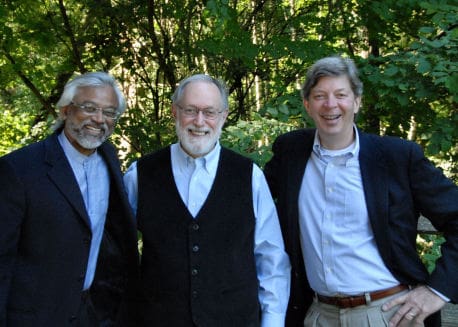
 Today we conclude our four-part interview series with the Three Interfaith Amigos: Rabbi Ted Falcon, Imam Jamal Rahman, and Pastor Don Mackenzie. During this episode, we discuss the past, present, and future of religion and spirituality.
Please don’t forget to check out my individual interviews with Pastor Don, Rabbi Ted, and Imam Jamal.
Also, please check out the books mentioned in the podcast, including:
- Religion Gone Astray: What We Found at the Heart of Interfaith
- Getting to the Heart of Interfaith: The Eye-Opening, Hope-Filled Friendship of a Pastor, a Rabbi & an Imam
- Spiritual Gems of Islam: Insights & Practices from the Qur’an, Hadith, Rumi & Muslim Teaching Stories to Enlighten the Heart & Mind
- Judaism For Dummies
Episode Transcript
Host: John Dehlin · Guests: Imam Jamal Rahman, Pastor Don Mackenzie, Rabbi Ted Falcon
This transcript is machine-generated and lightly edited for readability. The audio is authoritative. Please excuse occasional errors in names and spelling.
Introducing the Three Interfaith Amigos
Pastor Don Mackenzie [00:00:00] 1, 2, 3.
John Dehlin [00:00:07] Mormon Stories podcast is a production of the Open Stories Foundation. All donations to Mormon Stories are fully tax deductible and go directly towards keeping the podcast alive and towards building a community of support for Mormons like you. To support the podcast or to join the community, please become a monthly subscriber today@mormonstories.org. hello, and welcome to another edition of Mormon Stories Podcast. I'm your host, John Dehlin, and I'm very excited to have back on our show three guests that you will have listened to hopefully in my three previous episodes. These are the three interfaith amigos, and that includes Pastor Don McKenzie, Rabbi Ted Falcon, and Imam Jamal Rahman. I spent about 45 minutes with Pastor Don and then a good hour and a half with Rabbi Ted and Imam Jamal. Those interviews are released, and we've received incredibly positive feedback on all three. And as promised, we promised we'd bring back all three of the Interfaith Amigos to have a final discussion. And so, Pastor Don, welcome back to Mormon Stories.
Pastor Don Mackenzie [00:01:23] Thank you, John.
John Dehlin [00:01:24] And Rabbi Ted, welcome.
Rabbi Ted Falcon [00:01:26] Thanks.
John Dehlin [00:01:27] And Imam Jamal, welcome.
Imam Jamal Rahman [00:01:30] Thank you so much. Delighted to be on.
John Dehlin [00:01:32] Thank you. I know you're all three very busy gentlemen, so let's just dive right in and we'll try and keep this under an hour. Which one of you sort of was the genesis of the three interfaith amigos? Or was it something that came out from a friendship, a mutual friendship? Who can speak to the genesis of the interfaith?
Rabbi Ted Falcon [00:01:55] People don't really believe us, but we were three identical triplets, separated at birth. Actually, I knew Jamal. We were on a board of a group that was trying to form a spiritual university in Seattle. University never happened. But when 911 happened, Jamal was the first person I called because people had to see a different face of Islam than the one that was with which we were being battered by the media. And Jamal and I started working together.
John Dehlin [00:02:41] And what was the goal at the time?
Rabbi Ted Falcon [00:02:46] At the time, we were working on deepening an interfaith dialogue, which clearly had not been as effective as one might have thought. And from my standpoint, correcting rather incredible ignorance about the nature of Islam.
Imam Jamal Rahman [00:03:13] And the beauty was that in the process, I and Ted became friends and subsequently good friends. And then later on, Pastor Don McKenzie came in, and as I've said jokingly many times that I found out in the course of time, and Ted and Don have heard this countless times, that I realized that both Pastor Don and Rabbi Ted were two of the best Muslims I know. And you know, John, we've talked about this earlier in the earlier podcast, but the point here is that this is the key. When we develop a human relationship, a personal relationship, doesn't matter what our ideologies are, what our politics are, what our cultures is, then those differences, they don't loom as large. And we can collaborate and do wonderful programs together, programs that are dear to all of us anyhow. So I and Ted became very good friends, and we realized that we are cousins. As I said previously, we are from the same Abrahamic family, very dysfunctional family. And we realized that our Christian cousin was missing. That's when Don MacKenzie came in.
Rabbi Ted Falcon [00:04:28] I had known Don in Jewish Christian Dialogue group that I've been going to for several years in Seattle. So I knew that he was a good person for us to contact.
Pastor Don Mackenzie [00:04:42] So Ted called me and said he and Jamal and some others were planning an event to mark the first anniversary of 9 11, and would I like to be a part of that, and could it be at my church in Seattle? And I said yes to both things. And it was a very deep experience for all of us. And as we were debriefing, the three of us looked at each other and said, we can't stop now, not having a clue what that might mean. But we all shared an intuition that if we could penetrate the boundaries that have separated our tradition, something cooperative that could come of that, that could help address spiritual growth and the moral issues that we're facing.
John Dehlin [00:05:26] So it sounds like the original goal was to help dispel false myths and imperceptions about Islam. What would you say your goals are now? And I'll start with Don, just because I need to pick somebody. So what do you got? If you had three or four main objectives now, what are you trying to accomplish?
Pastor Don Mackenzie [00:05:48] Well, I think because we've been working together for 12 years, we want to invite people to try to understand what our friendship has helped us to do as religious leaders from different but related traditions. Namely, we've been able to identify the universals that transcend the boundaries of our traditions, as well as the particulars that flow from or support the universals in our traditions and the particulars that are inconsistent. And I think that kind of honesty and vulnerability we feel has come from our friendship. So we've identified the five stages of interfaith dialogue that are the substance of our first book, along with ways to help people get to know each other and to identify core teachings as well as those things that are not consistent with those core teachings. So we want people to see and hear the fruits of our friendship and our work together.
John Dehlin [00:07:00] And that first book is called what
Pastor Don Mackenzie [00:07:02] Getting to the Heart of Interfaith. The Eye opening, Hope filled friendship of a pastor, a rabbi, and an Imam.
John Dehlin [00:07:10] Okay. And we'll put a link to that book up on our podcast page. So, Jamal, I'm going to be tossing these questions out, and anybody, feel free to jump in. So what I hear you say is that it's important to build on common ground, that it's important to celebrate the differences as well. My first question is, as I interviewed each of you, I kind of tried to ask each of you, is your path the way? Because I come from a faith that claims to be the way. Not just a way, but the way. And the vibe I got from all three of you was that each of you view your way as a way, but you all feel like you're worshiping the same God. And so my first question is, and I'll ask this to Jamal, how essential is it for you guys to be able to work together that none of you see your way as the way? And could there ever be a fourth amigo that said? Well, no, actually, mine is the way, but I'm still willing to engage in interfaith dialogue.
The Practice and Purpose of Interfaith Dialogue
Imam Jamal Rahman [00:08:17] Jamal, you know, let me start with the latter part of your question, because that is something we're asked all the time. How do you deal with someone? How do you manage a situation where the other person says, my way is the only way?
John Dehlin [00:08:30] Right.
Imam Jamal Rahman [00:08:31] So to that we have a very common answer. We say the answer is yes. That's fine, if that's what you believe. I'm not going to oppose that.
John Dehlin [00:08:40] Right.
Imam Jamal Rahman [00:08:41] However, that does not mean that we cannot become friends. That does not mean that we cannot have a relationship as human beings. That does not mean that we cannot collaborate and cooperate on projects that are close to all of us. Social justice issues and Earth care, for example. And we have seen again and again that when we have dealt with people who are, you might even say, diametrically opposite to what we believe and are insisting on it, the moment we say yes, then it takes away the defensiveness and it allows for that opening to happen, and it makes it much easier that way.
John Dehlin [00:09:22] Got it. So, Rabbi Ted, what are. Okay, so I heard you say Earth Care, and I heard you say social justice. Are there some specific initiatives that you three have helped participate in or lead or cooperate in, as more examples of? You know, because my church, it's strange because the Southern Baptists have been attacking Mormons for a really long time. And now all of a sudden, because same sex marriage is starting to be accepted all throughout the country. Baptists, that's sort of the old maxim, that the enemy of my enemy is my friend. And right now, our church has seen same sex marriage is the ultimate, one of the ultimate enemies. And it's forcing them to actually bring evangelical ministers to Brigham Young University to forge friendships. And that's. I think that's probably an initiative in the opposite direction of where you three might be going. But tell me, Rabbi Ted, the types of initiatives that you three have been involved in, like the Earth care and the social justice kind of things?
Rabbi Ted Falcon [00:10:25] You know, I think specifically we've been involved in Habitat for Humanity bringing together. Now that's a project that we were able to bring together a much more fundamentalist Christian community along with other communities. And even though their minister said that their people would try to convert everybody else, that actually isn't what happened. We found people met each other as they were doing whatever their jobs were in the Habitat project. Otherwise, we've. We've been focusing on our work on supporting other, both lay leaders and religious leaders to form their own interfaith amigos and kind of deepen and broaden the kind of work we've been doing. One of the things that we start with is an assumption that all authentic spiritual paths are avenues to a shared universal, and that that universal is bigger than any particular path. And frankly, when any particular path thinks it owns the universal, we're in some trouble.
John Dehlin [00:11:47] Right.
Rabbi Ted Falcon [00:11:48] And so to answer your previous question about could such a. Could a representative of that way be a part of the interfaith amigos? I would doubt that anyone in that position would have energy for promoting interfaith works, since it really rests on the notion that we each have particular teachings, beautiful teachings that lead to a common, shared, universal reality.
John Dehlin [00:12:24] Got it? Got it.
Imam Jamal Rahman [00:12:27] But I want to add one thing here, Brother Ted. If somehow we can create that opening where there's a possibility for friendship to develop, no matter what the initial motivations are, it's always almost. It's been seen that the opposition or the vehemence of saying money is the only way, that usually always softens and becomes more diminished. We have met pastors, for example, in each of our traditions who, after we have got to know them personally and we made the initial attempt, they have privately told us that they personally doubt that theirs is the only way, but they cannot say this in the congregation. Yes, yes, but it is fascinating. That only happened after there was an attempt and there was some success in getting to Know the other.
Rabbi Ted Falcon [00:13:20] No, I totally agree. It's just. Would such a person be willing to come out publicly enough to participate with us in saying such things? And that would be a stretch.
John Dehlin [00:13:32] Okay, Pastor Don, I'll throw this one to you. So what if someone were to say, oh, you guys are working towards some Unitarian Universalistic kind of thing? Another way to ask this question is, how important are your differences? Why not just each of you leave your respective traditions and form a Unitarian Universalistic kind of endeavor?
Pastor Don Mackenzie [00:13:55] Well, I think that we see the differences as sources of growth and vitality. For example, I think both Ted and Jamal have quoted people like Houston Smith who said, you hold up an object and you see it from one angle and you turn it and you see it differently. And we value the. That reality. The reality is that people do see things differently. Different things make sense to them. And so we really feel that. I lost my train of thought, that
John Dehlin [00:14:31] there's strength through diversity, that diversity adds to all of our perspectives, that something would be lost if we all unified. Is that what you're saying?
Pastor Don Mackenzie [00:14:39] Well, not only that, but we'd split immediately, probably. I mean, I think that that's just not the way the world is. We have to look, learn to really value and appreciate difference rather than try to erase it. Just the same way. Someone once asked us, so you're trying to get rid of conflict? And we said, no, as long as there are egos, there'll be conflict. We want the consequences of conflict to be positive, creative, imaginative, and healing, rather than violent and the source of suffering.
John Dehlin [00:15:13] Got it. Okay.
Rabbi Ted Falcon [00:15:16] I think also each of us is. Or I'll speak for myself, I'm deeply embedded in my Jewish tradition. You know, I consider myself as a representative of that tradition, to be a guardian of the repository of the wisdom of that tradition. And I feel the same way about Jamal and Don.
Pastor Don Mackenzie [00:15:41] Yeah, I think we're all in the same boat.
John Dehlin [00:15:44] So I had a friend write me once, he's a former Mormon, and he said, john, one of the biggest problems in the world is tribalism. We need to transcend tribalism because it's tribes. You know, prejudice is born out of tribes. What would you guys say about that? That religions are the problem?
Imam Jamal Rahman [00:16:04] You know, I did say this once at a conference, in fact, in Don Sebeck conference. And this one lady from Africa was pretty upset because she said, actually, when you belong to a tribe, it creates a sense of unity and community. So I think when we say tribe, we have to be careful. We're talking about the parochial, negative, narrowing aspects of tribalism. And yes, that can be a big problem. And the problem is that I claim that my tribal, because of my tribalism, my religion is superior to yours. If I said it was very good, it is really absolutely wonderful. I have no problem with that because then just live it. You know, this is the problem human beings have. We talk about religion, we debate about religion, we fight for over religion, we even kill for religion. We do everything but live it. So the idea is, if it's very beautiful, just live it. Rather than bringing others to your side of the mountain to climb and reach the summit. That is a problem we have when we say mine is superior. This is not religion speaking. This is, as my brothers have suggested, this is ego speaking, my tribal nature speaking.
John Dehlin [00:17:20] Okay, well, that brings. That makes me want to jump to a topic. Rabbi TED I sent you a report, I think, out of the Pew foundation that talked about, you know, the alarming raid of Jews marrying other traditions or of abandoning the faith. I'm curious, to what extent do you, each of you, see institutional, organized religion really struggling and potentially suffering? I don't know if you guys know that the fastest growing group in the United States religiously is the none category, people who are no longer affiliating with anything. Don, why don't we start with you? Do you see that in mainstream Christianity and what do you think the cause of it is? And then I'm going to go to Ted and then Jamal.
The State of Organized Religion Today
Pastor Don Mackenzie [00:18:13] Yes, it's true in mainstream Christianity. I think what we're observing is a cycle where people are realizing that religion as an institution, Buddha, is spending more time and energy maintaining itself than it is trying to be true to its purpose. And we find this all over the place. I mean, we just got back from Japan. We asked how many people in Japan really are functioning Buddhists, and they said very few. So I think it's happening all over the world. And yet there is a movement beyond interfaith dialogue called interspirituality that could, I think, assist institutions to recover their sense of purpose, and who knows where that will take us. But I think right now we're experiencing an entire world almost where people realize that many of their institutions are more concerned about their longevity than. Than really fulfilling the purpose for which they were created.
John Dehlin [00:19:21] And that's hitting the Christian church in the Western countries particularly hard. True, Don?
Pastor Don Mackenzie [00:19:26] That's right. I mean, it's less true, for example, for Christians in Africa, where there's really a flourishing Christian church, but it's a different church from the church here in North America.
John Dehlin [00:19:38] Right. Okay. Rabbi Ted how's the state of Judaism?
Rabbi Ted Falcon [00:19:42] You know, I looked at the figures. I mean, I had seen them before you sent them to me because they were really striking. I forwarded them to a couple of colleagues, and my comment to them was, I don't know whether to despair or
John Dehlin [00:19:57] to rejoice right now. Why? Why would you rejoice?
Rabbi Ted Falcon [00:20:01] I would rejoice because I think it's a sign of sanity.
John Dehlin [00:20:05] But how? You know, I'm looking to reform Judaism and reconstructive Judaism as, like, Mormonism's only hope. How can you tell me that those organizations aren't like rainbows and lollipops and jelly beans? I mean, you're my only hope, Obi Wan. You're my only hope.
Imam Jamal Rahman [00:20:26] Right, right.
Pastor Don Mackenzie [00:20:27] Look,
Rabbi Ted Falcon [00:20:32] Any rebellion, those who rebel ultimately become very much like that against which they rebelled. It's just a general principle of human nature, of the nature of consciousness. And it happens again and again and again. So everybody thinks their rebellion is the last rebellion. You know, like, now that we have reformed Judaism, we're done. And it's not like that. It's like, okay, that had its run, it had its ark, and now it has become an institution that is as institutionalized as was an orthodox establishment against which it rebelled in the first place. So the institution thinks, okay, what do we have to do to get these people back? And that's, from my standpoint, that's the wrong question. The right question is to go where those people are and see what they are seeing and listen to what they are saying, because that's the evolution. Things are evolving again. We're at one of those places of evolution. So I find it very exciting. And what is interesting is a lot of the feedback so far about that report. Part of it has been the Jewish officials, you know, bemoaning the fact and needing to structure new programs to fix it. But then there have been the voices of those who are intermarried, and their response is very different because they know that with over 50%, well over 50% of all Jews marrying out of their faith, the real arena, the real context for the survival of Judaism is actually going to be in those families. Like, how does Judaism become supportive and spiritually illuminating in that context? And I think all of us are very both fascinated and interested and encouraged by those possibilities.
John Dehlin [00:22:49] Wonderful. Imam Jamal, the perception I have is that Islam's doing fine, that you're growing, that you're set to become, maybe even if you're not already there, one of the dominant world religions. Do I have it. Right. And is this for you, something that you want to both cheer and cry about or only cheer? How's Islam?
Imam Jamal Rahman [00:23:09] Well, first of all, you know, it is important to know that in Islam, in theory, we do not have religious ordination, religious hierarchy, not supposed to have religious institutions. The Quran says between humanity and God, there should not be any intermediary. But, however, that's not in practice. What is always happening, even in Islam. Yes, Islam is growing rather rapidly, but even in Islam, you see, we're not against institutions. However, when institutions. And we write about this in our second book called Religions Gone Astray, when institutions lead more to suffering than to healing, then we know it has gone astray. And the reason it has gone astray, as my brothers have suggested, is that the institutions are not providing that which congregants are most hungry for. And what are they hungry for? They're hungry for spiritual teachings. Spiritual teachings which enable them to become better human beings, enable them to be of greater service to others. What they're finding is that these institutions have become so invested in fundraising and recruitment rather than spirituality and service. And this is what is driving young people away and even older people away from these institutions.
John Dehlin [00:24:34] So my guess is that organizations do this because they need to pay the light bill, they need to pay the mortgage, they need to pay the rent, they need to pay the pastor. Right. So have you. I'm curious if you guys have seen models that work where they are self sustaining, but they also are spiritually edifying for their congregants? I mean, are there success stories or are there models that have been developed that don't end up becoming their own instantiation of what they were rebelling against, but instead models that work?
Rabbi Ted Falcon [00:25:12] I mean, I think it's gotta be both, John, because a model that works is not gonna work forever. Yeah, it's going to become its own institution. It's like relationships, you know, our marriages. We do what works, but then if we don't change what we're doing, just insist that. Wait a minute. This worked. You liked this before. Things start falling apart, things have to evolve.
John Dehlin [00:25:41] So, Pastor Don, are people, like, hiring. Do you have it as part of your mission as the three interfaith amigos to, like, save organized religion? Do people, like, hire you guys out to help them, you know, investigate their local congregation and figure out how they can do things better? Are you trying to. Are you trying to develop and cultivate models for successful, you know, religious execution?
Rabbi Ted Falcon [00:26:07] What a great idea.
Pastor Don Mackenzie [00:26:09] We have not done that per se. I mean, we talk about these things in our presentation. But the problem, I mean, we. At one level, we would say, let's get rid of institutions, but that's like saying, let's get rid of the ego. I mean, there are institutions at all levels of human experience, and you can. I mean, an institution can die, but people come together and that becomes another institution. So one question that we have is how can an institution keep visible enough its own purpose so that there is an effective balance between its maintenance and sustaining its mission? And that's a question that we put out when people are asking us questions like these after our presentations. It's an open question. And again, I think interspirituality, which has its focus, conversations that really have at their heart the kinds of things we've been doing, being vulnerable, talking about what's good, what's bad, where we're headed, what is the purpose of our institution, what is the core teaching, what are the beliefs, what are the core values that come from all that? I think, you know, it's not just religious institutions. I mean, governments, families, individuals. We all, you know, the purpose leaks out of us unless we're awake. And I think that's one of our main goals, is to help people understand how important it is to develop spiritual practices that do their best to keep us spiritually aware, growing spiritually and able to overcome the polarities, the we they, the tribalism in the worst sense of the word, even the nationalisms that prevent us from cooperating on the moral issues we're facing.
Rabbi Ted Falcon [00:28:08] You had asked John.
John Dehlin [00:28:09] Oh, go ahead, Ted. Go ahead.
Pastor Don Mackenzie [00:28:10] Yeah.
Rabbi Ted Falcon [00:28:11] Whether we had seen in our traditions things developed that were experimental and successful.
John Dehlin [00:28:17] Yes.
Rabbi Ted Falcon [00:28:18] In Jewish tradition, there was something called a chavurah movement in the 70s and 80s, which were smaller groups getting together, often affiliated with the congregation, but getting together in groups that were small enough so that people could really know each other, that they could worship together, you know, in smaller units and really practice more spiritual pursuits of, you know, more meditative activities, which weren't popular in the larger sanctuaries. And those really functioned well, except they kind of got absorbed into the institution. Now, there is another. There's a movement somewhat similar to that. It's called independent minyan. Minyan being a group that's large enough to pray together. Because in traditional judaism, you need 10 people, independent minyanim, that get together outside the context of any kind of professional synagogue or temple to explore their own tradition, their own identity, but not in an institutional way. And it's going to be fascinating to see what comes of that.
Imam Jamal Rahman [00:29:32] You know, John, if I may step in here and say something, please. In progressive Islam, we say that the main problem with institutions is that they have lapsed into what they call the deferred spiritual maintenance. We don't invest in spiritual maintenance. The main reason that people invite us, I think, to come and speak is that they like to see palpably and visibly, the three of us just stand together as a united team. And very often we see tears in people's eyes just from the. You might say, the visible action, the three of us standing together. And they can very quickly realize that we are friends. And so this gives rise to hope and to vision that three clerics from different traditions are able to be friends and transcend their scriptural differences to really form a united, shall I say, circle of friendship. And that, I think, is what people would like to see and know. How did you do that? And we have to always tell them it wasn't just by getting together. When we get together, at least in the past, we used to do a lot of personal spiritual direction, dealing with our egos, talking about our issues, our personal problems, connecting with our vulnerabilities. That I think that spiritual work is very critical.
John Dehlin [00:31:11] Thank you. Jamal, I love the term progressive Islam. I thought I tried to talk to you about that last time. Maybe we did, but I would love to learn more about progressive Islam, and I think my listeners would as well. Pastor Don, really quick. You said it's interspiritual. What is the movement, you're saying? Inner spirituality?
Pastor Don Mackenzie [00:31:34] Well, there was a conference in Seattle about a month ago, maybe a little bit longer. I was not there because I live in Minnesota now, but Ted and Jamal were there. So I think maybe one of those two guys could.
John Dehlin [00:31:45] Yeah. Is there, like, a leader? Is this, like. Is there a website? Like, what is this?
Rabbi Ted Falcon [00:31:51] It was called the dawn of Interspirituality. It's more a movement that is not yet. Not yet at all institutionalized. And many of us are afraid, fear its institutionalization. In many ways, it is saying the same thing we've been saying about the ultimate reality being one ultimate reality, and that being the goal, the purpose, the function, the meaning of every authentic spiritual and religious path in the past, in the present, and in the future, and finding ways of acknowledging that and celebrating that more directly. And that means in whatever ways, we celebrate our own traditions, moving also into specifically spiritual practices, meditative practices, fasting practices, you know, the kinds of practices that the enlightened ones of all our traditions practiced.
John Dehlin [00:33:05] So is this led by a person or Is there a website or a book or is this just something people are talking about?
Rabbi Ted Falcon [00:33:11] There is a main. Yeah, well, there's a main book by Kurt Johnson called. What's it called?
Pastor Don Mackenzie [00:33:22] The Coming Age of Interspirituality.
Rabbi Ted Falcon [00:33:23] Yes, the Coming Age of Interspirituality.
Pastor Don Mackenzie [00:33:26] Yeah.
Rabbi Ted Falcon [00:33:27] It's very heavily influenced by the work of Brother Wayne Teasdale, who wrote a book called the Mystic Heart and several other books. He is the one who actually coined the term interspiritual and interspirituality. I mean, this is new. This is an evolution. It comes out of the work of Father Thomas Keating in Centering Prayer. There's a group that's been going on for over 20 years that's interfaith, many of whom were at that conference. So people are meeting each other across the boundaries of their cultures and of their traditions and of their geographical locations, and discovering this comet thread that allows us all to celebrate together and to see a possibility of peaceful solutions to the world's problems.
John Dehlin [00:34:28] Right. Jamal, were you going to jump in with something?
Imam Jamal Rahman [00:34:32] No, I was just going to give the same information about Brother Wayne Teasdale.
John Dehlin [00:34:37] Got it, Got it. Okay, this is good. This has given me stuff to follow up on in my listeners. Pastor Don, are you aware of a Christian church that's like doing Christianity the way that. That you feel is really edifying, yet it has a model that's working? I know maybe it makes you uncomfortable to have you call someone out, but is this going on anywhere that you know of or.
Pastor Don Mackenzie [00:35:00] Sure, it's going on a lot of places. I mean, no institution is perfect. But I think that there is a movement called Progressive Christianity. It's interesting that it's also an Islam, and there are groups, I think, in Judaism as well. But I think that all these churches in the progressive Christian movement are seeking to recover the substance of Jesus teachings and also practice or live into the kind of spiritual practices that Jesus taught as well as challenge the status quo in the way that he did. Because I think that if you look at all these great wisdom teachers like Moses, Jesus and the prophet, peace be upon them, they all did all those things. They healed, they taught spiritual wisdom, and they challenged the status quo. And so I think that, you know, there are cycles, as we've been sort of suggesting, that institutions may start out doing those things, but then they find that the need to maintain themselves takes a lot of energy, and sometimes that just simply eclipses everything else, and they end up as empty institutions and realize that only after things have gotten so bad that they're really on the edge of closing down, but then new institutions rise up and so forth. So I think one of the things that we wonder, is it possible that interfaith dialogue leading toward cooperation and even to the inter spiritual kinds of conversations, is it possible that those things could help us to develop ways of monitoring consistently or more consistently whether or not the institutions are doing what they're supposed to do? And I don't think that has been as visible an agenda in Christian churches historically as it should be. I mean, there have been different ways of going about that, but I don't recall a time when churches wanted to combine spiritual wisdom, healing and challenge to the status quo.
John Dehlin [00:37:30] Right. Yeah. Okay, I'm going to ask you all three a similar question. I'll start with Jamal, can you name, and I'm putting you on the spot here, what are two or three of your most of the spiritual practices that you find to be most important for you to remain spiritually grounded? Are you comfortable answering that?
Essential Spiritual Practices Across Traditions
Imam Jamal Rahman [00:37:52] Absolutely. Oh, absolutely. I think for sure the practice of silence is very important. I love the saying by Islamic mystics that silence is the language of God and everything else is a poor translation. So that is critical. And the second thing I would say,
John Dehlin [00:38:15] what do you do for silence?
Imam Jamal Rahman [00:38:17] Oh, there are so many different techniques of becoming very still. You see, silence is not the absence of sound. Silence is absence of the little self, of the chatter, the monkey mind that continues all the time. So you can repeat a particular phrase, or you can focus on your breath and just be present with it. You can send out light and love from your heart. Depends on the different personalities. There are hundreds of different ways of practicing authentic meditation, which is really ushering into a space of silence where really it's an absence of the ego. So that's one practice. The second practice for me, which is a part of prayer, is to practice gratitude. And when one is practicing gratitude, I feel that one is really in attunement with the vibration of the universe, that everything is really proclaiming the greatness of God, of spirit, and thanking God. So I love this phrase from Islamic mysticism. Oh, God, favor upon favor have you bestowed upon this handful of dust. And if you keep on thanking and praising God, then when we are even expressing gratitude, in times of affliction, difficult times, we are giving gratitude for unknown blessings already on their way. So gratitude for me is my second most beautiful practice.
John Dehlin [00:39:42] Beautiful. Okay, Ted, do you want to take over and add a couple for you?
Rabbi Ted Falcon [00:39:47] Yes, but. Okay, so I would totally agree with what brother Jamal has Included, I'm going to say a couple. Specifically from my tradition, there is a blessing that is said upon rising, which is essentially a gratitude blessing, which is thanking God for connecting me again to ultimate reality. Thank you for allowing me to awaken to a new day. There's a prayer set at the end of the day that is a forgiveness prayer to work at letting go of all the perceived slights and wounds of the day, as well as letting go of those we experienced ourselves doing, either against ourselves or against others, so that we don't endlessly repeat them. Blessings before eating. And we all do this, you know, to call our awareness. Spiritual practice is essentially calling ourselves to be present for the immediacy of the moment. And whether that's through meditation, through blessing, through gratitude, all those are ways of opening up to being here, being now. Silence. We like to say we share many words, but the silence we share is one. There's only one silence. And that's why it becomes such a rich and important part of spiritual practice and spiritual discipline. When I'm in my silence and you are in your silence, in fact, we're together.
John Dehlin [00:41:55] Right? Unity. Yeah.
Pastor Don Mackenzie [00:41:58] All right.
John Dehlin [00:41:58] Pastor Don, sorry to make you go last. I hope they didn't steal all your good ones.
Pastor Don Mackenzie [00:42:01] They took it all. You know, I mean, what. What you've heard Jamal and Ted say is they've described practices from their traditions which are designed, as they said, to open the heart, to help us to be present and to put the work of the ego in a manageable place so that we can be better and more contributive human beings rather than competitive and things that end in violence. So I would agree with everything they said. But, I mean, just in Christianity, the particulars of spiritual practices have included things like something in Latin called lectio divina, or a divine reading, a reading of scripture and centering prayer that Ted mentioned from Father Thomas Keating, a more recent version of that, where it's a form of meditation and centering and reading scripture that does exactly what my colleagues have described. I think in some ways, the listening or the silence is maybe the hardest because we are so prone to need to. That need to have our space be filled with something that gives us the illusion of moving forward. And that's not why we're here. We're here to help each other rather than hurt each other and so forth. So there are particulars between and among our traditions that differ in terms of these spiritual practices. But the threads that run between and among them are basically the same thing.
John Dehlin [00:43:51] Right. Beautiful. Okay. Have Any of you heard of Alain Debouton? He's a British. He has a book called Atheism 2.0. He's been on Chris Tippett's On Being podcast. He did a TED about Atheism 2.0. Does that ring a bell at all?
Rabbi Ted Falcon [00:44:17] No, but it sounds interesting.
Pastor Don Mackenzie [00:44:19] Yeah.
Imam Jamal Rahman [00:44:19] Never heard of him.
John Dehlin [00:44:20] Okay. He's really important because basically what he said is, I'm an atheist. I was raised an atheist. But religion's doing a lot of things right. They sing, they have sermons, they meet weekly, they develop community. And we, you know, Dawkins and Hitchens and Harris got it wrong in the sense that all they did was tear down and attack religion. When in reality, what we secularists should be doing is stealing the best plays from the playbook of religion and forming secular communities that, you know, that still pray or that still sing and that still have sermons and that still help each other. And I was hoping you guys had heard of that, because I was going to ask you what you thought of it, but maybe I'll start with you, Pastor. Don't. What are your reactions to that kind of thing? Does that feel threatening? Does that make you celebrate? What would your thoughts be on that?
Pastor Don Mackenzie [00:45:16] Well, I mean, right off the bat, I think it's interesting because in contrast to others, as you pointed out, he's not throwing everything out. He's trying to find the best from his point of view that's going on in religion and make use of it, because I think he does see the value of some of those things, and they are valuable. There's just no question about it. So, you know, we say any spiritual path that desires to contribute to the common good is a valuable thing, and we have something to learn from it. And it feels to me as if that's the position he's taking, and I think that that's really something to contribute. That's great.
John Dehlin [00:46:02] You like that? All right, Jamal, what do you think?
Imam Jamal Rahman [00:46:04] You know, I think it's wonderful, really, because the purpose of religion is twofold in my understanding. One is it doesn't matter what the religion is, doesn't matter what the theology is. But how can I become a more complete human being, a better human being? That's one. And the other one is, how can I be in service to God's creation? How can I be of more authentic service? So then what this person is doing, I feel he's really being a very beautiful devotee of God. And we have no problems with atheists and agnostics in my congregation. We have atheists, a few small number of atheists and agnostics, and we have wonderful discussions. I always tell them, you believe in God, you just call God by a different name. You call it justice, you call it humanity, you call it compassion. If that is not God, then I don't know what God is.
John Dehlin [00:46:58] All right, Rabbi Ted, any quick thoughts before I ask the next question?
Rabbi Ted Falcon [00:47:02] No, I totally. He's not the guy who wrote Religion for Atheists.
John Dehlin [00:47:07] Yeah, I think he is.
Rabbi Ted Falcon [00:47:08] Okay. Because I've seen that.
John Dehlin [00:47:10] Okay, okay.
Rabbi Ted Falcon [00:47:11] And it interested me. You know, it's like, okay, taking some of the fruits of the spiritual quest, which essentially is a quest to be more fully human, and framing it without the theological frame. We don't do it because God said to do it.
John Dehlin [00:47:33] Right.
Rabbi Ted Falcon [00:47:34] You know, we don't do it to obey. We do it because it has meaning for us. Which in fact, as far as I'm concerned, is the maturing of any spiritual path. You know, if I'm just doing it because I'm obligated or forced or I get points for it, I don't think no decent God would want that.
John Dehlin [00:48:02] Right. And for you, God's got to be decent.
Rabbi Ted Falcon [00:48:07] What the heck?
Advice for Mormons Navigating Institutional Faith
John Dehlin [00:48:10] Okay, now I'm going to go all Mormon on all three of you because I need your help. We need your help. And I'm going to start with you, Ted. But I'm going to ask Jamal and Don each to opine because we Mormons are kind of. Well, there's a whole group of Mormons that are super happy. You know, they're the orthodox Mormons and you know, they believe what the church teaches, literally, they believe whatever the brethren teach and it works for them. And I do wish them peace. And your. Each of your sort of tolerance and empathy and love and compassion is helping me to see things in a more charitable way. But Ted, I talked to you a little bit about this in our podcast. Mormonism is in this really interesting state where we don't have a liberal branch. It's very top down, it's very patriarchal, it's very authoritative. Women are not allowed to be leaders with, you know, be priesthood holders within the church. The church has softened its anti lgbt, you know, gay, lesbian rhetoric, but it really is seeming like it's going to be retrenching and just holding the line in terms of opposing same sex marriage, of not fully embracing and welcoming gay and lesbians into the church, of holding women institutionally in sort of a second class status and just really holding on to the patriarchy. And so there's a whole breed of Mormons, let's just say, 5% of the population that are just draining out of Mormonism, and they're often draining into the secular world, atheism, agnosticism. And many are going to say that works for them. But over and over again, I hear these Mormons who are exiting Mormonism saying, I miss something. I miss the community. I miss the spirituality. You know, they're happier. I'm not saying they're not happier, but there's a sense that many feel like there's a void. And so I'm going to ask Ted and then Jamal and then Don, do you have any advice for the Mormon that says, I can't do it anymore with the institutional LDS Church, but I still feel Mormon and I don't know what to do. So, Ted, we talked about this a bit. You may have thought a little bit more.
Rabbi Ted Falcon [00:50:40] Right. So I'll give you my phone number. Tell them to call me. We could meet. Okay, look, if I were feeling in that position, I think the first thing I would do would invite some people into my living room. I mentioned to you the independent minyanim, the independent small groups who are practicing Judaism in their homes. I don't see any way around it. To directly try to change the institution, to directly confront the institution only drives the institution to a more fixed position.
John Dehlin [00:51:26] It's totally true. It's completely what's happening.
Pastor Don Mackenzie [00:51:28] Yeah.
Rabbi Ted Falcon [00:51:29] And when to the degree any institution is weakening, whether they admit it or not, they get even more rigid. That's what institutions do. That's what governments do.
John Dehlin [00:51:42] Yeah.
Rabbi Ted Falcon [00:51:43] So I. I would not suggest doing it that way. I would suggest creating sub communities in the midst of a larger community and insisting that we are Mormons, insisting that we are a viable, legitimate Mormon community, and practicing in whatever ways you can possibly practice the faith that makes sense to you. Not because of an authoritative command, not because of a decision by this elder or that elder, but because this is right within the context of your community and your teachings. And for goodness sakes, to look at the story as story. We create stories to give meaning to our lives. In many ways, we destroy the story by insisting that it's history rather than story. Like when I look at my texts and insist that they be history, I'm gone. I have to split from science. I got to split from my mind. It's not a kind of choice that I can be comfortable with. But if I look at that and say, look, these are stories that are meant to support a spiritual quest, I learn from them. I Learn what to do, I learn what not to do. I learn what works, I learn what doesn't work. I also learn from time and place. Some of the stuff is from an older time. It doesn't translate. Some of the stuff is more universal. What are the universals? What are the particulars?
John Dehlin [00:53:32] Beautiful, Jamal.
Imam Jamal Rahman [00:53:35] You know, Brother John, I would say that things are not what they seem to be. So, for example, if you describe the Mormon institution, like also the very conservative Islamic institution, as being just one block, the truth is, what is an institution? It's a collection of egos and in various stages of development. So I would bet that that very institution that claims to be totally literal and exclusive, you have a good number of people there who are thinking like you are thinking, but it's a road less traveled. They don't have an outlet for that.
John Dehlin [00:54:13] Right?
Imam Jamal Rahman [00:54:13] So I would say exactly what Ted said. As a Mormon, please be creative. Continue with the same things you're doing and find more creative outlets. And little by little, keep picking away at what you feel is the truth, which needs to be expressed, which needs to be said, which needs to be acted out on. And then you will find that little by little, then there comes a huge quantum jump. But the quantum jump does not happen unless we keep on doing that little by little, keeping at it all the time. Keep on trucking, as it were. Look at the. My brothers have always said the Berlin Wall, it finally came down, apartheid came down, you know, it happened, it seemed suddenly. But there was this little by little work continuing. So I would say, John, keep on trucking as a Mormon and things will change.
Inclusion, Gender, and Reform Within Each Tradition
John Dehlin [00:55:06] But Jamal, does that mean now, I don't know what your stance is on gay and lesbian, you know, brothers and sisters, but let's just say that that's a big deal to me. You know, are there things that would prevent you from attending an Islamic congregation if they taught or encouraged a certain thing or were biased in some sort of way? Or would you say no, keep attending even if what's taught offends your sensibilities.
Imam Jamal Rahman [00:55:34] You know, some of your voice trailed away, but I think I got what you wanted to say. You know, this is a good example. I am very much pro open and affirming congregation, and my views are not widely accepted in the Islamic community, but I just continue with that. And I know there are Muslims like me who are thinking like me, but they don't have an outlet. They slowly, they come and talk. They come and talk to me in private about the fact we should be more open minded towards homosexuals and lesbians. And so I know that by me continuing to say what I'm saying, even though it's falling on deaf ears, seemingly, it is having an impact I can gauge by those people who come and talk to me very quietly and very privately. So I just have to keep on doing that and realizing that if some people are being very, very conservative, not wanting to, you know, budge at all in their attitude towards gays and lesbians, it's because they don't know any gays and lesbians. They haven't experienced what is called the bridge model. And I always tell them the example of Christian evangelicals, how they have shifted because that similar views like Muslims did. And what happened was they knew people, their neighbors and co workers, they just didn't know they were gay. They liked them. But when it became safe for those people to disclose they were gay, the bridge had already been built.
John Dehlin [00:57:02] Right.
Imam Jamal Rahman [00:57:03] So that idea that there is no bridge, I ask any Muslim who's anti gay, how many gays do you know? Almost none at all. So I think it's a question of just continuing with it in creative ways.
John Dehlin [00:57:15] Okay, Don, help me out here.
Pastor Don Mackenzie [00:57:19] Well, when Ted used the phrase invite people into your living room, I was reminded of my own field education when I was a seminary student back in 19 fall of 1967. The congregation where I was working in northern New Jersey had what they called house churches, which is exactly what Ted described. The smaller groups of people who got together, got to know each other, did study, and helped each other to grow spiritually. And you can't do that in a huge group. You have to have those small group experiences where you can also feel free to say whatever you feel you need to say. And I was struck by your phrase. You know, I'm a Mormon and I want to be a Mormon. How can I be a Mormon? And so I think one of the agendas for a group like that could be to be educated about what it means to be a Mormon. And what is that relationship between that and what we're experiencing now? What are the core teachings and so forth. I mean, there are all kinds of opportunities for small groups that simply do not exist in larger congregations without those groups.
John Dehlin [00:58:34] And Pastor Don, what would your advice be? Let's say that there's a Mormon who is pro lgbt, who believes in male female equality, and just is constitutionally repulsed by a view that's one true church with exclusive authority. Would you, you know, and those are things that they feel bombarded by whenever they actually attend on Sunday. Would you, You Know, if they said, pastor Don, should I keep going to church or should I stop? Because it just, it makes me angry, it makes me feel bad every time I go. Would you have counsel or wisdom for them in that situation?
Pastor Don Mackenzie [00:59:15] Well, I'm sure that there are times when the frustration level is such that it no longer fruitful to attend those larger experiences, but instead, as my colleagues have suggested, to invite other Mormons into a home as an alternative to really become even more literate, perhaps. On the meaning of Mormonism, what are the core teachings? What are the particulars that support those and what do not? I mean, our views on homosexuality are rooted in the fact that homophobia is counter to the unconditional love of Christianity, it's counter to the oneness suggested in Torah, and it's counter to the compassion that is so central to the meaning and history of Islam. And we know that people are for the most part born one way or the other. And so we feel that homosexuality is in fact, natural. It's not prevalent, at least as far as we know, but it is as natural to be a homosexual person as it is to be heterosexual. That's new. I mean, the world has never looked at it like that until recently. Yeah.
Rabbi Ted Falcon [01:00:33] And in fact, they found that something around 6% of the population, not only of human beings, but of other species, evidence same sex relationships and attraction to same sex relationships. So it seems to be kind of across the board.
John Dehlin [01:00:54] And Ted, are you for female rabbis?
Rabbi Ted Falcon [01:00:57] Oh, sure. You know, that change happened in my lifetime when I went to rabbinical school. There were no women students and there were no women rabbis. But I became a rabbi in 1968. The first woman to be ordained was ordained in 1972. And for some years after that, the majority of many incoming classes were women who were just waiting for the possibility. And I still remember thinking, how could a woman be a rabbi? You know, that that was a father figure. And I was, in a way, I'm both embarrassed and I'm glad to be aware of holding that, you know, because I think I'm. I think I'm supportive of equality, but I have to face some of my own training. I think all of us who grew up in a patriarchal culture carry some remnant of it, you know, some residue of it. But now women rabbis are virtually totally accepted in all movements of Judaism, except for the Orthodox.
John Dehlin [01:02:10] Right, Pastor Don? Female pastors, yeah.
Pastor Don Mackenzie [01:02:14] The first woman in the congregational tradition was ordained in about 1868. So. But the Presbyterian Church didn't start ordaining women until the 1950s. But even so, in my class of 104 people, four people were women. That was 1970. And now it's at least half and half, if not more women than men. It's so common. We don't think about that anymore. But women in ministry still do not have the same kinds of opportunities as men, still are not compensated as well as men. So we still have a way to go, at least in the Christian church.
John Dehlin [01:02:55] And, you know, since Mormons haven't even started. How's that working, Don and Ted? Is that working okay? Are the churches falling down when the women get opportunities for leadership?
Rabbi Ted Falcon [01:03:07] Doesn't look like it. You know, we've had now we've had women in all the major leadership positions, at least in two of the three major agencies of the Jewish community. But certainly as head rabbis and as leaders of the rabbinical association, there have now been several women. It's very good to see it's working out,
John Dehlin [01:03:39] Jamal. And this will be my last question because I know I promised you guys just an hour, other than maybe a summary, but, Jamal, are there women imams in Islam yet?
Imam Jamal Rahman [01:03:50] You know, change is happening, as I said, slowly, little by little. So we have in some countries, women who are trained as imams. However, they are imams to female congregations. They're given their own mosques, but it's exclusively female. But, you know, if we keep at it, this is a huge change in the system and over time, as I said, little by little, and there's a huge quantum jump. And I'm sure there'll come a time when women will be leading male and female congregations, but it'll take time. But when the time does come and there's a quantum jump, it is because of that little by little, stage by stage, application.
John Dehlin [01:04:31] Okay, so I have to find some way to close the podcast. I honestly could continue this interview for another 10 hours, but I won't do that. I would ask, I guess what I'd like to do, to ask, to close, is for you guys each to share with the listeners either a hope you have for the future or something that you believe in that you feel is really important, or a piece of advice that you would give for a struggling Mormon who's trying to keep religion or some sense of spirituality in their lives, but who is finding it hard to do so within the institutional church. So I'm going to ask Jamal to start then Ted. Then we'll end with Don.
The Heart of Every Religion
Imam Jamal Rahman [01:05:11] You know, this morning I did a memorial service and I said this one thing which is at the essence of every religion that, Jamal, when you came over here from the invisible world to this world, everybody was laughing and smiling, but you were crying and weeping. Live such a life, lead such a life, that when you depart, everybody is crying and weeping, but you are laughing and smiling. This, I think, is the essence of every religion. Beautiful.
John Dehlin [01:05:43] Okay, Ted, I put you on the spot.
Rabbi Ted Falcon [01:05:47] I measure the religions according to the instructions of the Dalai Lama, and that is kindness, love, acceptance, joy and celebration. I think spirituality is ultimately inclusive. So true spirituality, truly opening to the one doesn't exclude anyone, but it opens with such love and acceptance that it encourages. It discourages violence, it encourages communication, it discourages exclusivity, but it encourages every individual to become the finest, particular, unique individual they can be.
John Dehlin [01:06:48] Love it. All right, Don, you've got some big shoes to fill.
Pastor Don Mackenzie [01:06:52] Yeah. I think, just to add, I think that ideally, interfaith dialogue and an inter spiritual sensibility could help to affirm the essential worth of every human being and help people to really feel that. Because I think each of us really doubts that we're worth anything or worth much. And we do all kinds of things to try to say that we are. And it's often using power, sex, money, and so forth. I would say it would be terrific if religion and spirituality could help to find a balance between masculine and feminine energies and sensibilities so that vulnerability and strength could find a better balance in human experience. And I think that those things could help to overcome the we, they negative tribalism and even nationalism that we're. And polarities that we're experiencing now. So I'm not. I'm saying I agree with what Ted and Jamal have said. And saying it, I guess, in a slightly different way.
John Dehlin [01:08:03] Beautiful. Is there anything we should do to pay attention to the three amigos, to support them, to learn from them, to join with them? What can my Mormon audience do to support your initiatives?
Imam Jamal Rahman [01:08:20] Bring us over to Utah. Bring us over to Utah. We'd love to do a program there.
Rabbi Ted Falcon [01:08:24] Yeah, that's what I was going to say. Invite us to come and make trouble.
Pastor Don Mackenzie [01:08:31] Okay.
John Dehlin [01:08:32] Count on it. What else? I will do that.
Pastor Don Mackenzie [01:08:35] John. I think that every Mormon should be aware that every person of faith has wondered at some point whether or not the bigger institution is doing the right thing. This is not something where Mormons should feel alone or isolated.
Imam Jamal Rahman [01:08:53] Well said.
Pastor Don Mackenzie [01:08:54] Well said.
John Dehlin [01:08:54] Okay, so they're not alone.
Imam Jamal Rahman [01:08:58] And John, I think what you're doing is going to inspire others who feel partially or more even than what you are thinking and feeling, and it'll inspire them to Come in the open and be creative and find outlets. So I really salute you for that work.
John Dehlin [01:09:13] Oh, well, thank you. Okay, so the website is interfaithamigos.com. the books are Religion Gone Astray, what We Found at the Heart of Interfaith and Getting to the Heart of Interfaith. Are those the two books?
Imam Jamal Rahman [01:09:31] Yes, yes, yes. And, John, may I just add one more book on Islam if people are interested? I wrote one book which was published in April of this year, Spiritual Gems of Islam.
John Dehlin [01:09:43] Beautiful.
Rabbi Ted Falcon [01:09:44] And I wrote the book called Judaism for Dummies.
John Dehlin [01:09:48] Oh, I love it. Okay, Don, you got anything for us?
Pastor Don Mackenzie [01:09:52] Just a CD from the Grand Ole Opry where my band plays.
John Dehlin [01:09:56] Oh, beautiful. Okay, if you guys will send me links to those things, I'm going to put them up and see if we can generate some sales for you guys.
Imam Jamal Rahman [01:10:03] Okay, thank you. Thank you, John.
John Dehlin [01:10:05] Okay, well, God bless the interfaith amigos. Thank you so much for your time and for blessing Mormonism, or at least progressive Mormonism. With your wisdom. I think you all deserve places in heaven. All right.
Pastor Don Mackenzie [01:10:22] You know, that makes it all worthwhile. Yes.
Imam Jamal Rahman [01:10:25] We're counting.
Pastor Don Mackenzie [01:10:26] Thank you. Thank you. Thank you.
Imam Jamal Rahman [01:10:28] God bless you.
Rabbi Ted Falcon [01:10:29] It's been great talking to you, John. God bless you.
John Dehlin [01:10:32] Thanks, brethren.
Pastor Don Mackenzie [01:10:32] Okay, thank you. Thank you so much.
John Dehlin [01:10:34] Okay, bye.
Pastor Don Mackenzie [01:10:35] Bye. Bye.
Imam Jamal Rahman [01:10:56] Come, come, ye saints, no toil nor labor fear.
Rabbi Ted Falcon [01:11:03] But with Jo.
Transcript © 2026 John P. Dehlin. All rights reserved. Brief quotations are welcome with attribution and a link to mormonstories.org; all other use requires written permission.

15 Responses
That was awesome! Thank you, Three Interfaith Amigos and thank you, John! I felt uplifted, humbled, loved, and educated by all four interviews. I know it was good and “of god” because I am walking away feeling more love for the world I live in and all of the people in it. Thanks again.
Funny how Interfaith religions are only represented by men. Not one single woman present to discuss matter on which men have always decided for them and ruled priviliging the male rights and interests over that over women.
In the end, all women should steer clear from both from men and religions, considering how little consideration they have for women, their voice, their issues and have not only ignored women since the beginning of time but have harmed them in the name of all male viewpoint and representations.
No wonder this world has been so bad for so long.
The past four episodes have been my favorite Mormon Stories episodes of all time. I love how the Three Amigos present and embody the best that religion has to offer while truly addressing the abuses and destructiveness that are in all religious movements as well. Authentic, hopeful and affirming of all paths while celebrating the value in following the particular path or tradition that is right for you. The only thing more I could wish for would be Three Interfaith Amigas to hear insights from the feminine perspective.
I totally “ditto” what Big L noted about the Three Interfaith Amigos and what they shared. I really learned a great deal about these other faith traditions and am so thankful to have had the opportunity to hear these podcasts. Thanks! Thanks! Thanks! (Thanks! x 3)!
What a great series! I found the three amigos broadly critical and broadly accepting simultaneously. Certianly in my top 5 Mormon Stories Series.
These were some of my all-time favorite podcasts. Thank you so much for the interviews, you were a great moderator and asked great questions John. I hope you bring them to Utah. And if you ever do, please see if you can record the sessions and offer them as podcasts to download and listen to. I am so willing to pay a fee for this! It would be wonderful to have them come and talk to Mormons in more depth with our specific concerns and questions. Interfaith is a great thing! Hopefully we will see more if this on Mormonstories! Good job! yeah!
I really enjoyed the discussion. I love the idea of cooperating institutions and inter-religion understanding and acceptance. I get so much of the opposite from my priesthood lessons/discussions. The whole concept of missionary work drives me crazy, not so much if we find people who can use our message to better their lives, but when we pull “functioning” people from another religion to ours.
As I listened, the thought kept coming to me… “Why can we not have discussions like this with our leaders?” They seem to be in hiding and only allowed to show themselves in scripted forums. What good is having a prophet if he is muted by a legal and marketing department? I would like to get to know them better as individuals, but The Church seems to not want that to happen.
John, have you ever invited… say… Oaks, Bednar and Monson to do a podcast similar to this one? If yes, what were their excuses for turning it down? (I realize the Three Amigos are more analogous to bishops/stake presidents…? but…) Are they so unsure of their ability to express themselves in a “live” forum that they shy away? Do they want to avoid “controversial topics” so much that they are willing to sacrifice their “public face.” Why can leaders of other churches be so open and free to talk, but ours are absent? I think I know the reasons, and they reflect the immaturity of our religion, but I am wondering what others think.
John and friends, I want to express my appreciation for your efforts to liberate the West from the veil of Mormon Oppression. You are the Bill Moyers of Mormonism.
Having lived under pale of mormon thinking for many decades, my spirit is buoyed by your insight and honesty of inquiry.
Interviews by open inquisitive clerics, “The Amigos,” is medicine for the Saints of Latter Days to ingest; self-scrutiny is the best elixir when it comes to extinguishing the persistence of doubt.
THE NEXT STEP:
Learning to let go of Joe; the next step would be to look into the bowels of this socialist theocracy and extirpate the superfluous, the extraneousness of the willfully ignorant and move to a humane inquiry into the human condition, The Amigos seem to have a handle on both, reality and theology. If Mormons would go back to their Amish Roots and build again, perhaps, a liberal flowering would occur, if not there are many other Tax-Free-Entities to join.
As it is said, “All god’s Chillun got a place in the Choir, but at what cost to the family of man?
Please keep the good works coming, I am pleased by your efforts — I’m sure many “Saints” are too.
Thank you John Dehlin, but your best reward is off in the wild blue yonder. There is a special spot for folks like you.
These are some of my favorite podcasts that I’ve ever listened to, and I’m quite the podcast junkie! Thank you, John, and the Three Amigos, for such interesting and fascinating discussion and information!
This was a brilliant podcast and gave me hope that we can unite as one in spirit and in truth.
Please accept my gratitude as you have filled in the gaps that cannot be filled by Mormonism which just makes me starving and searching to be filled.
I agree that this podcast was amazing. The Three Amigos are unique from what I see in the world. A wonderful insight on where Mormonism could lead given the progressive movement that has come forth. Personally, I do not have the patience or desire to “wait” for people around me to engage in a different type of Mormon religious practice. I find my new worldview free from religious oppression as healthy and happy. Thanks John and the Three Amigos for the wonderful information and insights.
Hits. Nail. On. Head. I feel so uplifted and inspired by these men, and at the same time so down and sad about my own religion (LDS). What’s the nest step for us?
It depends where you are in your journey about the Church. I think if your other family members listened to this podcast they might understand that something has to happen in the LDS Church because members are leaving.
I listened to a podcast on Mormon Expression called ten ways the Church is like North Korea and the pain and suffering that the church inflicts on people was expressed by one of the guests. My heart went out to him and others like him who have decided to leave and are rejected by their families.
My husband and I are leaving, we are also looking at organisations who do all humanitarian work to give our tithing to.
Rabbi Ted is an inspiration and I have since reflected that as Christ sat at the well with the Samaritan women he said to her “Salvation is of the Jews.”
Great Stuff, many thanks to all of you!
Love these three guys. We need more of these kind of people in the World. Thanks John for introducing them to us.