
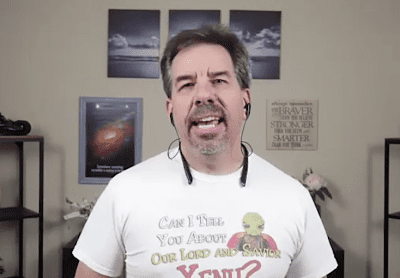
 Today we sit down with ex-Scientologist and Youtuber Chris Shelton to discuss a brief history of Scientology – with a focus on parallels between Scientology founder L. Ron Hubbard and Mormon church founder Joseph Smith.
This interview is the first in a series of 4 interviews with Chris as we will follow the chronological history of Scientology and draw parallels between the founding of both churches, and draw comparisons between their modern-day presences.
__________________
All of our interviews with Chris may be found here:
- 1189-1191: Scientology, L. Ron Hubbard, and the Parallels to the Beginnings of Mormonism – Chris Shelton
- 1192-1194: David Miscavige and the Rise of Modern Scientology – Chris Shelton
- 1195-1198: My Life as a Scientologist – Chris Shelton
- 1199-1202: Leaving Scientology and Becoming an Ex-Scientology Activist – Chris Shelton
__________________
Part 1: This transcript is machine-generated and lightly edited for readability. The audio is authoritative. Please excuse occasional errors in names and spelling. John Dehlin [00:00:00] Foreign. Stories is a production of the Open Stories foundation and relies solely upon the support of people like you, its listeners to help keep the podcast alive or to become a member of the community. Please become a monthly subscriber by visiting MormonStories.org and clicking on the Donate button on the right side of the page under Support. All contributions to Mormon Stories are completely tax deductible in the United States and go towards producing the podcast and building communities and programs of support for Mormons like you. Thanks for your support. Chris Shelton [00:00:53] Cry baby cry. Everything is gonna be all right. You gotta. John Dehlin [00:01:08] Hello everyone and welcome to another edition of Mormon Stories Podcast. I'm your host, John Dehlin. It is September 26, 2019 and as always, we're very excited to bring to you another edition of Mormon Stories podcast. Today we are continuing with the series that we began several years ago. The series is on interviewing people from other religious traditions about their awakening or their discoveries, their faith crises or whatever you call it, and their journeys out of their respective religious traditions and into whatever new life they've built for themselves. Many of you will remember interviewing Tova Mirvis, the exact ex Orthodox Jew about her book the Book of Separation. We've interviewed Lloyd Evans, ex Jehovah's Witness, along with Amber Skora, author of the book Leaving the Witness, and probably others as well, including Stephen Hasson, an ex Mooney who's a cult expert. Today we are super excited to be interviewing Chris Shelton. It's going to be probably the first of a two part interview with Chris. Chris Shelton is an ex Scientologist and he is also a YouTuber and a blogger and an author and there's a lot of cool things about Chris. And today we're going to be covering a brief history of Scientology and then we're going to bring Chris back to talk about his story specifically. But before we do that, I just want to make one quick public service announcement. For those of you who don't know yet, we are trying to do something really important here on Mormon Stories. We are partnering with the Thrive Organization, which is an organization that's dedicated to healing, growth and community for people who have either left Mormon Orthodox or have left the Mormon Church. So November 17, 2019 Salt Lake City. It's on a Sunday. We're going to be bringing Amber Skora from New York to Salt Lake to have her speak to us. We're going to have we're going to be bringing Wayne Sermon, the lead guitarist for Imagine Dragons. We're going to have several other cool speakers. We're going to be having an all day conference with hopefully 4,000 of you because that's the maximum capacity. And it is going to be a think of it as like a general conference for ex Mormons. It's going to be inspiring speakers and music and community and friendship and maybe even karaoke, all focused on positivity, focused on healing from leaving Mormonism and finding growth and health and well being and community after Mormonism. And we hope you and all your friends will come. We've priced it at a loss. We won't be making any money from this event. In fact, we'll likely be losing several thousand dollars from this event and that's if several thousand of you show up. But we've priced the event at $15 a person. We want everyone to come. It's a full day of amazing talks. We'll be sharing the lineup of the full speaker list soon. But it's an amazing group of people. Hans and Brigitte Matzin are coming. Stephanie Sorensen Larsen, Christian Moore, Natasha Alfer Parker. I'm going to speak. Margi will be there. It's going to be an amazing day. But if you want to sign up now, please go to thrivebeyondmormonism.com you can sign up. Please tell all your friends and family please register as soon as you can so we can know that we're going to have at least enough people to justify the event. We've got about 300 that have signed up already pre registered and we need about 3,700 more. So please spread the word. It's going to be amazing. And again, thrivebeyondmormonism.com is the website. So without any further ado, we are so thrilled and excited to be bringing Chris Shelton on to Mormon stories. I've known of Chris's work for at least a year or two. We've been in dialogue for way too long about trying to get Chris on Mormon stories. Finally, he's here. Chris is a former Scientologist, a former Sea Org member. We'll be talking about what that means. And he's now an ex Scientologist. He's a writer, a consultant, podcaster, a YouTuber and an advocate for critical thinking. We're not going to spoil it by telling you his whole biography, but you should know that he's got an amazing YouTube channel that you should all check out. It's called Critical Thinker at Large. He has a podcast called Sensibly Speaking. His website. What's your website called, Chris? Chris Shelton [00:06:06] Mncriticalthinking.com and spell that for us. MN and then critical thinking. So CRI. John Dehlin [00:06:14] What does that stand for? Chris Shelton [00:06:15] It was from. It was Minnesota, because I used to live in Minnesota when I started it. Okay. John Dehlin [00:06:21] Mncriticalthinker.com Critical thinking. Critical thinking.com and Chris has been featured. Many of you will be familiar with Leah Remini's A and E series, Scientology and the Aftermath. He was a consultant to that show for the first two seasons and he's written a book called Scientology A to Z New An Insider's Guide to what Scientology Is Really All About. And that's available on Amazon and in printed form, ebook and audiobook. So prolific. You've only been out of Scientology for a few years, right? Chris Shelton [00:06:57] Yeah, yeah, about five or six. Yeah. John Dehlin [00:06:59] That's amazing. I'm just in awe. And we're so thrilled to have you on. Thank you. Chris Shelton [00:07:05] Thank you very much. I'm very thrilled to be on. John Dehlin [00:07:07] Anything you want to say about my introduction that I got right or wrong or did you want to add? Chris Shelton [00:07:12] You are awesome. My YouTube channel, by the way, is just my name, Chris Shelton. Yeah, but otherwise you were perfect. Nailed it. John Dehlin [00:07:20] And you're kind of buds with Jonathan Streeter, right? Chris Shelton [00:07:23] I am. We just recorded this week a three Apostates podcast for this weekend with Jonathan and with Lloyd Evans. John Dehlin [00:07:32] That's so freaking amazing. And YouTube, really within Mormonism, YouTube is really an. Kind of a underutilized resource. I've had a YouTube channel for a long time, but I just publish these long form interviews that are five or six hours long, sometimes 12 hours long. But that's not how YouTube is working these days. So there's a lot of unchartered territory in Mormonism and post Mormonism for YouTube. But it's great to have you on. Chris, thanks for joining us. Chris Shelton [00:08:01] Absolutely, thank you. John Dehlin [00:08:03] All right, so we want. When we interviewed Lloyd Evans, ex Joe's Witness, we kind of broke up into three parts. The three parts were history of the Jehovah's Witness movement, what Jehovah's Witnesses believe now, and what it's like to be a Jehovah's Witness today. And then I wanted to have Lloyd just tell his own story, which in and of itself was heartbreaking and inspiring. I kind of want to follow a similar format. I don't know how much we're going to get to today, but I want to give at least a good three hours to the History of Scientology to give people a background of what we're going to be talking about with what it means to be a Scientologist today. What it means to leave Scientology and, and your story. But I'm also going to just give the disclaimer or the acknowledgement that many of my listeners have probably seen the Going Clear documentary, although I'm sure there are many who have not. But if you haven't, that's an amazing documentary that's based on a book by. Is it Lawrence Wright? Is that his name? Chris Shelton [00:09:01] Yes. Pulitzer Prize winning author Lawrence Wright. Yes. He's awesome. John Dehlin [00:09:05] Phenomenal author, phenomenal book, phenomenal documentary. And I'm just hoping we'll be able to sort of, you know, get, get a different point of view. That was going to incorporate a lot of that stuff, but maybe you've got extra info or insight or personal experience and we'll be able to dig a little bit deeper because we're not trying to jam it all into an hour and a half or whatever it is. I'm hoping that my listeners will. Will tune in even if they've heard Going Clear, because I guess they're going to. I'm guessing they're going to get valuable stuff in addition to what they would have heard there. Chris Shelton [00:09:39] Absolutely, yeah. The Going Clear. Absolutely, yeah. I want us to say right off, since we're talking about that the Going Clear documentary is the best two hours. If you only have two hours and you want to understand Scientology, that is the thing to watch. But you are going to have a thousand questions after you're done with it. So I'm going to try to fill in the blanks on all of that. John Dehlin [00:10:03] I love it, so that'll be great. We're excited and as always, we are live streaming this episode. Jonathan Streeter is already tuning in. Hey Jonathan, thanks for all your great work. We've got several people tuned in. Judith is watching from Texas. Laura Lee says you're the best. I don't know if she means you or me. Victoria is joining us from the UK Again, Jonathan Streeter's joined us and I'm guessing the listenership is going to grow over the next few hours. But the reason why I'm mentioning that one of the main reasons we live stream is to be able to get comments and questions from our listening audience. So if you've got comments or questions or feedback or personal anecdotes or whatever, we just want to make sure you feel welcome in sharing. So welcome all our livestream listeners. We look forward to collaborating with you. Also, shout out to Jeanne in Oklahoma, Melissa, and everyone else who's joined us. All right, so without any further ado, tell us about L. Ron Hubbard and the founding of Scientology. I am. I cannot get enough of this story. So let's do it. Chris Shelton [00:11:16] All right. Let's get to it. Lafayette Ron Hubbard. Ronald Hubbard. John Dehlin [00:11:20] So the L stands for Lafayette. I didn't even know that. Chris Shelton [00:11:24] That's right. He was born in 1911, March 13, 1911. And he, I think, until the Nebraska. And he grew up in the Midwest, and he was definitely a Midwest boy, a product of that time. And by that, I mean that, you know, casual racism was just part of his growing up. He was a very flamboyant guy. He was always an attention seeker. As a child, he had flaming red hair, which made him stand out in a crowd. And he was kind of a lanky guy, and he was into, you know, kind of beating the bush and running around and being a wild, wild kind of kid. He was a boy scout, and he. And he got around. And he had a unique childhood in that he traveled quite a bit. He traveled to China, he traveled to Guam. He traveled around. And even as a. John Dehlin [00:12:14] Like before his military service, you mean? Chris Shelton [00:12:16] Yes, before his military service as a minor, in fact, because father was in the Navy, and his father was named Harry Hubbard, and he had been stationed out in Guam, and Hubbard was in school, I think, in Washington state at this point. And I think this was when he was about 14 or 15, 16 years old, and he just skipped school, got on a boat and went out to Guam. Right. Just took off to San Francisco, figured out how to get on a boat, did so. And he's like, hi, dad. And they're like, what are you doing here? You know, this was kind of how he was. And he was always into telling, you know, flamboyant stories. He had a very, very, very active imagination. And he did not. He had a disdain for school. He didn't do well in structured, organized situations. So his school grades suffered as a result. But he was always the guy who was on the school newspaper or was on the. I think he had some involvement with sports. I know in college, he was involved with the ROTC type program. And so I think he had kind of an affinity for the military, which was interesting because he was so non structured in the way he led his life. And then when the depression hit in the 30s. John Dehlin [00:13:39] Can I ask you a quick question? Can I jump in? Chris Shelton [00:13:41] Absolutely. John Dehlin [00:13:42] Was he raised religiously at all? Was he part of a religious tradition that you know of? Chris Shelton [00:13:47] Not that I know of. It's actually not really talked about very much. And I've sort of got the idea that it wasn't a strong religious household, perhaps as average or ordinary as any other Midwest. You know, sort of out in Nebraska sort of household. You know, I mean, they might have gone to church, but he never actually commented on it. He had a lot to say in his later years about the problems with organized religion. He was very, very down on it. He considered the whole thing a big control operation. But he never really talked about having a religious upbringing. So I don't really know that that was part of his life. John Dehlin [00:14:24] Yeah. Yeah. That's really interesting. Okay, cool. I was just curious. Chris Shelton [00:14:29] Yeah. So I'm just kind of, you know, given a little thumbnail here of his. Yeah. Of his childhood. And then by the Depression years, he was making his way as a writer. He had tried. And I won't get into all the details of it because it's, you know, there's a whole bio on this by Russell Miller called Barefaced Messiah that really exhaustively lays all this out. But he was a writer by the depression times, and he was writing for fiction and nonfiction. Like he wrote for Sportsman, Pilot, and he wrote for, you know, he was a pilot. He liked flying, barnstorming. So he learned how to do that kind of thing. And then he would write about it and he would write stories based on those kind of experiences. And because he had traveled around in Indonesia or, or China, he had some experiences that other people didn't have. So he would utilize those experiences in his writing and he got into writing pulp fiction. And that's basically what sustained him through the depression years. John Dehlin [00:15:29] Tell us what that means. I mean, some have heard of the Tarantino movie, but what does pulp fiction mean? Chris Shelton [00:15:35] Pulp fiction was the entertainment, the dime store entertainment of the 1920s and 30s, and I think all the way into the 40s where people would buy magazines filled with stories and they were printed on pulp paper. They were really cheap. They were like $0.01 $0.10 for a collection of stories. And some of these were serialized stories and some of them were one offs. And Hubbard was prolific. He could whip out one, two, even three stories just staying up all night banging them out. And he was the kind of writer who pounded them out. He was a one finger typer, but he could type really, really fast. And he just kind of whipped it out, stuck it in an envelope, sent it to the editor. There was no second drafts and corrections and all that kind of thing. And he was very full of himself as a writer. He told many stories in his lectures in later years about how editors would give him a hard time or other writers would challenge him or give him a hard time, and he would always put them in their place. And you see signs from his stories early on that he had a temper and he had a fairly vindictive nature. He was not into being criticized. He thought that what he was doing was 1000% the best work that could be done. And he was a great writer. And you look at his pulp fiction, and I am a writer, and even when I was a Scientologist, his pulp fiction was kind of difficult for me. I never got on the. The fiction train with Hubbard. I never really liked his pulp fiction. And there's a lot of Scientologists who do. I find the dialogue trite, and I find the stories rather, you know, cut and paste. So. But he made a living at it, and there's no denying that. And he was creative. He wrote across all genres. He wrote westerns, he wrote sci fi, he wrote mystery, he wrote romance. You know, people say he's a sci fi writer, and they're right, but he was a lot more than that as a writer. And I'm not plugging him. I'm just saying that was his deal. You know, he was prolific. He didn't really care what he was writing about as long as he was making some money doing it. And he got into social circles with this. There were writer circles. This was kind of a celebrity circle to be in. And his name was up there. He put his name on covers of magazines, and he wrote under many, many pseudonyms as well. He had tons of them. So there actually were valid instances where I think at least once or twice, pulp fiction magazines were published, and they were all his stories under different names. Right. So anyway, that's how he made his living. And then the war came, World War II came along, and he signed up. He wanted to be in military intelligence. That didn't work out for many, many reasons, mostly having to do with his ego. And he really is very, very full of himself. He was always that way. And so in the military. And this is really, really strong. John Dehlin [00:18:37] His bio that he tried to apply to the Naval Academy and didn't get in, right? Chris Shelton [00:18:43] Yeah, he tried to. He actually was an officer in the Navy. I mean, he did get in, but he. But he didn't ever see combat, for example. I want to lay this out a little bit because it's important to the later story. This is actually the place where actually I should back up. There actually is something earlier than this. In 1928, Hubbard talks about having gotten a dental surgery and dying during that process. Now, whether he Actually died or not. He had some kind of out of body experience. And he claimed. And he claimed to die, go to a place, you know, tunnel of light, all that, where he was shown all the mysteries of the universe. They were all laid out like a smorgasbord, he said. And he saw these answers to all these things. But then he got pulled back. They resuscitated his body and he got pulled back. And they tried to make him forget, but he said he didn't forget. And so he came back and he had this epiphany and he thought that he had clued in on a secret of the universe or secrets of the universe that would. That in his words, would. Once he put it down on paper and he wrote this book, would outsell the Bible, would be like, bigger than, you know, than anything that had ever come before. This was literally his thinking as a result of this incident. John Dehlin [00:20:11] And this is. Looks like it's 1838, which was a few years before the US entered World War II. So just to give people a sense for the year around. Chris Shelton [00:20:22] Yes, correct. He was 20. Yeah, 27, I think, at the time. So, yeah, 38. And this was the book that was called Excalibur or the Dark Sword. And this book, Hubbard later claimed, we don't have this book. Nobody's got it. I know literally two people who have even seen it. It's up in the archives of the Church of Scientology International, and nobody has seen hide or hair of it. Hubbard later, he tried to sell it to a bunch of publishers. Nobody wanted it. And so what he did was he put it away, you know, sort of. And he walked off in a hump and sort of put it away. And then the war happened. And he referred later to this book, Excalibur, and said, most of the contents of it have been sort of released in the. In the Materials of Dynamics and Scientology. But it was about mankind as a species and how we interact with other people and our secret sort of desires and stuff. And really what I think was it was a big book of Hubbard's projection of his personality onto everybody. But like I said, I haven't read it, so I can't say for sure. But this book was a turning point in L. Ron Hubbard's life. And that's why I'm talking about it. He truly believed. There is no doubt in my mind, that he had hit on something very, very important philosophically. And he thought that he was going to be able to help a whole lot of people with this information. He later described it and this is kind of interesting. Maybe this will give you some insight into his, into the way he thought about things. He later described it as a book where he called it. He called, he said the reaction you would have to reading this book was going up the pole. And he described it as if you were a two dimensional earthworm or something and you were on a two dimensional plane and you were going along and that's all you could be aware of was two dimensions and suddenly you ran into a three dimensional pole. You'd bump into it and you'd have no, you know, you wouldn't be able to tell what this thing was because you'd never, you wouldn't have any concept of it. And you, but if you could somehow get a concept of it and go up the pole, you would go from a two dimensional existence to a three dimensional existence. And that obviously would be a life changing event. And that's what he described. People would have the experience of when they would read this book, except of course for the publishers who passed on it. Right. They didn't have that, never talked about them. Right. He only talked about these other people. Right. So anyway, he, I know for sure, I really feel very strongly that he felt that was a very pivotal moment in his life. But not getting the reception that he wanted. He kind of said, well, fine, you can't have it then. And he locked it away and didn't really talk about it too much anymore. He said later on also that the Russians heard about this and that they stole a copy of it from him. But that's pretty much just, you know, nonsense. There's really no evidence at all to back up his claims and lots of contradictory evidence to it, actually. So that happened in 38, then the war happens and after the war. John Dehlin [00:23:40] Yes, that. You know, I always try and pull parallels back to Mormonism and other religious traditions and a couple parallels I'm seeing with Joseph Smith. And I don't know if L. Ron Hubbard kind of grew up in poverty or not, but, you know, religions often start with someone writing a book and oftentimes religious start with some claim to an epiphany, some type of transcendent experience which no one will ever really know. No one will ever. It's impossible for anyone to know whether or not the experience really happened. But there's often a high probability that the person who claimed to have that experience maybe really thought they did have some sort of experience. Now how accurate they were about describing it and how much they committed fraud or other things later is a separate Thing. But it's sounding like you're saying that L. Ron Hubbard not only, you know, claimed to have some sort of transcendent experience, but that he. That he really believed he did and that his core motive was kind of to help humanity. Is that all fair to say? Chris Shelton [00:24:48] I would say that all of those things are true, but there are many, many, many other factors that also enter into the picture which we will develop. John Dehlin [00:24:57] Makes it so fun. Chris Shelton [00:24:58] Yeah, that's right, exactly. And by the way, he and Hubbard, by the way, did not grow up in poverty. He had a comfortable existence. You know, it was Midwest, it was out, you know, in the frontier and stuff. And he did a lot of traveling, like I said, but he didn't really suffer for anything or need for or want for anything as a child growing up. And he came from a big family, very supportive. It wasn't just his mother and father. His aunts were around, his grandfather was around. They were, you know, it was a. It was a tight family, which of course was the exact opposite of what Hubbard did later. But that was how he grew up. He didn't really have an abnormal or strange childhood that we can tell from the records and documents and testimonials. Okay, so World War II was another pivotal thing because Hubbard got into command situation. He was awarded officer rank and he was given command of a vessel. He went out to Australia and screwed around there for a little while, but they basically kicked him out. There's a lot of details to all of this I'm not going to get into, but he was what we describe as a very egotistical individual. So he bucked command and he bucked orders, and he didn't get along well with others. He didn't play well with others often. And this ran him into a lot of trouble. And he would misrepresent all of this later on, of course, but this was the fact of the matter. According to all the military records we've dug up, he claimed, for example, that he went over Australia and he was like the first United States officer over there or something, and he single handedly repelled some kind of invasion force or something. I mean, he really had some pretty tall tales about his war experiences. None of that stuff was true. There's a man named Chris Owens who has done some really championship research into Hubbard's war time, and he put a whole book together on that, which you can check out. So that's kind of all detailed there. But I'll tell you about two things that happened that were. That were telling. He was Sent back to the United States and he was given command of, I believe, a PT boat off the coast of Oregon. There was the idea that the Japanese could bring submarines all the way to the coast of United States western coast and they could perhaps, you know, lob some. Some missiles or something into Portland or something like that. So they were patrolling off the coast of Oregon and Hubbard thought that they had detected a Japanese sub. So for two days they start shelling and shelling and shelling the water, trying to kill this sub. And yeah, no, turns out actually they were actually bombing a magnetic anomaly of some kind in the water. And he thought that they had seen all this action and in fact they hadn't seen any action at all. And the whole thing was of silly. It was later investigated by the Navy. The whole incident was. And they said, yeah, that's not what happened then because he sort of, you know, was not. He wasn't well regarded after that. But he then sailed down the coast of California, down to Baja California and Mexico, and for whatever reason, decided it would be a really good idea to engage in target practice on a piece of property that was owned by Mexico and started bombing the hell out of that. And that got him relieved of his command. So, yeah, they weren't too happy with him about that. And he later claimed, you know, that this was all combat war action and all this kind of thing. But the real fact of the matter is I don't think he ever saw one day an actual combat in World War II. But near the end of his term, right, he had been relieved of command. So he was, you know, kind of a disgraced officer. And there was some incident, I think some magazines or explosives went off on the boat that he was on and he was injured. And so he got sent to Bethesda's Bethesda Naval Hospital in California, that's in the Bay Area. And he spent, he said, half, about a year there convalescing. Now this is all made up. There wasn't anything to really convalesce from. The actual records show he had ulcers and some eye problem, infection or something. And that was about the extent of his problems. But he was malingering there and he. So there's kind of two different stories running in parallel. John Dehlin [00:29:36] Psychological term meaning faking an illness. Chris Shelton [00:29:39] Exactly, exactly. John Dehlin [00:29:41] So listeners who. Chris Shelton [00:29:45] Yeah, so he, he kind of hangs out there now just for information purposes. He was also married at this point and had two kids. And his wife and two kids were up in Washington state where he left them when he went off to the Navy, he ends up in California. And he did not go back to his wife and kids, did not maintain communication with them much. And instead, after he finishes his thing and gets kicked into the reserves because he's off active duty now, he's out of the active Navy and he's into the reserves. And he ends up traveling down to Pasadena, California. And this is 45, I think 44. 45. Don't quote me on that. But it's in the 1940s for sure. He ends up five minutes. John Dehlin [00:30:37] When he went to World War II, he was married. Chris Shelton [00:30:40] He was. John Dehlin [00:30:41] And did he have kids with that first wife? Chris Shelton [00:30:44] Two kids. John Dehlin [00:30:44] Okay. And you're saying that once he got back from the war, he kind of bailed on the family, is that right? Chris Shelton [00:30:49] That's exactly what I'm saying. John Dehlin [00:30:51] Okay. All right. Chris Shelton [00:30:51] And it actually gets. Yes. And it gets worse from there. So. Yeah, so he goes down to Pasadena because he is still a writer. He's trying to get back into the writing game, but he's slow. He's kind of dejected, obviously, for somebody like him. I mean, if you kind of put yourself in his shoes for a second, which is kind of hard to do, but if you can do it. He was all about himself and how awesome he was. And he just had this war experience that was the exact opposite of all of his expectations of what he thought he was going to pull off. He thought he was going to go into military intelligence. He thought he was going to be King Cock of the walk and all that. No, none of that happened. So he was pretty dejected, pretty demoralized. After the war, he gets back into writing circles. He's having trouble writing, he's having trouble focusing. And he meets up with some other writers and ends up at a house in Pasadena owned by a legit rocket scientist named Jack Parsons. Jack Parsons was one of the founding members of Jet Propulsion Laboratory in Pasadena. And this was. That's right, early stage rocket science. Well, mid stage rocket science. And truly Jack Parsons really knew what he was doing with that. But the other thing that Jack Parsons was involved in was the occult. And that was the other side of him. And they've even made a TV series about him now. I forgot what it's called, but they're dramatizing the hell out of that. But Jackson was cold. John Dehlin [00:32:24] Do you mean like astrology? Do you mean tarot cards? Like, what do you mean? Chris Shelton [00:32:29] I mean the Ordo Templi Orientes and Aleister Crowley. That. John Dehlin [00:32:35] Oh. Aspect of the occult, that's like the classic Church of Satan stuff before the Church of Satan became secular. Right? Chris Shelton [00:32:45] Exactly. That's exactly right. And the Ordo Templae Orientis, the oto, that was part of it. There were rituals. There's blood magic. It's magic with a K. So Aleister Crowley, of course, was his own kind of nonsensical figure and infamously famous as the Beast and all that. Hubbard and Crowley never actually met. Crowley was over in England at this. Parsons was Crowley's acolyte and student. Right, meaning student. And he was really into this black magic stuff. The other thing that Jack Parsons was into was sharing his house with all kinds of odd people, right? Pseudoscience, believers, gypsies, fortune tellers. He loved all that kind of stuff. He just loved it. And he had this really big. John Dehlin [00:33:33] My listeners like to remind people that gypsy isn't a term we use today sometimes because people find it. Chris Shelton [00:33:39] Oh, sure. John Dehlin [00:33:40] But that's not to correct. Chris Shelton [00:33:41] Fair enough. John Dehlin [00:33:42] It's just. I don't want my listeners to get mad at me. So. Chris Shelton [00:33:45] Fair enough. John Dehlin [00:33:45] Keep going, keep going, keep going. Chris Shelton [00:33:47] Yeah, I just met nomadic people who are not really tied down by anything and have some pretty interesting beliefs. John Dehlin [00:33:53] We know what you mean when you say it, but then we're not supposed Chris Shelton [00:33:56] to say it, so fair enough. Okay. So this house that. That L. Ron Hubbard arrived to, to meet Jack Parsons and find a place to stay for a little while because he was kind of out of a home because he wasn't willing to go back to Washington and get back to a normal life. That wasn't Hubbard's thing. He wasn't into going back to that family. He wasn't a family man that way. So he arrives here and Jack Parsons takes him in. He finds him to be a flamboyant, interesting character. And of course, at this point, now trying to ingratiate himself with Parsons, get this free, you know, have a. Have a cheap place to stay, he starts telling all these tall tales about his history, his war record, etc. And Jack Parsons had a girlfriend named Sarah. John Dehlin [00:34:54] And Chris Shelton [00:34:57] Jack was also unconventional for the 1940s into open relationships. So he was kind of like, you know, free love, all that. He was kind of down with that. So Hubbard comes in and says, oh, yeah, well, this girl you're hooked up with is kind of cute. I think I want her. And he starts moving in on her and gets her to kind of couple with Hubbard. So he basically steals Jack's girl, so to speak, because Jack was a little jealous. We know a lot of this because Jack kept Journals. Hubbard talks about this period a little bit. The church has whitewashed all of this. But Hubbard actually got involved in occult practices at this house with Jack Parsons and they engaged in sex, magic rituals involving blood and masturbation and sexual practices. And again, I don't want to go into all the gory details because it's kind of complicated and very weird, but that much of it gives you the flavor of what life was like at this house. John Dehlin [00:36:10] Just to draw a couple more parallels, we know that when Joseph Smith was a young boy, he heard about Sally Chase, a glass licker. He learned about Lehman Walters, you know, a charlatan that would come into the community. And you know, what we have here also as a parallel is kind of like the young aspiring, eventual religious founder finding mentors in various, you know, various different sort of approaches to being a charlatan, let's just say. And that that's often how they get. Learn some skills, get the training, catch the vision for how they might be able to influence people, let's just say. Not to mention the kind of, some of the sexual explorations, I guess I'm just saying I'm seeing a lot of similarities between Hubbard and Joseph Smith even into this part of the story, of course. Chris Shelton [00:37:10] Yeah, for sure. It's so interesting the, the foundational events that happen in these peoples, in cult leaders lives and how it directs them to where they end up going. John Dehlin [00:37:21] Yeah, all right, so he steals, steals, steals Jack's girl. Chris Shelton [00:37:25] Now there's. But it gets better now somewhere. And I'm not sure, I've never been able to figure out exactly when, but somewhere along the line, Hubbard learned how to hypnotize people. And he was actually good at it. So that was a skill that he also obtained during this time period or before it. I think it was here. I think it was around this time or just before. But nobody's really clear on exactly, precisely when he learned how to do it. But everybody knows and commented on the fact that he could. And he would do it as a party trick. You know, he'd wrap a towel around his head. He told stories about this and he said it was actually very, very easy to do. And he would comment in some of his lectures about how easy it would be to fool people. And it was interesting because he was doing that and commenting on it at the same time. But he was anyway. But the way he presented Dianetics, it seemed like he was talking about that, but he was presenting Dianetics as a foil or a counter to hypnotism. And yet, anyway, we'll get to that. But that's exactly what he was doing to people. So it needs to be noted that he had that skill and it was something that he was actually good at. John Dehlin [00:38:33] And this is very reminiscent of Joseph Smith's fortune, his treasure digging glass looking, where he would convince people that he had the ability to find buried treasure when he never did. But he knew that he had the power to make people believe that he had the power. Chris Shelton [00:38:49] Exactly. John Dehlin [00:38:50] So it's that learning can have undue influence on people and then figuring out how to make a living off of that, basically. Chris Shelton [00:38:58] Precisely. And I have to note I didn't bring this up earlier, but just because you brought up the treasure hunting thing, I have to mention that Hubbard famously was involved in his 20s, right after college, in a voyage to, I think, Puerto Rico to find buried treasure. And it was a total mess. It was a complete disaster. They turned around before they even got there or got there. And hardly anybody was left. And it was just. The whole thing was a mess. Hubbard was a very poor organizer. He always was. He had very little business sense, he had very few poor organizational skills, and he spent money as fast as he got it. He was that kind of a personality. He would always just sort of, I'll glow it, right? I'll get more money somehow. And he always somehow managed to pull stuff off. But there were times during this time period, especially during the 1940s, where Hubbard really was on the skids and really almost completely, you know, dead broke. So he was struggling during this time. So Parsons was a way he thought he'd, you know, be able to stop struggling. Okay, so he gets involved in the sex magic stuff. Now there is evidence from Hubbard's personal writings during this time that were uncovered decades later that Hubbard actually believed in this magic stuff too. Or at least in the aspect of a guardian spirit. Because why would you write about that in your private papers that you would never expect to have experience exposed. Not a book, not a memo, not an editorial, but his own journals, right. Where he would write about this stuff. And specifically what he wrote were self hypnosis commands where he referred to his guardian spirit and how he was the master of all men and he was desirable by all women and men envied him. He made pages and pages and pages of these things that he would engage in self hypnosis sessions to convince himself of this stuff. We also know that he physically wasn't well. He had intestinal problems, he had vision problems, and he was trying to self hypnotize himself out of that stuff too. So the 40s was an interesting time for Hubbard. There was all kinds of stuff he was involved in. But what ended up happening at Parsons place was he does this sex magic stuff, but he also is always looking for the angle, you know, how can John Dehlin [00:41:23] I give us a three sentence description of what sex magic is? Chris Shelton [00:41:31] Ritualized ceremonies to. For enlightenment, for personal enlightenment and power. Personal power John Dehlin [00:41:42] that involves sex sex? Chris Shelton [00:41:44] Yes. And blood? Yeah. There's you know, like cutting and like a chalice and you put some blood in it and you mix in the wine and you drink and you, you know, or you jerk off or something. I mean there was just all kinds of, I don't know, all the specifics of the rituals except that it involved those things. This has been very well described. John Dehlin [00:42:04] Sex, blood, wine, some type of ritual. Chris Shelton [00:42:07] Yeah. John Dehlin [00:42:08] With the intent of what? With the intent of. Chris Shelton [00:42:10] Well, of creating a moon child. There was this idea that they were going to create the Antichrist or this moon child. And it's a little hazy because of Crowley's mixture of Christian beliefs with other stu. You know, it's not exactly like they're just creating the Antichrist out of apocalypse or something. I mean, there's all kinds of other stuff mixed into it. It's a complicated mythological system that Crowley created most of it while he was on some very, very, very serious hallucinogenic drugs. So trying to read through Crowley's materials, which I've tried to do and make sense of them, is extremely difficult. John Dehlin [00:42:49] But you have a sense of that Hubbard did believe in some sort of supernatural force that he was flirting with or playing with. Chris Shelton [00:42:57] Absolutely no question about it. John Dehlin [00:43:00] Religious belief there or metaphysical belief there. Chris Shelton [00:43:04] Yes. He believed in a guardian spirit that was watching over him. And I believe he said she had flaming red hair like his. John Dehlin [00:43:11] Right. Chris Shelton [00:43:13] And so he kind of rode, got on that Parsons train and started riding it. And he perhaps did it for self improvement. That could have definitely been part of the picture or self aggrandizement and personal power. He was very, very. You could tell from his own personal readings, like I said, that he was very into the idea of dominating other people, of being superior to other men and being desirable by all women was something that really appealed to him. These were life goals for him. So he wasn't just a regular guy trying to get along in life. He had delusions of grandeur and he tried to make those manifest in the real world. And this was one of his first attempts at a supernatural solution to those problems, to those delusions. That's really why this period is so important because it's the first time that we know of that he maybe tried to touch back into that reality that he thought he had touched into from that dental surgery. You know, maybe trying to connect those dots there. So I think there was personal interest in this magic stuff as a conduit or route to be able to do that. Didn't really work out so well, but that's what he tried to do. Now with Parsons and Sarah Hubbard always was working on money cons also. He was the kind of guy who'd borrow money from you and tell you you'd pay you back, but then he never would. And then he'd come around six months later and hit you up again. You'd be like, dude. And he was that kind of guy. John Dehlin [00:44:57] But you know what the magic there is that people must have liked him enough to be willing to suffer that character flaw. In other words, the magic. You know, the interesting thing wasn't the fact that he may have built people out of their money, but that somehow he was able to ingratiate himself so that people were somehow okay with that and still came back for more. Chris Shelton [00:45:23] Somehow. Yes. There were people who got sick of his. You know, sick of him. And I don't know how much I should curse here. There were people who got sick of him, and there were people who kind of put up with him or needed him for some reason. Like, for example, his editors, right, when he was writing, you know, they kind of put up with his nonsense. And some other writers loved him, and some other writers hated him. You know, he had a reputation. Okay, so where this goes with Parsons, though, is within six months of moving in. I think he moved in in October. And by, like, May or something or April of the following year, he had gone into a business deal with Sarah. And with Jack. With Jack being the one to put up most of the money. I think he put in $10,000. And they were going. It was a whole lot of money back then. And he was. The idea was there were going to be these boats that Hubbard and Sarah were going to go pick up in Florida and sail to Los Angeles. And they were going to do some kind of tourist excursion thing or something like that. Somehow these boats were going to be useful to them in this business venture. Well, Jack pays over the money. Hubbard and Sarah fly to Florida, buy a couple boats, and proceed to spend the rest of the money and not tell anything, not tell Jack a thing. And basically, they just kind of skipped town with his money. And within about a month. Month and A half. Jack was like, I think I just got taken for a ride. And he writes to Crowley and Crowley's like, you idiot, you just got taken for a ride. Right. And he then pursues legal recourse through Florida officials. I think this was in Tampa or Miami. And ends up tracking Hubbard and Sarah down. And they're living high on the hog on Jack's money and just kind of hanging as though there's no consequences to any of their behavior. And Jack manages to get his. The rest of the little bit of his money back. So Hubbard now has no money, and they've got like these three boats. So they sell two of the boats, get in one, and I think they. I think they sold all the boats and travel up to New Jersey. Now Hubbard is still married. John Dehlin [00:47:37] I just have to throw a couple things in. Chris Shelton [00:47:39] Yes, yes. John Dehlin [00:47:40] It says in his bio that he bigamously married Sarah. Chris Shelton [00:47:43] I'm about to get to that. John Dehlin [00:47:44] Oh, okay. Go ahead. Keep going. Chris Shelton [00:47:46] Yeah. This is when it happens. Okay. Yeah. John Dehlin [00:47:52] Connection. Somehow polygamy. Polygamy has to sneak in, you know? Chris Shelton [00:47:56] Yes, that's right. It absolutely happened here. And what happened was Hubbard was, remember, was still married to his first wife and had two kids up in Washington state. He was still married. He's philandering around with Sarah. Well, they go up to New Jersey and they get married. Now Sarah has no idea that his first wife, whose name is escaping me right now for some reason, but his first wife was off the radar. She had no idea that this woman even existed. Hubbard and Sarah move back to Washington state. John Dehlin [00:48:30] It's Margaret Grubb. I just looked it up. Chris Shelton [00:48:32] That's it. John Dehlin [00:48:33] Margaret Grubb. Chris Shelton [00:48:34] That's it. Polly. John Dehlin [00:48:36] She deserves a mention. Chris Shelton [00:48:38] Yes, big time. Because she put up with an unbelievable amount of crap from Hubbard. He shows up in Washington with Sarah as his new wife, and people are like, it's awkward central. Right. I took a year, and I'm not even going to get into, you know, whatever loose details we have about what happened there. But they end up getting a divorce. Right. It's a scandal. It's a problem. Hubbard, of course, during this whole time, is barely paying any money back to his wife. I mean, she's scraping in existence by raising these two kids. And Hubbard's just a total deadbeat dad. I mean, completely. And then he can. Then he shows up with a new young wife and what? You know, so this was kind of scandalous. Then he ends up going back to New Jersey because he. And this is 1948, 49 time period. Now he's barely scraping by, by the way. Right. He's trying to tell the VA to increase his monthly stipend because he's got all these wounds and war wounds and all this kind of nonsense, and he's gravely ill, and yet at the same time, he's not really gravely ill at all. And he's living as much of the life of Riley as he can, and he ends up back under Joseph John Campbell, editor of Astounding magazine. Creator and editor of Astounding magazine. Now, Hubbard had known him for years. They'd been old friends. And he ends up putting him up at his New Jersey home. He puts the Hubbards up there, right, Because Sarah is now a Hubbard, and by the way, she gets pregnant. So this is the time period where dianetics starts being formulated, and dianetics is where it all starts. As far as the Church of Scientology goes, this is where things really get going in the chronology of the Church of Scientology. And Hubbard wrote a manuscript, and this was published in Astounding magazine. It was called Terra Incognita. You know, unknown territory. Right. The mind. And he's writing about the mind, and he's got this whole sort of theory of a reactive mind and how the reactive mind is a part of your mind that only stores incidents of pain and unconsciousness that happened to you during the course of your life. John Dehlin [00:51:05] And it sounds like he's talking about the amygdala, right? The fight or flight, you know, center of the brain. Chris Shelton [00:51:10] Yes. And that's actually a bit of a misnomer, actually. Neurology is actually telling us now that that's not really what the amygdala does. But, yes, that's. Yeah. The amygdala, actually, apparently, from what I've just read, is actually the part of the brain that recognizes novel or new experiences and lights up the rest of the brain to tell you, hey, guys, guess what? We're experiencing something new and different. Time to learn what's happening, as opposed John Dehlin [00:51:37] to the same old, same old response in the brain. Chris Shelton [00:51:41] Absolutely. John Dehlin [00:51:43] And it sounds like that's what Hubbard was describing with his reactive brain, right? Chris Shelton [00:51:49] Not exactly. It was much, much, much more detailed than that. And I'm gonna lay it out for you here. Fight or flight is a response to an immediate threat or danger. The reactive mind Hubbard posited is an actual storehouse for mental image pictures that you are taking every second of every moment of your life. And these pictures are being stored in this reactive mind when you are experiencing moments of trauma, stress, pain, and unconsciousness. In order for an image or a picture. To end up in the reactive mind, you have to have pain connected to it and some degree of unconsciousness, even if it's just a millisecond of unconsciousness or a slight lessening of your analytical ability or power. And he divided the mind into an analytical mind and a reactive mind. So the reactive mind, Hubbard said, was the animal mind. It's the part of the mind. It's the mind that every. That animals have and that people. You know, he sort of. He sort of made some evolutionary stabs. But later he evolved this into spiritual entities and non physical things. But at the time of Dianetics, he avoided the whole structure question. He called it. He said, we're not going to get into where these pictures are stored or what part of the brain is operating on this or any of that. All I know is that when we do this procedure on people, it helps them. And so the idea here is that we are taking the trauma away from these incidents of stress and trauma and pain and unconsciousness. And he called these incidents engrams. Engram. Engram is a medical term for a trace memory in a cell, in a cellular body. And Hubbard just kind of absconded with that word because he thought it sounded good and had something to do with his concept of what was being stored in the reactive mind. They were wondering, you know, maybe it's being stored cellularly or maybe it's in the brain somewhere or whatever. And they. They eventually skipped out of that whole question. But the existence of engrams is foundational to Dianetics and Scientology. This is very, very basic part of the philosophy. John Dehlin [00:54:11] So you're going through structural parallel there. Mormonism's got this concept of the natural man. And then in Joseph, certain writings, you'll hear him writing, the natural man is an enemy to God. And so, you know, it's just this concept of like, you know, your natural, almost animalistic, primal self is. And this is very Christian, by the way, is very dirty, or it's dark, or it's, you know, flawed. And what we want to do is help you to become more of an enlightened human. So structurally, it just seems like religions need to sort of like condemn the biological, foundational, natural, primal self and then elevate some sort of theoretical ideal that they can either hold you down and guilt and shame about, or get you on a hamster wheel working towards some sort of unachievable ideal. That's what I'm hearing here. You can tell me if I'm totally off base. Chris Shelton [00:55:15] No, no, you're right on the line. And Hubbard didn't do it through religion to start with, though. John Dehlin [00:55:21] Yeah, yeah, yeah. Chris Shelton [00:55:21] And that's what that's. But you're absolutely online with that as religion. That's right. John Dehlin [00:55:28] Which is a con, you know, or as a philosophy that you just find religion becomes the most effective delivery vehicle. But we'll get to that quote later, right? We'll get to that. Chris Shelton [00:55:38] That's right, exactly. Hubbard started this and remember, he was working with Campbell, he was working with a medical doctor, Joseph Winter, and he was working with a couple other guys at Bay Head, New Jersey, on this whole thing. And they were working it over and coming up with different names for things. Like, at first the engrams were actually called, like comatomes or something. I mean, they were coming up with new terminology and stuff. But here's the real twist on this is that all this theory and structure of engrams and how you go through life and you this moment of pain and unconsciousness, and it affects you negatively because it's stored in a part of your mind that you don't have access to, ready access to. And so it's subconscious. But Hubbard said it was always running, so it wasn't really subconscious, it was really always conscious. But anyway, whatever the reactive mind is the subconscious beast that lies within you. And it will feed you these pictures with sensations and perceptions from that moment in time. Later on, if you run into that same context or situation again. And that's what's called restimulation. So you have the original incident and then you have a later incident. Let's say you got bit by a dog. I should probably explain this so we're really super clear about it. Let's say you get bit by a dog when you're five years old. This is kind of the classic example that gets used to one. You have the pain of a bite. You're five years old, you're in a little tiny body. It's very traumatic. You're crying, you're screaming. In fact, maybe the dog knocks you over and you pass out. The dog barking is one of the perceptions you experience at that moment. The smells, the sights, the sounds, everything. Maybe a car drives by, maybe your mom comes out and screams, get away from her. And you know, you nasty dog. You know, or something like that, right? Like all these things are being recorded straight into the reactive mind. They are no longer going to the analytical mind, which is your awake, aware, conscious mind. They're going into the reactive mind. You're not going to have a memory of all of this traumatic episode, even though your mind is recording all of it. So later on, you recover from that. You come back around when you're not unconscious anymore. You're no longer feeding the reactive mind, and your analytical mind starts coming back online and life continues. But then, let's say a year later, 6 years old, 7 years old, 20 years old, doesn't really matter. There is no time in the reactive mind. It doesn't care about time. So you know, it doesn't matter when later it happens. The sensations or perceptions of that incident are approximated in your current environment. Maybe you hear a car drive by and a dog barking at the same time. And maybe the temperature that day that you're here is similar to the temperature of the day you got bit by the dog. And so there's enough approximation that the reactive mind turns on and starts going, hey, bub, something's dangerous here. You've been in this situation before. You need to do something about this. And you start feeling a pain in your hand, and you don't understand why. You feel like you need to get out of here, and you don't know why. You actually have this concept in your mind from the reactive mind telling you, get away from her, you dog. Because that's what your mom said back in the time of the incident. But you're now not recalling that incident clearly in your mind. You're not thinking, oh, I got bit by a dog by five, and that's why I'm thinking this instead. The reactive mind is throwing it at you. So you're sitting there trying to contextualize these pains and these weird feelings you're experiencing, and this. Suddenly these words appear, you know, get out of here. And you feel this need to get out of here. And you feel kind of like a dog. You know, you're like, I'm not a good person. I'm a dog. You know, because these words are act as a command to you. The reactive mind is feeding it back to you. But the words act like a command. And so you act on that, Literally act on the words of the command without knowing why you're doing that. You don't place it back to that incident. You have no memory of the time you were five and you got bit by the dog. You've forgotten all about that. So here you are, 20 years old, suddenly feeling very anxious, very uncomfortable. I gotta get out of here. This is very weird. And you're in pain. That would be called a moment of restimulation, or what's called in dianetics A lock. It's a lock on the original incident, which is the engram. So that's the terminology. It's pretty simple stuff, right? This is not really super complicated psychotherapy kind of stuff. The technique that Hubbard developed in order to recover and relive and go, you know, I kind of detraumatize these episodes was what was Dianetics. And actually, though, the technique that he developed was just straight hypnotism. We're talking about counting backwards from 10 to 1. Your eyelids flutter, you go into a trance state. That was all described in the book Dianetics the Modern Science of Mental Health. It's all still there. Hubbard doesn't use the word hypnotism anywhere in the materials. And when he was challenged on it, he said dianetics is the opposite of hypnotism. Hypnotism puts you to sleep and Dianetics wakes you up. That was the marketing line. John Dehlin [01:01:30] Right. Chris Shelton [01:01:30] But the fact of the matter is that the technique of Dianetics, laying down on a couch, having the auditor, the person who's carrying out the procedure on the person that's in Dianetics, that's called an auditor because it's a person who listens audio auditor, not like a tax auditor. Right. So the auditorium directs the pre clear, the person who's getting the auditing through this whole process. And you relive the traumatic episode and you go through it again and again and again and again until it's relieved, you know, and you no longer feel stress and trauma from that. And Hubbard said exposure. John Dehlin [01:02:06] In the PTSD world, that's called exposure therapy, right? Chris Shelton [01:02:09] Correct. But the technique that's used to do that is hypnotic technique. I mean, you are put into a trance. It's a light trance, but it is a trance. And you are then directed to cast your attention back and relive the incident. And you tell the incident or narrate the incident as though you are experiencing it in the here and now. So when you do a dynamic session, you close your eyes, you lean back, and you're like, okay, I'm walking in the room and there's the dog and da da da da da, and blah blah, blah. So you're fully re experiencing it in the here and now, and you go through this whole thing. So that's basically dynamics in a nutshell. Hubbard called it a science. He said it was the modern science of mental health. John Dehlin [01:02:56] Without ever doing any scientific studies, right? Chris Shelton [01:02:59] No, there was no studies. Hubbard was an awful researcher. In fact, he even admitted it in one of his lectures. He said he was not good at notes and note taking and studies and all that. He had case studies, but they were really just one page write ups of, you know, okay, Sally, sue got bit by a dog. We ran through the incident and she was relieved and experienced great, you know, relief from her suffering and no longer has chronic pain in her hand. And that's. That's the case study. And you're like, okay, can I talk to her? Do you have any evidence of this? I mean, you could have just sat down and wrote this out, out of your imagination. And the fact of the matter is, he probably so. I mean, there's some evidence that he might have gone down through Georgia and gone through a mental hospital there and worked on some people there. But other than that, there is really no evidence at all that he ever did any kind of really rigorous study. There is zero peer review of any of this. Okay. So, yeah, so that's how that whole thing went down. So Dianex done some of this on Campbell and on Winter. And so they were true believers because they had been basically hypnotized, run through these traumatic episodes in their past and felt relief in the present time. They felt like they had gotten something from that. And they were all excited. They were electrified by this. I mean, Campbell was 1,000% on board to the point that he was actually one of the board members of the original Dianetics foundation, as well as pimping Dianetics through Astounding magazine, which is where it first debuted. So you have the article Terra Incognita. Then you have the Evolution of a Science, where he sort of lays out how he developed all of this. And it's a very nice fairy tale because most of it was really developed through living room conversations with Winter and Campbell and their little, you know, screwing around in Bay Head, New Jersey. So Dianetics gets published as a book. Once the article came out in Astounding magazine, people were really hot for it. I mean, it really was generating word of mouth. People were like, what's this all about? So Hubbard writes Dianetics the Modern Science and Mental Health, a very, very overly long, ridiculous book. I read it four times when I was in the church, so I kind of am pretty familiar with that territory. And it's very long and very ra. And he makes claims in the book Dianetics that this procedure will not just make you feel a little better, but it will result in erasing the reactive mind completely. Like, you just won't have it anymore. It'll be gone out of your mind, and you will only be operating on the analyzer or the analytical part of your mind. This was a big, big appeal to people because Hubbard's claims about this were, if you era reactive mind, you will achieve a state of clear. And being clear means your intelligence rises. You no longer will suffer from any psychosomatic illness of any kind. And he really went overboard when he said diseases like leukemia, cancer, bad eyesight are all psychosomatic in nature and can be cured with dianetics procedure. And that's right in the book. I'm not making any of this stuff up. He made hugely exaggerated claims about what the potentials of this science, supposed science, were. And he had little laws and little, you know, formulas and things written out. And it was all just sort of very pseudo scientific. And he was trying to put his best foot forward. And thinking that this was going to have academic credit, he sent it before publication. He sent it to the APA and the ama, the American Medical association and the American Psychiatric association. And they both, or psychological association. And they both rejected it and sent it back to him, rightly so, because there was no science there. And he's claiming this is a science. And they're like, okay, where's the peer review if you're sending it to us for peer review? Where's the evidence? Where's the case studies? Where's the notes? Where's all the stuff? And he was like, he just blew him off, right? He went, oh, well, if that's going to be your reaction. It was the same thing as when the publishers rejected Excalibur back in the day. Right, well, I'll just take my toys and go home then. Right? So instead he went the popular route and tried to write this book that would have public appeal. Remember that in 1950, the state of mental health was very different than the state that it's in now. And public awareness about mental health was radically different. Psychiatrists in 1950 were guys in lab coats with spectacles and weird faces, and they would tie you up and put you in straight jackets and shoot you up with lithium and stuff. It was not a good time for psychiatry. His criticisms of psychiatry at that time were valid. This was, yeah, you read about transorbital leucotomies and really brutal, nasty stuff in the name of mental health. So Hubbard writes this book and throws it out into America as a self help book in a time when self help was not a thing. This is way before that whole boom happened. So it enters the popular market and it had been primed through astounding magazines. So the first folks that were really on board were engineers and mechanical type people, people who were into sci fi and stuff that was a big part of the sci fi base at that time. So they're all on board with this. And he's presenting them with what appears to be and was presenting itself to be as a legitimate science of the mind that was an alternative to psychology and psychiatry. And seeing what psychology and psychiatry were doing at the time, which was either talk therapy that kind of went nowhere. It's pretty Freudian. Or the mental hospitals where things were really brutal. You know, the One Flew over the Cuckoo's Nest stuff. That was the state of mind science. So people, it's also worth mentioning, I can sit here and read this book and work with my neighbor or my wife or my cousin, and we can do this procedure on each other and go clear and no longer have psychosomatic illnesses, have higher iq, have a better life. Holy sh. You know, why not? Let's do it. And so it started a legitimate movement and was a best seller. It was coast to coast. And dynetics was extremely popular when it first came out. It was commented on in Time magazine and newspapers, Life magazine. I mean, it was a legitimate boom. So Hubbard found himself suddenly riding a wave of public popularity, and people were intensely interested in this and asking tons and tons of. Of questions. John Dehlin [01:10:30] Thank you for joining us today on Mormon Stories. If you enjoyed this episode, please help us make more like it by becoming a monthly subscriber@mormon stories.org. Rabbit Hole. An album chronicling the heartaches and rewarding discoveries of her Mormon faith crisis. You can purchase her album on itunes or by visiting mindygledhill. Chris Shelton [01:11:03] Thing is going to be all right. You got to appreciate the morning light. John Dehlin [00:00:00] Foreign. John Dehlin [00:00:10] Stories is a production of the Open Stories foundation and relies solely upon the support of people like you, its listeners to help keep the podcast alive or to become a member of the community. Please become a monthly subscriber by visiting MormonStories.org and clicking on the Donate button on the right side of the page under support. All contributions to Mormon Stories are completely tax deductible in the United States and go towards producing the podcast and building communities and programs of support for Mormons like you. Thanks for your support. Chris Shelton [00:00:53] Cry baby, cry. Everything is gonna be all right. You gotta. John Dehlin [00:01:09] I was actually going to reference One Flew over the Cuckoo's next. I was also going to talk about those lobotomies they used to do. They used to do these crazy lobotomy procedures when they really had no idea what they were doing, thinking that they were solving significant illnesses and really they were just destroying people's minds. And. And so that's really important to understand that Scientology's contempt for mental health services was rooted in a time where sort of post Freudian, but pre cbt, where there was a lot of really dangerous, scary stuff going on. And frankly, he wasn't guessing about a treatment, you know, any more than Freud was. You know what I'm saying? Like back in the day, there wasn't. And of course Skinner and behaviorists and others started trying to bring a science to mental health, but that was probably going on right at the same times that he was doing what he was doing. And so really everybody was guessing. So we can condemn his work as pseudoscience, which it was. But at the same time, that's pretty much all of mental health at the time. So it's interesting to. To get that perspective. Chris Shelton [00:02:20] Absolutely. And I want to be clear about that, because I've been since coming out of all of this, I have definitely looked into psychiatry and psychology extensively, and there are still issues all over the place with that stuff. So it's not like it's not understandable why Dianetics would have had appeal back then or why it still has appeal to people. I get it. The alternatives are not necessarily. John Dehlin [00:02:43] People are just desperate to feel good, right? And they're desperate to feel worthy. They're desperate to get out of their anxiety and depression. They want to feel a sense of meaning and purpose. And so I just think that makes people vulnerable to anything essential oils beyond their natural powers, foot zoning, hypnotism, you know, religion, whatever it is, people just want to feel good. And if they can find someone that either can help them feel good or at Least make them think that they are getting better. People are desperate for any of that. And I think that's a crucial component to the formation and growth of a religious tradition. Chris Shelton [00:03:27] I could not agree with you more. Absolutely. That is true. And that was the base that this whole thing started on, was people who were looking for that. And as I mentioned, it was a best seller coast to coast, and people were very, very excited about it and the potential of it. The problem became that they couldn't get the results that Hubbard was promising from the book. Hubbard was living in New Jersey still. He was still married to Sarah. This is May 1950, now that the book was published. And literally, and this is legit, people started calling him and knocking on his door and like, dude, what else you got? You know, we got this, and this is great. What else you got? And Almost immediately in June 1950, Hubbard started giving lectures in his home. He was renting a place, and people were showing up and there were cars out front all the time, and they started doing these classes. And he's just kind of making this stuff up as he goes. You know, he's not a scientist, this guy. He's not. He's a fiction writer. And he finds himself in this position now where people are treating him as legit. And he plays the part because this is what he's all about. He loves all this attention, right? And the money that came with it because he wasn't giving these lectures for free. So people show up, he starts charging them, they start putting little courses together. And he's doing lectures like Monday, Wednesday, Friday, and then he's doing Tuesday, Thursday, Saturday lectures. And, you know, he's trying to, you know, work all this stuff out and logistics and all this kind of stuff. And people start coming on board and they create Dianetics foundations, actual little organizations in Los Angeles, in New Jersey, and different other places around the country. These Dianetics groups start forming up just all on their own, because people are so excited about this. Kind of the same way, I guess, you know, the meetup groups start now, right? People are just excited about it. Hubbard is getting. People are reaching out to him directly, and he starts traveling the country, going around to these groups and giving lectures. And he especially focused on California, and he went out to Los Angeles, Oakland, California, actually. And that was the site of the biggest lecture that I think he ever gave. It had, you know, it was. They filled up the. Oh, was it the Shrine Auditorium maybe, or it was either in Oakland they filled up a place, or it was down at the Shrine Auditorium. I think it was the shrine. And he presented this woman as one of the first clears her name was Sonia Bianca. This poor woman, she goes up on stage and you're supposed to have. Oh, yeah, I forgot to mention this. One of the things you're supposed to get with Dianetics is eidetic recall, full recall of all things that have happened to you in the past. So, of course, everybody's all excited about this because here's the first clear they're going to lay their eyes on. And she comes up on stage, and Hubbard's standing there, and she's standing there, and somebody says, she turns around, they do this little memory test where, you know, they start asking her questions. And she couldn't even remember what color tie Hubbard was wearing. And she had just seen it, right? So people are like, wait a second, right? Immediately the crowd got ugly and things turned pretty bad pretty fast, right? And this was sort of the beginning of people like, wait a second, what's going on here? This isn't. You're not producing the goods. You say it can do all this stuff, but we're not able to do this. And here's this person you're presenting as a clear. And she can't do it. Of course, Hubbard being the consummate con man, he came up with wonderful excuses for that and continued to travel around. And not everybody heard about that either, because this is 1950, this isn't now. John Dehlin [00:07:19] This is pre Internet, right? Chris Shelton [00:07:21] Yeah, there's no Internet right now. John Dehlin [00:07:23] Did he use the term clear in his Dianetics book? Chris Shelton [00:07:26] Yes, that was the goal. The original goal of Dianetics is the state of clear. John Dehlin [00:07:32] Got it. Okay. Chris Shelton [00:07:34] So, yeah, so there's no Internet. There's no fact checking. I mean, you can't fact check Hubbard's naval record or any of that. And at this point, and this is really, really important at this point, Hubbard had sort of messed with his own biography and had this whole invented backstory for Dianetics. That. That time that he had spent at Bethesda Naval Hospital before he'd hooked up with Jack Parsons was a time where he had developed Dianetics and where he had cured himself of lameness and blindness brought about by war wounds from combat. All of the above is total nonsense, right? He had no combat wounds. He had. He did go to the hospital because he did suffer from some damage from some their own shells going off below deck, and that caused an explosion and that put him in the hospital. But he wasn't blinded in the hospital. He wasn't lame in the hospital. He wasn't hobbling around on crutches. That wasn't what actually happened, but that's what he represented as happened so that he could sell this story that that's when he had developed the technology, the methodology of dianetics, and he had tested it out, he said, on other veterans who were there in the hospital, and he had cured some of them. And in fact, he even claimed in a later lecture that was a doctor there who had been doing some hormone therapy treatment, and Hubbard messing with the patients and doing his proto dianetics on them had skewed all the results of the study because people were getting better all of a sudden, out of the blue, and the guys who were doing the hormone study didn't understand what was happening. He had this whole mythology connected with all of this. That was later. You can fact check all this stuff now. And none of that stuff happened, but that's what he claimed. John Dehlin [00:09:27] So again, the parallel to Joseph Smith is this tendency of stories to grow more fanciful, for them to be edited, to be changed, and the claims to get bigger and bolder as time progresses. Chris Shelton [00:09:40] Correct? Exactly right. Hubbard was no different than any other con man that way. So, okay, so we come back to 1950. Hubbard's making these claims. He's telling these stories in his lectures about how he had developed dianetics in his lectures, notably, at least the ones that all that we have that have survived this whole time period, because we can't say I have. I can't say I've seen every single lecture ever gave. We just have the ones that have survived all this time. And the church has really done a pretty championship job of preserving stuff from 1950 that was originally recorded on wax discs and, you know, magnetic tape that now is falling apart. You know, so we have this record of all of this, all these lectures that he gave and these books that he wrote. And so he's making these claims. And he never once credited Campbell or Winter or any of these guys, and they eventually turned on him. Over the course of 1950, Dianetics rose in popularity. These foundations grew to, you know, impressive sizes, hundreds of members. And Hubbard was traveling around, and he would go to the foundations and he would be the celebrity on site, and everybody was, oh, my God, it's Hubbard. And all this. And he would advise on what to do and how organizations and stick his. Excuse me, stick his nose into what their. Their business affairs were because he owned the copyrights of Dynetics. I mean, it was his. So they're, you know, they're only operating on. On his blessing and he would raid the bank accounts. You know, he'd just go in and I need some money. And he'd take it, you know, and he would say, do this, do that, do the other thing. And people. And he. His organizational sense was so poor that they would just be like, now stop. What are you doing? You know, and then they tried to rein him in and they couldn't. And it was kind of this battle, and it ended up that people would quit that, you know, Campbell resigned from the board, Winter resigned, actually wrote a book about Dianetics and his involvement with it. And, you know, he thought the procedure was good, but he thought Hubbard had gone off the rails. So he was making enemies almost right away. You know, within the first year, he had people who just hated his guts and Dianetics. John Dehlin [00:11:58] And of course, that totally parallels Joseph Smith's early years where early co founders of the religion split said that he had gone off the rails and there were early implosions and defections from kind of the early incantations of his religious movements. Chris Shelton [00:12:15] So there you go. Yeah, same, same. Yeah, it's all just a playbook, you know, you can just kind of lay it all out. John Dehlin [00:12:21] So I'm going to keep drawing parallels because I think it's. I think it's useful for our listeners. Chris Shelton [00:12:26] Absolutely. John Dehlin [00:12:27] To make note of parallels. Chris Shelton [00:12:29] Absolutely. Okay. So end of 1950, Hubbard starts on. He goes into a pretty heavy depressive episode, actually, and he ends up in Palm Springs. And he writes a book called the Book two of Science of Survival. And this is another pretty thick tome. It's the next biggest book that he wrote the whole time of Dynamics and Scientology. Though Dianetics and Science of Survival are the big ones. The rest of the books he wrote tend to be much smaller. And Science of Survival took the idea of a reactive mind and went one step further by introducing the idea of a life force or a kind of. It doesn't use the word spiritual, but like a spiritual force. In other words, a non physical manifestation of energy. That is life. That is who we are. And he calls this theta. And this is again foundational, which is why I'm bringing it up. Science of Survival is about emotion. And he made a big chart where he sort of plotted emotions on a scale and he assigned numerical values to them with like happiness and joy and, you know, that kind of thing at the top and death at the bottom. He actually said death was, you know, the end of Life is at 0.0 and you have the emotion of apathy, let's say at 0.01. You know, when a guy's just totally lifeless and I just wish I was dead, you know, that's apathy. And then you have grief and fear and anger, and it moves up to boredom. And then you have mild interest and then interest and then happiness. And, you know, this sort of. This scale, right? And of course, there's all kinds of judgment factors there. If you think about it for a second, that this emotion is lower than this emotion. And, you know, this kind of thing. There's all kinds of, you know, judgment being laid down in this chart. And this chart is big. It goes column and column and column and column. And what he was. What he was saying is that this chart predicted human behavior. You know, you would look up what emotion the person was at, and then you could go across the. The columns, and there would be sexual behavior. There'd be a column on sexual behavior. So what kind of sexual behavior could you expect from somebody who was at this emotional level? Or what Hubbard called a tone level. A tone. That's what he called emotions or tones. And this was a tone scale. He analogized it to music, a musical scale. Right. With the harmonics and this kind of stuff. It was all very pseudo scientific because, again, all of this was literally created right out of his head while he was experiencing this depressive episode. And we know this because his personal secretary was there, and she later dished on the whole thing. So he writes this whole chart, he writes this whole book around it. He ends up. While he's doing this, he came up with the chart first. Then he flew to Cuba, went on a total bender, had kidnapped his daughter. He and Sarah had estranged at this point, so he kidnapped his daughter Alexa and just took her. And you can actually find newspaper reports about this because Sarah was out of her mind trying to get her kid back. And Hubbard had her in hiding with DeMille. I can't remember his first name, but, you know, Cecil B. DeMille. John Dehlin [00:16:02] Yep. The director of the book Ten Commandments movie, right? Chris Shelton [00:16:07] Yes. It was his son or his nephew or something was hooked up with Hubbard and was like his personal assistant or something, and he was helping hide the daughter. And it was this very scandalous thing. And so eventually, Sarah got the. Got the kid back, only with promises that she would never badmouth Hubbard, never say anything about him, you know, recant all of her statements that he would beat on her beat, you know, and had kidnapped their daughter. And, I mean, it was a very, very. It turned out that Hubbard was an extremely abusive partner. And his first wife also agreed with this Assessment. She was also an abused, battered wife. So them, you know, getting Hubbard out of their life was a really good positive thing for both of them. And Hubbard at this point or shortly thereafter met and ended up marrying his third and final wife, Mary Sue Hubbard. But that comes a little bit later. So beginning of 1951, we find Hubbard in. In Cuba writing this manuscript or dictating it. It gets turned into a book. By October 1951. Sorry, August 1951, science of survival is published. From that, he comes up with a smaller version called self analysis, which is sort of do it yourself auditing, where you can just kind of read the book and it's sort of the author kind of does the procedure on you. You recall things. It's really a memory stimulation kind of procedure, that self analysis that also comes out at the time Hubbard comes out of his depressive episode, you know, stops drinking so much and gets back on the lecture circuit and ends up in Wichita, Kansas. Dianetics had gone completely bankrupt because of Hubbard's mismanagement and personal nonsense. And it was bailed out by a millionaire who lived in Wichita. John Dehlin [00:18:06] Don Purcell, it says. Chris Shelton [00:18:07] That's correct. Don Purcell. He actually offered Hubbard haven and said, come here, set up shop. I love Dianetics. Purcell was very interested in self improvement, and he thought Dianetics was the route to make that happen. And Hubbard's national popularity by this point had waned. And there had been articles in Time and life and other magazines from actual scientists panning Dianetics as a science. They said, there's no way this is a science as this is pseudoscientific hokum. And none of this stuff really makes a lot of sense. And please don't listen to it. Right. So that was already hitting the shelves by the end of 1950. John Dehlin [00:18:46] And also it looks like some of his former wives were talking about him in the paper. There were headlines saying he was insane. Chris Shelton [00:18:55] Correct. John Dehlin [00:18:55] And even one of the original founders. I'm not sure if you've already mentioned this or not. One of those two founders you talked about said that he had never actually seen a. A clear person ever. Right. So we've got early founders denouncing core. Core claims that the religion was kind of based on. Chris Shelton [00:19:16] Exactly. Well, it wasn't a religion yet. John Dehlin [00:19:18] What's that? Chris Shelton [00:19:19] It wasn't a religion yet. John Dehlin [00:19:21] Right, right. Well, depends on how you define religion. But the institution or the organization. Chris Shelton [00:19:27] Right, right. Yes. John Dehlin [00:19:30] But also just this idea of full financial collapse. You have this at Joseph Smith in the Kirtland time period where his founders are renouncing him as co founders. There's big, huge financial scandal, everybody's defecting. And it's really, really fascinating that one of the traits of these religious founders is that they can lead something to greatness, have an absolute total collapse, be facing destitution and total failure, but somehow rise like a phoenix from the ashes. Chris Shelton [00:20:04] Correct? That's right. And that's exactly what happened with Hubbard in Wichita. Purcell bankrolled him. Right. And he started the Wichita Foundation. And with Science of Survival is this newly minted book and self analysis, Hubbard starts lecturing again about this new thing called theta. And this is where it starts taking on really non scientific overtones. Because now he's talking about something that's non material, that's immaterial, but that exists and it's a life force. And the idea was with this tone scale was that by going up the tone scale, by more and more auditing, by doing more and more of the procedures, and Hubbard started developing new and expanded and different procedures to build on the original Dianetics procedures and the procedures through hundreds of changes over the years. So I'm not even going to get into all the specifics of that because Hubbard tried lots and lots and lots of different approaches. But the basic idea was that we were now going to address the individual as a life entity rather than the reactive mind, just as a part of his mind. And that by going up this, by doing lots of auditing, your tone level or your emotional sense state would improve and you would be more habitually in a better frame of mind, a better state of mind, whereas you're maybe chronically angry. You do enough auditing and you go up to being chronically bored. Well, that's an improvement according to Hubbard's scale. And then you keep auditing and eventually you get interested in things. And so now you're kind of chronically at mild interest. And that's a good thing according to Hubbard scale. So empirically this stuff really doesn't do this. But these were all Hubbard's claims. Okay, so I'm laying all of this out and describing all of these beliefs and techniques, but I really probably should make clear, and I probably should have said the get go. I don't believe in any of this stuff. I'm just telling you what is there. You know, this is what I was steeped in for decades. So I'm very, very, very intimately familiar with all this stuff. I've read all these books, listened to all these lectures. I spent decades learning this stuff. So, okay, so Wichita Hubbard's getting a new Start. It gets going. But Hubbard's personality, he hasn't really changed at all. And he really didn't learn a whole lot from the collapse of dynamics in the first place. So he starts taking Purcell for a ride. Purcell ain't interested. He's got all these debts he's bringing to the four. Right. Purcell had to pay them all off. And then there's more stuff, and Hubbard's just not really being like what he thought he was going to be like. And here's the thing, though, is Purcell bought all this stuff out. Bought basically bought Hubbard's debts. So guess who owns Dianetics. Right. John Dehlin [00:22:58] Well, that owns the copyright. Chris Shelton [00:22:59] Yeah. Because Hubbard didn't own it anymore because he had squandered it. John Dehlin [00:23:03] Right. Chris Shelton [00:23:04] And in order to get out of the big debt situation he had been in. John Dehlin [00:23:07] I just have to. You're getting annoyed at this, but Joseph Smith tried to sell the copyright to the Book of Mormon to pay off debts. So, I mean, these parallels are crazy. Chris Shelton [00:23:17] I know. This is actually really interesting because in all the time I've talked to Jonathan and we've done some great, great, great talks, we haven't really done a tit for tat comparison like this. And this is really interesting to me. So please don't. Don't think I'm annoyed. I'm actually fascinated. John Dehlin [00:23:34] Good. Well, this is fun. Chris Shelton [00:23:36] Yeah. John Dehlin [00:23:36] So super amazing that you've got all this history in your memory. Chris Shelton [00:23:40] So this is great. Yeah. This is my life for a long time, man. I tell you. I. Yeah. This is the one thing I get to say I'm an expert on. Yeah. So, okay. So it collapses, of course, as it always does. And by 1952, Hubbard has sort of squandered his goodwill with Purcell and ends up going out to Phoenix, Arizona. And that actually is by 1953, I think, is when they ended up out in Phoenix. But through 1952. The thing to talk about during this time period is really the research. And Hubbard was researching. I used that term very loosely, but it is the word Hubbard used, and I'll kind of use it. His research did not consist of going and consulting with other scientists or religious folks or anybody. It was all him. And it consisted of. This is an interesting twist in a lecture that hubbard gave in 1950, he. And we don't have the lecture. For some strange reason, the church has never released this actual lecture. We just have word of it. Hubbard described the idea of being able to build a machine that would be able to assist in the auditing procedure by detecting emotional or mental Charge. He said that he started making connections to the idea that the reactive mind and the mental image pictures that people form when they go through life actually have electrical charge connected to them, which could be measured by a machine. If you built a machine to these particular specifications, well, it ended up being a machine that's called a Wheatstone Bridge, or what we now know as one third of a lie detector. Right. It's the skin resistance meter. So if you're measuring skin response, or it's called galvanic skin response, or gsr, you're measuring resistance to an electrical flow that goes across the skin of your body. Your skin is electrically conductive. So a chiropractor named Volney Matheson built this machine based on what Hubbard had suggested in his own ideas. At least this is the lore. Right. I still have to dig in and see if this is the case, but Hubbard definitely gave that lecture, and Volney definitely built the device and presented it to Hubbard. And it was called an electropsychometer, or what they now call an E meter. This is still in use by Scientology. It's been fancied up and prettied up. But the circuit board is the exact same design as what they did back in 1951. Hubbard gets this machine, and it's got dials and needles and all these goofy things on it, and you hook somebody up to it by having them hold a couple of that have alligator clips that lead into this machine, and it creates an electric circuit that goes across your body. It doesn't go into your body. It's not that strong. You don't feel any electrical conductivity when it's going through. It's a very, very, very, very, very tiny amount of current. And again, this is just measuring gsr, right? This isn't measuring your mind or your brain or your mental image pictures. It's measuring skin resistance. But Hubbard had this whole mystique and lore that he built up around this device that what it's actually doing is it's measuring mental image pictures that create resistance to the electrical current. And it's the mental image pictures that you are relieving. And the electrical charge that is connected with these pictures dissipates. And that's why the needle will respond when you ask a charged question. Like, tell me about the time you were five and you got bit by the do boing. The needle hits, right? Oh, my God, there's something right. Look at that needle move. There's electrical charge connected with me saying, dog. So this is the proof that this device is registering Mental image pictures that have electrical charge connected to them. That's it. That's the proof the needle moved. So based on this proof, right, Scientologists, Dianettists, bought into the idea that this electrocychometer was something that would assist them in their auditing process. And you use it to ask questions and see what kind of response you get on the needle. And if the needle moves in response to your question, there must be electrical charge there, and there must be something to audit. And so we will audit that thing that we just asked you about. And in the course of doing that auditing, of course, you desensitize it. And so the needle stops moving. Well, that's just proof that you've erased that charge from your mind. See, that's the interpretation by Hubbard of how this whole thing works. Okay, so Hubbard got this E meter, and he went to town. He had himself audited. He audited his new wife, Mary Sue. They audited other people, and they started going to town on what they could find with this E meter based on what was reading on the dials. And what they started doing is they started putting. They started finding. This actually first started coming up in 50, but with the E meter, they really went to town on this. They started finding engrams. Incidence of pain and unconsciousness in past lives. Because the procedure of dianetics calls for going earlier. If the current incident is not destimulating, is not resolving. You go earlier. Is there an earlier similar time you got bit by a dog? Let's say. Well, if you're sitting there in a session and you're holding these cans, and the auditor is asking you, looking at the dials, and the dials are moving, right? The needle's moving, and you're sitting there, and you go, well, I just told you about the time I got bit by the dog, and I was five years old. There definitely is not an earlier time than I got bit by a dog. And they go, well, there's something here, so take a look and see if there's an earlier time. And the guy goes, well, okay, well, there's this picture of my getting bit by a dog, and I'm wearing a confederate uniform. People just started coming up with answers in past lives. And so this concept of having lived before, and this is where the theta concept comes from, and this is where the life force and this is where past lives enter into Dianetics. It's still not a religion. They're still calling it a science. They're still using the Dianetics moniker, but they're now into past lives. And this theta thing, and it was called the, you know, some people called it the theta theory back then. Right. You won't find that in the written literature, but that's what they were calling it. So Hubbard went to town on this and they started delving into and purposefully looking for past life incidents that would contain lots and lots of charge, would really make those dials just slam, right? Those needles slam around on the dial. And Hubbard, if you go back and listen to or read the transcripts of Hubbard doing auditing, and there are lots of those available, you can see that Hubbard was a professional at asking leading questions. He would direct people exactly where he wanted them to go and yet claimed at the same time that he was not doing that. But he very clearly was. I mean, it was really blatant. I mean, it's so black and white, it's amazing he actually got away with it. But he did. And so he would lead people with leading questions to common incidents that he believed existed millions and hundreds of millions of years ago. John Dehlin [00:31:56] And can I just. Again, this is just interesting. One of the things that Joseph Smith is noted for is taking any contemporary movement or philosophy or idea or theory or doctrine and somehow incorporating it into his theology, you know, as if it's sort of revelation from God. And it just sounds like just in a totally different time period with a totally different set of almost bricks. He's got some experience with the cult, he's got some experience with psychology, he's got some experience with hypnotism. He's learned about science a little bit. And this is just his 20th century amalgamation of memes and ideas and thoughts and movements that he becomes exposed to that then he incorporates. That's one thing that just. That really does strike a bell again. The second one is, and this is, you know, this is to me, really fascinating. He's moving away from science and gaining popularity. In other words, science has to stick to provable results and claims. And he's realizing that, yeah, it's not quite as. It doesn't sound quite as fantastic or as promising. If I have to be bound by the data and the peer review of science. So instead of like, oh my gosh, you're questioning dianetics, let's start a research lab and really show that the data demonstrate meaningful change. He's going the opposite direction and saying, we'll make the claims more fantastic, more out there, more spectacular. And the last thing we're going to do is be constrained by science or data, because that's not cool. That's not sexy, that's not exciting, that's not as compelling. And what makes religion compelling is when it's making promises far beyond its actual capacity. Promises to heal, promises of salvation, promises of purity, promises of an afterlife. All these are huge, big promises that it can never deliver on, but that make people willing to give everything to a really big promise. That's the second thing I'm hearing. The third thing I'm hearing is actually a little bit disturbing to me, as is the others. But as I've been studying satanic ritual abuse, claims of satanic ritual abuse, and the whole kind of hysteria in the early 1980s and early 90s about recovered memory, I've been learning about the perniciousness of sort of an attempt to combine some of these practices of hypnotherapy with a therapist or a guide who wants to inject their own narratives into, into people's mental health efforts. And as soon as you've got that, the ability to suggest with hypnosis, with people who aren't well, who are vulnerable, who are seeking help, you can really do harm, but also have an incredible amount of control over people and create memories that don't exist, but they become very powerful and even dominating in people's lives. And I'm hearing traces of that, which I never really tied recovered memory and hypnosis to Scientology and L. Ron Hubbard, but I'm starting to make that connection now. And you tell me if I'm totally off there. Chris Shelton [00:35:48] No, you are spot on. That's exactly what's going on that's so disturbing. Oh yeah, no, this is 100% what's going on. And keep in mind, this is why I highlighted that Hubbard was an accomplish. I mean, he knew his way around on this stuff. He was no amateur. And what he was doing was absolutely very, very self serving. And it had nothing to do with science. And I don't really know. And factually, I don't really even care whether he thought he was doing science or not. He wasn't. And I don't think he really thought that he was because he panned science every chance he got. He was constantly down on psychology, hated psychiatry, was really down on the government. Actually had quite a few anti government statements to make. He hated paying taxes, for example. So he was always down on that and he was down on organized religion. So he was presenting himself and his subject as the one true, only real path to some kind of, you know, first it was competence and ability and mental ability, and then eventually it became spiritual enlightenment and eventually, immortality. So, yes, the claims did get more and more exaggerated over the years as we'll go over. So it was. Everything you just said was spot on. John Dehlin [00:37:05] Okay, yeah. Chris Shelton [00:37:07] Yeah. John Dehlin [00:37:07] That's fascinating and disturbing. Chris Shelton [00:37:10] Exactly. So. And the E meter was a device that lended credibility to this because it's not me saying it. It's the meter. Look, the dial, you know, the needle moved, man. What am I supposed to say? Of course it's Hubbard who's telling you what the interpretation of the needle dials are. Right. But. But people kind of miss that when somebody's offering them an explanation for something that they don't understand. They look at it and go, I don't get it. Well, this is what it's doing. Oh, okay. I mean, it's amazing how easy it is to do that with people, actually, but that's kind of how we are. So a lot of people bought into this. Now, Hubbard had lost a lot of followers from the original Dianetics wave, but he retained some of them. And with this theta thing and the new book in Wichita, he was gathering a new core of follow. And then he ends up having to badmouth Purcell because, of course, Purcell turned on him. So, of course, Purcell was never with him and was always out for himself and was only trying to get steal Dianetics from me. You know, this was Hubbard's claims later on, after he screws Purcell over. Right. So this is his modus operandi. So in developing the subject, he takes the sea meter, he goes to town, and he takes this idea of theta, and he goes to town, and he ends up through the course of 1952 really developing this idea. And this was the transitional phase between the science of Dianetics and the religion of Scientology, which would eventually result from this. In fact, it was at the end of 1951 that he first used the term Scientology in any sense, in a written sense. And it was in early 1952 that he gave his first lecture where he introduced the word Scientology. But it didn't become a religion, and that whole thing didn't develop for another year OR 2. So 1952 is sort of the year of the thetan. Hubbard takes this idea of theta as this life force, sort of nebulous sort of energy thing, and he turns it into a thetan with a. You know, he makes it a noun. And so you're a thetan. You're not a body. I'm a thetan. This body is not what I actually am, my life force and the thing that continues to live even after the body dies. Is the thetan. And the thetan is the thing that we're now going to investigate to find out what it can and can't do, what its potentials are, all this kind of stuff. And this is where the term operating Thetan is developed. 1952. And this was that. This is, again, foundational concepts for Scientology, which is why I'm going into detail about it. An operating thetan is a thetan that is free of having to be encumbered by operating a body in the material universe. He starts coming up with this concept of the material universe. Matter, energy, space, and time, or mest. He coins this word, mest. The messed universe. Right. Matter, energy, space, and time. The thetan is separate from the mest universe. It's not contained within it. The messed universe. And a body that you operate is more like a thimble in the thumb of your thetan. You know, you're this immaterial entity that exists independent of space and time. So that's what he develops through 1952. Okay, so then we move into 1953. He continues on this bent, and by the end of 1953, he's given. He's building up this new core of followers who are all about this new stuff. And they might have heard about dianetics or they read dianetics, and they came in through that route. But then they learn about the e meter and this theta stuff. And if this is appealing to them and to a certain number of people, it was. They thought Hubbard was the bee's knees, and he was onto something really amazing. And they were now developing all these new procedures that were not just recalling or reliving past incidents, but there were other things to do now, other exercises and. And auditing procedures. And Hubbard just went to town with this. So he was still making claims this entire time. He's stringing people along this whole time with the promises of healing and mental clarity and spiritual release. Now, that's an added bonus here. And he hasn't gotten into the religion territory yet. But what ended up happening through all this time that he's making these claims? The FDA starts looking into this and goes, hey, dude, you don't get to say stuff like that. You know, you don't get to say you get to cure that. John Dehlin [00:41:57] You. Chris Shelton [00:41:57] You have the answer to curing cancer or leukemia. Like, what are you talking about? You know? Huh? And so he's actually being. Some scientologists or dianeticists are being charged with practicing medicine without a license. This is bad, right? This is not reflecting. Well, Hubbard doesn't want legal trouble like that. So end of 1953 comes along. Hubbard has relocated, I believe at this point to Phoenix, Arizona. He skipped town, skipped Wichita, left Purcell in the dust, doesn't own the copyright to Dianetics anymore, so he can't keep calling his stuff Dianetics. So he's introduced this new term, Scientology, which I'm absolutely sure he brought in on purpose early on so he could do exactly this. He switches everything over and he incorporates the Church of Scientology as an actual tax exempt organization. They apply for tax exemption, they get it in 1956, I think is when it officially goes into play. Maybe 55, maybe, maybe 54. But definitely by 56, they are a fully recognized tax exempt organization and they are a church. And in 1954, Hubbard really starts going to town in Phoenix. He creates the golden dawn series of lectures. And if anybody's familiar with Aleister Crowley or that whole thing, then golden dawn is a term that comes out of that. And Hubbard starts drawing from his occult past and he starts creating this idea of levels and moving up these levels. And you're going to go from this state of the encumbered, what he called aberrated. You know, you can't see in straight lines. You see crooked. You misperceive things because of your reactive mind, because of your spiritual barriers and trauma. You're an encumbered human being. And you're not well off, you're bad off. And you. And there's this state you can attain, and it's called operating thetan or ot. And clear is kind of in between these two states. So you go from crappy person to a clear to an ot. And that's sort of the initial levels of Scientology. That's the basic structure of what you're trying to attain. And Hubbard is over promising and under delivering basically for the next nine years. Right, but there's more. I'll get into some more of the details here. So he re establishes himself in Phoenix, Arizona, and he starts the Church of Scientology. And that's the first place where the organization really got going. And he's developing new procedures and he gets in bad, of course, with the people in Phoenix eventually. And he skips town like he always does, and he ends up in Washington D.C. and there is where they start, what is called the founding church, even though they really officially started in Phoenix. He relocates to Washington D.C. he's got aspirations of getting involved in government, not himself, but like creating safe ties with the government so that they'll have legal protection. And he's already Become in a religion and incorporated and he got his tax exemption. So now his claims about healing fall under claims of faith and not science. So he can kind of get away with making these claims and not having the FDA come after him in the same way that, you know, spiritual televangelists can heal you. And the FDA doesn't show up and say, hey Bob, stop practicing medicine without a law license. Right. They get a pass on that stuff. Well, so does Hubbard at this point. So he can continue over promising and under delivering and as long as the rubes keep coming in and giving him the money. And he's setting up this very structured sort of path to enlightenment. Now it's very loosey goosey still, I should say. The structure really comes in in the 60s, but it's. But the genesis of it is all through the 1950s and he is now traveling around. He does twice yearly congresses, he does advanced. He does what's called advanced clinical courses. And he's building up city by city, area by area. He starts new organizations. All the old Dianetics foundations had all shut down by this point or had converted into churches of Scientology. And he was encouraging during, especially during 54, 55 that, that the ministers wear ministerial robes. And this is where the Christian symbology comes in, where they come up with the cross. They have an eight pointed cross in Scientology and the idea of ceremonies. He writes a marriage ceremony, he writes a funeral ceremony. He comes up with all this stuff. He writes a creed for the church because you have to have that to apply for tax exemption. And it's all very religious sounding. And he bases it all on sort of Christian based ideas. But he's also bringing Crowley symbology and thinking into this. And golden dawn, for example, is one example of that. And there are others with the symbology. Like the cross that he adopts. The eight pointed cross is a rosy cross. It's a Rosicrucian cross, which was used in the oto, which was Crowley's thing. So. So there's these ties to it, but unless you're familiar with the occult, you wouldn't recognize that. Right. And these people who were following Hubbard didn't have a clue about the occult. That's not who these people were. So they didn't know that Hubbard was just drawing left, right and center from all these different subjects and sort of making this new medley called the Church of Scientology. But he was really going to town on the religion angle at this point. And this is where we should probably mention that in the past, Hubbard was quoted by three sources that we know of. I think at least three. Definitely at least three. That if you really want to make money, you start a religion. John Dehlin [00:48:02] Right? John Dehlin [00:48:03] Yeah, that's a famous quote. And because, number one, it legally protects you from any scrutiny than any other business or corporation or mental health, whatever would be under it saves you from any of that scrutiny and legal oversight. And then it allows you to go into the realm of sort of the unfalsifiable claims that are so fantastic that it captures people's imagination to the point where they're willing to give their lives to it. Because the claims are so fantastic. Chris Shelton [00:48:41] Exactly. And that's the organization that Hubbard starts building. And I have to note here, this is my own conjecture, but I believe based on everything that I've learned and read over the years, and talking to so many people who actually, even some people who were around during this time, I've gone as far back as that in a couple cases, Mary sue, his third wife, his third and final wife, was crucial to this whole thing. Because you remember I said that Hubbard couldn't organize his way out of a wet paper bag. He was very, very bad at organizational skill and ability. And his financial. His ability to control his finances was very, very poor as well, until he met Mary Sue. And after that point, after he marries her and he gets her pregnant and they are immediately having kids, I think they ended up having four or five. There's an abrupt change where Hubbard suddenly now is not tearing apart the organizations he's building as fast as he's building them. And I think that was Mary Sue's influence, and that's my conjecture, and I freely say that. But regardless, once he was hooked up with her, the organization started becoming more stable. And this started in Phoenix, then D.C. and then eventually they moved at the end of the 1950s to England. They actually left the country entirely. And he set up shop in East Sussex, or, sorry, East Grinstead, in Sussex, England, at a property called Saint Hill Manor. So all through the 1950s, he's sort of forming up these organizations. There's churches now in Seattle, Hawaii, Los Angeles. And I think there were London. I think he opened up England also in 1952. And he went over there and gave some lectures, and he was just constantly traveling around, lecturing to people. And he was writing books again. The guy was prolific. You know, he was a writer, and he could write. What he was writing wasn't so great. But the fact that he could sit down and pound out a book in a very short period of time was a skill that the Guy had, and he started pounding out books. You have fundamentals of thought. You have new slant on life. You have problems of work. You have a bunch of books that come out during this time period, and they're sort of foundational books and ways that he thought he could take the principles that he had been developing and maybe apply them to work situations or to life situations where it would draw people in and get them more interested in the subject of Scientology and get them in and paying for auditing and for classes. Because at this point, and really starting back in 1950, they were not only selling the ideas and the books that Hubbard was writing, but they were selling classes and how to become trained as an auditor so that you could audit other people the same way Hubbard did. And they were selling E Meters. They were producing them and selling them. And Volney Matheson was making money. Hubbard was making money. The organizations that were forming were paying hubbard, I think, 10% of their income, like, every other week or something. So he was now riding a cash train, and he was making money and real money, and he was making a family, and he was actually building a life that was, for the first time in his whole life, was actually kind of a stable sort of life, Even though he was traveling all over the place, he was having kids and all the rest. Okay. And he and Mary sue are running this whole organization. And if you want to see what that dynamic actually looked like in real life, the best thing I could recommend to you is to watch a movie called the Master by Paul Thomas Anderson. John Dehlin [00:52:36] Yeah. Yeah. With who's the actor who's passed away? Chris Shelton [00:52:41] Philip Seymour Hoffman. John Dehlin [00:52:42] Philip Seymour Hoffman. It's a brilliant. And I was always not sure. I knew that that was at least loosely based on the life of L. Ron Hubbard, but it wasn't. He wasn't playing L. Ron Hubbard, so I wasn't sure how explicit that was. Chris Shelton [00:52:55] It was exactly L. Ron Hubbard. John Dehlin [00:52:58] He wasn't playing El Ron Hubbard in the movie, right? Chris Shelton [00:53:00] No, he wasn't. He was. Lancaster Dodd was the name of the character. John Dehlin [00:53:04] But he's like typing on a typewriter on a boat, you know? And you're like, this is obviously him, right? Chris Shelton [00:53:09] Oh, absolutely. It was him. The sequences are different enough that you cannot really say, you know, you wouldn't be able to take Paul Thomas Anderson to court and sue him for appropriating L. Ron Hubbard and his life story because they made enough changes that it's not him. But that's why I said that if you want to see the dynamic between Hubbard and his wife who's played by Amy Adams in the movie, and how she dealt with things and how Hubbard dealt with things and how they treated their followers and how Hubbard would come out and do lectures. They nailed it. I mean, nailed it. Paul Thomas Anderson is the one guy who has never been connected with Scientology who has truly understood what I think Hubbard was actually like and what Mary sue was kind of like too. You know, she was. She was not like L. Ron Hubbard. She was different. She was her own person. But I do believe that she was at times. I think she really did serve as the backbone of the organization because Hubbard had his ups and downs and he was a pretty disturbed person. So he had his moods. But there's no evidence that he, for example, ever got away with beating on her. We know for sure that he beat his first two wives, and he totally neglected those kids that he had with his first two wives. But there was no evidence that he did some kind of turnaround of that once he hooked up with Mary Sue. And I think that that's more Mary Sue's strength and ability to deal with him and his nonsense and his personality than other people had had in the past. So she was her own strong character because Hubbard was a dominating person, and he was also charismatic. It's really interesting and difficult to explain to people because when you see him, especially later in life where most people focus, but if you go back and you look at this time period, Hubbard was not a bad looking person and he wasn't grossly out of shape, and he had a way about him, and he had that flaming red hair and he had that gregarious personality. And when he turned it on, he was the life of the party. He absolutely was. That's also reflected in the movie. So you see both sides of him turning on and turning off in different situations. And that's the brilliance of the master, is it really got Hubbard. So that's why I recommend that. So through that time period, then you have these tumultuous fits and starts, but basically Scientology was an expanding, growing movement through the 1950s. Hubbard relocates to England in 1959, sets up shop at St Hill Manor. They had been getting money from training classes and from professional auditing. Hubbard set up what he called Hubbard guidance centers, or HGCs, in each of the churches of Scientology around the world. They train people on Hubbard's lectures and written materials, of which there are books and books and books and books and books of them, and they professionally audit people. So if you don't want to train to Become an auditor. You just want to get the auditing yourself. You can do that, but it's going to cost you thousands of dollars to do it. Right. Actually hundreds of thousands of dollars at this point. Originally, it wasn't quite that steep, but now that's where it's at. So it was always kind of expensive. And that was the product that his churches, or what he called his organizations, he hardly ever referred to them as churches. And most Scientologists don't call them churches. They call them orgs. Organizations. Right. They love their terminology. And Scientology, there's tons of it. So all these orgs or organizations were forming up, and as the years went on, more and more and more of them opened. There's, you know, Kansas City and St. Louis and Minneapolis and San Francisco. Portland. Right. You have Salt Lake City. These churches just started springing up. Individual Scientologists would go out and start these things, and. And they would get permission from Hubbard to use the trademarks, because he was trademarking all of his terminology, all of his books. He was the sole owner, and he was collecting royalties. All this time, they're still collecting royalties, and these churches would form up, and he wanted more and more churches because that was more and more income for him and more and more popularity. So for whatever reason, he relocates to England, I believe, because at this point, America had become a little hot for him. He traveled all over the place, and he was kind of good at burning bridges at the same time as he was building up this organization. And England became a focal point. And through the 1960s, from 1960 to 1966, Hubbard stayed in England at Saint Hill Manor, and he had Scientologists come to him, and he delivered this. This big class called the Saint Hill Special briefing Course. And this was. This was like a intensive, you know, master level course that only the best of the best would go do. So we had hundreds of, you know, a couple hundred people there at a time, and they would stay at this little village, East Grinstead. They didn't know what hit them because it was really just this little township. I mean, it was really hardly anything on the map. I think it's about 45 minutes or an hour outside of London. And. And they had to get used to this sudden Scientology presence, you know, and there wasn't really a whole lot they could do about it, because Hubbard was a property owner there, and people were showing up and they were spending their money and that sort of thing. And so it sort of developed into this sort of, you know, thing. And Hubbard built up Saint Hill Manor, they renovated it, the property, etc. They built buildings and stuff. But through 1965, 66, Hubbard is basically lecturing twice a week developing new procedures. And he has said that basically at this point, they had solved getting everybody up to the state of clear. And that was something that they could now promise with some degree of certainty is that you could get to this state of clear. But it had been redefined. So it was no longer all the promises from the original book, Dianetics. There was no more claims of eidetic memory. There were no more claims of, you're not going to get sick anymore or we're going to cure your leukemia. That was kind of there, if you wanted to believe it. But it wasn't like that was the first thing they were telling you. And they had kind of toned it down a bit. And he was making more spiritual state claims like, you're going to become this, you know, operating thetan thing. And that kind of became the new goal. And so Hubbard spent years, you know, working people over and getting money from them and having them come to Saint Hill and trained under Ron directly. And he would lecture and you can see pictures of the stuff. And there'd be, you know, probably about 50, 60 folks at a time there. And there was kind of this constant enrollment, you know, sort of ongoing enrollment in the class. It wasn't like blocks, you know, I think maybe originally he might have envisioned that way, but it ended up becoming kind of an open enrollment, continuous class sort of thing. So what they were teaching in 1965 was pretty different from what they were teaching in 1960, but it was all still called the Saint Hill Special Briefing Course. John Dehlin [01:01:06] I have to draw one quick parallel. Chris Shelton [01:01:08] Yeah. John Dehlin [01:01:08] You know, it sounds like he's going. He goes to a place, builds it up, burns bridges, has to leave, and kind of goes on. And Joseph Smith starts in New York, then he goes to Kirtland, Ohio, then he goes to Independence, Missouri, and then he goes to the frontier of, I think, Missouri. Then he ends up in Illinois, which is where he's eventually killed. But there's these leaving these trails behind of kind of burnt bridges and scorched earth where he has to move on. That's almost the trademark of a charlatan. John Dehlin [01:01:41] Right. John Dehlin [01:01:41] Like the music. He moves on from town to town because you can't hurt too many people in one town before people kind of catch on to you. Chris Shelton [01:01:52] Right, exactly. And the difference with St. Hill was that Hubbard was kind of the rich guy, the rich American who was kind of throwing his money and his weight around. And he had influence at this point, not necessarily political influence. Politicians didn't like him, but he had money and he was this brash American, and East Grinstead's this tiny little village. And he just, you know, at first he tried being very pr, Very nice. He was the marshal of their parade, and he tried working with the community and stuff. But Hubbard's temperament was not the kind of temperament that he was into hearing other people's ideas about things. And eventually that's the thing that would end up biting him in the butt. But Saint Hill, this period of time, from mid late 59 until 1966, was the longest time period where he was stably in one place. He did travel from time to time to the United States or to other places like Australia to do lectures and stuff. But mainly that's where he was located, and that's where he raised his family. He had his kids by then, and that's where they were staying. And he built up. That's where he developed what is now known as the formalized bridge to total freedom. The terminology isn't too over the top, right? So the bridge to total freedom is a symbolic idea that actually comes from the end of Dianetics. In the first book, Hubbard said, look. And it's interesting, at the end of the first book, he says, look, this is the work. I've put this out here. Let's run with it. Maybe other people will develop ideas. Maybe we'll build a bridge to a higher place if we use that symbolically. Maybe we could use this Dianetics to bridge the chasm of darkness and go to a higher place of existence. Right? And at that point, of course, he was still talking about clear, but he held onto that analogy. And in 1964, 65, he comes out with this bridge to total freedom. And it really is a series of graduated levels that you climb in doing Dianetics and Scientology to get to the state of clear and then rise up these OT levels. And he's broken it down into different levels. And at first there were only three levels. Is on the brink of perforation. You think you're losing your religion. You second guess your own existence. John Dehlin [01:04:40] Thank you for joining us today on Mormon Stories. If you enjoyed this episode, please help us make more like it by becoming a monthly subscriber@mormonstories.org Chris Shelton [01:04:51] there I'd be John Dehlin [01:04:55] rabbit hole an album chronicling the heartaches and rewarding discoveries of her Mormon faith crisis. You can purchase her album on itunes or by visiting mindygledhill.com Morning light, Chris Shelton [01:05:11] baby. John Dehlin [01:05:11] CR. John Dehlin [01:05:17] Never Chris Shelton [01:05:20] to appreciate the light. John Dehlin [00:00:00] Foreign. Stories is a production of the Open Stories foundation and relies solely upon the support of people like you, its listeners to help keep the podcast alive or to become a member of the community. Please become a monthly subscriber by visiting MormonStories.org and clicking on the Donate button on the right side of the page under support. All contributions to Mormon Stories are completely tax deductible in the United States and go towards producing the podcast and building communities and programs of support for Mormons like you. Thanks for your support. Chris Shelton [00:00:53] Cry baby, cry. Everything is gonna be all right. You gotta. Okay, 1966, Hubbard starts thinking that they need a base of operations outside of where major governments are going to give them problems because the UK Government had not ignored the Church of Scientology's presence at Saint Hill Manor and all these Americans and other people flying in and learning under him, and what were they saying and what were they doing? And Hubbard, remember, was very, very anti government. He did not like any governments, and he definitely did not like governments interfering with what he thought was his money and his work. And he was very, very dismissive of any kind of authority besides himself. And you can hear this in his lectures, you know, such as how he was. John Dehlin [00:01:58] Can I just note. Can I just note quickly? Forgive me if you've already mentioned this, and I missed it, but it says that the FBI was tracking him from the early 50s, And that also the tax exempt status of the Church of Scientology through the IRS was withdrawn in 58. So, you know, that's. Chris Shelton [00:02:25] No, not. Not 58. John Dehlin [00:02:28] It was later. Let's see. In 1958, the U.S. iRS withdrew the Washington, D.C. church of Scientology. Chris Shelton [00:02:36] Washington, D.C. but not the church overall. John Dehlin [00:02:39] Okay, yeah, but lots of government heat, from the FBI to the IRS to the fda. You know, it totally makes sense that he fled to England, but then it looks like England and Australia caught on to him as well. Chris Shelton [00:02:54] Exactly. They all did eventually. Right. But there was this thing called freedom of religion that kept getting in the way. And this has been the bugbear of this. Right. I've kind of avoided the government agency aspect of this. Not because I was trying to avoid it. I just didn't make it part of the narrative here because I was kind of thinking about the organization and the subject. But you're absolutely right. Now, here's the catch, though, and this is the really crazy thing, is the reason the FBI was at all interested in what L. Ron Hubbard was doing is because he kept writing to them and telling them that his enemies from the early 50s were commies. He was Trying to ride the red scare to get rid of his enemies and get the FBI to do it for him. And this is what he would do. He would write these crazy letters to the FBI about how people who had wronged him were communists. And in the 1950s, that was a serious charge. That was not just some name you called somebody. This was the subject of intense government investigation. This is the McCarthy era. So Hubbard was trying to use that to help him and get the government to help him put his enemies away in jail. Hubbard was an extremely vindictive person. He never forgave and forgot, ever. So when he thought that, say, Joseph Winter or Campbell or many other people over the years that had hooked up with him and allied with him and then eventually turned on him because he was just such a jerk, and he just cast people aside like they were nothing. So he would write these letters to the government complaining about these people. And one of those letters, clearly, you know, the note on it was, you know, file away, but this guy is clearly mental. The FBI was not buying any of it. And so they started files on him because of that, and they sort of tracked his movements. The FDA had been investigating him because of practicing medicine without a license. And there was also drug therapy that had been involved in the early days. He had been putting vitamin balms and things together in very, very extreme doses. And that was a concern of the fda. So this is how he attracted government attention. But then he flipped the script when he would talk about these things to his follow and tell them that they were the ones being persecuted by the government, when in fact, the government regulation, regulatory bodies were just doing their job, trying to keep this guy and his over promises in check. So that's kind of how that went. And the tax exemption thing was exactly as you said. The D.C. founding Church got their tax exemption revoked, but not all the other churches, just that one. And that was enough to send him flying off to England. So thanks for mentioning that, because I forgot that little detail. John Dehlin [00:05:48] No, there's a million things we're not going to mention. But I just think that whole government pressure thing is really interesting and important. And of course, Joseph Smith, part of his undoing was government pressure. And that led to Brigham Young as well, about all the polygamy and all the scandal. The government just starts clamping down at some point. Chris Shelton [00:06:09] Exactly. And that's what happened with Scientology too, in many ways, as we'll get to, because what ended up happening at St. Okay, Hubbard is feeling the pressure. Oh, there was also, I think it was 1963. There was an FDA raid on the Washington Church of Scientology because Hubbard had written to the government saying, hey, Scientology can help you guys with your space program and stuff. And various other complaints had been coming to the fore because everywhere Hubbard went, there were complaints that favored. I mean, he was. All these years that he was forming this organization and building this thing up. All the characteristics, and I really should have noted this, all the characteristics of a destructive cult were being developed during this time. So, you know, the idea of shunning and kicking people out and ruining their life and Hubbard's vindictiveness. I mean, he. When he set his sights on somebody as an enemy, he would hire private investigators, he would use Scientologists to go persecute that person. What we now call fair gaming. But it hadn't even been that formalized of a thing that it had a name yet. It was just Hubbard having revenge on people. And he'd have people beaten up and he'd have people followed and intimidation tactics and stuff like that, because he didn't want people bad mouthing him or his work. That was his trigger. If you badmouthed him or his work in a public way, you were public enemy number one as far as he was concerned. And he would set loose his dogs on you. And this is also shown in the master, right, Very accurately as to how it was kind of done. So that was all going on during this time. So, okay, so he ends up in England, develops the bridge to total freedom, lays this whole thing out, and he then is looking at the FDA raid and he tried to get some positive media. You know, the picture that you might see around some of you might have seen of Hubbard with the tomatoes. And he's got his meter and he's got it plugged into these tomatoes, or he's got these gloves on and he's doing things with plants and stuff. This is at Saint Hill. And Hubbard was trying to put himself out in the public as a legitimate scientist and researcher who was. Who was researching the nature of life itself. And he was putting out the idea that plant life was really no different from human life in that the nature of life itself being this theta component. And he was trying to present himself and sell himself as the legitimate philanthropist and researcher, which of course, nobody was particularly buying because Scientology was crazy, but that's what he was doing. So that failed. And that also hit Hubbard hard. In fact, there was one particular article, and I cannot right now remember which publication it was, but it was something Hubbard really invested in. I think it was 1964, 65, that he really, really wanted this article to be this positive media press about him and his work. And he thought it was going to be this wonderful, glowing article. And instead, they totally panned him. And he was furious, I mean, beside himself with fury that he had been so betrayed by the media. And he had always been kind of down on the media, but now he really went to town, I mean, really. And he started developing conspiracy theories. And he then decided that St. Hill wasn't a safe enough place for Scientology, and they needed to kind of own their own country. They needed to own their own place, their own operation. And this is, you know, this is, of course, parallel with the Mormons. It's also parallel with Jim Jones, you know, taking off out of the. Out of the United States and taking his folks, his 900 followers with him is to a place where they had total environmental control. They didn't have to abide by the laws of the land. They didn't have to listen to anybody else telling them what to do. They didn't have to pay taxes. They. That's what Hubbard wanted. So he went down to Rhodesia in Africa, and he tried to infiltrate or get himself ingratiated with the government down there and set himself up as this philanthropic, philanthropic American. He had tons of money at this point. I mean, he had been rolling in it. Because Scientology is now an international movement. It's truly international in scope. It's not millions of members. It's never been millions of members. Okay, so again, it's small. It's not a organization. There's tens of thousands, you know, maybe 100,000 people at its peak in the 70s or early 80s, but it's not huge. And they're always misrepresenting their numbers, but it's big enough and international in scope, enough that Hubbard's making bank. And he goes down to Rhodesia, and he literally writes them. He suggests a constitution that he writes for the country, and he sends it to the government. And that's his announcement there. He's like, hey, guys, I'm here, and here's a new ide. And there was all this tumultuous activity and political activity, and apartheid was still reigning in South Africa. So he goes down there and makes a total mess of it because, again, he didn't have his wife with him, by the way, and he, again, has no real solid organizational sense, even after all these years. So he fails, and he gets kicked out. They don't renew his visa. They know, no, dude, we don't want to have anything to do with you. We see what you're doing, get the hell out of the country. Right. And they had enough good sense to kick him out. There's another backstory there, by the way, which you might find humorous. And this is not according to Hubbard's own writings that I know of, but I've been told by reliable sources who were hooked up at the time that Hubbard had the idea that he was Cecil Rhodes in a past life. John Dehlin [00:12:11] Oh, wow. Chris Shelton [00:12:12] And he thought he was going to go down there and dig up hidden treasure that had been buried down there. And of course, they never found any. But he tried to set up a little hotel deal and he tried to set up some business stuff down there, and it all just kind of fell apart after he got kicked out of the country and he came back to St. Hill. And of course, he got a hero's welcome at St. Hill because they all loved him there. But he decides after that, he decides, okay, there is no place we can go on land in this world where we can be safe from authority and laws and this oversight and these people interfering in what we're trying to do in our mission to salvage mankind. And I firmly believe that even if he started this whole thing because he thought it was just going to make him a bunch of money and he didn't really believe that he was onto something, I think it was actually a mix at the beginning. I think he thought he was onto something, but I think he also thought this was a great way to make money. Thus the quote about starting a religion and making money. By this time, by the 1960s, I am absolutely convinced that L. Ron Hubbard was a 1000% true believer in his subject. He didn't. I don't think he thought he was running a con. Now, there are people who disagree with me about that. It's a subjective question, and in the end, it doesn't really matter. But that's what I believe. Where he was at in his headspace, John Dehlin [00:13:44] because he truly, that is the biggest question Post Mormons have is, was he a conscious con? Was he a pious fraud? Did he believe in it, but believe the deception was okay? Right. And the wisest, even the most secular minds, like Dan Vogel, have come to the conclusion that there really was a genuine core of beliefs. But that was also accompanied with sort of a by any means necessary behavioral approach, which is what we're doing is true. But if we got to crack some eggs to make this omelette, we'll do it right. Chris Shelton [00:14:24] Hey, I was about to use the same analogy exactly. And that Was definitely Hubbard's mindset. He had no problem. And in fact, he wrote specifically as a direct quote in regard critics of Scientology. In regards to critics or people who have, you know, apostates. Right. Former members who have turned on the organization, Ruin them utterly. He said, right. John Dehlin [00:14:52] If he. If he propositioned a teenage girl for polygamy and she would decline him and be willing to talk about it publicly, he would go to the newspapers and eviscerate and destroy her reputation, Call her a whore, call her a slut, because he couldn't have his work undone. Chris Shelton [00:15:14] Exactly. That was Hubbard to a t. That same. Same. John Dehlin [00:15:18] The other thing is this fleeing any government jurisdiction, even though it was after Joseph Smith was killed. Joseph Smith had. Had envisioned this when he envisioned going to Mexico or the unsettled western United States. Obviously, Utah became our sea org. Utah became our boat. Right? Chris Shelton [00:15:39] That's right. John Dehlin [00:15:40] It was literally outside of the legal jurisdiction of the United States, Unsupervised by federal law enforcement. And it wasn't until we wanted statehood and the westward expansion of the United States when we became, you know, reconfronting with the law officials there. So anyway, again, more parallels. Chris Shelton [00:16:04] Exactly. And the parallels will continue because Hubbard. Okay. Early in life or earlier in life, remember, Hubbard had been in the navy. He had captained vessels. Hubbard was a competent, legitimate sailor. He was a small boat sailor. He was a big boat sailor. He really loved the ocean. He always had, and that was real. And he had done expeditions up to Alaska and stuff. And of course, back in his younger days, they had tried that whole mineralogical survey in Cuba and stuff and different things. So he loved being out on the ocean. And that became a solution for him because once every territory or country that he ever wanted to be in, it basically kicked him. I mean, England was revving up to kick him out of England. They had already banned scientologists from coming into the country. They had been very uncomfortable with hundreds of scientologists and these e meters and this other stuff. England was not really down with any of this. You know, Saint Hill and east grinstead, the little village. They really didn't have much of a choice. They had to deal with this. But the government was like, yeah, no, we're not down with cults being, you know, operating in our midst. So Hubbard knew again, from the writing on the wall that England was not going to be a saf for him anymore. And after getting kicked out of Rhodesia, he knew Africa wasn't going to be a safe haven for him anymore. So the obvious answer was international waters. And in late 1966, he took off and he got some boats. And there's all kinds of details to this, but the bottom line is he started what became. What started as the Sea Project for a year and then became the Sea Organization, not the Sea Church, that's the Sea Organization. And the Sea Organization was originally manned by people who had reached the state of OT So these were people who had to be clear or above. I think, actually, I think you had to be OT so you had to have been at St. Hill. You had to have been around. You had to have been fully indoctrinated in Hubbard's, you know, subject. You had to be like 100% on board and volunteer only. They were taking people to become part of the secret project. In fact, they were hand picking people at first, and then it grew and grew from there. But it started very, very tiny. And it started with a couple boats. And these were people who had no clue how to sail anything. And it's amazing, it is amazing that nobody died, because the stuff he put those people through was unbelievable. I mean, in terms of just getting these boats and getting them in shape and sailing them around, you know. And he was sailing between hull in England is, I think, where was a starting point. And they went down to off the coast of France and Spain and Gibraltar, and they went over to Greece eventually. That was kind of the area that they were sailing in. And I think the Canary Islands down there and then Morocco. That zone or region is the area where the Sea Org started. In the first few years of its operation, they were on a flotilla of boats, and Hubbard was the admiral, or commodore, rather. That was the rank he gave himself. And he set up a paramilitary organization that he said was necessary because he said that you have to have discipline in order to have results. And the Sea Org was all about results, right? We were going to get things done, and it was time to deal with the planet. It was time to get, you know, to figure out how Scientology was actually going to spread and that we were going to clear the planet, right? That became this sort of catchphrase that wasn't the original target of the Sea Org, but that was kind of the concept of, you know, what Hubbard was selling, of course, in 1967 is when the IRS revoked all tax exemption. And there had been a royal inquiry, or there was a royal inquiry was. Was firing up down in Australia because there were churches in Australia. And the royal commission was not impressed by Scientology, and they ended up banning Scientology from Australia, which in hindsight was a really stupid thing to do. Because when you ban things, then, of course, people get more and more interested in them, and you're making martyrs out of people. So really not the best way to deal with Scientology. They really should have just enforced some laws. They decided that they would try the banning route, and, of course, that creates public sympathy and support. So eventually the ban got overturned, I think, in 70 or 71. But the tax exemption, that was a whole different matter. That was a big deal. And that was the IRS saying that L. Ron Hubbard had been shown conclusively to be personally profiting from this religious movement. And we're talking about profiting to the tune of hundreds and hundreds of thousands of dollars. And in the 1960s, that's millions and millions of dollars now. So Hubbard was a very rich man, but he was also violating the IRS tax code by becoming so rich, and he was just taking money from the churches. I mean, it was just blatant money grab. So they lifted the tax exemption. Hubbard saw the writing on the wall, hit the waters, started the Sea Org, got a small group of followers that eventually grew. They hadn't. They modeled it after the navy and Hubbard's experience with the navy. So he ran a tight ship, and he uniformed his crew. He gave them ranks and ratings, and they had, you know, different ceremonies and stuff, like rank ceremonies and they. And that kind of thing. And I think the anniversary of the Sea Org is. It's sometime in August 1967 is when the Sea Project officially became the Sea Organization. And that's continued all the way through. Now, the Sea Org is not the Church of Scientology. We should be clear that from a legal standpoint, the Sea Organization does not exist. It's not a fraternity, it's not a trust. It doesn't have bank accounts. It doesn't have membership as such. It is just. It exists, really in name only, pretty much. There are. There's very little legal paraphernalia connected with the Sea Org, but over the course of years, from 1967, when it started, until 1969, when it had pretty much 1970, when it had really taken over completely the management of the Church of Scientology. Little background on this. When Hubbard was running Saint Hill and was delivering this course called the Saint Hill Special briefing Course, at the same time, he set up an international management structure for Scientology as a whole. So from his base in Saint Hill, he set up telex, electronic communication systems, which at that time was state of the art. He could have immediate communication through telex with any Church of Scientology anywhere in the world. And he Personally, and a small group of aides that he. That he trained up became the management body for the Church of Scientology. And this initially was called Worldwide or Worldwide Management, and that also operated out of Saint Hill Manor. So parallel with this course being delivered, you also have Scientology churches receiving orders and directions from L. Ron Hubbard directly or his immediate aides telling them what to do on a fairly regular basis. So he's keeping in touch with and monitoring the progress of every Church of Scientology hands on as a management person. When he started the Sea Organization, he tried to turn that over to the people that he had put in place. And at this point, it was something like 50, 75 people. It was a good sized organization in itself, Worldwide Management. And they were managing Scientology. And he went off to do the Sea project and, you know, evade the governments and that kind of thing and put this little project together, and nobody really knew what he was up to. And then come around 19, late 19, mid to late 67, there's a lecture that comes out, a recorded lecture that L. Ron Hubbard made called Ron's Journal Success. This is famous in Scientology. This is a very, very famous briefing that Hubbard recorded. I think he was on the Canary Islands at the time that he recorded it. You can hear the wind in the background and stuff. And he talks about how he discovered this new OT level. And up until that point, Clear. You could go up to Clear and you could do something called OT1, OT2. And that was the top of the bridge that was as high as it went. And he then comes out with this new thing that he calls the Wall of Fire. And he said he called it the Wall of Fire because that's what he said he had to go through in order to discover it. He said he broke his back, he broke his arm, he almost died doing the research for this level. It was so traumatic and so stressful, but somehow he made it through and he learned the secrets of the universe. And this Wall of fire level, this OT3 level, is what everybody now knows as the Xenu story. Right? We've seen this on South Park. Yes, right. The old Zinu volcanoes. John Dehlin [00:25:57] Tell us what your shirt says. Chris Shelton [00:25:59] Yes, it says, can I tell you about our Lord and Savior, Zenu? All right. Now, Zenu is not a God or anything like that. Zenu is just a gu. And the Xenu part of the story is actually the least important part of the story, which is really funny because it's also the most outrageous part. But there's this whole narrative of volcanoes. And this all happened 76 trillion years ago, or 75 million years ago, or whatever it was. And I think it's 75 million years ago here on Earth, which at that time was known as tgiac. And, you know, there was interstellar civilizations, and Earth was part of this interstellar society of 13 planets, and this was known as the Markab Confederacy. And there's a whole story to this, and it goes basically that there was a universal genocide carried out by this guy named Zenu. And Zenu was the lord, you know, ruler of this confederacy, and he was a madman along the same lines as Pol Pot or something like that, or Mao, right? So he decided, decides that because there's this gross overpopulation of all these planets, there's millions and billions and trillions of people, that he's going to get rid of everybody, and that's going to be the solution to this. And he ships them all to Earth in spaceships that look like DC9s and blows everybody up by throwing nuclear weapons into the existing volcanoes on Earth and then implanting all of the thetans that are left. Because when you kill somebody's body, you're not killing the thetan. You can't kill a thetan. A thetan doesn't exist in the physical universe. It just has an awareness of existing in the physical universe. It's not a material thing, but it's trapped in the physical universe because it believes that it is. This is sort of the. I'm really summarizing things here, but I'm trying to get to the. Get through this particular Xenu narrative kind of quickly. And so the nature of a thetan is such that when you kill the body, the thetan is left there going, well, what just happened? And its normal course of activity is to then go to a hospital and get another body, and then you have a baby, and you have a whole nother lifetime, and then the body dies. And then you're sitting there going, well, now what? Oh, I got to go get another body. And you go do that. And that's the cycle that all of the Satans on this planet are trapped in. And Scientology's ultimate promise is to free you from that endless cycle. It's kind of reminiscent to a Western mind, to Buddhism. You know, you're going to free yourself from this endless cycle of birth and death and birth and death. And that's what Hubbard ultimately promised with Scientology. That's what it had now grown to and developed into. So he announces this OT3 thing, but he doesn't tell the story. He doesn't even say the word zenu. He says nothing about it. No one in Scientology, and I cannot stress this enough, no one in Scientology who has not gotten to the level of OT3 on this bridge to total freedom has ever heard of Xenu. They don't know anything about it. I was involved with this organization for 27 years, and I didn't hear the word zenu until I got out and watched south park because I never got to OT3. I only got to clear. So that's how much of a secret it is within the world of Scientology. And the reason it's kept a secret is because in this briefing that hubbard gave in 1967, he clearly stated that if you find out what this whole thing is about, what this whole wall of fire that he had just discovered, if you find out about it before you're ready, you will literally, not figuratively, you will literally catch pneumonia and you will be dead within 32 to three days. It will kill you. This knowledge will, if you don't, if you're not ready for it, which means you have to go up all the steps of the bridge to get to OT3. That's why people don't skip right to the Xenu thing or anything like that. Which is why nobody in Scientology who hasn't gotten to that level knows anything about it. It is the biggest secret in Scientology. You can't know about it. John Dehlin [00:30:18] Okay. Chris Shelton [00:30:19] Scientologists believe you'll die. John Dehlin [00:30:21] Yeah. And again, this is for Mormons. The obvious parallel here is the Mormon Temple ceremony or polygamy. Polygamy was a top secret thing that was denied by Joseph Smith. It's something he added towards the very end in terms of like, really trying to institutionalize it. But then that got kind of enshrined in the Mormon Temple ceremony, which was this top secret ceremony that you made all these death oaths and promises and you literally physically demonstrated the ways that you would be killed. Your heart cut out, your throat slit, being disemboweled, if you ever to reveal the secrets in the temple ceremony. So again, it's this higher level of doctrine or theology that's like comes towards the end, that's super intensely secret, that only the special people get to have access to. And it's punishable by death. You can't even talk about it. And it's punishable by death if you ever reveal it. Sound familiar? Chris Shelton [00:31:23] Totally. John Dehlin [00:31:25] Okay, so here's my question, though. Mormonism was primed for that because Joseph Smith claimed to be a prophet, and what he meant by that is he talks to God and God tells him the newest stuff. And so from the very beginning, the Book of Mormon is revealed through a prophet, the Book of Abraham through a prophet, and then the Doctrine and Covenants is the series of revelations where Joseph's always receiving revelations and then updating the teachings in the church. With L. Ron Hubbard, it was kind of. It evolved differently because it didn't start out that way. It started out as like a self help book that becomes a set of procedures that then become more advanced over time. He wasn't claiming that he was talking God and there wasn't this sort of conditioning the members to think that he's always going up on high to get the newest thing. And so this famous talk, you said 1968, is that right? Chris Shelton [00:32:26] 67. Yeah. John Dehlin [00:32:28] Yeah. The members aren't primed to think that he's a prophet receiving revelation. So. And this whole fictional story of Zinu. And again, everybody's got to listen to the south park episode. What's the episode called? Chris Shelton [00:32:44] Trapped in the Closet. It's the one with Tom Cruise. John Dehlin [00:32:47] Yeah, and it's a great south park episode. It's. I mean, it's probably not great if you're a Scientologist, but if you're a Mormon, it's like all those kooky Scientologists, right? Chris Shelton [00:32:57] That's right. John Dehlin [00:32:58] They're so weird, you know? Chris Shelton [00:33:00] No, that. That episode lost the Scientologist's job because Isaac Hayes was a Scientologist and he played chef on south park and he had to quit the church, forced him to quit the. Quit that job because of that. John Dehlin [00:33:12] I love the chef. Oh, yeah, he's passed away, right? Chris Shelton [00:33:15] Yes. Yeah, he died a few years ago. John Dehlin [00:33:17] Yeah, but what. So like, I'm trying to imagine how. And I'm sure when he came out with this. I don't want to call it a revelation. What do you call it? The letter, like the speech. Chris Shelton [00:33:31] Well, Hubbard considered all of this. He called all of this discoveries on the research trail. See, this was research. John Dehlin [00:33:39] Okay, but how do you research and find out about Xenu? Like, where was he? What was the context? Did he tell all the men members, Chris Shelton [00:33:48] you sit in a room by yourself with an E meter, holding the cans and watching the dial and oh, that read. I wonder what that is. Like, I don't know what Hubbard's research method was, except that he went to a room by himself with an E meter and he came out with these stories. John Dehlin [00:34:06] And when he's. So when he gives this talk in 67, does he do they make a recording of it and send it to all the Scientologists across the world? Chris Shelton [00:34:16] Yes, that's exactly what happened. This briefing was a. Was a monumental briefing, and it was a recorded lecture that got sent around to all the churches. Everybody listened to it, and they were completely electrified by it. Okay. Because this was a new thing. John Dehlin [00:34:30] So instead of claiming it was a revelation from God sent to a prophet, it's like a revelation from the God of the E meter and the God of. And the ritual of auditing, because that was the God of Scientology was whatever the E meter revealed. Right. Chris Shelton [00:34:51] Well, really, it came down to what Hubbard said. The thing about destructive cults is that the deity figure is the way he's John Dehlin [00:34:57] got to say there's a source. Right? Chris Shelton [00:34:59] Well, the source was his own research and his own memories and reasons recall. John Dehlin [00:35:03] See, through auditing. Chris Shelton [00:35:05] Through auditing. Solo auditing. I should. Oh, yeah, I didn't even mention this. I should have brought this up in 1965 while still at Saint Hill. Actually 64. Maybe as early as 63. Definitely by 64. Hubbard invented solo auditing, where you don't have a counselor or an auditor, and the person receiving the auditing, it was called a pre clear. And you don't have that. You just have the auditor who is the pre clear, go into session and audit himself with a set of instructions written by L. Ron Hubbard, of course, but you're doing it silently to yourself. And that all started just a couple years before. And solo auditing were confidential procedures. That was the first time that Scientology had confidential high level information that was supposedly dangerous to people who were not advanced enough to be exposed to it. And so that was. So RJ67 in the Xenu story was not the first time that there was confidential information in Scientology, but it was the most advanced breakthrough on that topic. You could say, John Dehlin [00:36:24] okay, yeah, so. And this is such a crazy story. Like what I can just imagine, like, it's not rooted in anything. It's not rooted in, like, with the Book of Mormon or whatever. It's always like Jesus or it's always like God or prophets. But this is like. This is really like bad science fiction being revealed and then incorporated into a quasi religion. But really weird bad science fiction, right? Chris Shelton [00:37:03] It is, but here's why I said. Let me explain a little bit about why I said that. The Xenu part of this is the least important part, ultimately of OT3. OT Level 3 for Scientologists. Okay? The big reveal when you get on to OT3. Okay, let's remember also, by the way, that the very first people to do this were the most hardcore committed Scientologists, right? The guys who had taken Hubbard at his word, had joined the C project and the SEA organization and were signed up for life. I mean, they were committed. So these were the people who initially took this story on and said, oh, okay, and ran with it. The important part of OT3 is that the result of Xenu and his genocide was that all of these thetans, spiritual entities, were trapped here. And not only were they trapped here on Earth, but they were trapped in clusters. They had been knocked into a state where they were not really fully conscious anymore, and they were stuck together like they were glued together to other thetans. It's a very strange concept because a thetan is not a physical thing. So don't ask me to explain that part of it. This is all sign. That's sort of symbolic, I guess. Hubbard doesn't really draw lines between, you know, that kind of stuff. You just kind of have to take it as he talks about it. So that's the only way I can describe it. It doesn't make logical sense. This was one of my problems when I actually read it for the first time. I went, this doesn't make any damn sense. But for Scientologists, you know, you can make anything make sense. That's the miracle of the human mind. So in a Scientology context, the important part of this whole narrative was the result of this, which is that all these thetans got screwed over hardcore because all their bodies were completely dissolved and just disintegrated in these nuclear hellfires, and they were trapped by electronic fields to be stuck here on this piss poor planet at the edge of the universe where nothing's happening, and they were just stuck here, and they were knocked into a state of near unconsciousness. And for a thetan to go unconscious, he's going to be out of it for quite a while, right? Millions of years even. So the people who habitate bodies on this planet are the poor souls who survived that whole thing. And they're pretty screwed up. They're so screwed up that they're not even up to being able to habit a body because they're in a near unconscious, dead kind of state, and they're clustered together in these groups. So the people that you see in your day to day existence are actually the ones who've managed to kind of come out of that enough to be able to run a body, and they have all these other thetans stuck to them. And so what you do when you actually audit OT3 and all the remaining OT levels, I might add, because this just carries on, is you telepathically contact every one of these thetans that are stuck to you one at a time, and you wake them up and you get them to realize that where they are and what the condition that they're in is, and you get to release them. You free them from this enmeshed, you know, enslaved kind of condition that they've been in for millions and millions of years. They've been stuck to you. So you're freeing them. John Dehlin [00:40:54] And I just have to say, you're gonna. You may be floored at this, or maybe you and Jonathan Streeter have already discussed it, but core to Mormon theology is this idea that prior to us coming to heaven as spirits incorporating a physical body, we were all spirits in heaven before in a preexistence. And there were even way more than have come to Earth. And because of some bad decisions by about a third of those spirits, they were cast out of the plan and left to come to this earth as followers of Satan and incorporate our bodies and tempt us and get us to do bad things. And so, even though that's a totally separate sort of science fiction narrative, this basic framework of, like, why do we do bad things as a person? Why is there mental illness? Why. Why are we sometimes not even able to control our behavior? Why is there evil in the world? The sort of doctrinal device of creating some sort of external spirit or entity that is the main cause of the sin or of the bad behavior is very much a parallel, even though there's different names and structures. But what it really gets to is kind of like trying to satisfy questions and concerns around the human condition. Why am I sad? Why is there pain? Why is there suffering? Why do I keep doing bad things? Oh, let's project it onto these extraterrestrial spiritual forces, and let's offer ourself up as an organization. Most importantly, give us money. We'll provide the cure to these supernatural forces that are. That are controlling you and hurting you. Chris Shelton [00:42:53] And I am nodding vigorously because you are nailing it. Everything you just said is exactly what OT3 is for Scientologists. It explains voices in your head. It explains bizarre behavior. Because these thetans that are stuck to you, some of them wake up from time to time and look around and go, you know, and that's the voices you hear in your head. You see, that's the reason you have impulses you can't explain that you would never do. And yet you find yourself doing. And this is why Hubbard went so far. He oversold this so much that he said that this is the reason we have war, this is the reason we have criminality. This is the reason we have all the problems that we have on this planet. It is this incident that caused all of it. And it's. And so Scientologists who get to this level, and I have to stress that literally no more than 5% of Scientologists make it this high. Most people kick off or don't make it before they get to this level. So only 5% of the Scientologists that you're ever going to run into are even going to have ever heard the word Zenu. And they will never talk about it publicly for all the reasons we've already said so. They'll never acknowledge the truth of this. But when you get to that level, this is the answers. These are the answers you're supposed to be getting. And Scientologists are primed to expect that. They're not told what the specifics of the Zenu story are, but they are told that OT3 is the ultimate level. It will change everything about your view of life and other people. You will have more empathy for other people, you will have more compassion for other people, because you will understand them in a way you have never been able to understand them before. John Dehlin [00:44:41] Yeah, what that represents is the highest ritual. And so religions need ritual because it's somehow important to behavior, to learning the doctrine, to becoming committed to the organization to be devoted. And there needs to be ranks of privilege or of opportunity so that people have things to strive for. People can feel important, people can advance and feel a sense of accomplishment and sort of a way to make people pay money. And by the way, you can't enter the Mormon Temple without paying money. So it's just a different way of instituting a formalized ritual that requires money, that makes people feel like they're advancing, makes them feel like they're super special, super, super, you know, neat. And it all comes with this promise of like, you're going to become more enlightened, you're going to become a better person, you're going to become healed of all your problems. And in Mormonism, the culmination of that is actually a super secret ordinance that until a few years ago, most Mormons have never even heard of, which is the second anointing, where the Mormon, you know, one of the apostles, one of the twelve apostles of the Mormon prophets, actually anoints with oil a man or a woman and says, you've made it to heaven. You're going to be up there as a God someday. You've arrived. And in Mormonism, that's the crowning super secret ritual that only the really wealthy and privileged and connected ever get to even experience. And again, they're commanded to not talk about it and deny it. Even to their own children. Chris Shelton [00:46:25] Wow. Even to their own children. John Dehlin [00:46:26] Yeah. Chris Shelton [00:46:28] Wow. That is really interesting. I knew all of that, except anything about the second anointing, I had never heard of that before. That is fascinating. Again, everything you just said completely parallels OT3, or I should say really all the OT levels in Scientology, because they're now all the way up to OT8 is as high as you can go. And we'll get into those other levels in a little bit. But that's. That's the Xenu thing, is what sets the stage for the rest of the OT levels, because it's pretty much these thetans that are attached to you in Scientology are referred to by people at this level as body thetans to differentiate them from free thetans or operating thetans who you know, or from thetans who run bodies like you and me. Right. We're not operating thetans yet because we haven't achieved those levels. But we're not totally dead body thetans either. So, you know, we're kind of in between. So the. So the body thetans thing is what you address for the rest of the OT levels in different ways, but it starts at OT3. And that is absolutely advanced ritual to put all the things you just said into people's heads. And Scientologists who get to that level are absolutely convinced that they are in on something that is the secrets of the universe. Yeah. So it's so similar. I can't imagine that Hubbard didn't know all about Mormon rituals because he definitely knew about Masonic rituals, and he definitely knew and drawn from the old OTO levels and stuff and Crowley's and occult stuff. And frankly, that's where most of this stuff all comes from. And I think that's probably where Smith got some of this stuff too. So. For sure, yeah. You know, it goes back to the Masons and all that kind of crap. John Dehlin [00:48:21] So let me just check in. This is fascinating. I'm glued into my chair. As I suspected I'd be Chris Shelton. We've got about 18 minutes until I. So let's make sure we focus on kind of wrapping up L. Ron Hubbard's life. Chris Shelton [00:48:39] Good. John Dehlin [00:48:39] And we can decide if we want to talk about David Miscavige now or if we want to have that be the beginning of our next kind of. Chris Shelton [00:48:47] I think we'll talk. Well, let's cover Miscavige separately, because literally, he has run Scientology longer than L. Ron Hubbard did now, or about the same amount of time. Right. So, yeah, let's talk about Miscavige second. So let's wrap up Hubbard. Okay. And this can go pretty fast, actually, because this was. All the things we've covered are all the foundational things that make Scientology what it is. And I think I've done a decent enough job covering the basics. John Dehlin [00:49:12] You've done a fabulous job. Chris Shelton [00:49:13] Thank you. Okay, so Hubbard releases this in 67. By 1970, the Sea Organization has taken over management of Scientology from the group of people Hubbard left it to. He felt that they had done an incompetent job, had ruined it, had screwed it all up. So he took it over from them and just disbanded that management entity. And so the C organization became the custodians of the OT levels. You could not go anywhere except to the Sea Org to get these OT levels. That doesn't mean you had to join the Sea Org to get them, but you had. They were the people who delivered them. And it takes classroom supervisors and auditors to be able to deliver any Scientology services. So it just so happens that the Sea Organization started setting up their own Churches of Scientology that were manned exclusively by Sea Org members. Originally it was a mix, but at this point, they're exclusively Sea Org. So you have, within the hierarchy of Scientology, you have local city level churches like Hawaii, Seattle, Salt Lake City, etc. Those are manned by public Scientologists who sign voluntary contracts of commitment for five years, and they work for the church for really no pay, and they get to do free Scientology services as an exchange. But above them in the hierarchy are the Sea Org organizations, and those are the advanced organizations. That's literally what they're called. AOS Advanced Organizations. And they deliver the OT levels. You can't do them at the city level churches. None of the people at the city level churches know any of this stuff about Xenu and stuff, unless the individual staff member has, of course, done the OT levels. So that's kind of structurally how it was all set up. And that all was set up. In the 1970s, Hubbard sent out Sea Org members to Los Angeles, to Copenhagen, to, I think, Sydney. And they set up these advanced organizations. And there's one, the Saint Hill Manor where Hubbard resided all those years, that Scientology continues to own that property. And it is now an advanced organization. Of Scientology. So you can go there if you live in the uk and that's where you would do your OT level. So I think there's five or six aos around the world. And of course the one in Clearwater, which is the big one. Right. And there's one in Los Angeles. So if you want to do these OT levels, you're going to end up traveling to one of these advanced organizations, and Sea Org members are the ones who are going to be servicing you. And that's been in place since 1970. 71. Hubbard also developed a whole management structure for Scientology through the 1970s. And it changed and evolved over the years, and it really wasn't until the 80s, after he was dead, but the basic structure he set up, and it's a hierarchical system of city level churches, advanced organizations, and then you have the management and it's Sea Org from there on up. All of Scientology is managed by the Sea Org. And like I said, they're the custodians of the advanced levels. And what that really means is that the Sea Organization are basically what you would consider the fanatics of Scientology. And I use that word advisedly, knowing full well that I was one for 17 years. I was in a different headspace when I was there. For sure it is, and I'm dying John Dehlin [00:52:49] to ask you that story, but that's coming. Chris Shelton [00:52:52] Yeah, we'll get to my own personal story. But the Sea Org as a whole is hardcore. These are committed to a level that is monastic. Okay. That's really the only parallel I've ever been able to make, because the military doesn't even do it. You know, you go to the military and after boot camp, you know, being in the military, unless you're in a war situation, it's a 9 to 5 job for most people. You know, they do their time and then they go home and they have weekends off and that kind of stuff. And I know there's variations here and there, but basically that's kind of. That's kind of the drill. Nobody expects you to act like, you know, a Nazi. When you're in the American military, for example, it's a job. You get college, you get this, you get that, you know, and that's kind of how it's looked at. That's not the Sea Org. The Sea Org is like you're joining a monastery. Like, it's full time. It's 24 7. There is no off time. There is no relaxed time, there's no time off kind of thing. You could be called. You can be Woken up at three in the morning because there's some emergency deal that has to be dealt with. And it happens all the time. The Sea Org is the most stressful lifestyle I know of, short of, say, living in a concentration camp. John Dehlin [00:54:07] And we're going to come back and talk about that in detail just to make sure our listeners know that. Chris Shelton [00:54:12] Yeah, I'll tell you all the details of my own life with that. And it's extensive, But I just want to get across that the Sea Org is not a 9 to 5 job. Yeah. It is uniformed. It is ranked. They have their own messing system. They have their own galleys that you live on base. Very few Sea Org members have cars. They don't have an outside life. That's just not what the Sea Org is. John Dehlin [00:54:35] And this is the stuff L. Ron Hubbard set up when he was alive. Chris Shelton [00:54:39] Exactly. He created this in 1967, and he's the one who set all the rules. He wrote all the policies, all the guidelines, all the codes, and everything that Sea Org members swear to. And this is what we did. So you are fully committed. That's all I'm trying to get across. And you get the best you're going to have in terms of days off in the Sea Org is one day every two weeks. That's it. That's your time off. Right. John Dehlin [00:55:08] So we created an organization of highly loyal and committed members with the highest levels of expectations. Chris Shelton [00:55:20] Exactly. And they were the hardcore dedicated fanatics. So that was the. John Dehlin [00:55:24] By the way, Joe, speak about something called the Council of 50, which was this super secret inner circle of people that would even be willing to kill other people, you know, if necessary, to protect and defend him. So. Chris Shelton [00:55:38] That's right. And what you saw through the 1970s, if you're familiar with the Church of Scientology at all, in 1977, they got busted by the FBI because the Church of Scientology, the Sea Organization, had directed and overseen the infiltration of the United States government at a level that has not been repeated since by an internal domestic organization, except for Russia. Yeah, right. No, I mean physically. I mean, they were literally physically in the irs. They were in government installations. In fact, they got busted because what they were trying to do was okay. In 1974, L. Ron Hubbard got sick and tired of living on the ocean all the time, not having a safe port, not having a safe place to be, and he was really, really sick of it. Right. So he developed what he called Operation Snow White or the Snow White program. And this was a series of targets that were supposed to result in his good Name being restored in the various government offices of the world. And remember, they'd been accumulating files on this guy since 1950 because he had been sending them crazy ass letters and stuff like that. He created all of his own trouble. And it was true that they were monitoring his activities, but they were doing it because he was breaking the law left, right, and center. He gets to the point where he gets kind of fed up with this. He's got this group of hardcore followers who will do anything he tells them to do. And he had also set up a parallel structure under the guidance of. Under the control of Mary sue, his wife, which was called the Guardian's Office. Now, this was not a Sea Org outfit, but its sole purpose was spying and infiltration as well as public relations. It has now been called. It's been renamed and rebranded as the Office of Special affairs, or OSA. But at the time, in the 70s, it was the GO or the Guardian's Office. So you had the GO and you had the Sea Org. Now, they were kind of a little bit, you know, in competition with each other, but Mary sue was over the go, Hubbard was over the Sea Org. And. And the idea was that the GO was going to go into these government installations and they were going to clean the files. They were going to literally get rid of all the nasty reports about L. Ron Hubbard that the government had in its files. So they infiltrated the IRS amongst many other organizations. And this wasn't just the federal government. It was city, state governments as well, foreign and domestic. And they started trying to find what was in the files. And a guy named Gerald Wolf was. One fine day in the IRS building, actually, I think it was at night. And he was making copies, making copies of all these files, of all the stuff they had. And I'm talking about, like, stacks and stacks of files, because they have a lot of stuff on Scientology. And he got caught because he's not an IRS employee, and yet he had a badge and he was in there, and he was. Shouldn't have been. And somebody noted that they were like, hey, you're not supposed to be in here. And they kind of logged it, and somebody took note, and he came back and tried to do it again. And they caught him and they arrested him, and he got busted. And the church immediately went in damage control. The GO went into overtime. Oh, my God. And there were other people involved. And eventually, basically what ended up happening was the whole. They raided the Los Angeles Church of Scientology. The big blue buildings. That's where I work, by the Way they raided it in 1977, the FBI had accumulated enough evidence that they went in there and said, okay, something's fishy because we caught this guy making these copies and doing this weird stuff and he's telling weird stories and this isn't adding up. Let's go figure out what's going on. And they went in there with sledgehammers and they got file cabinets after file cabinets after file cabinets of data. And they found Hubbard's program, the Snow White program, and all this other stuff that the GO had been involved in where they had been trying to ruin people's lives. There was a journalist named Paulette Cooper who literally had been driven almost to the point of suicide by the Church's covert operations in her life because she had dared to write a book that was critical of Scientology, one of the first ones. So they tried to ruin her life. All of this came out in the files, right? She was like going literally going nuts. And she was being prosecuted by. By the law because the Church had set her up as a patsy, or not a patsy, but as a person who had written in bomb threats against police or something. And so they had busted her. Turns out the Church had set her up on purpose because they wanted to ruin her utterly. Exactly according to Hubbard's policies. So this all comes out in this raid. 11 Scientologists, including Mary Sue Hubbard, went to jail. John Dehlin [01:00:54] It also says they raided the Washington D.C. office. But that's not super important. Chris Shelton [01:00:59] No, I mean, all the pictures come out of la. But yeah, it was a big raid. And they got so much data. I mean, you can just euphoria request this stuff. And it's just stacks and stacks of documents. John Dehlin [01:01:09] But Mary sue got sent to prison, man. Chris Shelton [01:01:12] Yes, it was a huge bust. And of course, okay, so to summarize, L. Ron Hubbard, of course, threw her under the bus and she went to jail. She took responsibility. Hubbard was an unindicted co conspirator. And not one of those 11 people confessed that L. Ron Hubbard had anything to do with what had been going on. So he was kept separated. His own wife. Mary sue went to jail for him and they had two year prison sentences. I think this was a huge, huge PR nightmare for the Church. And of course they flipped the script and tried to make it all about how it was all huffed up, puffed, and there was just religious persecution and blah, blah, blah. But none of that was true. The Church had gotten caught red handed. As a result of this, there was a major reorganization and shakeup within the Church. There were Other actions that occurred, too, which I really can't easily explain, but basically, there was a structural reorganization of the entire church. This all occurred in the early 1980s, and it changed over to the structure that it is now, where it. It is a labyrinth of corporations, one over another, over another. It's very, very difficult legally, to separate out how all of this is put together. And it was done for purposes of plausible deniability and separation of the corporation. So if one goes down, another one is still there to operate. So they actually brought on board the best tax accountants and corporate accountants and legal minds that they could hire to advise them on how to structure this whole thing so that L. Ron Hubbard and his name and his estate would always be completely protected and kept separate from all this other stuff that the Church engages in, because they haven't stopped doing the stuff I was just describing that they got busted for. They still do that crap, but they just do it in such a way that they're way more sneaky about it, and they have more layers of plausible deniability because they hire it out to contractors and private investigators and stuff, and haven't instead of having Scientologists do their dirty work so much these days. So they restructured in the 80s, and part of the restructure, the main purpose of the restructure was actually still trying to clear Hubbard's name. And the fact of the matter is, they never pulled that off. And then he died. And he died in, I think it was January 1986. John Dehlin [01:03:54] And this report that I'm reading basically says that at some point, he moves to California and builds this massive, top secret kind of ranch thing, right? Chris Shelton [01:04:06] Yeah, there's a couple places, actually, he went into hiding. When the FBI raid happened, Hubbard was basically, okay, sorry. Hubbard went on to sea to hide. He came back to shore, and they started up in Florida, in Clearwater, where they now have their international base of operations in 1975. But Hubbard still couldn't be seen in public. Anytime it came up that his name was out there, I mean, legal authorities were pursuing him. And keep in mind that after the tax exemption was pulled, Hubbard did not pay any more taxes, and he did not authorize Scientology to. So they were just accumulating tax debt year after year after year, fighting this decision for tax exemption and not winning. So all through the 70s, all through the 80s, this tax bill was building up, and this was a great pressure stress point for the church and for Hubbard. So he couldn't be seen in public. He couldn't show his face, and he Hated that. He was also going nuts. He was suffering from dementia. He had a heart attack In, I think, 77 or 76, which he barely survived. I think he actually had two of them. He was being kept in hiding. People didn't exactly know precisely where he was, except a small number of people that he was. His most trusted, most loyal Sea Org members were directly working for him. And finally, they settled in California, out in the desert region of San Jacinto, actually, which is where what's called the Gold Base or the International base is located in San Jacinto, outside of Hemet, California. That's basically where they settled. But then when the whole raid went down and Mary sue went to jail and all that, Hubbard was like, oh, my gosh. And he really went into hiding. He even went into hiding from Scientology. There were only two people, three people, sorry, who were with him, who knew his exact location. He actually traveled around the country for a while in a Bluebird rv, great big blue RV bus. And then after a couple years of driving around in the western states, he settled down in Creston, California, outside San Luis Obispo. And that is where he built a ranch. I think there was a ranch already there. And they built up this ranch, and that's where he spent the last years of his life. And he was cared for by two Sea Org members and a guy named Sarge Fouth. Steve Fouf. And Steve is dead now. Hubbard, of course, died in 86. And the only reason, the only thing we know about what went down at that location and in that time is because after Hubbard's death, Steve Faust spoke out, and various. And a couple other people who were involved in that time period after Hubbard died and found out what happened, have come out at the church and have spoken out about that time period, otherwise, we really wouldn't know anything, because it was in hiding. John Dehlin [01:07:21] Says he built a horse track that never really got used. Observation tower. It also says that he was, like, composing music, and he wrote. You know, towards the end of his life, he wrote a couple more kind of fiction books, right? Chris Shelton [01:07:36] Battlefield Earth and then the Mission Earth series. John Dehlin [01:07:39] And was Battlefield Earth. Did it talk about Xenu and that whole thing? Chris Shelton [01:07:43] Nope. Okay, but get this. After Star wars came out in 1977, Hubbard wanted to ride that wave. And check this out. He wrote a screenplay called Revolt in the Stars, where he made a dramatized version of the Xenu story. And I've never really been able to get over that, because he says in the materials, if anybody finds out about this, they're gonna die. And then he writes a screenplay where he basically lays it all out. So I thought that was kind of hilarious, but that's what he. But he did that. But that screenplay, they tried really, really hard in 1978-79 to get that thing funded and made into a movie. And it never happened because it was so awful, nobody wanted to have anything to do with it. So that kind of faded. And. Yeah. And like I said, he was in hiding. And Creston was where he lived out the last years of his life. He was in communication with the church. I mean, they knew he was around. They just didn't know exactly where. Nobody knew. And that's how. That's. We'll get into the David Miscavige story next time. And I can go into more detail about all that. But it was during that time that David Miscavige's rise to power started. John Dehlin [01:08:59] Yeah, he died being worth hundreds of millions of dollars. Right. Chris Shelton [01:09:07] I think if you look at the church's total value, you might say that. I think personally, yeah, he had a lot of money. And there's also questions about his will. It looks like his will was switched out two days before he died. And the signature is a little suspect and stuff like that. So, like, for example, his family got almost. Not they just got little. A couple hundred thousand dollars. John Dehlin [01:09:29] What did Mary Sue. Were they estranged? Did she reconcile? Chris Shelton [01:09:35] No, she got thrown under the bus. But she remained loyal. He died. He cut communication with her. I think maybe there was a letter. I seem to remember hearing something about a letter, but it was not like a reconciliation. Miscavige actually dealt with her personally. They. After she got out of jail, they put her up in a house near Big Blue in Los Angeles, and she lived out the rest of her years there, quiet, unknown. Nobody really knew where she was except a few church members. And Miscavige basically strong armed her into keeping her mouth shut, and they just kind of took care of her. But she never saw or reconciled with Hubbard after that whole raid and fiasco and prison sentence. John Dehlin [01:10:21] It's kind of amazing how these people can engender loyalty after so much kind of scorched earth. You know what I mean? Chris Shelton [01:10:29] Exactly. I think Mary sue probably thought that her children would suffer because one of her daughters was and is still in the Sea Org. And she had already lost one of their kids, Arthur, I think, to suicide. He was a closet homosexual. Hubbard hated homosexuals. He was not at all interested in the Sea Org or Scientology. I mean, he was interested in Scientology. Got trained up and stuff, but he wasn't in the Sea Org. He didn't really want to get into that whole thing. And he ended up killing himself. And outside of Las Vegas, I think after a bender, and he had the hose into the car and stuff, and it was ruled a suicide. And there's really no reason to suspect it was anything other than that. When Mary sue found out, she screamed bloody murder. She could not believe that that had happened. And Hubbard's reaction was, God damn that kid. What's he done to me now? So something similar to that. So Mary sue loved her kids, loved them. She was all about the family. Hubbard, not so much. Hubbard loved the kids who loved him. And you know, because he was all about self aggrandizement and himself, he was. He was Mr. Ego. So it was a much more tragic loss for her than it was for him. And then when he threw under the bus, she saw it as, this is what you got to do. This is the price you have to pay for loyalty and for saving the world. Because everybody in the Sea Org, these are not people who understand that they are part of a con. These are people who truly, utterly and completely believe that everything they do is a forward motion to saving the world. And they have to fight the good fight. And that means that they have to fight against people who are gonna fight them back, but they love them, so they have to save them. You know, sort of thing. It's all kind of. It's this very weird, twisted sort of thing. But that's where the. That's where Sea Org members heads are at. So I've seen. And I was perfectly willing, when I was a Sea Org member to throw myself under the bus for the movement. You know, I wouldn't have thought twice about it. John Dehlin [01:12:44] Yeah. And we're going to talk about how intelligent these people are. There's always this sort of Mormon feeling. It's just like, how could someone know all these problems with the church and still believe there's no correlation between religious devotion and intelligence? Chris Shelton [01:13:00] None, zero. Zilch. John Dehlin [01:13:02] There's a time in Scientology that went to Stanford, that went to Harvard, you Chris Shelton [01:13:07] know, oh, there's doctors, lawyers, you know, lots of them actually in Scientology, it's not. It's not intelligence. That's not the factor. You know, joining a cult usually follows a life changing event of some kind, and usually a traumatic one. Or a person feels disoriented and traumatized and they need something to quell that. And that. That's why they join the group and they never. Nobody joins A cult, at least that they, you know, they don't think that that's what they're doing. And it usually takes another life changing event to get them out of it. John Dehlin [01:13:43] Whoever thinks they're in a cult, right? Chris Shelton [01:13:45] Nobody thinks they're in a cult. I used to laugh at it. You know, I used to tell people, yeah, Scientology is a cult and so is the Catholic Church. Just open a dictionary, you know, don't give that away. John Dehlin [01:13:54] We're going to come back to your story. Chris Shelton [01:13:56] Yes. Yes. John Dehlin [01:13:57] Okay, so that has been a spellbinding three plus hours with Chris Shelton as we've listened to the history of the Scientology movement and L. Ron Hubbard and drawn excessive parallels to Joseph Smith in the Mormon Church. Chris Shelton [01:14:16] I love the parallels, man. I was really, really glad to learn that stuff. So thank you for doing that. John Dehlin [01:14:21] Yeah. So, listeners, I hope you've enjoyed it. Thanks to everyone who's been tuning in. We, you know, for an afternoon, we've had a healthy continued audience of participants. We haven't been able to incorporate all the, all the questions and comments. But we will be coming back with Chris. We're gonna have him talk about the David Miskovich administration and what it's like to be a scientologist today. And then we're going to actually have Chris tell his story. So we're gonna have much more from Chris Shelton. And Chris, thank you so much for giving us your time. And will you do one final plug for all of your good offerings? Chris Shelton [01:15:01] Absolutely. Okay, again, again, thank you very much for this time. I've never spoken at this length in one go and I really appreciate it. The book is Scientology ETO Xeno an insider's guide to what Scientology is Really all about, you can get it on Amazon. And it is a critical analysis of the subject. It is not a memoir. Me, I'm only in chapter one. So I hope you guys will check that out if you're really interested in this stuff because I go into more depth and detail about everything we've talked about here. And of course I have my YouTube channel, which is my name, Chris Shelton. And you can find me on facebook@facebook.com critical thinker at large, because that is how I identify myself. John Dehlin [01:15:40] All right, all right, well, let's schedule some time and let's get you back and we'll do the other interviews. Thanks so much, Chris Shelton. Thanks to all our listeners. Please know that we're doing more of these interviews, but also if you want to attend a one day conference of 4,000 post Mormons dedicated to healing and growth and Positivity After Mormonism where Wayne Sermon the lead singer of Imagine Dragons Amber Skorra the author of Leaving the Witness the Jehovah's Witness Church Natasha Alfer Parker Stephanie Sorensen Larsen Donna Showalter Christian Moore Honza Bergina Mattson it's going to be an incredible affair. Please sign up@thrivebeyondmormonism.com tell your friends we're going to operate the event at a loss. I think it's $15 a person. We're going to lose thousands of dollars. But we're doing this because we believe in promoting healing and growth for Mormons. So please check that out, please. Thank you to all our donors on Mormon Stories podcast that donate to make this possible. If you want to see programming like this continue and you're not a donor, please go to mormorestories.org, click on the donate button. You know, 10, 15, 50, 100 bucks a month. Whatever you can afford. We're a non profit. We are transparent financially and we will make sure that your money is given to promote healing and growth for people who are leaving Mormon orthodoxy and or the Mormon Church. So please support us if you can. Chris, you're awesome and we'll see you guys all again soon on another episode of Mormon Stories. Take care everybody. Thank you for joining us today on Mormon Stories. If you enjoyed this episode, please help us make more like it by becoming a monthly subscriber@mormonstories.org. Rabbit Hole an album chronicling the heartaches and rewarding discoveries of her Mormon faith crisis. You can purchase her album on itunes or by visiting mindygledhill.com. Cry baby cry. Chris Shelton [01:18:06] Everything is gonna be all right. Transcript © 2026 John P. Dehlin. All rights reserved. Brief quotations are welcome with attribution and a link to mormonstories.org; all other use requires written permission.
Episode Transcript
Host: John Dehlin · Guest: Chris SheltonIntroduction and Guest Welcome
Part 1 of 3 · Ep. 1189
Framing the Interview: History, Theology, and Parallels
L. Ron Hubbard's Early Life and Background
Hubbard's Pulp Fiction Writing Career
Hubbard's Wartime Experience and Embellished Claims
Jack Parsons, the Occult, and Sexual Magic
Hubbard's Personal Life and Early Relationships
The Reactive Mind and the Foundations of Dianetics
Dianetics Published and the Mental Health Establishment
Part 2 of 3 · Ep. 1190
Dianetics Gains Popularity and Evolves
Hubbard's Emotional Tone Scale and Science of Survival
The E-Meter and the Birth of Scientology as a Religion
Operating Thetans and the Bridge to Total Freedom
Part 3 of 3 · Ep. 1191
FBI Surveillance and Hubbard's Growing Controversies
The Sea Organization and Scientology's Inner Hierarchy
The Xenu Mythology and Upper-Level Secret Teachings
Operation Snow White and Scientology's Criminal Activities
Hubbard's Final Years, Death, and Legacy
Closing Reflections and Parallels to Mormonism
Part 2:
Part 3:
Part 1
Part 2
Part 3

5 Responses
Just wow, incredible podcast. Chris is a master historian.
I LOVE this! These series where you explore other religions/cults are just fascinating. Also, I happen to have just read Leah Remini’s book, so very timely for me.
Interesting to note that “markab” means “boat” in Arabic. Maybe just a coincidence.
This was so eye opening to hear all of the parallels between Joseph Smith and L. Ron Hubbard and see the patterns between these two religions. I really enjoyed this podcast. Keep doing what you do John! You are making a big positive difference in so many people’s lives including mine and for that I thank you.
Great podcast. I’ve been following Chris for about 2 years now and he’s a walking Scientology Encyclopedia. He knows everything there is to know.