
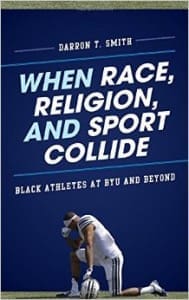
 When Race, Religion, and Sport Collide tells the story of Brandon Davies’ dismissal from Brigham Young University’s NCAA playoff basketball team to illustrate the thorny intersection of religion, race, and sport at BYU and beyond. Author Darron T. Smith analyzes the athletes dismissed through BYU’s honor code violations and suggests that they are disproportionately African American, which has troubling implications. He ties these dismissals to the complicated history of negative views towards African Americans in the LDS faith. These honor code dismissals elucidate the challenges facing black athletes at predominantly white institutions. Weaving together the history of the black athlete in America and the experience of blackness in Mormon theology, When Race, Religion, and Sport Collide offers a timely and powerful analysis of the challenges facing African American athletes in the NCAA today.
Dr. Darron T. Smith is a frequent political and cultural commentator on various issues of U.S. based issues of race, racism, and discrimination in forums ranging from Religion Dispatches, The New York Times and Chicago Tribune op-ed to ESPN’s Outside the Lines. His research spans a wide myriad of topics on race including healthcare disparities, Religious studies, Race & Sports, and Race, Adoption and the Black Family. His current research focuses on health care workforce discrimination involving African American physicians and physician assistants. He is the co-author of White Parents, Black Children: Experiencing Transracial Adoption and co-editor of Black and Mormon. His current book, When Race & Religion Collide: Black Athletics at BYU and Beyond was released in 2015.
Episode Transcript
Host: John Dehlin · Guest: Darron Smith
This transcript is machine-generated and lightly edited for readability. The audio is authoritative. Please excuse occasional errors in names and spelling.
Introduction and Welcome
Part 1 of 2 · Ep. 627
John Dehlin [00:00:00] Mormon Stories is a production of the Open Stories foundation and relies solely upon the support of people like you, its listeners to help keep the podcast alive or to become a member of the community. Please become a monthly subscriber by visiting MormonStories.org and clicking on the donate button on the right side of the page under support. All contributions to Mormon Stories are completely tax deductible and go towards producing the podcast and building communities and programs of support for Mormons like you. Thanks for your support.
Darron Smith [00:00:36] The kindly light amid encircling gloom Lead thou me on the night is dark and I am far from home.
John Dehlin [00:00:53] Hello everyone, and welcome to another edition of Mormon Stories Podcast. I'm your host, John Dehlin, and today I'm super excited to bring back one of our original guests on Mormon Stories podcast. And Darren and I were just sort of noticing this. Darren asked how long ago it was that we did our first interview. It Turns out on March 30, 2006, I released episodes 22 through 24 of Mormon Stories. Called it Black and Mormon the Darren Smith Story. And just completely coincidentally, it's now sort of March 2016. So, Darren, we're in our 10 year anniversary of that first Mormon Stories interview.
Darron Smith [00:01:38] Yeah. Yes, I believe it's fate. It's fate that brought us together, that brought us together this time, this time around. So a lot, surely a lot has happened since then, so it'd be nice to catch up.
John Dehlin [00:01:50] A little bit happened on this end. I'm guessing some stuff's happened on your end as well.
Darron Smith [00:01:56] Indeed it has.
Introducing the Book and Dr. Darron Smith
John Dehlin [00:01:57] All right, so we're here to, I mean, one of the main reasons we're here is to explore this book that I'm holding up to the camera. For those of you who are watching on YouTube, the book is called When Race, Religion and Sport Collide Black Athletes at BYU and beyond by Darren T. Smith. And I've read this book and I read it a while ago. Darren and I have had a bit of a back and forth in trying to schedule this time together. But so part of the purpose of this interview is to discuss Darren's book. So to talk about race, religion and BYU athletics. We're going to talk about that. But personally I want to talk and go a little bit deeper and broader. You know, when, when I first interviewed you, Darren, way back when, you know, I think, I think I was thinking very specifically about our history as Mormons with the priesthood ban and kind of our history of institutional racism. And that was important to cover. And I wanted to hear your story about what it was like to grow up sort of in the church as a black boy and a black man. But since then, things have gotten for me a lot broader and a lot more serious and frankly, a lot, a lot bigger than just kind of race and Mormonism. So, you know, I do have a PhD now, and, you know, I have studied a little bit about multiculturalism and diversity, so I've got a better understanding of all that than I did 10 years ago. But frankly, and I'm just going to start out by full disclosure, I. I'm terrified to talk about race in 2016. And, and I don't fully understand that. Why I'm so scared because I've always considered myself trying to be an ally, trying to be progressive, and, you know, thinking of myself not as being a racist. Although now I guess I've said it enough to know that that's a dumb thing to say, that we all sort of carry. That even people of color carry racism in different ways. So. But I. But I'll tell a quick story just to illustrate the point. I. About, oh, eight months ago, I was at Utah Valley University speaking, and I was speaking about, you know, post Mormons and, you know, people who leave the church. And I made this comment that now I'm super embarrassed about, but I'm going to own it and I'm going to admit it. I was talking about how many post Mormons consider the term anti Mormon to be offensive because just because you leave the church, just because you don't believe in the church anymore, even if you criticize the church, that doesn't necessarily make you anti Mormon. Right?
Darron Smith [00:05:10] Sure.
John Dehlin [00:05:11] So I made the awful error of
Darron Smith [00:05:14] saying
John Dehlin [00:05:17] to an ex Mormon, the term anti Mormon is kind of like our N word. And I think there was a part of me that knew that was probably not the best thing to say. But almost immediately, the Q and A comes up and my friend Misha, who's black, and she's getting her PhD at BYU, she said, John, I just want you to know that that's really inappropriate and offensive for you to say that. And she went on to talk about what that word has meant for centuries and how it's tied to very severe, you know, treatment and negative treatment. Torture, slavery, obviously, murder, all sorts of things, lynching. And, you know, I, of course I felt bad and of course I apologized to her in the moment. I thanked her, and I've worked really hard to never use that word again. But then something even crazier happened. Which was, which was that somebody caught wind that that exchange had happened. And on Facebook they posted can't believe that John de Lynn, you know, compared blah, blah, blah to the. And it just, and it was like a feeding frenzy. There were all these people who were just really, really eager to kind of give me a public lashing. And I don't all that's fine, but it was just weird. The politics of discussing race are really intense. Obviously there's, there's white guilt, there's, there's ignorance, there's people posturing to be the best ally. And all this time all these white people are doing all these crazy things. That doesn't necessarily help anybody make progress. It doesn't mean that our society is getting any better. So it's just super intense and complicated. And you know, you, you want to think that just because Obama's elected president or it's 2016 that everything's all better. But of course, we know with the black lives movement and the, the way that the police sort of situations that have gone on, you know, yeah, we've made some progress in the past 150 years, but gosh, we have so far to go. So I'm just, it's so complicated and so intense that I'm kind of scared to talk about it. But you tell me, brother Darren, I think, I think we got to get over that and just talk about it, knowing that no one's going to be perfect and it's going to get messy. What do you have to say about all that?
Darron Smith [00:08:04] Well, I agree. I mean, it is complicated. It's a 400 year old problem. So it's not going to be fixed. You know, it hasn't been fixed over the last 50 years despite civil rights legislation. We've got great civil rights laws in this country, but we don't follow them and enforce them much. And so as a result of that, you know, you know, people of color in particular African Americans have just not had enough time to catch up to whites. And if you want to use that as an example, continue to experience discrimination along the way. So at that rate, you know, we may not ever get there. I mean, I think that there needs to be some significant steps to, you know, in order to address this problem. And I think the rhetoric, we should be on at least beyond, beyond the rhetoric at this point. Because, man, we've been talking about this for, you know, what's funny is that I'm 50 years old now, you know what I'm saying? And you know, I was talking about this 25 years ago. The conversation was still the same in 25 years into the future, here we are. I'm still talking about the same thing. In fact, the students I teach now are just, as, you know, in the dark as the students I taught at byu. It's incredible. So it's not like. It's not like this is going to get better because there's no dialogue. It takes rioting to get people's attention. It takes brutality to get people's attention, which you shouldn't have to go to that extent. But because we are a racialized society, that's our mo. That's what we do. We do it better than most Westernized societies. In fact, most of them stole our secrets. And we've sort of gone above and beyond xenophobia and we've taken to a whole nother level. And I think what you're seeing now is the. Is the manifestation of that within this new millennial generation, hence with the Black Lives Matter movement. My generation, Generation X, we didn't do anything. We were pretty much scared from the last encounter that happened with our parents, and so we were kind of stunned. And there was this big hope that we would progress into a state of equality. But again, no one considered discrimination. When blacks left black schools and it began to flow into white schools, they encountered bitter discrimination from white teachers who weren't prepared to deal with black students. In fact, had never really encountered black students. Remember, there were two Americas, one black and one white. And so this experiment is only within the last 50 years, if you think about it. So, I mean, integration didn't happen immediately after Brown vs Board of Education because there was still significant redlining going on. There was still significant discrimination. So blacks and whites had really never had significant contact, save a few tokens like myself who happen to be middle class, or your friend Misha, I believe you mentioned, or others like her. So it's really a new phenomenon. And so the expectation on us, John, is to be like y', all, if we're going to be in your world, in your middle class environment. The expectation on me is to conform to you, you know, and if I do, I might get taken seriously, right? You know, but generally speaking, I generally don't get taken seriously. So it's been a difficult journey as a black professional, you know. You know, and being a black professional doesn't cocoon me or shield me from racism. I still encounter it as much as I did if, you know, 25 years ago. It's just different now. It's much more subtle, you know, than it is, you know, overt. Although there have been incidences of overt racism or overt discrimination. You mentioned, you know, the prolific killings that have been seen to have gone on over the last three or four years where now, and I think really with the advent of the cell phone, you know, we're able to capture that data like never before. And so, you know, I don't think that police officers can hide their ill gotten deeds. So I think that that technology has been very helpful. I think African Americans have always experienced, and also brown communities have always, always experienced police brutality. It's just over the last several years you're able to able. The American public has been able to see it and be outraged by it. But this is an everyday occurrence for black Americans. There's nothing new, you know, so I hope that it opens up a dialogue and changes some and I think it has for the better. It's made, it's caused departments to take a very hard look at their policies, you know, and the degree of mistrust that persists amongst blacks and police in general. So we have a long way to come. And you mentioned, you know, we've come a long way, you know, and I would argue it depends on how you measure, you know, A long way. If you're referring to education, I would say we hadn't come very far at all. In fact, we've gone backwards in education. If you're talking about health care, I would say no, we hadn't come very far. I think the death rate is still. Black Americans is still half of that. Half of that is whites. So if whites are dying, you know, at least in some areas from seven to 20 years, depending on the zip code. So that's still a problem. If you talk about Fortune 500 access to Fortune 500 companies, that's still an issue. If you talk about black professionals in the academy who teach in the academy like myself, that's still a problem.
The State of Racism in America Today
John Dehlin [00:13:38] So how about incarceration?
Darron Smith [00:13:41] Incarceration, huge one. That's a problem. So it depends on what you're measuring. You can't, I mean, you can't look at me and say, or look at someone that's a professional black person, then assume, oh, black people are doing good because Darren look like he's doing okay. Well, I'm catching hell every day as a black professional, so. And I just, I've come to accept that, that that's just my lot in life. There's nothing I can do about it. I can talk about it, I can make people aware of it. I can teach and educate folks, I can write about it. But it's a systemic thing and it requires systemic change that I can't do alone. And really, I would say it's not really a black problem or brown problem, it's really a white problem. You know, white Americans have to make significant inroads and recognize that, you know, and I think suppress that pre colonial urge to discriminate, you know, and to let go of these xenophobic fears, you know, of indifference, that seems to be a part of the, you know, the white experience. So until white people recognize that and take a cold, hard look at that, we're going to continue to have these issues. And so white people need to say exactly what you said earlier, John. I'm a racist. I live in, not because I want to be, but because I'm racist by default, because I live in a racist society that was formulated based on race as a salient factor. So as a white male, I benefit from that. I didn't crack the whip, but I didn't have to. I still benefit from it because of the way society set up the hierarchy, racial hierarchy. So when whites recognize that, they come to terms with that. You know, that has nothing to do with your abilities to be a good person or anything of that nature. It's a structure. The structure has to be demolished. And in order for that to happen, people have to get real about their own complicity in racist acts and racist, you know, events. I would argue.
John Dehlin [00:15:38] Yeah, and I, and I honestly didn't mean to infer that. In truth, we've come a long way. I think if, if we just sort of think about Martin Luther King and the Civil Rights act of 1965 and maybe some of the, some of the progress we've made on just the ability to vote. Maybe you could say we've made some progress, but honestly, I'm not sure how much progress we've made at all. Especially if you look at Donald Trump and what's going on right now with his popularity and that a presidential candidate can sort of take over a major party with racism as sort of a major underlying theme of his campaign. And he's kicking everybody's trash.
Darron Smith [00:16:23] I mean, yeah, I'm loving it. I've gone every night watching. I'm loving this. Loving to see what the part how the party is imploding. I'm loving it.
John Dehlin [00:16:33] Yeah.
Darron Smith [00:16:34] But he does win.
John Dehlin [00:16:35] Yeah. We've got a long way to go, so. Okay. So, Darren, I just want you to know I, I was expecting good things from this book, but this book exceeded my expectations. This is a top notch Book. I love it and it's super important read, but I don't want to start with the book. What I'd like to do is just sort of. And I don't even know if you remember where we left off, you know, 10 years ago, but why don't you just catch us up a bit on your life and if you want to talk about how your life has or hasn't intersected with the church since leaving byu, you can. But take us just through at a high level. What's your life's main, you know, highlights have been, or lowlights leading, leading up to the publishing of this book, which I think was published in 2015. Is that right? Yeah, yeah. So what's been going on, Darren Smith?
Darron Smith [00:17:31] Well, you know, a lot. I've since left Utah like you. I finished my degree, my PhD and praise God, it was a long time, but it's over and. And I left. I went to Wichita State. I was there for a while.
John Dehlin [00:17:45] Shockers.
Darron Smith [00:17:47] Yes, yes, shockers. You know, a couple of people up there, actually. I know.
John Dehlin [00:17:51] Yeah, yeah, yeah.
Darron Smith [00:17:53] Was it Natalie? Natalie.
John Dehlin [00:17:55] Natasha, I think.
Darron Smith [00:17:56] Yes, Natasha. Natasha. So. But anyway, so I was up there for, you know, some time, then I left there and I'm down here in Memphis. In terms of the church, I don't really fool with it much. I mean. I mean, to tell you the truth, I mean, I just. I don't see any. I can't continue to go to an institution that historically has been in denial of my experience. I just can't do it. I just cannot do it. I just can't because I'm party to my own marginalization and I just. I'm not going to be a participant in that. So I don't really practice much. You know, my faith, you know, my. My daughter was practicing a bit, but she's sort of not really going too much. So we're kind of like in limbo land at the moment. We're spiritual, but we're not necessarily attending any organized religion at the moment.
John Dehlin [00:18:51] And if I remember right, 10 years ago, you were still. You were still kind of active, right? Is that true?
Darron Smith [00:18:57] Yeah, yeah. I was kind of like lingering it. I was kind of drifting in and I think I've had a very long goodbye.
John Dehlin [00:19:03] Yeah. You know, so was there anything that kind of. Is there any. How would you describe kind of your. Your slow descent out? Was there anything that happened? Were there any stories? Were there any changes in your perspective that kind of led you out? Was it a tough. Was it a tough goodbye or easy Or.
Darron Smith [00:19:25] No, no, I don't think so. I mean, I think, you know, I think Packer said it right. You know, the intellectuals are the bane of the church's existence. And so I think knowledge left me, you know, drew me out as I. As I learned and became more, I guess, learned on the topic of race and my expertise. And I began to really look kind of hard at, you know, at the hope that people will change in the church. And I just don't see it ever happening, because there's a big factor there. One, most of the people there are Republican. That alone, ideologically, they're not changing. They have a very particular way of seeing the world as Republicans. I'm not saying that Democrats are any better. I'm just saying that Republican ideology as a party ideology for me, is incompatible with what I believe. And I think that having that sort of ideological wall up makes it very hard for, you know, the things that you're trying to do with the LGBTQ community. What I'm trying to do with race and so on, to try to bring awareness to this is falling on deaf ears. So, you know, we're like sheep crying in the wilderness. Nobody's listening because people's got blinders on, ideological blinders. And so race is one of those very hot, hotly debated topics, like some other topics that you folks are currently involved in. I know as well, but it's just not. It's incompatible, John. I just don't see it as ever. I'm not saying that Mormons aren't great people or good people. I'm not making any judgments on anybody of that nature. But just ideologically and even theologically, I just can't. I can't fool with it.
John Dehlin [00:21:11] So I'm going to go out on a limb and say that if you ask the average Mormon in Utah, is the church racist in 2016 and is the church experience, you know, racist in 2016? I think 95% of active Mormons would say, no way. We send missionaries to Africa. We've got black people in the, you know, in the Mormon Tabernacle Choir. You know, we don't say racist things across the pulpit. And we love and treat black people like brothers and sisters. Like, I think. I think that's probably what most active Mormons would say. So tell us how, like. And we've kind of distanced ourselves from the racist folklore of the past. The church even came out with that essay recently that said it was. It wasn't doctrine, it was folklore. And so. And I know this is a deep, deep Question. But what would you say to a white, you know, middle class Utah Mormon that said, no, we used to be, you know, a little bit racist, but now we're totally good. What would you say to help them see things a bit more clearly?
Darron Smith [00:22:30] I would say that they're defining racism in a very narrow way. Most Americans see racism as an individual, as individual acts of meanness, one race against another. It's a verb. So if I'm not committing acts of meanness, therefore I'm not a racist. Racist. Look, like that person over there, this person over there, that person with the pointy hat. But I'm not a racist because I don't call people names. No, I don't, you know, you know, engage in bantering about people who are of a different race. So therefore I'm not racist. I don't, I don't use the N word. Individualized verb. So they don't recognize that it's, it's, it's a, it's foundational, it's ideological, It's a lot of different things. And, but race, race speaks their experience. And they would say, well, how does, how does it. Well, you married white people, right? Aren't you married to. Yeah. Okay, you go to a predominantly white church. Yeah. Okay, you go to predominantly, you belong to a predominantly white party, right? Yes. You live in a predominantly white area. You get my point. Our whole lives are situated around race and we don't even realize it. Right. We call it free will. Right. Or free agency, if you will. Right. But I'm arguing that it's not as structurally determined in the sense that society is, again, racialized. And we make decisions about racialized decisions all the time. We don't realize we do, but we make those decisions all the time. So that's how I would approach a white Mormon. I would say your definition is extremely narrow. If race is only about you and me, explain those things we talked about earlier, John. You know, incarceration, these crummy schools, the crummy healthcare, segregated cities and so on. How do you explain that if racism is only about you and me, that negates this whole other structural process that's at work. And it denies, right, it denies the fact that racist is controlling and shaping the destinies of these experiences of people who happen to be black. Racialized as black. And I mean North American, indigenous African Americans, those who are transported across the Atlantic and whose ancestors live here. Not African, not, not, not, not Afro Caribbean. Right. Who have a different cosmo, you know, cosmological orientation than African Americans do. And they tend to see race very, very differently. They tend to like white folks. Right. Whereas African Americans are much more suspicious because of their histories. Two different histories.
John Dehlin [00:25:02] Right. Okay. And I think we'll probably get into this a little bit when we start talking about your book. But what I hear you saying is that even if you don't use the N word, even if you have a black friend or two, even if you do everything, you can not to discriminate and to treat everyone with love, just the fact that society has such awful disparity when it comes to education, to health care, to treatment by police, you know, treatment in the academy, in the corporate workplace, you know, the fact that society is still in such a bad place when it comes to race and we're all part of that system, it sounds like you're saying that implicates all of us. Right?
Darron Smith [00:25:56] Yes. Yes. So I'll just clear the air. All white people are racist. I'll just clear the air. All white people. I don't care if they're good white people or bad white people or in between. All white people are racist. The reason is because whites receive the benefits of a racialized society. So I'm talking about structurally. I'm not saying that white people out there committing acts of meanness and burning crosses on folks yard. I'm saying that whites as a group derive benefits from living in a racialized society. Some folks call it white privilege. Well, you don't have to worry about the kinds of things I have to worry about, like police brutality, for instance, or being racially profiled, for instance, or having to defend the dignity of black folks in this book right here. So, you know, in trying to bring voice to those who are voiceless, particularly those who are afraid to tell their talk about their experiences for fear of retribution. I'm talking about those inside the church. Right. So I. God bless them, those that stay in. I don't criticize anybody. Do your thing. Because I have deep empathy for many of my, you know, my, you know, practicing Mormon colleagues, because I was there, too. I gave it. I gave it all. I gave it all. My best, the best years of my life. I gave it. You know, I gave it all. And I don't take anything away from it. I think it helped to make me who I am today. It gave me a hell of an education, that's for sure.
John Dehlin [00:27:23] Right. And to kind of draw that into the church. If you look at the leadership structure of the church, we had the opportunity. We had three apostles die, I think in 2015, we had an opportunity to put a person of color in there. None of the first presidency, quorum of the 12 have a person of color to date. Even in the quorums of the 70, they're very poorly represented. So in the leadership structure, obviously we're not represented. But my guess is all that disparity in terms of education and health care and leadership opportunity, there's just as much disparity within the LDS Church as without. Would you say? That's fair to say?
Darron Smith [00:28:05] Absolutely. And it's not going to change. I mean, the apple doesn't fall far from the tree. It's not going to change. I mean, because again, ideologically the brethren are going to call people to positions of leadership who think, look, act and were similarly educated as they are. They tend to be very conservative in their outlook on life, even though that they don't necessarily profess to be political in their selections. But we all know there's only like two or two Democrats on, you know, who are more. I would even argue they're probably moderate democrats like Claire McCaskill. But having said that, I don't think that we'll ever see any changes unless somebody who has some fortitude might find somebody willing to coon to fill those red seats. And I'm not sure if there's anybody on the horizon, but there might be. You know what? In fact, let me put a plug in for a good friend of mine who's actually a practicing member of the church who's a fantastic guy. His name is Rob Foster. Some of the audience might know Rob. Rob was the first black student body president elected at byu. And his story is absolutely fascinating. He comes from North Carolina. He's had his upbringing in a drug addicted family and to his experiences to joining the church to where he is now. He's an optometrist in the Raleigh Durham area. He's got several businesses going. He was recently called to state presidency there. This guy. And what I like a lot about Rob is Rob's kept it real as long as I've known him. He's never compromised who he is. Right. He's just incorporated the church into his identity and made it his own. But he's never compromised his blackness. He's never suppressed that in order to appease white people, white members of the church. And I respect him for that. So I can see him, you know, someone like him making the jump to Salt Lake, if they would be so kind as to call him. I might come back if he's in there. But it'd be A hard sell. But anyway, they need folks like Rob who are willing to serve.
John Dehlin [00:30:16] I'm reminded of something Gina Colvin, who's one of our podcasters, said once, which is even just putting people of color into leadership doesn't necessarily mean that, that that is an act of sincere progress or that that that would lead to positive change, because it also depends on the type of the person that you put in and to what extent they're, they're committed to and willing to fight for more equality. Is equality the goal? Is that what we're looking for?
Darron Smith [00:30:48] I think so. I think, I think, I think we have a responsibility to end, you know, inequality in this world. Whether it be racial, whether it be gender based, whether it be whatever. We have a responsibility to end it all forms of oppression. Because if one group's oppressed, all of us are oppressed. And so, and I don't see that as part of the church's mission, John. I've never seen it as part of their mission. I think their mission is to save souls, right? Not to be transformed by other people's experiences, but rather, you know, to save souls. So it's a one dimensional relationship, a one sided relationship. So it's a losing proposition. And I agree, I agree with Gina. If they were to call someone who happened to be of color, and I think they have, they tend to be very conservative, you know, very conservative, because they're not going to call somebody, you know, who's going to challenge and kick against the pricks. It wouldn't be to their interest to do so. So I'm pessimistic. I just don't see it happening.
Defining Systemic Racism and Cognitive Frames
John Dehlin [00:31:52] Well, let's jump into this wonderful book of yours. Is that all right?
Darron Smith [00:31:56] Absolutely.
John Dehlin [00:31:57] And I think it's important to begin, you begin by talking about racial frames. Is it okay if we start there? Do you mind explaining to our audience what that is, what that means?
Darron Smith [00:32:07] Sure. So racial frames are like cognitive cul de sacs, if you will. They're sort of predictable ways that we think folks are generally socialized to think in particular ways. Race is one way that people have been socialized to think about. So in other words, let me give you an example of a frame. These cognitive frames are triggered when you see or hear or words, trigger emotions, et cetera. So black, for instance, conjures up in people's heads a whole lot of things. Evil, vain, lustful, etc. When we see black people performing in stereotypical roles, right. We tend to frame them as such. And these frames are historically founded or grounded in what the Founding Fathers created back in the 16th century. So during that time frame, moving forward, these ideas about blacks as cursed, these ideas about blacks as better athletes, these ideas about blacks as being more sexual, these ideas about blacks being more criminal, all of these ideas were historical constructions that have been pasted upon the bodies of blacks. Hence, they're called frames.
John Dehlin [00:33:20] Less intelligent, less capable.
Darron Smith [00:33:22] Absolutely right. And so part of my. Part of my experience, John, when I walk into a classroom and teach, students already start with the assumption that I'm incompetent before I even open my mouth. Surely someone like you can't be doing this, because not that they're mean people, but they're borrowing ideas and notions that have been handed to them and that have been regenerated within society. So these frames are very, very hard to break. They're very hard to get at, but they do exist.
John Dehlin [00:33:57] I should have asked. So are you at the university right now?
Darron Smith [00:34:01] The University of Tennessee.
John Dehlin [00:34:02] Oh, wow.
Darron Smith [00:34:03] And I also teach at the University of the University of Memphis.
John Dehlin [00:34:08] Okay, so you're. Are you. Are you faculty at Tennessee or.
Darron Smith [00:34:12] Yes, well, at the University of Tennessee Health Sciences center in Memphis, Tennessee.
John Dehlin [00:34:16] Okay, excellent. Congratulations. That's exciting. That's an SEC school, right? Yeah. That's amazing. All right, so, yeah, so we've got these frames, and then you talk a little bit about systemic racism theory. Talk a bit about that and why you started with that in talking about BYU athletics.
Darron Smith [00:34:39] Well, I think it goes back to what we were talking about earlier, when people tend to look at racism as individual acts of meaning. It's a verb, right? So if I'm not doing this, therefore I'm not. And so racism, I'm arguing, is much broader than that. It's much more entrenched than that. It's much deeper than that. Systemically, it resides within institutions. The way in which policy was created, the way in which leadership constructs ideas around work, et cetera, all are rooted within race. I mean, the same thing is true in Hollywood when they're making movies and writing scripts, you don't see a lot of people of color. You do. You tend to see them as the sidekick because that's not the worldview of the writer. So the same thing is true with this idea of race as a systemic issue. It's institutionalized. So I'm arguing that it's not necessarily Jill or John or whomever it is who's lds, who's practicing their faith, who's not necessarily racist. But the very nature of the church itself is racist, because the racist Ideas have flowed from the top to the bottom, and they've gone, you know, they've gone in line with the prevailing racist ideas of the day. Even though the church has publicly said this is all, you know, water under the bridge now. Right. These ideas are still there, these frames are still there, and people still utilize them to explain, you know, why blacks couldn't participate in church. Let me tell you, anyone who hears my voice out there in a podcast land, that is funk.
John Dehlin [00:36:14] What. What is it?
Darron Smith [00:36:16] This idea that black people were cursed and that black people were less dead? It's not true.
John Dehlin [00:36:25] Now, even the church denies that now, right?
Darron Smith [00:36:27] Well, they may deny it, but members still believe it. Yeah, they still believe it.
John Dehlin [00:36:33] Yeah, that's true. So I really enjoyed the extent to which your book kind of goes back into the history of, you know, should we say blacks in athletics is. What is that? All right. Okay. And you even go back to sort of slave times. Talk a bit about the. The history that you kind of recount in the book. I. I'm mindful of. I. I've never been a Quentin Tarantino fan, but someone told me I needed to. To see a Quentin Tarantino movie. So I. I saw Django Unchained.
History of Black Athletes in American Sports
Darron Smith [00:37:10] Yeah.
John Dehlin [00:37:11] And I love the acting, I love the writing, but there's this scene where Leonardo DiCaprio is in his house and he's having a couple slaves fight each other. Have you seen that?
Darron Smith [00:37:23] Yeah, I saw that. Yeah.
John Dehlin [00:37:25] And, you know, it reminded me of some of the stuff you wrote in your book, just how from the very early times of America, blacks were used as more than slaves and how athletics came into it. So talk about that for a bit.
Darron Smith [00:37:37] Sure. I mean, slavery was just another form of labor, another labor pool. And certain blacks had. Were known to be, you know, known to have athletic ability. They were known. Some slaves stood out on the field as being more athletic than others, and they would oftentimes get together and play games during their off days, if you will, or during times when they had as a family. So these blacks were often recruited by their slave masters, you know, to participate in all sorts of kind. All sorts of things. Boat oarsmen, prize fighting, horse racing and track and field, bicycling, bicycle racing and what have you. But the most popular of all of these different sports that sort of propelled the black athlete into his role at the time was horse racing. A lot of people don't realize just how prolific blacks were in horse racing early on, from the late 16, late 1790s into the mid-1800s. I mean, it was a big business, and blacks had occupied that field. And if you were a slave during the antebellum period and you were an athlete and you had some skills and abilities, you had a little bit better experience, if that's relatively speaking, than the field hand or the house. Or the house Negro, if you will. So although they want to. They weren't a lot of these. These. These athletes, but they were. There were enough of them to. To have a history about them and to write about their experiences.
John Dehlin [00:39:16] Okay. And. And we don't really. Correct me if I'm wrong in terms of, like, organized. You know, we kind of see organized professional athletics just in the United States really coming onto the scene in the 1900s. Is that right? I mean, whether it's professional baseball, professional football, professional basketball, that really is a 20th century kind of phenomenon, period. Right. And then each of those leagues have their own history of when. Of when black sort of came onto the scene. Do you want to talk a little bit about that? I loved. I love what you wrote about Bear Bryant, but. But I think it starts probably with Jackie Robinson and even boxers before that. Right. Do you want to talk a little bit about sort of blacks breaking into professional athletics in the, you know, 20th century?
Darron Smith [00:40:05] Sure. It was. It was, as you can imagine, it was very difficult. That was a time when, you know, separate but equal existed. And so there was always. In the 1920s, if you will, there was always this belief, this belief in biological racism, right. That blacks were inferior to whites, not just in. Not just in their mental faculties, but also in their physical constitution. They were inferior. So if they're inferior, certainly we can prove that in the ring. We can prove that, you know, in various contests, prize fighting was one big one, right. Is one big area where blacks did make some inroads there. Now, they didn't get the same training, the same opportunities as whites did then, and so they had to train. They had inferior training facilities, but nevertheless, they took advantage of those experiences anyway and transcended them. Oftentimes, these spectacles, like boxing, for instance, brought out a ton of folks because they were looking to see this white man knock this black man out. Right? They really had hope that this would happen, and of course, it didn't. I'm thinking the boxer's name, and I can't remember his name up top of my head right now, but he, like Jackie Robinson, was another individual who broke into the. Who broke the color bear, if you will, in track and field, you know, and you can imagine his experiences going over in front of Hitler Already knowing what?
John Dehlin [00:41:33] Jesse. Jesse Owens.
Darron Smith [00:41:34] Jesse Owens. Yeah, Jesse Owens. So Jesse Owens being the first to sort of break into track and field, but also going to Germany during the 41 Olympics and having to face the furor and having to encounter the racism that endured during that time. So blacks have always, always have had to fight for their own sense of space, their own sense of dignity. Historically, since the formation of sport and into contemporary times during the Black Lives Matter movement. I mean, what we're seeing today is a throwback of what happened in the 1960s. You know, blacks looking for and trying to find their place within society, trying to have a voice, trying to have their experiences heard. And not just heard, but changed and transformed. Like, my favorite, you know, team now is, you know, Mizzou. You know, you know, what happened with Mizzou, those young men, you know, and the courage they had to, you know, speak truth to power and to put, you know, and to put the money where the mouth, you know, where their mouth was. And, you know, and ironically, it was against byu. That game was against byu.
John Dehlin [00:42:53] Yeah.
Darron Smith [00:42:54] So, again, I don't know if you want to call it fate or serendipity, but it's interesting nonetheless.
John Dehlin [00:43:00] Mormons seem to put themselves at the center of a lot these days.
Darron Smith [00:43:03] Yes, indeed.
John Dehlin [00:43:04] Jack Johnson was the boxer. I had to Google it.
Darron Smith [00:43:06] Thank you.
John Dehlin [00:43:07] But I. Jack Johnson, he deserves our naming him appropriately so.
Darron Smith [00:43:11] He sure does.
John Dehlin [00:43:14] Whether it's him or Jackie Robinson or, you know, whoever. It's. It's. It's what? That's one of the fascinating things about 20th century professional athletics. Now, I have to. One part of your book really blew me away, and I want you to tell me if I got it wrong. But as I remember reading through your book, I actually. Well, two things. The first thing that really blew me away is that you seem to indicate in your book that it's a myth that blacks in general are more athletic than whites. Now, did I get that wrong?
Darron Smith [00:43:53] No, no, no, you're right.
John Dehlin [00:43:54] Yeah. I mean, from a little boy, I was taught, oh, blacks have a special tendon in their back leg. Or, you know, because of the way that they were bred. They were bred to have, you know, extra muscles or that sort of thing. Or. Or just you look at the NBA, now you look at the NFL now boxing, whatever you pick, pick most of the major sports, you know, black athletes, track and field, tend to dominate. So I was really surprised to have you say, that's actually not necessarily true. Talk about that.
Darron Smith [00:44:32] Well, it's not true. I mean, there's no third tendon. There's no special muscle.
John Dehlin [00:44:38] I'm sorry. I'm sorry I mentioned it.
Darron Smith [00:44:41] Although I wish I did have some special abilities. That would be fantastic. But no. A black cadaver looks the same as a white cadaver. So, you know, the same. But you know what's interesting that you mentioned that, though. I'll just say this one last, this one off the subject thing. Not six years ago, I taught at byu. Maybe six or seven years ago I taught there. And that was one of the questions I would ask students. I would say, is there a special muscle or are blacks more biologically gifted athletes than whites? And you'd be surprised how many students would say, yes, they are.
John Dehlin [00:45:12] Yeah.
Darron Smith [00:45:13] I mean, they have a third, and they believe they have a third muscle. So that's not the first time I've heard that. So again, that would be a racial frame.
John Dehlin [00:45:21] Right, right.
Darron Smith [00:45:23] The way of believing it. So, no. So there's no biological. There's no biological gene or that controls for athleticism. You know, I mean, there's a whole lot of interaction between genes. It would take a lot of research to be able to isolate a gene if it did exist. I don't think it does exist. But nevertheless, I think what you see is, you see people who are sort of a workforce, if you will, sort of corralled and pushed into a particular industry, right, that gave them access, like athletics. And because of that, blacks were able to excel because that's one of the few areas that they had open to them to excel, particularly in basketball and football. We're talking now, you know, later, you know, later, half of the, you know, 20th century, if you will. So particularly basketball and football, because, believe it or not, they're pretty cheap to play. I mean, most schools have, you know, football gear you can get. So it doesn't cost you anything, really. And there's boosters, high school boosters, to help offset the cost for those that don't have the money. So there's ways to sort of get around that for students who can't afford it. But athletics consistently has been a doorway out of poverty, a doorway out of hunger for African Americans. It always has been. So these young men that you just talked about, John, who you see playing basketball, typically men's basketball and football come from areas of the United States that are pretty. Pretty destitute in most cases. The vast majority of these young men come out of those environments. And so they're looking for sports as an opportunity like any other, you know, any other industry. But as you know, you Know, it has a very short half life, you know, and so we really have to get these young men trained beyond the gridiron. And that's where the universities come in. Which they haven't done a good job at that. BYU in particular hasn't done a good job at that.
John Dehlin [00:47:25] Yeah. Going back to the comparative athletic, athletic abilities, I think part of the point you were making, you can correct me if I'm wrong, is to, to perpetuate the myth that blacks are just generally more athletic than whites is to take away from their achievements. It's just to say, oh, it's not because they just happen to work really hard and we're really dedicated and committed. They just have this natural gift. And so is that, is that kind
Darron Smith [00:47:58] of partly why you were exactly right? That's exactly right. I mean, I think it, you know, it negates their, you know, the things that they've worked very hard to achieve. I mean, I don't doubt that people working hard achieve. And folks don't, you know, remember, these young men will start practicing day in and day out. They will skip school to practice. They will do whatever it takes to get them to that next level. So it's a lot of hard work, it's a lot of sweat equity to get them to where they are somewhat competitive, but it's a dead end road. In most cases, less than 1% of them will go to any professional team. So the numbers are very, very small. So again, we emphasize putting these young players into these situations to build the coffers, but then leave them with very little in return.
John Dehlin [00:48:49] Yeah, and that was going to be the second thing that I mentioned. I would have thought, and again, I'm just admitting my ignorance. I'm just owning it. I would have thought, oh, you know, yeah, we've been, you know, we've been unkind and unfair and racist to blacks over the past several centuries. But professional athletics has been, you know, the one exception where that's been really awesome, where we've been able to, they've been able to have lots of opportunity and financial gain and, you know, what a what a what a shining star on an otherwise really black or I just did it on a really. And this shows sort of the history of how words have been used and associated in ways that are this. So I'm catching myself. So on a really unfortunate history of discrimination that professional athletics would be the shining star of opportunity. But what you're arguing in the book is that maybe professional athletics has actually done a great disservice to People of color in the United States. Is that kind of what you're saying?
Darron Smith [00:50:05] Yeah, absolutely.
John Dehlin [00:50:06] Talk about that.
Darron Smith [00:50:07] Well, I think, John, it's an exploitative industry because it takes and takes and takes, but gives very little back. Now, some of your audience will say, well, you gotta get a free education
John Dehlin [00:50:17] or they get really rich. If LeBron James is really rich. Right.
Darron Smith [00:50:21] I mean, again, I mean, you know, for all the audience, the numbers are very small. You know, we're talking, you know, you know, maybe less than a thousand people. So we're, you know, it's a very, very small industry. And so to put all your hopes and dreams into one thing is really. Is really not, not, not, not, not good. It's certainly not good. So, man, we, you know, I mean, there's so. I mean, we have failed these. These players because the NCAA has made so much money off these. These young men, and they. And these. These players are. Are who build the wealth to fund all the teams, all the other teams in Division 1 athletics. And yet they get. And so. And yet when they dare to, you know, to raise this idea that, why don't you compensate us for a time? Why don't you at least make this somewhat, you know, you know, better for us financially while we're in college, they don't get that. Because the argument is that, well, you know, there's a. There's a. There's an educational mission here, and if we pay these people, then that takes away and cheapens their education. Right? Because now. Because so it goes back to the same, you know. You know, and we all know that's. That's bs, you know, because we know at the end of the day, they're taking advantage of these kids and not really given much. A good case in point is the University of North Carolina Tar Heels. What they did was appalling, absolutely appalling. Giving sham degrees and sham classes to students on the basketball and football teams. Purposefully doing it. And it went on for years. So I think they had a lawsuit that came out of that. I think 2,400 students who were all filed a lawsuit. They were given a sham education at UNC unc, one of the very best schools in the nation. One of the most prestigious public institutions in the South. You know, so. But this is something that's normalized. You know, this is not. These are not isolated incidences, but it's a normalized pattern of behavior. And we'd even. We even see the byu.
John Dehlin [00:52:41] Yeah. And I want to jump into university athletics, but I don't want to miss this bigger point. And again, I think I remember reading this in your book. It it. Because black athletes have been so prominent in. In American culture for the past 50 or whatever years, it's just so natural for these young black kids, and tell me if I'm wrong, to grow up with their heroes being Michael Jordan, Magic Johnson, LeBron James. Pick your. I don't know football very well, but pick your football player, whoever it is, right? O.J. simpson or whatever. And so you've got maybe entire neighborhoods saying, why don't you go be the next LeBron James? Why don't you try to go be the next whoever? And what would have happened if every one of those communities had doctors as the hero and as the target? Or engineers, right, or lawyers or professors or CEOs? How would that have changed the progress and the opportunity and the advancement of people of color if athletics hadn't have evolved to become sort of the pinnacle of achievement within these communities? Am I getting that right at all?
Darron Smith [00:54:04] Yeah, yeah, yeah. I think you're talking about socialization. You're talking about these kids, see, they've been socialized to see people who look like them doing particular types of work, right? And that's all they see. They don't get to see the physician, the professor, whomever. They don't get to see that very often. But the image that they're sold is this image of entertainer, sports star. And not only that, but their parents pushed them in that direction. It's almost like playing the lotto, this sort of feigned idea that maybe my child might be the next LeBron James and putting all of your eggs in one basket. And that's the way these kids have been socialized. So is that a random thing? Is it random or is it something that's much more systemic? And I would argue it's much more systemic because each year we see the same, you know, different names, different faces, but same black bodies playing on, you know, football and playing basketball. So we're seeing this sort of pipeline, athletic pipeline, if you will, you know, continually turning, Taking young men of color out of the. Out of their circumstances and putting them in college when they're not prepared, right? And setting them up for failure and then giving them sham classes so they can pass. So this. The whole system is rigged from the. I mean, from the. From the top to the bottom, it's rigged, you know, and so, I mean, what would have happened? The same thing would have happened to blacks that happened to whites. Whites have the luxury of seeing their heroes widely represented on tv, in newspapers, in the curriculum. Whereas people of color see very little of that. And if they do see it, it generally is in a stereotypical role, that of the athlete, that of the criminal, that of the sidekick of a white, you know, protagonist. So you have these roles or these again, frames that African Americans are sort of pushed into. And now some people say, well, they're unwitting participants. Well, if that's all you ever hear, that's all you ever see, you begin to believe, well, maybe that's all I have. Maybe that's my only option, is to use my body as a means to get paid. So the whole thing is messed up, John. It starts when they're knee high to a grasshopper. It starts with schooling. It starts with equality. We have to end inequality in order to raise blacks up to the level so they can be. So their children can aspire to more than just listen. I'll say this too, John. You know that even though the NFL recently came out with data which supports the fact that, you know, CTE is real. Right. It's a real significant diagnosis. Right. I guarantee you a lot of middle class white folks are not going to let their kids play football anymore. So what you're going to see is more and more brown and black bodies playing football. Right. Because that's the labor force. I would rather give my, you know, sacrifice my brain, you know, in hopes that I might get paid than to have to go to college. But I'm not prepared because I wasn't prepared when I went to school. And you probably say, well, how the hell is they get into college? You know, it's a mystery. Yeah, they can get, you know, if I want you to play football, I'll find a way to get you in.
Professional Athletics and the Exploitation of Black Athletes
John Dehlin [00:57:45] Yeah. So overall, if someone were to say, yeah, maybe, maybe different aspects of American society has not been good for people of color, but professional athletics has been great for people of color. It sounds like you're, you're kind of questioning that a little bit. Do you, do you feel like, do you feel like you would answer, no, it's been bad for people of color overall. Do you. Is it that strong for you?
Darron Smith [00:58:08] Well, I don't. I'm not saying it's bad, John. I'm saying it's limited. Right. It's only one labor industry that blacks seem to sort of migrate into. And there's reasons for that. That's not happenstance. There's reasons for why that happened. And you mentioned it earlier. You talked about socialization. You mentioned it. You gave the idea that, hey, if they. All they ever see is this, then maybe that's all they aspire to. And you're right. You're exactly right. So this is the image they're fed and this is the options that they feel they have. So, you know, so I'm not saying it's bad. I'm just saying it's limited. We need to have greater representations of people of color and widely represented throughout society, not just in football and basketball. That's the only image we see. So we need more images just exactly like you said. But that starts with public education. It starts with ending inequality in America. You know, the questions that are now coming to the fore and hopefully in this political campaign is discussions about inequality. We have to. If we don't fix that, that's going to be our greatest problems moving forward. The problem of the next century will be inequality. Significant. We're already seeing it now.
John Dehlin [00:59:19] Yeah. So I think I want to have this interview, have two main parts. The second part really focusing on BYU and its honor code and its, Its history and treatment of black athletes. But I think it's one. One of my favorite parts of your book is how it talks about kind of the. The student revolts of the 60s and 70s that kind of led up to the church in 1978 changing its policies about, about blacks. But you know, it talks about utep, University of Texas at El Paso, talks about Colorado State University, University of Arizona, Wyoming and then Stanford. Would you mind just recounting a bit of some of those stories just to talk about how some courageous black athletes in the 60s and 70s, and maybe even some white administrators helped push the LDS Church eventually to change its policies regarding black priests, black people and the priesthood.
Black Student Athlete Protests and BYU in the 1960s and 70s
Darron Smith [01:00:24] Well, I just, I mean, if the listeners aren't familiar with this history, many blacks were directly involved with organizing protests against byu, the football team and the basketball team in particular when they came and competed because they felt that the church's position on blacks was utterly racist and they didn't want to participate and compete against them. The schools in the PAC 10 or in the PAC conference then were very, very responsive to the athletes much more than other places were. And so they were able to effectuate significant change. And again, one of the ways they did it was simply protest, protest with armbands, protest their disdain for BYU athletics and trying to draw attention to the fact that they church was racist in their eyes. And I think they were very, very successful. I mean, there were riots. They were, I think at the CSU game with a firebombing thrown. There was.
John Dehlin [01:01:29] Yeah, you mentioned Molotov cocktail.
Darron Smith [01:01:32] Cocktail thrown on the floor. And, you know, I think it was an hour. An hour of disruption. Police came and cleared everything out. They resumed play. But this was big. I mean, this was serious business. And what's interesting is that some of the white athletes that played for BYU back then, John, who weren't Mormons, believe it or not. There were a lot more non Mormon basketball players back then, believe it or not. But a lot of these kids didn't have any clue what was going on. They had no idea the Mormon Church's position on blacks or they didn't know the theology a lot. So they were sort of taking heat for the church when they weren't even members of the church. But many schools participated in this overall attitude of sort of, you know, disrepute against byu, particularly the schools on the West Coast. So. And I think they opened the door for, you know, for, you know, the church to eventually say, you know, maybe we gotta do something about it. I don't think it was so much that John, that did it as much as I think that the tax. The issues with taxes, I think, were sort of. Maybe bad PR and the threat of having their, you know, having to be accountable for the way the church was, you know, BYU was tasked, I think, maybe propelled the church to maybe make that policy change to get them out of the gray zone. Because the IRS was actually investigating that. They were looking into colleges who had a history of discrimination, Bob Jones being one. There was a school in Greensboro, North Carolina, that had a racial policy in place. And then byu, in fact, the Department of Health and Human Services back then actually did an investigation. Their Office of Civil Rights actually investigated byu. They had allegations of BYU being racist. And when they came and investigated BYU to determine that it wasn't a racist, now, see, they were looking for the wrong things, Don. They were looking for expressly written documentation, like Bob Jones, that said, we don't want y' all here. If you come here, you can't interracially marry. Right? And the similar views were at Greensboro. But BYU didn't have that. They didn't have anything expressly written down other than a secret memo that was sent out to all, you know, African American applicants. It wasn't a lot, but there was a memo that was sent out discouraging these people to come, these students to come to actually come to BYU. So who were the first black athletes at BYU? I mean, who were the first students at BYU? They were actually Africans. They came in the 50s. But they actually left. The second wave that came in were athletes. So they slowly trickled in. And of course, as the church began to expand its proselytizing, scoping in the US more, a few more blacks start to trickle into BYU around the early 70s and 80s.
John Dehlin [01:04:31] But didn't your book mention that the president of Stanford University at some point just said, we're not going to play BYU anymore?
Darron Smith [01:04:40] Yep. So I think they were listening to the students, John. The administration was listening to the students. The students got together and had a meetings on this stuff. And the administration were like, well, you know, we want to be supportive in, you know, in supporting our students to not compete. We feel that they shouldn't have to compete against this institution if they don't want to. If they feel it's racist, they shouldn't have to compete. And they actually went on record, you know, the president of Stanford and pay. That's what student power can do, you know, and it can still. I mean, I've always told students, you know, who has the real power on campuses? It's not the faculty, not the administration, it's the students. The students are the ones that pay tuition. So they're the ones that have the greatest voices on college campuses. As we can see with what happened in the 70s and what's happening now with the throwback Black Lives Matter movement now, people ought to be scared. John, you mentioned when we first started this episode, you talk about how you're a little frightened by the state of race relations today. What I would say to you, John, is I wouldn't be frightened. I would be in awe that history is repeating itself. Obviously, this new generation of black folk, Right, feel the same disdain that the preceding generation felt and on and on and on. And what do they feel? They feel that their voices aren't heard. They feel invisible. They feel discriminated against in the academy. They feel like they're a nuisance. Their presence on campus is a, you know, is a. Is a distraction. Their voices aren't being heard. They don't have black faculty, don't have faculty of color. So these are all of these historical tensions sort of embodied in what you're seeing in the Black Lives Matter. I'm bouncing all over the place, John, but. So focus me back in if you need to. But it's embodied within the Black Lives Matter movement. So.
John Dehlin [01:06:46] Yeah, yeah. Well, here I'll just say that I'm going to close out this hour of our interview. I'm going to repeat it. The book is When Race, Religion and Sports Collide Black athletes at BYU and beyond by Dr. Darren T. Smith. We've covered in this hour, you know, just a little bit about the history of the United States and about athletics in the United States, a little bit about byu, really important framing and some theory for understanding race relations and specifically how it relates to athletics. I want to invite listeners to go to MormonStories.org and post their questions or comments for Darren. And mostly I just want to. I want to highlight this amazing book, encourage people to buy it and say that the history and the theory that you present, and it's probably half the book, frankly, is a really fascinating read before it ever really gets into BYU athletics. It was a really pleasant surprise for me, and I just, I can't plug this book enough and tell everybody they need to listen to it, they need to read it, they need to buy it, they need to share it. Now, next episode, Darren, if it's okay, we're gonna go into the honor code and what it's like to be a black athlete at BYU today, and we're gonna talk about Brandon Davies and, you know, the Baker's Dozen and all, you know, just sort of BYU specifically and why we shouldn't just only be excited about BYU athletics, but we should understand that there are some real costs involved and some negative costs involved with how things are run there. So. Darren Smith, thanks for joining us on this episode and we'll come back in two minutes to start the next episode. Is that all right?
Darron Smith [01:08:45] Sounds good.
John Dehlin [01:08:46] All right, thanks, listeners, and join us again on Mormon Stories for the next episode. Don't miss Part two with Darren Smith coming up soon. Thanks for joining us today on Mormon Stories. If you enjoyed this episode, please help us make more like it by becoming a monthly subscriber@mormonstories.org music for this episode was provided by the lower lights.
Darron Smith [01:09:16] Cease to make me whole
John Dehlin [01:09:23] when with a wounded heart, anger or malice
Darron Smith [01:09:34] I
John Dehlin [01:09:35] draw myself apart Searching my soul.
Exploitation in College Athletics
Part 2 of 2 · Ep. 628
John Dehlin [00:00:00] Mormon Stories is a production of the Open Stories foundation and relies solely upon the support of people like you, its listeners to help keep the podcast alive or to become a member of the community. Please become a monthly subscriber by visiting MormonStories.org and clicking on the donate button on the right side of the page under support. All contributions to Mormon Stories are completely tax deductible and go towards producing the podcast and building communities and programs of support for Mormons like you. Thanks for your support.
Darron Smith [00:00:36] The kindly light amid encircling gloom Lead thou me on the night is dark and I am far from home.
John Dehlin [00:00:53] Hello and welcome back to Mormon Stories Podcast. I'm your host, John Delinquent. The date today is March 18, 2016 and we're in part two of our interview with Darren Smith, author. Dr. Darren Smith, author of When Race, Religion and Sport Black Athletes at BYU and Beyond. Now this is an amazing book. You should buy it. You should read it. I loved it. We spent the first hour talking about systematic racism theory, about racial frames. We talked about the history kind of, of, oh, I don't know, race in the United States, but also of people of color in athletics. It was a great episode. I really recommend that you go back and listen to that first hour. It provides a lot of really good context for what we're talking about now. And so what I want to do for this episode. And by the way, it's worth mentioning that this is pretty much the 10 year anniversary of my episode with Darren called Black and Mormon the Darren Smith Story, which was released on March 30, 2006. So. So it's been 10 years since I interviewed Dr. Darren Smith. He's now at the University of Tennessee. As what faculty there?
Darron Smith [00:02:30] Yeah, yeah. I teach in the PA Physician assistant program there.
John Dehlin [00:02:33] Yeah. And we're just really honored to have you back, Darren or Dr. Smith. What would you like me to call you?
Darron Smith [00:02:40] Call me Darren, John.
John Dehlin [00:02:42] Okay.
Darron Smith [00:02:44] Everybody else called me Dr. Smith.
John Dehlin [00:02:46] Everyone else called you what?
Darron Smith [00:02:48] Dr. Smith. No, I'm just kidding.
John Dehlin [00:02:49] Dr. Smith.
Darron Smith [00:02:50] I'm joking.
John Dehlin [00:02:51] We'll call each other. You call me Dr. Delino.
Darron Smith [00:02:54] Exactly.
John Dehlin [00:02:54] No, John. And Darren's better. All right, so we touched on, we're going to talk about BYU athletics now, and we touched on this last episode. But let's start with a bit of a bigger frame. You, you mentioned last episode that you find college athletics, and particularly maybe football and basketball as being highly exploitative to. To people of color. Is that fair to say?
Darron Smith [00:03:24] Yeah, I think so.
John Dehlin [00:03:26] Talk, talk a little bit about the you know, I think you talked about them not getting fairly compensated for their work, that they're generating billions of dollars in revenue and, and seeing very little from it. But let's just start by talking about the exploitative nature of college athletics, especially for people of color.
Darron Smith [00:03:50] Well, I think. I think there's this, this assumption that these young men get these free scholarships and then a free education. Right, And a free education, and that's their compensation for. For play. But they also get a meager stipend which is barely enough for them to survive on. So occasionally you hear stories about an athlete selling a jersey or an athlete getting money that they're not supposed to be getting because these young men are, again, are coming from, you know, some of them are coming from. From the bottom, if you will. Not all of them, but certainly a lot. A large portion of these young men are coming from situations that, you know, that they want to rise above that and use their bodies to do so. So athletics takes from them. It steals their labor power that they willingly give, but they give nothing in return. Because you say, well, they get a free education, but many of them don't finish. They don't finish their education. They never take advantage of it. And the second part is that, John, many of them are not even prepared to be at the D1 level to even begin with. So you've got this sort of mismatch like these young men are set up to fail before they even get there. And I think that. I think. I think most coaches and athletic directors and others who are involved in recruiting realize that, that these young men are to be used and then turned out, and then used and turned out, et cetera, because there's. There's an ample supply of young folks who are willing to play, you know, D1, you know, in the D1, high revenue sports of football and men's basketball. So the system is exploited in that it takes and it gives very little in return. When I say little in return in terms of compensation. There was a movement a year or two ago to pay athletes, and that didn't go anywhere. There was some traction, but then it stopped, unfortunately. There was also another lawsuit. I think Ed o' Bedden filed a lawsuit trying to get, you know, the trade agreement. His numbers, the numbers that the players wear that sell like hotcakes. To even get those, get a piece of a percentage of those. I think that's still in flux too. So I think that as long as these young men are getting so little in return, looking particularly considering where they come from, Right. When the NCAA is making so much money off of them and not giving them very little in return, it's exploitative.
John Dehlin [00:06:13] Yeah, I. I want to be careful here because we don't want to say that all athletes have the same experience. No, but, but, but I tutored athletes at BYU when I was an undergraduate there, and I've had some exposure to the athletics at Utah State University in. In my graduate work. And what I can say is both for athletes of color and white athletes, sometimes there seems to be this sort of system where there are certain majors that are identified that aren't maybe particularly rigorous. There are teachers that are identified where their courses are super easy, or they, you know, they're known to be very friendly to the athlete. And in some ways, you can maybe take a major like physical education or health sciences or recreational sciences. And there's sort of. I don't want to say it's a sham of an education that sometimes these athletes can kind of engage in, but it certainly doesn't always seem to stack up to the same type of rigor. And I don't want to. Again, I don't want that claim to sort of mean that that means that people of color aren't fully capable and qualified for doing well in higher education. So in some ways, I don't want to perpetuate bad stereotypes, but at the same time, I think I just. I just want to dig a little bit deeper on this perception that they're getting a great education, because sometimes it's almost like just a very low caliber of education that some of these athletes, both black and white, seem to be receiving. Do you know what I'm talking about?
Darron Smith [00:08:09] Yeah, yeah, yeah. I would say. And I would say that that's certainly the case now. I don't think it's. It's a stretch of the imagination at all. I mean, I think that. I mean, athletic coordinators, you know, do kind of steer players into certain degrees that are easier, because these young men, most of them, are just not prepared for the rigors of college. They just. They came from very poor schools to begin with. They probably used their athletic abilities to get them from point A to point B. So they never really got the basics. So when they get to college, they just are completely out in left field. Not all of them, but the vast majority of them are. So in that sense, we failed. We failed these young folks, and then by the time they get to college, we just simply reinforce it because. And what I'm saying is that. And for your audience, the vast majority of These players don't graduate from college. They don't finish college. For those that do finish college, a small percentage of them will go into the professional ranks. A very small. Less than 1%. Okay. Super small percentage will then go. So they have to have something to do with some way to make money to survive. And oftentimes they leave without a degree. I think I say in the book, they leave with a concussed mind and a bruised body, and that's all they have to show for their time at wherever they went.
John Dehlin [00:09:37] Because the. Again, and I'll even say I've heard of scandals taking place where either other students at the university or. Or people outside will actually take exams for these athletes. They'll. They'll log on and pretend they're them on these online courses. And there's various ways to make sure that even. Even for the legitimate courses they have, that they. They don't have to. To learn and achieve. Is that your experience as well?
Darron Smith [00:10:12] Yeah, yeah. I mean, again, it goes back to. I mean, I think the system enables them. It enables them to, you know, to get by with just their brawn. So we're not doing these people, these folks, a disservice by allowing them to leave the institution with nothing, you know, and so, again, I mean, what I want to press upon this with your listeners is that college athletics is an industry, just like the professional ranks is an industry, just like education is an industry. And within that industry, it's about commodity, it's about the bottom line, it's about revenue. So they have to find some way to make money. It just so happens that the biggest sports, you know, the biggest revenue generators are football and men's basketball. And it just so happens that over 60% of them are people of color in some sports. In some places, it's even more than 60%. So they are the workhorse of the teams, but they get nothing in return. Yeah, right.
John Dehlin [00:11:12] Yeah. So. So the myth. And did you say less than half actually graduate with degrees? Yes, that's.
Darron Smith [00:11:20] Some schools do better. Some schools do better than others, but in general, no, they.
John Dehlin [00:11:25] Yeah, less than half. That's awful.
Darron Smith [00:11:27] It's terrible. And BYU has a very low GSR rate as well. So GSR score is something that ties does to sort of evaluate whether or not a school is producing graduates, student graduates, athletes who graduate. BYU had a very, very low score, which basically means all they do is they bring them in, churn them out, bring them in, churn them out. Because most of these players don't. I mean, there's another layer to that with byu. I guess we'll get to that soon.
John Dehlin [00:11:57] We'll get into that. Yeah.
Darron Smith [00:11:58] But they. It's an exploitative system where sadly, you know, blacks feel that that's one of the only ways that they, you know, one of the only ways of upward mobility they have is by playing athletics. But I'm not saying that's bad. I don't want to be, because I love athletics myself. I'm not saying it's bad. But when it's the only industry. Right. When there's all these other ones out here and that's the only one, we got to be asking questions. Why? Why is that?
John Dehlin [00:12:29] Yeah. Yeah. So they often don't get a legitimate education. They often don't finish their education. They don't get compensated well for what they're doing. And then I heard you say that they leave with physical. They often leave with physical injuries, physical scars or mental injuries, cognitive injuries that are so significant that sometimes those injuries can last a lifetime. Is that right?
Darron Smith [00:12:57] That's right.
John Dehlin [00:12:58] Yeah.
Darron Smith [00:12:58] That's right. And I would say the same exposure that NFL players have to CTE so do college players as well. There's always that risk. So when I say leave with a bruised body and a concussed mind, I'm speaking literally. So there's very little for these players to do and translate that. And the reason why I'm saying this is because when I've interviewed some of them to see what they're doing post football, you know, they're struggling, you know, and so. And some of them are so polarized and so fearful about what happened at byu. They. It was very hard to get them to talk about it. So. But any rate. So we can do better. And I think we can do better.
John Dehlin [00:13:41] Yeah. I'll be honest. I historically have loved college football, and I've loved college basketball. And this, along with the movie Concussion with Will Smith, is just really. It makes it hard for me to enjoy those sports now because I wonder if I'm supporting industries that are less than ethical.
Darron Smith [00:14:03] Yeah. Well, the problem is that it's not widespread. Some are better. Some institutions are doing better than others in terms of their GSR scores, graduating athletes, putting them out, in fact. Well, I don't know if you want to go into that now, but I can tell you right now that the two schools to the north, north of Provo, the two major schools, are doing much better than BYU in terms of producing graduates.
John Dehlin [00:14:27] University of Utah and Utah State University.
Darron Smith [00:14:29] Correct.
John Dehlin [00:14:30] Go Aggies. Okay, so let's Talk about you writing this book. Did you interview a bunch of former athletes to kind of gather some data for this book?
Experiences of Black Athletes Recruited to BYU
Darron Smith [00:14:44] Yeah, yeah.
John Dehlin [00:14:45] Was that part of the process?
Darron Smith [00:14:48] I'm losing you, John. Are you there?
John Dehlin [00:14:50] Was that. Can you hear me now?
Darron Smith [00:14:52] Yeah, I got you. I got you.
John Dehlin [00:14:53] Was that part of your process to interview athletes to get a sense for their stories?
Darron Smith [00:14:58] Yeah, yeah. I mean, I wanted to try to triangulate this so I can get some, you know, just some. Their personal experiences. So we. So a colleague of mine, he and I did a story back in 2011 in Deadspin where we looked at the disparities of honor code violations between byu. And so I took that theme and went further with it. Right. And so the group of people that we interviewed then, if for that article, I extended that and interviewed a whole group, another whole group, different group of people, and asked them similar questions about their experiences when they played, you know, you know, at byu. And it was very fascinating because I wanted to see what they. What their thoughts were, if my hypothesis was consistent with their experiences. I'm happy to report that. That it was.
John Dehlin [00:15:46] So talk about, you know, this. These kids grow up in Dallas, or they grew up in Houston, or they grow up in Los Angeles, or they grow up in Florida, wherever they grow up. Right. Talk about, talk about what, you know, of the experience of sort of a black male athlete, graduates from high school, gets recruited by byu. Talk about what that experience is like, what. What makes them want to consider it, what that recruiting experience is like. And, you know, we all think, oh, the honor code, we all know it, we all read it, we all sign it. But just start with what it's like to be a black high school graduate recruited by byu.
Darron Smith [00:16:27] Exciting, exciting that someone is interested in you. So very exciting. And so I think. And things are moving really, really fast, and you have to make decisions quickly. And so for a young person who gets the opportunity to go to a D1 school, it's a very exciting time. And BYU, part of their sales pitch to these young people is the wholesome nature of the school, that one of the ways that the parents can be reassured is that their child won't be into any shenanigans like maybe at the University of Florida or Florida A and M or some institution like that, or even Vanderbilt for that matter. No offense to anyone. But anyway, so that, that, that's the hope. And so byu, the coaches, the recruiting coaches, when they go and they. And they. And they sell byu, that's part of their spiel to the parents and Sometimes it works and sometimes it doesn't. So oftentimes it does. When they're going after players who are not necessarily, you know, or who, I wouldn't say necessarily like, like a University of Oregon level player, if you will, or maybe an Alabama player, caliber player, if you will, but a good player nonetheless. They're going after these sorts of folks, generally from California and Texas were one of the big areas they're recruited from, but they're recruiting from all over the place. So a parent hearing that my child gets to go to byu, I mean, that's just, wow. Just the fact that my child can go to college, it's like, wow, that's, that's, that's heavy. And then the parent and then, you know, and, you know, most, you know, most of the coaches at byu, when they do that, when they go and do their recruiting scripts, John, they have the very, you know, they have the missionary, you know, vibe about them. You know, they know how to sell, you know, they're very, they're very trained in that, in that art and so, and they're very convincing. And I'm not saying it's part of a nefarious plot, but I'm just saying that when they, it's not necessarily full disclosure or full transparency about what they will encounter at the institution. Now, these young men, for your audience, these young men typically grow up in what we would term as urban communities, right? So I take the black out of the urban, right? So folks, you say black communities, it tends to get, you tend to racialize that. Oh, well, black community or even urban has that sting to it. But urban generally means segregated community, right? Where these young men go to school with people who look like them, or Latino, right? They probably haven't had the greatest academic experiences. You know, they probably come from a single parent home or a two parent home where both parents are there, but they're struggling to make ends meet. Some of these players that I've spoken to had parents who were incarcerated or parents who had been killed. So these were people who were, you know, who were looking for an opportunity and were hoping that sports would propel them into something better than what they had, you know, at the hood or wherever they came out of. So, and the parents are extremely optimistic to have. I want to impress upon your audience, John, to have an institution like BYU or Stanford or USC interested in anybody, any of your children, is a major honor, particularly for working class black parents who never expected their child to even go to college for that matter.
John Dehlin [00:19:55] Do you think that these kids In Dallas or Los Angeles, wherever. Do you think most of them have ever heard of BYU and have they heard of the Mormon Church? And if they have, do they know anything about the church? And then specifically, do they know about the church's racist past? Or. I could imagine a bunch of kids in Dallas who've never heard of BYU or Mormons really talk about, if you have any sense for their understanding of the church in byu.
Darron Smith [00:20:23] Absolutely. Most of the ones that I spoke to, most of the players that I spoke to, saved, but one or two had no idea about the Mormon Church, had no idea about Mormons. It was all new to them. And so. And they certainly didn't have an idea. They certainly didn't have any concept of just how conservative Utah county would be for them if they chose to attend there. And they got an education like they never expected. So, yeah, so these, you know, these young men were. Oh, man. They never heard of. They never really heard of the curse. I asked him about, have you ever heard of this stuff? And some of them had said, no, we didn't know anything about that. We heard about it when we got there, but before we were getting there, no, we never heard anything about it. We had always heard it was a good school. It was very wholesome. Nothing really goes on there. That's why our parents were interested in having us go there, so we can be watched after, if you will. But they had no concept of it.
John Dehlin [00:21:33] Okay. I'm sure in the recruiting trips, you know, you hear about recruiting trips at other universities where kids are taking to parties, maybe women are provided to them. Maybe, you know, they're just shown a really good time. Do you get a sense for how those recruiting trips are for BYU football, for example, and is there a way for them to sort of communicate? Yeah, there's the honor code. And, yeah, the standards are high at the university, but we have a way to have fun. And they're reassured that they'll be able to find people like them and to be able to have a good time in spite of the honor code. Do you have any sense about that?
Darron Smith [00:22:19] Yeah, yeah. I mean. I mean, some of the players. So before the players make their trips to, you know, their recruiting trip to byu and they spend time at byu, kind of look at the facilities and see everything and so on, and so they make it. Make an intelligent decision. They tell them about the honor code. Sometimes they velvet love it. You know, sometimes sorry about that person's job.
The BYU Honor Code and Black Athletes
John Dehlin [00:22:41] That's all right. That's all right.
Darron Smith [00:22:42] So I can strangle her. Later. No, it's just my daughter. But anyway. Well, the thing is that. So some, you know, some coaches velvet glove it, right? Oh, yeah. We got this thing called the honor code. But, yeah, you'll be okay. And some. Some will say give them the more hard press. It depends on the coach and who they're recruiting and how bad they want that athlete. So once they do get to BYU and they do make that. That trip, some of the players that I. That I interviewed said they did have. They did have parties. They had, you know, they were. Some of the players would take them to these parties and get to know people and sort of, you know, so they can see that this is, you know, this is a cool place. It's not just a bunch of squares, you know, in Provo. But there's actually a, you know, a happening scene there. So, yeah, sometimes that happened, you know, and sometimes it completely depends on the character of the coaching staff. Like, for instance, when Lavelle was there, there was more of that. That type of, you know, wine and dining athletes. But after the Bronco got there, a lot. A lot of that stopped. So. So it depends on the character of the coach. So. But any rate. But yeah, there were some. There were some orgies and things that went down to. So, you know, so, I mean, like any other school, these are young people with raging hormones.
John Dehlin [00:24:02] So. So you talk in your book quite a bit about the honor code and why it's problematic for these black athletes. What's wrong with the honor code? If you're telling us they know about it beforehand, they. They sign it. Everything's above board. You're saying that some coaches maybe velvet glove it a bit, but what are your fundamental concerns with the honor code as it's experienced by these athletes?
Darron Smith [00:24:27] That's a great question. And the fundamental problem is that it's not just a document, John. It's an extension of theology. It's an extension of Mormon theology. So it was just a document, a freestanding document with a bunch of words that anybody could adhere to. That's one thing like any other universal, universal honor code at any other school, but for byu and most of your audiences who. Most of your audience members who attend to BYU can testify to this. It's an extension of the gospel. And these players don't know anything about that. Okay. Most of them were sexually active before they came to byu. They probably will continue to do that when they get to byu. They. Some of them engaged in, you know, other things that they probably. They would, you know, abhor, you know, People in Provo, but they did those things in their, in their particular setting and they transported those things with them to Provo.
John Dehlin [00:25:22] Are you talking drugs and alcohol?
Darron Smith [00:25:24] Drugs and alcohol, partying, sex, you know, sex, drugs and rock and roll, that kind of thing. So that partying scene, these are young people who. That's a lot of them. That's their, that's their mo. That's their lifestyle. So to put them in an environment where the honor code is not just a freestanding document, but rather it is actually an extension of theology is hugely problematic because it's setting them up for failure already from the get go. It's already creating a two tier system just by the fact, even though they're velvet gloving it. And the problem with the velvet gloving is that it's not just a velvet glove, it's actually gospel. So it's really, it's really, to me, it's really deceptive in the sense that the coaches don't really say, well, this is what we believe. And we believe it so strongly that we actually have, require our students to sign this document. You know, and if you, you know, want to come here, you know, you have to be willing to abide by this, these principles while you're here, you know, you know, if you can, great. If you can't, then that's. We understand, you know, et cetera. So. But even those that say, I can abide by it, you know, I can do that. They sign on and they get here, then it's a whole nother ball game because they have. Man, I, I talked. I mean, I spoke to Ronnie lot. I mean, Ronnie Jenkins. Is it okay if I, if I talk about Ronnie?
John Dehlin [00:26:43] Please, please. As many stories, many stories as you can tell. This is more than the stories.
Darron Smith [00:26:49] Okay, so good point. So Ronnie was one of the top running backs at BYU several years ago, and when he got into some trouble and was kicked out of byu, he was a NFL prospect player, a marquee player. I spoke to him about what went on when he got discharged. So he said, Ronnie said that I asked him about girls. Because before you came there, did anybody tell you about dating? And he said, well, dating would be difficult there because there's nobody, there's no black people there, you know, so that's sort of what he went on, the subject, you know, the sort of assumption he went on that was gonna be a lot of dates with people who look like me. But he gets here, right? And I said, well, did you date anybody when you first got to byu? He Says, well, no, no one was interested in me. I had nobody that was feeling me, feeling me. But when I started scoring touchdowns and started running, you know, that ball back, I had to fight him off with a stickball bat. I said, so what does that mean? Fight him off with a. You know. And he said, well, you know. You know, basically he said I had to pick at the litter. I could pick, I could take, you know, so the girls were willing, certainly willing to accommodate a non member, you know, and so that wasn't a problem. And not just Ronnie, but other players as well, who had similar encounters as well and had.
John Dehlin [00:28:17] And you're talking white girls, obviously.
Darron Smith [00:28:19] Yes.
John Dehlin [00:28:20] Probably believing members of the church.
Darron Smith [00:28:23] Yes, yes. And some of them, you know, head over heels in love with these guys. And then when it. When it went further, when it. When they tried to go further with, of course, the parents shut it down very quickly. You mean being sexually active or wanting to get married? Wanting to get married, yeah, being sexually active. I think all. All of those things. And so when they went and tried to ask for the hand of marriage, of course, that was a hugely, you know, that was a big no, no. So. And so that was a whole. So a lot of these players are so funny to talk to them about, you know, how they experience race, you know, how they. How they. They said that before, before we went to byu. Some of them said, before we went to byu, you know, we knew we were black. We knew we, you know, we knew we were racialized. But when we got to Provo, we really felt we were raped. We really felt. Felt it there. The isolation there. Right. And the presumption that, you know, we're sort of dumb jocks, you know, kind of, you're dumb jocks. And that sort of stereotype that goes along with it, or frame, if you will, you know, because. Because these folks take classes that. And take majors that have very little, you know, you know, economic, very little ability to translate into some money once they finish their degree. So it's really difficult for them, I think, and so to get kicked out of byu. And Ronnie said, we got kicked out of byu. You know, he floated around a little bit. He went to the NFL. But he said that experience haunted him, you know, the entire time that they kicked him out. It followed him around like a dark cloud, he said, you know, and he wasn't the only one to say that as well. So I had several other people as well, because it mars their reputation when they try to go to some other institution and make it worse. Sometimes BYU didn't release their school records, you know, making it even more difficult for them to move on with their lives. So just mean spirited stuff that really shouldn't happen. You know, these people, these young people already have it rough as it is. So it's like throwing salt in the wound and over stupid stuff. You know, generally, you know, you know, the drug, sex and, you know, and rock and roll typically.
John Dehlin [00:30:34] Yeah. That's interesting because you know, if, if a black athlete is, or a white athlete is, let's just say expelled from a team in another state or university. Well, it's usually for some really serious thing. Right. Like, like robbery or assault or.
Darron Smith [00:30:55] Right.
John Dehlin [00:30:56] Serious drug use or whatever. So if you're a BYU and you get kicked off the team for having sex, you still carry that reputation of being kicked off a team. It just so happens that what you did is something that at every other university is sort of absolutely normal. Right?
Darron Smith [00:31:15] Normalized. Yeah.
John Dehlin [00:31:16] Yeah.
Darron Smith [00:31:16] And that's the problem. See, you can't. Is that you're asking young people to, to, to stop doing the things that they did before, which is very difficult for them to do. I'm not saying they can't do it, but it's a, it's a long shot. And so I think that's why you have this revolving door there.
John Dehlin [00:31:32] What do you mean by revolving door? What does that mean?
Darron Smith [00:31:34] Well, they'll, they'll, they'll maybe get one or two years out of these players because they'll get up there and they'll find these, you know, you know, they'll get themselves into some, into some, you know, chastity related troubles and they'll be kicked out. And that's been most of the, most of the experiences. There have either been sex or there's been alcohol related or they've been, you know, you know, weed related. There has, there has been some robberies and some assaults mixed into there, but generally it's just generally sex. The big one is sex.
John Dehlin [00:32:06] Yeah. Yeah. So you're saying maybe they don't fully understand what they're getting into. And even if they do, it's an unrealistic expectation for many of them. And I would say even for the ones that don't get caught, you're telling me that it's often the white co EDS that are having sex with these black athletes. And even if they don't get caught, it sounds like they're having to learn to lie, right?
Darron Smith [00:32:37] Yes.
John Dehlin [00:32:38] Cause if you had to guess what percentage of, let's just say black athletes at BYU are sexually Active. Do you even have a sense for what that might be? Do you think it's most
Darron Smith [00:32:51] probably if they're non Mormon?
John Dehlin [00:32:53] Yeah. Yeah.
Darron Smith [00:32:55] Generally I would. I would suspect that non Mormons would be more sexually active than Mormons, but that's not necessarily true. Because of Brandon.
John Dehlin [00:33:01] Yeah. Yeah.
Darron Smith [00:33:02] I mean, Brandon. Brandon was knocking the bottom out of two people, you know, at the same time. So, you know, it depends on the person.
John Dehlin [00:33:10] Right.
Darron Smith [00:33:10] You know, so. But listen, if your audience only knew how hard it is to be a black male in Provo. It's like, on the one hand, you're damned right. But on the other hand, these girls are coming at you like literally, you are a chick magnet. I don't mean to be disparaging to your audience, but literally, these young men have to fight these. I mean, they're young, chiseled bodies. They're in shape. They're out there on the field. They're sort of. Sort of, you know, you know, heroes, if you will. You know, they're celebrities, these. Oh. I mean, it's the same way in Provo as it would be in any other place when it comes to athletes.
John Dehlin [00:33:58] Yeah. So it. Either it teaches them to lie and hide, or it sets them up for. For likely failure, which means. Which leads to this revolving door sort of dynamic. You also talk in the book about, let's just say, unfair application of the honor code. Is that right?
Darron Smith [00:34:19] Yeah.
John Dehlin [00:34:19] Talk about that for a bit.
Darron Smith [00:34:21] Well, I mean, that goes back to what I was saying earlier about the theological twist to it, you know, the way in which the honor code is not just a freestanding document in and of itself. It's not just a document like you would sign at Stanford or. Or csu, Colorado State, for instance. It's a part of the theology. So that's part of the deception, is that this is not just a document. Player X or player Y. This is part of our religious code. It's just enshrined in this particular, you know, prose, for people can pledge their faithfulness to the church, but essentially, it's gospel principles. Here's what we believe. And they're not told that. They're just said, sign this document and abstain from this, that and the other, and you'll be good to go. Right, right. And then I met on. On the other side of that. That equation. I met. I met players and spoke to players. John. Who kept everything on the down low the entire time they were there. So nobody ever found out, and they just kept it on the down low. Some players are more much More out there. And you know, and those were the ones that got like, for instance, Brandon was a magnet. You know, Brandon was a bullseye.
John Dehlin [00:35:34] Let's talk about Brandon for a second. Tell his story.
Darron Smith [00:35:37] Well, Brandon's interesting to me because Brandon is an adoptee and one of, one of my areas of research is transracial adoption.
John Dehlin [00:35:43] This is Brandon Davy. Brandon Davies. Right.
Darron Smith [00:35:45] Brandon Davies was a player.
John Dehlin [00:35:48] Basketball player.
Darron Smith [00:35:49] Basketball player.
John Dehlin [00:35:49] BYU in 2011 during the Jimmer Fredette kind of era.
Darron Smith [00:35:55] So Brandon was like, you know, big tall man, you know, gifted athlete. But, you know, he got into some trouble. He violated the honor code when he. Rumor got out that he had. I think he went and told someone that he had, you know, he had sex, premarital sex with this young lady.
John Dehlin [00:36:15] It's because his girlfriend got pregnant.
Darron Smith [00:36:17] Right, right, right, right. And that, that got out. I mean, but it was two, it was two different stories running at once. It was. One of. The first story was the young lady who was down at Arizona State. So. And then it later came out that he had another young lady in Provo who had gotten pregnant. By the way, I spoke to her. I spoke to her during the inter. I was interviewing and she spoke to me a little bit and she said that the baby that she had with. I'm jumping the gun. I'll get to that. But anyway, so. So, you know, so Brandon was hitting it. Hitting 2, 2 women at once. Just so happens he got this one pregnant. So.
John Dehlin [00:36:56] And Brandon was raised trans by white parents.
Darron Smith [00:37:00] He's raised by a white single parent mom in Provo. He grew up a member of the church.
John Dehlin [00:37:06] He grew up lds. Okay.
Darron Smith [00:37:07] Yep. He attended Provo High School. So he was, you know, he was a big tall guy. So he stood out, you know, and so I'm sure he was exoticized because he was so tall and he stood out. He was a black guy, you know, he was a black, A young, A young man. A black man in a. You know, with white sensibilities because he's raised in a white community. So that's what he knows. But, you know, but after a while. I'm not saying that, you know, after a while, one of the, one of the, one of the athletes had mentioned that, you know, they tried to. To abide by the principles of what the church has said that they should be doing there. But he said, man, I. After a while, you know, these girls coming at you, I just couldn't, I couldn't break. I had to break, you know, just get ways of them coming.
John Dehlin [00:37:52] So he said, it's almost unrealistic, isn't it? They're sexually. I mean, if they're sexually active before, if they're worshiped by the culture, if the girls are coming at them hard, if they're in their night late teens and early 20s, man, they're going to be having sex. That's just the way it's going to be.
Darron Smith [00:38:08] Well, well, you tell me, you're a psychologist. How hard is. How hard is it to give that up? If that's all you've ever done and you come out here and all of a sudden you're supposed to be, you know, celibate? How hard would that be?
John Dehlin [00:38:21] I think it'd be almost impossible. And it's hard because they could go to another university usually and they wouldn't have to deal with this. But they come here and sometimes it can ruin their career. Right?
Darron Smith [00:38:33] It has ruined a lot of careers. It sure has. Yes. Because to get kicked out of a school means you're damaged goods. So another school may not be as interested in having you, particularly if they can't get your academic record or they found out that you violated the honor code. Most schools don't know that the honor code at BYU is theology. It's not just a freestanding. I don't want to keep saying that it's not just a freestanding document, but yet it represents the canon of the church, which is a disadvantage to anybody who's non Mormon going there.
Differential Treatment of Black Athletes at BYU
John Dehlin [00:39:01] And I just saw. Is part of your point there just that it's not appropriate to be pushing our theology on other people's life?
Darron Smith [00:39:08] Yes, yes, exactly. If these young men come there, take them as they are. Take them as they, you know, as they are, or don't recruit them, recognize that you can't make them into. Make them become Mormons by having them, you know, not do the things that they were doing at home. You know, either you take them as they are, I don't bother recruiting. And I think that's exactly what the direction they're going.
John Dehlin [00:39:35] Do you get a sense that white athletes are treated differently than black athletes as it relates to the honor code at byu?
Darron Smith [00:39:43] Sure, sure.
John Dehlin [00:39:44] Talk about that.
Darron Smith [00:39:45] John. It would be foolish to assume that. Not that black athletes are the only ones having sex.
John Dehlin [00:39:52] Can I just tell you, when I was a tutor at BYU of athletes, one of the. One of the guys that I tutored lived with his girlfriend in their apartment. He had a. He had a cover of an apartment that he was supposed to have with his roommates. And he was white. And he and he lived with his girlfriend. And that. That was at BYU in the night in the early 90s. Anyway. That's anecdotal.
Darron Smith [00:40:16] Yeah, well, that's my point. My point is that that's happening. But in the event that, you know, a man, you know, a player who's a member of the church, runs asylum honor code and has premarital sex, they have more avenues to, you know, to deal with the repercussions of that. You know, they have more shock absorption, if you will. They have the church to fall back upon. They got their home wars to fall back upon, their university wards to fall back upon. They got their families to fall back upon. They have a cushion. Whereas these players don't have any of that. They're kind of on their own. So we don't know much about the white players who are having sex, who reported it, but it wasn't reported in the media because we don't see that anymore. But I would imagine the numbers are fairly high. I wouldn't be surprised because it's a university, and I was. I worked. I was called to be in the high council there. So I had a chance to be involved in several, you know, church courts. And most of them that I. That I was involved in had to do with sex. Somebody having sex with somebody.
John Dehlin [00:41:31] Sure.
Darron Smith [00:41:32] So these are white, white male students.
John Dehlin [00:41:37] Right. Would. Would a. You know how sometimes BYU culture encourages students to tell on other students? Do you think a sexually active black athlete would be told on at a higher rate than maybe a sexually active white student athlete? Do you have a sense for that?
Darron Smith [00:41:56] I would say 100% guarantee, absolutely.
John Dehlin [00:42:00] After the so and the.
Darron Smith [00:42:03] Well, because, remember, black because encoded on that body are these frames. You know, one of them is the sexual, you know, the sexual predator frame, you know, that's pasted upon the body of a chiseled young black athlete at byu. So, yeah, definitely, because everybody's gonna know you if you. If you. If you transgress, you know, the honor code. Everybody's gonna know who you are, so you can't hide. So most. Most of the players, a fair amount of them had their, you know, went to Vegas or went to Salt Lake to find. Find romance.
John Dehlin [00:42:37] Okay. So some of them avoided dating together.
Darron Smith [00:42:41] All together.
John Dehlin [00:42:42] They'd keep those relationships outside. I have to think, also, obviously, we have a history of condemning inner, interracial, you know, marriage and interracial relationships. I have to think that if some BYU student discovers that a black athlete is sleeping with a white woman, let's just say I have to think that our culture would trigger in them some sort of negative response that would make them more likely to tell on a black athlete than a white athlete. Is that just something about our interracial prejudices that could come into play there?
Darron Smith [00:43:24] Well, I would say certainly. I mean, I think that, you know, if you look at, you know, there's studies that sort of help sort of reinforce that. I mentioned a few of them in here. One about the jerseys. Black jerseys tend to draw more fouls. You know, that was interesting even in hockey, right? Yeah, yeah. I mean, it's really interesting. You know, so when you ask, tell that study.
John Dehlin [00:43:46] Talk about that study.
Darron Smith [00:43:47] Yeah, it was the NHL did a study where they looked at dark jerseys, you know, dark jerseys compared to light jersey. And I say dark, I mean, black jersey. And those that were consistently called for fouls were those players who were wearing black jersey. Right. Those players that played at their teams were wearing black jersey. They had more files called. Now, they duplicated that same study in the NBA, and sure enough, players who were wearing black clothing during their games had more fouls called on them than those that didn't.
John Dehlin [00:44:21] And do black athletes get called for fouls more than white athletes? Didn't you say that as well?
Darron Smith [00:44:27] Yes, yes, yes, they do. And also, I would also say that black football players, quarterbacks in particular. Right. Tend to get pummeled more often than white quarterbacks. Right. And so. And also, the expectations that are placed upon the black quarterback is very different than those expectations placed upon white quarterbacks. So again, it's all racialized. We talk about race as being, you know, not central to this narrative. It's hugely central to the narrative because it was central to the narrative in 1619, and that has not stopped. We have to get out of this idea that we're not a racist society. We are highly racialized. Among other things, we're also xenophobic and Islamophobic. So there's a lot of things that we are in this country. We got to get away from these. These ideological shackles that hold us down to keep us from being the people who we know. We're still an experiment, and so far we're not doing terribly well when it comes to social relations. So we need to start to tear these barriers down and replace them with sensible measures that are equal and that have equal outcomes or that can produce equal outcomes for those students who are the least of them. And if we don't do that, we're going to continue to have problems with race into the year, into the next century.
Recommendations for BYU on Race and Policy
John Dehlin [00:45:52] So towards the end of the book, you sort of make recommendations for changes at BYU as it relates to the honor code and black athletes. What are the recommendations that you would offer BYU if they were to say, darren, tell us how to fix this problem? What would you say?
Darron Smith [00:46:09] I wish they would, but they'll never do that.
John Dehlin [00:46:11] They haven't done that yet.
Darron Smith [00:46:12] No, no, I doubt they will, but I would hope that they would allow more faculty of color. This is all pipe dreams, which is all wishful thinking. It's not going to happen. But we hope it will. But it won't. But anyway, and if it does, it'll be Mormon people who come in who are not that great, who are just, you know, who are going to do the same thing that they're expected to do. So no diversity in ideology at all. Any rate, the point is. The point is this pipe dream.
John Dehlin [00:46:43] What's your pipe dream?
Darron Smith [00:46:44] Pipe dream is this more faculty of color. More faculty of color in leadership roles who look like the players they're recruiting. That is Pacific Islanders, black players. Shrinking numbers of black players. Now we're seeing more half cis, more biracial children, you know, children of members of the church now who are grown, who've grown up, who are going to byu. Interesting. Now, so more biracial kids.
John Dehlin [00:47:09] Do you mean leadership in the athletic department?
Darron Smith [00:47:13] Yeah, yeah. I mean. I mean in higher. In the. In the president's office and in the athletic office as well.
John Dehlin [00:47:21] Okay, okay.
Darron Smith [00:47:22] So both. Both. So you need faculty, you need coaching staff, you need academic coordinators who look like the people they're serving. Because again, goes back to the very. The very first discussion we had, John, you said, do people get tired of seeing or this? All they ever see is this. They see themselves as. They never see themselves as doctors, lawyers, and blah, blah, blah. It's the same exact argument. Folks have to see people widely represented in order for them to aspire to be more than just an athlete. You have to give people a vision of what they can be. So they have to change that. Second thing, I think, is to have a mentoring program in the community where you have members of the church who, if you can find them, look like those players who. Who were on the team, who are not squares, who can relate to the young. These young men and women, but who can relate to them and provide them with some. Some guidance of how to navigate Provo. You know, how to. You know how to navigate, how to survive Provo.
John Dehlin [00:48:24] So what if the. What if the players aren't Mormon? They don't want Mormon mentors Right.
Darron Smith [00:48:28] Well, well, I'm. Well, that's all they have in Provo. But if, but maybe we can go to Salt Lake and get some mentorship up in Salt Lake that are non Mormons. And we probably could, we could probably have a relationship with. And I don't know why I don't have a relationship with Calvary Baptist Church. Calvary Baptist Church in Salt Lake would probably be more than willing to help facilitate a mentoring program for black athletes at byu. So, I mean, just thinking out of the box, you know, so providing these young men with some community where they can feel a part of where, where they'll want to stay and they'll want to be productive in the environment. And so those two things, I mean, I think would be a start, a huge start. And I think that when these young men come to school, they need to, if they don't complete their degrees, BYU need to have some kind of program in place where they can come back and complete their degrees for free of charge, whether it's done online or whether it's done in residence. You know, these young men shouldn't have to pay for their education. Once they've completed their playing time, their collegiate careers, they ought to be guaranteed that.
John Dehlin [00:49:32] I once heard that athletes typically are not given multi year sort of scholarships or contracts that really, it's year to year. So if an athlete gets injured in year one or year two, they're released. It's not like they get to continue and just go on and study for years three and four and finish their degree. If they get injured in a way where they're perceived as not being useful to the team anymore, they're released. Is that your understanding?
Darron Smith [00:50:02] It depends. It depends. I mean, most of the time they honor their scholarships. Even if they do get injured, they honor those scholarships, okay. But there's only one school that I know that's ever done this program and I love it. The U. I remember when Chris Hill, who's the athletic director at the U, he asked me when I was working up there when I was an undergraduate to go find athletes who had finished playing, you know, their careers, who wanted to come back to the U and finish their degrees and that the U would pay for that. So I went out and started looking for athletes, you know, and I found, I found one of, you know, one of my very good friends now, his name is Ralph McKinney, who played for the U, but he went back and finished his degree in economics. And so stuff like that, where you have universities who are putting up money, putting money Back into the, back into these young men who played for them so they could, they can at least have, you know, finish with a degree now that helps their GSR scores, that they're able to get these players to finish their degrees and move on and be productive citizens. BYU has a responsibility to do that. Why is byu, who claims to be the pinnacle of sanctity, allowing its rivals, right, the University of Utah and Utah State, to outperform their athletes, to outperform them in the classroom and the gridiron? I don't understand that. Why can't they be models, right, and provide similar advances in these young men's lives than what they're currently doing? It seems like BYU just literally turned churns and burns. Get them, boom. Use them up, spit them out, get them, spit them out. And just, you know, and occasionally you'll find a, you know, a Curtis Brown in the bunch who converts or Kalyn hall who converts, right? And then goes on and lives and lives. A storied Mormon, you know, existence very rarely, but that's very rare. More often than not, these young men leave and go on to finish their degrees elsewhere or don't finish it all.
John Dehlin [00:52:14] What about the honor code itself? Would you make changes in terms of requiring these athletes to sign and live by the honor code?
Darron Smith [00:52:23] Well, yes. I mean, I think that they need to recognize that the way it's written now is not to the benefit of these athletes who are coming in. And I know they have an Arms Budsman there at byu. His job, or, excuse me, a chaplain, his job is to sort of act as a non. Sort of a liaison between the athlete and the administration. But the problem is that he's lds, so he can't, you know, it's really unfair. He can't really relate to the non LDS player. So that's really unfair. So they have to do a better job at meeting athletes where they are if they continue to recruit athletes who are not members of the church. And it's my understanding that those numbers have dwindled. They've cut those numbers down. And what, what's happening now is the people of color that you do see playing BYU football generally are second, you know, generation Mormons now who are, who are grown up.
John Dehlin [00:53:17] Okay, but, but still, you would say don't make them live. The honor code, it's, it's an extension of our theology. It's setting them up to failure. It's setting them up to be sort of looked down upon. It affects their careers negatively. It requires them often to be terminated early. From their career and in just so many different ways. It's unfair liability. It's a liability for them. Right. And of course, the university is gonna have a hard time letting the athletes live a double standard. Right.
Darron Smith [00:53:52] So, so ultimately what, so ultimately, how do we, how do we, you know, scale this impasse? And I simply say in the book, if you're not gonna do the things that need to be done, then don't bring these young men here.
John Dehlin [00:54:08] Don't bring them.
Darron Smith [00:54:09] Just don't bring them there. And I would, and I would actually warn players of color, African American players, be careful, vet them carefully. Because you know, if you go up there and you, you know, you meet, you know, Becky and you fall in love with Becky and you start, y' all start doing yalls thing and then, you know, you know, they find out you out, you know, so you gotta
John Dehlin [00:54:33] recognize and publicly shamed and embarrassed.
Darron Smith [00:54:36] They used to do that. They don't do that. Well, they claim they don't do that anymore. They don't blast them on. Before Bronco got there, they would blast all this on the news so everybody would know these, what was going on. And these guys would walk around with an A on their chest. Yeah. So they don't do that anymore, which is actually, I actually agree with that. But, but, but, but, but even still, they're setting these players up for fair because they don't tell them or they don't understand that this is not just an honor code, it's a, it's theology. And you can't really teach them to be Mormon by having him sign this document. Doesn't work like that.
John Dehlin [00:55:09] In Brandon's case, the news got out. I mean, anytime they release a player, even if they don't talk about why, everyone's left to sort of guess and fill in the blanks as to why a player got released. So I guess you're saying they don't say why the player was released, right? They're still releasing players, right?
Darron Smith [00:55:29] Well, yes, yes. But they don't blast them all in the media the way they used to. I think Brandon was the last. Because of Brandon. That was the last time they changed that. Right. After Brandon's experience.
John Dehlin [00:55:41] Yeah. Because poor kid. Right.
Darron Smith [00:55:44] He walked around, he would. Every time these people saw him, they saw him as a sex crazed black man. Right. That's how he was characterized. So he got to carry that around his back everywhere he went. And he's from the community. He is the community. Yeah. So. Man. And I think right now, I think he was playing in the NBA. He's no longer playing in the NBA. I think he's overseas playing overseas basketball now. So I wish him luck. I tried to interview him, you know, for the book, but he wasn't trying to. He wasn't trying to hear what I had to say. It was. It was actually a positive, you know, a supportive stance, you know, recognizing what he's gone through as a player and as a young black man growing up in Provo, probably very naive.
John Dehlin [00:56:29] So he didn't want anything with the book.
Darron Smith [00:56:33] No. Now his. The young lady who had a baby by him. Okay, so here's the story about Brandon's love child. So the young baby was given up for adoption by someone in the ladies ward in California, and the child's being raised there. And the mother of Brandon's child has parental. I mean, not in the parental, but still gets the. Find out what's happening with the child. Brandon signed over his parental rights to the family, so he's. No, he's not in the child's life at all. So that's the outcome. So it turned out to be. It's a really cute kid, too. So at any rate, there you have it.
John Dehlin [00:57:17] Okay. All right, so to summarize, byu, do the right thing and change your policies to make them more friendly to black athletes. And if you don't, then stop recruiting them. Right?
Darron Smith [00:57:31] Stop recruiting them.
John Dehlin [00:57:32] Yeah.
Darron Smith [00:57:33] And not just byu, but other institutions as well. Quit using these players up and spitting them out. And BYU has an added burden of throwing that religious piece on top of it, making it even more difficult for players to be, you know, to be successful and productive in such a very austere, religiously strict environment. Yeah, so.
John Dehlin [00:57:57] And pay them better, you're saying?
Darron Smith [00:58:00] And pay them.
John Dehlin [00:58:01] Pay the athletes better.
Darron Smith [00:58:02] Sure.
John Dehlin [00:58:04] Okay, so this has been a fabulous second hour talking about BYU and athletics. I've really loved it. I want to end maybe on two things, and I think that my first question may be really short. We did talk about the LDS Church really briefly last. Last time, and honestly, I struggle with this question as an excommunicated Mormon, because to me, it doesn't really feel relevant to my life anymore. But is there anything. Is there anything the church can do beyond what we've talked about, to become a less racist and a more inclusive organization? We've talked about having the leadership reflect the racial composition of the members. Let's just say there's some believing Mormons out there that are saying, I don't want to be part of a racist church. I want to make a difference have you even thought about what can be done, what people can do to try and be a part of the solution within the church and then we'll talk about just as American citizens after.
Darron Smith [00:59:14] Well, within the church, they can petition. They can, you know, they can do the same. White folks are great at mobilizing, man. When white folks want to get something done, y' all mobilize like in the LGTV community or the feminist, Mormon, feminist movement, all that. I mean, white folks want to get stuff done. It happens. When black folks want. Black folks who are members of the church want to get something done, it's like cricket, okay? Nothing ever gets done. And like I said before, I don't expect anything to get done because the population, the demographic is all wrong. Well, we talk about racial justice. You're talking about racial justice mainly the Republicans. Most Republicans don't even get a sense of what that means. I'm not saying the Democrats do either, but especially Republicans. So I think you have this mismatch, but I think that, you know, The church needs to apologize, man. I mean, you can't move forward without an apology. You have to say we screw. It's not enough to say, yeah, this man pinned on Joseph pinning on Brigham Young, but you got to take some ownership and say, institutionally, we allowed it to happen. We have ownership in it. And we apologize to our black brothers and sisters for the hurt, pain, the suffering that we've caused institution. They need to be. They need to go there. Until they go there, they'll always be disingenuous, man. Disingenuous.
John Dehlin [01:00:40] So apologize. Make your leadership representative of the people that do better being led. Okay? Those are the main things.
Darron Smith [01:00:50] Don't call me if you're going to call people of color, don't call tokens. Get people of color in a committee to help you pick people who might rep. More represent their interest. But that's not going to happen. That's called a democracy. And the churches aren't democracies.
John Dehlin [01:01:04] Yeah.
Darron Smith [01:01:04] So I don't ever see anything happening.
John Dehlin [01:01:06] John, what do they do with the Book of Mormon? They're kind of stuck with the Book of Mormon, which. Which is kind of racist, right?
Darron Smith [01:01:13] Kind of, yeah. Yeah, highly racist. But again, the church is no, you know, no apology. They have no apologies for any of that. They have no apologies for any of it. So, you know, for me, for one, I can't. I can't mess with that.
John Dehlin [01:01:29] It's kind of amazing that so many believing Mormons can read that book and just kind of be okay with it like for me now, the Book of Mormon in and of itself makes it impossible to be an active member in good standing because the book says that God turns people's skin dark when they're wicked. It's what the book says. And that you would think that'd be just a automatic non starter for, for at least three quarters of the people, but most of them are just like, oh well, yeah, that's what it says.
Darron Smith [01:02:04] Yeah, well, yeah, well. And again, it's not relevant to their life. So it doesn't, you know, you know, it's unfortunate it happened. And people make excuses, oh brother, you know, you'll be, you know, you'll be white in the next life, it'll be okay, you know, but.
John Dehlin [01:02:19] Or they say that it, or they say that the curse wasn't the dark skin, the curse was something else. It was the mark or the mark of the curse. I mean, there's all sorts of weird logic that they use to excuse the Book of Mormon, but I don't think the Book of Mormon is excusable in that way.
Darron Smith [01:02:37] Well, I mean, it is what it is. It is what it is. Now it's a racist text. It is what it is. I think the Book of Abraham utilizes, employs racist ideology as it explains the story of the creation, you know, and why, you know, and why certain groups will withheld the priesthood if it, you know, and that's even if, even if the damn thing is truthful to begin with. So these particular theologies are racialized and they position blacks in a very, evolutionarily speaking, at the very bottom of the social hierarchy. And black folks have to come to terms with that. For those that practice their faith, they have to come to terms with their own marginalization in a church that has a long history of that.
John Dehlin [01:03:24] What, And I'm not calling you to sort of judge another, but what would you say to a black brother or sister that finds a way to stay an active, believing member? I mean, on the one hand, I think we all want to say people's beliefs are sacred. You believe and act how you want to, we respect that. But, but maybe there'd be another conversation you'd want to have too if they were willing. What would that, what would that conversation look like?
Darron Smith [01:03:54] You're party to your own marginalization. You're participating in your own marginalization by attending because the church is not going to change their, their position and standing on the position of blacks. They're not going to change that. If you're looking for that, they're not going to Change it.
Racism in the LDS Church and Global Expansion
John Dehlin [01:04:09] But if they stopped, the church has changed. They've stopped being racist. They've given them the priesthood. The church has changed. What do you mean they're not going to change?
Darron Smith [01:04:16] Well, maybe they stop being rhetorically racist, but those behaviors are ingrained. They're ingrained. They're still there. And the evidence of that is that individuals within the church, all across the nation or even in Africa, still teaching, you know, are still utilized. The racist folklore that's supposed to be now defunct, but they still employ that stuff. So until the church comes out and says, we owe this group an apology, and I want to reiterate again, this is bs, don't teach this. This will continually be a problem.
John Dehlin [01:04:49] How do you feel about the church expanding in Africa? Like, let's be honest, the church is shrinking in Western Europe. It's shrinking in Japan and Korea. It's actually shrinking in the United States. If it weren't for the very high birth rate, it would be shrinking in the United States as well. And inactivity rates all over the globe in the developed world are super high. But do you have any thoughts or feelings around how Africa's been opened up and Africa is being targeted? And a lot of our growth is in the 21st century, comes from black Africa, sub Saharan Africa. How does that make you feel? Or what do you think about that?
Darron Smith [01:05:33] Well, again, Africa is a whole different culture, whole different cultural group. So. But I think that the history of Africa speaks to it being ripe for Mormon missionary service in the region. Nigeria, Ghana, these areas are, for all intents and purposes, white identified African countries, African nations. They love white folks, they love white religions. They come in there, Nigeria and Ghana, so they believe in the myth of white Jesus. And so the church has had inroads there because these people, unlike American blacks who have always seen white leaders and have had white leaders impose their particular will upon them, Black Africa has had black leaders, so they don't impose their will upon them. So they haven't had the same experiences with whites in the way in which blacks have had with whites in this country, the direct exploitation. So I think that's a whole different experience there. But Africans are joining this church and they believe it's true. You know, they believe it's absolutely true. I mean, I say so Africa is ripe for not only the Mormon Church, but also other evangelical churches have been very successful in proselytizing Nigeria amongst Nigerians and Ghanaians. So the Mormons are just one particular section. So that. But most churches have found, you know, great receptivity in those two countries because they're already Christian. They're already Christianized, if you will. They already speak English, you know, so it's a perfect. It's a match made in heaven. And also, they don't possess the same racialized, you know, the same experiences with race that American blacks have experienced or other European blacks.
John Dehlin [01:07:15] Would you say it's fundamentally dishonest for a Mormon missionary to baptize a person of color without explaining to them the history of our. Of our racist doctrines?
Darron Smith [01:07:27] Yes, I do believe that. I think it's absolutely dishonored.
John Dehlin [01:07:32] Do you think that's going on? Do you think that happens?
Darron Smith [01:07:34] Oh, yeah, of course. It happened when I was a missionary. I can't imagine that it hasn't. It's still not happening. It hasn't been that long. Things don't change that. Things don't change that fast. So. And I know that when missionaries are out in the field, people are asking them, hey, tell me about your church and its racist policy. Oh, back when blacks. And they start spitting off. Well, there was a time when blacks were thought to be less than. Their skins were dark, but as they got more righteous, their skins turned as white as snow. I mean, they would launch into that bull, right? And in fact, I remember when this. I remember when I was missionary, man, I was. I said that to a black. Two black college students at the University of. Well, it was western Michigan. When I served my mission, that brother looked at me like I was crazy, man. He was like, you hear this guy? He goes, dude, your church man is racist, dude. And that's kind of like. I was like, what? I was so, like, what? Racist? I know, I was talking. It took me some time to sort of get wrapped my brain around that, you know what I'm saying? So it's the ultimate betrayal job. I feel betrayed, very betrayed. And so. And I'm saying that as a. As a. As a one time, you know, practicing member, you know, if I feel betrayed and I actually know the culture, I can only imagine with those that don't know the culture, you know, what they experience, you know, so.
John Dehlin [01:09:00] Yeah. All right, last question. And this is like, this is. First of all, I want to do a shout out to a couple good things going on. There's a podcast that some of my friends are leading. It's, you know, Misha. We talked about her. I think it's Misha McGriggs, Gina Colvin and Lindsay Hanson Park. They have a podcast, I believe, called Color. Oh, my gosh. I had it on my Mind. And now I am. I am going to give it its proper respect.
Darron Smith [01:09:35] Look it up real quick.
John Dehlin [01:09:36] The color of. Oh my gosh, this is super embarrassing. Color of Heaven. And I figured that out before I looked it up. It's just a brain bleep. So, Color of Heaven podcast, Gina Colvin, Misha McGriggs and Lindsay Hanson Parker, they're exploring the history of race in the church. Please go check it out. It's brilliant work. Also, there's a blog, Fem Walk, it's called Feminist Mormon Women of Color. And a lot of really great stuff happening there as well. So I just wanted to call out at least a couple organizations that I think are working really hard within, within the faith to try and make progress and inroads. The last question, and maybe we need to have a whole nother episode about this. We certainly do. But let's just say for citizens of the United States of middle and upper class white people who think they're not racist, but they are, and they think that they're allies to people of color, but they really have no idea what they're even talking about. You know, is there anything that we can do to try and be a part of the solution to what's going on in America to try and move us from. Yeah, people can vote, but there's still all these areas of systematic institutional disparity. Education, health care, incarceration, the workplace, the academy, the police treatment. What can basic American white folk do to try to be part of the solution?
What White Members and Leaders Can Do About Racism
Darron Smith [01:11:15] So short of systemic change, right? Wholesale systemic change. Whites who are in positions of leadership can reverse the role, right? They can reverse the trend of mistreatment. They can reverse the trend by hiring more people of color, by giving people a fair opportunity and when they get into the job, allow them an opportunity to flourish. Because oftentimes you can get a job, but when you get a job, you experience bitter discrimination from within. So recognize that. So individuals can do things by unlearning the racisms that speak them. As I said before, it's institutionalized in who we marry, where we go to school, the churches we attend are examples of how race is institutionalized in the partners we select. Even though there's been what I think what, 10% of all marriages now are interracial marriage. That's still very low. Still very, very, very low. So most marriage, so basically most 80% of marriages are same race marriages. So people select their same spouses. We gotta. If you want to end racism, you gotta start. You start there. You gotta mix things up. A little bit right now. People gotta look a little different. Otherwise it'll be, it'll continue to be the way it is. So that's, that's one way white allies. Well, to be a real white ally means you have to really, you have to commit racial suicide. Basically what I mean by that is you have to leave Utah. You have to move into communities that are more diverse, which are hard to find, very hard to find. Because generally speaking, America is very segregated still. White, black, brown, nobody really lives in the bright communities. Typically, black people like me follow middle class white people around. So white people live in, like, I live in Germantown. So out here in Germantown, you got mostly white people and you have bright people. So you have Indians, East Indians, African Americans that live in very few. But the vast majority of blacks live in Memphis, the city of Memphis, which is where poverty, blight and so on exist in most of the areas there. So you've got this very polarized, segregated cities. And you have Utah that's extremely white. So in order to change that dynamic, it can't just be a rhetorical exercise. It has to be rooted in action and rooted in, you know, you have to vote with your feet, essentially. So you have to be. So today as a white person, you'll be, you'll look different today than you did yesterday because you've been, you've allowed yourself as a white person to be transformed by my experience as much as I've been transformed by yours. And part of that begins with listening, right? Because just because you don't experience racism as a white person doesn't mean it doesn't exist, right? And so I can fill my guts with data and this and that and the other and still not convince the non believer, right, that racism is a significant problem in this country. And we're seeing it sort of ramp up over the last couple, the last eight years. If you haven't seen race play out in the last eight years since Barack Obama has been president, you've been living in a cave. I mean, we've gotten more racially polarized because of who Barack Obama is and what he signifies, what he represents, what he embodies as a black man. And a lot of white Americans are highly uncomfortable with the presence of a black man in the White House. They have always been, particularly with a liberal in the White House, someone like Barack Obama. They're even equally as scared of potentially having a woman in the White House, you know, for that matter. So we're scared of the wrong things first and foremost. And so White people need to commit racial suicide, live in more diverse communities to the extent they exist, try to be better stewards by hiring diversity. Learn about diversity. You don't know shit about diversity because you don't live in a body. Live in a body like mine and experience what I experience. You experience, you have white privilege. So part of the white people that I know who are really doing something live in black communities. They don't live around white people. They live in black communities. They have black spouses. Right. These are white people that I know. They're extremely committed to, you know, racial justice. And for them, racial justice is a complete transformation. You can't be white, a white person, be committed to racial justice in the ways that these two people have demonstrated. They've completely uprooted and moved into communities that most white Americans would never do. So it takes that kind of discipline and that kind of effort shy of a revolution, which is not going to happen because most whites would rather push the button and allow other people to have access to what they've had access to for 400 years. So it's also a very ethnocentric type of a process, too.
John Dehlin [01:16:17] So I hear you saying, listen, in addition to all the things you said, I heard you say, listen, become aware of your own privilege and what privilege means. Become articulate about that. Would you. And I don't mean to pick on anybody, but would you say that religion just in general, is holding us back in some ways from more progress in this area?
Darron Smith [01:16:42] Well, yeah, because I think the most segregated day of the week is Sunday, the noon hour. So religion is still very much religious institutions, John, reflect society at large. So if society is segregated, religious institutions will be segregated. So they aid to it, they enable it as well. So again, religion is also a racialized event. What? Less than 10% of. 10% of religious worshipers attend interracial congregation. That's very low.
John Dehlin [01:17:16] That means 90% are racially segregated.
Darron Smith [01:17:19] Born to racially segregated, either black church
John Dehlin [01:17:21] or white church, Hispanic church.
Darron Smith [01:17:23] Exactly right, yes. Never the two shall meet. So we have to.
John Dehlin [01:17:27] That's awful. Terrible.
Darron Smith [01:17:29] Terrible. Really bad. And we. And we. And we've lived with. And we're okay with that as society. And then we wonder why there's crime, we wonder why there's blight. We wonder why people are struggling. Right. And people need help. You wonder why, you know, we got to be more. More. More charitable, you know, more. More understanding and recognize that our history has a lot to do with our. Our future, our current situation. And our future has a lot to do with our past. And until we recognize that as a society and white people, y' all are the one that did it. Yalls ancestors did it. Mine didn't do it. Yours did it, right? I mean, mine were forced here, right? Yours came voluntarily in most cases and were able to build up wealth and have opportunities at wealth generating businesses and so on and so forth. My ancestors didn't have that. They were denied that clear up until 1969 when the last Civil Rights act was signed. So it's only been 50 years and people expect, you know, shit to be equal when it's only been 50, it's been 50 years. And that's considered and that's not considering bitter discrimination that continues to exist. So it's going to take another 400 years until everybody's mixed up, you know, enough to where there's no more. I'm a borrow my brothers and sisters word ites among us, if you will.
Closing Reflections and Farewell
John Dehlin [01:18:56] All right, Darren Smith. The book is where race, religion and sport collide. Black athletes at BYU and beyond. The author is Dr. Darren T. Smith, a repeat participant in Mormon Stories podcast. Darren, it's so good for me to see you alive and kicking.
Darron Smith [01:19:17] You look good, buddy.
John Dehlin [01:19:18] Likewise. And it's been so fun to have you on. I would like to continue this conversation. So I would like to ask you if maybe you'd consider coming back if we kind of get into this a little bit more. We'd love to have you back. Would you consider it?
Darron Smith [01:19:32] Sure, anytime.
John Dehlin [01:19:34] All right. Anything you want to ask our listeners before we sign off?
Darron Smith [01:19:37] No. I gave John a flyer. I'm assuming he'll post it somewhere where you all can see if you want to buy the book. I would recommend you use that flyer because it's a hardback book and the publisher is trying to make money off this. So I'm trying to save you money. So please get the flyer and order the book. I'd be happy to sign any of them for if you want to send them to me, I'll be happy to sign it for you as well. So thank you. Appreciate it.
John Dehlin [01:20:05] All right, Darren Smith, you take care. Thanks for coming on Mormon Stories listeners, please go up to MormonStories.org and post your comments or feedback. Give Darren lots of praise and no criticism.
Darron Smith [01:20:19] Thank you.
John Dehlin [01:20:20] If you want go to Amazon and rate this book and give it good ratings. Please tell people about it and if you have thoughts or feedback, we want to hear it. And then separate from the book, all of you who financially support Mormon Stories, just know that your your donations are what makes Mormon Stories possible. So if you're able and willing and you want to keep Mormon Stories alive, please consider donating to that as well. But again, Dr. Smith, thanks for joining us, and we hope to see you back here again soon on Mormon Stories.
Darron Smith [01:20:52] Thank you. Thank you. Appreciate it.
John Dehlin [01:20:54] Take care, brother.
Darron Smith [01:20:55] Take care.
John Dehlin [01:20:56] Okay. Thanks for joining us today on Mormon Stories. If you enjoyed this episode, please help us make Mormon like it by becoming a monthly subscriber@mormonstories.org music for this episode was provided by the Lower Lights.
Darron Smith [01:21:36] I draw myself apart Searching my soul.
Transcript © 2026 John P. Dehlin. All rights reserved. Brief quotations are welcome with attribution and a link to mormonstories.org; all other use requires written permission.
Part 1:
Part 2:
Part 1:
Part 2:



79 Responses
I enjoyed the podcast and see a new perspective on institutional racism. And, I don’t mind his comment that all white people are racist. However, I also think that such a broad definition waters-down the label “racist.” I can’t change the fact I am white, I can only do my part to recognize inequality and take action to change it to the extent that I can. John, keep making podcasts, I get so much more done around the house with every episode. Looking forward to Tyler Glenn. A true rockstar!
Well I take exception to being called a racist simply because I’m white. Never once have I looked at a black person and thought…. Well obviously due to their colour they are inferior in this matter…. Whatever it may be.
I’ve had black teachers and never had a thought that they where incompetent simply because they arrived and are black.
I get there is a race issue but I’m sick of being lumped in with those who have one. I was brought up that we are all equal and not just at face value. And I truly believe that. If I’m ignorant of anything it’s of the full scale of struggles that blacks face, but that is because I accept they are human and have struggles just like me. I don’t dwell on whose struggles more. We all do! In different ways. I think it’s important to highlight the struggles and make us aware. But don’t stereotype me by saying I’m white and listen to my society, therefore I have no way to reason it out and think for my self.
I graduated from BYU in 1977. No one likes sports any more than me. But I got to say this, I wish BYU would get the hell
out of sports altogether. It was a problem with race when I started there in 1971 and it’s still a problem today. There’s got to be a lot of better places for nonmember African American athletes to play sports than BYU. I my opinion the church was racists on banning Blacks from the the priesthood and this ugly issue just keeps raising its ugly mug. The church to mug Elder Oakes. Admit it needs to offer an apology as part of the repentance process and stop trying to pretend it’s a sports school and separate missionary work through sports. If I had a child that was a real athlete, the last school I would encourage them too attend would be BYU, now that everyone who has studied church history is aware–that the church isn’t TRUE, everyone except those on the payroll and those stuck in the terrible claws of it’s cultish environment.
I was in the play “A Raisin in the Sun” and discovered as the only white character in the show. I didn’t realize until the 4th performance, naïve as I was, that I was the villain. I noticed the word “cracker” in the script over and over and didn’t understand it. At the beginning of the show we would get together as a cast to get the energy up. Someone asked “Does anyone have any questions?” I had noticed the word “cracker” over and over. So I asked “What’s a cracker?” It was funny because the rest of the cast all looked at each other wondering who was going to tell this honkie it was me.
A few years ago, I intentionally went to hear the daughter of Martin Luther King. It was her opinion that there hadn’t been much progress made either.
I’d like to recommend that you become aware of an acquaintance who I had met a few years ago by the name of Lanier Phillips and the town of St. Lawrence, Newfoundland. If you’re not aware of him, his story is remarkable. Lanier past away a few years ago but his story will touch you.
Just looked up Lanier Phillips. Thanks for the lead. I look forward to doing some reading. Given your story, which I definitely understood and appreciated, you’ll identify with my own. I just posted a comment today, April 5th. Debbie
Just finished reading about Lanier Phillips. I had assumed that he was white, and had been rescued and cared for by blacks, rather than the other way around. Experience with people is the very best way to eliminate discrimination. It’s how we come to understand that “they” are just like us, with all our strengths and weaknesses, joys and sorrows.
What struck me most of all, was recalling how segregated and racist the military was (maybe still is), and how they are still struggling to keep up with the times (with women, for example). Like religions, the military, with its sense of self-importance, sense of righteousness, and rigid hierarchy, is always lagging behind human rights progress in the general society.
This is why it is so hard to change institutional racism. The organization, itself, is resistant to change.
Here is Lanier’s story on youtube: https://www.youtube.com/watch?v=JJkbkBbTaYI
Dr. Darron
I’m a raciest because I’m white? That statement alone couldn’t be more raciest. Placing judgement on a person, a whole race, solely by the color of their skin? I grew up in L.A. One of only three whites in my class. I was the one who learned to break through the resist barrier with the Blacks, Asians, and Latinos all around me. I was the one, my whole life, that was judged poorly because the color of my skin. I see the judgement as I approach a group of guys, or go into a store, and have learned not to take offence from their actions and ignore their racism. I do not care what color, shape, gender, height, income, car, political affiliation, country, religion, school, family you come from. I care about how you treat your fellow (wo)men. To talk about race perpetuates racism. Focus on how one should treat others. I’m sorry if you have had to deal with unfair judgement in your life, we all have, but don’t flippantly discount my experiences . You don’t know every white person in the world and what they have experienced just like I don’t know everyone in every race in the world and make callus statements that perpetuates mistreatment of them. You know the things that are said behind my back(and in front of me). Maybe you’ve participated in saying them yourself? The ease in which you said that statement tells my that perhaps you have. Excuse me if I don’t participate in the same bigotry. There are good people who say stupid things out of ignorance and there are plenty of stupid people not willing to learn. Give them a break or avoid them. Focus on yourself and those around you. The positive selfless caring nonjudgmental good people, and grow with them. Don’t judge them unfairly.
You missed the point entirely Dane.
D
Because she’s white?
Yes because she’s white.
Dr. Darron
I’m sure I did. I’ve taken a lifelong frustration out on you and that wasn’t fair at all. I’m sorry. After that comment I allowed myself to fume and didn’t absorb the point you were evidently making. I need to finish the interview and I’ll do so with an open and understanding mind. I grew up in California but had plenty of family in Utah. What I saw was my Utah family just never had any experience with life outside the very white and very Mormon environment and that’s not their fault. I do understand there’s a learning curve for many. I’ve seen reverse discrimination though and that’s not progress. Perhaps your insight will help enlighten me further. Maybe making that statement turned off many who might have learned by your experiences.
I was impressed by your response here Dane. I am white, and haven’t listened to this interview yet, but I am going to do so with an intent to listen, even if I disagree or it hurts my ego. I am impressed with your maturity. I thought the conversation was going to devolve into typical internet arguing, and you brought it back simply to where it should be: A convesation.
Dr. Darron
I finished the podcast and I don’t know exactly how to proceed. Maybe I can explain my feelings this way. My father passed away 5 years ago. He was a kind and giving, hard working example to those around him. He also was a hard core unbending TBM to the extreme. He was born in the 30’s and had his share of racist, homophobic, and misogynistic ideas and views on life like many in his generation (this is not an excuse, just a reality that was). There was no changing him. I could only love him and when he said something that wasn’t very PC, I could ether go to battle (knowing that there will be no winner, just hurt feelings) or just say a little something that reduces the sting of what was said and leave it at that. I could never give him enough evidence to even sway his position no mater how misinformed I felt he was (and who am I to even think I had a right to do so anyway). No, the best I could do was to love him for who he was. Try to learn the best of what he had to offer and live my life the best way I knew how. I do feel though, a lesson I learned a little too late in life was overcoming the homophobic doctrine I was raised in my whole life. Even though I had many lgbtq friends in my life ( I graduated from an art college as a designer) I never addressed the bias with which I had been raised. Their plight wasn’t important to me. Partly because I had my own life to live and figure out how to survive, but also I was ignorant to their daily pain. But as I became more aware, I became more of an advocate. The interesting thing about this is that my oldest two kids (my third is too young to understand sexual attraction) have absolutely no understanding of what the big deal was about two guys or two women marring. They came up with their own acceptance of the lgbtq community on their own. I did not voice my bias, I taught love and acceptance and they came up with it on their own. They are also extremely accepting of kids who struggle with learning disabilities or social issues and I shouldn’t have to say but they don’t care what one looks like, it doesn’t matter to them in the least. I guess my point is that we shouldn’t pin the actions of the past to the generations of the future.
Darron, I think we should take Dane’s statement as written. He/she is raciest because she’s white. Not racist. Raciest. So Dane is apparently offended if we think he/she is sexier because he/she is white. :)
Yes… funny Mensch. I’m dyslexic and am also very used to being made fun of in the academic world.
Racism is a problem. It has gotten better, but we still have a long way to go. Concerning the change most progressives (like me) want, statements like “all white people are racist!” hit the brakes, not the gas.
John – That statement was a bit emotionally jarring for me as well….but I just wonder if we should listen more carefully before we dismiss the statement.
i think i listened pretty carefully. What are you assuming I didn’t hear or understand? Elaborate please. Because I would genuinely like to understand how that statement progresses the conversation.
John Glenn,
It is relatively straightforward. You are white I assume and therefore a racist for the reasons I referred to the podcast. I’m sure you are a very nice and decent person, but you are still a racist. It this conversion isn’t about making you feel special or sweet.
+1 on listening more to our African American brothers like Darron. As we work together to remedy racism, the feelings of us white folks cannot be the top priority! Great interview, bravo Darron.
Thank you Robert!!
DTS
I agree with John Glenn. I too have listened well and have not heard any compelling argument that supports your friend’s claim that all whites are racists. John Glenn wanted DTS to elaborate because wanted to genuinely “understand how that statement progresses the conversation.” Your friend’s retort was to call him a racist. So, who is listening and who isn’t listening?
I’m interested in the book and found the ~200 page Kindle version at Amazon for $61.75. Is this is a mistake? Is it a college textbook? Maybe I’ll check the library.
Great podcast. The book on Amazon has sold out to a used copy going for $90.00 ! Where’s the Audible version? I want it. Kudos for this topic! The dialog and the sharing of stories is paramount in forming understanding and creating safe environments of learning among supportive people who encourage and mentor. We have a long road ahead of us to become civilized. Right ON for pointing out the hierarchy based on color, the shaming and deflamation of the an honor code that REALLY gets enforced on black athletes. It’s a publish lynching of character. A tattle tale society loves a scarlet letter. Either we are ALL equal or none of us are. It starts with the person in the mirror! THANK YOU for the inspiration.
So your book has gone viral on Amazon this morning, they are running out of copies and the supply and demand are spiking the prices. Right on for having the courage to cover this topic. The doctrine of “the curse” and how it is still getting passed down by the people like a holy relic of we are superior to the other at the dinner table. Yes you nailed it, the institutional of racism, the ideology in the church/es that supports the hatred of the OTHER. And thank you for telling of the public humiliation- a sort of modern day lynching of black people of Brandon Davies. We are all guilty by being human. People can’t handle that truth. I heard we are all racist, and xenophobic and sexist and homophobic and human and totally agree. Either all of us are equal or none of us are. What we need/want is to be civilized. No more poverty, no more participating of making each other into the OTHER. So glad to hear the message of mentoring, creating relationships, building a supportive and encourage network for these kids of color who are playing for BYU and making them a lot of $$$$$$$. Change starts by fixing the person in the mirror. We have to look at the problem, to fix the problem.
Wow, this was an excellent podcast and my eyes have been opened, I learned a lot.
I must admit that I was a little turned off by Dr. Darron Smith’s statement, “all white people are racist.” I understand the point he is making but I have to disagree with him on that point for several reasons.
Just about everything else that was discussed was absolutely brilliant. Thank you for the great insight!
The problem that I have with the comment “all white people are racist” is that Darron seems to be redefining the term racist. Racist means something, it has a definition. It also has centuries worth of connotation attached. From the Oxford Dictionary:
NOUN
A person who shows or feels discrimination or prejudice against people of other races, or who believes that a particular race is superior to another.
ADJECTIVE
Showing or feeling discrimination or prejudice against people of other races, or believing that a particular race is superior to another.
Both definitions clearly require action. “Show”, “Feel”, “Believes”. But Darron would like to remove action from the equation and state that because society as a whole is racist (benefiting white people) that all white people are racist by association. I just don’t think Darron can do that.
Now as to the point he is trying to make I completely agree. I benefit simply by being a white, straight, cis-gendered, man. I essentially hit the jackpot when it comes to things I cannot control. But I think Darron needs a new word to describe this phenomenon. I agree that society is racist in the aggregate and if Darron wants to say “white society is racist” or “white people as a whole are racist” I think that would be a much more accurate statement than “all white people are racist”. It might seem like a small distinction but I believe it is an important one. Because while society is racist there are actors within society who are actively fighting against and trying to change that fact, and I don’t believe those individuals deserve to be saddled with the descriptor “racist” and all of the connotation that it carries.
Thank you. That’s exactly my what I feel too, what he is describing needs a different term.
I think the usual term is white privilege. But I think it’s interesting to think of it as racism. The sins of the father are not the son’s , so why should the benefits be? You’ve done nothing overtly racist, but have you done enough good to deserve your privilege? Have you done enough to justify being in a higher tax bracket and far less likely to go to prison or be murdered? Do you benefit from the systemic bias in our country? I think that’s why Darron was talking about moving to black neighborhoods and interracial relationships because in order to overcome your privilege drastic changes have to happen. Otherwise, you are in a way perpetuating racism, however benignly.
Thanks John and Darron for such an honest and thought provoking conversation on race. I never thought I would hear it a Mormon podcast of all things. John you are doing amazing work here.
White privilege is I believe, the correct term to use. My question for you PS is who gets to decide what is enough? By going to college and then getting an advance degree does a white person do enough to justify being in a higher tax bracket? By not breaking the law does a white person do enough to justify not being sent to prison? Women are also less likely to be incarcerated or murdered compared to men. Are women doing enough to justify those lower rates? On the flip side who gets to decide who is doing enough to fight societal racism? I live in a predominantly black neighborhood, I attend a mixed-race church, I raise money and volunteer for an NPO that serves at risk youth (predominantly black). Am I doing enough? Or am I still a racist because I fell in love with and married a white girl?
Societal racism is a huge problem, one that needs to be addressed. However, Dr. Smith takes a societal problem and applies it to all individuals based on skin color, while simultaneously arguing that we need to not focus on individualism when talking about race. I believe there is a bit of a disconnect there. In thinking more about this and would like to add to my point by bringing up some other societal issues and speaking about them in the same terms that Dr. Smith uses to speak about race.
We live in a society where one benefits from simply being born a man. Therefore, all men are misogynists.
We live in a society where one benefits from being straight and cis-gendered. Therefore, all straight and cis-gendered people are homophobes.
I wonder if Dr. Smith would accept being called a misogynist simply because he was born a man and a homophobe simply because he was born straight (assuming Dr. Smith is straight for arguments sake)? According to Dr. Smith’s logic I apparently need to accept that I am a racist and misogynist homophobe.
I see your point, Ben. I was trying to see Darron’s point because I hadn’t ever thought of racism in that way, and I found it interesting. I’m not sure where I stand. I’m curious, though. Do you at least accept that you are privileged?
Very well stated, Ben!
Thank you so much; THIS has been my favorite podcast ever! I am a Warriors fan and feel sick every night by watching exactly what you described. This means a lot to me because I feel and have thought this for years and years. I never liked sports because of this but could not articulate it. This needs to be exposed, shouted from the waves and as far as I am concerned, as a privileged white woman, change can’t come fast enough. Keep talking, please keep talking.
This is a fascinating topic and I like Darron and the way he communicates his positions. I have two comments so far:
1. I believe many white people are racists too. I also believe many black people are racists. Latino people? Yep, they can be racists too.
2. No black athlete choses to go to BYU if they can go almost ANYWHERE else. BYU is better than a community college or a program such as North Dakota State, but comparing BYU to Stanford or USC is just silly. I would love to know the name of just ONE BYU football player or basketball player that turned down a full ride to USC, Stanford, Florida, Texas etc. for a full ride at BYU. (Assuming playing opportunities being equal.)
Safe to say that black, brown and white players who are NOT LDS chose BYU because they are not offered anything better.
Darron
You said “They are in the business of saving souls”. You were talking about the leaders at the top, right? ” What constitutes a “saved soul”, I asked myself. When I bring to mind the leaders written and spoken messages from their beginnings to the present I say, “God help us”!
But, God bless you.
Mary
I had a hard time listening to Dr. Smith. Its ridiculous to say that all white people are racist. The way I understand and I think the rest of world understand racism is that any person no matter if they are White, Black , Asian, Hispanic, etc and hates another person based on skin color is racism.
Dr. Smith brings up inequalities found in our society are caused by racism. When I see different cultures through music and culture focus on sex, crime, drugs, and other activities and then mock those that aspire being educated. I see that as the problem.
Dr. Smith also gives a pass to black on white crime which are now more prevalent examples of racism in our society then anything else.
Glad I listened so I was exposed to Darron’s thinking. I can’t say that I felt much sympathy for his views. Seemed like everything he saw in the world around him was racist and awful. Sounds like a depressing way to see the world. I’m sure our modern world isn’t perfect, but if I were black or Muslim, I’d want to live in the United States where there is as much or more economic opportunity, freedom, and safety as anywhere else in the world.
At one point Darron said his end goal was equality, and it is clear by complaining about blacks being under represented in various areas of achievement, that he means equality of results. I just can’t on board with the goal of everyone getting the same result, which would of course have to suppress the importance of individuals efforts and aptitudes. You can’t have it both ways.
I would prefer not be judged by the color of my skin, but by the content of my character.
How do you know someone is a racist? Because they are white. That’s your thinking. Your statement that all whites are racists is not only ignorant (as all racism is) but it is also retrogressive and divisive. You put all of us in the same category as David Duke, the Aryan Brotherhood, and Brigham Young. Shame on you!
Do you really think Bobby Kennedy was a racist? Do you think Ann Dunham was a racist?
We have come a long way since the 60s but there is much more work to do to attain equality for all people including African Americans, women, and the LGBT community. I understand that a lot of long-established cultural structures put people of color at a disadvantage. I understand that there exists a lot of racism in this country. And I understand that racism comes in a variety of flavors. All racism–even the “benign” racism of the Mormon church–is insidious.
Perhaps you developed your view of white people because you were a member of a white-supremacist church for so many years. You surrounded yourself with white racists! The Mormon church has a long, ugly history of racism against blacks and yet you remained a believer in it’s racist doctrines for years. Could this be the reason you think Bobby Kennedy and Ann Durham were racists?
I sounds like you finally left the Mormon church. That’s progress. I hope you continue to progress and mature out of your irrational thinking that all whites are racists! Again, shame on you!
It sounds like you believe blacks are underrepresented in these areas due to a lack of individual effort and aptitude. Did I understand you correctly?
Dr. Darron,
With all due respect, you don’t get to redefine racist or racism to fit your own agenda. And having white people say to themselves, “I am racist” to get them to believe it is analogous to church members bearing their testimonies in order to receive one. Say it enough, and you’ll convince yourself of anything!
Greetings JJ,
With all due respect, my thinking on this matter is quite rational. Living in a black body affords me special insight into the nature and disposition of racism and white supremacy in US society. If you believe my thinking is “irrational” then you do not understand racism beyond the trappings of the individuals, which is typical and what I would expect from most well meaning white folk. It has been said that “the guilty taketh the truth to be hard, for it cutteth them to the very center.”
“the guilty taketh the truth to be hard, for it cutteth them to the very center.”
It looks like the church gave you more than just a good education. It also gave you some effective thought-stopping quotes and a way to utilize rhetoric.
Perhaps you should take Morgan Freeman’s advice on this issue.
https://www.youtube.com/watch?v=wMGfhXCpN2k
So long as we continue classifying ourselves as black or white or whatever, racism will always exist…..from BOTH sides. I could easily argue that there are reverse-discriminatory practices embedded in our grievance culture of today. The fact is it’s okay to discriminate against whites and only whites are racist. That’s the party line!
Fortunately for me, living in my white body has afforded me similar “special insight” into the nature and disposition of my own thoughts and actions. To say that I (or anyone else) am a racist simply because of my skin color is grossly counterproductive.
Yes, you have a very WIDE definition of racism. So wide that it seems irreconcilable (i.e. uncorrectable). I’m a racist because I’m white and I live in a society that has racism???…that’s just so ridiculous.
Colored people live in the same society as I do and in many instances, incite racism by calling white people racist simply because they are middle class citizens who live in predominately white neighborhoods, so doesn’t that make them racist too?
Racism starts with a person and their own personal thoughts and actions.
One way NOT to stop racism is continuing to call whites racists (that just incites more of what you’re trying to reverse), using mob violence to call attention to racism, singling out a single race and saying only THIER lives matter etc.
The way to end racism is to STOP talking bout racism altogether.
Yes, the more you talk about it, the more energy you give it, the more it perpetuates itself.
Any child phycologist will tell you that, if you’re a parent and you want to stop a certain bad behavior, you IGNORE the bad behavior and REWARD the good behavior.
So instead of calling out how racist you think whites are (which has the reverse effect you’re looking for) start calling attention to all the GOOD behavior that African Americans do. Start spotlighting African American successes. Start making a big deal about African Americans getting a solid EDUCATION.
It won’t change over night but if you continue to ignore the negative, focus on the positive and walk the talk, you’ll see racism start to go away.
My 2 cents.
David,
I do not believe “colored” is use anymore. I’m sorry you feel that such a statement as “all white Americans are racist,” is ridiculous. Don’t shoot the messenger:-) What is ridiculous however is the assumption that if people cease talking about race, it will somehow disappear. Unfortunately, such an idea reduces race to mere interpersonal relationships, which does not explain widespread systemic racial inequality. As I indicated earlier, white people unjustly benefit from the spoils of living in a racist society at the expense of Americans of color, which provides ALL white Americans (wealthy or poor) with unearned privileges for merely being the right shade of beige.
Well… being a psychologist, behavior change is a little more complicated than you suggest. IF the child is exhibiting both the positive behavior as well as the negative behavior, you can reward the desirable behavior and ignore or punish the bad behavior. This “reinforces” the desired behavior.
What is interesting about this scenario thought is the fact that institutional racism is rewarding to those it helps… for example, white people in the US. White people are VERY reluctant to give up the rewards they achieve through not changing “the system”.
I would disagree that insight and understanding come from “ignoring” issues, and not talking about them. Often times, people do not act better because they do not know better, have not been exposed to certain learning experiences, or have not developed certain skills (for a variety of reasons… innate ability, experience, opportunity, role models, etc.).
Whether or not we agree or disagree with the assessment that people are racist, I think we can all agree that the inequities in our country CAN be addressed, and SHOULD be addressed.
“All white people are racist.”
I understand why this statement can be so upsetting – but I think it’s deliberately provocative. You can close your ears and deny it has any merit or try to understand where it’s coming from. I’m white and grew up in Utah in an incredibly racially homogenous community (from elementary to high school there were a grand total of 3 black students), through no fault of my own. Luckily my parents never bought the ‘curse of Cain’ malarkey because though I heard that nonsense it was never taught in my home. In my adult life I’ve been committed to equality for all people, voting that way and making contributions to support that when I can. I don’t believe that I personally have ever done something specifically racist – but I have without a doubt passively benefitted from a centuries-old system of institutionalized racism (i.e. the United States of America). For many people that is an offensive idea that attacks many sacred beliefs (funny how our notions of patriotism/nationalism can sometimes be stronger than our need to defend the myths of an actual religion).
I found the work of the brilliant essayist Ta Nehisi Coates to be incredibly informative, in particular his essay “The Case for Reparations” from the Atlantic. It’s hard to read that with an open mind and not see how, as Dr. Smith has noted, we are all complicit in this system.
David,
I do not believe “colored” is use anymore. I’m sorry you feel that such a statement as “all white Americans are racist,” is ridiculous. Don’t shoot the messenger:-) What is ridiculous however is the assumption that if people cease talking about race, it will somehow disappear. Unfortunately, such an idea reduces race to mere interpersonal relationships, which does not explain widespread systemic racial inequality. As I indicated earlier, white people unjustly benefit from the spoils of living in a racist society at the expense of Americans of color, which provides ALL white Americans (wealthy or poor) with unearned privileges for merely being the right shade of beige. Nobunaga73 is spot on.
Can’t tell you how much I appreciated these episodes with Dr. Smith. I have been interested in being supportive of marginalized individuals and groups all of my life. By nature, I think I was born with an abundance of innate empathy that was nourished in a somewhat socially-progressive home. I also was handed a “story” by my family that resulted in me often feeling less-than, and I therefore identified with oppressed individuals around me (beginning with the bullied kid on the playground). And, as an adult, I eventually became a psychotherapist.
But… I was born white. My life had a particular trajectory because of that chance occurrence. Also, by chance, I grew up in a friendly neighborhood in an almost all white community surrounded by white schools, teachers, professionals, etc. However, there was a black family across the street. Dr. Brown, the father, was the most educated man in the neighborhood, and his kids were good students, a couple sons were exceptional athletes, but most importantly, they were just part of my circle of friends. This family was part of our neighborhood tapestry, and had a profound effect on my subsequent relationships with people of color.
Another coincidence of my birth, was the conversion of Mormonism by my grandfather when he married a much younger TBM. They raised his youngest son, my favorite uncle 10 years my senior, in the LDS church, and took me to primary most Sundays when I was little. Being around the church in the 60’s and 70’s, though young and relatively naive, I did come to understand the doctrines of the church, and the subsequent racial and gender inequality.
I traveled to Europe one summer in the early 70’s with my high school French teacher, who happened to be Mormon, and visited temples in several countries. It was there I encountered a black man that could not hold the priesthood. I was appalled. Around this time I was also meeting potential wives my BYU-attending uncle was dating, and they were struggling with their desire for equality and their dissatisfaction with traditional gender roles. I was horrified by the prospect that they had to conform to predetermined roles as wives and mothers. I can thank the LDS church for giving me a good kick toward understanding racism and sexism.
I heard the occasional racist remark among family members or my parents’ friends, but it was not until a few more black families moved into the surrounding community, and they started busing black kids from a neighboring school district to our 99% white high school, that I encountered significant and ugly racism among my well-respected white neighbors.
I left for college, from a large metropolitan area, to small, predominately white cities, and never dealt with racism, except to chastise those that were blatant about it. In grad school, I was hired by the university’s Educational Opportunity Program. I ended up being the only white staff member, other than administrative staff, that was providing direct services to students (summer RA, school-year-mentor, tutor, etc). I didn’t think much of that… until we started going through training in how to mentor young people of color… actually, young, economically disadvantaged people of all colors. Only then did I begin to have a fuller understanding of the cultural heritage that none of us can avoid, that informs everything in our lives, and must be actively challenged if it is going to altered. At first I felt misunderstood. “Hey, I’m not racist! I have black and Mexican friends! I’m dating a mixed-race young man! I never did … (fill in the blank)”! I left a few sessions in tears, especially after confronting the concerns of my peers about my color, my experience, my obvious naïveté about race/culture/society and white privilege. If my best friend who had recommended me for the job, an older, more mature Hispanic man, had not supported me through the process, I’m not sure I would have made it. It ended up, as you can imagine, changing my life… changing the way I saw everything and everyone in terms of racial privilege, inherent racism in our society (which includes every single institution within our society). When you are mentoring a group of 60 kids, and you end up feeling responsible for them, you become acutely aware that the small, predominately white college town you love, has it’s share of bigots. You can’t help but notice how people of color find each other, seek each other out – even if it’s just a slight glance or nod of the head passing in the street, because everything in their environment reminds them they are “the other”.
I did this work for five years at two universities. Although there were numerous memorable moments… it was the only time I found myself on the receiving end of obvious, tangible racism by a couple of Latina girls who were co-workers. It was devastating. It was so unfair and painful. It still stings, but it was also a gift that has informed my life in a profound way.
John often asks people to give their testimony at the end of an interview. My testimony would begin with something like, “I know this to be true, (and then nod to brother Darron and say)… what he said”! I’ve continued my work with minority groups seeking social justice over the years, and am constantly surprised by the need to confront my own biases and assumptions. This isn’t always about race. At my age, it can be about music, “the good old days”, right and wrong, etc. I am so saddened by the fact that the vision I had for racial equality in the United States that fueled my activism in the 70’s has NOT come to pass. We are as segregated as we ever were… especially on Sunday mornings. And women are still campaigning for equal pay!
“Let there be peace on earth… and let it being with me…” Until we confront every single bit of racism in ourselves, and no longer tolerate it anywhere in our lives… until we provide stepping stones for people that are not awarded advantages from birth because of skin color or poverty… until we challenge schools that still segregate and discriminate … we will never be free of the past and able to construct a better society.
If you think there is nothing inside of you that needs to change, you are not looking hard enough.
Thank you Dr. Smith for your work, your book, and this interview. One question. What do you think about black men getting tattooed with the logo of institutions that look down upon them, will never hire them, and will turn them out without a second glance? Makes my heart hurt.
The most interesting part of the podcast for me was discussion of the honor code and how it negatively affects black people (although I’d argue this is more LDS vs. non-LDS instead of white vs. black). Two thoughts from a middle aged BYU graduate:
1) The theory/observation that black athletes are punished more severely for honor code violations rings true. Not so much after they get caught but moreso in knowing how to either toe the line or cross the line and play the game to avoid suspensions. People that grow up LDS (generally white) have a community and people to go to bat for them. They know how to show the proper remorse with their bishop, how to start the repentance process. I imagine jumping into that culture cold is extremely difficult and definitely has given me something to think about.
2) That said, how is it a reasonable solution to not recruit black players to BYU? As if Darron Smith wouldn’t be on this podcast screaming racism if BYU were to completely stop recruiting black athletes. How does John just nod and move on from this suggestion? It’s because as he stated he’s afraid of looking like a racist if he at all pushes back on Darron Smith? Isn’t it better for black athletes to at least have the BYU option vs. not having the option? There are 35 comments above and no one has addressed this.
Thought experiment… LDS church tells children of gay couples that they are not welcome to be members in their church. How do John Dehlin and Mormon Stories community react? Now LDS church tells children of black couples that they are not allowed to play sports at BYU. John Dehlin and Mormon Stories community just nod and agree and move on.
Aaron,
That was only one of a myriad of contradictions the good doctor had said during the podcast. I started a list and it just became too long to try to address each one individually. John did let many ideas and statements go unchallenged. He usually would address the harder hitting questions with his other interviews, at least asking for the listener who may have the question. I feel with the subject of racism, one tends to walk on eggshells when less experienced with the subject (again it’s not their fault not to have had the opportunity to interact with this subject on a deeper and more personal level). It’s interesting that my African friends are less likely to have my race be an issue in our relationship. Like Darron said , they aren’t raised to have those attitudes or issues against me. It’s not up to those who aren’t racist to fix the issue, It’ up to those who are racist to let it go. There will always be dogmatism in society and there’s very little anyone can do about it.
Aaron,
This is not about John Dehlin and Mormon Stories. This is about reform and progressive change in the interest of young men who deserve more than merely being “beasts of burden.” At the very least they need a commitment from the institution to make good on its promises by providing an education to men in desperate need of something better in life beyond the gridiron.
If no one addressed the issues you raised in your post then feel free to offer up a suggestion to turn the tide in favor of the athlete.
DTS
Dane and Darron, thanks for the responses.
My point is that the black athlete having the option of BYU athletics/education is better for them than not having it at all (which is Darron Smith’s suggestion… not sure if Darron Smith is the “Darron” I’m responding to here). Things can always be better, but I’d argue that not recruiting black athletes is a turn for the worse. I also find it disingenuous that Darron and John find this a better solution, that they wouldn’t instead be crying racism if BYU completely stopped recruiting black athletes.
Darron, was your time teaching at BYU completely wasted time (ie were you a Beast of Burden)? In retrospect do you wish they had not given you the opportunity to teach there, or was there some good in your time there? Would you prefer BYU not recruit and hire African American faculty because of the honor code? I’d argue your time there, while likely far from perfect, gave you valuable work experience and ultimately unique credibility to write this book. So I’d say you benefited from BYU recruiting and hiring African Americans.
I agree there’s more that can be done for the black athlete at BYU. As already stated, I feel there’s a good point in how they are treated honor code wise vs. white athletes (not from experience, but what Darron said rang true/plausible to me). I also agree they should have more faculty and coaches to better relate to. Not sure Darron Smith thinks that’s a good idea though. It’s abolish Honor Code or bust for him it seems.
This interview was very interesting.
I think his opinion about all whites being racists is very provocative! It’s accurate but only because he is speaking factually about biology and applying it to sociology. Of course all white’s are racists, they all belong to the white RACE. ‘Course, that makes everyone of every race also racists. It also makes all males sexists, and then females too. Basically, his position boils down to saying that we can’t escape the context of our racial existence, and also of our social conditioning of upbringing. He asks that if racism is just about you and I, what accounts for racial injustice at large? My answer to that is that he is conflating racism as; a way to denote a person who is racially-minded, with; the natural tendency of any animal, any,, to naturally find safety among their own kind, and to lend help and protection and to find purpose and usefulness and a mate to their preference. Additionally, blacks leaving slavery were not wealthy, educated, organized, or militarily powerful. Their long standing disadvantage stems from these realities but then so do Native Americans and Mexicans just to name a couple. For this he apparently thinks you should feel guilty about expressing millions of years of biological programming and hundreds if not thousands of years of social expectations. I find his attempt to label anyone with this infliction as a racists pretty laughable. But like he says, the purpose of his book is to give a voice to a certain audience, if not the books purpose to give audience to his own voice. And if by my reasoning a racists is someone who is racially-minded, he must be among the most profound and should remember not to stare to long into the abyss.
I’m not sure his strategy to simplify racism to judging a book by it’s cover is a good idea. If we accept his premise that there’s nothing we can do, since we’ll always be racists, why bother to make any effort to grow beyond our genetic and social scripting? Why make any effort, however naive and pointless to try to be less biased, less hurtful, and more careful, and more open to interracial relationships? Additionally, by his logic if being white is being a racist then being racist is genetic and essentially a disability. So, he is condemning disabled people and telling them they need to find a way to fix their poor selves!
Darron further conflates stereo-typing with racism when he suggests that most people think of blacks as less intelligent. It’s a fair assessment of a negative black stereotype but blacks are also stereotyped for a long list of positive attributes such as being very athletic, musical, and for men; well-endowed. It’s nobody’s fault but what’s the saying.. 2 out of 3 aint bad, you can’t have it all! Again, Darron continues to see racism where there isn’t anything but good old fashion labeling. Personally I found him to be well spoken but if he’s smart you know he’s probably not as well gifted in other areas? Ooops, Was that just another stereotype? Well, what can you expect from a racist?
Recently I took Strengthfinder course and learned that like Darron believes, there is alot of determination going on in my life. Strengthfinder’s purpose is to find out whats right with people, not what’s wrong. They believe in working on your strengths, not on your weaknesses. I realized that I had been working too much on my weaknesses and in doing so I just kept feeling bad about myself. When we gave ourselves permission to account for our strengths and be our more authentic selves we also realized we had to give others that permission to be themselves and to see the good in them. We came out thinking alot more of eachother from a place of self-appreciation and self love. Afterwards while pondering how I came to working so tirelessly on my faults I realized that some people simply want you to feel bad about yourself, because your not like them so they sell you religion, or self help books, or even education. Or like the last poster Debbie Allen, who just wasn’t good enough being a person who wanted to help and make a difference but had to essentially be hazed. Darron wants whites to make headway on their discrimination (which is addressable and is a form of actual racism) but if whites are racists and racism is genetic how can they possibly change? I can come to no other conclusion that Darron is a simply another hater telling you you’re not good enough and really just wants to see the suffering of whites by angering them and trying some kind of mind voodoo to make them feel bad about themselves. If this were done to provide some satisfaction to his audience so that they could then feel empowered on their way to their own self acceptance and appreciation I could understand, but I doubt it is. Unfortunately people who are good are susceptible to Darron’s message of self hate due to genetics. I wonder where Darron learned this tactic? Was it the Mormon education he referred to??
Finally,,, While I’m sure there’s some good reason it doesn’t matter I’m not white or black and don’t identify as such.
Micca said, “My answer to that is that he is conflating racism as; a way to denote a person who is racially-minded, with; the natural tendency of any animal, any, to naturally find safety among their own kind, and to lend help and protection and to find purpose and usefulness and a mate to their preference.” Your assertions about my statement are incorrect Micca I’m not talking about some functionalist paradigm regarding race, racism and discrimination. I don’t give a damn about white guilt either. It is what is ALL white Americans are racist period.
Are you claiming that all non black Americans such as Hispanics and Asians are also racist? How about all non American whites are they also racists or are these groups and individuals taken on in a case by case basis? How about an American who is half black, racist?
I think i can guess what your going to say, but the suspense is killing me, so let me guess… all racists?
That’s a great question Micca and I also look forward to Dr. Smith’s answer. If a mixed race (half black) individual has light skin and are therefore viewed by those in society as white are they also racist? Let’s say they also have a white sounding name and they grew up in a predominantly white neighborhood. Are they racist? Are they only racist until someone finds out they are mixed race? Are they racist when alone or with their white parent, but not racist when seen with their black parent?
The only thing necessary for the triumph of evil is that good men do nothing.
You say, “It’s not up to those who aren’t racist to fix the issue, It’ up to those who are racist to let it go. ”
We cannot leave the solution to those guilty of racism. Most would deny the behavior or intent, and might not even notice when it is happening. AND, I suspect that if they could change, they would. I find most people wanting to better themselves.
Since most racist policies and unconscious thought processes are now securely “in place”, without individuals conspiring in back rooms to maintain them, they must be weeded out with concerted effort.
One need only look at the prison system to see how multiple levels are involved in institutional racism… from schools, to social services, to juvenile hall, to the police, to the DA’s office, to the courtroom, to the prison… to death row. A system that is obviously unfair is the not responsibility of one person, nor can it be repaired by just one person.
I like your position. I’m only speaking from my own experiences concerning the subject and how it has improved throughout my own life and those around me. Do you think that a child who is raised with equality at heart would grow up and as an adult start adopting and condoning racist policies? I hope not. That’s where I could see improvement possibly happen. Raise each generation to be better than the last. That’s where I can have an affect, at home. But really, who knows?
I just wonder if Dr.Darron said what he said to get people talking about his book? If so, I certainly fell for it.
Bingo, Debbie!
DTS
Funny. I worked on a prison, and most of the inmates were white. Go figure!
“Most” might be reasonable given than “white” people make up most of the population of the United States. But, when you look at the percentage of people within a group that are imprisoned, then you start seeing the inequities.
I would like to refer people to the book, “Just Mercy” by Bryan Stevenson
A powerful true story about the potential for mercy to redeem us, and a clarion call to fix our broken system of justice—from one of the most brilliant and influential lawyers of our time
It was chosen by CSU Chico as their book of the year to be read by courses in a variety of disciplines, as well as the community of Chico so students and non-student-community-members could learn together.
GSR scores also include a transfer to another university as a success. As such, they are definitely not a perfect predictor of academic success. I’d be interested to know information about the transfer rates, vs graduation rates. Also is BYU’s GSR rate low because of female athletes, who usually academically outperform male athletes hugely in terms of GPA and graduation. As college scorecard shows, females at BYU are way less likely to finish, because they are getting married and starting families instead of finishing their education.
Interesting discussion of a complex problem. I think college athletics generally is exploitative of all athletes. The NCAA is slowly losing power, but this will be a long fight because there is a ton of money behind it.
I believe BYU’s low GSR had more to do with how it’s measured. It counts graduating within 6 years of starting. As many serve missions and miss 2+ years BYU will always rank fairly low on graduation rates.
Fascinating podcast, I learned so much. I agree that race will become more of a nonissue the more we mix. I look forward to the day when there isn’t a box to check what ethnicity/heritage we are. I always write in American. Race is the issue that caused my husband to delve into LDS church history and eventually leave the LDS church. His interest was sparked because of his Puerto Rican background.
Question for Dr. Smith and John Dehlin: I was surprised to learn recently that there are several wards in the Utah area designated by ethnicity. I am in the Pacific Northwest and my stake has a Spanish ward. My understanding is that it is for non English speakers. But I hear that most of the people in these wards in Utah are bilingual. I started a thread on a FB group I’m on and most of the ideas for why these wards are formed and allowed were along the lines of supporting or preserving the racial background and culture. Isn’t that just supporting racism when peoples of a like race choose to segregate themselves instead of mixing with what would be a traditional ward boundary? I live in a community with a high population of hispanics and I see the same sort of thing happen at my kids’ schools. You see some kids mix with each other but the majority segregate to their own race.
My experience has been that people tend to stick to what they know of the culture in which they were raised. So, perhaps all humans are racist.
Down here in ‘Lanta we have the Norcross Branch, which is Spanish speaking and the rest are English speaking. Funny thing about the Norcross Branch is the dissonance that occurs in young people. The kids, specially those born here speak perfect English and some kinda speak and a few read Spanish. It is painful for some of them to read from a Spanish BoM or D&C. It is NOT always about speaking the language. I think it is better if there’s services in Spanish regardless of the location. My read on the situation is that MOST kids will want to get out of branch and go to English speaking branches where some of their friends from school go. But there is also in some places what you mention. Some kids tend to cluster around their own culture [In a broad sense being Hispanic is about kulture, not race]. My grandson [who wasborn here] spent a couple of semesters here in the same H.S that my daugther graduated from. My grandson has lived in the Third Coast all his life. He’s one of those clustering kids . My daugther was born along the Border in West Texas but she’s a third generation Mexican American and for all purposes she’s a Gringo with a funny surname. Which is fine because she is, after all, American. But it’s all about CONTEXT. Dr. Smith coyly hints at this saying that Caribbean born African descendants do not necesarily eye to eye with INDIGENOUS African Americans on race and equality [or lack thereof]. I, for one, am of the opinion that William Bonney aka William McCarthy aka Billy the Kid should be in the same stature within the Mexican American community as, say, Juan Cortinas. William Bonney spoke fluent Spanish, was well acquainted with the culture given the fact that he grew up in poverty, discriminated and in the company of other discriminated groups: Mexicans and Chinese in Silver City, NM. On the Mormon side you can see the difference between Brother Mitt Romney and his Mexican cousins. One of his cousins has mediated for brothers that have been kidnapped, particpates in local politics and if you hear the interviews revelals a character trend that Brother Mitt WILL NEVER HAVE, neither here nor in the afterlife, given the fact that we’re only the sum of our earthly experiences. Kulture is a matter of context and is not as black and white as some, including Dr. Dennon will have you believe.
Well said. Some things I haven’t thought of before. Thank you for the response.
Are all white people racist? I think this idea, and this suggestion, by Darren Smith has caused some push back from good people who do not think of themselves as “racist” or bigoted, and certainly do nothing to trample on the rights of others in their day to day lives.
I think we need to consider the issue from a larger perspective. Human beings, by nature, protect themselves, and then, their closest kin (children, parents, cousins). Then, they are most supportive of the community around them, the community that cares for, nurtures, and supports the values/needs/desires of their closest kin. This is simply human nature.
Given the history of the United States, with slavery, Jim Crow, segregation (quite legal legitimate into the 1960’s), and membership to certain clubs limited to particular racial/ethnic groups… i.e. no Jews, blacks, homosexuals, or women can be members … you can see how we have not been a society in which color, gender, orientation, or religion has not been a contributing factor to who YOU think is a member of your tribe/community.
As much as I have pushed and prodded myself to see all human beings equally… I don’t. I am more suspicious of some people than others. I am more likely to trust some people than others. I am more likely to feel comfortable and at home with some people than with others. Hey guys… I never go anywhere at night, alone, without worrying I might be accosted or raped by a man. In other words, I have biases that alter the way I see people, or engage with them. [Here I’d like to point out that, statistically, I’m more likely to be raped and/or killed by someone I know than a stranger.]
The more we come in contact with people different than ourselves, the more we learn that they are just like us. So…. how many African Americans in your neighborhood? In your ward? In your family?
If I were to canvas individuals, I’d probably discover that most were open-hearted, and didn’t harbor any hateful attitudes toward people unlike themselves. But, if you step back, and look at the how the larger community “scores”… our schools, our courts, our prisons, who’s poor/rich, a CEO or unemployed… you’ll notice some incredible disparities. If you think that every single one of these outcomes is “earned”, then, you are naive. For example, people raised by people with college educations are more likely to go to college. People who are white are less likely to be arrested, convicted, or sentence for the EXACT same crimes. And on and on and on it goes.
Since WHITE people (especially white men) tend to be the ones most often in power, their unconscious biases are quite powerful in influencing these outcomes. They are less likely to hire people of color, women, etc. So… that generation of workers might not rise as high as they could. NOT because they were not working hard, but, because “someone” felt more comfortable with the status quo, or working along side someone that looked like them. May I point out the disparity between the number of African American professional football players and the number of African American Coaches and Head Coaches??? [And do I need to remind Mormons about how often they prefer other Mormons… for anything and everything?!?]
Perhaps it doesn’t motivate you to see yourself as a white “racist”. But please don’t get hung up on that. Something is wrong with our society and we are all part of the problem, OR we are part of the solution. If we expend energy protecting our own reputation, then I don’t think our efforts contribute to the solution. If we react to “Black Lives Matter” with frustration and are quick to point out that ALL lives matter, then we are not part of the solution. I’m not asking anyone to become incapacitated by guilt. I’m asking people to understand that their brothers and sisters feel abused by our system, and we need to help fix it. In whatever way we can.
I wanted to respond to John’s question on how believing members can accept the Book of Mormon despite it racist mythology. Judging people of different era to our current sensibilities and social mores is historical presentism. We readily acknowledge that people are products of their culture, their time, and their environment and such is the case for scripture. Contemporary believers of the Bible can dismiss the fact that virtually everyone held misogynistic, homonegative, classist, racist, xenophobic beliefs because those beliefs systems went critically unchallenged at that time. Even Jesus was discriminatory in having the gospel only preached to the Jews in his lifetime. The Bible is replete with etiology stories from people having sex with giants to incestuous relations that supposedly led to the origins of different groups of people. Given the context of the Book of Mormon, one can also assume that the skin “curse” falls in the camp of an ill-conceived etiology story. So under the clause of “If there be faults, they be the mistakes of men” a believer in the Book of Mormon could recognize that the curse could be the manifestation of cultural bias and pre-scientific ignorance. Unfortunately, there are likely people who believe it wholesale, but I don’t think that the mythology is necessarily a “non-starter” as you say.
For me it’s a non-starter because the book claims to be written by God’s prophets, and to be teaching God’s holy word. And one of the central narratives of the book is that God made Lamanite skin dark to make Lamanites ugly to the Nephites due to Lamanite wickedness. It says the curse came from God….and prophets who claim to speak to God are making that claim. So if God can’t correct something that simple in such a MAJOR story line…then for me…it’s stretches beyond reason that the book is really scripture from God. If the BOM can’t get something so basic right…how do we trust its teachings on the atonement, resurrection, the church, etc.
Then if you add all the anachronisms, DNA problems, plagiarisms, etc. – and if you realize that NONE of Joseph’s Nauvoo doctrine (Melch. priesthood, temple sealings, temple marriage, polygamy, proxy work for the dead, etc.) appears in the Book of Mormon — to me the historicity of the Book of Mormon becomes an obvious and really sad joke played on millions.
Just my feelings at present. Don’t mean to offend.
John Dehlin
Why did you censored my last 2 posts? What was unacceptable or inappropriate about them? You invite people to engage in a discussion and ask questions, but when you don’t like the questions, you reject those posts. Why? If you can’t answer that question, then don’t invite people to ask questions.
Thanks for your response; no offense taken. Your feelings are legitimate and I’m sympathetic to your point of view. Likewise, I am sympathetic to the views of believing members who have a different paradigm regarding prophets. That is, I imagine many members would suggest that, like examples I gave about etiology stories in the Bible, the narrative in the BoM skin curse was evidence of a prophet’s “fallible” understanding of phenotypic differences in groups of people. Inasmuch as one can believe in the Bible and not literally believe that woman originated from a man’s rib, one can believe the BoM and not literally believe that dark skin originated due to divine rancor.
Since you believe the book is fraudulent then obviously it is a non-starter for you, but I was referring to the ¾ of people for whom you said the book should be a non-starter.
John it was an unusual podcast
You usually include more of a personal thoughts and feelings of the speaker — although the information he shared about black athletes is true and I agree
I would have appreciated hearing more about Darren’s personal experience and opinions related to being a black man in the LDS church
I think you said you interviewed him about 10 years ago it seems clear that he has changed his attitude about the church I would really like to know what happened why it happened and how he feels about the church now – what changes in his perspective his beliefs and his lifestyle
Is there some reason you or he did not want to discuss that
Is he concerned about church discipline
Please give us an update on Darren himself
Perhaps we could even write a couple paragraphs on this post
I totally agree with Darren about BYU black athletes but I would take it a step further and say that bYU’s standards are invasive way too controlling and inappropriate for young adults who should be able to think and act for themselves
But this was an unusual podcast for John he usually asks more personal questions and I am very interested in knowing about Darrens aparent changes in attitude about the Mormon church —since John talk to him 10 years ago. please get us up-to-date how does Darren Feel about the church what happened to make him change his attitude
Why and how did he leave BYU
How has he changed his lifestyle is the reason you did not talk about this because he is concerned about church discipline ? it was just very unusual for you John not to discuss these apparent changes and Darren’s attitude
Perhaps he could give us an in-depth up-to-date news as a response to this question or should you have another podcast
There are many inequities and biases that play out in our culture. They are by no means uniquely played out by whites on non whites. I’m a woman and by the same logic. All men, like Darron, are sexist because we are not treated fairly in the culture. Likewise, I’m in the LGBT community and I’d like to say everyone out there including Darron is a bigot or anti-LGBT. I could go on and on. These biases are damaging and they are hard to irradiate. They are more complex than one person. Blaming everybody does nothing to solve your problem or engender support. Its also starts a blame game we all can be found plenty guilty of. I think a more accurate terms is to say in general circles white people enjoy a position of privilege due to the cultural bias. There are so many other things that could be said about this but this is just one point I just couldn’t let go. To be honest the way Darron approaches this matter really turns me off of as someone who genuinely wants to make the world a better place.
I do not deny that I’m a sexist and that I have prejudice. Furthermore, I’m not intolerant of the opinion of others. However, what I do know is ALL white Americans wield white privilege, period. Call me or whatever you like if it helps you sleep better at night. Systemic white racism and oppression benefit white Americans as it always has since the founding of the nation. Racism remains a white problem.
White racism and supremacy turn me off as it should you. Don’t shoot the messenger I did not create this system your ancestors did so be turned off by them.
DTS
Please respond to my questions—- how do you feel about the church now?why did you leave BYU ? how has your life changed? What caused you to change your attitude about the church? Are you inactive? Withdrew membership? Excommunicated?
Hope you will share…….
Please don’t ignore these questions
Emma,
He won’t respond. He only believes is a one-communication: he talks and you listen, he calls you racist because your skin is white and you agree.
Questions that challenge Smith’s claim that all whites are racists are ignored. John Glenn said that he listened carefully to the podcast and found no reasonable argument to support Smith’s assertion that all whites are racists. He asked Smith to elaborate because he wanted to genuinely “understand how that statement progresses the conversation.” Smith’s retorted by calling him a racist. Ben pointed out that women are also victims of a society that favors men. Does that make all men misogynists? Fair question! No comment on Smith’s part.
I tried to post a message with some questions and my post was rejected. This amazes me. There was nothing inappropriate in that post (I tried posting it three times). I don’t know if it’s Dehlin that monitors the posts or someone else, but it’s hypocritical. It’s also bad manners.
I have been on a lot of forums, but never (if I remember correctly) participated on a Mormon forum. It’s a different experience. On the other forums, there is a more honest exchange of ideas. On this forum, there is a lot of guarded statements, a lot of walking on eggshells, and a lack of critical thinking.
It’s interesting how many Mormons so easily acquiesced to Smith’s guilt trip. I think it’s a fair statement to say that any member of the Mormon church who believes in scriptures that say a skin of darkness is a punishment is a racist. Anyone who believes that the black race is less worthy than the white race or that interracial marriage is wrong is a racist. In social issues, the Mormon church is always way behind the rest of society. Mormons live in a very small and isolated world. It certainly feels that way on this forum. But many decent Mormons must suffer from guilt for the racism in their religion. Smith is taking advantage of that Mormon guilt. I also think that Smith would benefit from discussing some of his issues with a professional.
I don’t think it helps calling people racists. That only divides people as the responses from this forum has demonstrated. I think a better solution is to work together toward equality and respect of all people (not just black people).