
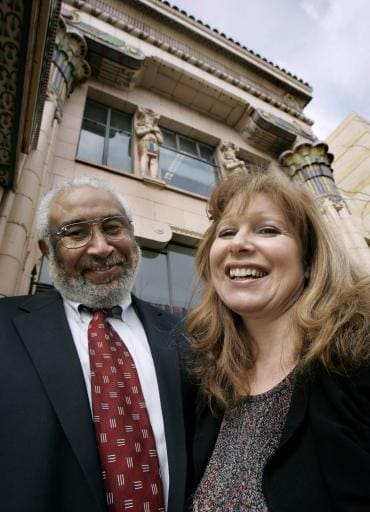
Recently, Brigham Young University invited Darius Gray–one of the founders of the LDS Genesis Group, and a black Mormon for over 30 years–to deliver a presentation entitled, “Blacks and the LDS Priesthood.”
- An audio-based PowerPoint presentation of this podcast can be found here.
In this podcast, Darius re-delivers this presentation, along with Margaret Young. Darius and Margaret are co-authors of a trilogy dealing with black Mormon history entitled: Standing on the Promises.
2 of the links mentioned in the podcast are:
- https://www.mormonstories.org/top10toughissues/blacks.html and
- https://www.ldsgenesisgroup.org/howtoreach.html
Finally–Darius, Margaret, and Richard Dutcher are collaborating on a documentary about blacks and the Mormon church…and are seeking donations for anyone interested in supporting. To contact them about a donation, please email Margaret Young directly at: margaret_young@byu.edu
Episode Transcript
Host: John Dehlin · Guests: Darius Gray, Margaret Young
This transcript is machine-generated and lightly edited for readability. The audio is authoritative. Please excuse occasional errors in names and spelling.
Introducing Darius Gray and Margaret Young
John Dehlin [00:00:11] Hello and welcome to Mormon Stories podcast. My name is John Dehlin. As always, it's indeed a pleasure to have you with us. We very much appreciate all of your emails and your posts to the Mormon Stories blog. We appreciate the community and the support. And it seems like we're getting up to a thousand listeners per episode now. So it's, it's very exciting to know that some of the stuff that we're doing is, is having an impact with, with many of you. We hope that some of you were able to tune in and listen to the podcast with Darren Smith. For those of you who were able to listen, Darren talked to us quite a bit about his experience growing up in the church as a black man and his time working at Brigham Young University. And during that podcast, I promised you all that we would do a deep dive on the issue of blacks, the LDS Church and the priesthood. And the two guests, if I could sort of cherry pick two guests that I could have to speak on this issue, I think that the two guests that we have on today would be the two that I'd pick with maybe Armand Moss to do some commentary afterwards. Words. And I've already got Brother Moss's consent to do that if it ends up being necessary. But without any further ado, I'd like to introduce my two guests. The first being Darius Gray. Darius, welcome.
Darius Gray [00:01:40] Thank you, John.
John Dehlin [00:01:41] And the second being Margaret Young. Margaret, thanks for coming on.
Margaret Young [00:01:44] Glad to do it.
John Dehlin [00:01:46] For those of you who don't know, around 1971, we're going to get into this. President Joseph Fielding Smith of the Mormon Church created an organization called the Genesis Group. And the Genesis Group was an organization founded to do outreach and to be fellowship and community for black members of the, of the Mormon Church. And Darius Gray was actually called as the first counselor of that group back in 1971. Prior to that, he had worked as a reporter for KSL News. He's also been involved in many important initiatives, including a project that many of you may not have heard of called the Friedman Bank Project, where he and Marie Taylor were directors and founders. It was sort of a name extraction program for black Americans here in the United States. We can talk about that a little more. I'm probably not doing it justice, but Darius has also received the Martin Luther King Award by the regional NAACP for his work in black affairs. And he and Margaret together are co authors of a trilogy called Standing on the Promises. And we'll talk a little bit about that during the presentation. But Darius, it's just an honor to have you On.
Darius Gray [00:03:05] Thank you. Thank you very much.
John Dehlin [00:03:07] And quickly, also last but in no way least, Margaret Young is also, as I mentioned, co author of this book, this trilogy that we've talked about. She's also a professor of English at Brigham Young University. So she's on the faculty, is it adjunct, Margaret?
Margaret Young [00:03:26] I am part time. I teach. I have this luxurious position of teaching two classes a year, one fall, one winter. So. Yeah.
John Dehlin [00:03:35] And you're also a mother and a grandmother and a wife and a writer and a singer. And I could go on and on. I should also mention, just briefly, that Darius and Margaret are working on a book. I'm sorry, working on a documentary together dealing with the history of blacks and the Mormon Church and priesthood. And we'll probably get into that as well. But I should mention that at the outset. Anyway, without any further ado, both of you, thank you so much for coming on again.
Darius Gray [00:04:07] Thank you. I'm excited to see what we do, what we're doing today, what we're going to talk about. This is.
John Dehlin [00:04:14] Yeah, well, let me just start right in there, because one of the interesting paradoxes that I experienced after doing Darren Smith's podcast was to realize that, you know, there's always multiple sides to the story. And I very much valued Darren and his story. I think there was much rich and interesting perspective because that was his perspective. And Mormon stories is not so much about telling people who's right or who's wrong, but instead it's just letting people tell their stories. But the truth is. Yeah, yeah, sorry, I didn't mean to cut you off, Margaret.
Margaret Young [00:04:53] Yeah.
John Dehlin [00:04:55] But at the same time, you know, Margaret, you're also faculty at byu, and one of the things that's probably worth mentioning is that just recently, Darius, you and Margaret were asked to come to BYU to present on this very issue. Is that true?
Margaret Young [00:05:12] That's not totally true. Darius was asked to present on the issue of blacks in the priesthood. I am always happy to take a supportive role to Darius packs a lot of power.
Darius Gray [00:05:28] I just got to be the mouthpiece. But we prepared the presentation together. But I was the mouthpiece.
John Dehlin [00:05:35] And that's, you know, and that's an interesting paradox because on the one hand, Darren feels very strongly that, you know, part of the decision to not let him continue teaching was because of his outspokenness around these issues. We don't need to get into that because that's how he feels and that's, you know, his perspective. But it's also, you know, an interesting paradox to note that, you know, Darius, you recently were invited to come to BYU to speak, from what I've heard, very directly and very candidly about the history of blacks in the Mormon Church.
Darius Gray [00:06:10] And so it was a surprise, especially since the topic was not suggested by me or us, Margaret and I, but it was suggested by Brigham Young University personnel, and they were open to that. They requested it and we were happy to address it.
Margaret Young [00:06:27] And it was a good, good crowd that came to hear. I know that some religion faculty had told their students that they ought to go here, and my husband and I both asked our classes to attend it also. So a really good audience and excellent, thoughtful response from the students and faculty members who were there.
John Dehlin [00:06:46] And that's sort of what we're here to talk about today, is sort of maybe a reproduction and hopefully even a further drill down on that talk. Is that right?
Margaret Young [00:06:57] Yes.
Overview of Blacks and the LDS Priesthood
John Dehlin [00:06:59] So, Darius, without any further ado, why don't you lead us through your discussion. And I'm hoping I have the PowerPoint presentation that you'll be speaking from. And if I'm able to pull a little magic together, I hope to reproduce for my listeners something called Screencast or a video cast, where actually, if my listeners want to, they can actually watch this presentation with the slides in synchronicity.
Darius Gray [00:07:24] I love it when technology works. The problem is it doesn't always work. So I'm glad it's going to be on your end to make it work and not on ours.
Margaret Young [00:07:33] And it's nice that we have a little more time. Darius really only had 40 minutes to present material that is so rich. And that's not really quite enough time to give everybody their due, to talk about Elijah, Abel and some of the other black Latter Day Saints, of course, with African Americans being part of the church from 1832. And that'll be my role, I think more is to add some of the stories and personalities that come into it.
Darius Gray [00:08:03] And I think it's important to start with just the very, very broad history. That the LDS Church had its beginnings in 1830, and we have records of blacks being members of the LDS Church from 1832 forward. And just the fact that there has been a continuous black presence in the LDS Church since its very beginnings is significant. And it's often surprising to people to know that so often the LDS Church has been considered a white person's church. And, and it is not. It is the restored Gospel of Jesus Christ. It is available to all and has always been available to all men and women, regardless of ethnicity or race. Now, with that said, the topic that I was given was the History of blacks in the LDS priesthood. And indeed, that's where we start. Back in 1999, which seems so long ago now, as we were getting ready to head into the year 2000, the Church News conducted a poll to determine which events of the 1900s of the last hundred years were to be the top stories of the past century. And it was interesting as they conducted that survey, the number one story by far was the revelation, extending the priesthood to all worthy males. And talking to the editors after the event, the survey, I was told that number two on the list wasn't even close. So we're talking about a very significant issue, something that touched the hearts and minds of thousands of Utah and church personnel across the country. The question was in the presentation, where to begin. Do we talk about the old history, the 1800s and moving forward, or did we talk about more recent history, something in 1978, the priesthood revelation? Do we talk about publications, things written by past general authorities, presidents, members of the 12, or do we talk about current day? And it seemed appropriate to really start off with the news of the current day, the most current being a statement offered by President Hinckley during the priesthood session of General Conference. And I have here a quote of what President Hinckley said. As a person grows older, he becomes a softer touch, has a kindlier manner. As this has happened to me, I've wondered why it is there is so much hatred and conflict in the world, so much pride and jealousy. Racial strife still raises its ugly head even among church members. There are reports of racial slurs and denigrating remarks among us. This is unacceptable. I remind you that no man who makes disparaging remarks concerning those of another race can consider himself a true disciple of Christ. President Hinckley continues. How can any man holding the priesthood, the Melchizedek priesthood, arrogantly assume that he is eligible for the priesthood, whereas another who lives a righteous life, but whose skin is of a different color is ineligible? We rejoiced in the 1978 revelation in the temple. There was no doubt in my mind or those of my associates that what was revealed was the will of God. I have often spoken of the diversity among us and taught that each of us is a son or a daughter of God. And President Hinckley concluded by saying there is no basis for racial hatred among the priesthood. If you have such feelings, go before the Lord and ask for forgiveness. End of quote. I think that's a powerful statement by a living prophet of God.
John Dehlin [00:12:06] Yes.
Darius Gray [00:12:07] As we continued with the presentation, we presented a partial chronology pertaining to blacks in the LDS Church. And A couple of URLs are provided for those who are able to see it on your site.
John Dehlin [00:12:21] John yes, and I'll make sure to make those available on the blog as well.
Darius Gray [00:12:26] And on the first one, I want to point out that it is not one that we have created, Margaret and I. It is just one of many that you can find on the Internet. And while it is provided here because it provides some information, there are numerous inaccuracies on that site. But if someone is going to do research, they need to have a starting spot, and this is as good a starting spot as you're going to find. Just know that you need then to check on each of the points listed for accuracy because there are inaccuracies. And the second URL is one that you can find at the LDS genesisgroup.org website and it has to do with the true meaning of the word black in the LDS scriptures. And that was one done by Marvin Perkins and we highly recommend that one.
John Dehlin [00:13:24] Okay.
Margaret Young [00:13:25] And once you access the one by Marvin Perkins, which is on the Genesis, the Genesis Group newsletter, that resource is available for anybody. Anyone all over the world can access the Genesis website. And we encourage anybody who listens to this podcast to make others aware of it. I'm a part of keeping it current and we work very hard. There are three of us who work really hard to make sure that we've got up to date material and it really has become a wonderful resource, including the archives. If you look at what we've done in the past, we've got some great stuff.
Darius Gray [00:14:02] Let me just give that URL for those who aren't able to view it that can hear it. It's www.LDSGenesisGroup all one LDS genesisgroup.org and then how to reach one word, how to reach HTML. And I think that would be beneficial for your listeners and your viewers.
John Dehlin [00:14:28] Excellent. Thank you. And we'll post that as well on the blog.
Darius Gray [00:14:33] Thank you. Moving forward, 1830 was the year that the Book of Mormon was first published. And that book uses a dark skinned motif as a sign of sinfulness by the lamanites. Quoting in 1st Nephi 5. 21, the Lord did cause a skin of blackness to come upon the Lamanites. And so we have questions of race and the coloring of skin and ethnicity that some might deduce from what they find in scriptures.
Race Language in the Book of Mormon
John Dehlin [00:15:08] Darius does the current Book of Mormon use the term blackness or is that just in the 1830 version?
Margaret Young [00:15:16] The current Book of Mormon does use the term blackness. The Change that was made was. And actually it was the change Joseph Smith himself made, where in later scriptures it said refer to white and delightsome people. And Joseph Smith made the change to pure and delightsome. And when the scriptures were redone, they returned to what Joseph Smith had changed it to, rather than the original flight and delightsome. But the scripture that Darius just referred to does say black.
John Dehlin [00:15:46] Okay, great. And for our listeners, that's first. Nephi 5:21.
Darius Gray [00:15:51] Moving forward in the presentation, July 1831, Joseph Smith Jr identifies Negroes as the lineage of Hamilton. The first Sabbath after our arrival in Jackson County, Brother W.W. phelps preached to a Western audience wherein were present specimens of all the families of the earth, Shem, Ham, and Japheth. Quite a respectable number of Negroes descendants of Ham. And that's taken from the history of the church. 1, 9 0.
Margaret Young [00:16:29] Of course, anybody, any student of history knows that we're in the. When we're talking about Mormonism, we're in the second Great Awakening, where people are becoming very aware of slavery. We're really setting up for the Civil War. The Nat Turner Revolt has happened in 1831. Slavery is a huge issue. It will be one of the issues that will cause the expulsion of the Saints from Missouri. So not really surprising that it would be mentioned here by Joseph Smith.
Darius Gray [00:16:58] Sure, of course, being the prophet that he was. In 1832, Joseph Smith Jr. Predicted an insurrection to begin in South Carolina, which slaves would rise up against their masters and great bloodshed would result. And of course, we can find that citation in DC 87.
John Dehlin [00:17:17] Okay.
Darius Gray [00:17:22] In that same year, 1832, we have an early black member by the name of Elijah Abel being baptized in the church. In those early years, there was a dispute over Elijah's exact ethnicity. Some reports have him as white, which seems impossible given later actions regarding him. But he was a biracial man. But using the words of my father, actually not of my father, but a woman of my father's acquaintance. Even a chicken know another chicken. And it was fairly clear that Brother Abel was a person of color. The census of 1870, the first year that blacks were listed as human beings on the census and not as property, Brother Abel is listed as a Negro, and then in later censuses, he is listed as a mulatto. So his ethnicity was fairly clear.
John Dehlin [00:18:19] Okay. Now, a lot of members don't know that. This is a huge one of the, I'd say 10 or 20 biggest revelations to a lifelong member of the church. Just the simple fact that not only blacks were members of the church. But as you'll mention later, that they actually at least one or two, did receive the priesthood in Joseph Smith's day.
Darius Gray [00:18:42] Well, in fact, we'll find that the number is greater than 1 or 2 or 3 or 4 or 5. There were black members of the church. Yes, black male and female members who were actively engaged from the earliest years. And several of those male members coming forward in time did indeed hold the priesthood.
Margaret Young [00:19:04] And Elijah Avill worked on the Kirtland Temple and was washed and anointed in the Kirtland Temple. So his initiatory rites were performed. Of course, the endowment didn't happen until the Nauvoo Temple. And Elijah Abel had left Nauvoo before the endowment was given. I've always wondered what would have happened if he had been there when the endowment was given. And I believe he received it along with everybody else. He was a dear friend of the Smith family. He received a patriarchal blessing under the hands of Father. Father Smith and was at Father Smith's bedside when Father Smith died. So very strong attachments with the Smith family and a deeply respected man.
John Dehlin [00:19:45] Do we know who actually ordained him to the priesthood?
Margaret Young [00:19:50] It appears. And actually Dryas will cover this. I think maybe we'll just let him get to it.
Darius Gray [00:19:55] Okay, well, we can jump forward in time. Go ahead.
John Dehlin [00:19:59] No, no, no. Let's follow the slide deck. Let's go with 1833.
Darius Gray [00:20:04] Well, in 1833, W.W. phelps in the Evening and the Morning Star published an article, Free People of Color. And it expresses an anti slavery viewpoint and outlines in that article procedures for the migration of free blacks to Missouri. And the quote is, so long as we have no special rule in the church as to people of color, let prudence guide. So in 1833, we are indeed looking for black members to come into the church as long as they are free persons of color. But we're being cautious because Missouri was a slave state. And the tensions, as we know, were quite high in that state towards Latter Day Saints, in part because we were, as a church, open to the participation of black members. But it was just after that, 1834, that we really have the beginning of what we've come to call the priesthood restriction, according to a brother by the name of Zebedee Coltrane, as he recalled in a conversation in 1879, some 45 years later, Brother Joseph Smith, in the presence of Brother Coltrane, received a revelation that blacks were not to be ordained to the priesthood. And this is a significant point in the change in our history. And again, that's Brother Zebedee coltrane recalling in 1879 a conversation that he says took place in 1834. And Brother Coltrane goes on to say, brother Joseph kind of dropped his head and rested it on his hand for a minute and then said, brother Zebedee is right. For the spirit of the Lord saith the Negro has no right nor cannot hold the priesthood. Close quote. And so this is being passed on. And it is because of that comment that we have some difficulty today and have had for some while.
John Dehlin [00:22:06] Okay.
Margaret Young [00:22:07] Although the comment doesn't become. It doesn't make that until 1879. And that. That's going to become very important as we go down the.
John Dehlin [00:22:15] Yeah. Because the very next couple slides offer something quite interesting.
Elijah Abel and Early Black Church Members
Darius Gray [00:22:21] Yeah. The prophet Joseph Smith, November 1835. Brother Joseph reaffirms his earlier proclamation that elders are to avoid going unto slaves or servants unless granted permission by their masters. It was very specific. There was not a prohibition about teaching blacks, but. But about going unto slaves or servants without permission.
John Dehlin [00:22:47] Okay. That makes sense.
Darius Gray [00:22:49] It does to me. Yeah. And in the earlier scriptures, the Doctrine and Covenants, 1835-1839, various sections of the DNC present a universalist, universal. I can't even talk today, friends.
Margaret Young [00:23:04] Universalistic, thank you.
Darius Gray [00:23:06] View of the Gospel being for all people and races and all people being equal in the Gospel. Again, God has never been a respecter of persons. He was not before and he is not now. And so the Scriptures would be expected to represent that same thing.
John Dehlin [00:23:24] Right. Okay.
Darius Gray [00:23:29] March 1836. Elijah Abel, who was baptized in 1832. This biracial man, Elijah Abel, is ordained an elder by Joseph Smith Jr. According to Eunice Kenny in her letter called My Testimony of the Latter Day Work. So Brother Abel, a black man, has his certificate of ordination dated 3rd of March, 1836.
John Dehlin [00:23:58] Okay.
Margaret Young [00:23:59] And. And that's something that a lot of people raise question. Joseph Smith ordained him. And. And we don't have the primary source on that. We do have the Eunice Kinney report. But it's absolutely without question that Joseph Smith was aware of the ordination. And as I mentioned, Father Smith gave Elijah his patriarchal blessing. And in that blessing it says, thou hast been ordained an elder and shalt be protected against the powers of the adversary. That patriarchal blessing was read in the famous meeting of 1879 where the policy was really kind of canonized and there was no question that he had been ordained an elder.
John Dehlin [00:24:38] So do the certificate of ordination or the patriarchal blessing survive to this day?
Margaret Young [00:24:44] Yes, I have a copy of the Patriarchal blessing. I don't have the certificate of ordination. They do have Elijah abel listed as one ordained to the office of the 70. If you go to church archives, the church historical department, that's there in 1836.
John Dehlin [00:25:04] But the evidence that Joseph Smith Jr. Actually performed the ordination is in this journal or writing for Eunice. Okay, great.
Darius Gray [00:25:14] And there's another account that we get to later that substantiates that, but in terms of having the actual certificate, I have not seen it. But there are other certificates that are there as well. Again, In December of 1836, Elijah Abel is ordained a 70, as Margaret mentioned. And that ordination, surprisingly, is performed by Zebedee Coldron Coltrane, the man who said that in 1834 that Joseph Smith had told him blacks could not hold the priesthood.
Margaret Young [00:25:45] So we've got a problem here, right? Got a problem with the date?
John Dehlin [00:25:49] Yeah.
Darius Gray [00:25:50] Well, if not with the dates. With the substance.
John Dehlin [00:25:52] With the substance? Yeah.
Margaret Young [00:25:54] If he's saying in 1834, Joseph Smith said blacks couldn't hold the priesthood, and then the records show us that in 1836, Zebedee himself ordained Elijah Abel to the office of the 70. Got a problem.
John Dehlin [00:26:06] Okay, now I want to address that, but I just have to jump in and ask one question. You know, I've experienced some extreme racism in my life, but, you know, just occasional. But you hear stories about the early 1900s or the 1800s with really severe cases of strong feelings where, you know, people don't even want blacks in the same room. You know, white people, extremely racist. And what I'm wondering is, how is it that if racism was so prevalent in the 1800s, a black man was allowed to be present and even highly participatory within the church without it causing, you know, severe turmoil and stress and contention among folks like Brigham Young and others who, if they were as racist as some might claim, wouldn't have even tolerated them being in the same room potentially. Do you have any sense for why that was that? Yeah, go ahead. I'm mostly asking just about for those who lived with Elijah Abel and Joseph Smith. I mean, was he eating dinner with people? Were they hanging out? And if so, how was that tolerated? You know, how is it tolerated?
Margaret Young [00:27:25] We actually do have some details on that. We know that Elijah Abel was welcome in the Smith home. That is, we know that Elijah Abel participated in trying to rescue Joseph Smith when it appeared that he was in harm's way. We also know that when Elijah Abel went on his first mission, he was accused of murdering a woman and five children. And obviously, his life was at risk, and he eventually was acquitted of that accusation. But as we'll get to in the slides, there did come a time when where he was instructed to preach only to his own people. In other words, only to people of color. But here we maybe should bring in Jane Manning James, who is probably the most famous of our black pioneers. She's portrayed in the new movie that the church has on Joseph Smith. But when Jane and her family, it was nine members of an African American family coming from Connecticut and then to Buffalo, New York, and then walking to Nauvoo. And she talks, she doesn't go into detail at all, but she says that when they entered Nauvoo, they were met with much rebuff. So we can just imagine what kinds of stares they were getting. Finally, they were directed to the Smith home. And you do get a sense of a lot of egalitarianism in the Smith home, because according to Jane's life story, Emma Smith greets them and says, come in, come in, all of you. And we know that the Manning family is. They've walked 800 miles without a change of clothes. Jane's trunk was put on a boat that they thought they would be able to take. And then because of their race, they were denied passage. The soles of their shoes have worn out and they have walked barefoot. So they are invited directly in in a condition where you wouldn't imagine that they would feel comfortable sitting on the chairs. But they come in, and then Joseph Smith. And again, this is all according to Jane's life story. He immediately welcomes them in, goes to the people who are in the parlor and says, we've got company come. And doesn't say they're black, just we've got company come. And then sits them down and says, I want to hear all about your journey. And says to Jane, you've been the leader of this little band. Well, according to Jane, her brothers and sisters find work, and Jane is there in the mansion house, weeping. Joseph finds her and says, why not crying. And Jane says, all the others have gone and got themselves jobs and I've. And bought houses and I've no place to go. And then Joseph talks to Emma and says, here's a girl says she has no place to go. Haven't you a place for her? And Emma replies that she does. And then Jane stays on and is asked by Joseph Smith via Emma. And Emma says, again, quoting from Jane's history, Emma says that this is at Joseph's bequest if Jane would like to be adopted as A child into the Smith family. And of course, the adoption practices in the early church, that's a whole different presentation. But the idea that it was not would you like to be our servant for all of eternity? But would you like to be adopted to us as our child indicates an openness in the smoke home that I think is quite exceptional. And she, as she writes, she turned it down. She said I was so green. And these are her later letters. I was so green that I did not comprehend. And I said I didn't want to be adopted as a child in the family. But she had a deep, deep love for Joseph and Emma. And she talks even about plural marriage there. Very, very fond associations. And we don't have a sense of her being treated in a really way that's much different from anybody else. She expresses such deep love for the Smith family that she is the only one of all of the Manning children who have come to Nauvoo to go with the saints all the way to Salt Lake. And then she becomes a prominent member in Salt Lake who has acquaintance with all of the church presidents from the time of Brigham Young to Joseph F. Smith. And Joseph F. Smith speaks at her funeral. So that just gives you a sense of certainly at the time of Joseph Smith and within the household of Joseph Smith, even though in Nauvoo itself, the Manning family meets rebuff within the household of Joseph Smith, they are treated with dignity.
John Dehlin [00:31:55] Yeah.
Darius Gray [00:31:55] And I think it's important to realize that slavery was probably the single largest issue on the nation's consciousness. It split families. Those who were pro slave and those who were anti. And of course, when you're dealing with slavery, you're talking about race. And there would have been those in the church who were abolitionist and opposed to slavery. And as we know, there were those who were slaveholders, who were members of the church. And so we are representative of the larger community. And we had some who were comfortable with diversity and others who were not. And hopefully today we've gotten a lot further than we were back then. But for an Elijah Abel or Jane Manning, James, they were in the community, the church community. They were participants. And I'm sure some accepted them very openly, as did the Smiths. And some would have been cautious, as were those who rebuffed the Mannings when they came into the city.
John Dehlin [00:32:57] Yeah. And I just want to. I try and always be an advocate for my listeners. You know, you grow up in the church and you pretty much never hear about race and it's sort of a non issue. And that's phase one, Phase two is if you happen to stumble into it, you know, you hear about, you know, statements that were made that some call racist and we're going to talk about those later. And then, you know, the product of your time, the product of their time sort of label is put on. But what this does is swing it back to the middle. It's not that race was a non issue and that everyone was lovey and kind and peaceful all the time. It's not that everyone was a racist and everybody was passing off racial slurs. But instead, not only do we see extreme acts of kindness on behalf of the prophet and others for all races and nationalities. At times we also have other members who express that. We also have black members saying that they had a great experience with the members of the church. And then of course, we have some instances of hatred and racism and cautiousness. But Greg Prince once said that there's really no black hats and no white hats, but that things are a lot more complex and nuanced than sometimes the Internet allows us to think.
Margaret Young [00:34:17] Absolutely.
Darius Gray [00:34:18] And I think the people then, as today, were about living and trying to survive and to make a living and to take care of themselves and their families. And in the process of that, we were also concerned about worshiping God. And so, yeah, it's not about black hats and white hats. It's about being on about the business of living and worshiping God.
John Dehlin [00:34:39] Okay, I appreciate that diversion that you allowed me to take you on. Please continue.
Darius Gray [00:34:46] Well, Elijah Abel, 1836, became a duly licensed minister of the gospel for missionary work in Ohio. And this good man also served missions in New York and in Canada.
John Dehlin [00:35:01] So is it safe to say he was comparable to a general authority third
Margaret Young [00:35:06] quorum of the 70? He wouldn't have had his picture in the ensign if they had had an ensign back then. But he was. He was a member of the third quorum of the 70s.
John Dehlin [00:35:17] Okay.
Darius Gray [00:35:18] And then moving forward in time, you know, the question is, when did the priesthood restriction come into play and how did it come into play? We have the statement, of course, from Zobe Coltrane saying it came into play in 1834. But in June of 1839, Elijah Abel's activities were discussed by the brethren. His holding the priesthood is not questioned. And in that meeting we have Joseph Smith Jr. So again, if Brother Coltrane is correct, we are at odds with the realities of what took place in a meeting from which we have the minutes. The meeting taking place in 1839.
John Dehlin [00:36:00] Okay.
Darius Gray [00:36:03] 1842. Moving forward in time, the Pearl of Great Price was completed. It's something that took place over the span of about five years. That work, the Pearl of Great Price makes two references relevant to the issue at hand. We have Enoch, who ministers the Gospel to surrounding nations, but does not do so to those of the lineage of Cain who are identified as being black. And the LDS community has traditionally interpreted Moses 7 as referring to the black skin color rather than black in deeds or in spirituality. But it's also interesting to note what happened to these people in Enoch that Enoch was ministering to. What happened to all those good souls, John?
John Dehlin [00:36:50] They were translated, I believe.
Darius Gray [00:36:53] No, that's a different Enoch.
John Dehlin [00:36:54] Oh, I'm embarrassed.
Darius Gray [00:36:56] Tell us and what we have. This is pre flood. All of those that Enoch was ministering to are those that he did not minister to. They got to find out how well they could tread water because Noah happens and we have the ark. And of course, in that story, we have Noah and his wife. We have the three boys, Ham, Shem and Japheth and their wives. But all of these people, whether they accepted the Gospel or not, were deemed not to be spiritually of the level that God wanted to save them. They were drowned. So even when we read that in the Pearl of Great Price, we need to put it in the context of what happened to those souls.
John Dehlin [00:37:40] Okay,
Darius Gray [00:37:44] again, going forward in time, 1843, we have three apostles, Heber C. Campbell, Orson Pratt and John Page, who meet and restrict Elijah Abel's missionary work to his own people. Now, again, the year is 1843. Elijah Abel's priesthood seems not to be at an issue. No one tries to take the priesthood from him, and in fact, he is called to serve another mission.
Margaret Young [00:38:15] And the other thing that's important to note is that they clearly perceive him as black of African lineage, because that was one of Zebdi Colchan's claims, was that as soon as Joseph Smith knew his race, he, Elijah Abel was dropped from the quorum. And we'll come to that a little bit later when we get to 1879. But important to note that if he was told to preach only to his own people, those of African descent, his race was acknowledged back then.
John Dehlin [00:38:46] So do we. I mean, did Joseph know Joseph was still alive in 1843? Did he know about this? Do we know if Elijah went and said, hey, what's up? Why are they doing this to me? Or is that just not known?
Margaret Young [00:38:57] He was in Cincinnati. So Joseph was in Nauvoo, Elijah Abel was in Cincinnati when this mandate came down. And I have the impression that it's from those three apostles, not from Joseph Smith, that just preach to your own kind. We've got the race issue getting hotter and hotter all the time. We're just around the corner from the Fugitive slave law of 1850. So the issue is pretty fiery, but you've got the distance and it's not where you can make a phone call or
Darius Gray [00:39:29] drop an email or do a podcast.
Margaret Young [00:39:34] And Joseph at this point is almost ready for the last year of his life and preparing for a presidential campaign which where he's going to take a very bold stance against slavery. And I don't believe that Joseph actually gave that order. I think it was the apostles. But we don't have a record of the line of, you know, the chain of command, how that came down.
John Dehlin [00:39:57] That's good. Makes sense.
Darius Gray [00:39:59] But then again, as we move into that significant year, 1844, we can look at another black man who held a priesthood. Walker Lewis, a black member, was a barber in Lowell, Massachusetts. He was ordained an elder by William Smith, younger brother of Joseph Smith junior. So we're not just looking at one black man holding the priesthood now, but Brother Walker Lewis. Okay, and again, that year was 1844. Also in that year. Pardon?
John Dehlin [00:40:33] Oh, the year of Joseph's death, actually, yes.
Darius Gray [00:40:36] And Joseph Smith is campaigning, of course, for the presidency and he's on an anti slavery platform and his aim was to end slavery by 1850. And brother Joseph said, quote, break off the shackles from the poor black man and hire him to labor with other human beings for an hour of virtuous liberty on earth is worth a whole eternity of bondage.
John Dehlin [00:41:03] So very strong. Now, before we talk about the martyrdom, I wanted to get the record straight just on one thing. I mean, it's a surprise to many Americans that people who we view as the grandfathers of freedom and, and civil rights, like, you know, Thomas Jefferson and Abraham Lincoln, even though we often attribute them with civil rights and with freeing the slaves and goodness and openness, the truth is they did make some statements that would be considered pretty hateful or pretty racist by today's standards.
Darius Gray [00:41:37] All of them.
Margaret Young [00:41:39] And you've got the Founding Fathers dealing with the issue of slavery way back then and during the three fourths Compromise because they need the Southern states who are not going to join them in organizing the Constitution unless they have that three fourths compromise. And so you have slaveholders who actually think slavery is wrong deciding that. Let's go ahead and do the three fourths compromise for a black man in order for the ideas of Representation to not favor one group of states over another. A black man will be worth only three fourths of a man.
John Dehlin [00:42:16] Right.
Darius Gray [00:42:17] The famous Jefferson and Washington as slaveholders. Lincoln, of course, during his day, was not, or in his lifetime ever a slaveholder. And while it was he who signed the Emancipation Proclamation and saw to it that legislation went through Congress trying to right the yields of the population past, Abraham Lincoln's own view was that if he could have held on to the Union and in doing so still have to agree to slavery, he would have done so. The Union was the critical thing in his thinking, and he may have made
John Dehlin [00:42:58] a statement or two that wouldn't be considered enlightened today on race. And so that was my question. Was Joseph Smith completely enlightened and pure on this issue, or are there statements just for the record, just to get everything out there? Are there opinions or statements? Go ahead.
Margaret Young [00:43:16] Darius is going to have more to say on this, but let me just launch it. What you see with Joseph Smith is evolution. You see him in the earlier years making statements about the seed of Cain and statements that are reflective of the project and ideas at the time. But you see him really growing. And I personally think that we grow in our acceptance of other nations and peoples as we become acquainted with them. We know for a fact that Joseph Smith had a deep friendship with Elijah Abel, that he had a tender relationship with Jane Manning James, that there were other African Americans in. In Nauvoo, and that they knew and loved Joseph Smith. And I suspect he knew and loved them. Slavery was repugnant to him. We haven't gone over all of the things that he did, but as mayor, a man was charged with whipping a slave, and Joseph Smith came down very hard on it. The whole idea of anyone being in bondage. When someone asked Joseph Smith, what if this person wants to come to Nauvoo, but he wants to bring 50 slaves with him? The answer was, tell him, free his slaves, educate them, and then come join us in Nauvoo. So I see a great evolution in Joseph Smith, and that, to me, is the promising thing for all of us, that the more he becomes acquainted with African Americans within the city and sees how they embrace the faith and how they love him, his heart opens up. Same as we were just talking about the pearl of great price. When God weeps, it's because the people are without affection and they hate their own blood. And the idea that our hearts can open as wide as eternity if we allow that miracle to happen. And I see it beginning to happen in Joseph Smith and the presidential campaign certainly reflects that.
Joseph Smith's Views on Race
John Dehlin [00:45:15] So while a detractor may be able to pull up isolated statements here, here or there from Joseph's earlier years that might be considered racist or inflammatory, if an objective person looks at the overall history and story, they're going to find a man who grew in further light and knowledge to a level of great enlightenment on race and color and creed, etc. Is that what you're saying?
Margaret Young [00:45:38] And we probably wouldn't say he attained full enlightenment on this because he still very much opposed to interracial marriage and said they should keep to their own species. And that's pretty late in his life. But Michael Quinn, one of the very knowledgeable church historians, talked about Joseph Smith being absolutely radical for his time in his views on race. I'm sure Darius has things to add on that.
Darius Gray [00:46:09] Well, you know, just the thought that Brother Joseph wanted to free the slaves by selling public lands and taking those proceeds and compensating the slave owners so that they wouldn't be hurt financially. He was very pragmatic. He realized that there was a great deal of money tied in that supposed property, the lives of human beings as slaves. But he was very active in trying to put forth a plan that would be workable, and I think that should be recognized. Was he a man, as Margaret said, who achieved full enlightenment? No, but I don't know of any who have done that other than one who was enlightened from the very beginning. I think his name was Jesus or something like that.
John Dehlin [00:46:56] Very good.
Darius Gray [00:46:58] Okay, please continue as we move forward. That same year, we were talking about 1844. Of course, in June of that year, we have the martyrdom of the prophet Joseph and his brother Hyrum. And that was a horrible day. And it marked a day that brought with it some changes. Later that same year, In November of 1844, we have the Apostle Wilford Woodruff, later to become a church president. Brother Woodruff visited Lowell, Massachusetts, and observed that a colored brother who was an elder, and presumably we're talking about Walker Lewis here, was present. And there was no remark made about the existence of a black elder being contrary to the doctrines or practices of the church.
John Dehlin [00:47:52] Do we have a source for that or
Darius Gray [00:47:56] that?
Margaret Young [00:47:57] That'll be in the journal of Wilfred Ridge of. Kept a great journal.
John Dehlin [00:48:00] Okay. Okay, sure.
Darius Gray [00:48:02] Then moving forward again in time, same year, 1844 through 1845, the Lowell, Massachusetts, area is visited by apostles Ezra T. Benson and Brigham Young, neither of whom mentions any problem with a black man holding the priesthood. Brother Brigham, later in 1847 made a statement that made it clear that he was aware of Walker Lewis and the fact that Walker Lewis did indeed hold the priesthood. So Brother Joseph is dead, Brother Hyrum is dead. The priesthood restriction that Zebedee Coltrane talked about having been put in Place in 1834 seems somehow not to have been noticed by any of the other senior brethren of the Church. Here we have 1847 with Brother Brigham leading the church and he has no apparent problem with Walker Lewis being a priesthood holder.
John Dehlin [00:48:55] Okay, interesting.
Darius Gray [00:49:02] 27th of April 1845. Orson Hyde refers to Negroes as the cursed lineage of Canaan and says that the cursed of servility which they bore was for their actions in the pre existence. This is interesting, John. I've been a member of the LDS Church now more than 41 years. And in those early years especially I heard so often that the reason that blacks did not hold the priesthood, could not hold the priesthood, was because we had been less valiant in the preexistence or that we had been fence sitters in the pre existence. And so here we have that comment being made in 1845 by Brother Orson Hyde. Sadly, there is no doctrinal support for that position. It is a position that was taken by an individual and put forward and then added to by others over time. But here we have again a beginning. We had a beginning with Brother Zebedee Coltrane. Here we have something else being added to the mix.
Margaret Young [00:50:11] It becomes really significant because the church had imported from all over the world, but all of the Protestant sects, especially the whole idea that blacks were descendants of Cain and that the curse of Canaan via Noah came on the blacks. That was something that had been used to justify slavery back in the 15th century. So you know, just absolutely ubiquitous all over the place people were using that. But in the articles of faith we're told that we are not responsible for Adam's transgression, that each man is responsible for his own. And you have to extrapolate from that. Then is a black man responsible for Cain's transgression or for Ham's transgression, for whatever was implied by seeing as Father's nakedness. And the answer would have to come back, well, not if we actually do believe that each man is responsible for his own sins. So then why would there be any cause for priesthood restriction? And this very speculative idea given by Orson Hyde and then later echoed by other leaders, but always speculatively, nobody's saying thus saith the Lord then comes into the institutional memory and before too long we have people saying, well the church has always said that. And my understanding is that because of what they did in the preexistence, but in fact we only have speculation trying to marry that idea to justify the priesthood restriction based on something that doesn't fit into our articles of faith. Blacks are being punished for sins that somebody else committed.
Darius Gray [00:51:47] But then we also have the issue that if blacks had been less valiant and had rooted for Satan in that battle that took place, we would not be here with physical tangible bodies. We're told that the very nature of the conflict required that everyone take a stand. Therefore there could be no neutrals and there could be no fence sitters. And the fact that blacks are here with physical tangible bodies is a clear indication that we were on the side of Father and of the Savior. So the fincader argument doesn't fit. It does not stand the test.
Origins of the Curse of Cain Theology
John Dehlin [00:52:26] So let me just real quick if I can jump in. The first thing I wanted to note is while the notion of a curse of Cain or a curse of Ham is certainly not a Mormon original.
Darius Gray [00:52:38] True, true.
John Dehlin [00:52:42] This notion of a curse in the pre existence just might be a curse stemming from the pre existence just might be sort of a Mormon original that
Darius Gray [00:52:52] is uniquely Mormon because of pre existence concept of the pre existence is uniquely Mormon.
John Dehlin [00:52:57] So a follow up question is does this belief voiced attributed to orson Hyde in 1845, is it found anywhere else prior to 1845 by Joseph Smith or any of the other general authorities or leaders in the church or do we even know?
Darius Gray [00:53:14] Not that I'm aware of.
Margaret Young [00:53:15] No Margaret, I haven't seen anything.
John Dehlin [00:53:17] Okay, so this is, and if we get a chance, I'd love to get the source of this quote because if this becomes the original, maybe Lester Bush's article talks about it, I'm not sure. But you know, that's pretty important and
Margaret Young [00:53:31] we didn't include the little brackets of it is my belief that, and I don't remember how he steps forth and says I am going to speculate that, but it's given as a speculation and then it's that speculation. You know, other people think about and say that's a pretty good speculation. And then just in the course of time, suddenly it's no longer being considered a speculation.
John Dehlin [00:53:55] And it does make sense that this belief is driven out of the attempt to reconcile that man is not cursed for what their ancestors do.
Margaret Young [00:54:05] Right.
John Dehlin [00:54:05] So you got to find some justification. So we may as well put it back into pre existence. Okay, great.
Darius Gray [00:54:11] You know we talked about Elijah Abel having a priesthood and Then we talked about Walker Lewis in Lowell, Massachusetts again. They weren't the only ones. We have now a third one. October 1846, William, also known as Black Pete, the king, is baptized and ordained by Apostle Orson Hyde.
John Dehlin [00:54:33] Okay, that's the man that we just talked about saying that quote before.
Margaret Young [00:54:42] Interesting.
John Dehlin [00:54:42] I'm sure that wasn't an accident.
Darius Gray [00:54:47] Well, Orson Hyde made the comment in April of 19 or 1845, and yet it was in October of 1846 that we have Black Pete being ordained. So no, I guess there was no accident there. Okay, Black Pete, William Makary, he was known as the Black Prophet. And he was a man who brought trouble upon himself. He seduced a number of Mormon women into his own pocket lickamy rights. And he was subsequently excommunicated because of that and because of the racial tensions between blacks and whites. And always there's been that fear about the oversexed black man wanting to have his way with the pure white woman. That may have brought some additional problems in other than just those of having William Makary excommunicated. Brigham Young that same year declares that blacks are ineligible for certain temple ordinances. And that might possibly be that Brigham was reacting to the William Makary Black Pete situation.
John Dehlin [00:56:01] So this is a pretty.
Margaret Young [00:56:02] Keep in mind that we're not dealing with prior to this and we'll get to the specific ideas about priesthood restriction. But prior to this, when people are talking about, about Curse of Cain, Curse of Canaan, it's not used as justification for this is why we're not going to allow blacks to hold the priesthood. It's being used as this is why blacks have it so hard. Or in some cases, a lot of Protestant preachers all over the place trying to keep the Civil war from happening are saying this is God's design and these are the curses that support the way things ought to be. So it's not a question of priesthood, it's a question of social status.
Darius Gray [00:56:41] And while Brother Brigham declared blacks ineligible for certain temple ordinances, there was not a restriction on priesthood that year in 1847.
John Dehlin [00:56:52] But this, this becomes, this becomes a pretty important event because it could be probably one of the seminal events in that leads to the prohibition. Would you guys say that there's a high likelihood of that?
Margaret Young [00:57:07] Well, yes, we actually have a statement back there, and I'm trying to remember which of the Orsons it was. We've got Orson Spencer, Orson Hyde and Orson Pratt, and my memory has served me well. But when these women are following Black Pete, the statement is made what will you follow a man who has no right to the priesthood? And that's the first intimation of what's going to follow. But that's the very first.
Darius Gray [00:57:31] But what Brother Brigham says at the same time is it's nothing to do with the blood, for of one blood has God made all flesh. We have one of the finest elders, an African in Lowell, Massachusetts, and it's all likelihood referring to Walker Lewis. So even during this period of time where Pete McCary is being excommunicated, and there's the sensitivity about seducing a number of white sisters, still, Brother Brigham says it has nothing to do with blood, for of one blood has God made all flesh.
Margaret Young [00:58:06] And we have one of the best elders. Very important because of what Brigham Young is going to be saying later, that in 1847, he's acknowledging an important African American elder in Lowell, Massachusetts.
John Dehlin [00:58:20] Yeah, and I'm just going to throw out, and I'm sure you guys are going to address this, this, that for those who have access to the journal Discourses or Google, they're going to find that statement by Brigham Young to be quite not what they expected from Brigham Young.
Margaret Young [00:58:34] Well, here we come. You just led us right there.
Darius Gray [00:58:38] All right, let's move forward two years. Now we are in February of 1849, and here we have the earliest statement on priesthood restriction, and it comes from Brother Bricken when he declares, because Cain cut off the lives of Abel, the Lord cursed Canaan's seed and prohibited them from the priesthood. And this is the first statement that we have, definitive statement. And it comes two years following Brother Brigham's own statement that it has nothing to do with blood, nothing to do with lineage.
John Dehlin [00:59:15] Right.
Darius Gray [00:59:16] So it sort of begs the question, what's changed? What has happened?
John Dehlin [00:59:20] Yeah, what happened? Well, I expect you guys may not have the answer, but, no, I think
Darius Gray [00:59:27] one of the things that happened was this. As we're moving closer and closer to the Civil War, tensions are mounting throughout the nation on the topic of slavery. And then, of course, on the topic of race. And now we have the saints who had been in upper New York State, and then they were in Ohio. And then from Ohio, they went to Mississippi or Mississippi, Missouri. Excuse me. And from Missouri, they, you know, were run out and went into Illinois, and from Nauvoo, we came west. But at each of those stages, the Saints were spending money moving. They were spending money moving, building new dwellings. They were spending money building two temples, the Kirtland Temple and then the Nauvoo Temple. And by the time The Saints got to the Salt Lake Valley, we were poor as could be. We had shot our wad. But there were seeds that had been planted by early Mormon missionaries who had gone into the Southern states and who had been teaching the gospel there. And in 1850, 12 Mormon slave owners who possessed between 60 and 70 black slaves came into the Deseret Territory. And one of those slave owners was the Apostle Charles C. Rich. And we have something else that took place in that same time period, 1852, the territorial legislature passed the law legalizing slavery in Utah. And that's something that many don't know. It was called an act in relation to service, but it gave legal recognition to black slave holding in the territory of Deseret.
John Dehlin [01:01:15] So slavery was.
Darius Gray [01:01:16] Did you know that Utah was a slave territory?
John Dehlin [01:01:18] I did, but I'm sure many of our listeners, that will be news to them. Was that a pragmatic decision? Was that, you know, how do you guys make sense?
Margaret Young [01:01:30] It was actually against the counsel of John Bernheisel, who was sort of the emissary to Washington, D.C. and probably was pragmatic, you know, involving part of the California Compromise with New Mexico, Utah and California.
Darius Gray [01:01:47] California. California came into the Union as a free territory or free state rather. And Utah and New Mexico territories were given the option of being free or slave. And New Mexico chose free and Utah chose slave. And I think it might be because of an accommodation being made to those Southern Saints, the Mississippi Saints, who came into the valley.
John Dehlin [01:02:15] Interesting.
Brigham Young and the Priesthood Restriction
Darius Gray [01:02:17] Now we move forward in time. Another year, 1853. Elijah Abel is now not allowed by Brigham Young to receive his endowment. As Margaret pointed out, Brother Elijah did receive the washing of the anointing previously in the Kirtland Temple. But as he approaches Brother Brigham asking for the privilege of receiving the endowment, that right is denied him. That privilege is denied him.
Margaret Young [01:02:43] This is one of the points. I really want the listeners to imagine what this must have been like for Elijah. Remember that he had left Nauvoo about 1843, gone to Cincinnati. He was a carpenter by trade, a gifted carpenter. He got married, had a wife, several children when he came on his own to Utah. And up until this point, there had been no hint that he would be restricted of anything. He had been made a priesthood holder, a member of the third quorum of the 70, had already served two missions and had been washed and anointed in the Kirtland Temple. And he knew Brigham Young. They weren't great friends, but they were acquaintances. Imagine what that must have been like for him to ask for the endowment which others were receiving. And to be told that because of his race, he could not participate in those ordinances.
John Dehlin [01:03:36] Now, the Salt Lake Temple wasn't up then, right?
Margaret Young [01:03:39] No, but you have the endowment. Actually, you've got Ensign Peak first serving as the temple, and then you'll have the endowment house, but the endowment was certainly being given.
John Dehlin [01:03:48] So just really quickly, what's Ensign Peak?
Margaret Young [01:03:51] Ensign Peak, that's actually the mountain where Brigham Young stood and designed all of Salt Lake City. But it served as the temporary temple. Anson Pratt was the first one endowed there. But they performed endowments on Ensign Peak.
John Dehlin [01:04:06] Wow. I had no idea.
Margaret Young [01:04:07] Yeah.
John Dehlin [01:04:08] Okay. Yeah. So what?
Darius Gray [01:04:10] The state Capitol building, John.
John Dehlin [01:04:12] Right.
Darius Gray [01:04:13] That outcropping, otherwise known as a peak. A mountain. That small mountain in back of the state capitol building is inside. Peak.
John Dehlin [01:04:23] So this was. Must have been just a shock to Elijah Abel.
Margaret Young [01:04:28] I love the term empathetic imagination. You have to not just look at the dates, but imagine this man who has come all across the plains with his family, who has been highly regarded and a part of the Smith family, and who has received everything until now. It's. He has been restricted as to who he can preach to, but he has been a loyal, loyal missionary and church member. And then he has told us that because of his race, he cannot proceed with what he has already begun. He has already had the initiatory ordinances, but he cannot proceed to the higher ordinances because of his race.
John Dehlin [01:05:06] Now, did he or any of his loved ones keep a journal to talk about this event?
Margaret Young [01:05:11] We have a little certificate of Elijah Abel signed with an X in indicating that he was not literate. We rely on Jane James for a lot of the actual events. We have wonderful historians who've done great work. Lester Bush probably being preeminent among them, and Noel Bringhurst also. Those two are the ones that we owe the most to for having really searched the records. But certainly messages were communicated to Elijah and the responses were communicated. And those are in the minutes of church proceedings.
John Dehlin [01:05:47] Okay.
Darius Gray [01:05:48] And what we're providing here, John, is a partial chronology. And if we were to try and fill in all of the instances, we would take forever.
John Dehlin [01:05:58] Sure.
Darius Gray [01:05:58] And so, if I may, what I'd like to propose we do at this point is fast forward. We were just talking about 1853 when Brother Brigham denied Elijah the opportunity to receive the endowment. But let's move forward in a big chunk here. Let's go up to 1879, and here's an example of the conflict that we've had ongoing in the church. Zebedee Coltrane claims that Elijah Abel was dropped from the Quorum of the Seventy when Brother Joseph learned that Abel was black. And that goes back to the statement of 1834. But now we're talking in 1879. At that same time, Apostle Joseph F. Smith challenged Coltrane's claim. And AAPostle Smith presented two certificates showing that Elijah Abel had been reordained to the Office of the Seventy. In those days, you had to be resetting, certified periodically. And Joseph F. Smith had sought out and found those two recertifications and presented them to counter what Brother Zebedee Coltrane was saying. So we have conflicting accounts in 1879.
Margaret Young [01:07:16] And let me just contextualize the time. Also, Brigham Young has died two years ago. This is 1879. Brigham Young died in 1870. 1977. So why is Elijah petitioning again? He's already been told no. And why are they listening again? Why don't they just say, well, didn't Brigham Young already answer that? It becomes a really important question and an important meeting. First of all, Elijah Abel's wife is dying, and he wants the sealing ordinances. He understands what is implied by the church doctrine of eternal sealing, and he wants to be sealed to his wife. But secondly, he thinks that with Brigham Young gone, he can approach the new church president and ask. And indeed, they don't summarily say, well, I thought you already got that answer. They go back and revisit and say, what did Joseph Smith say about this? And that's when Zebedee Coltrane provides his pretty old memory. And he gets a couple of things wrong in that memory. And then he have Joseph F. Smith countering it. But that's when his patriarchal blessing is read again. They pull that out of the records, and there are Father Smith's words. Thou has been ordained an elder and shall be protected against the powers of the adversary. So there's in 1879, there are big questions about this policy.
Darius Gray [01:08:35] And Brother Coltrane's memory is shown to be unreliable. Again, his claim to date 1834 for 20 Joseph Smith announcing the alleged ban is impossible since Coltrane himself ordained Abel 72 years later than that in 1836.
Margaret Young [01:08:52] And let's use the empathetic imagination once again. This information is taken through Elijah Able. And he's also told that Zebedee Coltrane had said, I washed and anointed Elijah Abel in the temple and never had a worse feeling in my life. And I swore that I would never do so again unless I were commanded to by a prophet. And Elijah is Told that. And he says, zebedee Coltrane did not wash and anoint me, but he did ordain me a 70. But imagine being told that. This is what is being said about you. That this man who performed. He claims he performed this ordinance and said he never had a worse feeling in his life than when he did. That we have the record of Elijah not in his own handwriting, but of Elijah responding. That is inaccurate. It wasn't Zebedee who washed and anointed me, but just the whole sense of things. That he is being told that he is defective. That somehow his very presence brings a terrible feeling to the person who is performing a priesthood ordinance.
Darius Gray [01:09:54] Moving forward.
John Dehlin [01:09:55] Very bitter pill to swallow.
Darius Gray [01:09:57] Yeah. And Moving forward just one year to 1880, Elijah Abel is again denied the endowment. This time by the quorum of the Twelve, before it was by Brother Brigham. And then in 1883, Elijah Abel is still on record as a member of the 70. And then in 1884, Elijah Abel goes on his third mission for the church. He returns home and dies in December of 1880. So here is a man who has given the majority of his adult life in the service of the church. He worked on three temples, the Kirtland, the Nauvoo and the Salt Lake. He served three full time missions for the church. He is a member of the third Quorum of the Seventy. He has to have felt isolated and at times very disregarded by the statements of Zebedee Coltrane and others. And yet he has remained faithful and has come home from his third mission only to die.
Margaret Young [01:11:06] And we'll get to his obituary. But let me pull Jane James back in. At this point, when Lester Bush and Newell Bringhurst wrote about Elijah, they were focused on Elijah Dreyson. I, as we wrote our book, got to look at everybody. And so we were always comparing dates. What's happening? Why does this matter to Elijah this year? And then looking at the dates the first time when Jane James goes to John Taylor, who is president of the church, to ask for her endowment, surprise. Jane James also petitioned, in fact, petitioned every church president for her endowment. What's the date? Well, it's December 25th, 1884. It's a Thursday. We know this because she dictated a letter on December 27 that says, Dear Brother, addressed to President Taylor. I called at your house last Thursday and I had my husband figure out what that Thursday was. December 25, 1884, is the date of Elijah Abel's death. It's hard to imagine that there wasn't some kind of a Conversation where Elijah Abel sort of gave the gauntlet to Jane and said, I have not been able to get my endowments, but you continue on with it. And the letter itself is so poignant, and it indicates her understanding of the Gospel. She says, I realize my race and color and cannot expect my endowments as others who are white. But inasmuch as this is the fullness of and through Abraham, all mankind may be blessed. Is there no blessing for me? And then she goes right on and asks for her endowment. And she doesn't stop asking every church president, Zina Young. She is writing letters, or dictating letters rather, to every leader that she thinks might be able to get her what she's asking for. And even the fact that sealed as a servant to Joseph Smith, and then in 1978, things get corrected and she's able to by proxy receive her endowment.
Jane Manning James and the Endowment Petition
John Dehlin [01:13:12] But even the fact that she's petitioning and asking pretty much demonstrates that there wasn't a clear policy or she wouldn't have been asking.
Darius Gray [01:13:19] Right.
Margaret Young [01:13:21] Well, they certainly knew what Brigham Young had said, but it seems pretty fluid by this time. And she. She does say, I realize my race and color and not expect my endowment. But the fact that she then goes on and asks for her endowment and that after she's given what they feel they can give her, looking at what the prophets have taught, which is to seal her as a servant to Joseph Smith, that she keeps asking, and that Wilford Woodruff says, jane, Jane, not being content with what we have already given her, has requested again. And it goes on all the way through Joseph F. Smith.
Darius Gray [01:13:55] And as you'll see in some other slides that are forthcoming, John, it is still unclear to the brethren, and we'll see that as we move forward even into the 1900s. But John Taylor had to ask, what did Brother Brigham teach? And Brother Brigham had to say, you know, if it's never been said before, I say it now, indicating that nothing had been said by the Prophet Joseph Smith Jr. So it is uncertain. It is a moving target. Yeah. Going to December 26th, the day following the death of Elijah Abel. We have the obituary in The Deseret News, 1884. And reading that obituary, died Elijah Abel of old age and debility, consequent upon exposure. While laboring in the ministry in Ohio, he joined the church and was ordained an elder, as appears by certificate dated March 3, 1836. He was subsequently ordained a 70, as appears by certificate dated April 4, 1841. He died in full faith of the gospel. And again, if this were A white person, member of the church who had died, the care would not have been given to point out that he had been ordained and given the day of that ordination, that he was ordained an elder or when he was ordained a 70. Again, they're making sure that people understand that this man was a man of color.
John Dehlin [01:15:27] Right. So it's pretty much unrefutable. Irrefutable
Darius Gray [01:15:34] in terms of his ethnicity. Yes.
John Dehlin [01:15:36] And his priesthood holding, standing, etc.
Darius Gray [01:15:41] Moving forward in time, 1895, we have a second review. Elijah Abel, now dead some 11 years, is again discussed by the Quorum of the Twelve. Joseph F. Smith again rebuffs claims that Abel had been dropped from the priesthood. On the contrary, Joseph F. Smith made two new claims. That Abel's original ordinance was done under the direction of Joseph Smith Jr. And that Abel was ordained a high priest after being a 70. And that is 1895.
John Dehlin [01:16:18] See, I always assumed that Brigham, that the statements that we'll talk about from Bruce Armaconki came from Joseph Fielding Smith, which was his father in law. That then came from Joseph F. Smith, which was his father, which came from Brigham Young.
Margaret Young [01:16:35] We're gonna get there. We're gonna have a reversal in 1908. We'll just move up to it.
John Dehlin [01:16:39] Okay?
Darius Gray [01:16:43] But now, moving forward in time, Elijah Abel's next generation. We have A certificate of November 27, 1900. Enoch Abel, son of Elijah and Mary and Abel, Enoch is ordained an elder, and that's in 1900. And again, if the policy had been firmly fixed by Brother Joseph or Brother Brigham or John Taylor, we would not have had that ordination. But now, 1905, Joseph or 1908, Joseph F. Smith, the man who on two occasions has defended the fact that Elijah Abel held a priesthood and that that was not removed from him, and that Elijah Abel continued to be an active member of the 70. Joseph F. Smith, on unspecified grounds, reverses his former position about Elijah Abel's status and now claims that Joseph Smith himself declared Abel's ordination null and void. I'm looking forward to a time when I can and speak to Brother Smith and ask what happened after you stood the ground and you saw the certificates, you presented them showing the evidence to the contrary. What caused you in 1908 to have a reversal? But now, even with that reversal, and that was again 1908. If we move forward to 1934, Elijah Abel, grandson of the original Elijah Abel, is ordained a priest. And then later In September of 1935, this same grandson, Elijah Abel, is ordained an elder.
John Dehlin [01:18:32] Right.
Margaret Young [01:18:32] I'll just make A brief comment about that 1908 date. This is one that I simply can't explain. I. I can't give a reason why Joseph F. Smith would have said what he said when he had been such a champion for Elijah Abel earlier. It is the year of Jane James death. I don't know if that had anything to do with it. I'm with Darius. I'm eager to understand why the policy changed or the statement, Joseph F. Smith's statement. But there you have again. We're looking at the establishment of institutional memory and this of course is much more consistent with what we're going to see later on in Mormon doctrine.
John Dehlin [01:19:18] Right. Real quick. And this has been very, very important and valuable. I'm so grateful that we have this history laid out. There's one dynamic that I'd love just to throw out there and get your guys comment and perspective on, and that's the. The statements that are so often pulled out of the Journal of Discourses by Brigham Young and others. I don't know if you want to quote them or if you want me to quote them or if we just want to refer to them.
Problematic Teachings in Church Literature
Margaret Young [01:19:46] I try not to quote them if I'm given the option.
John Dehlin [01:19:49] So tell me, tell us why, Because a lot of our listeners are going, hey, now, if we're seeking full candor and truth, you know, there's been some pretty tough statements made about blacks in the Journal of Discourses by Brigham Young and others. Why are you just sort of glossing and skipping over that? So it's fine if we don't choose to cover it here, but do you want to at least talk about why you've chosen not to? Or if you do have perspective on it?
Margaret Young [01:20:14] First of all, Darius has whole files of far more than the Journal of Discourses. It wasn't just Brigham Young. We have some awful statements from all of the leaders of the Church.
Darius Gray [01:20:25] Church.
Margaret Young [01:20:26] So how can Darius and I do what we do and hold current Temple recommends and know everything that was said in the past and still support the Church of Jesus Christ of Latter Day Saints? And basically it's because we don't believe in the infallibility of prophets. We think that Brigham Young did some remarkable things in leading the Mormons on that great immigration, great migration, the historic migration. But he was blind in certain aspects. There's just no question about it. I used the word evolution before talking about Joseph Smith. I see us as a church evolving, consistent with what Joseph Smith talked about in the King Follett Discourse about you climb up a ladder in your Knowledge. We, we certainly refer to it in the temple as, as we. We get better, we learn things, we grow from our infancy into our boyhood. We go from our boyhood in or girlhood into manhood and womanhood. But even I'm. I'm now 50 and you'd think that I would have figured out a whole lot of stuff. And I still find myself absolutely falling by some situations. And I fully acknowledge that I have a whole lot to learn about many, many areas. This area is one where I've taken a lot of time to find things out about other areas I'm not prepared to talk about. Brigham Young was marvelous in so much of what he did. But the statements that he made did start a disastrous chain effect. And the marvelous thing is that we are a church that believes in continuing revelation and that we are. In fact, we're going to be coming up to Bruce R. McConkie's bad statements and then the statements where he talks about seeking further light and knowledge. And that's. I have to plug all of that into the context. I've had to just kind of pinch my, my nose as I read through the terrible things that have been said by past leaders of the church, understanding the damage that they've done and the damage that they continue to do because they are very much with us. We are in the Internet age. You can look at with the click of a mouse. You can bring up what Brigham Young said about interracial marriage. You can bring up what he said about blacks being eternally destined to servitude. And they are ugly, ugly statements.
John Dehlin [01:23:01] Yeah.
Darius Gray [01:23:02] And there are statements that came from others of the leaders. I call them the Orson twins, Orson Hyde and Orson Pratt. And this isn't a question of glossing over or making pretty the hideous and horrendous statements of the past. There were racist statements made. It's fact, and I know that. And yet I realize that these were men and they are or were fallible, just as you and I and Margaret are fallible today. And yet I have a testimony. I am a Latter Day Saint. I am a religious person here speaking to you. And I have a testimony of the truthfulness of this restored gospel. And I know that God has to use we imperfect people to bring about his purposes. And so if imperfect people were called who had attitudes that were non Christian, it does not demean their calling from God. Brigham Young was a prophet of God. Did he have racial attitudes? Absolutely. And I have to separate the two. Otherwise I would have been offended by some ward member 30 years ago, 40 years ago, and never had the experiences of being in the gospel these last 41 years. So I have to make that separation knowing that they were imperfect, not to gloss over it, but recognizing their humanity and that I too am imperfect.
John Dehlin [01:24:24] Yeah, and I appreciate that. I, you know, I sometimes believe in this theory of inoculation, that there's going to be people listening to this podcast and some of this is going to be very new to them. And if they're introduced to these quotes or at least be aware that they existed, you know, then later on it's very easy for them to say, you know what, it's, yeah, I knew that. It's no big deal. But when people are blindsided sometimes by these quotes out of context, without an understanding, it can, it can take them down pretty quickly.
Darius Gray [01:24:54] So that's why I think, yeah, two days ago there was a message left on my answer machine by a man saying that we've got a new brother who was recently baptized and he is now encountering certain attitudes and past statements. Can't you help out? And you're right, if you're inoculated, if you're knowledgeable, if you're aware, then it won't blindside you. But too often people have been blindsided. So we acknowledge the ugliness of the past and we also acknowledge the joy of the past. And let's talk a little bit about the ugliness and the joy. We do have comments in our literature. And in June19, Bruce R. McConkie published his work Mormon Doctrine and under the heading for Negroes he states that Negroes are of the lineage of Cain through Ham's wife and that Negroes were less valiant in the pre existence. Now that goes again back to Orson hyde. But brother McConkie said that blacks are then banned from the priesthood and that the gospel message is not to be carried to them. That's, that's a horrendous statement. But now let's make, make the jump. J. Reuben Clark quote, they general authorities sometimes have spoke out of turn. You will recall that the prophet Joseph declared that a prophet is not always a prophet. So here we have J. Reuben Clark at general authority pointing out that not every word that comes out of the mouth of a prophet is prophetic. He's not always speaking for God. Brother Clark went on, even the president of the church himself may not always be moved upon by the Holy Ghost when he addresses the people. This has happened about matters of doctrine, usually of a highly speculative character, where subsequent presidents of the church and, and the People themselves have felt that in declaring the doctrine, the announcer was not moved upon by the Holy Ghost.
John Dehlin [01:27:00] Right. And just, I'm sure our listeners know. But just to repeat what we've mentioned in prior podcasts, Apparently David O. McKay wasn't thrilled when Mormon doctrine came out. He wasn't happy with the title. He wasn't happy that he wasn't informed about its coming out before it came out. He actually commissioned a study where he asked, I think it was Jerry McClark and a couple others to actually review the book. And hundreds of errors, doctrinal errors were found in it.
Margaret Young [01:27:30] Oh, not hundreds.
John Dehlin [01:27:31] Thousands, thousands. And Brigham, as I understand, Bruce R. McConkie was asked not to publish a new edition of the book, and a new rule was created as a result, requiring all general authorities from that time on to get approval before they could ever publish another book. So. And the only reason why the book wasn't openly repudiated and denounced was because, you know, there's a respect for the. For the mantle of general authority. I think he was a 70 at the time. He later became apostle. And, you know, they were showing respect for that mantle by not just embarrassing him outright. But I think there were discussions about should we denounce the book altogether? So that's a little historical tidbit that our listeners may not know that, I think. And I'm not saying that to disparage Bruce R. McConkie, great man, done wonderful things. But. But we shouldn't look at that book necessarily as the fifth standard work.
Darius Gray [01:28:26] And again, it was written by a human being who is infallible, who is fallible, not infallible.
John Dehlin [01:28:34] And I hope I.
Darius Gray [01:28:35] We had other voices besides, you know, Brother McConkie. In 1869, President Hugh B. Brown proposed that the church's policy be reversed and that blacks be given the priesthood. And this policy was approved by the quorum of the Twelve and the First Presidency. However, President McKay and Harold B. Lee were absent. President McKay was out due to illness, and President Lee was traveling on church business when that vote was taken. There was a revote after President Lee, or in this case elderly, returned and he called for another vote. And the measure, this time to extend the priesthood to blacks, was defeated.
John Dehlin [01:29:21] Now this will be. This will be shocking to some members to think that, you know, high level, important church policy can be a matter of votes and a matter of, you know, who votes and who doesn't. Do you guys have any thoughts on that?
Margaret Young [01:29:37] Well, it can certainly come in a number of ways. And the way that it ultimately did Come the fact that it's being. That the issue is being raised and that Hubie Brown felt so strongly about it. My understanding is that he wept as he signed the document. The same that priesthood would not be extended to blacks in that year. But the issue is being raised not just because we're in the civil rights era, but because the general authorities themselves are researching it. They are told to research it. And that was when President Kimball prepared for what he was going to eventually do. He asked the general authorities, including, by the way, Gordon B. Hinckley, to research the issue, to try to get to the real roots of it. Is this true? Is this a policy that is grounded in our doctrine, or is it not? Is it something that can change? Is it something that should change? So Darius and I both believe firmly that President Kimball received revelation. And we'll get to that in a bit.
John Dehlin [01:30:42] Okay?
Living Through the Priesthood Ban Era
Darius Gray [01:30:43] And one of the, I guess, difficult things for me, John, is that I lived through this period. This isn't detached history for me. Not that it is for you or Margaret or any of the others of the listeners. But I was in a unique position as a reporter at KSL during those years. I knew President McKay. I knew Hugh B. Brown, President Brown. I knew Harold Brown, Lee. I had meetings with some of these men. I was in their homes. I knew Spencer Woolley Kimball. So all of this is very first person to me. And it's sort of hard at times to reflect back on some of the attitudes and some of the issues as they were being addressed at the time. But then we always need to be forward looking, and that's not the gloss, but we need to be forward looking. 1973, after becoming President of the Church, Spencer Kimball was asked about the position of the church regarding blacks in the priesthood. And he stated, I am not sure that there will be a change, although there could be. And that's five years before the revelation was received. But here was a man who was at least open to it, and President McKay had been asking God about it. He was concerned. He had wept many tears over the issue. And so it was a process. It was something that we were moving toward. But here is the statement 1973, by President Kimball. I'm not sure there will be a change, although there could be.
John Dehlin [01:32:27] Do you guys want to talk really briefly about the conversation between Sterling McMurran and David O. McKay in the 1950s, early 60s, and David O. McKay's view?
Margaret Young [01:32:36] You can do that and refer. You've already got a podcast with Greg Prince, but Greg's book, David O. McCain. The Rise of modern Mormonism goes into a lot of the conversation between Sterling McMurran and David O. McKay, who were very dear friends. And Sterling McMurran called President McKay and said, I think that I've. I think I'm probably going to have church action taken against me. I just wanted you to know in case it comes up. And President McKay's response was, what did you do? He said, well, Sunday school, they started talking about the priesthood policy as a doctrine of the church. And I said, I don't believe it's a doctrine. I believe it's a policy. And President McKay replied, I'm glad you said that, because that's what I believe as well. And if they do hold a church court, you let me know and I will be there to speak in your defense. And readers can take a look at Greg's wonderful book on David O. McKay to find out more about that conversation.
Darius Gray [01:33:33] And you see, I remember a day when I was up at the University of Utah wherein Dr. McMurran invited me into his office and he was asking me questions personally about my membership in the church and what I thought of the priesthood restriction. So, again, a lot of these things sort of smack me between the eyes, and I'm glad we are where we are rather than where we were.
John Dehlin [01:33:59] Sure.
Margaret Young [01:33:59] And that just reminds me of President Kimball. We've had a plethora of really wonderful books coming out this year, with Ed Kimball writing another biography of his father, mostly about the priesthood revelation. That's where the heart of the book is. And then Greg's book. But he talks about President Kimball interviewing people to become stake presidents, and ask him straight out, what would you think if there were a change in the priesthood restriction, if the priesthood were extended to all worthy males? And the people being interviewed would think that it was probably a litmus test for their faithfulness, but would be kind of confused. And it really did seem that President Kimball was feeling out the territory. And then, as you have President Kimball's reports about going to the temple day after day after day and pleading with the Lord and saying, if this change is not to come, I will accept that and I will stand by the policy for the rest of my life. But if it is to come, then let us know. And again, this was done by asking all of the 12 to research the issue, the idea of study it out in your minds before we go forward. And then meeting in the temple on that remarkable day that we're going to talk about now in 1978, June 1, and President Kimball saying, if you don't mind? I would like to be the mouth. And then pleading with the Lord to have an answer for whether or not the priesthood could be extended. President Kimball already knew what he believed. The Lord wanted that. He wanted all of the 12 to be in full unanimity on this issue.
Darius Gray [01:35:44] And his quote was that he. I offered the final prayer. This revelation and assurance came to me so clearly that there was no question about it. I knew that the time had come. Close quote from President Professor Kimball.
Margaret Young [01:36:01] And this is the point where those of us who are old enough, whenever Darius and I talk about this with any group when they're my age or older, all of us have memories of where we were that day, what we were doing. Darius was told when he was working for Zellerbach Paper. And the secretary said, darius, I hear Negroes are going to be given the priesthood. And he.
Darius Gray [01:36:27] I didn't even look up. I. And I was offended by it because, you know, it was a sensitive subject. And then I told a woman, dixie, that's not funny. Get out. And she repeated it. And this time I swore at her. And I told her, you know, it was not funny. Get the hell out of my office. And the woman persisted. And she had been on the phone with the church office building. They were our largest customer. And the rumor was going about that the priesthood was about to be extended. And so I listened to this woman tell me that. And it was so contrary to everything I'd ever thought would happen. I thought I would have to wait until the Second Coming before priesthood would be available. But I turned on the television and the radio in my office, and there were no news bulletins. And so I did the only logical thing. I picked up the phone and called President Kimball. And so I received confirmation that priesthood was now to be available to all worthy males. I remember the day well. But, yeah, it's one of those for where you. When.
Margaret Young [01:37:39] And I was in Mexico. I got the message in Spanish from a weeping woman.
John Dehlin [01:37:45] And I. In Katy, Texas. And I was in Katy. Pardon me, I was in Katy, Texas.
Darius Gray [01:37:52] But, you know, as we move forward in time, I want to revisit Elder McConkie who had made those hurtful comments in Mormon doctrine. But he gave a talk one month after the revelation was announced in. Well, it might have been two months. It might have been August of 1978. But in speaking at BYU, in a talk entitled All Are Alike unto God, Elder McConkie offered these words, and this will be a quote. He said, forget everything that I have said or what President Brigham Young or President George Q. Cannon or whomsoever has said in days past that is contrary to the present revelation. We spoke with a limited understanding and without the light and knowledge that has now come into the world. Elder McConkie continued. We get our truth and our light, line upon line, precept upon precept. We have now had added a new flood of intelligence and light on this particular subject, and it erases all the darkness and all the views and all the thoughts of the past. They don't matter anymore. Close quote elder Bruce R. McConkie and
John Dehlin [01:39:09] most members have never even come close to hearing that quote.
Darius Gray [01:39:13] No. And that's the sad thing. But again, it's part of this progression. It's part of this evolving in the church. Elder McConkie evolved. He changed, he grew. He went from from his former position to the one just stated. And it's sad that that quote is not widely known, but again, you can find it on the Internet. All are alike unto God.
Movement Toward Reconciliation and the 1978 Revelation
Margaret Young [01:39:37] Bruce R. McConkey and we're going to be coming up now to our most recent conference, April of 2006. Obviously, we haven't come as far as we need to come, or we wouldn't have needed to hear President Hinckley's words in the priesthood session. And the beautiful talk that Elder Oaks gave that Darius will quote from in a moment where he makes so clear what the Abrahamic covenant implies and that none are excluded or restricted. We are still troubled, as we know, by the folklore that was introduced that is just that's our human nature kind of is to start little stories and then get them going, and then they'd be car. We assume that it was all true, that that foundation was all true. The way I see it, it's kind of like when the Salt Lake Temple was constructed on a foundation of sandstone that simply was not adequate to hold up. And the instructions came down, tear it down. It's got to come down. Tear it down so that you can build it on something that will last. And so all of that work had to be completely torn apart and the temple had to be started again. I was introduced to the idea of the Truth and Reconciliation Commission by President Hinckley, actually in another general conference where he talked about forgiveness and gave that story of a young boy who threw a frozen turkey at a woman in a car. And the woman was mangled by this frozen turkey. And he talked about how she forgave him because she wanted him to continue and have a good life and not spend the rest of his life in prison. I went to that talk and went to the link and in the link of the article that described that, it talked about the Truth and Reconciliation Commission in South Africa, said by Bishop Desmond Tutu and Nelson Mandela. And to me, it was just, oh, my goodness, this is clearly the answer. We have to be absolutely honest about what happened. And then we have to find a way to reconcile ourselves so that we can continue as a united people, repent of what's been done, but then move forward. Truth and reconciliation. And I certainly see this past conference as being a step towards truth and reconciliation. We're not finished, but some wonderful steps
Darius Gray [01:41:57] were made as a people, black and white, male and female. We have been wounded by some of the comments of the past, and some of those comments have been carried forward. But it is a time to heal, and we need to heal those wounds. Elder Oaks said at this last conference, God made a covenant with Abraham and promised him that through him all families or nations of the earth would be born. If ye be Christ's, then ye are Abraham's seed. And, Elder Oaks continued, neither riches nor lineage nor any other privilege of birth should cause us to believe that we are better one to another. Indeed, the Book of Mormon says that we must not esteem one flesh above another. And that's a close quote from Elder. And then the final slide that I have in this presentation Margaret and I put together is revisiting one of the first ones. And it's recalling again President Hinckley's words during the priesthood session of General Conference this year. There is no basis for racial hatred among the priesthood. If you have such feelings, go before the Lord and ask for forgiveness. And we would say, I think very safely that President Hinckley isn't referring only to the priesthood brethren, but to the sisters and to the children and all who are members of the restored gospel of Jesus Christ. There is no place for racial hatred. There is no place for racial bias or privilege. We are, as Brother Brigham said, of one blood. We are of one people. We are all of Abraham. We are brothers and sisters.
John Dehlin [01:43:55] And I must say, I was just on the edge of my seat, thrilled. When I was in the Priesthood Conference and heard those words. I, too, rejoice in those words.
Darius Gray [01:44:07] I shopped and I had a pocket full of paper towels that I used as handkerchiefs. And I dampened everyone. I soaked everyone. I was just crying with such joy. We need to heal. We need to be able to acknowledge, as they did in the Truth and Reconciliation Commission in South Africa, we need to acknowledge the realities and concern past. We need to speak openly to the current realities of insensitivity and bigotry and we need to be able to heal and move forward as true brothers and sisters.
Margaret Young [01:44:48] I wasn't in the priesthood session, obviously, but I got a call immediately after from a dear friend in California. And while I was on the phone with him, he told me what had happened. While I was on the phone with him during the Darius called and left a message which I still have on my answering machine. And all of our families listened to it, but Darius is just in tears and says President Hinckley did it. He spoke directly to the issue. My husband came home with very good notes on what had happened and he read those to me and I called one of my black friends and read them to her and. And a marvelous, marvelous step.
Church Responsibility for Racist Folklore
John Dehlin [01:45:30] Let me ask you guys. I think it's probably pretty safe to say that the church has never been fully responsible for a lot of this folklore because if you go to manuals and if you go to scripture or even if you go to a lot of general conference talks, you're not going to get a lot of this folklore. So in some ways you could say that the church isn't necessarily directly responsible for a lot of the folklore that's been persisted. On the other hand, a lot of members to this day still believe a lot of the folklore. My daughter this year was taught the curse of Cain in her Sunday school here in Logan, Utah. You know, my, you know, 10 year old daughter. And so, you know, you mentioned you wept during this priesthood session. Clearly it must have been out of anticipation or hope that some type of statement would be made. And my sort of question to you guys is I would never ask you guys to counsel the brethren or to, you know, say what you think should be done, etc. But I will say, you know, do you have ideas of how among the membership, you know, what can be done to sort of put a death nail in the coffin of the folklore? Because even though statements can be made today saying, you know, don't be a racist today, you know, don't be mean to people today, I think there's, it's still ambiguous for a lot of people as to what to do with the folklore that they were taught, because it could be that be nice, but that folklore still is true. And so do you guys have thoughts on what can be done to move the membership?
Margaret Young [01:47:15] We didn't say, isn't it wonderful that this problem is behind us now. We said what a wonderful step because we're not finished. And you know, we didn't talk about our documentary. We won't have time to talk about it. We can maybe do another interview about that sometime. But we hit the folklore very strongly. Darius confronted it. And as a black man in Utah in the 1960s, and we talk about exactly the effects of all of that. And what I love about documentaries is that they show the faces of the people so that you're not just hearing the words, but you get a sense that the human face is such a strong call to us to take responsibility and to care. I'll tell you what I personally do. I'm a Sunday school teacher. I teach the 14 and 15 year olds. I know what the official manual says. I always look on the Internet, especially if I think there's room in this lesson for somebody to do something. And there are several sites. Meridian magazine has a site for gospel doctrine instruction that's sort of supplementary. There's a guy, Beardahl, I don't remember his first name, who has gospel doctrine lessons, all supplementary. I always look at them sometimes to see if there's something I can use. But I'm always, because I'm so sensitized to these issues, I am always looking to see is there someplace where they could bring this in? Because I know when we talk about Noah, I hope nobody's going to go to the idea of Noah cursing Ham and Canaan. And sure enough, there it was on. I won't, I will say which side it was on. It was on Meridian magazine and I emailed the editor and I also saved it and I did more than just email. I'm just telling you what I do personally. So I looked at it and talked about the curse of. No, I knew that was not in the official. I also believe it's false doctrine and something that we've got to quit perpetuating. Without saying priesthood restriction. It definitely was talking about the priesthood restriction. There was one talking about Joseph's wife, Athenas and saying absolutely she was a Semite. Well, that's speculation. I believe she was an Egyptian. I think the evidence is pretty darn clear that she was an Egyptian.
Darius Gray [01:49:44] And a certain fellow by the name of Nibley who had some fair credentials said that she was an Egyptian.
Margaret Young [01:49:50] Yeah.
Darius Gray [01:49:51] And the scriptures, you know, if we're going to have to fall back on something, it's not bad to fall back on the scriptures. They say she was the daughter of Potiphara, sun God, priest and Egyptian. So let's call the woman Egyptian. Yeah.
Margaret Young [01:50:04] And then the first lesson we taught this year in the Old Testament called thou wast chosen before thou was born. Ooh, dangerous territory. Because what does that invite? They invite some of the quotes about valiancy and the pre existence and Darius and I both got calls. I was in a lesson, this was one where I had a niece being blessed. And so I went to my sister's ward and the teacher pulled out some quotes talking about valiancy into pre existence and how our earth life reflects either a reward or a punishment for our premortal life and our situation and circumstances reflects that reward of punishment. And I went to the bishop and said, I'm very uncomfortable with what was taught in Sunday school, but I went a further step than that. I also went to some higher authorities listening. These are the lessons that are on the Internet. You cannot ignore that the Internet is going to be used by Sunday school teachers. We've got to deal with this.
John Dehlin [01:50:56] And to be honest, in my stake and in my ward, there's a very heavy emphasis to, to only teach what's in the manual today. And I always think of it as sometimes I'm an elders quorum instructor and I actually gave an entire lesson just last month on the blacks and the priesthood. I was so upset that my daughter was taught this, I just decided that I was going to take one of the lessons I was supposed to give and sort of twist it to address this issue very frankly. But it's interesting. So I often think about the instruction I've been given to limit the outside materials I use as a way to stifle my thought or my free expression. But it could just as easily have been implemented to keep stuff like this out of the lessons that can be broken.
Margaret Young [01:51:41] I mean you probably, you wouldn't imagine me just sticking to a manual. And I don't because I've got 14 and 15 year olds and the manual is boring. Just to be really straight out blunt about it, sure, I want teach these kids the gospel, I want them to love the gospel, I want them to look forward to coming to Sunday school. So I do everything I can to make it interesting. But because we have not been adequately instructed so that we discern between truth and error, people can go out on the Internet and find stuff and think that it's perfectly fine because some church leader said it back in the 50s and it's not.
Darius Gray [01:52:18] And to answer the question further, what can we do? We can be informed, we can find what is true and what is false and that takes some effort and it is our responsibility. But I think that's a responsibility we accepted in the pre existent war where we were willing to stand with the Savior and to come here and to be responsible for our actions. We need to search out the truth. And simply because something is called folklore today, there are those that you rightly suggest would not know what is folklore and what is doctrine and that needs to be searched out. Maybe the most horrendous statement from the past that I can think of was a statement made by President John Taylor wherein he on at least two occasions stated that blacks were here on the earth as representatives of Satan. Now you can't get much worse than that to say that blacks are here so that there can be a balance in all things and that we are here to represent Satan. Is it doctrinal? No. Will the brethren today support that statement? No, but it was made by a president of the church. So is that doctrine or is that folklore? That's folklore and you need to search out the truth. You need to be guided by the spirit of God to truth to be able to recognize it so that you can know what is truth and what is folklore.
Margaret Young [01:53:56] I'm going to add just a little bit to that. The way that Darius became aware that that particular quote by John Taylor was actually being circulated to teachers in the church education system was because of me. Because I was an institute instructor and I went to the Church education symposium and received supplementary material. I had not opened the supplementary material. I was teaching Doctrine and Covenants and Church History. I didn't open it until like January when I was going to be teaching Section 76 of the DMC and decided, well, let's just see, it was still in its shrink wrap. I went and found it, opened it up and turned to section 76. I was teaching in Spanish and my habit would be when I found something I wanted to translate, I would just move to my computer and start translating. So I started translating this quote, why does God not kill Satan because he needs him? He suffered the seed of killing to come through the flood that Satan might have representation upon the earth. And then I realized what it was and immediately called Darius and said, let me read you what's in my supplement for my institute class. And this eventually got taken to much higher places and we don't know how it was ultimately dealt with, but we know that it was taken very seriously. My real that to me was a testimony that I really believed that I was led to open it at that time because I would recognize what was being taught and I happened to be connected with people who would be able to take care of it and that's exactly what happened. What that says to me is that God is really aware of even just an insignificant little person like me in this mission. God is really aware that we have a need in this church to move forward, to move beyond what the statements of the past brought us to, which was division and arrogance and dangerous racial pride and division. God cares about this. I believe that God communicated that to President Hinckley and that we heard a prophetic voice during priesthood session and in the other talks given as well. And I don't think that that communication is going to stop. I think the army of those who are going to be aware that we are called to be a Zion society. We are called to love each other and even ultimately to have all things in common and to not be able to bear the fact that some are poor and some are rich, but that we all want to be one in Christ. I think that the army will continue to grow until that happens and God is behind it. So all sorts of people will have experiences like I had to decide, discover there's false doctrine being taught here, and I need to bring it to somebody's attention so that we can become a religion that is really pure and undefiled.
John Dehlin [01:56:45] So this sort of brings me to a final question that I'd like to ask both of you, if you don't mind. I'm very, very grateful, and I know our listeners are going to be very grateful for all this information you've shared with us. And the question that I have, as I ponder the history that we've talked about is this. You know, I've often asked myself why. I asked myself things like, you know, why doesn't, you know, President Hinckley, you know, stand up in front of the membership of the church in General Conference and very specifically, you know, renounce the folklore? And I asked myself, you know, why? You know, why aren't we. Why don't we have a lesson once a year, just like there's a lesson on faith and we have a lesson on repentance, and we have a lesson on baptism and authority. You know, why isn't there a race lesson where, you know, the history is taught and the statements are made clear and just, you know, no stone is left unturned and all ambiguity is removed. And, you know, it doesn't take me long to realize that there's probably really good reasons why that hasn't happened yet.
Darius Gray [01:57:54] Yet.
John Dehlin [01:57:55] You could say that 20, 30, 40, 50 years ago that that would have caused people to flat out just leave the church because they would have disagreed with statements that opposed racism. But if you think about even today in the history we've talked about, this isn't, you know, this isn't milk, this isn't lightweight history. When you, you know, this issue of blacks in the priesthood, as you go through the chronology, brings up all sorts of things that a traditional Mormon who sort of had the correlated Sunday school set of instruction, you know, would be mind shocking to them. From the fact that blacks were given the priesthood but they didn't know about it, to the fact that racist statements were made, to the fact that apostles and prophets disagreed, that they overturned sometimes each other's statements, that sometimes in the church things aren't clear and methodical and organized and premeditated, but instead it's line upon line and it's sometimes unclear and uncertain. You know, so this, you know, this history illustrates how, you know, real and sometimes hard and challenging and mortal. Even our church and our highest church leadership can be. I mean, we're taught about direct revelation, yet you wonder where's the direct revelation? Why weren't, you know, Mormons leading the civil rights movement instead of trailing it? And so, you know, this is a tough issue and I can totally empathize now with the Brethren. I don't have anger anymore. I don't have bitterness. I only have pure empathy for trying to think about how they manage this large, diverse membership of the church on such a tough issue that can have such wide ranging implications. And so my final question to both of you, and I'll throw it to Margaret first and then we'll have Darius sort of end is, you know, how can someone emerge from not only an academic understanding of this history, but, you know, for both of you, you know, living this history, how can someone emerge with the testimony intact? And how can someone avoid not cursing God or cursing, you know, some of the Brethren? Tell our listeners, I don't want to say bear your testimony, but if you want to go ahead, you know, tell us how you take all the stuff, you know, all the stuff you've experienced and come out the end maybe even with a stronger testimony than when you were younger and just sort of tell us how maybe some of us who have struggled can come to the same place of grace that both of you clearly have come to. So, Margaret, you first.
Margaret Young [02:00:45] Golly, you're putting us in a really high position.
John Dehlin [02:00:50] Well, you can correct me if I'm wrong.
Margaret Young [02:00:54] Don't, don't think that we haven't. Well, I'm going to talk about Darius and about, I'll talk About several of the important men in my life. Maybe first about my husband, who gave me a beautiful blessing when you mentioned the introduction that I'm a writer. I've been a writer for a long time and published a lot of books. And I felt at one point in the temple that I really wanted my books to not just be award winners and, you know, have nice little things from my resume. I wanted them to make a difference. And I prayed that I would be able to do something that would make a difference, that I would be able to use my talents in a way that would matter. And my husband, we start our school years off with him giving priesthood blessings. And he gave me a blessing that I hadn't told him about this desire I had. And in the blessing, he said, the desire of your heart is going to be answered. You will be given a voice where you will be able to talk about the things that are of great importance now. I had no idea what I was going to confront as I began working with Darius. Not just Darius, stubbornness, which is legendary.
John Dehlin [02:02:14] Oh, she got you there. She got you there.
Margaret Young [02:02:18] The issues are so hard. And I didn't know about everything that was there. I had read a little bit about Jane James and a little bit about Elijah Abel. I had read Lester Bush's article. But I came as an absolutely new kid. I had no black friends. I had been raised in Provo, Utah. I had been in Indiana and Illinois breeding. But we certainly didn't have any black friends who were part of the household. So I was coming into this so absolutely new. And there came a point where I was reading all of the stuff that had been said and just felt almost a despair because it was so huge. How on earth can we tell the stories of the. These black Latter Day Saints in the face of all these terrible things that were said? How can we do this? And I got a phone call. The phone just rang at that moment, and it was Darius. And he said, margaret, for some reason, I just feel like you need me to bear my testimony to you. I just feel like you need to be strengthened. And he bore the testimony that I've heard him bear so many times. And it does not make matter. This is something I know and love about Darius. We've been in with audiences that have been very antagonistic to the church, with audiences that have been very with us, with audiences. You know, any audience, he is bold. If they say, why did you join the church? The words are almost always the same. I received a testimony that this is the restored gospel. And I was to join. And he. He talks about his conversion experience and that has held him up. And he offered it to me to hold me up. And that has been a tremendous help as I've become acquainted. And Darius and I have had the wonderful privilege of becoming dear friends with Marion D. Hanks, who was so involved in this issue. His testimony has bolstered me. But the other thing is that we have had miracle upon miracle. I mentioned one little thing where I happened to open my Institute supplement to a section that needed to be addressed. Probably the only thing in that whole supplement that was a huge problem, and I had been absolutely prepared to recognize it and I had the connections to deal with it. But others where. Some of which are too sacred to even talk about, but where in the midst of all of. What's a nice word? I'm thinking of a word that I don't think you want on your podcast. In the midst of all of the excrement, of all of the terrible, smelly things from our past, the waste that is still lingering with us, the scent is still there that God sends us a pillar of flyer and a cloud to guide us. There are these moments where we have a miracle and we see God is with you. And don't worry about it. Things are going to be fine. Keep walking. Keep doing what you need to be doing. It doesn't matter who said this. God is still God. And God is in charge. Jesus Christ is still Jesus Christ. And your. Your command is to keep going. You're engaged in the battle. You promised that you would stay. Stay.
John Dehlin [02:06:00] Very good.
Darius Gray [02:06:03] My turn.
John Dehlin [02:06:04] Darius.
Darius Gray [02:06:05] I'm not stubborn at all. Compared to Margaret. Oh, I'm just a breath of fresh air, something to get along with. For me, John, the answer how do we get to where we need to be for any of us? Is a simple answer. And that answer is love. We can look at the past and should. We should know the facts and we should know the truth and be able to. To address that truth directly and honestly. But whatever we do, we need to do that with love in our hearts. It's significant that when the Savior is asked, what is the greatest commandment? To love the Lord thy God with all thy heart, soul and mind. And the second is like unto it to love thy neighbor as thyself. And then he continues later saying a new commandment again, that ye love one another. Whatever it is we're about, it ought to be done with love. And that's the key for me. And I would offer for all of us, since it's not my Admonition, it's the Savior's. We are to love one another. We are to have that compassion, that charity within us. For without that, we are nothing. We can endure the truths of the past, the realities of today. We can endure it by having the love of the Savior in our hearts.
John Dehlin [02:07:39] Wonderful. Well, I think that is those are two beautiful testimonies that I know many, if not all of my listeners will be very grateful to have heard. So thank you both for sharing that.
Darius Gray [02:07:54] Thank you.
The Genesis Group and Closing Reflections
John Dehlin [02:07:55] Now, before we go, I think I want to just have you talk quickly about two things. One is the Genesis Group. I don't think we got to actually talk about its relevance today. If anyone. Is there anything anyone should know about the Genesis Group is the first question. And secondly, I'd love you guys to talk about the upcoming documentary you're working on and the support that you're hoping to get. So go ahead.
Darius Gray [02:08:21] I'll do the Genesis Group and Margaret can speak to the documentary. The Genesis Group was established on October 19, 1971, under the direction of the First Presidency in the quorum of the 12 to be a support organization for black Latter Day Saints and their friends. It has never been racially exclusive. The organization was initially called a department. We were dependent on priesthood in the state because blacks did not have the priesthood in 1971. But we were not to take the place of a home, ward or branch. We were to be sort of a safety net, a supplement, a resource to bishops, stake presidents, branch presidents and the lay members to try and hold on to our members of color. And back then, 1971, some of us were still considered or considering ourselves Negro and others were considering ourselves black. But whatever the name, the term, we were there trying to hold on as Latter Day Saints. And for those converts that were joining the church in those years, for them not to come in and be blindsided, the organization continues today. The mandate is somewhat changed in the priesthood is now available to all worthy males. But we are an official unit of the church, a budgeted unit of the church. The president of the group is Donald Harwell, and he is a good man. And we are trying to be a support still to black Latter Day Saints and their friends. We meet once a month, which has always been the case. And it's on the first Sunday of the month and it's at 7pm so as not to conflict with any other church meeting. And that's the group that meets in Utah. There are other Genesis groups outside of the state of Utah, but for the local group, those in the State of Utah who would like to join us or if they are visiting from out of state. Again, it's the first Sunday of each month, 7pm the location is 6710 south on 1300 East. And all are welcome. Probably about Salt Lake City, Utah. Yes. And the membership is indeed varied. It's diverse, probably 60, 40, 60% people of color and 40% white and people of color because we have African, African, African, Caribbean, African American, Asian, Hispanic, Native American. Truly it is as the world is a diverse population, but we are truly brothers and sisters and it doesn't hurt. The timing is only 7.5% fixed variable rates on request.
John Dehlin [02:11:09] That part was a joke.
Margaret Young [02:11:11] And when Darius said that when we were dedicating a monument to Jane James and Elder David B. Haight was there, Elder Haight added something he forgot to mention, the excise tax, which is 2.5%.
Darius Gray [02:11:25] Of course, the Genesis Organization is an official budgeted unit of the church.
John Dehlin [02:11:30] Okay, very good documentary.
Margaret Young [02:11:36] We are really excited about the documentary. It's called Nobody Knows the Untold Story of Black Latter Day Saints. And it's. We go a little bit into the history, but it's much more about black Latter Day Saints right now. And we do hit things like the Horseshoe Prophecy. I don't know if you've ever heard of that, but it's something that I heard when I was a teenager in my home in Provo, Utah. And my home teacher came and told us about this terrible thing that had been prophesied by John Taylor, which was that blacks were going to come out of Watts, California and invade the temple and blood would run down the streets
Darius Gray [02:12:15] or out of Los Angeles. I don't think they had Watts. It's time
Margaret Young [02:12:20] I connect it with the Watts. Right. Anyway, the whole thing had been made up and the church disavowed it. But the whole idea that we just were terrified with hordes of Negroes coming to Utah and raping the women and having blood run down the street, the potential that we have of moving ourselves into hysteria because we don't. We are different from other people and we don't. We haven't assimilated others into our society. And at that point we were. Provo, Utah, was the largest state, the largest city in the whole United States without a resident black family. Darius hit that one head on. And we talk about that. We talk about other things. The people that we have. Just amazing footage. We've interviewed Pastor Chip Murray in Los Angeles, California. His congregation, the First AME Church, was founded by Biddy Smith Mason who was a slave of Mormon converts, came across the plains as a slave. He had long conversations with President Hinckley and this is one where we get very tight lipped because they're really significant things that came out of those conversations that he talks about. Wonderful things that will be tremendous bridge builders. And then we have interviews with Martin Luther King iii. We have non Mormons, ex Mormons, current Mormons. So we've tried to really have a balance and to tell the full story. Richard Dutcher is the executive producer and of course his reputation is well earned. I thought States of Grace was just marvelous. Alex Nibley and Darius and I, Dana Gerald are others involved in this project. We anticipate that as we've seen what we actually have, we've just been so thrilled. We do need donations. We got a good grant and we, we've had some really fine donations so that we've been able to get the footage we have thus far. But we've got the footage now we need to edit it. And so if anybody wants to make a donation, probably the best way to do that because we do have an umbrella organization that takes the donations and makes them tax deductible. The best way to do it is to contact me at probably my BYU email address.
John Dehlin [02:14:44] Go ahead and read.
Margaret Young [02:14:45] Which is. Pardon me.
John Dehlin [02:14:46] Go ahead and read it out.
Darius Gray [02:14:47] Yeah, okay.
Margaret Young [02:14:49] And they have to remember the underscore not a hyphen, but it's Margaret M A R G A R E T YOUNG Y O U N G Y U EDU so Margaret underscore not a hyphen. It won't get to me if it's a hyphen.
John Dehlin [02:15:03] I will include that on the blog as well.
Margaret Young [02:15:06] I appreciate that, John.
John Dehlin [02:15:07] Well, I just want to thank you both for your time. This podcast is officially run about 2 hours and 13 minutes. So this is longer than I told you guys it would be. So the history has been.
Darius Gray [02:15:20] Does it mean you're buying lunch?
John Dehlin [02:15:21] Yes, I'll be right over.
Darius Gray [02:15:24] Okay, good.
John Dehlin [02:15:25] The checks in the mail. Yeah, I'll be right over. But I just want to thank Darius and Margaret. Thank you both for coming on. I know our listeners are going to love this, so thank you so much.
Margaret Young [02:15:37] Thank you, John.
Darius Gray [02:15:38] Best of luck.
John Dehlin [02:15:40] And to our listeners, thank you for tuning in. Please feel free to jump up on MormonStories.org and leave us your comments. Thank Darius and Margaret. If you want, or if you want to ask them questions, I'm sure they wouldn't mind jumping on the blog now and again to maybe just read what's been said and make a comment or two. Please tell your friends about this podcast and share it. You know, if any of you are thinking, what can we do to dispel the myths? Well, as they said, getting educated is a great way. So please tell your friends about this podcast, please share it, and I'm going to work on getting the slides and a video cast up so that you can actually have a visual representation and see these quotes firsthand. But thank you for tuning in to Mormon Stories. Please come back again soon and we hope to talk to you again soon. Thanks a lot and take care. The depth of your dreams, the height of your wishes.
Transcript © 2026 John P. Dehlin. All rights reserved. Brief quotations are welcome with attribution and a link to mormonstories.org; all other use requires written permission.

33 Responses
This is one be pondered and listen to more than once.
This is one to be pondered and listened to more than once. (I think this is closer to being grammatically correct.)
John,
As always, extremely well executed. I have to admit that this is an area I am not as well versed in as I should be, so I found this podcast, as well as the one with Darron Smith to be extremely enlightening on the blacks and the priesthood issue.
The thing that stands out to me, is that if the priesthood ban was just ‘folklore’ that crept into the church and became policy, why did it take a revelation to reverse it? Also, to me, Hinkley’s comments at conference were very disappointing. It’s very heartwarming to say, “don’t be racist”, but until the leadership specifically denounces the widespread beliefs behind the doctrine, or policy, they are implicitly endorsing it.
Hinkley did a soft shoe, when he needed to make a statement. He needed to come out and say there was no basis for the policy beyond simple racism of the 1800’s. Blacks are not cursed. God loves all his children equally, and always has.
Being more explicit like this would have done two things which would be beneficial to the church and its leadership, in my opinion:
1. First, it would have put the issue to bed in a definitive way. Without specifically denouncing the ‘curse of Cain’ teachings, this teaching will persist, particularly in predominantly white areas (Utah) where members have little, or no, daily contact with people of color.
2. It would have given Hinkley the opportunity to point out the fallibility of the leadership. They are men, and as such, make mistakes. Sometimes serious mistakes. Brigham said horrible things about black people, as did many other leaders. The members are told that the prophet will never lead them astray. They believe this whole-heartedly and give the prophet and apostles demi-god status.
As John pointed out, the perception of the lay members and the information superhighway are on a dangerous collision course. A belief that the leadership is infallible in ecclesiastical matters and knowledge of the documented history of the church are strongly at odds with each other, and I would argue, mutually exclusive.
End of the day, great podcast. As always, very insightful and thought-provoking John.
Excellent podcast. I really appreciated the insight that these two guests brought to the table.
I agree wholeheatedly with their comments.
They brought a wider approach to what was said by Darron Smith.
Good job John Dehlin. Thank you for bringing us this information.
I also enjoyed Darron Smith’s podcast. I happen to know Darron personally and have had many talks with him about the racism in the church issue. We have been friends for about a decade.
God brings about His eternal purposes despite the weaknesses of men. Prophets of God are still prophets despite their personal weaknesses… Peter lacked the faith to keep himself above water, the apostle Judas betrayed Christ, King David had a man killed in order to marry a woman he had no business marrying, after freeing the Isrealite slaves Moses himself owned slaves, Aaron his “1st counselor” helped the Isrealites build idols, etc. etc. Brigham Young and others may have had racist ideals but where still chosen of God for a specific purpose at a specific time. Racism wasn’t unique to the church. I believe God tolerates us while we mature as a church and people. The Isrealites wandered for 40 years largly so that the pagan ideals of the those that first left Eygpt would die out and/or change. God restored the gospel to the earth as soon as He possibly could, notwithstanding racism in America and in the church. Perhaps we’ve had to “wander” for a while as God gave us the time to grow “line upon line” and realize the mistake that was made relative to blacks and the priesthood.
Thanks again for the podcast. Keep up the good work. I especially enjoy the “edifying” podcasts such as this one.
Yes, wonderful podcast.
I’m not sure why church leadership bears a responsibility to spell out that they and the church are not perfect. I think this should be obvious considering that they are human and called from lay congregations.
Having said that, I, too, have been through the disillusioning process – I’ve had to painfully realize that the church is not perfect and seriously rearrange my testimony of why and how things are true. Almost didn’t make it though.
But I think my struggle had more to do with my maturity and less with church transparency. Of course it’s imperfect. I was silly to ever think otherwise. I think the brethren would agree.
I can’t really add anything to the last four comments but I will say that I agree wholeheartedly to all they’ve said.
I’m still listening to this podcast but I’m very pleased with it. This has been a tough issue for me since I joined the church. The more I research and learn the truth, the more my doubts are quieted and the more my testimony grows.
Thanks John, Darius, Margaret and Darron. I feel so edified by the words you’ve spoken on this subject here.
I am in the midst of student consultations, but will take a moment to respond to Lyman Wight’s comments. I love the Native American story about an elder describing two wolves inside him, one despairing and one hopeful. When asked which wins, the elder said, “It depends on which wolf I feed.” I choose to look at President Hinckley as a temple builder and a messenger of hope. He is always “forward-looking,” as he himself has said. I would not expect a sermon from him to expound on the weaknesses of the leadership, though he has indeed commented on the burden of having so many people put him on a pedastol. I found President Hinckley’s remarks at the Priesthood Session to be remarkable. I believe we will indeed hear more on this subject, and I suspect instruction will come at some point (sooner than many might think) to help the membership discern between folklore and doctrine. It will not come in the framework of criticism, however, but of growth. It will look forward rather than back. That is President Hinckley’s style. I think a quote from Lorenzo Snow is applicable here, and certainly represents what I suspect most GAs believe: “Seventy years ago this Church was organized with six members. We commenced, so to speak, as an infant. We had our prejudices to combat. Our ignorance troubled us in regard to what the Lord intended to do and what He wanted us to do … We advanced to boyhood, and still we undoubtedly made some mistakes, which … generally arise from a …lack of experience. We understand very well, when we reflect back upon our own lives, that we did many foolish things when we were boys … Yet as we advanced, the experience of the past materially assisted us to avoid such mistakes as we had made in our boyhood. It has been so with the Church. Our errors have generally arisen from a lack of comprehending what the Lord required of us to do. But now we are pretty well along to manhood … When we examine ourselves, however, we discover that we are still not doing exactly as we ought to do, notwithstanding all our experience. We discern that there are things which we fail to do that the Lord expects us to perform, some of which He requires us to do in our boyhood. … While we congratulate ourselves in this direction, we certainly ought to feel that we have not yet arrived at perfection. There are many things for us to do yet.” [Lorenzo Snow, 6 April, 1900, Conference Report (Salt Lake City, UT: The Church of Jesus Christ of Latter-day Saints, 1900),
Wonderfully said.
I feel too that the real value of studying history comes in how we are going to use the knowledge that it provides us. Hopefully, we are all armed with more insight, more tolerance, more acceptance, but most importantly more love. “Therefore, what manner of men ought ye to be? Verily I say unto you, even as I am.” This spoken by the Master who loved His Father and us.
Fantastic podcast. I love John’s work and look forward to the next one. I am thrilled to learn this facinating black history of the church. One of the facts that was revealed, however, was very sad for me to hear. I found out that my great-great-great-great-grandfather who was an honorable church leader in those early days of the church was also a slave owner. That stung! Ouch! In all of the histories that I had heard of this great man, in all of the family reunions that still continue to this day in his legacy and honor, I had never heard that. It goes to show that people remember only those things that we choose to remember and many true yet unpleasant facts are easily forgotten and often unknown.
I’m assuming “CRG” is referring to Charles Rich, though there are many other LDS pioneers who held slaves. I wish I could provide more information on Rich. He was not actually from the south, but the records say that at one point he owned six slaves. He was certainly closely associated with some of the Southern slave-owners–particularly those who went to California as “gold missionaries,” such as James Madison Flake (whose slave, Green, was one of the three “colored servants” in the Vanguard pioneer company. Green who has the distinction of being the ONLY Black Mormon pioneer we know of who still has a descendant who is active in the Church.) Green was duly baptized and was referred to later in his life as “the best damn missionary we have in [Idaho].” (We detail Green’s life in books 2 & 3 or our trilogy–_Bound for Canaan_ and _The Last Mile of the Way_.) For more information, I’d look at Ron Coleman’s doctoral dissertation on slavery in Utah. Ron is really the expert on that subject.
John, great podcast. It was informative and inspiring. I’m a student at BYU right now, and on my way to class the other day I saw a poster with Darius’s picture on it, announcing his speech. I was thrilled only to find that it had already passed. I am so glad I was able to hear the speech, and as a bonus get to hear your insightful viewpoints and questions. I thought both your guests did a great job, and it was nice to not be constrained by time, as speakers in colleges always are. Thanks!
Thank you Margaret, Darius and John.
I have already made a long comment (more like a novel in the blog world) on the issue of Black Mormons and the Priesthood. If you wish you can find it in the comments about the Darron Smith Story. Apr 3rd, 2006 at 12:23 am
I think this is a very sad part of our history. I think we as a church are going to have to suffer the pains of growth while getting through this issue. There is suffering in repentance. I think it is naive to think that we are past it. Obviously we are not. Some are still teaching the myths which came out of an ignorant time. Darius spoke of us being of one blood, that we are one family in the covenant of Abraham, we are one family. When my brother cries, I cry with him. When my black brothers and sisters in the church are hurt by the past then I should hurt with them. No one in the church should cry alone. I think it is uncaring to tell the black members to get over it, that it is behind us. If they are still being hurt by this issue then we are not over it. We mourn with those that mourn and comfort those that stand in need of comfort. That is a beautiful part of the covenant of baptism.
I found getting the rest of the story very enlightening. Can’t wait for the documentary.
One thing that I thought of during the podcast was how we waste far too much time building our testimonies on sand instead of rock. That rock being Christ. I belong to The Church of JESUS CHRIST of Latter Day Saints. Not the church of short hair, church of marrying young, church of not smoking, church of not drinking alcohol, church of family home evening, church of prophets, etc. I understand that some of those things are important but they are not what I worship. They might be how I worship because that is how the church is organized today. When we build our testimonies on policies of the church we are building on sand. When our testimonies are that prophets are perfect we are on sand. We have seen in history (some in their own personally) that the church changes policy to meet changing needs. When those changes come, or when we learn of a prophet making a mistake, where will our testimony be? Washed away. If we are built on the rock which is Christ we will be where we need to be. Solid ground. We are told to stay with the church and the brethren, but not told to deify or worship them. All of the prophets that we read about in scripture were fallible. They had personal sin. They were also who the Lord chose to be his prophets. I think they are a great testimony to the ability to grow, to repent and change. Some how we have a hard time recognizing the personal shortcomings of our modern prophets. It is too bad, because we could learn a lot from them in that regard. It could help a lot of people plagued by the guilt of being imperfect that they are okay as long as they keep trying. That is one of the greatest things about Joseph Smith that I have learned. He made mistakes, he was chastened by God, but he stuck with it. And in the end God made a great man out of him. What will we let God do with us.
I think that we have had the false teachings and myths about blacks because we know in our hearts how racist and un-Christlike the practices of the past were. If we are told that they deserved it because they were cursed or not valiant in the premortal existence it makes some of us feel better. Until we think about it and realize how those teachings are completely opposite of Christ. When we build our testimonies on false teachings or on misunderstandings we are building on sand.
Or testimonies should be built on true doctrine. That is why this topic is so important.
I think the church has not addressed this topic completely because they are still gathering the history on the subject to try and understand what really happened. The work of Darius, Margaret and many others are going to aid in this process. I think the church will deal properly with this matter when they are prepared to do so. In the mean time they will continue to invite people to come unto Christ, which is their mission.
OK. I’m going to be just a little bit critical, here. Everyone has been so supportive and positive, I feel guilty raising any concern or question. But first, let me say that I enjoyed the podcast as I have all of them, John. Keep it up. You and I are very different from the perspective of faith, but I feel we share in utmost respect for the stories people have, whatever they may be, and honoring their feelings and perspectives, and accepting them as valid, even if they don’t agree with ours.
To Darius and Margaret, I applaud your commitment and determination…and I admire your faith and that it has provoked you to constructive action. Wouldn’t it be great if there were more of that in the world?
Lest I mislead, after almost 50 years of devotion to Mormonism, I am now a total non-believer…and very much at peace with that…so I certainly have my own “life lens” through which I perceive things. I grew up and live in Maryland (part of the “mission field” to my Utah friends)…coincidentally, not all that far from where Elijah Abel was baptized. I remember well the attitudes and feelings of the 60s and 70s…both in and out of the church. Outside of the church, with friends and classmates, I was quite liberal for the times. But inside of the church, there was no question among my church friends, my family, and everyone else I remember in the branch (later, a ward), that blacks were the seed of Cain, and that as such they carried a curse that prohibited them from having the priesthood. What amazes me now, in hindsight, is that we were all able to make perfect sense out of it all, and never dreamed that it would ever change until the millenium.
Sorry for rambling…One of my points about the podcast…
I’m very uncomfortable with the reference to “folklore.” The prohibition of blacks holding the priesthood and its rationale was clearly a teaching and yes, even a doctrine, of the church. To suggest that it was not, I feel, is mincing words. To turn a phrase; If it looks like a doctrine, walks like a doctrine, and “quacks” (sounds like) a doctrine, it’s a doctrine. It was presented, taught, and expounded upon by by very people we revered and respected as prophets, seers, and revelators. We hold these people as the “authorizers” of our doctrines. That it was controversial to some, I have little doubt. That it was uncomfortable to others, I’m sure. But, to refer to it now as “folklore,” I fear, could be misleading to some. How about “traditional teaching,” or “controversial teaching,” or I could even accept “scripturally unfounded teaching” better than “folklore.” I think I understand the intent of using the word, but I feel it let’s the church and it’s leaders off way too easy.
One other thought…again, I absolutely admire the work and devotion of Darius and Margaret. I just wonder, if they were doing in the pre-1978 church what they are doing now, how would they have been considered? I can say with authority that I would have felt they were “murmering” and being critical of the “brethren.” As a young married devout Mormon in the 70s, I would “know” deep in my soul that to have such feelings and thoughts could only be due to allowing Satan’s influence, and that they had to be ignoring the promptings of the spirit. Judgmental, yes, but it would have been genuine none the less.
Feelings, attitudes, and efforts in very close parallel are going on today related to gays and the gospel and of women in the priesthood. Some of those espousing such positions are in danger of church action.
Just a few thoughts with no intention of offense. Keep up the good work and best wishes to all. Thanks, Maturin.
Good and thoughtful points, Maturin. I hope Margaret or Darius responds. I’m interested to see what they’d say.
As for me, whether the ban was sactioned doctrine or folklore doesn’t make much difference to me. I don’t think God sanctions all of the doctrine/foklore that church leaders impliment.
And it doesn’t bother me that the whole church may have been dead wrong on this subject, even if they thought they were being led by the spirit.
The purpose of this church is to expound Christianity, which is, essentially, kindness, forgiveness, repentence, etc. Perfection does not come naturally to any of us (if it did, we wouldn’t need a church).
D&C 68 says:
“And whatsoever they shall speak when moved upon by the Holy Ghost shall be scripture, shall be the will of the Lord, shall be the mind of the Lord, shall be the word of the Lord, shall be the voice of the Lord, and the power of God unto salvation.”
The only way for us to tell whether a prophet is speaking by the Holy Ghost or by himself is, of course, by the Spirit. The Spirit should tell us what to believe, not men. I think the brethren, or most of them, would agree.
Brigham Young said:
“Let every man and woman know, by the whispering of the Spirit of God to themselves, whether their leaders are walking in the path the Lord dictates, or not. This has been my exhortation continually (Journal of Discourses, Vol. 9, p. 150).”
The church can sanction junk without the ‘go ahead’ from the spirit. It has and will. But no matter. It’s up to me to know God. The church, with all of its imperfections, still has the doctrine of Christ that most agrees with my testimony of the spirit.
If the church were perfect, people would rely on its perfection for their motivation to attend instead of the life changing message of Christ. Nobody’s life changes because this church is true. Lives change because of Christ.
People too often build their testimonies on the church’s validity and are rightfully disillusioned. Sandy foundation.
I hope Darius will respond to Maturin’s comments too. (For example, he could tell about how he was treated as he, Ruffin Bridgeforth, and Gene Orr worked with junior apostles to confront and deal with the often tragic ramifications of the priesthood policy–or you could just read the third book in our trilogy to get that account.) It sounds like Maturin is slightly older than I am, but I certainly share the memories of years when various curses were taught as doctrine. I’ve written elsewhere on my early cognitive dissonance with this issue. (You could probably find an essay I wrote about this in a _Dialogue_ journal, but I don’t remember which number). Rather than justify the semantics Darius and I choose to use (except to say that to me, the past teachings do indeed walk and quack like folklore more than like doctrine–notwithstanding who used the word “doctrine” [as in “It has always been the doctrine of this Church that…”] or where), I’m going to get very personal and philosophical.
Let me respond first to the idea that Darius and I are “let[ting] the Church and its leaders off way too easy.” Though I don’t think the underlying assumption of this metaphor was intentional, the phrase does imply that we somehow have the leaders captive and possess the power to “let them off” or to keep their feet to the fire because of the institutional racism they supported. Here’s where I get personal. I don’t think anyone on this blog but John and Darius knows me, so I will talk somewhat freely about one of my children, a teenaged daughter. I will call her Lucy, though that is not her name. I recently learned that Lucy has engaged repeatedly in behavior which is absolutely opposed to everything I stand for and believe. The discovery was more than upsetting; it floored me. Feeling incapable of talking to her about it without being judgmental and overly harsh, I simply became distant. In the meanwhile, Lucy approached my husband and asked for a priesthood blessing. She said, “I know I have amazing things in my future, and I just feel like Satan is trying to get me. I need help.” She requested that two priesthood holders bless her, and asked that the second one be Darius, whom she loves and respects. (That blessing will be given tomorrow, Sunday.) I remember hearing another of my children criticize Lucy for swearing and being mean, and I remember her answering: “I know I did that, but that was the BAD Lucy. That’s not me. That’s not who I really am.” I realize that one of the biggest temptations we have in this life is to bind someone to a label like “sinner” or “adulterer” or “thief” or “racist.” As we do this, we refuse to let them become better people (in our minds, at least). We capriciously reduce them to categories. Or, as the philosopher Immanuel Levinas would say, we “reduce the other to the same”–making others simply reflections of our own agendas or theories, our own visions, the stereotypes we have adopted, extensions of ourselves and our world view.
Tomorrow, Bruce and Darius will join together in blessing “the good Lucy.” I know both men very well and know their weaknesses, just as they know mine. A huge part of my commitment to the gospel of Jesus Christ, as framed in this Church, is my witness of the way men and women are able to become more than we might imagine they [we] could be.
When I married Bruce, he was a nervous, new professor convinced that no woman could possibly love him because he was so “romantically unappealing.” He had spent his life in books, had even read encyclopedias during recess. A life beyond the comfort of textual analysis–a life of intimacy and children–seemed pretty scary to him. I remember when he blessed our first child. He was SO nervous, and he got some of the wording wrong. When he was called into a bishopric, he felt overwhelmed. When he was called into a stake presidency, he was in shock. How could he, this meek professor,this socially awkward person, possibly be the man God was calling him to be? From the time of that calling, some seven years ago, I have witnessed his growth. It has been like watching him learn to move clouds aside and open the sky. I have been astounded by his blessings, not just because I know he participates in revelation when he gives a blessing, but because it’s HIM, this man I live and sleep with and who still has flaws. And Darius, who is also not perfect, understands the priesthood through miraculous avenues. The idea of these two good men uniting their faith and love on behalf of my daughter speaks to me of mercy and possibility, and reminds me that I need to likewise be merciful and to believe in possibility and growth.
Tomorrow I will go to church, where I will greet my bishop–a man who in his past has broken a good many of the commandments. I wish I didn’t know that about him, not just because it’s none of my business, but because it is now irrelevant. He is NOT the man he was. He has become a new creature in Christ. In Sunday School, I will teach a group of fifteen-year-old boys, who are my son’s friends and frequently in my home. They have broken my windows, wrecked two of my chairs, messed up a room I took hours to organize, and otherwise brought chaos into my life. But I will not be looking at them as window breakers, etc. I am called beyond such reductive thinking. I must see them as future disciples of Christ who I have been assigned to teach and prepare and to love. All of this undergirds my testimony that God sees us as works in progress. He does not bind us to our sins with barbed cords (he took those on himself for our sakes), but serves as our advocate. For me, the gospel boils down to charity. If I am truly a believer, I must allow others–even nations and institutions and religions–to evolve. Yes, there must be “truth and reconciliation,” but not a static image we resurrect whenever we encounter someone or something we have, in our own minds, shrunk to its worst manifestations and unremittingly linked to its most shameful moments. I will not be the one to interview Brigham Young at the judgment seat. And Gordon B. Hinckley is not Brigham Young. This young church is not the Church it was in 1830, or 1850, or the 1950’s, or 1978–and anyone who presumes that because it has changed, it can’t be true, doesn’t recognize the foundational idea of eternal progression. It is far too easy to pit one general authority’s words against another’s. It’s also a waste of time. Why would we engage in such a contrived debate when we have so many other, far more important things to do? For Christ’s sake (literally), we have the hungry to feed and the naked to clothe. Why would we focus on who we have been rather than on who we are becoming and what good we can do NOW? We are still growing, as a religion and as people. My own faith is dynamic. It has highs and lows. I willingly let go of any idea when I recognize it as one of the “childish things” which must be “put away.” (Obviously, that includes any suggestion that God color codes his children.) I will continue to be an activist in race issues within the LDS Church, and I suspect that some will indeed perceive me as a heretic. Doesn’t matter; they will not be interviewing me at the judgment seat. But I will also stay within this faith and strive to work beyond my own weaknesses into a more godly version of myself–becoming “the good Margaret.” I suspect that Darius and I know the incendiary statements of past Church leaders better than the bloggers on this comment board, simply because we have spent years researching. But we stand together in faith that functions not despite the past, but beyond it and into eternal realms we have yet to even imagine. Eternity, not the list of others’ sins or the evidence of their blindness, must be our context. I hold no man or woman, no boy or girl, a captive of his/her sins. I believe in the atonement of Jesus Christ. I believe that His grace is sufficient for all of us. My mission is to learn to love more fully and forgive more freely. I believe Darius shares that mission. We fall short all the time. But we fully believe that there is “a balm in Gilead to heal the sin-bound soul.” And we know for certain that all are invited to partake.
I just can’t get past this: What good is a Church whose leaders promote false teachings? (From where I stand, if the curse of Cain is just folklore, it’s going to be mighty difficult to tell doctrine from folklore on other issues.) I could believe in a Church who’s leaders, on occasion, transgress the doctrines they teach (repentance is accessible to all), but what good is a Church that teaches philosophies of men mingled with Scriptures? What is the point of restoring the one true and living Church if it’s going to teach some truth and some lies? The nice thing about God talking to prophets is that you should really be able to trust what they say, but apparently, even after you find the true church and receive a confirmation from the Holy Ghost, you still have to test the doctrines one by one… to make sure. I suggest we pick sides. Let’s get behind God’s prophets 100% or let’s say the system is broken. I don’t believe this was meant to be a democracy. My guess: the system is broken, but that’s not because it used to claim blacks were cursed, or that polygamy was necessary to achieve the highest degree of the Celestial kingdom. It’s because activists and political pressure can change its teachings.
Margaret, thank you for sharing further insight and feelings. I wish your daughter well in her journey as I do for you and your husband. Professionally and personally I can relate somewhat to your situation and am happy that you are pursuing a path that may bring greater hope and peace to your family.
You are correct that I was not suggesting that you and Darius personally were holding the leaders feet to the fire, but rather it is the issue itself that does that. As you have seen for years, the contradiction between the essence of the gospel and the church’s practice and beliefs related to blacks is so striking that it should demand attention and resolution without any advocacy other than reason. Fortunately for many, you and Darius and others have stepped forward and helped it along.
My issue with the word “folklore” is really more semantics than substance, but in the interest of understanding (not argument), let me explain just a bit further. I just feel that such a word can provide too much of an excuse, suggesting that these teachings were somehow OK. They are certainly understandable, given the circumstances of the times, but it has never been OK to hold that some humans are less than others. The early leaders who taught such things were wrong, and it was wrong for the church to hold onto those teachings. And as good people everywhere do when they see their error, they apologize, make amends, and take actions to heal the wounds their error may have caused. It is clear that many in authority are doing much of this, and I really don’t have a hard time accepting that if the early leaders and authors of such offensive things were here today, they would do the same. In spite of my unbelief, I think the church leaders through the ages were good people doing what they felt was right. I am very pleased that there is a growing recognition of the erroneous teachings of the past and that measures have and are being taken. What does this mean for the church, however?
We certainly must allow people to change and grow. One of the greatest attributes of humanity, I believe, is being able to see each other in terms of one’s capacity for good and not holding one captive by one’s foibles or shortcomings. This is true for people. It is true for many institutions, too. But attributing such a thing to the LDS church is a difficult thing. Suggesting that the church is fallible is a severe shift from its position today and throughout history.
Perhaps this is where a different kind of “folklore” comes into play. How often have we been taught and still are taught such things as: the church is perfect, even if the people in it are not…God will not allow a prophet in this dispensation to lead the church astray…follow the prophet; even if he is wrong, you will be blessed for your obedience? Given how I was raised and what I was taught by parents, teachers, advisors, and leaders throughout my church experience, I can’t help but ask a similar question to those of the previous poster, “How is it that those proclaiming special access to and authority to speak for God did not see the error of our beliefs regarding blacks when so many others outside of the church did?”
Personally, I think it’s healthy for an institution to cast itself as a “learner.” As the presiding officer in a fairly large institution myself, I have seen great benefit in admitting error, making corrections, redirecting our course, and even apologizing. I think it would be great if it did, but the church has never described itself that way. Perhaps this will change, too.
I hope you sense my agreement with and support for so much of what you are doing. We are in different places in regards to faith, but I feel kinship in our hope and work for positive change to make the world a better place for all.
Maturin, you are clearly a thoughtful and respectful person. Thank you for this response. I agree with most of what you say. And I do have more to say on issues you raise, but since it involves the documentary and some of the footage we’re not ready to talk about yet, I’d prefer that you e-mail me at Margaret_Young@byu.edu . As for Christopher King’s response, I am hoping that my husband will offer his thoughts. He and I have talked about the issues both Maturin and Chris King raise, and I find his insights compelling. (I personally do not believe that an LDS prophet is so far elevated above other mortals that he will never lead the people astray–at least I don’t believe it in the sense which I think many Mormons do. Imperfection MUST be part of the mix.)
This is a wonderful and informative podcast. I just now was able to listen to it and enjoyed it very much. Kudos to Margaret and Darius for you wonderful work.
Thanks J., and to all of you for the kind feedback.
This is my very first Blog!
I have been listening to this and past podcasts of yours for the last week and can’t express how moved I am. To know that there is this resource and community on the web is so exciting (I’m pretty knew to podcasts too).
It is particularly strange to view my church through so many eyes. Obviously my experience is based on myself and the people around me here in Wisconsin, but I’ve been so amazed by how many people are struggling with their faith. My heart goes out to them and I am so excited at what this podcast may be doing to help them gain a better understanding.
I don’t wish to be naive, but in this and other podcasts that deal with struggles some have with the church, there is much emphasis on members that have offended (or broken trust) or issues with church history. I don’t understand how people can lose their faith over this. Even if church leaders of the past or present have behaved poorly, or mistakes have been made this doesn’t change the fact that the Book of Mormon is true (I love this book so much) and therefore Joseph was a prophet. It may sound simple but to me it is very powerful. Shouldn’t that sustain a person until answers can be found or offenses mended?
I am so inspired by many of the stories I’ve heard here and in particular this one with Darius and Margaret. Wow! I consider myself pretty well read on gospel topics but it’s amazing how much there is yet to learn. For me though, it’s the power of your guests experience that has really impressed and changed me in listening to your interviews. Thank you so much for doing this and a thank you to all your guests. I’ve been recommending this podcast to everyone.
I too, cannot wait for the documentary!
this doesn’t change the fact that the Book of Mormon is true (I love this book so much) and therefore Joseph was a prophet.
This is not a fact. It is an opinion. It may be a firmly held opinion, one that you believe is well supported by the evidence, but it is an opinion nonetheless.
Ms. Young, thank you for your eloquent comment of 4/22.
Ann, my apologies for being sloppy in my choice of words. “Fact” is one of those emotionally charged words like “evolution”. In addition, I would submit that it belongs to a scientific approach. In science (and I speak as a biologist by training) a “fact” represents a hypothesis or theory that is accepted as correct because it has failed to be disproved. That is not what I meant.
“Truth” is the word I should have used. This is a word that can be used in the context of religion and faith. Perhaps some think that by using such words as “truth” means to discount others beliefs and close ones mind to other possibilities. This is not what I mean either. I mean that I accept that there are some things that are universally true (true wether we want them to be or not). That the Book of Mormon is the inspired word of God is a “truth”, and is a truth I have come to know through no small effort and experience.
I understand and embrace that in this world of ours you may have your “truths” as well and I suppose we can respect each others truths, ignore them or go to war over them – it’s the time honored tradition of religion.
I thank you for offering an alternative to my poorly chosen use of the word “fact” above, but “opinion” is not what I meant either (even the generous “firmly held opinion”). I meant “truth”.
I just wanted to weigh in here and point out the history behind the Blacks and the Priesthood document linked in the main page here.
In 1997, Richley Crapo, Mel Tungate and myself were all subscribed to an e-mail list named Scripture-L. The B&P topic came up for discussion and I spearheaded an effort to come up with the most comprehensive chronology possible for all relevant milestones. Mel posted a rough outline that was little more than a brief summary of the Mauss & Bush chronology in the appendix of _Neither White Nor Black_. From what Mel posted, I added the majority of the content and went through a couple of editing iterations with Richley who requested some minor changes. The result was then posted to Scripture-L and ended up being incorporated into content for LDS Seminar, which was an online Gospel Doctrine lesson material aid for teachers, the original of which is still online at:
https://ldsgospeldoctrine.net/ldss/ldssemv1n43.txt
A cleaner version with additional historical material is available at:
https://www.ldsgospeldoctrine.net/kn/dc/od-2.pdf
The text original has been edited and posted online by others. Mel Tungate edited it a little bit and placed a personal copyright on it and incorrectly identified Richley as the principle contributor, even though his piece is clearly derived from the Scripture-L/LDSS post, Richley used Mel’s HTML version and edited that a little bit. Others have used it as source as well.
I am so grateful to have found this podcast. I have been asking this question since I was 12 years old and I am going to be 50 next year!!!!! I have had debates, arguments, shouting matches (not the most effective mode of communication) , and just plain cried many tears over this issue. Even as a young girl, the whole “fence sitter, seed of Cain” just seemed a smoke screen for racism. I left the church for 25 years and this issue was a large part of the reason that I left, when I returned with my family that is an interracial family, my husband is Black and my kids are mixed, I was not sure what to expect. I am ashamed to tell you that I have searched and studied, and searched for a reason that the priesthood was denied and I have never been able to find and answer. Today I know why. I am listening to Darron Smith as I am writing this response to your Podcast. My kids and husband have asked me and I have given them my own theory, which had nothing to do with any of the “folklore” that the Church had put out there.
To learn that this awful prohibition on Black men was largely motivated by political, monetary, and racist motives is so heartbreaking to me. I would have felt better if the reason had been that the prophets of old really did believe those things. I believe the bottom line was that Utah came into the Nation as a Slave State and the Church had to make a stand on the status of the Black Family of that time in order to attract the money of the South to it. As was stated, the Saints were bankrupt after being displaced and building both of the temples, and the survival of Utah depended on that status. How sad, Brother Brigham was certainly an interesting character, and I would not dare to say that he was not a prophet of God. He was a man however, and as a man he had failings and he was not shy admitting them, I guess we can see that he didn’t share in Joseph’s kindness toward all men.
I do think that the Church is coming to a place of reckoning, this conference was a remarkable example of a call to accountability. President Hinckley’s talk in the Priesthood session was the call of a loving Prophet to his people to repent and to turn away from such evil thoughts and speaking. The conference was full of admonishes to turn from wrath and to return to Christian love, to love all, not just those that think like us, or vote like us. We are to emulate Christ, and I believe with all of my heart that Christ loves the Church. Ephesians says that he “…loved the church, and gave himself for it; That he might sanctify and cleanse it….That he might present it to himself…holy and without blemish” I really believe that He is getting the Church ready for Himself. Look at the changes in the church, we are a worldwide church now. I live near Palmyra and believe me when I tell you Palmyra NY is nowhere, and look where this gospel is today, from the small beginnings in that small grove of trees on Stafford Road.
Again, thank you for teaching me the TRUTH now I can teach my husband the real reason why the priesthood was withheld, before he gets baptised!
Wow! What a great presentation. I learned more from this podcast about the issues with Blacks holding the preisthood than in 15 years of church membership. I still do not understand however, was it ever a “doctrine” that blacks not be given the preisthood? And if it wasn’t why was the 1978 revelation needed?
Brian,
You really ought to read “David O. McKay and the Rise of Modern Mormonism”.
I think that will help you see things much clearer.
If you ask me, it was never doctrine. If you ask a GA, they will tell you they don’t know.
Why was a revelation needed? If you ask me, it’s so the people would believe/follow. If you ask a GA, it’s because God wanted to give a revelation.
:)
Thanks John, I will add that book to my ever growing list of Church materials to read. And thanks for your insights and efforts here!
It astounds me that there is such a wide assumption that Prophets are perfect. That they recieve revelation moment by moment. That they are on a one-on-one basis with the Lord. That they can ask the Lord specific questions face to face. Why then would there be a statement by Joseph saying, as Truman Madsen points out, “Always go with the majority of the twelve!” There is obviously room for doubt and personal opinion amongst the Apostles – consequently allowing room for error. It appears to me that Faith is the key principle of earth life. The Bible is replete with this teaching. If it were so easy to know the truth, what is Faith? If the Lord placed at the head of the Church, an infallable Prophet who made no mistakes in judgement, Faith is taken away. We have a personal avenue for revelation from the Lord. We Latter Day Saints are simply too babied and the phase, “I know” is perhaps used too much.
If a Prophet makes a mistake, I believe it will all work out in the end. If we should follow a Prophet who made a bad decision, it would be accounted unto us for righteousness. We place too much emphasis on this life. It is but a fleeting moment, sadly often filled with pain we wish we could avoid. If we could see into the future, I think we will all be saying, “What was I so worried about? That was just a speck in time.”
The scriptures teach that the wheat and the tares need to be kept together or the wheat will be uprooted and wither away. I have had to do a lot of internal reflection when I come across problems, but it has made me more thoughtful.
Why did it need a revelation to clean the slate? Because it was so important to fix it firmly once and for all. The debate was over. Anyone who argues against it has no bases to do so.
It was a highly volatile time, the whole country had racist undertones; by our standards and enough people died.
I don’t know why it took so long, but I am pleased it finally happened.
Now we need to deal with the next concern and uproot the tares. Isn’t it exciting?