For the past 20 years I have been providing support, counseling, and therapy for Mormons navigating a faith transition, and for the past 10 years I have been partnering with Natasha Helfer Parker and Margi Dehlin in this work.
This presentation focuses on improving your mental health during and after a Mormon faith crisis/transition. It is based on two primary sources:
- My training as a clinical and counseling psychologist, which was based on a form of Cognitive Behavioral Therapy called “Acceptance and Commitment Therapy.”
- My collaborations with dear friend Noah Rasheta, founder of Secular Buddhism Podcast.
The main parts of this presentation include:
- How avoidance of “what is” creates additional, unnecessary suffering.
- How acceptance of “what is” can help alleviate suffering, and avoid additional unnecessary suffering.
- How attachment to labels, stories, and emotions increases unnecessary suffering, and how it is often more effective to hold emotions, stories, and labels “loosely.”
- The psychological disadvantages of focusing on the past or the future, and the advantages of focusing on the present moment.
- The benefits of mindfulness and mediation.
- The importance of determining one’s set of intrinsic values during and after a religious faith crisis.
- The importance of living LIVING one’s values during and after a religious faith crisis.
This presentation was delivered in August, 2019, in Salt Lake City, Utah – as part of a Mormon Faith Crisis retreat. 40 audience members participated. The full retreat can be found here.
Part 1 – Fundamentals of Mental Health in a Religious Transition / Mormon Faith Crisis Pt. 1
Episode Transcript
Full text · 35,800 words · 19 chaptersHost: John Dehlin · Co-host: Margi DehlinRead transcriptHide transcript
This transcript is machine-generated and lightly edited for readability. The audio is authoritative. Please excuse occasional errors in names and spelling.
Mental Well-being in a Religious Tradition
Part 1 of 2 · Ep. 1300
John Dehlin [00:00:08] The next thing we kind of really want to tackle are some fundamentals of mental health in a religious tradition. Because, you know, you'll see when we talk about intimacy and relationships later, that if you're not healthy as an individual, you can't have healthy relationships with other people. So so many of you are here because you're like, how do I raise kids after a faith transition? How do I keep my marriage together after a faith tradition? How do I communicate with believing family and friends after a faith tradition? How many of you care about those things? Well, guess what? If you're not healthy, then you're starting with flat tires, right? And you're not going to drive anywhere. So this first session lays the foundation for all those other sessions. Is that all right? That's why it's next. Now, we're not advancing this all as truth, but this is our best collected wisdom for some, just tools for mental health. And I want to give credit because I believe in giving credit. This presentation comes at least from three main sources. So I read a book called A New Earth by Eckhart tolle 12 years ago that got me interested in Secular Buddhism. So there's an underpinning there. Then when I was trained in my psychology, PhD clinical and counseling psychology, I was trained in a form of psychotherapy called Acceptance and Commitment therapy, or act. And ACT is literally Secular Buddhism woven into cognitive behavioral therapy. And so again, it's sort of Secular Buddhist informed psychotherapy. So that's the main framing for today's presentation. And then a third influence. This presentation is heavily influenced by the work of Noah Rasheta and his Secular Buddhism podcast. Noah's a former Mormon Stories listener. We did workshops together, and several of these slides come directly from Noah's work. So if you really want the source of the goodness, read A New Earth and. And listen to the Secular Buddhism Podcast with Noah Rashada. And, you know, some of our stuff is thrown in. So we want to answer the question, where do. We talked about this at the break. Where does situational depression come from? Where does anxiety sometimes come from? How do addictions develop? How do we get to the point where sometimes we're suicidal? And we have to make one sort of clinical distinction at the outset. There's biological anxiety, there's biological depression. There are chemically based, chemically, biologically genetically informed forms of mental illness that are outside the purview of what we're talking about today. And so, you know, there are. There are degrees of mental illness that are in that category where you need to go to a Psychiatrist, you need to get the medical, the medication, the therapeutic treatment that you need to get well, that's all real. We believe in that. We care about it. That's not what we're addressing today because that's outside of our. We're not licensed to do a lot of that work. We're not competent to do a lot of that work. We can't replace the role of a psychiatrist or an expert in a specific field of psychotherapy. And we're not trying to. So the circle we're going to sort of put around today's presentation are things that are within our practical realm of control. Situational depression, situational anxiety, things that come out of a faith crisis that affect our mental health, that we can control. Do you want to add any to that disclaimer?
Guest [00:04:14] Just, just a quick example I would give you.
Guest [00:04:17] Like, when I see a scrupulosity client
Guest [00:04:20] who came from Sunstone, parents like, that doesn't fit. There's something biological going there. When I see a scrupulosity client who comes from parents who, you know, didn't allow for you to take off your Sunday dress on Sunday, I'm like, ah, that's probably situational. Does that make sense? So there's, and there's, and there's complexities. It's not black and white there either, but that's just kind of what we're talking about. There's things that, when you wouldn't expect it, are still there. And there's a lot of things that just are coming from where we're wired. And that's, that's not what we're addressing today.
Seven Tools and Seven Obstacles to Mental Health
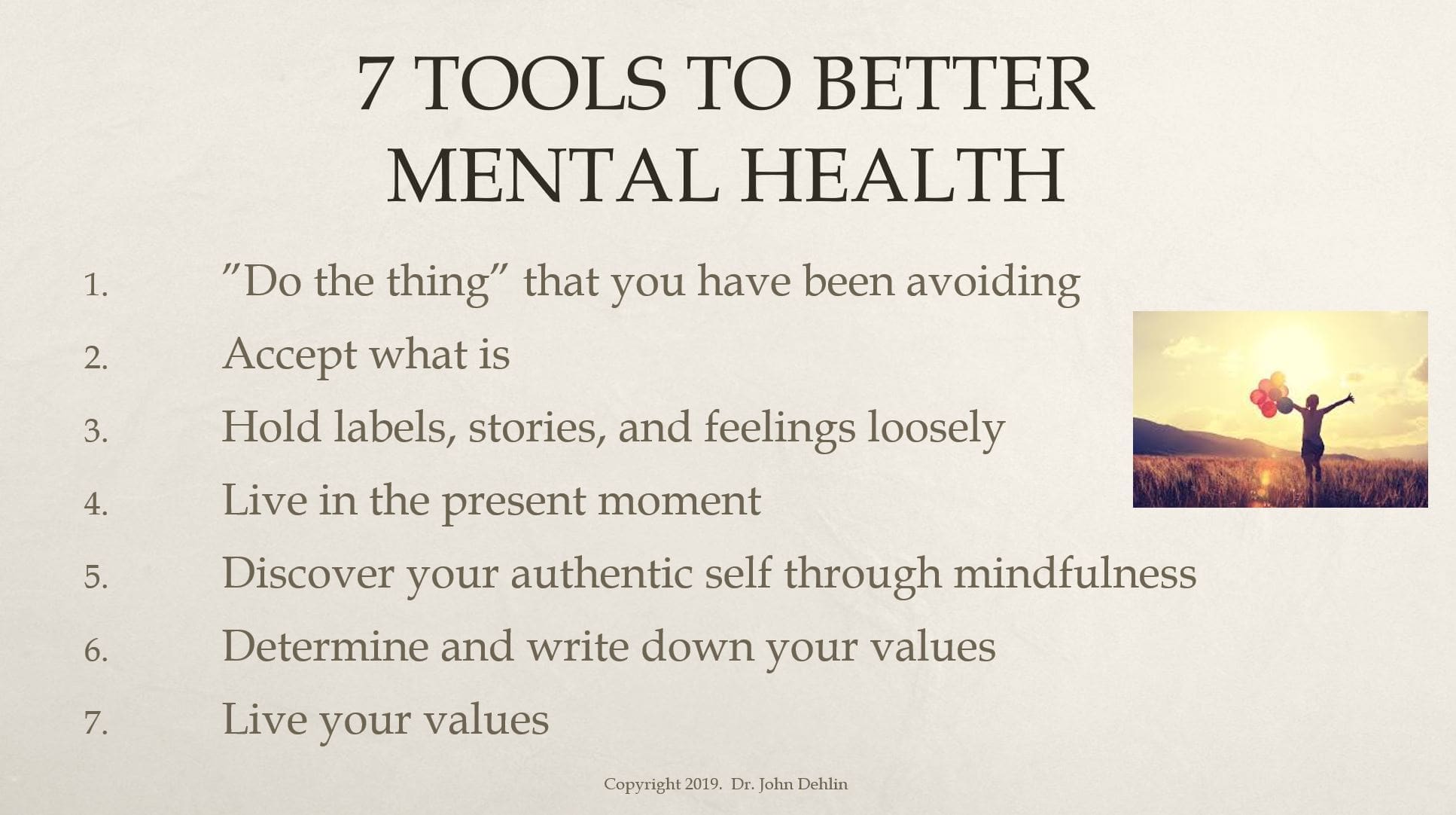
John Dehlin [00:04:57] All right, so I'm going to start with the end in mind. We're going to be giving you seven tools for having better mental health. But I'm going to start, and you can take a picture of the slide if you want. We can provide these PowerPoints afterwards as well. But I'm going to start by the problem and then I'm going to provide the solution right up front. Seven obstacles that today we're highlighting. Now I want you to start thinking as you read through these. Does any of this apply to you? Because we're going to be processing. Okay, so what we're suggesting is today seven obstacles to mental health. Obstacle number one, avoiding things that you know you need to do so, the avoidance of what you know you need to do. That's problem number one. Problem number two, non acceptance of what is so. Refusing to accept reality, basically. Number three, excessive attachment to labels and stories and even feelings. That's Number three. Number four is living in the past or in the future. See some heads nodding. Number four. Number five, disconnection from your true self. Number six, not knowing your values. And number seven is not living your values. Okay, off. Off the bat, is anybody starting to see some things they're connecting with? Okay, we'll get into it. So the flip side of this, seven tools for better mental health. Number one. And this is like giving. Starting with. Starting with the ending, right? Recommendation number one, do the thing that you have been avoiding that you know you need to do that could improve your mental health. Number two, learn to accept what is. Learn to accept reality versus resist it and try and fight it. Number three, learn to hold labels and stories and feelings loosely instead of tightly. And I'll explain what I mean by that. Four, live in the present moment instead of in the past or the future. Five, discover your authentic self through mindfulness and meditation and other forms. Number six, determine and write down your values. And number seven, live your values. Okay. All right. Okay. We can. We could end now, but I'm not going to. Okay, so tool number one, avoidance of what you know you need to do versus do the thing that you have been avoiding. All right, so acceptance commitment therapy designates the boogeyman, the bad guy, psychologically, as it calls it, experiential avoidance. It's basically, it can take anything from depression to anxiety to post traumatic stress disorder to eating disorders. Take any diagnosis in the statistic, but then the dialogue diagnostic and statistic manual, the DSM 5, that is not purely rooted in biology. Take a look at any of those disorders and what acceptance and commitment therapy would say is at the root is experiential avoidance. And if you think about that for a second, somebody mentioned depression, right? What were you saying? Is your. The way you cope with depression. You made jokes about it. Yes. Stand up and tell us.
Guest 1 [00:09:00] I watch Netflix.
John Dehlin [00:09:02] Right, and you watch Netflix and eat cookies. And what's the function?
Guest 2 [00:09:08] The function is if I'm not doing those things and I don't have something to do with my life, which I don't, then I have to sit in my pain and my lack of understanding and I just have to sit in all of the garbage that I can't explain and I don't know how to reorganize and I have to sit in. My pain is what I have to sit in.
John Dehlin [00:09:29] So what I hear you say is there's pain you need to process there. There are lessons you need to learn. There's growth you need to engage in but you don't know how to do that. And so what. What. What depression can end up being is sleeping and netflixing naps and Netflix and eating away your life.
Guest 3 [00:09:52] Yes.
John Dehlin [00:09:53] Because you're avoiding. Not intentionally.
Guest 2 [00:09:55] Right, Right.
John Dehlin [00:09:56] You don't know how to do better, but you're avoiding whatever changes or growth you need to make because you don't know. You're too overwhelmed or it's too hard to see a way out.
Guest 2 [00:10:08] And the coping mechanism makes it. It just feeds on itself. Like it doesn't. Like sleeping doesn't help. Watching Netflix isn't making it. So tomorrow I can cope.
John Dehlin [00:10:19] It's avoidance.
Guest 2 [00:10:19] It's complete avoidance.
John Dehlin [00:10:21] It's avoidance. Can we applaud her for her vulnerability? Thank you. Anxiety can be the same if you think about it. I'm worrying about the past, I'm worrying about the future. What are you not doing when you're anxious? You're not actually doing anything that improves your life. So can you see how anxiety can be conceptualized as a form of avoidance? Just like depression, they're just opposite ends of the same behavior, which is not dealing with what's going on. Right.
Guest [00:10:54] That's why they're BFFs.
John Dehlin [00:10:56] That's why they're best friends.
Guest [00:10:57] They are. Anxiety and depression are BFFs.
John Dehlin [00:10:59] They're BFFs.
Guest [00:11:00] Yes.
Guest 4 [00:11:02] Yes.
John Dehlin [00:11:02] Yeah. They're opposite sides of the same coin. Right.
Guest 5 [00:11:05] Well.
Guest [00:11:05] And it's probably the most common comorbid diagnosis. By comorbid means, you have more than one diagnosis. It sounds pretty fatal, but it's just pretty normal. We all have them.
John Dehlin [00:11:17] They come together. Anxiety and depression often come together. People who are anxious get depressed. Depressed because the anxiety wears them down. All right, so. So experiential avoidance is what we don't want. And when you. When you don't take action in your life, when there's something you know you need to do, but you, for whatever reason, get stuck and you're not able to move forward. Your brain says your brain starts pumping chemicals into your body. Cortisol, stress, depression, sadness, anxiety. That's your brain sending you chemicals, saying, you need to make a change. You need to make a change. Make a change. Depression can be conceptualized as your brain slowing you down to take a look at what. What is going on in your life, to become more thoughtful about what you need to make a change about. Until the point where you actually see the thing you need to change and then start acting on it. That's kind of what the functional role of depression. It's to slow you down, get you to see what you need to change, get you to concentrate on that so that you can see it and make the change. And anxiety can do something similar. That's why your brain's pumping those chemicals into your body that make you feel either super anxious or super depressed. There's a reason your brain does that. Instead of actually responding in a way that propels us forward, sometimes we just sit in the discomfort of that anxiety or depression and we try and numb it away. So instead of making the change, we self medicate to try and numb it away. Who would be vulnerable enough to tell us your favorite form of self medication? And we got microphones here, so just raise your hand. Who feels like they self medicate and who's willing to share? And stand up as you say it just so the camera can get you candy.
Self-Medication and Coping Mechanisms
Guest [00:13:17] What Candy?
John Dehlin [00:13:19] Candy. Candy Chocolate. Candy is your ice cream food. All right, that's vulnerable. Let's give her applause. Who else? Who else self medicates? Get some. We need a mic runner. Can somebody play the mic runner? Mehdi, how do you. What's your form of self medication?
Guest 4 [00:13:36] So I have noticed this habit in myself that if I'm having a really difficult emotional week, what I want to do most on the weekend is spend eight to 10 hours exercising. And it works because you feel endorphins and adrenaline. It makes me feel good, but it also allows me to disconnect from the relationships that are causing me problems because nobody comes and bugs me while I'm exercising.
John Dehlin [00:14:01] Because I'm ex.
Guest 4 [00:14:02] This is important. I have to exercise right now.
Guest [00:14:05] So whether I have a race or
Guest 4 [00:14:06] not, I still sometimes have that temptation to just check out and just exercise. And then the pain afterwards is also almost as good as the exercise because
Guest [00:14:18] then I'm in pain.
Guest 4 [00:14:19] Leave me alone.
John Dehlin [00:14:20] I'm in pain. Beautiful.
Guest 2 [00:14:25] Yeah.
John Dehlin [00:14:26] Eating can be healthy, but if the function of the eating is to self medicate away the pain for the that's being caused by you being unable to take action in a way that needs to move your life forward. Something that's normally healthy, like food or exercise, can be turned into a form of avoidance that actually does us harm in the end. Beautiful, Mehdi. Thank you. Yes, Jared.
Guest 6 [00:14:51] About two months after my shelf crashed and I started having going down that rabbit hole of learning church history and things like that that was causing me problems, my dad was hit and killed by a car. And I almost feel like that accelerated my issue. And I think my self medication was studying more and more and more to the point where studying what I was Studying church history.
John Dehlin [00:15:19] Church history.
Guest 6 [00:15:20] Studying the issues that I was having, going to the nth degree. I've probably studied a thousand hours over the past six months and it's been an obsession. I've realized it's probably an unhealthy obsession. And I feel like that has been my self medication is just doing that more and more and more and more. In fact, I think that's a lot of what I did to deal with my dad's death. And I've kind of shoved those feelings aside because I can just recognize that that's what I've been doing.
John Dehlin [00:15:46] Oh, that's so good.
Guest 2 [00:15:48] Right.
John Dehlin [00:15:50] Like there's a degree to which learning about church history, talking to others about church history, or problems with the church is a healthy, functional, normal part of kind of deprogramming, figuring things out and then moving forward. And then there's the extent to which it becomes, whether it's ex Mormon Reddit or Mormon Stories podcast, or, you know, some ex Mormon group or friendships that you have, where that constant churning and negativity is not actually serving a healthy function for us anymore, but instead it's serving so astutely, as you acknowledge, it's serving the function of self medication, of avoidance, of the changes that we need to make to find healing and growth and joy. And I think how many of you have been, you know, fallen prey to that? I think I've been your dealer, you know, if you're junkies, I'm your dealer. I admit it. Guilty. It wasn't my intent. I've got 1,150 episodes of Mormon stories, you know, so in some ways I'm, you know, I'm. I'm sorry. I apologize. I apologize. It was never my intent.
Guest 3 [00:17:04] Sorry.
John Dehlin [00:17:04] I was gonna say one thing. Green's good. It's your voice, John.
Guest 6 [00:17:11] I'm sorry?
John Dehlin [00:17:12] It's your voice. That's, that's the self medication. It's the sound of your voice. It's soothing.
Guest [00:17:18] Sorry.
John Dehlin [00:17:20] Thank.
Guest [00:17:23] Okay, so before we move on from this slide, I don't know about how many of you, but this is definitely my Mormon stuff coming up. I'm already feeling anxious about myself medicating, so we can very easily, in a group like this, get caught up into guilt traps, right? And shame. Because I know I self medicate in several ways, right? And I can already, I don't know, maybe it's just me and I'm projecting, but I can already feel kind of the anxiety of the room. Like, oh no, we're doing something wrong. Right? And we've been very. We've been trained well at picking up and being very hard on ourselves for doing things wrong. So I just want to normalize this a little bit. We are wired to avoid pain. We are wired for that. Every nerve ending in your body is wired to avoid pain. And the really, I don't know, wonderful or shitty part of life is that we're in this constant tension between avoiding pain now that oftentimes means we're gonna have to deal with more pain later or dealing with pain now, meaning we get to avoid pain later. And that's a constant truth of life, that we're all constantly in that tension. So I just wanna normalize this and, you know, and John will get really good about the act stuff, you know, and what helps us with this. But just to recognize that a slide like this can definitely trigger our Mormon shame in us. And we all do it. And it's actually part of it, I think a really good part is to recognize how our self medicating does help us because Netflix does help you avoid pain in that moment and a cookie does help you avoid and Mormon stories does help you avoid. And in that moment we can give that moment grace because maybe in that moment we can't face it quite yet. So let's just do a balance of that. Does that make sense? Okay.
John Dehlin [00:19:15] When I was. Thank you, Natasha. When I was doing my clinical training for my PhD, I had clients who self harmed who cut themselves. And that just to be honest, like my family knows this. When I envision people that I care about being harmed, I have a really strong physically harmed. I have a really strong visceral reaction. You never want to go on a bike ride with me and my kids. You know what I'm talking about, Margi? Because I'm like always like, don't get in the road. Come over here. Come close to the side, you know, because I'm like, I've got so like to sit in front of these clients who would come to the therapy room with windbreakers on and then they'd take off their windbreaker and I would look at their arms and they would just have cuts all up and down their arms. Right. I was just like, it was, it was panic inducing for me as a therapist. Or they'd have cuts up and down their legs and I would have to just stare at that and think, whoa, it's my job to make them stop doing that. Right. That's what I thought. And that was, that was. I was like imploding as a therapist, like trying to See if my client stopped harming themselves. And then I had this really wise trainer who said, you have this completely wrong. It is not your job to get them to stop cutting. That's not your job. In fact, that might be the worst thing you could ever do. And I'm like, what worst thing I could ever do? That's my goal is to get. And they say no. Do you understand that their cutting may be keeping them alive? Because who would cut? You cut when the distress of your life is so bad that you either prefer the pain of the cutting as a distraction from the pain that you're experiencing in your life, you know, that's why you cut. And so if you take away that coping mechanism, they're left with just their, their pain. And then they may not want to, you know, continue. And so never take away someone's coping mechanism unless you can help provide them with a superior form of coping. That's just a little dramatic illustration.
Guest [00:21:46] No, and I, and I am cognizant that probably in the room there are people who have self harmed or who
John Dehlin [00:21:52] have loved ones who have self termed
Guest [00:21:54] and I really do honor that as, I mean, this is what I mean by we honor the ways, even if it's cocaine or self harm or things that culturally we see as very taboo or negative and that can have acting out and can have negative consequences in your life, they also do have purpose. And I think that's always very important to ask yourself how our coping mechanisms are actually serving us. Because even if you've gotten to a point where they're serving you less than more, they still have served you. And maybe at certain times in your life that's all you had. And we need to thank those coping mechanisms. And part of the rituals I do with people in my office is to actually thank things like self harm, meth, whatever it was that got you to the place where you're now sitting in my office ready for a new chapter of your life. So let's be careful not to shame our coping mechanisms.
John Dehlin [00:22:51] So thank your cookie.
Guest [00:22:53] Yes, thank you.
John Dehlin [00:22:55] Thank Netflix, thank Mormon stories, thank ex Mormon Reddit. Margi. Margi wants to wait. No, no, no. You gotta stand up and Margi doesn't know the rules. Stand up and use the mic.
Guest 4 [00:23:07] Okay.
Guest 5 [00:23:07] I'm gonna do better with a not in a shame way, in a growth way. Gonna hold the microphone. Anyway, I'm so grateful that you talked about it in that way, the being thankful. One thing that I have noticed for myself and for women that I've worked with, sometimes coping Skills are a little less obvious. Like perfectionism for a lot of women is actually a coping skill. So when we feel unworthy or when we feel our flaws, what do we do? We hustle. We hustle harder.
Guest 7 [00:23:41] We.
Guest 2 [00:23:41] We.
Guest 5 [00:23:42] And so just kind of sending a thought out there that sometimes coping skills are a little less obvious. And one thing I do see is perfectionism as being one of those. And then this idea too, that oftentimes the coping skills that we pick up, we pick up young. We're actually young when we do it. And that's something we can have a lot of compassion for. And as well as we grow in awareness, then we can choose to ask and. And grow an awareness around, is this really a health, Is it healthy for me? Is it working for me? And then that I feel like it's so crucial to be able to actually thank the coping skill, to integrate that for what it did, for how it served you, and to choose to put it down and to choose to pick up something instead. It is one of the greatest, like, it moves me all the time in my clients. It's just one of the greatest forms of self love for me. So anyway, just thought I would add
Guest 6 [00:24:38] that,
Guest [00:24:41] yeah, I have never personally been able to move on from anything in my own life in a space of self hatred. Never. It's always actually exacerbated what I hate. And so that's why I get so angry when we talk so badly about pornography and things like that in our culture, because I just know that it's going to exacerbate the issue instead of actually heal it and help it.
Guest 7 [00:25:06] So one of the coping mechanisms that I used, particularly during the time that my wife was transitioning and I was
John Dehlin [00:25:14] still
Guest 7 [00:25:18] inside the church, was a little game that I had on my phone. And I would kind of use that as a way to check out. And particularly as my wife's law school got more intense and responsibilities at home became more intense on me, I would use that as a way to kind of cope through things. What was really interesting is that game on my phone was really bothersome to my wife because she identified that as me trying to escape instead of dealing with whatever I was trying to escape from the pain and everything. And we would go back and forth and she would pretty consistently try to take that away. And I was really resistant at doing it to the point where I would hide it from her and everything. Much to what you were talking about. That whole shame aspect of not owning it, as I need this as a way just to kind of check out and escape. We finally, we have come to terms with it. But there was a second part to it that I had to realize as well. And that is where my coping mechanism or this game became not just a coping mechanism, but a compulsion and where I was not using it just as a way to escape, but as, you know, as something that I kind of felt drawn to more outside of escaping from pain. So, you know, that was something that I had to realize as well about my, my coping mechanism and how it was in harming myself outside of just trying to escape.
John Dehlin [00:27:29] We have Holly.
Guest 5 [00:27:33] I was, I was just kind of along the lines of what Margi said. And then I was putting myself back into me as a Mormon woman, thinking about Mormon women and thinking what I have done to self medicate. And I think back even just to a year, six months ago, I was self medicating in the church by like doing everything in the church and not saying no when I needed to. And when I was asked to do a lesson or something, I would go above and beyond. I would make all the handouts, I would do everything. And I, that was a way of me self medicating. I was on the pta. I was getting my kids in every activity they could do. And I work full time. I was overly exercising, I was doing way too much and this was how I was coping. And then when my shelf broke and when I realized my marriage was broken, I realized that all of these things were just a distraction for me to stay busy from my issues. And so I took myself out of the church. I. I stopped being obsessed with exercise. I still do it, but I added in more yoga, less of the other stuff. I took my kids out of a lot of their stuff and I minimized my hours at work a little bit more. And so right now I am in the pain and the suffering and it sucks, but it's working better than what I was doing before, which was running from it.
John Dehlin [00:29:10] Beautiful. Okay, so why don't we act? Why do we avoid. And by the way, working excessively is another really. Or serving. Being an activist, I often make the joke or the dark joke that Mormon stories was a huge form of avoidance for me to work on issues in my marriage. Like I can save everyone else's marriage, when in reality I was sometimes just avoiding the work that Margi and I had to do. So I love that idea of all the different forms of avoidance.
Why We Avoid Grieving
Guest 8 [00:29:51] Yeah.
Guest [00:29:51] As a group, we're pretty messed up as mental health professionals. Just letting you know.
John Dehlin [00:29:56] Yeah, yeah. So why don't we act Sometimes it's because we don't know what the thing is that we need to do. So again, that's when depression or sometimes anxiety can, if we lean into it. If you saw the movie, Disney, Pixar movie, emotions inside out, inside out, the whole point of that movie was that they needed, the person needed to feel sad, but the person was pushing the sadness away. But if you go listen to the grieving podcast that we did with Margi and Natasha, what we try and talk about is grieving is a process you lean into, not away from. Instead of self medicating by leaning away, you lean into the sadness, you lean into the anger, you let it teach you. And part of what it's going to teach you is it's going to whisper to you what change you need to make. And so what's where the meditation, the mindfulness, the sitting with the discomfort, wisdom comes from that. That's why you do it. You don't do it to be a masochist. You do it because this pain teaches you lessons that you need to learn. And so by leaning into the pain, leaning into the anger, leaning into the distress, you hear the whisperings of the way you need to act and then you start moving forward. So I think it's really important to also understand and this is to motivate you a little bit. Oftentimes we self medicate or we avoid, to avoid the pain of whatever that might mean. Some of you might be in a broken marriage and so you are not dealing with your marriage because you think it's going to just be too disruptive or I'm not going to come out to my parents because then it'll be really painful, right? Or I'm not going to leave the church or you know, ask to be released from my calling or whatever it is because I don't want to experience the pain of that decision. And the irony of that is that far too often, whether it's in a marriage, whether it's our relationship with the church or coming out, is that you create more pain for yourself. You simply, you basically swap some pain now for a lot of pain later. The classic example of this is the couple where one doesn't really believe and the other does, but the non believer is scared to tell their believing spouse they don't believe anymore. So because they don't want to deal with the pain of that conversation. And so they're traveling on the road and they take their garments off when they're on the road, they stop paying tithing, but they don't tell their spouse, because they do that in secret. And then they start, okay, they drink on the road because. But they want to hide that from their spouse. But then as they start growing apart and apart, they're not feeling emotionally understood by their spouse.
Guest 3 [00:33:04] And.
John Dehlin [00:33:04] And so then they start confiding in other people instead of their main core partner, and over time. And then they end up betraying their spouse and making decisions that lead to a massive explosion of pain and suffering later because they were trying to avoid some of the earlier pain that would have been much more manageable.
Guest [00:33:30] And now we don't have a faith transitions issue. We have a betrayal and trust issue.
John Dehlin [00:33:34] And that's just. That's just one example. So you see how you think it's going to be super hard now. Just wait five years, wait 10 years. Try not to be shortsighted in. In this situation. So.
Guest [00:33:50] And can I just say one quick thing?
John Dehlin [00:33:51] Yeah.
Guest [00:33:52] The research on LGBT folks really speaks to a population that has been studied very, you know, in depth in regards of the effects of what it's like to keep a secret and how detrimental that is to mental health. And also, the research on mental health affecting your physical health has been blowing up in the last 20 years. So gastrointestinal issues, insomnia, all these things that we know, they're intricate, you know, intricately connected. You cannot separate your physical health from your mental health. We used to try to do that, you know, like, oh, is that a physical problem or a mental problem? We don't do that anymore. They're intricately connected.
John Dehlin [00:34:34] Yeah. So, yeah, all those autoimmune diseases, there can be direct ties between something like being in the closet, hiding your authentic self, living a life that isn't harmonious with who you are or what your values are. And the depression and the sickness and the illness that multiplies over time as you avoid making the change that you think is going to be painful. So the solution and anything we say is going to sound glib in your lived lives, but these are just tools for you to consider. What's the alternative to experiential avoidance? It's doing the thing that you've been avoiding. It will hurt. It will hurt. It will be very, very painful. Sometimes it's not as painful as we fear. Sometimes it's worse than we ever expected. But almost always it's less painful than more time. And there's always the joy that will come after the discomfort. So the idea is a little bit of pain now or a lot of pain later. Now there are good and Bad ways to make that change. Whether it's dealing with a spouse coming out, leaving the church, you can create horrible havoc and distress and pain and suffering for you and everyone around you. Or you can get help or find support and find ways to manage that more gracefully. And we should have self compassion when we screw it all up because we've all done that, right? But I don't want you to think we're advocating for sort of reckless, you know, changes in your life that cause untold collateral damage. Make the change, but do it in a measured, responsible, graceful way if you can.
Guest [00:36:33] And as we teach you those measurable, responsive ways, you will all, as we know from previous times of doing this, you will all be like, I didn't do that. I did all this stuff you're saying I shouldn't have done. Oh my gosh. Right, so the self compassion piece is really important because where were you supposed to learn these things? I mean, there's a manual in the church for everything except for how to lose your faith gracefully. And so, you know, I think that we do the best we can with what we know and we. You're gonna know better now and you're gonna do better and there's great power and repair attempts, which is a whole other concept we'll talk about later.
John Dehlin [00:37:11] Love it. So now's a little processing section. Can any of you identify in your life something that you've been avoiding, ways that you're self medicating to avoid, whatever you've been avoiding and what you. What your sort of soul tells you, you know, a change that you may need to make, but you just are a little bit stuck or don't know how to make it. Are any of you willing to be vulnerable about this tool number one in your life? I know this is sensitive, I know this is recorded on the Internet, but does anybody have anything come up for them? Who's in a box?
Audience Shares Their Avoidance Patterns
Guest 4 [00:38:02] Okay. So I spent my whole life avoiding. Raised in a family of violence and sexual and physical abuse and didn't even acknowledge it happened until I was 44. Had a child at age 18 that I placed for adoption because my parents and everybody in the church told me that no man would love me if I kept the child. So I had that. That I told my husband before we got married. And for 30 years we never spoke of it again because if I were to speak of it, I would stop, start crying and I would never stop is what I told myself. So I'm 44, I have three children, this beautiful family, and I'm I don't even know who I am. I don't know what I believe. And all of that pain starts coming back. And so I try and be better. All I know how to do is do so much good so you can't see how bad I am. That's all I know how to do. So I started working on some healing. I went through some programs when I was 56. So that's. How many years later, 40, 12 years later, I finally sit across from this man and tell him how much I hate myself. And it feels like I have betrayed him our whole marriage, because I never could say that to myself, much less him. And he looked at me and he said, now that you've told the truth, your real healing will begin. And that was true. So because I had built up this wall of I have to avoid everything. So I started doing some art and art therapy, and I wrote a little bullet point book on my life, my life story. And the very first line in the book is, I witnessed a lot of violence. I was abused. I was only a child. And I allowed my older sister to read this book. And she looked at me and she said, you were abused? And I. And I had to say to her, you lived in the same house I did, you know, so I see that's a legacy, you know, so. And I passed that same legacy to my children. They watched me avoid on my life. So now bringing them in here close is really hard because they're like, what has happened to you? You've never done this before. So it's a lot harder to avoid than it is to. To face. It really is.
John Dehlin [00:41:09] Thank you.
Guest 5 [00:41:09] Thank you.
John Dehlin [00:41:10] So powerful. Thank you. Who else wants to share?
Guest 3 [00:41:20] Hear my husband go, oh, no. I think just some smaller avoidance right now is just, just. I know I need to, like, start moving on, you know, like,
Guest 5 [00:41:35] just,
Guest 3 [00:41:42] Just I'm avoiding. Just reaching out and being. Creating friendships and stuff.
Guest 6 [00:41:48] I just.
Guest 3 [00:41:49] It's like, I just want to stay in my house and not do that. There are people I could be friends and socialize with, but I just feel like I just. I know what I should do every day. I didn't know I need to make a few calls and do a few things and maybe reach out to my family that I've kind of scared off. And I'm just not, you know, every day I'll work out and be like, oh, well, if that's all I'll accomplish today. So maybe that's. I'm just avoiding taking steps forward and getting on with life. If my personal life I don't know. Something like that.
John Dehlin [00:42:26] How many of you relate to that? You're not alone. Thank you. Who else?
Guest 9 [00:42:45] For me, after I had my faith crisis and it was a difficult thing to go through, and I was starting to kind of make peace with some of it, or at least not feel so much deep pain with it. I told some people that were close to me and my wife. A couple people at church, like my bishop, knew about it and things like that. But it took me a long time to even talk to my parents about it. I've still really only spoken to my mom about it in detail. My father is. I just. I can't, you know, let him know to the degree that I don't believe anymore. And my good, good friend that I talked to almost every day for two years, I talked to them every day and didn't mention this to him. He's a member. I baptized him after my mission, and he is a member with his family and his wife and everything. I couldn't speak to him. I avoided it. I was scared to let him know what I believe, what I've gone through, even though it was very hard and painful. There's that fear of judgment. There's that fear of what are they going to think? There's that fear of are they going to ask questions and am I going to make them spiral out and have a similar faith crisis and do I want to put them through that? And so a lot of my avoidance was kind of keep it to myself or keeping it to just a couple people, but not wanting to get it out there. You know, it's been hard.
John Dehlin [00:44:01] What did that cost you to keep it in?
Guest 9 [00:44:05] It just added. It's almost like when you have. Haven't forgiven somebody or you haven't dealt with the problem, you're kind of burying it. You're just kind of pushing it down. It's stressful. It makes you lose sleep at night. It makes me feel like I'm not authentic. Because when I'm talking to him, I could easily mention, hey, by the way, I need to have a deeper discussion with you. But instead I'm just going to talk about this fluffy stuff that we always talk about. But then you think of it later and it's this pit in your stomach, and you have to. You have to get it out and confront it and work through it, just like a lot of things in your life. But that's one thing that's really hard for me.
John Dehlin [00:44:47] How many of you relate to that? Anyone else?
Guest [00:44:53] Can I share? Yeah, yeah, you share Then I'll share.
Guest 7 [00:44:57] I'm avoiding doing this.
John Dehlin [00:45:01] Good.
Guest 7 [00:45:04] This is so hard for me. I'm avoiding just being seen and seen for who I am. It's one of the hardest things to
Guest 4 [00:45:15] do
Guest 7 [00:45:18] growing up in a family that you were just expected to be a certain way and always knowing that I wasn't necessarily that way, but trying to shape and mold myself to be how specifically my mom wanted me to be. She was very good at passive aggressiveness. There was a lot of. If she didn't like what I said, she wouldn't talk to me for a while. And so I watched my parents when my brother told them that he left. And so letting them know how painful being in the church is for me and then it's not a happy place for me is one of the hardest things. And I don't. I don't quite know how to do it. So I find that I'm avoiding them and I just don't want to talk
Guest 2 [00:46:16] to them a lot.
Guest 7 [00:46:18] But then they're older, so then I'm having this guilt because I feel like you never know. Once a person's 80, you never know if you're gonna lose them. And so I just constantly feel this tug of war if I don't want them to know where I'm really at. And so I avoid. And same with my sister, who's my best friend. So I relate well with what you're saying about, you know, they're your best friend and you talk to them on a daily basis. But she has no idea the depth of the pain that I've been through in the last two years. And so I. It's interesting because I'm avoiding a lot of other things in my life, avoiding changing careers, and I feel like a lot of that's surrounded about just trying to be not seen and just kind of fly under the radar.
Guest [00:47:06] So that's.
John Dehlin [00:47:14] You all are emotional gladiators. And I just have to say, Natasha was like, I want to go. Can I go? Natasha wants to go. Now
Guest 1 [00:47:22] I can go.
Guest 3 [00:47:23] Right.
Guest 8 [00:47:25] Well.
Guest [00:47:25] And before I even share, I think the reason, you know, I think we're trained to not share a lot about our lives, you know, as mental health professionals, because when we do that, it kind of takes away from your story or we're projecting our story onto you, and that's inappropriate. At the same time, I think that there are reasons and times when it's therapeutic or part of the kind of intervention to share. And one of the things I think both John and I are very cognizant of is that it's very easy. Again, because we come from a culture that pedestalizes people in authority. It's very easy to assume that we have it all figured out and that because we're teaching you these concepts, we must be super expert in living these concepts in our own lives.
Guest 5 [00:48:09] So.
Guest [00:48:10] So I'm going to share in the spirit of letting you know that I too, am effed up in many ways. I have given this presentation with John for three years knowing that I'm avoiding a big, big thing in my life.
Guest 3 [00:48:28] And.
Guest [00:48:34] It's hard to sit in a place where you feel, like, super hypocritical knowing that. And my move to Utah this coming December means that I finally had to sit with my husband and we had to face things about our marriage and about our gender roles and about our Mormonism that we have avoided for 24 years. So I feel super supported and loved by him in ways that we haven't felt before. And at the same time, we're a huge ambiguous spot of what's going to happen next. And so this is real. And just because we know it doesn't mean we always do it. And I share just because I want to say it's not just. It's not just theoretical stuff, it's personal stuff. And we've lived it too.
Guest 2 [00:49:27] Right?
Guest [00:49:27] In different ways. And so hopefully we're not some experts that are unapproachable or somehow better than we are. Just as messed up and just as much in the fray of all of this as you are. And so I just share in that spirit.
John Dehlin [00:49:51] Just as messed up or more.
Guest 7 [00:49:53] Or more.
Guest [00:49:56] They actually tell us that when we start graduate school, people who are attracted to this profession are really messed up. And we're all looking at each other like, oh, thanks.
John Dehlin [00:50:06] Okay, so you will get a lot more out of this weekend if you identify, you know, something you've been avoiding and set a goal for yourself to make a change in a responsible way. And so think about that. We're just going to leave that with you at the end of Sunday when we kind of have a close, we're going to ask each of you to share something you learned or something you're going to change, you know? And most importantly, as you walk away from this weekend, try and keep little notes of, like, things you want to change or insights you have about yourself. And I want to. I want to invite you to identify changes that you might be avoiding that might be really helpful to you. We have a. We need a mic. Thank you.
Guest 2 [00:50:58] If I'm Avoiding talking to people and avoiding talking to my friends and avoiding talking to my husband. How do I know, how do I prioritize which of the myriad of things I am avoiding to tackle first? Because I feel like all of these things I'm avoiding. So how do I pinpoint what I need to work on when everything applies to me?
Guest [00:51:37] Do you want me to take it? Well, I think, I mean, what we are going to talk, our next presentation, I think after this is talking about emotional intimacy. And I think we will talk about somewhat like prioritizing relationships in your life. And all of us in many ways are facing elephants. We need to eat. And you can only do that one bite at a time. So I think it's actually very wise of you to know intrinsically that you're overwhelmed, it sounds like, and that you might have to. To like temporarily. I know this, this word might be triggering, but we temporarily shelf a few things correctly to be able to deal with with a few things at a time. It's not realistic to do it all at once. And so to have grace for yourself in that process, I think is really important. Those are just a few thoughts I have.
John Dehlin [00:52:25] And I was just reflecting on Natasha's vulnerability. Our family spent between seven and $10,000 last year in coaching and therapy. Think about that. I have a. I have a PhD, six years of clinical and counseling psychology. I am a coach. And we, Margi and I spent between 7 and $10,000 last year in therapy and or coaching for me, Margi, me and Margi, several of our kids individually, and we've even had therapy as an entire family. So to just piggyback on your vulnerability, find a one way that it can help. You can prioritize and figure out which bite of the elephant to start with is through the multiple numbers of therapists and coaches that are emerging from our community who are willing to help, whether it's Natasha, whether it's Margi. Tell us your name again.
Guest 2 [00:53:32] Shannon.
John Dehlin [00:53:32] Shannon. Shannon's a marriage and family therapist. Go to the Mormon Mental Health Association. There's a great list there. Symmetry Solutions, which is a little network. Natasha, find a competent therapist or coach to help. We are big believers in that and we invest in that and we encourage that as one way.
Guest [00:53:58] And it's a really good way to use a weekend like this is to know that it's going to have its limitations. Right. Like we are talking to kind of like general conference, right. In generalities, in ways that, you know, might affect most of you, but you all have your own individual stories. And relationships and complexities that a week like this, we'll never be able to completely address. Right. And so that's where the individual coaching hopefully helps you then take the principles you're learning here and really apply them into your life. So, yeah, and if you don't have resources for that, because I know that's an issue for a lot of people. We do have community centers. We do. I mean, that's why we're trying to have a myriad of resources. Because I know mental health help isn't accessible to everybody, and that's just a travesty in our current country.
John Dehlin [00:54:50] Microphone.
Guest 3 [00:54:53] I just want to say one of the complications to being able to get help is I know for me is an aversion to anything that looks like I'm trying to perfect myself again. And so. So even if that's actually how I could get to a better mental health place, it looks too much like I'm working on myself again. I've got more lists of how I need to be better. And, you know, instead of paying the church, I'm paying, you know, somebody else to walk me through how to be better. And so it's enormous triggering to even get started. And you throw in there not having gained a sense of trust for yourself and a fear of being taken advantage of again, because any sort of work you do in this area, you're going to have to be vulnerable and open yourself up. And it leaves space for people. People to take advantage of that. And so I think that's an added complexity and hardship that some of us will face in even getting started.
Trusting Life Coaches During a Faith Crisis
Guest [00:56:14] Thank you. Can I respond to that really fast? This is where I think what's so complex is that there is truth from where we come from, like the idea of eternal progression. We're all progressing, right? We're all growing. And when that's been held hostage in a way that scares the hell out of us, that we're not good enough, that we're ever gonna make it into a certain place, that true concept has been hijacked to make us feel like shit about ourselves. And so extricating what's true from how it's been used in really untruthful ways is a real challenge. So I totally get that. I mean, I don't know what to say other than amen, sister. I think that that's really hard. But there is. There is something beautiful in this is where I have found my yes and is. Yes, I am wonderful just the way I am right this second, in all my imperfections and flaws And I want to, you know, grow and learn and progress and. Can I hold those two truths at the same time?
Guest 4 [00:57:42] Thank you.
John Dehlin [00:57:46] One more second.
Guest [00:57:46] Sorry, you wanted to say something?
John Dehlin [00:57:47] One final thing.
Guest [00:57:49] I'm not just in charge here.
John Dehlin [00:57:52] When. When. So there are good therapists and coaches and there are bad ones. And I. I could have started life coaching as soon as I started Mormon Stories. I didn't. I went back and got six years of a clinical and counseling PhD because even if I ended up coaching, I wanted the professional clinical training that would inform how I worked with people. One of the things I'm very grateful for is the ethical code that we are taught as professionals, as social workers, marriage and family therapists, or psychologists. And any of you have done coaching with me, you will know that when I begin my coaching relationship with you, there are a couple things that I guarantee confidentiality. And that my allegiance is to the ethical values of my client, not to impose my own values on my client. And another way to say that, that I hope the people that I coach with will agree is that my goal isn't to become their new authority figure. I explicitly work with my clients to tell them our job is to cultivate within you your own moral authority, your own intrinsic sense of right and wrong, and that I'm doing my job as a coach. If you are, you become your new authority. And I only say that because I want to help you become educated consumers of therapists and coaches. If your coach is nudging you or pressuring you or imposing values or trying to push you in any direction, that is the surest sign they're the wrong. That they're. They're engaging in malpractice. So look for people who are committed to the ethical position of finding out what you want to do with your life and then just helping you remove the obstacles and pursue what means to you. Do you know what I'm saying? And that's why the Mormon Mental Health association, that's why Natasha created it, because she vets every therapist on that list to make sure they're not going to say, you need to stay in the church or you need to leave the church. Beware of any therapist that tells you either thing. I invite you to punish me in severe ways if you ever find out that I told a client, you need to leave that church. I will never do that. But I will also never tell a client to stay in the church. I will ask a client, tell me how it's working for you, what feels right for you, what do you want to do? Now how can we help you get that? So it's just a tip. But if you find a really competent trained professional, they won't do what has been done to you by unhealthy organizations.
Guest [01:00:49] And it's a learning process for us too, because I will say that even as you're saying that I can think of three clients who rightfully fired me when I crossed that boundary, probably on issues we would all agree on, but it's still not appropriate for me to do that. And so they rightfully fired me and then I had to go to my own supervision and think through that. And you know, so we are even competent professionals are constantly challenged in these ways. And you might be with a professional at a certain time of their professional development where it's not a good fit. So trust that. Find somebody else.
John Dehlin [01:01:22] Word of mouth is good. Asking around for professionals who have been very helpful for other people like you can be, can really, really useful.
Guest 4 [01:01:31] So.
John Dehlin [01:01:32] Or just use Natasha or Margaret.
Guest [01:01:35] Except for it's one of those times when you need to fire me then.
John Dehlin [01:01:39] Okay, Karen, please.
Guest 4 [01:01:42] Okay.
Guest 2 [01:01:43] So I'm thinking about your comment and I understand where you're coming from with that. I feel like as a 50 year old woman that there are developmental things that I places that I should be at 50 in my life that other people I'm around other people who have never been LDs and there are things they understand and they know and I feel so, so behind. And sometimes it's really overwhelming, like I haven't really handled finances. Sometimes I'm scared to go to the mailbox to pick up my mail. That's the most ridiculous thing to be afraid of. And sometimes I can avoid for days going to my mailbox. So I love what Natasha says about just being kind of gracious with yourself because I think what we've gone through is something really, really, really big. And we can look really normal on the outside, but inside we can just be kind of shattered. So I would say this is my own thing. Do the easiest, easiest thing that you can pull your head out of the sand on and then you get to have that win and then go to the next easiest thing and pull your head out and just have a lot of grace. A lot of people have had 50 years of normal progression in their lives to get where they are. I don't even Until I was 46, I didn't know the difference between champagne and wine. Like that's just ridiculous for a 56 year old woman to not know that. And so there's 46, 46. Sorry, 46. So. But you understand what I'm trying to say, so there's a lot of reason for us to have anxiety about really normal things. And it's not that we're stupid or that we're really backward or maybe we are. It's just there's a reason for us being backward and it's okay.
John Dehlin [01:03:36] So beautiful.
Guest 2 [01:03:41] And.
Guest 2 [01:03:42] And that really, like, touches me because I so like, I turned 40 in January and I feel. I feel like a child and I don't know how to cope with that. I feel like a child that doesn't know about life and doesn't know how to function outside of this thing. That feeling like a child when I'm almost 40, like, looking at you guys, I'm like, oh, you're all so much wiser and, you know, so much more and more. I'm just this idiot that can only take naps and watch Netflix because I don't know how to cope with life. Like, it's hard to be a baby when you're an adult.
John Dehlin [01:04:27] It's born again.
Guest 4 [01:04:36] And I just want to say, as
John Dehlin [01:04:38] a young person who is a therapist of a lot of women in your position, I. It's not fair that because I haven't been married and don't have kids, I have been able to pursue an education. I've been able to pursue all this, like, personal development stuff that I see you guys and I'm like, you haven't
Guest 3 [01:04:59] had that chance to, so.
John Dehlin [01:05:02] But if you're the people I'll turn
Guest 4 [01:05:03] to for any advice that I need
John Dehlin [01:05:05] on like, marriage stuff or on like, raising kids stuff, because that stuff I'm a complete baby about. So, like, I think it's all like, just how you.
Guest 5 [01:05:15] You look at it.
John Dehlin [01:05:15] But like, don't feel bad for not knowing that.
Guest 3 [01:05:17] Knowing that stuff because you guys have
John Dehlin [01:05:18] been busy in, like, something else way important that I know nothing about. Love it. This is so great. Thank you, all of you. Okay, tool number two. Tool number two. Acceptance of what is versus non acceptance of what is. This is classic Buddhism. Okay, let me go back for just a second. Do you guys know the founding premise of Buddhism? You can reduce Buddhism to three words. What's the founding premise of Buddhism? Say it loudly. Life is suffering.
Buddhism, Acceptance, and the Happiness Trap
Guest 8 [01:06:02] Yay.
John Dehlin [01:06:03] Now why in the world? Yeah.
Guest 9 [01:06:06] Woohoo.
Margi Dehlin [01:06:07] Yeah.
John Dehlin [01:06:08] Awesome. Can you imagine Buddhist missionaries? We have a message to you today. Life is suffering. You know, what's the wisdom in starting with that premise? We need a microphone.
Guest 6 [01:06:31] The comfort I have in that is hearing all these vulnerable stories and Seeing that it's not just me, I'm not the only broken one.
John Dehlin [01:06:42] If that's the basis, if all of
Guest 6 [01:06:44] it is suffering, then I know that when I'm going through suffering, it's not because I'm broken or I'm a terrible person or I did something wrong, which those may be elements of truths to what I'm going through.
Guest 7 [01:06:54] But like we talked about earlier, that's
Guest 6 [01:06:56] just the human condition. That's just what everyone is going to experience and I shouldn't other myself or feel like I am not worthy of anything or I'm not a human just because I'm going through suffering.
John Dehlin [01:07:10] Beautiful. There's a book that's worth the whole book just from the title. You don't even have to buy the book. But the book is also good. The book's called the Happiness Trap. And it's important as you're thinking about your mental health to understand the happiness trap. The happiness trap is the idea that life is supposed to be happy all the time. It's a trap because then you wake up every morning saying, ah, today's gonna be a great day because I'm supposed to be happy and life's great, right? And then all of a sudden something crappy happens. They're like, oh my gosh, that sucks. Wait a minute, I thought life was going to be happy and now I'm sad. And then another bad thing happens. And then, and then because you're sad and you're discouraged, you start self medicating and avoiding and feeling anxious. And then you try and avoid more sadness and you try and micromanage your life so that nothing bad happens or you stay home so you can avoid more bad happens. And then more bad things happen because your life gets smaller and smaller and smaller as you get sucked down into depression or anxiety, worrying about trying to avoid the next unhappy thing. And it's a happiness trap. The more you try and make yourself happy, the more miserable it often makes you. Does that make sense? And that's a trap that we're all in. That's kind of a religious trap when they sell you that the purpose of life is happiness. No. Pursuing happiness will more often guarantee misery than not. So what's the alternative? The alternative is what Buddhism teaches, which is no. Start with the premise that life is suffering, life is a struggle, life is messy, life is problematic. Every day there's going to be huge problems that face you. And if you start with that expectation and premise number one, it's realistic so you're grounded in reality and Number two, you're pleasantly surprised when something good happens. And it's like icing on the cake. But it's a totally different psychological energy. Someone get a microphone back to Margi. It's completely different psychological energy. And all that ties back to this notion of acceptance. Acceptance of suffering actually leads to more joy and well, being. Resistance of what is which is suffering leads to more suffering. Margi, please stand up.
Guest 5 [01:09:35] And then I also really like that it says, life is suffering. I think it's super healthy for those of us. I remember after we were excommunicated, this intense pressure of feeling like, if I suffered, then I'm reaffirming what everyone thinks when you leave. Like, oh, life will just completely fall apart because you've left. And I do feel like sometimes there's an inherent message and a false promise in the church that if you make all the right decisions, you will be protected. Suffering happens to you. And I think it goes back to sort of like, why are you praying? Are you like, the long list of things that no one can ever do at the same time? Because the list goes on and on. But there's that inherent message, right, that why are we suffering? We're not doing something on the list. Clearly it's me. And I love this because it's like, no, why? Why do we suffer? Because we're alive. That's why we suffer. It's not because of what we've done. It's not because we're inherently wrong. It's because we're alive.
John Dehlin [01:10:36] Beautiful. Thank you, Margi. Yes.
Guest 6 [01:10:43] From my experience. From my experience, it's not the suffering that causes pain. It's the avoidance of the suffering that causes pain. And it's in that that we get it wrong. We try and avoid the pain.
Guest 8 [01:11:03] And
Guest 6 [01:11:07] in essence, it's just that it's the idea that the avoidance causes the pain and not the suffering.
John Dehlin [01:11:13] Beautiful. So, Camille,
Guest 6 [01:11:21] what's your name? This is. This is to Jessica. I was. I'm having a realization here that of my own avoidance. So you can. You can have. You can avoid with Netflix, you can also avoid with law school. And I really don't think one is better than the other. I mean, really, Maybe you're thinking that we're sitting. We're probably just being here and seeing that we both did the exact same thing is kind of creepy. I said from the onset, and it's giving me some realizations about avoidance. The fact that my bike's on that back wall, I guess everyone else sees me walk in is like, whoa, she's pathological and maybe I really am. So I got exposed to this idea that there's like this quadrant. Is this like a psychological principle? The walled off versus the. Do you know in the. Yeah, yeah. That you're like one of these quadrants and right in the middle is healthy self esteem. But just because I go batshit crazy and run off and leave my family and go to law school is no better of a form of avoidance than eating cookies and Netflix or just exercising like crazy and get. I mean, the world affirms what I did, you know, and yeah, I have a law degree now, but I really don't think I have I'm anywhere closer to that self esteem core than you are. So there's that.
John Dehlin [01:12:47] Wow.
Guest [01:12:51] And I just want to say that so I know that as Mormons, we take happy pills. Like that's the big important thing, right? Is everybody's got to be happy, happy, happy. And no matter what you're doing, you've got to present as happy at the same time. If I could have like a dollar for every client who I've asked what your goals are for coming to therapy and they will just say, I just want to be happy. And it doesn't really matter what tradition they come from. That's the deal. And when you think about how the whole media industry and advertising industry in this country is based on selling you happiness, it's a universal problem. Right. And it's maybe, you know, in countries where they have more Buddhism, it's not as much of a problem. But I think definitely here in this Christian country where we've been made to hustle for our worth, it's definitely something we think that we should be able to earn is happiness through our actions and our behaviors. And so that's a lie. And that's, I guess, just what I want to say. I want to say I think it's bigger than just Mormon issue.
John Dehlin [01:13:49] 100%. Yeah. And even. Yeah, you can clap at that. Yeah, absolutely. And what are the Buddhist countries like Thailand or I don't even know, China, Like, I don't know that they're necessarily beacons of happiness either. Like it's the human condition, certainly not Mormon condition. A couple slides. Yes, go ahead.
Guest 4 [01:14:15] So what do you do with the fact that all of your friends that see that you're struggling with things, and my mother also sees that I've been struggling with things, they always say to you, well, we just want you to be happy. We just want you to be happy. Why can't you just be happy? Sorry, honey, but he says that to me all the time too. I just want you to be happy. Can't you be happy? No, I can't. I can't. I wish I could, but I can't. I'm taking the antidepressants. I'm on the anti anxiety. I've been for 12 years. It's going to be a lifetime argument. It's going to be a whole fight for the rest of my life. It's just in my family. It's just going to be there. It's like me being a diabetic. I'm going to have to take crap. But I'm tired of everybody asking me to just be happy. I'm tired of it. I'm sad, I'm depressed, and I've got lots of good reasons for it. Lots of good. I want to be validated and I want to be supported in my sadness.
John Dehlin [01:15:13] Yeah.
Margi Dehlin [01:15:19] And.
John Dehlin [01:15:19] And honestly, when we, when we talk. Thank you. When we talk about you guys having your own wisdom, you. You know that that is what you should tell your. Your friends and family members that, that. That are safe, that. That really care. You should. You should tell them exactly what you just said.
Guest 4 [01:15:40] I've never said that to him. No, well, wait, okay, I have said that to you, but usually it's in a fight and. No, it is. Usually it's heated because he wants to make me happy and he works really hard at that and you couldn't ask for a better husband. And We've been married 31 years tomorrow and together for 32. He is everything my father was not. He is hands on in every way. Great dad, great husband, unselfish lover. Tell us all the great things.
John Dehlin [01:16:23] Tell us more.
Guest 4 [01:16:24] All the wonderful things. But I feel a lot of guilt because I'm not happy for him. Because I know he works so hard to make me happy and I want to be happy for him. And not even for me. I'd rather be happy for him because I can see him working so hard at it.
John Dehlin [01:16:42] Sure.
Margi Dehlin [01:16:43] Yeah.
John Dehlin [01:16:44] Yeah.
Guest 2 [01:16:45] Thank you.
John Dehlin [01:16:47] Just, just, just one quick response. A lot of times, number one, I just want to reiterate for the people who are safe. You should say exactly what you told us, which is, I want you to sit with me in my sadness. I don't want you to offer me reassurance. I don't want you to try and push me on to some other state. I want you to sit with me and hold my sadness with me and not nudge me and just be there with me like that's you Know you had the answer inside of you. And for the safe people, that's what you need to say. For the unsafe people, usually they're not actually saying they want you to be happy. What they're saying is, is that your state makes them uncomfortable. And they're saying fix whatever you need to fix because you're making me uncomfortable. But they don't say that. What they say is we just want you to be happy. And that's a way that we self protect. They're self protecting, they're avoiding maybe. And you're doing the real work, or at least you're here, you're engaged in the fight. So kudos to you for sitting in your sadness, owning it and seeing how you can grow from it. So kudos to you.
Guest 3 [01:17:58] Yeah, I just wanted to add really quickly that there's a lot of pressure on women, not just in Mormonism, but in society in general, for us to smile all the time, for us to be grateful all the time, you know, just to constantly reaffirm what society thinks we should be feeling. And if all of us women truly actually shared what we feel like medicated or unmedicated, what we still feel like, it's really disruptive to the, what we have built. It denies the narrative, whatever that is. If it's the church, church's narrative, if it's our country's narrative of the American dream and all of that and various other narratives. And so I, I, I think for ultimately women to actually self actualize, we need a period of time of essentially mourning. And that's what it looks like.
John Dehlin [01:19:09] Beautiful. Thank you.
Guest [01:19:15] Pleasant and pretty.
John Dehlin [01:19:17] Yeah, yeah, yeah. Keep sweet, right?
Margi Dehlin [01:19:20] Yeah.
Acceptance Skills and the Arrows of Suffering
John Dehlin [01:19:21] Okay, so a couple little sub tools in the, in the acceptance tool bag. A lot of these come from either ACT or Noah. What? And some of these we've already talked about, so, so there's the Tetris exercise and this, Margi is getting into what you were talking about, you know, if any, have you played Tetris? So Noah, this comes from Noah Rochetta. You know, when the little blocks are coming down, you want to fit them in the right place, right? But sometimes you get the wrong block or sometimes they start coming faster than you want and you start feeling anxiety that you're not able to get the right blocks in the right places. How much sense does it make to start screaming at the Tetris game saying how dare you give me the wrong block and this is the wrong shape and now they're coming too fast. Oh, I'm terrible and you're terrible and this Is terrible, right? No one would do that, right?
Guest [01:20:12] Well, we might.
John Dehlin [01:20:12] You might.
Margi Dehlin [01:20:13] Actually.
John Dehlin [01:20:14] We do. Yeah, actually we do do that. Right. But it's not. But what this teaching of acceptance is trying to drive home the point that it's not personal, right? This is the game of life. The game of life involves weird shaped pieces coming down at a velocity uncomfortable to us. In other words, suffering. Right? And we can either accept that and just go with the game or we can rage at it. And how effective are we going to be at placing that next piece while we're screaming at the computer screen shaking our fists? Right? So acceptance actually helps us deal more elegantly with the life that we've been given versus the non acceptance, the raging, the disappointment, the shame. Making it so we just compound the distress. And that gets us to your point about the arrows and suffering. Right? So there's this difference between pain and suffering. The story that Noah tells that comes from the Buddhist tradition is of the prince who's walking through the forest with an entourage and he's shot with an arrow, okay? And the arrow is lodged in his chest. If he doesn't do something with it, he's surely going to die. And yet what does he do? Because of his pride or because of his ego, he commands his entourage. Take a sample of the wood from this shaft and go search the forest for all the trees to see where this arrow came from. Because maybe if we can find the source of the wood for the shaft of the arrow, we can figure out who it is that shot me. And take a sample of the feather from the end of the arrow. Go sample every chicken in the forest and in the kingdom to find out where the feather came from. Because then maybe we can find out who shot me with the arrow. Right? Well, what's the prince forgetting? That he's shot with an arrow and he's gonna die, Right? So, and sure enough, in the story, as he's wasting time obsessing about the first arrow that got. He got shot with, he. He gets shot by the second arrow, right? So the first arrow represents the pain that life is inevitably going to give you, that you do better to accept than to avoid or not accept. The second arrow represents the suffering that's compounded by your non acceptance of the pain that life provides. Does that make sense? The first arrow is the inevitable pain that life will give you. The second arrow is the suffering you add to that initial pain by refusing to accept what is. And the best example I have of that in the Mormon context is what's called The Nephi effect. And you all, well, many of you have been guilty of this. The stereotype of people leave the church is that they, what, were weak, wanted to sin, stopped praying, stopped reading the scriptures, were offended. Right? Looked at porn like whatever it is, right? The truth is, most of the people that end up in these chairs in front of us are people who were the opposite. They were the people who cared so much, not who cared so little. Raise your hands if you were a zone leader or AP on your mission. Raise your hand if you've been a relief society or primary presidency. Raise your hand if you, you know, word of bishopric or whatever. It's kind of a steak high calling, right? These are in many cases, what Marlon Jensen called the best and the brightest in the church. And part of the hustling for worth that we all became victims of is this idea of wanting to be Nephi, wanting to be noble, wanting to be great, and learning this conditional love where everybody, our parents and our leaders pat us on the head and say, good girl, good boy. You're doing righteous things. You're being obedient, you're following the path, and we get connected to that adoration and that affirmation that our parents and the church provides. And so when we lose our faith immediately, we lose our status as the noble one, as the great one, as the good child, right? As the valiant ward member, as the exemplary wife or husband or mom or dad, right? And so when we then look at these ward members or parents or siblings who no longer think we're wonderful, we've downgraded in their estimation of worth instead of just saying, yeah, I'm downgraded in the eyes of my loved ones. And that's terrible. And that's just the way it is. What we do is we say, no, I won't accept that. So instead, I'm going to shove the CES letter in their face, and I'm going to bring up Peepstones and Book of Abraham and Fanny Alger and every single family get together that I can, or I'm going to needle my spouse every little chance I get with all the problems with the church, because we think, oh, we're doing it because we want to help enlighten them, we want to educate them, we want to save them from the pain that we, you know, we want to help them see the world clearly, right? What we're really doing is we're. We're basically refusing to accept that they no longer view us as. As an elevated, noble and great person. We're resisting that. And instead we're trying to force them to respect us. And just like that, that first arrow is the initial disappointment of no longer being daddy's little valiant girl or mommy's valiant son. Right. Instead of just sitting with that reality that we will never be viewed with as much respect by our believing loved ones, that's gone. You could win the nobel peace prize and cure cancer and you will be viewed as a disappointment by your believing loved ones.
Guest [01:26:57] These are true stories.
John Dehlin [01:27:00] That's the first arrow. The second arrow is when we wreck every meaningful relationship trying to force them to return to that level of respect for us. That's the second arrow that's refusing to accept what is. Does that make sense? Okay.
Guest 2 [01:27:23] Yeah.
John Dehlin [01:27:24] Thank you. So what's the alternative? What's the alternative? Imagine this awful monster across this awful pit and you find yourself pulling on this rope and the monster's pulling back. And the harder you pull on the rope to pull the monster in the hole, the monster's pulling you back just as hard. And your hands are getting calloused and your hands are getting bloody and you're getting exhausted by the effort to change what is. What escape is there because if you don't keep pulling, you're going to get pulled into that hole. What options do you have? Let go of the rope. And another word for letting go of the rope is what? What? Detachment. And another word for detachment is acceptance. Accepting it's something that sometimes doesn't occur to us as a possibility. And so I ask you, what is your rope? What problem are you strengthening by not accepting? And I got this from eckhart tolle. That which you fight, you what? Who's an eckhart Tolle fan? What? That which you fight, you strengthen. That which you resist, what persists, that comes from a new earth. So that's the question for all of you right now as we process, what reality are you refusing to exist? That is actually strengthening the problem, and that is adding that second arrow of suffering to the pain that you're already experiencing. Do you want to jump in on that before.
Guest [01:29:16] No. I think you've done excellent.
John Dehlin [01:29:20] Anyone? Does this speak to you? Yes. Stand up. I will share.
Guest [01:29:27] So I've been crying through this thing because my loss of who I thought God was, my relationship with him has really been painful. And
Guest 6 [01:29:42] so.
Guest [01:29:43] And I have. I don't sit at home. It's been three months since I lost my testimony. But I have been trying to let go. Obviously, I'm still holding on to that. I've just pushed it to the side and I'm not dealing with it, but I'm trying to let go and accept what is. I guess that who I thought God was is not who he is, if he even exists. And I do believe that there's something, you know, I don't know what it is and I have to redefine that. What I'm feeling in my heart, those past spiritual experiences I had with God. But I do, when I have those moments, when I do, I read whatever his name is, Eckhart Tolle. And when I listen to secular Buddhism, I feel that peace of come back and it's filling the hole but I need more time to process it. But yes, I understand that the pain goes away when I do let go. I'm trying to do that better.
John Dehlin [01:30:50] Beautiful. Thank you. Anyone else?
Navigating Mixed-Faith Families and Relationships
Guest 6 [01:31:02] The Nephi effect really spoke to me. I have a 16 year old daughter. I feel like I've disappointed my wife already. My kids don't know that I've even questioned the church and I've actually had major panic attacks about thinking about my daughter viewing me as less status as a priesthood holder. That's probably my biggest thing. The hardest thing with this whole journey is not just her, but you know, extended family. And I'm sure we can all relate probably to some extent with that. But that's the problem that I'm holding on to that I need to address that I can't. The acceptance thing just really spoke to me because I can't accept that right now in my life. And that's what I think needs to happen in order to move forward is to just accept that that is going to be okay. I can't wrap my head around it right now.
John Dehlin [01:32:12] Thank you.
Guest [01:32:14] I just, I just want to validate that. I think, I mean the mixed faith marriage stuff is really hard, but when it comes to our Papa Bear and mama bear instincts, I don't know if there's anything harder than that in this whole process. So I just want to validate that fear.
John Dehlin [01:32:39] What's ironic about that for me, my dad was a police officer and he's 85 and he's old school in so many ways and he taught, you know, say yes sir and yes ma' am and life is about respect and you respect your elders and, and I just, I, I've tried to bring that to my kids sometimes and Margi will attest to this where it's just like those kids don't respect me, you know what I mean? But what I've learned is the more I try and get them to respect me. The. The more I alienate them and the more they disrespect me. You can't force respect. It's something that somehow you earn through intimacy and connection, and we'll talk about that in our conscious parenting session. But you. That's where acceptance. Maybe they are going to look down on you for a time. Maybe they are going to see you as a disappointment. But the alternative is that second arrow of, like, trying to force them to respect your faith journey or where you are when they can't see that you're actually going to. You're going to. You're gonna make it worse, and that's hard. So it's better to sit with the discomfort of the first arrow than invite that second arrow by trying to force respect. That has to come organically, if it ever comes. Thank you.
Guest 3 [01:34:01] You did a Mormon Stories podcast, and it was the first one that I watched when I was questioning my faith. I think there was a man named Clay Christianson, and there was somebody else.
John Dehlin [01:34:14] Matt Elgren.
Guest 3 [01:34:15] Yes. And he was in his relationship, had not spoken up about, or he just sort of kept quiet. And, you know, this was before I had spoken to anybody, really, about my doubts. And I was watching this, and it broke my heart to see this man say, well, I've been like this. I haven't believed for 12 years. Yes. And I was like, especially when you come to the realization for those who do that, okay, this isn't real. And potentially, that means there's no heaven. All of a sudden, time becomes extremely precious. Time with family, time with children, your own time in your own life. And so I saw this man in your podcast, and I was like, I can't let that happen to me, because how are you living? And so I agree with you that we do need to accept that people will choose other things from us, even our loved ones. And we need to give them space to choose that and understand that and take them at their word that they are happy doing that if they choose to stay in the church, and if that's our spouse or whomever, but that we also need to find the words to say, you know, that while they may now respect us less, they still need to see us, and that we still get to. We don't have to censor ourselves. We can be respectful, but we don't have to do what I saw. And that really terrified me and made me realize, you know, the key is just relearning how to talk.
John Dehlin [01:36:13] Beautiful.
Guest 1 [01:36:14] Thank you.
John Dehlin [01:36:18] And. And we're gonna have a whole section on Communicating with believing family and friends. And that's exactly what we're gonna get to, is how to do that. Karen, did you want to say one
Guest 2 [01:36:25] more thing, one thing to you and Jared? This probably won't be anything that happens in your life, but I had the most Peter Priesthood son, kind of thought he was gay, but guess what? He was actually really my daughter. And if I had not left the church, that child would have gone on a mission, would have married in the temple, would have lived a false life. So. And then the damage would have been really catastrophic when he, she was older and came out and had children and a family. So while your daughter might have a hard time in the beginning, your daughter might bless your name for having the courage to stand up when you did. Because there might come a time in her life where she will be able to talk to you and know that you will love her and that you will accept, accept her and you won't judge her. And you couldn't possibly know that now. So I just. You are so kind and lovely. Your family's so lucky to have you and you're going to do this great.
John Dehlin [01:37:26] Anyone else have something they're not that they're strengthening by not accepting that they want to share? Yes. Yes, we have a first time commenter. I am a first time commenter.
Margi Dehlin [01:37:40] I'm not good at this, so bear with me. But like I shared a little bit last night. I spent 25 years keeping a deep, dark secret that I didn't want anyone to know. And it took 25 years to finally let go of the rope and get some help. And even then, walking into that therapist office, the last thing I ever wanted to do. It still took a year after that till I finally told him everything that was going on with me. And it's only been within the last six months that I've learned to drop that rope in. And I was one of those clients that walked in and said, I want to be happy, I want to learn how to be happy. What I realized lately is I want to learn how to be me. And whatever that means, sometimes that is being sad and being mad. You know, that's part of life's life is suffering. And so as I've learned that, and now with faith transition, you know, I've seen a lot of the pain that my mental health issues have caused my wife. And one of the fears that I have is I don't want to do that to her again. But I'm not, you know, I'm trying to shelter her by not sharing My feelings and being vulnerable. And so it's something that just recently I've started to learn to do through a lot of therapy. And I think it's making a difference, and hopefully we'll make a better, stronger marriage. And so it is okay to be mad, to be upset with my diagnosis. I'm less than 1% of the population has what I do, so you could say kind of like a Mormon in the world,
John Dehlin [01:39:53] but I've embraced. See, there we go.
Margi Dehlin [01:39:57] There we go. Took a minute to catch on,
Guest 7 [01:40:04] but
Margi Dehlin [01:40:04] I've learned to embrace that I'm different, and it's okay to be different, and it's okay to be sad. And the ones that. That. That do love you will embrace you and accept you for who you are. So.
John Dehlin [01:40:24] All right, tool number three. We're doing good.
Holding Labels and Feelings Loosely
Guest [01:40:32] Three hours later.
John Dehlin [01:40:37] Tool number three. Hold labels, stories and feelings loosely versus holding them tightly. And I'm guessing this might sound abstract to you, but let me explain, or let me at least try to. So our brains have certain abilities or capacities.
Margi Dehlin [01:41:02] Okay.
John Dehlin [01:41:03] Our brains create language. We have memories, right? We create stories and narratives from our lives. We label things good, bad, big, small, scary, you know, worthy, right? So we have words, we have language, we have stories. And all that is stuff generated from our brains. Our brains are like little factories that generate labels that do assessments, that create stories that try to make meaning. And I had this weird awakening just the other day. I was asleep, but my brain was going crazy. And I had this brief moment of, like, realizing I can't believe how much work my brain has been doing while I've been asleep. Because I was in that phase of, like, almost waking up, but not quite. And my brain was like, what do I got to do today at work? And what do I gotta. I've forgotten about this, and I haven't been nice to this person. I gotta apologize. And I'm just saying, by the time I wake up, I'm like, who's been doing all that work? I was asleep. But see, it's healthy to realize that you are separate from your brain. You are not your brain. You, if there's a you, if it's your spirit, if it's your soul, if it's your consciousness, whatever you call it doesn't have to be metaphysical. You are the noticer. You are the conscious being that notices things. That's an observer, right? Your brain is the thing that generates labels and words and makes assessments and thinks and feels and generates feelings. But you are not your feelings. You are not your labels. You are not the stories that you weave. Other people are not the labels you give them. Other people are not the stories that you impose upon them. Right. Your feelings and your labels and the stories are separate from you. And what I'm trying to suggest to you is it can be unhealthy to become too attached to any label, to any story, to any feeling that you are experiencing. And it can be healthy to learn to create distance between the stories that you tell yourself, the labels that you give yourself, the labels that you give other people. Right. And the feelings that you have. When you say, I'm depressed, what's the problem with that construction? I am depressed. What's the problem with that? What's wrong with that? Who wants to say what's wrong with saying I am depressed? Stand up.
Guest 7 [01:43:54] When. When you say I am, you're basically saying, that's everything I am, that I am depressed. So I am is a powerful statement in itself. And so I don't. It's just. It's just makes it so. Then you become more depressed because then you're telling your brain that's what I am is depressed.
John Dehlin [01:44:21] Yeah. It's like assuming an identity.
Guest 9 [01:44:23] Yeah.
John Dehlin [01:44:24] Yeah, right?
Guest 3 [01:44:25] Yeah.
John Dehlin [01:44:25] Instead of. So what would be a. And this is. There's a bigger point here than just, like, how we construct sentences, but just for the sake of it. What would be maybe a bit more of a healthy way to express what someone might be trying to express when
Guest 7 [01:44:39] they say, I'm depressed, I have depression, I deal with depression. It's something that I happens in my life.
John Dehlin [01:44:49] Yeah, it's. Yeah, I feel sad, I feel depressed. Sometimes I. Sometimes I have a diagnosis of depression. Whatever. Do you notice the difference? It's creating a little bit of a distance between you and in this case, the feeling you're having, instead of making it an identity, it's who I am. Because as soon as you start cloaking yourself in negative descriptors, you're starting to wear kind of a victim mentality, which. Which in and of itself can become a position of vulnerability and weakness, greatness, instead of one of strength.
Guest 7 [01:45:26] And this is something that is a huge, huge one for me. And I feel like when I understood this concept, it was life changing for me because everything I did, I labeled. And it was always, I, I am not. I don't have enough energy. I am not going and helping at this thing. I am not a patient enough mom. I am. And then even to the point where I am a Mormon, I am a Utahan. And then people would say bad things about Utah. And it became, well, then I am a Utah. And so I couldn't. It was so intertwined to hear, you know, people say things that were not nice about Utahns. And I took that as myself. And, you know, any. I just did this a lot. So I've learned how to be able to distance myself from that. It still comes back, but I recognize it when I. When I do that, so it's powerful.
John Dehlin [01:46:37] Noah taught me this principle of labels and stories, how they can be chains. They can bind you. Right? I am a Mormon. I am an ex Mormon. I am depressed. I am noble. I am courageous. I'm an activist. Right. What Noah said, paraphrasing, is negative labels and stories are like lead chains, but positive labels and stories can be like gold chains. But in the end, both can be binding or limiting. Now, can any of you women out there relate to how positive labels can become golden chains? Okay, in the back. And then. Holly? Anyone? Wait, was that your husband? Did you. Did you want to say something?
Guest 6 [01:47:33] No.
John Dehlin [01:47:33] No.
Guest 5 [01:47:34] Okay.
John Dehlin [01:47:35] Holly raised her hand.
Guest 5 [01:47:38] I was just thinking about when I was in the church, I spent a ton of time in the young women's. And so in my head, repetitively is, I am a daughter of Heavenly Father who loves me, and I love him. I will stand as a witness of God at all times and in all things, in all places. And I did that. I was a missionary, and I was a missionary my whole life. Everywhere we lived, I was a missionary. I literally would go places and put that tag on myself. I would start groups with women, and I was the Mormon girl. I was just. I made myself this. I labeled myself to be this. And so when I lost that, it was like, who am I? And that's where I am right now, trying to figure out that label aside, who am I?
John Dehlin [01:48:24] Beautiful. Thank you. Anybody else being weighed down by negative or positive labels or stories or feelings? Stand up. Nope.
Guest 4 [01:48:42] But it's very. It's almost like when someone's telling you, you are the party girl of the ward. You're the one that throws the parties. You're the one that does this. You're the creative one. What would we do without you if you don't help us with the word float?
Guest 8 [01:48:59] I don't know.
Guest 5 [01:48:59] Those of you that know about miniature
Guest 4 [01:49:01] parades in Utah, they're ridiculous. But, I mean, it's just things like that, they're supposed to be compliments, right? They become like a ball and chain. Because if I'm not living up to that expectation where I'm always throwing the parties and I'M doing all these nice things for people and serving everything, then I'm letting people down. And it's. It can be exhausting trying to keep up with all those expectations that people have put on you.
John Dehlin [01:49:31] Beautiful.
Guest 1 [01:49:39] I really related to what Holly said about labeling myself. And I feel like, you know, since the age of 20, I was very assertive in labeling myself as a Mormon and weaving that sort of rope and chain for myself in all the different circles and being very missionary minded. And so in the process of losing my faith, I felt this almost like frantic desire to reweave a narrative, to relabel myself in a way, going back a couple slides to gain the respect of the people that I love and value and trying to figure out an identity that makes it's somehow still respectable, but not Mormon and be very open about that on social media. And as I'm sitting here, I'm kind of realizing that that has not given me any peace. It's just made me feel more anxious, and it hasn't even given me space to figure out who I am. I'm just so busy, like, typing out letters and things and posts about what I'm going through. And I think what I really need is to just lay that down and to spend some time in peace and acceptance and doing the things that I know make me happy. Like listening to classical music makes me very centered and peaceful. And so I need to, like, maybe lay off the podcast. And I'm trying to, like, memorize all the Mormon history facts to just make sure I'm not crazy, you know, get the timeline in my head permanently. But just, like, let that go and just do things that will be peaceful and healing.
John Dehlin [01:51:19] Thank you. Put down the podcast. Let it go. You have my permission. Thank you.
Identity Beyond Motherhood and Gender Roles
Guest 9 [01:51:31] I understand that I'm not a woman, but I did want to comment on this because I do have some experience with it. I had three sisters growing up. I was the only boy. And I was kind of put on this pedestal by my parents, by my sisters. I was always the one that was the peacekeeper, the helper. They'd come to me for advice. My adult life, I was the returned missionary, the married in the temple, the financially responsible one, the one that people would come to for help. I was put on this pedestal bound with these golden chains that make it so that when I am imperfect, when I do go through an issue or when I have a problem, my inclination was to hide it or to not let them know because I don't want to feel vulnerable around them. I don't Want them to know that I'm not imperfect because that's how they see me and that there is a toxicity that builds up with that and we need to. That perfectionism is something that does wear on you and it becomes very difficult.
Guest 8 [01:52:26] One label that I put on myself and say all the time, because to me it just seems true, is I'm a mother. And of course it's true. I birthed seven children and I'm a wife. But in the construct of Mormonism,
Guest 3 [01:52:47] that
Guest 8 [01:52:48] meant a lot of things. Like you put that that's what you aspire to be, is a. Is a mother. You feel like it's generations that you will be affecting. And that pressure of how important motherhood is. It's the be all, end all. And in that spot, you put everyone, or at least I did, I put everyone above my own mental and physical health, every emotional health. And I felt like my purpose was to make sure that everyone else around me, my husband, my children, everybody fulfilled their potential and that my potential was not there. I mean, let's be honest. And, And, and my personality and myself and who I am just faded into nothingness because everything was all about everything. Everyone else, I the only girl and so the only daughter. And I take care of my parents and I do all the party planning. And I was also, even growing up, I was there to be the peacemaker of my brothers. It's just the role that I was conditioned to be in my whole life. So I just don't know. When you take those labels away, it's like I. I feel like I'm left with a blank slate, which is actually kind of nice and freeing to think I can choose now to be and do whatever I want to do,
Guest 5 [01:55:02] but also.
Guest 8 [01:55:03] Also scary. So. And that gold, those gold chains aren't necessarily. I mean, I'm not wearing it today, but I actually have a gold chain necklace with all my kids birthstones around it. And maybe that will mean something new to me now,
Guest [01:55:24] but.
Guest 8 [01:55:25] And I love my children and I always will. But learning the balance of how to become, have that role and have that be part of my life but not be who I am is, I feel like, can it be my work?
Guest [01:55:50] Did you have a comment?
Guest 6 [01:55:51] I've rethought what I was going to say.
Guest [01:55:53] Okay. I want to so really fast. Julia de Azevedo Hanks does a lot of really great work around identity of mother. So if you follow her on Facebook or things like that, she does some really good work around that. Narrative therapy is its own theoretical framing. There's a whole theoretical framework called narrative therapy. And it's all about this kind of an idea of the stories we tell ourselves and the stories that. And how that. The stories that we tell, the stories that have been passed down generationally, how they affect the stories going forward. And so it's really a beautiful concept. And I, you know, I'll just. One of the things that I talk a lot about are meaning ruts. That's just kind of, I don't know, probably somebody else has coined that. Every time I think I've coined something amazing, I go look it up and somebody else already coined it. But meaning ruts, meaning, you know, when you think about the pioneer ruts, you know, like your wheels and the rut and you can't get out. And when you think about research, I don't know how many of you would know how to answer this. But what's the number one problem with how research is interpreted? Does anybody know? Well, basically, it's the idea that you study this one thing and then you make the correlate that it's got to mean this, right? So if this is the result, that's what it has to mean. And that jump is where all of the mistakes are made in psychology or psychological interpretations of research. And so when you're in a meaning rut, it's kind of that same thing. It's like something has happened. And yes, our brains are wired to come up with a story of what that happening means. Part of that is actually very helpful. How many of you have seen 50 first dates, right? So if you had to rethink everything every day, that would take a lot of work, right? So your brain is actually supposed to be making meaning and stories because otherwise you start off every day having to remake all this meaning, and we would never get anywhere. So it's actually a useful thing, but it can become problematic when you make incorrect meaning. And so if, for example, the fact that my husband, I don't know, maybe rejected my sexual advances, and then I'm going to assume that means I'm not sexy or I'm not loved or I'm not prioritized, when maybe he just has a different wiring of libido, or maybe he had a really hard day, or maybe he's been up for 15 hours, but I make that meaning. I am now in a meaning rut. And if that meaning rut becomes toxic and, like, repetitive, you can see how the stories we create can really cause a lot of problems. So that's just what I would add to this. Concept.
Finding Meaning After Leaving the Church
John Dehlin [01:58:35] Noah gives a really beautiful story about the Chinese farmer. Have you guys heard the story? And this is a perfect follow on to your comment, Natasha, about meaning ruts. So there's a. An old man who's a farmer, and he has a son and a horse and a neighbor. And as the story goes, one day the farmer's horse breaks out of the stall and runs away. And so the crazy neighbor comes running up to the old man and says, your life is ruined. You've lost your horse. Your farm depends on the horse. You no longer going to be able to farm. You may as well just give up now. Your life is over. I'm so sorry for you. Right? And the wise old man says, who knows what is good and what is bad? And the neighbor kind of looks at him funny and walks away. The next day, the horse comes back, miraculously, with two young mares that he found out in the pasture, and they're able to enclose the three horses in the corral. And all of a sudden, the farmer has three horses, the old man has three horses instead of one. And so the crazy neighbor comes back in and says, you're the richest man in the town. You have three horses. You're the luckiest man in the world. You may as well just kind of like, just say you've succeeded and. And fold it in. And again the wise old man says, who knows what is good and what is bad? Then again, the neighbor kind of shakes his head, scratches his head and walks away. The next day, the son was breaking in one of the mares and he's bucked off the horse and he breaks his leg. And now the farmer isn't going to be able to work with the son to till the ground. And predictably, the neighbor comes rushing back. Your life is ruined, your son's broken his leg, you're going to starve to death, and you're going to die. Right? Again, he responds, who knows what is good and what is bad? Again, the neighbors confused. And then finally, the next day, the army comes into town to conscript young men for the military service. But because the young boy had a broken leg, he wasn't carried off to war. Do you get to see kind of what's going on in the middle? You know, these labels, these stories, these narrative ruts that we tell ourselves or the golden chains of the positive narrative. We're so fortunate, we're so blessed. Aren't we amazing people? Right? Any of those things can be chains one way or the other. When sometimes the wisdom of life is Just to suspend the labels, suspend the stories, hold the emotions loosely and just let life be what it is instead of always trying to assess it and label it and create stories from it. Now it's time for a break. But before we end, are any. We're gonna. This is the last little processing exercise before we take a break. Are any of you bound buy labels or stories or emotions in a way that isn't serving you? Because it won't be useful unless we apply this to our lives. Anyone want to share?
Guest 3 [02:02:15] Don't really want to talk, but I guess I will. I don't know, just the typical. I mean I don't even say it sounds just perfect. Mom, great kids. When we were active at church, my kids knew all the answers. I must be doing something amazing at home. Now that we've left the church. I feel like everyone's just hoping that, you know, my kid, my child will go start drugs or I don't know, something.
Guest 6 [02:02:39] I don't know.
Guest 3 [02:02:40] I just feel like I had the appearance of things were pretty amazing and on the flip side, my kid, I was pretty confident in being a mom and teaching my kids and now, you know, my oldest is 15 and I'm pretty open that I don't have all the answers now. And that's kind of also a scary thing.
Guest 6 [02:03:11] Camille in the original I'm like, I don't know when I've hit my limit. I used to restrict myself to 2 comments in Sunday school and I've definitely seeded that. I live with a. I've trained to do a lot of work. This is where I'm most focusing on progression right now. And I have the same triggers. The story that I have is related to patriarchy and it's. I put it on my husband and I put it on my, on my stamina. 19 year old daughter that I have a story and I don't know if. Have you heard of Loving what is by Byron Katie? Big plug for that. That's. That's really what helped me kind of decompress, deconstruct story. But she has you ask basic questions, you know, is it true? And do you, do you know that it's true? So my story is that she respects me less that I can't win her respect. I half think I went to law school to win like my daughter's respect. She really looks up to her father as being like sort of the source of all knowledge. The other day she was asking him legal questions. So I have a story that, you know, I can't win her respect. That she's been taught to worship men and that she worships her father and sees him as the fount of all knowledge. And we had the opportunity to go to Nepal with our daughter, and I had a clarifying moment where I realized I need to stop demanding that she respect me, because I'll have this pissy moments where I'm like, you know, you don't respect me. And really lived in that of sort story. And I had one moment where we stood looking at this, you know, gorgeous peak in the morning, and I said, you know what I need to do here, Aubrey? This is the gift that I'm going to give you this morning. I need to respect you. I need to shift the focus from trying to get you to respect me and just acknowledge what an incredible human being you are. And the wall came down and the tears flowed, and she embraced me. And it was a really teaching moment for me about story and labels.
Labels We Carry When Our World Turns Upside Down
Guest 3 [02:05:48] So I guess what I want to share is kind of the labels that we're left with when our world turns upside down. And, you know, there are some things we can leave behind when we leave the church, but there are some labels we can't. So, for instance, because I was not. I was not raised in the church, I did not want to grow up and get married and have children. That was like, one of my sort of goals for my adult life. And while I am happily married, it's been really hard for me, You know, and however this sounds, the label of mother is a really hard label for me. And I.
John Dehlin [02:06:42] Are you a mother?
Guest 3 [02:06:43] I have five kids. I think that counts. But, you know, that obviously served a purpose in the church. It gave me value. It gave me worth. I didn't even have to be really great at it because all I had to do was do what the church wanted me to do with the children and show up with the kids who knew all the answers and whatever. But I'm kind of a really sucky mom, in my opinion. And I never had to work on that because I was meeting the values of the church. And so now, as I reassess my life, as many of us are doing right now, and we're deciding sort of what stays and what goes, obviously, the children cannot go go. And I have had to try to grapple with, like, okay, well, I guess now I have to figure out how to do this thing that I never wanted to do. And just as a side thing, in case anybody else has gone through this in their marriage, you always know that you have identities and labels that don't work for you when you're trying to get others to compensate. Because one tension we had. So my husband's a physician, and I used to constantly ask him about work, and it got to the point where I was like, if you're not, like, you know, curing preeclampsia, then you need to get to it. Like, you need to accomplish big things because you're living for you and me. And, you know, so while I'm stuck with the label of, like, pregnant mom, like, you need to save the world because I don't get to. And. So, you know, I. I think there's some things we can do about the labels we have, and there's some things that just kind of. We have to sort of redefine.
John Dehlin [02:09:18] Beautiful. Or accept. Right? Yeah. Others, maybe. Let's get one or two who haven't. Is there anyone who hasn't or. Or who hasn't spoken, but just a little bit?
Margi Dehlin [02:09:32] Yeah.
John Dehlin [02:09:32] Were you gonna raise your hand? Go ahead. Yeah. Stand up. Do it. Do it.
Guest 2 [02:09:36] Mine's weird because I identify as someone that loves to serve the young women. I'm still first counselor in the young women's, and sitting through lessons is so painful, but I identify that I am someone that can serve the youth. I relate to them, they relate to me. I see that. I connect with them. And so I label myself as someone that's my calling. Not just like my calling calling, but like my heart, my calling. And I'm holding on to that label of myself that I serve the youth. And I. But it's so painful to even go. And I don't know how to let that go because that's my calling. And I don't know how to do my heart's desire outside of this thing. And so that's my label.
John Dehlin [02:10:39] Let's do one more, and then we'll take a break. Thank you. All right.
Guest [02:10:44] I don't really even know why I have this label for myself. I'm on ex Mormon Reddit, and my name is daughter of Joseph. I hate and I hate it. I named myself that I am a direct descent of Joseph Smith. And I've always hated that. Even as a Mormon. I hated that I'm related to him as a Mormon. You know, Joseph Smith was perfect. He's next to Christ. You know, he was perfect. And I. And I recognized that. But the problem was my dad. I don't want to go into who my dad is. He's a lot like who we know Joseph Smith is today. When I found out when my broke and I learned about Joseph Smith and what he did and the things that were hidden. I understood my dad, and I don't even know where I'm going with this. I guess as a Mormon, I kept it a secret, my relationship to him, because I was ashamed of. You know, if Joseph has this preserved blood running through his veins, you know, that's what we're taught, that he was something really special, and his blood was watched throughout all the generations to create him and then. But his posterity, including my dad, including myself, is something that I despised. And so I kept it a secret. And now
Guest [02:12:27] I don't even know.
Guest [02:12:28] I don't even know what this means, but now I want to wear it like a badge. I'm the daughter of Joseph because I
Guest [02:12:35] know who he is.
Guest [02:12:36] He really is. He's not something special. He was something that I'm angry at. I'm really angry. I'm angry at him, and I'm angry at my father. And they're a lot alike. And I understand my father now because of what I've learned about Joseph Smith. And when I learned those things, I thought, you know, oh, surely not. I actually was like, oh, that makes so much sense. I know that's true, what I'm learning about Joseph Smith, because I know my dad, and I don't know. I don't know what that means. Why. Why wear that now? Now I could say I'm the daughter of Joseph Smith, I guess. Shame. I'm embarrassed. Trying to cope with, who am I? Do I have those qualities? I don't know.
John Dehlin [02:13:35] So that's.
Guest [02:13:36] That's a label and.
John Dehlin [02:13:46] Super powerful. Thank you.
Guest [02:13:48] Becca was gonna say something Becca
Guest 8 [02:13:54] way. I didn't think I could remember it that long just because my brain isn't. I feel like I'm in a fog. I'm trying to absorb everything. But I. I'm in therapy right now. I'm seeing. And we're doing, like, marriage therapy. And then I go a little bit on my own. And the man asked me the other day, what do you want? And that was the first time I think I've been asked, like, what do I want? Because I think I've spent my whole life just, like, just doing what everybody else wanted. And because I am a natural pleaser, I just was like, oh, well, you know, growing up, I went to church because that's what my parents wanted. And I went to BYU because they told me they would only help with college if I went to a church school. And, I mean, my dream was to be a marine biologist, but we all know that's not going to happen in Provo. So I. So I was like, okay, I guess I'll go to BYU and Rick's. I mean, they didn't have that program either. The church had to put all their schools in the desert. I don't understand that. But I just. I think I. I just had never had anybody asked me that. And so for the last few weeks, I have been trying to decide what do I want, and I still don't have any answers. And it's the weirdest thing because I'm like, man, I'm in my mid-40s and I still have no idea what I want because I look at my kids and I think, Gosh, here's my 20 year old. And I'm watching her kind of go off on her adventures and I'm like, good for you. You know more of what you want than I do. But I thought, I want to make sure that as a mom, as a parent, even in my other relationships, that I'm more aware of the other person asking what they want and not just assuming. I think that's what a lot of this is, is assuming and putting those labels on each other without asking those questions. Because then that I think the labels show a lack of caring, a lack of sincerity. And I want to be more caring and more sincere.
Guest [02:16:05] Can I just say something, Heidi? Heidi? I just want to say, just
Guest 6 [02:16:11] in
Guest [02:16:12] that final moment when you said, I'm a daughter of Joseph, I felt power in that. I felt a lot of your personal power in that. So I'm not sure how you're interpreting that when you said shame or whatever. But I just want you to know that viscerally, I felt power from you. I just want you to know that.
John Dehlin [02:16:38] Is it a great world where everything you say get applauded? Why can't we do this all the time? Like say something. Good job. This is all affirming, isn't it? All right, we've done great. We're three out of seven and we've got four more to go. Clint told us to go slowly, so we're obeying. Clint, no, this is beautiful. For you. To make the most of your time this weekend, think about what stories or labels or emotions you might be overly identified with. And as you do your processing in the days and weeks and years ahead, how might you hold your thoughts or your stories or your labels or your emotions more loosely? And what freedom might that give you?
Living in the Present and Letting Go of What-Ifs
Part 2 of 2 · Ep. 1301
John Dehlin [00:00:07] We are in the middle of a bunch of tools for mental health, and we're not going as fast as we normally do because there's so much value in this interaction and the processing. So as we talked with Clint about how to do this, we had to think about, do we just jam more presentations at you or take the time to have this back and forth? And we decided that what we wanted to do was to try and have the back and forth. So thank you for helping make that possible. Couple more tools for mental health. So one of the traps that we often get caught in is living in the past or in the future instead of living in the present. And this is sort of Buddhism 101, that living in the present moment is where all your power is. The book that Eckhart Tolle started with was a book called the Power of Now. And he makes the point that all your power is in the present moment. You don't have power in the past. Why don't you have power in the past? Because you can't change it. It's done. And people that are kind of mired down in depression, sometimes it's because they're ruminating about the past, regretting the past, sad about the past. It's understandable. I guess the only power we have in the past is learning from it. But you can easily get mired down and stuck in it, worrying and regretting and feeling sad about the past. One way to conceptualize anxiety is fear about the future. What's wrong with what's not useful about fearing the future? It hasn't happened. It's not here yet. And you know what? It may not happen. You may not get a future.
Margi Dehlin [00:02:07] Can't control it.
John Dehlin [00:02:08] You can't control it. But also you may not have it. Like, my sister Gina was diagnosed with colon cancer just a year or two ago in October, and she died in December. And she was 60, right? Like she's never met her grandkids. You know, I don't mean to speak glibly about that, but it was just a really abrupt death, and you just realize that life is fleeting, and so you can waste a lot of your life worrying about the future. If there's a criticism of orthodox fundamentalist theology, it's its obsession about the past in terms of causing you to live in shame and regret about mistakes you made. Or it's about putting all your hopes in a future, some big promise of something in the sky that may or may not ever come. There's a saying that I heard probably from Eckhart Tolle. But maybe from somewhere else, which is if you're in the grocery. If you're in the line at the grocery store with the person at the cash register, that's the most important person in your life. That's a really weird concept, right? Because like, no, Margi, my kids, my friends, people that I work with, there's a million. There's a million things that are important. There are a million people that are more important to me than. Than that. That woman at the cash register in the grocery store. But the truth is, when I'm at the cash register at the grocery store, I'm not with my wife. I'm not with my kids. There's. There, there's no way that I can do anything meaningful with them, but I certainly can smile at this person and pay them a compliment, make them feel good and ask them about their day and maybe say something that lifts them up. And that's just sort of one small inkling of the power of now, of the present moment. And so entire books are written about that.
Guest [00:04:17] This is. Your
John Dehlin [00:04:20] entire books are written about that. But it's a really important concept. And maybe, you know, one of the most powerful stories coming from Buddhism. There's several raft stories in Buddhism, you know, but the metaphor that I really like about one of the raft stories in Buddhism is this idea that imagine that you're on one side of the bank and there's a fire or there's something that you're fleeing from from, and all of a sudden there's this raft that appears. And so you're going to. You're going to be looking to escape from something that's terrible. You're going to get on the raft and the raft is going to carry you safely to the other side of the river. But once you get to the other side of the river and you're to safety, are you going to destroy the raft that was there for you when you needed it? Are you going to shake your fist at the raft and be angry about it? Or are you going to try and carry the raft with you and carry it around as a burden? Carrying it around like a burden, or trying to destroy it or getting angry about it would be nonsensical, because that's not. It was there when you needed it. It was what you experienced when you were experiencing it. But now it's time to let the raft go, and it's time to move on to your next adventure. And so this idea of making peace with what you've experienced, not getting stuck in the past but also not fearing what might be ahead, because that can be paralyzing is the concept that we're trying to convey when we talk about the power of living in the present moment. And so that is something that we all, that we all can fall victim to. Regretting the past or fear of becoming paralyzed by fearing the future. Do you want to add anything to that?
Margi Dehlin [00:06:28] Well, I think that this is really where the what while I drink some coffee, this is really where the what if syndrome resides, which is what I find to be a very common part of a faith transition. So what if I had never been Mormon? What if. What if I hadn't been stuck in these gender roles as a woman or a man? What if I hadn't had sexual shame? What if I just. The what ifs that are a real thing to consider. Like, I don't want to minimize that or invalidate those real issues. And at the same time, I think there's a time and a season for that and not necessarily a place to get stuck in, because that kind of thinking will kind of drive you insane. First of all, you don't really know the what ifs. You know, you don't really have the crystal ball to really help. You know, if those things, if you hadn't been Mormon, you probably would have still had some level of sexual shame because you're, at least here in the United States, you're going to have some of that gender roles are, again, not necessarily just a Mormon thing. Right. The what if I think, is a trap that can really get people very mired in anger, depression and anxiety and sadness. So I think there's a moment for that to validate it, to understand. Yes, you were definitely affected by a lot of the things that came out of your Mormon story, and you don't really know what that would have been like if it would have been different. And see all my ands that I like and that I can't change that anyway, Right. And now I've learned some valuable things that maybe help me propel myself further in ways that wouldn't have been possible if I hadn't had that experience. Right. So there's a lot of ways to frame that differently that I think is much more helpful than just staying in the kind of, the grass is greener on the other side of the fence. And that's, you know, that's a saying, right? The grass don't buy into. The grass is always greener. Again, Mormons didn't coin that. That's a concept, a principle that people in general have found to be not necessarily helpful in framing your life going forward.
John Dehlin [00:08:42] One of my favorite memories of a quote from Natasha, there's this common dynamic that if I can be vulnerable, I'll admit that I think some of you might share if you happen to have sort of gotten married a virgin and if it happens to be that in your life you've only had sex with one person your whole life, which is my situation, it's very common in a faith crisis to think, what about all the good sex I could have had if I hadn't been Mormon? And all the whatever dysfunction marital problems, like dissatisfaction with my marriage. You know, what if Margi and I were struggling, if things weren't as exciting, if we're not feeling great about our marriage? Maybe if I had not been Mormon, then I would have had a lot more sex and experimentation in high school and then I could have found like the perfect partner for me and then we would have had just like 70 years of continual great sex and happiness and joy. But instead I was Mormon, you know what I mean? And Natasha, Mark, you would be horrified because we actually have a really good sex life. But I'm not bragging.
Guest 2 [00:10:02] You are.
John Dehlin [00:10:03] It's fine. But Natasha made the point. She's like you Mormons, you know, you guys in Utah, you Mormons think, you know, in such kind of a closed, circular kind of way. Do you think that outside of Mormonism there aren't people coming to sex therapists and marriage and family therapists who partied in college and had all the experimentation in the world? They're all seeking therapy too, just for different things. And if they weren't seeking therapy for one thing, they're seeking therapy for another. I'm sure you said it more eloquently.
Margi Dehlin [00:10:40] How great could the sex be at 19 anyway? I mean, really, right? I mean, I gotta say, I kind of lucked out. I had a really great boyfriend. And I had some really.
John Dehlin [00:10:51] In high school.
Margi Dehlin [00:10:52] In high school. But that's kind of the rare story that I get in my, in my, my sex therapy clinic. And so, I mean, we're not very developed. We're not, we don't have communication skills. Most of us were given fear based, you know, sexual education. So people struggle. And the actual, the very common story is people who have had really great sex prior to marriage outside of religious constructs still struggle in long term marital sexual relationships. So even the idea that, oh, we should have found out if we were sexually compatible, and I can't believe the Mormons told us not to have sex and we kissed for the first time across the altar. And now we're not sexually compatible. Well, so are a lot of people who actually had really great sex at one point and still face sexual incompatibilities as they grow older together. So don't give in to weird stories that you know very little about.
Guest 3 [00:11:47] Right.
Margi Dehlin [00:11:48] And so lots of people struggle in lots of ways for lots of different reasons. And, yeah, they're more complex than just a simple narrative. If I hadn't been Mormon, my life would be great. Right?
John Dehlin [00:12:01] It really is story. It's another form of story. So to just capstone this tool, who's willing to share ways that you believe you may have been limited or are limiting yourself by either living in the past or fearing the future, is anybody willing to. Does this resonate with anyone? Mehdi,
Grieving Lost Futures and the Past
Guest 4 [00:12:27] I'm embarrassed to admit this, but I was a huge prepper. And one of the reasons for that was that I genuinely believed that somehow I could stave off a terrible, apocalyptic future if I saved up enough stuff. And it has taken me a long time to realize how much that permeated a lot of my thinking about the world. I really believe that thinking about bad things that happened would help me to prepare for them, but also that even thinking about them would avert them. It was a weird kind of magical thinking, but I don't think I'm the only person who did this. And one of the realities was that I was afraid my entire life as a mother of kids that one of my children would die before I got to know them. And during my pregnancies, I would obsess over this. I would think, you know, oh, this child might die before I get to see them. And then it happened. And all of. I realized when my daughter died that all of that worrying, which I thought would somehow prevent it, had done nothing but poison every day of every pregnancy. And that, I mean, I don't know that you can. That pregnancy is so wonderful. I hated being pregnant. Other people may have different experiences. So I don't know that I would
Guest 2 [00:13:55] have been like, oh, I love being
Guest 4 [00:13:56] pregnant and being huge and ungainly, but at least maybe I wouldn't have spent every minute of pregnancy thinking, oh, no, I have to do something somehow to protect this baby. And thinking that that would have power to save it was this real moment of awakening where I had to stop. It's not that I could suddenly stop myself from worrying about the future, but at least I had to admit to myself that worrying about the future didn't prevent any bad Things from happening. And I had to have that magical thinking for so long, and I had to give it up.
John Dehlin [00:14:31] Thank you.
Guest 3 [00:14:37] Manny.
John Dehlin [00:14:37] Do you mind pulling those dividers shut just so that the camera cannot shoot the water bottles? Thank you. Yes.
Guest [00:14:46] My coffee's got a lid on it, so I'm good.
John Dehlin [00:14:49] Don't spill your coffee.
Guest [00:14:52] Yeah, so this is one I'm carrying a lot of. Am I holding this right? Okay.
Guest 5 [00:14:59] Yeah.
Guest [00:15:00] A lot of, as I mentioned in my introduction, is years of service in the church. And I feel like, especially during my mission, I gave up the best years of my life. Felt like I had a lot of opportunities. A lot of the fantasies John's talking about, probably I think of two. And you know, and so I'm angry about that. You know, I have my faith crisis as middle aged, middle age. And the faith crisis is like the perfect storm. You know, it's like if you thought I was really a rebel at 18, wait till I'm 50, you know, then things go kind of crazy. So I do resent that a bit. And as we talked about some of the things that I'm probably putting off is I kind of shut down. I have great neighbors, but I don't talk to them anymore. And they're not judging me. They're really nice people. And I think I'm missing what I did like about the church is it gave me a chance to serve. And you know, I remember as a deacon, my dad took me home teaching. We used to have home teaching. Now they changed it something else, ministering or something. But I often think of that, of here I was, I went to an elderly lady and we were her home teacher. And I thought, what a great. As I grow older, I thought I would have never met that woman. And even when I went on my mission, she would always call me by my first name. And it was like an angel talking to me. I miss that. So what I've learned from this group is, you know, getting back. And instead of being, you know, introverted and just self pity and sitting there talking about, oh, it was me, and look at all the opportunities I missed is I've had a great life. And I know I've heard a lot of the challenges others had. And I feel a little guilty. It's like, wow, my challenges aren't nearly as much as everyone else's. I'm a privileged white male in the church and had every benefit that came with that. And no one ever told me what I couldn't do. Always had the freedom to do what I wanted. And so I've tried to inspire that in my own kids. And now I think as a ladder of my life, second part of my life is trying to help others make good choices on their own.
Guest 6 [00:17:37] So my wife and I play this game probably about once a week or so of what I missed that. No, the game of what if we had to join the church? Or what if she hadn't joined the church instead of going through law school now she would have been done a career earlier, chosen her career earlier, probably put off having kids for a while in pursuit of the professional career, spending two years of my mission, even though there were valuable things that we gained from our missions, that's time that we would have spent. Advancing our careers. Tithing was a huge thing. I didn't come up with a number. I did not have the courage to figure out how much I spent in tithing. But, you know, that. At the cost of my family is a huge thing, you know, so all of these what ifs were huge burdens are still burdens that we occasionally play that game. And it's very painful to think about those lost opportunities that we would have done differently. And so the challenge for us still is trying to. Trying to put those aside and figure out what to do with the present.
Guest 7 [00:19:51] So I read the book Educated just this last year, and I know everybody just resonated so much, but it really, like put into paper kind of. I had really a lot of parallels with her growing up. We lived in northern Utah, and it wasn't that extreme for sure, but I feel like where our past split, where she went to school, I stayed in that. The narrative of like, okay, now it's, I'm. I'm get married, have kids. And this is the. And that's kind of the trajectory I went on. But as a child, I dreamed of living in a penthouse in New York City and running a company. Like, I had big dreams. And I mean, all of my brothers are successful. I have two lawyers. I've always had, like, my stepdad who was a lawyer, told me that I should be a lawyer. And so I had.
Guest 3 [00:20:59] But.
Guest 7 [00:21:00] And I would hear those things and I would. My heart would kind of leap. And then I think, no, but that's not my role. So I. So I think, like, at this point in my life, like, I could have been. I could have followed those kind of things. And now I've sort of missed the boat. But I have gone back to school from time to time. And after I read the book, I re enrolled to go back to school because it's not necessarily about the career. I think it is about that education. It is about following your dream and your passion and just kind of figuring that out. But so. But I do. I often think, you know, that. That I'm in this spot and I wanted to be over there in that spot. But anyway,
John Dehlin [00:22:10] And that's real, you know, and we're not saying, you know, don't. Don't regret, don't be sad, don't be angry about the past. You know, again, it's. It's going to be a grieving process and there's. We have to bring acceptance to that and we have to grieve it, and
Margi Dehlin [00:22:28] there's purpose in it. Like you're saying you're re enrolling in school, right? Or you're shifting your ideas about how you want to be in your community, or you're. So these. These feelings do propel shifts and changes in us. And so they do have a purpose and you do have a right to be angry.
Guest 8 [00:22:44] It's just.
Margi Dehlin [00:22:44] We don't want to just get stuck there. That's the only thing we're saying, right? We don't want to get stuck and then have that negatively affect us into spaces of clinical depression, anxiety, those kinds of things. So it's balancing the feelings, helping those feelings assess. And then what are you going to do with that assessment of where you're going to move next? But I don't know any human who isn't dealing with some level of the what if syndrome, whether it's religious or family or career or whatever.
Guest 8 [00:23:24] So the educated book, I totally relate. And I had a guy at a Swedish bookstore recommend it to me as a book. And you should have seen his face when I said that I used to be Mormon and that I had been a hoarder and I had homeschooled my children to protect them from the evils of the world. His face, he just was one of the most priceless. So this is what I just.
John Dehlin [00:23:48] Oh, he was shocked.
Guest 8 [00:23:50] He was like, could this even be real? And I just started laughing. So I'm also from northern Utah, but here's my thing that comes kind of with that. Tara could have never written that story if everything in her life had gone perfectly. So what if we just don't have boring lives? What if we get to have been raised in this religion and have lived one life and now we get to have a whole other life, and that life is so much more interesting from where we've come from, and instead we get to kind of be warriors and. And winners in our lives. And we get to show our children what it is to turn our lives around halfway through. And we get to have so much more depth and interest to our little life tapestry than we ever could have if we had gotten a PhD when we were 25. I don't know. I love that it's my story.
Guest 9 [00:24:46] I tell myself
John Dehlin [00:24:51] I had a. I think it was a client or a friend I was talking to to who's left the church. And he said something really profound to me, and I wish I knew who it was, but he basically said, you couldn't give me a million dollars to take away my past, but you couldn't give me a million dollars to go through it again. You know what I mean? It's like I value my past, even though I never want to repeat it. You know what I mean? I thought that was really profound. And I love that framing.
Margi Dehlin [00:25:25] It's a huge part of radical acceptance. Like, we wouldn't be who we are today without our past experiences. We think we've come into this wisdom just out of the blue sky, but really we've come into this wisdom through our experiences, and that's just part of the human journey. And one last thought. This is kind of what Brett. Something Brett said. I just want to point out that I think, you know, I think in the. In the grand spectrum of problems that come through my office, yeah, I guess maybe there is a severity scale. You know, maybe there's some problems that I'm like, wow, that's. That's really heavy. At the same time, I always try to remind everybody, this is not trauma competition. Like, we're all hurting. Hurt is hurt. Pain is pain. And so let's not get caught in that trap either of, oh, I don't have a right to my feelings because somebody else has had such a more difficult experience than me. I think that we all deserve to feel our own pain the way it shows up. So I just want to validate your pain.
John Dehlin [00:26:37] Others want to share any way they're being limited by past or future. Anyone. Ready to move on? Okay, tool number five. Discovering your authentic self through mindfulness meditation versus being disconnected from your true self. I sometimes coaches or public speakers are accused of, like, offering really glib, simplified kind of platitudes, pithy platitudes that really beg the question of what they actually mean. But they sound really good. And like, that idea of discovering your true self can be. Can be one of those sorts of things. Because we're all going to go, yeah, yeah, yeah. We all need to find our true self. But then you ask, what does that mean? And how do you do that? And that's the hard part. And yet I think that the biggest, the most violent thing that any system can do in that first half of life, the thing that can be most damaging, is systematically disconnecting us from ourselves. I really believe that we're not trained to think about what we care about. We're not trained to think about what we like. We're not trained to think about what's true for us, what's moral for us, what's useful, what brings us joy. Instead, we're plugged into the system that tells us what our morality is, that tells us what our values should be, that tells us what should be important to us. Like you're all kind of saying, and then tells us what life we need to live. And I don't think it's pernicious or nefarious in terms of intent, but in played out reality, many, many, many lives get underutilized. There's that quote from Little Women where I think a man says to Joe, you could have been a great teacher. Does anyone know that line? You could have been a great teacher? And she responds, I could have been a great many things, right? And you know, the opportunity of this faith crisis, maybe one of the most powerful ones, is for us to go on that journey of self discovery. Because what happens when you're living someone else's life for you? What happens? What happens when you're living someone else's values in life? What does that do to you? How does it make you feel? What? Empty? Inauthentic, Sad? Depressed?
Mindfulness, Meditation, and Self-Discovery
Margi Dehlin [00:29:29] Compromised?
John Dehlin [00:29:30] Compromised? Violated? Right? So this question of who am I? Is the, is probably the great question. And it's, it might be one of the hardest things to figure out. And yet that's what we need to do. We need to get still and figure out who am I and what do I care about. So many of you are like, I don't know who I am and I don't know what my purpose or mission should be. And if that's the case, then you really need to put more effort into figuring that out and prioritizing it. And I don't mean to be sermonizing you or lecturing you about that, but I just. The value of these tools is just to point you in directions that could be useful. And so the question is asked, how do you figure out who you are? And the only thing I can say is by getting still, by learning to sit with yourself and to tune out other Voices sometimes turn off the podcast, turn off the Netflix, turn off relationships and go on walks or meditate or write or journal. Spend time alone and get used to letting go of all the distractions that keep you occupied but that are actually blocking you from developing insight into who you are and what you care about. And it can be scary to sit with that silence and to sit with yourself and to turn off those distractions. But it is one of the most important things that we all need to do to then tap into our own inner reserve of who we are and what we care about and what gets us excited, right? So mindfulness is one way of learning. It's developing a practice. If weightlifting builds your muscles, mindfulness builds your ability to be introspective, to start tuning into who you are and what you care about, learning to sit with yourself, tune out the distractions, and then see what arises for you. And there are a million apps now. This is like all the new rage. It's. It's Calm app. It's.
Guest [00:31:55] What is it?
John Dehlin [00:31:55] 5% happier. What are the apps? You know them 10% happier. What are all the apps? Mindfulness apps, Headspace. There's a million of them. And this is all the rage. And people have a really hard time doing mindfulness. Have any of you ever tried to meditate and had this experience? And part of the problem is expectation. You throw think that meditating is supposed to be this thing where you arrive at this Zen state where your mind is clear and you feel great, but what often happens is your mind starts raging the more that you try and not the more that you try and clear your mind, the more crazy it becomes. And so guided meditation helps where these apps will walk you through a mindfulness process where you listen to bells or gongs or chimes or water rushing or little narratives or homilies or whatever it is, they can help guide you. And we don't have time to really dig into it a lot, but there are a ton of benefits of meditation in addition to developing insight. It reduces pain and enhances the body's immune system. It can improve feelings of depression and anxiety and anger. It increases your blood flow, provides a sense of peace and calm. It can reverse heart disease, can increase your energy, it can reduce your stress. Like so many benefits, it's a resource available to all of us. And it's something that still we really struggle to do. I wish Margi were still here because when I got excommunicated and when we had some pretty severe marital problems, she took up meditation and she just Downloaded the Calm app and she just started 10 minutes a day doing a guided meditation. And she will tell you she's a person who has high anxiety, she's a perfectionist. She would be a person who worries and stresses a lot and gets overwhelmed in her emotions and in her life. And what she would bear witness to you if she were here is the transformative power of just a 10 minute meditation exercise once a day. She wakes up in the morning every single day, gets her phone off the side of her bed, lies there in bed and does a 10 minute meditation exercise. And I want to invite you to consider if you don't have a daily meditation practice to start, and there are other than these benefits, it can help you develop insight about who you are, what you value and what you want to do with the rest of your life. And it also provides this function. When we talked about not being too attached to labels or stories or emotions, mindfulness helps you develop the practice of separating yourself from your thoughts. Just by noticing what thoughts I'm having, noticing how I'm feeling, noticing the stories that your brain is generating develops this space between your conscious self and the thoughts and the feelings and the stories that your brain is generating. And once you learn to hold those stories and labels and emotions a little less tightly, that gives you freedom to act in a way that you otherwise wouldn't have. And so that's one of the big values of mindfulness and meditation is it gives you more freedom to not be as reactive in your life. But it's like a muscle. You have to cultivate that muscle to strengthen it. So just really quickly, have any of you developed a mindfulness practice? And if so, can you bear witness as to how it's helped?
Margi Dehlin [00:35:39] Well, before that, oh, yeah, please, Natasha. The only way you can fail at meditation is to think you're failing at meditation. So even if. Can you put it back on this slide with the. Yeah, so, because this is what happens to me. And so I thought, oh, well, then I don't know how to do it. And I gave, I tried it like 10 years ago and then I gave it up for a while. But really, if this is what's happening, that's information to you. So meditation is just for you to be able to get information. So as long as you're not judging yourself about what shows up, then that's meditation. Right? So now I'm much better at saying, oh, that's interesting that that's where my brain went, right? Or oh, that's interesting that you know that now I'M feeling this feeling. And so it's just all information as you, you know, either do it guidedly or do it on your own. So it's just. It just the framing of it, I think, is very important to not feel like you've got some big expectation of it and then think you're failing at it.
Guest 10 [00:36:42] With that. I think a lot of people, especially a lot of guys, feel like it's roofy. And I think, think that meditation also, it can be simply sitting in your backyard and having your mind listen to all the sounds it can hear.
John Dehlin [00:37:04] Yeah.
Guest 10 [00:37:04] Or another one that I do real quick. If I've just had a busy day, just to kind of bring me back is I kind of try to notice what's in abundance in this world. And that's actually been one of the most powerful, powerful things for me because I'll literally say, wow, we have an abundance of lighting, and we have an abundance of air conditioning, and we have an abundance of carpeting. Can you imagine if, like, we just had wood floor, you know, pebble floors, or we have an abundance of tables? And when you do that, it actually creates this world where if you're feeling sorry for yourself or feeling sad, all of a sudden, you just really realize how much abundance we have in this world. So that itself is a meditation. So I think I used to always think meditation was literally, I set my clock for 20 minutes and I listened to the music, and I try to get my mind to come to a place where it's not thinking. And it doesn't always have to be that. It just can literally be. You know, like I said, you sit in a beautiful spot and see what you can see and name things and just kind of bring you to a place where you're just thinking about that moment.
John Dehlin [00:38:27] Beautiful. Yeah. Thank you.
Guest 7 [00:38:37] So I started meditating because we were. My husband had gone through a job loss, and it was for an extended period of time, and I had a new baby, and my son had given up a baby for adoption, and my daughter got married in the temple, like, all at the same time, within the same few months. And I feel like I had maybe a little. I have maybe a little add. Like, my thoughts just a little bit drove me crazy. Like they were. It was constantly rumination, constant, like thinking about all and worrying and everything. And one night I turned to meditation on an app, and I just thought, I'm just going to try it. And in fact, I did it just laying in bed, which they. They say that you fall asleep. So they. I think mostly people Recommend you're sitting up in a chair if you're doing like the official meditating practice, which, you know, as Marianne said, it could be a lot of things, but, but I just laid in bed and I meditated for 20 minutes. And after I felt like I had been on a vacation, like my thoughts that drove me crazy, like I had respite from them. It was like this real restful space that I had never experienced before. And so I craved it at that point. Every day I would do it at least once a day, sometimes twice or three times a day because life was just so stressful. And in that note, coming to know myself, that's when I started to sit in sacrament meeting and, and listen to people talk and realize that things did not resonate, resonate with my true self. And so I feel like I had kind of an, a conversion process to that. In fact, the very last Sunday I went to church, I gave a talk in which I testified of meditation. I couldn't do a whole lot more than that at the time. In fact, I sat down and I thought everybody in this whole ward is looking at me like an apostate right now. And I haven't gone back. But I did get a lot of comments. Wow, you had great insight. So I also realized through that that thoughts that I thought were coming from Satan were actually my thoughts and that Satan wasn't whispering in my ear and that I could redirect my thoughts. So it was actually a very life changing experience for me to find meditation. And through meditation I found yoga, same, same sort of concept and anyway, life changing. I really think that was the most important thing that I've done for myself through this.
John Dehlin [00:42:01] So thank you.
Guest 11 [00:42:11] I started doing a little bit of meditating and I will be honest, I've been practicing it for several months and still 90% of the time my mind is racing, but it's becoming habitual. But when my husband and I first separated, my kids were struggling a lot. Specifically one of my daughters who has kind of some high anxiety like me. And she, she was not sleeping at night because he wasn't in the home. And she wasn't feeling, feeling safe and she was scared. And so then she was sleeping with me, then I was getting no sleep and then I was more of a wreck. And this was going on for several weeks. And so finally I said, I think you need to do some meditating with me. So we started practicing together. And so I just thought for the moms that have kids that are struggling. So I now have time with each of my daughters, I do a little meditation with them. And then on the Calm app, that's the only one I use. I'm sure this is the same on the others. But on their app they also have, like, stories that. So my daughter that struggles will do the 10 minute session with me and then she will put on, like, Peter Rabbit or whatever, the calming voice. And that helps her fall asleep. So now I'm getting more sleep. So I think this can be good for our kids to learn how to practice this, especially when they lose the church. And then for my kids, their life's just kind of in turmoil. And I've also just noticed for me, that. And this sort of piggybacks off what you said is that I. Since I started meditating, I have just become more of a noticer in life. And I just think, like, how many rainbows did I miss before this? And how many birds did I not hear before this? Because I was so busy and distracted in my life. And so it helps me to be able to notice that other things that I probably missed out on before. So I'm a big fan of meditating.
John Dehlin [00:44:04] Beautiful.
Guest 12 [00:44:08] I just wanted to talk a little bit about the concept of God, maybe just a little bit. For me, as a believing member, I had this concept that God was some bearded guy that lived in Kolob and sat on a throne, and he was out there somewhere in space. And so you would scream out to him, you know, where are you? Why aren't you listening to me? And so going through a faith crisis, you lose that. And I think some people brought up here, they lost their relationship with God and with Christ. And I did that too. I lost that beautiful. That beautiful relationship. But through meditation and kind of turning inward, you know, Christ mentioned that the kingdom of God is within us. We can find that. I found that God has always been there. I am God, and he's always been there with me. Or she. She's always been there with me. Whatever gender God is to you. And I think we talked a little bit about. You've always had the answer. Turn inward and there's the answer. You just got to trust yourself and have faith in yourself. And. And there it is. And it's amazing and it's beautiful. So thank you.
Guest 2 [00:45:28] Thank you, Adam. Because I was actually thinking along those lines. My favorite. I loved going to the temple. It was a good experience. And my last time going to the temple, I loved going to the temple because of the celestial room. You get to sit in the celestial room. And I would always sit on the couch and close my eyes and pray to Heavenly Father. And the prayers were always the most powerful. And I just felt like he was right there with me and he would answer and we'd have this conversation back and forth. And the last time I went, it was actually after my husband had left the church officially and I was upset about it and just, I didn't know what that meant for our family, for our future. And so I had all these worries. I was taking to the temple and I sat there and prayed and I just got this awesome calm feeling that of eternity and the future and that everything was going to be okay. And that just this beautiful revelation to me. And I love that that was my last experience because I always treasure that. And now, you know, coming out of belief, losing God, I look at that experience through different eyes. I know that is, I was able to have those awesome experiences in the temple, in the session room because it was so quiet and it was so peaceful and it was beautiful. And that wasn't necessarily the Mormon Heavenly Father. It was, it was in me. It was in me. And I have the power now to go to a quiet place and have that experience anytime I want. I don't have to drive two hours and go through a two hour session and do all those crazy weird things to finally sit, finally sit and meditate and have that beautiful experience. I can now have that experience whenever I want. And I'm excited. I haven't really done that yet. I have the app, but I haven't actually done that yet. But I'm excited for the opportunity that I know that I can. I just need more time. I haven't figured it out yet.
Margi Dehlin [00:47:49] One of the things that, you know, we talk about often is again, how there's truths within our traditions. When you think about religions in general, it's not like Mormonism owns prayer, right? Or worship, the idea of worship or the idea of sitting in a celestial room, you know, and so when you look at all the faith traditions, there's all these really invitations for people to sit still within themselves. Unfortunately, they've been hijacked a bit by how exactly to do them and you know, or worthiness. You have to be in a certain space or a certain, you know, wearing a certain garb or, you know, and a lot of religions have these things pay 10%. But the reality is that there's truth to these, to these narratives that have been, that are so old, they're so ancient, right? Where people have found out, oh, if I sit in a still space, there's Something useful about that. If I try to, you know, connect with something larger than myself, there's something useful about that. And I think there's great beauty in seeing the wisdom of the traditions we come from and then reclaiming them for ourselves in ways that still resonate, whether it's mindfulness or whether it's still prayer or whether it's finding sacred rituals that we now ritualize for ourselves. Because there is power in ritual and there is power in these kinds of ideas that especially when we reclaim them, no longer belong to somebody else, they belong to us. So I think it's beautiful.
Guest 13 [00:49:30] Yeah.
Guest 3 [00:49:37] So when you asked who's been meditating, my immediate thought was that's my avoidance that goes to that. Because it's something I know I need to do. But I think in some ways it terrifies me in many ways.
Guest 14 [00:49:57] And I actually wrote about this in a poem and I just wanted to read it because I feel like it expresses. But it's called distractions kill.
Guest 3 [00:50:09] Silence scares me.
Guest 14 [00:50:11] So I find noise to fill the void. Like a good addict who wants to be sober but is not ready. Lacking self discipline because I am weak, like he said, silence provides space for his lingering programming to remind me that I will fail, that my life will mean nothing on my own. Incapable of self direction like he hoped, noise and distraction are my poorly chosen coping skills. Skills that are more like restraints keeping me in an in between where I have left him, but still hear his echo. So I busy my mind to drown him out, knowing sadly I too can't breathe. But I am accustomed to lacking self preservation like he made me. Silence forces me to not only hear how much of a hold he still has on me, but it also requires me to confront the weakness of my own voice. I am ashamed to meet me so with noise. I lie and shout loudly that I am strong, puffing up in order to survive. Hearing my normal voice would be too self deprecating. The weaker version, like he taught. Noise momentarily saves me, helps me sustain my distance from him. So I busy myself and then crash. Even though I know it is bad for me. And while I want different, it became the way I run from him and pretend that I have made it. When really my life is just a series of screams timed perfectly. Silence is a luxury for those who have always thought their life was their own. I am too afraid to finally hear because in silence I would confront what is left of me, which I fear is something small, something raised to take up little space. With noise I can self aggrandize, fake a Presence to feel important like he is. Noise kills me even after I have survived so long. Now I am the cause of my slow death, the death that is cruel where I exist but weakly. A life of shouting to make noise. I hate that I do this to myself and never know who to blame. Is it murder because he programmed me to speak softly, to be meek and lowly? Is it suicide because it is technically my hands that position the earbuds in self delusion? All because the bravery in me cannot bear to meet the woman he crafted in his image. Silence would save me from a shadow self. If I could just stand to sit with the broken woman I am. If I could just stand to hear the weak voice I have. If I could just stand to accept. With rebirth, I can become something new, something with more of an existence without him against his will. Naked is how I feel when I sit in silence and know I'm not ready for a side by side posted for an ego boost in silence. The me that has to exist without him is a version of me I currently despise. One I have not yet forgiven for being weak and turning into his child. I want to live a full life, but I'm not confident. So I tune out the minutes and inadvertently prove him right like he knew I would. Silence is for life, not death. So if I can master ease and comfort in my skin being still, then I will be able to become the smart, inventive, funny, trickster, bold woman I see as me. If I can endure starting at a weak place and not turn away from the image that shows how far away I am for what I want to be, then I could have hope for making life one lived. If I can remind myself that while I may still have to live in his kingdom, I can pick my participation level, then I can reclaim some of my existence and make the minutes of it reflect back the part of me that is free. Silence, while hurting me, will be my savior in a way he never was. He will die a slow, agonizing death in my silence. In my silence he will see me become something he did not determine. Silence, woman. My God, be silent.
Margi Dehlin [00:54:28] Wow. I'm just gonna say wow. That was really powerful.
Guest 9 [00:54:31] Thank you.
John Dehlin [00:54:32] If you want to share that poem in our group, I'm sure a lot
Guest 9 [00:54:34] of people, we would all love it.
John Dehlin [00:54:35] Read it.
Guest 9 [00:54:38] So meditation for me has been a little bit different, but so hopeful. I took a class called Soul Restoration and it just resonated with me that that's what my soul needed to be restored. And it started out with doing A timeline of my life and writing down every horrible thing that had happened to me. And after I got all that out, I had to turn around and go back and look at that and rewrite it. Even though I was abused, I have turned out to be a wonderful mother and have not abused my children, even though this happened to me, you know. And so I rewrote it in a positive form. And then they asked me to spend a day in meditation with the restoration team that I had to choose for myself, my younger self, my truth teller, and my 80 year old self. And I laughed and said, oh yeah, right, I don't even know who my younger self is. And she's so hurt and so damaged that I don't even know what she looks like. And so I set out to do that exercise to prove them that it couldn't, it couldn't work, it wasn't going to work. And I was absolutely determined that day that I had home alone that I was going to prove that this didn't work. And in the exercise they asked you, when you got in touch with your truth, with your restoration team, to ask them what gift they had for you. So it took me a long time to find that, that hurt little girl. But I had an image of a five year old grandson that I could use who was perfect and I never wanted to see him hurt. So I used that image and
Guest 8 [00:56:38] once
Guest 9 [00:56:38] I got that image, I could think about myself and I asked her some questions. I have this beautiful journal that I journaled all this in and I asked her what the gift was, was that she had for me and she said, you are so good. And that was really significant for me because I was pretty sure I was born bad. So for those words to come to me, you are so good, was really significant. My truth teller, the question I had for him was, will I ever get to meet her? And the answer that day that I got back was, if you want to meet her, you'll meet her. I had no idea how that was going to happen because I believed it was never going to happen. We had hired an agency to find her and they lied to us and said they found her, but she didn't want to have anything to do with me. So then when I contacted my 80 year old self and said spent some time with her and wrote down all the questions I had and answered them, she told me that I was okay and that I had always been okay. So I finished that thinking, wow. I set out to prove that wrong and it was such an amazing day. So fast Forward a couple of years. I kept getting voices and friends and people telling me that I needed to start a blog. And I kept saying, no, I'm not a writer. I don't know.
Guest 8 [00:58:16] No.
Guest 9 [00:58:17] And so finally I gave in and I started this blog because I had it already written. And I got to the point in the blog where I needed to tell my story, and I stopped because the blog scared me in the first place, because it was about my life and my kids didn't know a lot about my life and now they're reading this blog. Mom, this is really good. But is this really. So I stopped when I got to my story. And a year after that it came back and he was watching football and I got up because I was bored and I went down and sat down and I wrote my story, or at least a part of it, the significant part. And six months later, she found me. And the first thing that I had to give her was my story so she would know that I had never forgotten, I had never not wanted, I had never not desired to know her and how she is. And right now, as we live in Salt lake, she lives 20 minutes from me. So that's the power of meditation.
John Dehlin [00:59:41] Beautiful. So much power in this room. Can you believe the power in this room? Amazing people in this room.
Margi Dehlin [00:59:49] Yeah.
Clarifying Your Personal Values
John Dehlin [00:59:51] All right, well, consider yourselves recipients of a testimony meeting about the power of mindfulness and meditation. That's what we just experienced. Two more points and then we'll be done with this second presentation. And for me, these are the two, these are my favorites because they're very personal to me. If you're, you know, this is about mental health. And anxiety and depression are two of the most common, common, you know, things that we're afflicted with. And one of the things I realized as a therapist was that you could try and treat the symptoms of anxiety and depression all day long and, and sometimes make no progress, just trying to minimize the symptoms of the mood disorder or the anxiety disorder. And what I discovered and what I've lived through my own experience was the values. Knowing your values, figuring out what your life needs to be about, what your special purpose is in life, what your special contribution can or should be, if you can figure that out, that single discovery of what you really care about and then how you're going to spend your life pursuing that value can be transformative. And in terms of your own health and well being and joy in ways that trying to treat symptoms of a mental disorder never can. And so values is, I think, the most important part of this acceptance and commitment therapy, Roy Disney wrote, it's not hard to make decisions once you know what your values are. A little bit about values. Values are not goals. So getting a degree is not a value. What's the value?
Guest 9 [01:02:09] Education.
John Dehlin [01:02:10] Education would be a value. Right? Values are not destinations. They are directions. They're things that you literally value. When I realized how badly the term values had been corrupted when I was growing up in Texas, there was this notion of family values. It was kind of a buzzword in the 80s when Reagan was really popular. Any of you remember what family values meant? What did it mean? It's code for don't be gay. Right. Be straight. What else? No premarital sex. Right. Mom stay home. Mom stays home and has kids. Dad works. Right. Traditional family values.
Guest 8 [01:03:03] Pro life.
John Dehlin [01:03:04] No abortion, no alcohol, no drugs, no divorce. Right. Well, that's how my mind became associated with the term values. Values means a huge old list of things you shouldn't do, that a bunch of white straight men in power basically told us we should, you know, obey and follow. And that's just like with intimacy, which we'll talk about later, which has been corrupted by being associated with what? Sex. Intimacy has been corrupted in that sense. So is the term values. Values simply means what do you value? What do you value?
Guest 12 [01:03:46] What do you.
John Dehlin [01:03:46] What do you care about? What. What turns you on? What gets you excited? What would you do if you. If you. If you. What job would you have if you didn't even receive income from it because nothing could keep you from doing it? That's the type of. That's the type of question that the values question kind of imposes upon all of us. What is your purpose? Why are values important? They do two things. They provide you with direction on where you want to go, and they provide you with motivation when you're sad, when you're lost, when you're depressed, when you're aimless, if you can get in touch with your values and then become really clear about what your purpose and your life and your mission is? And then you just simply. When you're sad or when you're depressed, you're like, wait, what are my values? What can I do today to make a little bit of progress on something that I really care about or that I really believe about, believe in, or that I really feel like is one of my special contributions that I can make to this world, to my family, to myself, to people around me. It can be transformative. And again, one of the biggest disservices that a fundamentalist institution can do to us is by handing us, this is what you're supposed to care about, now do it. You know what I mean? And we never actually take the time to figure out, no, wait a minute. And a lot of you mothers are saying that it's like, hey, I love my kids, but I may have had less, or I may have had them later. I may have pursued some other things, but I was never asked what I cared about. I was never asked what I value. I was told what I was supposed to value. So we actually, literally have never been given the opportunity to take the time to get still, which is why we talk about meditation and mindfulness before we talk about values. Because values can emerge from getting still and tapping into our passions to what we care about. And that's why values are so important. So I just googled values, and this is just one of a billion lists of values. Brene Brown's got her own list. You can find all sorts of lists. Acceptance, commitment. Therapy has lists. But some of the values listed on this slide. Creativity, curiosity, honesty, integrity, simplicity, respect, transparency, integrity, humor, humility, service, kindness, fun, adventure. The list is endless. It's limitless. What's important is that the values that you choose turn you on, light you up, get you excited. What turns you on, and I don't mean that in a sexual sense, although that's not bad.
Margi Dehlin [01:06:49] Can be.
John Dehlin [01:06:49] Can be. It can be.
Margi Dehlin [01:06:54] I have sexual values.
John Dehlin [01:06:55] Yes, you can have sexual values, but what lights you up? What turns you on? That's probably one of the most important questions you can have. If you're stuck in depression, if you're stuck in anxiety, if you're stuck in your faith crisis, stop churning about Fanny Alger and Peepstones and polyandry and what's on Reddit. Get more in tune to what your. What you want your life to be about, not what you want to stand against, right? Spend less of your time focusing on what you're against. Spend more of your time focusing on what you want to be, for what you want to create, what difference you want to make in the world based on your values. And I, I will tell you from personal experience that it will transform you. Just one second. It will transform your life. It has the potential to transform your life in ways that nothing else will. So if you don't know what your values are, imagine a blank tombstone, like your tombstone. What would you want to be said about you on your tombstone? This is called the tombstone exercise. We're not going to do it, but do it in your mind. What would you want people to say about you. That's one way to think about it. If you were to write a eulogy for your funeral that you would hope your child or partner would offer on your behalf, what are the things you wish that they would say about you? What contributions would you have made in this life if you had kind of a clean slate to be able to decide for yourself? And so you probably all heard this come out of the Leah Young, Cody Young, for those of you who heard that interview, right? We've talked about this on Mormon stories. We've talked about this on Gift of the Mormon Faith Crisis. One of the most important things you could do for your health, happiness and well being is sit down and make a list of your values. 8, 10, 15, 5. Whatever, whatever it is, figure out what your values are. Write them down, make a list. If you've taken the proclamation on the family off your wall, that's fine. Cross stitch your new list of values and replace the proclamation on the family with your own effing proclamation, right? Your life, you can plot at that, you can clap at that, right? And if you have a partner, come up with a combined list of values. And if you have kids, do an exercise where your family is coming up with the list of what your family's values are and then post it somewhere. Refer to it often. When you get depressed, right? When you get sad, when you're worrying about the future, when you're stuck regretting the past, what can you do? Here's what you do. You go to your list of values and you go down and you say, okay, I value service. I value creativity. I value kindness. Huh? What's something creative I can do today? Because that is something I value. Maybe I'll go paint, Maybe I'll go write a poem. Maybe I'll start a podcast, whatever it is. Creativity. Oh, service. I'll go serve in the soup kitchen. I'll go volunteer to man the camera for a retreat for a bunch of messed up post Mormons that are trying to figure their lives out. Like whatever it is, right? Your values provide you with direction and motivation, right? And if I could just jump to number seven. Six is knowing your values. And you can't, you can't. You don't really know them until you write them down. Seven is living your values, which involves what ACT calls committed action. And the reason why I feel so passionately about this, and this is very personal, and I always hesitate to talk about this, you know, because it sounds like I'm boasting, but this is as Therapeutic that the intent of this story is more therapeutic than anything I could ever offer you. And it's just simply this. When I went through my faith crisis, it was devastating. I didn't leave. I didn't have a faith crisis because I hated the church and had been abused by it. I was the person that benefited from every aspect of the church because I'm a white, straight, you know, male, right? And so I loved the church. It was everything to me. So when I lost my faith, it was like for many of you, my entire world collapsing. I got depressed. I got irritable. Not just for days, not just for weeks, but for years. I was lost to my wife and kids. And by the way, in 2000, 2001, there were no podcasts, there was no CES letter, there were no Facebook groups. There were no workshops or retreats for people in faith crisis. There was nothing. There was zero. Go to family. They don't want to talk about it. Go to the bishop. He has no idea what you're talking about. Everyone in the ward looks at you like you're crazy. And I was suffocating in the depressive state of dealing with the faith crisis. At the same time, I was searching for a purpose because my job, as much money as I was making, as happy as I should have been, knowing Bill Gates and working with Steve Ballmer and traveling the world making a crap ton of money, I was depressed in my job because it wasn't fulfilling. And so I married those two things. And I said, I found my. As depressed as I am, I'm not shaven. I'm wearing Birkenstocks and socks to work in church, like everything's terrible. But I found my special purpose. And so I did the craziest stupid thing. I'm like, margie, I'm leaving Microsoft. We're going to Logan. I'm going to go to grad school at age 35 or 40, and I am going to figure out how to make it so other people who go through this don't have it as difficult as I did. That was it. And it was the scariest thing I've ever done. We certainly lost one or two million dollars in that decision by all the stock options and opportunities that I gave up. And I have not regretted that decision for one day. One day. Because what I did is I transformed my state of depression into a sense of meaning and purpose that has filled every single hole that losing my religion left inside my soul. Do I worry about community? I have the biggest and most beautiful community that I could Ever want. Do I worry about friends? I have a lot of friends or a lot of people that I could become friends with. Do I have spirituality? This is. I told you about the hair standing up on my arms. Doing these retreats with you is the most sacred and spiritual thing. Do I have morality? All of those holes that religion filled, including meaning and purpose, has been replaced by this one decision of figuring out what I valued, which is serving others, which is finding a way to contribute, to help people who have gone through something really hard. And by following that, it has fixed everything. And interestingly enough, now, now I'm able to kind of make a living at it. So I'm able to marry my passion with my need for income. And, you know, it's 12 years of no health insurance, and it was 12 years of no retirement and 12 years of not a good income. But finally it's even paid off in a sense where, you know, we're not destitute. And so I don't say any of that to, like, lift myself up. I don't. I don't seek applause for that. But that is the most important object lesson I can offer to anyone who's trying to figure out how to get healthier or happier is find out what that thing is for you. And it doesn't have to be activism. It doesn't have to be a podcast. It doesn't have to be externally focused. It can be pottery. It can be painting. It can be serving at the soup kitchen, volunteering in a nonprofit. It can be pursuing a new, fulfilling career, teaching whatever it is. You figure that out, that's your job. I'm just trying to say that knowing your values and then figuring out a way to follow them can all of a sudden radically transform your lives. And it's scary and it's risky, but I want you to consider that as you're trying to figure out how to get unstuck and. And where you want to go from here.
Margi Dehlin [01:16:17] That was pretty impassioned. I don't know what I'm going to offer after that. The only thing I would say is just, I think that in our tradition, we have conflated beliefs with values, so just be cautious of that, you know, So a belief is very different than a value. So I can say, well, I believe in God, or I can say, well, I value relationship with something universal or something divine, right? And so those. You can have a belief in God, but you want to still have a different value associated with that belief. So. And I think that, I mean, we'll talk A lot about this when we talk about communicating with family and friends.
Guest 9 [01:16:54] But
Margi Dehlin [01:16:57] what is usually so integral not just to your own mental health, but your relationship with other people is that the common denominators are usually values. And that's where you're going to most be able to find commonality with the people that you're really struggling with right now. So we can have very different beliefs. Most values are fairly universal, and that's been backed up by social research, such as, like, the Golden Rule. That's pretty much everywhere. There's not really a culture where you don't find some version of the Golden Rule. And so there's something really powerful in knowing your values and then knowing the language of values so you can really connect with other people that you're struggling with right now.
John Dehlin [01:17:44] And we'll talk about that in the session of communicating with believing family and friends. And in mixed faith marriages, values are the key to many of that. So really quickly, let's do some processing. Has anybody had any insight into some of their values? And yes, Abe, you're first. Anyone want to share anything about values? Anything about committed action, something they want to do, Some insight, Anything? Stand up, brother.
Guest 5 [01:18:11] Yeah, sorry. I have been actually really excited for this section. Sorry, I'm so anxious to share, but because I had a really meaningful. I did this this year. And I just want to share a little bit about the process and some of the benefits that I found. Because when Lily started going through her faith journey, I mean, all the way up until about, you know, six months ago, my life has pretty much always been in the box and in the convention, and it's all been pretty black or white and the narrative's all been working. And then all of a sudden, when you're in a mixed faith marriage, you're in the gray. And then I, like, I read the CES letter. I'm ingesting everything Lily's sharing with you, and my own faith is crumbling. And it's like, okay, now they're crap. There's no script now. And so how do I even stay intact? How do I stay functional? And like, 10 years ago, a friend had recommended a book to me. Get out of youf Mind and Into youo Life. I think that's from act.
John Dehlin [01:19:07] ACT is based on that.
Guest 5 [01:19:08] And so I actually had known about this. And so I just put pen to paper and I was on a ski trip with a work group. They're all chatting. I'm in the back of the van, just, like, crunching out my values, trying to figure this out. But a couple things I want to say, at least for me, it's very iterative. Like, I probably spent three or four hours just getting it down. And I think a lot of what can maybe stop people or almost stopped me is, you don't know right off the bat and you just put. I just did, like, a list of stuff, and I'm just like, I don't know. And then I did another look at it, and I spent another three hours, and I kind of like, I'm going to cap it at 10, because it's going to force me to, like, really think through, like, what's top. And then, like, a month later, I visit again. I'm like, tweaking language and like, it's. I'm six months later, and I'm still wordsmithing it. Right. But what it has done. And at one point, I thought the church was a value. And then I realized, no, it's not. But the reason why I engaged now I can understand it's connected to these other values. And it has really made my ability to work with Lilly. It's helped a lot because in that process, I realized I value her over any institution. And that was a really big awareness. But it also allowed me to understand and be able to articulate to Lilly why I do care about the church so much and, like, what values it's connected to. So that process in having those values has really helped my language. Like, one thing I've heard from other couples is, like, sometimes the spouse just won't talk or doesn't talk or just can't like that. The values process helped me to be able to explain to Lily, like, this is why the church. This is why I want our kids to be in the church. These are the values it's connected to, and we can relate to each other on values. And it's been just. It's been so grounding to me. Like, this is a really hard, crazy time in my life. But I do very regularly reference things, these values, to connect to me. When all the externalities are kind of chaotic and swirling around, I can kind of constantly connect to inwardly what I want and what I feel and feel grounded that way, if that makes sense.
John Dehlin [01:21:27] Beautiful. Who else?
Guest 15 [01:21:30] First of all, I can't wait to get home, sit down with my family, and create my own proclamation of my values and hang it on my wall. That sounds amazing.
John Dehlin [01:21:39] There'll be a little bit of humor in it, but it'll be mostly. Humor can be a value.
Guest 15 [01:21:45] Absolutely. I think it's interesting that a Lot of times. And I see this with people that are on your podcast, John. I see it with other people that I talk to or blogs that I read that when they have a faith crisis or they reach this kind of post Mormon life, they have to question what their values are. What are they then now, right? Because maybe it used to be going to the temple, reading the scriptures, doing all these other things that we were told should be our values, but were they ever our values? Right? And you have to kind of find your own. And a lot of people do, right? They say things like, I've never been so open about gender equality or acceptance, real unconditional love, not judging people for what they say. Their eyes are opened. And I think that it's important to kind of call it out, to think about it, all of us, as a goal, to kind of write those down and really kind of live by those. Because I think it is important to replace what used to be our values or what we were told they were, with what we really think that they are.
Applying Values in Daily Life and Family
John Dehlin [01:22:52] Is anyone struggling with this idea of values? Like, I don't know where to start. I'm confused. Like, I feel lost.
Guest 8 [01:22:58] Yeah.
John Dehlin [01:23:01] Anyone else? Yeah, here's one.
Guest 10 [01:23:08] I'll just say real quick. One thing that was hard for me when I first kind of was going through this is not so I would feel guilty if I had a value, if, you know, there was something that I valued that was not in the Mormon script. So, like, speaking up as a woman, having power as a woman, or, you know, just having my voice heard, those, or even just being able to have my own time, that to me was kind of looked at as sinful or, you know, you're not supposed to enjoy life. You're supposed to sacrifice all the time. So it's kind of selfish if you're wanting to go have a massage and, you know, be away from your kids. So that was something that was so hard when I first kind of was to rewire my brain and say, that's okay, that's okay if I value feminism, that's okay if I value, you know, being powerful as a woman, and if I value, you know, traveling with my husband and not serving all the time or volunteering all the time. So that's. I don't know. That's just what I wanted to say about that.
Guest [01:24:40] This is a good topic. I know. In 2000, there was Stephen R. Covey's 7 Habits of Highly Successful People. And then his planner came out. I remember I was a big believer in the Covey planner. Later Became Franklin Covey. And I'd have my binder and pull it together and you put your values together down. And it took off. It was nationwide, worldwide. It had a Mormon theme, but it was kind of. The ideas were really core and good. And now coming back to those,
Guest 12 [01:25:17] looking
Guest [01:25:17] at that again, I haven't really thought of this for a while, but I remember being so excited when I'd write those goals down or those values and then work towards goals, towards each of those and checking those off and how good those made you feel. And even when you didn't write it down and he did it later, I'd still write it down so I could check it off because I still felt really good about it and I'd have some history of it. I think I still have binders from decades ago of those, so that's good. I am a little confused. I've gone through some transition of what are my values? Because those were very Mormon centric. Be a good elders quorum president and do your home teaching and all that kind of stuff. But there were still lots of good values of being a good father, you know, being a good leader and helping others. And so I have to look at those again. I like the idea of the proclamation to the family and coming up with my own. So this is good, good things to think about. And I know they really motivated me at one point, so I'd like to do that again.
Guest 13 [01:26:26] Well, about a month or so ago, I. I listened to the Margi you did a podcast with about building your family values. And I feel like that really did help me because I was really like, felt like I was drowning at that point.
John Dehlin [01:26:41] Like, what do I do?
Guest 13 [01:26:42] Oh my gosh. And so I. A month or. I think it was about a month ago when I first listened to that. And I have been struggling, though, because there's so many good. Like every value is good almost. You know what I mean? Like, so I do. It took me a while. I tried to do a little home evening with my kids and that didn't go over so well, you know, kind of turned into joking, laughing, I don't know, kind of, you know, So I thought, okay, well, Jacob and I will just do it and then come to them. And it's just been a long process of trying to like, well, and then it's funny because I do have something up on our fridge right now which has helped so much. Give to. Give me purpose to feel like, okay, I'm not just falling, but it's just,
John Dehlin [01:27:27] how do you do it?
Guest 13 [01:27:28] Like, I Look at there. I'm like, oh wow, I left off curiosity. That's a huge one. You know, there's so many good ones. Like, I don't know, it's just hard. How do you do something to the point that you can cross stitch it and put it on a wall?
Margi Dehlin [01:27:44] Oh yeah, let's clap first. I love the idea. I think, Abe, you were talking about it, that these lists are fluid and they're ongoing and they should. I mean, you can do several cross stitches over the next 10 years so that they're constantly, you know, evolving. I think it's also important, well, first of all to say values are not behaviors, right? So doing home teaching is not a value. You know, it would be more. The value would then be like serving other people, right? So your behaviors are based on your values. And then the other thing I would say is just values can be in conflict with one another. For example, the massage, you know, that you mentioned, that's a value of self care. And I may also value sacrifice and service. So those two things are going to be. I'm going to have to figure out how my behavior, how my budget, how my time, the things that are, that I don't have, you know, exponential of are going to be spent in balance, hopefully with the my value. So maybe my value of sacrifice is being overbalanced by my value of, you know, self care or vice versa. So there's kind of some interesting ways to kind of frame this and a way that you can really find balance, find the complexities in it and find the beauty and the fluidity of it and the ongoing evolution of your values.
John Dehlin [01:29:08] And I'll just, in response, I'll just add maybe one way to sift through your values is to not just have it be a list of shoulds. Well, I should serve and I should be a good, you know, husband or wife or I should, you know, because yeah, there's a list of a thousand things we should be doing, right? But maybe pay attention to what stuff you're excited to do, right? And if you can find just a couple things or five things that it's not just, you know, that you should have that on your list list, but it's like something you're excited to pursue. So it goes back to that, what turns you on, what lights you up, maybe try and do a trial and error of which one of those things. Because like Margi loves learning. She loves learning so much that she reads like two to three books a week, but she loves reading. I value learning, but when I try and read, I have a really hard time doing it. So I read six or eight books a year, and usually only when I have to do a podcast about a book. And so I have to prepare. And so I would put reading or learning as a value, but it wouldn't be the best thing for me to put, maybe because it doesn't light me up. Now, recently I've rediscovered audio books, and I realized that that's the. The best way for me to consume a book is to. So I figured that out over time. But when my value was. When my manifestation of my value was to read more books, but I didn't really enjoy reading books or I wasn't successful at it, then that value just became like a millstone that made me feel more guilt and shame. Right. So start with the stuff that really lights you up and turns you on. Then over time, it'll become more clear and you'll be able to add more things to it over time and massage it. But that's maybe one tip, is start with what lights you up, but not medicine. What are you excited to do versus, like, what do I have to hold my nose and do?
Margi Dehlin [01:31:24] And what I think goes along with that is there are some things that it's okay to let go of in the sense of being good enough. Like, I've had several women in my office talk about the guilt of not being a good mother. You know, like you said, I'm not. I don't feel like I'm a good mother. So kind of deconstructing that. And you can be a good enough mother if that's not your big passion. Right? But then you can get passionate about other things. And even that example is part of being, I think, a good parent. You know, to see your kids see you be passionate about something. So I think back to your it shouldn't be a should list. Right? Because, yeah, I think most of us would probably agree that being a good parent, whatever that means, is probably a value we have. But making sure that you're not painting that in a way that, like you're saying, actually makes you more depressed or guilty. Because then we fall back into that cultural script, right? That we're not good enough. So there's lots of things in life that you can just be good enough at, not necessarily passionate about.
John Dehlin [01:32:25] Love that. Yeah, yeah. Just to follow on that, like, in this Mormon world, motherhood is what a woman should care most about. One of the most. Do you remember this in St. George, we had a woman get up in the audience and say, I Have a confession to make. Do you remember what she said?
Margi Dehlin [01:32:45] I hate being a mother.
John Dehlin [01:32:48] She's like, I love my kids, but I hate being a mom. I hate it. And I feel guilty that I hate it, but I do. But I didn't know until I had kids that I hated it. You know, and how many. You know, how many of you feel enthralled and fulfilled changing diapers and cleaning up, spit up and making food for. You know, like, I can. I can get. I get it. So, like, I really like this idea. Some women are better mothers when they work outside the home, because if they have that job, if they have that fulfillment, if they have that source of income, that source of power, that source of strength, that may be the value pursuing a career. But magically they're less grouchy with their kids. They're setting a better example of empowerment for their daughters and even their sons. And in the end, by pursuing that value of pursuing a career, it magically transforms and improves their role of motherhood, even though it was sort of a side benefit. Does that make sense? So that's just an instance of where going with what lights you up can actually improve a should. Does that make sense? Yeah.
Guest 3 [01:34:06] And I just wanted to add to that, what helped me, when I think about that this, is to start with questions like, who would I be if I wasn't somebody? If I wasn't being somebody for others? And to start sort of visualizing who I am in that way, in sort of a, I don't know, abstract way, not like in a. Of type, title way and. Or a set role. And then. And to be able to make a list of values and not place any judgment on what you've just written down. Not be like, oh, good for me, I put service down, or bad for me, I put, you know, whatever down. Because I think that's a separate issue. And I think it's fine to acknowledge, like, we have preconceived judgments about what should or should not come to us. But I think it's an amazing experience to be like, in a way, as
Guest 14 [01:35:17] if you were the only person on the earth. Who would I be?
Guest 3 [01:35:22] What would drive me? How would I spend my time? And if you weren't somebody for everybody else.
Recap of the Seven Tools for Better Mental Health
John Dehlin [01:35:36] All right, well, those are our seven tools for better mental health. Do the thing you've been avoiding. Accept what is, hold, label stories and feelings loosely. Live in the present moment. Discover your authentic self through mindfulness. Determine and write down your values, and then live your values.
Transcript © 2026 John P. Dehlin. All rights reserved. Brief quotations are welcome with attribution and a link to mormonstories.org; all other use requires written permission.
Part 2 – Fundamentals of Mental Health in a Religious Transition / Mormon Faith Crisis Pt. 2
Part 1 – Fundamentals of Mental Health in a Religious Transition Pt. 1
Part 2 – Fundamentals of Mental Health in a Religious Transition Pt. 2