
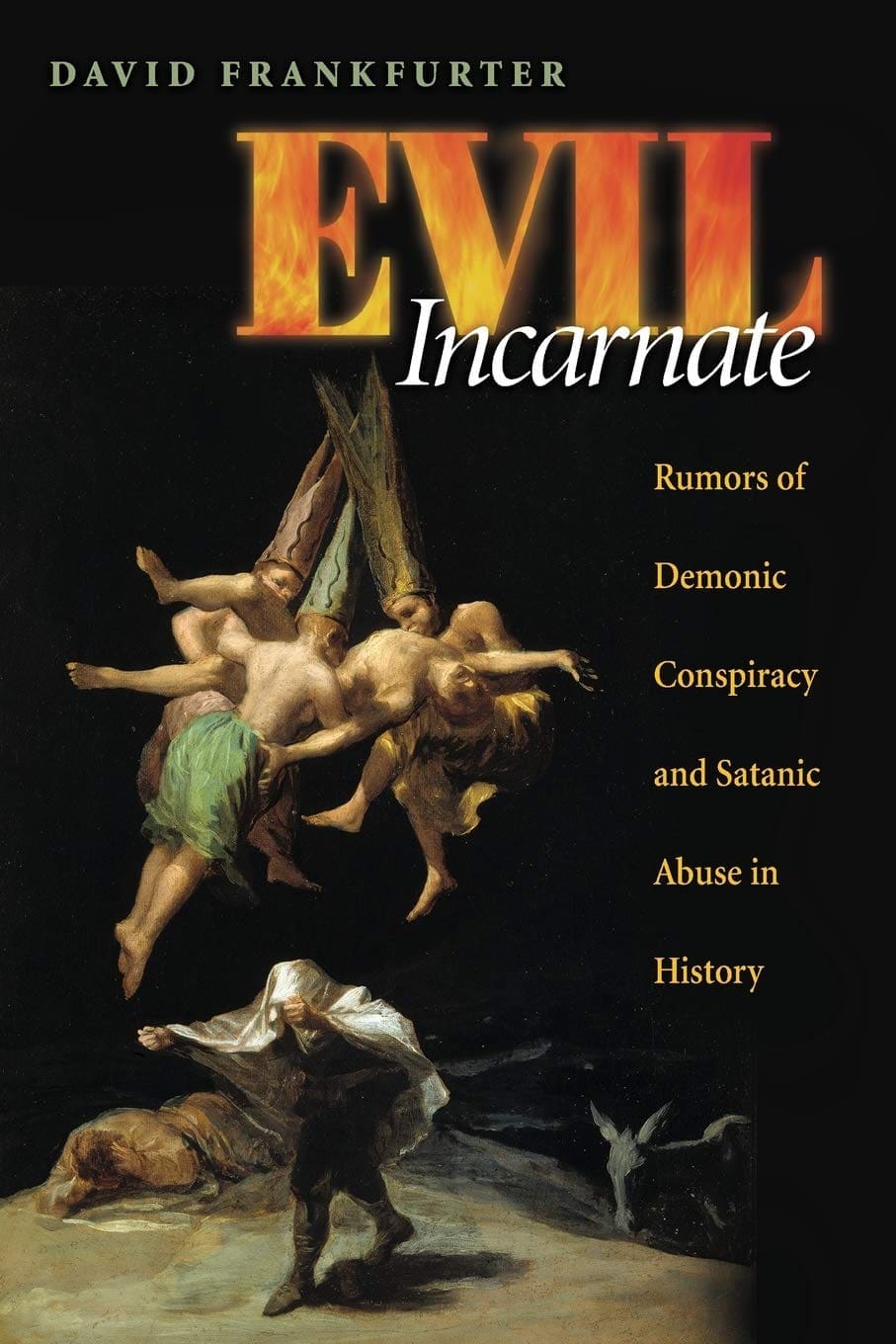
 As part of a multi-part series on claims of Satanic Ritual Abuse within Mormonism (including a spotlight on unethical “recovered memory” techniques within the field of psychotherapy, Utah therapist Barbara Snow, and Spiritual Guru Teal Swan) — today we are interviewing Dr. David Frankfurter – author of “Evil Incarnate: Rumors of Demonic Conspiracy and Satanic Abuse in History.”
 Part 1: The Historical Origins of Rumors of Demonic Conspiracy and Satanic Abuse
Episode Transcript
Host: John Dehlin · Guest: David Frankfurter
This transcript is machine-generated and lightly edited for readability. The audio is authoritative. Please excuse occasional errors in names and spelling.
Introduction and Episode Overview
Part 1 of 2 · Ep. 1312
Guest [00:00:00] One. Come, come you saints. No toil nor labor fear, but with joy when you're away.
John Dehlin [00:00:34] Hello everyone and welcome back to another episode of Mormon Stories podcast. I'm your host, Dr. John Dehlin. It is July 31, 2019 and I am excited to be bringing to you another episode of Mormon Stories podcast in a multi part series on the history of the long history of reports of satanic ritual abuse within Mormonism. For those of you who have not heard my introduction, I want to encourage you to go listen to it. I spent about 40 minutes giving an introduction to this topic. There's a lot of history and nuance and sensitivity that we discussed in that introduction and it's kind of important stuff. So please check that out if you're able and willing. But this is the next part. I'm not sure in that first part I mentioned and referenced the Glen Pace memo that we're going to reference in this episode. And I'm not sure whether this episode is going to appear after or before I discuss the Glen Pace Memo. So I'm just going to address that right up front. But regardless, we are so excited today to have with us our guest. And before I introduce our wonderful guest, Dr. David Frankfurter, I'm going to just give a little bit of a background to those who haven't listened to anything so far and who are disobedient in my request to hear the context. For many, many decades, Starting in the 80s at least, there have been a significant number of reports of satanic ritual abuse within Mormonism, within Mormon culture. And in the first episode I give my long history of experiences hearing about these reports. And we also reference the fact that around late 80s, early 90s, reports became so common and so frequent that Glenn Pace, who was serving in the Presiding Bishopric of the Mormon Church as a general authority at the time, wrote a confidential memo that's dated July 19, 1990, providing the results of his own personal investigation into ritualistic satanic child abuse within Mormonism. And I emphasized listening to the introduction first out of his art to be responsible, acknowledging the fact that one of the complexities with talking about this issue is that talking about it can create the problem. And what I mean by that is that whether or not these claims end up being legitimate or not legitimate, talking about these sorts of things can in some sense sometimes induce their own, we'll say social panic or conspiracy theories, and we'll be explaining a lot more about why that is. But I just wanted to kind of give a little bit of context to that and sort of give credit to Rick Phillips, who is a professor, sociology, I think, religious studies in Florida. We've had them on Mormon stories multiple times. But when I indicated through Facebook that I wanted to do my attempt to discuss satanic ritual abuse with the Mormonism, he said, john, I hope you don't do anything to further encourage conspiracy theories or moral panic in this regard. So please, you know, check out the book Evil Rumors of Demonic Conspiracy and Satanic Abuse in history, written by Dr. David Frankfurter. And so, you know, I take whatever Rick Phillips tells me very seriously. And so I immediately googled this book and looked it up and found it to be a really important book for setting a some contextual a contextual framework historically and sociologically and psychologically for the discussion of satanic ritual abuse. Because you do not need to know anything about Mormonism to learn a huge, massive great deal about the history of rumors of demonic or satanic ritual abuse in humanity, not just in the past year, not just in the past 10 years, not just in the past three decades, but in the past few millennia. And that's what this book is about. And that's why we've brought Dr. David Frankfurter onto Mormon Stories podcast. So if it's okay, let me read David's A brief bit about his bio. David Frankfurter holds the William Goodwin Aurelio Chair of the Appreciation of Scripture at Boston University. He joined the Faculty of BU in the fall of 2010. A scholar of ancient Mediterranean religions with specialties in Jewish and Christian apocalyptic literature, magical texts, popular religion, and Egypt in the Roman and late antique periods. Frank Furner's particular interests revolve around theoretical issues like the place of magic in religion, the relationship of religion and violence, the nature of Christianization, and the representation of evil in culture. He teaches courses on Western religions, comparative religions, Jewish and Christian apocalyptic literature, and the documents of early Christianity, including extra canonical sources, magical texts, and saints lives. And then for his background, his educational background. After earning his Bachelor of Arts in religion from Wesleyan University, a master's in theological studies from Harvard Divinity School, and a master's and PhD from Princeton University, Frank Furter taught at the College of Charleston and the University of New Hampshire, and he held fellowships at the Institute of Advanced Study and the Radcliffe Institute of Advanced Study, as well as research grants from the National Endowments for for the Humanities and the Guggenheim Foundation. I'm not going to read all his publications, but I am going to give a digital screenshot of the book that we're here to discuss. And here is my Kindle screenshot of his book because I don't have a hard copy. David Frankfurter's book, Evil Incarnate Rumors of Demonic Conspiracy and Satanic Abuse in History. So that is the background. And David Frankfurter, number one, welcome to Mormon Stories podcast. Number two, thank you for coming on. And number three, I was delighted at how amused you were when I called you to say that as a PhD level psychologist and podcaster in 2019, my ears are flooded on a weekly basis with ongoing reports of satanic ritual abuse within Mormonism in 2019. Was that a shock to you?
Dr. Frankfurter's Background and Expertise
David Frankfurter [00:08:14] It's a complete surprise. I thought that the entire panic had kind of declined during, in mid-90s. Basically, the last manual for treating satanic ritual abuse that I know of is from 2000. And that was way after the psychiatric association, the APA had all kind of pronounced that these rumors have no basis, these allegations have no basis.
John Dehlin [00:08:42] Now, who declared that?
David Frankfurter [00:08:43] Again, the APA talked about recovered memories and American Psychiatric association weighed in on dissociation and hypnotism. So the clinical techniques that were instrumental in allowing people to make these claims and to cultivate these fantasies, the clinical techniques basically declined by the end of the 90s.
John Dehlin [00:09:14] Right. And so, you know, a lot of people have kind of thought this issue was put to bed. But I can just tell you that a week doesn't go by where one or more people doesn't reach out to me and say either I was a victim or someone I know is a victim or a family member's a victim. And this has torn our family apart. And so in the outside world, this may be a dead or a dying issue. But in my world, this issue is very much alive and well. And so I'm so happy you would be willing to come on and talk about it really quick. We need to do a little bit of house cleaning and disclaimers. You know, in the era of Harvey Weinstein, of Bill Cosby, of the Me Too movement, you know, and within Mormonism, we're having our own sort of mini spotlight moment. Just like with the Catholic Church and all the, you know, systemic pedophilia scandals. We are in the midst of reconciling decades of systemic cover ups of sexual abuse of children and teens and adults, and realizing that the church has decade, a decades long history and with Boy Scouts of protecting the church's reputation, protecting sexual abusers at the expense of victims. And so we would be, and I talk all about this in my introduction, we feel very strongly that to deny or devalue or undermine the direct reports of Victims of what they've experienced would be catastrophically bad and harmful and devastating. So we're not at all about invalidating claims of abuse. We're about supporting victims of abuse and all credible claims and holding, you know, predators and perpetrators accountable and the church accountable for any instance that they do in terms of supporting. Having said that, it's also super important to talk about these sorts of things. And the satanic ritual abuse thing within Mormonism has just not been addressed. So immediately I'm concerned about victims or alleged victims who would say, well, John, if you really care about this and if you really care about victims, how in the world can you start out by interviewing someone who basically holds the position that a huge percentage, if not most, and I don't know if you'd be comfortable saying all of this satanic ritual abuse stuff is just hysteria and, and conspiracy and is not legitimate. So like, I'm already like stressed out that just by having you and I'm doing that. Having said that, Princeton, Harvard, Boston University, like this is, you know, this is one of the world's leading scholars who spent what, 10 years looking into this stuff. And I love science, I love social science, I respect academia. I'm not going to freaking ignore one of the world's experts when we have an opportunity to have them weigh in. So, so how do you talk about this issue knowing that victims need to be supported whenever possible and that abuse and sexual abuse and even ritual sexual abuse is happening in Utah? Because we know that at a minimum, Warren Jeffs did it with the FLDS church right down there in southern Utah. So how do we talk about this in a way that isn't harmful to either side of this concern?
David Frankfurter [00:12:57] Well, John, we begin by not only acknowledging but taking very seriously the reality of intra familial sexual abuse. And now since the Catholic Church revelations and I guess LDS as well, we also take seriously that those types of allegations. But the satanic ritual abuse panic began in the wake of the cultural discovery of intra familial sexual abuse back in the late 70s and 80s. And this was a turned the culture upside down. It was, people had known about it to some degree, clinicians had known about it to some degree. But it was very hush hush and it became an important part of feminism by the 1980s. But feminist critics have been kind of articulate about the, what the satanic ritual abuse claims do culturally. They say that quote unquote, as if there's a normal sexual abuse that's not as bad as satanic ritual abuse. Some people have pointed out that they. It puts sexual abuse from this often ambiguous, confusing situation in the home into something that's done off in a forest with people wearing robes and praying to Satan and things like that. It has the effect of saying this is entirely evil, whereas people who've undergone real sexual abuse in the home, it's confusing. You don't know whether the person you. Why the person you loved has been doing this to you for so long or even once. Interfamilial sexual abuse is confusing and it creates tremendous trauma because of that. But satanic ritual abuse, in a way, was mutation out of that cultural acknowledgement. And so we want to look at it in those terms. At the same time, there has never been any evidence for the allegations that people have made about satanic cults. Babies being sacrificed, multiple pregnancies inflicted on people, sites for satanic rituals, things like that. There's never been any evidence. And my book was really meant to frame this panic in the context of other situations in history where people have imagined satanic cults essentially abusing or taking children, things like that.
John Dehlin [00:16:06] Right. And just to kind of dovetail off of what you just eloquently shared. Like, one of the concerns I expressed in the introduction is that as I've seen journalists express interest in legitimate cases of child sexual abuse and youth Churchill abuse, sexual abuse and cover ups by the church, it is super reliable that claims of SRA get quickly intermingled into these legitimate attempts at getting to, you know, ways to show real evidence of real abuse and do real convictions or hold the church accountable. And so to the extent that SRA really has happened, then we want to uncover evidence about that. But the extent to which it's just a panic or a conspiracy theory, we don't want it to limit or hold back or scare off people who want to really get to the bottom of legitimate abuse. Does that make sense?
David Frankfurter [00:17:07] Yes. No. Totally. Yes.
John Dehlin [00:17:09] Yeah. So there's a lot we're going to be covering Both with David, Dr. Frankfurter and with other future guests. But what I'd like to do is just read an excerpt from the Bishop Glenn Pace memorandum. I will share a link to this in the Facebook Live feed so that those who are tuned in can access it. We're not going to go into the details of this memo now. We'll do that later. I'll just say this is a memo that's written on the top. Do not reproduce. So it's meant to be a private Memo. It's dated July 19, 1990. It's addressed to the Strengthening Church Members Committee, which intellectual Mormons or post Mormons will know what that means. And it's got its own long and sordid history and interesting history. It's from Bishop Glenn EL Pace, who is a general authority, a member of the Presiding Bishopric. And the subject is ritualistic child abuse. And I'm not going to read it word for word. We're going to do that later. But he basically says, we've had a ton of these reports in the late 80s. And so I did an investigation. I met with 60 victims. He lists where these victims were from. And then he describes the pattern of stories that he collected over time. And it was just in and of itself. The fact that he was able to condense 60 stories into a single narrative to me, was very interesting. I'm not going to read all of it, but I'm going to read maybe the most significant part. Now, you know, he talks about the fact that. That it's systematic, that it's torture, that it's well planned out, that there are conspiracies of people doing this. He talks about how many times children and youth don't have memories of this. And it's not until their adulthood that they become aware and these memories gets triggered. Memories gets triggered that they lead normal lives, but then all of a sudden their lives start unraveling and they don't know how to cope. And then he goes on to describe, oh, and he talks about why they can't remember that. He talks about dissociative identities and compartmentalization of the mind and things that we do to sort of block out unpleasant memories. And then he describes the memories, and I'm just gonna read what he says. The memories seem to come in layers. For example, the first memory might be of incest. Then they remember robes and candles. Next they realize that their father or mother or both were present when they were being abused. Another layer will be the memory of seeing other people hurt and even killed. Then they remember having seen babies killed. Another layer is realizing that they participated. They participated in the sacrifices. One of the most painful memories may be that they even sacrificed their own baby. With each layer of memory comes another set of problems with which they must deal. Now, again, I'm not going to go on and talk about the whole memo, but he ends by basically saying, my view to the church is that I believe that this happens. I believe that this is real. And part of the logic that he makes in here is basically that there's just no way that so many stories with so many Similarities can all have happened to so many people. And again, we're going to dive into all of this stuff, the therapeutic approaches, dissociative identity disorder, recovered memory scandals. We're going to talk about Martha Beck and Hugh Nibley, we're going to talk about all this stuff. But the reason why we brought David Frankfurter on was to address this idea of how unique to Mormonism is this, versus not in any way unique to Mormonism, but instead a three decades long sort of panic scandal that occurred in the United States, largely oblivious to Mormonism, versus how much of this sort of very similar reports or stories have been going on in the human experience for at least 2,000 years. And that's what this book Evil Incarnate addresses. And so that I think is the launching point. Now let me pause. David, is there anything you want to interject so far before we actually dive into the history?
The Bishop Glenn Pace Memo on Ritual Abuse
David Frankfurter [00:21:59] Well, I just wanted to add one thing to the appearance of many, many people making the same claims, having the same memories, having the same experiences. It has been found that multiple people went to the same therapists. So these are not independent cases of people having these memories. A community or a region or maybe the state of Utah has maybe three or four experts in satanic ritual abuse. And whether you come to them believing this happened to you or not believing, but having had other traumatic experiences, they will see to it that you remember satanic ritual abuse. So I think this is the most important aspect that sociologists found about the kind of fomenting of these, of these memories, because people will say they remember them, that they remember these things happening to them.
John Dehlin [00:23:04] Yeah. And I'm just gonna say that on Friday we have scheduled somebody who was a BYU student in Provo. Let's just say in the late 80s, early 90s, they were trying to deal with some mental health issues and some legitimate former trauma in their lives. A bishop referred them to a therapist that specialized in therapy, but really in recovered memory. And they feel like they were the victims of recovered memory with the therapist through hypnosis and other techniques. And my point is, not only is it usually has it usually been a small group of therapists that have done this. And your book does a great job of talking about what would motivate a therapist like this, why would they do it? How do these people get power? But it's that the church was part of systemically referring people to these specialists. Right. Bishops and stake presidents were channeling people to a select list of therapists. So, and we'll get into that on Friday. But anyway, I'm just, I'm just kind of dovetailing on what you had to share there.
David Frankfurter [00:24:15] Yeah. So
John Dehlin [00:24:19] tell us really quickly how you got into caring about this yourself.
David Frankfurter [00:24:24] I was interested probably in the beginning of my PhD program. I had a side interest in these rumors. But before SRA ever came on the scene, I was interested. What is similar between rumors about early Christians and rumors about women witches and rumors about Jews who were said to use Christian children's blood for Passover, the so called blood libel. And I was trying to figure out ways of thinking across these various historical situations. No one had really done this.
John Dehlin [00:25:05] Okay. So, and please forgive me, I told you before we started interviewing that I've. Mormons have a love affair with Judaism just generally. But I specifically had a love affair with Kaim Potok and his books as I was trying to figure out how Mormonism might be able to create something like a Reform Mormonism movement within Mormonism. And so because I know that you have at least some form of a Jewish background, I have to ask, like when you heard about, and your book talks about this, how Jews were killed historically with rumors of eating babies or killing babies or drawing blood or whatever, we'll get into that. Did you come across those stories as a Jew or as a secular Jew, like within your family? Or did you just read Stumble on that? And what was it like to have a Jewish background and know that in your heritage your own people were persecuted in part with the. Around these rumors or claims of ritualistic abuse and eating organs and babies and that sort of thing?
Blood Libel and Ancient Accusations Against Outsiders
David Frankfurter [00:26:06] Yeah, I don't think I felt it was fairly distant to me growing up in the northeast of America. The last blood libel stories, really, I think they're in France in the 1950s. That was rife in Russia through the end of beginning of the 20th century. So I wouldn't, it. I would say that the issues around satanic abuse and sexual abuse was the more kind of personal issue. Not because I have many friends who claim this, but because it was a very, very sensitive issue back in the 80s. It still is. And you don't, you know, as we talked about already.
John Dehlin [00:26:56] Okay, so for you it was just kind of a historical, interesting tidbit that this intersected with Judaism in some way.
David Frankfurter [00:27:02] Yeah, yeah, exactly.
Historical Roots of Ritual Abuse Narratives
John Dehlin [00:27:04] Okay, so tell us just about like we're going to cover a lot of aspects, but just give us the kind of history of like from the Roman times, if you want to go before then, Roman times, the, you know, the Middle Ages up until now. Tell us what about these stories that we're hearing seem to have origins in history for a couple millennia. Like how do we trace this back?
David Frankfurter [00:27:32] Well, the evidence I was dealing with was, first of all, early Christians. There seemed to have been rumors that they would have orgies and they would eat babies during these orgies, or at least beat babies until the blood came out. And they're very kind of graphic stories, strangely enough, preserved by Christians, not by non Christians. But these are some of the stories. Then you have stories about heretics, Christian heretics who cook babies and eat them and have strange orgiastic sexual rituals and all kinds of horrendous chance.
John Dehlin [00:28:18] And around what type? Well, around what time period do Christians start take? So we have like Romans fearful of Christians in like 2 or 300 AD, right?
David Frankfurter [00:28:27] Yeah, yeah. This was second century of the common era. Yeah. And then you have also images of Jews also cannibalizing occasionally. A little bit of evidence for that. But people, people tended to fear the foreigner back in antiquity as today.
John Dehlin [00:28:47] Right? Yeah.
David Frankfurter [00:28:51] So Christians then, Christian experts in heresy then develop these themes to talk about
John Dehlin [00:28:58] heretics in what, around what time period would that would be?
David Frankfurter [00:29:02] 3rd, 4th, 5th, 6th century and on. Because the literature about heretics moves very clearly into literature about so called maleficii or witches in medieval, late medieval and then early modern Europe. And so they used the literature about heretics to figure out what kinds of strange practices are being performed by people in the Italian mountains and the French countryside and things like that. They couldn't figure it out. All they had were these manuals about heretics. And so they started talking about what witches did. And witches would steal babies, they would eat children, they would take the children's fat so they could fly, they would conduct terrible rituals where they would eat disgusting fruits and dance in weird ways. And so this, this was very well known by, let's say, the 17th century.
John Dehlin [00:30:13] Now, to be clear, to be clear, were there actual people who identified as witches who actually ate babies, or was there just this persistent fear or rumor or panic that people like witches existed who did these sorts of things? Is there any evidence, but there actually were witches actually eating babies?
David Frankfurter [00:30:33] No, no, it was common. It was a development of a common story about the kind of demonic world in the forest. If you live in a small village and you're living in the 15th century, you tend to believe that there are kind of fairies and demons out in the forest that are going to afflict you. And this kind of gave flesh to those, to those stories. But also it became something that was Used to prosecute actual people. And this is where we get the idea of the burning times or systematic executions because people were officially executed for witchcraft. All over Europe, especially in Germany around the same time. You have the development of this blood libel that I mentioned. This was the rumor that there was a secret conspiracy of Jews who needed to get a Christian child and use their blood for matzah for Passover ceremonies. And this may seem completely preposterous to your studio audience. Most people find it preposterous today. But it was well known in many parts of Europe and Russia into the modern period. People just kind of assumed this is what Jews did. Again, you have ritual, you have the abuse and ingesting of a small Christian child. You have conspiracy. You have a.
John Dehlin [00:32:17] These are books and little graphics in the books, right?
David Frankfurter [00:32:20] Yeah. Or documents and also posters. They put. The town of, I think it was Frankfort, put up a big poster of a. Of one of these abused children that they imagined and they hung it over a gate so that everyone would remember what Jews did. So this was, this was a really, really serious rumor. Conspiracy rumor that had very, very terrible effects on.
John Dehlin [00:32:48] It's kind of a way to perpetuate antisemitism if you want to. Right?
David Frankfurter [00:32:51] Yes, exactly.
John Dehlin [00:32:52] You're looking for a reason to hurt the Jews or limit the Jews or punish the Jews. We will use confirmation bias to find all sorts of evidence that they're eating babies.
David Frankfurter [00:33:04] Right. Of course, the other, the benefit of these for local communities was if you find the bones of a child or bones of anybody and you. And you make the argument or the claim that these actually belong to a child, you can have your own local martyr in the town. And in early modern Catholicism it was very attractive to have your own local saint. And so a saint has to be abused. A martyr is the most powerful kind of saint. And then you have the priest set abusers who is the local Jews. So it's a win, win situation for the German community. It's lose, lose across the board and murderous, I mean leads to lynchings and pogroms for Jews. But it was a very serious rumor. Very, very serious. People knew it to exist, you know, and then. So blood libel. I think the, the other issue that I brought in as a parallel was the current interest in witchcraft in West Africa especially, where as part of dealing with colonialism and missions, many communities embraced missionaries notions of the devil and, and used it to change their own indigenous notions of witches into Satan worshipping witches. And this has continued to be a very dangerous form of belief. In Africa today through Pentecostal Christianity.
The Origins of Witch Hunts and Scapegoating
John Dehlin [00:34:54] Right, okay. Yeah. And, you know, you did spend 10 years on this book, right?
David Frankfurter [00:34:59] Long time. Yeah.
John Dehlin [00:35:00] Like, there's so much rich, you know, text and analysis and graphics, and it's really a. You take a multidisciplinary approach. It's not just history. You try and incorporate psychology and sociology. Right. Am I getting that right?
David Frankfurter [00:35:15] No. Right. I mean, I didn't want it to be a straight history. I wanted to focus on what it means to find common elements across these different cases. And you can't just say, oh, they all sound the same, or they're the same, or this kind of thing keeps on coming up, and you have to talk about what exactly it is that keeps on coming up. So, for example, the role of the clinician or the expert in evil in modern times actually does have a lot of similarities to the role of the witch finder in the early modern period, or the heresiographer, the expert in heresy in early Christianity. These people had charisma. People believed them. They were the ways in which people. People could feel safe from evil through these professionals and the identification of evil.
John Dehlin [00:36:07] Right. So for a. Let's just say a satanic panic to emerge, you talk in the book about kind of a few pillars or elements that kind of need to be there. I don't mean to put you on the spot, but, I mean, do you know what I'm talking about?
David Frankfurter [00:36:20] Yeah, yeah.
John Dehlin [00:36:21] What are the core elements to a satanic panic breaking out?
David Frankfurter [00:36:26] Well, I would say one would be these experts. And I think for modernity, for the modern period, this is essential before experts.
John Dehlin [00:36:34] What about doctrine and theology? Because it starts in Mormonism. If you watch the Mormon Temple ceremony, there's actually a character named Satan or Lucifer, and he's like, threatening Mormons that if you're not righteous, he's gonna curse you and call down. And then you've got one of the apostles of Jesus in the Mormon Temple ceremony raising his hand and casting out Satan or Lucifer from the midst of people. And the members are warned. If you do not obey everything that you learn in the temple this day, my hosts of evil spirits will be unleashed upon you. You'll be in my power. Like, how much does theology act as a prerequisite for this to happen?
David Frankfurter [00:37:16] Well, you know, most Christianities have a strong sense of the devil, but if you just compare what you just described to Central American and South American Catholicism, they have a very strong sense of the devil. They have the devil and his minions appearing in every single procession, represented all over the place. But they have come to develop a kind of playful view of the devil. Almost like he's strong, he's sexy, he could lead you to the wrong in the wrong paths. But he's also kind of funny and kind of phallic and not quite as dangerous. So I think there's something about Christianity is maybe in the Protestant tradition. I would include lds there that would. That are more anxious about evil and about the devil. Certainly that would be true of evangelicalism and Pentecostalism, conservative Christianities. But I would venture that.
John Dehlin [00:38:25] Right. And so. And especially. And I'll be willing to concede that I'm sure the Brethren, the leaders of our Mormon church today, don't talk about Satan and Lucifer and Ouija boards and the occult nearly as much in 2019 as they did in. In the 1970s and 1980s. And we're going to get into that. But okay, so you need to have some sort of myth or legend or fable or doctrine or theology around the presence of evil. Evil spirits, the ability of these evil spirits to do bad things, their existence. You mentioned some sort of expert. So talk about some of the other components.
David Frankfurter [00:39:03] I think one of them would be a. Alongside this articulate notion of evil, like a predisposition for thinking about it, you'd have to have some particular issue or crisis comes up, a child goes missing, a new moral anxiety like daycare centers or child sexual abuse in modern period.
John Dehlin [00:39:33] Or Jews, the existence of Jews.
David Frankfurter [00:39:36] Well, you know, Jews weren't always persecuted and they're not everywhere persecuted. So, you know, in these situations you might have a predisposition to. Well, there might be. There might be a tension with the Jewish community or there might be an anxiety about festivals, about the other there. Let's see, what else might you get?
John Dehlin [00:40:02] Like fears of war or nationalism.
David Frankfurter [00:40:06] Yeah, right. These would all be kind of the modern examples. In the early modern period in Europe, you seem to have a kind of interesting cultural combination of folk fears augmented to witch fears combined with the legal establishment. So as I said, witch hunts were not simply done by a bunch of people with pitchforks. They were done by people from the cities coming up with soldiers trying to be incredibly rational about it. So sometimes it's the self conception as being rational prosecutors of each that leads people to these horrible shams of justice.
John Dehlin [00:40:56] Right.
David Frankfurter [00:40:57] So I guess those would. Those are a number of the. A number of the factors.
John Dehlin [00:41:04] And then also I think I remember in the book you mentioning that like righteous ritual needs to exist as sort of a, what juxtaposition to some Sort of evil ritual. Like people have to be kind of used to the idea of good ritual so that then some sort of bad ritual or a fear of a bad ritual could emerge. Is that right?
David Frankfurter [00:41:28] The ritual issue is very complicated because in our culture, or let's say outside LDS and Catholicism, in mainstream and evangelical Protestant Christianity, ritual is a somewhat suspect idea. Ritual is not what we do in church. Ritual is something that is magical and involves superstition. Praising God and having demons expelled from you is not ritual. It's living the gospel.
John Dehlin [00:42:10] Got it?
David Frankfurter [00:42:12] In Catholicism, ritual is kind of a baseline word, general word, for the sacraments. But our culture has often viewed ritual as being very suspicious. And this is why satanic ritual abuse is such a potent term, because it underlines that when people go into a ritual state, they often are capable of evil. That's the idea. That's the, that's what's bound up inside that idea of satanic ritual abuse.
John Dehlin [00:42:47] Got it. So if we do it, it's sacred ordinances. If those weird people do it, it's scary ritual.
David Frankfurter [00:42:53] Yeah, right, exactly. But it becomes a, it becomes a dialectic kind of back and forth. Because when you imagine their ritual, in some ways you are reflecting on your own ritual. So even if you don't have ritual, even if you are a Pentecostal Christian or something like that, you're still thinking about what it is that people do in church. What is it that is legitimate that people should be doing as a group when they should be meeting, whether there's secrecy involved, whether there's not, who's allowed in, who's, whether it involves brainwashing or not. All these kinds of things get bound into thinking about who we are. The insider.
John Dehlin [00:43:39] Right. And so you've already referenced it. There needs to be these sort of almost self anointed priests or shamans or experts or therapists depending on the age that sort of emerge and, and assume this very ultimately powerful position in the culture. Yeah, let's talk about, you know, why would, in medieval times or even Roman times, you've already addressed this a bit. But like why would there be a need or an interest in that sort of person with that sort of message? And why would someone themselves ever want to do that, to be in that position?
David Frankfurter [00:44:23] Well, why there would be a need for this kind of person in situations of multiple immigration, massive immigration, population shifts, also popular anxieties, cultural anxieties, urban anxieties, what's going on? Who can we trust what different people are doing in different neighborhoods? There's, there are multiple Reasons why people might get anxious and might want a clearly described rationale for finding the source of our problems.
John Dehlin [00:45:03] Yeah, it's like their problems. We need to find a solution, right?
David Frankfurter [00:45:07] Yeah, we need to find a solution. We are receptive to someone who says, I am an expert in this. I can find out why there's plague in the town or why there's no water or why the children are disappearing or why the children are joining these new religions or something like that. I can tell you why. So it gets to your final question in some ways is a very interesting psychological question. Why would anyone do this? Why would anyone embrace the role as, as expert in the identification of evil? And I think it's most helpful with these people not to view them as charlatans or as deceivers or as false prophets or something like that, but rather to see them as deeply but weirdly sincere people. And that way you can understand how they, through their own experience, have come to feel a sense of authority over identifying evil. And I'm not talking just about witch finders in the early modern period. I'm talking about the therapists, the child welfare experts, the cult cops who have proliferated in America or proliferated during the 80s and 90s so that a community that was anxious about Satan's Satanists around in their woods or seducing the kids or something like that could call one of these cult cops to give a lecture at the local police station or for the community and everybody would be regaled with complete nonsense about the four graves of Satanism. But this guy, he has a sense of his own importance and everyone needs to hear what he says. That's the strange thing. There's nobody around who says, guys, there's no Satanism. There's nothing you have to worry about when your kids are dressed in goth, that's part of adolescence and you don't have to over over experience it. No one says that.
John Dehlin [00:47:21] Right? Yeah, I really, I really want to just reemphasize whether it's sort of a societal problem or I would even argue maybe an individual psychological problem. I'm depressed, I'm anxious, life isn't going as I wanted. Whenever things aren't going right at a macro or a micro level, we want an answer, we want a solution, we want help. And so it's just natural for people to rise up and say, hey, I can help. Here's how I'll help. And I'm of the opinion that religion doesn't fool us. We create religion as a way to signal to society, to the world. We have these existential needs. Can anybody plug them? And there's always going to be people willing to say, hey, I can tell you what God thinks. I can tell you what's going to make you happy or give you a healthy moral life. I'll fill that role. And thus religion gets created, right?
David Frankfurter [00:48:18] Yeah, yeah, yeah.
Countercultural Movements and Satanic Panic Origins
John Dehlin [00:48:20] So, okay, so let's go ahead and just jump directly to the 60s and 70s. I really liked in certain parts of your book how you kind of set the stage. And I read it as almost beginning in sort of the 60s and 70s with the emergence of Jonestown and Jim Jones and Guyana and also not only with Jonestown, but also Charles Manson and the cults that were happening in the 70s. It seems like, you know, we've got the Christianity layer. We've got millennia of these rumors of child sacrifices and satanic worship and Christian religious doctrine around Satan and Lucifer and sacrifices, all in our history and in our memories. And then we've got these cults breaking out where people are actually literally killed. You know, Charles Manson's like carving swastikas into people's killing pregnant women. Like Jim Jones is like leading hundreds of people to Guyana and then they're all drinking Kool Aid and dying. Like that gets pretty serious, right?
David Frankfurter [00:49:32] Well, yeah, I mean they're very different cases. But I think that when people have tried to talk about why satanic ritual abuse is real, they often cite these completely unrelated materials. What happened in the 60s and 70s is you have a lot of foreign religious movements or foreign derived religious movements, for example from India like Bhagwan Rajneesh and Krishna Consciousness and other movements like that. And you also had a number of youth oriented Christian groups that were, we might call totalistic, I.e. they, they, they required that you or they invited you to, to devote your entire life to religion. And this is very, this is a very popular kind of religious intensity for youth. And it is cross cultural and trans historical. Youth very often enjoy totalistic religious devotion, but when it's mixed with foreign derivation, parents get really anxious. The other thing that came out in the 60s was a resurgence of anxiety about so called brainwashing. Now brainwashing has no psychological basis, but it arose during the Korean War as a way of fomenting fears about POWs. But this was given a whole new life with, during the 60s and 70s with the deprogrammer movement that is experts in evil, in this case, experts who could kidnap your child from a group and subject your child to extreme deprivation and violence in order to convince him or her that they shouldn't be part of the group. And the idea was that what they claimed, the deprogrammers was that they were breaking the brainwashing that the group did. Brainwashing became an important aspect of the satanic ritual abuse claims. The idea was that these rituals functioned to hypnotize and brainwash the abuse victims. So not only were they victims of sexual abuse, they were victims of programming and deprogramming. No, programming and brainwashing. So I would say that that was one major thread that came into SRA and the other was the notion of the cult itself. The cult as. As a kind of folk model of dangerous religion. I don't use the word cult when I teach, and I. Even when I teach about new religious movements, I don't let this. I try to get the students away from the word cult. I tell them at a certain point that they have to. They have to. Sorry, they have to learn not to use the word cult because it's, it's. It's polarizing, divisive, it's derogatory. And of course, LDS members will know that, you know, in the broader evangelical society, LDS is viewed as a cult. It's really a word that means any form of religion that is.
John Dehlin [00:53:11] That you don't like.
David Frankfurter [00:53:12] Yeah. You don't like.
John Dehlin [00:53:14] A cult is a religion I don't like.
David Frankfurter [00:53:15] Exactly. Yes. But that became important for the satanic ritual abuse thing because now the satanic cult becomes the worst kind.
John Dehlin [00:53:25] Right. Okay. And so for me, kind of a major stake in the ground that I got from your book was the emergence of a book in 1980. Michel remembers that book.
Michelle Remembers and the Rise of Recovered Memory
David Frankfurter [00:53:37] Michel remembers, right? Yes, yes. So this is.
John Dehlin [00:53:42] Tell us about what you remember about that book.
David Frankfurter [00:53:44] This is a very, very strange book. Make myself a bit straighter here. Written by a psychiatric patient and her psychiatrist who she married. And it's about her sordid memory. Reconstructed memories of being abused by a satanic cult. And if you read it today, if you find a used copy on Amazon, you will be surprised at how pornographic it is. It really. The stories of sexual practices in this book, which I am entirely confident are fantasized, are just. They take your breath away. There's something that you get out of a, like a post Tolkien type sexual book. I don't know what, I don't know what. Where this kind of thing comes from.
John Dehlin [00:54:50] And I think this is really important because we, you know, if you believe it's all true, then you believe it's all true. But if you if you're, like, open to other theories, then you have to figure out where this all comes from. Right. And so I'm just going to read from your book, if it's okay.
David Frankfurter [00:55:06] Yep.
John Dehlin [00:55:07] The full merger of these ideologies was. This is on page 56. Was encouraged by the book Michelle Remembers 1980, co authored by a Canadian psychiatrist and his female patient, who came to, quote, remember, through therapy sessions. Multiple personalities stemming from child sexual abuse at the hands of a highly organized satanic culture practicing cannibalism. Right. Infanticide and all the perverse atrocities inherited from depictions of witches, of witches. Sabbats.
David Frankfurter [00:55:49] Yeah, sabbats.
John Dehlin [00:55:50] Sabbaths. Tell us what that word means again.
David Frankfurter [00:55:53] The word comes originally from the Jewish, The Hebrew word for the Sabbath, the day of rest. But it was taken over in the early modern period to represent witches rituals in the woods.
John Dehlin [00:56:15] Okay. Yeah. And so it goes on to say this book was extremely influential among child advocacy and psychotherapy professional communities in. In both the United States and the United Kingdom as the first systematic revelation of sra, or satanic ritual abuse, as an organized conspiracy manifesting itself in homes. Henceforth, SRA became the combined focus of evangelical Christian leaders, cult cops, child welfare advocates, social workers, psychotherapists, and psychiatrists, all of whom served as professionals in the identification and expulsion of evil. So I think that's kind of important, that book. And it's a source. And again, when someone comes to me within a Mormon context and wants to talk to you about satanic ritual abuse, it's almost identical every time. It goes something like this. The Mormon prophet and the first presidency and the quorum of the 12, they all have these tunnels under the Salt Lake Temple. And in these secret chambers and tunnels, they hold women as slaves who have to have sexual intercourse with the top church leaders. And the church leaders will come out into a room and it'll be like, I want this one. She looks good to me today. Or someone else. And so these women are enslaved. They're kept as breeders and the church top church leaders. And it's always like all the quorum of the 12 and the First Presidency, they're all in on it. They all have sex with these women. These women have babies, but the babies are then in turn used and are the part of sacrifices and on altars. And in Mormon temples today, top church leaders are sacrificing Mormon babies, making these women sacrifice their own babies. People are eating the babies, and these women are sexually abused. And then there's this ripple effect all throughout Mormonism of other influential middle to Upper middle class, connected Mormons who are practicing their own versions of this satanic ritual abuse again. Enslaving women, making them have babies, eating the babies, killing the babies, sacrificing the babies, and then it immediately goes. But it's not just, you know, Mormon leaders. It's the Federal Reserve and it's, you know, it's the FBI and it's the police force and it's the CIA and it's the Illuminati and it's the Masons. And all of a sudden, when you talk to these people, it's like pretty much everyone in the world is eating babies. That's kind of like. But it always involves these elements. And so you ask, like, number one, how come the story always sounds the same? And number two, where could stories of cannibalism and women being enslaved and babies being eaten, where could all that come from? Lo and behold, we have A source In 1980, you know, of a woman laying all this out there and making that claim. And then we've got the rest of the 1980s for this to build. Am I making too much of this book?
David Frankfurter [00:59:42] I think you put a little bit too much on it. Because if Michelle remembers, if the details in that book were themselves a resource, you'd find much worse stuff. I mean, much more disgusting stuff being used against.
John Dehlin [00:59:57] It goes way farther than that.
David Frankfurter [00:59:58] Yeah. What you just summarized is really the classic anti Catholic image of conspiracy that goes back to about the 17th century a little bit earlier. The tunnels, the breeders, including the babies being eaten. A lot of this comes out of anti Catholic ideas and traditions held in the Protestant unconscious, you might say.
John Dehlin [01:00:31] We have several listeners commenting. I'm just gonna read a few comments. Sven writes. I'd strongly recommend reading Lawrence Wright's book Remembering Satan, A Tragic Case of Recovered Memory. He's also the author of Going Clear on Scientology. So that's a great book. I've got it. I'm gonna be reading it. Anything you want to say about Lawrence Wright in that book?
David Frankfurter [01:00:51] Yeah, that book was written in. Oh, boy. I had this written down somewhere.
John Dehlin [01:00:58] I've got it right here.
David Frankfurter [01:01:00] Here's the book.
John Dehlin [01:01:01] Remembering Satan.
David Frankfurter [01:01:02] Yeah.
John Dehlin [01:01:03] A Tragic Case of Recovered memory.
David Frankfurter [01:01:05] Lawrence Wright, the case was from the late 1980s, which is the kind of peak period. And the interesting aspect of this. Of this particular case, it's one of the most interesting because a psychologist of. Of trance and dissociation was involved in testing the claims. But the subject here, the guy who still sits in prison because he kind of went into a trance state and admitted participating in satanic ritual abuse, that he came out of a very, very strict fundamentalist Pentecostal tradition. And so one of my arguments in the book is that this is an example of how people who are already trying to hold off sexuality in their own lives, but also beset by a very, very strict religious dominion which controls what they can believe, also gives them a very demonological view of sexuality that this kind of thing can come up. He becomes a very interesting case in terms of the role of fantasy in imagining satanic ritual abuse.
John Dehlin [01:02:32] And the year I see this book being published is 1994.
David Frankfurter [01:02:37] Just for the record, right? The case was late 1980s. Yeah.
John Dehlin [01:02:41] So Jean Paul writes, I read the Bishop Glenn Pace memo 15 years ago. I was serving as a bishop in the Cannes ward. I don't know if that's Cannes, France, or if that's somewhere else. But, yeah, it looks like it might be a French ward because his name is Jean Paul. So Cannes is the Cannes from the Cannes Film Festival. So. Thanks for joining us, Jean Paul. David writes, both of my sisters attended BYU in the mid-70s. They read and discussed a book about a teenage boy living in Utah county who becomes involved in drugs and a satanic group. It claims to be an account from a journal found after the teenager's death. They were told the events from the book were true and was a testimony to the powers of Satan and God's true church. The name of the book is Jay's Journal. So just a few interesting comments from our listeners. Okay, so. And we talked. Some listeners chimed in in my last episode where they talked about a real outbreak happening in Lehigh and then in Alpine, Utah, where a bunch of people were, according to this listener, falsely accused of sexual abuse. Being led by some of these therapists that we're going to talk about in just a second.
David Frankfurter [01:03:52] Right? Right. Right.
Guest [01:04:14] Come, come, ye saints no toil nor labor fear but with joy when you're though hard to you this journey may appear Grace shall be as your day Tis better far for us to strive Our useless cares from us to drive to your hearts will swell oh, all is well all is well. Why should we mourn? I think our lot is high Tis not so all is right why should we think to earn a great reward if we now shun the fight Gird up your lo Fresh courage take our God will never us for sake soon we'll have. Oh, all is well all is well oh, all is well all is well Sa. Sam. And should we die before our journey is through Happy day All is well we then are free from toil and sorrow too with the just we shall dwell but if our lives are spared again to see the sa the rest obtain or how we'll make this car is swell oh, all is well all is well all is well all is well all is well oh, all is well la.
Dissociative Identity Disorder and Therapeutic Influence
Part 2 of 2 · Ep. 1313
John Dehlin [00:00:00] One. Come, come, you saints. No toil nor labor fear, but with joy when you're away.
John Dehlin [00:00:34] Okay, so starting from this release of the book Michelle remembers in 1980, how does this grow into a national phenomenon?
David Frankfurter [00:00:45] Well, I think there are a lot of cases, I would say, that an interest in hypnotism and dissociation in the 1980s made it very kind of not chic, but popular to have people investigating what lies inside their patients and pulling out quote, unquote memories.
John Dehlin [00:01:17] And by the way, there's that Sybil movie that Sally Field starred in.
David Frankfurter [00:01:21] Yeah, that was a role too.
John Dehlin [00:01:23] When did that come out?
David Frankfurter [00:01:25] That would be.
John Dehlin [00:01:28] I'm looking it up right now.
David Frankfurter [00:01:29] Early 80s, late 70s.
John Dehlin [00:01:32] Okay. So again, this idea of multiple personalities launches into the public zeitgeist, you know, late 60s, early 70s, and then starts festering over the next 10 years. And I'm sure psychology then becomes fascinated, as they often do with trends with like understanding multiple personalities. So that, that starts to really get going hot in the early 80s. Right, go ahead.
David Frankfurter [00:01:59] It's dialectical between the patients who present graphic forms of sexual abuse to certain therapists in the beginning, then the therapists, perhaps influenced by conservative Christianity or by dissociation or by reading in the History of Evil or something like that, begin to put their patients experiences together and then cycling it back into their treatments. Some of the patients certainly come out of conservative Christian or Catholic traditions and can imagine as fantasy sordid forms of abuse that go beyond what they did or did not experience. So that recovered memory therapy or dissociation therapy becomes an opportunity for people to engage in fantasy in parts of their lives in a circumstance that they wouldn't be able to engage otherwise.
John Dehlin [00:03:04] And to be totally fair, I do have a degree in psychology and the DSM 5, the Diagnostic and Statistics Manual, the most current version, which is 5. It does list dissociative Identity Disorder as a formal diagnosis in the DSM 5. And so it is a legit medical diagnosis endorsed by the American Psychiatric Association. On the other hand, if you look at the history of did, it's hotly controversial and contested, and you will find legions of therapists that discredit the approach or the diagnosis as being connected to hypnosis, connected to recovered memory or false memory syndrome. And so it's certainly one of the most controversial diagnoses in the DSM.
David Frankfurter [00:03:57] Yeah. So I would say by the mid-80s you have a complete raft of experts in the fields of psychology and social work in the new burgeoning area of. What is it called? I think Theologically trained clinical psychology. Places like Fuller Theological Seminary, a famous evangelical seminary, had its own clinical program. You have cult cops developing now. These guys had been around since the 70s, but now they're getting more importance because they're able to identify Satanism as a social problem. We call these people all moral entrepreneurs because they are testing out a new problem for society and representing themselves as experts in this problem. And they become incredibly important. They go on talk shows. There was a famous Geraldo Rivera show, I think two to four hours long, which brought on teen Satanists, Ozzy Osbourne expert, people who claim to have suffered satanic ritual abuse. Experts from the psychology field, experts from the theology field. So this would go on national television. That had again, tremendous effect.
Daycare Abuse Cases and the Panic Spreads
John Dehlin [00:05:25] And then talk about how daycare interweaves into this.
David Frankfurter [00:05:31] That has its own lineage. Because the children who are interviewed at. Well, I should begin at the beginning here. There were a number of daycare centers where for one reason or another, and they tend to be very local crises, some mother took to the opinion or that their child had been sexually abused. And the very, very early primitive practice of social work, child welfare. Interviewing of children addressed these kids, sometimes toddlers, using dolls and very coercive questioning. And the children would start talking, as toddlers will, about genitals and circuses and airplanes and tunnels and people in masks. And it was almost impossible to see a kind of consistent narrative of sexual abuse. Especially since most of these kids showed no physical evidence of sexual abuse.
John Dehlin [00:06:58] And you've got. And I'm just gonna read from your book again. It's so good. The social worker Key McFarlane exemplifies this construction of a new expertise. In 1982, McFarland joined a network of Los Angeles area child protection workers. After losing a job at the national center for Child Abuse and Neglect to budget cuts, McFarland developed new ways of interviewing children suspected of abuse using hand puppets, dolls and playful interview techniques. When investigations into possible large scale organized sexual abuse at the McMartin Preschool in California began in 1983, McFarland took the opportunity to apply these techniques to some 400 children. And through protracted sessions and leading questions, children. She diagnosed sexual abuse in virtually every child. But this was not the child sexual abuse typically documented by social scientists and police. McFarlane was discovering group perversions, organized child pornography, and as she warned a congressional committee at the end of 1984, bizarre rituals involving violence to animals, scatological behavior and what they perceived as magic. And children threatened into silence with the use of weapons, threats of harm and death to family members and observing the slaughter of animals. So there we have it again, right?
David Frankfurter [00:08:22] Yeah,
John Dehlin [00:08:25] go ahead.
David Frankfurter [00:08:26] Well, so these particular cases tended not to have actual satanic evidence coming from the children, but the social workers put it together with the memories that other therapists were drawing out of patients across the country. So when somebody talked about, let's say a cult cop or a child welfare advocate, talked about the general conspiracy, the satanic threat to Americans and the family, they would draw on both the daycare center issues into and the satanic ritual abuse claims in the therapist's offices. You have it coming both ways.
John Dehlin [00:09:14] What's hard? So I'm going to play devil's advocate here for a second or abuse potential victim, abuse advocate. It is not hard for me to imagine some mom and pop daycare where the guy. I mean, if pedophiles can flock to the boy scouts or the Catholic clergy or Mormon leadership, you know, and young men's, young women's boy scout troops, pedophiles can flock to daycares and use daycares as a way to privately and secretly sexually abuse kids. That is completely in my perception of the realm of possibility. And so I'm torn.
David Frankfurter [00:09:55] I'm like, well, they could theoretically, but they tend to leave fairly clear trails. So the one case where we do have evidence of kind of massive pornographic exploitation of kids, the person had the films and the films were discovered. But the evidence, the physical evidence, the actual forensic evidence for children's abuse at daycares is very, very small. I mean, it's really just a couple cases. What is interesting to the study of child welfare and the fears of sexual abuse is that an intra familial danger or reality gets displaced onto a new institution in the 1980s and 1990s, that is the daycare center, including the daycare center, sometimes staffed by males. So what could be more suspicious in a way than a male daycare teacher? Although in North Carolina there were women who were arrested and sent to jail. But the daycare center becomes a kind of fearful, contested territory because what kind of woman puts her child in a daycare center? And what is she leaving her child to suffer when she goes away?
John Dehlin [00:11:29] So there's feminist themes here. There's traditional family parent role issues, Women working outside the home.
David Frankfurter [00:11:36] Exactly.
John Dehlin [00:11:37] You know, these are all kindling along with satanic stuff, along with sexual abuse stuff, along with the cold stuff, along with the ritual stuff. And you just have to think back to like the McCarthy Red scare of the 50s. Like there are the Salem witch trials. Like it can happen and it has happened and it continues to happen where some meme gets in the cultural consciousness and all of a sudden everybody's a guilty victim and tell me if I'm right. We have instances of people in prison for up to like 17 years who, where later it was discovered they were wrongly convicted of sexual abuse in daycares. But in the panic, everyone was scared to stand up to the accusers, to the therapists, to the cops, to the social workers, and even journalists were shamed and beaten down if they tried at all to bring evidence or skepticism to these accusations.
David Frankfurter [00:12:38] Well, you know, I don't have a lot of sympathy for this, the district attorneys in this and the prosecutors because I do think they, they become the kind of witch hunters in all these cases. But I do think it was up to the judges. And the problem is the judges in many cases just throw up their hands. I don't know whether there's satanic cults or not. They don't consult historians, they don't consult sociologists, they say, ah, whatever, you know, maybe there are satanic cults. And then they allow types of investigation and interviewing and evidence that is completely inappropriate. So I blame the judges, I blame the district attorneys and the prosecutors and certainly the so called experts during this period.
John Dehlin [00:13:27] So you're saying that people weren't imprisoned based on like DNA samples on the children's body or films or like eyewitnesses to the abuse. It was always like some cop or therapist or social worker was able to privately interrogate or give therapy to the child. And now it's uncovered that through these recovered memory, brainwashing, whatever suggestive sort of interviewing that was used as evidence to convict people.
David Frankfurter [00:14:01] Right. Using toddlers. And so one toddler would say, I don't like Mr. So and so. And then the therapist would ask the next toddler, did Mr. So and so do something to you? And then ask the next, and then the person would say, you know, he made a funny face. And then, then you ask the next toddler and the next toddler and pretty much you have brought together, you've put together, woven together a situation of Mr. So and so has been taking the kids away from the daycare center and, and molesting them. And there's no evidence, there's no forensic evidence, there's no physical evidence, there's no opportunity. But he gets convicted.
John Dehlin [00:14:43] And just again, to represent people who are advocates of SRA kind of stuff, I hear a lot of times what you hear from them is well, the cops are in on it. And the judges are in on it, and the churches are in on it, and everyone's in on it. And so, of course, no evidence is found. And of course, there's nothing credible found because everybody's part of the conspiracy. And so I would just ask you, like, in the Mormon context, they're gonna say, well, of course the church leaders aren't buying it because they're covering it up and they're the perpetrators. And of course, the judges and the policemen in Utah are not gonna find any evidence because they're all part of the conspiracy.
David Frankfurter [00:15:28] Right.
John Dehlin [00:15:29] So if somebody, like, I could hear them saying, well, you, you know, you, David Frankfurter, you must be part of the conspiracy because you must have some motive to want to discredit, you know, you know, these sorts of legitimate accusations. What would you say to that? If somebody's like, well, David Frankfurter, you're. You're clearly part of the conspiracy?
David Frankfurter [00:15:53] Well. Well, I mean, you can't really have a conversation with a conspiracy theory theorist. But one of the most interesting reports on the evidence for satanic ritual abuse came out in. It was 1994, and it was by the national center for Child Abuse and Neglect. And they investigated what types of therapists, psychiatrists, psychologists, social workers were cultivating these claims and what the evidence was. And at the end of this. At the end of this report, they develop another category which they call religious abuse. I found, as a historian of religions, I found this very interesting because now you have ritual abuse and religious abuse. But religious abuse are the atrocities that are committed to. In the name of what might be called mainstream or recognizable ritual religion, like exorcism. And I cannot tell you how many examples I found. It's in one of the last footnotes in the book, how many examples I found. Just doing a literature search on children who have been beheaded, drowned, smothered, beaten, abused in every conceivable way, appearing in emergency rooms or in morgues for the sake generally of some type of exorcism. So there's an example.
Examining the Evidence for Satanic Ritual Abuse Claims
John Dehlin [00:17:30] Are you saying those are real crimes?
David Frankfurter [00:17:32] Those are absolutely real crimes. They are ones that are forensically documentable and in. By emergency room technicians and by. By mortuary technicians. So there's an example of abuse that is absolutely real. And the problem with the satanic things is that there's never been any evidence. So what I would say to somebody.
John Dehlin [00:17:57] Okay, Okay.
David Frankfurter [00:17:59] I would. So what I would say to somebody who. Who is conspiracy minded is evidence really matters, especially when you put it. When you put the lack of evidence for Satanic abuse next to the abundant evidence for what I would call exorcistic abuse. And that happens everywhere.
John Dehlin [00:18:17] Okay, so you're willing to say that in the name of religion or under the influences of religious doctrine or dogma, you're willing to say lots of atrocities happen within religions. Yeah, you know, but that you're basing that on evidence that actual bodies or corpses or bruises or direct firsthand reports. What people in this SRA sort of mindset are gonna say is that, well, because of the brainwashing, because of the dissociative identity disorder, because of the threats. And we'll get into this when we read the PACE memo. Everyone's either programmed to. Not ever, you know, reported. And PACE even writes that people are. They're programmed to commit suicide if they ever start to move down the path of actually reporting real evidence. And so they're basically saying judges are bought off, policemen are bought off, church leaders are bought off, and then the victims themselves are, through CIA level ultra MK programming techniques, they're programmed as a computer, can be programmed to kill themselves before they would ever actually submit evidence. Have you heard that?
David Frankfurter [00:19:35] I've heard things like that. And yes, those beliefs still exist. They are absolutely unverifiable. And I think it makes more sense. I've always thought it makes more sense to view them in the context of the culture and the context of the history of images of subversive cults than in the context of actual criminal behavior. Because again, there is no evidence.
How the Mental Health Field Engaged With the Panic
John Dehlin [00:20:01] Okay, okay, so what happened? How did this panic play out in the 80s and early 90s in the mental health field, we've already touched on this. But in the mental health field, in the judicial system, in religions, in the daycare industry, how did all this unfold and play out? Did it reach some awful climax? How pervasive was it? And then what led to its sort of like, petering out?
David Frankfurter [00:20:30] Well, recovered memory therapists became delegitimized by the middle of the 90s because the American Psychiatric association took a stand against dissociative therapy, dissociative dissociation therapy, and national center for Childhood Child Abuse and Neglect came out, made. Made the statement that satanic ritual abuse is a product of particular therapists.
John Dehlin [00:20:59] Okay, can we. Can we pause there for a second? Talk about, number one, what would motivate. Like you said, these aren't black hats. These aren't people intending to hurt. What would. What would. What would make a licensed clinical social worker, marriage and family therapist, or psychologist, psychiatrist, all of a sudden want to start doing recovery Techniques. And then what would the actual techniques be? I know we've touched on it, but let's just really talk about that for a second. Of what? How someone would become a purveyor of that technique. Why they would become a purveyor of that technique if it's not to do evil, and then how they would actually do the technique, how it play out in the therapy room.
David Frankfurter [00:21:44] Well, the reason why certain clinicians embrace certain types of therapy comes down to political inclinations, for example, wanting to help women who've been victims of sexual abuse. It can come down to a desire to be with it. You know, to cultivate new techniques like MDMR is very popular right now as a way of reducing trauma. What else would. Maybe they're training in a particular institution. If you come from a. Perhaps a psychodynamic institution, there might be more of an interest, a Freudian institution, more of an interest in the unconscious and what it can hold than if you come from another kind of training program. So a lot of. A lot of, you know, why one therapist is going to choose to do recovered memory or dissociation or multiple personality therapy versus another one who just wants to kind of like talk to kids and let them explore their issues. It's very difficult to say, but I can say I can relay one particular theory which I did find extremely interesting.
John Dehlin [00:23:07] And I just have to say. I went through a PhD program in clinical and counseling psychology in the, you know, in the late 2000s, early 2010s. I had a training psychologist on staff who taught that satanic ritual abuse was real, taught all the students that they had treated multiple clients for satanic ritual abuse who had experienced baby sacrificing. And I was taught by this training professor on staff techniques around dissociative identity and the types of techniques that would be delving back into someone's memory to harvest their early memories as children.
David Frankfurter [00:23:51] What institution was this?
John Dehlin [00:23:53] Utah State University and APA accredited university.
David Frankfurter [00:23:56] Okay.
John Dehlin [00:23:56] And I trained from 2009 to 2015.
David Frankfurter [00:23:59] Wow.
John Dehlin [00:24:00] So I can tell you that's how I found out about it. Yeah.
David Frankfurter [00:24:04] Right. And some people would be very intrigued and some people would be repelled.
John Dehlin [00:24:08] And I talked to other professors and they're like, this professor is. Has a lot of power and I don't want to cross them and it's too controversial. So they would say, these techniques are awful, but I'm not going to make a big stink about it.
David Frankfurter [00:24:21] Yeah, very interesting.
John Dehlin [00:24:22] Yeah.
David Frankfurter [00:24:23] Anyway, so the more subtle explanation that I have read is that a kind of Theological interpretation that therapists during the 70s and 80s were encountering a tremendous amount of child sexual abuse. Intra familial child sexual abuse.
John Dehlin [00:24:48] Probably legitimate, right?
David Frankfurter [00:24:50] Legitimate, yes. My aunt was encountering this in a Cleveland neighborhood. It was just all over the place. And you just can't believe that these people are doing these things to their daughters and sons. You just cannot believe it. And that I believe the theory was that this begins to weigh on the therapist. Okay? And the therapist has this. This inchoate unspoken sense of evil in society, but does, but doesn't have the language for it because he or she is not allowed to use words like evil or Satan. They just keep on one person after another and training clinicians and training social workers, especially social workers. They see so many cases and this is coming up all the time. And so that when they begin to read about satanic ritual abuse or hear
John Dehlin [00:25:47] about it on Geraldo, on Donahue, on Oprah, on Nightline, like all over the news and tv, all over the news,
David Frankfurter [00:25:57] it takes on a kind of integrity for a person having that experience that for the rest of us, or distance it might not. And so this is a kind of psychology of its psychologist or a psychology of the social worker, that there's a kind. It's not like a breaking point, but it's a mass of terrible experiences and cultural observations you have no language for. And that somehow or other the notion of the satanic cult offers that language. So this was a dissertation at Vanderbilt that I had great admiration for. It was never published, but I thought it made a lot of sense because one of the things that I found when I was going through the writings of SRA therapists, psychiatrists, psychologists, was how personal they talk about their own encounters with patients claiming these things and that they actually feel like they are enthralled to the patient, that the patient is revealing something them. And you're thinking, man, these entire dynamics are being reversed here. But if you engage sympathetically with these therapists, you begin to see how a real engagement with SRA can come about. At least during the 80s and 90s, right?
John Dehlin [00:27:23] And so it does come out of a genuine concern to protect children and to help people heal from abuse. It just does. And I'm going to add that if you are a religious therapist and you believe in Satan and devil and evil spirits that possess you, then it's going to be completely within the realm of your worldview that, number one, Satan and his angels are out to make people do evil things. And then secondly, it's in Mormon scripture That, you know, secret combinations and murders and evil people are gonna always be with us as long as. Until Jesus comes and the millennium happens. And so it's almost like a self fulfilling prophecy. Well, there's got to be satanic people around doing evil satanic things because the scriptures say it, right?
David Frankfurter [00:28:17] Oh yeah. Oh yeah.
John Dehlin [00:28:18] So why wouldn't a therapist, a believing therapist, incorporate that into their worldview of what's going on with their, with their clients, Right?
David Frankfurter [00:28:27] Yes. So then we would have to particularly admire the believing therapist who does not do that.
John Dehlin [00:28:32] Right? Yeah. Okay, so what are the actual techniques? How, how could someone make someone think that they had a memory when they didn't really have it? Especially such a traumatic serious memory?
David Frankfurter [00:28:45] Well, hypnotism is one was one way of doing this suggestive kind of speaking through the external person to the internal person. Let's say. What else? Yeah, giving suggestive seeds for particularly killer memories, but also in a way allowing a kind of unrestrained fantasy world for the patient so that if she's allowed to talk about the satanic cult, it uniquely allows her to engage in sexual fantasies. She wouldn't be allowed in any other domain. This is the work of the psychoanalytic feminist psychoanalyst Janice Hockin, who wrote in her book the Pillar of Salt a wonderful discussion about how this recovered memory therapy can, gives, gives certain women from very conservative backgrounds a kind of license to engage in erotic fantasy that they wouldn't have otherwise. So that becomes another circumstance. And then the other thing that these types of therapists did was they would drop all boundaries. And so if the patient wanted to talk to them at midnight, they would have a phone consultation, they would rush into their office, they would have, they would extend their therapy sessions way beyond one hour. So there was no sense that the therapist or the memory or the relationship had necessary boundaries. And this really is key for taking responsibility for your own therapy. The therapist now becomes a kind of like parental figure who just will be always on call. So this was another massive error by these people. Again, they felt they were doing it out of benevolence. But we can see now, or we could see back in the 90s that this was creating the problem.
John Dehlin [00:31:00] Right. And I just shared in the, in the live Facebook feed a couple books. I shaved the. I saved the Remembering Satan, A Tragic Case of Recovered Memory by Lawrence Wright. But also kind of a really important book, the Myth of Repressed Memory by Elizabeth Loftus. I pasted that into the link. There's another book called Now I Can See the Moon by Journalist Alice Talmage that writes about her investigations of, and actually a niece, I believe, of hers who committed suicide as someone who, according to Alice Talmadge, was the victim of false recovered memory and false claims of satanic ritual abuse. Doug Fabrizio did an interview about with her on Radio West. And so, yeah, so there are a lot of books that cover this.
David Frankfurter [00:31:54] I would recommend the Janice Hocken book, H A a K E N alongside the Loftus book. Loftus is an experimental psychologist. And so she was often reviled by people in the sexual abuse recovery world, including the real sexual abuse recovery world, for being unsympathetic towards people remembering real cases of sexual abuse. She did experiments. She has a lot to say. She is an incredibly important gauge on what memory can do and what it can't do. But she has a kind of bad rap.
John Dehlin [00:32:38] Okay, thank you. And the book I have is Pillar of Salt, Tender Memory and the Perils of Looking Back by Janice Hawkins. So I've shared all those links in the Facebook feed. So, okay. So, yeah, and I can just imagine, and we're going to actually interview on Friday, someone who claims to have been the victim of a therapist who was referred by their bishop, who engaged in some of this hypnotismrecovered memory. But what I remember is sort of like, okay, let's do an intake. Let's hear about your symptoms. Oh, my gosh, your symptoms sound really traumatic. While these symptoms are really similar to the symptoms of other clients I I've had who have been satanically, ritually abused. Have you heard about satanic ritual abuse? Are you aware that memories get blocked off? And so by. We basically have this story that is millennial old, this story that the Michelle Remembers author tells. You basically have the therapist telling the story of what happened, which is a way to implant, to begin seeding the implantation of the memories. And then you have them saying, now let's go back. Can you remember someone in a cloak? Can you remember any sacrifices? Can you remember being sexually abused? And I think that is a possibly one theory of how this can play out in the therapeutic chair.
David Frankfurter [00:34:11] Yeah, yeah.
John Dehlin [00:34:12] Okay. And again with therapists believing that they're really uncovering legitimate satanic ritual abuse. Right. So it's not these bad actors trying to perpetrate lies.
David Frankfurter [00:34:22] Right, right, right, right, right.
John Dehlin [00:34:24] Okay. So you're saying that by the early 90s, all the major mental health associations are repudiating these hypnotic techniques, this usage of dissociative identity disorder in this way, and the use of recovered memory techniques in the Therapeutic chair. Is that true?
David Frankfurter [00:34:43] Mid-1990s, I would say it's really on the downturn. There was a manual for the treatment of satanic ritual abuse still published in 2000. Can't remember the name of it, but it was pretty much on the outs. That does not mean that you will not meet cult cops, satanic ritual abuse therapists as you described from your own training. They're still around, it's just that they, their organization, The popularity of this kind of investigation has diminished massively.
John Dehlin [00:35:28] So like a skeptic or a secular person is going to say, okay, well once all this was debunked and delegitimized, these fake accounts or these hysteria based moral panic accounts went away because it was identified as a problem and is not real and is being delegitimized. People who are believers in SRA would just say, yeah, just went back underground and we still have daycares and churches and Mormon apostles doing all this ritual abuse. But now the cops and the judges and the mental health professionals have all turned a blind eye and just left people to continue being victimized for more decades.
Decline of the Panic and Its Lasting Legacy
David Frankfurter [00:36:09] Right. Well, the other thing is that the Catholic Church scandal, which began, I think that was the end of the 80s, began to displace this. And here you have a case of again, people not with recovered memories, but with fairly lucid memories of particular situations which when interviewed by lawyers and distributors, attorneys and church lawyers, they all came out as similar across the board. So this became an institutional cover up of sexual abuse in reality. And so it took over the media.
John Dehlin [00:36:56] And again, it's not that David Frankfurter is a shill for Mormonism or the judicial system, or the Illuminati or the Masons or the Trilateral Commission or whoever you think you know is behind satanic ritual abuse, or Russell M. Nelson, the Mormon Prophet, or whatever it is, you are willing to condemn a religious institution if they're involved in any sort of abuse of anyone, correct?
David Frankfurter [00:37:23] Of course, yeah.
John Dehlin [00:37:25] Just, just you, you like there to be evidence?
David Frankfurter [00:37:28] Yes.
John Dehlin [00:37:28] And, and you're saying that in your 10 year study of all the outbreaks of satanic ritual abuse, is there, have you ever found any credible evidence of any meaningful satanic ritual abuse associated with daycares, with religions or whatever?
David Frankfurter [00:37:46] No. No. And that was what I, what I say in the beginning of my book is that I take the unusually positivistic position that this never occurred and nor did were there real witches either. But that was in a way an opportunity. It gives me an opportunity to investigate how these stories Develop. But seriously, I can go back and say I have not in the years since then, nor have any other investigators found any evidence for satanic ritual abuse.
John Dehlin [00:38:19] And my understanding is that after the. And interestingly, in the Mormon case, in the Glen Pace memo, he believed it, and he told the church, this is real and legitimate. He wasn't trying to cover up. He was saying, we need to get to the bottom of this and fix it. And he was claiming bishops and stake presidents and top church leaders were involved and that Mormon temple ceremonies were integrated and that, you know, he was. He bought it all hook, line and sinker. So he wasn't trying to hide it, he was trying to fix it.
David Frankfurter [00:38:50] Right. This is one of the interesting things about the experts in evil, that it is in the interest of somebody who is affiliated with a religious institution to become such an expert, because you're already trusted, you're already viewed as having authority, and now your authority extends to a covert evil. So I'm not surprised. It might seem ironic on the outside that he would be ostensibly condemning his own church, but in fact, being able to kind of see the evil that's surging around the Mormon institution, that might have actually given him more authority and more credibility.
John Dehlin [00:39:36] Right. And that goes back to what you were basically saying, you know, saying earlier, which is that for millennia, again, these experts have emerged because it's so alluring, even if very sincere, for these people to say, hey, this is a problem, and I think we can help fix it. I know what's going on, and we can solve the problem.
David Frankfurter [00:40:02] Right, right, right.
John Dehlin [00:40:04] Yeah. Okay. But it turns out that the state of Utah itself commissioned a study of satanic ritual abuse, and it found nothing. That probably doesn't surprise you. Again, the people who are for this sort of thing are gonna say that, of course, because the general authorities in the Mormon Church, you know, control the legislature and the judiciary and the, you know, the justice system. And so they would have oppressed it and suppressed it and basically said that, you know, there's no. These are not the droids you're looking for.
David Frankfurter [00:40:47] Right, right, exactly. Yeah.
John Dehlin [00:40:51] But then. And so I'm gonna go ahead and paste into the link the Utah report, because that is a public report that is made available. And then I've even heard that the FBI and CIA, at some point or another, maybe held their own investigations. And again, by any report I've never heard, there's never been any evidence.
David Frankfurter [00:41:13] Right, right. The FBI had put a particular agent on this. His name is George Gannaway. He never wrote a book, but he's been published all over the place. There's actually a book from 1991, a collection of articles called the Satanic. What's it called? Not the Satanic Scare, but Satanism Scare. That's what it's called. Edited by David Bromley. And Gannaway talks from the perspective of the FBI that no evidence was ever found.
John Dehlin [00:41:49] And that's important because, you know, again, like Spotlight in Catholicism, like Joseph Bishop McKenna Denson, like any of us who care about victims, who care about abuse, who care about human suffering, we are going to. We are. You know, there are lots of evidences of legitimate abuse reported to police all the time. Now, of course, we know that a very small percentage of abuse is reported, and a very small percentage of those that are reported end in conviction. So I want to again acknowledge that this is very complicated because it's not like all the abuse that ever happens is both reported and convicted.
David Frankfurter [00:42:32] Right.
John Dehlin [00:42:32] Having said that, you would think that with how pervasive this is, up to the highest levels of the church, in the judiciary and all throughout the world, there would at least be one case where there was evidence. And you're basically saying there's never been any evidence.
David Frankfurter [00:42:48] No, no.
John Dehlin [00:42:49] And that's kind of. That's kind of overwhelming, right?
David Frankfurter [00:42:52] Yeah, I guess so. But then if you turn the question around, who do these stories serve? What do these stories serve? Why do they have such propensity to kind of grow and morph and move into different domains? I think the answers are much more interesting. If we get stuck on did it happen? Did it not happen? We're not asking the really larger, important, larger cultural questions.
John Dehlin [00:43:22] So how do you want to. What else do you think is important for us to think about or know about? Because, you know, in addition to what we've covered, what if you wanted to leave our listeners with sort of some of the most important insights or perspectives from your 10 years studying this topic and for your career of being interested in this type of stuff, what are the most important things we can take away from all this?
David Frankfurter [00:43:48] Well, I would say that one thing is the role of fantasy in these stories, specifically sexual fantasy, that we have to take very seriously. The sexual narratives, the sexual exploration, the eroticization of different things, however gross or weird or perverse it seems to the outsider, this is one of the primary things driving these stories, and we need to take that seriously. So when people come out of extremely conservative backgrounds in the modern age especially, but even back in the 16th century, I have a colleague who's been studying sexual Fantasy and Polish witchcraft trials. But today, at least, people don't have a lot of outlets. And eroticism is a very, very complicated thing. Sometimes it is triggered by thinking about the worst or the most perverse or the most disgusting ideas or symbols, things like that. So that's one issue is to take seriously role of fantasy. The other, I think, is to think about what ritual means in modern age. And when I think about the different groups in which these stories have developed in different ways and been drawn out and illustrated, whether Michel remembers, which reflects a Catholic milieu or many of the others which reflect evangelical milieu. Very interested in what ritual means, what gesture and procession and symbol means in the community that's hosting these stories. So when you talk about these things developing within close LDS networks, I'm interested in how these might reflect thinking about Mormon ritual in the 20th or 21st century. So that would be the other thing I would think about.
John Dehlin [00:46:02] Yeah. So to go back to your first point, you know, I as I've not only gotten my degree in Psychology, my PhD, but also counseled with a lot of Mormons and progressive Mormons and post Mormons. Sexual. And I'm not trying to say you're saying this, but I'm just going to tell you my reflection. Anytime you've got this obsession with sexuality, this sense of repressed sexuality, of toxic messages around shame and sexuality and all these stakes of like, you know, Mormonism to have premarital sex is next to murder in terms of severity. And, you know, whenever you have a culture like that, it seems to just breed hard, weird, difficult kind of stuff that sometimes makes the problems worse than if you just kind of like said, yep, it's normal to have those types of thoughts. It's normal to have these types of behaviors. It's not, you know, do your best to be healthy, use good common sense, but just kind of normalizing and destigmatizing and deshaiming things. It just seems like when you have a culture that's just so, so wrapped around the axle around matters of sexual purity and sexual, you know, God caring so much about sexuality, is it fair to say that can breed these sorts of things?
Why These Narratives Persist in Religious Communities
David Frankfurter [00:47:30] I would say that people look for outlets to think about what they crave.
John Dehlin [00:47:39] Yeah.
David Frankfurter [00:47:40] Yes.
John Dehlin [00:47:41] And again, there's, you know, Utah, as I understand it, is one of the leaders in the nation in child sexual abuse and in adolescent sexual abuse. We also know that it's very high in pornography use. So there's something wrong with how Mormons are doing sex and sexuality that is making this problematic. Why do you think. Why. How in the world do you explain that so many Mormons and post Mormons are coming to me in 2019 still talking about this stuff when for you it was a dead issue back in the early 90s?
David Frankfurter [00:48:15] I have no idea. And you're telling me this completely turned me upside down. I was amazed. And it's probably worth a really interesting research paper.
John Dehlin [00:48:25] Okay. And I guess I want to just on the behalf of people who claim to be victims, and there are so many, it's got to be possible that some Mormons out there developed weird rituals around sex and abuse that may have even incorporated occult or weird symbols and performed something like weird sexual rituals on children. Like, you gotta admit that that's within the bell curve of possibility. Right?
David Frankfurter [00:49:02] I guess it's possible.
John Dehlin [00:49:03] The question is, I mean, if Warren Jeffs is doing sexual abuse of children in fundamentalist Mormon temples, like we said, that's one example.
David Frankfurter [00:49:14] Yeah. Yes. I mean, it depends whether you. There is a report that you would consider credible as the kind of thing a man or a father or uncle might say to a girl as a legitimate. As a way of legitimating his abuse. And I would begin with that kind of intuitive question or you know, is there something that stands out from the satanic ritual abuse standard? That seems like no. Well, we know a lot about these fundamentalist Mormon communities and we know a lot about how these guys would claim these girls. Or you know, could this extend to non fundamentalist Mormon family? I might ask questions like that is. Is there. There's certainly people have used religious language to legitimate abuse use for centuries. That goes without saying. But what makes it somehow weirder than just kind of, you are. Well, take that guy in Salt Lake City who kidnapped that girl, what was her name?
John Dehlin [00:50:44] Brian David Mitchell, kidnapping Elizabeth Smart.
David Frankfurter [00:50:48] Yeah, yeah, exactly, Brian. I read some of the things he said to her and the way in which he tried to kind of draw her into a little world in which she would become his bride. And it didn't seem. It's certainly weird, it's certainly deviant from Mormon sexuality, but it seemed to be on a continuum. Right, Continuum with language that might be familiar to many Mormons. Am I right or not?
John Dehlin [00:51:22] Yeah, for sure, for sure. Yeah.
David Frankfurter [00:51:24] So that's where. That's the kind of thing I would think of as, as possibly a ritualized abuse situation, if you want. If you wanted to use ritual in that way.
John Dehlin [00:51:36] Yeah, that's another great example. I mean, with, with Brian David Mitchell and Elizabeth Smart. It was, it's like he's bringing on an extra wife because Joseph Smith had multiple wives and Brigham Young on multiple wives. And he's a prophet, a modern day prophet. So he's got to have multiple wives. And of course, there was horrific abuse there. I do have one listener who writes Ann Johnson Davis. Her parents actually confessed to being involved. And he's referring to a book called Hell Minus one, My Story of Deliverance From Satanic Ritual Abuse and My Journey to Freedom, a Memoir, again written by Anne Johnson Davis. Does it surprise you that there are memoirs of people claiming to have firsthand accounts with this?
David Frankfurter [00:52:19] No, not at all.
John Dehlin [00:52:20] Or even the parents would admit it.
David Frankfurter [00:52:23] Well, this is one of the interesting cases that comes up in the Lawrence Wright book that you already uploaded. There are many, many reasons why parents would quote, unquote, admit something. It might be as a plea bargain. It might be because they saw no other way to get out of a complicated legal situation. So I don't really know the situation. I can't comment on it.
John Dehlin [00:52:48] Well, I'll just say to my listeners who are advocates of SRA or who claim to be victims of SRA, even though I brought in Dr. David Frankfurter to this discussion, even though I respect his work, I respect social sciences, I respect scholarship. My job and my intent as I laid out my first hour, is not to deny anyone's personal experience. It's not to convince anyone of everything. It's not to negate or dismiss people's claims. I just want to shine a big spotlight and sunlight on all sides of this issue and help us all get to the bottom of it. Because it can't be that there's never been any abuse in Mormonism. And it can't be that all these claims are all true in all instances for everyone, down to all the quorum of the 12 and 15 eating babies hearts were today in the bottom of the Salt Lake Temple like it can't be all true. So, you know, I'm just hoping to shine a spotlight. So I want to invite anyone who claims firsthand experiences of abuse, who knows of, who's an expert in any of this, who knows of the legal background, who wants to correct anything that we've talked about today. I think David and I both would be the first to embrace credible evidence wherever it may be found. Is that right, David?
David Frankfurter [00:54:17] Yeah. Yeah, yeah, yeah.
John Dehlin [00:54:20] So please reach out to me@mormonstoriesmail.com and if the story is not going to falsely accuse someone of something, if it's not going to be just based on hearsay, if it's going to have some evidence or whatever, and if it's in any way even approaching credibility, I want to at least give other people a chance to share their perspective. Because this series is not launched with the intent of discrediting people who have credible claims of abuse. That's just not where my heart is. That's not where my intent is. Anything else you want to add? David? You've been a real generous guest to grace my audience with your expertise. Any final things you want to say?
David Frankfurter [00:54:58] No. It's been fascinating and I'm very interested in what you're describing as a situation even today, therapeutic situation, even today.
John Dehlin [00:55:07] Okay. I'll keep you posted if you want, and any way people can follow you or support what you do.
David Frankfurter [00:55:17] I'm not on social media, unfortunately, or
John Dehlin [00:55:21] fortunately,
David Frankfurter [00:55:24] but people are welcome to email me and I can try to answer questions. So.
John Dehlin [00:55:31] Okay. Yeah, so they can. They can. I'll put a link up to your bio. It's dtmfu. Edu. Is that right?
David Frankfurter [00:55:41] Yeah. Yeah. And if someone. If someone's harassing, I can always block them. So it's not. I'm not worried about answering questions and, you know, carrying on the conversation with other people.
John Dehlin [00:55:52] Kristin Gluth Cranny, one of our devout, loyal supporters and listeners, she says, very interesting. Thank you both. So, David, on behalf of my listeners, on behalf of me, on behalf of the Mormon community, thank you for your scholarship. Thank you. Thank you for your professionalism. Thank you for your time and you being willing to share a little bit of it with us today on Mormon Stories.
Closing Reflections and Listener Resources
David Frankfurter [00:56:15] Great. Thank you and keep on doing your good work.
John Dehlin [00:56:19] All right, everybody, thanks for joining us. We're going to have more coming up. We're going to talk about the PACE Memo. We're going to have Sandra Tanner on to talk about her responses to the PACE Memo. We're going to have at least one person who personally experienced a therapist using, you know, hypnosis and recovered memory on them and their experiences of how that harmed them. And then we are very much open and willing to have therapists or experts or law enforcement officers, whoever has credible things to say. We will do our best to have you on, because this is important stuff. We want people who claim to be victims to heal and grow, whether this stuff happened or didn't. We want families that are torn apart to be united, if possible, in healing, however that happens. So please stay tuned for more episodes on this topic on Mormon Stories. Thanks to all the support and email us with any questions or concerns@mormonstoriesmail.com, give us your feedback and we'll see you guys again soon on another episode. Thanks to everyone who donates and supports Mormon Stories. You can donate@mormonstories.org if you want to support what we do. Take care, everybody. Take care. David.
David Frankfurter [00:57:31] Thanks.
John Dehlin [00:57:52] Come, come, you say no toil nor labor fear, but with joy wend your way, Though hard to you this journey may appear, Grace shall be as your day. Tis better far for us to strive Our useless cares from us to drive to the San Jo, you, hearts will swell. Oh, all is well, all is well. Why should we mourn? I think our lot is high, Tis not so, all is right. Why should we think to earn a great reward, Lord, if we now shun the fight, Gird up your lo fresh courage take our God will ever us forsake, soon we'll have let's tell a tale. Oh, all is well, all is well. Oh, all is well, all is well. Sam. And should we die before our journey is through, Happy day. All is well, we that are free from toil and sorrow too, with the just we shall dwell, but if our lives eyes are spared again to see the saints, the rest obtain, I will make this glory swell. Oh, all is well, all is well, all is well, well, all is well, all is well. Oh, is well, All is well. Ra.
Transcript © 2026 John P. Dehlin. All rights reserved. Brief quotations are welcome with attribution and a link to mormonstories.org; all other use requires written permission.
Part 2: Modern Claims of Satanic Ritual Abuse
IMPORTANT: A list of essential resources to understand the history of SRA claims in Utah and in North America:
- A brief history of the Utah/SRA Social Panic entitled: “A Rumor of Devils: Allegations of Satanic Child Abuse and Mormonism, 1985-1994?”
- The Pace Memorandum, which was a 1990 memorandum written by Glenn L. Pace, a general authority in Mormon church, describing to a church committee the complaints of sixty church members who claimed they had been subjected to satanic ritual abuse (SRA) by family and other church members.
- Ritual Crime in the State of Utah – a 1995 report commissioned by the Utah State Legislature.
- Statements from the American Psychiatric Association, the American Medical Association, the American Psychological Association, etc. on childhood memories of sexual abuse, Repressed/Recovered memory, etc.
- “Repressed memory Accusations: Devastated Families and Devastated Patients” – A research study which outlines the damage caused by Repressed/Recovered Memory Therapy to patients and their families, appearing in Applied Cognitive Psychology.
- An overview of ethical concerns raised regarding Utah Repressed Memory Therapist Barbara Snow. To date, Barbara Snow has not publicly renounced Repressed/Recovered Memory techniques, and has not publicly acknowledged the damage caused by her support and usage of these techniques.
- Uncover: Satanic Panic: A super-important and relevant podcast episode by the Canadian Broadcasting Corporation on an outbreak of SRA claims in a small Canadian town.
- The Gateway: Teal Swan. A national podcast by Gizmodo, covering in 6 episodes the rise of Utahn Teal Swan, who was a client of Barbara Snow, and who now employs Repressed/Recovered Memory techniques with her 700,000+ followers. Teal has also been dubbed “The Suicide Catalyst,” as she openly encourages her retreat clients to envision their own deaths by suicide, and downplays death by suicide as “hitting the reset button” into a future reincarnated life.
- Must-Listen Podcasts on the Satanic Ritual Abuse panic in the 80s and 90s:
- Uncover: Satanic Panic: A super-important and relevant podcast episode by the Canadian Broadcasting Corporation on an outbreak of SRA claims in a small Canadian town.
- The Gateway: Teal Swan. A national podcast by Gizmodo, covering in 6 episodes the rise of Utahn Teal Swan, who was a client of Barbara Snow, and who now employs Repressed/Recovered Memory techniques with her 700,000+ followers. Teal has also been dubbed “The Suicide Catalyst,” as she openly encourages her retreat clients to envision their own deaths by suicide, and downplays death by suicide as “hitting the reset button” into a future reincarnated life.
- Must-Read Books on the Satanic Ritual Abuse panic in the 80s and 90s:
CURRENTLY SEEKING:
- If you or anyone you know have had experiences with Utah therapist Barbara Snow, recovered memory techniques, and/or personal stories around claims of Satanic Ritual Abuse within Mormonism, please share with me via email.
- I continue to search for at least ONE credible story of Satanic Ritual Abuse in Utah and/or Mormonism. The criteria I am using to ensure the story is credible is as follows:
- The abuse must involve evidence, and/or some sort of police investigation.
- The case can NOT involve any sort of hypnosis or recovered memory techniques on the part of any therapist(s). As an example, Utah therapist Barbara Snow can not have been involved in the case as a therapist to the victim.
- I would prefer to interview someone who has read Lawrence Wright’s book “Remembering Satan.” In other words, I would prefer to interview an SRA victim who is aware of all the historical, social, and psychological pitfalls surrounding the SRA panic of the 80s and 90s, so that they can tell their story in a way that has maximum credibility for the listeners.
- I want to make it super clear that I (Dr. John Dehlin) FULLY acknowledge that both the state of Utah and the LDS Church have a HUGE sexual abuse problem – including a long, disturbing history of protecting perpetrators of abuse at the expense of abuse victims. I stand WITH victims of abuse, and against perpetrators of abuse (be it emotional, physical, or sexual). A sampling of the many episodes wherein I have covered and condemned abuse can be found here.
- I believe it to be essential that we simultaneously do everything we can to both prevent abuse and prosecute abusers, AND end harmful therapeutic practices like Recovered Memory. Recovered memory is dangerous for several reasons, including: a) it has no credible scientific backing, b) it has been condemned by all major mental health associations, c) it has often led to false accusations, which ultimately risks to undermine the mountain of credible abuse claims that exist, and d) recovered memory has been shown to actually harm clients who participate in it. For an in-depth discussion of this topic, listen to this podcast series on Teal Swan, recovered memory, and claims of Satanic Ritual Abuse (and most important Episode 5). and/or read the books Remembering Satan, The Demon Haunted World, and Mistakes Were Made, But Not By Me.
A HUGE thank you to Rick Phillips for making this episode possible.
Part 1: The Historical Origins of Rumors of Demonic Conspiracy and Satanic Abuse
Download MP3
Part 2: Modern Claims of Satanic Ritual Abuse
20 Responses
John, I’m a bit surprised by your attitude regarding those who claim to have been a victim of ritual abuse. I think I heard you say one time that Spotlight is one of your favorite movies. What if Spotlight had dismissed the claims of the Catholic Priest victims? Dr Frankfurter seems to be saying, if I’m understanding correctly, that the claims are just too aweful and far fetched for him to believe, too pornographic, it involves canabalism, or whatever. Look at Warren Jeffs. I’m sure he’s not the only person to do strange sexual rituals on little girls. When you say that people come to you with Mormon claims of sexual ritual abuse, they all are alike. You seem to be dismissing them because they all sound the same. Perhaps you should consider the possibility that they could be true because they are so similar. Is that too far fetched? I don’t know if these things are true, but I’ve gotten to the point, that I can believe that terrible things happen to people in religious contexts, and that leaders can look great on the outside, but be very evil behind closed doors. Please do a follow up episode, with a little compassion shown toward those who make these claims. I’d hate for them to see your comments as a rejection and then they go back into their silence.
I completely agree with you! I am a survivor of satanic ritual abuse from the Temple of Set in San Francisco (a satanic cult). However, they knew exactly what they were doing and had someone dressed up as Jesus come and torture me. I was also abused in the Oakland Temple. Was there a police investigation? No! Would I have been so stupid, as a kid, to tell someone what had happened to me when they made it VERY clear that if I told I’d be electroshocked by their cattle prods and tortured like I’d seen of other people? My evidence is they pulled my hip out of my socket to inflict pain (the more pain they inflict on little girls, the more the little girls dissociate and the less likely they’ll be able to remember and are more easy to control) and then have a burn mark (like cigarette butt) on the outside of that hip. I’ve also found houses that they brought me to, knowing just the streets that are headquarters for a sister satanic group. And I can describe the abuse that happened to me in the Oakland temple and in my own ward building. I spoke to a survivor of SRA who was ten years older than me but also from the Bay Area, she told me she was abused at Fort Ord military base and I looked it up and *finally* identified where I was tied up with chains and gang raped in front of a camera on a mattress on the floor with several other kids. They also brought me, in a basket, in the trunk of a car, up some steps on the side of a church. I found the same church with cement stairs leading up to a side door like I’d remembered. The most therapy I’ve done is EMDR. I’ve met other ritual abuse survivors who do have very similar stories. I spoke with a therapist in Sugar House (SLC) who said he currently had 4 survivors (and his practice doesn’t specialize in that). And trust me, ALL of us know how crazy this sounds and the whole “satanic panic” scare of the 80s/early 90s. That’s why none of us are speaking up. I emailed you, John. I have evidence, but no police report. You know FULL WELL as a therapist how ridiculous it is to tell your sexual assault survivor clients “I’ll only believe you if you have evidence or there’s been a police investigation!”
John, I have a question–do you think evil has boundaries?
My old church teacher was a prosecuting attorney of child sex offenders in the Bay area in the 80s and 90s. When I started remembering this stuff, I told her, terrified that she wouldn’t believe me. In fact, I cut therapy short one day because I felt like everything I was remembering was so crazy, there’s no way those things could happen. Period.
Here’s what she said, “I did encounter a pedophile ring a couple of times. I also have a good friend in Salt Lake whose two sons were victims of a pedophile ring/SRA when they were young…none of this sounds crazy to me at all. These men in pedophile rings know exactly how to “use” children and how to make them so afraid through horrible threats and methods that no one would really believe another human being is capable of using, that it does sound incredulous to an average person. These people are so evil and so depraved it becomes unbelievable even to the victims themselves–especially if it is years later that they (like you) being to have “snippets” of remembering. When the pedophile ring in SLC was caught, my friend’s sons were still being victimized and they couldn’t recall things exactly as they occurred because what is happening doesn’t make sense in a child’s world and they don’t know what to do with it. And you’re right, these pedophiles know exactly what works to make certain these children never tell and that they remain in a state of constant fear. It’s horrendous. No, none of this sounds crazy to me…these pedophile rings can actuallyb e pretty sophisticated operations and are often run through a nationwide network. In general, if they get “busted” its because a parent or several parents get suspicious of what’s going on with their child, but it can take years before the police may be able to gather enough evidence to make arrests. That’s usually because the abused kids aren’t clear about what happened to them. And the pedophiles make sure it’s confusing. They may transport the kids to different locations (sometimes putting hoods over their heads and making them crouch on the floor in back seats of car). They rarely repeat a place, a transport car, etc. so the children weren’t clear about where they were, etc. And the rings shift from state to state, sometimes.”
You’ll notice she doesn’t differentiate between SRA and pedophile rings because they mix with each other and SRA is sometimes used in pedophile rings. And in people’s stories about SRA, it’s kids being abused by multiple people. Often it’s recorded. Traded for other porn. Another form of a pedophile ring.
I respect John for his wiliness to tackle a very polarizing subject. If you think navigating a mixed faith relationship is difficult, this is much harder. From a distance, John seems to have an ability to see both sides of a mixed faith relationship and provides needed help and understanding for both, respecting individuality and humanity.
Sexual abuse is devastating and is much harder to navigate because it really happens more than we think, and there are times it doesn’t happen with many cases of recovered memories. Both are true and happen. Depending on a victim’s personal experience, they don’t know and feel the abuse is real regardless. And if outsiders don’t trust their recovered memories, the outsiders are not only dismissed from the conversation, but are often branded as abusers themselves, I know, I’m one of those. But I believe and empathize and want to help victims of real abuse.
I see John stepping onto a tightrope, trying to walk a very wobbly, professionally and personally perilous line, across a deep emotional chasm. I applaud his efforts. This is not easy. But if he can bring his sensibilities and experience of helping mixed faith relationships to this devastating issue of understanding real sexual abuse from recovered memories, then I have hope. His help is really needed especially in the Mormon communities. As an example, I was concerned to hear that a professor in Logan has advocated recovering memories in recent times.
We need John’s help to start the conversation. It will be polarizing.
I had no idea what to expect from this series…it’s so much more interesting than I would have ever imagined. It’s so nice to distinguish between conspiracy and problematic psychology practices and actually addressing real abuse.
In the second half of this interview, there was discussion about a dramatic rise of real abuse during the second half of the 20th century, I’m curious if John has any insight why this rise occurred. Is it somehow related to the sexual revolution which may have opened things up and resulted in some people falling into/getting involved with some really nasty stuff? Not sure what I exactly mean by this, but I wonder if a sense that “anything goes” made some people feel like they had permission to explore increasingly damaging behavior. Or, maybe these current rates of abuse are the same as always but that they’re just reported better now.
Thought for you, John:
If a predator knows how to abuse a child in a manner that ensures the child won’t remember the abuse, does that mean the abuse didn’t happen?
If a child is abused, the child is abused. It’s worse than horrific.
And if and when anyone knows about that abuse, and if and when the victim feels safe and decides to press charges, the perpetrators should be charged and prosecuted. And the victims should get the support they need to heal.
The fact that so many children and adults feel unsafe to charge and prosecute rapists is a huge problem that we need to address as a society of course. It’s sickening that 99% of rape cases go uncharged and unprosecuted.
My point here isn’t to say in any instance when abuse did or didn’t happen. Nor is it to protect any perpetrator. Anyone who follows me knows that I do what I can to stand strongly against abuse. See the disclaimers in the post. I hate abuse, and have covered and condemned abuse repeatedly on this podcast and elsewhere.
But if and when a therapist (Barbara Snow) or Guru (Teal Swan) implants or helps to generate in the minds of their clients fabricated or false memories of infant or early child abuse that didn’t happen, then no. That fabricated abuse did not happen.
Abuse is awful and real. Recovered memory is bad. Both can be true.
And it is also harmful to the clients to engage in Recovery Memory techniques, which have no scientific backing, are roundly condemned by the mental health community, and considered deeply unethical for therapists to us.
That is what this series is about.
Another thought:
How can a victim who doesn’t immediately remember abuse report it on time for evidence to be gathered?
The scientific literature says that it’s quite rare for victims to have absolutely no memory of abuse, and then to remember it years or decades later. Do you acknowledge that?
Also, Recovered Memory has been summarily condemned as an unethical and harmful practice.
Do you value the consensus of the mental health community?
All of this said, I do not consider it my business to ever question an individual’s report of abuse.
What I am comfortable doing is condemning harmful practices or unethical providers, based on scientific or professional consensus.
What research are you referring to, specifically, when you say, “The scientific literature says it’s quite rare for victims to have no memory of abuse, and then to remember it years or decades later” ?
Could you please provide some links to the abstracts of the studies you’re thinking about when you make that statement?
Based on the research you’re familiar with, could you say a few words about how scientists have determined that it is rare?
Have you searched for studies that make a counter claim? What do their abstracts say?
From the American Psychological Association:
“ First, it’s important to state that there is a consensus among memory researchers and clinicians that most people who were sexually abused as children remember all or part of what happened to them although they may not fully understand or disclose it. Concerning the issue of a recovered versus a pseudomemory, like many questions in science, the final answer is yet to be known. But most leaders in the field agree that although it is a rare occurrence, a memory of early childhood abuse that has been forgotten can be remembered later. However, these leaders also agree that it is possible to construct convincing pseudomemories for events that never occurred.”
“ A competent psychotherapist will attempt to stick to the facts as you report them. He or she will be careful to let the information evolve as your memory does and not to steer you toward a particular conclusion or interpretation.
A competent psychotherapist is likely to acknowledge that current knowledge does not allow the definite conclusion that a memory is real or false without other corroborating evidence.”
https://www.apa.org/topics/trauma/memories
This series is absolutely fascinating. I thought you might find this interesting: https://youtu.be/ZDFkP-wJNq8
It’s a video posted on May 12, 2020 by Dr. Neil T. Anderson (on the channel “Freedom in Christ”), who claims that Santanic ritual abuse is real and that he can spot it. Anderson seems like a textbook case of the phony therapists described by Dr. Frankfurter. Crazy. I look forward to the rest of your episodes on this topic.
I just looked at the youtube posting of Dr. Neil T. Anderson on the “Freedom in Christ” channel. This melding of Christian theology with physiotherapy is difficult to parse out what is healthy. Obvious question is what if you are not Christian?
hmmmm… oops… sorry, the obvious question is a literal belief in satin. Really?
John, you are probably aware of this, but the tunnels beneath the SLC temple, church office building, etc. really do exist. I have a close family member who’s been in them. But alas, and gratefully, no evidence of satanic abuse was reported.
Do you mean like the underground walkways in the underground parking garage?
Church leaders love to use their fascination with Satan to control the membership. Anyone remember a famous fireside speaker named Don (or Dan) Black. He was equivalent to a hellfire-and-brimstone kind of preacher. He wasn’t even a general authority, but spoke as if he was relevant. My parents bought his tapes for us. In one of the tapes, Black says how demonic possession occurs during a drunken stupor or while high on drugs. He told of a girl’s experience of how she saw a demon in her house while she was stoned. It scared me enough not to drink or take drugs in my youth.
Also in my youth (during the 80’s) we were taught not to participate in ouija boards, palm readings, fortune telling (reading horoscopes), and watch horror movies. We were also told never to talk about demonic possession because all this would attract them and Satan would basically have all this influence in our lives. So I dared not to do that Bloody Mary ritual in front of a bathroom mirror. Of course, just trying a joint, a sip of beer, a puff from a cigarette, looking at naughty magazines, watching rated-R (or worse)movies, were all going to cause some kind of demonic influence on us. Interesting how my church didn’t brainwash but other cults and churches had their members brainwashed.
Then there was the urban church legend about not being allowed to wear masks at a ward Halloween…er…uh…I mean Fall Festivals. I asked my YM’s leader or a Sunday school teacher why and he said that the devil could hide behind a mask. Funny how we could wear a mask at any other party or for trick-or-treating.
The during our mission prep that basically starts for Deacon-age boys. We were constantly reminded, and even as a 19-year old missionary, that Satan rules the waters and that is why missionaries are not allowed to go swimming. Wonder why Satan doesn’t wipe out a group of teenagers at a ward youth pool party!
During my mission, the sister missionaries said their landlord did seances on a certain night and they could feel the evil spirits. One sister was crying one time when we went to their flat with the power of the priesthood to help rid of these spirits. Interesting we never were taught in the MTC how to cast evil spirits or when and how to put our arm to the square. I think we were supposed to tell the local bishop so he could cast them out.
I was told my a British woman on her doorstep that there were tunnels from the UK to Salt Lake. I didn’t even try to deny because what was the use? She wasn’t going to take a Book of Mormon or listen to the first discussion. I also heard from Christians that temples were used everything that was discussed in this podcast. It was the first time I heard of these types of rumors about the church.
https://www.youtube.com/watch?v=W1xdVv5KlgQ
A BBC radio play (1992) that discusses ritual abuse and child abuse.
And so touches on much of the current MS episodes.
My comment just put ‘above’ was wrong – it’s an audiobook – Peter Robinson – Wednesday’s Child (1992) Banks #6. Read by Stephen Thorne.
But interesting in light of the current MS series.
If brainwashing is a myth how can a therapists put a suggestions in a person’s head and have them believe an alternate reality, isn’t that brainwashing? They have had people falsely accuse leaders parents daycare workers and they accuser believes it. What is the difference? Would like clarification.
Also do you know if Hugh Nibley’s daughter went to one of these therapist? I’m sure the family would like that black cloud dispersed if not true.
Thanks.
I read Hugh Nibley’s family’s rebuttal to his daughter’s claims. They said she’d been abused by some teenage neighbor boys as a kid but she neglected to mention that in her books (I read both of them). They are thinking that she’s confusing memories and if she was telling the truth, why wouldn’t she tell the whole truth (about the neighbor boy sexually abusing her) instead of leaving out that glaring fact.