
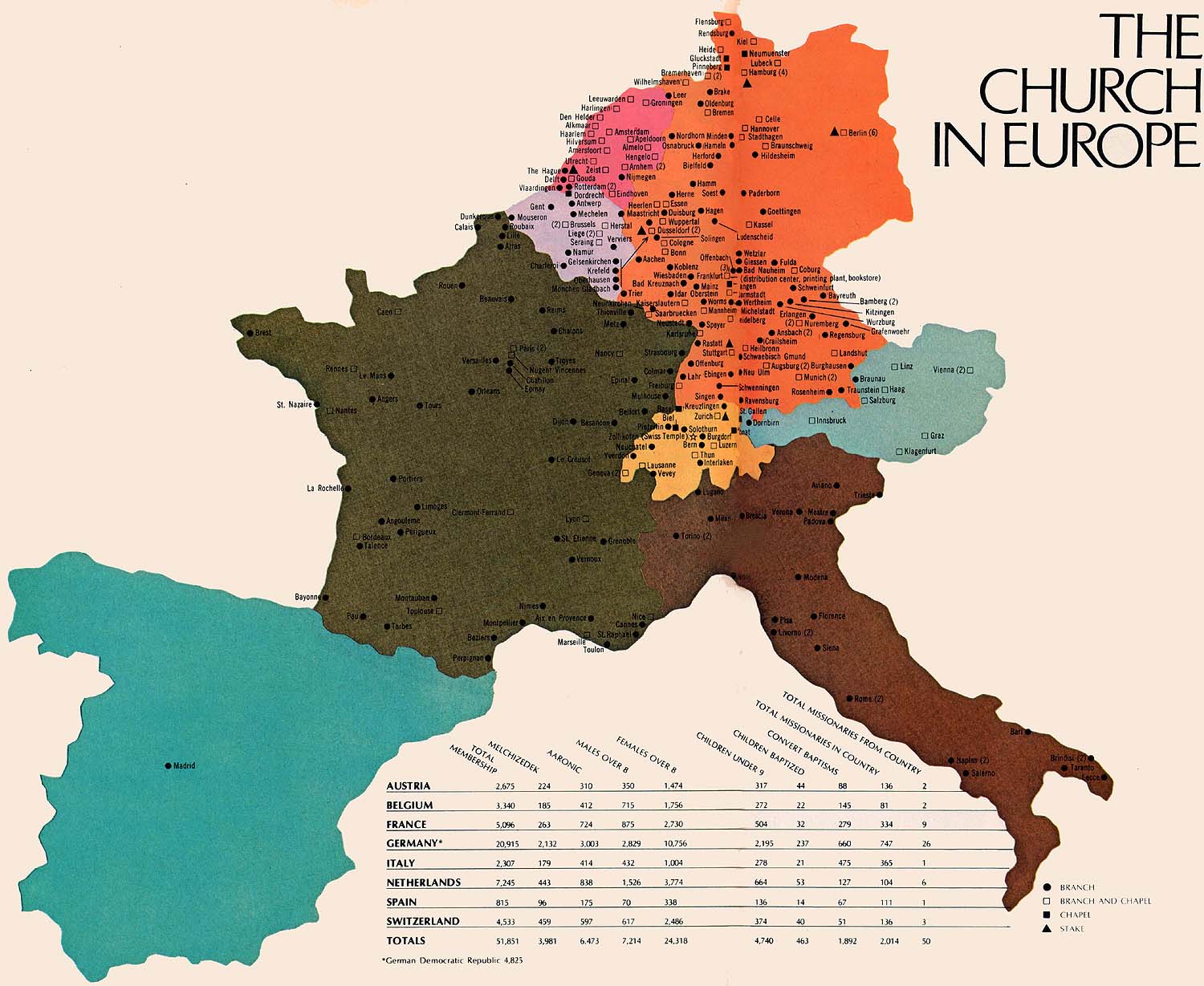
 In the latest episode of Mormon Stories Podcast, Marco Meiling, active and believing LDS church member in the Netherlands, reports on the beginning of a major contraction of the LDS Church in Europe. Mark Johnson from the U.K. also joins, along with listener questions and comments from around the world — all confirming a global trend towards decline and consolidation outside of Utah and the developing world.
From Marco’s original message to me:
Have you heard yet about a big push to consolidate the units in Europe?
We are having closing after closing being announced. Yesterday a closing was announced, and the Stake President stated there are 800 units in Europe which are considered too weak and would need to merge. We have 1163 units in Western Europe according to Cumorah.com.Holland with 34 wards will close 5 at least this year. In Holland the Church is phasing out all wards which don´t have a purpose-built Chapel.
Temple-attendance here is down 60% compared to 2000. However the amount of recommend holders went up 200%. So what do we make of this? A temple is a way for the Church to increase revenue. So even with less people, the Church can make a higher turnover.
The main reason given is that these units are too weak to run programmes aimed at the youth. and small units demand too much from the few members. Research has shown that people and families benefit form larger wards, and families are less burdened. That why the policy direction. Of course the longer travel will cause problems for some menbers. Assistance will be needed.
Episode Transcript
Host: John Dehlin · Guests: Marco Meiling, Mark Johnson
This transcript is machine-generated and lightly edited for readability. The audio is authoritative. Please excuse occasional errors in names and spelling.
Introduction and Breaking News Overview
John Dehlin [00:00:28] Hello, everyone, and welcome to another edition of Mormon Stories podcast. I'm your host, John Dehlin. It is March 15, 2017. It's about 2:00pm Mountain Time, and we are kind of, I think, breaking some news. We'll see if everybody else thinks it's interesting or worthwhile. But today we're going to be talking about some breaking news that I've heard about a contraction that seems to be beginning at the LDS Church in Europe. And so the source of the information is a friend who I've been Facebook friends with for quite some time. He's joining us live on the call now. And his name is Marco. I pronounce it Meiling. How do you pronounce it, Marco?
Marco Meiling [00:01:24] Mailing. But mailing is okay.
John Dehlin [00:01:27] It's okay with me and Marco. Let's just talk briefly. And also we've got Mark Johnson on the line right now. His microphone is muted. Hi, Mark Johnson.
Mark Johnson [00:01:37] Hello. I'm here.
John Dehlin [00:01:39] Okay. And Marco joining me.
Mark Johnson [00:01:41] See me and hear me.
John Dehlin [00:01:42] We can hear you. You're joining us from the uk, I'm guessing. Is that right?
Mark Johnson [00:01:47] I am. I am in the UK at the moment. Outside the cold swimming pool. Yeah.
John Dehlin [00:01:51] Excellent. All right, well, you can mute yourself except when you talk. And we'd love. We're really glad you're joining us. And we're inviting other European saints to join us as well. They just have to message me on Facebook and I'll add them. But, Marco, you caught my attention when you reached out to me to let me know of some information that you recently came across. And so I'm gonna go ahead and just read what you sent me, and then we're gonna talk about it and we're gonna ask others to join. We're also gonna talk about you a little bit about your background and what you've experienced and seen. Kind of eyes on the ground there. As a longtime member of the church in the Netherlands. How does that sound?
Marco Meiling [00:02:37] Excellent.
John Dehlin [00:02:38] All right, well, I'm really honored and excited to have you here on Mormon Stories. So thank you for joining us.
Marco Meiling [00:02:46] My pleasure.
John Dehlin [00:02:48] Okay, so as I pull up what you wrote, this is what you wrote. Also, I want to welcome everyone who's joining us right now on Facebook Live. One of the really cool benefits of Facebook Live, as far as I'm concerned that we can have people commenting as we go, asking questions, making comments, providing validation and feedback. We've got 83 people right now joining us on Facebook. So if any of you want to corroborate or disagree with or provide color to this podcast. We would just love to have that input. So I'm going to be watching those comments now, but I will go back, Marco, if it's okay, to the original message you sent me and share what I read, because I think it's really interesting and kind of important.
John Dehlin [00:03:40] So I will pull it up right now and read it to our listeners. So from Marco a couple days ago, I'm just pulling it up one more second. Okay. Here's what you wrote. You wrote. One more second. Okay. Dear Mr. Delin, have you heard yet about a big push to consolidate the units in Europe. We are having closing after closing being announced yesterday. A closing was announced and sp. I'm guessing that's stake president. Is that right, Marcus?
Peak Church Growth and Decline in the Netherlands
Marco Meiling [00:04:20] State President. Yeah.
John Dehlin [00:04:22] Stake president stated there are 800 units in Europe which are considered too weak and would need to merge. We have by in this, I think, Marco, by your count, you're saying we have 1163 units in Western Europe, according to Camorra.com so this, this represents possibly a third of the units in Europe merging with another third of the units to try and bolster and strengthen what's going on. So if you don't mind, Marco, take us back, tell us a little bit about your background as a member of the church in Netherlands and then tell us about what you heard and we'll go from there. Does that sound all right?
Marco Meiling [00:05:10] Okay, John, no problem.
John Dehlin [00:05:12] All right.
Marco Meiling [00:05:13] Well, I was baptized 20 years ago, almost to the day after being missionaries in the street. And, well, I met the missionaries, listen to their story, and 22 days later was baptized.
John Dehlin [00:05:28] Wow. What year was that?
Marco Meiling [00:05:30] 97.
John Dehlin [00:05:31] 97. Okay. And how old were you?
Marco Meiling [00:05:34] I was 19 years old at the time.
John Dehlin [00:05:36] All right, cool. So golden, you were a golden convert?
Marco Meiling [00:05:41] Yeah, absolutely. Absolutely. In a small branch in Denbosch in the southern part of the Netherlands. Well, I became a member of the church soon afterwards. Of course, I started attending dances and other things. Well, I met a young lady and well, in July 98, we got married, had two kids shortly afterwards. Now I'm still married 19 years, almost 90 years now. And well, among.
John Dehlin [00:06:17] Did you serve a mission? Did you serve a mission?
Marco Meiling [00:06:19] No, I didn't.
John Dehlin [00:06:20] And were you married in the temple?
Marco Meiling [00:06:22] Yes, I married in the temple.
John Dehlin [00:06:24] Okay, so Mary in the temple with two kids.
Marco Meiling [00:06:27] That's true. Yeah.
John Dehlin [00:06:28] Golden convert.
Marco Meiling [00:06:30] Yeah.
John Dehlin [00:06:31] Okay, any of you, sir, have you been active in the church for most of that time?
Marco Meiling [00:06:36] Yes, still. Am I.
John Dehlin [00:06:38] Okay, still, still active in the church. And what, what callings have you served in? Just to give us a Sense for your leadership background?
Marco Meiling [00:06:47] Well, as a counselor in the, in the branch presidency at 21, been award mission leader, Sunday school president, executive secretary, high councilor, then again counselor in the bishopric in my current board, I've done a ward clerk. Well, in small wards you do everything.
John Dehlin [00:07:11] Yeah, yeah. Okay, so multiple either bishoprics or branch presidencies and stake high council and an active committed member since 19 years old.
Marco Meiling [00:07:26] Yeah.
John Dehlin [00:07:26] Okay, so. So before you heard this news, what have you been observing? Like, imagine in your mind the peak of the church in Netherlands. At what age would you have said was kind of the peak of church growth and strength in the Netherlands? Around what year?
Marco Meiling [00:07:47] Well, the peak of growth, I didn't even live through it. I think it's, it's been 60s.
John Dehlin [00:07:53] Okay.
Marco Meiling [00:07:54] So it's what I hear from many people.
John Dehlin [00:07:57] So the church hasn't really been thriving and growing and thriving in the Netherlands since the 1960s.
Marco Meiling [00:08:04] That's true, that's true. I mean, we've gotten stakes since the 60s. We were the first non English speaking steak in the world, the Holland steak in 1961.
John Dehlin [00:08:15] Okay.
Marco Meiling [00:08:16] We've gained three extra stakes, one of them shared with Belgium, to be honest. So we've got three and a half stakes. We've gotten our own temple in 2002. So there is growth. But. Well, the church is still going and being run by those people who were baptized in the 60s and 70s and by their children.
John Dehlin [00:08:42] Okay, so something about the 60s with the Osmonds and, and whatever else, Kennedys, I don't know what, but caused this massive growth in the 60s that really hasn't been paralleled since.
Marco Meiling [00:08:57] Yeah, that's. Yeah, that's how I. Yeah. What I've heard and what I've seen. Yeah.
John Dehlin [00:09:02] Okay, cool. So. And do you have a theory about what made the church really explode in the 60s that hasn't been replicated since? Do you have any idea?
Marco Meiling [00:09:14] Well, in the 60s, a lot of people became members of the church. A lot of people also went to the United States. It doesn't happen anymore. People going to the States, that's something very sporadic. America was leading the world in the 60s with, yeah, everything, you name it. And America was leading the world. And since, well, the late 60s, 68 and the 70s, America's influence and status in the Netherlands has waned.
John Dehlin [00:09:51] Maybe that's the Vietnam War. Maybe that's, you know, who knows what. Right.
Marco Meiling [00:09:56] Yeah, I think Vietnam is a part of it. But when we look at, for instance, the last two decades with also American politics, people are turned off by a lot of things about America. And then I'm talking about, yeah, don't get me started about Donald Trump and how, I mean, missionaries talk to me about it and they say, well, we've heard about it and they've encountered people who tell them, like, you're stupid, you're Americans, you vote for Trump. Right. It's really happening.
John Dehlin [00:10:35] Yeah. Yeah. Okay. So that's a topic for a whole other podcast, but it's interesting.
Marco Meiling [00:10:40] Absolutely.
Stake Consolidation and Unit Closures Announced
John Dehlin [00:10:42] So for those joining us late, we're here talking with Marco Jerralee writes tuning in late. Catch us up on what the announcement is. And Jeralee, the announcement is that Marco heard from a stake president in the Netherlands that something like 800 units in the Netherlands, in Europe, Western Europe, have been identified as being kind of too weak to thrive on their own. And so what Marco's reporting is he's hearing reports of a massive consolidation effort taking place where hundreds of wards will be collapsed in other wards in Western Europe. So, okay, so we've talked, Marco, we've talked to you a bit about when you joined the church.
John Dehlin [00:11:26] You joined at 19. You were a golden convert, married in the temple. You've had two kids. You've served in most, you know, most high leadership positions at the ward and stake level other than bishop or stake presidency. Talk now about, you know, what you've observed in terms of the growth of the church in the Netherlands in the past, let's just say 10 years.
Marco Meiling [00:11:52] Well, we've seen consolidations already about, well, it's been about 50 years ago where a lot of small branches with 10 to 20 people active were consolidated into larger wards. And what we're seeing now is that those larger wards which were then created in the, say between 2000 and 2008, are now being slated to merge again or to be divided into two or three parts. And then the people have to go to several other wards again. So when you do the math, when you hear there's about 800 words and branches which are too small, well, that means that if you merge and you lose more could be 200 or 300, which you're going to lose. But how many stakes is that? 25, 40 stakes.
John Dehlin [00:12:52] Right. So, right, right now you're saying that in the Netherlands there's three stakes, Is that what you said?
Marco Meiling [00:12:58] Yeah, three stakes and one Belgium that's shared with.
John Dehlin [00:13:02] Okay.
Marco Meiling [00:13:03] Yeah.
John Dehlin [00:13:04] Okay. All right. And so what what is particular like, so what are you. So, so is that the main piece of news? Just that stake president tells you that 800 units are too weak or is there more background information you can give us to kind of substantiate why there might be a major contraction going. Going on?
Marco Meiling [00:13:29] Well, I've seen a major. Yeah, state branches and wards in the Netherlands being closed recently. Recently, yes.
John Dehlin [00:13:40] And like, which ones. Which one. Do you. Do you remember any names?
Marco Meiling [00:13:43] Yeah, of course. Nijmegen ward is being closed. It's a branch being worse with Ireland. Awesome. Branch has been closed. Well, there are strong rumors and people in the war tell me that Dordrecht ward is being closed. Rotterdam Ward has 40 members attending. It used to be almost 110 years ago. Then we have several other awards just in my stake, which are. Well, which are happy if they have 50 people attending.
John Dehlin [00:14:18] Okay, so in your. In the wards, in your stake, name each ward and talk about how many average members you think are attending.
Marco Meiling [00:14:26] Well, I've got my own ward spike initially that's about 70 people.
John Dehlin [00:14:31] 70 people attending.
Marco Meiling [00:14:32] A lot of young people, young families. So that's going okay. But then they've got to Rotterdam Second Ward. Well, if they've got 50. That's what I hear from family members who attend there. And they say, well, there's just 50 people. And they've lost 37 people last year and this year due to people moving out.
Marco Meiling [00:14:52] So there's now 50 people, 10 people gonna move in a few weeks time. I mean, that's bad. Todrich Fort is probably gonna merge with Rotterdam, the second world. Rotterdam First Ward is doing pretty fine. It's got about 70 people, but many of them elderly.
Marco Meiling [00:15:11] How the ward is pretty young, but yeah, not too many people. I've heard about 70. Utrecht is just 50 people. Next door they have a ward in Applesfort, in the Lowesteg, also a small ward. So both of them are barely getting by. And that's what people. That's what people tell me. So then I think, well, what are they going to do with all. With these wards?
Marco Meiling [00:15:44] I mean, if it's. If I get informed in public on Facebook, that are 800 units which are too small. And when I see that in Europe, in the Netherlands, where we have many wars, I mean, my stake is consisting only of wars and they are struggling.
Marco Meiling [00:16:04] What are they going to do with people in. With places where they only have branches left? I'm talking about the northwestern part of Germany, for instance, in the district there. I'm talking about parts of Belgium where they have branches with 15, 20 people.
Marco Meiling [00:16:23] What are they going to do with that? I mean, the ultimate irony, maybe in Friesland, which is a province in the north of the Netherlands. We used to have, 20 years ago, three branches. Now there's only one left.
Marco Meiling [00:16:42] That one is very small, very few people attending. I don't have figures, but I've heard there were having severe trouble getting a branch president at all. The irony is this. Friesland was the base of the church. The first people baptized were baptized by Annemika S. Van der Rauden, who was baptized himself in Liverpool. He was a skipper, went to Salt Lake, then back to Friesland, baptized his family, and started the work of the church in the Netherlands. It might not be too long until Friesland is free of Mormons. No more Mormon presence, no more missionaries, no more branch, nothing.
Listener Questions on Missions and Membership Trends
John Dehlin [00:17:29] Wow. We're getting a lot of good questions in from our listeners, so I'll ask you a couple of questions. Is that okay?
Marco Meiling [00:17:35] Of course.
John Dehlin [00:17:36] Patricia writes, what about missionaries and missions? Are there less missionaries or more missionary efforts? Now, from what you can see,
Marco Meiling [00:17:47] there is a drawdown of missionaries in the Netherlands Mission.
John Dehlin [00:17:50] Okay.
Marco Meiling [00:17:51] Rotterdam used to have eight missionaries. Now they're just down to two.
John Dehlin [00:17:56] Okay.
Marco Meiling [00:17:57] And then when I look at the. When I look pretty far in the past, we used to have a ward. Rotterdam is Long river, and there are four big cities in the neighborhood of Rotterdam itself. We had Rotterdam 2nd and the 1st Ward. And then you had Schedul Branch, you had Flahinge Branch and Maslage Branch. They were all merged. They all had missionaries. There's just now one set of missionaries. They're covering an area of 400 square kilometers. That's about 125 square miles with over a million people living there. One set of missionaries.
John Dehlin [00:18:40] Wow, that doesn't sound very good.
Marco Meiling [00:18:45] Then again, I'm living here in Spikenisse, in Spikenisse ward, and they've got a nice island to track out with 200,000 people about the size of Manhattan.
John Dehlin [00:18:58] Yeah. Okay, so from what you can tell, massive reduction in missionaries in Netherlands over the past 10 years?
Marco Meiling [00:19:08] Well, no, since the. Since the end of the search, actually. I mean, since the end of search, it's gone down. And yeah, missionary apartments are being closed.
John Dehlin [00:19:19] Okay. Okay. Mary writes, sounds like Scotland. So we have one person at least saying that Scotland's experiencing a similar trend as the Netherlands. Emily writes, could you give some of the major reasons why you think the members have stopped coming or reasons why they've left the church in your area? Do you have a sense for that, Marco? Do you have any friends? Do you have friends who have left the church? And if so, why?
Marco Meiling [00:19:50] Well, let's just say, just an example and I'm exposing myself maybe, but I don't. Some years ago, I came across your website, your podcasts, and I listened to them and I got angry about a lot of things. I mean, things that I've. Yeah. Which weren't told when I became a member.
John Dehlin [00:20:14] What types of things? If you're comfortable sharing.
Marco Meiling [00:20:17] Well, I knew about polygamy, but about one pet peeve of mine is church finances and selling of patriarchal blessings, for instance, which I had some trouble with.
John Dehlin [00:20:32] What do you mean, selling patriarchal blessings?
Marco Meiling [00:20:35] Well, that if you had to have a. If you wanted to have a patriarchal blessing, that the patriarchal paid for it, for instance.
John Dehlin [00:20:43] Oh, you learned about that in our history.
Marco Meiling [00:20:46] Yeah, in the. In our. In the history. Yeah.
John Dehlin [00:20:49] Okay.
Marco Meiling [00:20:49] For instance, and the.
John Dehlin [00:20:50] I've never heard that, by the way. I've never heard that.
Marco Meiling [00:20:52] Blackson. No, Blacks and bristowed.
John Dehlin [00:20:54] Yes.
Marco Meiling [00:20:55] Something for me. I mean, you wouldn't look at it. If you look at me now, you wouldn't say what I found out doing my genealogy. I could never have been a member of the church before 1978, for instance.
John Dehlin [00:21:08] Oh, do you have. You have.
Marco Meiling [00:21:11] I have Negro ancestry. Yes. I have African ancestry.
John Dehlin [00:21:14] Oh, wow.
Marco Meiling [00:21:14] Okay.
John Dehlin [00:21:16] Now, did you not know that growing up that the church kept.
Marco Meiling [00:21:20] No, of course. No, no, no, I didn't.
John Dehlin [00:21:22] You didn't know that until Mormon stories.
Marco Meiling [00:21:25] Well, I've read about it. That it was allowed all of a sudden, but I didn't know I had it. And when I find out that stuff, like, how is the church gonna. I mean, what's it gonna. I mean, it's strange. I mean, I've got ancestry going down in the 18th century. I mean, you don't see it, but all of a sudden was supposed to have been condemned. I mean, weird. It's something that dawned on me and so many other stuff. So much other stuff.
John Dehlin [00:21:57] So finding out that you had African ancestry made it more personal for you.
Marco Meiling [00:22:02] Made it more personal, obviously. Okay. And. Well, many things happened, of course, in the church. I've had a lot of experiences where I felt really uncomfortable with. So. Well, in the end, yeah, I had. Just like you and so many others, I had a faith crisis. And. Well, what happened is one thing. For instance, I shared a posting on tithing by Ellen Rock Waterman. You know?
John Dehlin [00:22:32] Yeah, Rock Waterman, sure.
Marco Meiling [00:22:33] Rockwater, yeah, of course. So I share this and lo and behold, people start commenting, people start attacking you. Attacking me on posting it a few weeks later to drop out of the church, I had something like, what happened here? And they read Waterman, and they started reading other books. And I know at least five families who dropped out of church because of things that I posted on Facebook.
John Dehlin [00:23:01] Wow. So you're. You're like. You're the John de Lit. You're the John de Lin of the nose.
Marco Meiling [00:23:06] Oh, no, no, no, no, no, no, no, no, no, no, no, no, no, no, no, no, no. Absolutely not. I mean, I'm just posting something I read from Watermelon, I think. What do you think of this? This makes me upset. People start. People read it and they start digging themselves.
John Dehlin [00:23:22] But your intent is your. You're active. So it can't be that your intent is to cause people to leave the church?
Marco Meiling [00:23:29] Oh, no, absolutely not. I mean, I talked about it to my stake president a year ago, and he said, well, it's their decision to leave. It's your decision to stay. I mean, you give them something to think about, something to chew on. I don't think he's glad with it. He's happy with it. But, yeah, he can't blame me.
John Dehlin [00:23:52] For people leaving?
Marco Meiling [00:23:54] Yeah, for people leaving.
John Dehlin [00:23:55] Do you feel responsible that when you share information, it causes others to leave?
Marco Meiling [00:24:04] In a sense? In a sense, yes. I mean, three weeks ago, a young brother came to me and he said, well, can you help me understand why my brother left the church? And I told him, do you really want to know this?
John Dehlin [00:24:20] Why who left the church? Why? Who left?
Marco Meiling [00:24:21] Why? Why his brother left the church?
John Dehlin [00:24:23] He didn't just talk to his brother. He was asking you.
Marco Meiling [00:24:26] He was asking me.
John Dehlin [00:24:27] Okay.
Marco Meiling [00:24:29] So I talked to his brother on Facebook. I said, well, do you. Did you know that your little brother asked me what it is, why you left the church?
John Dehlin [00:24:36] Oh, my goodness. That's weird. That's weird, is it? Well, I shouldn't say weird. That's rude. Let me ask you this. Is the culture in Europe such, or at least in the Netherlands, where maybe people are less comfortable having direct conversations if there might be conflict?
Marco Meiling [00:24:54] On the contrary.
John Dehlin [00:24:56] Okay. You're more direct.
Marco Meiling [00:24:58] Dutch directness is well known. Dutch people don't beat around the bush, they don't mince words, and they say things as they are. But talking about faith problems, of course, in church is still a taboo.
John Dehlin [00:25:14] Got it.
Marco Meiling [00:25:15] So, yeah. Well, in the end, this young guy talked to his brother. They had a nice dinner, and they talked about all kinds of stuff. But, yeah, I'm telling people there's a rabbit hole if they ask. But the point is this. We had a training last week, and the former state president also said, well, telling the foreign ished history of the church doesn't cut it anymore. With the new generation, we have to be honest. And if we're not honest, the young generation will find out and it will come back to haunt the church. So now we are in a transitional period. If we as a church keep holding onto the old stories, which are still in the correlated manuals, people will feel betrayed. The facts don't matter. The facts that people feel betrayed. That's the problem.
John Dehlin [00:26:22] Right.
Marco Meiling [00:26:23] And that was my problem too. Well, it took my wife to let to show me that not everything is black and white, that everything is a shade of gray. And she said, well, let it, let it be. There are good things in church, there are bad things in church, and there are bad things in any church. And she's quite right. And I think, well, why should I believe and live everything? I mean, I've got my own choices to make. I don't know if you've ever heard there's a saying, Catholics that believe the Pope is infallible, but no Catholic believes it. The Mormon prophet says he is not infallible, but no Mormon believes it.
John Dehlin [00:27:28] Yeah, I've heard that.
Marco Meiling [00:27:29] That's it. Yeah, that's what I live by nowadays. I mean, I try and find the truth for myself about everything and weigh it myself. That's what keeps me sane.
John Dehlin [00:27:44] Got it. Okay.
Marco Meiling [00:27:46] Sorry for the monologue.
John Dehlin [00:27:47] No, that's great. That's great. We've got lots of comments coming in. Let me just try and review a couple of them.
Marco Meiling [00:27:52] Yeah, of course.
John Dehlin [00:27:56] So Ryan writes also saw an increase in missionaries in the Manchester area. I'm assuming he means Manchester uk, But they have not been meeting with very much success at all. Lots are getting sent home with mental health struggles. That's coming from Ryan. Talking about Manchester, Mary writes Joseph's father used to charge for patriarchal blessings. So that's what she's referring to. When you, Marco, were talking about some of the things that caused you to struggle in your strike in your faith.
John Dehlin [00:28:34] Let's see, Ryan writes in our previous stake center in the uk, Chester, uk, our own ward was flourishing, but they recently sent some of the most experienced leaders in the stake to one ward and one branch as a final effort before closing. Closing them. So Ryan is reporting some people, some branches closing where he lives in Chester, the uk.
John Dehlin [00:29:02] Oh, Peter, Peter Erkamp joins us and says he's the brother. So Peter. So Peter, is he the brother who lost his faith or is he the brother who, who was asking why his brother lost his faith?
Marco Meiling [00:29:20] Now Peter is the brother who read the piece on tithing by Rock Waterman, which I put on my.
John Dehlin [00:29:26] Got it. Okay. So Peter is the questioning brother.
Marco Meiling [00:29:30] He's the questioning brother, yeah. All right.
John Dehlin [00:29:32] All right.
Marco Meiling [00:29:32] Great. Great guy.
John Dehlin [00:29:34] Okay.
Mark Johnson [00:29:34] Well.
John Dehlin [00:29:34] Hi, Peter. We're glad you've joined us on Facebook. All right, let's see. Denique. I don't know how to pronounce that. D, I, N, E. K, E. How do you pronounce that in the Netherlands? Marco.
Marco Meiling [00:29:52] Danique.
John Dehlin [00:29:53] Danique. She writes. I live in Apeldoorn. How do you pronounce that? Appeldoorn.
Marco Meiling [00:29:58] Appledoorn. Yeah, that's good.
John Dehlin [00:29:59] Appeldoorn. In the Netherlands. My family. 14 people left because of history not being true. So that's. What. Do you know her? Do you know Dineke Jungiajan?
Marco Meiling [00:30:12] Yeah, Jungian. Yes, I know. At least from name. I think I've been. There used to be a Mormon, a Dutch Mormon discussion group on Facebook about eight years ago. I believe she was on it as well. But the Alpeldorn stake was very badly hit indeed, back in those days, about five, six years ago, with people leaving in droves. I mean, the Apeldoren ward used to have, I believe, about 100 people. There were two other branches surrounding it. They've all merged into one. And one of the missionaries they had over here a few months ago said they are struggling to maintain 60 people. They've got one big ward, two branches. They're all merged into one now. They've got 60 people left.
John Dehlin [00:31:04] Now, why was the Facebook group closed down or what happened to the Facebook group?
Marco Meiling [00:31:10] Well, I left. I don't know if it still exists, to be honest.
John Dehlin [00:31:14] Okay, you left the group.
Marco Meiling [00:31:15] Okay, I left the group, yeah. Okay. Trying to get or maintain a relationship with the church. But in the end, of course, it didn't really work. I mean, still openly critical. I wasn't gonna be talking to you.
John Dehlin [00:31:32] So you. You, you. There was a point where you were part of a Facebook group that you wanted to kind of redouble your efforts to stay faithful in the church. So you left.
Marco Meiling [00:31:42] Yeah, that did work out.
John Dehlin [00:31:43] But you remain concerned, I guess.
Marco Meiling [00:31:47] Of course I'm concerned. I mean, it's the Church of the people. It's the Church of the Lord. And. Well, I spoke with an elderly couple recently who said, well, looks like the church is abandoning us.
John Dehlin [00:32:07] Abandoning you how?
Marco Meiling [00:32:09] Yeah, because the ward close to where they live is closing down.
John Dehlin [00:32:13] So, yeah, talk about that. What does it do. What does it do in a city in the Netherlands when the church closes down a branch or ward and asks them to merge with somebody else.
Marco Meiling [00:32:24] Yeah, yeah. If you've got a car, it's not a problem, obviously. Well, if you have a what?
John Dehlin [00:32:30] Say that again.
Marco Meiling [00:32:31] If you have a car. A vehicle.
John Dehlin [00:32:33] Oh, if you have an automobile. Car. Okay. Yeah, yeah.
Marco Meiling [00:32:36] If you've got an automobile, it's not a problem. Except of course, gasoline is about $9 a gallon over here.
John Dehlin [00:32:45] Wow.
Marco Meiling [00:32:47] So, I mean, I live 10 miles from the church, so for me, going to church is five bucks. But people in here in vein have to go to leoard, which is, well, 20 miles one way. If your car runs 1, 1 in 10, which is really good. It's getting expensive.
John Dehlin [00:33:10] Right.
Marco Meiling [00:33:11] And it gets expensive mighty fast. If you have to go even further, businesses. And it's. It's happening.
John Dehlin [00:33:18] Yeah.
Marco Meiling [00:33:19] And so being a member of the church, as Walter Von Beek, who wrote several articles in dialogue, he's a former stake president here as well, he wrote, being a member of the church in Europe is far more costly in the social and an economic sense than it is in the United States and especially in Utah. And that's something that the church leaders failed to fail to see, failed to notice. I mean, there are people, particularly some elderly people, who have sacrificed everything for the church, have held colleagues for 40, 50 or more years. And what's happening now is their word closes and they have to take a two and a half or three hour bus and train ride to get to the church on Sunday morning, three hours back.
John Dehlin [00:34:13] Right.
Marco Meiling [00:34:14] That's. That's what I call abandoning. Abandoning those people who have helped build your church.
John Dehlin [00:34:22] Yeah, yeah. It's gotta be tough. And I have a buddy in Brooklyn who's been attending his ward in a certain Brooklyn chapel for years and years and years. And they closed his ward down in Brooklyn and merged with a totally different building that's 20 or 30 minutes away. And he's already, you know, trying to make Sundays work. And it just having to. Having to go a long distance to be able to attend just makes it that much harder. Right. And it also, it ruptures relationships because the ward has a culture, the ward has this sense of pride and cohesion. And to dissolve a ward and
John Dehlin [00:35:04] merge it and then to have to disrupt a lot of the relationships, let's say, let's just say they, they merge the ward into five other wards, Then all of a sudden the people that you really enjoyed seeing a church, you don't see as many of them. And that can also take away some of the motivation. Is that true?
Marco Meiling [00:35:24] I think so, absolutely. I mean, when I said to my kids, we might be moving, and they said, can I please go back to the old ward? So that's how it works with kids. So we haven't moved. But that's one of the first concerns they had.
John Dehlin [00:35:43] Right.
Marco Meiling [00:35:43] And, well, what's happening too. I mean, that's one of the things that I wanted to. Maybe it's outside of the scope of this podcast. I mean, we've got a temple in the Netherlands.
John Dehlin [00:35:57] Yeah. Talk about that.
Marco Meiling [00:35:58] Well, yeah, we've got a temple in the Netherlands, was built in 2002. And, well, a good friend of mine gave me some numbers. He used to be the state presidency quite some time ago. And he said, well, tithing's up. The amount of people with a recommend has more than doubled. The amount of ordinances being performed has dropped by more than half. So per person, you're having one quarter, the ordinance is being done.
John Dehlin [00:36:32] So you said double. Double the number of temple recommended holders. Yes, but half the number of names being performed.
Marco Meiling [00:36:41] That's true.
John Dehlin [00:36:42] Huh.
Marco Meiling [00:36:44] And why is that? Why is that? It's quite simple. Again, in the past, people used to go to Frankfurt or London. They took out holiday, so they went to the temple for a full week. Of course, those temples have hotels next to them owned by the church, so it costs very little. People went to those temples and it was really being out of this world with members of your stake for a full week. So there was a lot of bonding there. Other spiritual experiences being had, people just being together, doing 20 or 30 ordinances in a week's time.
Marco Meiling [00:37:28] So you take off five days from your job, you can do 30 ordinances. Nowadays, people do the math. They say, well, I can take four days off. In those four days, I can do, well, 12 ordinances on the busiest day in the temple.
Marco Meiling [00:37:46] So the math is wrong in just. That's. That's my. My opinion. And people think, well, if going to the temple is just like doing the grocery shopping, they'll go to the temple, perform one or two, do one or two ordinances, and then go home again. And it's still. Even after 15 years, people still pine for those temple holidays, those temple trips.
John Dehlin [00:38:14] Wow. So you're saying that by making it easier to attend the temple, they're actually disincentivizing people to actually do the work because it's easier. And so it's taken for granted and they do less.
Marco Meiling [00:38:31] True, true. Because, yeah, it was a real pilgrimage. Going all the way to Frankfurt.
John Dehlin [00:38:36] Yeah.
Marco Meiling [00:38:37] I've got fond experiences of it, and many of the people who are older, who went to Frankfurt have very fond experience, very fond memories and people.
John Dehlin [00:38:48] Yeah, the theory is the higher the religion, the more the religion demands, the more people are willing to give and the less the religion demands, the less they're willing to give.
Marco Meiling [00:39:00] Yeah, I mean, it's a half an hour drive to this temple here.
John Dehlin [00:39:04] Interesting.
Marco Meiling [00:39:05] In bad traffic. It's two hours, by the way. But yeah, people are willing to go all the way to Frankfurt.
John Dehlin [00:39:13] That's weird. Yeah. I mean, I think about roadshows and temple trips and just the way that the church used to just be our social life. And lately, the past 10 or 20 years, I just continually hear the brethren saying, simplify, simplify, simplify. We don't want to put too much demand on the members. But by doing that, they're weakening people's commitment to the church.
Marco Meiling [00:39:37] It sounds like that's. That's happening. And that's one of. Also one of the reasons which was specifically named as why they should consolidate because it places less demand on members. You can spread the work amongst more people.
John Dehlin [00:39:57] So this, you're saying this might backfire. It's going to make it. It's gonna shut off a bunch of people and then. And then decrease the demand for others. Is that what you're saying or not?
Marco Meiling [00:40:09] Yeah, yeah. You're. You're casting away some people. You will lose people because they can't bring, they can't bring themselves to go that far to the church because it's too expensive, because it's too far away. It's impractical to go by public transport. And those people that do go, many of them don't, aren't really needed, if you get what I'm trying to say.
John Dehlin [00:40:35] Right.
Marco Meiling [00:40:35] So, yeah, so the commitment becomes less. I mean, the, the only people, the only group that wins will be the youth and maybe even they don't because they get ripped apart from their friends.
John Dehlin [00:40:52] Right.
Contraction Across Europe: UK, Germany, and Beyond
Marco Meiling [00:40:53] And one of the things I, one of the people who called in, or how we're going to call it, talked about Manchester and about the missionaries there having trouble, etc. I'm hearing this and hearing the same things from my missionaries over here.
John Dehlin [00:41:09] What are you hearing from the missionaries?
Marco Meiling [00:41:12] They're telling me that they're having a lot of younger missionaries going home early with trouble. And, well, for several more missionaries also say, well, it's nice that we have young missionaries, but they. Yeah, they need some growing. They still need some growing up to do. And it's. Yeah, sometimes it's hurting the work.
John Dehlin [00:41:38] Got it. I'M having microphone problems, so forgive me for just one second. Keep talking. No problem.
Marco Meiling [00:41:46] There are so many.
John Dehlin [00:41:47] Is this David?
Mark Johnson [00:41:50] No, it's Mark.
John Dehlin [00:41:51] Mark, please do you tell us where you're from, Mark?
Mark Johnson [00:41:55] I'm actually from Manchester in the uk.
John Dehlin [00:41:58] All right.
Mark Johnson [00:41:58] So just. We have had a ward close in the Manchester area. It was actually a branch. It was in the Ashton State, and that was relatively recently. It was. It's been running for a number of years. And they moved it into another ward. So that. That has happened, that consolidation has happened. And I'm also aware of one other branch ward that was closed. No, two other. Actually. There was one in Sheffield, which is over the hills from Manchester, that was recently, and also in Leicester. So that consolidation is happening slowly. Not in a. Not in a dramatic way, but every few months there'll be a unit closed.
John Dehlin [00:42:37] Okay. So, Mark, you're seeing. You're seeing consolidation in Manchester, uk?
Mark Johnson [00:42:43] Yes, yes. And not much growth either. There's a lot of missionaries, but not seeing many converts.
John Dehlin [00:42:51] Okay. And Marco, we've met you. We hung out the last time I was in the uk.
Marco Meiling [00:42:55] Yeah, that's right. Yeah.
John Dehlin [00:42:56] Yeah, I totally recognize. It's good to see you, Mark.
Mark Johnson [00:42:59] Yeah.
John Dehlin [00:43:00] Now, David, you've joined us. David, are you planning on talking? Unmute yourself real quick, David. I'm not hearing you, David, So you may need to get your microphone. Okay. If you could get your microphone working, let us know. But we're glad you joined us. You can tell in the bottom left there's a little microphone button that will show your levels. It'll let you know if Zoom can hear you. And, Mark, please feel free to jump in at any point. I should say we have over 200 people joining us now on Facebook, so it's a really good. Really good group. Let me read some of the comments really quick because we've gotten a lot of really good comments in. Deborah writes, let's see, a ward in Weston. A few months ago, there were three wards in Somerset. So I don't know where Somerset is, but she said down here.
Mark Johnson [00:43:55] Southwest. Yeah.
John Dehlin [00:43:56] So southwest uk, Somerset, they've just closed.
Mark Johnson [00:44:02] They actually closed a mission there a few years ago. So the mission that I served in, Bristol Mission, which covers the southwest, that was closed probably in the early 2000s, and then they also closed the Island Mission. So Ireland used to have its own mission up until a few years ago, and that was consolidated with the Scotland Mission. So if you want to. So. So that's the mission level. We've had consolidation to.
John Dehlin [00:44:28] So the missions also Contracting in the uk.
Mark Johnson [00:44:30] Yeah. Yeah.
John Dehlin [00:44:31] Okay.
Marco Meiling [00:44:32] Germany used to have four missions, I believe.
John Dehlin [00:44:35] Who did?
Marco Meiling [00:44:36] I believe? Germany used to have four missions. Now it's two.
John Dehlin [00:44:40] Oh, so Germany's gone from four to two.
Marco Meiling [00:44:42] Yeah. Netherlands used to have a mission and Belgium used to have a mission that's been consolidated. But it's over a decade ago.
John Dehlin [00:44:50] Right.
Marco Meiling [00:44:50] We are consolidating and we see it everywhere. I mean, we've got the abyons stakers losing ward after ward. They closed down two wards this year or branches this year. A third branch is probably going to get closed. Our stake has gone from 12 to seven. They're probably going to six.
John Dehlin [00:45:10] Six wards.
Marco Meiling [00:45:12] Six wards. We had one, two, three. We had three wards, nine branches. Now we've had seven wards. They're probably going down to six. I mean, people are talking about it, so it's probably gonna be true.
John Dehlin [00:45:28] Got it.
Marco Meiling [00:45:29] Too bad.
John Dehlin [00:45:29] Yeah, yeah, yeah. Okay. Let me keep reading some of the other comments. Let's see. Ryan writes, Chester steak in the UK is over 90 miles end to end. Makes steak activities very difficult. Yeah, that's a big steak, right?
Mark Johnson [00:45:47] Yeah. That covers the whole of North Wales. So it's quite a big distance and there's quite a few branches there as well. As well as the UK it covers.
John Dehlin [00:45:54] Elsa writes a good question. She writes, how does this consolidation affect things like home and visiting teaching and weekly activities like mutual. That's a good question.
Marco Meiling [00:46:05] That's a good one.
John Dehlin [00:46:06] Well, what would you guys say to that?
Mark Johnson [00:46:09] So home and visiting teaching is the same as it always used to be. Everyone's always chasing for the numbers. Recently in my ward they've asked people to expand their lists and do less visits, but to more people. So they try to reach out to more people, but I'm not sure if that's a ward initiative or a stake initiative, but youth and activities. I'm also seeing more and more youth activities happening at the state level. So instead of like one week of the month, they'll have everyone go to the state or rather than have them individually in the wards. So I think we're just doing that to bring them all together, give the
John Dehlin [00:46:47] youth a critical mass of people to be at the activity.
Mark Johnson [00:46:51] Yeah. Just on the other side, there is growth in some areas. So in the uk, where the Preston Temple, they've gone from one ward to four wards though I suspect that's move ins rather than converts. But there is some hot spots in the uk, but there's probably one that's. Yeah, not many of them.
John Dehlin [00:47:10] Yeah, there's all that's always going to be true is they'll be like Utah, I'm sure, is still growing because a lot of people leave California, leave other parts of the United States and retire in Utah. And so you're going to see growth in Utah and in probably some areas in Europe as well.
Marco Meiling [00:47:28] Exactly the same. We see it in the near temple at Sutamir. Used to be a small branch. They had a big building and now they've got a much, much bigger building, an American style stake center. And the branch is growing. People are all moving in there the same. In Friedrichsdorf, which is the actual location of the Frankfurt temple, they're building a massive steak center over there. Now a lot of people in Germany are going to live in Friedrichsdorf, which incidentally is something like, well, Malibu in, in America.
John Dehlin [00:48:03] Kind of wealthy.
Marco Meiling [00:48:04] Wealthy areas. Very wealthy. Yeah, absolutely wealthy.
John Dehlin [00:48:06] Okay, well, that's interesting. A couple more things we're reading. Ryan writes that there's been interest in Community of Christ amongst disaffected Mormons in the uk. So Community of Christ congregations in London, Manchester and Chester have all had interest from former Mormons. So that's, that's what Ryan is reporting. Candice is from San Bernardino, California and she's saying that they're merging wards in San Bernardino, California. So that's interesting. So let's see. Patricia writes, merging branches and wards will make it harder for people to get to church and other meetings. Yes, we've talked about that. Okay, so really quickly, let me ask
Why Members Are Leaving and Morale in the Church
Mark Johnson [00:49:03] you,
John Dehlin [00:49:06] let me ask you, Mark, who's also joined us, Mark, are you still with us? I think Mark just may have dropped off. Okay. I was gonna, and I was gonna ask Mark and Mark, you can talk about this. So you said that sort of church history was a significant contributor to many people's disaffection. Not being honest with history, are there other contributing factors? So for example, feminism, the church's reluctance to allow women to hold the priesthood, Is that a possible contributing factor? And then also the church's refusal to support same sex marriage, LGBT rights. Do you think those types of things impact members in Europe?
Marco Meiling [00:50:00] Well, John, talking about gay marriage, Holland was famously the first country to allow gay marriage.
John Dehlin [00:50:07] Right.
Marco Meiling [00:50:07] And we had general authorities visit us and instruct the stake presidents to take a stand against it. And you know what the state presidents did? What they do, they said yes. And then they shrugged their shoulders after
John Dehlin [00:50:21] he walked out and didn't do it.
Marco Meiling [00:50:23] They didn't do anything because it's. We are just with 7,000 people.
John Dehlin [00:50:27] Yeah.
Marco Meiling [00:50:28] Talking active people, 3,000 maybe. So it's, it's a run race. And. But for many people, for instance, in November, November 2015, problem was a trigger. People felt offended, people felt betrayed.
John Dehlin [00:50:50] Yeah.
Marco Meiling [00:50:51] Not saying it's. It's just one of the many factors. I mean, I know of. I know of one man. No, I know more. I know two people who are transgender and, well, where leaders have been, well, less than stellar in their handling of the situation, where family members of those persons, well, have felt deeply offended, have felt hurt by church leaders and who are, well, some of them have stayed active and some of them have left the church because of this. And I think, well, if our leaders are more considerate of people, they can safe, they can save people for the church. And they just stick to the manuals, the handbook of instructions. And they say, well, there's no place for you in church. And yeah, they kick them out. Yeah, well, I think. Well, I think it should be indifferent. Just my opinion.
John Dehlin [00:51:57] Yeah. Deborah writes, and I think, and she's in the uk, I think of the factors for leaving is same sex couples not able to have children, baptized. She says, I'm certainly aware of a number of members who have left because of this, some who were very aware of the history, but this became the last straw for them. So Deborah is echoing what you said, which is that the November 2015 policy has wreaked havoc on active membership in Europe.
Marco Meiling [00:52:33] Yeah, I think so. And there are many more things. I mean, when I say about that post I made once about Ellen Rock Waterman on tithing, I think that's cost the church a lot of credit. The mall cost the church a lot of credit.
John Dehlin [00:52:53] Yeah, literally.
Marco Meiling [00:52:54] But also figuratively.
John Dehlin [00:52:55] The mall.
Marco Meiling [00:52:56] The mall. The mall. For instance, I meet people, people wondering out loud, like, why is the church doing this? I mean, a lot of people just don't care. But when you have so few people, every person counts.
John Dehlin [00:53:09] Yeah, right.
Marco Meiling [00:53:10] Literally.
John Dehlin [00:53:11] Yeah, that makes sense. Stephen Blore, who's been on Mormon Stories before, he writes, when I was bishop, my stake president held a special meeting nine years ago to inform the bishops and Relief Society presidents that there was about to be a massive falling away from the church in the near future. He told us not to be shocked, but that many very elect members would leave soon.
John Dehlin [00:53:34] So I guess he's saying that his leaders were prophets nine or ten years ago, that they've been anticipating this for a long time. Aubrey writes, I live in Orem, which is in Utah. She says her mom's stake has gone from 10 to 7 wards, but the wards have gotten bigger, so about 450 people per ward.
John Dehlin [00:53:56] So Aubrey's saying that she's seeing consolidation in Orem. And then Emily from France. We're super glad someone from France is joining us. So, hey, Emily. She writes, I live in France, left church a year ago. Our big ward was split about a year ago because it was getting too big. Okay. So that's the opposite. People move to our area a lot because of jobs. However, she says the chapel, which was built only nine years ago, was too small from the beginning. We now have two tired wards instead of one strong one. So I think Emily's arguing for consolidation, saying that consolidation can help. What do you guys think about that?
Marco Meiling [00:54:37] I think it could help, John, but it depends on the demographics. The wards say in the west of the Netherlands, where there is still population growth, where people are moving because of jobs. I can see that these wards continue to grow. My own word is an example, socio economic. It's not too strong of a ward, but cheap housing is now pulling in a lot of youngsters who just got married. Public transport is pretty good, so they can go to school quite easily. So we've had quite an influx of young married couples, returned missionaries, because it's easy to get a house in our neighborhood. That's just one example. But it means that other wards are losing people.
John Dehlin [00:55:37] Right? Right.
Marco Meiling [00:55:38] And that's what we see in the. For instance, with Almiramor, they're really big, but other wards are suffering because of it.
John Dehlin [00:55:48] Got it. Aaron asks, would you say local members who aren't going through a faith crisis are noticing these contractions? Are members noticing that things are contracting?
Marco Meiling [00:56:04] I think they do. A lot of people just don't care. They don't really look outside of the ward, the war zone borders, I mean, or outside of their stake. But when they talk, when they've got expanded extended families and they do talk, meet each other, then they can see it. I mean, it's quite easy to see. But then again, you've got to have a network.
John Dehlin [00:56:27] Yeah.
Marco Meiling [00:56:28] I mean, some people in my ward just don't know about a lot of these things because they've just. They have their own thing, their own war, their own stake. That's what they care about. It's logical. I mean, in America, in Utah, you've got a small ward. Of course you can walk. You can do your home teaching and walking, you know.
John Dehlin [00:56:52] Yeah, right. You would notice if something changes.
Marco Meiling [00:56:54] Of course you would notice it if something changes. Yeah. Over here, my. My ward is well, yeah, it's 60 miles end to end.
John Dehlin [00:57:04] Yeah. Right. Becky writes that Italy's gone from four missions to two. So she's saying that Italy's contracting. Let me. Let me ask you this, Marco. How are leaders talking about this? Are they. Do they ever get up in, you know, word conference or state conference and say, we're in trouble, folks. Our stake is really in trouble. And what in the heck was someone doing posting to Facebook about this stuff? So what about those things?
Marco Meiling [00:57:36] Well, in this case, I mean, stake presidents don't really talk about it. In this case, what happened is that a stake president, of course, had to announce that a branch was closing down, and some members put it up on their Facebook wall for all to read. So, yeah, that's how you find out. Is it smart?
Mark Johnson [00:57:59] No.
Marco Meiling [00:58:00] Then again, you could ask, is it smarter than. I'm talking here.
John Dehlin [00:58:04] Are you worried. Are you worried about being punished for talking openly?
Marco Meiling [00:58:10] We'll see what happens, sir John. We'll see what happens. I mean, sunshine is the best disinfectant, they say.
John Dehlin [00:58:16] So you're talking because you. You want to try and help?
Marco Meiling [00:58:21] Well, isn't that what you tried to do, John?
John Dehlin [00:58:24] I think so, yeah.
Mark Johnson [00:58:26] Yeah.
Marco Meiling [00:58:26] So, I mean, it's. It's a church. I care about the church. Otherwise I just walk away. I didn't walk away. In spite of everything I know. I mean, a lot of people are walking away because of what they know, and it's the same as I know. But I care about the church. I want to help, and I think that being practical minded is a virtue.
John Dehlin [00:58:51] So my message to the leaders in the Netherlands. Don't shoot the messenger.
Marco Meiling [00:58:56] Don't shoot the messenger. But above all, think about it, what you're gonna do to those people who you are abandoning. Yeah, I mean, you could say. You could say, well, people have to make more sacrifices, but sometimes people can't sacrifice any more than they already have.
Mark Johnson [00:59:14] I am.
Marco Meiling [00:59:16] I had. I had a very close friend of mine who in tears said, if I had not moved to the church, I would have been one on the roles of being less active people because I am old and I am unable to get on a bus. I can just barely walk to. Just barely walk to the church.
John Dehlin [00:59:38] Yeah.
Marco Meiling [00:59:40] I mean, that's a person who lives quite near the church in another state. And I think that's. That's so sad. That's so sad. I mean, when you sacrificed so much, when you. When you've driven in your colleagues all across the country to do all kinds of tasks, and then on Then the church says, well, it's not worth it of keeping this ward open. We'll sell out. We'll sell off the building for cash.
John Dehlin [01:00:12] Pocket the cash.
Marco Meiling [01:00:14] Pocket the cash and let the members go.
John Dehlin [01:00:16] Okay?
Marco Meiling [01:00:18] Let them fend for themselves.
John Dehlin [01:00:20] So you feel like when the church consolidates and shuts down units, they're kind of betraying and abandoning those who. Who got the church strong.
Marco Meiling [01:00:33] Yeah, that's my feeling. That's my strong feeling. And they have to make a really good case for closing down the ward. I had to close down the ward myself as a High Councilor, and it wasn't nice. It wasn't pretty.
Marco Meiling [01:00:53] Stake president 10 years ago asked me go visit this ward. Report to me. So I brought out reports, and stake president then in a High Council meeting, said, should we close the ward? And it wasn't my call to make. And someone else said, yeah, you've heard what Brother Myling said. Close it down.
Marco Meiling [01:01:18] And then, of course, state, person, coalition. And the next Sunday, he called me and he said, you were going to visit next Sunday. And I had to take the grant because I had a bishop who was totally. Yeah, he was angry. He was really angry. He was livid, and rightfully so, because the ward was doing great, but the stake president's own ward was suffering and it was merged into the state president's ward.
John Dehlin [01:01:49] Sure.
Marco Meiling [01:01:50] I've been there. I've been there. I don't want to do. I don't want this to happen, and it's not my call, but,
John Dehlin [01:02:00] yeah, yeah, you just. You don't want them abandoning those who help make the strong.
Marco Meiling [01:02:06] Yeah. I've always seen people fall away. And then when you hear a high. Counselor, we talked about this a few weeks ago. When you hear a High Councilor say, well, then those people don't have a testimony, then I want to. Yeah, good.
John Dehlin [01:02:20] Yeah.
Marco Meiling [01:02:21] I want to kick him in the face.
John Dehlin [01:02:24] Evan asks, how's general morale? Is it fair to say morale is low?
Marco Meiling [01:02:31] Morale. Low. Many people are indifferent.
John Dehlin [01:02:35] Indifferent. Okay.
Marco Meiling [01:02:37] There's a new program. And they shrug their shoulders. Okay, we have. Well, just give you a taste. Our stake president is originally from the Canterbury State. That's where he lived. A Dutchman, working and living in England. He moved back here and his old state president said, well, I called him, apparently, and do you want to participate in an action for the refugee camps in northern France? So he asked people to help out and to donate food, donate clothes, make quilts, and all kinds of stuff. And most people shrug their shoulders. Nice for the state person that he Wants to do it, but most people say, well, no. Or if they want quilts. Well, those I've heard it say. I've heard someone say it to the state president. Those guys have enough time on their hands as it is. Why should we knit blankets if they can knit them themselves?
Mark Johnson [01:03:40] Right?
Marco Meiling [01:03:41] Talking about harsh, but okay. There's directness at work.
John Dehlin [01:03:46] Yeah. A few more comments. Mark writes that he has a relative who's bishop of a ward that has Sunday attendance of 15 people, max. So that's not really a ward. I'd say 15 people.
Marco Meiling [01:04:00] No. Really.
John Dehlin [01:04:02] Mark also writes it's worth pointing out that the Europe area report for 2014 was leaked and it confirmed the downward trend. And he's included a link to that report. Alexander Noot, how do you pronounce that? N O, O, T. Is that Netherlands Note?
Marco Meiling [01:04:22] Yes.
John Dehlin [01:04:23] He says our world is doing pretty well, but not as well as it had been doing a while ago. Less growth through converts and mostly through people having children and moving in. And that's. That sounds right. If. If Award has solid members, they'll grow by children, not by and by people moving in, but not through converts.
Marco Meiling [01:04:42] I love Alex Aldernard.
John Dehlin [01:04:44] All right.
Marco Meiling [01:04:45] I love this guy. Well, his dad used to be my. He was my first branch president.
John Dehlin [01:04:52] That's wonderful.
Marco Meiling [01:04:54] I mean, he said just he's my age and he. I love this guy.
John Dehlin [01:04:59] He wrote. I've not heard sentiments like that about refugees in our ward. And we're in the same stake as Marco. He writes.
Marco Meiling [01:05:08] Yeah, that's true. I've heard this in the Ronanm ward. First ward.
John Dehlin [01:05:14] Yeah. Okay. Also, we have a couple more people who wrote in. Aaron from Bellevue, Washington, says he's had so many people leave because of historical issues that one of the local members is now teaching an apologetics class to counter people like John Dehlin. Well, that's good to hear. Thanks for letting us know that, Aaron, that now people are having anti John Dehlin callings in their wards.
John Dehlin [01:05:40] Rachel writes she lives in western Massachusetts. In its heyday, her ward had 150 to 200 members per week. Now they're lucky to hit 50 in the last three years. Almost have. The membership has. Almost half the membership has left due to history and political stands by the church.
John Dehlin [01:05:59] These are members that were Relief Society presidents and in bishoprics. So. Wow. Western Massachusetts is being hit. Jason writes he lives in North Carolina, in Charlotte, one of the fastest growing cities in the United States. In the past 11 years that he's lived here, the church has grown very little and now, from what I hear from active members, growth here is static. They have wanted a temple in Charlotte for a long time, but the numbers still here don't justify it.
John Dehlin [01:06:28] Carl writes, I left four years ago now, but in Southern England, membership has been fairly static, if not reducing, because branches I knew got absorbed into nearby wards. Ward sizes generally were on the decline. Yeah. So just, man, it sounds like everywhere, but in Utah, the church is contracting
Marco Meiling [01:06:52] and it's sad, John.
John Dehlin [01:06:54] Yeah, super sad. Super sad. And I, you know, I've been, I've spent some time in Germany and in the UK recently, and the church meant a lot to a lot of beautiful people for many, many decades. And so I, even though we're being kind of candid about this, I don't think any of us are thrilled to see someone's social support and community and tribe eroding.
Marco Meiling [01:07:16] Right, True. I mean, one of my best friends, he used to be in the state presidency. And he said to me, I mean, he, after he got released, he had his own faith crisis. And, well, we helped each other through this. I mean, and he told me, he said, marco, if you had told me that we would be having this three years ago, he said, I would have, I would never have believed this. I mean, I see so many of my friends and acquaintances now studying things that you and I have studied and talking about it in the open and doubting and asking questions that I'm really wondering, where is this going to end? Is there going to be a church in the Netherlands left in 20 years?
John Dehlin [01:08:08] Yeah. Yeah.
Marco Meiling [01:08:09] Will my son ever be. Become a bishop, or will he just become a branch president, if at all?
John Dehlin [01:08:15] Sure.
Marco Meiling [01:08:16] My son says 17, by the way.
John Dehlin [01:08:19] Right. So we, we received a couple really, really good comments that were kind of powerful. One is from Gina Colvin, who basically says that the church is just way too American. So let me just ask you, Marco, it's one thing for us to point out this massive problem, but it's a total different thing to actually talk about possible solutions. It sounds like Gina Colvin's argument that we're just too American, that the church is too American, that they need to respect that there are other cultures out there.
American Cultural Dominance and Local Leadership Concerns
John Dehlin [01:08:58] And if the church could do that, maybe acknowledging that local cultures have a lot to share, stop trying to make the church so American. Right. What Gina wrote. Exactly. The church has failed miserably to be anything but American.
John Dehlin [01:09:15] When the US began to lose moral authority after 9 11, the church became questionable outside of the US and then Alexander, your buddy, said, the church really needs to start Realizing that other cultures are a thing, that what works in Utah doesn't necessarily work in other places. What do you think is part of the answer to this problem? Marco?
Marco Meiling [01:09:41] Yeah, Local leadership is one thing. I mean, don't you have local leadership? Of course we have local leadership, but some of them are very much Americanized. They follow the leaders. They follow Salt Lake City in their thinking and in their acting. Let me give you. I always tend to work by example.
Mark Johnson [01:10:06] Sorry.
Marco Meiling [01:10:07] Sorry for that. But when we have a ward conference and then the state president tells me, like, you follow. You should follow the leaders like we follow our leaders, then you are following Americans. And we have our own culture. Our culture in Holland is one of our consensus about talking. Talking about things and not.
Marco Meiling [01:10:38] We're working more bottom up than top down. And that's something. That's. That's a big. That's a big issue here for Dutch people. They don't like to be told how to do things. Doing things in a Dutch way is totally different than doing things in American way.
Marco Meiling [01:10:56] We tried to reach a consensus because then everyone thinks the same. All noses are going in the same direction because everyone wants to go that direction, not because someone in authority says, we're going that way. And no, that doesn't work here. That's something typically, may I say, Dutch.
Marco Meiling [01:11:23] And when Gina Colvin, who happens to be. Who happens to have been here recently in holiday in Netherlands and Belgium with the Ingrid, I believe, mutual friend. Small world.
John Dehlin [01:11:40] Yeah.
Marco Meiling [01:11:40] She says the church is too America centric. Yeah, I totally, fully agree. When you have. How do I say this? When you have a state president, for instance, who. Who's from British, who lives in Britain, then goes walking around wearing a poppy in November, people tend to raise their eyebrows here.
John Dehlin [01:12:09] Why?
Marco Meiling [01:12:10] Why? Because he's a Dutch man in a Dutch take. Why is he wearing a British poppy? Why isn't he wearing a white carnation? If you want to remember the war victims, then in Holland you wear a white carnation. No, he's wearing a British poppy. And people think, what is this? And that's just one cultural. Small. Very small cultural thing. But people notice it.
John Dehlin [01:12:35] Right.
Marco Meiling [01:12:36] There's so many other things. The American culture, American politics.
John Dehlin [01:12:40] Yeah.
Marco Meiling [01:12:42] I mean, what I said about state presence, turning a blind eye to the instruction to fight gay marriage is one thing. That's just one example.
John Dehlin [01:12:51] Yeah.
Marco Meiling [01:12:52] And people, another one. How do Americans ride a bicycle?
John Dehlin [01:13:01] I don't know.
Marco Meiling [01:13:02] What do they wear?
John Dehlin [01:13:04] Shorts?
Marco Meiling [01:13:05] No. Helmets.
John Dehlin [01:13:06] Helmets, yeah, yeah, yeah.
Marco Meiling [01:13:08] Every American missionary in the Netherlands has to wear a helmet. No. Dutch citizen wears a helmet unless they're riding. What are you calling electric bike, which goes faster than 45kph.
John Dehlin [01:13:24] Interesting.
Marco Meiling [01:13:25] So the missionaries are walking around in the suit with a backpack or whatever, whatever they're wearing on a normal bike, like granny uses, and they are wearing helmets. And everyone thinks. Every Dutch person thinks, what are these for? Kind of strange Americans.
John Dehlin [01:13:48] Yeah. Wow, that's really interesting.
Marco Meiling [01:13:51] That's a very small thing. But I know that our state presidency, when this. We had a new mission president come in, and the first day he said, everyone's gonna wear helmets because that's what the manual says. So the missionaries dutifully dumped their helmets again and immediately became the laughingstock of every normal Dutch person on a bike.
John Dehlin [01:14:12] Yeah. Yeah. Okay. And I'm getting culture. Yeah. So Chase writes, while in Spain, one common theme I saw in all areas was that the church lacked good leadership. Those who had leadership capability tended to leave the church or not convert in the first place. Gina wrote, local leaders are chosen because they are good at cultural mimicry. Meaning that I think that's reflecting what you say. If they're willing to sort of echo what Salt Lake says and show loyalty, that's gonna be what's most prized in terms of getting someone to be called into a leadership position. Is that right?
Marco Meiling [01:14:57] That's what I'm seeing.
John Dehlin [01:14:59] Alexander writes, is a suggestion call general authorities and area authorities from the actual areas. And the church leaders should be asking those local leaders what and how things should or could be done. So getting more leader, I mean, in this, we know, other than, you know, Uchtdorf is the only European member of the quorum of the 12. And I think getting a more diverse leadership in the quorum of the 12 would have to bode well for representation if they chose people that represented well, their local areas.
Mark Johnson [01:15:35] Right.
Marco Meiling [01:15:35] Yeah. Because if you go back to what Gina Calvin says, people get elected because of cultural mimicry. That means that if you get a European, he tends to look like an American. So it's not going to happen. Not soon.
John Dehlin [01:15:49] Yeah. Gina writes that the Dutch and Belgian church have contracted because leadership moves around a certain small group. She calls it a royal family who the GA's love. Do you see that? That there's royal.
Marco Meiling [01:16:03] I see that. I see that's true.
John Dehlin [01:16:05] Are there royal families in the Netherlands that are sort of like the pets of the ga? The ga.
Marco Meiling [01:16:11] I see that. I see that. True. There are a few families who are. There was one family here, for instance, who had, I believe they had five or six sons and four of them were bishop at the same time.
John Dehlin [01:16:25] Wow.
Marco Meiling [01:16:27] Well, I can, I can. There's one family here. I don't want to name names, but you can look them up fairly easily. One of them is a 70. His brother in law is a bishop, another brother in law is. Was in the state presidency all at the same time. I mean, one family, I mean you've got a stake president. One. One of his brother in law is a bishop, another brother is another bishop. And yeah, that's just in my stake. I mean, I'm not saying there is a relationship. Odds are, I mean, they were bishops before their brother was called as a stake president. But of course, when you have a few families and a few families are big, then you tend to get. Yeah, yeah, you tend to get this. I mean, it's logical.
John Dehlin [01:17:24] It's just, it's kind of patronage. It's kind of. You reward the spoils to the. It's almost clannish. You reward the spoils to the few loyal, wealthy, affluent, educated kind of people.
Marco Meiling [01:17:38] Affluence is not really.
John Dehlin [01:17:41] Oh, not affluence.
Marco Meiling [01:17:42] There's not a reason for. To become a bishop in the Netherlands. No. Because I know enough bishops who are struggling to get by, but lack of choice.
John Dehlin [01:17:53] But family connection. Yes. Not affluence.
Marco Meiling [01:17:57] Family connection. Yes.
John Dehlin [01:17:58] Okay.
Marco Meiling [01:17:58] Affluence.
Mark Johnson [01:17:59] No.
John Dehlin [01:17:59] Deborah writes church royal. There are church royal families in the UK as well. However, some of their heirs are also leaving the ranks. In her Facebook group UK former lds, we often see some very familiar names join us. So everybody's saying, people are saying that every country's got their royal families, but that even now the royal families are starting to see people leave the church.
Marco Meiling [01:18:28] Yeah. And that's what in the meeting last week where former state president spoke, who also wrote in dialogue, he said the church at this moment is at a crossroads because for the first time in maybe a century, the church is losing many people, not only from the bottom, but from the top. Yeah. And that's new. We never had this before.
John Dehlin [01:18:57] Yeah.
Marco Meiling [01:18:58] And it should be a cause of great concern. And your presentation you made a few years ago really started me thinking on the path of where is this going to end?
John Dehlin [01:19:11] Which presentation?
Marco Meiling [01:19:12] Which made a presentation. A few years ago you had a, you had talks with about, I believe 3,000 people.
John Dehlin [01:19:19] Yeah, yeah.
Marco Meiling [01:19:21] You remember?
John Dehlin [01:19:22] Yeah, I do. So why like, like five missing truths about why people are leaving the church?
Marco Meiling [01:19:28] That one. That one, yeah. Now I'm seeing this happening in Europe.
John Dehlin [01:19:32] Yeah.
Marco Meiling [01:19:33] I mean, I thought it was Utah. Now it's happening Europe and That's Hans Mattson interview.
John Dehlin [01:19:39] Right
Marco Meiling [01:19:42] back then. Shocked me. It really did.
John Dehlin [01:19:45] Right.
Marco Meiling [01:19:45] And many more. I mean I stood up once and I said, well listen, this is happening.
John Dehlin [01:19:51] Yeah.
Marco Meiling [01:19:51] And yeah, it's. It hurts.
John Dehlin [01:19:55] Yeah.
Marco Meiling [01:19:55] But I understand why.
John Dehlin [01:19:58] Uh huh. Sure. Okay. Well I think this has been an amazing interview and we have 190 people joined us still. Facebook says that we've reached over 63,000 people so far with 6,623 video views. So this is one of the most successful live interviews we've had. Marco, any other final thoughts on what the church could do to make things better? Other than stop being so American, stop relying on royal families, let local culture be more pervasive, drop the opposition to same sex marriage, be more open and honest about its history, stop abandoning wards that have been serving the church for decades, leaving the elderly members without any means of maintaining their membership.
Final Reflections and Closing Thoughts
John Dehlin [01:21:01] Any, any other, any other final suggestions? You know, and of course the world is experiencing, the western world is experiencing a decline in religion due to just secular forces. We have to acknowledge that that's got to be a major part of this. Right? It's just secular. There's a broader trend towards secularism.
Marco Meiling [01:21:22] True, true, true. And in the, I mean in America people leave the church and then they come back again when they get married, they get kids and everything. And in Western Europe there is no such pull. I mean it's perfectly acceptable to just abandon church altogether. No one's asking any questions. Yeah, I mean there's more than enough other social options to raise your kids. Yeah, I mean, right. People just go to soccer and it provides everything except for an altar. Well, you could call the bar an altar. Sorry. I mean there's plenty of options. So what could the church do? I'd say one thing, except that there are things called social. Mormons.
John Dehlin [01:22:18] Uh huh.
Marco Meiling [01:22:20] Just accept it as a fact.
John Dehlin [01:22:22] Okay.
Marco Meiling [01:22:24] And is that you?
John Dehlin [01:22:25] Is that who you are?
Marco Meiling [01:22:28] I believe, but for me the social aspect is. It's not as important for me personally because I've got a testimony, I know that God lives, etc. Etc. I mean I could go through a temple interview, but the point is this.
Marco Meiling [01:22:46] Accept that there are social warrants and accept that people want to see their kids get married. I mean in Europe it's not, at least in Holland it's not that big of a problem. I mean my sister in law got married in November.
Marco Meiling [01:23:03] On Friday we had the civil ceremony. On Saturday we went to the temple. I don't know exactly how it is in many other countries. In Europe, but the church in Utah, for instance, in America. Yeah. You only have one marriage, a temple marriage.
Marco Meiling [01:23:24] And if the church would drop. That would drop the requirements of waiting one year after the seal, after a civil marriage to get sealed, that would help a lot. That's just one small thing.
John Dehlin [01:23:41] Okay. Deborah's writing. The church could be more of a vehicle for service to all and less doctrine, less programs, less policies. That's an interesting theory. So, Deborah. So I'm intrigued a little bit that you consider yourself kind of an orthodox believer. Marco.
Marco Meiling [01:24:02] Well, orthodox. Well, not orthodox. Well, I believe. I believe what I believe. And I can still, albeit on the edge, consider myself a believer.
John Dehlin [01:24:16] Sure.
Marco Meiling [01:24:16] I. Getting through a temple interview. Okay. But
John Dehlin [01:24:23] you have to be a little. You have to be creative in how you word things.
Marco Meiling [01:24:28] Yes, yes. I mean, Joseph Smith had a vision. Exactly what kind of a vision it was and how and why that remains to be seen. I wasn't there. I don't know. That he had a vision. I don't doubt it. That he had revelations. I don't doubt it. But that he had. That he was a very complex person who made mistakes. I don't doubt that either.
John Dehlin [01:24:55] Yeah.
Marco Meiling [01:24:56] He's not a saint. He's a person with flaws. Some flaws. Very deep. It doesn't. For instance. It doesn't mean that. That I can't sustain and support the church that he founded. I mean, I can tell you about popes that things that would make. Right. Yeah. Would make you very angry. But then again, there are a lot of Catholics who still believe.
John Dehlin [01:25:22] Right. Are you comfortable talking about whether you view the Book of Mormon as actual historical record or do you want to not talk about that?
Marco Meiling [01:25:33] Well, if the Book of Mormon is an actual historical record, well, then I'd like to see the archaeology. And someone asked me, well, where are all the swords and all the medals and all the. All the other things from the last terrible battle at Gomorrah? Then I told him, well, the Romans said the Romans took it away. They knew there was a battle going on. And then I laughed very hard. So, I mean, yeah, there is there proof. The archaeological archaeologists. Archaeologists haven't found anything.
John Dehlin [01:26:10] So what is the Book of Mormon to you if it's not a historical record?
Marco Meiling [01:26:15] If it's not a historical record, it's, well, something like the Analects of Confucius. Not a historical book, but very. An important book with valuable lessons for how to live. And the same for the Bible.
John Dehlin [01:26:34] Right. How do you get around then not thinking that Joseph Smith was kind of a fraud? Or, you know, a bad guy if he's making stuff up and telling people the book is one thing when the book isn't that thing. And. And there's all the polygamy and the child brides and 30 wives and wives married other men. How do you keep from feeling like the church was a fraud?
Marco Meiling [01:27:02] Well, I'm not saying the church isn't.
John Dehlin [01:27:06] Oh, okay.
Marco Meiling [01:27:07] I'm saying. What I'm saying is this. The church is an institution presumably ordained by God to give us tools to become better persons.
John Dehlin [01:27:19] Okay.
Marco Meiling [01:27:21] But so is the Catholic church.
John Dehlin [01:27:23] Yeah.
Marco Meiling [01:27:23] So are the many Protestant denominations. They all claim the same. So for me, it's. If someone asks me, is this the only true church of Jesus Christ on earth, then I'd say, well, let me think about it. That's the hardest question.
John Dehlin [01:27:43] Yeah. So you're not a big. You're probably not a big believer in the one true church thing.
Marco Meiling [01:27:49] No, no, not really.
John Dehlin [01:27:53] How about in, like, exclusive priesthood authority, that kind of thing?
Marco Meiling [01:28:00] We've got priesthood, but so does. So does the Pope. They both claim they've got priesthood.
John Dehlin [01:28:05] Right. So you just think all churches can lead people to God and whatever one makes you a better person, then that's okay. Right?
Marco Meiling [01:28:14] Yeah. I hope our church is right, but I'm not quite sure.
John Dehlin [01:28:20] Right.
Marco Meiling [01:28:21] I mean, all of them claim the same. That's the big. That's a hang up for a lot of people.
John Dehlin [01:28:29] Sure, sure. All right, Marco. Well, I think it's a really courageous thing you've done to be willing to share this information. I think it's. And I think it's an act of faith. I sense a sincerity that you want the church to stay strong and to improve, and that your speaking out is not about a lack of love for Mormonism. It's actually speaking out because of your love for Mormonism.
Marco Meiling [01:28:57] Yeah. I mean, I love the church. I love my family in the church, and I want us all to. To be happy. Want us all to be. To remain together. And. Yeah. If actions prevent us from happening or tear us apart, I mean, that's. That's. That's a shame. That's shame. Too many people have sacrificed too much just to let it go to waste.
John Dehlin [01:29:28] Amen. Amen. All right, Marco, do you want to share your. Do you want to end with your testimony or are you good? Have you said everything you wanted to say?
Marco Meiling [01:29:38] I think I've said everything I wanted to say. I know that. I know that Christ lives and that we can all get a testimony that he is leading us as a person.
John Dehlin [01:29:54] Sure.
Marco Meiling [01:29:55] He can lead you, he can lead me, and he is doing so if we listen. That's what I want to testify.
John Dehlin [01:30:02] Well, any. Anyone who gives you in trouble, getting one who gets you in trouble for that testimony is crazy.
Marco Meiling [01:30:09] There are enough crazy people.
John Dehlin [01:30:13] All right, Marco, thank you for joining us on Mormon Stories. Thanks to. Thanks to others who have joined us and, well, including Mark Johnson. We're super grateful for that. Thanks to all the live listeners. Thousands of people joined us on this Facebook Live.
John Dehlin [01:30:30] So we're grateful for everyone who commented to make this possible. Please join us again on Mormon Stories. Please feel free. If you have comments or observations about contraction wherever you live, anywhere in the world, please post them to the MormonStories.org blog where we post this interview with Marco and we'll learn about other areas where the church is contracting.
John Dehlin [01:30:55] That'll be fun or at least informative and hopefully the church can figure out. Marco, I've got one last question for you. I'm sorry that I'm pulling this at the very end. Did you see that bubble chart that was released recently showing the different bubbles that the church, you know, that the church had?
Marco Meiling [01:31:14] Yeah, I've seen it.
John Dehlin [01:31:16] And remember, remember that bubble that talked about ites sort of like lumping everyone's, you know, international concerns into one big bubble? Do you remember that?
Marco Meiling [01:31:29] Yeah, she has. Yeah.
John Dehlin [01:31:31] What do you think about that?
Marco Meiling [01:31:36] Yeah.
John Dehlin [01:31:37] Do you think they just don't. Do you think they just don't get it?
Marco Meiling [01:31:40] Cultural pigheadedness of some people living on a plateau somewhere in the center of the United States.
John Dehlin [01:31:47] Ah, beautiful.
Marco Meiling [01:31:50] Behind the mountains. Yeah. And that's what my good friend said. The church is retracting itself back behind the mountains and trenching itself there and leaving us to the barbarians.
John Dehlin [01:32:06] So sad. What a great analysis, though. All right, that's a super great way to end. So thank you, Marco. Thanks to all the listeners and thanks to everyone who supports Mormon Stories. If you want to keep supporting this type of programming. $10 a month, $20 a month, whatever you can afford. It's all tax deductible in the United States. And it goes towards the mission of supporting Mormons and post Mormons in transition, supporting progressive Mormonism, questioning Mormonism, honest Mormonism and transitioning Mormonism. So please support us in the Open Stories foundation if you love stuff like this. All right, listeners, thanks for joining us. Marco, it's great to have you. Come join us again soon.
Marco Meiling [01:32:50] Okay? Thank you so much, John, for your time.
John Dehlin [01:32:52] Take care. Best. Best to your family.
Marco Meiling [01:32:55] Okay, thank you.
John Dehlin [01:32:56] All right, thank you. Goodbye.
Transcript © 2026 John P. Dehlin. All rights reserved. Brief quotations are welcome with attribution and a link to mormonstories.org; all other use requires written permission.



34 Responses
So wish we could do a Catholic version of this programme of people having a religious transition cue to discovering things about the institution.
I’m an ex Catholic monk.
Best wishes. I love Mormon Stories and I’m not even LDS.
David:
Mormon Stories just might have a Catholic-flavored transition story as I have offered to tell my story as a former LDS that converted to Catholicism and is transitioning away from Rome to non-belief.
I’m an ex-nun. :-)
I stopped being a catholic before I left the convent; for me it wasn’t the “institution” as such, it was the dogma which became increasingly difficult to swallow after the Second Vatican Council.
i love Mormon Stories too. About fifteen years ago, a student I was tutoring in literacy told me the missionaries had come to her apartment. She told them to come back later and asked what she should do. I told her I knew precious little about Mormonism, but did know that as a black, bi-sexual single mother, she would not be at the top of their hit parade, and promised to do some research. I started and couldn’t stop. Probably know more about Mormons than 95% of Mormons!
A very interesting episode indeed.
What year was the “The Church In Europe” graphic done? I found all of the numbers surprisingly low. Why are there two to four times as many “Females Over 8” as “Males Over 8?” That’s weird, isn’t it? They got some p’lygamy goin’ on over there? Or what?
With the percentage of Mormons in the world being an optimistic 0.2% or a more realistic 0.07%, the roughly 0.02% of the overall population represented by the total of about 52,000 in Europe, is an order of magnitude lower than the world at large. The “contraction” you speak of is in danger of going completely unnoticed by anyone but a few Mormons.
@St. Ralph – The reference at the bottom to the German Democratic Republic (East Germany) as well as the omission of any units in other Eastern Bloc countries date the graphic to the 1980’s at the latest. However, having grown up in the Church, the graphic style and typefaces date it to the mid-1970’s. Also, Portugal is also omitted as having no units of the Church; a quick search showed that the Lisbon mission was organized in 1974 and the first branch in 1975, so I feel confident in dating this map to 1974 at the latest.
That being said, and taking into account the lower population of Europe at the time, this was at (or shortly after) the height of membership growth in Europe, so even if membership as a percentage was higher then, I think that your percentage estimates for the present are not too far off, taking into account the decline since then. (guess I’m going to have to look for some census data circa 1974…) In any case, we’re talking fractions of one percentage point.
Also, I suspect that the disproportionate Female/Male ratio is the lingering aftereffect of World War II – i.e. widows. In demographics, it takes a long time for a population spike (either negative or positive –for example, the Baby Boom) to work its way through the distribution curve. I’d wager that the ratio today is much more even. If you take the hypothetical case of an 18-year-old bride in widowed in the last days of the war (mid-1945), she would be 90 years old today at the minimum. The vast majority of war widows would have been older than that and most have passed away by now.
Interesting. I wondered about the “German Democratic Republic” note, but I thought the so-called Church wasn’t even allowed to proselytize in the Eastern Bloc until the nineties. And (don’t tell anyone from Portugal) I didn’t even notice Portugal missing entirely. I just added up the current population estimates for the countries shown.
Thanks for the insight.
“Why are there two to four times as many “Females Over 8” as “Males Over 8?”
Maybe it has to do with mission expectations?
Regarding paying for patriarchal blessings: See Dialogue V26N03_11, pg 28. The original fee seems to have varied, but was roughly $1-$4 in the 1830, which is roughly equal to between $20 and $100 in 2016 currency. Some blessings were given for free. The weekly salary for the patriarch was prescribed to be about $10/week. Charging a fee or receiving payment from the church for giving blessings was ended in 1914, though they were still allowed to accept “gifts of gratitude” until these became discouraged around 1943
I know this seems bizarre, but it was only one-way Mormon leaders were being paid for their ministerial work. Bishop’s took a cut of tithing. Stake President took a cut of tithing too. Apostles sat on corporate boards. Brigham Young entered the Salt Lake Valley broke and died a millionaire.
If anyone is interested in reading more from Melinkie, he is a regular poster on the newordermormon.net board.
newordermormon.net is great. I like melinkie’s take on the church from Europe.
From 2011 to 2014 my wife and I lived in Munich and Dresden, Germany and Vienna, Austria. We saw firsthand that the only converts were immigrants and/or university students from other countries (and students usually left at the end of their studies). The stalwart local member families who were sustaining the wards/branches were rapidly aging. Everything that Marco described about the situation in the Netherlands is also accurate for Germany and Austria.
An acquaintance went to Rome on his mission. He had a wonderful time seeing the sites, but said that older Italians were often hard-line Roman Catholics who thought they would go to hell for even talking to a foreign missionary. The younger Italians (at least the Romans) tended to be uber-progressive Europeans. They would invite you in for “snacks” (usually cheese, wine and bread—You don’t like wine? Can we fix you an espresso?) but religion was the last thing they wanted to talk about. They weren’t repulsed by it; they just had zero interest in it. They wanted to talk about movies and music and cars and video games and American politics.
I completely agree with your comment that Marco is right with his conclusions. I was in Munich, Germany in the early 2000s, and visited a few times to members in Vienna, Austria, and made similar observations to yours about the lack of growth in southern Germany and Austria, retention issues with converts (also mostly immigrants and students), and overall, many members obviously apathetic or their spirit already broken to change the status quo. For how large the geographical area is for southern Germany and Austria, I’m shocked to learn there’s only 2 remaining missions in Germany, and one for Austria and southern Germany, and Switzerland (I guess…?). To me, it’s unimaginable, and makes me think about all the members I knew in the region (many who already struggled with traveling long distances on Sundays). Anyway, I feel bad for Marco, but it appears to be a growing trend for Europe. What’s sad is how it does throw many good European members under the bus, how important & healthy friends and family relationships will be impacted with more closures, etc. But I do think, at the end of the day, it is a calculated risk for the LDS Church. Sure, they will continue to lose members, and the LDS Church will conveniently put it in the bucket of “secularism increasing, and members not as faithful / righteous.”
In our ward in scotland i looked out upon the congagation last Sunday and thought (looking at the numbers) “this is grim”. I reckon in the last 5 years we’ve went from 120 to 60 members. Part of that is people moving away (work and school) but some of it is less activity.
As an aside, Scots are not allowed to wear their national dress to the temple, i.e. no kilts. Scots – in general – do not wear kilts on a daily basis they are ‘for best’ e.g. Weddings, graduations and other formal affairs. However, they are deemed inappropriate for visting the temple. Not a massive issue but a token of the church’s insensitivity to Scotttish culture nonetheless.
Personally i welcome consilidation, too few members too stretched; however i appreciate the difficulty for those who are geographically widespread.
Just wondering if there has been any consideration that the European financial woes are possibly tied to Democratic Socialism? This may not be a popular idea among those who accept that ideology. The idea that somehow the fault lays on the Church and that facilitation of the social and economical reconciliations are to be in their court seems “weird” and backwards. The members of the Church have responsibility in their areas to bolster and maintain activity along with ample funding of required facilities. If the Church fails in a particular area and restructuring is required this is only the natural conclusion that we should expect. Sustainabilty of institutional regions will always need to adjust to the ebb and flows of transitioning population, financial/social factors and and other demographic phenomenon. It may be the best plan, as difficult as it seems, to restructure these affected units to help
in the financial burdens that are imposed with inefficient infrastructure. I always refer to Jacob’s account in the BOM with regards to the allegory of the olives trees. These are difficult but in the long run serves a purpose.
In short… too much victim hood and not enough self reliance. It is obvious in the later years of the Church that hand fed testimonies cannot be sustained nor should they. No longer can we sit on the sideline and hope the leadership will cure all our discomforts (spiritually, physically and economically. Sometimes opposition is healthy to our ability to stand on our own feet.
It is sad to see there is a waning activity in certain parts of the globe. However, we should be a little less anxious in where fingers are pointed and understand the full picture on both sides of the equation. The podcast was big on antedotal understanding and weak on actual formal statistical data. Hopefully next time a more balanced perspective on these things can be presented
In conclusion I’m hopeful that the Saints in these affected areas can rise from the pain that is incurred and have hope that in the end the purposes of the Lord are all fulfilled. Stay faithful and God Bless!!!
“Just wondering if there has been any consideration that the European financial woes are possibly tied to Democratic Socialism? This may not be a popular idea among those who accept that ideology. The idea that somehow the fault lays on the Church and that facilitation of the social and economical reconciliations are to be in their court seems “weird” and backwards.”
Yes progressive Mormonism asks the church to look within, orthodox mormonism puts everything at the feet of the members. So yes, from an orthodox point of view it is backwards. From a progressive point of view, why is the church demanding the widow’s mite from its far flung members while making sure that down town SLC is rejuvenated? To some that would seem far more weird and backward.
Yes, Europe contains many high tax countries, making disposable income less – and yes as a whole in Europe we accept higher taxes (although we do not like them) because things like universal healthcare and inexpensive access to higher education for all, are seen as good things.
“The members of the Church have responsibility in their areas to bolster and maintain activity along with ample funding of required facilities. ”
The money goes to SLC and a small amount is given back. And according to Elder Ballard Northern at the regional conference broadcast just a couple of weeks ago, Northern Europe subsidises other parts of the world. So it would seem that we are funding our facilities and more.
“If the Church fails in a particular area and restructuring is required this is only the natural conclusion that we should expect. Sustainabilty of institutional regions will always need to adjust to the ebb and flows of transitioning population, financial/social factors and and other demographic phenomenon. It may be the best plan, as difficult as it seems, to restructure these affected units to help”
Agreed
“In short… too much victim hood and not enough self reliance. It is obvious in the later years of the Church that hand fed testimonies cannot be sustained nor should they. No longer can we sit on the sideline and hope the leadership will cure all our discomforts (spiritually, physically and economically. Sometimes opposition is healthy to our ability to stand on our own feet.”
More praying, paying and obeying will not make the church’s retraction stop. Yes, some people leave the church because they aren’t fully imbedded (i.e. join and quickly fall away), yes some people fall away because they become offended and want to sin – but we are learning that there are many many people who are leaving because they see the church’s policies as being unchristian/mean/harmful. And because the veracity of the church’s truth claims do not seem to stand up to scrutiny. Mormon Discussion Podcast recently explored they type of people who left the church in a podcast called ‘Who is the Doubter?” the podcast was based on a large study and illustrated that it’s not the lazy, feckless and weak who doubt and leave (John, hopefully it is OK to reference a non-OSF podcast).
“It is sad to see there is a waning activity in certain parts of the globe. However, we should be a little less anxious in where fingers are pointed and understand the full picture on both sides of the equation. The podcast was big on antedotal understanding and weak on actual formal statistical data. Hopefully next time a more balanced perspective on these things can be presented”
The 800 units is a descriptive statistic I am willing to accept until disproved. Yes there were lots of anecdotes throughout, but we are rather left scurrying around in the dark with regard to formal data, as the Church’s mantra is that the church’s biggest problem is its growth – which reinforces the longstanding circular belief that we are the fastest growing church in the world, and we are the fastest growing because we are the Lord’s true church. So we want to know the truth, I loved Marco’s comment that this is the Lord’s and the People’s church – there has been a lot invested in the church by the European saints so we naturally want to know what is going on.
“In conclusion I’m hopeful that the Saints in these affected areas can rise from the pain that is incurred and have hope that in the end the purposes of the Lord are all fulfilled. Stay faithful and God Bless!!!”
In conclusion, the most probable outlook is that some of the faithful will stay, more of the faithful will leave. I also hope that the purposes of the Lord are fulfilled. If the church stays orthodox, it will shrink – it quite simply is a net loss to most people. If the church becomes unorthodox it will shrink (I understand this is what happened to the Community of Christ). Either way its going to continue to contract.
In Europe, or at least Holland driving a car is:
1. expensive
2. rigorously tested
For elderly people coming to Church in 90% of the cases means being dependent on a car.
I know many families who stopped coming to church because they lost access to a car, or because the Church moved away from them.
It has nothing to do with democratic socialism, and to be Dutch Direct with Dale, it´s simply insulting or at the least insensitive.
Especially coming from people living in the Intermountain West.
That´s what Gina Colvin and many others understand and state as a big problem hampering the Church.
The overbearing culture from UT.
Also with a Church that closely holds statistical data to its vest, it´s hard to get out facts and figures. I tried as best as I could given the constraints I am facing.
The Brethren try to help, and keep the Church alive, but what we in Europe are seeing is just that.
Keeping it alive, barely, which is quite different from making it thrive.
And who gets the blame, the members do.
In the units in Europe, having no calling is very exceptional, holding down several is the rule.
John… I live in the SLC Avenues area. It was 12+ years ago that the 3 stakes in the Aves merged into 2. Everyone was a bit shaken up by it since we are basically downtown SLC. We were told people were moving to the suburbs. At one point the ward had one young woman, period. Contraction in Utah exists.
In the Chester England stake… one LDS chapel is now a mosque and another a day creche.
In Utah, they build a new neighborhood/suburb outside of town and they put in brand new buildings. Is it so unthinkable to ask those members to drive 10-15 minutes into town where the old neighborhoods have buildings sitting empty or half capacity?
This is a huge insult to members in Europe.
I lived in Central Valley California back in 1999.
In Turlock, CA, the Mormon Church has two buildings side-by-side. https://www.google.com/maps/@37.5320004,-120.8490005,3a,75y,99.29h,88.98t/data=!3m6!1e1!3m4!1soNBJEScLk0EG0-OFR1Od2A!2e0!7i13312!8i6656!6m1!1e1
These buildings share a parking lot. One building is a Stake Center. The other is chapel. The chapel houses two wards. The stake center houses one.
Why might you ask are two buildings housing three wards sitting side-by-side? In the early 1990s, the church needed to shut down a building on the other side of town. That building was out-of-code. And it was going to cost more to repair the building then to build a new one.
But rather than build on the same lot as the building that needed to be replaced, the Mormon Church decided to build on land next to the Stake Center. Two buildings, side-by-side, for three wards. I never understood the logic?
Ironically, another stake–about 40 miles away–had five wards (in 1999) crammed into a single building… with no plans to build a second.
Better Image of this: https://www.google.com/maps/@37.5326548,-120.8495145,127a,35y,127.53h,45t/data=!3m1!1e3
Yes, i have seen that all over Utah as well. I guess part of it has to do with zoning laws.
Sharing truth should never be a basis for Church discipline. But since doing so affects the bottom line, the corporate church must do what all corporations do. Cut its losses to hold its profits.
Can someone explain the last sentence to me — the bit about turnover?
“Temple-attendance here is down 60% compared to 2000. However the amount of recommend holders went up 200%. So what do we make of this? A temple is a way for the Church to increase revenue. So even with less people, the Church can make a higher turnover.”
Marco, what part of the Netherlands are you from?
I took that to mean that the so-called Church can actually, in capitalist parlance, “turn a higher profit” on fewer members.
I served in the England Bristol Mission in the late eighties. This mission was later dissolved, and the geographical area was divided up among the surrounding missions. We would get most of our discussion and baptism results from council estates/flats. Our mission had no shame in baptizing anyone despite the fact the chances of converts remaining active were very low. Ward leaders were bothered by this because that meant they had to find transportation and provide other kinds of support to new members with very little resources. Anyone who served in this mission around this time will know the term “flog.” Flogging meant we would stretch the number of actual discussions to get decent results so that we wouldn’t have mission leaders breathing down our necks. Then we would see “bogus baptisms” all the time. One could tell when missionaries rushed an investigator to baptism and the proof was later when the new convert never sat foot in that church building again.
It was hard to find quality investigators, especially in the working middle class areas. They would always say “no thanks, we belong to the Church of England” knowing full well that even this church was in decline at the time. In higher class areas, we can pretty much expect some attitude and the only people that would even talk to us were the elderly who just wanted to have a good chat. It didn’t help that we had contests to see which companionship, district, or zone could get the most baptisms for the month. This resulted in many “bogus” baptisms.
I served England Bristol Mission 1981-1982, we had zone competitions for baptisms and top zone got reward. All mission would meet and mission president would announce each zone position. It was like a sales business. Looking back feel so ashamed taught baptised people who were rushed into joining. Deep down at time new it was wrong wish I had the courage to have refused the slick sales tactics
You did an excellent job with this interview and your comment at the end expressing care for the older members of these european units was very kind. I was an Area Medical Advisor stationed in Frankfurt from late 2008 to mid 2010. There was contraction of the missionary numbers in Germany at that time that was taken care of by a member of the staff at the area headquarters. There was a change in the area leadership to have a total european presidency.
We grew to love the local members in our ward. The Germans tought us with their faithfulness and obedience. The change in missionary age will no doubt put many young men at psychological risk. Specifically the homosexuals no doubt have suffered tremendously. The parents of these young men are often forceful at every decision point. When they teach the principles of eternal marriage at some point it comes crashing down on them and they can become quite unstable. I had many hours of conversations with them and developed a love and concern for them. After my wife died in 2010 I left the church and have never had any regrets. Thanks very much for this website.
I am happy that I came across this entire website. I have tried to find info on the LDS church in Europe and have spent far too much time in doing so — time that I could have spent serving others. I was raised as an SDA although I am not a regular attendee due to certain logistics. I have studied the Mormon faith and at one point was about ready to join the LDS having done the missionary-directed studies. There were too many stumbling blocks for me to join. Why would I join a church where you don’t know fully what you are gertting into? I stated categorically that the temple work was an unknown factor and that I would not join without a full disclosure. Since then I have followed the evolution of Mormonism. The Mormon church of 50 years ago when I was first introduced to its beliefs was NOT the church of today. This era of Mormonism is unnerving at the very least. It’s hard to say, but I have actually been waiting to see how the church in its arrogance would finally stumble and fall apart. I have asked questions on exmo/reddit on how the LDS church functions in other parts of the world. Do members outside N. America have the same standards applied for worthiness to perform temple work? Why aren’t there more temple presidents who are locals rather than the Great White Buana blowing in from the U.S. to run the temple? Lack of trust? Lack of focus to get a native administrator on board? How long will the locals put up with “tithe-ation without representation”? These and several other questions have never been answered to my satisfaction. With this website at least I can get the first part of the outside North America puzzle. I also find it interesting for the comments about the SDA church. It’s amusing to see the comments about lack of transparency in the LDS church and that the SDA and Community of Christ have greater transparency. In comparison to LDS that is true to a certain extent. But even now there is a decidedly hostile environment in the SDA church with the current president and the top down management and what he says goes. Except that it doesn’t. The one thing that I can confirm is that the SDA church is a fast growing church although that is not its primary stated goal. It is a church that has embraced so many different cultures that it is regarded, with the exception of Roman Catholic as the most diverse Christian church in today’s global spiritual environment. The SDA church operates a very large and mostly successful health care system — meeting the needs of people first in the way that Christ did. Walk the talk. It also has a very large educational system starting with kindergarten up through fully-trained and ready for service physicians and medical research. The LDS church is about snagging your own planet and being a god in eternity. The SDA church is about meeting the needs of people in the here and now with the belief that it is through service to others that we find our eternal destiny. The SDA church used to have a very large missionary program. This has changed over the years to accommodate the current needs of each culture. The LDS is mammon and greed driven. Maybe a secular organization can last, but somewhere down the line God will settle up the scores and the inner workings will be laid open for public view. The fall and demise of this religion will come about from the workings within.
You’re right, I was remiss in finishing the thought. If they were to admit to the truth it will only increase the recession. They can’t admit this. These well meaning men are extremely flawed and living in a make believe mythology. I don’t feel sorry for them. This church for all its good causes far more harm by continuing to hold up a very distorted and dishonest history.
Interestingly, right around the time this podcast was posted, the Anchorage North Stake announced that two sets of two wards (including the one my husband belongs to) would be combined. They had 8 wards; they now have 6. So apparently it’s happening here in Alaska too, although I don’t know if any of the other stakes in Anchorage in particular or Alaska in general are being “reorganized” in similar fashion. Of further interest, my husband’s new ward now includes Dillingham (an impossible commute across the Cook Inlet), and he’s all excited about the possibility of using his computer telecommunication technical skills to hook them up with his ward’s sacrament meeting via some sort of remote internet webcast.
BTW, sorry I’m so far behind. You’re producing them faster than I can listen to them, John! But please don’t stop…
I feel that this contraction is worldwide, especially among LDS singles and even more so among men. I was on https://truelds.com dating site, and it just baffles me how many sisters there are to every brother and it is the same in my stake. In actual fact, there are no suitors in my local area.