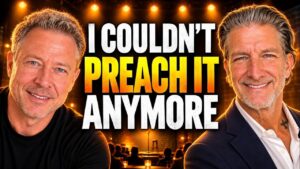
Travis Chappell grew up inside the Independent Fundamental Baptist (IFB) movement, in a KJV-only, young-earth, literalist Christian world where church, school, friendships, theology, and identity were deeply intertwined. At 12, Travis believed God had called him into full-time ministry. As a teenager, he preached, went soulwinning door-to-door, and believed with complete certainty that people who did not accept Jesus would spend eternity in hell.
In this episode of Exvangelical Stories, Dr. Todd Phillips sits down with entrepreneur and podcaster Travis Chappell for a personal conversation about Christian fundamentalism, deconstruction, religious certainty, hell, the Bible, church authority, marriage, loneliness, community, and learning to live without having all the answers.
Travis shares the youth conference where he committed his life to ministry, what it was like growing up inside the IFB “bubble,” and the pivotal meeting with his pastor when he began questioning whether ministry was really his path. He talks about moving from Bible college into entrepreneurship, privately questioning Christianity, navigating those changes within his marriage, losing much of his built-in community, and eventually becoming comfortable saying, “I don’t know.”
Today, Travis describes himself as agnostic with a spiritual leaning. Rather than replacing one absolute worldview with another, he has built his life around curiosity, relationships, empathy, and a willingness to change his mind.
Exvangelical Stories is produced in partnership with Mormon Stories and the Open Stories Foundation. The goal is not to convince anyone to believe or stop believing, but to create space for honest stories about evangelical Christianity, deconstruction, reconstruction, and religious transition.
CONNECT WITH TRAVIS CHAPPELL
Website: https://www.travischappell.com/
YouTube — Travis Makes Friends:  / @travismakesfriends
Instagram:  / travischappell
TikTok:  / traviscchappell
Facebook:  / traviscchappell
Also look for Travis’s new project Dinner Party and the Figuring It Out podcast archive.
CONNECT WITH DR. TODD PHILLIPS
Decon/Recon: https://www.skool.com/deconrecon/about
YouTube: / @drtoddphillips
Instagram: / drtoddphillips
Facebook: / drtoddphillips
TikTok: / drtoddphillips

Episode Transcript
Guests: Dr. Todd Phillips, Travis Chappell
This transcript is machine-generated and lightly edited for readability. The audio is authoritative. Please excuse occasional errors in names and spelling.
Introduction to Exvangelical Stories
Dr. Todd Phillips [00:00:00] Hey, I'm Dr. Todd Phillips and this is Exvangelical Stories. This is a partnership with Mormon Stories and the Open Stories Foundation. And the goal here is not to convince anyone to move away from or toward any kind of religious or philosophical faith or tradition. It's simply a place for people who've gone through evangelical Christianity, high control religious environments to tell their story and to do that in an open, honest format and also to help people like you. If you're questioning Christianity in some way, if you have those questions and you feel like you have nowhere to ask them, just know one thing, you're not alone.
Dr. Todd Phillips [00:00:33] And number two, we've provided a community called Decon Recon and it's an online, private, heavily moderated community to allow you to ask questions about where you are and whether you go right back to Christianity after asking those questions or moving another direction. That end result is not the goal. The goal is community and allowing you a safe space to ask questions. If you want to support Ask Exvangelical Stories, this is a new podcast and it's supported by the Open Stories Foundation. So if you want to give to that financially, either monthly or one time donations, the link will be in the description. I hope you'll consider doing that.
Dr. Todd Phillips [00:01:04] We're in a five part miniseries, but we'd like to extend that and that will be up to your support. So thanks very much. Today I have Travis Chappell. Welcome. What's
Meet Travis Chappell
Travis Chappell [00:01:13] up, Todd? How are you
Dr. Todd Phillips [00:01:14] doing? Well, man, I'm doing great. Glad to have you in here in Austin. This has been exciting. I've heard a lot about you, talked, talked with you and then found out about you through a mutual friend. So I'm glad this worked out. A lot of people know you through business and entrepreneurship, podcasting. I think you've done around 3,000 podcasts. Something like that, something like that.
Travis Chappell [00:01:32] Over 2,000 on my show and then, you know, a bunch of guest spots.
Dr. Todd Phillips [00:01:36] Oh, that's crazy. So this is my number three. So
Travis Chappell [00:01:38] perfect. Yeah,
Dr. Todd Phillips [00:01:39] I'll catch up. We'll, we'll get there at some point, networking the relationships you built. But the other part of this story that a lot of people don't know, some do, but a lot of people don't know. Kind of the overarching arc of your life story in relation to, to religion. And it's an interesting one. Travis grew up inside an extremely immersive, fundamentalist Christian world, believed that he'd been called into ministry as a child. He studied Bible and ministry in college and spent years trying to Understand what happened when the certainty he grew up with stopped making sense. And one of the things that interests me about your story most, Travis, is the contrast.
Dr. Todd Phillips [00:02:15] I mean, really where you were in this very high control religious environment, which we'll talk about, and the person you are today. And the one thing that I really related to, especially when I read through your story and we talked about that story, was that you're comfortable today with a phrase that I use quite often. I don't know.
Travis Chappell [00:02:33] Yeah,
Dr. Todd Phillips [00:02:34] right. I mean, that's really where both of us are spending a lot of our time. So for people who don't know anything about your story, give us a two to three minute kind of arc of your life and where you were not just with religion, but where you are today in business and things like that.
Travis Chappell [00:02:48] Sure, yeah. So grew up in a movement called the ifb, which is Independent Fundamental Baptist. Graduated from kindergarten on the same campus I graduated from high school and college on. Thought it was gonna be a ministry after I graduated, figured out it wasn't the path for me, and then did the only thing I knew how to do at the time, which was door to door sales. I did a little door to door in college, and so I just did that. I felt like the only real option that I had because my degree was more useless than the paper was printed on to some degree. I mean, you know this with any Bible degree, it's that way.
Travis Chappell [00:03:21] But ours happened to be unaccredited as well, so it was even, even more so. So I. Yeah, just door to door. And then had some success in door to door. Figured out that wasn't the path for me either. And for the first time in my life, man, like really dove into personal development like self education. Started reading books, listening to podcasts, watching YouTube videos, all that kind of stuff. And podcasting kind of resonated with me. It stuck with me. I really liked the format. I liked listening to podcasts. And so I was like, well, give this a shot. And that was nine years ago. Nine plus years ago.
Travis Chappell [00:03:51] So since then, a few different podcasts under the belt. We're launching a new podcast coming up soon. And then several different businesses all within, like the podcasting entrepreneurship space with podcast coaching, consulting, masterminds, communities, international retreats, you know, things like that. So. Yeah, but now it's back to full time podcasting at the moment.
Dr. Todd Phillips [00:04:12] Yeah. And so tell just for the listeners too. I mean, a lot of them will already know you, but if they don't, I mean, let's talk about. And I know I Normally don't do this, but it's quite impressive what you've done on the business side and especially as it relates to religion and what we'll talk about later. So how many followers do you have? What is your social media kind of influence out there? What does that look like?
Travis Chappell [00:04:29] You know, probably combined with everything, something like 150 to 250k or something like that. But combined with all the platforms and stuff, the podcasting is really like the main one just because that's really where I started and back in the day it was like YouTube or podcast. What are you going to start? They weren't like married like they are now, you know what I mean? I started with just an audio only podcast back in the day and then that sort of translated
Dr. Todd Phillips [00:04:54] and that was nine years ago.
Travis Chappell [00:04:55] Yeah, yeah, it's 20, 2017.
Dr. Todd Phillips [00:04:58] That's amazing. So. So let's go all the way back.
Travis Chappell [00:05:00] Okay,
Dr. Todd Phillips [00:05:01] let's go back to your childhood. I want to talk about what, what religious life looked like. Kind of explain the dynamics of your particular religion or your particular Christian denomination. Yeah. Your parents, your family life. What did it look like before your teen years? Childhood.
Travis Chappell [00:05:17] So my dad was a real estate agent. So it was actually really funny because the pastor of the church that I grew up in, which was sort of like, at least at the time that I was in, it was sort of the leading church of the IFB movement. Like it was like the megachurch of that world.
Travis Chappell [00:05:33] So you know, when we started going there, there was maybe a thousand, fifteen hundred people, but by the time I left there was probably 7,000, 8,000 members of the church. Full K12 school, full ministerial college, publication, ministry. Like a 40 acre, like people in that area call it the compound. Like, oh, you're from the compound. Because essentially like a little mini city that they built there on the east side of Lancaster in LA County.
Travis Chappell [00:05:57] So yeah, very high control religious environment. But like I have a lot of great memories from it, you know, and that's, and that's something that you and I resonated with when we talked the first time too. Is that like, like you said at the beginning of this, to punctuate that it's never my goal to pull people away from it. It's not my goal to like make it, it sound horrible and terrible or that I was abused or anything, because none of that stuff is true.
Travis Chappell [00:06:17] So I largely look at it as like it was a good childhood, a lot of great memories and a lot of good friends still that are, that I've known since I was three years old. That are still like brothers to me to this day, so. But yeah, it was strange, to say the least. I didn't realize it was strange, of course, because I was a kid, but now being out of it, I realize some of it was a little strange.
Dr. Todd Phillips [00:06:36] So it just was right. No judgment on either side. From your perspective as a child, you just grew up in it, and that's what was normal.
Travis Chappell [00:06:42] Yeah, yeah, of course.
Growing Up on a Fundamentalist Compound
Dr. Todd Phillips [00:06:43] So let's talk about that environment a little bit, this compound. You know, when I was a megachurch pastor, I used to say that one of the biggest challenges for these large churches was that we really had become. And I contributed to this, but also railed against it at the same time. It was a strange thing, but that we'd become more like a Christian country club instead of some sort of spiritual hospital. I kind of used that juxtaposition, and then it was to prove the point. I mean, some of these larger churches have bowling alleys and elementary schools and middle schools and high schools,
Travis Chappell [00:07:14] otherwise known as waste.
Dr. Todd Phillips [00:07:16] Yeah, exactly right. But if you were careful as a believer, and I wonder if this is true about the compound, if you're careful as a parent in that situation, your parents trying to protect you and raise you in a godly environment, they might have said, if you're careful, you really can separate your entire family, not just your children, but you can effectively wall off your entire family from all of the quote unquote, outside world. Is that really how you experienced it?
Travis Chappell [00:07:49] Yeah, absolutely. The term I use most often is a bubble. I mean, if you go with Hasson's definition of a cult, it definitely was a cult. But I find the language not particularly useful, especially for people that are still in that world. It's kind of a trigger word, and it inherently implies that it was a negative context of cult, but it was a cult by all, you know, real definitions of it. But I use the term bubble a lot because that's the best way that I can really describe it. You know, it's.
Travis Chappell [00:08:17] My church was the place that I went for my education, you know what I'm saying? So, like, my youth pastors and my children's pastors and all those, like, they were also the teachers in the school. And it was all intermingled, you know, so, like, everything was there. Like, my entire life was there.
Travis Chappell [00:08:33] I don't even. I can't even estimate the volume of hours that I spent on that campus growing up. But it's a lot. You know, probably, like, if you take away sleep, like probably spent more time there than I did at my house, you know what I mean? So really always a reason to be there, you know what I mean? Like, it was church three times a week. So it's Sunday morning, Sunday night, Wednesday night, but twice on Sunday morning because you have Sunday school, right, for the kids, or like you go to your age group Sunday school, then you go to what we call big church as a kid where everybody goes to church.
Travis Chappell [00:09:02] And then we take a break in the afternoon, we come back for Sunday night church. And then we had Wednesday night church midweek. And some, I think it was Lee Roberson, like some old IFB pastor said the phrase three to thrive, like, gotta be a church three times a week. And then everybody used that as like a, you know, sub doctrine of their. Of their. Of their church. And so, yeah, three, three to thrive three times a week. But then it was also like, we had missions conference and we had leadership conference, and we had youth conference, and we had winter retreat. And we had all these different reasons, excuses, youth activities, whatever, just to come back to the campus.
Travis Chappell [00:09:34] And then obviously, when your school is there, you're there five days a week for school. And then we had Saturday morning soul winning, which is basically knocking doors and inviting people to come to Chur. And then we had a soul winning rally before we'd go to soul winning, which is basically like a mini church service before we go. So it's like seven days a week for a very long time, you know.
Dr. Todd Phillips [00:09:51] So what's your first memory of that place? Are you. How old are you?
Travis Chappell [00:09:55] We started going there. I was three. So. Okay. I don't have any memories from before that time, you know, like,
Dr. Todd Phillips [00:10:03] that was entire. That was the entirety of your life experience.
Travis Chappell [00:10:06] Exactly.
Dr. Todd Phillips [00:10:07] As a child,
Travis Chappell [00:10:07] until I was 22 was the first time I left to go somewhere else.
Dr. Todd Phillips [00:10:13] So Fundamentalist Baptist.
Travis Chappell [00:10:14] Yeah.
Dr. Todd Phillips [00:10:15] Is it Fundamentalist Baptist or Fundamental Baptist?
Travis Chappell [00:10:17] Independent Fundamental Baptist.
Dr. Todd Phillips [00:10:22] It's very different, though.
Travis Chappell [00:10:23] Yeah, sure. So the independent would mean that we are independent of any governing body. So like, Southern Baptists have the Southern Baptist Convention and Catholic Church has the Pope and, you know, LDS has their administration. So independent Fundamental Baptist just meant that we were independent from any governing body of a religious institution. And the fundamental was that we adhered to a literal, exegetical interpretation of the Bible.
King James Only and Rigid Doctrine
Dr. Todd Phillips [00:10:48] Let's talk about that. As a Southern Baptist, I didn't become a Christian until I was 24. Wow. But I bought in aggressively and was told that God was perfect. All knowing, all loving, all powerful and perfect. And the Bible was Perfect. And by that, the Southern Baptist Church, and certainly my church in particular, meant that every word of the Bible from Genesis to Revelation was the literal word of God. That there were no errors, there were no contradictions, every story in the Bible was true, all the miracles happened. If it was in there, it was true. And further than that, and this is where I'd like to go with you. Further than that, it was univocal, meaning that it spoke with one voice. It wasn't man's effort to write about God, it was God speaking of himself through men onto the paper. Perfectly.
Travis Chappell [00:11:40] Yeah.
Dr. Todd Phillips [00:11:41] So describe you, does that describe you?
Travis Chappell [00:11:44] Yeah, 100%. Yeah. The only thing I would say that might differ is that we were KJV only. Were you really? Yeah, King James only. Yeah. So any other version of the Bible wasn't actually God's word.
Dr. Todd Phillips [00:11:55] So for viewers, kjv.
Travis Chappell [00:11:57] Yeah. King James Version, King
Dr. Todd Phillips [00:11:58] James version
Travis Chappell [00:11:59] of the Bible, Version of the Bible,
Dr. Todd Phillips [00:12:00] 16:11. Yeah. So. And for King James only denominations or churches, tell me what that means. What does that mean in relation to other Bibles? For example, we use the NIV quite often, the New International version of the Bible, and it was considered a more contemporary version. We would perceive it as in some ways more accurate because it had earlier archeological evidence and manuscripts to go from over. Let's say the King James Version or any earlier version for that matter. And there have been subsequent versions after the niv. Many. There are many, many versions of the Bible. Yeah, but what does that. So for a King James Version only, what does that mean to you and your church?
Travis Chappell [00:12:45] Basically, we would not accept any other version as the true Bible. So, like, the NIV was constantly mocked in our circles as being like, oh, this is. You're reading from something that's not even God's word. You know what I'm saying?
Travis Chappell [00:12:59] It's not even like we can't even compare the documents. This is like a crude version of it, and this is actually the word of God. And that persisted all the way throughout college. Like when I graduated college, we had, at the end, during the commencement ceremony. And this is why I try to differentiate it a little bit, because even going to a standard seminary is like, there's at least there's schools of thought that exists even among the professors themselves. And they're trying to get you to ask questions and think about it this way and then come up with your own sort of like, doctrinal statement.
Travis Chappell [00:13:27] At our college, if you. When we. When we graduated, during the commencement, they would read the doctrinal, the ifb, doctrinal statement from the pulpit and say, stand if you agree. And if you didn't stand, even if you completed all your credits, paid for school and all that, you could not graduate from that college. So it was. There was no, like, warring or competing thoughts. It was very much like, this is what is true, everything else is false. And here's how to overcome those objections, if you will, to take it in a business world to get people to buy into the version that we believe, which is actually the truth. And so the KJV Bible was a big part of that.
Dr. Todd Phillips [00:14:06] So let's talk about what you believed at the time.
Travis Chappell [00:14:10] Yeah.
Dr. Todd Phillips [00:14:11] And I would say likely to parallel with ifb, but I mean, what you believe specifically as a child, if you had any strong opinions about these. So the Bible was completely trustworthy? The 1611 King James Version of the Bible was completely trustworthy. Did it have any contradictions or errors in any way?
Travis Chappell [00:14:28] No. No. Inherent. Yeah. Completely inerrant, infallible.
Dr. Todd Phillips [00:14:32] Was it. Was it historically accurate?
Travis Chappell [00:14:34] Yep, historically accurate. You know, had scientific discoveries that, you know, people didn't know for a thousand years and all that. All that good stuff.
Dr. Todd Phillips [00:14:44] Yeah. And univocal. Right. From God through men, on paper.
Travis Chappell [00:14:48] The literal, inspired word of God. Yeah. That he spoke every word of the Bible to human authors. Yeah. What
Dr. Todd Phillips [00:14:56] did you. Go ahead.
Travis Chappell [00:14:57] Yeah, I was just gonna say I. I basically, like, from the time that I was a kid, I just accepted whatever was told to me. You know, the pulpit was like this. This unquestionable vehicle through which we can receive the truth. So if anybody was endorsed to be at that pulpit, it was like, they are speaking truth and I will listen to them. So there was no, like, I had questions and stuff as a teenager, but yeah, as a kid, it was just like, whatever everybody's telling me has to be the truth. Like, there's no other version of this that's the truth. So I'll just accept whatever's given to me, which I think is pretty standard for most people.
Travis Chappell [00:15:31] I think we all, you know, the version of God that we're presented with is most often the version that we accept and tend to not question. Because the, you know, to be fair to the creators of it, it's unquestionable to a degree. There's these, you know, there's these things called thought canceling cliches. It's like you, if you have a question, you can just say something, thought canceling and be like, we win. You know, you can play the ultimate trump card at any time, which is God, you know what I mean? Like, oh, I don't understand this. Well, we can't understand an eternal God. Boom, trump card. You know what I mean? What are you gonna say now? You know what I mean?
Dr. Todd Phillips [00:16:03] Yeah. His ways are higher than ours.
Travis Chappell [00:16:04] Right, right. There's no way that we can understand it. So it's like if you accept that there's an all powerful being who you can't understand, then any questions are therefore null and void because you can't understand it anyway. So like, even your attempt to understand it is, you know, a waste of time because, you know, he said it. So there's no, there's no reason for us to question it.
Dr. Todd Phillips [00:16:26] Yeah. It's amazing when I look back on my own I would call uncritical.
Travis Chappell [00:16:31] Yeah.
Dr. Todd Phillips [00:16:32] View of, of Scripture, even though I'd use the laws of logic and reason and, and I would use a healthy sense of skepticism until I was convinced through evidence that something was real in any other area of my life, I did not apply that to the Bible.
Travis Chappell [00:16:49] Yeah. Yeah. Well, because you can't.
Dr. Todd Phillips [00:16:50] Yeah.
Travis Chappell [00:16:51] You know, there's no, like I said, perfect. Exactly. Once you accept some of these, like basic fundamentals, then everything else is just sort of like, okay, well that makes sense. You know what I mean?
Dr. Todd Phillips [00:17:01] Did you feel like, if you, if you ever like. Well, let me ask you this. What did you think about hell? First of all, let's talk about a couple of basic doctrines. So Hell. Yeah. Was that real
Travis Chappell [00:17:09] literal place. Who went
Dr. Todd Phillips [00:17:10] there?
Travis Chappell [00:17:10] Yeah, literal place of fire, burning, gnashing of teeth, you know, all that stuff. Darkness, torture for all of eternity. Anybody who did not accept Christ as their personal savior, who were washed with Jesus's blood would not end up in heaven. So I think that would probably be something that we would have agreed on. Our definitions of accepting Christ might have been a little bit different. But, you know, I think that was the basis of it.
Dr. Todd Phillips [00:17:40] So people outside of Christianity were then the word, the term lost.
Travis Chappell [00:17:44] Correct.
Dr. Todd Phillips [00:17:44] You'd use that all the. They were saved, unsaved,
Travis Chappell [00:17:47] lost,
Dr. Todd Phillips [00:17:47] and they were going to. That literal.
Travis Chappell [00:17:49] They were going to. They were going to hell. Yeah. Which is sort of one of the ways that, you know, they convince you to go into ministry. Because I committed to that when I was 12 years old, which I can clear like, I can look back on. Like, one of the things that drove me crazy was that authority figures in that world would tell you whether something you were feeling was from God or from Satan. You know what I mean? So, like when I was called to ministry, that's from God. But then when I had questions about my calling to ministry later on as a teen or in college, you know, it was, well, that's Satan trying to pull you away from God and pulling you away from your calling.
Travis Chappell [00:18:23] And then it was sort of like, well, how could you possibly do anything else with your life when there are millions of people dying, going to hell on a daily basis? What else are you going to do? You're going to go be an accountant or an architect, you know what I mean? Like, people are dying and going to hell. This is an urgent problem needs to be solved and we need as many people to be in this battle against Satan as we possibly can. So what else could you possibly do? What higher calling could you have in your life than to do this thing? And as a 12 year old, it was my first youth conference.
Youth Conferences and Calls to Ministry
Travis Chappell [00:18:53] And youth conference there was a big deal essentially. Again, now I can look at it from an objective business point of view, which is like, youth conference was built by the college to bring youth from around the country to introduce them to the college so they could get college applications. That was like the funnel, so to speak, from the business context. But obviously my reality at that time is like, I'm looking forward to youth conference as a kid, you know what I mean? Because you couldn't go until you're a teenager. So the summer before my seventh grade year, I could finally go to youth conference.
Travis Chappell [00:19:20] It was my first youth conference ever. My pastor, who's like the leader of that world, who also happens to share a last name with me, which was coincidental. He is giving the closing sermon that was called who Will Go? And the invitation lasted for 45 minutes.
Travis Chappell [00:19:39] And they sang the song Here Am I, I Will Go on Repeat literally the entire time. So they probably sang that song like, you know, 20 times, 30 times, like in a row, just collecting commitment cards to go into ministry. It's like everything in that event was fully engineered to get people to be called to ministry so that they would be applying to the college when they were a junior or sen in high school. But, you know, at the time I felt it was just like God's tugging on my heart.
Dr. Todd Phillips [00:20:08] Yeah, let's talk about that. Let's talk not. Not what you know now, but how you felt then.
Travis Chappell [00:20:12] Yeah.
Dr. Todd Phillips [00:20:12] What. So where are you? So you're in this, this meeting. Where, where are you in the room?
Travis Chappell [00:20:16] I'm close to the front. Close
Dr. Todd Phillips [00:20:17] to the front?
Travis Chappell [00:20:18] Yeah. There was a whole section for our church's youth, you know what I'm saying? So, like this was. I mean, there's hundreds of churches probably that sent kids to this conference. Probably like 2,500, 3,000 teens. Yeah,
Dr. Todd Phillips [00:20:28] this is a massive place. This is huge.
Travis Chappell [00:20:30] A huge youth conference in our main auditorium.
Dr. Todd Phillips [00:20:32] I think people don't fully understand just how large these events
Travis Chappell [00:20:35] get. Yeah. And like you said, like every. Everything is engineered from the temperature in the room to the music that you hear, to the people that are talking to you, to the structures of the sermons, the topics of the sermons leading you up to a decision. Like, it's all the stuff that I got taught in a business context to like sell products and services from a stage. You know what I mean? Just that their product or service is getting you to commit your life to being in ministry.
Dr. Todd Phillips [00:20:59] You know, that's interesting because. And we're going to talk a lot about this, your perspectives on these events now that you're in business and you understand sales and sales dynamics and, well, everything you were just describing before. I remember thinking this and I'm curious what you think about this. We would do all these things because we believed that the Holy Spirit was moving. And we were called to use our own intellect and use our understanding of psychology and use our understanding of sales to do everything we could to facilitate an environment where someone could let go of the outside world, so to speak. Focus in, suspend any thoughts or ideas about what was going on in the world that day. Focus entirely on what was going on and that the environment we created was not. Was not seen at that time as manipulation.
Travis Chappell [00:21:55] 100% psychological manipulation.
Dr. Todd Phillips [00:21:57] It's a hundred percent.
Travis Chappell [00:21:58] We had these. We had our giving conference, which now, again, looking back on it is like, wow, they raised some crazy money because, you know, like, they would get millions of dollars in commitments and in cash during our, like, giving, you know, our commitment fund or whatever you know, they call building fund because they're building more buildings on the campus. Again, it's a 40 acre campus and with multiple like multimillion dollar buildings on the campus.
Travis Chappell [00:22:23] And there was this guy that would come in, he was an attorney who's a real piece of work named David Gibbs, who come to find out, defended a bunch of pastors who were abusing kids. And like, the rate of child abuse in the IFB world is double the rate in the Catholic Church. There's actually two documentaries about it. One of them is called Let Us Pray. My producer Eric runs a podcast called Preacher Boys Podcast that exposes abuse in the church, the IFB movement. And he's sort of like the talking head figure in this documentary called Let Us Pray P R E Y, which is on hbo.
Travis Chappell [00:22:57] And then another episode came out on a show called Toxic with Investigation Discovery that was talking about one of the big guys in one of the big churches abusing kids. And this attorney was founder of something called the Christian Law association, which was basically just him coming to save people who were doing egregious things inside of the church so that they could, you know, protect the mission at all costs. Anyway, he was a great speaker. To be like. To be fair to him, he was an amazing speaker, a great order. And he would come in for our giving conferences, and then at the end, when they started raising money, he would have people in the congregation stand.
Travis Chappell [00:23:33] Like who? Like, who can. Like, you know, it's not about the amount, it's about the sacrifice, you know, talking about the woman with the two mites and whatever. And so let's start with a dollar. You know, who. Who will give a dollar? And a bunch of people stand, you know, and they count everybody, okay, $5, okay, $10, but then they go up to, like, $500 and then $1,000 and then $5,000 and then $10,000. And like, again, I can see the psychological manipulations clear as day at this point, because you're engineering an environment using the probably the most powerful psychological persuasion element known, which is social proof, and basically asking people to stand.
Travis Chappell [00:24:10] So then there's this status game that's being being played where it's like, ooh, you know, as you're looking to see whose parents are standing and who's got the money in the church and who's going to be giving this much. And there's this, like, level of status that was gained by how much you gave. It was like, this is a psychological manipulation of the adults in the room, Just like youth conference was psychological manipulation of kids in the room. But it's all the same thing.
Dr. Todd Phillips [00:24:33] So I want to get to that. The manipulation component of it in reference to some of these other events that you're talking about, and certainly the giving of funds, because, again, we used all those during giving weeks and different things when we were trying to raise money for a new building or anything like that at some of these larger churches. So it's all familiar.
Dr. Todd Phillips [00:24:54] Let's go back real quick to when you were 12 years old, you're in this event and you surrender to ministry. Again, the environment, the dynamics are structured to get you to move forward. What do you do? What does Travis do? Travis is 12 years old. He's watching this he's feeling this. They're singing the same song for 45 minutes. They're moving everyone toward this decision. If you haven't made one yet, you feel pressure to continue to move forward because you haven't yet done it. And something inside you, I'm sure, is saying, maybe you ought to do this. Oh,
Travis Chappell [00:25:21] 100%. I didn't even wait the 45 minutes. I was like one of the first people up there. You
Dr. Todd Phillips [00:25:25] were there, you were
Travis Chappell [00:25:25] all in. I was all in, like the whole time. And I tend to be that type of a person in general, which sort of irritates me now because now, like, some of my friends in ministry are great, but I have some other people who I wouldn't even call my friends. There's people who I knew growing up who, who are growing up, who are now in ministry, who were just like terrible people, you know what I mean? And I was like, I was one of the ones who was like fully bought in. So as soon as that invitation started, man, I was like, I was up and like, I'm there, I'm committing my life to this.
Dr. Todd Phillips [00:25:52] And what do you do? What's the next step? You're in the audience and then what happens?
Travis Chappell [00:25:56] Yeah, so they had a choir loft where the choir was. We had like a 300 person choir or whatever. And as soon as you made the decision and filled out the commitment card, they had you stay in the choir loft. So again, a social proof thing because at the end they had everybody in the choir loft stand and then the whole room applauds for the people who just committed their life to the Lord. So I was up in the choir loft filling out a commitment card and talking to a counselor, youth leader or whatever for 35, 40 minutes, waiting for them to conclude the remainder of the invitation. So, yeah, I was up there basically the whole time.
Dr. Todd Phillips [00:26:31] So once you'd publicly said that and felt that God had called you, God himself had called you into full time ministry, how much freedom, I don't want to put this. How much freedom did you feel at any time after that to change your mind later?
Travis Chappell [00:26:47] Oh, none.
Dr. Todd Phillips [00:26:48] Yeah. Zero.
Travis Chappell [00:26:49] Zero. I mean, what, like, how are you going to go back on a commitment to God? You know what I mean?
Dr. Todd Phillips [00:26:54] Let me ask you this, man, because again, your story is very familiar to me. A lot of this certainly resonates with me in my own experience. How do you feel when I say something like with Penn and Teller, I think Penn was the one that said, look, if you, you know, he goes, I respect Christians. If you Believe you've got the antidote to hell. You know, why aren't you telling me? Right. So there's a component of this where, what you were saying earlier, certainly, again, I still feel it in my heart when I listen to this. I'm like, I remember going, yeah, what else could I possibly do but give my life to ministry?
Dr. Todd Phillips [00:27:30] What could I possibly do? What other profession could possibly even allow me to wake up in the morning and feel okay about myself? If so many people are going to hell, let's talk about. Because I want people to feel the depth of that conviction, Travis, because I don't think a lot of people fully understand in some of these kinds of environments, when you make a decision like that, it's not some sort of intellectual exercise. It's not a. It's not another decision on dots of decisions throughout your life. This is not a weight loss
Travis Chappell [00:28:00] goal. Yeah. This
Dr. Todd Phillips [00:28:01] is the thing. It's a fork in the road that you never go back from or you don't think you will. So talk about the depth of that I call conviction. I mean, when you say you're all in, you're swimming in it. When you're talking about tanks on the back, deep diving, all in. So what does that look like in your life once you make that decision? How does that change what's going on with you?
Travis Chappell [00:28:21] Oh, it just became like everything to me, you know what I mean? Like, I went to preaching camp when I was 12 years old, which was basically just. It was a. It was a college level homiletics course, which is the study of preaching that they would teach in the college. And they would do it as like summer camps again, to bring people to the campus to get them interested in the college. So they had a music camp and a preaching camp. And I went to preaching camp when I was 12 because I felt like I was called to ministry.
Travis Chappell [00:28:47] And to be fair, a lot of that's really helpful. I use that to this day. You know, I had the opportunity to be a public speaker essentially for 10 years from 12 to 22, when most kids have never even gotten on stage once, you know, I preach, we had something called Youth Night, where the teens would take over the service. And so, yeah, on a, on a Wednesday night, obviously not not Sunday, but on a Wednesday night, I preached to probably, I don't know, 1500 people, 2000 people or something when I was 15.
Travis Chappell [00:29:16] So, yeah, I was always up in front of people. I was studying preaching. I was writing sermons for fun to try to get better at speaking and presenting. The gospel. And
Dr. Todd Phillips [00:29:25] this was immediately after this. I mean, once you surrender to ministry, you're jumping full in to preaching, teaching, writing sermons, engaging in these classes, trying to figure out how to be a better preacher, teacher, minister, missionary, soul winner.
Travis Chappell [00:29:39] Every opportunity I could get, whatever it meant, whether it was music, it was preaching, you know, soul winning. We would like Hoff.
Dr. Todd Phillips [00:29:47] Okay, what's soul winning?
Travis Chappell [00:29:48] Soul winning is what we called just essentially it's door to door sales for the church. But yeah, it's our version of what the Mormons do with their missions. But we did it every Saturday. So we didn't do like the two years thing once you graduate high school, but we did every, every Saturday morning you go out and knock doors and invite people to come to church. But the thing that most people wouldn't do in that context that I always did, was that if you had an opportunity to convert somebody while you're on the doorstep, I would do that as well. So I'm oftentimes from 12, 13, 14, 15 year old kid, like standing on somebody's like a grown person's doorstep being like, are you sure that if you died today you'd go to heaven?
Travis Chappell [00:30:27] Which now again, looking back on it, I'm like, what would I do if like a 12 year old kid asked me that on my doorstep? But people were malleable to some degree or they listened to me. I don't know what it was. Maybe it was my depth of certainty at that time that was attractive to them.
Dr. Todd Phillips [00:30:46] Did you ever, did you ever win a soul?
Travis Chappell [00:30:47] Oh yeah. Oh yeah, dozens.
Dr. Todd Phillips [00:30:49] So dozens of souls just on a doorstep.
Travis Chappell [00:30:51] Yeah.
Dr. Todd Phillips [00:30:52] On a Saturday.
Travis Chappell [00:30:52] I remember one time leading my orthodontist's assistant to the Lord while she was working on my mouth, like in the orthodontist chair. So yeah, it was, I mean, all consuming.
Dr. Todd Phillips [00:31:04] Well, we're gonna have to hang out with that one. So you're at the orthodontist, you're in the chair.
Travis Chappell [00:31:08] Yeah.
Dr. Todd Phillips [00:31:09] Getting your teeth cleaned or whatever.
Travis Chappell [00:31:11] She's prepping for the ortho to come over. Yeah.
Dr. Todd Phillips [00:31:13] How do you open the conversation? Do you remember? You may not.
Travis Chappell [00:31:16] We probably were just talking about like the church or something. She maybe asked me a question just to, you know, manage the silence. And then it got to around to me asking that question, well, do you know for sure if you die today you go to heaven? She was like, well, I'm not, I'm not sure that, you know, we can know or whatever. And I was just like, well, the Bible says you can know. And here's exactly the verses that say that you can know. I memorized the Romans road. Yeah, sure. Which is what we called it, which is essentially verses, mostly in Romans, that can tell anybody how they can go to heaven and know 100% for sure that if they die today. So that way, whenever anybody asks you this question now, you can say with certainty 100% that you're going to go to heaven when you die.
Dr. Todd Phillips [00:31:53] Did your denomination believe you could lose your salvation?
Travis Chappell [00:31:55] No. No. Eternal security was
Dr. Todd Phillips [00:31:57] once saved, always saved. Eternal security. Those are the kind of phrases, right? Yep. So we had similar belief systems.
Travis Chappell [00:32:02] So no man can pluck you from the Father's hand.
Dr. Todd Phillips [00:32:04] Yeah. So there are certain denominations in the sphere of Christian denominations that believe you can lose your salvation and will negotiate with the biblical text to give more importance to certain passages that will suggest that you and I were in denominations where we gave more importance to those passages that says you were secure. So once you were birthed into God's family, you could not be unbirthed.
Travis Chappell [00:32:26] Which is funny now, watching the, like, linguistic gymnastics that people go through to try to say that I was never saved. You know, like, people I grew up with. Turns out Travis just was never saved. You know what I mean? Like, there's no way that he could be at the position that he's at right now if the Holy Spirit were inside of him. So he just didn't believe it hard enough. Which is hilarious to me, knowing how much I believed it. Like, knowing that it took every single second of my, you know, thought and I was dedicating my life to this thing and everything I did was for this cause and I reassured my salvation like two or three different times because, you know, I'd get in those, like, thinking about hell spirals and was just like, I just want to make double for sure.
Travis Chappell [00:33:08] I just want to make triple for sure. You know, why not? And so, yeah, it's just funny to me now to see people be like, well, he was never actually really saved.
Dr. Todd Phillips [00:33:15] Would you agree or disagree with this statement? As a 12 year old fully committed Christian in IFB, Travis Chappell was the most committed Christian that he knew.
Travis Chappell [00:33:31] I remember. This is going to sound so terrible. I remember talking to my parents one time. The ball's on me, man. This is crazy. I remember talking to my mom one time when I was 13 or something and literally telling her that I believed that God was blessing us financially because of my spirituality, because of my willingness to. Your commitment? Yeah, because of how great my commitment was and how strong my resolve Was because my parents were very much involved in that world, but not to the same degree that I was. So I looked at it like, well, you guys are doing enough, you know what I mean? And God's really blessing us because of, because of my effort, which again is pretty insane for a 13 year old to say that to their parents.
Certainty, Belief, and Early Faith
Dr. Todd Phillips [00:34:18] Travis, man, I totally relate to all of this, like, all of it, you know, the level. Let me ask you this. Where do you think that level of certainty came from?
Travis Chappell [00:34:26] I don't know, probably just the obeisance to unbridled authority. And I always had a desire to be looked at as somebody who was, I don't want to say better, but like I wanted to be higher status. I seeked this, this higher status in life. And so when I would see especially, and I think this is what might differ a little bit in the context that I grew up in compared to some other people, because it was both fundamentalist but also mega church.
Travis Chappell [00:35:05] So like my pastor was the guy, you know what I mean? Like it was everybody, like people traveled from around the entire planet to have lunch with him and things like that. So I think I wanted that type of, you know, following or that type of status where people felt like that about me and that I was doing such great things for the Lord that it would follow me. And so, yeah, I don't know, I suppose it was some version of that. And then also just being a kid, but, you know, there was plenty of other kids that grew up the same way I did who didn't have that level of certainty and didn't have that level of belief or desire. So I can't say for sure.
Dr. Todd Phillips [00:35:46] Yeah, I just find it remarkable. Right. I think there's a lot of. I've done a lot of research on the psychology of religious belief recently, last couple years, and I just find it interesting that, you know, one argument. I'm not sure if I believe this fully. Wonder what you think is that kind of our intrinsic psychology, how we're raised and who we are, there's a way we present ourselves and how we believe in ourselves.
Dr. Todd Phillips [00:36:15] You could argue where that all comes from. But when a person becomes a Christian, whether it's 12 with you, 24 with me, 55 with somebody else, the psychology of that person is what's being saved. Right. And so if you're an all in kind of guy, you're going to be an all in kind of Christian. Yeah, right. If you're a much more laissez faire kind of, I don't know, fly on the wall. When you become a Christian, you just are a perfect attender. Maybe, but you don't feel the need to. Your psychological profile would suggest you don't feel the need to change the world, yet you did.
Travis Chappell [00:36:44] Yeah,
Dr. Todd Phillips [00:36:44] I did.
Travis Chappell [00:36:45] Yeah. I agree with that. Right. Yeah.
Dr. Todd Phillips [00:36:47] So that you bring a certain person into the phrase. So it's not God changing you from the inside out. I don't believe anymore. However, I believe it's you.
Travis Chappell [00:36:55] Correct.
Dr. Todd Phillips [00:36:55] And you molding your psychology into that cultural dynamic within that religious, Particular religious environment. I find it. I really do find it fascinating.
Travis Chappell [00:37:04] Yeah. Yeah. Well, and it's the. The thing to me is that it's been something that's been happening for all of human history.
Dr. Todd Phillips [00:37:10] Yeah.
Travis Chappell [00:37:11] Forever. We've always tried to bridge the gap between certainty and uncertainty since we could, you know, form sentences. They were worshiping the sun God, or, you know, I think it was the Mayans who would sacrifice their kids during their babies, during the solar eclipse because they thought the sun was going away or whatever. And it's like. Seems like they believed it. You know, like, your level of belief does not indicate truth because there's plenty of people who believe stuff that even Christians would look at and go, like, that's crazy.
Dr. Todd Phillips [00:37:41] Yeah, you can be passionately wrong.
Travis Chappell [00:37:43] Exactly, exactly. Yeah.
Dr. Todd Phillips [00:37:45] And I believe. I believe. I certainly believe I was in reference to the things that we're talking about. But at the time.
Travis Chappell [00:37:51] Oh, yeah, you couldn't have believed it more.
Dr. Todd Phillips [00:37:54] Did you ever feel it was okay to say, I don't know?
Travis Chappell [00:37:56] No, not back then. Not back then. There was always some sort of reasoning or explanation, which is why I think, like, in college, I really. I clung to, like, the apologetics classes. And, you know, there was a class called Science and Faith. And so I really enjoyed those classes. And the professors were actually good professors. Those were. A couple of those professors were really strong.
Travis Chappell [00:38:19] And to this day, I still find some of the stuff they say fascinating. But, yeah, I really enjoyed those classes because I really wanted to have some sort of reason to be able to explain exactly what I was trying to articulate to people, even though it's a futile effort, because you can't fully explain something that is quite literally dependent on faith, which is, as Hebrews describes it, the substance of things hoped for, the evidence of things not seen. It's evidence of things that you can't see, so you can't fully explain it. And so, like, now, that's why now I'm more like, you know, I don't try to evangelize People to my cause or deconvert anybody.
Travis Chappell [00:38:55] You know what I mean? It's more just like this was my experience. And, you know, if you still believe it, that's fine, that's great. But don't pretend like it's completely scientifically and logically defensible like that. That to me, takes it to a step where I cannot follow you because there's too many things that don't make sense.
Lightning Round on Fundamentalist Beliefs
Dr. Todd Phillips [00:39:14] Okay. Back then, lightning round on beliefs. Literal Adam and Eve.
Travis Chappell [00:39:18] Yes.
Dr. Todd Phillips [00:39:18] Young earth creation.
Travis Chappell [00:39:20] Yes.
Dr. Todd Phillips [00:39:20] So that means that you believe that the earth was around 6,000 years old. Correct. There was a literal Adam and a literal Eve that were created in a literal Garden of Eden. And that was where everything happened. The serpent, the fruit, the fall of man being kicked out of the garden. The whole thing.
Travis Chappell [00:39:36] Yep. And then the bloodline of Adam carries the sin. So even if you could theoretically live a perfect life, you would still be condemned to hell because you're
Dr. Todd Phillips [00:39:44] born into sin. Okay. Noah's Ark.
Travis Chappell [00:39:47] Yeah.
Dr. Todd Phillips [00:39:48] Somehow all those animals, God can do anything. Okay. Physical resurrection.
Travis Chappell [00:39:54] Physical resurrection.
Dr. Todd Phillips [00:39:55] So Jesus died and he rose again in a body and walked around people, saw them, and then he ascended into heaven. Literally.
Travis Chappell [00:40:01] Yes.
Dr. Todd Phillips [00:40:01] Okay. So if it was in the Bible, Jonah and the whale,
Travis Chappell [00:40:06] 100. Okay. Everything's literal. Yeah,
Dr. Todd Phillips [00:40:08] yeah. And I think that's important, right? Is someone might be watching this. There are so many. I truly believe this. There are some 40,000 denominations now in Christianity that are recorded.
Travis Chappell [00:40:18] Right.
Dr. Todd Phillips [00:40:19] A bit more than that now. Some say up to 53,000. But my belief. Curious what you think My belief is there really is a denomination for every person that everyone has negotiated with the text in some way and come up with their own perspective and could unofficially call that a denomination. What do you think about that?
Travis Chappell [00:40:41] Yeah. No, it's real. That's what's one thing That's. I wouldn't even necessarily call it a nail in the coffin. But even if you have a conversation with somebody who would identify as an apologist, the one thing that I come back to, even if some of their arguments make sense to me, is, you know, there's this verse in the Bible that says God is not the author of confusion. You know, God's not one that any should perish, but that all should come to repentance.
Travis Chappell [00:41:08] And my thought was like, really? Because God authored one document, to my knowledge, the Bible, and there are 40,000 plus denominations, beliefs, value systems that were created off of this. And a lot of them fight about things that really matter. Now. We're not just talking about like, you know, weird standards that I grew up with. Like women not wearing pants or not being able to go to movie theaters or not being able to dance or listen to even Christian contemporary music. Like we couldn't listen to Chris Tomlin or anything or Hillsong or anything like that. Like we had like gospel 50s type music with piano only, no drums, no guitar, things like that.
Travis Chappell [00:41:47] They introduced acoustic guitar later on, but even that was like really controversial. So like the one book that God did write seems to me at least like it's actually the most confusing book ever written. Like it's not, it's. He's literally the author of confusion. Like the Bible is crazy confusing. Or else we would all at least agree. Like if you have some, a group of people that are studying the same document for their entire lifetimes, you'd think that they would agree on at least some of the most basic, fundamental, important rules. Like, like how do I make sure I don't end up in hell forever?
Dr. Todd Phillips [00:42:22] That seems number one right there.
Travis Chappell [00:42:24] Yeah, you could ask an orthodox Jew, you could ask a Catholic priest, you could ask a Mormon elder, you could ask a Baptist preacher and they will all give you different answers for how you end up in heaven. That seems like a pretty crazy thing to disagree on when you're all reading from the same book. Like how, like we haven't even figured that part out and now you're trying to say that you know this a hundred for sure. Like, well they don't know this 100% for sure. And they would believe like they believe what they believe just as hard as you believe what you believe. So it's not the belief that makes it true. It's like, so what is it then? You know what I mean? It seems like this is actually the most confusing book that was ever written. When he's supposed to not be the author of confusion.
Dr. Todd Phillips [00:43:04] Yeah, one could. Author, he is. One could argue that he's the most prolific author of confusion of all time. You know, even when I look at the Book of Mormon and I haven't, I've done comparative religion classes so I know enough to make me dangerous at this point. But even the Book of Mormon has less contradictions.
Travis Chappell [00:43:27] That's what I was going to say.
Dr. Todd Phillips [00:43:28] Than the Bible. If you're going to talk about accuracy and the lack of contradiction and univocality.
Travis Chappell [00:43:35] Right.
Dr. Todd Phillips [00:43:36] They both are not
Travis Chappell [00:43:37] right.
Dr. Todd Phillips [00:43:37] But the Quran is less so. Right. So if we really do believe the perfect God wrote our book, the Bible, it just again, when you look at comparative religions and you look at the structure. It just doesn't add up.
Travis Chappell [00:43:49] Well, at least what I like to say is at least the Mormons went for an update.
Dr. Todd Phillips [00:43:53] Sure.
Travis Chappell [00:43:54] You know what I mean? Because the Bible gets some things wrong about some pretty basic human rights stuff like
Dr. Todd Phillips [00:43:59] basically,
Travis Chappell [00:43:59] I don't know, slavery. Like that seems like something that an all knowing, all wise, all loving God, instead of putting a verse in the Bible that says slaves obey your masters. And speaking to in the context of that time or whatever, seems like he could have just abolished slavery right then and there and been like, hey, you guys are getting this one thing pretty, pretty wrong. I don't think you should own other people. So that's a no, no, you know what I mean? Like we're not going to do that anymore. But instead he gives instructions on how to conduct yourselves properly as a slave or as a slave owner.
Dr. Todd Phillips [00:44:28] Yeah.
Travis Chappell [00:44:29] You know, and, and it's like if, if an all knowing, always God was going to write a book that was going to last forever, why would it be strictly in the context of the time that it was written in and not something that would be able to be changed for future generations where those things weren't contextually accurate, accurate anymore? So I was like, at least the Mormons like went for an update. At least they were like, hey, well this is like the 1850 version or whenever, you know, it was written of the Bible and now this is the updated text. You know what I mean? But then it's still confusing to me on that perspective too, obviously, because I think most Mormons would say that they also believe the Bible, which then introduces a whole new realm of contradictions between those two documents. So it's like, yeah, there's too much confusion there.
Dr. Todd Phillips [00:45:17] Doesn't it seem it's very interesting that as time goes by, there is not more cohesion around a specific perspective on a given topic with the Bible or
Travis Chappell [00:45:29] any religion,
Dr. Todd Phillips [00:45:30] it becomes more divisive.
Travis Chappell [00:45:31] Right.
Dr. Todd Phillips [00:45:32] So now 40,000, 45,000, 53,000 denominations, we increase the number of denominations over time, not decrease. It's like I heard someone, I cannot honestly remember who it was, but I found this just very interesting kind of way to view it. You know, astronomy over time. We don't have Muslim astronomers and Christian astronomers and Hindu astronomers. We have astronomers.
Travis Chappell [00:45:58] Right.
Dr. Todd Phillips [00:45:59] Because the truth of astronomy, we used to think the sun went around the Earth. Now we realize the Earth goes around the sun. We understand the solar system. As more science and more understanding comes to play, all astronomers converge on that scientific truth. They're just astronomers. And there is Astronomy to
Travis Chappell [00:46:18] what is happened based on, based on the evidence
Dr. Todd Phillips [00:46:20] over time that evidence unifies. Unifies the perspective on the given topic over time with the Bible, time further divided divides people's perspectives and understandings.
Travis Chappell [00:46:33] And that's just talking about religions based on the Bible.
Dr. Todd Phillips [00:46:35] Absolutely.
Travis Chappell [00:46:36] Fastest growing religion in the U.S. islam.
Dr. Todd Phillips [00:46:38] Yep.
Travis Chappell [00:46:39] Nothing to do with the Bible, like
Dr. Todd Phillips [00:46:41] nothing.
Travis Chappell [00:46:41] You know what I mean? Like where. How did that just come along so that it's like all of the things that I held on to for some time because even when I, when I was first quote unquote deconstructing or whatever, I still was like, okay, but I, but the person of Jesus is, is a, that's a crazy interesting person. You know what I mean? And there were things I couldn't answer at that time or, or things about the Bible that I, that I couldn't answer, but it just didn't like feel right to me. But then, you know, the further and further I get away from it, the more I'm just like, it's because I was accepting the certain system that was given to me like the Bible for instance.
Travis Chappell [00:47:18] When, when I learned that the odds of all of the prophecies being fulfilled in the New Testament from the Old Testament was like this crazy number that we can't even. They have to scientifically more stars in
Dr. Todd Phillips [00:47:29] the sky than. Yeah.
Travis Chappell [00:47:31] I was like, well that's pretty compelling. You know, and then I find out that like oh, the New Testament was written until like, you know, the Gospels especially weren't written until like a hundred years after Jesus died. And the early church who canonized the, the books of the New Testament had the Old Testament books. Like it's not, they weren't just writing it out of nothing. That's right. They had all this stuff to go off of. So if they were, if they had some sort of a confirmation bias built reason to, to further confirm the things that they already believed, why would they not canonize or write something that allowed them to say that this prophecy was then fulfilled?
Travis Chappell [00:48:11] Which is why you have disparities even in the Gospels themselves. Like did Jesus go to Egypt or did he not go to Egypt? That's a pretty big like footnote and something that's actually kind of important for, for what you might believe about him or who he was. But it's like, okay, well they have to fulfill all these Old Testament things. So even that is like, okay, well I now knowing that, well, of course those odds that I learned are completely irrelevant because they weren't written in a vacuum. Completely independent of each other. They were written based on, like, them looking at these past documents and going, like, you know, I don't remember that one part happening, but why don't we go ahead and put that in there?
Travis Chappell [00:48:48] Because it had to have happened, you know what I mean? Because, like, or else everything that we believe is a lie. And, you know, the early church had a lot of reasons to confirm what they believed, you know what I mean, in terms of power structure and hierarchy and status of the game that they played at that time. So it's. It's. Almost none of it is done with, like, completely unbiased in a controlled system. And then you look at, you know, it's passed down oral tradition at that time. Like, you can't even play a game of telephone in one room in 10 minutes without the sentence you said, without the sentence that you said getting messed up by the 30 people in that one room by the time it gets around the room.
Travis Chappell [00:49:24] So you have multiple generations at a time when there was no way to. To. To accurately document anything or. Or distribute anything. And that oral tradition gets passed down to multiple generations, and then it gets written and recorded, and it's like, well, we. How do we even know that this is what Jesus said? You know, because then I got. When, you know, in apologetics, you learned that Jesus was either a liar, a lunatic, or he's the Lord. I don't know if you ever learned that, but liar lunatic
Dr. Todd Phillips [00:49:52] preached it many times. Yeah,
Travis Chappell [00:49:54] yeah, He. He either lied, saying that he was God or he was a crazy person, which can't be true because he was too influential, or he is who he said he was. It's like. Or he didn't say any of that. We don't know. Yeah,
Dr. Todd Phillips [00:50:07] liar, lunatic, lord or legend.
Travis Chappell [00:50:09] Yeah, right, exactly.
Dr. Todd Phillips [00:50:10] The things described that are attributed to him didn't actually happen. And
Travis Chappell [00:50:14] then it's the person of Jesus, which is like, okay, well, the person of Jesus is sort of problematic if you're gonna argue from that perspective, because he did change the world, and there are billions of his followers still Alive today from 2000 years ago based on a book that was written at that time. And that is, you know, insane to think about and makes you really start questioning some of those things. But then it's like, if that were the only persistent version of the truth, then how would Joseph Smith write the Book of Mormon and have this entire new faction of believers come out? Like, so was Joseph Smith the Lord as well?
Travis Chappell [00:50:45] What about Muhammad? Was he the Lord? Was he God? Like, what? You know, what I'm saying, like, there's. There's each version of that, or like, you know, one of the things we learned too, was like, well, Jesus has the power to change lives. Like, change lives is also evidence of God's work. It's like Tony Robbins changes lives.
Dr. Todd Phillips [00:51:01] Yeah, it's remarkable
Travis Chappell [00:51:02] how belief system changes.
Dr. Todd Phillips [00:51:03] Yeah, it's remarkable how much you and I going to apologetics classes and doing all the things that we did to become better pastors and better ministers. Just. It seems as though I can certainly say this for myself, and it seems the case for you just accepted those things at face value. So when they said there's more stars in the sky than the odds of Jesus filling the 300 prophecies in the Old Testament, even seven of them, there's another argument for that.
Dr. Todd Phillips [00:51:28] I don't know how much study you've done on this. One of the biggest things for me was the prophetic reality of the Old Testament and Jesus fulfilling these things. I actually spent 18 months, maybe two years doing just kind of looking anew.
Dr. Todd Phillips [00:51:44] These things that I assumed. And I know this is controversial for a lot of people, but I say it often. I have the number of prophecies that Jesus fulfilled, the count of the number of prophecies he fulfilled at zero.
Dr. Todd Phillips [00:51:56] At zero. When I've done honest research and study on the quote unquote virgin birth passage, the crucifixion passages in Isaiah 53, they're just not describing this man hundreds of years later. They aren't. And it's. It's incredibly apparent once you dive into the Hebrew text, you look at the critical scholarship on it, and it can just be explained away very easily. And yet it's the crux for many people of some of the reasons they believe Christianity.
Travis Chappell [00:52:25] If you want to believe something bad enough, you can find the evidence to believe it. You know what I mean?
Dr. Todd Phillips [00:52:29] Yeah. That's the difference between critical scholarship and apologetics. Right. Apologetics starts with a conclusion and back
Travis Chappell [00:52:34] works backwards,
Dr. Todd Phillips [00:52:35] works backwards to find the evidence. Critical scholarship just reads the text for what it is and allows it to tell its own story.
Travis Chappell [00:52:40] Right? Right. Yeah, there's just. There's just too many issues for me, man. Like Old Testament God versus New Testament God. Jesus supposed to be immutable, unchangeable. He's the same yesterday, today, and forever. Yet it seems like he became a completely different version of God in the 400 silent years between Malachi and Matthew. Like that God looks completely different than the version of God in the Old Testament. What happened to all the People that were born in the Old Testament times, you know, they didn't have Google or podcasts or YouTube. They even have newspapers or a printing press or anything. And they're born a Philistine with their version of gods that's presented to them, and God just orders the children of Israel to kill them.
Travis Chappell [00:53:21] You know what I mean? The Amalekites, same way. It's like. And then all of a sudden, like, New Testament rolls around and it's, he's not one that any should perish. And that it's to the Jew first and also to the Greek now. And like, we're now allowing more people into this thing. It's like, well, if it was just that version, you might be able to convince me of some of it. But you can't erase the fact that this is the same God that, like, ordered genocide and commanded, you know, rape to happen with David in some of these scenarios. It's like, this is.
Travis Chappell [00:53:51] These are two different versions, but he's supposed to be unchangeable. And then again, you question that and it's like, well, we just can't understand God. It's like, okay, well, that's not a sufficient answer to me at this point. Point.
Dr. Todd Phillips [00:54:00] Yeah, I'm listening to you. It sounds like I'm listening to myself in an interview last week. No, I'm serious. There's a laundry list of issues, I think. What happens?
Travis Chappell [00:54:09] Oh, yeah, I saw your post about hell. That's one of the big ones for me, to be honest. Sorry to cut you off.
Dr. Todd Phillips [00:54:13] No, no, it's okay. I just. When I'm listening to you, I've, for lack of a better term, for me, I've rattled off these 8 or 9 or 10 or 12 reasons that I no longer believe or find it unconvincing Christianity.
Doubts Emerge and Emotions of Deconstruction
Dr. Todd Phillips [00:54:33] So I'm going to ask you this question. So just kind of dive into your psyche a bit when you go through that, that litany of issues one after the other, right? These are things you thought about, and then they're coming out, and they come out with a level of emotion that I can feel, okay? And it reminds me of the level of emotion that I express when I get an opportunity to share all these reasons that I no longer believe.
Dr. Todd Phillips [00:55:02] What is that emotion? Is there some anger in there, some frustration at what you used to believe? Are you remembering back to how strongly you believed and now you don't believe these things? Do you ever sit and while you're going through that list, go, how did I ever believe this? Like, what are the emotions that you're feeling, if any.
Travis Chappell [00:55:19] Yeah, I. To be honest, man, it's a really good question because I don't 100 know exactly what emotions I feel when it. When I start thinking about those things. It might. It might stem from, like, the. The judgment that I've gotten from people that I grew up with. Christian.
Dr. Todd Phillips [00:55:39] The Christian world.
Travis Chappell [00:55:40] Correct for the stances that I have now, because they. They just write it all off as though I'm an idiot, frankly, for lack of a better word. And again, this is not everybody. I have some great friends in ministry, and I love them. They love me. We don't hang out a ton just because we don't have shared values. But, you know, I know that they love me and support me and are, you know, hoping for my best and things, but there's definitely a group of people who just go like, oh, well, you're riddled with logical fallacy. And you. You know, like, they're just so certain about something that is completely.
Travis Chappell [00:56:12] You can't be certain about it. You just. You can't be completely dead certain about it. Which I'm okay with, by the way. Like, that's why I'm not trying to win anybody over to my cause. My broader philosophical approach is that if something serves you and doesn't hurt other people, I'm cool with it. Do whatever you want, but stop pretending like I'm an idiot, because I don't see how you're coming up with these conclusions. Like, that doesn't make sense to me. So maybe there's a little bit of. A little bit of anger in there towards some of those.
Dr. Todd Phillips [00:56:42] And listen, thanks for sharing that, because I've felt those things too. And sometimes I catch myself later.
Travis Chappell [00:56:49] Yeah.
Dr. Todd Phillips [00:56:49] Not even aware.
Travis Chappell [00:56:50] Which is funny, because if either one of us should be more gracious and loving about the conclusion that somebody else has come to, it should be the Christian
Dr. Todd Phillips [00:56:59] 100%
Travis Chappell [00:57:00] that makes sense. You know what I'm saying? Like, you should be the one who's more loving and accepting and understanding. Why am I having to embody the character of Christ more than you are willing to when it comes to this argument, which tells me that you're threatened by some version of what I'm saying. You know, it sounds dumb and probably will just contribute to their argument that I'm an idiot. But comedy was a big art form for me to, like, point out some of the things that I believed at that time because I found myself getting, like, super angry when comedians would say something or when a joke would.
Travis Chappell [00:57:33] Would. Would Land, for lack of a better term. And I, and I didn't really have a great response to it. So my, my, my, my response would just be anger. Just like, how dare you talk about my God like that? You know what I mean? Like, how dare you say this? And I started looking at that as more like a signal. Like this might just be a signal that I'm upset about somebody calling this out because I don't have a great answer for it. And maybe that is an indicator that I should at least be willing to be open to somebody else's perspective about this.
Travis Chappell [00:58:06] And yeah, comedy was, was a, one of those big things. Like there was this great, just great clip on Family Guy where Osama. I've talked about it a couple times, but Osama bin Laden, basically he, you know, Seal Team 6 breaks into the room and.
Travis Chappell [00:58:22] And then he throws his hands up in the air and he goes, I accept Jesus as my Lord and personal savior. And then they shoot him him and he ends up in heaven. And he goes, yes. Like, it worked. You know what I mean? I was like, that is funny. That's just a funny thing that points to like. And even if you believe it, you can still agree that that's funny. Like, that's like, that is just a funny thing. Sure. Like, that should not be able to be happened. That is not the actions of a just and righteous God. Just because somebody, Even if it was like a real conversion, you know, obviously their argument would be like, well, he didn't actually convert, but you know what I mean?
Travis Chappell [00:58:51] There's a great example that I think of frequently. I don't know if you know this. Ted Bundy had a conversion to Christianity at the end of his life when he was on death row. And it was James Dobson, I think, was focused on the family. I believe
Dr. Todd Phillips [00:59:05] that's
Travis Chappell [00:59:05] true. Who led him to the Lord when he was on death row. I can't help but think about, like, a victim of his who wasn't raised Christian, who gets tortured and raped and murdered by this psychopathic maniac and then wakes up in eternal torment because she was 16 years old and she was raised in an agnostic or atheist family and didn't have access to that information. But this guy could be in heaven forever after the electric chair because he had a real conversion to Christianity. Like, that is the opposite of justice to me. That's not just. And if you are a parent, you cannot tell me that any version of that is just the only argument that you can hold to when you get to that point is there's no way he actually converted.
Travis Chappell [00:59:51] His heart was so dark and black with sin. There's no way that that was a real conversion experience. He was just doing it out of fear or he was trying to, you know, push off his death sentence or something like that. That's the only version you can accept. But theoretically, can you accept the version that might be true, which is that he did have a real conversion experience. And if that did happen, you might meet Ted Bundy strolling on the streets of gold someday when his victim is now in eternal torment forever and ever. Never to leave, never to have escaped, never to have, you know, any sort of respite from torture because of what, like.
Travis Chappell [01:00:27] But again, comedy is sort of one of those vehicles that pointed out some of those ridiculous things to me and made me go like, what do I do with that? That is, that is an interesting, at least thought experiment to think about, you know what I mean? And I can at least appreciate the ridiculous nature of this being factually accurate.
Leaving Ministry and Questioning Faith
Dr. Todd Phillips [01:00:44] Well, let's talk about when things changed. So
Travis Chappell [01:00:46] yeah,
Dr. Todd Phillips [01:00:47] you, you go off to Bible college and you're in full time ministry. When did things start to shift for you? What's, what's the crack in the armor?
Travis Chappell [01:01:01] So it was probably around my senior year of college where I started doing door to door and I was pretty good at it and I really enjoyed business and I always enjoyed entrepreneurship and business. Even when I was a kid. I was selling stuff at school and I had a landscaping business when I was 16, so I always enjoyed that type of stuff. And I started doing door to door and got promoted like four times in my first three months there and ended up being a team leader at this company. I was running like 25 guys, maybe 20 guys at the time and making pretty, pretty good money, a lot more money than I was expecting to make being a, in full time IFB ministry.
Travis Chappell [01:01:35] Of course I was already making it 19. I was like, I don't know, making 75, 80K a year or something like that when I was 19 or 20. And I was also interning at a church down in Newport beach every weekend for that entire year my junior year, which is also when I was doing door to door.
Travis Chappell [01:01:52] And I remember like going and interning at this church. And when I was there, all I could think about was getting back home so that I could go back to work and do the thing that I really enjoyed. And it was like kind of dawned on me, it struck me one day was like, I am supposed to be quitting this job in Like a year when I graduate and going and doing this thing, but I'm going to do the thing that I don't want to be doing and giving up the thing that I do want to be doing to go do this other thing. And it was like, started screwing with me a little bit, but of course, I didn't tell anybody.
Travis Chappell [01:02:22] This is very taboo in that world, you know, to go be a used car salesman. Like, we'd have literal preachers come in and preach about, like, this friend of mine had all the potential in the world for God, and now he's a used car salesman. And it's like, like, so they exist. What? Like, I don't understand. But anyway, so there was a lot of, you know, it was just taboo to not go into ministry at that point. And I had multiple. And I eventually got to the point where I had conversations with friends of mine who I was in Bible college with, and I was telling them I was thinking about pursuing this other thing, and they're like, bro, you can't do that.
Travis Chappell [01:02:54] You know what I mean? This is like what God called you to do. Like this. You know, you got to go into ministry. And then I finally had set a meeting with my pastor, who I've mixed feelings on. Now. I disagree, obviously, with a lot of who he is, but I also appreciate a lot of who he is. He did take over a church of 12 and turned it into this crazy, mega church. And it's like, I have a lot of respect for what he's done there and his leadership there, but because of who he was, it took me months to get a meeting with him, even though I grew up at the church, right?
Travis Chappell [01:03:26] So, like, in the college, there's like a thousand students. When I was there, it's. It's much less than that now. When I was there, there's almost a thousand students at the college, probably less than 100 of us. Maybe 50 of us were like, people who grew up at the church and came from the school there. So I had, you know, he's been my pastor since I was three. But the volume of time that I'd spent with him on a one, on one basis was, I don't know, like an hour, like, cumulative over the 20 years that I was there. And I set the meeting so I could have this conversation with him and get some counsel from somebody who I trusted about.
Travis Chappell [01:03:55] This is what I'm feeling. This is what I'm thinking. These are the thoughts that I've been having. Maybe I shouldn't be in ministry. And the meeting, he was late too. And we had like 20 minutes on the calendar, ended up being like a 12 minute meeting. And as soon as I got the words out of my mouth, like I've been thinking about going this other path, he basically just said, well, that's just the money talking and sooner or later you're gonna have to give that up and go into ministry. So who have you interviewed with so far? And I remember like just leaving that meeting, being crazy defeated and I was with my fiance who's, who's my wife now.
Travis Chappell [01:04:23] And she could tell that like something was up. So she just was like, what's going on? Like, what are you feeling? What are you thinking? I was just like, it felt, it felt like he took zero time to hear me out at all, you know what I mean? Like I've been going here since I was three.
Travis Chappell [01:04:40] It took me forever to even book a meeting with you. And then once we get to the meeting, you're not going to hear me out at all. You don't, there's no follow up questions like, well, why are you feeling like this? How long been feeling like this? Do you feel like that was God calling you to the ministry? Nothing. It was just, it seemed at the time I was very resistant to this. But now looking back, I can see that like, okay, it's not to say that he didn't care about me, but he definitely valued the numbers of students placed in ministry that the college had an output much more than he valued me and my time and what I was trying to do with my life at that time.
Travis Chappell [01:05:14] And so that was like a really difficult feeding experience for me. And so I eventually ended up taking a part time job at a ministry in Fresno so that I could tell everybody at the college that I was going. Because all the administration and faculty wants to know where you're placed in ministry before you leave. And so I was like, oh, I'm going to serve up at Pastor Josh's church in, in Fresno. And they're like, okay, great. So I could find, I could tell people like, I'm placed in ministry. We moved to Fresno. It took me three weeks to be like, I'm not going to be ministry.
Travis Chappell [01:05:44] That's it. So the, like the first exposure of my life of not being in the city that I grew up in, you know, less than a month later I was like, yep, this is not for me. So once I removed myself from all the outside influence of that place, it became super obvious to me and just didn't look back.
Dr. Todd Phillips [01:05:59] And I want to go back to the pastor conversation.
Travis Chappell [01:06:01] Yeah,
Dr. Todd Phillips [01:06:03] because I was a pastor for a long time. I had meetings like that. Probably sent people on their way more quickly than I should have. What happens to a person, what happens to Travis. When you realize, start realizing maybe with the authority figures around you that your honesty produces correction instead of curiosity. Right. You know what I'm saying? Like, you're being honest. You're being, you're laying yourself out there, man. You're throwing all the cards out to somebody that you respect and that you've admired or wanted to be like for many, many years. He gives you 12 minutes of his time. You tell him honestly where you are.
Dr. Todd Phillips [01:06:50] He's not curious. He just tries to correct your course in a 12 minute. It sounds pretty one sided in its conversation. And you said you were very defeated as you're making these decisions and eventually you decide you're not going into ministry. When you get into that first role, is that conversation constantly in the back of your mind or did you let go of it?
Travis Chappell [01:07:14] I mostly let go of it at that time. I just kind of wrote it off as like, this is his job, this is what he does. And you know, I can't be mad at a duck for quacking, you know what I mean? Like, it is what it is. But I will say it probably informed my willingness to share honestly with others after that.
Dr. Todd Phillips [01:07:38] Yeah,
Travis Chappell [01:07:38] like, it took me, you know, I took me a long time to share with my wife that I was questioning, you know, God and the church and stuff like that, because she didn't. She knew I was questioning being in ministry, but she didn't know I was questioning like everything else or my friends. You know, I didn't feel comfortable basically sharing with anybody. So it, I think that probably was the inception of sort of like a lonely period of just like, I don't feel like I can share this with anybody because I don't think that they're going to actually listen to try to understand where I'm coming from. They're trying to listen to convince me that I'm wrong and here's why you're wrong rather than. I just want to hear what you're thinking. Tell me what you're feeling. Describe your emotional state right now. You know, it was just never any of that.
Dr. Todd Phillips [01:08:19] Yeah.
Travis Chappell [01:08:19] So it was probably. It probably affected me more than I care to think that it did. But yeah, it probably affected me a good amount.
Dr. Todd Phillips [01:08:26] So you talk about isolation just now, the loneliness. How long did that. Just, just because I have a couple questions here. How long Was that time of isolation and loneliness. Would you. Would you say
Travis Chappell [01:08:36] probably a couple years?
Dr. Todd Phillips [01:08:37] Yeah.
Travis Chappell [01:08:37] Yeah.
Dr. Todd Phillips [01:08:38] One of the things, I think that when people that might be listening or watching this right now that are going through those questions, they're already feeling the isolation. Right. When you said that, the minute you said you felt lonely, of all the things you might have said through this, there are some people watching that, it hit them, I feel lonely. I feel isolated. I don't have anyone I can trust to talk to. Maybe my career, my livelihood, my paycheck, my marriage, my relationships with my kids. All these things are up for grabs. All these things can be potential costs to asking these questions, and they're right.
Travis Chappell [01:09:14] Yeah. That's why it's easier to accept it just because
Dr. Todd Phillips [01:09:18] it got costly for you.
Travis Chappell [01:09:20] Yeah.
Dr. Todd Phillips [01:09:21] So when did you move from I don't want to. So, yeah, so let's go there. When did you move from I don't want to be in ministry to I'm not sure I believe this?
Travis Chappell [01:09:30] Yep. It was relatively quickly, probably like a couple year time frame, really in between those two things, where things just stopped making sense to me. And. And I had that realization that we talked about earlier, which was that because I started doing my own independent research after college. And in the bite model Stephen Hassan lays out for cults, it's behavior control, information control, thought control, emotional control, and it was very much all of that in the world that I grew up in. So the bookstore at the church was the only place that we could really get books. And all of those books were obviously very, very, very well vetted by the administration.
Travis Chappell [01:10:06] So I started just picking up stuff and reading random stuff, trying to learn more about apologetics, and in that process, started having more questions than I had answers, and then eventually realized that, oh, there are people who've dedicated their entire life to this. So it's not a matter of me studying more things and reading more books and learning more about it. It's just something that you gotta believe, and if you don't believe it, you don't believe it. You can't logic yourself into faith. You know what I'm saying? And I was trying to do that. So at some point, I just got. I got fed up with the journey, and I was just like, I've spent my entire life dedicated to this thing.
Travis Chappell [01:10:41] I'm no longer interested in finding out the answers, and I'm okay with. And I'm comfortable with living in uncertainty. And then started focusing on business and all the other things that I did, which is probably why I have such a soft spot for, like, the loneliness epidemic. And, like, my podcast is Travis makes Friends.
Travis Chappell [01:10:59] My podcast that we're launching is called Dinner Party. It's all about bringing people together and having more community. It's about, you know, learning how to communicate with people and talk to people better and have more empathy for people. So a lot of the stuff that I talk about now is fully because, like, when I left that world, I left my entire network behind me. You know what I mean?
Travis Chappell [01:11:18] There's basically three groups of people from that world. It's like the people who are genuinely preying on my downfall because they don't want any sort of positive examples from their perspective. Growing up, it's like somebody leaves the church, it's only a matter of weeks before they're addicted to crack and, you know, murdering
Dr. Todd Phillips [01:11:34] somebody.
Travis Chappell [01:11:35] Sure. Yeah, exactly. So the narrative of somebody who'd actually, like, gone out and found a balanced approach to the world and had some success was not one that they wanted to see come to fruition. So there's definitely people who were voting on my downfall. And I saw, like, physical. And this is not in my head, like, I saw actual text message conversations of people who I've known since I was 4, like, talking about me. So there's that group and then there's another group that was like, my friends, like, my actual real friends who are still my friends to this day, who just like, we disagree and it is what it is, but we still love each other.
Travis Chappell [01:12:06] And then there's probably, like, the majority of the people. I would like to hope that the majority of people in that world just don't care. They're just like, you're no longer doing this mission. Good luck to you. But we're essentially done. So I think that's why I, I. It was so meaningful to me to start talking about relationships and my. My show when I first started was Build you'd network. It's now Travis makes Friends. So it's all about networking and friendships and relationships. Because that's what I needed at that time. Just, I needed some connection to people. And I had to restart it essentially from scratch when I. When I left that world. So, yeah, it's blessed.
Dr. Todd Phillips [01:12:39] That's exciting to hear that I knew some about that. You know, I. The isolation piece was the worst part for me.
Travis Chappell [01:12:46] Yeah.
Dr. Todd Phillips [01:12:46] And it didn't last for months. It lasted for years. And we just started a. And we'll talk offline. We started a decon recon community solely for the purpose of giving people a space to ask the questions safely, whether they stay for a month or three or four years, it's only at the recording of this, it's eight, nine weeks old. But it came out of a sense of desperation in my own life and a realization that people that were leaving comments on my channels were braving the social media, the vitriol and the anger and the dismissiveness of asking any honest question. And I thought, man, these people, that may be the first question they've ever asked. They may be me five years ago.
Travis Chappell [01:13:29] Exactly.
Dr. Todd Phillips [01:13:30] And not have a place to go. And I just don't want anybody to suffer like that. And when I say suffer, I'm not being hyperbolic. I suffered.
Travis Chappell [01:13:37] Loneliness is suffering. Loneliness is worse for your physical health than smoking 15 cigarettes a day or drinking five alcoholic beverages a day. For your physical health, not just mental health, not just anxiety and loneliness and depression and things like that. For your physical health. There's a double digit increase in all cause mortality due to loneliness or social isolation like it is. It is a insidious problem because it doesn't seem like it's as big of a problem as some of these other things, but it's, it's a real one.
Dr. Todd Phillips [01:14:05] So let's. Boy, this was not planned, but let's hang out here.
Travis Chappell [01:14:08] Yeah.
Dr. Todd Phillips [01:14:11] Because I guarantee people, many not just listening to your podcast and we'll put all the links to everything that you have in the description so they can find you, because I really would like them to, if they haven't already, and your community and everything that you're doing right now, and I'm going to subscribe specifically for that. Let's talk more about the stats. Let's talk more about. Are you using, Speaking of hyperbole, are you using epidemic hyperbolically or is it an epidemic?
Loneliness and the Cost of Leaving
Travis Chappell [01:14:42] No, no, it's legitimately like it was. There was a report released by the Surgeon General of the United States in 2021, I want to say, declaring it an epidemic, like officially declaring it an epidemic, because it is a actual real invasive problem that is persisting throughout culture right now. Even though we are technically more connected than we've ever been, we've also never been more disconnected than we've ever been or never been more disconnected. So no, it's real. That's not, it's not hyperbolic at all.
Dr. Todd Phillips [01:15:12] When I say, you know, I tell people, when I share my story that there are times as recently as 2025 that I just didn't want to wake up.
Travis Chappell [01:15:18] Yeah,
Dr. Todd Phillips [01:15:19] I wouldn't have taken my life. I believe that, but I really did get up in the morning every day for months and months and months going, man, I'm going to have to be conscious for the next 16 hours until I get to go back to bed and not be conscious.
Travis Chappell [01:15:38] Certainly depression, a variety of depression.
Dr. Todd Phillips [01:15:42] And it's just to me, when I look in our community, for example, just people for the first time being able to breathe, I'm almost to tears. And I'm sure you get this with people that you talk to in your own, for lack of a better term, your ministry to people, dealing with the loneliness epidemic, that you're providing a space for people. And I hope I am too. Providing a space for people to not only not feel alone but to feel connected again. And that's two different things. You can be in community, but feeling true, genuine, authentic, meaningful, non agenda based connection.
Travis Chappell [01:16:21] Which is by the way, one huge reason that I think church is as pop as regaining popularity right now.
Dr. Todd Phillips [01:16:27] No question.
Travis Chappell [01:16:28] Because it absolutely provides that. That's probably, probably the thing that I miss the most. Like, people ask me, like, what do you miss the most about that world? Two answers come to mind. First one is community. The second one is certainty.
Travis Chappell [01:16:37] I miss having certainty. I, I miss like thinking I knew everything about how we're here and why we're here, my purpose in the world. I, I miss having that sense of certain uncertainty. But I also miss the built in, rigid community structure because it's almost irreplaceable in other communities because there's no stakes in other communities.
Travis Chappell [01:16:56] There's much fewer stakes in your yoga class, you know what I mean? Like in Christianity, the stakes are heaven and hell and the lives and eternal damnation of millions of people. If that's not something that unifies people and demands that you show up when you feel tired or don't feel like going to church, you know, I don't, I don't know what is so that it, it provides that sense of community. And then when you ingratiate yourself in that community and then think about leaving it again, like, you can understand why so many people just go like if they have a question, nah, I won't think about it, you know what I mean?
Travis Chappell [01:17:28] Because what, what am I gonna do? Upend everything about my entire life? You know, I'm 54 or whatever? Like, no, I'm just gonna, I'm just gonna keep doing this thing, you know, that's why like your story fascinates. It's, it's really hard for me to sit in the guest chair when I have so many Questions for you, but as a host. But that's one of the things that I admire about your story as well, is that you did it like being a successful pastor, which I imagine is much more like I at least got to it before I took that position in ministry and had all these other stakes, including my livelihood and the way that I provided for my family, family tied to this thing. So, yeah, man, just tremendous respect for you being able to come out of that.
Dr. Todd Phillips [01:18:07] Well, I appreciate you saying that. I couldn't agree more with community and certainty, the 2 driver. Those are the things I miss the most. You just perfect. The community piece is huge. Haven't experienced it until just recently. Again, some semblance of that. And I do miss the certainty. I tell people all the time, and I don't tell them for their benefit. I say it for my own self, hearing myself. I say I'm in a chapter of my life of uncertainty and discovery, and I'm celebrating uncertainty. And I'm halfway saying that just to convince myself that I'm actually celebrating uncertainty.
Travis Chappell [01:18:44] Right.
Dr. Todd Phillips [01:18:45] And it's just a, you know, it's more of an affirmation to myself to, to be reminded that it's a beautiful thing to be uncertain. But, boy, I, I, I was very certain.
Travis Chappell [01:18:55] Yes.
Dr. Todd Phillips [01:18:56] And you were very certain. And these kinds of environments, the ones that we, we Southern Baptist, Fundamental Baptist, the stakes are so high. And I used to say from the pulpit, ironically, I'm afraid we worship at the altar of certainty rather than the altar of the God that we say we serve, because we really put certainty very, very high on a pedestal.
Travis Chappell [01:19:22] That's one of the things that it comes down to for me, man, is like, I can be convinced that there is a Creator, that there's a higher Power, that there's something in the universe that we don't fully understand. And it makes more logical sense to me that something like that exists rather than the atheist perspective of it's all an accident. It makes more sense to me, at least.
Travis Chappell [01:19:45] But the bridge that's built between there is a higher power, and his name is Jesus. And he wrote this book and here's how youw Should Live youe Life, because of it is a bridge that I just can't, I can't walk across like that. That's the one that doesn't make sense to me. And it's funny because I'll see people I grew up with, you know, I'll say something about this stuff every once in a while on podcasts and stuff, just because it, I don't people think that I bring it up all the time, Like, I'm trying to be a victim. Like, I grew up in this terrible way.
Travis Chappell [01:20:12] And again, I don't even feel like that about how I grew up. I'm mostly great memories grew up, and my parents were great and the school was fine, and, like, I don't have. You know what I mean? Like, you're placing all of this on me because that's the version of me you want to think exists so that you can support the narrative that I'm just a, you know, bitter, nasty atheist. It's like, that's. None of that's even true. Like, the only reason I talk about it as often as I do is because when people hear it, they go, oh, that's strange and interesting. Let me ask you more questions about that.
Travis Chappell [01:20:39] And I happen to be a podcaster for a living, so I get asked those questions all the time. Know what I mean? So it's not even from my perspective of, like, I'm the one bringing it up all the time. But when I. But when I talk about these. These things, the. The certainty that I used to have is for sure evident to me that that is no longer existing, and it's a scary place to be. So it's difficult to sometimes articulate even how I feel about it.
Travis Chappell [01:21:08] But, yeah, I forget exactly the. There was one thing I was gonna say about that, but I'm blanking on what it was. But I'll come back to it if I remember.
Life After Christianity
Dr. Todd Phillips [01:21:14] Well, how much of this story have you shared before this podcast?
Travis Chappell [01:21:18] Probably not. I share the story part, like, my own experience. I don't really talk about my problems with Christianity really, like, at all, because, again, that's not really my goal for my shows. So, yeah, this would probably be the first one that I've really gone in depth of, like, here's the problem. Problems that I have with it. Here's the issues that I. That I take with it. But, yeah,
Dr. Todd Phillips [01:21:38] thanks for trusting me with that.
Travis Chappell [01:21:39] Yeah. Yeah. Well, you know, it's. Again, your story is very inspiring to me from the perspective of, like, I can't imagine having to leave that after I've already, like, built a name for myself in that world and stuff like that. It had to be really difficult, so. And I knew that you would. And the one thing that I wanted to make sure that we were aligned on was, like, we're not. Our goal here is not to deconvert anybody or to, like, talk about Christians or anything like that. So some of the people that I love the most in my life are deeply embedded in that world and I have nothing but respect for it. But yeah, there's just a bunch of things that I can no longer just turn a blind eye into and be cool with it.
Dr. Todd Phillips [01:22:13] How do you describe yourself now? Or do you.
Travis Chappell [01:22:18] Yeah, I like, whenever anybody asks me, like, what do you really believe? So did you hear that Ricky Gervais line? I think he was on Stephen Colbert or something like that. And he said Stephen Colbert was kind of pressing him on his atheism and he said, you don't believe in 2,999 gods?
Travis Chappell [01:22:39] I just don't believe in one more. I thought that was a really succinct way of saying it. But my perspective is I basically believe in all of them. I believe in 10% of everybody's version of God that exists. Meaning that I think that it makes more sense that there's some, some creator, that there's some intelligent energy, universe, whatever you want to call it, that that exists.
Travis Chappell [01:23:04] I just don't believe in all the other fractured ways of trying to turn that uncertainty into certainty. It's like by definition we're trying to explain something that's completely unexplainable, that people have been arguing about for millennium now and that theoretical physicists can't even answer.
Travis Chappell [01:23:22] And so my, my thought on it now is like, I believe in 10% of every version of God that exists. Like, I believe that there is something out there. But can we know it? Does it have like a conscious agenda? Does it have a will for my life? Like, those are the kind of things that I'm like, I don't really believe that I think that something exists. But, you know, best estimation on what it could be, no idea.
Dr. Todd Phillips [01:23:47] So you, you call that God right now, but would you. So let me ask several different ways because I'm very curious about this. So would you describe yourself as agnostic?
Travis Chappell [01:23:56] Agnostic would probably be the category that I would fit under, but with a leaning towards something spiritual or unifying to some degree.
Dr. Todd Phillips [01:24:05] Yeah. And you believe it's more likely than not that something, whether it's a personal God that we might describe, or you and I would have probably described the Christian God to be a personal God who's, who cares about and is engaged in the issues and the affairs of our life. He's very involved, it seems like what you said before. And I just want to clarify that if there is a God, it's more of a deistic God, meaning that you find it less plausible that God whatever that may be, is involved in our lives on a daily basis. Is that accurate?
Travis Chappell [01:24:40] Correct. Yeah. It makes more sense to me to. To base my belief on something that we know exists and can explain, like matter and energy, than it does to just assume that it's like a Santa Claus in the sky. You know what I'm saying?
Travis Chappell [01:24:58] I'll hear people say from time to time, there's no other explanation except for it's God. And I'm like, yeah, except for that there's thousands of other potential explanations. If you're saying you can't understand God, then wouldn't it also follow that you wouldn't be able to understand your conceptualizing of God right now, even as you're saying this? Like. Like that in and of itself is something that you can't understand? So if we can't understand it, then there could be an infinite number of possible explanations for this thing. So why. Why would I, you know, try to, again, build a bridge to certainty when I don't believe that there can be any?
Travis Chappell [01:25:38] So it makes more sense to me to believe that something, I don't know, intelligence, probably not the right word even. Like, I think of it more like an energy that we all emanate from because we all have energy. Like, again, that's something that we can observe. Like, why would I automatically go to believing something that's unbelievable, similar with the resurrection, you know, why would I automatically just accept that that was this crazy thing that's never happened?
Travis Chappell [01:26:02] Just. Oh, for sure it happened because some guy wrote about it and he said 500 people saw him. So, you know, pretty bulletproof. And it's like, okay, well. Or I could just assume that anything else could have also possibly happened. It's the same thing. Like, you know, people
Dr. Todd Phillips [01:26:15] literally that anything else is more likely than that.
Travis Chappell [01:26:17] Yeah, yeah, because we can actually observe some of these other phenomenon. Yeah, people say that about their psychic. Yeah. You know, there's no way the psychic could have known, you know, this certain thing or detail. Or you watch somebody like. Like Ohs the Mentalist on Instagram, you're like, this guy's, you know, a Satan worshiper or something. Like, how does he know this stuff? It's like, turns out he's just really, really good at cold breathing and really, really in, like, in depth in psychological studies and understands how the mind works. It's like that stuff has existed for a long time. You know what I mean? So, like, just being like, there's no other explanation.
Travis Chappell [01:26:49] How would you explain it? It's like, I can't explain it. But also you can't either. The only reason that you're assuming that God's the only explanation is because that is the version of life that was presented to you. And you never thought to question it. Like, I just question it from time to time is really the only difference.
Dr. Todd Phillips [01:27:07] So what do you, what are you studying now? Do you, do you spend a lot of time studying? Like, for example, maybe consciousness is foundational? Or do you study neuroscience? Are you, when you say spiritual, what does that mean to you today?
Travis Chappell [01:27:19] Yeah, neuroscience, I find fascinating psychology, I find fascinating philosophy. Right now, reading a book from Michael Schur, which is great. Michael Schur is the creator of the Office and Parks and Rec, and he wrote a book called how to Be Perfect. And the T is like on the second line. So it's not perfect, you know, love that. But it's a, it's essentially a book on, on philosophy. And he basically, he put the show together. And by the way, for anybody who's, like, even in the deconstruction process or like, in that world at all, so a lot of your community, I'd highly recommend, recommend watching the show the Good Place on whatever streaming service you got.
Travis Chappell [01:27:57] I think it's on Peacock because it's an NBC show, but it's, it's essentially a broader take on philosophy. And it's about this girl who, like, goes to heaven or the Good Place, but was supposed to be in the bad Place and was there due to a clerical error. And then it's just like the whole, all the seasons get further and further down the line of, like, well, what would happen if there was a better system for this? Why isn't there a medium place? How come there's only a good place and a bad place? It seems like there should be this other place that exists. But it's, it's a, it's a, it's a sitcom, like a comedy.
Travis Chappell [01:28:26] But, but it's written as a study of moral philosophy, which is a really easy way to, like, conceptualize some of these things. Like, if you're not somebody who's going to go pick up a book from Kant, you know what I mean? Like, it's, it's a really easy, simple way just to, like, turn on something that's fun, enjoyable, hilarious. Ted Danson plays a demon in it, and he's phenomenal. Kristen Bell is the main character. She's great, too. But, yeah, it's a great show. So this book kind of came out of his study of philosophy while doing the show. So I Find a lot of philosophy really intriguing.
New Philosophies and Closing Reflections
Travis Chappell [01:28:59] Marx, Aurelius, stoicism, I like a lot. I'll read something on Buddhism every once in a while. I think that's interesting and fascinating. But, yeah, a lot. A lot of different types of things that are intriguing to me. Now.
Dr. Todd Phillips [01:29:08] What would you say as we close this out? You have an opportunity to talk to whatever number of people that are in that active deconstruction phase. Maybe they're Christians who are questioning things and they don't have a place to go. They feel isolated. They may be depressed. Their family relationships, their friends. The level of fear and uncertainty that they're dealing with right now, you know, could be debilitating. You and I both experienced some of that. What would you. What would you tell that person?
Travis Chappell [01:29:49] Just know that you're not alone. I know it sounds cliche, but there's, you know, lots of us out there who've. Who've gone through that process. And I know that's not super helpful because we're not your friends and family. You know, it is. Regardless of how you slice it. It's difficult to feel that type of rejection from people you care about like that.
Travis Chappell [01:30:09] But, yeah, you're. You're not alone. In fact, I would say that it is an indicator of the people you have in your life. If you feel that you cannot express any sort of questioning to them or any sort of other ideas to them without being ostracized or ridiculed or anything else for it.
Travis Chappell [01:30:32] That might be an indicator that there's other people that might be better in your life that would fully accept you for who you are and what you believe, and that there is another side to this that exists. And to me, it felt like freedom.
Travis Chappell [01:30:51] It was a lot of pain to go through that journey to find it on the other side. But there is another side, and it does get easier, and it does get better. And there are other people that are out there that are feeling very, very similarly to how you're feeling. So go find those people. And truth doesn't run from questions. And if you have questions and people are ridiculing you for that, it's probably because they don't know how to defend that truth. And they should question that, that themselves. But yeah, truth doesn't run from questions, man. So if you're in a world where questions are bad, then that might be an indicator that you need to ask some
Dr. Todd Phillips [01:31:31] how one more thing to them that you might say, how have your relationships changed? Like the relationships you've built after your Christian life?
Travis Chappell [01:31:41] It's based on who people actually are. I've had people in business tell me that they would not go into business with me because I'm not a Christian. But then I see the people that they go into business with who are Christian and they're just not good people. It's like you're assuming that just because somebody is under this belief system that that takes care of the thought that you would have to put into figuring out if they're a good person to be in business with. It's not. There are plenty of good people and bad people inside of the religion and outside of the religion. You just don't want to do the work of figuring it out.
Travis Chappell [01:32:15] So you outsource it to a document that was written 2,000 years ago to figure out if you should align with somebody. What's changed in my relationships now is like, I'm friends with people because of who that person is, regardless of their liberal, if they're Republican, if they're, you know, Christian, if they're agnostic, if they're atheist. It's who are you as a person? What are your values? How do you show up in the world? How do you treat the people around you? How do you treat your kids? How do you treat your spouse? You know what I mean? Like, those questions are much more important to me than what book do you say you base your life on?
Travis Chappell [01:32:47] So I think it. I think it's a wonderful aspect of relationships because it teaches me empathy and it helps me connect with more people who I might have just written off as dumb or hateful or any other number of adjectives that would have prevented me from being friends with them. And now I get to have all those types of relationships in my life.
Dr. Todd Phillips [01:33:05] I really appreciate that honesty and you've certainly been that way throughout this entire interview. Thanks for sharing your whole story.
Travis Chappell [01:33:13] Yeah,
Dr. Todd Phillips [01:33:14] thanks for sharing that with not just me, but everyone who's going to watch this, whether it's tomorrow or 10 or 20 years from now. And how do people find you? I know you mentioned a few things, but just give us the. And we'll have all this in the description so they can find you anywhere. But I'd like you to tell them,
Travis Chappell [01:33:28] please. Yeah, I appreciate that. The best place is we are launching a brand new show that I really excited about called Dinner Party. We brought in Shaquille O', Neal, Alex Ramosi, Alex's CEO, Shiran Srivatsa, Graham Stephan, a big finance real estate YouTuber, and Zach justice, who's a comedy YouTuber, podcaster, and just had like a full conversation. Some of it about philosophy, some of it about business, some of it about happiness, things like that. But yeah, we had five people in the room all at the same time. We're launching episode one of that first week of November 2026. So I'm super stoked for that one. I
Travis Chappell [01:33:58] would really appreciate any love and support you can have over there because we're took a big risk on this project and I have high hopes for it. But anywhere else, I'm just Travis Chappell. You can find me on Google, you know, travis chapel.com Travis Chapel on Instagram, all those places.
Dr. Todd Phillips [01:34:12] I really appreciate your time today.
Travis Chappell [01:34:13] Yes, sir.
Dr. Todd Phillips [01:34:14] This has been great. Thanks
Travis Chappell [01:34:14] for having me,
Dr. Todd Phillips [01:34:15] Tom. Yeah, it's, you know, it's just in again, the being a new podcaster and you know, this, this just five episodes. Yeah. And I don't know what's going to happen after that, but what an incredible privilege to be able to sit down with a guy like you and listen to your story. The success that you've had in business, the passion you have for community and connection, how you're living that out now in a very authentic way outside of religious environments and pursuing the relationships that you're pursuing and the network that you've obviously built around you. Your, your personality is very effusive, you're very charismatic. You're clearly well read and thoughtful. You know all this, but I'm just gonna say it. I
Travis Chappell [01:35:04] appreciate it, man. Thank
Dr. Todd Phillips [01:35:04] you. Yeah, you express yourself incredibly well. And you do it in a way that I think the audience, both on your podcast and obviously with all the work you've done on podcasts in the last nine years. But certainly on this interview, they're gonna relate to you well. And I really believe you're gonna help a lot of people that are in a transition phase in their life just asking those questions and this is going to allow them permission to maybe take that first step. And that's quite exciting for me.
Travis Chappell [01:35:32] Appreciate that, Todd. Thank you for having me. It was a pleasure for me to be able to chat, chat about it all with you.
Episode Wrap-Up and Final Thoughts
Dr. Todd Phillips [01:35:37] All right, so that was Travis Chappell. This has been an exciting episode. I hope you enjoyed it as well. As I mentioned before, this is a miniseries with Mormon stories and the Open Stories Foundation. If you want to support this, feel free. Feel like this is something you'd like to see continue, There'll be a link in the description below where you can give either monthly or a one time donation to make that happen. I hope you will, because I'm getting more excited the more interviews that I do. So I hope this will continue. And then also, if you're having questions about Christianity or you're going through deconstruction in some way, shape or form, please click on the link in the description as well.
Dr. Todd Phillips [01:36:07] To our Decon Recon community. I'm in there every week doing live sessions. I'm involved daily inside there. So any kind of posts or comments, that's where I spend all my time, engaging with people inside that community. No longer very much on social media Comments and DMs. So I've decided to take a step and move into this community and put my time, effort, energy and passions into that. So I hope you'll join there if those are the things that really resonate with you. So thanks again for joining here at Evangelical Stories.
Travis Chappell [01:36:39] Sorry, Todd, I have one quick thing to add if this is interesting to you. My producer, Eric, who has that other podcast, Preacher Boys, who's been in a couple documentaries now, me, him and my wife had a podcast a couple years ago called Figuring it out. And there's a bunch of stuff in there that we've kind of talked through about deconstruction and stuff. So if anybody really wants to go check out some of the archives of that and let me know if you want us to bring it back. But Figuring it out was the name of that, of that podcast.
Dr. Todd Phillips [01:37:00] Fantastic. So Figuring it out, we'll put that description. I'm very excited about this. We'll put that description or that link in the description so you can get to that as well. Thank you. Thank you, Travis. I didn't know about that. So thanks again for joining us for Exvangelical Stories. We'll see you on the next episode.
Transcript © 2026 John P. Dehlin. All rights reserved. Brief quotations are welcome with attribution and a link to mormonstories.org; all other use requires written permission.