
 Join us now on Mormon Stories Podcast as we interview Tonya Guest. Tonya shares with us her story, which includes:
- Experiencing a Mormon faith crisis
- Expressing a public statement on social media—specifically regarding issues of women and the church—and then
- Having her bishop (Ransom H. Love) question and shame her publicly for what she shared.
- We will also be discussing Tonya’s attempts to discuss the issue with her stake president, and we will read stories/experiences from others with similar experiences.
The full conversation between Tony and her bishop can be found below. We will also include the full text from an email sent to Tonya’s bishop from a concerned listener.
Episode Transcript
Host: John Dehlin · Guest: Tonya Guest
This transcript is machine-generated and lightly edited for readability. The audio is authoritative. Please excuse occasional errors in names and spelling.
Introduction and Episode Overview
Tonya Guest [00:00:00] Sa. Foreign.
John Dehlin [00:00:31] Hello everyone, and welcome to another edition of Mormon Stories podcast. I'm your host, John Dehlin. It is June 11, 2019, and we are broadcasting live to you today from our studios at Mormon Stories Podcast headquarters in Salt Lake City, Utah. And we have a bit of a different story for you today, and I'm really excited about it. Today we are interviewing Tanya Guest, and I don't expect that to be a name that is familiar with a bunch of you, but Tanya is Mormon. She lives in Harriman, Utah. And she reached out to me, let's just say a month or so ago, maybe more, maybe less.
John Dehlin [00:01:13] And she was kind of feeling a lot of feels because she had posted a comment on Facebook about an issue regarding women in the church, and her bishop publicly responded to her Facebook post. And they kind of got in a dialogue where the bishop became, I would say, very inappropriate publicly on Facebook. Not just sort of calling her to repentance for her post publicly, but also even disclosing some of the content of conversations they had had privately in his role as a bishop. And so Tanya reached out to me and said, hey, John, have you ever had this happen before?
John Dehlin [00:01:56] You know, should I be upset about this or not? I don't know if you were asking that, but. But anyway, I was like, oh, no, this is, this happens and it's awful when it does. And so we took some time just to process whether or not Tanya felt like she wanted to tell the story with the intent. As we know in 2019, most Mormon revelation or policy changes these days are grassroots comes from the bottom up. Whether it's Sam Young helping the church change its policies around interviewing children or the sexually explicit questions, whether it's Kate Kelly and feminism and Ordained Women or the church history essays, the gospel topics essays that were a result of the efforts of many, many people over time and of course, the repeal of the November 2015 policy and the change on ceilings in the temple, like all these vitamin inspired revelations or policy changes that Russell M.
John Dehlin [00:03:04] Nelson is making these days, all are clearly the result of people speaking up. And so our heart, our intent, and Tanya, you can tell me if you disagree, but our intent for today's episode is to help encourage the Mormon Church to implement new policies with its priesthood leaders. So they don't ever publicly shame or even engage their members on social media when they're in the role of bishop as bishop. And they certainly don't disclose confidential, private information that they obtained in those private, confidential bishop conversations.
John Dehlin [00:03:42] So that's our intent. We've also gathered some stories from our listeners so that others who have had similar experiences will be discussing those. But that's what today's going to be about. We're going to hear Tanya's story. We're going to actually read and discuss her exchange with her bishop, talk about how it made her feel, how it made her husband feel, who's still a believing, active member, talk about how the church can change, and then we'll read some of your own stories and discuss them as well for you on Facebook Live. If you are joining us and you have stories you want to share, we love to take live comments or questions or feedback or stories and read them on the air.
John Dehlin [00:04:22] It just makes things a little bit more interesting and a little more interactive. So hope you guys are ready for an important and interesting discussion. So without any further ado, Tanya Guest, welcome to Mormon Stories Podcast.
Tonya Guest [00:04:35] Thank you.
John Dehlin [00:04:37] So I gave the intro, but before we jump into your story, well, is there anything you want to correct about the intro?
Tonya Guest [00:04:43] No, I think that sounds about right.
John Dehlin [00:04:45] Okay. Let's just start with your kind of Mormon story a little bit, just to give us a sense for who you are, what your Mormon journey was, what led you to this predicament?
Tonya Guest [00:04:55] Okay. I grew up in an active family. I mean, I. We went to church. I mean, we weren't, like, super orthodox maybe, but we went to church weekly.
John Dehlin [00:05:10] Where. Where were you?
Tonya Guest [00:05:12] Payson, Utah.
John Dehlin [00:05:13] Okay. That's southern Utah for those who don't know. Utah. Where is it?
Tonya Guest [00:05:18] Like, mid Utah.
John Dehlin [00:05:20] Okay, Mid Utah. South of Provo.
Tonya Guest [00:05:22] Yeah, yeah, yeah.
John Dehlin [00:05:22] North of Cedar City.
Tonya Guest [00:05:24] Yes, we're in there.
John Dehlin [00:05:25] Okay.
Tonya Guest [00:05:27] Yeah. I then moved in in high school. I moved in with my aunt and uncle, who were super orthodox. So that was a bit of a change, but it was fine. I had, like, my rebellious years as a teenager, and then, you know, went back to church, gained my testimony, met my husband. We got married in the temple.
John Dehlin [00:05:53] How'd you. How did you regain your testimony? Or how'd you gain it? What happened? So rebellious user in high school or
Tonya Guest [00:05:58] after high school and college?
John Dehlin [00:06:00] Okay, where'd you go to college?
Tonya Guest [00:06:01] Uvu.
John Dehlin [00:06:02] Okay.
Tonya Guest [00:06:03] Yeah, good old uvu.
John Dehlin [00:06:06] And how did you have kind of your Saul on the road to Damascus?
Tonya Guest [00:06:09] I think I just. I was partying a lot, and I was not feeling happy with where my life was going. And so I saw all these people. I'm like, oh, let's give that a try. That looks good. And so I felt good about it.
John Dehlin [00:06:23] Okay.
Tonya Guest [00:06:24] Went forward with it.
John Dehlin [00:06:25] Did you? Was it a spiritual testimony, like a confirmation Kind of thing or.
Tonya Guest [00:06:31] Yeah, I think so. As I've thought about it over the past few years, I think I had a testimony in, like, the healing that I felt and some positive things in the church, but not ever really in
John Dehlin [00:06:47] Joseph Smith on the details.
Tonya Guest [00:06:49] Yeah.
John Dehlin [00:06:51] And just kind of like. I don't know. I think that's. I think that's common when people aren't happy and when life isn't going, making them feel the way that they want to feel, they look for something to help provide that structure. Right.
Tonya Guest [00:07:06] Yeah.
John Dehlin [00:07:07] Yeah.
Tonya Guest [00:07:08] And it did that for me. It was good.
Tonya's Conversion and Early Marriage
John Dehlin [00:07:10] Okay. Did you. Did you kind of, let's just say, have your conversion before you met your husband?
Tonya Guest [00:07:17] Yeah.
John Dehlin [00:07:17] Okay. So were there missionaries involved? Was.
Tonya Guest [00:07:22] No. No, just friends. Friends who brought me to church and I went along.
John Dehlin [00:07:27] Did you have to go through some sort of unsavory repentance process or anything like that, or.
Tonya Guest [00:07:32] Yeah.
John Dehlin [00:07:32] Okay. And I'm not. That's not me trying to pry. It's more to talk about, you know, I'm. Those bishops interactions. This is a. We're talking about a bishop's interaction today. And so you had a pretty heavy bishop's interaction.
Tonya Guest [00:07:47] Yeah.
John Dehlin [00:07:47] Prior. Was that positive? Was it negative? Was it hard? Was.
Tonya Guest [00:07:52] It was hard. I mean, it was uncomfortable. It was hard. I didn't love sharing things, but there was never, like. I never felt like it was inappropriate, but it wasn't, like a pleasant experience.
John Dehlin [00:08:06] Okay.
Tonya Guest [00:08:07] But. I mean.
John Dehlin [00:08:08] Yeah, okay. But you made it through.
Tonya Guest [00:08:12] Made it through.
John Dehlin [00:08:13] And how. How soon thereafter did you meet your husband?
Tonya Guest [00:08:17] Probably a year later.
John Dehlin [00:08:19] Okay.
Tonya Guest [00:08:20] Yes.
John Dehlin [00:08:21] So tell us about that courtship.
Tonya Guest [00:08:22] Okay. We. We dated a few months, got engaged, and then, trying to remember, we dated for maybe nine months before we were married.
John Dehlin [00:08:35] Okay.
Tonya Guest [00:08:36] Yeah.
John Dehlin [00:08:38] And you married the temple. So was that all positive for you? Was it hard?
Tonya Guest [00:08:43] It was. It was uncomfortable. I wanted it to be really positive. I wanted to feel good. I wanted those things that everyone shared with me. But I remember feeling it just was very awkward and very uncomfortable. But I looked to my family, and I was like, oh, well, if they, like, feel it's all good, then I guess I should, too. You know, maybe it's just that it's a new experience, I guess was my reasoning. But it was definitely uncomfortable.
John Dehlin [00:09:20] I mean, you've probably heard about the changes they've made.
Tonya Guest [00:09:22] Yeah, I've heard some. Yeah.
John Dehlin [00:09:23] Yeah. Talk a bit about. I asked you about kind of whether you had a feminist awakening prior to your, you know, Facebook post, and you told me you've kind of always had some of that. Do you want to talk about that at all? Kind of like feminist, your thoughts around gender equality going back into your childhood and or adolescence?
Tonya Guest [00:09:47] I think I've just always felt that way, that there was an inequality in being aware of it and not always knowing how I. What I could do. So it's always been there. And I think.
John Dehlin [00:10:01] Were the types of things that bugged you growing up or.
Tonya Guest [00:10:04] Yeah, there were a lot of things. I think I didn't always notice the things within the church. Maybe I didn't want to see or, I don't know, chose not to see. But I think my perspectives have definitely changed the last few years.
John Dehlin [00:10:22] So for you, you. You more notice gender inequality just in your life, in school or home or government or. Okay. But you had never kind of brought that lens to Mormonism?
Tonya Guest [00:10:36] No.
John Dehlin [00:10:36] Okay.
Tonya Guest [00:10:39] Okay.
John Dehlin [00:10:39] So you. So you get married?
Tonya Guest [00:10:43] Yeah.
John Dehlin [00:10:44] How long you been married?
Tonya Guest [00:10:46] Oh, boy. Nine years.
John Dehlin [00:10:48] Nine years. Okay, so what was that like? So the temple ceremony wasn't great, but you just kind of pressed on.
Tonya Guest [00:10:55] Yeah.
John Dehlin [00:10:56] And tell us about your faith journey over the past nine years.
Tonya Guest [00:11:02] I felt like I just did it all. I followed the path I was supposed. I mean, you're supposed to go on. Had children fairly soon after we were married. And then I guess probably 4ish years ago, I had a friend who left the church, and she started talking to me about some things, and I wasn't super open, didn't want to discuss them. I felt like I didn't have the knowledge to have a discussion. And then after some time, I was like, I want to be there for her and I want to build up my testimony so I can have these discussions and help her. I wanted to help her. And so I started researching things on my own. And I was like, whoa, what is all this? Some shocking things for me.
John Dehlin [00:11:52] What were the things?
Tonya Guest [00:11:53] Oh, a lot of the historical issues with Joseph Smith and polygamy. And I feel like anything you read in, like, the CES letter, I was like, whoa, how come I've never known about this? Like, I've been a member my whole life. I didn't feel like I was super sheltered, but, I mean, I was unaware of so much.
John Dehlin [00:12:17] What was that like?
Tonya Guest [00:12:20] It was really painful. It was hard. I felt deceived. But then I really wanted to make it work. I was trying to find answers and started. I mean, I talked with my husband about it and friends and, well, like one friend a little bit with family, the bishop, to try to help me understand, because I was like, what is this whole new world that I. I had no idea about.
John Dehlin [00:12:52] How long ago was this?
Tonya Guest [00:12:54] Three and a half years ago.
John Dehlin [00:12:56] Okay, so three and a half years ago, you're going down the CES letter rabbit hole.
Tonya Guest [00:13:01] Yeah.
John Dehlin [00:13:01] And were people able to help you out? Were. Did your husband, did the bishop? Did anyone give you good answers? What. Were there some specific topics? You mentioned polygamy and the stuff in the CS letter?
Tonya Guest [00:13:15] Yeah.
John Dehlin [00:13:16] Were people helpful?
Tonya Guest [00:13:19] No, I think. I mean, it was helpful to have the discussion so that I felt like I could be more open in my thoughts and concerns. And it was good to hear other people's perspectives and not necessarily just whole, like, one whole side, but I never felt good with, like, what I had read. Like, I couldn't just, like, ignore it or, like, justify those things that I didn't feel good about.
John Dehlin [00:13:47] Okay, so that was still three and a half years ago. So how did you survive?
Tonya Guest [00:13:54] Just keep going.
John Dehlin [00:13:55] So did your relationship with the church change at that point or not?
Tonya Guest [00:13:59] At the time, I still wanted to be, like, an active part of my community. I kept a calling. I was in the young women's. And then one day I was asked to teach a lesson on priesthood, and I was like, I can't do this. So I went and talked to the bishop, and that's when I started, I guess, talking with him about my concerns.
John Dehlin [00:14:20] How long was that?
Tonya Guest [00:14:21] Oh, probably three years ago.
John Dehlin [00:14:24] Okay.
Tonya Guest [00:14:25] Okay.
John Dehlin [00:14:26] And so three years ago, you stopped taking callings, is that right?
Tonya Guest [00:14:30] Actually, no, I had a calling until about a year and a half ago.
John Dehlin [00:14:36] Okay.
Tonya Guest [00:14:37] Yeah.
John Dehlin [00:14:38] What types of callings were you able to do as kind of a doubting
Tonya Guest [00:14:42] non believer Relief Society secretary?
John Dehlin [00:14:47] Okay.
Tonya Guest [00:14:47] Yeah. I liked being able to interact with a lot of people and get to know new people in our neighborhood, but also there were hard things about it.
John Dehlin [00:15:00] Right, right. Okay. And, you know, mixed faith marriages are famously hard, but you guys are still together, so at least until now, you guys are still able to navigate that and you stayed in your calling. So when did. Then. When did things start getting rough? What happened?
Navigating Faith as a Mixed-Faith Couple
Tonya Guest [00:15:23] Probably after my baby was born, I asked to be released. First baby, third baby, last baby.
John Dehlin [00:15:31] Okay, and when was that?
Tonya Guest [00:15:34] About a year and a half ago.
John Dehlin [00:15:36] Okay.
Tonya Guest [00:15:36] 15 months, 16 months ago.
John Dehlin [00:15:37] Okay.
Tonya Guest [00:15:40] I asked to be released, and that was fine. They released me. And then I think things changed dramatically. When I had asked the bishop if I could hold the baby during the baby blessing, my husband wanted to bless her. We kind of went back and forth about it and debated about doing it at home and then doing it at church. And then I was like, I Want to do it at church? I want to hold the baby.
John Dehlin [00:16:06] Talk about that. What were you. What were your thoughts around that? Why? And then had you thought about how that might be received?
Tonya Guest [00:16:15] Well, initially, I didn't want to do anything at all, but then I was trying to be respectful of him.
John Dehlin [00:16:20] Meaning no baby blessing at all?
Tonya Guest [00:16:21] No baby blessing at all.
John Dehlin [00:16:22] Okay. Because you're not, by this point, you're not believing anymore. Okay, but. But the babies get blessed in Mormonism.
Tonya Guest [00:16:28] Yes. And I knew my husband wanted to, and I wanted to be respectful of his beliefs.
John Dehlin [00:16:34] Right.
Tonya Guest [00:16:34] And I was like, okay, we can do this. We'll do it at home. And then I read somewhere or heard somewhere about a mother, like, holding the microphone during the baby blessing, and I was like, are you kidding me? Like, she is like, that's the only way a mother can participate is by standing on the outside holding the microphone. It just like, blew my mind. And then I was like, well, no, I'm gonna ask to hold my baby. And I, like, read the handbook and I researched what I could online, and I didn't see any rules against a parent holding a child or a baby in a blessing. And I debated about just doing it, and then I thought, no, I'll talk to the bishop about it beforehand. And he said no.
John Dehlin [00:17:21] So you, you asked for an appointment?
Tonya Guest [00:17:23] Yeah.
John Dehlin [00:17:24] Did you go in by yourself?
Tonya Guest [00:17:25] He actually came to our house.
John Dehlin [00:17:27] Okay.
Tonya Guest [00:17:27] And met with us.
John Dehlin [00:17:29] And so you just said. What'd you say?
Tonya Guest [00:17:31] I don't remember. I think I probably just told him I wanted to hold the baby.
John Dehlin [00:17:34] Would that be okay, Bishop?
Tonya Guest [00:17:36] Yeah.
John Dehlin [00:17:36] And how did he say it?
Tonya Guest [00:17:38] He said no, it was against the handbooks. And I. It was. I remember it was crazy because I had a newborn that was hungry and I had two other children running around, so it was hard for us to have, like a real conversation going back and forth, but. So I didn't feel like the conversation went as well as I'd liked. So I emailed him after and explained why I didn't say it was against the handbook and, like, tried to maybe convince him of my side or my point, but it was a no.
John Dehlin [00:18:09] Okay.
Tonya Guest [00:18:09] And then I was like, well, then can I at least hold the microphone? Like the job that a 12 year old boy gets, can I have that job?
John Dehlin [00:18:19] And did he give a good reason?
Tonya Guest [00:18:22] The handbook.
John Dehlin [00:18:23] Okay.
Tonya Guest [00:18:24] He stated it was against the handbook.
John Dehlin [00:18:26] And when you asked about holding the microphone, what did he say?
Tonya Guest [00:18:28] He said, sure.
John Dehlin [00:18:30] Okay, so you're gonna hold the microphone, not the baby?
Tonya Guest [00:18:33] Yeah.
John Dehlin [00:18:34] Okay.
Tonya Guest [00:18:34] Yeah, it like blew my Mind. I was like, I don't understand why. Because, I mean, I knew I wouldn't be allowed to participate and stand in the circle, but I thought maybe I could just hold the infant. But, no, but. So, yes, I. He approved of holding the microphone.
John Dehlin [00:18:52] So did you hold the microphone?
Tonya Guest [00:18:54] I did.
John Dehlin [00:18:54] You did it?
Tonya Guest [00:18:55] I did it.
John Dehlin [00:18:56] How did it feel for him to say, no, you couldn't hold your baby?
Tonya Guest [00:19:00] Oh, it was really anchoring. It made me so. And I just hated that I had to even ask, like, permission to hold my baby.
John Dehlin [00:19:08] Yeah, like, right.
Tonya Guest [00:19:10] Just kind of blew my mind. But it went along with it, I guess.
John Dehlin [00:19:15] So you. So you held the microphone. And what was that like? Was it better than sitting in the.
Tonya Guest [00:19:20] Yeah, I'm glad that I got up there. At first I was like, this is, like, humiliating. Just that I'm, like, the same as a microphone stand. Like, I'm just an object here, like. But I'm really glad I did it. I was frustrated before the blessing, he got up and spoke and talked about how they wanted to include me in the blessing, and so they had invited me to hold the microphone. You didn't invite me. I had to beg for this.
John Dehlin [00:19:46] Like, it was their idea.
Tonya Guest [00:19:47] Yeah.
John Dehlin [00:19:48] Oh, that's yucky.
Tonya Guest [00:19:49] That was frustrating.
John Dehlin [00:19:51] Okay.
Tonya Guest [00:19:51] But I'm glad that all my family and friends and people in the neighborhood could see maybe a different perspective, hopefully.
John Dehlin [00:19:59] Right.
Tonya Guest [00:20:02] So.
John Dehlin [00:20:02] Okay.
Tonya Guest [00:20:03] Yeah.
John Dehlin [00:20:04] So you held the microphone, and it felt okay, but, I mean, I didn't love it.
Tonya Guest [00:20:07] It wasn't, like, great, but I tried to make the best out of it.
John Dehlin [00:20:12] Okay. Okay. So then how does your story proceed?
Tonya Guest [00:20:18] So I think since then. I mean, I haven't really talked to him since then. I haven't really been to church super often. And then if. About a month ago, a couple weeks ago.
John Dehlin [00:20:32] So you hadn't talked to him about your faith crisis?
Tonya Guest [00:20:35] I mean, we had talked a couple years ago.
John Dehlin [00:20:37] Right. And he didn't provide you with good support?
Tonya Guest [00:20:40] No, I. It was. I just felt like I would leave our meetings very hurt and frustrated and confused because he's telling me one thing and my mind's feeling another way, and my heart was feeling another way, and I just. I just felt like there was always so much blame put on to me that I just couldn't meet with him anymore. It just was causing a lot of pain, and it wasn't helpful. So we stopped.
John Dehlin [00:21:06] Meeting was part of it. And the point isn't to shame or embarrass your bishop, but was part of his style or personality?
Tonya Guest [00:21:15] Probably.
John Dehlin [00:21:15] Yeah. And this Is the same bishop throughout the whole time?
Tonya Guest [00:21:18] Yes.
John Dehlin [00:21:19] Okay.
Tonya Guest [00:21:19] Yes.
John Dehlin [00:21:19] Okay. So these experiences with your faith crisis and with the baby, all the same, they build to what happened?
The Facebook Post That Sparked a Conflict
Tonya Guest [00:21:28] Yes. So I write on Facebook. I think that just crossed a line for him.
John Dehlin [00:21:35] Right, well, so let's talk about that. So you're. What made you decide you wanted to write something on Facebook or post something? Did your testimony or untestimony or loss of faith, your faith journey, progress in some way that led to you wanting to post something?
Tonya Guest [00:21:54] I don't know if it progressed or changed. I don't know. I just felt like I wanted to share my thoughts about it. And I honestly felt like it was a harmless little post. I even had, like, checked with my believing sister. I was like, hey, do you think this is, like, too attacky or negative? Are people gonna be upset? And she's like, no, I think it's fine. Like, brushed it off. And so I was like, okay, what were you feeling?
John Dehlin [00:22:22] What were you wanting to express?
Tonya Guest [00:22:26] That I feel like there's an inequality between men and women in the church, and I feel like so many people aren't willing to recognize or won't recognize. I mean, there are a lot of people who are. So I just wanted to share my opinion and thoughts about it.
John Dehlin [00:22:44] Okay. And with what end? What, just self expression?
Tonya Guest [00:22:49] Yeah, I think so.
John Dehlin [00:22:51] Were you trying to take away people's faith or change people's mind or. No.
Tonya Guest [00:22:55] I mean, I think I would love for people to be a little more open minded and see that women aren't always treated fairly or that they aren't given the same power or voice within the church, but not with any intention to change, like, people's belief or faith.
John Dehlin [00:23:14] Right. Okay, so you ran it by your sister. Is she a believer? She.
Tonya Guest [00:23:19] Yeah.
John Dehlin [00:23:19] Okay. Did you run it by your husband? I guess that's not very feminist.
Tonya Guest [00:23:23] I don't think I did.
John Dehlin [00:23:24] Okay, that's good. That's probably okay. And. Okay, so you decided to post it?
Tonya Guest [00:23:30] Yeah.
John Dehlin [00:23:31] Do you want to start by reading what you posted?
Tonya Guest [00:23:33] Oh, sure. Yeah. Let me pull it up here. Okay. So I posted. I've been told repeatedly throughout my life that as a woman in the LDS Church, that I have value, that I'm equal to a man. Why don't I feel or see the equality because of Satan's subtle ways, my own selfishness, Feminism. Why does a church continually need to address this if there isn't a problem? Why is Utah ranked last in gender equality in the United States? Why am I as a woman, not allowed to even hold my newborn baby while she is given a priesthood blessing from her father. Please stop telling me that I'm an equal and show me that I'm an equal.
John Dehlin [00:24:16] And then you have three links?
Tonya Guest [00:24:19] Yes.
John Dehlin [00:24:20] What are the links?
Tonya Guest [00:24:22] One was to a page on LDS.org about women's roles and responsibilities.
John Dehlin [00:24:29] Okay.
Tonya Guest [00:24:30] Another was just linking to Utah's ranking of gender equality.
John Dehlin [00:24:40] Was that the KUTV article?
Tonya Guest [00:24:42] Yeah.
John Dehlin [00:24:42] Okay.
Tonya Guest [00:24:43] And then.
John Dehlin [00:24:44] So local news story.
Tonya Guest [00:24:45] Yeah. And then I think another conference talk looks like.
John Dehlin [00:24:49] Okay, so you. And then an image. What was the image?
Tonya Guest [00:24:53] The image. It was an image of showing how many men spoke in conference versus women in the amount of time that was given to men.
John Dehlin [00:25:00] And read the. What are the stats on that?
Tonya Guest [00:25:03] So this one was an old one. It was from October, I think, since 2018. Men were given 393 minutes. Women were given 47 minutes. There were 29 male speakers, four female speakers, seven male prayers, and three female prayers.
John Dehlin [00:25:23] And it looks like that's from the October 2018 general conference.
Tonya Guest [00:25:30] Yes.
John Dehlin [00:25:31] Okay, so you're pretty much only stating facts and asking questions.
Tonya Guest [00:25:36] Yeah, yeah.
John Dehlin [00:25:37] Pointing to the church website.
Tonya Guest [00:25:39] Yes.
John Dehlin [00:25:39] A couple other websites.
Tonya Guest [00:25:40] Anti links? No. Anti. Anything.
John Dehlin [00:25:44] And stating facts.
Tonya Guest [00:25:45] Yes.
John Dehlin [00:25:46] And asking questions. As a woman who has strong feelings about this.
Tonya Guest [00:25:50] Yes.
John Dehlin [00:25:51] Okay. All right, so now what I'd like to do is we're going to kind of. I don't know if role play is the right word, but I'm going to take on the role of your bishop and read his responses to you, and we'll read the dialogue back and forth a little bit, and we'll just. We'll talk about his response, your. Your exchange, and let's interject kind of how it felt for you.
Tonya Guest [00:26:17] Okay.
John Dehlin [00:26:17] Okay. So what. Was there anything. Is there anything you want to say about the response before your bishop chimed in?
Tonya Guest [00:26:25] There were a lot of people who were very negative and attacking. There were people who came in of you, of me, questioning my role as a mother, my belief of my role as a mother, if I valued it, if I value being a parent. And yeah, I felt like there was a lot of negative comments and personal attacks. And I was like, wait, what does this have to do with, like, I don't know how my motherhood and my value of motherhood is being brought into this.
John Dehlin [00:27:04] So were these family members friends? Were they ward members? Were they just random people on the Internet you didn't know?
Tonya Guest [00:27:12] Friends?
John Dehlin [00:27:14] Like friends from high school, friends of friends, family?
Tonya Guest [00:27:23] I mean, there were a lot of comments from people in my neighborhood in ward, but those were A little bit later on after the bishop started commenting.
John Dehlin [00:27:32] Okay. So you're asking some questions about equality in the church, and people are questioning your commitment to motherhood.
Tonya Guest [00:27:38] Yes.
John Dehlin [00:27:39] Okay. That's not fun.
Tonya Guest [00:27:41] No.
John Dehlin [00:27:42] Okay. And you're feeling a bit attacked.
Tonya Guest [00:27:45] Yes.
John Dehlin [00:27:46] Okay. So were you starting to regret having posted it, or were you feeling like it needed to be posted even more after that?
Tonya Guest [00:27:53] Yeah, I felt fine about it.
John Dehlin [00:27:55] Okay. Okay. So how did you find out that your bishop had chimed in? Had you had any social media interactions with him prior to this?
Tonya Guest [00:28:03] No.
John Dehlin [00:28:03] Were you Facebook friends?
Tonya Guest [00:28:04] Yes, we are Facebook friends.
John Dehlin [00:28:06] Okay.
Tonya Guest [00:28:09] I don't have Facebook on my phone, so I hadn't received any notifications. A friend texted me and said, can you believe what your bishop said? And I was like, wait, what did he say? So I had to go get my computer and log in and read it. And I think it was even the next day, and I pulled my husband over. I'm like, you've got to read what the bishop just said. This is insane.
John Dehlin [00:28:30] All right, well, let's do it. Is it going to be triggering for me to read it?
Tonya Guest [00:28:35] We'll see.
Reading the Bishop's Public Responses
John Dehlin [00:28:38] All right, so I'm playing the role of Tanya's bishop, currently her bishop, and yeah, I have her Herman Ward. Okay. I think that there are so many that do not want to respond to this post for fear of offending. Okay. So first of all, the bishop is now acting as voice for many people, he says, who don't want. I'm gonna throw in my comments here. Right.
Tonya Guest [00:29:03] I love it.
John Dehlin [00:29:04] Yeah. So, like, he's saying, basically what I read from that is ward members are coming up to me complaining about your post. So I'm gonna speak for them. Yeah. How do you read that sentence?
Tonya Guest [00:29:15] I agree. And I. Yeah, I agree.
John Dehlin [00:29:19] Like, I hate that already.
Tonya Guest [00:29:21] Yeah.
John Dehlin [00:29:22] Because it makes you. I mean, it would make me feel like everyone's against me and everyone's talking about me.
Tonya Guest [00:29:25] Right. It was. Yeah. I was like, oh, wow. Okay. And then, I mean, after this had happened, I heard from some people that some people did message him and talk to him and saying that he needed to say something on Facebook because I was posting anti.
John Dehlin [00:29:43] So the fact that ward members are, like, complain. Instead of engaging you directly, they're. They're running to their bishop and kind of telling on you and then asking him to talk to you. It's a very kind of a passive aggressive, indirect kind of Mormon thing to do.
Tonya Guest [00:29:59] Yeah.
John Dehlin [00:30:01] Okay. So back to your bishop. He responds. Yet they find some of the comments somewhat offensive or at least belittling to woman and men who believe differently. Okay. You ask for equality, but I am not sure that is what you really want or are asking for. Okay, what's your response to that? I have a response, but go ahead. Yeah. So, like, he's questioning your motives that you're not really wanting equality, but you want something else, like as a man. I mean, this is mansplaining. Primo.
Tonya Guest [00:30:46] Yes. Yes.
John Dehlin [00:30:47] What's your response?
Tonya Guest [00:30:50] There's like. Oh, getting into this.
John Dehlin [00:30:54] I want to keep. You want to keep reading?
Tonya Guest [00:30:55] Go ahead. Yes, let's keep going.
John Dehlin [00:30:56] Okay. You don't want to respond to that sentence?
Tonya Guest [00:30:58] No.
John Dehlin [00:30:58] Okay, back to the bishop. To you being equal is that you want woman to hold the priesthood or to be the same. Okay. I didn't remember you. I don't remember you writing that.
Tonya Guest [00:31:13] Right.
John Dehlin [00:31:13] Man. And he keeps saying woman instead of women. I don't know why he's.
Tonya Guest [00:31:17] Yeah, I don't know.
John Dehlin [00:31:18] So he then writes, man and woman are equal before the Lord, but by nature they are different.
Tonya Guest [00:31:25] I'm not arguing that. I mean, I'm not arguing that men
John Dehlin [00:31:27] and women are different, but that's the separate but equal thing. It's like Plessy versus Ferguson. It's the black drinking fountains and the white drinking fountains. That's what comes to my mind. Okay. Not less, but different. Okay, so he's telling you they're not less. Does it not follow that if in nature we are different, that we have primarily different roles? The Lord offers us access to the same blessings.
John Dehlin [00:31:54] A man cannot enter a temple without taking upon himself the oath and covenant of the priesthood, young or old. Yet a woman can enter without it and receives every blessing offered a man. Is that equal? Is that fair?
John Dehlin [00:32:13] Apparently a woman does not need it to receive everything the Father has. Why does a man? Could it be the Father has already given her what she needs to return to him and receive all he has to offer?
John Dehlin [00:32:30] Men and women have divinely different roles. Thank goodness the church continues to change policies, but not core doctrines. The Family. A Proclamation to the World is the doctrine. It outlines the divine roles and responsibilities through which both a woman and a man can receive everything.
John Dehlin [00:32:52] You do not give woman or womanhood enough credit. Oh, my goodness. I'm about to jump out of my chair. It would appear that you want men and women to be the same. When? When? I believe the Lord wants us to celebrate and honor the differences. Not to oppress, but to bless and fulfill. Oh, my gosh. I'm taking deep breaths.
Tonya Guest [00:33:17] Yeah.
John Dehlin [00:33:18] Okay, so you did respond. But what Anything you want to say? Just about his response.
Tonya Guest [00:33:27] I don't know. There was a lot. It brings up a lot of feelings.
John Dehlin [00:33:31] So what about this argument of equal? Still equal, but different roles? Because in nature you're different, so you must have different roles.
Tonya Guest [00:33:41] I guess my issue with that is I don't want to be told what my role is because I think it could be different. Maybe what would work for my family would be for my husband to stay home. So I feel like it's unfair to define what my role in life is and not give me any other option.
John Dehlin [00:34:05] And of course, it's men doing it.
Tonya Guest [00:34:06] Yeah. Yes, exactly.
John Dehlin [00:34:09] So same blessings. And then he talks about how women get all these women kind of get into the celestial kingdom without things that men have to do. That's because Heavenly Father's already given a bunch of stuff to women that he hasn't given to men. How does that make you feel? Does that make you feel better?
Tonya Guest [00:34:27] That makes me roll my eyes.
John Dehlin [00:34:28] Why?
Tonya Guest [00:34:30] Because I just feel like. No, women are doing so much and men are doing so much. I just don't see, I guess, the correlation in his mind between what women and men have to do to receive the blessings.
John Dehlin [00:34:48] Right. And then he says the Church doesn't change its core doctrines. Thoughts on that?
Tonya Guest [00:35:00] No.
John Dehlin [00:35:01] Yeah. I mean, look at. Looked at the Doctrine and Covenants, how much it's evolved over time. Look at the doctrine of polygamy and how it was a requirement for eternal salvation, and now it's called not even doctrinal. Look at the blacks in the priesthood, which was, by a first presidency statement, declared as doctrine, unchanging doctrine in the 50s, and now it's been repealed, like so much has changed.
Tonya Guest [00:35:29] Yes, yes.
John Dehlin [00:35:30] And by the way, he's quoting the proclamation on the Family, which hasn't even been canonized. It's not even part of the Scriptures. And yet he's calling it doctrine, which. That's fine, but it's part of. My problem with this whole thing is that he's speculating here. He's giving his opinion about all these things as if he's speaking for the Church. He's in a role of authority over you, and then he's speaking his opinion as if it's doctrine. But I guarantee you there are members of the quorum of the 12 that would not agree with the things he's saying.
Tonya Guest [00:36:00] Agreed.
John Dehlin [00:36:01] But that doesn't even address the point that this is your bishop calling you out in public, reprimanding you publicly.
Tonya Guest [00:36:09] Yeah.
John Dehlin [00:36:10] Which is just weird.
Tonya Guest [00:36:12] Yeah. There's a lot. I felt like there was so much like, I can't even, like, comment on every little thing.
John Dehlin [00:36:22] Yeah. Okay, so. And again, that's. It's a classic thing to say. Women get to have babies. Women.
Tonya Guest [00:36:31] Right.
John Dehlin [00:36:32] Get to go to social kingdom without this or that. Therefore, it's clear the Lord's blessing them. They should be grateful for what they get. They just don't happen to be decision makers and all the core decisions and leadership opportunities that would shape their lives and the lives of their children and the lives of other members. But you get all these other things, like bearing babies. I mean, that's a classic response.
Tonya Guest [00:36:54] Yes. I think there were a lot of comments from other people about that on my post.
John Dehlin [00:36:58] Right. All right. So, Tanya, you're such a good sport. Will you read what your response to your bishop is?
Tonya Guest [00:37:07] Yes. I wrote, I am not sure you understand or know my beliefs of women or motherhood. So it seems unfair for you to assume that I don't give women enough credit. I can see inequalities between men and women everywhere. I don't believe that it is just a problem within the LDS Church. I could make a list throughout Mormon history of where women did not have all the same privileges as men in the church. That isn't the point of my post. I am not asking that men and women be the same. I am merely sharing my feelings that I don't have an equal voice in this religion. If God wants to celebrate and honor our differences, why not allow more women to share and have more of a voice?
John Dehlin [00:37:46] Very respectful response. You're basically saying, please don't tell me what I think or what I believe. Right. Yeah, I see. Inequalities. It's not just a Mormon thing.
Tonya Guest [00:37:59] Yeah.
John Dehlin [00:38:02] You know, I'm not even asking for sameness. I'm just sharing my feelings that they don't have an equal voice. Women don't have an equal voice, which is kind of a fact.
Tonya Guest [00:38:11] Right. And I don't know how to. How the other side argues that, but, yeah, people do.
John Dehlin [00:38:17] I mean, the best you could say is that that's the way God wants it. So. Sorry, Tanya.
Tonya Guest [00:38:21] God doesn't want me to have a voice.
John Dehlin [00:38:24] I mean, that's. At least that's an argument that could be made.
Tonya Guest [00:38:30] Yeah, I guess.
John Dehlin [00:38:33] Okay, well, I'll read the bishop's response. Tanya, you do not believe that these men are apostles and prophets of God. Oh, my goodness.
Tonya Guest [00:38:45] Yeah. I was like, okay, I didn't say that.
John Dehlin [00:38:49] Right now. I'm wondering if at that point he's invoking Things you had shared with him privately in your conversations because he's either making a huge leap or massively violating your confidentiality. Which was it?
Tonya Guest [00:39:04] Huge leap. Okay, that was a huge leap.
John Dehlin [00:39:07] So you had not told him in your private conversations that you don't believe that they're apostles and prophets of God.
Tonya Guest [00:39:12] I mean, maybe we had talked about it. I can't remember any specific conversations. But either way, I mean, even if we. If I had, I mean, that had been over two years ago, you would know.
John Dehlin [00:39:25] Right?
Tonya Guest [00:39:25] Exactly.
John Dehlin [00:39:26] Yeah. So either it's an egregious leap or a huge egregious assumption, but either way, it's kind of really offensive.
Tonya Guest [00:39:34] Yeah.
John Dehlin [00:39:34] And inappropriate. He goes on to write, you do not believe that they speak the mind and will of God. You do believe in Jesus Christ. Was he the son of God? God incarnate. We have been studying the four gospels in Sunday school. Have you found anything or any reference anywhere that Christ treated men and women differently? He called 12 apostles who were all men. That's, you know, one. One thought, but okay, was Christ equal to men and women in his treatment? If anything, he treated women better. Okay, so now Christ is treating women better than men. Again, it's sort of this. You women have extra. Don't you even see it? It's almost a form of gaslighting. It's like, don't you see all the extra things you women get? You don't even need to be asking for equal roles and responsibilities and equal say.
Tonya Guest [00:40:31] Right.
John Dehlin [00:40:34] Referring to. So going on, the bishop writes, they were clearly among his closest of friends and associates, meaning women. That's kind of like, I have a black friend. Yeah, it's like, I have a gay friend, Jesus. So he's saying, Jesus regarding women. They were clearly among his closest of friends and associates. He even showed himself as a resurrected being to Mary before his disciples and even before he returned to his father.
John Dehlin [00:41:04] Okay, yet not one of the twelve apostles or the seventy he called. Oh, yet not one of the twelve apostles or the seventy he called to administer his church and go before him in the world anciently, were women not one.
John Dehlin [00:41:23] Okay, so now he's basically saying Christ was equal. So since he was equal but only called men, then it must be okay. Okay, so he writes, was he being prejudiced or biased towards women? What would your answer be if he only called men as apostles or 70?
John Dehlin [00:41:40] He's basically asking you rhetorically, was he being prejudiced or biased towards women? What would your answer be? Yeah, it kind of is. Right. But he answers his own Question. What's that?
Tonya Guest [00:41:52] It seems like it.
John Dehlin [00:41:54] He answers no with an exclamation point. Was he meaning Christ, afraid to change the accepted customs of the times? No. He clearly did just that. I don't know what he's talking about. There. There was another reason. What was it? He was God in the flesh. How can a church that calls itself after his name and for its doctrine claim it is his restored church, not be organized the way he organized his church and anciently question mark it can't.
John Dehlin [00:42:27] And I just have to say, Christ didn't organize a church. Like Christ taught a bunch of teachings and called some apostles to teach it. But he didn't organize a church. I mean, we have written that into the story, but he didn't organize a church anyway.
John Dehlin [00:42:44] This is not about equality. It is about truth. Okay. He's pulling the truth card. You can know if it is true if you will read, study and pray about the Book of Mormon. It is true. Joseph Smith is a prophet of God. These men you speak of are prophets of God. Women in the church do things that only paid ministers do in nearly all faiths on the earth. Do men and women sometimes abuse authority given them?
John Dehlin [00:43:18] He says yes. Does that mean woman must hold the priesthood to be equal to men? Not in God's church, if it is what it claims to be. Okay. You didn't even talk about women in the priesthood.
Tonya Guest [00:43:34] Right. I'm like, I didn't even bring that up. That wasn't my point.
John Dehlin [00:43:38] Oh, my. So how are you feeling at this point? Like in the conversation, I was like.
Tonya Guest [00:43:44] I. I think I was just surprised a little. Maybe like flabbergasted. Like, why are you even. Why is. Why are you bringing all these other things into this? Like, I'm only talking about one thing. You're bringing in eight other things.
John Dehlin [00:44:00] Yeah, yeah. And chastising you and giving his opinion as truth and.
Tonya Guest [00:44:05] Yes.
John Dehlin [00:44:06] Kind of belittling you and man slip blaming you.
Tonya Guest [00:44:09] Yes.
John Dehlin [00:44:09] Okay. Okay. So your response?
Tonya Guest [00:44:13] I responded. I just.
John Dehlin [00:44:15] Very brief response.
Tonya Guest [00:44:17] I had a lot of things to respond to. There was a lot going on that morning. I just wrote again, it seems unfair for you to assume my beliefs.
John Dehlin [00:44:26] That's all you wrote?
Tonya Guest [00:44:27] That's all I wrote.
John Dehlin [00:44:27] To his big, long diatribe.
Tonya Guest [00:44:29] Yes. That's all I had.
John Dehlin [00:44:31] That's all you had. But he responds more.
Tonya Guest [00:44:36] Yeah.
John Dehlin [00:44:36] Another huge paragraph.
Tonya Guest [00:44:38] Ready for more.
John Dehlin [00:44:39] Okay. Bishop comes back. I will touch on one more thing you have raised which may be even more important. You have carried your children in your womb for nine months. Your husband had to depend solely upon you and God to bring that child to light. That miracle and sacrifice of pregnancy and birth has given you a bond to that child that never will be broken again. He's telling you all about you and your children and your husband.
Tonya Guest [00:45:07] Telling me again, yes,
John Dehlin [00:45:11] it is something a man does not have. Yet you and your children must now depend on your husband to bless and protect you and the family through the priesthood he bears. Is that how he obtains the same bond? Yet you would, in the name of equality, take that away. Oh, what are you taking away?
Tonya Guest [00:45:31] Like, wait, I'm not taking any bond away from my husband and my children.
John Dehlin [00:45:35] All right, what is he talking about? Like, well, how is he connecting that now you've. You're wanting to take a bond away from your. What? Do you have any idea what he means by this?
Tonya Guest [00:45:45] I think because he's assuming that I want women to have the priesthood, that that would change. Oh, the bond between my husband and children. But I'm like, okay, if I. We're to have the priesthood, like, couldn't we just, like, strengthen our whole family bond?
John Dehlin [00:46:01] So the idea is that since you will have a special bond with your kids, having born them and raised them as a traditional mom, that dads need title and authority and priesthood blessings and father's blessings and prominent roles in the church, because that's going to be the way that they form bonds with their children.
Tonya Guest [00:46:24] I think that's. Yeah, yeah.
John Dehlin [00:46:27] Except what I hear is how often the priesthood leads fathers to be working outside the home to the point of almost neglecting their kids sometimes. Like when I've interviewed children of bishops and stake presidents or general authorities, or wives of bishops or stake presidents or general authorities, or bishops and stake presidents and general authorities who used to serve in those callings, they're like, if anything, sometimes the priesthood callings would take them away from their children and family.
Tonya Guest [00:46:55] Definitely.
John Dehlin [00:46:57] But anyway, he's basically doing that again, where he's saying, you got your thing. Stop taking this away from men.
Tonya Guest [00:47:04] And I'm like, okay, I have motherfood. Motherhood. He has fatherhood. Okay, Right. Not sure.
John Dehlin [00:47:13] Right?
Tonya Guest [00:47:13] Yes.
John Dehlin [00:47:14] Oh, this is really hard. Okay. You're a good sport. He goes on, he's not done. The codependency creates love. Codependency creates love, unity, and respect. It creates a family. Oh, he means the interdependency. Kind of like, you have your role, he has his. Together that creates love, unity, and respect. Only if people act loving and respectfully. Right, right, right. If they don't, then it doesn't. I fear that what you want. Again, he's telling you what you want. I fear that what you want. Equity, but validation and vindication. You were offend. Okay, he means you were offended. You were offend because you fill fill instead of feel fill. You were deceived by an organization you trusted. Now, that was not in your Facebook post.
Tonya Guest [00:48:07] No, no, you shouldn't.
John Dehlin [00:48:10] So now he's pulling that. You. That has to be him talking about your. Your private conversations with him as bishop. So now he's lecturing you on a Facebook page about private conversations you had with him as bishop when you went through your faith crisis two years previous. Yes, right.
Tonya Guest [00:48:28] Yes, exactly.
John Dehlin [00:48:29] And he's pulling the old trope of you were offended so you don't have genuine concerns about gender equality. You didn't leave that you were offended.
Tonya Guest [00:48:38] That's because I was offended. Right.
John Dehlin [00:48:40] Okay, that's it. You were offended because you feel you were deceived by an organization you trusted. Unfortunately, you did not do what the organization counseled you to do. Seek, obtain, and maintain a testimony. Okay, I've got to pause. So he's lecturing you for not obtaining and keeping your testimony, and that's why you fell away. Do you have a quick response to that?
Tonya Guest [00:49:09] Oh, not a quick one.
John Dehlin [00:49:11] Any response.
Tonya Guest [00:49:12] Like, I. I mean, first of all, for him to, like, share that was so incredibly violating and hurtful. But no, I hate that he is telling everybody that I'm just offended. That that's why I have questions. Why anything? Because of offense, not because I didn't follow what I was counseled to do.
John Dehlin [00:49:39] Yeah. There's also just that you did it wrong. You didn't pray. Right.
Tonya Guest [00:49:43] Oh, it's all. The blame is all on me.
John Dehlin [00:49:46] Right, Right.
Tonya Guest [00:49:47] Did it all wrong.
John Dehlin [00:49:48] And anyone who's been through a faith crisis in 2019 knows that when you're going through a faith crisis, the more you read the Book of Mormon, the more questions you get and the more agitated you get and the more you pray and you don't get the answers you want, and the more you read things from general authorities or talk to bishops or stake presidents, what happens? I mean, tell us.
Tonya Guest [00:50:16] It caused a lot of pain for me and a lot of questions and a lot of hurt and a lot of doubt.
John Dehlin [00:50:21] Right.
Tonya Guest [00:50:22] I mean, more.
Personal Attacks and Hurtful Comments
John Dehlin [00:50:23] And then when you're told you didn't do it enough or you didn't do it right, and you were just offended.
Tonya Guest [00:50:30] Yes, it's very painful. Just felt like he's trying to shame me and put the blame all on me. And that I did it all wrong. I'm like, I tried. I tried.
John Dehlin [00:50:44] Yeah. And there are just.
Tonya Guest [00:50:45] There are issues. Like, it's okay for me to have these, not be okay with some of the things.
John Dehlin [00:50:52] Yeah, yeah. And there are hundreds of thousands of people going through this, including children and grandchildren of apostles. Right. So it's not just you. It's his own children, his own grandchildren. Right. His own siblings, his parents. Like, it's everywhere. The brethren can't stop talking about faith crises because they're everywhere. And if it were simply a matter of reading the Book of Mormon and praying and following the commandments, what then?
Tonya Guest [00:51:19] I guess there wouldn't be a problem.
John Dehlin [00:51:21] There wouldn't be a problem because who wants to lose? Who wants to lose all the assurance that the gospel provides all the comfort, all the community, all the safety? Who wants to lose that? I don't. You know, I didn't.
Tonya Guest [00:51:37] Right. It's incredibly, incredibly painful. Such a hard experience to go through, to lose, like your footing, your ground that you stand on, to not know what is true, like what you believe. It's so painful. And I wish people could understand that. I mean, I think a lot of people do understand that. A lot of people don't.
John Dehlin [00:52:04] All right, so he's not done. He's only halfway done with this response. He writes, he continues, you still refuse to find out for yourself. Instead, you run out and take for facts the lies, distortions and deceptions for truth. You lash out against the truth, seeking others to validate you and. Or in hopes of causing harm. Okay, so now he's actually accusing you of intentionally trying to cause harm.
Tonya Guest [00:52:38] Right.
John Dehlin [00:52:39] And he's saying that everything you've learned are lies, distortions, and deceptions. What were your sources of learning, the things you learned and read?
Tonya Guest [00:52:51] One of the first books I read was, I think, by Grant Palmer.
John Dehlin [00:52:56] Yeah. I mean, it's always the Book of Mormon. It's always the journal discourses. It's always the Book of Mormon itself. It's always prophetic utterances. If it comes to Grant Palmer or Jeremy Runnels, they're just providing quote after quote after quote of primary sources. Right. Like anti Mormon sources. No, but judging your intent is awful. Oh, just as a child.
Tonya Guest [00:53:22] Oh, this.
John Dehlin [00:53:23] He continues, just as a child throwing a tantrum or an animal being prodded by a sharp stick, kicks out aimlessly to seek to cause harm, but often only succeeds in causing itself harm. So he's not just comparing you to a child, but to an animal.
Tonya Guest [00:53:50] Right.
John Dehlin [00:53:52] Thoughts
Tonya Guest [00:53:54] just kind of blew My mind, honestly, I was like, is he really comparing me to a little child throwing a tantrum here for posting this and comparing me to an animal?
John Dehlin [00:54:07] And if anyone's tantruming.
Tonya Guest [00:54:10] Right.
John Dehlin [00:54:11] Your posts are tantrums.
Tonya Guest [00:54:13] Right.
John Dehlin [00:54:15] His are tantrums. Like, this is grounds for removal from office. I think this bishop should be put through disciplinary counsel just for what I've read, because this is outrageous. This is demeaning.
Tonya Guest [00:54:28] Yes.
John Dehlin [00:54:28] This is belittling. And somehow that's not a problem within Mormonism.
Tonya Guest [00:54:34] No.
John Dehlin [00:54:35] And then, yeah, somehow that's not subject to a disciplinary council or removal from a leadership position. Somehow the way he's talking to you and betraying your confidences is not a problem. I don't understand that.
Tonya Guest [00:54:48] I don't know.
John Dehlin [00:54:49] He goes on the scriptures call it kicking against the pricks. Unfortunately, it also. It is also the spirit of apostasy, a spirit of anger and revenge. I do not read anger and revenge in your post. Where's the anger? I mean, you may feel angry, but you aren't posting angry.
Tonya Guest [00:55:13] That's how I felt. I'm like, wait, I don't know how it's coming to this and is.
John Dehlin [00:55:19] Yeah. Like, you weren't. Like. You don't have, like, a YouTube channel where you're ranting about the church, do you?
Tonya Guest [00:55:23] No, I don't.
John Dehlin [00:55:25] Were there other posts? You know? No, I don't know what he's talking about here. Kicking. It's the pricks. Spirit of apostasy. Like the bar for apostasy.
Tonya Guest [00:55:39] That one hurt. I'm not gonna lie. That one hurt.
John Dehlin [00:55:42] Apostasy.
Tonya Guest [00:55:43] It's like, oh, all for sharing that. I felt like women should have more of a voice and be equal.
John Dehlin [00:55:49] Yeah, okay. He says, a spirit of anger and revenge, one that will consume your soul. You seek that which is contrary to truth and you will never be satisfied. You begin to fight truth rather than seek it. Rather than being filled with the love of God and light like him.
Tonya Guest [00:56:12] Right.
John Dehlin [00:56:13] You become consumed by anger and darkness. He's calling you darkness.
Tonya Guest [00:56:21] Yeah, yeah.
John Dehlin [00:56:23] Dark and loathsome. We've heard this before. He concludes this response to your one sentence comment. Please seek truth and real answers like his. Do not openly allow yourself to be deceived. You have so much to offer and have so much given. Do not throw it away. And he spells throu t h r o u g h. Do not throw it away. Okay. Like I am. I did not remember it being this egregious.
Tonya Guest [00:56:59] Yeah, yeah. There's so much. There's a lot.
John Dehlin [00:57:03] Anything you want to say about that diatribe of anger, that tantrum of kicking.
Tonya Guest [00:57:13] No, no, I don't have anything specifically. There's just a lot how it made
John Dehlin [00:57:19] you feel like, I.
Tonya Guest [00:57:22] It was really hurtful. I. I think I was still really shocked at his responses at this point in that he was calling me names on my Facebook page and trying to me what felt like throwing out the spirit of apostasy and that I was filled with anger and darkness. I'm like, are you trying to discredit me here? Making sure that there's so much. A lot of feelings about that it's hard for me to put into words.
John Dehlin [00:57:51] I am so, so sorry. Like, we're dramatizing this, and I'm kind of ranting a little bit, but this is deeply insulting and hurtful and painful, and I'm so sorry.
Tonya Guest [00:58:02] Thank you. That's. Yeah, it's hard, but, I mean, I try to laugh about it.
John Dehlin [00:58:08] Yeah. All right. So who's Nathan?
Tonya Guest [00:58:11] Okay. My husband.
John Dehlin [00:58:12] Okay. So we. And we've taken out some of the comments from this thread. Not.
Tonya Guest [00:58:16] Yes.
John Dehlin [00:58:16] Not to change any meaning or intent, but. But to make it. To not betray other people's confidences. Right. To not. You know, but it's not like we're cutting out mean things. You said to the bishop.
Tonya Guest [00:58:31] No, no. This was everything the bishop and I stated to each other.
John Dehlin [00:58:35] And it's still on your wall. Right. If people want to go to.
Tonya Guest [00:58:38] I kept thinking, I'm like, he's gonna delete this. He's gonna delete it. And it's still there.
John Dehlin [00:58:42] So as we'll see if. As of June 12, it's still there. But as of June 11, any of you listeners can right now go to Tanya Guest.
Tonya Guest [00:58:51] You can see it all.
John Dehlin [00:58:52] Timeline. What's the approximate date of the post?
Tonya Guest [00:58:57] May 10th somewhere.
John Dehlin [00:59:00] May 2nd. May 2nd, 2019. Tanya Guest, you could actually see the bishop's comments there if you want to, you know. Well, I won't invite people to respond, but the bishop's comments are still there.
Tonya Guest [00:59:13] They're still there.
Husband's Support and Further Exchanges
John Dehlin [00:59:14] Okay, so. So we. We edited out other people's responses just for the sake of time. But then Nathan responds.
Tonya Guest [00:59:24] Nathan responds, do you want to?
John Dehlin [00:59:26] And Nathan's your believing husband of how many years now?
Tonya Guest [00:59:29] Nine years.
John Dehlin [00:59:30] Nine years. Do you want to read Nathan, or do you want me to read Nathan?
Tonya Guest [00:59:32] I'll read his.
John Dehlin [00:59:33] Okay.
Tonya Guest [00:59:34] He wrote, you have crossed several lines here. Tanya was not in any way trying to make this about the priesthood or motherhood. She simply is stating that if women are equal, then we should hear their voices more. She just wanted to voice how she felt. She was not attacking you. Then in turn called her like a child throwing a tantrum and put words into her mouth. This is not about the priesthood, not about motherhood, but wanting women to be heard. And you only make things worse in your approach.
John Dehlin [01:00:02] Yeah, well, husband supports you. Believing husband supports you. How is that?
Tonya Guest [01:00:07] It felt really good.
John Dehlin [01:00:08] Did you ask him to post that comment or he did it on his own?
Tonya Guest [01:00:11] No, he had read it and then he's all on his phone. I'm like, what are you doing? What are you writing?
John Dehlin [01:00:16] So was he getting upset at the bishop?
Tonya Guest [01:00:18] He was very angry, and that's hard
John Dehlin [01:00:21] because he just wants to be a normal member and have his beliefs and doesn't want to have a fight with this ecclesiastical leader who signs his temple recommend and decides whether he can go in the temple or not. You know, and all that. That.
Tonya Guest [01:00:35] Right.
John Dehlin [01:00:35] So how did it feel that. That Nathan kind of came to your defense?
Tonya Guest [01:00:39] I loved that he stood behind me. I mean, that he had my back and was supporting me and was defending me.
John Dehlin [01:00:47] Good job. Good job, Nathan. Okay, so then you respond. Do you want to read your response?
Tonya Guest [01:00:54] Sure. I wrote, I am not sure how me sharing my feelings and pointing out injustices that I see is taking away the bond between my husband and our children. I am not sure how any women participating in priesthood blessings take away from the bond of a father and a child.
Tonya Guest [01:01:12] I'm not asking for men to give women the priesthood. I don't think they need permission from a man to exercise the power they innately have. But how does a mother or woman exercising or using the priesthood power take away. Take anything away from a man? How is that changing a bond?
Tonya Guest [01:01:28] Is it possible that the bond between the family unit could become stronger? I don't see why the focus here is on what a man would be losing. And then I continued, and you were right. I was hurt by the church. But my questioning isn't because I was offended. It is because there are serious issues that I have problems with. And I did try to do what the organization taught me to do. It is possible that the problem might not be me.
John Dehlin [01:01:55] Oh, yeah, yeah, yeah. Okay. Sorry.
Tonya Guest [01:01:57] Okay.
John Dehlin [01:01:58] There's a sentence. I did everything I was supposed to do.
Tonya Guest [01:02:00] Oh, did I skip that?
John Dehlin [01:02:01] Maybe. But I just love it so much if you didn't. I'm repeating.
Tonya Guest [01:02:04] I don't know where I am now.
John Dehlin [01:02:05] You did. You did everything you were supposed to do, like.
Tonya Guest [01:02:08] Yes, yes, I felt like I did. I tried. Even after I had my questions anyways.
John Dehlin [01:02:15] Everyone does. Okay, you're. It is possible that.
Tonya Guest [01:02:18] Okay, let me find something. Okay. It is possible that the problem might not be me. It could be that there are problems and issues within the church. I am tired of being being told that it is me. The problems are me. I have that. I have the problems. I didn't have enough faith, I didn't pray enough. I didn't attend the temple enough. The list could go on and on, but I did those things. I tried. But there came a point where I realized that maybe it wasn't just me being deceived by Satan. Maybe there were actual issues and it was okay to acknowledge those in my true feelings about them. And then I continued on with the.
John Dehlin [01:02:54] And I'm just going to say that the church is now acknowledging in 2019 that there are major issues.
Tonya Guest [01:03:00] Yes.
John Dehlin [01:03:00] Whether it's blacks in the priesthood, polygamy, you know, women in the priesthood, DNA with the Book of Mormon. Book of Mormon, historicity, Book of Abraham, take your pick. The church is acknowledging their deep issues. They've replaced all those awful apologists like Daniel Peterson at the Maxwell Institute. They put in people like Spencer Fluman and Patrick Mason.
John Dehlin [01:03:25] And all they're doing is basically saying, hey, you know, all these problems we hid and punished people for talking about. It turns out that they're legitimate and, you know, now let's start trying to be more pastoral and support people who go through these faith crises. And they're trying to issue guidances for how to deal with people in faith crisis. They just haven't shared it with your bishop yet. He hasn't gotten the memo because he's violating everything any current church leader would ever recommend. So they're not training their bishops on how to deal with people in faith crisis. Take a note, Church headquarters, create some bishop training and stake president training on how to deal with people who have a faith crisis. That this is exhibit A of what not to do. Okay, keep going.
Tonya Guest [01:04:12] Exactly. I continued with a quote. I feel like it's anyways often quoted.
John Dehlin [01:04:21] I wrote, this is J. Reuben Clark.
Tonya Guest [01:04:23] Yes, J. J. Rubin Clark. I wrote, I would also like to encourage everyone to seek to find their own truth in real answers. Then the quote is, if we have the truth, it cannot be harmed by investigation. If we have not the truth, it ought to be harmed. And then one more, I added, bishop, I am deeply. I'm also deeply offended that you were comparing me sharing my thoughts to a child throwing a tantrum. I guess when people are counseled to talk with their Leadership. Oh, that it was okay to have questions. Oh, I don't know how I phrase this. I guess when people are canceled to talk with their leadership or that it is okay to have questions. Those were just lies. Yeah.
John Dehlin [01:05:04] And so you're basically saying, I am offended by how you're treating me.
Tonya Guest [01:05:08] Yeah. I am offended now.
John Dehlin [01:05:10] And you have every right to be offended, actually. Yeah. Okay, well, that's a fair response. Even probably restrained.
Tonya Guest [01:05:24] There was a lot that I restrained. A lot.
John Dehlin [01:05:27] Okay, I'll read the bishop's response. Um, if you haven't had enough listening audience, there's more. Bishop writes, a public forum is the wrong place to have a discussion because it lacks so much context. This conversation is now over two years old, not just an innocent post of an opinion. Okay, so he is invoking again, your private conversations with him, continuing with the bishop in the beginning of the. I spent many hours talking to you and trying to understand your opinion and the many questions you had. I spent many more hours researching the sites and books you gave me to help me understand where you were getting your concerns.
John Dehlin [01:06:10] I read through the sites claiming they were just innocent questions only to find the most vile lies and misrepresentations of truth. I discussed them with you. I spent hours researching valid information with real source material and. And offered that to you. I believe you dismissed most, if not all that material because you felt it was biased. I'm sure he's talking about, like, fair Mormon apologetics. Like, it probably was biased. Like, what materials did he give you?
Tonya Guest [01:06:43] He sent me just, like, the church essays.
John Dehlin [01:06:46] Right, yeah. Which are biased. Right? Yeah, of course they're biased.
Tonya Guest [01:06:51] Definitely.
John Dehlin [01:06:52] He's seeming so angry that he has.
Tonya Guest [01:06:54] He's angry at me. I'm like, why?
John Dehlin [01:06:58] What's up with. Like, it seems really personal to him.
Tonya Guest [01:07:01] I am not sure. I. We. I mean, my husband and I talked about it because I was like, why is he, like, taking this so personal? Like, why is he attacking me and so angry with me and. I don't know. I don't know.
John Dehlin [01:07:12] I mean, there's the possibility that you're causing him to question his own. I mean, this situation is causing him to doubt his own beliefs, which makes him angry. But if he's just complaining that he had to do the job of a bishop publicly.
Tonya Guest [01:07:29] Right, right. Is that what he has? All those hours? Sorry.
John Dehlin [01:07:34] Is that what bishops are like? Is this the place for a bishop to be? Should bishops be publicly complaining about the time they spend with their members?
Tonya Guest [01:07:43] I don't think. On their Facebook pages. Not yours. Facebook page.
John Dehlin [01:07:48] Or your Facebook page.
Tonya Guest [01:07:49] Right. I mean, yeah, I just.
John Dehlin [01:07:51] This is a rogue bishop. I don't think most bishops would act this way.
Tonya Guest [01:07:54] I would hope not.
John Dehlin [01:07:56] I mean, I. We interviewed Scott Purvis a couple weeks ago about a really mean stake president when he was serving as bishop, and he. So I guess the Doctrine and Covenants is right. Occasionally men abuse their authority and power, and it's the nature and disposition of all men to sometimes do that. But this is weird, yet continuing. Yet you accept for truth material without references. Okay. Grant Palmer doesn't have references. Jeremy Reynolds doesn't have references.
Tonya Guest [01:08:28] There are plenty of references.
John Dehlin [01:08:30] Yeah, without references because it agrees with your views. So you're just doing it because you're just believing this stuff because it agrees with you now.
Tonya Guest [01:08:37] Right.
John Dehlin [01:08:39] We have held special meetings to address the very topics and asked individuals to research and provide the information with real data. So what he's providing you is real data. What you've been reading is uncited propaganda? I don't know, but he provided the real data. And I guess he means the church essays when he says real data.
Tonya Guest [01:09:00] I think so.
John Dehlin [01:09:01] Which are essays contextualized in a biased way with footnotes.
Tonya Guest [01:09:07] Right.
John Dehlin [01:09:08] Anyway, at the core of this discussion is a testimony of Joseph Smith. And again, he misspells Joseph. He needs to start spelling Joseph. Right. What he writes Joseph. Without it, nothing matters. With it, everything makes sense. The only way to know that is to read and pray about it. And you have refused. Okay. Again, he's saying that you never tried, that you never read and you never prayed. Is that true?
Tonya Guest [01:09:37] That's what he's saying. But no, I tried. I prayed so much. Yeah, I tried.
John Dehlin [01:09:44] And he says you just refused.
Tonya Guest [01:09:46] Right. I'm not sure where that's coming from.
John Dehlin [01:09:49] Yeah. And again, he's basically making the argument that the more you learn about Joseph Smith, the more you'll gain a testimony. And I think the opposite is true. The less people know about Joseph Smith, the. The more likely they are to have a testimony of him. The more they actually read about his life, the more problems. And so Joseph Smith isn't the answer to people like us. He's the problem.
Tonya Guest [01:10:14] Right.
John Dehlin [01:10:15] And that's not to say you can't believe in him. There are good people I know who believe in him, but I don't think it's through. It's rarely through studying the details about his life that they get there.
Tonya Guest [01:10:24] Right.
John Dehlin [01:10:25] It's through praying after they've heard a lesson about some whitewashed version of something that happened that they gained A testimony of him. And that's how they get it. Well, I would like to think that then he stopped. Right, right. Or that he at least gave you a chance to respond. But now there's a whole longer paragraph he writes that has no, you know, without a response from you. So, I mean, he's really on a tirade at this point. Is there anything you want to say before I read his next paragraph?
Tonya Guest [01:10:56] No. Go ahead.
John Dehlin [01:10:57] Listeners, I apologize for the level of depth, but this is important and the church needs to learn a lesson. You should be outraged and disgusted by this and this bishop. You know, we're going to get to the fact that the stake president knows that this bishop has had this conversation with her. The stake president, after seven attempts at contacting and discussing, has refused to talk with Tanya at all. We'll get to that. And the bishop is still. Still serving as bishop and has not taken any of these comments down and has not apologized to Tanya. Has he apologized?
Tonya Guest [01:11:31] No.
John Dehlin [01:11:31] Okay, so forgive us while we continue. Here is more from the bishop. So here is the core of the concern. And I sincerely apologize for you, assuming I called you a spoiled child. Okay.
Tonya Guest [01:11:47] What, like you did. You told me I was acting like
John Dehlin [01:11:50] a child, but now he's gaslighting you and saying you assume that he called you a school child. It was never my intent, even though he wrote it.
Tonya Guest [01:12:00] Right.
John Dehlin [01:12:01] I was trying to explain the spirit of apostasy. So I will try to do so differently because I care a lot for you and your family and for others reading this post.
Tonya Guest [01:12:12] So now the others reading the post.
John Dehlin [01:12:14] So he's kind of grandstanding. And by the way, if he cared about you and your family, he probably wouldn't be acting this way.
Tonya Guest [01:12:22] That's how I felt.
John Dehlin [01:12:22] Because I don't think this is the way to. To get you guys feeling good again. No, I don't know.
Tonya Guest [01:12:27] No, not at all.
John Dehlin [01:12:28] I mean, I have met your husband, and I don't think he's loving this exchange. So.
Tonya Guest [01:12:32] Not at all.
John Dehlin [01:12:33] He writes, when we seek answers or truth, one of two things happen. If we are humble, we receive it rejoicing. So he's calling you what, the opposite of humble. Prideful, arrogant, whatever. Okay. He continues, it feels us. He means fills us. It fills us with light and joy. However, when we reject it because it goes against traditions, the world, or what we want to believe or just want, we begin to rationalize and justify what we want to believe. Pause. What did you want? What did you want to believe? That you were then justifying your disbelief. So that you could justify the thing you. What was it? He's claiming that there's something you wanted to believe. Was it beer? Was it like, did you want, like.
Tonya Guest [01:13:28] No, I didn't want.
John Dehlin [01:13:28] Was it cigarettes? Like porn? Like, what was it that you wanted that made. You have to invent this stuff to justify something?
Tonya Guest [01:13:40] Right.
John Dehlin [01:13:40] I'm not.
Tonya Guest [01:13:41] There was nothing I didn't know.
John Dehlin [01:13:45] There's got to be something. It can't just be that there's legitimate problems.
Tonya Guest [01:13:48] Right, Right. Right.
John Dehlin [01:13:49] Okay. When we then seek to justify just. Whoa. We then seek the justification from others. We take our issues public to seek others who agree with us. We start with family members and then friends. Social media has now given us each our own personal pulpit. It's okay that he has his pulpit, but you can't have yours?
Tonya Guest [01:14:13] No.
John Dehlin [01:14:14] The challenge is the positive response seems to confirm our rationalization and it feeds our pride. Were you seeking validation when you made that post? Were you just trying to get other people to agree with you?
Tonya Guest [01:14:27] No.
John Dehlin [01:14:28] What were you doing?
Tonya Guest [01:14:28] I just wanted to share my thoughts and feelings.
John Dehlin [01:14:31] Yeah. In the form of a question.
Tonya Guest [01:14:33] Yes.
John Dehlin [01:14:33] Right. Which is like a basic human need. Right. It's like freedom of speech, like freedom of expression. We all have it. He's got it. I'm sure he bears his testimony on his website, right?
Tonya Guest [01:14:45] Yes.
John Dehlin [01:14:46] There are many examples of this in the Book of Mormon. We become more hardened in our views, Our hearts harden, and we reject the truth, but we keep being reminded of the truth. It is like being prodded with a sharp stick. Yeah, it does feel like that. We become angry, and intentionally, and maybe even unintentionally at first, lash out against those who believe differently than we want to believe. In the worst case, the person then tries to take as many with them as possible. So now you're just trying to take people out. Right.
Tonya Guest [01:15:18] Right.
John Dehlin [01:15:20] You're intentionally trying to take people out. I do not know where you are at in this cycle. Because he didn't actually reach out to you and say, where are you?
Tonya Guest [01:15:31] Right? No, he didn't talk.
John Dehlin [01:15:33] Let's meet privately and tell you where you are. So he's telling you publicly he doesn't know where you are. I don't know where you are at in this cycle. But you seem to have taken steps down this path. I care enough to call your attention to it. And if you are not headed this way, I am overjoyed. I would never do this publicly and especially on Facebook. Okay. What?
Tonya Guest [01:15:56] Wait. Yeah, you just did.
John Dehlin [01:15:59] I would never do this publicly and especially on Facebook.
Tonya Guest [01:16:02] But Right.
John Dehlin [01:16:05] But I am somewhat scripturally bound to do so. For behold, Jesus said to his apostles, thou shalt rebuke the members of thine ward through Facebook. He is bound. Was that the Doctrine of Covenants? I missed that. But he is scripturally bound to do so. Because your views have been made public, others who are struggling, who are facing challenges, can be caught up in the innocence of the questions being raised, just like they have been with the sights you have sent me to. Questions are wonderful if we truly seek the truth and answers. As I've said in the past. I do admire your willingness to raise questions. However, questions raised to cause others doubt. Again, why are you raising questions?
Tonya Guest [01:16:48] To express myself.
John Dehlin [01:16:50] He's saying you're raising questions to cause others doubt. To doubt their own faith, or questions raised to gather others to our cause can be incredibly harmful. Only you know where you are at.
Tonya Guest [01:17:02] Right?
John Dehlin [01:17:02] That's true.
Tonya Guest [01:17:03] Right.
John Dehlin [01:17:04] I never intended to insult you, but I did want to give you and others key insights. I mean, he's grandstanding. This is for. In his mind, he's saving the Internet. It's like, have you seen that image of, like, the person who's up at midnight and the spouse is like, why don't you come to bed? And the person writes, because someone's wrong on the Internet.
Tonya Guest [01:17:24] Oh, yeah, right.
John Dehlin [01:17:26] It's like he's either worried about his own warden stake, his own testimony, or he's thinking that he's somehow standing up as a missionary for truth to the world. I don't know.
Tonya Guest [01:17:36] Right.
John Dehlin [01:17:38] However, questions raised to cause others to doubt their own faith or questions raised to gather others to our cause can be incredibly harmful. Only you know where you were at. I never intended to insult you, but I did want to give you and others key insights or ways to consider these issues and let you know how others feel who do care for you. There is a line I must guard, and that's how he ends. Is that his final comment? It's the final one in our. That we've listed.
Tonya Guest [01:18:06] Anyway, I. I think that was his final comment.
John Dehlin [01:18:09] And this is like the whole watchman on the tower. It's this metaphor that Boyd K. Packer used to use that, like, church leaders are watchmen on the tower, which is a war metaphor, which means they have arrows or guns and you have to shoot anyone that you think is going to eat your wolves, basically. Right. It's a very violent metaphor.
Tonya Guest [01:18:30] Yes.
John Dehlin [01:18:31] To me.
Tonya Guest [01:18:32] Agreed.
John Dehlin [01:18:33] A line I must guard. Again, it's a war or a police kind of mentality. It's not. You're the lost sheep. No, I have to go after the lost sheep. The. The 99. The leave the 90 wine to go after the 1.
Tonya Guest [01:18:46] He's protecting them from me.
John Dehlin [01:18:49] Yeah, by sacrificing you publicly. And it's not like, charity and love unfeigned and, like, go the extra mile. Compassion, kindness.
Tonya Guest [01:19:01] It didn't feel like that. No, not at all.
John Dehlin [01:19:04] It's tough love. So you do have a final response you give to him, which is what?
Tonya Guest [01:19:10] Let me pull it up here. Do you know, I actually had two. I had two more responses to that.
John Dehlin [01:19:16] Yeah.
Tonya Guest [01:19:17] Okay, let me find this one. Where did it go? Oh, boy. Well, and back to. One of his points was with people who may have their questions of their own. So that I am trying to, like, pull them away. I'm like, no, we can all have questions. I'm not trying to pull anybody down with me into this darkness.
John Dehlin [01:19:40] Right.
Tonya Guest [01:19:40] I. I'm like, people can think for themselves.
John Dehlin [01:19:44] Right.
Tonya Guest [01:19:45] Sorry. I'm still trying to find my comment. Okay. I wrote. Oh, to your bishop. Love to. Your first comment from last night. The conversations we had were private, but you have taken those conversations and shared them with everybody reading this. My initial post was merely sharing some feelings about how I felt. Oh, wait, did I read this one?
John Dehlin [01:20:10] It's okay. I mean, you can read it either way if it expresses how you feel and what you think.
Tonya Guest [01:20:16] My initial post was merely sharing some feelings about how I felt on wanting to hear from more women in the church. You have now shared my personal questions and path with all those who know me. How unfair for you to do. And those conversations were, again, private, not me publicly telling everyone my struggles and questions. For the past few years, I don't see my post as an attack on anybody or their beliefs. My purpose was to share how I felt. Is it so wrong to have another perspective within the church? And I have read a lot of info from the LDS sites. I have read the church essays.
Tonya Guest [01:20:44] I have read books from Deseret book. I have listened to the podcasts from faithful members. I have tried to go to the original source in as many instances as I can. I have read pages and pages from the Joseph Smith papers, his own journals and documents from that time. So please don't tell me that I have completely dismissed the those. I will no longer be told how I should think about those things. I will use my mind and decide for myself.
John Dehlin [01:21:07] Beautiful. You had not read that. That's important.
Tonya Guest [01:21:09] Okay. I'm like, I don't know if I caught that one. In there. And then I think my last comment was, I feel like you were telling everyone that I have the spirit of apostasy, and I'm trying to take as many people down with me. Not at all. I was merely sharing my thoughts and feelings, unwanting women to be viewed as equals, because I do not feel that. And thank you for making sure everybody knows that they should discredit me in my thoughts because I have the spirit of apostasy. Thank you for sharing with all my friends, family, and neighbors.
John Dehlin [01:21:39] Yeah. Yeah. Okay. So what do you do with that? How do you like. I would be sick. I would be devastated.
Tonya Guest [01:21:53] It was really hard. And then, I mean, his comments were really hurtful, and I just could, like, the shaming. I felt like he was trying to publicly shame me and discredit me and label me unfairly. I mean, I just. Yeah, it's hard.
John Dehlin [01:22:13] Yeah.
Tonya Guest [01:22:13] And then to have people in our ward comment and say they support and sustain him in his comments was also incredibly painful.
John Dehlin [01:22:23] Right.
Tonya Guest [01:22:24] Like, how can you support this, like, bullying, this abuse, but to me, feels like abuse, not to, like, downplay abuse of others, but for me, this felt abusive.
John Dehlin [01:22:36] This is cyberbullying. This is verbal abuse. This is emotional abuse. This is gaslighting. This is abusive in every possible way. And that should matter to church leaders, to stake president, to general authorities, to administrators at church headquarters. This is unacceptable, and this person should be punished, and they should be apologizing.
Tonya Guest [01:23:02] Yeah. It felt so unfair for him to do this and change a portion of my life and my relationships, and he just moves on, and I'm stuck dealing with these feelings and repercussions from his comments and posts. And it felt unfair, and I hated that it hurt me so much, but it did. And it put me into this weird, like, depression for a little bit, and I didn't know how to start healing from this. I. So that's when I reached out to the Stig president to talk with him
John Dehlin [01:23:43] and tell us how that went. How'd you reach out?
Tonya Guest [01:23:46] I emailed him and he said, oh, I'm so sorry. I didn't give him any details. I just said, hey, I'd like to talk. I felt like Bishop Love did some inappropriate things, and I. Or comment or said some inappropriate things. I'd like to meet with you. And he said, great, let's meet next week. Let me know when is good. So I responded and said, okay, we're open. Let me know. Nothing. And then I think I emailed him, like, seven more times. And then I'm like, okay, maybe I need to go through the secretary. So I contacted him and he's like, yeah, the stake president will be in contact with you to schedule a meeting. Nothing.
Seeking Help from Stake Leadership
John Dehlin [01:24:24] So how long has it been since you first contacted your stake president?
Tonya Guest [01:24:28] Since this posts. So a month or so? A little over a month.
John Dehlin [01:24:32] So it's been about a month. Almost a month and a half. You've tried seven times to get an audience with your stake president, and he has yet to meet with you. The bishop has yet to take the comments down, and he has yet to apologize to you.
Tonya Guest [01:24:51] Nothing.
John Dehlin [01:24:52] Stake president hasn't emailed you, hasn't called you, hasn't asked to meet with you.
Tonya Guest [01:24:57] Nothing. Complete silence.
John Dehlin [01:25:00] What do you make of that?
Tonya Guest [01:25:01] I don't know. I. I at first was like, maybe making excuses for the stake president about why he wasn't responding, but now I'm like, no, there are no excuses. He's avoiding or is trying to just brush it under the rug. I don't know. I don't know.
John Dehlin [01:25:22] Yeah. So, I mean, I'm so angry. Like, one of the things we always talk about is like, do we name the people involved? And generally the policy is not to. It's, hey, this isn't about embarrassing people. This isn't about shaming people. I don't believe in being in public shaming. And I think we're all victims of a system that harms us, you know, and there's. And this is an aberration. Most bishops would never do this.
Tonya Guest [01:25:50] I hope not.
John Dehlin [01:25:50] But some do. And. But the system should be working. You appeal to a stake president, they should care. And you shouldn't need to come on Mormon stories to get someone to act. It's like the church relies on its apostates or its dissidents to force them to make changes. You don't get the church changing its policies with children by revelation. You get Sam Young complaining. Then they excommunicate Sam Young, Then they change the church's policies on children. Right. It's this weird, twisted, where the church doesn't. This patriarchy. Let's just call it what it is. This boys club doesn't care about women and children sometimes, unless they're publicly forced and shamed to do so.
Tonya Guest [01:26:38] And it's a huge problem. And I. I can only hope that they will make changes.
John Dehlin [01:26:46] Yeah. So where does that leave you now?
Tonya Guest [01:26:49] I don't know. I think I'm just now trying to still work through all my feelings from the Facebook post and from the stake president. Avoiding or ignoring? I don't Know from the silence. But it's hard and it's painful, and it feels very unfair.
John Dehlin [01:27:14] Yeah. What. How would you preferred. Let's just say. Let's just say that this is going to get raised with Salt Lake. Let's just say that someone in Salt Lake is going to notice or some listener is going to notify. Number one. Is there any. How can we point people to your stake president in a way that isn't shaming or violating their privacy or doxing them? Do you want to say the name of your steak? Is it. Would that. Would you rather not? Do you want to invite people to reach out to you privately and then you can give them that information? Like, how do we, number one, get the stake president to do what he should do?
Tonya Guest [01:27:57] I don't know. I don't know if I feel super comfortable sharing his name.
John Dehlin [01:28:03] Okay.
Tonya Guest [01:28:04] Or maybe necessarily the stake.
John Dehlin [01:28:06] So how about if people want to reach out to me privately or. You sure. And you can tell us what good intent you have to do with that information. We don't want to dox anybody. We don't want to make this public, but if you feel like you're in a position to make a difference, reach out to us. We'll give you the information you need to be able to get the stake president to do what's right here. Is that how you'd like to handle it?
Tonya Guest [01:28:30] Yeah.
John Dehlin [01:28:30] Okay, but then how would you have liked to be treated? How should a bishop handle this situation?
Tonya Guest [01:28:39] First of all, not comment on Facebook? I think if he had felt so inclined or scripturally bound to meet with me or talk or share his beliefs, then contact me, email me. Like, he could have emailed me. He could have called me. He could have texted me. He could have came to my house. There were so many ways that he could have expressed those things to me, not publicly, in front of all my friends and family.
John Dehlin [01:29:10] Now, what if the bishop was thinking, man, I spent so much time with her. I mean, clearly he was thinking, that, man, I spent so much time with her. It's not going to do any good to spend more time. So what if. What if a bishop says, I've done
Tonya Guest [01:29:22] all I can, then leave it.
John Dehlin [01:29:26] Leave it alone?
Tonya Guest [01:29:27] Yeah, I think so. I mean, if he doesn't feel like he wants to commit any more time, then I just don't think violating our confidentiality on Facebook is the appropriate way. Or to shame me or bully me. That's never the right way.
John Dehlin [01:29:50] So is there anything the bishop could do to persuade you to come back to church? Do you think at this point
Tonya Guest [01:29:57] or
John Dehlin [01:29:57] to get or to help you believe again? Do you think your testimony is salvageable from his perspective? What?
Tonya Guest [01:30:04] No.
John Dehlin [01:30:05] No. So how should a bishop or stake president treat a spouse of a believing member who. Who no longer believes with respect? Which would mean what? How would they talk about your journey, your faith journey?
Tonya Guest [01:30:22] I think first of all, not the shaming and not. I just feel like so often it's like, oh, she was offended, she wanted to sin, she didn't do the right things. Like. No, like you can admit that there. I mean, I don't know if there would ever be an admittance. Well, kind of half admittance.
John Dehlin [01:30:46] Yeah. You can say, you know what, these faith issues are hard and we know a lot of people are struggling with them and it's common and we may not have all the right answers and I may believe different than you, but, you know, we sure respect. We know this is a journey of integrity. We know this is a journey of honesty. We know this takes courage. We know that the implications for you are super severe. We know this is really hard. We know this is painful. We know that this is harder on you than anybody. And so we just want to say we love you, we understand, we care about you, we're here to support you.
Tonya Guest [01:31:26] Yes.
John Dehlin [01:31:28] How would that be?
Tonya Guest [01:31:28] That would be great. It would feel so great.
John Dehlin [01:31:31] Do they need to agree with you and say, yep, Joseph, was this or that?
Tonya Guest [01:31:34] No.
John Dehlin [01:31:34] Right. No, they just need to say, yeah, we get it and we're sorry that it's so hard.
Tonya Guest [01:31:41] Yeah, that would feel super comforting.
John Dehlin [01:31:44] And we respect you that you would. You did your best. And it's, you know, and who knows what's going on? And we have to trust a loving heavenly Father is going to work all this out. Right.
Tonya Guest [01:31:56] Right.
John Dehlin [01:31:57] Yeah. Okay. And then, and then what about free speech and free expression and a non believing person's right to ask questions or express things how. Like, let's say the church, on the one hand, worries about the tender testimonies of their members and so they. What if it's a reality that sometimes what you express could cause others to ask the same questions or even have doubts? Given that the church doesn't want the virus of disbelief to spread, how should the church handle people's public expressions of doubt or questions or concerns?
Tonya Guest [01:32:45] I don't think they should have any involvement in it. That's my, I mean, it's my personal questions, my personal beliefs, like, yes, it will affect, possibly affect others or the church. I just don't think they should get involved in people's personal lives.
John Dehlin [01:33:02] But what if other people have questions because of you?
Tonya Guest [01:33:07] Then they should go on their own journey and find their own answers. Like, it's. I. I just feel like I am able. Like, my husband and I, he is still believing we are able to have discussions, and I can talk openly and share all my questions and share all my anti beliefs or literature. And he. We can have, like, an open discussion. And he's. He still has his beliefs. Like, just because we believe differently, like, doesn't mean. I don't know. It won't affect his testimony necessarily. Like, I think people need to be able to have an open discussion and not be afraid of information or questions or people.
John Dehlin [01:33:55] I had an amazing professor at BYU say once that testimonies aren't soap bubbles. They shouldn't be treated as soap bubbles that have to be protected in the hand. Like, oh, they're gonna pop. He said testimonies should be like jackhammers. And he said the only way that happens is when we can openly confront and talk about and face difficult things.
Tonya Guest [01:34:16] Yes.
John Dehlin [01:34:16] And the church is still acting like everyone's testimony is a soap bubble that they have to protect.
Tonya Guest [01:34:21] Right.
John Dehlin [01:34:21] And in some ways, it's keeping people immature. Right, Right.
Tonya Guest [01:34:25] Agreed.
John Dehlin [01:34:25] Like, what they need to do is be open and honest with everybody, get all the things out in the open and have come up with good answers.
Tonya Guest [01:34:33] Right.
John Dehlin [01:34:35] Or admit that there are problems.
Tonya Guest [01:34:36] Yes.
John Dehlin [01:34:37] Which they're trying to do, I think.
Tonya Guest [01:34:38] Yeah.
John Dehlin [01:34:39] But working on it. I mean, honestly, if the church were to, like, train and educate all its bishops. I can't. Like, if I. If I were to interview every former bishop that's come to me on Mormon stories, I would do an interview a day. That's how many bishops have come to or are coming to me now. Many of them are still bishops.
Tonya Guest [01:35:01] Wow.
John Dehlin [01:35:02] There are bishops right now writing me saying I'm. I'm a stake president. I'm a bishop. I don't believe anymore. Help. And we've interviewed so many former bishops and stake presidents and mission presidents. Like, the church is in a rough spot because if it trains its bishops, it infects its bishops with the virus of disbelief. And so bishops are going untrained. Oh, wouldn't it suck to have their job?
Tonya Guest [01:35:30] Yeah, I really would. I agree with that.
John Dehlin [01:35:34] Because I don't know the answer for them.
Tonya Guest [01:35:36] I don't know.
John Dehlin [01:35:38] But you don't care. You just want them to be kind to you, right?
Tonya Guest [01:35:40] Yeah, pretty much. That's where I'm at.
Risks of Speaking Out and Church Discipline
John Dehlin [01:35:44] All right, so. And what about the crazy reality, like with Leah and Brinley Young and Cody Young, you could be excommunicated just for talking about this publicly. Like, were you worried about that?
Tonya Guest [01:36:01] Yeah. Yeah, it's a concern. It's something that's been on my mind. I guess it feels worth it for me to speak my mind and share my thoughts and that I feel like this is wrong. It needs to be said. And if the consequence is excommunication, then that's what it is.
John Dehlin [01:36:27] I mean, because your comments on Facebook were benign, now you're actually literally. I mean, what we're doing is we're. We're not trying to speak evil of the Lord's anointed. That's not the intent. The intent is to tell your story, which is factual and secondarily, to get these leaders to treat you kindly and justly, which is not evil, but it can be interpreted as criticizing the brethren. And of course, Dallin H. Oaks is on record as saying it's wrong to criticize church leaders, even if the criticism is accurate, which is troubling.
Tonya Guest [01:37:04] Right.
John Dehlin [01:37:04] But aside from all that, I know my intent, and some will believe me, some won't. I just want the church to stop hurting people. So podcasts like this lead to change. And my hope is that the church will change its training for bishops so that they don't do this again, and so that they know how to kindly and lovingly respect people who lose their faith.
Tonya Guest [01:37:30] Yes, I think that would be great. I would love that.
Impact on a Mixed-Faith Marriage
John Dehlin [01:37:34] I would just have to ask. A mixed faith marriage is hard. It's famously hard. Most of my coaching is mixed faith marriages. How does this help an already difficult situation between. Maybe it strengthens your relationship with your husband? I mean, I'm touched that he would have your back. So has this made it harder? Has this. Do you want to talk about, like, how. What the stakes are in a mixed faith marriage and why this is really important that the leaders get this kind of stuff right.
Tonya Guest [01:38:02] Right. Yeah. I think had Nathan, my husband, not have my back, I mean, yeah.
John Dehlin [01:38:12] Imagine if he took that temple covenant seriously or interpreted it in a way to where he can never speak ill of the Lord's anointed, which means he has to support the bishop over you, what would that have done?
Tonya Guest [01:38:24] I can't imagine. I can't imagine. I think it would have probably destroyed us. I need someone there that can support me and that has my back. And so if he didn't feel that way, then I don't know where we would be.
John Dehlin [01:38:39] Yeah. So, like, the stakes are super high. This isn't just like, we're not goofing around here. Right. You have three kids. It's a marriage. It's a family. And if your husband hadn't had your back, which not all do, it could have destroyed your. It could have destroyed your family.
Tonya Guest [01:38:58] Right. I am super grateful that he has tried his best to support me and love me. I mean, he's always loved me, but he's always tried to have his support through my journey. And he wants me to have my own path and do it my way, what works for me.
John Dehlin [01:39:18] And that's so lovely. That's so lovely. You're lucky.
Tonya Guest [01:39:24] Yes, I am. I am lucky.
John Dehlin [01:39:26] You're super lucky. Jenny writes, I want to be best friends with Tanya. That's what Jenny writes. Victoria writes, tanya is so brave. People are really touched by your. Your poise, your graciousness, and your willingness to share.
Tonya Guest [01:39:47] Oh, that's kind. Feels like a lot.
John Dehlin [01:39:50] Yeah. Well, I appreciate it because this. What if this leads to change? Right.
Tonya Guest [01:39:54] I hope so.
John Dehlin [01:39:55] It takes courage. How do you want to kind of wrap up? What else do you want to say? What else do you want to express?
Tonya Guest [01:40:03] I guess I. My final thoughts would be, I hope that the church changes. I hope it has positive changes and it will stop hurting people. And I don't know what all those answers are, but I. I can only hope, I mean, that there will be good in the future.
John Dehlin [01:40:28] Yeah. And. And some will say. Did you have to go read all the bishop's comments? I'm going to say this. Not all bishops write those types of things on people's public Facebook profiles. In fact, very few do. Tens of thousands of bishops and stake presidents think and feel those things your bishop expressed because they are not trained and they don't know better. And so even though we're going to acknowledge that you got a really bad apple in terms of social media behavior, I bet he's right in the medium or the median or mode or mean of what most bishops think. Right. About people who have doubts.
Tonya Guest [01:41:14] Yeah.
John Dehlin [01:41:15] So that's probably even more important than a social media policy is how can the church help bishops actually empathize with and understand those who go through a faith crisis instead of objectifying, belittle, and demean them for what they've been through.
Tonya Guest [01:41:33] Yes. I think that would be great.
John Dehlin [01:41:39] Huge shout out to Nathan. Somebody else writes. Ali writes, hugs to Nathan. Nathan says, hugs back. He's here in studio. Somebody just. Sarah just wrote, I missed what the bishop said. Can anyone give the highlights? Oh, boy. Sarah There. That's what rewind is for.
Tonya Guest [01:42:00] There's a lot to go through.
John Dehlin [01:42:01] We'll be releasing this soon on. Well, I. We may even share the text. I don't know, but. All right. Anything else, Tanya, you want to share? Are you doing okay? Is your family doing okay? Are you going to make it through this?
Tonya Guest [01:42:13] Yeah, of course we'll make it through it. I mean, it's hard and it's rough, but we'll just keep pressing on.
John Dehlin [01:42:18] Yeah. Okay. Well, we wish you the best and we. We. We thank you so much for your courage because unfortunately, this is the only way change happens in the church.
Tonya Guest [01:42:30] Right.
John Dehlin [01:42:31] It's when people make a big ruckus.
Tonya Guest [01:42:33] Well, I hope there is change.
John Dehlin [01:42:35] Yeah. Well, thank you for your part, and we'll keep. We'll keep beating the drum.
Tonya Guest [01:42:41] Great.
John Dehlin [01:42:43] Anything else?
Tonya Guest [01:42:43] That's it.
John Dehlin [01:42:46] All right. Well, it's been lovely to have you come back again.
Tonya Guest [01:42:50] Oh, boy. Maybe. We'll see.
Reflections and Closing Thoughts
John Dehlin [01:42:54] Well, thanks to all our listeners today for joining us. This has not been fun. I laugh, I joke. This is deeply disturbing, painful stuff, and it's just how I deal with it. Again, our heart is not to shame or demean the bishop or the stake president, but the stake president has had seven chances to fix this, and he's ignored everyone the bishops had over a month.
John Dehlin [01:43:19] And so we're just trying to make this change happen, not just so that Tanya can get support and an apology and be treated respectfully, but also so the church can learn from this. And if any of you have stories, there are so many people who sent in stories, I don't think we have time to go over those today.
John Dehlin [01:43:43] So we're going to save it for another episode. If you have been treated or mistreated by a bishop or stake president in a really egregious way, let's have you on as well. We'll read some of these other stories that have been shared, and we will beat this drum until the church miraculously receives a revelation that they are to change how they deal with this sort of stuff. And we'll keep plugging, but ultimately our heart is honestly to have the church be better and treat its members better, to treat its former members better, and to have us all be kinder, kind of more Christlike to each other.
Tonya Guest [01:44:20] Right.
John Dehlin [01:44:21] So that's our heart, even though we're a little bit sharp elbowed about it. Thanks to everyone who tuned in today. Thanks to everyone who supports Mormon Stories Podcast. If you didn't donate, we couldn't do this. So thanks for your support. You can.
John Dehlin [01:44:36] You can donate@mormonstories.org 1050, 100 bucks a month, whatever you can afford. 5 bucks a month. All of it goes to a publicly transparent nonprofit that is dedicated to supporting people in transition. And our finances are transparent and we use all the money to help with the mission of the organization. So take care everyone. Reach out to me@mormonstoriesmail.com if you want to email us with other issues or questions or ideas if you have feedback. If you want to help us help the Stake President and the Bishop, do the right thing, reach out. And we'll see you guys soon again. For another episode of Mormon Stories, Shout out to Cody Layton in studio for helping us with the production and post production. And a shout out to Nathan for his awesomeness in supporting Tanya. Take care everybody. See you soon.
Transcript © 2026 John P. Dehlin. All rights reserved. Brief quotations are welcome with attribution and a link to mormonstories.org; all other use requires written permission.
Audio
FACEBOOK CORRESPONDENCE BETWEEN TONYA GUEST AND HER BISHOP, BISHOP RANSOM H. LOVE
Tonya Guest – I’ve been told repeatedly throughout my life that as a woman in the LDS church that I have value, that i’m equal to a man. Why don’t I feel or see the equality? Because of satan’s subtle ways, my own selfishness, feminism? Why does the church continually need to address this if there isn’t a problem? Why is Utah ranked last in gender equality in the united states? Why am I, as a woman, not allowed to even hold my newborn baby while she is given a priesthood blessing from her father? Please stop telling me i’m an equal and show me that i’m an equal!
https://i0.wp.com/…/…/01/Conference-Women-10.18-765×1024.jpg
https://kutv.com/…/l…/utah-ranked-last-in-us-gender-equality
https://www.lds.org/…/womens-divine-roles-and-responsibilit…

Bishop Ransom H. Love – I think that there are so many that do not want to respond to this post for fear of offending. Yet, they find some of the comments somewhat offensive or at least belittling to woman and men who believe differently. You ask for equality but I am not sure that is what you really want or are asking for. To you being equal is that you want woman to hold the priesthood or to be the same. Man and woman are equal before the Lord but by nature they are different. Not less but different. Does it not follow that if in nature we are different that we have primarily different roles? The Lord offers us access to the same blessings. A man cannot enter a temple without taking upon himself the oath and covenant of the Priesthood, young or old. Yet a woman can enter without it and receives every blessing offered a man. Is that equal? Is that fair? Apparently, a woman does not need it to receive everything the Father has. Why does a man? Could it be the Father has already given her what she needs to return to Him and receive all He has to offer. Men and woman have divinely different roles. Thank goodness the Church continues to change policies but not core doctrines. The Family: A Proclamation to the World is the Doctrine. It outlines the divine roles and responsibilities through which both a woman and a man can receive everything. You do not give woman or womanhood enough credit. It would appear that you want men and woman to be the same, when I believe the Lord wants us to celebrate and honor the differences, not to oppress but to bless and fulfill.
=====================================
Below is the text of an email sent to Mormon Stories Podcast and Bishop Ransom H. Love. by a concerned listener:
Bishop Ransom H. Love.
Meadow Rose Ward
5017 West Grand View Peak Drive
Riverton, UT 84096
Ransom H. Love
Portfolio Director
Media and Publishing Services Department
3740 West Market Center Drive
Riverton, UT 84065
Re: In Defense of Tonya Guest and Thousands of God’s Children Just Like Her
Dear Bishop Love.,
A friend of mine recently forwarded a podcast called “Mormon Stories” in which I listened, painfully, to the public interactions you had with a member of your congregation. I was mortified by them.
Based on your public comments, I surmise that you really care about Authority and most likely will not consider any type of feedback unless it is said by someone with Authority. Therefore, I feel obligated to share some of my LDS credentials with you. I am a life-long member of the Church, an AP for more than half my mission, I taught in the MTC for several years, went to law school at BYU, and worked for years in a capacity where I associated with Apostles, Seventies, and other Church leaders on a monthly basis. I have served in several Bishoprics, a high Council, and in Ward and Stake leadership positions for decades. I frequently associate with current and emeritus General Authorities.
With that said, I will address my offenses in turn:
- Your Facebook comments treated a member of your flock as if she was a wolf in sheep’s clothing, not a black sheep that has wondered from the Fold.
- You broke your ecclesiastical duty of confidentiality by disclosing the content of extremely personal and painful details that were divulged to you within the confines of that sacred trust.
- You demeaned this daughter of God by comparing her to a child throwing a tantrum or to an animal “kicking against the pricks” (the irony of the length, tenor, and ferocity of your response compared to hers in this regard was not lost on me) rather than kindly acknowledging her legitimate concerns, even though you disagreed with them.
- The braggadocio with which you stated how often you have counseled her and the pains you went through to address her concerns not only broke confidentiality, once again, but made it appear as though counseling with her was a burden that you did not want even though it is a basic responsibility of a Bishop. If you don’t like fulfilling your responsibility, you probably shouldn’t be doing it.
- You shamed this sister in a public forum. Even in your comments you acknowledge that social media creates a “pulpit” from which to pontificate. Congregants would be rightfully disgusted if you stood up on Sunday, called out a sister by name, and ranted against her for ten minutes. What you did, via Facebook, was no less egregious.
- Because of your leadership position other members of your flock saw your comments and felt justified to “pile on” and follow your example in shaming one of their fellow sisters.
- You created an “us” versus “them” mentality between a member of your congregation who is “straying from the path” and those active and believing members who are in your care. Where a flicker of disagreement was created by a Facebook post about woman’s role in the Church, you fanned the flame into an inferno of enmity that not only engulfed many members of your congregation but the friends and family of the poor sister who you so publicly berated.
- Like the pharisee’s of old, you sit in the “chief seat” and from your pedestal of so-called authority condemned a woman for her beliefs while ignoring the “weightier matters” like mercy and kindness. Cloaking yourself with the authority of Jesus Christ while acting like a pharisee is not only hypocritical in the eyes of the public, it nullifies your Priesthood in the eyes of God. Your public actions typify “unrighteous dominion” and take the name of God in vain because you did so by virtue of your Priesthood office.
- You incorrectly assume that your duty is to “guard the line” of the Church doctrinal tent as if it’s your responsibility to attack those who dare to extend its boundaries. Perhaps a scriptural review of Jesus’ examples of “watching the flock” would help you to realize how backwards your view of your duty is.
- You lashed your fellow sister in public and then reprimanded her for being offended as if the whole situation was her fault. Such actions are emotionally abusive at any level let alone from one is so willing to publicly declare his role as Bishop.
I could go on, but suffice it to say I am outraged on behalf of this women. Even though I have never met her, I personally feel her pain. As one who shares her same doubts and desires for change I know that I have been talked about by Church leaders in the same way that you spoke to her. Fortunately, my Church leaders have never been foolish or insensitive enough to call me out, by name and over the “pulpit,” but I know they have treated me the same way behind closed doors.
The doubts and concerns of hundreds of thousands of members of the Church are real. The doubts are based on historical facts and validated by Church publications and desperate apologetics. When doubting members of the Church are treated as this sister was, it pains all of us deeply.
Unfortunately, my current familial and professional obligations make me uncomfortable disclosing my identity and taking a public stand against a Church that justifies, encourages, and protects leaders like you. So, just like hundreds of thousands of other former members I will vote with my feet and silently walk away and take my tithing, my children, and my grandchildren with me.
========================
Screen Shots of the correspondence between Tonya and Bishop L.
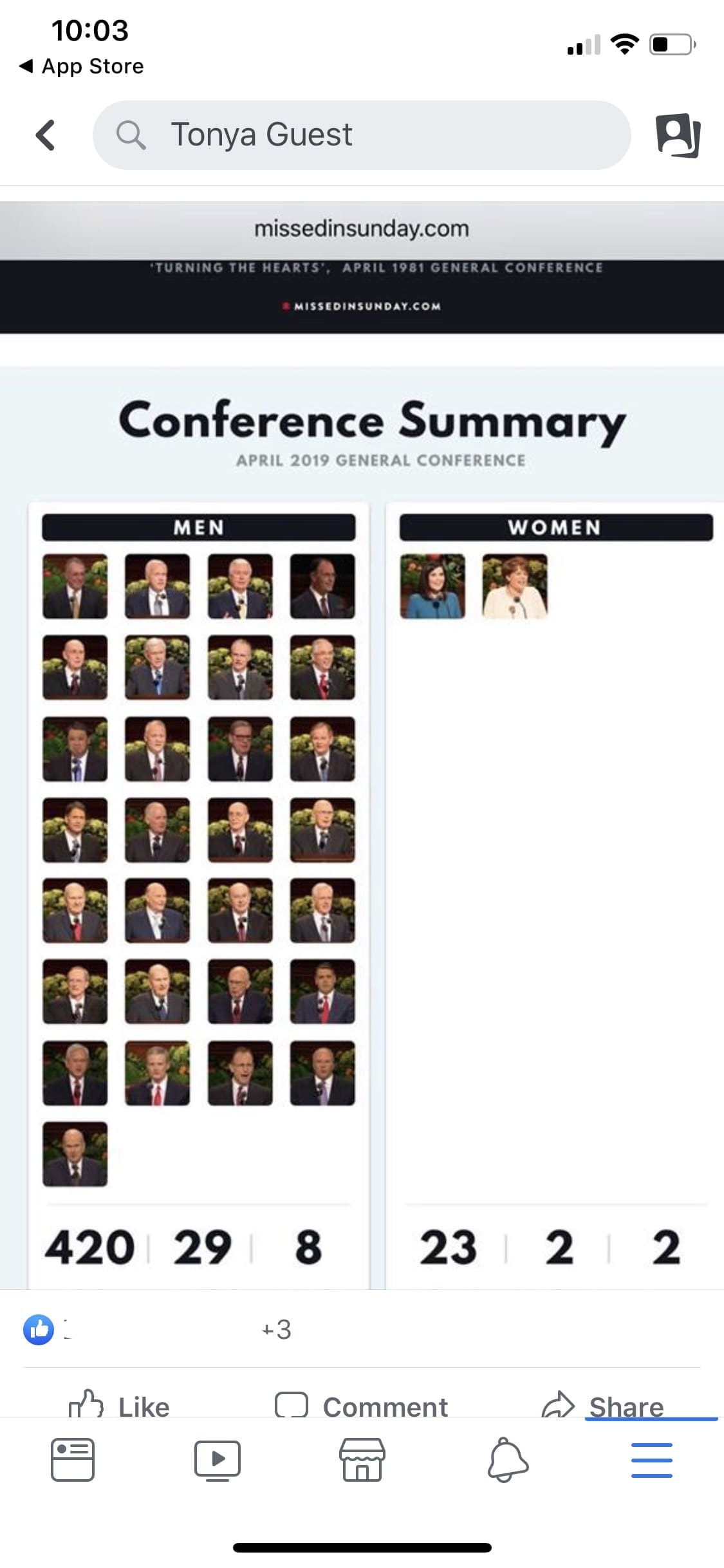
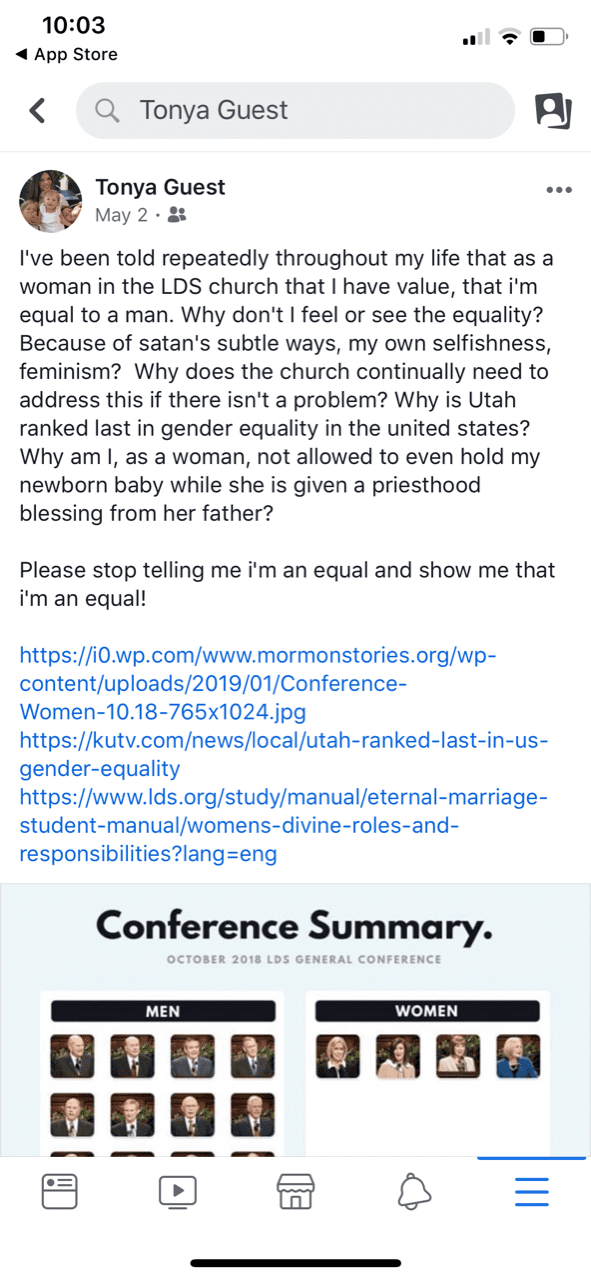
31 Responses
I’m so sorry for Tonya being bullied by her bishop. Every statement in his facebook posts were completely inappropriate and especially sharing items from private conversations even if he believes he’s a “watchman on the tower.” He violated every rule under the sun when it comes to privacy, decency, kindness, love, respect, etc. There could be many explanations of why he attacked Tonya; his own insecurities, the loss in his ward due to truth claims, his own arrogance, his own narcissism, etc. It’s also possible the reason why the stake president hasn’t met with her is due to “legal” reasons. We know that everything that is done in the Mormon church gets the blessing of their legal team/scribes. Just like the “reporting” of abuse, the handbook requires local authorities to call the church’s legal advisers first meanwhile the harm continues. In any case, it’s completely inexcusable for the stake president to not meet with her. This is LDS leadership roulette at it’s worst. Best of luck to Tonya and her family for being put through this despicable act of unrighteous dominion.
This was so horrible, my hands are shaking as I am commenting on this. Bishop L. needs to be reprimanded and pulled from his calling. He clearly has no respect for women or for the privacy that his calling demands. Bishop L.’s openly rude and misogynistic behavior has me fearing for his congregation and what he says and does behind closed doors.
Please update us as to whether or not Tonya’s stake president has bothered to get in touch with her. His non-response is as horrifying as Bishop L.’s shameful rants. I am concerned that Tonya has been threatened in some way as her May 2nd post has been removed from her FB account. If Tonya’s stake president continues to be elusive regarding this matter, or if Tonya has been threatened, please provide email addresses of the area presidency over the Herriman Stake so that we can send letters of sincere concern. Thank you!
Thank you for providing and maintaining the full transcript. Light is the best antiseptic.
I am so sorry! This was so triggering for me. Your Bishop and mine must of gone to the same training. So, so painful. Wishing you peace.
If her bishop would reflect and look at his own last name, then this situation will be different. He needs to change his name to bishop apathy.
Tonya seemed reticent to share any thoughts or feelings beyond what she shared on Facebook. John provided most of the commentary with just a lot of “right, right, I agree, yeah” from Tonya, starting and stopping any real comments (yeah, i mean……). I wondered if she was trying to minimize the damage to her reputation in the community while fearing future retribution like a “court of love” if she shared any tangible thoughts. I applaud her for her courage to bring attention to this issue and also encourage her to continue speaking her truth out loud, regardless. To Nathan, bravo for providing partnership over patriarchy in your home.
I am appalled by Bishop L. His behavior is one of the many reasons so many people think Mormons are weird. Think of all the people reading his judgmental comments along with the people who supported him. I live in an area where there are few Mormons. Trust me when I say that mormons don’t have a good reputation in my area and the public verbal abuse by this bishop and his supporters just validates people’s ideas about Mormons. It’s no wonder people think the Mormon church is a cult. Also, there is no excuse to treat anyone condescendingly, especially by a pastoral leader.
Also bishop L needs to study church history much deeper than Mormon apologetics/lds.org and come to the realization that many of the so called “lies” about the Mormon church are actually true and amazingly the lds church archives almost all of the evidence supporting the many disturbing church history issues in their own storage and research facilities.
Tonya – you seem like a very strong, amazing daughter of God, so I’m sure you don’t need my support , but I feel compelled to stand next to you and John and condemn the response and actions of this so called shepherd of God. I’m sure this bishop has good qualities and is not all bad, but the way he represented himself and treated you is one of the most disrespectful, demeaning responses I have ever come across from someone who is supposed to lead as Jesus Christ would. My prayers are with you and you are 100% correct that there are major problems with the church, historically and now and I pray God will continue bringing these things to light through brave souls like you, my wife, John Dehlin and so many more. I also hope your husband has seriously condemned this Bishops actions to his face and makes sure his actions are known to higher leaders that can take swift, immediate action to either pull him from his position or put him through the necessary disciplinary actions the church should have in place for things like this. Prayers are with you and your family. You have a tribe and support in us. Travis and Melissa Holding
This makes me mad in so many ways! Not only does he shame her on Facebook, he reveals confidential information. This Bishop needs to be released. If he thinks she is the only one in his ward feels the way Tonya does, he lives under a big rock. Even TBM’s feel that the church has a long way to come as far as a voice for women in the church. If I was in his ward, his comments would be enough to push me over the edge and I would not return until he was released, or ever. If he is not released for this, then it is another big red flag that there are so many problems within the church and they protect the MEN and let them get away with crap like this.
Thank you so much for sharing your story…wow, that bishop is unreal. I had a bishop-then-stake-president who was just like him when I was growing up in SLC..hearing the way he talked to you reminded me of my old bishop-stake president. I felt like he was back in my ear, talking with so much arrogance…yuck. There are lots of good guys as bishops, but there are many many like this one. The church has no way to weed them out, no training, no system to prevent such abusive behavior. So they will always be around..luckily more and more of us are leaving. They will soon be very lonely dictators.
Thanks again for putting your story out there !
Thank you Tonya for your courage in sharing this painful experience. I can’t imagine the far-reaching consequences for you and for your family of this Bishop’s public bullying and violation of your privacy – and of his betrayal of your trust in the position that the Mormon Church has given him. You and your family deserve much more than an apology from him and from the Mormon Church. I was touched by your asking, as the mother, to hold your baby during a church blessing – and felt sick to my stomach at the love withheld from you and your family when you were refused.
I think this conversation should not have taken place in public. There are women who think they should be equal in everyway but physideally and spiritually and mentally. I have always said that if a woman can-do as well or better than men and if that is what they choose. I do not know why God give the priesthood to men or why women where chosen carry the children. However and for what I have seen women are more nurturing thereby tempering life’s lesson and to raise their children in the gospel a thing which is rightous. To be honest the women stay and raise their families even as father’s disappear. To me that is the most importantly of the gospel that you are the gluethat holds the family together. There has been a lot of change over the last 70 years and used our prophet bringing about change as fast as the Lord gives it to him.And one more thing men are gross and we need refined women to baLance us out.You don’t really want to be equal to men do you because it is a long talk to get there. Let’s wait a bit to see what happens for God is giving us revelation fast as we can handle it and the Lord knows your desires.
But, Reid, remember that it is men who have given us the scriptures (Even B.H. Roberts in his book, about the Book of Mormon, said that it is very likely than Joseph Smith wrote the Book of Mormon.), and men want a god who is male. How else can men be controllers of women? Why didn’t women write the scriptures? The only reason you believe there is a god is because a man told you. Like in today’s politics, there is a strong Christian movement that tells us that Trump has been ordained to be president. And more and more people believe this because evangelical Christian males say so.
Tonya seems a bit fearful of the Mormon priesthood shown by her not being eager to answer John’s questions. She should be fearful. The Church is probably thinking about a disciplinary court on her right now. I thought it interesting that an earlier podcast on the Witnesses, as a JW talked about such a court with 3 white men but the LDS Church has how many? 15? Stake Pres, two counselors and 12 high councilmen? And they are white men. Never women.
Thanks, Tonya, for having the courage to be on this podcast. “Do what is right, let the consequence follow”. And, “That which can destroyed by truth, should be.”
Regarding the Bishop’s spelling/misuse of homonyms and pronouns: there is a disorder, which he has clearly demonstrated in his lengthy responses. Aside from available guides he could use, we should let this go. Let’s concentrate on his anger, his desperate need to shame, and his willingness, at the expense of the member, to ‘stay in the [sinking] boat’.
I know one prick I’d like to kick.
…Sorry, maybe that was too harsh, but that was initial reaction late last night after watching this. I was absolutely appalled by this Bishop’s abusive and un-Christlike attack on a member of his “flock” that he’s suppose to love and care for without judgement. I want to add, thank you Tonya for taking the higher road than this authority-drunk Bishop. I’m very sorry that you were a victim of ecclesiastical abuse and in such a public and demeaning way. Your story should be an Ensign article on the principle of “Unrighteous Dominion” warned about in D&C 121. A more perfect case study than this there could not be.
34 Behold, there are many called, but few are chosen. And why are they not chosen?
35 Because their hearts are set so much upon the things of this world, and aspire to the honors of men, that they do not learn this one lesson—
36 That the rights of the priesthood are inseparably connected with the powers of heaven, and that the powers of heaven cannot be controlled nor handled only upon the principles of righteousness.
37 That they may be conferred upon us, it is true; but when we undertake to cover our sins, or to gratify our pride, our vain ambition, or to exercise control or dominion or compulsion upon the souls of the children of men, in any degree of unrighteousness, behold, the heavens withdraw themselves; the Spirit of the Lord is grieved; and when it is withdrawn, Amen to the priesthood or the authority of that man.
38 Behold, ere he is aware, he is left unto himself, to kick against the pricks, to persecute the saints, and to fight against God.
39 We have learned by sad experience that it is the nature and disposition of almost all men, as soon as they get a little authority, as they suppose, they will immediately begin to exercise unrighteous dominion.
40 Hence many are called, but few are chosen.
41 No power or influence can or ought to be maintained by virtue of the priesthood, only by persuasion, by long-suffering, by gentleness and meekness, and by love unfeigned;
42 By kindness, and pure knowledge, which shall greatly enlarge the soul without hypocrisy, and without guile
There is something about this Church that seems to foster unrighteous dominion. That’s how I read this Bishop. That and an immensely smug sense of superiority.
A woman will never be equal with a man insofar as she continues to value the essence of manhood as the highest good. The very expression of wanting equality with men by having what men have is to acknowledge man’s superiority and the woman’s inferiority. And a man’s lack of value for the essence of womanhood as a lower good while getting what he wants from her will always keep him content, never wanting what she has, and wondering at the woman’s desire for what he has. Both man and woman are to blame. The man will try to dominate the woman while the woman will try to master the man. True or not, who ever wrote the story of the fall was on to something. It’s unfortonate Mormons have hardly tried to understand that story and worse, imposed their doctrine on it. And with certain temple changes it is now likely lost to Mormons for good. It’s a shame. If anyone was to get it, it should have been Mormons. That story holds the key to all this trouble with “inequality”. IMHO.
I don’t know any women who believe that the essence of manhood is the highest good, even if those women can see that the authors of the scriptures thought so, and those women are religious, and they picture God as a man.
I don’t know any women who believe men ARE superior, although they know that from an early age males seem to FEEL superior.
Most women know that sex is their main, but not only, value to men. If you are thinking there is such a thing as “penis envy,” you are nuts.
Most girls understand while still very young that most boys look down on them and would not want to be girls.
Many young girls think most boys are stupid or mean, and resent boys’ domineering and condescending attitudes toward them.
The only reason the average girl would want to be a boy is for the greater freedom from restrictions and the sense of entitlement and superiority that a world run by men gives him.
The only reason the average woman would want to be a man is for acceptance into the “good old boys” network where financial and political and other forms of power and influence are concentrated.
Women often try to master men when their men cannot manage self mastery.
What I “get” from the STORY of Adam and Eve and the Fall: Ever since God ran out of ribs and had to take one from Adam, men have had a strange suspicion that women owe them something. Ever since Eve listened to a snake, women have been accused of being delusional. Ever since Adam listened to Eve and fell from God’s presence, men haven’t been able to hear to a word women say.
The universal problem at the crux of this discussion is the continued influence that patriarchal and sexist religious traditions have on the cultures of the world. As long as people believe that ancient religions are their doorway to heaven, and as long as they believe that ancient religious writings are the word of God, ancient attitudes will continue.
Look at our own Christian legacy:
Genesis 3:16, “. . . thy desire shall be to thy husband, and he shall rule over thee.”
I Corinthians 11:3 (Paul), “But I would have you know, that the head of every man is Christ; and the head of the woman is the man; and the head of Christ is God.”
I Cor 11:7 (Paul), “For a man indeed ought not to cover his head; forasmuch as he is the image and glory of God, but the woman is the glory of the man.”
I Cor 11:8 (Paul), “For the man is not of the woman; but the woman of the man.”
I Cor 11:9 (Paul), “Neither was the man created for the woman; but the woman for the man.”
I Timothy 2:11-12 (Paul), “Let the woman learn in silence with all subjection. But I suffer not a woman to teach, nor to usurp authority over the man, but to be in silence.”
I Corinthians 4:35 (Paul), “Let your women keep silence in the churches: for it is not permitted unto them to speak; but they are commanded to be under obedience as also saith the law. And if they will learn any thing, let them ask their husbands at home: for it is a shame for women to speak in the church.”
Ephesians 5:22-24 (Paul), “Wives, submit yourselves unto your own husbands, as unto the Lord. For the husband is the head of the wife, even as Christ is the head of the church and he is the saviour of the body. Therefore as the church is subject unto Christ, so let the wives be to their own husbands in every thing.”
A predominant idea since ancient times has been that a man is entitled to respect just because he is a man. It was acceptable for him to expect, demand, or coerce respectful behavior from a servant, spouse, children, and subordinates in order to take charge and remain in charge. While most men in modern society today realize that they need to earn the respect of women, in the Mormon church, all males over age twelve are given some degree of Priesthood authority, along with the respect attached to it, simply as a right of passage, while Mormon girls or women have no such entitlement. Perhaps this accounts for the attitude of Bishop L. and other leaders like him.
If men run the church and the world, then women can only gain true respect and equality in the church or the world through them. Men have respect for those they see as worthy competitors, those who can measure up to, or exceed, them. As women have competed for and earned positions in traditionally male domains (the university, the workplace, the halls of congress, the board room, the military, the church hierarchy, and professional, competitive sports), men have been forced to acknowledge and respect their abilities outside of the kitchen and the bedroom. As with any marginalized group, women first have to secure political power in order to have their voices heard. Only as they have the power to influence or put forth legislation that addresses women’s issues, only as they take more powerful positions of leadership in our governmental, political, educational, business, financial, military, and religious institutions, will they feel that they have an equal say, that they are properly and equally represented, and that they are being seen and treated by men as truly equal, although different.
Not everyone is cut out to be a bishop, or any other leadership position.
John, this is my least favorite Mormon Stories episode yet. In fact, I’d have to go as far as to say I hated it. I thought the tone of discussion was extremely bias, unfair, and even cringy at times. You also spent way too much time and effort putting in your own opinions and conjecture while the interviewee sat there and said “right, right, right,…” , rather than allowing her to speak her own commentary. DISCLAIMER: I am an ex-mormon who agrees that there is much within the Mormon church that is unfair to women. With that being said, there is much that is wrong with this interview and topic. Here are a few points:
First of all, you are creating victimhood where there is none with the whole Facebook aspect. Facebook is only as public as you make it, yet the whole time you’re talking as if this bishop went on some TRULY PUBLIC forum, UNINVITED, and spilled her personals for everyone to see. When, actually, the day this girl “friended” her bishop on Facebook, was the day she gave him permission to be a part of, and comment on the posts that she makes. Regardless of yours or anyone’s opinion on whether his comments on Facebook where befitting of his position as bishop or not, he was totally within the realm of what should be an understanding of what Facebook is and how it works.
Next, this bishop is made out to be some evil guy who blatantly attacked this girl. The worst I think he did was possibly cross the line with some confidentiality breaches which I agree should be called out. However, with the way you set and built things up I was expecting to hear some pretty awful stuff; but to my own surprise, after you read aloud his initial and subsequent statements, I found them to be very much, shall we say, expected? All the while, you’re making a show of being completely surprised and disgusted at what he wrote. This, of course, has me confused, so I go back to listen again thinking I must have missed something. But no. All he was really saying is what I think any defensive TBM would say if you happened to poke them the wrong way. I could agree that maybe as a bishop he should have been more professional and taken a different approach, but if this would have been any other TBM not in a leadership role, it would be nothing more than a person making some rebuttals on Facebook she didn’t agree with. That’s it. End of story. But with how much offense you’re taking to his actions and statements as a bishop, one would think you, John, are still a TBM yourself; and we all know that’s not the case.
And let’s not forget, she DID open up this “can of worms” herself on Facebook. FACEBOOK! With the bishop as her “Facebook friend”!! We NEED to take responsibility for our own actions. I myself don’t post things on Facebook without the understanding that it IS semi-public and that there IS the possibility of my comments being bashed and derailed by even my own “friends” and family. Everyone should understand this.
Furthermore, I didn’t see anything wrong with his general theme of men and women being different and playing different roles. But you made him out as being some kind of misogynist for saying it. Look, I’m all for equal opportunity between men and women; at least as far as it’s possible; but let’s be real, men and women ARE different; are they not? And that is not to say at all that one is beneath the other. Just that they ARE different and that they compliment each other. They fit together like two puzzle pieces to make a whole; literally and figuratively.
Even if you don’t agree with such ideals, you have to acknowledge, everything this bishop is saying is through the lens of a TBM. Why would you expect him to say otherwise? You can’t expect the Mormon church or its leaders to think the way you think otherwise they are no longer the Mormon church as we see it; and they are no longer TBM’s. But then maybe that’s the goal of your podcast now? To tear them down? Not that I would care too much being an ex-mormon myself, but a lot of your content and approach is seemingly more and more “anti” over time.
The overall tone of this discussion seems to suggest that “one side” can have their view points and opinions, but ‘how dare!’ the “other side” voice their view points and opinions. Which is just WRONG. If we don’t have true dialogue, then what do we have?
Lastly, I didn’t appreciate how you read the bishops comments aloud with an overly aggressive tone making it out to sound worse that it would have if you would have just read it more neutral. This part was so cringy, I had to stop it to take breaks several times. Very unprofessional and bias.
I’m sure everything I’ve said could be mistaken as me defending this bishop wholeheartedly. Well I’m not. But we need to see and treat things as they really are. Or, at the very least, try to see and approach beyond our own biases.
I genuinely appreciate the feedback, Aaron.
I agree with Aaron to the extent that I think those who post things on controversial topics on Facebook should expect a response; I don’t think there is anything wrong in principle with a bishop sharing his thoughts on Facebook, even if they differ with a member of his congregation.
On the other hand, I found what the bishop had to say and how he said it every bit as egregious as John’s lead-up said they were. From his very first post, the bishop starts with an insult to Tonya by telling her what she thinks. That’s inappropriate, counterproductive, offensive and wrong for anyone, and even more so by someone in authority. And it gets worse as he goes along as the insults become more blatant. (I agree with Aaron that it would have been better for John to let the posts speak for themselves. I think most of his listeners are smart enough to recognize bullying when they hear or see it.) Let’s just say that if I were the stake president I’d be looking for a new bishop.
My best wishes for Tonya. I appreciate that she refused to stoop to the bishop’s level and managed to act gracious even when under attack. I hope she finds whatever answers she is looking for.
And for what it’s worth, I’m glad that bishop isn’t mine. (I’m an active member with progressive beliefs.) To judge from his worship-the-prophet mentality and right-wing political postings on his public Facebook page, I wonder if I’d be welcome in his ward.
I think the things Aaron mentioned sound a little extreme and crazy. After watching the podcast, I didn’t perceive any of these things Aaron mentioned. Tonya and John were simply just sharing how they perceived the Bishops comments. I agreed with the majority of what Tonya and John said in the podcast.
In my opinion, the Bishop should be released from his calling, if he hasn’t already. I think he should appear before a disciplinary council and be lectured on how he should’ve handled the situation differently. I also think he should be lectured on the equality and rights of women from a pro-women perspective.
Based on Tonya’s Facebook and podcast interview responses, I think she handled herself really well. I don’t think she should’ve done anything differently.
I loved listening to this and have found great truth in many of the discussions in the podcast and in the comments. I feel for Tonya and see where she’s coming from. She didn’t deserve that, even if she chose to friend the asshole and make the comments. Just like walking alone in a bad part of town, I do agree with Aaron and Eric that she should have expected it. I completely disagree that she deserves it, or it was a consequence of her actions, but expect it nonetheless.
This is exactly what the 15 (and hundreds of dead ones) have told bishops to be. They are the judges and will be responsible for the sins of their people if they don’t call them to repentance. I’m actually shocked that everyone one of them ISN’T like this, or worse. I mean if you truly knew (beyond a shadow of a doubt, like they like to say) that you will be accountable to a god of unthinkable power for people like Tonya and her public apostasy, you would act like this too. But most already know, at least subconsciously, that it isn’t true.
Don’t get me wrong, though, this is just one more piece of evidence for me that people are actually good despite religion-not because of it.
Sorry, the “text of the email from a concerned listener” has no business being on this page. The closing statement: “Unfortunately, my current familial and professional obligations make me uncomfortable disclosing my identity and taking a public stand against a Church that justifies, encourages, and protects leaders like you” should eliminate this letter from any sort of publication.
So, let me get this straight, you go along with the Church because you benefit personally and professionally but you’re not willing to take a stand because it might cost you? Keep lobbing those stones from the front yard of the property containing your glass house. Write the letter again when you develop the courage to stand for something.
Thank you, Bishop Love, for confirming, once again, that my decision to leave the cult founded on a hoax by hucksters; which you represent, was the right one. I hope every member of the LDS Mormon church reads your responses on her Facebook post. Most will see that there’s no “Love” in them.
I actually feel bad for the bishop. All those long meetings with her. Unpaid, untrained, and doing the best he can. Time away from his own family and doing the things he wants to do to in his own personal life to answer her questions for what? Celestial glory? I don’t know about that.
I enjoyed reading your comments. All of you have valid points for readers to consider. I am most inclined to agree with the wisdom of OLD DOG. “As long as people believe that ancient religions are their doorway to heaven, and as long as they believe that ancient religious writings are the word of God, ancient attitudes will continue.” This OLD DOG is capable of learning new tricks! (Maturing) That is a compliment and I hope you will take it as one! I enjoyed the Adam and Eve analogy.
Unfortunately, I am sad to say, that in my experience, the behavior of this Bishop is characteristic of Mormons in the “faithful” stage or what is referred to here as a TBM (True Blue Mormon). The priority in this stage is to be faithful, Loyal and obedient to the covenants they have made, to the LDS Church, no matter what. Christ-like love is not the priority. Do they know how to extend this kind of love in this stage? This stage seems to be more about judgment, punishment and rewards. Behavior from a member in the “faithful” stage can be “bewildering” to a member who has moved into a “logical” stage where the truth is more important than obedience. Logic upsets the “faithful” member. I don’t even try to reason with those that are in the “faithful” or TBM stage. They don’t want to hear it. The only thing that matters to them is that their submission will bring them “promised” rewards, if not in this lifetime, in the world to come. Some people never grow out of this stage.
Bias. I understand the opinion of staying unbiased in reporting. In writing down some histories and spiritual experiences for a family member, who said that she did not want these experiences to be made fun of, I wrote them exactly as she told me, without interjecting my biases. Yet, what are the guidelines for this podcast? I would think that it is permissible to include John’s perspectives in Mormon Stories. Talk-show hosts do the same. And what is a Mormon Story without emotions? (I just barely started listening.) If the purpose of some of this podcast is to support members in a faith-crisis or faith-transition, then how they feel about what happened is important. Sometimes, people won’t talk unless asked. John’s tone in reading the Bishop’s remarks was a surprise to me, at the same time, I had to laugh because the tone was exactly how I have been spoken to by True Blue Mormons. I tend to avoid them or at least refuse to talk about religion because I want to avoid this kind of upset.
Authority. We consult with authorities outside of ourselves because we have been told to do so. Yet, what is the use of that? Lindsay Hansen Park comments very briefly on the sickness of following professed authority in podcast 551 where I learned about Year of Polygamy and John Dehlin in podcast 1158 THRIVE CONFERENCE, mentioned Jesus and the scripture in Luke 17: 20-22 KJV, “The Kingdom of God is within you.” John said, “I’m OK pointing at any Guru who points you back into yourself.” We can’t see that the real authority is within ourselves. Those in the “faithful” stage must be faithful to outside authority. And if they are the person in authority, those under their “jurisdiction” must be faithful to them and their advice. And yes, sometimes they exercise unrighteous dominion.
FACEBOOK I am not a member of FACEBOOK because people can be vicious!
Wow…this saddened me to listen to. Not necessarily due the back & forth with the bishop, which is also sad. But mostly because it seems your entire faith journey had been uncomfortable and unfulfilling…from wedding to baby blessings to not being given clarity to your very real questions.
Being a part of the church of Jesus Christ is supposed to be healing, joy full & life giving….I assure you it’s not supposed to feel like that. So you’re right to be questioning things. Keep seeking clarity until your mind and soul are at peace.
I encourage you to look deep into the history of the church, back from the very beginning 2000 years ago… you will come to find there has always been one true church, that was established by the apostles and has preserved the full truth from the very beginning. This is the Orthodox Christian church, or also known as the ‘ancient faith’.
You seem like an incredible young woman, I usually never comment on things but couldn’t help myself after listening to this. May God bless your journey, I imagine it likely won’t be easy for you but it will be well worthwhile… pray & keep seeking the full truth about God and his church, if there is someone worth seeking after it’s God.
Much love from a fellow young female in Canada 💗