
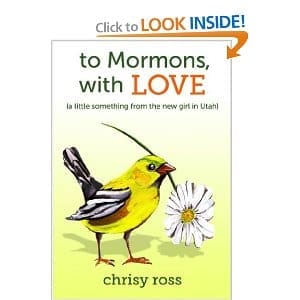
 Chrisy Ross is a delightful writer, mom, runner, and outdoors aficionado who has lived in an idyllic Mormon town near Salt Lake City since 2002. She and her husband and three sons are not Mormon. And they enjoy their small-town Utah life. Chrisy has written numerous articles for LDS Living about living in Utah as a non-Mormon.
As part of the Mormon Stories Book Club series, Heather Olson Beal—along with readers Brent D. Beal and Rebecca Mauldin—interviews Chrisy Ross about her book, To Mormons, with Love, and about her life as a non-Mormon in Utah.
When Chrisy Ross and her family moved to a small-town LDS community — one she affectionately refers to as Mayberry — she underestimated her readiness as a nonmember for what turned out to be a cultural immersion. Sure, she knew Mormons didn’t drink caffeine (cough), and they never swore (double cough), but life with family-centered folks would be cozy and wonderful. She could smell the fresh-baked bread just thinking about it.
Join her as she honestly, humorously and lovingly describes her quest to find someone with a real panty-line problem, requests her LDS friends baptize her — after she dies — and considers her dad’s suggestion to become a Jack Mormon. Although not a convert after reading the literature, Chrisy develops an understanding and respect for a widely misunderstood religion and has found a comfortable spot in her town, the community and the culture.
To read more of Chrisy’s work, click here.
Please support Chrisy , the American Fork Arts Council, and Mormon Stories by purchasing the book through this link.
Episode Transcript
Host: Heather Olson Beale · Guests: Brent Beal, Chrisy Ross, Rebecca Malden
This transcript is machine-generated and lightly edited for readability. The audio is authoritative. Please excuse occasional errors in names and spelling.
Welcome and Introducing the Episode
Heather Olson Beale [00:00:00] 1, 2, 3.
Chrisy Ross [00:00:07] Mormon Stories Podcast is a production of
Brent Beal [00:00:09] the Open Stories Foundation. All donations to Mormon Stories are fully tax deductible and go directly towards keeping the podcast alive and towards building a community of support for Mormons like you. To support the podcast or to join the community, please become a monthly subscriber
Heather Olson Beale [00:00:26] today@mormonstories.org okay, hello, everybody, and welcome to another edition of Mormon Stories Book Club Podcast. I'm Heather Olson Beale, and I'm here with what I hope is going to be a really fun group of people. And we're here tonight to talk about the book to Mormons with love, A little something from the new girl in Utah, which is written by Chrisy Ross. So Chrisy is here. You want to say hi, Chrisy, Hello. And I have with me two readers, Brent Beal. Say hi. Brent is my husband, and he's on the other side of the house. And Rebecca Malden. Say hi, Rebecca.
Rebecca Malden [00:01:06] Hello.
Heather Olson Beale [00:01:07] And I don't really know Rebecca at all. I believe that I posted in a Facebook group like, hey, I'm looking for somebody who wants to read this book. Rebecca, does this sound like I made it up or not?
Rebecca Malden [00:01:19] No, I'm pretty sure that's exactly what happened. I said, I'm excited to listen to that, and you said, why don't you be on it?
Heather Olson Beale [00:01:23] Okay, cool. And I actually think that there was. This is embarrassing. In case someone listens to this, someone else or maybe one or two other people said they were interested, and I actually mailed a book to someone. This is embarrassing. I shouldn't be saying this. And I don't remember who that person was.
Chrisy Ross [00:01:39] So
Heather Olson Beale [00:01:42] this is my apologies since I don't remember who you are if you wanted to be on this, but lucky you, you got a copy of the book. Need to get more organized. Anyway, Rebecca is here, and this is a really cool, fun book. I think that I read a little, like, an excerpt or a little article about it in LDS Living. Could that be the case, Chrisy?
Chrisy Ross [00:02:05] Yes. Okay. There was a feature article when the book first came out, but that was two years ago.
Heather Olson Beale [00:02:12] Okay, well, that means I either read it really late or I ripped it out and saved it or something.
Brent Beal [00:02:17] I don't know.
Heather Olson Beale [00:02:18] But I found it and contacted Chrisy a while ago and got some copies of it. Read it. It's a really neat, really neat, fun book. So I'm excited to talk about it. So let's just get. I'm gonna ask Brent, you first, and then Rebecca, if you guys want to just tell us a little bit about yourselves and then Chrisy will get a little bit more information from you. So Brent, tell us a little bit about who you are.
Brent Beal [00:02:40] Sure, let's see, any particular angle? I mean, I'm married to you.
Heather Olson Beale [00:02:48] That's all that counts.
Brent Beal [00:02:49] That's all that counts.
Heather Olson Beale [00:02:50] No, I'm just kidding.
Brent Beal [00:02:52] We blog at Doves and Serpents. That's fun. I teach business. I teach corporate strategy at a school here in Texas, University of Texas at Tyler. And I really enjoyed the book.
Heather Olson Beale [00:03:08] All right, cool. Okay Rebecca, you want to tell us a little bit about you besides that you responded to a Facebook requests from me?
Getting to Know Chrisy Ross and Her Background
Rebecca Malden [00:03:17] Yeah, I am from Seattle, well, near Seattle. And I am not lds. I'm actually Catholic, proud papist. I'm married to a former Mormon and he has a large, very Mormon family that I spend a lot of my time with and religion sort of a hobby for me. So that's how I ended up in Mormon Facebook groups. And I really enjoyed the book. It was really entertaining and lots of fun to read about someone else who is surrounded by Mormon culture.
Heather Olson Beale [00:03:50] All right, cool. Okay Chrisy, give us a little bit, tell us some things so we can get to know you a little bit.
Chrisy Ross [00:03:59] Well, I have lived in Utah now for 11 years. My husband and I and our three sons, two when we first moved here. I was raised in a small town in Indiana in the Midwest. My parents were probably agnostic is the best way to describe them. We went to church on Easter and Christmas, you know, amateur night and
Brent Beal [00:04:24] just
Chrisy Ross [00:04:25] to a non denominational Main Street Christian church. As an adult I pursued religion and had a full immersion baptism. As an adult became just a non denominational Christian. I don't like to use the term evangelical because I think there's negative connotations. People are always curious about my religious background but and now I am. I refer to myself as a quiet questioning Christian. We don't attend church on a regular basis but I'm familiar with all the materials. So yeah and I've been a technical editor and writer prior to becoming a mother. I worked for an airline. Always written creatively and to Mormons. With Love is my first published book. It's a little project that was important to me and personal and I've written for LDS Living. I continue to write for their website as a non member voice and their light pieces, their humor, you know, commentary on LDS culture from non member's point of view. That's not a kick in the knees but is honest. But with done, I hopefully it's perceived as done with respect.
Heather Olson Beale [00:05:41] So okay. And you do that regularly? A column?
Chrisy Ross [00:05:44] Well, you know, it's not irregular. Just when I feel inspired or they have an idea, they'll contact me and say, do you want to tackle this one? Or so I have to say. I'm getting a little. I don't know what else I can say, do you know what I mean? On the topic, I feel like it's just important to be respectful, especially since I'm not a member.
Heather Olson Beale [00:06:06] Okay. Okay. And so you, you're a full time, full time rider?
Chrisy Ross [00:06:14] Well, yeah, I'm not paying the mortgage, but yeah, that's what I do. Okay. And mother, I take care of the kids. I'm the primary caregiver in our home for our kids.
Heather Olson Beale [00:06:24] And how old are your kids? Is that fair game?
Chrisy Ross [00:06:27] Of course. I have three sons. 15, almost 16, 14 and eight. Three boys. They're great boys. My two older ones just happen to be type one diabetics. People always find that interesting. But they're great, healthy, bright boys and happy living in Utah. But we can talk more about that later.
Heather Olson Beale [00:06:48] Okay, cool. All right, so I'm gonna just read what's on the back of the book to kind of set it up for people if they aren't familiar with it. And then I'll ask you to kind of tell us a little bit about. Kind of like I always want to strike a balance. I don't want people to like, you know, give away all the gems that are in their books. But if you could just sort of tell us the setup, how you kind of move into Utah and give us a little bit of that, give us a little bit of the flavor for that. So let me just read this little snippet on the back. So it says, who wrote this, Chrisy? Who wrote this thing on the back? I was gonna say who wrote it?
Chrisy Ross [00:07:29] The. The description of the book.
Heather Olson Beale [00:07:31] Huh?
Chrisy Ross [00:07:31] Yeah, it was a collaborative effort. I worked with an editor, you know.
Heather Olson Beale [00:07:37] Okay, okay. So it says on the back. When Chrisy Ross and her family moved to a small town LDS community, one she affectionately refers to as Mayberry, which I love, she underestimated her readiness as a non member for what turned out to be a cultural immersion. Sure, she knew Mormons didn't drink caffeine. Cause cough and they never swore. Double cough. But life with family centered folks would be cozy and wonderful. She could smell the fresh baked bread just thinking about it. Join Chrisy as she honestly, humorously and lovingly describes her quest to find someone with a real. With a real panty line. Problem requests her LDS friends baptize her after she dies and considers her dad's suggestion to become a Jack Mormon. Although not a convert, after reading the literature, Chrisy develops an understanding and respect for a widely misunderstood religion and has found comfortable spot in her town, the community and the culture. So I thought that was a nice little, a nice little summary. So tell us a little bit about ending up moving to Utah and kind of what that was like.
Moving to Utah as a Non-Mormon Outsider
Chrisy Ross [00:08:42] So moving to Utah was a job related move for my husband. We came here from Castle Rock, Colorado, which is near Denver. And the man that my husband, his boss in Colorado, moved to Utah for a job called my husband. Hey, I think this would be a good fit for you. The job was in Provo. My husband's former boss and current friend is a member of the LDS Church and he said, hey, have you guys been to Utah? Do you think you'd be happy here? Regardless, Chris took the job and we ended up in Utah. As we looked for homes, people advised us that we might want to look in Salt Lake county versus Utah County. And for people outside of Utah that don't know it, there's kind of a dividing line. Salt Lake county is considered more religiously diverse than Utah County. We ended up moving into Utah county into a small town that I don't think it could be more lds. I really don't. I think I'm. There's half a, there's another half a human being somewhere here that is not a member of the church. And you know, my husband and I both had exposure to Mormon friends and business acquaintances. And I don't know, we just didn't think it would be a big deal. And as we were house hunting, we fell in love with the town where we live because it's so beautiful and quiet and it clean, there's running trails. We both run and ride mountain bikes. And I tried to diplomatically ask our realtor, you know, hey, you know, is there a little diversity here? You know, I just, just curious. And they dodged the question, which legally they have to do, but they dodged it directly. But they also both the, the, the realtor of the builder where we purchased our home and our buyer's agent gave us the impression that, gosh, not only was Alpine a little more religiously diverse than other places in Utah County, I live in Alpine. I just disclosed that, oh, well, I've disclosed it at other places, but that, oh, you know, Oprah Winfrey's even building here. And we just got the impression that it would be predominantly LDs, but that there would be other people who weren't members. And that just wasn't the case. So I kind of joke in the book that ultimately we landed where we landed. It was an accident. Although, I don't know, looking back, if someone had told me, you're probably going to be the only non member family in your ward, that I don't know if we would have not chosen to move here. But I did expect to find other relationships and families that weren't members.
Heather Olson Beale [00:11:34] Okay, so can you kind of go back? You said it was 11 years ago. Mm. And do you remember kind of how it seemed to you as an outsider once you. Once you kind of moved in and got settled there? Like, did you. Did you feel like you were always thinking, wow, this is weirder. People are using strange language or I mean, just kind of. What was that like initially?
Chrisy Ross [00:11:58] Not at first. Initially it was really dreamy. I call it the honeymoon phase. I mean, it's beautiful. Utah is a beautiful state. Just about anywhere. It's a really pretty state. And this town is so pretty. And everybody was very kind. You know, it was just kind of dreamy, honeymoonish. And I wasn't asking who was and who wasn't LDS at first. So I don't know. Three to six months of this is great, great. And our neighborhood was filling in with new families and it was pretty dreamy. And. But then I started. It became really clear that everybody assumed we were lds. And by calling me Sister Ross, the assumption was that everyone was lds. And it. I just. My focus was honed in on everything Mormon at the grocery store. I just. It's like when you're pregnant, all you see are pregnant people. All I saw were indications of church membership everywhere around me and made me a little paranoid. And even though. And I. And that's. This is one of the reasons I wrote the book. I really created the majority of my own problems. Nobody was blatantly unkind to me or chastised me about anything. But I developed some paranoia because I felt like I was only a missionary opportunity. I was suspicious that I was only a missionary opportunity to people. But as far as just like things that jumped out other than Sundays were like Christmas Day. Every Sunday's like Christmas Day around here. It's like, you know how on Christmas Day the world kind of shuts down and it's what it feels like here. It's like every Sunday feels like Christmas Day. And at first that was neat. And then it started feeling like an irritant. I started feeling irritated.
Brent Beal [00:13:54] Can I. Sorry, can I jump in real quick?
Chrisy Ross [00:13:57] Sure.
Brent Beal [00:13:58] There's just a part of the book that I wanted to read. Chrisy was just talking about it. Can I. Can I read a paragraph? Is that okay?
Heather Olson Beale [00:14:05] Of course.
Brent Beal [00:14:06] Chrisy said. I mean, these are your words. Chrisy, you say. I felt like Gladys Kravitz as I looked out our windows, sizing up the new folks unloading boxes from trucks or walking by on the sidewalk. And this is part. I assume this is you describing what it was like watching the neighborhood kind of fill in and hoping that there would be some non Mormons moving in. Says it became a game, searching for one family like us, new from out of state and not Mormon. A few times I thought this might be the one. They're from Minnesota. He went to graduate school in Boston. They have only three kids. My hopes were always shattered. Dope. They met at byu. Damn it. Never failed.
Heather Olson Beale [00:14:45] It's true.
Chrisy Ross [00:14:46] It's true. Oh, gosh.
Heather Olson Beale [00:14:49] Do they have a wine rack?
Chrisy Ross [00:14:50] Oh, do I see a Coke?
Heather Olson Beale [00:14:51] Makeup?
Chrisy Ross [00:14:53] Never. Not a once.
Heather Olson Beale [00:14:55] That's awesome. Brent or Rebecca, did either of you guys want to jump in?
Brent Beal [00:15:00] I have a question, though, which is related to this. Chrisy. So you move in and you discover that. And I like the way you've set up the book, too. I mean, you have it kind of described. You have in the beginning where you talk about kind of the honeymoon period, and then kind of this period of paranoia where you start to kind of notice that things are kind of odd in certain respects. But I thought it was interesting. On page 30, this is in the Irritation and Paranoia chapter where you have this entertaining little paragraph. You said, when the doorbell rang in the evening and I had a glass of wine poured, internal sirens would blare in my head. I was like a running back, shoving my kids out of the way so I could hide the glass in a cabinet, grab a piece of gum, and fluff my hair before answering the door. I just thought that was interesting. So could you comment a little bit on. I mean, did you feel. I mean, the way you've described it, it's almost like you felt a tangible kind of pressure to conform to cultural norms that are originating in a religion that's not yours. So, I mean, I was kind of surprised that you would have even cared. I mean, it wouldn't have surprised me had you just gone to the door with a glass of wine and just thought, well, hey, I'm not Mormon. People drink wine. How did you kind of manage that? I mean, did you feel some pressure to at least look Mormon on the outside?
Chrisy Ross [00:16:26] I wouldn't say that I Felt pressured to look Mormon. It really was rooted in. I wanted to be respectful. And as I was trying to figure out, would people judge me? Would people allow their children to play with my children if they knew that I drank alcohol on occasion? Not a big, sloppy drunk with a cigarette hanging out of her mouth, but, you know, not that there's anything wrong with that. I really. I really desired to be accepted and I guess liked and wanted my kids to be accepted and liked. And I was. I was just paranoid and just concerned that. I remember one time my parents, they brought us a bunch of beer because, believe it or not, in liquor stores here, beer is so expensive. And we're not big beer drinkers, but sometimes we have someone who is in the home, we want to offer them a beer. So when my dad comes up from Arizona, hey, honey, do you need anything? I said, oh, you know, throw. Get some just regular light beer. Just Bud Light or Coors Light, because it's expensive. They don't even sell it at the regular liquor stores. And it's three, two, and the grocery, yada, yada. So he had just come up and brought way more beer than we needed. And it was in our garage, and I threw a big blanket over it because I was so embarrassed. And there was somebody working on our house in our basement. We were having our basement finished, and he went out in the garage to get something, and I saw him lift up that blanket, and I gasped. I'm like, we're not members of the LDS Church, but we don't really drink all that beer. And he just looked at me and laughed. He goes, it's okay, you know, I don't care. But I really was. I was really worried that I would offend somebody, which was silly. That was me, though. Nobody said, put your beer away. Put your wine away. It was me.
Brent Beal [00:18:10] Rebecca, I mean, you said that your husband has a big Mormon family that you kind of hang out with or spend a lot of time with. Do you feel kind of the same? Same sense of. I don't know how to describe it exactly, just kind of wanting to fit in and kind of being afraid of stepping out of line, so to speak.
Rebecca Malden [00:18:33] I used to feel it more than I do now, I guess. I used to be really conscious. The first time I met his parents, I was wearing a tank top. And that was really uncomfortable for me because it was an accident that we ran into them. So I used to be really conscious. I wouldn't order drinks when we were out, even if it was a situation where I normally would. And I wasn't the only. Even if I wasn't the only person there and other people were ordering drinks, the only non Mormon, I still wouldn't. It was definitely present, and it still is to a certain degree, especially when I'm the only non member. But not to the degree, I guess, that it was expressed in the book, because when people come to my house, we have a giant wine rack and a coffee pot and lots of crucifixes hanging on the wall, actually. But I definitely identified with her feeling. And she kept saying in the book that it was her own creation. And I felt the same way. Like, at times I felt like I was kind of being crazy for this. Like, why am I concerned that I'm wearing a tank top? If I was in any other situation, I'm not immodestly dressed by anyone else's standards, but by my mother in law standards, I am. So it was just very strange. And I don't want to say my mother in law caused it or my family members caused it, but it was definitely present in my head. I was conscious of it all the time.
Brent Beal [00:19:59] Mm. And I love this image of Chrisy of you turning into a running back.
Rebecca Malden [00:20:04] Yeah, that was hysterical.
Chrisy Ross [00:20:07] Get out of the way, kids. Move it. Rebecca, I want to ask you, if you don't mind. So when you said you also chose not to have a drink if you were at a restaurant, even if there were other, where was that decision rooted? Was that rooted in your not wanting to be judged, wanting to be respectful? You know, that choice, that choice, where was that rooted? Because I feel like that's what I get asked too. And you're not the first person that's asked me that, Brent. Like, what is that rooted in?
Navigating Mormon Culture and Social Dynamics
Rebecca Malden [00:20:40] I mean, I want to say it was a really conscious decision to be very respectful of their beliefs. I would love to say that, but I think a lot of it was I didn't want to answer questions. I didn't want to deal with any weird looks or judgments that may come my way as a result of ordering a glass of wine or a beer. So I think it was sort of a mixture of the two. I did want to be very respectful, and I especially early on, and I try to be very respectful when I can be. But there was also definitely a part of me that didn't want to be judged, didn't want to be called out as different, didn't want it to be recognized that I was not a member of the club. I guess at times, yes.
Heather Olson Beale [00:21:26] That's interesting to me that people who aren't Mormon would feel compelled to have to sort of, you know, abide by Mormon standards. Although maybe it's just whoever has the most conservative, you know, or the, you know, the tightest. The tightest boundaries gets to make the rules in those cases. I don't know.
Brent Beal [00:21:49] Or whoever's in the majority. I see it more just along the lines of social norms. I mean, social norms are very powerful things. You know, Heather and I, we just visited Tokyo, and it was interesting to me how concerned we were at times about, okay, what is the social norm in this situation? And then we were going to follow it. I mean, in Tokyo, the Japanese don't usually walk on the street and eat food. I mean, you wouldn't see somebody, you know, eating a hamburger walking down the street, typically. And so we didn't do that. I mean, once we kind of picked up on that norm, then it would have made me very uncomfortable to do that. And I think maybe it's a similar kind of thing. I mean, you just.
Chrisy Ross [00:22:33] That's exactly what it is. That's exactly what it is. And I also think that it's. We're conditioned with our social norms to be polite. You know, I was raised to be polite and courteous and not be a doormat to other people. But that's part of our culture, I think, in the United States, generally speaking.
Brent Beal [00:22:56] And it's tough to break a social norm if, you know, you're breaking one. It's very uncomfortable. I mean, I've felt that at times.
Chrisy Ross [00:23:05] Yeah, I think that's fair.
Heather Olson Beale [00:23:07] Interesting.
Brent Beal [00:23:10] Can I point one more thing out in part one of the book? I mean, there's so many things that we got to talk about. We for sure have to talk about the different types of. Of Mormons. Right. Where is that?
Chrisy Ross [00:23:22] Mormons on sabbatical.
Brent Beal [00:23:23] Mormons on sabbatical. Yeah, we have to talk about that for sure. And there's a few other things. But before we get out of point, is that. Okay, Heather, can I raise.
Heather Olson Beale [00:23:31] Yeah, you're good.
Brent Beal [00:23:32] Okay, well, on 43, I wanted to talk about this underwear problem, because I've been through that just in reverse. Chrisy, you want me to read that, or do you want to read that?
Chrisy Ross [00:23:49] Which part?
Brent Beal [00:23:50] That's on page 43 when you're at the therapy session.
Chrisy Ross [00:23:54] Oh, yeah.
Heather Olson Beale [00:23:56] Brent, maybe you shouldn't read that.
Brent Beal [00:23:58] Well, I was asking. Maybe, you know, someone else wanted.
Chrisy Ross [00:24:00] Oh, it's okay. No, you can read it. You have a better voice than I do, Brent.
Brent Beal [00:24:05] Oh, you do? Now I'm going to be uncomfortable Reading them. But I. But I'll read it. That's fine. Kristi, do you have the book?
Chrisy Ross [00:24:13] Okay, I will read it. Where do you want me to begin?
Brent Beal [00:24:17] Maybe on just on the top of page 43.
Chrisy Ross [00:24:20] All right. My therapy session was finished and a female intern was summoned to wrap my leg. The guy explained that if I needed to go home to get underclothes, they could wrap tightly over anything. I said, thank you. He left the room and the young woman entered to wrap my leg. I was getting, side note, physical therapy for an injury to my thigh. And there's a wonderful physical therapist in our community who I refer to as the guy in my book. Anyway, do you want me to just lift up my shorts? I asked. No, you're going to have to remove them. I need to wrap this around your hips too. If you need to put something else on before I wrap, I can wait. Just so you know, I'm not lds. Before I pull my shorts down, I should also tell you I'm wearing green underwear with white polka dots. Sorry. I was mortified that my underwear would reveal my non member status. At least they were bottom covering cotton and not the skimpy, racy variety. Smiling, the woman said, you mean there are two of us in this town? Anyway, yeah, it was. I was not wearing garments and that made me feel embarrassed at the time.
Brent Beal [00:25:27] I also like the way you did on the previous page when you're talking about the guy trying to place you on the ward. You know, you have that in a couple places. Thinking, thinking, thinking brow. Keep asking. He's asking for additional information. Yeah, I just thought that was. I mean, I laughed out loud at the description of it. And I've been in exactly the. Just that exact same type of situation, but in reverse. Oh, so very familiar with that. And again, it's just. It's just you're like. You're afraid of breaking norms in a way.
Chrisy Ross [00:26:02] Exactly what it is. If I could have twinkled my nose and had garments, I would have done it that day. Like, how can we do it?
Heather Olson Beale [00:26:10] Oh, Chrisy.
Chrisy Ross [00:26:11] I know what's interesting about that though, and this is just when I was getting therapy there, everybody assumed that I was a member. And it's not that people discuss things that were secret, but there was a very candid discussion about church related things that my hunches wouldn't have occurred had they known I wasn't a member. And you know, I'm just being descriptive. I don't think that's good or bad or right or wrong, but that's Just how predominant the church is here in our particular town.
Heather Olson Beale [00:26:52] Mm. So the assumption is just, you live here, so you're Mormon, and so we share all this. Yeah.
Chrisy Ross [00:27:00] Yeah. I had. I had a miscarriage several years ago here, and the nurse that was helping me started telling me why. Heavenly Father, you know, just made the assumption that I was LDS and about why that spirit probably didn't wait. I was at a place that I. I knew her intentions were really coming from, a kind place, but I could have been very offensive to somebody else.
Heather Olson Beale [00:27:32] Sorry. We're getting a little bit of feedback on someone's. I don't. I'm not sure. I feel like it's. Can you guys hear me?
Chrisy Ross [00:27:41] Yes.
Brent Beal [00:27:41] Yeah, it's great. Now the feedback's gone.
Heather Olson Beale [00:27:44] Okay. Okay, let us. I'm gonna switch gears a little bit. Brent has a list, literally, of, like, 25 funny things he wants to talk about. So, Brent, you're just gonna have to sort of interject when these things come up, if you want.
Brent Beal [00:27:58] I'm fine.
Heather Olson Beale [00:28:00] Rebecca and I both had. We kind of each came up with some questions, and we're both wondering, as you were writing it, Chrisy, kind of if you were thinking of a target audience or were you just writing it? You know, were you thinking, this is. This is going to be for Mormons or for non Mormons or anybody?
Chrisy Ross [00:28:17] It evolved initially. And the book that. The little book you have in your hand is a third of the content, the original manuscript. So I have a lot of stuff I didn't include. So I originally wanted it to be for non members and members, more of a national audience and some beta readers. The non members weren't that interested. Religion fascinates me as a whole. And then after workshopping it in a writing class that I was taking, I just decided to write it specifically to Mormons. And the reality is, Mormons members of the LDS Church were always interested. Once they found out we weren't members. What's it really like? I mean, they seemed really interested in my experience, in my perceptions. You know, who, you know, did I have experiences with people making me uncle. Like, how are we doing? How are people behaving? How are you being treated? I can't tell you how many times I was asked that whether somebody was coming to work on a landscape light or. And, like, without. Very rarely did somebody come and do work on our home or help me with something that wasn't a member of the church. And then they would kind of look around the house and see some visual signs that we maybe weren't anyway, when it came out that I wasn't Sister Ross, without exception. Wow. How did you end up here and what's that like for you? How's that working? So I kind of ultimately decided to just go really niche and write it primarily for an LDS market. And that's why it's To Mormons With Love. The inspiration comes from To Serve with Love, the old movie with Sidney Poitier. And so. But I have found a non member following. I wanted to include some stuff in there in case non members picked it up.
Heather Olson Beale [00:30:20] And Rebecca, so what did you think? Did you feel like it spoke to you or did you feel more like Chrisy the author?
Rebecca Malden [00:30:28] I enjoyed it a lot. I felt a lot more like the author. I definitely felt like it wasn't written for me as an audience member in mind, with me in mind. But I still enjoyed it. It was definitely entertaining. But yeah, it definitely felt like it was for, for an LDS audience.
Brent Beal [00:30:46] So I.
Rebecca Malden [00:30:48] That's good that that's what you intended it to be.
Heather Olson Beale [00:30:50] Yeah. And now Chrisy, we talked a little bit last week, but of course that was just me and you about kind of the people that you've interacted with about the book. And you said that you had gone to, you know, enrichment meetings and Relief Society things and everything to talk about the book. Can you talk to us a little bit about that kind of how it's been received by Mormons in Utah?
How the Book Has Been Received
Chrisy Ross [00:31:16] Sure. I've been overwhelmed by how positively it's been received. And I have not received any hate mail, which is good. Somebody said, oh, that's really good. I've received lots and lots of email from members all over the United States and even some non members. And mostly they're just sharing their own stories. Nobody disparages the church. I think it's been a conversation starter for people. The book clubs and the church functions that I've gone to where we've talked about the the topic and the content have just gone well. People find it refreshing and again that it's more we're talking about culture, not about doctrine and highlighting communication. Simply asking questions. People ask me, you know, well, how could we embrace the missionary opportunity better? Because with the cornerstone of the church being missionary membership or I think, I think that's ultimately the struggle for a lot of the member non member divide or that creates some misperceptions with people. But it's gone well. It really has gone well. And I did speak with our kid. My sons have a. Well, it doesn't matter. There is a man Who? His wife. Their book club with the church used read the book and they decided to go up to a cabin for women's retreat and they discussed it. He said it got very, very heated. He said nothing that you wrote, but these are my words, not his, but kind of like throwing a turd in the punch bowl. Like it created some discussion back and forth about issues of competitiveness or intimacy issues or sexism issues or missionary opportunity issues. So it's, it was a conversation starter, if nothing else. But I think that's healthy.
Heather Olson Beale [00:33:16] Yeah, that's great. Yeah, I wouldn't. That was surprising to me to hear, like when you said, I haven't gotten any hate mail because I was kind of thinking, what could someone possibly, you know, object to? Because as you said, it's not like a, you know, you're not debating doctrine. That's not, you know, that's not really even addressed at all. It's just sort of cultural, contextual kinds of things. But yeah, maybe there's some things there kind of under the hood that. Yeah, like you said, that just sparked. Sparked discussion. That's interesting. Yeah.
Chrisy Ross [00:33:48] Well.
Heather Olson Beale [00:33:49] Hey, Rebecca, you had wanted. I know I'm just sort of jumping all around this little outline that we've kind of talked about, but you had asked you'd wanted to ask a question about the kids, I think, in the neighborhood. Do you remember that?
Rebecca Malden [00:34:01] Yeah, sort of. I was just curious how your kids handled it. So I, I've never lived in Utah, but I do have some friends who grew up in Utah as non LDS members. And they sort of. I mean, I don't want to sound too strong, but most of them use the word hate Mormons. They had really negative experience growing up. So I'm just interested because you, you don't talk tons about your, you, your children, but just sort of how they have interacted with the neighborhood. And I know they don't go to the local school. And if you think that's one of the reasons it's been a more positive experience for them or how your kids have handled it.
Chrisy Ross [00:34:41] So our kids have handled it well, you know, I have to say the people in my neighborhood are from all over the United States. They all happen to be members of the LDS Church. They're intelligent. I mean, they're just human beings who happen to be Mormon. And their kids are. Some are ornery, some are kinder than others. They're typical kids. And again, I'm not trying to minimize that people have had some negative experiences with, you know, negative experiences. But for us, our Kids have been included. I made it pretty clear early on that hey, we're good, you know, we're good. You know, please don't view us or our kids as missionary opportunities. And you know, in the book I kind of talk how that kind of worked its way out really. We just, we're just neighbors and our kids did scouts for a while because they had, because they don't go to the, to the local school here. They go to an independent school north of here. As they've gotten older, my teenagers, my 14 and almost 16 year old boys are not plugged in the neighborhood. Boys their age are good kids. My boys don't play football and baseball and you know, they haven't been in. There's just no history as life has gone on for these boys as they've all gotten older. So I feel badly now for them because they're pretty isolated. I feel like we could, from their perspective, we could live on a farm on the weekends. There's nobody for them to interact with near our home. There just aren't any relationships. And I can't say it's just because we're not members of the church. There's no shunning involved or these kids just haven't created memories together. My little one, my 8 year old, he just turned 8, he has a little female friend in the neighborhood who he adores and they walkie talkie at night and I think it's easier when they're little kids as they get older it can get a little awkward if they're not intersecting once in a while. But honestly, I mean, I don't know if we're just fortunate. I can't personally or nor can my kids say that they've been treated poorly. I did a local television show in the past year, we talked about this and I asked my older boys and you know, because the school they go to is mixed, you know, there's LDS kids, there's Jewish kids, agnostic kids, atheists anyway. And my, one of my sons indicated that some of the, they felt from a couple people that of their LDS friends that they felt a little bit of elitism like they. And when I pressed my son on it, he said, he said no, I think that he doesn't, I think he thinks he's better than me because he's lds. And when I pressed him a little more, we identified that it's probably more personality trait of this particular kid, you know, more like a personal failing, not a statement of the LDS church because I'm really, I don't Want my kids generalizing and stereotyping and anyway, you know, I'm sorry to disappoint, but it just hasn't been.
Rebecca Malden [00:38:08] No, it wasn't disappointing. It was actually really refreshing to hear that because I've only heard negative experiences of growing up. So it was nice to hear that, actually.
Chrisy Ross [00:38:16] Well, and you know, I wrote an article for LDS Living, I don't know, about a year, year and a half ago titled is Shunning Something we still do in 2012? And it came about because at book signings I always get somebody that has a horror story like what maybe your friends have described. Oh my gosh. You know, my daughter won't. Isn't allowed to babysit anymore because we're not members or oh, my kids aren't invited to school dances because they're not members. The Mormon boys won't ask them out. And I'll always press. Really? Do you really think that's what's going on? And so I wonder just it's hard to know what the reality is. I find it hard to believe that, that many people are dissolving relationships or not pursuing relationships simply because someone is or is not a member of the LDS Church. And I know that that's a two way street. By the way, I have LDS friends that are like, oh, we're excluded and we feel like people shun us when they, you know, when the group of member women find out that we're or non member women find out that a member, they want to invite me out to dinner with the whole group because they want to have a glass of wine. So, you know, I've heard both sides of that coin.
Heather Olson Beale [00:39:30] Yeah, you, you mention. Or actually I can't remember if this is what we were talking last week or not. Sorry. But it seems like some of your experiences are that your positive experiences maybe have resulted from your attitude or kind of the position or perspective you've tried to take. I mean, would you, would you say that, do you think it's possible that someone else could have had your same experiences and not sort of come away feeling so positively or not?
Chrisy Ross [00:39:59] Definitely. And you know, I don't mean to. I'm not having rainbows and unicorns all over the place here in my house. I mean, I get frustrated once in a while and feel lonely. It can still feel isolating because everybody's so busy and I have some issues and opinions on intimacy with some of my female relationships down here. Down here being in a predominantly LDS community. And I've analyzed that in my head, like gosh can interfaith intimate relationships really be developed with women? With adult women? You know, not lifelong friends who, you know, go on different religious paths. But. But, yeah, I've even told friends who said, oh, you know, let us know when houses go on sale in your neighborhood. We'd love to live. I'm like, you know, I don't think you'd be happy here. I think, you know, the reality of the culture might not be a good fit for you.
Friendship, Intimacy, and Community Across Faith Lines
Heather Olson Beale [00:40:56] Interesting. I want to kind of go back to that question you raised about intimacy. I have a very good friend who's not Mormon. And I mean, you know, I grew up in Texas, so many of my friends, most of my closest friends, you know, when I was a kid and everything, weren't. Weren't Mormon. But then it seemed like as an adult, you know, I went to byu, and then we would kind of move into a new place, and it was like you had this automatic social, you know, network. So then, you know, 10 or 15 years ago, a lot of our really good friends were Mormon. And it is kind of like you. Not that I don't mean to say that all Mormons agree on everything, because I know that's not true, but there is sort of this shift. Shared, common, you know, knowledge or experience. Or you say, you know, we went to BYU too, or we, you know, you have these shared experiences. So it felt like with this particular friend of mine, it kind of was like, for a while, okay, we're really good friends. But then it felt like there was always kind of a place, like, we can't get past this place. Like, you know. But then over time, more and more things came up and we got to where we were closer. And she would, you know, ask. Just things would come up, and I would say, okay, well, this is kind of how the way it works in the Mormon Church. And she would say, oh, why is that? Or, you know, explain. As we got closer, it almost felt like at some point there was like a wall that had been there that finally came down. And now I don't really feel like it's an issue, but I know that it was a thing. And I even remember thinking to myself, we are really good friends, but I feel like kind of we're never going to be as good a friends as me. And so. And so who's Mormon? You know, So I felt like that was there. I don't know if that's something that other people who aren't Mormon have felt or if Mormonism is just unique enough that it. That it causes that or I'm not sure.
Chrisy Ross [00:42:34] No, it's an interesting thing to ponder and I think about it a lot. You know, can I have full range of motion as a human being who's desirous of intimate, you know, friendships? And, you know, you have to be selective about who you choose to allow into your inner circle and share some of your grit with. And that needs to be. Those need to be safe people.
Heather Olson Beale [00:42:55] And.
Chrisy Ross [00:42:56] Yeah, I wonder how many relationships aren't happening because of. Yeah, I don't know if it's a false wedge that's there, but all I know is it's, it's one thing I can say for me and I have tried hard, maybe too hard. Maybe I, maybe I've overshared. Maybe that's my problem. But it's taken a long time, the, to develop intimate relationships with women here or even kind of close to intimate. A long time. And a lot of. I say in the book, I've turned myself inside out twice in an effort to. And again, you know, I hate to even say that because it sounds like I'm. I'm not a kick in the knees or I don't want to dis. But, but I just, I don't, I don't know if it's just everybody's really busy or so focused on the family, which is a lovely, lovely thing. And I'm focused on mine, too. I love my husband and my sons and they're my priority, but man, if I didn't have a couple good girlfriends, I might not be married anymore. To talk to once in a while,
Brent Beal [00:44:00] that's just really interesting. Research has been done on exactly the kind of thing you're talking about. Just the density of social networks within the church and the fact that Mormons tend to associate and are friendly with a lot of people, but typically don't have social relationships with non members. It's kind of like a closed social network. In fact, one of the biggest predictors, and Heather and I have kind of laughed about this, one of the biggest predictors that a Mormon is going to go kind of rogue, go inactive. Join. One of these categories that you talk about here later in the book is if they have non member friends, close friends that they associate with beyond just kind of an acquaintance level. So it is just fascinating to hear you talk about it from the other side. Heather and I are coming at it from a different angle. We've grown up Mormon. And then Heather, you probably agree with this where in the last three or five years we've really kind of expanded out beyond the Mormon community. In fact, you know, there was a time, I would think, where we really didn't have any close friends that weren't Mormon, and that's not true anymore. So, you know, it feels quantitatively different as you get to know somebody who's. Who's not a Mormon. There is kind of a transition. There's kind of a barrier there, and I kind of feel like we've crossed it from the other direction. So it's just interesting to hear you talk about coming at it from the other side.
Chrisy Ross [00:45:39] Well, and, you know, I think for me, my friends couldn't be more different from one another. And that when your friend, for example, one of my dear friends, we had our last babies at the same time, and she just had a house full of kids, and I was like, let me watch your children so you can go to the temple. I know that makes you feel good. I mean, that's what friends do for each other. We're not trying to change each other. And, you know, I don't know. I just. I think it's important if you're a true intimate friend, that it's not about trying to change the other person, but just support them through their. Their walk in life and their journey and be supportive and laugh with them. I have a girlfriend who's gone through all kinds of things. Like, okay, we're going through. Got real involved in her Catholic church.
Heather Olson Beale [00:46:30] Okay.
Chrisy Ross [00:46:30] We're gonna do the whole Catholic thing for a while. All right, you go to your.
Heather Olson Beale [00:46:34] Okay.
Chrisy Ross [00:46:35] Oh, okay. Now we're doing the crystal rock hanging thing. Okay, now we're. But I love her no matter what. You know, she's good egg, so.
Heather Olson Beale [00:46:44] She's a good egg. Hey, so, Rebecca, I'd love to hear you weigh in on this. The whole issue of friendships, Mormon or otherwise. You have anything you want to add to that or not?
Rebecca Malden [00:46:57] I definitely relate with Chrisy on the difficulties. I have no close friends that. I mean, people I would refer to as close friends, I guess, that are lds, not for lack of trying. I have some friends from high school and some friends that I've met, sort of friends of the family that I would refer to as close acquaintances, but we're definitely not really close. And then the closest I have is we had a couple that we hung out with a lot, but they lived in a ward where there were no younger people, so they were pretty much the only people under the age of 50 in their ward. So they hung out with us a lot. And then they moved, and as soon as they made new connections in their ward. We sort of dropped off their radar, which made us sort of. We've discussed it. Sort of feel like we were not really friends, but more of opportunistic. And when it became clear that we weren't going to convert and that we weren't needed anymore for a social outlet, we were sort of dropped. Is how we perceived it and how we felt. I don't. I'm. I mean, they're wonderful people, so I don't know if that was their. The way they perceived it, but that's how it felt. And I've definitely been unable to get close to any of his LDS family in an intimate level.
Brent Beal [00:48:18] Well, we could do a whole podcast on that. I can add one more thing. And I know we're coming up on our hour, so I can be brief, but I think it is. I'm just fascinated by both what you said, Chrisy, and what you said, Rebecca, because like I said, I'm kind of coming at it from the opposite direction. And there's this odd dynamic. I mean, I can look back. I mean, I was raised Mormon in a very traditional kind of Mormon household. A lot of very good, positive things about it. But one of the things that was difficult is that you grow up with this idea of Mormonism being the truth in a way, kind of this universal sort of way. And then within the church, oftentimes you feel obligated to do missionary work precisely because you care about somebody. And so you have this interesting kind of leverage that goes on where you're Mormon, you get to know somebody, and then if you start to care about them, then it's almost like your religion then obligates you to try to convert them, because if you really care about them, you would want them to have the truth with a capital T, that sort of thing. And the institution, the religion, it leverages that in interesting sorts of ways. And I can remember very clearly kind of finally surrendering that idea and just getting to know other people on their own terms and just honestly being curious about what they believed and not feeling any sort of obligation to change them or convert them anymore. And I can remember the difference that made in relationships. All of a sudden, all sorts of people wanted to talk to me about religion that I think before maybe had sensed that it wasn't entirely. Well, it's not that it wasn't based in friendship. It's that it just kind of came with this other additional kind of leverage. And it was awkward in a way, but once I kind of surrendered that, you know, it was just. I would say that religion is kind of a hobby for me, too. And I've over the last few years, just really enjoyed talking to people in a way that is just quantitatively different than I would have approached it maybe 10 years ago when I was a more traditional Mormon. And so I think what I'm trying to describe, and maybe I'm not describing it very well, is just kind of the exact opposite, kind of the mirror image of what you guys are seeing, that there is kind of that barrier there. And for me, I had to kind of break it down and so I can get out and get to know people that weren't Mormon and be comfortable with them and talk to them about their spiritual journeys and talk to them in a way that they were going to be comfortable sharing some of these things with me. So I remember. I can look back and say, okay, well, I remember that transition, and I remember it feeling very, very different. And I wonder if that's not what you're describing. I mean, does that sound familiar to y'?
Heather Olson Beale [00:51:21] All?
Chrisy Ross [00:51:21] That's perfect. And what you have done is you've personally reconciled something that is a cornerstone of the church. And I don't mean to put words in your mouth. This is what it appears to me. And I had coffee with the girlfriend today, and I was encouraging her just on this fact. I said, you know, my LDS friends that I'm very close with have somehow reconciled that missionary membership, you know, privately, in their own minds. But I just don't feel it, and I don't feel like they're having stress about that piece of their faith, which is not. I mean, the Great Commission. Anybody who's a Christian. That's what the Apostle Paul says. Right. That you're supposed to. You know, that's wonderful news to share. So if you're a. You know, that's what we're. Everybody's supposed to do if you're a Christian.
Brent Beal [00:52:06] Right, Right. Yeah. Yeah. You're supposed to witness.
Chrisy Ross [00:52:08] Yeah, yeah, you are.
Brent Beal [00:52:09] So different terminology, but it's the same thing. I mean, if you care about somebody, you should witness to them. You should try to, you know, bring them into the fold, so to speak. Yeah.
Chrisy Ross [00:52:18] That's what you're taught when you go to church, any church, actually, so. So I get all of that. But I think as adults, navigating this space together, this beautiful world and this gorgeous life, that can be very. That can muck things up, that can muck up progress, frankly, in your witnessing desire, if that's, you know.
Brent Beal [00:52:40] Yeah. It becomes kind of ironic. Yeah. But once you accept kind of this universalist sort of approach where you recognize that people just. They have their own spiritual experiences, they're going to figure things out in their own way. And there is just kind of a. It's a beautiful thing to kind of talk with other people about that and learn to appreciate that. And there's so much diversity out there in the way people think about these sorts of things. It's almost like you need to approach it from that way in order to really have opportunities to share what. What you might think is valuable. So you have this kind of built in tension, which I think is what you're trying to describe.
Chrisy Ross [00:53:21] And, you know, Brent, what you said
Brent Beal [00:53:23] about
Chrisy Ross [00:53:25] the lovely parts and about being raised in the church, and I read the Book of Mormon Girl, which I loved that book. I loved that book. And I became tender. That's another reason I wrote the book. And I say that my section, to non. You know, to the non members that don't be offended. That's coming truly from such a loving place. And I felt that I really, when I let go of my defensiveness and, you know, chose not to be offended. I felt that it really came from a sincere and loving place. And I really am. You know, I feel like there. There are still so many misunderstandings about the LDS Church. And some people call me a little bit of an LDS sympathizer, but I. I'm sincere in that, you know, and if people would do their homework and ask questions, and there's a lot to be learned and there's a lot of relationships that people would find value in if they would give it a chance, you know.
Brent Beal [00:54:32] Yeah, well put.
Heather Olson Beale [00:54:34] Okay. So do you ever have missionaries try to come over? Chrisy, I love it.
Chrisy Ross [00:54:38] I just got an email from a friend last week. He's like, hey, the missionaries want to come over. And I'm busy this week, of course.
Heather Olson Beale [00:54:45] Yeah.
Chrisy Ross [00:54:45] We haven't seen him in a while, but I told him I'd really like him to babysit, and they said they can't do that. Like, we can. Do you need weeds pulled? I'm like, only if you get the root. But I'd really like if it's.
Brent Beal [00:55:00] So are we gonna make people buy the book to get to some of the funny parts?
Chrisy Ross [00:55:05] No. No. And you know what?
Brent Beal [00:55:06] I feel like we're running out of time, but, Heather, you're in charge of the clock, so I'll do.
Chrisy Ross [00:55:12] It's a short read. And I tell people I didn't write this to get rich and Proceeds are benefiting the Timpanokos Arts Foundation. And if you do buy a copy, share it with your friends, it's like say it's a two bathroom read.
Categories of Mormon Involvement and Book Highlights
Heather Olson Beale [00:55:29] Well, hey, Brent, so you said you wanted to talk about the Mormons on sabbatical categories.
Brent Beal [00:55:35] Yeah, but we don't have to. I mean, I'm looking at a really funny part on page 81 right now. The Mormon power parties, which is so true. That's such a cultural kind of element. We could talk about that. I thought the segregation comment that you made in almost an offhand sort of way was really profound.
Heather Olson Beale [00:55:56] Well, Brent, you're going to have to explain.
Brent Beal [00:55:59] Oh, the power parties.
Heather Olson Beale [00:56:00] Well, people haven't read the book.
Brent Beal [00:56:03] That's true. But I'm just, I'm giving them a teaser.
Heather Olson Beale [00:56:05] Like the four of us might be looking at it. But you're like, the segregation comment is funny, but everyone's like, what's this guy talking about?
Brent Beal [00:56:12] Well, Chrisy, you make this observation. You talk about Mormon power parties that you say are executed with precision, accuracy and attention to time, specifically the rapid up time, which is so true. When the party's over, it's over. Right. And then everybody pitches in and cleans it up in about 10 minutes and everybody goes home. And that's that.
Chrisy Ross [00:56:28] The hum of the vacuum, man. That vacuum.
Brent Beal [00:56:30] Yes, that's right. And the segregation comment that you made, you could have written a whole chapter on that. I think it's so interesting because what you say is absolutely true within a ward. I mean, the ward is the family, and you don't pick your ward. And so when you go to the ward parties, you're associating with people that you have sometimes absolutely nothing in common with. Different socioeconomic status, different interests, different background. The only thing really that's common is that you're assigned to the same ward boundaries. And so you do have this. I mean, you associate people with people that you probably wouldn't ever otherwise associate with. And that's good and bad because then when ward boundaries change, those relationships change. And that can feel kind of superficial and odd to people that aren't used to that, I think. So, you know, I just, I just found that to be a very astute kind of observation.
Chrisy Ross [00:57:24] That was another thing about that everybody, that there's no segregation within the ward boundaries. Another beautiful thing, I think about the LDS Church and the way the ward works is when girlfriends have shared, when they've been little irritated with another girlfriend and, and they are forced to, you have to, you have to mend Fences. I mean, you simply have to. Because next thing you know, you're someone's visiting teacher or her husband's, your home, you know, they're really forced to bury. To move through sometimes some difficult and uncomfortable stuff that some people say, bye, bye, I'm done. I'm done with her. I'm not speaking her again. Or that family is this. And they really are forced to, frankly, move through just the imperfections of being human. And I think that's cool. I think that's. That's really a good thing. We want our kids to do that. So I wrote another article for LDS Living called. It was a real popular one, why Relief Society Should Run for President. And I use that as an example. This group of women that they, man, they managed to get the projects done on no budget and, you know, pretend to get along even when they're ticked at each other. And anyway. But when you talked about the segregation and all the differences in the ward, they still ultimately just keep coming back together.
Brent Beal [00:58:46] Yeah, yeah, that's true. It is like a big family in that way. I don't think Mormons are aware of how unique the language is, which is a point that you make in the book over and over again. There's so much jargon and just kind of Mormon argot that it's just really interesting.
Heather Olson Beale [00:59:03] Mm, that's true.
Brent Beal [00:59:06] Let's see. Oh, I did want to bring up one other thing. So is there a file? At several points in the book, you wonder if there is some sort of secret file on you being kept at the ward building. And I don't know. I don't know if you ever settle that. You go back and forth. I mean, you address it in the end and say, well, you know, it's a myth. But then you seem to leave the door open to maybe it not being a myth.
Chrisy Ross [00:59:30] So is there a file you tell?
Brent Beal [00:59:32] Well, I wanted to share one just real quick. I went to byu and there were a group of us, we were in the dorm together, and we all got called on missions, and we served missions in different places. And one of the boys, a friend of mine, was called to the Salt Lake South Mission. And if you know where Salt Lake south is, that took in byu, I believe, at the time. And we were at byu. So, you know, I was heading to Spain, people were heading off to Germany, and he was staying right there to serve his mission in Hous, Utah, which was interesting. And then after the mission was over, he talked about these files that they used to keep. Now, these are missionary files. These are not anything official, they're not at the ward building or anything. But he said serving in Utah, they would be rotated in and out of these small communities like yours where there just wasn't enough non Mormons to have missionaries there all the time. So you know, every couple years they would transfer in a few elders for, you know, three months or six months just to check to see if anybody wanted to get baptized. And that was more than enough time to talk to all the non members that were within a 50 mile radius and then they would transfer them back out. So he talked about, you know, being transferred into some of these towns and then being given these files by the previous missionaries. And the previous missionaries would say, okay, well here's the seven non members that are here in the 30 mile radius and here's notes by previous missionaries for the last five years about every one of them. So he would say, he just said, well they would read the files and then they would go visit all the non members and then that was that. So I thought I'd just throw that in the pile. Maybe there is a file, maybe there's not. Just a complicated.
Chrisy Ross [01:01:20] I said if I give you my book, can you pass that out along with the Book of Mormon? They're like, oh, we'd love to.
Heather Olson Beale [01:01:28] I did want to ask you to read a little excerpt. Is that something that you. We kind of talked about that we didn't settle on it. Chrisy, is that something you're okay with or am I springing that on you?
Chrisy Ross [01:01:40] You mean like have I put thought and selected something?
Heather Olson Beale [01:01:43] Or we could ask Brent for you to read apart since he still has a really long list and he's going to be sad that he's not going to be able to talk about. Oh no, I'm every funny thing that he wanted.
Brent Beal [01:01:54] I didn't think we'd actually cover that whole list. We gotta, we gotta leave something for, you know, the audience and we gotta motivate them to buy the book, right?
Heather Olson Beale [01:02:03] Yeah, that's right.
Chrisy Ross [01:02:05] There's a part in a chapter called Mormon Myths and non member Pitfalls where I talk about the CIA type file. Some people like that.
Brent Beal [01:02:16] I could.
Chrisy Ross [01:02:16] Okay, read that. And by the way, the non member grapevine when we first moved here was alive and well. It, I have to say, maybe I'm just not, I'm hanging around different people. You don't hear as much crazy stuff about those Mormons. You know, be careful Mormon though. You know, everyone's gonna try to convert you. You know, watch your kids if you're not. If you don't show them they're. You're firmly rooted in your faith, you know, and they'll get them in seminary. They'll make you know, you know, just. Which may be all that. There's a grain of truth in some of that. Like to your point, people really wanting to share their capital T. Truth. But anyway, so some of these aren't.
Heather Olson Beale [01:02:56] I just.
Chrisy Ross [01:02:56] Okay. On the lighter side, the CIA type file. My husband's name is Chris, by the way. Also, Chris and I walked to the park with our kids on a sunny Saturday afternoon. We were attending our first church social activity, a picnic. Everyone was gregarious, welcoming, and appeared happy we had accepted the invitation. We knew a few couples from the neighborhood or we wouldn't have gone to the barbecue. We expected to chat with the folks we knew, make some new introductions, mingle, eat and head home. Just like any other social gathering. We felt like the bride and groom at a wedding, struggling to make conversation with the friends of our parents, the friends who know everything about us but who we know nothing about. People knew our names, the ages of our kids, which child had which medical condition, where Chris worked and what we did for fun. Almost every person made it a point to greet us and shake hands, sometimes forming a small line in front of us. That was strange. Chris said to me on our way home. We were the stars. I said, how did those guys know where I worked? I bet they all read our file. They probably have to do their homework. A few of those guys were ready to go home, but they hadn't met us. So they shot over to shake your hand. Felt like a receiving line. I wonder what else they know about us. Chris said, I don't like it. I told you there was a file. And then I go on to say in hindsight, we were probably the first non member family to have attended a church function in a long time. I'm sure word traveled quickly at the gathering when fresh faces appeared. People were happy to meet us, perhaps a little curious and had good intentions. But the over the top friendliness perpetuated this DIA type file myth.
Brent Beal [01:04:32] Anyway, that's good. Yeah.
Heather Olson Beale [01:04:34] Yeah, that's good. Yeah. So yeah, you kind of end with some, some advice to non members and some advice to members that, that I thought was really good. Like you said, it's a, it's a quick read, but I think there's a lot of, you know, a lot of good wisdom in here for people on both sides just to again, you know, gain, gain awareness of some, some of the Things you're talking about, you know, just. Just those issues of negotiating different boundaries with people that are, you know, whose lives, who are making different, different decisions about what to do with their lives and how to lead them, you know, kind of how to negotiate that. Well, cool. So Chrisy, if you could. I know you there. Like I said, there's several sections in the book too. You know, there's one at the end to non members and one for members. But if you could just share with us. I don't mean necessarily by reading but. But what a couple of those. Kind of like a final message to us on the podcast either for. From either direction. If you have some advice from your experience that you kind of leave with people, what would you share with us?
Chrisy Ross [01:05:39] So the two sections that you kind of referred to, I have a small section called confidential to non members and one that's confidential to members that actually pertain to both groups. So if somebody does pick up the book, you know, I said things that I think are kind of adult common sense. Don't believe everything you hear. For some, not all the bubble is real. This is to the non members. Give people in yourself multiple chances. I say bumping noses when you go in for a kiss shouldn't prevent future attempts. The payoff is always worth it. Be prepared for a few more head tilts, leaning in at the wrong time, pulling away. You know, just I think it's important to try accept where you live. There's diversity. Just look. So these are, these are to non members. If you have questions, ask. Oh my goodness. People have been so. And not like, oh my gosh, she's going to convert. But really just honestly answer my questions and that's shouldn't be a scary thing. If we all underestimate one another. We really do read the book. I tell non members, Book of Mormons, you know, it's a little dry, but most religious teachings are. They can read it, it's short or skim the good parts. And I tell people, lighten up. You know, lighten up. Then, then the confidential to members. I joke that we're not all Catholic. And again, I think this has changed to the church. Well, we're all a society. We're all evolving every five or ten years. Right? You know, so. But people saw a cross. Everyone who saw the cross would just oh, you guys Catholic? You know, so that was just a joke. But don't use the word we because it creates this us versus them. You know that my friends would say we help non members find one another if they're seeking, you know, just like you wanted to find members in Tokyo where you could go, you know, I guess that's not fair to say. I just wanted to find some non members because that's not a religion. But I say let the missionaries do the mission work. If you, if you live in a neighborhood and even though you really feel in your deepest place, you want to witness it, usually, you know, I'm sure there's success stories and baptisms that occur, but man, we all know that those, those young men and women with their name badges, we know it's crystal clear why they're knocking on your door. And when it's your neighbor, you start questioning, are we being friends? Or if I don't convert, are you breaking up with me? And the church might not tell people that, but that's how it felt sometimes. Clarify the fun part. If you're a member, tell somebody, hey, come, this is how we socialize. This is a block party. It only just happens to be at a park or at the wardrobe. We're not going to try to dunk you in the back room. And then I joke that to members, I say no means no and maybe later means no too. Just ask any married person. But you know, if somebody says no, you know, back off. And even if they say maybe, that means no, they're just too shy to say no. But you know, I just, I really think, I don't know. It's. We're all so much more, we're connected at our emotional core and focusing on that, trying to focus on fair mindedness, communicating with people. That doesn't mean you can't gently walk away from people you don't click with regardless of their faith. But when you're trying to learn as a non member, ask questions of your member friends or colleagues. And I think that can be said. Like Brent, you indicated that you did that as a member. You kind of just decided you wanted to, you resolve something and you wanted to get to know people and learn more about their faith or just who they were. I think we all will have some richer relationships regardless of where somebody sits on Sunday to worship. Not.
Heather Olson Beale [01:09:54] Yeah, yeah, that's great. Well, yeah, we should wrap up. I'll just say, you know, like you said, it's a quick read. It's, it's funny. Brent laughed out loud numerous times. So did I. It's witty. But there's also, you know, some real, you know, some real meat in it that I think, and I think it's always just good to have an opportunity to read something that makes you kind of think, oh, have I ever done that? Or, you know, how have I handled these situations when they've come up? And, you know, there's been a lot of attention over the last couple years on Mormonism because of Mitt Romney, I guess, but. So I think it's. I think it's become a little bit easier to. Easier to talk about. But, yeah, I just want to say thank you, Chrisy, to you for writing the book and for being so willing to share it with us, because there's just a lot of really good. I mean, it's just a very uplifting thought, a very uplifting positive, positive read. So I really appreciated that.
Closing Reflections and Listener Recommendations
Chrisy Ross [01:10:53] Well, thank you. I'm honored that Mormon Stories, you know, actually read my book. You guys are fantastic. And if anybody who's listening has not read the mission statement of this group, you need to.
Heather Olson Beale [01:11:05] Yeah, it's wonderful.
Chrisy Ross [01:11:07] It's so inclusive.
Heather Olson Beale [01:11:08] So thank you to all of you, and I'll let all of you guys know when we get this up on the. On the blog and we can. You could share the URL around. So huge thank you from me and from Mormon Stories.
Rebecca Malden [01:11:20] Thank you.
Brent Beal [01:11:21] Thank you.
Heather Olson Beale [01:11:22] All right, good night.
Chrisy Ross [01:11:24] Good night.
Rebecca Malden [01:11:24] Good night.
Brent Beal [01:11:45] Come, come, ye saints. No toil nor labor fear, but with joy when you're with.
Transcript © 2026 John P. Dehlin. All rights reserved. Brief quotations are welcome with attribution and a link to mormonstories.org; all other use requires written permission.

One Response
It’s very interesting to hear about this experience. It is the complete opposite of mine. My family is the only Mormon family in our town. My children are the only Mormons at school. Our lifestyle is so much more conservative than even the most conservative non-Mormons around. Often, abiding the social norms would be against the standards we’ve coveneted to live by. It is sometimes difficult to feel like we fit in. On the hottest summer day, I am the only woman in the group with sleeves and long shorts (and therefore the sweatiest). We are the only couple at the party without a drink. Sometimes, I want to accept the coffee offered by hospitable folks just to signify that I accept their kindness and want to be a part of them, but so far I haven’t.