
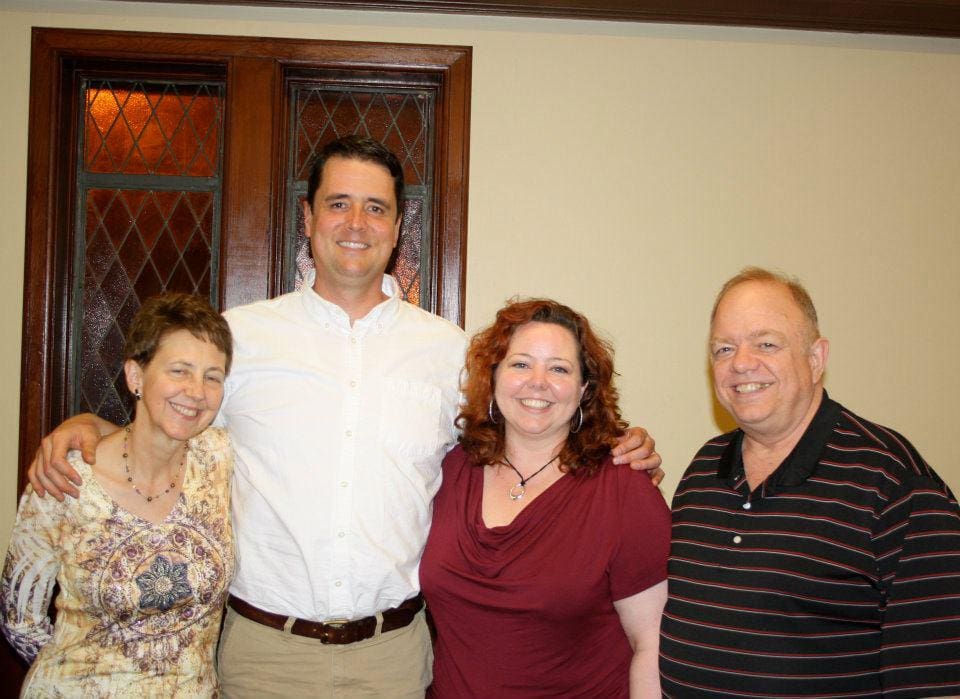
Bill Prince spent years as a counselor in the Houston Texas Stake presidency, the patriarch of a family with deep roots in Houston Mormonism, before his daughter Tina left the LDS church, a decision that was followed, in time, by Bill and his wife Julie. Recorded at a January 2012 Mormon Stories regional conference in Houston built around the theme of maintaining relationships through empathy and dialogue, this conversation brings together Bill, Julie, Tina, and Bill’s nephew Lee to talk through what happened to the family.
Bill and Julie describe meeting five and a half weeks before their wedding, Bill’s father’s strict, self-made rise as a building-materials manufacturer, and the tightly observant home the children were raised in, where memorizing the Articles of Faith perfectly or starting over, family prayer every morning, and never missing church were the norm. Tina describes the research that first unsettled her testimony as a young adult and how she assumed her parents would simply have a reasonable answer. Julie describes reading a book about Joseph Smith’s wife Emma that reshaped how she understood polygamy and her own place as a woman in the church, and Bill discusses studying the material himself and eventually deciding he could no longer stay.
Lee, who was twelve years old and serving as home teacher to Bill’s family when the crisis unfolded, describes watching his uncle’s family’s reaction from the outside, shaped by the same strict Mormon upbringing his own father and Bill had shared as brothers. The family talks candidly about what leaving cost them, including friendships, ease at family reunions, and a daughter who waited until 18 to be baptized against her own family’s wishes, and about what they gained, closing with reflections on whether a middle way within the church was ever a real option.
What’s covered
- 02:02 Meet the Prince family of Houston
- 06:03 Bill and Julie’s early lives and marriage
- 12:35 The Prince family’s deep Mormon roots in Houston
- 17:00 What it meant to be a devoted Mormon family
- 29:13 Bill’s faith crisis and decision to leave
- 44:05 Julie’s path out of the church
- 58:04 Lee’s perspective growing up around the family
- 1:10:41 Family relationships and the costs of leaving
- 1:30:09 Personal beliefs after Mormonism
- 1:46:42 Reflections, advice, and closing thoughts
Episode Transcript
Host: John Dehlin · Guests: Bill Prince, Julie Prince, Tina Prince
This transcript is machine-generated and lightly edited for readability. The audio is authoritative. Please excuse occasional errors in names and spelling.
Introduction and Conference Context
John Dehlin [00:00:00] This interview was conducted as part of the January 2012 Mormon Stories Conference in Houston, Texas. Hope you enjoy. Mormon Stories podcast is a production of the Open Stories Foundation. All donations to Mormon Stories are fully tax deductible and go directly towards keeping the podcast alive and towards building a community of support for Mormons like you. To support the podcast or to join the community, please become a monthly subscriber today@mormonstories.org okay, well, my name is John Dehlin. I'm very happy to have you all here today. Again, thank. We want to thank the Moores for hosting us tonight. They're delightful hosts. Thank you. We also want to. Oh, please. Oh, yes. If there's a fire, run out the door. Try not to trample people. Let's see. I guess we should. I want to thank the people who are involved in organizing this conference tonight. Let's see. Ashley Merback. Where's Ashley? Ashley, this is Ashley Murbach. Where's Amanda and Matt? This is Amanda and Matt Nokelvee. Ann Peffer is right here.
Guest [00:01:36] She's.
John Dehlin [00:01:39] Is there anyone I'm forgetting or is that. Were those the main organizers? Okay. All right. So Houston. Yeah, baby. Houston represent. And Dallas is here. Baton Rouge is here. Anyone else? San Antonio, Tooele, Longview, Rutherford.
Meet the Prince Family of Houston
Guest 2 [00:02:02] All right.
John Dehlin [00:02:03] Yeah. Texas, baby.
Julie Prince [00:02:05] Okay.
John Dehlin [00:02:05] Pearland. That's all Houston, right? It's just all one big suburb. I'm just kidding. I can say that because I'm from Katy, right? Yeah. Katie. Katie's right here. Okay. Well, so welcome to this special event. It's a Mormon Stories evening special interview with a very special family. I'm going to just begin by telling you a little bit about my story and how it relates to these wonderful people that we're going to be talking about here today. I grew up in Katy, Texas, for most of my life. I moved to Houston in 1976. We lived in Houston proper for a year, and then we built a house or moved into a house in Katy. And I lived in Katy from third grade until I graduated from high school. And when I moved to Katy, it was a branch, and we met in a little house across the railroad tracks from the high school. This is before there were photocopiers. So they actually had one of those purple mimeograph machines that you would hand crank. Is that right? And Bishop Chudley was the bishop. And, you know, it was back in the time where you kind of built your own chapel. Like, the members would raise the money and you'd build the chapel, but it was a really exciting time I can't believe the level of leadership and activity in the stake. In the Houston, Texas stake. I just have extremely fond memories of youth conferences, of temple trips. The closest temple is Mesa, Arizona. So we would actually get in a bus as a youth group and drive all the way to Mesa, which was like a two day drive. You know, dance festivals and, you know, we put on a Saturday's Warrior production. We did road shows and there were dances every month and the kids actually danced instead of standing around and talking. And it was just one of the most marvelous experiences growing up. And you really couldn't live in Houston and be a member of the LDS Church without knowing of the Prince family. I guess we'll talk a little bit about what brought the Prince to Houston, but today we're going to be visiting with a very special family. This is a family that was in Katy Branch and in Katy Ward. They are, they're part of the Prince dynasty in Houston. This is Bill and Julie Prince. And my parents were decent friends with you guys. Just as a personal tiny story, when my dad was disfellowshipped from the church, one of the things that he remembers quite fondly is that Bill was one of the people who was actually very kind to him during that process. He never felt judged by Bill. But I used to babysit your children when I was what, 12, 13 years old, 14, something like that. And without me giving too much of an introduction. I guess we'll go ahead and start. This is Tina. This is their oldest daughter.
Tina Prince [00:05:35] Yeah, I'm pretty sure I'm a daughter.
John Dehlin [00:05:37] Yeah. And she goes by Christina now, but I know her as Tina. And this is Lee. Lee is a nephew of the family and I don't want to spoil the surprises. So we'll get into the story as we go. Why don't we start by just talking a little bit about what brought the Prince to Houston.
Bill and Julie's Early Lives and Marriage
Bill Prince [00:06:03] Well, I was serving a mission in Mississippi and Louisiana. My parents moved to Houston while I was serving. And so I came home to Houston from my mission and I went to a. At that time it was called MN and Gleaner Activity. It was a young adults activity. And my wife, who was an airline hostess for Continental, was there and she had just joined the church just what, a few months earlier. And so we met and I took her home that night. And five and a half weeks later we were married.
John Dehlin [00:06:49] So tell us a little bit about your dad and his business and your family proper and kind of what type of home you grew up in prior to getting married.
Bill Prince [00:07:04] Well, my Father was very religious, very strict, and I had assumed that the way he raised us was just the way the church was. However, I learned since that he was way more strict than the church is generally. But we had. My parents had 13 children. I'm kind of right in the middle. My father kind of handled things like he was a drill sergeant in the Army. And so as we were raised, it was, you know, down for prayers, you know, at a quarter to six, and he would come, have inspections on our bed, flip the quarter, make sure it bounced. We had army cots for our beds that he had gotten from the army surplus. And so he ran a real tight ship, and we all had chores to do. I remember going on my mission thinking, oh, I get to sleep in, because we didn't have to get up till six. But he was served mostly on the high council. It seemed like everywhere when he was on high council. But then in Houston, he was a bishop three or four times in different wards, and was really almost thought of as a little prophet almost in the area because he was very much into giving very strong blessings to people. And he. I actually had some. Well, he would. I don't want to get into too
John Dehlin [00:08:36] many of those blessings.
Bill Prince [00:08:37] They're pretty wild. But he was very inspired. And actually, it seemed like all of his blessings came true. You know, he was known for. If people needed a special blessing, they'd go to Douglas Prince because. And he wasn't afraid to tell them almost anything. But he seemed to be very inspired, and like I said, his blessings seemed to come true. The difficulty I had, even when he was a bishop and I was in the Stake Presidency, is he had a tendency to. He would always tell people what to do, and they loved to hear it because he really wouldn't give them the opportunity to have them go out and pray and gain their own conviction as to what they should do. He would pray about and say, okay, this is what you need to do. He would think of him almost like a Brigham Young type personality, but he would tell him, you do this, this, this, this, and this, and this will happen. And it always seemed to happen, you know, and so out in the Katy area, he is just, you know, worshiped almost because of the things. Everybody has stories that he had had counseled them for this or that or whatever, and they had had such great experiences. And so I just grew up in a very religious home, maybe a little thing like the United Order as we grew up, because we was in a large family, we had to turn in our paychecks when we worked at places for it to be used for the family income. And I remember getting off my mission. And one of the reasons I got married so quick is because I had turned my check in still. And I said to my dad, I said, it's not right. How am I going to get on my own, you know, if I have to keep turning a check, you know. And he says, well, when you get on your own, then you can keep your money, you know. And so after I met Julie, then it didn't take long, but of course we started broke because I hadn't been able to save any money because it all went into the family and that's just the way way it was. We lived kind of a united order. And what else? You asked me a question. I'll try to answer.
John Dehlin [00:10:47] So, Julie, tell us about your conversion. Just really quickly, what brought you into the church and what your life was like right before?
Julie Prince [00:10:54] Well, as quickly as I can as a younger person. I. My parents divorced and I had, you know, not the perfect family life, but it wasn't horrible, but it was, you know. And I met a girl in college and I was really impressed that what an awesome person she was. And a friend of both boys and girls was still being a good person, a lot of fun, had a lot of humor. And I said, you must have a good family life. And just kind of popped out of my mouth. She said, thank you. I do. It's because of my church. And I said, really? What church is that? And she said, the Church of Jesus Christ of Latter Day Saints. I said, I don't think I've ever heard of that church before. And she said, well, it's commonly called the Mormon Church. The only thing I'd ever heard about Mormons was when I was a little girl, there was a girl in my class who said she wasn't going to come to school the next day because she was going to be baptized for dead people. And in my little mind, I could imagine being a cave and people dressed in black and skeletons around. And I thought that was the strangest thing I'd ever heard. But I decided that since this girl was really nice then, you know, and she shared some information with me, which my mom, once she found out was just having a fit. So I can remember I hid them under my mattress for a long time and kind of forgot about after a while. But when I became an airline hostess, I decided I need something. I need something more than. Because I could see a lot of airline hostesses would just become kind of. I don't know, start out like really sweet people and become different and I didn't want to become different and I. So I looked into joining the church again and that's kind of how I ended up joining in Dallas.
The Prince Family's Deep Mormon Roots in Houston
John Dehlin [00:12:35] All right, so maybe talk a little bit about your dad's business and by virtue of bringing some of your siblings, you know, to Houston, how that sort of set up a bit more of the Prince presence within Houston.
Bill Prince [00:12:55] Well, my father was somewhat of an engineer. He was kind of a self made engineer and he was working for a company in the block and brick manufacturing and he had some ideas of how to develop a new manufacturing process. It was basically to make a Mexican looking brick, but out of a high quality concrete product. And back then in the Houston area that was the big rage was the casual look in the Mexican brick and probably still is in many places. So he developed this system called, it was called cast stone brick. And we got it financed through Wallace E. Johnson, who is the co founder of Holiday Inns. And the company got started. Eventually we ran into some hard times and actually was able to take over the business and get Wallace Johnson out of the business. And so we owned it. And when we owned it, then he brought in his brothers that were from lived in Salt Lake and so forth and the, the rest of the family that had married, they all came in and we kind of had everybody from all over helping in this cast on brick facility. Eventually in the early 80s when we had a big oil problem and the gas lines and so forth, eventually in about 85, 86, we lost the business because the construction business just went way down and we had to sell out. And so then everybody went their separate ways and I became a tax accountant and started doing the tax business and that's what I'm still doing today.
John Dehlin [00:14:36] So how many of your siblings or uncles or family members would have served in, let's say bishop level positions, you know, in Houston during the entire time, you know, you were kind of, were you, you know, doing what you were doing?
Bill Prince [00:14:55] Well, my uncle Wayne didn't serve as a bishop, but he had been a stake president in, in Utah and he had come down here and so in fact he taught seminary down here. But no, that was. Lawrence Layton was, was patriarch. No, Wayne Prince was down here. Ronald Prince came down here. George Prince came for a while and helped us out. Mike Prince, I just was trying to
John Dehlin [00:15:25] establish how many bishops.
Bill Prince [00:15:26] Oh well, my father was in the state presidency and was a bishop several times. I was in the state presidency. My brother Leon was a Bishop. He then became in the stake presidency when he moved to Austin. Ron was a bishop. Ron Garish was a bishop. Yes. Lee's father, Warren Prince, was a bishop in the Westlake area. Let's see, Lawrence Layton was a bishop. He was my father's brother in law, and he was also the stake patriarch. And I'd say that covers.
John Dehlin [00:16:10] And if any of you remember some of the colorful stories I've you told told about my seminary teacher, this is Lawrence Layton. So I guess what I'm trying to establish is the Prince were kind of a dynasty. And, you know, they all drew. I remember you all driving either Cadillacs or Mercedes Benzes. I mean, everybody had nice cars, kind of, you know, seemingly affluent, successful. Here we go. So let's establish a little bit about what type of Mormon lifestyle you guys tried to live in terms of how orthodox you were or what how your Mormon ness sort of manifested in your behavior. I kind of remember you guys being really into the church. I'm wondering if you guys have any stories or examples that would help people see the type of family and your type of commitment. Who wants to grab that? You want to start, Tina?
What It Meant to Be a Devoted Mormon Family
Tina Prince [00:17:00] Sure. I'll take one. My dad was really big into us memorizing anything that was noteworthy in the church. And one of them was the articles of faith. And just to give you an idea of the level, we had to say it perfectly from the first all the way through. And if we missed even an and, or, an or, or. But we had to start all over from the beginning. So we had to do it over and over and over. And it was a big competition in our family to see who could pull that off without missing. And we did. Ultimately, I think all the kids, maybe Joanne and Doug, not. But by memory, by memory, all the articles of faith. And there was a number of things like that. We had family prayer every morning. We had family on the evening. We had seminary. Never missed church. It was very typical Mormon family life, I think, in that time for this area.
John Dehlin [00:17:56] Any other stories you want to tell about your level of Mormonism? Because I have a story, but I
Julie Prince [00:18:01] want to hear yours.
John Dehlin [00:18:02] So I remember a testimony. Well, one thing I remember is when I believe it was one of your. This isn't a huge deal, but I believe it was one of your children was being blessed. I just remember seeing you just taking really copious notes of like every single word that was said during the blessing. What was that about?
Julie Prince [00:18:21] I just. Because the rule was that you couldn't record it. And I thought, well, if this is an important thing. I ought to try to write down as much as I can. And I would hand, you know, I don't know, shorthand. So I would just do the best I could and try to use B for baptism or, you know, JC for Jesus Christ, or whatever I could to shorten things down. And I actually have done that even for grandchildren now, you know, I haven't recently, but even, you know, or other family members, just as a friendly thing to do, because, you know, I mean, it's. How many people know what was said in their blessing as an infant. So I thought it was nice.
John Dehlin [00:19:01] Now, they do say that again.
Guest 2 [00:19:03] Bill and Julie have a little bit more sophisticated methods for recording blessings now than hand notes.
John Dehlin [00:19:10] The story that I remember, I don't know if you guys went to Disneyland or Astroworld or where it was, but I remember you bearing your testimony, Julie, in sacrament meeting and talking about how you were all really thirsty and so you wanted to buy a soda, you know, a beverage, but all the cups said Coca Cola on them. Okay, okay.
Bill Prince [00:19:34] That's actually when I was a youth, and again, we had this big 13, you know, children, family. And we had gone to the Utah State Fair, and we wanted to get a drink, and. But all the cups were Coca Cola cups. And my dad was very strict on that. There's no Coke or anything, and so. But we had to buy it, so we did. So he got the whole family to get together around in a circle so that the cups would be on the inside so no one would be able to see. And he told us, now everybody's got to drink it right now. Nobody turn around, you know, finish it. Even though we were having orange or whatever it was, but it was in Coke cups. And he didn't want anybody to see any of the kids holding a Coke cup, you know, in their hands. So that was a little bit of a radical. My dad would have the saying to always avoid the appearance of evil. And I used to kid with him. I said, what about avoiding evil instead of just avoiding the appearance? But anyway.
John Dehlin [00:20:37] Okay, thank you. I remember a couple things right. So the theme for tonight and for tomorrow is around relationships. It's basically how to communicate in your relationships, especially when you've got something that you're living with that's difficult, and you're trying to figure out if you want to share, how to share who you want to share with, and then how to have difficult conversations with people that you love, whether it be spouse, children, grandparents, aunts, uncles, ward members, et cetera. And so you Know, what I've tried to establish is the level of orthodoxy that this family was partakers in and the level of leadership that they were also involved in and their level of prominence. And you could sort of say that in 2012, it's almost a trend for thoughtful middle class or upper middle class Mormons to have crises of faith and maybe even to decide to leave the church. I mean, the numbers are growing exponentially. Well, that wasn't the case in the 80s, right? In the 80s, to leave the church was a pretty big deal. And it was even a bigger deal if you were to apostatize. And it was even an uber bigger deal if you were from a super prominent family. And if you're a member of a stake presidency, then that might be a really, really big deal. And so we're here to talk about how they navigated that entire decision during a really difficult time. And I joked with them right before we started, you know, I said, have you guys ever been honored before for the decisions you've made? And, you know, it's kind of. We're not trying to say that we want to hold up people who leave the church as examples, but at the same time, I'm a big believer that sometimes people make those decisions out of reasons of integrity. And so it deserves respect whether or not you agree with their decision, especially when they do it at great personal cost. And so, you know, part of what I wanted to do is to honor these good people for the decisions they made. I'll just tell you how I first learned about this. So Tina and I were in high school together. I was a couple years older. You know, we were really good friends, had a lot of respect. We were in Saturday's Warrior together. You were Mrs. Flanders, I was Ernie. But, you know, our families are really close. And, you know, there weren't what, 15, 20 Mormons at Katy High School. So, you know, the Mormons knew each other. We stuck together. And I don't want to mischaracterize you, Tina, but I just remember Tina being really committed to the church, really sweet, really spiritual, really into prayer and righteousness. Just someone, just some. I would hate to say Molly Moorman,
Tina Prince [00:23:48] but, yeah, I'll claim it.
Bill Prince [00:23:53] So.
John Dehlin [00:23:55] And, you know, Tina was a couple years younger than me, so when I. Not only that, but Tina actually brought at least two friends into the church while she was in high school. So these are, you know, these are high school girls in a Baptist town. And Tina is actually getting them baptized and having them join the church, which was pretty Remarkable. I never, I don't think I ever brought anybody into the church. And I was like seminary president and whatever else. So, I mean, Tina was pretty hardcore and committed. And so after my first year at byu, I'm in the mtc and I get this letter. You know, I'm sitting there in the cafeteria opening my mail and write my letters and I get to see. I get this letter from Tina and I open it up and I'm like, oh, Tina wrote me, how sweet. You know, and I open it up and it basically says, John, I just want to let you know I totally am getting it all wrong. I'm sure. But this is my memory. It's basically. I just want you to know that I was reading some books and I, you know, started reading a book about Masonry and I discovered that the temple ceremony, which I had just been through, has lots of Masonic relics in it. And as I started studying more and more, I've just decided that the Church isn't what it claims to be. And I've left. And do you remember what my response was to you? Why don't you share what you remember of my response?
Guest [00:25:25] Well,
Tina Prince [00:25:27] it was inflammatory. My memory is that I remember because I respected you and I always felt like we were always on a quest for truth, that you would be able to help me in some way or give me, especially since you were on a mission, which I, in my mind, being the Molly Mormon that I was, that that's where all the secrets are revealed and you would know everything that there was. And which is why I had moved to Utah in the first place, so that I could be the uber Mormon that would know everything. And so back up and tell a
John Dehlin [00:26:08] little bit about what led you to want to start reading more and then tell the response.
Tina Prince [00:26:15] Okay, I moved to Utah at 15 and I felt like I was ready. And my parents can probably go on about that, but I worked it out to live with my aunt and uncle who were LDs, and I wanted to study the Church. So I spent probably two years before I had wrote you that letter going to the library, studying, reading everything I could about the church because I thought that it would bring me into some exaltation state since I'd already brought my friends in and, you know, went to all the church, everything that I could go to. So that's what made me start studying.
John Dehlin [00:26:57] And then you. And then what happened?
Tina Prince [00:26:59] I discovered some things about Masonry and because I didn't want to read anti Mormon literature, I studied Masonic literature, anything that I could find about it. And it was I was 16, I guess, at the time when I connected, which could be false now that maybe the Jack the Ripper story had something to do with masonry. So it led me to believe that the Masons might have had negative beginnings. And so I thought if that were the case, then that would mean the Mormon Church would have negative beginnings.
John Dehlin [00:27:35] Okay, so what was my response to your letter? Do you remember anything else?
Tina Prince [00:27:40] I actually looked for your letter before I came here to see if I could find it, but I might have sent it to you. I don't know. It's been so long, I was unable to find it. But my memory is that you were basically so incensed. I think you said something like, how could I even think of saying something like that to you while you're on your mission? I think you might have said, do you have no soul? Or something like that. It's been 25 years. It's been a long time. So I was really unprepared. I had no idea that it would be so groundbreaking that would affect you that much. I really did not expect that at all. So it was very surprising.
John Dehlin [00:28:25] I mean, it was. I mean, given our level of. Given the amount of time we had spent together and our level of friendship, I guess looking back, you would think that I would have, like, gone, oh, my gosh, I'm so sorry. How can I help? That's what I thought and that's not what I did. Basically, I flipped a bit, you know, on or off, I basically just said, well, see ya. And that was
Tina Prince [00:28:52] so.
John Dehlin [00:28:52] I'm not proud of that.
Tina Prince [00:28:54] It's understandable. I have since happily listened to your podcast and had I known what was going on on your mission, in hindsight now, I'm just. I think I might not have had a soul at the time. I can't believe that I even brought those things to you when you were going through all of that. I had no idea. So.
Bill's Faith Crisis and Decision to Leave
John Dehlin [00:29:13] So tell us about what it was like for you to be sitting there in Salt Lake City deciding that for you, the church wasn't what it claimed to be. What did you do next? What did you contemplate? What did it feel like to have that build up inside and to contemplate trying to tell your dad, who was in a stake presidency, your mom, who is a convert to the church and loved it, your grandpa. What were you feeling?
Tina Prince [00:29:40] I think because I was so young, I didn't really understand the consequences of what I was looking at because it didn't seem like it was anything against the church. If that Makes any sense. I just, I naturally assumed that somebody would just say, oh, well, here's the answer. There's no, there's nothing bad about it. It's just this xyz, whatever the answer was. And so when I talk to people, I naturally assumed they would all give me answers or something, but that was not what I. What I encountered. Everybody was very, very, very upset that I was studying anything and they told me to stop and they said I should get to church and I should read my scriptures and pray. And I found a letter last night from grandpa on my birthday telling me his testimony and that I needed to kick Lucifer and his apostate teachers out of my life. So that was basically the kind of response I had at the time.
John Dehlin [00:30:45] Okay, so. So you went to your dad talk about that?
Tina Prince [00:30:52] I went to my dad and I started. I kept letters. We just uncovered them. We're looking at them. In preparation for this, I asked him questions about the blacks holding the priesthood. I didn't feel like after I had read about that, that that was fair how it was handled. And so he wrote me back all the reasons why he thought it was okay. And so I initially started asking him things that I knew were a part of the church that maybe would start to show that I had questions. And then I obviously started finding more and more things that had the Masonic connection. And when I wrote to him about that, I believe that it caused him to have a lot of problems.
John Dehlin [00:31:40] Okay, so did you feel like you could trust your dad? Did you feel like he was a safe person to talk to?
Tina Prince [00:31:46] Definitely. Totally.
John Dehlin [00:31:48] So good for you. So what was it like to receive that letter and tell us about how you followed that up? And Julie, you too?
Bill Prince [00:31:56] Well, just give a little background because my wife was a convert to the church. All of her family were non members and we had. I had dealt with a lot of anti Mormon literature through her family. Every time we'd go to California, one of her cousins or whatever, I forgot his name, but we would spend. We had all kinds of correspondence back and forth. I had dealt with so many issues that I felt like there was nothing that could crack me. And. But what Tina did, which kind of threw me is she said, dad, I want you to read this stuff as though you're a non member, you know, with a complete open mind. And because she, you know, not from a defensive or from a. Because I had dealt with so much anti Mormon literature that I felt like I knew the answer to everything there was. And so when she said that, then I thought about It. And I thought, okay, that's a different way, you know, of looking at it. And so as I would read, the first thing I read was the Captain Morgan book that she sent to me on the masonry. That didn't do anything to me because I already had dealt with that so much in dealing with my wife's family. To me, it didn't bother me that Joseph Smith had gotten some of the ideas, you know, from masonry and had, you know, that a lot of things were similar. That was nothing, you know. So I tried to explain it to her that. Explain how that it's not, you know, that when you get inspiration and so forth, you have to use from your own experience. And that the masonry was just part of his experience. And so the things that he came up with, that was very logical. But when I could see that her testimony was falling away, of course, naturally I wanted my daughter back, you know, and I was nervous for her. Then she gave me Fawn Brody's book, no Man Knows My History or whatever it is. And I read that, and that didn't phase me either. You know, I'd read things like that before. And so I had all my arguments and things to explain away what had been said. And once again, I was reading this stuff and I was trying to do with an open mind, and I could see that we had some difficulties, but nothing to shake my testimony. And. And. But then actually, the first thing that started turning me was I found a book by Hugh Nibley. No, ma', Am, that's Not History. That he had written as a response to the Fawn Brody book. I was very disappointed in his response to me. All he did was character assassinations on her and didn't answer anything. And so that caused me to be a little more open. But I was. I wanted her back, but I felt like I had to be open and honest and fair about everything that I was reading. And to make a long story short, after about two years of hardly not even working in my business, reading every day, probably eight hours a day, and just barely getting enough work done, so I keep food on the table. Then little by little, my testimony fell apart. And while I tried to cling onto it, eventually I just couldn't, you know, And I finally had to say, this is just. But when I was still very believing. I remember when Tina wanted to leave the church and have her name taken off because she wanted to go in the military. And her bishop was not willing to let her do that, you know, because he was. Felt like she was too young. I think she was 18 or 19, and even though I wanted her in the church, I felt that she had a right, you know, she was a free agent. And so I told her I would make sure she could get out of the church, you know, even though that's the last thing I wanted, but haven't cried in a little long while. But anyway. But so we made arrangements so I could go up there and meet with her bishop, because I was in the Stake Presidency then, and I knew he had listened to me, you know, so there was no. No problem. We got her out of the church, even though that was not at the time something I wanted to do.
John Dehlin [00:36:15] But.
Bill Prince [00:36:16] But anyway, we. Go ahead.
John Dehlin [00:36:21] Tell me what's making you feel emotional right now.
Bill Prince [00:36:24] I think just remembering the experiences that I went through at that time. I didn't really want to leave the church. You know, it's kind of like I really love the church, and frankly, I still do, and I defend it quite a bit. However, my study and my honesty about it could not allow me to continue, especially in the Stake Presidency. I remember having discussions with President Steward, and I told him, I said, I just can't be in the church. I just don't believe these things anymore. And even though I still had what you might call a spiritual testimony, I kind of. After I stopped believing the historicity of the Book of Mormon, that it was a historical fact, then I still believed it was inspired of God, that it was still true principles, and that Joe Smith was still inspired, even if it was not the way that it was represented to be. And I finally came to the conclusion that that's the truthfulness of the church was the fact that we believe in revelation and we believe in being inspired. And in fact, just before I finally split, you might say I still had a current temple recommend, but I wouldn't be worthy to get a new one. And I went to President Stewart and I said, you know, I still have a temple recommend. I'd like to go to the temple to really kind of give a last stand on this thing to see. And would it be okay if I went, even though I didn't have a testimony at that time? He said, yeah, you go. And so I had planned to go up there for three days to the Dallas Temple and just fast and pray and go through one session after another to see if I could get an answer, you know, to this situation that would allow me to continue in the church. And I went up there and I just started going to one session after another. In between, I would study the Scriptures and Read the scriptures in the. In the rooms.
Julie Prince [00:38:26] And.
Bill Prince [00:38:26] But on the second day, halfway through the day, then I just had the strong impression, this is not of God. You know, it was just that it was really strong. And when I got the answer, then I called up my wife. I said, I don't need to stay the three days. I said, I've got my answer. I've got to leave. You know, I just have to. So anyway, I came back and told President Stewart, I said, you're not going to like what happened. But I said, because I had told him for quite a time, I need to be released. And he said, no, no, you just keep praying. And he didn't want to release me. But finally when I came back from the temple experience, then I said, no. I said, I just can't continue. It's not right. I said, I just don't. I don't believe it anymore. And I said, even though I think the church is great and I have no negative feelings towards it, I just cannot continue. It's wrong. And so anyway, that next state conference and the COVID story, frankly, was not. We didn't want anybody really know I was leaving the church. And so he just more or less told people that my health had gotten bad and that I needed to be released. And so I wasn't going to church. I didn't go to church. And so I was just out of everything for several months. And little by little, the word got out, you know, that I had left and didn't have a testimony or whatever. But anyway, I'll quit. I could go on forever.
John Dehlin [00:40:02] So I want to note. I want to note a couple things in terms of relationships. I wonder if you realize how. Well, I think it's remarkable that at such a young age you cared enough to study your faith intensely. I certainly didn't care enough about my faith to study it intensely. And I felt like I was the uber Mormon.
Tina Prince [00:40:25] I thought you were, too.
John Dehlin [00:40:26] Yeah. So that's. I think that's remarkable. I think it's remarkable that you were willing to talk to people about it, especially during that time. And I don't know how much of that is a credit to your parents for being.
Tina Prince [00:40:42] I definitely think so. And I do recognize my. Which I find in many of the community that I see through Facebook and the Mormon stories is that our integrity is very high. And that was why I wanted to have my name removed. Because being young and passionate, I felt like if I were to meet my maker, being in the military, I could not have my name on records that I Didn't believe. So that was why. And then when I told my dad we found the letter, he actually sent me copies of the handbook, how to have youe Name Removed, so that I would know. And then came up and spoke for me because they wouldn't take my name off. So.
John Dehlin [00:41:25] And so I guess many people don't feel like they're able to share what they're suffering with, and they suffer in silence. And that's something you didn't have to do. And then when those who do choose to share with their parents share, what they sometimes are met with is ostracization, shame, rejection. And you didn't receive that either. In fact, you did a little.
Tina Prince [00:41:55] Yeah, there was about. I think it was about five, six months where there was no conversation and it completely stopped. And I just remember, I get this from my dad. It was really hard. Breathe. So I did the same thing. I went back to church and I thought maybe I can just. I apologize. I thought maybe I could just do it and keep my family. But I think it was Valentine's Day, and my dad had sent me flowers, and he called me. And he just. He told me he was crying like we do, and said that he couldn't put the church over me and that he would look at it with an open mind and then I could start sending him whatever literature meant something to me. And so it was really great. And it is definitely because of them that, you know, I think I made it through because it was still a lot of opposition, I'm sure nothing like what they had to go through. But for me, it was all my friends, my family, extended family. It was hard.
John Dehlin [00:44:00] Thank you. So, Julie, how are you processing all this while this is going on?
Julie's Path Out of the Church
Julie Prince [00:44:05] Well, as a follow up to Tina, my family were thrilled, and they took her in with open arms. But I had read a book called Emma, and it was not one that was done through Deseret books. And I had read this some time before any of this had happened. And the thing that struck me about this book, when I finished reading the book, I had the feeling. And they used a lot of stuff that was just general journal stuff. I had the feeling that the reason we had polygamy was because of the relationship that Joseph Smith had with his wife. And I also felt like that the only way I could reconcile that God would allow that was that what was it was more important that the prophet have what he needed to be a prophet. And that the women were really. And that as a woman, I was not as important as a man. And that was really hard for me to process. And I remember I tried to talk to Bill about it, and he. I don't think he got what I was trying to say about it. And I just kind of. He kind of said, you know, well, you know, it's those times. And, you know, and he didn't. He didn't fight the fact that perhaps because it even says that, you know, Joseph Smith asked about it and why would he ask about it? I think it's because of the relationship he had. But anyway, so I had that, and I had kind of worked my way through that. It was my faith crisis. And then I. But I just kind of put it aside because the church gave us stability to, you know, I married a real prince. And then, you know, we had all these kids. We had our six children in 10 years. So my major thing was just trying to get through to the point to where I could have some sanity in my life back. So when Bill started going through all of this stuff, I had to. My fear was I didn't. It didn't bother me that much in a way that he was finding out because I had had my own questions already. But the thing that my fear was there were times, like every couple has, when, you know, you have your hard times and your good times as a couple. And there were times when he had said, you know, if we weren't members of the church, if I hadn't made a covenant with God, too, I'm not sure we'd still be together. So now when he's talking about possibly leaving the church, I'm thinking, is this threatening our relationship, our family? Is everything going to fall apart? So that was my biggest fear. And I remember I really tried to talk him out of it. I said, let's wait till the kids are older. Let them make up their own mind. We could just kind of, you know, fade away later on. And plus, I was the choir director. And by the way, I was also. Had been a Relief Society president and primary chorister and a lot of other things. So I'd done my time, but he said no, he had to do it. He just. He was compelled. You know, he felt like that he wouldn't be honest to himself. And so once I got my head around that, then I just decided, you know what? I'm just going to trust God, that whatever happens, happens, and somehow life will go on, you know, and it's worked out. We're still together.
John Dehlin [00:47:36] Was it devastating, though?
Julie Prince [00:47:37] At first it was frightening because, like I said, I was just afraid that My, Our whole relationship and the family and what was going to happen to the kids. And they. This wasn't fair to the kids because we'd been raising them like this. And then, I mean, some of them were still quite young, you know what I mean? They were like at that formidable age 10 and 12, you know, nine, but 10, I don't know. Anyway, some were very young still. Some, you know, Tina had. And she. The reason I ought to let you know, we don't normally. Being such a fundamental family wouldn't normally have allowed our daughter to go up to Utah and live with her aunt and uncle. She'd been having severe migraine headaches. The school system was not very sympathetic and they wanted her to retake a grade. And she visited in the summertime, her aunt and uncle, and they said, hey, if you want to live up here, you can. And up there in Utah, they were able to. To work things out to where she could go to school part time, full time, work whatever. Online. I didn't have online, but they had. She could pick up her work and just come in once a week or something. And we were having her see a psychologist too, in helping her with biofeedback, with her migraines. And I talked to him about it and he said, you know, because he knew our house was so crazy and we had a handicapped child and all the things we were going through, he says it may not be that bad for really. So it was a lot of decision. It wasn't like we just said, sure, you know, I just want to make that clear.
John Dehlin [00:49:06] Well, now we feel better about you. We were, you know, weren't we? Weren't we? A little bit. Really? You did that? So, Bill, now it's time for us to understand what it was like for you to have to figure out your dad, your parents, your brothers, the ward members. Did you, you know, how did you process how to communicate or not to. If to communicate and if to communicate, how to communicate and what to communicate and what not to communicate.
Bill Prince [00:49:40] Well, I'm not a confrontational person and I don't like to hurt people. And so. But at the same time, I knew I had to do what I had to do. And so the initial thing was just to be sick. And actually I was sick. It was really difficult for me. I was so involved. You could almost say the church was almost more involvement than everything else that I did. In fact, really and truly, I wasn't really being a good Mormon in a sense, because my wife was doing all the raising of the kids because I was gone constantly doing Stake Presidency work. Every Sunday we were gone from early, from 5 in the morning till, you know, 10 o' clock at night. I was hardly ever home all during the week. But this is back before the church started saying family first more, you know. And my dad taught me that you put the family first by putting your church work first. That's how you put your family first. And so I was kind of into that kind of a mode. And so when I discovered that I just couldn't continue, then my health did go down because it was such a. It was so tough on me, you know, to leave the church. And so I really was sick. And so I didn't go to church once I was released from the Stake Presidency and people first thought I was just sick. And that was the story, that was the outside story. So I really didn't have to say anything to anybody too much. Now my family kind of knew, obviously, and my parents sort of knew, and I became kind of the black sheep of the family because Tina's involvement with my two brothers in Utah, they would have their little meetings and talk about the church. And so they were kind of on the skids, but they weren't really big, big into the church. In fact, they started to have their beer and alcohol. Once they stopped believing in it, then they wanted to enjoy some of the things the church doesn't let you do. I was different. I didn't like. I had tasted alcohol, never liked it. And when I got out of church, I thought, well, now I guess I can. Let me try it. I never liked it. So I'm still living the word of wisdom. You know, I've been out 20 years. You know, I'm even losing some weight finally. But anyway, I just didn't know how to really tell people. And as the word started getting out, my practice was. I'm a tax accountant. And really the majority of my clients were Mormons. You know, I'd probably say 80%. And once the word got out that I was no longer, you know, really in the church, and the bishop made an announcement too, in the ward that everybody should stay away from us, you know, that we had, you know, were no longer people they should associate with. And so it was, it was difficult. I did. I lost probably a third of my practice, you know, because they stopped coming to me. Fortunately, my practice was strong enough that I had enough other people. I was able to survive. And in fact, now it's kind of interesting. I have non members that are actually referring members. I have more members now than I had at one time just simply because other people have recommended them. And so I'm. Everything's fine in my practice, but there for a while, it was kind of tough. But to me, you know, you have to do what you have to do. And we went through the first period of just me just not associating or doing anything. But eventually I knew I was going to have to pretend to get well. You know, I couldn't stay sick forever. And so anyway, eventually, because there was a couple of people that had heard and they'd come over to me, they said they want to know what I had read or what did I learn or whatever. And I said, now you don't want to go there because you'll lose your testimony. No, no, nothing affect my testimony. But there's a couple people that I finally, reluctantly said, okay, well, here's some of the stuff I read. And they did, and they lost their testimony, you know. And so the word kind of got out that I was like an anti Mormon, which I'm not. I'm actually very supportive. And so the bishop was considering to excommunicate me. And that was also. My wife had said some things to people. And so he was trying to make up his mind to do that. He came over and to talk to me, and he said that he was trying to make up his mind whether to excommunicate me or what. But he had been inspired to call me as the ward executive secretary, and I'd been out of the church for maybe a year at this point. And I said, well, you know, I don't have a testimony. And he said, yes, I know that. But he said, I. I feel like it was either excommunicate you or call you as the word executive secretary, you know, and I would like you to consider that. And so I said, all right, I'll consider it. Because I missed the association with the members and because I'd been so into service. And so after thinking about and talking to my wife and I had originally been the stake executive secretary and the stake clerk, and I knew how to do. I'm a computer guy, and I knew how to do everything. And so I thought, well, that might be kind of fun, and I'll do that and see what we can do. So I met with him. I said, okay, here's what I'm willing to do. I'll be the executive secretary. I said, I won't attend priesthood or Sunday school because I don't want somebody to ask me a question. I don't want to lie about anything. At the same time, I'll refrain from saying anything about my lack of testimony, and we'll just see how it goes. And. And so I was the executive secretary for about nine months. I cleaned up the ward, got the books all straight and did things. And the bishop, because I'd been in stake presidency and a lot of leadership, then when we'd have our bishopric meeting, then he'd always turn to me and ask my advice on stuff. And he would always do whatever I said. I mean, every single thing. He would take everything I said over his counselors every time. And so finally, after about nine months, he came to me. He said, I'd like to call you as my counselor. And I said, I can't do that. I said, I don't have a testimony. He said, you must have a testimony. How can you give me the kind of counsel you do and not have a testimony? You know, because he says it's right on. I said, well, it's because I love people, you know, and I don't want to see them hurt. And when you're going to do something that's going to hurt the members, then I don't want it to happen. And so that's why I give the counsel that I do. And we walked around the church out in the parking lot for a couple hours, it seemed like talking about it. And I said, well, I'll think about it and pray about it, but finally. And I said, I'm willing to pay tithing. Again. Tithing was no big deal to me, you know, it's just stuff you do, you know, and although it was a bigger deal to my wife, she's been happy that we're not paying tithing because we were able to fix our roof and get some things done. And.
Guest 2 [00:56:48] But.
Bill Prince [00:56:48] But I told him, I said, I can pay my tithe, and that's no big deal. And I said, but I can't answer the questions for the temple recommend properly. You know, I can't say that I believe the church is the only true church or whatever. And. But we argued and discussed for about a week or so. And then finally I said, you know what? I think I really need to be released, because I know most of the members think I'm back, and I'm not back, you know, I'm just here doing the work, you know, and so then I. That's when we quit for good. And that's. And eventually. And then he actually still wanted to excommunicate me, you know, and so he talked. In fact, Lee's Father Warren Prince, my brother was a high council advisor to the ward and when he got wind that the bishop was wanting to excommunicate us, then he went to the stake president told him and he said, no, they're not doing that to the princes, you know. So the stake president went to the bishop, said we had put our name in to have our name removed. About he'd been holding it for like a year or two or something. And he said, look, he said, you just follow the do the get, let them leave the church. We're not going to do any excommunication. And so then the bishop went ahead and responded to our letter and we were taken out.
Lee's Perspective Growing Up Around the Family
John Dehlin [00:58:04] So Lee, let's bring you in. Now, as I understand it, you were 12 years old when all this was going down and you were Bill's home teacher. That's what you told me right before. Why don't you tell us a little bit about from outside the family, how you and your dad, Warren and mom Lori and other extended family members were perceiving and experiencing everything and what you as a 12 year old boy was thinking about.
Guest 2 [00:58:31] Sure. Well, I think my response to all this was very much colored by my dad's response, which was influenced by the upbringing that was described earlier. And so part of the upbringing was a strict orthodoxy, but I think a result for all of, for my dad and Bill and for their brothers was a kind of a reaction to that, of a strong love principle. And so when all this was going on, I remember feeling, I remember there was distress about it, but there was an overarching feeling of love. And my dad was a strong champion of Bill and his thought process and that it was motivated by integrity and trying to find out. And by way of background, I'm very active in the church and what people would consider to be a true believing Mormon today. But I think one of the reasons I'm able to be that way is because these experiences, conversations with my father, I was kind of inoculated to some of the stuff that was going on and heard some of the issues and was able to contextualize them. But some of this strong reaction was in our own ward. And I remember the bishop saying not to go over there. And I remember feeling very hurt about that instruction, feeling like it was misguided. And Bill had a lot of friends in the church and champions in the church even after he left who loved him, understood what his motives were. And I certainly fell into that camp. I felt a love and an admiration for him. I didn't feel A crisis about it. So I think that all the interactions that we had were. And that my dad had with him and that we had around this topic. And I was very close with, you know, Bill's son, Gordon, who we had discussions, and there was a feeling of love that pervaded it. And the feeling of being a prince felt like that was a stronger connection than being a Mormon or being a member of the church. But I do remember that we were their home teachers. And what that really meant was just that we would go over there and hang out. Didn't talk about the church much. At least when I went, we didn't talk about the church. But I remember the. When they finally had their name removed, I remember some of this stuff leading up to it that we talked about. But the thing that stands out is when Bill wanted to have his name removed. And I think, Julie, at the same
Bill Prince [01:01:18] time
Guest 2 [01:01:20] that the bishop came to our house because my dad was his home teacher and the high counselor, and we all prayed together. And I remember praying and. And I still. And I've prayed a lot for Bill and his family since then, over the years, but I remember praying that, you know, that the Lord would touch him and that he would want to stay a member of the church. My prayers have the nature and the words of my prayers over the years have changed, but I remember as a boy feeling that and praying that and being very emotional and feeling a sense of loss, feeling a lost connection. And I grew up in this kind of what you described in the podcast of this, you know, this awesome Katy, Texas experience. I very much experienced that. And part of that for me was being part of this family. And my uncle's in the Stake Presidency, and my dad's a bishop and my uncle's a bishop. My other uncle's a bishop. And so I do remember feeling very proud of, you know, my family. And Bill always had a place in the family of being kind of known as being the integrity guy and the churchy guy of all his brothers. And so I remember there. There being a feeling of loss. But our families stayed close in the time after. And, you know, there were some. Some things, tough times. But overall, that feeling of love, I think stayed. And that was kind of my memory of it.
John Dehlin [01:03:00] I'm going to do something I almost never do in an interview. I'm just going to interject a really quick commentary, and that's that I've been talking to a lot of people about these issues for many years, and I'm just. I'm getting this experience over and over again. And that's that the people who feel shocked and dismayed and end up needing to leave are usually the ones who believed it most literally and followed it with the highest level of orthodoxy. And I've also found that the people like Lee who are able to stay are the ones who, either because of their own intellect or because of the way they were raised, were raised to take everything with a grain of salt, to be able to feel empowered, to say, you know what? You don't have to believe that bishop, he's full of crap. Or, oh, that thing in the Book of Mormon. You don't have to believe that piece because it's garbage. If you're raised with that sense of flexibility, then you don't end up in your adulthood feeling betrayed and deceived and angry. It's the ones who truly care who become the victims of that mindset. And that's kind of an interesting twist.
Bill Prince [01:04:10] I think there's a lot of truth to that. However, in my particular situation, I didn't ever become angry. I always loved the church. In fact, after we left the church and Julie started teaching, singing in the Methodist choir, they were having a Sunday school class. I didn't like going to other churches. I only enjoyed going to the Mormon Church, you know, so I didn't go to church. I had watched some televangelists sometimes on tv, but she's a church lady, you know, And I don't mean like the church lady.
John Dehlin [01:04:39] Okay,
Bill Prince [01:04:43] but she likes going to church. In fact, a little side note, when I was in the Stake Presidency, one of the things that bothered me was sacrament meetings. I didn't feel like that they were spiritual enough and good enough. And I went around and did a survey amongst people and said, look, if God said, you don't have to go to church, that has nothing to do with your salvation. It's, you know, you can go if you want to. It's fine. It's strictly elective, you know, Would you go? I interviewed high councils, bishops, relief study presidents and everything. Only had one person that said they would go to church if they didn't have to, and that was my wife, because she loved the music. She loved going for the music, you know, but everyone else said, well, you know, I enjoy it sometimes, but. But, you know, a lot of times I don't enjoy it that much. But, you know, they go because the commandment, you know, not because they want to. And that was a fault. I felt like the church had. Why not make the church like other churches do, where people want to go, you know, instead of that, you have to go or it's a commandment. So I was all about when I was still believing. I was trying to make changes, you know, to see if we couldn't make our meetings more inviting. So people wanted to do missionary work not because they had to do missionary work. It's like if you see a great movie, you want to tell your friends about it. And so if you make the church where it say, oh, this is so great, I love it, you know, why don't you come join us? Rather than you get told by the prophet, you got to be missionaries to your friends. And so I was all about trying to make the experience more of a fun, enjoyable spiritual experience. But, but when I. So, but anyway, I didn't have any anger. And so getting back to the moment when we were going to the Methodist church where my wife was, they had a Sunday school class on going, talking about different religions and they decided to talk about the Mormons. When they found out that I was a former Mormon and in the Stake Presidency, then they asked if I would help teach that class. It was like a six or eight week class on the Mormons. And so I went ahead and did that. And in the class though, because we all know that has been Mormons, that the Mormons believe the scriptures way more literally than the Protestants do. And so, but what I did is took the position because I wanted there to be more tolerance, you know, for the religions about Mormonism and whatever. And so as I taught the class, I had a lot of fun because I would say now, of course, we as Methodists, I pretended to be, I said, you know, we believe this scripture this way. I said, now the Mormons believe it this way. And let me explain to you why, you know, and I'd go through the thing. Well, the fact of the matter was they could see the logical thing was the way the Mormons believed, you know, and after about, oh, it was about six weeks of the class because I was trying to let them realize Mormons are. They're Christian and they have good families and so forth. They just believe the scriptures a little differently, you know, but you can see there's good justification for why they believe the way they do. You know, it's very logical. Of course, it's not like the way we believe, you know, and that some of the members start going to the pastor and start having problems because they're saying, do we believe this? You know, the Mormons believe this. And so they shut the class down because it's Having too many, too many of them that we're wanting to, you know, kind of maybe stray, you know. So it's kind of fun because I've defended the church. I feel like the church is a great church, you know, there is a few issues I have, like guilt. I think that they are weighed big on that. I think they should change. There's a few other things, but as a church I think it's a great church. Good values and everything. So I've never been angry at the church and I just felt like I just couldn't joy in their joy. Like when I would go to a fast testimony meeting because we still have kids in the church and we will go several Sundays a year, you know, to see them sing or talk or whatever. And I don't really enjoy going. I like seeing the members, but I don't enjoy the services because I can't join their joy, you know, when they bear their testimonies or whatever. And I think eh, you know, I don't, I don't, I don't buy that, you know. And I couldn't, I thought. But I don't at the same time I don't want to destroy their happiness, you know. And that's why I've never been one to go out and preach against the church or to try to get people to lose their testimonies because I say, hey, if they're happy, let them be happy, you know, because happiness is hard to find. And so if they're enjoying it and it's working for them, then let them keep doing it, you know. Now if they're unhappy in the church, come see me and I'll help you get out, you know. But if you're happy, then keep on, you know, because that's what way you need to be. But so I've been a big defender of the church and my son in law, although he's not active now, when he was investigating the church and he came to me to talk to me because he knew I was out, I said, hey, listen. I said my issues are totally different. I think the church would be really good for you. And we supported him in it and helped him to get baptized because I felt like it would be good and it was good for him. It helped him out a lot. In fact, Lee's his home teacher and has done a great job with helping him. It's too bad he's not still active because it would be really good for him. I think the church is a good church. I don't have any negative, I just can't do it because of my background and what I've gone through. It just doesn't work for me. But anyway, I don't have those anger things that you're talking about.
John Dehlin [01:10:20] Got it. Thank you. So I want to, you know, it's a. You pay a price when you leave the church. You haven't talked about how your dad responded or let's spend a little bit of time on the price you paid for leaving. So we'll just go boom, boom, boom. Okay. Tell stories or whatever. All right.
Family Relationships and the Costs of Leaving
Bill Prince [01:10:41] Well, of course, my dad, everybody who knows my dad and Bill Moore knows my dad very well. And my dad's a strong man now. He's dead now, but he was a very strong man. As I mentioned, some of the stories. And so the first ones that were starting to get weak in the church because of Tina's involvement with my brother, Kim and Donald, then my dad was of course upset and we'd have family discussions about it and so forth when we get together. Well, then when I started studying this stuff and I was just, I'd come to them and show them my dad and my mom about this and that. I remember one time telling my mom about something. She said, well, I don't believe that, you know. And I said, well, no, it's right here in the, in the Bible. She said, maybe I'm remembering another story. But it seems like she said, I, I just tear it out, you know, to me, it's not in there. You know, in other words, she could not accept anything that wasn't in her mindset. And so I learned real quickly I couldn't really share this stuff that I was learning because I did this over a two year period. And so I would share things like with President Stewart, you know, about. We'd ride back and forth to state presidency meetings. I'd tell him about what I'd learned this last week. And because he was a convert to the church, had been a Baptist and he loved the church as well. And he said, oh, he said, he said, I just. And I, Because I tell him, I said, you ought to look at some of this stuff, you know. And he said, no, no, no. I said, I, I don't even care. He said, I love the church too much. I don't want to go there. You can study it and look and pray about it, but I don't want to even, I don't want to even go there. And so I really couldn't discuss these things with very many people. But finally, when it became evident that I was Leaving. And when my dad found out that I was leaving the Church, he just really went ballistic, you know, because he's strong and he can call you every vile thing that there is. You know, how I'm Satan's, you know, tool. And, I mean, he really can be tough. I mean, even when we were both friendly, I had. Because he wants everything to go his way, is very manipulative and very strong in the family. I had a person, when I got off my mission, that wanted me to go work for him, you know, and to do a job. And so I told my dad, because I was working for my dad when I got home at his place of business, and I said, oh, this would be a good opportunity. He said, that is Lucifer, you know, that's trying to get you out of the family. I mean, anything that wasn't the way he wanted with us. Now, he may not do this in the general public, but to us, it was Lucifer, you know, that was causing. That was being tempted. And so, obviously, when he found out that I, in the stake presidency, was losing my testimony, was going to leave, then he suddenly decided it was my fault that everyone else in the family that had already lost their testimonies, it was my fault that they had lost their testimonies, that if I would have held to the. You know, to the truth, you know, then they would have come back in. But me doing it, that just kills the family, you know, so he was just really upset, and we had a. He could not talk with me without giving me a lecture and stuff like that. And I just. Because, again, because I'm not confrontational, I just have to keep kind of let it go in one ear, out the other. And I just kind of say to myself, look, he doesn't understand, you know, Father, forgive him for not what he does, you know, because I knew that he just didn't understand. And I knew I wasn't going to be able to help him understand. And there's no point. He's way too old to rethink life, you know, and so I just need to be patient, love him, understand him, and that's just the way it's got to be, you know? And so. And now that.
John Dehlin [01:14:39] How do you explain him as your role model for what fatherhood is compared with how you decided to be a parent to your children? Why weren't you modeling him versus almost having the opposite reaction?
Bill Prince [01:14:55] Well, you know, every child picks up certain things about their parents that they model and certain things that they don't. And my father, while he was a really good man in many, many ways. One of the things I didn't like him about him at all is he was tough on my mom. He was real tough on her. He controlled everything. And I just. And they would argue, and he would give her a tough time. I remember in our home how that at least three or four occasions, she would leave home and go stay with her sister, you know, for several days, until they could come cool off, and then she would come back. And I vowed that we would not have that kind of a marriage in my family, you know, that we would not argue and fight. And we've done pretty well. The kids never saw us, and we didn't do it in private either. This is something I don't like to do, is have arguments. We may have had arguments one or two or three times in our whole marriage, you know. Doesn't mean she always likes everything I decided or whatever, but to me, it's just not worth it, you know, it's just better to get along. And if she wants something, that's fine, and if I want something enough, she'll let me have my way. And we just. We just had a happy family. We didn't argue and fight or yell or scream or nothing. That just was. Yeah, it just wasn't our thing. But anyway. But my father blamed me for the destruction of the church in our family, you know, because I was the strong one, and me going down was just inexcusable. And so I had real. My mom, on the other hand, she loves me to the end, you know, and was. Was. Was. She still would bear her testimony, but she was understanding, whereas my dad never was. You know, he always would give me a lecture, and two things always the church and my weight. Those were the two things that he would give me lectures about. And when he was starting to get very old and getting close to being senile, I could tell how well he was doing if he gave me a lecture about my way to the church, you know, if he. If we just had a normal conversation, I knew he was in trouble, you know, and because that's just the way he was, he felt like to his dying day, he had to keep pushing and pushing and pushing to try to get me back in. But I just had to say, you know, I just have to consider. Love him anyway and just let it go. And that's just the way it is, you know? And I never tried to pursue. I've never tried to pursue anybody to get them to lose their testimony, because that's just not what I think is the right thing to do.
John Dehlin [01:17:36] So, Julie, talk about the emotional or social or familial costs of making that tough decision.
Julie Prince [01:17:43] Well, first of all, he forgot to mention that both of his parents told other family members, because Bill was kind of sick at the same time, too, that this sickness had affected his mind and that that's why he left the church. So that was. And we thought, well, if that helps them, you know, that's their thing. But as I mentioned before, when I first joined the church, my. My dad and I, I don't know if we had. As we never had at first, we didn't have as close of a relationship, and we started to get a close relationship. And then I joined the church. And that was challenging for him. He was a Lutheran, but he was always really polite about it. And he always would. Every once in a while he would say, well, as long as you believe in Jesus Christ. I said, absolutely. The name of the church is the Church of Jesus Christ. And so he'd say, okay. But he was always really polite. And because of that, it was so easy when we finally did leave to call him up, you know, and tell him. And of course he was delighted. But I thought about. And I've told other people this too. You know, if people want to help their children one way or the other, they need to be like the Chinese say, don't be too. Be careful with your strong words, because your children will either follow them or fight against them. And the thing is, is that when. If he had been tough with me and said, oh, this is terrible, and it would be hard, how could I go back to him then and say, you were right? Because nobody wants to say you were right. I was stupid, you know, but he was. He was really nice. And he used to tell. I could hear in the background him talking to one of his friends, saying, you know, the Mormon Church, they really do. They have a lot of good things. They have family values. And he would. I'd hear him saying nice things and he wouldn't do it in front. He wouldn't know I was listening. So that always made me feel real proud. And I was. So it wasn't really hard for me. Yes, there were friends that. Nobody was ever rude to me. I lost some friends in the church, but now I end up coming back quite a bit because our two daughters and our church is just around the corner from where we live and they're always inviting me and people are always very nice to me. So it's okay now.
John Dehlin [01:19:47] So what about. And I'm not trying to make it sound appealing to leave the church. I still go to church and my kids still go, but there's this sort of, oh, no, what will become of my life? You know, will we lose all our money? Will we become evil? Will we know misery and sadness? You know, what will we do? Will I have an identity? Will I have meaning? Did you guys struggle with any of that?
Julie Prince [01:20:13] I have to say that our son, when he married and you know, you do have that feeling. I think when you're in the church, you get this feeling like if we didn't have all these rules and stuff, whoa, we would just go crazy. And my daughter in law, and my daughter in law, who was raised atheist, agnostic, is probably one of the most moral people I know. She's a really awesome person. And I thought that. I was amazed. I was shocked, you know, but so I don't know if that answers your question.
Bill Prince [01:20:42] What was the question?
John Dehlin [01:20:48] Yeah, like just, is your life going to unravel into sadness and debauchery if you leave the church?
Bill Prince [01:20:56] Well, one of the things that affected me when I was at Castone Brick and we were doing some things, we had a technician come in that helped us and he was an atheist. And I would ask him, because then I was really strong and everything, I said, well, why, you know, being an atheist, you know, I mean, you just, how can you live? I mean, you'd want to go steal stuff, you'd want to cheat on your wife, you'd want to. I would say, what keeps you doing good, you know, and being a good person, you know, being an atheist. He said, I'm a human being, you know, he said, he said, I love my wife, I have no desire to cheat on my wife, you know, or I don't want to go steal stuff. And he said, I said, well, what gets you motivation or whatever? And because I just couldn't understand it, you know, because I figured, you know, being in the church and having the rules, that's what cause you to do what you do. And. But he said, no, I'm a member of the human race. I want to improve the human race. I want to do good things, you know, and he was an atheist, you know, and so I, as I contemplated that, you know, I thought, oh, well, then my journey after I left the Mormon church, then I started studying Christianity and actually I lost my. I became an atheist as well. Now I've kind of reverted back a little bit, but I find that my values are many times stronger now, in many ways because I have now decided my own values. You know, before it's like I had adopted the church's values and thought they were true. But now, and with raising our kids that were still at home, then I would talk to them. In fact, our youngest kids were probably more moral than our older kids that were raised in the church because. Well, the reason I say this is because like with Doug, our youngest son, he had no problem with promiscuity or having been tempted because we would have conversations and no longer was I saying, God doesn't want you to do this or whatever. It'd be like, well, you know, you got to think about these things, you know, you don't want to be intimate, you know, with a girl until you're ready to take on all the responsibilities that go with it. You know, and we talk about what can happen and we talked about things in more of a natural way. And I said, even though, you know, the church teaches this, but the reason is not because God wants you to this or that. It's because they've learned over the centuries most all religion and the Bible and everything else is a human experience where they've learned things and they codified it in religion. And. But really it's just good principles to live to make you happy. And I said, so if you think about your relationship with other people, you don't want to do things that you're going to regret. And so we'd have discussions on a completely different basis because there's no more church, no more rules. It was like, what's good for humanity? What's good for your life? You know, what, how do you make good life decisions? And I had no more authority now. I didn't have the priesthood, you know, so I couldn't lord over anything. Or in fact, my position in the family went from the top dog to the bottom, you know, because I had nothing now, you know, and so whereas the church kind of gives you that, you know, that priesthood leadership thing, I had nothing. You know, now mom's in charge, you know, now I don't have the priesthood. But anyway, I feel like that once I no longer then I had to think about things from a different context. No longer was it church related. And even in our marriage we went through a little bit of a crisis because now I didn't have the temple covenants, you know, to keep us married, you know, and did I really still want to be married to her? You know, because we had had our challenges and so I thought long hard about it. When I really analyzed it though, I decided I was very Lucky to be married to her, you know. But at first I was wondering, you know, should I. And I contemplated, you know, what, should I go a different direction? Because now I don't have a God that's going to be. Then my salvation is not going to be because I don't believe in that anymore. So now it's just, do I want to live and have my life with this person? And so I started looking at all the pros and cons. And after I kept looking at it, then the pros kept getting longer and longer and longer, and the cons kept, you know, going smaller and smaller and smaller until pretty soon, I was so grateful. I was afraid, how dare I even think about leaving or doing something else? Because, you know, what if she agreed to it?
John Dehlin [01:25:33] You know?
Bill Prince [01:25:35] But anyway, so our marriage has become way stronger, you know, we're much closer than we ever were when we were in the church. Because now we choose to be together for no outside reason. We choose that course. You know, it's our own choice. And so I feel like that having left the church, while at first I was. It was very difficult. And I went for the first 10 years wishing somebody would come to me and say, look, I read all the stuff that you've read, and here's the right spin. You just looked at it wrong. Here's the way it is. So now you can get back in. I wanted to come back in if somebody could have figured out a way to tell me because I missed the church. I loved it, but I just couldn't reconcile it. And everybody that decided they were going to take that challenge on left the church. And so I didn't have. I had two members of stake presidencies that were my close friends, both of them thinking they were going to be able to bring me back in. And then now they're out. Rob Hemingway and Reed, John Reed, they were both in the stake presidency in Katy State or the Houston, Texas stake. And Rob Hemingway came to see me and he said, you know, he went gone through reading all the literature, and he was bound in termin because we were close friends and he met with the general authorities. Now he had a different experience once he left the church. He was angry. He was angry because he was very wealthy and he had been paying all this tithing, you know, and, you know, over 100,000 a year in title tithing. And so he came to me and wanted me to join with him in a lawsuit against the church, you know, to get our tithing back. And I told him, I said no, I'M not interested in that. I said, I, you know, I'm glad not to be paying it now. But I said, you know, when I gave it, I believed it, I felt good about it. I don't have any bad feeling about the money I contributed to the church. And so I said, unfortunately, you'll have to be on your own on that one. So there's different reactions, but I've never had someone. I'm not trying to throw out the challenge, but for the first 10 years, I wanted someone to bring me back in, you know, find a way that I can rationalize these things that has pulled me out. But now I will say this, that we have now grown to the point where we're actually kind of glad we're out of this church. Okay. I mean, we still love the people in the church, but we enjoy so much more free agency, feeling of thought that we can make our own, you know, things.
Guest 2 [01:28:08] We're.
Bill Prince [01:28:08] Right now I'm trying to do missionary work. We attend Lakewood Church with Joel Osteen. We love it, you know, because he is so open and hopeful. Every week is another message of hope. And even though I'm still kind of an agnostic, atheist is combination or something, I wish there's a God. I hope there's a God. I don't technically believe there's a God, but it would be great if there was, you know, But I can go along with the Joel Osteen things, and that helps me in my life every week to think about things in relationships, to do better and so forth. So I enjoy that association. But now I'm not looking for someone to find a way to get me back in. In other words, now I'm happy, I'm out. And I actually kind of feel a little bit sorry for the ones that are in, you know, because I feel like. But as long as they're happy, it's okay, you know, but, boy, if they're unhappy, then they need to find something else. You know, I used to have a principle that I would teach when I was in the church at state conference or at ward conferences, that God doesn't have commandments just to have us go through hoops. Every commandment that he has is a happiness principle. And if we. If you can't find the happiness in living that commandment, then the commandments either not of God or you don't understand it. And I finally decided most of them were not of God, you know, but anyway, that. The point is that there's no hoops that you have to go Through God doesn't do that. It's not going to be a game, like, you got to do this, this, this, and this to come be over here, you know, and it's all about happiness in my book, and growing in that way. So I have evolved now to where, while I still love the church and the people and everything, I'm not looking to get back in because we're happy now in our situation.
Personal Beliefs After Mormonism
John Dehlin [01:30:09] Tina, why don't you briefly just talk about the price, the costs, and then the benefits of your decision?
Tina Prince [01:30:17] Well, the costs we probably covered. Loss of friends. The one that was baptized, she actually had to wait till she was 18 to be baptized because her family was so against it. And I did talk with her. I didn't tell her any details, but I just said, please take some time, please, you know, because I felt very responsible. And she said, we need to just make a pact to never speak about religion ever again. And we didn't for a long time. My dad baptized her into the church. That was before he left, of course. And we're not very good friends anymore. We send Christmas cards. But that's cost. I don't want to say. And so certainly loss of that, going to family reunions and having Prince family members not know how to greet me, how to talk to me, still, you know, that's cost, certainly. Seeing my dad go through all this, feeling like I started it, that was cost. That was really hard. But the benefits have been so great over the years. I think because I was so young and I didn't have to explain anything to a husband or to children, I took it as an opportunity to say, okay, now I have no idea what I am, what I believe, where I go, what do I do? So I just studied everything. I studied Thomas Paine, Age of Reason. I questioned Christianity. I questioned everything and read for many, many years, and it was really good. And now I'm not as motivated into religious discussion as I used to be. Of course, I'm like my dad. I'm happy to go to the church. I've had the missionaries come to our house many times. Lee's been our sort of home teacher. Yeah, he's helped us out a few times. We've had really good relationships. And I feel just like my dad. That's. That's where it needs to be now, is just love. Everything needs to be from a core of love. And it really doesn't matter to me what a person believes, what church they go to, where they stand. And I'd say probably. Personally, I identify more with female deity. Now, that is not prevalent in the church very much at all. And so it would take a lot for me to ever want to return. But I would say the benefits are great. I do feel every choice I make, everything I do with my husband, my son, my life is so much more strong, so much more truth. If that's the one true truth, it's that I'm deciding things for myself and the consequences follow, whatever they may be. So I like living from that standpoint. And like my dad, I'm sure my word of wisdom is far stronger than most Mormons. I was raised this way, so I don't drink soda still. And I don't do a lot of the things that I think most LDS people do. So it's easy for me to be with them, be friends with them. My husband doesn't smoke or drink, you know, I don't, you know, so it's just. It's a good. A good life for myself. How about you, Lee?
John Dehlin [01:33:47] It's interesting that when we say I'm still Mormon, what we often say is, I don't drink or smoke or that's, you know, those are the things that we say are uniquely Mormon. It's also interesting when I only asked you to talk about the costs, you went so quickly to the benefits. I mean, I'm not. I'm not sad. I was going to ask you that next, but I think that's interesting. This is actually not again in, you know, trying to evangelize or glorify leaving the church at all. And so that's one of the reasons why I wanted to have Lee here, you know, and Dan tomorrow is going to be making a pretty strong case for giving Mormonism a second chance. And so we want to have balance. Well, I don't mean to characterize what you're going to talk about, but that's kind of who Dan is. Too late. But, Lee, you know, you've seen all this, and you know all this, and you know, you're. You call yourself a believer, and I've really valued how you comport yourself on Facebook and in your communications with other people, because I've never felt judgment from you. I've never felt indignation. You may be feeling it, but I never felt. I never felt it. Say it again.
Guest 2 [01:35:06] I said, I go home and yell at my wife.
John Dehlin [01:35:08] So he's a chip off for grandpa's great grandpa's wife. So, you know, let's give faith a chance here. And Lee, why don't. Would you mind bearing your testimony and specifically how is it that you've been able to make it work so that those who want to make it work can maybe have some ideas about how they might make it work? And then we'll end by having each of you bear your testimonies of what's true for you now. And then if anybody wants to ask a few quick questions, think about those, and we'll end with maybe a little bit of a Q and A. Does that sound all right? Okay.
Guest 2 [01:35:46] I think to answer the question about making it work, there's two pieces in this context to making it work. One is making it work with other people and the relationship piece. And I'm going to talk more about that tomorrow, but I think that's fairly easy. And, you know, it's rooted in love. It's rooted in understanding and listening. It's rooted in not both sides of the aisle, so to speak, not painting each other with a broad brush. You know, people's decisions and thinking is very nuanced and complex. And believe it or not, people who are still active in the church, their thinking is often more nuanced and complex than we're given credit for, I think, sometimes. So I think that's that piece. But as far as truth claims and how I'm able to reconcile or make it work, is that kind of your question? I think one of the things is the universe of truth claims kind of narrows. You know, what you have to believe to be a true believing Mormon or to have a testimony, I think is different than kind of The Bruce R. McConkie, Joseph Fielding Smith era version of what you have to believe. So for me, there were gold plates, that they were real and that somehow, whether looking in a hat or Urim and Thummim or making it up, Joseph Smith came up with the Book of Mormon from the gold plates and that they were ancient and that Jesus is real and that he was the son of God and the savior of the world. And I think everything else is kind of on the table for me and is a working model and trying to figure it out. And I think a lot of issues and trouble and problems that folks that I talk to have for me are resolved kind of with the notion that people aren't perfect, the church isn't perfect, Joseph Smith wasn't perfect. I'm not perfect. I mean, it's easy for me to see how, you know, kind of the lionizing and the hagiography of the church just sets people up for, you know, something that can never be lived up to by anyone. And so I Try to avoid that. I don't try and defend the church on every front because I don't think it needs to be defended on every front. But for me, you know, it's rooted in the Book of Mormon and the textual richness of the Book of Mormon, the spirit that I feel. And I ask myself this a lot about kind of the epistemology of testimony. How do you know what you know? And I can only describe it as an experiential thing, something that's real for me, just as real as anything I read or touch or see with my senses. It's real like that. And so that's how I stay active and. Or why I choose to remain a member of the church. And it's great for me. I love it. I'm one of the people that loves going to church. I love being at church. I love being with the people. I love what I hear. I love all the imperfections and the craziness and all the characters, and it's just great. So that's where I'm at
Julie Prince [01:39:16] next.
Tina Prince [01:39:18] I think I want to take the moment to just say that for me, what I know is true is that what you're doing is right on, right on. Because I could only hope to wish something like this was around when I question. And so, I mean, for me personally, it's even more special that it's you that's doing it. So that's my truth. Thank you.
Julie Prince [01:39:51] I recently got a plaque and put it in my front hall that says, happiness is a choice. And of course, this is true of religion and belief, too. I often tell Bill, because we have this discussion about, I choose to still believe in God and heaven, but I've got my own belief. And I think that. That I tell him that belief in God is a choice. And he says, I can't play games with my mind like that. And I said, well, okay. But my whole life I've tended to be a worrier. Two things, fear and guilt were things, and they're really kind of close together, but mostly fear and worry. And I've been a worrier. Worry about my kids, worry about everything. And actually, again, kind of tacking off what he said about going to Lakewood is I really have started to feel like that, you know, God loves me, I'm the apple of his eye. And that, you know, he's not surprised when I make mistakes and that he's got a plan for me. And one of the things that we heard in a sermon once was so good, he's planned C D E F. No matter what you is, no matter what your situation is, there's another plan for you. And he says, and the reason I can promise you that is because you're still breathing. And as long as you're still breathing, God still has a plan for you. It may even be for the people around you, but it's. You're still part of the plan, you know, and that gives me a lot of comfort. It makes me to not worry so much. I just feel like that, you know things. So my truth is that, you know, there. There's a plan, there's a purpose, whatever. Whatever I'm going through, I can look to the bright side, you can look to the downside or the upside. And, you know, I'm still seeing. I'm talking here. Tonight, I walked into my own two feet, breathe in the air still, and scratch my own itch. And those kinds of things which we take for granted, you know, are just wonderful, wonderful blessings. And if you don't have them anymore, then you realize, you know, how great they are.
Bill Prince [01:41:50] Well, in my journey, I would say that at this point, I want there to be a God. I believe there's something greater than us here. I believe in inspiration and revelation. I'm not sure where it comes from, but I believe that people can be inspired to do things. I think that some of the great composers or the great artists or various individuals, I think Joseph Smith was inspired, but not necessarily from God. I don't think it's from an evil source. I think that what he did was a great work. I feel like that. That I believe the stories where people get a feeling about to go check on somebody, and had they not gone and checked on them, maybe they would have died or had a severe problem. And so I do believe now where it comes from, I'm not sure. There's a lot of things that are unanswered for me, but I believe that there's something, you know, that helps humans help humans, you know, And I think that love is a factor of that. I think love, you know, brings that about. And. And so I don't know what is really true. I don't know if there'll be something after this life. I would like there to be, but I don't know whether there is. And because I don't, then I value life so, so much more than I did before when I was in the church, because every day is precious. All my family is precious. Relationships are precious because you don't get to just, oh, they're dead now. We'll see them again sometime when we're together again because you may never see them again. And so to me, everything is more valuable than it was to me. But I don't know where I'll be in the end or what will happen or how I might change. And I've told Julie because as we go to Lakewood, I said, well, as long as I'm enjoying it, then we'll go, you know, or that I'll go. And I get fed every time. And so I'm enjoying it even though I feel like I'm more or less an agnostic. Whatever helps me feel better and do better and have better relationships. That's, that's what I'm about. And I value again, I feel great about the Mormon Church, I feel great about other churches, you know, that do good. And I believe in humanity and in helping us grow and progress. And I guess that's where I'm at in my quest. But I love life. I want it to continue as long as it can. And I want to do the things I'm doing things health wise more now than probably ever because I know that's what I've got to do. You know, I can't just pray things away. You know, you got to take action. If you want things to change, you got to do something. And, and so I feel that way. And so I'm very grateful that you've let us be here and, and sharing this for all the people that have come. I hope I haven't hurt anybody. I didn't intend to. And if I have, just kind of ignore whatever you thought you heard that I didn't really say that because I want everybody to find happiness in whatever they're doing. And so I hope that I haven't messed anybody up because that certainly is not my goal. But thank you for having this get together.
John Dehlin [01:45:29] So two of the most sacred to me moments in Mormon stories history or when in a live session we were able to give Margaret Toscano and Michael Quinn a standing ovation for the sacrifices that they've made to help us understand truth better. So I would just like to invite anyone who feels comfortable doing that to also give the princes that honor as well. And Lee, thank you so much for bearing your testimony and sharing your experience as well. We look forward to your words tomorrow. Okay, so many of you are probably a year to go. I don't know, but is there anybody who has a question or, or two they'd like to ask? There's no pressure. Come on up. Needed to come in the microphone so that our listening audience in the podcast land can. And if any of you else want to ask questions, just come make a little line.
Reflections, Advice, and Closing Thoughts
Bill Prince [01:46:42] I got two quick ones. When I talked to you about 10, 12 years ago, you told me a story about how you were at general conference and had this revelation, basically. And I remember at the time, I thought, how could he have that experience and leave the church? And I was wondering if you could share that experience. And secondly, and you've kind of answered this, but at any point along the way, did you ever look back and say, I wish I would have looked for a middle way in the church and just given up the literal belief and just tried to, like, have. For example, had you. Had the Internet been around and you had listened to John Dehlin's podcast, would that have made a difference at all in staying? So that's my two. Well, probably because I was in the stake presidency and weekly bearing testimony and ordaining people and setting people apart, I felt like I could not do that, you know, with what was happening to me. And so I had to get out. Once I get. Had I been just a regular member of the church, perhaps I might have been able to just squash it and just kind of keep going and not worry about it and just not take positions that were problematic to my testimony. But because of where I was, I just felt like it would be unethical for me to do anything but do what I did. And so I didn't really give it any consideration. You know, it was just like, I can't do this. I've got to go another direction now to tell about the story that was some of the most difficult part of my life is I've had many, many inspirational times that I subscribed. It was God giving me revelation when I was the time. Well, just to go. The first time when I was called in the stake presidency, I had gone to the dedication of the Dallas Temple and I was sitting in one of the rooms. And while I was sitting there, then we knew that because President Bassett, who was the stake president, had been called as a regional representative, and we knew there was going to be a change in the stake presidency. And Lee Tobler, who was the first counselor, and Colin Stewart was the second counselor, we just all assumed that Lee Tolber would be called to be the new stake president in the conversation. I was on the high council at the time, and we'd have conversations, and that's just what we thought. But I was sitting in the temple and I looked, I could see President Stewart off into another room. And all of a sudden I had what. It wasn't a voice, but it was this strong feeling that he was going to be called to be the Stake President and I was going to be called as his counselor. And it just hit me real strong. And so I told my wife about it. I even told my brothers. I said, now I'm sure it's not this time, because we know what's probably going to happen, but it's not. Someday I will not be surprised if I'm called as a counselor to President Steward, you know, that that might happen. Well, as it turned out, I was called at that conference a few more days, you know, later than I was called as a counselor. Well, that was a strong testimony because I'd had that not thinking anything like that. How do you reconcile that? That's what helped me be a counselor and accept the calling, because they didn't really feel worthy of it. But when you have that kind of experience, experience, and you think, must be from God, you know, and that's the way I felt about it. Well, after being in the Stake Presidency, we were having a difficulty coming up with a calling for a particular individual. And we'd gone to General Conference together, President Stewart and I, and we were sitting in the tabernacle, and while they were talking, giving their speech, and all of a sudden, right above the. The podium where they were speaking, it just kind of opened up and I saw a vision of this individual and what he was doing, you know, while the message was going on. And so I bumped President Stewart and I said, I just saw a vision. I mean, I was shocked, you know, that I was seeing this. And I told him what it was and explained it. And so we ended up calling this individual to this particular calling. And actually it was my dad. He was coming off a mission. He had been the mission president in Pennsylvania. And we didn't know what we was going to do with him when he came back. And I saw him teaching all these singles, you know, and these individuals and bringing people that had been inactive back into activity. And so we called. Actually made a special calling first. Then we called him as the bishop, the singles ward. But we, I. We made a special calling for him to actually work on activation. He was a. Called him the High Council and called him for activation of people that were inactive. But so I. And I've had so many other spiritual experiences that were. I had to reconcile all these things, and I had to. I finally came to the conclusion that that's why I believe there's something beyond what we are. But I couldn't deny the other things that I had read and learned. And I felt like that whatever is out there wants humanity to grow and progress and that. So therefore, and I don't think it's any church related thing, I think that it's whatever happens. If you, if you listen, you hear stories like this in other churches and other things, I believe it's more. And if it's God, then great. But there's something going on that, where people can be inspired and do things that help them in their life. So that's. Is that what you're talking about? Okay,
John Dehlin [01:52:34] Janelle.
Julie Prince [01:52:37] So I guess I'll direct this to whichever one of you wants to answer this. But as you look back with hindsight, being 20 20, on the process of coming out, I guess as leaving the church, of course it's always a very awkward time and you're treading new ground and you don't really know what you're doing or how you're doing it. But do you, looking back, would you have handled it differently or have talked to people differently, or have presented it differently if you could do it over again, do you feel like there's something you could tell your past self to help make it go smooth, smoother or better in any way?
Tina Prince [01:53:14] I did speak with a young person, my same age when I came home, before I was even out of the church, because no one would talk to me. And so I felt that that person that I was talking to was smart like me. We could understand things together. And I asked her first, of course, if we could discuss it so that I could talk to somebody about all the things I'd read. And that led to her then asking her parents later. I was already gone back to Utah. I would come home for Christmas. And her doing that then caused the parents to talk to the bishop, who happened to be one of my relatives. And then that started a whole possible excommunication process directed towards me. I wasn't even there to experience it. They could probably tell you more, but in hindsight, I know that there were a number of times when I wanted to speak to people, not because I thought it would disrupt their testimony, but just so I could have somebody to talk to. And I think that that's not always the best course. I don't know. I mean, now of course we have John, and that's wonderful. But back then I really wish that I would not have. There were many times when I refused to talk to anybody, certainly because I didn't want that to happen, but I learned from that experience, and so I just learned to not speak about it ever. And if they wanted to know, I'd say, well, I'm sorry, I just. I can't. I just didn't want to create waves. And like my dad, I loved the church. I didn't want to take away their happiness. And I could see clearly what it was doing to him for years, and that was rough. So I. I would say, if somebody were having those crises back then, don't talk about it. Certainly now we have an avenue where they can go and talk. But I would choose my words carefully. And certainly if they're not an adult, then certainly not to talk about it. But I learned that. And it's unfortunate, but that's why I'm so grateful and happy and excited that this is happening. That this has been all the years when I first heard the podcast, I was just. I felt so excited and like I was having closure. Finally, you know, finally somebody gets it. And so that was really wonderful. A gift that everybody can be excited about, whether they stay or leave, because that just wasn't available 20, 25 years ago.
Guest [01:55:49] You.
Julie Prince [01:55:50] Basically, I had a similar situation. So just go ahead,
Bill Prince [01:55:55] honestly. And I'm not trying to say I did it right because I felt like I did it wrong, but I don't know what else I would do. I. I just avoided everybody until they. I did get a number of letters. Oftentimes, I would write back, but not send the letter, you know, because after I would write it, I thought, this isn't adequate, you know, to explain. How can you explain two years of study and prayer and searching, and in a simple letter, I wanted people to believe that I did the right thing for me. I didn't want to say it's right for everybody, but from my understanding, that's what it should be. But I couldn't explain, expressed that I didn't know how to do it without messing up. And I feel sad for the ones who did come to me. And I finally, reluctantly told them what I had read and gave the information, and then they dropped out of the church. And that's what caused the bishop to think he should excommunicate me as well. And so because they don't understand, then probably, in retrospect, I would probably not tell anybody. You know, I would probably say, look, it's a personal thing. I just. I was sad about a lot of people who thought that I had gone, had an affair or something, you know, that I was doing some kind of bad church thing or some sin or something that caused me to leave the church, which is often the case. But I felt, hey, they're going to have to think. Whatever they're going to think, I can't be around to talk to them. I will tell you one little story. I went to see a psychologist because I was having difficulty right after leaving the church and that, trying to get back in because it was such a huge part of my life and knowing how to handle it when we would go to church, I felt this feeling like everybody was looking at me like, what's wrong with him? You know, doesn't he see, you know, how can he do this? And it gave me concern because I always thought they should think of me as an intelligent person, that I don't do things lightly, you know, but it made me feel weird, you know, being there and just feeling like everybody's looking at me. And so I told the psychologist this, and he said, well, let's talk about that for a minute. He said, what do you think they're thinking? I told him the negative things I thought they were thinking. He said, let's suppose they're thinking everything you're thinking. They're thinking, what are they going to do about it? You know, are they going to slap you in the face? I said, no, they're real nice to me. Are they going to go out and slash your tires? No. Are they going to burn your house down? No. What. So what you're telling me is that if they're thinking all the bad things you think they may be thinking about you, nothing's going to happen bad, right? I said, right. Okay. He said, now let's. What do you want them to be thinking about you? And so I told him about how that I was an intelligent person and that I had done all this good thinking. I'd come to good conclusions whether they agree or not. He said, now let's assume they're all thinking that. He said, now what are they going to do? You know, are they going to kiss you? Are they going to give you money? You know, what are they going to do that's going to make you feel good about by what they do? I said, nothing. You know, they're going to treat you the same way, you know, shake their hand, hi, how you doing? Just like they do already. He said, so it really. He said, you might as well pretend they're thinking what you want them to think, you know, because it doesn't make any difference. He said, now the only things you need to be concerned about is if what they're thinking is going to cause harm to your family, you know, or harm to your. Whatever he said, then you have reason to worry or think about it. But otherwise, who cares, you know, what they're thinking, you know. Well, that really helped me, you know. So then when I would go to church and my wife would always know if I was calm and everything because my fingers are warm, you know, if they're cold, I don't know, they're probably cold because I'm talking in front of people.
Guest [02:00:01] But
Bill Prince [02:00:05] then after that, she'd always reach over and fill my hands and they were warm. I was comfortable because I no longer had this anxiety, you know, about what everybody might be thinking. Because when you're doing what, you know, I'd been in stake presidency and all these positions and doing all this stuff, and. And now these people think you, here you are, you know, what's happened to you or whatever then. Anyway, so that's something I went through, was worrying about what everybody's thinking. But I don't worry about it anymore. I just feel, hey, they're going to think whatever they're going to think. I'm not. I don't care, you know, I mean, I care about him, but I don't. I don't let it affect me like I did the first year or two or three, you know, afterwards that I left church. Does that help at all?
Julie Prince [02:00:49] I have one quick little story that's kind of funny. His mom was talking to me when he. She. They knew something was going on with his testimony as well as the fact that he was sick. And she said, how's Bill doing? I said, he's doing pretty good. And she said, no. How's his testimony doing? I said, well, you know, he's. He's still, you know, looking into things. And she says, isn't there something you can do? You know, because I was still coming to church. I was the choir director, so I had to be there every week. But I said, well, Mama, I said, you have to realize this is my mother in law. But I said, you have to realize that I'm. I'm not that far. I'm listening to him and, you know, and I said, even the church tells us we're supposed to follow our husbands. And so then. So then she says, are you going to follow him to hell? And I said, yes, if that's what I have to do, I will follow him to hell.
John Dehlin [02:01:47] Any other questions? We good? Do we need to make any announcements for. Well, let me just say I'm going to sign off on the podcast. I'm going to thank again the Prince for coming. Thank you all for coming. Thank you listeners for listening and joining us on this special Mormon Stories Conference live from Houston, actually Sugar Land, Texas. Thank you all for joining us. Check us out on MormonStories.org thank you very much. Go ahead, Ashley. Thank you for joining us today on Mormon Stories. Music today was provided by the Saber Rattlers. Check them out@sabre-rattlers.com the Mormon Stories logo was generously donated by StudioCase.com thanks for listening.
Closing Hymn
Guest [02:02:44] Come, come ye saints. No toil nor labor fear but with joy wend your way though hard to you this journey may appear Grace shall be as your day Tis better far for us to strive Our useless cares from us to drive to the San Jo Hearts will swell oh, all is well, all is well. Why should we mourn? I think our light is hard Tis not so, all is right why should we think to earn a great reward if we now shun the fight? Gird up your lo Fresh courage take Our God will never us forsake soon we'll have let's tell a tale oh, all is well, all is well oh, all is well, all is well. Sa. And should we die before our journeys through happy day all is well we that are free from toil and sorrow too with the just we shall dwell but if our lives are spared again to see the same the rest obtain. I will make this chorus well oh, all is well, all is well, all is well all is well all is well
Tina Prince [02:06:45] oh,
Guest [02:06:47] is well, Is well all in the way. Sa.
Transcript © 2026 John P. Dehlin. All rights reserved. Brief quotations are welcome with attribution and a link to mormonstories.org; all other use requires written permission.


62 Responses
This doesn’t work.
Second notice: This doesn’t work.
Still a scrambled podcast. I would love to hear the Prince’s story.
Working for me now!
Hello? Anyone in the lighthouse?
I hit play in pop-up and then it worked.
It’s always tricky the first day. I have been trying all day without success. Can’t wait to hear it. Should be good road trip entertainment!
Too many people are downloading. Please give it 24 hours or so. Thanks/sorry.
Very interesting podcast. I feel like I know Bill Prince and his family because I knew his parents.
Douglas F. Prince (Bill’s father) was my Mission President for the first 18 months of my mission (1988 – 1990) in Pennsylvania. What a character! I’m not surprised to hear that he was kind of a strict father. He had some pretty interesting views on belief and the Church but was generally a great guy. Your mom was/is a sweet lady as well. Sounds like Bill and Tina may have got their emotional nature from Douglas F. I can’t count how many times I saw him tear up when talking about the Church and his faith. It was interesting to hear your stories from the perspective of a son.
The coke cup story made me laugh. Pres. Prince was also big on home remedies. Apple cider vinegar and cayenne pepper were cure-alls. When I was a DL one of my elders ended up in the hospital because the vinegar and cayenne didn’t quite work as they promised to.
I have a ton respect for Bill and his family. I respect him for doing what he felt was right despite the costs. I can’t imagine leaving back then. It took the internet and the support of many other like minds for me to get where I am. I’ve become a disaffected Mormon after finding out about some of the history and doctrine. I liked the Church alright but in the end was faithful because I though it was the truth. To me once it became clear that it was not what it claimed to be it was not worth it. I don’t see the reason to pretend things are real or that they happened if they did not— just to support a belief system.
Glad to see that Bill and his family are happy and making it all work. It gives me hope. I can only that someday I can get to such a good place.
Thanks to John and all for sharing.
I’m curious why you choose to call yourself LDSRevelations… it doesn’t seem fitting with what you write.
Thank you so much you all for participating in this. I find it to be tremendously helpful in my post mormon reality to hear. I often feel I am alone in my unique perspectives regarding the church outside of it. One doesn’t just turn anti and unfriendly! We are still who we are and life goes on when those around us allow it, but more importantly when *we* allow it. Nice to meet these folks!
I second Sophia. Thank you Prince Family so much for your sharing and your warmth!
you can get it from itunes
So gratifying to hear the Prince’s get to tell their story. It’s great to have fora like these where people can be heard.
Bill, if you read this, could you tell me if you had anymore of those incredible spiritual experiences after leaving? And after losing faith in God? My current working model is that *which* religion is less in important than having *a* religion to focus our minds and hearts on that “something” force you say helps humans help each other. But you seem to naturally experience these things, and I wonder if that has abated since leaving religion.
I have only had a few very special spiritual experiences in my life, some have been gospel related and others relating to my family. Prior to leaving the Church I would consider myself a spiritual person and had many what I would call promptings of the Spirit. Most of my experinces were Church related because that is where I was spending most of my time. Since leaving the Church, I feel that I am the same person. I still feel spiritual, but do not feel that I know whether the experiences are self generated or come from a higher source of some kind. I do not believe that the Mormon Church has a corner on spiritual experiences.
Thanks for following up and responding, Bill. I appreciate the warm spirit you communicated in telling your story, and the amount of empathy and tolerance you have for the church even after your departure. Thanks for sharing your story!
Never met the Princes, but really appreciate this podcast immensely. Honesty, courage and integrity shines through their “testimony”. Thanks John for facilitating this.
Bill Prince is such a lovely human being- thank you so much for this story. What a brave family.
Thank you for sharing the contents of this conference!
Glad you enjoyed, Lisa!
You know, the thing that stands out so much in this story, is this: It seems to be all about the Church. Why is there no sense of Jesus in all this? Where is the devotion, the love, the understanding and appreciation for the Savior that is unique among the Saints?
I get the feeling that Bill was so involved administratively and socially that he never engaged devotionally. After all, Jesus said to Nicodemus, “We speak that we do know and testify that we have seen…” Was Bill, this man of renowned integrity, speaking that he did know and testifying that he had seen, falsely, all those years, before he left?
Doug, To me this is the whole problem with what Mormon Stories has become virtually an anti church site. There is rarely the focus on the saviour , his atonement or reference to the scriptures.
I rarely visit now what was once a promising idea, to take in all shades of view.
The recent second podcast by Grant Palmer was an all time low.
Paul
Did Julie or Bill Prince have a top 10 list for anachronisms, doctrinal disagreements, or historical problems which tipped the scale towards leaving? I heard 1) masonry in the temple ceremony, 2) commandment based value influence rather than discovery of pragmatic ethics through a human unity evolutionary technique. Joel Osteen’s one of the few evangelicals to accept at face value that Romney as a Mormon might be a Christian.
It is a small world. I am a Freemason and a Mormon. I also
lived Kay, Texas for few years as well. I even lived on Mason rd. in Katy :) Although I am an active believing Mormon I can understand why the masonic connections to would trouble
some people. It troubling for me at first as well but through a lot studying and
prayer I was able to work through it. I wish nothing but the best for the
Princes.
It is a small world. I am a Freemason and a Mormon. I also
lived Kay, Texas for few years as well. I even lived on Mason rd. in Katy :) Although I am an active believing Mormon I can understand why the masonic connections to would trouble
some people. It troubling for me at first as well but through a lot studying and
prayer I was able to work through it. I wish nothing but the best for the
Princes.
The purpose of the podcast and the theme of the conference was “Maintaining Positive Relationships Through Empathy and Dialogue,” not an in-depth discussion of the reasons why we left the church or the depth and authenticity of our relationships with the Savior. While many of you seem to question the reasons my father, mother or myself left the church, this was not the purpose of the podcast. The focus was to discuss our relationship and the costs and benefits of the choices we made. While I understand some of you have more questions, I would ask that before you suggest that my father, mother, or myself did not have a personal witness of the Savior, or that our testimony was only of the “administrative or social” nature of the church, I would remind you of the purpose of the podcast. It is unfortunate that the empathy and positive nature of the podcast has been lost of some of the commentators here.
Let me also say, that while a few here missed the spirit of the podcast, I have had lovely responses personally and through facebook, along with the positive commentators here. I truly appreciate the support. This was a difficult podcast for all of us, having never talked about it before in public. The people who have reached out to me personally and shared with me their stories and found help by listening to ours is such an honor. I want to make sure that I also mention the positive. Except for a few comments on this site, the entire experience was quite positive. Thank you all for your kind words and love for me and my family.
What a great podcast! The goodness and integrity of the Prince family shined through and was very inspiring to one like myself who has had a long struggle these last seven years as I’ve tried to show my wife and family of six children who I raised in the same devout way as the Princes, that I am still the same man with the same values I always had. The way the church tries to insert itself into sacred family relationships has made me very angry and probably taken 5 or 6 years off my life I think. I’m so grateful for John Dehlin and the Prince Family for having the courage to share your story and I can’t wait to share it with my family. And I testify that truth and love are more powerful than dogma and guilt and are winning out ever so slowly in our family, so thank you again so much for helping so many others like me on this very hard but so worth it journey.
Hello? I’d like to have heard this, but as others have noted before me, it doesn’t work!
Nice program John. I loved your interjection and you made a poignant observation. It used to annoy me that my wife would accept the “warts” and “failures” made by the church, and saw her attitude as too liberal, too compromising. I was the orthodox member, and tried to live my life by every whit of obedience. Today, I’m the atheist, and she is still a member with a recommend.
She recently took our young son through the temple as he prepares for a mission. The ceremony disturbed him immensely. He asked me how, after such ritual, we would dare argue against the accusations of being a cult. I told him to be patient and talk to his friends that are out on missions now. There is a part of me that would tell him all I believe, but then again, I look back on my mission with fondness, and appreciate the language I learned and the experience that matured me into an adult. I prepared him as best I could and even discussed the fact that the ceremony is a masonic copy, and it doesn’t come down from the Solomon story. For me, the temple is one of the big 5 that steered me out of the church.
Anyway, thank you Princes for sharing. I also didn’t want to lose my faith, but now that it is gone, there is indescribable peace, joy and understanding. A love that is mine to freely give without compulsion. Everything religion promised, but only non-belief delivered, as I realize my position in the cosmos, I cling harder to my loved ones, including my wife, and suddenly honesty, stark realization, and unbelievable appreciation for my station in life, just to be here possibly for this moment only, make me eagerly want to live my life as best I can, and cultivate my close relationships as if all hinges on it. It does.
Rude Dog,
Your experience with your son, and your restraint in what you didn’t tell him, touched me deeply. I really appreciate what you said. Thank you. You show an understanding and a maturity for the fuzziness of these issues. Not everyone will agree, but I really do feel the delicacy of these issues and feel the struggle you experienced trying to decide how to raise your son as he serves a mission for a church with “warts” and “failures” as you call them. Great. Loved it.
Jonah
I am a Mormon whose roots are to Far West and Nauvoo. I come from a very long line of temple workers. In fact my wife and I presently are temple missionaries in Lima Peru. Both an uncle and a partner in business were Freemasons, so I had many opportunities for discussion and discovery concerning the topic of Mormonism and Freemasonry. I just finished reading “The Development of LDS Temple Worship by Devery S. Anderson. He quotes several sources that indicate a common held belief among church members in the 19th Century was that our temple ceremonies were a refined and revealed purer form of Masonry. I ask what is wrong with that interpretation?
I have traveled to numerous old Inca and ancient pre-Inca ruins throughout Peru and the Andes Mountains. As I have climbed and hiked about these ruins of which the earliest date back to almost 6,000 BCE, I find temple symbols. Symbols all of who are endowed would recognize and understand their meaning. Does this mean that Masonry like Presbyterianism is not true?
As one of the observations made in the Anderson book suggested, was Joseph a fraud because he and Oliver baptized each other, copying that ceremony from the Baptists in the Susquehanna River?
Personally, everyone needs to find their comfortable place and I am happy the Prince family has apparently found theirs. I appreciate there is no ranker or attack on the Church and they too have a live and let live attitude.
Just for you Tina, as you seemed to open the Masonry can of worms — I can stand in the ruins at Machu Picchu or a dozen others, or the rooms of any temple including the parking lot of the Bountiful Utah Temple and find the same symbols. Teachings in the endowment are represented in every ruin I have visited and and have been assured by the scholars and the books I have read that specific and certain basic tenets were practiced and handed down through the millennia along with their symbols. Brother Nibley wrote about this as well and I wish he had visited Peru. What he wrote about the Hopi Indians and Egyptians applied to the Inca and pre-Inca of Peru for the last 6,000 years.
My best wishes to all. Remember life is a struggle and that is part of our temple teaching and prevalent in stones everywhere I have been for the last 18 months in Peru. It has been a fascinating and illuminating journey. Peru is a land of 10,000 temples, shrines and sacred sites yet each day my wife and I work in the only true temple of our God and his Son.
I’m disappointed that someone had to leave the church to logically appreciate the benefits of something like the law of chastity. I was never taught that we live this way primarily “because God said so” but, rather, I was always taught to appreciate why these things were good for me, personally. God doesn’t give us commandments for HIS benefit. I always understood that.
BIll Prince make a comment that bothered me. Bill said that he did not beleive in the Mormon church yes He said: “what Joseph Smith
did WAS A GREAT WORK” was he kidding? Can someone explain what he
meant?
I really enjoyed Bill sharing his experience about how anxious he felt in church when he came back and what his therapist said about it. That is awesome advice for anyone feeling anxiety in any situation but especially at church. I have always admired those who are inactive, or especially excommunicated, who are brave enough to show up at church again.
I’m sad the Princes had to leave but really enjoyed their perspective on it all. Thank you Prince family for sharing your story!
It seems obvious that love should be the ruling principle when people don’t share religious views or values. There is a natural defensiveness that active, faithful church members feel when someone claims to have a “revelation” that they should leave the church… especially if that person wants to share that with others and bring others away too. It’s an area where great sensitivity and tolerance is needed both directions. I have a non-LDS friend who has been alarmed by the number of people she knows who have had parents and siblings abandon them simply because of their choice to become a member of the LDS faith. It could happen in any religion, and is obviously wrong, as it is also obviously wrong to not continue to love and respect a person who leaves the LDS faith. On these issues, there are many of us who will simply never see eye to eye.
When it comes to religion, there should be more of an “agree to disagree” philosophy. I find it offensive when people try to convince me that my religion is not true (as seems to often be the case with many who leave the church, hence the phrase “they can’t leave and not leave it alone”). I would certainly never try to insult a person who was a member of any faith by trying to explain to them why their faith is wrong. I am interested in the traditions of people in other faiths. I also don’t want someone trying to explain why my faith is wrong. I appreciate people like the Princes who are not trying to bring people away from the LDS faith even though they have left. Mormon stories helps informed LDS members to have a better understanding of people who leave, I know I have felt much kinder feelings to those people I may have previously labeled “unrepentant sinners” in my ignorance of their personal situations.I am interested to know how The Princes feel about past experiences and revelations that moved them forward on the path they were on before leaving the church, or if they look back and honestly say that they never had faith confirming experiences… that they went through the “church motions” based on what parents, family, and friends did. It only makes sense to me that if a person never had faith confirming experiences or a conversion, he/she would eventually not be motivated to stay. If someone did have faith confirming experiences, what makes opposite revelations more reliable? And if someone begins to doubt or believe, it seems that emotion can be like a self fulfilling prophecy toward greater belief or unbelief. I don’t think it’s right for any of us to judge each other. My experiences and testimony which have lead me to believe that The Church of Jesus Christ of Latter-Day Saints is Christ’s church, doesn’t mean I can judge someone who does not share that faith or had experiences like mine. I sometimes wonder why some people seem more inclined to faith and others not. There is certainly not a direct relationship between being a wonderful person and being an active member of any faith. Some of the best people I know don’t believe in God or Christ (I’m thankful that my LDS faith gives me a reason to hope for the salvation of every person). some people’s brains work in a way that doesn’t leave room for the unprovable. I pity them for the experiences they are missing out on, they pity me for what they see as living in a delusional state. It’s a mistake to label a lack of faith “sin”. The scriptures seem to explain that some people are not ready… there is much talk in the scriptures about the Jews one day becoming a believing people. Interestingly enough, there is some Jewish heritage in my LDS family… and it is through that Jewish line that there is the most unbelief. It also doesn’t mean anyone who has not had my experiences can judge me. So there is a natural difference of feeling and opinion between those who have experienced conversion and those who have not. Hopefully we can all appreciate each other.
Some time ago, on one of those news shows, there was a story about a young man who had some sort of tumor or condition that was affecting his brain in a way that caused him to have visions and he would try to prophesy or teach others. I remember it really struck me, because the doctors could solve the problem by some kind of surgery or drugs (sorry I am so vague about the details. It’s been a while ago, I’m an old lady). Both the young man & his father had doubts about either, because the euphoria he felt with his visions was so great, he could not imagine a life without it. Some might question that he maybe was some sort of inspired prophet. The scientists felt the answer was in the brain… Since that time I have read articles or seen other documentaries about the brain to lead me to believe that I need to be very careful about responding to strong “feelings.” I am not ready to give that up completely and say it is all science & neurons. But now I like to use logic & how the inspiration or feeling may help me or others in society. I remember once a friend of mine was listening to the Mormon Tabernacle Choir on a tape as she was resting on her bed. She was pregnant at the time and felt very spirtually moved. All of a sudden she had the feeling that this pregnancy was going to be lost, or that the baby would die in infancy or early childhood. She shared this with me (I was still a TBM at the time) and explained that God was trying to prepare her. I told her that I categorically disagreed. I couldn’t believe a loving Father would cause her so much sorrow or stress by allerting her of some horrible future event. Because she had lost an infant many years ago, I suggested that this was a fear feeling that just happened to coincide with her sleepy listening to the Tabernacle Choir. She seemed unconvinced. But, happily, that baby is now a mother with babies of her own. I guess what I am saying is, whenever I have negative feelings that one of my visiting kids is going to crash in the plane or whatever (!) (can’t help when thoughts rush in – I can only help my reaction to it) I immediately say a prayer thanking God for bringing them safely home and for all the many blessings I am enjoying. Then I toss that negative thought out of my mind. What if something terrible ever did happen? I would consider it a coincidence. I refuse to believe a loving creator would warn someone who could do nothing about the outcome! So whether it is a possitive or negative feeling, I anaylze it and make sure it is something that is helpful to me, & others or at the least, not harmful or negative to either myself, others or society.
@d5e61ea68de0a89421bd28cd434007b3:disqus
If you’ve listened here at Mormon Stories you would have heard on numerous occasions that Masons and Mormon Masons agree, Masonry as a practice and organization got its start perhaps as early, but not earlier than the 13 and 14th centuries. By reading your post it sounds as though you would promulgate the folklore and traditional myth that somehow the endowment has made its way from the ceremonies practiced in Solomon’s courts, and that somehow the ancestors of the Mayan and Incas had a version of the endowment and even practiced it. Did I read you right? I’ve heard it straight from Masons themselves, that Masonry is not, and never was a religious organization, not even a so called purer form you postulate. There is a difference between “scholars” that lead Mormon flavored tours of South American ruins where Lamanite fervor and fever run wide and the BoM is used by the Smithsonian to aid its pursuit of knowledge, and scholars, like Micheal Coe that have been featured here at Mormon Stories, who let the evidence lead where it may, and would emphatically deny your hypothesis. But I’m open. Do you have a link that would show these recognizable symbols you bespoke of?
@fd5cbbfa2325df9e62003275adb98e25:disqus
Our church makes definite truth claims about the natural world that can be tested by natural means. I appreciate your comment on faith, but I still hear you saying that those without faith are somehow at a disadvantage, that we’re “not ready”. Mustering all the faith you can doesn’t transform the way things “really are”. Faith can be a negative and horrifying trait if it keeps one from truth and compels one to violence as a strong and pure faith flew airlplanes into skyscrapers, and murdered 120 men, women and children in a quiet meadow in Souther Utah. It used to be said that “anti-Mormon” used to mean anything that isn’t true, now it’s used freely and recklessly by members to describe anything that goes against the proclamations of any one leader or even one member, or any set of contemporary teachings from the Salt Lake Pulpit. I think your last comment about natural difference of feeling and opinion between those who have experienced conversion and those who have not is a judgmental statement, as I would argue that although I don’t know you, I am willing to make a bold prediciton that the Princes expreienced the same warm feelings and had profound experiences that seem miraculous, like you would personally describe, all within the church narrative. I have had them as well. but so has the Muslim, the Jew, the Baptist, and the Wiccan. If you will give them all the same due with their conversion story and place as much truth and profudity on their experience as you do your own, then I think you’re on the right path. I felt the warm burning of the bosom listening to Paul Dunn tell his stories, and I felt it as I learned about evolution and planet formation. Does all this count as a “conversion experience?”
I really enjoyed listening to this podcast. Thanks to the Princes for sharing their story. I would agree with Christina and Bill’s ‘hindsight is 20/20 advice’ about not being vocal to friends and family about doubts. In the past I have definitely shared too much and have felt the judgments of others (as well as the guilt of possibly tearing down someone’s testimony). It’s sad that I can’t be more open, but that’s the reality. For this reason, I really enjoy my Indianapolis MS regional community.
Thanks to the Open Stories Foundation for all your hard work.
Thank you for sharing your story, I really enjoyed listening to it.
There were a couple of times Bill Prince mentioned books he read and would recommend to people, and I’d really love to know his reading list.
@Rude Dog — The Joseph Campbell Foundation for symbols, myths, images, and even comments about coming to SLC. Enjoy!
Apostate. I think that best describes this web site.
Why the deception in the name of the site? These aren’t “Mormon Stories”. Ex- Mormon Stories, or perhaps Anti-Mormon Stories would seem more appropriate to me. Am I wrong? If you all are so happy and fulfilled now that you have left the church, why the need to share this with others? Perhaps out of the goodness of your souls you are trying to help us poor, diluted, believing members of the church. Get a life.
Why did you remove my comments? Is it because the wicked find the truth hard to listen to?
The Princes are obviously good people. But in this life we walk by faith. If we feed our doubts they’ll grow. If we feed our faith it will grow, and on occasion we’ll have powerful spiritual moments that carry far more weight than anything that feeds doubt.
Paul – you are correct so long as the faith is genuine. But if it is false, you are just feeding a fantasy and those powerful spiritual moments may or may not be evidence of truth. We are all in such a tough spot when it comes to faith and doubt…
From believer, to doubter, to agnostic, to atheist. I’m saddened by this increasing path.
Mormons don’t have all the answers but I know I’m a better person for being one.
Me too – but that doesn’t make it any more correct than hundreds of other faith traditions that promote kindness and clean living. Useful and true are VERY different things.
Guestwho – you say I’m “correct so long as the faith is genuine”. Well, I hope my faith is genuine. But I have absolutely no doubt that I’ve had powerful spiritual moments that were genuine. Not a lot of them, mind you. I’m not sure we need a lot of them if we appreciate the one or two or several that might come our way. I only know that I experienced the “burning in the bosom” I’d heard about my whole life. I’m not sure I even expected it, but it was real. I won’t elaborate more than that because it was so powerful and sacred. I was not “feeding a fantasy”, as you say. I knew then and there that the revelations Joseph received really happened.
If you’ve ever had such moments, I encourage you to reflect back on them. If you haven’t, I encourage you to focus on getting one. But it’s not likely to come while you’re reading or listening to most of the stuff on this site. This forum provides a safe place for those who like to focus on their doubts. Interesting reading, and maybe it serves a purpose. But I would hate to hang my spiritual welfare on some of the opinions provided here.
Again more nonsense from Paul.
Can anything be more “sacred” than seeing God the Father and Jesus Christ? Did Joseph Smith hide behind the whole “its too sacred to share but trust me…I KNOW things” You know you have to hand it to Joseph Smith when it comes to this…at least he had guts to say it.
Paul,
I’ve had similar life experiences and choose to focus on the positives. Without a true knowledge, it’s what makes the most sense to me.
“Feed out faith”….I can really relate to that.
Thanks
Thanks for another great podcast!
The Prince’s story really resonates with me. Thanks for having the courage to share.
I am a 36 year old mother of three. My husband and I stopped going to church over a year ago and it was mostly due to extensive reading, studying, questioning, discussing, arguing, praying, thinking and more of the above over and over again. We learned a lot about the church’s history that we didn’t learn growing up and it changed our belief in the church’s claims. I totally agree with John’s assessment of people that go through this, that it’s mostly those who believe it most literally and follow it to the highest level of orthodoxy that are most shocked and dismayed with what they read. I was the young women’s president and my husband was the executive secretary when it all came crashing down for us. We had both served missions, I taught at the MTC, went to BYU, married in the temple…the whole enchilada. I tried to continue in my activity, but I slowly let go, asking that I be released, that visiting teachers stop coming, home teachers and then I stopped attending Sunday meetings. Some may see these choices as “feeding doubt”. We got one letter in which the sender chided, “Don’t let Satan win!” I actually got a good laugh out of that one. Yes, it was difficult, but SO enlightening. I felt and continue to feel a greater sense of connectedness to people and the world around me. I feel like less of a robot.
I found this great quote on faith from poet Christian Wiman that made me think of my journey:
“Doubt is so woven in with what I think of as faith that it
can’t be separated. I am convinced that the same God that might call me to sing
of God at one time might call me at another to sing of godlessness. And that
sometimes when I think of all of this energy that’s going in, all of this what
we’ve talked about, these different people trying to find some way of naming
and sharing their belief, I think it may be the case that God calls some people
to unbelief in order that faith can take new forms.”
It’s funny now, but when we stopped paying tithing and going to church, I was waiting for my husband to lose his job or for some big trial to hit us. I thought that we were going to miss out on some heavy duty blessings or be struck down. That hasn’t happened. What has happened is that I have worked harder and realized that sometimes praying for things can last a lifetime. When we were going through this, I felt a lot of stress and anxiety, so I started lifting weights and working out. What I realized was that I had prayed for a long time to get in shape and have more energy as a mom, but had done nothing about it. And here I was leaving the church and that prayer was being answered.
For those who still believe and attend, I hope you are finding peace and joy and happiness in your journey. I’m not writing this to offend or as an invitation for you to challenge my journey. I write to help those who may be going through something similar. It can be a really difficult and lonely journey.
I appreciate and feel a connection with all of the people like the Princes who are sharing their stories. And thank you John Dehlin for providing an outlet and forum for this kind of discussion and sharing to take place. It really helps me to try and figure out ways to maintain a healthy relationship with my true believing friends and family members. I HAVE had a lot of anger and it’s nice to hear Bill Prince’s perspective. It’s refreshing. I really want to make peace with the church. I want to celebrate ALL of the many ways and routes people follow to find happiness.
Thanks again. I’ve listened before, but this is my first comment. It’s nice to know my husband and I are not alone.
I really enjoyed your comments! Your comments about a lingering fear of some form of celetial retribution for your leaving the church resonated at some level for me too. However, I was mostly just happy to get our roof replaced! As faithful tithe-payers+ there was never enough money to get the roof fixed!
Best wishes to your & your family. After the “difficult & lonely journey” things get better. Bill & I actually feel so happy now! Sunday has become one of our favorite days & is truly a day of rest (we usually attend Lakewood Church on Sat. night as our “date”).
Thanks. I’m glad you’ve found comfort and peace in the Lakewood Church. We have started attending a local Universalist Unitarian congregation and it has brought SO much peace and healing. A lot of the anger has started to subside. All my best to you and your family.
Just wanted to thank you for sharing. I grew up in the church and was active until 3 years ago when my husband committed suicide , leaving me with 5 children at home. I have always had questions, I am 43, but was afraid to search other religions and whatnot because of the way I was raised. I felt that I would go to hell if I left the church because what if it was the only true church and I just denied it after being in the temple and making those vows. Well, I don’t deny the church, I definitely believe the Book of Mormon to come from somewhere other than Joseph Smiths mind, but there is also the Koran, and hopefully more books of history to come out in the future from other people… Weren’t all commanded to keep a history?? So I search… I am thankful for the church and the scripture study that allows me to have intelligent conversation with people. I have even inspired some people to go back to church that have been inactive even though I do not want to go… go figure…
It always gets our attention when someone who had an “important” calling, i.e., missionary, stake president, YW president, executive secretary, etc., goes inactive. “If someone at their level went inactive they must really know something”! But there are more than a few examples of the same throughout the scriptures. The parables certainly point to the possibility, and as I understand it, teach the importance of having faith, being in Gospel soil, getting adequate nourishment, etc.
Fact is, there are missionaries who serve for 2 years, work hard, look the part, and give a great talk when they get home. But it’s all an act if they never really experienced the burning in the bosom we call a testimony. I would guess there are a few older members in the same boat. Socially & culturally, they’re “active”. But their foundation is made of sand if the spiritual component is insufficient. A genuine testimony is precious and powerful and reminds us “what we know”. If one’s activity is more a social/cultural habit, it may not be enough to keep you going, especially when you begin to focus on your doubts.
What a perfect example of self-righteous nonsense. There are 1.5 BILLION Muslims on earth of which millions testify citing that the spirit bore witness to them the truthfulness of their religion. What makes their experience less valid than yours Paul? You both can’t be right.
Thank you for sharing your experiences. From its inception I’ve valued Mormon Stories for the power of sharing experiences centered around the faith that I’ve grown up in. The world of Mormonism is simply richer and more nuanced than that interpreted by Bill’s dad or Bruce R. McConkie. In a universe blessed by free agency we all get to choose. In a universe where love is the highest power we are all blessed when we choose love.
As an active, believing member of the Church and long-time listener to Mormon Stories I strongly identify with Lee Prince. Thank you, Lee, for your thoughts. They remind me of Eugene England and like his, inspire me to be kinder and more devoted to what I believe.
Thanks Kevin. Glad you enjoyed it.
This interview reminded me of how important your interview with the master Mason who is a member of the Church has been to me, John. Since then I haven’t lost a wink of sleep over the ties between Masonry and the Church. God bless the Masons. May we better embrace the principles of love and goodness from Masonry that have impacted our faith.
Bill Prince is a perfect example of how Joseph Smith “done” wrong. You just can’t keep a good man down!