
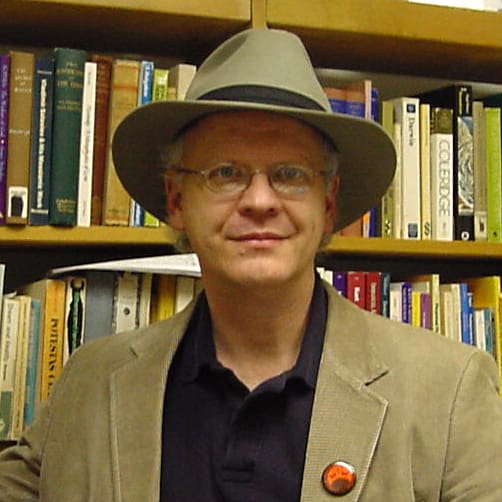
 James McLachlan is a professor of philosophy and religion at Western Carolina University, and is actively involved in academic discussions of Mormonism as a co-chair of the American Academy of Religion’s Mormon Studies Group and a board member and past president of the Society for Mormon Philosophy and Theology. But to overplay his academic bona fides is possibly a mistake, because, as this interview with longtime friend and Mormon Stories contributor Dan Wotherspoon reveals, Jim is the opposite of the stuffy scholar stereotype. In this two-part interview, his incredibly quick and inquisitive mind is on full display, but it’s his good humor and ability to use observations from everyday life, great literature, and important films to elucidate powerful philosophical and religious questions that will surely captivate listeners. Among other discussions, through Jim’s lenses Mormonism’s fully engaged God—as Sterling McMurrin described: a God with his “own problems”—comes alive and becomes a highly compelling alternative to traditional Christian views that borrow so heavily from Greek ideas about the nature of perfection. Hear, too, Jim’s wonderful take on why those of us who experience many of Mormonism’s theological ideas differently from many in the mainstream might still feel confident in answering temple recommend questions affirmatively.
Episode Transcript
Host: John Dehlin · Guests: Dan Weatherspoon, James McLachlan
This transcript is machine-generated and lightly edited for readability. The audio is authoritative. Please excuse occasional errors in names and spelling.
Introduction and Welcome
Part 1 of 2 · Ep. 302
Guest [00:00:00] 1, 2, 3.
Guest 2 [00:00:07] Mormon Stories podcast is a production of the Open Stories Foundation. All donations to Mormon Stories are fully tax deductible and go directly towards keeping the podcast alive and towards building a community of support for Mormons like you. To support the podcast or to join the community, please become a monthly subscriber today@mormonstories.org
Dan Weatherspoon [00:00:30] hello Mormon stories listeners. This is Dan Weatherspoon. I am excited to host another one of these conversations for the Mormon Stories podcast in addition to the Mormon Matters ones that I do. And I am with a very good friend of mine today. He is the kind of guy that I just think far more Latter Day Saints need to meet. He is extremely bright. He is so energetic, he is so likable and he is incredibly smart and, you know, just. Just one of those cool Mormons that everyone deserves to know. And his name is Jim McLaughlin. Jim is a professor at Western Carolina University back in North Carolina. And we'll get a feel for his philosophy and the things that he does as we go along here. But Jim, welcome to the Mormon Stories podcast.
James McLachlan [00:01:18] Hi Dan.
Dan Weatherspoon [00:01:20] We kind of came to deciding to do this and I ran it by John Dehlin as an episode for this and he was really excited about it. John has known you off and on through Sunstone contacts and things as well and find you fascinating and so we think our listeners will really enjoy it. By the time this releases, many of you listeners will have heard Jim already on the Mormon Matters podcast. He and I and Duane Jeffrey and Steven Peck, a couple of biologists or scientists at BYU are going to be recording an episode on the history of evolution in the church and controversies at BYU that we're now exactly 100 years from. So we're marking the anniversary of that. So many of you will have heard Jim a little bit on that and hopefully that's given you a great tease to be excited to dive into this. So, Jim, this is Mormon Stories and what we normally do at Mormon Stories is have our guests basically share whatever pieces of their growing up and formative years and turning points and all that stuff that's helped them shape their worldview. So I'm going to mostly turn you loose a prompt you here for maybe a little more clarification from time to time. But I really would love you just to dive in and stuff. So where were you born and take it from there.
James McLachlan's Early Life and Background
James McLachlan [00:02:36] Well, I was born in Salt Lake City, you know, in a hospital.
Dan Weatherspoon [00:02:43] Already we're getting the Jim McLaughlin personality here.
James McLachlan [00:02:46] I love it. I grew up in Taylorsville, Utah, and what was Left of my grandparents 30 acre farm. My great grandmother Margaret Naismith had bought the farm for a dollar from my great grandfather William McLaughlin during the polygamy raids. And she lived out there and raised her kids. She lost three of them in one day to scarlet fever. But I'm telling you this because my ancestors are. For me, Mormonism is kind of like ancestor veneration. So anyway, she raised her kids out there. My grandfather John McLaughlin took over the farm and raised a bunch of kids who became both Mormon and Jack Mormon. But they all had this kind of belief in the thing. My dad, James West McLaughlin grew up. These were depression era kids. Dad saved money and went on a mission and left. Actually entered the mission home on December 7, 1941, went up to the Northwestern states mission. Wow. Yeah, he walked around out there. People, you know, they liked him. But they also, you got a lot of why aren't you out fighting the war stuff. So when he got released from his mission in 1944, came back to Utah, joined the merchant marines and served out the war in the Pacific. Important story here. His brother Marvin had joined the Marine Corps and was killed at Okinawa just before, a few days before the end of the war. And he had this. I'll tell this story now and I won't tell the whole thing because it's kind of, I don't know, too sacred to share with a mass audience. But he had an experience of his mother coming to him on the ship and telling him what happened to his brother. And for me, as we'll get into this, I think my testimony of the church is kind of, how would you say, eccentric. Okay, I love it. But that's an important part of this story that he told me and exists in my family of this experience he had. But anyway, he survived the war and went home and back to Utah. Wanted to farm, but making a living as a farmer is fairly hard. So he ended up working at Kennecott Copper. And though he voted Republican, he was a union man. And so that was important to me too when I was growing up. My mother, really interesting story. She grew up in New Jersey. Well, her family was Pennsylvania German, but she ended up in New Jersey and she found a book called the Proselyte about the Mormons and read it and then found the Book of Mormon in the library and read it and decided she wanted to become a Mormon when she was in her early teens. Her parents were Presbyterian and of course Mormons didn't have that great reputation back in the 30s and 40s. They thought she'd gone nuts. But she eventually did join the church when she was 21, came out to Utah and met my father. But she became this kind of avid genealogist she had been already before she joined the church. And so this idea of the importance of not just your own story, but the going back into the story of your ancestors was always important for me. We used to spend our summers, she was in cemeteries in Pennsylvania. This is my idea of how vacations were spent when I was little.
Dan Weatherspoon [00:07:06] Too funny.
James McLachlan [00:07:07] Beating tombstones with flour sacks so we could try and read them. But later, as I got older, I found out that other people didn't spend their summer vacations that way. And I felt kind of cheated. It was still a good experience. I still love to go into cemeteries now. Very interesting. They aren't scary places for me. But anyway, I grew up with them. My mother. I didn't read the scriptures when I was a kid, but my mother read them to us. She read us the Book of Mormon. He grew up out there. You go up in the mountains and you wonder if Nephites were hanging out, you know, childlike ways of looking thing at things maybe. But. Yeah, so I grew up out there. But one of the important things of my youth was I grew up out there with my uncles and aunts and cousins. Most of them, a lot of them were Jack Mormons. But they'd all come down and they'd have these wonderful kind of speculative conversations. My Uncle Scott would tell J. Golden Kimball stories. My Uncle Ralph, who. Believed in the healing virtues of early thyme whiskey. They called him the Prof. Though he liked to prophesy. And he would talk kind of speculative Mormon theology. But they would all do this kind of stuff. I had two aunts that were fairly active in the church, but they would get together and you just get this kind of interesting wild speculations going on about the church and about the gospel. My dad didn't graduate from high school until he was in his 40s, but he read B.H. roberts and John A. Witstow and James Talmadge. So I was raised with that kind of stuff in my background, plus a lot of wonderfully weird stuff as well. So it was good. But then when I was about 12, we sold the farm, moved over to the east side of the valley, and that kind of sacred space sort of disappeared.
Guest [00:09:25] It was.
James McLachlan [00:09:26] And you know what West Valley's like now, right?
Dan Weatherspoon [00:09:29] Right. You keep talking about way out there in Taylorsville and it's all connected now.
James McLachlan [00:09:34] Yeah, it's like strip malls and the sacred space is gone. So that actually theologically is quite important to me too, because I don't feel tied to places. Maybe it's because I had to move to North Carolina too, as much as I thought that I would be, you know, that there are these sacred ancestral grounds and you're, you know, you're. You're tied to them or, you know, anyway, but so I went to high school and we lived in Holiday. I went to high school there at Olympus High School, which was at the time an odd mixture of the upper classes and the working class. The east side of the valley now is probably all, you know, fairly wealthy people. But I remember going there and I was a terrible student. Well, not terrible. I wouldn't even be called what you call a slacker now. I don't think I had like a C average. I didn't think I was going to be going to college. I remember the Vietnam War was going on and a bunch of us being herded into an assembly with the army recruiters telling us that if we joined, we wouldn't have to be frontline soldiers. But since our grades were so bad, we were probably going to end up drafted it in there. But my senior year, I had some really wonderful teachers and I discovered Dostoevsky. I discovered debate. I quit playing football, which was good because I wasn't a very good football player. My contribution teams was holding the tackling dummies. I realized I could never be a farmer because I went up and spent a summer working on a farm in Idaho and realized I would starve to death. But I had an English teacher who had us read Crime and Punishment. I read Dostoevsky, and it was incredible. And then I was always a fairly good history student. So I had another teacher, Mr. Tolman in AP history. Mark Hoffman was in my class.
Mark Twain and Early Intellectual Curiosity
Dan Weatherspoon [00:11:48] Very interesting.
James McLachlan [00:11:49] Mark was a quiet guy. We didn't talk much. He was already busy doing his work. But anyway, so that was a great experience. But one of the things that happened was I was taking a class and we were told to read books, find a book. And my sister had read Mark Twain's the Mysterious Stranger, and she said I should read that. Plus, it was short.
Dan Weatherspoon [00:12:19] It was the virtue of all high school reading choices.
James McLachlan [00:12:24] Yeah. So it looked like something I could get done with. And then I just want to read one passage from this to you, because when I read this book, which is one of the most depressing things I've ever read in my entire life, I hadn't. I read this, and I got to the end of it, where you Know this angel, Lucifer, who's not the real Lucifer, but his nephew comes to these boys during the Thirty Years War in Germany. And it's an amazing book because it's like no good deed goes unpunished. It's like Cormac McCarthy. But anyway, at the end of the book, after all these horrible things have happened to these boys and to anybody who they want to be blessed by. This angel at one point, just a story about this. The boys ask the angel to help this guy who has just had this miserable life, even though he's a good human being. And the angel goes over and touches him and he goes mad. And the boy said, why do you do that to him? He says, don't you know the only truly happy people are the insane
Dan Weatherspoon [00:13:42] Mark Twain at his finest attitude towards religion.
Guest [00:13:46] Yeah.
James McLachlan [00:13:47] If you really want to freak out your kids sometime, there's a Will Vinton. Remember Will Vinton and the California Raisins?
Dan Weatherspoon [00:13:55] Yeah, vaguely.
James McLachlan [00:13:57] There's a Will Vinton claymation movie called the Adventures of Mark Twain, which is a wonderful thing to watch. It's got stuff from the Adam and Eve diaries in it and everything like that, but it has a little section from the Mysterious Stranger. And I teach religion and film courses here at Western and I always show this little clip. It only lasts about three minutes. It's in the middle of the movie and it freaks out my college age students. So imagine showing this to your 5 year old, anyone. But it's a great movie. But anyway, the end of the book, the boy talks to Lucifer, to the angel and asks him what's going on. And the angel says, hey, don't you realize this has all just been your dream? So it's really dark. But what he says here was important to me. It was an important statement about God that has stayed with me ever since then, ever since I was 17 years old. And I'd like to read it.
Dan Weatherspoon [00:15:07] That's fine. Yeah, I know the quote you're talking about. So yeah, it's a wild and crazy quote.
James McLachlan [00:15:14] Okay. Strange that you should not have suspected years ago, centuries ago, eons ago, for you have existed companionless through all the eternities. Strange indeed, because you have not suspected that your universe and its content were only dreams. Fiction. Strange because they are so frankly and hysterically insane. Like all dreams, a God who could make good children as easily as bad, yet preferred to make bad ones, who could have made every one of them happy, yet never made a single happy one, who made them prize their bitter life, yet stingily cut it short. Who gave his angels eternal happiness unearned, yet required his other children to earn it. Who gave his angels painless lives, yet cursed his other children with biting miseries and maladies of mind and body? Who mouths justice and invented hell, who mouths mercy and invented hell, who mouths golden rules and forgiveness multiple applied 70 times 7 and invented hell. Who mouths morals to other people yet has none himself. Who frowns upon crimes, yet commits them all, who created man without invitation and tries to shuffle the responsibility for man's acts upon man instead of honorably placing it where it belongs upon himself. And finally, with altogether divine obtuseness, invites this poor, abused slave to worship him. You perceive now that these are impossible except in a dream. You perceive that they are pure imperial insanities, the silly creations of an imagination that is not conscious of its freaks. In a word, they are a dream and you are the maker of it. The dream marks are all present. You should have recognized them, Cyril. Excuse me? You should have recognized them earlier. I remember reading that. I don't know, it just seemed true
Dan Weatherspoon [00:17:12] to me that this is an absurd God, or. What is it that felt true to
James McLachlan [00:17:18] you, that believing in a God that controlled everything, that controlled people's destinies, people will get up and say, God is. When somebody suffers a horrible malady and said, God has sent me this trial. And that just seems to me an impossible thing to believe. I know that many people believe it, and many really intelligent people believe this, and people who I respect and love believe it. But for me, it was, when reading this just resonated with something in me that. That I couldn't believe in that kind of a God.
Dan Weatherspoon [00:18:04] Now, at this point, had you tied into the idea that Mormonism doesn't believe in that sort of God that most Mormons. Yeah, I'm trying to get.
James McLachlan [00:18:14] Yeah, sort of Mormons are. We'll talk about this later, but sometimes people will talk about Mormon theology. And I've come to believe that there is no Mormon theology. There are about 30 Mormon theologies. I think this is true of pretty well all religions is that there is the initial revelation or the initial experience, and then we try and explain it and we explain it in a bunch of different ways. And I think it's a great thing to do. Theology. I love theology. It's what my uncles and aunts were speculating on as they sat in the house on Saturday nights sometime. And so I did have a sense, I think, that the Mormon God wasn't like this. But you got hit from both sides. People are wonderfully inconsistent where on the one hand they talk about us being free and the pre existence and on the other hand you'd have this idea of absolute God who's in charge of everything that could possibly happen. The quote both struck me as remarkably true and screwed me up at the same time. Have you recovered?
Drifting from and Returning to the Church
Dan Weatherspoon [00:19:28] No,
James McLachlan [00:19:31] nobody. Yeah, it's like Freud says, nobody ever fully recovers. You just get by. But at the time too, I had made another decision. About a year earlier, I quit going to seminary because I wanted to save my faith.
Dan Weatherspoon [00:19:47] Wow, that's an interesting statement.
James McLachlan [00:19:49] Well, you know, I found seminary the most faith destroying thing that I ever experienced. They were nice people, but it was, at least for me, the stories and the sometimes depended on the teacher. But sometimes dogmatism was so out of line with the Mormonism I had experienced from my father and my mother and my aunts and uncles, some of them Jack Mormons, that it just didn't help me.
Dan Weatherspoon [00:20:27] So you're rejecting the certitude and the concreteness and we have this completely figured out versus the that.
James McLachlan [00:20:36] And then it was so. And this is, you know, I didn't figure out these things until later, but I didn't like testimony meetings because, you know, everybody would get together and especially, you know, we were all young people and it would get really emotional and everybody would talk about how they were about the gospel being true and people would be crying and everything. And just at the time it just bugged me because I knew some of these kids and there was a certain amount of hypocrisy there. It's high school. It's a cruel and unusual place. And I got to admit too politically, I was always was born a leftist, I think, and at least the leftist wannabe, I should say that way. But you know, my dad had been in the union. I was really pro union. I actually ended up in college because I won a scholarship from the AFL CIO on why unions must participate in
Dan Weatherspoon [00:21:41] politics really too fun. So yeah, you're an unusual kid here. Obviously the things that you were interested in, your mind gravitated towards and the things that you weren't, you just couldn't care less.
James McLachlan [00:21:53] Well, laziness was a big part, but also a kind of ADD I think nowadays people would call it. I had a hard time in high school because you had to take seven classes and that just freaked me out. But in seminary later, I would come to think of it as a kind of. Well, you have these intense social experiences at Nuremberg rallies and at tea parties and at rock concerts. And that seemed to me to be kind of dangerous that you would just kind of dissolve into this mass of good feelings. So, yes, I dropped out of seminary. I was reading Mark Twain and Voltaire and people like that, but I was also reading Dostoevsky. And so by the time I got to college, I was fairly confused on all these things. I went to Utah State. I lived in the Mormon dorms up there. They don't exist anymore, but they had Mormon dorms. And I was a member of the Young Socialist alliance at Utah State. I think there were four of us. I got the militant. There was a guy there, Dane Goodwin, who probably wouldn't remember me because like I say, I was a Marxist wannabe. I couldn't commit to really going out there and doing what needed to be done. But I believed in the possibility of the revolution. There was that great song from back then, the Revolution Will not be Televised. Do you remember this?
Dan Weatherspoon [00:23:27] Not really.
James McLachlan [00:23:30] YouTube it. It's really fabulous. One of the big disappointments of my life is it never happened. Some people are disappointed because Jesus hasn't come back. I was disappointed because the revolution never happened. But anyway, anyway, there came to be a point where I had to make a decision. You know, I was 18 and I had to decide whether or not I was going to go on a mission.
Dan Weatherspoon [00:23:56] Okay, so you had done a year at Utah State before this decision?
James McLachlan [00:24:00] Is that what I was doing my freshman year? I just 18, I was just turning 19, you know, and everybody else was going. And there was, you know, there's a lot of pressure, you know, about this. I've heard your stories. You rebelled against it.
Dan Weatherspoon [00:24:14] That went the other direction, that's for sure.
James McLachlan [00:24:16] Yeah, but there was a lot of pressure to go. Everybody, like in my ward at home liked me. And when I'd get up and I'd mouth Marxist stuff in the ward, people would just kind of say, oh, it's okay, he's Jim McLaughlin's kid, he'll be all right.
Dan Weatherspoon [00:24:35] And it wasn't like, oh, he's talking law of consecration here. How spiritual.
James McLachlan [00:24:40] No, I hadn't figured out law of consecration. I think I told you once, Point. Well, my mother had read the Book of Mormon and we'd done a lot of talking about such things. But the only scriptures I had read before I went on my mission was the Song of Solomon. And that was because somebody told me it had to do with sex. I had a couple of wonderful cousins though, who I was staying with. They were both returned missionaries. They were from the non Jack Mormon side of the family. When I was up there and I had great talks with them about stuff. They couldn't believe I was Uncle Jim's kid because how could I be a lefty and so messed up about so many things, at least from their point of view. But anyway, I had a talk with my father one night, and he was such a gentle human being. He was just sweet. He died four years ago, and I miss him tremendously. But we were talking and we were talking about whether or not I'd go on a mission. And he looked at me and he said, jimmy, you know, you don't have to go if you don't want to. And right at that moment, I looked in his eyes and, oh, hell, I've got to go. I could tell it would break as hard if I didn't go. And people say that's the wrong reason to go. But I have come to believe, and we'll talk about this when we get into the actual theology, at least for me, that was the best possible reason to go, because I looked into the man's eyes and I saw God. It wasn't, you know, Joseph Smith with the vision in the Grove or whatever. People, you know, feel these feelings. I saw God because I loved him and I felt the same way about my mother. So I decided to go on a mission.
Dan Weatherspoon [00:26:48] That's beautiful.
James McLachlan [00:26:49] Well, you know, it was pretty miserable, actually.
Dan Weatherspoon [00:26:54] Okay, well, beautiful. I saw God. Now, the miserable part is your mission or what?
James McLachlan [00:27:01] The miserable part is that, yeah, I saw. I loved my father. I didn't realize that I'd seen God yet. I see.
Dan Weatherspoon [00:27:08] Yeah, good comment, man.
James McLachlan [00:27:09] I went into the language training mission down there in Provo before it was the mtc. This is ancient times. I got called to France, which was good, because that's where I wanted to go, even though I hadn't said that I wanted to go there because I loved everything French. It was a great country for leftism and the French Revolution, and I loved philosophy, and it was a great country for that. I had been a history major, by the way, up to this point. Up to this point, too. I thought I wanted to be a union lawyer. So I end up on this mission. I go down to the LTM and I read the book. I read all the standard works while I was there for that two months trying to learn French. I read Jesus the Christ and the Articles of Faith, and I kept waiting for this big experience to happen, and it kept not happening. I read a good deal of the teachings of the prophet Joseph Smith. And toward the end of my time at the ltm. I read the King Follett discourse for the first time. I'd heard people talk about it as I grew up, but I read it for the first time and I thought, I think I can believe this. Because if you go back to that Mark Twain mysterious stranger thing, and like I said, my dad was a big BH Roberts guy and WITSO guy, so I'd heard talk about these things. But I read that and I thought the idea that God is one of us, the idea that God developed through time, that God isn't in complete control of everything and sort of a tyrant torturer that I thought, yeah, this is. I wasn't spiritually converted this time, but intellectually that made really good sense to me. The Book of Mormon, I thought was a really nice book, said nice things in it. I really like Second Nephi chapter two, thought it was great, you know, that opposition in all things. But then we got the Second Nephi chapter three about there will be this guy, Joseph and everything. Oh, come on. Joseph Smith writing this, predicting his own greatness. I mean, I had people, you know, anyway, the. There were things in it. I just, you know, they just kind of too much, you know, like 2000 Stripling warriors. None of them even gets wounded. Oh, well, they get wounded. None of them get killed. You know, there was just stuff like that for me at that time were just. They were just beyond the possibility. And then, you know, rereading the Book of Joshua, you know, kill them all, even the babies. It seemed like Mark Twain was right about a lot of these things. But anyway,
Mission Experiences and Finding Purpose
Dan Weatherspoon [00:30:11] so you're in the LTM and you're at least beginning to have a reason to go. I'm getting a little more excited because at least I know I can explore this angle. Is that what you're saying?
James McLachlan [00:30:21] Okay, yeah, I'm in the LTM and I'm falling in love with philosophy too, because I get fascinated with this idea that there's all this really disturbing stuff in the scriptures. There's all this kind of what I thought time thought was crazy stuff in the scriptures, and then there's all this cool stuff in the scriptures. The fact that there was so much in there, the old 70s expression blew my mind kind of a thing, but I didn't have a testimony. And when I finally got to France, I remember telling my missionary, my mission president. Plus this was a time when the civil rights movement was going on and we hadn't figured that one out yet, which seemed to me pretty awful because people will say that Mormons weren't Racist sometimes. I grew up in a society of people who had never met a black person but were incredibly racist. But one of the things I have to say for them that often when they met a black person, they somehow didn't see they were black. Oh, this is a human being. So they overcame their ideas. But anyway, I got out on my mission. I remember telling my mission president this, and he said, well, you know, just say you believe what you believe, and, you know, you can leave it at that. Then I told him, you know, I think that I will go mad if I have to just read Mormon stuff over my whole mission. And he said to me, well, you can read anything you want to read. Just read it in French. Which, you know, I don't know if they do that anymore. They probably don't. But he even gave me a list of books. Montaigne, Pascal. And so I got loose on my mission. Every Friday, I would get up and I would have all these French books. And it was. It was a real motivator to learn to read and to learn French, you know, everything else is a real motivator, too, when you're out there. So I read the Scriptures again voraciously, and I tried to read all the philosophy that I could, but it took me. I was out there for about a year, and I read the Kingfollet Discourse kind of over and over and over again. And I guess at a certain point, I had two big sort of experiences that I don't think other people would see as great spiritual experiences, but they were for me. One was in my first town, Bazon Son. I was so frustrated. I tried all the stuff that happens in the Book of Mormon, the King Limhi stuff, and lay down on the floor and give all your sins away and all that.
Dan Weatherspoon [00:33:06] Nothing happens.
James McLachlan [00:33:08] Felt like words were falling on the pavement. So one day I walked out. And this will sound silly to most your listeners, but it sounds silly to me. But one day I walked out and got on my bike and I shook my fist at heaven and said, okay, it's your turn. And I was really distracted, and I almost got run over by a truck.
Dan Weatherspoon [00:33:32] Interesting.
James McLachlan [00:33:33] So I pulled off the side of the road and said, okay, I'll wait. I'll just keep trying. But then I got to my second town, and I would always talk to all the communists and Marxists and socialists. And there was a guy who worked for the railroad, great guy. And I remember having a really intense conversation with him about God. And he looked at me and said, you believe this stuff, right? And once again, Just like when my father looked at me, this is experience of, yeah, I can believe that you are divine. That is true. And at a certain point in my mission, I just decided that's what I believed. And so I believe that other people
Dan Weatherspoon [00:34:20] are fundamentally good versus just fallen creatures, that kind of thing.
James McLachlan [00:34:26] Well, not that they're fundamentally good, but that they are divine. That we are these creatures that are in a struggle, you know, and part of this is as much. Well, it's Second Nephi, Chapter two, you know, the opposition in all the things that goes all the way down. And by all the way down, I mean, even with God, you know, it goes all the way down. There's tremendous struggle going on between good and evil that's in all of us. I make that sound like it's more a Manichean dualistic universe. I don't mean that when we get into talking philosophy, we can talk about why that's not the case. I do think there's a struggle in us about. And it's a proper struggle. It's a struggle that Mosiah talks about when he says the natural man is an enemy to God. That we have these desires to be individual, but we have also this need for community with others, for loving others, for getting beyond ourselves. And that struggle itself is an indication of the divine in us. We're not just selfish bastards. And this man that I was talking to was such a wonderful person. He was committed to the union there, but he also, you know, he wasn't going to go out and kill people over it. And he was committed to making a better life for his family. He was just a good man. And I would meet these people all through my mission. There was a Protestant minister who ran a home for homeless people. And, you know, we would hang out with him and with the homeless guys, and, you know, we didn't do much, but they were. You know, all the drunks in town knew us and liked us, so that was good. And I met these. They called them worker priests. The worker priest movement was big in France, and these incredible guys that would. They were priests, but they were working in factories with working class folks. And it just seemed that the best things about religion were. And I thought Mormonism had this in it, to recognize the divinity right here in our brothers and sisters that surround us, and not just in something that was up in heaven, far, far away. And so that I kind of went through my mission with that, and the mission got better. France is a tough place. I worked in Burgundy, Beaujolais and Provence. Three of the biggest winemaking regions in France. And if folks liked you, they'd let you in and they'd offer you a glass of wine. And then they wouldn't be interested in Mormonism anymore because wine was a bigger part of the French religion than Catholicism was. But the French were fabulous. I mean, these people could laugh. I mean it was, oh gosh, I spent three months in Switzerland and the Swiss were all incredibly polite but very cold. The French were all incredibly rude and just wonderful.
Engaging Leftists and Marxists as a Missionary
Dan Weatherspoon [00:37:46] I'm wondering what your companions thought of you. I'm going to seek out all the leftists and Marcus and Marxists in every town I go to. Were they looking at you as this bizarre creature or were they just going along for the ride and enjoying these kinds of people too?
James McLachlan [00:38:01] I had great companions, they were fabulous people. I would just some of them maybe more than others, but they were all good guys. I had one companion who was a jazz drummer. He was from California. He was the straightest looking Mormon guy you ever saw. And yet being away from his drums was killing him. He would just get going and actually we were in mantra together where the big jazz festival was. And the rule was we couldn't go to it. But after I got transferred, I got a letter from him saying that he'd gone to it and I was so proud of him.
Dan Weatherspoon [00:38:38] All right,
James McLachlan [00:38:42] we worked hard. A lot of them, they thought I was a little weird maybe, but they were good people who worked and who were trying to. Not just self righteous little freaks, but who were actually trying to help people because the church was always struggling in France and the members of the church were fabulous. They were just kind people. I met the most amazing man of my life while I was over there. I mentioned my problems with the priesthood ban. I was there 74 to 76, two years before the priesthood ban was lifted. And I met two people, a fellow from Zaire who was. We baptized a couple of people, but this guy didn't get baptized. But he was the easiest guy to teach that I had met. We got about halfway through the lessons and I had to get to the part where I told him about the priesthood ban. Fortunately, in the 60s, President McKay, they'd issued that statement for reasons known to God, but only known, not unknown to man, but only to God. So all the idiot stuff about not being valiant in the pre existence wasn't necessarily the case. But I had to tell him this. And it was like the worst moment of my mission, having to tell this guy who was a much better human being than I was, that he Couldn't have the priesthood. And he said, well, if the guy's a prophet, there must be something to this, which I wasn't ready for. But that, once again, showed him that he was a much better man than I was. So I met him. And then there was another guy in the last town I was in. I was down on the Riviera in San Rafael. And we were the only people dressed. It was a really difficult place to be in the summer. There were incredibly beautiful women walking around and not much. But there was a guy in the branch there, Monsieur Bourdin, who. He had married a woman who had ended up in a mental institution. And she'd had five or six kids, and he'd taken them. And he was a truck driver who lived in government housing. And he, once again, a black fellow. And he was a saint in the real sense of this. He. He kind of. All the kids in the housing unit were always over at. In the housing development, were always over at his place. He was taking care of them. He was. You could feel the goodness just kind of ooze out of this guy. He was just kind. He was happy, and he led the music. And every week we sang Onward Christian Soldiers. And he would make the place. We only had 20 people, but he would make the place. It rocked. Okay. It was just great. And he's one of those guys, when you meet him, you say, sometime in my life, I would like to be like him. And then I came home from my mission. Well, one last thing about my mission. I'd been over there and you'll appreciate, because you do process theology. I had. I met a woman. We became friends, her and her husband and me, because we sit around, talk theology. Then I'd gotten transferred. Well, she had told me a book that I. She had told me I should read Dietrich Bernhofer, the Protestant theologian. And I was 20, and I couldn't remember the name Bernhofer. That's a hard name to remember. But I remember the guy's name began with a B. And he died heroically in World War II, too.
Henri Bergson and Philosophy on the Mission
Dan Weatherspoon [00:42:35] He'd be an interesting person for a lot of our listeners to get to know because he was a Hitler and, you know, he was a Nazi hater, I mean, trying to fight against it. And he got caught up in a plot to execute or to murder Hitler and ended up being executed by the Nazis towards the end of the war. Right. But, yeah, fantastic.
James McLachlan [00:43:01] I didn't read him, though, because I got confused. This was one of those really productive mistakes. I got my dictionary. I Had a little French Dictionary of Philosophy and B, and died heroically in World War II. And I was going through it, and I come across this guy, Henri Bergson. Yeah, he was Jewish, but he had contemplated conversion to Christianity, but then decided not to because he said the darkness was approaching and he wanted to stay with the people in the dark part of the picture. But he had registered him because he'd won the Nobel Prize in Literature, one of the few philosophers to do it. He had been granted Jewish immunity. How you like that? By the Vichy government. But he was in his 80s at the time, and he went out and he stood in the rain for several hours so he could register himself as a Jew. So that was heroic. So I started reading Bergson, and I loved it. It's kind of process theology stuff. And I got his last book, the Two Sources of Morality and Religion, which is one of the fabulous books. And it dealt with things in ways that were in just this really interesting way. And I was reading this on my mission and not understanding it all, but at least getting some. One was. He said, there's two sources to religion. One is the conservative, what he called the closed source. But he says this is absolutely necessary to religion. It's social, it preserves what has been revealed. It's institutional, but it also can be oppressive. The other source he called the open source. It was revelatory. He associates this with the mystics and the prophets, and it's open to new innovations in religion. He says, now, both of them are good, but both of them can kind of tumble off into a kind of evil. The one, obviously, because it's repressive, it. It tends to close itself and become dogmatic. But the other one can wander off into flights of fancy and into kind of utter chaos, just going here and there and everywhere, like sunstone.
Dan Weatherspoon [00:45:26] Oh, man, I love sun, rip.
James McLachlan [00:45:32] But there is a possibility sometimes that we get so for sure, so open to our own spiritual experiences that we wander off into La La Land.
Dan Weatherspoon [00:45:44] Exactly. Yeah.
James McLachlan [00:45:46] I go to Sunstone all the time. I love sunstone. I consider myself a sunstoner, but that's our temptation. Now, if you go to church, it's the other temptation that would be repressive and dark. And either one of them has their temptations. But anyway, the last line in that book, and like I say, I didn't understand the book very well, but it really got me excited, was it humanity must realize that the universe is a machine for creating God. Very last line in two sources, I was like, he's a Mormon. We try to baptize a lot of people that can't be baptized, like C.S. lewis. But I don't know. But for me at the time, that was an incredible revelation.
Dan Weatherspoon [00:46:33] Very cool. So this is at the end of your mission, and so you're excited and all this stuff is going good. So.
Marriage, Family, and Life After the Mission
James McLachlan [00:46:40] Yeah. I go home.
Dan Weatherspoon [00:46:41] Yeah. Tell us about my mission president.
James McLachlan [00:46:44] I was going to go home, and I was going to go to either the U or Utah State because I'd sworn I'd never go to byu. But my mission president talked me into going to byu. And, you know, I'm glad I did. I mean, I went there, and the best thing that happened to me there was I met my wife, and I met her in all the ways that you're not supposed. Well, all the. No, not supposed. You are supposed to. Okay. All the. What would you call them? Cliche ways. I was studying there. I'd never been so lonely in my life. And I go to family home evening. That's what it's set up for. And there she is. And I look at her, and she just seemed. It's one of those experiences, like I was talking to with my dad and this fellow in France, like a nice person, like somebody who's kind of. And I went over and we talked about Mark Twain. She was an English major, and we talked about Mark Twain. And I was totally smitten. But I didn't see her again for about three weeks. Finally, I got a date with her. We went and listened to Jacob Noizner, the Jewish scholar, speak at byu, and then I took her to see Taming of the Shrew. And by that time, I was head over heels in love. And a week later, we got engaged. I don't know if she was head over heels in love with me. She said when I asked her to marry me, I was sitting under my punching bag in my basement apartment. It wasn't very romantic, but I was overwhelmed with love. And she said, I know I'm going to marry you. I took that as a yes. Apparently, she didn't. But the next day, my sister worked at O.C. tanner, so I had 30 bucks to my name. But my sister forced me to get a ring for her and gave me a diamond, which was really nice, and I just had to buy the setting. A couple of months later, we got married. I was totally worthless during the whole time we were engaged. I flunked a couple of classes.
Dan Weatherspoon [00:48:57] So you needed to hurry and get married so you could get back to being able to concentrate.
James McLachlan [00:49:01] I can only think of one thing at a time. So it was. Yeah. And We've been married 34 years now. It's the most wonderful thing that ever happened to me. If anything, Carrie is wonderful.
Dan Weatherspoon [00:49:15] I know Carrie, and she is fantastic.
James McLachlan [00:49:20] Well, I guess that brings us. Well, after byu, I went back to France, Kerry and I did, with our young child, Jimmy, and he was only a month old. And I taught French history for byu, study abroad there for six months. I thought I was going to stay and do a master's in philosophy at the Sorbonne, because one thing my mission had done is, and this is for good or ill, I don't know how you want to think of, had pulled me so into philosophy, trying to figure out this God question, that I decided I wasn't going to be a union lawyer. Which, like I say, depends on what you want, theologians or union lawyers. I don't know if I would have been a good union lawyer or not. But anyway, so I go to byu, I go to Paris, I sit in on classes on Heidegger at the Sorbonne. But I, you know, I figure, well, you know, we can't afford to live here because there's three of us. We go back and I get into Indiana University and doing. I'm doing European intellectual history. It was really interesting, but I decided that. I walked over, my advisor in history said, you know, you shouldn't be in history, you should be in religious studies. I didn't even know what religious studies was. They didn't have it at byu. And I said, well, you know, our church doesn't have ministers. And he says, that's not what religious studies is. So I went over to the religious studies department. I started taking classes from a guy named Jim Hart, who was an incredible polymath. He knew everything. He read every book. He said. He recommended to me that I read Nikolai Berdyaev, the Russian theologian who I eventually wrote part of my dissertation on. And then I took a class in Jean Paul Sartre from a guy named Paul Spade, which was. And read I owned being a Nothingness. I'd read parts of it on my mission, didn't understand any of it, but I took the class with him. And it was, you know, the world opened up again and so I decided to leave history and I went up to the University of Toronto and did philosophy of religion in the center for Religious Studies at the University of Toronto and studied Russian philosophy, Bergyev and those people, but also spent a lot of time with Hegel and Schelling and Heidegger and names that might mean something to the listeners. But I actually got more converted to the church in Toronto than I had been on my mission because we were in an inner city ward and these people were struggling and they were good people, they were trying so hard and it was just such a pleasure to be with them. But anyway, so I did my studies there. I had a fellowship. We actually went from Toronto back to Indiana, where Carrie did her master's degree in religious studies and I worked with Jim Hart some more. And then we came back to Utah, where we existed in poverty for several years. As I wrote my dissertation, you know how this goes. And I decided to write my dissertation, it came to me in priesthood meeting because there's an idea in Sartre called the desire to be God. And he thinks this is what he calls not human nature, but the human condition, that we desire to be God. And for him that's largely a negative thing. And we can talk about this in a minute. But it came to me in priesthood as I was sitting there listening to, you know, my brother is talking about becoming gods, like going up the corporate ladder of success. And that just didn't seem like a good thing to me. So I wrote it. So I used Sartre's idea of the desire to be God. There's nothing about Mormons in this whole dissertation, but it was all in the background. That's what I was thinking about all the time. And then coupled that with Nikolai Berdyaev's notion of becoming like God, which is a notion of self emptying, of relationship to the other. And that was my dissertation, which eventually became published as a book that I think four people read.
Guest [00:53:39] Woo hoo.
James McLachlan [00:53:40] Yeah, it's the scholarly stuff. I'd like to get back to it sometime because it really still interests me. But anyway, so we lived out there in Taylorsville while I wrote this. I taught at Westminster, I taught part time at Utah. It was Utah Technical College then, not uvu. And I taught part time at byu, both in the philosophy department and in the religion department. The BYU stuff kind of dried up and I was still teaching at Westminster and Utah Tech. But one of the great experiences we were living out on the old farm in Taylorsville. And it was a two room house, not a two bedroom house. We had three kids and we were in this little two room house. And my cousins, who were both construction workers, lived out there too. They used to kind of look at me and say, well, Jimmy, you were the smart one. What happened? But I remember they'd get drunk independently. And whenever they got. Not whenever they got drunk, but sometimes when they got drunk, they'd come down, want to talk religion. I'd have these wonderful conversations with my semi drunk cousins.
Dan Weatherspoon [00:54:50] One spirit leading to a different type of spirit.
James McLachlan [00:54:53] Yeah, exactly. Well, it opened them up. I mean, you know, my. They were, in some ways they were more open to the spirit than I was. They'd go down there and they'd feel kind of the presence of the ancestors. They regarded it as a kind of sacred spot. And it was always wonderful to talk to them. And they had really profound things to say when they were slightly inebriated about the problem of suffering because, you know, their family had gone through significant amounts of that and the. And, you know, justice. And it was just, you know, fascinating part of my theological education just talking to those guys. But anyway, I got really sick and I just wanted to. I was teaching at Westminster at the time and they put me on phenobarbital. It was an asthma condition. And I was really kind of trippy for a little while, even though I was giving lectures on Thomas Hobbes. But I just wanted to finish my dissertation and find a job. And I remember calling BYU to ask them if they could just hire me for the summer so I could have some money to finish my dissertation. They said, well, we're going to hire you next year for a year appointment. And I remember hanging up the phone and wondering if I'd hallucinated it. When I went down to talk with the department head a couple of weeks later, I was really careful to try and I was trying to get him to say that they were going to hire me because I wasn't sure that they had. Finally I just came out and said, did you guys want to hire me next year? And they looked at me kind of strange and said yes. So I got the job at BYU for a year. I taught there for a year and then got my job at Western Carolina. And in 1991. It was 1991 when the six got excommunicated, right?
Dan Weatherspoon [00:56:47] 93.
James McLachlan [00:56:48] 93, yeah. That hit me as quite a blow. And I contemplated leaving the church at the time. But a year later I kept going to church. And a year later. This will sound really incredibly self serving, but it's not. We moved from our apartment. Apartment. We finally raised enough money for a down payment on a house. We moved from our apartment to our house and the ward showed up to help us move. And I just wanted them to move some furniture, but they moved everything. They packed everything up. They just moved us. And I had this same experience. You know, the. These are Wonderful people. How could I ever give this up? You know, they, you know, that was splendid. You know, these beautiful people, you know, terrible problems in their own lives, some of them. But, you know, doing the right thing, helping somebody else, you know, I could never give that up. And I, you know, I've taught seminary and institute since then. I don't know why, but I'm on the High Council now. Out here in my stake that's 200 miles across, you live old enough and you stay around long enough, they stick you on the High Council. But ever since that event, I've really. I still struggle with theological ideas, but I don't struggle with the idea of ever leaving. You know, the. There's a sense in which it's true. The sense in which it's true, like I say, is going to be fairly eccentric for me. But that's my biography part of this, and I probably talk too long, but this is what I'm committed to. It's like I'm committed to my wife as the most beautiful person on the planet. I'm not saying everybody else has to follow me, but they're wrong. She is. And same thing here with Mormonism. Mormonism is the true faith. Why? Because I love it. And, you know, I admire Buddhists, I admire Taoists, I admire atheists, and there's a lot of truth there, but they're wrong.
Joseph Smith, Theology, and Closing the Biography
Dan Weatherspoon [00:59:12] Wow. That's wonderful. Well, I loved hearing this, and I think our listeners will love it. So let's make that the sort of the close of the biography section. I'm sure as we go along here, you'll illustrate with other pieces of your life as ghosts. But let's close this first segment of conversation and move into another one. Does that work for you?
James McLachlan [00:59:35] Yeah. That's great.
Guest 2 [00:59:39] Thank you for joining us today on Mormon Stories. Music today was provided by the Saber Rattlers. Check them out at saber-rattlers.com the Mormon Stories logo was generously donated by StudioCase.com thanks for listening.
Guest [00:59:55] Come, come, ye saints. No toil nor labor fear but with joy Wend your way though hard to you this journey may appear Grace shall be as your day Tis better far for us to strive Our useless cares from us to drive to the San Jo your hearts will swear well oh, all is well all is well. Why should we mourn? I think our lot is hard Tis not so all is right why should we think to earn a great reward if we now shun the fight? Gird up your lo Fresh courage Take our God will ever us for sake soon we'll have tale to tell? Oh, all is well? All is well? Oh, all is well? All is well? And should we die before our journey's through? Happy day? All is well? We then are free from toil and sorrow too? With the justice we shall dwell? But if our lives are spared again? To see the saints the rest obtain? I will make this glory swell? Oh, all is well? All is well? All is well? All is well? All is well? Oh, is well? All.
Sartre, No Exit, and the Desire to Become God
Part 2 of 2 · Ep. 303
James McLachlan [00:00:00] 1, 2, 3.
Dan Weatherspoon [00:00:07] Mormon Stories Podcast is a production of the Open Stories Foundation. All donations to Mormon Stories are fully tax deductible and go directly towards keeping the podcast alive and towards building a community of support for Mormons like you. To support the podcast or to join the community, please become a monthly subscriber
James McLachlan [00:00:26] today@mormonstories.org
Dan Weatherspoon [00:00:31] welcome back, Mormon Stories listeners. We are moving into a second segment here with Jim McLaughlin. I trust that you have all enjoyed the first section where we got to know his life and certainly the beginnings of his philosophical worldview. And I thought it was a beautiful way that he closed with a testimony of sorts, and I definitely want to move towards that again. By the end of this, I had forgotten to mention actually, Jim might be familiar to some of you for another reason. And that was from a 20002007 Sunstone presentation that he did with Tom Kimball of Signature Books, and it was called do youo have a Testimony of? And it was basically Tom and Jim discussing about how two people who've kind of looked at the same questions have decided differently on the ability to say yes to temple recommend questions. And so I definitely want to move into that towards the end. But for now, Jim, if you don't mind, I'd love to just lead us into a couple of areas of your philosophy that I find fascinating, and that would be the materials that you wrestled with in your dissertation and simply that whole desire to be God stuff. And then after that, I want to talk with you about one of the favorite articles and the themes of that article that I ever published at Sunstone was working with you on this sort of idea of the Mormon God who is in the fray, who is in it with us instead of being above it. It's a real distinction between Mormon theology and perhaps what we would consider classic Christian, Judeo Christian theology. Those are the areas I want to cover. Does that feel good to you?
James McLachlan [00:02:14] Yeah, sounds great.
Dan Weatherspoon [00:02:15] Okay, so lead us into if you were to encapsulate your desire to be God thesis and sort of how that flavors your life and your in Mormonism and things like that, please dive in.
James McLachlan [00:02:27] Okay. Well, one of the most famous lines in Sartre, and it's the one that most people would have heard, is from his play no Exit, where the character Garcin, who's in hell with these two other characters, says, hell is other people, and it's other people because of what Sartre thought was the basic human condition, which he described as the desire to be God. Now, for a Mormon, just that idea of the Desire to be God. I remember reading this on my mission and then in graduate school and thinking, wow, somebody else is thinking about the desire to be God, but for him, it's a negative thing. It's our desire to have our will worked in the world. Now, what do I mean by that? Well, you know, think about being a little kid and you've just seen Rambo on tv and you imagine yourself Rambo esque. You know, you're really tough. You go out there because all these action films are male fantasies of being God. You know, you go out there and the world is there for you. When I was a kid, you know, it was James Bond, because James Bond never died and could seduce any possible woman. I mean, they were all just putty in his hands. So you go out though, and so you have this desire for your will to be worked in the world. I remember one of the reasons I got a PhD in Philosophy was that as growing up, through elementary school and junior high especially, it was until my senior year that I even thought I was even going to go to college, that I thought I was stupid. And some of my teachers did, some of them didn't. Some of them said I was smart but lazy. But I remember thinking, if I got a PhD and became a college professor, then I would know I was smart. Now, Sartre, of course, says none of this works because you get a PhD and you meet all these stupid people who have PhDs, or all these college professors who are idiots, even though they're nice people. But there is no guarantee that you can pull this kind of thing off this project, he calls it, that you can finish it. And one of the big reasons you can't finish it is because hell is other people. Now, what he means by that is, say, okay, let's go back to being Rambo. In the playground, the bully comes up and kicks your ass and says, you're not Rambo, you're Pee Wee Herman. So you become suddenly aware that your project is doomed to frustration. But you also become aware of what Sartre called the other. And this in philosophical terms, there's always going back to the philosopher Descartes. There's this problem of other minds. How do I know this is all just not my experience? Or if we go back to the Mark Twain story, remember, it was all your dream. Well, Sartre says no, because we are immediately aware of the presence of the other because they frustrate our desires. And there are all sorts of really complicated phenomenological, philosophical explanations of this experience, of the experience of the Other, but we have this sense that the other frustrates all our desires. I remember reading this and thinking, wow, that's Cain in the book of Moses. Why does he kill Abel? I have learned the great secret that I can murder to get gain. This desire to be God and what's in our way. Well, other people are in our way. Or if you go to King Benjamin's discourse and the natural man is an enemy to God. Why? Because he wants to be God, to be God in this evil sense of wanting to control the universe or Lucifer during the war, you know, in the war in heaven, I want to control everyone else's freedom. It's this incredibly negative idea of being omnipotent, omniscient and omnipresent, which just happens to be the way most people think about God.
Dan Weatherspoon [00:06:48] Okay, yeah, very interesting.
James McLachlan [00:06:51] So Mark Twain's right in this sense, that this idea of God is of the supreme jerk who rules the universe. And that just struck me as incredibly powerful. There were other philosophical reasons for thinking about things this way. But as we know, Sartre's an atheist and there's no way out of this for him. But I was also at the same time reading Nikolai Berdyaev, the Russian philosopher, Friedrich Schelling, a German philosopher, and Jacob Bohrma, 17th century German mystic who, you know, that article was partially on him. But there is this wonderful line in I think it's six theosophic points where he says basically hell is the place where you blame everyone else for your being there. It's a place totally without love. Or it's a place where there's only self love, I guess you could say. But we all have. And that's basically what Sartre said when he said hell is other people. They frustrate my desire to control the universe and I find that hellish. And so how do we, you know, Sartre himself spent the rest of his life after being a nothingness trying to figure out how we get out of this mess. He promised the next book was supposed to be about ethics and that was going to show us the way out. And he famously never got it done. But I think that other philosophers have done it. I think it's in Mormonism about how to do it. And I guess that's what we should sort of come to now.
King Benjamin, C.S. Lewis, and the Book of Mormon
Dan Weatherspoon [00:08:35] Dive in. One of the things that when you mentioned all the different examples of blaming everybody else, stuff like that, I don't know if you've read C.S. lewis, the great Divorce.
John Dehlin [00:08:45] Yeah.
Dan Weatherspoon [00:08:46] But the description of hell as it's just This I don't want to be in relation with anyone else. And so he talks about hell expanding out and out and out and people abandoning the center of town where they have to deal with other people until eventually it's just this pure isolationism, because that's the only way that they can find sort of peace is to not be in relationship with anybody else.
James McLachlan [00:09:07] Yeah, there are places where this idea pops up in literature all over. You know, it's in Brothers Karamazov when Grushenka tells the story of the Onion. But if you've ever read Michael Enda's the Never Ending Story, I'm not talking about the movies, but the children's book, the Never Ending Story, Balthasar Bucks ends up in something like just what you've described, the city of. The city of the Emperors, Lost emperors or something, last Emperors, where he has become so obsessed with his own power that he's completely out of touch with anybody else. And he kind of like John A. Witstow and Brigham Young describe, is in danger of disintegrating into nothingness. Very interesting turning back to element, because to exist is always exist in sociality. It's to exist in relation to other people. I think for Mormons, we want to start getting into this now. To be is to be in relation. And that's true even for God, not just for us. God doesn't exist out there in eternity, outside the world. God is in here with us. One of the philosophers who fascinates me is the French Jewish philosopher Emmanuel Levinas, who, like Sartre, talks about how we encounter the other person as opposing our will. But for Levinas, he sees this as the beginning of ethics, as the beginning of language, as the beginning of everything important about what it is to be a human being, to encounter this opposition in the face of another person, and this tremendous sense of obligation as well. And that's, you know, if we go back to King Benjamin, those chapters, one of the bad things about having verses is we quote them and then we forget how they relate to the rest of what's going on. So you have in chapter three 19, the natural man is an enemy to God and has been since the beginning, unless he yield to the enticings of the spirit. And then the next chapter, we have the rich man who has his chance to yield to the. The enticings of the spirit. The poor man is asked for his help, and he says, as being an enemy to God, he says, you've brought this on yourself. And Benjamin says, no, this guy has to repent. Because that's where he's encountering God right there in relation to that human being who's asking his help. And that's when Benjamin says as well, when you're in the service of your fellow man, you're only in the service of your God. This is incredibly wonderful stuff. And I think it connects the Book of Mormon to King Follett. Some people have claimed that Joseph Smith's theology has changed radically by the time he gets to Nauvoo. Well, it's developed, but you see how it could all work together if you think of it in, I think, these terms.
Dan Weatherspoon [00:12:16] Right. And then Certainly things like Alma 42 about God ceasing to be God and all that, that's all in the Book of Mormon that, like you say, it develops.
James McLachlan [00:12:26] Yeah, I mean, that's an incredibly radical idea that if God were. I remember this is one of. Go back to my biography a minute. I remember sitting in 9th grade seminary and them trying to explain this mercy justice thing and the way it was explained. And then my seminary teacher was a good guy, but the way it was explained, it made absolutely no sense to me at all. You know, why can't mercy rob justice? Well, if God was a good guy, he'd let it rob. I mean, the resources are there in the tradition, for it could be easily explained by the fact that God can't. You know, that soul that we. What is it? That song. Know this. That every soul is free. That God can force no man to heaven because then he becomes Satan. Cease to be God. And we have this idea that, wow, God could cease to be God if he did these kind of jerky things. So, yeah, I think you find this stuff back there and you don't have to look at Joseph Smith as a kind of traditional Christian in the Book of Mormon and then a radical Promethean in. In the King Follet discourse, you can see that there are connections that go all through it.
Dan Weatherspoon [00:13:47] Yeah, cool. Well, for those who listen to me on Mormon Matters, they know that I'm totally into pushing the unique or the different flavors of Mormonism. As for whatever you think of Joseph Smith, he's proposed some interesting things about the universe. He's hit on some sensibilities that I find really attractive. So I love where we're headed with this. So I'm going to push you. We go right into sort of that material on. And again, I don't want to disparage traditional Christianity. I know that there are historical reasons and like you say, there are many wonderful people that believe these things and would argue with us. But I would still love for you to lay out that distinction between the Platonic ideal of a God that's everywhere and unpassable and all that stuff, versus the Mormon God that's in the fray. What Gene England eventually kind of of towards the end of his life, one of his final essays was the Weeping God of Mormonism. So I'd love to play in that field for a while.
Finite God Theology and Mormon Thought
James McLachlan [00:14:51] If you don't mind, I'd like to start out with a quote from one of my favorite American philosophers, a guy named Edgar Sheffield Brightman, who probably nobody has heard of, but Sterling McMurran liked him quite a bit. He was a personalist. Matter of fact, he was Martin Luther King's mentor at Boston University. He died a year after King got there. But King was always heavily influenced by Brightman's philosophy. And in the 20s, Brightman wrote a book called the Problem of God. And he said the title had a triple meaning. And I think this is just wonderfully Mormon, that God is a problem for us, that we are a problem for him. And strange as it may sound, that God is a problem to himself. The idea that if we go back to Second Nephi Chapter two, that opposition in all things goes all the way down even into God, is, I think, a really powerful notion in Mormonism and solves a lot of. We get different theological questions that come up because of it, but solves a lot of the traditional theological questions, especially dealing with the problem of evil. And the difference being that the west has adopted. And I love Plato, okay, I think Plato is a fascinating person to read, but the kind of Platonic version of perfection that comes from Plato and the Greeks, is the ideal of an unchanging perfection that exists outside of space and time, that somehow eternity, in the sense of. Not the way morphs Mormons think about eternity as endless time, but in the sense of perfect being never changing, is basically the Platonic idea of perfection. I mean, if you go to Florence and you look at that wonderful statue by Michelangelo of David and you wonder if I were an alien and I didn't know and I'd popped down from the planet Z Box or Kolob, and I didn't know who the heck this guy this thing was, but I had read the biblical story, I don't think I would ever connect the statue to the David in the Bible, because what we encounter there, because Michelangelo is a wonderful Christian Platonist, is this idea of human perfection imitating the divine perfection. But the individuality of it, besides it Being an individual statue, the imperfections, you might say, the things, the accidents, the things that make David an individual are all kind of washed out. This is the ideal human body, I think, going back to Sartre's desire to be God. This is why Salt Lake City leads the world in plastic surgery. Because we've come convinced that we have to be perfect in the sense of not having any face.
John Dehlin [00:17:56] Wow.
Dan Weatherspoon [00:17:57] Any individual.
James McLachlan [00:17:58] Yeah, all individuality has to be completely washed out, like this ideal. And, you know, this gets Christianized by early Christian theologians like St. Augustine, who, once again, Augustine, one of the greatest minds in the history of Western thought. But it allows him to talk about eternity. Let's see, I've got a quote here from Augustine in the sense of God is sitting there in eternity, and he's looking at the whole of the painting, the whole of creation as a painting. If you remember that old Bette Midler song, God is watching from a distance, and he sees that it's all good. So much of this language is in just our everyday parlance, it's all good. God is watching from a distance. It's all part of God's purpose. And so if you're, you know. So if we look at the painting, and I use this sometimes when I'm talking to my philosophy of art students, if the painting were completely white, you know, no dark spots in it, it would be incredibly boring. But if the painting were filled with contrasts of light and dark, of thunder and lightning and all these kind of things, then it's interesting painting. And so Augustine says at one point, we are like people ignorant of a painting who complain that the colors are not beautiful everywhere in the picture, but the artist has laid on the appropriate tint to every spot. Now, that's one way of approaching the problem of evil, that everything is God's in his heaven and all is well on earth. That hell exists because you got to put the evil people somewhere, and that's where they are. And you get this sense of. From God's point of view, it's all good. If you're stuck in one of the dark spots of the painting, you just should kind of kick back and say, well, I know I'm playing my part now. That's what Mark Twain, when he says, mouths forgiveness and invented hell, mouths golden rules and invented hell. That's what he means, that we have a being who exists in eternity, who is changeless, who is perfect. In that cold, marble sense, David is perfect and created a world that has this horrible suffering in it. But somehow, from his point of view. It's all good that there's something really horrible about that. Another wonderful example of this is the end of the Divine Comedy. We've gone through hell and we get up to paradise and Dante meets Beatrice. It just sounds so much cooler.
Dan Weatherspoon [00:20:54] Beatrice, come on.
James McLachlan [00:20:57] And, you know, she takes him to the beatific vision and they stop looking at each other and they look at God. Yeah, it's like, you know, I've never met God, you know, and this is going back to my own spiritual experiences. I haven't met God that way. And I'd be very suspicious of it if I did because, you know, it could just be a projection of my own desire. But I've met my wife, and I've met Frere Bourdin in France, and I've met. I can't even remember the name of the Marxist I knew in France. And I've met my father and I've met my dog. And I feel kind of more compelled by them than I do by something that strikes me as a philosophical and religious fantasy.
Dan Weatherspoon [00:21:51] Interesting.
James McLachlan [00:21:52] And maybe not a very good one right now.
Dan Weatherspoon [00:21:56] One quick clarification. These are the philosophical implications of the God in traditional Christian group. Not everyone is pushing it to this thing. They're not thinking this and saying, I prefer this. It's probably just more in the level of an unexamined sort of like to
James McLachlan [00:22:19] believe that there is this all powerful being who's going. And we all love to believe it. This is what I believed when I was hoping for the revolution to happen. That this event or this person is going to come down and set everything right and do it all for us. Have you ever seen Annie Hall? Woody Allen's Annie Hall?
Dan Weatherspoon [00:22:41] Yeah, I have.
James McLachlan [00:22:42] You remember, he's in a conversation. He's standing in a movie theater and he's arguing with a guy about Marshall McLuhan. The guy saying, look, I teach a class on this at Columbia. I ought to know what I'm talking about. And at that moment, Woody Allen pulls Marshall McLuhan from out behind an advertisement, you know, a poster. And Marshall McLuhan says to the guy, you obviously don't understand what I'm talking about. This resolves the argument and we all. I think one of the real attractions of creedal and traditional theism is that idea that this being is going to appear and tell the Republicans they're wrong or tell the Democrats they're wrong, or in the really bad versions of this, wipe them all out and kill them all. Even the horses they came in on. If you read the Left behind series. What did the Horses do? I love horses. Or if you read Tertullian, you know he's going to shove them down to hell. And you and me, because they tortured us, are going to be sitting up there in heaven kind of grooving on the whole thing of them being tortured in the hell. Wouldn't that be a great place to sit there and stare at Glenn Beck down there burning forever? But there's something really sick about that way of looking at the world.
Dan Weatherspoon [00:24:06] Exactly. But it all comes out of a desire, like you say, for security, that this is going to be made right.
James McLachlan [00:24:13] It's going to be my. It's security, it's power. And I think it's something we have to be very suspicious of. And if I sound like an atheist here, attacking religion from Dawkins point of view or things like that, Levinas once said, and Berdayev did too, that atheism is an important moment because it's in a moment of asserting a kind of independence from this. This other. But it's a moment, and it's a moment that we need to move through towards something better. We have to move from a kind of innocence of the Garden of Eden, where we're together with God but don't exist as ourselves, to rebellion, I guess, is one way to talk it, but to at least alienation from the other, where we discover ourselves. But then the next moment, I think, is to answer the call of the other God and of other human beings and animals and enter into a kind of community with them again. And I think this is what section 130 of the doctrine and Covenants is saying when it talks about the kind of sociality that we have here but haven't fully realized yet. And that's what we should work for, and that's what we will hopefully get to in the next life.
Mormon Communitarianism Versus Platonic Individualism
Dan Weatherspoon [00:25:36] Wonderful. Take us down. Okay, so let's say the worldview that you've talked about, the Platonic ideal and unchanging and a God out of space and time, that's there, people don't push it. People don't push our Mormon starting points the way we do it. So do that for us, if you don't mind taking us and really make vivid, if you can, the difference in Mormonism that again, is there, but a lot of us don't.
James McLachlan [00:26:05] Well, you know, there's a wonderful couple of pages in the middle of Richard Bushman's author's diary that I'm going to make a plug for Cofford Press here. They published I Can't even remember the title of the book, but it's an author's diary on the Road with Joseph Smith. That's it, right?
Dan Weatherspoon [00:26:23] It's the year after Rough Stone Rolling came in out. And he's basically keeping a diary of his travels and the conversations he has with people as he promotes that book.
James McLachlan [00:26:33] Right in the middle of it, I can tell you the pages. Pages about 60 to 63. So everybody should buy this book and go out and read this part. Bushman talks about what he thinks Mormon theology is, and it's basically, he talks about the gods, plural, out there, calling us to be like them. And I think the idea of calling here is important, calling us to be like them, to exist in a fuller, richer existence, and we have the choice whether we're going to do it or not. And he tries to lay this out. It's just a couple of pages, and he's just beginning to think about this. But at one point he says, of course, this has been de emphasized in the church. And he talks about President Hinckley in his famous interview with Mike Wallace, saying, we don't know much about that, even though if you go back and you look at King Fallout and you look at Brigham Young and Penrose, it's all over the place. But he says, well, maybe it makes sense to de emphasize this as the church expands, but it would be a horrible thing to lose it. It's an important cultural resource. And I think he's really right about that. At the beginning of this, I said, I don't believe there is an Amormon theology. I think there are about three, 30 of them. We're trying to make sense of things. So that's that. Back to Bergson again. That's that open and closed source. You need them both. And so as we go back to this particular interpretation of the Scriptures and of King Follett, and I know my friend Blake Ostler sort of agrees, but sort of doesn't agree with me, or Bob Millet wouldn't agree with me at all. But the. The idea here and what I find so compelling about it, about this particular Mormon idea of God, which I think is the right one, of course, of course, is that God is involved in this with us. That wonderful passage from Second Nephi, Chapter 2, that there is opposition in all things, goes all the way down, even into God. God's been around longer, or I should say the gods. I like that idea. I like to think of them as God is an ancestor. Just further back, you know, do your genealogy, and you don't connect your. Well, I like Brigham Young on that too. But you go back far enough, you know, in your celestial genealogy, and you get to God and Mrs. God of course too. They're both there because that's what it is to be a God. And it's not just them, it's the whole family back there. It's the whole council. And they're involved in this. They handle the opposition better than you and I do. The opposition is this tension between the community and the individual. At least that's one way to look at it. There are more oppositions than that, but one of the central ones is between the community and the individual because there are rewards and dangers by losing the balance between those. Bridgiev talks about two things. One he calls freedom from and the other he calls freedom. For the freedom from is the freedom from restraint, the freedom to do what you as an individual want to become. This by its nature is going to alienate us from others, at least somewhat. The temptation toward evil there is to become demonic in the sense of what we were talking about with CS Lewis and Michael Enda's never ending story, that we become so individual that we deny our relation with everyone else. And Brigham Young said if this would happen, we would just cease to exist because the reality of the world is to exist in relation with everyone else. I could go on like this for hours.
Dan Weatherspoon [00:30:39] I love that stuff too.
James McLachlan [00:30:40] Yeah, yeah. Hegel talks about this. He says, you know, like he calls it spirit. And he says, think about this. Did you create your language? Absolutely not. But it doesn't exist out there like a platonic ideal. It's changing all the time. We are both creating it and created by it. And it's a community, it's a relation to a community that happens, but it's only what makes a community a whole bunch of individuals. So the evil from excess individualism is this freedom. An excess of freedom from is exemplified, I think, in people like Korafor was I look at as the John Galt of the Book of Mormon.
Dan Weatherspoon [00:31:20] Fun.
James McLachlan [00:31:20] Well, you know, I mean, Ayn Rand was smart enough, I think she's a grade D minus philosopher, but she's smart enough to realize that what she's doing has nothing to do with Christianity. And it would be good if Mormons could realize that too. But. But this idea that you can do this by yourself, I mean, that's evil. Okay? And okay, for the other side, we have Freedom 4, which is the freedom to create Zion, where we come together and we seek to create this community together. But there's a temptation to evil here, too. And it's another way of dissolving the self. But we dissolve into the mass. And this is what certain spiritual experiences, I think, are dangerous this way. Like, I remember as a kid growing up and going to testimony meetings. But people would be just kind of overcome by a feeling of emotion. And Herman Melville describes this in Moby Dick, in the moment when everybody is squeezing the fat and they're all squeezing the fat together from, you know, melting down the blubber from the whales. And they have all these wonderful thoughts, but it's complete fake, you know, I mean, they end up at the end, you know, getting everybody killed. But the self is lost in this kind of, you know, common feeling. And, you know, you get that in Nuremberg rallies where everybody gets together and Zeke Heils. And so often those are constructed too, as either these incredibly vague things or either these things that we set ourselves up against another group. Hitler against the Jews, Tea Partiers against liberal, socialists against Tea Partiers. Woody Guthrie used to talk about this. Blacks against the whites, browns against the yellows, polka dots against the plaids. But we lose ourselves and we become these ciphers that don't allow us to see in the face of another person because they're different than our group, the divinity that's there or don't allow us to see individual wonder that's in the other. Somehow we have to learn. And I think that if you study the Scriptures here, we have to learn to balance these things. And that brings us into the higher unity, which is Zion or sociality. I always love this quote from the Hindu philosopher Ramanuja, who, after Shankara had said, the truth is the One. To be real is to be absorbed into the 1. To lose your individuality in oneness. And, you know, Charles Hartshorn used to point this out. But there's no difference between pantheism and theism here. You know, God's everything for the theist. And the ones everything are Dharguna, Brahmans, everything for the pantheon. But what Ramanuja says is in order for there to be loved, there has to be a lover and a beloved. There has to be at least two. We have to have this plurality. And God can't be God without us. And Joseph Smith, I remember reading your dissertation, and you quote that wonderful line that God in the King Fallet Discourse where Joseph says, God. And maybe you can quote this for me if I get it wrong, finding himself amongst other beings like Himself, desired that they should be more like him, or something like that, yeah.
Dan Weatherspoon [00:35:15] Finding himself in the midst of spirits and glory, saw fit to institute laws, et cetera, where they could become more like him.
James McLachlan [00:35:21] That's beautiful. You got it. And that, I think, is, for me, the most powerful idea in Mormonism and the most beautiful.
Dan Weatherspoon [00:35:31] I agree, I agree. And I want to make this stuff come alive a little bit more. And you are so amazingly well read, both in literature but also film. Would you do some of your. Kind of draw these things in more concrete ways through Groundhog Day? Crouching Tiger, Hidden Dragon, Wings of Desire. Wings of Desire, Yeah. The early version of the City of Angels or whatever. Yeah. So just riff, if you would, because I just think you just do such a great job of nailing these things down in sort of plot lines and sensibilities that we all have.
James McLachlan [00:36:09] Yes.
Dan Weatherspoon [00:36:10] This is the better way. And yet so many of us don't examine that there's a real difference in philosophy at play.
James McLachlan [00:36:19] Okay. Yeah. I saw Groundhog's Day back in the 90s when it came out, and I loved it, and I thought it was a cool movie. And then I was reading this kind of crazy Croatian philosopher, Zizek. Slavo Zizek. Yeah. I love the German idealist, romantic Friedrich von Schelling. And he had written this book on Schelling called the Irreducible Remainder, which is an incredibly interesting idea. And if we get to talk about free will, maybe it's something that I'd like to bring up. But anyway, at one point, Zizek, who talks about pop culture a lot, brings up Groundhog's Day. And it was one of these moments where my eyes were open, where he says, if you think about it, Bill Murray is a bad case of the desire to be God. He is sitting there. He starts out, remember before he gets stuck in the time loop that keeps him in. I can never say the name of it. Pennsylvania. Somebody can say this on Groundhog's Day. And what Jesuit says he's in eternity. And he's in an eternity without relation to others because he sees them. At first he sees, and he even says he sees. He thinks he's a God. He sees himself as kind of controlling this thing. And he does certain things, like seducing women and robbing banks because there's no consequences to it. He's in eternity. But eventually he realizes he's in hell because nothing happens. It's just this constant, eternal return of the same. It's in a bad sense. He's just going around and around in circles. Aristotle said that the perfect form was A circle. But we know in reality that nothing works that way. But what happens, he says, this is the Schellingian element of the film, is he falls in love. He falls in love with Bill Murray, falls in love with the Andie MacDowell character. And when he actually really does get to the point where he really loves her, he gets out and he leaves eternity in this bad sense for time. But if you watch the film carefully, too, it's not just him that he her that he falls in love with. He falls in love with the whole town. He loves everyone there. And that breaks the bad eternity that he's in. This hell is other people thing that breaks it. And he gets into relation with others. And when you're in relation with others, either God or us, theologically that brings change because it's like being in a conversation. I have to react to you. I've got a quote from Schelling here that I love where he says, God can only reveal himself in what is like him, in free beings acting on their own, for whose being there is no ground other than God, but who are as God is. Now, this next sentence is really interesting. He says he speaks and they are there. Now, usually the way we would theologically read that traditionally is God speaks and the world comes into existence. But what Schelling means here, when he says he speaks and they are there to speak, to say something is to assume the existence of another someone who you speak to. And so in a real sense, God becomes God because he has another to whom he speaks or she speaks, or they speak. But to be is to be in relation with others. And, you know, so, you know, I can't talk about love unless I think about my wife. You know, I can't. We can't talk unless, you know, Dan Weatherspoon, whose name I finally said right after almost 15 years of knowing you,
Pop Culture, Film, and Mormon Theological Themes
Dan Weatherspoon [00:40:14] is, I wouldn't have thought you knew it was me if you didn't say it wrong for so long if I
James McLachlan [00:40:21] wasn't talking to someone. And there's this, you know, this sense of, you know, if you're going to have love, you've got to have others, and you have to. And others implies change. Because in any conversation, if bad idea of a conversation is the one that we all get into, when we get into debate, we stop listening to the other and we're just thinking about what we're going to say. But the real conversation is to, you know, actually react to the changing world that we're in. And, yeah, it's genuine Risk, Yeah, genuine risk. And that's what I think God's up to. Now, somebody might object and say, well, gee, how are you going to finally win this, you know, and bring about Zion and bring about, you know, paradise? Well, you know, God's always on the job. He's never going to quit. You know, even those folks that are down in hell, he's trying to talk them into coming back, but, you know, they probably. We won't do it. But this is why I love the early Talmage version of Articles of Faith, where you get progression between kingdoms, because this job is never finished. Constantly working at creating Zion or Brigham Young. I've got some favorite quotes from Brigham Young, but the idea that if they send us to hell, we'll irrigate it, we'll create heaven of hell, or, you know, and this goes down. This makes Mormonism so much more interesting. Like, there's a wonderful quote from Brigham where he says, I've got to get back to more movies. But he says, if he's speaking in the 1850s, and he says, you know, if the Book of Mormon was translated now, it would be translated differently than it is. Isn't that cool?
Dan Weatherspoon [00:42:05] Very cool.
James McLachlan [00:42:06] I mean, because times have changed in a sense. There would be things that certainly we could find consistencies. And when I see passages where the Lord says, I am the same yesterday, today and forever, it's not that I'm this changeless rock that just sits here. It's that I will love you. I will be on the job. I am committed to you forever. You are engraven on my hands, Mother for get it, suckling child. It's the commitments we make when we marry each other in the temple or, you know, that, hey, I'm going to love you. I'm going to love you more actually in 20 years than I do now.
Dan Weatherspoon [00:42:45] Awesome.
James McLachlan [00:42:46] So those are, I think, wonderful things. But now back to the movies. Okay, so Groundhog's Day. Consider you get this wonderful line in Crouching Tiger, Hidden Dragon, where you have two characters played by Cho Yong Fat and Michelle Yao. And Cho Yung Fat is a Buddhist monk who practices incredible kung fu and
Dan Weatherspoon [00:43:14] is in slow motion.
James McLachlan [00:43:16] In slow motion, yeah. And flies. And he's trying to save. I can't remember the name of the character who is in danger of becoming evil from the jade Fox. But he gets the jade fox, tries to kill her, and he gets hit by one of the darts. If you haven't seen the movie, go see the movie. And he gets hit by one of the darts, and he Pulls the dart out and he's been poisoned and he's going to die unless they can get this antidote, which they have to run away for. But he sits there at the end of the film with Michelle Yau, and they're talking, and she says to him, hold your breath. And you know these two people are in love, even though they've never even touched each other. She says to him, hold your breath for your meditation that you can enter, so that you can enter nirvana. Don't waste your last breath. And I mean, this is one of the great romantic lines in the history of film. He says, I've wasted my whole life. I would rather. And he tells her finally that he loves her. And he says, and I should have the quote in front of me, but I don't. He says, I would rather wander by your side eternally as a hungry ghost than enter paradise without you.
John Dehlin [00:44:44] Wow.
James McLachlan [00:44:45] I wish I could come up with lines like that and say to my wife, because, I mean, if you've seen any J. Horror, you know what being a hungry ghost is. It's not nice, but it's this just incredible idea that, yes, being attached to some things, as we know, Buddhism, wonderful. It is. And there are types of Buddhism, I think are actually quite like things in Mormonism. And we should be dialoguing with these people. But that's another discussion.
Dan Weatherspoon [00:45:16] Well, Sharon Adams is doing it and. Yeah, so there are some people doing it. And I agree with you, it's fantastic.
James McLachlan [00:45:23] But that idea that here, that goes against the basic Buddhist notion of not being attached to anything, that there are certain things. John Cobb talks about this in his dialogues with Buddhism and beyond dialogue. But there are certain things. And Christ in a pluralistic world. But there are certain things that are worth being attached to that you should be attached to. You know, that if you're not attached to them, you're in trouble. And that seems to be what's going on there. The last film that I. And there are more films, we could talk about lots of films, but the last film that really strikes me this way is Vim bender's really wonderful 1980s movie Wings of Desire that gets remade into an American version, which I've actually never seen. City of Angels with Nicolas Cage and Meg Ryan.
Dan Weatherspoon [00:46:16] And it is a terrific film. And I know the themes that you're going to talk about here really are in it as well. But I saw both of them and I saw why you'd prefer this one.
James McLachlan [00:46:26] The German one is amazing. It's one of the most amazing films I'VE ever seen. And it's Bruno Ganz who later gets to play Hitler in Downfall. But he's younger and more handsome in this one. But he's an angel. And the angels watch. They're in Berlin and they're watching over people. They're chronicling everything that happens. And the angels are always in eternity. So they're in black and white. And there's some wonderful links here to the wizard of Oz, by the way. But the angels are always in black and white, and they're watching from eternity. But he falls in love with this woman who's a trapeze performer, and he's pulled by this into the world. And when he enters the world, he enters a world of color, of suffering, and of change. And as you pointed out, real risk. And what's so funny about it, too, is he is so cool when he's an angel, but when he becomes human, he just looks so uncool. Which I think vendors, I'm sure vendors does this on purpose, but she has dreamed about this guy. And finally they meet in a bar at the end of the film. And she doesn't let him speak, but she gives one of the most beautiful speeches. The dialogue for this film was written by Anke, the German poet. She gives one of the most beautiful speeches in film. But basically what she says is, now life has become serious. I have come to a point where I'm making a commitment. He's making this commitment to this other person. It's not just as we go back to Groundhog Day. It's not just this fantasy in my head. It's not just this idea that I'm entering some eternal, unchanging perfection. Now I'm meeting this person who is wonderful for the fact that they're not me, they're different than me, that they stink, sometimes they have body odor, that they contradict the things I say, that they're capable of doing all these things, but also at the same time, capable of being. Of doing something, of freely responding to me and telling me that they love me. And this is how life becomes serious, because you think about what friendship is and what love is. And this is what it is. And I think when the Lord, both in the Bible and in our Scriptures, talks about us as his friends, that's far better than being his subject. Because to be a friend is to be in this relation with God. And I think it's evident in the Book of Mormon. Well, evident in the Scriptures. If you look at something like you take our idea that Jehovah is Christ, the God who created under the direction and along with Michael, it's done in council and the women should get mentioned. But this comes out of a patriarchal tradition. So like Brigham Young said, if it was translated today, it'd be different. Okay, very cool. But, you know, when you read the Book of Job and you listen to God's response to Job, you think this is completely unsatisfactory. God has got problems here. You know, now there's two ways of reading that. One is that God's just saying, look how cool I am. I create everything. The other is Brightman's way of reading it is God saying, hey, man, this is a mess. I'm doing the best I can. Which I find a little more sympathetic. But still, you know, it's a very, I think, unsatisfactory response to Job. But then you look at Book of Mormon. I think It's Alma, chapter 7, verses 11 and 12, where it talks about Christ will come down and, you know, suffer the pains and suffering of all human beings, that he may learn to succor his children. Hey, there are certain things about experience in the body that you just can't get theoretically.
Dan Weatherspoon [00:50:35] Exactly.
James McLachlan [00:50:36] And then you go Forward to Section 122 of the Doctrine and Covenants, which is another response to Job type thing, but much more understanding, much more, hey, I was kind of a jerk to Job, but I know how it is. And just hang in there. We'll get through this and it'll be for your good. So you have that kind of development, I think, right in our scripture. That is just a better way to look at our relationship with God and our relationship with each other.
Dan Weatherspoon [00:51:13] I love it, man. Great stuff. This is the kind of stuff that always intrigues me. And. And this is. I don't know, I just always just put it at the level of an intuition, a sensibility about the world that I think that Joseph Smith hit on. I don't know that he fully understood it himself. He couldn't wax as eloquent as you on how this distinguishes from other things.
James McLachlan [00:51:41] He was pretty much, Yeah, go ahead.
Dan Weatherspoon [00:51:48] No, I just. So for those, again, I just, like, give the guy some credit for coming at the world in a different way. And these are the kinds of ideas that keep me around. Definitely. Besides those other things of the sociality and the positive freedoms, four of what I want to try to accomplish in the world through other people, with other
Why Mormons Stay and What Mormonism Requires
John Dehlin [00:52:10] people,
James McLachlan [00:52:12] go to this notion often, why we stay in the church. And. And Gene England talked about this when he said the church is as True as the gospel. Because if you think about the gospel merely as this kind of platonic idea, it's pretty worthless. It's something that you have to. It becomes helpful when we actually exist with it in the world with other people. And I remember years ago reading Peggy Fletcher Stack's Peace in Sunstone, talking about her journey and the joys of being in a ward with people that don't politically or theologically agree with you, like in Wings of Desire. That's what serious life is, is having to figure out how to live with these people and even better than that, having to figure out how to love them. And Tom Kimball is such a beautiful guy. He wrote a piece in Sunstone a few years ago where he described it was just, Tom's such a down to earth guy. Putting on somebody's, you know, fixing somebody's roof in the war and showing up. You know, Woody Allen used to say 80% of anything is just showing up. Showing up and doing something like that is, I think, more important than sitting around doing theology. But doing theology is important because it gives us the tools to help us to show up. Okay. I like it because if I couldn't believe, if I hadn't done this stuff, I couldn't go home teaching because I run into all these people that watch Glenn Beck and listen to Russ Schlimbaugh and think, man, I don't need this. I'm just gonna go hang out with the folks that watch Democracy Now. But to meet real people is to realize that we gotta live with these guys. And then when we stop living with them, we have something like the Civil War happen.
John Dehlin [00:54:26] Wow.
James McLachlan [00:54:27] That's why I think all Mormons should read Lincoln's second inaugural over and over again too. Everybody should.
Dan Weatherspoon [00:54:33] No kidding. Every time I go to Washington D.C. i just start bawling when I read that on the wall. Yep, amazing. Hey, I want to bring it home. And you mentioned Tom Kimball, so this is a good segment. John Delino often take guests on Mormon stories and he'll ask them pointed questions about, you're aware of all these difficulties. How do you handle them? And. And I know that when he interviewed me, he says, how is it that you.
James McLachlan [00:55:03] Yeah, I remember that.
Dan Weatherspoon [00:55:04] Yeah. For him it's like, how can you handle with integrity the different questions of the Tempo Recommend interview where you need to assert certain things. And you and Tom, as I mentioned in 2007, had this wonderful session where the two of you each talked about why your integrity takes you in different directions on that particular. Can I answer Tempo Recommend interviews and not feel false. And I'd just love it if you would take us home. And I'm sure this will tie back towards the end of our first segment about your approach. I thought it was just gorgeous. I don't really want to get into the difficult issues or anything, but I will let people know that you certainly are aware of anybody else about all the. All the stuff that doesn't add up yet, but you're still there.
Dark Spots in Mormon History and Compelling Belief
James McLachlan [00:55:56] Like so many of us, I'm an amateur Mormon historian. I know that there are many dark spots in the painting, but that makes Mormonism so much more interesting than if it was what we were told in seminary. This is just one thing. One of the things I'm thankful about in my life now is the thing that I. Is that I had the. Well, the thing that I thought I was cursed with. When I went on my mission, I believed that I was not a very spiritual person, and I still believe that I'm not. And I actually am happy about that in that wondered, why can't I believe this stuff? But then later, when I decided what sort of. That I believed. And I love this passage from Brigham Young where he says, you only have to believe what's true. So when I first encountered the dark spots in Mormon history, I don't think it hurt me as much as it did some people who were so committed to the whole thing. I know my wife Carrie, had a hard time because, as we discovered, these things, they hurt her more than they did me because I hadn't been that committed as a youth as she was. But anyway, get to the temple recommend interview. You're going to have to help me remember the question.
Dan Weatherspoon [00:57:21] Well, don't worry about it. To me, it's more just the approach of you're aware of all these things, and yet you still affirm the reality of the resurrection. Those kinds of different things.
James McLachlan [00:57:35] Okay. Yeah. Yeah, okay. I have. What did I say?
Dan Weatherspoon [00:57:38] Resurrection. I meant restoration.
James McLachlan [00:57:40] Well, resurrection works, too.
Dan Weatherspoon [00:57:42] Yeah, no kidding. You're right. Yeah. So. Hello.
James McLachlan [00:57:46] Well, what I did with Tom was I tried to emphasize. And we had been talking about this for quite a while. Like I said, Tom is one of the most wonderful people I know. And what I tried to talk about was what I call the minimum and maximum. There's the minimum that I think is necessary for me to believe and accept, to go on, and then there's the maximum, which is what I hope for. And if we consider things like, oh, let's say. Let me say the Book of Mormon, I spent a long time in Kind of the middle period of my life in the church. Reading things from farms and reading things against farms, trying to make up my mind whether the Book of Mormon was an ancient document or a 19th century document. And since I got to admit, since I love the 19th century, all my interests in philosophy are in the 19th and early 20th century. I see those elements in there. But finally I came to the point where I just said this is. While I was teaching institute and seminary here as a volunteer here, I'm in Cullowee, North Carolina. I'm at the only state university in the country that doesn't have a town. We are rural. If you've seen Deliverance, you've seen where I am. Literally, they film part of it here. I finally came to the opinion that it doesn't matter. It's nice to believe that it's ancient. But the truths of the Book of Mormon, the more important ones are if you can. William James helps me on this. If you can put together a way to live. And in a way, I don't want to sound like the guys from south park in the Book of Mormon musical, because it has to be more than that. But the minimum is believing that God has revealed this truth in a way that we can build a community together that will help us to build Zion. That's the minimum. The maximum is that there's a guy named Nephi in heaven and I'm going to meet him someday. I really hope that's true. And I will be overjoyed if I get to heaven and I run into Nephi and he says, hi, yeah, I'm really here. And that will be the coolest thing that ever happened. But if I get to heaven and there isn't any Nephi around, I'm not going to be that disbelieved. I want to be, you know, my dad will be there and that'll be even great, that'll be better. But I feel this way about everything. You take the truths of the Restoration, whether or not Joseph Smith was chasing around 14 year old girls, these ideas are wonderful. And let me read a quote here. You've heard this quote before.
Dan Weatherspoon [01:00:45] Not the idea of chasing 14 year old girls, wonderful. But you're saying these broader truths that came through Jesus,
James McLachlan [01:00:53] not a good idea. Telling Kimball's daughter, you know, that if she didn't marry him, her family was going to hell. That was definitely bad. Okay, he's gonna have to do some time for that. God is always on the job. But, oh, let's see, let me just. Here it is. Where is it? Okay. As you know, one of my favorite Mormons was William H. Chamberlain, who was the first Mormon to study philosophy formally. He worked with two of my other favorite American philosophers, George Holmes Howison and Josiah Royce. He said this. This was printed in the BYU newspaper when he was teaching down there. It's called the Christmas sentiment. There's this quote in there that I find just incredibly compelling where he says, for reasons like these, I am thankful for nothing, as I am for the place in the midst of a chosen people of the Lord for service. Now notice that chosen people of the Lord for service. You're not chosen people of the Lord because you're so great. You're chosen to actually get out and work. It says, as life unfolds, my own desires and efforts are sanctified by the memories of my parents and grandparents and their struggles for the cause of Zion. And so it is with all of us. Now listen to this. Even if Mormonism were not true, inspired by our love for our fathers, we could make the cause they loved true and bend it to the service of our God. For his work in this world is infinite and he yearns for our cooperation. He goes on to talk about how God can't do this alone. Now, if you look at that, I've had people, I read this once at a conference and a particularly well known Mormon guy got up and got irate at me for it. But if you look at it and you see what he's saying, he's not saying Mormonism isn't true. But more important than the mere historical stories that we tell each other to help us to understand how God is working in the world is the idea that even if it weren't true, inspired by our love of our fathers, we could make the cause they love true. We could bend it to the servants of our God that he yearns for our cooperation, that what they did. And I was particularly impressed a couple of years ago by one of John's guests, whose name I can't remember now, who talked about how much he loved 19th century Mormonism. What they did was to create a society that's still with us, that, you know, people will always say all the law of consecration didn't work because we weren't holy enough to live it, or the, you know, united order was an ideal that we can't live by. And I remember this brother saying, well, you know, just because it's an ideal doesn't mean we shouldn't try to live by it. We don't junk the law of chastity because nobody can quite figure that one out. But actually, when you look at it, we do still live by these laws. We're asked to do them in the temple, to covenant to them. And when my neighbors showed up and moved me, they were living that law. You know, the church is involved in humanitarian work in a big way now. They don't talk about it much. And that's good too. And I remember after Proposition 8, a wonderful quote by one of the people from the gay community said, you know, I don't hate Mormons. I just wish they'd get back to what they're good at, disaster relief. And that was such a beautiful thing to say because that is what we're good at. We're the best when we're doing that kind of work. And that's what Chamberlain's talking about here, is that's what the restoration is about. It restores these glorious ideas of our interdependence with each other and of the divinity in every human being. So in a sense, that would be the minimum that I think the most wonderful part that we have to believe in now. If it happened, I really hope it happened all the way Joseph Smith said it did, that John the Baptist came down in Susquehanna river and then Peter, James and John and all that stuff. But if it wasn't quite like that, I'm cool. I still have this wonderful group of people who I can work with to try and help make the world a little better. And if. Same thing when we talk about belief in the Resurrection, the temple question, asking whether President Monson holds all the keys and everything. Well, of course he does. He's running this organization. That's the minimum. If it means what my bishop means when he says it, that's the maximum. And I would hope for that. But what was I going to say here? I just went blank. But this idea of this kind of cooperation goes forward to our notion of the Resurrection. I think as well that we believe in Christ's atonement. And if you think about what's wonderful about this, even on the minimal level, Christ calls us to sacrifice our own selfishness in love for others. He calls us to love our enemies. The other thing I used to read over and over again was the Sermon on the Mount. Both versions. I liked Luke's because the poor were the good people and the rich were the bad people.
Reflections, Gratitude, and Closing Thoughts
Dan Weatherspoon [01:06:43] You Marxist.
James McLachlan [01:06:45] I love Marx, but like I say, I'm a wannabe Marxist, so I don't do. Now those ideas of this kind of self sacrifice, I think on a Minimal level. If there isn't life beyond this one, it's still a better way to live. But we can hope for a life beyond this, and it's not. I was talking to Carrie about this, and she said the same thing. I have had so far, a wonderful life. I met Carrie. I've got to. I teach at a regional state university, which isn't research university heaven, but it's a wonderful place. I have wonderful students. I get to think about this kind of junk all the time. How many people have done that in the history of the world? Early Mormons used to do that, and they were farmers. So if I died and there wasn't anything else, I've had a good run. It wouldn't be bad. But on the other hand, there have been a whole lot of people who life has been absolutely horrible to. And if they died and there's nothing else, the universe is a real shitty hole. I can't describe how much I would hate the place. And so I have. You know, William James talks about this in the Will to Believe. I have to believe. There's a moral, I think, imperative to believe that there is something beyond this life that we are working towards. And the other thing, if my dad doesn't exist anymore, the universe has got something seriously wrong with it. And so I feel like the minimum idea here is that I believe in life beyond this life because I think I'm morally compelled to believe it. The maximum, though, is that even though, as I say, I don't believe, I am a very spiritual person in the sense of, you know, meeting folks on the other side and stuff, but I have people that I have loved. Now, this is the empirical part. Who I trust, who have had experiences that I know can be explained in reductionist ways, you know, in materialist ways, but they are the most real experiences that these people have had, and I choose to believe them. And so I think that the Zion concept is building Zion here and perfecting it finally on the other side.
Dan Weatherspoon [01:09:19] Anyway, thank you so much, Jim. There's a part of me that wants to say, how do you handle the statements that you have to believe it all or nothing? It's sort of these. It's all true or it's all false if this.
James McLachlan [01:09:37] Well, you know, that's the thing with Brigham Young, too. He says you only have to believe the true part. So I can believe what they're saying insofar as it's true.
Dan Weatherspoon [01:09:45] Okay, that's good. And how did you evolve to that perspective? Is it simply at certain point you began to trust your own intuition, your own deep contemplation on it over something like that. That could be interpreted at least the way I do it is more political rhetoric to rally the troops, to shore up, I guess. That process, I think, is something that a lot of Mormon stories listeners. I think we're in the middle of that process of saying, I'll trust my own gut when they say this.
James McLachlan [01:10:20] Well, when I didn't get hit by the truck back when I was on my mission and I told God, okay, I'll wait. Life is short. I am never going to figure it all out. But I can hope that eventually, as Paul says, when we get through this, we see through a glass, but darkly now, but then face to face. Isn't that interesting? He says, face to face, we're going to encounter the other face to face. So I think it's a question. Now, I don't blame people who leave the church because I was close to leaving it several times myself. But you're leaving something wonderful if you do. And there are ways. You're going to have to figure out how to live this in ways that you can feel that you're being honest. I think that if we study the history of the church and the statements of general authorities, so many of them that contradict each other in some ways, that there we have to realize that that puts us in that opposition of all things and that struggle to try and figure out what is most important and how can we live through this? How can we continue to create something like Zion, a world or a community worth fit for human beings to live in and for me to leave the church. I know people leave it for other groups, but to wander off by yourself renders you less effective in doing that. Now, I'm sure that there are many listeners who would think no things are so incredibly repressive that just sitting in church and occasionally saying something, I am really rendering myself incredibly ineffective. I should be out working in things that actually work. Yeah, I can see that. But then you were giving up the church. The church was so beautiful and we're going to give it up to Glenn Beck. No, I can't do that.
Dan Weatherspoon [01:12:47] Wow, Jim, this has been a couple of hours well, well spent and I'm so thankful to you for coming on. Just the neat circumstances of you and I talking and then I'm going hit myself over the head saying, why have I not thought to make sure that Jim McLaughlin becomes a friend to so many more and known to so many more? Because I just have loved our friendship. I'm always inspired by it, and I have a gut feeling that this is going to become a favorite podcast for many of our listeners. So thank you very much.
James McLachlan [01:13:20] Well, thank you. And I just want to thank both you and John for doing this, because Kerry and I listen to the podcasts and we really enjoy them. They've been really helpful to us in thinking about some of these issues that you guys discuss, and it's just been a pleasure doing this. Knowing you for the last 15 years has been one of the great things in my life because we're both process theologians. It's just fun to have another one around.
Dan Weatherspoon [01:13:49] Well, you know, it's so funny, I was thinking beforehand, you and I will have to be careful not to talk too much inside Baseball on things like that. So maybe sometime we ought to do like a side series Mormon Stories for the philosophy nerds, and then we can really go into all that. So if enough people in the comment section here call for that, maybe we can do it and clearly delineate or differentiate this from a normal Mormon stories, and then you and I and maybe a few other people can start riffing heavy on consequent nature, primordial nature of God and all the other whitehead and different things that we're nerds about. But thank you. I just thought today was wonderful and down to earth and practical. I'm going to go ahead and link to that article in Sunstone that I've loved so much and people can get a little bit more into the issues that you raised through the movies and God in time and outside of time and different things. There's some really powerful stuff there, again, like you hinted at, about what really it is Satan's plan to want to be away from other people and to want to control it all and to isolate and stuff.
James McLachlan [01:15:00] There are really wonderful resources in this whole tradition of philosophy. It hasn't been the a tradition, the majority position, but it's been out there since the beginning. And I think my crusade is to try and make Mormons more aware of it. But there's this whole tradition running from that. You find it even in the Middle Ages, but I think especially running from Jacob to the German romantics to some of the existentialists, to the process theologians to American idealists and American pragmatists that Mormons really, really ought to study.
Dan Weatherspoon [01:15:38] Exactly.
James McLachlan [01:15:40] And I think it would be helpful to them.
Dan Weatherspoon [01:15:43] Awesome. Well, Jim, thank you for your generous spirit and spending the time with us. And if I can engage you, I'll let you know when this thing posts. And if you don't mind visiting the blog from time to time and responding to comments. I know that people will really enjoy that.
James McLachlan [01:15:58] Okay, Thanks a lot, Dan.
Dan Weatherspoon [01:15:59] Thank you. Take care my friend.
James McLachlan [01:16:00] Goodbye.
Dan Weatherspoon [01:16:06] Thank you for joining us today on Mormon Stories.
James McLachlan [01:16:09] Music today was provided by the Saber Rattlers. Check them out at sabre-rattlers.com the Mormon
Dan Weatherspoon [01:16:16] Stories logo with generously donated by StudioCase.com thanks for listening.
Closing Hymn: Come Come Ye Saints
John Dehlin [01:16:21] Come come ye saints no toil nor labor fear but with joy wend your way though hard to you this journey may appear Great shall be as your day Tis better far for us to strive Our useless cares from us to drive to the San Jo Hearts will swell oh oh, all is well, all is well. Why should we mourn? I think our lot is hard Tis not so all is right why should we think to earn a great reward if we now shun the fight? Gird up your loins fresh courage take Our God will never as far as sake soon we'll have tale to tell oh, all is well, all is well oh, all is well, all is well. And should we die before our journey's through happy day all is well we then are free from toil and sorrow too with the just we should shall dwell but if our lives are spared again to see the sa the rest obtain I will make this chorus swell oh well, all is well, all is well all is well all is well oh is well. All in the way all in the way.
Transcript © 2026 John P. Dehlin. All rights reserved. Brief quotations are welcome with attribution and a link to mormonstories.org; all other use requires written permission.
44 Responses
“to traditional Christian views that borrow so heavily from Greek ideas about the nature of perfection.”
I guess that means Isaiah was Greek, too. The early church decided Plato borrowed from Torah, not that Jews and Christians borrowed from the Greeks.
Speaking of the Greeks, “a God with his ‘own problems'” sounds remarkably Homeric. Poor Zeus. Poor theology. Sounds like creating a God in the image of man. Very therapeutic.
Plato borrowing from the Torah? That’s quite a strange imagination… (Without a doubt christian apologetics adapted greek dialectic (and rhetoric) to their needs.) And where does Isaiah resemble Plato in any way concerning the perfection of God?
Solon—
I guess the real question is not one of “strange imaginations” but was Justin Martyr (110-165) representative of “the early church”?
And that you may learn that it was from our teachers—we mean the account given through the prophets—that Plato borrowed his statement that God, having altered matter which was shapeless, made the world, hear the very words spoken through Moses, who, as above shown, was the first prophet, and of greater antiquity than the Greek writers; and through whom the Spirit of prophecy, signifying how and from what materials God at first formed the world, spake thus: “In the beginning God created the heaven and the earth. And the earth was invisible and unfurnished, and darkness was upon the face of the deep; and the Spirit of God moved over the waters. And God said, Let there be light; and it was so.” So that both Plato and they who agree with him, and we ourselves, have learned, and you also can be convinced, that by the word of God the whole world was made out of the substance spoken of before by Moses. And that which the poets call Erebus, we know was spoken of formerly by Moses.
https://www.logoslibrary.org/justin/apology1/59.html
You’re not a philologist,are you? Of course Justin Martyr is arguing for the greater antiquity and gravitas of his sacred scriptures as opposed to Homer (as the great poet) and Plato (most eminent philosopher), he’s trying to convince them of christianity. It’s still wrong…. there’s not even proof that Plato knew anything about some obscure text from a people he would have thought of as unenlightened. (At that time there wasn’t even a Septuaginta, so Plato would have had to learn Hebrew to read the Torah… even more unlikely)
Similarly, Clement of Alexandria in his Exhortation to the Pagans tried to show his pagan readers that a good part of Christian doctrine can be supported by Plato’s philosophy. It was a common thing to try and show that the greatest authorities (e.g. Plato) actually agree with you. But if you have any other sources or other evidence to support your claim (not just an even older unsustainable claim), I would be interested to take those into account.
(Bytheway: Are you German or why that nickname?)
No, I’m not a philologist, are you?
Yes, Solon, like my macaronic handle, I’m part German. Are you Greek?
Did not the original Solon interrogate the wisdom of older powers?
And did not Socrates, who seemingly sought wisdom of everyone who crossed his path, including a Libyan cult at Dodona, also interrogate Levantine merchants swirling through Athens, even those he might have (no way of knowing, is there?) “thought of as unenlightened,” and could he not have obtained a good working knowledge of their beliefs even without learning their languages and reading their books?
And did not the Athenian intellectual milieu Paul found—“all the Athenians and strangers which were there [my emphasis] spent their time in nothing else, but either to tell, or to hear some new thing”—most likely exist long before Paul’s visit?
And who sounds more like Plato, Moses and Isaiah (“I am the first, and I am the last; and beside me there is no God. . . . Is there a God beside me? Yea, there is no God; I know not any. . . . for I am God, and there is none else; I am God, and there is none like me”) or Homer or Hesiod, or Aeschylus or Sophocles, for that matter, squirming with gods and goddesses as all their works were?
But to my original point, a polygamous god with “his own problems”—like domestic turbulence, including fratricidal conspiracies and insurgencies, living in a subdivision of an infinitely polytheistic cosmos—sounds remarkably Homeric, a fit subject for a Euripides or an Aristophanes, perhaps, but not rising to Mosaic or Isaian, or even Platonic, levels.
For information regarding the Hebrew concept of an anthropomorphic God in both Judaism and Christianity, see
Shamma Friedman, “Anthropomorphism and Its Eradication” in Iconoclasm and
Iconoclash: Struggle for Religious Identity, ed. W.J. van Asselt, Paul van
Geest, Daniela Muller, Theo Salemink (Brill, 2007).
David L. Paulsen, “Early Christian Belief in a Corporeal Deity: Origen and
Augustine as Reluctant Witnesses,” Harvard Theological Review 83:2
(1990).
Carl W. Griffin and David L. Paulsen, “Augustine and the Corporeality of
God,” Harvard Theological Review 95:1 (2002).
Christopher Stead, ‘Philosophy in Christian Antiquity’ (Cambridge University Press,
1994).
Meir Bar-Ilan, “The Hand of God: A Chapter in Rabbinic Anthropomorphism,” Rashi 1040-1990: Hommage a Ephraim E. Urbach, Congres
europeen des Etudes juives, ed. G. Sed-Rajna (CERF, 1993).
I really appreciated this interview. The Mormon return to paganism never looked so good!
John, on the iTunes feed, it is re-playing Part 1 although its listed as Part 2.
LO – I think I fixed it now. Thanks a TON for letting me know.
I support “Mormon Stories for the Philosophy Nerds.” Great interview!!
Hi Ryan, I’m thinking of doing a philosophy series over at MM. A regular schedule of hitting a Phil topic from Mormon angles about every two months. Thinking of things like the Problem of Evil (though I may want to do a more accessible show on that one, as well), mind-body problem, process theology, and pragmatism. What topics would you add to this list, and what would be your priority ones?
Glad the good professor could do this podcast.
“The sense in which it’s true is going to be fairly eccentric for me–haha.” Loved it.
I also liked when he said, “It’s true in the same sense that my wife is the most beautiful woman in the world. I’m sorry, but she is.” Awesome! The truth is what you choose to love and cherish. That’s profound. Similar to the “Truth is beauty and beauty is truth” refrain. Very Keatsian.
Wonderful interview. Lots of interesting ideas that could be expanded into hours of discussion. Such a different fresh view on things for me.
I love to hear fellow Leftist/Laborista Mormons! Solidarity Brother! It is nice for this 4th generation union electrician to be reminded that we are not (quite) alone.
Solidarity Brother! That said I’m am unfortunately more or a wannabe than a union member. UNC wont let us unionize. Keep up the struggle!!!!
Wow, this was my favorite Mormon Story to date (and I go heavy on this site). I’m an undergraduate at Indiana University, and I have been considering going into grad school to study American Religions (Mormonism)…but Philosophy religion…sounds interesting.
I am so glad I listened to this podcast. It gave me a greater sense of realizing that my sacrifice of over fifty years of service and incalculable amounts of money, not to mention all of the emotional investments while having had to bear the many turmoils, etc, was indeed all for the cause of building up the one and only true church. Wow, had I to do it all over again…well, I’d definitely watch more Kung Fu movies.
WTF?? “Whether or not JS was chasing around 14 year old girls, these ideas are wonderful”. What if you happened to be that 14 year old girl, professor? How wonderful would these ideas be to you? You are the emodiment of “they teach for doctrine the commandments of men”. The whole ward came and helped you pack your whole house to move, so the church is true. Really!? You are on the high counsel but you have to ask Dan to remind you of what the temple recommend questions are. Really!? And you would have to sit in judgment of a person who could face excommunication? What criteria would you use to judge such a person, “The Communist Manifesto”?
If we rejected every idea on the character of the person uttering it (as opposed to taking it on its own), then we would be forced to live in a rather poor world. I can see Joseph as both a criminal and a religious genius. I would not get close to him, personally, but I am interested in what he says.
Being interested in what someone has to say as opposed to basing your choices and decisions in life according to the false prophesies, fabulous fables, and egotistical utterings of that same criminal (can’t quite go with the genius part) are two completely different things.
I was engaged by the interview with Dr. McLachlan but am left disturbed when individuals of his stature within the Mormon community inflate the charity Mormons perform [where does it say that pure religion is never having to pay for movers?] while discounting the charity performed by organizations outside the greater LDS community [Salvation Army, Catholic Charities, homeless shelters, soup kitchens, etc…]. I wouldn’t even say that Mormons do disaster relief very well when their prime objective many times is solely good publicity. My twenty years as a Mormon proved to me that Mormons are overly insular and contribute virtually nothing to the communities in which they live except in areas where they dominate the population base.
Dr.McLachlan is hanging onto Mormonism because he doesn’t want to expend the energy to engage himself in other faith-based or secular organizations that would give him the same connections to people that he gets in Mormonism. Certainly that’s his prerogative but he shouldn’t be discounting those opportunities.
I am curious how Dr.McLachlan reconciles the missionary efforts of himself and his church with his knowledge. How does one justify preaching an exclusive view of truth to investigators/converts requiring them to change their beliefs, cultural practices, and tribe when Dr.McLachlan is not willing to do the same when his own faith tradition is lacking? How does one justify sowing discord in convert families?
Hi Mike,
I must have not explained myself very well. When I described being moved by the people in my ward it was not just that they moved me and my family but that they cared about us. That idea seems simple but it was very important to me at the time. I see nothing to really disagree with in what you write here other than I would disagree that for most Mormons doing acts of charity is so they can do missionary work. Although I think your right that for many Mormons they wouldn’t make a distinction between the two. Saving the body and the soul for them is about the same thing. My evangelical students often try to save me and I think it would be wrong to take offense at their attempts. For me it means they must like me and not want me to burn in hell. I hope that Mormon’s prime motive in doing disaster relief is that we regard all humans as divine. I agree that service to other people is what is most important wherever it takes place and in whatever group it happens. When we work in the same cause with people I disagree with either theologically or politically, just to help others, we form a bond with them that is more important than doctrines.
As far as missionary action goes The Buddha used to ask people a question more or less like “how are you doing?” If someone feels no need they wouldn’t and shouldn’t convert to another faith. It is in some ways like falling in love. If the other person doesn’t need anything its not going to happen.
I do believe Mormonism is the one truth but I hope I can see the good in other positions. And when I say that Mormonism is the one truth I recognize I’m a pretty fallible character. I’ve been wrong about a lot of things but I love Mormonism sort of like I love my wife, and my family, and friends and regard them as “true” I love Mormonism. I think its basic doctrines are true because they honor the divinity in others whether or not they are Mormons.
Thank you for the podcast. It has been one of my favorites here on MS. As a monthly-paid subscriber, I hope that the philosophy nerd-fest podcast as discussed by Dan and Dr. McLachlan comes to fruition. I am also wondering if Dr. McLachlan can post a suggested reading list to accompany this podcast.
Thanks again for such a great feast of the mind and spirit.
This is my favorite episode so far, and I’ve listened to almost all of them. Thank you so much! (And I must echo Erico’s request for a suggested reading list, s’il vous plait.)
This was very enlightening and cerebral, however throughout the podcast I couldn’t help thinking that Mr McLachlan seemed to be expending a lot of time and energy tip toeing around Mormon teachings that are in opposition to anyone who tries to live life with a greater sense of empathy and compassion.
Mr McLachlan also seems to have resolved that much of Mormonism is not inspired of God, but there are enough good ideas in there for this religion to be worthy of at least 10% of a devotees income and much more of a portion of their time.
The philosophical discussions seem religious in themselves in that they just vanish into thin air if you disbelieve them, while empathy and compassion prevail.
With empathy and compassion there is no need for a dogmatic and very human religion of any type. The truth is within each of us and we don’t need to pay for it with money, meetings, fear or guilt. The time wasted on dogma, ritual, and propping up a corporation masquerading as a religion could be better spent actually practicing those aspects of Mormonism that make the world a better place – volunteering and MoTab.
I disagree, I like what you say about compassion but religion isn’t a private thing. The Church provides a sphere and a community in which to work. It forces to confront others who don’t think like I do. And then at bottom I’ve committed to it. As I said I don’t think of myself as a greatly spiritual person and I’ve always been suspicious of claims to have seen the other world. But at the same time I know people who I trust who make those kinds of claims and I hope they are right. Empathy ultimately doesn’t work well enough. Too many people have been totally screwed in this world that I why I think we must hope, at least, for justice in the next world while working for it here.
Jim,
Does our religion really force us to confront others who don’t think like we do? Or does it force us to confront only the beliefs we share in common while discouraging a confrontation of our disagreements? If you wish to propose the former, I’m willing to debate the validity of that claim.
Is hope for justice in the next life really a good reason to believe in it? Shouldn’t a hope for justice focus our attention on being more just and equitable in this life? Let’s fix the now right? Isn’t the next life a distraction in this regard?
I am a little late to this one. I am having a hard time keeping up with all the Mormon podcasts lately. This was probably one of my favorite MS podcasts of all time. I am so glad I listened. Thanks to Dan W. and Jim for taking the time to have this discussion. I often don’t re-listen to the podcasts, often because they are so long (and new ones keep coming out that I want to listen to), but I can definitely see myself going back to appreciate this one again and again!
I have been re-listening to this podcast as I needed to work on post production for an exhibition that is coming up in just a week now.
It felt as if this pod cast inspired me and what has been a problem for a week now just found a simple and beautiful solution. Funny, hu?
Listening to podcasts from MS feels like I open doors in my mind and I just don’t know what they are but life feels easier and lighter and problems are solved.
Is this when I bear my testimony that I know MS is true?
I should be ashamed of joking this way :P
James, what on earth is the appeal of Marxism? If relating to others is so fundamental to joy and if service and acts of love are so meaningful, shouldn’t we hope for a system of government that leaves the field clear for that kind of thing? If government tries to solve more, it leaves the individual with less to solve and care about. Why should I help my neighbor if he is being taken care of already by the government? How can it ever be better to have more planning made on our behalf than less? I’m asking a moral or philosophical question. (I don’t believe a Marxist system will function better on a practical level either, but that’s another can of worms.) I’ve heard it said “the unexamined life is not worth living”. It seems to me that Marxism strives to protect us from having to “examine” life.
I agree with alot of what you say here. I think that Marxism’s critique of greed, dehumanization, and the structures of domination is pretty good. I thinks some of it what it says about sharing with others is also closer to Christian ideals than capitalism has been. That said no one can deny that the Soviet and Chinese systems have been the greatest betrayals and disasters of the 20th century. It seems to me however that the types of mass bureaucracies and structures of control we have in liberal democratic countries are nothing to be excited about either. This is one of the reasons I remain a Mormon. I still hope for Christ’s return and for cooperation in building the kingdom of God.
I liked your explanation of the “Hell is other People” . I had heard about this comment by Satre but perhaps misunderstood it. Others do frustrate our efforts. I think of Maslow’s hiearchy of needs. The top level is not achievable by all. For somone to suceed someone else loses. I apply for a higher position at work but it goes to somoene else. They have frustated my efforts. Is that similar to what you are talking about?
I love this quote of Twain which you have in The
Nonrational Given:
Edgar S. Brightman on the Dark in the Divine”Strange! that you should not
have suspected years ago–centuries, ages, eons, ago!–for you have existed,
companionless, through all the eternities. Strange, indeed, that you should
not have suspected that your universe and its contents were only dreams,
visions, fiction! Strange, because they are so frankly and hysterically
insane–like all dreams: a God who could make good children as easily as
bad, yet preferred to make bad ones; who could have made every one of them
happy, yet never made a single happy one; who made them prize their bitter
life, yet stingily cut it short; who gave his angels eternal happiness
unearned, yet required his other children to earn it; who gave his angels
painless lives, yet cursed his other children with biting miseries and
maladies of mind and body; who mouths justice and invented hell–mouths
mercy and invented hell–mouths Golden Rules, and forgiveness multiplied by
seventy times seven, and invented hell; who mouths morals to other people
and has none himself; who frowns upon crimes, yet commits them all; who
created man without invitation, then tries to shuffle the responsibility for
man’s acts upon man, instead of honorably placing it where it belongs, upon
himself; and finally, with altogether divine obtuseness, invites this poor,
abused slave to worship him!. . . .(Twain 1974, 743-744).”
“…a God who could make good children as easily as bad, yet preferred to make bad ones”? Twain lost me entirely here. If there is one thing I don’t feel like, I don’t feel like I was “made”. Joseph Smith taught that we are co-eternal with God, and that anything that had a beginning will also have an end. We are Gods children, not his creation. Perhaps our bodies are His creation but our will certainly isn’t.
I don’t understand the appeal of this quote. When my 10 year old son goes into tedious detail about the rules of his video game or how he achieved a particular level within it I can’t help but feel impatient as I listen. The ground rules that Twain lays out here seem as arbitrary as a video game. Drama for the sake of it. It’s a juvenile rant. There is nothing enlightening or philosophical about it. It was invented in order to dismiss.
I agree with Dbl_zout here. I like Twain but this quote isn’t compelling to me.
“then tries to shuffle the responsibility for man’s acts upon man, instead of honorably placing it where it belongs, upon himself!”
also sounds as if Twain didn’t read the part in the good book where the word made flesh takes all human pain and suffering upon himself.
Like other testosterone
infused males, I had my Rambo qua God reveries. Ultimately, it wasn’t a
playground bully or a smarter colleague that “kicked my butt.” It was Charles Darwin, that 19th
century “natural” philosopher, along with his followers. The consequence was neither frustration
nor alienation – it was awe, wonder, and liberation from intellectual and
spiritual constraints.
I’ll claim, without due
argument, that Darwin can “kick the butts” of Sartre and other 19th century
philosophers who miss 3,000,000 centuries of natural history that
produced their creative brains.
Evolution by natural selection is arguably the greatest intellectual
discovery in human history. And it is becoming even more impressive as it begins to
inform cognitive science and psychology.
I think it solves the “No Exit” problem with astounding elegance – and that it has an empirical foundation is the cake to this icing.
So here we humans are,
divided selves, literally – the consequence of modular brain structures
selected to fulfill the blind imperative of projecting genes into the next
generation, one random adaptation at a time. The hallmark of our divided selves are competing moral
emotions – some that make the existence of “the other” hellish and some that turn our hearts toward in-group others in measures proportional to their relatedness (and too often at
the horrible expense of a out-groups). These same brains supply the unconscious biases and proneness to self-deception that make this all work.
Darwin said, “There is
grandeur in this view of life.”
Clearly this is a grandeur that takes some effort to understand, accept,
and construct a meaningful life alongside. Accomplishing this well might take as much effort as
Dr. McLachlan spent weaving his theology from selected strands of Mormonism. Alas, natural selection suffers the
disadvantage of being random at its core.
Naturalists cannot find their meanings ready made in the form revelations from ancestral
gods – a theology that suggests an infinite regress to higher forms of natural law that reign supreme – or Spinoza’s god. But the naturalists can find help in this same Spinoza, and in many other
philosophers that Mormons might read along with Dr. McLachlan’s
recommendations.
Neither is all lost for the
naturalist in a practical sense.
Evolution’s legacy for humans is a pre-frontal cortex that can “rebel” against
purely genetic imperatives. Our world needs these to apply their reason to
mitigate large-scale societal stresses and scarcities that provoke
innate brutality. I’ll
take a genetically engineered corn that will feed the next billion of us over a
creative theological “tool” that helps me show up to help shingle a roof. I do not mean to belittle Dr. McLachlan’s
in saying this. Showing up for neighbors is
important. And I must confess that I do not get called to help move ward members as often.
Despite my contrariness, I do
appreciate and share Dr. McLachlan’s core values, especially the conviction
that human lives flourish in committed relationships with others. Indeed, whatever reality may be at the
atomic scale, relationships are our daily, yearly, and life-making reality. I also agree that alienation can
represent a stage of growth and that it is crucial to find one’s way back “to
answer the call of the other.” We
differ only in that Dr. McLachlan repeatedly included God among his “others.” To my ears this felt superfluous –
and awkward. I was left with the
impression that Dr. McLachlan was but a single added word past a bona fide secular
humanist. Perhaps it’s not so a
big word that it needs to make a serious difference.
Thanks Dr. Witherspoon and
Dr. McLachlan for an outstanding offering.
JT
Very well-put. Thanks.
I can see the appeal of process theology for someone already attached to theism, as it reduces the strength of the problem of evil. It also has many aesthetic benefits; evolutionary language, divine immanence, emphasis on freedom.
Despite all of this, I haven’t been able to take it very seriously for two classes of reasons. The first is that it doesn’t seem logically impossible that God couldn’t be a horrifying being – indeed, if my Calvinist friend is correct, this is exactly what I should expect because I am depraved. The universe has been pretty good at serving up horrifying realities so far, so I wouldn’t put anything past it.
The second class of reasons are connected to the first, as I’m a strong agnostic with respect to God. This falls out of a lot of other philosophical positions: soft determinism, physicalism with respect to mind, belief in the causal closure of the universe, believing in the inadequacy of God as an explanation for anything – these are just a few. So process theology is offering a friendlier, more sensible God, but fashioned from a set of philosophical positions which conflict at every turn with those I hold.
Even if the Philosophy for Mormon Stories couldn’t get technical enough to adress these sort of concerns, I would still support it. I’m probably going to get around to reading the Phenomenon of Man in the next few months.
Just listened to the podcast – love it. Reminds me that last year that I saw Terryl Givens talk at BYU and I spoke with him for a few minutes afterward about some stuff I was interested in studying. He told me to get in contact with an LDS professor at Western North Carolina – McLachlan. Long story short – I didn’t contact the professor – great to listen to this podacst and hear Jim’s ideas and approach to Mormonism and actualizing relatedness.
Please make a Mormon Stories for Philosophy Nerd series happen! :) This was one of my very favorite episodes–I’m so glad I happened across it. I’d never heard of James, but read the description (professor of philosophy and theology who brings in film and literature) and knew I had to give it a listen. Thanks!
Just wondering if the Sunstone session with Tom Kimball about the temple recommend interview is available online.
All the audio files for past Sunstone symposiums are off the site right now. They’ve been building the new site and haven’t gotten all the functionality transferred in yet, and this is one of the pieces still not transitioned. Soon, they say. When the audio comes back, this one will be downloadable for free.
Sorry for not better news at the moment. Keep checking, and let us know when/if you find it back up there. And I’ll try to keep watching the site to see, as well–and hopefully I’ll remember to come back here to report….
This was the best MS episode for me. I feel like I finally found myself here as he said things I could not yet explain but felt. I have had so much more peace in my life since listening. Thank you so much for sharing yourself with us!
Thank you again for another excellent interview. James McLachlan was quite an interesting character. In the first part of the interview, he came across as a very well-rounded, even-keeled, knowledgeable, and open minded person. Sadly, in the second half of the program, he was a bit disrespectful of those who do not hold his political views and a bit condescending to those who do not hold to his theology. The mischaracterization of Joshua and the Canaanites and God’s description of creation as being “good” were probably the low points as well. However, overall, this has to be one of the better pieces you have done!