
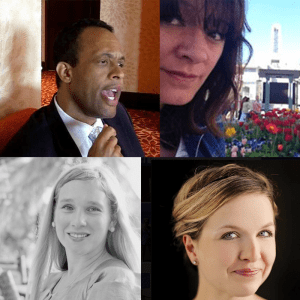
 As parts 3 and 4 in our series reviewing the events of Mormonism in 2015, we assemble another all-star panel including Lindsay Hansen Park, Dr. Gina Colvin, Dr. Kristy Money, and Sean Carter. Some of the topics discussed included:
- The state of the Mormon Internet (blogs, podcast, social media)
- Social group formations in progressive and post-Mormonism
- The state of Mormon Feminism
- The impact of disciplinary councils and excommunication on modern Mormonism (hint: it isn’t good)
- The state of Progressive Mormonism
- Issues of race and multi-culturalism within modern Mormon culture (LDS and post-Mormon)
- The state of Mormon Studies
- Retrenchment/leadership crisis/corporatism in the modern LDS Church
We hope you enjoy it!!!!
Episode Transcript
Host: John Dehlin · Guests: Gina Colvin, Kristy Money, Lindsay Hansen Park, Sean Carter
This transcript is machine-generated and lightly edited for readability. The audio is authoritative. Please excuse occasional errors in names and spelling.
Introduction and Welcome
Part 1 of 2 · Ep. 614
John Dehlin [00:00:00] Mormon Stories is a production of the Open Stories foundation and relies solely upon the support of people like you, its listeners to help keep the podcast alive or to become a member of the community. Please become a monthly subscriber by visiting MormonStories.org and clicking on the Donate button on the right side of the page under Support. All contributions to Mormon Stories are completely tax deductible and go towards producing the podcast and building communities and programs of support for Mormons like you. Thanks for your support.
Lindsay Hansen Park [00:00:36] The kindly light amid encircling gloom
Kristy Money [00:00:43] Lead
Lindsay Hansen Park [00:00:43] thou me on the night is dark
Kristy Money [00:00:48] and I am far from home Lead thou me.
John Dehlin [00:01:00] Hi, I'm Steven Carter, the editor of Sunstone Magazine. Like you, I'm addicted to blogs and podcasts that explore Mormon themes. But I also want to be with people, the kind who are as curious about history, theology, and culture as I am. That's why I've been going to Sunstone Symposiums for more than a decade now. I want to explore new ideas. I want to see Mormonism from other perspectives. And I'll admit it, I want to have lunch with my Mormon studies heroes. Sunstone has some great symposiums coming up, including one in Berkeley on January 30, one in Mesa, Arizona on February 20, and our first ever international conference in Birmingham, England from February 26th through 28th.
John Dehlin [00:01:39] Some of our speakers will include Wendy Montgomery, Dale McGowan, Natasha Helfer Parker, Christian Moore, Lindsay Hanson park, and John de Lim. Visit sunstone.org to learn more about our symposiums and magazine. Come join us. It's good to be together.
John Dehlin [00:02:07] Hello and welcome to another edition of Mormon Stories Podcast. I'm your host, John Dehlin. It is January 12, 2016, and I am super excited for this interview, as always. Yesterday we on January 11th, we interviewed a panel of distinguished guests that included Jay Nelson Seawright, Jamie Hannis, Handy, Marisa Calderwood, and John Hamer. And we tried to review kind of, you know, main events in Mormonism in 2015. It was a great discussion. I really enjoyed it. And as we told you yesterday, we were going to pull together a second panel of equally distinguished and insightful guests.
John Dehlin [00:02:53] Do you guys feel flattered? It's all true to talk about other topics and there will probably be some overlap, but we are going to dig deeper into kind of the events of 2015, where we are in 2016 and where we're going.
John Dehlin [00:03:13] And I can't be more excited. Some of the main themes today are going to be about kind of the state of the Mormon Internet, progressive Mormonism, Mormon Studies, Mormon apologetics, Mormon feminism. We talked briefly about those at the end yesterday, but I want to dig into those a little more deeply.
John Dehlin [00:03:30] We'll talk about church government, retrenchment, leadership crisis. Gina wants to talk about social group formations. It'll be awesome to hear what she has to say there. New apostles. We can't have Lindsay on without talking about polygamy. We're going to try and talk about race and international perspectives in the church and millennials, because Christy says that she represents that, technically represents that. That population. So without any further ado, I'm going to introduce our guests. So we will begin. And all of these guests are return visitors to Mormon Stories. And I'll begin with Dr. Gina Colvin. Gina, do you mind introducing yourself just a bit?
Meet the Panelists
Gina Colvin [00:04:13] Hello, everybody. I am a blogger at Kiwi Mormon. I'm also the host of a thoughtful faith podcast, which is one of the open stories found and family of podcasts. And yeah, thanks, John, for having me on.
John Dehlin [00:04:28] Yeah. And it's always a pleasure, Gina. Thanks for coming on. Lindsay Hanson park, tell us a little bit about you for the three of my listeners who don't know who you are.
Lindsay Hansen Park [00:04:42] Thanks, John. I'm excited to be on this panel. I am the assistant director for the Sunstone Education foundation, and we put on conferences all year long for Mormons like you. So that's what I do for my day job. And I also host a podcast, the Feminist Mormon Housewives podcast, where we did the Year of Polygamy series, which I've talked about a lot in your show. And right now we're working on a series with Gina. Actually, it's called the Color of Heaven series, and we're talking about race in the LDS Church. So you guys can check that out and meet.
John Dehlin [00:05:15] Misha is a part of that, right?
Lindsay Hansen Park [00:05:18] Yep. Misha McGriggs and Gina and I. And we are doing the same thing we did with Year of Polygamy, but we're exploring church history through the lens of different racial identities and colonialism. Did I get that right, Gina?
Kristy Money [00:05:33] Before.
Gina Colvin [00:05:34] And everybody should listen to it because it's great.
John Dehlin [00:05:36] Yeah, yeah, I'm excited for that. Very cool. All right, next we'll have Shawn Carter. Shawn's joining us again. Shawn, tell us a bit about yourself.
Sean Carter [00:05:46] I am a strange in the sense that I am a late convert to Mormonism. I converted as a grown man in my 40s and live in Arizona with my wife and four children. I guess I have the distinction of being one of the only three, I think, African American members of the church. I'm not the guy in General Conference, and I'm not the guy who makes the videos online.
John Dehlin [00:06:10] You're not the guy who sings. You're not him.
Sean Carter [00:06:13] Exactly. Yeah. I don't have the face paint under one eye.
John Dehlin [00:06:15] Wait, are you the guy that sings for the Mormon Tabernacle Choir? Are you that guy?
Sean Carter [00:06:22] No. Exactly. So I'm the other one. And. And, you know, I guess my. My entree or my bona fides in liberal Mormonism was that I had a brief stint on the board of Ordained Women.
John Dehlin [00:06:32] Yeah. And Sean's a humorist, so, you know, we've got to go along with that. Right, Sean?
Sean Carter [00:06:38] We absolutely do.
Lindsay Hansen Park [00:06:39] Yeah.
John Dehlin [00:06:40] All right, well, rounding out this distinguished, illustrious panel is Dr. Christy Money, who recently had twins. Dr. Money, welcome to Mormon Stories. Give us a brief introduction if you can.
Kristy Money [00:06:54] Thanks for having me, John. All right, so I'm. I'm a BYU trained psychologist and I blog, and I have a private practice on Dr.christymoney.com and I work mainly with Mormon women's mental health and faith transition. So. Happy to be here for sure.
John Dehlin [00:07:14] All right, well, let's get going. We've got a lot to talk about and never enough time, which is saying a lot for Mormon Stories Podcast. So let's begin. Let's begin by talking about. And this is kind of a really broad topic, and I'm curious if you guys even have thoughts about it.
State of the Mormon Internet in 2015
John Dehlin [00:07:35] I think a lot about the state of the Mormon Internet. I'll give a little bit of. Maybe a bit of a setup so that everyone else can kind of prepare a thought or two if they haven't already. Prior to, let's just say 2000.
John Dehlin [00:07:51] I don't know, 2000, maybe. We had bulletin boards and Internet forums. Around 2004. We saw blogs becoming really a significant force, whether that was by Common Consent or Times and Seasons or feminist Mormon housewives. Podcasts kind of started coming on the scene in 2005, 2006, and those have been significant.
John Dehlin [00:08:14] And then at some point, social media really started picking up with Facebook and Twitter, and there are lots of substantive Facebook groups now, and there are lots of podcasts. And I'm just curious if anyone has spent any time thinking about where we are today. It feels like over the past year or two, there has been some important shifts. And, Lindsay, I think I'm going to start with you and ask if you have any insights or thoughts about kind of where we are in 2016 with the Mormon Internet and what's important or not.
Lindsay Hansen Park [00:08:56] Wow, that's a Big question. I can't speak for everyone. I can speak for myself. I came onto the scene when Mormon feminism online was becoming very vibrant and active. This was before a lot of the activism that we saw, like wear Pants to Church Day and Ordained women and a lot of these different movements that started happening out of this vibrancy. I think that there are several things that have affected the vibrancy. But to. When I say affected, I mean, I feel like we're kind of in a sort of depressed state, if you will. That doesn't mean sad or anything like that. I just. I think it's depressed.
Lindsay Hansen Park [00:09:36] I think. I think Mormonism right now is a bit disoriented. At least that's what it feels like to me. The community had this vibrancy. They had this sort of hope that things would change, and we've had excommunications, and we've had these policy changes, and we've had a lot of things to sort of, sort of rob us of that hope or deflate the hope. And I think that there's so much out there now and so many voices and conversations happening that. That it is a bit depressed and disoriented, if that makes sense.
John Dehlin [00:10:10] Yeah, you know, I feel. I feel somewhat similarly. There was much more of a community feel, in my opinion. You know, let's just say 2005, 2006, you knew who the bloggers were. There were substantive conversations. People would join it. People would all kind of be on the same page. Sometimes it feels very fragmented now. Do you feel that way?
Lindsay Hansen Park [00:10:34] I don't necessarily think fragmented is a bad thing, but yeah, I agree with what you're saying. I think fragmented is good if people are moving towards health and, you know, moving on. I know with Mormon feminism, the excommunications was part of that, but I also think that we ording women sort of launched a discussion or actually held a mirror up to Mormon feminists to talk about racial issues and how a lot of the vibrancy in Mormon feminism, these issues that we were talking about for years, were really centered on white Western women. And so that has caused a lot of us to look inside ourselves and be more reflective.
Lindsay Hansen Park [00:11:12] So a lot of us, I think, are doing that work. We're looking inside ourselves rather than to the community. And there's still, you know, the community work happening, fragmenting is happening. I just think that there's more and more growing voices, and we're not an organized religion. Progressive Mormonism isn't a religion. It's a movement. And so there's not one singular leader sort of to follow. And I see that as a good thing because I think this, this one man profit rule thing is not healthy for community. So I think that's good. I just think as far as having more common causes to fight against that might be more fragmented.
John Dehlin [00:11:55] Yeah, totally. Gina, let's get you in here. Do you have anything to add, any thoughts or insight on this question?
Mormon Feminism and Online Community
Gina Colvin [00:12:02] Yeah, I do. I think the state of Mormon media, and social media in particular is possibly one of the most fascinating things about this moment from the perspective of sociologists. It's absolutely riveting and I agree with Lindsay in many respects one of the central features of what's happening at the moment is that the reorganization of our social boundaries and our collectives has taken place around one central, I suppose, cause, and that is a growing trivialization is one word for it, of the need for some central control.
Gina Colvin [00:12:48] So, you know, where we used to have this very strong top down, everybody kind of listens at the grassroots and pays attention and rallies around those, those very centralized messages. Everybody's fragmenting away, away from central, the need for central, consistent voice, you know, one person in the seat, as it were.
Gina Colvin [00:13:10] And I think, you know, broadly speaking, this is a really, it's a feature of the way in which social media has really mobilised us. It's become a mobilizing structure. And I, and I think what's happened is that in many respects social media is helping us to collectively organise. It's bringing us to collective action and in the meantime it's creating new movements, new subcultures within Mormonism. So I think that's really.
John Dehlin [00:13:42] Well, I have a question about that. Like, if you think about, and I mentioned this yesterday on the podcast, and we have three current or former ordained women board members here on this panel. You know, I feel, you know, what I, what I hoped would have happened with ordained women. And this isn't to talk necessarily about ordained women specifically, but it's just to use it as an example. What I really hoped would happen with ordained women, just selfishly was that someone else would step up and replace Kate. Because, you know, we talked about the hydra sort of metaphor yesterday in that, you know, the church would cut off a head like Kate Kelly and then another head would rise and that would send the message that you can't, you can't, you know, cut us down by excommunication.
John Dehlin [00:14:32] So what I was hoping would happen would be that someone else would step up, take the reins of ordained women, that they would continue with more Strong actions that elicit an equal degree of public attention and that it would just continue strong. But what seems to happen, if you're looking at it from the church's perspective, is that that sort of maybe took the teeth out of ordained women and made whatever actions they've had not be as interesting or get as much press, which means they haven't had potentially the impact that they used to. And so it looks like maybe the church has sent the message that if you do a strong action, you'll be punished.
John Dehlin [00:15:20] Therefore, many people who are trying to make the church do better or be better are kind of backing away. So that's just me musing a bit. Gina, do you have a reaction to that?
Gina Colvin [00:15:34] I do. I think in many respects you're quite right. And that would be the natural inclination to think, well, okay, they got rid of Kate and therefore somebody else should rise in their place. But I think, I think that's an old model.
Gina Colvin [00:15:46] And when it comes to social movements and social mobilization, it doesn't work in post modernity quite as well as it might have worked, you know, like in the 1970s and 80s. And I think the church relies upon that model because that's the model that they have. You know, one person speaks and they get to be, you know, the prophet for the people.
Gina Colvin [00:16:06] But I think, I mean, look at the Occupy movement, which was, and you know, the Arab Spring movements, which were all massive social collectives which reorganized and challenged a social system. And a lot of people say, well, the Occupy movement didn't work, so what the heck?
Gina Colvin [00:16:23] But what is happening, and I go back to the point that I made before, is that what is the central thing to look at is the way in which the members of the community are reorganizing out from the center. So they're not requiring central support, they're not requiring one single person.
Gina Colvin [00:16:45] And in many respects they are trying to replace the current institution with something that feels more vibrant, that meets their social demands, and they're organizing out of the sense of social deprivation, but also a sense of oppression. We don't want to be part of this top down theocracy, part of this top down hierarchy anymore. So I think that it doesn't feel it's as visible, but the undercurrents are most certainly there.
John Dehlin [00:17:18] But do you think.
Gina Colvin [00:17:19] And we'd be interested. Yeah.
John Dehlin [00:17:21] Do you think it's. Do you think it's more vibrant or is it just like Lindsay says, kind of a feeling of kind of more depression and inaction?
Gina Colvin [00:17:30] Because no, I don't think It's. Yeah, it feels like that because we're looking for visible signs. We're looking for dramatic, visible signs of some kind of change. But if you take every. Every. Every community that pops up, you know, and every. Every person that expresses, you know, that shares their narrative, something incredibly convulsive and even more powerful is happening.
Gina Colvin [00:17:54] You know, people are stepping back from the old forms of Mormonism and saying, no, you're not going to control me. I will find groups in which I can be a member. You know, I can recognize myself in, and we will have a conversation. And when people start recognizing themselves and the identities or the narratives of others, they form new social groups. So, you know, how this plays out? I don't really know. I mean, most social media sort of, you know, theorists don't know, because we're in the middle of something really, really new.
Gina Colvin [00:18:26] So, you know, those patterns aren't strong enough in terms of our social, you know, in terms of the study of sociology to really be that predictive about it. But one thing we do know is that things will never be the same again.
John Dehlin [00:18:41] Yeah, never. Yeah. And I completely agree that people are stepping back and joining new groups. One thing that really struck me at the end of yesterday's interview was Jay Nelson Seawright, who's totally left the church, calling on listeners to sort of engage with Mormonism at whatever level they want and to be more creative about their engagements with Mormonism. And something about that I loved. But what I wondered right now is, as people are stepping back, are they re engaging with sort of any sort of Mormon identity, or are they just sort of leaving and shedding their Mormon identity and trying to get as far away from Mormonism as possible? That's, you know, that's something that I'm kind of wondering.
Gina Colvin [00:19:27] It would be interesting to research that.
John Dehlin [00:19:29] Yeah, Sean. Sean, go ahead.
Sean Carter [00:19:31] That's one of the big challenges we have. And I'm going to give sort of an African American perspective here because I think that's my job, but also because I think it is a different perspective. Remember, I'm not at all personal, very vested in this church. I didn't serve a mission. I don't have family. My family would love for me to leave, but part of my background tradition says that when you find out that where you are isn't perfect, you don't leave. You stay and change it. And I've never had an expectation from joining the church that I thought it was going to be right from day one.
Sean Carter [00:20:05] I thought, well, there's some things we're going to have to fix around here. And I think what happens with a lot of us people born in the tradition is that when they find out that the church isn't everything it said it was, that the prophets can lead the church astray. It causes an idea that says, well, it can't be true anymore, I'm done with it. And as an African American, my idea is that, well, no, nothing is true. No man made institution is true. And we would never be anywhere.
Sean Carter [00:20:32] Look at America, what a contradiction. From day one we have all men are created equal. Well, all white men actually, all property actually, only all wealthy slave owning white men are created equal from day one. It's not true. And African Americans, we didn't get that idea. We got to get out of here. This isn't right because quite frankly, if we created our own society, it wouldn't be right either. There's always going to be some level of discord. And so I'm perfectly happy and sort of feel like I'm in my place when there is improvement to be made to Zion. I think that's part of Mormon theology, but it's way down deep underneath a lot of other stuff about profit and fallibility, etc.
Sean Carter [00:21:15] So I've seen it with ordained women where we have people who are very excited and as they become more enthused and more convinced that the prophets aren't right about say ordaining only men, then it becomes sort of less important because the church can't be true and therefore it doesn't deserve my allegiance.
Sean Carter [00:21:34] And I think that the allegiance should come to the community. And so, you know, what I'm committed to is the community of people. And that to me is as true as it ever was. Regardless of what Elder Nelson says on any one given Sunday.
John Dehlin [00:21:50] Now you're still attending church, is that right, Sean?
Sean Carter [00:21:54] Yes. Well, I was attending better when we had 1pm but now we're 9am this year. So you know, I'm attending second and third hour, but I actually, I still teach. I still, they let me teach. Elder Scorm.
John Dehlin [00:22:09] Yeah, that's great. Okay, so. So you're sticking, to use a phrase from James Carville, you're, you're not feeling like disenfranchised and disoriented and disaffected. You, you honestly feel called and driven to want to stick around and help make things better, is that what you're saying?
Sean Carter [00:22:30] I feel that I am where I'm, I'm supposed to be and that my particular take on particular perspective, it could be Possibly useful here. And quite frankly, you know, when the announcement came out in November and I got, I think, first time I heard from you about was from you in an instant message.
Sean Carter [00:22:53] I was very upset. And I said, this is my Waterloo. And I wrote out my resignation letter. I wrote my resignation letter in five minutes. It takes me 45 minutes to do a post on Facebook. It took me five minutes to write this letter out. I was done. I said, don't contact us anymore, et cetera. And I don't want to get to the long story of it, but I had an experience locally that made me. I didn't tear up the letter. It's still there. It's still ready to go.
Sean Carter [00:23:19] But it made me think, you know what? I'm not willing to give up on the people in my ward yet. The church itself, I could leave tomorrow. But there's some people in my ward that. That have some things that, quite frankly, I still need to get a level of kindness and generosity that I still have not been able to produce. And I haven't found any faith tradition that produces it as consistently as Mormonism at its best. And so I'm not willing to give up on that yet.
John Dehlin [00:23:48] Gina, something tells me you're doing a happy dance inside to hear Sean say that. Is that true?
Gina Colvin [00:23:53] Yes, indeed. I'm with you, brother.
John Dehlin [00:23:56] So we're going to talk about that in a minute.
Lindsay Hansen Park [00:23:59] Wait, John, can I just say. Can I jump in for a second?
John Dehlin [00:24:01] I was going to have you come next. Christy. Yeah, jump in.
Lindsay Hansen Park [00:24:04] No, Lindsay, sorry.
John Dehlin [00:24:06] Oh, sorry. Lindsay. Yeah, jump in.
Lindsay Hansen Park [00:24:08] I just wanted to clarify, because I think that when I say depressed and disoriented, I'm not using that as a pejorative. So I'm not saying. I think it's just part of this sort of circadian rhythm of this movement of Mormonism. And I don't think it's unhealthy for people to be stepping back and looking inside. So I just wanted to clarify that I'm not saying, like, oh, all hope is lost.
John Dehlin [00:24:30] No, no, no.
Lindsay Hansen Park [00:24:31] That's not what I'm saying.
John Dehlin [00:24:32] And I didn't interpret it that way either. Christy. Yeah, jump in.
Kristy Money [00:24:36] And this is Christy jumping in. I agree with Lindsay. I do think. I do see that fragmentation. I also don't see it as a bad thing. I think people finding their own path, wherever it leads them, is not only healthy, but also, like Lindsay said, it's pretty cyclical. I mean, I think that this is going to happen whenever we see the church doubling down like it does, causing People to reflect, to decide, okay, where am I? You know, what is this going to look like for me in my relationship with the church? And it's going to be so different for everybody. I mean, everyone's faith journey is going to look so completely different.
Kristy Money [00:25:15] I mean, there's, you know, the different look of a faith awakening or transition for every person that's out there. It's all going to be very different. So, yeah, I'm noticing that too. But I remain hopeful, like Sean. But I also, yeah, I don't. I don't see it as a bad thing at all. Like Lindsay said in her last episode of Year of Polygamy, you know, when she was talking about the Lindsay, I love that metaphor. I will continue to keep bringing it up, even though you might be tired of it by now. But you remember that metaphor about taking the reins to your covered wagon and look and searching for Zion? I just. I love that. And that's what I see.
John Dehlin [00:25:59] Yeah, I'll just say I love what I love about the past few years, and I would love you guys to argue with me if you disagree. But you can just point to specific initiatives, whether it be the work that was done to survey struggling Mormons that led to the behind the scenes work, to the essays being created, or the ordained women, you know, the feminist work that led to the actions that led to specific change.
John Dehlin [00:26:37] And there's lots of examples we can give that we can think over the past several years where everybody was engaged and excited, you know, working towards something, and then concrete results came about as a result. And I just have to say that I loved the feeling of being a part of and experiencing all that. And I think there's a part of me that worries that those days are behind us. If we get too fragmented, does anybody have a thought or reaction?
Lindsay Hansen Park [00:27:09] I feel like that's very Mormon of you, John. Like, oh, that's so Mormon of you. Like, we're all building Zion. It's like a primary song, right? Like, if we all. What's that song? Saturday is a special day. We get ready for Sunday.
Lindsay Hansen Park [00:27:23] That's exactly how you just explained the movement. We're preparing and we're working towards a goal. And I know what you're saying, because I felt that too. But I think if we look at this as sort of a natural progression of this excitement, I think it's okay for us to also look at the resting or the sort of regrouping or the retreat into ourselves as a means to that end, too. I think that when I came to this movement.
Lindsay Hansen Park [00:27:55] What I felt, and this was years ago, was that I couldn't talk to anyone about my issues. And that's not the case anymore. Of course, people do still feel trapped, and it's still an issue for a lot of people. But there are so many places people can go for information and for community and to talk to now, which is fantastic.
Lindsay Hansen Park [00:28:15] So that's great. And I don't think that we can keep reinventing that wheel. And I'm just kind of excited to sit back and patiently see what happens now and in the meantime, sort of try to do my work, work on myself, if that makes any sense. So I don't think you need to look at it as, oh, the good old days are gone. I just think it's time to maybe to take Christie's metaphor, pull your wagon over and camp for the night.
John Dehlin [00:28:44] Yeah. A metaphor Margi likes to use is kind of seasons and how sometimes in winter there is an active growth. You know, the roots go deeper, but the leaves fall off. And it seems kind of like a lot isn't going on. But it's that the roots growing deeper when it's dry and cold that then allow for a more vibrant spring and summer. Is that kind of what you're saying, Lindsay?
Lindsay Hansen Park [00:29:07] That's at least how I feel. I mean, when I try to think of imagining what the spring would look like for Mormonism or progressive Mormonism, it's really hard for me to see that because, you know, the policy changed that took out so much hope from sort of any bright light that I saw Mormonism having from a theological standpoint. So it's hard for me to imagine. But, yeah, I do think that. I think that the work that a lot of Mormons can do right now is like, we've been talking about we are not finding the light and the truth from the top down. And that's really disappointing.
Lindsay Hansen Park [00:29:47] And I think our hearts get broken over and over again when the leadership says something really dumb or really outdated or really hurtful. And I think that the only work that we can do is strengthen the roots within ourselves, look within ourselves, try to unpack those systems. Because still, you know, I've been doing this work for a while now and studying theory and trying to become more ethical, and I keep screwing up still. And I think that it's just going to be a journey, like, not a destination. And in Mormonism, faith for me was like a noun, like, you had it or you didn't have it.
Lindsay Hansen Park [00:30:26] And now I look at faith as a verb. Right. It's like an action word. It's something that you're working on or working towards. And so that's kind of how I'm claiming my Mormonism right now, is I'm just trying to purify myself, not from a hierarchical standpoint or punish myself with sin, but just try to sit in the winter if you will, and let the roots grow.
Sean Carter [00:30:53] See, I had an exact opposite reaction. For instance, I almost grinned when I saw Elder Nelson's statement the other day that just for. I guess anyone gets this a long time from now, that it was the word of God, that God doesn't like the children of gay people.
Sean Carter [00:31:14] I love that. And here's why I say that. You know, I thought it was horrible, but it's like, you know, a Bull Connors moment. It's a Pettus Bridge moment. Whenever the church, you know, makes a statement that is so outrageous, it ends up getting carried by the New York Times, right? The Guardian in London.
Sean Carter [00:31:36] I wrote this in my notes. I think Elder Nelson's working for us. He doesn't know it, but he's working for us. All right? The best way in the world to have the change we want to see is to have the entire world begin to come down the church for its stance on this. And by the way, that was almost leaving the news. I hadn't seen a post on that in weeks on my Facebook feed, and he sort of brought it up again.
Sean Carter [00:32:01] And so when these moments happen, I think there's one way to look at it, which is, oh, my, this is kind of destroying my faith in the one true church and the Lord's anointed. And my other is simply that these types of things are necessary to move forward with progress. I haven't seen it happen any other way other than these types of statements that cause enough popular outrage. And the thing I was most impressed about with the policy was that there were so many people who opposed it and publicly opposed it. When I started posting things about ordaining women, I remember my bishop called me in and he said, I don't know if you know this because you're new, which I use a lot, by the way.
Sean Carter [00:32:41] I can always say I didn't know. And so he said, you know, but you're not supposed to criticize the apostles in public, so you understand you're not going to do that anymore. And I said, well, I don't think you understand. Of course I'm going to do it now. You told me to. I have to do it more. But when I did that, that was Kind of an unusual stance. I, There were people who were. I had an email I got from a bishop's wife, right, who said, I think this is horrible, et cetera, et cetera, et cetera. And I think that that type of retrenchment got people paying attention probably more than they had to anything in the past.
Sean Carter [00:33:13] So there's pain to come from that. I don't want to minimize that. But these types of moments to me are the moments that give us that opportunity to have some action. So we might not be moving forward the way that we'd like to, but. But, you know, we're getting a lot of help.
John Dehlin [00:33:28] And that was, that was a lesson I took from the movie Milk about Harvey Milk. Every time we lose, it's one step more forward towards a win. You know, just like look at, look at the results of Proposition 8.
Sean Carter [00:33:42] Perfect.
John Dehlin [00:33:43] We literally, you know, had legal same sex marriage within, what, eight or nine years of that. And it started in Utah, of all places. And I think you could draw a line between Prop 8 and that progress, don't you think?
Sean Carter [00:33:59] Absolutely. And I think everyone thinks it would not have happened. It would have happened, but not as quickly without the outrage of Prop 8.
John Dehlin [00:34:06] Yeah, yeah, yeah. And this recent November LGBT policy certainly has generated a ton of outrage. Okay, any other thoughts on sort of general Mormon Internet social media before we move to the next topic? Gina was when you were talking about the dynamic of changing social group formations, is this kind of what you were meaning or is it time to transition to that topic?
Gina Colvin [00:34:35] No, I think it's largely what I mean. I mean, you can't think about population change and new social group formations and modernity without thinking about the role of the Internet.
Lindsay Hansen Park [00:34:45] So.
Gina Colvin [00:34:46] Yeah, and you know, really, it's. I think what we're seeing happen is, as Lindsay said, look, there's this massive personal transformation happening, really deep personal transformation. New subgroups, new subgroup identities are being formed, and that's causing this kind of social rupture in Mormonism. And you counterbalance that with. And that goes in association with this unlatching from the Brethren as a primary source of religious attachment and because of the lack of social and emotional well being that that sometimes arouses. So it's a really. And that that will cause massive institutional changes. So, I mean, it's a very, very interesting time. And obviously social media has, has played a huge role, an essential role. And what's happening now?
John Dehlin [00:35:37] Yeah, well, let's, let's dive into a few specific subgroups because I think it would be fun and interesting. So let's start with Mormon feminism. I've made. I've, you know, you know, I remember a time when it was sort of the, quote, good feminists like Natalie McBain and let's just say Maxine Hanks or, I don't know, people that were kind of with those sensibilities versus sort of, quote, the bad feminists, which I, I know these are straw women, so to speak, but, you know, Kate Kelly and ordained women, and there was a lot of vibrancy around ordained women and feminism. All these changes were happening. And it feels like 2015 after, you know, after Kate's excommunication in 2014, it almost felt like feminism.
John Dehlin [00:36:26] And this is just from a, from one perspective, just sort of kind of died down and was a little bit muted. I know that Ordain women did some type of action this past conference regarding Keys, but I don't think a lot of people paid attention to that or participated in it. So, Christy, why don't we start with you and what's your perspective on kind of the state of Mormon feminism after just emerging from 2015?
Kristy Money [00:36:54] Well, of course, and I can only speak from my own experience, but I'll start with the story, because we love stories, Mormon stories.
John Dehlin [00:37:03] Yeah, we do.
Kristy Money [00:37:03] And you were there, John. Yeah, you were there at usu when I'm going to talk about when I was in Logan for that Talk with Nylan McBain and Fiona Givens and Julie Dare, church historian and myself. And first off, I do have to say it was disappointing that there were no women of color whose voices were heard that day and that that was. There was a noticeable lack.
Kristy Money [00:37:33] It was also interesting that a lot of, a lot of people listening and myself included, there weren't that many differences anymore. I mean, because we'd been through a lot together as Warren feminists. So, yes, there's still, I think there's structural fragmentation in terms of people who, you know, for very valid reasons, you know, need to stay. They can't, you know, publicly oppose the church even if, you know, inwardly they're really, really struggling with what's been coming out. But, you know, the four of us, we all agreed on some pretty fundamental things about how women had a lot more authority in a Joseph's day than they do now, that that was taken away and that there is so much more that women should have in the church that we don't have now.
Kristy Money [00:38:37] But, yeah, that was a really interesting day. And Logan, I'm really glad you were there. And yeah, I see, I see feminists Like Lindsay was saying, and like I've been noticing in my own private practice, where we're doing our own work inwardly and, you know, rooting out biases, you know, challenging our, you know, these ideas that we've held on to since we were kids, since we were girls in church. And.
Kristy Money [00:39:14] And I see it as a very good thing because it'll make us stronger for when that Mormon spring is going to come. And it will come. I have faith that it will. It might be winter right now, but if we're doing that really important work inwardly for ourselves and within our families, we'll be ready to fight another day.
John Dehlin [00:39:34] Okay, so it's metaphorically a bit of a winter for Mormon feminism. Is that. Is that fair to say? Well, where the roots are going deeper.
Kristy Money [00:39:46] Yeah. Well, I feel like that is for. For me personally. I will say, though, that I think that that's gonna depend on. On, you know, the Mormon feminist that you ask, because it, you know, for some, they might. They might be in summer right now because they're just now, you know, connecting with feminist Mormon housewives or with Mormon stories or they're, you know, they're just having their own feminist awakening or they're, you know, realizing they're not alone. So for them, it's like it was for me in 2000, 2010, 2011, you know, right before ordained women, you know, where, you know, they're. They're realizing that they're not alone and that, you know, they have power.
Kristy Money [00:40:28] What they can do with that power. Now, that's another discussion, you know, given the constraints within the institutional church. But. But there are, you know, I think I agree with Jason from yesterday that there are. Where there's creativity, there's hope. And so, yeah, I don't know if I'd say that Mormon feminism is experiencing a winter. I know I am. I feel like I'm regrouping in winter quarters right now, you know, to continue the Mormon metaphor. You know, I just had twins and, you know, so for me personally, like, I'm, you know, doing some deep reflection on, you know, what is this going to mean going forward?
Kristy Money [00:41:10] What am I going to, you know, because I've got four kids that I want to raise in a healthy environment. And, you know, with this new policy coming out, like, what if Athena, you know, one of my twins, what if she's gay?
Kristy Money [00:41:27] You know, what is that going to mean for her? You know, as a Mormon, like, I have this incredibly protective instinct right now. So getting personal, that's at least where I'm at Right now.
John Dehlin [00:41:43] That's great. Thank you, Christy. Other perspectives on Mormon feminism
Gina Colvin [00:41:50] in a conversation with Joanna Brook Street. Gina, I was having a conversation with Joanna Brooks after Mormonism's essential writing, Mormon feminism, essential writing came out. And one of the things that we notice over time is that in terms of Mormon feminism is that you do get a period in which Mormon feminists speak up. And these are during softer cultural moments, you know, period during periods of liberalization. And then there's often a movement that develops, and then there's often a disciplinary. Something, some disciplinary event that happens, and then maybe fragmentation and a reformation at the periphery and at the premises of the church, but it never goes away.
Gina Colvin [00:42:34] So I think what we're noticing is one moment in which we've, you know, a part of that cycle is that fragmentation. But, but I think one of the beautiful things about this moment is that the conversation continues, whereas there's been fragmentation and silencing because there was very little opportunity for masses of people to get together, have this conversation. What we have now at this point is that the conversation continues. And as you say, you know, as Jason said, it's, you know, moments of creativity. So being at the periphery and being quiet doesn't necessarily. Or publicly quiet doesn't mean that there's nothing there. It's just waiting for the next iteration. I think it will come sooner than the patterns that we've seen, but it's there. It's not gone.
Kristy Money [00:43:17] Yeah, yeah, Gina, I think you're right. I think it's going to come sooner because there's. There hasn't been a silence, you know, because, you know, ow flew open those doors wide open, you know, so that. That we can continue to challenge without. Without there being. Because what was it where you got. Joanna would know this better than me, but it's almost a decade. Wasn't it where, you know, the chill effect from 93 till.
John Dehlin [00:43:45] Oh, yeah, of course. Yeah, yeah, for sure. I mean, there was still action. There was still the Mormons, Mormon Women's Forum or. But. But it. It certainly seemed to die down. Right?
Kristy Money [00:43:59] Yeah.
Gina Colvin [00:43:59] And I think that's natural and normal. I tell you what, what I have not, and I only know this anecdotally, is the number of women that have dropped away from church activity and left their husbands on the pews. That's been. That's just anecdotal. It's really, really interesting. And our stake, it's just palpable. It's noticeable.
John Dehlin [00:44:19] Yeah.
Gina Colvin [00:44:20] Everyone blames it on me, but.
John Dehlin [00:44:22] Yeah, well, you are a troublemaker. So am I, by the way. Yeah. So here's just a kind of a question. I know as I remember my conversations with Joanna and things I've heard her say, it seems like she was really fighting to try and prevent any more excommunications of feminists, and then Kate went along and got excommunicated. Do you get a sense that there's a decent amount of sort of Internet Mormon feminists who really feel like Kate set feminism back by getting herself excommunicated that then could possibly lead to a chill?
Fear of Excommunication and Its Meaning
John Dehlin [00:45:12] I'm sure that there are as many opinions as there are women or feminists. But to what extent do you think that sentiment prevails versus a sentiment of like, she's a hero, she really helped us out, Big strides were made under her and we all should be thankful. Do you guys have any opinions on that? Lindsay, why don't you jump in if you are comfortable and others can too?
Lindsay Hansen Park [00:45:38] No, I don't see. I think that from probably an outside perspective, that's maybe how people perceive that we would be looking at the situation. I know when Kate was going through this, and this is like my first time sort of, you know, because I wasn't there in the 70s or in the 90s when prominent Mormon feminists were being excommunicated. So I assume, assumed that the reason why there was this chill effect is because people were scared or they were scared that they were going to be excommunicated. And when I interviewed several of them on the podcast Lori Winner Stromberg, and I'm just trying to think.
Lindsay Hansen Park [00:46:17] There was several of them. Yeah, all of them, they say, we weren't scared. We were never scared. People were not scared of being excommunicated. That's not why this chill effect. It wasn't out of fear. And I, you know, I think that that's the case. I'm not scared. The reason why I feel like I'm in a winter is because I never.
Lindsay Hansen Park [00:46:41] I guess. I guess I thought I would be scared. But what ordained women did for me, the movement, when I. When I marched on Temple Square, it just hit me so strongly that I'm never going to ask those men for anything again.
Lindsay Hansen Park [00:46:56] And so excommunication or not, that became less and less important to me because that comes from them. And again, it became reclaiming my own power and taking my own reins. And that's why I think this idea of seeing Kate as a hero, as a villain, I don't think that's a dynamic. I don't think that's how most of us look at it. And if we do, that's problematic. I hate to be a nerd and a bad feminist, but I love Game of Thrones, right. I'm obsessed with Game of Thrones. And there's this quote where Daenerys, she's the mother of dragons, they say, you know, there's this wheel always turning in their spokes and one's on top and then another's on top and they crush everything beneath them.
Lindsay Hansen Park [00:47:36] And Daenerys says, I'm, you know, basically she says, I'm not interested in this wheel. I'm going to break the wheel. And I. And I feel like that's where Mormon feminism is headed. We're not interested in those old, those old dynamics. We're not interested in, in this hero or villain or making a new profit. We're finding like this true empowerment within ourselves. And ordained women did do this. And I know for myself, I'm very grateful because Kate was part of that, being a catalyst. But I don't think people see her as a hero or villain. I could be wrong.
Gina Colvin [00:48:13] Yeah, I agree. I agree, Lindsay.
Kristy Money [00:48:16] And especially in terms of not scaring those, those Mormon feminists. I mean, I, so I, knowing Laurie Winder Stromberg, for example, like, nothing, nothing can scare her.
John Dehlin [00:48:26] That's true.
Kristy Money [00:48:27] Like, she's like, she's like the Chuck Norris of Mormon feminism.
John Dehlin [00:48:33] Love it.
Kristy Money [00:48:34] Anyway. Yeah. And so, and so she was, she was there in the room when Kate got. Was excommunicated. So was I. And I'll repeat what I said earlier because it's important that. And so echoing what Lindsay said, that as you know, we're not going and falling into old paradigms of leadership, top down leadership, we're doing this inner work. You're right. We're going to crush the wheel at some point when that Mormon spring happens, which I think it will, but it can't happen unless we do this inner work when each of us does it, and we're doing it now. So that's what gives me hope.
John Dehlin [00:49:14] I love it. Gina, go ahead.
Gina Colvin [00:49:15] Yeah, can I just, can I ask Lindsay and Christy, you know, are you afraid of excommunication?
Kristy Money [00:49:29] Yes and no. But I'll let Lindsay answer first because I'm just so magnanimous.
Lindsay Hansen Park [00:49:35] Yeah, I go back and forth on that. Mostly the answer is no. I mean, it's not. However, I have, you know, John's a good friend of mine, Kate's a good friend of mine, and I have seen it affect you guys in ways that I didn't anticipate, and I don't think that you anticipated, because I would like to say it means nothing. It's just a bunch of men deciding something that doesn't matter. But that's not really true. There are stigmas attached to this. Obviously, there is a meaning to it. So I can recognize that and hold that on one hand. On the other hand, again, I am not going to ask these men for anything.
Lindsay Hansen Park [00:50:14] So if they are going to, they can do what they want with my membership. I don't recognize that, so I'm not going to let that drive me. I'm not going to orient around that or organize around that. Am I scared?
Lindsay Hansen Park [00:50:32] I don't think I'm scared. I'm trying to be pragmatic about it, but it doesn't scare me. That's not a threat that can be held over my head anymore.
Kristy Money [00:50:43] Christy, thank you for. Thanks for tackling that one first, Lindsey. Okay, so to get real personal here, on an intellectual level, no, it doesn't scare me. And I don't. I feel like, Lindsay, that they're, you know, they can't take anything away from me spiritually, that it's between me and God. There's no.
Kristy Money [00:51:07] There's no. I mean, no man can stand in between that. That said, I often have nightmares of getting letters of excommunication. And in fact. Okay, one more side story real quick. In the mail, we got something with. From the letterhead or local leadership and, you know, with the church building, and, you know, it was typed out, you know, to me and Ralph, and I'm like, oh, crap. Like, this is it. I was. And so I was. I. So I was like, my, you know, ever the psychologist, you know, my fight or flight response kicked in. You know, the.
Kristy Money [00:51:48] All the adrenaline rush came, and so my emotions just completely overwhelmed me. Like, oh, no, this is it. It was just a Christmas newsletter, you know, with the message of, you know, the atonement was mentioned. Anyway, so it was just news to everybody, but I was panicked. So, yeah, no, I think my work will come from squaring the emotional intellectual. I think everyone is on that path to an extent, you know, trying to find that balance between what they know intellectually and what emotionally they feel in terms of their relationship with the church. So anyway,
Lindsay Hansen Park [00:52:34] excommunication, what does it effectively do for me? It defines your identity for you. Right. I've seen this with Mormon fundamentalists. So there's this deep, deep wound, this deep pain and angst with many Mormon fundamentalists who were excommunicated for practicing polygamy because in one sense, it completely isolated them and made them strange and weird and wicked to most of the world. But on the other hand, a lot of them embrace that identity, for better or for worse. And I think that that's really what we're worried about. Or at least myself, that if they excommunicate me, I'm not worried about being with my family and their eternities or any of that. I don't believe that they have that power. But there is this. This fear that they can say, you're the other now. You're the outsider. You don't have a right to a voice.
John Dehlin [00:53:28] And part of why I'm not backing down is because I don't want to empower that. That strategy or tactic by going silent. So some of you may be sick of me, but I'm not going away just for that, defying that tactic alone. Gina, I gotta ask you the same question you asked Lindsay and Christy, if you don't mind.
Gina Colvin [00:53:51] No, I'm not. I'm not afraid of it. I think it's violent, it's unnecessary, and it's intentionally cruel, and I don't like it, and I don't respect it. And so for that reason, I wouldn't like to, you know. And as Lindsay has said, I've seen the effect that. That, you know, that's had on you and Kate, just as, you know, as a socially violent act.
Gina Colvin [00:54:20] So I'm not afraid of it because it doesn't have any spiritual power over me. It has some social power over me. And I think the other thing that would make me sad is that that makes me sad about it, is that it makes the church less, and I love the church, so. But, I mean, the reason I ask that is because of something Greg Prince said. He said, you know, the threat of excommunication is not, you know, it's losing because, you know, there was no respect in the process where Kate was concerned, very little where you are concerned, John, you know, even less where the Calderwoods were concerned. It just seems to be practice that is losing its. Its currency. So. Yeah, but not afraid.
John Dehlin [00:55:14] Good. Well, that's good. Well, let's. Let's move to a discussion that I'm dying to have, because I've been thinking about it a lot, Gene. I've been. I. You know, I don't have time to listen to podcasts, but I. I have to admit, I've been tuning into a few of your recent episodes because I'm really. I'm really fascinated with. With kind of what's, what's going on. And I guess I'll preface it in the following way that, you know, I, I obviously started stale. DS.com I. I'm the one who called Dan Witherspoon and said, hey, Dan, you know, do Mormon matters? We need your voice.
Middle Way Mormonism and Theological Labor
John Dehlin [00:56:00] I even, you know, I think, Gene, I even invited you to take over. Thoughtful faith like I. And of course, with the tradition of Eugene England and Lowell Bennion and T. Edgar Lyon and Dialogue and Sunstone, you know, there have been decades of people, let's just say thoughtful, progressive Mormons in the church trying to carve out what we might call a middle way between, you know, orthodoxy and, and just complete disaffection. So I only say that to just say that I feel like I tried to carry that torch for many, many years. And at some point, the way it imploded for me was I would sit in those pews and enjoy the community, which I still miss.
John Dehlin [00:56:50] And I still often wish I could be back from only a social sense. But I would sit there and say, dang, I love communing with the Saints, but if I give my name to the church, if I give my money to the church, if I give service to the church, what I'm doing from a place of privilege as a white, straight, cisgender, middle aged, middle class male, what I worry that I'm doing is being complicit in what I see as very significant harm that is being done to, you know, women, minorities, racial minorities, sexual minorities, et cetera. And I, you know, as a mental health professional, that.
John Dehlin [00:57:42] That became more amplified because I would sit in these sessions, whether it's young men or women who are masturbating and are suicidal over it, or a returned missionary comes home early and is suicidal over it, or a young gay or lesbian person who's suicidal, you know, I. And women who, you know, feel trapped. There are so many different vulnerable minorities that are negatively impacted by Mormonism. I said to myself, I can't stop speaking up about this stuff and speaking out vocally.
John Dehlin [00:58:19] And being vocal is going to be the tax that I pay to retain all the benefits of association. And so around and so around, let's just say, you know, 2013, I just decided I had to kind of take the gloves off and stop trying so hard to mute myself or be diplomatic. But instead I would speak out strongly.
John Dehlin [00:58:46] So that's when I did an ordained women profile. I gave my TED Talk on LGBT stuff, and of course, I even crossed the line and started criticizing church leaders like when Elder Oaks gave that horrific talk in October of 2013. And the reason why I'm going into all this is because I received exactly what happens when you do that, when you cross the line, criticize the brethren, speak out.
John Dehlin [00:59:11] I got disciplined. And that was a decision that I made. I had to do that. And so for me, obviously, that struck a blow to my personal investment in and hope for progressive Mormonism, because the emotional reaction for me is they don't want us and they're going to punish us and they're going to marginalize us for what we've done. And, and so, of course, I watched with curiosity to see what that would do to Dan, to see that would do with a thoughtful faith, to see what that would do with the broader Mormon studies communities. Just think about Patrick Mason or Christine Hagland or by common consent or whatever dialogue.
John Dehlin [00:59:55] And what I've noticed is something really interesting, and that's that Middle Way progressive Mormonism is not going away. And you know, I was, I think I got hooked, Gina, by your interview with Thomas McConkey. And it was like he became sort of this, at least for a moment, this breath of hope and fresh air for Middle Way Mormonism.
John Dehlin [01:00:22] You know, the Givens Terrell and Fiona Gibbons have been going all around the world, funded by this Temple Observatory group, giving all these firesides, giving very Middle Way speeches. I know that Spencer Fluman and Patrick Mason and Richard and Claudia Bushman have been a part of those seminars.
John Dehlin [01:00:43] And then Dan's like the Energizer Bunny. He's not going away. The thoughtful faith community is growing. And I know that was a big monologue, but that's all leading to just this sort of discussion of, of where is progressive Mormonism right now and how is it surviving all the terrible turns that the church has made. So, Gene, I'm going to let you start a response to this one, if you don't mind.
Gina Colvin [01:01:10] Do you know, that's something that I've really thought about, and I've thought about many of these Middle Way Mormons and some of the work that they're doing. And I think it's and I'm going to put Thomas off to the side a little bit because I think his is different than perhaps the Givens work and Patrick Mason's work and Adam Smith's work and Sam Brown's work, where there's this wrestling with theology, trying to make it fit around. I feel a little less capacious where that's concerned. This work of, and it's largely males who are doing this work of trying to wrestle with Mormon theology and make it, make it relevant to this moment.
Gina Colvin [01:01:54] And, you know, a comment that I made recently was that I made recently in some frustration, like, why are Mormon males, white males, American white males continuing to do this work? Where and why aren't women doing this work? Why aren't women doing that theological wrangling and trying to make it, make Mormonism fit better around maybe these core theologies or reworking of core theologies? And I think it's largely because women actually just want to have their stories heard.
Gina Colvin [01:02:29] Why are people of color not doing that theological work? I mean, I think, gosh, liberation theology would be a great place to take this. But when they're not doing it, because there are massive structural issues in the church that no matter what way you work theology, they're not going to take care of it because the problem is with church government.
Gina Colvin [01:02:55] And I mean, I'm not sure to be interesting to see how. And I have an ongoing conversation with Thomas about his work, which was really actually just being sort of generously saying, look, if you look at it, a development model, we've actually, this is just normal, it's natural, and it's actually really healthy way of spiritually thriving.
Gina Colvin [01:03:18] To accept that we change over time as adults, and putting that into a Mormon context was, you know, a moment of genius for me. But it still doesn't take care of the structural issues that can only be addressed. When we start addressing, you know, the questions that you raise, John, about the treatment of minorities and, you know, the use of money, you know, the heavy corporate topics, I think that a lot of people are too afraid to approach. I think that has to be the next barrier that we break down. That's the glass ceiling when people can start doing the work perhaps that Paul Toscano did, when they can actually, and, you know, that, you know, you did prior to your.
Gina Colvin [01:04:06] To your excommunication to look at structural inequities and problems with church governments, with problems with neoliberalism, problems with patriarchy, white, you know, patriarchy and American exceptionalism. Until we can actually look, look at those and break those down and have those hard conversations, I think we're going to that. That middle ground of, you know, there's these sort of speculative theologies that we hope might fit better with our identities, you know, that needs to be broken open to something more and something much more institutionally transformative. I don't know. Did that answer the question?
John Dehlin [01:04:41] No. That's good. I love it. Who wants to Follow Gina.
Kristy Money [01:04:47] I wouldn't know how to. I mean, I agree with everything she just said. That was perfect. Gina. The problem is structural, and from a woman's perspective, yes, that's the problem. I see, too, about trying to make the theologies work. You know, we need to look at what the doctrine and theology is doing to the least of these, and how that doesn't square with what the Savior taught. So. Amen. That's what I have to say.
John Dehlin [01:05:14] Got Christie's endorsement. Sean, do you have a thought?
Privilege, Race, and Reform in the Church
Sean Carter [01:05:18] You know, I guess it comes back to my normal thought. You know, when you said John, for instance, earlier, something that you said struck me that, you know, you were concerned about the church's policies and doctrine and how they affect. You know, I think the best way to put it, the least of these. I have the same concerns. My only question is, what institution in America does not have those faults?
John Dehlin [01:05:44] Sure. Or in the world, of course, to
Sean Carter [01:05:46] be quite frankly, to be quite clear. And so I think there's always that, you know, for me, there's always that recognition that everywhere you go, you're going to have that problem. And whether you are supporting the church or whether you're paying your taxes or whether you are buying an ipod, you're going to be supporting these things. Right? And so you get comfortable with that dichotomy, and then you move on and say, okay, where can I help where I am? And that's where I think the church is concerned. Now, I do have privilege in a weird way. I have privilege in a way that exempts me from some of the things I think that you guys would legitimately be concerned about.
Sean Carter [01:06:27] One, I have a weird sense of black male privilege in the church. And here's what I mean by this. It would take a lot for me to get excommunicated for complaining about inequality in this church, because it would just look really, really bad.
Sean Carter [01:06:46] I had a conversation with my bishop once, and I explained to him quite clearly. I said, you know, if you ask me not to. To speak out about these issues, you asked me to betray a legacy of this, and you basically asked me to choose between being black and Mormon. And I choose Mormon every day of the week and twice on Sunday.
Sean Carter [01:07:03] So I hope I said that right. I choose being black, and so you can do what you want, but I'm never going to give up being black. And that was sort of the end of our conversation about it. He got it right, that it just does. So I do have that privilege. And I also have the privilege of the fact that he knows that there isn't anything they can take from me as far as employment, as far as my family.
Sean Carter [01:07:21] Like I said, you know, they'd welcome me back in open arms. However, the other thing I think, though, that helps a lot as far as privilege, and this is going to sound strange, though, is humor. There's a great expression that says, you know, there are three ways to tell the truth, humorously, anonymously, and posthumously.
John Dehlin [01:07:41] That's awesome.
Sean Carter [01:07:43] And I pretend if Socrates had learned to tell some jokes, he'd be alive today. All right, I say some of the things I say to you, and I say them during what I call open mic Sunday. And if you have a little humor, it goes a long way because it allows the people who want to discount you to go, oh, that's just Sean. Okay.
Sean Carter [01:08:08] And it allows people, I think, you know, to take what they can. But, you know, the point of humor is to be very subversive. You know, my hero in this regard is Erasmus, who was, you know, the Dutch humanist, was known for being, in addition to being, you know, brilliant man, humorous. I mean, funny thing is, I've read some of his work, and it doesn't sound funny in the 21st century, but I have to give him credit. I imagine in the 13th century, it was hilarious. Or the 14th, I guess, or 15th. But it seems to me, though, that, you know, that there is a way to do this.
Sean Carter [01:08:43] But the idea, for instance, that I thought to myself, for example, when they passed the new policy, I can't have my name associated to this because that just. It's against everything I stand for, makes me a hypocrite. And then I realized, wow, so does being an American, and so does being a capitalist business owner, and so does being a man.
Sean Carter [01:09:08] Everything that I am closely associated with is deeply flawed and problematic. And to the extent that I would throw away this one thing because it is. It's just a matter of no, I've got to double down and do what I can. And I don't have any delusions to be the savior of Mormonism. It will do what it does, and it will likely be imperfect. Whenever I depart from it, hopefully it'll be a little less imperfect than when I got here.
John Dehlin [01:09:37] Yeah, I love that perspective. Sean, I want to challenge you on a couple things, but before I do, I want to give Lindsay a chance to jump in. Lindsay, do you have any thoughts before I jump in with some questions?
Lindsay Hansen Park [01:09:50] Yeah, I mean, I agree with everyone what they're saying, and to Sean's point, every system has problems, and so you participate in problematic systems wherever you go. And that's why I think it's so important that we're doing the inward work right now. Because I think if I were to guess what the future of the Mormon spring would look like, I think it has to do with racial issues.
Lindsay Hansen Park [01:10:17] And that might sound strange to some people, because when I thought of my angst with the church, it didn't have to do with racial issues. It was polygamy, it was maybe finances, it was some of the ethical treatment in the LGBT community. And I just kind of thought, yeah, well, the church, they were bad, they were racist. But they took care of that in the 70s when they lifted the priesthood and temple ban. And a lot of Mormon feminists, I think, felt the same way. And that's why we've kind of looked inward, because we've been challenged on this.
Lindsay Hansen Park [01:10:47] If we look to this racial issue and we see how far the church has really progressed on the issue of race, it's hardly at all. You know, we say, look at the quorum of the 12. They had an opportunity this year to fill the spots with more racial diversity, and they didn't. And I actually have some, you know, conspiracies on why they didn't do that, that have to do with polygamy. But I think that if we really want to see progress, we're all going to have to look at it. But instead of pointing at the church and saying, oh, look at how racist the church is, it first has to come with us looking at ourselves.
Lindsay Hansen Park [01:11:22] Because, you know, I've been looking at this now since I've been challenged by feminists of color in the community for, like, the last two years, and I'm just beginning to see it. I'm just beginning to see it. So we want to sit there and we want to say, oh, look how bad the church is at this and this and this.
Lindsay Hansen Park [01:11:39] And it's kind of a deflection from our own work and the work that we have to do. If this is a system, that's a problem. A racist system, a white supremacist system. We are part of the system. And we might not be the leaders in the chairs calling the shots, but we were all complicit in this. And. And I myself was in this movement. I thought that that issue was fixed, and it's not fixed.
John Dehlin [01:12:04] Yeah. And Lindsay, I get that feeling. I mean, you just have to look at broader America and the way race is such an explosive issue. It's obvious that in America, at least, we have so much reckoning that we have to do around race. And it's. In some ways we've made progress, and in some ways we've made no progress. And I agree with you. I feel a sense of that throbbing need to address that elephant or that elephant in the room. Although I will say that the issue of gender is just as unaddressed and just even more apparently egregious. And so it's hard to know which should be. It's almost not fair that LGBT concerns are being addressed so prominently, because issues of gender and race affect a lot more people. But we're kind of still waiting.
Lindsay Hansen Park [01:13:05] I don't think it's like a hierarchy, like it's a competition for which one is worse. I think it's like, if you look at it as like a tangled web, like a spider web, and how, you know, if you tug on one web of the spider web, one end of it, the whole thing. Shakespeare. And that's kind of how I see this issue. But I do think that white Mormons, in particular, especially white American Mormons, are so practiced at making people of color invisible. We are just so good at it. And, you know, Gina was saying she was frustrated why women aren't doing this theological work, why they aren't doing that. And when she was saying that, I was thinking, well, why aren't you doing it, Lindsay?
John Dehlin [01:13:43] What.
Lindsay Hansen Park [01:13:43] What's stopping you? And two things are stopping me. First of all, that stuff doesn't interest me because I don't think Mormon theology had a lot to offer me as a woman anyway. And second, I'm just too busy working on my own autonomy, things that I didn't have in the church. And that's taking a lot of my time reclaiming that. And I wonder. I can't speak for people of color in the church, but I suspect that the reason why they're not doing that in the way that we want them to is they're not even being heard to begin with. So why would they call attention to that? What does Mormon theology offer them, and who is listening? Nobody. We're so good at not listening.
Sean Carter [01:14:23] Absolutely. I think that's definitely, you know, part of it is that, you know. Right. No one's listening or asking us. Also, I have to admit, though, I think Mormon theology, at least, for instance, say, the Book of Mormon, is very problematic from an African American standpoint. So a perfect example is I've never made it really past first Nephi in the Book of Mormon. I listened to the podcast, my Book of Mormon. I've gotten wherever I've gotten there.
Sean Carter [01:14:52] But when you tried to convince me that the Palestinian Jews came to America and then had their skin turn darker, that just automatically kind of made it difficult for me to continue with the work, because I knew those people weren't white at the beginning. And so there's some things, I think that are so fundamentally racist or difficult about our theology, but how much more deeply could I go into it if I'm starting out from the premise that, wow, our fundamental foundational document seems to be wrong from about page 35.
Lindsay Hansen Park [01:15:31] Yeah. And I've had a lot of my friends of color tell this to me because we're like, you know, as Mormon feminists, and it's, oh, the problem is you don't have a seat at the table. Well, come to our table. Come sit at our table.
Lindsay Hansen Park [01:15:42] And my friends are like, we don't want to sit at your table. We don't like what you're offering. It's not for us. And I didn't understand that forever. I'm like, well, come on. The funeral potatoes are great. Just try them. But it's true. I mean, that's a problem. And it's a problem that translates into progressive Mormonism. You can go on forums, ex Mormon forums, and there are people that have really great points and problems that they point out with the church, but they'll do it in racist, sexist ways. And I think, what's the point when we just become a mirror of the same structural problems in the church? And I'm guilty of it myself.
John Dehlin [01:16:25] Thanks for joining us today on Mormon Stories. If you enjoyed this episode, please help us make more like it by becoming a monthly subscriber@mormonstories.org music for this episode was provided by the Lower Lights. When with a wounded heart, anger or
Gina Colvin [01:16:55] mad
John Dehlin [01:16:59] I draw myself apart searching my soul.
Institutional Honesty and Faith Crisis
Part 2 of 2 · Ep. 615
John Dehlin [00:00:00] Mormon Stories is a production of the Open Stories foundation and relies solely upon the support of people like you, its listeners to help keep the podcast alive or to become a member of the community. Please become a monthly subscriber by visiting MormonStories.org and clicking on the Donate button on the right side of the page under Support. All contributions to Mormon Stories are completely tax deductible and go towards producing the podcast and building communities and programs of support for Mormons like you. Thanks for your support.
Guest [00:00:36] The kindly light amid encircling gloom
Guest 2 [00:00:43] Lead
Guest [00:00:43] thou me on the night is dark
Guest 2 [00:00:48] and I am far from home Lead thou me.
John Dehlin [00:01:00] Hi, I'm Steven Carter, the editor of Sunstone Magazine. Like you, I'm addicted to blogs and podcasts that explore Mormon themes. But I also want to be with people, the kind who are as curious about history, theology, and culture as I am. That's why I've been going to Sunstone symposiums for more than a decade now. I want to explore new ideas. I want to see Mormonism from other perspectives. And I'll admit it, I want to have lunch with my Mormon studies heroes. Sunstone has some great symposiums coming up, including one in Berkeley on January 30, one in Mesa, Arizona on February 20, and our first ever international conference in Birmingham, England, from February 26th through 28th.
John Dehlin [00:01:40] Some of our speakers will include Wendy Montgomery, Dale McGowan, Natasha Hilfer Parker, Christian Moore, Lindsay Hanson park, and John de Lim. Visit sunstone.org to learn more about our symposiums and magazine. Come join us. It's good to be together.
John Dehlin [00:02:02] Okay, I celebrate and agree with everything that's been said. And I'm going to tell you the biggest it's not a barrier for me because I'm. I am trying. I don't know. I am trying to do this work, too, in whatever ways that I can. And, and here's the biggest barrier for me. And this goes back to Sean's comment about imperfect institutions. It goes back to Gina's engagement, my concerns, or questions about progressive Mormonism. It really ties to your recent interview with Greg Prince, Gina.
John Dehlin [00:02:35] And it's this, like, certainly society has to make a lot of progress, and I'm committed to making that progress. The challenge that I have now is, is to what extent does it make sense to try and make that progress in the church? And what does that mean? And here's why I'm saying that.
John Dehlin [00:02:56] For me, what came out of New Mormon History and all the historical work that led to these essays was whether it's book of Mormon historicity or Book of Abraham or polygamy. Name any of your big issues or to me, what came out of that historical and scientific sort of revealing is that and I'm just going to be honest, and I know that these are trigger words for some people, is that the church clearly isn't what it claims to be.
John Dehlin [00:03:32] And what I mean by that is it's pretty clear the Book of Mormon for someone who's. And I get a lot of pushback on this, but for me it's pretty clear the Book of Mormon wasn't translated, isn't a translation of golden plates, you know, from an ancient record of Native Americans. I think there are people who for whatever reasons believe that. But if you take anyone who can objectively look at it, the probability that Joseph sort of made all that up or got help in making it all up, it seems pretty obvious to me and to many in 2016.
John Dehlin [00:04:14] And if you see that Joseph was one of many people claiming divine visits in the early 1800s, if you see the way that the current church has evolved, all this evidence just seems to point to the fact that the church just isn't credible or legitimate anymore. And so you think back to Christ's admonition in his parable about putting new wine into old bottles.
John Dehlin [00:04:44] To what extent does trying to reform Mormonism or church based reforms, to what extent is that like rearranging the chairs on the deck of the Titanic? Do we have a sinking ship? It may sink slowly. I mean, the Catholic Church is still vibrant after, you know, institutional pedophilia scandals and cover ups. So obviously religions don't die easily.
John Dehlin [00:05:13] But how do we get invigorated? How do I get invigorated about reforming the LDS Church when for so many it lacks credibility and doesn't deserve the saving? And again, people get really mad at me. Some of the most explosive reactions I get is when I say this.
John Dehlin [00:05:35] I, I'm just trying to be sincere and I would love to have this discussion with thoughtful people that I respect. So who wants to start?
Sean Carter [00:05:44] Well, that certainly doesn't. Thoughtful person, human respect doesn't necessarily, I think apply to me. But I'll give you my short one because it'll be fast. I guess my question to you in return would be I have about the same.
Sean Carter [00:06:00] I've come to the same conclusion that you have about the Book of Mormon. Actually, I'm more agnostic about it. And I had this conversation with my stake president and he was giving me his four pillars of his testimony and I said, you know, I got to tell you, with regard to the Book of Mormon, I've studied it, I'm blissfully agnostic, But I'm about 60, 40, that Joseph made it up. And I still think the church is valuable.
Sean Carter [00:06:22] I take Christ's admonition with regard to, you know, the fruit, right. You'll know. And he actually says, you'll know false teachers by the fruit. And I think that for the most part, you know, this church has very good fruit, at least on the local level.
Sean Carter [00:06:37] And so to me, it doesn't have to be true, because once again, no narrative is true, but it still can be useful and helpful. And I think sometimes we kind of do ourselves a disservice. I want to explore this at one point in a larger context. But the idea that the Church didn't tell us the truth. I've come to the conclusion that the Church did not tell you the truth and it was. Wasn't supposed to.
Sean Carter [00:07:05] And here's what I mean by this. If you go to the Dr. King Museum on racial equality, there will not be a single mention of his infidelity. Not one. That's not their job. It's not their job to give you a history lesson of Dr. King, his personal life and his personal frailties. It's to get you inspired about the cause for which he was dying for and to get you motivated to carry on the work.
Sean Carter [00:07:31] The purpose of the LDS Church, I'd imagine in their minds, is to get you inspired about the Gospel and to get you to carry on the work. The love of Christ and the idea that we would expect the Church to give you the ugly parts, the warts might be a little strange because no one expects the Dr. King Museum to do this. No one expects the Catholic Church to cover the Spanish Inquisition during catechism.
Sean Carter [00:07:56] It's not the institution's job to give you messages that don't move forward. The mission of the institution. And so I look at the Church's narrative and I think a lot of parts of it is just untrue and made up. And it does not make it any less valuable because most of America's narrative is made up and false.
John Dehlin [00:08:20] Yeah. So I'll just. My pushback there is the following. And I don't know that it's airtight at all, but you know, when Russell M. Nelson gets up on Sunday and says, hey, you know that policy around calling, you know, gay and lesbian same sex married people as automatic apostates and that their children are no longer wanted, you know, in the church until they're 18. And if they only renounce their parents, you know, that policy that is likely to lead to even more depression and suicide, et cetera, is being claimed by the top of the church to be God's will. And so it's one thing when a country does whatever it does because it's trying to be the best country that it can be and it makes awful mistakes along the way.
John Dehlin [00:09:10] I mean, that's terrible. But at least hopefully those who are supporting the country can back off this idea that this is actually God's one true country. And something that I often feel is there's something particularly egregious about evil being done in the name of God and by a church that claims to have direct revelation from God, that claims to have direct authority from God that's exclusive and that claims to have leaders that have that direct connection. And so it's one thing when we're all going about our lives fumbling around doing the best we can, it's another when these leaders stand up and say, oh yes, 15 year old gay person who's trying to decide whether or not to end your life. This stuff, I'm telling you, that makes you want to kill yourself. Well, that's God talking.
Sean Carter [00:09:59] And you're right. My question though is, and I understand we were sort of, you know, you're raised in the context that these men are prophets, et cetera, but at some point don't we have an obligation as adults to really, you know, look through it? And I'll give you a perfect example, is about, you know, old men giving crazy admonitions. And I put this on the Mormon transition blog today. My grandfather, true story, when he was in his, you know, near the end, thought he was a professional boxer and he'd say, watch out now I'm Shelby boy, 130 pounds of floatin joy.
Sean Carter [00:10:33] I think he was serious. We didn't take him seriously. We knew he was delusional. As a result, here's the thing we didn't do. We didn't get mad at him, we didn't yell at him. You know, we said, oh grandpa. Because we understood that grandpa is older and he's not, you know, he's not, you know, the best. He always was. He had moments of lucidity when we listened to him, but, but when he wasn't lucid, we just ignored him. And I'm suggesting that that is a mentally healthy thing, but also I think a thing that we should sort of get to ourselves and maybe we'll do it individually is to get to ourselves.
Sean Carter [00:11:06] These are men, they've worked hard for the church. I think they're entitled to be wrong, to be demonstrably wrong, to be republicanly wrong. I think they're entitled to that. But we as adults have an obligation not to take their delusions. None of us would say, oh, well, grandpa says he's a professional boxer. We must him because he said he was. Let's now go orient our lives according to what grandpa said. No, we respected grandpa. We love grandpa. But at some point we say, okay, grandpa is Grandpa. These men are maybe as clearly delusional. But I would argue that if you tell me that God told you that he hates the children of gay people, then yeah, and here's the point.
Sean Carter [00:11:48] Whose responsibility is it to, you know, listen to and heed the words of a 90 year old man? Is it the 90 year old man who's saying the things or the 40 year old people who are implementing them? And part of my responsibility, and one of the things I'd love to see us move to as a community, as a liberal activist community, is where we stop focusing so much of the attention on the leaders. But the local leaders say, you know what? You're not a 90 year old man. You haven't earned the delusion. You haven't earned your delusion. All right? And so if you're a 45 year old man and you put into place this policy, you refuse to baptize a kid, refuse to send them on a message, you hold a disciplinary court against a loving gay couple.
Sean Carter [00:12:32] We're going to take this out on you. You are going to be the subject of the meme. We're going to be contacting your employer. We're going to be putting the responsibility where it lies. I expect Elder Nelson is absolutely sincere and believes that he got what he got from the word of the Lord. From the Lord. But the fact that he believes that doesn't make it true.
Guest 2 [00:12:53] And.
Sean Carter [00:12:54] And doesn't and should not sort of, I guess, insulate the rest of us from our responsibility to know what the truth is and then to act accordingly.
Guest [00:13:03] Yeah, John, can I jump in for a second?
John Dehlin [00:13:06] Yeah, yeah, please. Lindsay.
Guest [00:13:08] I was just going to say that's why I'm not interested in reforming the institutional church anymore. The institutional reform is something that I tried. I think that it takes a long time. I think I agree with Shawn that people that are so set in their ways and have a pattern of doing things, change is not something that is going to happen easily for them unless their hands are forced at Least that's my personal opinion. I'm interested in personal reform. That's the work that I'm interested in. That's the work that I'm doing. And so you say the church isn't what it claims to be. Yeah, that's right.
Guest [00:13:44] That's step one. Right. And we talk about, like, a faith crisis. But my friend Misha McGriggs, who does a podcast with us, she uses this term spiritual development, and instead of a faith crisis, and I think that's true in terms of spiritual development. Finding out that the church isn't what it claims to be, that's step one, and it's a good thing.
Guest [00:14:09] I don't think we should look at that and say, well, it's not what it claims to be. So we have to walk away from this and leave. Because I don't think. I think it's with ex Mormon communities that people don't walk away and leave. Some people do, some people leave and they never think about Mormonism again. I think that's pretty rare. I think that there's something inherent in the Mormon community that makes us invested in it for a long time. And I think, at least for myself, who grew up in the church, it's always going to be a part of my life in some way.
Guest [00:14:36] And so I'm interested in personal reform, not institutional reform. And personal reform, at least from my own personal experience, takes a lot of work. If we think that the institution is hard to change, it's hard to change our own thinking and unpack and sort of decolonize our own Mormon brains and reform ourselves from these harmful Mormon ideas that we inherited, that Mormonism has inherited from, you know, 19th century America and this colonial world. And I think that that's the work we need to do. And it can feel like a crisis at times, but it is spiritual development. And if you develop away from God, that's part of your spiritual development.
Guest [00:15:16] If you develop towards a different God or a different brand of religion, that's important, too. But I think as long as we keep giving the institution that power, if we keep taking their narratives and perpetuating them, and I actually think ex Mormons do this better than some faithful Mormons by saying, well, the church isn't true, so we have to walk away, or the church says that I can no longer be part of them, ex Mormonism is still very much Mormonism to me.
Guest [00:15:49] People identify as ex Mormon. So I think that we just need to get real about that journey and accept it. And if the church has hurt you and you want to distance yourself. I understand that. But we also have to accept that it's always going to hold a piece of us in some way. For most of us, I mean, it's very, very rare. But I do know that there are people that walk away completely.
John Dehlin [00:16:13] I love that perspective, Lindsay. But before Christy or Gina jump in, I just want to respond quickly to Sean, which is that, Sean, I just have to say that the difference you talked about how adults need to sort of not pay attention to the men in the red chairs, as Greg Prince says, and more focus on the local level. My only concern about that is if you look at the seminary and institute program, if you look at Sunday school, and if you look at the institution itself, it's all oriented towards the exclusive authority. Prophets speak to God, follow the brethren mentality. And so you're exposing a lot of vulnerable children and young adults to messages that their brains may not be ready to receive in mature ways.
John Dehlin [00:17:01] And so that's why, if we're talking about mature, healthy, sophisticated, highly educated adults, I could see them navigating Mormonism, possibly in a safe, healthy way, if they have enough privilege to be able to really do that, if they have the right ecclesiastical roulette leaders that allow them to do that, and if they happen to be in wards that are progressive enough. But I just say my response to that is it's fraught when you think about people who don't have privilege or younger people who can be very vulnerable to the very damaging messages that are just baked into the bones of the LDS experience.
John Dehlin [00:17:41] Now, having just responded to you and not giving you a chance to respond, let's get Christy and Gina in, and then we can come back. So Christy or Gina, who's next?
Guest 2 [00:17:51] I'll just speak up real quick and speak from my own experiences as a psychologist, and that's that Lindsay's absolutely right and that I want to give hope to those who are listening who, you know, because this podcast episode is about, you know, the year in review, right? So, you know, it's been. It's been a tumultuous year. And, and, you know, we talked earlier about, you know, seasons and how, you know, it seems like in many ways we've hit. We've hit winter, you know, systemically.
Guest 2 [00:18:24] But here's the thing. Like, I. I'm with Lindsay. I am not as interested in. In the institutional church anymore. It's going to do what it's going to do. I am interested in individuals. And as we transform ourselves, just like Lindsay was saying, and doing that Inner work. And I would also agree that in some ways, it's harder than trying to change the institution. Because, I mean, you.
Guest 2 [00:18:53] I mean, yeah. I mean, going through spiritual development, faith transition, or awakening, it can feel like hell sometimes, but it can also feel amazing as you're. As you're awakening and seeing the world in a whole new light. And as you do that, that is the hope that I see is that we as individuals are changing, even if the institution is going through its retrenchment mode. And so I would encourage everyone who's listening to.
Guest 2 [00:19:27] And I've said this in other forums, to. To, like, be Mormon on your own terms and figure out what that's gonna look like for you. Because, yeah, it's the institution. It's just. It's gonna do what it's gonna do. It really will. Yeah, that's my two cents.
John Dehlin [00:19:42] No, I love the theme that Christy and Lindsay are advancing my experience. My reaction to that, just with the people that I connect with, is there are just so many people who are so repulsed by what Joseph did, by what the church is doing now, that they don't even want to continue carrying the Mormon identity. Now, I know that many of them, as Lindsay said, will continue to act very Mormon even in their ex or post Mormonism. They're still very connected to Mormonism, but people are struggling with retaining any semblance of a Mormon identity just because they are so frustrated by the church not being what it claims to be.
John Dehlin [00:20:31] Feeling deceived, the social actions, the racism, the sexism, the homophobia, that it's. We're in this really weird point where, like, Judaism just went to Reform Judaism, where it's like, throw all that literalistic stuff out, just be a cultural Jew. And it blossomed into the. The largest branch of Judaism in the United States.
John Dehlin [00:20:53] But for some reason, Mormons aren't wanting to go that route. They're not wanting a Reform Mormonism. And instead, it seems like they're just kind of slowly checking out and moving on and lightly staying connected to Reddit, the ex Mormon Reddit, or an occasional podcast or Facebook group. But so many people are wanting to de. Identify as Mormons that I have a lot of angst about Mormonism as a culture dying. You know, and sometimes I feel like it should die, but other times I'm like, no way. I want to see our people thrive. So with all that, Gina, why don't you jump in and respond however you feel inclined?
De-Americanizing Mormonism and Scripture as Myth
Guest [00:21:35] I feel inclined to say that one of the biggest issues that's facing the Mormonism I think, is the pressing need to un Americanize, because I think the lifeblood of the church exists in the international church, at the periphery of the church. And one of the reasons that I say this is that we are so caught up in the American drama out here on the periphery that it's blinding.
Guest [00:22:03] And it is so utterly and absolutely an American drama. It's not a Mormon drama. It's the way that America. It's a way that Mormons are confronting the realities of their own cultural context. So we can look at the LGBTQ issue.
Guest [00:22:21] You know, Denmark's been recognizing same same gender partnerships since 1989. You know, we've been, you know, and it's gone smoothly. It's gone beautifully. You know, they began recognizing same gender marriages in 2012 or 13 or 10. I can't remember when it. When it was.
Guest [00:22:40] And to understand what that could look like in America seems to not even be a question like, you know, it's as if America is the world. And in America, all of these battles are being fought and being confronted and being worked out when, guess what? You know, the rest of the world have largely done that. You're behind the times.
Guest [00:23:10] And so once, you know, in an international church, that's just unconscionable. In an international church, we were constantly being spoken to from the center of Mormonism, which is in the United States, and being told what to feel about our social and cultural context and our social arrangements, which is sometimes a bloody done deal, is just tiresome. And I want to go back to the race issue. You know, America has got massive, massive convulsive issues when it comes to race. During the 1970s in New Zealand, I'm not saying that New Zealand has a terrible, you know, a great, you know, racial rights problem. But in the 1970s, you know, work started to be being done, started being done about reconciliation and reclamation and, you know, returning indigenous land and what are we going to do about the language?
Guest [00:24:04] And, you know, it's not perfect, but New Zealand is a largely bicultural nation, you know, and I have credibility because of the language. You know, I speak Mori language. There's. There's an element of sort of social and racial privilege that I feel in New Zealand, being a Mori woman, that I simply don't feel when I come to the United States, like my color seems to stand for something. And I think back in terms of New Zealand history, you know, the church was always a Mori church here. It was almost a syncretic tradition in which we used Mori, ancient traditional practices and blended them with Mormonism.
Guest [00:24:41] And so there was that work always going on here until, you know, Mary became hyper corporatized. You know, that was a wonderful marriage of two traditions, cultural traditions, you know, when it became hyper corporatized and deeply centralized and Boyd K. Packer wanted to see the church very uniform everywhere. Then the tension started arising.
Guest [00:25:04] And I want to go back to this idea of mythologies also. You know, I mean, you know, I'm, as a woman who's mori, I'm awash in mythologies, all of which I hold in service to my spiritual tradition and service to my cultural tradition. And I hold them to be true in as much as they are in service to those traditions. I don't need them to be true because.
Guest [00:25:28] Because my whole identity will rise and fall on the veracity of those particular claims. I think one of the problems with Mormonism is that all of these mythologies have become, and I think the Book of Mormon. I'm pretty agnostic about whether or not the Book of Mormon is a.
Guest [00:25:43] And I've said to you in the past, John, I just don't think that I struggle also thinking of it as a literal thing, but as a mythology. I think it gives me some spiritual traction in terms of my identity. It gives me a sense of spiritual identity. I don't think I'm required to believe that it's true as it translated the way that it was. But it still is resonant with me and I still love it.
Guest [00:26:10] And I hold it in that same space as I think about other traditions and mythologies that have been handed to me through my genealogy. So I don't know. I mean, I just, I think that. Come back to the original point. I think if Mormons can actually unravel from what is an American problem that has been conflated with their religious tradition and actually see these things as separate, then until that point, I think that we're going to go over the same crisis again and again and again. So that's my point. That's my response.
John Dehlin [00:26:47] Yeah, and I hear what you're saying, and I love myth and we are way too American. I agree with all that. And then yet I think, well, what's perpetuating the racism? It's, for example, a book that's inherently and blatantly racist.
John Dehlin [00:27:08] And if that book comes from God, well, then God's got some explaining to do. But if that book came from Joseph, well, then we have 150 years of Mormon racism, partly because it's, you know, rooted in America and partly because that's how humanity works. But it's partly because we've all been believing and having special feelings towards a book that, you know, is teaching things that don't have any basis in reality and claiming they're from God. And so, Gene, I'm sure you can appreciate the, the chicken and egg problem of appreciating the Book of Mormon and the spiritual sustenance that it may give us. But the fact that the reason why it's central in all of our lives is because we've been taught that it comes from God and is true, and yet it's the very thing that's perpetuating.
John Dehlin [00:28:04] I mean, the Book of Mormon and the Doctrine and Covenants celebrate the central nature of the United States and how the Constitution in America and, and rah, rah, rah, Constitution and the founders. And so baked into the very core of this church that you say you love. But you're sick and tired of the Americanism and the racism is claims that God himself is the author of the racism, sexism, homophobia and patriotism. How do you.
Guest [00:28:33] So, John, if you throw, if you threw that out the window, you throw the Book of Mormon away, you say, I don't believe it anymore, then what are you not racist anymore? This is my point. I mean, you hear what we're saying, but I hear you saying you want it to go away. And I can sympathize with that. But what I'm trying to say is it's not going to go away. And these problems that Mormonism sometimes engendered and perpetuated, they're not necessarily specific to Mormonism. I think Mormonism is a symptom a lot of things. I think the Book of Mormon is a symptom of 19th century racism.
Guest [00:29:07] And it did, it has. You should see the effect that these doctrines have on Mormon fundamentalists. It's awful. And it does inflame these harmful ideas. However, it can be our jumping off point, our platform, our sort of the waters that we swim in to unpack this work in ourselves. And that's why I still think it's valuable to look at Mormonism, because I just don't believe that if you throw it away, the problem goes away. I just, I don't, I don't think systems work that way.
John Dehlin [00:29:39] I 100% agree. And that's why, you know, for me, Mormon transitions, which is a new thing, is me trying to say, I think something similar to you, Lindsay, which is the momentum for people who, I think, become informed of these difficult issues, who are aware of the history who object to the corporate nature of the church or the, the ways that the church is acting in terms of social justice, it seems like the momentum of them is away from orthodoxy. And so, yes, let's be invested in having healing and growth and introspection and development of that group of people.
John Dehlin [00:30:21] What I'm curious about and what I've shown frustration with, but what I'm getting continually re educated about as people get mad at me is this group within the church, whether it's a thoughtful faith or Mormon matters, or Adam Miller or the Bushman's or the Givens that are saying, let's continue engaging with this church that we know is likely built on miscommunications and potentially fraud and these scriptures that we know were not what they claim to be and all this injustice is happening, but let's continue to engage with that institutional church. That's the part that I keep struggling with. And what I hear Christy and Lindsay saying is, yeah, we're kind of done trying to engage the institutional church.
John Dehlin [00:31:03] But what's interesting to me is to hear Shawn and then to see people like Gina and Dan and others say, no, we're going to stay engaged with the institution. And I just, I'm curious about how that's continued to thrive, that's all. And in some ways I love it. And in some ways I'm just probably, I'm partly jealous that I can't keep doing that. But, you know, but, but I'm also
Guest [00:31:28] like, I think that's the point for me because in Mormonism, we are such, we grow up on such, we, we need validation from such external sources, right? From the prophet, from God, from each other. We police each other and what we wear. We, we notice who's wearing garments and who's not wearing garments. And we just get in such a pattern of that. And so when somebody does something different within Mormonism, even, even if you've left the church, you're like, wait, does that invalidate my decision?
John Dehlin [00:31:56] Right?
Guest [00:31:56] And I think, I think that that is such a painful thing, especially those in the ex Mormon community to see people who know these issues and they say, why are you staying? This church has hurt me. It's hurt you.
Guest 2 [00:32:10] Why?
Guest [00:32:10] Why are you staying? And I think there are a lot of things going on, but one thing is a journey for everyone. And if you were to look at the things I said five years ago as opposed to now, it's a different, it's obviously different because I reserve the right to change and grow and, and develop and sometimes Regress.
Guest [00:32:30] And I think that that's part of it. But I also think that Mormonism, it's not black and white. It's not all terrible. And if people are finding ways to reform the institution, I celebrate that too. I celebrate anyone that's willing to take something that is harmful and try to make it not harmful.
Guest [00:32:50] And that's hard and it's invalidating to, to some of us who have gone down a different path and who have paid the price for that. And John, you have paid the price quite publicly for that. And a lot of us have paid the price.
Guest [00:33:02] It's hard to see people do that and think that they're propping up the system. But I think we just got to get real and look and see that we're all propping up the system in some way or another. And so to point fingers and say, you are complicit in the system. Well, yeah, but what ways am I complicit in the system? Does that make sense? And that's why I'm always like, I think Mormonism has taught us to look for others for validation. And we just got to keep practicing looking at our own selves.
John Dehlin [00:33:31] I love that.
Guest [00:33:33] Can I also say something? I want to go back to the Book of Mormon as a kind of a metaphor also. Do you know, I mean, you raised the issue of the scientific racism making its way into the Book of Mormon. Do you know that was read in, in mori as not necessarily an issue of skin color. A lot of people, you know, I remember, I remember reading it as a child and thinking, was a young person saying, yeah, well, that's interesting.
Guest [00:34:00] But largely we came to some social agreements as mori that, well, that didn't really matter because, you know, something was off there. You know, maybe it was like, well, that's American issue. And if you translated, it didn't use skin color so much as it used the word ma, which means pure, as much as it did white. So, you know, there were all these little work arounds that we did. The one thing that we didn't understand is how American Mormons couldn't read the obvious socialist agenda, social justice and socialist agenda. That was just riven, that was just kind of, you know, threaded through the Book of Mormon.
Guest [00:34:36] So we see what we want to see in the Book of Mormon. I think it's not just, it's not a case of a single story. And we work with, you know, mythologies or whatever or stories in the way that makes sense to us. And I think that there's real power there. And if we actually listen to each other's stories, I think, you know, collectively, you know, we can come to more healthy places. But when the story's just coming from one place and it's just one story, and it's either, it's an either or proposition, it's yes or no, it's in or out, then I think we've got problems. How about it's just been and, and, and, and.
John Dehlin [00:35:10] And I love that. Well, I. I appreciate everyone indulging me in that conversation, I guess, to the point that Lindsay and Christy and everyone else has been making. I do think the inner work is the big journey for the next however many decades in terms of where so many of us are. And I know that I have a lot of personal work to do there, and part of that is not allowing my emotions and binary thinking to get the best of me.
John Dehlin [00:35:45] And when I see something horrible said, that makes me angry, that makes me fear for people's safety. You know, the work I have to do is to stop moving to that binary mindset where I make enemies or I point fingers or make things worse, honestly.
John Dehlin [00:36:03] And I need to keep reminding myself that everybody deserves love and respect, that kindness wins, that love and respect wins, and that lots of people could do lots of good things from wherever they are in their process. So, Lindsay and Christy, I think your perspectives are super helpful, as are Gina and Sean's. Everyone's on this podcast are really helping me work through some things. So thanks for indulging that really quickly in terms of Mormon studies, Lindsay, you know, I guess Lindsay and Gina seem to be more plugged into Mormon studies, certainly, than I am. And I don't know how much Sean and Christy think about that, but do either of you have a perspective on kind of where Mormon studies is and where it's going?
The Future of Mormon Studies
Guest [00:37:01] Well, I personally think the sleeping giant of Mormon studies is going to be interdisciplinary. We have to look at feminism, obviously, but you know, how that intersects with questions of race. And I think, you know, and I'm on the dialogue board and the editorial board is in an international working in international work. And I think that's the next thing that needs to happen. Just more contributions and more thinking about Mormon studies internationally.
John Dehlin [00:37:37] So. So a lot of these themes that we're talking about, about the multinational multicultural aspects of the work we need to do, you're saying that the Mormon studies is moving in that direction as well, as well as a multidisciplinary sort of maybe a move away from the centrality of history in Mormon studies and Branching into new disciplines, Is that what you're saying?
Guest [00:37:59] Absolutely. Yeah, absolutely. And I think we also need to do our own theology. I mean, a lot of our theology comes out of history. I think that's starting to be problematic. We need to go back to the questions, you know, the fundamental questions of any religious organization. What actually are our ideas and, you know, how Christian are they? And, you know, we really need to revisit that. And I sense that that work's being done and I think that will give us a huge revitalization.
John Dehlin [00:38:30] Love it. Lindsay, how about any thoughts?
Guest [00:38:34] I 100% agree with Gina and I think that that's what needs to happen. I think Mormonism was an isolated religion for so long, and as it tried to modernize with America and now it's going global, I think that that's the direction that it needs to go. And I really think it's the only hope in Mormonism right now that we have to move away from being so self interested in these old ideas. And this goes for progressive Mormonism too. We talk about the same issues over and over and over. And that's not to, you know, dismiss them or to say that they're not important, but there are other amazing, incredible things to talk about.
Guest [00:39:13] And I think the only way that Mormonism is going to come to a healthy place, and I'm not talking about the institution, I just mean if Mormonism is going to have any sort of positive impact on the world, it's going to be looking out rather than in. And I know in Sensetone, that's what my goal has been, is to bring outside voices into voices that are already important and engaging. And so in March, we're having a conference where I'm bringing. It's called the Borderlands Conference. And it comes from Fatima Soleil's idea of theology from the margins.
Guest [00:39:50] And of course she didn't invent that idea. But this idea that our theology, like Gina said, needs to come from the margins. We need to look outward. And we're bringing. Her name is Eddie Kachilomay, She's Not Mormon. To a Mormon conference to sort of talk about these new ideas. Because I think if Mormonism is going to have a positive impact, it needs to have new theology and theology that comes from the margins. And what that means for progressive white Mormons like me is we need to listen and support those voices a lot more. There's a blog called Femme Walk, Feminists, Mormon Women of Color. And to me, I think that's the most interesting blog out there right now.
Guest [00:40:32] They're talking about things that we're used to not paying attention to, but that we should be paying attention to. I really do think that that's the future.
Guest 2 [00:40:42] Yeah, femwalk is amazing.
John Dehlin [00:40:46] Is it still going strong?
Guest [00:40:48] Yeah,
John Dehlin [00:40:51] no, there was some turbulence with, it seemed, with Femwalk in 2015, and I just wasn't sure its current status.
Guest [00:41:01] Yeah, yeah, it is still going strong.
John Dehlin [00:41:03] Go femwalk. That's great. I still have an open invitation out to the women of femwalk to come on Mormon stories so that, that continues. So whenever you guys are ready. Are you still a part of that, Gina?
Guest [00:41:17] Yes.
John Dehlin [00:41:18] Okay, well, that invitation remains open.
Sean Carter [00:41:23] You know, let me tell you something, as someone, and I am definitely, you know, on this panel, the least educated and thinking of you, I think that sometimes, you know, one of the things that's distinctive about our movement, but maybe not the most helpful part, is that we are very thinky. So let me give you a comparison. I come from the black Baptist tradition, and before I became a Mormon, I could not tell you what made me Baptist.
Sean Carter [00:41:51] I did not realize that the Baptist movement is actually sort of, as you know, as you all know and Lindsay definitely knows because we listen to the same podcast, you know, a reaction to sort of, you know, baptism, infant baptism, and it basically said that we want your baptism isn't going to really count unless you get baptized after the age of accountability. It's a decision you've made yourself. Now, the Anabaptist means the Baptist movement started out as a non creedal movement. We're not going to set up a creed like Mormonism and have all these things. And we're going to basically say, as long as you go for the baptism thing after the age accountability, we're all good.
Sean Carter [00:42:25] It's so consistent with that model that there are 212 denominations of Baptists and they are separated by everything from. There's one group out there called the Left Hand Baptist Church. And as you know, as you would imagine, the difference between them and the other Baptists, those evil Baptists, is that they take the sacrament with the left hand because Christ would be on the left hand. And so when you stand before Christ, he would be on your left because you're facing the other way, et cetera. Right. And the reason I bring this up is that Baptists aren't true to their non creedal tradition. If you were to study the Baptist movement from the standpoint of that, you become very jaded.
Sean Carter [00:43:08] But even to this day, despite the fact I joined the LDS Church, I Still consider myself sort of a black Baptist by birth and by birthright, not because of the creedal tradition that they've been so true to, but the fact that basically the 60s, right. What happened within the civil rights movement, I think is the greatest example of what a Christian church can do, at least in American history, and maybe likely in the history of the 20th century. What I'm tied to in that tradition and what I love about that tradition is the actions of it.
Sean Carter [00:43:42] It's doctrinal underpinnings, its history, not so. So interesting at all to me. And what the black Baptist movement is to me is Dr. King and Ralph Abernathy and Reverend C.L. franklin and a thousand other people who can't be named in this podcast.
Sean Carter [00:44:04] That, to me, seems like kind of a different underpinning of where you put your faith and your love of the tradition. I imagine that if you looked at Mormonism from that standpoint, there'd be a lot of things you'd find that you could love and that we probably wouldn't have to argue so much about, because some of the arguments we get into, and don't get me wrong, I'm fascinated by all of them.
Sean Carter [00:44:26] I read and try to keep up with it, but. But Joseph's shoe size should probably not be a determining factor of whether you decide to keep your membership in the church or his practices with regard to his financial.
Sean Carter [00:44:43] Whether he kept an accurate checkbook. But that's sort of what we end up, I think, in our thinkingness, end up creating out of Mormonism is this set of creeds, and I should say, and doctrines and historical facts that become the basis of our testimony versus the idea of who we are and who we've been or who you've been. And when I look at for a minute, because I don't have a history that goes back very far, I just look at the people I know and who they are and who they've been, and it's easier for me to see some truthiness to that than it is to look back to what happened in the sacred grove in Palmyra.
John Dehlin [00:45:32] Powerful. Thank you, Sean.
Sean Carter [00:45:36] I'm not very. Thanky.
John Dehlin [00:45:38] No, very thoughtful. Very thoughtful. Thank you. All right, well, there are a couple more things. This has been a fabulous conversation. I feel like it's been important for me personally. So I'm. I'm sort of stunned in thought as to kind of how this shapes my direction. So I'm loving this. There are a couple more things that we have on our list that maybe we can briefly talk about.
Leadership Crisis and Disciplinary Councils
John Dehlin [00:46:09] Gina I know you've been really upset by the disciplinary councils that have been threatened or held and you really wanted to talk a bit about the leadership crisis and the failing corporate model in the church. We've talked a bit about that.
John Dehlin [00:46:29] You know, I'm just, I'm on the phone with somebody who's currently being threatened with the disciplinary council just for publicly not supporting the November policy changes. And so even though it's a mixed bag depending on leadership roulette of where you live, you know, Marie Osmond isn't being threatened with church discipline or Steve Young's wife Barbara, you know, they're outspoken, you know, supporters of same sex marriage, etc.
John Dehlin [00:46:56] At the same time, it seems like in the day to day lived Mormon experience there are many LDS church members who are either explicitly or indirectly being threatened with possible discipline. And it's still a time where many of us are holding our breaths to see if there's going to. This rash of, this increase of excommunications or disparity councils are going to continue. So Gina, what do you want to say about that and the corporate model and the leadership crisis
Guest [00:47:27] tonnes to say about it? I think in the first instance I want to express my sympathy for local leaders who have not been provided with the resources to understand the complexity of this situation, to understand what their boundaries are, what their limitations are in terms of a disciplinary council. And that has everything to do with it, with the tribal nature of our patriarchy, this sense of permission to allow revelation to trump thought and intellectual inquiry. I think that's really, really problematic.
Guest [00:48:05] And for those. And so I do have some sympathy for the fact that a bishop can go into this without ever having engaged in the complexity of the situation, without ever having or a state present, without ever having thought about perhaps the difference between a doctrine and a policy without understanding the historical context.
Guest [00:48:29] And in that having had no institutional barriers placed upon them about whether or not they can or can't conduct or convene a church disciplinary council, these things are being used punitively, they're being used very poorly, have no respect for them.
Guest [00:48:47] And it has, and it causes me to disrespect in many respects once again the corporate nature of our church, in which that kind of carte blanche ecclesiastical power can be so open for abuse. But I think that the fact that it hasn't been controlled at the local level has a lot to do with the problems that they have at the central level of the church.
Guest [00:49:14] I mean to think that this is a stagnant group of Men who are just so kind of caught up in their hubris that they're not doing anything undermines I think the convulsive nature of the organization at the very top levels. My senses and my sources tell me that this is a really, really trying time for them.
Guest [00:49:41] And you know, in the meantime, in the crossfire of all this, this crap, you know, good people are being dealt with really poorly. I just wish they would just stop them right now, just say, look, you know, we're going to embargo the whole church disciplinary for apostasy until we've actually got our crap together. Because right now we don't have our crap together. So it makes me really angry, John, I've got to say. I think it's. And I'm reminded, I'm reminded of a man in the 1970s and he ran a bookshop in Auckland, which is in the north island of New Zealand. And he was reading Fawn Brodie and all sorts of New Zealand history books.
Guest [00:50:21] And you know, I was contacted some, some months ago by someone who said I was in this man's high priest group. High priest group. He said he started telling stories about Joseph Smith having, you know, more than one wife, Joseph Smith being married to young girls, him being involved in speculative corporate matters, et cetera.
Guest [00:50:45] And we got so frightened that we reported him to the state president and he was eventually excommunicated as he was a man called Ron Reese. And he said, you know, and I feel really terrible that after all these years he was right.
Guest [00:51:00] Now that tells you. And I think that should be a wake up call to every bishop or stake president considering church discipline. It should be a wake up call that you just might not have it right. So you need to stop.
Guest [00:51:17] So I'm clearly pissed off about it, but you know, I feel very exercised about it. It's a violent and it's an evil practice and it needs to stop.
John Dehlin [00:51:27] Love it having been through it. I wholeheartedly agree. Other follow ons to Gina, I have a follow up question, but anyone else want to jump in on the disciplinary council question?
Guest [00:51:42] I would just say that that strengthens the argument for reforming the institutional church, that it's clear that it's still harming people and it is and something people should speak out against it.
John Dehlin [00:51:55] Yeah, I agree, Sean.
Sean Carter [00:51:59] Well, I would even go one step further and I'm gonna lose some of you here, but I would stop all excommunications for all purposes maybe with a few exceptions and I mean very few exceptions like maybe murder and that'd be you know, of someone in the stake, maybe even then, not particularly someone in the stake, I guess I'd probably forgive that. But seriously, the idea that one one of God's children has a right to disinherit another of God's children from the father's blessings is absurd. Even my 11 year old, if my 18 year old, my 21 year old told the 11 year old, I decided that daddy, you're out of Daddy's will, my 11 year old would laugh in the 21 year old's face.
Sean Carter [00:52:44] Now he'd laugh for two reasons. One, because there's nothing to be left in daddy's will, so who cares? But also because he knows that the big brother doesn't determine how much the father loves the child. Right? But that I determine that and that that is between him and I. So this whole idea of even giving stake presidents and bishops the delusion that they have the ability to sever that tie is absurd to me. And then it creates all of these other types of damages. I would get rid of that entire process.
John Dehlin [00:53:21] But it seems like 2015, one of the major outcomes was in 2014 the church sipped of its sort of, it sort of fell off the wagon and started jumping on the disciplinary council for Apostasy sort of bandwagon. I'm mixing my metaphors here, but in 2015 it sort of amped that up and now I wonder whether it's going to sort of become addicted again to that as being the method. You know, I think 2016 is going to be really fascinating to see if those pick up because there's a certain, there's a real distinct possibility. True, true.
Criticizing Church Leadership and the November Policy
Sean Carter [00:54:03] With the question. I think, and this is a question I have, I really don't have, I have an opinion, but I think I'm wrong about it. Is it seems to me those of us who are thinking about it from activism is do we go after the elder Nelson's at this point and you know, and create the memes about him online or do we take it to sort of the local level and really, you know, ramp up social pressure on the actual individuals who'll be carrying these things out? Particularly I'm thinking about the excommunications that will happen as a result of, you know, same sex married couples.
Sean Carter [00:54:36] I could see some avenues and tell me if, you know, I'm sure, I'm sure I'm going to lose some people here where, you know, for some of our local leaders, particularly those who are professionals, business owners, etc. I think of lawyers being a great Example, you know, it probably doesn't look very great to their corporate clients, et cetera, to the extent that they are running people out of the church for being gay. Just as, for instance, you would lose your job at, say, Netscape, right, if you had been given money to, you know, anti, you know, gay marriage forces.
Sean Carter [00:55:10] And the question is, is that within the Mormon paradigm to really ramp up that, you know, that social pressure and to make that, you know, a campaign to really. Because I think what we normally do is we defer so much to the leaders that we simply say, okay, we're only going to criticize the leaders, but, you know, we can create all the means we want. But I don't think Elder Nelson is on Facebook.
Sean Carter [00:55:31] And he has no. And he has, he has no one he has to answer to, but his stake president has people he has to answer to.
John Dehlin [00:55:38] Yeah. And honestly, I brought my stake president into my disciplinary council and he ended up a focus of the New York Times. But it was a really yucky process for me because I didn't want to wreck the man's life or make him sad. And in some ways, like Gina said, he's a victim of poor training and of being caught carrying the water of the people above him. And so I hear what you're saying, Sean, and I can say, having been through that, that it can get really messy and ugly. And in some ways we're just all victims of a larger institutional, structural problem, you know,
Sean Carter [00:56:18] True. Although we wouldn't ever excuse, you know, we wouldn't excuse an 18 year old kid in war, you know, for doing something because he was following orders. And so a 55 year old professional, you know, I have no. And maybe I look at it differently, but I think if you're gonna do the kind of that violence that we're talking about, stripping someone's identity, I couldn't imagine, for instance, having disparate court and someone saying, sean, you are no longer black. You're now gonna have to be, you know, Asian, or maybe, maybe you can pass as Cuban, but you no longer be black. I would take that very personally. Right. And so I don't feel, you know, maybe it's just me. Like I said, you know, that much compunction that, you know, if that caused you to lose some sleep, lose some clients, lose some money to do that to someone, you probably got off late.
John Dehlin [00:57:05] Well, I can certainly sympathize with what you're feeling, that's for sure.
Sean Carter [00:57:08] I figured you could. And I imagine that that's not necessarily, you know, the Mormon way to do it. But we'll see what happens, I guess, going forward.
John Dehlin [00:57:17] Yeah, I can tell you the Mormon stories. I'm in. Gina, I think you may have similar impulses. I'm committed to exposing every single disciplinary council for apostasy that I can until they stop this, you know, so I'm gonna. I'm gonna keep at it. I could tell you that.
Guest [00:57:34] Yep.
John Dehlin [00:57:35] Gina York and Christy. I don't. Christy or Lindsay. Did you guys want to jump in before I ask a follow up question? Either of you?
Guest 2 [00:57:46] No, you can continue.
John Dehlin [00:57:47] Okay. Lindsay?
Guest [00:57:52] No, I'm good.
John Dehlin [00:57:53] Okay. I was gonna say this thing with Nelson was really interesting to me. One of the very one. You know, I know that we should all be skeptical of Reddit, but one of the reports that I read that seemed really credible right after the November decision hit was that in reality, this was not a decision made with a consensus of the quorum of the 12.
John Dehlin [00:58:18] That in reality, that either Monson or Nelson or somebody kind of rammed it through without 12 apostle approval or consensus, which the report seemed really kind of speculative at the time, and obviously I was really skeptical about it. But just today, somebody who's a very close, dear friend of mine who's been a mission president, who's been a church employee, told me that from very credible sources that he trusts. And again, it's third hand, but he told me almost an identical story that Nelson, you know, even though Christofferson used the word policy, I think like 10 or 15 times. And I remember Patrick Mason, I think even in your discussion with him, Gina, seemed to take solace in the idea that this was policy, not doctrine.
John Dehlin [00:59:15] Nelson, this just past Sunday, seemed to really want to emphasize that this was doctrine, not policy. And hearing this other report that seemed to be independent, saying that maybe Nelson's going rogue here, that maybe there is dissension within the quorum of the 12, and that there's really a fracturing.
John Dehlin [00:59:39] On the one hand, I want to say this is just the same old tired thing that liberals do. They tell themselves that Marlon Jensen is our savior or, you know, Uchtdorf is our savior. And I just remember Joanna Brooks telling me once, none of them are our savior. They're all in this together. And if we think that we have a friend in any of them in any substantive way, we're really fooling ourselves. I swing from that to the other side, which is sort of what Greg Prince and others want to have us think and feel, which is that there really is dissension and struggling powers.
John Dehlin [01:00:15] And this really is a moment of a leadership crisis where the 12 themselves are fractured and fighting. Does anybody want to jump into that sort of speculative sort of question? And it does go back to the leadership crisis question, Gina, that I think you're asking anyone, or is it too speculative?
Guest [01:00:38] It is really speculative, isn't it? I mean, I think my sources suggest that this has not been a smooth thing that, you know, there is in the quorum of the 15. You know, this isn't the smooth story that Elder Nelson would have one believe.
Guest [01:00:58] Yeah.
Guest [01:00:58] But I mean, going outside of that feels a little bit too speculative. But I do think either way, it's going to be really problematic for them. I mean, I just. I just don't think they're in agreement. I just. I just cannot see that they're in agreement.
Guest [01:01:13] From what I understand of the situation, they might be in agreement because they're required to be in agreement with each other that there may be some, you know, that whole seniority complex that they have in the quorum of the 15 plays out heavily in the, you know, in the relationships that they have and who gets to say what and who gets to be authoritative, even amongst each other.
Guest [01:01:35] So the junior members of the Quorum, I think, are very much held over by the seniority of the older members of the Quorum. I think that's really, really problematic. You know, what's more problematic is that, you know, every person in that quorum has the opportunity to speak up for themselves.
Guest [01:01:56] And that. That's what pisses me off. Like, you know, someone like Uchtdorf, you know, he has the power to speak up for him. You know, I just don't like the way they. They defer to group think. We know damned well that these men have got their own thoughts and opinions on these things. I wish. Wish they'd grow up and get some courage and be brave and speak about this issue in a way that is intuitive, spiritually intuitive to them and actually use their revelation in the service of God rather than revelation in the service of the corporation. Oh, that was a bit mean, wasn't it?
John Dehlin [01:02:32] Yeah. I mean, why are we forced to speculate? Because they won't, you know, give press conferences. They're told not to keep journals, or if they keep journals, they have to sign a contract that the church gets to keep the journals. And, you know, we're forced to speculate because, in fact, they won't tell us what they really think or feel. Christy, do you have. Do you want to weigh in here? I'd love to hear from you if you have thoughts about this?
Guest 2 [01:02:56] Eh, yeah. Yeah, I just. I would. I wish that. That Holland or Uchtdorf or Christofferson could have. Could read or have read Kalani's essay in Feminist Mormon Housewives recently about the Mormon Milgram Experiment. I think that segues in a little bit into what we're. We were going to talk about about Mormon millennials, because, I mean, Kalani is a millennial too, I think.
Guest 2 [01:03:23] But, you know, that this, this really is, you know, the Mormon Milgram experiment moment of, you know, will people, you know, where. Where are they going to, where are they going to do about. About this line being drawn and, and these men in authority, they. They have the power to do it. You know, I, I sincerely hope that, that someday one of them will. I, I don't know if that ever will happen. But you know, we as individuals and you know, these millennials that Nelson was addressing, you know, we can do that. We can, you know, decide for ourselves. You know, are we going to, you know, press the button when we know that this policy is hurting other people and that's going to, you know, what you do about that is going to look so different for every single Mormon, post Mormon, tbm, Mormon, whoever.
Guest 2 [01:04:20] And that's what Lindsay and I, I think, were talking about earlier, about the inner work being done, like, you know, irregardless of any activism or, you know, that, you know, could be going on in the future. I mean, I think everyone needs to wrestle with what they're going to do and then be, you know, be at peace with if that is, you know, congruent with that, with their, you know, inner set of values and, and if they feel good about it, about what their Mormonism is going to look like, how they're going to morm, then that's important. But I think everybody needs to think about that.
Guest 2 [01:04:59] I really wish that Holland and Uchtdorf and Christofferson and a couple others would. But we have no power over that. Well, we do have power over is what we decided to do in this moment. And with that, I've got some twins wriggling on my, my lap here. The, the snuggle is real, guys.
John Dehlin [01:05:20] I love hearing the baby in the background. Yeah, no, I mean, if you think about it. What's that?
Guest 2 [01:05:27] No, just the newborn sounds are pretty much the best.
John Dehlin [01:05:29] I love it. I, you know, if you think about it, Uchtdorf and Holland and others in many ways were showing these signs of maybe even some progressivism and stuff. And this November policy is a real black mark on all of them, isn't it?
Guest 2 [01:05:49] Well, it doesn't bode well. From what we hear, that has to be unanimous.
John Dehlin [01:05:57] Lindsay, are you privy to any semi credible speculation in this realm?
Guest [01:06:06] I think I've heard the same sources that you have.
Guest 2 [01:06:11] I
Guest [01:06:13] wish I had more to say on it. I do think everything would be speculation. I've heard just the same stuff. I do think that it is shocking to me how blindsided that the church appeared by this. And my only explanation is many of these men must be, must really believe in this doctrine or at least in the authority, or else how could they stand behind something so horrific? I mean, I've heard of four possible teen gay suicides in Utah alone this week. And how many more of these do we have to sit through? The answer is probably more and more and more. And it's a shame.
Guest 2 [01:06:58] Amen. Yeah, Amen to that.
John Dehlin [01:07:01] Yeah, it's awful. Yeah. So. I guess maybe, Lindsay, just to follow up your comment, the year of polygamy, the podcast, what year did that span? 2014. 2015.
Polygamy Podcast Reflections and 2015 in Review
Guest [01:07:25] Yeah, it took a little bit over a year. We did 100 episodes. And it ended when 2015.
John Dehlin [01:07:33] Yeah. And we just. Because I think it's something that'd be important to cover. I think what you did is a pretty important thing for Mormonism that ended in 2015. And we did list on our list of topics to just briefly allow you to talk a bit as we kind of celebrate you and your great work, to just talk about, you know, what you've learned or what you think 2015 brought us in terms of insider perspective on how polygamy and fundamentalism still influences us. What do you want to share with us in that regard?
Guest [01:08:14] Well, if people are still listening after this long, I think I would say listen to the entire series. It's a big commitment. It's 100 episodes, but I think we pretty much show effectively how the church is still very much a polygamous church, that polygamy is tied to everything, everything. On this new series that we're doing with Gina, the Color of Heaven, Gina and Misha, I'm finding even more ties to polygamy and polygamy and race and the priesthood ban. It has everything to do with polygamy. And so I think that that's something everyone needs to focus on. If polygamy has never been your issue or you think you know all there is to know because you know about Joseph Smith or Brigham Young, you haven't even begun to start.
John Dehlin [01:09:00] And if somebody said, well, isn't that just more history, more navel gazing when we should be thinking about people of color in the future and looking forward instead of back. What would you say to that?
Guest [01:09:14] I mean, I disagree. I feel like that it's very much tied into the racial issues of the church, and it's hard to see that. Again, I had a lot of my friends of color say, why should I care about polygamy? That's not an issue. That's for women of color. And while that's true, I think it's all tied into polygamy. Sorry. My kids are melting down, so I'm trying not to.
John Dehlin [01:09:39] Okay. All right.
Guest [01:09:41] Listen to the series. That's what I'd say.
John Dehlin [01:09:43] All right, well, congratulations on a. On a wonderful contribution, Lindsay. All right, so I think it's time for us to go ahead and wrap up what for me has been a really rewarding and insightful panel. So thank you all for joining us. The way I ended it with, with the panelists yesterday, and I'll challenge you guys all to come up with something as well, is to share with us any, you know, hope or optimism, a final thought or even a prediction about what we might see in 2016 beyond, or what you would want to see or hope. You. You have a lot of hope. You have a lot of, let's just say, latitude in what you.
Final Thoughts and Predictions for 2016
John Dehlin [01:10:24] What you share. But we'll just go around the horn, and I'll have everybody share with us one final thought or comment or prediction. And if it's all right, Christy Money, I'll start with you. What do you want to leave us with as we close the chapter of 2015 and look to 2016 and beyond?
Guest 2 [01:10:45] Well, I definitely see hope as we do our own inner work. It's definitely been the theme for this episode for me, and it's been the theme for the year. And as I've been starting my private practice, that, and I do see as individuals change, the institution might not change, but individuals will. And as a collective, as we all have our own awakenings and do our own work, I feel like a Mormon spring is going to happen, and when it does, it's going to be beautiful. But I don't think it's going to come from the institution, honestly. It's going to come from the borderlands, and I can't wait for it.
Guest 2 [01:11:29] I can't wait for it for my children's sake. And in the meantime, I'm just gonna keep them as safe as I can and do what I can to look inwardly and figure out, okay, what is my relationship with Mormonism gonna be. How can I make it better for those who are, you know, who are in it? Anyway, that's my contribution.
John Dehlin [01:11:56] Beautiful. Thank you, Christy. And I've loved your contributions today and previously, and I hope to have you back at Mormon Stories. All right, Shawn Carter, you're next. What do you want to leave with us?
Sean Carter [01:12:09] I guess my prediction, I don't have a positive prediction. I think 2016 is going to be another year, like 2015. We're still sort of waiting it out. Maybe we're waiting for our next Kate Kelly, which, of course. But I think in 2000, you know, we'll have a couple new chances to replace apostles. Likely the disappointment that we had last General Council or General Conference, I don't see that being fixed this time. I don't think that there was enough hoopla. It's amazing how little, you know, consternation was raised over that. And I think that church will need more of that. So hopefully there'll be more consternation this time, and maybe 2017 or 18, we'll finally get an apostle of color.
Sean Carter [01:13:02] I would even settle for someone with just a nice tan or maybe an Afro of any type. So hopefully we'll have that happen, but I think it'll be another year. We're still gaining our sea legs.
John Dehlin [01:13:22] Beautiful. Yeah. I think all of us would love to see some diversity in that quorum of the 12, not just racially, but also gender. So we'll keep hoping, right?
Sean Carter [01:13:33] Baby steps, brother. Baby steps.
John Dehlin [01:13:34] Baby steps. All right, Lindsay, why don't you. Why don't you go next?
Guest [01:13:42] Okay. I would just like to encourage people on, sort of Jason J's call on your last podcast to be creative with Mormonism. I would say my call for action would be for people to really try to do the work on themselves, too. It's good to call out harm where you see it, but always keep, like, an open heart, a softened heart, if you will, towards maybe the harm that you're doing, even if you don't realize it, because I've realized that even myself, you know, I'm vulnerable to that, and there are blind spots that I have. And so I just, I guess, give yourself permission to do this work and permission to.
Guest [01:14:25] You don't have to be perfect, but to maybe not organize around what those men in downtown Salt Lake City are doing all the time and try to be centered on yourself. And that's at least the work that I'm going to try to do this year in 2016. 16.
John Dehlin [01:14:41] And, Lindsay, I'm going to do my best to Take that to heart as well. So I appreciate that call. All right, Gina, you get to have the last word because, you know, you're awesome, as is everyone else, but you are too amazing.
Guest [01:14:56] Well, I tell you what, with my prophetic hat on, I do think 2016 will be a double down at the local level. I think there'll be rogue, untrained bishops and stakes presidents who will make sure stupid decisions and continue punitive action against people who not following the party line. I think that's inevitable. It's part of the pattern.
Guest [01:15:16] I think that will be met with silence, mostly from the organized, from the central church. I don't suggest that that will be that they'll be neutral to it, but they will be watching and they will be concerned about the ruptures that that creates.
Guest [01:15:34] I think so, though. I think there'll be more hemorrhaging or there'll be. I think it'll be a hard year. I think there'll be more resignations, but I also think that there'll be more informal work of the kind that Christine and Lindsay have been talking about, more thoughtful ways of pushing back. I think there'd be more emphasis and notice taken of the central church government and its corporate operations, its involvement with Utah. I think that's a lid that needs to be cracked open and its role in state and institutional politics. I think that's. And I think we're kind of getting to that place where we need to be looking at that as an important story.
Guest [01:16:17] And I think one of the great things that will come out of this year is more attention to theological work and interfaith work and actually seeing Mormonism as part of the crisis of American religion in general and more partnerships form. So I think it's good and bad.
John Dehlin [01:16:34] Beautiful. But moving forward, onward, ever onward.
Guest [01:16:38] Absolutely.
John Dehlin [01:16:39] Yeah.
Guest [01:16:39] Absolutely. Yeah.
Closing Remarks and Gratitude
John Dehlin [01:16:41] All right. Well, I consider it a real gift and a privilege and a blessing that you all would give so much of your time generously to our audience. So thank you, Sean, Christy, Gina and Lindsay. You're all beautiful people. I'm grateful just to call you friends and associates. And I want to thank everyone for tuning in. And I would encourage anyone who has thoughts or questions or comments to go to MormonStories.org and feel free to post them. Hopefully some of our panelists will engage to appropriate respectful comments there. And we just want to thank everyone in Mormonism and in progressive Mormonism and online Mormonism for all the work you've done to help move our people forward.
John Dehlin [01:17:25] And I just want to reiterate the call of everyone here for all of us to keep doing our internal work and to keep fighting the good fight wherever we are to try and help our people. I love that message coming out of today and I'm going to take it with me into 2016. So again, Lindsay, Gina, Christy, and Sean, I love you guys. Bless you and let's keep moving forward. Thanks for joining us today.
Guest [01:17:52] Love you, Joan Thanks.
Guest [01:17:54] Thanks, John.
John Dehlin [01:18:02] Thanks for joining us today on Mormon Stories. If you enjoyed this episode, please help us make more like it by becoming a monthly subscriber@mormonstories.org music for this episode was provided by the Lower Lights.
Guest [01:18:20] Me whole
John Dehlin [01:18:24] when with the wounded heart,
Guest [01:18:29] anger or malice
John Dehlin [01:18:35] I draw myself apart, Searching my soul.
Transcript © 2026 John P. Dehlin. All rights reserved. Brief quotations are welcome with attribution and a link to mormonstories.org; all other use requires written permission.
Part 1 of 2 · Ep. 614Download MP3Listen on Spotify Part 2 of 2 · Ep. 615Download MP3Listen on Spotify


20 Responses
Thank you all. I particularly appreciated the exchange John initiated regarding how one might/should personally respond to harmful or problematical institutional LDS behavior and beliefs.
It sure feels like a Solomon’s choice – whether to cut yourself off from a loving local community to satisfy an urgently felt (yet rational) need to end your complicity in such mischief, or remove the taint of counterfeit gold plates.
Obviously, this same choice is more acutely faced within families, and hopefully with even greater reluctance NOT to cut. Of course the LDS Church knows this – it’s “baked into” its doctrine. As do my own “work on myself” this “winter”, I have to acknowledge that I was able to cut myself free from the institution (i.e. formally resign) in large part because I wasn’t so personally attached to my local ward community (or to my Mormon identity). BUT then, I could only do this after it became clear that that cut would not simultaneously sever our family.
Finally, I also agree with Sean’s insight. Even though I am no longer connected to the Mormon corporate empire, I remain connected to several other myth-laden institutions (and self-identity categories) that ethically taint my existence and which I have yet to seriously challenge or help to reform. So, I take limited pride in my resignation.
Fascinating discussion per always, though I find Sean Carter’s reasoning too apologetic and/or apathetic for my liking. Martin Luther King, Jr. did not suppress or manipulate a population of millions through a blatantly false narrative. Nor was he deceptive in his mission–He believed in a fundamental truth and fought for it. Thinking Mormons must do the same. We can’t sit silent in the pews when the Church leadership is lying on repeat.
WE may comprehend that doddering old men are doddering old men, but the larger membership reveres the Q15 as anointed megaphones who resonate God’s voice. I was especially grateful that John asked him about their particularly dangerous position re: LGBT. So many members know that the policies are fundamentally wrong, but simply chalk it up as just one more wrong thing (like polygamy, race, sexism, the Book of Mormon, Book of Abraham, etc.) justified by “aw shucks, isn’t the church such a nice place?” or “This really doesn’t affect me directly.” Mormons are olympic champion compartmentalizers, so I get how this dynamic thrives, but it leads to disassociation of self and community.
I was sad to hear the one African-American voice on this podcast defend an institution that propagates so much untruth; the same kind of untruths that have harmed his own community for so long. Deceit is its own form of oppression, and if 2015 taught me anything, it’s that the Church’s formerly effective tool of deception is losing the battle against informational transparency.
The LDS church claims divine authority and divine inspiration for its doctrines, its policies, and its administrative decisions at all leadership levels. Obedience to the high demands of the LDS church is the only institutionally and culturally acceptable option for members. The LDS church does not permit its authority claims and its inspiration claims to be openly challenged from within and harshly punishes and shuns those who do. For at least these reasons, the LDS church cannot be reformed or redeemed, despite the best efforts of those who decide to stay. If this was not clear to me after the policies were leaked last November, it was absolutely clear to me when Russell M. Nelson claimed divine revelation for those policies.
I am an active unorthodox member of the LDS church who has a calling and who has paid tithing up until November. I now see the folly in trying to redeem the LDS church. I don’t know how much longer I will remain active. I certainly cannot, in good conscience, pay tithing. And while I understand that (as some panelists noted) that every American organization will have its own problems addressing race, gender, LGBT or other issues, I believe I can find an institution without comparable claims to divine authority, claims to divine inspiration, and demands for obedience. In that sense, the LDS church is NOT just as flawed as alternatives.
Amen Brother! You took the words right out of my mouth and gift-wrapped them nicely. The absurdity of the comparisons made this real clear to me.
I was molested by a family member. There is good in him–only because he is human. Since he is a member of my family and he is a member of the human race should I bring my family around this person and chance them being molested too? Maybe a bad analogy but the church has molested us all–not just me, and the panel made comments to the effect that their is good and we should find ways to stay (I simplified their statements). How could I stay after I read the essays? On my mission in the 80’s people told me things that I was taught was anti mormon rhetoric and today the church says the anti mormons told the truth? John was excommunicated and can never return unless he lies to them and answers all the baptismal questions the way the church wants to hear it–he was molested by them greatly and yet how can he find a place in the mormon church as the panelist suggest. The church harms people and when people are being harmed people need to leave. Having said all that I know that I have said is a very biased approach and I really loved the discussion of all 4 episodes! Very powerful conversation and very thought provoking.
PS–I am not eloquent in speech and I hope anyone who reads this might understand what I am trying to say. Stop the pain–don’t perpetuate the abuse?
I have listened to many of John’s podcasts but this one today really got under my skin and I left feeling depressed. The depressing part to me was when John asked the panel about how they can stay in the church when they have just said they are upset and trying to change in their own ways. They are disgusted by the way women are treated as less than in the church, gays, lesbians and transgender people aren’t wanted in the church (and are committing suicide!) and it sounds like the panel doesn’t even believe the BOM came from God. They are giving their time, energy and efforts to a church that is based on a lie! Joseph Smith plagiarized, made up and had others write a book that this whole church conglomerate is based on! When John asked them about them staying or being worried about excommunication, they all seemed to back peddle a bit. Sean’s analogy of Martin Luther King really bothered me. If I went to a museum about Martin Luther King, Jr., I wouldn’t want to be shielded from the truth! Besides as another person mentioned, he was one human man that did great things but did make mistakes. The Mormon Church has many church leaders taking horrible actions by putting members that are just looking for the truth about this religion. They were previously told a different story about the first vision, Joseph Smith, polyandry , polygamy, etc. etc. I just don’t know how any parent or grandparent would want their daughters especially growing up in the church that isn’t even based on truth let alone give 10% of their income and not ever knowing where the money goes! Really?! Yes, the Mormon church has “good fruit” to partake of as Sean said but so many other organizations and religions have that same fruit. Why not take your family and do good and “work on yourself” in a place that hasn’t lied, killed and continues to hurt people. Why be part of a religion that hurts people?! I left the church about 20 years ago and it was very difficult and continues to be a struggle because I see so many injustices that affect members of my family and friends. I understand the majority of members stay and love it because they haven’t been privy to the things discussed on this and other podcasts. I know many member don’t want to hear the tough stuff. They have told me they are fine the way things are. That is their choice and I have to respect it. I just don’t understand how people can stay that have been educated on church history and support a church that hurts people. Yes, you might lose some friends, family members and clients but I would rather be true to myself and accept the consequences. The only reason I would have stayed was if it would have broken up my marriage, That’s a tough choice I’m sure. Unfortunately, I don’t see the male dominated church changing anytime soon. I would rather spend my time, money and efforts in other places that treat me as an equal and treat all the other people on this world as equals too. That’s just me.
I think and hope what you commented is 2016 . It sounds like to me that a few of the panelists have external motives for staying and aren’t seeing how similar they are to the nazi sympathizers. “Sure there’s some harm, but I’m a good upstanding Nazi”. I’m sure there were plenty of those types in Germany and they all had motives to keeping the party line. This is the question that many will be forced to answer in 2016. These people making use of their skills by keeping people in the NOM group and in the Church will have a rude awakening when the movement moves past them. I think they will be sorely left behind in this great ground swell.
Maybe I was too harsh. Do people need others helping them into life boats. Maybe that’s hard to do if your not on the sinking ship. Maybe everyone on this panel are serving a function in different capacities and I should not be so irritated by Sean’s comments if he’s someone that can keep creating dissonance in his ward and with his audience. Very hard for to see where he might be helping especially if he’s encouraging people to not get in the life boats and that the good ship Zion is fine.
I really appreciated this remark. While I was listening to the podcast and John FINALLY said what should have been said a lot earlier, my thoughts were the same – why hang on to something which is blatantly deceitful, fraudulent, untrue, harmful, judgmental, etc. etc. However, my irritation after leaving the LDS Church after 49 years is that the LDS Church diminishes and demeans Jesus the Christ. I didn’t realize how disrespectful the LDS doctrine is toward Christianity until I left and learned what Christians actually believe. LDS doctrines place the focus of worship on our works rather than on His Grace and LDS doctrines demean Him and His gift – doctrines such as the atonement happened in the Garden of Gethsemane instead of on the cross; Jesus’ sacrifice for us wasn’t enough, we have to do works such as temple rituals, fasting, tithing, having lots of kids, for polygamists having more than one wife, etc.; Jesus was the brother of Satan; Jesus was a polygamist; Jesus’ mother had sex with God the Father rather than being overshadowed by the Holy Spirit; the priesthood had to be restored even though the veil in the temple was torn in half when Jesus died – symbolizing that NO ONE and nothing ever again stands between God and us; Jesus is our brother rather than our creator, etc., It was extremely painful to leave Mormonism since I was born and raised in it, but when I discovered it was all a lie, I was stunned and I had to leave it all behind and I tend to look at it now as dangerous to our physical, emotional, financial, and spiritual health. I’m still suffering from PTSD from my life in Mormonism and it is doubtful at this late date I’ll ever fully recover from it – Such is the journey.
Regarding ridding he church of racism, let’s start by not referring to non-white people as “People of Color”, we are all people of color!
I listened to the panel and felt like it was an interesting, moving discussion. Lot’s of topics that could be commented on.
I have long been a student of LDS history and issues. I understand many of the problems with the the official LDS line. I have been deeply troubled for years by books like Miracle of Forgiveness (which I could never read all the way through–the most depressing LDS book ever written), Mormon Doctrine, Man, His Origin and Destiny, racist teachings in the Book of Mormon, Section 132, etc. I also attended a high school that had race riots in 1969 and 1970. I was relieved and overjoyed to the point of tears when the church announced the new policy (doctrine? nah!) on blacks and the priesthood and the temple. I felt deeply uncomfortable with that LDS teaching for as long as I can remember.
One of the main questions in the last session was about, how can you stay in the church if you know all these problems about the church? I think the answers to that are complex and are matters of the heart as well as the mind. Intellectually, I know all too well many of the church’s problems. I have known gay people for most of my life and worked with them closely in various jobs. I completely disagree with the church’s new policy on gays. I wondered after I heard about Elder Nelson’s talk if the special moment of spiritual confirmation came before or after they completely backed off from the harshest and least defensible aspect of the policy, and called it a “clarification”. This disingenuous characterization makes me suspect that Elder Nelson is comfortable in the Boyd K. Packer school of teaching that the church isn’t obligated to tell the truth–the mission is to build faith. Of course, the tragic results of that world view are the loss of faith in many members as they find out they were deceived and they know that at some level of the church hierarchy, the deception was deliberate. Certainly Joseph Fielding Smith knew it. I suspect Bruce R. McConkie did too. I think Dallin Oaks and Quentin Cook are well aware of it as well.
The knowledge of the Lord has flooded the earth, as the Book of Mormon prophesies. But I think the church never anticipated how the knowledge of everything else was also going to flood the earth at the same time because of the technology of the internet. There is no hiding from past misinformation. The essays are a step in the right direction towards acknowledging the priestcraft and unrighteous dominion (LDS concepts) that is inherent in teaching falsehoods to manipulate faith. The intent may have honestly been to build faith, but the end does not justify the means, IMO.
My view on what keeps people like me in the church and hoping for more spiritual sunshine, despite all the bad spiritual weather, is that I have had a lifetime full of positive experiences in the church. I have known many wonderful people, including Bishops and other leaders, who genuinely, sincerely cared about others. I don’t know if it is legitimate to call this the “fruits” of the LDS teachings? But I do know it is true. I have never had a bad bishop or other church leader at the local level. Even if I didn’t agree with them, I still knew that their hearts were good and they were trying sincerely to act morally and ethically with integrity to their beliefs. These people were great mentors and teachers in my life. Also, there are many amazing women in the church who have set terrific examples for me and have taught me and influenced my life positively–especially my own mother, who might have the best heart of anyone I know.
So I am stuck in the cognitive dissonance of knowing the church is still spouting a lot of BS and falsehoods. But most of those who do it sincerely believe they are telling the truth. I admit I am more skeptical about the GA’s of the church. They have rock star status in the church that from many members, IMO, borders on idol worship. Seriously, we put pictures of these dudes all over our buildings, but we reject having the cross as a symbol of Christ. I think there are more pictures of GA’s in the buildings than of the Savior. I don’t like it. I cringe when I hear them say how “humbled” they are in the Lord’s service. It often feels like the exact opposite to me. If they were humbler, they would do like the apostles depicted in the temple and go out and sincerely seek to find out what is going on in the world before they go and try to minister as apostles. But they never do this. That white shirt, dark suit and tie thing is a deliberate branding of themselves as the Lord’s “humble”servants, here to tell us what the Lord wants, and never to listen to how the rank and file feel about their callings, their service and about the church’s policies and practices (I am leaving doctrine out of this–there is plenty of the other stuff that are just policies and practices and, frankly, Utah culture). The “Which Way do You Face” talk a few conferences ago epitomized this unbelievable arrogance.
Does all this make me an apologist like John stated Dan Wotherspoon has become (I disagree about this assessment of Dan)? I don’t know? I just made an argument that part of my staying is based on my respect, love, admiration and great experiences with my local leaders–similar to what Sean mentioned on the podcast. So I guess I am saying that even though the GA’s have made and are making some pretty big mistakes, I still feel like the church at the local level is often wonderful for many of its members. I confess that I am conflicted. And I am scared enough of Big Brother at the church office building that I choose to remain anonymous. So I am a coward, too. But I think that is because I value the church and how it affects my family and me, and despite the problems I find in it, I want to stay in and help change it for good. I don’t think it is reasonable to expect any church to change quickly. I am hoping for progress in the LDS church, even if it is slower than I like.
I have a prayer that the church leaders will somehow be able to empathize with the person who faces LGBT issues, and with the parents and family members who love these people and want them to be part of their eternal family. I hope we will focus less on judgment and being “watchmen”, and more on loving our fellow brothers and sisters with great kindness, tolerance, forgiveness, mercy and humility. I hope we will respect and love those who aren’t as “perfect” as our leaders seem to think they are, and try to make our tent bigger and welcome individuals with love, respect and understanding. If we “ex” people, let’s kick out the child molesters and murderers. Let’s not label those who struggle with gender issues “apostates”. At worst, they are sinners just like all the rest of us. God help us all to be the Church of Jesus Christ–the one that strives to follow the Savior in love and with the same judgment we want meted out to ourselves. Jesus fulfilled the Law of Moses. Let’s not make it our mission to try and bring it back!!!
Memba,
Thank you for your comments. Everything you said resonates with me. I’m an active member with a church leadership callling. I love so much about the Gospel and yet my eyes have been opened and I realize the church as an institution is broken. Your desires align with mine. You are not alone.
As a long time listener I really enjoyed this podcast. It’s refreshing to hear ideas so well expressed that have been developed after what is obviously a lot of time and probably exhausting deliberation. It was an in-depth discussion moderated skillfully.
Personal reformation is essential as we grow as human beings.That is always a given as far as I’m concerned. I can understand working for organizational reformation as far as one’s “village” is concerned. I admire the diligent efforts of the panelists who are working to improve the status quo in the church. However, after listening to the entire podcast I was left thinking that if perhaps the Book of Mormon isn’t at the core of Mormonism and literal translation and historicity aren’t deal breakers – according to a few of the comments – then how do the panelists define what “Mormonism” actually is.
What distinguishes Mormonism from other Christian religions? Is it the saving ordinances? What does Mormonism come down to? What are progressive Mormons holding on to that they want to save? I’m trying to understand what is left of Mormonism after the reformation of current views regarding women, polygamy, LGBT issues, corporate management, racism etc. and the view of the family is re-imagined. Is Joseph Smith and his view of the eternities what make it distinctive? Are we clinging to tradition and nostalgia wanting to see the good things continue for our children? What are the specifics that make Mormonism different and worth fighting for? Do people project their own ideals onto it or are there commonalities and “articles of faith” for everyone? I would sincerely like to hear how the panelists would define their Mormonism and what it looks like after the “Mormon Spring” arrives. If continuing to call oneself a Mormon, why is it a better place to be than any other group where people are seeking safety, love and a common interest in personal and community growth.
I would love a podcast where the discussion remains focused on the topic of whether or not the church is worth redeeming. Yeah I was born in the early 70s. Yeah I did roadshows and pageants. Yeah I like funeral potatoes and have some Mormon pioneer heritage. But a lot of non Mormons have pioneer heritage and everybody pretty much has immigrant ancestry stories etc. Can we honestly compare Mormonism to Judaism? Mormonism is not even 200 years old. For it’s entire history, the Mormon tradition has been racist, misogynist, homophobic and deceitful. The entire tradition is based on a con man and a fraudulent book. The Mormon church is based on lies and deception. Why can’t the church be dismissed as a backwoods con religion……as a religious experiment gone bad? Because the church has so much money?
I took my family so a Methodist church for xmas eve because my wife wanted to sing some songs. The female pastor spoke about having a real problem with Santa as a Christian because his gifts are conditional. She then spoke about how the gift of Jesus was free and unconditional and how to access this gift you just had to………….get ready for this………………..just let Him into your heart. Now I’m an atheist but my head snapped up and I was like wait what?!!!!! You mean you don’t have to take discussions with missionaries, attend a minimal amount of services, be interviewed by someone who has exclusive authority and answer a set of questions correctly…..just to get baptized? ( and when you do, you better go all the way under or it’s do over time) You mean you don’t have to then have to pay a full tithe for a year, get interviewed again by a man, again correctly answer a set list of questions…just to get access to the next level of Christ through the temple?….which then you have to go through without even knowing what you are promising before you are asked to promise EVERYTHING , your time, talents, money, kids…not just to Jesus but to the Church of Jesus Christ of Latter Day Saints. Then you have to memorize words you can’t forget….memorize a new name you can’t say and remember handshakes at the right time…all of this and MORE just to access the full measure of Christ? Really? Is this a religion worth preserving? Is this religion even based on Christ? Or maybe there is something else going on. Is this really worth preserving? My son left the xmas eve thing at the Methodist church and said, “you know, that was better than any of my Mormon church experience” I wonder why. Jesus is free. You don’t have to feel guilty about all these rules and go through men to get forgiveness or advice and everything else.
Do I look fondly back on singing “give said the little stream” and having friends in the ward building the members built in the 70s? Sure. But I also remember being taught how to identify and evil spirit and singing “book of mormon stories” and carrying around the BofM with the gold cover with the bs writing on it. And of course I was too young to remember that the church I went to was racist and was working or defeat ERA. Do you have to excuse the religion and find creative apologetic ways to preserve it just because you have some nice memories of growing up mormon?
I always laugh when NOMs defend their “faith tradition” by saying things like don’t listen to the old men or by actually saying that the BofM is not historical. Great. Keep that up and you have redefined the Mormon faith tradition out of existence. Which is exactly where I think that church needs to go.
Great comments! I think the members just go about their daily lives and not even think about all the time, money, and efforts they just give to the church. It’s been ingrained in them just like was! Sure I liked the roadshows, ect. but that part was just one more way to keep me involved in the fold.
To my understanding, this is how the process works. In order to retain control over the members, the LDS prophet and apostles claim that policies are backed by revelation. Then later when they are forced to change the policy, they say that it was just an opinion or theory, but certainly not a revelation. I won’t bore you with the details, but just read about the church’s racist past if you need an example. For more than 100 years every general authority defended the policy that denied the blessings of the temple and the priesthood to an entire race of people, saying it was based on revelation. Now the modern church says it was all based on human error, and all the explanations made by church leaders were just opinions and theories. Russell Nelson is now saying that the recent policies regarding gay marriage are backed by revelation. Here they go again.
Hi jon, thank you and all the panel for all your interesting comments, l do feel it is so important for us to be able to air what we feel and speak our truth, l am so pleased to hear you feel able to speak out about your truth jon and we all must be allowed to express ourselves and our doubts and confusions whether it’s just to get it off of our chests or to really look for and find out truth, thank you all, thank you jon for speaking out right what your heart is telling you.
I am not a Mormon, but I find your conversation fascinating. For my two cents I agree with John that the gender issue affects more people and is not addressed as directly by progressive Mormons as the race and LGBT issue. I think that if you do address the gender issue head on and get more decision making power into the hands of women you will make more progress with the other two issues. So while I know a black in a top leadership position would be huge, I also feel a woman in that position would be an agent for transformative change. Kind of like in the bigger world in general. You have to have all of the people represented if you are ever going to achieve a fair and balanced perspective.
I think this was a great panel discussion. I don’t want to sound rude, but I have REALLY hard time relating with Sean’s comments, like the one about the Martin Luther King museum not telling the bad about him, or his example that members of the church should not listen to “crazy grandpa” when talking about Elder Nelson (I listened to it a few days ago so I cannot remember exactly, or more examples). While I do admire him for trying to make changes within the church, I find him VERY apologetic, and I do not relate with him like I have with every other guest on the podcast.
I am not trying to be mean… just providing feedback.
https://youtu.be/mADM3RYKl5Y