
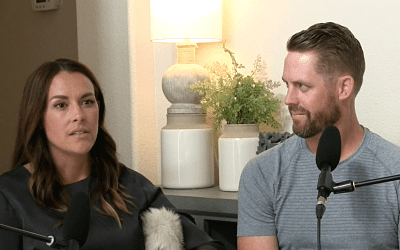
 In this edition of Mormon Stories, we visit the Houston, Texas area to interview Emily and Kyle Harris as they recount their 14-year mixed faith journey in their marriage. We cover:
- Their backgrounds being raised in the LDS Church, leading up to their marriage while still being believers
- How Kyle lost his faith in the Church early on in their marriage
- The process Emily went through for 14 years as she learned to understand and accept Kyle’s lack of faith
- What mistakes and successes Emily and Kyle experienced as they learned to navigate their mixed-faith marriage
- What changed in Emily’s life to help them get on the same page
- How Emily and Kyle arrived at a healthy, happy place in their marriage
Read Emily’s talk “On Worshipping How, Where, and What We May.”
Emily’s list of top 10 favorite quotes that have resonated with her during her journey:
- If we have truth, it cannot be harmed by investigation. If we have not the truth, it ought to be harmed. – J. Reuben Clark
- Faith doesn’t mean you don’t have doubts. – Barack Obama
- Never let a problem to be solved become more important than a person to be loved. – Thomas Monson
- The task of any religion is to teach us whom we are required to love, not whom we are entitled to hate. – Rabbi Harold Kushner
- The beginning of love is to the will to let those we love be perfectly themselves. The resolve not to twist them to fit our image. If in loving them we do not love what they are but only the potential likeness to ourselves then we don’t truly love them we only love the reflection of ourselves we find in them. – Thomas Merton
- Religion is the belief in someone else’s experience. Spirituality is having your own experience. – Deepak Chopra
- This is my simple religion. There is no need for temples. No need for complicated philosophy. Our own brain, our own heart is our temple. The philosophy is kindness. – Dalai Lama
- A gift we have have been given is to be very wrong about something and realize it. It changes the way you see the world. – John Larson
- Help me be gentle on people and tough on systems. – Mica Nicole
- Heaven is right here – Lynn Harris (paraphrased from Jospeh Campbell)
Episode Transcript
Host: John Dehlin · Guests: Emily Harris, Kyle Harris
This transcript is machine-generated and lightly edited for readability. The audio is authoritative. Please excuse occasional errors in names and spelling.
Introduction and Episode Overview
Part 1 of 4 · Ep. 955
John Dehlin [00:00:31] Hello everyone, and welcome back to another edition of Mormon Stories podcast. I'm your host, John Dehlin. We. I have a bit of a alternative introduction. Today I am recording an introduction separate from the actual recorded interview because there were some technical difficulties in this interview. So welcome to another episode of Mormon Stories podcast. Something that's not different between this episode and others is how excited I am to introduce this amazing. What I think is kind of an epic story.
John Dehlin [00:01:05] Today, we are going to be playing for you an interview with Emily and Kyle Davis. This is an interview that I conducted on July 12, 2018 in the Woodlands in Houston, Texas. And this interview is epic because deals with Emily and Kyle's mixed faith marriage that lasted 14 years. In other words, Emily, Emily and Kyle were raised lds.
John Dehlin [00:01:34] They got married and for, you know, and Kyle at some point early in their marriage lost his faith in the church. And they went another 14 years in a mixed faith marriage before Emily was able to really understand what Kyle was going through and where they're able to get to a really happy, healthy place. So that's kind of epic.
John Dehlin [00:01:58] So there's so many people who are in a mixed faith marriage or one person loses their faith and another one doesn't and they need help knowing how to navigate that. Well, this interview is going to help you with that. So what you're about to hear, you'll hear their early years. You'll hear about Emily and Kyle's respective upbringings in the church. You'll hear about what caused Kyle to doubt.
John Dehlin [00:02:24] And then you'll hear about how they navigated, you know, 14 years as a mixed faith couple. What, what, how they dealt with that, what mistakes they made, what they did. Right. And then finally you'll hear what changed in Emily's life that helped them get on the same page and kind of where they are now.
John Dehlin [00:02:42] It's a great interview. And the reason why we're recording this introduction is because there were some audio problems right at the beginning of the interview, um, that made it hard to hear me. So you'll hear Emily and Kyle fine, but you'll hear my questions be sort of faint. And I just want to let you know that's going to happen. And for about 10 minutes of the interview, my voice will be really faint, but that corrects because I do some adjustments to the audio and the rest of the interview should. But please welcome to this interview. Thank you for checking it out. And we now, we now will splice in our interview of Emily and Kyle Davis's epic Mormon mixed faith journey of 14 years. And we know you're going to enjoy it, so please enjoy it. Thanks for tuning in.
John Dehlin [00:03:29] Emily and Kyle, welcome to Mormon Stories podcast. It's such a delight to have you.
Emily Harris [00:03:35] Thank you for. For coming to our home. We're super appreciative, number one, that we get to document our story. We think that's important for our kids in the future and our posterity, so to speak. So we're grateful to have it recorded and a history of our own. I've been an avid viewer of Mormon stories for many years and recognize that it's.
Emily Harris [00:04:05] They have been instrumental in my faith transition, but as well as other podcasts, but that we. Or I understand, you know, that they're. The stories that come out of Mormon stories are really just that they're someone's Mormon experience, which is, you know, different from others Mormon experiences. And they are just stories. They're authentic and they're full of integrity.
Emily Harris [00:04:30] And so we're grateful to be able to share ours today. And, you know, we're hopeful that our being transparent about our journey is helpful to someone else. That's the intent of our sharing our story. We get as personal as to share that at one point, there was more. On more than one occasion, we talked about separation and divorce, and there are a lot of reasons to get divorced.
Emily Harris [00:04:59] A difference of religious preference should not be one. And so that's what we hope to convey today. And in fact, to the contrary, it should be embraced and valued. And that wasn't necessarily something I believed for quite some time. And so, if anything, this is a what not to do, at least from
John Dehlin [00:05:19] Emily's perspective, because it was a bumpy ride.
Emily Harris [00:05:23] It was a bumpy ride. So I didn't always believe that, you know, there was a time that relationships weren't as important as my beliefs, I guess I should say.
John Dehlin [00:05:36] Well, it's beautiful. Well, Kyle, it's also great to have you. Thanks for. Thanks for being willing to do this.
Kyle Harris [00:05:41] Absolutely. Glad to have you in our home, and we're excited to tell our story.
Kyle and Emily's Mormon Upbringings
John Dehlin [00:05:46] All right, so I guess as we always begin, let's begin kind of with your respective journeys as Mormons. Who had the most normal Mormon upbringing?
Emily Harris [00:05:59] This guy.
Kyle Harris [00:06:00] I did.
John Dehlin [00:06:00] All right, Kyle, you want to go
John Dehlin [00:06:01] ahead and just kind of tell us about your Mormon upbringing?
John Dehlin [00:06:05] Sure.
Kyle Harris [00:06:05] Yeah. I grew up, for all intents and purposes, in Provo, Utah, so right there at ground zero. Grew up in, I would say, a very loving, mostly traditional household. I'm the third of four children, so I have three siblings. I have an older Brother, an older sister and a younger sister.
Kyle Harris [00:06:28] But, you know, growing up in Provo, we were very much the, you know, the, I think the prototypical Mormon family home evenings, every Monday night, you know, we wouldn't, we wouldn't miss a Monday night, you know, up before school, you know, with book where my mom would read a chapter or a few verses out of the Book of Mormon before we all left for the day. So very much the traditional family.
Kyle Harris [00:06:58] I think the one in one way that I don't think we were traditional was this kind of the activity or the trains running on time, so to speak, that was largely my mom driving that effort. My dad was certainly a participant, although more of a passive participant in this traditional Mormon machine.
Kyle Harris [00:07:24] But no, I had a great childhood. I had a lot of good friends. Of course, growing up in Provo, almost every one of my good friends were also Mormon. And I didn't know any different. I just thought that was the way it is.
Kyle Harris [00:07:43] But, yeah, pretty traditional Mormon story. I will say that. You know, even in this traditional paradigm, I never really attempted to gain kind of my own personal testimony of the church. I was more just kind of going along with the current, you know, and checking all the boxes. I, you know, all the way through the deacons, teachers, priests, quorum. I was a. For example, I was an Eagle Scout by the time I was 14. I mean, very much kind of doing what I was told to do and not thinking too much about it.
Kyle Harris [00:08:29] So I don't want to get too far down the road. But I guess when I graduated from high school, my dream was to play college football. The only problem was I was about 150 pounds soaking wet. And you can probably imagine there weren't a whole lot of major football schools or universities beating down my door, wanting me to come play for them. But the one school that showed some interest and actually offered a scholarship was what was then Rick's College.
Kyle Harris [00:09:04] So I actually, after high school, went up to Rick's College to play football. And the way that it works at Ricks College, or at least when they had a football program, they don't anymore, is you go up there and all of the freshmen right out of high school, they actually don't play on the team. They redshirt. So you're basically going to practices, you're still going to school, but you're not playing on the team.
Kyle Harris [00:09:34] And so you don't, you don't burn a year of eligibility. And then what you do is you go for a year and then you go on your mission. For two years. And then when you come back from your mission, you're ready to play and you still have two years of college eligibility where you can go beat up on unsuspecting 18 year olds. All the teams we played were 18 and 19 years old. And, and the Ricks college team is made up of a bunch of 21 and 22 year old men that have served missions. So my point is, I never really thought seriously about a mission growing up.
Kyle Harris [00:10:09] Kind of assumed I'd go, but I was never, never really driven to do anything to prepare. But when I went up to Rick's again, kind of got caught up in the current. And that's what you do. You redshirt for a year and then you go on your mission and you come back and you play. And so that's what I did. I'll stop there. But that's kind of what led me to my mission experience, was kind of going along with the flow and not thinking too deeply about anything, Just kind of doing what the others around me were doing.
John Dehlin [00:10:43] So your particular testimony in your teenage and early adult years, it was just kind of not super strong.
Kyle Harris [00:10:51] I was much more interested in chasing girls and playing sports. I was not, I wouldn't describe myself as a real deep or critical thinker as a teenager in that way. I was kind of the black sheep of the family.
Kyle Harris [00:11:09] My three siblings were much more studious and academically inclined than I was at that time. So, yeah, I just, I did not, you know, I would do all of the things. Check all the boxes. No, so that was, that was maybe the, maybe one area that, that I pushed back on a little bit. I went, I think, my freshman and sophomore year. And then I think I might have. I can't recall if I graduated from seminary, but if I did, it was by the skin of my teeth. I mean, I was.
Kyle Harris [00:11:44] My junior and senior year, I was you know, either not going or going just enough to get credit for it. But the church was not even in this active, traditional home. The church was not something that was important to me.
John Dehlin [00:11:59] Okay. And that's. That wasn't because of some problem you had or concern. It was just your interests.
Kyle Harris [00:12:06] Yeah, it wasn't anything I was doing or not doing. It was just the. I, I never really. Those hooks never got into me too deeply, I suppose.
John Dehlin [00:12:16] Okay.
John Dehlin [00:12:18] All right.
John Dehlin [00:12:19] So no like, struggles to get your testimony or to read the Book of Mormon and pray about it or any of that stuff up through Rick's?
Kyle Harris [00:12:31] No, I mean, I'm sure I read the Book of Mormon, you know, from time to time, I remember as a youth, you know, different leaders, some, you know, prophets or local leaders would challenge, you know, challenge the youth of the church to read the Book of Mormon within a certain period of time, I think I did that. So I was doing these things, but it just. Nothing was really sticking for me. I mean, I was not developing an independent testimony. Now that changed a little bit on my mission. I'm going to wait to. To tell you about my mission until Emily catches up to me. But growing up, no, it just wasn't that important to me.
John Dehlin [00:13:11] Got it. Okay. So, Emily, why don't you tell us about your faith Church.
Emily's Strict Orthodox Childhood
Emily Harris [00:13:18] Okay. I grew up in a very orthodox, strict Mormon home. I'm one of nine children, three boys, seven girls. We were very poor growing up. I remember being on either church or government welfare as far as I can remember, almost always.
Emily Harris [00:13:44] My dad was very authoritative. He was controlling, had a short temper. You know, Mormonism was important to him. And I would say his relationships with his children and subsequently, you know, also his wife were not the most important thing to him.
Emily Harris [00:14:07] There was, you know, I think at least for the older children, some physical abuse, definitely emotional and verbal abuse growing up. And, you know, I would say today about eight, let's see, eight out of the 10 children have. Do not have any connection with my father.
Emily Harris [00:14:32] I'll talk later. My parents ended up divorcing down the road. What else? My mom was a saint. I think my mom did the best she could under the circumstances of. Of, you know, just kind of survival mode. I think for her with that many children and the poor, you know, the circumstances.
Emily Harris [00:14:58] But she also, I think, was in a position of kind of being helpless, you know, with the situation of having so many kids and a husband who I also, you know, my understanding, was also abusive to her. My mom, as far as I'm aware, had mentioned that to bishops over time. And the answer to her was, you know, that he was the leader of the home and, you know, figure things out at home type thing.
Emily Harris [00:15:34] So that's the dysfunctional part of my upbringing. But as far as my participation in the church, I was. I had a great experience going to church. I had a great experience being raised Mormon as far as, you know, hindsight. But, you know, I feel differently. But when I look back as being a child, you know, it's hard to know, you know, there's more out there and that there's.
Emily Harris [00:16:06] Your childhood feels normal until you grow up. Right. So I had a great childhood with my siblings. We all Loved each other and enjoyed each other's company. A lot of entertainment going on there with each other. But I was involved in everything. Primary, young women's.
Emily Harris [00:16:28] I was a seminary graduate all the way through early morning seminary, at least in Washington. My junior year, my family moved to Utah. My dad was going to go back to school. He was always working on some degree or doing something new. He was, he was kind of a dreamer. So what else? You know, I did all the typical things. Girls camp. I enjoyed girls camp. I had great experiences in young women's.
Kyle Harris [00:17:05] Well, unlike me, you grew up in, you know, high school where at least before you moved to Utah, where you were the minority and you kind of prided yourself, didn't you, on.
Emily Harris [00:17:14] Yeah. Oh, certainly being Mormon? Yeah, no, I, I did. And in that, you know, I felt like I stood out. I felt like Mormonism was, it was kind of a badge of honor, you know, getting up for early morning seminary and having a leg up when I got to school. So, no, I valued. I wouldn't say I was self righteous, but I maybe walked around with a little skip in my step because I was Mormon. It made me different from others and that was a good thing in my mind.
John Dehlin [00:17:51] Okay, so for you, Emily, in terms of your upbringing and your faith, did you try to find out that the church was true? Did you feel like you had a solid basis for your testimony even when you were a teenager?
Emily Harris [00:18:09] Yeah, sure. I mean, I was constantly, you know, if I was assigned to read the Book of Mormon, I would do that. And if things were going well in my life, I attributed that to, I'm doing everything right. You know, I'm reading my Book of Mormon, I'm saying my prayers, I'm doing everything that I'm asked to, and I feel like the blessings that I'm receiving are because of my obedience. And did I have. I don't remember having any lightning bolt. You know, people talk of, you know, these lightning bolt experiences where, you know, they just, they knew the church was true without a shadow of a doubt. Mine would have been over time and just, just kind of a, you know, basic understanding that, that if I was happy that I. And I was doing these things, then, then the church must be true, you know.
Dreams of a Mormon Marriage
John Dehlin [00:19:08] So did you, Emily, have a dream of kind of what you wanted your Mormon marriage to be like? Do you think you had a sense of that? And if so, what was it?
Emily Harris [00:19:18] Oh, sure I did. It was a returned missionary, someone who held the priesthood and held it worthily, although I don't know that I knew what the meaning of that was with the father that I was raised with. Right. Like. But yes, you know, this vision of a temple marriage to a returned missionary that, you know, I would make sure that that was in my future. That was always the goal, for sure.
John Dehlin [00:19:52] Something that I found just as kind of a. Kind of a coach timeout is that in mixed faith marriages, oftentimes when one. When one member of the partnership grew up in a home that was dysfunctional or part faith or part. Or just experience any sort of trauma or dysfunction in the home, that can often make that person cling more tightly to the church and their ideals for what they wanted in a marriage and in the church because they have this sense that my upbringing wasn't great, it was subpar, it was sad, it was dysfunctional or broken. And so I'm going to have that kind of perfect, ideal marriage where the church is the thing that binds us together and keeps us from falling apart. Did you feel like that maybe was part of what you brought to your marriage?
Emily Harris [00:20:52] I guess there was no other option. Like, that was the only paradigm that I brought to the marriage. It would be this way. It would only be this way. The church is true. Marriage is eternal. There is one way to be married, and it's in the temple and for eternity with one person. So, yeah, I mean, there was just another. No other reality in my mind, but that got it.
Kyle's Mission and Early Adult Faith
John Dehlin [00:21:27] So is there anything else you guys want to share about your stories before your meeting? Anything that's important to your Mormon? So I guess, Kyle, you. You ended up serving a mission, right?
Kyle Harris [00:21:36] I did.
John Dehlin [00:21:37] So did you have kind of a big conversion or did you go on your mission? Kind of lukewarm.
Kyle Harris [00:21:42] I wanted to. I wanted to talk. Thank you for asking just a little bit about my mission. So. So I. I actually went out on my mission without a. Any viable testimony that the church was true. Again, it was. That's what all the other freshmen at Ricks College that played football were doing. And sure, that sounds good. Again, not a. Not a real deep thinker at the time. And so I served my mission in New Jersey, of all places. And a couple of comments about my mission.
John Dehlin [00:22:14] So
Kyle Harris [00:22:16] one of my lasting memories of my mission was my first Zone Conference. So for most of our listeners may know what Zone conference is, but it's basically a monthly meeting on your mission where all of the missionaries in a given zone, and I think we're talking maybe 50 or 60 missionaries convene at the most convenient chapel and the mission president leads the discussion. And it's basically a meeting with a testimony meeting session and some other things. Well, my first zone conference, I was, you know, out on my mission for a month or less than a month. And the. The first session of this zone conference was a session that they called my mission president, called Accountability. And what they did was they rolled in a great big green chalkboard on wheels into the front of the. Just below the. The podium president called Accountability. And what they did was they rolled
Emily Harris [00:23:20] in, got rolled on,
John Dehlin [00:23:23] keep going.
Kyle Harris [00:23:24] Okay, so they roll in the big green chalkboard, and on the chalkboard are, I don't know, seven to 10 categories of, basically statistical categories. And each companionship had to stand up and account, hence the name accountability. You had to account for your performance the previous week. And so these categories were, you know, how many discussions did you teach the previous week? How many copies of the Book of Mormon did you hand out? How many investigators did you bring to church? And on and on, and ultimately, you know, how many baptisms did you have? And I remember getting up with my trainer at this first zone conference, and I had no idea that I was going to be standing in front of the mission president, 50 or 60 missionaries, you know, and we were going to have to literally write our.
Kyle Harris [00:24:21] In chalk, write our statistics up on this board for all the zone to see. And we had not had a very good week the previous week. And so our statistics looked really, really bad compared to the rest of the missionaries. And I just remember feeling just horribly embarrassed, you know, that I was somehow not the missionary that these other companionships were.
Kyle Harris [00:24:51] And from that moment on, on my mission for the next close to two years, my mission, unfortunately, in a lot of ways became exercise in this accountability where I was. And I think a lot of the missionaries in my mission were very much concerned with statistics and optics.
Kyle Harris [00:25:13] And so, you know, that was. That became very early on and continued throughout my mission to be one of, if not the driving motivation is for me to. To compete. Compete. I'm a competitive person. My friends and family would tell you that maybe that's a fault, but I bought into that. And so I dove in. And I was on my mission a grinder. I mean, I was working hard and doing everything I could do. I do remember at times, particularly in weeks that were leading up to his own conference, where we'd have to stand up and account. We would stay out a little bit later and, you know, as the door is closing in our face, try to get enough principals in to be able to count that discussion as an official discussion that we could put up on the chalkboard.
Kyle Harris [00:26:10] So that was happening. You know, I did have a successful mission. I, towards the end of my mission, became an assistant to the president and served in that capacity. I do think that I developed a testimony on my mission.
Kyle Harris [00:26:37] Looking back at it, I think that it was more of a. I would describe it as a manufactured testimony. You know, a mission is. I haven't served in the military, but I've heard the comparison drawn and I think it's a good one. You know, you're up at 6:30 and you're praying and then you're studying the scriptures and then you're studying with your companion and then you're studying alone and then you're praying and then you're out the door by 9:30 and you have a schedule to keep and you're testifying of the truthfulness of the church, you know, over and over again. And through the course of that, I do think that I developed a testimony and I do believe that when I was telling people the church was true, that I.
Kyle Harris [00:27:25] That I believed it. I do, I do think that, you know, I don't want to get too far ahead. But anyway, so I had a. I would say I had a positive, successful mission, albeit motivated for the wrong reasons, motivated for my own ego, if you will, but served an honorable mission and came back home in the summer of 1998 and you know, had no. Had no.
Kyle Harris [00:28:00] My intention was to stay active in the church, to get married in the temple. I mean, I was. I was in a window of my life, my mission, and for two or three years afterwards where I was fully active and fully, fully a believer. And it was during that period, that window of activity, when I met Emily.
Emily Harris [00:28:23] Okay.
John Dehlin [00:28:24] So I mean, if you reach the level of assistant to the president, that means you were a pretty intense missionary. And I'm sure you would have perceived yourself as having a very strong, solid testimony.
John Dehlin [00:28:39] No.
Kyle Harris [00:28:39] Yeah, no, I think that I did. Again, my mission was. This sounds silly, but it was a competition. I remember in these zone conference meetings. Well, particularly when I was an assistant to the president, I would travel with the other assistant with the mission president and we would put on these meetings, monthly meetings, and they would always end with a testimony session.
Kyle Harris [00:29:07] And I can remember, you know, missionaries getting up and bearing their testimony and, you know, someone saying, you know, I was saying my prayers. I was on my knees saying my prayers last night and I didn't dare open my eyes because if I would have opened my eyes, I was just sure the Savior was standing next to Me and, you know, and then we would travel to the next zone two or three days later, and, you know, you'd hear a similar type of. But maybe even a little bit more embellished of how another missionary was. Was spiritual or, you know, that close literally to the Savior.
Kyle Harris [00:29:49] And I'm sure I bear or bore my testimony, you know, in that respect or in that way as well, so. So, yeah, to answer your question, I do think that I. I had a testimony, and I was not afraid to use it.
How Kyle and Emily Met and Married
John Dehlin [00:30:07] Okay. All right, so who wants to tell the story? Emily, is there anything else you want to share about your life prior to meeting Kyle as it relates to kind of your faith journey?
Emily Harris [00:30:20] No, other than I ticked all the boxes, you know, of what I should be doing to navigate my way through Mormonism, to be the best Mormon I could be. For sure. Mormonism was important to me.
John Dehlin [00:30:33] You were in it to win it. Okay. So how'd you guys meet?
Emily Harris [00:30:39] Well, Kyle played football at Rick's, and I was in the sports medicine program, the athletic training program. I mean, that's how we crossed paths and started dating. I think the first time you ever saw me, it was Tuesday Devotionals at Ricks College.
Kyle Harris [00:31:02] Remember it? Well, I can remember exactly what you were wearing when I saw you for the first time.
Emily Harris [00:31:08] And, you know, is it kind of
John Dehlin [00:31:10] a little bit prestigious at a BYU school to date a football player? Was that kind of cool for you or not or.
Emily Harris [00:31:17] Well, other than that, I dated a few previously, and so when he came along, I was sure I was done dating football players. I mean, I wasn't seeking out football players that just so happened to be who you would run into. We were in the same circles because of what my. What my schooling was in. So I also ran into basketball players and female basketball players. And so it wasn't just. Just football players, but I don't know, it was a prestigious. I wasn't seeking that. But that's who. We. We ran. We ran into each other. He would claim I was a water girl. That is not the case, in fact.
Kyle Harris [00:31:58] Well, she'd come out to the football practices. She was a student trainer. So, you know, we would. The team would be out on the field. And I do remember seeing you carried some water, and from time to time, you carried water. But she was out to the field. She was an athletic trainer out to
Emily Harris [00:32:12] the field, mostly for the injured, you know, those who were injured, although he was never injured.
Kyle Harris [00:32:19] Yeah, I thought. I thought about faking a groin injury and going into the training room.
Emily Harris [00:32:24] The truth about that is, they would not let females work on groins in the sports medicine church school. So we wouldn't get practice with groins. We'd have to wait till we left and got out into the real world to work on groins. We digress. Anyway, so when we met, it was the. I had done a summer term at Ricks College and now we were into the fall and he had returned from his mission and it was basically my first semester in college that we met and we met towards the end of the semester and we dated. Let's see. So we met in November and we were engaged by May. So super quick. As is the case in Mormonism typically.
John Dehlin [00:33:16] Wow.
John Dehlin [00:33:17] So that's. What do you think about that?
Emily Harris [00:33:21] There are faster. I've known people to get married, engage faster.
Kyle Harris [00:33:25] A little more detail. So I do remember that I had to. I was clearly interested. I mean, what's not to be interested in? And I had to be very persistent. Maybe some of those mission skills were put to good use. But I was persistent and continued to, you know, go over to Emily's apartment. And the one advantage I had was I had a. At the time I had a Toyota truck and Emily didn't have a. Didn't have a vehicle. And so I could offer her rides or you know, if you. She needed to run to the grocery store. So I kind of used that as kind of my in.
Kyle Harris [00:34:00] So I did have to work at it to get her to notice me. But I think once we. Once we started to spend some time together, I think it clicked and you know, probably November, December of 98, 1998. And really from that day forward we've been. We were inseparable. I mean we were. And maybe that was one of the reasons that it happen quickly other than just kind of Mormon culture. Right. You find somebody.
Kyle Harris [00:34:26] I checked the boxes. She. She needed checked and you know, I was. I was highly motivated as well. And so we moved pretty quickly. But that was a. That was a fun time. It's a fun. I mean, it was a quick courtship and engagement, but it was. I look back on that fondly.
Emily Harris [00:34:44] Yeah, same. Same small town. So there's not a whole lot to do but hang out and be with each other. And in the cold and the bitter cold in Rexburg, Idaho. So it was fast, but we enjoyed each other's company, you know, talking for hours on end, just.
Kyle Harris [00:35:02] Yeah. I mean, this was before cell phones, so I remember staying up till, you know, three or four in the morning with the. With the one phone and we was living with Five other guys, and they were fighting for the phone with the one landline. I do want to say, when I proposed to Emily, it was the traditional proposal. Took a knee, went out to a nice dinner, and I made.
Emily Harris [00:35:24] In Sundance.
Kyle Harris [00:35:25] It was at Sundance. And I made several specific promises, including that I would. That I planned to honor my priesthood, that I planned to be a worthy priesthood holder. And at the time, I completely meant it. I mean, that was not anything I felt like I should say or needed to say. That was just what was in my heart. And that'll come up later. But I made that warranty and representation that I would be all in in the church and really had every reason to think that that would be the case.
John Dehlin [00:36:03] So your faith crisis started after your marriage?
Kyle Harris [00:36:06] Yes.
John Dehlin [00:36:07] So you weren't. There was no bait and switch involved?
Kyle Harris [00:36:09] No, not at all. And like I said, we met in a. You know, if I look back, I'm, you know, 41 years old now. We met during a very narrow window for me where I was active in the church the two years on my mission, and then for a few years after, that was the window. But we met, and I'm glad we did, because we may have missed that. Had I had a faith crisis before I'd met Emily, I wouldn't have checked the box. So I'm glad it was within that window.
Emily Harris [00:36:39] When he was teaching gospel doctrine, if I remember, at Ricks College, post mission, I had no other, you know, indication that he was not all in. I mean, we're at a church school and he's here, and we're both buying into it all the way.
John Dehlin [00:37:03] Okay, so. So you get married in the temple. Anything we should know prior to Kyle, you starting to lose your faith? Anything we should know about your marriage that is relevant to this?
Kyle Harris [00:37:14] Well, we found out we were pregnant six months after we were married.
Emily Harris [00:37:19] Well, let's back up. I would like to say about the marriage ceremony. So I'm 19. Kyle's 22. His parents are divorced. We hadn't mentioned that. My parents are separated. When I went off to college, my mom. There were some events leading up to my mom realizing that basically she didn't envision eternity with this guy, with her husband, with my dad. It did not sound enticing to her. And she had.
Emily Harris [00:37:59] I think the straw that broke the camel's back was my sister Charity was getting married outside of the church, and my dad would not walk her down the aisle at her wedding because it wasn't a Mormon wedding. And that was the summer that I started college. At Rick's. And so I was off at Rick's doing that and was learning from some of my siblings that things were tense between mom and dad and mom was considering leaving dad. And I think she, the timing of all that. She also had the support from her active brothers, an active uncle of hers and my two oldest siblings, men, two brothers who were learning about what had been going on.
Emily Harris [00:38:47] And we're giving her the support to be able to actually, you know, take, you know, leave my, leave my dad. And that it was, it was not a good situation that she was validated in leaving my dad. So, you know, they were separated at the time we were planning for the wedding and it came down to who was going, who were going to be the witnesses at our wedding. So my dad, you know, I was communicating with him a little bit during this time and he was sure that it should be him to be the witness at our wedding. And I didn't feel that he should or that it was justified or that he had the right necessarily to.
Emily Harris [00:39:28] And I told him no, that I was considering one of my older brothers. And I remember him saying that he is the, that it is his right and he's the priesthood holder and he should be the witness at our, at our wedding. And in the end, I chose my brother Ben and Kyle chose his brother Ryan.
Emily Harris [00:39:46] So leading into that, that will play in the reason for my telling this will play in a little bit later. But that was the, the ceremony. Kyle's dad was not in, in the temple. I don't know if you want to.
Kyle Harris [00:40:00] Yeah, it's probably beyond the scope of this interview, but my dad had been excommunicated from the church. And so as close as I was and Emily was and is to my dad, he was not in the temple. He was not able to participate in that. Pretty exciting day.
John Dehlin [00:40:22] Okay, so a little bit of family, maybe some family drama leading up to the wedding and connected with the wedding. Some parental question marks or instability or how would you describe it?
Kyle Harris [00:40:38] Go ahead.
Emily Harris [00:40:40] Yeah, I mean, I think my reason for bringing that up is that I would, if we could get married over again, Kyle's dad would be there and not my dad. And I feel like in that way temples separate families and the person that deserved to be there wasn't there. And although my dad was a temple recommend holding member of the church, he had no right to be there. And if we were to do it over again, Kyle's Lynn would be there. But I also, that plays a role later when I, when I look at my children and the potential that their dad would also not be at their temple wedding. So that's why I bring that up.
John Dehlin [00:41:37] Yeah, I think that's. That's common. Just especially if someone's a convert or, you know, they have inactive parents. And when people go through a faith crisis, they just really regret how many times they just didn't even really think about what it might be like for their parent to really just not be there. It was just like, well, this is what we do. And so I can't be there.
John Dehlin [00:41:58] Mom or dad or grandma or grandpa
John Dehlin [00:42:00] or aunt or uncle or close friend and people. That's a source of pain for a lot of people. So thanks for sharing something so hard.
Emily Harris [00:42:12] And we were 19. I didn't think about anybody but myself at that wedding.
Kyle Harris [00:42:15] I mean, we were so young.
Emily Harris [00:42:17] We were 22.
Kyle Harris [00:42:17] 22 and 19. I mean, we. We would do a lot of things differently. And we can talk about. Talk a little bit later about,
Emily Harris [00:42:29] you
Kyle Harris [00:42:29] know, kind of the. How old I was when I feel like I grew into my adult brain and started making decisions based on what I wanted to do, based instead of based on what I perceived other people wanted me to do. But back then, you know, it's over the top, over my head,
John Dehlin [00:42:48] so. Anything else you want to share?
Emily Harris [00:42:50] No, sorry.
John Dehlin [00:42:51] No, that backed up. Don't apologize. That was powerful. Yeah. Okay. So. So what happened, Kyle?
Early Married Life and Seeds of Doubt
Kyle Harris [00:43:03] So we finished, actually never graduated from Rick's college. As I said, I was playing football. And so we were married and played my, I guess, my sophomore fall season of football at Ricks and played well enough where I had the opportunity to continue to play football and had a scholarship more or less to go play football at Bucknell University, which is out in Lewisburg, Pennsylvania. So it's central Pennsylvania, not much. There's several Amish communities nearby, but not much else.
Kyle Harris [00:43:38] But it was a great opportunity. Small liberal arts school. And so Emily and I, and we had just found out days, or literally days, January 1st, we got in a U haul and drove from Utah to Pennsylvania that Emily was pregnant.
Kyle Harris [00:43:58] And so off we went to Bucknell. And my education at Bucknell is something that I will always cherish. I just met a lot of very interesting people. There was a great amount of diversity, small class sizes. Sound like I'm on a commercial or infomercial for the school.
Kyle Harris [00:44:27] But I remember just being. And again, 22, 23 years old, just completely invigorated by learning and took a lot of interesting classes. The one that I wanted to touch on and probably my favorite class that I took at Bucknell was a class called the Philosophy of Peace and Non Violence.
Kyle Harris [00:44:50] And in that class we read, you know, we read Mahatma Gandhi, who's kind of the godfather of the nonviolent movement. We read Henry David Thoreau, we read Martin Luther King. And then after he'd read all those people, we read Jesus Christ.
Kyle Harris [00:45:13] But I'm in a class with 12 other students. The professor is not Christian. And we're reading Christ's words and, you know, his philosophy on nonviolence just as we were reading the other. The other authors. And for some, just from a historical perspective, not. Not as the Son of God, not that he's deity, but he's just another voice who had something to say on the subject.
Kyle Harris [00:45:43] And that was really mind blowing for me. Not that I, at the time began to doubt Christianity. I wouldn't say that, but it just opened. My mind was beginning to expand in a lot of ways as I was taking those classes.
Kyle Harris [00:46:05] And I guess I should have gone back on my mission. There were several times on my mission where we would be knocking on doors and in the back and forth we had with people we were talking to, you know, we were trying to hand them a copy of the Book of Mormon or pamphlet. And a lot of people over the course of two years would hand back information. And I remember on my mission receiving some pamphlets from people either on their doorstep or in a park that would, you know, talk about things that I thought were just shocking and untrue and appalling. Things like how the Book of Mormon was really translated.
Kyle Harris [00:46:50] Things like the Book of Abraham. And while I was on my mission, I remember I was in Toms River, New Jersey, about three months into my mission when someone handed me a pamphlet for the first time about Joseph Smith. And, you know, basically looking into a hat to translate the book Mormon. And at the time I thought, this is preposterous. This is nothing I've ever been told. It can't be true. I remember walking back home that night with my companion thinking, this is, you know, I think my companion called it spiritual pornography.
Kyle Harris [00:47:25] You just shouldn't be. Shouldn't be entertained. And how dare they. And I got home from my mission and began to think about that and began to become curious or more curious. And so eventually started to do. I started to do some reading.
Kyle Harris [00:47:47] And this is, you know, on top of all the other reading I'm doing at Bucknell, and started to actually study and learn some church history that had not been disclosed to me at any point. I mean, I was growing up. As I told you, I was attending all my meetings and checking all my boxes. But two books that I want to mention that I read, and this would have been in the 2000 and 2001 time frame, I believe, a book called Mormon Enigma, which is a book written by a couple of professors, I believe, from the University of Illinois. John, you may know their names.
Emily Harris [00:48:28] Linda K. Newell.
Kyle Harris [00:48:29] Linda K. Newell. And someone else. But Valiant Tippets. The book is interesting in that it's packed with historical content. So all of their sourcing is journal entries, affidavits, court records. But it's written from Emma's perspective, Emma Smith's perspective.
Kyle Harris [00:48:49] And it talks. It goes into great detail about. It talks about the Book of Mormon translation, but it talks in great detail about polygamy. And for me, that was, again, just new information that I'd never heard. Let me give you one more. Let me refer back to my mission one more time.
Kyle Harris [00:49:12] On my mission, there were times, more than a handful of times, where I had to defend polygamy, either during a discussion or in someone's home or on the street. And the way that I had heard it defended by my trainer, by the zone leader, by other kind of missionaries that I looked up to, was that what we were supposed to say if polygamy came up? Of course we wouldn't bring it up, but if it came up, we were supposed to say that, yes, the church practiced polygamy for a short period of time, but the reason for that was the church was, you know, people were threatened by the church, and so the church body had to move.
Kyle Harris [00:49:59] You know, they migrated from New York to Ohio to Nauvoo. And during the course of this migration, there were several battles or skirmishes where some of the men were killed and leaving a lot of widows. And so because women outnumbered men, these women couldn't support themselves. And so kind of as a humanitarian effort, these men who had survived the battles would take on more than one wife. But it was for the benefit of these poor women whose husbands had been killed in battle.
Kyle Harris [00:50:34] And that was kind of the accepted narrative or explanation on polygamy that I then used for the next two years. I can still remember telling people and arguing with people and testifying that that was what happened. And so fast forward to post mission and post marriage, and I'm learning that's not at all what happened.
Kyle Harris [00:51:01] And my initial. I went through several different emotions, but the one that really stuck with me was I just felt like I had been deceived. I felt like I had been you know, not told the truth and then sent out as a tool, as a beacon for the church to go perpetuate these untruths. And I absolutely became angry.
Kyle Harris [00:51:32] The other book that I read that was influential to me was Fawn Brody's no Man Knows My History. And in reading those two books, and I'm sure I read others in this early 2000 time frame, for me, the wheels fell off the wagon pretty quickly.
Kyle Harris [00:51:55] And around this time, I remember it may have been in a general conference. If Gordon B. Hinckley was still the prophet, I don't know how he was the prop. He was my prophet, right? I mean, I served my mission from 96 to 98. He was the prophet. So he was. He was the guy. And it was either shortly after my mission or around this time, this early 2000s, where I either heard him or read his kind of.
Kyle Harris [00:52:23] I call it the Sudden Death Theory, where he said, and I think he may have been quoting previous prophets, Joseph Fielding Smith, I think where he says either Joseph Smith is. Was called of God and had the first vision and translated the Book of Mormon and is to be revered as the prophet of the Restoration, or he is a complete fraud.
Kyle Harris [00:52:48] There can be no middle ground, is what I remember reading from my prophet, Gordon B. Hinckley. And it hit me. I agree with you, President Hinckley. There can be no middle ground here. Either all of those things happened or none of them happened.
Kyle Loses His Testimony
Kyle Harris [00:53:09] And for me, it was. It was just. It was clear. It was black and white. Lost my testimony and, you know, was sure of it. I wasn't on the fence. Like I said, it happened pretty quickly. And that's in a nutshell, how I lost my faith.
John Dehlin [00:53:32] And this would have been around what year?
Kyle Harris [00:53:34] 2001. I think we were still at Bucknell. I graduated Bucknell in 2000, May of 2002. So in that 2001, 2002 time frame.
John Dehlin [00:53:45] So I have a question, and I don't know that you're gonna be able to answer this, but one of the things that's kind of mind blowing is,
John Dehlin [00:53:53] you know, Fawn Brody's no Man Knows
John Dehlin [00:53:55] My History was written, published, like, in 1945. Like, books have been around forever. That would give people cause to study
John Dehlin [00:54:05] and doubt and even leave the church.
John Dehlin [00:54:07] So just the mere existence of a book doesn't. Or even someone reading a book doesn't mean they're going to leave. There are people who have read no Man Knows My History. Like, I think Bill Real at one point said he read that book while he was an investigator and he joined anyway. I could have my memory wrong, but my point is, just having a troubling history book or even reading it for many people, means nothing to their testimony.
John Dehlin [00:54:33] What do you think it was about
John Dehlin [00:54:35] your testimony, your experience that, number one, made you want to read, that made you curious enough, made you courageous enough or interested enough or faithless enough, or whatever you want to use as an adjective.
John Dehlin [00:54:47] And then what made you open and
John Dehlin [00:54:50] willing to ask that question? Is it possible it's not really true? Because so many of us, when we were confronted with anti Mormon literature or real accurate history, we just brush it off and blew it off and discarded it. Have you done any introspection as to what made you ripe for that at such a young age?
John Dehlin [00:55:09] And before, you know, it was cool,
John Dehlin [00:55:12] you know, to leave the church. Yeah. And I don't mean it's cool to leave the church. I just.
Emily Harris [00:55:16] Before the Internet was popular.
Kyle Harris [00:55:17] Before the Internet, before, Before Mormon stories,
John Dehlin [00:55:20] what made you open to that?
Kyle Harris [00:55:21] So. So I think a lot of it was, like I said, the. My mind was just blowing up with all. I mean, ideas at Bucknell were flying around like bullets. Another part of it is probably my brother and my dad.
Kyle Harris [00:55:41] Now, they were not feeding me information, or my brother ended up leaving the church a little bit before I did. And so conversations with my brother, I think that's where I. Where I heard that this book, Nomad Knows My History, was out there.
Kyle Harris [00:56:00] So conversations with my brother, conversations with my dad. There was no persuasion going on, but it was just awareness, creating awareness. And I took that awareness and went and found the books and really kind of became fascinated by it, too. It was not just the. The loss of my faith. It was historically interesting to me. I mean, the history of our. I still call it our church.
Kyle Harris [00:56:29] The history of the church is just amazing. And particularly it's amazing when it's very different than the Disneyland whitewashed version that I grew up, you know, believing was true. So. So there was a lot of that. But I would. I would say that my family, my brother and my dad were probably important in that process, at least for just saying, hey, there's, you know, if that's bothering you, if these things you learned on your mission are concerning you, there's information out there, because I just didn't know. I didn't know these.
John Dehlin [00:57:11] Did you respect your dad and brother then?
John Dehlin [00:57:13] Is that.
John Dehlin [00:57:14] Was that part of it? You just respected them?
Kyle Harris [00:57:16] Yeah.
John Dehlin [00:57:17] Okay.
Kyle Harris [00:57:17] Absolutely.
John Dehlin [00:57:18] Okay.
Telling Emily About His Lost Faith
Part 2 of 4 · Ep. 956
John Dehlin [00:00:31] So to what extent, you know, how did you deal with, with Emily when this was happening and were you scared? You know, do you remember like the first moment you thought, well, this might not be true, and. And then started like the wheels started turning about what the implications might be, what the risks might be. What was that like for you, that process?
Kyle Harris [00:00:54] So I don't remember a specific, like the first time that I talked to Emily about it. But I mean, we've always been tight. I mean, I don't remember being. And maybe again, I'm too young and dumb to know that this could, at the time, that this could be really serious to our marriage. But I remember while we were Bucknell and even after we moved to Houston in 2002, trying to have these initial conversations and not really being. I didn't try to hide my concerns about the church from Emily. I think we would talk about it now. The more we began to talk about it, I think the more I began to realize, oh, wow, this is going to be a big problem.
Kyle Harris [00:01:44] But initially know, chalk it up to naivete or just being, you know, too young or dumb. I didn't really have trepidation initially about saying, hey, I've learned some things. Let me tell you what I've learned.
John Dehlin [00:01:57] So, Emily, I'm guessing you remember when he first told you, is that true?
Emily Harris [00:02:01] Well, I don't remember the first time, but. But let me go back and set the stage as to what I'm doing while he's in school and being educated in his minds. But blowing up my mind is doing the opposite. I am at home, pregnant, not going to school. I stopped going to school because we needed to make a home for this baby we were going to have. And I was scrapbooking and doing mind numbing tasks. So when he would come home and it wasn't, he would come home and share interesting tidbits from his philosophy class or what have you. And that was interesting. I don't remember vividly at Bucknell, it being super uncomfortable for me yet. Can you remember a story at Bucknell coming out to me? I don't have a strong recollection.
Kyle Harris [00:03:01] It's a good point. It's later and also during this time and really all the way through 2015 when Emily stopped going, I was still going to church. So it wasn't as if, John, that I had said, you know what? Church isn't true, I'm not going to participate. I was still going for years. I had callings. So I was kind of muddling along. While mentally, emotionally, I Checked out. I was like I said, convinced the church was not true. To keep the peace and to be a part of my kids lives. I was still going. So from the outs, I mean I will get to it. But in 2008 I baptized my daughter because I. That was just the path of least resistance without a testimony of the church at all.
John Dehlin [00:03:53] Let's, let's dig a little bit deeper there. So you know, we don't know how many active Mormons right now don't believe but are just going along and, but, but, but I imagine there are lots of reasons why people do that. You've talked a little bit about it. What is that like? Is it, was it hard? Is it excruciating? Is it boring? Like, you know, there, there are people that will want to be connected with about what they're going through. Do you remember what it's like to keep attending church after you now?
Kyle Harris [00:04:26] Yes.
John Dehlin [00:04:26] No longer believe it. What's that like?
Kyle Harris [00:04:27] It was completely miserable. Completely. That I've described it to Emily before and the way that I could best articulate it was to say it like going to church and maintaining a calling and kind of muddling through and pretending to still be participating and have a testimony. It feels like wearing a shirt, a dress shirt that's about three sizes too small.
Kyle Harris [00:04:55] And no matter how you move or no matter how you maneuver or no matter what you try, that shirt just feels uncomfortable. It doesn't fit. And that was me for years. And you know, eventually I figured out the primary. I'm sorry, the nursery was a good place to be. You know, I could hand out goldfish crackers and you know, cut orange slices and people would more or less leave me alone. But it was even then I was still going to sacrament meeting and you know, just the fact that I would attend with my family, there's the presumption, right, that Kyle must be active. Here he is on Sunday with his family.
Kyle Harris [00:05:41] And so just, you know, and it's just easier not to have a difficult conversation with someone you don't know. Well, it's easier to, to just kind of go, go with the flow. But it was miserable. I was miserable. Now I wasn't miserable, you know, Monday through Saturday I was miserable during that three hour block. And then any, any type of, you know, depending on what calling I had any type of prep work, but it was tough.
Emily's Distress Over Kyle's Doubts
John Dehlin [00:06:12] So Emily, do you remember when this first started to be like alarming or distressing to you and if so to talk about that?
Emily Harris [00:06:20] Yes. So after Bucknell, Kyle continued his education Went to law school in Houston, University of Houston. So we moved to Houston. And I remember the summers we would. We would go home to Utah. That was our home, where our family was, and we would. We would stay the summers there.
Emily Harris [00:06:43] Kyle would work for his dad a little bit over the summer, and I had lots of family there, and so we'd be home. There was discussions, you know, he would share little tidbits of information to me, and basically, as those started, I would put up a wall, is the best way to describe it. Just, I almost didn't even hear him when he would communicate concerns, whether it be about polygamy, blacks, and the priesthood.
Emily Harris [00:07:21] And so I assumed that it would dissipate, it would go away. I would continue to direct him back to scripture reading and prayer, and maybe we could talk to a bishop about it and they would solve all of his concerns.
John Dehlin [00:07:36] Maybe it was a phase.
Emily Harris [00:07:38] Maybe it was a phase. I might be jumping ahead too quickly to that summer in Utah.
John Dehlin [00:07:44] Take your time, though.
Kyle Harris [00:07:45] I don't think that's the right place,
Emily Harris [00:07:49] so. Yeah, it is, because that's when you were reading Mormon Enigma.
Kyle Harris [00:07:53] I think I was rereading it, but yeah.
Emily Harris [00:07:55] Yeah. Yes. So what year do you think that was?
Kyle Harris [00:07:58] It would have been 2003.
Emily Harris [00:08:01] 2003. We're home for the summer, and I'm sure I have a few sisters in Utah. Had had a few sisters at that time in Utah. And we were. We had a barbecue at one of my sister's homes, and somehow we got on the discussion of Kyle's concerns with. With church history and Joseph Smith specifically.
Kyle Harris [00:08:23] I think I either brought. Made the mistake. Horrible mistake of bringing the book in the house with me or was in a bag or something. But anyway, somehow some of Emily's sisters became alive to the notion that I was reading this book, and they're like,
John Dehlin [00:08:38] oh, what are you reading?
Emily Harris [00:08:41] Yeah. And I don't know that I'd shared a ton with my family at that point, you know, maybe that. Just that he was having some doubts, you know, and I was concerned. And then, you know, I think you went. One of the sisters asked what it was about, and you started to share what was on your mind. And, you know, maybe we're under the impression it was a safe environment and you were just super excited to tell people about it, but it did not go over well. And I remember before the night was over, one sister had. And she literally said, we're getting a storm here in Houston.
John Dehlin [00:09:19] I love it. Houston, thunderstorms.
Emily Harris [00:09:21] It's going to get loud and Dark in a minute, she said. I remember her saying these words to Kyle in the kitchen across the way. Kyle, you can't change your mind. You, you can't change your mind. You, you married Emily and you told her that you would be these things. You can't change your mind. And quickly the next sister piled on. And what's funny about this, if there's anything funny, is the, these two sisters have left the church today. But, but back then, and we laugh about this with each other. So I can share this story. The one, the next sister said, kyle, you are Satan.
Kyle Harris [00:10:00] Whoa.
John Dehlin [00:10:01] She went there? Yeah.
Kyle Harris [00:10:03] She said, I can feel it inside. And you're telling me these things and you're reading these things. You are. And she didn't say the devil. She said, you are Satan.
John Dehlin [00:10:13] Get thee behind me.
Emily Harris [00:10:15] And, and so for me, you know, I, I had, I felt like we're skipping some of the, maybe your introduction to concerns that would have bothered me enough for that summer to, you know, introduce it to my sisters and some of my family to see their reactions confirm that I was also what I was feeling, which was, this isn't okay. This is a big deal. This is threatening our eternity. We have a child now. So Jaden, oldest at that time, would have been. She was born 2003, so she would have been three years old. And this is a big threat to our family. And my sister's reactions confirmed that for me, that, oh my gosh, this is, we're on scary ground here.
Kyle Harris [00:11:04] So let me tell you what I remember about that night. It was horrible. It was a several hour long discussion turned argument turned yelling in Emily's sister's house that just, I just felt sorry I'm trying to text her.
Kyle Harris [00:11:25] I just felt kind of, you know, what I was hearing from Emily and it wasn't Emily, it was her sisters. But they were, and they were protective. They love her, I get that. But it was that. Kyle, you can't change your mind. You've committed to this and you're a disappointment.
Kyle Harris [00:11:46] And I remember I went to bed after this all ended and we were sleeping over at this sister's house and I remember crying myself to sleep. We were home for the summer and we were set to go back, come back to Houston. We were in between law school years and I was just the, the way that this felt and the words that were said, I was sure that Emily was not going to come back to Houston with me. And we had a three year old. So I was thinking, I'm gonna have to go back and Start my second year of law school by myself because Emily's, you know, Emily at that point had the full support of her family, but maybe even more than support, encouragement to cut ties. And I just remember being scared to death that night.
John Dehlin [00:12:45] We have a couple listeners who are making comments. Lisa writes, I'm going through the whole family being torn apart now as well. Caleb writes, kyle, we could have been Faith Journey twins. Tamara writes, thank you for sharing. It brings me hope. Tamara also writes, so sad how it tears apart families. I'm feeling this way right now. So we have over 220 listeners that are live, live listening, and it's, it's resonating with a lot of people. Emily, really quickly, do you want to share? Was your family talking to you? What were they saying? What was going on behind the scenes? What type of pressure were you feeling, if any?
Surviving the Crisis and Staying Together
Emily Harris [00:13:29] No, other than I was validated that we were right. Like, if Kyle was going to leave and I had to leave the marriage because he chose to change his mind, then that was going to be on him and I would be. I would be supported in leaving him because of his faith crisis. I did feel that with conversations with siblings. However, I don't think that I had the capability of having these deep conversations with my family other than there was this threat to our marriage. So more of the emotional side, not the deep doctrinal, let's go ahead and sit down with Kyle and talk these issues out. That was never gonna happen. It was, you know, if you're gonna make a move, you should make a move type thing before you go back. Your.
John Dehlin [00:14:22] Your. Your family, Your family was.
Emily Harris [00:14:25] Well, no, like, like we weren't sitting down, making the plan to, to do it, but it was. Or maybe in my mind, if, you know, this was the breaking time, maybe that was more in my mind I should. I should say so that was the first time we talked about separation or me potentially not going back with him.
Emily Harris [00:14:48] And our daughter Jaden, you know, we are vocal about this now. She would love to claim that she is the reason that we're still together today. Because in the end, there was. I couldn't imagine separating Kyle from Jaden. And I was able to push.
Emily Harris [00:15:09] Push back my fears and concerns while also not knowing what else to do with my life. You know, I have a child, we're married, I've got baggage. All those thoughts were in my head to divorce. And I genuinely enjoyed and loved Kyle. I just didn't love his faith transition. I didn't love his doubting and his questioning. But I Enjoyed my time with him. Otherwise, like, we were connected on every other level.
John Dehlin [00:15:36] Yeah. Let me do a quick coaching timeout, if you can turn the light on. Quick coaching timeout. You know, Margi and I coach a lot of married couples. There are a lot of people going through this right now. Like, thousands and thousands of couples all over the world are going through this in Mormonism.
John Dehlin [00:15:58] And one of the factors that really makes a difference is what was the quality of the. Of the union independent of the church. Because you. You know, there's kind of a. Let's just say there's a continuum. And there's people that married because they loved each other and were best friends and just really hit it off and enjoyed being together and couldn't imagine their lives without each other.
John Dehlin [00:16:26] And then there's people, let's just say, on the opposite side of the spectrum, we. Where it was like, oh, I'm home for my mission. Who's the first girl that I kind of dated or was attracted to? Let's get married. And we're doing this because we're both very committed to the church, and in some sense, they married the church as much or more than they married each other. And depending on where a couple falls in that continuum can oftentimes be a major contributing factor to whether the marriage survives.
John Dehlin [00:16:58] And, you know, it sounds like with you, Kyle, that you guys were lucky enough to, in some ways, be married to each other primarily. Does that seem right?
Kyle Harris [00:17:11] Yeah, I think that's great insight. Come on in. And I would agree that with Emily, that we were connected. I mean, I have always. I have always felt like Emily and I have been best friends. You know, we just genuinely enjoy each other's company.
Kyle Harris [00:17:36] And so that was always there, even when. And we'll talk about how things were when we got back to Houston. Really, the only time that we would fight and argue would be over the church and over my concerns about the church. But every other. Everything else was there. I mean, I adore her. I think she adores me. So I think so I think we were married to each other, as you said, fortunately.
Kyle Harris [00:18:06] And then there were the issues with the church. But, I mean, it's not an understatement or an overstatement to say that when we would fight in this period of our marriage, it was over my lack of belief and when we would. So things kind of peaked that. That night in Utah, fortunately, we kind of rode that, rode through that storm and went back to Houston.
Emily Harris [00:18:39] You did share that with your dad. You tell that story about.
Kyle Harris [00:18:44] Yeah, so so that same, maybe the day after same, that same summer when we were in Utah, I remember going on a bike ride up Provo Canyon. I think it was up to Vivian
Emily Harris [00:18:54] park someplace with Jaden in tow with,
Kyle Harris [00:18:57] with my dad and my daughter. And I told him about this unfortunate night and what was said and how I felt. And I remember him telling me, and this was, this was the first time I had been reassured by anybody that things might be okay. He said something like, well, Kyle, I hope Emily snaps to and kind of figures out that you're a pretty good guy and a pretty good dad and you're going to be a good provider and that you love her. And he said, if, if she figures that out, you guys are going to be okay. And I remember just thinking that that would, that meant everything to me because that was the one. I guess he was the one person or that was the one kind of comment where, hey, this may, this man, you may end up being able to, to overcome this.
John Dehlin [00:19:50] So and so, Emily, it sounds like you're saying having the child was a major thing that, that kept you from, from leaving Kyle.
Emily Harris [00:20:00] Yeah.
John Dehlin [00:20:01] Was that it? Or were there other things?
Emily Harris [00:20:03] Well, other than I loved him. I just couldn't wrap my mind around what to do with this information that he, that my vision of us, you know, he was going to figure it out still. You know, I thought I didn't know what that meant, but what was the question again?
John Dehlin [00:20:23] Yeah, like what. What kept you with him? What kept you from bailing?
Emily Harris [00:20:26] Yeah, so my love for him and, and that I couldn't envision separating Jaden from him. That felt wrong. We've told each other before. You know, if we were just two, no children, that would have been an easier. Well, maybe it's just better that we cut ties.
John Dehlin [00:20:45] Our listener John writes, my mixed faith marriage lasted only four weeks. My wife came out very quickly after I read her DNC132. She dropped the book in shock.
Emily Harris [00:20:56] That was not me. It took me a lot longer.
John Dehlin [00:20:59] Yeah. And that's part of why we're. Part of why we're doing this interview. Okay, so how did you guys progress?
Kyle Harris [00:21:09] So, so we get back to Houston and for the next, I would say five or six years. And I've got a couple.
John Dehlin [00:21:14] Oh, wait, I have one more thing.
Kyle Harris [00:21:15] Sure.
John Dehlin [00:21:16] Heidi Nielsen Packard.
Emily Harris [00:21:18] Hello.
John Dehlin [00:21:18] Heidi, who we've interviewed, we know along with Josh, she writes Kyle and Emily. Your relationship was an example to me when I thought about leaving Josh.
Emily Harris [00:21:30] Wow, thanks for sharing.
John Dehlin [00:21:32] How do you guys know Heidi and Josh?
Emily Harris [00:21:35] Well, actually we, we attended the 2012 Mormon Stories first time you came to Houston. But Heidi is a, we first met Heidi through Kyle's sister.
Kyle Harris [00:21:45] Yeah, Heidi and my sister Jasmine met in I think San Antonio, Texas and
Emily Harris [00:21:51] they're in primary presidency together.
Kyle Harris [00:21:55] Small world.
John Dehlin [00:21:56] Well, thanks for helping Heidi and yeah,
Kyle Harris [00:22:01] but I have a couple of examples that I hope I can remember. But we get back to Houston and things are generally good. Right. I mean, I don't want to paint the picture that, that were fighting all the time. We weren't most of the time. I mean, we like to be together. I think we like parenting together. I think we share some of the same philosophies on parenting and you know, life was good most of the time, but just under the surface at all times was my lack of belief in the church. And you know, there would be flare ups. So we would have discussions that would turn to argument and of course we couldn't resolve it.
Kyle Harris [00:22:49] What Emily would tell me was, you need to go. I remember you saying just, you know, go read the Book of Mormon more or again and pray for confirmation that the church is true. And again, it's that shirt that just doesn't fit. I mean, I've read the book.
John Dehlin [00:23:04] What would you do?
Kyle Harris [00:23:05] Well, you know, we'd have these discussions and I'd try to explain. I've done that. And my answer isn't your answer.
Emily Harris [00:23:11] And it would just end in an argument where we wouldn't. We'd fight and go to bed without talking. Yeah.
Kyle Harris [00:23:16] And so my point was we would, we would. When we'd have a flare up or a fight, we're both fairly stubborn people and we would go at first a day maybe without talking to each other where we were both kind of, you know, humph.
Kyle Harris [00:23:34] And then we'd make up and things would be good and then we'd have. But, but the, the frequency of these flare ups about the church would, was growing and the length of time where we would kind of generally ignore each other because of these disagreements over the church would get longer. So after a while, I can remember several times where we would have a pretty good argument over the church and then we would go a full week, full calendar week without talking to each other.
Kyle Harris [00:24:14] And you know, we would talk, I guess through the kids to each other, like at the dinner table or we're all sitting at the dinner table and you know, but we wouldn't talk, we wouldn't speak to each other.
Emily Harris [00:24:28] It was not a good environment for anyone. The kids involved, like hindsight, that was immature. On, on Our part, and we lacked the ability to communicate well.
Kyle Harris [00:24:37] Yeah. And so that was. I mean, that was happening at the same time. I'm now through law school. I'm working at a big law firm in Houston, working a lot of hours. And, you know, the opportunity would present itself from time to time to go have a beer after work with my colleagues. And so I would do that from time to time.
Kyle Harris [00:25:07] And of course, I wouldn't tell. Wouldn't tell Emily that I'm doing this. And so I remember doing that once in a while and coming driving home after, you know, having a beer and stopping at the gas station to, you know, know, get some potato chips and some mouth rinse to try to mask what I. You know, the fact that I'd just been out with a couple of colleagues for an hour after work.
Kyle Harris [00:25:36] And, you know, I. I just remember having to try to. To really. To try to. To deceive Emily that this wasn't happening. And every once in a while, it was obvious, and you'd find out and we'd fight about it. But it was an unhealthy environment. I mean, it's never a healthy situation in a marriage when one spouse is having to trick or deceive the other one. And the reason I did that was I felt I wouldn't be accepted by being authentic. And so it was better for me, rather than just trying to be me, to try to. To try to hide it. And that led to additional problems.
Emily Harris [00:26:27] Yeah, even. Even worse. Because what's worse than. Than not believing in the church? Well, drinking, of course.
Kyle Harris [00:26:34] Yeah.
Emily Harris [00:26:35] I mean, and lying to me about drinking. So, I mean, those are. Those are separate issues when you're not honest with your spouse. You know, religion or no religion, if you're deceiving your spouse is not okay. So that was hurtful on two levels.
Kyle Harris [00:26:48] Yeah. And I felt awful for doing it. It was not easy, and I didn't take it lightly. I felt horrible, and it was unhealthy. I mean, in the church, you know, we talk a bit about alcohol, but others may disagree. But I think if you were to rank the hierarchy of sins, you would have murder at the top, and then you'd have adultery number two, and a close third would be drinking. And the Mormon church, there's no education or. I mean, it's just don't do it. And so for a lot of people in the church, there's not a difference between, you know, having a beer and doing more. If you have a drink, you're drunk and you're an alcoholic. And neither of those were true for me, but I certainly needed that. In Emily's mind, that was the case.
John Dehlin [00:27:45] So just as kind of a timeout, coaching moment. Yeah. Don't do this. Don't stop wearing your garments without telling your spouse and trying to hide it. Don't stop paying your tithing without telling your spouse. Don't start drinking or doing drugs or whatever without telling your spouse, because it's enough to feel betrayed and to feel like you've abandoned what was the foundation of their marriage.
John Dehlin [00:28:14] Add on top of that, them feeling lied to. It really undermines your position. But that leads me to a question, and you've talked about it a little bit. You talked about how, on the one hand, and alcohol shouldn't be that big of a deal, but it is.
Kyle Leaves the Church and Early Transitions
John Dehlin [00:28:34] And talk about why that was so important to you to have that drink of beer. Because a lot of people do. They just. They really want to drink that beer, have a cup of coffee. And in any other context, that's completely reasonable.
John Dehlin [00:28:48] But it's so, you know, it's adding a lot. And even if you do tell your spouse, and even if you are totally open with them, you're introducing additional changes and variables that add to the distress. And so can you guys talk about that?
Kyle Harris [00:29:07] Yeah. I mean, for me, it was. It just kind of felt. And again, this was occasional. This wasn't regular, you know, a regular basis, but. And I'd have a lot of opportunities. I worked at a firm right downtown. There was plenty going on down. I mean, there's restaurants and bars, and I'd get invited on a weekly basis to go out with some. A lot of times partners that I was working for. Sometimes there was an expectation that I'd go. Right. I mean, you don't want to tell this corner office partner who's just invited you out for beer, no, thanks.
Emily Harris [00:29:41] And then not partake.
Kyle Harris [00:29:42] Right. So there was some of that, but part of it was it just kind of felt natural to have an occasional beer to blow off some steam. I mean, I just kind of felt alive to do that. And so I did. I. I was about to say I regret the deception, and I certainly feel horrible about it, but I don't know. It's a tough. I was in a tough spot. I mean, because I felt like I wanted to do it. I felt like it was healthy.
Emily Harris [00:30:21] And he didn't believe it was wrong,
Kyle Harris [00:30:22] and I didn't believe it was a sin.
Emily Harris [00:30:24] He doesn't believe in the word of wisdom.
Kyle Harris [00:30:25] Why.
Emily Harris [00:30:25] Why would he abide by it? It's as simple as that.
Kyle Harris [00:30:29] So. So the reason not to do it in my. In my worldview would obviously, I mean, disappoint Emily. And that. That's huge. But I. I made the decision. I'm gonna have an occasional beer and try to hide it, deal with the disappointment.
John Dehlin [00:30:45] So how did things progress?
Emily Harris [00:30:49] Well, I'm just thinking of drinking alcohol down the road. When I came to terms with, okay, he's. He's just going to do it. And you tried to introduce it into, like, a date night meal. I remember sitting across from the table. Actually, we were in D.C. and you wanted. We were celebrating out for a work event that I followed you out to D.C. for. And it was a fun part of town. And you said, I'd like to order a beer. And I entertained it and said, okay. And then the beer was delivered and he started drinking it, and I just lost it. Right. Like, I could not. It felt awful. I could not stand that he was drinking alcohol. It ruined my meal. So. And that sounds really juvenile, but that's exactly. That was my reaction. It was juvenile. And so what else can you think of on that end?
Kyle Harris [00:31:46] Yeah, I remember that night. I remember just the air being sucked out of the evening. I mean, we were celebrating. I think it was early on at the firm, and we were on a kind of a really nice trip to D.C. and the fact that I ordered a beer, one beer, just kind of completely deflated the night and kind of ruined. Ruined the rest of the night. So that. That was something that was a. Continued to be a problem for us for a long time around the same time period. And I'm in my mind, in the 2007 time period, I was going to tell the Chick Fil a story because I think that's kind of where we were.
John Dehlin [00:32:34] Yeah.
Emily Harris [00:32:34] As far as where we're progressing to at this point. Yeah, that's about 2007.
Kyle Harris [00:32:39] So things are not good. The frequency of our fights are increasing. The length of time we're going, when we're trying to do our best to ignore each other, is. Is expanding. And I think we were both fairly miserable people during this period.
Kyle Harris [00:33:01] And one weekend, I think. I don't think we planned the location, but we ended up in a Chick Fil a parking lot, sitting in the car and talking very specifically about getting a divorce. And I remember one of the things that I said to you, and I don't know that either of us were arguing more for the divorce or less for the divorce. We were just kind of talking about the D word is this gonna happen.
Kyle Harris [00:33:39] And I remember asking you the question, I said, you know, are we really going to end this marriage? And at the time we had our son, so we had two children. We had a seven year old and a three year old.
Kyle Harris [00:33:57] And I said, are we really going to end our marriage? Because I don't believe Joseph Smith had the first vision and translated the Book
Emily Harris [00:34:07] of Mormon or was a prophet of
Kyle Harris [00:34:10] God or was a prophet. And I don't remember the outcome. I mean, I don't remember your answer to that. I don't remember the outcome of that specific conversation other than we were talking now much more specifically about a divorce. But I think that had, that had
Emily Harris [00:34:31] an impact on me that it shocked me into this black and white scenario. Like it seemed pretty silly when delivered that way that I would leave you a great father of our kids, a great, a good husband otherwise, other than, you know, his disbelief because he didn't believe in a man who doesn't even exist on the earth anymore. So I also don't, don't remember what I said to you in the car that night. I just remember it kind of jolting me like, this is ridiculous. No, you know, we've tried to recall that and we can't really. But that was my understanding. It was just seems again silly. Let's move on. Let's keep trying again.
Kyle Harris [00:35:23] Yeah. So we had, I mean, several pointed conversations about divorce. And again, it was all because I no longer believed. Now remember, during this entire time, I'm still going to church the year after this chick fil a parking lot discussion. I baptized my daughter. So I'm still faking it because I didn't know what else to do.
Kyle Harris [00:35:53] But anyway, it was a rough patch. I remember I think either the year before or maybe it was the year after. Now it's raining. We went out for dinner on our wedding anniversary. And the reason I remember this one was Emily surprised me during the dinner by giving me a card, an anniversary card where she told me that she was pregnant with, with Reese, with our youngest. And I just remember completely being surprised and thrilled and excited. So, so, I mean, things were still there, things were still good. I mean this was. We were having a great anniversary dinner. I was thrilled that Emily was pregnant.
Kyle Harris [00:36:36] We're gonna have, we're gonna have another baby. And great night, celebratory night. And on the drive home, it was a five minute drive home from the restaurant we were at. I don't know who brought it up, it was probably me. But we got on the subject of the church and Some of my concerns about church history completely torpedoed the night. I mean, here was this celebratory night, you know, that should go down in history as one of the greatest nights of our marriage.
Kyle Harris [00:37:07] Emily's pregnant again. Things are good. And within five minutes of leaving the restaurant and driving home, we're not talking to each other. So it was, it was dramatic and it was. Like I said, the frequency of these episodes was, was going up.
Impact on Emily's Faith and Church Activity
John Dehlin [00:37:27] Emily, talk about what Kyle's doubting and loss of faith did to your relationship with your heavenly father, to the church, to your church activity levels. And how did you respond spiritually and religiously to the situation you found yourself in?
Emily Harris [00:37:54] Oh, I doubled down. It was, I, I, I've got to carry us across the finish line. If, if anybody's going to save this, you know, and keep our family together, I've got to do it. I've got to keep everybody going to church. I've got to keep us on the straight and n.
Emily Harris [00:38:16] You know, it was on me. I remember asking for blessings from when we go home and visit family from family members. I need a blessing to be able to survive this on my own and to help my family spiritually. I was constantly on my hands and knees, or my knees praying. And in one of my darkest moments, I remember there were two ways that Kyle was going to come back to the church.
Emily Harris [00:38:52] This sounds so awful, but I was sure that something awful was going to happen to someone in our family, in our immediate small family, something, I don't know, something catastrophic, something, some illness or sickness or accident or injury that would bring him to his knees.
Emily Harris [00:39:12] And somehow, I mean, it's outlandish hindsight. Looking back, it's, I don't, that's not the Emily I know now, but back then it was, something drastic will happen and it will bring him to his knees and he will come back to the church. He will come immediately back to the church or some male authority in the church will say the right thing to him.
Emily Harris [00:39:37] He will find something in the scriptures and he will, we will go get direction. It was always someone will fix it. And I envision that as a male authority in the church and, or an event.
John Dehlin [00:39:53] And you were getting a bit emotional. When you say an event, did you mean like some sort of tragedy? Like you were almost, I mean, what I interpreted is you were almost hoping for some sort of tragedy or expecting some sort of tragedy to trigger.
Emily Harris [00:40:08] I wouldn't say hoping. I certainly didn't want that to happen. But I also expected that that's the way The Lord would, you know, bring him back into alignment somehow. Isn't that. That's awful. You know, that I. That that's the God I believed in. But that's how true Mormonism was, that there would be something that would bring him back. I just didn't know how God's hand, what. How his hand would play in that, because it was. It was so threatening to our, you know, eternity together that he wouldn't believe. So I started making. I don't know, psychoanalyze that. I started making up these scenarios that he. He'd possibly come back.
John Dehlin [00:40:55] For listeners who may hear some noise in the background. We're in Houston, and there's a thunderstorm going on. So you'll hear. You're. You'll hear thunder from time to time, which is fun, and it adds to the dramatic effect. Okay, well, that's. You know, that. That's pretty intense. So. So you were doubling down and asking God for answers.
Emily Harris [00:41:23] You know, why is this happening to me? I've done everything right. You know, I've ticked all the boxes. I've been faithful. I've been obedient. I'm reading my scriptures. You know, we're going back to the scenario where I was a kid, and when I did all those things, it worked out. I was happy. Life went well for me.
Kyle Harris [00:41:41] Yeah, you were still very much in the. I don't know what word I'm looking for traditional mode. And what I mean by that is over the. So we're in the 2008 time period right now. There were several points in our marriage where I would want to do something and Emily wouldn't want me to do it. And I could try to justify it or explain why I wanted to do it and why it was okay. And Emily did not want to hear it from me, but if she heard it from a male leader in the church, then I was good. It was like a hall pass. So a couple of examples.
Emily Harris [00:42:25] Well, I'll give the first one, and we're gonna have to go back a little bit to 2005, one of the summers we were home.
Kyle Harris [00:42:31] I think it might have been that same summer.
Emily Harris [00:42:34] And maybe that was what played into my easing up on you. That horrible summer. My mom was in a. In a provo ward there, and we. I just said we need to go visit the bishop. We didn't have, you know, our bishop there, so we went to my mom's bishop. We were staying with her that summer.
Emily Harris [00:42:54] And I remember this bishop, when we told him of Kyle's concerns, I Don't remember how much detail we gave this bishop, but enough for him. We told him that Kyle stopped wearing his garments, and that was, you know, that was a problem in my mind. Right.
Emily Harris [00:43:12] He was less spiritual. He was. Couldn't be, you know, in tune with the Spirit without his garments. He, you know, couldn't be as close to God. You know, of course, this. That was going to lead him on a trajectory farther away from Mormonism. And that bishop listened to us. And this is rare. And this, of all the bishops we've been to, this is the one that I would wish we could have continued to go to for counsel. But he said, well, if he doesn't believe it, then why would he wear them?
Emily Harris [00:43:45] You know, simple as that. And as soon as that bishop said that, I instantly gave Kyle permission not to wear his garments. In my head, it was okay, thank you. I needed your permission my whole life. I needed a male authority to make decisions for me.
John Dehlin [00:44:03] How do you feel about that now?
Emily Harris [00:44:05] Oh, the opposite. Awful. Like, no, thank you. We can get into that later. But, you know, I took the reins back. I took the.
Kyle Harris [00:44:19] My lack of faith or my faith crisis rendered me with zero credibility on anything church related. And so, like I said, we could have these discussions and she's going to, you know, your analogy of grabbing the canoe and sinking down, she's going to sink down in that canoe and stabilize it anytime I say something. But the minute a bishop or a church leader would give me or validate me in any small, marginal way, then it was okay. Yeah, permanently.
Emily Harris [00:44:55] That was a relief to me and to you. Right. Like, that helped both of us, but.
John Dehlin [00:45:00] So shout out to that bishop.
Kyle Harris [00:45:01] Yeah, he helped us.
Emily Harris [00:45:04] Bishop Sumption in Provo, Utah.
John Dehlin [00:45:08] Any other. You were going to tell a couple of the stories?
Kyle Harris [00:45:11] Oh, just another. A couple others. In the same. In the same chronology or same. Not chronology, but the same line when we were first married. And this kind of goes to getting married quickly, and you don't know everything about the other, about your spouse, but I like to watch football on Sundays. I like to watch the NFL. And Emily grew up in a home where you don't watch TV on Sundays, period. And so right off the bat, when we were married, that was a problem.
Kyle Harris [00:45:40] We fought about it or, you know, disagreed about it. And when we moved to Pennsylvania to go to school, we went over to dinner one of the first Sundays at the bishop's house. They had invited us over to make us feel comfortable.
Kyle Harris [00:45:58] And wouldn't you know it, we walk into the living room and this Bishop's watching, you know, the Steelers game. And I didn't even have to say anything. Wow, that's God. But from that day on, I could watch football on Sundays. And, you know, that was okay.
John Dehlin [00:46:20] Interesting.
Emily Harris [00:46:21] I dropped it quick.
John Dehlin [00:46:26] So what did being in such different places do to the quality of your marriage and relationship? How did it affect the day to day? So you're wearing garments, Emily, but. But Kyle's not. I can imagine that having implications even in the bedroom, you know, you know, you're feeling Kyle, like almost emasculated, maybe, where you're. You're a disappointment. And in the home, she's looking to any other male authority but you. How does that describe what that does to the. To the connection to the intimacy of a marriage? And I don't want to say that that was a struggle for you guys, but for many it would be. So. Can you talk about that?
Kyle Harris [00:47:15] Yeah, I don't. I hear. I hear the question in my. And you disagree with me, but in my mind, I mean, we did have those episodes where we'd ignore each other for a period of time after a fight.
Kyle Harris [00:47:28] But generally speaking, I think we were able to maintain some healthy emotional intimacy, even in the face of all of this. And maybe that just speaks to the foundation or the connection. These things didn't make that easier. But I felt like generally on the day to day, as long as we weren't in one of those windows of ignoring each other, things were good.
Kyle Harris [00:47:58] And we've talked about this. You know, I have never once thought about or felt like this is during, you know, when I was having my faith crisis and Emily was doubling down. I never felt like, you know, when we talk about divorce, it wasn't anything I wanted. I wasn't looking for a way out. I wasn't looking to spread my wings.
Kyle Harris [00:48:28] And I think we. I think that's because we could somehow still have that connection. And maybe we're the outlier. And, you know, I'm glad we are, but we. I think we were able to keep that connection. Connectivity.
Emily Harris [00:48:43] Go ahead. Well, I think that's an important point, is that I never looked at it as, does Kyle want to stay with me if I expect him to continue to be a believing member? You know, selfishly, that didn't enter my mind. It was, what do I want to do? Do I want to continue in this marriage? It's up to me. While. All the while, you know, he's in it to win it and he's not going anywhere. I really didn't even entertain that that he could want to leave. You know, it was in my court. And that just shows how selfish I was at the time that this was about me.
John Dehlin [00:49:28] There can be a little bit of a believer privilege or a believer arrogance where you're almost condescending to stay with him. He's kind of lucky that you. You're sticking around. Is that right?
Emily Harris [00:49:41] Yeah, certainly. And I would have had the support not only of my family, but I think of Kyle's family as well. They would have understood why I left or at least some of my family. Some of your family?
John Dehlin [00:49:54] Yeah. That's so hard. I'm just gonna jump in and do another coaching moment. This is, this is kind of really important. I had a listener email me the other day after watching the Jolly interview. So that's Andrew, Jolly and Allison. And you know, this was a relationship that was really strained by a mixed faith marriage. And then they were able to work it through.
Learning to Navigate a Mixed Faith Marriage
John Dehlin [00:50:21] And what he told me is, john, I just want you to make sure you understand that while I'm super happy for this couple, and you know, you always bring on couples where there was a happy ending. And you know, we do that to give people hope. We do that so that people know that they shouldn't give up, that there are ways through this, there are ways to be happy.
John Dehlin [00:50:51] There are people who don't have the foundation to be able to weather through this, either to have the marriage survive or to have the marriage survive with any positive quality. And he basically said that while, you know, the interview, he, you know, he was happy for the joy that, you know, the, the happy ending for the. These couples, that these interviews made him feel almost sad and desperate and, and, you know, almost suicidal because it sort of made him feel like he and his marriage was a failure because they couldn't make it work. And he's tried and he's lasted for years and he hasn't seen it, seen a change.
John Dehlin [00:51:39] So I just want to make sure if the. There are those of you who might be listening, I always want you to have hope. I don't want people to give up. I want people to seek to find a therapist or a coach that can help them make things better. I want people to learn the skills necessary to weather through it. But I also want to make sure everybody knows that not every marriage is going to survive or survive in a happy way through this.
John Dehlin [00:52:10] And in some sense, really, Kyle and Emily are kind of in the 98th percentile for the quality of their marriage. You know, that helped them see this through. And I just don't want anyone to feel discouraged if your marriage isn't working out or if your marriage ended or if you're just stuck in a really awful marriage and there's no hope in sight. Not all marriages are going to last. Not all these. These marriages should last.
John Dehlin [00:52:36] And, you know, the best thing you can do is, you know, learn how to navigate it effectively and get professional help through a coach or a therapist. And there are good ones. And so reach out to me, email me@drjohndelinmail.com we will find you the support you need to either get the marriage back on track or to transition in a healthy way out of the marriage. Either way, we just want to create that space for people who don't have the same sort of story.
Emily Harris [00:53:17] That's awesome. That might be a good transition into what was helpful. For me that kind of changed the tides or at least started this new approach that I took toward Kyle and his disbelief. So this is about 2009.
Emily Harris [00:53:41] Two things happened. I remember a conversation with my mom about, you know, I probably was sharing a little bit of my frustration with Kyle's disbelief with her. And she said to me, I remember her saying, well, Emily, he's a good dad and a good husband, you know, period.
Emily Harris [00:54:07] And for that to come from my mom, who didn't have a good spouse. And, you know, I did not have a good dad. Everything else was going to work out later. Like, I have goodness in Kyle. He's a good human being.
Emily Harris [00:54:41] And I need to focus on that more than where this all goes. And I just need to put it in God's hands. We'll figure it out in the next life, right? But he's a pretty good guy, so why am I considering sending him down river?
Emily Harris [00:55:00] So that was just an aha moment that I had with my mom. It was super powerful coming from her. And the second thing was I started training for a half marathon and I think I asked some of our friends for podcasts or what they do to keep, what music they listen to or something. And someone suggested podcasts. And so I said, well, what interests me in podcasts? And I googled Mormonism. Mormonism interests me. And I found John Dehlin's Mormon Stories.
Emily Harris [00:55:36] I can't remember if Mormon Matters was also up and running then, but there was one of your first, or at least when I came into the scene. Podcast was a short, one hour long mixed faith marriage. It didn't go very deep, but it went.
Emily Harris [00:55:55] It was new to me. It was fascinating to me. It was. I was Desert thirsty for anyone like me. I didn't know anyone going through what Kyle and I were going through. And that was the first time that I felt a little bit normal. Listening to this. It was swapped. The wife was doubting and losing her faith, and the husband was a believer. So, you know, it ease. The pressure, eased up a little bit just. Just from those two events.
John Dehlin [00:56:30] Yeah. Bless your mom. And as kind of a coaching moment. I don't know how many orthodox believers listen to Mormon stories. I know there are some, but maybe some of you who are going through a faith crisis can at least forward to that part that Emily just shared. You know, orthodox family members need to understand that they can railroad a marriage. They can end a marriage by not being loving and supportive and by undermining the intimacy and the connection between the believing spouse and the unbelieving spouse.
John Dehlin [00:57:08] And I just can't fathom a true religion where the God of that religion would prefer to see, you know, a healthy couple separate and divorce and children be thrown into a fractured family just because one lost their faith.
John Dehlin [00:57:31] Regardless of what faith you choose in the world, the vast majority of the world isn't of that faith. And if God is the Father, if Heavenly Mother is the mother of all the children on Earth, then it can't be that the right religious denomination that anyone joins or is devout to or leaves should be the determining factor in a successful marriage. And so bless your mom for giving you that support. And for anyone who's listening, who's in a position to influence their believing child or sibling or parent or whatever,
Kyle Harris [00:58:11] go
John Dehlin [00:58:11] with the family, side with the family. And I love what side with the union. And I love what you said about your theology. You what was transformative for you, Emily, was to become more flexible in how you view your theology. That, yes, eternal marriage, you know, was what you were hoping for. Yes, that's the idea from an orthodox perspective of what Heavenly Father wants. But eternity is a long time. And it's okay to say, to put it in God's hands, Heavenly Father's hands. If. If you're a believer and just say, you know what? I don't know what this is going to be like. I don't know how it ends.
John Dehlin [00:58:55] What I know is I have this life right now. And what I know is, is that we have these children right now. And I know that I'm going to love my partner, not just tolerate them, not just stick with them, but cherish them and celebrate them.
John Dehlin [00:59:13] And I'm gonna. We're gonna give our children the best model that we can for a healthy union. What's the best thing you can give your children? I'll tell you. It's a healthy, happy, thriving relationship with your spouse. If you're married. That's the best gift you can give your kids. That's more important than giving them the example of orthodoxy, because they're gonna have a partner someday. And you know what, with all the people leaving the church these days, chances are one or both of you will lose your faith at some point. And so mixed faith marriage could be a huge gift to a relationship, to children, because you're gonna model what is likely to.
John Dehlin [00:59:53] Going to be their. Their inevitable, you know, outcome. I've read something, something the effect of 60 to 80% of all marriages are mixed faith at this point. And they're growing. And so in so many ways, modeling a healthy mixed faith marriage is. Is one of the best gifts you could ever give your children. You guys were looking at each other when I was saying that. Were you thinking something or.
Emily Harris [01:00:18] Lots of things that we agree. That's. That's one of my quotes. That's how I want to end the podcast.
John Dehlin [01:00:26] No, we'll. Yeah, we'll. We'll bring that in.
Emily Harris [01:00:29] Okay.
Children's Baptism and Parenting Across Beliefs
Part 3 of 4 · Ep. 957
John Dehlin [00:00:31] So, so you had Emily, you had this sort of breakthrough where you said, I'm going to love and celebrate my husband and I'm going to put this in God's hands and he'll figure it out in the eternities. And you started listening to podcasts. And that's another thing. Refer people to this podcast or other podcasts.
John Dehlin [00:00:50] A thoughtful faith Mormon matters Bill Real on Mormon dialogue or Mormon discussions. He's got a new series called Marriage on a Tightrope or Marriage on a High Wire or something like that. There are lots of options for podcasts that deal with this mixed faith marriage thing. Mormon stories. If you go to Mormon Stories menu, there's actually a menu option where you can just filter in the episodes about faith crises, about couples, about mixed faith couples. Check those out, share them with your spouse, your believing spouse, your non believing spouse, extended family, because these are podcasts you can listen to together and share with others. So, all right, what's next in your journey?
Kyle Harris [00:01:38] Yeah, so yeah, get into that.
Emily Harris [00:01:42] Okay.
Kyle Harris [00:01:44] But from my perspective, so I wasn't on the phone. I, I don't remember. Obviously I don't know that you shared initially that conversation you had with your mom whenever that was. But I can tell you that when Emily started listening to John to your podcasts, that was a bright line sea change in our marriage.
Kyle Harris [00:02:08] Prior to that, we were living on the other side of Houston and Emily had a lot of good friends, all of them ward member active Mormons. And they were kind of aware generally that while I was still going to church, I wasn't participating or, you know, lost my faith. But either they didn't have the tools to know how to ask the questions of Emily, to have a conversation, or Emily didn't feel comfortable talking to them. But there was no community for Emily to latch onto, to either listen or to vent or to talk about what was happening between us until, until your podcast. And I would put that around 2010, 2011.
Kyle Harris [00:03:05] And I just remember you were, I mean, once the. And you were still very active in the church, but once you got onto these podcasts, I mean, you were listening to a podcast every day or every
Emily Harris [00:03:21] other day, clean toilets and fold laundry and listen to podcasts.
Kyle Harris [00:03:25] She was on fire listening to these podcasts because she was finally listening to other stories where, wouldn't you know it, there are actually people out there like us trying to navigate these issues and we're not alone. And so for me, that was huge.
Kyle Harris [00:03:45] And that was in the same time frame, I think, John, where I met you for the first time, Emily found out you were coming to Houston for an event, and we met you at someone's home or you put on a podcast, and I remember thanking you. Then back in 2011, kind of along these same lines, around that same time, our son was about to turn 8, and I needed to make a decision about whether I was going to baptize my son. Now, I had baptized my daughter, my oldest, in 2008. Even though my faith was dead as a doornail, I was still checking the boxes and going to church so I could kind of get away with it.
Kyle Harris [00:04:33] Not that that's the right thing to do, but when it came time for my son's baptism, I took a different approach. And I think in large part because you allowed me to. It didn't happen overnight. It wasn't. I don't. It was a gradual situation, but Emily began to start to accept me and, you know, all of me, my lack of belief for who I was.
Kyle Harris [00:05:08] And I felt like I was beginning to be able to be authentic and not to be a disappointment by being myself. And I think that gave me the confidence because you gave me the license to be authentic, where I made a very big decision in 2012 and made the decision that I was not going to baptize my son, because I don't believe this. I haven't believed it for over a decade.
Kyle Harris [00:05:44] I would be doing my son a disservice. I would be. It doesn't make any sense, and I'm tired of pretending to just go along with the current. And that was not an easy decision. The easier decision was four years earlier with my daughter when I just kind of faked it and nobody asked any questions. But with my son, I remember calling my mom, and I had two things to tell her. The first one was because she was planning to come with her husband to my son's baptism, and I had to tell her that I'd made the decision that I'm not going to baptize my son.
Kyle Harris [00:06:26] And basically what I told her was, at the time I was 35 or so, I said, mom, I'm done making decisions in the church based on what I perceive other people want me to do. And I've got to follow my conscience and make decisions on based what I think is right.
Kyle Harris [00:06:52] And I think the right decision here is for me not to baptize my son. And she, you know, it was a difficult conversation, but she told me she loved me. And the second thing that I wanted to ask her on the call was I didn't really have anybody to fill in for me.
Kyle Harris [00:07:18] And so I asked her, and I asked her husband Kirk if he would come down to Houston and perform the baptism. And he did. He was very gracious and it was awesome. But it was almost a coming out party for me in a sense where I no longer had to pretend to be someone that I wasn't. I could take that shirt off that was a few sizes too small and I could be myself. So I attended the baptism. I think I said the opening prayer, but that was the extent of my participation.
Kyle Harris [00:07:58] And it was really beautiful. It was really beautiful. And I had the full support of Emily. And so. But that was only a year or so after Emily started listening to your podcasts. I mean, she. We came that far in a year's time where I was suddenly able to be myself and she was appreciating and loving me unconditionally. It was beautiful.
Emily Harris [00:08:27] And Thay's baptism was beautiful. It was focused on Thay. You know, if there was any drama because Kyle wasn't doing it, I didn't feel was a beautiful baptism for Thay.
John Dehlin [00:08:42] And it's a. It's a tiny bit crazy that sometimes religion gets in the way of unconditional love. Like you would think that at its core, The Core, a 1:0 base level requirement for religion is unconditional love of our fellow man, woman, and especially of our spouses and our children and our immediate family. But unconditional love sometimes takes us decades to figure out. It's kind of crazy. Really quickly, Kyle, you talked about early on how hard it was to go five or seven years faking it. What does it do to you to go 10 years faking it? What does that do to you? You talked about the shirt being too small and feeling suffocated. What does it do to your psyche, your psychology, your mental health over time to be inauthentic and to fake it for so long? What's that like for your health?
Kyle Harris [00:09:44] It's deflating. It's not, you know, and again, it wasn't. It was every Sunday for me because I was in the nursery, so I was not really asked to do much. So it was just those Sunday meetings. But it was, you know, looking back, sometimes I wonder how I did it, how I, you know, just. But it was difficult and painful and frustrating, all of those things. But, you know, in our story, it was worth it.
Kyle Harris [00:10:26] So I'm glad I did it, glad I wore that shirt, because as we've talked about, for us, the foundation was there and I didn't Even think that it was a possibility to throw that foundation away. So for me, it was worth the pain and the probably mental anguish to have to pretend and to fake it. Now around this 2012 timeframe, and really we moved from where we were living on the other side of Houston to where we are now in 2013. So same city, but different. Different side of the city. Houston's a big place, so it was a move.
John Dehlin [00:11:18] Can I jump in for just one second? There are a lot of people that once they lose their faith, the idea of their kids getting baptized is. Causes panic. They're thinking church isn't true. I don't want them exposed to it. I don't want them on the records. I don't want them being followed and harassed throughout their lives. And they have this fear of, like, I don't want them becoming true believers and then becoming missionaries and then thinking I'm broken and sad and defective. Talk about, like, even a listener just asked, how in the world could you have let your kids to be baptized once you knew it wasn't true? And you guys smiled at each other there, what was going on there?
Kyle Harris [00:12:03] So I'd known or believed it wasn't true for a long time. So 2012, I'd come to that conclusion about a decade earlier, but for me, and I think we kind of got to the same place eventually. For a long time, I worried about, well, in a mixed faith marriage, we. What do we teach our kids, right? I mean, do they. Do I come in guns blazing and tell them everything I know and say, you know what? That story about the first vision, that was actually written 18 years after the fact, and there are three other versions that are wildly different. You know, no, I made the decision I was not going to ruffle feathers to proactively destroy my children's testimony as they were developing in the church.
Kyle Harris [00:12:53] Rather, for me, what made more sense was let's, you know, Emily is a believing member. I respect that. The Mormon Church is a fine church. I don't believe it's the one true church. But a lot of good people are products of the Mormon Church.
Kyle Harris [00:13:14] So I was okay with continuing to attend and allowing my children to continue to attend. And where we came out on it was, look, as soon as our children get old enough where they start being sophisticated enough to ask questions, as soon as they get old enough to start noticing that dad doesn't believe the same way that mom does.
Kyle Harris [00:13:38] What I think the conclusion we came to was, let's, you know, if my daughter came to me and asked me Whether I believe the church was true, I would be honest with her, and I probably wouldn't tell her everything, but I'd tell her as much as I felt like she could handle for that age and that mental state.
Kyle Harris [00:14:00] And then I would finish that discussion with, that's what I think. Your mom has a different belief set, and you need to talk and listen to your mother. But ultimately, when you get older, it's up to you to decide what you believe, because it doesn't do any good to force religion on people or force belief on people, because ultimately they're going to have to make up their own mind anyway. And so for me, getting back to your question, I was okay with Ty getting baptized. I didn't believe the church was true, but Emily did. And I respect that. And eventually, you know, my plan was and has been to have conversations with my son about the church and feed him information while not being overbearing and eventually allow him to make up his own mind.
Kyle Harris [00:14:53] That's a gift that I think I was not given growing up that I want to give to my kids, is the. The gift of choice and support.
John Dehlin [00:15:04] So many of the people that I work with, they. They start panicking and they want to resign from the church. They want to pull out, they want to stop going to church and they want to yank the kids out or, you know, kids are 7 years old and they want to tell them about polyandry and Book of Abraham and Papyru. It's a natural reaction. It's super common. So we laugh at it, but it's just so common. It sounds like you, Kyle, wanted to take the long game, but I'm just. I'm imagining that required a certain temperament that not everyone has and a lot of patience and faith that things would.
John Dehlin [00:15:43] Would kind of reconcile in the end, that you wouldn't come out the loser, but you. You know, the 14 years is one of the pulls to this episode. But I think your long game was an important part of the success. And Emily, what? Tell me why you're nodding. Emily.
Emily Harris [00:15:59] Well, I agree it was his approach, number one, that he wasn't going anywhere, that he was a devoted husband and father and. And basically, you know, things were good. But number two, that he's super reasonable and not dramatic in that sense. And he's, you know, a good parent would understand not to inundate. Although some could argue I was inundating on the other end. But he just. He just kept a fair distance and kept the peace. I commend him you for that. In the process. It was mature, it was reasonable.
John Dehlin [00:16:48] And Kyle, you mentioned the canoe analogy that I've talked about in previous podcasts where if the kids are in the middle of the canoe and one stands up and starts screaming, meaning the church is not true, there's a shark, the other, like you said, is going to buckle down and brace down and double down like you said. Emily, Emily, would you say it's true that when the opposite happens, when he chills out, when he just let go, that that made you feel what, in terms of your comfort level and your willingness to investigate?
Emily Harris [00:17:22] Well, he was willing to. He wasn't. He was never pulling the kids aside to, to change anyone's mind. You know, I think maybe that approach also came from your dad and your brother. It was to each their own. You're going to figure this out at some point. There's no rush. We're just going to be over here. He's just going to be over there being honest with them and hoping that our kids will come to him to seek advice at some point. It's not going to shove it down their throats. So I think, you know, that was just his approach.
John Dehlin [00:17:59] What I've seen is the calmer the non believing spouse can be and the more safe they make their partner feel then that believing partner is willing to learn and at least empathize with and study what the concerns are and become more informed. And the goal isn't to get the believing spouse to stop believing, but the goal is for there to be strong emotional intimacy and, and respect between the couple. And that happens when the believer is willing to look at the evidence and the issues from the perspective of the non believer and then reach this point where they can look to their partner and say, I get it, I get why you left.
John Dehlin [00:18:47] You're not broken, you're not bad. But in reality, this was an act of courage and integrity for you. And in some bizarre way, even though I'm a believer, I respect you for you doing what you felt was right. Did any of that apply to you guys?
Emily's Faith Evolution and Personal Beliefs
Emily Harris [00:19:05] And I think I started to realize that beliefs are so personal and I think in Mormondom specifically, we get up and we talk about how much we know the church is true and we know, we know and we share our beliefs more. So hindsight, now that I'm out and I live in religious conservative Texas and have a lot of Christian of other faiths, other denominations, Catholic friends, it is fascinating to observe them and realize how different each other's spouses beliefs are even within in their family and that that's just personal. And I just feel like in Mormonism there was so much of sharing our beliefs that therefore if you're anything but those of those same beliefs and that makes everybody uncomfortable.
Emily Harris [00:20:05] And instead of valuing someone's personal faith, belief or journey or even their journey out of Mormonism, you know, it's valued less, less so in Mormonism. It's hard for people to value that in Mormonism. I just, I just looked at him and I was finally able to say, good for you. You know, to each their own. And what you, you know, what you're able to, what you believe and what you wrap your mind around is almost none of my business. I started to get to that point, which is really hard for someone in Mormonism to do because we are each other's business and that's going to affect eternity.
Emily Harris [00:20:54] And specifically we get so specific in Mormonism to a certain tier. Like I've gone down, I'm no longer in the celestial. If you're not with me, I get it. So what, as long as I'm with you, that's better than nothing. But I just valued his personal approach.
John Dehlin [00:21:13] So what was happening to your faith during this transition?
Emily Harris [00:21:19] It was just broadening. I'm going to use a quote, it's from Aristotle and it is the mark of an educated mind to be able to entertain a thought without accepting it. Which was something I couldn't do initially with my small, non critical thinking mind when, when we were so young and, and like I said, I was just doing mind numbing tasks. That was the wall that I put up is if I just don't have to accept that
Kyle Harris [00:21:55] or that if you entertain this piece of information that you're telling you, you must accept it.
Emily Harris [00:22:02] Yeah, that it's going to become my thought as well. So I kind of approached it with kind of a clean slate, you know, like what do I believe in about Mormonism? And let me, let me dig deep. You know, all these issues that Kyle brought to me and I kept at bay were now being presented by multiple like minded people in Not Just Mormon Stories podcast. Multiple a year of polygamy with Lindsay Hansen Park Dan Witherspoon's Mormon Matters. And these were exposing me to, You know, thoughts that you'd brought to me that I wouldn't entertain. And so I was now, now I was sorting through those on my own, still separate from him. And I did that on my own just day after day after day. And then we, we moved up here to the Woodlands. So I, if we want to Start going down that road. I think the, the cultural.
John Dehlin [00:23:06] Is there anything we missed that you want to.
Kyle Harris [00:23:10] Just 1, 1 point to circle back to what you were saying earlier during your last coaching timeout. You said, I think that if the non believing spouse can calm down, that does wonders for the believing spouse. And that's true. I think though it's more dynamic than that. It's not static in that I can speak from the non believing side. The more Emily allowed me to be authentic Emily and to not judge me for it, the more I calmed down. So it was cyclical. Right. I mean, as she was loving me for who I am and unconditionally, that calmed me down. And so it cut both ways. But that was, you know, once that start, once I started to feel loved and like I could be myself and, and we were going to be good, that's when things started to get good.
John Dehlin [00:24:14] So much, so much of the anger and desperation and frankly depression and mental illness comes from living inauthentically. Living inauthentically is toxic to mental health. And if you find yourself angry or if you find your non believing spouse angry, if you find yourself depressed and suffocated, chances are it's because you haven't come out to all the people you need to come out to and you're living almost suffocating in a, in a box. It's like a cardboard box. The sun is beating down and you're in a box. And I. That's a great point.
Finding Community and Emily's Authentic Voice
Kyle Harris [00:24:54] So anyway, moving to the Woodlands, you're going to talk about what that did for you.
Emily Harris [00:24:59] Yeah. So, you know, Kyle talked about good friends, that they were more my friends back in Pearland, Ward members. So for the first time, you know, we moved away from them and didn't have, you know, instant friends here in, in the Woodlands. So it's kind of a fresh start for me, I would say culturally in Mormonism. While now I was kind of diving deep into, you know, what do I really believe doctrinally in Mormonism and sorting those things out. I was also leaving, you know, maybe the pressure to conform and be an active, believing member just with, you know, friendships and daily run ins with my good friends whom I love and adore.
Emily Harris [00:26:00] And we got up here to the Woodlands and the first we rented a home for one year and then we purchased a home the next year. And so that put us in two different wards in the Woodlands just because of boundaries.
Emily Harris [00:26:12] And the first ward we went to, I was greeted by, you know, the welcoming into the ward. They send someone from the Relief Society presidency to greet you. And the Relief Society member they sent was a dear friend who was instrumental in my continuing to dive deep in Mormonism, in this new Mormonism that I was. You know, I've kind of changed my tune and was ready to start fresh and look at it in a different lens. Right.
John Dehlin [00:26:51] And how did you guys identify each other? How did either of you feel safe or get a clue that the other was questioning?
Emily Harris [00:26:58] Good question. So when she came to my home, I had a coffee table book, an Obama picture book, and she said something kind of I thought was snide like, ooh, Obama. You know, we're in conservative Texas and I'm a Mormon, so why in the world would I have Obama? That's at least the way I took it. And so I think I pushed back a little bit, thinking she's coming to my home, you know, talking about Obama. And I just had something about us being progressive, and it was instant. We both were listening to Mormon stories, podcasts, just coincidentally. Yes, yes.
John Dehlin [00:27:43] Your visiting teacher.
Emily Harris [00:27:45] Well, the Relief Society representative.
John Dehlin [00:27:47] Okay.
Emily Harris [00:27:48] And. And we didn't go into much detail because, you know, of course there was a companion with her, but it was a, you know, we should. We should meet at the door when we parted ways, you know, we should maybe go to lunch and. And from then on, it was, you know, Starbucks. In fact, at least once a week, maybe twice a week for hours on end. And then. And then she and her husband became close and we'd go out on weekends. But she was what I couldn't allow Kyle to do for me. And I still, even though I was certainly, you know, accepting of his position and where he was at, it was just helpful to go through that with someone who was experiencing the same things at the same moment.
Emily Harris [00:28:33] And so she and I would talk for hours. She was a light in this, and we could just bounce things off of each other. And we were believing members at the time, both of us, we were just learning lots of things that hadn't always wasn't our understanding of Mormonism before in this Internet era. And so we spent a lot of good, good time together. We became, you know, I told Kyle, for the. The friends that I've had that took, you know, what, 10 years to make these long lasting life relationships with. She and I are at that phase after year one, just because of the deep conversations that we would have.
Emily Harris [00:29:20] So you get to know someone pretty quickly and pretty intimately when you're. When you're talking about faith crises. And she was instrumental to that. She moved away unfortunately, after about a year and a half. But we're still good friends, and that was helpful to me in a way that I wouldn't allow him to be helpful to me.
John Dehlin [00:29:45] Beautiful. Okay. So, Kyle, what's it like for you to have her listening to Mormon stories all the time and now finding people in the Relief Society that feel the same way she does and to see her wheels start turning? What was that like for you?
Kyle Harris [00:29:59] It was. It was almost like a dream, right? I mean, I'd been hoping that not. I mean, I don't know what I was hoping for, but I was hoping for full connection for so long. And her, you know, with this friend she had and the podcasts, it just allowed us to complete that connection where we hadn't been able to for so long. Around the same time, the essays the church started to publish, you know, not dated or not signed by anyone, but they published these essays on their website.
Kyle Harris [00:30:37] And, you know, for the first time, we were reading these and she was still a believing member, but we, you know, she let me in. Right. Like we previously, every time we discuss religion, it was an argument. And we started looking at these essays and we were reading them together and there was no contention. You know, so suddenly we were starting to react to these essays almost as a team. And, you know, she texted me at work and, you know, they just published the Blacks in the Priesthood essay, and we, you know, come home and read it at night together. And that.
Kyle Harris [00:31:21] That was really kind of beautiful. Not that the essays were necessarily beautiful, but. But the fact that she was letting me in and now it was kind of her journey, right. It was the beginnings of her faith crisis.
Kyle Harris [00:31:35] And I was. I was able to have a shotgun front front row seat to. To help her through that. So, I mean, 180 degrees, it was. It was beautiful.
John Dehlin [00:31:47] Something that. Something that people forget so often when a religion or the coaching moment, some, when religion seems like it's the main problem in a relationship, the truth is, the problem is a lack of emotional intimacy. And when there's a discrepancy in belief or in faith, it seems like the problem is that will you believe different things. But the real problem is you both see the world so differently and you're both so scared or angry or emotional that you stop connecting emotionally, talking about things, sharing your feelings, being vulnerable, you know, having unconditional love, making each other feel completely loved and accepted, being best friends, having fun together.
John Dehlin [00:32:32] The emotional intimacy dies. And that's what really jeopardizes the relationship. And so what I hear you guys say is that it wasn't so much that, oh, the marriage gets better because she's losing her faith, even though that's kind of how people might be interpreting this.
John Dehlin [00:32:49] My perception is I hear this after the fact is the marriage is getting better because they were talking about things, they were sharing things, they were being vulnerable and exploring together and kind of having this engaging, you know, intellectual and emotional and spiritual quest and engagement, and they're doing it together. And I loved what you said, Emily, about it's not that you have to. The believer has to stop believing. It's not that the believer has to change their point of view.
John Dehlin [00:33:19] That's not the goal. The goal is for the couple to go on this intellectual and spiritual journey together and to benefit from the exchanges of vulnerability, of sharing, of openness, of intellectual intrigue, of communication. And that's what. That's what strengthens the marriage.
Kyle Harris [00:33:38] I 100% agree. And during this period, I don't want to paint the picture that I was rooting for her to leave. I was not as long as the church. No, as long as the church was healthy for her. And we'll get to that.
Kyle Harris [00:33:50] Like, towards the end, I was telling her that, you know, I saw the pain that she was going through, and I told her that it was like she was, you know, banging her head into a cinder block wall over and over and over again. And I felt that wasn't good for her health or mentally. But at the time, I was just glad to be, like you said, to be a part of it. And if that meant that she stayed in. And at this point in time, I'm kind of jumping ahead. Emily has always been.
Kyle Harris [00:34:22] She has just a dynamic personality. She's a leader. And whatever she touches, she's able to affect change. She's able to. People listen to her. What she says is impactful. And so during this period, she was having these questions and entertaining these historical issues, but she was also continuing to make change for good in the church. And I saw that. And so I didn't have a rooting interest for her to leave. And, John, the reason for that probably was she allowed at this point I could be myself.
John Dehlin [00:35:04] So
Kyle Harris [00:35:06] there was no judgment on her part for my lack of belief. And so as soon as I had that, I wasn't threatened by her, continued. As long as it was what she sincerely believed and she felt like it was the right thing, I was fully, fully behind it.
Emily Harris [00:35:23] In fact, you told your dad and brother, she'll never leave, even though she, you know, they would Say, oh, seems to be pretty progressive.
Kyle Harris [00:35:30] I was completely comfortable with that.
John Dehlin [00:35:32] Yeah, yeah, that's the way to be. And it's also, I know I'm interjecting a lot, but I, I coach people and so I, you know, I'm trying to just give people the support they need. You want, you want your believing spouse to go on their own journey and you don't want to let them read their own books, talk to their own friends. They're going to get a lot farther if they're, if you're not the teacher because nobody wants to marry their dad. No one wants to marry their child. No one wants to marry, you know, anything other than their lover. And so don't become the teacher to your spouse.
John Dehlin [00:36:12] Let them go on their own self guided learning journey and to use other friends or other sources or other books or other websites when they're ready in their own time instead of you feeling like that's up to you. Okay, so how do you guys want to kind of, you know, when do you guys want to take us next?
Engaging With Gospel Essays and Feminist Issues
Emily Harris [00:36:33] Well, so when we moved to this ward, I was also ready to be authentic in the fact that I had a disbelieving spouse who was still attending church with our family. And so we were in our new ward and I met with the bishop and I let him know that this was our family. This is, you know, Kyle attends with this, but he is a non believer. We were married in the temple and this is, this is where we're at now, you know, because typically when you get into ward, you get asked to talk as a couple. And I said, so I, to this bishop, I don't know if you have, you know, plans to ask us to speak, but I'd still love to speak.
Emily Harris [00:37:17] And specifically I'd like to speak on the topic of, you know, an article of faith that's been talked about in our home as of late. And so what I wanted to share next is this talk I gave in our first ward when we first moved to the Woodlands. Again, we go to a second ward later, about a year later. And I was called, let's see, in that first ward, I was called into Young Women's, Jaden was into Young Women's. I was super thrilled about that to still be with her in Young Women. So I was called to Young Women's and I was given this opportunity to give a talk.
Emily Harris [00:37:53] And I knew how I wanted to give this talk in this new ward in order for our family to, you know, come in with our warts exposed and to worship Authentically in a ward family. And I thought the best way to do that was to share our story. And so I used. The, you know, impetus for this story was started with the article of faith 11. Let's see if I can remember it. We claim the privilege of worshiping the Almighty God according to the dictates of our own conscience. We allow all others the same privilege. Let them worship how, where, or what they may.
John Dehlin [00:38:36] Nice.
Emily Harris [00:38:37] Yes. And my, my point in, you know, I had an agenda, and it was to remind Mormons that we memorize this and we preach it and we apparently believe it as an article of faith that we believe in, but we don't live it very well. And speaking from personal experience, I did not live this when it applied to my own spouse, which was that I didn't let him worship how, where, or what he may. That was an issue. And, you know, at that time I was.
John Dehlin [00:39:18] I've never thought about applying that to a Mormon marriage. Yeah, but why not?
Emily Harris [00:39:24] Yeah. Or any person who questions within Mormonism. That was kind of. My point is that we tend to generally, I'm not speaking for everybody in Mormonism, but we tend to generally turn our backs on those who question, you know, they're a threat and it's scary and we fear it because we don't understand it.
Emily Harris [00:39:47] And we've been told to, you know, stay away from non believers from the top down. And so my message was, you know, I think I started off with reminding everyone that Joseph Smith at one point wasn't Mormon. You know, he believed in something else at one point and so did the rest of his family. They were going to multiple different congregations, Methodists, Baptist, and until he, he created Mormonism. So I started with that and then I'm trying to summarize, you know, our. Oh, I think what was great is Elder Uchtdorf at that time had come out with, you know, for so long there have been reasons why people leave the Mormon Church.
Emily Harris [00:40:36] Well, they want to. To sin. You know, the myths as to why they leave and they wanted to sin or they were having an affair or they wanted to drink alcohol. Help me out. Like, you know, there's all these reasons. It couldn't be that they actually don't believe it to be true or the truth claims to be true and.
Emily Harris [00:40:57] Or that, you know, there are some uncomfortable truths about our history. And so I can't remember Uchtdorf's quote, but he was finally giving permission to look at these mistakes that were being made by church leaders, and they weren't pretty. And we have a bunch of them. And he also was speaking to why some Mormons leave. And it was unprecedented, and it was nothing like I'd ever heard before. So that was great.
Emily Harris [00:41:25] And I used that in the talk. And then I got down to telling our story, which I almost didn't tell our personal story because. Because I thought what I was preaching could stand on its own, kind of asking Mormons to take their own medicine and to not turn our backs on our loved ones like I did.
Emily Harris [00:41:48] And it was Kyle who nudged me to say, you know what? Just as a reminder, you could have used someone to tell this story. And from the pulpit, you know, like, there is not a forum for, you know, me to have had that experience or to share, you know, like, we've already talked about that. So I lost my train of thought with the water bottle exchange.
Kyle Harris [00:42:20] So you told our story.
Emily Harris [00:42:21] So I ended up telling her our story. And the highlights of that, you know, were after so much time, I just decided to love Kyle, not based upon the condition that he was Mormon and based on unconditional love, that. That I just loved him, and that was enough.
Emily Harris [00:42:48] And. And that he was following his own personal, you know, journey. And that was beautiful. And mine is beautiful going this way, and his is beautiful, and that should be valued. And, you know, I was just championing our situation, I guess, in some ways. And then. And then I went on to talk about our kids. Same. Same type of approach. You know, we.
Emily Harris [00:43:19] Mom believes X, dad believes Y, and your job is to find out what you believe. Am I missing some of the highlights of that? And so that felt really. I think you could have heard a pin drop. It was not your traditional Mormon talk up at the pulpit, introducing our family to the ward, but I told everybody that he, you know, he was no longer a believer, that we met at Rick's college, and I expected him to be. We were married in the temple, and he's left. And so here we are. Accept us, take us, you know, if you'll have us. And I remember finishing, and the bishop got up and, you know, kind of.
Emily Harris [00:44:08] I think it was uncomfortable enough that he felt like he needed to advocate for Kyle a little bit, which was sweet. And he just said, I've met Kyle. He's a great guy. And, you know, I agree we need to allow those to worship how, where, and what they may.
Emily Harris [00:44:28] But what happened after that is the amount of people that came up to me afterwards in tears, multiple people in tears. And there was kind of a line, you know, people waiting to have opportunity I mean, immediately after that meeting ended, people came directly up to shake my hand. And it was. They were kind. And the people that I ran into were sweet about it.
Emily Harris [00:44:54] And even days after that, it was. And I'm only saying that because I really think people resonated with it. And, you know, one person told me her mom didn't believe, and that was the first time she'd ever felt, you know, comfortable in a church setting or. I'm thinking of other people that everybody knew someone. Right. Like some.
Kyle Harris [00:45:18] There's no forum within the. The church structure for that type of a discussion. And so I think when Emily gave that talk and she was vulnerable and said, you know, basically told the story that we've told today and then said how we, you know, at the time, how we were navigating things. I think people are, to use your word, desert thirsty. But there's no community. There's no forum. Which is why, John, what you do is so important, because there are people that need to know that there's a community and need to be able to tell their story and listen to other people's stories. It's healthy, it's therapeutic, and it's. It's critical. But there isn't a structure set up unless things have changed since I. Since I last attended to do it.
John Dehlin [00:46:15] Yeah. And I just have to say, it's so bizarre, if you really think about it, how. What. What you did, Emily, was so basic. All you did was tell your story and just say, this is what happened to us. This is what happened to Kyle. This happened to me. And that, in a. In a Mormon context, is a radical act.
Emily Harris [00:46:41] Yeah.
John Dehlin [00:46:41] It's an outrageous, risky, scary, revolutionary act in a Mormon context to simply be authentic.
Emily Harris [00:46:53] Yeah. Oh, no, I felt radical.
John Dehlin [00:46:56] And all you did was tell your story.
Emily Harris [00:46:57] Yeah. No, I felt.
John Dehlin [00:46:58] It's like you burned a bra or, like, punched somebody. Right.
Emily Harris [00:47:03] Yeah.
John Dehlin [00:47:03] All you did was speak your truth. And that's revolutionary.
Emily Harris [00:47:08] Well, to give you an example, a friend who sat through that, I wasn't close to her, but she was in Young Women's with me. She thought the bishop was going to get up. She. She caught me afterwards, and she said, I thought he was going to get up and rebuke you. And I was ready to walk out. I don't really even know her that well, but her reaction was like, oh, my gosh. And I hope he doesn't get up and rebuke her for that talk.
John Dehlin [00:47:36] And he didn't, to his credit, because others might have. Could have had a Savannah moment where they shut off the microphone.
Emily Harris [00:47:43] Right, right.
John Dehlin [00:47:44] Ask you to sit down. Yeah, yeah, but that. But it's a. It's a call to those who are active Mormons, you know, tell your story. Not. Not because you want a certain outcome, but because look how many people lined up and said, I'm suffering, too. So many people in this religion are suffering in silence, and all they want to hear is just somebody be authentic. And it can. It can save a life, it can transform a life, it can save a marriage, and it can literally save a life.
Emily Harris [00:48:15] Well, and now I'm going to get selfish. I had other motives as well, and that was to create a safe space for my children to attend that ward family there. Inevitably, their dad wasn't, you know, potentially could stop attending. He still was attending with us at that time.
Emily Harris [00:48:36] You know, they might go home with their dad after sacrament meeting and may not hit up every meeting, you know, just, you know, to kind of keep the peace and to be reasonable. They may not. They will. They will do better in Mormonism with that understanding, with everybody knowing who they are and who their family is and where they come from and the basic background of their family, which is something we did not have back in our previous wards. And I'm not saying that's anyone's fault. I should have gotten up and told that story. And other words, everybody should tell their story and be open about it. So it was to create a safe environment for me and the kids.
Part 4 of 4 · Ep. 958
Emily Harris [00:00:00] Sa.
John Dehlin [00:00:31] So just tell us how this kind of. I don't want to say how it ends, but, like, how does it. How does it end this. This journey?
Emily Harris [00:00:40] So we purchase a house in new boundaries and move wards, I should say. You know, I was teaching back in the old word, teaching young women's with Jada, and that's really when I started having her in young women's for me.
Emily Harris [00:01:03] And learning the things I was learning caused me to want to advocate in lessons and give my spin on things in class. I often was doing damage control with the kids when they would come home from their lessons.
Emily Harris [00:01:25] I'm trying to think of some examples, for example, Jaden and I being women's together. There was a lesson once. I'm giving an example of some friction that started to occur. There was a lesson, it was on temples, I'm sure, and one of the leaders got fancy with it and created. And maybe it was something going around the blogger world or something, but the theme of the lesson was, if this is not.
Emily Harris [00:01:59] If this isn't your, you know, there's a picture of a temple. If this isn't your castle, you're not my prince. And so she sat through that lesson, and we came home that Sunday and kind of did some damage control. Fast forward to the Tuesday night mutual. And we. We go to activity night, and here they are now creating this wooden board with the vinyl letterings of that saying. And I leaned over to Jaden and I said, oh, it's our favorite quote or something like that, because it's basically being facetious.
John Dehlin [00:02:33] He's not your, you know, something wrong with.
Emily Harris [00:02:35] Right.
John Dehlin [00:02:36] Him.
Kyle Harris [00:02:36] Right, right.
Emily Harris [00:02:36] Well, that's just not her reality. You know, this is my prince. We did get married in that castle. He no longer believes in that castle. But that doesn't mean, you know, it was so negative. It was. Her reality is that her parents have a great relationship and this is working regardless of where they got married.
Kyle Harris [00:02:55] Well, that was your sister's attitude toward me 10 years earlier. Right. I can't change my mind. And if I do, I'm not your prince.
Emily Harris [00:03:03] Yeah, yeah. So another leader heard me kind of whisper that to Jaden. Unfortunately, I didn't want to make a big scene, but we just, you know, decided. I can't remember if we finished the activity or not, but it just was uncomfortable. And I didn't. I didn't want her to have to sit through that. But I did call, you know, the young woman's leader afterwards, and I told her, you know, laid out what this. How this felt and what this, you know, meant to us and how this fell on our ears. And when I, when I told her that, you know, that that's an uncomfortable position that you're putting Jaden in, specifically Jaden, that was most alarming to me that, you know, she's starting to receive these messages that somehow we're counterfeit, you know, this doesn't work.
Emily Harris [00:03:57] And when I, the young woman's president was great, she said, you know, I never looked at it that way. I can now think of multiple other girls in the ward whom I didn't know very well because we were new, but that this would be an issue for us. You know, she was grateful and again, it wasn't in the actual manual, but that is our message, you know, like there is a stigma behind that for sure that you're somehow less than if you don't get married in the temple. And that's just not what Jaden's reality was. That's. Things were. Things were. Well, so that's an example of some of the, the, you know, Kyle talks about me banging my head against the, the wall that was starting there.
Emily Harris [00:04:44] So we move to the, to the next ward. We move over. And so I'm feeling like, oh, we've got to kind of make a space for us again all over. And so I didn't run into our bishop as soon or as early as previously, but I did email him my talk just because I thought that's the easiest way to do that. He can run through this and know who we are and we'll see what happens after that. I'd love to give this talk know, in this ward or, you know, I could give it him relief to say I don't need to just. It doesn't need to be over the pulpit necessarily, although I'd prefer.
Emily Harris [00:05:27] But I just had this, you know, desire to make sure we started off on the right foot in this, in another new ward. And I never, I didn't hear back for him from him for quite some time. And then about the talk specifically. And then am I fast forwarding too quickly to he wants to meet.
Emily Harris [00:05:48] Throughout that time, I'm wrestling with the issues or the essays. I'm having large issues with the essays because, you know, I had started to do Mormonism on my terms a little bit. You know, I was sorting through, you know, issues with, you know, Mormons positions on blacks and the teachings that we had, you know, generally that blacks were less valiant in the premortal existence and their skin was the curse of Kate. And then I, you know, had come to terms with, okay, that was just a super racist prophet at the time. You know, I was doing all the mental gymnastics still, I think, or the polygamy essays that the church was releasing.
Emily Harris [00:06:47] I was coming to terms with them somewhat when I meet with this bishop. And the reason I was meeting with this bishop finally ended up being because my temple recommend, it was two years up and I was needing to recover, renew, renew that. And I'd received the email from the bishop member to come in to renew that. And so I made this appointment and I, you know, wanted to be sure that I would come away with a temple recommend. So I. I went in to this meeting kind of, again, warts exposed.
Emily Harris [00:07:28] I wanted to ask the bishop, you know, about potentially giving my talk in this new ward and, you know, being able to worship with our family in this ward. And I had plans to renew my temple recommend because I was struggling specifically with the essays being released and how. What I was reading in these essays was it was really honing in on that what I had believed in Mormonism was not what was in these essays. And that was causing me to question my foundation in Mormonism. More so than, you know, I think I was pretty progressive. But these essays were specifically harmful. For, for example, the SME essay that came out on polygamy.
Emily Harris [00:08:19] I had decided already that polygamy was not of God and that it was awful. My understandings and the way that that was introduced by Joseph was inappropriate and wrong, and he was honest about it and he was deceiving and he was practicing it before he even had, you know, supposedly the revelation to introduce polygamy,
John Dehlin [00:08:47] or the sealing power for that matter.
Emily Harris [00:08:50] Right.
John Dehlin [00:08:51] Yeah.
Emily Harris [00:08:51] Behind Emma's back to multiple young girls as young as 14. And then the essay that the church released came out and said, you know, by a God came down with a flaming sword and told Joseph to instate polygamy. And so in the modern.
John Dehlin [00:09:17] What's wrong with that?
Emily Harris [00:09:21] I don't buy it. God did not, you know, that's not the God I believed in. That's what's wrong with that. Why not?
John Dehlin [00:09:32] Why not?
Emily Harris [00:09:32] The God I believed in would never have allowed for that. Polygamy is not okay, should never have happened. It's awful. My. My readings and my understanding of the women and girls who participated in it and the way Joseph, you know, threatened their.
Emily Harris [00:09:57] Either their family's eternal salvation if they didn't participate in it or their own. I mean, there are just so many things about it that are. That are awful. And it Just wasn't true. I didn't believe in it anymore. And I just chalked it up to a prophet's that they were just wrong, which really, you know, they were wrong about blacks in the priesthood and they were wrong about polygamy. And so here starts this decline of the prophet's ability to be, you know, what they claim to be, which are seers and revelators.
Emily Harris [00:10:34] So I'm getting ahead of myself. But so, for example, blacks in the priesthood, for me, what was more appalling to learn, you know, that just because of their skin, they were kept from holding the priesthood. It was more painful for me as a female to understand that they were also not allowed to be sealed as families in the temple.
Emily Harris [00:11:02] And for a church that claims to be so family first oriented, that felt really awful to me. The first time it dawned on me that whatever I'd read that women and children were not allowed to be sealed to their husbands and their husbands couldn't hold the priesthood. And it just indicated to me that couldn't be the God that I believed in. God would not have revealed, that God would not have revealed polygamy to be of God. So I started to see prophets.
Emily Harris [00:11:45] What's the word? Like the, the secret sauce. I want to say, for some reason, if their job was to reveal and I was supposed to follow, I started to not want to follow what they were revealing and move into what they're revealing currently in Mormon, not in the past.
Emily Harris [00:12:08] For me, one of the major issues that came up in modern times was, is the church's stance on LGBTs. And so I'm going into this bishop's office ready to tell him that I feel worthy, you know, that I'm here for a temple recommend. I feel worthy to receive a temple recommend.
Emily Harris [00:12:31] I've always had a temple recommend. I'm just renewing and. But in full disclosure, I, I am having some issues with the church's current essays. You know, I don't know if you've read those or if you're aware of them. And he said, you know, I think he claimed to have read them or knew about them, but by the end of our hour long talk, realized he really hadn't.
Emily Harris [00:13:01] So interesting, you know, that when I went in to get a temple recommend interview turned into an hour long conversation about every topic on the table, really. And I'm trying to think what's most important about that too.
Kyle Harris [00:13:26] The ultimate decision was that the bishop said she could not get a temple recommend, that he'd have to go talk to the stake President, and apparently he had done some recon on Emily because she had attended the vigil after Kate Kelly was excommunicated. And the bishop. I wasn't in the meeting, so you can tell your own story. But he communicated to you that he knew that. That you were there, and that was problematic.
John Dehlin [00:13:52] How would he have known that?
Emily Harris [00:13:54] I still don't know to this day how he knows that.
John Dehlin [00:13:59] So you attend something in Salt Lake City?
Emily Harris [00:14:03] Well, it actually was in the Woodlands. There were about five of us.
John Dehlin [00:14:05] Oh, okay. There was a Woodlands, a local Kate Kelly vigil for excommunication. This would have been 2014. And somehow someone. Yeah. Is collecting names a year later and then giving them back.
Kyle Harris [00:14:20] He says that he knew you were there, as if that's.
Emily Harris [00:14:23] Yeah. And that was shocking to me. And. And I said, in fact, he didn't even know her name. He was like, you know, he was asking what I thought of the ordain women movement. And. And I told them what I thought of it and that I thought, you know, as far as I understand it, you know, women, we hold the priesthood in the temple, apparently, and we're supposed to be priestesses in the next life. And I think, you know, if it can be revealed, you know, if the priesthood is revelation from God, then, you know, it can be revealed to women as well. And.
Temple Recommend Denied and Growing Distance
Emily Harris [00:15:07] And that's when he asked me about having attended this. This vigil. And so I was taken back, and I. I said, well, you know, is that a problem that I, you know, would attend a vigil? And he said, yeah, well, it would. It would indicate that you don't. You don't agree with. With the. What the prophets are saying about women's ordination. And I said, well, I don't know.
Emily Harris [00:15:29] You know, I don't agree that attending a vigil for Kate Kelly means that I encompass all of her beliefs. I truly was there to mourn the loss of her membership. That's a pretty big deal. You know, excommunicating her didn't feel Christlike to me. I felt like, in respect to Kate Kelly in the ordained women movement, you know, our prophets and our leaders entertain and allow for the Dalai Lama to visit and come up to their offices and chat with them or, you know, other religious leaders. But it felt wrong that they wouldn't allow one of their own to just at least have a conversation with her, you know, And I think a lot could have been accomplished if they would have, you know, would have maybe even calmed her down, and a lot would have been accomplished if they would have just listened to her.
Emily Harris [00:16:26] So my issue was the inability for them to listen to her. So I was attending that vigil to mourn for the loss of her excommunication and nothing more. And is that a reason to keep that I should not receive a temple recommend? He says, well, you know, I don't know about that.
Emily Harris [00:16:45] And then he asked, you know, how do you. What do you think about LGBTs? And I said, well, I'd be an ally and an advocate for them. You know, I'm on board with supporting them 100%. Is that an issue for me, receiving a temple recommend? Again, I don't know. I'm going to have to take this to the stake president.
John Dehlin [00:17:04] So
Emily Harris [00:17:07] I don't know. That was a very disappointing meeting with the bishop. He also didn't have any plans to let me, you know, give my talk from the pulpit. I just. I felt like a very large threat to the bishop in that meeting, you know, and to the ward in general. Like, here I was coming in, and they didn't really know what to do with me. What else am I missing about that?
Kyle Harris [00:17:38] So this was in 2014, May of 15. So the Kate Kelly happened. And this is a year. This is.
John Dehlin [00:17:47] Okay.
Kyle Harris [00:17:48] This is the spring of 2015.
Emily Harris [00:17:50] So I was just wrestling with these essays and. And what they were revealing and how it conflicted with the pretty little bow that had been wrapped up in Mormonism in my mind. Like, I'd come to terms with certain things. And then these essays were released, and by.
John Dehlin [00:18:04] By. By spring of 2015, I would have been excommunicated. And I only bring that up because you would have been listening to my podcast.
Emily Harris [00:18:11] Yes. Yeah. And that felt wrong as well. It felt. Again, we. The excommunication just seems so archaic and doesn't solve any problems. The issues are still there, right? Like sending you guys away.
Kyle Harris [00:18:28] Well. Well, let me just say so. And I. Again, I'm. I'm fairly far removed from being a believing member or advocating for the church. But the fact that the church doesn't want you, John, and the fact that what this bishop basically told you was, you're a threat, we're not going to give you a temple recommend. We don't want you to speak and give your talk in our congregation. So. So the fact that the church doesn't want you, that is, you know, you talk about the best and brightest either leaving the church or being forced out.
Kyle Harris [00:19:12] The church would be a better place with the two of you in it. Exponentially better. The change that could be done for good that the church could accomplish with the two of you as active members and maybe kind of members on your own terms, but still with membership rights. It's. It's the church's loss. It's. It's not your loss.
Emily Harris [00:19:39] Well, and so what. I pushed back on him in that meeting. I said, you know, what are the reasons that people go to the temple? It's to get answers to questions or, you know, commune with God. And here I am asking to take these issues. That's what I was intending to do, is I wanted to keep my temple recommend. Even though I was having all these conflicts. I wanted my temple recommend, but just because it was time to renew it, I felt obligated and I felt worthy to have it. I wanted it to be able to go to the temple with these issues that I was having with the essays being released.
Emily Harris [00:20:19] And he still was uncomfortable with it. He needed me to get more in tune, he said, and read my scriptures daily, which I was. I was doing everything. I was researching it. I was on my knees praying. I was, you know, all of those things were happening. And.
Emily Harris [00:20:43] What I was trying to convey to him is that, you know, not only was I having these experiences, but I was still kind of at peace just because I felt like I was on the road to seeking truth.
Emily Harris [00:20:55] And I felt that, you know, my heavenly parents were a part of that process. I didn't feel like I was out here in left field and, you know, doing anything wrong. I truly didn't. I felt like I was doing exactly what is asked of us, which is to, you know, look into these things. I'm. I. If I'm going to be affiliated with Mormonism, I. I want to know all about it and that. And that's what I was doing.
Emily Harris [00:21:22] But I was. I was not allowed a temple recommend. I remember my parting words to the bishop that day were, I'm. I'm disappointed. Sounds like we're going to go round and round, and it's time for me to. Looks like it's time for me to go.
Emily Harris [00:21:40] And I meant that in the sense of, like, leave the bishop's office. When I came home and told Kyle that, he said, wow, that sounds like you and the church as well. You're disappointed. Looks like we'll go round and round, and it's probably time for me to go. That meeting was on Mother's Day of 2015 that I had with the bishop, and I. I decided it was time to take a break. Like, stop banging my head against the wall. I'm going to take A sabbatical for Mormonism.
John Dehlin [00:22:15] We actually have a current Mormon bishop listening to Mormon Stories right now. His name is Shane Goldberg, and Shane writes. As a bishop, I can imagine he was operating from a position of ignorance, fear, and feeling threatened by what you were saying. Shane, I hope you don't get in trouble for listening Mormon Stories podcast, but we're really glad you are, because I imagine it's going to help you support your ward members better. But what do you guys think about what Shane had to say? That the bishop was just acting out of. Acting out of fear and ignorance.
Emily Harris [00:22:49] I agree. I felt like I was bringing in a whole lot of information that he didn't know in the end. And he actually said, towards the end, you know, I wouldn't. We were in a conversation about, you know, I said, well, I think your position speaks to how much I've read of the essays and maybe how much you haven't read of the essays, possibly just throwing that out there. And he said, well, why would I read the essays if I would lose my testimony?
Emily Harris [00:23:22] And I realized, you. You know, I realized he couldn't help me pretty quickly, early on in that meeting. And so I should have just left. But I really thought I'd walk away with one. I really didn't think there was any reason why I wouldn't walk away at the temple. So I did find myself pleading for it in that meeting.
Emily Harris [00:23:40] But, yes. So that speaks to exactly where he was, that he just is unaware. And most Mormons are unaware of the essays. We all know they came out, and
John Dehlin [00:23:50] most bishops haven't read them. And most bishops aren't even aware they're there.
Emily Harris [00:23:54] And they're hard to find on lds.org
John Dehlin [00:23:56] they're intentionally obscured on the website so people won't find them because, you know, I hear this every day. The essays trigger people's faith crises. So of course the church wants to have them there legally.
Emily Harris [00:24:10] Yes.
John Dehlin [00:24:10] To be able to be able to not be subject to fraud, you know, allegations that people joined, but we're not fully informed. So they can point to the essays and say, no, no, we published all this information. You're a lawyer, not me. But. But they don't want members actually reading them.
Kyle Harris [00:24:30] Yes. They're not dated unless they've gone back in since I last went online. But they're not dated, so very difficult to pin down how long they've been there. Right. It allows for the argument, oh, these have been up here for, you know, for. For a long time. And there's no pride of authorship. Right. There's no, no one signing their name to the end of the essay to say, this is. This is mine. You know, compare that to the proclamation to the family that's signed by the First Presidency, framed and hung in every wardhouse here. We have fairly lengthy essays on historical issues and nobody wants to put their name on it.
John Dehlin [00:25:12] Yeah. So you stopped going.
Emily Harris [00:25:18] I did. We, we. So the way we approached that with the kids, because they'd always been going, we had our hot tub conversation, which is where all wonderful conversations happened, in our hot tub with the kids, all good ones. And we told them, we didn't tell them necessarily about anything about the meeting, but just that mom was going to take a break and that if the kids felt like they wanted to go that, you know, we'd be happy to take them. Like, mom's going to take a break, but that doesn't mean you need to take a break. And let's see where we go from here.
Emily Harris [00:25:55] And I think there were questions asked. Jaden was pretty quickly like, okay, get my towel and head out of the hot tub. Sounds good. Ty, on the other hand, had lots of questions about that. And it was a healthy conversation with the kids. But that started our. It made it, you know, easier for them to understand that we really weren't going and we're taking a good break.
Kyle Harris [00:26:25] Yeah. So May Mother's Day of 2015, that was actually. There was a. Some ward member and this may have just been like, I don't know how it happened, but offered to take. It was kind of weird. We were in the back, in the. Sitting in the back of the chapel for sacrament meeting. And sacrament meeting ended. And I think you had yet to go to your interview that you've talked about with the bishop. But another ward member offered to take our family photo, which is kind of chapel that had never happened before. So we actually have a picture of, of our last Sunday, all five of us. The last Sunday we were, we attended. It's kind of fun to look back at that.
John Dehlin [00:27:06] That's awesome. Well, something that I, that I think about that's actually. I don't know if it's happy or maddening or what, but it's different in 2018. If somebody tells a bishop in 2018 they support same sex marriage or they went to Kate Kelly's vigil or listen to Mormon stories or read the essays.
John Dehlin [00:27:35] Bishops care less now. They're not excommunicating people. They're not taking temple recommends away from people for supporting same sex marriage. You know, it's a Totally different world. And it's a better time to be questioning and doubting as a Mormon because the church is realizing the more they clamp down, just the more they're gonna lose people and the worse they make it. How does that make you guys feel to know that if it were three years later, you may have had a very different experience? Does that make you happier or angry or what?
John Dehlin [00:28:08] And by the way, I should add that Bishop Shane Goldberg is a. He just clarified. He's a former bishop who's now going through his faith crisis. So he's not actively currently serving as a bishop, though I know we have bishops and stake presidents who listen to Mormon stories, but anyway, I don't want to take us out of the narrative, but I, I do think it's interesting that in just three years, we're at a totally different place.
Kyle Harris [00:28:32] I think it's. It's probably an act of self preservation, right? I mean, they see the writing on the wall and they need, need to become more flexible. I mean, also, I think a lot of these issues, lgbt, the LGBT issue for sure, is a generational issue. You know, I can't imagine that. I don't know how flexible the church will become in the future on that issue. But as the current, you know, brethren phase out and are replaced by younger apostles and prophets from, from our generation, I think there's going to be more flexibility on that point. And I think there probably has to be for the reasons you described. So I'm. I don't know how I feel about, about that, but I, I'm not surprised that the church is just, in three short years, demonstrated some flexibility on that.
John Dehlin [00:29:29] Ken writes, still holding, still in a holding pattern to get a temple recommend. Worthy but not believing in Joseph Smith or the restoration. So there certainly are bishops that are not always willing to give temple recommends, but I've heard of. I've heard of stake presidents issuing calls to non believers to serve in bishoprics or as bishops, either because they don't have enough leadership in their wards, or they want a member of the bishopric who's a non believer to be able to minister more effectively to non believers. But I have several friends that were called into bishoprics as non believers believers and one friend that's a bishop.
Kyle Harris [00:30:07] That's, that's remarkable. I didn't know that that was happening.
Emily Harris [00:30:10] That's a great idea.
John Dehlin [00:30:11] I do, too. So what else, what else do you guys want to share? Just to kind of start moving towards the end. Anything else about your journey that you really want to make sure. And cover
Resigning From the Church in 2017
Emily Harris [00:30:22] well. So we actually resigned in 2017.
John Dehlin [00:30:28] So two years after you stopped attending, you resigned.
Emily Harris [00:30:30] So as far as looking back and what if the bishop had extended me a recommend? How much longer would I have really stuck around? I don't know. I would have battled it out and wrestled with my issues, I'm sure much longer. It kind of worked out that he was unwilling to give it to me and I was kind of fired up and left. But for. We specifically chose the date of November 5th to resign. 2017.
John Dehlin [00:31:03] And that's two years after the November policy was released for LGBT people. Yeah, November 15th.
Emily Harris [00:31:11] And interestingly, you know, we talk about, you know, the temple recommend interviews, and they ask, you know, do you affiliate. Affiliate with any organization or. I can't remember the. The actual line, but flip that on me and do I feel. I did not. I no longer wanted to be counted in on the church's records as a number, as a member of the church.
Emily Harris [00:31:36] So long as they held that and continue to have that November 5th policy. That is an awful policy. It's another one of those. That is not the God I believe in. He would. He would not have revealed that to the prophets.
Emily Harris [00:31:55] And that policy could end tomorrow. They could make that policy go away and Mormonism would be better for it. And so they were no longer going to get to count me as a participant on record. I wasn't attending, but as a number, I was. I did not want to affiliate with the church. My name to affiliate with the church. So that was the day we. We chose to. Both of us. Kyle was kind of along for the ride and happy to resign.
John Dehlin [00:32:27] But it's kind of ironic because that temple recommend question, do you affiliate with any, you know, organizations that run counter to the gospel? We often think about us being worthy for the church. But it sounds like you decided the church wasn't worthy of your name.
Emily Harris [00:32:46] Oh, certainly. You know, when I walked from that office, I remember thinking, you know, basically, my core values and personal beliefs no longer align with what I see at church. They no longer, you know, I don't trust the hierarchy, the brethren. They don't align with what I see from the top, and they certainly didn't align with what I just sat through in that bishop's meeting. Not to say that there aren't bishops that would have behaved differently and would have approached this and I would have walked out with the temple recommend. But on the whole, My standards were not being met by my own religious institutions. Institution any longer.
Kyle Harris [00:33:40] Yeah, I don't have anything much more to say other than, you know, I, as we're kind of trending toward the end here, I, my motivation for sharing some of these sensitive stories in our journey is the hope that it will help somebody, you know, in a, in a mixed faith marriage to have hope. And not that every marriage needs to continue, but, but ours did. And, and we came out, you know, we came out the other side with our marriage intact. So I don't know statistically where that puts us, but hopefully listening to, to this podcast and to our story is, is helpful and provides hope to somebody.
John Dehlin [00:34:34] And I'll just, I'll just be really clear the, the out. You know, in this podcast, we don't, we don't interview people to sort of suggest that leaving the church is the outcome. Even we at Mormon Stories are shooting for. That's not what we're shooting for.
John Dehlin [00:34:53] We're just shooting to save marriages. We're shooting to strengthen relationships and to strengthen families. And when you strengthen a couple, you bless kids lives, you make kids happier and healthier and stronger. And so I just want to be clear that for Mormon Stories podcast, the preferred outcome isn't that the believing spouse leaves, it's that the marriage becomes strengthened. And I'm happy that that helped with you guys.
John Dehlin [00:35:23] I also want to just continue with the caveat I gave previously, which is that not every marriage is going to have this, this outcome. It is laudable, Kyle, that you waited 12 or 14 years and you stuck with the marriage. Emily, it's laudable that you eventually chose your marriage and your partner over belief and over dogma and doctrine.
John Dehlin [00:35:53] But you know, we want to give our hearts, sort of do a shout out and give love and support and our empathy for marriages that don't have this outcome. When the believing spouse isn't flexible, when the marriage continues to be malnourished without emotional intimacy, when the marriage grows cold and loveless and dark and sad, or when it ends in divorce. That is an outcome and it's not, it's not your fault.
John Dehlin [00:36:26] If you were on the non believing end of that, you were in many ways a victim. And even if you're a believing spouse, you're not bad that you stuck to your faith and chose your faith over your spouse. That's what you were taught to do.
John Dehlin [00:36:42] It's tragic, but it's not your fault. And not all marriages should last. There are marriages that are better off ending because once the marriage becomes so toxic, number one, it's bad for your individual health. But number two, you're modeling toxicity and toxic relationships to your children, and that's not good for them.
John Dehlin [00:37:06] So my advice continues to be find a coach that'll support you through a mixed faith marriage or a therapist. Find one who's experienced. Find one who's an expert. Because navigating a mixed faith marriage is its own specialty. I would never treat someone with a severe eating disorder, even though I have a PhD in psychology. I would never treat someone with severe post traumatic stress disorder, even though I have a PhD in psychology. Those are disorders that deserve a specialist.
John Dehlin [00:37:40] Likewise, a mixed faith marriage is a specialty. And you want to find a coach or a therapist that has years of experience not only understanding the difficulties of a faith crisis from the perspective of the non believer, but also who understands what it's like to be an orthodox believer and that can show support and respect and empathy for both sides and to balance that relationship in a skilled, careful way so that both partners trust and that both partners are willing to engage in the process. And you want a coach or a therapist that isn't going to push the non believer back into belief, but that isn't going to push the believer into non belief.
John Dehlin [00:38:24] I certainly don't do that. You want a coach or a therapist that pushes the couple towards deeper emotional intimacy. And in that case, if you have a coach or therapist that's willing to do that, it doesn't matter what the outcome is in terms of faith. You just have a stronger, healthier, happier marriage, which means your kids are healthier and happier, which means your marriage is stronger. And you know, God will work that out in the afterlife if there is a God. And if. And if there is an afterlife, that'll all be worked out.
John Dehlin [00:38:57] But save the marriage. So that's just a shout out of love and compassion and empathy for those for whom they don't have what I would say is a happy ending. Get help. And if the marriage doesn't survive, go on and find, you know, call it a second act. Go on and find that love. Find that partner that will engage with you in emotional intimacy, who does respect you and who does want to partner with you in a meaningful way. There is joy and health after a faith crisis, either with a new partner or with your own. I just had to say that.
Reflections, Advice, and Looking Forward
John Dehlin [00:39:37] So how do you guys wanna. How do you guys wanna end? This has been such an epic journey. So many people love what you guys have shared. They appreciate your vulnerability, your candor, your willingness to share a couple quick things that people wrote.
John Dehlin [00:39:59] Lisa writes, we left the church just over a year ago after reading the CES letter and the Church essays. We have five children. I was extremely worried about how the kids would cope with all of the changes, but it's been the best thing we've ever done. My kids have opened up to me so much more and I feel like our relationship is better than ever. My relationship with my family, parents and siblings has not been so good however. Our biggest support has been watching and listening to Mormon Stories podcasts. Lucky for us, we have best friends that left for the same reason a couple of years previously and they supported us through all these emotional roller coasters.
John Dehlin [00:40:33] We live in Australia and I wish there was a bigger support network here for members who haven't left or had a faith crisis. Lisa, you bring up a really good point. If you're in a mixed faith marriage, find other couples in a similar situation. There is a wonderful Facebook group that I'm going to give a shout out to right now.
John Dehlin [00:40:54] It's called Mormon Mixed Faith marriages. It has 808 members. It's run by dear friends of mine and go up to Facebook and find that Facebook group. Go to Mormon Spectrum and find find the local Facebook or community or meetup group in your local area in your city. Mormon Spectrum has a map so go to mormonspectrum.org map. Find local friends or family or people that you can have a relationship with as a mixed faith couple. Or find it online because you will do better as a couple if you have other couples to talk to, just like you guys had in your ward here here in Houston.
John Dehlin [00:41:36] So, and those of you who are in a mixed faith marriage, reach out to others who are in need of help because they deserve that help and people shouldn't be fighting this alone. I'm going to read one more quick comment from Heber Hinkey. He writes, I served as Bishop and then later at a Stake Presidency and it was not until I was preparing lessons for word conferences that I came upon the Gospel essays. The first one I came upon was Blacks in the Priesthood and I just kept reading until I had gone through most of them. They blew me away. It was literally the stuff I used to say was anti Mormon literature.
John Dehlin [00:42:12] So here we have a member of a Stake Presidency who went years not reading the essays, not even knowing about them, and then finally when he discovered them, realized that the Church is now admitting and owning up to what many of us for decades labeled as anti Mormon literature. So thank you listeners for your comments and points. It's super helpful.
Emily Harris [00:42:36] Let me respond to Lisa. I liked what she said about her kids and the Real conversations that they're able to have because nothing's off the table. Like, there is. There is nothing that we aren't willing to talk about in front of our kids. And it is super authentic. I feel that we're all closer because of.
Emily Harris [00:43:00] Because of this change. I remember thinking on my way out that I felt. I didn't feel like it was my position to interpret deity and God for my children after my faith crisis, for fear of me interpreting it less beautiful than how they could interpret it.
Emily Harris [00:43:23] I just didn't want to get in the way of that anymore. Like, if they're going to have a relationship with deity at some point in their life, they're going to figure that out in their lifetime and not because of anything I've said or indoctrinated them with. And so our approaches to the kids, as far as, you know, a potential religion they might participate in, is. Is go for it. Seek your own truth. And, you know, it will not look like my experience, certainly, but it could be even more beautiful than my experience.
John Dehlin [00:44:03] Some people are going to say, how are you going to not cheat on each other without the church? How are you not going to become drug addicts or drugs drunks without the church? And how in the world are you going to raise moral, healthy children without the church? What's been your experience? Are you debaucherous? Are your children sleeping in the gutter? What's going on?
Kyle Harris [00:44:30] Yeah, I mean, for me, my relationship with my kids has become. And it was. It was always strong, but it's now that I'm able to live authentically. As Emily was saying, that leads to real, meaningful, candid, raw conversations with my kids, particularly my older, too. Our youngest is 10, and she's not ready for those conversations yet, but it's led to more meaningful discussions. So I think I'm closer to my kids than I was. And like I said, my story is I've been out for a long time, but just in the last three years since then, since we stopped going to church and officially took our names off the records as to, you know, how do you.
Kyle Harris [00:45:29] Basically what you're asking is, how can you be a good person without the church? You know, I believe that everyone is born with some sort of, you know, wired into their DNA, some sort of ability to judge right and wrong. And, you know, it's one of the quotes Emily has. Abraham Lincoln said, when I do good, I feel good. That is my religion.
Emily Harris [00:46:02] So when I do that, I feel bad. That's my religion.
Kyle Harris [00:46:05] Yeah. So there are plenty of Opportunities outside of and beyond Mormonism to have conversations with your kids about how to treat people, how to live a productive, meaningful, beautiful life that has nothing to do with, with a dogmatic prescribed religion. That's entirely possible. And I would argue it's, it's actually more attainable once you kind of remove the, kind of the artificial parameters and the restrictions.
Emily Harris [00:46:40] And I would argue that if one needs religion to be a good person, You know, you may want to check your religiosity. Like, you know, I don't know what I'm trying to say here. I just feel like that guidance is within, you know. One thing I took back from Mormonism when I left it was this idea that, you know, my spirituality was caught up too much in Mormonism and I really had that all that time on my own.
Emily Harris [00:47:25] So many of my spiritual experiences were assigned to very specific things in Mormonism. And when I cut out the middleman that kept me from deity and kept interpreting God for me and Mormon and my spirituality, it was always in me all along. And so any goodness that I have in me, you know, probably started with, you know, that we can all be good people and we can, you know, kindness is, you know, how you would want to be treated is the. I just no longer need a religion to tell me to be good and to look for the good in others. And, you know, to the contrary, I was.
Emily Harris [00:48:21] My moral compass guided me out of Mormonism because of a lot of the things that I saw that were contrary to my, like I said, my standards and my beliefs. So ironically, I left it because I was no longer seeing the goodness that I once found in it.
John Dehlin [00:48:43] Patty writes, if you need religion to be a good person, then you aren't really a good person.
Emily Harris [00:48:48] Yeah, that's one of the quotes I was thinking of.
John Dehlin [00:48:50] Yeah. Stuart writes, the idea that without the church, you have no morals is a fear based concept that needs to stop. Unfortunately, it exists. Having left the church, the relationship with my wife and family has improved. Improved. We are now guided by our own internal compass and by our ability to judge right and wrong. Lots of people share that. You guys have some quotes that you wanted to share. Did you want me to read them or did you want to read them? Well, how do you tell us what these quotes meant to you? And this was kind of how you wanted to.
Emily Harris [00:49:22] To end.
John Dehlin [00:49:23] To end, right? Okay.
Emily Harris [00:49:25] So, yeah, I'm hungry.
John Dehlin [00:49:26] You're hungry?
Emily Harris [00:49:27] It's dark and I'm hungry.
John Dehlin [00:49:28] All right, so we've gone from bright to dark. We've gone from clear Skies to thunderstorm lightning.
Kyle Harris [00:49:36] It's been quite a journey, hasn't it?
John Dehlin [00:49:38] It's been an epic journey. But we're almost done, listeners. Thanks for tuning in. We've still got 82 people tuned in. Thanks for tuning in, everyone. All right, how do you guys want to close?
Emily Harris [00:49:48] Okay, so I hope this will be fairly quick, but throughout my journey, I kept a journal of quilt quotes. And when I looked back, and so it was over the span of probably the last eight years, I think. And when I look back, in preparation for this podcast, I read over my quote book, and it was interesting to see the evolution of my experience, my journey in Mormonism. And so I pulled out my top 10, I think that I've got in here, and you can just kind of see my. My trajectory and then ending where we're at now. So you want to read in? Should I just go? Okay. The first one is, if we have truth, it cannot be harmed by investigation. If we have not the truth, it ought to be harmed. And that was J. Reuben Clark, a Mormon. The law school's named after him or something.
Kyle Harris [00:50:47] I think you use that in your talk.
Emily Harris [00:50:49] I use that in my talk. It again gave me permission to start seeking truth within Mormonism. What do I have to fear? Even though we've been told to fear doubt and all that from the top. So I jotted that down and I started my quest towards seeking truth.
Emily Harris [00:51:09] This one's from Barack Obama. Faith doesn't mean you don't have doubts. Again, that kind of speaks for itself. I just. It was again, giving me permission to doubt along the way once I started my journey separate from Kyle Thomas S. Monson. Never let a problem to be solved become more important than a person to be loved.
Emily Harris [00:51:33] And I see lots of Mormons do that in Mormonism, and I needed to do that for this guy. The task of any religion is to teach us whom we are required to love, not whom we are entitled to hate.
Emily Harris [00:51:48] And that is Rabbi Harold Kushner. For me, that had a lot to do with the Mormon Church's position on gays. And I remember coming to terms with that and realizing that they were just dead wrong about their position on gays and that.
Emily Harris [00:52:11] So that was early on. That was me. You know, I also housed the same position that the church did on gays for quite some time. And then I think it was Carolyn Pearson's goodbye. I love you. Just listening to people's stories, all you have to do is listen to a gay loved one. And I think hearing their stories is life changing. So this one is. I remember jotting this down and thinking of Kyle. The beginning of love is the will to let those we love be perfectly themselves. The resolve not to twist them to fit our image. If in loving them we do not love what they are, but only the potential likeness to ourselves, then we don't truly love them.
Emily Harris [00:52:57] We only love the reflection of ourselves that we find in them. And that was Thomas Merton. Religion is the belief in someone else's experience. Spirituality is having your own experience. Deepak Chopra. And again, that was me taking back my own spirituality from Mormonism.
Emily Harris [00:53:22] This is the Dalai Lama. This is my simple religion. There is no need for temples, no need for complicated philosophy. Our own brain and our own heart is our temple. And the philosophy is kindness.
John Dehlin [00:53:37] So good.
Emily Harris [00:53:40] Yeah. A gift we have been given is to be very wrong about something and realize changes the way you see the world. And I do consider it a. A gift to have clawed my way out of Mormonism with my marriage intact.
Emily Harris [00:53:58] We're super lucky. I recognize that. This is from Micah Nicole, a Facebook friend. She says, help me be gentle on people and tough on systems. And to me that means I'm still advocating for the church to be a better place, even though I'm outside of it.
Emily Harris [00:54:21] I want to be hard on the system that is hurtful and harmful to people, and I will always continue to do that. But I also love Mormons. I think they're great people and I want to be gentle on them and those that we know that are Mormon, we absolutely love and respect you and we don't think anything, we don't think ill towards you for being Mormon. I hope nobody feels that way about us. One thing we told our kids when we left was you will always have Mormon family members.
Emily Harris [00:55:03] You will run into them. We value them. They're not wrong and we're not right. So let's make sure that. That we're gentle on people. But I will also continue to be tough on systems where they are harmful and hurt people.
Emily Harris [00:55:20] And I'm still Mormon in my blood. And so I want Mormonism to be a better place. And I have plenty of family members in Mormonism and I want it to be a better place for them too. So if I advocate too much, that's my reasoning, but I do it out of love.
Emily Harris [00:55:37] And lastly, this is a. I'm quoting my father in law, Lynn Harris, who is paraphrasing Joseph Campbell, but he'll always say, heaven is right here. And I don't know if there's an afterlife. I hope so. I hope that we all get to be together, but I don't know. I don't think anybody knows.
Emily Harris [00:55:59] And realizing that has been liberating. And it's made this life really important to me. And it's made Kyle that much more important to me and my kids that much more important to me. And relationships, I value them so much more. In case there isn't the next life, I hope that there is. But if there isn't, heaven is. Is certainly right here. And that's what it feels like now.
John Dehlin [00:56:35] For some people, not having a belief in God in heaven makes it no heaven to them. It's like, why live? Why bother? That's too terrifying. That's too scary. What. What's the purpose of life if you don't have an afterlife to work for? Why even. Why even live it?
Emily Harris [00:56:55] I don't. I don't have any other choice. Like, this is where I exist now, right here. And that's beautiful. Life is good.
John Dehlin [00:57:05] So it's beautiful even though your beliefs have changed.
Emily Harris [00:57:09] Yeah. I no longer fear what that might look like afterward. There was also. It's beautiful for people, but it's also fearful for a lot of people to be a certain thing and to not be accepted in the next life path, potentially. So life is good and heaven is right here. We're in a good place.
John Dehlin [00:57:35] All right. Well, Kyle, what's it like to wait 14 years and to be where you are now? What's that like? What's that like for you?
Kyle Harris [00:57:44] It feels pretty sweet. No, it's.
John Dehlin [00:57:47] Was it worth the wait?
Kyle Harris [00:57:49] Absolutely. Absolutely. And, you know, during the wait, like I said, it wasn't. We had a lot of good, good times and. And, you know, it was. There were amazing moments along this roller coaster ride, but right now we're kind of. Hopefully the rapids are behind us for now, and we're kind of enjoying the sunshine.
John Dehlin [00:58:10] Yeah. All right.
Kyle Harris [00:58:11] Any.
John Dehlin [00:58:12] Anything you want to close by sharing or.
Kyle Harris [00:58:15] No, I think I've. I've said plenty, so. I just appreciate having. Having you in our home and. And you giving us the opportunity to tell our story.
Emily Harris [00:58:24] Agreed. Thank you, John.
John Dehlin [00:58:27] Well, it was super lovely. We've been wanting to do this for quite a while, but I wanted to do it in person, so I'm super glad we did it. And the. The lighting changed throughout the interview. We had lightning and thunder, but the. The substance and the quality of the conversation never waned. So I want to thank you both, Emily and Kyle, for your willingness to share your story, for your wisdom. It's going to help people. It's going to bless people's lives. It may save some marriages, maybe it saves some lives. And so I just want to thank you both for your willingness to do something very courageous and selfless and risky and scary.
Emily Harris [00:59:11] Yeah, you're welcome. That that is our intent is we were transparent only because it was really uncomfortable for us and we wish we would have known that there was help out there.
John Dehlin [00:59:25] And there is. Victoria writes it's time for me to go to sleep. It's 2.45am she's in the UK. She's been joining us like all night and morning for her. Victoria, it's always great to have you with us. Thanks for joining us. Lots of other listeners have been with us for this whole time.
John Dehlin [00:59:45] Thank you so much. All the listeners that have provided comments. That means a lot. And we just want to thank all our listeners who join us on Mormon Stories. If you are struggling in a mixed faith marriage, get help. Find a coach, find a therapist that's an expert in mixed faith marriages.
John Dehlin [01:00:02] Even email me@drjohndelinmail.com and I will get you support. Please, please don't give up hope. If you're in a marriage that's irretrievably broken, that's okay. Find a coach to help you guys separate in a healthy way and have hope that you'll be able to find a partner if you want a partner that you can have joy and a fulfilling life with.
John Dehlin [01:00:29] But, but get help. Thank thanks to everyone who supports Mormon Stories Podcast. We do this because of the donations of others. So if you donate and support Mormon Stories Podcast, thank you. If you don't and you appreciate this type of content, please right now go to MormonStories.org click on the donate button at the top right. 1025, 100 bucks a month, whatever you can afford.
John Dehlin [01:00:54] It's tax deductible in the US we're transparent in our finances and all that we do is to save marriages, to minimize depression and anxiety, to improve people's mental health, and to help support people out of who are who are departing from Mormon orthodoxy either into progressive Mormonism or post Mormonism. We don't care. We're here to support you.
John Dehlin [01:01:17] We're here in Houston because we're doing tomorrow a Mormon Stories retreat where we have about 50 individuals that are all coming to get support in their faith crisis, to help them communicate more effectively with believing family and friends, to help them raise their kids better, have healthier relationships, to improve their own mental health, to even work on spirituality of some sense Please check out mormonstories.org events There are events coming up.
John Dehlin [01:01:46] We have Idaho Falls and Portland in August. We have Sacramento in November. We have a Bahamas cruise in October. That's going to be more about just having fun together. You can find out about all these events and more at mormonstories.org events please email us at mormonstoriesmail.com or staffopenstoriesfoundation.org if you want to bring a workshop to a retreat to your geographical area, we will organize it and come there if there's enough people to warrant an event. Usually it's around 40 people, but we would love to have you at these events or bring some events to you if you are in a mixed faith marriage that hasn't worked out or even if you got divorced from your mixed faith marriage but now have a happy healthy life life.
John Dehlin [01:02:38] We want to hear from you. So please email us@mormonstoriesmail.com if you want to come on the podcast and talk about things not going right or your marriage getting in a divorce, but how you found health and healing and happiness afterwards. We want your story too, so please reach out to us. Anyway, thanks to everyone who makes this possible. Thanks to everyone for tuning in. And please please know that we have great episodes coming up on Mormon Stories Podcast. Some amazing things planned. So please stay tuned and join us again soon for another episode of Mormon Stories Podcast. Take care everybody. Thanks so much for tuning in. See you again soon.
Transcript © 2026 John P. Dehlin. All rights reserved. Brief quotations are welcome with attribution and a link to mormonstories.org; all other use requires written permission.
Part 1: Emily and Kyle share their Mormon background
Part 2: Emily and Kyle share how cracks in the faith influenced their life
Part 3: Emily and Kyle share the breakthroughs they had while learning to manage a faith transition in a marriage
Part 4: Emily and Kyle share their hope for the future
Part 1
Part 2
Part 3
Part 4

29 Responses
John, Emily and Kyle,
About all I can say is thank you! Your stories, quotes, and healthy and unhealthy experiences were all so very healing. This podcast goes on my list of favorites. Thank you all again!
Loved this interview! Thanks so much.
Thank you John Emily for another brilliant interview, for the sincerity honesty genuine kindness, warm hearted love from both of you, it has been lovely to listen, l hope there will be more stories to come.
I’m only about half way through but so far could easily substitute my name for yours! And I just have to add that the thunder in the background lends a great “ominous” feeling to your story….like Kyle stopped wearing his garments, *rumble, rumble, rumble – hahaha!!! Nice touch. ;)
So excited to listen. Emily’s mom married my dad about 15 years ago…or something like that. Growing up, her family attended Ferndale 2nd ward (WA) and my family attended Ferndale 1st ward. Kids in both families knew each other well through church activities and one of her brothers was VERY close to our family. I don’t know Emily that well, but was excited seeing she and Kyle did this podcast.
Interestingly, my dad is in a polygamous eternal marriage with our mothers. My mom passed away the year my dad married Emily’s mom. I have always been uncomfortable with polygamy and did not realize it was still being practiced until my dad’s second marriage.
Hey there Jennifer! Fascinating comment. For obvious reasons I imagine that your feelings about our parents in a polygamous marriage are stronger than my feelings about our parents in a polygamous marriage. That said, I am sure grateful that our parents have each other as companions here currently. I don’t envision any afterlife that would require our moms to share your dad. Just writing that out makes me uncomfortable. One shelf (0f many) that broke for me was during California’s Prop 8 campaign. The church and so many of its members (and their money) campaigned for traditional marriage by citing the Proclamation to the Family: marriage between one man and one woman to be ordained of God. I found that super ironic because not so long ago mormons practiced and pushed for traditional marriage to be between one man and one woman + one woman + one woman + one woman + one woman . . . And although the church and its members no longer publicly campaign for polygamy, they certainly practice it. Enter our parents. Enter current apostles practicing it. And, of course, it is still current scripture in the Doctrine and Covenants. We sure come from fascinating families and a fascinating religious background. Nice to hear from you. : )
Hi, Emily!
Such a pleasure to write my thoughts to you after staying up most of the night last night drinking in yours and Kyle’s story.
I could write you a book, but instead, I will condense it down to the Readers Digest version.
In no particular order:
God save the Church from the side-effects of whip-smart, highly intelligent, critically thinking, heart-centered Mormon women!
Your adventure of discovering your true, authentic nature was poetry in motion, Emily. Stunningly beautiful to witness as you unfolded yours and Kyle’s amazing story. It was a page-turner to watch you unpeeling the layers of Restored Gospel covering the true self that The Brethren eventually failed to keep under wraps with their Plan of Eternal Stagnation.
I wanna particularly acknowledge your pivotal insight as you left your Bishop’s office after flunking his TR interview test. You said something to the effect (my words) that YOU were excommunicating the Church for the crime of promulgating core values in serious misalignment with YOUR own true and authentic core values, Emily.
I am an engineer whose career success depended upon successfully practicing ROOT CAUSE ANALYSIS. You can’t truly fix something that’s broken unless and until you identify the core cause of the dysfunction … otherwise, you are just band-aiding, not healing.
YOU NAILED IT, EMILY!
You nailed the root cause of why so many kind-hearted, decent, salt-of-the-earth human beings are leaving Mormonism in their rear-view mirrors. The root cause is irreconcilable differences between fundamental, core values of the MEMBER vis-a-vis the core values of The Brethren … as evidenced not only by their words, but especially by their public behaviors and how they treat MEMBERS.
I assert the following to be a statement of fact:
Virtually ALL of the kindness, goodness, lovingness, generosity, selflessness and authentic expression of the core teachings of Jesus Christ that exist within the Mormon Church … are alive and well … where? Where are these good and decent thoughts, feelings and behaviors found within Mormonism?
You discovered the answer, Emily.
The teachings and core values of Jesus are alive and well within the hearts and souls of THE MEMBERS … and most unfortunately, too few and too far between amongst the personal core values of The Brethren who not only own and control the Mormon Church, but who also are showing NO INTEREST in allowing themselves to be influenced by the heartfelt expressions of core values more and more courageous members are wearing on their sleeves for all to see.
Well done, Emily and Kyle!
What follows now will perhaps seem inappropriate for this blog, but I will say it anyway … in the spirit of authenticity (may the consequence follow) …
In my experience, there is NOTHING SEXIER than to behold a female of my species who has MADE CONTACT with her true self and core essence and innate female energy, and who has self-determined that she no longer answers to any OUTSIDE AUTHORITY to make her own choices and run her own life as she sees fit! When that happens, she cannot help but BLESS EVERYONE AND EVERYTHING SHE TOUCHES.
To summarize that Emily comes across as “powerfully attractive” is a gross understatement … and intended as a high compliment and affirmation. Compared with cartoon, make-believe Priesthood “authority,” there’s no contest when it comes to the Power of a Self-Actualized exMormon Woman. (Same applies to men, of course, but the transformation through Emily’s trajectory from “helpmeet” to Woman of Power is higher contrast and more dramatic … not to mention entertaining as well. You just plain ROCK, Emily!)
I will just say that Kyle clearly has impeccable taste in opposite-gender companionship. Well done, Kyle! Your part in this drama was beautiful to witness as well!
Message to everyone: One of the most beautiful and sacred things to behold in all of the Universe is … a mere mortal, human being on Planet Earth who has somewhere, somehow figured their way out from under the suffocating layers of culture-taught limitations, brainwash, mind-numbing programming, engineered disempowerment and spiritual-growth-stunting messaging … fully intended to keep us dumbed-down in service of someone else’s agenda. Prevented from discovering our own awesomeness and the truly unlimited potential that’s lying latent in our very DNA … and within our immortal soul-essence that enlivens this “meat suit” vehicle we’ve temporarily boarded for our Wild Ride on Rollercoaster Planet Earth.
YEE HAH !!!
The Highest and Best and Most Sacred contribution any of us can make to the Planet and to our fellow human beings is to somehow escape from entrapment inside ALL of those limiting layers of confining boxes to discover … to discover what? That singularly rare and unique gift we each brought with us … and then to BRING IT! Make it manifest! Do it! Give it! … whatever that gift may be.
Leave that suffocating CCC (Cookie Cutter Culture) behind and BLESS THE PLANET with who you are and what you brought with you.
Thank you, Emily and Kyle, for demonstrating how to do just that!
Time to wind it down here …
================
Note for John: I will meet you in person for the first time next weekend in Portland. I’m looking forward to the encounter. (Hopefully, neither of us will ever be the same again.)
Miraculously enough, I became sudden close friends with Sam Young, of all people, after e-meeting him on his blog, and then facetime in Houston two times last spring 2017. Such a high honor to be his friend and to witness Sam the LionHeart in action. (Talk about discovering your unique gift … and then BRINGING IT big time! Sam’s the Man!)
After listening to this podcast, I went and read chapter 22, pages 395-411, of “The Articles of Faith” by James E. Talmage. (On the title page it reads: by James E. Talmage, One of the Twelve Apostles of the Church.) Chapter 22 covers the 11th Article of Faith under the title, “Religious Liberty and Toleration.” It was a very interesting read and would probably be a “radical” talk to share from the pulpit. I believe it should be a talk that is not only delivered from the pulpit in chapels but from the pulpit in the Conference Center as well. Thank you again for this very important Mormon Story.
Thank you John Emily and kyle, your story is so beautifully, warmheartedly and sincerely with love put together, l hope for more stories like these, you touch the hearts of so many of us struggling and doubting and unsure as to where to go next.
Emily and Kyle, I loved this interview!! Thanks so much for your willingness to share. I have been on a long journey (similar to Kyle) where I had to keep a double life for many years in order to keep my sanity. However, my non-beliefs about the church are now out in the open, and I attend Sacrament Meetings as a non-believer, with my TBM wife. It helps to keep us in a more respectful place and is helping our marriage, which has been rocked by my journey.
I am very grateful for the podcast community and spend many hours each week listening (and re-listening) to podcasts. Thanks John for all you do providing these very important resources to learn about the church and the journeys of others to help keep marriages in place. It is very liberating when believing and non-believing spouses can allow and celebrate independent thought instead of living under the “thoughts” the church requires its membership to adhere to.
Thank you Emily and Kyle. I previously thought that this was uncommon.
After living this for almost 25 years, I finally might be starting to reach where you two are. It is still very hard. I have not lost hope.
At the very least, according to true believers, my wife can find her eternal companion in the spirit world. So she has something to look forward to.
Thank you for this hopeful and heartwarming story. There are so many ears that need to hear this, so many lives that need healing outcomes.
John Dehlin,
When you coach why are you not using Mormon scripture to drive your points home about mix faith marriages be blessed by God & Approval is given to STAY MARRIED . The unbelieving spouse is saved period! Why John? Are you encouraging the big D? Or rather are you allowing it to occur because you don’t arm the non beleiving spouse with a scripture they can use to save their marriage? I hope that’s not your goal I hope your sincere & if you are you will read this scripture during your coaching sessions on Mormon Stories Pod cast!
Why not shut up all the LDS Leaders who are Recommending DIVORCE to the beleiving spouse & expose them as the ‘cause of a marriage failing. The Lord has harsh words for those who put asunder those God has brought together in the holy marriage. Why not demand Mormon Leaders follow the Lords counsel found in Mormon Scripture over the unwisdom of men.
I haven’t heard the podcast yet but I’m sure it’s good. One thing that is very important: “never let a problem to be solved ….” favorite quote was originated by author Barbara Johnson, not Tom Monson. Tommy was real good at quoting others without giving credit. He even plagerized the Cheshire Cat. This is an important point given the propensity and proclivity of Mormon leaders to plagerize other peoples work .. can you say Adam Clark??
I did not realize. Noted, thank you.
I love this. My wife and I are somewhere in this exact same journey. It is so nice to know we’re not the only ones who struggle with these issues. Also, I love thunderstorms, and the whole thing is just enhanced by the occasional thunder in the background. Listening to this just fulfilled me on so many levels. Thank you!
Freddie if your the unbelieving/questioning spouse just read D&C 74:1 to your wife & stay married good Luck!
Emily and Kyle Harris, I am thinking of moving down there for work. Is there a way I can get in touch with Kyle to visit about the area.
When I was younger, we had a wonderful bishop in almost every way. For example, he would open the doors to his home for those in need. We once had a high councilman from the stake give a talk and he mentioned that this bishop gave a higher percentage of his income to tithing than anyone else in the stake………………then glared at the rest of us. I could give countless other examples but here’s the thing; he believed that non-temple marriages were basically a wasted opportunity. This podcast may as well be considered a non-temple marriage. My sister was married to a non-member and he offered to let her and her kids move in with him until such time she could get a divorce and find a worthy priesthood holder to be sealed to. I have another sister and some members were trying to fix her up with this guy in the church whose wife was a non-member and wouldn’t come to church with him. Are these things terrible? To me they are but I think that type of reasoning is still common within the church.
Dwayne Read D&C 74:1 & tell these members to STAY MARRIED the Mormon God Requires it & saves the unbelieving spouse!
Hi Kyle and Emily! I live in The Woodlands and would love to meet you. I am almost through my own faith crisis and my husband is TBM but we are finally at the point we do not argue about personal beliefs. I’d love to discuss with Emily where my husband is on his journey. Loved the podcast and I bet we are neighbors. Robin
I just finished listening to the full interview. I was close friends with Kyle’s parents, older brother and sister growing up.
I appreciated the interview, and found the story of Kyle and Emily very interesting. I appreciate how candid they were.
I wish we were neighbors, and could discuss more.
But here is what I would talk about with them if I had a chance.
1. Consider reading or listening to “Rough Stone Rolling” – I think all sides agree this is the most comprehensive and thorough biography of Joseph Smith, placed in the context of his life and times. I would be interested in Kyle’s thoughts after reading it.
2. Kyle is very smart. He can pretend to be a dumb jock, but he’s not. He’s very smart, and a jock.
3. Emily is very thoughtful. And deep. Had she had a different orientation growing up, I’m sure she could have gone to law school and done very well.
4. I agree with nearly everything both Kyle and Emily said, but I still believe, and even find joy in the Church of Jesus Christ. I understand and appreciate how the same facts and experiences can lead others down different paths.
5. But I have three criticisms. First, I think it is leader abuse to expect anyone, from the prophet to your spouse to your kids, to be perfect. They all need the Atonement, and so do you. I completely agree that Joseph Smith wasn’t perfect. Joseph Smith would strongly agree that he wasn’t perfect. And, I would even go so far as to point out that Joseph Smith was the only prophet in the latter-days to be called home from a premature death. Why? God had preserved Joseph’s life many times through a series of miracles. But he didn’t that last time. I’m confident that Joseph had completed his mission. Have some compassion, and also understand that everyone needs checks and balances, or you can become a god unto yourself. Attorneys especially understand and appreciate this. I think it is just sort of mean to expect Joseph Smith, or your bishop, or even the current prophet, to be perfect. So, if God blesses you with the light and knowledge to see people going off course you have two choices: One, criticize them, or two, help them. In my experience, once I pitch in and help for a while, folks are much more likely to seriously consider my gentle suggestions on how we could do better, typically given in private.
6. Second, I’m not sure that Kyle and Emily’s story proves that mixed faith marriages work. I think Kyle and Emily really like each other, and their kids, and their marriage. And I think even their “bad” marriage was still better than the average marriage that many people are enduring. They no longer have a mixed faith marriage. They are of the same faith now (non-believer). And they seemed to indicate they are the happiest that way. So, I think their story really stands for the fact that your marriage will be really hard, and likely unhappy, until you both believe the same. On that point, I completely agree.
7. Third, they seemed to indicate their faith journeys are both over now. I think they’re likely wrong. For example, what if Kyle read “Rough Stone Rolling” and told Emily that maybe he’d been too hard on Joseph Smith, and maybe going back to Church for the sake of the kids for a year could be fun. How would Emily respond? What if the Church gave our LGBT friends full fellowship? And women? What if their kids wanted to go back now, or when they are adults?
8. I got a chance to go to BYU as an undergrad, and learned from many thoughtful individuals who had been reading Sunstone and Dialogue for years. I also listed to John Dehlin’s podcasts, nearly every one, from about 2009 to 2015. In other words, I think I understand all the hard issues. Ironically, I agree with nearly all the critics on nearly every point, but I guess I’m more patient, or feel at peace when I pray that this is God’s place for me. I feel a lot like Eugene England does in his classic essay “Why the Church is as true as the Gospel” – because I think the Church is God’s pathway to becoming complete and whole. While my brain prefers members of the Church who are fully aware of our history, and have a strong education and worldly awareness, I don’t think such members help me become like Christ nearly as much as the sunbeams I work with every Sunday. Consider reading this essay here: https://www.eugeneengland.org/why-the-church-is-as-true-as-the-gospel
That’s all for now. I hope this criticism isn’t offensive, it isn’t meant to be. But I don’t think anyone’s journey is improved in an echo chamber, and I am hoping/praying that Kyle and Emily find the thoughts above interesting and helpful on their journey. I’d welcome a chance to talk to either of them off line in greater depth.
Hi Joel.
It was not my intent in the podcast, nor is it here, to attempt to convince anyone of the propriety of my decision to leave Mormonism. In the end, it is a judgement call. I have lived Mormonism 35+ years, I own my experience and I have determined Mormonism (albeit bursting at the seams with wonderful humans) to be untrue. I gather that your experience has led you to a belief that the Church is true; it is a judgment call.
As was said in the podcast, my moral compass and my conscience led me out of the church. At the same time, I fully accept that others’ moral compasses can lead them to (or keep them in) the Church. No judgement here. There is not an ounce of me that hopes or wants for you to conclude what I have concluded about Mormonism. And unless your beliefs, words, or actions harm others, you won’t find me criticizing you.
Finally, I grant that there is always the possibility that I could change my mind and (once again) believe that Mormonism is true, sure. But I think I can honestly claim that during (and let’s say more specifically over the last 10 years of) my sincere truth seeking I had never been more open to or wanted more for the Mormon church to be true. I very much tried and very much wanted for Mormonism to ring true. It failed me. I simply followed my heart when I thoughtfully and intentionally left the church, a decision that still feels the most right today.
Emily
Emily,
Thanks for your thoughtful response.
No need to respond further, but I was intrigued by your answers above.
1. Veracity of Mormonism: It appears you have decided it is untrue, but are fine with me concluding it is true. Can it be both? Maybe you think it can. One of my favorite scriptures is where Pilate asks Jesus “What is truth?” (John 18:38) – unfortunately we don’t have the answer to that question. I’ve come to the conclusion that I’m not sure it matters. And I think trying to describe or prove spiritual truths is difficult, if not impossible, to do. So, how did I conclude it was true? I’m not sure I have. I do think it is God’s path for me, and I would go so far as to say that I also believe everyone’s path can likely be improved by taking it as well. How, my feelings. How did you conclude it was untrue? I’m guessing by your feelings as well. So, saying that something is untrue because it doesn’t work for you seems a little, well, very 1990’s Mormon. I think you want to say it has many good things, but after learning about things you consider bad, it isn’t something you want to give your time to any more. But, that leads to an even more interesting question – who decides what is good and bad? Everyone on their own? I actually think everyone does, and some people are humble (or naive) to believe that our ancestors, or other people, might have some insight on good/bad that we take on faith, or we simply give respect to until we have our own belief in it. Not easy.
2. Deciding it wasn’t for you: Don’t think you’re so far out. When you read the New Testament, Christ brutally attacks the “church” on a regular basis, put is very patient and kind with almost everyone else. Maybe the church needs you. You certainly were contributing a lot even when you were struggling. Are you contributing more to the world outside the church? Are you at peace? Would you have done this 8 hour podcast and/or even responded to all the comments if you just didn’t care any more? I’ll be blunt. I think you’re more Mormon in 2018 than most Mormons who go every Sunday. And I think that you and Kyle could still be a tremendous force for good within the Church. But I think you’ll have to decide together, because it is too hard on your own.
3. Marriage vs. Church: In your marriage, it appears like you are very patient, and willing to accept and deal with a number of differences. But I’m guessing you still agree with most of what is taught or required in the Church, and chose a few points that you disagree with to end your relationship. You are certainly can justify doing so. But, if you treated your marriage the same way, you likely would have also left it many years ago as well. So, realize that just like you are very patient in your marriage, to your enormous credit , and with some very positive results – other people are willing to be very patient with their church.
That’s all. Thanks for sharing, and engaging. You’re brave.
Kyle – I think you would especially find these comments from Richard Bushman interesting. Bushman attended Harvard as an undergraduate, and left on a mission without a real testimony.
“[Bushman’s] college years were filled with questions rooted in a belief there was not enough evidence to truly believe in God.
And yet notwithstanding his doubts, Bushman lived the life one might expect of a believing member of The Church of Jesus Christ of Latter-day Saints.
“Later in life, after telling this story innumerable times, I confronted the fact that despite my supposed doubts, I went on a mission,” Bushman said in a recent interview. “More, I went without anguish. There was no internal debate, no thrashing about. I told my mission president I did not have a testimony, but still took the train to Nova Scotia to teach the gospel.”
As the years went on, Bushman began to realize he was wrong to think there was a time he did not believe.
“I have now concluded, though it is at best a surmise, that I said I did not believe because I could not explain to people like my Harvard classmates or my sophomore tutor, I.B. Cohen, why I believed,” said Bushman. “I had no words to sustain myself in educated company — which I experienced as disbelief.
“After I learned to speak more intelligibly about my belief, my faith returned,” said Bushman. “Ever since, I have felt compelled to find words to say when an objection is raised. But underneath it all, I am a believer and probably always was.”” Source: https://www.deseretnews.com/article/900033909/new-book-out-of-byu-celebrates-legacy-of-disciple-scholar-richard-bushman.html
Joel,
In response to your comments I offer the following:
(1) I’m not sure why you assume I have not read Rough Stone Rolling. I read it in 2007 or 2008 when a friend loaned me a copy following an earnest conversation about historical issues I have with the Church. When I read the book I recall finding Bushman’s tone overly facile and apologetic, particularly when discussing Joseph’s well documented enterprise as a money digger. I’m happy that Bushman’s offering was helpful to you, but I found it wanting. I’d be happy to discuss the book (and Bushman) in detail off line if you are so inclined.
(2) When you say “I think their story really stands for the fact that your marriage will be really hard, and likely unhappy, until you both believe the same,” I fear you missed the central tenet of our message. Emily and I were in a mixed faith marriage from the time I left the Church in the early 2000’s until she finally left in May 2015. While the ride was often turbulent and acrimonious, several years before Emily left the Church, she made the decision to love me without condition – unhitching the requirement that I must believe the same way she did (See Segment 3, around minute 5). This was game changing. Once our love for each other became mutually unconditional, from around 2010 until Emily left the Church in 2015 our marriage enjoyed more love, depth, and mutual respect than it had ever had before – with Emily believing wholeheartedly in the Church (I.e., a classic mixed-faith marriage) (See also the transcript of Emily’s February 2014 Sacrament Meeting Talk for a more robust description). The point is, if nothing else, our story is evidence that a mixed-faith marriage can work, and can lead to a rich, trusting marriage, so long as both spouses love one another without belief or activity in the Church as a pre-condition. The fact that Emily left the Church in 2015, making ours a same-faith marriage, had no material impact on our marriage at that point, as we had been successfully navigating those waters as a mixed-faith couple since 2010.
(3) I don’t expect Joseph Smith, or current Church Leaders, to be perfect. I do, however, expect the Church and its leaders to be honest and forthright about Church history, and allow members to make educated decisions about the Church’s truth claims with all the information on the table.
(4) You don’t know me, and you don’t know Emily, so you wouldn’t know that Emily’s central motivation for staying in the Church the last several years of her membership was to work to make the Church a better place, for all members, particularly the marginalized. Emily worked tirelessly (in public and private) to motivate, guide, and assist members of the Church to make the Church a more inclusive place to worship. It was only after years of effort that she left; so your statement that “in my experience, once I pitch in and help for a while, folks are much more likely to seriously consider my gentle suggestions on how we could do better, typically given in private” rings hollow to me.
(5) I agree with you that my faith journey is not over, nor is Emily’s. We are all works in progress, and I look forward to learning and growing, mentally and spiritually, throughout the rest of my life.
(6) As an aside, I find it fascinating that you appear to have written and posted your two comments about our podcast during weekday business hours (Wednesday, Oct 10 and Thursday, Oct 11) while ostensibly on the clock as a shareholder at Kirton McConkie, the Church’s law firm. Given the Church’s important status as a firm client, I wonder if you received credit from the firm when you posted your lengthy criticisms of our Mormon Stories podcast. Can you enlighten me?
Kyle
Kyle,
Thanks for your comments above. Thank you for the thoughtful response.
1. Rough Stone Rolling: I assumed you never read Rough Stone Rolling because I never heard you mention it, but you did mention reading some other sources. Given how long Rough Stone Rolling is, and the commitment required to read it, I assumed you would have mentioned it. My bad. Of course Bushman is a believer, so he casts things in the best light. But he also shares a number of facts that have made appear to make most members uncomfortable, which was a big step forward, but not so much now. The understanding of many members was, indeed, “facile” regarding the Church’s history, with too few efforts to improve on it. I think most church leaders, and even historians would agree with you in 2018. Maybe that’s too late. But, consider taking an hour to watch the current way they are teaching church history to the young adults in this world wide devotional held just a couple months ago. One of the two historians is Kate Holbrook, who graduate from Timpview with me and Ryan, so was taught very similar to you and me while growing up: https://www.lds.org/broadcasts/face-to-face/cook?lang=eng
2. Marriage should have no pre-conditions to love: Conceded. Entirely. Emily’s 2014 talk had a hard edge, and some real anger. She was not at peace. She was being pulled from both sides. She saw the good in both. She was not in a stable equilibrium. She loved you. She loved the gospel. She didn’t feel like Church was a safe space for her. It seemed like Emily agreed that with the right bishop, she might still be active. She might change her mind at some point, or one of your children could also, or you could as well. But, as the minor prophets Mumford and Sons have stated, “Where you invest your love, you invest your life.” And we all only have so much life we can give. I think it was likely still hard for Emily to go to Church without you. She loved you, but she was giving her life, and thus her love, to the Church as well. Her talk eloquently expressed her frustration, especially with what was likely inadequate support from ward leadership or members.
3. Don’t have to be perfect, but do have to be 100% honest, with hindsight: Did church leaders ever try to actively conceal the truth? I don’t’ think so, but I could be wrong. And it appears you do expect your church leaders to be perfect with regards to honesty. Well, so do I. But is anyone capable of being 100% honest, especially with the hindsight that comes with time and better understanding? I think you would agree with me, but then say you just wanted more and better honesty and transparency. Once again, I totally agree. The seer stones and the translation of the Book of Mormon are a really good example. I think the historicity of the Book of Mormon might be another challenging issue that could explode over the next 20 years. So, I think I get it – it is just too much for you at some point. While, even though it makes me frustrated, I’m willing to be more patient and forgiving (or naive?). But God has let a lot of really bad and hard things happen in the past, and appears to have no desire to stop them from happening. Figuring out right and wrong, and who we can condemn, and who we should have patience with, is really tough. I think God has only given us clear guidance on about 20% of our decisions. The rest we have to figure out with experience, wisdom, and hopefully some spiritual guidance.
4. I don’t know you or Emily. Oh, but I do. I listened to the entire 6 (or 8?) hour interview where you got pretty much a blank slate to tell your story exactly as you wanted to tell it. And I know your parents and siblings. And I was raised in pretty much the same environment that you were raised. And I went to law school where my religious beliefs and assumptions were intellectually destroyed. And I worked at big coastal law firms where even my most basic beliefs (fidelity in marriage and attending church on Sunday) were treated with outright contempt and derision. I think Emily shared at least one instance where another ward member, I think another Obama supporter, became good friends, and they strengthened each other. I think Emily was having a very positive influence on many ward members, and enlightening them on multiple issues and perspectives. Her 2014 talk is Exhibit A. The church will miss her. We need her. Now. In 2018. But I appreciate she only has so much love (or time) to give, and has to choose where it is most effective.
5. Still growing. Great! I am too. And that is why I found your podcast, and comments, so interesting. Especially because I agree with you on so many points. But it seemed like at the end of the interview that you and Emily seemed confident that you had arrived, and were done on your journey. But, that could be my fault.
6. Billing to write this: Um, no. I am a shareholder at Kirton McConkie. My firm does do a lot of work for the LDS Church. I haven’t billed any time to the LDS Church, or any affiliate, in nearly 5 years, as I’ve built up my own client base. I certainly have no concerns with billing time for them. But I didn’t bill the time I responded to you above, nor am I billing now. I tried for many years to bill 12 hours a day, 6 days a week, and it made me miserable. Now I bill 6 to 8 hours a day, and take frequent breaks during the day to do stuff like this. If you can do legal work for 10 hours or more a day, more power to you.
Joel
Another great interview. I love what you do, John (enough to support the podcast financially), and I very much appreciate you, as well as Emily and Kyle and all the other people like them that take the time to share their stories so we can all benefit from their experience. It is working, as I, for one, benefit greatly and am addicted to these faith transition podcasts in particular.
I never seem to be listening to the podcasts live and am always late to the party, but I’m hoping at least one of you checks back in and will see this and provide an update about the church status of Emily and Kyle’s families. Specifically, when commenting on the ugly things her sisters said to Kyle Emily said “both of these sisters are now out of the church” or something to that effect. I spent the rest of the podcast anticipating a follow up on this but there wasn’t one.
Have your family members left the church? Did they finally just follow your lead, or did they have their own separate path(s) out? To the extent possible, please provide an update. Inquiring minds want to know!
Thanks.
Oh goodness, each of my siblings could have their own podcast. : ) But no, no one “followed my lead.” Each of my siblings who have left the church have had different initial concerns with Mormonism but ultimately none of us any longer believe in the truth claims. 6 out of the 10 kids in my family no longer affiliate with the mormon church. I’m closest to all of my sisters. Interestingly, all 3 brothers are active, believing members. Mormonism works well for them. : )