
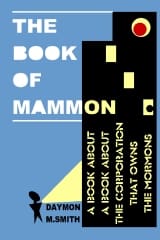
In this incredibly fascinating 4-part series, long-time Mormon Stories supporter Andrew Ainsworth interviews Daymon Smith Ph.D., a Mormon anthropologist and the author of a new book called: The Book of Mammon: A Book About A Book About The Corporation That Owns The Mormons (Paperback). In this interview they discuss:
- Episode 1: Federal Prosecution, Post-Manifesto Polygamy and the Rise of Mormon Fundamentalism
- Episode 2: The Life and Death of the Mormon Speculative Tradition, and the Rise and Costs of Correlation
- Episode 3: The LDS Church as a Corporation and the Corporation as a Church
- Episode 4: Is the LDS Church Serving God, Mammon, or Both?
Daymon’s fascinating dissertation can be purchased here.
Episode Transcript
Host: John Dehlin · Guests: Andrew Ainsworth, Daymon Smith
This transcript is machine-generated and lightly edited for readability. The audio is authoritative. Please excuse occasional errors in names and spelling.
Introduction and Guest Background
Part 1 of 4 · Ep. 149
John Dehlin [00:00:00] Thank you for joining us today at Mormon Stories. A few quick reminders if you're interested in attending either of our August 4th Sunstone workshops, the morning session focusing on navigating an LDS faith crisis in or out of the church, and the afternoon session focusing on navigating a marriage. When one of you loses their testimony, please email us today. Space will be limited. Second, if you are interested in joining the private Mormon Stories Internet web forum where you can meet and discuss Mormonism in privacy with others like you, please send an email via Facebook to let me know of your interest. And finally, if you value what we're doing here at Mormon Stories and want to keep this program Alive past July 2010, please consider signing up today to become a monthly paid subscriber to Mormon Stories. All donations are tax deductible. They will go directly to the time and materials used to produce the show and you can sign up for as little as $5 a month@mormonstories.org thank you for listening and please enjoy the show. Hi, this is John. Before we begin this episode, I just wanted to give you a few program notes. First, I wanted to introduce you to Andrew Ainsworth. Andrew is a close personal friend and a longtime Mormon Stories listener and he'll be conducting the interview today. He's an attorney by trade and he's very well prepared for this interview and I think you'll see that from the get go. I also want to introduce you to Daymon Smith. Daymon has written a fantastic and interesting book. He's an anthropologist by trade and he's worked inside church headquarters. So if you've ever wanted to know a little bit more about post manifesto polygamy, the polygamy that happened after the church said it was going to stop polygamy. If you ever wanted to understand more about the church's changing identity in the 1900s, how we went from a polygamist sort of faction into a mainstream church. If you ever wanted to understand about correlation in the church and how, you know, correlated and systematized our manuals are today, maybe even a bit dull and dry at times, Daymon will be talking about that. And then finally, if you've ever wondered about how the church runs as a corporation, its finances, how it makes tough decisions, and even about the new City Creek Mall that's being built. Daymon's got a lot of insider information about that as well. So this is a fantastic podcast. It's several hours long, but it's well worth a listen, so please check it out. And thanks again for joining us today on Mormon Stories
Daymon Smith [00:02:26] Nearer my God to thee, Nearer to thee Even though it be across the
Andrew Ainsworth [00:02:40] Daymon Smith, welcome to Mormon Stories.
Daymon Smith [00:02:43] Thank you, Andrew. I was going to read your script that you provided for me here, but it's a pleasure to be here.
Andrew Ainsworth [00:02:49] That's an inside joke, folks. The script says, thank you, Andrew. I'm a huge fan of yours. I practically worship you, actually. And it's a great honor just to be talking to you, but we'll skip that.
Daymon Smith [00:02:58] Yeah, I was planning on making the conversation about whether you can serve Andrew and Mammon or Andrew and God. That's how it is for me.
Andrew Ainsworth [00:03:05] Well, you're jumping ahead. You're jumping ahead. Let me start you where John usually likes to start his guest, which is to ask you to give us a summary of your background, you know, your upbringing in the church, pivotal experiences that shaped your understanding of the church and your relationship with it, as well as any background experiences that have shaped your worldview.
Daymon Smith [00:03:28] Yeah, I mean, I was born here in Utah, Utah Valley. I come from a large family. I've 10 brothers and sisters, one of these kind of old school Mormon families in a fairly old school Mormon community in Pleasant Grove where there's a lot of, you know, really large families. So I had a sense of Mormonism as really kind of an all encompassing thing. It really was your community was perfectly aligned with, with your religion. So, you know, that was kind of my early childhood. Then I moved up to Idaho as a teenager and sort of, I imagine had a fairly common experience up there. So the, you know, raised in the church and of course being raised in the church, I never really took any of it very seriously. Went to seminary, slept through most of it, even though it was during school hours, and really didn't give much, much attention to these kinds of matters of religion. It was something which, honestly, I can't recall too many Sunday school lessons that I heard as a child or as a teenager, except there was one about my teacher was saying that in the millennium we'll find out who actually killed jfk. So the. My experience, that's exciting. Yeah. You know, I mean, finally the answer will be resolved. So, you know, I went from that to. Deciding that I was going to go on a mission. And at the time, I didn't really believe in much of anything. It just seemed like a pretty interesting adventure. And most of my friends were going, which I imagine is not so different from a lot of, from a lot of guys who fill out their paperwork. When I was in the mtc, however, I actually opened up the Book of Mormon and took it seriously and decided, I better figure this thing out if I'm going to be out there preaching it and teaching people about it. I better, in some sense, decide whether I really want to be an advocate for this book and for this religion. When I was there, I had one of those sort of standard experiences where in some sense I obtained a testimony that it was true. But this put me in kind of an awkward position. I had to then go and decide if I was going to confess to certain things that I had done prior to my mission. If I wanted to do the mission correctly, then I needed to, in some sense, start with a clean record. And I did this. And these were, I found out later, apparently, minor things, but it was of such seriousness that they sent me home. So this was six weeks into my mission, and I actually really loved the mtc. I thought I had a great time there. I actually enjoyed the food, which gives you some sense of my upbringing. My mom wasn't much of a cook, so, you know, that sort of brings me up to. I started to kind of go off track here a little bit from the standard Mormon experience, I think, and. But I also, I think, kind of grounded my belief very much in my own personal experience, as much as a lot of Mormons do, probably. So I really became kind of a deinstitutionalized Mormon, I think, at that point, and really went off on a very different track than I think a lot of people would take. I was married in the temple a year and a half later to my wife. I have three children. And after that, I decided to take life a little more seriously.
Andrew Ainsworth [00:07:17] Well, let me just jump in because I've got a couple questions. But before you move on too much, you know, you're a guy who's gone on to basically devote your career to the study of the church, and you obviously have a very academic bent. And I'm just wondering, at what point in your life did you. Did that sort of academic approach to religion, to the church, kick in for you?
Daymon Smith [00:07:45] Yeah, it's one of those things that I can't really pinpoint, to be honest. I was, again, not terribly interested in Mormonism as a youth. I didn't read a lot of books on Mormonism or anything else. It really, I think, happened when I was at the University of Utah and I took a class from David Knowlton, who's one of these few Mormon anthropologists. He just began teaching there, I believe, the semester that I took his class, and he taught a class on myth, magic and religion. And then he Taught another class on anthropology of religion. And I was blown away. I couldn't imagine actually studying this kind of stuff and making a living while you're doing it. So that really was kind of the first opening for me, was the idea that you could study something like religion as an anthropologist and not necessarily have to convert or be an advocate for or against the religion. Anthropology provides a nice sort of comfortable framing to neutralize these questions of conversion or disaffiliation, and allows you to really take questions seriously that the religion poses, but not necessarily convert. So I think I was kind of slowly led into the study of Mormonism that way. And from there I did some research with David Knowlton on missionaries and masculinity and their sort of experience of masculinity through this prism of morality, which is kind of the way that we reckon masculinity in kind of the modern world. And really began to develop a love for doing these kinds of ethnographic research and field work and interviews with people who were very different from me, who had different experiences from me, and begin to sort of fall in love with the idea of a puzzle that anthropology presents, which is, how do you understand something like Mormonism as a cultural phenomenon without necessarily beginning to wrestle with the questions of whether its claims are true or false? And so from there, I applied to a number of graduate schools to get a doctoral degree in anthropology and ended up at the University of Pennsylvania, where there was an anthro, he was in the anthropology department, but he wasn't actually an anthropologist named Melvin Hammerberg. And he kind of brought me in. And my original intention was to study Mormonism, contemporary Mormonism, from the perspective of psychological anthropology. I eventually moved away from this psychological approach and began to take up a much more historical approach to the study of anthropology, to the study of Mormonism rather. And there are a number of reasons why I leaned much more heavily towards historical versus psychological approaches. And the main one was that I realized that in order to understand something like modern Mormonism, you had to understand correlation. And my original insight was I was asked to teach a lesson in Elders Quorum on correlation. So in some sense, my Elders Quorum president is to blame for the entire trajectory that I've taken since then.
Daymon Smith's Dissertation on Correlation
Andrew Ainsworth [00:11:05] Well, that provides a perfect segue to go right into discussing your dissertation. I understand you did your. Your dissertation on the history of correlation, and it's a very lengthy work. And for those who are interested in reading the entire dissertation, I should just let you know up front, you should check out the. By common consent website where Daymon Smith and Brad Kramer did a really excellent nine part series where they took Daymon's, what, four to five hundred page dissertation and basically boiled it down to the Reader's Digest version. Is that about right?
Daymon Smith [00:11:52] Yeah, yeah, it's about 500 or so pages and I think it's shorter. On the blog, though, certain people were complaining about the nine part series.
Andrew Ainsworth [00:12:02] Well, what I was hoping, if that was the Reader's Digest version, what I was hoping we could do in this podcast is to give our listeners an even more abbreviated Cliff Notes version of your dissertation. And I have to start by thanking you because your dissertation made me fall even deeper in love with Mormon history, because it illuminated this period of church history that often gets overlooked in our official histories. And that's that basically that gap of time between the manifesto in 1890, that purportedly ended practice of plural marriage, up through, say, the beginning of the Great Depression in 1829. It seems that in official church histories, not much is said about this period, except we get the story about Lorenzo Snow emphasizing the importance of tithing and getting the church out of debt. But other than that, in official histories of the church, this, this roughly 40 year period is somewhat of a black hole in church history that we average Mormons don't really seem to know much about. And yet it is such a fascinating, turbulent, transformative period that serves as this sort of missing link between the church of Joseph and Brigham and the modern church of today. Just to frame our discussion of your dissertation a bit more, because there is a lot of content in there and like I said, I want to do like a Cliff Notes version. This was my takeaway and maybe you can kind of. That I was hoping would frame this discussion and you can kind of correct me if I didn't get it right. But I see you really identifying three main sets of chain reactions that become the major driving forces towards correlation. And that first set of chain reactions begins with the federal prosecution of church leaders and members, which then causes Mormons to adopt a widespread practice of saying one thing to the feds, but doing another to continue living their religion while attempting to avoid or thwart prosecution. And that then creates confusion among church leaders and members when the 1890 manifesto comes along about whether that should be taken seriously, whether the church leaders really mean it, which in turn creates a debate about the true succession of the priesthood keys and results in the Mormon fundamentalist movement, which then creates a need to formulate on the part of the modern LDS Church a sort of seamless historical and doctrinal narrative that links the Church of Joseph to the modern LDS church. And why don't we start then? If you could just take us then to the beginning of that first set of chain reactions with the federal prosecution of church leaders and members over polygamy. Take us back to 1890 and just sort of paint the historical scene for us and take us into how that federal prosecution affected the way Mormons used language.
The 1890s Transition and Polygamy in Code
Daymon Smith [00:15:33] Yeah, this was something which was sort of pointed to me by the writing of Carmen Hardy, who's a historian who covers some of the transitional eras in Mormonism with a focus on polygamy and post manifesto polygamy. D. Michael Quinn's work, of course, and Sarah Gordon, who's a law professor at Penn. And I realized that my training in linguistic anthropology was perfectly suited to begin to approach this. What you rightly point out is really a kind of black box in Mormon history, which is this era from the 1880s up until really the 1920s, 1930s. So the 1880s is a. Is a really, really interesting and difficult time. What you have is the federal government inventing a new crime called unlawful cohabitation. And they had to invent this crime because they couldn't really prosecute anybody for polygamy because of certain protections that made it so that a wife couldn't testify against her husband. And of course, the real problem is establishing who was the legal wife and who's the. Who's the second wife. And this could only be established while you were on the stand. And of course, you couldn't allow the testimony which was then pronounced on the stand. So the federal government had a real conundrum, which was, how do we get these guys to stop their practice of plural marriage? Which really was the interest, which was kind of the public face of a much more realpolitik kind of interest, which was, how do we destroy their political and economic power in the West?
Andrew Ainsworth [00:17:22] Mm.
Daymon Smith [00:17:23] So the. Of course, polygamy was the. Was the easiest hammer to use here. And so they. They invented this crime, unlawful cohabitation. And over about a year, from 1884 to about 1886, the evidentiary standards really got pretty loose to the point where you were committing unlawful cohabitation. If somebody believed that somebody else believed you were possibly living in the marriage relation with somebody who was possibly your wife.
Andrew Ainsworth [00:17:56] Sounds like a perfect recipe for a witch hunt.
Daymon Smith [00:17:59] That's exactly what happened. And so you. As soon as you put that kind of authority to enunciate, you know, the criminal behavior can just be basically pronounced from the witness stand. It creates the kind of paranoia that. Exactly. You saw with, with the witch hunts. So my interest in this era was how did language play a role in the sort of creation of this paranoia? And then how did the response by the Mormons who were sort of in the crosshairs of this, of the, of the Fed, of the feds, the marshals and what came to be called the spies, what was the response and how did this affect Mormonism? And so what I do in the dissertation is I go through the development of newspaper reports of spies and there's an increasing generalization and sort of ambiguity with respect to.
Andrew Ainsworth [00:18:56] I'm sorry, just to jump in, when you say spies, we're talking about federal agents who are disguised as Mormons just sort of trying to blend into the Mormon community. Or are these members of the church who are being paid by federal authorities to spy or is it both?
Daymon Smith [00:19:14] Well, that's the question that they were asking at the time is who exactly is a spy? And of course a spy is somebody who hides their identity. Right. So you can imagine that the paranoia ramped up pretty quickly because if somebody's walking by your down the street and you don't know this person, maybe that's a spy. Yeah, right. So what you actually have here is a series of really kind of tragic and comedic misunderstandings where polygamists who are on the run from what they perceive to be federal agents, these spies who are sort of in the pay of the marshals, or maybe not even in the pay of the marshals, they're on the run from these guys and they enter into a town that they're not recognized in and they create a kind of chain reaction of people fleeing because they're perceived as a spy.
Andrew Ainsworth [00:20:05] So yeah, you leave your home, you go to the adjoining town, you show up in this new town, people don't know who you are, you must be a spy. And so that causes a group of guys to flee that town and go to the next town where the same thing happens repeatedly. Is that the idea?
Daymon Smith [00:20:21] That's right. And this was really exacerbated by what was then regarded as the only Mormon creed that we've ever had, which was mind your own business.
Andrew Ainsworth [00:20:31] Was that an official creed or that's a term that you sort of used to describe it.
Daymon Smith [00:20:37] It was called the Mormon creed and it was on the sort of banner head of John Taylor's newspaper. It was something.
Andrew Ainsworth [00:20:47] And it said, find your own business.
Daymon Smith [00:20:49] That's right. That was the just a four word creed. Yeah, yeah, simple enough. And it, it had certain virtues. But it also really created all kinds of problems in this kind of environment, because the polygamists would be following the creed and minding their own business, because they were told in the newspapers that this was the only proper response to the. To the persecution that they were experiencing was to basically mind your business, because the only way you could determine who was a spy was people who asked impertinent questions or people who maybe were looking at you. And of course, the problem is that a spy is looking at you, though you don't know that they're looking at you. So there was a problem of surveillance, which could never be verified in any of these guesses that somebody was a spy. And so, as a result, it was really easy to guess somebody was a spy. And just to be helpful, you might send a letter to the editor of the Territorial Enquirer and say, hey, there's a spy who I saw yesterday walking down the street. And, of course, this would create all kinds of paranoia among the readers, because usually the descriptions were so vague as to more or less include anybody. And then these reports would get picked up through a kind of syndication, and you might find a couple days later report in the Ogden newspaper or in the Salt Lake papers about spies in their midst as well. And so the creed to mind your own business really made it impossible to determine who was a spy and who was a polygamist, who was. Who was then what began to be called on the underground. And so the underground became a kind of discursive space which was created through your ability to, in some sense, hide your identity through language. And they had a lot of prescriptions that they would give to kids, that they would give to polygamists, that they would give to the wives of polygamists in order to protect men who are on the run or who are on the underground. And these prescriptions are pretty clear that you're not obliged to answer any questions people put to you. But more importantly, if you can misdirect them, if you can point their attentions in another to another area, all the better. These are sort of soft ways of saying you're not obliged to tell the truth to anybody who asks you. You a question, and anybody who asks you a question is possibly a suspect person.
Andrew Ainsworth [00:23:14] So just to provide an example, I mean, just a sort of a normal, ordinary conversation you might have with meeting someone the first time back then, the kind of questions you ask people you meet at church for the first time is, oh, are you married? Do you have any children? How old are they? Et CETERA how would that sort of. How had those sort of simple, seemingly innocuous questions gone over back then?
Daymon Smith [00:23:42] Well, the proper response to a question like that is mind your own business. And this was actually. It wasn't regarded as a rude thing. So there's an account of Annie Tanner in her book Mormon Mother, where Wilford Woodruff asks her the question of who is her child's father? Which seems like a. Not such a prying question, but she basically told him to mind his own business. So, you know, even things like who are you married to? Who is your son in law? These were the kinds of questions which were regarded as impertinent and potentially kinds of surveillance which the feds would use to throw somebody in jail. The 1880s is really the place where I decided to locate this massive transition from the Mormonism of Joseph Smith and Brigham Young into its kind of modern formation, in large part because what you had here was the leadership really falling apart. And a real kind of discursive divide is kind of the phrase I'm going to use for it. Where you were expected as a good Mormon, to say one thing to one audience and to say another thing to another audience. And the more kind of in the role of a leader you were either in the local communities or in the church itself, the more you were expected to abide by this kind of a norm. It really was kind of a marker of being an authentic Mormon, was your ability to. To mind your own business and to obligate other people to mind their own business by virtue of your ability to obfuscate.
Andrew Ainsworth [00:25:31] Let's say you also used some examples of this sort of emergence of speaking in code in addition to sort of telling people to mind their own business. Speaking in code develops and you provide this humorous example of a bishop's son going to a neighboring farmer and talking to him about cows. I was hoping you could provide that. It's such a funny example for our readers because I think it really gives you a good humorous understanding of the levels of distrust that had been created because of this federal prosecution.
Daymon Smith [00:26:11] Yeah, it was one of the Batemans, and they were often on bodyguards of. Of John Taylor, who's of course, on the run at the time. He dies in 1887 while on the run, and they call him a martyr. So these are the Bateman boys. And, you know, they were a pretty burly group. And they were also kind of the most paranoid because their job was to protect the president. Now, whether they needed to protect the president is another matter. There was all kinds of Bribes that went around that sort of secured their protection, but that's kind of a different story. So in this example, you have Bateman goes down to the farm, and he's sort of having a conversation with one of these farmers, and he's asked by the farmer to basically go ask another guy if they have any new cows, I believe was the phrase. I'm trying to remember the exact. The exact phrasing. But he's asking a question about cows or new calves.
Andrew Ainsworth [00:27:15] I seem to remember it being something like, if you have any extra cows, leave the fattest ones outside the barn and the bishop will come get them later. Or something like that.
Daymon Smith [00:27:24] Yeah, it was just such a random sort of question. And he goes away. And initially he doesn't make anything out of it. But the more he thinks on it, the more the. The paranoia begins to sort of interpret the experience for him. And he decides that he is the fatted calf and that the marshals. That this is a speaking in code, that the marshals are actually after him. So he flees. So what happened here is the paranoia made you and every individual person who's sort of viewed themselves as a target, the subject of all these secret codes. And they actually did develop a formal code as well, but it wasn't used. It wasn't used that much, mainly because you had to teach people to code and much easier to just sort of assume everything is a code. And so, you know, this is. What is the foundation then, for the issuance of the manifesto of Wilford Woodruff's manifesto in 1890, is you have a community of people who, if they've been trained in this underground culture, they in some sense expect a statement which is uttered in public to whom it may concern is literally who it. Who it is addressed to. They expect something like this to be a smokescreen to say one thing which is not necessarily the sincere God's truth of the matter. And then you have another group, and this is kind of where the eventual schism occurs. This sort of very soft cleavage line that fractures Mormon culture. You've got a group who is really being raised at the time in monogamous households, and they are in some sense really pretty isolated or separated from what is going on in the underground among the polygamists and their development of this kind of ability to say one thing and to mean another. And they're called in the newspapers Young Utah. And so Young Utah becomes something that the newspapers fix upon as kind of the. The new hope for Mormonism that maybe they won't all be polygamous socialist, communists, patriarchs. But maybe there really is kind of a new crop that is going to come forth.
Andrew Ainsworth [00:29:46] Can you give us an idea of the breakdown of all Mormons back then? Roughly what percentage would have been polygamist? Part of this underground movement, part of basically this atmosphere of distrust and paranoia and this sort of culture of saying one thing and doing another to kind of throw off the feds.
Daymon Smith [00:30:11] Yeah, it's tough to put any real solid numbers on it, but the lowest estimates of the number of men who are involved in Polygamy is like 3%, which is, I think, very conservative, you know, but even if you, if, even if you just take that, that very low number, if you take the average number of wives that these men had, let's say three, and then the number of children that each of these wives had, let's say four, you can begin to see the number of people who are just involved, who are very much legally connected and have an interest in the, in the well being of this, of this polygamous who's on the run starts to really move up pretty quickly.
Andrew Ainsworth [00:30:53] Is it safe to say as well that. Oh, I'm sorry, I don't want to cut you off there.
Daymon Smith [00:30:57] Oh, I was just going to say that the network of the underground included monogamous because they were viewed as kind of safe houses. And so the number of people who are actually involved in it goes up pretty high. But there's a kind of weird division that occurs. Whereas the people who can actually sort of create and interpret underground discourse is a much smaller segment than the number of people who are kind of involved in and sort of follow the basic creed of mind your own business. So you might end up at somebody's house who isn't a polygamist and has nothing to do with polygamy. But they will know not to ask you any questions. So their assumption is, you know, let's just keep our mouth shut. And that's a way to protect people. This is kind of the way that the monogamists would have operated. The polygamists, on the other hand, would have had a much more complicated. And they do have a much more complicated understanding. You see it in their, in their letters. So there's a great deal of discussion in the dissertation about the letters of Joseph F. Smith to his wives and to his friends. And there really was a lot of conflict among the wives because they were hearing different stories about where he was going to be living and where he was living at the time. So they didn't even actually have his Address. They didn't know if he was in Utah, in Hawaii, in New Zealand, in England, in Washington. They heard different stories. And if there was a confirmation that let's say he was in New Zealand and one of his wives thought he was in New Zealand and she turned out to be right, the other wives, of course, would be pretty hurt by this revelation because they would think that perhaps Joseph F. Trusted that wife with that information more than he trusted the other wives. And so the households themselves really started to break down and you see this kind of thing going on. And the monogamous households are brought in, but not at the level of an understanding of the kind of value of deception. And even the polygamists themselves really kind of resented the fact that they had to lie all the time and they had to hide all the time. You know, they view this as kind of engaging really in borderline sinful activity. And, you know, their standards were really pretty high.
Andrew Ainsworth [00:33:17] Well, how did people deal with that? I mean, because nowadays, I mean, there's pretty much a pretty clear cut ethic about, you know, say what you mean and mean what you say. How did church leaders and other members of the underground, I mean, did you ever uncover any letters or sermons or, or anything like that where they sort of explain that there's some sort of divine authorization to deceive in this context?
Daymon Smith [00:33:49] Yeah. I mean, one of the examples is Nephi in the Book of Mormon who not only kills his religious authority, assassinates him, but then dresses up like him in order to deceive people. So that was one of the examples that they would, that they would trot out as justification. But the basic idea was that when you're being persecuted by the forces of darkness, that really you have to do what you have to do in order to protect the flock.
Andrew Ainsworth [00:34:21] Yeah. So there's no sin in deceiving the devil or the forces of the devil.
Daymon Smith [00:34:26] That's right. Though they knew that this is a very dangerous kind of dance to engage in. And, you know, Jose F. Smith, you know, wrote letters to Charles Penrose and to Charles Nibley sort of lamenting this fact that they had to lie all the time and that in some sense they were raising, as they said, a generation of deceivers, children who were being taught to say one thing about who their dad was, to say they didn't know who their dad was, for example, or they didn't know who their mom was, or they didn't know who their brothers were, they didn't know where they lived, that they had to teach their children These things really was a very, very difficult thing and played a much more significant role in accepting the manifesto than I think we're apt to realize.
Andrew Ainsworth [00:35:10] Yeah, I think when I was reading about this, I thought it started to make so much more sense. To me, the manifesto started to make so much more sense when you sort of kind of between the lines here, President Woodruff saying, you know, we're just really in a completely unworkable situation. And, you know, I'd always known about the federal prosecution and, you know, people having to be on the run, but I honestly had no idea the extent to which it affected Mormon culture. And even just communications between family members, between neighbors. I mean, it really was a complete breakdown of communication. You just never knew if someone was telling the truth, if someone really wanted the cows or if they were telling you to run away from the marshals.
Internal Purges and Loyalty Tests Before the Manifesto
Daymon Smith [00:36:01] Yeah, it was something which went all the way up into the first presidency, where George Q. Cannon is being accused of keeping Joseph F. Smith away and sort of scaring him with all these stories of spies haunting his residence. And you've got Joseph F. Being accused of certain things by other people in the quorum of the 12. And the quorum of the 12 really began to suspect one another of maybe not necessarily being a spy, but of having a loose tongue, of maybe writing something in a letter that maybe tipped the feds, who maybe intercepted the mail. And so you get a lot of real sense of the thing that really broke the movement was not the financial aspect, not the difficulties that they endured. Mormons were pretty hardy folk and had endured worse persecution than this. But what broke it was a kind of soft exercise of power, which the Mormons were very much complicit in. And that was the development of distrust as the kind of overriding assumption in Mormons that you couldn't trust anybody. Even if you trusted them to not, you know, go to the Feds, you couldn't trust the person that they might talk to. And so distrust really was the thing that broke it all apart, you know, alongside this kind of paranoia where, you know, every individual was a target at all times. It's this distrust, which really is the kind of stark feature when you read their journals and when you read their letters, they didn't know who. Who was on whose side. And in that kind of situation, again, they began to really look out for themselves first and foremost.
Andrew Ainsworth [00:37:55] So before we get to the manifesto, can you say a word about loyalty tests? Because that certainly these loyalty tests really explain a lot of the confusion when the brethren later try to enforce the ban on plural marriage. So what were the loyalty tests that the members were subjected to before the manifesto came out in 1890?
Daymon Smith [00:38:19] Well, in order to vote, they had to say that they didn't believe in polygamy or that they weren't polygamous. And this created certain problems in Idaho, where they actually excommunicated whole congregations so that they could vote, and then they could say that they weren't members of the Mormon church. And this really was a pretty drastic strategy for these guys to take. And the idea was that then they would, of course, bring them all back. But as soon as you begin to sort of play with people's membership and their covenants as a way to vote, it's hard to say kind of where you're going to draw the line. And so the. The question for a lot of these guys is, you know, where do we draw the line? What do we need to give up, and what are we willing to not give up? And, you know, they. They regularly sent letters. The monogamous in particular, sent letters to John Taylor asking him to basically allow them to. To write a state constitution which banned polygamy. All the while, you would go and teach people on the side that we don't practice polygamy, we practice plural marriage, or we pract celestial marriage. So it's a completely different thing. You know, we'll just ban gentile polygamy. And there's one of these kind of tests that you're asking about. Wilford Woodruff presented an unsigned document which basically said that the Latter Day Saints are not going to practice plural marriage anymore. They're not going to teach it, they're not going to advocate it. It's no longer going to be a part of their religion.
Andrew Ainsworth [00:40:01] And this is before the manifesto.
Daymon Smith [00:40:02] That's right. This is in 1888 and then in 1889. And it was put to the youngest members of the quorum first put into a position of really difficult spot. And one by one, they all say that they can't sign something like that, that they can't give up that kind of thing, even if it's just a matter of a kind of smokescreen that they can't do it. And Woodruff says, well, great. This was just a test to see if you really are loyal. Whether it really was or not is a different matter, because, of course, you know, 18 months later, virtually the same document is signed by Woodruff, not really written by him, but signed by him. And a lot of these guys in the Quorum actually don't hear about it until they read it in the newspapers. So it's actually published in the newspapers before it is presented to the congregation at the general conference in fall of 1890. And of course, once it's in print, there's not much these apostles can do about it. So the question of loyalty then becomes. It really moves much more into a kind of public sphere performance of loyalty. And really, the first kind of example of this is in that 1890 General Conference where they're presented with two documents. First one is the articles of Faith, where they're asked to basically sustain this as a guiding creed of the church, with particular emphasis on the twelfth article of faith, which says, basically, we agree to follow the laws of the land. And, of course, this was just laying the groundwork for then the presentation of the manifesto. You vote for the articles of faith, how do you then decline the manifesto? So the. The manifesto passed. Of course, it's not to say it was unanimous. Apparently, there were a lot of people who didn't raise their hand one way or the other. They followed the basic underground creed of not saying anything, minding your own business. And of course, the manifesto is issued into this environment where people have very complicated ways of reading a text from somebody like Wilford Woodruff. So this really does create a lot of problems. And no matter how many times Woodruff says we don't believe in polygamy and we don't practice it anymore, it's really easy to find evidence of apostles and other church leaders who. Who read that kind of a. Of a statement or declaration as actually meaning the opposite as meaning we really do practice it, and the faithful will read between the lines and understand this strategy that we have to do.
Andrew Ainsworth [00:42:58] Yeah. So, I mean, if you're an average church member or I guess, average general authority there at that general conference, it seems like in this. In this sort of context of distrust, of paranoia, this history of, you know, saying one thing but doing another in order to throw off the feds while living our religion, it seems like it would be very understandable for there to be confusion amongst the church leadership and members about whether when they voted on this, is this just sort of a. A sham, you know, a further effort to pull the wool over the fed's eyes? Or is Wilford Woodruff speaking as a prophet and telling us that God's will literally is for us to discontinue this practice?
Daymon Smith [00:43:50] Yeah. And they would point to Abraham as an example where the Lord told him to lie, you know, tell a kind of soft lie about Sarah, who was Apparently a half sister, but he told Pharaoh that. That she wasn't his sister, or I mean, wasn't his wife, but was his sister. So the thing that really got me interested in that era is there was so much dispute over the manifesto, what it really meant. And I read a lot of fundamentalist books about the Manifesto. I read a lot of responses to the fundamentalist books by Latter Day Saints about the Manifesto, and it became clear that the answer was not, does the Manifesto mean one thing? But the problem was, how do I account for the many interpretations of the Manifesto as a kind of historical development? So this is where I position the underground as, in some sense explaining the fact that there are many manifestos. The 1890 manifesto, yeah, there's a single copy, a single document you can go and look at. But with every copy, there was in some sense another interpretation of what it really meant. And Mormons were very careful about it. They in public would always say that they absolutely didn't doubt the manifesto, but the national newspapers, the national press really doubted it. They viewed Mormons as being inherently deceptive. That was just one segment of what made them un American and even anti American. So the newspapers were very skeptical about it and continued to be skeptical throughout the 1890s, even with statehood in 1896, which was viewed as, in some sense, the completion of this bargain that they had made where if they give up polygamy, we'll give you statehood. The idea among the apostles, at least those who had strategies about statehood, was that once they had statehood, then they could write their own constitution, they could practice polygamy, and they'd have power over the courts to prosecute or not prosecute polygamists. Of course, the feds saw right through that kind of a strategy and required a clause in there that forever forbid polygamy. This didn't, of course, stop many people, including possibly Wilford Woodruff, from taking a wife as late as 1896, 1897, even 1898. Wilford Woodruff's son, Abraham Woodruff. And of course, the number of church leaders who were involved in post manifesto polygamy, as the work of D. Michael Quinn and other historians makes clear, is really pretty hard to say that. That they were rogue apostles or that they were somehow misunderstood. What Woodruff really meant. I mean, I have a hard time believing Woodruff somehow didn't understand what he himself meant by it. So of course, Woodruff didn't actually write the thing, which in some sense complicates the idea that Woodruff was telling a lie or that the Lord was telling him to tell a lie. He was very careful about his explanation of where it came from. He said that the Lord told him to issue it. Now, that's a different thing from saying that the Lord wrote it, or that would have dictated at the voice of
The Manifesto and the Smoot Hearings
Andrew Ainsworth [00:47:24] the Lord this thing, or even that the Lord actually wants us to go through with this.
Daymon Smith [00:47:31] Exactly right.
Andrew Ainsworth [00:47:32] If he says, the Lord wants me to issue this statement, you can see people who are still wedded to plural marriage saying, well, yeah, the Lord was just asking you to issue the statement to further pull the wool over the Fed's eyes. The Lord didn't actually expect you to go through with it.
Daymon Smith [00:47:49] That's right. And so what happens here is the interpretation of the manifesto itself becomes a kind of loyalty test. Are you really on the Lord's side? You can answer that question by saying, yes, because I'm taking another wife as late as 1905, 1906, 1907. Or you could say, yes, I'm on the Lord's side because I am a monogamous and have been since 1890. And these are both equally valid ways of being a Mormon up until 1910. So, again, like the. The complication here is that it's not as if you have true Mormons and Mormons who were just confused or fringe Mormons or perverted Mormons. Both of these are legitimate ways of being a Mormon at the time. And again, there's really no way you can break out one group from another group because you can stand up and have Joseph F. Smith say 1904. No, we're serious. We really don't practice polygamy. And on the side, you've got apostles who are going around performing plural marriages and saying that this is what the faithful will really interpret it as. And so, again, go ahead.
Andrew Ainsworth [00:49:02] Well, I was going to say this was one thing that just kind of differs from my upbringing and what I learned about polygamy in the manifesto, which was little growing up. And I think maybe the sense, I'm guessing, amongst most members of the church whose knowledge of this period is going to be pretty limited to having read only those materials that have made it through correlation. The idea is that Wilford Woodruff got up, issued a man, read a statement, it was voted on, it was accepted, and that was the end of polygamy. And obviously, you and other historians have pointed out that that's just simply not the case, that it continued for a few more decades. But we know that at some point, and we know this because today the LDS Church is not polygamous anymore, as
Daymon Smith [00:50:01] far as we know. Right.
Andrew Ainsworth [00:50:03] So that at some point, obviously monogamy carries the day. And why don't you take us to that point of that sort of growing pain where you have the leaders pulling in two different directions. And I think this is probably where it's appropriate to bring John W. Taylor, John Taylor's son, onto the scene.
Daymon Smith [00:50:26] Okay. So in, in the early 1900s, Utah got its first senator in Reed Smoot, who was an apostle. And he's a very kind of complicated figure. He was a monogamist. Apparently, though, they tried to paint him as a secret monogam or a secret polygamous rather, who was just going to do the will of Joseph F. Smith. And so there was the Smoot hearings occupied several years in which the Senate brought in various experts, they brought in apostles to testify before them. And Joseph F. Smith was one of these guys who was brought in to testify. And his testimony really was a debacle. I mean, he said that basically he violated his own church's rules, that he didn't receive revelation. He received inspiration just like any Methodist might, that he couldn't remember the names of his wives. He didn't know how many kids he had, that he didn't know which companies he was on the board of directors for.
Andrew Ainsworth [00:51:29] And was he doing that, though, because he literally didn't remember or because again, he's been in an environment where it's not wise to say how many wives you have and what their names are because of prosecution?
Daymon Smith [00:51:41] Yeah, well, the way that you answer that really determines kind of the trajectory that you're going to follow after this. So if you're, if you fall on the side that he must have been tired because it was a long train ride and really couldn't remember these things. And he really is kind of sincerely. Given his account of the truth, then you probably weren't really interested in practicing polygamy. If on the other hand, you view this as kind of old timey underground Mormonism where they stand up and say one thing and mean another because they're not accountable to the, to the laws of this land, they're accountable to a higher law, then it made perfect sense that he was saying these things. Though, again, everybody seemed troubled by his testimony and it was, it was big news across the land. I mean, they really painted him as a fool. And it really did, I think, cause some real problems in the quorum of the 12, diminished his power quite a bit. So it created all kinds of confusions in the quorum of the 12 where you have somebody like Francis Lyman who is more or less starting a witch hunt to really route out these polygamists, root them out. Meanwhile, you've got somebody like John W. Taylor who says, no, we have to continue practicing plural marriage and also taking new plural wives. And so he and Matthias, Callie, and some other apostles got dragged or got subpoenaed to testify before the Senate. They didn't show.
Andrew Ainsworth [00:53:15] Can you give us the date range again, now that we're Just to make sure?
Daymon Smith [00:53:18] Yeah, we're talking 1903 to 1907. Okay, so 1904, Joseph F. Smith issues the second manifesto, as it's called. And this is in large part in response to the fact that Taylor and Cowley just refused to show up.
Andrew Ainsworth [00:53:34] And just for our listeners, can you summarize the second manifesto? I mean, does it say we really. We really meant the 19 or the 1890 manifesto?
Daymon Smith [00:53:41] Yeah, we really meant the 1890 manifesto, and Lorenzo Snow really meant the 1900 manifesto. And we really meant, you know, every. Everything that we've said about it. That's really. It kind of recounted the history of our declarations in public about polygamy and reaffirmed it. And so, you know, you had sort of marching orders from Lyman to go to every stake in the church and read it and get people to basically sign on to it, raise their hand, and agree to it. But, of course, while they were there, they would go and perform plural marriages on the side. So, you know, it's. It's one of those things where eventually Taylor and Callie becomes targets, in large part because Smoot makes a deal to sacrifice them. And if they can sacrifice those two guys, then it'll show that the Mormons are sincere, at least show enough to satisfy the constituents of the various senators who were on the investigation committee.
Andrew Ainsworth [00:54:44] And by now, Smoot has been seated. He's a senator.
Daymon Smith [00:54:48] Not yet. Well, it's kind of complicated, this sort of the trajectory that they take in terms of seating him and then opposing his seat. So I believe he's seated, but then they actually oppose it. That's kind of the process. But he doesn't really sort of become a full voting member of the Senate until 1907, 1908. And again, this is after they've made the sacrifice of Taylor and Callie, which, if you read letters and diaries at the time, most people understood that it was just a sacrifice, that these guys weren't being removed from the quorum of the 12 because they'd done anything necessarily wrong. They were being removed strictly as a measure. So that Smoot could get into the Senate. And this actually created a lot of resentment against Smoot in the quorum as well as among Mormons as well, because Smut wasn't a very popular guy, even among Mormons, whereas John W. Taylor was wildly popular. He was viewed as the prophet of the quorum, one of these guys who still manifested these charismatic gifts to give revelations to heal people. And again, he really was the inheritor of kind of the mantle of his father and really kind of brought a promise of a revival of this old school Mormonism. And Taylor really is running. You can sort of see the trajectory of Taylor and Lyman. Lyman, who performed a plural marriage, who sealed one of John W's wives to him after the manifesto. Lyman, whose father was an apostle, who was excommunicated. Lyman really begins to sort of head up this purge of the polygamist. And so what he does, he sets up these courts and brings in various patriarchs and sort of relatives of leading figures of the church and asks them who performed their plural marriage. And of course, these guys would say, well, they took an oath that they would never reveal that. And the more the apostles would press these guys, one of them, Judson Tolman, for example, an old patriarch, the more they sort of press Tolman to reveal the name, the more he viewed it as a loyalty test whether he was really going to keep to his covenants and his oath that he had taken never to reveal the identity of the person who performed the ceremony.
Andrew Ainsworth [00:57:22] Plus, so you got someone sitting on the other side of a table from an apostle or a group of apostles. The apostle asking the questions is, tell me, give me names. Who authorized this? Again, because of this history, he doesn't view this as an apostle sincerely asking questions, sincerely wanting him to give answers. This rather is kind of a continuation of the loyalty tests that have been going on for years.
Daymon Smith [00:57:51] That's right. And if he passes the loyalty test, maybe he'll be, you know, given greater opportunities and greater blessings, you know, maybe moved into a higher priesthood or something. Plus, sometimes these guys were actually in the room who had performed the. Who had performed the ceremony. So you've got, you know, for example, Anthony Ivins, who performed. He was himself a monogamist, but he had performed all kinds of plural marriages in the Mexican colonies. And, you know, sometimes they would be asking one of the guys who, you know, one of these new polygamists who they brought in, who had performed it. And sometimes the guy who had performed it was literally in the room asking the question.
Andrew Ainsworth [00:58:34] So, I mean, it seems like this helps us understand why it was so difficult to get polygamy to stop on a dime in 1890. Because even, you know, over a decade, well over a decade later, when you have these courts really trying to purge it, you still have people thinking that they're being loyalty tested and that the way to be a good Mormon and to show that you are a faithful, true Mormon is not to answer the apostle's question and give him the answer, but to refuse respectfully, to answer the question.
Daymon Smith [00:59:08] That's right. To say that you're willing to suffer any kind of punishment in order to. To keep your oath that you had taken, which again, they sort of took with the seriousness of the temple covenants that people take on. So this really does get resolved. However, by 1910, 1911, by 1912, Taylor and Callie are punished. Callie is disfellowshipped, and Taylor is actually excommunicated. And with every excommunication, they were very PR adept and made sure that they published the accounts of the excommunication with the Salt Lake Tribune. So the kind of public awareness that there really were excommunications going on really put a different kind of trajectory on to this kind of secret polygamy and again drove it underground to where you had, ironically, Mormons doing the same kinds of tactics to. To polygamists, which had been done to them by the federal government. And so you have here an example where one group of people begins to persecute themselves in order to kind of get rid of the overall persecution or sense of persecution that might possibly happen from the federal government.
Andrew Ainsworth [01:00:27] In other words, the apostles and whatnot who are conducting these courts would be, you know, going out amongst members of the church and trying to get informers and to inform on their other church members about who is still practicing or who is still entering into polygamous marriages.
Daymon Smith [01:00:46] That's right. And you had a lot of opposition to this. You know, you had. They had to remove some stake presidents who refused to hold hearings against bishops who were polygamists. You had bishops who refused to bring the name because, you know, the bishop has to bring the name to the stake presidency before the high council. And you had bishops who just flat out refused to bring these guys before the. Before the local high council. And so that's in some ways why they were dragged up to Salt Lake City to sort of testify before the, you know, before the circle of apostles in the temple. So, yeah, they began to use secret informers and spies. And really, by the 1930s, under J. Reuben Clark, they literally began to write new kinds of laws which they hoped would exterminate polygamy forever. And they began to literally use informers as well and spies to kind of break into these secret groups, which again, takes us into this new kind of Mormonism called fundamentalism.
John W. Taylor, Cowley, and the Fundamentalist Split
Andrew Ainsworth [01:01:49] Yeah. So before we get started with that, let's spend just a little bit more time with John W. Taylor and Cowley. Now, Cowley, you mentioned was disfellowship, but am I recalling correctly that he was disfellowshipped, but then he was promptly sent on a mission to India.
Daymon Smith [01:02:08] That was Joe Musser, who eventually is the leader of the fundamentalist movement. Yeah, he's disfellowshipped in 1910 or 1911, and then in 1914, he sent off to India.
Andrew Ainsworth [01:02:20] Okay, well, tell us about John W. Taylor's excommunication, because that seems like it was some high drama in those meetings. Why don't you tell us about that? And revelation of his father that he produced at that court.
Daymon Smith [01:02:36] Yeah, this was really one of the things which made sure that polygamy didn't die. So they bring Taylor in, and Taylor is pretty defiant. He had refused to answer their summons multiple times. At one point, he'd gone in and he had cursed George Smith. He'd cursed George Q. Cannon, or, I mean, not George Q. Cannon, Francis Lyman rather. And he had asked Joseph F. Smith to call on The Council of 50, this secret body who supposedly was running the political and religious affairs in Utah. Joseph F. Basically laughed him off. So Taylor enters this thing, really, as the guy who they've managed to at least create an air of suspicion about that. He's the guy who's running everything. He's the guy who's behind all the secret new plural marriages. He's the guy who's sealing these guys who's sealing these new marriages. He's the guys who's, more importantly, giving the sealing powers to the patriarchs to do these things. So they really focus on Taylor. And a lot of it, I think, is personal animosity, to be honest, from Francis Lyman and some of these other apostles. Plus, they'd already sacrificed these guys publicly with the smoother. So Taylor comes in, he's arguing with the guys, really defiant, and says, basically, we cannot give it up because I have this. And he pulls out of his pocket of revelation, signed by his father from 1886, and eventually has a rather notorious career. But at that point, it's pretty secret. And he says, look, I found this in my father's papers after he died. And this Says it's from the Lord. And it says that you can't ever abandon plural marriage because it is an eternal law. And if God is an eternal God, how can he change his eternal laws? And this really seems like Taylor's gonna come out of this thing not just unscathed, but entirely victorious. So he leaves that day, comes back, and basically, they began to question the legitimacy of the 1886 revelation. They begin to question, do we have that.
Andrew Ainsworth [01:05:03] I mean, do we have that original hard copy that people can examine and sort of test whether that is authentic? Compare it to the handwriting of President Taylor.
Daymon Smith [01:05:16] You can get a copy of it in Fred Collier's work, the unpublished revelations. It's a sort of photocopy. So, you know, purports to be that. Anyway, the actual copy, I haven't seen. I don't know that you can actually see it. If you go down to the. You know, down to Temple Square, I don't think that they'll pull it out for you just to sort of give you a look.
Andrew Ainsworth [01:05:39] Actually, I tried. They turned me down. No, just kidding. But I'm curious, though, because we're going to get into fundamentalism, and this really is the crux of the issue. And I'm curious, has anyone ever done any forensic examination of this 1886 purported revelation from John Taylor saying that we can never end polygamy?
Daymon Smith [01:06:01] Yeah, I don't know of any sort of formal analysis of it. I know D. Michael Quinn said it looks like Taylor's handwriting to him. And from what I've seen of Taylor's handwriting, it looks like Taylor's handwriting to me, too. But I'm no expert.
Andrew Ainsworth [01:06:16] Yeah, well, certainly it would be in line with some of the things John Taylor said. I mean, am I not mistaken in that he was known to give sermons during his lifetime where he said effectively the same thing?
Daymon Smith [01:06:29] Yeah, that's the thing that really kind of puts the question about whether he wrote it or not almost irrelevant, is that he regularly said that we can't do this because it's an eternal law. And the sort of structure of the revelation is a series of questions and answers that Taylor gives, which really was his kind of mode of writing down a revelation was to ask a question and then write down the answer. If you read some of his other revelations, you see the same kind of pattern. So, I mean, it strikes me as completely legitimate. And I have a hard time believing John W. Taylor fabricated it or that he would have been fooled by something. Like somebody wrote a note that looked like John Taylor's handwriting and that John W. Taylor would have been fooled by it. So to me, you know, the question of whether Taylor wrote it, I don't really have any doubts that he did write it. But again, how you begin to build fundamentalism on the back of that 1886 revelation is a different matter. You know, a lot of these apostles don't really doubt the 1886 revelation, at least at the time. What they doubted was whether John W. Taylor should be in opposition to the current stance of the Church. And so here you have really the movement towards a kind of modern Mormonism, which is to say the current principles of the Church can be in direct conflict with the past principles or even the past revelations. And that what matters is that you are abiding by the current norm. And Taylor had a hard time reconciling that with this idea of an eternal law.
Andrew Ainsworth [01:08:09] So this is. You're saying that this is really when the Mormon doctrine that the current living prophet trumps the statements and revelations of all past prophets really gets defined and developed.
Daymon Smith [01:08:25] Well, I mean, I think that they had enunciated that doctrine for a long time, but they also said, you know, if it, if it contradicts something from Joseph Smith or Brigham Young, then it's probably not true. And so they had, you know, a kind of complicated relationship to it. But here it really is kind of put, you know, really kind of where the rubber meets the road becomes, are you going to abide by it or not? Because this is the new rule, you know, and I don't know that they'd really had sort of put people into that kind of position before. Especially, you know, even apostles where they were asked if they would abandon a previous law for a new law. You know, that kind of question hadn't really been forced upon them, upon Mormons, until this time. So it's something which, you know, again begins to separate and create two new kinds of Mormonisms. One is this modern Mormonism, which really is a new kind of Mormonism, and fundamentalism, which is an attempt to go back to the old school Mormonism, and which is in a lot of ways a reaction against this new kind of Mormonism. So neither of them, of course, have any real historical continuity. If you look at certain principles with the mormonism of the 19th century, if you look at very generic principles, yes, of course, they can both claim true descent from the 19th century. And this really becomes where they begin to build new notions of priesthood among the fundamentalists, but also among the modern Latter Day Saints, in response, in some ways to what the fundamentalists were claiming.
Andrew Ainsworth [01:10:08] Yeah. So I mean, basically what we have here is when it comes to the issue of authority and priesthood succession, we've, you know, a lot of times we focus on the debate over where did the priesthood go and the priesthood keys go when Joseph Smith was killed. And you have a number of people coming forward and claiming that the keys were passed to them. What you're saying here is this is a period in history where actually, for a second time now, we have, for lack of a better term, a priesthood succession crisis, where you've got the fundamentalists saying they've got the priesthood via John Taylor's 1886 revelation and John W. Taylor and Musser and Woolley, although you haven't gotten to them yet. And then on the other hand, that the keys are still with Wilford Woodruff and his successors.
Daymon Smith [01:11:05] That's right. I think that's the proper way to look at it is a secession crisis. And what the fundamentalists claimed is that John Taylor's bodyguards were there when he received his 1886 revelation and were given the priesthood keys. Because Taylor also said that the time will come when the majority of the Latter Day Saints abandon the gospel and go into apostasy. And so he had made preparations. And the only surviving two members of the secret circle, which they later call the Circle of Friends, or the Quorum of the Friends, or the Seven Friends, one of them was John Woolley, who was an old guy who sort of worked at the Salt Lake Temple, who was performing plural marriages in the Salt Lake Temple even up until 1914, 1915. All right, so you have Loren Woolley and John Woolley, these two brothers who claim to be the bodyguards with the Batemans as well in this 1886 episode. And John Woolley eventually dies, Loren Woolley sort of holds on into the 1920s and starts to tell the story of this 1886 revelation. And doesn't just tell the story that the Lord gave this revelation to John Taylor, but says that he was there and that he has the keys to continue this and that Joseph F. Smith gave the keys back to the Lord. And so the only remaining keys for the kingdom of God on the earth were with this Loren Woolley character and
Andrew Ainsworth [01:12:41] this idea that Joseph F. Smith gave the keys back willingly or involuntarily, maybe both.
Daymon Smith [01:12:48] It's unclear.
Andrew Ainsworth [01:12:50] In any event, it was, I guess, as a result of the Church abandoning plural marriage.
Daymon Smith [01:12:56] That's right. And so when he announces his 1918 revelation, which of course is the last one in the Latter Day Saints, Doctrine and Covenants. The interpretation that Woolley gives of this is that Joseph had given the keys back to these guys who he describes in the vision.
Andrew Ainsworth [01:13:15] So an alternate explanation maybe for why the Doctrine and Covenants ends there.
Daymon Smith [01:13:19] That's right. And so what you have here again is this kind of revival of an ability to read between the lines, which then becomes a kind of recruitment device for this burgeoning movement to restore real Mormonism among these people who had been kicked out of the church. Among them, Joe Musser. And Joe Musser, of course, wasn't even excommunicated until sometime later in the 1920s. And he has this argument back and forth which are going to end in the dissertation with Joseph Fielding Smith. And what happened is Joe Musser was at his ward in the Sugar House area and was sitting on the stand in a position in a seat of honor and took the sacrament. And this is of course, after he is a kind of notorious polygamist. And Joseph Fielding Smith is there and really begins to ask whether Joe Musser has the right to take the sacrament, given his status in the church. And so here you begin to see the development of two different notions about priesthood. One among the Joseph Fielding Smith kind of segment, which is that the priesthood is connected to your membership in the church. If you're out of the church, you lose the priesthood.
Andrew Ainsworth [01:14:37] So Musser had been excommunicated at this point, yet he's up on the stand.
Daymon Smith [01:14:42] Yes, he's up on the stand, which is how Joseph Fielding Smith saw him, I think. And of course that seemed all the more disreputable to be taken it in such a public setting. You know, it's sort of the idea was that it would cause this kind of suspicion that we really did now again sanction plural marriage. Because here you've got a guy who's kind of a well known polygamist taking a sacrament with an apostle there. So, you know, again. So Musser, however, puts the argument to Joseph Fielding Smith that his dad authorized him to take those plural wives, that Joseph Fielding Smith ought to know his own history, his family history, as well as sort of the history of the church. And that he doesn't seem to know this history. And that simply by being removed from the organization of the church doesn't in any sense have an effect on his priesthood. And this becomes the argument which the fundamentalists start to push, which is that they have an alternate line of priesthood authority which comes from this 1886 event through the Woolies, and then is bestowed upon Joe Musser. Joseph Musser and he becomes the organizing point and starts to write a great deal of pamphlets which he has subscribers to. This is amid the Great Depression. He abandons his failed oil company that he was involved in and a couple other failed endeavors, starts to write. And the first thing he writes is a synthesis of this 1886 event. And this is one of the things which fundamentalists now sort of have internal debates about whether you descend from the Joseph Musser line or whether you descend from the Benjamin Franklin Johnson line, which I don't really go into in the dissertation. But what you find is that the fundamentalists by, by the 1930s began to replicate a much more sort of stripped down structure of authority, which is you have certain men who hold priesthood keys, and these men have absolute authority over their members. If you leave or are kicked out of the LDS Church, you are welcomed with open arms because now you're among the sort of saving remnant of the kingdom of God, in other words.
Andrew Ainsworth [01:17:09] So if you're excommunicated, yeah, you're not a member of the Church anymore, but you've still got your priesthood. And you can still be part of an organization of priesthood holders. And under the direction of priesthood holders, their priesthood just having come through a different line of succession.
Daymon Smith [01:17:30] That's right. The question was whether they had more authority to do things like baptism, for example, or endowments, or whether they only had the ability to perform the sealing for plural marriage. And so these guys got together and they were very sincere, trying to sort of petition heaven, as they called it. This is 1932, 1933, 1934. A group of guys, seven guys or so, who are petitioning heaven really on a weekly basis to receive authority to perform baptisms and to perform the sacrament and to perform all these things which they had sort of been accustomed to having as members of the, of the LDS Church. And in their diaries, they don't ever report receiving these kinds of keys or authorities. They fast. They go on what they call sexual fasts, which is they abstain from having sex, they abstain from food. They really go into every kind of sacrifice that they can think of. They try to make. They're very sincere. This is not just about having lots of women around or having authority over guys, but they were pushed by a lot of the, of their new sort of members of their congregations. To receive tithing was kind of the first thing that the members wanted to do. They wanted to pay their tithing. And so Joe Musser and these guys received their tithing and they'd send a lot of it down to what is now Colorado City, which is where they begin. They tried to sort of start a consecrated community down in the desert.
Andrew Ainsworth [01:19:17] So this is where we have the makings of another church, because at the beginning we had one church, but two lines of authority, supposedly. Right. And so it looks like these folks in this other alternate, what we now call fundamentalist line of authority, they're starting to work out and ask questions about, well, what does our authority allow us to do? Is it limited to performing plural marriages, or can we do everything else that the church we've been excommunicated from does, Baptisms and whatnot.
Daymon Smith [01:19:54] That's right. They begin to try to replicate the exact same ritual structure as well as structure of authority that they had encountered in the previous experience in Mormonism.
Priesthood Authority and Fundamentalist Claims
Andrew Ainsworth [01:20:08] Yeah, and this might be a good point to bring up something you mentioned, which was the fundamentalists aren't really coming that far out of left field with this idea when we are talking about priesthood and its relationship to church membership, because as you pointed out, the priesthood was restored through Joseph Smith in 1829.
Daymon Smith [01:20:36] That's right.
Andrew Ainsworth [01:20:38] And as we all know, the church was not organized until 1830. So, Daymon, explain for us then the fundamentalist argument about how the priesthood being restored in 1829, before the church was even organized, sort of in their mind, establishes the idea that you can have priesthood exist without, you know, separate and independent of a church existing.
Daymon Smith [01:21:08] Yeah. The idea was that the priesthood would always be on the earth, and it was on the earth in some sense to organize a church, but that this made the church dependent upon the priesthood. So this is their argument that they're making in the 1930s is that any kind of church is an outgrowth, an appendage of the priesthood. Whereas the, for example, John Widtso writes priesthood and church government compiles these various statements from church leaders, presidents of the church, and so on, going back to Joseph Smith. And if you actually read it and you look at these, the chronology, there aren't any statements that make it clear that the. The church and the priesthood are perfectly correlated, as it were. What you do find, however, is you find these statements in the 1930s, and they were actually written by John Widtso, which make it clear that your priesthood as an individual depends upon your membership in the church. And so the argument basically splits the two camps, clearly. And what this does, it actually does a real favor for the Latter Day Saints, where if you want to practice polygamy, you don't have to be underground and the church doesn't have to deal with these sort of suspicion of underground Mormons practicing polygamy and then possibly being made to seem like they're responsible for it. So the fundamentals actually do a real favor in terms of clarifying what a Mormon is and what a Mormon is, at least among Latter Day Saints. Now, it doesn't clarify things, of course, among the American population and still hasn't. Most of them still view Mormons as polygamists, and this is in part because polygamists view themselves as Mormons. Latter Day Saints, however, are regularly troubled by this, by this problem, this seeming misperception. So you know what this does? Is it, you know, by 1940, you have just to sort of summarize, you have two notions of priesthood authority, and both of them are restructuring the way that people understand priesthood as authority. And prior to this, you have a notion of priesthood as the ability to perform certain covenants, but it's not really a kind of administrative authority. After the fundamentalists break off and position their notion of priesthood in the Latter Day Saint Church, the idea of priesthood as preeminently about administrative authority really begins to flower.
Andrew Ainsworth [01:23:41] So when we started this discussion, we said, you know, we're going to discuss this sort of first set of chain reactions that leads the church leaders to ultimately decide in the 60s that we need this thing called correlation. And so you've just walked us through this first set of chain reactions, beginning with the federal prosecution of church leaders, which creates this sort of rampant paranoia and deception. It creates confusion when the manifesto comes out, which then creates a priesthood succession crisis. And so, again, just to make sure our listeners are aware, how exactly do you tie this into correlation?
Daymon Smith [01:24:24] Yeah, so what you have here is a kind of, as it were, evolutionary selection, a kind of cultural selection of a group of people who are going to be treating public statements by a person who has a title, president of a church, as definitively sincere, you know, a statement of the way heaven really wants things to be run, not as a smokescreen or a kind of deception. Those people would have been basically siphoned off and picked up by the fundamentalists. And so you have the kind of discursive confusion that led to a great deal of problems up until 1910, dividing out. And you have this new church that I'm calling sort of the modern LDS Church, which is built around the idea of public statements as being authoritative. And increasingly, the more sort of closer they are to real time experience, the more authoritative they are. So what happens in the next journal conference has sort of precedent over what happened in the previous general conferences. So this is the idea, very much the idea of a modern thing, right? It's kind of what's going on right now is what's to be regarded as authoritative and the, the larger audience makes it in some sense more valid. Whereas among the fundamentals you have a sort of a real embrace of this notion of secrecy, that it's the secrecy and it's the secret that is more to be regarded as true. The God in some sense reveals through secrets rather than through satellite distribution outlets. So here you have a division in terms of how truth is going to be distributed and the ways that people can be trained to recognize something as being true. So is it because it's public or because, because it's secret? Is it because it's coming from the president of the church or is it because it's coming from somebody who claims a kind of secret lineage that goes back to the 19th century rather than a kind of public lineage? So this is the, the modern church here is really laying the foundation for making possible something like correlation. But we're still, you know, a little bit aways from actually what brings about correlation. You've mentioned the main part here is of course a concern over priesthood authority. And how do members recognize legitimate priesthood authority versus illegitimate? And the easy answer to this is if this guy operates in public and says something in public and you agree to that, he's your authority. If you don't, then you've got another group of people you can join up with who operate in kind of person to person networks.
John Dehlin [01:27:09] Thank you for joining us today on Mormon Stories. To comment on this episode or to provide feedback, please check us out@mormonstories.org if you want to help keep Mormon stories alive, please consider either making a financial contribution or spreading the word about this episode through your blog, Twitter account, Facebook page, family newsletter, or through your Ward Bulletin and ward newsletter. Just kidding about those last two. Music on this episode was provided by Clayton and Sky Pixton. Check them out@claytonpixton.com or Sam skypixon.com that's sky with an E S K Y pixton.com thank you.
Daymon Smith [01:28:07] Still all my song shall be Nearer I go to the Nearer my go to Nearer to the.
Early Mormon Theology and Doctrinal Inconsistency
Part 2 of 4 · Ep. 150
Andrew Ainsworth [00:00:01] Thank you for joining us today at Mormon Stories. A few quick Reminders if you value what we're doing here at Mormon Stories and want to keep this program Alive past July 2010, please consider signing up today to become a monthly paid subscriber to Mormon Stories. All donations are tax deductible. They will go directly to the time and materials used to produce the show, and you can sign up for as little as $5 a month@mormonstories.org thank you for listening and please enjoy the show.
Daymon Smith [00:00:29] Nearer my God to thee, Nearer to thee Even though it be a cross that
Andrew Ainsworth [00:00:43] so that's probably a good point to then have you lead us down the second set of chain reactions that leads to correlation. And you point out in your dissertation that that really all starts with a tendency among early church leaders, especially Brigham Young, to to engage in doctrinal speculation. And anytime you've got speculation going on, of course you're going to have inconsistent teachings by early church leaders. You're going to have some unique, eccentric teachings that were very unpalatable amongst non Mormons, then became problematic for them as they were trying to get a bid for statehood. And that so having these sort of inconsistent, unique, eccentric, sometimes embarrassing doctrines then leads to this need to create a more uniform, palatable, Protestantized version of LDS doctrines. So why don't you walk us through the beginning there, talking about giving us some examples of the sort of doctrinal speculation, that sort of rich tradition of speculation that was among the early brethren.
Daymon Smith [00:01:58] Yeah, I mean, this is where things start to get probably the nitty gritty or the details anyway, in terms of how I explain the changes probably beyond what we can do here. But really, you know, I can provide examples and sort of give a sort of thumbnail sketch of what happened. You know, 1850s, 1860s, you have people like Orson Pratt who are writing really rich, speculative, kind of. I wouldn't even call it theology. It's almost like a kind of ethnography of the spirit world where they describe the conception of a spirit in the womb of a celestial queen, the sort of development of the spirit what kind of food do they eat in the celestial world? How long does it take them to travel from one kingdom to another kingdom? If their bodies are made of light, you know, what kind of ship did they need to carry all the seeds and animals to this earth if that ship has certain mass and density, because it's a celestial ship. So here's Orson Pratt, sort of a mathematician, self taught by any standard of genius, I think, really taking what he understood about the physical world, trying to understand the spiritual world on the basis of really sophisticated, but, at bottom, simple analogies. You know, we. You know, Mormons went out into the desert, cultivated the desert, and made it blossom as the rose. So that's what the gods do. They cultivate. They colonize some world of darkness and plant new seeds and new crops and make it grow and make it, you know, in the image of the kingdom of God. So Orson Pratt is developing this. And the key notion or the key doctrine here for Orson Pratt is the doctrine of intelligences, which, again, you know, there's a lot of disputes nowadays about what he really meant by this. And my interest wasn't in getting out what Orson Pratt really meant. My interest was in getting at how he seemed to view his dispute with Brigham Young over intelligences. And the dispute seemed to fall on whether there was an S at the end of the word. Brigham Young uses the word intelligence, whereas Orson Pratt is using the word intelligences. And for Orson Pratt, they're kind of little agents in the universe that sort of comprise all things and can move and can be attracted to something else. So if you have something like beauty that you can get more beauty by drawing that sympathy with sort of the beauty of heaven or truth or goodness or whatever. Brigham Young, however, enunciates a different kind of doctrine which is very much grounded in kind of human relationships. And, you know, I don't really want to sort of go into the summaries of these different doctrines because people have their own interpretations of what they really meant and stuff. My interest, however, was in how language shaped their ability to speculate. And so, you know, my argument is that whether you put an S on the end of intelligence, it seems like a pretty minor thing, but it actually launches your speculations in completely different directions. And that these directions, one was taken more or less by Orson Pratt and one by Brigham Young. One views intelligence as something like water, and the other one views intelligence as something like. Like a person, but in a kind of pure spiritual form. So These are the two trajectories that Mormon speculation takes in the 19th century. And depending upon which rail you decide to ride upon, will lead you into different understandings of how priesthood as a power works, how priesthood as a kind of authority should work, whether it ought to be more democratic or whether it ought to be hierarchical. It leads you to an understanding of how something like a healing happens, how the atonement works. All these different doctrines can be understood in different ways depending upon whether you think there are intelligences. In the universe or whether you think there is a kind of intelligent material that you call intelligence.
Andrew Ainsworth [00:06:20] So, I mean, I think it's worth pointing out here at least a couple things. One is that the subjects or the topics of speculation really are heavy into metaphysics. I mean, we're talking about the nature of what makes up the universe, and that's very different from what we talk about or hear about in church on Sunday these days. I think it's also worth pointing out how odd is it? I mean, this is, to my sort of Mormon modern mind, almost sort of inconceivable that you have an apostle engaging the president of the church in debate,
Daymon Smith [00:07:04] theological debate, and being threatened with discipline if he continues, but then he continues to debate in public. Now, you know, sometimes he'd sort of apologize or go back, but, you know, he still sort of abided by his basic principles that he viewed as being true about intelligences. And, yeah, it seems like a pretty minor thing to dispute the president of the church about, but, you know, for these guys, the doctrine of intelligence or intelligences, this is important stuff. It was the foundation of everything, not only metaphysically, but the foundation of things which brought together the spirit and the flesh. Intelligence was both spirit and flesh. Spirit was a manifestation of intelligence. Flesh was a manifestation of intelligence. So it really was this sort of unifying point to talk about the relationship between the spirit and the body, and to talk about the relationship between heaven and earth and to talk about the relationship between humans here. How do we organize here in a way that mirrors the organization of heaven so that then we and heaven can be drawn together through a kind of mutual sympathy?
Andrew Ainsworth [00:08:07] Yeah, I mean, anyone who's taken a basic philosophy class will remember that there's basically four main branches. You've got epistemology, about how we acquire truth. You've got metaphysics, which is about the sort of the physical makeup of the universe. And really, what you believe about epistemology and metaphysics is going to determine the outcome of the second two categories, which are ethics, your for daily living and politics, how to structure human societies. And so although today we might think of this as just sort of kooky stuff that high priests talk about. Metaphysics is important in philosophy and theology.
Daymon Smith [00:09:00] It's important, I think, in politics and economics. It's important in all these things. It seems like it's, you know, what's the point of studying Plato? But, you know, you have a much greater understanding of sort of the modern world if you can understand Plato. So the, you know, for Mormons here The metaphysics provided the explanation for why they were practicing plural marriage. It was a question of organizing the elements here in the way they had been organized in other worlds. Same thing for why they should practice consecration is that they should be bound by covenants of love which would hold them together in ways which reflected the order of things in heaven. And so the. The political, the social, the marital, you know, all these things were. Were tied to this idea of. Of intelligence or intelligences, depending on how you understood it.
Andrew Ainsworth [00:09:51] You.
Daymon Smith [00:09:51] You kind of developed different directions, or maybe it was a reverse. I don't know. So, yeah, but however, by 1900, you. Again, this is after you've got the persecution from the federal government. You have the capitulation in the 1890 manifesto. You have James E. Talmadge, who is commissioned to sort of convert some of his theology lectures into a book in 1899. And, you know, he sort of trots out some of these notions that he had been developing in his own kind of theology and really begins to write a new kind of Mormon theology. And he does it with, you know, a couple simple tricks. The first, I mean, maybe not tricks, as might be kind of a. Kind of a cynical way to put it, but really two simple changes. One of them is to make the idea of intelligence abstract. So it's not something that is real, intangible, and is the foundation of all things, but it's just sort of an abstract notion that maybe we don't really know anything about. The second one was to sort of rewrite, because now you lost the doctrine of intelligences, was to rewrite who the Holy Spirit is, who the Holy Ghost is. And this begins to introduce all kinds of confusions which are still with us today about the Holy Spirit, the Spirit, the Holy Ghost, the influence of these things, the. The manifestations of these things, the gift of the Holy Ghost, on and on and on, all go back in some Sen. Talmage, as well as the idea that there's somebody named Elohim, who's the father, somebody named Jehovah, and that Jehovah is the guy in the Old Testament who eventually becomes Jesus in the New Testament. These are all Talmadge's innovations. And again, Talmage was commissioned to do this thing really as a kind of PR movement to explain what Mormonism was to Christians, and of course, to explain it in ways that Christians would not only understand, but would not really have a lot of problems with. So Adam, God, however you understand, what Brigham Young was trying to say, is gone by that point, the doctrine of intelligence gone the doctrine that man becomes a God again in public theology is gone. So you begin to sort of lose a lot of this stuff. And again, the loss of these metaphysical doctrines coincides with the changes that are going on politically in terms of church and state relationships, and also the kind of changes that are going on in terms of priesthood, your relationship to the priesthood, your understanding of the priesthood and its relationship to the church. So the linguistic matters here are a little bit too complex to get into in terms of how grammatical categories work and how they shape our ability to speculate and to draw analogies, which is in some sense the backbone of metaphysics. But by the 1950s, you have, in some sense, all of these doctrines, which were very tangible, very physical in some sense, like intelligence and spirit, by 1950, become abstract. They become things which are understood as something like mind.
Andrew Ainsworth [00:13:07] Can I just ask you, is the reason for that, that we've got these metaphysical musings by the apostles, but they're not consistent? I mean, just to provide a couple of examples of inconsistencies and speculation, maybe you can just really briefly summarize the debate between Orson Pratt and Brigham Young over the question of whether or not God is still progressing.
Daymon Smith [00:13:34] Right. So Brigham Young insisted that God continue to progress and that all gods continue to progress, and that that is the mark of being a God, is eternal progression. Whereas Orson Pratt held to a doctrine that once you reach a certain level, you are perfect, and once you've hit that level, there's no more progression. So the dispute here really was Orson Pratt was viewed as being heretical because he said God doesn't progress in his knowledge, in any of his qualities that make him divine. He has a. Of the qualities of God. Brigham Young said, no, that's absolutely heretical. And that Joseph Smith said much the same, that to be a God is to progress eternally. Well, of course, that brings up the question that, does that mean that God or the gods or whatever word you want to use, does that mean that they don't know everything? This was something that I think Orson Pratt really didn't want to wrestle with, whereas Brigham Young seemed fairly comfortable with the idea that. That at any point in the history of the universe, that the gods don't really know everything, that they're still learning. You know, they also differed in terms of their origin stories about God, too, that Brigham Young said that God had always been. That there had always been a God so long as there had been a universe. Orson Pratt, however, said that the first God organized himself from the ella, from the elements from the intelligences. And that he sort of, through a process of trial and error, like a scientist like Orson Pratt might do, decided that organizing the intelligences in the shape of the human body somehow allowed him to capture more of the essence of truth and light in the universe. So you have them arguing about whether there is even a God in the beginning of time, the sort of career of the God of the gods as they continue on through the universe. And again, these are things that are sort of brought up by the fundamentalists who want to go back to those 19th century doctrines, and particularly Adam God is one of these things that they're throwing in the face of church leadership.
Andrew Ainsworth [00:15:52] Yeah, I mean, it's a good example of some of the doctrinal inconsistency that results when you have people engaging in this sort of speculation about these metaphysical issues. You just mentioned Adam God. Why don't you just briefly summarize there the debate again, for the purposes of identifying for our listeners another example of the sort of inconsistency that resulted from this really rich speculative tradition amongst the early church leaders.
Adam-God Doctrine and Post-War Church Growth
Daymon Smith [00:16:28] Right. So the, you know, the statements from Brigham Young make it clear that, that he taught that Adam was the father of our spirits, you know, as Michael, that he was a God because only a God could father spirit children in this, in the pre existence, and that in order to provide bodies for these spirit children, that he partook of this fruit after Eve had done so, had changed his body, and that his body began to incorporate blood into it. You know, he also said that the, the story in Genesis was a children's tale, that, you know, the partaking of the fruit was much more sexual and that the story of Eve being taken from his rib was also just a euphemism for something else. So the, the idea of Adam God wasn't actually disputed by Orson Pratt. It however, wasn't really taught by anybody in public after Brigham Young. I think John Taylor probably didn't believe it whole hog. And so you find strange comments from like Abraham Cannon in the 1890s where he's being taught Adam God by, by George Q. Cannon and is surprised by it. So you find Adam God sort of popping up here and there, but really by 1900 it seems to have kind of disappeared. And certainly by the publication of Talmadge's Articles of Faith, which in some sense Talmage goes back to the Lectures on Faith to understand the Metaphysics, which really weren't, which was as much kind of the most Protestant version of Joseph Smith theology as I think you'll find in his lifetime, whether it's even written by him is in dispute. So the, you know, the Adam God here is running headlong into conflict with Talmadge's doctrines about Elohim and Jehovah and Michael. And again, like Adam God became used as a kind of club against Mormons by Christians and then was used by fundamentalists against, against the Latter Day Saints
Andrew Ainsworth [00:18:47] for abandoning Brigham's doctrine.
Daymon Smith [00:18:49] That's right. And for sort of enunciating new kinds of doctrines that weren't tied to 19th century Mormonism.
Andrew Ainsworth [00:18:56] So it seems like, I mean, and so just to summarize, kind of where we are in the discussion, I mean, you've got this rich speculative tradition in the church which leads to inconsistent theories or musings by presidents of the church and apostles debating each other. And this really gets dropped in the. Of Talmadge and the others. Again, what decade are we in? Just so our listeners can.
Daymon Smith [00:19:23] Well, with Talmadge, we're talking 1900, basically. But again, Talmadge is writing this stuff at the same time that BH Roberts is really trying to synthesize Orson Pratt and Brigham Young and John Widtso is still writing manuals to be used in elders quorum, which actually still enunciate Pratt's doctrine of intelligences.
Andrew Ainsworth [00:19:45] So this is what we might call sort of a pre correlation phase, where these inconsistent statements by church leaders get dropped in the laps of these folks and they're trying to make sense of them. What do we do? Do we try to synthesize them, we try to make them harmonized with each other? Or do we just sort of jettison what Brigham Young taught and embrace what Orson Pratt taught? I mean, do you think that's a good way to think of this time as sort of a pre correlation period?
Daymon Smith [00:20:18] I think so. And you know, again, part of it is in response to the fundamentalists in the 1930s, where Widtsoe really becomes the guy who puts together the first compilation of kind of doctrinal, authoritative statements about priesthood. And this is at the same time that they're not allowing publication of B.H. roberts, you know, what eventually is called the Truth, the Way the Life, which really presents kind of these 19th century kind of radical doctrines, and he's sort of wrestling with how to make sense of them. So, you know, at this time, like to be a Mormon is to hear completely different and sometimes contradictory teachings about who God is, where God came from and where he's going, as well as like, who the Holy Spirit is, his role, his, her role. Whether it's even like gender is decidable is up in the air at this time. So, you know, by 1940, the idea that we need to begin to make sense of this is pretty pressing among the Quorum of the apostles. But also, there's a real problem that in some sense, they're not really equipped to understand these sermons from the 19th century, let alone do the same kinds of speculation. And this is an argument that I make about the influence of language and specifically grammatical categories on our ability to speculate. And again, this is something you'll have to read the dissertation to really get the nuts and bolts of. But really, by 1950, we've not only lost, in some sense, the ability to speculate in terms of drawing analogies from our experience here to try to understand what heaven is doing or what the spirit world is like. You don't see that anymore. You don't see it anymore because the grammatical terms, the grammatical categories that the terms we use for our metaphysics have changed. They become abstract. They become, in some sense, mirrors of mind. Just like the word intelligence literally became a quality of the mind rather than something which is organizing the universe. So psychology here actually plays outside psychology that is produced outside the outside. The church plays a pretty serious influence because Widsoe and these guys are reading William James and they're reading some of the new writings in psychology. That makes the mind now, in some sense, a space to be colonized in as much as the desert used to be. And so they begin to sort of wrestle with the sort of the mind as something that they can explore through language, something that they can begin to map out, something that they can diagram, something that they can in some sense, make public, which was, ironically, the opposite of what the underground was about. The underground was about concealing your mind from the surveillance of the federal government. Whereas by 1930, 1940, you have the church leadership and probably church members trying to make the mind the foundation of a sort of public organization. And that's really where correlation begins to take off.
Andrew Ainsworth [00:23:27] Yeah. So why don't you bring us to this post World War II period where you point out that we've got some projections for exponential growth on the horizon, especially overseas, and how that sort of post World War II, that sort of, you know, we feel like we're on the verge of greatness and really just sort of exploding on the world scene. And how that really, you know, creates this sort of pressing need to make sense of all of this conflicting doctrine.
Daymon Smith [00:24:06] Right. So, of course, you know, after World War II, the world is, you know, divided up into two spheres, basically, right? You've got the Soviet Union, you've got the United States, and that the United States is going to colonize everything that the Soviet Union isn't colonizing and fight, you know, over pretty insignificant patches of jungle in some sense, in order to sort of prevent the Soviets from taking over, you know, this sort of domino theory. So the Church at this time is embracing this idea of a kind of global entity in the mirror of sort of global empire that maybe the United States or the Soviet Union was trying to do. Of course, one trying to counter the supposed strategies of the other. So, you know, you've got, at this point in the 1930s, during the Great Depression, the church organized a welfare system under Harold B. Lee in Salt Lake City. Harold B. Lee also presided as a stake president over the excommunications and disciplines of people who had left the church to join fundamentalist churches. And he organizes a sort of very modern line of production where you've got sort of clearly discriminated lines of authority, of administrative authority, lines of staff and assistance, and that this is going to make for efficient production of things like, you know, canned peaches. So Lee has this, you know, these diagrams stashed away in his desk. And, and he also begins to get word. And Lee at this time, you know, we're talking, let's say 1960, is an apostle, a fairly young apostle at the time. He also begins to engage in and hear from people who are engaging in a new kind of speculation, which is not theological speculation or metaphysical speculation, but is instead a kind of numerical or statistical speculation. And so they begin to speculate about the growth of the Church in the future, which is, of course, what we expect of prophets, seers and revelators is this kind of speculation. And the speculation is entirely future oriented and statistical. So rather than enunciate how spirit children are conceived and what kind of carrots they eat, now they're talking about that there will be 12 million members by the year 2000. And so the puzzle here for Li
Andrew Ainsworth [00:26:30] is which ended up being pretty prophetic in hindsight.
Daymon Smith [00:26:33] That's right. And I could go into some of the reasons why, you know, why they sort of made this true. But what happens is Lee decides in order to kind of keep the Church pure, to keep it consistent and whole, he's going to have to ensure that people in Guatemala have very simplified manuals that they can work from so that the church doesn't spin off into a hundred different churches. And part of the drive for this was the experience of many of these young apostles like Boyd K. Packer, Harold B. Lee and a few others. Markey Peterson, who had spent time on the Indian reservations at the Utah border and in Arizona and New Mexico. And their experience here convinced them that these guys, you know, these Native Americans just didn't seem to quite get it. They didn't really seem to understand the doctrine of the priesthood or the atonement or these things that were viewed as being foundational to what every Mormon should know. And this is in the 1950s, and they came back from there convinced, through their experience with the church education system, that they needed to simplify. And so you've got here three different trajectory, three different lines of sort of vectors, as it were. You've got these guys coming in from CES who had experience in non Protestant America. You had speculations about the growth of the Church as it moves into international areas, into Latin America in particular. And then you've got Lee's concerns over how to make everything efficient. And that was really kind of his, his guiding light was how do we make something efficient and specifically, how do we make the exercise of priesthood authority efficient in the church so that we don't get a lot of schisms, so that we don't get a lot of resistance to a new kind of manual or to a new kind of, you know, canning program. So Lee is commissioned by President David O. McKay to head up an editing committee called Correlation, which David O. McKay had been on the previous time it was instituted in 1920.
Andrew Ainsworth [00:29:12] And just to keep us on our timeline. Is this about 1960 when President McKay asked Harold B. Lee to review these curriculum manuals?
Daymon Smith [00:29:23] That's right, 60, 61. And McKay had been on a similar committee in 1920 and had made recommendations that were viewed as far too radical in terms of how to structure the writing of curriculum. And so lee basically, or McKay gives Lee this commission. It's a very small thing, basically go through some of the manuals and kind of reduce redundancy and overlap because at this point, you know, they're producing all kinds of different manuals. Any, any of the auxiliaries. The Relief Society could go and ask anybody to write a manual for them. They could ask Hugh Nibley, they could ask Sterling McMurran, they could ask, you know, John F. Kennedy, they could ask anybody to write these things. Primary as well, young men's, young women's, any Sunday school, any of these could, would have their own curriculum writers. So of course you got a lot of overlap. And Lee's concern was not necessarily that redundancy and overlap is a problem, but that we need to sort of structure the redundancy in a way that is going to ensure the creation of a pure people who are going to be qualified for Zion. And so he really does take what is a very small commission and an editorial committee and revolutionizes the modern church and really does in some sense create a new kind of Mormonism, which was really only sort of bubbling into some kind of organization up until then. You know, the church was still sort of trying to figure out what it was going to be from 1920, 1930, 1940, and then the 1950s. Harold B. Lee says this is what it's going to be. And what it's going to be is in some sense what I'm calling correlationism. It's this sort of concern that we are correlated is in some sense the principal thing that makes you a Mormon.
Andrew Ainsworth [00:31:25] So, Daymon, you mentioned that we've got this thing called a correlation committee. So how does it go about achieving correlation of doctrine?
Daymon Smith [00:31:37] Yeah, this is one of those things that historically, you see a lot of transitions in. So in the 1960s, 60s, the way that they started to do it was really to kind of discern what the foundations of the gospel were. And so this is where they took an empty room and filled it with note cards. They had 72 note cards, and they filled the note cards with phrases or abstract nouns. And these were, for the most part, terms which were kind of broken away from any kind of tent system. So it wasn't like you needed to know about, you know, when this particular event happened. When, for example, Elijah, you know, came to the Kirtland Temple, you were sort of on those note cards. You find things like members need to know things about priesthood authority, or they need to know about repentance, or they need to know about obedience. They need to know about the restoration of the gospel. So they sort of mapped out 72 different terms which they regarded as, like, ideas. 72 ideas.
Andrew Ainsworth [00:32:51] Do you know where does the number 72 come from? I mean, other than, you know, six times 12 equals 72. I mean, is there some ancient mystical Hebrew numerology behind 72? I mean, I'm joking.
Daymon Smith [00:33:04] There is, actually.
Andrew Ainsworth [00:33:06] No, you're kidding.
Daymon Smith [00:33:07] No, no, no, there is.
Andrew Ainsworth [00:33:08] I just stumbled onto one of the mysteries in a Mormon Stories interview. Okay, so what is the magic behind 72?
Daymon Smith [00:33:15] Well, you know, the idea was that they had divided the earth into the fallen angels had divided the Earth into 72 different quadrants, and they were each going to be a God or a steward or a shepherd over each of these 72 segments of the Earth, or 70 depends on sort of which ones you're looking at, you know, and then there's also sort of a notion that God has 72 names. So, you know, I don't think that, like, they were sort of reenacting the sort of mystical Kabbalism, but, you know, it was probably that there were 72 note cards in the pack that they bought. You know, that's sort of my guess of it. You know, I think what they'd gone through and taken, you know, maybe they wrote 100, maybe 150, and they kind of boiled it down to 72 essential ideas.
Andrew Ainsworth [00:34:04] Okay. And so each one has a word on it, like tithing, restoration, repentance.
Daymon Smith [00:34:09] Right.
Andrew Ainsworth [00:34:10] And this seems to be the sort of the defining. Well, first of all, you're defining the gospel. You're defining Mormon doctrine. You're creating, it seems. I don't know if it's for the first time, but you're creating what we now sort of term essential doctrines or core doctrines or principles. Is that what we have going on?
Daymon Smith [00:34:32] That's right. And these are viewed as things that they can teach the converts, the flood of converts that they're going to be having, because they've now sort of stumbled upon a new kind of financial way of leveraging debt into a missionary system. So this is the work of N. Eldon Tanner, or actually Henry D. Moyle, who had sort of decided they were going to fund the missionary work through deficit spending. And of course, the problem is, then you've got all these people who are going to be converting to the gospel on the basis of a financial speculation, a model of financial speculation. How do you keep them all in? And of course, if you can reduce and boil down the gospel to 72 words, you know, that's a good place to start. Now, of course, the dilemma is that you can't really test to see if anybody understands something like repentance just by putting it into a manual. But, you know, the. The concern here was with sort of formal replication. And the principle behind this was that the mind was something which was going to be in some sense forced into public scrutiny through this regulation of doctrines that they were, that ultimately became correlation. So you have lee in the 1960s formulating some basic doctrines that the few manuals he was going to be editing needed to teach three times when you're a child, three times when you're an adolescent, and then three times when you were an adult. And the idea was that if you got it three times in these three different segments, again, sort of trinitarianism run amok, talk about numerology, then you would be, in some sense, have the best shot at being a pure religion, sort of creating the foundation for Zion. And so by, you know, there's, there's some things that he had to do in order to. To make this massive correlation of the administrative functions of the church happen. One of them was he had to eliminate the budgets for the auxiliaries, which, you know, they used to raise their own money in order to hold, or through various fundraisers, through their magazines, through their conferences, through selling books, they used to raise money to fund their organization. And they were, in some sense quite independent from any other administrative branch of the. Of the church. And so you had.
Andrew Ainsworth [00:37:15] Yeah, you mentioned earlier that they were making their own curriculum, right? I mean, the Relief Society made their own curriculum. The Sunday school. Was there a Sunday school board or something? General Sunday school board. They would make their own curriculum. The primary would make their own curriculum. Is that right?
Daymon Smith [00:37:28] That's right. And so the, the, you know, what I was told by, you know, one of the heads of correlation now the head of the correlation department, one of the managers there, is that you had something like five different Mormonism, five different churches, really, because each of these things had their own presidency, general presidency. They had their own lines of authority, they had their own budgets, they had their own conferences. And so the concern was not that, like, in the distant future, all the Brazilians joining the church are going to break off and form some new kind of Brazilian Mormonism, but that they saw it going on in their midst at the, you know, on the grounds of Temple Square. You had many different kinds, at least from Harold B. Lee's perspective, and a few other guys, different kinds of Mormonisms, and this was unacceptable.
Harold B. Lee and the Rise of Correlation
Andrew Ainsworth [00:38:18] Okay, and so let's talk about how this, I mean, you took us through how Harold B. Lee gets an assignment from President McKay that starts as just sort of reviewing some curriculum manuals. This leads to the creation of these 72 notecards, a sort of distilling down of essential or core principles and doctrines. Is this something that everyone was on board with, or was there some resistance to this movement?
Daymon Smith [00:38:50] Well, you know, to say that everybody was on board is to, in some sense, give correlation credit for existing before it actually happened. So there wasn't that kind of correlated movement from the top down that Lee had dreamed of. And the fact that there was resistance actually gave him an argument for the need for Further correlation. So the more that there was resistance and there was resistance, including among the first presidency. David O. McKay had real doubts about this kind of hierarchization of curriculum. He said that it was akin to what happened to the early church when the Roman leadership took over from all the other churches. In other words, this was a stepping stone in the great apostasy.
Andrew Ainsworth [00:39:45] Why? Yeah, why would that be? I mean, it seems so innocuous on the surface. I mean, you have people taking all of these sermons and doctrines that, that the past prophets have given us and sort of trying to simplify it and distill it for making curriculum.
Daymon Smith [00:40:01] Yeah, well, this is where the metaphysics of priesthood as a power came into play for David O. McKay. So in his conversations with Hugh B. Brown in the First Presidency, in his diaries, he records them reciting D&C121, which talks about how you can amen somebody's priesthood. In other words, how you can sort of lose the priesthood as. As a right to administer or as a power to bring heaven and earth together. And that by putting the priesthood at the head, where they had to regulate and edit and censor and make all the cons. In other words, they had to basically act as managers, that this would put the priests in a position where they would begin to be tempted to and then eventually begin to exercise unrighteous dominion.
Andrew Ainsworth [00:40:58] So the concern, it sounds like, is putting too much control, too much power in the hands of too few people, in sort of the same way the Founding Fathers decided, hey, the best way to avoid a tyranny is to chop up power and diffuse it amongst as many players as possible. Similarly, it seems here that there was a concern that the Body of Christ with its many members and its diverse talents, may be getting sort of taken over and trumped by this sort of smaller group of men.
Daymon Smith [00:41:35] That's right. And so you have a number of arguments from guys who are sort of getting behind the word correlation. But it's pretty unclear what exactly LI means by what he's doing with correlation. He presents all kinds of diagrams and things at General conference in the 1960s to report on what his committee is doing. And David O. McKay is kind of encouraging people to give talks on correlation. So you find a lot of metaphors about the Lord marshaling his army for these last days, that the priest that is going to be the head and the church is the body that is going to be run by the priesthood. And it's unclear, however, what he means by the priesthood. Does this mean the power that the 12 year old has when he's ordained into the Aaronic priesthood. Or does this mean a group of guys? And it was unclear. But however, if you read the sort of proceedings, the General conferences from the 1960s, you find a lot of people, including Hugh B. Brown, clearly behind something like correlation. Now, in private, you would find them sort of talking about their concerns about what exactly Lee meant to do with this thing called correlation. That it was undefined. And in that, because it was undefined was the real concern. But it was clear that what they were doing, that what Lee was up to was to put a certain group of people in authority, and that the First Presidency's concern was that the group of people who were going to be in authority was not the first presidency. It was going to be what David O. McKay called Lee's super Correlation Committee.
Andrew Ainsworth [00:43:11] And you point out how the way that Lee sells this Super Correlation Committee is with some very good concepts or very good aims or goals, like, for example, unity. There's nothing to fear here in this power, being amongst a small group of people, because what we're really aiming to achieve here is unity. And unity, of course, is a good thing, another one being efficiency. If we're going to go spread the gospel to the world, we've all got to be on the same page. Also. We've got to avoid these divisions of the past. We can't have divisions in doctrine or curriculum between Relief Society and Primary and whatnot. We've all got to be unified. We've got to be on the same page. How does his message go over?
Daymon Smith [00:44:02] Well, you know, he begins to talk about being of one heart and one mind and of sort of creating Zion here on Earth. And, you know, among the primary General Presidency, they're reluctant to get behind this plan because it basically takes all their jobs away from them and hands it over to a committee and then also to paid employees who are going to be overseen by this priesthood department, the Relief Society. It's unclear what kind of resistance they offered, but locally you had a great deal of resistance among stakes and wards as to what exactly this correlation thing was. And this is when Lee actually gets David O. McKay to sign off on the creation of a new General calling, which is the calling of regional representatives. And there was some dispute over what they were going to be called initially. They were going to be called regional representatives of the quorum of the 12. And Gordon B. Hinckley actually is the one who had them chop off that last little bit until. Because in some sense, I don't know that you Know, I don't know what the politics were behind it, but they eventually settle on regional representatives, which of course, then eventually becomes the. The new quorums of the 70. So this new calling, however, was specifically designed to enforce correlation at the local levels. It was there to. It was there because there was this resistance locally. And so they sent out these guys with handbooks or manuals on correlation. And it's filled with all kinds of quotes about that. This is what the city of Enoch had, was this new correlation plan that Harold B. Lee had restored. And that by following the principles of priesthood correlation, as they began to call it, among them, having priesthood home teaching, having priesthood interviews, having priesthood welfare. In other words, what they did is they put the word priesthood in front of things that they couldn't really get people to do before and said that if we follow these practices, that we will be of one heart and one mind. We have ward teachers who would go, you know, around the neighborhood. And they had a schedule of questions. And the questions are actually things that probably nobody would dare ask nowadays when they do their home teaching. But, you know, you were supposed to sort of make a record of these things and submit this record to your stake. And the stake would then submit the record to the. To the general Home Teaching Committee. And there was all kinds of really elaborate sort of surveillance that everybody was supposed to be conducting on each other. Not in a sort of insidious sense, but nevertheless, keeping track and keeping records of what everybody was doing.
Andrew Ainsworth [00:46:53] Making sure the water gets to the end of the row, as I've heard that analogy used before. Right. When Salt Lake comes up with a new program, making sure that it gets all the way down to the local level and gets implemented.
Daymon Smith [00:47:06] Right, right. And so the, you know, so what began as an editorial committee sort of mushroomed. Because you can't just change some of the manuals without changing the budgets. Well, you can't change the budgets without changing the administrative structure. You begin to change administrative structure now you sort of have a whole new field of possibilities. Until by the 1970s, they've created a new kind of department called Internal Communications. And that this new department, as a result of some outside consultants who came in, who were managerial consultants, this new department took control over the production of all things that were going to come from church headquarters. And so this new committee, which was originally just going to simplify and reduce the curriculum so that you could. So that the postage on a manual would be manageable if you sent it to New Zealand, roughly a decade later, you've got A small group of people who have oversight over all the magazines, all the curriculum, the CES curriculum.
Andrew Ainsworth [00:48:16] How about conference talks? Are they correlating conference talks yet?
Daymon Smith [00:48:19] Not yet, no. You don't begin to see that until correlation in the 1980s starts to take over the role of ensuring that what is being said is true. So initially it was a question, like you said, of efficiency and hitting on these key doctrines so that you have the right kind of redundancy by the 80s. It's a question of how do we make sure everything is true so that people are only hearing true doctrines.
Andrew Ainsworth [00:48:44] Can I jump in and ask you who is on this correlation committee? I mean, is the First Presidency a part of it? Because I seem to recall part of President McKay's concern being that if you create this correlation committee and make them sort of the funnel through which all church doctrine and whatnot must pass, that that sort of super correlation committee starts to trump the authority and the function of the first presidency.
Daymon Smith [00:49:14] Yeah, well, it depends on who you ask. If you ask somebody at the church office building, they will tell you that the president of the church is the head of the correlation committee. But of course, he doesn't do any actual correlating.
Andrew Ainsworth [00:49:27] He,
Daymon Smith [00:49:29] you know, his role is different. So in terms of the people who do the correlating, who do the fact checking, who do the editing, who sort of see if it conforms with. They have a handbook that they hand out which is full of quotes that are viewed as authoritative quotes, and they. And they check it against this handbook. And so, you know, there are people at Brigham Young University who are on it. There are a lot of people in the CES at the institute level who do sort of correlation, but the actual correlation department is really pretty small. You're talking like maybe five people. So there's a manager and there's a sort of sort of supervisor of correlation. And what they do is they farm out jobs to people who are called to be on, on the correlation committee. And so, you know, they are, you know, along the Wasatch front for the most part, you know, lifelong Mormons, more or less.
Andrew Ainsworth [00:50:29] And these five members of the department, I mean, will any general authorities be among them or they are non general authority employees of the church working in the church office building.
Daymon Smith [00:50:41] They are employees of the church. Of course, the correlation department, which has the Research Information division as well as the Intellectual Property Division, the correlation department is headed by three general authorities. But the correlation, sort of the part that actually does the correlation is actually five people might be too generous. You know, you're talking literally two guys are more or less the correlation. The sort of administrators of the correlation process.
Andrew Ainsworth [00:51:19] They're the ones who farm out the jobs to say, BYU professors.
Daymon Smith [00:51:25] That's right. They sort of go over the correlation manual that they use to decide whether some personal story that's going to be published in the Ensign conforms to accepted doctrines and sort of historical fact.
The Impact of Correlation on Church Structure
Andrew Ainsworth [00:51:43] I want to hit on you do a good summary of what the sort of overall results or impact of correlation is on Mormonism. And one of the main points you bring out is that correlation brings a death of the speculative tradition about these sort of metaphysical issues that Brigham Young and Joseph Smith and the other early church leaders like to speculate about. So that dies that tradition. And I think anyone familiar with our modern day church leaders would say correlation did a pretty good job of killing that off because it seems the modern church leaders really avoid that sort of stuff like the plague.
Daymon Smith [00:52:31] That's right. So there's really at least two effects you could kind of trace out of this correlation revolution. You know, the one is again, like you said, the absence of speculation as something that is admitted into the correlation process. So if, you know, you speculate about what kind of education systems celestial beings have on Kolob, you know, that's not going to make it into the new era. So you have here the removal of these things from the public sphere of the official texts that are sent out from the church office building, which has a sort of chilling effect on the ground in terms of the value of speculations in elders quorum or in relief society or in your sacrament meeting talks. In other words, the sort of performance of acceptable Mormonism. Whereas in the 1880s it was about your ability to sort of deceive without really lying and you know, being really tricky about language. By the 1980s, 1990s and so on, you begin to find that to be a Mormon is to in some sense eschew public speculation and to sort of leave those as mysteries and you be. And so this isn't however sort of built in thing with correlation. I don't think they intended, you know, Lee intended to sort of eliminate speculation among the congregations. But it's something that is clearly connected with the scripting of the interactions that goes on in Sunday school, that goes on with home teaching, that goes on with visiting teaching. These are literally what they're providing as scripts for people to circulate over and over and over again. And, and the assumption is that if you encounter the script enough times that you will become one of These people of Zion.
Andrew Ainsworth [00:54:18] Well, help us understand, though, because we are talking about a very different church in terms of what people think is relevant or important to talk about. You have Brigham Young. They are prophets, seers, and revelators, and they believe that part of what's important to understand and know is the sort of metaphysics of the universe, to know the nature of intelligences and how spirit children are conceived and reared and what celestial beings eat and how they travel. How is it that that ceases to become relevant or important? Because I know nowadays if you were to start talking about that sort of stuff in high priests or elders quorum, people would look at you like you're crazy.
Daymon Smith [00:55:13] Yeah. And you know that it might be a hobby horse, but it is ultimately irrelevant. So the sort of trick here was that
Andrew Ainsworth [00:55:21] how did metaphysics become irrelevant, I guess, is what I'm wondering. Is it just because it creates dissension? Because it would seem that if you're trying to create unity in a unified doctrine, and so you go back and you look at all these old sermons on metaphysics, what you're going to find is where there's two gathered in my name to speculate about metaphysics, you will find seven or eight different theories. And so if we're. If you're in the realm of talking about and speculating about metaphysics, that's just not correlatable. That's just not something that's a discussion that's going to engender unity.
Daymon Smith [00:56:06] Right, right. So the very idea here was that anything that is causing disunity from somebody's perspective is to be regarded as something which sort of shouldn't have a public presence. Yeah. So, yeah. I mean, obviously metaphysics here is. Is one of these things. But another issue is that I don't, you know, the sort of. The linguistic machinery that they mobilized in the 19th century to create these really rich speculations, starting from the idea of intelligences, just isn't there. It's gone. And it's literally written out of. Out of this, you know, this room of 72 note cards. It's not there in part because, you know, Mormon doctrine, the book Mormon doctrine, said that these things are mysteries. Joseph Fielding Smith, in his answers to Gospel questions, said that these things are mysteries, and that by asking these kinds of questions, you're wasting your time when you should be doing your home teaching. So in other words, they framed the act of speculation as a sort of discursive act, the act of asking a question as things which would be a sign that you are not on the same page as everybody else. So, you know, the sort of framing of your Mormon ness became again, much closely tied to what kinds of words you're going to use. In anthropology, we call this a development of a register, but it's a kind of vocabulary that in some sense shows what kind of person you are. And if you use a different kind of vocabulary, you talk about Adam, God, that shows what kind of person you are to people who view themselves as being properly correlated. So, you know, the, the reasons why are in other words, administrative, but also connected to language.
Andrew Ainsworth [00:58:05] Yeah, so you can understand how you can kind of understand the reason why they felt like they needed to sort of abandon the speculative tradition from a standpoint of wanting to create unity and efficiency. On the other hand, it seems that something that dies along with the rich speculative tradition is this sort of questing spirit amongst Joseph Smith and Brigham Young and their contemporaries, this sort of curiosity about the universe.
Daymon Smith [00:58:39] And yeah, so the Mormonism becomes much more about providing the proper answer rather than asking the right kinds of questions to sort of give it a, you know, a really summary treatment. It becomes about whether you can say the right kinds of, you know, phrase rather than whether you're going to ask a question that no one as sort of encountered before.
Andrew Ainsworth [00:59:06] So the time for questioning is over. I mean, questioning was that was the province of Abraham, that was the province of Moses and Joseph Smith and Brigham Young. But we've got the answers now. I mean, you've got the Doctrine and Covenants ending with in what, 1918 was the last revelation there.
Daymon Smith [00:59:28] Right.
Andrew Ainsworth [00:59:29] So now is not the time for questions. Now is the time for memorizing the answers. Is that what you're saying?
Daymon Smith [00:59:35] Well, yeah, and doing your home teaching, it's a time for, you know, for action, not sitting around and philosophizing. That's part of it. You know, the other sort of impact of correlation was to provide not just answers for people to questions that they're not really asking, but it was provide a new kind of way of reading our own history, a new way of approaching texts, a new way to read our own scriptures. This new way to read the scriptures was not, you know, not to sort of begin with the question, what does this mean historically? What were the contexts, you know, what were the strategies that John Taylor was using when he made the sermon? What kind of speculations was Orson Pratt engaging in before this and after this? And what kind of dispute was going on? Or, you know, what is the sort of meaning of this in the eyes of heaven? The question you Know, the sort of the reading method that correlation develops around and then begins to write its curriculum with is, how is this relevant for me and my life? So the, you know, so this is what they do when they go and they read John Taylor's sermons is how does what John Taylor says here relate to, you know, my life in Midvale, Utah, in the year 2001?
Andrew Ainsworth [01:00:52] And how does it apply to your daily life? Right, that's right. That's another. I mean, very common part of the ethos of church nowadays is, I think, ironically, it might have come from a statement by Brigham Young, which is that a principle that can't be a principle or doctrine that can't be put into action isn't worth discussing.
Daymon Smith [01:01:13] Right. And, you know, that sort of makes sense when you're talking about. I mean, it doesn't seem like it makes sense when you speak of intelligences related to polygamy. Something like that just doesn't seem to have any bearing on anything. But, you know, when you talk about something like, you know, how does priesthood authority help me to administer family home evening in my living room? You know, that's something that, like, people can rally around. And so you can go, and then you can read Brigham Young's sermons and make it seem like he's actually talking about family home evening. And that family home evening is one of these eternal principles. And this is really what they did with, with correlation was to write it back into history before 1960, and indeed write it all the way back to the beginning of the creation and to speak of the city of Enoch as actually having the correlation program. And of course, they had the correlation program because they were pure and hard. And being pure and hard is what correlation program does. So this was the kind of logic that was used to convince people that correlation was the new revelation. And in fact, you actually have people saying that David O. McKay revealed correlation, even while David O. McKay is actually sort of really questioning the metaphysics behind correlation.
Andrew Ainsworth [01:02:40] And so it sounds like what you're saying is you have them basically taking the 72 note cards of abstract nouns, you know, repentance, tithing, and whatnot, and then kind of reading them back into history, all the way back to Adam or even the council in heaven.
Daymon Smith [01:02:54] That's right. And so you can then say that because Adam taught repentance, Adam clearly had the correlation program. And so, you know, this is how correlation kind of lays its own tracks. It's like a train that lays its own tracks, develops with a sort of projection from abstract nouns into a kind of timeless realm and says, well, correlation is apparently one of these, like, platonic forms that exists eternally. And here we have it again among us in large part because the world is going to hell in a handbasket. You've got communists and you've got hippies, and you've got rock and roll and you've got drugs and you've got all this stuff going on on college campuses. And, you know, and you've got, like, revolutions in the third world where the church is supposed to go and grow. And so, you know, it becomes pretty easy.
Andrew Ainsworth [01:03:44] You need an anchor. You need an anchor, right?
Daymon Smith [01:03:46] That's right.
Andrew Ainsworth [01:03:47] You need to have an anchor. It's got to be timeless.
Daymon Smith [01:03:49] That's right. Yeah. It had to be part of this timeless gospel. So that, you know, and then you have to begin to sort of teach people how to read themselves into this timeless gospel.
Andrew Ainsworth [01:04:04] Okay? And you talk about some interesting. You talk about how some of the ironies in correlation, such as the fact that doctrines that were taught by Brigham Young and that were denounced as heresies by Brigham Young, that the heresy, those doctrines taught by Pratt that were declared heresies by Brigham Young, those former heresies now become the new official doctrine, and the old doctrine taught by Brigham Young now gets declared a heresy. And the example you gave was going back to this idea of whether or not God can still progress. And I've got a quote here from your discussion with Brad over at Common Consent. You say, quote, whereas you have, in the 1870s, you have Brigham Young using the pages of the Deseret News to publicly flog Orson Pratt for daring to preach the heresy that God is incapable of learning or progressing in knowledge. Then you have, a century later, in the 1970s, Bruce R. McConkie essentially making Pratt's argument on this question in another very public venue, this time at the university named for Brigham Young, arguing only that God is not progressing in knowledge, that he's perfect in knowledge and not capable of learning anything new. But labeling Brigham Young's article, sorry, labeling Brigham Young's argument heretical, and not just any kind of heretical, but a deadly heresy, a kind of heresy that will jeopardize one's salvation. So you kind of point out there that you've got Bruce R. McConkie basically invalidating what Brigham Young taught and siding with Pratt and, you know, calling what Brigham Young called a heresy the new official doctrine.
Daymon Smith [01:06:01] Yeah, well, that's the thing is, you know, to begin to say that you're going to keep the church Pure in 1960 is, you know, 130 years after the Church began. So you've got to be pretty sure that, like, you're already pure. Which then, of course, brings up the question, why do you need correlation if everything's already pure? So, you know, the sort of conundrums here that you're faced with kind of make something like instituting a purification of something that's already pure a little bit absurd. And, yeah, again, like the. The doctrines that ended up being picked as true Mormon doctrines versus heretical doctrines weren't entirely arbitrary, but they were connected to this trend towards embracing the timeless and the abstract and the intangible. Those things which were not in any way connected to having a body were those things which were palatable to this new process of correlation. Because bodies are in time, they're in space. These were the kinds of things which correlation really couldn't handle in terms of an administrative function, as well as sort of regulating what people were saying. It imagined a new world where the ideal Mormon, in some sense, doesn't have a body, has a mind, but has a mind that is receptive, not inquisitive necessarily, and exists in some sense outside of time and space. And so you find actually the. The preservation of this or the sort of perfection of this new kind of correlated principle of what heaven must really be like in the way that modern Mormons treat the celestial rooms in the temples, which are reduced as a sensory environment in terms of how you use your body. You're supposed to sit there, not move, not talk, close your eyes, and literally turn inside your mind to the timeless realm where you can now commune with heaven. Now, to give us some sense of the contrast here with Brigham Young's day or Joseph Smith's day, they built a dance floor in the Nauvoo Temple, and that's how they glorified their God was by dancing through the night. So you get the sense that the kind of correlated Mormonism after the 1960s manifests itself not just in the administration, not just in the manuals, but it manifests itself in terms of our understanding of the rituals, our understanding of sacred spaces, and the way that we use these spaces and then view them as being closer to heaven because they are stripped of the body.
Andrew Ainsworth [01:08:42] And is that example of McConkie calling Brigham Young's doctrine a heresy and embracing as the new official doctrine what Brigham Young denounced as a heresy? It provides an example, I think, of when you have correlation aiming at creating unity, at best, they're really only ever going to be able to create an image of unity right because you have Orson Pratt's words there in the historical record to read. You have Brigham Young's words in the historical record to read. And there's not unity between what Orson Pratt and Brigham Young say. And so if you're going to create an image of unity, you either have to fail to mention what either of them said, or you have to quote what one of them said and fail to mention what the other said.
Daymon Smith [01:09:36] Right. You begin to get yourself involved in a pretty hairy puzzle. If you want to sort of promote unity, the question is, what kind of unity are you trying to promote? Is that unity economically? Well, no, it wasn't really that. Is that unity in terms of what we believe? Well, sort of. But you can't really gauge what people believe. You know, you can sort of give them scripts and you can control what people say, you know, sort of indirectly on the ground. You can say, you've got to read this manual and only this manual. But, you know, you. You have a problem with the fact that we have a history and that that history wasn't correlated before 1960. It is increasingly correlated now because everything that is on the church website, for example, only goes back to the 1970s, at least last time I checked.
Andrew Ainsworth [01:10:27] And I think it's 78 or 79 is the cutoff.
Andrew Ainsworth [01:10:30] Right.
Andrew Ainsworth [01:10:31] Because you've got some hairy stuff pre1978 on the priesthood ban.
Daymon Smith [01:10:36] Right. And so the Internet becomes a space where you can now imagine a kind of unity that exists outside of time and space, just like the Internet in some ways exists outside of time and space. And, you know, you can begin to recreate a kind of idealized Mormonism which doesn't have these kinds of conflicts, you know, and it's easy to do this when you assign somebody a sacrament meeting talk and tell them to get their, you know, their. Their topic, which is a topic that is generated in some sense that goes all the way back to those nine, to those 72 note cards. You give them a topic and you say, go to the lds.org to research this topic. You know, they're not going to come across something from Morrison Pratt. They're not going to come across something from Brigham Young unless it was quoted by somebody after 1970. And so you have a real kind of screening and filtering that happened, where the kind of trend of correlation is to quote things and then to quote a quote and to quote a quote about a quote. Because this is in some sense the only guarantee that you'll get through correlation is to quote things that were already Correlated, which is to say that which was enunciated after 1970.
Andrew Ainsworth [01:11:44] So let's talk here about again, going back to sort of the overall impact that correlation has had on the church today. I get the sense when I read about how correlation came to be, I can really sympathize with Harold B. Lee and others in the sense that here they are in 1960 with 130 years worth of church history. And in some ways, I mean, not to get too carried away in being too dramatic, but in some ways it's a train wreck when you're approaching it from the standpoint of now needing to create this sort of core, essential, unified curriculum. And I really feel for these guys because Orson Pratt and Brigham Young, they're all over the map and they've got to come up with some way to distill this down, to assess them. So in the one sense, you can really feel for these, you can really feel for these guys and understand why they did what they did. On the other hand, we've got some negative consequences from that. And one of those main themes is, and anyone who has an Internet connection can just jump on and type in the word Mormon. And plenty of anti or ex Mormon websites will come up. And one of the main arguments is that they feel like the church has lied to them in its presentation of correlated history.
Daymon Smith [01:13:29] That's right. And you know, this is one of these unintended consequences. Of course, it's all right if you can in some sense lock up the church archives and you know, after a generation of correlating people, they will probably, you know, maybe they'll all forget Adam, God or polygamy or consecration. You know, all these things that were viewed as essential to being a Mormon in the 19th century. You know, nowadays it's not so easy, right? Like you said, you can Google Mormon and you can come across Adam, God and polygamy and Joseph Smith and you know, the Kinderhook plates, you can come across everything in three seconds. So correlation, unfortunately didn't sort of account for that. But what happened is now people are in some sense selecting out, just as they did in the early 1900s, over plural marriage, where they wanted to sort of embrace a 19th century Mormonism, they would leave. And this made modern Mormonism really easy to or much easier to administer. Same thing is going on now where people leave because they've been sort of raised with this idea that everything they get at church in that building is everything that there is to the gospel. Now, whether that's true or not is a Different matter whether that sort of reasonable conclusions a different matter. But, you know, that's no doubt the, the lament is that there was a big cover up and that because they covered things up, you know, how can you trust everything else? So again, here you have like ironically, the 1880s argument coming back, right, that if you can't trust something like the manifesto, then you're going to continue to practice polygamy. So, you know, it's this, the movement, in other words, to embrace the public sphere as the medium for disseminating authoritative and indisputably sincere doctrines worked until you began to develop alternate channels for distributing things like the Internet. You know, that becomes a space where now you can. It's both very public but also very private.
Andrew Ainsworth [01:15:47] Well, I'd like to. I came across just this last Friday an interesting example of, you know, as I was preparing for this interview, what you might consider a casualty of correlation. Because I think everyone can agree that correlation had some very laudable and has some very laudable aims. This is a resignation letter from a woman who. I think she's around 35 years old. I think maybe she says that she's 37. But let me just read the first couple paragraphs to you because I think it's. I think, like I said, it's an example of the downside to correlation. And so let me read the letter. To whom it may concern. This letter is to inform. Ironic, right? Because that's the manifesto language. Right. This letter is to inform you that I am officially resigning from the Church of Jesus Christ of Latter Day Saints. Two years ago, I was reading a Salt Lake Tribune online article about the FLDS church. Someone commented on the article and stated that Joseph Smith was very similar to Warren Jeffs. I was offended by that statement and posted my own comment defending Joseph Smith as a man of God. Another person sent me a link to. It's a website, wivesofjosephsmith.org Although Wives is spelled with an F. This website stated that Joseph Smith married girls as young as 14 and women that were already married to other men. One after personally sending the woman's husband on a mission, I was horrified and I went to Fair and Farms websites. Those are of course, apologetics websites in hopes of finding information that would refute these claims. However, Fair and Farms offered only excuses that seemed to not address the issues at hand and left me feeling confused. Sadly, this confirmed to me that the other website was at least somewhat accurate. This led me to further research the church's history. I was very bothered to discover that Joseph Smith gave multiple differing versions of the first vision. The only one that is in his own hand, right, states he saw only Jesus. Why would he forget to say he saw Heavenly Father too? This will be the last, actually. I'll read a couple more. Actually. This information left me in a state of shock for several days. I couldn't eat, sleep and shed more than a few tears. After the shock wore off, I was angry. I felt I had been deceived by the church. I am 37 years old and have been an active member of the church all of my life. I was raised in a very active LDS home. I attended LDS seminary and high school. I attended byu. I was married in the temple. I watched conference and read the ensign regularly. My husband and I have served in many church callings and have tried to teach our four children the gospel. So why did it take me 35 years in the church to find out these issues? She goes on, but I think this provides a pretty powerful example of someone who is active in the church. Their heart is in the right place and she's got all the good intentions of the world. Then you've got Harold B. Lee and his folks. They've got all the good intentions of the world wanting to create this sort of unified, seemingly seamless, coherent, consistent history. And yet we obviously are at a situation here where the proposed solution that is creating unity or the image thereof, is not working for all of us in the church.
Daymon Smith [01:19:30] Yeah. And you know, one of the sort of unintended consequences, again is that you can create unity. The question then becomes what are you going to use to measure how unified people are? And can you keep everybody in when you're trying to create unity? It's easy to create unity if it's just you and you chase out everybody else or it's you and your best friend. Right. And you can sort of get the sense that, yeah, Harold B. Lee clearly had the best of intentions and clearly thought he was being guided by the hand of God. But what happened, an outcome of this is that the church, whatever people mean by that, became viewed as the avenue for the dissemination of truth. And of course, correlation doesn't present everything from our history. And despite the numerous requests from people that the church website have a statement on polygamy, besides we don't practice it it some kind of explanation as to why they used to and why we don't, and an explanation of Joseph Smith's practices. You know, none of those things are really going to register at the church office building because, you know, a woman like this who lived her life clearly in the model of the correlated Mormon, can now be viewed as having lost her faith. So in other words, you can, through the institutionalization of what is called correlation, you can explain away every error of correlation as an error of faith, but you can credit everything that happens in the church as a result of correlation. And so it's very difficult to try to explain to people why something like correlation maybe was unnecessary, maybe it wasn't good, maybe it wasn't and you know, everything maybe didn't actually bring about the City of Enoch to descend upon us like they said it was going to. You know, maybe if we just wait a little bit longer, that city Venus will come. Maybe if we just get that home teaching number up to 99%, the city of Enoch will show up. Right? So it's impossible once something like correlation has been instituted to ever remove it. And no number of people leaving the leaving the church, regardless of how much they believe in the gospel or how much they believed in the church previous to leaving it, no number of that is going to ever change anything that happens with respect to correlation.
Andrew Ainsworth [01:22:06] So, Daymon, I really appreciate you sharing your summarizing your dissertation for us. At the end of the Common Consent thread on this, you mentioned that the whole reason you decided to study correlation is that you knew that it really was sort of the defining force within modern Mormonism. And you were someone who was fascinated by the 19th century church with all of its, you know, questing and curiosity and bold speculation, and yet you were having a hard time understanding how a church that was so fascinating in its origins to you was leaving you feeling so bored in your Sunday experience. And I just want to ask you, did you find the answer to your question?
Daymon Smith [01:23:05] Yeah, I think so. I mean, I've sort of answered it, at least to my satisfaction as to why I, I mean, I haven't answered why I find the 19th century so appealing, but I have, I think, answered why I find the 21st century so unappealing. Let's say I still go to church and I actually teach elders quorum from correlated, or at least I have the correlated materials in front of me. But you know, again, like my, you know, this, the dissertation was as much a kind of personal quest to get at this, this puzzle, which was I was raised in a correlated church that I didn't believe in and I didn't believe any of the doctrines that I was taught. And I didn't believe these things until I actually opened up the Book of Mormon and tried to read it, not as A way to say, how does this, how do I fit into that verse? You know, how do I make the Book of Mormon serve me? Once I began to read it as a question of how could somebody have written the Book of Mormon? How could they have, you know, how could somebody like Joseph Smith had sort of come up with this kind of stuff? And then more importantly, like, what is it really saying in the Book of Mormon that strikes me as being genuinely true? Once I looked at it that way, I began to sort of see that, you know, now I understand that I don't really necessarily belong in the 21st century. I would have been perfectly comfortable in the 19th century, probably. But that what's important is this ability to contrast these two different kinds of Mormonisms. And they are, you know, I don't want to sort of under emphasize they are very different Mormonisms. They are not the same thing. And they are in some sense irreconcilable differences. These two kinds of Mormonisms, yes, they both teach about Jesus. What they say about Jesus is really pretty different. 19th century Jesus was a polygamist, communist, revolutionary. 21st century Jesus is not quite the same kind of guy. He wears pastel colors and holds sheep and caresses children's hair.
Andrew Ainsworth [01:25:19] And so, I mean, bringing that to your Sunday experience, then, I mean, why is it that you find yourself bored or unsatisfied with the correlated materials?
Daymon Smith [01:25:30] Because it's there to sort of have everybody engage in the ritual of going through the material. And this is extremely explicit. You actually hear people say, we all know all the answers. We just need to go through them again. That, to me, is not what I view the point of the gospel. The point of the gospel is not, in my perspective, to all read from the same script and be sure we're all reading from the same script. As I understand it. At least you know, the. The gospel that sort of I find appealing is that it provides the obligation to search out the mysteries.
Andrew Ainsworth [01:26:06] Thank you for joining us today on Mormon Stories. To comment on this episode or to provide feedback, please check us out@mormonstories.org if you want to help keep Mormon Stories alive, please consider either making a financial contribution or spreading the word about this episode through your blog, Twitter account, Facebook page, family newsletter, or through your ward bulletin and ward newsletter. Just kidding about those last two. Music on this episode was provided by Clayton and Sky Pixton. Check them out@claytonpixton.com or skypixon.com that's sky with an E S K Y E pixton.com thank you.
Daymon Smith [01:26:54] To thee Even though it be a cross that still all my song shall be Nearer, my God, to thee Nearer, my God Nearer to thee It.
Working Inside the Church as a Historian
Part 3 of 4 · Ep. 151
Andrew Ainsworth [00:00:01] Thank you for joining us today at Mormon Stories. A few quick reminders if you value what we're doing here at Mormon Stories and want to keep this program Alive past July 2010, please consider signing up today to become a monthly paid subscriber to Mormon Stories. All donations are tax deductible. They will go directly to the time and materials used to produce the show, and you can sign up for as little as $5 a month@mormonstories.org thank you for listening and please enjoy the show.
Daymon Smith [00:00:29] Nearer my God to thee, Nearer to thee Even though it be a cross that
Andrew Ainsworth [00:00:42] so, Daymon, let's switch gears. Now that you've sort of brought us to the present to modern Mormonism, why don't we switch back to the narrative of your life story and let's talk about your employment at the church office building. I understand you were there, that you started working there while you were finishing your PhD dissertation, is that right?
Daymon Smith [00:01:04] Yeah, that's right. It's a little bit ironic to be actually writing a history of a thing and then you have to step into the history as a sort of employee of the thing that you've just been describing. But yeah, when I was near the end of it, I applied for a job just almost on a whim. I never really had any notion that I'd actually get employed there. I had no experience doing what they were asking for, which was user experience research. I didn't even know what that meant.
Andrew Ainsworth [00:01:35] Yeah, explain that. Explain that for our listeners. I mean, what is user experience research that you're supposed to be conducting?
Daymon Smith [00:01:41] Well, officially I was supposed to be doing things like, you know, how can people click through the website to get at what they want to get at? If they're searching for, you know, let's say polyandry on LDS.org do they, you know, how many times, how many times do you have to click the mouse to find that? You know, how long does it take them to look at the screen to, you know, to sort of find the link that they're looking for. And, you know, that's sort of the basics of at least what I understand about user experience research. It's a sort of web based thing. But it turned out that that wasn't actually what they were looking for. What they were looking for is almost, you know, pretty well in line with what I had training in, which was analyzing Mormon culture and how mass media shapes Mormon culture. And so what they were, what they were looking for apparently was somebody who could do sort of audience research on church media. So you Know, let's say they produce a DVD that's a training video for bishops. How do people in Mexico interpret this church media? What about a church website? You know, how does it sort of translate culturally? So it was really kind of a vague job description, and I was vague enough apparently to somehow land the job.
Andrew Ainsworth [00:03:14] You're mentioning polyandry and how long it would take to find on the church website. You got me curious. So while we're sitting here, I went to lds.org, i went into the general search screen to search all content. I typed in the word polyandry, and it tells me that your search for polyandry has returned zero results in all church content.
Daymon Smith [00:03:31] Yeah, it doesn't exist.
Book of Mammon and the Church as Corporation
Andrew Ainsworth [00:03:32] Well, this is probably a good time to segue to your book that you wrote in which you. It's basically mainly a memoir of your experience working at the church office building, and you title it the Book of Mammon, a book about the corporation that owns the Mormon Church. Why don't you tell our listeners about even just picking the title, because obviously it's an interesting title. So tell the listeners. What does the title of the book tell listeners about what the book will
Daymon Smith [00:04:11] be, what it's about? Well, it's about a book. Well, the original sort of working title was To Two Masters Bound. And, you know, I sort of got a lot of positive feedback with it. But it also seemed like maybe it was about some kind of S and M operation that was going on.
Andrew Ainsworth [00:04:31] Probably not a good form of confusion for a church.
Daymon Smith [00:04:34] Yeah, I mean, maybe, you know, more people would have been interested. I'm not sure. But, you know, I sort of decided to go straight with a kind of classic old school title, Book of Mammon, and in some ways has the potential to make it seem like I'm mocking the Book of Mormon, which is actually the exact opposite of what I'm doing with this. I mean, I tried to seriously think through if the Book of Mormon were written today, how would it be compiled? What kind of genre would it be in? For example, would it be fiction or nonfiction? You know, and what kinds of materials would they draw from were they to write something like this? And that's not to say that I believe that the Book of Mammon is in some way sacred scripture or something like that. But nevertheless, I think the Book of Mormon provides a really important model for Mormons to try to emulate in their own writings. So the initial titles, in some ways, it's really a kind of homage to the Book of Mormon and the kind of debts That I feel that I have to it. The subtitle kind of grew and grew and grew. Initially it was open and read of the corporation that owns the Mormons. But this was thought to be maybe confusing to people to have an imperative sentence rather than a declarative as a subtitle. It was a little bit different than what most people expect. So the, you know, the rest. To make a sort of long story short, the book is in some ways three different kinds of books all put together. Just like the Book of Mormon is compiled from many different books. You know, the storyline inside the book is that it is in some sense it was a found record in a database that was written by a computer. Daymon D A E M O N In some distant future, where in some ways history and time and these kinds of things have been forgotten and are no longer understood. So it's a kind of, let's say science fictiony angle to try to sort of recreate the long history that the Book of Mormon enjoys, which I don't really have. Me being one person who has a short lifetime, I sort of telescope everything out into the future and into the past. And also it was originally conceived as, in some ways a parody of the 19th century expose. You know, the sort of books of, you know, the Mormon Octopus or How I Escape from Polygamy, these kinds of books that were written and very popular in the 19th century, which nowadays it's kind of a sign of certain changes that you don't actually find a lot of these exposes being written anymore in part because again, the sort of controls that are put in place are great. Plus, what exactly are you going to expose? That Mormons have family home evening on Monday nights, or that, that they don't drink coffee? You know, these aren't really the sorts of things that sell a lot of books, at least as far as I understand it. So, you know, and that's in some ways another kind of commentary on the existence of things and our relationship with sort of American culture. If we're no longer sort of worthy of the expose, what role does that put us in, in relationship to. To our ancestors, to the people of the 19th century?
Andrew Ainsworth [00:08:06] So your reference in the title to Mammon obviously refers back to Christ's statement that you cannot serve both God and Mammon. And then the subtitle there about the corporation that owns it obviously lets the reader know that you're going to be talking about the corporate side of the church. And so let's move to that when we're talking about the corporate structure of the church. And this issue of can you serve God and mammon? I guess kind of a theme that we'll be returning to throughout this episode is going to be one of the overarching questions is to what extent should it be done, or can it be done on earth as it is in heaven? Your book describes the corporate structure and character of the church office building. And so this is probably a good point to trace, if you might, for us, just trace a bit of the history of the development of the church's corporate entities. So let's go back to Joseph Smith to 1830. He organizes the church. What exactly is the nature of the earthly organization or entity that he created? I mean, did he create a corporation the way we have a corporation today?
Daymon Smith [00:09:29] Well, the word corporation would have been used at the time. It would have been a sort of charitable corporation or an elimo cinery corporation. And, you know, the evidence sort of suggests that he tried to conform to the legal requirements of the state of New York, which were that you had to have between five and seven elders sign on if he wanted to form a sort of church corporation. So whether he really sort of went through with the legal paperwork and so on is a historical question. But it seems pretty clear that in 1830, what they're talking about is the incorporation of a church. This is something that they begin to sort of play with various models of corporate forms. Joseph Smith does. And I think part of the struggle here is to institute the Order of Enoch, or the sort of consecrated order where a different kind of relationship to property was going to be instituted. And, of course, they had a very hard time ever devising a kind of legal form here that that would match what they described as going on in the celestial kingdom. So the, you know, Nauvoo things are much more complicated because you have a clear overlay of the city state of Nauvoo with the actual church itself. You know, by the time they end up in Utah, they have a trustee in trust, which eventually gets taken over by the president of the church, even though originally it was the role of the presiding bishop to be the trustee in trust. Brigham Young calls himself into the presiding bishop bishopric, and then once the presiding bishop dies, makes himself trustee in trust. And, of course, this causes all kinds of problems when Brigham Young dies in 1877 with his heirs, and he had, of course, rather numerous progeny, and all of them decided that they deserved a share of the property of Brigham Young, which was effectively the same property as what we'd call the church. So this caused all kinds of concerns with respect to how do we actually work this out so that we can have something that survives beyond the death of the president of the church or the trustee in trust. And, you know, and they had incorporated the Church of Jesus Christ of Latter Day Saints in the territory under the federal law. However, this entity was disincorporated in 1890 by the United States Supreme Court. It confirmed the disincorporation that was done by some of the anti polygamy legislation in the 1880s that we've talked about a little bit already.
Andrew Ainsworth [00:12:00] So just, just a trace then from 1830. Just to recap, just a trace from 1830-18. You've got Joseph at least seeming to begin to start the process of incorporation in New York, although it's unclear whether that was accomplished. When they hit Nauvoo, though, they create a new corporation. Is that right under the charter that Nauvoo had?
Daymon Smith [00:12:25] That's right. It's a city corporation, basically.
Andrew Ainsworth [00:12:27] Okay, a city corporation. But then by the time they get to Utah, we switch to the model of a trustee and trust and they
Daymon Smith [00:12:35] still had the corporation of the Church of Jesus Christ of Latter Day Saints. But it's unclear who exactly held the property because again, these things both terminated in the same person in Brigham Young. So when that person dies, it's not necessarily a secession crisis, but it's a crisis of who now holds the property if the trustee and trust is dead. So, you know, by 1890, they hadn't really worked these questions out. And indeed, it actually got even more complicated because now there wasn't even a corporation which could hold property. So the United States government held all the property. And for example, the temples had to be rented by the trustee in trust. And the trustee and trust actually lost his trustee. Wilford Woodruff lost his trust, though it was eventually given back to him in 1893. Now what happened here was sort of what you pointed out in your initial introduction about this sort of vague period of Mormon history, which is the church gets out of debt as a result of Lorenzo Snow instituting tithing. And, you know, the question, of course, is, well, why was the church in debt? And the reason why was because the government had escheated all of their property. And the second reason was because they'd gone into serious debt, something like $3 million, which would be close to probably $3 billion in today's money to build the Salt Lake Temple. So the, you know, through the, through the 1890s, up until 1916, you only have a trustee in trust. There's in fact no corporation and legally speaking, no actual church that exists. By 1916, however, Charles Nibley, who was then the presiding bishop, got the laws a little more flexible in the state of Utah and allowed them to incorporate a corporation soul.
Andrew Ainsworth [00:14:35] So tell us, what is a corporation soul exactly?
Daymon Smith [00:14:39] A corporation soul is what is called an individual corporation. So in sort of medieval times, there were two kinds of corporations that the Catholic Church had formed. One of them was an aggregate corporation corporation aggregate which included, which would be, for example, the Benedictine order. It would be a separate corporation. It could have property, it would have a sort of timeless secession. It would go on forever. The other one was a corporation soul which was designed so that the bishops could hold property in perpetuity in the office of the bishop. So when they died, it wouldn't allow the king to take all the property from the Catholic Church and claim it as his own because he refused to allow a new bishop to be ordained. And so this was a strategy by the monarchy to basically claim all the church property. The church instituted a corporation sole as a way of getting around the monarchy strategy. So it was really a kind of dead form. You don't find corporation sole throughout American history. They're very, very rare. And it was something that Nibley apparently thought was the proper form for the presiding bishop. So he organized the corporation of the presiding Bishopric as a corporation soul. And this is indeed before you actually have the corporation of the president of the Church of Jesus Christ of Latter Day Saints, which is also a corporation soul.
Andrew Ainsworth [00:16:05] And that's basically the top corporate entity today, right? Is the corporation of the president.
Daymon Smith [00:16:12] That's right. The corporation of the president was incorporated in 1923. You can find the articles of incorporation online. They're posted as a PDF. And, and yeah, and that is the. It's a corporation that consists of a single person who is the president of the church. And upon the death of the president of the church, it is written into the articles of incorporation that the sort of the person with seniority who's the president, as it were, of the Quorum of the Apostles becomes the next corporation of the president of the Church of Jesus Christ of Latter Day Saints. So the, the secession now is written into the laws of incorporation. And this is a rather different kind of corporation than you would have had in 1830. Whereas in 1830 when you were baptized, you would have signed on as a member of the corporation. And this gave you, you know, all the rights that would have sort of attended with that kind of corporate form that they had organized as well, as within the articles of incorporation.
Andrew Ainsworth [00:17:15] So kind of joining this spiritual kingdom, this spiritual organization of a church would have been reflected also on the records of the earthly organization, and not just sort of on a piece of paper, but you would actually become a member of that corporation of the church, become a member of that legal entity, is that right?
Daymon Smith [00:17:36] That's right. And this is why the principle of common consent is important. It's a legal principle as much as a spiritual principle. And as Mormons, we know that we can't really separate the spiritual from the natural world anyway.
Andrew Ainsworth [00:17:47] At least that's what Brigham Young taught. Right? I mean, Brigham Young taught that there is no division between spiritual and temporal.
Daymon Smith [00:17:53] Right?
Andrew Ainsworth [00:17:54] I mean, they're both one.
Daymon Smith [00:17:55] That's right. And Joseph Smith seemed to teach very much the same thing as well as most of Mormon sort of theological writings seem to sort of build on that from the Doctrine and Covenants. So, you know, it's a question here of, you know, like you said, in what ways can we expect the earthly kingdom of God to mirror the heavenly kingdom of God? And in the early church, the idea was that they had to mirror each other perfectly. The idea was we were going to create the heavenly kingdom here. We couldn't just sort of wait for heaven to descend upon us and teach us how to actually do things correctly. We had to actually strive for that here. And again, by the time you have this incorporation as a corporation soul, this is after a lot of the transitions that I've described in our earlier conversations that I track in the dissertation, which is really a division between spirit and flesh, starts to really take hold in the theology that mirrors a division between church and state, that mirrors a division between mind and body, let's say, from a philosophical perspective. And so by the time they incorporate the idea that we should be following the order of heaven, exactly, is something that a lot of folks can't really wrap their heads around, because heaven is something which is really quite abstract by the time.
Andrew Ainsworth [00:19:26] I mean, there's a lot of different forms of corporation. Right. I mean, so there were available back in 1923, ostensibly forms of corporations that could have more closely mirrored the 1830 sort of idea of having a more representative, democratic sort of corporation where the members of the church also become members of the corporation of the church. So did you get any clues in your research as to why Charles Nibley settled upon the corporation soul giving sort of absolute power, as it were, to the president of the church rather than a more sort of democratic corporation?
Daymon Smith [00:20:08] Well, you know, initially, the power would have been all within Charles Nibley. And his record with handling finances isn't sterling. So part of it is, you know, there's always a question with somebody like Charles Nibley not to sort of besmirch the. The record of, you know, one of these church leaders who's long dead and, you know, maybe will haunt me if I give him sort of a, you know, a bad rep here. But, you know, what you've got is really, it's a financial question, and you've got a lot of schisms going on in the church over polygamy. And I think that that was the main concern is that he was probably pretty sure that he wasn't going to become a polygamist and leave the church. So he felt pretty secure in making himself the owner of everything. And, you know, and there had already been a sort of consolidation of the trusteeships. Every bish and stake president would have been a trustee in trust over their property of their congregation. This was part of their role as a steward over the temporal side of things, where they would be handling the distribution of tithing and welfare and fast offerings.
Andrew Ainsworth [00:21:24] So the idea then is, and I guess that's an important thing for you to remind us of, is that this is basically happening. This incorporation is coinciding really, with another priesthood succession debate between the fundamentalists and the church leaders of the time. So I guess if you concentrate the legal ownership of the church's property in as few a hand as possible, the more likely you are to ensure that that property stays within the LDS church rather than going into what will become the FLDS church. Yeah.
Daymon Smith [00:22:01] And again, if you had people who were members of the corporation who were leaving, if you had a bishop, for example, who was the trustee in trust over his congregation, he could leave and he would take the property. You could have no claim over him. So early in the 1900s, you know, they had already sort of consolidated this, and Lorenzo Snow had basically made himself the kind of super trustee and trust of all the other trustees. And I think by the time Nibley does this in 1916, the concern is that Joseph F. Smith, who's the trustee in trust, isn't going to be here much longer. And when he dies, are you going to have local congregations basically breaking off and claiming property? You know, this is going to be a protracted legal problem for the church. So by forming a corporation, sola, it makes it so that even if Charles Nibley dies, that the next guy in line is going to immediately become the new corporation. And so you really do sort of cut out the feet from any kind of legal challenge that fundamentalists might put forward.
Andrew Ainsworth [00:23:02] And so are there any. And so I guess, once again, this is an example of how you can certainly understand the motives or the good intentions behind choosing a corporation soul to sort of be able to weather the storm in case of any sort of fracture within the church with fundamentalists or anyone else. But is there anything to be worried about in this legal form of the corporation soul? I mean, what is the worst case scenario that the president of the church, as the president of the corporation, could do? I mean, could he go so far as to turn all the meeting houses into bowling alleys if he wanted?
Daymon Smith [00:23:46] Yeah. This was a comment that came up on the post by common consent, where one of these corporation lawyers who obviously understands the law much better than I do, was certain that the church couldn't possibly be a corporation soul because that would mean that they could turn everything into a bowling alley, you know, all the. All the chapels into bowling alleys, you know, and they could actually. The president of the church could do whatever he wants with the property. There are, as far as I understand, no real legal constraints on what he does with it. You know, it's supposed to be put towards religious uses or charitable uses, but, you know, those are fairly vague categories. So it's even more than, you know, let's say we don't have to worry about President Monson suddenly becoming a bullying fanatic, but. But that he obviously doesn't sign off on everything. They have technology that mimics his signature. And so you could actually have literally machines running this corporation without any kind of actual physical person who is incorporated. They could literally have a machine sign off as the. Of the church. It's a kind of absurd scenario, but nonetheless, it actually could happen. Yeah.
Legal Identity and Membership Records
Andrew Ainsworth [00:25:05] I mean, near the beginning of your book, when you sort of set up this discussion of the existence of the church as a corporation and its corporate entities, you challenge readers with an assertion that you may or may not have intended to be taken seriously. And that's what I ask you about that assertion is you say there's no such thing as the Church of Jesus Christ of Latter Day Saints. It is a trademark. And I imagine that there may be some listeners whose ears are burning right now upon hearing the assertion that there's no such thing as the Church of Jesus Christ of Latter Day Saints. That is a trademark. Can you explain what you meant by that?
Daymon Smith [00:25:49] Yeah, I mean, this is me sort of being a letter of the law. And according to the letter of the law, there really isn't a church. It hasn't existed since 1890. And that phrase actually is just a trademark that is owned by the corporation soul. Now, am I trying to sort of take away people's experience as members of what they would call the church? Of course not. But what I'm trying to do is in some ways, yeah, of course, be provocative, but also to begin to ask the reader to really think through what makes them a Mormon. Is it the fact that they show up to a certain property on a certain day of the week? Does that make you a member of the church? Because legally speaking, you don't really have much more of a role than that. You might donate some of your money to this corporation. You might show up, you might give them your time. But is that really what makes you a Mormon? Or is being a Mormon now a sort of cultural phenomenon? And if that's the case, then where exactly does this thing called the church exist? So it's a way of kind of asking the reader to do something that anthropologists do as a result of a great deal of training, which is put themselves outside the culture and then try to see it from the inside. And I'm trying to force the reader into this. Into this sort of culture shock by in some ways taking them out of the thing that they believe that they're a member of and then asking them to really prove to themselves or to somebody else or, you know, I guess they could disregard it, of course. But what really makes you a member of the church or what really makes you a Mormon? Are these things, do they coincide perfectly, or is there really a distinction between them?
Andrew Ainsworth [00:27:38] So I imagine some listeners are basically might be saying in their head something like, well, so what if the church exists as a corporation soul, and that maybe technically there's no such legal entity called the Church of Jesus Christ of Latter Day Saints, that the legal entity is the corporation of the president of the church and the corporation of the presiding bishop and whatnot. I mean, I imagine you might have people respond by saying, hey, you know, Jesus said, my kingdom is not of this world. So can't a church or a spiritual kingdom exist kind of independent or regardless of whether or how it's recognized by the laws of man?
Daymon Smith [00:28:28] It's a good question, and it's one of those things that I honestly haven't resolved. But I really do want the reader to begin to ask that kind of question. And it really is, I think, a very serious thing that we all ought to be thinking about. Yeah, of course, the kingdom of heaven doesn't need to be incorporated here by the laws of the state of Utah. But as Mormons, we also understand that we can't have complete disregard for the laws that operate in the world in which we inhabit as mortal beings. So, you know, again, it's this relationship between the spirit of the law and the letter of the law, or between the spirit and the flesh that really kind of gets at the heart of it. So, you know, from my angle as an anthropologist, I mean, I can't really answer these sorts of metaphysical questions. I can pose them, but I, you know, I can't really provide any solutions. But, you know, as an anthropologist, I can say that as a result of organizing as a corporation soul rather than as a standard nonprofit corporation, which most churches are, except maybe the Catholic Church, if you were to go to a Methodist church, you would be a part of that corporation. You would have the same rights as you would have if you were a shareholder or an employee of IBM.
Andrew Ainsworth [00:29:46] So you've explained the first part of your assertion, which was the assertion that there's no such thing as the Church of Jesus Christ of Latter Day Saints. Could you explain for us the second part of your assertion that the Church of Jesus Christ of Latter Day Saints is a trademark? It is, as it were, a corporate DBA sort of a name, a brand name under which a corporation does business?
Daymon Smith [00:30:11] Yeah, I mean, I don't really know sort of what else to go into besides that the church doesn't exist except as a kind of social fiction which is legally managed as a trademark. So other churches or other corporations, of course, couldn't brand their building with that trademark. Though if you remove the hyphen, you can, or if you change a capitalization here and there, you can actually trademark a very similar name. You know, and sort of the implication of this, of course, is that if there isn't a. A Church of Jesus Christ of Latter Day Saints, it's just a trademark. You can't really be a member of a trademark. You can own a trademark, but you can't really be a member of it. So this is part of the other assertion that there aren't really any members of the Church of Jesus Christ of Latter Day Saints because the thing just honestly doesn't exist legally.
Andrew Ainsworth [00:31:03] Well, let's talk about that, because you and I and everyone else who's a member of the church, we probably have this thing called the baptismal certificate. And I think most of us sort of regard that as sort of a kind of hard copy acknowledgment of the fact that we are members of this thing that we call the Church of Jesus Christ of Latter Day Saints on church records itself. How is our membership acknowledged and who owns those records? In what format are they kept?
Daymon Smith [00:31:41] Well, this would be regarded as the intellectual property of IRI, or Intellectual Reserve, which is of course, just subsidiary corporation.
Andrew Ainsworth [00:31:49] So there's a subsidiary called Intellectual Reserve, Inc. That's a subsidiary of the corporation of the Presiding Bishop. Right, right. Which is a subsidiary of the corporation of the president of the Church of Jesus Christ Latter Day Saints. So IRA has some database of records, is that what you're saying?
Daymon Smith [00:32:07] That's right. And so you actually would be entered in, as you know, by your member number into a database and you know, sort of what the information that they would regard as relevant would also be entered in your age, you know your status with respect to temple ordinances,
Andrew Ainsworth [00:32:27] you
Daymon Smith [00:32:27] know, whether you're dead. And also, you know how much you've donated. And also, as I talk about in the book, whether you've had any serious transgressions that would need an asterisk next to your membership number.
Andrew Ainsworth [00:32:43] When you say that, is that. Are you saying asterisk literally or figuratively?
Daymon Smith [00:32:47] Literally. There would be some kind of a marker on your membership number which would notify. If you were to move, let's say, and your records were to be moved to another congregation, the bishop would be required to call the database administrators and get the information that was put on your membership file. So this would, of course, be if you had confessed of something or if your bishop knew of something. And even if you hadn't been to church in 20 years, and even if you had been excommunicated and had been sort of brought back into the fold, all this stuff would, would stay with your membership record. So again, it's a question of how does the membership record mirror, say, our spiritual relationship to heaven? And in some ways there's not a perfect fit because the database doesn't forgive sins quite as easily, apparently, as Jesus might. It's like in oh Brother, Where Art Thou? Where you might be sort of forgiven of your sins in the eyes of heaven, but the state of Mississippi is a little more hard nosed. The database is a little more hard
Andrew Ainsworth [00:33:53] nosed in its forgiveness because the asterisk never comes off.
Daymon Smith [00:33:57] You have to get permission from the first presidency to get that removed.
Corporate Conflicts Inside Church Distribution
Andrew Ainsworth [00:34:03] Your book provides several examples where you saw a clash between the interests of the church and the interests of the corporate entities. And I'd like to talk about the example of the clash between the nonprofit distribution department you know, the department that distributes scriptures and whatnot. With the clash between that nonprofit department and the for profit Deseret Book Department, the example you use is when the new Quad came out several years back, there became this clash between distribution and Deseret Book. And can you walk us through that just to kind of illustrate what you're talking about here?
Daymon Smith [00:34:52] Right, so you've got church distribution, which is a division of Materials Management, which is a department that manages all the material aspects of the church. And then you've got a separate corporation, of course, Deseret Book, and of course they're both owned by the presiding bishop. But what you had here in 1979, you had a new version of the LDS Bible. That was done. And prior to 1979, you could take any Bible you wanted to Sunday school. And hardly anybody was using the same kind of Bible, though probably most of them used the King James. And the LDS version of the Bible is based on the King James, but it's got a lot of footnotes and other chapter headings, things like that, which allowed them to then copyright it as an LDS King James. So with the Quad, where they stitched together the King James, LDS version of the Bible, the Book of Mormon, the Pearl of Great Price, and then the Doctrine and Covenants, you also had inserted into that a fifth book of Scripture, which is the Bible Dictionary, which is in some ways treated as a work of scripture by some Latter Day Saints. And the problem here was in the early 80s, that after they had sort of the publication announcement and a lot of fanfare, that nobody was buying the Quad. And so people went around and tried to figure out what exactly the problem was, despite all the sort of admonitions to buy this new Quad, this is really sort of key to your development spiritually. And the sort of decision was that it was because Deseret Book was advertising only the hundred dollar version of the Quad. So the complication here was a Deseret Book, of course, as a for profit, though it is owned by the corporation, Sol its management and its employees had an interest in showing that they were making money. Whereas Church Distribution, which was going to be distributing the Quad as well, doesn't really have an interest in making money. It has an interest in getting the, the Scriptures out to people for as, you know, as minimal a cost as possible. So what you had here was the idea is that people weren't buying from church distribution. And these are sort of back and forth letters between managers of Desert Book and managers of Church distribution, is that it was Desert Book's fault that they were advertising these books only the expensive version. That's right. And they had an interest in not talking about the cheaper version, which they were in some ways bound to sell at a certain price, which was basically at a loss from their perspective.
Andrew Ainsworth [00:37:34] So basically, you could get the $100 version or you could get the sort of much less expensive. You could get the $100 version of Deseret Book, or you could get a much less expensive version at distribution. But basically the whole marketing campaign for the quad was run by Deseret Book, and they were just advertising the most expensive version. Is that it?
Daymon Smith [00:37:55] That's right. Church distribution had no marketing campaign. Now, Deseret Book came back and they said, well, the problem is not the hundred dollar quads that we're selling. It's that we can't sell quads in pink, in green and white, which are the colors that we believe the consumer wants. And so there was. They sat down and they really had negotiations between apostles about what kind of colors are they going to allow Deseret Book to sell the quad in. And of course, nowadays you can get it in many different colors. So you can see the Deseret Book clearly carried the day in their argument that if we. If we have the quad in, in light pink or puchsia, that people are more apt to own them and to buy them. And the distribution center was pleased with this, so long as Deseret Book was clear that they would also not hide what they called the Style C, which was the desert, which was the sort of cheapo version which Deseret Book was accused of basically putting into the ghetto of the store so that no one would buy it. They literally didn't want people to buy the Style C because they were. It was carried at a loss on their balance sheets. So here you've got a kind of complicated relationship, which is of course, their interest, both sides, is to get the new scriptures out to the Mormons. But from Desert Book side, it's, well, we can get the. The scriptures out, but we ought to get it out at a profit, because as employees, that's our job. And of course, they marketed, whereas distribution didn't market. And so what you begin to see here is that the sort of resolution of this problem made its way all the way into General Conference and a special satellite broadcast that preceded General Conference, where one of the heads of church printing wrote a talk for a leading church figure, just basically provide an advertisement for the new quad so that people would then have information about where they could buy the quad at church distribution as well as a tessera book. So you have here the literal movement into the spheres of kind of sacred religious sermons as a way of resolving what amounted to a kind of internecine warfare between the nonprofit church distribution and the for profit Deseret book.
Andrew Ainsworth [00:40:38] And so I guess this is a good point to ask. I mean, why is there such a thing as a for profit department of the corporation of Deseret Book? I mean, we are a church, we want the scriptures to go out, we have a distribution center. Why do we need this additional for profit Deseret Book entity that, as we have seen in this example, sometimes gets in the way of the distribution center's mission of putting as many scriptures in as many hands possible at the lowest price?
Daymon Smith [00:41:16] You know the answer to that. You'd have to ask various people who are probably long dead. My sense is that they acquired Deseret Book, which was a kind of independent bookseller, and rather than sort of convert it into another distribution outlet, they decided to keep it as a, as a for profit again in the mirror of what GM was having a great deal of success throughout the early and most of the 20th century, which was if you can have the principles of capitalism regulating your production of these things, that that creates a kind of feedback among the membership and so you can have a better gauge of what the members want and control for waste this way. The problem of course, is that we aren't and the corporation isn't a for profit corporation that is selling commodities to a market. And so the model here of a marketplace doesn't make sense from a business perspective because of course we're not a business and this isn't a market. So you have a very kind of schizophrenic model here where your revenue stream isn't really very connected to your product line.
Andrew Ainsworth [00:42:37] Well, what do you mean? Explain that a little bit how your revenue stream isn't connected to your product line.
Daymon Smith [00:42:44] Well, let's say you want to start a company where you're going to make shoes. Your gauge as to whether you're reaching the market is of course, how many pairs of shoes you actually sell. And of course the price point. And all these different matters play a role with respect to understanding. It provides a representation of your ability to understand the market. However, if you are printing millions of dollars worth of manuals every year and you're providing them seemingly at no cost to millions of people, and then these millions of people are also donating and funding and subsidizing the arm of your company. You can imagine if you were to. To sell your shoes on this basis, that your shoes might begin to reflect the interests of the people who are making the shoes, Rather than the interests of the people who are buying the shoes. So think of it this way. Let's say you could make any kind of car you want. The simpsons has a great episode of this, where homer designs the car that he wants, and it's a monstrosity, and they try to sell the car. I believe homer's brother is the owner of the car company, and of course, nobody buys the car. Now, what we have set up in the church Is in some ways, a functioning system where the homer simpsons of the world. Not to be rude, but, you know, it's a metaphor. The homer simpsons, the world can design any kind of monstrosity of a car and send it out at no cost, seemingly, and that the revenue stream that they're using to build these cars Is independent from the actual act of buying the car.
Andrew Ainsworth [00:44:31] And regardless of whether people want the car or like the car, it's free, right?
Daymon Smith [00:44:36] So why not just take it home and put it on your shelf or park it in your driveway? And of course, the. The revenue stream is going to not necessarily depend upon whether you like the latest, you know, automobile that they're putting out.
Andrew Ainsworth [00:44:50] So it sounds like. Oh, sorry, go ahead.
Daymon Smith [00:44:52] Well, I was just going to say that, you know, I imagine few people change the amount that they tithe As a result of whether they really like the lesson that week.
Andrew Ainsworth [00:45:04] So you provide another example, Kind of sticking with scriptures and scripture distribution, you spent some time discussing the history of what they called the missionary edition of the book of mormon. And you explained how that became tied eventually to the family to family campaign, as well as the broader message of flooding the earth with the book of mormon. So maybe could you kind of summarize that or briefly recount that story for us?
Daymon Smith [00:45:34] Yeah. Well, one of the problems with the quan Is that you had this massive volume, which wasn't really in the interest of missionaries to cart around on their backpacks. And so they created the missionary edition. It was kind of a trimmed down version of the book of mormon. It had fewer footnotes, and of course, it didn't have the bible and the other books. And it was viewed as sort of a kind of key to the conversion process. And they had some research that showed that the book of mormon was indeed important in the conversion process. So in the. In the mid-1980s, they. They produced millions of these in church distribution, because that's Your job, as in church printing, is to print books. And so you have this new order of we need these books. And so they printed millions of these books. The problem, however, was that the storehouses and the inventory houses that would be distributing these books to the mission presidents were still full of the old versions of the Book of Mormon. So that doesn't seem like much of a problem, right? I mean, why not just give them all the Book of Mormons? Well, it's a problem for the Directors of Temporal affairs, who are then sort of over the warehouses where these Book of Mormons would be housed.
Andrew Ainsworth [00:46:47] That's. How do you give them away? Right? I mean, they operate the warehouses that store them, but how do they get rid of them?
Daymon Smith [00:46:52] It would show a loss on their account books, and that wouldn't please their management. And so they were in direct. The Directors of Temporal affairs were in direct conflict with the mission presidents. The mission president said, well, we've been told we need these new missionary additions. And yet they couldn't get them because the Directors of Temporal affairs were saying, well, we need to move the old inventory first. So this came to a kind of resolution through a number of different outlets. One of them was getting President Benson to announce that our initiative as Mormons is to flood the earth with the Book of Mormon. Now, this didn't resolve the sort of problem between the mission presidents and the Directors of Temporal affairs, but what it did is it created a new market of consumers for the Book of Mormon among the viewers of the General Conference. And, of course, how many Book of Mormons do you really need to carry around at your house? Well, the idea was that if you buy one for you and maybe a couple for your neighbors, you could then pass these books on to your neighbors. So what you had here was a marketing plan which was called the Family to Family program, where you would put your picture in the COVID and write your testimony, and then you'd mail it out. And every General Conference, the Church News would run stories of people who bought cases of the Book of Mormon, of copies of the Book of Mormon, and then would send them out to missionaries. So you had here a sort of ingenious way of getting Book of Mormons into the hands of missionaries, which satisfied, of course, spiritual impulses among the membership to do good works and to get those books out there so that people could convert and enjoy the Gospel. But you also had a nice way of resolving an inventory backlog. And the way that this was resolved was again the admonition to flood the earth and to do it through this family to family program.
Andrew Ainsworth [00:48:58] So it's interesting, kind of going back to what we were just talking about, taking the sort of American corporate model and trying to apply that to the church and its operations. What we're kind of talking about is a corporation where the consumers have an unusual level of devotion and loyalty to the CEO of the corporation, such that when the CEO tells them that they need a new product, the consumers then go out and purchase the new product. I mean, you don't really have that paralleled anywhere in the marketplace.
Daymon Smith [00:49:38] Well, and not just for themselves, but they'll purchase it for other people because they really believe. So this would be like if you have a friend who's really into Apple buying a bunch of iPads and then passing them out to his friends as a result of sort of a new kind of program because the CEO tells
Andrew Ainsworth [00:49:55] you that you need to do that.
Daymon Smith [00:49:58] Yeah, it maybe appears as a crass way of talking about it, but when you read the meeting minutes from the Materials Management department, this is in some ways how they talk about it, that they couldn't have sold nearly as many Book of Mormons without the help of President Benson.
Andrew Ainsworth [00:50:20] And yet you mentioned in your book that the sort of net impact of this is that sales triple.
Daymon Smith [00:50:26] That's right. They go up until you have like 6 million being printed and quote unquote sold in 1990, which was approximately the same number of people who are on record as being Mormons or, you know, Latter Day Saints that same year. So you had really one book being printed and sold for every member of the church after they dismantled the Family to Family program because they institute a new way of donating to the Book of Mormon fund on the tithing slip as a result of sort of getting around certain tax concerns. You could donate in liquid capital to this fund and then church distribution would just pass them out to the missionaries through that channel. So they sort of resolved it. The sort of tax question resolved it. But yeah, again the, the fact that these, that they were printing so many more Book of Mormons was, you know, on graphs and it was presented to general authorities and it was presented to the quorum of the 12 that we are indeed meeting the, the instructions of our, of our prophet. But we were also, you know, this looks good for the guys who are in church printing and in, and in church distribution. It's good for their careers.
Andrew Ainsworth [00:51:49] You also raise another example of garment production in South America and how that ended up creating sort of a glut of unused inventory of temple clothing. And you described the way that that problem was dealt with. Can you briefly summarize that episode for our listeners?
Daymon Smith [00:52:13] Yeah, I'll try to be brief with it. It's really very complicated. What you have is the Beehive Clothing, which manufactures the garments and sort of became the de facto maker of these, of the sort of quote unquote, Mormon underwear. They had a hard time keeping employees on because they were paying, as they said in materials management, a below poverty wage. And this is in the 1980s, so they weren't paying their employees enough to really live on.
Andrew Ainsworth [00:52:51] This is in the United States.
Daymon Smith [00:52:52] That's right. This is in Salt Lake City. And so what you have here is, well, we've got to keep the cost down because as I said, they have a price conscious consumer here that they need to sell these goods to. Meaning Mormons are cheap, apparently. Nice way of saying it. They want their underwear cheap.
Andrew Ainsworth [00:53:09] We're frugal, right?
Daymon Smith [00:53:10] That's right. And who doesn't? And of course it's a required purchase, so it ought to be as cheap as possible, I suppose.
Andrew Ainsworth [00:53:18] Sure.
Daymon Smith [00:53:19] And of course you could just make your own. But nevertheless, they, they also had a problem of getting garments into certain Latin American countries like Venezuela, where there was a really high, a really steep import tax on these when you'd bring in these kinds of garments, not just religious garments, but garments in general. And so they, they got permission from, from the higher ups, Beehive Clothing got permission to, to contract with factories in Venezuela so then they could produce these garments locally and get them to the members at a cheap price and thereby allow the members to sort of keep their covenants as they've made them. Now this is a great plan and it seems to be working pretty well. But then sort of the mammon side of things steps in and says, well, now that we have permission to go international in terms of the production of garments, it makes a little more sense financially to go to places where there is an established garment production factory. So they began to look at moving the production of garments into Mexico and into Uruguay, where of course, they have a kind of established tradition. We have words for what this, what these kinds of factories are, but it made sense financially to do this. And the church accountants had said, well, you can't get your garments into Venezuela the way you've been getting them in, which was apparently stashing suitcases full of these things and paying a guy to then bribe the customs agent, a sort of local guy who was chumming with the customs agents, would smuggle garments in and would bribe the customs officials to get them through customs and the auditing department said, no more of this. So you had here a real legal conundrum and a religious problem as well, which was solved, really, by way of just looking at the raw numbers that you could then import stuff from Mexico and make it so cheap that the imports didn't really drive the prices up that high. And, of course, what happened here was that the guys in Beehive clothing have an interest in producing as many pairs of garments as they can for as cheap as possible. That's right, because this is, you know, a way of sort of serving God. And you had then, however, a kind of glut of temple clothing. This glut of temple clothing was solved eventually by an announcement that was read in congregations that every member ought to have their own set of temple clothing. Now, whether, of course, this was driven by the inventory backlog is a different matter. But nevertheless, with the growth of the temples in the 1990s, as part of President Hinckley's sort of temple building plan, you had a real uptick in the number of garments and temple clothing that were being produced until by the late 1990s, you actually have. They're actually not able to keep up with demand as a result of this admonition that Mormons ought to own their own pair of temple clothes rather than rent them from the temple.
Andrew Ainsworth [00:56:43] Thank you for joining us today on Mormon Stories. To comment on this episode or to provide feedback, please check us out@mormonstories.org if you want to help keep Mormon Stories alive, please consider either making a financial contribution or spreading the word about this episode through your blog, Twitter account, Facebook page, family newsletter, or through your ward bulletin and ward newsletter. Just kidding about those last two. Music on this episode episode was provided by Clayton and Sky Pixton. Check them out@claytonpixton.com or skypixon.com that's sky with an E. S K Y E. Pixton.com thank you.
Daymon Smith [00:57:34] Even though it be a cross that reset me still all my song shall be Nearer my go to thee Nearer my go to thee Nearer to thee.
Part 4 of 4 · Ep. 152
Andrew Ainsworth [00:00:01] Thank you for joining us today at Mormon Stories. A few quick reminders if you value what we're doing here at Mormon Stories and want to keep this program Alive past July 2010, please consider signing up today to become a monthly paid subscriber to Mormon Stories. All donations are tax deductible. They will go directly to the time and materials used to produce the show, and you can sign up for as little as $5 a month@mormonstories.org thank you for listening and please enjoy the show.
Daymon Smith [00:00:29] Nearer my God to thee Nearer to thee.
Andrew Ainsworth [00:00:43] So we've provided two or three examples here about some of the sort of funny dynamics when you inject a corporate model into the operation of a spiritual church. Why don't we turn now to the issue of money and just sort of the question of whether the money that the church has ultimately gets spent in ways that reflect our highest spiritual values, which is an issue you raise in the book. You explain in your book how at the end of the 19th century, beginning of the 20th century, the tithing requirement was monetized, meaning that title tithing needed to be paid in the form of money rather than labor or livestock or eggs, some other donation of value. You discuss how this monetization of tithing was a major change that had a tremendous impact on shaping the modern church. Why don't you tell us about that?
Tithing, Investment, and Church Finances
Daymon Smith [00:01:48] So as you mentioned again with Snower, sort of understanding of that is that he got the church out of debt by by instituting a new kind of tithe and of course promise that the windows of heaven would open. That's probably the phrase that most Mormons would understand. Sort of a historical vignette. But there's much more going on than just opening up the windows of heaven here. When you monetize tithing and you make it 10% of your income, you change the dynamics dramatically. So the sort of easy way to think of this is that you can't really put a bunch of chicken eggs into a truck, ship them all down to Salt Lake City and put them into a bank and accrue interest on the chicken eggs, and then move those chicken eggs out to Guatemala. You can do that when you're just dealing with capital. So what you have here is a kind of, at the turn of the century, a move from a sort of spiritual economy of tithing and fast offerings, which was very minimal in terms of what they could actually bring in. But that was also clearly tied to our physical bodies and to the sort of the natural cycles of the earth. So if you could pay tithing in milk. You couldn't hold on to that milk forever. You had to do something with it. And that something had to be more or less given it to people who needed milk. Same thing with chicken eggs or wheat. You distributed these things as a bishop to people who needed wheat and chicken eggs.
Andrew Ainsworth [00:03:34] So tithing really gets spent largely in the form of assistance to the needy.
Daymon Smith [00:03:40] That's right. It goes right back out to the people in the local community. Whereas by the time you monetize it. And the main real impulse to monetize it was that Lorenzo Snow tried to pass bonds to Eastern bankers in order to get the church out of its debt that it had created with the Salt Lake Temple. Literally sell the church into bondage. This strategy wasn't terribly successful, but what they could get done was that they could get the members to sort of pour in liquid capital. And that's exactly what they did, is they changed what tithing was and said, well, it's got to be money. This is what we need in order to pay off our debts. And the windows of heaven indeed opened and massive amounts of capital poured in so that the church was out of debt very quickly. But then the question is, now we've got a kind of problem of having too much money. Well, what are we going to do with all this money? And back then, they started sugar companies and railroad companies and electric companies, sort of social services, you might say, with the money to modernize the west and to really increase the quality of life among everybody out here, Mormons or non Mormons. Now, in the 1960s, they had a real struggle, and eventually one side, one which was then they would be. They decided that they could indeed invest tithing money. And once you begin to invest tithing money, you create an entirely different dynamic with respect to what. What decisions are going to be made at the church headquarters. And one of the. The sort of easiest way to illustrate this is with the Perpetual Education Fund, which is a sort of benevolent fund that most people would agree with and probably donate to, which is to provide educational loans to people in other countries so that they can attend, usually technical training and support the families. Great idea. It wasn't an idea original to the church office building, but nevertheless, they sort of managed the funds for this, and the money poured in again. But the way that it works is that you. Is that the money that is actually loaned out is the interest that accrues on the fund. And so none of the money actually that is donated is ever put at risk. The interest is donated out and it's donated at a certain, with an interest rate that the debtor has to begin to repay to the church as soon as they take out the loan. So the fund will always go up as long as the investments that the fund is tied to are going up. And I imagine that they made very wise financial decisions, invested in long term bonds or something. I don't really know what kind of investments are good or bad, but what this does is it changes the dynamic in terms of what the church is up to. Rather than continually fund things like a sugar operation so that we can get sugar here and even, even though we have to sort of continually subsidize the sugar operation, which is what happened in the early 1900s and prior to that, what you have going on now is decisions being made that how can we sort of get the expenses down that are tied to the corporation and always keep the revenue up? Which is to say we're not going to invest in operations that are losing money. We're not going to fund a hospital that is going to be a continual loser in terms of its money. Now you know, of course they fund things like welfare farms and other operations that are designed to be charitable works. But you can see that the transition just if you go into Deseret Industries, where of course they receive all their merchandise as a donation, but you know, as a part of this sort of transition in the 1980s and 1990s towards a more sort of finance sensitive corporation. Desert Industries is a real money maker as I understand it. And of course it's justified because the profits that accrue from Desert Industries are to be put towards funding other good works. But what you have here is actually a division between the sort of charitable side of things which is if you actually look at the amount of capital that is donated to humanitarian aid with respect to the amount of money that is brought in through the donation streams of fast offerings and tithings, you see that it's really surprisingly small amount of money goes towards humanitarian aid and that increasingly the day to day operations of the corporation are being funded by volunteers. Which makes sense of course, if you have a corporation, you know, why put all your money into payroll when you could just have missionaries quote unquote doing data entry. So again in the 1980s they began to move towards a sort of volunteer based model of running the operations of the corporate side of things. And of course this is drawing on the sort of church side to make it so that the corporate side doesn't have the expenses that it used to have. Now the Problem is, of course, they're not doing this because they don't have any money. They're doing it because it makes sense financially to free up more and more capital. And so the question then is, what is going on with all this money if the expenses of the day to day operations are continually being driven down, and then what is really going to be going on with the rest of the money? And it is being invested for the most part in real estate throughout the 1990s and then in the previous decade, which was part of the building spree of the corporation of the Presiding Bishop, but also in Wells Fargo Mortgage Backed securities and Citibank and in many other major funds which I sort of document in the book, which I can't really reel off right now. But, you know, you're talking a real lot of money that is being invested in things, which again, it makes sense if you're a business to do this kind of thing, of course. And it makes sense maybe if you're an individual to invest in these, you know, in these funds that are going to be bringing back a lot of money. But the question that I really want to sort of put forward in the book is does it make sense for a religion to be doing this kind of stuff? And of course, a lot of the listeners will say, yeah, of course. And a lot of the listeners maybe will say, well, maybe it doesn't make a lot of sense. You know, in the book I try to sort of put forward an argument as to why it doesn't necessarily make sense from a metaphysical perspective, from a cultural perspective, and even from an economic perspective. If you're just a strict businessman or a businesswoman, maybe it doesn't make a lot of sense actually to be setting up things in this manner either.
Andrew Ainsworth [00:11:08] Well, it sounds like the approach or the philosophy that's been adopted is that we ought to be using our business acumen to invest tithing funds in a way that will cause them to multiply and replenish the balance sheets in order to ultimately do good.
Daymon Smith [00:11:32] Right.
Andrew Ainsworth [00:11:33] And so what's the problem?
Daymon Smith [00:11:37] Yeah, well, this is, you know, difficult to limit. It's one of these Faustian bargains that, you know, again, we traded away certain aspects of our religion which were said to be essential so that we could get statehood. And the idea was that once we had statehood, we would reinstitute these essential principles for our exaltation.
Andrew Ainsworth [00:11:56] And you're talking about jettisoning polygamy and law of consecration in order to get statehood.
Daymon Smith [00:12:03] That's right. And of course, you know, as far as I know, these things haven't been reinstituted. Though I suppose there could be an underground in which there are a bunch of Latter Day Saint polygamists. I doubt it, but perish the thought. Yeah. So, you know, again, it's a question of a sort of means to an end. Is it acceptable for the kingdom of God to do this dance with people who are not necessarily, who may not seem like they're directly opposed to us? Of course they're not bringing in the cannons like they did in 1857 and rolling them into Salt Lake City and keeping them pointed at the city. But it's the kind of thing that, you know, we have, as Neil Young once said, a kindler, gentler machine gun hand. The exercises of power in the modern world are much gentler than they used to be. And so the way that that mammon works is to make it seem like it makes perfect sense to play along and that we can do it to our advantage, that we can make a deal with, as it were, the devil. And I'm not saying that rich people are the devil or that Citibank is the devil, but the things which are not that don't have an interest in building up the kingdom of God, I believe are of course building up another kind of kingdom. And so the question for me is, and this is what I try to pose in the book, without necessarily sort of grandstanding too much, is whether we can actually make these kinds of deals. So, and in fact, whether we need to be making these kinds of deals. If Jesus tells us to consider the lilies of the field, maybe we ought to be considering the lilies of the field rather than investing our funds in sort of a lily gilding operation that is going to yield an 8% profit for the next 50 years. In other words, is it right for us to build a, a foundation of security that is tied to the global economy or should we be trying to do something which was maybe a little more in line with how I read what Joseph Smith was trying to do, which is create an order of people who are independent as much as possible from the operations of the world. Because the world is fallen, it's in a state of sin. And for us to try to profit from the sin is a very dangerous, in my perspective, proposition.
Andrew Ainsworth [00:14:51] So the question being, does the wise man build his house upon the long term bonds?
Daymon Smith [00:14:58] Yeah, I mean, if, you know, if there's sort of a run on sand, I guess you could build your house on sand and hope that you can flip it to the next guy before the sand really falls out from under you. But if 2008 is any kind of indicator, they didn't move from the sand quite fast enough. And I think they lost. I don't have any sort of hard figures on this, but they lost a pile of cash in the stock market, as apparently a lot of people did. So again, if we were to invest strictly in things like humans and provide for the needs of the poor in third world countries, here in Utah, there's a great many poor people. Rather than, say, building a multi billion dollar high end retail establishment in downtown Salt Lake City, is that a bad financial decision? Well, who can say one way or the other? Is that a good spiritual decision? I'd say yeah. Is it a good spiritual decision to build a multi billion dollar mall? You know, I sort of leave that up to the readers to sort of try to see where Jesus raised that kind of capital in order to build, you know, a mall in downtown Jerusalem so that he could have a foundation for building up his church.
Andrew Ainsworth [00:16:21] Yeah, I seem to recall him saying something about his kingdom not being of
Daymon Smith [00:16:25] this world and not having anywhere to lay his head. And again, to. To seek first the kingdom of God and all things will be added unto it is a principle that I think is enunciated in not just the New Testament. And it's something which is a very hard thing, of course, for Mormons to really abide by. You know, we're told that our responsibility as priesthood holders is to get a solid job where we can take care of our families. And of course that's absolutely true. The other side of it is, of course, well, we need to be taking care of our spiritual resources first and foremost and rely upon God to do the rest for us. At least that's how I read it.
Andrew Ainsworth [00:17:16] What about the argument, Daymon, that we've been there and done that? I mean, we tried to implement the law of consecration, we tried to live on communes, we tried to, you know, take what the prophets viewed as being the economy of heaven and we tried to bring that down to the earth and it didn't work out so great. And so I guess the question being, is the alternative that you're proposing, is it workable? I mean, have we already discovered that it's not workable in this world of ours?
Daymon Smith [00:17:54] Yeah, I mean, you know, exactly what I would sort of propose in terms of the, you know, the practical dynamics, I'm not sure, but is it workable by the sort of standards of the world? No, I'm sure it'd be a Sort of financial disaster. Would that in some ways work in the eyes of heaven? Well, you know, look at Kirtland. They had a real financial disaster in Kirtland in, in 1836, 1837. You know, they had a depression going on, but they also had everybody putting whatever excess they had into building this temple, which was completely unfunctional from, from a business side of things. But you also had a lot of people having pretty remarkable visions and reporting fairly fantastic phenomenon which, you know, I don't see a lot of reports of these things going on nowadays. You know, whether there'll be these kinds of charismatic experience when they open up the City Creek Center. You know, I've got my doubts. And again, you know, the, it was, it was a terrible financial decision and it really did a lot of damage to the members of the church. What happened in Kirtland when they began printing money for the anti banking society, you know, it was run by Joseph Smith. But again, if you look at Joseph Smith's life, the guy couldn't run a store, but yet he had apparently a lot of friends up in heaven.
Andrew Ainsworth [00:19:26] So your point really is. Yeah, maybe trying to institute the heavenly order on earth here is not going to make us wealthy. Maybe it's not going to even make us financially secure. Maybe it's even going to bankrupt us and put us into debt, like the experience of the early, the early days in the church with Joseph Smith and Brigham Young demonstrated to us. But maybe what you're saying is we need to get comfortable perhaps with another version of Christianity in which God and Christ don't really care all that much about how much money we have.
Daymon Smith [00:20:09] Yeah, I mean, if you look at how they apparently use gold, they pave the roads with it. So, you know, gold apparently is not any more important to them than asphalt is for us. They've got tons of it, but they don't really care about it apparently. So, you know, the, you know, the question for me is with respect to how the church office building runs. What is, what is our tithing dollars? What are our tithing dollars doing to the religious side of things? And what we're getting is a, you know, to be sort of honest as I can possibly be here, what we're getting is a religion which is, which makes sense in terms of a balance sheet which doesn't offend people, which doesn't ask them necessarily to give all of their money to this bishop who's going to decide how they're going to sort of redistribute it. You know, we've got a religion which it asks a lot in terms of time, and I don't want to diminish the sort of volunteer aspect that, that a lot of members have. And we've got a religion that ask a lot in terms of lifestyle. You know, we don't have to, you know, we apparently can't drink coffee and wine. But what we don't get is a religion which seems to be drawing clear and distinct lines in the side of money that it seems to be drawing in terms of gay marriage or in terms of immorality among the teenagers, or in terms of pornography. They don't seem to be willing to sort of say, well, we have a hard time being chaste, even though we've made covenants to be chaste, so let's loosen up the rules a little bit and live a little. Yet you hear this argument being made with respect to consecration. It's not something that we're capable of doing. So, of course, we're not in any sense apparently bound by the covenants we've made to live this law. I think that that is a dangerous position for Latter Day Saints to be in. If you make a covenant that you're going to do something, you need to do everything in your power to live that covenant any more than you might say, well, you know, it's really hard to keep my pants zipped up, as it were, so I'm not really going to follow that rule anymore. I don't think that flies.
Andrew Ainsworth [00:22:34] And so that kind of brings us to the issue of the sort of financial reporting or lack thereof. I mean, basically, it's difficult to estimate how much money the church takes in. I think you estimated in your book somewhere between 5 and 6 billion. And you mentioned that, as I said, it's not exactly clear how this 5 or 6 billion gets spent. But you mentioned that members of the church, particularly those in Utah, certainly depend on the purchasing habits of the corporations that run the church. And so why don't you give us some examples of what are some of those kind of big ticket item expenditures that LDS business owners in Utah benefit from?
Daymon Smith [00:23:33] Yeah, and this is something which, you know, is again, kind of a tricky thing to discuss without offending a lot of people. But nevertheless, let's sort of rush ahead. You've got, you know, I'm saying five, six billion dollars a year that they're bringing in. They're spending approximately two billion dollars a year just in materials management. So you're talking like BO paper and couches and carpet and, you know, and sort of real estate.
Andrew Ainsworth [00:24:07] So a third goes to infrastructure.
Daymon Smith [00:24:10] Right. And, you know, and of this, you know, you've got a lot of things, you know, let's say carpet, for example. You know, you're talking millions of dollars spent on carpet every year. How do you make sure you're getting a value for your dollar? Well, you know, they sort of have problems keeping track of how much money is being wasted on carpet. You're talking a couple million dollars a year, maybe that is being. That doesn't really have an accounting for where it was spent with respect to carpet. And this is just carpet. So, you know, you're talking 30, $40 million a year being spent on automobiles. Do they need to be buying all these automobiles? You know, that's not really my job to say, do they need to be spending $40 million a year on automobiles? Well, that's something that I suppose the listeners need to decide for themselves. You know, you've got 30, $40 million being spent on airline tickets, in part to fly missionaries, of course, but also to fly employees of the church office building to conduct evaluations as well as a kind of surveillance of what's going on on the ground. You know, you've got, you know, the manuals, the presidents of the church manuals, the print runs for these things. Once you sort of trace out all the costs that are involved, you're looking at probably $10 million for each title. Now, the question is, that's a great thing, of course, to be getting these teachings of the presidents of the church out into the hands of. Of members. But does it need to be done this way? And is there really no poor among us so that we don't need to be worrying about feeding people? We can provide them with this kind of spiritual food. Is that the way it's supposed to be going? Well, Joseph Smith said you've got to feed them first before you can teach them. And at the church office building, there is plenty of research to indicate that many members of the church, indeed probably a majority of the members of the church, are in real poverty. They don't have enough to eat every day. And a lot of them actually, when they fast once a month, they miss two meals. This means missing two days of food because they're only eating once a day anyway. So, you know, this is. It's difficult to see maybe in the more affluent area, why this would be a problem, that we're. That we're buying Avalons, the sort of luxury edition Avalon. This is good for Larry H. Miller, the late Larry H. Miller, and I'm not saying that to disparage the man. I seem to do a lot of good charitable work. But it's good for car dealers to sell their cars to the corporation. And it of course makes for softer travel for, for the people who are in these cars rather than, you know, requiring them to ride buses or to hitchhike a ride or to walk or to ride a donkey, I suppose. But these things come at a cost. And the cost is you've got many members, fellow brothers and sisters in Christ who go without food on a daily basis, who literally search the dumps for their food. This is something which is known in the church office building and it's something which is known to be a problem. It's also something which in the church office building, as I document in the book, they're not really equipped in any ways to manage it in large part because there's a great deal of distrust about how money is going to be distributed in the Philippines or in Bolivia or in Guatemala. And it's much easier to trust in the accounting that goes on here at the church office building than it is to give everything. When you're asked by some, you know, some convert branch president in Paraguay, you know, he says he needs his money to feed people. Are we to trust him or not? You know, this is, it's a difficult thing for us to really wrestle with. And I don't want to sort of, you know, create this sort of sense of guilt or to accuse people or to condemn any of the listeners or indeed anybody at the church office building. But it is nevertheless a hard reality that the majority of the members of this non existent church are members who are terribly poor and are our priorities in the right spot when we're building high end retail malls with the sort of sense that maybe in 10 years time we'll have a real, we'll be making a lot of money on the mall, that then we can buy people rice so that they can eat twice a day. You know, for me, for me it's, it's a very personal thing because I was involved in, in the evaluation of material that was designed to train people on how to administer welfare. And I saw firsthand the way that, you know, reports about how people live, that they really do get much of their daily sustenance out of the garbage. And yet I see this going on as we're sitting around the conference table, which was not a cheap conference table, and we're watching the focus groups being conducted in Ghana on a massive plasma flat screen TV through a satellite link up and they're talking about the fact that they can't pay their school fees for their kids. And as they're talking about this, we're all, you know, enjoying corporate funded catering, which isn't extravagant, of course, but nevertheless it's much more than those people who are on the other side of the satellite link up have on a daily basis. So it's a real difficult thing. And, and you know, the church office building, they take it very seriously, the obligation for us to take care of people around the world. The difficulty is that things are structured there in a way to disincentivize these kinds of programs that would be moving the kinds of resources, the medical resources, the financial resources and the educational resources out into these corners of the world where we know they need to be.
Church Welfare, Perks, and Financial Transparency
Andrew Ainsworth [00:30:48] Why don't you tell us then about. Because you're sparking my memory of a story. You related about a video that was made to train bishops all over the world in how to distribute church welfare and what the overall message of that video was. Can you tell the listeners about that?
Daymon Smith [00:31:11] Yeah, the video was produced by the welfare department and it was based upon research that they had that bishops, that the main problem for most bishops around the world is not pornography apparently, but it's that people don't have any food to eat. And so they, they, they created a video to train bishops on how to distribute these, these funds locally and to really sort of solve this problem. The, the, the movie and my job of it was of course to evaluate how well the movie achieved what it was supposed to be doing. The movie was supposed to teach bishops how to administer welfare in the Lord's way. The message of the movie, however, didn't quite carry over once we showed it to people in other parts of the country, in other parts of the world. Rather, the message was to teach self reliance so the bishops could then teach members how to get off church welfare, which seemed in some ways contradictory to the problem. The problem was of course not that the bishops didn't know how to teach self reliance. The problem was of course that people, no matter how self reliant they tried to be, they simply didn't have enough money. There's research that we had in, you know, members in Mexico work three, four jobs and they still don't have enough money to feed their families. So the, the answer that the movie was providing wasn't really a question that was being asked by the bishops around the world. The question, you know, the problem wasn't that we've got all these People who are on the welfare dole who are siphoning all the money. Yet that was what the movie was created to solve. And so we. The movie was about self reliance and it had a parable about seagulls and that if you feed the seagulls and they stop having any kind of instinctual drive to feed themselves and of course then they all die. The message was clear that by handing out church welfare, you're actually in some ways killing them. So it was a sort of tough love message, I suppose. And we showed it around the world to focus groups and it didn't quite come out that clearly. In Africa, for example, they thought that the church was now being involved in a microlending program, which they thought was a great idea. It didn't happen, of course, but it was a great idea for them because they said the real problem is capital. We don't have any capital here to start businesses. It's not that the members are lazy and looking for the church to do everything for them. It's that there simply isn't a kind of infrastructure there to accomplish the standard of living that we'd like them to have.
Andrew Ainsworth [00:33:59] So they interpreted the parable of teaching a man how to fish is to give him a microloan so he can, you know, get, get that capital to start his business and become self reliant.
Daymon Smith [00:34:07] Right, right. So he can buy a fishing pole. And then once he's able to get a fishing pole, then he can hire other members in the ward who are also on church welfare to do his fishing for him and then everybody will be doing great. The, the example in the, in the story was about blenders. The, the, in the, in the movie, the bishop buys a blender for, for woman and she starts a salsa operation and employs other members in the ward who are on church welfare. So we showed this in Mexico and you know, and they praised it and said it's really great, it's inspiring and so on. But the problem is not a matter of we don't understand the principle of self reliance. The problem is how do we fill out the forms. And this was a similar problem when we showed it in Asia. The problem is not the members are lazy. The problem is that we don't know how to fill out the forms. And so the bishops end up paying out of their own pockets for the burial of members. We don't have enough money to bury our dead. And so the members are joining up with the Catholic Church because the Catholics will bury us. So you have here many problems that the movie was not in any way going to solve. They knew the movie wasn't going to solve this. We had clear research that showed this. But the incentive in the church office building is to go from conception to release. And so the movie went forward as it was planned. I don't know that it was ever created or you know, sent out around the world, but it didn't get at the real problems that they knew were going on. And the issue is that the relationships are structured in the church office building to make it very difficult to solve these kinds of problems. You know, we were sitting around the table and saying, yeah, we really could start up clinics in the Philippines so that the members don't spend all their money on medicine and then they don't have anything to eat. We could do that. We've got the manpower, we've got the capital. We could easily set these things up in the Philippines. We don't. It's not church policy to do it. We could easily set up schools in Africa. We don't. You know why? Because it doesn't make sense. It's not something which you can really get a lot of people to rally behind even though they may see the spiritual and sort of human benefits behind it. You can't get it through committee after committee after committee and get all the departments on board in the way you can for something like a training video that is going to teach self reliance, that is going to free up more capital. People can get behind that and they can see that it serves the interests of heaven. Of course. Yes, we ought to be self reliant, I suppose. And it also serves the interests of mammon, let's say.
Andrew Ainsworth [00:37:08] Now in your book you make pretty clear that you don't necessarily see any gross examples of financial self enrichment on the part of the general authorities, although they do get a living allowance I think, as it's termed. But you do identify a certain sort of stratification in the church organization that, that there is this sort of upper middle and lower class and that the upper class enjoys certain perks and privileges that the other classes do not enjoy and which are in fact financed by church members. Can you identify some of those perks or privileges that the sort of upper class in the corporate organization or church organization if you prefer, might enjoy?
Daymon Smith [00:38:05] Yeah, and these really are minor things and it seems like I'm just really nitpicking here and I've sort of got some kind of grudge against people who drive nice cars. I don't. But the question for me is, for example, there was A demand put in by a church authority that they receive 100% cotton rag paper to write upon for all their correspondence, and that lesser figures in the church Hierarchy would receive 50% rag and the local leadership would receive 25% cotton rag paper. It's a minor thing, of course, but the problem, or at least the question for me, is why does there need to be any distinction? And the same thing goes on with automobiles. So missionaries, of course, at least used to drive sort of entry level economy sedans. They've moved up a little bit, at least in certain areas, because the materials management sells them after a couple years. And so they go for the cars that hold their value a little bit better. But you have a sort of. Whereas even up until the 1980s, most of the general authorities and missionaries and, you know, people who had access to the church motor pool drove more or less the same automobile, there was kind of a push to give the general authorities better cars. Now, this didn't come from the general authorities. They didn't request that they all drive luxury Avalons, but nevertheless, it was sort of put upon them that they drive luxury Avalons. And while other people who are driving church automobiles don't get to drive that kind of a car. So it was a sort of nice way of rewarding men who had given up, you know, much in their careers and much in terms of family time to serve, to serve the corporation or the church. But it's also one of those things that isn't in any sense, as I see it, necessary. And you know, this isn't to sort of criticism or to begrudge people who drive Avalons, but it's one of those things that if you look at other instances in the church or other times in the church, if you go back to Jesus's time, I don't know that the apostles rode around in extravagant chariots while the other missionaries weren't given quite as nice a ride. And again, it's not like they requested these things or that they even asked for them, but they do allow that kind of class distinction to hold in terms of automobiles, in terms of paper, in terms of airline tickets, anywhere that it's possible for the market to discriminate between upper middle and lower class, that discrimination will in some sense find its way into the church office building so that you can reward people who are high up in the spiritual hierarchy with goods that are marketed to people who are high up in the economic hierarchy.
Andrew Ainsworth [00:41:43] So like you said, these sort of perks and privileges getting to fly first class or business class or driving an Avalon versus an escort. Or you mentioned in there complimentary tickets, I guess, to church performances. How did that work exactly? If you were related to a general authority, you would get free tickets, whereas people of any other sort of middle lower class who were not related to general authorities would have to buy their own tickets. I guess the other thing you mentioned was in your book was these food and cafeteria subsidies that go for people. Talk about that just a bit.
Daymon Smith [00:42:31] Well, the cafeteria itself, which feeds the employees of a church office building, is subsidized heavily by members. And it's not as if, you know, everybody there is sort of scrimping to get by and so can't afford, you know, to Pay, you know, $5 for a sandwich, so they get to pay $1.50 for a sandwich. You know, most of the people there are making adequate wages. You know, I don't know what they are, but I know that there are. That they have, you know, people who are paid to decide what the going wages are in the area and to get pretty close to matching it. So, you know, the sacrifice factor, as they say, isn't really that great. I made more when I was working there than I did in academia. So the cafeterias are subsidized, you know, let's say $100,000 a year, which isn't a great deal of money when you really look at the overall picture. But could that $100,000 a year go towards the homeless shelter that's a couple blocks down the street? Well, probably. Would that have a detrimental effect on the employees? I don't know. You know, the general authorities, you know, again, they're. They eat not in the cafeteria, but they have sort of. They eat at, you know, sort of a higher level of food that comes from the, from the Lion House restaurant that is in Brigham Young's former residence. And again, this is subsidized at almost the same amount as the entire cafeteria. Subsidized? Subsidized. Which feeds thousands of people a day. And, you know, the, the issue here is, again, not if we compare that to the kind of perks that an executive has at, you know, at Microsoft or Apple or IBM. Of course, there is no comparison. You know, they're riding around in limousines. They're eating, you know, I imagine, you know, pretty expensive restaurants. Not at the Lion House. But again, you know, my question. And one of the things that sort of drove me to write a book like this is not to sort of shame these men, you know, into eating poor food or to make them ride and coach because I begrudge their legroom. It's to sort of ask the question whether these kinds of things would be what you would see in heaven. Would you find those who are higher up in the spiritual hierarchy flying first class from Kolob Airlines not to be sort of too irreverent, but. Or do you find them actually being the least among them? And again, is this a wise financial decision? If you compare them to how things run in IBM? Of course we're getting a great value for the expertise that we bring in. Is it a great way of spiritually running things? I'm not the spiritual authority here, but I think if we just look through our Bibles or a Book of Mormons or Doctrine and Covenants or a church history, it's clear that Joseph Smith wasn't. Driving around, you know, in, in the best wagon. Not that he wanted it, but that people made him the best wagon and sort of forced him to drive around in it so that they could see that he was higher than everybody else. You know, it's one of those things that in Dostoevsky's the Brothers Karamazov where he's got an interview with the Grand Inquisitor, the Grand Inquisitor is telling this messiah figure to play it up with the masses, to perform miracles for them to accept the high offices. And, you know, these are the temptations that Satan offered Jesus, right? Put yourself upon the temple and cast yourself down so that the angels can save you. Turn this stone into bread and don't just do it for yourself, but make bread for everybody. Then they'll like you. Jesus seemed to refuse these things and I wonder if he had good reasons for refusing the kinds of privileges that he could have enjoyed but apparently turned down.
Andrew Ainsworth [00:47:09] So let's shift gears just a little bit. I want to talk about the, the public relations, the PR aspect of the corporation and how it influences things. And you know, we did sort of a deep dive into correlation in the previous segment and I think this is a. But this is an interesting example of correlation being driven home all the way down to the local level. And that is this example that you told about the I Am Jane production and telling about what the performers of the show had to do and what they had to cut out in order to obtain approval to present that I Am Jane production in the church owned office building, not the church office building, but in a church owned meeting house or stake center, something like that. Can you tell the listeners just summarize what was the I Am Jane production who was putting it on, where did they want to put it on, and what did they have to do and cut out of it in order to get approval?
Daymon Smith [00:48:25] Right. So the. The initial production was submitted to the. To the Cultural Arts Committee so that they could. What was called the Genesis Group, which is a group of African American Mormons. They're sort of officially recognized as a group. And they submitted the script and the request to use, I believe, the Bountiful center, which is sort of a smaller venue. And so, you know, they were told they have all these hoops to jump through, and that takes, you know, a couple years to really sort of meet up with this, because you submit the script and then your script gets correlated and then you have to revise the script usually. So the. The things that they were told they had to revise were based in historical fact, and they had to do with the experience of this woman named Jane, who was an African American who joined the Mormons.
Andrew Ainsworth [00:49:22] Is this Jane Manning?
Daymon Smith [00:49:24] I'm not sure of the last name, actually. Sort of the name escapes me. But, you know, you may be right. So her experience was a difficult thing, and it wasn't just in terms of persecution. She had a kind of typical American experience as a Mormon.
Andrew Ainsworth [00:49:46] If this is Jane Manning, if I recall correctly, her family converts in Buffalo, New York. They take a stagecoach as far as they can, but then their money doesn't take them far. They end up walking all the way to Nauvoo, and then she and her family end up walking from Nauvoo to Salt Lake just to kind of give you an idea of the faith of this world.
Daymon Smith [00:50:11] Right, right. So when the script was submitted, there was a number of things they had to cross out. They had to cross out certain characterizations of Brigham Young as sort of shooting from the hip hop when he's up on the. Up on the pulpit. They had to cut out her pregnancy outside of wedlock. They had to cut out the use of the N word in the script. So they had to cut out a great deal of things. And, you know, and this wasn't just the Genesis Group that has to sort of submit to these kinds of correlations. But even Brigham Young University, their dancing group, wanted to put on a dance at the conference center. And they showed, you know, sort of, I guess they had a video of this that they showed to one of these committees, and the committee thought that it was too suggestive. And so then they offered to put some of the members of their committee to oversee the future operations of the dance department at Brigham Young University to Make sure that it was in line with the dance norms. Apparently at the church office building.
Andrew Ainsworth [00:51:33] I think. Sorry, if I could go back to the I am Jane. I think the edit that surprised me the most was that they had to remove the reference to Elijah Abel, who is an African American member of the church. They had to remove the reference to him having received the priesthood, which I understand to be a historical fact.
Daymon Smith [00:51:57] Yeah. And again, there wasn't any explanation as to why these things had to be removed. They just had to be removed if they wanted to use the church venue. And you know, there was other constraints put upon them. They couldn't advertise, for example, they couldn't do this to make money or really even as a fundraiser. And whether they could really charge money for the production, you know, was another thing though. They had to pay, you know, something like $1,000 for the privilege of using this theater. So, you know, they're put in a really tight financial spot and then they're put into an even tighter artistic spot. And this isn't just this, you know, this group, but it's something which occurs to, to anybody who wants to produce church art, they've got to compete with this massive amount of capital and spiritual authority. So the influence of the church office building with respect to the art community in Utah really is rather massive. And it doesn't show up in very simple ways. And I go into in the book sort of tracing out the. The ways that art is converted into religion, meaning it is turned into and sort of, if it isn't overtly propaganda, if it is an overt propaganda that is serving a certain message in the church office. But this isn't my way of describing this is sort of how they would decide what is acceptable art then. It doesn't get branded as being official Mormon art. And so what you have here is a kind of creation of a genre of Mormon art which is then redistributed through church outlets like Deseret Book, Siegel Book and church magazines and of course official productions at the conference center. And this has real effects in terms of what Mormons can do through art and whether they can talk about this African American former slave, I believe, who was ordained into the priesthood by Joseph Smith. These kinds of things you won't find apparently being done by funds that are controlled by the church office building.
Non-Religious Ventures, City Creek, and the Spirit of Mammon
Andrew Ainsworth [00:54:20] So another topic that's covered in your book is the church's involvement in non church related financial ventures. And this is a bit of a hot topic today with the church's current involvement in the more than $1 billion City Creek Mall project across the street from Temple Square. Before talking about the church's present day involvement in non church related financial ventures, I think it makes sense to provide some historical perspective because church involvement in financial ventures goes all the way back to Joseph Smith and Brigham Young, does it not?
Daymon Smith [00:55:01] It would seem that way, yeah. I mean, you've got revelations in there to start a hotel, you know, to sort of donate your money here and there, you know, so it's not as if this is a new thing where the church, you know, the Mormon Church is being involved in, you know, commercial activities.
Andrew Ainsworth [00:55:22] Is there any difference between the needs that were supposed to be addressed through the financial ventures of Joseph Smith and Brigham Young, say, and the needs of the City Creek Mall project?
Daymon Smith [00:55:38] Probably, you know, if you've got like, you know, Brigham Young coming out into what is really a desert and he's going to use church funds to build a mill, you know, that doesn't seem like it's got a direct relationship to church. However, you know, to sort of put that into contrast here, what is going on and has been going on for some time is a sort of downtown revitalization of Salt Lake City that is being funded not exclusively by the, by the Presiding Bishop, but you know, the actual finances of this aren't public, so it's hard to see just how much or how deeply they're involved here. You know, we, we had an initial announcement that the Presiding Bishop would be spending a billion dollars to build a new mall in place of the ZCMI center and Crossroads Mall. They would be knocking down several city blocks in Salt Lake City to build a new kind of high end retail establishment that would be a rival to the Gateway center, which was built in anticipation of the 2002 Winter Olympics, which
Andrew Ainsworth [00:56:58] is, and this is, this is right across the street from the temple, is that right?
Daymon Smith [00:57:01] That's right. The City Creek is right across the street. And the concern here was that if the downtown property around Temple Square deteriorated, that would affect the impression or the, you know, the actual value of church properties on Temple Square and thereabouts. And so as a way of sort of ensuring that the downtown Salt Lake City didn't turn into Detroit, the Presiding Bishop and other members in the community, in the business community of Salt Lake City put together this massive revitalization plan that is called Downtown Rising, I believe. So with the, with the, it's called the City Creek center is the mall which is named after the Creek, of course, that, that'll be built upon the city Creek Mall was initially going to be a billion dollars. It's now apparently over $3 billion dollars is going to be put into this mall. And it is actually creating a bit of a stir in the area among faithful Latter Day Saints. They have opposed opinions on this thing, whether the church ought to be involved in this kind of an operation. Many people will say, yes, it's great that we have the church here to sort of prop up a faltering economy and to make sure that Salt Lake City doesn't go into real decline. And, you know, it's difficult to sort of counter something like that. I mean, of course, isn't it important that we employ people, that we, that we have a nice looking city, that it's, that it's modern and efficient and providing, you know, a nice walkway for people in the winter? It would seem that way. You know, my, you know, again, this is going to sound like I've got a list of grudges or gripes against malls and Avalons and so on, but, you know, there's, there is another side of this that the Mormons are also concerned about. Whether the church ought to be throwing billions of dollars into the creation of a mall. You know, whether this is going to help the economy or not is again, a matter of sort of future speculation. You can't really argue against the claim that if we weren't to do this, what might happen in downtown Salt Lake City. Well, that's not really an argument that you can put forward or counter. We don't know what's going to happen if we didn't build this mall. We don't know that the economy would or would not crash if we were going to build this mall. So the argument for like future stability doesn't seem to hold a lot of water with me and with a lot of other people. Now, the argument about whether it's right for a religion that has done a great deal of PR work lately to promote its humanitarian side, and apparently they do do some humanitarian work though. There's a bit of an irony. You know, I hear on in Elders Quorum, for example, that the church does a lot of humanitarian activities, but they don't really promote it so that people know about it. You know, the question, of course is, well, how did you know about it? Well, they saw it on tv. So there is a lot of public relations work that is being done to kind of counter the impression that the church is just a business and it's just involved in real estate. And, you know, I think they're quick
Andrew Ainsworth [01:00:44] to Point out that this is not tithing funds.
Daymon Smith [01:00:47] That's right, yes.
Andrew Ainsworth [01:00:48] It's not $3 billion of tithing.
Daymon Smith [01:00:51] That's right. Yeah. We were assured that no tithing dollars were used in this. And not to sort of put doubt into it without any kind of evidence, but there is no accounting that anybody outside the church office building has seen. And my understanding of the accounting is that tithing money goes into a general accounting fund, just as any excess fast offerings that are not spent at the stake level are also directed into these general funds. And that legally they can do whatever they want with these funds because they are labeled general purpose. So, you know, it's probably true that no tithing dollars from Sister Gonzalez in Mexico City are being used to build this mall. But where did the money come from? Well, maybe it came from the for profit endeavors, maybe it came from good investments. If that's the case, you know, and perfectly possible that it is,
Andrew Ainsworth [01:02:02] where did the capital come from to start those for profit businesses?
Daymon Smith [01:02:06] That's right. It's not as if they were selling shoes and then got into the religion business. The funds of these things are largely, you know, the majority of that $6 billion is tithing money. So if they've got a reserve of several billion dollars that now they can move into these kinds of real estate redevelopment plans, is it the case that we really don't have anywhere else? We could spend $3 billion to help people in Utah or in Bolivia or in Europe or in Africa or in Asia. Is it the case that all the tithing dollars are spent and everybody's needs are actually satisfied? And so we've just got a couple billion dollars sitting around. Why not make a really cool mall that has, you know, a lot of virtual reality going on, which was kind of one of the selling points initially is that it would have cool virtual reality reality?
Andrew Ainsworth [01:03:09] And I guess so the question being, again, you know, employing people and preventing cities from going to urban decay is laudable. Why the preference for Salt Lake City?
Daymon Smith [01:03:24] Right. And also, you know, you can employ people in many different ways. You don't need to employ them at Saks Fifth Avenue. You could, you can employ them at clinics. You can employ them, you know, in many different ways. You know, as educators in Africa, there's a lot of different ways you can create employment. And I'm not sure that the Mormon church should just be focusing on creating employment for construction companies located in the immediate area.
Andrew Ainsworth [01:04:00] The retail sector, you know, the, the shops that will ultimately be located in the mall.
Daymon Smith [01:04:05] That's right. And you know, and these are high end retail shops. And so at the same time we're being told to tighten up our budgets and then to make sure we don't skimp on our donations, we're also, you know, being told to live frugally and within our means. We're also being directed to this, to this high end retail establishment which is across from the temple, so that as the presiding bishop said, we can do a little shopping or maybe go out to dinner before we make a visit downtown or make a visit to Temple Square. So the way that he framed it was a matter of leveraging the importance of Temple Square into capital.
Andrew Ainsworth [01:04:54] I read one of these, I received one of these emails that members of the church receive from time to time from a well meaning friend who wanted to pass along a sort of faith promoting story. And this particular email had Bishop Burton, the presiding bishop of the church, giving a speech, sort of giving an apologetic defense of this mall project. And he said basically that this mall project was vitally needed to preserve the sanctity of the temple, which is something you can't really argue against. But the idea, I guess, being that you wanted to create this nice buffer zone of
Daymon Smith [01:05:39] upper middle class retail, I
Andrew Ainsworth [01:05:41] guess, nice looking property, nicely developed property around the temple. Is that something you've. I don't live in Utah. Is that something you've heard up there?
Daymon Smith [01:05:53] No, not, not through emails or anything like that. It might just be that it's assumed that they don't really have to explain themselves and that if you are critical of whatever it is that they're doing, then, you know, you obviously don't have your faith in the right areas. So, you know, the, The argument that it's needed to preserve the sanctity of the temple, you know, I, again, I don't have any way of sort of making an argument against that any, any more than you could say, well, you know, how would you prove something like the sanctity of the temple is somehow diminished because there's, you know, sort of cheap clothing stores across the street. Like, I don't honestly see the connection between the level of retail that surrounds Temple Square and the sort of spirituality that occurs inside the temples.
Andrew Ainsworth [01:06:59] It just sort of strikes me that perhaps the reason why we have a bit of schizophrenia within the church about these issues of money is that, I mean, to be honest, the scriptures aren't really clear. The scriptures are, at least to me they seem contradictory on the question of the relationship between righteousness and material prosperity. On the one hand, you've got Abraham being A very prosperous patriarch who's sort of rewarded for his spirituality through abundant herds of camels and whatnot. You've got repeated over and over again in the Book of Mormon the promise that if you are righteous, you will prosper in the land. So this sort of endorsement of the puritanical work ethic and material prosperity being a reward or an outward evidence of your inner spiritual righteousness. And yet, on the other hand, you have Jesus being unemployed, homeless, and calling blue collar working class people to be his leaders and telling them to travel without purse or script and telling them basically, do not worry about money. Is this schizophrenia we have in the church a function of perhaps the schizophrenia within Scripture on this issue?
Daymon Smith [01:08:36] It is. And I think the schizophrenia you see in Scripture is just part of the schizophrenia you see in the entire world. Where this is something that every dispensation I think has to wrestle with is how do they create these kinds of lines? You see it in the Book of Mormon. This is one of the things I remember from seminary is this cycle of prosperity where because members are righteous, they work hard, they're honest, they become prosperous, and then they become prideful and then they fall. And it is one of those things that clearly just because you're rich doesn't mean you're a wicked person. I don't want to be read as indicating anything like that. My sense is that it doesn't matter one way or the other because those are just numbers that we're assigning to people. And anytime you assign a number as trying to read righteousness, I have doubts as to how accurate something like that could be. So, yeah, it really is a difficult problem because as you point out, there are a lot of guys who are pretty wealthy and that doesn't seem to make them enemies to God. So, you know, Brigham Young was quoted as saying apparently that if we all lived the law of consecration, we would all be pretty wealthy, you know, but what seems to be going alongside wealth is, and this I think applies to the corporations as well as to individuals. The different kinds of obligations and temptations and interactions seem to follow the acquisition of great deals of capital. And this is really what I sort of want to point out through this kind of metaphor of talking about the spirit of Mammon or the development of something like Mammon as a figurative entity that makes decisions for us. And it doesn't make decisions, of course, as an actual person. It makes decisions through these very small and seemingly insignificant day to day decisions that we all make. And, you know, in terms of, you know, this Schizophrenia, where we have to serve God and Mammon. Jesus seems to put a pretty hard line on it. You know, whether Abraham served Mammon first and then got rich or whether he served God and then got wealthy because he could be trusted. Whereas somebody like Solomon seemed to be in pretty good terms with God until he built a house out of gold that was bigger than God's house. That seemed to create some kinds of animosity between the Lord and Solomon. It's one of those things that, again, we don't have clear instructions on. And I think there's reasons why we don't have clear instructions on that. Whereas we have clear instructions on how many piercings we're supposed to have. And the reason why I think we don't have clear instructions is because Mammon doesn't allow clear instructions like that.
Andrew Ainsworth [01:11:53] Well, let's hope that the square footage of the City Creek Mall is smaller than the square footage of the Salt Lake Temple.
Daymon Smith [01:12:00] Doesn't look that way.
Andrew Ainsworth [01:12:03] So your book concludes with a summary of your argument that you see us treading on dangerously thin ice in that we might be inadvertently, with all the good intentions of the world, converting our religion into what you call capitalism in some strange disguise. Can you just sort of summarize your overall argument or the point of your book for us? Just in conclusion?
Daymon Smith [01:12:31] Yeah, there's a couple sort of misinterpretations. I want to get out there first and say. I'm not saying. I'm not saying that the church is an apostasy. I'm not saying that the capitalism is a bad thing and necessarily just another word for Mammon. What I am saying is that what we call religion is increasingly thought of and treated as a commodity which is marketed in ways that modern corporations market anything. And so what we are increasingly, I think, experiencing as Mormons is something that is in the image of religion, but is not necessarily the same thing as religion. And this isn't a kind of conspiracy among the general authorities. Honestly, I make the argument that the general authorities don't have a whole lot of influence actually in what goes on in the church office building. And I think the higher up you go in the ecclesiastical hierarchy, the less influence they actually have as individuals to shape what goes on at the church office building or certainly outside the church office building and all the other corporate entities. So my argument is something like what Mammon promised to provide in John Milton's Paradise Lost was not a challenge to heaven. What he offered when. When each of the, you know, each of the devils is kind of I guess it's a kind of focus group in hell. After they've been banished from heaven, each of them takes up, you know, is allowed to stand up and say, well, what, what the fallen angels ought to be doing. And Mammon stands up and he says, well, we can create the image of heaven and as long as people don't actually go and experience heaven, they won't know any different. And so we can make darkness into light and light into darkness. And there's a reason why I titled the book the Book of Mammon is because this is what I see going on is the creation of a new kind of imaginary, as we call it in anthropology, which is to say we are involved in the construction of the image of heaven as we see it. Which is not to say we're constructing Zion. We're constructing Zion as a kind of trademark or as a sort of retail establishment, which is, you know, I laugh, but I laugh not because I'm sort of mocking this or I'm trying to simplify it. It's a very, very difficult argument that I'm trying to make. And it's not that the church is in apostasy. The argument is that the church doesn't exist as it used to exist. It exists as something which is something like the image of a church. So I don't know if that, if that summary makes it clear. And this is why I'm saying it's capitalism in a strange disguise. It's not as if you've got just rampant 19th century capitalism draping itself in the robes of the priesthood. What you have is sort of post modern capitalism that is very adept at public relations, which is another way of saying it's very adept at creating a kind of imaginary in which consumers can now take on different identities and that for every identity they take on, there is the creation of value that then accrues in the form of capital among the producers of those identities and those kinds of lifestyles. So religion here is being constructed. It's not just a Mormon thing, it's something that you see going on in anything that you want to call religion nowadays. It's a matter of lifestyle in the same ways that whether you want to call yourself a member of the goth community or the gay community or the, you know, the intellectual community, you can call yourself a member of the Mormon community. And we've provided all the material that you need to sort of to make that believable.
Andrew Ainsworth [01:16:57] Okay? So I'd like to just give you an opportunity to end the way John usually likes to end all of his interviews, which is to give you an opportunity to share your testimony with us. And before I do that, of course, because I'm going to let you have the final word. Just really want to thank you for coming onto Mormon Stories and explaining to us your dissertation on the history of correlation and your discussion of the influence of corporate culture on the church in the Book of Mammon. And so thanks a lot for coming on to Mormon Stories. And I'll let you conclude with your testimony.
Daymon Smith [01:17:47] Yeah. First of all, thank you. It's been a pleasure. I want to thank any of the remaining audience who is still with us besides the two of us. Really, it's been a pleasure. And. And I hope that I've said things that, you know, that maybe will make some sense to people. And really, you know, the point of my work is to try to help people make sense of where they might be in the sort of modern culture of Mormonism. You know, I wrote the dissertation to help myself make sense of my relationship to Mormonism, which was in some ways temporally displaced. And this sort of goes at the heart of what I think you might call a testimony, which is that I don't really have any doubts that what Joseph Smith revealed really is the true gospel. And it has the potential to do what he said, which is revolutionize the entire world, to grind down all forms of oppression and wickedness and to create the kind of community where the gods could walk among us and not be embarrassed or. And we wouldn't be ashamed to be in their presence. I really do believe that, you know, that Joseph Smith revealed these kinds of truths. But, you know, as part of my testimony as well, I really believe that we, as Mormons, and I don't exclude myself from this, that we have gone far astray from what Joseph Smith tried to reveal and that were he to walk among us. And I, as part of my testimony, actually believe that, in fact, Joseph Smith is among us, walking and looking and seeing what we are doing with what he's revealed, that he is probably not pleased with the way things have turned out. The main principles that he's revealed, we have abandoned and we have replaced a great deal of what he hoped to do with things that are. That makes sense to a world that Joseph Smith did not create, but that he tried to shape. So, you know, my testimony here is. It's a. It's a sort of bittersweet thing. I do believe these things, you know, about the gospel as we understand it, about Joseph Smith's teachings about Jesus. Joseph Smith's teachings about our relationships to each other and also our relationships to things like the law of justice and things of mercy. These things are true. I don't really have any doubts about them. I've made my adulthood, most of my adult life in pretty serious study and contemplation and research at what I think is a pretty high level of scholarship. And this is something that I realized when I was at Penn is the more I spent, the more time that I spent and the more attention I devoted to the study of Mormonism, the more it began to unfold a certain kind of beauty that simply wasn't there anywhere else. It's not there in academia, it's not there in other systems of knowledge that Mormonism really does have it. The question then is what kind of Mormonism really has it. And my personal experience of growing up in a post correlated Mormonism and still of course, a member of a post correlated Mormonism makes it clear to me that we don't have the same kinds of things that they had in the early church. We don't have the same kinds of charismatic experiences. We don't have the same kind of relationship to heaven that they had. And the point for me, and honestly the point of a lot of my research is to help us understand how things have changed. And they've changed in radically and very, very complicated ways. It's not so simple as there was a bad guy who came along and started to preach something different. It's not the case that the members all became evil and abandoned the gospel. The kinds of changes that I try to document are changes that occur through language and changes that occur in widely distributed forms of organization in the modern world. You know, these are things that, that I've been trained to see and in some ways I feel obliged to then try to describe for other people in a way that makes sense to them. You know, I could have written the Book of Mammon in a very academic way and I could have, you know, tried to get, get an academic publisher for it. And I don't think I would have had much difficulty doing either one. I decided to, to self publish it and I decided to write it how I thought it needed to be written so that it could reach Mormons who were interested in these kinds of questions. People who in some sense still believed in the gospel in the ways that I try to believe it, but also in some ways want to understand maybe their relationship and maybe some sense of dissatisfaction. So, you know, that may not be the same kind of testimony that you might hear on Sunday, you know, but it's a sincere testimony nevertheless.
Andrew Ainsworth [01:23:36] Well, Daymon Smith, thank you once again for joining us here on Mormon Stories.
Daymon Smith [01:23:40] Thanks again. It's been a pleasure.
Andrew Ainsworth [01:23:44] Thank you for joining us today on Mormon Stories. To comment on this episode or to provide feedback, please check us out@mormonstories.org if you want to help keep Mormon Stories alive, please consider either making a financial contribution or spreading the word about this episode through your blog, Twitter account, Facebook page, family newsletter, or through your Ward Bulletin and ward newsletter. Just kidding about those last two. Music on this episode was provided by Clayton and Sky Pixel. Check them out@claytonpixton.com or skypixton.com that's sky with an e s k y e pixton.com thank you.
Daymon Smith [01:24:38] That resent me still all my song shall be Nearer I go to thee Nearer I go to thee Nearer to thee.
Transcript © 2026 John P. Dehlin. All rights reserved. Brief quotations are welcome with attribution and a link to mormonstories.org; all other use requires written permission.
Part 1
Part 2
Part 3
Part 4
140 Responses
“Salt Lake doesn’t turn into Detroit.” Ouch. I love Detroit.
Wow! Well done. The evolution of doctrines was my favorite part. Intelligences — eternal progression — adam-god. really interesting stuff.
I listened to the first segment this morning on my way into work. So amazingly fascinating! I love it!
Kudos to all of you. Thanks so much for taking the time to put it together! I look forward to hearing the rest.
I loved it. IV been a member of this church my whole life, being poor most of the time. There so many things I was disappointed in that the church did out of policy to my family, it was not what I know to be what the gospel is. I came to distinguish between the church and the gospel early in my life. And see how far away the church is actually moving away from the gospel. This put everything in there proper place, were the church can not hide its true hart anymore. And cense there is only one member the president of the church. I am not a member, none of us are. They got ride of that legal condrum just before I was born, I see how the church is just an image and yes what you hide is an action and it dos show were your true nature is. I will not be paying into your own destruction. My charity will go to true charitable causes.
I cannot take your argument seriously if I don’t read your comments.
All of his sources maybe we’ll documented. Read his book and then decide. He says he’s a professional.
Fascinating stuff! Do you know if Daymon has any plans to put this book on the kindle? I can’t wait to read it.
This is by far one of my favorite episodes. Daymon’s series on BCC was fascinating and this was a great follow up.
Great podcast!!! Best quote: “The 19th century Jesus was a polygamist, communist, revolutionary…20th century Jesus wears pastel colors, holds sheep and caresses children’s hair.”
I loved the first part of the podcast about the early church language and speculation in among early church leaders and church members. I can see why the church had to go to correlation just to keep things from getting out of hand. Boy, I wish I could see those 72 note cards. Do you think they’re still around?
Where I part ways with you is in the 4th podcast about the use of church money and how not enough of it is going to the poor. When we first moved to the Houston area (1986), the missionaries were baptizing a lot of people who were converted to the church welfare system but not to the gospel. We had missionaries going into investigator”s homes, seeing their poverty, then setting up an appointment with the bishop to get them church welfare. One sister missionary called me to ask if brother so-and -so and his girlfriend could come to live with us because supposedly the reason they didn’t go to church was because their family members didn’t want them to. So if he and his girlfriend (!) could get away from their family, they would become faithful members. (I made a call to the mission president about this). Also, on the first Sunday of the month, you would always see a couple of slackers sitting on the sofa outside the bishop’s office waiting to ask for rent money. Then you would not see them again until the next rent payment was due. The abuse was rampant and disgusting. When these people were baptized into the welfare system, they just became a huge burden for the faithful members. Thank the lord the church put an end to this type of abuse….
campeche,
thanks for the response.
I’d like to explore this question of ‘abuse’ of church welfare, if I can. Would it be abuse if they ‘believed’ in the gospel? Is it abuse because they expect the check, rather than come there as a last resort? What I’m trying to get at is what makes welfare legitimate and when is it abuse?
For my part, I cannot see paying a couple hundred bucks a month for someone’s rent is really comparable to a multi-billion dollar mall, I guess.
I think what I was trying to say is that sure, there’s abuse in church welfare, but that is not really an excuse to not give when the case is legitimate (as research suggests most cases are), and that the expectation of abuse (and the reaction against the Welfare Queen stereotype) does far more damage, spiritually speaking in the illegitimate denial of charity, than would follow from simply handing out a rent check.
While I have always liked the concept of Mormon Stories, I’ve not really gotten to listen to a lot of episodes, because I believe they are sometimes prohibitively long (and I’d rather, for example, read transcripts after the fact. [which is often what I end up doing with, say, conference].)
But I decided to listen to this one and I was hooked! This kinda interested me for a lot of things I never cared about in the past.
There were several “lines” that intrigued me. One was the notion of comparing the church’s involvements in worldly affairs (e.g., financial investments) with building a house on sand. Another was the related idea that in pursuing such a cause of action, the church is taking a stance that it doesn’t appear close to taking in other realms — e.g., with the Law of Chastity or the Word of Wisdom. So why would the Law of Consecration be different?
Of course, then when Andrew asked the question: But didn’t we try all that before? Didn’t it not work? I found the answer kinda chilling: well, if we’re basing things on material or worldly measures, then it’s not going to work. But the church should probably have a different focus (e.g., seeking the kingdom of heaven) first. Until I really thought about THAT, I never really got the whole Mammon stuff — but after this series of podcasts, I’ve begun to wonder if the financial status of the church (which I have assumed as a normal state of affairs, something not all that questionable) is a real ideological problem.
One thing I thought was intriguing was the way that Daymon pointed out that way back in the old days, there certainly seemed to be more charismatic and “amazing” spiritual experiences. Yet, we don’t see that today. At least a couple of times, he implied (at least, I don’t think he came right out and said it) that the comparative lack of such experiences now might be sign that we aren’t in the right direction spiritually (regardless of the church’s financial status). I guess I found this intriguing because, as someone who doesn’t believe in the church’s claims (or in claims of divinity in general), it was interesting to see this implication.
…nevertheless, one of the bigger things the podcast impressed upon me (that I guess I hadn’t really “gotten”) was how different the climate of the church was in the old days (with the speculative tradition) vs. how it is now with correlation. But I can’t help but lament for something that I’ve never experienced, and find no way of experiencing. After all, it doesn’t seem appropriate or authentic to just start picking and choosing strands of old dudes’ musings related to Mormon ideas about metaphysics based on what things appeal to me. Even if I were to pursue such a path, the question on my mind is…how can I start dabbling in x idea or y idea without dabbling in something like polygamy? So it seems like the past’s rich speculative tradition is kind of off-limits. Something we can study nowadays as anthropology, but not something we can actually live (unless we want to take “extreme” steps that would put us directly at odds with the LDS church/corporation.)
Loved the podcast.
Explaining the speculative tradition helped clarify why there are more strange teachings in the past than in the present.
It seems that early Mormonism allowed for dissenting theological opinions in a way that post-correlated Mormonism doesn’t. And the fact that much of the early teachings have been discarded, relieves us of the burden of needing to accept it all. We can believe weird things if we like, but we aren’t obligated to, and nobody can accuse of it either.
I found it very enlightening when Daymon explained the motives behind correlation, which were to create greater unity, simplicity, and to prepare for the flood of overseas converts. Removing troublesome doctrines wasn’t a “cover up” the way I used to assume, but was rather an effort at consolidation, where the “non-essentials” were discarded. It made me more sympathetic to the church’s motives.
I hadn’t really considered the spiritual damage that might come from pursuing wealth alongside the kingdom of God. Perhaps it isn’t very healthy, but not sure. If we are going to establish zion as a community, then it will be realized in material as well as spiritual ways. It seems that Mormonism has always believed in turning spiritual ideals into physical realities. I would be completely comfortable with the church’s investments if they spelled out, in advance, where the interest will be spent, and what percentage will go to humanitarian aid and human investment.
As long as the books are closed, we’ll never really know. It makes it hard to donate to fast offerings and/or humanitarian aid, knowing that any unclaimed money just sits in a bank account collecting interest, as if we’re saving for a rainy day. Maybe they could create a three-fold mission for investments, they way John Huntsman did with his profits. We certainly shouldn’t aim to be rich and secure before spending on the poor and needy.
To commenters so far,
thanks for the kind reviews, and for what are really very good summaries (though I don’t necessarily agree completely with the interpretations) of the interview. I’m pleased that listeners find Mormon history intriguing, and seem to be giving some real thought to the relationship between God and Mammon.
The comment about Detroit and Salt Lake was really a tongue-in-cheek paraphrase of a similar comment I read time and again on the Trib site and other blogs where the question of the downtown development was posed. I don’t think there’s any way SLC could become Detroit, any more than Detroit could transform into SLC if only it had a massive infusion of cash from a certain religion.
And I have a real root-for-the-underdog feeling for Detroit.
Daymon, is it possible to get a recording or a written copy or this podcast I am very interested and the one I’m listening to keeps jumping around . My parents lived through the 1900 period. Polygamists in Mexico and then some who continued to practice after the Mexican revolution in Virden, New Mexico.
Best… podcast… ever
I have loved the first two episodes of this Podcast. I would be less than honest though if I didn’t acknowledge that the subject of church correlation left me so depressed. Especially to learn there is no going back. I’m three score and ten,
I remember the gospel prior to correlation. I miss the meat of the gospel, as opposed to the milk…
Andrew and Daymon,
Thanks for that great podcast. I remember reading about that mall development in the Tribune a couple of years ago. As a member of the church, I wasn’t pleased by it. Why did the church need to build a massive mall next to Temple Square? What does this development say about what the church represents? Do shopping and worshiping at the temple really mix? What kind of message is the mall sending to member and non-members? After listening to your discussion of this mall development, I find myself wanting to know more about this development. Has their been any vocal LDS opposition to it in Utah? I live in Canada and have a limited knowledge of how the church is intertwined in many aspects of life in Utah. However, if a mall isn’t mammon then I don’t understand what mammon really is.
Great podcast! Very informative, especially about the degrees of cotton bond paper, Toyota Avalons, hardwood paneling, and the tithe-subsidized cafeteria and catering services.
My first brush with the LDS hierarchy being too good for the peasant life was on my mission. I went stateside. A general authority came into my town for a Sunday talk at the stake center. For whatever reason, both the G.A. and the mission prez had made no dinner plans so I invited them over to our missionary pad for a modest, yet sabbath-observing meal as I had ample food and decent cooking skills. My invitation was laughed at by the G.A. and mission prez and they both promptly took myself and my companion out to dinner at a fancy restaurant. A little piece of me died that day. It may seem like a little thing, but as a missionary who idolized general authorities, it was discouraging to see them not follow the same rules that the rank and file were obligated to keep. Maybe I wouldn’t care if the leaders weren’t so strict in laying down the mission rules, but it seemed like it was a double-standard. Ever since then I’ve never been a fan of the Mormon hierarchy bling, even if it consists of a not-so-cool pimped out Avalon.
Rambling on… so yeah, Correlation is definitely one of the factors that drove me out of the church. Thanks for discussing its history. Correlation is like the No Child Left Behind law which is actually creating an entire generation of brain-dead zombies. Strong words, yes, but today’s average church member truly has no idea about what real Mormonism is.
I have invested additional time and listened to the final two episodes. I enjoyed them nearly as much as the former two. In the final episode, Daymon shares his testimony with us. I found it troublesome in just one way. If J. Smith would not be happy with the current status of his church, then an apostasy (at least limited) has occurred. If we tailor the policies of a corporation, because of pressure from without, then are we true to the original design? I rarely give testimonies in my life anymore. I do though send strong affirmations of thanks when something of good report invades my cerebellum and makes me feel good about Mormon culture. Mormon Stories Podcast does just that. Shalom and thanks (again).
This “reference work” work episode of Mormon Stories that to me ranks in the top 10 ever. It was so very informative. I will be listening to this many times to soak it all in, in addition to getting Daymon’s book. Such a profound topic to help 21st century Mormons understand themselves.
Excellent podcast!!!
Thank you for bringing peace to my mind by confirming that 19th Century Mormonism is not the same as 21st Century version we have today. As I’ve studied, I started to see this gradual change in doctrine, and thought I may be losing my mind in thinking that the statement “The Church is the same today and forever” was not very accurate.
I do believe, if Joseph Smith was to return to see the church today, he would be blown away by the growth of the church worldwide, and of the personal dedication of the individual faithful members. Meaning, they actually live the Word of Wisdom, pay tithes, say prayers, give of their time. However, he would be disappointed by the extreme restraints of doctrine and thought that correlation has brought to the church. Thank you Daymon for pinpointing the time periods and individuals who influenced this gradual change in how the gospel is expressed. Recognizing the change does bother me, but honestly, I think I’d rather try to live as a 21st Century Mormon. There would be only one unrighteous reason I would desire to live polygamy and I’m too selfish to live the Law of Consecration…but that’s just me.
While listening to the correlation portion of the podcast, the thought came to me that 1960’s LDS correlation was just like the Council of Nicaea in 325 A.D., where a group of Christian Bishops met together to obtain a consensus on church doctrine.
You could call correlation, the LDS version of an Ecumenical Council (a conference of bishops of the whole Christian Church which convene to discuss and settle matters of Church doctrine and practice) which resulted in the first uniform Mormon doctrine.
My question is how did this LDS “Council of Nicaea” decide which doctrines to throw out and which doctrines to keep. Was it a consensus? Was it by majority vote? Was inspiration involved? Did the politics of the day have an influence in what doctrines were adopted? Who was in attendance at these meetings?
The decisions that were made are of extreme importance to the membership, but we hear nothing of this “Council of Nicaea” from church leadership.
The Council of Nicaea always seemed a very fishy to me and now LDS correlation has that same sort of smell.
Allen,
The analogy to the Council of Nicea was hinted at by David O. McKay as well. The way the doctrines were decided was HBLee and a few others got in a room and wrote the ‘doctrines’ on cards, and those were the ‘foundation’ (abstract nouns) which provided the test for all others to make it into publications. What to do, then, with the stuff that didn’t fit? Teach people how to read ‘symbolism’ or ‘how does this apply to me’, and then, if that doesn’t work, provide them with new scriptures (as detailed in the Book of Mammon).
Was inspiration involved? That’s for every person to decide, I suppose, by the maxim: By their fruits shall ye know them.
Great podcast. I would rate this in the top five Mormon Stories interviews ever, along with Bushman, Palmer, Jacque, and Paul Toscano. Just my opinion of course…
I would be fascinated to hear more abut the business thinking that leads to church decisions. (The illustration of the Book of Mormon distribution during the ETB “administration” was amazing and unsettling.) While this can all be very disturbing at one level, in a larger sense I suppose it shouldn’t come as too much of a suprise. In many ways, business is the language and thought-process of our society. Just as the medieval church was built on a feudalism-and monarchy-inspired way of governance, and the Protestant reformation was affected by the flowering of Calvinism within the Swiss society, it stands to reason that the LDS church would be operated like a business, not just because the people called to it are all business people, or that businesslike practices have been seen to solve its problems, but also becasue business is the way that things “get done” in today’s world.
I’m not defending the church by saying all this. It’s discouraging that the church would adopt the “corporate/MBA” model and not the “government” model, or at least the “non-profit association” model.
This really helped me understand the formation of Mormon doctrine. As an outsider, I’ve encountered the difficult task of nailing Mormon doctrine to the wall more than once. This clarified to me how it can be both slippery and hard edged to different people at the same time.
For all of the complaints about Nicea, it seems correlation is on its way to the same results . . . creeds.
Business model get things done is grate if you accuraly eared your money the old fashion way. But this church or corporation what ever you what to call it, gets its money for FREE. Then calls everyone members which we are not and then calls it a sin to ask were all the money is going (believing we are members and would rightfully what to know) and if you don’t pay the heavens will chastise you. This doesn’t make any sense were the chastisement should go is those who should know better the ones who say they speak with Christ, (well im not sure they actually say that, but they let everyone believe they do) they take the money and use it totally improperly?
Also when tithing started with actual money it was because the church was in debt and needed help out, so it called upon its members to help. Well when its members are in debt they are told to get out by the leaders no help, even telling us that they still expect us to pay them money. How in the world would we every get out of debt?
I also found this podcast fascinating, Daymon. Big thanks for coming on and sharing your thoughts and info with all of us. Your dissertation and book are on their way to my house.
I guess the main thing I found disturbing were a few quotes during your testimony section about some of the truths that JS revealed would for less oppression and allow for the “gods” to walk among us. You write about how the church can better handle humanitarian aid and ideas to use some of that awesome money they have coming in to help the poor among us. Yet JS did reveal a lot of hurtful and oppressive doctrine in his day. Polygamy is the biggest one for me. I’m a woman and I find the doctrine abhorrent. So yes, I can see the importance of the law of consecration and yet I don’t think he was the first to come up with that. I’m trying to understand what ideas of JS’s are so revolutionary that would actually change the world for you. What specific things? Just trying to get at where you are coming from as a believer. Would JS not like what he sees today because of the corporation model and the lack of humanitarian aid or because polygamy was abandoned and the law of consecration, temple ceremony, garments etc or all of it?
I wish the church would build schools in Africa and clinics in the Philippines, yet I also wish they would become more egalitarian with regards to women and gays within the church. So where do your beliefs lie in regards to what JS revealed? Do you wish we were still practicing polygamy, living the law of consecration? Agree that it’s good women don’t hold the priesthood because that’s what JS said? So justice for some but not for all???
Overall, a wonderful and informative look at the church and money and how its doctrines/beliefs have changed over time. So thanks. Don’t mean to be too nosy, but your “testimony” wasn’t really clear and would like to know more if you’re willing.
You will be truly pleased, no relieved, and satisfied to know what the Lord feels about polygamy, as is so apparent in the Book of Mormon, and how repulsed Joseph Smith was about it, as was Hyrum. You can study all of this out, my husband finally did, and when he came in one day and said “I have finally got my answer (he left the church for twenty years, and had just come back a couple years ago,) he said “Joseph Smith did NOT start polygamy, Brigham Young and some others that truly believed they were suppose to did, and covered it up, put in D&C 132, re wrote journal entries, young girls who lied about it, when others stated EMPHATICALLY through the same journal entries, that Jospeh Smith absolutely was not guilty of practicing something abhorrent enough to hide on the side, and from the Lord, or claim the Lord “told him with an angel that he had to, or die”.
It is easily dispelled, and if you would really like to get more info, you may contact me who like you am a woman, have never understood it, but accepted it until enough research led me to a true knowledge of the fact of when it was put in, and who and what Joseph Smith really was. It makes the gospel MORE true, the Lord more real, the church and it’s dealing more understandable as we go through a major cleanse within and without.
aa
mytapestree@yahoo.com
I, too, enjoyed the podcast a great deal. I have a few observations:
1. I have long thought that the move from a more revolutionary gospel to the current correlated church to me seems like a move from an aggressive, creative and dynamic search for truth, to a focus on the preservation and growth of a corporate institution. This podcast gave me the background knowledge to understand why.
2. The revelation that the CoJCoLDS ceased to exist as a legal institution in 1886, and now is a trademark of the Corporation of the President of the CoJCoLDS, threw me for a loop. I don’t think it matters in an eternal sense if the organization of the CoJCoLDS is an informal remnant of the original institution, but it is a fascinating idea that I may be a member of a trademark owned by a corporation and guided by a trustee with almost unlimited power over the properties of the corporation. (Turning church buildings into bowling alleys would improve some of them, but maybe groovy communes a-la united order mini communities would bring back some of that 19th century radicalism).
3. I told my wife that as a legal entity the CoJCoLDS doesn’t really exist. She did not like it, and became frustrated with me mentioning the fact. I suppose that many members have similar reactions to this info.
Thanks for spending so much time giving a thorough explanation of your knowledge and opinions. But Daymon, when you say over and over again that you are not criticizing, or that you don’t think the church is in a state of apostasy, you plant in my mind the opposite of your words.
As I write this, I can’t help but believe, through your conditioning me as a listener, that you believe the church is in a state of apostasy, and that you are criticizing it. But I think it is ok for you to believe that. Wo unto those who say all is well in zion. You are following scriptural mandate. Keep up the good work.
I can’t believe I find myself defending the church because I’m usually so critical of it, but I don’t see the church’s development of downtown Salt Lake as wrong. If they can invest in a project that will bring in more revenue for the church, it makes good business sense. I don’t think it’s a good idea for the church to be totally dependent on member’s tithing and contributions as it’s only means of support. On the flip side, I don’t feel guilty about not giving the church a full 10% of my income, especially if they have revenue from other sources. I give as much as I’m able to give but it’s almost never 10%. I prefer to donate to the perpetual education program and the humanitarian fund.
Church welfare abuse is real. I know of a bishop in another city who gave one family almost $70,000 last year because: the dad couldn’t find a job, mom won’t work because she’s depressed and needs to be at home with the kids (like the prophet counseled), and they can’t live in a more affordable neighborhood because their kids might have to go to an inferior school etc, etc, . You can bet THAT generated a church audit! (as it should have)
One case in my area was a middle aged woman who lived alone and had several grown children. For several years, she depended on the church for her rent and food, which came from the bishop’s storehouse. Because she had no income, she paid no tithing. She had a temple recommend and went with the Stake once a month to the then nearest temple about 5 hours away. It was like her little vacation every month. Finally when a new bishop came in, he weaned her off of church welfare. Her reaction was to leave the church and never come back. All the while her grown children did nothing to help her out. They were not members and took the attitude that the Mormon church had relieved them of the burden of taking care of their mother.
Also, a LOT of the members in my ward and stake are illegal aliens. They can’t turn to the government for assistance (contrary to popular belief) so they often have to turn to the church. I don’t care one way or the other, but I’m sure there are some strong feelings from more conservative members about the church providing assistance to illegals. When a member comes to a bishop for help, the bishop doesn’t ask if they are here legally. This is not the role of the church, but you can see how this can be abused.
While I expect the church to help the poor, I also expect it to be a good steward over the member’s money. Yes, Jesus taught us to help the poor but the Bible is also teeming with stories about taking good care of the “vineyard” and making it prosper. Being wealthy is not evil, it’s how you use your money that counts. What plans does the church have for the money it generates from these business ventures? I’m hopeful enough to believe that most of it will be used to build a stronger, better church. I agree with the old saying that it’s better to take the ghetto out of the man, than to take the man out of the ghetto. Creating a bigger and better church can be an important step in this direction.
As a young (read that naive) person just starting my working career, I was asked to do some construction work in the Seattle Temple. Not many construction workers have the required temple recommend. I was surprised and disappointed to see that you could tell the importance of the workers in the temple by the quality of their office. The office of the temple president was very swanky, his first counselor, not quite. I remember thinking that things like that should not matter, especially in the House of The Lord. Boy did I have a lot to learn!
Some replies to questions
to Anon12:
I’ll try to give a brief account of my positions. I think Joseph’s doctrine of plural marriage was not just polygamy, which I agree has immense potential for abuse, though it also can be used against the husband. But no more nor less than monogamy can oppress women, and, perhaps, even a man or two. I think JS taught in heaven all are sealed together, all ‘married’ as it were. That sounds pretty egalitarian to me, no less than consecration (which makes these two interdependent). With respect to gays in the church, I can’t seem to find anything from Jesus or JS about that practice/category. Jesus and JS seem far more eager to condemn class division and oppression. RE: women in Mormonism, I think women have as much priesthood as men, which is to say, they (both) have a promise of such. Priests and priestesses are made only after being proved that they won’t abuse their ‘authority’. Hence, back to plural marriage and consecration, which seem to be pretty good systems for preventing abuses of power.
Michael Nelson,
thanks for taking the time to reply.
I don’t believe the church is in apostasy, for two reasons:
1. I don’t know any theory of apostasy which would allow us to determine that state, so I’m reluctant to turn a guess into a claim of fact. The only working theory is that an apostate people wouldn’t be able to tell they were apostate, which only gives us a possible indicator.
2. I don’t think there is a ‘church’ which could be in apostasy; we have the image of things, a promise of a church (or a kingdom, or a priesthood). Hence, we are members of trademarks owned by a corporation of one person, but this is a kind of grace. As a test it allows us to reject the fullness of the gospel, while not yet enjoying the bitter fruits of that rejection.
RE: Abuse of Church Welfare.
What is it called when we give to someone who doesn’t really deserve the gift? Abuse? Only if we haven’t yet heard of Charity (‘caritas’ or ‘love’ in the Christian sense, that is, the way Christ gives). Welfare can’t really be abused by giving to people who ask; that’s what welfare is. It can only be abused by leaders siphoning funds for their own personal benefit. Folks go to church to ‘get’ various things they lack: friends, ‘the spirit’, ‘blessings’, subordinates, and yes, even money. Why is cashing a check for pay rent any different than showing up to ‘feel the spirit’? Are we not all beggars?
Is it good to invest the Lord’s Sacred Funds wisely? I’d say yes, but can ‘wisely’ be determined by market-based models that ‘see’ into the future of the global economy? I doubt that, and would point to the failed Church investments in 2008 as evidence. What better way to invest than how the gods seem to invest, which I think is in teaching people, healing them, paying their debtors.
Bill,
I think there’s a book out there that describes in great detail how decision are made in the COB ;).
With respect to the business model, as I explain in the book, the business model doesn’t work because there’s no actual market. Hence, the ‘hand’ which businesses rely on is not only invisible, but ineffable too. It’s closer to a socialist model of production, though it competes against its own for-profit subsidiaries (e.g., Deseret Book) that ride on the cachet of the ‘non-business’ side (e.g., Church). This confusion is at the heart of the COB, and that is why I begin the book with the discussion of the Quad, some of which I recount in the interview.
Oz,
thanks for the kind words. I hope you’ll read this in as charitable a light as it was given, that is, as an attempt to teach what I understand.
I don’t think Joseph would be blown away by the growth of the Church, seeing that he predicted in his lifetime it would fill all of North and South America. I think he’d be disappointed by our stagnant growth, as most of the ‘numbers’ we publish are just that, numbers, and not really representative of actual people who live, believe, and otherwise are shaped by the gospel. For all the PR, the reality is that the LDS Church is declining in membership (especially if we use the standards you mention).
It’s true that more Mormons live portions of the WoW, though Joseph Smith didn’t. I don’t see folks getting disciplined for immoderation, for consuming foods out of season, or for drinking hot drinks (that’s why I say ‘portions’). And perhaps Mormons give more time now, but I wonder if a strict punch-card accounting of time-given is as relevant as whether our time is devoted to things that matter. The sacrifice is important, of course, but also ineffective here if we’re just attending a meeting because it is scheduled. Joseph seemed to teach that we should give all our time, anything less is cheating god. With respect to praying, we don’t pray in the ways Joseph Smith taught, that is, ways that open the heavens and call down angels (i.e., ‘true order of prayer’). This ‘true order’ depends on consecration, as I understand the Endowment rite. And, finally, tithes. The fact that we pay tithes, while they consecrated, is not something I am proud of. One is explicitly required for exaltation, while the other is explicitly a lesser law. Anyway, that’s how I see things, but I’m open for learning.
Fantastic Podcast! One of the Best I’ve listened to (& I’ve listened to almost all of them)!
I’m going to have to get his book!
Wow, I’ve only listened to the first two parts of the podcast and I am hooked. I just ordered the book as well as become a monthly subscriber to Mormon stories (should have done it a long time ago). Thanks to all involved. I am going to finish listening and comment soon.
One quick note… During my disaffection process I keep asking myself – Does the current church model really fit the Kingdom of God that Christ speaks of? For all the early saints went through to establish the “Gospel” here again on the earth – Is the modern corporate church worthy of representing them? Maybe the answer to those is indeed yes, but I have a really hard time accepting it.
I find the beauty of the early speculative doctrines as the opportunity to be wrong. If one can never be wrong in doctrine than what do we usually speak about? Usually very simplistic things that people have a hard time getting excited about.
Anyhow… Thanks again.
To Campeche,
Some reasons to oppose the mall, strictly from an investment standpoint:
At 3 to 4 billion dollars, it’s simply too expensive. The average price for a mall this size is 250 million. Recently, a New Jersey investor bought 5 similar-sized malls for $500 million total. The tallest building in the world only cost 1.5 billion, the 2009 Yankee Stadium was 1.2 billion. The LDS mall, which will probably end up costing 4 billion is the same price as the Space Station Mir and the longest suspension bridge in the world!
The average mall this size makes a net profit of $37 million per year (based on a generous 15% ROI). That means that the LDS mall will only take 108 years to pay back the initial investment, if all goes as planned.
The problem is that things aren’t too good in commercial real estate right now, and the future prospects aren’t very good either. Commercial property values have dropped 40% in the past 2 years, with the largest decline in “Regional Malls” the category in which the LDS mall fits. Economist predict that vacancies will continue to soar and rents will continue to decline until at least 2012. Add to this mix the trend toward online shopping and auction sites, and you have to wonder whether the church even considered the threat of internet competition. Will people still flock to malls in a 100 years from now, when this one finally starts turning a profit? Too bad we won’t be here to find out.
Besides, high-end retail is not something anybody really needs, especially cash-strapped LDS families with lots of mouths to feed. Plus there are plenty of malls in SLC already, which will require the church to set rents at a level comparable to other less expensive shopping centers.
danko,
Ouch. :)
Danko,
Did you send that to Bishop Burton?
I’ve never really seen any financial justification for the project, and that is the first I’ve seen against the Mall. Maybe they are planning on both a massive suspension bridge to the spacestation, with a Yankees stadium thrown in for good measure.
Daymon,
I haven’t sent this to Bishop Burton yet. Maybe he’d send a balance sheet in response :)
My guess is that the “buffer zone” is a bigger reason for revitalization than the actual return on investment.
Nobody wants to be across the street from Savers and Payless Shoes. It’s a fact that plastic shoes smell worse than leather, and Savers won’t give missionaries the 10% discount that the new Mr. Mac has promised.
Maybe the next time the church has 4 billion dollars to spare, it will ask its members what they’d like to spend it on. I’m voting for free LDS Mall coupon books, since I can’t afford to shop there otherwise. I can’t wait to hear those talks of yesteryear when members were encouraged to only patronize “godly” establishments.
General conference will end with these remarks: “As you return home from this marvelous event, be sure to obey all traffic laws, to use caution and to travel with care, and to prayerfully consider what has been taught to us this day. And if you feel so inclined, please stop by the new shopping center to enjoy food, beverage, and a wide variety of high-end consumer products. Mention the word “conference” and receive an additional 10% discount at participating stores.
I think they did already say something very similar in a general conference. (im guessing you know that)
When I think of a hundred years what kind of religion will we be telling? remember children about The grate mall . I remember in church, admiring all the members who broke there good china to put on the temple so it sparkled. It always gets to me that these people loved there god this much. But now or in a hundred years what god do we love what god are we telling our g-grand children we love?
I listened to all the podcasts. They rocked my world (in a good way). Thanks so much taking the (long amount of) time to put it together!
Daymon,
In the first part of the podcast you mentioned a prophecy about there being 12 million members by 2000. I was hoping to hear you come back to that. It seemed from your tone of voice that there may be something of a story there and I was hoping to hear about it.
I enjoyed the interview very much, but it also made me feel very sad. I always thought I was 100% mormon. The more I hear, the more I realise that those of us who live abroad, and perhaps those of us who live outside Utah too, are funding industry, jobs, corporate perks etc in Utah. How does the mall benefit someone like me? Answer: it doesn’t.
Great podcast! I really appreciated the insightful explanation of the evolution of both sides of the LDS church. I am no longer of member of the church (or tradename!). I found myself feeling sad of the many devout members who give all and who are really seen as little more than voluntary slave labor working to minimize operating expenses for the church to grow its holdings. It seems to me that the LDS church has become drunk on making income to the extent that it has forgotten about its members and the role it could play in bettering the world.
I thought this was an excellent presentation. Congratulations on a job well done.
Welfare abuse happens a LOT. Many people get very comfortable having the Bishop pay for all their needs in perpetuity. It is easy to fall into the trap of just saying “well, we are helping people so there is really nothing wrong.” Welfare funds should be used just as wisely as any other funds and should not be subject to abuse by those that are lazy or seek to maintain an elaborate life style on the back of someone else.
I know of one stake where they do it right. First, they recognize that Bishops are not professional financial counselors. They have two or three people in the stake that are trained, professional financial counselors called as stake financial counselors. Whenever someone asks the Bishop for assistance or whenever the Bishop puts someone on assistance, the people receiving assistance have to first meet with one of the stake financial counselors. They sit down and figure out what needs to be done to maintain basic subsistence (the cable TV, kids cell phones, etc. are the first things to go). Part of the idea is that there must be some sacrifice on their part to motivate them to get off Church welfare. They then figure out an exit plan to get the person off Church assistance as soon as possible. The counselor puts together a report to the Bishop that explains the person’s financial condition, the amount of assistance needed, and the exit plan. The Bishops can do what they want, but usually follow the plan. Most of these wards are flush with welfare money and everyone’s NEEDS are being taken care of nicely. There are a few people in each ward that are chronic welfare users (usually older widows, etc.), but they are very much the exception.
I don’t have a huge problem with the Church’s mall. The Church made the decision that it wanted to control development in downtown SL and they need to be responsible for that decision. They are probably spending too much, but I think many real estate developers did the same thing back in the heady days of the boom. The Church can’t just default or quit because it cares much more about its public image than developers that are only in it for the money (and thus defaulted and let the banks take the hit). Of course, it would have been nice if someone at the top would have “foreseen” this boondoggle, but not much is “revealed” to them these days so why should this be different?
Daymon,
In part 1, you mentioned how Mormon leaders would try and justify their lying by pointing out that God told Abraham to lie when he said his wife was his sister. I have no doubt this happened, but the problem is that the passage in the Bible (Genesis 20:2) says that Abraham does this on his own. God has no part of it. Mormons similarly have tried to justify polygamy in the same way by pointing to instances in the Bible where it is practiced.
I have read the Bible several times in different versions and nowhere do I see it commanded. God makes it pretty clear that his intent was for monogamy (Genesis 2:24) and actually polygamy makes its first appearance in the Bible when Cain’s descendant Lamech marries two women (Genesis 4:19). I think that is beyond ironic in light of Mormon teachings on the descendants of Cain. The next instance we see is the story of Abram and Sarai which also has major significance in Mormonism.
In Genesis 16:2-3 it says that Sarai
“said to Abram, “The LORD has kept me from having children. Go, sleep with my maidservant; perhaps I can build a family through her. Abram agreed to what Sarai said. So after Abram had been living in Canaan ten years, Sarai his wife took her Egyptian maidservant Hagar and gave her to her husband to be his wife.”
This is quite different from what it says in D&C 132:34 –
“God acommanded Abraham, and Sarah gave Hagar to Abraham to wife. And why did she do it? Because this was the law; and from Hagar sprang many people. This, therefore, was fulfilling, among other things, the promises.”
Not only is the Mormon version in direct contradiction to Genesis, but the implications also go much further. God specifically establishes his covenant through Isaac (the name means he laughs because Abraham and Sarah initially laugh at the idea that they will have a child in their 90’s), the child “born as the result of promise [as opposed to the child] born in the oridnary way” (Galations 4:22). The point is that Abram and Sarai acted independently of God when they decided that it was a good idea to practice polygamy. They lacked faith and tried to make God’s promise happen on their own because they thought it would be impossible to conceive together at their age. It is also interesting to note that it was common practice in that culture for the husband of a barren wife to sleep with their maidservant to conceive. Thus, the verse in D&C has absolutely no relationship whatsoever to a Biblical understanding of God’s promise which is highly problematic in profound ways.
While there are clearly other instances of polygamy in the Bible, they are never commanded by God. The Bible talks about many things that were common to the people/culture of the ancient near east. This does not mean God necessarily thinks those things were a good idea. We do have numerous instances in the Bible where polygamy is spoken against (Deuteronomy 17:17, 1 Timothy 3:2, 12 and Titus 1:6).
The church is in apostacy and needs the One Mighty and Strong to “restore much” (D&C 85:7, 2 Nephi 3:24) to get us BACK to the original purity of the church before polygamy and masonry infiltrated, where women held the priesthood and the Book of Mormon was unaltered which changed the identity of God. Your post in defending the very clear words of God that polygamy is an abomination is exactly true! Thanks you very, very much.
Polygamy has NEVER been of God no matter who follows it whether King David, Solomon, Abraham, Joseph Smith, or Brigham Young. Polygamy is a suppression to women and caused depression. Women who were spiritually forced to live it or “else be damned” hated polygamy as evident in this lecture by Jedidiah Grant and reiterated by Brigham Young:
Apostle J. M. Grant on September 21, 1856 in a church sermon called for personal blood atonement and rebuked wives for complaining about polygamy. “I would ask how many covenant breakers there are in this city and in this kingdom. I believe that there are a great many and if they are covenant breakers we need a place designated, where we can shed their blood… And we have women here who like anything but the celestial law of God; and if they could break asunder the cable of the Church of Christ, there is scarcely a mother in Israel but would do it this day. And they talk it to their husbands, to their daughters, and to their neighbors, and say they have not seen a week’s happiness since they became acquainted with that law [plural marriage], or since their husbands took a second wife. …Journal of Discourses, vol.4, pp.49-51).[6]
The rest of this post is taken from http://www.mormonstruth.org/Young.html Ann Eliza Young’s words from her 1876 (free e-book) book “The 19th Wife” come forth from the dust to expose the truth of the horrors of polygamy and masonry (satanic blood oath see Moses 5:29).
Historically six of Brigham Young’s fifty-five wives were still married to other living husbands, while six other wives were separated or divorced from their husbands. Twenty-one wives had never been married and sixteen were widows. No marital information is available for six other wives. Ten of these wives divorced Brigham Young. For historical preservation and clarification regarding the wives’ ages and that the majority (62%) of Brigham’s wives were young; their ages at the time of marriage have been broken down: Thirty four ranged from the ages of sixteen (three of them) to twenty-nine, nine ranged from the ages of thirty to forty-four, five from the ages of forty-eight to fifty-nine, and seven wives ranged from the ages of sixty-two to seventy.[7]
Why did Ann Eliza Young write in 1876 a witnessed account of her life as a polygamous wife? She testified that she had “a desire to impress upon the world what Mormonism really is; to show the pitiable condition of its women, held in a system of bondage that is more cruel than African slavery ever was, since it claims to hold body and soul alike…” She also stated “I intend to give a truthful picture of Mormon life…”. A very important point that Young asserts is that the Mormon Church in the beginning, had a beautiful simplicity built upon good principles and the people felt the Spirit of God in their lives. They were happy and enthusiastic. This was before polygamy and Masonry were introduced.[8]
Award-winning LDS historian, D. Michael Quinn presents evidence to confirm the writings of Ann Eliza Young with a historical account that Joseph Smith repented of polygamy and masonry:
Michael Quinn’s historical research into the early years of the church found that Joseph Smith repented of polygamy weeks prior to his assassination by burning the original polygamy manuscript with his first wife Emma and telling the Quorum to burn their Masonic temple garments and to stop practicing polygamy. June 10, 1844: “Hyrum (Joseph’s brother) tells Nauvoo City Council that the 1843 revelation pertains to ancient polygamy, not to modern times…” June 20, 1844: “Smith writes the apostles to return to Nauvoo immediately and probably on this occasion, instructs them to destroy their endowment undergarments.” June 23, 1844: “…Joseph and Emma Smith burn the original manuscript of the 1843 polygamy revelation, presumably on this evening…” (Quinn, pg 645 ¶ 6, ¶ 12, pg 646 ¶ 1).
Daymon I want to thank you for doing this important work. This is more than just worthy research, it is new paradigm for understanding the modern church. I am from your generation and think of myself as being very sophisticated and well read as to Mormon studies, but I have to say that this interview is a watershed for me. Correlation is just not something that is well understood, and early 20th century church history certainly is not either. What you have said here has unified a great deal of what I already knew. Anyway, I hope not to embarrass you by too effusive with my praise but I have though ever since I became interested in Mormon studies (maybe ten years ago) that the conditions were ripe for our generation to produce some phenomenal scholarship. You are one of the finest examples of this, congratulations.
By the way, I imagine someone at FAIR is scrambling to respond to this even as we speak. One way to gauge the importance of what has been said here will be to watch the vehemence of the response from the apologists. Get ready to have your motives questioned.
matthew,
thank you for the compliments, and for the FAIR warning.
Thus far the response has been…silence.
As long as what I’ve written remains confined to a blog post here and there, all in quasi-orthodox venues, I think it will be dismissed. This is what Correlation (as a model) predicts, anyway, and that only when FAIR-like folks imagine non-Mormons reading something do they rally the defenses. It’s a matter of Public image, and guarding an awareness of such that they are defending, I think. Mormon apologetics is really just PR, from what I’ve seen, delivered to the public who already believes a certain version of history. A kind of ritual theater.
Hardly anyone wants to take on what I’ve written about (the way I write is surely to blame, in part), and Mormon blogs, even the ‘liberal’ or ‘fringe’ ones too have bestowed an abundance of silence. Mormonstories really took a risk with this interview, for which I am very grateful.
Daymon/Andrew/John,
I don’t have any profound comments. At this point I simply want to thank you all for another absolutely fascinating podcast. I know I speak for many others when I say that I deeply appreciate your work, your writing, and your thought — and that applies to all three of you. Please keep it up.
dblagent007,
I have here a quote from your post:
‘Many people get very comfortable having the Bishop pay for all their needs in perpetuity. It is easy to fall into the trap of just saying “well, we are helping people so there is really nothing wrong.” Welfare funds should be used just as wisely as any other funds and should not be subject to abuse by those that are lazy or seek to maintain an elaborate life style on the back of someone else.’ And ask, if we change ‘bishop’ to ‘Mormons’ does this claim apply only to persons, or also to corporations?
As I document in the book, money given freely is not so stridently accounted for as those stake councilors require of the needy in their midst. Cell phones? How about hundreds of millions of dollars on fancy new computers (tossed into Surplus the next year)? Perhaps if the COB didn’t engage in the sort of massive profligacy that I document, I would take the spartan demands made of the poor as something other than an attempt to free up capital to invest with mortgage-backed securities.
People speak of abuse of welfare, and yet cannot seem to imagine that vastly greater amounts of money disappear at the COB. Where is the complains of ‘elaborate’ lifestyles being maintained on the backs of donated dollars (and Pounds, and Pesos…) I cannot see how a bishop could ask a widow to formulate a welfare exit-strategy all while sitting in a multi-million dollar ediface, behind an expensive corporate desk, while sending fast offerings and tithes to supplement the efforts of an organization which is throwing billions into a retail ‘development’. It is apparently easier to question a fellow child of god rather than an imagined construct of modern man, and this is what I find absolutely fascinating about us.
RE: Polygamy in the Bible (response to Wes Cauthers)
Wes,
I’m not sure what the dispute is about polygamy. I’m simply reporting history as I read it.
I can’t claim to have read so many bibles, nor to have an edition apparently written by God that gives an unedited transcript of the goings on some time ago. And I’m sure I don’t have the gumption to say Abraham lacked faith. He seemed to be on pretty good terms with God, but that’s only what my bible says.
In any case, I don’t have much interest in debating the bibical foundations of polygamy. If bible-god intended monogamy, by god he (or she?) should’ve made that intention clear, say, by having Jesus take a single bride as his wife. Could Mark et. al. have forgotten to report such an event? If bible-God was so inclined toward monogamy, why then were Adam and Eve evicted from the garden for following that law? (These are just rhetorical questions, of course.)
Daymon,
With regard to polygamy, I was just showing another example where things recorded in the Bible are incorrectly cited in an attempt to justify and give legitimacy to certain acts. Whether it’s claiming God told Abraham to lie when that is not what the Bibe says, or whether it’s claiming God commanded polygamy when that too is not what the Bible says, both instances are inaccurate accounts of the text.
Wes,
I agree with your reading of certain bibles. I guess I don’t see why one would point out that 19th C. Mormons were not biblically grounded (in some readings of the bible), given that they said the contradictory readings of the sacred book were the reason they followed a new prophet, new revelation, etc.
I have yet to see any version of the Bible where God commands anyone to lie or practice polygamy, so I’m not aware of what contradictory readings they are referring to.
That was one of the most interesting interviews yet – the last one especially.
It appears that the downloads are mislabeled. Parts 4 and 2 are switched, so to listen in order, you have to do part 1, part 4, part 3, part 2.
@Trevor – I checked the downloads and they appear to be correct. How did you come to the conclusion that the downloads are mislabeled?
The filenames are correct, but the tags on the mp3 files that contain the information that displays when they are played is wrong on parts 2 and 4.
Enjoyed the interview. Now I need to get the book. Though some of what was discussed is troubling. The Church seems more like big business than I ever considered. Can I give my tithing to the humanitarian fund please?
Enjoyed the interview. Now I need to get the book. Though some of what was discussed is troubling. The Church seems more like big business than I ever considered. Can I give my tithing to the humanitarian fund please?
This had been a favorite listen. I’m on time number three. Thank you for taking the time.
Daymon,
Currently the Church wastes a lot of money on welfare and everything else. Does that make either one okay? I don’t think so. I don’t excuse the Church in either area.
As for the mall (actually the mall is only part of it, they are building a lot more than that), I think they made a mistake. However, like it or not, they chose to own every square inch of ground around temple square so they have to do something besides let downtown SLC descend into squalor. If you are taking the position that they should not have spent any money on bettering that area, then I disagree with you. If you are only saying that they are mismanaging it, then I agree with you on that. They probably could have accomplished their goals for much less money.
By the way, you mischaracterized what I said. The stake that handles welfare right has widows on the rolls for indefinite periods of time. But they do make families led by healthy men formulate welfare exit strategies. They don’t get to sit back and live the easy life.
The first two episodes were amazing- not as impressed with the last two. I think it was less objective than the discussion on correlation. I think we can be overly critical at the legal organization of the church based on our cultural filter. I feel the discussion on the church as a “business” was not anthropological but a critical commentary based on your own world view.
Danko, your summary of the mall project was overstated. The mall itself was just a portion of the project. The project also included six high rise towers for both commercial office space and residential living; not to mention the infrastructure improvements and the parking necessary to support such a massive project. Your monetary figures are grossly exaggerated for the cost; as one who has some knowledge of the design of the project you haven’t come close. Again, it seems this is the kind of fodder that feeds the frenzy rather than to enlighten. I take the position that seeing the decline of the downtown and it’s possible affect on temple square as an opportunity for strengthening downtown and Salt Lake City.
Are we really trying to understand or just criticize because it doesn’t fit your definition of what the church should and shouldn’t do.
There were some surprises in this interview — some small nuggets that helped me fill out my picture of how the Corporation of the President (what many refer to as the LDS Church) operates.
What surprised me most was Daymon’s testimony. I assumed (wrongly) that he was not a believer.
sag,
I don’t think I was critical of the church because it is a “business”. I am curious about what my ‘worldview’ might be, familiar as I am with the very good reasons for jettisoning the term and its baggage several decades back, in anthropology, anyway. Of course, I did speak from my perspective, which I don’t think is in itself a criticism. I do have some reasons for making the claims I make, and they aren’t just reducable to “worldview” or “opinion”.
Build a mall, don’t build a mall, whatever. I only voiced my doubts about how this fits with my understanding of Mormonism (anthropologically and ‘natively’).
I started wondering if Daymon was a disgruntled employee at Church headquarters, since he seemed to depart from scholarship and opted for unsubstantiated innuendo. He left me satisfied at the end. I agree that adopting business norms in an organization (the LDS church) founded and run based on social norms can be distracting and even destructive.
I still think that the church should announce that we are suspending all missionary activities for a period of time (1 year) while we address poverty and human suffering. That would do more good for the “brand” than anything else. That’s how Jesus started his ministry and it worked pretty good for him.
Sag you are in a very brief description and a very brief understanding, criticizing daymon is this not what you are saying he’s doing to the church? Although he actually went into the work space and studied what was going on. Not leaving a nasty comment about someone on a whim of what you heard. And it seams to me having read his book, and listened to his interviews that if he was to talk in anthropological way I would not understand, so simplifying it for non academic people is helpful thank you daymon for the hard work of studying.
Ron Carter,
please advise me re: scholarship and unsubstantiated innuendo, as I’ve only written a doctoral dissertation and published a lengthy volume which documents what I describe. You have apparently listened to some of a podcast interview. Now feel free to read what I’ve written, and get back to me with your counsel.
I was never, to my knowledge, gruntled as an employee, and thus cannot see how I am currently in a state of disgruntlement. Did I sound disgruntled? Was I pleased with how things ‘worked’ there? Obviously not, for reasons I give in the book. Of course, that I may or may not be a disgruntled employee entirely answers every argument I make, and clearly proves the contrary case, whatever that may be. Only gruntled persons can make true statements, for sure.
Sag,
Please feel free to provide all the details you suggest make the project one of ‘strengthening the downtown’, with which you are familiar. That’s a fancy slogan, to be sure, but what does it really mean? “Strengthening” is the command metaphor in the church, and it means…what? I suspect it, like so much ecclesiasticapitalistic blather that gets passed as faithful information, means something like, “you don’t know enough to question my plans, so just get in line and keep marching.” So inform us, please, how downtown strengthenings are sure to follow an unaccounted for multi-billion dollar retail development. I’d love to learn.
Also, there is such certainty that the downtown would utter fail, become a desolation of abomination, were it not for the mall. No doubt you have figures, or revelations, that could establish this speculation on more sure footing.
I can see strengthening the buildings, or the construction workers, but cannot see how a downtown is ‘strengthened’, or to use common English, is somehow ‘Stronger’, by this project. Did you not hear that Mormons are starving? Or is that a secondary matter to the erection of luxury highrise condos atop a high-end mall? Or is the grand plan to house all those Latin Mormons in the condos? Sag, how does one so close to the project square this circle so easily?
Daymon,
I owe you a read of your book or dissertation (is it available?). My apologies for the use of a poorly selected word “disgruntled”. I was only responding to your language where you seemed to communicate dissatisfaction with your experience “behind the curtain” at church HQ.
Ron,
No problem, I am sorry I reacted rather prickly. There’s such a loss in communication when we don’t have the voice to attend to the words. I actually made a few jokes about being ‘gruntled’ in the book, as I was expecting the term to be thrown at me. The links to both volumes can be found on the first page of the interview on Mormonstories.
Daymon,
Where can one download a copy of your dissertation?
Kari,
The dissertation is available for purchase at the link provided (at on Amazon).
(If the price is prohibitive, I can send a PDF to you, but it won’t be bound, of course.)
Thanks Daymon, completely missed the link originally.
I want to correct something that was said in the podcast. Mr. Smith said something to the effect that most Churches are just regular nonprofit corporations. This is partially true.
Nonprofits in most states are governed by the Revised Model Nonprofit Corporation Act. Most Churches are what is known as a “religious benefit corporation.”
https://www.muridae.com/nporegulation/documents/model_npo_corp_act.html#17.07
Mr. Smith also claimed that if you belonged to a Church that was a normal nonprofit that you would have rights similar to a shareholder in IBM stock. This is not accurate. Religious benefit corporations are subject to much less scrutiny and accountability by both the government, members and private citizens than a traditional for-profit corporation or a secular nonprofit corporation.
Furthermore, just because a person attends a Church that is a religious benefit corporation under the Revised Act, does not mean that they are a member for legal purposes. Indeed, a religious benefit corporation may not have any members at all for legal purposes. (Section 6.03).
Even if a religious benefit corporation does have members, those members do not have the same rights as a stockholder of IBM or a member of a secular (mutual benefit or public benefit) corporation. Where a member of a public benefit or mutual benefit corporation has the right to inspect records of the corporation, the member of a religious benefit corporation does not necessarily have that right. Section 7.20(f).
There are other substantial rights that members of a religious corporation don’t have that other members of nonprofits do have, but it’s getting late. If you want to read all of them, go through the Revised Model Nonprofit Corporation Act listed above.
I guess my point in saying this is that I think Mr. Smith has overstated the differences between a regular nonprofit religious corporation and a Corporate Sole as far as the rights (or lack of rights) of members are concerned. Because a religious benefit nonprofit corporation doesn’t even have to have members and because even if it does have members, the rights of those members can be so restricted, there is not a signficant difference from the members perspective.
Also, the Corporate Sole is a function of English common law. Therefore, the State of Utah did not have to recognize it by statute for it to exist as a legal option for incorporation.
How do I know all this? (1) I am a dork. (2) I have spent the last year and change doing nonprofit law as a clerk.
“Indeed, a religious benefit corporation may not have any members at all for legal purposes. (Section 6.03).”
Poorly written. That should say “Indeed, a religious benefit corporation is not required to have any members at all for legal purposes. (Section 6.03).”
Forgive my lack of clarity.
Now, that aside, great podcast! Very well done Daymon Smith! I enjoyed this very much.
Tom,
Thanks for carefully pointing out the differences between the many different kinds of organizations a ‘church’ might legally take. I gladly defer to your expertise, acquired by right of dork or clerkship. The absolute limit of the non-profits that you describe, with respect to lack of shareholder rights or need to have ‘members’ only approaches the Corporation Sole form. In other words, strip down a non-profit or religious association and you come close to identity with a Sole (leaving aside tax, accountability, and other considerations). Thus I am going to have to insist that real differences exist between Sole and other forms of incorporation that a church might take, so much so that other states no longer allow for Sole incorporation, while allowing the other forms (I’m not sure of the current status in Utah). The analogy might be like saying because you’ve piled in all your friends into a VW, painted the windows black, and charged them an arm and a leg for the ride, that there’s really no difference between VWs and a very stripped down limo, so there’s really no difference between VWs and Rolls Royce limos. The error, I think, comes in generalizing from the legal category to wash away particular distinctions which make the LDS Corp Sole rather unique with respect to other protestant and post-protestant churches. I am glad you pointed out that not all churches would be have membership rights in a manner IBM might, however. That example merely tried to provide other absolute limit of rights and membership that a church could take, and which the early church seems more closely to approximate.
While you point out the legal similarities between Sole and other ‘aggregate’ corporate organizations, the differences are also significant, and not simply from a legal perspective. As a cultural anthropologist my concern is with the cultural forms that develop from the legal one, as well as the metaphysics that emerge from one or the other. One more thing: I don’t see why English Common Law, though obviously important to American law, would oblige the state of Utah to recognize an English corporate form (and which most states no longer recognize). And I’m glad you enjoyed the podcast, of course.
Daymon,
First off, loved the podcast and am loving The Book of Mammon. In fact, I find myself chuckling at more than a few of the insanities (at least in my estimation) I see come through the events you discuss and write about. Of course, the work is *fiction*, but that makes it all the more enjoyable. I have a good friend who never hesitates to bring out the “we’re under condemnation” quote from ETB every chance he gets, and specifically states how that “condemnation” has yet to be removed. As such, your discussion in the Book brought a smile or two to my face.
Secondly, while I understand your focus on the cultural aspects of what’s happening, I unfortunately haven’t yet come across the metaphysical aspects you mentioned that “emerge” from the correlation process. Is there somewhere you can point me to where you’ve discussed these aspects of the changes? Or, perhaps you’d be willing to discuss it briefly here. That’s the particular discussion, ultimately, that I’m interested in.
Lastly, I don’t want to step on Daemon’s [sic] toes, but there’s a link to the dissertation over at BCC.
https://bycommonconsent.com/2010/03/03/correlation-an-uncorrelated-history-part-1-the-mormon-underground/
Tom,
Thanks again for reading the book, I’m glad you’ve enjoyed it so far. Though in my earlier post I was referring to the metaphysics of ‘incorporation’, it’s probably more interesting to work through Correlation. I’ve not really made explicit the metaphysics of Correlation in any published work, though I did have David McKay voice his concerns (which ultimately are mine as well) in the dissertation. And the discussion in Mammon about the Book of Mormon’s take on history, and our relationship to it, also alludes to the problems/results of Correlation (an ahistorical view, which is to say, a veiling of history by way of ‘topic’). But since you asked, I’ll make it explicit: Correlation instituted an old notion of authority as inherent to ‘the priesthood’, where rather than serve, primarily, a man of the priesthood would be dictating orders (to the ‘order’, as it were). Like a king. Now it is said that the ‘keys’ are really just authority over some group. This ‘authority’ would ensure ‘perfection,’ the descent of Enoch, etc. and etc. (This discussion of changes in the meaning of “order” and “priesthood” comes from the final chapter of my dissertation, by the way.) This absolute hierarchy defines how one sort of deity operates, who is said to have a priesthood and powers and thrones that serves him; whatever his name, we now regularly call this deity God. What do I see as the alternative? Does the structure of authority have anything to do with the ‘power’ exercised? I would point to D&C 121, like McKay did. The discussion b/t Joseph and the Lord would seem to indicate that even gods (as kings and/or priests) can’t intervene unless certain conditions are met (hence, the reference to Job, i.e., the wager b/t Lucifer and God). Didn’t Joseph Smith institute the principle that only the president of the church has the authority to receive revelations for the entire church? Sort of. It was instituted ‘by common consent’, and that case is a difficult one (b/c it refers to Joseph Smith, not necessarily to the ‘office’, no matter the person holding it; and Smith was said alone to possess the keys to the kingdom to seal, and so on, for eternity, another difficult problem not simply resolved by saying he passed them on to Brigham Young, but that’s another story for another day). Anyway, I’d love to continue this discussion, if anyone else is interested as well.
Daymon,
While recently reading the transcript of Joseph F. Smith’s testimony at the Reed Smoot Congressional hearings in 1904, which can be accessed here: https://nboman.people.wm.edu/smoot.php., (testimony starts at Volume 1, page 80), I learned that Joseph F. Smith was, in addition to being President of the Church, the president of dozens of businesses by virtue of his being President of the Church.
My question is: Do we know whether the President of the Church today (Monson) is likewise a director, executive, officer, etc. of dozens of business interests by virtue of his being President of the LDS Church?
What I’m getting at is: we’re often told that the General Authorities are not financially benefited by their being General Authorities, some going so far as to suggest they lose money by accepting callings as GAs. However, it seems to me that someone like Joseph F. Smith, being the president of dozens of businesses by virtue of being President of the Church, would have received some financial benefit from that fact. Likewise, it would seem the current President of the Church, also serving as a director, executive, officer, etc. of dozens of businesses, would likewise receive some financial compensation for that.
If this is so (and there are indications that it is so), it seems very disingenuous for folks to assert that the President of the Church gets only a meager living allowance for his Church service (around 90k per year, not including car allowance, subsidized meals, subsidized residence), when in reality he is getting significant additional financial compensation for his service as a director, executive, officer, etc. for dozens of businesses owned by the LDS Church/Corporation– which is a status he acquires by virtue of being the President of the LDS Church/Corporation that owns those businesses.
To use a hypothetical, let’s say I’m the President of Parent Corp., and Parent Corp. owns dozens of subsidiary corporations that run dozens of businesses. Let’s say Parent Corp. compensates me with what it calls a “living allowance” of a mere 90k a year. But let’s say as President of Parent Corp., I also get to enjoy the status of being a director, executive, officer, etc. of these dozens of subsidiary corporations, each of which pays me additional compensation for my service to that susidiary/business. In that situation, even though I might be receiving a meager living allowance of a mere $90k from Parent Corp., I could be receiving total compensation in the hundreds of thousands of dollars due to my service with the dozens of subsidiary corporations owned by Parent Corp.
In that scenario, it might be TECHNICALLY accurate to say that as President of Parent Corp. I receive a meager living allowance of 90k per year. But that would be extremely disingenuous because it would omit the fact that, as President of Parent Corp., I am also a director, executive, officer, etc. of dozens of businesses owned by Parent Corp. each of which give me additional financial compensation, possibly totaling in the hundreds of thousands of dollars per year.
Is there any indication that is going on with the President of the LDS Church/Corporation?
Ed,
I don’t know for certain about particular GAs, but I do recall that under Hinckley they changed the policy to a more restrictive one, whereas before GAs could and were on the boards of directors (see my note in Mammon, borrowed from Quinn’s work). Then not long after Hinckley passed I read a story on an Idaho newsite that said the Corp had again relaxed its policy toward GAs on boards, ostensibly to give ecclesiastical leadership to these corporations. Of course, the only ‘lay’ leaders we have are bishops and stake presidents; the others are paid, even a ‘small living stipend’ is pay, and thus, a soft priestcraft. Contrast this current state with Lehi, Nephi, et. al. from the Book of Mormon, who all worked non-church jobs rather than live off the tithes / taxes of the people.
Daymon and Andrew, thanks for an interesting series of podcasts. Those of us who live overseas tend to be quite disconnected from news such as malls and other business enterprises where the Church is concerned. Up until about a couple of years ago, I naively assumed that the Church didn’t own much more than a few bookstores and buildings. When I found out about the hunting preserves, it was a huge jagged pill for me to swallow. I still haven’t swallowed that pill, and I’m still disgusted not just by the practice itself, but perhaps even more so by the secrecy and inaccessibility surrounding what amounts to a lucrative business for the Church, catering to the rich who want to spend the weekend trophy hunting — and initially, even the canned hunting of animals tended to by “missionaries.”
Daymon, I share your views concerning how the Church’s wealth is being spent (or not spent) and am also very troubled by what seems to amount to a lot less humanitarian work than we’re capable of. I’m sure it’s not without risk that you have been willing to voice your opinion on these matters and have shared many details about Church operations with us. So I wonder, do you expect to be disciplined for your work? How will you handle it if you are?
FaithfulD,
thanks for listening to the series. I don’t expect to be disciplined, for various reasons. But if my expectations prove wide of the mark, I don’t see why I wouldn’t continue to attend the church near my home. It’s not like I’m a member of anything right now (this is something I get into, with much more depth, in the book), so I cannot really be dismembered. This is also something I spoke about briefly on the latterdaymainstreet.com blog interview recently published. But I would be saddened by any action, to be sure.
Thanks for this fascinating Mormon Story! John Dehlin and co keeps me going in the church.
Dayman spoke of his appreciation for the prophet Joseph. I share that appreciation even though I have some doubts about the nature of his calling. I still think he was brilliant. I can live with the church such as it is. My problem is church attendance on a Sunday. Correllated boredom and unchallenged neanderthalic, thoughtless ideas drive me up the wall.
Can’t wait to read the book.
I disagree with the church simply up SLC when there are thousandfs living in poverty in Sao Paulo and Soweto, which are near to temples. The South African temple area is grand to say the least, yet within a ten minute drive there are people in squalor. The Area president lives in a manicured mansion, yet just down the road a man begs for food. I wonder where Jesus would have lived.
The Corporation is simply that: an American big business run on the ‘money-is-all-that-matters’ ideal of American capitalism.
Oop: should read “buying up SLC”. Sorry
Daymon,
Where can we buy your book? It’s currently listed as “unavailable” on Amazon.com. It’s been referred to me a couple of times and I finally went to buy it, only now I can’t seem to locate it.
Thanks!
John
John,
The book should be on Amazon. Please check again, and enjoy!
@ danko on May 19, 2010 at 8:06 pm
https://www.sltrib.com/sltrib/money/49890045-79/church-units-regent-creek.html.csp
You were right……. : (
Daymon,
In your third podcast when you were talking about the temple garments, you said that the church was using factories in mexico and uruguay to produce them. It sounded to me like you were hinting that these factories were akin to sweatshops, but it wasn’t clear to me what you meant when you said “we have words for what these kinds of factories actually are.” Was the church using sweatshops to produce temple garments? Could you clarify this for me please? Also, do you know if the church is still using these factories to produce our temple garments?
Thanks,
Malory
So, if the church is a corporation, and it has all these profit-making companies as subsidiaries, is the corporation still a 501-C3 organization? ie, is it a charitable organization in terms of the IRS and the tax laws that allow us to deduct tithing on our tax returns?
BTW, I just ordered the book. Can’t wait to read it.
For some time, you had a FOUR PART series interviews with Daymon Smith. I was wondering where I might find those interviews. Thanks,
Wayne
I’m coming to this discussion late, but after just listening to Part 2, have to comment that the discussion on correlation is informing and validating some of my frustrations with the 72 ideas of the gospel. I’m feel pretty solid on those, to be honest. I got it down. I’m bored with the general instruction of correlation and like Andrew referred to I’m itching to move on to the “mysteries.” How I wish there was a post-correlation track for those who are ready to move beyond the basics and seek the “further light and knowledge” that is in the realm of pure speculation now? Sunstone is great for that, of course, but hardly mainstream in the church. Any ideas, thoughts on this question?
Yes, Jenne, it’s the Book of Mormon. There is incredible knowledge in there if one studies (not “reads” but “studies”) it, discarding all “official” interpretation. Prayerfully, intently, openly, humbly study.
Alma 13. Incredible.
Most Gentile references refer to the members of the LDS church (also, “why do ye pollute the holy church of God” can only be referring to us, the members of God’s holy church).
The meat is most definitely there, for anyone who wants to dig deeply and humbly enough.
Joseph Smith was into Masonism (ala the whole temple and ceremonies are almost carbon copied from it) as well as was into Kabbalah from what I gather. You could go to those sources and see what you got there and where those lead you. You are probably far beyond where you were when posting this now nearly two years ago, but figured it may be worth a comment anyhow. :)
Brigham Young is responsible for the altering the Temple ceremonies. Lots of people get involved in Masonry and never know anything about the higher levels where the darkness really rules. THINGS…are definitely NOT what they appear. This FORT was CAPTURED along long time ago…but still flies the flag of the fort founders. One thing is for certain…once you are off the milk and on the meat…you are in for a long and difficult chew!
I think a quick look at the numbers shows where the LDS church’s priorities lie. Over the last 25 years the church has spent $1.2 Billion on humanitarian aid
https://beta-newsroom.lds.org/facts-and-stats
The City Creek Center by comparison is officially at $3 Billion and rising everyday. Unofficial speculation has it at a much higher number.
https://www.deseretnews.com/article/705341784/Salt-Lake-City-high-rise-is-ready-for-occupancy-on-Main.html
How can this be defended? This mall will cost at least 3 times the total spent of humanitarian aid over the last quarter century. I think Daymen had great insight when he said the church has created a perception through the media that they are service oriented. Every time they hand out a toothbrush they make sure a camera crew is present.
What is the ultimate point of accumulating this kind of wealth? The church could run indefinitely without taking another penny. How much is enough? At what point will the focus turn from hoarding money to serving humanity? It’s widely accepted that church brings in anywhere from 4 to 8 billion a year in tithing, even if you take the low end that would mean the church is only spending 1% on humanitarian aid. That’s less than many corporations like McDonalds, Walmart, AT&T, Microsoft and on and on… As a member this is embarrassing, throughout my life I have been told we pay tithing to “build up the kingdom” turns out the church has a VERY different interpretation of what that means. As for me I will never give another cent to the church until they open their books and offer transparency to the people they should be responsible to.
Craig:
I am not going to defend the LDS Church per se. But at least be honest in your criticism. The City Creek Center may cost 3… 4… heck, even 5 billion. But this is an investment that will generate a return. So isn’t it a bit unfair to criticize a business investment (that will generate earnings) to charitable contributions?
Maybe not? But if revenue projections suggest that the City Creek Center will pay for itself (with interest) in say 10 or 15 years, then perhaps the criticism is unfounded? Especially since the alternative was a decaying down town area and mall. No?
Joe, the Iraq war was also supposed to pay for itself. That was what was so appealing about the plan. That is why all our congressmen approved it.
Investment is just that. It is a gamble. Counties have gambled away pensions over investments that went sour. There is no such thing as a no-risk investment. Should the Church sink faithful members’ offerings into investments that also bear risks? (Is the real estate market going to take another hit? Isn’t a shopping center just a different name for mall– and aren’t they all going under now anyway?)
The question still is: Is it appropriate for a religious organization to manipulate funds the same way a business would. Is it an appropriate use of donors’ funds if the donors have no knowledge of its use. What would a widow in Zimbabwe think to find her hard earned 25cents were used to build a luxury condo? At least in a corporate setting, stock holders have a say in the operations of a business. Church members are left in the dark.
Joe,
From the huge cost overruns to the church cutting the price of condo units in half combined with the fact we live in a time when malls across the country are struggling to stay afloat, it’s hard to believe they will make any money on this project. Also take into account that nobody is convinced that downtown SLC can support two malls a block away from each other. This seems to be a less than inspired investment, however it will give them back some power and influence they have lost within the city of of Salt Lake.
Regardless of the mall issue the most conservative of estimates puts the church under 1% of tithing going to humanitarian efforts. It’s indefensible in my book.
Craig, what is your source for the 1% comment? If true, I would love to know it. TIA.
A 1997 time magazine article pegged the church at somewhere around 5 billion a year in tithing donations. A quick look at the numbers. If there where only 2 million full tithing payers paying 10% of the US median income of $32,000 that would still put the church at over 6 billion a year. These numbers are very obtainable, and it doesn’t take into account fast offerings or money from the for profit side of things so 1% may be very generous. Bottom line is they should open the books to members who sacrifice this massive amount of money.
Tia, go to providentliving.org and the numbers on cash given to humanitarian efforts. I think the number is less than .5%. More is given by member time and donations as well.
While the Mall is the clearest example many point to as confusing certain principles enunciated at the pulpit, it is also important to consider that the “kingdom” is a slippery term, and is used to justify many things which would seem to have little to do with Mormonism (as delivered at Gen Conf, let’s say). The majority of the revenue from tithing seems to land increasingly into projects which have increasinly diminished accountability, either in a strict accounting sense, or in a broad sense of creating anything with any identifiable effects on humans. In short, most of what goes into the great hole of the COB is just burned, like the old Potlatches of the Kwakiutl Indians. A sort of sacrifice to a certain god who prefers the scent of money over the incense of barbecue.
Dear Daymon,
it’s said that Heber J. Grant mortgaged the Salt Lake temple to Wells Fargo and Chase Manhattan so that he would have the resource to start the “Heber J Grant Life Insurance Company”, or (depending on the version of the episode) to buy an interest in a sugar company
(more currently U&I Sugar).
Have you found anything in your research on this regard?
It has been a common belief among some Fundamentalists that the loans were never paid off what would make the Chase Manhattan the actual owner of the Corporation of the president of the church.
I’m confused; I got to your podcast thru an anti Mormon website.Do you believe that the LDS Church- “corporation” is the Lords church on the earth today? I’m sorry for being so blunt but I’d really like to know your true beliefs on this subject.
Tim,
Who are you asking?
The Chase Bank ownership conspiracy theory would certainly explain why corporatism took over and the financial records were closed only a few years after Heber J. Grant’s presidency. It’s an interesting theory, and I can see why a bank would want to own the church, though there doesn’t seem to be much or any evidence for it.
I was in sunday school class yesterday and the teacher asked “What does the church do with tithing money?” I almost replied, “Build shopping malls!” I’m glad that my internal filter kicked in before my big mouth got me in trouble!
I was in sunday school class yesterday and the teacher asked “What does the church do with tithing money?” I almost replied, “Build shopping malls!” I’m glad that my internal filter kicked in before my big mouth got me in trouble!
It appears to me that as the church began to grow, that the leaders were embarrassed (and fear of reduced growth rate) by statements of early leaders and continued speculation later in the 20th century. Harold B Lee, used correlation to get control (and cover up) and the leaders now have tremendous control. The backlash is that the intertnet still provides information that is embarrassing to the church that I believe is a tool used by people to investigate the church and leads them away. On the other hand, what correlation has done in my opinion is to have made it incredibly boring. Link boring, with time consuming, tremendous amount of work all under a very authoritative regime, and with information showing intentiaonal deception (cover up), and it seems like a perfect recipe for diminishing numbers in the church. This appears to me what is happening, in growth, in inactivity, and in apostacy. I have plotted church growth rate since the early days of the church. It is as low now as I have found in the past. The death rate appears incorrectly calculated, apostacy may not be reported to where birth rate a growth rate a slowly becoming the same number (so I think there may still be deception). The internet is trumping correlation and President McKay’s fear will be answered by something outside correlation control.
Note, I find conferences, every Sunday School Lesson, Priesthood Lesson, and most sacrament meeting are tremendously boring.
I wrote this before hearing the last of episode 2. I’m intersted that DS has found it to be boring and to be a script.
Daymon, thanks for providing this insight into a world that matters a lot to us members of the church, but one which we seldom get to see glimpses of. After listening to your four podcasts, and mentally comparing notes with you along the way, I have to agree that “we have gone far astray.”
Of course, the implications of even that simple statement are tremendous. There is a word in the Book of Mormon for religion that is made to be profitable. It is “priestcraft.” To those who have also listened to Daymon’s presentation, now go read Mormon 8: 32-39 and see if we can’t “liken the scriptures” to ourselves. To me, it is heartbreakingly clear that we can.
When we pray for the leaders of the church, let’s pray that they can correct some of these things. As troubling as they are to us who are impure, they must be even more offensive to God who is pure. Though our leaders may not have intentionally brought them about, they are probably our best bet for correcting what has been done.
Thanks again Daymon.
Daymon – I’m a late-comer to Mormon Stories and am just finishing up the 3rd part of your series. It is really fascinating. I am in my Speech and Language Pathology Masters program right now and found the linguistic side that you couldn’t get into really interesting. I would love the chance to read your thesis. Is there anyway that would be possible?
Who is singing on the intro?
skye pixton
I’m just getting through this interview now. Finished Part 1 and 2, and it is fascinating! This has been one of my favorite interviews so far, even as a die-hard, believing member.