
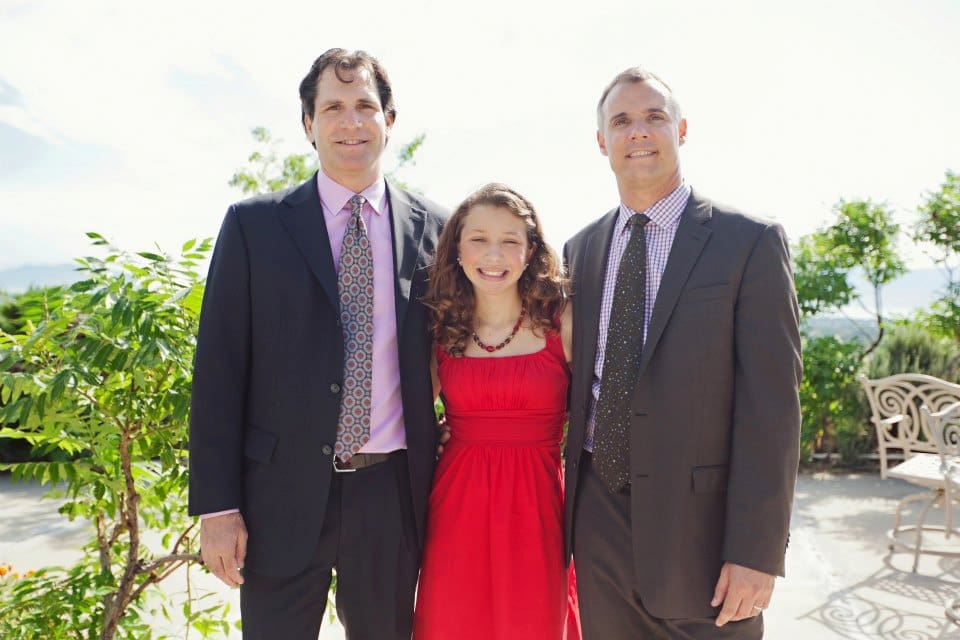
 On this historic day when the United States Supreme Court is considering the legality of gay marriage, we share with you our interview with Brett Bradshaw. Brett is the son of longtime Mormon LGBT advocates Marge and William Bradshaw. In this four-part interview Brett discusses:
- Part 1: His early LDS years, his mission service, falling in love with his husband (Jeff), and his decision to leave the LDS church.
- Part 2: His process of coming out as a gay man, and his thoughts on exploring sexuality in healthy ways
- Part 3: His decision to marry Jeff, have a child (Madeline) via surrogacy, and his view on family values
- Part 4: His thoughts on Mormonism, Proposition 8, Post-Mormonism, and social justice.
This episode is a co-production with the fabulous Daniel Parkinson of Gay Mormon Stories Podcast.
Episode Transcript
Host: John Dehlin · Guest: Brett Bradshaw
This transcript is machine-generated and lightly edited for readability. The audio is authoritative. Please excuse occasional errors in names and spelling.
Introduction and Episode Overview
Part 1 of 4 · Ep. 408
Brett Bradshaw [00:00:00] 1, 2, 3.
John Dehlin [00:00:07] Mormon Stories Podcast is a production of the Open Stories Foundation. All donations to Mormon Stories are fully tax deductible and go directly towards keeping the podcast alive and towards building a community of support for Mormons like you. To support the podcast or to join the community, please become a monthly subscriber today@mormonstories.org. hello and welcome to another edition of Mormon Stories Podcast.
John Dehlin [00:00:33] And in this case it's a co production along with Gay Mormon Stories Podcast. I'm your host John Dehlin and as always, I'm very excited to have this guest with me. I am on the phone, I am on Skype with Brett Bradshaw. The last name may be familiar to some of you.
John Dehlin [00:00:55] Brett is the son of Marge and Bill Bradshaw. Bill Bradshaw. I've had him on Mormon Stories a few times now. He was a professor of mine when I was at byu, a biology professor and a religion professor. He was my mentor for sure. You know, former member of the Stake Presidency, former mission president, the Hong Kong Mission, along with his wonderful wife Marge and Bill has also become one of the leading advocates for gays and lesbians and LGBTQ individuals within the LDS Church.
John Dehlin [00:01:31] And he's also one of the co principal investigators on my dissertation research which is dealing with the same sex attracted LDS experience in the church. And, and there are lots of reasons that my cousin Daniel Parkinson and I, Daniel, who is the host of Gay Mormon Stories, wanted to bring on Brett Bradshaw. Those of you who follow Mormon Stories will know that last week we will have released an interview with Josh and Lolly Weed. And I'm really proud of that interview. I really love Josh and Lolly and they represent an LDS couple that are in what's called a mixed orientation marriage. And if you watch or listen to that interview, you'll know that these are great people who are living sincerely according to their values and what they feel is right.
John Dehlin [00:02:31] But that only tells sort of, you know, one side of a story. In reality, the vast majority of people who experience same sex attraction in the LDS Church end up not taking that path for a variety of reasons. And so it's important as part of Mormon Stories and gay Mormon Stories to profile, you know, different paths, hopefully all of which are constructive, healthy, you know, paths or role models.
John Dehlin [00:03:03] And we chose Brett for a number of reasons. One is that he is, you know, legally married to his husband, Jeff Jackenitz. And we'll be talking his relationship with Jeff. We'll be talking about what it's like to be in a legal gay marriage and it's also important to understand that Brett and Jeff have a daughter, a daughter that was born through surrogacy. Her name is Madeline. And we'll be talking about how that works as well. And you know, no one necessarily wants to be a role model, but the idea is to hold up or to shine a light on Brett and Jeff and their relationship and their family to understand what a same sex marriage and a same sex family can be like or can look like.
John Dehlin [00:03:54] And also we'll kind of end in Josh Weed's case, he stayed in the church and has found happiness there. In Brett's case, he's chosen to part ways in some ways with the LDS Church. And but I think when we talk about his profession and his life, we'll see that for those who do decide that they need to leave the church, and again, around 70% do, according to our data. You know, this is an example of a healthy, hopefully happy, healthy relationship and a path for those who feel like they need to leave. So without any further ado, Brett Bradshaw, welcome to Mormon Stories and Gay Mormon Stories.
Brett Bradshaw [00:04:39] Thanks, John. I really appreciate the opportunity to talk with you. I've been an admirer of you and the podcasts, both the ones you've done and the ones that Daniel has done, and just excited to have the opportunity to talk more. Thank you.
John Dehlin [00:04:53] Oh, my pleasure. So let's begin just with your Mormon story. I imagine that being the, the son of a mission president and the son of all the various callings that Dr. Bradshaw has had, that the church was probably a pretty important part of your early years. Is that true?
Brett's Fifth-Generation Mormon Family Background
Brett Bradshaw [00:05:18] Absolutely. Yeah. So I am, what, a fifth generation Mormon. So on both sides of the family, so my dad's side of the family converted in the U.K. in fact, both sides did, but my dad's side, I don't remember the year off the top of my head, but would have been in the, in the 1840s, I imagine.
Brett Bradshaw [00:05:46] And then they immigrated to the U.S. so my dad's side of the family, I think the Bradshaw side came through St. Louis, took a ship across the pond, as it were, came through St. Louis and then made their way to Utah. On my mom's side, they immigrated through Canada, came down, I think they made a brief stop in Illinois and then out to Utah initially. And then her family settled in Wyoming in Star Valley, Wyoming, which is a little LDS enclave there. So yeah, many, many generations of Mormons. And on both my mom and dad's side, I was sort of a typical big Mormon family, lots of siblings.
Brett Bradshaw [00:06:31] So I grew up with Seeing lots of cousins, lots of family. Both sides of the family were educators by profession, both sides sort of active churchgoers, leaders in lots of callings, sort of well respected figures. So the way I sort of talk about it is there was just a strong legacy of active Mormonism and sort of accomplishment on both sides. So I was well aware of that growing up and had a lot of example of family members, cousins, uncles, aunts, et cetera, that were sort of pillars of the community, both in Salt Lake, where my dad was raised, and in Star Valley, Wyoming, where my mom was raised.
John Dehlin [00:07:24] So give a sense for what role the church played in your immediate family while you were growing up and what it played for you.
Brett Bradshaw [00:07:35] Yeah. So it's funny, I describe myself as being raised by progressive Mormons, if such a thing exists. Well, we know such a thing exists. Though when I typically describe that to people not familiar with the faith, they sort of think that is a oxymoron. Right. So how can there be progressive Mormons?
Brett Bradshaw [00:07:56] So, you know, my parents both did LDS missions. They met on their LDS mission in Hong Kong. Soon after they returned, I think my dad, trying to remember, I think my mom got home first. My dad got back later, he courted her. Not soon. Soon thereafter they got married and my dad had been. And then they moved to Boston where my dad was in school at Harvard. So mom had finished her undergraduate degree at University of Wyoming, and then they moved to Boston. So I think for them, they had a little bit of an exposure outside sort of the typical Mormon enclaves in Utah and Wyoming in which they were raised.
Brett Bradshaw [00:08:42] And so I think some of that different experience rubbed off in their political views, in their social views. So I think we were. We were raised. I was raised. Me and my siblings were raised. I'm the fourth of five kids, so we were. We were raised sort of with that mindset. I was born in Seattle, where my dad was doing a postdoc at the University of Washington.
Brett Bradshaw [00:09:12] After that point, we moved to. A couple years after I was born, we moved to Oak Ridge, Tennessee, where my dad took a job at one of the federal nuclear labs. That's in Oak Ridge, Tennessee. My youngest brother Ben was born there.
Brett Bradshaw [00:09:26] And then in Utah, where my dad took a faculty position at byu. So my early years were sort of doing some of that transitioning from Seattle to Tennessee back to Utah. And it was in. I think, I guess it was.
Brett Bradshaw [00:09:44] I was in first. No, trying to remember the sequence of events here. Soon after we got back to Utah, my dad was an associate professor at byu and then not long after got the call to be a mission president in Hong Kong.
Brett Bradshaw [00:09:58] So all of my parents children were born by that time. The youngest, Ben, probably would have been two years old. I was four at the time. And we then made that transition and moved to Hong Kong for three years. So lived in Hong Kong from age four to age seven. I guess just we can go into some greater detail on that if that's of interest.
Brett Bradshaw [00:10:25] About my participation in the LDS Church was that it gave me lots of advantages. I felt like. So the metaphor I'll use gave me a passport sort of both literally and figuratively. So on the literal side, I was able. The experience of being the child of two sort of active, committed Mormons who then were called to be mission parents gave me the opportunity to go live abroad for three years, which was a spectacular opportunity for a four year old to live abroad and have that experience. So in Hong Kong I went to a British school in that class were in that class at school were kids from all over the globe whose families were probably doing business in Hong Kong.
Brett Bradshaw [00:11:12] So there were Dutch families, US families, Korean families from all over. And just having that exposure, I felt like was, or as I look back and reflect on it now, that that was a spectacular opportunity that I had access to as a result of my participation and my family's participation in the LDS Church.
Brett Bradshaw [00:11:34] And then I think beyond that, sort of the more figurative elements of having a passport, you know, that activity and the fact that both sides of my families were active leaders in the church and were well regarded just gave me a lot of opportunity and a lot of advantage. So I look back at those years, you know, pretty fondly, you know, and then after we returned back to Utah, lived in Orem, which is smack dab in the middle of Utah County. Lived, lived there from second grade through, through the end of high school. And a lot of your listeners know they call Utah Valley Happy Valley.
Brett Bradshaw [00:12:15] And on the veneer, it has just a sense of being a stable community where, I don't know, it's sort of similar to what Garrison Keiller says about Lake Wobegon, right? That every, every kid's above average and everything is wonderful and fabulous.
John Dehlin [00:12:33] All the women are good looking or something like that.
Brett Bradshaw [00:12:35] Yeah, right. All the women are good looking and the children are all above average. So that sort of experience that I lived at least growing up there of having a lot of advantages, and I wouldn't say that they were, they weren't monetary advantages, so but just access to opportunities through church activity, access to Opportunity through. I was in Scouting. I was an Eagle Scout, just had opportunities to develop myself. And having come from Utah, that also gave me, I think, some privileges once I went to college, I think. My guess, I don't know for sure, but my guess is I applied to a bunch of colleges. And being admitted to colleges, there was an element of having some cultural diversity represented by me coming from the west and coming from Utah as a sort of green Mormon boy.
John Dehlin [00:13:35] Right. Just real quickly, what role did the spiritual elements of Mormonism play in your life? Personally, I imagine some of the traditional things. Scripture study, prayer, family home, evening, you know, testimony building, any of that, you know, hymn singing. Did you ever connect with the spiritual side of Mormonism personally? And if so, how.
Faith, Spirituality, and Early Church Involvement
Brett Bradshaw [00:14:03] Yes, I did. And I have sort of. I guess it's the luxury of looking back at that period of time. So I was exposed to all of, you know, we were active churchgoers, went pretty much every week. I had various callings, did scouting through the ward.
Brett Bradshaw [00:14:26] So for anybody who knows Utah county, you know, 85 or 90%. Well, I don't know what it is now, but at the time it seemed like to me, 85 or 90% of the population is LDS. Certainly that was the case in my high school. So I went to Orem High and I was the seminary president at. At Orem High School during the years I was there, 1981 to 1985.
Brett Bradshaw [00:14:50] So I definitely had what I would have called then spiritual experiences as it related to my experience with the LDS Church. So at the time would have said with. Absolutely. Had a testimony, frequently bore testimony of fast and testimony meetings, would have been seen by other people as true blue Mormon, though it's interesting. On the other hand, you know, our family, politically, we were Democrats, which made me an outlier in a lot of regards.
Brett Bradshaw [00:15:31] So I guess this has to do a little bit with what I was just talking about in that having this privilege of, you know, having a legacy of strong Mormons, I think allowed me, though, to experiment a little bit and be a little bit on the edge how I expressed my views about politics. And, you know, I remember in fourth grade there was a mock election. It was the 1976 presidential election. And I was like the only one in the class that voted for Jimmy Carter, you know, against Gerald Ford. So, you know, that. But. But I think I was. I had the ability to do that because of how I was sort of positioned or situated with regard to all of this other opportunity in this legacy.
Brett Bradshaw [00:16:13] Right. So a lot of privilege and the privilege Absolutely right. So, you know, just I. Now that I've had all kinds of other experiences post sort of my initial upbringing, I don't discount the way I was raised, the spiritual experiences that I would have called them then. I see them a lot differently now through the lens of things I've studied, things I've come to understand.
Brett Bradshaw [00:16:42] I had a lot of emotional experiences as a young person and did my LDS mission and had a set of experiences there. So I don't discount them. I just understand them a little bit differently now as an older adult.
John Dehlin [00:16:57] But the church inspired you. You felt like. You felt like you had a strong testimony. You felt like it was a good thing. And if there was any, you probably would have characterized feeling some type of power or strong influence or inspiration from your experiences with it.
Brett Bradshaw [00:17:18] Absolutely. And, you know, my first year in college when I, you know, I went to the University of Chicago, so the first year in college before I went on my mission again, I enjoyed that privilege because I was known as. I was this sort of this exotic creature who came from Utah who talked about these kind of things in a. Maybe in a different way. So people, I think, were drawn to me in some ways because of that. And I was able to. And I represented as a Mormon, you know, I was. I gave copies of the Book of Mormon to my roommates and stuff like that. So, yes, I would definitely say I had that. That was definitely part of my identity up until I was, you know, until I came back from my mission.
First Awareness of Same-Sex Attraction
John Dehlin [00:18:01] Okay, so when did you first experience same sex attraction?
Brett Bradshaw [00:18:08] Yeah, good question. I remember being attracted to guys as early as junior high, though I certainly didn't have language at that time to call myself gay or to think of myself as having a trajectory or a future as a gay man or as a gay person. So it's an interesting thing. So I have clear memories of being attracted to guys, though. It's funny that I guess it has something to do with how the brain works and levels of consciousness and subconsciousness. I just think I wasn't wired at the time for that to make sense to me.
John Dehlin [00:18:56] Right, sure. Yeah.
Brett Bradshaw [00:18:57] That's if that makes sense.
John Dehlin [00:18:58] Makes total sense.
Brett Bradshaw [00:19:00] So through high school, I dated girls, went to dances with girls. When I thought of myself consciously in the future, I thought of myself as going on a mission, getting married to a woman, sort of doing what Sort of the heteronormative life, the role models around me that were sort of heteronormative. That was, I think both consciously and subconsciously were what was true for Me
John Dehlin [00:19:34] now there are kind of, I don't know, gender based stereotypes, I'll call it, that we have for what we consider, let's say in US culture as being masculine and feminine. And then often with the same sex attracted youth who's male, their gender characteristics will be perceived as more feminine by many of their peers, kind of in adolescence. But that's not always the case. So the average young gay male might be viewed as effeminate or everyone will kind of know that they're gay but not talk about it. The parents might have had a good sense of that from maybe even age 7 or 6 or even younger. Was any of that the case with you?
Brett Bradshaw [00:20:29] Good question. I think it's mixed. So I was athletic, I played sports, played football and basketball and baseball. So on one level I did a bunch of things that in the gay community we would call butch. Right. So I, on some level was, was really quite butch. On, on the other hand, I, you know, this is, it's always funny with, with the luxury of retrospection that people can go back and say, yeah, there was something, I always noticed something about Brett that now it kind of all falls into place now that he's out and it's all sort of out in the open. There were some things that I could, that I could tell, that I could detect.
Brett Bradshaw [00:21:16] So I don't know. I mean, I wouldn't say that when I was growing up, my parents would have necessarily predicted that I would have been gay. I think when I came out to my dad, he was. I haven't talked to him about this recently, but I would. My guess is he was thoroughly shocked, had no idea, did not, did not realize my mom had. Go ahead.
John Dehlin [00:21:42] What were the things that, looking back, you would have associated with being more
Brett Bradshaw [00:21:48] stereotypical, sort of a level of sensitivity. So I, among my siblings probably am characterized as of the more sensitive. Sensitive both to sort of my own emotions, but also in caretaking others and sort of having a sense external to me about what's going on emotionally with other people. Okay, so that would be one thing, you know, I don't know. You know, also being somewhat, you know, socially at ease both with other boys when I was young, but in particular with girls. So having just a little bit more sort of kind of social ease, being able to code switch, as it were, between, you know, people I played football or sports with, but then just as easily being able to participate and have friends with people in the choir or people who did drama and then girls as well. So that maybe was another thing and
John Dehlin [00:22:57] did girls find you attractive? I know it's a weird question, but yeah.
Guest [00:23:03] Yeah.
Brett Bradshaw [00:23:06] People, Jeff, my husband, and my close friends make fun of me all the time. Because I will recount this story about being in high school, and, you know, there was this dance called Preference where it was sort of the girl's choice, and I was sort of named the most preferred guy two years in a row. Whenever I get into sort of a. A jocular back and forth, I will raise that to raise my stature that I was the most preferred two years in a row.
John Dehlin [00:23:34] So Jeff broke a lot of hearts, basically.
Brett Bradshaw [00:23:37] He did. But, yeah.
John Dehlin [00:23:41] Were you ever attracted to girls?
Brett Bradshaw [00:23:44] Yeah, I mean, I did. It's interesting when I use the Kinsey scale for myself, like, as an adult, I put myself on the far pole of being gay. So as an adult, being sort of, like, sexually attracted, I would say I'm most definitely all the way sexually attracted to men.
John Dehlin [00:24:11] Six. You're saying you're a six?
Brett Bradshaw [00:24:13] I'm saying I'm a six.
John Dehlin [00:24:15] Okay.
Brett Bradshaw [00:24:15] Wouldn't say I'm bi. Didn't have any sexual experiences with women before coming out, so. But in high school, I think because of how knowledge and experience is socially constructed, I thought I was doing what I was supposed to do. Right. Which is flirt. Flirt with girls, go on dates with girls. Now, on some level, I'm not saying there weren't meaningful connections between myself and girls, though. Now, as I look back, you know, being adult and having sort of grown into myself, as it were, I would say I wasn't sexually attracted to girls.
John Dehlin [00:25:01] Okay, but at the time, you were kind of flirty and, you know, interested and.
Brett Bradshaw [00:25:06] Yeah, yeah, but.
John Dehlin [00:25:07] But never. But never explored that. So you didn't even really know the depths of it. You just kind of did what guys did socially.
Brett Bradshaw [00:25:14] Correct.
John Dehlin [00:25:15] Okay, so never. Okay, so never a serious girlfriend or anything then? Really?
Brett Bradshaw [00:25:21] Never a serious girlfriend.
John Dehlin [00:25:22] Okay. And did you conceptualize that is my mission is really important to me and I'm not gonna get distracted before my mission kind of thing.
Brett Bradshaw [00:25:30] Yeah. Or, you know, I didn't find the right person or. Yeah. I think it became more acute in college, so. Came back from my mission.
John Dehlin [00:25:42] Okay, wait, really quick. I'm sorry. I don't mean never. Never the, like, oh, my gosh, I'm gay thing in high school. Never had that experience.
Brett Bradshaw [00:25:52] Like, privately, I wouldn't describe it as doing that, but I did, particularly in high school. Later on in high school, I had crushes on boys, but not as. But that's the language I use now.
John Dehlin [00:26:05] Right. Back then, Close friendship.
Brett Bradshaw [00:26:08] Close friendship. But there was something awkward about it. But I certainly was going through the emotions, sort of the emotional sort of connection with some of my friends or the guys that I was attracted to that I then sort of created opportunities to be around a lot. So that was sort of the wish fulfillment. Right. But without the fully, fully constructing the thoughts and the intentions in, you know, in my mind. So I think later there were some times like I may have uttered the words, like, oh, my gosh, I think I might be gay. But it was never fully realized. Like, yeah, oh, I definitely know what's going on.
John Dehlin [00:26:51] And one of the things we find in our study is that a lot of people's. And this is going to sound kind of explicit, but, you know, I think it's fair. I mean, I think it's good to talk about this kind of stuff. Some people have their kind of sexual awareness or awakening, like in the locker room, or they're like, dressing and they see other guys and it's kind of a really embarrassing thing, but they find themselves really attracted. Others don't. Was that ever a part of it or. Not really.
Brett Bradshaw [00:27:19] Yeah, yeah, no, I was looking. I was sneaking peeks in the locker room, all of that.
John Dehlin [00:27:24] Okay, okay.
Brett Bradshaw [00:27:25] Yes, yes, yes, and yes.
John Dehlin [00:27:26] Okay, okay, okay. So you serve a mission as this true blue Mormon, right?
Brett Bradshaw [00:27:32] Yep.
John Dehlin [00:27:33] And is there anything relevant to your, you know, sexual orientation that occurred on your mission?
Brett Bradshaw [00:27:43] Interesting. Not directly, but I think indirectly. So I went. I served in Brazil, in Sao Paulo, Brazil, which, you know, by the way, is full of beautiful people, both men and women. But. So there were moments in my mission where on a conscious and subconscious level, continued this narrative.
Brett Bradshaw [00:28:09] I guess it's not even narrative. It's an actual experience of being. Of being attracted to men there, though I think I had. I did have this singleness of purpose that it didn't. It wasn't disruptive. You know, I went about my business, you know, I did my mission, you know, And I think the larger awakening, as I would call it, that I had on my mission was, I think, maybe not totally disconnected from more coming into myself as a gay person, but an awakening of having some doubts about my faith. Oh, yeah. So I don't think they're entirely disconnected, but the way I talk about it now is going on my mission was the beginning of the end for my faith, for my participation in Mormonism.
John Dehlin [00:28:59] So we did a pretty big study on why Mormons leave the church. And there are kind of different categories. There's historical issues, there's Doctrinal, theological issues. There's cultural issues, and there's even spiritual issues where people just feel either not edified in church or they feel spiritually drawn elsewhere. And there's kind of political issues, socio political issues. Were your main issues in any of those categories or were they in other categories?
Brett Bradshaw [00:29:33] Some of all. But the one that stands out for me is the second one you mentioned, sort of the doctrinal issues of doctrine issues, of just having doubts and questions about that. And I think how it. How it transpired for me on the mission is in this way.
Brett Bradshaw [00:29:56] The mission I was in, I think at the time I was called, had the highest rate of baptism in the world. So it was, you know, Brazil is a Catholic Christian nation, but the mission itself and the country in terms of conversions was growing at a astronomical rate. And the mission president at the time was.
Brett Bradshaw [00:30:21] His orientation was to baptize. Baptize, Baptize. So I think getting back to the way I was raised by my parents is I had some expectation going on my mission that it was about service in a broader sense. And I had both sort of an internal compass, but a set of expectations that I was going to be engaged in activities that would be helping people broadly. So I'm going to. You know, Brazil's a.
Brett Bradshaw [00:30:51] Particularly in the neighborhoods where I was working as a Third World nation, people need all kinds of help. And so for me, the prospect, the idea of offering solely a. I wouldn't even call it a spiritual dimension of service. It was.
Brett Bradshaw [00:31:13] And the way the mission was structured is you met a family, you did the first discussion, and you asked the family at the end of the first discussion to commit to more and even to commit to be baptized. And if they didn't say yes, you were to leave and not have more contact and go find somebody else who would commit to that. So for me, it was. It became, in my mind, so narrowly focused on the service being geared towards converting people which met quotas, which met numbers, and not about really caring for people, learning more about them, learning to appreciate them and their culture.
Brett Bradshaw [00:31:58] Also, I had a lot of dissonance around assimilation and going to a country different from my own and having a sense about the LDS Church as being a relatively American religion. And that what I was doing was sort of proselytizing and trying to get people to assimilate into my way and had a lot of issues and problems
John Dehlin [00:32:24] with that kind of cultural colonialism.
Brett Bradshaw [00:32:27] Absolutely.
Serving a Mission and Navigating Sexual Orientation
John Dehlin [00:32:28] How many baptisms a month at the peak of your mission experience, do you think for your mission?
Brett Bradshaw [00:32:34] I Can't remember mission wide, but
John Dehlin [00:32:39] often it's. You know, the higher baptizing missions are between 500 and 1,000amonth kind of thing.
Brett Bradshaw [00:32:45] Yeah, my guess is that would be in the range. I mean, me personally, you know, it wouldn't be uncommon to have three, four baptisms a week.
Guest [00:32:56] Whoa.
Brett Bradshaw [00:32:56] Certainly. Yeah. You know, you'd meet people and there'd be, like, a huge pipeline. Right. And that was how the whole mission was constructed. And that's how you were trained. And that's. It was. I mean, if you use the metaphor, the factory model. That was it. Right. You know, there was. There was a pipeline, and you would meet people, and you were supposed to meet so many new families every week. And from those new families, you were, you know, so it's sort of like backward planning. You wanted to have three or four baptisms a week. You would have to then meet X number of new families every week.
Brett Bradshaw [00:33:27] Week. Yeah. And that was drilled into you from the beginning. And I. I had a problem with it. And in fact, so much so that that I was on a running list. I probably headed this list frequently, but I was on the list of the elders who had the longest consecutive baptismless stretch.
Brett Bradshaw [00:33:48] So, you know, so I had a reputation of being sort of the one who thought about things and didn't always toe the line. And it was a challenge for me.
John Dehlin [00:33:59] Just as an aside, my very first Mormon Stories episode was about my mission experience in Guatemala, which was very. Almost identical. What year were you there in Brazil?
Brett Bradshaw [00:34:11] 86 to 88.
John Dehlin [00:34:12] Okay, so we were contemporaries. I was in Guatemala from 88 to 90. So it was right during that Golden Age.
Brett Bradshaw [00:34:22] That's right.
John Dehlin [00:34:22] There was a mission in Chile during that time, the Vina del Mar mission that had over a thousand baptisms a month.
Brett Bradshaw [00:34:28] Yeah.
John Dehlin [00:34:29] Okay, so that sort of put some cracks in your testimony. And I guess you had mentioned that you noticed a lot of attractive people and probably were attracted to some of the Brazilian men down there. Anything else related to your sexual orientation and your mission, or is that pretty much it?
Brett Bradshaw [00:34:50] That's pretty much it.
Guest [00:34:51] I mean,
Brett Bradshaw [00:34:55] the way I think back on it now, I really feel like I put a lot of stuff on hold for that two years. So it was, you know, I think I was able. I wasn't battling with myself around my sexual orientation during my mission. It was around some of these other philosophical, spiritual questions around how I fit in into Mormonism and having some of that struggle.
John Dehlin [00:35:23] Okay, so how did you go from returned missionary to coming out as gay? What was that process?
Brett Bradshaw [00:35:30] Yeah, so as I said, I think it was important in this period of time that I was outside of Utah. So I come back from my mission, I go back to college in Chicago. And that was seminal in a lot of ways. So I have some really fond memories of some great courses that I took.
Brett Bradshaw [00:35:55] One of them being the title of it was Self, Culture and Society. And it was a sort of a. At Chicago, you're required to do it. They have a strong common core philosophy. So you. You essentially do a year of study in each of the main sort of disciplines. So there was sort of the sociology, sort of humanities areas. And so I took this class and we read, as you mentioned, the term you said sort of cultural colonialism. So we read a lot about that. We read Durkheim, Levi Strauss, Todorov, a bunch of other people. And so. And I wrote a lot of papers on my experiences from my mission.
Brett Bradshaw [00:36:39] You know, I wrote a whole paper about me being a conquistador, the equivalent of a conquistador with my religion. So I think I had opportunity to do a lot of that intellectual exploration and felt a lot of agency to use my experience in my religion and what I was going through to be part of the fodder for what I was writing and thinking about.
Brett Bradshaw [00:37:05] And I was active in the ward in Chicago. So it's the. At the time, well, it's still the Hyde park ward. So University of Chicago is on the south side. And it was an entirely different kind of a church going experience than I had experienced back in Utah. So the ward at that time was essentially half people who were affiliated with the university and then half people who were local to the south side.
Brett Bradshaw [00:37:35] And the south side of Chicago is predominantly African American. So the ward was essentially half black and half university folks. And it was just a really nice mix of that. And so I think I was able because of the orientation of a lot of the people in the ward, you know, free thinkers, intellectuals that came through in Sunday school classes and the way it was taught. I, you know, taught classes myself, so just sort of immersed myself in that. So. But I think it ultimately served the purpose of distancing me somewhat, allowing me to further pursue sort of my thinking about some of these things, furthering some of my doubts, and then also allowing me to more fully come out to myself.
Brett Bradshaw [00:38:26] So I think those things were both happening at the same time. So having this somewhat challenging experience on my mission, being able to explore and think and doing that in this environment, that was really stimulating for me as well as I think because of My age and sort of developmentally becoming a little bit more aware of myself, but also being in Chicago where I was exposed to a lot of different things. So, you know, there was a LGBT student group at the university. So getting some of those images, images of out gay people, helped to, I think, open up the possibilities for me in some way.
Brett Bradshaw [00:39:07] So all of that is sort of going on and at the same time sort of exploring a little bit more my attractions to other men at school, at college, in Chicago, and that I think I was able at the time to take that in in a way that it began to mean something to me.
Post-Mission Life and Early Relationship with Jeff
John Dehlin [00:39:26] So a couple common phases, especially for young Mormon men that return from their missions and go to one of the BYU schools. One is the sort of desperate bargaining with Heavenly Father to take the same sex attraction away. Was that ever part of your experience, kind of the hyper religiosity and bargaining with God as a way to make it go away? Did you just bypass that?
Brett Bradshaw [00:39:58] Pretty much. I didn't have much of that. And again, I think that's somewhat. Well, I don't know whether it's somewhat rare or not. I don't have enough experience to know, but at least that wasn't my experience. And I think it's. I try to think of what I could attribute that to, and I think it goes back to the way I was raised. So I don't know if what's idiosyncratic about that is what my parents were like or the combination of my parents living and raising us in the community in which we were raised, which was a relatively conservative one, or if it is something inherent in me, I can't always say, but probably some convergence of a lot of those things made me feel like I had agency, that I could choose for myself what I was going to do and that I didn't need to doubt myself about it.
Brett Bradshaw [00:40:51] So I think it was my senior year in college where this, you know, I mean, if we use the phrase come come to a head. So, you know, I think I was sort of intellectually and emotionally distancing myself somewhat from Mormonism at the same time coming into my own and starting to get a better sense that I'm gay.
Brett Bradshaw [00:41:19] Meeting Jeff, my now husband. So at the time we. I remember. So we were both seniors in 1991. I remember seeing him in the library cantina. There was, you know, like in the basement of the library was a place where you would go and get snacks and stuff during breaks when you were studying. And I remember seeing him across the room and Being attracted to him and noticing him. Right. And, and he was one of the guys back then. At the time, in the libraries, as you left the building, you had to be screened, you had to open up your bags and somebody would look through them to make sure you weren't taking out books.
Brett Bradshaw [00:41:59] And Jeff was one of those guys. And so we just, you know, I was drawn to him. We both had applied to Teach for America as seniors in college. So Teach for America is a teacher corps. Essentially the analogy is it's the Peace Corps, but placing people in two year stints in under resourced school districts across the US So he and I both did that. And so I remember having a sense of who he was. We both applied. So in the application process, you spent a lot of time with other applicants. I got to know him that way. And that was sort of in the, the spring of our senior year.
Brett Bradshaw [00:42:41] And so as I would leave the library, all the time, I would spend, you know, a lot of time just chatting and talking with Jeff as he was doing his job. And that was happening all at the same time as these other things were going on for me.
Brett Bradshaw [00:42:56] And so I think subconsciously what's going on is I'm incredibly attracted to this person. And at the same time, I'm not fully disassociated with Mormonism and still am holding on to my upbringing and still feeling devoted to my family and, you know, not sure what fully coming out would mean for all of that. Right. So all of that is going on at the same time. Jeff at the time is a little bit further out of the closet than I am. But he hadn't been with any men either at the time.
Brett Bradshaw [00:43:32] He had dated women in college, but he had sort of decided, you know, I'm pretty sure I'm gay and I'm gonna. And I'm gonna give this a go. I'm gonna. I think I'm gonna have my next relationship be with a guy, but I don't quite know what that means yet, but I'm open to it. So he's sort of in that place. I'm not quite that far along, but these things are all happening for me. We both get admitted to Teach for America. He gets placed Houston. I get placed in Los Angeles.
John Dehlin [00:44:04] What part of Houston? Just downtown Houston, do you know the
Brett Bradshaw [00:44:09] name of his school was Lantrip elementary. And I don't.
John Dehlin [00:44:13] Okay, that's fine. I'm from Houston, so I was just curious. But it's.
Brett Bradshaw [00:44:15] Yeah, so it's. It was a neighborhood that was primarily Latino and with inside the belt 610, whatever that is.
John Dehlin [00:44:24] What do they call it? That's fine.
Brett Bradshaw [00:44:26] Yeah. Anyway, so all this is going on and then we continue to spend a lot of time with each other and I think for Jeff, Jeff's like confused. He can't figure me out. He can't figure out whether I'm just this naive Mormon boy or whether I'm really hitting on him. And he can't quite read the signals. So subconsciously, I'm sure I'm full on flirting and hitting on him, but I don't have the full awareness about that. It doesn't. Again, it's not clicking with me entirely.
John Dehlin [00:44:56] And real quick, had you tried dating women at this point?
Brett Bradshaw [00:45:03] No. Still no. So it probably people ask me like, well, wasn't it obvious? Like people probably had this, had a sense like, you know, Brett's not really dating anybody seriously, there's probably something going on there. But I think unlike high school, in college, it was feeling a little bit more awkward. Right. So I just, I think at the time I could easily explain it away before my mission, like, well, I'm not gonna really date women because I want to focus on, on my mission. And then coming back, it just really didn't work. So I knew a lot of women, spent a lot of time with a lot of women, both other people in the ward in Hyde park as well as other people, you know, students with whom I had, I was in classes. But no, okay, didn't have any dating experiences with women during that time.
John Dehlin [00:45:57] Got it.
Brett Bradshaw [00:45:58] So at this point, Jeff and I are spending a lot of time together as we're, you know, gearing up to graduate and through sort of the Teach for America infrastructure, we're, you know, getting excited about going to do this. The way the program worked at that time, it was just the second year of Teach for America, so what they were doing, it was an upstart at the time. They were busing people from wherever they happened to be to Los Angeles. And you did a two month intensive summer institute.
Brett Bradshaw [00:46:32] And the reason they did it in Los Angeles is because there were year round schools in LA Unified at that time so you could get a student teaching experience as well as do this intensive institute before then. You were then flown out to wherever you were going to be doing your two year commitment. So the way it was going to work for me, where my parents were coming to graduation in Chicago, they drove out from Utah and then I was going to drive with them back to Utah, spend a few weeks in Utah before I had to Report to the Summer Institute in Los Angeles.
Brett Bradshaw [00:47:07] So during a lot of this back and forth, I convinced Jeff to take the bus from Chicago to Salt Lake, spend a few days with me in Utah just to sort of see where I was from and spend a couple of days together with my family. And then we were going to drive together. We're going to do a road trip from Orem, where my parents house was, down to Los Angeles and stop at the national parks in Southern Utah and sort of make a, take a, take a week and have a road trip together.
Brett Bradshaw [00:47:39] So that's what happens. And so during all this time, I'm kind of stealthily even to myself, kind of exploring what this might mean for me. You know, I think back now is an incredibly exciting time, right? So really excited about, you know, fallen for this person. But it was also, you know, interestingly bizarre, you know, not being fully conscious about what was actually happening, not having full use of all my faculties and my intentions. So we graduate, we do this, this plan all happens. Jeff spends a couple of days with my family, meets my family, we hop in the car and drive down. And it's during this whole period, I think also during the last few months of college, while Jeff and I were spending a lot of time together, you know, we opened up, we had connection on a lot of levels.
Brett Bradshaw [00:48:29] So it wasn't just on a physical level. Had a lot of connections, emotionally, had a lot of things in common. And then, you know, over the course of this, of this road trip together, we kind of open up a little bit more, confess to each other a little bit about are sort of feeling like we've been attracted to men at different points, sharing our experiences and having that deep connection with each other. So it's in the course of this road trip, Jeff actually makes the first move and states, you know, I'm really attracted to you and want to explore what that would mean, like what that would mean for us.
Brett Bradshaw [00:49:11] And it's in retrospect now it's sort of obvious to me that I would sort of reciprocate that. But in the moment it was, it was pretty shocking because I think it was the first time that I actually had this conscious realization that this is something that I could pursue and this is something that I could do and that it would be real for me. So I'm sort of faced with that in the moment. In fact, it's a, it's a great story because we were actually hiking the narrows in Zion national park and we're like hiking through, you know, the Virgin river, whatever. We're in this fabulous, gorgeous, beautiful setting and we stop for lunch and, you know, we've been talking about stuff, you know, for hours in the car, what have you.
Brett Bradshaw [00:49:57] And it's at this moment he sort of turns to me and drops this bomb. And I'm, you know, sort of shocked. And the thing I remember saying back to him is, yeah, I feel the same way, but it's not. It's not easy for me. Like, I still need to sort of figure. Figure this out, figure out what this means. If I were to sort of honor what my feelings are around this and really do what is feeling really natural and feeling really central and core to me, I would say, let's go for it. But I am not sure what that would mean to my family.
Brett Bradshaw [00:50:35] So, again, sort of the specter of coming out to my family sort of raised its head there. And I thought to myself, I'm not ready to do that. Not sure I can do that. Not sure what it meant. And again, I think it's both the flood of the conscious elements of what my upbringing, what Mormonism tells you about gay people, and also a lot of the subconscious stuff about representations of who gay people are, representations of the lonely bachelor at the end of the street that's unhappy. I mean, those kinds of things that are represented in the media, that are represented in stories that people take in on both a conscious and a subconscious level.
Brett Bradshaw [00:51:24] I think all of that was coming up for me, and in a moment I hesitated. I was like, I feel the same way as you do, but I'm not quite ready for this. So it made for a awkward.
Brett Bradshaw [00:51:41] It made for an awkward drive from Zions National Park. We stopped in Las Vegas on our. On our way down to la. So it was sort of a strange couple of days. But so given all of that kind of turmoil, relatively speaking, I can say now it was fairly easy. So after a couple of days of sort of ruminating on this, and I think it probably I needed to have done.
Brett Bradshaw [00:52:10] I needed to have gone through what I went through in terms of my mission, in terms of all of what I just described, the last few years of college, me detaching somewhat from a sort of fundamental testimony and belief in Mormonism, I think all of that needed to happen in order for me to be in the place to say, you know what? I. Yes, I'm attracted to you, and this is something that I want.
Brett Bradshaw [00:52:37] And, yeah, so this is something I'm going to do. So anyway, so at that point, we decide we're going to give it a go. And so we're at this summer institute in Los Angeles. We're, you know, placed in different apartments in a tower, a residential tower at USC University of Southern California.
Brett Bradshaw [00:52:59] We're not out to anybody. We're terrified. People know we're just coming, you know, we're just coming out to ourselves as the first experience for both of us. And we're dealing with all of that at the same time as we're figuring out how to be teachers, getting ready to, you know, Jeff getting ready to fly off to Houston, me staying in Los Angeles. So it was just a. It was a heavy, heavy period, but one that I look back on as being really exciting as well as sort of a new frontier for me.
John Dehlin [00:53:32] And this is. It should be noted that this is pre Ellen, pre Glee, pre sort of in 2013, you really can't have a TV show that doesn't have a gay character. And you know, it's just, it's on the news everywhere and, you know, 10 states or whatever now have legalized gay marriage. It's. It was a totally different deal back in 91. 92. Right.
Brett Bradshaw [00:54:02] It is on that level. On another level, I remember those years fondly sort of coming out. And I mean, the other thing that is really significant about that period is it's very instrumental, very significant for me in terms of sort of the era of aids.
Brett Bradshaw [00:54:23] It's sort of on the tail end. So a lot of people were still getting sick, a lot of people were dying. And that's a lot of the narrative too was about the implications and the consequences of AIDS policy. So it's so 91, it's George Herbert Walker Bush is president. So this was, you know, after the 91 was. I remember the first Iraqi war. So that year, senior year, I remember watching news about the war. So that's sort of going on at the time. So a lot of the. So for a lot of people my age and people a little bit older too, who had been out already, you know, there's a vibrant gay community in Los Angeles at the time, so.
Brett Bradshaw [00:55:10] And in Houston also for Jeff. So as we're figuring this out and then we. I'm kind of going in a couple of different directions, but let me say then that we had decided at the end of this institute that we were, we entered into this sort of two month period thinking, you know, we're not making any commitments necessarily, we're just sort of figuring this out to. When he left for Houston, sort of deciding that we were going to try to do this long distance relationship and keep and continue to give it a go even though we were going to be in different cities. And in fact that was, I think, really important for us both as a couple and both as individuals because we didn't have to navigate, we were able to ease in really slowly.
Building a Life Together as a Couple
Brett Bradshaw [00:55:55] We didn't have to navigate all of the pressures about coming out along with trying to figure it out together, figure out our relationship together. So we were able to have our own lives with our own. We each had roommates that were also teachers. We both sort of dove into the respective gay communities in LA and in Houston.
Brett Bradshaw [00:56:18] And then we saw each other really frequently. You know, we were on a teaching schedule. So pretty much every school holiday one of us either flew, either I flew to Houston or he flew to Los Angeles. So we spent a lot of. We spent, we spent time together usually every six or eight weeks.
Brett Bradshaw [00:56:34] But that gave us a chance to sort of figure out what being gay was for us, but also what our relationship was. So I really appreciate that two years of time, even though on some level it was a challenge.
Brett Bradshaw [00:56:49] But again for me in Los Angeles had a vibrant gay community. But also that's where I got initially connected to Affirmation and that was also important thing for me to have happen during, during that period. So met some other, in fact, Paul Mortensen, who's one of the founders of Affirmation, who, you know, was coming out at BYU in 1978 or whatever, lived at the time, still lives, I believe in, in Los Angeles and was hosting affirmation gatherings there. And I remember going to his place and meeting a bunch of people and that being an important and important thing for me to find. Other people of my of a similar background who had gone through were going through some of the same things.
John Dehlin [00:57:44] Thank you for joining us today on Mormon Stories. Music today was provided by the City Saber Rattlers. Check them out at saber-rattlers.com the Mormon Stories logo was generously donated by StudioCase.com thanks for listening.
Guest [00:57:59] Come come ye saints no toil nor labor fear but with joy when you're though hard to you this journey may appear Grace shall be as your day Tis better far for us to strive Our useless cares from us to dread to leave and joy your hearts will swell oh, all is well, all is well.
Guest [00:58:57] Why should we mourn? I think our lot is high Tis not so all is right why should we think to earn a great reward if we now shun the fight Gird up your lo fresh courage Take our God will never us forsake soon we'll have tale to tell oh, all is well all is well oh, all is well all is well.
Guest [01:00:53] And should we die before our journey's through Happy day All is well we then are free from toil and sorrow too with the just we shall dwell but if our lives are spared again to see the saints the rest obtain I will make the this car is swell. Oh, all is well all is well all is well
Brett Bradshaw [01:01:52] all is well
Guest [01:01:55] all
Brett Bradshaw [01:01:55] is well
Guest [01:01:59] oh, all is well.
Coming Out to Jeff's Parents
Part 2 of 4 · Ep. 409
Brett Bradshaw [00:00:00] 1, 2, 3.
John Dehlin [00:00:07] Mormon Stories Podcast is a production of the Open Stories Foundation. All donations to Mormon Stories are fully tax deductible and go directly towards keeping the podcast alive and towards building a community of support for Mormons like you. To support the podcast or to join the community, please become a monthly subscriber today@mormonstories.org okay, so I want to get to sort of a real focus on your relationship and, you know, what led to marriage and the family.
John Dehlin [00:00:39] But I'd like to, if it's not totally disjointed with the sequence of your story, I'd like to kind of shift a bit and talk about, you know, coming out to your family, what the environment, family environment was like. I know, you know, your dad was like a, you know, all star high school quarterback. I'm not sure if your mom was athletic or not.
John Dehlin [00:01:05] I know that you had at least a brother or two that played college basketball. So my guess is that masculinity is sort of maybe a part of your family in some way. Traditional masculinity. And then there's the heavy church element. So tell me if it's a good time to talk about what it was like for you to think about, contemplate coming out and then how that actually happened and then how people reacted or if there are other important parts of the story you need to tell first.
Brett Bradshaw [00:01:36] Sure. No, no other important parts of the story to tell. So Jeff and I had been together a year. How did this work? So it was June of 1991 when we started this Summer Institute, and he left for Houston in August. So we continued to see each other through that fall.
Brett Bradshaw [00:02:02] And one of the things that happened was at that Christmas break, Jeff's from New York and his dad lives. Lived at the time on the Upper east side in Manhattan. And so he was going to go spend part of the break with his dad in New York City, and I was going to spend part of the break with my family in Utah. But then I planned to go to visit Jeff in New York.
Brett Bradshaw [00:02:30] And at the time, I didn't think that was an odd thing to do. I thought, you know, wow, you're going to go, you know, spend part of a vacation in New York City. There's all kinds of things to do, et cetera. I think that was maybe the first time people in my family wondered whether there was something going on. I think they found, maybe they found it odd that I wouldn't spend the entire Christmas break with them in Utah, but instead would spend a few days with them and then go to New York and spend some time with Jeff. So you know, my parents had met Jeff.
Brett Bradshaw [00:03:00] I don't think any of my other siblings had met him yet. But I think now that I've talked with family members since that time, I think that raised people some questions. So you know, in terms of what you said about, you know, representations of masculinity, all that was true.
Brett Bradshaw [00:03:19] Having three brothers in addition to myself and my sister was athletic and played sports. That wasn't an issue for me that, you know, it was more. My fear in coming out to my parents was just. I think it was a combination of one disappointing them.
Brett Bradshaw [00:03:38] It was a fear of what that would mean in their relationship with me vis a vis the church and teachings about eternal families and all that kind of stuff. I personally was. I didn't have those same doubts for myself. Like I didn't struggle in coming out to myself with fears or doubts or concerns about my own eternal damnation or not being able to fulfill, you know, my callings that were determined in the pre existence etc, etc. That wasn't a struggle for me, for myself. But it came into the mix when I thought about coming out to my parents. So in those first few months of being with Jeff, I couldn't imagine it.
Brett Bradshaw [00:04:32] So he had geared himself up to come out to his parents that Christmas break. So you know what, we had been together not even six months and he came out to his dad and his dad's a great guy, politically liberal, New Yorker, all of that. And you know, he isn't without sort of his own challenges and understandings about what that meant. Like one of the first things he said is, oh no, I'm not going to have any grandkids. So you know, I think there are all kinds of associations people have. But largely Jeff had a positive coming out with his parents.
Brett Bradshaw [00:05:09] His parents are divorced. So separately he came out to his mom right about that same time. So he was a little bit further along at that time. I couldn't imagine it, doing it. I couldn't imagine doing it myself. I think I just was still living, living with this fear. So for me I had to stage it. So I was out to people who I like, my roommates that I lived with in Los Angeles. I was out to people who I'd come in contact with in affirmation, et cetera, but not yet to anybody from no childhood friends or family members. So the first person I came out to was my best friend and that went positively.
Brett Bradshaw [00:05:51] So I was of course nervous about it. So like we Were driving. We were driving. I was visiting Utah. So it was probably that same Christmas. So that same Christmas, when Jeff came out to his family, I came out to my friend Dan.
John Dehlin [00:06:04] A male friend.
Brett Bradshaw [00:06:05] A male friend, yeah. Yeah. My closest friend from childhood. We've known each other since second grade and went to college together. The two of us were roommates at University of Chicago the first year, so. And that went well. So it was terrifying and scary, but his reaction was great. And so that was sort of one under my belt, as it were, that went positively.
Brett Bradshaw [00:06:31] I'm trying to remember the first family member. I felt like I had a strategy, so I was going to come out to all my siblings first because it was easier. So again, the fear in coming out, and it was never the fear of rejection. I never thought my siblings or my family or my parents never thought they would disown me, never thought they would be hateful, never thought they would.
Brett Bradshaw [00:06:59] I mean, disown strong. I never thought there was going to be a significant rift as a result of doing this. It was just this fear of the unknown and the fear of disappointment and the fear of what this would mean on some level in our relationship going forward. So I felt like I needed to amass some allies for myself. So I came out to each of my siblings separately. And then it was the following.
John Dehlin [00:07:24] How was it with your siblings? Was there any righteous indignation kind of stuff?
Brett Bradshaw [00:07:31] None.
John Dehlin [00:07:32] None.
Brett Bradshaw [00:07:33] So none.
John Dehlin [00:07:34] There's no Nephi. There's no Nephi figure in your family? The sort of pious sibling that considered himself quite fondly?
Brett Bradshaw [00:07:45] Nope. So I count myself lucky in that regard. Yeah. So, I mean, currently, across the array of my siblings, they are at varying levels currently of activity in the church. Some are very active, others not at all anyway, and I'm not sure that was evident at the time that I came out to them, but even the siblings who are the most active now were generous and loving and gracious and handled it fine. Now, if I were, you know, I don't know. We haven't had deep conversations about what their views on gay people are, particularly as it relates to active Mormonism, Though they all were. They all came to our wedding.
Brett Bradshaw [00:08:36] They all have been incredibly supportive. So on one level, coming out in that way just, I think, boosted my confidence. I needed to do a few trial runs. They all went positively. So I, up until that point, hadn't had a negative experience with coming out to anybody.
John Dehlin [00:08:55] Okay, great.
Coming Out to Brett's Own Parents
Brett Bradshaw [00:08:56] So then leading up to my parents. So it was the following Christmas to Christmases. 92.
John Dehlin [00:09:01] Wait, wait, wait. I'm sorry, but. But I can't imagine that you would characterize your home as an LGBT friendly home growing up. Because I just can't imagine in the late 80s, the Bradshaw home in Orem, Utah being an ally family. So.
Brett Bradshaw [00:09:21] No, no, it wasn't. It wasn't. It wasn't talked about.
John Dehlin [00:09:25] Was it talked about negatively? Like pejoratives used or anything like that?
Brett Bradshaw [00:09:30] I'm sure there were pejoratives used, probably even by me in my youth, but nothing on an overt level, you know, nothing really major. I mean, the couple of things I can remember is, I mean, I would guess my parents at that time, at the time I came out to them and in my youth would probably say they didn't know any gay people.
John Dehlin [00:09:56] Right.
Brett Bradshaw [00:09:57] Or if they did, they were people who neighbors gossiped about or, you know, or whatever, but didn't have.
John Dehlin [00:10:04] My guess is they knew about Bruce Bastian at that time.
Brett Bradshaw [00:10:07] Probably he wasn't even out at that time.
John Dehlin [00:10:09] Oh, really? No, he was the word just for our listeners. He's the word perfect co founder that I interviewed a year or two ago. You can go back and watch that interview. But anyway, okay, so. Wow, he wasn't even out yet.
Brett Bradshaw [00:10:21] Yeah. You know, like, I think, you know, I remember from my youth, like my dad not railing or anything, but I remember him saying something like he didn't like Elton John because Elton John was gay.
John Dehlin [00:10:32] Right.
Brett Bradshaw [00:10:32] Or I'm sure there were sort of philosophical conversations about, well, should gay people be able to adopt kids? And my guess is before I came out to my parents, they probably would have said no.
John Dehlin [00:10:46] Right?
Brett Bradshaw [00:10:47] That's my guess. But it wasn't on one hand.
John Dehlin [00:10:52] Yeah. It wasn't Spencer W. Kimball esque either.
Brett Bradshaw [00:10:57] Correct. It was not. It was not. So, you know, so then when I sort of internally decided, like, I gotta tell my parents, like. Cause part of it was like, felt like I was sneaking around. So Jeff and I were seeing each other every month. You know, I would call my parents or they would call me, and either Jeff would be there or I would be with him in Houston, or he would be with me in Los Angeles. And I just felt like I can't live like this anymore. I'm misrepresenting this. It's. It's not feeling right. So I don't know that I read the book there probably all kinds of books about how to come out to your family and maybe I consulted those resources.
Brett Bradshaw [00:11:35] I don't remember, but I know I had. I had a plan. I had thought about it enough I was going to be at home over the Christmas holiday. I had decided beforehand that I needed to tell them separately, partially because I think I felt like. I felt like their reactions were going to be somewhat different, that their concerns would be different. And I wanted to, you know, meet each of them where they were. And I just felt like it was going to be easier for me in a one on one conversation rather than a one on two.
Brett Bradshaw [00:12:09] Now maybe that, as it turns out, was unfair. I mean, there were some crazy things happening right at that time. It's known in our family lore as the Christmas from hell. So I say that fondly, my family says it fondly, just because it was. All these things were happening. So my sister had just given birth to twins, like, right before I was coming. So my mom had been planning to go spend like a month with my sister to help her. And those twins were. Then would have been her fourth kids.
Brett Bradshaw [00:12:45] So my sister needed some help. My mom was planning on going. The other thing is, like, half the family at the time got the flu. So everybody was sick and vomiting and all this stuff. And then I decided to come out to my parents during this period. So I told my mom before she was going to get on a plane the next day to go to my sister's place to be gone for a month.
John Dehlin [00:13:05] You told mom first?
Brett Bradshaw [00:13:07] I told mom first. Wow. Because I knew she was leaving and I wanted, you know, and I was like terrified to do it. So I did that. And then I asked her. She probably hates me for this, but I asked her not to say anything to my dad until after she had left.
John Dehlin [00:13:25] Oh, man.
Brett Bradshaw [00:13:27] So that I could do the same with him. Right?
John Dehlin [00:13:29] Yeah.
Brett Bradshaw [00:13:30] So I'm sure she didn't sleep that night. Whatever. It was probably a disaster. So thinking back on it now, I know that was challenging for them. It was where I was at. So I don't. I don't really want to discount where I was at the time because I felt like it was important to come out and to do it, and that's the way I could conceive of doing it at the time. I wish it could have been different. Anyway, so I. So I told my mom.
Brett Bradshaw [00:13:57] You know, she was. We both cried. It was, you know, as I look back on it, I remember her telling me she loved me. You know, I tried to explain as best that I could. And I also felt like I needed to be really concrete and really specific. So I felt like I needed to say to her, I'm with Jeff.
Brett Bradshaw [00:14:22] We've been sexual. We're Together. I don't want to change. I'm not going to go see anybody. So I'd like. I felt like I had to sort of lay this all out and be very specific because I didn't want there to be a lot left to the imagination.
John Dehlin [00:14:39] Right. So every mother's dream.
Brett Bradshaw [00:14:43] Every mother's dream. Right. So, yeah, I'm really glad I can laugh about it now. So, you know, she. So. But it's very upsetting to her. Right. So, you know, I mean, you go whatever all the stages of one's experience, initially having shock, then denial, then anger. You know, she went through all that stuff, but not in that sitting, you know, so she took it in, and I think at some point she. It was confirmation about what she knew already. So I bet she had probably known for at least a year, maybe a couple of years, and was just sort of waiting for it to be confirmed.
John Dehlin [00:15:18] And was that atypical of your family? Because there are some families that just don't talk about anything intimate or serious. Like there could be a major indiscretion in the family and no one would ever talk about it, or a major illness and it just wouldn't be discussed. Was your family the type that it wasn't unnatural to keep things from each other, or was it a different type of family?
Brett Bradshaw [00:15:44] It would feel unnatural to keep things from each other. I mean, how do I describe this? I remember sitting down and having a deep, long, detailed conversation with both my parents right after I got back from my mission, where I expressed a lot of these doubts. So we had a serious conversation about that. You know, I remember before I had come out to my parents, having read Randy Schiltz book and the band played on that, you know, was a sort of a narrative description of the AIDS epidemic and having a couple of arguments with my dad about sort of the scientific lack of response to the epidemic. So him, you know, being a little bit more defensive of the scientists and me being a little bit more critical. And so I think we did have a history, a pattern, an inclination in the family about talking about serious things.
John Dehlin [00:16:37] What about personal things?
Brett Bradshaw [00:16:40] Yeah, but personal things. Well, I mean, you know, we would talk about, particularly around how I was doing in school, how I was doing in college, how I was doing on my mission. So those things, though. Yeah, I mean, I get your question. I never would have. I mean, maybe this gets to my hesitance to come out to them for the relatively long period. I don't know. I don't know how long. What's typical for people but my not coming out to them for that long, maybe that's an indicator that we could talk about lots of things except for those things. But largely speaking, I knew I could tell them at some point, and I just. I need a little bit of time. Psyched myself up to do it and then dove in and did it.
John Dehlin [00:17:30] So did your mom give you any like, oh, my gosh, this is terrible, or oh, please don't, or any. Any sort of awful type comments or responses or anger at you, or was she kind of resigned?
Brett Bradshaw [00:17:47] I think she, like in that moment, I think she was just taking it in. So not in that sitting. So, I mean, we'll get to my dad in a second.
John Dehlin [00:17:58] Okay.
Brett Bradshaw [00:17:58] But I'm going to kind of jump around a little bit. So my mom went to Arizona, was helping my sister with her twins, and I then made a trip from Los Angeles to Arizona to go see her during that period of time. So to continue the dialogue, to continue to talk about it and deal with their concerns. So I think at the time in that first conversation with her, I probably.
Brett Bradshaw [00:18:27] Well, I was probably making. Still making meaning for myself about what it meant to be gay and probably was. I know I wasn't as comfortable then as I am now or even five years after I came out. So I think at the time I was probably hedging a little bit, like, you know, because at that point I hadn't been with women. So I think my. I think in that conversation, my mom saying, well, how do you know how. If you've not been with a woman, how do you know?
Brett Bradshaw [00:18:57] And couldn't really answer that question. But it was important to me to tell her I don't have an interest in that and I'm not going to try, you know, So I was pretty clear about drawing some boundaries. Like, I'm not going to entertain fixing myself, changing myself or even calling myself bisexual.
John Dehlin [00:19:17] Right.
Brett Bradshaw [00:19:18] So I think she sits with that for a while. And like I was saying about sort of the stages of acceptance, I think she went then from some shock to probably some denial. And she did. She got to an anger, angry place. And it was not. I mean, I think she probably would say now she feels guilty about saying or writing whatever she wrote. I'm not sure if we had a conversation or if she wrote me a letter about it, but I think she was like, how, you know, her point of view was, how could you do this to our family? You know, how you know what you're doing? Selfish.
John Dehlin [00:19:52] Oh, okay.
Brett Bradshaw [00:19:54] So I think that was that angry period. And you Know, I won't deny that at the time it hurt. But knowing that people have need, some people require, human beings require some time to wrap their heads around an event like this.
Brett Bradshaw [00:20:12] So I totally, and I think at the time was. Had read a lot about coming out. You know, I had given my parents some books and some other resources as well. There's a great one that I know that's called. And now that you know.
Brett Bradshaw [00:20:27] So I think that I would prepare myself to let my parents have their own experience for a little while, which might have included some of this stuff. But I was committed to staying in a conversation with them. So I went to Arizona. We had some additional conversation about it.
Brett Bradshaw [00:20:45] I think at that point she had lots of questions. I answered all her questions. And then I can't really remember exactly when the switch was flipped. The other thing that happened soon thereafter that was probably good was my parents had decided to temporarily move to Boston. My dad took a sabbatical from BYU and was working in a lab in Boston. So this actually gave them an opportunity to get away from their neighbors. So, you know, they were still closeted, as it were. So I had come out to them, but they weren't telling anybody.
Brett Bradshaw [00:21:25] And it gave them this period to do some reflection, to do some of their own work around this. And they were able to do it in a far away place that actually had a bunch of resources. So I sent them to pflag, Parents of Lesbian Gays, Parents and Friends of Lesbians and Gays in Boston. They went to meetings there.
Brett Bradshaw [00:21:49] They had, I think, an opportunity to kind of get out of their environment and deal with this a little bit more. Let me just say a quick thing about my dad coming out to my dad. So mom, you know, going back to that Christmas from hell, mom gets on a plane, goes to Arizona, tell dad the next day.
Brett Bradshaw [00:22:08] And I think he was. He was more shocked, perhaps didn't anticipate this coming. And I think for him this is a generalization. And it's probably not fair to either of my parents, given that who they are as full human beings. But part of my experience and part of how I would characterize is my mom wearing her emotions a little bit more on her sleeve and my dad being a little bit more cerebral and intellectual about things. So he had questions.
Brett Bradshaw [00:22:38] I think he was deeply concerned. And I think in the moment it probably challenged a lot of his preconceived notions about who gay people are. I think it worried him also. Like, and I remember him saying, like, I'm worried. I'm going to go to your funeral. So a lot of those associations about what it meant to be gay and what happened to gay people, you know, flooded into his mind.
Brett Bradshaw [00:23:00] And I think he also took it harder. My approach of, I'm not going to go see a therapist. I'm not interested in being changed. I think he felt like this was an important, really critical decision for me and he would have wanted me to have consulted my family, my parents before I officially decided that I was going to do this.
Brett Bradshaw [00:23:29] So I think it was harder for him to accept that. Getting back to this theme of agency, that, no, that's my decision. This is my sort of identity, and I don't need to ask your permission. I don't need to run it by you. And I didn't, and I'm not going to. And so I think he had some problems with that, and that was hard for him. So I think he was, you know, so then the rest of that trip when I was there, he was, you know, wringing his hands and, you know, didn't know. You know, probably didn't know what he was going to do.
Brett Bradshaw [00:24:02] But again, communicated to me that he loved me, that he was going to stay in relationship with me. So again, looking back, it was hard. It was a relief that I came out, though. Even then, I think I had a sense that it didn't go as badly as it could have gone. So now, as I look back on it, I think it was an important step for me and I. And I think of it positively in general.
Brett Bradshaw [00:24:31] So then I think both my parents. I mean, the other thing. There are two things that are funny. Maybe not so funny, but in my memory, what it was. I came out to them and probably a couple of months later, the Crying Game, the film was released. Don't know if you remember that movie.
John Dehlin [00:24:47] Isn't there some big scene where someone discovers that someone's a different gender than they thought or something like that?
Brett Bradshaw [00:24:54] Yeah, yeah, yeah, yeah. So it's. It's a little.
John Dehlin [00:24:56] I never saw it because back then I was conservative, so I wouldn't have seen such a bad movie. I just remember people talking about a scene where is it a woman's a man or something?
Brett Bradshaw [00:25:05] Yeah, yeah. So it's an awesome movie. I love this movie. But anyway, so. But the thing about it is it got a huge amount of press. But it was miraculous in that this shocking surprise was largely kept under wraps in movie reviews. So a lot of people didn't know. So my parents went to see this movie, not knowing that this was happening. So the film takes place in the uk. So there's a sort of veteran of the Irish conflict who goes back to sort of civilian life and seeks out the. Who he thinks is the girlfriend of a soldier, fellow soldier that he knew, finds this person, this person is a gender bending.
Brett Bradshaw [00:25:45] She's like a bartender or something. And in fact she's biological male, but identifies as a woman and he thinks she's a woman. They start to date and then there's this scene where it's, you know, revealed that in fact she is a he. And so my parents go to see this movie and it's. And I had just come out to them a few months earlier and they were totally shocked. And yeah, I just, I just recount that story now in that these kind of issues are sort of all around them. And like I said before, I think at the time, before I came out to them, they wouldn't have said, oh, I know a lot of gay people.
Brett Bradshaw [00:26:22] But after I came out, it's like the colors in a black and white TV show or film start to pop out. You become aware, this comes into your awareness and now it's all over and you can't get away from it. So they go to see this movie. The next thing they do is in a. In a lovely, generous sign of solidarity. They decide they're going to go to the Pride Parade in Boston. And this is, you know, less than a year after I come out to them and they go and have a very interesting and probably as they would describe it at the time, a disturbing experience.
Brett Bradshaw [00:26:59] Now, had they been marching in the parade, had they like gone with P flag and marched in the parade, it would have been an entirely different experience. You know, like when you're a parent and you're marching in the parade and everybody on the sidelines looks at you and projects their wish that their parents were like the people who are marching. You get these adoring looks and waves and everything else, but instead they were observers from the side and they see all of the pride floats go by. They see the men in scanty clothing, scantily clad. They see half naked people, they probably see the dykes on bikes, bare breasted, all of this.
Brett Bradshaw [00:27:40] And they're shocked and haven't come to terms with the fact that their son's just come out to them. And they sort of identify what they think their son's life is going to be with sort of these images and these representations in front of them.
Brett Bradshaw [00:27:57] So I just tell both of those stories to sort of say that it Was a journey for them. You know, I think both the approaches of both my parents, I think, are also evident in the way they kind of tackled this independently. So my mom is much more of sort of constructs knowledge socially. And so for her, going to those PFLAG meetings was really important to, like, disclose and tell people her story and get connection by meeting other people. I think my dad in those meetings, as I recall having them tell me about them, was a little bit more reserved and a little bit less able, less willing at the time to sort of tell all and put his feelings out there for people he didn't know all that well.
Brett Bradshaw [00:28:45] I think they both read voraciously, so they read a lot. They became informed. I think they both realized that they weren't educated and weren't informed about issues of sexual orientation and sexual identity. So they did their homework, they read, they learned, they met other people. And then after they completed this temporary period in Boston, they moved back to Utah. I began to put them in touch with some other families in Utah from a Mormon background that were dealing with having gay and lesbian kids. This was pre. This had preceded. This period was before Family Fellowship had been formed. There was a group in Salt Lake City called People who Care, which was sort of a precursor to Family Fellowship.
Brett Bradshaw [00:29:35] I think the woman who had started that group, her name was Jerry Johnson or Jerry Johnston, something like that, who was a really significant person in getting some of this work going. So Gary and Millie Watts were sort of connected to that group. So my parents began to seek out some support for themselves around this, you know. And so then, little by little, I forget when they first or when the next time that they. Well, they had met Jeff. But the next time that they spent any significant time with Jeff, I think, again, we had gone back to New York to be with Jeff's dad.
Brett Bradshaw [00:30:14] And they were in Boston at the time. And they came down to New York and we spent some time together. And it was, you know, I won't describe it as easy. I think there were awkward moments and they were getting used to it, but they were trying, and I knew they were trying. So we had continued to talk and to try to make collective meaning about what this portended for me. And they were doing their due diligence. So I am totally, extremely grateful for the way in which they went about both finding information, finding support for themselves.
Brett Bradshaw [00:30:47] And so it probably took a year or two and they began to sort of make sense of this. And I think, like it is with a lot of people who start to figure out or have people come out to them or when they begin to get to know somebody who's lgbt, that the closer you get to somebody, the stereotypes, the associations that you hold start to start to fall away. And so I observed that in my parents, and they both, in different ways, had, through my upbringing and then more recently into my early adulthood, had shown a strong sense about social justice, but largely not around the LGBT question.
Brett Bradshaw [00:31:34] It had come up more around race than about gender and about gender roles and about how people of color are treated. And so I think when I came out to them, after some initial getting accustomed to what that was like, they began to use their social justice frame about, well, why should LGBT people be marginalized in the same way? And they began to question, I think, some of the commonly held attitudes about LGBT people. So it took a couple of years. My parents warmed up. The thing I always say is, I mean, obviously I appreciate and love Jeff and for many reasons, and that's why we've been together for 22 years.
Brett Bradshaw [00:32:21] But it's almost as if, in terms of my parents, it's like, what's not to like? You know, he is a great guy, and so if they could just get past the fact that he's a man, then things would be fine. So I think as they began to get to know Jeff a little bit more, they were able to. To build an independent relationship with him and to appreciate him for the person that he is.
John Dehlin [00:32:46] Real quickly, did he grow up with a religion, a religious background?
Brett Bradshaw [00:32:49] He did. So his parents split when he was 9 or 10, and up until that point, he did not. But as part of their divorce and their sort of becoming independent of each other, they both sort of then dove into their own respective religions. So his mom became active in the Episcopalian church and his dad in the Unitarian church.
John Dehlin [00:33:11] Okay.
Brett Bradshaw [00:33:12] Both of which are, generally speaking, very LGBT affirming in different ways. So he was, you know, he. Depending on who he was with his mom or his dad would. He was active in youth groups in both the Unitarian and the Episcopal Church.
John Dehlin [00:33:30] Okay, so I'd like. If it's okay, I'd like to shift gears a bit now, and I want to direct at least this next section directly at. Let's just create a picture of the young 20, 21, 22 year old gay or lesbian Mormon that comes off their mission, that maybe they've been bargaining for a same sex attraction be taken away. Maybe they've tried desperately through therapy or through religiosity or through dating to, you know, try and, you know, date the opposite sex. And that hasn't worked. And they're just sort of staring down what they might think is this barrel of potentially having to take some of the same steps that you've taken.
Advice for Young LGBT Latter-day Saints
John Dehlin [00:34:23] But in spite of the fact that it's 2013, they're scared, petrified about what this means for their faith, their worldview, their family relationships. I think you've laid out sort of a model that even in 2013, many could only dream for in terms of a familial and parental response. So in some ways you're very atypical, even by today's standards. I would say in the LDS world, not to disparage LDS people, just, you know, that's just, it's a tough situation. But the thing I want to talk about specifically is dating and sex.
John Dehlin [00:35:07] Because what can you talk about to this 22 year old, 24 year old Mormon male who says, I can't date women, but. But I'm scared as heck to date men. I don't know where to start. I don't know what to do with all these stereotypes that I have in my mind. And most importantly, how in the heck do I handle sexuality? Because in my experience, these men haven't been sexual at all with anyone.
John Dehlin [00:35:40] Maybe they've masturbated, maybe, maybe they've dated a bit, but, but most of them have had no sexual experience of any type. So I don't want to say that I'm like encouraging people to break the law of chastity or violate the commandments, but the reality again is that 70% leave the church. And so for those who are going to leave, what would you say to that young man? And if you can apply it to women, that's great too, about how they should approach exploration, dating and sexuality.
Perspectives on Marriage Equality and Dating
Brett Bradshaw [00:36:20] Yeah, it's a great question. So I appreciate the dilemma. I think you've categorized, you've described that dilemma pretty well. So I want to talk about it in a couple of different ways. So one, my attitudes about this, they certainly weren't formed at the time. I was going through it myself though on some level. The fact that I had decided to be sexual with Jeff when I did in a relatively. I had the conversation about, we sort of acknowledged our attraction to each other. And then the point at which I had sort of decided, all right, I'm gonna, I'm go forward with a relationship and it's gonna include a sexual relationship was relatively short.
Brett Bradshaw [00:37:06] But the lens I want to look through now is this lens of systemic oppression. And this might seem sort of incongruous right now. But it's this sense that the dominant sort of ideas about sexuality are from a heterosexual perspective, that in fact the majority of people are heterosexual. And it's this sense that's informed through, you know, history and attitudes that have largely been anti gay over a long period of time, that the homosexual LGBT people are on the margins and in fact, that the dominant prevailing way of being, of expressing sexuality is solely heterosexual. And that particularly then in the Mormon community, that if you would describe it as being progress, that now the institutional LDS Church says that it's okay to identify as LGBT so long as you don't engage in behavior that is homosexual.
Brett Bradshaw [00:38:18] So the way I look at that is so deeply, deeply, for me, that is unjust and is about the dominant culture oppressing behavior that doesn't look mainstream and doesn't look the same, doesn't look like the way it's expressed by the majority of people in either in the church or in society or in the world. So what I would do with whomever a young man, young woman is first, totally empathize with the situation. That situation sucks. You know, no way. No way around it. So, you know, rather than speaking absolutes about what people's experience is, I think it's important to empathize and really listen to what someone's experience is, because it looks really different, my experience.
Brett Bradshaw [00:39:12] So I don't hold up myself as a model or the right way to do anything. It's just the way it happened for me. So for me, I knew at the time, I mean, I remember reading an essay by Eugene England in Dialogue, which may not have been the first time this idea was expressed, but certainly for me it was the first time I saw it. This idea that we can be sympathetic and empathetic with LGBT people, but they're orientation is the cross they have to bear. And if they want to remain active in the Mormon Church, they're just going to have to be celibate.
Brett Bradshaw [00:39:52] So for me, even at that time, and even more so now, the fundamental injustice of that is to me really profound and something that in fact, both of my parents have shared with me as well. Like, they have that same view. And I think it was fairly early on, after I came out to them, particularly with my mom, her saying, like, how could I, who have enjoyed a very positive sexual relationship with my husband, haven't? This is probably gonna embarrass her profoundly, but having a positive sex life with my husband and then actually deprive my son of having that as well.
Brett Bradshaw [00:40:34] So for that young person who sort of wrestling with all of this, you know, I think I would, I would want to listen and be empathetic and then also just share what my experience is, that for me, I wasn't able to do it and wouldn't dream of doing it. You know, wouldn't dream of living a life where I could identify and accept myself as being gay, but not allow myself to explore that part of myself. Now it's hard to. In that moment where you have to meet, in my view, you have to meet somebody where they are. So for me to either recommend that they throw their commitments to their religion to the side or to, you know, recommend that they stop being active and just jump in to me is disingenuous, is I can say what worked for me.
Brett Bradshaw [00:41:29] But I think people need to sort of think through and explore what that means. What would a commitment to one's faith and one's religion require you to do? And at what cost would it come if it meant that you weren't able to date or you weren't able to express yourself sexually with somebody that you cared deeply about?
John Dehlin [00:41:51] So the classic argument that I'll just put forward because I've heard it many times, is, hey, there's plenty of single people in the church. There's plenty of people who, you know, think of the 40, 50 year old woman or man that just never was able to find that special someone.
John Dehlin [00:42:09] But they, you know, are committed to the Lord and, you know, why not? You know, they're able to do it and this is your cross to bear. So there's kind of that argument and then there's the argument of, you know, we all, and I know this is offensive, so know that, I know that this is offensive, but there's always the, you know, some people, you know, have genes, genetic dispositions towards alcoholism or towards other types of illnesses, let's just say, and you know, part of being committed to the gospel and righteousness is overcoming the natural man and, and foregoing earthly pleasure or satisfaction in exchange for eternal reward.
John Dehlin [00:42:58] Now, I'm not asking you to challenge this person's theology because obviously if you really believe in the gospel, you might not see any other option than either celibacy, mixed orientation, marriage, or leaving the church. But so, so I'm not asking you to even touch the theological stuff, even though I brought it up. But what would you argue about the risks or the implications of attempting celibacy just in terms of how it might affect you physically or emotionally or psychologically?
Brett Bradshaw [00:43:37] So again, I would describe it through my own experience, which has been that I couldn't reconcile it. So I couldn't. I felt like. And for me, it's fundamentally tied to the way I was raised into the way I experienced Mormonism. So when I first started to have attractions for Jeff, I felt like I not only had to.
Brett Bradshaw [00:44:07] Not only had the opportunity and had the agency to honor those feelings, but that I had to. That it was being true to myself. That, in fact, if I weren't to explore that part of myself, that would be going against who I was as a human being. So I know people would.
Brett Bradshaw [00:44:27] I know there are people who are committed Mormons who might say, that's rationalization. That's a justification. I've heard all of the same things, but again, for me, it's was about am I going to live a fulfilling, happy life or am I not going to?
Brett Bradshaw [00:44:44] And the thing I would say about people's response to or people's suggestion that there are single people in the church who haven't been able to find someone. And what I would say is those people are oppressed too. And if you were to gather single people in the church and have them talk about their experience, my guess is that you would find that those people would articulate being marginalized, not be. Would have their own challenges that would not stand up and say, this is a great experience for me overall. So the lens that I look at it now is informed with some of my professional work that I hope we'll get to a little bit later.
Brett Bradshaw [00:45:28] But it's this idea of systemic oppression and how dominant cultures tend to represent and control behavior by marginalizing. And a lot of it is done on a conscious level, and a lot of it is done on a subconscious level. So, you know, I don't even know how to respond sort of about the alcoholism, but again, I think the alcohol, the analogy to alcoholism, or people also say if there were a pill that you could take, that would change you. Again, making the expression of sexuality and either in a gay, lesbian, bi, trans context as being an illness or being unnatural or out of the mainstream.
Brett Bradshaw [00:46:15] I think it's just also informed by my worldview. So hard for me to know how to respond to it sort of in an intellectual kind of a way other than it's just to say, you know, I. To me, it falls in a whole different category that.
Brett Bradshaw [00:46:32] That's also informed by science and the study of human sexuality and the study of sort of the biological origins of sexual orientation and sexual identity, so that they're.
John Dehlin [00:46:46] That they're fundamental to happiness and health.
Brett Bradshaw [00:46:51] They're fundamental to happiness and health. And that in fact. So, you know, I also can't. I can't fully. I wouldn't fully say to somebody, you're, I can guarantee you that you're going to be miserable and unhappy if you don't accept this part of yourself. Though I think there are studies and research and data that suggest that people who are wrestling with this on a deep, deep level are at greater risk for some unhealthy health outcomes, socio, emotionally and physically in terms of drug use, alcohol use, suicide, depression, other bad outcomes. So, and again, those things, in my view, because of how I've been trained and what I've learned is not that those things are causal as a result of one's.
Brett Bradshaw [00:47:50] They're not inherent to a person because of one's sexual orientation, meaning LGBT people aren't inherently more likely to use drugs, to be depressed, et cetera. But there is definitely a causal relationship, a correlation between people who are in an oppressed population and the incidence of those kinds of things.
John Dehlin [00:48:14] And that kind of speaks to Caitlin Ryan's work with the Family Acceptance Project that it's not so much, quote, the gay lifestyle that takes people down, it's the family and the social rejection. Well, so I'll take another. You know, a lot of people are like, oh, John, you support, you know, gays and lesbians in gay marriage. So you support what they like to call the gay lifestyle, which I also know is an offensive term. Too many? Probably most. But what they mean when they say gay lifestyle is rampant sexuality with multiple partners, even multiple partners at the same time. I mean, all sorts of awful sexual stereotypes that go on.
John Dehlin [00:48:56] And I guess I wanted to start by asking you a question then. Have you go back to that young man who's decided he's going to. He's going to date, you know, what tips you'd give him and how to do that if he's made the decision to do it. But what's wrong with living a gay law of chastity? Which would be to say, okay, I'm going to find my Jeff, but I'm not going to have sex with them until we're married. I'm going to not have sex with anyone until I'm married. I'll just live a gay law of chastity. Is that something you would be inclined to be supportive of or skeptical of or even adversarial towards?
Brett Bradshaw [00:49:41] Not adversarial towards, I guess, some qualified support for. I mean, part of the reason it's not an option is because gays and lesbians can't get married in the vast majority of states. Right. So it actually is not so if you talk about an equal playing field. So first of all, the characterization I would object to is that gay people engage in promiscuous sex with multiple partners at any higher rate than straight people do. Don't believe that that's the case. So all you have to do is look at Tiger woods, reject it altogether. That there's any. All that is, in my opinion is a way to marginalize and characterize as gay people as perverse as a way to say we have moral indignation and we disapprove of gay people morally.
Brett Bradshaw [00:50:36] I don't think it's rooted in any factual evidence. Now the point about, you know, would it be a valid choice for somebody to live the law of chastity? I think absolutely. But there's not a level playing field. So it's. If young people had positive role models. If, and I'm talking in an LDS context, if young people heard from the pulpit representations of gay young people dating, saw representations of gay marriages in the temple, if there were no ordering or listing or sorting and selecting of what's good, what's okay, what's not.
Brett Bradshaw [00:51:21] I think absolutely. And if the playing field were level. Absolutely. So then in fact somebody could say, you know what, I get value out of holding off on engaging in sexual activity until I like. It's important to me to have some demonstration of commitment. And for me that looks like marriage and that's what I've decided to do. So yeah, I don't have any.
Brett Bradshaw [00:51:47] I also wouldn't judge somebody who said, you know what, that, that isn't for me. So again, I'm not in a. I don't find myself often being in a position of judging someone or telling them what their experience ought to be. So, but, so even in my case, right now in California, you can't get married legally.
Brett Bradshaw [00:52:09] I got married during the short period of time when it was legal to do so. There are what, 10 or 12 states now where gay marriage is legal, but it's not the same for a young person. The experience, the policies, the practices and the cultural representations of gay people are not on the same level as they are for straight people. So it's just.
John Dehlin [00:52:32] Yeah. So I want to move to your decision to get married and what it's like with your family. But let's just talk really briefly. I'm thinking of that 24 year old gay male who's decided I'm leaving the church and I'm going to date men and I'm going to explore my sexuality, but they're, like, scared witless. What advice do you give them about how to do that in a way that's healthy or even moral? If you can.
Brett Bradshaw [00:53:09] Yeah, well, so I'm not sure that I can one, because that wasn't my experience. So I didn't really date anybody. You know, like, Jeff and I sort of met during this period where I would sort of talk about our connecting when we were in college. I wouldn't even really call that dating. So I sort of felt like I was lucky enough to have that set of events happen and have the timing of it happen such that it worked out for me. I fell in love with this person and he's the only person I've been with. He's the only person I've been in a relationship. He's the only person I've been with sexually. And that's unusual. So hard for me to give dating advice to somebody when I haven't.
John Dehlin [00:53:51] Oh, yeah, okay. Okay.
Brett Bradshaw [00:53:53] Right. You know, so. So, you know, in terms of, like, the stereotypic question is, well, you do meet people in the bars. Do you meet people, you know, how do you meet? You know, all of that? So I. I don't have a lot of experience to draw on. But what I would say to anybody, young person, man, woman, et cetera, is that you've got to sort of find ways to authentically be yourself. And sometimes that. And I'm not saying that doesn't happen in a bar or online or in the workplace or in school or even in church. Right. So you meet people. So I know a lot of people, gay folks from LDS backgrounds that met in church, that met somehow at some LDS kind of a function.
Brett Bradshaw [00:54:39] I know people who have met people online and then started to date, and it's worked out for them. So again, I think that it's about this dynamic between doing some of the internal work to do some of the. Some of the self acceptance. And I think some of that self acceptance is hard to do, but it's necessary, particularly because then it involves learning to love yourself and understanding that you deserve to have a solid, good relationship. So I think a lot of times we internalize the messages about, you don't deserve it. Gay relationships are false relationships or they're perverse relationships or whatever. And it takes a lot to be able to think that through and reject some of those things, though you don't always, particularly with how the brain works, you don't always rid yourself of all of those associations that you've grown up with, that you've internalized all of that.
Brett Bradshaw [00:55:38] So I think it would be some dynamic between doing some internal work, doing some self acceptance, figuring out that you deserve to have a good relationship, a solid relationship, and that that sort of forms a foundation for how you would go about meeting people and seeing the interactions and connections with other people of your same sex in a positive way, in a mature way, in ways so that you interact with people in ways that we all live our lives. So again, it's. I want to make a reference to a sign I've seen at pride parades held by couples, particularly around some of the Prop 8 debate.
Brett Bradshaw [00:56:17] It was a big sign that said, sort of the gay agenda. One, do the laundry, two, take the kids to soccer practice, you know, whatever. So it was sort of normalizing the very existence of what it means to be a human being. To be a human being that happens to be gay or lesbian or bi or trans, which is you go about living your life in an authentic way. You go to work, you are contributing members to society, you have a satisfying job, or maybe you have an unsatisfying job, but you hope for a more satisfying job.
Brett Bradshaw [00:56:50] You're in school, you're trying to live your life and do things in a. In a normalized kind of way. And that's certainly been my experience, right? So whether it's, you know, making a decision to get married or have. Have a kid, or the way I live my life and my work, or, you know, like, I'm a good neighbor, I talk to my neighbors, whether they're gay, they're straight, whatever.
Brett Bradshaw [00:57:13] I walk down the street, I nod to people as they walk past, like, you know, I have human connection with people. The things that I want, the things that I desire, my intentions are common to what other people want. And so I, I think that's sort of the base, the foundation at which I would suggest to any young person coming out that you sort of do that internal work to come to terms with who you are and what you want, and then you live your life in an authentic way. And I would just say it's. The likelihood that it's going to work out is much greater than if you beat yourself up about it and sort of continue to struggle, beat yourself up in this struggle.
John Dehlin [00:57:53] And the common. I don't want to say common, but, you know, there is this notion that I've heard of the queer bounce. Have you heard of that term?
Brett Bradshaw [00:58:04] No.
John Dehlin [00:58:05] Which is that. And it turns out that this isn't just an LGBT phenomenon. It can happen probably in all cultures and religions and societies, but it certainly can happen, for example, in the post Mormon and ex Mormon world, where you were defined so much by your observance of the law of chastity and the word of wisdom.
John Dehlin [00:58:29] And once you reject your faith of origin, then you can almost sometimes fall into the trap of becoming the reflection, the inverse of what you were. And that can mean, let's just say, a new adolescence where you're acting like a kid in a fraternity or a woman in a sorority, where you're. You are doing some of those typical, let's just say college kind of behaviors of lots of sleeping around and lots of substance use or whatever it is, because why not? You don't believe in the same things anymore. And it's fun, maybe for some, and sometimes that can maybe be dangerous. And there are diseases and.
John Dehlin [00:59:22] And substances can lead to self harm or harm of others. And so are those types of things real concerns that people need to look out for, or are they overblown? And again, part of these stereotypes of oppression that are used to cause internalized homophobia.
Brett Bradshaw [00:59:46] So I would not say that they're not concerned. So the historical analog I would make is during the height of the AIDS epidemic, the question the issue of the bath houses. So both in San Francisco and in New York. So the idea being that in an environment of systemic oppression, where LGBT people had been raised, had their identity been formed in a very oppressive society.
Brett Bradshaw [01:00:14] And this happened, you know, in the 70s. Right. So move to places like San Francisco and New York. And it became like this. So again, using your reference to the queer bounce. Right. So getting to a place where they were in a ghetto, if you will, with other. Lots of other gay people who have found the freedom. So there's all the tropes around sexual freedom, you know, the movement not disassociated from women's liberation, from civil rights, the early parts of the gay rights movement. So at the time when people were suggesting that bathhouses be closed, you know, you can look at Larry Kramer's play, the Normal Heart, that sort of articulates his experience in that period of time that there were certainly negative health outcomes that were resulting from the behavior of primarily gay men in bathhouses and other places.
Brett Bradshaw [01:01:17] Now, do I believe that a lot of that behavior, that expression of their sexuality was certainly impacted and informed by systemic oppression? Yes. Am I sort of sympathetic to this thought that a rejection of some of that gay men themselves experienced a rejection of some of the social norms that had oppressed them? Yeah, I'm not one that even though my experience has been a monogamous one, I'm not terribly judgmental of people who haven't lived that way and have made decisions where that isn't their experience.
Brett Bradshaw [01:01:56] But what I would say just in response to your question is that I think it is the experience of a number of people that their inability to come to terms with their sexuality and their, you know, struggle with how they're marginalized can be expressed in unhealthy ways with sexual behavior, drug and alcohol use. I think that's a reality now. Do I think that there are people who can use substances, drink and live non monogamous life that are good people and for them that it's the right choice? Yes, I think that's true as well. I'm not sure if I'm being too sort of morally relativistic here, but I think it depends, think it depends on the situation and for whom and what each particular person's experience is.
John Dehlin [01:02:49] And just like there are varieties in the straight world. Could you find, could you, I know this is probably an offensive question, but could you find, you know, gay and lesbian individuals that do live a comparable version of the law of chastity and monogamy is really important to them and none of this that there would be people who find, you know, that aren't open to open marriages or aren't open, other types of things, but it's just traditional morality and commitment and monogamy without any of the other stuff. Is that also within the realm of possibility and even practice?
Brett Bradshaw [01:03:28] Yeah, absolutely. Absolutely that's true for a number of the couples that I know, a number of gay couples, lesbian couples, people who are bi who are in a same sex relationship. So definitely, I mean, I have trouble with this, with these notions a little bit because for me, I see myself as having made a number of choices that I wanted to make that are working for me. I feel like I'm living a full, happy life. It's not without its work.
Brett Bradshaw [01:04:03] I'm sure, you know, a lot of people, a lot of listeners know marriage is hard work, relationships are hard work. We have ups and downs, all of that. Raising a kid is incredibly hard, all of that. And I know that these choices that I've made appear from the outside to be quite heteronormative. So, you know, the way I identify as a gay man, I live and associate with a lot of people. I'm part of a population that is marginalized in our world. I get that. And at the same time, I think I've been able to leverage my privilege as a white person in the US As a man.
Brett Bradshaw [01:04:44] Well, as a white person in a largely racially insensitive world, as a man in a world that favors men over women, that I've been able to leverage that privilege to be able to buffer myself from a lot of the. From a lot of the issues that come from being part of a marginalized group.
Brett Bradshaw [01:05:06] So on one hand, I don't want to say that my choice is best. In order to get through it, you have to look like a straight couple, you have to behave like a straight couple. So on one hand, that makes me uncomfortable. On the other hand, those are the choices that I've made, and I'm happy with them. But what I also like to remind people a lot is particularly around the gay rights movement. A significant moment in the gay rights movement was Stonewall, which was orchestrated by a bunch of drag queens who were the most marginalized, were the people who were despised and beat up by the police and arrested.
Brett Bradshaw [01:05:41] And those people stood up for themselves and said, we're not going to take it anymore. In a way, that became part of a legacy that I have benefited from significantly. So I'm not trying to suggest that people who are heteronormative or who make choices that align or look most closely like a straight person or a straight couple are sort of the future of the movement or any of that, because I think people's experiences are varied and diverse. And I mean, just like you asked me early on, you know, whether in my own experience, I sort of had a sense or other people had a sense of me as being effeminate or not.
Brett Bradshaw [01:06:27] We all know that boys who are effeminate are marginalized and get messages all the time that are negative about themselves. You might say the same thing about masculine women. So those people are those people. And I want to live in a world where those people's choices would be honored as much as the choices that I've made. I just think there's this range of experience and not trying to suggest that my choices are the right or the only ones, though I know they've worked for me and have contributed to what I've been able to enjoy as an out gay person who's living a full and good life.
John Dehlin [01:07:13] Thank you for joining us today on Mormon Stories. Music today was provided by the Saber Rattlers. Check them out@sabre-rattlers.com the Mormon Stories logo was generously donated by StudioCase.com thanks for listening.
Guest 1 [01:07:28] Come, come, ye saints no toil nor labour fear but with joy wend your way Though hard to you this journey may appear Grace shall be as your day Tis better far for us to strive Our useless cares from us to drive to the San Jo. Your hearts will swell oh, all is well all is well well, Why should we mourn? I think our lot is hard Tis not so, all is right why should we think to earn a grace reward if we now shun the fight Gird up your lo Fresh courage take our God will ever us forsake soon we'll have tell the tales oh, all is well all is well oh, all is well all is well.
Brett Bradshaw [01:09:36] Sam.
Guest 1 [01:10:22] And should we die before our journeys through half a day all is well we that are free from toil and sorrow too with the just we shall dwell. But if our lives are spared again to see the saints the rest obtain I will make this chorus swell. Oh, all is well all is well all is well all is well all is well oh, is well.
Deciding to Get Married and Commitment Ceremony
Part 3 of 4 · Ep. 410
Brett Bradshaw [00:00:00] 1, 2, 3.
John Dehlin [00:00:07] Mormon Stories podcast is a production of the Open Stories Foundation. All donations to Mormon Stories are fully tax deductible and go directly towards keeping the podcast alive and towards building a community of support for Mormons like you. To support the podcast or to join the community, please become a monthly subscriber today@mormonstories.org all right, Brett, so we've covered your early years in the church and your meeting Jeff, your decisions to come out, what that was like with your family. And then we've talked about sexuality and young adult sexuality.
John Dehlin [00:00:46] Now I'd like in this third segment for it to be about marriage and family. So why don't you tell us about, you know, the decision to get married and first, the decision to be in a committed relationship, the decision to get married, and then the decision to have a daughter and all that goes into that. That's what the next hour is about. But, you know, did you ever wonder what? If I could love another man or even a woman? Like, it just seems like I'm trying to imagine marrying the first person I ever, you know, kind of my first girlfriend ever. That probably would have been a disaster. Yet you kind of married your first boyfriend or girlfriend. So, you know, anyway, talk about whatever you think is relevant in your story.
Brett Bradshaw [00:01:41] Well, so I think as I was getting into that, I was explaining initially for. At least for Jeff and me, I think the circumstances that we were in, teaching in different cities, living apart for a couple of years, coming out to ourselves and our families, just seemed to put us on a trajectory that seemed to work for us. So after we finished our two year commitment to Teach for America, we decided we wanted to move to the same city.
Brett Bradshaw [00:02:09] So we moved to San Francisco. So this was in 1993, but at that point, we both were feeling like we also needed to take it slow. So we didn't move in together. We lived in separate places. So we felt like, let's just move forward a little bit at a time and we'll move to the same place and we'll figure out what it's like to date and be with each other. Not date exactly. I mean date in that I use date for a term for like, being around each other time. Because what we had been doing was seeing each other every six or eight weeks, having sort of an intense weekend together, but then sort of going back to our respective places and living our lives. So we decided we wanted to move
Brett Bradshaw [00:02:49] to the same place. Try this out. So we lived apart for a year again, had our own interests, but spent a Lot of time with each other, but had each of us had our own respective roommates. And so we were continuing to figure out what it was like to be a gay man in San Francisco, to connect with other people, to have a lot of friendships, both straight friendships and friendships with LGBT people.
Brett Bradshaw [00:03:16] So it just sort of. We progressed. We moved along nicely. So what, we would have been together two and three years before we finally decided to move in together. So we did that the second of the two years we were in San Francisco, moved into an acute flat in the Lower Haight in San Francisco, and things were just moving along really well for us. And I think we were figuring.
Brett Bradshaw [00:03:43] I think it's not insignificant that it sort of took about that amount of time to really get to get fully comfortable with our families, respectively. I think my parents, in particular, were, by that point, were fully accepting. And that just put Jeff and I in a good place in terms of our relationship. So then we both decided we were going to apply to graduate school.
Brett Bradshaw [00:04:12] So this was in the. I guess the fall of 95. Jeff studied English literature. I studied public policy. So we applied to six or seven schools in common. And the one place that we actually both matched was UT Austin. So we moved from San Francisco to Austin, Texas, in 95 and started our graduate program. Jeff did a PhD. So his program lasted five years. Mine was shorter. I got a master's in public policy, so it was done in two years. And then we just.
John Dehlin [00:04:50] In the Lyndon B. Johnson School, right.
Brett Bradshaw [00:04:52] At the LBJ school at UT Austin. So that just seemed like it was, you know, just another step, I think. I think we were both becoming a lot more serious about sort of the longevity of our relationship, though, again, like I was saying before, there was no gay marriage at this point. I forget when Hawaii, the situation in Hawaii, where the Supreme Court in Hawaii first said to the legislature, you have to justify why you would deny same sex partners a marriage license. And this was, what. Maybe that was 99 or somewhere in that. In that area, in that time frame.
John Dehlin [00:05:38] I'm gonna guess late 90s. Yeah.
Brett Bradshaw [00:05:40] Yeah. So this was before all of that, though. We had. You know, when you. When you come out and you are in some of these big urban areas, we knew people who had been together for, you know, gay and lesbian couples who had been together for 10, 15 years. You know, I remember going to.
Brett Bradshaw [00:05:58] When I was in Los Angeles, before I moved to San Francisco, had gone to a PFLAG meeting and had seen a couple that were a male couple that were in their late 70s, who had been together for 40 or 50 years.
Brett Bradshaw [00:06:13] So you see these people. And I knew a lot of these people and knew that people had sort of made private commitments to each other, yet it wasn't quite yet as frequent an occurrence, or it certainly wasn't in the media as much as it is now. So we were in Austin in grad school probably a couple of years when we decided that we felt like it would be important to make. I mean, we wanted to have a wedding, we wanted to have a party. We wanted to have a time where we brought together our family and our friends and people who were important to us and people who loved us to.
Brett Bradshaw [00:06:54] To sort of have an occasion that recognized and acknowledged that we had sort of built a partnership and were together. So, you know, we didn't call it. You know, the language at the time was a commitment ceremony, but we decided that we wanted to do that. Now, at that point, we had probably been together seven years.
Brett Bradshaw [00:07:14] So, you know, seven years isn't the longest time. But it would be atypical for a straight couple to sort of. Unless that couple were committed to sort of staying together without marrying, which a lot of people have made that choice to do. But if a couple were dating for seven years and they sort of hadn't decided whether they wanted to get married, that would sort of be atypical.
Brett Bradshaw [00:07:36] So on some level, because I think we both knew that we were not in a hetero relationship, that we were sort of already on the margins, we kind of struggled a little bit with, well, do we really need to do this?
Brett Bradshaw [00:07:50] We've already personally made a commitment to each other. We're living together. We're commit. We've been monogamous. We've committed to each other in that way. We just haven't done it publicly. Do we really need to? So on that level, at least for me, I can speak for myself, Jeff. I'm not sure if Jeff would say differently. Maybe he would, maybe he wouldn't. But for me, I don't look at our commitment ceremony as me making an expression of my commitment that is all that different to one that I had already made to him. It was more to me about a public gathering where I could gather together people who I cared about, who could see me and acknowledge me and my relationship in a public kind of a way.
Brett Bradshaw [00:08:35] That was what was critical and important about that event for me. So, I don't know. It was on a lot of levels, it was a traditional kind of a wedding. We decided we wanted to do it in San Francisco because that was a significant place for us. So we came back to California. We decided to have the ceremony itself in a sort of ecumenical chapel that's in the Presidio in San Francisco. For the listeners who don't know that it's a former US army station that's on a beautiful sort of bluff on the tip of the peninsula in San Francisco. This chapel sort of looked out over the bay.
Brett Bradshaw [00:09:20] You could see the Golden Gate Bridge. Beautiful spot. And at the time, they had just decommissioned the Presidio from sort of it being active military. So this chapel was sort of being managed and organized by relatively progressive people. And they were actually really interested in same sex couples doing ceremonies there.
Brett Bradshaw [00:09:42] So we were able to do it there. It was beautiful. We had a reception afterwards at one of the public sort of venues in the War Memorial Building in San Francisco. It's a city owned, big, grand civic kind of a structure with these big columns. And it was a sort of beautiful hall in there. All my family was there, extended family came, all of my friends that sort of. I had accumulated from college to graduate school to the time we lived in San Francisco. All these people were there. It was a fabulous, beautiful event.
Brett Bradshaw [00:10:20] So, you know, Jeff and I had sort of decided, all right, we want to do that. This is an important thing for us to do. Even though it wasn't legal and didn't come, it didn't come with any advantages to us in any way, shape or form. You know, no tax advantages, no insurance advantages, nothing like that. It just felt like it was the right thing for us to do at the time.
John Dehlin [00:10:48] And your parents and siblings did come?
Brett Bradshaw [00:10:50] Yeah, yeah. So my side. Jeff's an only child, so his parents, he doesn't have siblings, but his parents and some other relatives and friends. So, you know, but we. Since we'd been together already seven years, a lot of the people we knew. I had some childhood friends that don't have a background with Jeff, But a lot of the people that were there were people that we sort of accumulated together as a couple. But my parents were there. They walked me down the aisle. One of my brothers read something, participated in the wedding, did a reading. All of my nieces and nephews were there. There's a couple of beautiful photographs of my mother surrounded by all her grandkids. So pretty much everybody was there.
John Dehlin [00:11:39] And I'll just refer our listeners to my interview with your dad, Bill, or William Bradsh. He talks about the wedding there. And it's. For me, it was a particularly moving part of my interview with him. So I'LL encourage folks to check that out.
Brett Bradshaw [00:11:56] Yeah. The other thing I would just say about that is he wrote. I'm not sure that he wrote it for publication per se, but he wrote a piece. Jeff and I had the ceremony in October, and my younger brother got married in May, the previous May. So there were sort of these two marriages in our family right about the same time. And my dad wrote a piece that just talks about how he saw the similarities of what was being done at my brother's wedding and our commitment ceremony, how they felt aligned to him in many ways. And that piece ultimately got published in the book that Carolyn Pearson edited. I guess it's called no More Goodbyes.
John Dehlin [00:12:43] Okay.
Brett Bradshaw [00:12:44] So it's one of those pieces in there. So listeners can also read the piece my dad wrote that sort of talks about his impressions from both those events.
John Dehlin [00:12:52] And we're always eager to plug the beautiful, the wonderful, the wise Carolyn Pearson on this podcast.
The Path to Becoming Parents
Brett Bradshaw [00:13:00] Yep.
John Dehlin [00:13:01] Okay, so that's. That's a commitment ceremony, but it's not a legal marriage.
Brett Bradshaw [00:13:08] Right. So that was seven years in. So that was in 1998. So it's a little bit out of sequence. So at that point, Jeff and I then go back to Austin, continue our grad school. While we were away, we had a friend of ours house sit and dog sit for us. So our firstborn is actually a dog.
Brett Bradshaw [00:13:33] And so this person who was house sitting for us is a woman that Jeff initially met in his graduate program in English. And we'd spent a bunch of time together, we became friends, she was house sitting for us. We come back at that time, I guess we had already been talking about becoming parents. So it wasn't. We didn't have a full on plan yet. So I think we both had articulated the desire to at least think about it and consider it. Though up until that point, we usually were not both at the same place, like both saying, the timing's now we really want to do it.
Brett Bradshaw [00:14:17] So we were just talking about it and I think for us, the motivation was we had had a lot of great. Of course, we'd been together seven years. We were feeling good about our relationship, feeling in a good place about it. Had taken a lot of trips together, had a lot of. Had had a lot of fun, had gone to Europe, had gone to South America. And then I think at just some point, whether it's because we sort of see. Saw ourselves as somewhat heteronormative, you know, I think we thought, do we want to grow old together as a couple? Thinking that that was a Valid choice that we would, you know, continue to have the kind of freedom where we could take trips together, do things together, et cetera.
Brett Bradshaw [00:15:04] Or would we want to introduce the idea of having a kid and having sort of that bringing that level of commitment into the mix, bring in another person into the world to have the embodiment of our commitment to each other and commitment to having a family. That was good. And we were fully cognizant of the commitment and the effort and everything that that would involve.
Brett Bradshaw [00:15:34] And so ultimately we started talking about that. So we come back from our commitment ceremony, and this woman who was house sitting for us had been party to some of our conversations about it. And so we're sitting down at brunch, telling her about the commitment ceremony and talking through a bunch of stuff, and she says, well, look, you guys, I've been thinking about this, so I don't want to give you the impression that this is a knee jerk response for me. So I've been thinking about it for a while, but I would want to talk with you further about being a surrogate for you.
John Dehlin [00:16:06] Whoa. She offered of her own volition.
Brett Bradshaw [00:16:10] Right. So it was, you know, pretty amazing. We're floored. We didn't know exactly how to. How to respond to that. So. But it was totally intriguing and exciting, and we said, okay. So we began talking about it. I mean, I'm compressing the timeline here, but probably it took about a year. We talked it through. We talked with counselors, we talked with lawyers. You know, up until that point, Jeff and I, the path that seemed the most appropriate for us was adoption. You know, when up until that point, we had investigated, there were some resources out there from the Lambda Legal Defense Fund, which is a legal defense fund that sort of centers its work around supporting LGBT people.
Brett Bradshaw [00:17:00] So there were. There was a Lambda report about adoption law, a legal analysis of what it was like to adopt in 50 states. So that was sort of the. If we thought we were going to become parents, we thought it would be through adoption. And then this came up all of a sudd sudden. So it's a different for any of the listeners that either have had their own decisions about creating a family. There are all kinds of considerations about a surrogacy versus adoption, et cetera. So we talked through all of that stuff and finally decided that this was an opportunity that was presented to us that we couldn't pass up.
Brett Bradshaw [00:17:39] I'm not sure we would have said that that moment was the absolute right moment for us to do it, but we felt like I Don't know, it was a gift from the universe or something. And it was a small opening, a window, and we had to make a decision, and we sort of felt like that we needed to say yes to that opportunity. So, you know, we then sort of consulted some of the medical people. And it's funny. Jeff's dad is a biochemist and spent most of his career as a biochemist at a family planning nonprofit organization. He was a person who worked on contraception for third world applications.
Brett Bradshaw [00:18:28] So he knew a sperm expert. You know, that was like work down the hall from him. So he went, you know, and we did a consultation with the guy about fertility and artificial insemination. And so Jeff's dad acquired all the accoutrement that comes with sort of artificial insemination, sent that stuff to us, and it was miraculously low tech for us. So we decided to go forward, do the surrogacy. Without getting too graphic about it, it was essentially the turkey baster method. So there's not any fancy fertility treatments needed.
John Dehlin [00:19:04] You can impregnate yourself with a turkey baster?
Brett Bradshaw [00:19:09] Well, I mean, that's the metaphor. That's. You've not heard that before?
John Dehlin [00:19:16] I've never studied surrogacy at all.
Brett Bradshaw [00:19:18] Yeah, the turkey baster method. Yes. So it's a little bit more technical
John Dehlin [00:19:23] than that, but doctors are not involved. It's just do it yourself.
Brett Bradshaw [00:19:29] Doctors are not involved.
John Dehlin [00:19:30] Oh, my gosh.
Brett Bradshaw [00:19:32] If you do, I mean, if you have some fertility challenges, then they get very high tech about it. But for people who want to get pregnant who don't have any fertility challenges, you know, you can use some syringes and.
Brett Bradshaw [00:19:47] Yeah, and it was pretty straightforward, so it was relatively easy for us. So, you know, our surrogate was keeping track of her cycle, and she was very regular. So we knew we had to artificially inseminate over so many days.
Brett Bradshaw [00:20:05] We had a pretty narrow window of opportunity. Like, she wanted to actually give birth between, you know, May and September, when she would be off of sort of the school calendar. So as it turns out, she got pregnant the first cycle. It took the first time. So we were all really shocked about that. So it just. It just all really worked out. So we decided to do it. Spent a year, got all in the right place, tried the insemination. It took the first time. She.
Surrogacy, Birth, and Welcoming Madeline
Brett Bradshaw [00:20:39] The surrogacy laws in Texas, I mean, surrogacy laws differ from state to state. Some states, they ban it altogether. Some states allow the exchange of money. In Texas, they didn't allow that. So you Can. There can be surrogacy, but there can't be any appearance that there's any exchange of money or services, I guess, for the appearance of, like, it's too far to be seen as buying a baby. So we had to sort of navigate and orchestrate some stuff. We wanted her to come live with us the last trimester so that we could be around to sort of support her and help her. So technically, we had, you know, through the lawyers, we drew up some agreements about our intentions, though we went into it with the full knowledge that there wasn't.
Brett Bradshaw [00:21:33] There isn't a lot of legal precedent for this. And in most cases, if the surrogate decides she doesn't want to abide by whatever agreement she signed, there's not a judge that's going to side with the gay couple. So we sort of also had a little bit sort of let go of control and sort of dive into this.
Brett Bradshaw [00:21:53] But we felt like we had done our due diligence in talking it through between the three of us and felt comfortable with it going forward. So surrogate lived with us through the last trimester. She was more comfortable given birth at a birthing center with a midwife. So that's where we did it. Jeff and I were present at the birth. She also had a couple of her close friends who were there as well. We went through birthing classes with her through that whole period, through the last several months of her pregnancy. And so it was wonderful, fabulous experience to be at the birth.
Brett Bradshaw [00:22:35] So we had done the ultrasound and wanted to know what the gender of the baby was. So found out that we were going to have a girl, were thrilled with that. And so it was. It was. All really went relatively smoothly. So her pregnancy was easy. The delivery was, by most standards, straightforward and without any complications.
Brett Bradshaw [00:23:07] And at the birthing center, it's the practice at the birthing center to send mom and baby and family home after, like, six hours. So, you know, we left after, you know, she labored maybe 12 hours. We left several hours later and took Madeline home.
John Dehlin [00:23:26] Wow. So I'm not gonna ask what you guys did specifically, but how would a couple come to the decision as to who the father would be? Like, it seems like that would be an awful thing to have to decide.
Brett Bradshaw [00:23:42] Yeah.
John Dehlin [00:23:44] So you can talk about how you've hurt other couples, or if there's a variety of different ways people make that decision. Is it possible to. This is going to sound really graphic. Is it possible to do a mixture so that it's just kind of luck as to who Becomes the father.
Brett Bradshaw [00:23:58] Like, yes, it is. And that's what we did.
John Dehlin [00:24:01] Okay.
Brett Bradshaw [00:24:02] So we both donated, as it were, and just sort of mixed it on up and handed it over. And yeah, so we don't. And we haven't yet done a DNA test to determine paternity definitively. We just, based on like baby pictures and looks, we think that I am the biological father. But we don't know that for sure.
John Dehlin [00:24:32] And you don't necessarily want to know.
Brett Bradshaw [00:24:35] It's not important for me to know. Jeff said the same thing. Madeline at some point may want to know, and if she does, we'll determine it.
John Dehlin [00:24:44] Right.
Brett Bradshaw [00:24:46] She hasn't asked for that to be the case. So we didn't. I think for us, we did. Well, neither Jeff nor I specifically said, it's really important to me to be the biological father. Really, really, really important. So it's funny, I don't have a recollection of us spending a lot of time talking about it. I'm sure we did. And my guess is that we both were. Would be okay being the biological father, but not threatened if we weren't the biological father. So I think, and I really don't know what the actual science is about doing a mixture and whether there really was an equal chance of one or the other. You know, who knows what the. But at least for us, it felt random.
John Dehlin [00:25:37] Right.
Brett Bradshaw [00:25:38] So it was, you know, it felt random. And then now that we have not actually done a paternity test, it doesn't really matter.
John Dehlin [00:25:44] Right. Okay. Yeah. So I don't want to give short shrift to all the ways in which it's similar to. For you to be a parent, I guess, compared to a heteronormative couple to be parents. So if that's something that's important to talk about, please do. But you know, what I'm definitely interested in knowing is what's it like to be parents as a gay couple and particularly what are the challenges that you have faced.
Raising Madeline in the Bay Area
Brett Bradshaw [00:26:16] Yeah. So we both knew once Madeline had come into our lives that we wanted to move back to the Bay Area primarily because we wanted to be among other queer people, other families with same sex parents. And we knew there was a critical mass here. So Austin was a great place to live. We liked it a lot. It's a little progressive enclave in Texas. I could see us under other circumstances, being wanted, wanting to stay there, but once we knew we were going to have a family, we felt like we probably would have been okay, but she would have been like, likely the only kid in her class.
Brett Bradshaw [00:27:05] Having two dads or two moms. And we felt like we wanted a greater critical mass of queer people. So we timed it so Jeff was finishing. It really worked like clockwork. Jeff finished his PhD, he defended it. He finished writing his dissertation. He defended his PhD in, well, Madeline was born in May. He defended in June.
Brett Bradshaw [00:27:29] We left Austin in July, traveled a little bit, but then ended up in Oakland, where we live now in August of 2000. So for us, part of the reason, for many reasons, we love Oakland, but one of the reasons is there are a lot of LGBT people. There are a lot of families that are headed by same sex couples here. So that has just been really significant for us. We have found community in a lot of different ways, but particularly around sort of the LGBT parenting angle. There are just a lot of resources out here. So there's.
Brett Bradshaw [00:28:11] When we first got here, we found a group that's called Our Family, the Our Family Coalition. So there would be events where you would go, like at the Berkeley ymca, they do an annual event, and there's something like, you know, 300 couples with kids who sort of converge there and swim and play and do all kinds of stuff. So you meet other people.
Brett Bradshaw [00:28:40] There are. There's a resource that we came across. There's a LGBT family camp that goes up into the Sierras, and there's like 150 families that go spend a week together up at a family camp. So we found different resources like that. So it's been a very supportive place to be an out same sex headed family. At Madeline's elementary school, There were probably 10 other same sex headed families. She had two other kids in her grade, and at different times, they were in her class with either two moms or two dads.
Brett Bradshaw [00:29:20] So on one level, it has been a place with a lot of resources and we felt a lot of support. Though I would also say that since Madeline's been in sort of institutional daycare and preschool and school, primarily, our friends have been hetero couples with kids that are peers to Madeline. So it's also just. Oakland's just a really welcoming, diverse kind of a place where for us, it's been easy to be parents. So on that level, we haven't struggled a lot with having awkward moments where other parents find out that the kid they're playing with has two dads.
Brett Bradshaw [00:30:06] That really hadn't ever been an issue. Most of the time, teachers are sensitive and aware. I mean, there's always the kind of stuff in school where Madeline or people don't know what to do. On Mother's Day. Right. So when it's Mother's Day or you.
Guest 2 [00:30:24] You know.
Brett Bradshaw [00:30:25] But on some level, there are institutional practices that schools do where you do want them to be a little bit sensitive, so that when you're filling out forms in the school, it can be a challenge, and it can feel alienating when the form says mother, father.
Brett Bradshaw [00:30:40] Right.
Brett Bradshaw [00:30:43] Sometimes you have to. We've had to work and advocate for ourselves a little bit, to educate people a little bit. And for the most part, at least in this community, people are welcoming and open to doing that. So there's been. Even in Oakland, though, there have been some challenges. At Madelons Elementary School, Jeff and I and some other LGBT parents, we started an affinity group for parents.
Brett Bradshaw [00:31:11] So we had, I don't know, 12 or 15 people that were part of a sort of LGBT family leadership kind of a group. And as part of the things that we did is we brought some professional development to some of the teachers. And one of the things we did was we brought a group that's called Gender Spectrum, and they do a little bit of a training. They do training. They do professional training with schools and teachers around how to be aware about gender roles and how kids express their gender identity and what their gender assignment is. And it's a little bit. It all makes sense to me, but I can understand from the outside, it can be a little bit on the edge in terms of how it talks about gender being fluid, but it builds the case for how our institutions should be opening and welcoming to individuals that self identify in a way that doesn't easily fall into boy and girl.
Brett Bradshaw [00:32:17] Now, once people sort of in the community got wind that this training was going to happen, there's an institute out here. I forget the name of it, but it's largely. Largely as a legal foundation and resource to try to stop schools from what they call sort of imposing a liberal agenda on behalf of families in schools and not giving them the opportunity to opt out of getting this kind of stuff. So there were. There have been a couple of occasions like that where some people came and made a lot of noise about this training. And, you know, we dealt with it, and largely, it worked out to be a very positive kind of a thing because the school was able sort of rally around the intention that they had about being an opening and welcoming place.
Brett Bradshaw [00:33:09] So I wouldn't say it's altogether been categorically positive and easy, but largely our experience has been one that's been positive and parenting, which I guess I would say parenting is challenging and hard enough. And we haven't necessarily felt marginalized in such a way that would add additional stress to what it would be like to stress on our relationship and stress on our family. So it's been. It's been overwhelmingly positive in that way.
John Dehlin [00:33:40] Does she call you both Daddy, then, or Father?
Brett Bradshaw [00:33:43] I'm Papa. Jeff is Daddy.
John Dehlin [00:33:45] Okay.
Brett Bradshaw [00:33:46] In fact, there's a great film that was made by somebody who's local to the Bay Area called Daddy and Papa.
John Dehlin [00:33:54] Okay. Did you pick your own name, or did she pick it?
Brett Bradshaw [00:34:00] Jeff wanted to be Daddy, and I'm fine with being Papa because Papa is a little bit less used. So. In fact, at Madeleine's daycare, her original daycare, a lot of the kids called me Papa, just in general, because I was the only Papa that showed up. So I've been happy with that. I'm glad to have the more unique of the two names.
John Dehlin [00:34:22] Okay. Has she ever been mistreated by anybody that she's aware of? Any traumatic or sad experiences that she would remember?
Brett Bradshaw [00:34:33] Not traumatic, but she definitely has felt a sense of being other. So, overwhelmingly, the number of experiences that she's had, I think. And I can't. It's possible that she hasn't shared with us in order to protect us, but my sense is that overwhelmingly. That overwhelmingly her experiences have been positive. People being lgbt, affirming, being positive. But I'm sure she hears pejoratives. I mean, the. You know, the phrase that's so gay is pervasive, and I know. So. I know she's heard people say stuff like that.
Brett Bradshaw [00:35:18] And at the same time, I think she's experimented with having her own voice for the most part. She's a kid who is aware of how people see her and more often than not, seeks, you know, wants to conform.
Brett Bradshaw [00:35:35] So she is not generally the kind of kid who wants to draw attention to herself, but she's. She has talked about us, referred to her two dads in class, you know, written stuff about it. So it's been. It's been largely positive. I don't doubt that she has an awareness and is. You know, she's 12 now, but is developing an awareness about the reality that LGBT people are marginalized and oppressed, have had violence done to them, that kind of stuff.
Brett Bradshaw [00:36:10] And so I think she's beginning to sort of piece it together that there are people in the world that have prejudices that would act out not solely violence, but also unkindness towards LGBT people. I think she's aware of that kind of stuff, and at the same time, I think she. She Recognizes that it makes her unique in some way, and she. She grooves on that as well.
John Dehlin [00:36:36] I'm assuming that both Jeff's family and your family were. Were overjoyed. True.
Brett Bradshaw [00:36:43] Yes.
John Dehlin [00:36:44] And do you think she feels treated differently as a cousin? Does she hang out with her cousins and have fun with them?
Brett Bradshaw [00:36:51] She does. She does. So I have a brother that lives a couple of hours away, so she sees cousins on that side.
John Dehlin [00:36:59] Is this Kate's dad?
Brett Bradshaw [00:37:01] This is Kate's dad.
John Dehlin [00:37:02] Okay. Yeah.
Brett Bradshaw [00:37:03] Yeah.
John Dehlin [00:37:04] Okay.
Brett Bradshaw [00:37:05] And one of my other cousins is getting married this weekend, so Madeline. I have to stay and work this weekend, but Madeline and Jeff are going to the wedding. She'll see her cousins there. So. Yes. We've never experienced any hesitation by any cousins or family members about treating her any differently than anybody else. So that part of it's been really positive for her. Jeff's an only child, like I said, so she's the only grandchild for his parents, so they come around a lot. They love spending time with her. She also sees my parents frequently, so that part of is all good. And we have really enjoyed the support that has come with family and extended family and felt like Madeline has benefited from those relationships.
John Dehlin [00:37:56] Is there anything you think might be difficult for you and Jeff about being same sex parents, or is it just pretty much like being straight parents?
Brett Bradshaw [00:38:08] I would probably say it's the same. We typically do not, because, like I explained, we have not experienced a lot of challenges around how we show up in schools or in any of the institutional places. We don't often fall back on a feeling or an experience like we're being discriminated against or marginalized or held to a different standard. So we often don't find ourselves feeling like either we, ourselves or Madeleine got short shrift because of who we are.
Brett Bradshaw [00:38:48] So that part of it hasn't been hard. I think the thing that's been challenging, again, is around the Mormon identity. So certainly during the Proposition 8 campaign, that was hard for us and hard for Madeleine. And on some level, because of that, Madeleine has her own sensibilities about how she perceives Mormons in general feel about LGBT people, and then by extension, her.
Brett Bradshaw [00:39:19] So, I mean, just to be frank, the Mormon Church doesn't come off well to my daughter. You know, she has her own experience with her cousins and grandma and grandpa
John Dehlin [00:39:32] and aunts and uncles. Right.
Brett Bradshaw [00:39:33] And aunts and uncles. You know, not all of whom are sort of active have, you know, Mormons, but many of whom are. But in general, she thinks of Mormon people. Mitt Romney, sort of the sort of the institutional face of people who, you know, stuck yes on eight signs and who actually ripped out no on eight signs from our front yard. Sheep sees Mormons as bigots. You know, that's sort of her limited experience and I think it's been rounded out and mediated somewhat by her experience with her own family members. And we also try to contextualize it a little bit more for her. But you know, as a 10 year old, however old she was back in 2008, I guess it was longer than that, maybe eight or nine year old, that was her impression.
John Dehlin [00:40:33] The term internalized Mormon negativity just came into my mind. I'm wondering if either do you ever find yourself wanting to defend the church or now are you kind of a self loathing Mormon in some ways or do you try and strike a balance?
Balancing Mormon Heritage and LGBT Advocacy
Brett Bradshaw [00:40:52] Well, I try to strike a balance. I mean, what I say to people in General. During the Prop 8 campaign, I worked, I was active in the no. 18 campaign, made phone calls, did, worked the day of the vote, put in a lot of time, felt really invested. We donated money and my family did as well. My dad came, spent a weekend with us and he and I went and phone banked together.
Brett Bradshaw [00:41:22] Many of my siblings gave cash contributions to the no. 18 campaign. So it felt very real to us and, you know, it was great. My dad would often, you know, you go to these phone banks and you get a script and you're supposed to stick to the script. And of course my dad would deviate off the script and I would hear him talking to people, telling them about, you know, what he sees in his son and his granddaughter, et cetera, et cetera. But anyway, so on one hand I tell people these are, you know, active Mormons who I see as having staked out a position for themselves that is different from sort of the institutional mainstream position.
Brett Bradshaw [00:42:06] And I try to contextualize that for Madeleine. Like I tried to say without, you know, I did not sort of categorically bash the LDS Church, but tried to sort of give her a broader view that which I think is a fair one, that you shouldn't paint a whole category of people with, you know, one brush.
John Dehlin [00:42:32] Right. Real quick. I'm going to assume that discussions about her birth mother are kind of just things that would rather not be talked about. So I'm going to assume that position and then just say, is there anything you would want to say about that or should we just leave it at that?
Brett Bradshaw [00:42:51] Well, I could just say we currently have a relationship with the Surrogate it's not a deep one. Madeleine and her surrogate don't see each other frequently. They've seen each other a couple of times. Madeline has had some challenges, I think, in living in a world that by and large has a default sensibility about moms being the more nurturing parents. So I, you know, I think for her and for us as well as 2Dads, we've had to navigate some challenges around that. So I think, and it's not as if she has ever said to us, and I don't believe she believes this, that she would want to trade in one of her dads for her mom. She never says that. It used to be the narrative early on, you know, maybe she was 6, 7, 8, 9, is she would want to have two dads and a mom.
John Dehlin [00:43:53] Right.
Brett Bradshaw [00:43:54] Sometimes, you know, she, and her perception is, you know, if I had a mom, she would know better how to do my hair. So like, you know, like more recently, her hair will drive her crazy and she will say, if I had a mom, she would know what to do with my hair. You know, what, you know, whatever. Or you, you know, you two dads, you don't have an, you don't have an experience going through changes in a girl's body, so you couldn't possibly know anything about that and have anything to say to me about that. Or the only reason, you know is because you read it in a book and haven't experienced it yourself.
Brett Bradshaw [00:44:33] Therefore it's not quite the same. And we say, we try to be honest about it and say, you know, you're right, I didn't go through that myself. It's not my experience. Yet I am putting forward an effort, I am learning about it, which is significant to me. And I'm going to be here for you around that. So I'm going to be here to answer your questions, we're going to deal with it together and I'm here for you. And it might not be how you imagined it or how you wanted it, but we're going to figure it out together. So we sort of deal with that kind of stuff on various levels, you know, maybe so I don't know, at some point she's probably going to want to explore a little bit more what her identity is like as a person who's raised by two men, one of whom she's biologically related to, one of whom she's not, what the relationship, what biology means in day to day life as you, you know, grow into adulthood and sort of begin to think about your own Relationships, the possibility that you might become a parent yourself.
Brett Bradshaw [00:45:39] I don't pretend to think that she's not going to explore those kinds of things and maybe have some challenges around them or maybe find it, figure out a way that it's all going to make sense for her about it. But we're committed to being open and we talk about it and we try to have an open and honest and authentic relationship, to be able to bring that stuff up and address it.
John Dehlin [00:46:04] Have you ever thought about finding her a female kind of confidant or role model that she can talk to in a sort of motherly daughter, motherly type of way? Or is that too awkward or weird?
Brett Bradshaw [00:46:17] No, it's not. And she does have those. So we have a lot of female friends. We have a next door neighbor who Madeline's had a close relationship with up until now. She has largely not wanted to pursue that. So particularly around sort of changes to her body, she's mostly been pretty private about that and we've raised it to her. Do you want to talk to so and so. And she's mostly just wanted to talk to us about it and has been, you know, quite forthcoming and open about that kind of stuff. So I suspect she may want to do that. And we've also tried hard to sort of construct some formal opportunities for her to be around girls and young women as well.
Brett Bradshaw [00:47:12] So through this camp that I mentioned, we're also going to send her to a sleepaway camp this summer for three weeks where she goes and spends the time with some other girls her age, but are also around a bunch of counselors who are young women where she can explore some of that stuff at great distance from us?
John Dehlin [00:47:31] Right. This is going to sound like a weird question maybe is there some bizarre gravity that pulls one of you towards more of a traditional fatherly type role in the family and the other towards more of a motherly type role where one's a little bit more serious and whatever, distant and the other is a little more nurturing. Or is that just not even in the atmosphere?
Brett Bradshaw [00:48:01] It's not so. And I think that's, at least from my perspective, a really wonderful and great thing about our particular family structure is that. But we totally bust all the sort of commonly held stereotypes or roles about gender as they pertain to family structure. So we are pretty, Jeff and I are pretty equal in terms of who cooks, who cleans, partially out of necessity because we both work. We both work. We like to alternate. You know, we are. Are somewhat equal in the way we sort of divide things up. But then again, we each have our own respective interests. Jeff has a lot greater tolerance for doing workout in the yard.
Brett Bradshaw [00:48:49] I really don't want to do that and have made that clear. He probably would like me to, but I don't do it. I get a little bit more. I enjoy cooking a little bit more, so I put in a little bit more effort into it. Madeline probably would say I'm the better cook, you know, but I.
Brett Bradshaw [00:49:06] I shoot baskets with her. Jeff swims with her. So I think, I don't know, maybe this is my way of looking for sort of the positive elements of having a gender bending kind of a family structure. But I think, at least for Madeline, she has seen that there aren't necessarily attributes or roles that are ascribed to women or similarly to men.
Brett Bradshaw [00:49:36] And I hope that gives her an openness and a view about the world that might actually serve her in not limiting her to any certain sets of activities, because those were the kind that were modeled for her and her upbringing.
John Dehlin [00:49:51] Right. Have you experienced any discrimination in the gay community for choosing to be parents?
Brett Bradshaw [00:50:00] No, not at all.
John Dehlin [00:50:01] Okay.
Brett Bradshaw [00:50:01] Though I would say that it's very possible that there's a sort of a self selection. I'm not sure if that's the right way to talk about it. In other words, we're an old married couple, Right. You know, like, we largely surround ourselves with the majority of our closest gay male friends, also have kids, some of whom we have known before. We all decided to have kids, and that's just the route they've gone. And then a number of people that we've met through dad's groups or parenting groups, et cetera. So I would say it's very possible that there are some people who would say that the way you live your life is not the way I've chosen to do it. And if they felt any particular, you know, being particularly judgmental about those choices, I don't have a lot of occasion to be around them.
Brett Bradshaw [00:50:57] So.
Brett Bradshaw [00:50:58] But then again, a lot of the LGBT people that I interact with on a day to day basis are those that have made somewhat similar choices to me. Now, broadly speaking, and this is particularly true in light of my recent experiences around being sort of a marriage equality advocate and working around the Proposition 8 campaign and so forth, is, I think there is sort of a broader movement about progress and LGBT rights that I think parents, LGBT parents have a role to play in.
Brett Bradshaw [00:51:39] So I think mostly up until now, a lot of civil rights organizations that have worked in the LGBT space haven't always thought about deploying or employing LGBT families, same sex headed couples, families headed by same sex couples, to sort of be spokespeople or to sort of use the experience of family members in order to forward the agenda of, you know, broadening LGBT rights.
Brett Bradshaw [00:52:14] So I think that's changed somewhat. So I think I haven't myself experienced any judgment for being a parent, though. I know there are people who have said that's not my thing. And as far as I'm concerned, it's live and let live on both sides.
John Dehlin [00:52:29] Right. So what would you say to the just traditional, conservative, let's just say Christian person in the United States who would say the ideal setting for a child is to have a mother and a father? And okay, if there are orphans or, you know, children of drug addicts that no one will take, maybe, maybe we'll consider gay parents or lesbian parents. But other than that, kids should be raised with a mother and a father in the home. How would you respond to that?
Brett Bradshaw [00:53:08] So without trying to be too defensive, Sorry. No, no, no, no. I mean, what I recognize fully is I'm not disputing that the way in which a straight couple would go about having kids is biologically sound, and that's the way it happens. Right. So I'm not trying to suggest that there's nothing evolutionary, natural way of child rearing, childbirth, conception that happens between a man and a woman. Right. So fully get that.
Brett Bradshaw [00:53:46] And I know at the same time that in my view, and one that I think is backed up in the science, is that there's a valid, normal sexual orientation and expression that is between people of the same sex.
Brett Bradshaw [00:54:08] So it's certainly in the minority. So if you were to say, even by the most generous standards that maybe 5 or 6% of the population is lesbian or gay. All right. But it still is. So in my view, there are lots of ways in which people go about pursuing a desire to have a family that are not through traditional, typical ways. Right? So there are infertile straight couples. There are couples who choose to adopt rather than to conceive and do childbirth through the natural way.
Brett Bradshaw [00:54:52] There are lots of different kinds of ways that people go about having children. So if, in fact, I accept the fact that it's a healthy, natural part of the world order that there are gay and lesbian people that exist that are wired that way, that are born that way, that it's a. That in fact, it is a, though small, normal way of sexual expression, and if those people choose to want to have families, why wouldn't we allow that to Happen in the same way that we wouldn't constrict people who are infertile or people who have to use reproductive technology or any other means to have
John Dehlin [00:55:35] families or single parents or grandparents raising their grandkids or.
Brett Bradshaw [00:55:40] Absolutely, absolutely.
John Dehlin [00:55:41] Okay.
Brett Bradshaw [00:55:42] So to me, it's part of, it's part, again, it gets back to this sort of this dominant culture piece that I was talking about a little bit ago. Right. So I think there are people who want, that they try to construct in their initially in their minds and in their experience, and then it shows up in policies and practices and in cultural representation that there's one way to do things, one way to do things a particular way, and it reinforces some of their, it reinforces social mores, it reinforces historical precedent that is not sort of arbitrary and random, that it sort of was put in place and that there in fact are structures in our world that advantage heterosexuals, Heterosexual way of going about having children the natural way.
Brett Bradshaw [00:56:38] Now, that said, I think there's also a lot of research and a lot of studies coming out that are showing that children of LGBT couples are absolutely similarly well adjusted as those that are from straight couples. So I don't subscribe, don't believe, don't think it's valid when I hear that it's preferable.
Brett Bradshaw [00:57:02] So again, to your point, some people might say we'll do it on rare exceptions, but we just need to acknowledge that it's preferable to have a mother and a father. I don't believe that.
John Dehlin [00:57:15] Right. So are you aware of any data that suggests that there's a higher incidence of same sex attraction amongst children of same sex attracted parents?
Brett Bradshaw [00:57:27] Not when it comes to one's orientation. I have, and I don't have the data off the top of my head, can't cite a study, but I believe that it is true that children of same sex couples are more willing to experiment, that they're being raised in an environment that has different gender roles, that has different representations of what it means to be a couple that's outside of the mainstream, give children some degree of permission to experiment.
John Dehlin [00:58:10] What would you say to a voter that says, well, that's a little bit scary. The kids are more likely to experiment. That's scary.
Brett Bradshaw [00:58:18] Well, I mean, I guess it's again, getting back to the point about controlling behavior and trying to sort of influence people to behave in a particular way because you think it's the right way to do it. Right. So I don't know, I guess I just have. That's a different worldview I have a different parenting view that the job of parents and the job of, you know, our schools and our institutions that support young people are to meet people where they are, to support them in making good choices, but not shackle them with social mores that really are more about tradition and outdated ways of thinking than they really are about the kid's well being.
John Dehlin [00:59:04] It sounds like what you might be saying is that if a child were to decide to be straight, that's great. If a child were to decide to be gay or lesbian, that's great. If they were to decide to be bisexual, that's great. If they were to experiment before choosing any of those paths, in the end, it sounds like what you're saying is they can still come out the other side, moral, healthy, a responsible, loving, good person and contributing member of society, and that having those options for either exploration or some type of final conclusion available to them in your mind doesn't compromise their ability to reach their full potential, I guess.
Brett Bradshaw [00:59:52] Right?
John Dehlin [00:59:53] Is that what you're saying?
Brett Bradshaw [00:59:54] That's what I'm saying.
John Dehlin [00:59:55] Okay, so real quick, what would you say to somebody who said to you and Jeff, look, you've got your commitment ceremony, you know, you've got your child, you don't need the marriage thing, you know, don't redefine marriage for the rest of us. Marriage has had a definition for 6,000 years. And just be happy with what you've got, but please don't force us to change what, you know, what we felt has been the definition of marriage for again, millennia. And on top of that, I want you to talk about, in what ways are you and Jeff disadvantaged for not. Or people like you since you guys have been married? But in what ways are gay or lesbian couples disadvantaged in your experience? By not achieving full legal equal status. So that's two part question.
Brett Bradshaw [01:00:59] Yep, yep. So to respond to the first part, so, and I can talk about it in our own real experience. So we did decide to get married. And it was not a cavalier decision when, I mean, we decided to get married, we decided to officially go down to the county reporter's office in Alameda county and officially do it during the period of time when it was legal. So as some of you might remember, the California Supreme Court issued the ruling that opened the door to marriage licenses being issued the same sex couples. And there was, I forget the month that that happened in. It was, it probably happened in June or July or maybe April, something like April, May, something like that, Jeff and I of 2008.
Brett Bradshaw [01:01:55] And it all had happened was as a result of some legal challenges that came as a result of the fact that in 2004, Gavin Newsom, who was the mayor of San Francisco, you know, instructed the city to issue same sex marriage licenses. A bunch of people got married. The California Supreme Court put a stay on those marriages and invalidated them. A couple of people sued, and then that put in place the legal battle that ended up in front of the California Supreme Court, that then ruled in this case that was called the marriage cases, that it was legal in California. So there was a lot of celebration.
Brett Bradshaw [01:02:36] We decided to do it. So why. I think for us, we had been a registered domestic partner. We'd been in a domestic partnership since, what, 2001, I think it was. So we had been registered. So we had many, not all, of the rights that come with marriage. So in terms of power of attorney and decisions around health care and being able to be registered with the state, we got all of those things through domestic partnership.
Brett Bradshaw [01:03:16] But it just sort of felt, you know, and we had had the ceremony already, so we felt like we had committed to each other. We had started a family. We had been together at this point for 17 years.
Brett Bradshaw [01:03:27] And so I think for us, it was. We really felt like, in the broader. Taking a long view of this, that this was an important moment in LGBT rights broadly, largely because of our perception that having this separate status with registered domestic partners versus having the relationship being able to be recognized as a marriage in that. In using that term and all of what comes with it, we just felt like having that it was separate and unequal.
Brett Bradshaw [01:04:12] So I know there are some allusions there to the civil rights era, and I'm not trying to equate LGB oppression with racial oppression. I think they exhibit some of the same characteristics and they're very different. So I'm not trying to suggest that equivalence. I'm not trying to suggest equivalence.
Brett Bradshaw [01:04:33] However, for us, this domestic partnership versus marriage was separate and unequal. And we felt like, you know what this is? We felt, we supported the California Supreme Court decision. We felt like it was right. And we thought, you know what? It's time for us to stand up and be counted among those people who would avail ourselves of this opportunity once it's given to us. So it wasn't a dramatic marriage. We needed to have a witness there. So we called one of our closest friends who came with us. Madeline was with us. We went into the recorder's office. I forget which day of the week it might have been, like a Friday afternoon.
Brett Bradshaw [01:05:12] It was a really Beautiful, sort of active, beautiful scene. There were, I don't know, maybe 20 other couples who were deciding to get married. Not all same sex couples. There were some straight couples in there getting married too. It was. Had this really cool feel to it. We took a number, we filled out all the paperwork, we waited, we were taking pictures. It was sort of a scene. And then we got called up to a little, you know, marriage room and there was a, you know, government official in her robes who, you know, has the authority to issue a civil marriage.
Brett Bradshaw [01:05:50] And it was on one hand a very kind of perfunctory kind of ceremony that has sort of the script, you know, do you take so and so. And on one level, it was just very ordinary. On the other hand, just to be in an institutional setting, a place, a seat of government, in front of an official who was looking on us and acknowledging what our relationship was like, the commitments that we had made to each other, and saying in sort of this seat of civic power that we acknowledge your relationship and treat you the same that we do, other people just felt really moving and significant to us.
Brett Bradshaw [01:06:40] So even though we felt like we had made commitments to each other that we had a lot of the specific sort of legal rights through the domestic partnership, but it didn't quite feel the same and didn't have the same weight of having some societal recognition of the dignity and respect that our relationship had generated over the course of the time that we'd been together. And so for me, I feel like that's not a redefinition of marriage. So, in fact, if I were to talk to those people, I would try to say, what this is about is me and my husband wanting to try to join and be a part of the same kind of commitment and the same kind of institution that you have enjoyed.
Brett Bradshaw [01:07:31] I want to have that too. I want to join what you have rather than I want to take what you have and sully it or redefine it. It is about marriage, having a set of understandings out in the world. Like people don't consider registered domestic partners and the domestic partnership to have the same kind of commitment, respect, dignity that a marriage does. They just don't.
Brett Bradshaw [01:08:03] So for us, even though we had some of almost all of those rights, it felt like it was a business transaction, right? I had to fill out a form, I sent it into the state, they sent it back to me with a stamp on it, and it was a transaction instead of a commitment. And a marriage being something that is representative of commitment. And, you know, the effort that I put in to taking care of my partner and my husband when he's sick, when we're not doing well in our relationship, and the work that I'm putting in to make it better, all of those things, having that sort of recognition of what we have as being, you know, having this dignity and respect to it, I thought was really important.
Brett Bradshaw [01:08:53] So we felt like it was important for us to be counted in that way. Just the same way when we fill out the census, I think it's important for us to represent ourselves the way we're living our lives and to have that be counted in a way that can be represented to give the full sort of picture of how LGBT people are living their lives.
John Dehlin [01:09:16] It sounds very symbolic on the one hand, but it sounds like you're saying symbolism really matters.
Brett Bradshaw [01:09:22] Yeah, yeah, absolutely. And I think that's, you know, for anybody who's sort of following the Prop 8 litigation that has been happening. You know, the trial that happened in front of Judge Walker way back in which he ruled Prop 8 unconstitutional. And then later with the Ninth Circuit Court of Appeals and now with the Supreme Court of the US Hearing the case next week, a lot of those ideals about symbolism and wanting to join and be a part of something that has significance to society is.
Brett Bradshaw [01:10:04] Is part of the whole case. And I think what has been ruled upon thus far is that the justices have ruled that the inability of society to grant that for LGBT or same sex couples is not rooted in any real societal interest, but is more enrooted in animus that is arrived at either through religious reasons or other prejudices that have nothing to do with the real science or the real evidence.
John Dehlin [01:10:47] Thank you for joining us today on Mormon Stories. Music today was provided by the Saber Rattlers. Check them out@savor-rattlers.com the Mormon Stories logo was generously donated by StudioCase.com thanks for listening.
Guest 2 [01:11:02] Come, come ye saints no toil nor labor fear but with joy when you're away Though heart to you this journey may appear Grace shall be as your day Tis better far for us to strive Our useless cares from us to drive to the San Joel your hearts will swell oh, all is well all is well.
Guest 2 [01:12:00] Why should we mourn? I think a lot is high Tis not so all is why should we think to earn a great reward if we now shun the fight? Gird up your lo fresh courage take our God will let ever us for sake soon we'll have tale oh, all is well all is well oh, all is well all is well Sam.
Guest 2 [01:13:29] Sa. And should we die before our journey's through Happy day All is well we that are free from toil and sorrow too with the justice we shall dwell but if our lives are spared again to see the saints the rest obtain I will make this chorus swell oh, I'll. All is well all is well all is well all is well all is well oh, is well. All is well all is away.
Church, Social Justice, and Marriage Equality Efforts
Part 4 of 4 · Ep. 411
Brett Bradshaw [00:00:00] 1, 2, 3.
John Dehlin [00:00:07] Mormon Stories Podcast is a production of the Open Stories Foundation. All donations to Mormon Stories are fully tax deductible and go directly towards keeping the podcast alive and towards building a community of support for Mormons like you. To support the podcast or to join the community, please become a monthly subscriber
Brett Bradshaw [00:00:26] today@mormonstories.org I think for me, my relationship with Mormonism took a little bit of a turn for the worse around the marriage equality debate and the Proposition 8 debate. And I think as a result of that, you and your listeners may also know that in the Aftermath of the Prop 8 there have been some efforts to try to address some of that.
Brett Bradshaw [00:00:54] For example, Carolyn Pearson initiated a project to try to get people to sit down and eat together and have dinner. People from sort of, if I could say there are two sides to that issue, people from both sides to try to come to some mutual agreement. And we engaged in some of those activities and had people over for dinner.
Brett Bradshaw [00:01:17] The thing I wanted to go to is again, part of what motivates me to. Motivates is the wrong word. Part of what I've not been able to bring myself to do in terms of continuing to be either return to Mormonism or the negative experiences I've had around that have revolved around feeling like people have been some active lds, people have been well meaning in their desire to reach out to me and as they might couch it or might characterize it as being charitable. And I know there have been some different institutional messages that have come from the church hierarchy about taking care not to offend and try to have a civil discourse about this, et cetera, et cetera.
Brett Bradshaw [00:02:14] I think that's well meaning and may in fact represent some progress. The place where it doesn't work so much for me is I still believe there's this, that ultimately I'm not held or perceived equally in the midst of the LDS Church. So a good example I can give you is you and some of your listeners might have heard the story of Elder Marlon Jenkins. What's his last name?
John Dehlin [00:02:47] Jensen. Marlon Jensen.
Brett Bradshaw [00:02:48] Marlon Jensen. He at the time, I think he's no longer a general authority, but at the time he was church historian and
John Dehlin [00:02:57] a member of the church. Historian?
Brett Bradshaw [00:02:59] Yeah, member of the quorum of the 70. And at the time he was had supervisory authority over the Oakland Stake. And so post Prop 8, the stake president in Oakland had been organizing some sessions in wards across the stake that specifically tried to address some of the issues that had come up during the campaign and to try to do Some healing around some of the pain that was caused.
John Dehlin [00:03:30] Do you get the sense that the church lost members or people went inactive, that there was a price paid in the Bay Area for the church's stance on Proposition 8?
Brett Bradshaw [00:03:43] Don't have actual data to back this up, but my sense is yes, not just in the Bay Area. So I'm sure there are, I think, LGBT people themselves, probably not so much, but their family members, people who cared about them. I think it had a devastating PR effect on the church broadly. I think it probably hurt proselytizing on some level. I think Mitt Romney paid a price for it on some level.
John Dehlin [00:04:19] Anyway. Yes, okay.
Brett Bradshaw [00:04:21] Okay, yes, yes, all of that. Anyway, so getting back to this story. So Marlon Jensen was in Oakland as the visiting general authority for the state for a stake conference that was happening. So the stake president organized this session that I went to with a number of other people and it got some press because it was actually a really beautiful, interesting meeting. So it was sort of like a testimony meeting. A bunch of people had been invited, LGBT people, some that had remained in the church, some who had not, family members thereof, other, you know, bishops and other leaders. I don't know, there are probably 40 or 50 people in the room.
Brett Bradshaw [00:05:01] I spoke, a number of other people spoke. Elder Jensen seemed to be really moved by it. He had made some comments that. Not sure it was an official. It certainly wasn't an official church apology, but he sort of uttered sort of a personal expression of regret over how people had been treated broadly.
John Dehlin [00:05:23] Were you moved by his expression?
Brett Bradshaw [00:05:26] Yes, okay, yes, absolutely. Thought it was authentic, was moved by it. Didn't think it was self serving, didn't think it was planned or staged. But what I'm trying to get at is, so that happened in this meeting, this meeting preceded the regular general conference, was moving, great experience. So I decided to stay and actually attend the session of the state conference.
Brett Bradshaw [00:05:55] And, you know, it's a pretty familiar story and format of the meeting. There were a couple of, I think a young person spoke, a member of the stake spoke, the stake president spoke, and then the general authority spoke. So it was, you know, pretty typical. But the point I wanted to make is when Elder Jensen got up there, he had just come from this meeting where he'd had this expression and where this is sort of all conscious and out in the open. And then I think without intending to sort of as a, as a default knee jerk reaction, he alludes to the young man who had spoke to that started the meeting and you know, talked about his granddaughters and how this was such a fine young man and how his granddaughters would love to be interested in this, you know, in this fine young man.
Brett Bradshaw [00:06:44] Right. So again, it's like this subconscious way of privileging heterosexuality without really stating it explicitly. So I was just thinking of the kids in the audience who are 12, 15, 17, whatever, who are starting to come to a realization that they might be gay or lesbian. And the message they get from the pulpit is around the normalcy of being straight, the desirability of being straight. There's a cultural representation of a fine young man, and any young woman would want to find this person and ultimately get married to this person. Like that becomes the normal thing.
Brett Bradshaw [00:07:29] So for me, it was just another indication that it would not feel good to me for me and my family to sit in the audience. I could be asked to come. And in fact, the Stake president and his wife have extended to us numerous times invitations. Well, you'd be welcome in the ward in Oakland, and maybe we would be. But on a deep, deep level, there are sort of structural realities that would render us and our family as less than. And the messages that we would get that my daughter would get would continue to be that it's better to be straight. Straight's the normal way to do it.
Brett Bradshaw [00:08:15] And that kind of an experience just wouldn't work for me and wouldn't work for my family. So that is part of what I've been trying to sort of reconcile a little bit is, you know, in terms of my own faith, I'm not a practicing Mormon. Have, as I had talked about earlier, sort of moved on, have different. Have had issues with the theology.
Brett Bradshaw [00:08:45] Have had. I mean, I'm forgetting the different other categories that you. That your research has shown you. But, you know, I probably do have some historical stuff. It is. I do have some issues doctrinally. But then again, ultimately, I wouldn't want to put myself and my family in a situation where we are not held up as the good people that we are, the tight family that we are. It just wouldn't. It just wouldn't work for us.
John Dehlin [00:09:20] This is going to sound bizarre, and I don't want you to think that I'm asking this from my own bias because I don't even love the question, but my brain's telling me to ask it, which is, is it possible to say I, as a gay man, and awesome. I'm awesome, My husband's awesome, Our gay marriage is awesome, our family is awesome, and a heteronormative family is the ideal Is it possible to have those, you know, to not have to, say,
Brett Bradshaw [00:09:54] to
John Dehlin [00:09:54] be able to affirm in every way the choice to be LGBT or to have an LGBT kind of based family, and to say, yeah, let's encourage and foster healthy, heteronormative families, because that's the way that's the backbone of our society, and that's the way most of our kids are going to choose to go. So let's do both. Let's affirm what you're choosing, and let's go ahead and say, that's what the norm's gonna be, and let's celebrate that norm, too.
Brett Bradshaw [00:10:26] I guess in theory, that would be true. In my experience, it's not done that way. It's the heteronormative way, is couched in systemic oppression, to marginalize and hold as less than the other way. So if. If I saw evidence that, in fact there were people who it really, really didn't matter whether their kid ultimately identified as straight or gay, then I would say it would be okay to say we celebrate all kinds of relationships. There's going to be a minority of them that are lgbt. The majority of them are going to be hetero, and we support and care for all of them. But in my experience, that's not the case.
John Dehlin [00:11:25] Got it. So this is a total hypothetical, but let's just say tomorrow, Thomas S. Monson says, you know, it's okay to be gay, just live the law of chastity and gay marriage is fine, and we support gay marriage. And he even amends the doctrine to say that there's, you know, gay temple marriage and exaltation for gays and lesbians and all that? I know it's totally hypothetical, but would that be enough to bring you back in, or have you moved on enough in other ways, theologically and spiritually and dispositionally, such that even an extreme move wouldn't bring you back? Or is there a part of you that's still irretrievably Mormon? And if the church were to make such a bold move, you would say, hey, I could do this, then I could go back.
Brett Bradshaw [00:12:17] I would not go back. So as you characterized it, I would say, I've moved on. So I think for me now, if the church, if Thomas Monson were to say that, that would, to me, be an indication of some change.
Brett Bradshaw [00:12:37] And so perhaps that would then portend some additional changes which would perhaps ultimately allow me to consider, I guess, what the ultimate thing for me is my experience with Mormonism. And I guess it has to do with sort of this duality between pluralism and fundamentalism is.
Brett Bradshaw [00:13:03] I sort of fall. See myself falling in sort of the camp of the pluralists. Right. So if the LDS church were a place that really felt like different views about all kinds of things, whether it not just pertaining to LGBT issues, but or issues about the role and the place of women, if someone could say I don't fully. Well, even I don't fully or at all subscribe to the narrative around Joseph Smith and the first vision.
Brett Bradshaw [00:13:43] Or if I could really say I don't. The doctrine and the dogma around the pre existence and sort of this sense about predestination that in fact my state and lot in this earthly life is a somewhat privileged one because I, in fact, was a vigilant person in the pre existence, therefore I'm advantaged over others.
Brett Bradshaw [00:14:15] I'm using that as an example. So if in a pluralistic view, the church had room for people to not adopt the standard line and to have something that sort of joined people together, that superseded or, you know, or rose above some of those, what I perceive as currently sort of this more fundamentalist nature, then perhaps I would consider it. See, so for me, I see it more as a fundamentalist kind of a place that you. That really there's one or limited number of ways that one can be a good Mormon. And again, I experience. I have the experience there of it being kind of a dominant, oppressive kind of a place.
Brett Bradshaw [00:15:06] So again, if the. If the policy around how the church treats LGBT people and marriage were to change, I think it would be a significant marker in this broader sense. But that in and of itself wouldn't change it for me.
John Dehlin [00:15:21] Okay.
Brett Bradshaw [00:15:22] I just.
John Dehlin [00:15:23] So the church would have to become the Unitarian Universalistic Church, basically, Perhaps.
Brett Bradshaw [00:15:28] I mean, let me just give you an example. Like, you know, one of Madeline's close friends from school was bat mitzvahed the other day, and she has two moms. And so we went to the synagogue is an LGBT synagogue in San Francisco. And so it was a, you know, a room full of people. And it was, you know, she did her Bat Mitzvah and it was really odd because neither of the two moms is Jewish, but their daughter's biological father was Jewish. So they decided they wanted to do this as a family. The rabbi is a queer woman.
Brett Bradshaw [00:16:07] The congregation is made up of LGBT people and other straight people who sort of believe that that's the kind of congregation they want to belong to. I just found that incredibly refreshing. Like, I wanted there to be a ward like that, like, where's the ward where it's okay for the ward as a group to sort of decide, this is the kind of community we want to be.
Brett Bradshaw [00:16:31] We welcome LGBT people. The bishop marries LGBT people, marries same sex couples, and they're not marginalized, stamped out, rooted out, excommunicated, disciplined, et cetera. So that's sort of what I want. So in terms of this sort of more pluralistic kind of a way, I believe that there are other people from LDS backgrounds who sort of operate and revolve around the periphery in that sense.
Brett Bradshaw [00:17:03] And I guess for me, I could potentially see myself as part of a community. If there were the possibility that those kinds of people could self form and still remain part and have some institutional credence given to them, I could possibly see myself taking part in that. But I think that's a long way off, if possible, even at all.
John Dehlin [00:17:31] Was that a Reform Jewish synagogue or Reconstructionist Jewish civil, Do you know?
Brett Bradshaw [00:17:37] I'm sure I don't know. Reconstructionist. My guess is that it would be Reform.
John Dehlin [00:17:41] Okay. All right. Yeah, I think we've got a ways to go.
Brett Bradshaw [00:17:47] Right, right.
John Dehlin [00:17:49] Although we are acknowledging that a gay identity exists now, so that's, you know, step forward. Right.
Brett Bradshaw [00:17:56] Yeah,
John Dehlin [00:18:00] we're actually making a lot of positive progress. But, yeah, we've got a long way to go. Real quick, do you ever feel an unfair pressure that your marriage has to succeed because you're like representing gay marriage and if you get divorced, then that's going to speak ill of the prospects of gay marriage elsewhere?
Brett Bradshaw [00:18:28] I don't. Maybe I should, but I don't. Funny, there are a couple of close friends of ours, two gay men who'd been together for, I don't know, 12, 15 years, something like that, and they. They recently split up.
Brett Bradshaw [00:18:44] And it was. And it was distressing to Madeline. You know, she had grown up visiting them as a couple. They have a kid and, you know, their marriage didn't work. You know, happens. Right. So I, as I mentioned before, marriage takes work. Jeff and I have had ups and downs. We're committed to it. You know, I'm not the kind of person who would say, we absolutely know we're going to stay together forever.
Brett Bradshaw [00:19:18] So I don't feel that pressure to. I wouldn't feel that pressure even to stay together in an unhealthy relationship for fear that I would tarnish an image that somebody has of me. I mean, but I think it's. I think perceptions matter on some level, and I would hope that we both would sort of conduct ourselves in a breakup if that's in fact what ended up happening, that would also represent our sort of totality as human beings and our being able to move on and continue to parent our child if we weren't together.
Brett Bradshaw [00:19:58] Just knowing that lots of people split up and continue to be productive contributing members and raise good children and move on and have subsequent positive relationships, et cetera.
John Dehlin [00:20:12] Right. Just for the sake of attribution, my cousin Daniel wrote up a lot of these questions for me this time, so I'm just going to acknowledge that I'm stealing a lot of his questions. But do you. I've heard that, you know, I've even heard Daniel talk a little bit about this, that sometimes, you know, gay and lesbian couples have options available to them that heterosexual couples often don't either have or don't consider as possible options. And you know, one of those that you sometimes hear as being available and I don't know if it's fair to say common, is that you could be in a committed gay relationship but have the agreement that either or both in the partnership can have other relationships, even sexual relationships.
John Dehlin [00:21:13] And you also hear about just people who decide not to be in committed relationships. Something that they get that a committed couple does not get is variety. You know, I imagine that if, if gay marriages are similar to straight marriages that there are times where, for example, sex and romance and intimacy takes a front, front seat role and other times where, you know, day to day activities and the grind and raising kids can make sex be sort of less of a prominent part of the relationship.
John Dehlin [00:21:53] And you could even imagine a gay couple where the couple would kind of get bored of each other or not as excited as they once were. And so you do, you know, you make some trade offs in terms of choosing to be monogamous and to be committed. And I'm just wondering if you ever feel like you've given something up or miss or even envy some of the freedom that maybe your gay friends have who either didn't choose to be parents or didn't choose to be in committed monogamous relationships.
Brett Bradshaw [00:22:30] Right, right. Well, for me, the regret I have is not so much about not playing the field, as it were. I regret not coming out earlier and having an adolescence that was sort of filled with more common and I would say positive kinds of dating and interaction. And you know, because as I look back, I wouldn't say my adolescence and my young adulthood was miserable, but I think it was, I think it was missed opportunity.
Brett Bradshaw [00:23:12] Now, I don't know, somebody might say, well, maybe you wouldn't have met Jeff had that been the case. And maybe that's true. But, you know, like, I would have liked to have gone to a prom with my boyfriend. I think that would have been awesome. I think that would have been great. I didn't have that opportunity, you know, I would have liked to have been open and, you know, and talked with my friends about the guy I was interested in. Just as much as I heard lots of people talking about boys, talking about the girls they were interested in. I think that would have been.
Brett Bradshaw [00:23:42] Would have been great. So I regret that on one level, you know, I wouldn't be. I wouldn't be honest if I didn't say that I still now notice other men that are attractive. In fact, it's funny, you know, Madeleine and I sometimes will talk to each other about people we think are cute, you know, football players who we think are cute, actors, et cetera.
Brett Bradshaw [00:24:08] You know, we do that. So, you know, and Jeff and I kind of have a. You know, we still have, you know, we both have our, as we say in the gay community, our gaydar, being able to identify other gay people. And, you know, so we'll. We notice when people walk past and are checking us out and, you know, we do the same. So that's sort of part of the whole thing.
Brett Bradshaw [00:24:31] I think that, again, similar to what I was saying earlier, I don't. I don't harbor any judgments about people who. Who have had active sex lives with. With lots of different people. I know some of my friends who are in current relationships that, I mean, I don't know the details of their sex lives. I. I presume they're monogamous, they're still together. Who knows? I don't have any knowledge that they're in open relationships. And then I know some people who are dating who have been with lots of people who, you know, their wishes that they did have a sort of regular, sort of dependable relationship that they were in.
Brett Bradshaw [00:25:16] So, yeah, I mean, it's. I know I get a lot of. A lot out of my relationship with Jeff on a sexual level, on a social, emotional level, on a friendship level. I think so far for us that the whole combination of it has seemed to work for us. I know that there are people, and this is not just limited to people in the gay community, that straight friends of ours, too, see their relationships and their sex lives ebb and flow.
Brett Bradshaw [00:25:49] So for me, I haven't, you know, I don't live my life in such a compartmentalized kind of way where I'm either. I mean, I have a broad diversity of people that I interact with. Straight, gay, bi, et cetera. And so it seems, I guess I don't view it so much from the lens of it being primarily a gay issue, though I would agree that operating on the margins and not having the same rules and being able to define one relationship on one's own terms, that LGBT people have had to do because they've been outside of the mainstream, because, in fact, they've had to. That's the way they've had to survive brings a level of freedom that is.
Brett Bradshaw [00:26:40] That is really beneficial, that I have enjoyed. So, in fact, on one level, me being able to say, I'm in a relationship with this man, I don't care whether I get societal approval or not. It's what it is. Having the freedom to define that for myself in that way is really important to me. And I think it does give sort of a level of.
Brett Bradshaw [00:27:05] I don't know, of different choices, different freedoms, that maybe the constraints of sort of the typical traditional hetero union might stymie other people. But on the other hand, I think in my experience, most of the people that I've encountered, whether they're straight or gay or bi or trans, they're looking for the same thing. They're looking for companionship. They're looking for relationships that buoy them up, that allow them to go through life with some level of joy. And so hard for me to really distinguish them so much purely on the. On the gay versus straight level.
John Dehlin [00:27:53] Right. So we've talked, I think, a lot about some of the things you mentioned to me before we started the interview. Is there anything you want to talk about your job and how that relates, or do you feel like you've covered most of the principles?
Brett Bradshaw [00:28:08] Yeah, you know, I think I've weaved it in a lot. The one thing I would say is I had a. I've made a job transition right about the time Proposition 8 was happening. So it was really important. So I was in this frame of mind of wanting to work sort of in the realm of social justice to advance equity for populations of people that are marginalized. And the immediate group that was in front of me was sort of LGBT folks.
Brett Bradshaw [00:28:41] So I made this transition to this organization where I work now, where we do a lot of equity work, mostly along sort of race lines. And this. You know, I just think I needed to be professionally in a place where I felt like the work that I was doing was advancing some social justice and advancing some equity for groups of people that have traditionally and Historically been marginalized. And just as I was talking about my own experience, even from my youth, my experience with Mormonism, feeling like it afforded me a lot of privileges that I was able to sort of leverage to allow me to be the kind of person that I am.
Brett Bradshaw [00:29:28] I just, it comes with me sort of a sense of responsibility to sort of work for a more equitable world because of what I have and the privileges that I've been able to amass for myself. So I know that that seems, I know maybe you're already thinking to a lot of allusions to sort of Mormon scripture or other sayings. You know, there's that song. Because I have been given much, I too must give. So while I don't fully subscribe to currently to don't really consider myself active, you know, Mormon, that kind of sentiment still kind of resides in what I've chosen to do professionally. So at least for me, the work that I've seen is, at least in this country, race is such a difficult topic to talk about and it still really is the marker of well being and other populations who have been marginalized.
Brett Bradshaw [00:30:37] That's not necessarily true worldwide, but it certainly is true in the US So there are outcomes of well being in our country that are totally associated with race. Racialized outcomes is another way to talk about it. Another way to think about it is disproportionality. So in the context in which I'm working, we're working largely in the education sector to look at educational outcomes for populations of students that haven't been served well. And you can look and see how graduation rates, when you disaggregate them by race, you'll see that poor educational outcomes are associated with populations of people that are black and brown, at levels and at rates that way exceed their proportion to the general population.
Brett Bradshaw [00:31:33] So something is going on there. So that's the kind of work that we're involved in, is doing some leadership development with people to try to get them to understand some of the conditions, to have a discovery phase, to sort of understand how these dynamics are at play, but then to try to exercise some leadership, to take some agency to do something about it, to sort of create a different kind of an outcome. And the way that for me this relates to my work around marriage equality is that I really believe that people who care about advancing LGBT rights would be well served to sort of look at other manifestations of systemic oppression in our society, particularly when it comes to issues of race, as a way to sort of learn how systemic oppression operates.
Brett Bradshaw [00:32:25] And also to try to, try to sort of broaden and diversify the movement for LGBT rights. Because as you probably know, and many people know that in some circles it can sort of be thought that the LGBT rights movement is a somewhat, somewhat privileged, somewhat white kind of an enterprise. And there has been a lot written and talked about, about some of the, you know, rifts between the LGBT community, between African Americans, particularly African Americans that are religious or church going. And so I just feel like they're. As part of my work, it would be important to me to use some of the, some of the sort of racial analyses both to help inform some of the social justice and advocacy work that would yield some good outcomes for LGBT rights, as well as to connect some of the efforts in other communities that are also finding ways to lead and move forward towards the sort of adoption, attainment of a more equitable world.
John Dehlin [00:33:38] Got it. Yeah. I think somehow we're all going to win if we move in that direction. I guess you've talked a bit about how you probably still feel in many ways blessed or privileged by having been raised lds. I'm just going to, I'm going to guess that. But you can speak to it. I guess what I wanted to end with. I want to thank you so much for your story, for your, your honesty, your openness, for your thoughtfulness. I think this is gonna be,
John Dehlin [00:34:13] you
John Dehlin [00:34:13] know, this is gonna be an interview that is really gonna help a lot of people who are trying to tease out and understand these issues. So I just want to thank you ahead of time. And I want to close by asking you, do you still, you know, in what ways are you grateful for your LDS heritage? It's a three part question. Do you still consider yourself kind of a believer or spiritual in any way, or do you kind of lean more towards kind of the secular perspective? And then kind of most importantly, in the LDS tradition, there's this thing we call the testimony, where you talk about what you believe in. If you were going to close an offer your version of a testimony now of the things that you believe in that you think are most important, what would you leave with us?
Reflections on Identity, Faith, and Final Thoughts
Brett Bradshaw [00:35:08] Sure. Yeah. Well, I've really appreciated the opportunity to talk and tell my story, talk about my experiences. So first, I think it's been evident I do absolutely value the way I was raised and have a, and have some, some positive, many positive experiences that I draw on in terms of the way I was raised in, in the LDS Church. So again, I think for me it connects back to a little bit to my sort of sense about social justice. I think a lot of the advantages that I have are unearned.
Brett Bradshaw [00:35:54] So I. You know, there's a. There's a way of talking about this. A lot of people have a worldview in which they think that the advantages that they have are earned. And, you know, in my view, I think they're unearned, in fact, so I have them. To me, it's accidental that I was born into the family that I was born in, though I recognize and acknowledge a lot of the advantages that I've had as a result of that. So I think, like I talked about before, I've had access to a lot of opportunities that I wouldn't have had otherwise.
Brett Bradshaw [00:36:25] And, you know, I think it's. On some level, I think it's interesting. I find myself talking about my Mormon upbringing a lot. I don't. I'm not closeted about it. You know, particularly in this last presidential campaign, I was a huge Obama supporter, but in my place of work, you know, there was an activity where we did together where each of us sort of drew. We made sort of a quilt together of squares of, you know, paper, essentially, but you sort of represented something about yourself that would then be weaved together with some of your colleagues. And I chose to do a thing. I sort of had a visual representation of sort of a line of sort of a historical line from Joseph Smith coming up and then branching off and me being on one pole and Mitt Romney being on the other pole, sort of representing a, you know, a common legacy, a common ancestry, as it were, but then sort of politically and in many respects, being in very different places, you know, and people got a kick out of that.
Brett Bradshaw [00:37:38] They were, you know, were curious about it and know me and know my background. And sometimes I like to surprise and confound people because people wouldn't necessarily think upon first meeting me, knowing that I'm gay. I have a husband and a daughter, that I came from a Mormon background. So I, you know, I refer to it a lot. I reference it a lot. I think it's been instrumental. I think my particular family.
Brett Bradshaw [00:38:02] I recognize the importance and the unique nature of how I was raised and what my family life has been like that I think can't be divorced from the many generations of Mormons that have been represented in my family. So on that level, it has been important to me in terms of. I'm forgetting your second question. I know the third.
John Dehlin [00:38:29] Do you still consider yourself spiritual or a believer in some way, or are you kind of more kind of gone the secular Route, Yeah, I have definitely
Brett Bradshaw [00:38:38] gone the secular route. Don't really consider myself a believer, so. But I'm not sure I would fully say, maybe I would say I'm an atheist. I don't know. It's not a topic of conversation. So I don't wear that as a. I don't wear the badge of an atheist as a badge of honor. I don't.
Brett Bradshaw [00:38:59] But I certainly don't live my life with this sense, particularly don't have the view of the mainstream LDS view of what God is, who God is. So, yeah, I wouldn't even consider the way I operate necessarily to be spiritual, though. I absolutely have and have and recognize, have lots of emotional experiences, connections with people, feel moved. Often when I come across people who are in need or I see some realization of some of the equity work that I'm working in, get moved all the time, I tend to think of that as an emotional kind of a thing that happens with me in the connection with other people and have ways of explaining it outside of a spiritual frame.
Brett Bradshaw [00:40:02] But I think I like the way I live my life. I feel like I have a moral compass. I make decisions, I think, taking into consideration other people in their best interests. So in that way, I feel satisfied with sort of that. That secular way of looking. Secular humanism, whatever you want to call it. Feel good about that. Okay, sure.
John Dehlin [00:40:30] Sure.
Brett Bradshaw [00:40:30] Yeah. So I guess then the last thing I would. That I would close with. It's interesting. I have a lot of analogies or analogous experiences to like testimony meetings. And just in the way my work goes, I think there sort of is, for a lot of us that work in the social justice world or sort of the non profit world, where for us, you know, questions of privilege and equity and equality matter, there's kind of a way you go about having those conversations that in many ways reminds me a lot about testimony meetings and all of that. So it's familiar territory to me. You know, I would just say I don't consider myself.
Brett Bradshaw [00:41:18] Don't see myself so much as. Don't want to be thought of as a role model in that there's only one way to go about, you know, living your life as a gay person. And in fact, the way I think of it is, particularly when it comes to my parents, I love my parents. I am absolutely grateful for the way they have supported me and the way they have chosen to live their lives in advocating for LGBT people. And at the same time, given who I am and the relative tameness, and I would say I'm vanilla As it were.
Brett Bradshaw [00:42:03] It hasn't been terribly hard for them. Right. You know, so on one level, I'm grateful for them, and they're coming to accept somebody who went and got formally educated, married the first person he met, had a family that it's been relatively, on a broad spectrum, easy for them to accept me because I've been, you know, been easy that way. Right. So I think I would hope that my actions and what I intend to do, both in the work that I do professionally and the way I show up with my immediate family and with my friends is to sort of work to create the kind of socially just world where people can be who they are, where there can be sort of a pluralism of thought, and where my experience can be listened to, sort of with some perspective about what has been true for me, but.
Brett Bradshaw [00:43:11] And how that road may differ from other people. So I just am grateful for the opportunity to tell my story and happy that we had the chance to talk.
John Dehlin [00:43:23] Beautiful. And is it right now, is it someday your dream to kind of just to grow old with your husband and reach that 75th anniversary kind of thing and celebrate it with Jeff. Is that kind of what you're thinking right now?
Brett Bradshaw [00:43:40] Yeah. Well, I mean, we're Madeline's 12, and we're. We love being parents. She's awesome, and it's gonna be great when she goes off to college and Jeff and I can soon thereafter retire and, you know, spend more time together.
John Dehlin [00:43:58] That's great.
Brett Bradshaw [00:43:59] So that's the hope.
John Dehlin [00:44:01] All right. Well, Brett Bradshaw, I want to thank you so much again for coming on Mormon Stories. I guess I want to kind of thank Jeff and Madeline because whether they like it or not, they're. Their stories are being shared, and I'm sure they're a part of that. So thanks to you, thanks to your wonderful mother, Marge, and your father Bill, and your siblings that have all provided such an inspirational story. It just seems like a great story all the way around. So thanks for modeling a life that will probably be edifying to many people. Yeah.
Brett Bradshaw [00:44:39] Thanks so much, John. I appreciate the opportunity to chat.
John Dehlin [00:44:42] All right, take care.
Brett Bradshaw [00:44:43] Take care.
John Dehlin [00:44:48] Thank you for joining us today on Mormon Stories. Music today was provided by the Saber Rattlers. Check them out@sabre-rattlers.com the Mormon Stories logo was generously donated by StudioCase.com thanks for listening.
Guest [00:45:03] Come, come, you saints. No toil nor labor fear but with joy wend your way though hard to you this journey may appear Grace shall be as your dead. Tis better far for us to strive Our useless cares from us to drive to the San Jo Hearts will swell oh, all is well, all is well.
Guest [00:46:01] Why should we mourn? I think our lot is high till not so all is right why should we think to earn a great reward if we now shun the fight? Gird up your lo fresh courage take Our God will never us for sake soon we'll have tal to tell oh, all is well, all is well oh, all is well all is well.
Guest [00:47:06] Sam. And should we die before our journey is through Happy day All is well we that are free from toil and sorrow too with the just we shall dwell but if our lives lives are spared again to see the saints the rest obtain oh, I will make this chorus well. Oh, all is well, all is well all is well all is well all is well oh, all is well. All is well.
Brett Bradshaw [00:49:28] Sam.
Transcript © 2026 John P. Dehlin. All rights reserved. Brief quotations are welcome with attribution and a link to mormonstories.org; all other use requires written permission.
Part 1 of 4 · Ep. 408Download MP3Listen on Spotify Part 2 of 4 · Ep. 409Download MP3Listen on Spotify Part 3 of 4 · Ep. 410Download MP3Listen on Spotify Part 4 of 4 · Ep. 411Download MP3Listen on Spotify
17 Responses
I loved the mention of your dad wholeheartedly supporting the Vote No on Prop 8 campaign, Brett. I’m going to revisit John’s excellent interview with him from several years ago. When I was living in Idaho our ward high council representative earnestly and cheerfully instructed our high priest group to sign up to work the phones for Prop 8. For something so vigorously championed by the Church, Prop 8 felt awfully un-Christlike to me, not to mention it just smelled like it was going to be on the wrong side of history. The whole thing gave me jolt of cognitive dissonance. I don’t know if anyone else in the room had gay family members but I had a gay brother and his companion that we dearly love.
Finished Parts 1 and 2 so far. I like this dude.
Edified…Thanks so much for the interview.
Thoughts after listening…
“Diversity encounters the human experience facilitating expansion beyond predicable boundaries”.
Should Hypocritical Pious attitudes be promoted as “Hate Crimes” as it relates to gay marriage?
How many years ago was it that an old pious prophet said something about ” Death on the spot” if marriage was between the African race an the pasty white? What would that old bearded man say about gay marriage?
History gives us a good view of how slowly society reacts to change. We need to change with the same pace as change comes. And don’t think LGBT lawful marriages will never be allowed nationally, it’s coming and it will take place. With that said, how many people will society marginalize and deconstruct, hurt and oppress and maybe lose before we change?
Oh that’s right, we need follow religious dogma and oppress the advisory in the name of god.
Lastly, not one single LGBT marriage has degraded my “straight marriage” .
With all due respect, that is a totally false equivalency. You’re taking something concrete–the money supply–and doing something concrete that will, by definition, dilute its value. Marriage isn’t a commodity that has some set value that has to be shared by all its participants. By that logic, if I could be married and keep others from doing so, my marriage would be somehow worth more. Maybe I’d feel more special in some twisted way, but it’s still poor reasoning.
What you actually seem to be saying is that by allowing gays to marry, it will cause you and I to think less of our own marriages or to ignore the value of marriage as an institution, although I can’t for the life of me see why.
A better analogy would appear to be a club that only allows a certain class of person in, arguing that their club will no longer be special if the “riff raff” is allowed to belong. The difference here is that a private club is allowed to discriminate according to sex, race, or economic class. However, I would contend that marriage isn’t something owned by a class of people simply by virtue of them being straight and in the majority. And no, the “club” will not be ruined if we allow our gay brothers and sisters to join.
I listened to all four parts of this podcast. I’m incredibly impressed with Brett Bradshaw. Thanks for sharing so much of yourself. I’m very pleased that the world is moving towards marriage equality.
A few weeks ago, my wife and I went to dinner with some friends. My teenage daughter asked, “Now, are John and Jeff roommates?” “No. They’re partners.” “Oh, okay. That makes sense.” And then the conversation just moved on.
I never saw examples of this as a child, and I believe her world is better for knowing people like John and Jeff.
Personal opinion:
50 % of all marriages end in divorce= zero value to society
( -50 + 50=0) if marriage can relate to a monetary value…
If I and my family were to die and only a daughter was to survive…and I had to choose between a divorced straight couple or two loving married gay men raising my daughter? Sorry, gay wins.
Sadly, some three years ago I would have been posting anti-LGBT sentiments. My son, when in college, was an activist supporting LGBT lifestyles and I didn’t understand how he could have wondered in that direction. His activism moved me to analyze my thinking process and consider what may have conditioned my biases. What I found in myself was a right wing conservative bigoted pious leftover living in a dogmatic haze of religion. To be clear, after three decades of a straight marriage, I would not consider a LGBT lifestyle, not wired that way.
I did find myself in need of an attitude adjustment and that is where I am now, not just defending the LGBT’s in society, moreover embracing charity and the defense of diversity in society, hopefully in a more humanistic way of thinking and attitude.
What I find repugnant, in this otherwise excellent and soul searching podcast, is how the LDS Church gets away with very little criticism throughout, yet it is obviously directly responsible for all the heartache and personal tragedies that result from its past and current doctrines. John did not shrink in suggesting and highlighting some of the highly controversial and insulting views that the Church and its members have on alternative lifestyles. Yet the LDS Church, the very source of this relentless psychological cruelty and inhumanity, gets hardly a mention and indeed an easy passage throughout this interview. The corruption of unrighteous judgement rests solely with the LDS organisation, and not with its people who feel they must always obey, whatever the consequences.
I will try to keep this short. Marriage Deconstructionists are those who hold the view that marriage is a social convention that can be anything culture defines it to be, an invention of culture. In other words, marriage has a fixed, natural teleology or it does not. Marriage supporters claim the former while Deconstructionists claim the latter.
As for Loving v. Virginia, you bring up a fair point. The problem, however, is that the circumstances that this point is based on are not the same for both interracial marriage and same-sex marriage (which is also why this objection will not work to justify polygamous or incestuous marriages.) Same-sex marriage and interracial marriage have nothing in common. There is no difference between humans of different ethnic origins because skin color is completely trivial. There is an enormous functional, psychological, and physiological differences, however, between men and women. Ethnicity has no bearing on marriage. Therefore, laws against interracial marriages prevented the essential public purpose of marriage from being fulfilled, which is to tie mother and fathers to each other and to their children. Having an African American marry a Caucasian does not impact that function in any way.
And on a side note…Harry Jaffa of the Center for the Study of Natural Law pointed out that, in America, there were those who were considered three-fifths of a person, though nature and reason informed all that a human being is not a horse or an ox and should not be treated as such. With the same voice, nature and reason informs all that men and women are different but complementary and so ethical sexual relations can only be formed by such.
This puts Marriage Deconstructionists (same-sex, polygynous, polyandrous, group, etc. “marriage” activists) in a conundrum. There is no argument where they can condemn slavery without condemning their own position on marriage. They either have to give up the argument against slavery or give up the argument supporting deconstructing marriage.
“But Honey, I can’t go to bed yet. There’s someone on the internet who’s wrong.”
Yep, telling someone they are wrong is breaking one of the three post-modern commandments. Another is you can do what you want as long as you don’t hurt anyone. And you can do whatever you want with someone else as long as they consent.
And breaking one of these will bring down the post-modern fiery hell upon you.
I don’t think it’s that big of a conundrum. I understand that “marriage” as a tradition has been an institution designed to bring Mothers and Fathers together and provide them with an incentive to raise children and stay together. However, lots of exceptions are provided for individuals who won’t have children, can’t have children, divorce, etc.
The purpose of “binding individuals together” to raise children doesn’t always succeed, but that’s okay, we make exceptions for those people. Extending those exceptions towards gay people (who consist of 3-8% of the population?) would mean an enormous change to marriage, completely contradictory to it’s purpose. But it still wouldn’t have any real effect on the continuation of marriage’s “traditional” purpose. Divorce is also completely contradictory to the purpose, but we make exceptions for it simply because it creates a more fair and balanced system living in a modern world. Are there consequences to loosening the rules, and extending certain privileges to those who are in less fortunate situations? sure there are consequences, some negative even. But that’s not going to stop us from moving forward to create a more inclusive and fair society.
One of the beautiful things about marriage is its inclusivity and fairness. We can all marry the person we love, depending on how many people we wish to marry, whether or not we are currently married, their age, their sex, their familial relationship with us, their immigration status and paperwork, whether they can appear with us to pick up the marriage license, and so on. We all share the same rights and restrictions equally.
However, to move forward in society, the threats to the integrity of marriage as an important social institution need to be addressed, specifically no-fault divorce, cohabitation, and same-sex marriage. In divorce, we find only a slight deviation from the ideal of a life-long marriage commitment. In other words, divorce only exists as a safety outlet if something goes wrong. No-fault divorce, however, greatly weakened an intrinsic part of marriage, life-long commitment. Most people who cohabit expect someday to marry, whether it is with the person they are living with or not, so the ideal of marriage here continues to remain intact. Same-sex marriage, unlike no-fault divorce and cohabitation, is a complete deviation from marriage, as are the other forms included in Marriage Deconstructionism, since it unhinges marriage from any objective standard.
If marriage is not anything in particular but is merely defined by society in a way that the definition can change to meet changing conditions, then no one argue that marriage must include a life-long relationship of sexual fidelity, for example. No one can even argue that marriage must be based on consent, because who are we to impose our own dogmatic definition of marriage upon others who do not happen to conform to our narrow views of morality?
Let us hope and strive for society moving toward marriage stability.
I would hardly consider the requirement of “consent” to be dogmatic. You can’t force your will on another individual.
When you look at the current situation that marriage is in, it’s detachment from religion and procreation, I would say same-sex marriage is the result of this “deconstruction,” rather than it’s continuation. The shift from it’s familial purpose to an individualist perception has already occurred. And it wasn’t gay people who caused this shift, it was straight folks like Romeo and Juliet, the feminists, and those free-loving hippies.
Take “The Bachelor” (and all romance films) as the perfect example for the current idea of marriage, completely detached from any Institutional state apparatus or procreative incentive. For a very long time now Marriage has been primarily about the emotional gratification between two individuals. Same sex marriage is the result of this shift, not the cause. The new perception of marriage has had many benefits, but also many negative consequences for society. But like it or not, it’s the new norm, with or without gay marriage, and it’s one we’re just going to have to adapt to.
The deconstruction of marriage started when it began, the first deconstruct of marriage occurred when society allowed divorce (not Ethical). I would presume society is trying to hold on to something that is already lost by the definition in its purity. Nevertheless, we love to blame others (you know the liberal fringe) for lost virtue. Society accepts deviation from their apparent abnormalities and self deconstruction and idolizes its own decay as a societal norm. Unwelcome abnormalities are demonized as the apparent cause for society’s failures and placed upon the fringe to convey sorrow of lost virtues.
The real sorrow is society marginalizing other Humans in an attempt uphold their own moral superiority. The garbage society hurls is nothing more than their own cesspool hitting the fan.
Whether you’re expecting your first child or your kids are grown and on their own, being a dad is a new experience. When my wife was pregnant, we decided to have a homebirth. We hired a doula and two midwives. I won’t tell you how much it cost. According to them and other experts, labor was going to last 10-12 hours. My son had other plans. My wife’s labor was so short that the only other person in the room when he was born was – guess who? – me. After nine months of preparing to support my wife in the birth of my first child, there I was, with no medical training, serving as midwife, doula, and doctor. I fought off the strong desire to run out of the room as fast as possible. When I caught Joaquin, I experienced pure exhilaration and love. -`
Up to date post on our blog
<https://www.melatoninfaq.com/
I’m almost 80, grew up with the “gay is horrible” attitude. I have a grandson and a nephew that are gay. I love them dearly and they are wonderful young men. I can no longer agree with the beliefs of my background. I started off listening to Bill Bradshaw’s story and now listened to Brett. I can now say that my outlook on the right or wrong of someone “being gay” is completely changed. Thank you to all the Bradshaw’s for sharing their lives with us and helping me to understand that being gay is not a choice. It is like having red hair and freckles – it just came along with the body.