
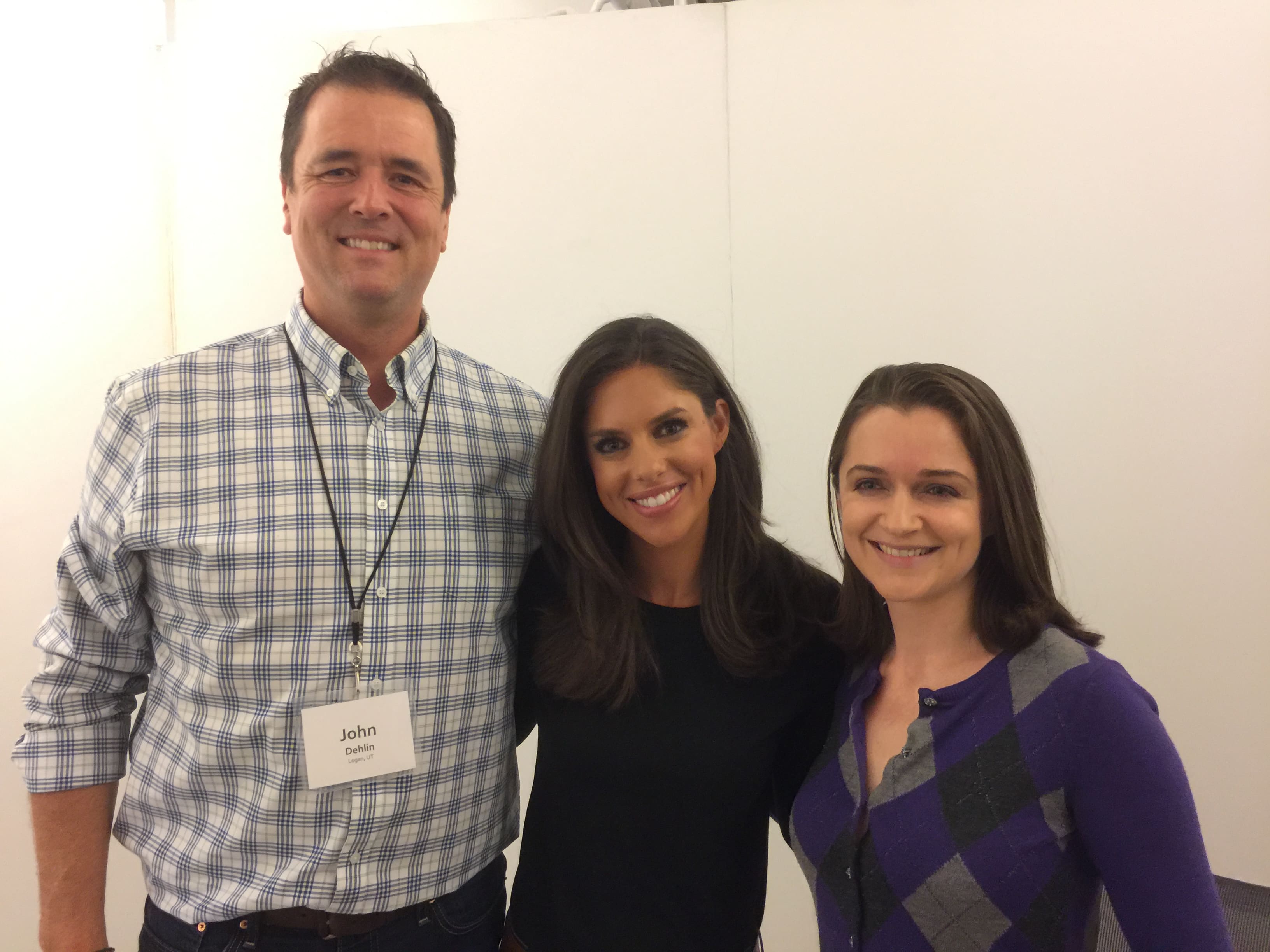
Abby Huntsman, then a host on Fox & Friends, walked into the 2016 Mormon Transitions New York Retreat and said it felt like a room that understood emotions she was still working through. She and journalist Carrie Sheffield, a returning Mormon Stories guest, sat down with John Dehlin for a 45-minute conversation about what it was like for each of them to leave the church, followed by questions from the room.
Carrie describes an eight-generation Utah family and a pioneer ancestor, Jane Johnson Black, whose stories of sacrifice made leaving feel like an insult to the people she came from. She says she left for doctrinal and intellectual reasons, that the first couple of years were hell, and that she is much happier now. Abby says she “hit the lottery” with her immediate family, since her parents raised their children to be open-minded and the whole family transitioned together, but that even with family support there is nowhere obvious to go when you step away from something that told you why you exist. John asks her about the signals her father sent, while running for office, that he was not a typical Mormon.
In the Q&A, Abby talks about growing up feeling that questioning wasn’t allowed, the anxiety of trying to be perfect while teaching Relief Society, and holding onto a belief in Christ after letting go of the rules. An audience member asks for advice specific to women whose mothers can’t accept their leaving, and to men who want to support the women in their lives; Abby’s answer is that some people will never change, and you still have to live your life.
What’s covered
- 00:00 Introductions and the guests’ Mormon backgrounds
- 09:53 Leaving the church and the hardest parts of transition
- 28:48 Audience Q&A: faith, identity, and professional life
- 46:39 Advice, reflections, and closing thoughts
Related episodes: 505-506: Carrie Sheffield on Leaving Mormonism, Finding Stoicism, Politics, Conservatism and More
Episode Transcript
Host: John Dehlin · Guests: Abby Huntsman, Carrie Sheffield
This transcript is machine-generated and lightly edited for readability. The audio is authoritative. Please excuse occasional errors in names and spelling.
Welcome and Introductions
John Dehlin [00:00:00] So happy and honored to have Abby Huntsman and Carrie Sheffield here with us. I've gotten to know the Huntsman family just a tiny bit, both Abby and her sisters and her sister in law, but also James and Marianne and their family, including Heidi and Sam and others.
John Dehlin [00:00:20] And these are wonderful people. And Carrie Sheffield, Carrie Sheffield has been on Mormon Stories. We go several years back as well. She has a really wonderful episode on stoicism and sort of, sort of adopting a new framework for seeing the world after you've lost your framework of Mormonism. And for her, it's stoicism and it's a really great episode. So if you haven't heard Kerry's, check that out. We're glad. We're honored to have Abby here on Mormon Stories for the first time. We only have about 45 minutes for this discussion, so we're going to jump right in. I'm going to sit down and I hope you guys can shuffle your chairs in a way where you can see the people speaking.
John Dehlin [00:01:08] But we're just going to have kind of an informal bit of a Q and A. I'll leave it and we'll try and leave time for a conversation. Maybe 30 minutes in. We'll leave the last 15 minutes for kind of a Q and A. Is that okay?
Carrie Sheffield [00:01:20] Yes.
John Dehlin [00:01:20] All right, so please, so please join me in welcoming Abby Huntsman and Kerry Sheffield to the. Okay, just for the sake of time and efficiency, I'm gonna have each of you introduce yourselves. So, Abby, if you don't mind, just tell us a little bit about yourself and your high level resume in terms of, like what you do in your life and a little bit about yourself.
Abby Huntsman [00:01:49] I think we're all still trying to figure that out at this point. But thanks for the introduction and it is so great to be here. Right. When I walked in, I felt like this is a room that understands so many of my own emotions that I've gone through and continue to go through. So I'm Abby Huntsman.
Abby Huntsman [00:02:03] I actually live two blocks from here with my husband who's in the room with me. I currently work for Fox News, host on Fox and Friends. And yeah, I mean, I've got a story I think similar to a lot of you. I think we all have a different story to tell. And I met Kerry through relating to some of those same emotions. And we're both in the media world. But anyway, so I'm happy to be here. I'm happy to be here with my family, too. My Uncle James and Aunt Marianne and their kids and my sister Liddy. So anyway, I'm excited for this discussion. It's be good.
John Dehlin [00:02:33] We're dying to talk about FOX News for a bit.
Abby Huntsman [00:02:37] Oh, gosh,
John Dehlin [00:02:40] Kerry, tell us a bit about yourself.
Carrie Sheffield [00:02:41] Sure. Well, if you want to go to John Dillon's podcast. I'm sorry, there's a two hour conversation with me. So you can read that and that will be enough, I think. But I am an entrepreneur. I just founded a media company. It will be a year ago on November 30, which is Mitchell Churchill's birthday. He is my ideal conservative and so we launched it on his birthday. But I'm also a media commentator and I do a fair bit of penetrary on Fox, but also miss NBC and CNN and different channels.
Carrie Sheffield [00:03:12] And so, yeah, I was raised Mormon. I left the church. I wrote about it in the Washington Post about why I left. And I wrote that in 2012 when Mitt Romney was running. And I had hoped that we would have more progress because of all the scrutiny and press attention. And I think we got some. But then when it all went away, I think we kind of regressed a little bit. But that's me.
John Dehlin [00:03:36] Beautiful. So, Abby, tell us a bit about your upbringing in the church and what church was like in your family in terms of, like, what it meant to you and how you guys, how Mormonism sort of manifested in your family, whatever you're comfortable sharing and just sort of some of the touch points that sort of would reflect us. What the church meant to you in your life when you guys were in it?
Abby and Carrie on Growing Up in the Church
Abby Huntsman [00:04:03] Yeah, no, that's a good question. It was really everything. So I'm one of seven kids, come from a huge family, bazillion cousins, and we were all raised in the church. My great grandpa was one of the twelve apostles, David B. Haight. So it's always been something that is close to my heart. And I'm so grateful for being raised in the church because I think it taught me so much about myself and about values and about family and the importance of that. But my mom wasn't raised Mormon. She was actually Episcopalian and her parents are still Episcopalian.
Carrie Sheffield [00:04:39] And so I always.
Abby Huntsman [00:04:41] And we moved around a lot. I lived in Asia for a number of years. And so my parents did a really good job of raising us in the church, but also making sure we understood other faiths and appreciating the Episcopal Church where my mom was raised. And she ultimately was baptized in high school and then to Utah and then she married my dad.
Abby Huntsman [00:05:00] So for me, it was really everything. And I Thought it was going to be the rest of my life. I mean, I had a missionary. I ended up moving to Pennsylvania, going to school at U. Penn. And I thought he'd come back and we'd get married and I would stay in Utah and have a bunch of kids, and that would have been great.
Abby Huntsman [00:05:18] And so I moved to Penn, to Philly, and I taught Relief Society in the ward there and really tried to get as involved as I could with the community. And then, you know, you start to have questions and everyone's story is different. And I often get asked, what was that moment for you? When did you realize that this wasn't for you or you had real questions? And I think all growing up, I probably had moments where I questioned things. Even my mom makes fun of me. When I was five years old, I loved coffee ice cream. She goes, oh, we're going to be in trouble with this girl already disobeying.
Carrie Sheffield [00:05:52] But
Abby Huntsman [00:05:55] I think for me, growing up, I questioned oftentimes my mom's parents, who, as I mentioned, are Episcopalian, who are the most wonderful people you will ever meet in your entire life? And I asked my mom, I said, how come in the church they are not going to go to the celestial kingdom? How come they are such wonderful people? And yet I've met many people in the church, and there are some wonderful people in the church, but I've also met people who aren't so wonderful. How come they're going to make it there and your parents will not? And she could never answer that question for me.
Abby Huntsman [00:06:25] So that when I was younger, always confused me then. I also had a lot of friends who are gay. And I still have many friends that I'm very close to who are gay or, you know, whatever. You don't have to be defined as anything. But the way the church handled that issue, I always struggled with. And so when I got to Penn, I taught really society and really tried my best to be a part of the church, because that's what you're told to do. You know, when you move out of Utah, you gotta stay close to the. Because that is what you're supposed to. You're supposed to obey.
Abby Huntsman [00:07:02] And I tried to date all the Mormon guys there. And I realized after a while, after a few bad boyfriends, I told my parents that I don't care who I meet next, I'm just gonna find someone who I love and I wanna be with, and we'll see where that goes. And three weeks later, I met.
Carrie Sheffield [00:07:17] I mean, I'll get emotional.
Abby Huntsman [00:07:18] I met my Husband who's in this room now, he was a Mormon. He was Episcopalian. And I still was going to church and still trying to make it work. So, you know, we'll see where this goes. You know, I don't know if this will end up being a real relationship or not, but he was just the most wonderful person I ever met. Just so kind, so loving, never judging, and never really asked about the church. He didn't really have a problem. He said, hey, I just love you for who you are. The bishop called me in about a month into hearing that I was dating someone that was not of the faith.
Abby Huntsman [00:07:46] And I'll never forget this sitting across from him in his office, and he said, you know, I'm very concerned about you. And a lot of us are here, and we've heard that you are dating someone who's not of the faith. And you realize that if you marry him, your kids won't be blessed.
Abby Huntsman [00:08:03] They will not go to the celestial kingdom. And I just sat there for a minute and I thought, I've been dating this guy a month now. All I know is that he's the best person that I've met, and I've dated a lot of Mormon guys.
Abby Huntsman [00:08:18] And I was so hurt by that because he didn't know Jeff. He didn't know anything about him. He didn't really know me, frankly. He didn't know anything about me. I walked out of there that day, and that was the moment for me. I said, I can't do this. I can't do this because I love too much. I love people regardless of what their religion is or what their background is or what their sex is, and ended up being the person that I was supposed to marry. And he has changed my life, and he's loved me every day ever since then. And obviously, my story is far more complicated than that, as all of yours are.
Abby Huntsman [00:08:53] So people ask, are you Mormon? Are you not? You can't even answer that question because it's a tough one, it's an emotional one. And it was so much of who I was and who I still am to this day.
Abby Huntsman [00:09:04] But that's just a little bit of sorry it went on forever. But that's a little bit of my story and. And where I'm at today.
Guest [00:09:10] Thank you.
John Dehlin [00:09:11] Thank you. Abby Kerry, tell us, tell us quickly your sort of what the church meant to you early and then what kind of was your breaking point.
Carrie Sheffield [00:09:21] Sure. So for me, the church really meant everything. It meant the trajectory of my life. It meant where I was going to spend My energy, my time and talents, and everything that I had planned to devote my. My everything, too. So when I realized that I couldn't believe the literal claims that I was making, that really shattered everything for me.
Carrie Sheffield [00:09:45] And I'm from a multi generational Utah family, I think eight generation. One of my ancestors was a surgeon and midwife, and she helped nurse back John Taylor to life when he was shot in Carthage jail, along with the Prophet or whatever, however you view him, Joseph Smith.
Carrie Sheffield [00:10:09] And so for me and she, there's a whole book written about her. Her name is Jane Johnston Black. She was always my icon and hero, especially she was on my mother's side. And my mom would always talk about her. And she's having this strong female. She, at one point, the prophet Brigham Young assigned her to go in the middle of nowhere in Utah with her husband to colonize the desert. And she was so strong, they had Native Americans walking around their house just with no warning and threatening them. And at one point, she literally had to saw off a man's thigh because he needed an amputation.
Carrie Sheffield [00:10:47] And she was the only surgeon around, and she just did it by hand with a hacksaw. And so whenever I'm going through hard times now with my journey, I'm just
Abby Huntsman [00:10:55] like, you know what?
Carrie Sheffield [00:10:56] I'm not sawing that style right now. I think that I'm okay. But just those stories of courage and sacrifice, for me, I'm sure lots of you have the same stories that you've been told. And so for me, to give up the Mormon Church was really to kind of insult my ancestors. And that was really hard and heavy. But for me, I ultimately. And again, if you want to hear the whole story, it's in the podcast of how I left. But for me, it ultimately comes down to truth.
Carrie Sheffield [00:11:26] I went to Brigham Young as a journalist, studied there. I got my master's at Harvard. The motto of Harvard is Veritas, which is truth. And for me, I really believe that you shall know the truth, and truth will set you free. So it has been very difficult leaving. I left really for doctrinal and intellectual reasons. And it was like hell for the first couple years. But ultimately, I am so much happier and I am pursuing my truth. And I hope that all of you here, if you're going through a hard time, just pursue that truth and it will see you through.
John Dehlin [00:12:02] Thank you. Carrie. Abby, what had been. You know, people heard things from your dad as he was running for office that maybe signaled to a lot of Mormons that he wasn't your typical Mormon. And what I know about your family is that it seems like most of your family is kind of on the same page as you now. So I guess in some sense you kind of hit the lottery in terms of what it was like for you to actually leave. But maybe, I would guess that maybe with extended family or in other contexts, there were really hard things about making that decision. Can you talk to us about maybe what the hardest things have been for you in your decision to kind of disengage from the church? Whatever you're comfortable sharing?
Leaving the Church and Family Reactions
Abby Huntsman [00:12:51] Yeah, no, I did hit the lottery with my individual family because my dad's someone who was very spiritual and he still is one of the most spiritual people I've ever met. But when it comes to religion and orthodoxy, he has a hard time just because he is so open minded and he just loves people for who they are. And so he raised us with that mindset. And I've been so lucky because my family, we all sort of transitioned together.
Abby Huntsman [00:13:14] My parents always were kind of the way they are now, but they wanted to raise us in the church. And now we're all the same and we all understand each other and we're going through this together, which has helped me so much. And I can't even imagine how hard that must be to not have your family. And I know that so many people are going through that and it separates families. And that's so, so hard, I think, for so many people on an emotional journey.
Abby Huntsman [00:13:40] But for me, even with that, even with the family support, it hasn't been easy all the time. Because religion is so much more than going to church every Sunday and meeting up with your community and, you know, trying to obey. It's who we are, it's why we believe that we're here. Right? It's just so much bigger than that. And so when you step away from it, it's not like there's a place for you to go to say, well, here's another religion that's just more open, that's go go there. When you leave the church, you feel like you have nowhere to go.
Abby Huntsman [00:14:12] When you go from being so obedient and feeling like you have to, you believe the Joseph Smith story, right? Just stepping away from that, you feel lost and you don't know where to go from there. And you're sort of in this weird period of one foot in, one foot out, where you still kind of go to church, but then you're questioning it. And then with other people that aren't Mormon, you're living a different Life. And from what I found is that is the hardest place to be. Is this in between phase of admitting to yourself where you want to be and what it is you believe because you don't want to say, well, I'm just.
Abby Huntsman [00:14:47] I don't believe in anything. I'm just not spiritual. Because I know all of you here probably believe in something bigger than yourself and you believe in just being a good, kind person. And that's where I found myself. And now I'm to a place where I'm just. I'm happy and content with who I am, regardless of how anyone judges me. But in that transition period, and it has taken me years to get here, there are moments where you take a step back and you think, am I doing the right thing? You know, I mean, I was raised this way. What if I am wrong? What if, you know, what if.
Abby Huntsman [00:15:18] What if I'm crazy in all of this? And I think you have to get to a place where you are confident and comfortable with yourself. And my wedding day was a really tough one for me because I was the first one to get married in my family of, I don't know how many cousins are there? You know, 70 of us, maybe.
John Dehlin [00:15:33] I was gonna say more than 50.
Abby Huntsman [00:15:34] More than 50. More than 50. And I was the first to get married outside the church. And so I was nervous about embarrassing the family because our bloodlines are very thick in the church, very deep. And you know, my grandpa, great grandpa being One of the 12 apostles, my dad was governor of Utah, and even he was concerned about it. It's like, we shouldn't serve wine at the wedding.
Carrie Sheffield [00:15:58] We shouldn't.
Abby Huntsman [00:15:58] And I said no. Even my dad asked back. This was eight years ago. He said, would Jeff ever think about converting? And I said, dad, why? Why? Because that's what he's supposed to do. Because it's going to look better. And I said, no, he's not going to. And that's not what we're going to do.
Abby Huntsman [00:16:14] And we kind of laugh at that now. And my dad's so grateful that we have stayed true to who we are at this point. But you want to please. You want to please your family and please the people in the church. So I remember our rehearsal dinner. We did serve wine. And my grandparents and others, not everyone came because I think it was tough for some of my family to come to a non Mormon wedding, given that I'm in the family. We did serve one. I had the worst stomachache. I thought I was going to throw up. I actually was about to Just leave. I couldn't do it.
Abby Huntsman [00:16:43] And after that, I woke up the next morning on my wedding day, and it was almost like a relief. Like, I pulled off the band aid, we've done this. Like we are here. And I was so happy that I did the wedding that I wanted to do because I was true to myself. But like I said, it's not easy. And I know all of you in here, this is an emotional thing and this for me, too, even with the family that for the most part supports me. But it's a journey and it is not easy. And there's still going to continue to be moments where it's hard.
Abby Huntsman [00:17:10] It is hard. And you have to have a community. You have to have this. You have to have people that you talk to that get you, because you can't do this by yourself. So if you don't have a family that's on board, honestly, John, thanks to you, I mean, you've really done such a good job of bringing a community together to talk because it's not like we are anti church or anti Mormons or anti our family that are. There's some people that might still want
Carrie Sheffield [00:17:30] to be in it.
Abby Huntsman [00:17:31] It's just people that understand what we're going through and understand our emotions. And I'm grateful for that. I'm grateful for my family and for our community because that's what gets us through. Honestly.
John Dehlin [00:17:42] I want to clap for.
Carrie Sheffield [00:17:49] Kerry.
John Dehlin [00:17:49] Thank you. Thank you, Abby. Kerry, what have been the most difficult parts about the transition for you?
Carrie Sheffield [00:17:54] Yeah, so I think it's very, you're very blessed that you had the family to go with you to transition out. For me, it was a lot more difficult in the sense that, yeah, I was the first to leave and I didn't have that support. And I wrote about this in my Washington Post essay how basically my father, my father comes from a fairly successful family. My grandfather was majority whip or certain Republican whip in the Utah legislature for a long time before I was ever he actually, this is a long story. I could say he died actually the week before I was born.
Carrie Sheffield [00:18:31] And I still feel very connected to him in a lot of ways that maybe I'll share someday. But, you know, he was, if you drive around Salt Lake, he was on the, I think it was the chair of the Zoning and Planning Commission for Salt Lake and a successful attorney. And his daughter was Miss USA. She was dates of 47, including my aunt.
Carrie Sheffield [00:18:51] So, you know, he came from a successful family. But my father kind of took a more hardline term and so maybe Some of, you know, kind of the hardline person in your ward, or maybe it was in your family. But my father was much more, I think, hardline, and the most hardline of all his family. And so when I disagreed with him on religion, he went out on me home for about four and a half, almost five years. And so, you know, it was not easy, but I haven't talked about it publicly.
Carrie Sheffield [00:19:22] But ultimately it did make me stronger. It really did, because it. I don't know why I'm getting emotional, but don't talk about it. But ultimately, you know, again, I'll refer to the podcast if we're short on time. But I did come on stoicism after trying out lots of different religions to kind of guide me through this process. I went to Protestant church. I was dating a Catholic guy. We really hit things off because he was ex Opus dei, which is like a small kind of extreme subset of a thing, Catholicism. And so for an ex Mormon and ex Opus DEI person, we had a lot in common.
Carrie Sheffield [00:20:01] So I went to Catholic church for a while, and I went to an evangelical megachurch for a while. It was funny because the day before, the first time I went, I had gone to a Coldplay concert. And I walked into this church the next day and I was like, I'm still at the Coldplay concert.
Carrie Sheffield [00:20:18] And I really tried to get into it, but I think because Mormonism is kind of more traditional with the songs, and I just couldn't get over the rock music in church. For me, I just. It didn't really sink.
Carrie Sheffield [00:20:30] And so just over time, I realized that. I remember the first Christmas when I realized I didn't necessarily believe in the literal narrative of the divinity of Christ, at least in the way that traditional Christianity believes in it. That was a very hard Christmas for me because it was just like, is this all fake fiction? Like, is was hard to let that go. But again, I felt strengthened by the pursuit of truth and just knowing that even if it was a hard time now, I felt comfort in knowing that I was being true to what I perceived as the truth.
Carrie Sheffield [00:21:11] And so that's eventually fast forward. I did come upon stoicism, which is really a school of thought. It's not a religion. It's more a philosophy and way of looking at the world. But I talk a lot about it in my podcast with John. But it's basically. It was a school of ancient thought in Greece. The Stoics were from the ruling families. They would send their sons. Women weren't allowed to. The school of stoicism which is to learn about how to live a good and a virtuous life. It's really centered on your life, on principles, which I think Mormonism does.
Carrie Sheffield [00:21:45] And I sort of was so angry that I kind of threw that worldview out. And coming back to that, I think I came to terms with what I had left behind. And I think that is something that we all have to do as we're going through this journey.
Abby Huntsman [00:22:00] Can I just add one thing to this topic, please? I think we can all relate to the feeling of fear and anxiety during this transition, no matter where you are in that pathway or if you are staying in or getting out of wanting to be perfect. And I just remember in college going back to my coffee addiction. Apparently I would get chai tea because I thought, well, that's okay. I can at least get shy and I won't smell like coffee. But even when I would see people that were in the ward that would be in that area or at Starbucks, I would leave. Like, I remember one time they said, abby, you know, Abby, your order.
Abby Huntsman [00:22:38] And I just walked right out. I'm like, I can't get that. Or, like, just stuffing it in the bottom of my trash can because people from the ward were coming over and they could not see a Starbucks cup. I just remember those moments of just living ins. It's funny, now we laugh because, like, that's ridiculous. This is a cup of coffee. I mean, it's insane. But living in this fear and wanting to please everyone around you. And the Truman show, that last scene, that was so perfect, I think, for what so many of us feel. Because that moment where you feel free, where you feel like, I'm okay with this.
Abby Huntsman [00:23:10] I'm okay walking in holding a cup of Starbucks coffee, and I don't have one bit of anxiety anymore to get to that point. It is so freeing, and it feels so good to actually accept yourself. And I think no matter where you are in this journey, getting there, it's worth it in the end, to your point of it's hard. And there are going to be moments where you're wondering, is it even worth going through this? But in the end, that feeling that you have is going to be so much better than you ever were before that point. So getting over that fear is huge.
John Dehlin [00:23:37] Beautiful. Thank you. And, Kerry, really quickly, I just want you to know I also found your story to be beautiful. So I'm going to clap for Kerry as well. And I do want to clarify one thing. Sometimes when I think about stoicism, I think about, like, well, emotions are bad and have to get rid of. Talk really quickly about the role of emotions in stoicism. Just really briefly.
Guest [00:24:00] Yeah.
Carrie Sheffield [00:24:00] So for me, the way I interpret stoicism with emotion, it's really about mastering your emotions and to know that. I think that in the Mormon Church, we kind of in testimony meeting, we have these very public displays of emotion where if you're crying, that means you're somehow more virtuous or something, and just really feeling like the Holy Spirit is something that you can't control, it just kind of hits you. And I think that I had been taught that I just couldn't really control how I was feeling at the time. And what stoicism really teaches you is I think it's really a cognitive process that emotions, we can really process them and control them in a very healthy way and to not suppress them at all, but to really trace kind of like the evolution of where is this emotion coming from?
Carrie Sheffield [00:24:47] So it's really. There's a formula. It's abc activating event, belief and cognition. So when something happens to you, if you're going through this journey and it's an activating event that is a trigger or whatever that's causing you some sort of distress, you realize there is an A and then there's a B, because the B is your belief about that activating event. And so many people think that they don't have that B step and the cognition or the consequence is how you respond to it. And I think most people just go from A to C and they skip that B step. And stoicism for me, really taught me that I have that B step, which is my belief about this emotional response.
John Dehlin [00:25:26] And I think that's getting at what we're trying to talk about, about connection to the self and emotion. I think that ties in beautifully.
Carrie Sheffield [00:25:33] And one other thing about stoicism, Mormonism, what's really funny is there's actually stoic. It's called stoic con. Stoic convention. It's actually happening this weekend. And I'm like, I'm so tur.
John Dehlin [00:25:46] It's here in New York.
Abby Huntsman [00:25:48] Only in New York.
Carrie Sheffield [00:25:49] Well, they actually have it in London too. And this is the first time they're having in New York. So I'm going to go there later. And some of them might come to karaoke. I'm trying to, like, blend. But one concept first with very helpful. Helpful is a phrase that they use.
Carrie Sheffield [00:26:07] It's the phrase of amor fati, which is love of fate. To realize that anything that happens to you is really your decision about how you respond to that. And if you love whatever happens to you, in the end, you own it and you master it. So for me, it's like, okay, yeah, my dad's gonna shut me out for, you know, five years. You know what that means? I'm gonna be so freaking productive. And I'm gonna do five internships before I get my first job because those other lazy classmates of mine at byu, they're little named Pammies and they're going home sleeping on the parents couch for the summer.
Carrie Sheffield [00:26:36] I'm going to go to freaking New York City and work for Newsweek for the summer. You know what? So it's really like learning to love what happens to you. And that is something that is incredibly empowering. So for me, it's like all the rejection and all the anger and disappointments that I get from my family, it was like I was able to just do this concept now to really love all of that, which sounds kind of like weird to love things that are hard or that suck, but in the end, if you learn to love them, then they become your treasures.
Guest 2 [00:27:10] Beautiful.
John Dehlin [00:27:11] And if any of you are looking for sort of a new framework to replace the spiritual framework that you had within the church, stoicism is great. I also recommend a podcast called Secular Buddhism that my friend Noah Rochetta runs. But Buddhism is all about acceptance, and that ties into amor fati. If you can learn to accept what's in front of you, it turns out there's so much health and growth that can come from it versus trying to resist what is in front of you. And that's just creating more suffering, it turns out.
John Dehlin [00:27:45] So there's a huge power in acceptance. So, Abby, just with a few minutes before we open up to Q and A, if you had a few lessons you've learned, maybe I don't want to call it advice, but if you have some perspective to share with a bunch of people who are in the middle of their transition, their self awakening, do you have any sort of lessons or insight that you've gained that maybe you would share with some of the people here, knowing that none of us are experts and you're not even asked to give advice, but just perspective.
Audience Q&A on Faith Transitions
Abby Huntsman [00:28:16] You can pay me later, John. Okay. You know, I was thinking about it when Kerry was speaking about questioning. You know, you ever notice we're not allowed to question in the church? You're not allowed to ask questions. You're not allowed to be curious. You're not allowed to wonder why things are the way they are, why we believe in still polygamy, when you die, those sorts of things that I always struggled with growing up, you're not allowed to question. And then on fast and testimony meeting, I always wondered this because. Because oftentimes, almost always people would get up there and they would say, you know, I had, you know, I had a moment, just a slight moment where I questioned.
Abby Huntsman [00:28:51] But now I realize this is the only true church. And I'm thinking, how many people have questioned and had tough moments but could never tell anybody, but they always have to come back to saying, but I know this church is true and don't worry, you know, it was just, you know, it helped me realize that I need to be here.
Abby Huntsman [00:29:08] Because we all question. We all have those moments. You know, I would say everyone's story is so different. So it's hard to give advice on what, you know, each of you collectively have to do to get to a certain place where you're happy and confident with yourself.
John Dehlin [00:29:24] But just what's worked for you?
Abby Huntsman [00:29:26] What's worked for me? You know what I think? Still holding onto my spirituality and still knowing that I believe in Christ and believing in something for me personally, that has kept me going and knowing that I'm a good person. Because what it comes down to for me is not the rules. It's not about what we, you know, are allowed to do or shouldn't be doing. That doesn't matter to me. I think life is so much more complicated than that. We all have our own story. We all have, you know, whether it comes to. To our religious backgrounds or our ethnicity or our sexuality, whatever that is, I don't care.
Abby Huntsman [00:30:07] I think that we need to get to a place in life. Even in politics, you can put that in there as well, where we just accept people. So for me, it is just. It's been about trying to be the best person I can be. And as long as I'm. That I'm happy and I'm okay, you know, because I found when I was in the church and trying to be the best, and then I was teaching myself society and trying to help other women, I was scared a lot. I had a lot of anxiety because I was trying to be perfect. And I felt like even as much as I tried, I still wasn't good enough.
Abby Huntsman [00:30:38] I remember teaching a lesson in religious society when I was at Penn, and I put a picture of Christ on the table and my whole lesson, frankly, I didn't understand the lesson they gave me to teach. I was like, I'm not going to the manual. I'm not going to do that. So I talked about Christ and how we should all be more accepting of each other and less judgmental, because in the church, we tend to judge people because they aren't as good as they should be, or we're always looking over the fence to see what are they doing. Well, do they have their garments on?
Abby Huntsman [00:31:06] Are they drinking wine? Are they drinking. Enough of that. So I try to teach a lesson about just accepting each other. And that very day, I get an email from the head of Relief Society saying, we're really disappointed in you. You didn't stick to the manual, and you didn't teach a lesson that we were expecting you to give. At the same time, in my Facebook page, I had about five emails from women in the class saying, I still can't get over the lesson that you gave.
Abby Huntsman [00:31:32] I was in tears because it's exactly what I needed to hear because I had been struggling. And I think what a disconnect between what the women that are leading religious society wanted to be teaching and what the people needed to hear in that moment, just about not judging and accepting people. And I think if we can all get there and, you know, you're being a good person, that's all you need to know about yourself. And you're making this world better. So it's gonna be. You're have people that judge you. You're gonna have people that whisper about you and your family or your friends or people that, you know, you used to be friends with.
Abby Huntsman [00:32:04] But that's okay, I think, as long as you're okay with yourself. That is what has led me here. And honestly, having a husband who is loved and accepted, accepted me for who I am, it's been so.
Carrie Sheffield [00:32:13] So helpful. But that's.
Abby Huntsman [00:32:15] That's been my journey.
Carrie Sheffield [00:32:16] So beautiful.
Guest 2 [00:32:19] Beautiful.
Abby Huntsman [00:32:19] There's a sebo here that is driving us crazy.
John Dehlin [00:32:22] I'll grab it. I had in my hand. I should have squashed it.
Guest [00:32:27] Evil.
John Dehlin [00:32:30] Carrie, what are. What are some. Some important points of wisdom or perspective, other than what you've shared, that you would share for others to consider what works for them?
Carrie Sheffield [00:32:41] Yeah, I really like what Abby said about not having to just have that, you know, correlation manual guide your life. Like, for me, it was funny. When I was, you know, basically my senior year at byu, I just floated in terms of. I did not believe the literal claims, but I still, at this point, more of a boyfriend at the time. And I.
Carrie Sheffield [00:33:05] He said to me, like, when I told him I was thinking of leaving, he was like, so you just want to go? Look at pornography all day then, right? No, I want to have my journey enlargened. And I do like the articles of faith where it talks about if there's anything virtual, lovely or of good reporter praiseworthy. We seek out for these things. Like, I think that Mormon culture is really beautiful in that way, but there's always that, like the boundaries of where that falls. So it's not anything. It's like whatever is in the correlation manual that's beautiful and blah, blah, blah. And so for me, I found just not to say that like, these books wouldn't be allowed by the church, but I've just found that I have found comfort and wisdom from a lot of books that are not, you know, wouldn't necessarily be taught in Sunday school.
Carrie Sheffield [00:34:00] I made a couple notes on books that were meaningful for me. Viktor Frankl's Man's Search for Meaning. If you haven't heard that, I very much recommend that he was a Holocaust survivor and just talked about the purpose of life is the purpose that we create. And for me, that was really beautiful to learn because my purpose had been taken away when I said stop believing in Mormonism. So I would recommend that book. I would also recommend reading about the life of Corrie Ten Boone. She was again fought the resistance protecting members of the Jewish faith in Europe in World War II, and she was a Christian and she was taken to concentration camp.
Carrie Sheffield [00:34:40] And just her narrative of how she survived that and it really is a story about love and grace. And there's also. I really. And I know that you worked for the Huffington Post. Arian Huffington's book called Thrive is a really great collection of wisdom and thoughts. And there's a quote in there that says that there is a hidden purpose in alchemy and suffering that's transmitted into wisdom and strength. And so I think that hidden alchemy is something that each of us can create in our lives as we're going through this, this period of suffering.
John Dehlin [00:35:14] Beautiful, thank you. Okay, we have about 10 minutes left. So I want to open, open the floor up to questions. I'm going to put a microphone right here. I'm going to make everyone who asks a question come up and speak into the microphone. For the benefit of the audio recording. You won't be on camera, but your voice will be heard instead of sort of muffled. So if you guys to want to line up just right over here, I'm going to ask you guys to avoid. Sometimes people like to kind of monologue as their question. And I'm just going to say, please don't do that because we literally have 10 minutes. So if you want to make a statement, make a one sentence statement and sit down. But we prefer questions to our guests because we want to hear them. So please come up here and ask your question.
Abby Huntsman [00:36:04] How do you deal with questions at work where people ask you about your Mormonism and your past Mormonism?
Carrie Sheffield [00:36:10] In the professional world, that's a good question.
Abby Huntsman [00:36:15] You want to start.
Carrie Sheffield [00:36:16] Well, as an entrepreneur, I'm the boss, so I don't have anyone telling me, but no, I have a lot of clients that I provide content for, honestly, because I stopped practicing in 2005. For me, the church is not part of my day to day life.
Carrie Sheffield [00:36:32] I don't talk to my father. I'm just estranged from him. So I guess in that sense it's sort of like a quarantine so I don't have to deal with that. And since I left, some other, my siblings have left. I have their 8 kids in my family. And so those who have left as well, we've sort of really bonded. And so I do have them. But other than that, I don't really have Mormonism in my day to day life, so. But I still talk about it because it's always part of you. I think I've heard someone say once, it's like you can't wash it off.
Carrie Sheffield [00:37:03] You can't wash the Mormonism off. So I think it's definitely part of who I am. But I think in politics, being from Utah, it's a very unique state. So every now and then someone might ask me a question about that being from Utah. And I cover the Utah legislation for the Daily Herald and worked for the Daily Universe. And by the way, I love the BYU newspaper name is the Daily Universe. It's just like amazing. I was the editor of the Universe.
Carrie Sheffield [00:37:33] But yeah, I think that for me, and again, this has come with time. At the beginning, it was very hard for me. When I first left and I was working, I was at Politico, if you know, politico.com when they were a startup.
Carrie Sheffield [00:37:47] And I was still very, I was still very angry at the church. So I actually like had all these stories of how I was going to expose the church using Politico or like other freelancing journalism. And over time I just realized that that's, that's not healthy.
Carrie Sheffield [00:38:03] I think that there is a way to have a healthy dialogue. And when I did write that essay about why I left the church in 2012, I know that I was told that there were some and leaders in Salt Lake who did notice. So I was able to have impact. And it was very hard for me to write that essay, but I'm very glad that I did. And that really kind of put me on the course of how I met John. And so for me, I just always, again, I fall back on truth. And the truth is I see it comfortable as a truth.
Abby Huntsman [00:38:34] Luckily, Fox, my religion is not the top of their radar at the moment. Other challenges to deal with. But, you know, today I ask that question all the time as well. And obviously, like all of you in this room, it's quite complicated. So for people that don't really understand the church and it's, are you Mormon? I usually just say I was raised Mormon. I'm no longer active. But, you know, I very much respect everyone in the church and all that, but I've gone my own way. But for me, I had a moment where I had to make that decision of, am I honest about this in my professional life, or do I just continue to say I'm Mormon and all that?
Abby Huntsman [00:39:17] So I sat down with Brian Williams. That's the story of his own these days, not the CBA world. I sat down for Rock center, and this is when Mitt Romney was running. So they were doing a whole special on Mormonism and trying to help the American people and the voters understand the faith. And I decided to open up about what I'd been through, and I talked about the situation that I had with the bishop and how the church is still to this day, very black and white. And they've got to learn how to evolve and to be more accepting. And I was open about that, but also just still very respectful to the church.
Abby Huntsman [00:39:52] That helped because now that story's been told, and I think people know that story. But I will tell you, after I did that, my husband's here. He could tell you. I went in hiding for days. I cried for days because the messages that I got were so horrific. Things that you can't even imagine about me personally, about things that they wanted to do to me from Mormons, from very active Mormons, monologues on my Face Facebook page and emails and tweets.
Abby Huntsman [00:40:27] It was. That was probably the hardest few days of my transition coming out of the church was that time. And I don't even think my husband was wonderful at the time, but I don't even think he understood the deep emotions that I felt that many of you in this room would feel because you have all experienced it, I'm sure, on some level and have received comments this was so public and so hard. But now I'm so glad that I did it because. Because I also got the same amount of comments that said, thank you. You are telling the same story that I have, and I feel the same way that you do, and I'm so glad that you make me feel better about it.
Abby Huntsman [00:41:02] At the time, it was hard for me to appreciate those comments because I let all the hate impact me. And then I questioned, why did I do this? That was a really, really tough few days when it really went into a depression of sorts of.
Abby Huntsman [00:41:16] But I'm grateful that I did now because people can go online and see, okay, this is who she is, and she went through this. And frankly, it was just a really honest story about what I've been through. And if anyone is just being honest with themselves, and they'll say, you know what? I've been through that, too.
John Dehlin [00:41:32] There really is a power when it's right, when it's safe in coming out and being fully authentic. There's something really powerful about that. Our LGBT friends know this better than we do do. But it's true for us as well. Travis.
Guest [00:41:47] So you guys really left the church because you wanted to drink coffee? That's not.
Carrie Sheffield [00:41:55] Wait, by the way, have you. If you haven't seen the Book of Mormon, I have to say Abby triggered me when she's talking about coffee. There's a scene in hell where it's Genghis Khan is playing the flute, which is obviously getting his con. Should be an L, but it's like, there's a Starbucks coffee cup dancing, right? Dancing. Starbucks is not the same.
John Dehlin [00:42:14] And Hitler and Jeffrey Dahmer. Don't forget that
Guest [00:42:18] tiny monologue. You guys both coming out and publicly talking about your stories had a big impact on me. And I think Carrie, especially that article you wrote, it kind of set into motion everything to the essays being released. It was a really good big deal. But that's not my question. So I'm, you know, rookie into stoicism, you know, And I know that I'm not supposed to care when people, like, don't.
Abby Huntsman [00:42:45] You should love it.
Carrie Sheffield [00:42:48] Don't even. Not, like, don't obstruct it. Okay. It's part of the journey.
Guest [00:42:52] But how do you guys. And you're in public positions, and you take a lot of heat when you come out, especially a few years ago. How do you not let it bother you? Because you both seem pretty Zen right now.
Abby Huntsman [00:43:04] Right now. Not during those three days. Yeah.
Carrie Sheffield [00:43:10] I think for me, I meditate every morning, and that's something that has made a big difference. Like, I think for a while I, you know, because I used to do that growing up. Like, that was one thing about having a very strict dad. And he literally wouldn't let us eat breakfast until we read our scriptures. So it was like, you need to free your soul before you feed your belly. That's what he would say. So, like, I would do that, you know. And I think it created this habit for me to set the tone of the day of, like, I am going to have a good day, I am going to pray.
Carrie Sheffield [00:43:37] I'm going to tap into something bigger than myself. And for a while, when I was going through my anger phase, I stopped doing that. And that was a dark period in my life. And for me. So I do meditate every morning.
Carrie Sheffield [00:43:49] Usually if I sleep in, then I might rush, but that helps. Reading these books that I mentioned, just really finding people who have gone through similar journeys, it gives me courage and it gives me confidence to know that, you know what, like, again, I'm not hacking a man's thigh off right now, or I'm not in a concentration camp. And I read the stories of what they've been through and just how they process the emotions. And that has. I mean, I write down, I have this whole little quote book of wisdom that I read in the morning. And to me, that really solidifies my intention for the day.
Abby Huntsman [00:44:30] Haven't you heard people say you're worse off if you were Mormon and you left than if you just never knew about it anyway? And I always felt so anxious about that when I was going through this transition, because I'm like, what if I'm totally wrong here? And then, so you're screwed in the end.
Abby Huntsman [00:44:47] A lot of wine has been helpful. I think you're right. I think it's people. I think it is being around people that accept you and that love you and that make you feel like it's okay to just be you? I think having a community is so key if you don't have your family, because not everyone does, unfortunately. In the church, you've got to find friends that.
Abby Huntsman [00:45:12] Not just friends that are like, oh, it's fine, we accept you. Friends that understand, friends that have been through it too, that have these deep emotions because they are very real and they're hard to explain to people that don't understand, that haven't been in the Mormon Church.
Abby Huntsman [00:45:26] It's complicated, right? I mean, that's the only way I can describe it. It's complicated. It's hard for us to even Understand the emotions that we're feeling, let alone explain them. So having other people where you can just even in this room to look around and say, I kind of get you guys, there's a comfort there that is so helpful. So I would just say surround yourself with people whenever you're having a hard moment. Go meet up for lunch or coffee or someone and talk. And it'll make you feel better because you'll realize that other people are going through it too, versus sitting there and feeling like you're all alone and that you're in the wrong somehow. It's just have a community.
John Dehlin [00:46:04] Thank you. Last question, quick. Make it quick. Super quick. Walk through the microphone.
Advice for Those Considering Leaving
Guest 2 [00:46:10] Okay, so I have a few friends who are women whose mothers are very hypercritical of them wanting to leave. And we live in a society that's very hypercritical of women. And so my question is your experience in leaving and find the life outside, is there any gender specific advice you would give? And then is there any advice for men that you would give who are trying to help the women in their lives?
John Dehlin [00:46:39] Love that question.
Carrie Sheffield [00:46:40] Thank you so much.
John Dehlin [00:46:41] Love that question.
Guest 2 [00:46:46] Super quick, super quick question.
John Dehlin [00:46:47] Advice to women. Advice to women. Advice to men.
Abby Huntsman [00:46:52] I can't speak for men necessarily, but I do think they have a real responsibility in the church because they're the only ones that hold the power, as you know, to be more accepting and understanding. But the women thing is really interesting that you bring that up. Even my grandma, you guys know this will say if the women leaves, then the family leaves because the women kind of holds the family together, which my mom has received on numerous occasions, because our family sort of.
Abby Huntsman [00:47:21] I do think that women, mothers that have a hard time accepting their kids and what they're going through, oftentimes they're struggling too, and they hold on to the church as the one thing they have and all that they know. And so sometimes they can be even harder on people and they can't understand.
Abby Huntsman [00:47:44] It's usually those that begin to open themselves up to say, okay, well, let me try to understand what you're going through. Those are the people that are the happiest, I think, that are the most open, I think advice for gender for women, that's a tough one. I think it's your mom. You never want to let down. Right. So that's a really tough situation to be in. I think just conversations and talking it out and doing your best. And if that doesn't work, then you have to just say, you know what? Some people, you're never going to change. Sometimes you're just never going to change the way they think about things.
Abby Huntsman [00:48:21] And I can't let that ruin me. I have to live my life and it's heartbreaking. It's really hard when families have to break up because of that. But at the end of the day, you have to be happy. You have to be true to who you are, true to yourself.
Abby Huntsman [00:48:32] And as a woman, I think more now than ever, women have to be empowered to have that strength and that confidence and know that society is now to a place where they're going to be accepted. And if it's not in their home and it's not in their church, it's going to be outside of that. It's going to be in their communities, it's going to be in their family, you know, in their work environment or elsewhere.
Carrie Sheffield [00:48:54] I think for me, being raised in very strict gender roles, this is what you shall do as a woman. You know, I have five brothers and they were allowed to ride their bikes more than I was, further vicinity, you know, further radius than I was. And they got to do. They were allowed to hold, you know, a paper route job or have an outside job, but I wasn't allowed to do that. And I remember once my mom was like, what do you want to be when you grow up? I was like, I want to be president. She's like, no, you can't be president. Your husband would have to be president.
Carrie Sheffield [00:49:21] I was like, well, he can be vice president. She's like, no, that's wrong. So for me, I think I had to actually make a very conscious effort to stop thinking about being a woman. Because I think that. And I'm not saying I'm not repressing myself just to tell you, John, I'm not repressed just in the sense that I feel like I had to kind of remove some of that conditioning to tell myself that, you know what, it's not fair that in the afterlife that a man can have multiple wives, but I can't have multiple. That's just inherently not fair. So, like, you know, that's part of why I left.
Carrie Sheffield [00:49:58] Not that I want to have multiple husbands, but like, just the, like, structure of it not being fair. And I think also again, to truth, like, truth is gender neutral. Like, truth is something that we can, no matter what our gender is, we follow.
Carrie Sheffield [00:50:14] And so I remember actually I used to spend a lot of time on exmormon.org and a ton of different websites like Beliefnet. And for me, that was my support group since I didn't have the family support in person. So it's like a bunch of random strangers I didn't know sharing their stories, which was so important.
Carrie Sheffield [00:50:29] I remember once and I used like a gender neutral name for my posting. And I remember once someone thought that I was man when I was posting and I was like, yes.
Abby Huntsman [00:50:38] I was like, he thinks I'm a man. And then I'm like, you know what?
Carrie Sheffield [00:50:42] That's really messed up that I think that that's a compliment. And I think that, like, that I have to feel like my thoughts aren't worthwhile unless someone thinks I'm a man. But I think that that's the Mormon conditioning. And so I think for me, it's like, as I have learned about stoicism and really tried to follow my commitment to truth, I sometimes I'm like, oh, yeah, I am a woman. I don't know, it's funny, but I try not to gender stereotype like that. And I think that's. That's worked for me. Maybe that's too general, but as far as my mom is concerned, sadly, she. She is, I think, emotionally abused by my dad and she's kind of subservient to him.
Carrie Sheffield [00:51:27] She. So I had that modeling again for me growing up. And, you know, she. And I've tried to help her a little bit to kind of push back against my dad. I do talk about to her, but she sadly is just so entrenched in, you know, her religious beliefs that, you know, she. She's really sad about what I've done, and there's nothing I can do that would police her unless I go back.
Carrie Sheffield [00:51:52] And I just. It is like Abby said, sometimes you just have to know that that's. You can't change. She can't change me, I can't change her. And it's just, again, that acceptance.
John Dehlin [00:52:04] Beautiful. Well, thank you for your questions, gentlemen. We're out of time. But I do want to just close by saying it's one thing to go through this faith crisis. I've experienced a tiny bit of what it's like to go through this in the public eye and just to reflect on what Travis said.
John Dehlin [00:52:33] It is deeply meaningful for us to have some of you willing to come out publicly and face the very public fiery darts of opposition to stand for your truth and to shine so brightly. And I just want you guys to know that.
John Dehlin [00:53:00] I sit in my basement sometimes feeling a lot of pain. And it means so much to me to see Abby Huntsman and Carrie Sheffield out there shining so brightly. Their light to the world, and it just means a lot to us.
John Dehlin [00:53:16] So thank you. So keep shining and we'll talk about Donald Trump and the Republican Party at other time. But thank you guys so much for coming. Can we give them one final round of applause? So you guys take care. Thanks for coming. Keep doing great work, and maybe we'll have you guys back after the election season's over.
Abby Huntsman [00:53:51] Let's do it.
John Dehlin [00:53:52] To talk about what the crap is going on.
Transcript © 2026 John P. Dehlin. All rights reserved. Brief quotations are welcome with attribution and a link to mormonstories.org; all other use requires written permission.

24 Responses
I can’t tell you how many times I’ve heard the idea of feeling like you’re living in limbo. You feel good or comfortable in the Church and you don’t have the social skills that help you outside in the Church. That’s part of why the LDS Church does so poorly with their missionary work. Members can’t relate to non-members and non-members can’t relate to the Church members. The relationships in the Church are pretty paper thin and inauthentic because you don’t usually talk about anything meaningful or personal.
It’s very difficult without a community to share the journey with and assuring you that you’re ok The experience of growing up in the Church is a very skewed view of reality and is it any wonder why leaving is such a challenge. That’s part of why those who leave struggle with “leaving it alone” because they’ve been so immersed in it. Great interview and exchange.
I found the Church through torments of the damned and was almost finished as a seeker of CHRIST. You guys that have /had the Church basically don’t have a covering for your sin with,especially, being born under the Covenant. Wait till you see the number that satan can do and it is horrific without me breaking that down into it’s component parts. Good luck against the adversary. I hope your stalwart relatives/friends are praying for you. I wouldn’t dare do what you’re’casually’ doing! True Church is Seriouse stuff try not to find out the Hard Way!
So So good and so helpful! Thank you all so very much! incredible and so inspiring. Yes….. you are doing right and wonderful work. It helps me to realize that 99% of all people are not indoctrinated Mormons. You all are GREAT PEOPLE….. stay humble.
I sure appreciate you two ladies talking of your experiences and how an ex-Mormon community helps you so much. How I wish that my wife and I could participate in such a thing. We have been non-attenders for over four years now and it is still hard. We live in a rural area in western Idaho, some 25 miles from three wards. We have 4 active families, including the bishop within a half mile of us, but past friends have a tendency to avoid us.
We have attended three Christian churches in the last 3 months, but after a while I think it likely that they will ask if we are Christian. We just want fellowship and understand that they would never understand our anxiety as LDS dropouts. After all the study for us to leave Mormonism, I kept studying and now do not in any way believe in Jesus being a divine being.
If there any communities like you have found, they would be around a 4-5 hour drive from us. We have had three families drop out in the past 5 years, from our ward, one became a Baptist, one some sort of believer of some deity, and us. But I want to at least study stoicism. I have been looking some at Buddhism but can’t seem to get much interest.
At first I was very angry at the Church and wanted to tell all my member friends what I had found, but I have discontinued that. I would love to get them to watch Mormon Stories, but I get no interest. I may be isolated but without Mormon Stories I would be in trouble. Thanks again, Abbie, Carrie, and John.
I’m sorry that you are feeling so isolated. I think that you are right about the Christian churches. Many are accepting at first in the hope that you will become a “born-again” believer, but not very welcoming later if you don’t conform. On the other hand, I do think that many Christian churches also have closeted agnostics and atheists in their midst. I’m guessing that this would be more common in liberal-leaning denominations.
The Congregational United Church of Christ in my city has a great slogan “A Safe Place to Explore Faith”.
Maybe, as more and more people are looking for a sense of community outside of religion, we will create additional safe gathering spaces in our towns and cities. Like you and your wife, I find great comfort and community within Mormon Stories.
Thank-you, Debbie, for those comments.
Since we are both seventy and not having much to sell, we are pretty well stuck in this areas until we die and this area is a bit unusual. Mormons at least used to be in the prepper-food storage mode. Well, this place is that way with both Mormons and non-Mormons. It is a place where many live off the grid and could be termed survivalists. And since there are no building permits required around here, the housing, like ours (without a well for example), makes selling pretty hard.
There are many churches here but fundamentalism is very strong, so I will probably look to Mormon Stories for my socialization.
Having been there some, I can occasionally talk to polygamists and past ones, or those who believe the earth is flat and part of some conspiracy, or those who hope a revolution is coming, or those who may be members of the several militias in the area, or even the gun crowd (There are probably more firearms per capita in this county than any other in this country), but as time go on I have even less in common with them.
That does sound isolating. I’m so glad that you can find at least some community and support here.
Please take full advantage of the internet and possibly find someone to Skype with. Religion is so private …..the internet is a fantastic medium to connect. Many understand and feel the same thought and emotions.
I can certainly appreciate what you are going through. My sweetheart and I left the church in the late 90’s and I am happy to report that there is indeed, life outside the cult!
Since that time we have studied many different ideas and faiths, but the Spirit never moved us to join anything. It is really important to understand the difference between the Spirit and simply emotions–which is what almost all testimonies in the church are based upon.
After years of searching, I lost my sweetheart to multiple brain anyurisms and so for the last almost six years I have been on my own. Most of our nine children have abandoned their father and that is the worst part about all this. They all left the church and have not replaced it with anything else. Because of my zeal while in the church and my beliefs about what is possible with faith, my children have grown tired of listening to me, and no longer pay any attention to what I have to offer in the way of a belief system.
Long story short, I would suggest that you get very familiar with a man by the name of Neville Goddard. You will really enjoy his take on Jesus Christ and what that patern is really all about. Jesus is the patern man of scripture. The bible is NOT a history lesson, instead it is salvation history. May I humbly suggest that you go to the following link and listen to some. https://www.youtube.com/watch?v=I_jRUKfVn38&list=PLxQDthgW68QUebGSjLJSW0bLs3T9B7R_5
After listening to and reading a ton of Nevilles stuff, I can honestly say that the scriptures are all of a sudden coming alive and making sense, for the first time in my life.
Good luck, and God be with you
Christ has been misrepresented to you your entire lives. Don’t blame Jesus for those who claim to represent Him. I invite you to give Christ another chance and to pick up a copy of the king James Bible and understand his deity. Simply, Jesus loves you and died in your place as a final sacrifice for sin. Accepting Him is your only way to eternal life in paradise! What a better way to live out your retirement than in the loving arms of God and His son Jesus. Give those Christian churches another try and explain your questions. If they condemn you then on to the next. If you don’t feel welcome you know Christ isn’t there. That’s one way to test a church. If you don’t feel welcome when you walk in the door then you know they don’t know Jesus. Jesus welcomes all.
Thank you. This is a beautifully honest and thought provoking interview. I love the stoic tie-ins.
Does anyone know where I can find a link to Abby’s New York Times article that is discussed in the interview? I’d love to hear more of her story. Thanks.
Because I’m still transitioning out of Mormonism, I appreciate these interviews, so thank you John.
Abby and Carrie’s stories were touching and helpful. I felt inspired as a woman at their successes as well.
Thank you for sharing ladies!
https://www.google.ca/search?as_q=%22abby+huntsman%22+mormon&as_epq=&as_oq=&as_eq=&as_nlo=&as_nhi=&lr=&cr=&as_qdr=all&as_sitesearch=nytimes.com&as_occt=any&safe=images&as_filetype=&as_rights=#as_qdr=all&q=%22abby+huntsman%22+site:nytimes.com
I so enjoyed this quick interview with Abby and Carrie. As a working single mom of 4 kids who lived as an active Mormon for most of my life, it’s healimg to hear how other women, especially professional women, have moved forward with their lives. I’m envious they both left activity before kids. I was especially touched with Carrie’s story of having to let go of her parents’ judgements, and was delighted to hear the Huntsman family has transitioned together. Thank you for being public about your journeys. It inspires me to be more open about mine.
John, Why only 45 min? Don’t you know some of us wake up hoping there is something new on Mormon stories. I could have listened to Abby and Carrie for much longer. They are smart and wonderful. Listening to you guys is like brain candy! Please feed our addiction
That’s all the time she had! I was grateful for the 45!!! Hoping to have her on again after the election.
John,
I was so looking forward to your comments or questions about Fox News to Abby as you had indicated at the beginning of the interview, but that didn’t happen. I hope there’ll be another opportunity in the future to interview her again.
Thanks for this great conversation with them and for all your efforts, John!
Me too, Sara! We simply ran out of time. I am hoping to get Abby back on after the election. Crossing my fingers.
Yes, I should be grateful for the 45 min also. You are my people, I’m sure many can relate. I get impatient and want more. But thank you, thank you !!!!!
John, you seemed particularly moved by Abby and Carrie – you seemed to get emotional at the end. Care to share what triggered that response to their stories?
Yes, it is okay to be you! Carrie and Abby, thank you for sharing your personal stories; you are an inspiration to me. I wish you both the very best!
This was wonderful. Thank you so much, John, for these Mormon Stories podcasts. Abby is very fortunate to have a family that supports her, and Carrie, I’m sorry your father has rejected you; that must really have been painful. Both of you were amazing to me, and thank you so much.
I am what would be known as a non-church member, nor have ever been m contact personally with any LDS PERSONS, other then through Ancestry.com contact. However, I found the video w/Huntsman & scheffild wonderfully refreshing having experienced my own journey away from My childhood religion of Roman Catholicism. While viewing the interview, I senses that God graces are active in many ways, & in many places. May His Name be praised for His wonderful works toward the children of man.
Thank you for this inspiring and extremely helpful interview. When someone asks me about my religion I simply reply that I am a “Recovering Mormon”. I feel that sums up the struggle that leaving the church causes. Keep up the great work and to people newly leaving the church, hang in there! It WILL get better, I promise!