
“Faith and Reason, Conscience and Conflict: The Paths of Lowell Bennion, Sterling McMurrin, and Obert Tanner”
April 12, 2014
McMurrin Lecture: In her lecture, Flake defines an intellectual as one who loves and is committed to the life of the mind, one for whom thought is both a delight and a necessity, a source as well as means for human flourishing. This does not mean a life without conflicts, as illustrated by three intellectuals – Lowell Bennion, Sterling McMurrin, and Obert Tanner. Flake will consider their intellectual lives in relation to the religious culture from which they came. Doing so will tell us something about whether there is a Mormon intellectual tradition and, if so, what are its distinctive features.
Kathleen Flake holds the Richard L. Bushman Chair of Mormon Studies at the University of Virginia. She is the author of The Politics of American Religious Identity: The Seating of Senator Reed Smoot, Mormon Apostle (University of North Carolina Press, 2004).
Professor Flake has been awarded grants from the Mellon Foundation, Lily Endowment, Pew Charitable Trusts, and American Philosophical Society. She has held office in the American Academy of Religion, the American Society of Church History, and the Southeastern Commission for the Study of Religion. Frequently invited to comment on Mormonism in the news, she is also a panelist for the Washington Post/Newsweek “On Faith” blog.
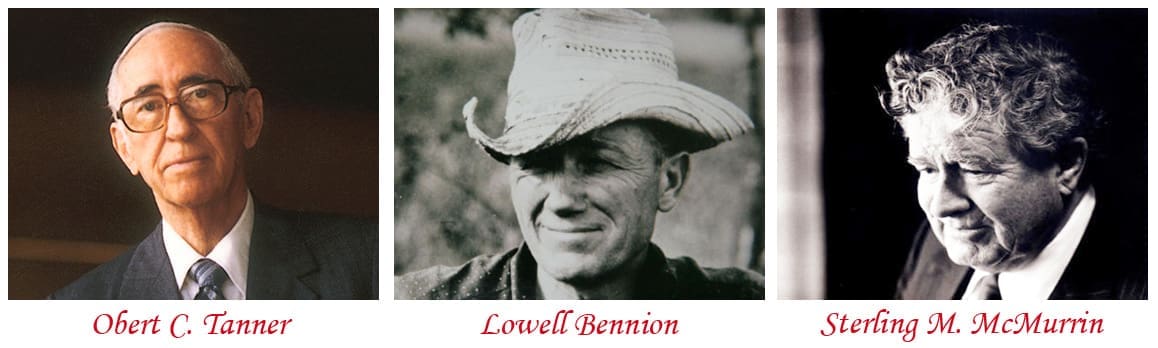
Symposium: Mormonism is often seen as a religion of conformity, with a hierarchy in tight control of members’ beliefs and behavior. Yet this perspective misses a rich tradition of intellectual independence and principled dissent. With an eye to the present and future, the Tanner Humanities Center will offer a unique symposium on the lives and legacies of Sterling M. McMurrin, Obert C. Tanner, and Lowell L. Bennion. Their stories reveal the tensions between faith and reason, conformity and dissent. This symposium will mark the 25th anniversary of the founding of the Obert C. and Grace A. Tanner Humanities Center.
Panels include “Challenge of Conscience: Sterling M. McMurrin” (9:00-10:30 AM), with Bob Goldberg (Chair), Jack Newell, James Clayton, and Brian Birch; “Challenge of Loyalty: Lowell Bennion” (11:00 AM-12:30 PM), with Irene Fisher (Chair), Greg Prince, Tony Morgan, Sam Allen, and Emma Lou Thayne; and “Challenge of Faith: Obert C. Tanner” (1:30-3:00 PM), with Greg Thompson (Chair), Kent Murdock, Bob Goldberg, and Grethe Peterson. A concluding panel, titled “Public Men and the Challenge of Their Private Worlds” (3:30-5:00 PM), will focus upon the personal, intellectual, and working relationships that existed among these men, with panelists Linda King Newell (Chair), Carolyn Tanner Irish, Ellen Bennion Stone, Charlotte Hansen Terry, and Bill McMurrin.
These three intellectuals who shared a determination to act were rooted in Mormonism, but possessed distinctive visions that penetrated beyond their treasured religious heritage and drove them to embrace—and respond to—the pressing social, cultural, and political issues of their time. With mutual respect, but using distinctive methods, Tanner, McMurrin and Bennion shared a passion for justice and impatience with racial discrimination in their church and across American society. At various points in their careers, they served the LDS Church, the University of Utah, their state, and the nation in pursuit of their visions of a more enlightened and humane society.
Pursuing justice and adhering to conscience brought its own rewards, but also exacted a cost. As Director of the University of Utah’s LDS Institute of Religion, Lowell Bennion chafed at supporting church authorities in their denial of the priesthood to African American men. Largely over this issue, he surrendered this post, swallowed his disappointment, and vigorously channeled his religious instincts into serving the needy in Salt Lake City. Sterling McMurrin chose to proclaim himself a heretic and relished that identity, but lost friendships and some sense of community. Obert Tanner, a closet skeptic, muffled his doubt and kept his silence to play prominent roles in the life of his country, state, and city.
Symposium speakers and panelists will not only examine the specific, contemporary impacts of Lowell Bennion, Sterling McMurrin, and O.C. Tanner, but also consider their enduring legacies on the issues facing the Mormon Church today: the inclusion of women more fully in church leadership circles, the need to face painful facets of church history more honestly, the challenge of retaining the engagement or affiliation of socially and culturally liberal members and young adults, the quest to understand the effects of new technologies on Mormon practices and beliefs, and other concerns of our time. A concluding panel will focus upon the personal, intellectual, and working relationships that existed among these men.
The Tanner Center is partnering with the College of Humanities, Smith-Pettit Foundation, and Michael Morris to bring you this event.
Episode Transcript
This transcript is machine-generated and lightly edited for readability. The audio is authoritative. Please excuse occasional errors in names and spelling.
Welcome and Introduction of the Lecturer
Bob Goldberg [00:00:05] I'll do that right now. Ladies and gentlemen, ladies and gentlemen, please, please, please. We have a full house tonight, so please, if you can either signal where a seat is open or scrunch a bit. Thank you so much.
Bob Goldberg [00:00:24] Ah, great. Good evening. Good evening. Welcome to the 23rd Annual Sterling McMurran Lecture on Religion and Culture. And a welcome also to KCPW radio listeners. My name is Bob Goldberg and I'm the director of the Tanner Humanities center at the University of Utah. Please take a moment to silence your cell phones, pagers and all things, all things that might beep in the night.
Bob Goldberg [00:01:05] Sterling McMurran died in 1996. He left a profound legacy of scholarship and service. Professor McMurran taught in both the Philosophy and History departments. He served the university as Dean of the College of Letters and Science, Dean of the Graduate School. Academic Vice President and Provost Sterling McMurran also held the position of United States Commissioner of Education under President John F. Kennedy. In sterling's name, the McMurran Lecture on Religion and Culture was established.
Bob Goldberg [00:01:38] Its goal is to bring the best scholarship on religion to our students, faculty and Utah community. Previous McMurran lecturers have included Krista Tippett, Reza Aslan Thuptin Jimpa and Laurel Thatchell Ulrich. Please note. Please note that this lecture tonight is a part of the University of Utah's Mormon Studies Initiative. It is also the keynote address for our conference tomorrow. Faith and Reason, Conscience and Conflict. The Paths of Lowell Bennion, Sterling McMurran and Obert Tanner. The conference begins tomorrow at 9am will be held in the Tanner Humanities center in the Carolyn Tanner Irish Building on the campus of the University of Utah. Again, 9am campus of the University of Utah in the Irish Humanities Building.
Bob Goldberg [00:02:30] To introduce this year's McMurran Lecturer, please welcome Jack Newell, University of Utah Professor Emeritus and former Dean of the Liberal Arts Program, and Professor Emeritus and President Emeritus of Deep Springs College in California. Jack.
Jack Newell [00:02:57] Thank you, Bob. And welcome to everyone. Gee, it's a great thing to look out and see such a. Such a wonderful audience for tonight's event. It's my privilege, as Bob Goldberg just mentioned, to introduce our keynote speaker Tonight and the 23rd Annual McMurran Lecture on Religion and Culture at the University of Utah.
Jack Newell [00:03:19] We just had a delightful dinner with Professor Flake and it's a special privilege to be able to introduce her. Now, Kathleen Flake has been around academically. She began her education at byu, where she earned her baccalaureate degree, and then redeemed herself by proceeding to the University of Utah, where she earned her Juris Doctor degree.
Jack Newell [00:03:42] From here she went to Washington, D.C. where she spent about 16 years as a trial attorney for the United States Department of Education, Civil Rights Division, and then as Chief Counsel, Chief General Counsel to the fdic. While she was busy with those years as an attorney, to keep herself busy and occupied, she decided to take a Master's degree in Religious Studies at the Catholic University of America.
Jack Newell [00:04:11] Having finished that, she got curious about other worlds, became a recovering attorney, and proceeded to the University of Chicago, where she studied American religious history. From there she went to Vanderbilt University in the year 2000 and spent 13 years on the faculty there in the School of Divinity, teaching a wide range of courses on religion in America, with a specialty, as you might guess, in the legal side of the relationship between religion and government in America.
Jack Newell [00:04:44] After 13 years at Vanderbilt University, she accepted the Richard L. Bushman Chair in Religious Studies at the University of Virginia, where she is just completing her first year. Her landmark publication is the Politics Religious the Seating of Senator Reed Smoot, a Mormon apostle. That was 1994 by the University of North Carolina Press, and the next year it won the Mormon History Association's Best Book of the Year award.
Jack Newell [00:05:12] She's at work now on another book for the University of North Carolina, and we look forward to seeing that. In the meantime, she's published an unbelievable number of articles on religious history and religion in America, and she has been a commentator on just about every national and international news organization you can believe. Except Fox News, I think, is the only one I noticed was not there. So with that, I introduce Professor Kathleen Flake. Kathleen,
Kathleen Flake [00:05:56] Thank you. And let me also thank Professor Goldberg and the Tanner Humanities center for this invitation. I am truly honored to be here and it is a great pleasure as well. Of course, the series itself is a great honor for me to participate in, but I feel especially tonight, it's an honor to be invited into that circle of deep, deep affection that these three men have been held in for so many years. And I'm so grateful to be here.
Introducing Bennion, McMurrin, and Tanner
Kathleen Flake [00:06:30] Now, some of you know Lowell Binion, Sterling McMurran and Obert Tanner, not from afar, but as friends, even as fathers. For those of you who don't, I look forward to introducing you to them and to their contributions which warrant the attention they are going to receive in the next couple of days.
Kathleen Flake [00:06:49] I have chosen to emphasize those facts about them that reveal their intellectual commitments in an anti intellectual period of LDS history. Admittedly, this will by no means capture their full character. Those of you who knew them personally may feel that keenly as I speak. I apologize for that and am relieved to know that tomorrow's panels will treat them individually, each on his own merits and in greater detail.
Kathleen Flake [00:07:16] Let me acknowledge also that not only in detail but also in their focus. Tomorrow's panels will compensate for my remarks. You may have noticed these panels are dedicated to discussing the men's, and I quote here, distinctive visions that penetrated beyond the their treasured religious heritage.
Kathleen Flake [00:07:35] I, on the other hand, will be inviting you to think about them in terms of their religious heritage, sometimes treasured, sometimes not. I was struck by an unusual turn of phrase, however, in the description of these panels. The reference to distinctive visions that penetrated beyond, typically one merely goes beyond or extends beyond something. But here a more forceful term is used, as if there were a barrier in need of breaching in order to be free of the limits of their religious heritage.
Kathleen Flake [00:08:06] Though the usage is unusual, the sentiment is not. Of course. Indeed, the sentiment is so familiar that it has the ring of common sense. Reason and faith are assumed to be diametrically opposed. That is the problem with stereotypes. They usually begin with a generally accepted type. A type so generally accepted that it shortcuts reason.
Kathleen Flake [00:08:26] And that, my friends, is what being intellectual is all about. You know, reason. So let us reason together tonight about what these men have to teach us about being reasonable and religious. First, a caveat. However, I suppose a second caveat. It is only reasonable to begin by admitting that conflicts between reason and faith are not limited to those of the Mormon faith, but common to all faiths. Indeed, it contributes to the very definition of modernity, and my students of variety religious stripes wrestle with it. Nevertheless, the conflict has a social location, as we intellectuals like to say about everything. It takes its shape and form from historically specific cares and aspirations, anxieties and confidences of of the people who engage in the conflict.
Kathleen Flake [00:09:18] Therefore, faithful reasoners or reasonably faithful people have reacted in various kinds of ways. Tonight I would like to consider the way in which these three great men, Professors Tanner, Binion and McMurran, responded to the religious conflicts of their time and place.
Three Lives Spanning the American Century
Kathleen Flake [00:09:40] Now our subjects lives span nearly the entire American century, as the 20th century has been called. All three arrived within a decade of one another, beginning with Obert Tanner's birth in 1904. It was a time of radical change and expansion for the nation certainly, but no less for Mormonism. The LDS Church was about to recover from the economic costs of the onerous anti polygamy campaign and had just placed an apostle in the United States Senate. Reed Smoot would represent both church and state for 30 years, rising to the highest levels of political influence. Thus our subjects arrived at a time when the LDS Church was moving out onto the national stage with unprecedented authority and about to follow the American flag abroad.
Kathleen Flake [00:10:30] Obert Tanner, or Obert Clark Tanner, we should say, was born in Farmington, Utah, the 10th child of Annie Clark Tanner and her absentee husband. From her journal, which Obert took such pains to publish, we get a glimpse of his life, too. The personal, moral, economic, and, yes, religious conflicts which were the warp and woof of his formative years.
Kathleen Flake [00:10:53] Obert's birth coincided with the start of the Smoot hearings in Washington, D.C. he would not have remembered the details, of course, since he was nine years old when the hearings ended. But you could say the consequences of those hearings were lived by him as he saw the church's diminishing moral support for his family's way of life. The business he founded as a University of Utah undergraduate gave him for the rest of his life a degree of wealth which not only spared him repeating his family's poverty, but also their susceptibility to the church's fluctuating policies.
Kathleen Flake [00:11:28] Just four years younger than Obert, Lowell Binion, too, grew up in this particularly torturous period period in Mormon family and ecclesiastical life. But he had a much easier time of it. Reared in what appears to have been an idyllic setting in Salt Lake suburbs, he met family expectations for educational excellence and sincere religious piety. His parents had not followed their parents into the principle. More influential on their son was their educational aspirations and attainments. Trained at Columbia, his father, Milton, was a professional educator and in turn named his son Son Lowell after the Boston intelligentsia.
Kathleen Flake [00:12:05] The son did not disappoint him, as we shall see. Also influential on the young man, however, were early and rewarding experiences with ranching that left Lowell with a great affection for tent living, cold showers and dawn to dusk labor.
Kathleen Flake [00:12:19] Not unlike his later friend and colleague Sterling McMurran, Stirling, like the other two, was a child of the Mormon pioneers and richly connected to LDS leadership, both middle and high. On his mother's side, he had the benefit of connections to the Moss family, founders and later general managers of the Deseret Livestock Company. Summers working in the real world of the ranch seemed to have been for him an antidote to his more cultured, even formal environment of his paternal grandparents.
Kathleen Flake [00:12:52] He later recalled that a visit from his grandfather McMurran was very much like a visiting church authority in our home, and maybe that was because he was one holding, as he did, one of the top 20 positions in the LDS hierarchy. Though sterling spoke emphatically of his deep love and indebtedness to both grandfathers, later interviews show his mother's family and their ranch made the more lasting impression. He was especially impressed that for grandfather Moses, Mormonism was simply an inherited problem property like the color of his eyes. And though he was a bishop and a genuinely devout person, the church didn't own him.
Kathleen Flake [00:13:34] The same could be said of his grandson. His chief chronicler introduced him as inevitably free. In each case, these men's families placed them close to the origins of church authority. They were of a generation that inherited a level of familiarity with church high hierarchs that made them less high.
Kathleen Flake [00:13:54] That would soon end. Church authority was itself changing. During these years, Mormonism was modernizing with the rest of America. It was a progressing era, a time of enthusiasm for professionalization and specialization, in other words, for higher education and bureaucratic ordering with their rational approaches to any problem.
Kathleen Flake [00:14:18] The new generation of church leadership David McKay, James Talmadge, Richard Lyman, John Widtso were college men, not frontiersmen. With them came the ordering of church auxiliaries and quorums according to their specialization and application of corporate principles and educational curricula. As William Hartley has shown, and I can't resist sharing this with you, it was no longer permissible to alternate religious lessons with readings from Frank among the rancheros and pigs is pigs. All of that ended in this era.
Kathleen Flake [00:14:50] True to the spirit of our time, our subjects joined the out migration of Mormons who sought professional training after receiving baccalaureate degrees at home from the University of Utah. All three spread their wings abroad by a mixture of opportunity and talent as well as their own resolve. They received degrees from some of the world's finest institutions.
Kathleen Flake [00:15:10] Local Lowell's intellectual aspirations drew him to the German research university, but Nazism drove him back across the border to be credentialed by the University of Strasbourg. There he produced the first work on Weber in English and the first work in any language synthesizing the great sociologist methods. Such accomplishments notwithstanding, he chose to commit the next 30 years of his life working in the LDS Church's education system.
Kathleen Flake [00:15:38] The institute he founded at the University of Utah was his sanctuary, he said, and he experienced deep satisfaction there later, upon being forced out of the institute. The story we'll return to in a minute. He served as the University of Utah's associate dean of students and on its sociology faculty for a decade before retiring. He appeared to never regret dropping his innovative work on labor, and he seemed to never regret having had a purely research appointment. He wrote and gave lectures of another kind, though in the words of Mary Bradford, his former student and biographer, as a public intellectual he helped give rational consistency to Mormon thought, focused it on social morality and service, and he opened it to ecumenical dialogue.
Kathleen Flake [00:16:23] End of quote. The One of the three who may be least well known as an intellectual is Obert Tanner, benefactor of the center we celebrate today. Though it is not a bad thing to be best known for one's philanthropy, it is good to remember that his philanthropy was an expression of his intellect, his philosophical love for the good, the true and the beautiful, not just his charity. After receiving a Bachelor of Arts and of Law from the University of Utah, he went on to study law at Harvard as well and earned a degree and quote, Most of the PhD in Philosophy from Stanford before he finished.
Kathleen Flake [00:17:01] The premature death of his and Natalie's son apparently made them want to come home. Stanford's loss was Utah's gain. For nearly 30 years, Tanner was a full time professor at the University of Utah's philosophy department, authoring or co authoring 10 books. While on the faculty he added a JD to his credentials, but his interest was always academic. He never practiced law.
Kathleen Flake [00:17:24] Much more could be said, of course, especially about his influence not only on Utah's cultural community, but also in national and international circles. It must suffice to measure this aspect of his work by noting that it earned him the National Medal of Arts and the status of Honorary Fellow of the British Academy, Oxford University and Cambridge.
Kathleen Flake [00:17:45] Now Stirling MacMurran began his academic career setting history and Political Science and then earning a Master's of Philosophy at the U. He went on to obtain a doctorate in Philosophy at the University of Southern California and was immediately offered a position on their faculty. Twelve years later, he too returned to the University of Utah, joining Tanner on the philosophy faculty. Over the next 40 years, McMurran held many positions. Dean of the College of Letters and Science, academic Vice President, Provost, Dean of the Graduate School and founding member member of the Tanner Lectures on Human Values. Many honors followed, including the title Distinguished professor and the Rosenblatt Prize.
Kathleen Flake [00:18:25] With Tanner, he received the first Utah Governor's Award. McMurran was author or editor of 21 books and over 250 other publications. Midway through his tenure, he was appointed Commissioner of Education in the Kennedy Administration. But even that could not keep him from Utah. He returned home to complete his distinguished career with seven honorary degrees and two professorships named in his honor.
Kathleen Flake [00:18:51] It may come as a surprise to you that not only Binion but Also our other two intellectuals began their illustrious careers employed by the LDS Church education system. Obert Tanner taught at Stanford for five years. Meanwhile, Sterling McMurran labored in Zion's nether regions Richfield, Utah Montpelier, Idaho, and Tempe, Arizona, until he finished his doctoral training. One wonders how he stood it, and the answer is, unsurprisingly, not very well.
Kathleen Flake [00:19:23] We will pick up on that story, too, in a minute. For now, it is important simply to note that after stellar educations and multiple professional opportunities, each returned to Utah. And if they left again, it was for a limited purpose and time. All three were, as McMurran said of himself, 100% Utahn.
Kathleen Flake [00:19:42] I asked you to consider that this was not simply a matter of geography, place, but of culture. They were a product of and became producers of Mormon culture. They must have liked it for all their struggles with it, and sometimes we can forget that.
Kathleen Flake [00:19:59] Finally, let me point out, their lives were intertwined, though in too many ways. To enumerate a sample must suffice. All three met during their early years of professional formation. Binion remembered selling his Oldsmobile to a very young McMurran in the mid-1930s.
Kathleen Flake [00:20:17] Later, McMurran would replace Bennion at the Arizona Institute. They would trade places again When Bennion asked McMurran to assume leadership of a group called the Swearing Elders, a faculty study group at the University of Utah. Tanner and McMurran became fast friends in 1938 and office mates when they joined Utah's philosophy department, respectively, six and eight years later. Meanwhile, the Bennion and Tanner families were neighbors, both in the city and then, as their children grew in the suburban homes to which they moved in the mid-1940s, these ties bound them in times of crossing crisis as well. When McMurran was about to be put on trial for his church membership, Tanner made a beeline to his great and good friend Adam S.
Kathleen Flake [00:21:05] Binion, who was an apostle and who in turn told church president David McKay. This led to McKay's famous offer to serve as a witness on McMurran's behalf. As for Binion, when evicted from his institute sanctuary and wondering if his new academic assignment at the U would satisfy, he declared, if not, I'll quit and be Obert's gardener.
Kathleen Flake [00:21:32] It is not surprising that our three subjects knew each other so early and that their paths continued to cross so often. Early 20th century Mormonism made for a very, very small town in terms of human relationships, and it was still intact. In the 1950s, for example, university president Ray Olpin heard rumors at the local Barber shop about trouble brewing between McMurran and his bishop.
Kathleen Flake [00:21:56] So when asking McMurran to be dean of Arts and Sciences, actually after asking him, Olpin added, quote, by the way, is it true you've been excommunicated? Adding, the last time I got my hair cut there, someone said they were making you an apostle. Then someone said, no, no, he's being excommunicated. In the crowd.
Kathleen Flake [00:22:20] It was 1954, and Mormonism's small town had been invaded by a new crisis that drew our academics down from their ivory towers and out of their sanctuaries. Not just the norming of higher criticism and the evolutionary theory, but also the rise of the social sciences and advances in the physical sciences surfaced new challenges to biblical truth, but also challenges to religious tolerance and even rationalization of racial segregation.
Kathleen Flake [00:22:52] Meanwhile, virtually all believers in America joined in a modern holy war against godless communism. Fundamentalists, especially, were active on any front that offered hope of regaining the cultural authority they had lost in the 1920s. Mormonism did not escape these broad social forces. The moderate Republican consensus, which had served it so well during the Reed Smoot years, declined under pressure from the anti intellectualism of Joseph Fielding Smith and the anti communism of Ezra Taft Benson.
Kathleen Flake [00:23:26] It was at this historical moment our three heroes, now trained in the classic liberal arts of rhetoric and reason, reached their professional maturity. Little wonder, then, that they became enmeshed in this cultural contest. Two incidents have become symbolically potent for latter day saint intellectuals. First, the failed effort to excommunicate McMurran in 1954. And second, the successful purge of Bennion from the church educational system in 1962.
Institutional Conflict and Collective Memory
Kathleen Flake [00:23:56] Before considering these events in detail, let me suggest some reasons why Obert Tanner plays a marginal role in in the collective memory of these events. First, we know of no incident where he came into public conflict with the LDS Church. This may be because we don't have a comprehensive account of his life. Most of what we know comes from others. In their words, he appears to be, like McMurran, an academic, primarily to privilege that academic training and thus less likely to take certain fundamentalist concerns seriously.
Kathleen Flake [00:24:32] Moreover, again, like McBurn, his employment in the academy gave him distance that Bennion did not have. After all, it was Bennion's handing over to McMurran the swearing elders which gave McMurran the opportunity to do combat, as we shall see. On the other hand, Tanner seems to have been more like Bennion in his piety. Religious experience, not theological propositions, mattered to him.
Kathleen Flake [00:24:57] In published lectures, he voiced this deep preference. The argument from religious experience, he said, is like friendship, not a matter of proof but rather of experience. So too is beauty a matter of experience, also love and goodness, and so also is the experience of God. It is a deeper matter explained by the poet. And then he quotes the poet, earth is crammed with heaven, and every common bush afire with God, but only he who sees takes off his shoes.
Kathleen Flake [00:25:30] Finally, one can't help but wonder whether his status as a successful entrepreneur and generous benefactor gave him access to, or, as he chose, independence from institutional power that others did not have. Any of these factors could have placed him on the margins of fundamentalist conflicts. He spoke privately, not publicly, about what concerned him in church affairs.
Kathleen Flake [00:25:54] This loyalty, then, too, played a role. MacMurran summed up his friend's position this in the encounter with scientific knowledge and philosophic wisdom, Tanner moved from an early orthodoxy to a naturalistic and humanistic piety. But his devotion to his church, its traditions, and its people constantly strengthened rather than weakened.
Kathleen Flake [00:26:18] Tanner's omission does not mean he was not sympathetic to the difficulties his friends were having. Indeed, as I've said, he interceded on McMurran's behalf through a friendship with an LDS apostle. McMurran believed that that intercession precipitated McKay's support, which ultimately revealed the absurdity of the local bishop's concerns and presumably the futility of his efforts since the matter was dropped. As for the bishop's intentions, I think it's fair to say they remain a mystery. MacMurran himself never knew the exact cause. Cause he knew that they were concerned about the study group referred to earlier because he was invited to a meeting with Joseph Fielding Smith and Harold B.
Kathleen Flake [00:26:59] Lee on the question. The group evidently discussed the religiously charged issues of the day with great frankness and, it appears, some criticism. Lee asked McMurran, the leader of the group, would it be possible at the end of every session of these swearing elders, for you to summarize the position of the church and simply remind everyone what the beliefs are?
Kathleen Flake [00:27:26] End of quote. Seems modest, doesn't it? And his cousin replied, utterly impossible. Utterly impossible. This answer then led to a discussion of McMurran's own beliefs, as he had when in seminary. He responded honestly with his naturalistic views, including a denial of Jesus divinity as well as of the authenticity of the Book of Mormon. The two apostles seemed surprised, he said, but responded graciously, even adding their impression that he had the Holy Ghost.
Kathleen Flake [00:28:01] Now one must also understand that in their lexicon, in their way of understanding the world. That was the highest compliment they could give him. And so they parted in peace. Afterwards, McMurran left for a year on a Ford fellowship. When he returned, friends like Olpin told him they heard that he was in trouble. He scheduled a meeting with his bishop, a highly placed church bureaucrat who admitted his sense of duty, to determine whether an excommunication trial was appropriate. The bishop admitted also that no adverse witnesses could be found.
Kathleen Flake [00:28:37] He wondered, could Sterling help him? So opening the door wide open, Sterling walked through it and gave him the names of, quote, two members who are thoroughly acquainted with the depth of my heresies, end of quote. You've guessed that, I'm sure. He gave them the name of apostles Smith and Lee, which of course were another utter impossibility this time for the bishop.
Kathleen Flake [00:29:06] At this point, Obert Tanner interceded with David O. McKay, who outranked Smith, and we are robbed of the rest of the comedy. The matter quietly died. This story illustrates at least two concerns in the conversation about anti intellectualism and freedom of conscience, Mormon style.
Kathleen Flake [00:29:28] The first has to do with the range of belief among larity saints and the permissibility of expressing it. The second has to do with administrative anxiety about the swearing elders or intellectuals as sources of unbelief. McMurran cites McKay for liberality with respect to both propositions. To McMurran's self effacing statement that a person of my beliefs does not have a claim on membership in the church, end of quote. McKay is said to have angrily replied, now just what is it that that a person is not permitted to believe without being asked to leave this church? Just what is it? Is it evolution? I hope not, because I believe in evolution.
Kathleen Flake [00:30:09] End of quote. Now evolution was, as you may know, one of Joseph Fielding Smith's chief theological anxieties. Secondly, McMurran states that McKay, pointing in the direction of Smith and Lee's offices advised him, if those men try to get you in a corner again, you just refuse to answer them because what you believe is none of their business, end of quote.
Kathleen Flake [00:30:33] McMurran was convinced that Joseph Fielding Smith was behind the whole matter. But it did not matter. Four years later, in 1957, when Ohio State University asked the church to provide a lecture on Mormonism, McMurran was given the assignment.
Kathleen Flake [00:30:48] No small irony and no less a person than Harold B. Lee invited him to do so. McMurran's lecture was later repeated at the University of Utah and byu. He said one of the major strengths in Mormon theology is its concern for reasonableness in religion. He certainly made it sound so published as the Philosophical Foundations of Mormon Religion. His characterization of Mormonism is still in print.
Kathleen Flake [00:31:16] MacMurran remained, as he said of himself, the loyal opposition, a giver of in house criticism. He his preferred self description was a good, well rounded heretic, end of quote. This label was not only apt but also, I believe, served to create a useful boundary for him marking his independence within Mormonism. Lack of such independence was his chief criticism of his people. Whenever asked, he lamented his he lamented quote. The intellectual life of the church in terms of openness and free discussion has been going downhill since the deaths of B.H. roberts and James E. Talmage in 1933. End of quote.
Kathleen Flake [00:32:04] Now note this is the year that McMurran turned 19. Today we are hard pressed to think Talmadge as a free thinker or of Roberts as part of a free discussion. So MacMurran's nostalgia for these days may be, well, just nostalgia, even a reflection of a loss of his own innocence from the days when, with his father, he would read these men's theologizing.
Kathleen Flake [00:32:29] Nevertheless, as late as 1981 he told an interviewer, we are going through a stage of intense indoctrination in the church that robs the individual of intellectual freedom. End of quote. And he he was right. The last 20 years of the 20th century were a time when the LDS Church organization was fully bureaucratized and dogmatism dominated its official discourse.
Kathleen Flake [00:32:54] Those at mid century now going back to the 1950s, including McMurran at times who believed McKay was the exception and had a moderating effect, must admit he never publicly used his considerable authority to speak against dogmatism, at least publicly.
Kathleen Flake [00:33:11] Even when it was when this dogmatism was and he and others in his council believed it was doctrinally in error. This was especially fateful for Lowell Binion. Bennion's story is much more complicated and without a happy ending. He was known for his liberal views, but in his sanctuary at the institute and supervised by pragmatists at the general level of the church, he he had avoided conflict. This ended in the 1950s, when the church education system was reorganized and put at its head was the newly appointed BYU president, Ernest L. Wilkinson.
Kathleen Flake [00:33:51] Wilkinson wanted to replace institutes with junior colleges as feeder schools for byu, and Binion's program at the University of Utah was his biggest stumbling block. Through a number of strategies, Wilkinson ultimately forced Binion from his position. But this was made easier by Binion's having confronted two apostles at the recent annual conference for church educators he challenged one for his views on evolution, the other for his racism. He was called to account for himself, and the interview did not go well. Binion continued to insist on what appears to me, and probably to you, a rather mild proposition that students not be asked to choose between science and their faith, especially with a litmus test on the age of the earth.
Kathleen Flake [00:34:38] Wilkinson had already placed Binion on a list of teachers who have critical attitudes, and this seemed to prove it. Binion hoped McKay would intercede, but he did not. When the University of Utah offered Binion a position as dean of students, the church had a way to escape having to choose between the two men, directly, at least. And after 27 years, Bennion lost his sanctuary.
Kathleen Flake [00:35:06] In response to the uproar of appalled friends and students, he would only say, quote, I managed not to please somebody, so we go on to other things, end of quote. Marion D. Hanks recollected, it had to hurt him badly. It had to hurt him and badly. But he took it better than his defenders and protagonists who wanted to cause a stir. He put that down.
Kathleen Flake [00:35:32] Binion took the advice he had consistently given his students, focus on the gospel message, not on matters on its periphery. Quoting now from Lowell. My satisfactions lie in creation, so service and trying to keep my integrity. He said the ethical life and loving service were the core. Everything else was the periphery.
Kathleen Flake [00:36:00] So he turned to other institutions, some of which he created, like the Teton Valley Boys Ranch, others which he led, such as his 17 years at the Salt Lake Community Services Council. As significant, however, were the innumerable, innumerable acts of individual kindness and even rescue that he performed without anyone knowing. Happily, however, these are memorialized in the University of Utah's Binion Community center, which encourages students to go and do likewise.
Kathleen Flake [00:36:31] Though he served on the church's Youth Correlation Committee for the next 10 years, he found the work stultifying and asked to be released. Being back in his ward freed him for what he called the relational aspects of church life.
Kathleen Flake [00:36:45] Many years later, Obert Tanner recalled his dismay at the firing. The church had a very great and very good man, and the church should have been more careful. I'm not criticizing the church. They did what they thought was right. I just think they did wrong. End of quote.
Kathleen Flake [00:37:05] But Tanner was not completely without public criticism. While his friends was caught in a power struggle with the church fundamentalists, he gave a speech at that time entitled Truth and Myth as Competitors for the Mind. He said a culture of greatness, whether it be in politics, religion, or economics, should constantly read out truth claiming myths.
Kathleen Flake [00:37:29] It is better to disband power structures for possibly better ones than to preserve them by the aid of of myths. End of quote. Though he could have been more specific, he could not have been more clear. So let me now close by asking you, are there detectable patterns in these three men's lives that illuminate for us how to be both intellectual and faithful in a time of religious fundamentalism?
Distinct Intellectual Patterns Among the Three Men
Kathleen Flake [00:37:59] I say patterns in the plural because for whatever they shared in terms of their historical context, these men were very, very different from one another. So let's keep with the tie that has bound them together tonight for us, their intellectuality. How did they analyze the problem of fundamentalist anti intellectualism in the church they valued, even believed to various degrees? What advice would they have for today's intellectuals who feel similarly strained Now? My list begins with Obert Tanner's observation about the academy and the church, which was simply know the difference between them.
Kathleen Flake [00:38:38] He said, quote, it is no wonder that universities find religion a difficult problem, for it seems to defy or escape our intellectual categories. It is therefore also inevitable that universities are unable to deal with more than the fringe of religion, those ideas about religion, not the personal private experience of religion. It is no wonder also that churches and free universities are respectful but reserved towards each other.
Kathleen Flake [00:39:08] We should likewise be respectful and reserved and know the difference is what I would suggest. As for Bennion's advice, I think he would tell us as he told his students, be respectful of the distinction between the gospel and the church. Or as he put it, the church is the instrument, the vehicle to to inculcate the gospel into the lives of men and women. It was established by Christ to perfect the saints. The church is both divine and human.
Kathleen Flake [00:39:36] Elsewhere he expressed this as a matter of we who can honestly believe in God believe that the things that matter most are not ultimately at the mercy of things that matter. Least that's worth a sampler or a magnet on your fridge.
Kathleen Flake [00:39:56] Finally, Sterling McMurran. It's a little more complicated and comes from a statement he made about himself beginning with his days teaching seminary. I had a genuine love for the church as an institution and its people. I was devoted to the church, really was and am right now. I've always considered myself as Mormon. As these orthodox Mormons, though I have been a confirmed heretic, end of quote.
Kathleen Flake [00:40:22] Now there is some truth here about the relationship of love to criticism and self knowledge. Something that goes to the heart of the difference between heresy and apostasy, between loyal opposition and just plain opposition. And it's worth remembering in each of these statements. I believe there is wisdom for any day, not just their own. It is the kind of wisdom that answers the dilemma that Bonner Ritchie points posed about this same conflict. He said, you can't make institutions safe for people. And as some of you may not know, he was a professor of organizational behavior.
Kathleen Flake [00:41:00] You can't make institutions safe for people, only people safe for institutions. The wisdom of these three men that we've been talking about tonight can make people safe for institutions, I believe
Guest [00:41:14] not.
Kathleen Flake [00:41:14] The offenses they received, but the wisdom they have to give is what I believe we should remember them for. I think they too would have it that way. Now it is your turn to add to this list or to question my list. I look forward to the conversation. Let me simply close by again sincerely thanking Professor Goldberg and the Tanner center for this opportunity. My life has been greatly enriched by meeting these men who exemplify the LDS intellectual tradition. Thank you.
Audience Q&A: Faith, Heresy, and the Church
Bob Goldberg [00:42:11] Professor Flake welcomes your questions, but we have a few guidelines. If you notice in front of me and to my right, your left, there are two microphones. Please cue up behind the microphones, ask a question, and then you must release your grip on the microphone and back away and back away from the microphone while Professor Flake answers your question. So please join us down here if you have some questions.
Kathleen Flake [00:42:45] That sounds a little unfair to me, too. I get the last word, so I'll try to be fair. Please, do you have any questions? As I tell my students, I think you learn more from what you say than what I say. So come talk to me.
Guest 1 [00:43:02] Hello.
Guest [00:43:02] Thanks for coming. Dr. Blake, you mentioned that these men, specifically McMurran, thought of themselves as Mormon heretics. And I'm wondering if they ever thought of themselves as heretics among intellectuals. That is, if their Mormon heritage ever caused them to take a somewhat hostile, well, maybe not hostile, but suspicious view of. Or critical is a better word, critical view of intellectualism. And specifically the fact that intellectualism has been traditionally suspicious, if not hostile toward the kind of revelatory claims that are at the heart of Mormonism.
Kathleen Flake [00:43:51] It doesn't appear in the record about them. I think that you can get a glimpse of their position, however, especially in Tanner and in Bennion's resort to experience and Tanner's statement that it is the nature of the academy, that it never fully understands religion. Religion doesn't suit their categories of analysis. And that's why these two phenomenon have to be respectful of one another, because at some point they must admit the impossibility of the two worlds ever being fully integrated.
Kathleen Flake [00:44:31] And you suggest this with your use of the word intellectualism, I think, which has a kind of negative connotation, a rationalization of the world. I don't know if you meant that, but I think they would have said that. That they didn't bring their religion to their academic life, but rather used the tools. The two of them, I'm speaking here not of Bennion, but the other two studied the nature of the good and McMurran, in particular, the nature of religion, using philosophical tools. So it was always at a distance. I don't think they felt that. Reverse conflict. Yes.
Guest 2 [00:45:10] I wondered if you'd be willing to talk about the relationship between the LDS Church and intellectuals or within the church or intellectualism now. And do you feel that things have started on a course, like maybe starting in the 50s that will just continue down that path revocably? Do you think there's a pattern or a cycle or that? What do you see? How do you see things now? And what do you foresee for the future?
Kathleen Flake [00:45:46] Thank you. As a historian, I always see things changing. I don't think there's anything about Mormonism that makes it inclined towards fundamentalism. I think it's social forces, fear and anxiety that catalyzes that dogmatic response. That said, I think that that small town that I described is gone.
Kathleen Flake [00:46:16] And therefore the connections that allowed people to be more forgiving with one another. I'm inclined to analogize it to a ward testimony meeting. Forgive me, this church response. We put up with a lot in our Mormon meetings, right?
Kathleen Flake [00:46:40] And we just say amen, right? But that's because we know each other and we're just really happy that that person stood up and found the curse to give a saga, meeting, talk. So that's the point, right? It's not what they say, but the church, the broader church doesn't, I don't think, has that kind of freedom. Neither does it have the kind of connections where. That's why I was focusing a little bit on these. You know that Harold B. Lee was Sterling McMurran's cousin. Who would have thought that? And.
Kathleen Flake [00:47:17] But these kinds of encounters change because we're strangers to one another, and so things have become more legalistic. That's also why I emphasize bureaucracy. The international. For me, the single greatest explanation for the kind of conservatism that got a grip of the church in the 50s, 60s and 70s, or any explanation would have to take into account growth.
Kathleen Flake [00:47:48] We never talk about the problems of growth. They're crippling and so I think anytime a system is barely in control, which I think the Mormon Church was in the late 20th century, and I don't dare speak now because I'm a historian, but as I look at that period in the late 20th century, the church was just hanging on by its fingertips. And so when systems are not in very much control, they themselves are going to lose control of themselves. And I think that's what happened in the 90s, but I think things have settled down a little bit. But no, I think it's cultural forces that make for conservatism, cultural forces that inspired the same kind of fears you saw in America.
Kathleen Flake [00:48:35] As I said in this paper, that may not be enough. There are other things I know, but the instability of leadership and the frightening level of growth that was destabilizing the system I think led to dogmatism and a loss of control in the late 20th century over themselves. Anything else?
Guest [00:49:04] You actually started to touch on my question just as I was walking down,
Kathleen Flake [00:49:07] but I figured I would ask it
Guest [00:49:09] anyway, which is, do you think that
Kathleen Flake [00:49:10] these three men could exist in the
Guest [00:49:12] church today without getting kicked out?
Kathleen Flake [00:49:14] Oh, I think they're here. I meet them all the time. And I hesitated. I thought I shouldn't name them. I was going to say like so and so, but I thought they wouldn't appreciate that. So, yeah, I think that's why I characterize them as part of a tradition. I think these, to the extent that we unfairly type them, these types are around us now.
Guest [00:49:41] Yeah, thanks. I was actually going to ask a similar question. How do you think their legacy is living on now? And what can we do to kind of further the legacy? And then second question, more of a personal one. Do you ever get the urge that they had to come back to Utah? Because we'd love to have you back.
Kathleen Flake [00:50:01] Thank you. Thank you. You know, I think the best way to be the kind of people they were is to. To be as serious about your academic profession as you are about your faith profession, and vice versa. It's interesting to me how that word is used in both contexts, both the academy and the church, to profess as a professor or to a profession of faith. And I think I probably shouldn't say this. I think we get ourselves in trouble when people who don't have the tools to talk about these things. Things think they do, and then they're. So I think all that goes under. I think that not all that goes under the name of intellectuality is that smart. So. So
Guest 3 [00:50:59] as.
Kathleen Flake [00:50:59] And I would say the same. A lot that goes on under the name of religiosity is not that religious either. But that said, would I ever come back? You know, I remember at one point on my mission thinking of that song that opens Fiddler on the Roof, and they say to Tevye, is there a prayer for the Tsar? Paula, I know you know the answer, right? May the Lord keep the tsar very far from us. And I thought so. As I've emphasized, you know, this paper is a bit of a Rorschach test. What I see in their lives is how they manage their boundaries and distance. But I can say whenever I come back here, I love being here and I love seeing my friends and making new ones, as I think I have on this trip. And I pay a price for that distance. But the answer is probably no. Yes, Bob,
Guest 4 [00:52:05] I might preface my remarks by saying I had the enormous privilege back in the 80s of having Professor Flake as my gospel doctrine teacher in the singles ward in Washington. And I don't think anybody has taught a gospel doctrine lesson at that postdoctoral level that she did. It was just a fascinating, wonderful experience.
Kathleen Flake [00:52:27] Thank you.
Recent Changes and the Church's Relationship with Intellectuals
Guest 4 [00:52:28] I'd like to ask Professor Florida Flake if she can talk a little bit more about more recent history. We're seeing enormous changes in the church today with the Joseph Smith papers, the new positions@lds.org. it seems that. And we read about from Elder Jensen about people leaving the church because the things they've learned are not websites that are not LDS sponsored that they didn't know about. And they're being disenchanted with some of the things they've learned about. I also was disenchanted for a few years when I moved to Utah and learned about these things. Do you see these trends continuing? Can you make a comment as to who among the quorum or the First Presidency is pushing all these changes?
Guest 4 [00:53:19] Because it seems we've gone a long way from those dogmatic years to years now when the church is opening up, backing away from Brigham Young's position on blacks in the priesthood and the first vision. All these things are dramatic. And your perspective would be welcome.
Kathleen Flake [00:53:37] Thank you. You know, a dear friend of mine described it this way. The winds blow one way and then they blow another. They blow the next way. And you just have to wait long enough and the wind starts blowing the other direction. So there's a little bit of that going on. Institutions, naturally. I think I'm no expert in this, but it seems to me like the rest of life, you kind of look for that middle place and So I think the Mormon Church is no different in that regard. That they course correct when they've gone a little bit too far one way or the next.
Kathleen Flake [00:54:13] Now that also means they may decide they've gone too far in the last decade, two decades, with what they're doing. We don't know. I guess the only thing I would say about it, it's probably obvious you can better understand, you can understand what they're doing if you have a better sense of what their priorities are, what is the nature of the institution. And again, I go back to what Tanner said about churches in the academy.
Kathleen Flake [00:54:47] And secondly, my own feeling about the flood of information. Though of course, as an academic, I love it. It's much nicer to sit in my jammies and read the Joe Smith papers than to have to fly to Utah to read them. And especially since somebody's already transcribed them for me.
Kathleen Flake [00:55:10] All that information, of course I love it, but. And so I think this is good. And why do I. And what's behind that? The winds are blowing another way. But also the Latter Day Saint leadership is. Very aware. These are not men who got their training in divinity schools and then continued to narrow their lives. And so I think they have their finger on the pulse of where the church is in the broader culture and internationally, which I think we often do not take into account. We're so americentric in the American church.
Kathleen Flake [00:55:55] I think that they know that they were losing the battle, the information battle. And to the extent that information would help than they are now. I sometimes think it's like lawyers, we sometimes say when someone asks for one document and you don't want them to have it, you give them a warehouse. We warehouse them with documents. So in a way, the world is being warehoused. I think the essays they're doing are helping to mediate some of that information. And that's good.
Kathleen Flake [00:56:24] But I don't pretend to know the beginning from the end on this. My thought as, as an academic and as a churchgoer is that information ultimately is not the answer. And they know that too. It's what Tanner and Binion both said about experience.
Kathleen Flake [00:56:44] And there's another statement that Binion made that I didn't quote where he talked about students had trouble because all they knew was in their heads. They didn't live their religions, they didn't go to church.
Guest 5 [00:56:58] They didn't.
Kathleen Flake [00:56:59] They didn't get involved in that particular system. That is Mormonism. I think you have to do Mormonism to get it. And I think if you don't do it and you just think about it. It's not just that. It's not. You don't. As an intellectual, I would say you don't get it from that great a distance. So, no, I don't think information is the answer, though. I'm glad, Bob, that it was useful to you and I'm really grateful for how it helps me with my research. But ultimately it's a bigger problem out there.
Guest 6 [00:57:30] But.
Kathleen Flake [00:57:31] Sorry, that was a very rambling answer.
Guest 1 [00:57:36] This is a question that I've thought about for years after my own experiences with these men.
Guest 2 [00:57:43] And
Guest 1 [00:57:47] you well established the idea that they just loved and were lifetime committed to their culture that they were born into. And I know that we have to be careful not to go to types and pigeonhole people. But even Lowell Bennion was a strong believer and advocate in Weber's ideal. Types as a construct to think about people and others not in a judgmental way, but to understand. So with that preface, I want to see what your reaction is in your studies to these men in terms of the words agnostic, atheist. You know, you used the word heretic. You suggested something about Stirling McMurran's attitudes toward divinity of Christ.
Bob Goldberg [00:58:42] Would you just deal with that a
Guest 1 [00:58:44] little bit to the extent you're of course, comfortable?
Kathleen Flake [00:58:47] Well, I think it's only McMurran that you would really raise that question. And there's some debate about there. As I surf on the web, which I confess I do, I see people arguing that he was atheistic. He himself rejected the term. Am I right, Jack?
Kathleen Flake [00:59:06] Yeah, we'll talk about that some tomorrow. Yeah, okay. Yeah. My reading of Jack's interviews of Sterling are that he. He explicitly rejected that term. And so I would buy Sterling's description of himself as a heretic. And a heretic is one.
Kathleen Flake [00:59:26] You can only be a heretic if you're inside the fold. You can't be a heretic if you're outside. And so I think in using that word, Sterling was saying, no, I'm inside the fold. I just. I want to stand over here and be unorthodox. I think he would have preferred, and he did talk about himself often as unorthodox. But you have to remember he also described the Mormon Church as unorthodox. So it's a compliment he not only took for himself, but he extended to the Mormon Church.
Kathleen Flake [00:59:57] So I. So those types. I think there's no. To me, there's no. Maybe I'm not understanding your question in a sophisticated enough manner, but I think Bennion And Tanner were believers to their toes. I think there was a difference in the kind of their belief.
Kathleen Flake [01:00:15] I think that Tanner was much more philosophical. I mean, that's obvious. He was much more philosophical. And I think he would have avoided answering any such questions. But he would not have, I would expect, would not have believed all that Binion believed.
Kathleen Flake [01:00:36] But, yeah, I think that one of the things they chafed at is that it was in. Maybe it was in their generation that they had to start making those distinctions that we take for granted. Yeah.
Guest 6 [01:00:53] I've come to the microphone because I'm very concerned that numbers of people here who would like to attend the symposium on campus will have the most difficult time finding it. I spent the whole afternoon and I worked 21 years up there.
Guest [01:01:13] Wow.
Guest 6 [01:01:15] So can we give some guidance? I didn't bring my maps that I got, but if no one else is prepared.
Kathleen Flake [01:01:23] Yeah, maybe Bob, when we close the night, Bob, you can. You can be working on your simple directions.
Guest 7 [01:01:32] I can speak about this real quick. On Saturdays, any parking in university or permit parking is free. So there is a lot just east of the Carolyn Tanner Irish building that you can get to from Wasatch Boulevard. And the Carolyn Tanner Irish Humanities building is just east of the Union on campus. So if you're familiar with where that is, just go east and you'll see a large four story building that's a Carolyn Tanner Irish building. You can actually download a map that shows where the building is and where to park at the Tanner Center's website, which is thc, Utah. Edu.
Bob Goldberg [01:02:08] Okay, can you do that one more time?
Guest 7 [01:02:10] Yes. The website once again is www.thc.utah.edu.
Guest 6 [01:02:20] and I would just add that it's called the Irish Humanity Center. On the maps, they don't have the Tanner in there, but it's. But when you get there, it's Tanner Irish.
Bob Goldberg [01:02:40] And so. And so if you find the Irish Building, you will go into the Irish Building and you will see across the lobby, Tanner Humanities Center. You cannot miss it, I promise. Go past the food stand, you cannot miss it. Go down the corridor, you're there. And we will have people looking out for you just in case.
Kathleen Flake [01:03:02] And besides, it's a beautiful day for the walk, so you can find it. Yes.
Guest 8 [01:03:09] Lean.
Kathleen Flake [01:03:09] How will these three men influence you in your tenure at Thomas Jefferson's University of Virginia in this noble position? Oh, thank you. It's certainly named after a noble man. You know, I think it's just. I don't know. I think Barnard will have to settle in Me a little bit. I have heard these men talked about most of my adult life, so it's nice to know them better. I think they will inhabit me the same way that Emma Luthan does. I see her up there at the top and Aline Clyde and these other. This generation of noble and wise people. So I think they're in. It's just. It's in me all the time. So. Kate, Kate, one second. Should we finish with these questions and then let people go? It's up to you. Okay, well, let's go for 10 more minutes, but please feel free to leave as you need.
Guest 3 [01:04:24] Kate, Kathleen, we're talking a lot.
Kathleen Flake [01:04:26] Kate turned in her dissertation today.
Guest 3 [01:04:31] Thank you.
Kathleen Flake [01:04:33] Yes. We're talking a lot about women tonight. We're talking about men tonight.
Guest 3 [01:04:38] Yes.
Kathleen Flake [01:04:39] Yes. I was thinking about the whole time I was doing that. Yes. I wondered whether you'd talk a little bit about why it was so important
Guest 3 [01:04:45] to Tanner to publish his mother's.
Kathleen Flake [01:04:48] You know, I don't know why it was so important to Tanner, except what he says is that Dale Morgan helped him. Dale Morgan was a great historian of Mormonism, and he. He helped Tanner see the significance of his mother's diary. But Tanner also is explicit in his introduction to that volume that it's from his mother that he got his desire for learning and the desire to pursue the excellence that he did in his education so clearly. And we know from her that she was the parent who reared him, and he called his father a great success in the world and a failure in the home. So there you have it. Right? So
Guest 9 [01:05:36] I want to thank you for coming. I was getting tired of everyone asking about the future.
Kathleen Flake [01:05:41] I'm sorry.
Guest 9 [01:05:42] I was getting tired of everyone asking you about the future because you're a historian. So I want to ask you about the past. Tom Alexander wrote a book called Mormonism and Transition a about this kind of period from 1900 to 1890 to 1930. And it seems like the three men you've been talking about tonight are examples of a wider phenomenon that no longer pertains, which is that under the auspices of the LDS Church, people were encouraged to get secular learning to come back and to apply that directly. And I've read some of the manuals that were produced during this time pre correlation time.
Guest 9 [01:06:18] And I was struck by this when I was looking at Mark Scherer, who's the historian of the Community of Christ, our LDS Church, and they had a similar period for them, it was in the 1960s. The difference between the two, as I see it, is Theirs was allowed to continue. Whereas in the LDS Church that was terminated abruptly.
Kathleen Flake [01:06:37] And what was terminated abruptly, it was
Guest 9 [01:06:39] this window of opportunity to kind of open up the, the theology to secular influences, to admit.
Kathleen Flake [01:06:47] So not, not the education. Not encouraging people to get education because that's.
Guest 9 [01:06:51] No, no. But officially under the auspices of the church to encourage them to go to non denominational colleges. And this kind of thing that continued in the RLDS tradition with I think a liberalizing influence that's apparent now with women having been ordained to the priesthood in the 1980s and the presidency having left the Smith line and this kind of thing. It seems to me like that was terminated. And I don't see that happening again in the.
Kathleen Flake [01:07:18] Maybe I'm not understanding. I think the Church has. I don't think it's changed that. And you might stay around in case I misunderstand. I don't think it's changed that the Church encourages people to get advanced degrees.
Guest 9 [01:07:34] They just don't pay them to do it anymore. They used to pay them to do it. Yes, but they paid them to come back and work.
Kathleen Flake [01:07:41] Yeah, but they would subsidize and a lot of that. They were like fellowships where people would be in the church education system while they got the degrees as I described today. Right. They don't. I don't. I think some of this is.
Kathleen Flake [01:07:57] I don't think there's a plan here. I don't think they need it anymore. I don't think they need people trained as they needed them in the early part of the, in the early 21st century. We're full up with PhDs and lawyers and doctors and you know, we're doing just fine without. The Church doesn't need that, doesn't need to finance that expertise because it can hire it. Right. And it does hire it. So if you look at what's going on in the church education system, particularly church historian's office, they have captured some of the cream off of the last 10 years of higher education in a variety, some of the best universities in the nation.
Kathleen Flake [01:08:41] But it seems to me you're asking another question by your comparison to what the community of Christ did in the 60s and 70s. And those were people who were trained at religion. Okay. The Mormon Church has always resisted people being trained to do their religious work.
Guest 9 [01:09:03] Yeah, I guess what I'm really trying to say is I wish you were a general authority.
Kathleen Flake [01:09:08] Well, then you're no friend of mine. But that last point, right. Whatever they subsidized, they never subsidized. Subsidize people to go study religion. We're all supposed to do that ourselves, right? Yeah.
Joseph Fielding Smith, Gender, and Closing Questions
Guest 10 [01:09:30] I wondered if you could say a little more about the relationship between Joseph Spilding Smith and Sterling McMurran. I'd always grown up hearing that as sort of, you know, villain, martyr and opposing forces. And I was surprised to read recently an interview with McMurran where some. Someone brought up Joseph Fielding Smith and he came to tears and he said, you'll have to forgive me. I loved that man dearly.
Kathleen Flake [01:09:53] Right.
Guest 10 [01:09:53] And so although they were very different, they were close. I just wanted to.
Kathleen Flake [01:10:00] Yeah. And that was the piece I was trying to get to at the end about the kind of loyalty he felt to the institution, the sense of affection notwithstanding the conflict. That's hard to get if you don't know each other personally. And they knew each other personally. Now, I don't know their relationship. I don't know what preceded that meeting in 51 over the swearing elders. I don't know what kind of contacts they had. But. That's what I mean by saying we lost that small town. And so I think things get tougher. I think things. Things get more judgmental. Right. So sorry, I can't do more on that. Someone needs to write a biography of Joseph F. Smith. Joseph Fielding Smith. Sorry.
Guest 3 [01:10:52] I want to thank Kate for cracking open the gender door. And I wanted to ask. It seems like Mormon intellectual traditions started off male, and Mormon studies today is still resoundingly male. What did our intellectual forefathers say about women and gender in the church? And who are the women, public Mormon intellectuals who are carrying on the tradition today?
Kathleen Flake [01:11:25] Well, it's a big question what general authorities have said about women in the church. You know as well as I do, When I think about these things, I'll tell you my bottom line. The challenge, the challenge of gender in Mormonism. And I'll say this to my classes at both universities I've been at, when we talk about gender, that the challenge is to conceive of equality and difference at the same time.
Kathleen Flake [01:12:02] How do you have equality and maintain difference? Our society struggles with this terribly. We can't figure it out. And not just in gender, but on race and all kinds of other things. That's the problem. The Latter Day Saints will always argue that there is a difference. Now the question becomes, given that.
Kathleen Flake [01:12:26] That premise of difference, then what becomes just and true about those differences and how they operate in the social field? And that's the problem. And that's the subject for another lecture. But that's how I would frame the question. I hope that helps.
Guest 8 [01:12:51] Thank you for coming tonight. My exposure to Sterling McMurran is mainly through a dialogue article from 1983 written by Blake Osler.
Kathleen Flake [01:13:02] The 7th Street Press interview.
Guest 8 [01:13:04] Yeah, that was very enlightening and it had a lot of the quotes that you used tonight. My question is about enforced orthodoxy that's still present in, in Mormonism that I see it like. McMurran was able to escape from his persecution because he knew both Lee and Smith and had the connection to McKay. We see a lot today. We see that the pressure of enforcing orthodoxy is coming from the other direction, from the apostles down, as we saw earlier this year in Sandy, where we had the excommunication of Denver Snuffer for stating that he for his works. And at the same time, you have people that are not excommunicated for liberal views such as Bushman and Prince. So would you care to comment on this enforced orthodox?
Kathleen Flake [01:14:09] I'd be happy to. First of all, Brother Snapper and Brother Bushman are talking about very different things that may have something to do with the difference about how they're being treated. I guess I have. I anticipate this question to some extent. And I have to confess, as someone who doesn't live in Utah, I don't have the experience you do.
Kathleen Flake [01:14:33] I don't feel that sense of coercion that I think some of you do. And so it's not really fair of me to comment because I don't feel it. Okay, now granted, some of that comes from a. Well, let me put it in terms of these men we talked about tonight.
Kathleen Flake [01:15:02] They wanted independence, and so they made decisions in their lives that allowed them to get it. Binyan wanted something else, and so his independence had to be more a matter of personal integrity. I think it is very difficult to keep your independence under two situations. If you're getting your paycheck and your salvation from the same institution, you're gonna have a sense of coercion. But I. Every employer I've had, and I've had great employers, I feel coerced. There are things I can't do, you know.
Kathleen Flake [01:15:43] And so I think a major problem comes when you get your living there. Secondly, and I won't say this well, I think too many people want the church's approval and so they ask for the church for it on occasions when the church would just soon not be asked to take a position now that may be too sympathetic to the Church. I know that there are lower level managers like this bishop here who felt it incumbent, felt that he needed to have a trial of McMurran and couldn't find witnesses. You just want to be in that same position that McMurran was in, that your bishop can't find witnesses.
Kathleen Flake [01:16:34] And there are ways to do that. So, anyway, so those two things. I think unless you're made of really stronger stuff than I am, you avoid church employment if. If you live out here. And secondly, you have to be really brutally honest with yourself about how dependent you are, you know, the psychological need for the church's approval. And I think that's where a lot of the suffering comes from, because I really think the church is too busy to think about most of us. One more. That's it. Okay.
Guest 5 [01:17:16] I'd like to ask a question about apathy. I see it a lot now, and I've always felt like it's one of the big things we have to fight off in our lives. And I see it in people who leave the church. I see it in my son who's named after Lowell Bennion and doesn't really have any interest in reading about him or being part of the church. I see it in people who are at church but just zone out because it's easier than making the comment that they're nervous about or listening to things that upset them. I see to myself, and I just wonder if you feel like these three men ever felt that in the tension, if they had to fight off apathy or how they. Maybe it's a natural thing. And how they did.
Kathleen Flake [01:17:55] I don't know that I would call it apathy as much as I would anxiety, because you talk about people being silent. So I would say, yeah, I think they had to grapple with anxiety about what would happen if they stood up in a CES conference and confronted a general authority about racism.
Kathleen Flake [01:18:18] So, yeah, I think they did have to combat. I think there's another kind of apathy that's implied in your question. And I think that. I think. Don't know if I want to get into that, but basically, I have never found anything as intellectually interesting and rewarding as to think about Mormonism.
Kathleen Flake [01:18:47] And I don't know how people get apathetic about it because it's just so damn interesting. I just. I don't know how they do. I don't know how they sit in those wards and be bored. I don't know how they talk in such boring ways. That seems to me take more effort than to be interesting about Mormonism. So that I can't explain to you. I can't explain that to you. But, yes, I think everybody has to make that choice. Thank you.
Transcript © 2026 John P. Dehlin. All rights reserved. Brief quotations are welcome with attribution and a link to mormonstories.org; all other use requires written permission.

17 Responses
If they excommunicate you (partly) due your support for same sex marriage… and the Church has a fully restored, eternal, gospel… how will they then treat members when same sex marriage has become a federal law in the U.S. Will they excommunicate everyone not opposing federal law?
Also, in Sweden, where I live, same sex marriage is federal law and a civil right… I have written my stake president and bishop about my support for the same, and not heard anything back. Chances are that they find me crazy imagining to be excommunicated (in Sweden) on equal grounds.
I give the Church 5 years, if that, before they will come back to John and others to hand deliver an invitation back into the Church once it reverses it’s stance on marriage once again, like it has done so many times before, and allows SSM, in the temple even.
The Church has had so many different stances on marriage since it’s beginning, that it’s hard to keep up with their changes or even know where they really stand today on marriage, for they keep changing doctrine with the wind of inside or outside pressure.
I believe the return of polygamy is next, as soon as it’s legal nation-wide too, which is right behind SSM. For it’s obvious that the vast majority of members and church leaders totally support, agree with and even like polygamy, especially in it’s various forms it still allows today.
That was a very interesting talk and I, especially, enjoyed the question-answer segment.
I liked what she said about the conservatism of the LDS religion being cultural, and not really stemming from the religion, itself (which is definitely a path less followed, in Christian circles). The actual theology of Mormonism, to a large degree, is very out of the ordinary and quite interesting to study, as she said! I was excited about it, when I first joined the church, 15 years ago, but over time, it’s easy to get worn down, by the stifling culture.
Personally, I don’t see the conservatism going away anytime soon. But, we’ll see. I wouldn’t mind being pleasantly surprised.
John,
Best to you and your family tomorrow. You are a pioneer of epic courage to get to the truth and make the lives of others who are impacted by the Mormon Church. So many families are being torn apart because of the lies, cover-ups and deceit orchestrated by the Mormon Church since the time of Joseph Smith in their efforts to distort and rewrite history. Fortunately, you have shed a light on the hidden truths the Mormon Church has tried to keep from its members.
Above all, record the proceeding tomorrow. It is you right! Anything less than a full record of the proceedings would be a travesty to justice.
Dear John Dehlin,
I wish that you were allowed to have your opinions. I have heard it said that we live in a day and age where men can do as they please with zero consequences, but say the wrong thing and he is punished severely!
God bless you and your family for ever and ever.
I do not understand the workings of men in this church. Could they not pursue the real bad guys? I know an individual who I reported for rape to my Bishop… He later molested my 9 year old daughter.
He is still a member in good standing. And yet, they put you to council? What has this church become? The priests of King Noah come to mind.
I walk by the pure waters. Those who received Alma the Elder were Christ’s true church.
I have been persecuted severely by Mormons. I was not a member of Ordain Women. I fought hard in California for Prop. 8… And yet, my local church chased me out of town and harbored my adulterous enemies.
Kind Sir, if this were Christ’s church… He would elevate you… Because you received the least of these, those meek, those of low estate, homeless, broke, devastated.
Sincerely,
A True daughter of God
Eventhough Im not sure how I feel about all the controversial subjects, such as Ordained Women, Sam Sex Marriage, when I listen to Mormon Stories, especially you John Dehlin, I am put at ease. Not because I have lived a controversial life myself, but because you seem the sort of person that if I needed to talk to someone about my feelings with church, you would make me feel that I am ok no matter what it was, Id be ok. No prejudice, no judgement…just a listening ear.
Thank you for that! The good news is I know that excommunication will not change you. Thank goodness. You are a rare and good person. My thoughts are with you and your family
Deana
from Salem, Oregon
Christ clearly taught us in his parable of the ‘Good Samaritan’, that it is ‘not’ Church leaders, or those who pridefully think themselves righteous, who help those in need and those who suffer, but it’s the ‘outcasts’ themselves, those who ‘know what it’s like’ to be treated badly, cast out and shunned, who are the ones who succor those in need and tend to their wounds.
While Church leaders and members walk on by with their high heads.
You are a ‘Good Samaritan’ John, and an example to a Church that isn’t ready to learn yet.
“The difference between treason and patriotism is only a matter of dates.”
John, Mormons can be proud that they have a member like you who stands up for social justice and honest, open discussion. No matter what the current leadership says, you are doing God’s work. The Church is on the wrong side of history, and my prayer is that it might realize this in our lifetimes.
You must have incredible patience to be where you are and do what you do. Or maybe its just that truth never needs encouragement and can never tire?
Hats off to you tomorrow. Been there too. Lots of tears from mis-placed concerns from my buddies, (the council) but still true concern.
Thank you for taking on this difficult fight. You represent so many of us.
My thoughts are how John can be in the same stake with Mark Jensen as Stake President and have meaningful and spiritual conversations regarding his feelings and belief, and no church discipline is taken.
President King is sustained and all of a sudden a court is convened to determine John and his future standing in the church. Living in the same stake as John, I know both stake presidents and yet fail to see how they can reach such different viewpoints and courses of action.
I can’t help but wonder, would Christ excommunicate John?
The catholic church in America has a reputation of being very conservative and dogmatic, but in reality unlike members of the LDS church they are allowed to dissent without excommunication. Several years ago some members tried to deny communion to politicians who did not oppose abortion rights and they failed. The clergy has a much more nuanced view of Jesus and the bible and rarely denounce homosexuality. Priest have told me that the bible should not be taken as the literal word of god. The creation stories in genesis (it does offer two distint and different versions) have been explained to me by my priest as parables. It is sad that Mormons don’t allow the same intellectual flexibility.
Jesus doesn’t discuss homosexuality so people often simply impose their cultural views on others in his name. Even if Jesus did come out against homosexuality it would be reasonable to disregard it like we do his views on divorce: Matthew 5:32 “whosoever shall marry her that is divorced committeth adultery”. Like Jesus’ condoning slavery that passage is disregarded my most Christians.
Questioning the basis of faith shouldn’t result in excommunication. After all it is common for jesus to be called ” the prince of peace” when he explitly contradicts that concept in Matthew 10:34 “I come not to send peace, but a sword.”
I have read the book of Mormon and find its narrative to be unlikely, but my faith says that at every mass when the priest says a few magic words and the altar boy rings his bell bread and wine become the actual body and bloos of christ. If my christiannsect let’s me question institutional canabalism and still be a member in good faith, the LDS. Church should allow youmtomdo the same.
Mr. Dehlin:
I applaud you for standing up and seeking the truth. This disciplinary council passed judgment upon you for speaking the truth that there are errors in the teachings of the Church. All you need to prove that is look to the “Official Declarations” published by the Church, which practically admit to errors in the teachings of polygamy and white superiority. This disciplinary council proves itself to be comprised of fools who do not know the rudiments of their own religion.
The disciplinary council would do better to follow the Christian teachings recited in Matt. 7:1-5. This council has proclaimed its measure of judgment; it will haunt them for many years to come.
People forget that Jesus himself was a revolutionary: the Pharisees and Saduccees of his time on many occasions excommunicated him from their circles. The sin lies not in speaking the truth, but in speaking the propaganda coming forth through official communications channels, knowing it to be false.
Do not concern yourself, Mr. Dehlin, that officials in the Church have separated themselves from you. It is not you that is condemned, it is they: Matt. 7:21-29.
John,
I think it’s great you speak your opinion, I admire an open mind. I do however think you could have seen this coming long ago. The church isn’t like a suit that you can buy and then tailor to your wants. In your bio you say that you don’t believe in a current prophet that speaks to god or that anybody can tell what the other side is like. If that’s what you believe, great….but it’s obvious the mormon church isn’t for you because that’s what it’s teachings are. Find a church that suits you or try to understand the principles of the churches beliefs but don’t try swimming upstream. I mean this with all due respect though, and I wish the best for you!
John,
I wish for you that it were true that dissent had a place in the LDS church. It does not. Your excommunication is only the latest in a long history (See also, “From Housewife to Heretic” by Sonia Johnson). The church will do whatever the hierarchy deems necessary to perpetuate its power through control. The church will no more sanction same-sex marriage than it does today support the ERA.
I pray that you will find the joy and peace that comes with being free from the LDS church. My best advice to other members who are having doubts is to do your research, find out the truth, and then leave. You needn’t break the china on the way out the door, but you cannot live with integrity within the Mormon religion anymore. If you wish to live in a faith community, explore the myriad other churches that allow their members to grow in faith, love of God, and love of fellow human beings without all the guilt, control, intimidation, and mandatory conformity that accompanies the Mormon gospel. Or live in kindness and compassion for your friends, family, and neighbors without the need for a faith mythology. There really is life after “the church” and it really is beautiful, joyful, and sweet.