
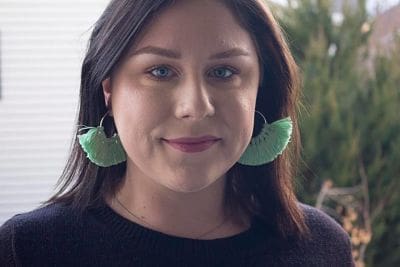
 Lindsey Johnson Snider was raised LDS and attended BYU-Idaho from 2012-2016. She experienced a shift towards progressive/liberal Mormonism in 2013, which coincided with a faith crisis. Later, Lindsey became the editor in chief of the BYU-Idaho student newspaper called “The Scroll,” and worked for the paper until the end of 2015. During her time with “The Scroll” Lindsey wrote many controversial editorial and opinion columns, which both changed some hearts and minds on progressive issues, and also upset/angered some orthodox Mormons. Lindsey’s tenure with the paper included a meeting with the dean of the BYU-Idaho religion department, wherein all BYU-Idaho religion professors were told to be more respectful of those in their classrooms who may be part of the LGBTQ community.
After leaving BYU-Idaho, Lindsey and her husband lost their first baby girl at 23 weeks due to premature labor. This experience caused much grief for Lindsey and her husband, and ultimately brought her 5 year faith crisis to a head.
Today we will be discussing Lindsey’s story, going into depth on the good/bad/ugly of attending BYU-Idaho, along with Lindsey’s faith journey and her experiences with grief.
________________________________
“One” is a song by singer/songwriter Mindy Gledhill off her new album “Rabbit Hole” — an album chronicling the heartaches and discoveries of her Mormon Faith Crisis. You can purchase her album on iTunes or by visiting MindyGledhill.com
________________________________
Episode Transcript
Host: John Dehlin · Guest: Lindsey Johnson Snider
This transcript is machine-generated and lightly edited for readability. The audio is authoritative. Please excuse occasional errors in names and spelling.
Introduction and Episode Overview
Part 1 of 4 · Ep. 1059
John Dehlin [00:00:00] Sam. Hello, everyone, and welcome to another edition of Mormon Stories podcast. I'm your host, John Dehlin. It is January 16, 2019, and as always, I am super excited about today's interview. As many of you know, there are at least three major universities that are affiliated with the LDS Church, probably four.
John Dehlin [00:01:02] There's Brigham Young University Provo, Brigham Young University, Idaho, Brigham Young University, Hawaii, and I think, LDS Business College. Those are the ones that come to mind. But for all of those universities, those who have been tracking Mormonism for.
John Dehlin [00:01:21] For years and years, know that those can be wonderful experiences for many. I myself went to BYU Provo and met my wife Margi there and had a great experience overall. But those. Those experiences could also be fraught for various reasons. For the honor code, for the culture, for dating culture, for matters around, you know, ecclesiastical endorsements and academic freedom and all sorts of things. And then, of course, for those who have been following the BYU experience over the past five or 10 years, the matter of navigating a faith crisis is also kind of a really big deal. Because in the past, we've found out that if you have a faith crisis while you're at BYU and you are open about it, you can be kicked out of byu, which can jeopardize your academic career.
John Dehlin [00:02:23] It can put you back a year or two, it can cost you a bunch of extra money, and it can be a traumatic and emotionally difficult experience. So that's kind of the landscape, and that's kind of the background for today's interview.
John Dehlin [00:02:37] Today we are going to be interviewing Lindsey Johnson Snyder. Lindsay was raised LDS and attended BYU Idaho from 2012 to 2016. In her second year there, 2013, she experienced a shift towards progressive or liberal Mormonism, and then that coincided with the beginnings of a faith crisis that lasted about five years.
John Dehlin [00:03:08] During Lindsay's time as the editor at BYU Idaho, she became the editor in chief of the BYU Idaho student newspaper called the scroll, and worked on the scroll until the end of 2015. During her time on the Scroll, Lindsay wrote many controversial editorial and opinion columns, which both changed the hearts and minds of several students on progressive issues and faculty, I'm guessing, but also some of her, you know, writings, opinions, editorials. Also upset or angered, as you can imagine, many orthodox students and faculty staff.
John Dehlin [00:03:50] Her time with the scroll also included a meeting with the dean of the BYU Idaho Religion department, where eventually, I think that led to BYU Idaho religion professors being instructed to be more respectful of students in the classroom who could be part of the LGBTQ community.
John Dehlin [00:04:13] And then after leaving BYU Idaho. Lindsay and her husband got married in the temple, got pregnant, and then, in a very tragic turn, lost their first baby girl at 23 months due to premature labor. So in addition to be talking. In addition to talking about what it's like to be at BYU Idaho, the culture there, the academic freedom, the standards honor code, the standards office, what it's like to work on the paper there, just all that stuff, good, bad, and ugly, we'll also be talking about Lindsay's faith journey and her experiences with grief.
John Dehlin [00:04:55] So it's going to be, I think, a fascinating interview. We do want to invite any of you who attended BYU Idaho or who attends BYU Idaho or who has been or is currently faculty or staff there to participate, because in addition to Lindsay's experiences, we also want to incorporate the experiences of other people who've been there.
John Dehlin [00:05:24] We have collected some comments and questions from people on Facebook, so we will be incorporating those. But also it would be really fun to incorporate the experiences of some of our live listeners. So that's what we have on the docket today. And so, without any further, further ado, Lindsey Johnson Snyder, welcome to Mormon Stories podcast. It's great to have you.
Lindsey Johnson Snider [00:05:57] Thanks. It's great to be here. I'm so excited.
John Dehlin [00:05:59] Yeah. And where are you joining us from today?
Lindsey Johnson Snider [00:06:03] I'm in Boise, Idaho.
John Dehlin [00:06:05] Okay. That's where I was born. So go Broncos.
Lindsey Johnson Snider [00:06:09] Yes. I mean, I'm not from here, so I don't have a good connection to it all, but I like it. It's really great here.
John Dehlin [00:06:16] Anything you want to correct from my introduction?
Lindsey Johnson Snider [00:06:20] No, no. You did a great job.
John Dehlin [00:06:22] Got it. We got it summarized. Okay, well, let's go ahead and begin. Just briefly, my understanding is that you were raised lds. Do you want to just talk briefly about kind of your experience growing up in the church and kind of what led you to attend BYU Idaho?
Growing Up LDS with a Non-Member Father
Lindsey Johnson Snider [00:06:41] Yeah, absolutely. So I was born lds. My mother was lds, my father was not. When they got married, he was not a member, and he was not baptized until I was about 7 years old. So I do remember my dad wearing, like, tank tops, noble garments, and drinking coffee.
Lindsey Johnson Snider [00:07:02] He wasn't a drinker or anything like that. Those are really the only two memories I have of things that weren't Mormon that he did, and that was different from my mother and I do. I wasn't very old, so I don't have a ton of memories of it. But I have been told that I was very strongly encouraging my father to get baptized because I wanted him to be. I saw that my mother wanted him to be. So I was very passionate. I was very outgoing little girl. And so I wouldn't. I would tell him that he needed to be baptized and the missionaries would come over and teach him.
Lindsey Johnson Snider [00:07:42] He went through several companionships and missionaries that tried to get him to get baptized, commit to be baptized. And finally he decided that he would. We were sealed in the temple about, probably about a year later. And I have a couple memories of that.
Lindsey Johnson Snider [00:08:00] I remember being in a children's waiting area with my two younger brothers, I assume while my parents were being sealed or brought into the sealing room. And then I remember being brought into the sealing room together with my brothers, seeing my mother crying. And I don't remember this, but apparently I asked them why they were dressed the way they were, which is kind of a funny little anecdote from that.
Lindsey Johnson Snider [00:08:25] But yeah, after that, things kind of carried on as normal. As an orthodox Mormon family. I'm the only girl in my family, I only have brothers, so I was the only one having to follow a strict modesty code, I guess, you know, that the church has. And that was always something that bothered me growing up. Not necessarily because I wanted to dress very provocatively as a young girl, but just because I didn't. I've never liked being told what to do. And so having restrictions and not being able to feel like everyone else was hard for me as a young girl and as a youth. But that was my main issue growing up.
Lindsey Johnson Snider [00:09:08] I remember just feeling like, why can't I just wear a two piece bathing suit? Why do I have to be so different? But I never had any doubts about the church being true as a child or as a youth.
Lindsey Johnson Snider [00:09:21] I enjoyed it. I have many friends that I still have, are lifelong friends from my LDS upbringing from the ward. Let me think, what was your.
John Dehlin [00:09:35] Tell us in what city you kind of grew up in.
Lindsey Johnson Snider [00:09:37] Oh, yeah. So I grew up in Orlando, Florida, more specifically Longwood, Florida, which is just a suburban area, I suppose, in central Florida, so really close to Disney World. Most people are familiar with that, I would assume.
John Dehlin [00:09:55] Okay, and as far as kind of your. Did you go to early morning seminary in high school?
Lindsey Johnson Snider [00:10:03] Yes, I did.
John Dehlin [00:10:04] And what was the content or substance of your testimony? Like, were you just kind of doing it to do it? Were you really into it? Did you really have a burning testimony? Were you like, viewed as devout by your, you know, fellow young men, young women, your leaders, your parents? Were you Nephi? Were you layman? You know, what was your. And I wish we had female equivalents for Book of Mormon role Models and antiheroes.
Lindsey Johnson Snider [00:10:32] But yes, I did go to early morning seminary and I was not a fan. Frankly, I am not a morning person. So that was my biggest problem with it. I think if it had been during the day, like some lucky folks out in Utah who get to go during the day, I might not have minded as much. But it was hard for me. I never had any big doubts when I was growing up or in high school. But I also wasn't like a Nephi. I wasn't extremely devout and I wasn't the one going up and bearing my testimony at every turn. I don't think I really. I think I can count on one hand the amount of times I've worn my testimony in public. It just hasn't really been a thing for me. I've never been super. I turned to later in life about my testimony.
John Dehlin [00:11:32] You broke up for just a second. Say that one more time. You never.
Lindsey Johnson Snider [00:11:36] I didn't. I wasn't super outspoken about my testimony as a youth. I felt it and I did have it, but I kind of just went by under the radar and did all the things I was supposed to do. I wasn't necessarily a troublemaker or a rule breaker a little bit in high school, but I wasn't known as that. And my family was devout and yeah, I just wasn't anything. I wasn't either extreme, I guess.
John Dehlin [00:12:09] Okay. All right. So anything else we should know about your youth childhood before we talk about going to, to byu, Idaho?
Lindsey Johnson Snider [00:12:20] No, I don't think so.
John Dehlin [00:12:21] So had you. Were you, in terms of, like, I know right now, you were involved a little bit in politics. Were you liberal or progressive in your politics prior to. Were you political at all prior to attending byu?
Lindsey Johnson Snider [00:12:38] Well, I was a conservative child. I've always been very opinionated. When I was growing up, it was the opposite of how I am now. But I was raised listening to, you know, Sean Hannity and Rush Limbaugh and watching Fox News like that was normal for me. I regularly engaged in political conversation. I was very passionate about my opinions, even though I didn't fully understand them at the time. I was kind of just parroting what I was hearing.
Lindsey Johnson Snider [00:13:10] But I was considered. I considered myself a Republican conservative, as that's how I was raised. Up until my first year college. I voted for mitt Romney in 2012, something that my friends and co workers now make fun of me for.
Lindsey Johnson Snider [00:13:26] But at the time, I was. I didn't see anything wrong with that and I was encouraged to vote for him. It was kind of a no Brainer in Mormon culture and in my family. Of course I was going to vote for him. So, yeah, it was definitely a huge shift for me as I switched over to progressivism.
Choosing BYU-Idaho and the Endorsement Process
John Dehlin [00:13:46] Okay, all right. So, you know, you could have gone to a number of schools in Florida. What made you choose BYU Idaho? How'd that process work?
Lindsey Johnson Snider [00:13:58] Well, I've never. I didn't actually have a ton of options because I wasn't a very diligent student in high school. I wasn't necessarily a bad student, but I was very middle of the road, you know, average. And so I. Sorry for the dog bark.
John Dehlin [00:14:15] That's okay.
Lindsey Johnson Snider [00:14:16] My husband just walked in, I think, so he's excited. I. I didn't have a ton of options and so I had a couple of friends who attended BYU Idaho, and I had heard about it, heard it was fun and it was easy to get into and it was affordable. And so I applied and of course I got in and it was really one of my only options. I think not. The other school I got into was Utah State, but the tuition was just too expensive being an out of state student. So that wasn't really an option for me either. But yeah, it was. I wasn't terribly excited about it, but again, I felt like it was one of my only options. And I was excited to be with a couple friends and to be in an area where I was around so many Mormons.
John Dehlin [00:15:04] And did you have any, you know, what were your preconceptions about what it would be like to go to BYU Idaho, coming from Florida and based on what you had learned from your friends,
Lindsey Johnson Snider [00:15:16] it being cold was my number one thing that I had heard and that I was afraid of because I grew up in Florida where it is hot always and does not snow and it's humid. And at that time I didn't know anything different. And now I love the cold. But at the time it was kind of. It was very strange to me and I was not used to it. So. Yeah, that was the biggest thing, the honor code. I hadn't. I didn't even really think about it, honestly, because I didn't feel it would be a challenge for me to follow it. But I knew it was strict there. I had heard about the whole skinny jeans fiasco
John Dehlin [00:15:59] before you went.
Lindsey Johnson Snider [00:16:00] Yeah, that was before my time.
John Dehlin [00:16:02] Tell people what that was.
Lindsey Johnson Snider [00:16:03] Yeah, so the skinny jeans fiasco was. I forget what year it was. Maybe like 2011 or 10 or something. Apparently a female student. I could be wrong about this. So people can sound off in the comments with corrections if you, if you know the story better than this, but a female went to the testing center at BYU Idaho wearing skinny jeans. And I guess a male testing center employee saw and thought they were just a little too tight.
Lindsey Johnson Snider [00:16:36] And so he would not let her enter to take her test. And following that, he put a sign up on the door or in the front of the testing center saying, if you're wearing skinny jeans, you may not come in and take your test.
Lindsey Johnson Snider [00:16:51] Which, if I'm not mistaken, it wasn't. That was not a rule. That was not part of the honor code. That was kind of him acting on his own opinions and thoughts and taking matters into his own hands. So a student posted a picture of it on social media, and of course, it quickly blew up, and media outlets picked it up as something very strange, and the school corrected him.
Lindsey Johnson Snider [00:17:19] The sign was taken down, and I'm. I'm. I think he was let go. But, yeah, of course skinny jeans are allowed at BYU Idaho. But, yeah, that was what I'd heard about.
John Dehlin [00:17:33] And it looks like that was 2011. So I posted. I posted a couple links in the show. Notes.
Lindsey Johnson Snider [00:17:39] Yeah, and something similar.
John Dehlin [00:17:42] What's that?
Lindsey Johnson Snider [00:17:42] Something similar happened when I was there, and it was man buns that were banned.
John Dehlin [00:17:48] Okay, we'll talk about that.
Lindsey Johnson Snider [00:17:50] Yeah, that actually was banned.
John Dehlin [00:17:53] Okay. So did the skinny jeans thing give you pause or make you concerned at all?
Lindsey Johnson Snider [00:17:58] No, because by the time I went, it was over, so.
John Dehlin [00:18:02] Okay. Okay. So you're thinking, I'm going to this cheap school that has a bunch of Mormons in it that's really cold, but it's going to be fun. All right, so what. So what happened? You go there your freshman year. How was that? Anything else? Anything else? You know, about your ecclesiastical endorsement or anything you want to share before talking about going there?
Lindsey Johnson Snider [00:18:26] Yeah, the ecclesiastical endorsement was nothing for me. It was. I mean, as a Mormon, I was used to interviews, worthiness interviews. And I knew this was a church school, so the. The idea of having to be worthy to attend was not foreign to me at all. And I didn't have anything to hide at that point. At least I don't. But I. Yeah, that was nothing shocking to me at all. But my. You asked about my freshman year, how it was.
John Dehlin [00:18:57] Yeah. So what? Tell people what you have to agree to in the honor code. For those who, you know, we have Jehovah's Witnesses and evangelicals and Jews who listen to Mormon stories. For those who don't know what you agree to. With the. With the ecclesiastical endowment and the endorsement of the Honor code, tell people what that. What that agreement is.
Lindsey Johnson Snider [00:19:16] So I don't remember exactly what is a part of it, but I assume that it's like most worthiness interviews in that you agree to adhere to the dress and grooming standards at BYU Idaho, which includes most of what you would see in the first Strength of Youth pamphlet, except for a couple of things which are. Capris are not allowed. That was one thing. At BYU Idaho, that's kind of weird, but yeah, you have to have. You can't have any dramatic hair colors or hairstyles. You have to wear dresses down to your knee, at least. You can't reveal your shoulders or show any midriff or cleavage or anything like that. You have to agree to follow the word of wisdom as laid out by the Church of Doctrine and Covenants, to not drink alcohol or smoke or do drugs or anything like that.
John Dehlin [00:20:17] Or cop your tea, right?
Lindsey Johnson Snider [00:20:18] Yeah. Or copy your tea. Thank you. And what else? And of course, the law of chastity. You're not to engage in any inappropriate sexual conduct with anyone while at BYU Idaho, or you. You will face some discipline of some kind. I mean, it. It's up to your bishop. But you could get kicked out of the school depending on, you know, the luck of the draw who the bishop is.
Lindsey Johnson Snider [00:20:47] It really does depend the severity of the consequences. So just your typical worthiness interview questions, basically, just to follow the honor code. There's a curfew at BYU Idaho, which is midnight every day of the week except for it's 1am so you have to be back in your apartment by that time. And if you are consistently missing your curfew, your. One of your roommates might decide to tell the bishop or tell somebody. And if it happens enough times, that could also risk you losing your ecclesiastical endorsement.
Lindsey Johnson Snider [00:21:26] You have to attend church, Reggie. You need to be a member in good standing or you could lose your endorsement. Yeah, that's what I can think of at the moment.
John Dehlin [00:21:34] And you're either on campus housing or you have to live in campus approved housing. Is that true? Yes, that was true at BYU Provo.
Lindsey Johnson Snider [00:21:44] Yeah.
John Dehlin [00:21:45] And usually those are segregated so that males are in units with males and females are in units with females.
Lindsey Johnson Snider [00:21:53] Absolutely.
John Dehlin [00:21:54] And I think those have curfews as well. Right.
Lindsey Johnson Snider [00:21:59] If you're a student, you have curfew no matter where you live.
John Dehlin [00:22:02] Yeah. Yeah. Now, as far as you know, is any of that different from BYU Provo? How much of that's identical versus different? Other than the Capris?
Lindsey Johnson Snider [00:22:11] From what I've. Yeah, from what I'VE heard. I don't know. I don't think BYU has a curfew. I could be wrong, but BYU Provo definitely.
John Dehlin [00:22:22] I don't know about a curfew, per se. The dorms definitely had a curfew, but they definitely control how late you're allowed to have members of the opposite sex in your apartment.
Lindsey Johnson Snider [00:22:33] Yeah. Yeah. So I think it might be more strictly enforced at byu, Idaho. BYU is obviously larger. I'm not. I think that it's definitely stricter in Rexburg. From what I've heard from people. Yeah, that's generally what I've heard.
Freshman Year Culture and Campus Life
John Dehlin [00:22:56] So, for that freshman year, what did you notice that was interesting about the culture, about academics, about administration, about the church, about, you know, your friends, your peers? What was that freshman year like?
Lindsey Johnson Snider [00:23:11] I loved it. I didn't feel upset with anything, per se. I mean, I. I loved my roommates. I loved my bishop. Classes were fine. I was doing generals at that point, which weren't great. Like I said earlier, I wasn't especially studious. And that didn't change in college very much. It was interesting to me, the concept of religion classes and getting grades that go toward your GPA for them. I kind of thought that was odd. I. But I didn't think anything of it at the time. And I wasn't particularly liberal yet, so not many things bothered me until maybe the next semester or the next year. But it very much felt like I was at EFY still and, like, I wasn't an adult. I did not feel like an adult. I felt like I was at an extended adult EFY We. And I don't know.
John Dehlin [00:24:16] I mean, did that bother you as a freshman, or did you just enjoy it?
Lindsey Johnson Snider [00:24:19] Yeah, it did bother. I mean, I'm not really the let's play duck, duck, goose and get to know each other in college kind of person. Like some people are. They like to play games and have fun and, you know, go rollerblading for activities. And I just kind of wanted to, like, hang out and chat and watch movies maybe, but I'm not into the. That kind of scene, so I didn't go. We have, like, a. When you're a freshman, your first semester, you go to, like, a weekend where you're introduced to everyone. You get a tour around the school, you're in, like, a group, and. And you go to all these activities and you play games, and I did not participate in that.
Lindsey Johnson Snider [00:24:56] It just wasn't appealing to me. It kind of felt a little childish. And there's nothing wrong with those. I know people Love them and it's great. But that was kind of how I felt going to BYU Idaho my first semester. Like it was just efy.
John Dehlin [00:25:12] And for those who don't even know anything about efy, that's the especial for youth summer program for Mormon high schoolers, basically where they're inspirational speakers and dances and games and that sort of thing. So what, you know, you mentioned duck, Duck goose. Like what would be the types of activities of freshmen would, would engage in at BYU Idaho that would be different than a normal state run university elsewhere in the United States?
Lindsey Johnson Snider [00:25:48] Yeah, you mentioned rollerblading at BYU Idaho. We have a little bowling alley in our main eye center.
John Dehlin [00:26:00] Not eye center, that's like a student center.
Lindsey Johnson Snider [00:26:02] Yeah, kind of. And so. And they have a big room or sometimes they have rollerblading activities. And like I said, those are fun and great, whatever. I don't have a problem with those necessarily, but it's just very much like that. And that could be available at other universities, I don't know. But the difference I think is that everything really is geared toward getting you married. I mean that is really what the whole purpose is of all these activities of family home evening groups.
John Dehlin [00:26:39] What are those?
Lindsey Johnson Snider [00:26:41] So as when you're in with your, living with your family, growing up in Mormonism, you have some devout families, have what's called family home evening every Monday night. And it's where you come together and you have like a lesson and a song and a prayer and maybe a treat and a game. And it's just some good wholesome fun for a family on Monday night. And they at BYU Idaho and I think in the other church universities. Yeah. Wanted to extend.
John Dehlin [00:27:08] Margi and I met as a family evening Mom. Mom and dad.
Lindsey Johnson Snider [00:27:12] Yeah. Okay. So they extend that into college so that you still have that and that it's an easier transition to when you have your own family again. Which is what I've heard a few times. And it's. I mean I bonded great with some of my fhe families. Like it really was fun.
John Dehlin [00:27:29] So it's like 10 or 10 or 12 kids, right?
Lindsey Johnson Snider [00:27:31] Yeah.
John Dehlin [00:27:31] And one of the women is. What's that?
Lindsey Johnson Snider [00:27:34] Like two different apartments, like a guy's apartment and a girl's apartment. And you get together every Monday night and have an activity and one of
John Dehlin [00:27:41] the men is sort of assigned the role as the dad in the and one of the women is assigned the role of the mom in the group. And then you're supposed to meet every Monday night and again have a spiritual lesson and prayer and song and some sort of meaningful activity. Service or fun. Right?
Lindsey Johnson Snider [00:28:00] Yes, they had an fhe mom and dad were assigned. And later in my college time, they discouraged the use of the words mom and dad and siblings just because, I don't know, I think it might have been kind of awkward. And they wanted to encourage us, if we felt like it, to date each other and if we were calling each other siblings. It wasn't exactly fostering a good environment for romantic relationships. Relationship to form. So. But yeah, we did have that. There was. There was a woman leader and a guy that were in the apartments and they would kind of be in charge and we would plan out our activities and it was really fun. But that was.
John Dehlin [00:28:46] What are some of the activities you do? Just to get a sense.
Lindsey Johnson Snider [00:28:49] So let me think. Sometimes they're centered around holidays. So around Halloween, we would carve pumpkins. Maybe we would go out to like, a haunted house out in Rexburg. One time we did something called a pudding drop where somebody was standing up on our third floor on our balcony of our building. And we would lay on the ground on the, like a bottom floor on the grass, and they would drop pudding and try to drop it into our mouths from the top floor, which. It's very silly, but it was fun.
John Dehlin [00:29:27] I imagine you did sledding or something like that.
Lindsey Johnson Snider [00:29:29] Yes, we went sledding. Yeah, that was always fun.
John Dehlin [00:29:33] This is good, clean fun, right?
Lindsey Johnson Snider [00:29:35] Yeah, totally. Yeah.
John Dehlin [00:29:36] I remember being in venue evening groups and. Yeah, it was kind of sweet. It was. You had these people you'd call your sister, your brother or sister. You'd have your mom or your dad. I was. I was, you know, dad at least once or twice. And. Yeah, good clean fun, right?
Lindsey Johnson Snider [00:29:54] Yeah. Yeah. And I was. I was never the mom ever. I remember that every time I was like, I wonder if I'll be a phe. Mom. Never.
John Dehlin [00:30:01] Okay.
Lindsey Johnson Snider [00:30:02] But, yeah.
John Dehlin [00:30:03] What was weird about what you noticed about couples who were. Who were dating? Like. So, for example, there was always this weird public display of affection stuff at BYU Provo where couples would be cuddling on a couch in the foyer of the dorm or and kind of kissing or really holding tight. It was kind of this PDA because they couldn't go anywhere private. And so they had. But they were attracted to each other, so that kind of forced them to have to cuddle and kiss in public, which was always a little bit weird.
Lindsey Johnson Snider [00:30:39] Yeah, definitely. And it's kind of funny because you think it'd be the opposite of people being super distant from each other because they don't want to make anybody watch or be uncomfortable. But yeah, it definitely. That is an effect of them not being able to be alone anywhere. A lot of couples would sneak off to cars, laundry rooms was a big one. Oh, the gardens. We have like a garden area at byu Idaho. And it's kind of just that place, you know, where everyone goes to make out kind of thing. So the gardens was one over by the. People would go to the temple sometimes, like in the temple lawn area, Hang out and cuddle.
John Dehlin [00:31:27] Okay, wait, you broke up for a second. So you're saying that people would sometimes make out on the temple grounds?
Lindsey Johnson Snider [00:31:33] Yeah, yeah.
John Dehlin [00:31:34] Okay.
Lindsey Johnson Snider [00:31:35] Absolutely.
John Dehlin [00:31:36] That's the Rexburg Temple, right? Yes. Okay, yeah, that's interesting.
Lindsey Johnson Snider [00:31:41] Uh huh. And yeah, it would be. It would get very awkward in apartments because if your roommate was dating someone, they were not allowed to take them back to their room, obviously. And so if there was a couple and one of your roommates was dating somebody, they would bring them to the apartment and they would end up being there like every night in the living room, like cuddling, awkwardly, making things awkward. And you couldn't be comfortable in your own apartment because they would be on the couch cuddling and then you'd walk in on them making out or something. It was, it was just very. Yeah, very weird and not fun all the time. But no.
John Dehlin [00:32:21] Okay, let's see. Jessica's writing Haunted mill. Is that the haunted house you would go? What is that?
Lindsey Johnson Snider [00:32:29] So it's just like a. I don't know if it was a real mill. It used to be or something. And they've just transformed it into like a haunted attraction where you walk through it and yeah, it's just like a haunted house out in Rexburg. But yeah, we would go there.
John Dehlin [00:32:46] Okay.
Lindsey Johnson Snider [00:32:47] Like a haunted corn maze or something,
John Dehlin [00:32:48] you know, and when, when boys and girls went on dates, what types of, you know, kind of fun dates would people go on? What, what was the way that you could actually go on an appropriate date in Rexburg? Yeah, what was there to do?
Lindsey Johnson Snider [00:33:03] Yeah, well, that's one thing. And yeah, there's a big misconception that there's nothing to do in Rexburg. And that might be true for some. I mean, not everyone can be happy and thrive in Rexburg. That's obvious. But it is a college town and so there are plenty of fun things to do. There's lots of places to eat. There's like three subways in Rexburg, which is crazy. I think there's three McDonald's now.
John Dehlin [00:33:32] Subway sandwich restaurants.
Lindsey Johnson Snider [00:33:34] Yes. Okay, yes. And so there's lots of places to eat. There's a duck pond, which my husband and I went on our second date to a duck pond. There's a couple parks. Let's see. A lot of people go on what are called devotional Devo dates. We call devotional devo. I don't know if that's also a thing at byu, but every. Every Tuesday at BYU Idaho, there is what's called a devotional, where there is a speaker, usually a faculty member, who speaks to the student body in our ice center, which is kind of like a mini conference center at BYU Idaho. And they just give like a talk, like a 20 minute talk.
Lindsey Johnson Snider [00:34:17] And you're instructed to bring your scriptures and be ready to learn. There's an opening hymn, a closing hymn, sometimes a special musical number by a choir. And a lot of people go on devo dates and they bring somebody with them and they sit next to them and cuddle awkwardly or maybe hold hands.
Lindsey Johnson Snider [00:34:38] I think I did a couple of those. So that's one thing people do is like a wholesome date. Some people go on walks up to the temple or because the temple is kind of up on the hill at the top of Rexburg. So you go on a walk and do that.
Lindsey Johnson Snider [00:34:57] There's ice caves kind of far out if you drive far enough. Sometimes people do that, but yeah, you always have to be back by midnight, though.
John Dehlin [00:35:07] Okay.
Lindsey Johnson Snider [00:35:08] Yeah.
John Dehlin [00:35:13] What were the religion classes like, you know, for you as a freshman?
Lindsey Johnson Snider [00:35:18] Yeah, religion classes are, I think, one of the most toxic things about BYU Idaho, to be honest.
John Dehlin [00:35:25] Did you feel that as a freshman?
Lindsey Johnson Snider [00:35:27] I'm trying to remember my freshman year religion classes.
John Dehlin [00:35:32] So for those who don't know, there's. I'm sure there's like a Book of Mormon.
Lindsey Johnson Snider [00:35:34] Yes.
John Dehlin [00:35:35] That's the semester, too. There's Doctrine and Covenants, there's Pearl of Great Price, there's New Testament, Old Testament. There's Church history.
Lindsey Johnson Snider [00:35:43] Yes. Presence of the Church, preparation for eternal marriage.
John Dehlin [00:35:47] Marriage prep, right?
Lindsey Johnson Snider [00:35:48] Yes. Missionary prep. Yeah.
John Dehlin [00:35:50] And there's a lot. And these are. You have to take a lot of religion classes to graduate, right?
Lindsey Johnson Snider [00:35:55] Absolutely.
John Dehlin [00:35:56] None of which transfer to any other university. So that's always a problem.
Lindsey Johnson Snider [00:36:00] No, I actually did not mind religion classes my first year of college. I remember I took book of Mormon 1 and 2 and I liked my teacher. I remember being feeling edified and enjoying Book of Mormon class. So that is interesting. That was like my Intro to Religion classes at BYU Idaho, and I actually didn't mind it at all.
John Dehlin [00:36:30] I remember being inspired by My religion professors, I remember just eating that up. I thought that was amazing. Did they start secular classes with prayer?
Lindsey Johnson Snider [00:36:42] Yes, every class.
John Dehlin [00:36:43] So math class, chemistry class, it'll all start with the prayer, right?
Lindsey Johnson Snider [00:36:48] Every class? Yes.
John Dehlin [00:36:48] Yeah. And yeah. Okay. Yeah. I remember being really inspired by my religion teachers. Elder Holland was one of my Book of Mormon teachers. People really excited about learning from Hugh Nibley back when I was at byu. And you know, this was, this was one of the great things about BYU is just this religious instruction from some of the top religious scholars in the church, you know.
Lindsey Johnson Snider [00:37:15] Yeah. And I think a lot of people would agree about BYU Idaho. They would feel the same way. Now, many people see nothing wrong with religion classes at all. And a difference is I don't think we get as many scholar rock stars at BYU Idaho as BYU gets. We kind of, we get, there's plenty of great religion teachers, but I think BYU kind of has a claim on the big names, if you will.
John Dehlin [00:37:41] But yeah. A couple comments from our listeners. Jessica writes religion classes take up too many credits. So she was basically complaining about having to take so many religion classes. Kylie writes that the course Living Prophets was a hard religion class for her even as a fully believing kid. To her it felt like prophet worship. That's what Kylie writes. Tracy writes marriage prep is a college accredited class. Holy heck. And then Chelsea. Hey. Chelsea writes, it certainly is.
Lindsey Johnson Snider [00:38:16] Yes.
John Dehlin [00:38:16] Yeah. That's interesting. So it sounds like I grew up watching Leave it to Beaver kind of these 50s style, everything is good, everything is happy, everything is fun, everything is perfect sort of environment. And it sounds like one way to experience BYU is just to say this is wonderful, good clean fun. You know, kids aren't getting drunk and assaulting each other, you know, on some big scale. There's not a lot of drugs and alcohol and people smoking around and it's, you know, good, clean, Leave it to Beaver kind of fun with jello drop, with pudding drops and bowling and, you know, dances. You know, what's not to love, Right? Is that kind of how you felt by the end of your freshman year?
Lindsey Johnson Snider [00:39:09] I don't think I was that optimistic, but that is the general idea, yes.
John Dehlin [00:39:17] And did you experience it that way
Lindsey Johnson Snider [00:39:21] for my freshman year?
John Dehlin [00:39:22] Yeah.
Lindsey Johnson Snider [00:39:24] Yeah, I would say for the most part, yeah.
John Dehlin [00:39:29] Did you see your freshman year any drugs or alcohol or smoking or premarital sex? Were you aware of any of that going on?
Lindsey Johnson Snider [00:39:36] No. I mean, there are a couple of parties that happen every year that are kind of like, oh, that's where people get drunk or that's where People smoke pot at those parties, you know, But. But I didn't know anybody who did it, and I certainly wasn't involved in it myself. So, no, I was not aware of that.
Discovering Feminism and Bell Hooks
John Dehlin [00:39:55] Okay. All right. So it sounds like you had a pretty good freshman year and pretty good time.
Lindsey Johnson Snider [00:40:02] Yeah.
John Dehlin [00:40:03] So did things. I get a sense that things started to change. Your sophomore year, is that right?
Lindsey Johnson Snider [00:40:07] Yeah, it was probably the end of my freshman year. Beginning of my sophomore, kind of.
John Dehlin [00:40:13] Okay, what happened?
Lindsey Johnson Snider [00:40:16] Well, so in 2012, when President Obama won the presidency, won a second term, I remember I was. I had just voted for Mitt Romney, and I really didn't know why I did, but I was.
John Dehlin [00:40:33] Because you're Mormon. What do you mean you didn't know why Mormons vote for Mitt Romney? That's what we do.
Lindsey Johnson Snider [00:40:39] Yeah, that is why, actually. And so I saw other people on my Facebook feed who I had friends who were. Who identified themselves as feminists, and I was beginning to be interested in what they were saying. I hadn't been exposed to that before then. And I started to think, like, hey, I actually agree with some of this stuff. And so I reached out to one of my friends who was a feminist, and I asked her for some reading material for someone who doesn't know anything about feminism and who just wants kind of like a crash course and intro into it. And so she recommended I read Bell Hook's Feminism is for Everybody.
John Dehlin [00:41:19] Okay.
Lindsey Johnson Snider [00:41:22] PDF for anyone who is interested. It's a great introduction.
John Dehlin [00:41:26] You broke up. Say that again. You broke up for a second. Oh.
Lindsey Johnson Snider [00:41:29] There is a free PDF of the book online.
John Dehlin [00:41:32] Okay.
Lindsey Johnson Snider [00:41:33] And for anybody who is interested in that, I recommend reading it.
John Dehlin [00:41:37] Tell us the name again.
Lindsey Johnson Snider [00:41:39] Feminism is for Everybody. It might be everyone, but I think it's everybody. But it's by bell hooks and it's free online.
John Dehlin [00:41:47] How do you spell bell hooks?
Lindsey Johnson Snider [00:41:48] B, E, L, L and hooks. The regular way. H, O, O, K, S. Okay.
John Dehlin [00:41:54] I'll try and find a copy of it and post it in the comments.
Lindsey Johnson Snider [00:41:57] Yeah, so I devoured that book. I think it was actually the last semester of my freshman year. And it completely flipped my world upside down. All of these things that I had never questioned before, like gender roles and stereotypes of men and women and how they were harmful.
Lindsey Johnson Snider [00:42:23] And I began to kind of look at the world around me and think, how does nobody else know about this? How is nobody else thought about this? And how have I gone this long without knowing about feminism? And I was just obsessed with it and it took hold of me and changed me in A good way. I felt myself feeling passionate about something that I felt was important, and I wanted to learn more about it. And so I kind of delved into it, and I started watching the Daily show with Jon Stewart. That was kind of. People are probably gonna roll their eyes at that, but that was kind of my intro into political action.
John Dehlin [00:43:06] Your gateway.
Lindsey Johnson Snider [00:43:07] Yes, it was. I've always loved comedy, and so combining comedy and politics is still one of my favorite things, and so I loved that. And that opened my eyes as well to some of the corruption going on in politics, specifically on the right, which I had not seen before. And before I knew it, I was the angry roommate, arguing with my fhe brothers about politics and correcting people when they said offensive things. And. Yeah, that was kind of how it all started.
John Dehlin [00:43:43] Yeah. And, you know, it's hard for someone who hasn't been to a really religious school to understand there's such a culture of conformity, of spiritual conformity, of gender conformity, sexual conformity, you know, political conformity, because it's. It's just. It's so highly structured and controlled. Differences and diversity are not generally. And there's. There's racial sort of. It's. It's. You know, what. What was it like racially at a BYU Idaho?
Lindsey Johnson Snider [00:44:16] Extremely white, obviously.
John Dehlin [00:44:20] And they don't even have. They don't even have black student athletes or Polynesian student athletes. So, like, that's sometimes what saved BYU Provo is you would actually see a person of color occasionally, usually because they were on the basketball or football team or volleyball team or something. But BYU Idaho has no kind of formal sports, right?
Lindsey Johnson Snider [00:44:43] Yeah, there aren't. There aren't any sports teams. There's, like, leagues you can join and play, like ultimate Frisbee or.
John Dehlin [00:44:51] Yeah. Intramural stuff, right?
Lindsey Johnson Snider [00:44:52] Yes, that's the word. Thank you.
John Dehlin [00:44:54] Yeah. But so it's very. So you're guessing, what, 95% white, 98%
Lindsey Johnson Snider [00:44:59] white, what, somewhere around there. Most of the black students that I ever saw were from places like Africa.
John Dehlin [00:45:09] Right.
Lindsey Johnson Snider [00:45:09] They were not from here, and they spoke Nigerian or. And they were. They were not from the United States, typically. Now, there are definitely some. And I don't want to discount their, you know, their presence at BYU Idaho, but generally, that is how it feels. Extremely white.
John Dehlin [00:45:28] Yeah. So in all those different ways, it's just. It's about conformity and fitting in and. And following. So to be something just as benign as a Democrat or a political liberal can feel very, I don't know, uncomfortable or controversial. Right.
Lindsey Johnson Snider [00:45:49] Yeah. Almost revolutionary. I want to say it was incredibly. It was bold of me, especially since I was a woman. I was. It was not taken as a cute or fun thing. When I was talking about feminism, I had a roommate who said out loud that she was anti feminist and that she thought that homosexuality was a mental illness. Those are just some things that pop out in my mind. So when I. And those things, nobody would even bat an eye at someone saying that at BYU Idaho, typically. And so for me to kind of stand up and start arguing with statements like that, I was not made popular by that. It was not something that gained me many friends. I had my friends, but nobody wanted to date me. Let's just say that.
John Dehlin [00:46:44] And that's hard because everybody's dating, because that's the main point of BYU Idaho. It's probably not education. It's probably, first and foremost, to find your eternal companion, right?
Lindsey Johnson Snider [00:46:56] Yes, absolutely. Whether people want to admit it or not, that is the case for most.
John Dehlin [00:47:02] So that must feel kind of crummy to not have anyone wanting to date you because you're different politically.
Lindsey Johnson Snider [00:47:08] Yeah. And, I mean, I could just be attributing the reason, that being the reason, and hiding the fact there were other things that made me not desirable, like how I'm not super smiley all the time, or, you know, maybe I need to be nicer, flirt more, whatever that was. Things that were told to me, but that did definitely help keep the boys away, I think.
Feminist Awakening and Speaking Out on Campus
John Dehlin [00:47:30] Okay, so as you have your feminist awakening, how does that play out at BYU Idaho? What happens?
Lindsey Johnson Snider [00:47:40] Well, I started to get increasingly more angry, which people would attribute to. Some people might attribute that to my losing the spirit.
John Dehlin [00:47:48] Now, really quick, as you have your feminist awakening, are you thinking back to your upbringing in your family or your church or your time at BYU and noticing ways that you may have been harmed or mistreated or treated unfairly that then led to that anger?
Lindsey Johnson Snider [00:48:11] Yes.
John Dehlin [00:48:12] What were those sorts of things that you sort of said, hey, wait a minute. This has not been good for me all the way.
Lindsey Johnson Snider [00:48:19] Modesty was a huge one.
John Dehlin [00:48:20] Okay. Why? What's wrong with that? Dressing modest, like. Yeah, what's wrong with that?
Lindsey Johnson Snider [00:48:26] So, I mean, like I said before, even as a child, I always just was like, why? I don't understand why. I never did. And the answers were not satisfying to me. Like, oh, you need to respect the body the Lord gave you and cover it up. And that just did not equate to respect in my mind.
John Dehlin [00:48:41] Showing your shoulders, for example.
Lindsey Johnson Snider [00:48:43] Absolutely.
John Dehlin [00:48:44] Your knees or your ankles or whatever.
Lindsey Johnson Snider [00:48:46] Yeah. Or wearing A bikini or what have whatever. So as I became a feminist, I started to realize how women were being blamed for men's thoughts, for pornographic addictions.
John Dehlin [00:49:02] Tell us how that narrative would go. So a young man in the church is being taught the law of chastity. How did that interact with women?
Lindsey Johnson Snider [00:49:12] Yeah, so in my home board, actually, I recall being told that, well, actually I think this was a general conference quote. I remember hearing it somewhere that when you dress immodestly that you are walking pornography to young men.
Lindsey Johnson Snider [00:49:28] And you know, growing up it's like, oh yeah, that's so true. Like these poor guys, they just can't help it. And I'm just walking around and, you know, tempting them. And I believe that someone actually did complain about my modesty when I was a youth. In my ward, one of the young men actually complained to the bishop and I was not dressing immodestly at church. I would never have done that because I wouldn't want the attention. I wouldn't want anyone to think poorly of me. But I mean, someone complained something I was wearing was too tight or I was showing too much cleavage or whatever.
Lindsey Johnson Snider [00:50:02] And looking back on that, it just infuriated me to think that I would get pulled in to be told that I need to dress less revealing as a 13 year old girl. One time, an older man in my ward, I saw him staring at me as a 14 year old, just very obviously looking me up and down at church. And I just started remembering all these things related to my body and modesty and covering up and.
John Dehlin [00:50:33] Yeah, and you being responsible for the behavior of the young men.
Lindsey Johnson Snider [00:50:37] Yes.
John Dehlin [00:50:38] Kylie, one of our listeners writes, in my freshman ward, the bishop lectured us about how our immodest clothes were keeping boys off their missions. The boys all just sat there and nodded.
Lindsey Johnson Snider [00:50:52] Yeah, that's gross.
John Dehlin [00:50:55] But that, you know, that's one example of just how, you know, instead of one, being body positive, number two, being sex positive, number three, separating whatever women did from the responsibility boys have to mind their thoughts or to manage their thoughts or to manage their behavior. You're saying that there was this burden of shame and control put on women for things that they shouldn't be carrying or owning. And you got angry about that?
Lindsey Johnson Snider [00:51:24] Yeah, definitely. I started to just remember all the language that I had heard growing up about it and you know, the whole chewed piece of gum or poop in the brownie thing where if you have any, if you've done anything wrong sexually, that you have been chewed like a piece of gum and no one likes to chew an already chewed piece of gum, as in, nobody's going to want to marry you if you've already screwed up. That. That also started to process in my brain as something harmful and hurtful. Yeah. So it all kind of came crumbling down.
John Dehlin [00:52:02] Yeah. So if you. Instead of some sort of atonement forgiveness philosophy, where the atonement wipes you clean, which is what our doctrine often. You know what our doctrine should be? If you, if a boy touches your breast, if you have some sort of sex or something like it, that represents a staining of your worth, staining of your character, a soiling of you. And by using metaphors like a chewed piece of gum or a board with a nail, you know, nailed in the hole, that remains. Metaphors like that object lessons like that make you feel irreparably damaged and unworthy and dirty as a woman.
Lindsey Johnson Snider [00:52:46] Absolutely.
John Dehlin [00:52:47] And oftentimes boys, for some reason in the culture, even though it takes a boy and a girl to have that sort of exchange, somehow it's the women who emerge tainted. And for some reason there doesn't seem to be that same sort of taint for the boy. Is that fair?
Lindsey Johnson Snider [00:53:05] Yeah, definitely. It's not the same at all.
John Dehlin [00:53:08] Okay. Okay. So I can see why that you didn't love that. What else, what else got you angry and how did that play out?
Lindsey Johnson Snider [00:53:18] Kind of looking into my future as an LDS woman, I had been taught my whole life and I had kind of absorbed the idea that my primary purpose and role was as a wife and mother. And not that those are bad things at all. I'm a wife now and a mother to my daughter who has passed on. So those are very sacred roles to me, even still.
Lindsey Johnson Snider [00:53:43] But to be taught that that is your priority and that nothing else should ever come in the way of that and that you are a nurturer, you are gentle, you are kind. And I mean, I didn't always feel that way. I didn't feel like, you know, I was the opposite of some of those things. I've always been very outspoken. I've always been kind of harsh and very blunt.
Lindsey Johnson Snider [00:54:12] And I had other goals for myself. That's why I, in college was because I wanted to have a career and I wanted to do something for myself and I wanted to be a mother, definitely. But to look at the. The way that it was structured as a feminist, as a newly self identified feminist, I started to realize I do not want what they want for me fully. And I started to feel like I did. That's when I started to feel like I did not belong and like, I was different.
John Dehlin [00:54:49] And that's really hard for a lot of reasons, but it's particularly hard when now you're a year, year and a half, two years into your education, you've got all these credits that won't transfer because it's a private school, it's not a state school. You've got all these religion credits, You've got all this investment now, and you realize, oh, my gosh, what do I do? I. I don't want to leave and lose all that money in time, but I'm really feeling like I don't fit in and starting maybe even to feel unsafe. Did you start to feel unsafe at that point? A little bit.
Lindsey Johnson Snider [00:55:25] Not physically unsafe or, you know, and not even that someone would tell on me for being liberal. I mean, it wasn't really a secret at that point. And at that point I had. I would never think that I could get kicked out of school for, you know.
John Dehlin [00:55:41] Yeah.
Lindsey Johnson Snider [00:55:41] For just having different views.
John Dehlin [00:55:43] That would be a feminist, you know.
Lindsey Johnson Snider [00:55:45] No, I would never get kicked out of school. Me, never. And so, no, I wasn't afraid of that. And. But I didn't necessarily go up to my bishop and say, I really, really like to talk to you about some of the things that are troubling me. I didn't want to bring it up. I figured I would just sort it out myself. I didn't want to draw attention to myself or make him think that I needed special attention or that I was. That I had lost my testimony or something like that.
John Dehlin [00:56:16] Okay, so how did things start becoming problematic as you had your feminist awakening?
Lindsey Johnson Snider [00:56:24] Yeah, so I think as once I became a feminist, I started to become more politically liberal, obviously. And one of the biggest issues for me from the start was same sex marriage. I. I never thought there was anything wrong with that. And that was a secret that I had. I remember for the first time actually saying it out loud to myself that I believe that people should be able to marry who they want to marry, regardless of sex or gender. And that was like, oh, my gosh, I can't believe I just said that. I can't believe I feel that way. And I remember that vividly.
Lindsey Johnson Snider [00:57:03] I remember talking to my mom and asking her, like, is there something wrong with me? Like, is this bad? Am I bad for believing these things? And I just felt so alone in that time where I had no one I could talk to who would understand me and agree with me. My parents certainly didn't. It would turn to arguments with them and usually to My fault, because I would call them looking for an argument, because I just needed to get out my aggression, and I didn't know who else to talk to.
Lindsey Johnson Snider [00:57:40] I didn't have roommates who understood at that point how I was feeling or what I was going through, and they couldn't relate to my new opinions. Yeah, okay, so there was not.
John Dehlin [00:57:53] Okay, so when I was at byu, there was this newspaper called the Student Review, and this was an alternative newspaper separate from the Daily Universe. And there was also an honors program that tended to attract more intellectual and liberal students. And so you could always.
John Dehlin [00:58:19] You would get your Daily Universe and read it, but then you would go find the Student Review that was, you know, put somewhere like a pizza parlor or a subway, you know, place, or sometimes it would actually be put in the stack with the Daily Universe, but you could read that. And by the way, it was this, you know, Joanna Brooks and people like that were writing for the Student Review back in the early 90s.
John Dehlin [00:58:41] And you could. At a minimum, you could know that there were other liberal or progressive or even edgy students at byu, even if you didn't know them, you could read that paper and know that they were there. And of course, it was always a controversial paper and that sort of thing. But if you, you know, you could also look up these people, find them, hang out with them, or through the honors program, find other students like you, so you didn't have to feel so alone. And sometimes, you know, gay or lesbian kids would also find each other through these sorts of programs. And by the way, there was also a feminist group at byu, and so you could find your gays, feminist intellectuals, and you didn't have to feel so alone.
John Dehlin [00:59:30] Is there anything like that or was there anything like that at BYU Idaho when you started to have your feminist awakening and your sympathies for LGBT people?
Lindsey Johnson Snider [00:59:40] Yeah. At the time, I had no idea there was anybody else like me at BYU Idaho. I thought I was the only one, and I was not, obviously. I remember the first time I actually felt seen. There was an article, an editorial actually, in the scroll. Before I was a communications student, before I had ever picked up a scroll in my life, and it was written by someone who I am friends with now.
Lindsey Johnson Snider [01:00:07] And it was about how we should not assume that everyone at BYU Idaho is a Republican conservative, that there are Democrats and liberals here and that they have a voice, and that we should not just assume that everyone is the same. And I could not. I was so happy when I found that article. I was like, oh, my gosh this is amazing. Like I couldn't believe it.
Lindsey Johnson Snider [01:00:32] And I, from there, yeah, I started to, I found progressive Mormonism on Twitter. I found that community and eventually join the paper and so on.
John Dehlin [01:00:45] Okay, so you, so the newspaper represents kind of this breath of fresh air where you learn that there are people, maybe people like you that you couldn't find just through the wards and yes, through your classes.
Lindsey Johnson Snider [01:00:58] The paper was huge for me in my, in becoming who I was in college and who I am now.
John Dehlin [01:01:04] Yeah, I remember that. You would, I would read the editorials every single day to see people's opinions and to see, oh, there's dissent, there's disagreement. Because you, you learn about, you know, the 60s and the 70s and campus, you know, protests and sit ins and civil rights stuff and anti war demonstrations. You learn about that in your history class and then you see no, nothing like it at where you're going to school. You're like, where's, where's the thought, where's the debate, where's the controversy? That should be part of the college experience. And it's just sometimes not there.
Lindsey Johnson Snider [01:01:41] Yeah. And I. Sorry to interrupt and take you off target. My grandmother actually commented on the post and I'd like to answer her.
John Dehlin [01:01:51] No, we love that. So go ahead. Hi, grandma.
Lindsey Johnson Snider [01:01:55] Yeah, so her name is Linda, if you can see her comment. And she asked why anyone would want to attend a university that they don't align with morally. And I did align morally with BYU Idaho. When I went, I didn't have any problems with anything regarding the church or church culture. But it came later. And by that point I had already accumulated credits.
Lindsey Johnson Snider [01:02:25] I had no, I didn't have any idea of how I would attend another school with those credits that would not transfer. And I was not that great of a student and I had moved out there and already started a life there and, and by the time that you have those credits built up, it's very hard to start over. And so you do really feel trapped. And when you are there and you do feel this conflict, the best thing you can do is try to make it better for you and try to improve it. And that is what I did as a BYU Idaho student. And I tried to make my space better for me and for other people.
Lindsey Johnson Snider [01:03:06] So while I do criticize the university, there are things about it that are not great. There's no university is perfect. But yeah, I went and I stayed and I'm glad I did. But I, I will call out the things that aren't great about it.
John Dehlin [01:03:25] Yeah. So do you do you have a sense, Linda, your grandma. Thanks for making the comment. Do you have a sense if Linda. And you don't have to answer this if you're not comfortable. Is she orthodox? Is she not, you know.
Lindsey Johnson Snider [01:03:37] Yes, yes. She is an LDS member.
John Dehlin [01:03:39] Okay. So she's pretty orthodox. Yeah, yeah. The issue is, number one, we're taught as Mormons we need to marry other Mormons. And if you grow up outside of Utah, the pickings can be really slim. So why did I go byu? First and foremost, I wanted to date Mormon girls because I needed to marry a Mormon girl. Right.
John Dehlin [01:03:59] But then also cost is a big thing and there's a lot of cultural pressure to go from believing family and friends. And again, you go there with a certain set of beliefs. And what's so difficult is not only do people change in college, people are supposed to change in college. College is a crucial time for learning about the world of exploring your identity.
John Dehlin [01:04:27] That's what it's for. So, you know. Yes, she makes a good point that you sign the honor code and you know what you're getting into and you're supposed to go. You go there with a certain set of beliefs. But what if it changes?
Lindsey Johnson Snider [01:04:41] Yeah.
John Dehlin [01:04:41] And what if it changes when you're two years in and now you've got all this time and money wrapped up and all this credit wrapped up in university where that stuff doesn't transfer? That's, you know, that's. That would be the charitable way to look at this, because that's the reality for so many students, is what if it changes? Right.
Lindsey Johnson Snider [01:05:02] Yes.
John Dehlin [01:05:02] You didn't envision becoming a feminist. You voted for Romney. Right. You.
Lindsey Johnson Snider [01:05:08] Yeah.
John Dehlin [01:05:09] You thought feminism was a bad word. But then what if it changes? Right.
Lindsey Johnson Snider [01:05:14] Yes.
John Dehlin [01:05:16] Yeah, sorry.
Lindsey Johnson Snider [01:05:17] Yeah, she's right. She commented again, if I were choosing a master's program now would not be an LDS college. Yeah. Because I am no longer lds. So it definitely wouldn't be right.
John Dehlin [01:05:28] Juliet writes. Juliet. Hey, Juliet. She's great. She writes, if a college can't make room for students to grow, they can hardly call themselves a center of learning.
Lindsey Johnson Snider [01:05:37] Right, Right.
John Dehlin [01:05:39] Blake Oakley. Blake Okey writes, I had to transfer from byu, Idaho, and I did essentially have to start over. Most of the science and math courses are worthless at other universities. And then your grandma writes, thanks for answering. I was thinking of students who mostly go to a college because of parental control. I'm so glad for students who find one that they are comfortable in.
John Dehlin [01:06:08] Juliet reminds that Levy is expensive. She says it cost her son an entire year of classes perhaps more so. Amanda writes, grew up in California, and the number one reason I didn't want to go to BYU is I didn't want to go to college to find a husband. There's so much more to my college experience than becoming a wife.
John Dehlin [01:06:32] Absolutely. Absolutely. Amanda, that is so, so great. Dan writes, my heart honestly breaks for you good women out there. I wish I would have looked at you then the way I look at my fiance now as a Christian.
John Dehlin [01:06:49] So, yeah, this is great. And then Pat writes, it's really sad that people who go to these schools are forced to bury the faith questions until after graduation for fear of retaliation by the school. So let's get into that.
Part 2 of 4 · Ep. 1060
Lindsey Johnson Snider [00:00:00] Sa.
John Dehlin [00:00:31] So you're having your political crisis, you're having your feminism awakening and your LGBT awakening. How did that affect your faith as you get into your sophomore year? Or did it?
Lindsey Johnson Snider [00:00:44] Yeah, I mean, it's, you know, it's strange that it's hard to remember, but I remember I never had issues with church history or anything along those lines in college. I didn't read anything. I didn't look into anything like that in college.
Lindsey Johnson Snider [00:01:05] The only problems I had were social problems, like with, with social issues, I mean, and cultural issues with the church and the way things were handled and the culture of BYU Idaho. That was my biggest problem with it.
Lindsey Johnson Snider [00:01:19] And it did lead to me going to church and leaving angry and being angry while at church. I was not happy being there. But while you're at BYU Idaho, you don't have the option to not go to church because if you don't go to church, you will be asked to leave.
Lindsey Johnson Snider [00:01:41] And so that was really difficult for me. Um, and I ended up turning to writing to kind of let all of that frustration out. But, but I deep down still had faith and I believed in the gospel. I had a testimony, but it was just a whole mindset of things just need to change. The people need to change. The church doesn't every. The just the people need to. In that.
Lindsey Johnson Snider [00:02:09] The sexism and the homophobia and the racism, those things need to change. But that's not the gospel, that's not the church. And Jesus isn't that. So that was kind of how I justified it all in my mind.
John Dehlin [00:02:21] Okay. A lot of people are asking why the credits don't transfer to other schools. You know, the religion courses don't transfer because it's like studying the Book of Mormon and getting a testimony. It's like preparing for an LDS mission. There's no equivalent. And you have to take like eight of those types of religion courses over a four year period. You know, one per semester, basically. But then there are always these weird courses. Like BYU made you take American Heritage, which was this weird combination political, economic and history class that really didn't fulfill the requirements for a poli sci class or a history class or an economics class, but you had to take it.
John Dehlin [00:03:08] And, and it really was a political, social and economic indoctrination class because they're trying to get you to. They literally are trying to get you to value conservative politics, to value capitalistic market economy economics, and to view history in a real sort of Western, patriarchal sort of way. So they're trying to shape your worldview and of course, a class like that's not going to transfer to a state school because it's weird and it's. And it's biased and it's not scholarly. Right?
Lindsey Johnson Snider [00:03:44] Yes. Yeah, we had the same class and I took it my first semester and my teacher was, by the way, Kelly
John Dehlin [00:03:54] is saying that American Heritage did transfer as a history class.
Lindsey Johnson Snider [00:03:57] Oh, interesting.
John Dehlin [00:03:58] That wasn't my experience, but Kelly's had experience. But go ahead.
Lindsey Johnson Snider [00:04:02] I'm glad. But yeah, for me, my professor was very strongly capitalistic minded. We would watch videos of Justice Scalia and he would just like praise him up and down like about how great he was. And I didn't know anything about Justice Scalia back then. I didn't know the difference between any of them. But now that I look back on it, yes, we were being only taught that and no other side of anything. And history was looked at through a very conservative and. Just that the founding fathers were all perfect and everything was great and nobody did anything wrong.
John Dehlin [00:04:48] Yeah. Blake writes BYU Idaho general ed math classes are mostly a survey course of math, finance, geometry and stats. Math for the Real World, he writes for science is the same. A survey course that doesn't have an equal at other schools. Blake said he had to retake science courses like biology because BYUI science is in the same as other general education courses. So that's Blake's experience.
Lindsey Johnson Snider [00:05:14] Yep. I did take math for the Real world as well my first semester. Yeah.
John Dehlin [00:05:21] So it's just weird private school religious practice stuff.
Lindsey Johnson Snider [00:05:24] Yeah, yeah, definitely.
John Dehlin [00:05:28] Okay. All right. And then Kelly writes, my son lost at least an entire year when he transferred schools because he couldn't live with BYU rules and atmosphere anymore. He was absolutely miserable there. Zero friends made because he was just too different. He kept his hair long, he refused to cut it, kept it in a beanie or wore in a man bun, as you said. That later got outlawed. When he started byu, he had short hair and felt entirely different. He wasn't trying to be a rebel, but was a connection to his friends here in Texas. And he was so lonely at BYU Idaho. Thanks for sharing and I'm so sorry that your son had that experience, Kelly, but your comments help contribute. Okay, so tell me how you survived BYU Idaho, Lindsay.
Finding a Voice Through the College Newspaper
Lindsey Johnson Snider [00:06:21] Well, it really was my college newspaper that helped me.
John Dehlin [00:06:25] So how did you get involved in that?
Lindsey Johnson Snider [00:06:27] Yeah, so I took a, let's see, it was like a 100 level communications course my second year of college, right before I got my associate's degree because I was planning on leaving and maybe doing hair or Something because my mom was a hairstylist growing up. And so I thought, you know, I don't really know what I want to do. Maybe I'll just do that and get my associate's degree and leave.
John Dehlin [00:06:49] Yeah, because you need to just be a good wife and a mother and a career is really what you should be doing. So if you're not going to be an elementary ed teacher, then you should be a hairstylist or something.
Lindsey Johnson Snider [00:06:59] Right. And I loved the idea of that. It sounded great. And I wasn't finding anything that I really wanted to do at BYU Idaho, so I figured I might as well try that and go back home to Florida.
Lindsey Johnson Snider [00:07:10] But as I took that class, I fell in love with the communications department and the courses. And the next semester, I joined the student paper, the scroll, as a staff writer and completely fell in love with reporting and journalism.
Lindsey Johnson Snider [00:07:29] And I started. I mean, I hadn't. I didn't start writing opinion pieces yet, but I just finally felt like I was good at something and that I was excelling at and made friends. And I remember one of my best friends now, I met on the paper, his name is Willie, and he wrote an opinion column about feminism for the paper. And the day it ran, the day it was published, he wore a shirt that said, this is what a feminist looks like. And I was immediately, like, glued to him from that point on because I had found, like, my feminist buddy, and I was. From then on, I joined the paid staff as an editor and just made all these wonderful friends that were.
Lindsey Johnson Snider [00:08:19] That thought the same way as me, or at least similarly to me, or at least liked listening to me talk and liked what I wrote and were open to learning and listening. And, yeah, I started writing opinion pieces that were viewed as very controversial.
John Dehlin [00:08:37] Talk about those.
Lindsey Johnson Snider [00:08:38] What were.
John Dehlin [00:08:39] What were those?
Lindsey Johnson Snider [00:08:40] So I. I wrote a lot about feminism. I wrote an entire. What we called them exclusives, which was basically a story focusing on a. An important issue that was longer. And usually we had, like, two students working on it to write it. And we wrote another person on staff. And I wrote this together. And it was all about what feminism is. And all. It seems very elementary and like Feminism 101. But like, at BYU Idaho, you kind of have to start there because most people don't even know that feminism is something that's not burning bras.
Lindsey Johnson Snider [00:09:23] You know, they don't know that. And they're not familiar with it being. And they're not familiar with it being accessible to them or being something that is not bad. So we wrote about how it's not exactly what you think.
Lindsey Johnson Snider [00:09:37] And you can be a feminist too. You probably are a feminist and don't even know it and just trying to make it as normal as possible and encouraging people to see the other side of things. So that was one. I wrote an editorial piece.
John Dehlin [00:09:53] Wait, wait, what was the reaction to that?
Lindsey Johnson Snider [00:09:57] It was always mixed. I definitely. The Scroll Facebook page always has a lot of commenters on it, a lot of commenters who think that the scroll is just this liberal newspaper and it really just depends on the staff at the time. But when I was on staff, yeah, it kind of was because those are the topics we were interested in. Those are the opinion pieces that we wanted to write.
Lindsey Johnson Snider [00:10:24] We tried to keep our news stuff as neutral as possible, but when it comes to opinion pieces, that was what we wanted to write about. So that's what they thought of the paper. And so they. A lot of people were not happy about it, you know, saying that we were wrong, that feminism was actually bad and destroying society, destroying the family, destroying womanhood, etc, etc, destroying the role of mothers. And another piece, another column I wrote was about dating and it was about how men need to take no for an answer when a woman says, no, thank you, I would not like to go on a date.
John Dehlin [00:11:03] Consent, a very important topic.
Lindsey Johnson Snider [00:11:05] Yes. And that one got a lot of negative response from men at BYU Idaho, at least on Facebook, was not popular for that. So, yeah, it was just about how when you ask someone on a date and they say no, that means that you stop trying and it's not cute for you to come back five or six times and show up at my door with flowers and stare at me during sacrament meeting and ask me again and again and again after I've said no, that's not okay. And many people, well, you know, I have a lot of success stories. Now. I didn't keep trying and.
John Dehlin [00:11:46] Wait, wait, you broke up? You broke up for a second. You broke up for a second. Say that again about success stories.
Lindsey Johnson Snider [00:11:51] Well, some people commented saying that they and their spouse would not be together had the other spouse not persisted and kept trying as kind of like a. Oh, you're wrong. You know, sometimes it's okay to do this, but I was just kind of writing from personal experience because it did happen to me a couple times at BYU Idaho. But yeah, I got a lot of negative comments on some of those. People were not a fan of my
John Dehlin [00:12:19] work of encouraging consent in respect of wins. Boundaries.
Lindsey Johnson Snider [00:12:25] Yes. Not a popular stance.
John Dehlin [00:12:29] How do you argue against that?
Lindsey Johnson Snider [00:12:30] I'm just curious you would be very surprised when something reads as, oh, that liberal stuff that I see in the mainstream, you know, buzzfeed articles, if it all resembles that, then they're not happy. They think that it's. That it's liberal, it's feminist. It's not. I don't want anything to do with it. Even if it is really a reasonable thing, when you see something that looks and looks like something from the other side, you don't want to see it.
John Dehlin [00:13:02] Yeah. Okay. All right. So you're publishing more and more editorials or stories that are controversial.
Lindsey Johnson Snider [00:13:13] Yeah.
John Dehlin [00:13:13] How does that. So what. What happens next?
Lindsey Johnson Snider [00:13:16] Well, a couple other examples. Sorry.
John Dehlin [00:13:18] No, I want. I want examples.
Lindsey Johnson Snider [00:13:21] Okay. I wrote an editorial about how Planned Parenthood should be funded by the government. That one was really unpopular.
John Dehlin [00:13:28] That's like pro abortion or abortion rights in freaking Rexburg.
Lindsey Johnson Snider [00:13:33] Yeah, it was. That one was interesting.
John Dehlin [00:13:36] But what was the response?
Lindsey Johnson Snider [00:13:38] Well, I obviously had a dissent in the paper. A couple. A few students actually wrote a dissent. And how it would work on the paper was one person a week would write an editorial and they would read it in front of the staff.
Lindsey Johnson Snider [00:13:55] Then people would take a vote on it. And if they agreed with it, or if they didn't agree with it, and if you don't agree with it, then you get to write the dissenting piece collectively or individually. And so I welcomed it. I always wanted a dissent. If I didn't get one, I kind of saw that as a. As a failure on my part for not having a interesting enough opinion for someone to disagree with me. So, I mean, I knew that one would get dissents, and it definitely did.
Lindsey Johnson Snider [00:14:24] And I tried to get the message across that I'm not saying that I am pro abortion, whatever that even means. I am simply, I don't want funds to be taken away from Planned Parenthood, which provides many services to women besides abortion and, you know, et cetera, et cetera. And that government fund.
John Dehlin [00:14:45] Yeah. Contraception. Right. STI testing. Health. Health stuff.
Lindsey Johnson Snider [00:14:51] Yes. And that the money for taxes that people pay does not go toward abortions. I see my grandma's commenting again, but I'm not going to look.
John Dehlin [00:15:01] We can come back to that.
Lindsey Johnson Snider [00:15:03] Yes, I'm sorry. So that one. And I also wrote another piece about cultural appropriations or fuzzy around Halloween time, saying not to dress up as a Native American, et cetera, et cetera. That was another one. And that actually went on the front page
John Dehlin [00:15:22] telling BYU students not to dress up like Native Americans for Halloween.
Lindsey Johnson Snider [00:15:26] Yes. Because there would be events like cowboys and Indians around that Time there had just been one or something like that. And people would dress up as, like, sexy Native American women and, you know, as sexy as you can get on campus at BYU Idaho. But, yeah, just. And in Rexburg, there was a Halloween store. It was a chain, so they sell them in every store. But that were Native American Halloween costumes, and that had recently kind of sparked some conversation in Rexburg. So I took it as an opportunity to write this piece about cultural appropriation and what it is, and interviewed several students of color, got their opinions on it, their takes on it, and interviewed James Singer, who just ran for United States Congress in Utah as a Democrat.
Lindsey Johnson Snider [00:16:21] I don't know if he identifies as a Democrat, but he ran as a Democrat on the ticket. And that was before that happened and before he ran, obviously. And he was one of my main interviewees for that piece. So that was really cool. And he is a Navajo Native American man.
Lindsey Johnson Snider [00:16:39] So I tried to gather as many people of color as I could for this interview, and I was very proud of it. And it received a lot of backlash. People were upset about me telling them what they could and couldn't dress up as for Halloween. But, yeah, I'm proud of it.
John Dehlin [00:16:59] Absolutely. Yeah. That's all really important stuff. And it's just developmentally appropriate in 2000 and whatever to learn about these sorts of things. Yeah, yeah. Okay. So. So there would be some, you know, you would write these editorials, you would hope for dissenting, you know, opinions, because you value dialogue, you know, et cetera. Right?
Becoming Editor in Chief and Publishing Controversies
Lindsey Johnson Snider [00:17:29] Yes.
John Dehlin [00:17:30] And, okay, so what was it? So what happens next?
Lindsey Johnson Snider [00:17:35] So while I was editor in chief of the newspaper.
John Dehlin [00:17:38] Okay, wait, so was that hard to become editor in chief?
Lindsey Johnson Snider [00:17:42] Yeah, it's definitely competitive. I mean, I worked as a writer for one semester, which is an unpaid writing position. It's just like a class. I wrote stories, a story a week, and then after that, I went on to be the assistant news editor, which was a paid job. From there, I became the news editor, and then the editor in chief, and from there I became the content manager, and then I left the paper. So, yeah, I moved up fairly quickly and really fell in love with it. So I was extremely lucky to have all the opportunities I had there.
John Dehlin [00:18:19] And when you. When you get a position like that, is there some talk where they sit down with you and say, this is one of the Lord's universities and you have a sacred trust to support the church and blah, blah, blah? Like, to what extent do they really emphasize how careful you need to be? You know?
Lindsey Johnson Snider [00:18:40] So, I mean, there's no. Like, I didn't have like a sit down talk or anything necessarily because I had already been in the paper for a few semesters and so I knew. But there is definitely. Everything that is written goes through an approval process, obviously. And part of the approval process is having a faculty advisor look over it and make sure everything is good to go.
Lindsey Johnson Snider [00:19:03] And if something was a little too critical of the church of the university or, or anything like that, it wouldn't run. And that was known. And we knew, we always were like, okay, we're gonna, we're gonna put this piece up as the front. And if brother so and so or sister so and so comes in and says that it's inappropriate, we have to find a new front page. And so we were aware of that.
Lindsey Johnson Snider [00:19:26] But yeah, we, we were criticized by the administration for running a story about man buns, like I mentioned earlier, being banned from the university.
John Dehlin [00:19:40] What did the story say? What was the.
Lindsey Johnson Snider [00:19:42] It was just reporting on. Wasn't an opinion piece. A student on staff had heard. Cause she worked for the athletic center, had heard from her boss, hey, if you see anybody with a man bun, which for those of you who don't know, it's just men who have kind of longer hair, put it up in a little bun on top of their head.
Lindsey Johnson Snider [00:20:00] It was a style a few years ago. It still is, I'm sure for some, but. And if you see that, tell them they have to cut their hair. You're not allowed to have that. It goes against the honor code. It's an extreme hairstyle. And so I'm sure it had been a role for a while, but that was the first time she had heard it. And so she told us. And naturally we wrote a story about it. And we wrote, we put it online first and it quickly got picked up by like all these publications like GQ picked it up. I think Huffington Post picked it up just because it's weird and it's an oddity.
Lindsey Johnson Snider [00:20:34] And so, you know, publications love that. So they picked it up. And we had like printed out all the papers and the articles online everywhere and put them on like a wall as, like a wall of, you know, the winning wall or something.
John Dehlin [00:20:48] You would see it as a success if any of your stories got national coverage.
Lindsey Johnson Snider [00:20:52] Yeah, absolutely. We were so excited in our, in our advisors were too, our manager, faculty managers, like they were, they were so excited and supportive and they were all for it being on the front page. The reason that the administration of the university had a problem with it was because we had just Gotten a new president. Clark Gilbert, I think that was. Yeah. And he.
John Dehlin [00:21:18] We had, after Kim. Kimberly Clark.
Lindsey Johnson Snider [00:21:20] Yes. So there was President Clark and then Clark G. Gilbert. It's kind of confusing. That's the Clarks. Yeah.
John Dehlin [00:21:27] Okay.
Lindsey Johnson Snider [00:21:28] He came after. And this guy was. He was awesome. Like, he was younger. He was. I'm trying to remember what he did before then, but Clark Gilbert is a digital communications guy. And. Yeah, I'm trying to remember his. What he did.
John Dehlin [00:21:48] You're saying that the president University was awesome.
Lindsey Johnson Snider [00:21:51] Yeah. Yeah. I mean, that's. He was considered like a newer, fresher, younger guy. And especially because he was in the communications field. And so to us, we were excited, you know, because we had a comms guy and he had been involved, I think, in Deseret Digital Media in Salt Lake City. I think he was like the. The CEO or something of that.
John Dehlin [00:22:15] This was before Eyring's son got put in, right?
Lindsey Johnson Snider [00:22:18] Yes, he. So President Gilbert has now become the president of Pathways or Pathway.
John Dehlin [00:22:26] Pathway Worldwide.
Lindsey Johnson Snider [00:22:27] Yeah. Yes, that's it. So that's when he left byu, Idaho.
John Dehlin [00:22:31] He previously served as president and CEO of both Deseret News and the Deseret Digital Media.
Lindsey Johnson Snider [00:22:38] Yes.
John Dehlin [00:22:38] And he had been a professor at Harvard Business School. So. Sounds like a sharp guy.
Lindsey Johnson Snider [00:22:43] Yes. He was incredibly smart, funny, personable.
John Dehlin [00:22:48] That must have been nice.
Lindsey Johnson Snider [00:22:50] It was after President Clark, bless his heart.
John Dehlin [00:22:53] What was President Clark like? Kimberly Clark?
Lindsey Johnson Snider [00:22:56] He wasn't like a. I mean, I don't know. I didn't have any. I know a lot of people don't like him at all, and I don't really have a strong opinion on him either way, but he was definitely much more serious. And, yeah, a lot of people really loved him, too, but he was just a lot. He was more serious and very.
John Dehlin [00:23:13] You know, when there was that controversy over that video that compared porn and masturbation to, like, being at war.
Lindsey Johnson Snider [00:23:23] Yes.
John Dehlin [00:23:23] And had, like, soldiers getting blown up and shot out on the battlefield. Like. And then comparing that to porn and masturbation. And then, like, something about roommates having an obligation to report their roommates if they find out that they're looking at porn or masturbating. Was that during Kimberly Clark's administration?
Lindsey Johnson Snider [00:23:45] I think so.
John Dehlin [00:23:47] Was that while you were there or was that before you?
Lindsey Johnson Snider [00:23:49] I was there in that devotional. I remember that video.
John Dehlin [00:23:52] Okay. What was that. What did you think about that video at the time?
Lindsey Johnson Snider [00:23:56] Just that it was another weird thing.
John Dehlin [00:24:01] I mean, that got some national press, too, I think.
Lindsey Johnson Snider [00:24:03] Yeah, I did. And that was kind of interesting. I was kind of used to it at that point, like, oh, gosh, whatever, you know. But yeah, it was. It was definitely. And there is definitely a culture of tattle on your roommates at byu Idaho. Absolutely.
John Dehlin [00:24:17] Okay.
Lindsey Johnson Snider [00:24:18] Yep.
John Dehlin [00:24:19] Okay. But when you became editor in chief of the scroll, this. This other guy, Clark Gilbert, was president and you were feeling pretty good about things.
Lindsey Johnson Snider [00:24:31] Yeah, you know, I'm trying to remember. I think that might have been after I was editor in chief. But, yeah, the reason why that the university was upset was because they had just had like three apostles come for to his inauguration the week before, and that wasn't our front page. And they thought that should have been our front page. So that's why they were upset.
John Dehlin [00:24:56] He was there from 2015. April 2015 to February 2017.
Lindsey Johnson Snider [00:25:02] Yes. Very short time for a president. Yeah. And so they had, I think somebody else. I think I was content manager. Then they had the editor in chief actually go and speak to one of the. I think the vice president of the university about that front page and kind of get a white scolding for it for putting that. Or at least to plead her case. But, yeah, just to finish that story. But, yeah, I was editor in chief and I think President Clark was still. Kim B. Clark was still the president when I was editor in chief. But the thing that stood out to me the most about that time was I wrote a blog post. It wasn't actually for the paper. It was on my personal blog about a time I walked out of my religion class. And that received quite a bit of attention.
John Dehlin [00:25:57] What happened in your religion class?
Lindsey Johnson Snider [00:26:00] So I was in a class, I think it was Family Foundations. That was a class that we were also required to take. Just basically a class like the Family Proclamation to the World in a class form.
John Dehlin [00:26:17] Essentially another class that might not transfer to the university.
Lindsey Johnson Snider [00:26:22] Yeah, maybe not, but we actually had to memorize the proclamation and pass it off at the end of the semester. So in that class that day, we were talking. I don't remember what the subject was. It was probably. This was probably veering off the topic of conversation, but someone had brought up feminism.
Lindsey Johnson Snider [00:26:45] And my teacher was encouraging the conversation as people were saying that feminism was destroying the role of women and mothers and just talking about how horrible it is and that, you know, And I saw a student. I probably shouldn't have been looking, but I saw a student in front of me taking notes, and he said, like, feminism is destroying womenhood or something like that. And I was like, I was just so done that day. I think it was just really bothering me that day.
Lindsey Johnson Snider [00:27:20] And then the conversation shifted to LGBTQ issues, and I actually knew someone in the class who was a closeted lesbian. She had come out to me, and so it made me increasingly uncomfortable for her, but also just angry in general. And it was right after Caitlyn Jenner had come out as transgender and revealed her new. Her new name. And it was right after that had happened. So people were talking about it, and it got brought up, and my teacher was saying, like, you know, everyone is normalizing this. This being people who are transgender, but when you think about it, it's really kind of weird. And he used the word weird.
Lindsey Johnson Snider [00:28:06] I remembered that, and I just. I was sitting there thinking, like, I cannot believe this is happening right now. And people in class were encouraging it and saying, like, yeah, we can't even say what we want to say anymore. Like, we have to censor everything. And even though this is something that's so obviously wrong and distorted, you know, we have to pretend we're okay with it just for, you know, just to be politically correct. And so I, at that point was.
Lindsey Johnson Snider [00:28:35] I was on the verge of tears. I was. I could feel that I was bright red. And I walked out of the room and went to the bathroom and cried for a minute. And then I went back to the newsroom where I worked for the paper, because it was kind of a place where we all just kind of hung out all the time, and I told someone about it, and then I probably too quickly started writing about it just on my blog. And it might have just done it to blow off some steam, but I ended up publishing it almost right away about why I walked out of my religion class and what was said and why it bothered me.
Lindsey Johnson Snider [00:29:14] And really quickly, it started getting shared really a lot. Like, more than I had experienced in the past with other posts of mine. I mean, it had kind of a clickbait title, why I Walked out of My Religion Class. But before I knew it, I had hundreds of shares, hundreds and hundreds of comments, maybe even thousands on the post itself. On WordPress, I had people who were in my class say, oh, yeah, this girl. She's in my class. I saw what happened. She was totally overreacting. And.
Lindsey Johnson Snider [00:29:52] And I was terrified. Like, I was. I was like, oh, my gosh, I can't believe I did this. Like, I posted this, and now I'm gonna get kicked out of school. Like, you know, everyone is gonna know I wrote it, and people are going to.
Lindsey Johnson Snider [00:30:08] I don't know. I don't know what I was afraid of. I Just didn't want people to look at me and be like, oh, that's the girl who wrote that thing. And the next morning, my teacher, my religion teacher actually emailed me. And I opened the email, and the first thing I saw was the link to my post in the email from my religion teacher. And my heart just dropped. Like, I was just like, oh, no. Like, this is it. And he was saying, I'd really like for us to talk about this. I feel like there's a big misunderstanding, understanding. I'd like for us to work this out and talk about it.
Lindsey Johnson Snider [00:30:44] And I'd like you to take the post down. And I refused to take it down. Obviously, it's still up. And I said, I won't be taking it down.
John Dehlin [00:30:56] What was the name of the post?
Lindsey Johnson Snider [00:30:57] Why I left. Why I walked out of my religion class today. I can. I have the link right here. I can post it.
John Dehlin [00:31:03] I'll do it. Keep talking.
Lindsey Johnson Snider [00:31:04] Okay. So I told him, I'm sorry, I'm not going to take the post down. I'm sorry if it's made you uncomfortable. I did not mention his name in the post. I didn't say who my teacher was. And I realized that I don't remember how I came to this conclusion, but. Oh, yeah, he said that another faculty member had showed it to him, and that's how he saw it. So another faculty member showed it to him, not knowing that it was about.
John Dehlin [00:31:41] Wait, you broke up?
Lindsey Johnson Snider [00:31:42] Interesting to me.
John Dehlin [00:31:43] You broke up. Say that again.
Lindsey Johnson Snider [00:31:45] Sorry. I said, another faculty member showed him the post, not knowing that it was his class that the post was about. And so he was. He was upset for sure, and he wanted me to take the post down.
Lindsey Johnson Snider [00:32:02] But I did not meet with him because I was afraid, frankly, to meet with him. But I went to another faculty member that I trusted and that I really liked, and he really liked me. And I went to him and he was like, so, what are you gonna do? Because I didn't even have to tell him about it. He already knew because it had just gone everywhere within the small circle of byu, Idaho. And he's like, I think you need to get ahead of it before it gets up to the owner code office.
Lindsey Johnson Snider [00:32:34] And I was so terrified. I just thought, like, I'm gonna get kicked out of school and I'm not gonna have anybody to defend me for this. Like, I thought, my parents are not gonna defend me. They're gonna say, why did you write this? Like, what were you thinking? And I was. My mind was just going, like, through all the Worst possible outcomes. But I ended up that, that professor who I had a close friendship with at that point, he set up an appointment for me to talk to the dean of the religion department.
Lindsey Johnson Snider [00:33:07] And so I went and met with him and told him the situation. And he, he basically said like, yeah, I would say that it was a little harsh and I think you might have written it a little prematurely and you need to maybe try to be a little more understanding and not quick to judge or whatever, whatever.
Lindsey Johnson Snider [00:33:34] But also I will talk to brother so and so about this and I will talk to the rest of the religion professors, if you will, teachers about how to maybe, maybe be more aware that there might be someone in your classroom struggling with this or with something that you're talking about and to just be a little more cautious. And I don't know if he actually did that. I don't have any proof that he did that talk to, to them.
Lindsey Johnson Snider [00:34:04] But I had to continue going to class and we never brought it up again. I never talked to my teacher about it. But yeah, it kind of just kind of fizzled out on its own. But it was a very eventful couple of days for me.
John Dehlin [00:34:20] And were you editor at the time you wrote that?
Lindsey Johnson Snider [00:34:22] I was editor in chief, yes.
John Dehlin [00:34:24] So that is kind of bold, but also completely courageous and understandable. I can't find that link, by the way, so if you can share it, that'd be great. Okay, sure. So this is always the pickle with BYU related student newspapers because you want to create news and news, you know, sometimes if it bleeds, it leads sort of thing, and you want to cover all sides because that's a fundamental principle of journalism, right?
Lindsey Johnson Snider [00:34:58] Yes.
John Dehlin [00:35:00] But then you're going to always have orthodox people, parents, donors, ecclesiastical leaders reading what gets written and just objective reporting or even slightly conservative objective reporting in a global context can be seen as liberal and radical and anti Mormon or anti church in a BYU church school perspective. Right?
Lindsey Johnson Snider [00:35:31] Yeah.
John Dehlin [00:35:32] So did you ever have a sense that administration was breathing down your necks, trying to control what you were doing? Did you ever have papers denied? Did you ever get in trouble? You know, how did that go in terms of administration, being uncomfortable with what was being written?
Lindsey Johnson Snider [00:35:48] We didn't have too many interactions with administration. Usually if something was problematic in that way, it would get stopped before it ran for publication. So one instance that's coming to mind, the day that same sex marriage was legalized across the country.
Lindsey Johnson Snider [00:36:12] That was our front page. And reasonably so. Even for a, you know, conservative religious institution. It is news. It is big news. And so we had like a pride flag on the front page, or at least some type of it. We didn't, you know, just some type of rainbow something or other.
Lindsey Johnson Snider [00:36:34] And we were told that we could not run the paper, we couldn't run the front page unless all of the rainbow was taken off the front, because we didn't want to appear that we were endorsing same sex marriage or celebrating this news. And so the paper went out and it was the black and white grayscale front page, which is not normal for us. We always had great front pages with lots of color, and it was always designed well, but for that one, out of fear of seeming to be complicit with same sex marriage, there could not be one drop of colored ink on that front page.
Lindsey Johnson Snider [00:37:12] And that was incredibly upsetting to us, especially since some of the people on staff were part of the LGBT community. And it was a very celebratory thing for us as a friend group. It was a safe place to celebrate it. There were a few people who weren't joining in on the celebration, but for the most part, it was a safe space.
John Dehlin [00:37:31] What do you mean? No colored ink?
Lindsey Johnson Snider [00:37:33] Like, it was black and white, the front page. Like, we usually have, like a design on the front page, like an illustration or a photo to go with the story. Something that stands out and catches your eye, you know.
John Dehlin [00:37:47] And it was normally colored, the front page?
Lindsey Johnson Snider [00:37:49] Yeah, yeah, it's normally colored. There's a design and it's got color on it. The writing is black and white, but the images themselves are colored. And so we had this front page that had some type of rainbow element as part of it, but it was not allowed to be printed because it seemed to be an endorsement of it just by being colorful.
John Dehlin [00:38:14] Yeah.
Lindsey Johnson Snider [00:38:16] So we had to remove that in trouble. I don't had a couple times where we had a faculty member tell us that we couldn't run something at the last minute. And, you know, but nothing. Nothing too out of the ordinary or too extreme, I would say.
John Dehlin [00:38:36] Okay, good. Yeah, that's nice.
Lindsey Johnson Snider [00:38:38] Yeah, they were great. We had great faculty mentors, I think.
Broader Mormon Church Controversies at the Time
John Dehlin [00:38:43] Let me ask. So during the time you were there, there was a lot of crazy stuff happening in Mormonism. The church had come out with its essays by 2013. K. Kelly, you know, would have been excommunicated in 2014. I was excommunicated in 2015. And of course, the, you know, the Supreme Court stuff and LGBT stuff all happened. Was any of that penetrating the consciousness of the BYU Idaho students as far as you could tell. And was any of that penetrating your consciousness at all?
Lindsey Johnson Snider [00:39:25] I had no idea about the essays at all. Didn't know they existed.
John Dehlin [00:39:29] Awesome.
Lindsey Johnson Snider [00:39:30] Didn't know you existed. Had no idea who you were or anything like that.
John Dehlin [00:39:37] Even after I was excommunicated, even then.
Lindsey Johnson Snider [00:39:40] Never heard of that.
John Dehlin [00:39:40] See, that story was in the New York Times multiple times, like it was a global news story. Same with Kate Kelly, even more so.
Lindsey Johnson Snider [00:39:49] And I'm not speaking for everyone, but just me. Like Kate Kelly, I definitely heard of. As a Mormon feminist, you know, I had heard of her.
John Dehlin [00:39:57] So what was that like for you when she was excommunicated?
Lindsey Johnson Snider [00:40:01] I didn't consider myself to be part of the ordained women movement. I remember that for me, I was of the mindset, how I was justifying it was, oh, well, they just don't get it. You know, they don't understand the gospel, otherwise they wouldn't be asking for the priesthood. Which now looking back on that, I think that's horrible to think, but I mean, I was just adopting thoughts here and there from what other people were saying.
John Dehlin [00:40:29] So you were a good feminist, meaning that you were still deferent to the patriarchy? To the Mormon patriarchy, yes.
Lindsey Johnson Snider [00:40:35] I was a very good Mormon feminist. I thought I could be the one who could do it all. You know, I could be in good standing, be a follower, be orthodox, and still be a feminist. And I did it for a while, but I. It was not sustainable for me. Yeah.
John Dehlin [00:40:54] Okay.
Lindsey Johnson Snider [00:40:54] When she got excommunicated, I remember some people talking about it in class and just being so angry with her, like, and I remember actually defending her. Like, I can understand why that they're asking for this. I mean, and I understand. I don't think there's anything wrong with it. You know, I don't personally. I would think. I don't personally want to priesthood, but I understand asking for equality and for asking for policies to change. And then that was another thing. I was like, well, there's a difference between changing policy and changing doctrine. And, you know, giving women the priesthood will be changing doctrine. But we, you know, and I had no idea at all that doctrines have been for years and years. I know.
John Dehlin [00:41:40] Okay, you broke up for six. Say that again. You said, I had no idea that. What?
Lindsey Johnson Snider [00:41:44] I had no idea that doctrines have been changing for years. And I just didn't know about that.
John Dehlin [00:41:50] Right. But, you know, that's pretty remarkable that so much of this happened completely. And BYU Idaho students are completely oblivious. Like you. You were a newspaper reporter. You. You were an Editor of the paper could have been. Was likely plugged in all sorts of news media, social media, etc. The fact that all that could happen. Jeremy Reynolds, excommunication, the CES letter, my stuff, all the podcasts, all the podcasts, all the Mormon themed podcasts, the fact that all of that, it just makes you realize that as far as we've come, as much awareness and social media and as much attention as we've received, we really haven't scratched the surface yet.
Lindsey Johnson Snider [00:42:42] Yeah, no, I think about that all the time. About this interview. I shared it on my personal page, but if I hadn't shared it on my personal page, nobody would see it. At least nobody in my circle. I mean, nobody that knows me would see it. As far as I was concerned, I didn't know about the excommunications happening. I had no idea. And I figured if they were getting excommunicated, there was a reason, you know, And I just dismissed it that way just for my own comfort, because I. I was afraid that people were just waiting for me to leave because of how a liberal I was. Like, I felt like people just saw me as a ticking time bomb, like, oh, well, she's gonna leave eventually, you know, And I wanted to prove them wrong. So I put. Kind of blocked that kind of stuff out.
John Dehlin [00:43:34] Okay. So any other stories you want to tell? I want to talk a little bit more about BYU Idaho culture, but any more stories from. Any more stories from your story about being at BYU Idaho that you want to share before?
Lindsey Johnson Snider [00:43:51] Well, yeah, I mean, I wanted to mention an instance of. I don't know if this is a good time to bring it up. Someone I know, somebody who was actually assaulted at BYU Idaho as a member of the LGBT community. And it's something that people don't think happens, but it does. So I don't know if that. If now is a good time to mention that or we should wait till later. Whatever.
John Dehlin [00:44:15] Let's stick with your story and then we'll come back to that. I'll make sure.
Lindsey Johnson Snider [00:44:19] Sounds good.
John Dehlin [00:44:20] Yeah.
Lindsey Johnson Snider [00:44:21] Yeah, I think other than that, I mean nothing too. Yeah, the paper was the majority of my time there.
John Dehlin [00:44:30] Okay, but you were able to finish, you know, all your coursework and graduate and. Hang on. Right?
Lindsey Johnson Snider [00:44:38] Yes.
John Dehlin [00:44:39] And you. There was no, like, full blown faith crisis for you. You. You left BYU Idaho as still maybe a liberal progressive, but as a. Still is a believing member, right?
Lindsey Johnson Snider [00:44:49] Yeah, I received my endowment, actually, in 2015. In December of 2015.
John Dehlin [00:44:58] That was right after the November 2015 policy.
Lindsey Johnson Snider [00:45:01] Yep. Yes. I do remember that being particularly challenging for me, but I found a way to comfort myself through it. I remember when it broke, it leaked, actually, that policy. And because I was working at the paper and we were there, it was late at night, and I remember seeing it somewhere and thinking, oh, that has. That can't be true, because it didn't come from Mormon newsroom. There's no way that that's true. And plus, it sounds horrible. And I remember other people in my. In the area who were conservative, devout, orthodox Mormons, not progressive Mormons at all, saying, oh, yeah, the church would never say something like that. That can't be real. And plus, it didn't come out the way other policy announcements come out. So I don't believe it. It's not real. So we called. I forgot his name. The PR head honcho of the church. You know his name.
John Dehlin [00:45:58] Purdy. Michael Purdy, maybe.
Lindsey Johnson Snider [00:46:00] No, it was something else. Whatever.
John Dehlin [00:46:01] Oh, Blake. Oh, Otterson. Michael Otterson.
Lindsey Johnson Snider [00:46:06] I don't know.
John Dehlin [00:46:07] Okay.
Lindsey Johnson Snider [00:46:08] It was a guy. I don't know. Whatever, someone. And so I called him, and he confirmed that it was real. And then the following day, things started to come out. But by that evening, I had discovered that it was, in fact, authentic real.
Lindsey Johnson Snider [00:46:24] And I remember crying in my car about it and just being like, is this gonna be the final straw? Like, is this gonna be what tips me out and makes me want to leave? Or, like, what's it gonna be? You know, I just remembered, if this is so hard for me, I know that eventually they're gonna do something that I just will not be able to justify anymore.
Lindsey Johnson Snider [00:46:47] And I just was terrified. Like, I never actually thought about leaving. That thought had never crossed my mind. Even as a progressive Mormon, I might have fantasized about it a couple times. Like, oh, man, I wonder what it would be like if I left. And then I'd be like, well, that's never gonna happen. I can't do that.
Lindsey Johnson Snider [00:47:04] So at that point, I was really faced with, I cannot be an LGBT ally and then keep giving my money to this organization that is doing something like this. That was the first time I had confronted those feelings. Mine.
Lindsey Johnson Snider [00:47:19] And I remember I went into my apartment, I went in my room, and I prayed and I cried and was praying and praying and reading the scriptures, and I came across a scripture that managed to put a band aid on my concerns for the time being.
Lindsey Johnson Snider [00:47:35] And it was. I forget what the reference was, but it was, ye are little children. You cannot bear all things now, or something like that. And then it was like, I will. Something along the lines of, all of my children will be protected. I will, you know, something along those lines. And that really helped me. And it was uplifting. And it felt like the spirit was speaking to me about that and that, you know, in this lifetime, it might be bad, but things will work out in the next life. Things will all work out, and nobody who is a good person is going to be lost.
Lindsey Johnson Snider [00:48:14] So it's okay, you know, I mean, if. If it's all gonna work out in the end, it doesn't really matter, which is not true. But it's just a justification that I had for that. And I had already planned on going to the temple at that point, so it was set. And then I went the next month.
John Dehlin [00:48:35] Right, Cool. Okay. And you. And. And when did you graduate?
Lindsey Johnson Snider [00:48:42] July 2016.
John Dehlin [00:48:44] Okay, so you were there another semester or so?
Lindsey Johnson Snider [00:48:47] Yes.
John Dehlin [00:48:48] Okay.
Lindsey Johnson Snider [00:48:49] I actually spent a semester in New York City interning with Fox News.
John Dehlin [00:48:56] Oh, wow. Fox News.
Lindsey Johnson Snider [00:48:58] What was that like, the Fox News? I didn't actually apply for it and seek it out. My. One of my faculty advisors said, hey, you should apply for this and do this. So I got the internship, and it was. It was difficult. I mean, I. I worked at the. On the website side of things, so I wasn't hanging out with Bill O'Reilly or anything. But, yeah, it was definitely interesting. But that was right after I received my endowment. I went and did that and then came back to Rexburg for my last semester.
John Dehlin [00:49:30] Okay.
Lindsey Johnson Snider [00:49:31] Yeah.
John Dehlin [00:49:33] All right.
Lindsey Johnson Snider [00:49:34] So.
John Dehlin [00:49:36] And you graduated. So anything else about your story that you want to share about byu, Idaho?
Lindsey Johnson Snider [00:49:44] No. I met my husband my last semester. We went out on our first date my last week there. I asked him out, and it was kind of just a last semester right before graduation thing, like, oh, I might as well go out with a bang and ask somebody on a date, you know, and asked him out. And then we were married that December, so that was like the very tail end of my byu, Idaho experience.
John Dehlin [00:50:11] That must have been nice to be able to find somebody.
Lindsey Johnson Snider [00:50:14] Yeah. At the very end.
John Dehlin [00:50:18] Yeah. All right. Lots of comments are coming in. One of the things you'll find interesting, Mike Reyes has been commenting, I guess. Was he one of your predecessors as editor?
Lindsey Johnson Snider [00:50:32] Yes, he was on the scroll with me.
John Dehlin [00:50:35] Okay.
Lindsey Johnson Snider [00:50:35] Still a good friend of mine.
John Dehlin [00:50:37] Yeah, yeah. He mentioned that that cover. The COVID page that. I guess the day the. Something was announced, the LGBT stuff was announced.
Lindsey Johnson Snider [00:50:48] Same sex marriage. Yeah.
John Dehlin [00:50:50] The Supreme Court ruling. Right?
Lindsey Johnson Snider [00:50:52] Yes.
John Dehlin [00:50:52] Yeah. Joshua writes, I remember you being so nice to the LGBT kids in the communication Department, and I always admired you for that.
Lindsey Johnson Snider [00:51:01] Well, thank you. Trying to be nice to everyone.
John Dehlin [00:51:05] Yeah. So there are some people who were with you at the time commenting. Axaron Pearl writes, I was at BYUI the same time as Lindsay, and I also never had heard of you or any of the things going on, meaning Mormon stories, you know, podcast stuff, et cetera. They write. I actually met Lindsay in the music scene and had no idea she had any of this going on either. Great job, Lindsay, and thanks for being a trailblazer.
Lindsey Johnson Snider [00:51:36] Yeah, I in the music, you know, bands and stuff. My roommate was a singer, songwriter, and she's amazing and we were really good friends. So every now and then I would join in on her band and sing backup or play at open mics, things like that. That was another fun part of my BYUI experience.
Attending Church Towards the End of BYU-Idaho
John Dehlin [00:51:56] Carla was asking, Carla's asking what it was like to go to church for you towards the end. Was it difficult? How was the worship? Did you still feel connected to, you know, God and Jesus?
Lindsey Johnson Snider [00:52:08] Yeah. So I had a lot of luck at BYUI with my wards. I lived in the same place all four years. I only moved like one time, and then I moved back to where I started. I loved my bishop. He was such a sweet and very generous, tender man and very kind.
Lindsey Johnson Snider [00:52:29] Not everyone is that lucky. But I had a great bishop at BYU Idaho. And even with a great bishop, church was still extremely frustrating for me as all the Sunday school lessons are taught by students, Relief Society lessons are taught by students.
Lindsey Johnson Snider [00:52:45] And so things can kind of get a little offensive if you're sensitive to those things regarding doctrine. And they, I don't know, people don't fully understand how to be sensitive. And so I was always kind of upset leaving church, but I had a strong friendship with my roommates. And so I had people with me always who were.
Lindsey Johnson Snider [00:53:12] Who were great to me and understood me. By that time, I had kind of made a couple of my roommates into liberals. And so I had people who agreed with me on things by then, and I didn't make them into them. Like it wasn't all me, but I had influenced them in some way. And at least they had kind of picked up on some of my beliefs and thoughts and ideals. So, yeah, by the end of the semester, end of my last semester, I was fine with it. I mean, there was a rough patch in the middle, but I had found a way to make it work. I'd say, right?
John Dehlin [00:53:47] Amy packardcheck it asks Lindsay, have you heard that BYU Provo has a feminist family home evening. I've thought of starting one here in Rexburg, but I'm not even sure if it would be well received. I'm totally supportive of the LGBT community. Wish I could get involved with LGBT community at byui, but I'm not a student there. My husband is.
Lindsey Johnson Snider [00:54:09] Uh huh. Yeah. I actually have heard of feminist fag, and I think that's a great idea. I would totally encourage you to do that. That would be great. I recommend finding people on Twitter. There is a strong progressive Mormon feminist Mormon presence on Twitter. Feel free to follow me and then I can introduce you on there to some of my friends who go to byu, Idaho, who are feminists. I'd be happy to do that. And I could type my handle in right now in the comments.
John Dehlin [00:54:40] Okay. Yeah. So let's talk about that for a second.
Part 3 of 4 · Ep. 1061
Lindsey Johnson Snider [00:00:00] Sa.
John Dehlin [00:00:31] Do you know, since you weren't really plugged in to students who completely lost their faith at BYU Idaho, who became atheist or agnostic or who did listen to the podcasts and who did find the CES letter and you find these people on the ex Mormon Reddit, these students who just completely lose their faith there. Are you aware of how, you know, let's just say there's a closeted BYU Idaho student right now who doesn't believe anymore but is terrified to tell anyone, but feels completely alone but doesn't know where to go. Do you know where these. If these students have a way to find each other and support each other?
Lindsey Johnson Snider [00:01:12] Yeah, it really is hard. A lot of it for me came from Twitter. Twitter was a huge thing for me. It's where. And I was encouraged to use Twitter as a communication student. We were encouraged to have every single social media platform there was. You know, and so I was always pretty critical of some of the things the church did and that attracted or people who felt the same way followed me and I became friends with them. So I recommend that. But other than that, I mean the paper, I was just really lucky. I had a great group of friends at the newspaper.
Lindsey Johnson Snider [00:01:52] If you find someone who understands you and feels the same way as you about certain things, like hold on to them and try to find like minded people. I mean, one thing I loved about Rexburg, even though I surrounded myself with people who felt the same way as me, I was not in a echo chamber by any means. I was in probably the most conservative place you can be. So I was always being challenged and I learned to see that as a good thing. But yeah, I just think you need, if you can find your people that I highly recommend that. And if not, then you can always message me and I will gladly talk to you anytime you need to.
John Dehlin [00:02:33] So how do you, how would you like. I am, you know, is there some sort of underground non believing, you know, atheist or agnostic or whatever group of BYU students? I hear that BYU Provo may have something like that. Are you aware of anything like that existing?
Lindsey Johnson Snider [00:02:51] No, I'm not. I mean there very well might be, but I never was a part of it. And I'm sure there is, there has to be.
John Dehlin [00:02:59] And the trick, the trick about talking about it is if we talk about it, then we risk outing them and getting them in trouble and getting them kicked out.
Lindsey Johnson Snider [00:03:08] Yeah.
John Dehlin [00:03:09] Joshua writes, look into USGA in Rexburg. That's understanding same gender attraction group in Rexburg. If you want to get involved with the LGBT community. I was hosting it in 2016 after I graduated, but I'm not sure if they're still meeting, but there were a lot of people going, so that's a tip.
Lindsey Johnson Snider [00:03:30] I did have friends who attended those meetings. And one thing that happened while I was there, they used to be able to meet on campus. And from what I understand at byu, they do meet on campus and it's a much more official group and it's allowed to exist, I guess. But at BYU Idaho, apparently parents were calling the university and complaining that this club was encouraging people to engage in same sex relationships and sexual encounters and was kind of just like a matchmaking meeting up thing. And they didn't want it to be on campus anymore, so it wasn't. And it was not allowed to be held campus anymore. So people were forced to hold their meetings in local restaurants and people's apartments and things like that.
John Dehlin [00:04:27] Okay, so if any of you know, you know, I don't know. I don't even know how we would. If somebody, if people were to reach out and say, I want to, I want to get in touch with the support group like this, I wouldn't even know how to communicate that a way that wouldn't harm or damage people. So I don't even know that we're gonna be able to solve that problem.
Lindsey Johnson Snider [00:04:50] Yeah, it really is unfortunate and very tricky. People don't want to sometimes. Most of the time. I would bet people's roommates don't even know if they are part of the LGBTQ community. And they are afraid that they will either have someone tell on them and get them kicked out of school, which that has happened to people I know, or they will be physically harmed. And so they are living in fear and in silence. And it is truly unfortunate.
Campus Culture Around Sex, Dating, and Gender
John Dehlin [00:05:20] Let me ask you a bunch of questions just about your understanding of the culture. So for kids, I had someone. A commenter wrote previously that there was a lot of sex going on both at BYU Provo and BYU Idaho. Is that. Did you have any exposure to that at some point? Is that.
Lindsey Johnson Snider [00:05:42] No, Let me think. No. If that was happening, it was extremely quiet because that's a sure way to get kicked out. I knew a couple of people who had done that and it was like, oh, man, he's really cooked his goose like he is. He's not going to have an easy time from here on out. You know, he's. People would often get suspended for a couple semesters from school if they broke the law of chastity to that degree. And it was. Yeah, it was not common, at least that I knew of. I'm sure it was kind of very underground.
John Dehlin [00:06:28] Okay. You hear about creative ways that kids get around the law of chastity, and some of these things are kind of graphic, but just various ways that you could, you know, explore sexually, but in a way to where you could technically say, you know, no penile vaginal penetration or no moving once inside or yes, soaking and docking and all that sort
Lindsey Johnson Snider [00:06:59] of creating, but everything else is happening.
John Dehlin [00:07:01] Dry humping or, you know, did you have any exposure to that or is that anything you can.
Lindsey Johnson Snider [00:07:07] Yeah, I mean, that kind of stuff happens all the time, I think especially.
John Dehlin [00:07:11] Do you want to describe any of that or just for people from a cultural perspective, not from a pure aisle lured perspective, but just to understand what it is that kids do to cope. Because it is the sexual prime for many of those young men and there's no outlet for that. And you can't even masturbate without getting in trouble. So again, this isn't to be lurid or just to kind of talk about what kids do.
Lindsey Johnson Snider [00:07:37] Yeah, well, obviously, like you were saying, I think once you've committed something that is considered to be such a sin, you will find a way to justify and think, oh, it couldn't have been that bad, like, I didn't do this or I didn't do that. And so I think I'm okay. And just out of fear of, oh, no, I'm going to get kicked out of school or I'm gonna have to repent or I'm gonna, you know, jeopardize everything, all my covenants and everything.
Lindsey Johnson Snider [00:08:07] So, yeah, they will find ways around it. And like you were saying, dry humping is definitely something that is common from what I've heard. And you know, even for devout Mormons or especially engaged couples, making out for too long is considered to be something that's not allowed. And so things can get pretty suppressed after a while. And a lot of people end up going off in cars and finding, you know, privacy that way. But I mean, extremes. I've heard people say that even anal sex is fine because it's not vaginal. And they've justified it that way. But just like, that's an extreme example, but that I've heard that, yeah, everything you listed is pretty much what I've. What I've heard.
John Dehlin [00:09:06] Yeah. So that. So you did hear about anal sex too, as being so. I've heard it referred to as the poop hole loophole. Have you heard that?
Lindsey Johnson Snider [00:09:14] Oh, my gosh, no, I have not
John Dehlin [00:09:16] heard that it's just a way to get a release of some. A potentially dangerous or unhealthy way, depending on, you know, I guess if you
Lindsey Johnson Snider [00:09:26] don't know what you're doing, you don't
John Dehlin [00:09:28] know what you're doing in a dangerous and unhealthy way to get around, you know the rules, but to still in your mind remained chase or virtuous.
Lindsey Johnson Snider [00:09:38] Yes. And I think another thing that happens is assault. I mean if, especially for men, if they are suppressed for so long, sometimes they will act out aggressively toward young women in these types of situations where. Yeah. Where that can happen.
John Dehlin [00:10:01] Yeah. On the one hand you want to say there's never an excuse for assault ever. So you can't blame it on anything other than people just not having self control and not being respectful, etc. But you do have to wonder when sex is so objectified, it's so forbidden, the tension is so intense you can't even masturbate and you can't look at porn. But sometimes that can actually drive an increase in porn and masturbation use because it's so obsessed about. But all of this charged sexual repression, I can only imagine it leading to mental health problems, but also a sort of pressure cooker that could lead to weird behaviors including dangerous and illegal behaviors like assault.
Lindsey Johnson Snider [00:10:56] Yeah. And I think something that some people might think is, well, there's lots of religions where you're not allowed to have sex before marriage. And so this isn't unique to the Mormon church, but frankly BYU Idaho, BYU and BYU Hawaii. I don't know if they're all the same, but Rexburg is such an extreme, like you were saying, pressure cooker. It is not like just being a mainstream Christian and deciding to remain celibate until marriage. It is cultural and it is like your whole everything in your life is on the line. If you screw up, you're gonna lose a lot of. And so it is definitely different in that way. I'd have to say.
John Dehlin [00:11:38] Some people want to know why, if you have any theories on why BYU Idaho and Rexburg is even more conservative than BYU Provo. That's hard to imagine for some people.
Lindsey Johnson Snider [00:11:49] I really don't understand it. I've always wondered why and I don't know why some things are forbidden at BYU Idaho and then totally fine at byu. I'm really not sure. I've heard some people say, well, BYU Idaho is the Lord's university, but BYU is the church's university and looks like it's like the more righteous version and they're living Like a higher law.
John Dehlin [00:12:16] BYU Idaho is the Lord's. BYU Provo is the church's university.
Lindsey Johnson Snider [00:12:21] Yeah, okay. I've heard that. I really don't know the answer. Why? I wish I did, but.
John Dehlin [00:12:29] Yeah. Okay. Well, that's interesting. What about word of wisdom stuff? Did you ever hear about or see creative ways or just violating ways that people. That students would deal with the word of wisdom with tobacco, alcohol, prescription drugs, opiates, whatever.
Lindsey Johnson Snider [00:12:51] Yeah, I knew that people did drink, although it was very secretive. But you can. Rexburg, you cannot buy alcohol on Sundays. I don't know if that is a rule in a lot of places, but you can't. It's not for sale on Sundays. And yeah, trying to remember what I was gonna say. And I know that people did smoke marijuana. I smelled it occasionally from time to time in Rexburg.
John Dehlin [00:13:25] And recently I saw some students get arrested for. And they showed this huge T of like all these drugs, hallucinogens, marijuana pills. And they were at Rexburg, so they were clearly dealing to students there.
Lindsey Johnson Snider [00:13:40] Yeah, and that definitely happens, especially when, I mean, it's almost like people would think that wouldn't happen there, but it's almost as if there's not a better place to sell it than a place where people are so suppressed that they are and they're curious and it's forbidden. And there are plenty of people there who do drugs and who drink and who break the word of wisdom. They just recently opened a coffee shop in Rexburg, which.
John Dehlin [00:14:09] Was that a big deal?
Lindsey Johnson Snider [00:14:11] I mean, it was after I graduated, but I couldn't believe that they opened that. And I'm sure they don't sell much coffee, but they have other things. But Idaho Falls, there's definitely more stuff. More like there's Starbucks, you know, there's bars. And that kind of stuff isn't far away from Rexburg.
John Dehlin [00:14:31] 30 or 45 minutes away.
Lindsey Johnson Snider [00:14:32] Yeah, about 30 minutes, depending. Yeah.
John Dehlin [00:14:34] So Joshua writes, we got some comments from our listeners. Joshua writes, there's only one liquor store out by the freeway, so not a lot of places to get liquor. Joshua says, Amy writes, they just did a huge drug bust at the single male apartments, the Gates.
Lindsey Johnson Snider [00:14:54] Oh, wow. Yeah.
John Dehlin [00:14:57] So Chelsea writes, off topic. I just followed Lindsay on Twitter and she makes amazing earrings.
Lindsey Johnson Snider [00:15:07] Oh, thank you. Yes. I have a side business. I make earrings.
John Dehlin [00:15:12] Tell us how they, how they find that if they want to get a hold of you and.
Lindsey Johnson Snider [00:15:15] Okay, I can. I'll put a link in there.
John Dehlin [00:15:18] No, but for the listeners who don't check the comments.
Lindsey Johnson Snider [00:15:21] Okay, sorry. I'm forgetting that this is going to be just for listening. So my business is called Stellar Earring Co. Like company short for co or co short for company. And it's named after my daughter who passed away named Stella. So it is on Etsy and it's on Instagram. So. So.
John Dehlin [00:15:45] And we will, we will come back to talk about the end of your story. So we will talk about Stella. So thank you, Joshua. In the question about why BYU Idaho might be more hardcore than BYU Provo, Joshua writes, I think it's because it's a smaller town and so it's easier to exercise control.
Lindsey Johnson Snider [00:16:06] Yeah, absolutely. Like I was saying, there's much more. There's, it's bigger at BYU at Provo, so it's probably not as easy to enforce like it is in Rexburg.
John Dehlin [00:16:17] Chelsea writes, suppression plus blaming women for forbidden sexual thoughts definitely leads to assault or at the very least, no understanding of consent. So that's about the rape culture kind of stuff.
Lindsey Johnson Snider [00:16:30] Yeah, agreed.
John Dehlin [00:16:32] Yeah. Amelia writes, back in my day, BYU kids were going to Vegas, getting married, having sex and then getting annulled. Were there rumors of that going on at BYU Idaho?
Lindsey Johnson Snider [00:16:42] I have never heard that ever. But wow, that's a lot. Back in my day,
John Dehlin [00:16:48] I heard that. Back in my day, Amy writes, I heard the divorce rate is the highest at BYU Idaho out of all the BYU's. Because people get married so quickly around here after only a few months, usually getting engaged after only a few weeks. It's crazy. Super different culture here. That is very foreign to me. Is that true? Were people getting engaged super quickly?
Lindsey Johnson Snider [00:17:08] Yes, absolutely.
John Dehlin [00:17:10] Like what?
Lindsey Johnson Snider [00:17:10] Like a month maybe. And I got engaged after three months.
John Dehlin [00:17:18] Three months,
Lindsey Johnson Snider [00:17:21] yeah. I'm definitely married.
John Dehlin [00:17:24] You broke up.
Lindsey Johnson Snider [00:17:25] Definitely a part of the getting married quickly group, so.
John Dehlin [00:17:30] Right.
Lindsey Johnson Snider [00:17:30] Yeah.
John Dehlin [00:17:32] Yeah. So people getting engaged after a matter of weeks or a month or two.
Lindsey Johnson Snider [00:17:36] Yeah, definitely happens.
John Dehlin [00:17:38] Amy writes, Rexburg has a higher concentration of Mormon people than even Provo. And it doesn't really feel diverse to me. Of course. She says, she, she's from the Bay Area in Silicon Valley. She says Rexburg is very white and very Mormon. So that may contribute to the problem.
Lindsey Johnson Snider [00:17:57] Yeah.
John Dehlin [00:17:58] What are super dates? Joshua writes about super dates.
Lindsey Johnson Snider [00:18:02] I don't know. Maybe he could tell us because I don't know.
John Dehlin [00:18:05] Okay. All right, so tell, tell us how the honors code and the honor code and the standards office worked in terms of students getting, you know, turning each other in or getting kicked out. Did you have any experience about that?
Honor Code Enforcement and the Tattling Culture
Lindsey Johnson Snider [00:18:19] Yeah. So how it works is basically, if you know that one of your roommates has been doing something to break the honor code, whether it be staying out past curfew too many times or breaking the law of chastity, or even for some people, being openly gay or bisexual or transgender or whatever. They could choose to go and report you to the honor code office where the report will be reviewed and you will be called in to kind of explain what's been going on and what.
Lindsey Johnson Snider [00:19:01] Explain the report. And then it will be from there determined whether or not you will be permitted to stay at the university, whether there will be any punishment or not. So I knew a few people who had been reported to the honor code office, and it just depends on the situation. Someone I know, they were reported for tweeting certain things negative about the church.
Lindsey Johnson Snider [00:19:35] And when my friend went to the honor code office, they had already printed off like pictures of her tweets and were like, this is why you got reported. This is why you got written up. And they. I don't think she was punished for it necessarily. I think she kind of got a warning.
Lindsey Johnson Snider [00:19:57] But yeah, there's always kind of a. And you're kind of. You're told that if you know that something is going on in your apartment and your roommate is breaking a rule, that it is your obligation to report it because you are also responsible if you know about it and don't report it. And in the long run, you are helping that person. You are doing it out of love. And it's just so twisted and wrong. But that.
John Dehlin [00:20:28] What's wrong and twisted about it?
Lindsey Johnson Snider [00:20:30] Well, it's creating the idea that telling on someone and as a result of it, this person could lose their temple recommend, they could lose their education, they could get kicked out of school and, and lose everything. And you're. And you're being told that that's okay just because you're doing it out of love and it's going to be better for them in the long run.
Lindsey Johnson Snider [00:21:00] It creates a very unhealthy, toxic environment around roommates, around friends, and even between bishop and board member, student. If they see it as serious, they will tell the honor code office and bishop, if someone confesses something, you could be sent home for it.
Lindsey Johnson Snider [00:21:22] So it's. It's terrifying going around thinking that if somebody, if I, if, for instance, if I were writing in a journal about something that I was struggling with or and someone found it and then they turned me in, that I could get in trouble for it. I mean, that is. That's really terrifying. And that's no way to live, especially as an Adult in college.
John Dehlin [00:21:45] Yeah, yeah. It's on the one hand. Yeah. Everyone agreed and they signed the honor code and they knew they were, you know, what do you say to that again? You signed the honor code, you knew what you were getting into. So what's wrong with encouraging people to enforce the standards Everyone knew they were getting into and they signed up.
Lindsey Johnson Snider [00:22:06] Yeah. And like you were saying before, things change, you know, and
John Dehlin [00:22:14] what if they said, well, then leave and go to another university? Don't. You can't expect to go to a private university where there are rules and live your own rules.
Lindsey Johnson Snider [00:22:23] Yeah. And when it comes to that, if someone is doing something extremely objectively bad like assaulting someone or, you know, anything is to that extreme, it's not about those things. It's getting kicked out of school over something that is, that is not breaking a commandment. The honor code is kind of equated with the commandments at byu, Idaho.
Lindsey Johnson Snider [00:22:54] Keeping curfew is a commandment. Like you are supposed to keep the curfew, you know, if you're not wearing the appropriate gym clothing. Like you get asked to leave the gym. And that's not the kind of thing you get kicked out of school for. But I think it just gets out of hand. And.
Lindsey Johnson Snider [00:23:17] Yeah, sorry, I'm forgetting the question, but just. Yeah, if you, if you sign the honor code, you do agree, but sometimes it's just, it doesn't change the fact that it's up to that person individually and it's their spiritual well being, their choice. And everyone watching everyone creates an extremely unhealthy environment. And everyone takes on other people's spiritual progression as their own responsibility, which is not, it's just not good.
John Dehlin [00:23:57] Yeah, I can see that. Did you, do you have an opinion on the quality of academics there overall?
Lindsey Johnson Snider [00:24:11] I think it depends on the department, but I personally love, I can only speak for my department, but I loved my professors. I feel I got a great education and that I learned almost more than some other people do. And I really did like my faculty. But yeah, I would, I don't know, I haven't heard too many people saying that they felt they were at a disadvantage.
Lindsey Johnson Snider [00:24:44] There are ways in which I feel we are at a disadvantage and just that we don't get to network as well as people at byu. BYU professors are just more well connected with people in the field, in the industry because they're generally more qualified. They've been around longer. Byu, Idaho, sometimes the professors don't have as much experience or as they haven't been teaching as long and therefore, they don't have as great of connections to provide to their students. So that's the only thing I've really heard, and my husband feels that way, that we were at a disadvantage in that way.
John Dehlin [00:25:25] Okay, one thing. So one thing people often reach out to me about is they're a BYU Idaho student that's either LGBT or lost their faith, but they're struggling with depression and anxiety, but they don't know where to go. And they, you know, we know that BYUI has a counseling center, but oftentimes students might feel scared to go there because they're worried that if they're open about their sexuality or their apostasy or lack of faith or whatever, they're worried that the counselor might turn them in and they might get kicked out. Do you have any insight about that?
Lindsey Johnson Snider [00:26:11] Yeah, that very well could happen. I don't know that it has to anyone in particular, but I would not be surprised. Also to keep in mind that at the BYU Idaho Health Center, I've known students who are gay who go and conversion therapy is used on them, and it's called reparative therapy, I think, at BYU Idaho. But for people who think that that is not practiced anymore, it is very alive and well at BYU Idaho for LGBTQ people. And so that is something that's very troubling to me and should be troubling to everyone. But, yeah, I also know that it's kind of hard to get in to see a counselor as it is at byu, as we recently learned with the tragic suicide of that student at byu.
John Dehlin [00:27:16] Did you hear of a lot of suicides happening at BYU Idaho
Lindsey Johnson Snider [00:27:23] from time to time? At least attempted suicides did happen. They were not super, super common, but a lot of stuff in Rexburg goes unreported. But typically, whenever there was a student death, everyone would receive an email about. Didn't say how they died necessarily, but we would be notified and we would hear about it. Typically, and especially working at the newspaper, we would look through crime logs and things like that, and we would see attempted suicides by overdose, things like that, a lot of domestic violence. And so mental health is a huge issue in Rexburg, and a lot of the times it is not treated or recognized as such.
John Dehlin [00:28:14] Mike writes, I'm gay and graduated from BYU Idaho. I went to a few appointments at counseling, and the conversion therapy session was advised for me, and that was my last time at the counselor's office at BYU Idaho. That's sad, I can say. At BYU Provo, there are counselors there who are Amazing. They are psychology PhDs. They take the APA's ethical code very seriously. They would never recommend reparative therapy. They will keep the secrets of the students. They won't turn you into the honors office. They are well versed in coaching and counseling people and providing therapy around faith crisis and sexuality and those sorts of things. So I can speak highly of the BYU Provo Counseling center, but I don't know enough about the BYU Idaho Counseling center to be able to recommend it.
Lindsey Johnson Snider [00:29:07] Yeah, and that's great to hear. And Joshua commented and he said that there was talk at USGA of what counselors were safe to talk to about LGBT stuff. And I'm sure that there are people who are great. I just have not heard the best things about it. But I'm glad that at least there are some that are safe.
John Dehlin [00:29:32] Got it. Amy writes, omg, the gym clothing there is crazy for women. They have to wear solid black leggings with no pattern. Everyone has to wear BYUI shirts. I tried joining the gym and after everything I saw, I was like, nope, no thanks. Then she writes, I had to prove I was married to my husband since I'm not a student there but my husband is. It was ridiculous, all the paperwork. I went to ucla, so after seeing all of it at BYU Idaho, it felt cultish to me. That was Amy's experience. Sorry about that experience. Amy.
Lindsey Johnson Snider [00:30:07] Yeah. I was asked to leave the gym once for wearing yoga pants that were mid calf. They cracked down on gym clothing when I was there. If you were going to wear like black yoga pants, they had to go all the way to your ankle and they had to be like bell bottom at the bottom. They couldn't be tight to your leg. They had to be wide legged at the bottom just because they didn't want it to be too form fitting all the way down. So I made it all the way to an elliptical and then a guy was following me behind me and said, sorry, you're going to have to leave and change. So that was infuriating.
John Dehlin [00:30:50] Blake writes, it's important to know with honor code stuff that they have no guidelines regarding how they punish you. You can be given a warning or kicked out or in my case banned from CES schools for seven years. There's no standard, it's completely subjective to your bishop or the specific honor code admin you work with.
Lindsey Johnson Snider [00:31:10] Yep.
John Dehlin [00:31:12] And someone else writes about Bishop roulette, basically that depending on whatever bishop you get, you can have a very huge variety of consequences for what happens.
Lindsey Johnson Snider [00:31:26] My bishop that I had the majority of my time at BYU Idaho, he never kicked anybody out, ever. And then other people I know, their bishop would kick them out willy nilly like it was nothing. So it really does depend on who you get as a bishop.
John Dehlin [00:31:46] Yeah. All right, so I'm gonna read a post that was made on Reddit from a, from a student there who lost his faith. And I just think it's. Maybe we'll talk a little bit about it and you can tell me what you do or don't know. Is that okay?
Lindsey Johnson Snider [00:32:08] Yeah, definitely.
John Dehlin [00:32:09] All right. This is Mean Jim on ex Mormon Reddit, and I think he's a current BYUI student, so I think that's interesting. He writes, people ask me why I go to BYU Idaho if I don't believe. Well, I certainly wouldn't have gone if I didn't believe when I applied. I lost my testimony at that school.
John Dehlin [00:32:28] Coming from a fairly free thinking family, I think the group think attrition really wore down on me. I hated going to church because everybody is the same. They just teach directly out of the manuals because they have no life experience.
John Dehlin [00:32:42] Ironically, I had quite a few classes that seemed pretty progressive. I had at least two science classes where the professors professed in no uncertain terms that global warming is real. I was pretty shocked at their integrity. I also had a philosophy class that greatly encouraged critical thinking. We had a thought experiment every Friday, and on a particular Friday we talked about abortion.
John Dehlin [00:33:05] It was a tough experiment. I distinctly remember thinking, wow, I really don't know the answer to this one. What are the church's views on this situation? Then I thought, no, what are my views on this? That opened my eyes to the fact that I had relied on the church as a crutch for my moral outlook. They had done the thinking for me up to that point. Any comments so far?
Lindsey Johnson Snider [00:33:28] Yeah. When he said a teacher who actually recognized the existence of global warming, I had a teacher like that too. It was a class called Environmental Stewardship and he had us all calculate our carbon footprint after like a couple weeks time. And I had another teacher who recognized the existence of evolution. So that was interesting as well. Yeah, it just kind of reminded me. But yeah, agree with everything he said.
John Dehlin [00:34:01] Really quickly, there are commenters wondering whether I meant to BYU Provo or BYU Idaho in terms of the counseling center. Yes, it's the BYU Provo Counseling center that I've had really good experiences with, not BYU Idaho. So again, sorry if people got confused about that.
John Dehlin [00:34:21] BYU Provo Counseling center can be very safe and healthy. Great people there. Okay. This this writer on Reddit, mean Jim, he goes on to write. I now contrast these classes with intellectual integrity with the Eternal Families class I took. My professor was very dogmatic. It was constantly implied that we needed to get married as young as possible and have as many kids as possible. Birth control was portrayed as evil at worst and terribly unreliable at best, so you might as well not use it. I took offense to the derision slung at people who married late. My dad married in his 30s and my mom in her late 20s and they are perfectly happy together. Marrying young was portrayed as the only way, but I knew otherwise. So this relates, this reflects things that we've talked about, right?
Lindsey Johnson Snider [00:35:11] Yeah. Wow.
John Dehlin [00:35:14] He writes. One of my proudest moments in that class was when the November policy was brought up. I asked the question of why the children of cohabiting straight parents were not under the same constraints as those of married gay parents, which is a great question.
John Dehlin [00:35:28] Both parents were breaking the law of chastity. The Church preaches against both lifestyles, so if the former children were allowed and the latter weren't, then obviously preventing contention in their home lives was not the purpose of the policy.
John Dehlin [00:35:42] I got the class to lively debate. If we should even be allowing 8 year olds to be baptized, maybe they should all be baptized at 18. So that sounds like, you know, it sounds like you can find good professors there who do encourage thought and even open discussion, which is nice. Yeah, that's great, he writes. Bishop roulette is very much a thing here. They basically choose any worthy priesthood male from the surrounding area because there are so many wards. Consequently, there's some bat blank crazy bishops. I had a run in with one over masturbation at that awkward point in my life I felt was not a sin, but that it needed to be confessed because my bishop might think it was.
John Dehlin [00:36:28] In short, I didn't want to be dishonest about something I didn't feel guilty about. I was already going to therapy and my therapist said it was okay if I thought it was okay. I told my bishop all of this. He wanted me to meet with him weekly to recover, and I refused.
John Dehlin [00:36:47] I was already getting, quote, help from my therapist. I told him my bishop had never encountered anybody that had told him that refused his help before, especially with such a legitimate excuse. He could not accuse me of not seeking help, just that I wouldn't seek his help. He flipped and demanded my temple recommend. I casually flung it at him. He got even more angry and threatened to expel or withdraw my ecclesiastical endorsement.
John Dehlin [00:37:16] I appealed to the stake president and he was on my side on this issue. This all happened before my shelf broke. That's a very traumatizing story, right?
Lindsey Johnson Snider [00:37:25] Yeah. Wow. That is. Wow.
John Dehlin [00:37:29] So he says he just lied about masturbating after that. And again, sometimes these rules literally just teach kids to lie because they don't feel like they have a choice.
Lindsey Johnson Snider [00:37:38] It's easier.
John Dehlin [00:37:40] He says, I had a bishop shake my hand when he asked if I masturbate. And I lied no, with confidence. I guess I was the only one in the ward. Lol. And of course a ton of these kids are masturbating. Certainly the majority, and probably the bishops and stake presidents too.
Lindsey Johnson Snider [00:37:57] Yeah.
John Dehlin [00:37:58] And so that's. It's sort of just this weird standard, right?
Lindsey Johnson Snider [00:38:02] Yeah. Yeah. That's a great example.
John Dehlin [00:38:06] Yeah. He goes on to write, as I've said before, last February I asked the question of if Joseph Smith could have made up the Book of Mormon. I looked at the contemporary resources available to him at the time, like View of the Hebrews in the Late War, and concluded that yes, he definitely could have written it. I had to open my mind to that possibility. I had to set aside the sacrosanct mental block about the Book of Mormon in my mind. I've literally never been happier. On average. I no longer grapple with cognitive dissonance. I no longer succumb to guilt trips of members. The only obstacle I have left was the loneliness.
Finding Community as a Doubter on Campus
John Dehlin [00:38:41] I felt. I needed the company of like minded individuals. So this is about that loneliness problem and the trick of wanting to find people like you, but then it being dangerous because if you join this group and people rat you out or have a change of heart or, you know, infiltrate these groups like CIA or Gestapo or Soviet agents, then you risk getting expelled.
Lindsey Johnson Snider [00:39:05] Yeah.
John Dehlin [00:39:06] Yeah. Over the summer I attended an exmo meetup group while I stayed with my sister and her family. I hadn't bonded so quickly with anybody in my life so quickly before I decided that I needed that camaraderie at school. So I founded a meetup group that is 30 strong now in connection with the group downtown. Down at byu, life couldn't be better. I can definitely make it to the end here, but I will adamantly warn off anybody from attending if they don't believe beforehand. So. So it sounds like if you want to find a progressive or post Mormon group. Unless Mean Jim is a spy trying to ferret out non believing BYU Idaho members. So be warned, I have no way of verifying Mean Jim's identity. Or if mean Jim on XLReddit is safe. Mean Jim is saying that he curates a post Mormon group or a non believing group there at BYU Idaho.
Lindsey Johnson Snider [00:40:04] Okay.
John Dehlin [00:40:05] Reach out at your own risk.
Lindsey Johnson Snider [00:40:08] Right? Yeah. I hadn't heard about that when I was there, so.
John Dehlin [00:40:13] Yeah. You were gonna tell us of an LGBT assault at BYU Idaho. Do you want to talk about that really quick?
Anti-LGBT Targeting and Hostile Incidents
Lindsey Johnson Snider [00:40:19] Yeah. So I knew somebody who was gay, a man, and he from time to time would go on apps like Grindr and Tinder. Grindr is an app. I don't know if it's. I'm showing my ignorance here. I think it might be for gay men.
John Dehlin [00:40:41] It's gay Tinder, basically, just.
Lindsey Johnson Snider [00:40:43] Just for the LGBT community. Okay.
John Dehlin [00:40:45] That's my understanding. Yeah.
Lindsey Johnson Snider [00:40:46] Yeah. So he would use that app and matched with somebody who he would meet up with occasionally. And this person turned out to be a. A bully and a, like, identified as straight, who would match with gay men and then assault them when he got to meet them.
Lindsey Johnson Snider [00:41:13] And this happened to my friend multiple times and ultimately ended up being. I think it might have been a rape situation, if I'm not mistaken. And my friend told me about it. It had been going on for at least two years where he would.
Lindsey Johnson Snider [00:41:33] He was following my friend, he was meeting up with him and assaulting him physically. And then he would go off track, is what it's called when in the BYU Idaho track system, where you're on for a semester, then you're off for a semester. And so then when he was gone, everything was fine. Then he would come back and it would start up again.
Lindsey Johnson Snider [00:41:58] And my friend told me about it, and he was afraid to tell anyone because he would have to then admit that he had been on Grindr, and that could risk him losing his ecclesiastical endorsement. And he was just about to graduate. And I have known people to get kicked out right before, like the year before they graduate or something, so that could very well happen. And he was afraid to say to the university, this student is assaulting me. And the student had blackmailed him as well, saying, if you tell anybody about this, I will reveal, like, who you are and what you have done.
Lindsey Johnson Snider [00:42:37] And so he was living in fear, walking around, could be assaulted at any time and didn't know if this person would be around. Luckily, he had friends who would walk with him to places. And eventually the student was reported to the police and he was kicked out of school. So it ends on a good note, but it doesn't always end on a good note for everybody. So that is one of the most traumatic things that I remember viewing happen to somebody at BYU Idaho.
Lindsey Johnson Snider [00:43:16] And it was horrible. And that kind of thing does happen more than people realize, but it goes unreported. Nobody knows about it. And this violence and it's happening.
John Dehlin [00:43:27] Yeah, I'm gonna. That's terrible. And I'm gonna keep reading a lot of these. We're getting a lot of great comments and stories coming in. And for those of you who just wanted to get a general sense, you know, you may lose interest. But for those of you who are at BYU Idaho or really interested or considering sending your kids there, I think these stories are really helpful. So we're going to keep sharing some. And of course, we're going to end Lindsay with your story so listeners know that that's going to be how we end. But we're going to talk a little bit more about some of this. Willie Rose writes, I was lucky at the BYU I counseling center. I confirmed with each one that I could trust them. So Willie Rose is saying on Facebook that she had he or she had some good experiences. Maybe it's he. Willie. Yeah, it's he.
Lindsey Johnson Snider [00:44:20] He's my friend.
John Dehlin [00:44:20] Okay. So Willie's saying he did have a good experience there. So maybe the advice is just to ask around and make sure you get a referral from someone who's safe.
Lindsey Johnson Snider [00:44:30] Mm. Yeah, That's a great idea.
John Dehlin [00:44:36] Someone. Amy writes, I know someone who was depressed, had a breakdown, and a Relief Society president Calder left a message and said, oh my gosh, my brother committed suicide. Please don't ever do anything so selfish. Instead of giving empathy, she shamed her. Seems like there's people there that think depression really isn't a real thing. The bishop denounced in the ward for everyone to pray for this gal, even though she asked the bishop to keep it confidential. That's a mess.
Lindsey Johnson Snider [00:45:02] That's horrible.
John Dehlin [00:45:03] So awful. They left the ward after that. I had issues with that ward, too. That does not sound good.
Lindsey Johnson Snider [00:45:10] No.
John Dehlin [00:45:13] Willie writes. More I was lucky with three counseling sessions at BYU Idaho. I made sure that I could trust each person I spoke to and maintain focus on what I wanted out of the session. I knew I couldn't let them think for a second that I was unhappy with being gay because I didn't think they'd help with my other problems first if they thought they could pray me straight. I had worse luck with bishops and moved to a new ward apartment every three to six months. It was my way of staying under the radar and completing my education without being constantly guilted and pushed towards goals that weren't my own. That does not sound like a good experience and to be have to move all the time just to kind of stay under the radar. That's really sad.
Lindsey Johnson Snider [00:45:59] So our and Willie also worked on the newspaper with me.
John Dehlin [00:46:03] Okay, so Melissa writes, Weber State is great, great, great. I also, I also know that there were BYU Idaho students who lost their faith, who transferred or got kicked out, who transferred to Utah State University and had a good experience there.
Lindsey Johnson Snider [00:46:23] Yeah.
John Dehlin [00:46:24] Some other comments from Reddit. We're getting some great comments from Reddit. Forgive the language ginger bitch 3000 she writes. I realized it wasn't true right before my last semester at BYU Idaho. It was so hard to keep my mouth shut. Sometimes dissenting opinions are not appreciated. I think the craziest thing I heard was a professor telling us in no uncertain terms that birth control was evil and that righteous mothers should be willing to put their lives at risk to have more children even if it wasn't medically recommended.
Lindsey Johnson Snider [00:46:56] Yikes.
John Dehlin [00:46:58] That does not sound good.
Lindsey Johnson Snider [00:47:00] Where is all this birth control is evil stuff coming from? I'd never heard that.
John Dehlin [00:47:04] Oh well, that was taught when I was growing up. That was part of church doctrine for many, many years, even church policy. So that comes from the, you know, 50s and 70s, but it stretched all the way into the 80s and 90s with Mormon doctrine and Joseph Fielding Smith and Ezra Tabitha Mormon doctrine.
Lindsey Johnson Snider [00:47:25] Okay, yeah, okay.
John Dehlin [00:47:27] So now the church has moved away from that policy, now that they have working women and they've become more progressive, relatively speaking. But that doesn't keep some Yahoo BYU Idaho professor who's been in Pocatello for 30 years from just not changing their curriculum and teaching whatever they were taught growing up. You know what I mean?
Lindsey Johnson Snider [00:47:49] Definitely.
John Dehlin [00:47:51] Yeah. So you are not alone. The father writes on ex Mormon Reddit. I was a solid TBM throughout my entire experience there. For me, I knew that the culture there is more intensely Mormon than what the church actually requires of everyday Mormons. But I justified it by saying to myself, well, you don't have to go here. You sign up for this stuff, I'll edit. If you can't take it, then go somewhere else. And frankly, I still feel that way to an extent. It's not like BYU Idaho is the only affordable place to get a degree in the country. I do sympathize with closet gay members or closet doubters or non believers who end up there, or people who start a faith crisis while there, because the only option is literally to stay hidden or have your education and then your whole life go off the rails.
John Dehlin [00:48:38] I have good things to say about a Lot of the locals. I found that because there's a huge demand for church leadership in the wards there, they pull a lot of down to earth guys into bishoprics. I had a super cool bishop who told me not to worry about porn and to just not go down a shame hole. So that's interesting. So some BYU I profess bishops are going to take your temple recommend and potentially expel you. This guy had a cool bishop that told him not to worry about porn and to just not go down the shame hole.
John Dehlin [00:49:12] He writes, it's still a hardcore leadership roulette culture, meaning that you know you're totally at risk depending on which bishop you get. I think they could put the hard ass bishops in the singles wards and then the more chill guys in the married wards. So that's. Oh no, that's what he thinks they do do. Yeah, the tougher bishops are in the singles wards, the more chill bishops are in the married wards. Do you have anything about that?
Lindsey Johnson Snider [00:49:40] I didn't attend a married student ward. My husband and I went to a family ward when we lived in Rexburg, so I can't speak to that. But yeah, I would agree that that sounds like something that would make sense. I don't know if it's that calculated. Maybe I'm underestimating, but yeah, it makes sense to me. It seems to be extremely strict student wards.
John Dehlin [00:50:07] Okay. Croban17 writes, I have two stories. I took a class called Marriage or something like that. It wasn't the typical religious based required family class. It was one required by some majors that went over marriage statistics, how to solve arguments from a counseling perspective, etc.
John Dehlin [00:50:27] One day the teacher showed a clip of a woman on the news defending her fight for gay marriage legalization. I was so disturbed by my classmates shaking their heads and scoffing at her. When the clip was over, my classmates did nothing but bombast this woman for daring to dirty the sacred tradition of marriage with her gayness. I raised my hand and tried to play devil's advocate to the class, explaining that she doesn't understand our gospel perspective and is doing her best with the knowledge she has and we should at least honor her courage and commitment to equality. I was immediately talked down by my class for agreeing with her on any level.
John Dehlin [00:51:06] The amount of arrogance and unchristlike behavior my classmates showed towards this woman was a huge shelf item for me. And it sounds like you, you struggle with some of the classmates as well.
Lindsey Johnson Snider [00:51:17] Yes. Something about religion classes at BYU Idaho is that everyone assumes that everybody in the room is in the same belief system as them, that they are all very conservative, that everyone is straight, that everyone has had the same walk of life as them, and everyone agrees with them. And that is a safe space to say all the things that they feel they can't say in other spaces, which can lead to some seriously damaging comments. And that's what I found at BYU Idaho, that it's just an echo chamber and one person said says one thing, then somebody else follows it up with something, and then the comments just get worse and worse and worse. And depending on the teacher, they could encourage it. And usually they do and they engage. And that's the really unfortunate part.
John Dehlin [00:52:08] Okay, all right, here's the second story from croban17 on ExMormon Reddit My husband and I were lucky enough to receive an email inviting us and a few other students to eat with the President and the devotional speaker before devotional, have a Q and A, and sit up front during the devotional. At the time, my husband and I were seriously considering having a child, but we're on the fence.
John Dehlin [00:52:38] We were still two years from graduating. During the Q and A portion, I asked President Clark so this would be Kim Clark for his bias on what we should do given that we were both working and living paycheck to paycheck. He said that he wouldn't tell us what to do, but did tell a story. When he and his wife were in college and graduate school, they had multiple children, they lived in a dilapidated house, missed meals so their children could eat, etc. He explained that though it was hard, it was worth it to follow God's commandments and that they were ultimately blessed for their sacrifice.
John Dehlin [00:53:09] So yeah, we had our answer. We had our first child a year later. Huge mistake. I love her to death, but I would give anything to go back and have her later. I tell that story whenever somebody like my mom claims that there's no way BYU Idaho encourages students to get married and have children early.
Lindsey Johnson Snider [00:53:27] Oh wow. Yeah, it definitely does. That's what the whole culture is. That's what it's created for, I feel like, is to create marriages and families as soon as possible.
John Dehlin [00:53:42] Yeah, okay, just a couple more of these stories. Moroni Baloney on Ex Mormon Reddit these are great names. I know Shares the following story One day, just to clear my head, I decided to go for a walk. A couple stopped in their car and offered me a ride somewhere. After I said no thanks. When they were driving away, I saw them high five each other as if celebrating doing their good deed for the day. I can see that at a byu.
Lindsey Johnson Snider [00:54:13] Yeah, that's a big Rexburg thing.
John Dehlin [00:54:16] A couple stories from when I was very active still, I was a Relief Society secretary and it was my job every Sunday to take attendance and notify the bishop when someone had missed more than twice so we could call them into his office. And that's, I'm just going to say editorially, that's, you know, faith and attendance should be a personal thing that you work out. Having a bishop calling you in if you miss two Sundays in a month, that doesn't seem to allow the freedom of free agency and choice and expiration that you would want people to have to come to a religious devotion on their own versus being compelled. Forgive my own editorial comment there.
Lindsey Johnson Snider [00:54:56] That's great.
John Dehlin [00:54:57] She writes also as a secretary. One month we had one girl not do her visiting teaching. So we went to her house at like eight at night, practically begging her just to go say hi to her teachees so we could count 100% on our visiting teaching.
John Dehlin [00:55:14] That's intense. Another time in ward council, we were talking at length about a shy girl in our congregation with everyone trying to brainstorm ways we could help her make friends. Even at that time, I felt squidgy that and knew she would be mortified if she knew we were all talking about her like that.
John Dehlin [00:55:32] Finally, they write, going through a faith crisis was not fun. There was no time to be able to critically think about stuff. Since any skipping of church got you reported and weekly ward activities, family meet, evening, etc. There's never any time for yourself without raising some kind of red flag. It took moving across the country to be able to self introspect and get to know myself away from the church.
Lindsey Johnson Snider [00:55:57] Yeah.
John Dehlin [00:55:58] Sounds like that's kind of what happened with you as well. You had to move away to kind of process everything.
Lindsey Johnson Snider [00:56:03] Yeah, definitely.
John Dehlin [00:56:06] My wonderful nephew John writes, it sucks so bad. Imagine that you can't tell anyone what you're feeling for fear they will tell the bishop or honor office and screw up your entire life. Being forced to lie or just be alone all the time. Not to mention nothing. Freaking transfers. In terms of credits, I don't think Harvard cares much for Book of Mormon 304.
Lindsey Johnson Snider [00:56:27] No, probably not. Yeah, he's right.
Reflecting on the Good and Bad of BYU-Idaho
John Dehlin [00:56:32] Okay, so I think we've sort of covered the main issues at byu, Idaho. Hopefully we've talked about the good and the bad. I tried to at least start with the good.
Lindsey Johnson Snider [00:56:48] Yeah.
John Dehlin [00:56:48] But I think it's safe to say it's deeply problematic if you, number one, don't believe. The advice is don't go.
Lindsey Johnson Snider [00:56:58] Yeah.
John Dehlin [00:56:59] Never go to a BYU school if you don't believe. And if you don't want to, if you aren't really committed to either following the standards or lying and leading a very secretive life, don't go. True.
Lindsey Johnson Snider [00:57:16] Don't recommend it if you're in that boat.
John Dehlin [00:57:19] Yeah, But. Yeah. And so. But otherwise, you can have a lot of fun if you're interested in sort of an efy, like.
Lindsey Johnson Snider [00:57:31] Yeah.
John Dehlin [00:57:31] But if you're interested in true exploration, experimentation, debate, you can find good professors. You can find a group of students. But it's hard and difficult and sometimes you're going to feel alone.
Lindsey Johnson Snider [00:57:47] It's the exception, for sure.
John Dehlin [00:57:49] Yeah.
Life After BYU-Idaho and Leaving the Church
Part 4 of 4 · Ep. 1062
John Dehlin [00:00:00] Sa. Let's, let's go ahead and pick off on your story where we left off. Talk about what, you know, you're now we're kind of leaving BYU Idaho behind now.
Lindsey Johnson Snider [00:00:42] Yeah.
John Dehlin [00:00:42] And let's just talk about, Lindsay, your journey after leaving BYU Idaho, getting married in the temple. And I know we're going to be talking about grief here, and we're also talking about your faith journey. So let's go ahead and tell us. Take us to the conclusion of your story so far.
Lindsey Johnson Snider [00:01:00] Okay. So I graduated from BYU Idaho in July 2016. I was married in the temple to my husband Tom in December 2016. We lived in Rexburg for a little while longer as he finished his degree. I graduated before him. I worked at a local paper in Idaho Falls while we lived in Rexburg post graduation before we moved. Before I moved back to Rexburg, I worked at KSL in Salt Lake City and lived there for a few months and then moved back to Rexburg when I got engaged.
Lindsey Johnson Snider [00:01:37] So we, we lived in Rexburg. And I, I had already started kind of feeling my faith crisis begin. Every couple months or so, I would have conversations with my husband, Tom, and I would kind of just like spill out all my doubts and my anxieties regarding the church. And I don't really know if I feel I belong with this anymore. I find that my beliefs don't align with it.
Lindsey Johnson Snider [00:02:11] But I'm married in the temple. I've gone through the temple and received my endowment. My whole family is lds. It would crush them if I left. Well, my immediate family and my parents, but not my whole extended family. But it would be, it would be hard to leave. And we would talk about it and then we would not talk about it and for a while and we would go back to church and keep going and just, you know, bottle it up and ignore it or turn it off. As Book of Mormon musical so lovingly sings.
Lindsey Johnson Snider [00:02:44] So I continued down that path, went to church, was active in the church, and then once Tom graduated, we moved to Las Vegas. We lived there for about nine months and Tom got a job at a university in Utah as a recruiter and he was recruiting out of Las Vegas. So we were living there. And I didn't have a job, so so I had a lot of time on my hands. And we got a puppy and I discovered I was pregnant that December. And so then my faith crisis, I think it had pretty much stayed stagnant for that period of time. Like I was still having issues as a progressive Mormon.
Lindsey Johnson Snider [00:03:32] And it was starting to come to A head just because I felt so much conflict within me. But now I found out I was pregnant with a baby girl. And I started to face the realities that I don't fully believe this. And I don't know if I want to raise her this way. I could never see myself doing fhe every Monday or reading scripture every night and morning, saying family prayer every morning. And I didn't. I didn't feel compelled to do that myself. And I didn't feel like I would be able to keep that going as a family.
Lindsey Johnson Snider [00:04:08] And so I would think, how am I going to teach her modesty when I don't believe that that is a healthy thing that's taught the way it is taught? And I don't like the culture shame surrounding young women in the church regarding their modesty. And I don't want my child to be a part of that. And I was just worried of how it was going to play out.
Lindsey Johnson Snider [00:04:32] But I never engaged or searched out anything. I knew people who had left the church because of church history issues and things like that, and I didn't at that point, I hadn't. I was too afraid to look at it because in my mind it was like, that's all it's gonna take for me. If I see anything that I'm gonna be like, okay, I'm done. Because that's what I saw other people doing, or at least thought they were doing.
Lindsey Johnson Snider [00:04:58] So it was all still just ideals in my mind that didn't align with the church. In April 2017, I had my baby prematurely at 22 weeks and six days. She lived two days and passed away in the NICU.
Pregnancy Loss and Its Emotional Aftermath
Lindsey Johnson Snider [00:05:21] And that was a huge life altering event for my husband and me. Obviously, it was extremely traumatic. I have since been diagnosed with PTSD because of what happened. And it really made me question everything. And I know that people in my life and in my family's life who know me and know that I've left the church, they attribute my leaving to the loss of my baby.
Lindsey Johnson Snider [00:05:52] And I understand that people need to have a reason. They need to justify in their minds that this is why this person left. And so I've gotten that a lot. And I don't think I owe anyone an explanation as to why I left. But I do feel the need to say that I don't appreciate that. And I don't. That's not the reason why, like this interview has shown, I have had a faith crisis been brewing. A faith crisis has been brewing in me for about five years. Prior to my leaving, the grief Process did bring it to a head.
Lindsey Johnson Snider [00:06:30] I moved. We moved to Boise when I got this job at the Idaho Democratic Party. I'm a communications director for them. And we moved into this new ward, and I was just not. I did not want to go to church.
Lindsey Johnson Snider [00:06:50] It was hard seeing all these pregnant women, all these families with small children. It was extremely triggering for me, and I didn't expect everyone to cater to my feelings. We were just having a very hard time. We moved here right after the loss of my daughter happened. It was very quick, and so we didn't have a lot of time to process it before we moved here.
John Dehlin [00:07:22] Can I say something kind of hard?
Lindsey Johnson Snider [00:07:24] Yeah, sure.
John Dehlin [00:07:24] And you can say no or something. Speak as little or as much as you want to about this for. So feel free to just say, I don't want to go here. I can't do this. But for someone who's never had a baby or who's had lots of babies but never lost a baby, what can you tell us about what that's. Is there any way you could give us a sense for what that was like for you?
Lindsey Johnson Snider [00:07:49] Yeah. So I had. I was only about a little over halfway through my pregnancy when I was home alone. My husband had just gone to California for work, so it was a few hours away, and I was home alone that night. And I started getting contractions. And I had never felt them before, so I didn't think they were contractions. I thought it might have been Braxton Hicks or something. But then they started coming regularly, and I thought, okay, this is serious. And. And then I discovered that I was bleeding.
Lindsey Johnson Snider [00:08:26] And. And I drove myself to the emergency room, which was not easy, but we lived pretty close to the hospital, so I drove myself. They discovered, upon examining me, that I was about three and a half centimeters dilated. And I had no idea that I was dilated or anything. It happened. I don't know if it happened painlessly throughout the day or all at once. But before I knew it, they were telling me that the likelihood of your baby surviving is extremely low at this point. They tried to stop labor, but at that point it was just too advanced. And it was. She was coming. And so I was kind of in shock, and I had.
Lindsey Johnson Snider [00:09:13] I was in labor. I experienced contractions, and I had an epidural. And the only people. My husband was out of town, so the only people who were there with me were my bishop and the elders quorum president and the bishop's wife. They were there for me during that time. And that's something I Am forever grateful for. While I was in.
John Dehlin [00:09:33] That's one of the good things, right?
Lindsey Johnson Snider [00:09:35] Yeah. Yeah.
John Dehlin [00:09:40] Okay. Wait.
Lindsey Johnson Snider [00:09:41] Worst of my contractions.
John Dehlin [00:09:42] You're breaking up. Say that last part again. Sorry. You broke.
Lindsey Johnson Snider [00:09:45] While I was in the worst of my contractions, my bishop was there, and he was the one who was there with me. My husband missed the contractions, and I'm grateful for that. He didn't have to be there for the part where I was in a lot of pain, but I'm grateful that somebody was there with me.
Lindsey Johnson Snider [00:10:04] My husband got there pretty quickly, and I was scheduled. Well, I wasn't scheduled. It was an emergency C section, so they wheeled me away for a C section, and I don't remember much of it. I was on a lot of drugs, and so I.
Lindsey Johnson Snider [00:10:19] I remember I was shaking out of anxiety the whole time. But she came out, and she was nice and pink, apparently, her coloring. And they were able to. They were worried that because of her small size, they wouldn't be able to get tubes to help resuscitate her and give her air in her lungs, but they were able to do.
Lindsey Johnson Snider [00:10:40] And they were able to keep her alive for two days. And during those two days, we had tons of ward members come visit us and bring us things that were there for us. My family flew in to Las Vegas from Florida. They were there. Tom, my husband. Tom's parents, were there. So we had a lot of love. We were surrounded by a lot of love and a lot of people who cared about us and our baby.
Lindsey Johnson Snider [00:11:10] My husband actually gave her a father's blessing while she was in the nicu. We weren't able to touch her. We were able to put. He was able to put his hands on her incubator, which is just like a casing for a premature infant who has to be contained in an environment safe from outside germs and such. And so we were able to do that.
Lindsey Johnson Snider [00:11:37] That was something we felt we needed to do. We didn't know how long she'd be with us, and we felt that we needed to give her a blessing before.
John Dehlin [00:11:44] Do you remember any. Any promises or prophecies?
Lindsey Johnson Snider [00:11:47] I actually couldn't hear any of it.
John Dehlin [00:11:50] Okay.
Lindsey Johnson Snider [00:11:51] It was loud. Tom remembers what he said, but I don't. I don't recall. And I was also just in such a state that I. I honestly can't remember, but, yeah. So we never got to hold her while she was alive. I was not able to touch her or feed her. I could touch her a little bit. Like, I could put my hand in and put My finger on her, and that's about it. We couldn't stroke or anything because her skin was just so fragile.
Lindsey Johnson Snider [00:12:20] I was trying to pump breast milk for her and to give her something, but she passed away. And we were able to hold her after she had passed. We had a photographer come in and take pictures for us with her, which is a treasure for us that we have those images.
Lindsey Johnson Snider [00:12:44] And after we went home, my breast milk came in after she had already passed. And that was. I think that's probably when I look back, one of the most painful parts for me was having my breast milk come in and not having a baby to feed my body, thinking that I had a baby that needed my milk and I needed to feed and protect, and she wasn't there, and I couldn't feed her.
Lindsey Johnson Snider [00:13:15] And I just remember feeling it come in and just overwhelming sadness. Um, and my mother was there with me, my. My dad and my brother. And so I had people around, but I just remember those first few days were just pure agony and anxiety, and I just wanted to be unconscious, like. And I would. I would just take whatever I could take that would make me sleep just so that I didn't have to think.
Lindsey Johnson Snider [00:13:43] Meanwhile, we were getting blessings. I had a blessing from my bishop and from Tom. And her funeral. She was buried in California. That's where Tom is from. And she's buried in the same Memorial park as some of Tom's family who has been buried there.
Lindsey Johnson Snider [00:14:06] So that's where she's buried. But, yeah, it's incredibly. It's a horrible experience. It's. She. You know, she was born. She was alive. Like, I had a baby, and she was. She was alive. I went through it, and. And then she died. So it's. I don't want to minimize the pain and suffering of a miscarriage, but I've had a lot of people equate my experience to a miscarriage, and it is not the same. I've never had a miscarriage, and I'm so grateful for that, and I hope I never do, but I just want. And I'm not saying mine is worse than a miscarriage, but it's just different.
Lindsey Johnson Snider [00:14:48] And she. Yeah. And because of the birth that I had, I might have what's called an incompetent cervix, and I will have to wait at least two years after the birth of my baby to try to have another baby.
Lindsey Johnson Snider [00:15:07] And so going back to how it's connected to the church in my mind, I'm like, okay, well, when can I have another baby? Like, I want to have another baby. And so that was really, really hard for the first few months of knowing that I was not able to choose to be a mother again and I had to wait. So that was, that's another difficult aspect of it, was the having to wait part.
John Dehlin [00:15:32] Yeah. And then what are the emotional after effects? It's been how long now?
Lindsey Johnson Snider [00:15:42] So it was April. Nine months? Ish.
John Dehlin [00:15:46] Nine months. And again, tell us her name.
Lindsey Johnson Snider [00:15:49] Stella. So her name is Stella Marie. Last name is Snyder.
John Dehlin [00:15:53] What are the emotional after effects even nine months later for you?
Lindsey Johnson Snider [00:16:00] Waves of grief. Usually I'll see something that reminds me of it or makes me feel sad. I had panic attacks for a while about it and moments where if I was laying in bed and trying to fall asleep for too long, I would start to think about it and then it would just overcome me and I would just cry and cry and cry.
Lindsey Johnson Snider [00:16:26] Other times it would hit me during the day when I was at work and I had to hide it and pretend like everything is fine. It did affect my, my work and still does affect the way I work and.
Lindsey Johnson Snider [00:16:46] Yeah, I mean, and it's also, it's also hard when your whole life, most of the things you go through, your parents have been there and they can understand what you've been through. And when you lose a child and your parents haven't also lost a child, they can't even imagine what you've been through and they can't relate. And so it's really hard for them to be able to understand and give you advice too. So you just kind of feel like nobody understands and nobody gets it and everyone else kind of just moves on with their life while you're still in this hell of grief. So that's been really difficult for us.
John Dehlin [00:17:29] Well, I'm sure my listeners are joining with me to share with you our condolences for such a difficult thing.
Lindsey Johnson Snider [00:17:36] Thank you. I appreciate that.
John Dehlin [00:17:38] And thanks for telling that part of your story because I'm sure there will be other people who will feel validated and supported by hearing you tell it.
Lindsey Johnson Snider [00:17:48] Certainly hope so.
How Grief and Loss Shaped Her Faith Transition
John Dehlin [00:17:50] So how has this impacted your faith?
Lindsey Johnson Snider [00:17:53] So once we moved here, you know, there really hasn't been like, when I think about leaving, there hasn't really been a connection of losing the baby to leaving. It really has been unrelated. I mean, it's, it's kind of. It wasn't that I was angry with God and lost my faith in God because of it. If anything, after I lost her, I clung even more tightly to the gospel into the plan of salvation. Just out of desperation to have any hope that I would see her again. And so I. I was desperate to believe in eternal families after losing her.
Lindsey Johnson Snider [00:18:35] That was the biggest thing for me at that point. I was praying constantly, and we were praying, like on our knees praying morning and night. And that wasn't something that we were. That we got in the habit of after we got married, but after this happened, we were, you know, just going.
Lindsey Johnson Snider [00:18:54] Doubling down on everything that we possibly could just so that we would feel worthy of her and feel worthy to see her again in the next life. But when we moved here, I took. We started watching the show Leah Remini, Scientology and the Aftermath, right? And we really started to see the parallels and similarities between the way Scientologists are made to think, between the way we were made to think. And so after that, I started really thinking about things. And my husband, very well versed, and he. Sorry, you read quite a bit about.
John Dehlin [00:19:44] Say that last couple sentences.
Lindsey Johnson Snider [00:19:45] Again, sorry I said, my husband Tom is very well versed in church history and knows a lot about church history. And so every now and then we would talk and he would tell me things that I didn't know, you know, about Brigham Young's polygamy or Joseph Smith's polygamy, this or that. And it didn't really affect me that greatly, but the thing that really made my shelf come down and was kind of the final straw for me was actually the similarities between the Masons and the endowment. That was. That was like the thing that was. That really shook me, like, okay, I'm done. Like, that was it for me, surprisingly. And I don't find many people who. That was the final straw for them, but it was for me.
John Dehlin [00:20:35] Why was that it for you?
Lindsey Johnson Snider [00:20:38] Because I had thought that the endowment was all original revelation given to Joseph Smith for us. And to see side by side, the Mason initiation ceremony, whatever you want to call it, next to the endowment, almost verbatim, was earth shattering for me. And it made me realize this wasn't all original, and this is clearly taken from this. And. And I didn't know that.
Lindsey Johnson Snider [00:21:12] And I, you know, people have talked to me about it, say, well, it all came from the same place, you know, and, you know, came from Solomon's temple, Old Testament and what have you. And I. But I was. I was so troubled by that.
Lindsey Johnson Snider [00:21:27] And then from then on, from there forward, I started, I read the CES letter, which further made me realize all the things I did not know about my own religion. And I always just thought it wasn't important because you know, we have modern revelation and we have.
Lindsey Johnson Snider [00:21:52] Though, you know, that was a different time and things aren't the same now and people aren't perfect. And I had realized that those were all things that I had been taught to think and that it was not that it does matter.
Lindsey Johnson Snider [00:22:06] And Joseph Smith's credibility was huge for me as well. Learning that he had scammed people and learning about his polygamy, his marriage to teenagers, was incredibly troubling to me. And I could no longer see him as the Joseph Smith that I had been raised to believe he was. That those were just some things that really troubled me and drove me off the deep end as far as my faith.
John Dehlin [00:22:39] And what's that. What's that been like for you since? Has it been happy, sad, hard, fun?
Lindsey Johnson Snider [00:22:47] I mean, I feel like I've discovered truth. I. I feel like I now know this stuff that really happened, but I. But I feel like if I. If I'm talking about it with a believing member, they look at me like I'm crazy and like, well, where did you hear that? That's ridiculous. I don't know who made that up, but that's not true. And they've never even looked at anything or heard anything. And they just assume that because it's not pandering to the church or positive about the church, that it is false and that they're not even interested in hearing about their own church's history.
Lindsey Johnson Snider [00:23:29] Stuff that the church claim that the church recognizes as truth, and they still won't listen to it. And I was just. I've just been so frustrated about that, and I don't. And I've had to learn to just kind of take a step back and not force it on people. You know, I mean, it's been hard because you feel like you've discovered something that is so life altering, but no one wants to hear it. And people who were interested in your thoughts before, when you were active now don't want to hear what you have to say anymore. And they think that you're a bully and that you're harassing them and angry and miserable, and it's.
Lindsey Johnson Snider [00:24:10] And it's not true. I'm not miserable at all. When I am talking to someone and I feel like I'm losing my mind, I'm gonna get heated, but I'm not angry. You know, I'm. It's frustrating, but I am comfortable with my life and my decisions. And. Yeah, it's. It's been tricky, for sure.
Impact on Marriage, Family, and Final Reflections
John Dehlin [00:24:31] How has this affected your marriage?
Lindsey Johnson Snider [00:24:34] Well, we have both left the church and we were in different places initially. Tom stayed a little longer than I did. He wanted to keep giving it a shot and I had decided that I was done and so he would go to church. It didn't last very long, this period of time, but it was really hard.
Lindsey Johnson Snider [00:25:03] Did not know how I was going to navigate a mixed faith marriage. I didn't know anything about that. The thought of having children in a mixed faith marriage terrified me as well. I didn't want my children to be raised anywhere near Mormonism now. And so that was scary to me. And for a while it was really difficult.
Lindsey Johnson Snider [00:25:23] We've both kind of been navigating our grief over the church too. Not just about the baby, but we've lost our entire life, our belief system, everything. I mean, and it's been incredibly hard. And I, for a while I hadn't cried about it or anything. And one day it just hit me and I just had a good long cry about really is traumatic. And so we've both been dealing with that in our own ways, but we're starting to feel normal now.
Lindsey Johnson Snider [00:26:02] But, you know, it's great that we both understand the other and that we both know, you know, the history and what it's like to be Mormon and we can help each other through the process. That's been great.
John Dehlin [00:26:16] Right? Well, I'm glad you guys ended up on similar pages.
Lindsey Johnson Snider [00:26:19] Yeah, definitely. Me too.
John Dehlin [00:26:21] Marriage can be hard enough without having to navigate those differences.
Lindsey Johnson Snider [00:26:28] Yes, absolutely.
John Dehlin [00:26:29] How has your loss of belief in Mormonism affected or not your thoughts or feelings about the child that you've lost? Has that affected it at all?
Lindsey Johnson Snider [00:26:41] Yeah, it's been really hard. You know, I kind of, when I left Mormonism, I was leaving all. All the things that I realized were bad about it. And then it wasn't until later that I realized, oh, well, since I left, that means I'm also leaving the idea of eternal families. That means I'm also leaving my patriarchal blessing behind. That means that I am leaving all the good things too. In my mind. You know, that's what I thought. Like, wow, I forgot about all these other things.
Lindsey Johnson Snider [00:27:15] These are hard to leave. The bad things were easy to leave, but the good things are not quite as easy. And so the thought of, well, I don't believe this anymore, but so can I believe that eternal families still exist and that she exists somewhere and she's waiting for me to come back to her?
Lindsey Johnson Snider [00:27:35] Can I really believe that now? Does she still exist? What's going to happen when we die? Those are questions that Keep me up at night. And as much as I would like to stay in the church just so I can believe in eternal families, you know, if that would work, then great, but that's not doable for me.
Lindsey Johnson Snider [00:27:59] And so I'm still trying to figure out what I believe and how I feel about that and coming to peace with the thought that, you know, I don't know what's out there, what's next, what happens after we die. I don't know anymore. And I'm having to start from scratch. So that's been really difficult.
John Dehlin [00:28:24] Yeah, that's super hard. It's one thing to think about in the abstract, it's another thing to have to deal with it.
Lindsey Johnson Snider [00:28:30] Yeah. And there's no answer for it, you know, I mean, I guess I'll never really know for sure. I can believe what I want, but I might. I won't know for a long time, hopefully, but.
John Dehlin [00:28:43] Right. So in your heart of hearts, do you feel like your child somewhere watching over you or that you'll see?
Lindsey Johnson Snider [00:28:53] I certainly hope so.
John Dehlin [00:28:55] You hope so?
Lindsey Johnson Snider [00:28:56] Yeah. I mean, for. At the beginning, that was the main reason I wanted to stay in the church, was like, well, I have to believe in something. I have to believe there's something after this and then I'll see her again. Because I can't function if I don't believe that.
Lindsey Johnson Snider [00:29:12] And I've really gotten comfortable with the idea that I just don't know and I can't know. And while it's not as comfortable as believing that I'm gonna see her and that she's with Jesus Christ and that, you know, she has a great work and that's why she's there. And she just needed a body and now she's good when. And that's. I've been told them, but I mean, as much as I would like to believe those things, I can't have my cake and eat it too. I can't just. I mean, you can. You can do whatever you want. But for me, I don't. I don't feel comfortable just believing in this.
Lindsey Johnson Snider [00:29:51] But it's also attached to all the problematic things about Mormonism. And I can't just have this one thing just for my own comfort, but also believe that the church itself is faulty and incorrect. So it's a tricky place to be.
John Dehlin [00:30:07] And some people just go right to Christianity and just say, well, I'll just keep all the God, Heaven, Jesus stuff and just scuttle the church. But for you, is that more complicated?
Lindsey Johnson Snider [00:30:16] Yeah, I just have so many problems the problems I had with Mormonism initially, the issues with social problems and issues, those exist in Christianity as well, with the homophobia and sexism. And, I mean, I'm sure there are churches out there that are more progressive. I know that there's the. What is that one church called? That's kind of like an offshoot community.
John Dehlin [00:30:46] Community of Christ.
Lindsey Johnson Snider [00:30:47] Yes. Yes, I've heard of that church. And while I think those are great, I don't really feel an absence in my life without religion. I feel fulfilled. I don't feel like I miss having a religion. I still automatically pray sometimes just out of habit. Like if I'm nervous about something or I can't find something, you know, I just. I still pray without thinking, and I'm trying to just let myself process it in my own time.
Lindsey Johnson Snider [00:31:20] If it still brings me comfort to pray every now and then, sure, I'll do it. But I. I don't know anymore what I exactly believe. And to some people, that sounds. I'm sure that sounds like a horrible place to be to not know and to not feel that, you know, but it's actually been very freeing for me to just be able to decide and navigate what I believe and what works for me personally and what makes me happy and. Yeah. So I'm. I'm excited to kind of navigate my faith in the future. Bless you.
John Dehlin [00:31:56] Thanks. So even if you've lost some knowledge or some certainty or even some comfort and whatever else you've lost with community and belief, would you say overall, you're more happy and healthy now?
Lindsey Johnson Snider [00:32:10] Yes, absolutely. Yeah.
John Dehlin [00:32:13] And I'm not saying a believer might say, how can you ever be happier and healthier without the church?
Lindsey Johnson Snider [00:32:20] Yeah. And I'm not saying my life is perfect. I have a normal life with challenges and problems. I just. Just the feeling of freedom that I felt when I decided that I no longer wanted to be a member of the church.
Lindsey Johnson Snider [00:32:38] I've never felt anything like it in my life. And it wasn't a freedom of cool. Now I can go drink and do whatever I want, because those things didn't happen until much later. But I just. The freedom of not having to feel guilty for beliefs that I have and not having to think, oh, is that okay? Am I allowed to think that? Is this right? And having that constant conflict in my brain of the church and what I really feel, to just be able to believe what I want to believe has been amazing, and there's no feeling like it in the world.
Lindsey Johnson Snider [00:33:18] Freedom of thought is incredible, and it's something that I hope Everyone gets to feel, whether it be in the church or out of the church. It's something that has really helped me get to know myself better and be able to live more authentically. And there's no Christ on authenticity. It's. It's. It's definitely incredible.
John Dehlin [00:33:45] Well, that's. That's an important testimony or testament.
Lindsey Johnson Snider [00:33:49] Yeah.
John Dehlin [00:33:52] You know, we know there are a lot of people that feel very happy and satisfied in the church, but it's important for people to know that you can find joy and happiness outside of it if that's the path you end up needing to go.
Lindsey Johnson Snider [00:34:03] Definitely.
John Dehlin [00:34:06] All right, well, that seems to cover your story and take us up till today. Is there anything else that you wanted to share before we end this interview?
Lindsey Johnson Snider [00:34:21] Like I mentioned earlier, we were talking about byu, Idaho. Anybody who is going there now, who is struggling as a progressive Mormon, as someone who has lost their faith, as someone who is of the LGBTQ community, please reach out to me if you need someone to talk to. I've included my Twitter handle in the comments on Facebook, but for those who aren't on the Facebook livestream, it's Lindsay A. Snyder. Lindsay J. Snyder. Excuse me. L, I, N, D, S, E, Y, the letter J, and then snider, S, N, I, D, E, R. So that's my Twitter handle. And my email address is Lindsay J. Snydermail.com spelled the same way as my handle. So please reach out to me if you need anyone to talk to or just vent to. And, yeah, I think that should just do it.
John Dehlin [00:35:15] Well, thank you so much for being willing to speak out. As I mentioned at the beginning, this is a problem. So many people are losing their these days. It's an epidemic, and it particularly is an epidemic with millennials and young people. And so BYU Provo in Idaho and Hawaii, and these become these perfect storms of youth meets freedom, meets education, meets information, which meets, for many, a faith crisis. And it's unacceptable that simply losing your faith at a church school gets you kicked out.
John Dehlin [00:35:56] They should just let you finish. And so the financial and the time, the years lost of these people who either have to live in silence and suffer and be alone and lie to get by, that's unacceptable. But also having to transfer seems unnecessary. And then, of course, getting kicked out, losing all that time, losing all that money, having to start over, we just need to stop that. So this is a call, a first of many calls we're going to keep making to the LDS Church to change their policy to be a more humane policy, where if for sincere reasons, you struggle and can't live up to everything you signed on for the honor code that some accommodation can be made where you can still follow a reasonable set of guidelines and complete your education undisrupted.
John Dehlin [00:36:58] That's what we're calling for. And we want to invite other BYU Idaho students who have things to add above what Lindsey has shared, or BYU Provost students to reach out. Because we want to provide these students with whatever care and support we can so that they can so that they can live healthy, happy lives no matter what.
John Dehlin [00:37:24] Thanks for speaking out and thanks to everyone else who participated today. We had some great comments and stories both from Facebook Live, but also from Reddit. So shout out to Ex Women Reddit for giving us great color. There are actually several more stories that I didn't read a lot of.
Lindsey Johnson Snider [00:37:43] Take a look.
John Dehlin [00:37:44] Funny and good ones. So everyone check out the thread that I started on Ex Mormon Reddit yesterday, January 15, 2019, because there's some great stories there and hopefully students can maybe find each other there as well if there are students there.
John Dehlin [00:38:00] So thanks to all listeners. Thanks to our donors that make Mormon Stories podcast possible. Your donations make it possible. If you want to keep programs like this alive, please go to mormonstories.org top right, click on the donate button and whatever you can afford. 10, 25, 50, 100 bucks a month.
John Dehlin [00:38:18] These donations are tax deductible in the us all the money goes towards keeping the podcast alive. We're transparent in our finances and we do our best to continue helping people in and out of Mormonism. So thanks to everyone for their support. Please support us if you can. Please tune in again soon for more episodes of Mormon Stories Podcast. And again, Lindsay, you're awesome. All the best to you and your husband in the future. We wish you guys a bright, beautiful future.
Lindsey Johnson Snider [00:38:47] Thank you.
John Dehlin [00:38:49] All right, Lindsay, take care and thanks everyone again. We'll see you guys again soon.
Lindsey Johnson Snider [00:38:53] Thanks. Bye.
Transcript © 2026 John P. Dehlin. All rights reserved. Brief quotations are welcome with attribution and a link to mormonstories.org; all other use requires written permission.
Part 1 – Choosing BYU-Idaho:
Part 2 – Intellectual Awakening:
Part 3 – Faith Crisis at School:
Part 4 – Faith Journey after BYU-Idaho:
Part 1
Part 2
Part 3
Part 4



7 Responses
I don’t remember every secular class starting with a prayer when I was at “Ricks.” Is this a recent change?
When I was at BYU-Idaho it was about 50-50. It really depended on the professor if we had a prayer or not. Some of my professors (mostly in my religion classes) even had us start with a hymn along with the prayer.
I was impressed with Lindsey (at approx. 1.50) setting out the issue of consent, which I’ve rarely, if ever, heard identified so clearly.
Maggie,
Could you specify minute mark of which of the download of that which you are talking about?
David,
In Part II, early into this section, Lindsey talks about writing opinion pieces for The Scroll. In particular, one on dating. She mentions the negative response she received from men at BYU, when she wrote that after saying no to a date, it wasn’t okay to keep coming back five or six times, to show up at her door with flowers, and to stare meaningfully at her in sacrament meeting. (sorry I screwed up on reading the timing mark on the tape for this)
This specifically caught my attention as in other interviews men mention not taking no for an answer and believing it was okay to continue trying until they got what they wanted, one even acknowledging his behavior as stalking in a joking manner.
Hi, John Dehlin says in the part 1 he’ll put up a link to the Bell Hooks pdf, and in part 2 he says he’ll put up a link to personal blog post about why she walked out of her religion class.
I found Bell Hooks’ Feminism is for Everybody
https://excoradfeminisms.files.wordpress.com/2010/03/bell_hooks-feminism_is_for_everybody.pdf
I would also love to read the blog post titled something like Why I Walked Out of My Religion Class Today. Link please?
https://web.archive.org/web/20151226032438/https://linsjohnson.wordpress.com/2015/06/09/why-i-walked-out-of-my-religion-class-today/
I found the post on archive on the wayback machine.