
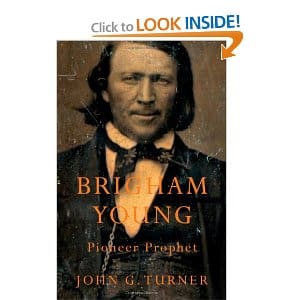
 As the 2nd feature of our Mormon Stories Book Club series (organized by the brilliant Heather Olsen Beal), we feature John G. Turner and his new book “Brigham Young: Pioneer Prophet, accompanied by Dialogue Foundation chair elect Morris Thurston. Please click on the image to the right to purchase your book through Amazon. A small amount of the proceed go to help support Mormon Stories.
==============
Title: Brigham Young: Pioneer Prophet
Author: John G. Turner
Publisher: Harvard University Press
Genre: Biography
Year: 2012
Pages: 352
Binding: Hardcover
ISBN-13: 0674049675
Price: $26.00
Support Mormon Stories by purchasing Brigham Young: Pioneer Prophet through this link
Book Description from www.amazon.com:
“Brigham Young was a rough-hewn craftsman from New York whose impoverished and obscure life was electrified by the Mormon faith. He trudged around the United States and England to gain converts for Mormonism, spoke in spiritual tongues, married more than fifty women, and eventually transformed a barren desert into his vision of the Kingdom of God. While previous accounts of his life have been distorted by hagiography or polemical exposé, John Turner provides a fully realized portrait of a colossal figure in American religion, politics, and westward expansion.
After the 1844 murder of Mormon founder Joseph Smith, Young gathered those Latter-day Saints who would follow him and led them over the Rocky Mountains. In Utah, he styled himself after the patriarchs, judges, and prophets of ancient Israel. As charismatic as he was autocratic, he was viewed by his followers as an indispensable protector and by his opponents as a theocratic, treasonous heretic.
Under his fiery tutelage, the Church of Jesus Christ of Latter-day Saints defended plural marriage, restricted the place of African Americans within the church, fought the U.S. Army in 1857, and obstructed federal efforts to prosecute perpetrators of the Mountain Meadows Massacre. At the same time, Young’s tenacity and faith brought tens of thousands of Mormons to the American West, imbued their everyday lives with sacred purpose, and sustained his church against adversity. Turner reveals the complexity of this spiritual prophet, whose commitment made a deep imprint on his church and the American Mountain West.”
Book Club Resources:
- Click here to listen to the Mormon Stories Podcast with author John Turner, Morris Thurston, Max Mueller, John Dehlin, and Heather Olson Beal [H1]
- Reviews of Brigham Young: Pioneer Prophet
- Harvard University Press webpage: https://www.hup.harvard.edu/catalog.php?isbn=9780674049673
- HuffPo piece re: Brigham Young and polygamy by John G. Turner: https://www.huffingtonpost.com/john-g-turner/brigham-young-and-polygamy_b_1792555.html
- Times and Seasons review: https://timesandseasons.org/index.php/2012/09/book-review-brigham-young-pioneer-prophet-by-john-g-turner/
- Association of Mormon Letters review: https://mormon-chronicles.blogspot.ca/2012/06/review-brigham-young-pioneer-prophet-by.html
- Improvement Era review: https://improvementera.com/2012/09/review-and-musings-brigham-young-pioneer-prophet/
- Podcasts re: the book:
- Harvard University Press podcast: https://soundcloud.com/harvard-press/john-turner-brigham-young
- National Review’s Between the Covers with John J. Miller: https://www.nationalreview.com/media/betweenthecovers/328405
- Mormon Expositor: https://mormonexpositor.com/6-brigham-young-pioneer-prophet-with-john-g-turner/
- KCPW podcast: https://kcpw.org/blog/cityviews/2012-09-10/cityviews-91112-brigham-young-pioneer-prophetwhy-mars-matters/
- Other Mormon-themed resources/writings by Turner
- New York Times piece re: Mormons and racism by John G. Turner: https://www.nytimes.com/2012/08/19/opinion/sunday/racism-and-the-mormon-church.html?_r=0
- Turner’s thoughts on “the Mormon moment”: https://www.nytimes.com/2012/07/03/books/mormon-studies-attract-more-scholars-and-attention.html?pagewanted=all
- Turner’s take on the Hill Cumorah pageant: https://online.wsj.com/article/SB10000872396390444330904577536774199980182.html
- Turner’s thoughts on Mormons and the Civil War: https://opinionator.blogs.nytimes.com/2012/05/01/the-mormons-sit-out-the-civil-war/
- Turner’s review of Book of Mormon Girl: https://www.patheos.com/blogs/anxiousbench/2012/09/book-of-mormon-girl/
Syllabus for a research course Turner teaches on Mormonism:
https://www.southalabama.edu/history/faculty/turner/documents/HY441MormonismSyllabus.pdf
[H1]: Links provided once we record the podcasts.
Episode Transcript
Host: John Dehlin · Guests: John Turner, Morris Thurston
This transcript is machine-generated and lightly edited for readability. The audio is authoritative. Please excuse occasional errors in names and spelling.
Introduction to Mormon Stories Book Club
Part 1 of 2 · Ep. 377
John Dehlin [00:00:00] 1, 2, 3.
John Dehlin [00:00:07] Mormon Stories Podcast is a production of the Open Stories Foundation. All donations to Mormon Stories are fully tax deductible and go directly towards keeping the podcast alive and towards building a community of support for Mormons like you. To support the podcast or to join the community, please become a monthly subscriber today@mormonstories.org hello and welcome to a special edition of Mormon Stories podcast, Mormon Stories Book Club.
John Dehlin [00:00:36] I am your host, John Dehlin, and I'm very excited to have with us today author and professor John G. Turner. He is the author of the brand new biography on Brigham Young entitled Brigham Young Pioneer Prophet and and he's the feature today of Mormon Stories Book Club. I also have joining us today the distinguished Morris Thurston.
John Dehlin [00:01:04] Morris is an attorney, a retired attorney. He lives in Orange County. He's been on Mormon Stories several times before. He's also, I believe, the chair elect of the Dialogue foundation, active participant in Mormon studies. He was a participant on the Joseph Smith Papers Project and has done a lot in doing sort of legal analyses of Proposition 8 and the Church's position on gay marriage. So, John Turner, welcome to Mormon Stories.
John Turner [00:01:38] Thanks for having me, John. Pleasure to be here.
John Dehlin [00:01:41] And Morris, welcome to you as well.
Morris Thurston [00:01:43] It's great to be here, John. Thanks.
John Dehlin [00:01:45] Okay, so I'm going to just so audience, a couple things to note. First of all, we've actually conducted this interview once already. We conducted it a week or two ago. We had Heather Olson Beale and Max Mueller on in addition to John Turner and Morris Thurston. But the audio software actually didn't record the first hour and a half and I feel horrible about that. But the software just failed us. So we're going to take some precautions. But I want to give a shout out to Max and Heather, especially Heather, for planning arranging this entire interview. She's sort of taken the lead on Mormon Stories Book Club and so I want to thank her and also thank Max for joining us and tell him how sorry we are that he couldn't join us today.
John Dehlin [00:02:28] Let me just tell everyone really quickly about Mormon Stories Book Club and what it's about. This is the second in a series. The first one was with Joanna Brooks in August when we featured Book of Mormon Girl. But here's how it works.
John Dehlin [00:02:42] We provide a link to Amazon where you can purchase the book in question. Right now, if you go up to mormonstories.org Brigham Young Pioneer Prophet is featured in the left hand toolbar. You can click on that link and purchase the book.
John Dehlin [00:02:58] We've had dozens of people already buy John's book even before we've actually recorded this podcast. So we're happy about that. And a little bit of the money will come to Mormon Stories if you a way for you to support Mormon Stories and good literature.
John Dehlin [00:03:14] But also the way that we're setting this up is that we're going to do this initial interview with John Turner and allow you to listen to it. And then we're going to encourage you to hold book clubs all over the country in your local area through your Mormon Stories Facebook community and other friends and family or ward members that you have. And we're providing all sorts of supplemental materials for you to read up on the book. To prepare yourselves for a book club discussion, we've set up a Facebook group called Mormon Stories Book Club where you can go and actually interact with John Turner and ask him questions.
John Dehlin [00:03:52] And for those who are able to gather book clubs of, let's say, 10 to 20 people, John Turner has actually expressed a willingness, and this will be the same with other authors, to actually appear at your book clubs via Skype, if you live far away from the D.C. area. Is that where you live, John?
John Turner [00:04:10] That's right. We're in Northern Virginia.
John Dehlin [00:04:12] Yeah. So if you live near Northern Virginia, he might even be willing to visit your book club. Personally, we have a vibrant Mormon Stories group in Washington, D.C. but also he's willing to appear at your book clubs via Skype, you know, if you have a big enough group to sort of, you know, make it worth everyone's while. So that's what Mormon Stories Book Club is about. I also want to just let you know that you can purchase anything through Amazon Stories. You can purchase anything through Amazon through a link on Mormon Stories, and that will just give Mormon Stories a little bit of extra financial support. But that's not important right now. The most important thing is for you to buy John's book, Brigham Young Pioneer Prophet. And we're going to now jump in to feature that book.
John Turner [00:05:00] So
John Dehlin [00:05:02] before we jump in, John, I thought it would be interesting to begin by having you read an excerpt from your book. I was rereading through it today, and the prologue just jumped out at me as a fascinating and captivating introduction to the personality of Brigham Young. So it is a few paragraphs, but I think it's worth reading to sort of set up what's going to be our discussion. So would you mind reading the first few paragraphs from your prologue?
John Turner [00:05:36] Sure.
John Dehlin [00:05:36] All right.
John Turner [00:05:37] On New Year's Day, 1877, Brigham Young and nearly 1300 Latter Day Saints Gathered in the southern Utah settlement of St. George, they came to dedicate a temple, the first the church had completed so since fleeing Illinois 31 years earlier.
John Turner [00:05:56] For three hours, Mormon leaders offered lengthy prayers, consecrating the new building. At the end of the services, Young finally arose. He was ailing from rheumatism and unable to walk. Several men had helped him into and around the temple in a sedan chair on rollers.
John Turner [00:06:17] Despite his infirmities, Young, a man who had delivered thousands of discourses over the past 45 years, would not allow this occasion to pass without comment. He began by reminding the congregation of the occasion's historic significance. The Mormons had dedicated two temples before the one in St. George, but now they would have the time to introduce what he considered the full range of sacred rituals for the first time.
John Turner [00:06:46] We that are here, Young said, are enjoying a privilege that we have no knowledge of any other people enjoying. Since the days of Adam, church members could perform all the rituals necessary to ensure their own eternal exaltation. And they could perform the same ordinances as proxies for their ancestors. Can the fathers be saved without us? Young asked.
John Dehlin [00:07:12] No.
John Turner [00:07:13] Can we be saved without them? No. Combined with other ordinances that would bind children to parents and adopt men to spiritual fathers, Young envisioned these rituals as binding together a great chain of redeemed humanity stretching back to Adam.
John Turner [00:07:33] Given the sacred importance of this task, he suggested the house of the Lord should be crowded after its dedication. Then Young's tone gradually changed. Despite the sacrifices of the Mormons who had built the temple, he feared that church members were more worried about money than the eternal fates of their ancestors.
John Turner [00:07:58] They would choose a single dollar over eternal life, and they would give away the people's wealth to their enemies. Some of this people, he complained, if they had the power, would build a railroad to the bottomless pit and would send all they had, and the earth besides, to the devil. Too many of the Mormon people, he said, were damned fools.
John Turner [00:08:23] Young demanded that his people mirror his own commitment to the kingdom of God. Let those infernal holes in the ground alone eternal, he instructed the audience. And let the Gentiles alone, who would destroy us if they had the power.
John Turner [00:08:40] If they did not heed his words, there would be consequences. You will go to hell, lots of you, unless you repent, he warned. Building to a crescendo, Young upbraided those who were satisfied with the temple's dedication, a symbol of the Mormons spiritual commitment to and material progress.
John Turner [00:09:03] I am not half satisfied. Young thundered, as much as his aging lungs would permit. And I never expect to be satisfied until the devil is whipped and driven from off the face of the earth. To drive home his final sentence, Young took a hickory cane filled with knots and struck the pulpit with such power and that he buried three of the knots into the solid wood.
John Turner [00:09:31] The noise reverberated around the hall, and visitors to the temple a century later could still see the marks. Young's spirit and determination were as strong as his body was weak. He was blunt spoken, pugnacious, and sometimes profane. Through his dedication, energy, and tenacity, he. He had built an earthly kingdom for the Mormon people, and he would fight to defend it until his final breath.
John Dehlin [00:10:05] Beautiful. I'm so happy you were willing to read that. Well, John Turner, let's start by just having you tell just a tiny bit about yourself, just sort of career wise and academically. And then the big question that I wanted to start with was, what got you interested in Brigham Young?
John Turner's Path to Writing About Brigham Young
John Turner [00:10:28] Sure. Well, thinking about how far to go back, I grew up outside of Rochester, New York, and at some point I became aware of the Latter Day Saints as a piece of local history. And then by the time I got to graduate school, I was interested in the history of religion in the United States.
John Turner [00:10:55] Didn't actually focus on Mormonism while I was a graduate student or writing my first book. It was about evangelicalism. But I developed a little bit of curiosity about the Latter Day Saints. I had some good Mormon classmates in graduate school. That piqued my curiosity a little bit. I think if you're interested in the history of religion in the United States, it's hard not to get at least a little bit interested in the Mormons. The 19th century story in particular is so dramatic and colorful.
John Turner [00:11:34] About five years ago, I was looking for a new research project, and I thought about doing a project on Mormons and politics in the United States since World War II, which also I think would have been timely. But as I started to read up about Mormon history, I got drawn back into that 19th century, and I saw Brigham Young as a towering figure not only for the history of Mormonism, but also for the history of the United States more broadly in the 19th century. It had been a while since anyone had written a full biography of Brigham Young. And so I plunged into it as a way of partly satisfying my own curiosity about the church's history.
John Dehlin [00:12:29] And you grew up evangelical, is that right?
John Turner [00:12:32] Yeah, that's right. Somewhere between evangelical and mainline Protestantism. But yeah, no, I kind of, kind of came of age spiritually as a young person. Through evangelical organizations like Young Life and Intervarsity, which probably have not historically had very good relationships with Latter Day Saints, for all I know. So, yeah, I'm kind of somewhere between evangelical and mainline Protestantism. I tend to like the piety of evangelicalism with, without liking what I consider to be its kind of superficiality and politicization.
John Dehlin [00:13:15] Right. So had you heard of, you know, how much. I'm just trying to imagine someone who doesn't necessarily know a lot about Mormonism, who didn't grow up in the Mormon faith, you know, deciding to tackle a biography of such a large historical character. And as someone who's a bit of an insider who knows that Leonard Arrington, who's well respected as sort of like the grandfather of modern Mormon historiography. I don't know if those are the right terms, but he's definitely a towering figure in. In Mormon history in the mid to late 20th century.
John Dehlin [00:14:04] I just. I imagine feeling intimidated at writing a biography knowing that Leonard Arrington had already made an attempt. So what was it? Did you feel any of those kind of pressures either about the largeness of Brigham Young or following Leonard Arrington as you sort of decided to take on this task? Did it feel like a big task to you, or did it just kind of grow in a way to where it wasn't that overwhelming or monumental in your considerations?
John Turner [00:14:38] Well, I think I was too ignorant at the outset to realize what a foolhardy sort of project it was, honestly. I mean, one of the first things I did was, you know, naturally read the existing biographies of Brigham Young, or at least several, including Leonard Arrington's.
John Turner [00:15:00] I guess the first thing that struck me was just in this, you know, just in the sense of time passing. Been a long time since American Moses had been published. When I. When I started the project, it had already been a little bit more than 20 years.
John Turner [00:15:22] And in terms of scholarship and academia, that's a long time. And I knew that there had been a lot of fabulous books and articles on Mormon history published since then. So I knew just on the face of it, that there would be plenty of new things to say. So the fact that American Moses existed wasn't intimidating.
John Turner [00:15:49] I also thought, just from the initial time I spent with the literature, that while American Moses was a tremendous step forward in terms of using the primary sources of the Brigham Young papers and other collections, I thought that there was a lot more to say about quite a few topics, ranging from plural marriage to mountain meadows to Brigham Young's theology.
John Turner [00:16:21] You know, Leonard Arrington was trained as first and foremost, an economic historian. You know, my focus has always been the history of religion and its intersection with politics. So I thought also in that sense, I'd probably, you know, be taking a somewhat different approach. So, no, that wasn't intimidating. I probably didn't really understand the absolute mountain of sources that one is blessed with when, well, not just doing a project on Brigham Young, but on almost anything pertaining to 19th century Mormonism.
John Dehlin [00:17:01] Okay, well, that's a great background. Real quick, after you. After you really got to know Brigham Young through your readings. You know, you mentioned wanting to talk, you know, that there was some new information about, let's say, his plural marriages or mountain meadows or his theology. Was there something about his personality that either captivated you or that you sort of felt compelled to want to share? In other words, maybe in a biography you get a chance to paint the personality of a historical figure. And were there elements of his personality that you either felt attracted to or sympathized with or felt compelled to want to share and to highlight for the interested audiences
Brigham Young's Spiritual Fire and Early Character
John Turner [00:18:02] lots of things. John I wanted to capture the spiritual fire that animated Brigham Young during his early years as a missionary. He more or less was almost a full time missionary from the church from his conversion in 1832 until Joseph Smith's murder.
John Turner [00:18:24] And, you know, he was a fiery speaker. He spoke with some frequency in spiritual tongues. He was a fierce advocate for Joseph Smith. So I wanted to capture those elements of his early personality, wanted to capture the tender letters that he wrote to his wife, Mary Ann angel, during those years. I also wanted to capture some of the changes in his personality produced by the traumatic experiences of the mid-1840s, starting with Joseph's murder. You know, he became a man who was much more burdened by fear and anxiety, someone who could be vindictive toward fellow church leaders and antagonistic toward outsiders. And so I wanted to capture the complexity of his personality and get as close to Brigham Young as I could. The closest accounts of his sermons and people who were with him at the time.
Morris Thurston [00:19:42] John, let me just ask something. You've mentioned some things that took place early in Brigham Young's life or at least before they got to Utah. And I think a lot of our listeners are probably a lot less familiar with Brigham Young's early life than they are his later life. But I found that section of your book to be really enlightening.
Morris Thurston [00:20:03] In particular, I think there was a time it might be helpful for you just to set the stage with Brigham Young. How old was he compared to Joseph Smith? Did he come from the same part of the country? And then as far as his background goes, when he was 16 years old, his father basically said, you're on your own.
Morris Thurston [00:20:27] And they weren't a well to do family to begin with. He had not had much education, hardly the sort of thing that that one would expect or a background one would expect of a future leader of an American Moses type history. So perhaps you could just tell us a little about his early years.
John Turner [00:20:48] Sure. It's a great question. And there's some similarity between Brigham Young's background and Joseph Smith's. Quite a lot of similarity. Their families both moved from Vermont to New York. Brigham was about four years older than Joseph Smith. Both families were poor, mostly rural.
John Turner [00:21:15] Brigham Young had a very impoverished upbringing, no formal education. His mother died when he was around 13 or 14 years old. And then you're right after his father remarries, he basically tells Brigham that it's time for him to be independent now. Being independent at age 16 was not quite as unusual then as it would be now, but still, I think it was pretty tough sledding for him as a young man.
John Turner [00:21:47] He for a while followed in his father's footsteps of moving from place to place, trying to find a way to get ahead economically and not succeeding at that. He was also a bit of a spiritual seeker or drifter even.
John Turner [00:22:07] He had a conversion to a restorationist branch of Methodism called the Reformed Methodist Church. And ultimately that experience left him unsatisfied. I think some of those who sought salvation through evangelical conversion didn't find the assurance of salvation they were seeking. And Brigham Young was in that category. And it left him feeling utterly despondent about his spiritual state and I think about the state of churches that he encountered as well.
John Dehlin [00:22:51] Hey, John, will you tell us really quickly what you mean by restorationist and what that means?
John Turner [00:22:57] Well, in the context of most Protestant restorationist movements, it meant attempting to restore at least elements of the New Testament Church. So the Reformed Methodists, for instance, focused on restoring the gift of spiritual healing as it had been practiced in early years of Christianity. They also founded a communitarian settlement. This was before Brigham Young and his family were involved. They saw that as also restoring an aspect of economic cooperation and sharing that's described in the Book of Acts. They. They were focused on restoring New Testament Christianity. And I think that when Brigham Young then encounters Joseph Smith, a prophet who talks about restoring the ancient order of things, that makes sense to him in a way. I think he's preconditioned to a certain Extent to at least take seriously the claims of Joseph Smith and this other, other version of restorationism.
Morris Thurston [00:24:14] And apparently, John, it was not only Brigham Young, but many of his extended family. It might just, again, by way of setting the stage, might be helpful just to tell us about it, because he had quite a few siblings, right?
John Turner [00:24:30] He did. He had something like five brothers and some sisters as well. And it more or less was a family conversion. One of his older brothers seems to have led the way, perhaps even a couple of them. And Brigham himself spent almost two years considering the claims of the Book of Mormon before seeking baptism along with other members of his family. And then quite a few members of the young family finally are baptized in the spring of 1832.
John Dehlin [00:25:10] So how old would Brigham have been when he started reading the Book of Mormon?
John Turner [00:25:13] Just shy of 30.
John Dehlin [00:25:15] Okay.
John Turner [00:25:16] Just shy of 30 years old. And then he's almost 32 at the time of his conversion. What really seems to have influenced him to crossing that threshold of converting and seeking baptism was seeing a group of Mormon elders, traveling missionaries, speak in tongues. I think for him, that was a clear display of God's power and presence and helped him overcome some of the hesitation that he had experienced.
John Dehlin [00:25:55] That's so fascinating because we don't speak in tongues today.
John Turner [00:26:01] Presbyterians don't either. So. No, it's foreign. It's foreign. And something so associated with Pentecostalism and something that begins in the early 1900s, but it was a prevalent part of early Mormon spirituality.
John Dehlin [00:26:19] Now, was Brigham Young. First of all, do we know who the missionaries were? Was he attracted out by missionaries? Did he have a relationship with.
John Turner [00:26:28] You know, I don't know the extent to which he really had a relationship with these traveling elders. Eleazar Miller is the elder who ultimately baptizes him. There are several others. The names escape me at the moment.
John Dehlin [00:26:44] Oh, that's fine.
Morris Thurston [00:26:45] There was one, though, I think the one that initially contacted him. If I recall your book correctly, John was one of the first, if not the first, missionaries sent out by the church. Maybe I got that wrong.
John Turner [00:27:02] Yeah. You know, Brigham's brother Phineas encounters Samuel Smith, Joseph Smith's brother, very shortly after the publication of the Book of Mormon. And then Phineas, Joseph Young, and Brigham Young all have interactions with Solomon Chamberlain, who's an early believer in the Book of Mormon and a visionary himself. Ultimately, all of them conclude, I think, that what they had been searching for in Reformed Methodism, they found in Mormonism.
Young's Life Before Joining the Church
John Dehlin [00:27:49] Talk just briefly, about his professional life leading up to joining the church and also his married Life, just so we can get a sense of what state he was in when he joined the Mormon community.
John Turner [00:28:03] Sure. Well, he's married to Miriam Works. He married her in 1825. They had two daughters. And at the time of their conversion, she joined the church a little while after he did. She was dying from tuberculosis. And there are some.
John Turner [00:28:24] Some of his recollections suggest that it was an incredible ordeal for him to be working, caring for his daughters, caring for his wife during, you know, perhaps that last year or two of her life in. And she died in September, a few months after their conversion.
John Turner [00:28:46] Economically, he was a craftsman. I think he did a number of jobs, but was most accomplished as a furniture maker. And he also worked on the construction of buildings. He worked on a printing press at one time. He did quite a few different things.
John Turner [00:29:07] I. I know he wasn't getting ahead economically. His father had purchased some land outside of Rochester, New York, and at one point Brigham and his brother Phineas purchased some land as well. But they quickly get behind on the payments and have to sell.
John Dehlin [00:29:26] That's kind of another similarity to Joseph, just kind of financial struggles leading up to heavy church involvement.
John Turner [00:29:34] Absolutely. Yeah. No, I mean, there's certainly no sense that Brigham Young's life had any clear direction or upward trajectory before his conversion to Mormonism.
Morris Thurston [00:29:48] One thing I liked about your book, John, is that you would often quote Brigham Young and you would quote him with the original spellings if he was writing a letter, for example, and it's clear that his ability to spell as an adult was probably on a par with my six year old grandson. I mean, it was a totally phonetic type spelling or with Joseph Smith.
John Dehlin [00:30:16] Right, right. Morris.
Morris Thurston [00:30:18] Yeah. Although I don't recall Joseph Smith's spelling being as bad as Brigham Young's.
John Turner [00:30:22] Now Brigham's is worse. I think that's true. Yeah. No, and actually, I found that a very endearing thing.
Morris Thurston [00:30:34] Oh, me too.
John Turner [00:30:35] Yeah. And you know, it wasn't so uncommon in the 1800s, especially the early 1800s, for people to employ incredibly irregular spelling. A much smaller percentage of people had formal education and things in general were a little less standardized.
John Turner [00:30:56] Brigham Young, after his conversion, he keeps a diary, especially during his missionary travels. He writes letters. In particular, when he's in charge of the mission to England in 1840 and 1841, he often sits down and writes long letters to his fellow apostles.
John Turner [00:31:21] And that strikes me as something that must have been rather burdensome for him. And he would sometimes write at the end, please excuse errors. Once in a while he'd put a Note or a postscript on a letter to his wife and something to the effect of, don't show this to everyone. I know my handwriting and spelling are terrible.
John Turner [00:31:45] I'm very roughly paraphrasing him, but I kind of think of him almost slaving away to do that sort of official writing in particular at times.
Brigham Young's Conversion and the Book of Mormon
John Dehlin [00:31:58] One more question about his conversion. Do we have a sense for whether the Book of Mormon played a pivotal role in his conversion?
John Turner [00:32:05] Well, I think it did, but not in a straightforward way of reading it and believing it, and not in a straightforward way of the contents of the Book of Mormon having a big influence on him at the time. I think he did when he encountered the Book. He did take it as a sign of God's renewed presence in the world and God acting as. As he had acted in previous eras of history. So I think he was moved by the appearance of the Book of Mormon, but I don't think his conversion primarily rested on him reading the Book of Mormon, reflecting on the book, contemplating on the book, and then deciding to believe. I think the interactions ultimately with other believers were most instrumental.
John Dehlin [00:33:07] Did he meet Joseph before joining?
John Turner [00:33:11] No, he traveled to meet him shortly afterwards. Shortly after his wife's death, he and his friend Heber Kimball traveled to Kirtland and he found Joseph Smith chopping wood in the forest. And he later talked about really being so pleasantly surprised at how down to earth Joseph Smith was that he didn't put on any sort of airs as a prophet. He just seemed very much like an ordinary person that Brigham Young could relate to. At the same time that those days with Joseph Smith during. During that first trip to Kirtland certainly convinced Brigham Young that Joseph Smith was a prophet, which is something he never wavered about for the remaining 45 years of his life.
John Dehlin [00:34:13] And was it soon thereafter that Brigham was called as a missionary?
John Turner [00:34:20] Well, he'd already been serving as a missionary. The first thing he writes in his diary post conversion, he makes a note that he was baptized in April of 1832. And then pretty much his next sentence is, I preached as opportunity presented.
John Dehlin [00:34:42] That's called a golden convert in Mormonism.
John Turner [00:34:44] Yeah, well, it was not unusual. Other early converts like Parley Pratt had had very similar experiences. I think he simply wanted to go out and share with others this experience that so quickly transformed his life. He wrote in his diary, I was ordained to the office of an elder before my clothes were dry upon me. So he simply immediately goes out and. And preaches first in Mendon, and then he travels these reformed Methodist circuits, especially in Canada and talks to many people he had known within the orbit of Methodism and is fairly successful at gaining several dozen converts over the next couple of years.
John Dehlin [00:35:46] And this is traveling without Percy Script just
John Turner [00:35:50] absolutely. And trudging through mud and ice, making a sacrifice for his new faith. And later on in life, when others would complain about what they were having to sacrifice, he would often refer back to these early years of missionary service as if to say, I've made these sorts of sacrifices. You shouldn't complain. It's now your turn to put your shoulder to the wheel, so to speak.
John Dehlin [00:36:25] I get the sense that he was rarely living in the same city as the prophet. And for some reason, I get the sense that he spent most of his time overseas in Europe. Talk a bit about how he goes from meeting Joseph to kind of what his involvement in the church is while Joseph's still alive.
John Turner [00:36:44] Well, you know, it's actually. It's back and forth. I haven't really calculated it, but I would say it's about half of his time in the same place as Joseph and then about half as a missionary. And he's only overseas. It's really a two year or two and a half year trip from Illinois to England and back. So much of the time he is with Joseph Smith, but it's inconstant. He moves to Kirtland in, I think, 1833. He remarries in 1834. He goes with Joseph Smith to Missouri in the Zion's Camp march, which is also a formative experience for him.
John Dehlin [00:37:37] Was that a challenge to his faith at all? To. I mean, for our listeners who don't know about Zion's Camp, you know, the Saints in Missouri were getting persecuted, as I understand it. Talk a bit about Zion's Camp and whether that tested Brigham Young's faith because it was such a. Some would say it was such a failure of an expedition. But I imagine failure in a matter
John Turner [00:37:58] of perspective, that's absolutely correct. Well, the Saints in Jackson County, Missouri, had been basically just kicked off of their land. And they go and several leaders go to Kirtland and really expect Joseph Smith, I think, to do something about it. And he decides to march a very makeshift army, if you will, to Missouri and help the Jackson County Saints reclaim their property. He's had some assurance from the governor of Missouri that he'll be supported in this. That turns out not to be the case.
John Turner [00:38:46] And when this army, just a ragtag army, reaches Missouri, it does turn into a debacle. It's clear that they're not going to be able to reclaim the land. Then there's a cholera epidemic that claims a number of lives.
John Turner [00:39:09] But no, that doesn't shake Brigham Young's faith at all. For him, I think it was a precious opportunity to be with Joseph Smith. Joseph Smith explained the setbacks of Zion's camp as a result of the people's own transgressions and also God's providence. And it didn't shake Brigham Young's faith to march with Joseph Smith to Missouri and back.
John Turner [00:39:40] I think he simply viewed those sorts of setbacks through a different lens, through a lens of faith in Joseph Smith. Those sorts of experiences didn't disrupt his faith in Joseph as a prophet.
John Dehlin [00:39:58] Well, there's a saying that familiarity breeds contempt. And, you know, as you kind of trace the church's history up to 1838 or so, you know, by the time 1838, 1839 rolls around, you've got members of the First Presidency and a significant number of apostles being excommunicated and people left and right not only losing their faith in Joseph Smith, but even turning against him. What was it about Brigham Young or Brigham Young's relationship with Joseph that made it so that he didn't lose faith in Joseph and stayed a staunch support when so many others seemed to wither?
John Turner [00:40:41] It's a great question. Ultimately, maybe it's hard to say, but my sense of Brigham Young is that he saw Joseph Smith as the prophet who had brought forth the Book of Mormon, who had re established God's church. And through that, Brigham Young had finally found the assurance of salvation that he hadn't been able to find through Reformed Methodism.
John Turner [00:41:09] I can't really ultimately explain why Mormonism satisfied those spiritual urgings in him and evangelical Protestantism did not. That definitely was the case. And I think in Brigham Young's mind, through Joseph Smith, God had brought him these things that he had learned, long sought.
John Turner [00:41:35] Why? Doubt in the face of setbacks. But you're absolutely right. Many other people fell away during these years. Brigham Young certainly recognized deficiencies in Joseph Smith's leadership at times. He didn't think that Joseph Smith's financial management was perhaps all it could have been.
John Turner [00:41:59] And he didn't think that Joseph handled dissent as he should have, that he should have taken a harder line toward dissenters within the church. So it's not that Brigham Young had blinders on to Joseph's human frailties, but I think he simply resolved that he wasn't going to let those frailties interfere with his him following Joseph as a prophet. So he remained A very stalwart supporter of Joseph Smith when many other people questioned him, which is one reason he rose in Joseph's estimation.
John Dehlin [00:42:40] Because of his loyalty.
John Turner [00:42:41] Absolutely, yeah.
Succession Crisis After Joseph Smith's Death
John Dehlin [00:42:44] Was there anything about the seniority and the disaffection of certain apostles that made it in terms of seniority such that Brigham Young was then set up later to become Joseph's successor as a result of these apostasies in 38 and 39?
John Turner [00:43:06] Well, by the time Joseph Smith is in jail in Missouri, Brigham Young is the most senior remaining member of the quorum of the twelve apostles. He's actually two weeks older than Heber C. Kimball. And so when Joseph Smith writes from liberty jail, I think it's from liberty jail and says that leadership of the 12 is going to devolve upon the most senior member, he may not even have been sure if it was Brigham Young or Heber Kimball, but it was Brigham. So that's just kind of luck and happenstance.
John Turner [00:43:48] You know, by the time of Joseph Smith's murder, I don't think that Joseph left any clear instructions as to who should succeed him. But Brigham Young, as president of the quorum of the 12 and as someone who is intimately at the center of Joseph Smith's introduction of ordinances during those years, is in a position in which he can claim leadership of the church for the 12.
Morris Thurston [00:44:27] I think it's interesting to contemplate how history might have been different had this sort of serendipitous occurrence not happened. For example, had David Patton, who was the most senior apostle, not been killed in Missouri, had Brigham been just a few weeks younger than Heber, you know, how would those men have perhaps handled the whole issue of succession differently? And not to mention the trip to Utah and everything that followed after that?
John Turner [00:45:05] Absolutely. Well, it's fun to speculate what would have happened to the church had Joseph Smith not been killed in 1844. Leadership matters. So I think those are interesting questions, not that there's any way of knowing what the answers are
John Dehlin [00:45:26] real quick. Since polygamy ends up defining Brigham Young to such a large extent. What can you tell us about how Brigham Young learned about the polygamy and whether he was excited or not excited and what his early polygamist sort of involvement looked like when Joseph was still alive?
John Turner [00:45:46] Great question. He learned about plural marriage sometime shortly after his return from England in 1841. By the next winter, he officiates at one of Joseph Smith's plural marriages. So within a span of less than a year, eight months or so, he certainly accepts the doctrine for his Initial responses, we have to rely upon his later recollections. He later said that it was the only time in his life that he desired the grave, which I think makes sense that he would have seen this as something that was going to, at the very least, disrupt his existing marriage, family, life. I'm sure he sensed the potential that polygamy had to tear apart the church.
John Turner [00:46:48] He has other recollections where he sounds as if he. He found the doctrine more thrilling at the time, that this would bring him privileges and power even that he hadn't previously experienced. It's hard to know how to sort those out. Not a lot of men, when they reflected upon the introduction of plural marriage, talked about how exciting they found it at the time.
John Turner [00:47:15] They kind of almost be distasteful to do so. So I don't know. I think there probably was a period of resistance, but it wasn't a long period. And I think there's a parallel with his conversion. He's a man who deliberates, hesitates, but once he commits, he's fully committed and he doesn't look back.
John Dehlin [00:47:43] I'm just wondering. I'm just wondering. A lot of the critics will say that, oh, you know, these men like the. Like Martin Harris or the Whitmers, you know, they weren't very bright. They weren't necessarily very strong in character, and so they would be easily bamboozled, you know, by, again, what the critics would say. A charlatan like Joseph Smith. I'm wondering to what extent you found him to be a bright person, a bright. A person of integrity, a person of character. And if you found him and others around Joseph Smith to be, you know, quality people, to what extent that speaks to Joseph's power and influence to be able to do something as shocking as introduce plural marriage and still retain the faith and confidence of these men that probably had a lot of strength and character.
John Turner [00:48:44] Well, it's a good question. I certainly think that Brigham Young was a very intelligent man. Not book learning, but just raw human intelligence. I think he certainly possessed that. I think he could be fairly shrewd. I don't think he was gullible.
John Turner [00:49:08] And I think for him, it stems back to simply seeing Joseph Smith as God's prophet. When Joseph introduces the ordinance of baptism for the dead at roughly the same time, it's equally thrilling to Brigham Young and many other Latter Day Saints.
John Turner [00:49:33] And I think the. I'd love it if we were more privy to the conversations that Joseph had about plural marriage with men like Brigham Young during these years. We get Some sense of those conversations from the diary of William Clayton. But Brigham Young doesn't record his own interactions with Joseph in such detail at all.
John Turner [00:50:05] So to a certain extent, it's hard to know. I don't think that even Joseph Smith and certainly not Brigham Young, had any clear sense of how this new practice was going to play out practically during these years. It's only after Brigham Young leaves Nauvoo and heads west that he begins assembling a polygamous household.
John Turner [00:50:33] He doesn't cohabit with the women he marries in Nauvoo. He doesn't begin having children with any of the women until after Joseph Smith's death. So during these early years, it's a little bit hard to know what he thought about these marriages.
John Dehlin [00:50:58] That's interesting. So we don't know of very many children Joseph had in his polygamous marriages in Nauvoo, and we don't know of any from Brigham either. Do we know of any. Morris, to you or John Turner? Do you guys know if any children were born, polygamous children, children of polygamous unions during the Nauvoo period, or do we even know that?
Morris Thurston [00:51:25] Well, I guess I'll maybe defer to John Turner, except to say that I know after Joseph's death, there were clearly cohabitations going on, and I suspect children were born. My own great, great grandfather, father to children by a polygamous wife.
John Dehlin [00:51:47] A child.
Morris Thurston [00:51:48] But it was as they were leaving Nauvoo. I mean, it was within a few months after leaving Nauvoo.
John Dehlin [00:51:56] That's interesting.
John Turner [00:51:58] Yeah. You know, I think there's still debate about whether or not Joseph Smith ever had children by any of his plural wives. I. You know, there are a couple of debatable cases. There are people who know a lot more about it than I do, so you should probably ask them. I won't speculate further. There is evidence that both Joseph and Brigham consummated at least some of these marriages during these years. And then he does begin to have children with his wives about the time that they're leaving Nauvoo. So there are conceptions before they leave, and several of his wives have children on the trail west. I think there are a couple who have children right before the Exodus or around the time of the Exodus.
Morris Thurston [00:52:55] And in fact, I now recall that on the Exodus, the first wagon train that Brigham Young led, there were like, three women on the trip, one of whom, or maybe one of whom was Brigham Young's wife. I think two of whom were heber Kimball's wives, and one of them at least, was pregnant.
John Turner [00:53:15] Yeah, right. Right.
John Dehlin [00:53:17] All right, John Turner. So let's. Before we leave Nauvoo, there's sort of this traditional story that many of us grew up with, dealing with. You know, after Joseph's death, Brigham comes into Nauvoo. You know, Sidney Rigdon thinks that he should be Joseph's successor. Brigham kind of thinks he should be Joseph's successor. And they have this sort of showdown with all the people in Nauvoo where both of them give talks or speeches to the saints in Nauvoo. And there's a report, several reports maybe after the fact, that when Brigham's time came to speak to the people of Nauvoo, that some recall actually seeing or experiencing the aura or essence or voice or even image of Joseph Smith's face in Brigham Young as he's speaking to the saints in Nauvoo. Is that what the historical record actually bears out for you, or what's your understanding of that succession and how Brigham Young pulled it off?
John Turner [00:54:27] I don't think that a transfiguration would have been necessary for Brigham Young to carry the day, to persuade the majority of Nauvoo's Latter Day Saints that they should follow the apostles rather than Signe Rigdon. And your question is correct, that there are a lot of reports of a miraculous transfiguration of sorts, so that people either saw or heard Joseph Smith when Brigham Young was talking. As far as I know, none of those reports are contemporaneous, which doesn't mean that that sort of miracle didn't happen. But we don't, you know, historians generally, you never end up with evidence that really bears on such questions.
John Turner [00:55:24] You know, it's clear that very quickly a lot of people see Brigham Young as having inherited Joseph Smith's prophetic mantle. It escapes me if it's Wilford Woodruff or William Clayton. But in a letter between those two men in October, so two months later, the letter writer comments that the mantle of Joseph has fallen on Brother Brigham. I think a lot of people certainly saw it that way, that it wasn't just that the apostles had assumed leadership of the church, it was that Brigham Young had assumed leadership of the church, even though he didn't form a first presidency for another three years.
John Dehlin [00:56:18] Do we know why he didn't do that?
John Turner [00:56:22] Well, I think he didn't attempt to set himself up as Joseph's successor. And I think that's the main reason why he shied away from doing so. He. He Very self consciously did not attempt to imitate Joseph Smith's style of leadership during these years. And I think, you know, given the fact that many of the apostles were leery of reconstituting a first presidency, when Brigham Young raises the idea three years later, suggests that many of them would have been wary of that in late 1844 as well. So it may have been pragmatic or simply that he didn't feel comfortable doing that initially.
John Dehlin [00:57:13] There's a sense that I've heard that, I don't know if this is true, that sometimes he didn't even refer to himself as the prophet, that it was more the president than the prophet. Is that your understanding?
John Turner [00:57:28] Well, he gave that impression at times. He. He would sometimes say things that were self deprecating about the issue of prophethood. He would say things like, I don't know whether I'm a prophet, but I know that I've been profitable to this people. He'd say, I don't know if I'm a prophet. I'm a Yankee guesser. I can't predict the future. I'm just a Yankee guesser. But at the same time, I think he did see himself as a prophet. He records a written revelation in 1847. He tells the people from, I think, as early as 1845, if not late in 1844, that they should regard his words as scripture, as revelation. And I think especially as the years pass by, he very much does see himself as a prophet.
Trauma, Personality, and the Blood Atonement Doctrine
John Dehlin [00:58:34] You had inferred early on that Joseph's death and a lot of the adversity that he faced in those Nauvoo years really made a mark on his personality and character. Can you talk about that a little bit about that change or transformation?
John Turner [00:58:52] Sure, yeah. I think those two years from Joseph Smith's death until the Saints leave Nauvoo were extremely traumatic and trying on Brigham Young. I mean, first of all, simply the loss of a man whom he loved was traumatic.
John Turner [00:59:14] Also, I think a sense that dissent within the church had led to Joseph's death, led to his murder, was very alarming. The fact that anti Mormon mobs were still active in areas surrounding Nauvoo and posed a threat, not just to the church, but also a personal threat to Brigham Young. It was very trying. You know, he carried weapons around Nauvoo. He slept in the Nauvoo Temple to avoid assassination or arrest.
John Turner [00:59:55] I think he keenly felt a burden, an intense burden of leadership during these years. He would talk about how he would have, you know, terrible headaches and that sometimes he just wanted to withdraw by himself. So I think he very much was scarred by these experiences. He always feared that dissent within the church could lead to a reprise of what had taken place in Nauvoo, that there was a fragility about his leadership that dissent could threaten. I don't think he ever really left behind the trauma of those years. I think it might have faded a little bit during the last decade or so of his life, but those wounds never really healed.
John Dehlin [01:00:52] One of the things Brigham's known for, that we can talk about in a bit, is this whole notion of blood atonement. And I'm wondering if to what extent Brigham Young was involved in either the Council of 50 or the Danites in. If there was any degree to which that involvement in, let's just say, some of the rougher, more violent aspects of sort of Nauvoo or late Missouri Mormonism in any way informed what some attribute to him as maybe some violent traits later on.
John Turner [01:01:30] Sure. Well, I think from the time in Nauvoo, after Joseph Smith's death, he thought that extralegal violence was one appropriate response to criminals and troublemakers. And you can see this very strongly, once the Latter Day Saints are in Utah, he will threaten people with violence. He not infrequently approved of extralegal violence after the fact.
John Turner [01:02:10] I don't really connect this to blood atonement per se. Sometimes he used that rhetoric when warning people to reform their behavior. And he would sometimes talk about. He would certainly talk about the fact that some sins were so grievous that only a sinner's own blood could atone for them, that Jesus blood wouldn't suffice. And he talked about it being an act of charity for people to kill such sinners.
John Turner [01:02:46] I think that language, that that particular language was meant to primarily to frighten people. And when there were instances of extralegal violence in Utah, I don't think those were done out of any theological charity toward the victims. I think there are occasions when evidence suggests that Brigham Young may have authorized an act of violence or at least approved of it afterwards. I don't think those are really closely connected to blood atonement per se.
John Dehlin [01:03:22] What about the Council of 50 stuff and the Danites?
John Turner [01:03:28] To the best of my knowledge, Brigham Young was not involved with the Danites in Missouri. He does use the Council of 50 as kind of a pseudo legislature in both Nauvoo and then especially in the late 1840s in what becomes Deseret and then Utah in The absence of any other civil government, The Council of 50, you know, really comes into its own as the political, you know, organization of the church. I don't think he ever saw it as having an independent authority beyond himself, but it was a group of men that he trusted that he insisted keep things close to the vest. And then once the state of Deseret and then the territory of Utah are established, then The Council of 50 largely fades from significance.
John Dehlin [01:04:36] Right.
Morris Thurston [01:04:36] You know, before we leave the subject of the blood atonement, just so that listeners aren't confused, I thought your comment was a good one, John, that, you know, blood atonement was not an excuse to just go out and shoot your enemies. It had more to do with the person whose blood was spilled was atoning for sins that that person had committed in the past. And it was a doctrine apparently taught by Brigham Young and other church leaders at the time, no longer taught by the church, but it was responsible for the fact that Utah, until very recently, was a state that permitted people condemned to death to opt for a shooting squad rather than firing squad, rather than the gas chamber or some other method of dying.
John Turner [01:05:38] Well, and I guess that, you know, that is a significant legacy, and it does suggest, in a very unusual way, a certain theological concern for the person who's going to be killed. I just don't think it had much to do with the instances of vigilantism or extralegal violence in Utah.
John Dehlin [01:06:00] Got it.
John Turner [01:06:02] And I didn't explain it quite as clearly as I might have. That rhetoric. I mean, Brigham Young, he employs that rhetoric on a number of occasions. It suggests that murderers, adulterers, maybe apostates merit death in that manner. And he preaches the doctrine so strongly that few people confess to grievous sins such as adultery and offer their heads. And his response is, repent, don't do it again. Keep your head. And then there are instances in which people are killed, but they're not killed because Brigham Young is preaching the doctrine of blood atonement. They're killed because they're troublemakers for the church, or they're considered. In particular, they're considered enemies. During the Utah War. It just didn't make sense to me to connect these things to blood atonement.
John Dehlin [01:07:12] Totally. Real quick, two quick questions before we move on to the pioneer migration. What do we make of the fact that Brigham Young and Emma didn't quite seem to get along and that Emma chose not to go with Brigham Young? What was that about?
Emma Smith, Polygamy, and the Pioneer Migration
John Turner [01:07:30] I think it was ultimately about polygamy. There's some little bit of evidence that Emma was already had a poor opinion of Brigham Young because of his acceptance of the doctrine before Joseph's death. They never meet after Joseph's death.
John Dehlin [01:07:55] Really?
John Turner [01:07:56] Yeah. They're both traumatized in different ways. Emma I'm sure, even more so. And I think they know that they have this issue that, you know, is going to divide them. And if I'm not mistaken, isn't Emma pregnant with Joseph's last child at the time? It must have been tremendously stressful and traumatic stretch of time for her. She doesn't oppose Brigham Young's leadership publicly, but I think they both know that they simply won't be reconciled because of this issue. There's more hope that Lucy Mack Smith, Joseph's mother, might come west. She passes through the endowment ceremony in Nauvoo, which Emma does not do. And so I think she, she wavers a little bit more, but ultimately decides also to remain in the East.
Redeeming Qualities of Young in the Nauvoo Period
John Dehlin [01:09:00] We've talked a lot about maybe some of the rougher and darker elements of Brigham Young during this time period, but just let's end the Nauvoo discussion. Is there any degree to which he also showed a pastoral sort of healing or emotional side where he could console the saints or warm their spirits or encourage them to carry on?
John Turner [01:09:31] Yeah, in many ways, and I'm glad you asked. I mean, he really becomes, you know, the chief priest for the people after Joseph's death. He participates in rites of healing for countless church members during these years. His sermons are very meaningful to many church members during these months in Nauvoo. And he stakes his leadership on leading the people through the sacred ordinances, namely the endowment that Joseph had introduced. And in a sense, he also stakes his leadership on the completion of the temple. And despite pressure from anti Mormons in Illinois, which forces Brigham Young to agree to leave in the spring of 1846, he perseveres, dedicates the temple, leads thousands of people through these sacred rituals.
John Turner [01:10:29] Dances with the Latter Day Saints in the temple late into the evening in Nauvoo, speaks in tongues in the temple late at night in Nauvoo in front of the people. I think that spiritual leadership inspired many to follow him west.
John Dehlin [01:10:55] And what did they feel like they were doing in the temple? Is it the same as the modern day notion of just, you know, doing work for those who have died? I know the answer, but I'm going to ask you to sort of help us understand what the temple and the temple ordinances meant to all those Nauvoo Saints because it might have been slightly different than what the temple means to us today.
John Turner [01:11:20] Well, yeah, I mean, you know, it's a little bit hard for me to talk about that as an outsider to the church. My experience of Mormon temples is limited to open houses in Ochre Mountain and Brigham City. So, you know, I come with pretty limited knowledge in that respect. In Nauvoo, it's first and foremost about thousands of Latter Day Saints passing through the endowment ceremony, which in many ways had the same meaning, even if some things have changed. The sacred drama that I think most simply encapsulated the plan of salvation for Latter Day Saints.
Morris Thurston [01:12:05] And just to make it clear, John, we're talking here about endowments for themselves as opposed to for their dead ancestors. At that point, there's so little time, and so many people who want to go through Brigham and the other apostles are working from morning till night just to accommodate them.
John Turner [01:12:23] Absolutely. Thank you for. Yeah, thanks for the clarification, Morris. Which was. I know that's what John was asking about in his question, and I digressed. Yeah, no, it wasn't so much about doing work for ancestors in Nauvoo. It was the endowment ceremony, sealings in marriage, and then a new ordinance that's really introduced by Brigham Young of adoption and also sealing between parents and children. So those are the primary aspects of temple work in Nauvoo.
John Dehlin [01:13:01] Describe adoption just because our listeners won't. A lot of our listeners won't really know about that because it was, as I understand it, it ended in 1890 or so. Just describe adoption really quick.
John Turner [01:13:14] Sure. Well, the basic idea was that behind really all of these ceremonies was creating a chain of redeemed humanity that ultimately would stretch back to Adam. And for people who did not have parents in the church, adoption was a way to connect themselves to that chain of priesthood. And so a number of mostly couples really were adopted to Brigham Young and one of his wives or to other church members. Occasionally this was performed for single men as well. So I think several dozen individuals were adopted to Brigham Young in the Nauvoo Temple. And then the ritual, the ordinance, is not performed until after the dedication of the St. George Temple.
John Dehlin [01:14:17] So that's men being sealed to men. Right.
John Turner [01:14:21] Men being sealed to men, but more often couples being sealed to couples. Although, you know, the primary meaning seemed to be, as you suggested, you know, creation of. Of links between men.
John Dehlin [01:14:41] Thank you for joining us today on Mormon Stories. Music today was provided by the saber rattlers. Check them out@sabre-rattlers.com the Mormon Stories logo was generously donated by StudioCase.com thanks for listening.
John Dehlin [01:14:56] Come, come ye saints no toil nor labor fear but with joy when you're
John Dehlin [01:15:07] away
John Dehlin [01:15:11] Though hard to you this journey may appear Grace shall be as your day Tis better far for us to to strive our useless cares from us to drive to the San Jo your hearts will swell oh, all is well, all is well. Why should should we mourn? I think our lot is high
Morris Thurston [01:16:00] t
John Dehlin [01:16:01] not so all is right why should we think to earn a great reward if we now shun the fire Gird up your lo fresh courage take Our God will never us for sake soon we'll have tale and tales oh, all is well all is well oh, all is well all is well. Sam. And should we die before our journey's through happy day all is well we then are free from toil and sorrow too with the just we shall dwell but if our lives are spared again to see the saints the rest obtain I will make this chorus well oh, all is well all is well all is well all is well all is well all is well. All is well all in the way. Sa.
Part 2 of 2 · Ep. 378
John Dehlin [00:00:00] 1, 2, 3.
John Dehlin [00:00:07] Mormon Stories podcast is a production of the Open Stories Foundation. All donations to Mormon Stories are fully tax deductible and go directly towards keeping the podcast alive and towards building a community of support for Mormons like you. To support the podcast or to join the community, please become a monthly subscriber today@mormonstories.org so to what extent was this pioneer migration sort of just something that anyone could have done versus one of the greatest epic feats of 19th century Americana? You know, what was Brigham's role and how important and difficult of a task was it to migrate to Utah?
John Turner [00:00:55] I think in terms of getting a company west as of 1847, certainly challenging, but not unusual. There are thousands of Americans who were going to Oregon and California during these years. That last section of the Mormon Trail into the Salt Lake Valley was both more physically challenging in terms of terrain and much more unusual. So I think there were greater challenges there. I think it is, you know, it's noteworthy that Brigham Young is able to get the pioneer camp to the Salt Lake Valley with nobody dying and with the people sticking together. And it's even more remarkable that over the succeeding years, he's able to get thousands and then tens of thousands of Latter Day Saints to Utah to a large extent, with a common purpose and a great deal of cohesion. I think in terms of westward migration, you know, that. That ultimately is very remarkable.
Governing Utah: Church, State, and Theocracy
John Dehlin [00:02:15] Once Brigham Young sort of establishes his leadership and his rule in Utah, what was this, you know, what was his role? What was the separation of church and state? And to what extent were they kind of commingled?
John Turner [00:02:33] Well, they were very, very commingled. I don't think there was any. Any sense that there should be a clear separation between church and state. There was a civil government, of course, but Brigham Young believed that the priesthood should dictate to his governorship, for instance.
John Turner [00:02:51] And he certainly believed that the priesthood should control the politics of the territory. So, you know, he and other church members would make decisions about candidates for political office when there were state or then territorial elections and people would vote for them.
John Turner [00:03:13] And, you know, theocracy is such an ugly word in the United States today. Brigham Young sometimes used the term theodemocracy, that we presume that this must have really irked a lot of church members back in the 1850s. I think there were things about Brigham Young's leadership that irked people, but I don't really think it was the church's political control of Utah.
John Turner [00:03:39] People, for the most part, seemed to accept that in Brigham Young's mind. People had chosen to join the church through baptism. They had chosen to follow him and the priesthood west from Nauvoo. They had chosen to come to this sanctuary. And so they had chosen to follow the directives of the priesthood, and they should continue to do so.
Morris Thurston [00:04:17] One thing, John, Brigham Young was clearly in charge of things when he got out there. And personally, I had not realized until a few years ago how many members of the church that were members during the Nauvoo period had sort of stopped on their westward trek in Iowa. And we're just kind of living there. And I can understand why, because the church has sort of bounced around between places ever since its existence. And I think that they were kind of going to say, well, let's see what happens here. Is Utah going to be the place, or is there going to be some other place? Is the place.
John Dehlin [00:05:04] Right.
Morris Thurston [00:05:05] And so Brigham Young makes it out there in 1847. There's tons of people that are on the trail in 47, 48, 49, but there's still a ton of people living back in the Midwest who are Mormons. And then in 1850 and 1851, Brigham puts out the call and says, you know, get yourselves in gear and get out here. And that gets a lot more people out there.
John Turner [00:05:28] Sure, yeah, go ahead, John.
John Dehlin [00:05:31] Had the, you know, prophecy about Zion and, you know, the New Jerusalem. Had that been officially, you know, neutralized, or were people still hanging on to Independence, Missouri, is the place? Do we know?
John Turner [00:05:47] Well, maybe Morris would like to reflect on this as well. Brigham Young talks about returning to Jackson county occasionally. Sometimes he makes statements to the effect that this is going to happen relatively soon. I think during the Civil War in the early 1860s, he talks about perhaps the Latter Day Saints returning to Jackson county within seven years, but it doesn't seem to have been a central feature of his hopes and dreams. Once they get to Utah, you know, it's maybe more the way a lot of Protestant Christians think about the return of Christ. You know, once in a while, you get excited about the thought and think it might happen soon, but most of the time, you're. You're busy with the practical tasks before you today.
Morris Thurston [00:06:40] Yeah, I think it's a very good analysis, John. I think that's exactly what people thought.
John Dehlin [00:06:45] Truthfully, who'd want to go back to Missouri at that point, Right?
Morris Thurston [00:06:50] Well, let's hope we don't have any listeners who are true Missourians who take offense at that.
John Dehlin [00:06:54] No, I just mean at that point in the 1850s, after what had happened, how many of the Saints would have wanted to go back there? Right.
Morris Thurston [00:07:03] Yeah.
John Turner [00:07:03] Well, I think that you're probably largely right about that.
John Dehlin [00:07:09] I'm just curious. We talked about him being a craftsman and then a missionary. It seems like the tasks that he had to embark on in the Utah Territory, building up being a governor of a territory and eventually building up an entire economic system. I mean, that's not the stuff he was raised. It's not like he was raised as a corporate or a political, you know, heavyweight. Right. I mean, what an interesting thing that that task was put upon him. You know, talk a little bit about how he was or wasn't prepared and what that was like for him and how effective he was at doing something that you would think that he just was not prepared to do.
John Turner [00:08:00] It's a great question. Well, I mean, ultimately, he is very successful as a colonizer. You know, he sends groups of Latter Day Saints to establish all sorts of settlements and economic missions in Utah. Quite a few of those economic missions, you know, say, growing cotton, producing iron, don't work out, but in the process, the Mormons settle rather vast territory. And he imbues those sorts of economic tasks, tasks with a strong sense of sacred purpose.
John Turner [00:08:45] There's a lot to his success in that as well. In terms of being prepared to be a political leader. He's governor of Utah for most of the 1850s. He's superintendent of Indian Affairs. You're right. I mean, he didn't have the background that you would maybe expect someone to have, except that he, as leader of the 12 and then as leader of the church starting in 1844, he's certainly used to making decisions that affect large numbers of people. I don't think he, until later in life, develops some of the skills that would have been useful for him as governor. I think it was hard for him to interpret the changing nature of the US Government during these years. He's pretty isolated in Utah, despite sources of news from elsewhere. And I think that's a bit of a handicap.
Violence, Gathering, and the Mountain Meadows Massacre
Morris Thurston [00:09:51] You know, John, one of the things I think that has plagued our church in its formative years is it seems like wherever we have gone with this philosophy of gathering, we become sort of a big political force, and it causes problems with neighbors. It did in Kirtland, again in Missouri, and again in Nauvoo. And now in Utah, 10 years after the Saints arrive, we have a war going on. And maybe you could tell us a
John Turner [00:10:26] little bit about that. Sure. Well, it's a different sort of problem because in those earlier instances, you're quite right that the principle of gathering certainly created a lot of political opposition because you'd have Mormons quickly become the majority, say, in a county or region, and then that would be very threatening to non Mormons. Brigham Young very much wants to go somewhere after Nauvoo where there are no old settlers, as people used to call old residents of an area. So he wanted to go somewhere without, you know, other white people, really. And there were only a handful around the Salt Lake Valley when the Latter Day Saints get there.
John Turner [00:11:15] But then, yeah, of course, it creates opposition, not so much because the Mormons can, you know, elect their own to all of the political offices of Utah. There are hardly any non Mormons in the territory in the 1850s, so. So that's just kind of a natural result of the migration.
John Turner [00:11:39] The real conflict comes from clashes between Brigham Young and outside political appointees for the territory. Since Utah is a territory while it has its own elected legislature, Washington has a lot of control, appoints the governor, and President Fillmore appoints Brigham Young. But then there are lots of non Mormons who are appointed as judges and officials for the territory. Brigham Young doesn't think that they should have any control over things in Utah. These outsiders, especially these non Mormon outsiders,
Morris Thurston [00:12:25] they're sort of like carpetbaggers, right?
John Turner [00:12:26] Yeah, they're carpetbaggers, very much so. It's anti Republican for a people not to be able to govern themselves in his mind. So he tends to make the lives of these outsiders rather uncomfortable. It's kind of a natural clash over political sovereignty. And these officials and a collection of others, including some US army officers, either go back or write back to Washington with stories of theocracy and polygamy. And newly inaugurated President James Buchanan in 1857 gets several reports of Mormon disloyalty and Brigham Young's failure to acknowledge the sovereignty of the US Government. And he decides to send an army to Utah with Brigham Young's replacement, A non Mormon replacement. And I think Brigham Young and a lot of Latter Day Saints see the approaching army, about 2000 or 2500 individuals, as another mob. And so he prepares to resist.
John Dehlin [00:13:52] And this becomes the beginnings of what leads to the Mountain Meadows Massacre. Is that right?
John Turner [00:14:00] That's correct. Brigham Young mobilizes Utah's militia, the Nauvoo Legion, to prevent the army from reaching the Salt Lake Valley in the fall of 1857. He seeks to form military alliances with native leaders across the territory. He instructs his people not to sell grain or other supplies to Gentile immigrants who are passing through the territory. And I think that that response creates a very explosive situation.
John Turner [00:14:42] And it's as this potential war is emerging that the Mormon militia in southern Utah massacres a group of 120 men, women and children who are on their way to California. The exact reason for the massacre is still, in my mind, somewhat opaque.
John Turner [00:15:11] This wagon train, you know, certainly had some conflicts with Mormon settlers as they passed through the territory, and those seem to have crested in Cedar City. It was pretty well to do, wagon train with a lot of livestock.
John Turner [00:15:30] And I tend to think that, you know, John D. Lee and Isaac Haight organized this attack on the wagon train partly as a way of enriching themselves. And they round up a group of Paiute Indians who were very friendly with the church to attack, to ambush this wagon train. The attack ultimately is not successful. I mean, a number of the emigrants are killed, but it turns into a standoff. The Paiutes don't want to keep fighting.
John Turner [00:16:10] And eventually John D. Lee and Isaac Haight and probably William Dame instruct the local militia to finish the job, and they trick the immigrants into giving up their weapons, and then they slaughter them,
Morris Thurston [00:16:31] I think. Go ahead, Marsh. Well, I was just going to say, I think it's important, too, to place this, the general attitude in Utah. The Mountain Meadows Massacre was, in a sense, a small part of the Utah War and was even not a main part. It was the most horrible part, probably, definitely. But the siege mentality that was in Utah at the time, here, a lot of Utahns, I think, felt, here we are again. It's like Nauvoo and like Missouri.
Morris Thurston [00:17:05] They're coming against us. What do we do? And Brigham Young went to the point of announcing that they were going to burn Salt Lake City if necessary. If the federal troops entered and tried to take it over, he sent people out to search out hiding places for the Mormons in the mountains. Again, one of my ancestors was one that was sent into the mountains in eastern Nevada, of all places, to find places where they could hide. And so you had people feeling like they were under attack, even if, in fact, they weren't. And that, no doubt was a contributing factor to what happened at Mountain Meadows?
John Turner [00:17:47] Absolutely. No, I think that's the case. Who is your ancestor, Morris, by the way?
Morris Thurston [00:17:52] Edson Barney. He was a man that was on the Zion's Camp march and was one of the first quorum of 70. Not particularly prominent, other than the fact that when he died, he was the oldest living member of the church and had been a Member longer than anyone. He lived to age 96. He was about Joseph Smith's age.
John Dehlin [00:18:15] So, John Turner, two of the burning questions people have, and the way you discuss the narrative might even sort of answer the question as to what your opinion is. But the two questions people have that are kind of burning are, number one, did Brigham Young order the Mountain Meadows Massacre? And even if he didn't order it, to what extent should he be held responsible for the rhetoric and, you know, the environment that might have nurtured a sense of fear and even millennialism and ultimately violence? So what are your thoughts on that?
John Turner [00:19:01] Well, I don't think there's evidence that suggests that Brigham Young ordered it, or at least not very much. There are some scattered references, say, in California newspapers, which quote William Dame as saying that he was acting on orders that he couldn't go against counsel.
John Turner [00:19:28] But I think for the bulk of the evidence that we have suggests that Brigham Young didn't order it. And I still think a key piece of evidence which has been scrutinized by many people is the letter that Brigham Young writes to the leaders in the south, to Isaac Haight in particular, at the time of the standoff. And he says, you know, don't meddle with the emigrants. Let them go. He also does say if that basically, if the Indians want to kill them, you know, that's fine. And, you know, he says that in a number of contexts in September of 1857 and August of 1857. So it's not as if that letter necessarily paints him in a great light overall.
John Turner [00:20:15] But I do think it's exculpatory, you know, exonerating. In terms of the specific question of him ordering the massacre. I do think, you know, if. Whether you want to blame President Buchanan for sending the troops to Utah in the first place, and one could argue that the federal government had more pressing issues as of 1857, or whether you want to blame Brigham Young for how he responded. And I think, ultimately, I don't think his response was wise.
John Turner [00:20:48] It's certainly true that something like the Mounted Meadows Massacre would not have taken place in any other year or any other moment in Utah's history than in 1857 at the height of this military standoff.
John Dehlin [00:21:05] Right. You know, it's easy for us to judge. Looking back, I'm just wondering to what extent you felt sympathy for Brigham Young or for the environment that might have led to the massacre. I mean, the Saints had been just continually driven out from place to place to place. And there was probably, you know, the Government had sent an army. So there was a lot of reason to fear and a lot of probably a well deserved persecution complex. Did you ever find yourself feeling some sympathy for the difficulty and the, and the trauma that the Saints had experienced that would make it more understandable why they would think about violence as a reaction?
John Turner [00:22:00] No, I think it's a reasonable question. You know, I've had a couple of people read my book, especially when it was in manuscript form, and suggest that I was, you know, too critical of Brigham Young for his leadership during these years. And I think you're right. I mean, I think that context does make his response somewhat understandable.
John Turner [00:22:28] At the same time, it was not wise for Brigham Young to repeatedly thumb his nose at federal authority in the 1850s. You know, he had supported sending a rather incendiary petition or epistle to Washington early in 1857. You know, basically making, you know, making threats against outsiders who would come to the territory. You know, I kind of forget the particular contents, but also the treatment of some of the federal officials that came to Utah was at the very least pretty shabby.
John Turner [00:23:16] And I think, you know, I think those sorts of injudicious actions certainly are the reason why President Buchanan decided to replace Young as governor and send an army to Utah. I don't think that Buchanan certainly didn't come into office intending to take action against Mormon Utah.
John Turner [00:23:47] I think he just concluded that from a series of things that he had to do something. He wasn't quite as vigorous against fire eaters in the south as Brigham Young rightly pointed out later on. But, but maybe that's what I was referring to before in terms of Brigham Young's early lack of political skill. I think initially when he was able to intimidate and then run off several federal appointees, I think he got the sense that he could act with impunity and not expect a harsh response from the federal government. I think in many ways then he's caught unawares when Buchanan decides to send the army to Utah
John Dehlin [00:24:34] before, before we leave Mountain Meadows, the final thing that concerned people, and I think that was sort of not even discussed in the latest book on the Mountain Meadows massacre that was put out by the church history department. To what extent, number one, was Brigham Young sort of complicit in a cover up of trying to fool federal authorities into thinking that it wasn't the Mormons, but instead the Indians who did it, or that the Mormons weren't involved? And then to what extent should we, you know, feel sadness or frustration or judgment about Brigham about how he sort of hung out his. What some call his adopted son, John D. Lee, to kind of be the fall guy so many years after the event. Talk about that alleged cover up, if you can.
John Turner [00:25:31] Well, I don't feel sorry. First of all. I don't feel any. Well, this sounds unchristian of me to say, but I'll say it anyway. I don't feel any particular sympathy for John D. Lee taking the fall, since he was clearly guilty and never struck me as the most savory human being in Utah.
John Turner [00:25:53] You know, sometimes people ask the question of, you know, how can good people do something so terrible? Which is a reasonable question to ask of many of the people involved. But it never struck me as terribly applicable to John D. Lee, who definitely had good and charming moments, but also had a pretty mean and violent streak that showed itself at other moments besides Mounted Meadows.
John Turner [00:26:20] I don't know. I felt the need to castigate John D. Lee posthumously in this conversation. But the problem is not that Lee is punished. It's that nobody else is. That's the miscarriage of justice. I think it's hard for us to understand Brigham Young's response.
John Turner [00:26:45] I think the way you asked a question about the Utah War is also quite applicable to the question of obstructing an investigation into Mountain Meadows. It's clear that at the very latest, by August of 1858, so about a year afterwards, Brigham Young knows that John D. Lee was on the ground at Mountain Meadows and some other Mormons were as well.
John Turner [00:27:15] And I'm pretty certain he had a pretty clear sense of who the most culpable were pretty quickly. He was very well informed. And yet Brigham Young does not excommunicately for another 12 years and on occasion says rather callous things about the victims at Mountain Meadows.
John Turner [00:27:40] Sometimes he tells federal officials that he'd be more than willing to cooperate in a fair investigation. I think he sees most federal investigators as simply desiring to use Mountain Meadows to strike at the power and security of the church and strike at his own person.
John Turner [00:28:02] And so his response is largely characterized by in action. I think, you know, for Brigham Young, what was of foremost importance was protecting the church and himself. And I think he saw little to be gained from a full airing of what had taken place at Mountain Meadows. And he may well have thought that if he took vigorous ecclesiastical action against people like John D. Lee and others, that could also have created trouble for himself.
John Turner [00:28:40] And even if he didn't, even if they're. Even if, say, in that letter I referenced earlier, even if that exonerated him from the specific charge of ordering the massacre. His wartime policies would certainly raise some eyebrows among American officials, encouraging engine attacks on wagon trains. So I think he, you know, there's good reason why he was cautious. Even if I think retrospectively on a
Morris Thurston [00:29:11] moral level,
John Turner [00:29:14] it's hard to come to terms with Morris.
Polygamy, Wives, and Domestic Life
John Dehlin [00:29:17] Any final questions about Mountain Meadows?
Morris Thurston [00:29:19] No, I think we've done well as far as covering the basics of Mountain Meadows. I do think that it might be useful maybe at this point to drop back to the question of plural marriage once he gets to Utah, because, of course, that whole setup changed a lot with the saints there. And another thing that is going on during certainly the 1850s is what's called the Reformation in Utah. And that may the rhetoric of the reformation have played into Mountain Meadows, the Utah war, other things. It kind of all is related, but I think we haven't talked a lot now about the Reformation. Polygamy.
John Turner [00:30:02] Sure. Well, why don't we start with a little bit more on polygamy, then, just to get the story up to speed? Fairly quickly, Brigham Young begins assembling a larger polygamous household on the trail west. He still resides with Mary Ann angel. And when he builds a large residence in Salt Lake City, the beehive House, she is the only wife to live in that residence during its earliest years. And then later on, she decides to live elsewhere. And his first plural wife, Lucy Decker, moves into the Beehive House at various points, around 15 of his wives live in a second mansion, the lion house, in Salt Lake City.
John Turner [00:30:59] Other wives who don't want to be part of a communal household find Brigham Young willing to build residences for them either elsewhere in Salt Lake City or ultimately elsewhere in the Utah territory. So for his wives, it's a tremendous diversity of experience during these years. Some were very contented as members of his household. Others found this sort of arrangement hard to stomach.
John Turner [00:31:33] There were some who very much resented his lack of attention for them. And some were discontented to the point where they asked for and received divorces from Brigham Young. I believe eight women received divorces from him.
John Dehlin [00:31:53] Out of how many total marriages?
John Turner [00:31:55] 55, by my count. There are a couple of cases that I consider ambiguous, but I go with 55 is the easiest answer to that question.
John Dehlin [00:32:06] So over a 10% divorce rate.
John Turner [00:32:08] Yes.
John Dehlin [00:32:09] Okay.
John Turner [00:32:10] And there were some others that simply didn't come west at all, that simply stayed in the east and just drifted out of Mormon history entirely. So, you know, reasonably high percentage of what you could certainly call unsuccessful plural marriages.
Morris Thurston [00:32:30] And one thing, too, John, you might talk about. I think a lot of people have the idea that in polygamy, lecherous old men went after young women and convinced them to marry them against the young women's wish. But as I understand it, in Brigham Young's case, there were a number who really solicited him as a marriage partner, many of whom he turned down.
John Turner [00:32:56] Yes. Well, I mean, and there were obvious theological and economic reasons for that. You know, at first, in Nauvoo, Brigham Young talks about the need for all women to have their choice. Very strong emphasis on that women should have agency and be able to choose. And a lot of women choose him. And by the 1850s, probably earlier than that, he realizes that he doesn't want to be married to and support 200 wives. So he slows down his rate of marriage considerably. And there's some interesting cases. There are a couple of women in the 1850s who write him letters and ask to become his wives, and he turns them down. But in two cases, they were very persistent. And then many years later, he is sealed to them. So there are a lot of just fascinating histories of the wives, not all of which I was able to fit into the book.
John Dehlin [00:34:09] And do we have a sense, a couple things. How did he arrange his, let's just say, domestic visits of the different wives? Were they scheduled by calendar? You know, did he. And also, did he have favorites?
John Turner [00:34:28] Well, the second question is easier than the first. He definitely had favorites, and sometimes that changed over time. Emmeline Free very much was a favorite wife, especially through the 1850s. And then in 1863, he marries Amelia Folsom. That's one of those instances, as Morris referenced, in which there was a very large age difference. I think she was 24 and he was 61, something like that.
John Turner [00:35:04] And Brigham Young very much seems to have fallen in love with her. Late in life. She became a frequent companion at the Salt Lake Theater. She would travel with him to St. George in the winter during the last several years of his life. She never had any children by Brigham Young, but he very much seemed to be very taken with her.
John Turner [00:35:37] In terms of domestic arrangements. In general, neither Brigham Young nor his wives were overly forthcoming about such matters. There was one Augusta Adams Cobb, who wrote in letters that she felt neglected sexually and very much wanted to have a child with Brigham Young. She was about 50 at the time, so it probably wasn't very likely. Other than that, though, it's very hard to say what those sorts of intimate arrangements were. John.
John Dehlin [00:36:22] Right. A lot of listeners Want to know how wealthy was Brigham Young? Where did his wealth come from and was there anything suspicious or untoward about his wealth?
Brigham Young's Wealth, Race, and Controversial Teachings
John Turner [00:36:37] Well, most of his wealth came from real estate that, you know, when the pioneers arrived in the Salt Lake Valley, they laid out a plat, it was called for the city and high ranking church leaders got large and what later became very valuable pieces of land,
Morris Thurston [00:37:01] and
John Turner [00:37:02] that land appreciated considerably. Brigham Young was also granted economic concessions by the Deseret and Utah legislature, water and timber rights. I don't really remember the specifics. Those sorts of things added to his wealth as well. You know, he almost was a one man economic engine and bank for the territory as well. Lots of people were in debt to him.
John Turner [00:37:36] He was the fulcrum of a lot of economic activity later on. His position, you know, both his wealth and his standing as church leader facilitated his ability to get contracts to build telegraph and railroad lines in Utah. In terms of whether there's anything suspicious or untoward about his wealth, he ultimately at one point has a wealth of maybe $2 million or so, which is a lot of money. Say around 1870.
John Turner [00:38:10] His wealth generates some resentment among church members, most of whom are very impoverished, or at least among some church members. I don't know if I'd say there's anything untoward about it. I mean, you know, if you think that it's, you know, callous for a man to accumulate wealth when many others don't have very much, you know, I mean that. I suppose that's one way to look at it. I'm not sure that's the only way to look at it though. Yeah.
John Dehlin [00:38:46] I mean, he was the leader of a large people. He had a lot of families. He certainly had sacrificed a lot and probably felt like he needed to not have to worry about financial things to be able to govern and take care of the people. So, I mean.
John Turner [00:39:02] Yeah, well, I mean, I think he felt he needed, you know, a pretty impressive residence for entertaining, you know, especially non Mormon visitors from the East. You know, that's. That charge is made against so many religious and political leaders, you know, down to the present day. You know, that charge is of accumulating too much wealth is made against men like Joel Osteen, the megachurch pastor in Houston today. If you think that religious leaders should remain poor and give away their wealth to the poor, then you might have a problem with Brigham Young's accumulation of wealth. But he did become very wealthy, Right?
John Dehlin [00:39:55] One of the really interesting dynamics of the sort of Salt Lake Brigham Young period, as I understand it, were sort of these epic doctrinal battles between Brigham Young and, I believe it was Orson Pratt. Is that right?
John Turner [00:40:10] That's right.
John Dehlin [00:40:11] Can you talk about what those were about and how Orson Pratt felt like he had any right to be debating with the prophet and why the prophet would even entertain such debates if he had sort of consummate power? What were those debates about, and how did Orson Pratt not get in big trouble for him?
John Turner [00:40:29] Well, he did get in a lot of big trouble.
John Dehlin [00:40:32] So what were they about? How did they start?
John Turner [00:40:34] Well, you know, I think the theological disputes mostly start with Jung's identification of Adam as humanity's God.
John Dehlin [00:40:43] Did he get that from Joseph Smith?
John Turner [00:40:45] I don't think he got that from Joseph Smith. I think it was one possible way to work out what Joseph had introduced. For instance, the belief that Adam played a significant role in the creation of the world. I think was present in the Nauvoo endowment ceremony. Joseph Smith talked about God being a man like yourselves. There did seem to be that that part of the plan of salvation was there. And for Brigham Young, I think for him, it was logical that Adam had come to this world as an exalted, resurrected human being.
Morris Thurston [00:41:40] And.
John Turner [00:41:45] I think from there, he simply said that Adam is the only God with which we have to deal. He was uncertain about the hierarchy of divine beings beyond Adam, but he suggested that human beings on earth should regard Adam as their God.
John Turner [00:42:09] That raised all sorts of questions, didn't seem to square very readily with the book of Genesis. You know, some people wondered, does that mean that we should pray to Adam? It was one of those things that Brigham Young introduced that met with a fair amount of opposition.
John Turner [00:42:31] And Orson Pratt also opposed it. That's not the only theological topic on which they clash, but it seems to have precipitated a lot of division. There are others that I detail in the book. I think Brigham Young would have been okay with Orson Pratt sitting in his office and chatting about these matters and having some differences of opinion. What Brigham Young was unwilling to tolerate was the fact that Orson Pratt would also talk about these things and express doubts about what Brigham Young was saying.
John Turner [00:43:14] Not so much publicly, but with other church members. And when Brigham Young confronted Pratt about what he considered to be disobedient, Pratt would. You know, he was resistant. He wasn't quite willing to simply accept what Brigham was saying as the word of the Lord.
John Turner [00:43:38] And Brigham Young wanted him to, and he wanted him to publicly submit to his theological leadership. Pratt eventually does so, but it takes a great amount of arm twisting. And Brigham Young doesn't really ever feel assured of Pratt's obedience to him.
John Dehlin [00:44:04] It's almost like a Henry viii, Sir Thomas More kind of interaction, it seems
John Turner [00:44:09] like, yeah, maybe something along those lines. And he also had a tremendous clash with Orson Pratt when he moved to reconstitute a church presidency in late 1847. And they had very heated, animated discussions about that at the time. I think, you know, ultimately what kept Pratt, Pratt remains within the church and ultimately becomes submissive to Brigham Young. And Brigham Young does say that if you chopped Orson Pratt up into a thousand pieces, each one of them would cry out. Mormonism is true. So I think ultimately Young wanted to keep Pratt within the church, but it was a pretty uncomfortable relationship. And one of the things that is not so pleasant about Brigham Young was that he would stand up and publicly denounce and chastise men like Orson Pratt at Sunday meetings, for instance. His other church leaders really did not enjoy that method of leadership.
Morris Thurston [00:45:27] One of the ironies, too, about the Orson Pratt, Brigham Young dispute is that Orson really won the war in the sense that we no longer believe in the Adam God theory. So maybe he's having the last laugh in his grave somewhere.
John Turner [00:45:45] There's definitely some truth there. Yeah, I think a lot of, you know, there are some people who were convinced by Brigham Young, but it's one of those teachings that fades away pretty quickly after his death. He brings this up in the 1850s and then sets it aside in the face of opposition. He returns to it in the 1870s, and it's very present at the St. George Temple dedication. But it doesn't convince most Latter Day Saints.
John Dehlin [00:46:17] Right. So we're late in talking about this in the chronology, but I guess any discussion of Brigham Young would be remiss without talking about his views on race and the historical timeline of Joseph ordaining blacks to the priesthood. Yet somehow, by the time Brigham Young is governing in Utah, blacks aren't able to participate as they had under Joseph Smith. Can you talk about that and to what extent we should, you know, rush off and call Brigham Young a racist versus to what extent we should just say, hey, he's a product of his time and let's cut him some slack. He wasn't certainly the only racist person or person who had views like this in 19th century America.
John Turner [00:47:10] Yeah, well, I mean, the latter point you make is definitely true. I mean, outside of John Brown, it's hard to find non racist white people in mid 19th century America. Really hard. So then I guess you're talking about degrees of Racism.
John Turner [00:47:31] And, you know, in terms of Brigham Young's earlier opinions about black people, it's hard to find much. There's one positive reference to a black man in one of his missionary diaries, but otherwise, we don't. We don't know a whole lot.
John Turner [00:47:52] You know, there certainly were black men ordained to the priesthood during Joseph Smith's lifetime. I don't know if that's so much because Joseph Smith was terribly egalitarian on the matter of race. He's, you know, he kind of goes back and forth on the issue of abolition, but does include abolition as part of his platform when he runs for the presidency in 1844. And there's no sense that he's opposed to the ordination of people of African descent into the priesthood. There's no sense that Brigham Young initially is opposed to it either.
John Turner [00:48:34] There's some rather egalitarian statements that he makes early in 1847, but then by the end of 1847, his views seemed to harden considerably. He's horrified at the report of a black white marriage between a white female church member and a black church member. And that specter of intermarriage seems to push him to lots of talk about black people being under a divine curse, usually because of them being descendants of Cain and therefore not being fit or not able to hold the priesthood until God lifts that curse.
John Turner [00:49:27] And certainly there's very tough rhetoric about intermarriage from Brigham Young during these years as well. So, you know, I think that's in a nutshell how I would explain it. I don't think it actually makes sense to lay all of this on Brigham Young.
John Turner [00:49:52] We speculated earlier about what other church leaders might have done, but quite a few American churches move from egalitarian or radical roots on issues of race and slavery to more conservative positions during the 19th century. The Methodists and Baptists in the south both did so. So I don't think the Became.
John Dehlin [00:50:16] Became more, we'll say, racist than they had been previously.
John Turner [00:50:20] Yeah, more accepting of slavery and more racist. So it's not too surprising to me that as the church grows, that Mormonism moves in that direction as well. And there's an awful lot of bitter and virulent racism in the American west, in particular during this time period, often in places like Utah with very tiny numbers of black people.
John Turner [00:50:51] So, you know, Brigham Young puts these ideas and, you know, in a way that's somewhat distinctive, but I don't think his positions are incredibly surprising. I think the fact that he expressed them with such vehemence and sometimes with Prophetic authority made it much more difficult for the church to back away from them later on. I think in terms of Mormons and race, the surprising part of the story is the persistence of, of these views into the late 20th century. It's not that Brigham Young embraced these views in the middle of the 19th century.
John Turner [00:51:31] I don't mean to excuse views that I, and I'm sure most readers will find repugnant, but ultimately people are a product of their times and their experiences. I don't think it's because, you know, Brigham Young had a particularly evil gene in this respect.
John Dehlin [00:51:53] Right. Any. Anything remarkable about his views on women that you found,
John Turner [00:52:03] You know, in terms of his views on women, it's one of those cases in which he said so many things over the span of 30 years that are often contradictory that it's a little bit hard to know what to make of them. I do think he became, you know, his most misogynistic comments came in the first half decade or so after he becomes the church's leader. And I think toward the end of his life, he was more able to recognize the ecclesiastical talents and contributions of women like Zina Huntington and Eliza Snow. So he becomes, I think at first he clearly doesn't want the re establishment of Relief Society and later supports it. So I think there is some evolution of his thought in that area.
Morris Thurston [00:53:00] I suppose this would play into that question a little bit as well. And we alluded to it earlier, but Brigham Young, not only in his own family, but in other families, was fairly lax at permitting divorces to occur. In other words, if a woman didn't like her situation in marriage, he wasn't loathe to let her leave. Is that your understanding?
John Turner [00:53:23] Absolutely. You know, I mean, and people would come to him, you know, he's kind of like an ancient Israelite judge. People would come to him with all sorts of problems. And not infrequently people brought their marital problems to him.
John Turner [00:53:39] And, you know, he gave, you know, he didn't follow, you know, some 21st century guide on marital counseling. You know, people would come and tell him that their husbands were abusive. And oftentimes he would say, well, you know, give it, give it one more try.
John Turner [00:54:00] I'll, you know, I'll say send a message to the husband or have the bishop talk to him. And if it doesn't, if it can't work, you can have a divorce. He once wrote this letter to an abusive husband saying, if you don't reform, I am going to send someone to visit you in a very tone suggesting that this man was going to have serious trouble if he didn't mend his ways.
John Turner [00:54:31] So, I mean, he gave all sorts of advice for different situations. But you're quite right, he was pretty liberal in terms of granting divorces. He did also, at the same time, say that granting divorces wouldn't necessarily cancel an eternal sealing.
John Turner [00:54:54] So maybe it's not quite that simple. But he would at least allow women to get out of, you know, very difficult marriage arrangements. And he often would then, you know, sanction remarriages.
Morris Thurston [00:55:11] You know, John, there's an interesting anecdote that you mention in your book, and this is clearly an outlier, but I found it fascinating as to Brigham Young's personality about. Maybe you can tell, because I don't remember the name actually, of the people involved, the names. But there was a woman who wanted to have children, and her husband was impotent. And so Brigham Young essentially gave her permission to have children by another man, which she did, and then went back to her husband. Maybe you can tell the story better.
John Turner [00:55:47] Well, people should definitely read the story in the book. It was fascinating, and I had seen references to it and a couple of other books, but I found some of the sources for myself, which, you know, at first I was kind of skeptical that he actually gave that advice.
John Turner [00:56:13] But there was a woman named Mary Richardson whose husband was impotent. And I think because of that, she was worried that this would limit not just simply their ability to have children, but to receive the full celestial blessings that they might have otherwise been able to expect.
John Turner [00:56:40] So Young writes to Mary Richardson, who wants. She wants to. She doesn't want to cast off her husband entirely, but she's got this problem. And his response is, if I was imperfect and had a good wife, I would call on some good brother to help me that we might have increase, and then they would get all of the celestial blessings in the temple that they might otherwise anticipate.
John Turner [00:57:13] And so he kind of gives Mary Richardson a temporary civil marriage to another member of her community. She has two sons with this man, and then she returns with those sons to her prior husband. So that's kind of an example of very ad hoc marital advice. And I do think it's an outlier. But Brigham Young felt that he could just take these cases as they came and devise a practical solution.
John Dehlin [00:57:54] Wow, that seems kind of progressive today.
Morris Thurston [00:57:58] We could solve it by other scientific methods, but in those days, they didn't exist.
John Turner [00:58:04] Yeah, I mean, he, you know, impotency, he regarded as, you know, that serious of an obstacle to a marriage that I think he was willing to entertain that solution. And, you know, Mary Richardson's husband, Edmund seemed to accept the arrangement. And actually Edmund Richardson requests that Young eventually adopt him as a son through that ordinance of adoption. So both parties seem to be on board with the arrangement.
John Dehlin [00:58:53] Fascinating. Thanks for bringing that up, Morse. Real quick, John, and I hope this doesn't put you in an uncomfortable position. But while we're on the topic of Brigham Young's sort of doctrinal explorations and cultural commentary, what do you make of the fact that the church seems to be lds? Church now seems to be distancing itself from a lot of the statements Brigham Young, a lot of the teachings and statements that Brigham Young made. Do you feel like they're sort of walking away from Brigham Young or that Brigham Young's mark is still very much all over, you know, 21st century Mormonism? Does it make you a little bit sad or have you even, you know, are you even aware of maybe some of Brigham Young's teachings falling a bit out of fashion in church correlation today?
John Turner [00:59:43] Yeah, well, I don't consider myself any sort of expert on contemporary Mormonism, but certainly the church has distanced itself from doctrines such as blood atonement or Adam God, certainly. What else do you have in mind, John?
John Dehlin [01:00:07] Yeah, it's a bit of an uncomfortable question to ask.
John Turner [01:00:12] I'm happy to engage it. I mean, I think Brigham Young is most comfortable as a pragmatic, pioneering prophet. He's less comfortable as a theological leader and less comfortable as a political leader. I think in many ways as well.
John Turner [01:00:35] You know, his communitarian economic policies would be another example of something that ultimately was abandoned. You know, I still think Brigham Young has a very clear legacy for the church today, at least the church within the United States. Well, and I'd say more broadly, I mean, Brigham Young, and this is not something that's often associated with him. He very much was a temple builder, not just a Nauvoo, but laying the foundations for multiple temples in Utah. He could have just begun work and completed a temple in Salt Lake City, but he instead decides that there should be temples in St. George, in Manti, in Logan.
John Turner [01:01:31] And he talks about one day that there should be temples across north and South America, that there should be thousands of temples, and now there are nearly 150. And I think his spiritual legacy in that respect is very pronounced and something that moved Mormonism forward as something very different from mainstream American Christianity. So I think that's a very clear legacy. I Think what you might call a pioneer era ethic of self sufficiency, industry and cooperation. I think those are still
John Dehlin [01:02:19] very much.
John Turner [01:02:20] Yeah, very much part of Mormon culture and a very valued part of Brigham Young's legacy. So it'd be nicer, I suppose, if you could just have Brigham Young without the rough edges. But, you know, I think his influence is still there.
John Dehlin [01:02:44] This is probably an impossible question to ask, but just for the fun of it, I'm going to ask. Do you think that if Joseph, you know, Joseph Smith and Brigham were, you know, within five years of age, is that right?
John Turner [01:02:55] Yes.
John Dehlin [01:02:55] Do you think if Joseph had lived as long as Brigham, have you been able to learn about them both enough to know whether you think Joseph could have taken the church as far and as high and grown it as much as Brigham did? Do you even have a way to theorize or speculate about that, or is that too hard of a question to ask?
John Turner [01:03:20] Well, historians are totally unqualified to render judgment about things that didn't happen, and it's hard enough to figure out what actually did happen, and it's even harder to explain what happened. So, you know, we're only kind of looking through a glass darkly at actual events from the past. But since you asked, I'm still happy to answer the question.
John Turner [01:03:42] I mean, my sense of Joseph Smith is certainly a religious genius that had great difficulties with the practical side of leadership. You have a church that totally collapses in Kirtland, and Joseph Smith and Brigham Young basically have to flee from creditors and really flee from their lives.
John Turner [01:04:09] And then you have. You certainly have a lot of external pressure in Missouri, but you also have a collapse of the church from within, which we talked about earlier. And in Nauvoo, you again, have dissent within the church creating all sorts of difficulties. And I think you could also say Joseph's innovations creating a lot of difficulty.
John Turner [01:04:42] So with Brigham Young, you know, it's a different story. You know, he brags that the church did not experience 10% of the dissent under his leadership as it had under Joseph's. So in terms of how things would have turned out if Joseph had lived and Brigham Young had not become the church's leader in the mid-1840s.
John Turner [01:05:09] You know, based on, you know, based on the events in Ohio, Missouri and Nauvoo, I don't think the outlook for Joseph kind of practical institution building would have been very good. I'm sure others view those elements of Joseph Smith's leadership differently, but I suppose that's my gut feeling about things which one should Just take with a grain of salt.
Church Archives, Historical Access, and Final Assessment
John Dehlin [01:05:41] Interesting.
Morris Thurston [01:05:42] And one thing we really haven't talked about, I don't know that we need to, but just the colonization and empire building that Brigham Young instituted. The ability to get church members to leave their comfortable homes in settled areas and go to really godforsaken places and start communities. Amazing that he was able to accomplish that. One wonders whether Joseph Smith would have had that same ability.
John Turner [01:06:15] Yeah, I mean, who knows? And not all of Brigham's colonization ideas or economic missions worked out, but nevertheless, things really held together under his leadership and people undertook tremendous sacrifices to attempt what he asked. And, you know, I've certainly described him as a pretty hard fisted leader and I think he was. He was very authoritarian, but that wouldn't have been enough to motivate people to follow him. So it's not as if he simply ruled by fear. You know, I think his practical accomplishments earned him a lot of respect. And many, many Latter Day Saints very much looked up to him as the church's prophet and savior, even, if you will, as their Moses.
John Dehlin [01:07:18] Right. So, John Turner, just a couple more questions. You've been really generous with your time. I want to leave Brigham Young himself for a second. I'm going to return to him at the end and ask you to tell us a story that shows the toughest side of Brigham Young. And then maybe the most sympathetic or inspirational part of Brigham Young is kind of the way to close. But let's just talk just a tiny bit about what it was like to interact with, you know, church archives, church history.
John Dehlin [01:07:51] You know, there's a perception among some who maybe aren't as informed that the church is really restrictive in its access to archives, that the church is trying to hide all sorts of things. Was that your experience? You know, what was your experience trying to access the, you know, some, what I would guess to be sensitive documents and maybe even documents that others haven't been able to access. Talk about that, if you don't mind.
John Turner [01:08:17] Sure. Well, I mean, the issue of access was very important in terms of writing the biography that I wanted to write. And so embarking on the project, I really didn't know ultimately how that would turn out. You know, I sought to build relationships with people in the church history department and at the archives.
John Turner [01:08:46] But, you know, it's not as if we had a conversation five years ago and there was any sort of agreement about how things would go. I just kind of asked for things when I needed them and kept asking.
John Turner [01:09:03] And ultimately I was able to use all of the Brigham Young Papers which are extensive and do contain a lot of intimate and, be fair to say, controversial material about everything ranging from his plural marriages to his clashes with other church leaders.
John Turner [01:09:26] And many other collections were opened to me as well. Was turned down on a few requests. And I can't really speak about the experiences of other people, but I did sense a desire to help, and I don't know.
John Turner [01:09:52] I mean, I'm very grateful for that. I think it would certainly be simpler if everybody could just see everything, but I certainly was not coming to the project as any sort of academic big shot, so. So I think it's a pretty encouraging sign if somebody with a limited record of publication and accomplishments can show up and get a tremendous amount of cooperation. And I've even noticed that the people at the archives are quite good about trying to help even people working on projects without an academic position or anything like that.
John Turner [01:10:43] So I think I showed up at a pretty good time. I think in general, there's more openness than there was 10 or 20 years ago, and I certainly benefited from that.
John Dehlin [01:10:56] What were the documents you weren't allowed to see?
John Turner [01:11:00] George Q. Cannon's journal, which I. I really wanted to see because the sources on Brigham Young's later years are not as good, and I thought there could be some relevant information there. What else? That was the most important one.
John Dehlin [01:11:19] Council 50 minutes. Is that right?
John Turner [01:11:21] I didn't ask.
John Dehlin [01:11:22] Okay.
John Turner [01:11:25] First of all, I thought I had enough from either typescripts or diaries about the Council of 50 during those years. And, I mean, I asked for an awful lot of stuff. And I don't know, I didn't think that was. I didn't think that would be the most intelligent ask battle to wage, so to speak. You know, there are some minutes of prayer circles in the 1850s that I didn't get access to.
Morris Thurston [01:12:04] William Clayton's journals are. Some of them are published, but not all correct.
John Turner [01:12:10] Not all, but I think the most valuable parts probably have been. Yeah, just to give. I mean, to give you a better sense there, there are vast collections of typescripts made of all sorts of documents and collections that a woman named Edith Romney made, I think, mostly in the 70s and 80s, which I think Leonard Arrington and his researchers relied on pretty heavily for American Moses, as I was able to see what I at least think was the entirety of those collections, which are tremendously vast. I know that the George D. Watt transcripts of Brigham Young's discourses, his sermons, are now available. Not just available to me in my case, but available more generally. So there are a lot of things that are restricted at the archives. I hope that other researchers have experiences akin to my own.
John Dehlin [01:13:32] So overall, pretty happy.
John Turner [01:13:34] I was very happy. And like I said, again, I'm really coming at it as I just imagine that when I showed up and said, I want to write a biography of Brigham Young and I don't have any background in Mormon history, I'm sure some people just thought I was nuts, which I probably was. So, I mean, especially, you know, I think if, I don't know, if I was some Pulitzer Prize winning historian and I was showing up, you know, I kind of might think that I would get treated with extra, you know, care and concern, but I kind of thought I got a lot of that even being a relative. Nobody.
John Dehlin [01:14:17] Right. Were there any. I don't want to put you in the position of leaving names out or feeling like you have to name people, but overall, how did you find the general Mormon history community? Were they helpful at all in writing this book? And were there any particular people who sort of stood out as being really helpful, or was this more of just a solo effort?
John Turner [01:14:44] I got a lot of help from all sorts of people who are part of the Mormon history community. I mentioned many of them in the acknowledgment, so I don't really want to check that out. I mean, I single out a few there, but beyond that now, I got a tremendous lot, a tremendous amount of help.
Morris Thurston [01:15:08] And.
John Turner [01:15:08] And. Kind of the standard thing for acknowledgments is nobody's responsible for my mistakes. Those are all mine. But I know that many friends saved me from a lot of mistakes. And the Mormon history community is remarkable. It's so vibrant, so active, and there's so many different sorts of people who participate in the expansion of our knowledge and understanding about the Mormon past. And that was a real pleasure in terms of the project was getting to know. Getting to know so many wonderful people. And in fact, you know, when I thought about what do I want to do more projects on Mormonism in the future or not, the more ready opportunity to continue those relationships and friendships is, you know, it's definitely a factor. It's one thing that makes me want to do more of this.
John Dehlin [01:16:20] Wow, that's great to hear. Well, Morris, I'm going to ask him a question. Just that closing question already listed. But are there any final questions you want to ask of John Turner before we ask him to wrap up?
Morris Thurston [01:16:36] I don't think so. I think you should get to the wrap up.
John Dehlin [01:16:41] All right, so, John Turner, let's Just leave. I think there are those who kind of see Brigham Young just really simply as the bold prophet that. That carried Mormonism into the Utah times and beyond courageous and saving of the church. And then there's those who kind of maybe view him as a tough guy and as an unpleasant guy and as a rough guy and maybe even as a violent man. Let's just end with maybe a story or two that sort of illustrate both. But I want to end on the one that maybe is a little bit more emotional or touching or inspirational. Just to maybe leave us with two or three of your favorite stories that made the biggest impact on you about Brigham Young.
John Turner [01:17:33] Well, great question. I mean, there's so many stories. First of all, when you get into. When you're blessed with an abundance of primary sources that are contemporaneous, I think people emerge as just so very human. So, you know, I feel like I got many glimpses, you know, many glimpses of Brigham Young in that respect.
John Turner [01:18:05] Let me just close with one story, John, that I think illustrates both the rougher and the more tender elements of Brigham Young's personality. The first president of the Quorum of the twelve Apostles was a man named Thomas Marsh, and he's among those who fell away from the church and betrayed the church in Missouri.
John Turner [01:18:34] And Brigham Young often had rather unkind things to say about him afterwards, as you might expect. And then in the mid-1818s, Thomas Marsh wants to come to Utah and have a reconciliation with the church. And he seems a bit maybe mentally imbalanced by this time.
John Turner [01:19:04] He's certainly physically diminished. And Brigham Young tells him to come to Utah, and he. He gets to Salt Lake City just as the Utah war is brewing. And in early September 1857, Brigham Young publicly denounces him in front of the people. So it's not exactly a warm welcome. He basically says one good reason not to apostatize is that you might end up like Thomas Marshall, you know, this withered, pitiful, pitiable figure.
John Turner [01:19:42] And so that, you know, just seemed incredibly cruel to some extent, though I think, you know, understanding the history of Missouri maybe tempers that a little bit. But then after that, Brigham Young was much more tender toward Thomas Marsh.
John Turner [01:20:03] Marsh. I don't think he had any money or any source of income in Utah, and Brigham Young gave him clothes and other forms of charity. At least once in a while, Brigham Young would invite Thomas Marsh into his office, and they would sing hymns together. Brigham Young liked to sing songs that they would have, songs of Zion that they would have sung together back in the 1830s.
John Turner [01:20:33] And I like that narrative because, first of all, it shows that Brigham Young and Brigham Young with relationships that are shaped by these early years of church history. And it shows a side that could be vindictive. It also shows a side that could be tender, maybe more likely to be tender after someone has become submissive, but nevertheless. So I think a story like that highlights the complexity and humanity of Brigham Young's personality.
John Dehlin [01:21:07] Right. Well, that's a great story to illustrate the complexity of this man. Let me just encourage every single listener to buy 10 copies of this book. Christmas is quickly approaching, and this book belongs on every Mormon bookshelf, in my opinion. The book is Brigham Young Pioneer Prophet. The author is John G. Turner. It's published by Harvard University Press, and it's not only available through Amazon. Tell us where else it's available.
Where to Find the Book and Closing Remarks
John Turner [01:21:44] Well, most of the usual places it is being carried by Deseret Book, and as far as I know, is in a lot of Deseret bookstores. So if listeners happen to live near Deseret, they can buy it there as well.
John Dehlin [01:22:05] And that's sort of for the more, let's just say conservative members. That's a bit of a statement saying that this past the approval process for those who might worry that the book is trying to do any harm to the church. I think that speaks well for everyone who I've talked to about this book in addition, which have all said that it's a very fair, interesting, compelling, and extremely valuable contribution to Mormon history with very credible scholarship. So our top commendations to you, John Turner, for an excellent book. Thank you so much.
John Turner [01:22:46] Thanks. It was a pleasure talking to both you, John, and you, Morris.
Morris Thurston [01:22:51] It was good for me to be here, John. And I'll just echo what John Dehlin said. I found the book to be fascinating. I think it's a must read for anyone interested in Mormon history in the same sense that Rough Stone Rolling was a must read if you wanted to know Joseph Smith better.
John Dehlin [01:23:09] Wow, that's a great endorsement, Morris. And Morris, thanks for joining us today as well. You've been a fantastic contributor to Mormon Stories now and in the past, so thank you.
Morris Thurston [01:23:20] You're welcome.
John Dehlin [01:23:21] All right, so please go to mormonstories.org if you want to make comments and discuss this podcast or the book. We also invite you to join the Facebook group Mormon Stories Book Club, where you can actually ask direct questions to John Turner.
John Dehlin [01:23:39] And most importantly, if you want to hold book clubs in your local area and you can get enough people together to buy John's book and make a strong showing. John would even be willing to maybe schedule a Skype appearance at your book club to help be a part of that book club. So please buy this book. Buy it for friends and family support Mormon Stories Book Club. You can get that link at Amazon on mormonstories.org thanks to everyone for listening and please tune in again soon.
John Dehlin [01:24:11] You guys take care. Thank you for joining us today on Mormon Stories. Music today was provided by the Saber Rattlers. Check them out@sabre-rattlers.com the Mormon Stories logo was generously donated by by StudioCase.com thanks for listening.
John Dehlin [01:24:31] Come, come ye saints no toil nor labor fear but with joy wend your way though hard to you this journey may appear Grace shall be as your day Tis better far for us to strive Our useless cares from us to drive to the San Jo Hearts will swell O all is well, all is well. Why should we mourn? I think our lot is hard Tis not so all is right why should we think to earn a great reward if we now shun the fight? Gird up your lo fresh courage take Our God will never us forsake soon we'll pass well Tail tail. Oh, all is well all is well oh, all is well all is well. Sam. Sa. Before our junior is through half a day all is well we that are free from toil and sorrow too with the just we shall dwell
Morris Thurston [01:27:56] but if
John Dehlin [01:27:56] our lives are spared again to see the saints, the rest obtain I will make this chorus well oh, all is well, all is well, all is well
Morris Thurston [01:28:22] well
John Dehlin [01:28:24] all is well all is well oh, is well, All is well
Morris Thurston [01:28:48] the.
Transcript © 2026 John P. Dehlin. All rights reserved. Brief quotations are welcome with attribution and a link to mormonstories.org; all other use requires written permission.
16 Responses
Looking forward to this podcast….any idea when it will go online?
Bought it through the link on your site last week! I was looking for a biography on BY and the recommendation on MS was just perfect timing. I’m currently ready and marking it up. It’s a great read for anyone who enjoys Mormon history from multiple angles, not just the correlated history I thought I knew from my youth.
I am 60 pages into his book. Loving it!!! I read it on the subway to and from work.
What are the biggest misconceptions of Brigham Young, both in and out of the Church.
What was Brigham Young’s biggest accomplishment?
I don’t remember it in your book, what was Brigham Young’s involvement in Freemasonry?
In your opinion, was Brigham Young really the best person to take lead of the church during the succession crisis?
Did Brigham Young ever address not adding to the D&C?
It was asked in the question part of John’s announcement if there is evidence that Young led or approved of violence. I think John Turner’s book does an excellent job in answering this question. Though John does not deal with one case that may have the most evidence of Young calling for cold blooded murder, The case of Jesse Thompson Hartley is well documented in this fantastic article. https://user.xmission.com/~research/mormonpdf/storm.pdf
John Turner quotes from an amazing assortment of letters to and from Young. Reading these extracts of letters gave me some of the more interesting glimpses into the life of Young. One letter comes from Young’s older brother Joseph, who was the spiritual leader of the family before the families conversion to Mormonism. The letter is in regards to the murderer William Hickman. As early as 1849 Joseph was trying to explain the character of Hickman to his younger brother. Unfortunately Brigham seemed to not have the same moral fiber as his brother. Joseph writes of Hickman: “Inocent Blood it will Be found Driping from the hands of William Hickman,” whom he labeled “a cold Blooded Murderer.” This was Joseph’s reaction after seeing Hickman murder two Indians, one who Hickman let bleed out over a day.
I can’t wait to read this.
And I was really heartened that you used the letters during his missions to Mary Ann Angell. They are my great-great-great-great-grandparents and some of those letters were in my grandmothers trunk until about 10 years ago. I have copies of them… They are pretty interesting.
I have been waiting for a biography that captures what a complex character he was. Thank you!
Rachel,
This is a very interesting post. The letters John’s quotes from between Mary and Brigham are great. I find it interesting to hear these stories of letters found in a trunk.
Is there any way you would be willing to share copies? My email is rbssman gmail com
Rachel,
I’m also a descendent of Brigham Young and Mary Ann Angel, and my mom especially would be so thrilled to see copies of these letters! My email is dmh102@yahoo.com
Thanks-
Yes- I could send both of you copies. I will try to do that this week.
I understand the John Turner lives in No. Virginia, as do I. I’m wondering if he is speaking anywhere nearby where I could meet him.
Hi David,
Closest to you would be in Potomac, Md., next month (organized by Greg Prince). Unfortunately, I had two local events last month but nothing else as of now. I’ve heard rumblings of one or two book clubs in the broader-DC area. In any event, hope to meet you at some point.
I think I’m on the invitation list for Greg’s group so if I can come, I’ll see you there.
I was all set to buy this book through your link. But the price for the kindle edition is almost $20! Can’t do it! I refuse to spend more than $10 for an e-book. Enjoyed the podcast though and hope to read it eventually.
What a great interview. I definitely plan to buy the book. I kind of hate Brigham Young but this interview made me realize he was a person like most others. I really want to learn more after listening to this podcast.
Really enjoyed this, hope to some day get a copy of this book. Thanks.
Sadly, few can see how evil Brigham Young was and that Joseph Smith was almost surely intent on excommunicating BY and other leaders for polygamy, if Joseph had lived a little longer.
For according to the teachings of Christ, Joseph Smith and ancient Book of Mormon prophets, Brigham Young was an abusive adulterous imposter, a false prophet, who led many people astray to do the vilest of evils, and he still leads many astray today to believe in those same evils.
Very few are willing to search out and believe the truth to what he really was.
Joseph never preached or practiced polygamy, he constantly warned and fought against it. I believe Joseph knew how evil Brigham Young was and he warned the Saints to never fall for polygamy, even if a prophet came preaching it, or to fall for the vile rumors that he himself was living it.
But sadly it seems, that most people would rather believe perverse hearsay, than the proven and published truth by true prophets of God.
Is this John Turner related to the John Turner than was on the mayflower and died shortly afterwards? am related to the Mayflower one through one of his sons who came later-just curious