
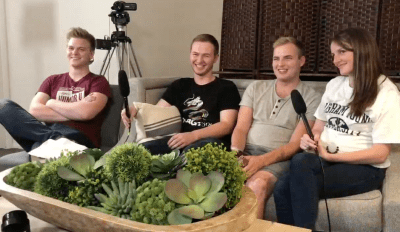
 Join us now for our Mormon Stories Podcast series on “How to Survive BYU as an Unorthodox or Non-Believing Student.” We will be interviewing Bradley, Alana, Jared, and Andrew—co-founders of the “BYU Survival Guide”—a survival guide for “Ex-Post-NOM-Never-Mormon” BYU students.
We first interview each former student one-on-one to get a sense of their Mormon story and how their faith changed—inevitably impacting their experience at BYU. We learn how each navigated their unique experience and what advice they have to offer students who are now in similar situations.
Our final episode includes a panel discussion with all 4 students as they share their motivations behind creating the BYU Survival Guide.
Please share this info with anyone who you think might benefit from it, including any past, present, or future BYU-Provo, BYU–Idaho, and BYU-Hawaii students.
Episode Transcript
Host: John Dehlin · Guests: Alana Butters, Andrew Jacobs, Bradley Butters, Jared Brinton
This transcript is machine-generated and lightly edited for readability. The audio is authoritative. Please excuse occasional errors in names and spelling.
Introduction to Surviving BYU as an Unorthodox Student
Part 1 of 5 · Ep. 1169
Alana Butters [00:00:00] Sa.
John Dehlin [00:00:31] Hello everyone and welcome to another edition of Mormon Stories Podcast. Maybe today I should say rise and shout. The cougars are out. I'm Dr. John Dehlin. It is August 23rd, 2019 and we have a very special multi part series that we're going to be covering today. Today is BYU Cougar Day. Does BYU Idaho have a mascot? Are they cougars too? I don't even know. What's that?
Bradley Butters [00:01:00] I would assume so, yeah.
John Dehlin [00:01:01] Okay. Well, it is back to school week in the United States and lots of the children of Mormon and post Mormon adults are going to be attending byu, whether BYU Idaho or BYU Provo or BYU Hawaii. And so we are really excited to be bringing to you today a series on how to survive the BYU or BYU Provo. BYU Idaho, BYU Hawaii. As either an unorthodox Mormon student or as a non believing student, Margi and I went to byu. My faith crisis really started and heated up there.
John Dehlin [00:01:48] So this is a topic near and dear to my heart. But every single year we have students reach out to us either privately or on Facebook or on Reddit and they share that they've lost their faith at byu and what do they do? Because their academic career can be in jeopardy, their standing at BYU can be jeopardized, they can be turned into the honor code office. But more importantly, how do they find friends? How do they find community? How do they find support? How do they deal psychologically with the difficulties and the perils and the dangers and the traumas of losing your faith at BYU or just being unconventional at byu?
John Dehlin [00:02:34] We know that worst case scenario, you can lose one to two years of your academic work and a lot of money and a lot of time, not to mention the psychological harm that can come about when you're trying to navigate a very conservative religious and academic environment and a sincere faith crisis. And so we're going to be talking about it today and our goal is to, number one, provide support for students who are there to help them make it through unscathed or minimally scathed. But also we know that Church Headquarters pays attention to Mormon Stories podcast. We know that our efforts combined with others, helps, you know, helps the church change its policies.
John Dehlin [00:03:23] And there's this amazing BYU Survival Guide that's been written and is being maintained by the people that will be, or at least some of the people that we'll be interviewing today. And so we'll be promoting the BYU Survival Guide as well as part of all of this. And so we have three individual interviews that we're going to do each to kind of profile a different student or in this first case, a couple. And then we'll be bringing together a panel of all of them to do a final sort of breakdown and discussion. We really do. We are live streaming all of this, hopefully if technology allows.
John Dehlin [00:04:02] And so we are welcoming comments and questions and stories if people want to share that we can add to the discussion. So that's what. What's about for today. If you have. If you're listening now to the live stream and you have family or friends who are past, current, or future BOU students, please share this with them so they can watch it and share it on your walls however you want to share it to get the word out. And we'd love to have as many participants as we can. That'd be great.
Meet Bradley and Alana: Background and Early Life
John Dehlin [00:04:34] So without any further ado, our first discussion today is going to be a fun one. We are interviewing Bradley and Alana Butters and. Hi, guys. Welcome to Mormon Stories podcast. Hello, Alana. I see you've got your BYU T shirt there.
Alana Butters [00:04:55] Yes. This is a nonverbal cue that we like byu and this is not a hate podcast.
John Dehlin [00:05:04] It's not. It's a love podcast.
Alana Butters [00:05:06] So this is. This is for students. This is for the university. This is for. This is for that. So.
John Dehlin [00:05:12] Yeah. And I loved my time at byu. So did Margi. There were hard things, but there were amazing things. So. Yeah, this won't be a trash fest. No, no, no, no.
Alana Butters [00:05:21] Yes.
John Dehlin [00:05:22] But also a deep dive into how we can help people.
Alana Butters [00:05:25] Yes, yes.
John Dehlin [00:05:26] All right, so let's begin with your guys story and then, you know, we'll kind of do the background stuff and then we'll get to the BYU experience. Is that all right?
Bradley Butters [00:05:35] Yeah.
John Dehlin [00:05:36] Who wants to go first?
Alana Butters [00:05:37] I'll go first.
John Dehlin [00:05:38] Okay, take it away, Alana.
Alana Butters [00:05:41] Okay, so what's your maiden name? Peters.
John Dehlin [00:05:45] Okay. Yep.
Bradley Butters [00:05:46] Peters.
Alana Butters [00:05:47] Yeah. So, yeah, I'm the oldest of six kids. Great, great family. I was raised and just did all of the LDS things and loved it. Absolutely, absolutely. Still do really, really love the. Yeah, the LDS faith, the. The church, all those things. I was baptized at 8. We were really good about doing family home evening every Monday. I loved family home evening.
John Dehlin [00:06:21] Where were you? What? Geographic.
Alana Butters [00:06:23] So I was born in Provo. You know, my parents were in Wymount.
John Dehlin [00:06:27] Really?
Alana Butters [00:06:27] Yes.
John Dehlin [00:06:28] Probably maybe 10 years after me. Do you know what years they were there?
Alana Butters [00:06:32] They were. Yeah. Like 90 to 95ish.
John Dehlin [00:06:36] Okay, so we overlapped.
Alana Butters [00:06:38] Yeah.
John Dehlin [00:06:38] That's awesome. Yep. I ended in 93, so.
Bradley Butters [00:06:41] Okay.
Alana Butters [00:06:42] Yep.
John Dehlin [00:06:43] That's awesome.
Alana Butters [00:06:44] So, yep. Had My roots there.
Bradley Butters [00:06:46] Her dad taught at the MTC for while.
Alana Butters [00:06:47] Yep.
John Dehlin [00:06:49] And you guys are making me feel old, by the way.
Alana Butters [00:06:53] Yep. Yep. And yeah, he moved around for his job. We moved to Texas and then back to Logan, Utah and then a.m. amarillo, Texas. But I mostly was raised in by. When I was 10 we moved to Washington State, which is actually where Bradley's family lived. That's where we met. Was in Washington in fifth grade. In fifth grade. So that's where I claim being raised was Washington. But yeah.
Bradley Butters [00:07:20] Yeah. And then I was born in Salt Lake at. My dad was going to the University of Utah.
John Dehlin [00:07:26] What?
Bradley Butters [00:07:26] Yeah, we've got a really fun rivalry that goes with football and everything. All of my siblings ended up going to byu so we outnumber them. Yeah. So I'm the oldest of five siblings. I've got all sisters. I'm the oldest and I was baptized at 8.
Bradley Butters [00:07:45] Family's super active in the church. We did scripture study, family home evening. We're always on time to church, sat towards the front. Just a really, really solid. Yeah, really solid core family in our ward in Washington. So we moved there when I was like five.
Bradley Butters [00:08:04] It's a pretty small town which was a lot of fun. There's like 5,000 people in town and growing up there was just one ward. So we were in the same ward for most of our youth activities. And then the word split later on when we were in high school and we ended up in different wards.
Bradley Butters [00:08:24] Yeah. So all my life I was preparing for a mission saying I hope they call me on a mission in primary. Both my parents families were members have some inactive family. But yeah, it was really, really great and made me who I am today. So I'm really grateful for that and to my parents for that. Yeah, we really enjoyed the small town community.
Alana Butters [00:08:55] We had a really tight youth group too. So like everyone in our age level like got personal progress, Eagle Scout duty to God, like mutual all the time seminary. And we were really, really, really close. I remember once we were. There was a snow day and no, it was a two hour delay from school and I thought, oh, we have two hours in the morning. And we were in high school and instead of thinking like, oh let's sleep in and drink hot chocolate like our friends, I was like, it would be so fun if we all went to the Ch and watched the testaments and I remember calling everyone and our whole seminary class showed up.
Bradley Butters [00:09:44] Yeah.
Alana Butters [00:09:44] And that was. And like we were always doing stuff like that. Like we'd watch church movies on Sunday evenings together. We'd go to all the dances. We really made an effort to like, try and invite everyone to the dances. And I remember, I remember singing like, we are the army of Helaman, that song and like crying in high school because I just felt like everyone in our, in our group was so solid and we were so blessed by the gospel. We were so happy.
Bradley Butters [00:10:12] Yeah, there's a lot of good camaraderie. I had a lot of really good friends in the grade older than me and in my grade, and we were kind of the golden generation of our ward. I felt like there was good grief, like an eight year period, I think before us at least maybe 10 years where there was maybe one missionary that left the ward. And a lot of the older kids went inactive after leaving high school. And then we came through and we were just like, totally solid.
Alana Butters [00:10:39] Yeah. Like the year we graduated, There was like 13 people on missions.
Bradley Butters [00:10:44] Yeah.
Alana Butters [00:10:45] Yeah.
Bradley Butters [00:10:46] And I think that a lot of the ward members kind of appreciated that and we kind of changed the feel of mutual and of the ward because it, instead of being something that you did begrudgingly, like, we really enjoyed it and it was a lot of fun.
Alana Butters [00:11:00] Yeah, we want. Yeah. I remember going and like putting pass along cards in people's high school lockers, like during lunch. And that was a fun thing that lots of people did. And yeah, we had a really good time.
Bradley Butters [00:11:14] We.
John Dehlin [00:11:15] In high school.
Bradley Butters [00:11:16] Yeah, in high school. Yep.
Alana Butters [00:11:17] And then we'd see, you know, the high school quarterback has like a picture of Jesus on his binder. And I was like, put that in your locker. Yeah.
Bradley Butters [00:11:25] We ate together at lunch. So everyone knew us as the Mormons. There's not a lot of members in our town in Washington, so that was kind of our identity growing up and who we were. I wasn't super enthusiastic about, like putting pass along cards in people's lockers and being like super missionary at school. But I wasn't like, afraid of it and like, was willing to talk about it.
Alana Butters [00:11:48] So.
John Dehlin [00:11:49] Okay.
Alana Butters [00:11:51] Yeah.
John Dehlin [00:11:52] Any. Any experiences kind of as Mormon teens or youth that kind of feed into what ended up happening at byu just in terms of seminary or bishop's talks or family dynamics or any of that.
Bradley Butters [00:12:08] So my dad was called as counselor in the bishopric before the ward split, and then the word split when we were freshmen in high school, I think, or in eighth grade. And then he was called his bishop after the word split. And so that was a big change for our family and that it just kind of really changed the spirit in our family and.
John Dehlin [00:12:32] Good way.
Bradley Butters [00:12:33] Yeah. In a positive way. Like, we felt like we had to step up. You know, dad was at church all day on Sunday and in the evenings, and it was just this family sacrifice that we did. And, you know, mom had to get us ready for church by herself because he was there early. And it was this, know. It was just kind of this big thing for our family. Like, we're doing this and it's. Yeah, it's big. It was. Yeah, it. It was great. Yeah.
Building Faith and a Relationship Growing Up
Alana Butters [00:13:05] Did you have something else you were going to say? I can talk about how I got a pretty strong testimony.
John Dehlin [00:13:11] Yeah, sure. That'd be great.
Alana Butters [00:13:12] Yeah.
John Dehlin [00:13:12] So you guys in seminary together, right?
Bradley Butters [00:13:14] Yeah, yeah, early morning seminary.
Alana Butters [00:13:16] Early morning. Yep. Yep.
Bradley Butters [00:13:18] I was seminary president.
Alana Butters [00:13:23] So When I was 10, 11, what was the year that President Hinckley asked all the families to read the Book of Mormon by the end of the year. And it was the first time a challenge like that had been given and, like, everyone was doing it.
John Dehlin [00:13:37] I was in Logan. I remember I was in Logan at the time. Sometime between 2004 and, I don't know, 2015.
Alana Butters [00:13:44] Yeah. Anyway, so we did it as a family, and I was, like, 10 at the time, and I had, you know, like, four younger siblings reading the Book of Mormon. And when we were done, my dad really took the time to talk about
John Dehlin [00:13:56] how, you know, Cody says it was 2005.
Alana Butters [00:13:59] 2005. Okay.
John Dehlin [00:14:00] Thanks, Cody.
Alana Butters [00:14:01] Yep. How like you, there's the promise and Moroni's promise. And, you know, if you read these things, I would exhort you that you should ask God, the Eternal Father, in the name of Christ, you know, if these things are true. And then if you ask with a sincere heart, real intent, having faith in Christ, manifest the truth unto you. So my dad said, you should do that. You know, we just finished. You should go pray and. And see what happens. And so I did. I just remember the spot. It was, like, behind my bedroom door. And I, like, opened the door, so. And then, like, hid in the slot and knelt down and prayed.
Alana Butters [00:14:41] And I just remember, like, it was, like, warm and tingly all over. And I just, like, knew the Book of Mormon was true. And. And I tried reading after that. I read it again by myself on, like, the top bunk, I remember. And then I did it again two years later, and the same thing happened. It was, like, so powerful. I just. I knew the Book Mormon was true. And then we read it again in seminary. I read it again a couple times in high school, and I just kept doing it every time because I thought, you know, every Time I can get the same answer and it really happened every time.
Alana Butters [00:15:18] And I just, I really knew it was true. And. And then I think a big thing for me too was like, by their fruits you shall know them. And like the fruits of my life were so good. Like, I had a really beautiful family.
Alana Butters [00:15:36] Like, I was so happy like all the time. And high school, just looking at my friends, I just felt so much happier than they were. And I was like, I want to share this with them. And so a lot of it was like a really practical outlook too. Like, look at what it's done for my life. This is something that's so valuable for me and I would just love for everyone to be happy like this. And so, yeah, that's, that was big for me.
Bradley Butters [00:16:07] And that's a lot of what attracted me to her was seeing that positive outlook and seeing how she was just so happy and loved the gospel and was preparing to be a great wife and mom. And that was a lot of the focus with young women's, you know, and.
Bradley Butters [00:16:25] Yeah, and I felt a lot of the same way. I, I didn't have a lot of spiritual experiences growing up. That was just kind of the nature of my faith and how I felt the spirit. It wasn't a constant thing, you know, it wasn't like I read the Book of Mormon and prayed about it and like I felt, you know, Moroni's promise. But there were a few very powerful moments growing up. My baptism, you know, I felt great.
Bradley Butters [00:16:58] There was, you know, doing home teaching with my dad. There was a couple times the man we would be in the car, like on the way to help like some widow or some family that was struggling activity. My dad and I kind of got. Well, my dad, he was really giving and selfless and hard working in the ward, which is why he ended up being called his bishop, I'm sure.
Bradley Butters [00:17:27] And so we had a lot of really hard families to home teach some inactive members that, you know, hadn't opened the door for a while. Families that were going through divorce and infidelity and widows and things like that. And so there's a few of those like really special, powerful experiences that I felt like really served me later on to prepare me for a mission and like really strengthen my testimony. There's a few times in like Sunday school, as a young teenager, we watched the.
Bradley Butters [00:18:00] What's the movie? It's not 17 miracles. It's another pioneer one where they're going across the plains and dying. It's really hard and they have faith. And I remember like, that was one of the first times I really felt the spirit really strong, and I was crying. And so Legacy.
John Dehlin [00:18:13] Legacy was, like, in the. Was it in the visitor center?
Bradley Butters [00:18:17] I don't remember. It was a little bit older, maybe like a 90s film.
Alana Butters [00:18:20] Okay.
Bradley Butters [00:18:22] And I was crying, and it was embarrassing, and it was the first time, like, I'd felt like that as powerfully. And so I left and went to the bathroom, and my mom was out in the hall and saw me crying. And we went outside, and she just gave me this big hug and said, you know, that's the spirit. And.
Bradley Butters [00:18:39] And it just felt really good. And that's something that I reflected on for a long time. Yeah. So I think that's kind of what Drew Alana and I together was we were both really strong in the church, and we really respected each other's values and what we were preparing for my mission and her being a wife and mom and active in the church.
Bradley Butters [00:19:03] Um, and I guess this kind of gets into our love story. She moved in in fifth grade. And again, what city is this? Prosser. Washington. Okay. And that's near Tri Cities. Yeah. So Tri Cities area. And there's quite a few members in the Tri Cities area. They built a temple there when. Oh, like, early 2000s, I think. And I remember that my parents were really excited.
John Dehlin [00:19:22] What are the three cities that are part of the Tri.
Bradley Butters [00:19:24] It's Kennewick, Pasco, and Richland. And so we were in the Kennewick Steak, and then it switched, and then we switched.
John Dehlin [00:19:31] Centralia near there.
Bradley Butters [00:19:32] Centralia Central is a little farther up in Washington, in the center of Washington. So. Okay. Yeah. So Alana moved into our school in fifth grade. There's only one. You know, there's one elementary school, one middle school, one high school.
Alana Butters [00:19:48] So one ward.
Bradley Butters [00:19:49] One ward. So it was a small town, so she moved in. And I remember. I don't remember if I saw her in primary for the first time or if I saw her in fifth grade for the first time, but both times I noted, like, oh, man, who's that new girl? Like, she's cute and bubbly. And so I remember it was like, the first day of sixth grade because she moved in towards the end of fifth grade, and we did a few things, I think, over the summer with our families.
Bradley Butters [00:20:19] Our ward was really good about. You know, we had a lot of close family friends in the ward. My parents were friends with several other. There were several other really big families. And so we would go over for family dinners, and my dad was hunting buddies with this guy. And so we became really close with them, and so there's just a really good ward community.
Bradley Butters [00:20:41] Anyway, going back. So, yeah, beginning of sixth grade, she really caught my eye, and I just was, like, infatuated, head over heels, and a lot more gutsier then than I am now. And so I started writing secret admirer notes, and sticky came in her locker and just little, like, I love you and some little praise things, but not giving away who I was. And so that went on for, like, all of sixth grade and.
Alana Butters [00:21:08] And most of seventh and most of seventh grade. I didn't know who it was.
Bradley Butters [00:21:11] Yeah, she didn't know who it was for a long time. And. Yeah, I don't know how you felt about that, but.
Alana Butters [00:21:19] Yeah, Well, I ended up figuring out it was him because he was always, like, looking at me, and I was like, I think it's him. I wrote back. I'm like, I think I know it's you. Put it in his locker. And then.
Bradley Butters [00:21:32] Yeah, I would, like, hang back at recess to hold the door.
Alana Butters [00:21:36] And he was always holding the door for me. That was a tint.
Bradley Butters [00:21:40] Yep.
Alana Butters [00:21:41] And. Oh, and when he was passing the sacrament, he would, like, when he was waiting, he was always, like, looking at me. And I thought he was pretty cute. Passing the sacrament.
Bradley Butters [00:21:51] Yep. I'd always try to sit where the deacons line up so that I would pass the sacrament to her family.
Alana Butters [00:21:55] Yeah.
John Dehlin [00:21:57] Yeah.
Bradley Butters [00:21:58] So then.
Alana Butters [00:21:58] So I found out it was him. Didn't like him back at first, but then very soon after, well, he was really quiet. I hadn't totally noticed him before.
Bradley Butters [00:22:06] Very introverted. So.
Alana Butters [00:22:08] But then I started paying attention. He was always doing the right thing, the right time, like, very quiet, very humble about it. He was just always, you know, with his family, holding his little sister on his lap in sacrament meeting. And I just thought, like, wow, that is everything I want. And he's not, like, prideful about it. And so, yeah, it didn't take very long. I thought that I liked him back. And so it began.
Bradley Butters [00:22:34] We both excelled in school. And so we were in the honors classes and the advanced classes, which there was only one of those classes for. For different subjects. And so we were always in the same class. And so. Yeah, that was nice. And so after she decided she liked me, then 8th grade, we weren't 16 yet, and so we had. You know, we stuck to all the. For the strength of youth. Youth standards.
Alana Butters [00:22:57] Very strict.
Bradley Butters [00:22:57] Yeah. Very strictly. Didn't kiss and didn't hold hands and weren't really seen together in public that much. Yeah. But we started to develop a relationship in 8th grade. Wrote notes back and forth and were just praising each other for what we respected. You know, like me being a worthy priesthood holder was a big thing to her, and her doing well in young women's was a big thing for me. Yeah. And then high school rolled around. I was in sports, she was active in like school leadership and. And like, really, she memorized every single person's name in our grade in school. There's like 180 people in our grade, I think.
Alana Butters [00:23:44] Wow.
Bradley Butters [00:23:46] Yeah. So just really outgoing. And I think that kind of pushed me to be more outgoing and helpful and positive too. I got involved in student government because she was. And so then we turned 16 and started dating. Well, I guess first we started going to stick dances.
Alana Butters [00:24:03] When is that?
Bradley Butters [00:24:04] 14.
Alana Butters [00:24:04] The romantic time.
Bradley Butters [00:24:06] Yeah. That was. Finally we could dance with each other and hang out.
John Dehlin [00:24:11] But at least a Book of Mormons distance.
Alana Butters [00:24:13] Oh, it was like this.
Bradley Butters [00:24:14] Oh, yeah. It was the awkward, you know, stiff arms, sweaty hands. Yeah, classic. And that was a big thing for a whole core group of friends. Before, no one from our ward had gone to steak dances. Like, our ward didn't really know about him. And then me and my best friend Buddy in junior high and high school just like got up the guts and we're like, man, there's these steak dances and we've never been. And I was, let's see, I'm about a little less than a year older than her. We're in the same grade. But I turned 14 and him and I went to this first date dance together and we were just wallflowers. But then, yeah, we were super excited for other people to join us. And then it became this core group of our friends that would, you know, we'd carpool and there would be.
Alana Butters [00:24:56] I had to set up a carpool because we had like 22 kids going every.
Bradley Butters [00:25:01] Out of a single board.
Alana Butters [00:25:02] Yeah.
Bradley Butters [00:25:03] So we really kind of just our core group of friends really were really close. And so we would carpool and there'd be like three or four vans of us, and that was a lot of fun. And we started dating and well, dating. Dating. Yeah, we.
Alana Butters [00:25:18] So I turned 16. We went on a date, but you're not supposed to steady date.
John Dehlin [00:25:22] Right.
Alana Butters [00:25:23] So it was like we went on a date and then it was like, well, we'd have to go on a date with someone else first. But there's no one else in this small town and we don't like anyone else. So it was like we didn't really Date. We went on like five dates total by the time I graduated high school.
Bradley Butters [00:25:36] But we hung out at some, like, official dates. Yeah.
Alana Butters [00:25:38] And everybody knew that we liked each other. So it was like. It was this really awkward thing where we weren't supposed to set a date, we weren't going on dates. But it was like.
Bradley Butters [00:25:48] We hung out every lunch.
Alana Butters [00:25:49] We hung out every lunch. And it was. But we were really trying to, like, really trying to follow the standards.
Bradley Butters [00:25:56] Yeah.
John Dehlin [00:25:56] And I think about that a lot, like, when I see students here in high school, because my kids go to Mormon high schools and it. And there are all these homecoming and Sadie Hawkins or, like, girls choice or prom or whatever. There's this weird thing in Utah where you can't ask the same person to a big formal dance.
John Dehlin [00:26:20] And, you know, it's obvious what they're trying to do is to not have kids become sexually active. So you kind of have to choose carefully if you have a special someone, which dance you ask, invite them to. So on the one hand, I could see how from the church's perspective, that's good because in their mind, that'll keep kids from having sex. On the other hand, I kind of feel weird about that because, number one, it makes kids have to ask people to dances that they really don't want to go to with. But then also, like, it kind of discourages emotional intimacy. And on the one hand, I can see why the church wouldn't want sexual intimacy.
John Dehlin [00:26:55] But on the other hand, I think the church would want people to develop emotional intimacy. And so why would they want to stunt that? And so, you know, I'm not criticizing. It's just like. It's a weird thing.
Alana Butters [00:27:05] Yeah. It was a really tricky line for us for a long time, and then
Bradley Butters [00:27:08] we can get into this later. But kind of on that, like, then you go on a mission and you're totally isolated, and that's frowned upon. Then you get to college, and then it's just open door, you know, like, have at it emotionally. And.
Alana Butters [00:27:22] But we. I would have to say we did, like, a really good job of following the standards for the. I mean, we.
Bradley Butters [00:27:32] Yeah, yeah. And my parents were a little stricter about it. They kind of went above and beyond, like, for the strength of youth. And so they were kind of the ones that were encouraging me to date other people and maybe discouraging from, like, going to school dances. We went to, like, one or two steak dance or school dances.
Alana Butters [00:27:48] Well, we went to all of them.
Bradley Butters [00:27:50] I didn't. Well, not four, just proms. Not like, the Other dances like homecoming.
Alana Butters [00:27:54] Oh, yeah, we didn't go to those.
Bradley Butters [00:27:57] And then, yeah, there was like. There was a lot fewer young women in our ward than young men. And so if I wasn't interested in the three or four other young women then that were my age then.
John Dehlin [00:28:08] Because you can't date non Mormons, right?
Bradley Butters [00:28:09] Yeah, yeah, yeah. Non Mormons were out of the question.
Youth, Guilt, and Early Church Struggles
Alana Butters [00:28:11] So remember when we spent. So we were on leadership, we spent a year planning junior promotion and then we left early because the music was vulgar.
Bradley Butters [00:28:20] Yep.
John Dehlin [00:28:20] What was it? What was the music? Do you remember?
Bradley Butters [00:28:22] I don't remember just like rap or something.
Alana Butters [00:28:24] But we. Yeah, we planned prom and then left
Bradley Butters [00:28:27] early and she was student body president and I was student body vice president. And so junior year for junior prom because junior prom is like the big one. Then when you're a senior, you go to the junior, you know, the dance the juniors planned. So like we planned foul standards. Yeah.
Alana Butters [00:28:42] We left the thing that we spend hours like raising money.
John Dehlin [00:28:47] Tell us for the. Who knows when someone's listening to this, how the strength of the youth pamphlet will change. But what were the big standards? Just list them out.
Bradley Butters [00:28:55] Yeah. So don't date till you're 16.
Alana Butters [00:28:58] Don't study date after that.
Bradley Butters [00:29:00] No petting.
John Dehlin [00:29:01] Meaning?
Alana Butters [00:29:03] Well, yeah, yeah.
Bradley Butters [00:29:04] Groping, whatever.
John Dehlin [00:29:05] We have non members who listen, so.
Bradley Butters [00:29:06] Oh, yeah. Oh, okay. So. Yeah. Touching each other. Clothes on private parts. Yeah. Passionate kissing. I think it specifically says no laying down with each other.
Alana Butters [00:29:18] Obviously no sex.
Bradley Butters [00:29:20] Yeah, obviously no sex.
John Dehlin [00:29:22] Or did we say our movies? Did you. Was that in there?
Bradley Butters [00:29:25] Yeah, yeah. So those are just the physical intimacy and then the music.
Alana Butters [00:29:29] Music with your modesty.
Bradley Butters [00:29:33] Modesty is a big one for.
John Dehlin [00:29:34] What does that mean, girls?
Alana Butters [00:29:35] Modesty means wearing, you know, addressed a problem that has a sleeve instead of like a tank top or low cut or wearing shade shirts underneath. Like everything you wear, just in case. I still love those things.
Bradley Butters [00:29:49] Yeah.
John Dehlin [00:29:50] Not.
Alana Butters [00:29:51] No, I do.
John Dehlin [00:29:52] I still love.
Alana Butters [00:29:53] I still am like a very conservative, modest personality.
Bradley Butters [00:29:56] And then. And now it's. I mean, as a young man, like, you're obviously attracted to girls. And so there was this like. Well, I respect her because she's this good, strong young woman. But I mean, wouldn't it be nice? Right? And so. And then moving to Utah for school, it was a weird thing to see these high schools.
John Dehlin [00:30:13] Was there porn? Masturbation, emphasis in school.
Bradley Butters [00:30:16] So that was big in strength of youth and bigging young men's and in priesthood session of conference. And so that was really like beat to death. And like I was coming up and it really said so. Ooh, let's see.
John Dehlin [00:30:30] Just don't, don't do it.
Bradley Butters [00:30:31] Yeah, don't do it. And it was started really early in like as soon as you're in Deakins and out of. Out of primary when they start splitting the young men, young men and young women's on Sundays and you have separate classes, then that's when it starts. And my. Oh, my dad was.
John Dehlin [00:30:49] How do they say that in church?
Alana Butters [00:30:50] My dad taught you that lesson?
Bradley Butters [00:30:52] Well, later on in. No, he was our priest quorum advisor. Advisor. My dad was our deacon's quorum advisor forever for like five years when this core group was going through. So my dad was really close to the youth and to my friends and really like a counselor and father figure for us. And so he was in there in Sunday school when it, the first time it came up and they said like, well, you know, don't have sex with yourself. And I was like, what does that mean?
John Dehlin [00:31:22] Cause they don't want to say the word masturbate, right?
Alana Butters [00:31:24] Yeah, I was like, what does that even mean?
John Dehlin [00:31:26] So they say don't have sex with yourself.
Bradley Butters [00:31:29] That's how they would phrase it. Well, just that, just that first time.
John Dehlin [00:31:32] Did they say self abuse? Did they ever say that?
Bradley Butters [00:31:34] No, they didn't say that. And later on, you know, it got a little more explicit and so in obviously like in the locker room and whatever. Like outside of church is where most of my. And outside of church and outside of my family is where most of my sex ed came from. So. Yeah. And obviously, you know, a lot of young men struggle with that and
Alana Butters [00:31:56] I
Bradley Butters [00:31:56] did too, you know, off and on. And so that was a large source of guilt and shame and.
John Dehlin [00:32:04] And your dad was your bishop, is that right? No.
Bradley Butters [00:32:09] When was he.
Alana Butters [00:32:09] Because he was called. When we were in college.
John Dehlin [00:32:11] Okay.
Alana Butters [00:32:12] He was a counselor, so you didn't have to.
John Dehlin [00:32:14] So did you have to talk to your bishop?
Bradley Butters [00:32:15] Oh, okay, so they split the word when you're in high school. He wasn't the first bishop. He was. He was counselor. And then after I got home from my mission, he was called his bishop.
Alana Butters [00:32:23] Yeah, because we were in the BYU lesson found.
Bradley Butters [00:32:25] That's right. That's right. Yeah. So I never had my dad as bishop.
John Dehlin [00:32:29] Okay, so did you have to talk to your bishop about that kind of stuff?
Bradley Butters [00:32:34] I mean, I should have. And that's what a lot of the guilt and shame was from. But then I was scared and I did later on in high school because I mean, it was like very young age and so yeah, And I was, I mean, other than that, like, straight laced, you know, did everything right. And so that was kind of the one source of like, man, I'm going to hell and I'm not good enough. And like, man, if my parents found out and there's that kind of guilt and shame, you know, that comes from beating that to death. You know, Elder Holland's talk in that one priesthood session where he said, you know, buckle up or whatever, I'm going to sing your eyebrows.
Bradley Butters [00:33:12] And then he talks about. He compares it to playing football or whatever. You can't suit up for Satan's team. And then come mission time, expect to play on the Lord's side. And that was, you know, it was fire and brimstone and just had a profound effect on me. But, and, and I mean, obviously, like, I was trying and repenting and yeah. Off and on thing.
John Dehlin [00:33:44] So how does that affect a kid profoundly?
Bradley Butters [00:33:51] Well, I. We can get into mental health a little bit later, but yeah, depression, anxiety is kind of a family history thing. And we didn't talk about it growing up, you know, and I respect my family's, you know, whatever they.
Bradley Butters [00:34:09] But yeah, my. My mom in particular struggled with it, but it wasn't something we really talked about in our family growing up at least. And I think our family kind of. Well, I'm not. I'm not really sure. I was young and so I wasn't privy to my parents, that kind of relationship. But at least in the. We were really conservative, I think. And so the.
Bradley Butters [00:34:34] It was kind of the suck it up and get over it type feeling is what I got. And so I, I didn't know what depression was through junior high and high school. It became a bigger issue later. But I had some, like, really down periods. And I think that, yeah, that guilt and shame was part of that. Just one factor that obviously, you know, it's a genetic, like, illness and stuff.
John Dehlin [00:35:01] So did you feel like you kind of had to lie at least at some point?
Bradley Butters [00:35:04] Yeah.
John Dehlin [00:35:05] I mean, what does that do to kind of put a kid in a situation? And that's every kid I've ever talked to.
Bradley Butters [00:35:10] Yeah. Like, what do you do? Do you tell your bishop? And then you don't have a temple recommend? And we're doing youth temple trips every single month. And that's what our core group of friends does. And we're all active and strong and like, I know that other people struggled with it and so. But like, am I going to be the only one that doesn't go to the temple with my Friends, because I don't have a temple recommend. And then it's. Yeah, it's like passing the sacrament or passing the sac. Yeah, it's a small ward, it's the only ward and there's like relatively few youths. And so if I, we had to have Melchizedek priesthood holders sub in to pass the sacrament because sometimes there weren't enough deacons.
Bradley Butters [00:35:51] And so, yeah, if I'm sitting out and whatever someone comes and says, like, hey, can you pass the sacrament today? Like, if I say no, then that's a big public shaming thing. And everyone, you know, everyone notices when my friends, you know, if someone didn't pass the sacrament, you know, we knew and it was kind of.
Alana Butters [00:36:11] And they were talked about negatively.
Bradley Butters [00:36:12] Yeah, not, not amongst my friends, but just in the ward, you know, I'd hear, you know, oh, so, and so didn't pass the sacrament. Oh, you know, I heard it was this and that and so. But overall we were like really core, good, strong group.
John Dehlin [00:36:28] So is it, is it hard to kind of learn to lie early? Is that.
Bradley Butters [00:36:31] Yeah, I mean, I felt really, I felt really bad about it and I didn't really think it was fair sometimes because it was such a hard thing and we didn't talk about it in a positive way. Right. Like sexuality and, and I think I in particular maybe was more sexually driven than a lot of average young men. So yeah, like, it was a big, it was a big thing and like lying wasn't something I was comfortable with and but it was, it was really tough. And that was something that I beat myself up over. Like, well, you weren't brave enough and willing enough to do the right thing and, you know, come clean to the bishop or whatever.
Bradley Butters [00:37:15] And when we'd go to temple, youth temple trips, then, you know, you're sitting there thinking, man, am I worthy to be here? I'm not actually worthy to be here. And so temple trips and passing the sacrament and stuff, sometimes it would turn into this self beating up session of, you know, I shouldn't be doing this and I'm not good enough. And so, and I wouldn't say that I questioned the gospel a lot, but I was afraid of, I was afraid of two things. Maybe I was afraid of it not being true and missing out on, you know, like I was afraid of it not being true and following the standards and sacrificing a lot of things and working hard for the church and everything.
Bradley Butters [00:37:57] And I was afraid, you know, I didn't think I was gonna go to the celestial kingdom, like I just kind of given up on that, I guess. And so that was kind of a sad thing. But I don't know, it's kind of the cognitive dissonance, I think. It's hard at the same, you know, I'm not worthy and stuff, but at the same time, like, well, I'm trying my best and like, what do you do? And, like, it's gonna work out, whatever. Like, I'll get married and then it'll be better or I'll go on my mission and it'll be better. And so.
John Dehlin [00:38:22] Yeah. And just, just, you know, just to pause for just one second, like, it's. What's insidious about this is that the kids that are honest about it get punished.
Bradley Butters [00:38:34] Yeah.
John Dehlin [00:38:35] Because they get, they're the ones who get the shame. And so somehow we're punishing the honest kids. And then the kids who lie about it, well, you know, they're not punished, but then they are taught to lie.
Bradley Butters [00:38:45] Yeah.
John Dehlin [00:38:45] So it's kind of a lose, lose for everybody. And it's super painful and shameful. And for those who care about this issue, Margi, my wife and I, and Natasha Alfred Parker recently did an episode called A New Approach to Pornography and Masturbation. It's both on Gift of the Mormon Faith Crisis and on Mormon Stories. But if you or your spouse or your child or whatever are struggling with how to deal with pornography and masturbation, we offer kind of a mental health informed, better approach. So check that out. But this is, this is tough stuff.
Bradley Butters [00:39:22] Yeah.
John Dehlin [00:39:24] And Alana, we, we always kind of assume this is a male problem. And, you know, statistics show that over 90% of men masturbate. But, but women are over 50%. And I, I'm not interested in, like, details for any personal reason. Mark, one of our listeners writes, I've yet to meet an honest, active Mormon male who didn't struggle with porn growing up. And that's kind of what's ironic is these bishops and stake presidents and, you know, they're all doing it, and yet these kids are being kind of held over Iraq. But, you know, is this something that, from your experience, either personally or other girls, you know, that, that girls struggle with or.
Alana Butters [00:40:07] Nope, nope. It was not part of my experience. It wasn't something that I struggled with.
John Dehlin [00:40:12] So it's less common. It's less common with.
Alana Butters [00:40:14] We didn't talk about it. So if my best friend was doing it, I had no idea.
Bradley Butters [00:40:18] And they didn't talk about it in young women too.
Alana Butters [00:40:19] And we didn't talk about it in Young women's cause it was kind of assumed no one was doing it.
Bradley Butters [00:40:22] Yeah. And that was something that I felt was unfair. Later on, when I was more aware of things, was, in priesthood, you're beat to death over it. But then in young women's, it's not mentioned. There's no sexuality lessons and shaming and guilt with respect to that. So.
John Dehlin [00:40:38] Yeah, and it's. You know, we're drilling into this, and this is really about byu. I'll be curious to hear if this all flows into your BYU experience or if not. But.
Applying to BYU and Pre-Mission Experiences
Bradley Butters [00:40:48] Yeah, well, obviously, you know, in high school, we had to interview. Get the ecclesiastical endorsement to apply for BYU and interview with the bishop, interview with a stake presidency. And so, yeah, I mean, it's. It was an issue with that. And I think that was one of the times that, you know, I kind of came clean. And the other thing is, it's totally bishop subjective. You know, some bishops might.
John Dehlin [00:41:13] Oh, don't worry about it. It's totally fine.
Bradley Butters [00:41:15] Yeah. Or, you know, try your best.
John Dehlin [00:41:17] Keep you from going to BYU or keep you from a mission.
Bradley Butters [00:41:19] Yeah, yeah. You know, well, you can pass the sacrament, go to the temple, you know, just repent on your own and, you know, try not to do it or whatever. And then others would. You might get publicly shamed. And the other thing was, like, I didn't know those statistics, and so I thought that, well, maybe all my friends aren't, and then I'm just the only one. Yeah.
John Dehlin [00:41:35] Because you don't admit it.
Bradley Butters [00:41:36] Yeah. Yeah, yeah, yeah, yeah.
John Dehlin [00:41:40] So that's super hard. Okay. Well, I'm sorry. Thank you for being honest about that.
Bradley Butters [00:41:43] I haven't really talked about.
John Dehlin [00:41:44] It's pretty much every kid, you know, 90. I'd say 98.
Bradley Butters [00:41:49] Yeah.
John Dehlin [00:41:49] So boys, you know.
Bradley Butters [00:41:51] Yeah, yeah.
John Dehlin [00:41:53] But girls struggle with it, too. So what else is kind of crucial to both of your stories? Prior to the BYU experience?
Alana Butters [00:42:02] Yeah.
Bradley Butters [00:42:03] So we'd kind of, you know, not dated through high school. Didn't kiss for a long time, and then finally did. And then from there, you know, sparks flew, and it was a volatile, dangerous, you know, walking the line sort of thing. And, you know, I think that people were rightly worried about the risk of having sex and things like that, but I always had a curfew, and we were encouraged to do things with friends. But, you know, if we went out for lunch together, then, you know. Yeah. Making out.
Alana Butters [00:42:36] And a lot of people didn't trust us.
Bradley Butters [00:42:39] Yeah.
Alana Butters [00:42:39] Like, I'd go babysit for someone in the ward, and she said, well, My mom said, you guys aren't going to make it. I was like, thanks. You know, like, I'm doing everything I can. And she's like, assuming we're not going to make it. And by the way, we did.
Bradley Butters [00:42:52] Yeah.
Alana Butters [00:42:53] You know, like, we were chased all the way through. And like, we did get married in the temple. Chaste and so.
John Dehlin [00:42:58] But even that. And I'm not asking details, but there's this. I lived it. Margi and I lived it. It's like, so what can you do short of actual intercourse that, you know, still will allow you to be worthy?
Bradley Butters [00:43:13] Yeah.
John Dehlin [00:43:14] So there's kind of that making out as a Mormon teen where you're trying to figure out what you can get away with versus not what you have to confess about and what you don't. Is that weird? Was that hard?
Bradley Butters [00:43:25] Yeah.
John Dehlin [00:43:26] And that's a BYU too, right?
Bradley Butters [00:43:27] Well, yeah. And it was a super small town, so.
Alana Butters [00:43:30] And every leader will tell you you have to confess about something different. So some leaders are like, you kissed passionately for more than, you know, 10 seconds. You need to go talk to your bishop about that.
Bradley Butters [00:43:42] And yeah. So being a small town, this is kind of a funny thing, but we went to lunch, came back and I drove my dad's truck and we were like making out in the truck or whatever and. And my mom just drove by the school and. Small town, right. From a doctor's appointment or something like that. And she looked and saw us making out in the truck and there was hell to pay when I got home. And yeah, that was not okay. You know, I broke the law of chastity and I had to go talk to my bishop, actually my stake president. It was when it was during my mission interviews and it was a big deal.
Bradley Butters [00:44:10] And so. But, you know, the standard wasn't the same for. From her family, maybe. And so, yeah, it's just really. And my family went above and beyond the stick strength of youth. And so which is good. I mean, I, you know, I broke curfew sometimes, but I knew that. I knew the expectation and I think that did, you know, protected us.
John Dehlin [00:44:29] So what's hard about all this is that there's probably an argument that kids delaying sexual activity might. Might be good for some kids. Right.
Bradley Butters [00:44:38] So that's.
John Dehlin [00:44:39] That makes this complicated. Yeah.
Bradley Butters [00:44:41] And maybe that even helped us, you know, actually make it and get married later on. And so just because we couldn't date a lot. So.
John Dehlin [00:44:48] Yeah.
Alana Butters [00:44:49] Um.
Bradley Butters [00:44:50] Yeah. So high school was wrapping up and I was getting ready for a mission. It was always expected. And I'D always been getting ready for it. But then when the time came, you know, there's this massive hesitation or worry kind of man. Is this really what I want to do? And, you know, there's whatever unrepentant things. And two years is a long time. Am I going to be good enough?
Bradley Butters [00:45:15] My dad served in the London, England mission and loved his mission and tried to talk about it. And I remember when I was getting ready, he pulled out his mission things and was trying to like, share his mission experiences with me. And I wasn't really interested. I just had this like, aversion to talking about it and, you know, I wish I had when I got back, that was. And had my own experiences and it was something we could bond over, but it was scary. And so.
Bradley Butters [00:45:42] But, you know, I started going through it and kind of the not fake it till you make it, but you're just kind of swept along in the current in the church, I think, as a youth sometimes. And the testimony comes after the trial of your faith sort of thing. So, you know, I started the mission papers process and I.
John Dehlin [00:46:00] Weren't you. Were you in the time when you'd go to BYU for a year and then go on the mission?
Bradley Butters [00:46:04] No. So. Oh, yeah, so we were 18.
Alana Butters [00:46:06] The age was his wave.
John Dehlin [00:46:08] Okay, so you were right there. The age change.
Bradley Butters [00:46:10] The age change affected me.
John Dehlin [00:46:11] Thomas Monson.
Alana Butters [00:46:12] Yep.
Bradley Butters [00:46:13] So it only affected that. Yeah, I was actually. I was actually. It was on a Saturday, so I was actually at a cross country meet. So I didn't hear it. I wasn't listening to conference, which is kind of some of the kids. There's a couple other members on the cross country team and they had it on their phone listening and you know, being a let your light so shine to the rest of the cross country team or whatever. And then, yeah, I heard the announcement, word of mouth. And I think Alana called me at the cross country meet.
John Dehlin [00:46:40] Or were you like junior or senior?
Bradley Butters [00:46:42] Senior.
John Dehlin [00:46:42] Okay. So that's intense.
Bradley Butters [00:46:44] I was intense.
Alana Butters [00:46:45] My SAT test because.
John Dehlin [00:46:46] Were you planning on going to byu?
Bradley Butters [00:46:48] No. So I was planning on leaving. Yeah. I turned 18. I was going to turn 19 the fall after graduating. So I would have, you know, four months to leave. And the age change only affected me is that I got to leave after graduation in the summer.
John Dehlin [00:47:02] You were older in your. In your.
Bradley Butters [00:47:04] I was, yeah. I was like one of the oldest in my grade, so. But I applied and deferred BYU acceptance. And so it was surreal, you know, like, wow, I thought I had all summer and part of the fall to prepare. And now I can leave in a month or two and I don't know if I'm ready and I don't know if I want to do this. And oh, I should mention one of the most powerful recent spiritual experiences was feeling that kind of apprehension and coming home from home teaching with my dad one Sunday and had a really good experience. He said some really powerful things to me when we were just driving.
Bradley Butters [00:47:47] You know, he was talking about just being a good man and being a good priesthood holder and helping people and being Christ, like, you know, rescuing the lost sheep kind of thing. I don't remember if it was that day or shortly afterwards, but I came home and I went to my room and I spent quite a bit of time in my room just reading and things. And so I remembered thinking, you know, I. I need to ask God if this is what I should do and get that testimony for myself because, like, you know, I'm scared. And so I knelt down by my bed and I prayed really hard.
Bradley Butters [00:48:28] My prayers, you know, were out of habit and things up and so. But this was a really sincere and inquisitive prayer. And I cried while I was praying. And then I laid down on my bed and I picked up my scriptures and I kind of thought, like, you know, I'm just going to open to something. And I mean, I kind of guided where I was opening to like, well, open to, you know, the later part of the New Testament when the apostles are proselyting whatever, or the missionary sections of the Book of Mormon. But. And so I flipped open and the, oh, one of the other things was I was.
Bradley Butters [00:49:07] I'd been accepted to a couple universities and got a really large grant to University of Montana or Montana State, and they weren't going to hold it. And so I was thinking, man, like, I'm losing a lot of money going on a mission and.
Alana Butters [00:49:24] And you didn't have enough money for your mission?
Bradley Butters [00:49:25] Yeah, well, I had saved up. That was the other thing. I didn't spend a penny of the money. I worked every summer, like harvesting onions, worked my butt off and saved up close to 10, close to the $10,000. Actually, I think I had a little bit over the $10,000 to save up.
Bradley Butters [00:49:41] And I was, yeah, I was going to pay for it with all my own money and my parents encouraged me to save up. And then right before the mission said, you know, we'll pay for half of it or whatever, but yeah, there's a lot of concerns. And so when I prayed, that was part of My worry, you know, should I do this? And the verse that I flipped open to, the first one was, when Jesus is calling his apostles and he says, take no thought for your purse or script. You know, just go with the cloak that's on your back and it'll work out, because God's aware of the lilies of the field and the sparrow, so how much greater are you?
Bradley Butters [00:50:22] Or whatever it says. And that was just huge for me. It was directly answering my prayer and just this overwhelming, like, I'm gonna do it. Like, this is what I'm supposed to do. And from then on, the fears kind of washed away. And it was pretty soon before the mission, you know, I think I. I hadn't got my call, but my papers were pretty close to being done, and. And it was huge. And then I just spent the rest of the evening, you know, hours reading about the apostles and in the Book of Mormon, reading about the later, and you find lehi and missionaries, and it was really huge.
Bradley's Mission to Spain
Bradley Butters [00:51:03] And that was something that lasted all the way up until, you know, my faith crisis later on that throughout my mission and first years at byu. So. Yeah. Is there anything else you want to add about high school?
Alana Butters [00:51:16] I was going to go on a
John Dehlin [00:51:17] mission too, once the age change.
Alana Butters [00:51:19] Yeah. Because it changed. And so I.
John Dehlin [00:51:21] Women, 19, right?
Alana Butters [00:51:22] Yeah. And so I was like, I can do this. And I felt really strongly that I should. Should. And I told him that. And because of that, I was hoping he would delay going for a little bit. We could spend some time after high school, then we could both go at the same time and, like, both go
John Dehlin [00:51:35] to BYU for a year.
Alana Butters [00:51:36] No go. No. Like, Yeah, I guess. And then both go on a mission at the same time.
Bradley Butters [00:51:41] Kind of. It was. It was. She wasn't planning on going before the httage because I'm a year older than her and women go at a later. At a later age. And so I would be getting back from my mission and then we were going to get married, so. And we'd been planning our wedding all through high school. So when the age changed, it was like, well, man, now we can overlap and girls serve a shorter mission.
Alana Butters [00:52:02] So I was hoping he would not go right after high school, but he did. He's like, no, I got an answer, and this is what God wants me to do, and it's going to be okay for us. And so he went, yeah.
Bradley Butters [00:52:12] And I don't know if you want to talk about your dad. He had his own faith crisis. You can go into that.
Alana Butters [00:52:16] Oh, yeah, right. Yeah. My dad had a hard time, was starting to struggle with his faith, and I knew that. And he said. He kind of said. He had me watch a presentation that you gave that was. It was like an hour and understanding. Understanding why people leave, and it's pretty much just like, don't think they're dumb and stupid. And it was really good. So I had some exposure to that. And so I thought, okay, my dad's okay.
John Dehlin [00:52:45] So your dad was a Mormon stories listener?
Bradley Butters [00:52:48] Not. Well, I don't know if he was. I don't know if it was Mormon stories.
Alana Butters [00:52:50] But anyway, yeah, yeah, my senior year. And anyway, so he was saying he
John Dehlin [00:52:56] was like, that's multi generational Mormon stories listeners. I like that.
Alana Butters [00:53:01] I'm having a hard time, you know, just so you know, if you don't, you know, if Bradley doesn't serve a mission and you guys don't get married in the temple, I'm still gonna love you no matter what. That's what he said.
John Dehlin [00:53:11] That's nice.
Alana Butters [00:53:12] And so I called Bradley and was like, are you sure you want to go on a mission? And I said, are you sure this is true?
Bradley Butters [00:53:18] And that was.
John Dehlin [00:53:19] So you started to wonder.
Alana Butters [00:53:20] Well, I was pretty sure I knew, but suddenly my dad didn't know. And I was like, what the heck? You taught me this. And I was. I just checked with Bradley because I was like, you know what? My life with my dad is almost. I mean, like, I'm almost gonna move out. I'm planning with Bradley, like, what matters is, like, what page we're on. And I called him and I was like, are you sure it's true?
Bradley Butters [00:53:39] And we were the closest people in the world. And I remember that phone call, and this was, you know, I still had apprehension and there was still the fear of, what if it's not true? And the guilt and shame sort of thing. And so, I mean, internally, I maybe hesitated a little bit, but, like, I knew it was true and I said yes. And looking back, like, in talking to her now and seeing how big of a deal it was to her, it
Alana Butters [00:54:03] was a rush of relief. I was like, yes. Like, we've got our future still planned out. He's still going a mission, we're still going to the temple, like, it's going to be good.
Bradley Butters [00:54:11] And so. But just remembering how I felt as a high schooler, that it was maybe not as a sound answer as she took it for just because, you know, everyone has doubts and is on, you know, worries and stuff. So, yeah, so I think that's it.
Alana Butters [00:54:28] Tell you what.
Bradley Butters [00:54:28] Yeah, Pretty much wraps it up. I got my mission call. So, yeah, my. My generation of our core friends were the first ones to go out on a mission. The age change was our generation. And was I the first one to get my call out of our group?
Alana Butters [00:54:44] So maybe. Or one of the first. And then it was like, bam, bam, bam, bam. Oh, yeah. And we were all going.
John Dehlin [00:54:49] I remember that. Yeah.
Alana Butters [00:54:50] Everyone was getting. It was so exciting. We're just. I'm baking brownies for everybody and boys and girls, right? Oh, yeah.
Bradley Butters [00:54:56] There weren't any girls in our ward. I'm just one.
John Dehlin [00:54:59] For us, it was.
Bradley Butters [00:55:00] Yeah, yeah.
John Dehlin [00:55:01] An avalanche. Of all the youth going on.
Alana Butters [00:55:03] There were about three that went a year later.
Bradley Butters [00:55:04] Yeah. So, yeah, it was big. There was this flood of. I was the first one that turned in my papers from our ward in a long time. And then my friend turned in his. He got his call before I did, and then I got my call, and we all went to everyone's calls. You know, it was a big deal for our friends. And so when I opened my call, that was when you still got them in the mail. Everyone was there and family came into town and. Or, well, I guess we Skyped. Anyway, ward members were there, and it was a big ward family thing.
Alana Butters [00:55:37] Yeah. Everyone was crying.
Bradley Butters [00:55:39] Yeah. And I opened it up and, man, I wish I had it here. Said, you know, elder brothers, you are hereby called. And I'd been set apart at this point, had I? No, no, you get set apart later on. Yeah. You get your call then. Yeah. Anyway, but it's. Did it say Elder Bradley? Anyway, it says, you're hereby called to serve.
Bradley Butters [00:56:04] And the area you'll serve is the Spain Malaga Mission. And then it goes on about, you know, the language you'll serve is Spanish. And then it's. There's paragraphs about serving the Lord. And it was a really emotional, just powerful thing. And, you know, to have the call, like, this is it. Like, I'm called, and the field is white and ready to harvest.
Bradley Butters [00:56:29] And so once I got the call, it was like, full steam ahead. And my mission president had a mission blog. And so, you know, we got on and we're reading the mission blog and looking up things about Spain, and we're really excited.
Bradley Butters [00:56:45] And I had studied Spanish in junior high and high school, and so I was, you know, proficient. I could say sentences and understand quite a bit. And I didn't take AP Spanish, but I was. I could communicate pretty well. And so, yeah, so then I went to this. The Madrid mtc. So I had to fly down. It was to the Provo MTC like, a month before to get my visa. I think there's a Spanish ambassador or whatever who came to do a big batch of visas. And that was the first time I met everyone who got their call to the Spain Malaga Mission, or, well, to the.
Bradley Butters [00:57:25] There were three Spain missions at the time. And so, you know, I met some of my companions there for the first time, and it was kind of a dry run for going to the mtc. I flew out and I had to stay a couple days here, and then, you know, ate lunch in the MTC with the missionaries, and it was a cool experience. And then I went back and had like a month or whatever to leave. Went to the Madrid mtc.
Alana Butters [00:57:53] I just have to say, Bradley leaving was the hardest day of my life. Probably. I was so proud, but it was a big. I mean, I felt like I was giving the other half of my soul and my love. And, I mean, we'd grown up together. He was like my other half, and. And it was really hard to let him go, but I was so proud of him, and I just knew that was the right thing. And it was a really, really deep love.
Bradley Butters [00:58:16] Yeah.
Alana Butters [00:58:18] Yeah. I was so proud of him.
Bradley Butters [00:58:20] And part of the, you know, discouragement from dating is that it's a distraction for young men from going on a mission. And so that was kind of, you know, she wasn't supposed to be at the airport when I left because it's emotional distraction. And so she wasn't, to my knowledge, but her and her mom had driven to outside the airport and watch the plane take off. So I flew out to Spain with a huge group of missionaries.
Alana Butters [00:58:51] It was the biggest group they'd ever
Bradley Butters [00:58:52] gotten, the biggest group that if Spain MTC had ever got, because there's this huge swell of. This massive swell of missionaries. We were the biggest group to ever go through, I think, because the groups after us were smaller. We were the people graduated from high school, and it was like the first batch of missionaries leaving or second batch of age change. And so the Spain MTC had been having, like, 20, 30 missionaries. And it's on the temple compound. And so there's the distribution center on the first floor, the classrooms on the second floor, and then the dorms on the third floor. And it's a small MTC.
Bradley Butters [00:59:25] They only had, like, 2030 missionaries there at a time from all over Europe. And we got there, and there was over 100 eventually. And so the church was renting hotels and putting us up, like, I Was. I was on the. Living in the. One of the dorm rooms and.
Bradley Butters [00:59:43] But it was. We. It was a great experience. Everyone was just new and like deer in the headlights. We had a senior couple of missionaries that were working MTC who were in the tabernacle choir. And every Sunday we would. The whole MTC would go out and stand on the steps from the temple compound onto a busy Madrid street and we would sing medleys of, you know, the army of Helaman and things like that. And I remember it was just this powerful spirit, just. We felt like God's army and people treated us like that. You know, the MTC president. And it was like, wow, this is a massive group and you guys are going to change the.
Bradley Butters [01:00:29] The world. You know, the mission and you're called to do this. And it was. It was huge. On Saturdays, we would leave the MTC and go proselyte in the. There's a huge central park in Madrid. And we would go out and contact people in the mtc, which was like, awesome experience. Like, real people were like, oh, it's going to be fake and whatever, but, like, it was real. And there was a lot of experiences that it was great. And then those people we contacted would be references for the Madrid missionaries.
Bradley Butters [01:01:00] And I tried really hard and had really good contacts. People in MTC were like, wow, Elder Broders, like, he gets more contacts than a lot of people. We'd partner up with a different elder every Saturday. And I was doing a good job. You know, I was really proud of what I was doing. And I spoke a lot better Spanish than most of the other people. And so there were some really touching experiences that I had.
Bradley Butters [01:01:27] So Spain is. There's kind of this dichotomy of beliefs. There's a dictatorship, Franco up until it's like 1975, I think. And it was a far right Catholic dictatorship. And so the older generation was raised super, super staunch Catholics, like nationally. So it was national religion. Still is, I think, officially.
Bradley Butters [01:01:50] And then in the 90s, I guess, Spain, the younger generation kind of swung the other way and joined the rest of Europe. And so the younger generation is atheist and not interested in religion. Clashes with the older generation. And then Spain in particular, being on the Mediterranean coast, which I served in Malaga, which is the southern third of Spain, so we had the, you know, the Spanish Riviera.
Bradley Butters [01:02:17] Lots of parties, lots of discothecas, lots of college students. And. Anyway, so in this park, I remember contacting, like my first experience with an atheist, and it was this older guy, actually, and he talked about the suffering in the world. And he talked about, I think he'd like lost his wife to cancer and had hard financial times. And I was just speechless. You know, I had these canned answers and preach my gospel textbook things. And it didn't like I had nothing to say. And so I went, I went back to the MTC thinking about that and we would go to the Madrid temple once a week while we were in the mtc.
Bradley Butters [01:02:58] And I remember praying in the temple because my life had been, you know, perfect up until then. I hadn't really experienced any suffering. No family members had died. And I did, I felt like I couldn't relate. And so I prayed and I said, you know, please God, give me some sympathy. And I remember asking for a trial. Asking for, yeah. And the temple ceremony was I'd gone to the temple, I'd been endowed in high school and I guess shortly after graduation and had gone over the summer several times. We had a temple nearby and we went to the temple on p days in the mtc and emailing my family later on that day I found out that my grandma had cancer, pretty advanced.
Bradley Butters [01:03:48] And it was this massive, like be careful what you wish for. You know, I'd wish for this trial. And, and so I remember crying and you know, wow, I'm leaving on my mission and I don't know if I'll see my grandma again. And you know, she'd been less active and never been, you know, were not sealed and so I was worried about that and.
Bradley Butters [01:04:13] But it was this massive like, wow, God answered my prayer and this is a trial of my faith and it's going to help me. And she, she had surgeries and got better. But it was really scary then. Yeah, I went out on the mission field and I loved my mission president. He was and still do, he was one of the most Christ like people I'd ever met and his wife.
Bradley Butters [01:04:37] And we were the biggest group to hit the mission. We took a train down from Madrid and my trainer was amazing. I just really looked up to him. He was the hardest working missionary in the mission, hands down. He was legendary. Like everyone was like, elder Elson is Unamakina.
Bradley Butters [01:05:03] And exact obedience was really huge. You know, there weren't a lot of, I didn't think there were a lot of jack missionaries, you know, that disobeyed rules. My trainer later went on to be AP and was just this legend. You know, it's hard to baptize in Europe. It's hard to baptize Spaniards. So a lot of most of our Baptisms were South American immigrants. And, you know, I.
John Dehlin [01:05:29] We were the South American or South African.
Bradley Butters [01:05:31] South American.
John Dehlin [01:05:32] Okay.
Bradley Butters [01:05:33] Yeah. So a lot of Bolivian, Peruvian, Ecuador, Ecuadorian immigrants that would come over because the euro was stronger than anyway. And so I don't know, you know, the average baptisms for a missionary in Spain, but we were the second most baptizing mission in all of Europe.
Bradley Butters [01:05:53] And I think particularly for that reason, because there was a lot of South American immigrants that were more open to proselyting. And so I think missionaries maybe on their mission would, you know, baptize. I don't know, maybe five was.
Bradley Butters [01:06:09] I don't really remember a lot, but I think like five was a lot or six or whatever. And my trainer was baptizing like 20 people in each area and just made me the missionary that I was. Let's see.
Bradley Butters [01:06:29] And one thing he told me was we were talking about how disappointed I was with some of the missionaries that were in my dorm in the MTC and some of the missionaries that were in our district once I saw that there are missionaries that don't obey the rules and that like, don't work hard. And he told me, be the kind of missionary that you thought missionaries were before you were a missionary, because the missionaries, you know, in wards are just looked up to and respected and really well taken care of. Less so in. In Spain at least, because, well, they're. They're honored in that way, but there's just fewer members.
Bradley Butters [01:06:58] And so, you know, we didn't have a lot of member meals and things like that. And it's harder to work with them, to take people with you. And so planning was huge. Goal setting was huge. We were driven by numbers and
John Dehlin [01:07:18] really
Bradley Butters [01:07:18] worked hard to reach those. Maybe to a fault sometimes, but it was always to reach more people and to be more effective and to plan more effectively. We were preached my gospel missionaries and. And, you know, my trainer did a really good job at going through the first. What is it, the first six weeks program or whatever. Um, and we did language study perfectly. And we were, you know, I can't think of anything we did wrong. We were always on time for everything. Pretty much the only time we wouldn't be on time was we would teach so many lessons. We would have lessons going late, and the Spanish schedule's different.
Bradley Butters [01:07:51] Um, you can stay out later because we have medio dia, so you go out back during lunchtime. And we would have to sprint home because we were teaching lessons and try to make it on time. And we were frequently late getting home. But to us, it was worth it, you know, and God was blessing us with all these lessons. We opened and opened a new area. My first experience in the mission was opening a new area. And, you know, we didn't really have a great area book and there weren't, like, members. And so it was awesome. And we baptized in this new area. It had been part of a sister's area, but it was hard for them to get to.
Bradley Butters [01:08:22] And so they passed a couple investigators to us, but we tore it up. It was. It was awesome. And we worked super hard. We would work through. We'd skip meals. We would literally run. We'd use personal money. So you get your. Whatever it was. 200 or €400. I don't remember what it was. It was quite a bit. And we would use personal money for travel and then not reimburse it because it was hard to collect receipts and send them in. And so it was just a personal sacrifice. And it was above and beyond what a lot of people did.
John Dehlin [01:08:56] What. What were some of the. Just for the sake of time, like, what were the parts of your mission that you think were kind of most essential to the stories that leads into byu?
Bradley Butters [01:09:07] Yeah, there was. So in that first area, we were attracting. Knocked on a Catholic priest's. No, an evangelist pastor's door, looking for less active. And he's like, oh, yeah, elders, I know who you're talking about. Whatever, come on in. And then he wrecked us with the New Testament. And it was all about authority to preach about the apostasy. And he was speaking in tongues. And it got really weird. And I felt like the presence of Satan was in the room. But he totally owned us with the scriptures, with, you know, Bible bashing. We weren't bashing. And my trainer was frustrated, so we just kind of walked out and I went back and I read the New Testament.
Bradley Butters [01:09:56] I read the New Testament probably three or four times on my mission. And that was something I was known for, was, you know, I. I knew how to. I was like a lawyer or an attorney. And so. And I was pretty proud of that. And I'm a little bit of an aggressive, you know, driven person. And so I'd get sucked into Bible bashing sometimes.
Bradley Butters [01:10:14] But I knew the church was true, logically, like A plus B plus C. Given all these scriptures, like the apostasy, the restoration, it was true indisputably. And I was really effective at communicating that. And people would, wow, I didn't know the New Testament was, you know, that's the way the church was set up. And like, yeah, there has to be a continuous priesthood line, things like that.
Bradley Butters [01:10:35] And so I could throw it down with, you know, Catholic priests, evangelical pastors, Jehovah Witnesses, would always snag us on the road. And if you're not a Catholic sect in Spain, you have to be really scrappy. And so, yeah, I had a very, very strong testimony of the restoration and scriptures.
Bradley Butters [01:10:58] Had some hard experiences. Companion pull a knife on me and just really abusive companionship for a while. Tried to get emergency transferred, and it couldn't happen. We were just isolated, you know, hours away from anyone else. And there was a whole year that I didn't baptize. We baptized in my first area. And then I was working really hard, being perfectly obedient. Went a year without baptisms, and then finally it broke. And I was sent to a lot of the hardest areas, whitewashing, opening new areas, training areas that hadn't baptized in years, that were on the verge of being closed down. I didn't, like, be zone leader or anything like that, but I knew the president trusted me to, like, get the job done and work hard.
Bradley Butters [01:11:39] And then on my mission, I sometimes I would feel just woefully, like, unworthy. And looking back, it was severe depression. But my companion would go to bed and I would stay up praying and just sobbing for repentance and. Or for forgiveness and just this dark pit of respect, of despair. And sometimes it would get so deep that I would feel this, like, kind of light thinking about the atonement. And so that was a big testimony to me of the atonement.
Bradley Butters [01:12:09] A lot of dysfunctional branches working with church leadership. And in my patriarchal blessing, it said, learn the workings. I don't remember exactly where, but learn the workings and administration of the church because it'll come to serve you later on. So I thought, like, I'm going to be a bishop or like a stake leadership later on. Like, you know, that's who I am. I work hard and I love the church. And so.
Bradley Butters [01:12:33] And so I played a big hand in some of these small, struggling branches. And then towards the end of my mission, Alana waited for me for like a year and a half. You can talk about that maybe.
John Dehlin [01:12:45] Yeah.
Bradley Butters [01:12:45] What was like after graduation, Alana, while
John Dehlin [01:12:48] he's on his mission, what are you doing?
Alana Butters [01:12:50] So I went to byu.
John Dehlin [01:12:52] Provo.
Alana Butters [01:12:52] Provo.
John Dehlin [01:12:53] Okay, so let's talk about.
Alana Butters [01:12:54] The reason why I chose it was because that's where he was going, but it was also where my parents had gone, and it's very affordable and had all the Programs I wanted.
John Dehlin [01:13:04] And were you excited to go to byu?
Alana Butters [01:13:06] Yep.
John Dehlin [01:13:07] Was the ecclesiastical endorsement an issue for you?
Alana Butters [01:13:11] Nope.
John Dehlin [01:13:11] And what were your visions of byu? Like, what was it going to be like?
Alana Butters [01:13:17] I think I was. I don't know.
John Dehlin [01:13:19] I guess. You weren't excited. Like, I was excited to date. But you wouldn't have been excited to date.
Alana Butters [01:13:23] No, I was really worried that I was going to get a lot of pressure to date, and I was, like, getting ready to, you know, and you
John Dehlin [01:13:30] should be able to, your freshman year, like, date up a storm and all these Mormon boys and new.
Alana Butters [01:13:35] There was a ton of pressure from the YSA Ward to do that.
Alana's BYU Freshman Experience
John Dehlin [01:13:39] Were you not in a dorm at BYU your freshman year? Why not?
Alana Butters [01:13:42] Because the dorms were too full. Because they were using dorm rooms for MTC missionaries.
Bradley Butters [01:13:47] With the age change, it was a huge surge.
John Dehlin [01:13:48] Really?
Alana Butters [01:13:49] So they were using freshman dorms for missionaries, so. Yeah, there were no dorms.
John Dehlin [01:13:52] Oh, you were deprived of the BYU dorm experience. Experience.
Bradley Butters [01:13:56] I wouldn't say deprived.
John Dehlin [01:13:58] Hey, as someone who was in a BYU dorm, Chipman Hall Honors dorm. I'm pointing to the camera. We had a great time. But anyway. You didn't get that. Okay.
Alana Butters [01:14:07] Yeah, but I had awesome roommates. I mean, we like all about Disney princesses and Nacho Libre and conference comes and we build a fort and we're eating popcorn, watching conference. Like, so fun.
John Dehlin [01:14:19] Yeah. Now we're getting into the real deal at byu.
Alana Butters [01:14:23] Yes. It was so, so fun. And, and,
Bradley Butters [01:14:29] and. And I think that was kind of hard for me to hear. She wrote me really well because here I am, like, busting my butt and, like, giving everything, and then it's just a party. And like, I don't know, like, I felt like there was maturity that I got in the gospel on the mission that maybe was lacked by students. You know, you're like all those immature being students. Yeah. Anyway, so.
John Dehlin [01:14:51] And you're.
Alana Butters [01:14:52] You're.
John Dehlin [01:14:52] But you're really just jealous and envious.
Bradley Butters [01:14:54] Yeah. Yeah, it was real. It was actually jealousy.
John Dehlin [01:14:56] So did you. So tell us about just what you loved about your time at BYU as, you know, that freshman year. Like, what are some of the things you loved?
Alana Butters [01:15:04] Yeah, so I loved going to devotional on Tuesdays with my best friend.
John Dehlin [01:15:08] Do you remember any speakers that you loved?
Bradley Butters [01:15:11] You don't have the young women's.
Alana Butters [01:15:13] Oh, yeah. I met Elaine S. Dalton at a. It was a dance, devotional. And I hugged her and cried. She was my hero.
John Dehlin [01:15:21] Okay.
Bradley Butters [01:15:22] Elder Holland?
John Dehlin [01:15:23] Yeah.
Alana Butters [01:15:24] I mean, so if there was anything with an apostle, I was like, there
John Dehlin [01:15:28] and there's that buzz of like an apostle's coming. Once he touched your arm, brushed your arm.
Bradley Butters [01:15:33] Yeah, you were.
Alana Butters [01:15:33] I was holding the door for. And well, we can talk about this later. But yeah, I saw him.
Bradley Butters [01:15:39] And you went to a thing with Elder Oaks. That was a big.
Alana Butters [01:15:41] Yeah, well, that was later too, but studied elementary education. Loved. Because I love children. Want to. It's notorious for being the major that LDS girls choose when they don't know what to do. But I knew that that's actually what I wanted to do. It legit is what I wanted to do.
John Dehlin [01:16:01] But not full time as a career, right?
Alana Butters [01:16:04] Not while my kids are little. No. I have a little. We have a little boy right now and another one on the way. So when they get back into kindergarten, maybe I'll go back. Right now I'm teaching dad's part time, but yeah, minored in dance. I loved how kind all the professors were. I was really shocked. How kind. I remember my first Thanksgiving, several professors invited. Students had this open invitation that anyone that didn't have a place to go for Thanksgiving could go to their home. And I thought that was really nice. All the boys would get the doors for all the girls. And I thought, oh, like, they're just trying to get me to like them. But then like, no, they're getting it for old ladies, they're getting it for pregnant ladies, they're getting it for moms. Like there was this really nice culture.
Bradley Butters [01:16:49] Chivalry's not dead.
Alana Butters [01:16:50] Yeah, it was. I felt that was very alive and well. And I had several professors that were just so kind to me. I had this one professor, she was a dance professor and she canceled class once and brought loaves of baked bread. And she's like, jesus broke bread with his apostles. So I'm going to break bread with you and we're just going to talk and I'm just going to love you today. And I was like, only at byu, you know, and maybe that's not only at byu, but I think we have to give credit to the fact that lots of people are really inspired by the faith to do really, really beautiful things.
Alana Butters [01:17:24] I love my time at BYU there. And then I heard about this opportunity. Well, yeah, I heard about this opportunity to do an internship in Romania. And I knew that I had to do it before I was going to go on my mission. And so it was a last minute thing. I signed up and I. And I went and it was like volunteering in orphanages. And this was like my dream. I'd always wanted to do it. So I went and did that. And before I went, I got all my mission papers ready to go and I had my wisdom teeth taken out. So I was just ready to like, push the button and go and went to Romania, had a beautiful, beautiful experience there.
Alana Butters [01:18:05] Like, I consider those my first babies. I just absolutely loved. We'd go and play with them and teach them how to walk and visit them in the hospital because they get sick all the time. They don't have parents there.
Bradley Butters [01:18:17] And she wrote me, and that was kind of her first exposure to like, real suffering and real hardship because birth control was banned under the Soviet Union, like, dictatorship. That was.
Alana Butters [01:18:31] There was.
Bradley Butters [01:18:32] Yeah, yeah, it was. And so they have this massive dysfunctional. Yeah. Orphan problem and Gypsies and babies dying in the orphanage.
Alana Butters [01:18:43] Yeah. So I went and had a really good time, but that was when I started having a really hard time, like, reconciling my faith. Do you want me to start talking about that?
John Dehlin [01:18:54] Yeah, sure.
Alana Butters [01:18:55] Okay. So I was in Romania, ready to push the button, ready to go on a mission. I was reading Preach my gospel in Romanian, reading the Book of Mormon. Romanian, like, ready to go. And I had a really hard time with a few things. One of the things was suffering. Like, how would God, like, how would he do this to his babies? Like, I love them and like, how. And I kind of thought, like, well, I'm his hand, so he is taking care of him because I'm taking care of them. But it was like, how? And it was really confusing because in Alma there's a scripture that says, like, that same spirit which inhabits this, which does possess your body at the time that you go out of this life, that same spirit will possess your body in that eternal world.
Alana Butters [01:19:41] So I was like, whatever happens to you in this life, it goes with you. So I'm like, these babies, like, they're having severe attachment disorder. They don't have the ability to feel or perceive love. Like, really bad things are happening. How could God want to send that into the next life with these. These babies? And like, how.
Alana Butters [01:20:04] Yeah, how. How could he not plan for that? And sometimes it's like, oh, well, you. They have candy caps because they were so righteous in the pre existence. But I was like, well, I was righteous in the pre existence too. And that's why I got a good family. It's like, why do they get no family? I had a really hard time trying to think about that. And then also, like, looking at gypsies, like gypsy families, the parents would. You could see them in the street. Coaching their kids how to steal. And I'm like, how? Why would God do that? Like, send kids down to earth and have their parents teaching them to steal?
Alana Butters [01:20:36] Like, how does that get reconciled? Like, are they supposed to not steal or listen to their parents? So that was really hard. And then like, another thing that was really hard was looking at the members in Romania and seeing like all of the joy that I got from the gospels because I had my family and like, I knew it was true, but also, like, I had tons of fruits in my life, but I just didn't see any fruits in the Romanians lives. Like, no one came with their family. They were all single because their family were Romanian Orthodox.
Alana Butters [01:21:13] I was like, how could I get ready to go on a mission and tell these people that they need to come to this church when, like, I've been to the Romanian Orthodox churches too. That was part of the experience. And like, everyone there seems like, happier because they're like, with their families. So like, how could I do that? And then the missionaries were really jealous of what we were doing because no one was letting them in. But like, we were actually like, being able to serve and like, do something kind of productive. They're like, oh, I just wish we could go to the orphanage or I wish we could go to the hospital.
Alana Butters [01:21:44] And so, long story short, I was like, I started feeling really uneasy about going on a mission and I didn't like, push the go button when the date came that I was going to be old enough.
John Dehlin [01:21:57] Because you were kind of doubting your testimony a little bit.
Alana Butters [01:21:59] Because I was kind of doubting. I wasn't say I was doubting my testimony, but I was doubting that. Like, it worked for everybody else. The gospel works for me, but it doesn't seem like it's working for the orphans or the gypsies or the. I was just like kind of separating myself from everyone else and being like, it works for me, but I'm not so sure that I want to impose that on other people.
John Dehlin [01:22:21] Yeah, yeah. And just to kind of. I think I understand that like, gypsy isn't a great term these days to use.
Bradley Butters [01:22:30] Is that true?
John Dehlin [01:22:32] But I mean, you're referring to them how you refer to them at the time.
Bradley Butters [01:22:36] Yeah. And I mean, I just like to
John Dehlin [01:22:38] be sensitive to that.
Alana Butters [01:22:39] Yeah. Thank you.
John Dehlin [01:22:41] Indigenous people, like, I don't even know. Nomadic.
Bradley Butters [01:22:43] No.
John Dehlin [01:22:43] I mean, what an alternative.
Bradley Butters [01:22:45] We had a lot of gypsies in Spain and the Spaniards were really racist towards them and they were just isolationist anyway. Yeah. I mean, I don't know, they called them Roma because they came from, like, Romania, whatever, but.
Alana Butters [01:22:58] But Romanians don't want them to be
Bradley Butters [01:22:59] called Roma because ethnically, they're different, they're darker skinned. And anyway, yeah, it's not super, but it's sensitive.
Alana Decides Against a Mission and Begins Doubting
Part 2 of 5 · Ep. 1170
John Dehlin [00:00:00] Sa. Okay, so you're. You decided not to push the button on the. On the mission.
Alana Butters [00:00:34] Okay. So then I went back to byu, and instead of being on a mission at the same time as him, I was at BYU for another year, kind of struggling with my testimony.
John Dehlin [00:00:44] Oh, so you started to struggle with your testimony at byu?
Alana Butters [00:00:47] Yeah, because I came back from Romania and had a really hard time reconciling my privilege. Like, I had a really hard time being like, what? Like, I get to come back. I'm going to college for a really great price. Like, Romanians can't get college for this price. I get it because I was a member, but, like, they didn't even have a really good chance to be a member. And like, what, I get a washer and dryer and no one has washers and dryers. They're like, doing it by hand. Like, it was so hard for me to understand what.
Bradley Butters [00:01:19] Why I say words.
Alana Butters [00:01:21] Yeah, it was just really, really hard for me to understand why. Why I could be deserving of what I'd been given at byu. And every time I asked someone, they would say, well, it's because God loves you. And you were right just in the pre existence and you deserve it. And I like that. But by saying that, you have to also be saying that God doesn't love other people and they weren't as deserving. And how can you say that about an orphan? You know? And I just had a really hard time reconciling suffering. And so I was. I would like, do a bunch of sneaky things to try and figure it out without outing myself.
John Dehlin [00:02:02] Okay, so. So by the time you're. You're a sophomore at this point at BYU and you're. Was it a conscious thing for. This is where we're kind of rubber starting to meet the road. Right. So are you consciously thinking. I'm not sure how much I believe this.
Alana Butters [00:02:15] I was consciously thinking that my faith is struggling.
John Dehlin [00:02:19] Your faith is struggling?
Alana Butters [00:02:20] Yeah. And so it was never an option to not believe. I was just like, obviously the thing I need to work on right now is faith.
John Dehlin [00:02:27] So you're thinking, I've got a. I'm struggling with my faith and I want to strengthen it.
Alana Butters [00:02:30] Yeah.
John Dehlin [00:02:31] Okay, so how did you handle that? Did you tell anybody?
Alana Butters [00:02:35] Didn't tell my roommates because that would be really embarrassing.
John Dehlin [00:02:38] Okay.
Alana Butters [00:02:40] Didn't tell Bradley for a really long time because maybe he wouldn't want me.
John Dehlin [00:02:43] He was still on his mission.
Alana Butters [00:02:44] Still on the mission.
John Dehlin [00:02:45] And he's super zealous by this point.
Bradley Butters [00:02:47] Oh, yeah.
Alana Butters [00:02:47] Oh, yeah. So. And he would never, you know, what if he didn't want to marry me anymore?
John Dehlin [00:02:53] So now you're thinking about lying or hiding, right?
Alana Butters [00:02:56] Yeah. So it was. So I found out some tricky ways to go about it. You could go and volunteer at the mtc and you could pretend to be an investigator, and then you could pretend to have all these questions, but it wasn't really you, because you were acting. So I was volunteering at the trc, like, every week, But I was just
John Dehlin [00:03:12] asking my trc Teachers Resource Center.
Alana Butters [00:03:14] Teaching Resource center. And they close it down, actually. But I would, like, ask my legit questions, but, like, pretend to be acting. And that was really therapeutic for me to be able to have a place where I could go ask questions, not be, like, what? And you're at byu and you have. You don't understand the purpose of suffering and just be like, wow, you are such a great investigator. You got some good questions. So that was a really, like, safe place for me. I liked going to the temple and doing baptisms, because that temple is so busy.
John Dehlin [00:03:43] Provo Temple, or the downtown Provo or the old.
Alana Butters [00:03:46] The new one hadn't been built yet.
John Dehlin [00:03:48] Okay, okay.
Alana Butters [00:03:48] So, like, you'd spend two hours waiting for your turn, and I just liked waiting and just being alone thinking about it. I loved that. I loved. Whenever I had a chance to go, like, see an apostle, I'd go. Go to the devotional, like, go see them. And. And the more I started thinking, the more I started having a really hard time with, like, everything, but specifically, like, the five things, like Joseph Smith, Book of Mormon, prophets and apostles. I never doubted God or Jesus.
John Dehlin [00:04:19] Did you just do the Testimony Glove? Was that what that was?
Alana Butters [00:04:21] Yeah, the Testimony Glove.
John Dehlin [00:04:22] You knew that that's from the prophet's wife, right? Wendy. Wendy.
Alana Butters [00:04:25] They gave us all kind of gloves.
John Dehlin [00:04:27] Nelson, like, okay. She wrote that book. You just. Yeah.
Bradley Butters [00:04:30] Yep.
John Dehlin [00:04:30] So I was like, you're saying those you never doubted?
Alana Butters [00:04:33] No, those. The. I never doubted God or Jesus, but I doubted the other three.
John Dehlin [00:04:37] So tell us slowly again, you started doubting Joseph Smith, the Book of Mormon,
Alana Butters [00:04:41] Mormon prophets and apostles.
John Dehlin [00:04:42] You started doubting that as a sophomore at BYU. And around what year were you a sophomore at BYU?
Bradley Butters [00:04:47] 2014.
John Dehlin [00:04:49] 2014. Okay.
Alana Butters [00:04:51] Yeah.
John Dehlin [00:04:52] Okay. That's five years ago.
Bradley Butters [00:04:54] Yeah.
John Dehlin [00:04:56] Okay.
Alana Butters [00:04:57] Yeah. And I was also having a hard time with BYU culture. There were some things that were really hard for me, like BYU finances were really hard for me to see because my family grew up poor and we paid tithing and things like that. And I knew that Tithing money went to byu, but I had a really hard time being like, tithing money subsidizes BYU education. So why does the widow's might in Peru subsidize my college education? Especially when like, yeah, we were poor, but, like, we were educated. I had saved my money. Like, I could be like the rest of my peers and get some student loans and do college. Why do I. Why am I able to afford college? Because tithing money is going to.
Bradley Butters [00:05:45] Poor is a relative term too.
Alana Butters [00:05:47] Yeah, we were not that poor, you know, but, like, I had seen people in Romania that were poor, and it was really hard for me to know that tithing money was going to it. Like, if that was God's plan, doesn't he know that I don't need that? Like, so that was really hard. And then seeing how much money goes into byu, there's so much money. Like, I was doing YSERV groups and like, helping mentor. And there was.
John Dehlin [00:06:12] What is that? What is. It's like the student service organization.
Alana Butters [00:06:16] Yeah.
John Dehlin [00:06:16] Okay. So I'd go in by USA when I was there.
Alana Butters [00:06:20] There's by usa, which is leadership, and then there's service, which is like, service in the community.
John Dehlin [00:06:24] Got it.
Alana Butters [00:06:24] Yeah. And I was doing the service one. So, like mentoring students, like, in the community. Yeah. And they just had so much money to spend. Like, I remember getting to the end of the year and I was a program director, were like, we have a lot of money left in our budget. If we don't spend it, we're going to lose it in the budget next year. What can we spend it on? So, like, we took all the kids bowling and bought pizza and it. That felt really hard to do because it's like, this was tithing money, you know?
John Dehlin [00:06:51] Yeah.
Alana Butters [00:06:52] So that was really hard seeing, like, the grounds are absolutely gorgeous.
John Dehlin [00:06:56] Spectacular, right?
Alana Butters [00:06:57] Just won an award. 2019, like, most beautiful college campus. And just knowing that, like, tithing money goes to, like, flowers that are changed out every week or month.
John Dehlin [00:07:09] Shout out to Donna Showalter, who used to work on the grounds at byu.
Alana Butters [00:07:12] Yeah, it's pretty, but it's just like, why is tithing money going to that? And like, that doesn't. How pretty a flower is has nothing to do with my testimony or the strength of the church. So that was really hard. And also student employment. I had a super awesome job working at the info desk at the Wilk. People would come in and ask questions, but it was pretty much just sitting there. I could do homework and I got paid to sit there. And it was like I don't think this is right. Like, this doesn't seem like that hard of a job. But what am, like, tithing money shouldn't be paying me for this. But, like, what do I do if I quit? Because I don't think it's wrong. They're just going to hire someone else.
Bradley Butters [00:07:53] Or custodians who. This was interesting. Who work on Sunday and they don't do anything. They just sit there on call, you know.
Alana Butters [00:07:59] Yeah. I knew several people that had custodian jobs on Sunday. Yeah. And they just sit there getting paid to do nothing on Sunday just in case. And it was like, what? Why is there so much money at byu? Like, can't we redirect this somewhere else?
Bradley Butters [00:08:13] And then the YSA wards, you know, basically dumping money, funneling money into dating, you know.
Alana Butters [00:08:20] Yeah. So much money.
Bradley Butters [00:08:21] Yeah, you can talk about that. I didn't experience that. So.
Alana Butters [00:08:24] Yeah. Like, every Sunday we get this huge meal. Like, every other Sunday there's this much. And mingle. Like extravagant treats. Like in our ward growing up, if there was a war dinner, it was like potluck. And maybe the word bought the potatoes, you know, but it was like, super nice meals. Like, I just remember thinking, like, these are fancy treats, like Reese's Peanut Butters Cups and like, avocados and like, how do we have all this money for this? Like, taking the whole ward to lodges and skiing. And it was like, we don't need this. Why is there so much money in these YSA wards? So that. That was a really hard test of my faith, thinking, like, who's in charge of these budgets? And, like, how do I know that the prophets and apostles, like, are really over BYU and that this is, like, all run by God? So that was hard.
John Dehlin [00:09:15] So, Alana, I have a question for you.
Alana Butters [00:09:17] Yeah.
John Dehlin [00:09:17] And then we'll come back to Bradley. So there are tens of thousands of BYU students that serve missions in third World countries, and they come back to BYU and they're just like, oh, this is awesome. And they don't worry about their privilege and they don't worry about the budget, and they just enjoy it and think it's awesome. And whether they serve missions or do service like you did, if they come back to byu, it's like, hey, I'm awesome. I did service. They're not worrying about the discrepancy and the poverty and the widow's might in third world countries.
Bradley Butters [00:09:53] Wife that.
John Dehlin [00:09:54] What?
Bradley Butters [00:09:55] Wife that.
John Dehlin [00:09:56] What does that mean?
Bradley Butters [00:09:56] It means, like, that's what I'm looking for in a wife. Like, it's A boost to your dating.
John Dehlin [00:10:00] Right. So can you explain. And this is always, you know, a curious thing about, like, people who question or doubt the church or leave it. What was it that made you so different than probably almost all your peers in terms of privilege, awareness, empathy and sympathy for. For those in poverty? Concerns about budget and opulence at byu? Do you even know? Was it you said you grew up poor? Was that it? Was it. Is it just your personality? You have a higher conscience? Like, any idea?
Alana Butters [00:10:31] I think some of its nature. I think some of it, I. I came with, but I.
John Dehlin [00:10:36] Social justice.
Alana Butters [00:10:37] But. But it's scriptures, right? It's. It's like Jesus serving the poor and knowing that, like, we need to be taking care of these people. And it's like, you know, it's. It's like really wanting to be like Jesus and like, really wanting. That's what I thought it was.
John Dehlin [00:10:58] So it was being very Mormon, basically,
Bradley Butters [00:11:00] very Christian and Christ, like, in the strength of your testimony.
John Dehlin [00:11:05] Yeah, that's dangerous. Believing too literally in Jesus teachings and the Book of Mormon teachings, frankly, is dangerous to a testimony, it turns out. Yeah, well, that. That's to your credit. So.
Alana Butters [00:11:21] Yeah. And having a really good educational background, like, being. Growing up, I had a lot of. I was really encouraged to ask questions I was never told. Like, you're asking too many questions. In fact, I think I. I was kind of publicly awarded a couple times for, like, how curious I was. And so I felt like finding things that were weird or confusing or didn't have answers was a really good thing. Like, that's what everyone should be doing.
John Dehlin [00:11:51] Kristin Gluth Craney wants to know, Elana, if your dad's doubt in any way gave you that space to think more freely. That's a great question. Thanks, Kristin.
Alana Butters [00:12:01] Yeah, probably a little, but I wouldn't have said that. That.
John Dehlin [00:12:08] But it's a good point.
Bradley Butters [00:12:10] Yeah, he. He has his PhD in engineering, and so that's kind of generally who he was. Too curious.
Alana Butters [00:12:16] And yeah, even as a believer, he was like, ask the hard questions, figure it out. If you don't find an answer, like, keep looking. That's what. That's the joy in life is figuring things out. So maybe, yeah, I could say maybe his doubt a little bit, but even more just who he was as a. Like a seeker of truth.
Bradley Butters [00:12:33] And that was someone who I really looked up to before the word split. He was my priest advisor, and I wanted to go into engineering. And that's kind of the mentality that I had to just seek after knowledge and ask questions and solve problems.
John Dehlin [00:12:49] So, Bradley, what's going on with you while she's doubting your faith as a BYU sophomore? What are you doing?
Bradley Butters [00:12:55] I am in the midst of tearing it up in Spain and just zealous about the Gospel. There's something I forgot to mention in my first area. Elder Reece de Mendoza, he was in Area 70 in Spain. He came to Sevilla. That's where my area was. And did. I think he did a group thing with the missionaries there. But he asked the mission president, you know, hey, I want to talk to some couples and get some companionships and get a feel for the area. And my mission president picked me and my companion to talk to Elder Reese de Mendoza.
John Dehlin [00:13:28] So you were among the noble and great missionaries.
Bradley Butters [00:13:31] Yeah. I'm not sure how many companionships. I thought. Don't quote me on this, but I thought it was one companionship of elders and one of sisters. And so my companion and I went in with this private room with us and Reece de Mendoza, and he talked about. He asked him questions about the work and how it was going. And he talked about what it means to be a special witness of Jesus Christ. He opened some scriptures and kind of the, you know, dust off your feet.
Bradley Butters [00:14:01] He talked about how it's a binding testimony and when people turn away from it, you know, it's damning. And he then bore his testimony to us. It was really powerful. And he said, you know, I know. And he talked about Jesus Christ and the way he described it, you know, I don't remember exactly word for word, but I had the feeling that, like, he has seen Jesus in the flesh, like, physical descriptors. Like, I know his voice. I felt him.
Bradley Butters [00:14:37] The room was on fire. Like, it was. The spirit was so, so strong. And I was thinking, like, wow, this is amazing. I'm sitting here with a general authority and crap. I can't leave the church or sin again because, like, this binding testimony, like, it's going to go bad.
Bradley Butters [00:14:54] Which, you know, that's not what I was thinking. Anyway, so fast forwarding when Alana was kind of struggling. Spain was hard. The mail was kind of hard. She. She wrote me, but I was transferred around. And she'd wrote, written this letter kind of explaining her doubts. And it took forever to catch up to me. It went to the wrong area. Then it. Then I transferred. And so it was like at least a month before I got it. And she was having a really hard time during that time.
Faith Crisis, Depression, and Staying at BYU
Bradley Butters [00:15:20] And I didn't write her very much. I was committed to the mission and so when I got that letter, it was a total blindside and kind of made me stop and think, like, this is the last thing I expected. You know, here I am on a mission and, you know, I had this perfect model of a young woman waiting for me.
Bradley Butters [00:15:44] And so. And I was super zealous. And so I sat down and I wrote a lengthy letter in response, answering her questions. And looking back, it was awful. It was the worst thing I could have done. You know, she asked about polygamy. She asked about blacks in the priesthood. She asked about all these typical hard questions.
John Dehlin [00:16:03] In your email. In her letter.
Bradley Butters [00:16:05] In her letter.
John Dehlin [00:16:05] Okay, wait. Back to you, Alana. You did not tell us about all this. So you started that sophomore year getting into the controversial history stuff.
Alana Butters [00:16:13] Yeah. And those were things that there were seeds I'd had in high school. Like in seminary, I remember asking like, well, I just learned about, like, the civil rights movement. And I was like, well, how do we know that blacks were, like, less righteous than the pre existence? That doesn't make any sense to me. It seems like that's an excuse for, like, what happened in history with racism. So I wondered that for a long time, but I was like, that doesn't affect me. So that's fine. Like, my life's fine. I'm not going to worry about that. And polygamy too. I.
Alana Butters [00:16:47] In seminary, we learned about polygamy. And I prayed and asked God about it, and I got a bad feeling. So I knew that that wasn't right for me. And I felt okay with it because I wasn't expected to live it. But all of those things, when I was really having a hard time at byu, looking around thinking, like, this is the Lord's university, this is the Lord's place. And it doesn't seem to be, like, working the way I thought it would. Then, like, all these other questions started coming back, like, and then what about polygamy? And what about.
Alana Butters [00:17:20] What about blacks in the priesthood and Book of Mormon? There were some things with Book of Mormon history that didn't quite line up. And I was like, how do I. How do I know about that? But mostly I asked Bradley about. I just said, hey, I'm having a really hard time.
John Dehlin [00:17:39] Yeah, so did you. So while you were a sophomore BYU in 2000. 15 ish.
Alana Butters [00:17:45] 14.
John Dehlin [00:17:45] 14 was like, so this is the time the church was starting to come out with its gospel topics essays.
Alana Butters [00:17:52] Oh, it was the next year.
John Dehlin [00:17:54] What?
Alana Butters [00:17:54] It was an extra 2015. They came out with that.
John Dehlin [00:17:57] I'm just saying it was around that Time.
Alana Butters [00:17:58] Yeah. Yeah.
John Dehlin [00:17:59] So this was Kate Kelly, and I would have been called into the carpet in 2014. Kate would have been excommunicated in 14. Like, podcasts would have been going strong. Were you oblivious to all that stuff? Were you?
Alana Butters [00:18:12] Yep. I didn't look into.
John Dehlin [00:18:14] And CES letter wouldn't have been written quite yet. And so.
Alana Butters [00:18:18] Yeah.
John Dehlin [00:18:18] Was there talk in byu, and I
Alana Butters [00:18:20] wouldn't have found those things if they had.
John Dehlin [00:18:23] You wouldn't have because it wasn't an
Alana Butters [00:18:25] option to look on the Internet.
John Dehlin [00:18:27] Well, this is like 10 years into mormon stories, so, like. So this. I'm dying to know this. How can in 2015 or 14, a BYU student not hear about all this stuff? Because the youth are more Internet savvy than everyone else. So.
Alana Butters [00:18:43] Because if you hear a seed of it, you know you're not supposed to listen to it.
Bradley Butters [00:18:46] And it's a personal struggle.
Alana Butters [00:18:47] And it's a personal struggle. And. And it wasn't an option. I don't. I don't know. I mean, if I. If I looked, I could have found it, but I wasn't looking for news. I was looking in the scriptures and I was looking in. In the temple, and I was looking in fasting and prayer and the empty sea.
John Dehlin [00:19:06] Okay.
Alana Butters [00:19:07] Okay, sorry.
John Dehlin [00:19:08] So all the controversies you hadn't heard of. So this wasn't coming from any external sources. No, this is all just you. You're noodling.
Alana Butters [00:19:16] Yeah.
John Dehlin [00:19:17] Totally alone and oblivious to the. The external world of sort of Mormon doubts and Mormon critics and Mormon questioning and podcasts and blogs and.
Alana Butters [00:19:27] Yeah.
John Dehlin [00:19:27] Books and Sunstone and.
Alana Butters [00:19:29] Yeah.
John Dehlin [00:19:30] Wow. So, again, that's rare, right?
Bradley Butters [00:19:32] Well, I think that's the situation of a lot of students at byu. Maybe not so much with the Internet, but that's. It's just strongly discouraged. And you feel alone and you're.
Alana Butters [00:19:42] And you're told to look in prayer and fasting. So that's where I would say if we were to. And we'll talk about this later, but I say that's where everyone starts. Right. Is looking in. In the scriptures and prayer and stuff.
John Dehlin [00:19:56] Okay, so. So you got up the courage to let Bradley know, even though you knew it could jeopardize your relationship?
Alana Butters [00:20:04] Yeah, just because I wanted to be honest with him, and I knew that he was really solid in the gospel, so I thought maybe he would know what to say. And I know that he loved me. He did know what to say.
Bradley Butters [00:20:13] Air quotes, you know, they.
Alana Butters [00:20:15] What he said didn't help my testimony, but. But I knew that he loved me and he was concerned about me. And I. I felt really, really broken. I asked for a lot of priesthood blessings. I would go to church and just feel like I couldn't feel anything good. Like. And I felt really broken, like my faith isn't. Isn't good enough and like, what's the matter with me? Type of thing. So. And there was a few things.
John Dehlin [00:20:49] Did you tell your bishop?
Alana Butters [00:20:50] No, no, no, no, no, no.
John Dehlin [00:20:51] But did you tell the elders giving you. The students, giving you blessings? Because it would have been like, guys in your ward, right?
Alana Butters [00:20:59] Yeah, I told the home teacher. They were the only one I told.
John Dehlin [00:21:03] These are kids your age, right.
Alana Butters [00:21:04] And I just said, I'm struggling with my faith. And they were like, wait, so what do you want me to bless you with? And I was like, just help me, you know, and it was like, you're loved, and, you know, I want you to bless you with a testimony and things like that. And honestly, I tried really hard. Those things didn't really work. You know, prayer didn't really work. Reading the scriptures was really confusing. It just makes you have more questions and. And, like, going to the temple was peaceful, but, like, that didn't really solve anything. Like, going to the MTC was a really nice place to ask questions, but it didn't have any ANSW announcers. One thing that I would really, really recommend for anyone in that situation was asking specific professors who
John Dehlin [00:21:54] seem safe, who
Alana Butters [00:21:55] are experts, who are experts in that field.
John Dehlin [00:21:58] So, like Spencer Fluman or.
Alana Butters [00:22:00] No, like asking about polygamy to a church history PhD guy or asking about
Bradley Butters [00:22:09] evolution to a biology professor.
Alana Butters [00:22:11] Yeah, like, don't. Mixed topics. But every time.
John Dehlin [00:22:14] Don't ask a religion professor about biology.
Alana Butters [00:22:16] Yeah, no, no, no. Because then they'll give you the black and white. Why are you. Why is this a question for you?
Bradley Butters [00:22:21] And there's definitely conflict between departments that I've seen. Because, you know, the religion department, some professors are in denial of evolution, but then they're teaching it in across campus.
Alana Butters [00:22:29] So. Yeah. But I was able to find a little bit of acceptance there, asking specific professors, because they love talking about it. They love the gospel. They love that field. Like, they're dedicating their life to it. And so usually they would say, great question. Why don't. Why doesn't every student ask that? Come on into my office and stay and we'll chat about it? And yeah, you're right. That's crazy. And I heard some really interesting things from a lot of interesting professors that was like, if you combined all of their knowledge, you'd have Someone that like, didn't believe in anything.
John Dehlin [00:23:03] In other words, a lot of BYU professors are either super liberal or unorthodox in their field. In their field, yeah. Well, I know, because I've had several BYU professors reach out to me, that there are closeted, non believing professors.
Alana Butters [00:23:16] There's that too. I would say most of them believe, but just in their field they have some nuanced.
Bradley Butters [00:23:21] Yeah.
Alana Butters [00:23:22] So like, I had a geology professor tell me, like, the Earth is definitely whatever, 14 billion years old. This 6,000 year old Earth is definitely analogy evolutions. Yeah. I heard a biology professor tell me, like, Adam and Eve was probably an allegory. Like that. There's like, definitely we came from evolution. There's no way that that story is
Bradley Butters [00:23:42] real, which is huge.
Alana Butters [00:23:43] That same professor also told me there's no evidence for Noah's flood. And so, like, there's definitely. That's probably a story that was kind of mythologized. Maybe there was a small flood later. But, like, we haven't found any evidence for it yet. My elementary education professors told me, like, the way they teach Sunday school is like, really developmentally inappropriate. You know, church history professors telling us, like, Joseph Smith went hunting for hidden treasure and didn't find it. He made a lot of mistakes. You know, sociology professors saying, like, the way the church treats the LGBT community is wrong and inappropriate. They'll change one day.
John Dehlin [00:24:22] And it was like, but they all compartmentalize.
Alana Butters [00:24:24] But they all compartmentalize and believe everything else. And it was like, well, if you listen to all of them, like, there's nothing left. So. But I found some solace there and some acceptance talking to one at a
Bradley Butters [00:24:35] time, safe, thoughtful professors, intelligent people who still believe. And I think that's the right thing for them to do. It's academically honest. They're experts in that field. So hopefully the church doesn't go to BYU professors after this and say, you're only supposed to promote faith, which they are. That's the mission of byu, is to promote faith. And so there's some conflict of interest there and we can get into later, maybe BYU's accreditation. But yeah, that's what I experienced too.
Alana Butters [00:25:02] Yeah. And the two things that finally I felt like my testimony got fixed was I went to a devotional with Dalla Nate jokes. And it was. There was like a Q and A afterwards. And someone asked, you know, you're an intellectual, which he is, like, how do you reconcile all the issues with the Book of Mormon? And he said, I've read it and prayed about it, and I was like, oh, that's. That's how Dalla Nate jokes, knows it's true. Like, I read it and prayed about it, and that's what I did, too. So, like, why am I worried that I'm broken and, like, more broken than Dallin A jokes?
Alana Butters [00:25:40] Because that's what he did. That's all he did, clearly, because that's all he had to say, you know? And so after that, I was like, I'm good enough. Like, my Book of Mormon testimony is good enough. Like, I'm okay. And then so you kind of put
John Dehlin [00:25:54] everything back on the shelf.
Alana Butters [00:25:55] Yeah, I was like, I'm okay. I'm not. I'm not broken. I'm the same as. As these guys.
John Dehlin [00:26:01] Apostle.
Alana Butters [00:26:02] Yeah. So I kind of was like, okay, Book of Mormon. Maybe there's some issues there. But, like, it really inspires me. It really helps me. I read about it. I prayed about it. It's good enough for me. It's good enough for me to, like, still stay here and. And get married, and I'll be okay there. And then I. Then we were. General conference was coming up, and I was just pleading with God, like, I just feel so broken. I'm so tired of feeling broken. Can you just, like. Like, I know that the prophets and apostles, sometimes they make mistakes, but, like, can you just show me that, like, you're coming through them somehow? Like, please? And so I made arrangements to go to general conference live, which I would recommend. That's cool to do when you're in Provo.
John Dehlin [00:26:49] The conference center.
Alana Butters [00:26:50] Yeah. And I was like, I'm just gonna. I don't know about these guys, but I know God really well. I know Christ really well. I know their voice. So I'm gonna, like, listen for them, and if I hear them, then I'll know that, like, there is some inspiration there. And all the talks at that session were about, like, prophets and apostles, Joseph Smith.
Alana Butters [00:27:12] And I saw it as a huge sign. Like, God is listening to me because that' what I asked him for. And, like, that's what everybody spoke about. And so I was like. I saw that as a huge, huge sign. And he was listening in Spain, and he knew that I was. And he wrote this letter, and he was like, oh, my goodness, so many miracles. Right? And I was like, yeah. And so after that, I was. I kind of decided that I was good enough and I could still kind of do this gospel path. And I still loved the gospel for all the reasons I did, but I was different in the way that I was willing to Accept that there were things that were problems. And I. And I also didn't feel super. Still didn't feel super passionate about pushing that belief on other people.
Bradley Butters [00:27:59] Yeah.
Alana Butters [00:28:00] Yeah.
John Dehlin [00:28:00] And so, Bradley, how did you deal with her, like, sticking to that dagger in that she's doubting you're super zealous missionary? What?
Bradley Butters [00:28:11] Yeah, I mean, super bad answer, you know, lengthy letter with all these rationalizations for polygamy, for the blocks in the priesthood thing and things that the church disowns now, you know, but things that I was taught growing up and so. And things that I'd maybe found on the scriptures and I was confident. I knew the church was true. Like, I knew that Joseph Smith was like a prophet, and so, like, they couldn't be wrong, you know, like, this is how it's got to be. And so. And there's an answer, you know, that we should be able to find.
Bradley Butters [00:28:46] But. Yeah. And then afterwards, the. We stayed in contact, and so there was the little things conference, you know, and that was big. But. Yeah, I mean, I was a little bit worried. But then, yeah, she kind of put everything back on the shelf. So. Yeah. So towards the end of the mission, I got another blind side. She had started dating another guy.
John Dehlin [00:29:13] Okay. That's what I'm talking about.
Bradley Butters [00:29:15] Yep. And had been for a little bit. Had. Had been dating around a little bit just because there's so much pressure, you know. And then. And I had told her, you know, like, well, I mean, you can go on dates, but you know, we're gonna get married, so whatever. So, yeah, I got Dear John.
John Dehlin [00:29:32] And did she actually write Dear John?
Bradley Butters [00:29:36] No, his name wasn't John.
John Dehlin [00:29:37] I know, but you got Dear John.
Bradley Butters [00:29:41] Yeah. And that was really, really hard because I was giving, you know, my everything. And we'd been, you know, together since. Well, I'd been infatuated since, you know, end of fifth grade, sixth grade. Maybe that's unhealthy, but. And I was doing everything I was supposed to do, so why. Why didn't this work out? And I was kind of mad.
Bradley Butters [00:30:02] There were things that were in back and forth, and I basically said, you know, well, don't make a decision until I get home, because they were pretty serious. And so it was really hard and contributed to, you know, the depression and things on the mission and still does.
Bradley Butters [00:30:20] It's still, like, a really painful scar that's still there. And, you know, we've had to kind of work through, and it doesn't seem like a big deal. Right. Like dating around and Dear Johnning. Somebody, but I don't know. It's kind of. Yeah.
Bradley Butters [00:30:35] So that was hard. And then she kind of prolonged that decision. I got home, and then it was, you know, like, it was when I left, and everything fell back together.
John Dehlin [00:30:44] So what happened to this other boy? How'd you.
Alana Butters [00:30:46] I broke up with him two months before Brazil got home.
John Dehlin [00:30:51] Why? How did you make that decision?
Alana Butters [00:30:54] Prayed about it. Really got a really strong answer.
John Dehlin [00:30:56] What did Heavenly Father say?
Alana Butters [00:30:58] He said, you can do what you want. Which we made that decision really, really hard for a long time. And eventually I came to the conclusion that I wanted Bradley still. And so I prayed and asked God, I remember I was in Peru at the time. I went and taught English and Peru, and I knelt down and prayed and said, I'd like to marry Bradley. Could you help me? Like, do you approve of that? Would that be okay with you? And felt really, really strong. Yes, that, that. That, you know, I kind of felt like it's going to be hard, but I approve, and I'm so happy, and I will love that decision as much as you will. And so I've never looked back on that.
John Dehlin [00:31:44] All right.
Alana Butters [00:31:45] Yeah.
Bradley Butters [00:31:47] And part of the kind of difficult thing that rose up later on was the. The way the church kind of. Well, so guys, you know, growing up, you don't date. Seriously. Guys are focusing on their mission. You go on a mission, and girls graduate and they're not expected to go on a mission, which is weird, kind of. And then they go off to school, they date around. They're encouraged to have fun, make lots of friends and just play the field and whatever while guys are on a mission. And then you come home from a mission, and then it's like, get married. You know, every mission president.
Bradley Butters [00:32:24] Well, maybe not every, but the outgoing talk to missionaries, going home and personal interviews is like, all right, you know, go home, get married, have a family. And so I didn't date around. I got home and in July, went back to school in September or end of August with her here at byu. And it was awesome. You know, we were finally dating away from our parents.
Bradley Butters [00:32:50] We were dating post mission, so there's no focus on your mission. And so it really took off. You know, made out by the duck pond and all the, you know, all that stuff, and then proposed in, like, September, and we got married in December.
John Dehlin [00:33:08] Oh, wow. Super fast.
Bradley Butters [00:33:10] Yep, super fast.
Alana Butters [00:33:10] Not as fast as others, but.
Bradley Butters [00:33:12] Yeah, but it was, you know, it was what I was supposed to do. And there were still apprehensions about things that had happened and wounds that I Had. But I just decided, you know, like, it's not worth giving this up, and I'm gonna take the high road and just, you know, forgive and forget. And you felt betrayed A little bit. Yeah. Yeah. And it got harder later on, but it was. But that was what I wanted. And, yeah, I don't regret that decision. And we're happy. So, yeah, fast forward. We've been married, like, three and a half years. No, that was 2015. End of 2015. We had our kid
Alana Butters [00:33:57] like, a year later.
Bradley Butters [00:33:58] A year later? Yeah. We wanted to wait till she was closer to graduation. She was still in school, but dance was a big thing. And so.
John Dehlin [00:34:08] So as BYU newlyweds, I imagine, Alana, you were just trying to keep everything on the shelf. Right. And trying to, like, just renewed optimism. It's like temple marriage and he's home. Returned missionary.
Alana Butters [00:34:25] Yeah. It was a dream.
John Dehlin [00:34:27] So you were living the dream again. You were back on the train.
Alana Butters [00:34:29] Yep.
John Dehlin [00:34:30] And that was good.
Alana Butters [00:34:31] Yep.
John Dehlin [00:34:32] And you were happy?
Alana Butters [00:34:33] Yes.
John Dehlin [00:34:34] Were you living in Wymount?
Bradley Butters [00:34:35] No, we.
Alana Butters [00:34:36] We started at My View and then we moved for, like, a really cheap, dumpy apartment.
Bradley Butters [00:34:41] Yeah. And why View was so expensive, so I think there was some nuance on her shelf, but it was.
John Dehlin [00:34:49] Did that bug you?
Bradley Butters [00:34:50] But it was pushed back. No, I didn't know. I had no idea.
Alana Butters [00:34:52] I didn't tell him.
Bradley Butters [00:34:53] It was like, oh, well, like, she resolved it and, like, we're getting married in the temple. And like, this is awesome.
Alana Butters [00:34:57] Yeah.
Bradley Butters [00:34:57] Doing what we're supposed to do. So. Yeah. So both faithful, super strong. I struggled with the. I was in a YSA ward for, you know, a few months, but didn't like it for some of the same reasons and the dating pressure, and it was just really frivolous and immature. I felt like coming home from a mission, got married, went to married student ward. Part of the thing was, like, I felt like callings were fake. Like, how do you serve the money thing A little bit. I didn't play intramural sports, and that was huge. And so we tried inviting couples over for board games and things. And it was just hard to make friends as married couples who are busy students because you don't have roommates and, you know, it's. And you don't have the forced dating. And so, yeah, I guess fast forward to last year.
John Dehlin [00:35:52] So how many years were you just relatively orthodox believing. Two married BYU students.
Alana Butters [00:35:59] And we had a baby, and I finished school with a baby.
John Dehlin [00:36:02] So we're up to 2017 now, which is two years ago.
Bradley Butters [00:36:06] And that was really Hard. So she. We had the baby and she did student teaching afterwards, which she's gone, you know, eight to four. And I was doing mechanical engineering, which is a really strenuous major, and shuffling a baby around on campus. We had siblings here, which was nice, so we kind of passed them around. But it was hard. It was brutal. She was tired. It was definitely a strain. We didn't see each other a lot. It was hard. It was really tough having a kid, but we don't regret it. He's awesome. We love him. So.
Alana Butters [00:36:37] Yep.
Bradley Butters [00:36:38] Yeah.
Alana Butters [00:36:39] So that was till last year.
Bradley Butters [00:36:40] Yeah. Oh, yeah. Up until.
John Dehlin [00:36:42] Cause I remember you guys bringing. Bringing it, right? Bringing a baby to the little workshops we were doing.
Bradley Butters [00:36:47] Yeah, to the workshops and. Yeah. Yep.
Alana Butters [00:36:50] So that's. She's cute.
Bradley Butters [00:36:54] So fast forward to last spring. I'd been really strong. Some of the mission zeal, you know, I tapered off with, you know, not reading, preach my gospel every day and that kind of thing. And I had. Oops, sorry. There were things that I thought about growing up and in the mechanical engineering major, you know, you think about a problem, you use your resources and tools, you know, to like solve a problem and figure it out. And there were a couple of classes at BYU that were really influential on me. My freshman year, I had to take a class that they discontinued. It was the history of creativity. And I had a professor who I'm pretty sure was out.
John Dehlin [00:37:48] Non believing, you mean?
Bradley Butters [00:37:48] Yeah, non believing. Non believing professor. You can't be out because you have
John Dehlin [00:37:53] to keep your temple recommended. You get fired, so you have to pretend.
Bradley Butters [00:37:55] So he. I'm pretty sure he was non believing. And it was his last semester teaching before he retired. And so I think he just, you know, whatever. It was kind of a hard class because he, you know, can you share as many.
John Dehlin [00:38:05] No pressure.
Bradley Butters [00:38:06] Yeah, I'd rather not.
John Dehlin [00:38:07] Okay.
Bradley Butters [00:38:08] But yeah, we talked about the, the Reformation and we talked about the Enlightenment and we talked about the Renaissance and all these things where, you know, I idolized Leonardo da Vinci and Martin Luther. Yeah. And just all these people who not fought the system, but used their brain to think about things and didn't take it as a given, you know, that the, that the, the geocentric model of the solar system and, and even if it didn't jive with scriptures, they looked at the evidence and the evidence is what guided them. Yeah, there was that. There's a couple other classes that were really influential and I did not like the religion classes. We took a.
John Dehlin [00:38:52] Why not? Why not go.
Bradley Butters [00:38:53] Go into the. What was the Class.
Alana Butters [00:38:55] Eternal.
Bradley Butters [00:38:55] Eternal family. We took Eternal family, like, right after we got married. Did not like the professor personally. And there was annoying professor. Yeah, yeah. Young, immature. His first semester. And then there were just things said in class that I was like, you know, that's not right.
John Dehlin [00:39:13] I.
Bradley Butters [00:39:14] It was so long ago, and I haven't thought about it a lot, but it was a big turnoff to. There was a lot of justification for doctrine. It wasn't really about eternal families. It was about the church is true, and here's why.
John Dehlin [00:39:30] And that's kind of Gays are a threat. And the traditional family.
Bradley Butters [00:39:34] Yeah, we talked a lot about the family proclamation, and it was a lot of rationalization. You know, how. What. What's the definition of doctrine? And how not to get lost in the stuff that's not important. And it just. It was weird. And I think the religion department. Oh, yeah, the religion department had recently redone all the religion classes. And so I think that was a huge focus. Was just every single religion class. It wasn't about. Well, I can't say every single. But the. The track, the main track, a huge theme was doubts and how do you know what's doctrine? Because that's a huge struggle and profits. And so it wasn't really about eternal
John Dehlin [00:40:11] families because by then the essays had come out.
Bradley Butters [00:40:14] Essays had come out. Which we weren't aware. Well, yeah, the essays were aware.
John Dehlin [00:40:19] Excommunicated. Kate had been excommunicated.
Bradley Butters [00:40:21] And I'd heard buzz in the mission about that stuff because Kate Kelly served in Spain. I think that's right. And so there was some buzz about that and the ordained women and stuff like that. But, you know, we didn't think about it. It's like, oh, that's crazy Utah stuff, those Utah Mormons.
Alana Butters [00:40:37] Actually, when the blacks in the priesthood essay came out, I read it and I was like, oh, they're admitting that. What I thought about a few years ago was right. And I showed Bradley, and I remember him saying, oh, yeah, it's always been that way. And I was like, what? They clearly changed their mind.
Bradley Butters [00:40:54] Yeah.
Alana Butters [00:40:55] So that. Anyway, but.
Bradley Butters [00:40:56] Yep, yep. Let's see. So then last year, I was thinking about. So right before my mission, I think there was the leaked videos of the general authorities getting briefed first.
Alana Butters [00:41:12] You had depression?
Bradley Butters [00:41:13] Oh, yeah. Okay. I guess we'll. We'll cover mental health first, because I came first. Yeah. So I. After we got married, I had some, like, ups and downs. And during the downs, Elana's like, hey, do you think you might have depression? And it was Something I'd never thought about before. And so I like, well, maybe, I guess, but I'm not going to do medication because, you know, I know my mom's had a hard time with that going on and off and made it worse in my view and sister and like, I don't want to get stuck with that and I don't want to go talk to somebody about my feelings and like I'm just going to man up and stick it out, I guess, you know, it's. It's good most of the time. I last spring started feeling really suicidal
John Dehlin [00:42:07] now, if it's okay to ask.
Bradley Butters [00:42:10] Yeah.
John Dehlin [00:42:10] How much of it do you think if, if you had to guess was kind of biological? Depression versus situational, like things weren't going like you wanted or there were things wrong because there's a difference.
Bradley Butters [00:42:23] Everything was going perfect, you know, married, going to byu. Like there was no reason to be sad. And people would tell me that and it makes it so much worse because biological.
John Dehlin [00:42:32] So you would have said, you would have said, I'm happy in my marriage. You would have said, you would have said, I love.
Bradley Butters [00:42:37] We were happy living in a terrible apartment and it was tiny and we loved it, you know, okay. It was awesome.
John Dehlin [00:42:42] So it was biological.
Bradley Butters [00:42:44] Yeah, it was biological. And, and yeah, you know, nature versus nurture. I don't know. There's a lot of factors and it runs and it runs in your friends and family. Definitely multi generationally.
John Dehlin [00:42:53] Yeah.
Bradley Butters [00:42:53] And so, yeah, feeling really suicidal. I worked in a lab, laboratory on campus as a ta and I'd work late a lot of the time. And sometimes when I was really down, I would just stay there by myself, not want to go home, just not for any particular reason. Just I didn't want to be around people.
Bradley Butters [00:43:20] And then I beat myself up over that. Like my wife and kid are at home. Like, I don't want to spend time with them. Like there's just so many things. And one night I was staying late in the lab, just wasting time, procrastinating, and I hung a rope from.
Bradley Butters [00:43:45] There's like a beam or whatever in the lab and got up like sat on a garbage can and like got really close and I just thought, you know, like, I could just end it, you know, I could just end the suffering and just like make it all go away.
Bradley Butters [00:44:10] And I don't want to get too much into those feelings because suicide's like not an answer. It's not a solution. So, yeah, there are ups and downs and I try to keep, you know, I try to keep the faith and the mental health thing a little bit separate. Obviously, there's some, like, interplaying connection there. But the mental health has been a history. And something that's been hard recently is having family members blame the mental health problems on the faith transition and on, you know, life decisions, whatever.
John Dehlin [00:44:37] That you're depressed because you left the church.
Bradley Butters [00:44:39] Yeah.
John Dehlin [00:44:39] And sight of the church, you wouldn't be depressed.
Alana Butters [00:44:41] He was clearly depressed.
Bradley Butters [00:44:43] And so my faith transition started when I was feeling good after that. I'll talk about that later. But then.
Alana Butters [00:44:54] So you walked yourself into the counseling center?
Bradley Butters [00:44:56] Yeah, I walked into caps.
John Dehlin [00:44:58] Byu. Caps, the counseling center.
Bradley Butters [00:45:00] And some things had gone. Alana wasn't home. I was gonna meet with some friends. It fell through. And I was alone on campus. I had a full bottle of oxycodone at home left over from a surgery. And I thought, you know, if I go home, I'm going to OD and kill myself. I can't go home right now by myself. And so I don't know why I did it. I just decided to walk into caps, and they have people who don't schedule appointments, who can be on call. And so I sat in there for maybe half an hour in the waiting room, and they got me in, and. It was really good.
John Dehlin [00:45:46] How did they handle. How did they handle that?
Bradley Butters [00:45:49] So it's totally confidential. You go in, you fill out some paperwork, and they.
Alana Butters [00:45:57] They're very well trained.
Bradley Butters [00:45:58] Yeah, they're well trained.
Alana Butters [00:45:59] They did a really good job.
Bradley Butters [00:46:00] And I know that's come up a lot recently. They've been overworked and maybe more so recently as well. It's not the fault of the people who are in CAPS right now. I had multiple counselors. We tried a marriage counselor that didn't really work out. And we tried another one that was awesome. It was great. So my first counselor was an active member of the church, and it didn't come up. I talked about the faith things, and I talked about being dumped on the mission, and just all these things I was beating myself up over, and family things, and it was really good.
Alana Butters [00:46:40] And she said, you gotta find something to live for. Like, you need to think about your values really deeply.
Bradley Butters [00:46:46] Yeah, that was.
Alana Butters [00:46:48] She sent you home with an assignment. You need to think about this very, very deeply and figure out something to look for.
Bradley Butters [00:46:55] Yeah. So there was a core values activity, and there was a page of prompts with maybe, like, 200 different values and things, because it was, why do you make decisions? You know, why did you choose to be a family guy? And Be this cookie cutter. Part of the thing was like, man, I feel like I'm a cookie cutter guy. That's an RM married and stuff. And it was. That was kind of hard for me.
Bradley Butters [00:47:19] And so. And also, being a male struggling with depression, it's not really talked about. And I'd look online for some resources sometimes, and I Google some stuff. And, yeah, it's mostly women, which is great. But BYU has a Title IX office that does a lot of stuff for women and yoga and all these things, and the women's center, and that's great.
Bradley Butters [00:47:45] But as a male with depression, I didn't know where to go on campus. And even walking into caps, the artwork is women. There's pamphlets and flyers that are targeted towards women. Really great. But I didn't feel like there was. Like, I didn't know what to do and where to go. So actually, she encouraged me to be introspective. So I started a blog. I didn't publish anything, but I have all these posts written that's more of a journal. And part of that was maybe like, being.
Bradley Butters [00:48:15] Anyway, I was trying to figure out maybe how to start a blog about men and depression. Anyway, back to this core values thing. We did this. I went home and thought about, why do I make decisions? And it was interesting. I had to pick five things, and what floated to the top was justice. Justice is a huge thing for me. Like, things being fair, things being, you know, by the rules. And so that was huge.
Bradley Butters [00:48:45] There's a couple other things. Intellectual honesty and the search for knowledge and truth was huge. And I noticed the things that didn't flood up to the top. Faith. Just a lot of the Christlike attributes and things like that that are good, that I believed in. But when I had, you know, I was forced to pick the things that were core things and those weren't them. And maybe that, you know, doesn't make me a bad person, I hope, but that's just what I valued most.
Bradley Butters [00:49:25] And so after that, I thought a lot about that. And I remembered prior to my mission, there were those videos that were leaked about the. With the general authorities being briefed about cybersecurity and a whole bunch of other things. And my dad had told me, you know, hey, I. I didn't see them, but I think that Bishop Ricks had received a letter or something like that that was. I'm not. I'm not exactly sure, but somehow he was made aware of it, and I think it was through church leadership.
Bradley Butters [00:49:54] And he told me, like, hey, you know, there's These videos that have been leaked, they're taken out of context. They make the general authorities look bad, don't watch them because it's out of context and like people are trying to tear down the church with it.
Bradley Butters [00:50:07] And so I was like, oh, that's weird. Like, sure. But years later when I'm thinking about intellectual honesty, pursuing knowledge and I was confident with my testimony, I thought, you know, it just. Oh, I was listening to. I was in the car listening to the radio talk, like some talk radio thing based out of Salt Lake and they mentioned Mormon leaks and some. It was last year, there was some big thing that had been leaked. It was like the financial thing with a stocks or companies that the church has and like the $30 billion. And.
Bradley Butters [00:50:42] And so I was like, oh, wow, like Mormon leaks, that's a thing. I. And then in the spirit of intellectual honesty, thought I'm going to look up those videos and watch them. Like, what could hurt? Like even if it's taken out of context, they're the general authorities. And it's been a question that I've kind of. It was on my shelf and watched the videos and there was nothing taken out of context. The videos from beginning of briefing to end of briefing and the questions they asked were obviously, you know, I don't.
Bradley Butters [00:51:15] What. It was really disappointing. And you know, looking back, it's, you know, these senile old men that are just way behind the times and can't focus on the topic at hand. You know, it's about cybersecurity and they're talking about the sexuality of whoever and just this massive anti LGBT agenda and the evil media and oh, Romney was. Had been running for president at the time and it was, I don't know, I was a little bit disgusted with it. And then I.
Alana Butters [00:51:48] So then you went down the.
Bradley Butters [00:51:50] Yeah,
Alana Butters [00:51:53] that just started.
Bradley Butters [00:51:54] Yeah. How did I ended up on Mormon stories?
John Dehlin [00:52:00] How'd you hear about it?
Bradley Butters [00:52:01] I don't remember. Oh, oh, okay. Yeah, So I was on Mormon leaks. I watched the videos and then I was going through. I just started opening interesting things and reading them and I was like, you know, this is the church. Like this is how the church is run and this shouldn't be hid, you know. And I found the enemy chart or whatever they call it, you know, where there's poor and masturbation and all these like things are threats to the youth. And then there's this random like 6 people who are on there, like snuffer, whatever and John de Lynn and these people. And so I was like, wow, that's really weird that I have names.
Bradley Butters [00:52:35] And so I just started googling people's names and I was like, oh, snuffer, whatever. Like, oh, that's weird. And then I googled, oh, John de Lin and oh, wow, he has a podcast. And what's Mormon stories opened up. Mormon Stories, Wow. This looks like actually, you know, a well put together thing. And there's podcasts and this is really interesting. And so I searched the topics and there was one that came up. I searched for something with marriage and something that came up was the. I don't remember. I should have looked it up beforehand. It was the one where I think the couple was from Nevada.
Bradley Butters [00:53:09] He had left first, she joined him later and they started a marijuana business and they had some marital problems. And I listened to that and they talk about the book of Abraham and that was the beginning of the end.
Bradley Butters [00:53:23] It was evidence, it was logical, it was, you know, undeniable. We have the papyrus. It was stuff that I'd kind of heard of, but like I'd rationalized and didn't know the details and that was a shock. And then, yeah, I went down the rabbit hole and it's been covered a lot. So then I went to Alani and I was like, I think. And it was, it was really fast. Within three days, you know, I was done with the church. I kind of.
Bradley Butters [00:53:54] I would go to school, I would Wikipedia things and look at primary sources, diaries, journals, church documents, lds.org articles and like, it made it worse. You know, that's the evidence, the scriptures. And just spent hours and hours and hours every day. And Alana didn't know.
Bradley Butters [00:54:19] And then I said, hey, you know, you should maybe watch this podcast. I think it's really good. And you were familiar with John de Lynn because of the why do people leave the church? Thing.
Alana Butters [00:54:31] And so I listened and I was like, oh yeah, I knew about this. I knew about bookmark Viharam and stuff like that. He's like, you did and you're still going to church? You know, And I was like, well, yeah, there's lots of reasons why I still go to church and why I still love going to church and I love the gospel. And it didn't make sense to him because he is very logical and he's like, well, if it can be proved wrong, why would you do it? And like, oh, there's lots of reasons. But anyway, long story short, he was surprised that we were on way more of the same page than he thought.
Bradley Butters [00:55:04] And I played catch up to her knowledge for a while. She Had a really broad but superficial knowledge of the issues. And I just went down the rabbit hole and was shocked. And it was a really pivotal point in our marriage. And so I was like, what do you, you know, what do you actually believe based on the evidence? What do you actually believe about the book of Abraham? What do you actually, deep down believe about Joseph Smith and the church and Jesus and God? And I was surprised that it was
Alana Butters [00:55:37] not what he thought.
Bradley Butters [00:55:39] It was not orthodox. And even to the point of the classical, what she described earlier as the problem of evil, you know, how can there be evil and how can there be God? And. Yeah, just the fact that, like, questioning God, like, blew me away that I hadn't known that and that she had put it back on the shelf. Like, I couldn't understand that. Like, how could you. How could you think and know these things and put it on the shelf and continue to happily live the gospel? So.
Alana Butters [00:56:11] Yeah. So do you have any questions?
John Dehlin [00:56:13] Yeah. Yeah. So. So what's it like, just realizing now you're losing your faith at BYU and the risks involved in that?
Bradley Butters [00:56:24] I was mad. I was, like, felt super betrayed. Felt lied to. And going to class was hard. Like, the spiritual thoughts and just the spiritual environment. And I had been, yeah, like a really good person. There were people who were on campus doing things I didn't agree with. And then. And I felt like, oh, that wasn't fair. And now that I don't believe, I'm like, wow, man, this is just. It was weird. It was so weird.
Alana Butters [00:56:54] And the more we would look, the more, like, disappointed we were together. Like, we read rough stone rolling. Like, we read saints, we read Note Mine Knows My History. Like, we asked religion professors, we took a trip to Jerusalem that was like, kind of a pilgrimage. And we were trying to make sure that, like, we were trying to look for an answer there. Kind of like what we should do.
Bradley Butters [00:57:16] We'd wanted to go besides that for a long time.
Alana Butters [00:57:18] Yeah. But we're like, this is our chance to decide what we're going to do with our life. And we received several answers that was like, this can't really be a part of our life anymore.
Bradley Butters [00:57:30] Yeah, it was seeing.
Alana Butters [00:57:33] Well, we were.
Bradley Butters [00:57:35] It was seeing the cradle of Christianity, you know, seeing Orthodox Christianity, seeing the spot where, you know, supposedly Jesus did this and Jesus did that and he died here maybe, and he was buried here maybe. And, like, wait, this is the original Christian church, like the Catholic Church and the Orthodox Church that split off and, like, our church isn't true. And so where is Jesus and it seemed. It was just obviously mythology.
Bradley Butters [00:58:04] You know, maybe Jesus was an actual person, but because there's Jews and there's Muslims and there's Christians all sharing this, and it was just. Just diverse, conflicting beliefs. And it was, how could God create this confusion? How could there be, you know, millions of Muslims and millions of Jews and millions of Christians and we all share this, like, common Old Testament story? And it just. It just became obvious that it was mythology. And so at that point, we were both like.
Alana Butters [00:58:35] And whether or not it was true was less relevant to me, but, like, whether or not we wanted to continue with it in our lives. And we were in the Holocaust Museum in Israel, and they talk about, like, how those kinds of things get started. And they. And I was reading and just thinking, wow, if I was a German, I would be doing the exact same thing. Like, I would just be not brave enough to do anything about it.
Bradley Butters [00:58:58] And it really focused on propaganda and blame and stereotyping.
Alana Butters [00:59:03] Yeah. And there's a quote that's like, first they took the Jew, the, like, Jehovah's Witnesses, and I wasn't a Jehovah's Witness, so I didn't say anything. And then they take the, you know, handicapped people, and I didn't say anything because I wasn't handicapped. And then they took the Jews because I didn't say anything because I wasn't a Jew. And then they came for me and there was no one left to defend me. And I actually have Jewish ancestry, so I felt like, wow, like, this happened to my people. And I just. It hit me like, I've been doing this to other people. Like, I've been doing this to mostly my fellow, like, gay students that are, well, not my fellow, but gay students that studied with me in my major.
Alana Butters [00:59:48] Like, I'd just been not worrying about their problems because it wasn't my problem. And I didn't feel like that was a very responsible thing to do anymore. Like, I needed to not just keep doing something because it worked for me. When it's really, really hurting other people
Bradley Butters [01:00:04] and our faith crisis was really different. There's mutual respect. She was more driven by the contemporary, like, social injustices and the damage that the church was doing. And I was focused on the logical, like, proving the church couldn't possibly be true, and therefore I'm not going to participate in it.
Alana Butters [01:00:24] So that was really hard. And there was kind of this moment where we had to decide, like, so are we going to keep going to byu? And I was graduated at the time, badly. Had a Year left and this was
Bradley Butters [01:00:34] all under wraps from the family, like nobody knew really. And so we. Okay, well, okay. So prior to the Jerusalem trip, my little sister was going through high school, dating this non member guy. Started to question things and it was really hard for my parents.
Bradley Butters [01:00:53] And my mom called one day and we had the best conversation that like I've ever had with my mom probably. We talked about depression, we talked about family history with that and a lot of hard things. And then she started talking about my sister's struggle with faith and not a very positive way and not knowing that I was.
Bradley Butters [01:01:12] Had already pretty much decided. And so I tried to figure out, like, how do I create that space and kind of, you know, validate what my sister's going through when. And so I said, well, you know, I'm, you know, I've. Everyone has doubts, I've had doubts. And.
Bradley Butters [01:01:32] So I just kind of glossed over like, oh, well, what are your doubts? And I just went for the obvious things, dinosaurs, you know, gold plates, whatever. And then from there just had to eventually, you know, one thing led to another and questions about what I actually believe led to eventually just kind of having to come out.
Alana Butters [01:01:54] Yeah.
Bradley Butters [01:01:55] Yeah. So. And it went pretty well at first. We, prior to the Jerusalem ship, sat down and I just asked my parents all my questions, you know, about blocks in the priesthood, about a, you know, all these logical things that I'd already had figured out and I'd already, you know, come to a conclusion pretty much, but just kind of looking for their rationalization and how did they make it work. And at first they kind of tried to share that, but, you know, just didn't make sense.
Alana Butters [01:02:23] Yeah. So it was rough.
Bradley Butters [01:02:25] Yeah.
Deciding Whether to Stay or Leave BYU
Alana Butters [01:02:25] So we kind of had to decide whether or not we needed to we were going to stay at BYU or we were going to transfer. And that's a really hard decision. And we can maybe talk about that later, like everything that goes into that decision because it's different for everybody. And so we. But what did you decide and why?
Bradley Butters [01:02:50] Oh, with byu?
Alana Butters [01:02:51] Yeah.
Bradley Butters [01:02:54] Well, I mean, I was a junior now the degree was really hard. And so, you know, I was just going to finish. Yeah.
John Dehlin [01:03:03] And you're in this position where you've signed the honor code and those who are defenders are going to say, hey, you signed the honor code. It's very explicit. You made that deal, Right?
Bradley Butters [01:03:14] Yeah. So that was something. So the honor code wasn't an issue as far as like obedience to standards and things like that. It's vague in the area of like apostasy and following the gospel of Jesus Christ, you know, what does that mean? It's kind of subjective.
Bradley Butters [01:03:27] And then what eventually happened, and I have a lot of regrets about this, is we became more and more open about it. Dallin H. Oaks gave that pretty terrible talk about LGBTs in. It was the fall conference. Yeah. Of last year. And we decided, you know, like, well, we can't stand for this, you know, and so we made a Facebook post that was pretty open and kind of defensive of the. The LGBT community, but not. And a little critical of the church, which I regret.
Bradley Butters [01:03:59] And it blew up. You know, it blindsided our entire ward back home and all of our friends. And so there was, like, 200 comments on this.
John Dehlin [01:04:08] So you made a public post.
Bradley Butters [01:04:10] Yeah. Not saying, I'm out, but eventually in the comments, it came to that, because, well, how could you question. How could this and that. And I fell into my kind of intellectual prideful. Like, I know. Like, I have the evidence. The evidence is on my side. And so I, you know, I shared too much in the comments. I said, you know, well, this and this and this. And I proved people wrong. And one by one, you know, my friends stopped commenting because I shut them down, you know, and the rationalizations weren't right. And I shared some pretty ugly things about Ezra Taft. Benson wrote that book that has decapitated Negro on the front and talks about communism and Martin Luther King Jr. And really racist stuff. And, yeah, it was. It was terrible. And I aired it out the. Like, the church's dirty laundry, and I shouldn't have.
Alana Butters [01:05:00] So people started being. Contacting us and being really concerned and upset and offended that we were at byu.
Bradley Butters [01:05:07] And I had a lot of friends also reach out and say, hey, I've struggled with the same thing. Like, so that was really interesting. And friends from back home in the ward and things like that. So. And then.
Alana Butters [01:05:17] And that made people really uncomfortable that. That we were still at byu.
Bradley Butters [01:05:22] Yeah. And so close family members called the honor code office and called our bishop, and, you know, you should be excommunicated. You're in apostasy, and you should be kicked out of byu. And they called and reported those things, and so. And kind of stirred up other people. And, yeah, the gossip mill really was terrible and that. And that was my fault for kind of getting in that defensive position.
Alana Butters [01:05:50] But then suddenly, your degree's on the line, three years of work is on the line. All this money's on the line. Like, I feel like my future's on the line, even though I'm graduated Because, like, we were planning on him graduating and, like, providing for us and, like, so if we have to transfer, that's like a really big deal.
Bradley Butters [01:06:08] And so I. We freaked out and we filled out
Alana Butters [01:06:12] so many transfer applications.
Bradley Butters [01:06:14] I was accepted to usu, which has a great aerospace program, and was. And anyway, we're scrambling like people are out for blood on the warpath, and we've got to get our stuff together within like a week, you know, because
Alana Butters [01:06:27] if you lose your ecclesiastical endorsement, you lose good academic standing, which means it's really hard for you to transfer.
Bradley Butters [01:06:35] Yeah, that's on your transfer application is you are not in good academic standing.
John Dehlin [01:06:39] That's awful.
Bradley Butters [01:06:39] So it's, shoot, we have to hurry and apply before all the fallout. Which is ridiculous because I'm a great student. And so that doesn't reflect who I was. USU doesn't care about apostasy or whatever. And one of the biggest and kind of hurtful and nonsensical things was, well, you're taking a faithful student spot. Like, you don't deserve this. And it's. I'm a junior in college.
Bradley Butters [01:07:08] I was given this spot at byu. BYU decided that I was deserving of that spot when I was a freshman, right. And I was a believing freshman. I was all in. I'd served a mission. Like, I earned that spot, you know, And I'm very grateful for that spot and I'm grateful for the tithing that went into that.
Bradley Butters [01:07:24] But as a junior, I felt betrayed. And I'm not taking someone's spot if I get kicked out. There's not another junior that's replacing me. I was leading engineering competition teams. I was a really high performing person, and it would be a massive loss to BYU if I left. They've invested money and at this point, if I don't go, they're already paying professors, they're already paying TAs, they're losing my tuition money.
Alana Butters [01:07:45] They don't have someone to lead the racket team. They don't have someone to finish this really prestigious capstone project that like, brings in money for the university. You know, they. They don't get to claim him as a graduation number or anywhere that he goes and is employed. So from the university standpoint, like, they want him to stay. The few professors he told about it, they're like, what can we do to help you graduate? His peers that he told about, they're like, what can we do to help you? So it wasn't like the university as a whole would be better off or the individual people would be Better off if we were kicked out. But it was really offensive to other people. And it hurt us to hear that
Bradley Butters [01:08:27] undeserving comment, like, you're taking someone's spot.
Alana Butters [01:08:30] Yeah. Like you're just staying. Cause that's easier for you.
Bradley Butters [01:08:33] Yeah, you're taking the easy road. And because you're doing the wrong thing.
Alana Butters [01:08:38] It was really hard.
Bradley Butters [01:08:40] Close blood, family and the faith transition is like the hardest thing you could do, you know, and it's not my
Alana Butters [01:08:44] fault, like, anyway, so it's hard because there's some truth in there. Like, yeah, I wish I wasn't here at this university. I wish someone else could be in this spot and be believing. But at this point, you can't switch like that. And yeah, no one's better off if you just leave. Unless it's actually better off for you. So, yeah, that was hard.
Bradley Butters [01:09:11] So I talked to my bishop prior to that previously, luckily, and awesome, awesome guy won't go into what we talked about. He made it very clear that there's a spot for us in the church. You know, we're welcome. He's not going to push us out. There's a spot for us at byu. Like, that's ridiculous.
Alana Butters [01:09:35] And he made us feel very loved, very accepted, listened to questions, and we were really blessed to have him.
Bradley Butters [01:09:47] Yeah. And like, more than a bishop. It was like a genuine friendship, like, casual. We'd go on a. Rather than meeting at his office, we'd go on a walk. And one walk in particular, you know, I was pretty sure of what I decided and I asked him all my questions and he was very validating of that. Like, and it was just a huge breath of fresh air because it's so polarized with believers, non believers, and you don't talk about it and there's tons of denial.
Bradley Butters [01:10:16] And so, yeah, the validation. And then he just talked about, you know, Christ. And this one walk was this. I felt the spirit so strong after I'd already decided. And I went home and I cried and told Alana, like, man, what if I'm wrong? You know, this bishop is, you know, one of the most Christlike people I've ever met.
Bradley Butters [01:10:41] What if there was, you know, what if Jesus was real and, you know, I'm feeling the spirit, you know, quote the Spirit. And it made me want to stay and, like, kind of reconsider. And I wish it was true.
Alana Butters [01:10:56] Right.
Bradley Butters [01:10:57] Like, I would love if the church was true and we could have stayed. We were so happy and it was working for us. So.
Alana Butters [01:11:03] Yeah. But it made us decide to stay. At BYU and also just realizing that was going to be best for us in the long run.
Bradley Butters [01:11:09] And I never heard from the honor code office.
Alana Butters [01:11:11] Yeah, they never contacted you.
Bradley Butters [01:11:13] Yeah. And fortunately, I'd already opened up to my bishop, so when he got those calls, he was like, yeah. You know, didn't affect our relationship, so.
Alana Butters [01:11:21] Yeah.
Bradley Butters [01:11:22] Yeah. So it worked out. Well, something that came up later was tithing. And we can get into this with the survival guide, but for the ecclesiastical endorsement, I had to get an ecclesiastical endorsement after already having opened up about all these things. And so, you know, tithing was a big thing, and, like, I don't support what the church is doing with its money, and it's not, you know, I sometimes at some points I was, you know, like, burn it down angry. But we decided. We decided we had to answer yes on that question. So we paid a big. A large backlog of tithing.
Alana Butters [01:11:58] At the end of the day, we paid tithing mostly because we liked our bishop.
Bradley Butters [01:12:05] Yeah. And also.
Alana Butters [01:12:07] And there was this guilt that, like, we're taking money.
Bradley Butters [01:12:09] We are taking the spot. We're taking tithing money. So, you know, and we're not paying a lot of decisions, so we should pay into it. So.
Alana Butters [01:12:14] But many students.
Bradley Butters [01:12:15] That was our decision. Yeah.
Alana Butters [01:12:17] Get around it, and they don't pay. But that was a hard thing. Yeah.
Bradley Butters [01:12:23] Yeah.
Alana Butters [01:12:23] What else?
John Dehlin [01:12:24] Yeah, pretty.
Bradley Butters [01:12:25] That was recent. And so.
John Dehlin [01:12:28] And so you ended up graduating.
Bradley Butters [01:12:29] Yeah. Yeah.
John Dehlin [01:12:32] Was it kind of another scenario where you kind of learned to lie a little bit? Just.
Bradley Butters [01:12:37] No. I mean, I was, I guess, your bishop.
Alana Butters [01:12:39] Yeah.
Bradley Butters [01:12:40] I was pretty open, and I asked him all my questions, and I said, you know, hey, if you've got an answer, like, I'm open to an answer, but I've done due diligence, and I don't think there is one. And so we just, you know, so you should. Stayed relatively active.
Alana Butters [01:12:54] You should talk about deciding to start
Bradley Butters [01:12:57] the group and stuff.
Alana Butters [01:12:58] Yeah. And we're kind of going along, so.
Bradley Butters [01:13:00] Yeah. So. Yeah. Then I had a friend, grew up in the stake and back home, and I was at work during the summer. I had to get on Facebook for something, I think, to message Lana or something. And I just saw from her about Love Loud. And we had watched the movie, the documentary Believer prior to that, and I was like, huh, that's really interesting. It's a very supportive LGBT post.
Bradley Butters [01:13:25] I read the comments, and then I, like, went to her Facebook and like, oh, wow, she's, you know, pretty feminist. And, like, there's some interesting things. And so I messaged her and was like, hey, like, I like your post about love loud.
Bradley Butters [01:13:40] What do you think about that? And she gave this like, really good open response. And then I was like, you know, this is a personal question, but what do you believe about the church? And she's like, well, you know, my, my beliefs have changed a lot and not, you know, whatever orthodox. And I was like. Then I was like, okay, well, me too. And I don't believe anymore. And she's like, oh, like, me neither. And then it was just this gush of just commiserating and just we'd gone through the same thing. It was amazing. And so she was married. And so after that, we hung out as couples and decided it would be cool if like, we had a group to do this.
Bradley Butters [01:14:17] Like, it was so cathartic and so therapeutic to just get together and know that you're not alone. And it was just a massive change. And so we joked like, man, we should just. Okay, I don't want to get into too much detail about how we organized, but
Alana Butters [01:14:32] was like, I should start a group. And I was like, that's really stupid.
Bradley Butters [01:14:38] She was way against it.
Alana Butters [01:14:40] Like, you are risking so much for our family. You're not the only one in this family. Like, this is really, really stupid. You should not do it.
Bradley Butters [01:14:47] Very risky. Yeah. I'm not gonna suffer the consequences.
Alana Butters [01:14:50] It'll be fine.
Bradley Butters [01:14:51] Yeah. And I was like, well, whatever, you know, I was. Anyway, so I did it. Anyway, he did it. And yeah, it was the three of us. Her husband was still kind of in, like questioning. Pretty open minded. So it was me, Lana and this other girl were the.
Alana Butters [01:15:09] I was like reluctantly in.
Bradley Butters [01:15:11] Yeah. Because she'd graduated and so. And was on the same page.
Alana Butters [01:15:17] And so Bradley started trying to recruit.
Bradley Butters [01:15:20] Yeah. I was like, man, how do we find other people? And I wasn't on social medias with, you know, ex Mormon social medias or whatever. And so I was passing out flyers on campus in the library and profiling, maybe this is bad. Whatever. Profiling students with, oh, this guy's got a beard. Oh, this girl's got like multiple piercing or she's wearing short shorts and a like low top or whatever.
Mental Health, Support Groups, and Moving Forward
John Dehlin [01:15:45] So you're recruiting for your group.
Bradley Butters [01:15:47] Yeah. And passing out flyers. Yeah. And it was during passing hours. So there's masses of people passing each other and we can get into this later. Anyway, so it's like fairly anonymous to just like slip someone on a flyer and walk off. And so. Yeah, and it was, it was great. And it did a lot of good for me. I Think.
John Dehlin [01:16:01] What did the flyer say?
Bradley Butters [01:16:03] I went through a couple iterations, but
Alana Butters [01:16:05] basically they got more vague as he went.
Bradley Butters [01:16:07] Yeah, they. I realized that was a security risk and so I stepped up. I learned a lot and had like one or two close calls maybe, but decided to protect the group and take the bullet if it happened. Started vetting people and we kind of came up with a good system and eventually found these guys and we can get into that later. So.
Bradley Butters [01:16:28] Yeah, and my grades tanked. Mental health was a big struggle and I was focusing a lot on just the faith transition. And I had a really hard time graduating, actually. I failed some classes. I went from, you know, having a mid 3 point something GPA to like failing classes and just a couple. And it was just feeling overloaded and not keeping up on the work. It wasn't that I, you know, couldn't do it. And so I guess going back a little bit last year, I.
Bradley Butters [01:17:04] My grades had tanked a little bit before. I was getting, you know, Cs and towards that end of that spring semester or that winter semester and then got really down later on. When was it anyway? And went to a family reunion with her side of the family.
Bradley Butters [01:17:30] Had a great conversation with somebody there who was a student at byu, Idaho. Just really supportive and you know, hey, you know, mental health's a hard thing. And it was great. But then at the family reunion afterwards, I felt terrible, so I went out to the car and attempted suicide. I drank a full half, whatever, 750 milliliters of like straight whiskey and took
Alana Butters [01:18:03] a whole bottle of Benadryl.
Bradley Butters [01:18:04] No, it was like 30 Benadryls and got pretty loopy before I kind of went out and texted guy in the group, kind of a, hey man, like take care of the group, like a goodbye thing. And we talked about mental health. And so he called Lana and was like, hey, you need to find Bradley right now. And so she came out to the car and I don't really remember anything past that, but I ended up in the hospital. It was really close. I was held there for a while.
Alana Butters [01:18:42] And
Bradley Butters [01:18:44] yeah, I mean, I, I think I got, I don't know, I had some experiences with, you know, being unconscious and God wasn't there. Later on, that's something that kind of stood out.
John Dehlin [01:18:57] But is there any way to know if the faith crisis slash byu, you know, sort of situation contributed to your depression because you were, you were feeling depressive depression before your faith crisis?
Bradley Butters [01:19:15] Yeah, I mean, yeah, I mean, it probably contributed. I felt like I didn't have a lot of Friends. But I was. I was loving the group at that point. It was doing a lot of good for me. And so.
John Dehlin [01:19:24] The support group.
Bradley Butters [01:19:25] The support group. Yeah. That I started. And so, yeah. I mean, I was kind of bitter and angry, and family stuff wasn't going super well, but it was. It wasn't that. That drove me to make that decision. That's not what I was thinking.
Alana Butters [01:19:39] But certainly it doesn't help. Right. It makes everything really hard.
John Dehlin [01:19:44] I mean, like. Yeah, I'm so sorry.
Bradley Butters [01:19:46] Yeah. No, it's. Whatever.
John Dehlin [01:19:47] And we'll get to this. But just. There's enough to deal with in college.
Bradley Butters [01:19:51] Yeah.
John Dehlin [01:19:52] And you don't plan on or ever want to have a faith crisis, so there needs to be a graceful way. Just sort of like a. Just like an allowance, like if you lose your faith at byu, maybe some standards around how you behave. But, you know, we don't need to force you to go to church, and we don't need to force you.
Bradley Butters [01:20:12] Yeah. And we can.
John Dehlin [01:20:13] To lie or, you know, we'll get into that, but.
Bradley Butters [01:20:15] And that's what we've talked a ton about that we want to cover in the panel.
John Dehlin [01:20:19] So. Okay.
Bradley Butters [01:20:21] Yeah. And then scraped by, graduated and moved to Florida and working now.
John Dehlin [01:20:27] And I met you guys when we were doing these monthly Mormon faith crisis workshops at the Community of Christ building
Bradley Butters [01:20:35] in Salt Lake City, which was actually my preschool when I lived in Salt Lake when I was five. And anyway, that was weird, so.
John Dehlin [01:20:40] But you guys were showing up as BYU students. You're bringing your baby, if I remember right.
Bradley Butters [01:20:44] Yeah. Bringing other students. We saw you at the Mindy Gled Hill Rabbit Hole concert. Alana and I had bought more tickets and offered them to other students in the group. And so it was a lot of fun. Yeah. And so we'd been in contact with you for, like, almost a year now,
John Dehlin [01:21:03] so I knew you while you were going through this, and still you guys were kind of in hiding.
Bradley Butters [01:21:06] Yeah.
John Dehlin [01:21:07] So we had to wait until you graduated to do this interview.
Bradley Butters [01:21:11] Yeah. So it's going well, and, you know, there's continual struggles and stuff, but, yeah, we're both still members. I. After they. I was gonna pull my records, but the church just made the thing where you have to get a. Get it notarized. And so I just haven't got around to it. But our records got transferred down to Florida, which kind of made me mad, and had a terrible experience with a doctor that I went to for something who turned out to be lds, and I didn't know it, and he was a Terrible doctor, didn't believe in mental health and all these things and gave me a really hard time about being at BYU and stuff like that.
Bradley Butters [01:21:46] It came up that I was a member and so during this mental health crisis and I decided like, the church is going to haunt me forever and track me down and the records are being transferred, you know, and so, like, I need to get out and move on with my life.
John Dehlin [01:22:02] So, Ilana, any final words before we move on to the next guests and then the panel?
Alana Butters [01:22:11] I wanted to share a little bit about what it was like to interact with other students who were struggling with their faith at BYU once Bradley started doing that. But we can do that later.
John Dehlin [01:22:20] Okay.
Alana Butters [01:22:21] Yeah.
John Dehlin [01:22:22] All right, well, thanks for joining us for parts one and maybe two of this series on, you know, being a BYU student unorthodox or non believing and coping with that, we have much more to come. We're going to do two more stories of other BYU students and then we're going to do a panel where we talk about an amazing resource, the BYU Survival Guide and best tips and tricks on what you can do if you're a BYU student or if you know a BYU student who's going through a faith crisis and they're trying to survive byu. We're going to do our best to provide help and support.
John Dehlin [01:22:59] And if we can find a way to help current BYU students find community without endangering, we want to try and do that too. So that's part of the tricky business of all this. So don't go away. Come right back and you'll hear more about navigating BYU as a non believing and or an orthodox student. So thank you guys so much for being willing to come on Mormon Stories. Yeah, thank you, John, Bradley and Alana. It means a lot. And thanks for being so vulnerable.
Bradley Butters [01:23:30] Yeah, thanks.
John Dehlin [01:23:31] All right, we'll see you guys soon.
Introducing Jared Brinton: Building Underground Support Networks
Part 3 of 5 · Ep. 1171
Jared Brinton [00:00:00] Sam foreign.
John Dehlin [00:00:31] And welcome back to another episode of Mormon Stories podcast. I'm your host, John Dehlin. It is August 23, 2019 and we are live streaming today to you from our Mormon Stories podcast studios in Salt Lake City. And we're excited to be continuing our series on navigating Brigham Young University or byu. As an unorthodox or as a non believing student, it's a really important topic.
John Dehlin [00:01:09] It causes a lot of heartache, as we learned from our episode that we just recorded with the Butters. It can be associated with depression and a lot of pain and suffering because as we know, BYU is wonderful. We love byu, but also it's a very painful place to kind of fall outside the norm and particularly to lose your faith. So we're doing a multi part series where we're going to be interviewing, doing three different interviews of sets of BYU students and then we're going to end with the panel talking about this amazing resource called the BYU Survival Guide that we want to make sure everyone knows about so that if you're a BYU student and you've lost your faith or for any other reason, need support outside of kind of orthodox channels, you can have that.
John Dehlin [00:02:01] So today, now for part two of this interview, we are interviewing Jared Brinton. And the Brinton name is near dear to my heart because Janelle Brinton, who turns out to be Jared's older sister, she was a Mormon Stories listener from very early on and I think I met her in Houston after she had left BYU and moved down there. And now she's finishing up her degree to be a therapist. But a shout out to Janelle, who is a good friend. And we're here to interview Jared. So Jared was a BYU student until recently where he graduated and he was a really important part of creating what has become the BYU Survival Guide and being a part of the support groups that are now hopefully flourishing throughout not just BYU Provo, but BYU Idaho, Hawaii, and maybe even there needs to be some resources at Southern Utah University and LDS Business College. But without any further ado, Jared Brinton, welcome to Mormon Stories Podcast.
Jared Brinton [00:03:15] Thank you. It's a pleasure to be here.
Jared's Mormon Upbringing and Early Doubts
John Dehlin [00:03:18] So, yeah, so tell us your story. Like, you know, give us a little background before your BYU time so we can kind of know you can establish your Mormon cred before you then, you know.
Jared Brinton [00:03:30] Yeah, it's so cliche. You have to go through and say like, oh, I was such a devout Mormon pioneer ancestors and blah, blah, blah. Yeah, I think what really makes my story unique is, is I had my faith Transition while I was on a mission. And I went ahead and I finished the full two years as an agnostic, unbelieving member.
John Dehlin [00:03:51] Okay, wait, are you going to skip your childhood or.
Jared Brinton [00:03:53] No, I'm going to go there first for sure. Just putting in context. Let's go to the beginning for sure. So I'm the youngest of five children total. I was raised in the San Francisco Bay area in the East Bay.
John Dehlin [00:04:07] Oh, wow. What were parents doing there?
Jared Brinton [00:04:11] So my dad moved there for work as a doctor. He's an ophthalmologist and eye doctor.
John Dehlin [00:04:17] Okay.
Jared Brinton [00:04:18] Yeah. Also my mom had some roots there because her family moved there for medical school when she was 12. So we have a lot of ties there. But my mom's from Idaho, my dad's from Utah, the whole pioneer stock, yada, yada.
Jared Brinton [00:04:35] So, yeah, youngest of five. Growing up, I was absolutely fully into the church. Like, I don't know, deacons, quorum president, teachers quorum president, equal scout, that sort of thing. I remember this memory of youth conference and I ended up getting pulled up to the stand for the main speaker as one of a couple people, and he asked us if we had any scriptures memorized. And I went ahead and I recited half of the Psalm of Nephi. It's like 10, 20 verses just from memory. Like, I was that guy.
Jared Brinton [00:05:03] So, yeah, I was fully in. Didn't really doubt it. I'd read the Book of Mormon half a dozen times before I ended up on my mission. All of this is so cliche. This is how everyone starts this sort of thing.
Jared Brinton [00:05:13] But it gives some context. Another thing that gives some context is that I did a lot of debate growing up. I was part of debate clubs. I took debate speech and debate classes in high school at the local community college.
Jared Brinton [00:05:27] Funny story, the teacher who was hosting our debate club decided to stop hosting it. And me and my team were like, well, we want to keep on doing this. So we ended up doing it on the side, prepping for the next debate tournament, and we ended up going and we got like half a dozen medals. And it was like one of this really great experience because we kind of turned it into our hobby instead of just a thing we do at school. So we put a lot of time and effort into it. And that really informs the way that I think going through things. I have no issue with taking.
Jared Brinton [00:05:53] Taking a side of an argument that I don't believe in and arguing it for the sake of getting some better understanding around an issue in general and kind of removing the emotion from that. So no one's getting offended sort of thing. I really like to have those sorts of conversations. And that ended up definitely informing my own faith transition going forward.
Jared Brinton [00:06:13] My parents were very orthodox Mormons. My mom's version of Mormonism, the way I would best describe it, is. So she grew up in a very tiny farming town in Idaho. And then when she was 12, her family moved to inner city Oakland. Last time I checked, this is the third most violent city in the nation. So this was a huge culture shock.
John Dehlin [00:06:35] Oakland.
Jared Brinton [00:06:36] Yes, Oakland. And she was fearing for her life on the daily. And what she ended up doing to cope was going full head on into the church. So the sort of Mormonism that I got from her was a. The world out there is a really scary place, and you need to be 100% obedient to the church in order to stay safe sort of thing. That was kind of her version, as I got it from her. And then my dad's was more of a. Like, his family were. I think they're very successful people in Utah in general. Lots of, like, doctors, mission presidents, bishops. My grandpa's photo is hanging up in the University of Utah for contributions there.
Jared Brinton [00:07:20] So from his perspective, I think he saw Mormonism as a way of life that has worked very, very well for his family. It has brought prosperity, it brought opportunities to contribute to society. And I think he saw Mormonism as the vehicle that allowed him to take these things that he really valued and pass it on to his children. So from his perspective, he also really valued having a very orthodox Mormon home.
John Dehlin [00:07:47] The.
Jared Brinton [00:07:49] The trouble, I guess, started around the time I was 8 or 9. My sister was in college at BYU at the time, and she started having doubts about the church. And this was back in. This would be 2003, 2004. This was like, before people really left the church in any measurable numbers. So this was very kind of unusual. People hadn't really figured out yet how do you interact with family members who have left the church? And it really did not go over well at all. My family did not react well to her.
John Dehlin [00:08:20] Is this Janelle?
Jared Brinton [00:08:21] This is Janelle, yes.
John Dehlin [00:08:22] I'm pretty sure I met her around 2011. 2012.
Jared Brinton [00:08:25] Okay.
John Dehlin [00:08:26] So, yeah.
Jared Brinton [00:08:26] Yeah. So she had been out of the church for a good seven years or so before that. So I remember my mom had told a member of the family that she had reported Janelle to the honor code office for some infraction and that she wanted her to get expelled. And this was because, like, she knew that Janelle was doubting at this point and wanted to Try and fix this, because that was a huge issue.
Jared Brinton [00:08:53] Didn't go over so well. She ended up getting put on academic probation. She didn't get expelled. A bunch of other drama in the family ended up having her be disowned from the family. She was. Or as my parents would put it, she was disinvited from coming home. That was for about a decade. After a while, they started allowing her back. And the reasons that they put was basically from their perspective. Janelle was being deceived by Satan. She was this really negative influence. Like, oh, she comes home and we smell alcohol in her breath. And, oh, she's like pulling the other siblings aside and telling them about sex and stuff.
Jared Brinton [00:09:27] And a lot of this, I mean, not exactly that way, but they had a lot of concerns about how she was influencing us. So their response was just remove her entirely from the family. And that did not go over well. There's been a lot of really unresolved issues there in the family. And I feel like this isn't something I blame my parents on. I don't blame my siblings or anything like that.
Jared Brinton [00:09:54] I see Mormonism as the issue here. Mormonism really focuses on family. Family is central to everything. Families can be together forever. And they admit to the fact that there's like a dozen asterisks on that. You have to do everything just right, just this way, or else, no, your family can't be together forever. In fact, oftentimes they kind of separate families and cause a lot of discord, like, don't let families come to weddings. And there's good doctrinal support for the idea of, oh, we shouldn't support children who left the church. We should kind of remove them from our lives. The whole love the sinner, hate the sin thing, it's really hard to do both of those at the same time.
Jared Brinton [00:10:36] If you're going to really hate the sin, you can't be shown as supporting a sibling who does things that you consider sinful in any way, shape or form. Or your children. You can't support them in any way or be shown as that. And that was kind of the perspective at the time, at least for my family. And it really was just a big issue.
Jared Brinton [00:10:55] A lot of hurt feelings did not go over well. So that was when I was about 8 or 9. I was really young. I was getting the story from my parents, not really from my sister. It was just kind of like, oh, your sister went way off the rails. She's deceived by Satan. Don't listen to her. Don't contact her sort of thing. And I was like, okay. Took that at face value. Too young to think otherwise.
Jared Brinton [00:11:14] Another three or four years later, though, my brother Michael started having some issues with the church as well. And these were maybe a bit farther back. And because he's much closer to me in age, I kind of had a much closer front seat to what was happening there.
Jared Brinton [00:11:29] Essentially, the ward back then had had a bunch of youth that were just ruthless bullies, and they chose him as the target for that. So he was the target of some really bad harassment. We ended up moving as a result.
Jared Brinton [00:11:45] Kudos to my parents for doing that. But it caused a lot of problems. And generally speaking, he ended up becoming the scapegoat of the family. It's like, oh, you're the one who can't do anything right. I feel like a lot of the unresolved tension with my sister Janelle over her leaving the church ended up getting channeled into him because he was having some issues as well, and it just did not go over well. He ended up having a lot of, like, a rebellious phase. He turned to video games for coping. My parents view video games as the gateway drug for porn, and that's terrible. So, like, playing video games in our house was like, borderline, I don't know, rebellious sort of thing.
Jared Brinton [00:12:22] So that was just like they saw this as this gigantic issue. I remember so many arguments growing up between them, lots of yelling. I remember a point where my. I remember a point where my. I remember my brother punching a hole through the wall.
Jared Brinton [00:12:41] I remember I wasn't thinking to get emotional. I remember my. My dad and my brother, like, wrestling full on, on the floor. I remember police getting called at one point. I remember when I was like 11 or 12, having to essentially step in and kind of deescalate it, like telling my parents, no, just because you guys are yelling, you don't need to call the police on him. Like, you're escalating this. It's too much.
Jared Brinton [00:13:05] There's a point where, you know, the whole, like, legal kidnapping thing. One day people came up and just took Michael away and he was gone. He went to some sort of, like, rehab program in Arizona. It was like this wilderness program.
Jared Brinton [00:13:20] And most of the people going to that were like, kids who were deeply troubled, like drug addicts, like people who were violent. And then my brother. And what was his crime? Like, he was rebellious and he played a lot of video games. Like, he didn't really belong there.
Jared Brinton [00:13:34] But the funny thing about that is that that actually ended up being a very Spiritual experience for him out there in the wilderness in Arizona. And I guess this was the beginning of the end for him, for the church, because that spirituality that he experienced there was completely removed from Mormonism, had nothing to do with the church. So as a result, he essentially had, I guess, reclaimed spirituality for himself outside of the religion and his parents sort of thing. So I guess that was a very good thing for him.
Jared Brinton [00:14:04] But here I was on the sidelines seeing all of this. And I don't mean to like air family dirty laundry here. My point here, I have a couple points here. One is that if you have family who's doubting the church or leaving, you can't disown them. It doesn't work. You will not bring them back that way.
Jared Brinton [00:14:24] All that does is deepen the divide, make them even more alienated. It does not work. And for me on the sidelines, what I was seeing here was that if I was not completely toeing the line, if I was not completely orthodox, my life could end up in kind of tragedy sort of thing. Like, I view a lot of these things as deeply tragic in a way, and I don't blame anyone for it. There's no bad actors. I blame the church, really. It's kind of the structures that enable these sorts of things to happen. And I don't think it's just my story. I think there's plenty of people out there who have these sorts of really deep seated family issues as a result of arguments that first arise out of Mormonism doubts around it not knowing how to address those issues.
Jared Brinton [00:15:08] So I got the message loud and clear. I cannot in any way be unorthodox in this family or else my parents can turn on me sort of thing. And I really understand both sides here. Like, as I was saying, like the Mormonism as a result of like fear and like, as a form of protection and safety, and my dad's version of it being like, I want to like pass on this legacy and this way of life to my children. Like Mormonism is the vehicle to do that.
Jared Brinton [00:15:36] But still it's, it's deeply tragic. So. And I guess I had a small experience of this for myself as well growing up. So there was a point where I got caught watching porn. It was not anything too crazy, but my parents really turned on me. There's, I think the only time I remember my dad getting close to tears and he was essentially like, I've already lost two children, I'm not going to lose another sort of thing.
Jared Brinton [00:16:02] And I was like, wow, like that's A lot to put on a kid. And in the year or two that followed, my parents just did this complete 180 in the way that they treated me. So my dad, for example, I realized that every time he ever communicated with me, it fell into two categories. It was either logistics, like, hey, I will pick you up at this time sort of thing, or criticism like, hey, you need to be doing this better, or like, why aren't you doing this sort of thing? And that went on for, like, years. And I remember I wrote a letter at this point to my parents, basically saying, like, hey, I get why, like, my two siblings have so many issues with you.
Jared Brinton [00:16:35] Because if you turn on them, the way that I'm feeling right now, like, makes perfect sense. It's completely justified. I never send it to them. But as a result of.
John Dehlin [00:16:44] What Age were you when you wrote that, do you think?
Jared Brinton [00:16:47] Say it again.
John Dehlin [00:16:48] Around what age were you when you wrote that?
Jared Brinton [00:16:50] Age 16.
John Dehlin [00:16:51] Okay.
Jared Brinton [00:16:51] Yeah.
John Dehlin [00:16:52] And you're in what city? In Danville or where?
Jared Brinton [00:16:55] Yeah, so we grew up in Danville, and then at age 8, we moved to Lafayette, which is like 20 minutes away. And the reason why we moved is because of the bullying that my. My brother was experiencing from the ward there.
John Dehlin [00:17:06] Right? Okay.
Jared Brinton [00:17:07] Yeah.
John Dehlin [00:17:07] But it's all kind of Oaklandish area or Bay Area.
Jared Brinton [00:17:11] All East Bay.
John Dehlin [00:17:12] Okay.
Jared Brinton [00:17:14] So as a result, I was kind of in this very unique position in the family where I kind of saw both sides. I. I could see what, like, my family, who left the church were feeling and why they had these issues. And I could also. I was still very fully believing at this point. So I was kind of still on, like, the Mormon camp sort of thing. But I kind of, like saw this. I had a front row seat to this divide in my family and the ways in which Mormonism was causing that sort of thing. So in some ways, I guess it may be able to be more of a peacekeeper, but it also gave me a lot more insight into Mormonism in general, going back into how devout I was at this point.
Jared Brinton [00:17:48] Next to our house, there was this forest, and just no one goes up there. There is a fallen tree in there. And I would kind of joke to myself that that is the tree that fell on the forest that no one heard sort of thing. Like, just so isolated. And I found this tree up there that was just the perfect shape.
Jared Brinton [00:18:07] It had two trunks, and right in between, it made this perfect prayer altar. So I would go up there and I would kind of do enoch type things. I'd just, like, go up there for hours at a time, just pray until I got an answer about something.
Jared Brinton [00:18:18] And I would pretty much always get an answer. The way I look at this now is essentially, hey, if I commit to myself, like, hey, I'm stuck in this forest until I get some sort of spiritual experience, then, yeah, of course my brain's going to f. But at the time, it was like a very spiritual thing. It was kind of very deep, seeding me into Mormonism itself.
Jared Brinton [00:18:36] So I definitely view myself as a very spiritual person. Everyone in my family went to byu. No exceptions, I guess. My brother went to byu. Hawaii, still a byu. There was never a doubt in my mind that I would go anywhere else. Why would I even consider it? It was kind of, BYU is the option. That's where you go for school.
Jared Brinton [00:18:53] So I went to byu. I did a year there first before my mission. It was pretty uneventful. Really great year. Had a good time. I guess. If anything, it solidified my love for byu. I think it's a great college. Great academics, a lot of really good people there.
John Dehlin [00:19:08] Were you in the dorms?
Jared Brinton [00:19:09] Yes, I was in Old Heritage just before they were bulldozing them down. So that was kind of fun.
John Dehlin [00:19:15] So you made your own food in the kitchens and that whole deal.
Jared Brinton [00:19:18] Terrible cook. I burned peas once. Boiling peas. I burned them, like, set off the fire alarm. But I tried. But, yeah, that was a really fun experience. After that, put in my mission papers. I got my call to Taiwan, Taipei, the Northern Mission.
John Dehlin [00:19:34] What year?
Jared Brinton [00:19:35] Around this is 2014. So I reported to the MTC in October of 2014.
John Dehlin [00:19:39] Five years ago. Okay.
Jared Brinton [00:19:41] Yeah. And I remember at that time, I went to the temple for guidance on what I would do with the interim period between college and going on my mission. And the answer that I got in the mission or in the temple was that I should devote 100% of my time to being the best missionary I can be. And I was like, okay, well, how am I going to use this time? And I was like, well, if I'm going to spend two years peddling the gospel, I want to be a professional at it. I want to know all the arguments. I want to know how people view the church.
Jared's Mission and Loss of Belief
Jared Brinton [00:20:06] I want to know the arguments against it sort of thing. I had the mentality of, like, we have the truth and nothing can harm it sort of thing. And I was very confident in that. Like, yes, we have the truth. I just need to go find the arguments to persuade everyone else that we have the truth.
Jared Brinton [00:20:19] So in that interim period, I started researching. I was like, okay, I Need to understand the people who criticize the church. Where do I find them? Went on Internet forums. I found the CES letters, like, great. Started going through that. I actually stopped like two thirds of the way through because it was getting too emotionally charged. And I was like, I'm looking for facts here. I want to find the arguments and how to refute them sort of thing. So I kept on moving on. I was going through all of this and coming up with apologetics against it. And I was very successful. I was coming up with very good arguments, very good, relatively speaking, to combat all of these issues against the church.
Jared Brinton [00:20:53] And I was like, see, look, we do have the truth. Nothing can harm it. And people would just get mad at me on the Internet. I'd be like, posting on forums. And I was like, oh, the wicked take the truth to be hard sort of thing.
Jared Brinton [00:21:04] I'm right. The changing point was about a month or two into this endeavor, I found a post about Alana Rockwaterman's pending excommunication. It's funny, I view them as the big three back then. So Kate Kelly, John De Lan, you and Alana Rockwaterman were kind of like the big three figures that kind of got excommunicated that year, or close to it.
Jared Brinton [00:21:31] So I saw this and I was like, okay, I'm interested in how he's wrong. Pull up his blog, start reading through. And the big difference here was it was no longer a I'm outside of the church and I'm attacking it on truth claims. It was now a I'm inside of the church and I'm attacking it on moral claims. What I was starting to realize was that I was looking to the church as a moral institution, as a place to find like basically a template for what is exemplary behavior, what is the best moral life to live. And I was starting to realize that, no, the church really is not very good on that track record.
Jared Brinton [00:22:05] So things that were really disturbing to me at that time were things like spending 2 billion on a mall. What's that? Like investing billions in stocks. I remember I figured out that buying my groceries at Walmart donates more to charity than paying tithing. And I was like, whoa, huge issue here. I was seeing the church as charitable, and now I'm not really seeing it. And then a lot of things that they were really trying to hide, like hiding their finances. What are they doing? If they're hiding it, it seems like they're up to something. And then we learn, like, oh, they have six figure salaries. I was told small stipend. To me, that means the $150 a month that a missionary gets. It was very misleading.
John Dehlin [00:22:45] You mean the general authorities getting six figure salaries?
Jared Brinton [00:22:48] Exactly, yeah, all those sorts of things. And then I was starting to uncover kind of, I guess, the underbelly of Mormon culture. So, like the culture of fear and shame and guilt gossiping. Utah's one of the top 10 in the nation for opioid overdoses. That's a huge red flag. Suicide rates, especially for the youth, LGBT youth are just sky high. And I was just starting to uncover all of this stuff. I was realizing all of these ways in which we'd really changed. Mormonism has just been a very fluid organization, and what it was at the restoration is wildly different from what it is now.
Jared Brinton [00:23:28] So that was kind of the breakthrough point for me that started my faith transition and realizing, oh, the church isn't what I thought it was. I still believed. I still viewed the restoration as divine, but it was like, well, maybe the church is an apostasy. I can't really trust the church as it is now as a moral exemplar.
Jared Brinton [00:23:48] So I kind of had this very interesting middle phase there. Whereas essentially, I guess you can call myself a snufferite. Like, I read his book at one point. It was very interesting stuff. Kind of the whole idea of the church and apostasy sort of thing.
Jared Brinton [00:24:02] And that was kind of a stepping stone for me to kind of get through my faith transition because I was so in the church that I couldn't just go from in to out. It had to have some sort of middle ground there.
Jared Brinton [00:24:13] This was at this point, about a month before my mission was about to start. And I had the, I guess the presence of mind to realize, oh, a mission might be an issue when I'm going through these things. So I reached out to my two siblings who left the church, and I was like, hey, I'm having these doubts about the church. I still believe in God and the restoration and stuff, but I might have some issue on my mission.
Jared Brinton [00:24:37] Can you guys support me? Sort of thing. And they responded very positively. They were like, yeah, we don't really care what you believe and whatnot. Like, we're here for you. And that was really great. Then I went into the mtc, and part of this time was I was kind of testing the waters for how my parents would react to this. So I'd kind of like share little things with them. And it almost always ended up with them being really, really concerned about me. And the. I guess the breaking point for that was in the MTC when I got an email from someone in my ward back home and he basically told me like, hey, your mom is talking in church in such a way that it sounds like she's going to go to your future mission president and tell him what a bad missionary you are.
Jared Brinton [00:25:16] And like you have all these issues and like I want to give you a heads up, like you may have some trouble ahead of you sort of thing. And I was like, whoa, thanks for letting me know. Luckily, I think, how'd your parents know?
Jared Brinton [00:25:29] I was telling them little things. And especially when I got into the MTC itself, I was like, I'm going to have two years. They can barely contact me because of all the mission rules. I can say whatever I want because they can't do anything about it sort of thing. So I started being very more loose lipped right around the MTC as you
John Dehlin [00:25:43] wrote them home as you wrote them, or just talking to them.
Jared Brinton [00:25:46] Literally the day before entering the mtc, I was like, hey guys, I'm considering reincarnation. And they're like, wait, what sort of thing? And then my emails home and the MTC were extremely unorthodox. I was like saying everything that was going on with the missionaries and if you know missionary culture, it's like it's a bunch of 18 year olds stuck in a room with nothing to do. They're going to talk about stuff that's not going to seem super holy on the outside. And the culture is, don't talk about that. Make your emails home very uplifting. And I was like, no, I do not care about that. I'm saying what I see here sort of thing. And that really concerned my parents and people back home.
John Dehlin [00:26:22] And just to be clear, you read Denver Snuffer prior to your mission?
Jared Brinton [00:26:26] Yes.
John Dehlin [00:26:26] That's crazy.
Jared Brinton [00:26:27] Yeah, isn't it?
John Dehlin [00:26:28] Do you remember how you heard about the book?
Jared Brinton [00:26:31] Probably through Waterman. I think there was at least some connections between those two. Okay, wow.
John Dehlin [00:26:37] And so like, did that make you want to try and see Jesus?
Jared Brinton [00:26:41] Yes. I remember distinctly a point in the MTC where I was like, all right, I'm doing this, I'm going to get an angel sort of thing. And I was down on the floor praying for so long and nothing happened. But I'd convinced myself this is going to happen sort of thing. Didn't. That's kind of the mind space I was in. It was a very, very. Just really objectively intriguing place to be mentally because it was like you look at the scriptures and you realize there is so Much leeway for how you interpret it if you don't have a prophet now telling you how to interpret it.
Jared Brinton [00:27:15] So as soon as you remove that sort of interpreter, you can interpret the scriptures any way you want to. So I was kind of trying to figure out, okay, how do I want to interpret these? And you can go in so many different directions. So I was almost in a way coming up with my own personal Christian esque religion for myself in that void and kind of experimenting with it and seeing to what extent I could bounce it off of other people and see their responses and get feedback and kind of morph it as I go.
Jared Brinton [00:27:43] So really fascinating on that front. So turns out that whole thing of my parents telling my mission president I'm a bad person, whatever wasn't the case. Some sort of miscommunication maybe misunderstood, some gossip going around that my mom was spreading.
John Dehlin [00:27:57] But you were kind of traumatized by the way they treated your siblings. And so you just. It must be. It must have been emotionally scary for you to know that your parents could turn on you at any time.
Jared Brinton [00:28:08] Yes. So that was the final confirmation for me that nothing has changed. It will still be essentially tragedy for me if I try to go against them, if I'm not fully independent from them. So that was the point where I was like, oh, I need to stop talking to my parents about this sort of thing. Need to go radio silence on that front.
Jared Brinton [00:28:28] And that is what it is. Also another aspect of this was because I was kind of loose lipped in the mtc. It put a target on my back for the entire mission as being the missionary that preaches false doctrine sort of thing. And I would occasionally have people come up to me and kind of like to the side, be like, hey, you're the guy that's like into deep doctrine, right? And I was like, sure, okay, what does it sort of feel?
Jared Brinton [00:28:49] And I could never shake that for the rest of my mission. It kind of, it maybe caused some issues. It wasn't a huge deal, but it was kind of. I was branded that way. Now. I did some crazy stuff while I was in the mtc. I was just wanting to get everything I possibly could about the restoration at that point, read through anything I possibly could. So I somehow convinced my companion to go to the print center at the MTC and I printed like 10 volumes of the Journal of Discourses in four point font, put them into all these little folders, just had this huge stack and then I'd like fold them up, put them in my scriptures.
Jared Brinton [00:29:24] And then during Personal study time. It would look like I'm reading the scriptures, but actually, I have this piece of paper of the journal Discourses. I was going way deep on that. Once I got out to the mission field, I got little USB MP3 players. So tiny little things, really, really easy to hide. And then I downloaded as many podcasts as I possibly could. Listen to a lot of Mormon stories during this time, both before my mission and on my mission.
Jared Brinton [00:29:49] One of the really big ones for me was Mormon expression. The role that Mormon expression played for me was he goes through topic by topic. So for me, it was essentially, I had this whole faith crisis where my big castle came toppling down. And now I'm like, okay, what am I going to rebuild? I have to look at every single stone and be like, is this something I want to incorporate into the new me? And that was a way to kind of look at every single stone of Mormonism and really examine it thoroughly and see, okay, here's the holes in the logic here. Here are the issues with this sort of thing.
Jared Brinton [00:30:21] And I very slowly, methodically went through kind of every aspect of Mormonism by listening to these podcasts. And I would listen to them, like, really late at night when my companion had gone to bed in the shower.
John Dehlin [00:30:33] Like, did you have an iPhone?
Jared Brinton [00:30:35] Did you have a little USB MP3 player?
John Dehlin [00:30:37] Okay.
Jared Brinton [00:30:37] Tiny little thing, could plug it into the computer. It looked like a flash drive. So it was like, oh, it's just photos or something, but it's got a
John Dehlin [00:30:42] little audio jack out.
Jared Brinton [00:30:44] Exactly.
John Dehlin [00:30:44] And again, you downloaded those before you went to the mtc.
Jared Brinton [00:30:49] I didn't have the breadth of mind to do that, but I had some lenient enough companions initially in the field that they let me do that on P Day.
John Dehlin [00:30:57] So on P Day, you would just be downloading MP3s, sticking them on your little flash drive.
Jared Brinton [00:31:03] Exactly.
John Dehlin [00:31:04] And then sneakily listening to them. I wonder, because honestly, missionaries reach out to me all the time, and I wonder, how in the world are they listening to Mormon stories on their missions?
Jared Brinton [00:31:13] Well, nowadays they have smart smartphones, they have iPads. They have a lot more technology. So I'm imagining it's easier for.
John Dehlin [00:31:19] I just think it's all blocked. But I guess people find ways around stuff.
Jared Brinton [00:31:23] Yeah. So the way I did it was I got two of those very small USB MP3 players. They looked exactly the same. So if someone saw one, they wouldn't know. There's a second sort of thing. I got a, like, bathroom bag with toiletries at the very bottom of it. It was a Black bag at the bottom of it, there's a black sock inside the black sock. I stuffed that stuff into there.
John Dehlin [00:31:40] Oh my gosh.
Jared Brinton [00:31:40] Bring it into the bathroom with me. When I was like going to take a shower, I take one of them, plug it into the wall so it could charge, and then I could listen to the other while I was showering. And I have like 15 minutes there. And it was just like, no one could figure that out sort of thing. Well, maybe someone caught it.
John Dehlin [00:31:53] That's pretty elaborate.
Jared Brinton [00:31:54] Yeah. The things you got to do on a mission in order to get like outside material in. Because it's like there's six books that are approved that you can read. And like everything else is out of bounds. Another thing I did was I started this little notebook of notes. And what I do was as I got reading material that I liked, I would find quotes and I would copy it by hand into this notebook until I had this notebook filled with these quotes from, I guess, non correlated materials. And then that way, whenever it was like really on lockdown in the mission sort of thing, I could still be reading that.
Jared Brinton [00:32:27] And it looks like, oh, that's his scripture notes or something. But really I'm reading other books that I'm not supposed to be. All these tiny little things that was like, this was kind of how I got by. This is how I coped being a missionary when I'm unorthodox with all of these really stringent rules.
Jared Brinton [00:32:42] Yeah. So tons of podcasts. I was just methodically going through everything, kind of giving Mormonism and Christianity and believing in God my best shot. This entire time I was doing things like taking the idea of praying always to heart. And I would literally, like my every other thought was turning into a prayer. And I like, basically was like programming my mind to take that very literally. Like those sorts of things. I was going all in on this. It was like, I really need an answer, I need to figure this out sort of thing. It was my life 24 7. I was a missionary by day and I was studying all this stuff by night sort of thing.
Jared Brinton [00:33:14] Nothing else in my life. I was full in on this. The big turning point for me was so I'd gotten on island in Taiwan. I had a great trainer. It was good stuff there. He left. I got my next companion. He was a former assistant to the president AP. This guy was 110% obedient. Like, literally, he would make up rules that didn't exist.
Jared Brinton [00:33:39] Here's an example. We went out to eat one day. We walked into this little Food place. And he just froze at the door. And I was going to, like, get a table and stuff. I was like, hey, what's wrong? He's like, there's no men in here. We can't eat here. And I was like, we don't need a male to accompany us when we're in public. Like, that's ridiculous. But he was like, no, we need to have someone accompanying us. Everyone here is female right now. I was like, okay.
John Dehlin [00:34:01] Must have been really wrapped tight around the axle regarding women, because that's. That's a pretty intense reaction.
Jared Brinton [00:34:08] Yeah, well, the entire mission field was that way. It was like. It felt like the church does not trust their missionaries in any way, shape or form, which is why everything's on lockdown. Why if we taught female investigators, we had to have some member who's a male present. And if I remember right, just before I left the mission field, they outright banned it. Like, males can only teach males, females only teach females. It was like the level of distrust there was just. I don't know, it was a big red flag for me because, like, why don't they trust us sort of thing. Why do they need to put all these rules in?
Jared Brinton [00:34:41] And on my side, I wasn't trusting the church either, because I'd seen all these ways in which they misrepresented their history, misrepresented what they do, their charitable actions. So it's just like a trust issue all around. Another example I remember of this guy. So we'd go to Internet cafes to do our emails and Internet cafes. You got a bunch of, like, young kids, like, playing games and stuff, and they'll swear and stuff at times. And my companion couldn't take that. There'd be times where he'd be sitting there emailing. Someone would swear, and he'd just, like, stand up and look over and be like, don't say that word sort of thing. I was like, what the hell?
John Dehlin [00:35:15] Like, raise the hand of the square. Like Joseph Smith in Liberty Jail, casting out the evil.
Jared Brinton [00:35:21] Yeah. So he really made my life pretty hellish, for I only had him for five weeks, not even six. They moved that one transfer a little bit, but even for five weeks, it was so hard. I have a permanent floater in my right eye from, like, the stress and the sleep deprivation of that time. I like to think of it as, like, the souvenir of my faith transition. As far as I can tell, it's going to always be with me just from, like, the intense stress of that time.
Jared Brinton [00:35:49] I was. I remember I was so angry during that time. And I just had no way to express it. I didn't really have people I could talk to. I had to keep up appearances, sort of feel. So I would, like, put it into my journal. And on P day, I could occasionally talk to maybe one of my siblings at home.
Jared Brinton [00:36:07] And I just remember, like, just being so angry and just writing all this stuff, like, oh, how dare the church do all these things. And, like, breaking apart families and, like, stealing people's money and whatever it is sort of thing. I was very angry and I had no way to express.
Jared Brinton [00:36:21] Finally culminated in one morning. So I was just so sleep deprived, so tired, so stressed out. It was personal study. In the morning. I was reading something Book of Mormon so I could have something to share with my companion because he had to know exactly what I learned.
Jared Brinton [00:36:37] I was reading about the spirit world in Alma, and I started kind of drifting off, daydreaming a little bit. And I started daydreaming about going to the top of our apartment building and jumping off so I could go to the spirit world.
Jared Brinton [00:36:53] And then I kind of kicked back awake, and I was like, what just happened? Am I suicidal? Do I want to kill myself? I started, like, very seriously thinking through this. Is this something I wanted to do? And then personal study ended, companionship study started. My companion turns to me and he's like, can you give me a priesthood blessing? The sun hasn't been out for several days, and I'm feeling depressed. So I go over there, I put my hands on his head, I'm blessing him to have sunshine in his heart sort of thing, all the while thinking, do I want to kill myself?
Jared Brinton [00:37:26] And that moment right there was when the floodgates opened sort of thing. That was the breaking point for me. Because this whole time, I basically devoted 247 to figuring out this whole God thing. Like, is there a God? How should I believe in him? How can I be the best person and follow him sort of thing. And what was the response? God essentially rubbing lemon juice in the wound sort of thing. Not only not going to help you, but like, I'm going to, like, mock you in this way sort of thing.
John Dehlin [00:37:51] Making you give someone else a blessing when you needed help. Is that what you mean?
Jared Brinton [00:37:54] Exactly. It just felt so. The contrast between me wanting to kill myself and my companion getting support from me because the sun wasn't out, just like that contrast just broke me in that moment. And it was like, in that moment, for me, the feeling was I had to make a choice between survival or my belief in the church, one or the other. And at that point I decided I'm choosing survival. I don't want to ever feel this way again.
Jared Brinton [00:38:22] My first priority here is keeping myself away from that brink. And as such, I can't wait on God anymore. He isn't coming. I got to trust myself. I got to take control of the situation sort of thing. So in that one, just brief instant, the whole thing, the whole like almost a year at this point, so this is now mid-2015 that this happened, came crashing down. And in an instant I turned from being like a very devout like Christian person trying to figure out belief in God to full on agnostic.
Jared Brinton [00:38:56] And I entered what I call survival mode where it was essentially like I am willing to do whatever it takes to keep myself surviving. And if that means I break what I consider to be moral laws, if I need to lie to people, if I need to misrepresent where I am, so be it. I need to keep myself alive.
Jared Brinton [00:39:15] So that was a huge, just threshold point for me. And very quickly after that I was like, okay, well what is my direction now? How do I know what I should be doing sort of thing. And luckily enough, I'd been collecting a lot of stuff throughout my mission at this point. So I had a book on stoicism, I had a bunch of Buddhist proverbs and stuff and I kind of went headfirst into those, kind of turning to other faiths to kind of get an understanding of like what is a base philosophy to approach the world since the very core of my being has been destroyed.
Jared Brinton [00:39:44] So I delved very much into that and there was very helpful as a result. I kind of consider myself a, I guess a philosophical eclectic is maybe a way to put it. So I take to heart the Mormon idea of Mormons find truth wherever they find it and they incorporate it into Mormonism. It doesn't matter where you find little bits and pieces from everything and you incorporate into one great being that is in Mormonism. Mormons themselves, I don't think we really follow that these days, but I've going forward, that's kind of my philosophy and how I like to do things.
Jared Brinton [00:40:15] So as a result, my own personal perspective on life and philosophies and whatnot end up taking little bits and pieces from Taoism, this big thing in Taiwan, Buddhism, Hinduism, Stoicism, Christianity, whatever, Hinduism. I think I already mentioned that whatever it is, I wanted to find the good things of it and distill it down into something that worked for me, that was a coherent worldview. So that was kind of how I went forward. And then the big question there was, do I leave the mission? Because I don't believe anymore. There's nothing left for me here. I went into the mission thinking I'm still somewhere in the restoration umbrella.
Jared Brinton [00:40:48] I just need to figure out where exactly sort of thing, and it's still valuable to be a missionary. And now I was like, I don't believe in any of this. So as a result, do I stay? Do I go?
Jared Brinton [00:40:58] And about this point, Janelle started responding to my email. She had been missing in action for a bit, and she started kind of coaching me through this. And she was like, okay, your options here, you can continue to play the part. Given just how badly my family has reacted in the past with these sorts of things, it's a very attractive option. You can go ahead, finish your mission, go back to byu, have a good program there, get your degree, and then once all that's done, once you're finally free, then you can let people know, yeah, you don't believe anymore. And she was like, well, if you do this, though, I want to give you a warning.
Jared Brinton [00:41:34] If you take that path, it's going to be extremely emotionally fraught, maybe emotionally damaging, and you're going to have to accept that sort of thing. And we talked through a lot of the other options. Like, she was like, okay, if you need to go home, like, I can support you. We can, like, help you get a life back there sort of thing. And I kind of was walking through, what are all my options here? And what I essentially ended up realizing was that when it came to my goals for what I wanted in life, for my education, for independence, for all of that stuff, the quickest way to all of those goals was to stay in the mission, finish this up, go to byu, finish that up, and just not tell anyone that I don't believe until all of that was finished.
Jared Brinton [00:42:18] And at that point, after going through it all deciding, yeah, that's the best path forward, I basically had to commit to myself, okay, I'm willing to take the emotional damage that comes as a result of that. I acknowledge the fact that being an ex Mormon as a missionary is one of the hardest things anyone can possibly do. I wouldn't wish this on my worst enemies sort of thing.
John Dehlin [00:42:41] Talk about that for a second. Like, what's hard about. Yeah, I mean, on face value, it seems impossible and excruciating to continue as a missionary when you no longer believe. Tell us what that's like emotionally and practically, how do you do it?
Jared Brinton [00:42:58] So the way I ended up approaching it was essentially, why not think of this as a job? Like, when it comes down to it, like I'm getting benefits from this in my life in such a way that it's as if I were just working a job. So this is just what I do. It's my day job sort of thing. I don't need to be emotionally involved in it. But further than that.
John Dehlin [00:43:19] So you compartmentalize and take the emotion out of it and just go through the motions intellectually and yes, physically, yes, to an extent.
Jared Brinton [00:43:28] The other part of this was, you may recall, I talked about debate growing up. I was like, you know, this is a great exercise for having these conversations with people. So the way I ended up approaching missionary work going forward was kind of a. All right, I don't believe in this Mormonism thing at all, but I'm going to give you my best argument of it. I'm going to steel, man, the Mormon belief system to this person on the street, this random Taiwanese dude that I cornered sort of thing. And then it's like, I want to hear your rebuttals to this. Like, what is your worldview?
Jared Brinton [00:43:57] How are you going to respond to this? I want to get. So I guess missionaries, they have this sort of, I guess cultural imperialism. They go into these foreign countries basically saying, we have the superior religion, we have the superior culture and we're going to give it to you guys sort of thing. And I kind of reversed that. I was like, well, the one that I have kind of sucks. I'm trying to get away from it. What do you guys think? What is your culture? What is your belief? Let's reverse the tables here sort of thing. So I was no longer the missionary. I was the investigator with the entire country of the Taiwan as my teachers.
Jared Brinton [00:44:31] And it was really, really just a fascinating experiment. I guess what I realized was that the sorts of mental models that these different countries and different ways of thinking use are so just on a fundamental level, so different from each other. And as a result, most people do not really understand any other methods of looking at the world. And it was really eye opening to be able to actually get outside of myself and really fully put myself into the shoes of someone else. And how they think, how they believe, how they view the world. I think that's a really rare thing to have happen.
Jared Brinton [00:45:09] How often is it that people have their entire base perspective on the world completely shattered to its core in front of their eyes and then restart from scratch? That's so rare. And in my opinion, that's a huge gift.
Jared Brinton [00:45:22] How wonderful it is to be able to re examine everything that makes your mind work and think on that level and then rebuild everything in a methodical, highly examined level to the point that the end result is something that is fully yours, that you are the author of everything that you now believe at the end of that road. Because you started with nothing, you destroyed everything, and then you rebuilt from nothing. I think that's a really valuable experience and as a result I feel like extremely grateful to have had that experience, even though by far it was the most painful thing I've ever done in my life.
Jared Brinton [00:45:59] I wouldn't wish a faith crisis on anyone, much less doing it on a mission, much less at byu. It's just a terrible situation, but I valued it.
John Dehlin [00:46:11] Okay, so it wasn't excruciating and psychologically damaging for you to finish. How much of your mission, how many months did you.
Jared Brinton [00:46:20] I had a year and a half at that point, so the majority of my mission was ahead of me as an agnostic.
John Dehlin [00:46:24] So you spent a year and a half as a non believing missionary. Did your companions ever get, you know, did you, did you ever. Did they ever find out? Did you ever confide in them? Did you ever confide in your mission president, any of that?
Jared Brinton [00:46:39] I confided in my trainer at one point that I was thinking that the church as it is might have gone astray, but that wasn't my final resting point of an agnostic. And I never told anyone that I was agnostic because I had been put into survival mode at that point. Everything was about survival and telling people was just a risk. Why would I do that sort of thing? Sure, my mission president did pull me in at one point and he was like, hey, I got an anonymous source that you're studying anti Mormon literature sort of thing.
Jared Brinton [00:47:10] Luckily, he's a great guy, he took it really well. But for the most part, no one knew. Continued as normal. I had a couple companions who very much questioned my motives to be on a mission. They're like, it doesn't seem like you're doing the work for the right reasons sort of thing, which is completely true.
Jared Brinton [00:47:29] But for the most part I pretty much got by without anyone knowing, as if I was just a normal missionary, all the while just having a wildly different experience from everyone else. For them it was like, this is solidifying my faith. And for me this is the experience that is bringing me into something very different from what my original faith was.
Jared Brinton [00:47:51] I think a lot of people look at the mission field in general and think oh, that would be so hard because you can't watch movies or, oh, that would be so hard because you can't have a girlfriend or whatever it is. And I mean, yeah, those might be kind of hard things, but from my perspective, here are the things that make a mission excruciating. Number one, chronic sleep deprivation. You get, at a maximum, if everything is perfect, eight hours of sleep. Almost never. Does that actually happen. There's no way you can ever make up sleep on the weekends. And as a result, all missionaries are sleep deprived.
Jared Brinton [00:48:23] Chronically sleep deprived. They're like walking zombies. I remember I overheard a conversation where some of the missionaries were just kind of nonchalantly talking about them being their vision was going bad because of sleep deprivation. They're just kind of joking about, and it's like, okay, wait, wait, what? Like your vision's going bad because what, you're okay with this?
Jared Brinton [00:48:44] I had a mission companion who just could not learn the language. And I think at least part of it was due to sleep deprivation. Another part was that he was on ADHD medication, and for whatever reason, the mission field denied that to him.
Jared Brinton [00:48:59] Not completely, but they would give him, like, only a fourth of his medication, not the full amount he was supposed to get. And as a result, he just couldn't function. Like, learning Chinese is a really hard language to learn. And if you don't have mental faculties due to chronic sleep deprivation and not having the medication you need, you're just.
Jared Brinton [00:49:16] You can't do anything. It's just a horrible experience. So that's the number one thing that I think makes missions just terrible. Number two is no alone time. You are stuck 247 with someone who's constantly watching over you and, like, making sure that you're doing the thing you're supposed to do, you're not breaking any of the rules sort of thing. And especially if you're more of an introverted type, that can really wear on you, especially if it's nonstop for two years.
Jared Brinton [00:49:42] I don't know if I can throw around the word cult here. I guess that there's. There's a lot of emotional charge there. If you look at. The church itself, probably doesn't fit the definition of a cult. However, the mission field itself, it checks almost every single box of what the definition of a cult is. So a couple examples here.
Jared Brinton [00:50:02] Removing your identity. So, like, removing your name, like giving you a number in concentration camps, for example. It's a very cult thing to do in the mission field. You lose your first name. No one can call you by Your first name anymore. You're now elder.
Jared Brinton [00:50:13] Identical appearance. Everyone got to get the same haircut, the same dress. That's another cult tactic. Restricting heavily the things that you can read, the things you can see, listen to, to only be the approved things within the cult or within the organization. Another checks another box. The obsession with getting new members checks another box. It's almost textbook definition of what a cult is. And I don't think we give enough attention to just how damaging and how harmful the mission field can be for these people. Almost every mission companion that I had on the mission was struggling with some level of depression, anxiety, extreme stress. It wears on people.
Jared Brinton [00:50:55] And then after the fact, they've learned to contextualize the mission in a way that it's the best two years. And oh, I learned so much. And in some ways maybe it did because it reinforced their belief. They became essentially this martyr on a hill for their, their religion. And as a result, that solidifies their belief. And as a result, it's a very useful thing for them. I mean, brainwashing tactics have a purpose in mind. So for example, the military, you can consider it to be a cult. It checks a lot of the boxes there. They use brainwashing techniques to make the military okay or the soldiers okay with killing people.
Jared Brinton [00:51:28] That is generally widely against what's humanity our human nature says we should do. But we essentially have this socially acceptable way of brainwashing people into being okay with killing other human beings for the sake of defense. Similar thing with the mission field. Now, I want to make it clear here that the mission field compared to other harmful organizations is not nearly as bad. Like Mormonism in general doesn't hold a candle to Scientology, to Jehovah's Witnesses, to a lot of the smaller cults. But they have a lot of the same telltale signs, especially in the mission field, of the techniques that those organizations use to control their membership.
Jared Brinton [00:52:11] And that's really alarming to me. And especially going through it with an outsider perspective, despite being within the mission field, it was really clear to me, like, oh, this is brainwashing. Oh, these are control tactics. Oh, I'm in a cult sort of thing. Just really eye opening experience.
John Dehlin [00:52:34] And yet you say that you finished your two years kind of being grateful. Is that. Did I, did I hear that right?
Jared Brinton [00:52:41] Yes, yes, you did hear that right. And how am I grateful? I sometimes think of it along the lines of like, if you talk to someone who's been in prison, they'll probably say like, I'm so glad for that time. I had in prison. Like, it wasn't necessarily a good experience, but one of the things that humans are really, really good at doing is contextualizing their experience to be something that was helpful to them.
Jared Brinton [00:53:03] Something Mormons do all the time. They look at tiny little things in their lives and say, okay, this is the hand of God helping me. And this was all for a purpose. In the end, we all do that to varying levels, and it's what we have to do. We have to construct a narrative for our life in a way that makes it all make sense. We. I don't think we can live with life without having some sort of context and meaning to it. So, yeah, in that sense, I'm grateful for my mission. I think it was a good experience on a lot of levels. It's the hardest thing I ever did, but there were some good things there.
Jared Brinton [00:53:37] I wouldn't have stayed if it was 100% bad. The way I thought about it was it's about 80% just needless suffering and about 20% really great experience. I have some really good, like, experiences of, like, camaraderie with other missionaries meeting really unique people, like, biking through these, like, lush tropical mountains with, like, monkeys in the trees, and then, like, discovering this abandoned, like, cemetery with, like, ancient Chinese inscriptions. And I was like, this is full on adventure right now. Like, I have a lot of those sorts of experiences. We got to do paintball at one point. It was really fun. So I had some really good experiences on my mission, don't get me wrong. But it was in spite of the church, not because of the church.
John Dehlin [00:54:23] Right. And I'm just. I'm surprised. Emotionally, it didn't have its toll on you because you. You start thinking about, wow, this is a year and a half. I could be getting on with my education. I could be dating girls. You know, I could be seeing fun movies or who knows what. Like, that's a. I don't know. It's got to be a hard sacrifice.
Jared Brinton [00:54:45] Yeah, it's emotionally a really hard thing to go through, especially, like having other people point out in the mission field, like, oh, what about this thing in church history? And what about this issue with the church? And you can't say anything because if you do it kind of outs yourself sort of thing. Having to stay silent, having to essentially misrepresent who you are as a person? That is emotionally damaging for. For sure. I'm still kind of picking up the pieces there. Like, how much was I affected as a result of this? I'm not so sure. Still figuring that Out. Exactly. But I guess I was able to contextualize it in such a way that I felt like it minimized the damage, and I arranged my goals in such a way that it was the fastest way to what I wanted to do in life. And as a result, it wasn't damaging in that sense.
John Dehlin [00:55:30] Okay.
Jared Brinton [00:55:30] Yeah. But my recommendation is, if you are doubting, do not go on a mission. It is a terrible place to be. And if you have no other choice, if you have to go on a mission and you are doubting, you need people on the outside who you can tell everything to that you can be fully genuine with. That is the only way you can make it through sort of thing. Otherwise, it'll. It can break you.
John Dehlin [00:55:54] So, Janelle, your sister and maybe your brother were important.
Jared Brinton [00:55:58] Yes.
John Dehlin [00:55:59] Resources for you.
Jared Brinton [00:56:00] Yes.
John Dehlin [00:56:01] Good job, Janelle.
Jared Brinton [00:56:03] Critical support network. Also, surprisingly enough, I found another missionary in the MTC who also did not believe, who also finished his full two years. He was a bit more nuanced in his faith. He. So on my hand, I was viewing the church as a kind of morally damaging institution for him. He was seeing it as, well. The church isn't true, but I still think it's a good institution. So I'm doing this for charitable reasons to be on the mission. But I talked with him a little bit. We were in different missions when we got out into the mission field, but that was also a support network for me.
Returning to BYU as a Non-Believer
John Dehlin [00:56:34] Okay. And so not only did you decide to go ahead and finish your mission, but to go back to BYU as a non believer?
Jared Brinton [00:56:40] Yes. And the funny thing about this is getting back to byu, it was a breath of fresh air. It's like, this is a cakewalk in comparison to the mission field. This is paradise now. Like, BYU is great. Why are people complaining? But on the other hand.
Jared Brinton [00:56:54] So I did finish my mission. I did come back. I went through that whole gauntlet, got back to byu, and the thing that I first experienced was essentially urban isolation. It was like, there's thousands of people around me, and it's like they're speaking different language. I don't understand them anymore, sort of thing. Like, I don't know how to connect with these people anymore. I've changed the way I think on such a fundamental level.
Jared Brinton [00:57:18] So it's a level of loneliness that is far deeper than anything else I've ever experienced. Because it's not only like a, I don't have friends, but it's a. I don't understand people at all on any level. I'm not capable really of Having a connection with anyone around me. And I lasted for a couple months, if that tops. I distracted myself. I built myself a desktop PC.
Jared Brinton [00:57:44] I was going to the gym a bunch that only lasted so long before I was like, I need people. I need people I can connect with or else I'll go insane. So at that point I started looking around. I was like, how do you find ex Mormons when you're at byu? Like there's so many issues here because if people know that you don't believe you can get expelled for that. That's a huge thing over your head. So you have to be really careful. Who am I talking to about this? How do I find these other people?
Jared Brinton [00:58:10] What I ended up doing was I found someone on an online Internet forum who had at one point organized a BYUX Mormon meetup. A one off thing. I reached out to him and it was, it was obvious that he was extremely like paranoid about me. Was like, this guy might be at the honor code office sort of thing. So he was like, I need really solid proof. And luckily enough I had some connections. I got a moderator of that Internet forum to vouch for me sort of thing. And then eventually he was like, okay, I guess I trust you enough.
Jared Brinton [00:58:39] I don't do those meetups at all anymore. Those are done. But there's this other group I know about who meets at this time at this place sort of thing. Maybe you can check them out. I went the first week I was at a coffee shop and that was scandalous, like going into a coffee shop in Provo sort of thing. So I was kind of like going around the side and kind of peeking in sort of thing. Like, what if someone sees me? And the first time I just kind of walked by the building once or twice and then just walked home. And I was like, too much.
Jared Brinton [00:59:07] I'm not willing to go in. The second time I found this guy and he said, oh, they happened to me in a different place this week, they aren't here sort of thing. I tried to go to that other place, but they weren't there either. And I was like, ah. Second time failed again. Third time I went, finally found some people and it was like two or three other people, really small group. But there were people that I could connect with that I felt I could like share my story with, that I could. It was not like they were speaking another language sort of thing. And that was just so important to me for my mental health, for making it through byu and just it was night and day difference between going through BYU completely Alone and going through BYU with other people in the same boat who knew that experience, who were going through it with you, that you could have that level of camaraderie with.
Jared Brinton [01:00:01] So that was like a saving grace for me. And then in the next couple weeks they started telling me, oh, I'm leaving, I'm moving to Salt Lake. Oh, I'm moving somewhere else. Everyone in the group, almost everyone in that group, left over the next five, six months. And I was kind of seeing them slowly leave, like this great thing that I'd found. My saving grace was kind of fleeing before my very eyes. And I was like, this is a huge issue, I gotta do something before I break sort of thing.
Jared Brinton [01:00:29] So before everyone left, I started talking with one of the guys, Ryan Harvey, I got his permission to say his name here, shout out to you. We started talking like, okay, what are we going to do here? How are you going to make it through this experience? How are you going to graduate byu?
Jared Brinton [01:00:46] And we started thinking about maybe repurposing this group, maybe doing something different with it. And I think the kind of, the breaking the fresh, the threshold point for that was we were up on the hill underneath Y mountain. We had some folding chairs, kind of out in nature, looking out over the valley. We were sharing a word of wisdom, non compliant substance together and just kind of talking about our vision for the future and like where we were going. And kind of in that moment, we kind of consolidated this idea. Okay, we're going to take this group that's dying that originally was not even specifically byu.
Jared Brinton [01:01:25] We're going to repurpose it. We're going to make this a support group for ex Mormon BYU students going through the situation. And we're going to throw it online and start advertising online for this. So over the next couple weeks we started coming up with like some documents, like, okay, this is kind of a scary thing to do because there's this honor code. We could get expelled for this. How are we going to keep everyone safe? So we started lining out, how are we going to do this? How are we going to make sure this is the safest thing we could possibly do? We started throwing it out there, kind of advertising online, these ex Mormon meetups sort of thing.
Jared Brinton [01:01:58] And the crazy thing about it was the biggest pushback we got was not from orthodox members, it was from the people who had left. They were like, what's wrong with you that you're still at byu? You need to get out. Like you're going to get people expelled doing this. And that's Going to be on your hands sort of thing. So tons of pushback. And I really was not expecting that. And at first I was trying to argue with these people and I realized it just wasn't going anywhere. And I was like, how do you deal with this? Like, I'm getting pressured from both sides here.
Jared Brinton [01:02:25] We got the orthodox members at BYU who are like, this is a school for the orthodox Mormon members sort of thing. Anyone else, if you don't believe, get out. And then you got the other side of the ex moments who are like, it's not worth it, man. Transfer as soon as you can sort of thing. And I'm here in the middle thinking, like, if I tried to transfer, like my relationship with my family is just going to turn tragic and I'm not ready to face that yet sort of thing, like, I need to stay. And there's a lot of other reasons why ex Mormon students decide to stay at byu.
Jared Brinton [01:02:58] A lot of very good reasons, very reasonable things to keep themselves at byu. A lot of people even, okay, even if everyone transfers as soon as they possibly can, if you have your faith transition at byu, you're going to have at least some time while you're at BYU as a non believing student. What are the support networks for those people? Even if they're about to leave in a couple months, there's nothing there. Everyone's like, just get out. Nothing else. So there's this huge void there. And it was like, I need this help, I need this support. So it was like nothing else. We're going to start it even if we're getting pushback from both sides.
Jared Brinton [01:03:33] And luckily enough, there's just enough of a need there, enough people just desperately needed to not feel alone at byu. Going through this experience that we started getting to people to reach out. And by the time that the last person from that original group left the town, we had like six, seven, eight people. And it was well enough established that we could keep on going on our own. And from that point it just kind of slowly grew as this very kind of undercover thing. Like if you were connected to ex Mormon resources, you could find it online sort of thing. We had like vetting processes so like we could ensure everyone who's here is not going to report us to the honor code office.
Jared Brinton [01:04:10] Like the fear there, the fear, the paranoia, the stress about that risk there is so very real because people have been expelled at BYU simply for not believing, not even like breaking the honor code on other sides of things that has happened. It's not very common, but it Happens. And when you have your education and basically all your life goals hanging over your head, it's just. It's a really an emotionally traumatic place to be. And you need support when you're in that situation.
Jared Brinton [01:04:45] So luckily, at least for myself, from a purely selfish standpoint, I finally was able to kind of get something that was solid enough that I felt like, okay, I'll have the support I need to make it through byu. But what I was realizing was so few people had gotten into that group. There's so many more people out there. I've heard so many stories of people who lost their faith at byu. It's much more common than you think. Everyone who has that experience thinks they're the only one.
Jared Brinton [01:05:11] And then you go and you talk to people after the fact, and everyone's like, oh, yeah, I lost my faith at BYU as well. That's generally when people start coming to maturity with their own viewpoint is in their college years.
Jared Brinton [01:05:23] So it was like, there's literally hundreds of other people like us out there and we need to reach out to them sort of thing. So that was kind of what drove me through this. It was like, we got to help these other people, like, we got to find the others sort of thing. And it was like trying to figure out, how is it that with all of this pressure from all sides against us, how do we find these people? How do we get them the support that they need?
Jared Brinton [01:05:44] So that was, I guess, my experience with the group at byu, and it was my personal overall experience at BYU was. It was great. I loved my time at byu.
John Dehlin [01:05:55] What'd you study? Business, right?
Jared Brinton [01:05:57] Business Information systems.
John Dehlin [01:05:58] Yeah.
Jared Brinton [01:05:59] Yes.
John Dehlin [01:05:59] And they have a great program, right?
Jared Brinton [01:06:00] They do. I originally was accounting, and they're number three in the nation, last I checked. I switched at the last minute. That was a big reason why I decided to stay. It was like, well, if I want to do accounting, this is like the best school to do it and by far at the best value for your money. Why would I go anywhere else? It would just be worse outcome for more effort and sacrifice. Like, why do that? Very good reason to stay. And a lot of other people do that. Like animation programs are really great. There's a lot of other good programs.
John Dehlin [01:06:29] Industrial design. A lot of good programs at byu.
Jared Brinton [01:06:33] Yep.
John Dehlin [01:06:33] Yeah. Yep.
Jared Brinton [01:06:35] So I loved my experience at byu. Great academic college. I felt like I learned a lot. I have a lot of ties to BYU. I remember, like, as a 7, 8 year old going and like, staying in Deseret Towers with, like, my older brothers who were like in the dorms and like I remember like the BYU candy store and like that was my favorite thing as a little kid as we'd go visit. My family had ties to one of like the, the BYU organ teachers.
Jared Brinton [01:07:03] I was able to like go into the BYU organ practice rooms and like do Oregon when I wanted to as kind of a little safe space. There's a lot, like the environment around the mountains, like, beautiful area. Like, there's a lot of reasons why I really did love byu. It was a great school and I wanted to stay. And it was just the big question there was like, how do I make this work from my standpoint, given my perspective, my viewpoints, my religion or my, I guess, perspectives on religion sort of thing. And I'm not the only one. This is a huge issue for a bunch of other people. And how do we kind of band together and make this work to can get through together?
John Dehlin [01:07:40] So you left BYU kind of really grateful for the experience. It sounds like.
Jared Brinton [01:07:45] Yeah, I see no good reason to not be grateful for your life experiences. I think there's always a way to contextualize what you go through in a way that it's like, this was really great for me. But yeah, from my perspective, BYU was great. I had a great time there and I felt like I was able to kind of get the full college experience to the extent that I wanted to have that on my terms.
Jared Brinton [01:08:10] A lot of people were like, oh, well, you're going to miss like drinking culture at other schools and stuff and you're going to miss all of those fun years. And I was like, you know what? To the extent that I value those sorts of things, I found ways to get that here. I don't feel like I'm missing out on anything. I don't have a fear of missing out here. And I get people who have that feeling who feel like, oh, they really missed out by going to byu. I personally did not have that feeling.
John Dehlin [01:08:33] So the thing things you're not supposed to do, typically BYU drink coffee or tea, drink alcohol, do any type of drugs. You're supposed to stay active in the church, you're supposed to keep the temple, you know, recommend question, kind of covenants, you're supposed to believe and, you know, no sexual kind of activity. So I imagine once you don't believe anymore, those rules can often be off the table. But then you've got to figure out how to hide if you engage in any of that stuff, how to hide it from anyone that might see.
Navigating the Honor Code as a Non-Believing Student
Jared Brinton [01:09:09] Yes.
John Dehlin [01:09:09] So that you might get in trouble.
Jared Brinton [01:09:11] And the thing about that is simply not believing is technically a breach of honor code. Like, you can get indicted for not believing anymore sort of thing. So from the get go, regardless, we've broken the honor code just given our position. And from that point, it was kind of like, all right, is there anything else here, really, of that much value? Like, I want to live my life in the way that I feel is going to be the most valuable for me and the people around me sort of thing. And if not having a beard is like, an issue for me, like, I don't feel all that much devotion to the honor code to adhere to that sort of feel. But regardless, do you have to beat
John Dehlin [01:09:53] back feeling feelings of dishonesty? Like, I'm being dishonest, I'm lying, I'm hiding. Or do you kind of say, well, it's an unjust set of rules, so I don't feel bad breaking them.
Jared Brinton [01:10:03] I've had a lot of issues with that to be sure. My breaking point on my mission, my conclusion was that my mental health and my ability to make it through is more important than honesty. But that is definitely a very conflicting thing.
Jared Brinton [01:10:20] Lots of moral gray area there, for sure. And I've definitely had the feeling a lot of times after getting out of byu, getting my diploma and moving on with my life, like, how could I have been so, I guess, dishonest on so many levels. And I guess part of that is I didn't feel like the church deserved my honesty to them, considering they hadn't been honest to me.
Jared Brinton [01:10:46] And then to the extent that with my relationships with other people around me, I wanted to be as genuine and as open as I possibly could, because I really just did not like the fact that I was essentially being, I guess, dishonest with the institution I was in. So I would try to make up with that in other places. Which is another reason why having a support group was so important there. I could be fully genuine and myself sort of thing.
Jared Brinton [01:11:13] And I kind of made up for that fact. But it's still. I think there's a dozen different ways you could approach that. I don't fault people at all for saying I'm going to be 100% above board and how I approach this sort of thing. There's just so many different, equally justifiable ways to approach that situation. There's no one good way.
John Dehlin [01:11:32] And you didn't try and tell your bishop what was going on.
Jared Brinton [01:11:35] Yeah, Bishop's roulette is. I've heard enough horror stories of people getting expelled by their Bishop for the smallest of things. I wasn't willing to risk it. One of the big things here was, like, I had this experience of a mission behind me and all of this pain and suffering from that. And it was like, I've already put in so much. My tolerance for risk at this point is extremely low. Because if things get thrown off the rails and I, like, don't graduate and I. All of this becomes for naught, that sort of meaninglessness. For all of that pain in my life, I don't think I would have been able to handle it very well. Like, the whole thing around me already felt unjust enough to begin with. I didn't want to mess things up and make it feel even more unjust for myself. So I took no risks.
John Dehlin [01:12:24] And if somebody said this is unethical, what you should have done is just resigned from byu, enrolled in another school, you did something unethical, what would you say to them?
Jared Brinton [01:12:34] I think that's completely justifiable to say that. And I take full responsibility for the fact that by many perspectives, the situation that ex Mormon BYU students are in leads them to do a lot of things that would be considered unethical. And I guess you got to live with that. That's kind of the nature of the situation right now. What I would really hope is that BYU gives a way for people who have left the church to be authentic at BYU to have a way to say, okay, I don't believe anymore. I still want to be here. Can I transition to non LDS tuition? They don't have that right now. They pretend they do. Anyone who's ever tried to fill out that form has gone expelled or suspended or.
John Dehlin [01:13:16] Okay, what's this form? It's a form.
Jared Brinton [01:13:19] I'm not the expert on this, but my understanding is that Free BYU in 2015, had the whole accreditation thing with BYU, and the response to that was, okay, we'll make this form where you can apply to move from normal LDS tuition to non LDS tuition. You can stay here. And there's kind of like, you guys want to have that avenue to be genuine here at byu. Here's something. But anyone who's tried to fill it out, I don't think anyone's ever been successful.
John Dehlin [01:13:48] So, you know people that filled that
Jared Brinton [01:13:50] out and got expelled directly. No, but I. I've. My understanding is that that is what has happened.
John Dehlin [01:13:56] Okay, so normally when we do things that are reasonably considered unethical by some standard, I don't want to say use the word justified, but we find, you know, we. We find some Way to reduce the cognitive dissonance by feeling okay about it. You were really. You were really upfront, just saying, yeah, it was unethical from some points of view. How did you kind of rationalize it?
Jared Brinton [01:14:24] I mean, I could justify it if I want to. One of the things that I was taught growing up is that to be fearful of rationalizations. Essentially, kind of the Mormon view of this is like, if you try to rationalize your behavior, that's a way to kind of downplay the fact that. That you're sinning sort of thing, and then that'll lead you to sin more. And that to me is in itself a level of dishonesty with myself. And the issue to begin with was I don't feel okay with this dishonesty that I'm having. So why pile more dishonesty on top of that by trying to rationalize it, if that makes sense?
Jared Brinton [01:15:00] So I would rather be, to the extent that I feel capable in this situation, as honest as I possibly can be with myself and the people around me. And part of that is admitting that by many perspectives, basically lying about being a good Mormon is a very unethical thing to do.
John Dehlin [01:15:18] Yeah, so did. But. But you surely had reasons, like, it's good for me or it'll benefit my career or it's cheap or it'll avoid conflict with my parents. Like, that's what.
Jared Brinton [01:15:30] I don't really see those as moral justifications. Those are more like, I'm trying to get something out of this situation. Situation.
John Dehlin [01:15:34] Yeah, but that's what it was, right? That's why you did it, right?
Jared Brinton [01:15:38] Yes, yes. And another big part of this was after I had made it through the mission, I realized that I was in a very unique position. I have not met anyone else to date who served most, or if not all of their mission as a fully, fully agnostic ex Mormon. So given that unique experience, I felt like I was in a unique situation to be able to help other people. I saw just how much pain and suffering that was for me personally. And it was like, well, no one's addressing this need. Someone should do this. Who better to do it than someone who experienced it? So I guess that might be like a moral justification for doing what I did.
John Dehlin [01:16:19] Do you feel like you were able to help people?
Jared Brinton [01:16:21] Yeah, I think so. I've so many people who have reached out to the group where it's like, I am suicidal right now. I'm considering taking my life. Can you help me? Sort of thing. It's just. It becomes almost commonplace at that point. I had, for example, one of the people in the group worked for various medical services. So he had access to an understanding of suicides on on campus BYU housing. And he kind of went with his coworkers and kind of compiled, okay, how many suicides are we seeing here? We got the number together. We compared it to the average for the US for that age group.
Jared Brinton [01:17:02] It's about 30 times higher for on campus BYU housing suicide rates than the national average. And I mean, they don't publicize that and they try to downplay that for good reasons. One is you got to protect the good name of the church sort of thing. That's maybe not a good reason. Another part is suicidal ideation. You don't want to talk about suicides on a very upfront level for contagion.
John Dehlin [01:17:21] Suicide contagion, yeah.
Jared Brinton [01:17:23] So for a lot of reasons, they kind of try to push that under the rug, but it's a huge deal. I know people personally, multiple people who had roommates commit suicide at byu. I know people who have attempted suicide and luckily did not go through with it or didn't succeed. It's a huge deal. People are suffering in that situation, especially LGBT people. There are people who not only are ex Mormon and at byu, but are also gay, bisexual, transgender. Like to add insult on injury for how much, I guess stigma is against them in that situation. Like, that's really hard. And there's a lot of people in that situation. And how do they make it through? And for the most part at the moment, it's, they go to counseling, they get antidepressants. But. And it maybe helps a little bit, but for the most part, they're suffering, they're miserable, they're considering suicide sort of thing.
John Dehlin [01:18:15] Did you guys come up with an average number of suicides a year at BYU Provo?
Jared Brinton [01:18:20] The numbers that I got were second hand enough and not concrete enough to have an exact number. So take that with a huge grain of salt. It is not anything concrete to say that the suicide rates are 30 times higher. I think the point is there is an issue. There's a question for how severe the issue is and it needs to be addressed.
John Dehlin [01:18:39] Hmm.
Jared Brinton [01:18:40] Yeah.
John Dehlin [01:18:41] All right. Anything else you kind of want to say before we have our last interviewee up prior to the panel?
Jared Brinton [01:18:49] I guess one last thing. My perspective on this is I do not view anyone as bad actors in this situation. I don't think anyone is acting in a way that they believe is like, I'm going to go harm people sort of thing. Today I'm going to make this, this non orthodox students life really hard. I don't blame anyone for that situation.
Jared Brinton [01:19:09] I do blame the system. I think there's a lot of changes that can be made to how BYU operates, for how the church runs, for how our culture works. That could alleviate a lot of issues here. I really don't want to be. One of the things that I really dislike that I view as being one of the sources of so many problems in humanity in general is us versus them mentalities. This idea that, oh, I'm in the in group where the elevated people were better than these other people, they're the enemies. That sort of dichotomy causes so many issues between people. And I really do not want to ever be labeling people as you're an enemy, you're bad sort of thing.
Jared Brinton [01:19:53] I think the solution for a lot of these problems is to remove that sort of stigma, that sort of accusations, and instead be like, here's a problem. It's not related to people themselves. It's not your fault, it's not my fault. Let's work together and come on common ground to solve it.
John Dehlin [01:20:10] And so that's what you're hoping to do or trying to do or try to do.
Jared Brinton [01:20:15] And if not me, I hope that we can in general, as Mormons, do a better job with that. And I've seen a lot of really good trends with that. I think Sunstone's doing a really, really good job with that. I really like the fact that you on Mormon stories, it kind of exists in this middle space and you're connecting a lot of Mormons who otherwise would not be connecting with each other and fostering understanding between all these different forms. We kind of, we like to think of Mormonism as this one version. It is the corporate version, the LDS Church sort of thing. There's so many flavors, though, even within that church, even within the orthodoxy of that church.
Jared Brinton [01:20:48] There's so many dozens of reasons to believe dozens of flavors of Mormonism. So we need to understand that. We need to realize there's just so much diversity within the Mormon heritage and the Mormon umbrella, and we don't need to stigmatize anyone within that umbrella simply because they believe differently from us. I'm really proud of my Mormon heritage. I think it's. There's a lot of really good things that come from that culture. What I'm really hoping is that we can take the baby out of the bathwater and kind of remove the toxicity that I see so much of within the culture while still retaining the heritage and the really good things about Mormonism that's made it thrive on so many levels against all odds in a lot of ways. And I'm really proud that that is where I came from. That is my heritage, my ancestry. And let's build on that.
John Dehlin [01:21:36] So what's the website? We'll refer to it at the end, but just for people that are going to be listening to this first. What's the website?
Expanding Support Groups Across BYU Campuses
Jared Brinton [01:21:45] Yeah, so I had my one group. Eventually it turned into two, then three, then four. We got from BYU to BYU Idaho to BYU Hawaii. All three now have support groups for non orthodox Mormons and we combined them all together into one grouping with the BYU Survival Guide. So this is a website you can go to BYUsurvivalguide.com and it has a listing of a bunch of resources. We've compiled it over approximately a dozen authors at this point and we're welcoming more contributors to it of kind of a central repository of here are the things that can help you make it through the BYU experience as a non orthodox believer. So byusurvivalguide.com and from there you can find support groups, you can find resources, you can find whatever.
John Dehlin [01:22:31] All right.
Jared Brinton [01:22:32] Yeah.
John Dehlin [01:22:32] Well, Jared Brinton, thank you so much for joining us on Warmer Stories and being a part of this series.
Jared Brinton [01:22:38] Thank you so much. It's been a pleasure.
John Dehlin [01:22:40] And Janelle, thanks for supporting your brother, sister of Jared, not brother of Jared, sister of Jared. We love you, Janelle. And I hope, Janelle, you're doing some counseling and therapy for post Mormons. And if you are, let me know and I'll make sure and refer people to you.
Jared Brinton [01:22:56] That's our hope.
John Dehlin [01:22:57] All right, so we'll be coming right back with one more final interview of a BYU student, former BYU student, and then we'll bring them all back for a a four person panel to discuss the survival guide in detail and how you can either find or create or join groups to get the support you need as a BYU student. All right, and we'll take, maybe we'll take some questions from the audience. We'll see. All right, thanks, Jared. Thanks, everybody. Don't go away. Come right back for the next episode of Mormon Stories podcast.
Andrew's Story: Faith Transition Before and During BYU
Part 4 of 5 · Ep. 1172
Andrew Jacobs [00:00:00] Sam.
John Dehlin [00:00:31] Hello everyone and welcome to another edition of Mormon Stories podcast. I am your host, John Dehlin. It is August 23, 2019 and we are continuing our series today on how to survive byu, Brigham Young University. As an unorthodox or non believing student, we have interviewed three people so far.
John Dehlin [00:00:58] We've had some wonderful interviews and we are going to be interviewing our third person today before we then have a panel. And this is all sort of culminating around a really important resource that needs to get a lot more attention, especially as it's back to school time right now in 2019. And as more and more BYU students and, you know, Mormon missionaries frankly lose their faith and need support and feel alone.
John Dehlin [00:01:29] The BYU Survival Guide can be a phenomenal resource for those who have to go to BYU Provo, BYU Idaho, BYU Hawaii. And you know, I think they're looking into expanding into Southern Valley, Southern Virginia University, SVU and LDS Business College. But anyway, we are just in the midst of talking about, about how tough it is to lose your faith at byu.
John Dehlin [00:01:57] It can cause depression, it can cause suicidality. You can feel alone, you can feel crazy, and you can lose your academic standing, be turned into the honor code office. You can be kicked out of the university, which means you can lose sometimes one to two years of credit, one to two years of your life, and one to two years worth of expenses, not to mention whatever emotional psychological trauma that will accompany that that you'll have to kind of get over. So it's a pretty serious thing. We're not aware of any good systems that BYU has to deal with this. There are rumors that BYU allows you to fill out a form to shift from a believing student to a non member, but there's no indication that anyone's done that successfully.
John Dehlin [00:02:45] And so it's a real problem that we want to help see addressed. And that's why we're doing this series, not only to support BYU students, but also to help the Mormon Church change. Because we know that they pay attention to podcasts, we know that they make changes based on what is said on podcasts and on the Internet. And so this is just another opportunity for growth for the Mormon Church. And we're very grateful and happy to support you in that way.
John Dehlin [00:03:17] So without any further ado, we're going to be interviewing our fourth guest today on Mormon Stories podcast. His name is Andrew Jacobs and he is going to be talking to us about his journey, becoming a BYU student and then losing his faith.
John Dehlin [00:03:33] So without any further ado, Andrew, welcome to Mormon Stories Podcast. Hey, how you Doing good. All right. Well, you've heard the others. Tell us your story.
Andrew Jacobs [00:03:44] Yeah, I guess we should start like the others, at the beginning, just talking about my upbringing. I. I was very orthodox as a very believing young person. I was born in California, and I was raised there. We. I think there are just some keynotes that I want to go through that really shaped the way that I approached this early on in my life. And some of those things are, like, very early on, I became really fascinated with Thomas Edison. Thomas Edison was my idol. I really loved just the process of invention, and my parents really supported me in that.
Andrew Jacobs [00:04:34] My dream was some kids grow up wanting to be a police officer, firefighter. I just really wanted to invent the next light bulb. And I thought for sure that I could create hover shoes. And I would dry. Dry draw plans, like, with propellers on the bottom, with a motor in the sole. And my mom would bring me to.
Andrew Jacobs [00:04:56] I think it's Hobbytown usa, and she would help me buy all the parts to build these hover shoes. And usually it. I didn't get as far as putting the propeller in the shoe because as soon as I got the propeller attached to the. To the little motor, I realized it wasn't powerful enough and that it wouldn't support human weight.
Andrew Jacobs [00:05:17] I learned a lot about how not necessarily physics really worked, but how they worked practically in the real world. Um, and it. It yielded a lot of testing and a lot of trial and error and the thought that I should never give up and that my parents would always support me.
Andrew Jacobs [00:05:37] Then another thing is that my grandpa showed me when I was really young, a magic trick. And that just fascinated me. I thought, that is crazy. And so I was always a firm. I had this desire when I was little to really have real magic. And I would every year for Christmas, ask Santa for just a little bit of his magic so that I could do real magic. But what that ended up turning into, as I learned Santa wasn't real. Sorry for anyone watching.
Andrew Jacobs [00:06:17] I realized that there were tricks that could be done to make it look like you had magic. And I thought that was really cool. And so I became a magician. And I would approach everything from that moment on as though it were a trick and figure out how it could be done. So I had two.
Andrew Jacobs [00:06:35] Two traits by this point. One, the process of inventing, which is failing and failing and failing until you get it right. And then the other one, where anything can be done, or at least you can make it look like anything can be done. And if you can't, then you just apply the process of invention and come up with a way to make it look like that thing can be done.
Andrew Jacobs [00:07:00] And so I really didn't think that this would come up later on in life with applying to my faith because as I grew up, I was very, very active in the church. And that's all thanks to my dad. He's very active in the church today and he taught me so much about how to care for people, especially within the ward. He showed me how to go to families that needed help and really provide service and support and friendship for them.
Andrew Jacobs [00:07:36] And we would go to people's houses and make sure that if they wanted to go to an activity at church to make sure that they could get there and then. Or there were some families that were literally living out of hotels because they couldn't find a home. And the hotel was being paid for, I think through government support, just because they couldn't find a home. And by a hotel, I mean the worst motel in our city. Just a really grungy spot for a whole family to be living.
Andrew Jacobs [00:08:09] And I don't really know all the details of that because I was pretty young and I wasn't told everything. So I don't want to say details that aren't actually correct, but the. What I learned from the experience was just to, no matter what, help people who need it.
Andrew Jacobs [00:08:26] And that, that began when I was around 12. I remember we. That's when the deacons were told to start setting up the chapel for church. And I would show up every week, even if it was by myself, and set up the over the chapel overflow with chairs.
Andrew Jacobs [00:08:47] And I remember being really angry about it at the time, thinking that I was like all by myself and I didn't like that nobody else was helping me. But it really showed me after a while that I could make a difference, even if it was on my own. And then growing up a little further, I ended up.
Andrew Jacobs [00:09:10] I never really was given direct responsibilities or callings when I was young, so that gave me a lot of extra time to pick up slack where I thought I saw it. And that wasn't. I never really was thinking of this as a critical thing of people, but sometimes I saw where people either didn't have time, fellow church members that were my age didn't have time to fulfill the responsibility that they had been given. And I thought that I could pick up that slack. For example, when I was.
Andrew Jacobs [00:09:46] I was never part of a youth conference committee, but I knew the people who were in youth conference committee and I knew that they wouldn't be going around to these families who are inactive and getting their children the pamphlet so that they could attend youth conference if they wanted to. And so I went to them and said, hey, can I get those pamphlets? I'll go pass them out for you. And so I, I made sure always to try to do my best, even when it wasn't what was expected of me, it was what I felt I wanted to do. And I never felt like I was needed.
Andrew Jacobs [00:10:25] Well, I, I felt like I was needed, but I never did it because I felt like I was needed. I did it because I wanted to. And so I think everything was smooth sailing in my life. I High school was great.
Andrew Jacobs [00:10:47] We'll return to a specific instance in high school that at the time I thought was very faith building, but soon would return to be probably the moment that I felt the most deceived by anything. I, I went on to BYU directly out of high school.
Andrew Jacobs [00:11:09] I went to summer term and my plan was just to go to summer term, then go on a mission. And when I went up to college, I had a really great time. I met a girl, got a girlfriend. And when we were trying to think exactly how to express this, but in the, in the culminating months leading up to going on a mission, we very, very lightly broke the law of chastity. And that resulted in me being delayed on going on my mission.
Andrew Jacobs [00:11:50] And I was super distraught about that because I didn't, I wasn't in school because I had skipped out on fall term because I had was expecting to go on my mission. And when I did that, I, I felt already that I was so trapped at home in California. And so when, when I told my mom that I wouldn't be able to go for another six months is what my stake president had told me, he. My mom said, well, repentance is between you and God, so it's not between you and the stake president, so don't let him tell you that six months is what's going to happen.
Andrew Jacobs [00:12:36] Go to God and if you can show him that you've repented, then God will tell the stake president that you can go on your mission sooner. And so I went back home and after being told that, I went to my room and prayed and read the scriptures for 24 hours.
Andrew Jacobs [00:12:56] I didn't sleep. And I really took to heart the idea of, I think it's Enoch who prays so hard for forgiveness. And I really thought that I could do the same thing. That was a really spiritual experience for me. And I went back to my stake President.
Andrew Jacobs [00:13:19] And when I told him that, he said, I can tell you've repented. I haven't told the first. I haven't reported this to my superiors yet. So I think that you're ready to go out on your mission.
John Dehlin [00:13:33] Wow, that's a cool story.
Andrew Jacobs [00:13:34] Yeah. And at this point, I was. I was really. I was really excited. So I had already passed the. The delay point to leave that month, so I was going out on the next transfer cycle. And this is where I think my. My faith started to really be called into question, or at least the start of it. I didn't recognize it as such, but this is where I had to. I suddenly realized that I was being ripped away from my family for two years. And I went out to the MTC in Mexico. I was called to Tampico, Mexico. And my mission was not fun. It was.
Andrew Jacobs [00:14:20] It was hell. But it's an experience that I still cherish. The. The MTC was a blast. I really loved learning. I made a lot of friends. But when I got out to the mission field, the first thing that happened to me was I was taking a shower, and out of the shower had popped a worm. And this worm landed on my eye and then crawled down my eye.
Andrew Jacobs [00:14:49] Yeah. So that was the start of me getting five different types of parasites while on my mission in the course of six weeks. And I was dying again.
John Dehlin [00:15:03] You were where?
Andrew Jacobs [00:15:04] Mexico.
John Dehlin [00:15:04] Okay.
Andrew Jacobs [00:15:08] The.
John Dehlin [00:15:09] You were dying?
Andrew Jacobs [00:15:11] Yeah, I. I felt physically the most pain that I've ever felt in my life.
John Dehlin [00:15:16] From your eye or from other things, too?
Andrew Jacobs [00:15:17] From the other five parasites. So the eye is connected to your ears, mouth, nose, and mouth? Yeah, I said mouth. And so it just traveled down to my digestive system, and from there, that's when I started getting really sick. And when I was.
Andrew Jacobs [00:15:35] I couldn't eat anything. I couldn't sleep. I would go to. I would go to bed on my mission with my insides feeling as though they were on fire. And my. My mission companion would go to sleep, and then I would move to the other room and lay on the floor on the tile because my body just felt so hot. And I would lay on the cold floor to try to cool myself down, and I would punch the floor until I passed out. And I would wake up around an hour or so later with bloody knuckles and other worms crawling on me because we were just not in good living conditions.
Andrew Jacobs [00:16:13] And I had scorpions on me. Yeah, it was just terrible. And it went on like that for around six weeks. That was the first six weeks of being actually in Mexico or Being in my area in Mexico, because I went to the Mexico mtc, it was in those moments that, uh, I was only sleeping around an hour every night. And so by the end of the six weeks, my companion, uh, by the end of the six weeks, I was barely able to walk. I couldn't. I had also had contracted gastritis at this point, so that means I wasn't able to eat anything more acidic than a tomato.
Andrew Jacobs [00:16:59] And so I was eating just essentially crackers when I could. And I was in the hospital every weekend. And then we had an. It got to the point where I was taking one step and I could tell that the next step was the step where I end up on the dirt and I pass out in a country where I can only barely confidently speak the language. And I didn't know what to do. And I told my companion, hey, we need to take a. We need to take a rest. I can't move on anymore. And he said, okay, well, we only have one more lesson for the day.
Andrew Jacobs [00:17:39] And it was around five, six, seven. I don't. I don't know what time it was, but it was later on in the day. And we only had one. One more lesson to get to. And. But it was kind of far away. And I said, okay, I can make it, but we're going to have to go at my pace. I'm going to pass out if we don't. If we don't move slowly for me. Then he said, okay. Then he looks at his watch and he says, well, actually, in order to make it, we have to run there. And I said, I can't do that. And then he said, stay with your companion.
Andrew Jacobs [00:18:12] And he took off running. And I, on the verge of passing out, just said, okay, like tunnel vision is creeping in. I'm just, I'm. I'm alone. I'm just. I know the directions to get there. I'll just take one step at a time. I can do this.
Andrew Jacobs [00:18:29] And so as I'm taking each step, it's starting to get darker at this point. And I'm in the only 200 square foot of pavement in the city. That, like, that was near our apartments. And that's when I started hearing growling around me. And that's when dogs started circling around me. And usually in Mexico, when dogs start to attack you, you just pick up a rock and throw it at 1. And they all understand we're going to get hit by rocks if we try to do anything. Let's run away. But again, I was in the only paved part of the city, and there were no rocks.
Andrew Jacobs [00:19:06] So I had to just keep pretending, on the verge of passing out, that I was throwing rocks at dogs to make them wince back, as if you were throwing a treat to them, but not actually throwing air, because dogs are dumb. So they'll react, but then they quickly figure out the trick and they just come back. So I just did that for I have no clue how long. Time just kind of stopped existing for me. It was survive, and that's it.
Andrew Jacobs [00:19:36] And so by the time I just kind of kept shifting, trying to get to a more civilized part of the city, and when I got there, the dogs just kind of left. And my companion was waiting there, and he grilled me for taking so long, and I was way too tired to give him an explanation.
Andrew Jacobs [00:19:52] And I just said, okay, like, let's just keep going to the lesson. And that was it. And then I got transferred that. That transfer, and then found out that I also had torn my ACL meniscus before I came out on a mission, and so ended up going home for knee surgery six weeks after that. So I was only out on my mission for 12 weeks.
Andrew Jacobs [00:20:14] And the reason I bring that up is because a lot of people have pointed to that as the source of my faith transition. And I can just say with absolute certainty that it was not. I came home from my mission believing that it was the most wonderful experience that I had ever had. And a lot of that was because I didn't remember all of those traumatic experiences. And after I had surgery and started preparing to go back, I had a lot of these memories resurface. And I went and saw a psychologist, and he helped me out a lot. But anyways, so I returned back to byu.
Andrew Jacobs [00:20:54] Everything's going fantastic for me. I feel really good now. I've seen a psychologist. I feel more mentally secure. I'm not going back on my mission, which relieved a lot of anxiety for me because of all the things that happened to me prior previously, when I had gone the first time and I meet another girl and things are going well, and then she wants to know should she go on a mission? And I, of course, said no. And she said, well, I'm not sure. Let's ask God. And I said, okay, like, that's up to you. I'm. I'm not a part of this because I. I can't ask.
Andrew Jacobs [00:21:38] Like, the way that it works is you say that, like, how is it phrased that it's almost like spiritual jurisdiction. You have authority over yourself. And so, like, fathers have authority over their family. Bishops have authority over their ward. I felt like I had no authority over her and I could not receive revelation for her. And I said, I don't think I can pray about this. And she said, no, I really feel like you should. And I said, okay. And so we both prayed about it. And I was at that point feeling as though I had received, like, consent in some form and thought, okay, well, we'll both pray about it and come back and compare answers.
Andrew Jacobs [00:22:20] And I expected God to give us both the same answer. And she said that God told her a resounding yes, she should go on a mission. And I had gotten the complete opposite answer. And at that point, I initially was like, oh, yeah, of course, like spiritual jurisdiction again, like that. That makes a lot of sense. But I didn't understand at the time that that placed a huge weight on my shelf, that I felt like even if that was the case, I, um. When I had gone to ask the question, I didn't ask, should she go on a mission? I asked, should I support her in going on a mission?
Andrew Jacobs [00:22:56] So that's about me. And I got no. And so I was really confused at how God could give seemingly different answers simultaneously to two different people about the same topic. And I was very confused by that. But I didn't recognize that at the time. And so she leaves, goes on a mission, and I spiral into depression. I thought at first that I had adhd. I wasn't able to focus or get anything done at work. I wasn't able to. I was doing really poorly with grades. I wasn't keeping up with activities.
Andrew Jacobs [00:23:29] And when I started to, I went home to be what I thought was interviewed by therapist or a psychiatrist about adhd. And the psychiatrist diagnosed me with depression, or at least a situational depression. They put me on Zoloft. And that was really helpful for me. It cleared my head up. I was able to be more productive at work. But it also gave me a clear mind to really approach some of these questions that I had. And it almost was serendipitous. Like, in the same way that people tell these stories of the number of unique things that happen to them when they're trying to pray about the Book of Mormon and see if it's true.
Andrew Jacobs [00:24:15] And, wow, this could only happen if God was there. All these things that really just happened all at the right time. For me, that's what happened. Except for deconversion, I was just getting into cybersecurity at the time. I was very interested that and WikiLeaks and Snowden and I was very fascinated by things like that. So I had just watched the Snowden movie. And regardless of historical accuracy or political swing, despite all of that, the moral of the movie is just that you can't trust authority because it has authority. You can't trust authority because they claim it.
Andrew Jacobs [00:24:57] People have to earn their authority. And I thought, wow, that's a really, really good message. And I didn't even, like, think about the implications of that. I didn't have time to. My dad came downstairs within five minutes of me finishing the movie and having that thought and said, hey, do you want to watch this show about Scientology with me, hosted by Aaliyah Remini? And I said, yeah, sure, because my dad and I love to watch historical movies and just documentaries together.
Andrew Jacobs [00:25:24] And so I go upstairs to his room, and I'm watching this show with my mom and dad. And this episode is particularly about finances within Scientology. And in this episode, they discuss how Scientology isn't nearly as successful in other countries because they have to be financially transparent to their constituents. And that's not the case here in the US with any religion. And. Or it's not a requirement for any religion. And so while.
Andrew Jacobs [00:25:59] While this is happening, somebody who's being. Who's on the show says, hey, Leah, you should really. You should really try to get this instigated in the US And I said in my head, I said, yeah, that's a great plan. That's. That's absolutely. Yes. That would stop organizations that are doing terrible things with their finances. And I thought that in my head. And then my dad chimes in from behind me because I'm sitting in front of him on his bed, and he says, I just see this as a pattern of taking down churches. And I said in my head, again. That would only take down bad churches, though, because only people who have stuff to hide, and we have nothing to hide.
Andrew Jacobs [00:26:40] Right, right, right, right. I just kept going over that, and it just rang so hard in my head. You can't just trust authority. You can't just trust authority because they claim it. And so I went downstairs thinking, all right, time to put this in the box once and for all. I'm going to see that we have nothing left to hide. I go downstairs and just start looking into the finances of the church, and I found out how much I didn't know.
Andrew Jacobs [00:27:08] And I didn't know just how much general authorities were getting paid with their modest stipend. I didn't know how much money the church threw at City Creek. I didn't know a lot of things, including the amount of tithing that really goes to charity versus other institutions.
Andrew Jacobs [00:27:40] And so at the same time, I thought, okay, well, I need to really go over this, and I need to really get into each of these points and build it up from the. From the bottom. And as I went through, I just felt like for every point, I was expecting it to all end up evening out and be on faith. And at the end, it felt like all the.
Andrew Jacobs [00:28:08] All the pro. It was going to be pros versus cons, and pros would be pro church, and cons would be contrary to the church. And it felt like the con stack got so high. And I never felt like faith would have to overcome so much in order for something to be true. And at that point, that's when I instituted a test. And this is where the inventor side came out. And I.
Andrew Jacobs [00:28:31] I went out And I was 21 at this point, and I just bought a Mike's Hard Lemonade and drank that on my own. Uh, and the.
John Dehlin [00:28:40] The.
Andrew Jacobs [00:28:41] The test was just to see if the spirit was really there. And if it was there, I would feel guilty, and if it wasn't, then I wouldn't feel guilty, and I would be caught, and there. There'd be so much more to affect my life. And when I went out and drank that by myself, and then I threw it specifically in the dumpster at my own house with the idea in mind that if the spirit was really trying to, like, show me that God was there, my parents would have a prompting to look into the garbage at their own house for no reason. I don't know.
Andrew Jacobs [00:29:16] And that never happened. I went on for six months, just kind of waiting for an answer, and nothing happened. And so that gets me to a point where I no longer believe. And I approach my friend and say, hey, I think. I think I don't believe anymore. And his first reaction was, hey, we should go smoke some weed.
Andrew Jacobs [00:29:39] And I stopped and said, wait, wait. I don't even know what I think about life, let alone whether or not I think I should smoke weed. And that. That becomes really important as I transition into a BYU space. And I'm thinking, I have no idea, like, what I'm doing. I need a social group. I was closeted and depressed. Like, at this point, I'm off of the antidepressant medication. I told my parents, thinking that, like, this is really. This is really, like, stuff that I didn't know. And I thought that it's just that my parents didn't know either. And so I go and tell them and they said, you're deceived by Satan.
Andrew Jacobs [00:30:20] And the next day, my mom's at my apartment saying that they canceled my prescription for Zoloft, which was, coincidentally, something I wanted to get off anyways, so I wasn't too upset. But it still seemed like a massive breach of trust. And it felt like it's also dangerous
John Dehlin [00:30:35] just for those who are paying attention. You don't want to. You don't want to cancel SSRIs too quickly. There can be even up to strong feelings of suicidality that come from really dramatic changes in medications.
Andrew Jacobs [00:30:53] Yeah. And I guess I forgot to mention that when I told my parents, I was really nervous, but I also felt confident that they would take my side because up until this point, they had backed me almost every step of the way through life.
Andrew Jacobs [00:31:08] But I also was very nervous because my mom told me, despite being very supportive of me all through my life, my mom told me when I was young, the only thing I could ever do to hurt her was leave the church, and that was it. There was no practical application for that because that never came up. But that rang true in my ears every time I thought about it. And now I understand that it was. I still don't know how I feel about this, but at least initially, I was.
Andrew Jacobs [00:31:43] I understood that I was hurting my mom every day when I. When I left the church. And there was nothing I could do about it, because it's not as if I just choose to have faith. I lost it. And there's a reason why it's called lost. It's because you. It's really difficult to get back. It's not something that I just decided to leave behind.
Andrew Jacobs [00:32:05] It was something that was incapable of me grasping. And I just. I hate that. I hate so much that I'm put in this position where I. I'm taking every value that I was taught when I was young, every value that I was taught by them, and it's being twisted around and looked at as if it's some monstrosity.
Andrew Jacobs [00:32:31] And I had some friends leave the church when I was growing up. And my dad said, oh, they just thought themselves. They thought too hard about the church. And I just thought, that's crazy. What. They thought too hard about it. And they came to a conclusion that it really bothered me, but I decided to leave it alone.
Finding Community and Coping at BYU After Losing Faith
Andrew Jacobs [00:32:48] But anyways, I'm now at BYU looking for a social group. And my. And we joined this and I discover Jared's group. And it was a godsend for me. It was great. It was everything I needed I just needed some friends that I could talk to, and it was phenomenal.
Andrew Jacobs [00:33:12] And I realized while I was there that there are a lot of things that people need guidance in, and I didn't feel like I was the one to give it. I didn't even know what I thought about a lot of things.
Andrew Jacobs [00:33:24] But it really struck me that the first thing that happened when I said, hey, I don't know if I believe in this moral system, this religious institution anymore, that it was an active LDS friend at the time who told me, hey, do you want to smoke some weed? To me, that frightened me so much because it felt as though if I like people, including me, leaving a religious institution that's very high demand as it is, and one that is a moral arbiter, people leave and they lose their moral compass and they have to rebuild it for themselves. And that's a dangerous place to be in for a lot of people.
Andrew Jacobs [00:34:12] Yeah, I. I'm trying to think of anything else that I really feel is important to cover. Really, it comes down to the values that my parents told me were important, which are supporting the people in need. And in this journey, I've met so many more people than I even ever thought could be in need. And I've made friends that I would never have made as a member of the church.
Andrew Jacobs [00:34:43] And that's not to say that the church is evil. I don't believe that it is. I just don't think that they actively do good. And I don't think that they were honest with me. And many people. I remember being in high school, that experience that I was talking about a while back, a little bit ago, and in that experience, I had some friends approach me and tell me, hey, in south park, they have Joseph Smith, and he translates the golden plates using a seer stone, a rock, and a hat. And I said, that's ridiculous. Like, you should talk to the people that actually know. Like, number one, I've been taught, and this is my religion, I've been taught about the way that the church, the way that Joseph Smith translated the golden plates and he used the Urim and Thummim, he used Revelation, and like, that was it.
Andrew Jacobs [00:35:33] There was no rock in a hat. I would know that they would mention that that's the rock in the hat is just as strange as translating gold plates using a breastplate with two rocks. There's no reason that they would ever try to keep that from anybody. There's no reason it wouldn't come up. Not even if they were trying to necessarily keep it from someone, but there's no reason that they wouldn't talk about it if that were the case. And my friend said, yeah, that makes sense. That makes a lot of sense. And he trusted me. And then as I looked through church history in that.
Andrew Jacobs [00:36:06] That night, I remember feeling so deceived because I felt that I had unwittingly lied. I'd unwittingly defended something that was not true. And I felt used. I didn't know what to do about it, and I just kind of left it alone right there. But since then, I've never wanted to defend something as.
Andrew Jacobs [00:36:34] Without feeling that I really have done my due diligence on it since. And with this, I really do feel like I want to defend the BYU Survival Guide because I've met so many people who've been affected by losing their faith at byu.
John Dehlin [00:36:52] So talk about your. I mean, how did you experience BYU once everything came crashing down? What was that like for you?
Andrew Jacobs [00:37:04] Well, first, I tried to move away. I tried to run away. I tried my very best to move to North Carolina because it was as close as you can get to somewhat California weather, as well as being away from California and having weather patterns as a student. Uh, yeah, I tried to just, I, I thought, you know what? I'm going to quit byu can't handle this. I had a friend who was on a mission. I messaged him and said, hey, I'm going through a faith transition. And he said. And I asked him if he wanted to know everything that I, I knew. And he said yes, because I'm going through suicidal thoughts right now and I really need help.
Andrew Jacobs [00:37:44] And I. And he. And so I explained everything to him and he said, this is exactly what I've been struggling with, and I'm, I'm. I'm going to come home. And I said, okay, I'll help you get there. Because I knew what it was like. And I knew what it was like to come home early, too. And that was. That's another big thing that I kind of forgot to mention was when I came home early, people judged me really hard within the ward. And because I didn't talk about why I came home, I felt embarrassed. I was really nervous that my parents would be mad as I got home.
Andrew Jacobs [00:38:15] And when I expressed that to them, they laughed and said, why would you even think that? And I was like, oh, yeah, like, that is a really dumb thought to have. But it was ingrained in me that it's like a mark of honor, and if you don't finish, there are reasons. And I Was really worried that my parents would be upset. I'm really glad that they weren't. And they're really good people for not being upset. But when I really opened my eyes as a believing member of the church to what it feels like to be the other. And I remember thinking like, wow, this is exactly how all of my friends growing up felt like, who didn't go to church as often as they, like, should have.
Andrew Jacobs [00:38:56] That's, that's what they were feeling this whole time. So much judgment and so much hate. No wonder they didn't go. I, I was really insecure about it. I didn't know how to address it. And it really opened my eyes to just what it feels like to be the outsider for once. I had been bullied in high school, in junior high, and stuff like that, but I never really felt like an outsider within my, what felt like my home.
Andrew Jacobs [00:39:26] And so being at byu, I just thought, this is it all over again. I can't handle this. I messaged this friend and said, hey, this friend that was on his mission and came home said, hey, let's move in together. And he said, yeah, absolutely, let's move to somewhere with, with weather patterns. And that was our compromise, North Carolina. And I drove out there. I picked him up on the way.
Andrew Jacobs [00:39:52] It didn't work out. I dropped him off and drove back to Provo because I just kind of meandered around the States for a while because I didn't know where I wanted to end up. And then I ended up back in Provo thinking, how did I end up here?
Andrew Jacobs [00:40:08] I tried to register at Salt Lake Community College and when that happened, they lost my Social Security number and swapped it with other people's. And I thought, this isn't an institution that I really want to have my future rest on. And as I was going to register for Salt Lake Community College, thinking I had no other choice, the URL auto filled and filled in with BYU's registration page. And I found out that all I needed to do to maintain being a student was I just needed an ecclesiastical endorsement. So I thought, okay, like I can do that maybe. So I went to my bishop at the time because I was living in off campus housing at BYU because I hadn't sold my contract still, I was still living at BYU that whole time and paying rent.
Andrew Jacobs [00:40:54] And so I went back and talked to the bishop and I told myself I wasn't going to lie. And so I went in there and said, hey, here's the deal. I don't believe a lot of this, but I'm not necessarily willing for, like, ready for the conversation to be over. So if you want to convince me of your side, I'm open in all ears, and I still am for anyone who's, like, watching. But I'm still willing to have that conversation. But it's going to have to be convincing. Like, that's part of the thing that I really am. Like, I'm a big proponent of convincing arguments.
Andrew Jacobs [00:41:30] And right now I feel like it's convincing not to be a member of the church. But I told my bishop that, and he said, okay, I'll have to pray about it. And then an hour later, I got a message from him saying, you're in. You can go about as you please, register and whatnot. And I said, okay. And so I registered. And so during that semester, I was very open about my disbelief. And it was a really interesting experience because even though I was, I. It was a really like, it was a game changer because I felt like I could be open about who I was with less consequence than before.
Andrew Jacobs [00:42:10] I still had to be careful of the honor code because the honor code will still crack down on that. But as far as religiously religious enforcement, that was something that I could still, I felt like I had been liberated from. And so I talked to my religion professors outside of class for hours and about my issues and they.
Andrew Jacobs [00:42:34] I really want to put this on the table that religion professors, as an ex, like as an ex Mormon BYU student or even just a non orthodox BYU student who still believes in some things but not all things religion classes can be hard. But please don't, please don't place that blame on your religion professor, because he expressed to me how even though he really wants to teach factual things in the classroom, and I'm sure he does, and he did, his main priority is not education, it's spiritual upliftment.
Andrew Jacobs [00:43:13] Uh, it's to be spiritually uplifting. And so he told me that his job is more dependent upon him being spiritually uplifting than being educationally proficient. And so with that said, just don't put too much blame on the professors. I more blame a poor institutional position that they've been put in. I think that there's a lot of good that's happening at byu, but this is just one of the things that I feel like is a failure within the classroom. I think that BYU has a lot of really good things to offer. And I had a wonderful experience while I was there. I've now transferred to University of Utah and the experience is very different, equally good Just very different.
Andrew Jacobs [00:44:04] And there are things that I really miss about BYU at University of Utah and there are things that are new at University of Utah that I really wish had been at BYU and still wish would be at byu.
Andrew Jacobs [00:44:16] A lot of it just, I just recently entered this week. And the first thing that they do is have you take a course that's mandatory on sexual harassment and sexual safety and appropriate use of, and safe use of alcohol on campus in your personal life. And I think regardless of, even if you don't think you'll ever participate in those activities, I think it's really important to understand safety within those contexts because friends do it, you may do it, you never know. And those are things that I wish had been, and I wish that they would be instigated at BYU as safety precautions for people who choose to participate in those activities.
John Dehlin [00:45:03] Yeah. Like consent, responsible drinking.
Andrew Jacobs [00:45:07] Yeah. And that's, that's part of what we have on the BYU Survival Guide. And I'm just a kid, I feel like just a kid. I don't feel like I have too much knowledge to really give on the Survival Guide. And there's a collection of authors, but really it's just I'm taking what I learn and adding it as we go. And so if there's any critiques or things that are inaccurate, please let me know, let us know and we would be happy to correct them and fix them.
John Dehlin [00:45:39] Okay, so you, you did spend some time getting to know other non believing or unorthodox students at byu, being in kind of these groups that exist.
Andrew Jacobs [00:45:52] Yeah, I kind of made it my purpose to. After a while, once I, I joined Jared's group and once I joined that group, we found out about another group and then other groups emerged and I started realizing that there were a lot of groups and I tried to make it my purpose to just get my hand in all these different pots because I want to connect them all because so many of them feel alone. And it's just such an unfortunate position to be in, to feel so isolated because it leads to so much thoughts of self doubt, depression and anxiety that like permeate this, this social atmosphere.
Andrew Jacobs [00:46:35] And I know for me it really turned my life around as far as feeling confident and being active in different activities again. And now I try to make it part of my life's purpose is just to unite people. And Jared talked a little bit in his segment about breaking down the divide of us and them. And that's something I really, really get behind. I hate the idea, even in this case of the BYU Survival Guide. I don't want this to come off as a, here you're a believing student and here we're non believing students. This isn't about that. This is about people being able to socialize within groups that they share values with.
Andrew Jacobs [00:47:23] And so even if you're like, even if you're a believing Mormon who just maybe doesn't believe in certain aspects of the church as it is institutionally at byu, that is still a rough space to be at. Especially if you don't have anybody who can support you in that. You can very well believe in every aspect of the church but the word of wisdom and think that doesn't make sense or the church's treatment of those in the LGBT community, that doesn't make sense. And it makes it really hard for specific for individuals to find social support. And the church understands how important social support is. One of the things as a missionary that you're taught to do is first, get them baptized, second, get them a calling.
Andrew Jacobs [00:48:11] And getting them a calling is important and entrenching them within a social community. And I think that's good. I think it's good to have community. I'm not trying to deny what the church has done in that instance as a good thing.
Andrew Jacobs [00:48:26] I think that in some cases it can be viewed as problematic. But I think that in most cases when people are provided a community, they're more effective and more healthy at being productive human beings and successful human beings.
John Dehlin [00:48:46] Yeah. Well, kudos to you for being willing to be a part of that solution.
Andrew Jacobs [00:48:52] Thank you.
John Dehlin [00:48:52] Yeah, I know it's been a lot to a lot of people and go Utes. My daughter, one of my daughters, just started at the U this fall, so. Yeah, so now we've, we've done the cougar thing, we've done the Aggie thing, and now we're doing the Ute thing.
Andrew Jacobs [00:49:06] So congratulations.
John Dehlin [00:49:08] Hope you have a great time with you.
Andrew Jacobs [00:49:09] All right, great time.
John Dehlin [00:49:11] Before we go to our fourth part of the series where we actually talk about the Survival Guide, is there anything you want to end with?
Andrew Jacobs [00:49:18] I can't think of anything. I'm sure I'll just add it into that segment, so thank you.
John Dehlin [00:49:24] All right, well, thank you so much, Andrew Jacobs, for being willing to come on Mormon Stories and share your story. Thanks to all you listeners who have been with us now for these three wonderful stories of courageous, thoughtful, sensitive, passionate BYU students, former BYU students now who are all scared to come out as unorthodox or non believers while students, but since graduating have been willing to come out and talk to us about the support groups, the communities within BYU for non believers or unorthodox believers. And it's important stuff. So to conclude this series, what we're going to do is we're going to end this episode and then come back and bring all four back.
John Dehlin [00:50:14] And we're going to talk about the BYU Survival Guide. The BYU Survival Guide is really important. You can find it@byusurvivalguide.com and it's a wonderful resource for current and future BYU students on how to navigate BYU as an ex dash post dash NORDERMORMON dash nevermormon.
John Dehlin [00:50:37] And we're excited to talk about it. So thanks, everyone. You guys take care, and we'll see you immediately next on Mormon Stories for our final episode on this issue. Take care, everybody. See you soon.
Panel Discussion and the BYU Survival Guide Overview
Part 5 of 5 · Ep. 1173
Bradley Butters [00:00:00] Sa.
John Dehlin [00:00:31] Hello everyone and welcome back to another edition of Mormon Stories Podcast. I'm your host, John Dehlin. It is August 23, 2019 and for those of you who've been following us in sequence, we are sort of four or five, three or four or five episodes into a series on byu. How to survive and thrive at BYU as an unorthodox or non believing student.
John Dehlin [00:00:59] And we are featuring something called the BYU Survival Guide, which is a guide, an online guide, a website found@byusurvivalguide.com entitled how to Navigate BYU as an X Post Northern Mormon, Never-Mormon and we're really excited. This is a topic that I've wanted to cover for a long time. It's a topic that's, that's really needed. And today on Mormon Stories podcast, we have interviewed four wonderful people. We've had Bradley and Alana Butters here, married and super cool couple. We have had Jared Brinton, sorry, brother of Janelle, if you don't mind me saying that because I'm just a huge Janelle fan.
John Dehlin [00:01:51] And then we just had Andrew Jacobs on. And so they're all back to join us to talk about the BYU Survival Guide. Welcome guys and girl, lady, young woman, what do you want me to say?
Alana Butters [00:02:04] Thanks,
John Dehlin [00:02:06] it's good to have you guys and yeah, all of you. So really quick. I just think it's interesting, there's a tiny bit of history here that I think is kind of fun. So, so before I was at BYU, I went to BYU in 87. Before I was at BYU, there was this sort of rumor about an old newspaper, kind of a rogue newspaper that used to be available called the 7th East Press, I believe it was called, and that was at BYU, I want to say, in the 70s or early 80s.
John Dehlin [00:02:37] I'm pretty sure that many of the people that, that started either signature books or that took over Sunstone from its original founders, they sort of sharpened their teeth or got their chops wet running this rogue underground newspaper called the, I want to say 7th East Press. Somebody Google that.
John Dehlin [00:03:00] And somehow that died and then the Student Review popped up. So by the time I was at BYU in 87, there was this rogue newspaper called the Student Review that, that they'd hand out once a week and it would just, you know, it had jokes, it had talked about feminism, LGBT people, liberal issues in the church, church history. And interestingly, for those of you who have heard of Joanna Brooks, she's kind of faded a little bit from public Mormon consciousness these days. But she was one of the writers or editors of the student review. And as a liberal, kind of progressive BYU student, I always loved check out the Student Review.
John Dehlin [00:03:41] From there, the student review died. But by the time I started Mormon Stories, Kate Kelly and Ashley Sanders, who is the granddaughter of Neal A. Maxwell and several other students started something called Study Night, I think it was called, where they would all get together in someone's house, have liberal professors over. I even did a Mormon Stories podcast episode where we interviewed Ted Lyon, my former BYU professor, former mission president, et cetera, in front of the study group that was their study night group at BYU during that little era in, let's say the mid 2000s, mid to late 2000s. And they're the ones who organized the alternative commencement where when Dick Cheney was gonna come, I guess, speak at BYU graduation, they got Ralph Nader to come do an alternate commencement.
John Dehlin [00:04:31] Have you guys even heard of that or not? You guys have no freaking idea. This is so lame that there's just these memory holes and goes down. But the point I'm making is like, there are always going to be liberal slash, you know, unorthodox, non believing BYU students. It's probably always been that way. But there's never been a permanent resource for them. And I'm sure that's by design. Like, why would the church ever want you guys to find community or support or help each other? It's kind of like either pretend everything's fine or leave, but certainly don't ever organize and find support because this virus grows.
John Dehlin [00:05:11] That's just a little historical background. And the new iteration that I'm aware of is these guys, the BOE Survival Guide. I found out about them a little while ago. We've been communicating for, I don't know, a year, I mean, a while.
John Dehlin [00:05:30] And who's Cosmos Sagan? Yeah. So, like, I think I first heard about what you guys are doing on ex Mormon Reddit. And it's always interesting to see either current missionaries or current BYU students come out on ex Mormon Reddit and say, help me, I'm dying on my mission or at BYU and then telling stories. But I think that's where I first learned about the idea for the BYU Survival Guide. And we had to wait until all these guys graduated from BYU to be able to actually do this episode. So we've had this in the works for half a year or more and it's like, no, we can't, because we'll all lose our diplomas and, and throw our education down the toilet if we talk to you.
John Dehlin [00:06:13] Which is kind of a weird, almost cultish Draconian kind of bizarre situation, but it's the reality. So that's just a little bit of history and context. Thanks for everyone who's joined us so far. Thanks to everyone who's here. And so let's maybe, let's begin, if it's okay, with just the history of, of how the BYU Survival Guide got started.
History and Purpose of Student Support Groups
John Dehlin [00:06:39] And it has to be that this thing continues so we don't have to have this turnover, we gotta have this thing persist. But let's start out by the history. So who started the first thing? Who was it?
Jared Brinton [00:06:53] So maybe I can start with kind of where we were and then pick up from there and how it turned into the survival guide. So we covered my group and its origination and chronologically that was the very first.
John Dehlin [00:07:04] Give us the short history. Just for those who didn't hear your episode, who just want to learn about survival Guide.
Jared Brinton [00:07:08] Yeah. So after coming off of my mission as an ex Mormon, end of 2016, early 2017, I found a very small group that almost immediately all left Utah County. So I repurposed it.
John Dehlin [00:07:19] And how'd you find. How'd you find this group?
Jared Brinton [00:07:22] Online through an Internet forum. I messaged a random guy, had to provide him excellent exmo cred. And he eventually was like, okay, I'll let you know about this one group out here sort of thing.
John Dehlin [00:07:33] It took because there's always this fear that, like there's spies or like you could get kicked out. And so everyone's got to be like being double agent spy, secret, secret stuff to. To make sure no one ever gets hurt. Right?
Jared Brinton [00:07:46] Yep. So much fear, so much paranoia. It's ridiculous.
John Dehlin [00:07:49] Okay.
Jared Brinton [00:07:49] Yeah, so I got that group started in the summer of 2017 and that ran pretty well.
John Dehlin [00:07:55] That's two years ago.
Jared Brinton [00:07:56] Yes, until fall 2018. In fall 2018, one of the times.
John Dehlin [00:08:00] Wait, so what was this group?
Jared Brinton [00:08:03] So it is kind of an underground ex Mormon BYU group. At that point, we're more focused on fully out, less so, kind of also maybe other shades of non orthodox. And we would just be a support group for each other. We'd meet weekly, talk about our experiences, our faith transitions, what it's like to be at BYU and just kind of provide support for each other. And then fall of 2018, I was doing my normal thing of kind of.
John Dehlin [00:08:36] Wait, wait, I have to ask. So, like, you probably can't answer this, but I'm thinking you're meeting in coffee shops or in bookstores, in people's apartments, right?
Jared Brinton [00:08:46] Yeah, that general idea. We would make sure to meet in Places where. And at times where the chances of running into other Orthodox students are extremely small.
John Dehlin [00:08:56] And, like, what's the feeling in the group? Is it, like, scared? Is it, like, happy? Is it.
Jared Brinton [00:09:03] Generally, it was. When people first came, they were really scared. They didn't know what to expect.
John Dehlin [00:09:07] Yeah. The person shows up for the first time.
Bradley Butters [00:09:08] Right.
John Dehlin [00:09:09] What do they look like?
Jared Brinton [00:09:10] And then very quickly, are they wearing,
John Dehlin [00:09:12] like, an overcoat and glasses and, like, a hat?
Jared Brinton [00:09:15] Like fake names? They would use fake names sometimes. Yes, absolutely. And then very quickly, so Russian.
John Dehlin [00:09:23] That's like, it's Cold war, man. In 20, 18, 19.
Jared Brinton [00:09:30] Yeah. And then pretty much always within half an hour or an hour, they're like, oh, you guys are really chill. I can relax here. This is a safe space.
John Dehlin [00:09:38] And do people share their stories? I'm guessing everyone kind of tells their story.
Jared Brinton [00:09:42] Yeah, absolutely. Kind of introductions. Oftentimes, if we're small enough to make that work, sometimes we would have so many people is just impossible. Like, just people swarming all over sort of field.
John Dehlin [00:09:51] What's the biggest group you've maybe experienced at one time? The most amount of people?
Jared Brinton [00:09:56] For me, it was 21 people. For them, they hit 25.
John Dehlin [00:10:00] Okay.
Alana Butters [00:10:00] Yeah.
John Dehlin [00:10:01] And that's crazy because BYU's got, like, 20, whatever thousand students. Like, you know, there's, like, thousands of students probably going through this.
Jared Brinton [00:10:09] Yes.
Andrew Jacobs [00:10:09] We've done some rough estimates on statistics, and it's hard to nail anything down. But just based on reaching out in classes and, like, based on the class size and how many people respond. I sent out a learning suite message once. That was probably the gutsiest thing I did. And there was a class of 40 people, and I had four students that responded positively and were interested.
John Dehlin [00:10:33] 10%.
Andrew Jacobs [00:10:34] So, yeah, I think roughly, it's been about a 10% at least.
Alana Butters [00:10:37] And that was a religion class, which everyone is required to take. So it's not like that was a skewed engineering sample. It's a really small sample. Yeah. Yeah.
Jared Brinton [00:10:47] I, for the longest time, operated off of the assumption that maybe 1% of BYU would fall into this category, which would be about 300 people. That's a lot more people than what we had been seeing for a lot of the time. But I think he's right. It's much higher, especially if you account for all the shades of gray. And between easily double digits.
John Dehlin [00:11:04] Yeah. Because the younger you are, the more likely you are to reject religion, period. That's what the Pew foundation shows.
Andrew Jacobs [00:11:10] And with our limited ability to advertise, within a few months, my group's grown to about 100 people. So there's obviously tons and tons more.
Alana Butters [00:11:21] John Ogden estimates 20%. I don't know where he got that, but at BYU. Yeah. So I don't know where he got that. I'm thinking it's more along 10%, but with, like, 33,000 students. That's like 3,300 students. That's a ton of students.
John Dehlin [00:11:36] Yeah, for sure.
Alana Butters [00:11:38] So, yeah, I wanted to share one experience. One of the meetings that we had, it was the one where 25 people came, and it was. They all filed in silently, you know, and at the time, I was still really against this idea because I was thinking, first of all, this is a huge risk for us. Like, second of all, you're like.
Alana Butters [00:11:59] You, like, don't know. Like, people don't want this. People don't need this. You're like, I was having a really hard time getting on board and wanting to support this idea that we should support people that are struggling with faith at byu, even though I struggled with faith, because that's, like, it seemed so bad to me still. And it was going around and listening to them share their stories one at a time. And, hi, this is my name. And I remember at that meeting, there were four people that said, this group has saved my life.
Alana Butters [00:12:33] And being married to someone whose life has been in danger multiple times because of depression, like, they were serious, you know? And so, like, I get when people are like, why would you take it upon yourself to, like, want to go against this thing that, you know, it's BYU's brand. Why would you want to, like, tear that down? And it's not that. It's that, like, these students need help. And, like, who are. Who am I to say that I'm too good to help support these students that, you know, they need friends, they need someone that's going to listen to them, and a lot of their families aren't listening to them, and you feel this responsibility to, like, be family for them and just love and accept them no matter where they are. And we had a lot of experiences, like, fulfilling that role for people, I think.
John Dehlin [00:13:27] So how did it. So you started a group two years ago, and then did you not. So another group started. You guys didn't know about each other.
Andrew Jacobs [00:13:35] Yeah. So I had my own faith transition, and pretty quickly was done with the church and noticed a friend on Facebook who had posted something about Love Loud reached out to them. And it was someone who we grew up with reached out to them and said, hey, you know, where do you stand on the church?
Andrew Jacobs [00:13:58] We Both opened up and it was this huge, just therapeutic gushing of like, oh, man, there's someone else. Like, I can't believe it. We went rock climbing together. Her. Her husband and Alana and I. And there we were, like, man, this is so awesome to get together and be able to talk about, like, our families and like church history and things that are hard and like, our experience and like, we have all this stuff in common and we're not crazy, you know, and we're all. And we're all at BYU and we're all scared.
Andrew Jacobs [00:14:24] And so we kind of half jokingly like, well, we should start a group. And then I went home. I was like, wait, no, seriously, we should start a group. That was awesome. And so the original group was Alana, me and this one girl from our homestake. And I got really passionate about it. So part of Something with type 2 bipolar is just becoming obsessed and becoming like a workaholic with whatever your obsession is at the time. And I just, like 247 was just living and breathing like this group and getting the word out there.
Andrew Jacobs [00:15:01] I made flyers and started in the passing time between classes, just profiling students and, you know, oh, this guy's got a beard. This girl has multiple earrings, short shorts, you know, and passing out flyers. And it's. Within a couple weeks, you know, we had 20 people.
John Dehlin [00:15:17] Yeah, that's so missionary, man.
Andrew Jacobs [00:15:19] Yeah. Yep, yep.
John Dehlin [00:15:21] So an ex missionary is a dangerous thing.
Andrew Jacobs [00:15:24] Oh, yeah, yeah. If you don't do summer sales, then yeah, you've got to. Got to find something else to put your skills, your high pressure sales to solar panels, insecticide.
John Dehlin [00:15:33] What else? Yeah, alarm systems.
Andrew Jacobs [00:15:36] Yep, yep.
Bradley Butters [00:15:37] Okay.
John Dehlin [00:15:37] Ex Mormonism, one of the four.
Jared Brinton [00:15:39] Yeah,
Andrew Jacobs [00:15:42] yeah. So I have this group on social media and I. It was a closed, like, undercover group underground. And I was the moderator of it. And I originally security was kind of low. People had to apply to get in and I would kind of vet them. It grew pretty quickly.
Andrew Jacobs [00:16:05] And then I kind of just had to evolve the vetting process. And then, yeah, it was. I started. It was kind of hard passing out flyers. I was really nervous and decided, let's see, I went to Utah Valley. Oasis is something that Alon and I really liked as a kind of alternative Sunday activity.
Andrew Jacobs [00:16:29] It's just a secular community for good is their slogan. And so we settled on agnostic atheist secular humanism. And that was really awesome. And it's not anti mormon. It's not tearing down the church, whatever. While there, we met an X. BYU professor who I don't know his whole story. But he was awesome to talk to about church history and especially about evolution and biology because that was kind of his forte.
Andrew Jacobs [00:16:56] And he referred me to talk to Jared. So we did we talk on social. Yeah, we talked on social media first and then met up at a coffee shop and had to establish this mutual trust. And the way it kind of works with us is there's mutual anonymity. So I don't know who he is and he doesn't know who I am. So there's, you know, we're both safe and we can both pull out if we sense that there's some.
John Dehlin [00:17:22] So you're using fake names at the time?
Andrew Jacobs [00:17:24] Yeah, fake names, you know, shadow accounts of whatever platform.
John Dehlin [00:17:29] Again, it's just so.
Andrew Jacobs [00:17:31] Yeah, I mean, like clandestine. Yeah. If you get compromised, then, yeah, just burn the account and move on and, you know, so deny it.
John Dehlin [00:17:39] Yeah, it wasn't me.
Andrew Jacobs [00:17:40] Yeah, Plausible deniability.
Jared Brinton [00:17:41] So I can't underscore enough just how much paranoia there is around this. It's like literally any moment, if I make one misstep, I can lose my degree. And that just permeates the culture there for people who are non orthodox.
Andrew Jacobs [00:17:55] Yeah. And so I kind of grew accustomed to taking those risks and reaching out and kind of developed a system that worked. But the fear from people that I was reaching out to was huge. You know, you're the honor code reaching out, and you're going to. This is like a sting operation. Right. And you hear about the strengthening the church members community or committee and going to gay bars and taking pictures of license plates and tracking down members and things like that.
John Dehlin [00:18:17] And so, yeah, so back in the 60s, there was an administrator named Ernest Wilkinson. The Wilkinson center is named after him. And it was all. And maybe even in the 50s, but there was this whole communist scare. There was a concern about communists or liberals at byu. And so there was this spy ring that the president of BYU instigated where he would have BYU students telling on other BYU students they were too liberal, they were homosexual, whatever it was. And they would even spy on professors and turn in professors that were teaching liberal doctrines. So, I mean, there's a history of spy stuff going on at byu, right?
Alana Butters [00:19:00] Yeah. And the students who are struggling take crazy precautions to. To be safe. And it's all motivated by fear. So, like, girls, if they're not wearing their garments, they'll wear an undershirt so that people never ask them why they're not wearing their garments, or they'll only do their laundry at certain times of the day when no one will see their laundry so that they don't notice they're not washing garments or, you know, they're.
Alana Butters [00:19:25] They. They feel like they can't go to church and be, like, healthy. Like, church is so hard for them, so they'll stay home from church, but they'll change into church clothes, so no one asks them why they didn't go to church, you know? And so it's just this fear. We went to something in Salt Lake to support Sam Young, and it was like, we got to wear sunglasses. Like, no one can take our picture. No one can ever see us. That takes a big emotional toll on many students to live like that.
Andrew Jacobs [00:19:55] And my picture ended up in the Salt Lake Tribune wearing glasses. And as they took the picture, I held my sign up in front of my face, you know, and so that's.
Ecclesiastical Endorsements and Bishop Interactions
John Dehlin [00:20:03] Were you scared or proud? Which one?
Andrew Jacobs [00:20:04] Both. I mean, I knew it was a danger, and I was willing to kind of put it out there. But, yeah, I was wearing sunglasses and when the media was present and kind of stayed aside. But the fear is real, and people have to take precautions and keep up a facade. And at the same time that you're going through a faith crisis and dealing with other things that are hard. And so, yeah, just really wears people down. There's massive paranoia. So that was kind of the setting in which Jared and I found each other. My group had grown by that point, and we never really merged groups per se.
Andrew Jacobs [00:20:39] Jared kept his group separate, and I kind of managed my group, and both Andrew and Jared participated in my group. I never went to their meetups. And, yeah, it turned out to be really, really great. We had a lot of crossover. People from their group came to mine, and people from mine went to theirs. And, yeah, it was great. And so once I found Jared, it was referred to Jared on social media.
Andrew Jacobs [00:21:04] I started using social media more. I was a lot more effective with my time. With my limited time, I could scroll through accounts and find, oh, this girl's, like, super, super feminist. Oh, wait, she has, like, these five friends that are also really feminist and then message them from different accounts. And anyway, from there, it just really took off. Yeah. Just different forms. Yeah.
Bradley Butters [00:21:26] I kind of want to highlight also that, like, the reason that we kept the two groups so separate was part of this paranoia, is that once, if there were. If it was the case ever that someone was able to effectively infiltrate or compromise any of the groups which are operating in secret, then we didn't want everyone to go down at once. We didn't want this entire system that we had built to collapse. And that was. So we just tried ever to do everything we could to keep all of our eggs in separate baskets so that if something ever came up, we could keep something going.
Jared Brinton [00:22:08] And something I want to point out here, we're talking a lot about all this paranoia and fear and like the honor code going and outing people. All of the evidence that we know shows that at the moment, the honor code does not do anything actively to go and try and out people. They are a very passive organization at this point. They pretty much respond only to people's submissions of hey, I saw this person do this thing sort of thing. So as a result, we kind of have a list of here are the biggest risks. And the number one is your roommates.
Jared Brinton [00:22:38] I have known two people who got suspended or expelled during my time here due to these sorts of issues, and both of them were a result of roommate issues. Number two is bishops. You want to make sure that you have a good relationship with your bishop. There's the occasional time where you're at the wrong end of bishop's roulette, and that can turn out badly, but it doesn't happen that much. And then a much more distant third are things like going to groups outside of campus and talking to people about your story and that sort of thing. So as a result, there's this healing huge culture of paranoia. And most of it is unfounded. The vast majority of it is not as necessary as people think it needs to be.
Bradley Butters [00:23:21] I agree with you up to one point regarding bishops. I think most bishops, great people, and I really support them in what they do. I've never had a bishop that I didn't think was an awesome person. The only reason that I think that this is problematic is because bishops are given such a subjective set of rules. And there are some cases where a bishop's subjective judgment is far is vastly different than another bishop's subjective judgment. And so that leads to really fluid standards for people who are living and moving from apartment to apartment around byu because the standards under which they live are constantly moving and they have no idea what these standards are.
Bradley Butters [00:24:08] And I was talking with one of one of my past bishops and he explained to me, and this was in an interview where I thought that I could possibly be kicked out of the school. And so I was recording the interview and he just happened to explain to me, not in an aggressive way, this was the. The whole meeting was wonderful. And so I've only included this as an informational thing, not to play Gotcha with this bishop. And I love this bishop to death. He was wonderful to me. But I just want to, like, explain just how powerful their judgment is. I have a recording of my pre.
Bradley Butters [00:24:44] One of my bishops saying that when a bishop is. This is in regards to attendance at church on Sunday, he told me that he can issue two kinds of revocations of ecclesiastical endorsements, and these can happen solely on his judgment. This is just what happens if he. If he feels there are some. Well, first I should explain that there are some explicit rules that they have to follow as far as issuing and revoking ecclesiastical endorsements, but some rules that are subjective. One of the things that's explicit is church attendance. If a bishop doesn't see you at church for a majority of the time, then they have the prerogative to issue a soft revocation or a hard revocation.
Bradley Butters [00:25:33] And he explained the difference to me. The difference is a soft revocation. He calls the honor code, and the honor Code immediately suspends the student. Just a suspension. A hard revocation is issued also immediately. And he just calls the honor code office and says, this is the student that I need to give a hard revocation to. And they are instantly expelled. No questions asked, no rule set process. There's no appeal. This just happens. There's nothing you can do to fight it. It just happens. And so this is a very real threat, but it's. It's a very rare threat, but it is very real.
Andrew Jacobs [00:26:11] There, There is. There is an official appeals process. I think when the bishop institutes, when he pulls the hard revocation, your classes are instantly dropped and there's no questions asked. You can go in and ask for a form, fill it out, and not.
Andrew Jacobs [00:26:29] Not defend yourself in your innocence, but ask for an exemption from the ecclesiastical endorsement requirement. And again, to my knowledge, that's never happened. I think I've heard of one or two people trying. And you've already been expelled. And so it's just an easy no at that point.
Andrew Jacobs [00:26:49] And then one other thing. With the security, I think I had maybe one. One likely and maybe another one possible moles. And by that time I'd kind of perfected my. Not perfected, but bettered my enhanced. Enhanced my vetting process.
Andrew Jacobs [00:27:06] And yeah, we had someone that tried to get into the group. It was kind of questionable where they stood. And I had barriers to entry that.
John Dehlin [00:27:20] Do you have to, like, drink a bottle of vodka? Like, what.
Andrew Jacobs [00:27:23] Do you have to. No, no.
John Dehlin [00:27:24] Some initiation?
Jared Brinton [00:27:24] No.
John Dehlin [00:27:28] Burn your garments?
Andrew Jacobs [00:27:30] No comment.
Jared Brinton [00:27:32] I don't think we want to be explicit on exactly how we prove that.
John Dehlin [00:27:35] I'm just being silly. I mean, my mind's going.
Andrew Jacobs [00:27:38] Because, like, the church is going to hire private investigators that aren't members. And then, you know, so I think
Jared Brinton [00:27:45] we can say that there's very specific things that, like, you can tell. A orthodox Mormon will never do that thing sort of thing. And there's some very easy markers that you can.
John Dehlin [00:27:55] My imagination is going crazy, and I don't want you to tell.
Andrew Jacobs [00:27:59] And anyway, there was some kind of hesitation there, which I understand, and I tried to be flexible with what students are comfortable with, but it prompted me to do some further investigation. And this person worked directly with the honor code office. And so that was a big red flag. And I was really close to, you know, letting them in. And they were a student. They'd express some struggles and, you know, express disappointment at my hesitation. But, you know, I'm sorry if you know who you are and you didn't get in, but it's a huge risk. And so at that point, you know, there's 60 people who are at risk in my group, and so got to play it safe.
Jared Brinton [00:28:35] But, yeah, one of the reasons why we decided to keep the group separate is that there was a different level of risk tolerance in the two. So, like, Bradley was, like, out there, like, handing out flyers, messaging his entire religion class. And for us, we had been much more underground, kind of. Ooh. That didn't sit well with a lot of people. So in order to accommodate people who aren't willing to maybe take those risks, we kind of have separate groups on that level.
Andrew Jacobs [00:29:00] Yeah. Yep.
John Dehlin [00:29:03] Makes sense. Okay, so before we jump into the guide itself, I have a kind of a devil's advocate question. Like, what if you just called the group unorthodox students at BYU and nobody felt the need to actually say the details of their disbelief, and it was just a group for alternative students to find support, then it wouldn't need to be clandestine because it's not professing to be anything other than a little bit left of conservative.
Andrew Jacobs [00:29:34] Then you run into the same problem as your roommates, right? You go, you want to talk about your doubts, you talk about church history,
John Dehlin [00:29:39] and you want it. You need to be able to.
Andrew Jacobs [00:29:42] It's. Yeah, it's what you need to talk about that you can't with orthodox members. So if you call it, you know, the unorthodox group and it's not clandestine, then anyone can come and anyone can out you. So there's not that trust.
Bradley Butters [00:29:56] The point of these groups is to be a support group. And so if we have a bunch of conflicting ideals and values within that support group, really only leads to conflict within those people in that group. So it's best, in my personal opinion, just to allow people to have a space to express their opinion without judgment. And there are other venues to have your opinion criticized and have your entire moral foundation thrown under the bus and criticized. But in this case, this is just meant to help people find the social support that they need. The kind of social support that recedes when you say, hey, maybe I don't believe in this kind of thing anymore. And you lose certain friends and sometimes you lose family. This is supposed to take the place of a friend group and a family.
Andrew Jacobs [00:30:51] Yeah. And so the mission statement that I put on my group says, faith crisis is hard, and faithful orthodox members can make it harder. This group is intended to be a space where questioning, doubting, or disillusioned BYU students can meet, mingle, and voice their concerns. Outings will be organized. Questions can be asked in the media. Anyway, things can be shared. Intellectual freedom and acceptance is our goal. And so, yeah, we kind of just touched on that openness and not having to hold back. Yeah.
Jared Brinton [00:31:22] So before we go into the survival guide, I'd like to talk a little bit about the BYU Idaho and Hawaii group and how those came about, if
John Dehlin [00:31:28] that's okay with you.
Andrew Jacobs [00:31:29] Sure.
Jared Brinton [00:31:29] All right. So around the same time that Bradley started his group. So this was about a year ago last fall, one of the times I was advertising our group on the Internet, multiple people, several people reached out to me saying, hey, I'm at BYU Idaho, and is there anything for me? And I basically told them, no, there isn't any. However, if you'd like to start it, I am here and happy to advise and help that happen. And one guy at BYU Idaho took me up on that. So me and Andrew, we had this fun little outing where we went exactly to the halfway point between Rexburg and Provo, middle of nowhere.
Jared Brinton [00:32:08] We found a rundown bar there, and we met this guy there. It was just the funniest situation ever. And, like, over handshakes and drinks and going over documents and stuff, we kind of hashed out, all right, here's everything you need to know if you're going to do this safely and if you're going to make this a success up at BYU Idaho, kind of talked through all of the different things you need to know. And then he went and he started his own group, and it was also very successful.
Jared Brinton [00:32:36] Last I checked, there's somewhere in the 30 to 40 person range up there in that group. So that was great. And a couple weeks later someone reached out to me for the same question for BYU Hawaii. And that time I was like, oh, I can't meet with you in person, but I would love to kind of advise you on how to do this. So we, we had some calls and we went through all of this stuff. And then he started up his own group as well. And BYU Hawaii is a very small school, only a couple thousand people in the student body. So at the moment there are like five people.
Jared Brinton [00:33:05] But it's something, at least there is some resource there for support groups for people who are non orthodox. And this was part of the reason why we started thinking about the Survival guide. That coupled with learning about Bradley's group because at this point we had suddenly gone from one known group to four in the course of several months. And it was starting to get very hard to manage those interactions between all of them. Who goes into where, that sort of thing.
Andrew Jacobs [00:33:31] Security.
Jared Brinton [00:33:32] Yeah, security. All the different groups have their own like little cultures and like risk tolerances, levels of outness, how much they're focusing on like LGBT support, etc. Etc. So we wanted to keep them separate from. Because they all had their unique support that they were providing. So the survival guide became our solution to kind of tie all of these different groups together into one kind of central space where you can just go here and then you can find the resources you need.
Andrew Jacobs [00:34:02] Yeah, and a big shout out to all the BYU Idaho students. The rules there are a lot stricter. Reporting your roommates and kind of the spy on your peers is a lot more encouraged. And so from, from stories I've heard and student experiences, it sounds like the culture is a lot more toxic and a lot worse off with the dangers and risks.
Jared Brinton [00:34:22] And then with BYU Hawaii it's the opposite. They're much more laid back than here. So it's interesting just to see the cultural differences even between the BYU's.
John Dehlin [00:34:29] And we need LDS Business College and Southern Virginia University. So we need this to grow.
Jared Brinton [00:34:38] If you are at those colleges and would like to get involved with this, reach out to us and we can.
John Dehlin [00:34:43] Is there an email address?
Jared Brinton [00:34:45] There's a form on the BYU Survival Guide that you can fill out either to find a group or with kind of like giving us feedback sort of thing. So either way you can reach us and we can contact you that way.
John Dehlin [00:34:57] Okay, yeah.
Andrew Jacobs [00:34:59] And then just to kind of promote the group, like some of the things we did. So we had a big Halloween party We did a Thanksgiving dinner for students who didn't go home over Thanksgiving. That was really awesome.
Andrew Jacobs [00:35:12] We did a Christmas gift exchange and that was the best attended event. It was really hard because it was the end of the semester. People had exams, but yeah, I think that was where we had 25 people came out and it was really fun. We played a lot of games and yeah, did our gift exchange. And that was the one where we had a lot of brand new people. People who hadn't participated this event. Oh, this is something else.
Andrew Jacobs [00:35:36] We try, not, at least in my group, I try not to regulate explicitly what goes on. Right. It's a support group and so we support people how they are. That being said, we want to have events that a diversity of students are comfortable attending. And so we will designate events as explicitly honor code compliant.
Andrew Jacobs [00:36:05] And so this Christmas party was. We had a lot of students come out and tons of students we'd never seen before who were in the group and had been vetted, maybe not personally. And so we went around the room and we all shared our experiences and it was, I felt the spirit, you know, it was like, it was so touching and like, wow, this is making a difference. And there's so many people.
Andrew Jacobs [00:36:27] It was awesome. We've done movie nights and watched. We have a movie list. You know, we watched the Truman show, the Matrix, Kumari. Yeah, just all these, all these shows about, you know, religion and paradigm shifts and things like that and had some really, really deep philosophical discussions on like the meaning of life and like searching for purpose and.
Andrew Jacobs [00:36:50] Yeah, like living without religion or living without Mormonism and where do you stand on, you know, Christianity is just all sorts of things like that. And it's a, it's been a really beneficial, positive experience. So.
John Dehlin [00:37:02] Beautiful. Well, let's get to the actual survival guide and let's talk about some of the topics that students can find there. Is that all right? All right. So again, the URL is BYU survivalguide.com talks about why it's necessary. Let's just do like a lightning round and talk about some of the topics in you guys perspective. So number one, Bishop's interviews. What are your top. What are the top issues or thoughts or concerns about bishop's interviews or techniques? Who wants to jump in?
Support Groups at BYU Idaho and BYU Hawaii
Bradley Butters [00:37:34] This is one of the ones that kind of lent itself to my magician background only because we discussed also earlier that a very high number of men just in general masturbate. And so in this case there I discuss in that page that bishops can sometimes appear as if they're reading Minds. And it's a classic trick within magic and magicianry. And I don't mean to say that people are actually.
Bradley Butters [00:38:06] Bishops are actually trying to trick people. They're just accidentally acting upon a specific trick that magicians can use. This is a method that is easily stumbled upon. It's just that saying something with the effect of like, I'm reading your mind and just simply having the authority over somebody where they might believe you gives you the credibility where they are susceptible to believe. Yeah, you're actually reading my mind. And in one of these cases, it's very easy to imagine because I'm sure it's happened to many of us where a bishop says, is there anything you want to talk to me about as a young man? I think that you may be struggling with pornography or masturbation.
Bradley Butters [00:38:49] And that seems to a young man that pierces deep. I know it's happened to me. And I thought that he was reading my mind or, like, sensing my spirit, but that's really not the case. I was one of almost 90, almost 100% of the world. And so it seems like he's hitting me with a bullseye, but really he's just throwing a dart at a board that he can't miss. And it's really important to recognize that bishops in some, like, you can believe what you want, and you can believe that a bishop has authority over you, but it's important also to recognize that you are your own person and privileged to your own thoughts.
Andrew Jacobs [00:39:34] Something I had a.
John Dehlin [00:39:35] And your own privacy.
Andrew Jacobs [00:39:37] Yeah, and something I had a counselor tell me. And this was with regard to talking to family, but I think is applicable here, is you're in control of the conversation and how much you tell. And so if at any point you start being uncomfortable with it, like, you can pull out, you can abort and just, you know, stop disclosing if you. If you feel like you might be in danger. So you're in control and you can go in with however you want to, however much you want to disclose.
Bradley Butters [00:40:01] So.
John Dehlin [00:40:03] All right. Any other thing about bishops interviews? All right, next one's church attendance. Now, is this a guide of, like, how to not have to follow the honor code? Like, does this give tips on. Because I hear about people, like, attending other wards or, like, telling their current bishop that they attended a missionary farewell or homecoming. Attending a home ward, like, is part of this. Giving tips on how to circumvent the honor code a little bit.
Alana Butters [00:40:32] So that's a huge conglomeration. Right. So some students are needing that. Some students are totally fine continuing living the honor code. Except for that part where like you have to have faith. And so that's. So this is just like topics for everyone. Some people still want to go to church, some people still want to pay their tithing, Some people, you know, want to abide by all these things. And there's a huge number of students struggling with faith that fall into that category. But there's just a ton of students with tons of different needs from.
Jared Brinton [00:41:09] Another way that we approach that topic is basically letting people know where the target is. Because there are certain set things that the honor code is looking for in your church attendance. Like should you be attending sacrament meeting or Sunday school or priesthood? What are the most important ones? How often per week are like the thresholds that they're looking for. So understanding the target there and what the requirements are is really important in understanding your own strategy. And how will I be approaching this part?
Andrew Jacobs [00:41:37] And there's just some thought provoking questions too, like what are you personally comfortable with? You know, are you comfortable with lying? Are you comfortable with paying less tithing? Just kind of some ethical considerations. And if you lean more orthodox and obviously you need less adaptations to the honor code. And so yeah, it's just what students need.
Bradley Butters [00:41:55] The site is kind of built around enabling people to act freely. And some of these things are really shackles that are built implicitly into the honor code, not explicitly. And I don't think that there should ever be implicit regulations in something that holds so much like implicit subjective regulations that hold so much high stakes. Yeah, they're such high stakes. And so the way it's built is to enable people to live as they want. And so obviously as you become less and less orthodox, being at BYU becomes more and more difficult. So the site can come sometime. The site can sometimes appear as though it's catering specifically to the absolute most non orthodox Mormon.
Bradley Butters [00:42:43] But the case is really just that it becomes far more difficult the more you go down that spectrum. And so really this is there to help everyone. And these steps are only to be taken if you want them. They're not there to convince you to take them. They're only there as instructions for if you want to. We never advocate what you should do, just what you can do.
Alana Butters [00:43:03] And if you have better ideas like it's up for.
John Dehlin [00:43:09] Why do you guys have an email address that people can just email ideas to?
Bradley Butters [00:43:12] There's a form at the bottom for suggesting edits to the topics.
John Dehlin [00:43:16] And is that just more secure to have a form?
Bradley Butters [00:43:18] Yeah. So, um, having I Don't want to give anyone ideas, so I'm just going to leave it at that.
John Dehlin [00:43:23] It's more secure. Okay.
Jared Brinton [00:43:25] This is a living document for sure. This is ongoing. We have two articles, for example, in the works.
John Dehlin [00:43:30] Modern Revelation. Is that what you're saying?
Jared Brinton [00:43:33] Yeah, yeah. So we're trying to edit this and grow this and make it as adaptive as possible. So as much feedback as possible is welcome.
Practical Advice on Tithing, Honor Code, and Campus Life
John Dehlin [00:43:42] So tithing settlement. What. What are, like, what are some of the recommendations there?
Alana Butters [00:43:49] Like I said before, that's up to the student. Right? So, like, we went ahead and paid a full tithe because we felt like we maybe owed it because we were getting tithing money from, like, the university, like a tuition rebate. But speaking as a voice for many, many students that I know, they have a really hard time with it. They're already, you know, taking out student loans. They. They feel really robbed by the way the Church spends their money. And so that section kind of talks about how you can keep an ecclesiastical endorsement and do something that feels morally good to you.
Andrew Jacobs [00:44:32] And as a student, I mean, your tithing is like a drop in the bucket of the Church, right? So if you disagree with how the church is spending the money and, you know, it's obviously not going a lot towards your education, there's all sorts of justifications you could use. And so, yeah, there's a variety of approaches.
Bradley Butters [00:44:50] This was written in a way that's intended just to express the moral ambiguity regarding the topic, because some people, like Alana and Bradley, felt is that it's far more ethical to donate to this institution because I agreed to it. Other times you can be put in a system where you don't agree with how the system operates and you feel that it's far more ethical to break that systems, to fight the system from within. Other times, some people can say. Some people can feel like. Well, most, at least I know this was the case for me. I'm not trying to, like, say that my parents didn't help me, they are helping me significantly with school.
Bradley Butters [00:45:37] But there are many parents who don't help their kids financially through college because BYU is so cheap and they're already paying tithing that the amount, the 10% of their income that would normally go towards helping their children get through college is now being dedicated towards tithing. And so they see that tithing money is coming back to them and they don't feel that they need to pay into that because it seems morally ambiguous there.
Bradley Butters [00:46:09] At other. I don't know any statistics on this. I just know through anecdotal evidence of my friends. But it seems to be, it seems to me that of my friends who attended other colleges, there are higher rates of their parents financially supporting them rather than at byu.
John Dehlin [00:46:26] All right, what's the section about? What is anti Mormon material about and why does that need to be there? Is that something a bishop might ask? Is that in the temple that's not in the temple recommend? Is that in the honor code interview?
Bradley Butters [00:46:40] Another focus of this site is just to help people understand that the conclusion, like it's to help. It's also to help orthodox Mormons understand the positions of non orthodox Mormons. So you don't have to agree with them. But you. I think it's a reasonable expectation to say, okay, like, I came to my conclusions in a reasonable fashion. And just because you don't agree with me doesn't mean that both of our positions are unreasonable. And one of the things that's very, very often used as a crutch to say your position is untenable is that you are using anti Mormon material. And so the idea is just to say that the only thing that's anti Mormon is opinion.
Bradley Butters [00:47:23] Facts cannot express a bias. Yeah, express, express bias. It's neither pro Mormon, neither anti Mormon. And so the idea is just to say that if somebody has come to a conclusion by way of specific facts about history or about the world or about philosophy as they understand them, it's not an unreasonable position for them to take. You just don't agree with it and that's okay.
John Dehlin [00:47:53] What's the section about experimentation and harm reduction about?
Jared Brinton [00:47:58] So one of the things that Andrew talked about in his podcast was how like he came to his friend and was like, hey, I don't believe in the church anymore. And he was like, great, you want to try weed? This is, I think this is a very normal part of the move out of the church is kind of this brief period where it's like all the restraints have been let go and you go and you do all of the things. And oftentimes people can be very unrestrained about that and not very safe about it. One of the things you miss as a Mormon growing up is a lot of the harm reduction sorts of talks to tell you, hey, for example, with sex, we're not going to tell you you have to be abstinent.
Jared Brinton [00:48:38] Yes, that's generally the best way for harm reduction. But here is all of the things you need to know if you're going to go about practice practicing safe sex. And it is the same thing for Coffee, tea, alcohol, drugs.
Jared Brinton [00:48:53] We want to make sure that especially when people are so vulnerable and especially when there's the added pressure at BYU that they have all of the information they need to know to make the decision of, do I want to try these things? To what extent? How will I be safe doing this if this is what in fact I'm going to do?
John Dehlin [00:49:11] Yes. You've got sections on coffee and tea, sex. Let's talk about consent in there. Alcohol, drugs. It's just kind of like how to be safe, because, you know, that's true. Like when I had. Now that I have kids that aren't necessarily in the church, I don't have anything to. I have no advice to give them because I don't know anything about extramarital sex. Really. I don't know anything about drugs or alcohol. I'm clueless. So that puts us in danger because we didn't get to learn responsible alcohol or drug use or consent or healthy sexuality. We never learned it. We're kind of infants that way, right?
Alana Butters [00:49:51] Yeah. And again, we're not advocating for this. A huge number of students.
John Dehlin [00:49:55] Yeah, that's clear.
Alana Butters [00:49:55] Yeah. Like that. Don't believe. Continue to choose not to do those things, like me. Yeah, yeah. But we don't want those students that do experiment to be in danger. Danger, yeah.
John Dehlin [00:50:08] Self harm.
Bradley Butters [00:50:09] Yeah. It's just all about risk reduction. That's really the main thrust of this page.
John Dehlin [00:50:14] What's maintaining appearances about? Is that, like, beards and garments and skirt length. What is that?
Jared Brinton [00:50:21] Yeah. So a lot of it is about, like, deflecting attention from yourself. One of the things that I noticed was really, really effective, both growing up and at byu, actually, is you may be familiar with the gray rock technique. It's a familiar. It's a method of dealing with narcissists where you basically make yourself seem as uninteresting as possible. That's a way to avoid their drama in the way that they kind of suck energy out of you, sort of feel. And a lot of those applications or those principles apply to BYU as well. A lot of this is kind of. You want to deflect attention from yourself. Like, you don't want your roommates to, like, really digging into your life, or else there could be some adverse outcomes there. So that page is all about, like, here's some tips on how you can go about avoiding the unwanted attention that could lead to trouble for you.
John Dehlin [00:51:10] Avoiding the appearance of evil, basically.
Bradley Butters [00:51:16] That's a good title.
Alana Butters [00:51:17] And there's students that are willing to push the envelope, you know, they're willing to like announce in their philosophy class like, hey, I don't believe in God. Like that definitely happened. But most students aren't ready to do that.
John Dehlin [00:51:33] Yeah. So, yeah, I see there's a shout out here for the caps Counseling and Psychological Services. I happen to know that there are several really sharp people there. I'm not gonna give any details about that. But there's. There are very LGBT friendly and faith crisis. Faith crisis friendly therapists there who are legitimately affirming and supportive and very professional. And very professional. And you kind of don't have to worry about telling them I'm an atheist or I'm gay or I hate the church or whatever because they so. And it's free. So freaking use caps. Right. And they're also not going to recommend reparative therapy there. They're not going to shame you.
Andrew Jacobs [00:52:19] They're not pray and read your scriptures.
John Dehlin [00:52:20] They're not going to tell you to pray and read your scriptures. They're not going to turn you in to the honor code office. And so freaking use caps because they're brilliant geniuses there for the most part. From what I understand and may. Long live the current staff at BYU caps. Is it bad if I give them an endorsement? But that's probably not good for them. No, but like maybe administration is going
Jared Brinton [00:52:46] to be concerned, but they are a little bit understaffed. So it can sometimes take a couple months to get through that system. Unless it's an emergency.
John Dehlin [00:52:53] Yes, months. So just say that you're suicidal and then you can get right in. No, I'm kidding.
Jared Brinton [00:53:00] And it's really important to know that they literally can lose their licenses and their careers if they share any information about. About you to people outside of caps. So it is. They're bound by law to keep it confidential for you.
John Dehlin [00:53:12] No, that's true. Yeah. Yeah, that's true. Okay. You've got guidelines for like callings and, and self care, LGBTQ resources, which is great. Talk about other. Like there's by usa, right.
LGBTQ Resources and Finding Community at BYU
Andrew Jacobs [00:53:28] Usga.
John Dehlin [00:53:28] Sorry, usga. Yeah, talk about that really quick for those who don't know. Anyone know about that?
Andrew Jacobs [00:53:34] Yeah. So I mean, I don't really want to speak for those groups on here necessarily. No.
John Dehlin [00:53:38] But just so people know.
Andrew Jacobs [00:53:39] Yeah. So there's. And they're not affiliated in any way with the. Formally with the, you know. Yeah. Non believer movement. But yeah, USG is great, I think. Yeah. Yeah. And so, yeah, USG is great. What is it?
John Dehlin [00:53:55] It's the understanding same gender attraction for LGBT BYU students.
Andrew Jacobs [00:54:01] Yeah. And so there I've only go one with a couple friends and it was awesome. Have you guys gone to more or. Yeah, they bring in speakers. There was like 100 people. Maybe it was a historian that you interviewed. Yeah, David Bachavoy. Yeah, it was really great. And they take care to, you know, protect their members and comply with honor code stuff. There's a ton of Utah Valley organizations of varying purposes and age groups. There's ones for millennials, there's one that's for a little bit older people. There's ones that are a party and there's more intellectual ones. And so that's kind of something that the survival guide can do as well with referring people to not only BYU group affiliated groups, but also outside groups and in circles.
Bradley Butters [00:55:03] Good.
Andrew Jacobs [00:55:03] Yeah. And circle is really good.
John Dehlin [00:55:04] Circles. Great.
Bradley Butters [00:55:05] Yeah.
John Dehlin [00:55:06] Okay, for. For this part about finding a group or joining your group, what can people. What's the process for someone joining one of your groups? And what can they expect when they to get in and then to what can they expect once they get in?
Bradley Butters [00:55:24] So as it is now, there is a form that. Well, we have a page that just describes the necessities of a social support group. People just need spaces where they can be authentically themselves and express themselves freely without fear of criticism or resulting in harm to themselves financially or any other way.
Bradley Butters [00:55:49] As it is now, there's a link that you can click on the Finding a Group page that brings you to a Google form in which you just answer some questions. Please answer them honestly that are intended just to gauge your level of faith. And this isn't intended to be a barrier to entry. Just so that I know because as of now, I'm the one looking at all these just so that I know where you stand and then I can help point you in the best direction of what group to go to. And from there it just. I just kind of try to keep everything on, on the back end.
Bradley Butters [00:56:29] And I'll point you to these guys, other guys, some other ones. Not going to say any specific details, but the idea is just to help you find people you can connect with.
John Dehlin [00:56:42] And I guess they have to trust you that you. You not betray them.
Bradley Butters [00:56:46] I go to uvu.
John Dehlin [00:56:47] What if you're. What if you're a mole? What if you're like a member of the church, strengthening the members committee.
Bradley Butters [00:56:52] I go to U of U now and I hope that's enough street cred. As a non BYU student.
John Dehlin [00:57:00] You left byu, right? If the church like hired you to leave BYU and then go to the U so that you could vet or, you know, ferret out non believers. That'd be pretty extreme. I mean, you know, you never know, but.
Bradley Butters [00:57:13] Yeah.
John Dehlin [00:57:14] So will you test?
Bradley Butters [00:57:15] They at least don't get my money anymore.
John Dehlin [00:57:17] Right.
Bradley Butters [00:57:19] The. Yeah, I. I absolutely. I care about you and I just care about making sure that people have a home. And it's something that I think everyone deserves and should be privileged to. I really want. I will treat your. Your information as if it's my own and won't give it to anyone. Besides, it will only reach my eyes. And.
Andrew Jacobs [00:57:56] And this is coming from a cyber security professional.
Bradley Butters [00:58:01] Not professional. I am very much not professional, but aspiring. Aspiring. Yes. Yeah.
John Dehlin [00:58:08] What are the group rules? Are there group rules to keep people safe?
Bradley Butters [00:58:12] Depends on the group.
Alana Butters [00:58:13] Yep.
Andrew Jacobs [00:58:13] Depends on the group.
John Dehlin [00:58:14] What are some of the safety rules for some of the groups?
Jared Brinton [00:58:18] So, for example, making sure that you have express permission of everyone before taking pictures and especially before posting any of it on social media. That's a very big one. Definitely. Things about like, no. Sexual harassment, racism, bigotry, those sorts of things. Those are pretty universal throughout all of them.
Andrew Jacobs [00:58:35] Yeah.
Alana Butters [00:58:37] And accepting just wherever you are, no matter what you are or aren't comfortable with, no matter if just acceptance is a big rule.
Andrew Jacobs [00:58:47] Yeah, Whatever reduces risk.
Jared Brinton [00:58:51] A lot of them aren't hard rules. They're more like, hey, here's what you need to know in order to reduce your risk while you're in this situation. Here are the guidelines. And you to don't have have to do this, but we would recommend this based on what we have seen over years as to keeping yourself safe.
Andrew Jacobs [00:59:06] And even within the group, the group's so large now, there's like 100 people, you know, months ago when there's like 60 different people would host different events at, you know, safe houses and safe spots, and you can kind of know, like, what the event's going to be and whether you want to attend or not, you know, so, yeah, you can kind of judge and go to events that fit you and fit what you're comfortable with.
Transfer Guide, Closing Reflections, and Final Thoughts
John Dehlin [00:59:29] All right, so you've got a transfer guide here for. For students who want to transfer. That's really helpful, super important. And then you've got relevant links, which is like links to podcasts, links to truth claims websites, other support groups. Really cool website.
Bradley Butters [00:59:46] I should know. As far as truth claims websites, I try or we try to keep them as. As balanced as possible. So if you see a website that you think, oh, that's going to have views that I disagree with, hopefully also there's a site on there that you've
John Dehlin [01:00:04] got fair Mormon, you've got the church's gospel topics.
Bradley Butters [01:00:06] Yeah. There should be an even distribution of. Oh, this is pro. This is con something so that you can weigh things as you like.
John Dehlin [01:00:13] And I've never heard of a Careful examination. That's. That's new.
Bradley Butters [01:00:16] That's one of my favorites.
John Dehlin [01:00:18] Really? I'll have to check that out. It's. Yeah, it's a GitHub site, so I actually can't give the URL in any meaningful way. But you can find it. If you go to the BYU Survival Guide, you can get a link to a new kind of like CES letter like website or Mormon think like website called A Careful Examination. Who knew? You guys taught me something today and I'm kind of old. Like I'm 50. It's hard to teach a 50 year old something these days. But you guys did it. And I'm very grateful that Mormon Stories is the first podcast listed. You know, what do I need to do to stay, you know, sponsor us? Sponsor you with money?
Bradley Butters [01:00:58] What do you mean?
Andrew Jacobs [01:00:59] No?
John Dehlin [01:00:59] Does this count as sponsoring?
Andrew Jacobs [01:01:01] Yes, definitely.
John Dehlin [01:01:01] Like a full day of my commitment. Does that count? That's what you got to do. Step up other podcasts. You got to find a way to support these guys. All right, so I think we've kind of covered a lot of the stuff. It's almost time to adjourn. It's five o'. Clock. Any. Any final thoughts or comments or experiences? Kind of an epilogue. Things you guys didn't say in your interviews that you want to say. Now's your time.
Bradley Butters [01:01:32] I just kind of want to say that I love my family. I think they're great. That I hope nothing that I've said today impacts our relationship in any meaningful way, but if it does, hopefully it's for the best. And I love you and care about you as equally as I care about all the people that I've talked about caring about today, if not more. And I really value the values that I've been raised with. And I hope that I can take all the good things that have been taught to me at BYU and my family and the church and apply them in the future and help spread them as I go throughout life.
John Dehlin [01:02:10] Thank you.
Andrew Jacobs [01:02:14] I think that by nature it's easy to as kind of having gone through a faith crisis, it's easy to focus on what you don't believe in and what you don't affiliate with and what you don't want to do. And so. But I think that Alana and I are much happier living authentically. And you know, we had to re examine everything kind of like Jared was saying, looking at each rock. You know, we looked at parenting without religion. Like, how do you do that? That's something that's super relevant to us. And we found, you know, some mommy blogs that kind of were address that. And we really fit and kind of identify with secular humanism and just doing good for the species and just feeling like a camaraderie. A lot of my views about the world have changed and yeah, we don't need. Yeah, we've just rebuilt it on our own.
Alana Butters [01:03:21] Yeah. And yeah, just really focusing on like charity, wanting to be there for people that don't have anyone, especially people whose families aren't there for them. We just saw so many students who were abandoned for a while and we don't want anyone to be in that situation. And so we just, you know, charity suffereth long and is kind and, and that's just what we were trying to do. And, and you know, we're gonna keep doing that. Like BYU's motto is enter to learn, go forth to serve. And like we learned so much and like now we're going forth and you know, I'm gonna be the very best teacher I can be and teach my kids good things. And you know, Bradley's excited about engineering and like furthering human, you know, going to space. And so yeah, BYU gave us, gave that to us and we love that.
Andrew Jacobs [01:04:20] Yeah. And I think finding meaningful ways to maybe replace the role the church filled, you know, like not only a community and self focused things, but service, you know, Oasis was awesome. We loved Oasis. They did things with a food bank up in, was it Lehigh and down in South Provo. That was really awesome in eye opening. And then we volunteered at Encircle doing things with our money other than pay tithing, you know, putting it where we feel is best and you know, giving generously is something that we, you know, want to do. And so we're really happy and really comfortable with kind of where you've settled.
Alana Butters [01:05:02] Yeah. And just to any students that are out there, like whether you believe or you don't like, I think the goal of this podcast was to show that there's students there that aren't telling you that are having a hard time and, and so can you just please realize that they're there and be careful about what you say and be careful about the spaces you're making for them and you know, we need to take care of these students and you know, for Example, talking about mental health, depression, suicide messages. That's been a huge focus on campus the last year. And they've said a lot of things like if you feel like there's nothing left, you can pray to God and he'll be there for you.
Alana Butters [01:05:49] Well, how does that feel to someone that doesn't feel like they can pray to God, that feels like there's nothing for them. So, you know, continue supporting the faithful, but let's, can we support people that are having a hard time too? You know, what can we do as fellow students, as professors to acknowledge that they're there and we'd like to kind of welcome them in and say, you can, you're safe here, you can stay here and you know, I'm going to put my arm around you and you're going to be okay.
Andrew Jacobs [01:06:17] Yeah. And the student body has been really compassionate with recent events, the on campus suicide and different things like that. And so that's really great. And part of our mission is just to kind of raise that awareness. You know, the post it note wall in the Tanner building was awesome. That was a great effort by the students. Just started up and so just with further awareness you could go to the, you know, as a non believing student, it could be hard to maybe feel like you're not represented. So yeah, just kind of that awareness and a continuation of that compassion.
Jared Brinton [01:06:59] I have three takeaways from this whole BYU experience. So the first one is non orthodox students need support groups that is non negotiable and they're not going away, they're going to be there as long as there's a byu. This is a permanent need. This needs to be there. Number two is there needs to be
John Dehlin [01:07:19] an off campus, permanent, unorthodox BYU student group where you guys need to exist. But this group needs to have a Facebook group which is unorthodox BYU students and it's like this umbrella clearinghouse. Just because you can't kick out everyone who just says I'm unorthodox. And they should have like regular weekly speakers weekly or monthly come down. There should be a culture of just fun things and getting together and nobody needs to talk about anything scary or dangerous at that bigger group. Right. Just so that a more progressive culture can, you know, have social groups and then other groups can exist as subgroups that have higher levels of security for the more authentic conversations.
John Dehlin [01:08:05] That's what I would like to see. But if that doesn't happen, it doesn't happen. But anyway, I'm just piggybacking on what you Say, because why not bring David Abacavoy down to like all the students that want to hear him or, you know, Lindsay Hansen park or John Larsen or Sam Young or whoever? Why not? Why not like this big group of progressive, unorthodox Mormon BYU students?
John Dehlin [01:08:30] It sounds fun. It would seem weird. Was that dangerous? What do you guys think? Am I freaking you out? Am I scaring you? Is BYU not like it used to be?
Jared Brinton [01:08:40] I really love the sentiment and I agree with you. I think there may be some issues with implementing a broader broad umbrella non orthodox group, but I really like that and I want to see if we can make that happen in the future.
Andrew Jacobs [01:08:52] In the definition of apostasy, you know, do you affiliate with any groups who oppose the. So Sam Young could be qualified as that.
Jared Brinton [01:09:05] So yeah, the first takeaway for me is the support group is a necessity, non negotiable, here to stay. Number two is the orthodox community at BYU needs to be more aware of the existence of non orthodox students and more welcoming to their presence. We shouldn't have that. The perspective, oh, they just need to get out of here sort of thing and invalidate them Again, they're here to stay, we need to welcome them. And then the third one is on the opposite side of the spectrum. The non orthodox ex Mormon community needs to understand that there will continue to be permanently students in this situation and we need to support them. And it doesn't help to tell them, keep your head down, don't talk to anyone, transfer as soon as you can. That doesn't help.
John Dehlin [01:09:48] You hear that on Reddit quite a bit.
Jared Brinton [01:09:50] Oh yeah.
John Dehlin [01:09:50] It's like, why are you guys even there? Get out of there. Run away. Yeah, you're stupid. Like, have integrity. Whatever those dumb people on Reddit say they need to shut up and. Right.
Jared Brinton [01:10:03] Yeah. So these students at BYU are being pressured from both sides and it's a really hard space to be in. So we really need to alleviate that pressure from them.
Andrew Jacobs [01:10:15] Oh, sorry. Let's see, Let's see. Oh, okay. So there's a couple other things as, as members and like individuals, I think the community's done a great job. And then there's a lot of changes that we'd like to see. You know, obviously with BYU as a whole, the honor code movement was great and we participated in that to the degree that we could. You know, we encourage students to go. It's an issue that is applicable.
Andrew Jacobs [01:10:50] And the reaction, it was interesting to see the reaction to that movement. You know, there we were given this tiny, out of sight place to protest. We weren't allowed to use a microphone. And it was just totally different than any other group would have been treated on byu.
Andrew Jacobs [01:11:04] And then there's orthodox students who are yelling, if you don't like the honor code, go to a different school. And things like that. And it's like, well, that's not the message. The message is how it's enforced and the regulation that goes on in the office.
Andrew Jacobs [01:11:20] There's a couple other things with kind of more current events. The separation of church and state is kind of a big thing with BYU police losing their. I haven't kept up on that. What's happened. I think in September they were scheduled to lose their license as an official police department. And it was because of using police resources and the police database to report students to the honor code office. And so the BYU police didn't have the oversight that regular police offices do from wherever that is at the state level or something. But they were given those powers and those privileges and the church was going to appeal.
Andrew Jacobs [01:11:55] And so there's this dishonesty and self interest that the church, you know, we're not going to play by the rules and this is obviously wrong, but we're going to defend ourselves. And so that has to change. You know, we can't.
Andrew Jacobs [01:12:08] We've all got to live honestly. And yeah, and then, yeah, and then just the, you know, professors individually are awesome. We've all had pretty good reactions with religion professors, with science professors, and both faith building and clarifying conversations.
Andrew Jacobs [01:12:33] Free BYU has been a big movement for a long time. And so there's kind of two different branches from what I've seen with that, where BYU is an explicit violation of at least a third of the NCCU accreditation requirements. And one branch of that is student rules and enforcement. You know, students have to be. There has to be clear, objective rules and the consequences for those rules has to be explicit and well defined. And so the ecclesiastical endorsement system is a total loophole to that. The way the honor code office works. There's just this. You never know what's against the rules, what you're going to be punished for and their subjectivity.
Andrew Jacobs [01:13:11] And that's the purpose of so many of the requirements the NCCU has that are being violated. The other branch of that is academic rigor and honesty. And I think to a small, that's a much smaller degree. But it says professors have to be explicit when something's their own opinion and when something is factual. And so there's this weird gray area where the mission of BYU is to Promote faith and uplift and promote the gospel of Jesus Christ and the religion department in general. You know, it's a tough position that professors are put into and you know, we sympathize with that. And so there's a lot of things that could be changed and we hope going forward that these movements that have started can continue and make improvements.
Alana Butters [01:14:02] And to all the orthodox believing like professors and students that we came out to and that loved us, there's a lot of you and thank you.
John Dehlin [01:14:13] All right, well, have we come to the close of our day? Are you guys wiped out? We started at 8:30 in the morning and it's now almost 5:30 in the evening, so we need to go pick up our kid. Okay, well, thank you all so much for all you've done, not just for the full day you've spent here, but also for all you've done to kind of not just get your own needs met, but to organize and put forth all this service and effort to help other people.
John Dehlin [01:14:53] So thank you and those of you listening, please do your part to support, reach out if you need help, but also to help carry the load. Because as someone who has tried to pitch in where I can over the years, it's so much nicer. You know, they say many hands make light, light effort or light, what is it? Lifting. Light work. Yeah, many hands make light lifting. So support these guys and women and other people and let's keep BYU Survival Guide thriving for years to come. So the BYU Survival Guide is BYUsurvivalguide.com and check it out. And again, thanks so much to everyone today who has made this possible, especially Cody Layton for all his work, his post production, his producing makes a huge difference.
John Dehlin [01:15:51] Thanks to, thanks to all of you guys who were able to come here today. It's meant a lot and I hope you guys will stay in touch.
Bradley Butters [01:16:00] Thank you too.
Andrew Jacobs [01:16:01] Thanks.
Jared Brinton [01:16:02] Our pleasure.
John Dehlin [01:16:03] Yeah. And you guys, don't be strangers. I expect good things from you as well. And yeah. So without any further ado, huge thanks to Andrew Jacobs, to Jared Brinton, hi Janelle. And of course to Alana and Bradley. It's been great to have you guys here and keep up the good work and let us know how we can support you further. Is that all right?
Andrew Jacobs [01:16:30] Yep.
John Dehlin [01:16:31] All right, everyone, you guys take care. Email us@mormonstoriesmail.com if you have ideas or other things you want to talk about. Please support us if you can financially@mormonstories.org we're 501c3. We're financially transparent and all your donations go to keeping the podcast alive and towards supporting members of the community that need our support. So thanks for that and support. Is there a way they can donate to you guys or throw you some bones?
Jared Brinton [01:17:01] Not at the moment, but we've thought about making something in the future for that.
John Dehlin [01:17:05] If you guys need money, will you let me know? And I'll find people who can step
Andrew Jacobs [01:17:10] up and help because everything's been potluck style so far, so.
John Dehlin [01:17:13] Okay, well, if you guys need financial support for an important initiative, will you let me know? All right. I'll be a little bit of a broker. All right, you guys take care, and we'll see you again soon on another episode of Mormon Stories podcast. Take care, everybody.
Transcript © 2026 John P. Dehlin. All rights reserved. Brief quotations are welcome with attribution and a link to mormonstories.org; all other use requires written permission.
Part 1 – Bradley and Alana share their story:
Part 2 – Bradley and Alana share their story, continued:
Part 3 – Jared shares his story:
Part 4 – Andrew shares his story:
Part 5 – Our panel discusses their motivations behind the “BYU Survival Guide”:
Part 1
Part 2
Part 3
Part 4
Part 5

13 Responses
This couple of course are like babies to me, being that I am 74 and I might not be interested except as to where they lived in Washington. My wife and I joined the Church in S.E. Idaho two years after we were married in a Presbyterian Church in Granger, Washington. We moved to another place but since my wife’s family was prominent in the eastern part of the Yakima Valley, we would visit often and eventually I would return to teach in Granger. While in the Valley, we resided about 8 miles west of Mabton, meaning that we lived about 18 miles from Prosser. Since we were in the Yakima Stake, Toppenish Ward, we would do things in Yakima rather than in the Tri-Cities. In those days there was no interstate going by Prosser.
And John, you asked about Centralia. It is on I-5 halfway from Seattle and Portland and before I got old enough to not like driving I would visit my branch president in that area.
Looking forward to more of the podcast.
You asked if BYU-Idaho has a mascot: no, they don’t now. It used to be the Vikings when it was Ricks and they had sports teams, but now that it is a branch of BYU, there are no sports teams and no mascot.
As a side note, when we did a campus tour for my daughter and someone asked this question, the tour guide said that the mascot “is the Holy Ghost.” So, “Go, Holy!”???
The sports teams were the Ricks Vikings but the mascot was actually (ironically) Thor. There used to be a giant Thor statue in the foyer of the Hart Auditorium. The school remodeled the Hart building in 2012 and donated the statue to a local high school. You can find an article about it here https://byuiscroll.org/thor-donated-to-nearby-high-school/
John I have a question. Is it understood if experiences like a faith crisis, mission trauma or social isolation due to faith transition cause or enhance depression or are they independent of one another.
Basically if none of this Mormon induced trauma ever happened would a person be mentally more healthy?
The flagrant use of gypsy really shut me down, and them. A longer descriptor would have been better than repeating the term. Hard to know who they meant. Thanks for saying something, John.
Same as Pish mentioned below, the term gypsy is used among themselves liberally and with pride. It’s a vague description that fits many different groups and cultures, but as mentioned here it’s something those in many countries, and certainly Spain, self identify as and is used like “Latinos” or “African Americans” to describe a people and culture. (Though they suffer a great deal of racism regardless of nomenclature, just like many minorities)
The only other term I’m aware of is Roma, which is used mostly by those specifically having come from Romania, but is much less pc and accurate to use for all generally.
Just give a listen to some flamenco for a little ‘gitano pride’
As an ex-Mormon who left the Church decades ago after losing his faith on a mission, then had to navigate 2 more years as a non-believer at BYU, I very much identified with these young folks’ stories. I was struck by how much some things have changed and how much some haven’t.
Similar to Jared, my faith crisis happened at the 5 month mark on my mission but in many ways it was LESS traumatic than those described by your panel because I felt my range of choices was narrowed down to only one option — I felt I had to fake it until I got home with honor. Kicking against the pricks or having the courage to come out and declare I didn’t believe were not on the table for me, both would have been cultural suicide. And so with no options seemingly open, I didn’t stew over what to do. I faked it and I was actually very successful in my remaining 18 months, finishing as DL, ZL, and traveling AP. Turns out belief in your product is not essential to success as a salesman.
After returning home, I then made a big mistake… I should have immediately transferred to the U, and I didn’t. I had a full ride at BYU and I chose to stay for the money. If I had transferred at an early stage, I would not have been so deeply vested and the psychological stress that your panel talks about would not have been allowed to build up to such extremes. I fell for the “sunk costs” fallacy and I stayed. Every semester my stress built and my grades got worse. IMO, the first line of the BYU Survival Guide should be “transfer quickly, if you still have time”. For those Juniors and Seniors who have no choice, the rest of the guide may then come into play.
John, you were right about the 7th East Press, I was at the Zoo in the early 1980’s when the 7th East Press was active. It was bold, it was scandalous, and we devoured every issue. I was a total non-believer working as a cartoonist for the Daily Universe at the time, getting in minor trouble for drawing satirical cartoons about the football team, but I NEVER once considered outing myself by working for 7th East. My thought was, “The Honor Cops are going to catch them all and throw them all out of school.” We had no bravery like these young folks have today. We would have never dared march in protest against Honor Code Office offenses or publish secret survival guides. We lived in fear of the HCO and we knew that they had spies everywhere… especially among your roommates and ex-girlfriends. The only way to keep a secret was to tell it to no one.
But at the same time, it was much easier to hide and dodge back then. One ecclesiastical endorsement to get in, and you’re done. From then on you could just ward-hop, no one was taking attendance. If you started ward-hopping right at the beginning of the semester, you didn’t get a calling, and you could skate by the rest of the year. I never once had a bishop’s interview in any student ward I attended so I didn’t have face any awkward questions. I think I attended 2 devotionals my entire time at BYU. If you wanted to fly under the radar back then, you could do so pretty easily. No one ever asked me if I believed in the Church my entire time at BYU.
The final thing that struck me while listening to your young folks’ faith crises was how frequently issues that I consider to be minor (Church finances) proved to be sore sticking points for them. Frankly, I still couldn’t care less how the Church spends its money. $2 billion on City Creek Center instead of helping the poor? Whatever. Lots of gardening to dress up BYU’s bland, utilitarian campus packed with concrete office buildings? Hell, they have to do something to make it look nice. The things that rocked my faith, the absurdities of the origin story and the lack of historicity of the Book of Mormon, Book of Abraham etc. … are all old, old issues that were obvious to all who looked way before the 1970’s and 80’s when I found them, they didn’t need the CES letter or the Church essays to find their way to the surface. And yet for your young crew they seem to be less jarring to their faiths than some other things that I find inconsequential.
Which goes to show you can never tell which straw it will be that will break the camel’s back.
The contact I have had with the people, they refer to themselves as Gypsies. I think I only hear of racism associated, but I do believe that is the term they would use. I could be wrong, but when we have provided services at weddings they have always referred to themselves as Gypsies.
John,
The discussion of the topic of suicide (especially the graphic details) needs a trigger warning, and (in my opinion) was treated too casually. I felt one of your “therapist moments” after the attempt in the car was certainly warranted to help this couple and the listeners handle the sudden reveal… just sharing honestly.
For what it is worth…from a listener who has family members who struggle with depression and suicide ideation from time to time…
The entire run of the 7th East Press is available as a free PDF download from the Signature Books Library.
https://signaturebookslibrary.org/seventh-east-press/
The Seventh East Press was actually sold in the BYU Bookstore. After a fairly lengthy run, it was banned from being sold on campus, and that led to its demise. The reason for the banning was “officially” stated to be the interview with Sterling McMurrin, where he candidly expressed his views. That, however, was the second to last issue sold on campus. the feature article in the final issue, I suspect, had an even stronger influence on the decision to ban the publication – the article was an in-depth study of BYU faculty salaries, a taboo topic. Anonymous surveys revealed that BYU salaries had actually pretty much caught up with the competition, coming squarely in the middle of the various schools surveyed. I suspect that this article was the actually grounds used to ban the Seventh East Press.
But the revenge for the banning was a stroke of genius – a final, free, Parody of the Dailey Universe was the final issue published, and it was distributed by leaving stacks in the Dailey Universe slots across campus. It was absolutely hilarious – for example, one of the articles covered the ban of shoe mirrors – and on the following page, the Bookstore add listed a close-out on all shoe mirrors.
Take some time and peruse the PDF from Signature books – you won’t be sorry!
John, thanks for your incredible, educational podcasts. I, too, was a student at BYU when my faith crisis began. Fortunately, I was able to graduate with my degree before the throes of my crisis reached a depth that I felt I could no longer maintain my integrity in the ecclesiastical endorsement interview. I didn’t experience the level of pain that a lot of these students experience, and I support the aims of organizations trying to influence BYU to allow students who lose their faith to remain at BYU as non-believing students.
Couple of questions. We know that a student can, essentially, be expelled from BYU for not believing by virtue of losing their ecclesiastical endorsement. There were a couple claims made during these interviews that I have not seen evidence for to date despite searching the internet for quite a while.
The first is that it would be harder to transfer to another school if you lose your ecclesiastical endorsement due to losing your faith because a note is placed on your transcript that indicates that you left in bad academic standing. What is the evidence for this claim? I have not seen any statements by school officials that say this, nor have I heard any case where a student who lost their faith and their ecclesiastical endorsement showed concrete evidence (note on transcript, statement from BYU records, statement from new school admissions office, etc.) that they struggled to transfer to a new school for this one reason.
The second claim mentioned, that I have heard quite a bit on social media, is that if you lose your ecclesiastical endorsement due to loss of faith then you can potentially “lose 1 to 2 years of credit”. How does this happen, and do we have any evidence for this claim? Again, specific cases, statements by school officials, etc. are helpful.
To be clear, I am not saying what was said is not true. I hear some of these specific claims thrown around on social media quite a bit but I have never once seen concrete evidence for them. It seems that BYU, essentially, kicks you out of the university, kicks you out of student housing and any university job, and prevents you from enrolling in and graduating from BYU or any church-owned school. These consequences do not include those two claims referenced above, though.
If anyone responds to this comment, like I said, concrete evidence (link to document, statement by school official, even a link to a primary source anecdote with as much info as possible, names, dates, etc) would be most helpful. Thanks!
For those looking for an anonymous forum that caters specifically to church school Alumni, and current students that are Exmmormon, non-believing, nuanced in faith, unorthodox in faith, going through a faith/truth crisis, etc, there is a new subreddit that has been created recently called r/BYUExmos. The purpose of the subreddit is to provide Alumni a place where they can provide advice to current students seeking help, participate in the usual subreddit ways, and provide a sense of community. In addition, for current students that count themselves apart of the groups previously mentioned, the forum provides several materials to help understand how to keep them safe from the honor code and to embrace online anonymity to find a sense of community, when a current student at a church school that is exmormon or going through a faith crisis can feel alone, isolated, and afraid. The goal of r/BYUExmos is to be a safe online community that helps mitigate some risk associated with having an exmormon community at a church school.
Also, this community was created due to the inspiration provided by this specific podcast, so thank you for the inspiration.
https://www.reddit.com/r/BYUExmos/
Due to having to rush my description of the r/BYUExmos community, I’ll be leaving a link to a subreddit post here that does a better job describing the online community. Sorry if I did a poor job describing it in the previous comment.
https://www.reddit.com/r/exmormon/comments/enfw12/follow_up_post_to_the_i_was_thinking_about/