
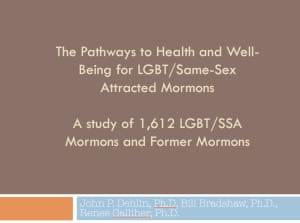
 This episode is a re-broadcast of the Mormons Building Bridges Community Conversation featuring Dr. Bill Bradshaw and Dr. John Parkinson Dehlin as they summarized the major findings from their 2011 survey of LGBTQ Latter-day Saints. The discussion was recorded on February 3, 2016.
Background: An on-line survey was conducted in the fall of 2011, under the auspices of Utah State University, which yielded 1,612 participants – LGBTQ Latter-day Saints (current and former members of the Church). Responses to the large number questions produced a wealth of data regarding such topics as sexual identity development, religious identity development, interventions engaged in for the purpose of coping with or changing one’s sexual orientation, mental health outcomes, and religiosity and religious trajectories. Seven published papers reporting this work have now appeared in prominent academic journals, with others in preparation.
The PDF used for this presentation can be downloaded here.
Episode Transcript
Host: John Dehlin
This transcript is machine-generated and lightly edited for readability. The audio is authoritative. Please excuse occasional errors in names and spelling.
Introduction and Study Background
Guest [00:00:01] Two. One.
Guest 2 [00:00:04] Welcome to the Mormons Building Bridges community conversation. Tonight we'll be hearing from Dr. Bill Bradshaw and Dr. John Dehlin as they summarize the major findings from their 2011 survey of LGBTQ Latter Day Saints. Hope this presentation will stimulate a vigorous conversation.
Guest 2 [00:00:22] There will be a wide this will be a wide ranging conversation and although many in the LGBT Mormon community are excited about their work, this is not just an event for fans. So if you have questions about their methods or want to know more about why they feel this is a valuable study, please submit comments and questions now. How to do that There will be a few panelists who are able to interact live with Bill and John as they will be asking questions at the beginning of the Q and A portion which comes after the presentation. The rest of you viewers who are watching right now can hear and see the presentation obviously, but are only able to interact via text chat, which you can click on in the bottom of your screen.
Guest 2 [00:01:06] Vicki Johnson and Erica Munson will be moderating those submissions as they come in and we'll pose those to the two doctors as the conversation goes along. Panelists, however, will be able to ask follow up questions throughout the discussion portion of the evening.
Guest 2 [00:01:24] So there is the housekeeping. So without further ado, without waiting any longer, we will turn the time over to Bill and John for the presentation. Then we will open it up for questions and answers. We will be ending the meeting promptly at 8:30 just to respect everybody's timetable. So turning it over to John and Bill.
John Dehlin [00:01:46] Thanks Kendall. I think Bill and I drew straws and he asked if I would would begin. And so I want to just thank you and Mormons Building Bridges and all the attendees for their interest in this presentation. And we know that time is going to be short and we want to leave a lot of room for Q and A. So we're going to kind of go through these slide presentations quite quickly and hopefully that will leave lots of room.
John Dehlin [00:02:17] So the title of this presentation is the Pathways to Health and well Being for LGBT Same Sex Attracted Mormons. It basically began as an idea from Dr. Bradshaw, who was my biology professor at BYU. And he basically called me and said John, and this is probably back in 2010, I want to say. He said there's a lot of opinion and anecdote about sexual orientation change efforts and other sorts of things, but there's not a lot of data.
John Dehlin [00:02:48] And he was right. And so he asked me if I would team with him to do a study to collect as much data as we could. So I went to a professor of mine at Utah State University named Dr. Renee Gallagher, who has published many articles on the LGBT Mormon experience, even though she's never been lds.
John Dehlin [00:03:10] And we brought on another graduate student named Katie Crowell. And off we were. There were basically three questions that we thought initially we wanted to ask, you know, to what extent are LGBT Mormons attempting to change their sexual orientation? And to what extent do they report those attempts to be either effective or ineffective or even damaging? That was sort of question one. Question two is, how do LGBTQ Mormons navigate their identity? And then question three was, if we were to look at things like celibacy, mixed orientation marriage, same sex marriage, same sex relationships, church attendance, what were the decisions for LGBT Mormons that would lead to optimal health and well being versus suboptimal health and well being?
John Dehlin [00:04:02] So ultimately, our goal was to provide as much information as we could to LGBT Mormons and post Mormons and their family and friends and mental health professionals and church leaders to help them make informed decisions. Our primary design goal, just to get into the methodology a tiny bit, our primary design goal was to have a large and a diverse sample.
John Dehlin [00:04:26] So what we did is we contacted Jennifer Dobner of the Associated Press. She wrote an article advertising our study with a link at the bottom.
Guest 3 [00:04:35] And.
John Dehlin [00:04:35] And then because it was the Associated Press, that article went out to over 100 newspapers across the world. We also approached every LGBT LDS support group that we could find, including Evergreen, North Star, Affirmation, and any possible group that we could find. I think there were over 20 support groups that we approached. And it was very important to us not to to cherry pick a particular group that might align with a particular opinion. And so we really did our best to recruit everywhere possible. And actually we made extra attempts with Evergreen and North Star to make sure that plenty of people who would be inclined to even say that their sexual orientation marriages or sexual orientation change efforts were successful.
John Dehlin [00:05:27] We did not in any way try and stack the deck. We opened the study up to as many people as who would participate. Fortunately, we were able to acquire an N, as we say in the research biz, of 1,612 participants who completed the online survey.
John Dehlin [00:05:50] And we were thrilled. I think we would have been thrilled with two or 300. The largest study that we were aware of at the time attempting to study this information was around 200. And so we sort of got an Eightfold increase, an eight times increase in respondents.
John Dehlin [00:06:07] Just to make a point, when we looked at the existing studies that had tried to study things like sexual orientation change efforts, we couldn't find a study that had over 200 people and that was from Spitzer 2000. And that's a well known study, not only because Spitzer was one of the main participants in the dsm, the Diagnostic and Statistic Manual for the American Psychiatric association, very controversial study where he actually said that he was able to find people who reported successful attempts at change. Now he's since retracted his own study. I think he's passed away. But the point is there has not been a lot of data and the largest studies prior to ours didn't exceed 200.
John Dehlin [00:06:50] There was one that had 224, but it was not published in a peer reviewed journal. So just to quickly discuss, we actually asked people when they filled out the study where they heard about our study so that we could know from what source they came. 40% came through, you know, what we call snowball sampling. Word of mouth, email, Facebook, social media. Another 22% came through the support groups that I mentioned. And we actually listed their support groups. So we know we have participants from Evergreen and North, North Star and Affirmation and all the other groups. 22% found us just through the newspaper articles without any of these other sources.
John Dehlin [00:07:31] And the rest were through blogs, websites, Internet forums and other sorts of organizations like Equality Utah, et cetera. Those are the sources. Just to briefly describe the demographics of our sample, 75% male, 22% female, obviously skewed heavily towards male. The mean age was 37 years, 91% Caucasian. We were able to get 48 states into our study, along with the District of Columbia and 22 countries across the globe. And even so, 45% of our sample came from Utah, reflecting where the majority of Mormons and gay Mormons and gay post Mormons live, interestingly enough, higher than average income and education for our participants, which is something we would have actually expected.
John Dehlin [00:08:24] 64% were college graduates, 42% of our sample were single, 35% were in a committed same sex relationship, 16% were in a married heterosexual relationship or a mixed orientation marriage. And then 7% were either divorced or other. And then, you know, aligned with the 75% male, 63% identified as gay, 14% as bisexual, 14% as lesbian, and then 9% either identified as heterosexual or same sex, attracted or transgender or something to that effect.
John Dehlin [00:08:58] Interestingly enough, a full third of our sample reported to be active members of the church at the time of completing the study. 36% reported to be inactive, and then 32% reported to be. Actually, 35% reported to be either resigned, excommunicated or disfellowshipped. So we got a good balance of all those categories. And then briefly, Bill, do you want to talk to this slide?
Guest 1 [00:09:24] Yes. Thank you. Just one clarification. Although there were some of our participants who self identify as heterosexual, we believe that they in fact are homosexual because of other data that they provided about their life experience. So we'll return to this point about identity later on.
Sexual Identity Milestones and Coming Out
Guest 1 [00:09:51] The slide on the screen shows you the results of questions that we asked in order for our participants to report to us milestones in their sexual identity development. At what age did you have a certain kind of experience with respect to what your sexuality might have been? So the numbers represent averages for all of our participants and the numbers in parentheses are standard deviations. The first question was, when did you have some kind of sense that you were different than peers of your same age? For men it was nine years of age and for women a couple of years older.
Guest 1 [00:10:38] At this point, people don't know exactly why they're different, although they have the strong feeling that there's something unusual about them. Then the second question said, when did you interpret that difference as a sexual one? About age. 13 for men and 16 for women. When did you have the first same sex romantic experience? Usually this took the form of an adolescent crush on someone of the same gender.
Guest 1 [00:11:14] 18 for men, 21 and a half for women. When did you come out? You see the numbers. 22 for men, 23 for women. And when did you accept the label of being someone who was non heterosexual? A couple of points. These data confirm results from other lab, from other investigations.
Guest 1 [00:11:42] The numbers are remarkably the same. The point to be made is that homosexual individuals have not chosen their orientation. This is not something that people grow out of. And at an age that's remarkably young, they have a sense of their sexual differences.
Guest 1 [00:12:09] A final point is that when we look at just those participants in the age group 18 to 30, the numbers for the last three questions all move to 18. That is coming out and labeling oneself as much is up to four or five years earlier for younger people in our culture. I think this is to be attributed to.
Guest 1 [00:12:42] The fact that there is much more public conversation about homosexuality. It's in the media, There are organizations in high schools for gay straight alliances. There is an age difference. John, let's go to the next. John, can you help me move to the next slide? Thanks. So topic number one is about change efforts.
Coping Strategies and Change Efforts
Guest 1 [00:13:11] Next, There were a series of options to which our respondents could talk about. And that was ways in which modes of intervention in which they tried to cope with or understand or change their sexual orientation. So this slide shows the relative attention for each of these interventions. So you see that at the personal level there was the highest degree of effort. Personal righteousness represented efforts in the LDS paradigm to be granted a blessing from Heavenly Father, church attendance, missionary service, fasting and prayer, temple attendance, accepting and fulfilling church assignments. Individual effort took the form of private investigations, reading, going to sources, trying to find out about homosexuality.
Guest 1 [00:14:25] And church counseling represents efforts in conversation with bishops and stake presidents. So beyond these personal level interventions you can see that 35% engaged formally in psychotherapy and there were less amounts of participation and support and group therapy and so on. Next, This slide then shows us these same interventions. They're listed in a different order here. And the color coding indicates our participants response to the degree to which these various interventions were effective. So from left to right, red to green, red indicates a degree of harmfulness.
Guest 1 [00:15:30] Green represents the highest degree of helpfulness. So the options that people were given were highly effective, partly effective, not effective. That's what you see in yellow, somewhat harmful orange and highly harmful red. Over on the right side you see the percent of usage, how often on average did our participants engage in these particular efforts and the average length of time?
Guest 1 [00:16:05] The important point as highlighted in blue is that the personal efforts turned out to have the highest negative rankings and the least effective ones. Those efforts that normally Latter Day Saints would think would be the most effective in doing what's right and in getting God's blessings, those were the ones least effective. Next.
John Dehlin [00:16:35] And Bill, I'll just add it's worth noting that for those who engaged in personal righteousness as an attempt to change, they engaged in that on average for 11 years and church counseling with the bishop or stake president for almost seven years. And so it's worth noting that the most damaging methods were used most frequently for the longest duration. I'll just add that.
Guest 1 [00:17:00] And the explanation of that, as you will see in a moment, is that these efforts were not successful, change was not forthcoming. So a quick summary of the results of these efforts are shown in this slide. I should say that the way these numbers were determined was that There were about 600 or 700 open ended narratives written by our respondents in which they described this change effort experience. And these were read independently by John and myself. And from it we determined the perception of our respondents about whether or not change efforts were helping.
John Dehlin [00:17:54] And Bill, it also came from their self reported Kinsey scores of attraction.
Guest 1 [00:17:58] Thank you. So very small numbers of persons actually, 32 out of the total of 1600 offered some comment about that change had helped them in some way or that there had been some kind of change. 3% out of the total of this large number of people, 40% on the contrary, reported significant harm of some kind. Next.
Guest 1 [00:18:40] So to give you a little bit of a qualitative sense about how people reported that they had experienced change, listen to these quotations. I think of the same sex relationship every day, but I don't act on it. Clearly a comment about behavior, not about a change in core erotic feeling.
Guest 1 [00:19:05] Same sex attraction diminished but never went away. These thoughts do not define who I am. And so some people saw the positive change that they experience in being able to see themselves in some positive light. Finally helped to decrease my negative reaction to my same gender attraction. Once again, a a response that suggested, doesn't bother me anymore, not that it has changed in some significant way. Next JOHN so we were able to make lists of benefits and harms that people shared with us from this experience.
Guest 1 [00:19:55] The benefits primarily centered in self acceptance of one's sexual orientation, decreases in depression or anxiety, and improved family relationships. The harms were poignant decreased self esteem and feelings of self worth, shame, depression, particularly sadness that the change that was offered by church leaders or by professional counseling never took place.
Guest 1 [00:20:40] And so people had the sense of, well, I've prayed about this for 11 years. I've done everything possible. Nothing changes make maybe God doesn't love me, maybe I'm not lovable, maybe there is no God. So there was a decrease in spirituality and a departure from church affiliation.
Guest 1 [00:21:11] Next, As a quick sub summary, most homosexual Latter Day Saints make some efforts at change at a private the private level efforts are more prevalent than the professional ones with therapists and counselors. The most harmful methods are those that are used more frequently and last for the longest period of time. Overwhelmingly, there is no evidence here for significant change through these Herculane efforts and a lot of sense of harmful consequences. John, you're up.
John Dehlin [00:21:59] Thank you, Bill.
Guest 1 [00:22:03] I'll just say that our studies focused on change efforts have been published in two important journals. In the Journal of Counseling Psychology, we report broadly across all of those interventions. Next, John and then in a second publication, we focus on the efforts through formal psychotherapy. Thank you.
John Dehlin [00:22:31] And you know, I think it's worth mentioning that the Journal of Counseling Psychology is one of the flagship journals of the American Psychological Association. And while all these journals are peer reviewed, we just, you know, we've had people comment about our methodology and our sample and we just want to make sure people understand that while no sample is perfect, and we certainly do not have a randomly, you know, drawn sample, that certainly the sample was good enough for probably now 7 well established peer reviewed journals to accept our, you know, findings from our study.
Guest 2 [00:23:10] So.
Guest 1 [00:23:10] So our studies meet the criteria for publication by professionals in the field.
Guest 2 [00:23:16] Yeah.
John Dehlin [00:23:18] Thanks, Bill. Now we'll go to topic two, which is navigating sexual and religious identity conflict. We found a really important study by a gentleman named Pitt who divided a sample of LGBT participants into four quadrants, analyzing their religiosity and their sexuality. And we borrowed from, we borrowed that methodology and applied it to our study where we were able to sort of compartmentalize four identity types for our sample.
Identity Types and Religious Conflict
John Dehlin [00:23:55] Identity type one would be those who rejected an LGBTQ identity. We call them rli. And for short in the acronym, these would be people who reported, let's just say, a three to six on the Kinsey Scale for attraction, definitely.
John Dehlin [00:24:19] But at the same time, they identified personally as heterosexual or same sex attracted, and they definitely identified as religious and were active members of the LDS Church. The second group, we're calling them compartmentalized LGBTQ and religious identity, or comp. These were individuals who definitely privately identified as lgbtq, but they remained active in their church and publicly their identity was as more straight individuals.
John Dehlin [00:24:55] The third category were those who we described as rejecting their religious identity. These were people who had left the LDS Church completely and identified as lgbtq. And then the fourth category were individuals
Guest 2 [00:25:10] who
John Dehlin [00:25:12] we were calling integrated, meaning that they were openly LGBTQ and they remained actively participating in the LDS Church, sort of out and proud as a, as a active Mormon. These are the four categories that we divided our participants into.
John Dehlin [00:25:32] And to just show you the prevalence of those four identities, those who just sort of rejected their religious identity and were LGBT identified were around 53%. Those who compartmentalized were around 37%. Those who rejected their LGBTQ identities were around 6%. And then those who were, you know, we described as integrated were around 4%.
John Dehlin [00:25:58] So that's kind of the prevalence of those four identities. Now we use several psychosocial measures to measure both positively and sort of, you know, suboptimal mental and psychosocial health. Let's just say we used a self esteem scale by Rosenberg. We used a quality of life scale to measure positive attributes in their lives. We'll talk about that in a second. And then for negative associations, we used a scale for internalized homophobia, for identity confusion, for sexual identity distress. And then we used Something called the ccaps, a subscale of the CCAPS measure which measures depression.
John Dehlin [00:26:44] So those were the six sort of things that we measured. And we basically focus on the quality of life scale in this presentation, mostly because it's a positive measure. So instead of pathologizing being lgbtq, we just want to understand from a very positive sense how do they rate their own material and physical well being, how do they rate their relationships with other people, how do participants rate their, their social engagements, their community and civic activities, recreation, hobbies, personal development? And the range on this quality of life scale is from 16 to 112. And 90 has been given as the guidance for a healthy average. So when you look at a QOL or a quality of life number, you want to look for 90 as being sort of the healthy average.
John Dehlin [00:27:33] So examples from the questions on the QOL scale would be things like talk about how do you rate your material comforts at home, do you have and are you rearing children? How would you rate your relationships with spouse or significant other, with close friends at work, socializing, hobbies, entertainment, et cetera. And they're giving themselves self ratings here. And just to sort of cut to the chase, across the top of this grid you will see the four identities and, and then you'll see the six measures of well being or non well being on the, on the left hand side in the columns. And what you'll find is those who rejected their LGBT identity, who identified as same sex, attracted or heterosexual, and yet reported significant same sex attraction.
John Dehlin [00:28:26] They were, they, were they self rated as being the highest with internalized homophobia, highest with identity confusion, highest with sexual identity distress, highest on depression, lowest on self esteem, and second lowest on quality of life. And if you think about those who compartmentalize, you'll see slight improvements in internalized homophobia, identity confusion, sexual identity distress and depression. But they actually came out equal on low self esteem and slightly worse on quality of life.
John Dehlin [00:29:00] So you can sort of, sort of summarize from this that those who reject their LGBT identity or compartmentalize and live what some have described as two different lives, those are the, they have the least well being, according to our respondents. Now, if we take the flip side, those who completely left their religion altogether reported the lowest internalized homophobia, the lowest identity confusion, the lowest sexual identity distress, actually the second lowest sexual identity distress. But statistically it was indistinguishable from the integrateds, you know, much lower depression, better self esteem, and higher quality of life. Now, interestingly enough, even though the integrateds as we call them, were the smallest of the four subgroups.
John Dehlin [00:29:52] They actually had the healthiest overall scores. So for those who were able to integrate successfully their religious identity and their LGBT identity, they reported, you know, optimally on identity confusion or best on identity confusion, lowest on sexual identity distress, lowest on depression, comparably low on self esteem, and they had the best quality of life.
John Dehlin [00:30:18] And what this shows is when people aren't forced to choose between their sexual identity and their faith, they report the best outcomes. Although it's important to put an asterisk on that to say that only about 4% of our sample were able to be in that category or chose to be in that category.
John Dehlin [00:30:37] This just shows the quality of life ratings. And again, it shows that those who reject their religion or are integrated had the highest quality of life. And there are statistically significant differences between these first two numbers and the latter two numbers. So the takeaways from this particular study were that voiding sexual orientation change efforts was associated with positive well being.
John Dehlin [00:31:04] So was accepting your LGBTQ identity instead of suppressing it or denying it. Coming out to family and friends was a positive correlate. Reducing or eliminating your LGS church activity seemed to be a positive thing for most of these participants. Interestingly enough, those who lived outside of Utah fared better than those who lived inside.
John Dehlin [00:31:26] And again, if you were to remain LDs, the extent to which you could integrate your identities and come out but retain your LGBT identity or embrace it, you had the best outcomes. And what we seem to glean from this was that those who were in committed same sex relationships had the highest well being. But we actually asked that question specifically in our, in our final study that we're going to come to in a second. So to summarize that, that was a summary. This, this study particularly was published in the Journal of Identity and International Journey of Theory and Research, which as I understand is, is the top journal on identity in the, the field of psychology.
John Dehlin [00:32:07] So that's our second study. And then I'm also going to cover the third study that we conducted, which was on just the overall psychosocial well being of SSA LDS Church members. Now, most of you will know this history better than Bill or I, but historically, especially prior to the study being conducted, the approaches that the LDS Church seemed to advocate for SSALGBTQ individuals were to not believe that your same sex attraction is biological or fixed to eschew an LGBT identity, but instead to either call yourself heterosexual or same sex attracted or same gender attracted to try and change your sexual Orientation, if possible, whether it's through personal righteousness or speaking with the bishop, or going to Evergreen or working with North Star or going to LDS Family Services to get support from a psychotherapist, as well as retreats or groups or other sorts of things.
Psychosocial Well-Being Across Identity Groups
John Dehlin [00:33:14] If you can't rid yourself of same sex attraction, and if you didn't feel comfortable being married in a mixed orientation marriage that you were to stay single and celibate, get into a mixed orientation marriage if possible, and be as righteous as you possibly can sometimes, you know, being described as having faith or drawing closer to Christ or being as righteous as you could possibly be.
John Dehlin [00:33:41] So what we did is we just sort of took some of these recommendations and categorized our participants in a way where we could see what the actual corporate quality of life outcomes would be based on these recommendations. So the first one was sexual activity.
John Dehlin [00:34:01] We had two categories of people who identified as celibate, those who chose to be celibate by choice, and those who were celibate because they had no partner. And interestingly enough, they had the lowest quality of life reported scores by far.
John Dehlin [00:34:21] And so that's interesting. Then if we look to those who were sexually active, we categorize them and they self categorized into either being not in committed relationships or in committed relationships. And what we found is by far those who reported the highest quality of life were sexually active and in committed relationships. But even not being a committed relationship, you showed a significantly higher quality of life reported.
John Dehlin [00:34:47] We have the line there about lupus. Unfortunately, the quality of life measure that we used only gave as interpretation medical illnesses that participants had. And so we picked one that sort of seemed to be a reasonable threshold for well being versus not. It was participants who took the quality of life scale who had lupus, which is a pretty debilitating kind of horrific illness. And what we find is that those who reported to be celibate had quality of life scores worse than those who reported to have lupus. And that's also true for those who were not committed but were sexually active. But it just, it gives you a sense for how important I think sexuality is, how we're sexual beings, and how if we try and suppress that, it can have really deleterious outcomes on our well being.
Mixed-Orientation Marriages and Outcomes
John Dehlin [00:35:43] The next sort of group that we wanted to study were those who chose to be in mixed orientation marriages. And it's important to kind of establish a baseline. First of all, I believe our study showed that about 30% of our participants had entered into a mixed orientation marriage at some point. So that's A pretty large number.
John Dehlin [00:36:02] To establish a baseline, we did a literature review to understand what, what the divorce rate for first marriages is. There's a common statistic that 50% of marriages end in divorce, but that's actually skewed by second, third, fourth and fifth marriages. It turns out that first marriages have a divorce rate of somewhere between 22 and 28%, depending on the study. So kind of think about 25% or a quarter of all first marriages ending in divorce. That's what you would want to compare mixed orientation marriages to the first marriages.
John Dehlin [00:36:36] And what we found from our study was a 70% projected divorce rate for mixed orientation marriages. So over 50% had already been divorced by the time they took their study. But many of the people who took the study were in the early years of their mixed orientation marriage. And so we were able to find a projected divorce rate for the remaining, and it came out to be about 70. And this is comparable to the literature. The literature, we found divorce rates for mixed orientation marriages anywhere between 50 and 85%. And so this fell right in the middle of what the literature also said about mixed orientation marriages, which means that you're almost three times more likely to get a divorce if you enter into a mixed orientation marriage from a Mormon background.
John Dehlin [00:37:23] And interestingly enough, for men who reported to be either fives or sixes, I believe on the Kinsey scale, who were predominantly or exclusively homosexual, the divorce rate actually rose to 85%. And another way to say that is those who were able to remain in a mixed orientation marriage by the time of our study, by far were self reported as being bisexual. So for our study, reporting bisexual attractions was a very important factor in having your mixed orientation marriage succeed.
John Dehlin [00:37:59] So one point that we also want to make is that if you, if you are LDS and you're same sex attracted and you enter into a mixed orientation marriage, what our study showed is that 2/3 of those people by the time they had taken their study had left the church. And so if 70, if 70% of, you know, LGBT Mormons end up leaving Mormonism, and that's probably lower at this point, it begs the question as to whether that's a solid foundation to build a marriage upon. If there's a 70% likelihood that your relationship with the church is going to end, it would make sense that when your relationship with the church ended that your marriage might end soon thereafter.
John Dehlin [00:38:41] Finally, we wanted to just understand whether activity in the church was correlated with higher or lower well being. And so we took people's self reported status in terms of their church activity. And we measured quality of life and we found that in fact, and this was 30% of our sample, so it was a very large number, you know, over 500, I think, participants, they reported the lowest quality of life scores, again lower than those who reported of lupus.
John Dehlin [00:39:14] We got a slight bump if participants got a slight bump if they went inactive, another slight bump up if they were disfellowshipped. And then, interestingly enough, very large bumps happened when the participants reported to have either resigned from the church or to have been excommunicated. And excommunicated members actually had the highest quality of life of those who participated.
John Dehlin [00:39:38] So that was an interesting finding. And then finally we just hit, you know, ask this question about being single versus in a mixed orientation marriage versus in a non legal same sex relationship or a legal same sex relationship. And what we found again is that those who were single reported very low quality of life scores. You got a decent bump up if you're in a mixed orientation marriage, but still lower again than the sort of standard that we've been using about lupus. Still lower quality of life reported scores than those who have lupus.
John Dehlin [00:40:12] And then if you wanted to sort of exceed that threshold, according to our participants, they were either in a non legal same sex relationship, but those who were in legal same sex relationships almost approached the healthy average across the nation.
John Dehlin [00:40:27] So we feel like this is a very important finding. Now this, this all happened before same sex marriage was legalized in the United States, but we felt like that's an important finding as well for people to know about as they're trying to decide, you know, what to do with their lives as they're looking at the future. So to summarize the correlates to happiness and health and well being versus the opposite, it appears to be negative associations with health and well being for believing that your same sex attraction is due to your upbringing, the way your parents raised you to sin, to choice those sorts of things.
John Dehlin [00:41:08] Negative associations with attempting to change your sexual orientation, which includes religiously, which includes praying and fasting, and drawing closer to Christ and being extra righteous. Negative correlates there. Negative correlates with staying in the closet, with remaining active or even inactive within the LDS church. Negative correlates with being in a mixed orientation marriage or single, and very negative correlates with celibacy. And if you flip that around, the positive associations were believing that your same sex attraction is biological, accepting it as a core part of your identity, coming out to friends and family and associates when you feel safe to do so.
John Dehlin [00:41:50] You know, leaving the LDS church is what many reported to be helpful for them. Being sexually active, but preferably in a same sex committed relationship and preferably a legal committed marriage. The results from this study were published in the Journal of Gay and Lesbian Mental Health, which again is a fine journal. And now I'll turn the time over to Bill to just discuss briefly the topic of heterogeneity in the LGBT LDS population.
Diversity Within the LGBT Mormon Population
Guest 1 [00:42:20] John, I want to begin with a comment. The data that you have seen in the last 15 minutes show significant differences depending on choices that people make about their life trajectories and about their behaviors. And because there are differences does not mean that John and I are advocating for a particular, for anyone to follow any particular pathway in life. Well, let me just.
John Dehlin [00:42:59] Absolutely true, Bill, that's absolutely true. And it's also, I think it's also fair to say that we did find people in mixed orientation marriages and people who are celibate, who chose celibacy, and people who are active in the church who had high quality of life and high self esteem and low depression. So these are just averages. But no one should, no one should interpret from this study that it's a fait accompli or it's inevitable that things will go one way or the other. People shouldn't make their decisions based on averages of a sample. This isn't representative of all Mormons. And everyone has to decide for themselves what's right. And we don't want you to think that happiness is impossible with any of these options. People can find joy and happiness in all of them. It's just a matter of letting people know what the percentages seem to be. So sorry, Bill, please continue.
Guest 1 [00:43:56] Thank you. Sometimes people appear to think, to believe and to speak as if they view homosexuality as a monolithic circumstance. And we want to finish by showing you data suggesting that that's not true. Next, John. So along the x axis of this figure are the points of the Kinsey scale.
Sexual Orientation, the Kinsey Scale, and Marriage Data
Guest 1 [00:44:28] 0, 1, 2, 3, 4, 5 and 6. A seven point scale with three in the middle 0 indicates a self report of exclusive heterosexual attraction. 6 on the other end of the scale represents exclusive same sex attraction. And what we show you here are the differences between the distribution of men and women in our study along the Kinsey continuum.
Guest 1 [00:45:05] The very important observation here is that there is a distinct gender difference and there are many more women who perceive themselves to be in the middle of the scale, bisexual, with some capacity for erotic or romantic feelings for both men and women. And the Difference is significant.
Guest 1 [00:45:30] So There are about 20% of our male respondents in the 0 to 4 stretch of the continuum, and it's over a third for females. Next, John, I want to show you now some data just for the male participants in our study.
Guest 1 [00:45:55] So this is about marriage. Along the X axis you have age. And on the Y axis there's a scale from 1 or 100% at the top to 0 at the bottom. That's a measure of how many persons in the study are married.
Guest 1 [00:46:18] So if we start at the left hand at the top, we are moving from left to right and it's 100% because nobody is getting married in childhood. And then there are four lines and they start to depart going downward, indicating that those persons in that cohort are getting married. There are two variables here. One is Kinsey scale position and the other is whether or not these men served an LDS mission.
Guest 1 [00:46:51] So on the line that's moving downward, first, that indicates those who have a low Kinsey scale in the bisexual region of the continuum and who served an LDS mission. Next is the solid line, and it shows those with low Kinsey score, but those who did not serve a mission.
Guest 1 [00:47:17] So whereas with the first group, about 90% ultimately got married, only about 40% of those who the non missionaries in the low part of the scale. Now, for those who are, let me say, really gay, those in the five and six positions on the Kinsey scale, you see that there was a much less frequent attempt at marriage. Again, there is a mission effect.
Guest 1 [00:47:55] So high Kinsey scale, men with a mission tried marriage up to about 25% or so, maybe 30. And those without a mission, only about 15% perhaps attempted marriage. Next, These data are about divorce. Again, the two variables are whether there was a mission experience.
Guest 1 [00:48:31] The two bars on the left are for those who did not serve a mission. Excuse me, those on the right, those who did serve a mission. And you see the difference between low and high Kinsey scores. So divorce is much less prevalent for those with low McKinsey scores.
Guest 1 [00:49:05] But for those in the high end of the continuum, it's 85% divorce, even with admission, and 95%, pardon me, 95% for those who did serve. Next.
Guest 2 [00:49:29] So
Guest 1 [00:49:32] John and I believe that we have gained some important insights from this study. Let me just add that there were 149 items in our questionnaire, a large number covering a wide diversity of experiences in the lives of these fine people.
Guest 1 [00:49:55] And these are a few of the most important conclusions that we'd like to leave you with. Sexual orientation is Not a choice. This is not a phase that someone goes through. Gay people are not pedophiles. Gay people are not perverts. Gay people are not trying to be rebellious or in other way to in any other way to.
Guest 1 [00:50:30] To have negative motivation. Sexual orientation is a graded biological response. Were we to have other time and if John would turn me loose, I could share a large amount of data demonstrating that homosexuality is biologically induced during embryological development and very, very early in the development of the postnatal brain.
Guest 1 [00:51:01] Soce if you phrase the question simplicity, does do change efforts? Does reparative therapy work? The answer is no. It was very rare to have a claim for that among our participants. And many of those comments, as you saw, were ambiguous.
Guest 1 [00:51:26] In fact, they are harmful. These efforts, especially those in a religious setting. And the explanation for this is when you try everything you know in an LDS setting to affect a change, to do what you have been told is right and what you feel is right, to enlist God and ask for blessings. You do all of that for a very long time in the most intense way and nothing happens.
Guest 1 [00:52:02] The negative consequences of that are severe. Those who in our study accepted their sexual identity, their non heterosexuality found that to be healthy. And unfortunately, those who disaffiliate from the church report increased negative mental health outcomes primarily because of the not negative bill positive.
Guest 1 [00:52:37] Let me restate it. Thank you, John. Most, most people who remain affiliated with the church report continual negative mental health consequences primarily because of the negative commentaries in their religious communities. Thanks for the correction, John. It is not good for man to be alone. We've been told that for a long time celibacy does not generally produce healthy lives.
Guest 1 [00:53:18] Those in same sex committed sexual relationships reported the highest measures of mental health and happiness. And not all gay people are the same. It's important to note that especially since homosexuality sexuality is determined by biology, those who are programmed so as to have capacity for erotic feelings for both men and women, those people have options that are not available to those who are on the high end of the scale. Thank you.
John Dehlin [00:54:03] And we're happy to provide our email addresses to anyone who may have questions. But that completes the PowerPoint presentation part of our study. And so I'll stop sharing this slide now and we can turn it back to the moderators for a vigorous Q and A.
Guest 2 [00:54:24] Thank you very much. So I'm going to go through and start unmuting the panelists so that they can begin or if they've already unmuted themselves, even better so that they can start asking questions so, Bryce Cook, I know that you are primed.
Audience Questions on Change and Representation
John Dehlin [00:54:41] Yes.
Guest 3 [00:54:42] So it seems that the results of your study are a really good empirical test of the fruits of the church's doctrine and position on how LGBT should live their lives. And one measure in particular that I have a question about is church activity.
Guest 3 [00:55:05] You have about 29% showing active and 70, 71% is being inactive or out of the church. And my thought was this is really a moving target because I would think that, you know, people, young people, people just off their mission, would tend to, you know, really try to make the church work. And as they get older, you know, we see, at least in church, how many single high priests you know that have never been married do we have in our wards? In my experience, it's very few. And so I was wondering if you have stratified the sample by age and could comment on, you know, as you get older, you see anyone who's gay staying in the church.
Guest 3 [00:55:52] Because it seems to me that unless they've been able to successfully enter into a mixed orientation marriage in which, you know, they and have a family, which is sort of the church narrative, and therefore they could make it work that they end up not staying. So if you could just comment on how that percentage of activity and non activity changes as people age.
Guest 1 [00:56:21] There are active people all along the age continuum. So the age range of our participants is from 18, and there were a handful of people in their early 70s. And I would say that the important variable is not age as much as where people are on the Kinsey continuum, what the intrinsic level of their sexual attraction is. So my view is that people who are Latter Day Saints, who gay Latter Day Saints who are bisexual, have the easiest time of remaining closeted in their congregations. They can be. They are most likely of those who do make mixed orientation marriage work. They are people in that range of the scale. And so they can remain, appear to be like everybody else in the congregation and not be required to expose themselves as gay persons. I would say that that's my response.
Guest 3 [00:57:34] Just a quick follow up. So would you say that if you looked at everyone in your sample age 40 and older, that you would find the same percentage, you know, 29% active and approximately 70% inactive or out of the church? Or wouldn't you see a much higher. I mean, I would think just based on, you know, my own family members and other gay people, I know that, you know, when they're young, they tend to stay in, but then as time goes by, you know, and the continual fight and trying to Live that celibate lifestyle takes its toll. So that you would, I would think would be more like, you know, by age 52 or 3%, 90 plus percent out. But I could be wrong.
John Dehlin [00:58:18] Well, if I can just give my quick answer on this, I believe I would need to go back and look at the data. But my memory is that there's a positive association between age and disaffection from the church and a positive association between age and divorce in a mixed orientation marriage. Now that. But that can be true and Bill's point can be true, which is that you can find people of all age brackets remaining active. That's my response. Bill, go ahead. I didn't mean to.
Guest 1 [00:58:48] No, no, that what you said is helpful.
Guest 3 [00:58:52] Thank you.
Guest 4 [00:58:53] I've got a question from one of our viewers. Can everybody hear me?
John Dehlin [00:58:57] Yes.
Guest 4 [00:58:58] Great. Okay. Did you see any link between respondents, Kinsey scale figures and the length of time with which respondents battled with their orientations?
Guest 1 [00:59:17] If we produce a graph that shows change efforts as a function of age or the length of change efforts as a function of age, that distribution is skewed strongly towards older individuals. So there are a significant number of persons who, for example, have spent in excess of eight years, up to 25 years in a at least semi continual effort to try to cope with who they are and especially change efforts.
Guest 1 [01:00:00] And that they have begun that period of time on average about age 15. But there are a significant number of older people in the sample who started their change efforts at ages 25, 30, 35, even up to 50.
Guest 1 [01:00:21] And so yes, I think that. There is a group of a subsample of our population who engaged the most heroically in these efforts to change. And those are the persons who tried everything possible to try to make some kind of sense out of their sexual orientation. And when it didn't change, the consequence of that was usually disaffiliation from the church.
Guest 4 [01:01:01] And was there any relationship?
Guest 1 [01:01:02] And those were. Those tended to be people at the high end of the Kinsey scale, fives and sixes. So they were the persons who probably came to understand correctly that they were the least out of step with friends and others of their same age in terms of sexuality. And so they were trying the hardest then to make a change.
John Dehlin [01:01:30] Erica, I'll just add to Bill that I would. It's been a while since I've looked at those exact numbers and so I would need to look at them to be able to answer definitively. I would be inclined to say that based on my memory, there is a positive association between Kinsey's scores of attraction and duration of attempts at change. My only hesitation would be realizing that a full third didn't even attempt. And I want to say that there's a. I'm going to guess that a significant percentage of those who never even bothered, never bothered because they just said, I know there's no way I'm going to be able to change. And that might skew the numbers a little bit.
Guest 4 [01:02:10] Okay, thank you.
John Dehlin [01:02:12] I'd like to do a follow up
Guest 2 [01:02:13] question on the change efforts since we're on that topic. That early graph in the deck, that 0% felt that there was permanent change, 3% felt that there was even some change is pretty graphic result. But I even question that 3% because it makes me wonder, is there any way of subdividing them into those who are bisexual? And maybe that accounts for all of those who felt there was any change at all. Do you have any handle on that?
Guest 1 [01:02:44] Yes, Greg, the average Kinsey score for all of those 3% who indicated some change is right smack in the middle of the scale. It's about three.
Guest 2 [01:02:56] There you go. Yep.
Guest 3 [01:02:58] Do you have numbers on where they ranked on the Kinsey scale 10 years ago versus now, or do you only have a current rank for them on the Kinsey scale?
John Dehlin [01:03:07] Just current at the time. At the time they responded to the study.
Guest 3 [01:03:11] But that's kind of a problem too, right? Like if I were to report on my sexuality, I would have been a six, you know, before I got married and met my husband. Then I would have been a, you know, three or four after we got married. So, you know, it's a little tricky because, yeah, sure, I'd rank more on bisexuality now, but that's. And yeah, my marriage, I do rank higher because my marriage is doing better. It's like, how do you know the cause and the effect? Like, is the bisexuality making the marriage better or because my marriage is better, I'm ranking more bisexual.
John Dehlin [01:03:42] That's a great point. Correlation does not mean causation. And we don't know the directionality of the change and the causes. We can only report associations.
Guest 3 [01:03:52] Yeah, but people take it that way though. You know what I mean when you say, oh well, those who were more bisexual are the ones that are doing better in a mixed orientation marriage. Well, again, I'm just saying when you report it that way, it makes it sound like they've always been bisexual and their marriage is better. Whereas that may not be the case. And believe me, I'm all for getting rid of the whole idea of changing sexual orientation, which is why I'm a little even hesitant talking about moving along the scale. But, you know, there's some movement that goes on, and I just think that, you know, we need to be careful in that it can be misleading for people.
Guest 3 [01:04:26] And this same. Just one other point I wanted to make, and I know you guys did. I totally. I appreciate the work that you're doing. It's such an important category, and I know you're trying to get it, you know, so it's not biased. But the problem is to gather people that are doing well in a mixed orientation marriage are the ones that don't contact North Star. They're the ones that don't pay attention to articles on sexual orientation. You know what I mean? The ones that are doing best are the ones that you aren't getting reports from. So I just think that's unfortunate. I know you kind of say, well, this is, you know, we know it's not a random sample, but it definitely leans toward those less happy with regard to, you know, those feelings, you know, because they're not doing well.
Guest 3 [01:05:09] Like North Star. If they gather to North Star, it's because they're having trouble. But if you gather to affirmation, it's more because, you know, you're identifying as gay or lesbian and you're feeling, you know, better about that and you want to be with other people that feel the same way you do. So you're. The pools. Those two pools are really different.
John Dehlin [01:05:28] It's a fair point. And the only thing I'll say in response, number one, you're absolutely right that we are probably definitely underrepresenting women, and we likely are underrepresenting the category of people that you mentioned. Having said that, if you'll notice, 6% of our sample fit in that category of not even identifying as LGBT and being very active in the church. And so that would be, I don't know, 90 people. And the Spitzer study had 200. So even though we only had about 90 people who fit the category you talk about, possibly, that's still a very large number relative to any other data we have out there. So it's suboptimal data, but it's the best data we have.
Guest 3 [01:06:14] Yeah, I know.
Integration, Affirming Communities, and Church Policy
Guest [01:06:16] I have a question about the integrated category. For one thing. I'm sort of interested in the fact that the. The likelihood of being in that category is about the same as the likelihood of reporting change sexual orientation.
Guest 3 [01:06:34] That was a great.
Guest [01:06:36] But do you have any sense of what factors might contribute to the ability of individuals to integrate.
John Dehlin [01:06:48] I do. Bill, do you want to start? And then I'll add. Go ahead.
Guest [01:06:51] John.
John Dehlin [01:06:52] My sense would be it would be a tolerant bishop. It would be an affirming ward. It would be being outside of Utah, you know, Cambridge, Massachusetts, or, you know, New York City, or, you know, Oakland, California, come to mind. Those would be some of the factors that I think would be most influential. Bill, what would you add?
Guest 1 [01:07:23] I think that it is very hard
Guest 2 [01:07:26] for
Guest 1 [01:07:29] moral individuals to try to be something that they are not. And I think in the lives of many of my gay and lesbian brothers and sisters, there comes a point at
John Dehlin [01:07:43] which
Guest 1 [01:07:45] it becomes just too hard internally in your soul to promote an external perception that doesn't match what you are internally, and that people, various people at various times in their lives, come to the realization that they have to be honest with themselves. When I was scout, we had this program, be honest with yourselves. All the rest of you are too young to know this, but there were post, there were little cards and there were posters in all the chapels. Be honest with yourself.
Guest 2 [01:08:28] No, I'm not too young.
Guest 1 [01:08:29] Okay.
Guest 2 [01:08:30] But
Guest 1 [01:08:33] it's a truism. If you're not honest with yourself, it's awful hard to live your life in the way you want to. And that leads people, especially if they have an understanding bishop, to live in a way that we define as an integrated category.
John Dehlin [01:08:54] John, I'll just. Thank you, Bill. And John, I'll just add that I think we should dig down into that data and understand it. I think there's a lot of good data there that we have not mined. We think there could be, if there are any aspiring researchers out there, we think that there are probably 30 more dissertations that could be written from these data. The dailies data is hardly tapped. John, I think that's one question we need to dig into to understand.
Guest [01:09:19] Yeah, I mean, you're talking mostly about. You're citing mostly external factors like what acceptance are they getting from church leaders and church members. But I know of situations, individuals that I would categorize as integrated, who don't necessarily have the external, but have a very strong sort of internal connection with God or, you know, there may be some other internal factors there that play a role. And, you know, I could say in my own case, having been active in my ward for about 10 years now as an excommunicated individual, that I think I've noticed a change in my ward over time, terms of how leaders and members of the church respond to me. And so I think an integrated individual who's present in a ward can probably help shift some of those external factors as well.
John Dehlin [01:10:19] Yeah, that's a study worth doing. So you make great points, John. Thank you.
Guest 2 [01:10:25] I'd like to make a global comment here. Having spent 40 years as an experimental biologist, I think I appreciate data, and I certainly generated a lot of data. And I also know the price that one pays by denying data. I look at your data and then I look at church policy, and the phrase that comes to mind is climate change denial that you have overwhelming data moving in one direction. But I don't really see that there's been a millimeter's worth of movement on the ecclesiastical side. I see some cosmetic things that are done occasionally, but at the core, I don't think this has made any difference in the worldview of the men who are setting the policies.
John Dehlin [01:11:18] Many won't disagree with you on this panel, I think.
Guest 5 [01:11:23] So I'd like to jump in for a second. I wonder if we aren't. Well, when I hear your study and I look at your study and I hear what different people, different people talk about it, I wonder if we aren't presenting it almost always in a negative light. We always say things like, you know, if I'm single and I'm gay and I'm trying to be Mormon, is there any possible, there's no possible way I can be happy. Right. We compare it to lupus. Right away, we all these negative things. And I wonder if we as a community, and perhaps just in general when we present your research, we could do a better job to say, saying there are options.
Guest 5 [01:11:59] Sure, it's hard. Sure. We need to do these things. And I wonder if we'd be better off if we focused on things like saying, what can we do to help these people or ourselves? You know, what can we do to create that affirming environment to make people feel more comfortable. And I don't really see that conversation happening. And I'm wondering what we can do as a community to help facilitate that.
John Dehlin [01:12:25] Kyle, you make that's a great question, Bill. Do you want to start or do you want me to jump in?
Guest 1 [01:12:30] I'll just say, if you're in a high pre quorum like mine, speak up and don't let the mythology and the nonsense go unchallenged.
John Dehlin [01:12:41] Kyle, I'll say that on the one hand, I love your comment in the sense that I think being positive is pretty much always the way to go, even though it's not always easy in these sorts of situations. The hesitation I would have would be, for example, to say, you know, there's a one in four chance of having your mixed orientation marriage succeed, but you should go for it anyway because some people are able to make it work. Or, you know, we were able to find one person out of 1600 who said, you know, they, you know, their same sex attraction went away. So, you know, you have a shot.
John Dehlin [01:13:23] Especially when people reporting divorce or such high levels of experienced harm. And when people's reported experiences can be so negative at church, it's hard to say, hey, you know, you can totally enjoy church and here's people who do it. I'm torn when I think about like, you know, I'll just say Ty and Daniel Mansfield on the COVID of LDS Living magazine. On the one hand, it's very important if there are happy mixed orientation marriages out there and that should be acknowledged. On the other hand, you know, if my daughter comes to me and says, I'm going to marry this guy and there's a 25% chance we'll remain married after 15 or 20 years, I'm not going to necessarily go think positive.
John Dehlin [01:14:12] I'm going to sort of say, whoa, this is a really serious decision you're making and tread really carefully. So, Kyle. Yes. On positivity, and I just would say if we focus on the positive, we have to find a way to do it where people understand that there are real risks here.
Guest 5 [01:14:31] That's fair. I just wonder how it comes across too. For example, gay youth, for example, who want to remain members of the church. And yet because of the way we present your study, they feel totally hopeless in being both gay and Mormon. And they want that, they're seeking that. And what does that lead them to? I mean, we talked a lot about the problems with suicide in the community this week when it kind of blew up on Facebook. And I think we need to find a way to talk about it in such way where we say, well, okay, if you want to try that, it's going to be hard, but people have done it. Here's the kind of things you need to focus on to try and make that happen.
John Dehlin [01:15:05] I love that. I love that suggestion. Thank you, Kyle.
Guest 2 [01:15:08] Thank you.
Guest 4 [01:15:08] Here's a really interesting question from one of our viewers along those lines. So are there any metrics out there now that would indicate what is an affirming ward? I mean, I'm sure there's nothing specific to LDS wards, but are there metrics about workplaces, about schools, about that sort of thing that maybe we can start applying to LDS communities?
Guest 1 [01:15:32] Erica, I would comment that I think the most useful metrics are the ones that Caitlin Ryan has has validated for the fam the setting of the family. And so the affirming the affirming behaviors are stop. Stop the the jokes. Stop. The pejorative comments about people are stop younger kids from saying oh, that's so gay. And try to help them explain why that's a harmful sort of thing. Affirming behaviors, including include welcoming the gay friends of your gay child into the home. They include talking openly to your child, gay or straight, about homosexuality. And do your best to become informed. Dive into the biology literature. It's not difficult to understand. Look at what's known from professionals who have spent a lot of effort in trying to generate valid information.
Guest 2 [01:16:57] I've got a question.
Guest 1 [01:16:59] I didn't do Caitlin do her justice, but that's a place where you can find a list and description of those affirming behaviors.
Guest 4 [01:17:09] In the chat I put more information about the family acceptance project, which is Caitlin work.
Guest 2 [01:17:14] I've got a question that's come in through Facebook, so I'm just going to read it here and it says I'd like to preface my question by first noting that I found the study interesting and that I think it is important to listen to and learn from the experience of gay members and former members like those participating in the study. And then goes on to My issue is that while paying lip service to the limitations that the sample methodology imposes when discussing the study, the authors and others in the community, I think, and others continually use the study to make generalizations about gay members or former members and their experience in the church writ large. When this study can't be used to make generalizations, what do you have to say?
Guest 1 [01:18:12] It can't be used to make general generalizations in a technical, statistical sense. But even maybe it's helpful to re emphasize that the that we report many of our data points as averages, but they but they reflect distribution, a wide distribution, sometimes for any particular metric.
Guest 2 [01:18:45] So is it.
Guest 3 [01:18:46] Is it.
John Dehlin [01:18:47] Go ahead.
Guest 2 [01:18:48] Is it fair or accurate to say? And again, I'm just reading from Facebook, this person's trying to get into our conversation, but the regular platform isn't helping. So it says it's not a scientific sample and so its findings cannot be said to be representative of the Mormon experience generally, just the sample participants.
Guest 1 [01:19:09] Well, that's true. It reflects the results of the study reflect the experience of those in the study. But even though, as John has been careful to note, certain subgroups of persons are underrepresentative, that's certainly True, but that doesn't mean that they're not represented. We would like to make the argument that all of the important subgroups that we can think about with respect to church affiliation or any other of the variables, they are represented to some degree and quantitatively in significant numbers, that their experience can be identified and described, and therefore the study as a whole is valid. Because of that.
John Dehlin [01:20:07] I'll just. I'll add, Kendall, that I hope people heard me say, sort of mid presentation, that this study isn't to be generalized to everyone, that there are absolutely important exceptions across all the different categories. I. I don't know how more explicit, personally I could have been saying that.
John Dehlin [01:20:28] We start the presentation by mentioning the limitations of our study, by saying it's not scientific. The extent to which we do present this in ways that overstate. I would love feedback, but I absolutely agree this is not a scientific study. This cannot be generalized everywhere. We should not say that. On the other hand, what I would object to are people who say it's not a scientific sample, therefore it's worthless.
John Dehlin [01:20:57] It's not a scientific sample, therefore it's not credible. You know, seven or eight peer reviewed scientific journals wouldn't have accepted it if it weren't a credible sample, if it didn't have a solid methodology. So there's somewhere in the middle between not taking it too far, but not summarily discrediting and dismissing it, which I think some of our critics have tended to do in the past. And I just don't think that's helpful either. And so I think the best we can do. But it's also worth saying that our sample is eight times larger than the next biggest study.
John Dehlin [01:21:34] And scientists will tell you that having a large sample is significant and it's very important. And so the question is valid, the question is correct, and it's just important that we not over or under state the importance of these findings.
Guest 2 [01:21:53] Can I just.
Guest 1 [01:21:54] And if there's someone out there who can conceive of a way to enlist the comments of those who may be underrepresented. If you have individuals whom you know, who you think represent a different point of view and they are willing to share intimate details sometimes of their life experience, then please bring that to the attention of the public.
Guest 2 [01:22:26] Great. Now we technically only have two minutes left, and normally, excuse me, I'm Mr. Stickler for time, but since this is an online gathering where people can voluntarily leave and not make a noise as they, you know, walk out through the cultural hall and click their way out the door, they can just disappear. I'm going to go ahead and make an executive decision that let's keep this conversation going for at least another 15 minutes because there's a lot of questions coming in so that we can keep the conversation going. But again, if our two main contributors need to leave, then that's, you know, another story. But for those that would like to continue to participate, let's hold on at least for another 15 minutes and then maybe I'll make another call then. So, Erica or panelists, could I piggyback
Questions on Methodology and Church Response
Guest [01:23:19] on that question about the data? Do you think that there might be some way to do a statistically valid random sample and then normalize the data that you have using the information that you get from maybe a smaller random sample so you can get a sense of, you know, from a statistically valid sample? What percentage of people try marriage? What percentage are in marriages? What percentage are, are in same sex relationships? What percentage are active in the church? What percentage are not?
Guest 1 [01:23:57] John, we spent a great deal of time talking about that in the initial conversations about doing the study. We don't know how to do a random sample of gay Mormons that fits the criteria that social scientists would use for studying some other topic. The church does not make membership records public. I'm quite sure the church would not permit outside people, people outside of the church bureaucracy to conduct that kind of a study. The basic problem is that you have some individuals who are in the target universe that you want to, that you want to describe and they're not willing to talk to you or anybody else. And I don't know a way around that.
Guest 3 [01:24:59] I think sometimes, like, I know just based on your guys's background, like the kind of assumptions, you guys are probably leaning a little more toward kindness to LGBT and less to others. You know, that is those that are doing worse than, you know, those who have lupus. I think sometimes there's a little concern about bias, whether or not you have it. I think just, I know, you know, just hearing I didn't participate in this study, not because I was trying to skew anybody's data. I just, I'm one of those who I'm kind of a problem with because, you know, it's not really that much of an issue for me anymore, so I'm not really motivated to participate.
Guest 3 [01:25:37] I think that's part of the problem too, right? Like, I don't have a, you know, I don't want to show I'm unhappy or I, you know, I'm not a professional that makes money off of being Happy is, you know, in that couple. So, you know, I think you're right. I think motivation is part of the problem because it, you know, a lot of people that are on the other end would just assume, you know, probably be anonymous. And a lot of it's not based on what you guys do either. It's based on what they get from people at church. Even if you're not, you know, even if I'm, I have this happen still when people know that I'm, you know, have, have been in lesbian relationships and even though I'm married now to a man, it still doesn't matter.
Guest 3 [01:26:16] They are still uncomfortable with the topic. They still, you know, I still get shunned, you know, not as bad as the others. I'm not like complaining, but I think a lot of that culture doesn't help, as you guys have already found, right?
Guest 1 [01:26:29] Yes,
John Dehlin [01:26:36] Absolutely.
Guest 4 [01:26:37] There are several people in the chat asking about reaction, official reactions from church leadership. Have you received any, have you interacted with them in any way?
Guest 1 [01:26:53] I have spent time with those in the family relationship department of the church and shared copies of our papers and answered questions. So at least at the level of LDS family services, our data have, are known. I haven't had any official response to that. I will say that I'm also aware that others in the hierarchy of the church are aware at least of some of the results of our work.
John Dehlin [01:27:43] And while we have not been reached, you know, we have not been reached out to by the church, we are very willing at any point to share what we've, what we found with anyone who's interested. So.
Guest 2 [01:28:08] Okay. In the Q and A or. Excuse me. Yeah. An online question is, says in this study, is mixed orientation marriage only a reference to marriages of heterosexual person and a gay or bisexual person? Would a marriage between a gay person and a bisexual also be considered a mixed orientation marriage?
Guest 1 [01:28:33] John, you better answer that.
John Dehlin [01:28:36] Yeah, we allowed them to self classify, so certainly that would be possible. And I'm pretty sure that is the case that a mixed orientation marriage, for example, could include two bisexuals who are married together. That's, that's my understanding.
Guest 1 [01:28:57] I think that's rare however.
John Dehlin [01:28:59] Yeah, but it's certainly one of the, you know, one of the possibilities.
Guest 1 [01:29:11] More commonly one's understanding of mixed orientation is a heterojax heterosexual married to a gay or lesbian spouse.
Quality of Life, Being Out, and Mental Health
Guest 4 [01:29:25] I have a question about how perhaps the LDS definition of quality of life might differ from the population at large. Is there any way to identify or measure the Mormon concept of suffering in this life? Is But a moment and worth whatever, worth a great reward in the hereafter.
Guest 1 [01:30:04] Well, we don't have, as I think about our questionnaire, I can't identify any of the items that would explicitly reflect a view on that, on that LDS notion, but I can tell you that there are. One of the questions that we introduced into the questionnaire went as follows. Have you ever had an experience that you attribute to deity in which you felt acceptance of your same sex feelings?
Guest 1 [01:30:51] And there was a question just like it. Have you ever had an experience in which you felt the disapproval? Overwhelmingly, our participants respond in the affirmative to the first question. So there are very, very long narratives in which these wonderful people pour out their hearts with respect to how they have had experiences in which they felt the love of their heavenly Father and acceptance by him.
Guest 1 [01:31:28] Acceptance that did not require some sort of change in their sexuality. These have come in holy places. There are people who have reported these experiences from being in the temple. One very moving narrative explained that this person. I'll come very close to quoting it.
Guest 1 [01:31:55] I was on the way. I was driving into the west desert, having determined that I would kill myself. I got stopped by a highway patrolman for speeding. That person was so kind and gentle with me. I didn't get a ticket. He.
Guest 1 [01:32:18] He showed love towards me. I believe he left. I sat in my car, began to weep, felt an overwhelming feeling that my heavenly Father was with me and loved me. I turned my car around and came home. That's not an isolated sentiment.
Guest 1 [01:32:40] And so I would say, I would say that I'm going to give my own opinion. I'm not going to try to reflect on the sentiments of our participants. I think we need to acknowledge our profound ignorance about exactly what's going to happen in the world to come with respect to sexuality and a whole lot of other things. And in the presence of that profound ignorance, we need to be non judgmental.
Guest 1 [01:33:19] And because I believe that questions like that are not answers to questions like that are not available to us right now, what we do is love one another and soldier on the best we can.
Guest 3 [01:33:36] Well, and look what that says too. You know, he felt love from a cop and can't feel it from a congregation. I mean, that's a pretty sad tale of woe right there, you know?
Guest 1 [01:33:46] Yeah.
Guest 3 [01:33:46] I have another commenter here saying I have felt those positive, accepting experiences without activity within the church.
John Dehlin [01:33:56] Yeah. But Bill, if I could just follow just briefly onto your beautiful comment, I would just say that as I reflect upon my memory of the data, what seems to come to me is that when people feel most hopeless about this life and most desperate about this life, it's when they feel as though there's no hope for them to ever experience true joy and intimacy with a companion. And if there is no joy for them to have in this life that is most deep and meaningful to them, I think that's when some of the really unhealthy thoughts start to come about maybe accelerating this life so that they can get to a life where maybe things are better.
Guest [01:34:51] Good. John?
Guest 4 [01:34:54] Yeah. I'm interested in the idea of is there an experience of is feeling connected to the eternities as how does that differ from being feeling connected to right now? And are those different things, Are they the same really or not? And I'm not asking for an answer to that question, but that's just an interesting. That's a particularly Mormon dilemma, I think, with LGBT issues.
John Dehlin [01:35:32] Great point, Erica. Thank you.
Guest 2 [01:35:34] We have another question that says, were survey participants asked whether they were currently out or not or the degree of them being out? If so, was this correlated with any quality of life outcomes?
John Dehlin [01:35:50] Yes, they were asked if they were out to family, to church congregation members, and to people in their work or school environments. And yes, being out was positively associated with pretty much all the positive
Guest 1 [01:36:11] outcomes.
John Dehlin [01:36:12] Lower self esteem, lower sexual identity distress, higher quality of life, higher self, you know, higher self esteem, higher quality of life, lower depression, lower sexual identity distress, etc. So we've lost a visual of the main speaker. Okay, now it's back.
Guest 2 [01:36:31] That's me.
Guest 5 [01:36:31] Sorry.
Guest 2 [01:36:32] I just tried to disappear as much as possible. Sort of connected to that. And I know this has sort of been discussed, but I'll bring it forward one more time with a question from somebody that says both Dr. Bradshaw and Dr. Delin said that they are not trying to use this data to get LGBT people to disassociate from the church. However, from the data, it looks like for a gay person to be happy, they would need to leave the church and enter into a same sex marriage. Is there any indication from your data that there is a healthy future in the church for gay members, whether single or married?
John Dehlin [01:37:13] My quick answer is to the first part of the question. We are not trying to suggest that you. You can't be happy in the church, either celibate or in a mixed orientation marriage. That's not what we're trying to say, although it's. Kyle makes a good point that that's going to be how many people potentially walk away and that we need to be really careful not to give that impression. That's the first part of the question. Second part of the question. I don't think our data give us any indication about what we can hope for in the future, to be honest. When we started the study and when we published all these papers, I think all of us believed that the future of the church was only going to get brighter.
John Dehlin [01:37:51] And that's how I think we all felt until, for me, fall of 2013. But then really, it got even harder, obviously, last winter, last November. So our data doesn't speak to the future of the LGBT experience at church.
Guest 1 [01:38:12] I think what our data suggests is that. Everybody who cares ought to work hard to change the church so that when people, when our gay brothers and sisters can be with us without fear of being denigrated, when they can sit next to us in sacrament meeting, when they can be valued as highly as anyone else in the congregation, when we stop all the foolish statements that denigrate homosexuality and gay brothers and sisters, then the next generations of people in a study like ours in the future won't have the same kind of outcomes. Let's act like Christians, and let us act as Christians, like we say we are.
Guest [01:39:16] Well, it seems to me that the data about integration does suggest that activity like being in the church and being able to accept yourself as LGBT actually provides the best outcome. So to me, that doesn't say that you can't find happiness in the church. It suggests that hopefully, if you can integrate, that the church provides tremendous possibility for happiness.
John Dehlin [01:39:48] Yeah. I just have to say, in psychology generally, which can be a very secular discipline, it is generally accepted and understood that religious participation is positively associated with well being. That is not. That doesn't traditionally hold true with LGBT people in conservatively religious congregations. But it clearly can be a very positive thing for an LGBT person to remain affiliated with their faith if the host environment, I think, is compatible to well being.
Guest 2 [01:40:23] I've got a comment for both John and bill. About 30 years ago, Dialog did a fairly extensive survey of its readers, and then 20 years later did essentially the same survey. And what I'm really intrigued about is the possibility of going back and using a similar or identical survey farther out. Because what you've got right now is one snapshot in time, and that would address the issue in a changing society and in a church that changing. And you can decide which direction you think it's moving. What is going to be the effect over time.
Guest 1 [01:41:04] Good idea. Keep me alive longer, Greg.
John Dehlin [01:41:10] We'd love that, Greg. Thank you. That's a great suggestion.
Guest 3 [01:41:15] I have A question from Dr. Phil Rogers. Did you ask about suicide? Was it correlated to any of your stuff status categories?
John Dehlin [01:41:26] A big regret of mine is that we did not ask about suicide. However, there were several comments made voluntarily about suicide or suicidality and Bill, Bill reviewed those. So Bill, did you want to comment on what you found in terms of what people offered qualitatively?
Guest 1 [01:41:46] Well, unfortunately, having identified all of the individuals who made some kind of a comment about attempted suicides and suicide ideology, we have not had the time to conduct correlation analyses to see what other variables might be related to that. So I can't answer the question without
John Dehlin [01:42:16] any precision, but there are really good qualitative responses that could be amassed into a really fine qualitative analysis. So it's another one of those dissertations ready to be pursued by aggressive researcher
Guest 3 [01:42:38] with a lot of time.
John Dehlin [01:42:40] Yeah,
Guest 3 [01:42:45] I have another one. My experience has sadly been that awareness and attention to this issue among general membership of the church is very low and limited. It's high, of course, within gay support groups and allies, thank goodness. I rarely find it to be a topic of keen interest among those who don't have a pressing need or involvement with the issue. So he says. I feel that most active members simply dismiss it as not important in their lives. I guess that wasn't really a question, but I see more personally, I see more interest since November. What about you two?
John Dehlin [01:43:27] I think it's especially among millennials, this is an issue of strong interest. And millennials tend to be very affirming overall of LGBT individuals and identity. I think in Kendall and Erica's excellent out in Zion podcast that I listened to today, it mentions LDS Church leadership's concern about the millennials because they're so affirming of LGBT people, that that was one of the concerns that possibly informed the the November policy decision. But yes, I think both generally in the United States, we're seeing significant shifts countrywide towards LGBT affirmation. And I think the church will be no exception to a positive trend towards more and more acceptance over time. That's my opinion.
Applying the Research and Closing Reflections
Guest 2 [01:44:25] I have a personal question. Or. Yeah, personal meaning it's coming from me. I don't mean it's personal about you. So how do we best use the information and the work you've done at consolidating and summarizing the information? What have you guys learned in your process of trying to disseminate and share it into our community in a way that is effective? So obviously, ways to lessen as much as possible resistance to just even the very nature of the questions and the data, but also how to help people learn whatever is to be learned from this so that we can improve the quality of our conversations. Have you learned anything? Any tips?
Guest 1 [01:45:19] I think we have learned to be excited whenever we're invited to talk to anyone or to show our data or to send reprints. Whenever. In the support group to which I belong, LDS Family Fellowship, which is a support group for parents of LGBT persons, I continue to have phone calls from parents who think that their worlds have just changed because their adolescent child has come out to them as gay or lesbian. So what you do is invite those dear people to lunch and you talk and you express the need for us all to love our own gay children and the gay children of others and to be kind and you have a chance to put away some of the false information and you do what you can to introduce hope into people's lives.
John Dehlin [01:46:32] I'll add that one of the big lessons I learned, it's easy both as a researcher and as a mental health professional when you see these data, to want to try and use it like a billy club. And I've fallen into that trap of doing that. I admit it, I own it. And I can tell you it doesn't work. It probably creates psychological resistance on the part of those who you're trying to assault. So.
John Dehlin [01:47:03] And of course, someone who's committed and believing in their faith and supportive of what the brethren say are not going to necessarily be interested in research or data if it's being used to try and change their minds or dissuade them in any way. So I think Kyle's urgence earlier on is something that is correct and it's something that I want to take to heart more in the future, which is let's focus on the positive. I think John Gustav Rathal made a great point that there's a really positive message here for members, which is that if we can integrate these things, be out and open, but still affiliate, it can actually lead to the highest well being.
John Dehlin [01:47:48] Let's lead with that. But also I think for me, something, if I'm going to be honest, one thing that is really positive for me is look at the difference between, let's just say, and I hope no one takes offense to this, if we look at the difference between Evergreen and North Star or the old church versus the new church, there is much more willingness to say, yes, let's not try and reject our identities. Let's not deny who we are. Let's accept who we are and how we are.
John Dehlin [01:48:26] And I think, I think what this data provides is good support for that approach. And so let's acknowledge that. And then the only other thing I'd say is for mental health professionals, for loved ones, I think one of the real blind spots that has been missing from the discourse is we've been focusing on reparative therapy. We know the Ferguson vs Jonah case a lot, a lot of talk in the media about psychologists, you know, in reparative therapy or groups in reparative therapy. But one really important outcome from this is, from the study is that it's, it's the personal righteousness attempt at change that's the most common and the most harmful.
John Dehlin [01:49:16] And I think that is really missing from our conversations. I think we all know that sort of the book Voices of Hope, for example, is very well intended. But I think what some people can get from a book like that is this idea that if you have enough faith, if you draw close enough to Christ, that then your sexual orientation will change or diminish or you'll be able to be in a mixed orientation of marriage. And I just want to make sure that, that all of us understand that while we can all affirm the importance of prayer, we can all affirm the importance of believing in Christ or the scriptures or the brethren, that prayer and righteousness, if it's oriented towards the wrong goal, can actually be really harmful.
John Dehlin [01:50:07] We have to find a delicate way to say, believe in God, believe in Christ, stay in the church. Absolutely. Study the scriptures, but don't misuse any of those behaviors in ways that are deleterious. And fortunately, I think the church is starting to give us some good support around these ideas. And maybe this study can be used to help support what I think both Northstar and the church and Affirmation and others, Mormons building bridges, are all trying to tell us. It's a difficult thing to handle, but I think it's one of the most important findings of this study.
Guest 5 [01:50:44] Perfect.
Guest 2 [01:50:44] That's a good segue to my last question. We have just four minutes left, and so we will cut it off at 9 o'. Clock. So I want to thank both of you for participating and everybody for participating. So sort of as a summarizing question, there's the sort of the saying that the numbers tell the story right or tell a story at least. And so I wonder if, I guess, first of all, would you agree with that? And then in very brief terms, because we've just got three minutes left, what is the basic story that you think these numbers at least tell you? Or that the rest of us should draw. What is the story of these numbers,
John Dehlin [01:51:23] every one of you?
Guest 1 [01:51:27] Kendall, you made me think of supper at my home decades ago, and Brett came home from seminary and he said we were talking about serious things. And the message was, when. When the prophet speaks the dis. The discussion is over. And I told my son I didn't believe that. I thought when the prophet speaks that that should prompt the discussion to begin. So what's the take home from the study? Let the discussion begin.
John Dehlin [01:52:09] I'll just add, I think love is always a really good takeaway. Kindness and compassion, empathy. I think obviously there's a message of accept who you are. There's a message of trying to change who you fundamentally are is harmful and isn't worth doing. There's a message that religious involvement can be very healthy under the right circumstances, which pushes us, as many have said today, to do our best to make our home congregations as important and as affirming and our families and our friendships and our communities as affirming and as supportive as possible. We don't need to lose LGBT members from the church if we can just find a way to follow Caitlin's advice and accept and affirm versus reject. And so acceptance and support and love seem to be the messages that are most often worth taking away from this.
Guest 2 [01:53:20] I agree.
Guest 2 [01:53:21] I agree. Beautiful way to end. Thank you both very much for all of your work and your study, your work and your willingness to continue to try to communicate it and what it means to the rest of us. And thanks everybody for participating, both those who are on the panel and those who submitted questions, and just those who have been watching. Again, a reminder that as soon as I click a button here, we will begin the process of uploading the video recording from tonight's conversation, and it will be placed on the Internet. And all you need is the link, and you can watch it as many times as you like.
Guest 2 [01:53:54] And we would ask you to please consider sharing that link far and wide. And like Bill just said, let the conversation continue. And we will have the conversation, of course, continue, on the Mormons Building Bridges Facebook group, but elsewhere as well. So thank you all very much and have a good night.
Transcript © 2026 John P. Dehlin. All rights reserved. Brief quotations are welcome with attribution and a link to mormonstories.org; all other use requires written permission.

7 Responses
my dad and mom said this church is the only true church..when I got my computer and started doing research on church history I found out different..joe smith never had any golden plates..his 11 witness did not see them with there eyes,they were covered up as they always were.they say they saw them in a vision.all 11 men were either excamunicated or just left the true church.he started the Kirtland bank in ohio illegally..then he took all there money out and rode of in the night to wsMissouri.he was the biggest con man ever..he had people take things from there niegbers because the lord said they should have it..its still the same to day..the big fraud in salt lake city..Utah…they hate black people yet but put up with them because of laws..they hate gay people more
The research shows:
For an organization that claims to be based on truth, the LDS church could not be more ridiculous, further from the truth, more fraudulent, fake and destructive to a group of humans.
The facts are, and the message is: If you are LGBT and want to be healthy and happy, you should BE WHAT YOU ARE, NOT WHAT YOU ARE NOT, and LIVE WHAT YOU ARE, NOT WHAT YOU ARE NOT. Moreover, according to the research, the last place for you to seek counsel and help would be from the church. In fact, you should not listen for one minute to any advice from those who claim to have the truth.
The research here shows you can be happier if you LEAVE the church, since the church does not have a healthy place for you to exist. Though there may be a few of you who can be quietly celebate and suffer in silence, who can stick with the church.
I do hope the church will take a look at the research and change. But change in the Mormon hierarchy must come from the top down, not from the bottom up.
The advice for the church: If you want to help, don’t try to change LBGT people,
change yourself. Because the truth is, and I hope you seek the truth. They are OK, you are not.
Further, I would recommend for the church: Set up a special track for the LGBT group, not a web site, but an on the ground group, uncensored and with open dialogue.
Thanks John.
Love you all.
It would be interesting to do the same study, or a similar one because some modifications would probably be necessary, with a church that openly welcomes and accepts LGBT members and allows them full participation in their religion (such as Unitarian Universalism with which I have some personal experience, or the Community of Christ which still has some commonalities with mainstream Mormonism except for this particular issue and a number of others), and see how much the results would differ. I would suppose they would have a much higher percentage of people who could successfully integrate their sexual orientation and their religion, and do so in a healthy way?
Fascinating discussion as usual.
EDiL13 (Elohim’s Daughter in Law)
As a member of Community of Christ, I can affirm that (in North America and a few other countries) we are accepting of LGBT members. The rules / expectations are the same regardless of sexual orientation, whether priesthood or general member. I will admit, however, that some individuals and some congregations are less open, though they are certainly in the minority. The Worth of All Persons is one of our Enduring Principles, as is Unity In Diversity. I would love to see such a study done in Community of Christ. Feel free to check us out at: https://www.latter-dayseekers.org
Just wondering…
Yesterday my inbox received a reply to this message from someone called “Russ”, but I’m wondering why I don’t see it posted here on this website. A link was included to a website about the Community of Christ (https://www.latter-dayseekers.org), apparently designed specifically for LDS folks who may be looking for something a little different (I’m hoping to give it a closer look soon), and I suppose it would likely be of interest to a number of other listeners besides me.
And thank you, Russ (if you see this message). Lately, I have often thought that if my TBM husband could ever become convinced that Joseph Smith III was the rightful successor instead of Brigham Young, and if there were ever a CoC congregation meeting within reasonable traveling distance of our home (currently there isn’t), then we might actually be able to find a religion that we could share again :)
EDiL13
John … any chance I could get a copy of the actual study? I attended a PFLAG presentation where Dr. Bradshaw presented the study and it’s results. I’m a “strategic analysis” by trade and would love the raw data and paperwork. Any chance?
p.s. My 16 y/o son “came out” shortly after the Church’s Children of Same-Sex Marriage policy … so I’m a bit new to this culture but have been blown away by the paradigm shifts I am experiencing regarding the amazing individuals in the LDS LGBT subculture. Your TED talk in 20213 was amazing, beautiful and powerful … so I passed it on to all in my family as well as my Bishop and Stake President. It was interesting that you mentioned in your TED talk why so many are only willing to be “retrospective allies,” instead of forward thinking “allies today,” because it might cost you something.” That hit me deeply. And then, as I began to study your history with the Church and the Church’s reaction to your honesty and truth, the truth in your truth became so apparent. And your willingness to take such a needed stand, at such a great personal price, earns my honor for you forever. Thank you for all you’ve done and the prices you pay to teach the truths that so many are too blind to see. God bless, Brad
Brad – It should all be here. https://digitalcommons.usu.edu/etd/4251/ Let me know if that works for you!