
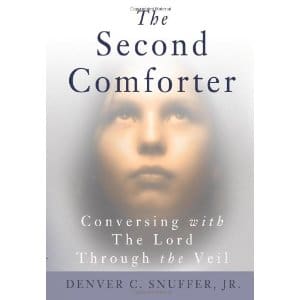
 In this episode John Dehlin interviews Denver Snuffer: a progressive, fundamentalist, non-polygamist Mormon lawyer who claims to have seen Christ. Denver is the author of several books including The Second Comforter: Conversing With the Lord Through the Veil and Passing the Heavenly Gift.
Episode Transcript
Host: John Dehlin · Guest: Denver Snuffer
This transcript is machine-generated and lightly edited for readability. The audio is authoritative. Please excuse occasional errors in names and spelling.
Introduction and Episode Overview
Part 1 of 2 · Ep. 321
Guest [00:00:00] 1, 2, 3.
John Dehlin [00:00:07] Mormon Stories Podcast is a production of
Denver Snuffer [00:00:09] the Open Stories Foundation.
John Dehlin [00:00:11] All donations to Mormon Stories are fully tax deductible and go directly towards keeping the podcast alive and towards building a community of support for Mormons like you. To support the podcast or to join the community, please become a monthly subscriber today@mormonstories.org hello and welcome to another edition of Mormon Stories Podcast. I'm your host, John Dehlin. I'm very excited to have a new guest with me today. Before I launch into introducing my guest and talking about him, I want to provide just a little bit of a disclaimer generally and then dive in. Recently I've been receiving a lot of feedback from my listeners who are expressing frustration. It's usually from the more believing side of my listenership. And the sentiment that they've been expressing to me is basically that, you know, what they've always enjoyed about Mormon Stories is that it is open and respectful of all points of view, affirming of belief or supportive of belief and not denigrating, but also supporting disbelief and just wanting to hear all sides. And some of the feedback I've received lately is that people feel like Mormon Stories has dwindled a bit into being a little bit more critical or hostile towards belief. And that is something we never, ever, ever want to do. And so I want my listenership to know that I'm sorry if they feel that way and I'm going to do everything I can. And I've talked to my board of directors about this, which is full of believers and non believers and, and we're going to do what we can to right that ship. So I want to make that promise to you guys and this interview actually fits along that purpose quite nicely. Today I've invited someone on the show whose name many of you may not know. His name is Denver Snuffer. He is an attorney in Salt Lake City and he is an author and sort of a social commentarist or a religious commentarist on modern day Mormonism. Denver's the author of at least eight books. Denver, welcome on Mormon Stories.
Denver Snuffer Introduces Himself
Denver Snuffer [00:02:36] It's good to be here. And if I'm, if I'm your gesture towards the orthodox believing community, then I'm pleased to hold down that end of the spectrum.
John Dehlin [00:02:50] Well, I want to tell the listeners just right off why they really need to listen to this interview because it's not going to be boring, I can promise you. So Denver, you've written several books. There's a couple that I've been made aware of One is the second comfort of conversing with the Lord through the veil. Isn't your main premise there that members of the church can actually potentially have a personal, you know, I don't want to say visit, but can have a personal witness of Jesus. Is that kind of the approach of that book?
Denver Snuffer [00:03:22] It is. I would go one step further and take the step that you're reluctant to take. And that is, yes, have a visit with the Lord.
John Dehlin [00:03:29] Okay. And you actually believe that that can happen in this life, correct?
Denver Snuffer [00:03:35] Yes, I do.
John Dehlin [00:03:36] And maybe you even know people who've had that experience.
Denver Snuffer [00:03:39] I do, in fact.
John Dehlin [00:03:40] Okay. Okay, so we'll talk about that today. We're not going to talk about that now. You also have a book you've written recently called Passing the Heavenly Gift. What's the main premise of that book?
Denver Snuffer [00:03:54] It's taking a look at the church's history, dividing it into four phases through which we have passed, and discussing the contrast and the definitional differences between the first phase in which Joseph Smith was around and the subsequent three phases after his death.
John Dehlin [00:04:14] Okay. And just because I'm wanting to give my audience a sense for who they're listening to. You're unique because, you know, a lot of my listeners, they study the church history and for them the conclusion that they take from the history is that it's not credible, that it's fraudulent. And a lot of them end up just not believing and leaving the church. The reason why I think you're such a fascinating interview is because you've dug into the history probably as much as any of us, and. And it's taken you the other direction almost. The term fundamentalist is dangerous because it's got, with its associations like Warren Jeffs and all that stuff. I would say you come out of a fundamentalist impulse, which is your studies of the church has even made your belief stronger. But it's pointed you in two sort of impulses. One is to really look back into what Joseph did and what the Lord did through Joseph and to really put the emphasis back on the early church. And then that also leads you to be a bit of a critic. And I don't mean critic in a non constructive way, but you are sort of a Hugh Nibley esque kind of critic to the church today. Is that kind of fair to say?
Denver Snuffer [00:05:36] Yeah, there are things about the current church I find exasperating. And yeah, I do think that if Joseph Smith is an authentic agent for God, then the real question that we ought to try to get to the bottom of is what was God attempting to do in calling Joseph Smith? Not even what Joseph meant or what Joseph intended, but what was God trying to do through the agency of Joseph Smith? And the trail back to God's presence really picks up at the last place where we had a good deal of contact with God. And that's early in the restoration, early in Mormonism.
John Dehlin [00:06:25] Okay. And so that's what we're going to be talking about today. We're going to be talking to a man who believes, who knows all the history, yet maintains a sincere belief in the Restoration, and who believes that not only should we eschew atheism and agnosticism and ex Mormonism, but is calling us to consider that maybe we can each have a personal witness of Christ, a literal personal witness of Christ. And this is a man who is a successful professional who lives in Salt Lake City, you know, who many find to be very reputable and respectable. So that's the intro, Denver. And let's begin by just giving us a brief introduction to your story, you know, sort of a few of the relevant points or stories that kind of inform your impulse or your brand of Mormonism today.
Converting to Mormonism and Early Faith
Denver Snuffer [00:07:20] Well, I'm a convert. I joined in 1973, but I joined out of a family in which my mother and my sister were Baptists. My sister still is Baptist. And the process of even considering Mormonism was one that arose out of what I would now call a polemical environment. Because when my mom found out I was interested in the Mormon Church, all of that inoculation she'd hoped to have done earlier was followed up with a lot of pamphlets and anti Mormon to try and discourage the conversion. So at the outset, when I joined the church, I came through a tidal wave of criticism and objections to the church. And I feel comfortable the idea that there's a criticism that ought to be leveled against either the faith or the founder or the current practices of the church is the milieu out of which my faith or originated. So I don't find that uncomfortable. I don't find that distressing.
John Dehlin [00:08:40] Okay, so you sort of have been inoculated against criticisms from the start. You're a convert to the church. And so let's just talk about, you know, did you serve a mission? Did you get married in the temple? Did you go to byu? Like, you know, married in the temple, like, tell us just a little bit about your bona fides, so to speak.
Denver Snuffer [00:09:05] Well, I joined the church. I've been married in the temple. I attended the law school at Brigham Young University. In fact, Paul Toscano was a year ahead of me at the law school, and he and I were first acquainted with one another there. He was classmates with Corey Maxwell, Neal Maxwell's son, who's down at Deseret Book now, previously at Bookcraft. And, you know, the environment of the law school, of course, was an interesting1@ BYU. Rex Lee was the dean back then. Ed Kimball was my criminal law professor. And my first marriage, which was a temple marriage, ended in divorce. I was subsequently married again. My current wife and I raised the four children from the first marriage, and then she and I had five more of our own. So we've had nine children in the home, though most of them, the majority of them are now gone. We're down to the final three. And, you know, I've been on the High Council, I've taught gospel doctrine or the priesthood for 21 years. You know, I've given a lot of care, time, attention to both participating meaningfully in the religious process and in supporting and helping it.
John Dehlin [00:10:40] Okay, fantastic. And you were a High Councilman relatively recently, right?
Denver Snuffer [00:10:45] I was. In fact, I understand the system well enough that I probably shouldn't tell people the machinations I use to get me in my current calling. But when they released me from the High Council over to teach the priests, at the time, I had a son who was still at home, he's now in college, and that was the calling I wanted. So using what I understood through participating in the High Council, I was able to get called to teach the priests, which I still do.
John Dehlin [00:11:18] Okay, so you're active in the church, believing and committed to the gospel or to the restoration, I guess. Yeah.
Denver Snuffer [00:11:26] In fact, here's a bonafide for you if it's of any worth. I literally cannot recall the last time I wasn't 100% home teacher. It's been so many years, so there's a benchmark that some people will understand.
John Dehlin [00:11:44] Yeah, that's a pretty high bar. Okay, so this is what we're going to do. I want you to. Now, we're not going to be able to go into too much depth. Right. But I want you to give us your perspective. Okay. There's going to be a couple parts to this podcast. One is give us your perspective on a history of the church that might be different from the correlated version that gives us an overview of what you feel like God was actually trying to do with the restoration and through Joseph, so that we can get sort of an understanding of not only of what he was trying to do, but then how it went Awry oh, okay. So part one is, what was he trying to do? Part two is how did it go awry? Just at a high level. Part three is, what are the problems with where we are now? And then part four is, what can we do about it? For those who are believers who kind of view your perspective and, you know, how do we be constructive parts of bringing about Zion or whatever it is? Does that make sense? And somewhere in there, we have to throw your teachings about the second witness.
Snuffer's View of the Restoration's Origins
Denver Snuffer [00:12:55] Okay. All right. Well, I think the first part of that, when you go back to the first part of that, the origin where we began and what was happening early on, is connected to the very topic that you raised last, and that is man reuniting with God. Okay.
John Dehlin [00:13:19] So, yeah, I mean, that's like, you know, James 1:5. Right. That's like what the founding of Joseph of the Church started with.
Denver Snuffer [00:13:27] Right, right. In fact, that's one of the comments that I make in the last book, and that is that Joseph Smith really stands foremost as a witness that James 1:5 works. And James 1:5 puts the burden each individual then to ask God and to see if God will not answer them and give them information. That's what the missionaries go out and they tell everyone to do. Here's our testimony, here's our book, here's our program. Now you pray and ask God if it isn't true. And of course, that Moroni 10, 4, and 5, those are the verses that the missionaries ask you to invoke. I just happen to think that that is not a rite of passage to be experienced one time at the beginning and never thereafter to be broken out, polished off and used again. I think that's the heart and core of the process that is continually ask God, who does give to all men liberally and doesn't upbraid you, doesn't scold you, doesn't send you away after asking for a loaf of bread with a rock or after asking for a fish, send you away with a serpent. He gives to all men liberally, meaning that what he gives is even better than what you were asking for. And I think that is the process. It was not intended to say. Check it out if it's true. We want to baptize you now. Get in line, pay your tithing, show up faithfully, do what we ask you to do, never turn down a calling, and be a good little Mormon. I think it was always intended that we continually increase in light and knowledge until we arrive at the perfect day, which is taken from the Doctrine and Covenants. The goal being the perfect day, not simply to witness the sunrise, but to also arrive at noonday when the shadows are gone.
John Dehlin [00:15:38] Okay, well, I want to return at the end, and maybe this will be a hook for our listeners. I want to return in the end of this discussion, maybe two hours from now, about how in the world it's possible to experience Christ now. But let's put that off and for now. So Joseph has this witness somewhere between the ages of 12 and 16. We don't know exactly the year, but then a lot of other stuff happens. There's golden plates, there's Book of Mormon, there's the founding of the church, there's the restoration. You know, supposedly there's the Aaronic priesthood and the Melchizedek priesthood. Then it moves into ordinances and temple rituals and polygamy and, you know, then Joseph gets martyred and then Brigham Young takes over. So, like, what are that stuff? Which of the things that I mentioned and other things do you still see as valid and important? And do you see any of that, any of that stuff as well as being distractions or side projects or missing the mark? Well,
Denver Snuffer [00:16:49] there are 10,000 little nuances to every step of that, and that would take a great deal more time than we have in the interview. In general, what I see along the way is that the basic outline of Joseph praying, having contact with God, God directing Joseph and him setting out on an adventure that though at the end of that we can put into an overall narrative, at the beginning of that, I don't think Joseph had a single clue where it was headed. In fact, the earliest accounts he gives of his first vision are really a conversion story. It's a tale of personal redemption. It did not assume cosmic importance and have relevance for your salvation and mine until some years later. So Joseph didn't approach this as a youth, thinking that the entire universe was going to be reshaped through the experiences that he was having. He was simply being converted. It assumed greater proportion as it went along in the understanding of Joseph. But I think at the beginning, God's contact with Joseph was purposeful and intended ultimately to affect you and to affect me and to affect mankind.
Priesthood, Ordinances, and Getting to Heaven
John Dehlin [00:18:21] So where are you on the importance of authority, of priesthood, of rituals like baptism and the endowment to get into heaven? Do you see all of that as sort of punch passes that you need to go through to make it to the, you know, to be exalted? Or do you see those as kind of bureaucratic distractions or side trips?
Denver Snuffer [00:18:49] I think the purpose of the ordinances is to extend an invitation that they are instructional. They are to initiate you into an understanding of a different culture than the one from which we hail in order to get you mentally and spiritually adapted to looking at the way that God deals with man. Man's culture and man's ways are not culturally, we are divided from God when we go to more primitive cultures. In fact, we've even got the phrase the magic worldview that we have coined in order to describe the attitude that we think we're more sophisticated than and we can look down upon. Whereas in the teachings of the Savior, the more correct way would be the child's view, or becoming more childlike. Because we all remember in our childhood how believing we could be in all kinds of stories. Well, the purpose of the ordinances, in my view, is to initiate us into another way of viewing things, another way of opening ourselves up to receiving those kinds of influences which if there is a God, and I believe that there is, he would have embedded everywhere. And therefore ordinances ought to heighten our sensitivities and create within each of us an expectation not merely that we're going to go through a ceremony in which it's depicted that we will encounter God through the veil, but that that is a deliberate effort to invite us to experience the transcendent and to make the connection between ourselves and God through a veil, through that which apparently separates us, to reach up and to have him reach down and to make that connection. So I think the ordinances are educational. I think they are invitations. I think they are an extension of God's care, concern, and invitation to each one of us. And if we're received in that light, I think they serve a marvelous purpose in inviting us. They are not the real thing, but they are a depiction of the real thing and an invitation to receive the real thing which involves God and man.
John Dehlin [00:21:39] Okay, so that's kind of a different way than it's kind of talked about in church. And an immediate implication that comes to mind for me is the question of, so what's happening with all of other God's children that aren't lds? And what I'm hoping to hear you say are, although I don't want to lead the witness, what I'm hoping to hear you say is that this is an inclusive perspective that then allows for God's power to manifest, to be available to all of his children, not just through the institutional LDS church. Am I hoping vainly or is there something to that?
Personal Revelation and the Role of Christ
Denver Snuffer [00:22:24] I believe that God is as interested in every man as he is interested in any man. Christ may have come, lived and died in a Jewish culture, but the atonement that he wrought was intended universally. It was intended for all. In fact, some of the problem we have in coming into some unified understanding is that we do tend to be
John Dehlin [00:22:52] rather
Denver Snuffer [00:22:55] chauvinist, rather exclusivist about what we have. And until we have had a far more widespread transcendent experience, I'm not sure that we have any ground from which to boast about our own religious validity. Because look at what has happened with transcendence among Buddhists, transcendence among the Hindu, even transcendence among Islam. The fact is that our ordinances were intended to invite us, but we're the ones that have to pick up and accept that invitation and then do something further with it. The endowment. If you look at It from section 128 and 129 perspective, the endowment is Joseph's effort to lay out in ceremonial form the kind of experiences that he lived through. We tend to take them and transfer them out of the context in which Joseph could provide that initiation and say, oh, it's historical. But the story that is shown in the temple endowment is your life. It is my life. It is everyone's life. We arrive here in a state of innocence. We at some point become corrupted and therefore accountable. And we begin from a position in which we know God at least. We as a child have no problem both believing in and feeling comforted by a divine being. It's everywhere. In fact, it is so promiscuous among the little children that they can believe in the easter bunny and 10,000 other fairy tales, the Tooth Fairy. And then we arrive at a point in which we begin to feel alienated from him. The endowment is your life. You've been cast out of that garden. Now the problem is trying to figure out from the. From the mess in which we find ourselves in this lone, we are now alone and dreary world. The Book of Mormon uses that phrase alone without God in the world several times. It's a really pregnant with meaning phrase that I think captures the problem of where we are and then find our way back. Where are the true messengers who does come now bearing a message from God? And by the way, that is not always someone who presides over either our church or any church. It can sometimes be a frail old woman ministering to the lepers in Calcutta who gives up her life in order to live a celebrate nun's life, ministering relief to the poor and the outcast in the far flung reaches. Of the world. And yet here she is, a visible manifestation of exactly what Christ was talking about in the Sermon on the Mount.
John Dehlin [00:26:33] So for you, there's this godly impulse or this godly desire to communicate with man that certainly manifested itself in Mormonism, but that is also manifesting itself outside of Mormonism. And Mormonism is maybe one strand of that attempt from God to connect with his children. Is that fair to say? Yeah.
Denver Snuffer [00:26:59] At the second Coming, we do not expect that the only people who survived the return of the Lord will be Latter Day Saints. It's a common teaching going all the way back to the beginning that during the millennium there will be missionary work to be done. If there's going to be work to be done during the millennium, then Mormonism is not the exclusive place you will find the kind of worthy people who will survive and rejoice at the Lord's return. And I don't, by the way, I don't even think some of those who survive the Lord's return will necessarily even be rel. Religious. They'll just be good people, principled people.
John Dehlin [00:27:42] So even my atheist and agnostic friends, there's hope for them too.
Denver Snuffer [00:27:47] I absolutely believe so. And I think that an honest atheist who is concerned about what's good and what's right is better than the cynical, hypocritical religious folk who think themselves better. In fact, I think the folks who are proud of their own religious worthiness and standing before God are probably the very ones that won't survive his return.
John Dehlin [00:28:17] Got it, Got it. Yeah. I mean, it's clear that that was Christ's message in the New Testament.
Denver Snuffer [00:28:22] It is. It is.
John Dehlin [00:28:23] Yeah. Okay, so. Okay, so the restoration for you was less about keys in terms of doors that are literally locked, that can't be opened without the keys, in terms of, like, you know, I had a. I had a good. I had a cousin of mine once describe it as the country club kind of approach or the franchise approach to, you know, to salvation, that unless you, you know, buy into the franchise and have the right membership card, you're not getting to heaven. And that's even how the temple ceremony has been interpreted by some. You have to literally not only have been through the right specific ordinances to make it to heaven, but you have to actually know the right, you know, signs or tokens or whatever to even have a chance of getting back there. And I'm. And I'm just hearing from you a simultaneously fundamentalist, but also very inclusive framing of the restoration.
Denver Snuffer [00:29:23] You know, if you take the approach that you just suggested. Then we have. If you're a true believing Mormon and if you think that the temple possesses that kind of power, then you're immediately confronted with the fact that we have made changes in my lifetime not just by the removal of the penalty, but the alteration of a sign if they are in fact how you unlock the door. All of those folks who came through after 1990 are institutionally dispossessed of the capacity to open the door. Therefore it can't mean that. It must mean something else. And if it means something else, then we ought to be exploring, well, what are we trying? What are the hints that are contained in that? What are the underlying teachings that are contained in that? What are, what is the invitation or the communication from God intended by that? Not. Hey, hey, I've got this bundle of keys and that's going to get me somewhere because frankly, Gerald and Sandra Tanner have possession of the keys. They've been publishing them and they don't believe in Mormonism at all. And yet they, they clearly are in possession of those kinds of things that in the first scenario you described, the possession of magic movements to unlock doors. And therefore it can't mean that there must be something more to it.
John Dehlin [00:31:07] Got it. Okay, so this is fantastic. So I think I get a sense of, for what you view the restoration was all about, and now we've got what, 150, 200 years of Mormon history that has been layered on top of what I see you sort of arguing for as some very plain and precious truths.
Denver Snuffer [00:31:29] Right.
John Dehlin [00:31:29] So talk us through your views on how. Well, there's a lot that's been done, right? There's a lot that happened in Nauvoo and then with Brigham Young in Salt Lake all the way through, you know, the renunciation of polygamy and the correlation to the modern church. Talk us through your view of how the church has progressed historically and when we've gotten it right and when we've gotten wrong, sort of at a 2000 foot view.
Denver Snuffer [00:32:02] It's very difficult at the 2000 foot view other than to say in aggregate, from the time he began until the day of his death, Joseph, Joseph's death from the beginning of the 1820 experience and lasting. Well, if we can trust the 1820 dating, because we all know that that 1820 beautiful spring morning may have been 1823, or it may have been some other spring morning. But whenever that spring morning occurred, from that date until June 27th of 1844, Joseph's work was primarily additive. The religion that he was working on was increasing in volume, in content, in complexity, in nuance and in depth. From that date until today, the institutional church and when Joseph was here, there may have been an institution, it's true, but the church was immediately responsive to Joseph Smith. From the death of Joseph Smith until today, the institutional church has been primarily deductive. Deductive in the sense of doctrine, nuance, ordinance practice. It has grown immeasurably in wealth and in numbers and in worldly success. But in terms of the underlying cosmos, the, the religious center that it proceeds forth from, it's been simplified, it's been reductionist, it's been growing progressively less while at the same time succeeding in popularity more.
Institutional Church Versus Personal Spirituality
John Dehlin [00:34:11] Okay, okay, so let me, let me. So that resonates with me and I know it's going to resonate with a lot of listeners because the church seems so insistent on claiming to have prophets, seers and revelators. Yet people who are really thoughtful about that are asking, where's the prophecy, where's the seeing, where's the revelation? And it's true that some things have been added to the Doctrine and Covenants, for example, the official decorations almost as responses to social pressure. But you know, the Reorganized Church is much more expansive than the traditional LDS church. You know, at least their DNC grows over time. Ours tends to either change or kind of stay the same. And so I resonate with that premise. So let's first talk about the expansion. So Joseph Smith added all these things, right? He added the teachings about the institutional church, he added the Melchizedek priesthood. He added, you know, baptisms for the dead and celestial marriage and the endowment, and he even added polygamy. So before we talk about where we are with those now, tell me how you view those additions and how we know which of those additions were true and proper versus him just experimenting or you know, just coming up with stuff that isn't binding.
Denver Snuffer [00:35:44] Well, see, I've, I've tried to work through at the up close and personal level all of those issues in that last book, Passing the Heavenly Gift in General from the 10,000 foot level. There, there are roles which other people played in the life of Joseph Smith that we really need to take into account when we're trying to reconstruct what went on there. Let me use one little vignette as an example because everyone's familiar with this. Martin Harris, who's bankrolling the publication, well, he's bankrolling the translation as well as the publication of the Book of Mormon, wants to be able to get his wife on board with what he's doing and giving this young prophet the financial support that he's lending to him. And he persuades Joseph to inquire about allowing him to get possession of those 116 pages. We all know that ultimately, after having been told no a couple of times, Joseph is allowed to give the 116 pages. And disaster ensued. They were lost, they were taken, they were apparently adulterated. It would be interesting to try and find a copy of those around somewhere today. But through that incident, what we see is that Joseph Smith can be persuaded by someone who is intimate with him in doing something which the Lord told him was a bad idea and turned out it was in fact a bad idea. So if you accept that premise, and I think everyone would, whether they're. They're extremely devout or whether they're skeptical, Joseph could be influenced. And then you introduce the events that occur with the conversion of Sidney Rigdon and the people that he brought on board. I think that Mormonism at the beginning, during that first phase when Joseph was here, includes some very interesting accretions, additions as a consequence of the influence of Sidney Rigdon. Okay, okay. Sidney wanted a New Testament church. Sidney really wanted a restoration through an authoritative prophet. That was what he was teaching about in the Western Reserve of Ohio when he was a Campbellite minister. That was what he wanted to have. And when he got converted to Mormonism, he ran to Joseph Smith and he became an immediate intimate, which irritated some folks like David Whitmer and Oliver Cowdery. Joseph was awfully quick to take Sidney on board. But Sidney, after all, created numeric success when he came on board. That whole commune at Isaac Morley's farm essentially were converted in Mass. They brought on board big numbers. And therefore he legitimately had influence. Sidney is responsible for getting Joseph to work, really focused on the New Testament church. And I think that if you look at the restoration before Sidney's presence, and then you begin again after Sidney's disaffected in the 1838, 39 timeframe. And you say, well, what was Joseph doing pre Rigdon and post Rigdon? The look and feel of Mormonism is quite different than a New Testament church orientation. What Joseph was trying to, or what the Lord through Joseph was trying to bring about was something really quite ancient. The temple ordinances, though, you have a lot of Mormon scholars working them into a New Testament motif. And undoubtedly that case can be made. It really hails from something much earlier, something that is patriarchal, Egyptian, earliest age of man kind of faith. And I can detect even if you just take section 107 of the Doctrine and Covenants, section 107 of the Doctrine and Covenants is an attempt to get direction about how to manage the New Testament Church. In the middle of talking about the New Testament Church inquiries, you have this sideshow going on where the Lord is not just talking about what Joseph and Sidney were interested in knowing about, but the earliest stages of man. The first get together in the Valley of Adam on diamond, three years previous to the death of Adam, in which seven high priests gather together. The Lord appears and administers comfort to Adam and calls him Michael the Prince. And so you have this enormous antiquity that the Lord was interested in in the same revelation that you have what Joseph and Sidney was interested in. And I think therein lies the. The real purpose behind the Lord calling Joseph. In the first instance, you go to the New Testament, Christ is talking about his second coming. He analogizes that to the time of Noah, the model for what mankind needs to look like at his coming to survive the ordeal. The model is what it looked like much earlier than the New Testament, a patriarchal era, an era dominated by Enoch and Noah, and shortly following on the heels the death of Adam. And so the religion that Joseph was really working his way back into after Rigdon's departure was a much more ancient form than what we have today.
John Dehlin [00:42:04] And you're saying that's a good thing?
Denver Snuffer [00:42:06] I'm saying that's a good thing. That what we have done, what Mormons have done, what we have done with the restoration, is akin to what happened with the children of Israel at the time of Samuel when they said, give us a king. We want to be like other people. The Lord was offering us something through Joseph Smith. And we were saying, give us a church. Give us a New Testament church. And the Lord gave us what we were asking for, and we've got it. We've got the best New Testament model church in existence anywhere. We don't have popes, we have prophets, we don't have cardinals, we have apostles, we don't have archbishops, we have 70s. We have authentic names derived from a real New Testament model. But was that really what we were shooting for, merely a New Testament walk back? Are we supposed to be walking back to something even further and more ancient still? And I think Joseph's life, when you look at it as. As pre Rigdon, post Rigdon allows you to say, huh, Rigdon had an enormous influence, much like Martin Harris with 116 pages had that influence. And when you divorce Rigdon and you say where was it headed before him? Where did it return to after him? And you allow Rigdon to have his responsibility and his influence. Then Joseph's mission began and ended in a much, much more ancient setting, one where we've yet to really reconcile ourselves with.
Polygamy, Race, and Historical Problems
John Dehlin [00:43:46] Okay, so what I'm hearing you say is that there's something more profound and spiritual and connective to the divine that the restoration was trying to offer us than simply to emulate the New Testament.
Denver Snuffer [00:44:03] Yes.
John Dehlin [00:44:07] And more importantly, to create some type of corporate bureaucratic structure. But the original question was, what do we do with all of Joseph's innovations, with, you know, the endowment and with celestial marriage and even polygamy? And what I think, and I need you just to simplify it for me a little bit, what I hear you say is that there were people influencing Joseph in different ways. Because I think anyone's going to agree that in some ways he was sort of a sponge for feeling what was going on and reading what was going on and then synthesizing and incorporating things. But let me just ask you again. How do we know whether polygamy is something that God wants us to be doing or not? How do we know whether celestial marriage is a doctrine or not? Because all these things that Joseph added, you know, the church has backed away from. But there's also the possibility that Joseph just took someone's idea and ran with it. But maybe it was taking us in the wrong direction, right?
Denver Snuffer [00:45:13] Oh, sure. Yeah. See, and the difficulty, and I'm not trying to be evasive, but the difficulty is that all of the details really matter. And so when you get to something like that, details matter a great deal. And we'd spend the rest of the time just on the details. I'm not trying to be evasive because I have written about this in passing the Heavenly Gift. My view is that when Joseph made the inquiry about what to do about the plural wives, that that inquiry was provoked in 1829 with the translation of Jacob, chapter two, that that was when he asked about it. And the answer that he got is really the first part of section 132 that would not be reduced to writing until the 18th of July of 1843. So Joseph is in possession of an answer in 1829 that he doesn't put in writing until 1843.
John Dehlin [00:46:15] And you're talking about polygamy, right?
Denver Snuffer [00:46:17] I'm talking about the original inquiry. That is the beginning part of Section 132. And that beginning part, as I walk through in passing, the Heavenly Gift has a series of Verses that are devoted to the eternal duration of the marriage covenant, the possession of eternal progeny, the connection between the man and the woman and the image of God, and the preservation or perpetuation of the family of man. And throughout all of that, throughout that entire section dealing with the eternal marriage covenant, it is a wife singular. A wife, a wife, a wife. And I walk through that in the book. It's always singular. After completing the description of the eternal nature of the marriage covenant, then he answers the question Joseph put, which is about the plural marriage and that is separate from the eternal marriage covenant. But to go back to, is that a bona fide. Was Joseph out in the woods when he was talking about the eternal nature of the marriage covenant? When you read the text of Genesis, the word that is used to identify God in the original Hebrew is a plural word, and the image of God is clarified to be male and female. Therefore, in the original Jewish text, you have a plural deity comprised of a male and a female.
Guest [00:47:59] Right.
Denver Snuffer [00:47:59] In the text of Genesis, from the original text, was Joseph innovating? Was he out in the woods? Or was he merely returning to something that goes back to the original and is quite ancient when it comes to the eternal marriage covenant? I happen to think that the plural marriage issue, which is the second part of the beginning verses of section 132, and I think section 132 is at least 15 different revelations. The first one deals with the marriage covenant for eternity as one subject, plural wives as a second subject. I happen to think that they were an authentic answer and that the limitations, which are extraordinarily limited in Joseph Smith's original practice got blown way out of proportion in the Brigham Young. Follow on. And I don't think plural wives are essential for someone's exaltation. And I explain why in the passing the heavenly gift.
John Dehlin [00:49:08] Okay, so just to summarize, you're saying that eternal marriage and even theosis of a man and a wife becoming a God in the sense that a companionship that achieves God's status. Yeah.
Denver Snuffer [00:49:26] Look at it this way. You are finite. You as a mortal man, in your individual state, as a person, you are finite, you and your wife, despite the fact you're composed of flesh and blood and you're both going to die and be buried, you and your wife together are not finite because you produce offspring. And after you produce offspring, your offspring produce offspring. And so when that continues, when the man and the woman are together, and that continues, assuming your progeny remains man and woman in every generation following hereafter you, John Dehlin, become, though you are flesh and blood and mortal, you become eternal and infinite because your seed will continue forever. That is the kind of symbol, that is the kind of expression found in the, in the eternal marriage covenant. That is a mortal experience that reflects the infinite nature of God.
John Dehlin [00:50:36] Okay, okay, so you can. So you're okay with eternal marriage and you're okay with theosis of man and woman becoming joint heirs to God's inheritance. Right. As far as polygamy goes, you're seeing that maybe as something that God wanted Joseph to do, but not necessarily something that was intended for all of God's children or for the eternities or for
Denver Snuffer [00:51:09] mass exportation and for. Yeah, I think that got off the rails at that point, frankly. If you go back to Joseph's practice and you say how many plural wives Joseph tolerated inner circle practice of multiple wives. He tolerated that. But you go back and you research how many sealing of plural marriages Joseph Smith performed apart from his own, go back and look at that because you'll be shocked at how many. There aren't. There are not. Joseph was in one category and the narrow reasons in the answer found in section 132 were satisfied and the others weren't and didn't satisfy the criteria. He used plural marriage as a kind of litmus test. Hey, bring me your wife and I'm going to marry your wife. Because this is a principle. John Taylor brings him his wife, delivers his wife to him, and Joseph says, hey, you passed the test. And he seals them together. Now, there are a number of problems in analyzing what went on with Joseph Smith, the plural wives, and the history of that for absolutely understandable reasons, including the fact that they wanted to keep it secret. They wanted to hide a great deal of what was going on. But when you boil it down to the final analysis, Joseph did not seal in plural marriages as an eternal covenant apart from himself more than one man. And if it was an essential for salvation, if there is something salvific about plurality of wives, you can't prove that in the practices of Joseph Smith, the sealing of the plural wives was a practice really begun and expanded in a beyond the person of Joseph Smith and one other after Joseph's death and under the administration of Brigham Young and the quorum of the 12, beginning in Nauvoo.
John Dehlin [00:53:31] Okay, okay, so got it. So I guess just to summarize, you're saying that there are, you know, that we have to look at what we, the doctrines that we ascribe to Joseph carefully. Some of them, we've misunderstood some of them. He may have even just been experimenting. And some of them, there are clear sort of divine influences and justifications for. And in your view, for example, just to use polygamy as an example, it's certainly not something we're supposed to be practicing today. Is that fair to say?
Denver Snuffer [00:54:08] Oh, yeah. It does not belong to us today. In fact, if you go back and you look at the journals and even the public talks, the general authorities, the presidents of the church, have been saying that they don't even have the keys to practice that anymore. They've been removed. I'm looking at section 132 right at the moment. If you look throughout the first part of that, a wife in verse 15 with her. And it just throughout this beginning. A wife. A wife. Verse 26, a wife. It's in the singular. You don't get to the second topic, which was the one he inquired about, until you get about verse 29. And so I don't think that it is correct to equate eternal marriage with plurality of wives, as we have done, but I get into that in some detail in approaching the heavenly gift.
John Dehlin [00:55:20] Okay, got it. So I'll just ask you for really quick, you know, which parts of the restoration you agree with and don't, just so that we can have a bit of a summary. And you don't have to. You don't have to provide justification for each one, but just in general. So give us a quick, your quick view on, let's just say, the endowment. I guess you already have. You're saying that there's spiritual value to the endowment.
Denver Snuffer [00:55:46] Correct. But it's also clear if you read the explanations of facsimile number two that Joseph provided, and if you look at the teachings of the prophet Joseph Smith, that he wasn't done with what he regarded to be the ultimate temple ceremonies, what we have from him is the beginning of the work. The Nauvoo temple was never completed during Joseph's life. He died before it got to the second floor. He did some initiations in the red brick store. What would have been provided had he survived to the completion of the temple, probably would have had a different look and feel. Well, a more expansive look and feel. Because look at facsimile number two in the notes there. There's stuff yet coming. There's things not yet restored. And then Joseph talked about there is a place in the restoration for a return of animal sacrifice. Not the law of Moses that's been fulfilled, but that animal sacrifice has a place in the restoration. In fact, as he talked about that, he said that portion that existed before the law of Moses, meaning you're going now back to that original era of the earth I was talking about before. That kind of religion is really the target ultimately of what the restoration was intended to include. The endowment, I think, is the beginning of where it was headed.
John Dehlin [00:57:29] Got it, got it. You know, that's very. It's a bit refreshing in that it, it makes, it invites us to want to be expansive and creative. Not this narrowing and legalizing of the restoration, but instead it's basically this, this sensibility is sort of calling us to our more creative, higher, expansive impulses to say, Mormonism, Joseph just started it. And there's so much more, so many better places we can take it if we tap into this sort of divine source. Is that kind of what you're saying?
Denver Snuffer [00:58:07] Yeah, go connect up with that same source to which Joseph was connected and then watch where it takes you because it won't leave you where you are now. You will wind up going somewhere that Joseph was headed. And let's face it, the farther back you go in the family of man, the more united we all become genealogically, physiologically, genetically, there's a convergence. When you get back, you go to the earliest pre flood era and emerging from the flood, in the tales that we are told in our Old Testament, there is one family. In that one family, we all began united under Adam and we got fractured, we all got reunited as kindred, as brothers of a common father, as sisters in a common family again at Noah. And when you look at the promise of the second Coming, one of the things that it hails for us is the opportunity once again to reunite as a single people, to become unified under the presiding direction of this benign, loving, self sacrificing God whose purpose it is to bring us back into unity. And so, yeah, Mormonism should be a unifying faith, a creative faith, an inviting and a loving faith, and not a. A strangely militant, close minded, arrogant group of proud folk.
John Dehlin [00:59:54] Got it, Got it. Okay, so I'm going to just ask you to do very quick, and I mean just a few sentences, just reviews of a couple of the things that people. I'll refer people to passing the Heavenly Gift for your full explanations, but just really quickly, you know, Black's not getting the priesthood. Thoughts on that. Just a few sentences, just summary.
Denver Snuffer [01:00:19] I point out in the book that one of the really interesting, one of the really interesting little details is that the same fellow who ordained Elijah Abel to the priesthood is the fellow who repeated the statement about Joseph did not want priesthood going to the slaves, the African Americans. It's one of those little bits of irony where, okay, you ordained him, and you're the one who's bringing that along. Needless to say, that is a very problematic moment in church history. And if you take what Brigham Young said at face value, and you say that as the. As the orthodox today claim, which is that the president, the Church, can never lead us astray. Brigham Young was adamant that if the Church were ever to give priesthood to the blacks, then the Church would lose all priesthood. Your choice is presidents of the Church can, in fact, make mistakes, so everything's okay. Or presidents of the Church cannot make mistakes. Brigham Young was right. And the Church has no priesthood because we've conferred it upon blacks. We really do have moments in our history on that issue in which we are pointing in both directions.
John Dehlin [01:01:53] And so for you, it's that God never intended blacks to have the priesthood withheld from them. Is that.
Denver Snuffer [01:02:01] Yeah. Why Joseph made no effort in Kirtland or in Nauvoo to exclude or to not ordain? And if Joseph represents the best practice, then we have a lot of embarrassing dialogue. The problem is that Brigham Young won the argument and the majority of the Church followed Brigham Young. And Brigham Young becomes. He becomes the narrow neck, the funnel through which Mormonism is strained in its most popular iteration in the world today. Therefore, you have to confront Brigham in all his language. And when you confront Brigham with all his language, you know you could not. It was impossible to convey priesthood. You have all those problems. Well, look, I think we either have to be a little softer on the point that church presidents can never lead the Church astray on the one hand, or we have to be a whole lot more humble about declaring that we are in possession of all authority on the other hand, because you cannot assert those two propositions and harmonize them. And so you're left with the horns of a dilemma if you're someone who believes that current position. By the way, Brigham Young didn't think that the president of the Church couldn't leave the Church astray. He talked about how that was not only possible, but a grave risk that we needed to guard ourselves.
John Dehlin [01:03:55] That's totally right.
Guest [01:03:55] Right. Yeah.
Book of Mormon Historicity and Spiritual Value
John Dehlin [01:03:56] Let me just ask you quickly, and my listeners are probably bored with me asking this question, so I'm going to just make it really brief. Is it important in your epistemology or Mormon worldview that the Book of Mormon be an historical document in the sense that a nephi and A Lehi actually existed and that there were actual golden plates and that, you know, the Book of Mormon is a historical document. Is that a pretty important part or are you flexible on that? And the same with the Book of Abraham?
Denver Snuffer [01:04:26] I think the Book of Mormon is an important document independent of its point of origin. However, one of the things I pointed out is that it becomes really problematic to say that there is no historicity to it. When Martin Harris and David Whitmer and Oliver Cowdery say they saw one of the characters of the book, when they say they saw Moroni, then we know at least one of the people that the Book of Mormon describes showed up in an angelic form and was seen by three, well, four, counting Joseph people. If four people say that they saw him and they never relented in the position that they did see him, then we have the problem with, oh, we cited one of the characters. Therefore, if we cited one of the characters, how do we displace all but him? Given the fact that he comes at the end and he's talking about the preservation of plates and the passing of the plates along? I think if you're fair minded, the better view is if you accept what the four witnesses, Joseph and the other three, say about having seen the plates through the auspices of Moroni, then dismissing its historicity becomes a bit of a challenge. I accept the Book of Mormon as being an authentic ancient book. I don't know that it matters as much as the content, the doctrinal content and the import of the doctrinal content, but I do accept it as being an actual record of an ancient and fallen people who saw our day and nailed us. I mean, they nailed us.
John Dehlin [01:06:20] You mean they foresaw our day and got the predictions right and are telling us what we need to know to get out of the mess we're in. Is that kind of what you mean?
Denver Snuffer [01:06:30] Yeah, I mean that when it gets to talking about the religious environment of the last days and you accept their definition of Gentile as the Church of Jesus Christ of Latter Day Saints, and I think that is the context it was meant in, then the Book of Mormon is talking loudly and relevantly to us.
John Dehlin [01:06:55] Okay.
Denver Snuffer [01:06:56] And by the way, they don't flatter us.
John Dehlin [01:06:59] Right? Right. Yeah. Okay. And Book of Abraham.
Denver Snuffer [01:07:07] Well, okay, Book of Abraham. Clearly the text that Joseph translated is not the text that we found in the Metropolitan Museum. Nibley's work on the Joseph Smith Papyri, an Egyptian endowment, walks through the history of the church where he's describing the papyrus from which he was translating. The material that we have recovered of the Joseph Smith papyri are clearly different in appearance than what he said it came from. We don't have that papyrus anymore. I think that what we have is an authentic Abrahamic collection of material, but I don't know that it has a thing to do with the papyrus. And I think Nibley did a good job of acquitting Joseph in his Joseph Smith papyri and Egyptian endowment work. But again, that's one of those texts that I spent a lot of time looking at and in fact, looking at the facsimiles and facsimile 2 in particular. And boy, there's some interesting material there. I'm not prepared to publish anything on that, but I've tried to read everything pro and con that I can get my hands on because it's appears to me to be an important text to look into.
John Dehlin [01:08:52] And I'm just, I'm pulling this straight from your blog, which is denver snuffer.blogspot.com there's going to be some people that sort of say, man, he's talking about angels and he's talking about plates, and that's where you lose me, Denver. What you wrote on your blog, and I'm not saying this to be sensational, but you wrote, quote, I've seen angels, I've been taught by them. And so I think that's a proper quoting. And I guess I'm only saying that because your approach is that we really can have access to the divine. And so because you've had an experience yourself, then you obviously would be more inclined to trust the three witnesses and the eight witnesses instead of just dismiss them as a fictional hogwash or deluded people. Right?
Denver Snuffer [01:09:50] Yeah. Fantasy, whatever. Yeah, yeah. In fact, when I first joined the church, I joined with the full expectation that this was the common experience for Latter Day Saints, that it was expected that you would have that kind of an encounter and that that was normal for Mormons. I thought, well, Joseph Smith opened the heavens. Mormons believe in an open heavens. Therefore, Mormons with regularity have some contact with the hosts of heaven, the angelic and the divine. And it really, it required me to move to Utah before it became abundantly apparent that, well, most Mormons actually don't think it possible. There's a lot of people who believe it's possible, but confined narrowly to the group at the very top, and that somehow God's always in touch with the guys at the very top. But for the rank and file, that isn't the way God deals with us anymore. He's given his authority to men and he deals with the big men and he leaves everyone else alone. Well, happily, in my naivete early on and with the full expectation that God would talk to me as he talked to Joseph, I had encounters that satisfied me that even if no one else believed in it, it was appropriate to believe in. And it can and does and will happen.
John Dehlin [01:11:38] Thank you for joining us today on Mormon Stories. Music today was provided by the Saber Rattlers. Check them out@sabre-rattlers.com the Mormon Stories logo was generously donated by students StudioCase.com thanks for listening.
Guest [01:11:53] Come come ye saints no toil nor labor fear but with joy when you're away Though hard to you this journey may appear Grace shall be as your day Tis better far for us to strive Our useless cares from us to drive to the San Jo hearts will swell oh, all is well. Why should we mourn? I think our lot is high Tis not so all is right why should we think to earn a great reward if we now shun the fight? Gird up your lo fresh courage take Our God will never us for sake soon we'll have path tal oh, all is well all is well oh, all is well all is well. Sam. And should we die before our journey's through happy day all is well we then are free from toil and sorrow too with the just we shall dwell. But if our lives are spared again to see the sa the rest obtain I will make this chorus well oh, all is well all is well well all is well all is well all
John Dehlin [01:15:50] is well
Guest [01:15:54] oh, all is well. All is all.
The Second and Third Phases of the Restoration
Part 2 of 2 · Ep. 322
Denver Snuffer [00:00:00] 1, 2, 3.
John Dehlin [00:00:07] Mormon Stories Podcast is a production of
Denver Snuffer [00:00:09] the Open Stories Foundation.
John Dehlin [00:00:11] All donations to Mormon Stories are fully tax deductible and go directly towards keeping the podcast alive and towards building a community of support for Mormons like you. To support the podcast or to join the community, please become a monthly subscriber today@mormonstories.org okay, so Denver, I think we got a good sense for your, you know, a high level summary view of how you view the restoration. Just let's, let's at a high level talk about from Brigham to now, and if you could give just a high level how you see the church evolve and when you started seeing some of the influences and policies being introduced that may have been important contributors to the mess maybe we're in now. I would love to hear you talk about it. And you've talked about four phases or something like that. I don't know if that's the right framing for this question, but hopefully you get a sense for what I'm asking.
Denver Snuffer [00:01:13] Well, yeah, the second phase of Mormonism began at the death of Joseph Smith, and it lasted, really. The second phase, we clarified a bunch of problems, including what do we do now that both Joseph and Hyrum are dead? And how do we perpetuate the institution in an existence that will allow it to survive? We figured that out. But the second phase largely is defined by the plural marriage issue. And it ends when the practice of plural marriage ends publicly in 1890 and then privately in 1904 with the second letter of President Joseph F. Smith actually ending the practice. The third phase of Mormonism.
John Dehlin [00:02:02] Okay, wait, wait. What was the important, what was it about that phase that was important or distinctive for you?
Denver Snuffer [00:02:07] Well, in that second phase of Mormonism, what the church was really trying to do was to preserve what it was that Joseph had handed and then to live it, no matter the hazard, live what it was that Joseph had handed
John Dehlin [00:02:26] down, what they thought he had handed down.
Denver Snuffer [00:02:29] Correct, correct. And they became quite militant about that. The idea was that if God originated this work, that all they needed to do was to show enough fidelity to it, and then God would come out of his hiding place and protect it. And the militancy about that. And then I think the single most challenging doctrine was the one that Brigham Young chose to use as the whipping post to get everyone into line on, and that was the plural marriage doctrine. If you can live that, then you can be approved of God because you're sacrificing so much to make this work. And the enormity of the sacrifices that were involved in trying to make that work, I don't think they can be overstated. People that have gone back and done very good work. Todd Compton, others that have written in the area show you this was a very difficult practice and there was no reason to engage in this kind stuff except out of a religious conviction. The women in particular who tried to make that system work, who bore children and who raised them under that system, I don't care if you think that they were completely mistaken. There's a nobility and a self sacrifice and a self discipline about that that you really have to respect, despite the fact that I don't think they should have been doing that. It dominated the landscape. When you get to the end, though, and you begin to look at how we manage to extract ourselves, it was a political compromise with the United States, pure and simple. There wasn't a revelation to end the practice. In fact, when you read the private journals of those who were involved, the idea that they would renounce it temporarily and yet statehood was what they started with. They made incremental compromises along the way. And in the final moment, when plural marriage ends, it's really a moment that occurs with an attorney preparing President Wilford Woodruff to testify before the special master regarding the property belonging to the church that the federal legislation had taken away. And the guidance that the lawyer gave on how the questions ought to be answered. And Wilford Woodruff goes off, then he testifies in court. And when he comes back, you read in the journals, they're all saying in a kind of horrified recognition that now that he's testified that way, we really have ended the practice. It's not coming back. And that wasn't where they set off to get. It was a series of pressures brought about upon the church and it ended. And the reaction, the horrified reaction of those who were critical because they'd sacrificed so much, led President Woodruff then to claim that he wouldn't be doing it if it hadn't been approved by the Lord. And then the legacy of that comment becomes the notion that the president of the church can never lead the church astray. The thing that is most important as I look at that second phase, is really what happens when it finally turns and we step into the third phase. Because the third phase not only changes.
John Dehlin [00:06:14] Wait, Denver, Let me just jump in for a second. So what I'm hearing you say is that, well, what I heard you say from the beginning was that maybe it wasn't even God's will that the practice of polygamy, even persistent Past Joseph, certainly
Denver Snuffer [00:06:33] not widespread, certainly not in the form that it assumed, and certainly not for the reasons that Brigham taught.
John Dehlin [00:06:39] And so the foundations of this second phase, which is protecting and defending polygamy, you're sort of just saying maybe that whole thing was on a faulty premise.
Denver Snuffer [00:06:50] I'm saying that it was a wildly enthusiastic overstatement of what it was that Joseph was doing. Joseph's purpose behind plural marriage. And the limitations are spelled out in the second portion of DNC section 132. His behavior and his practice was far more limited in scope than what it became in the second phase of Mormonism. And I think ultimately for salvation and the realization of the Highest blessings. Section 132 doesn't even support doctrinally the idea that it is mandatory. That is a second phase teaching. To be saved, you must have celestial marriage. And the definition of celestial marriage is not a man and a woman. It is a man and women plural. And yet section 132 is phrased in the singular. A wife. A wife.
John Dehlin [00:07:57] So since God never intended it, of course it's going to be a legalistic, lawyerly thing that it gets taken away, right?
Denver Snuffer [00:08:05] Yeah, the, the, the, the church. The church got taken on by Washington and Washington one and right in the process of winning, we became not just American, we became uber American. We got it. We have been proving our bona fides ever since then.
John Dehlin [00:08:22] Okay, okay, so, so third phase, then.
Denver Snuffer [00:08:27] The, the most important tool to Mormonism in the third phase became the idea that you can renounce a central doctrine, a doctrine that you say is essential to exaltation. Not only can you abandon that, but you can abandon it and renounce it. And not only abandon and renounce it, but I can excommunicate you for what was before essential to your salvation. Now I can excommunicate you for continuing the practice. What that does to Mormonism is so fundamental, so radical, so far reaching that that allows Mormonism, from that moment in the institutional church, it can become anything. There are no limits. It is completely unanchored. Because if, as the second phase emphasized, you can't get to heaven without it. And in the third phase, I can excommunicate you if you do it, then Mormonism has now assumed a flexible standard, a dimension of capacity to change. And not just change, but reverse. And not just change and reverse, but to militantly do so, consigning you to hell for doing what used to be required for your salvation, well, now the possibilities are endless and unanchored. It is radical, beyond radical.
John Dehlin [00:10:14] And you're saying endlessly, potentially terrible. Right.
Denver Snuffer [00:10:18] I'm saying we don't wind up where we are today unless you make that transition that enables the metamorphosis without bounds of Mormonism. It's unchecked at this point.
John Dehlin [00:10:29] Yeah. Okay, so you're not a big fond of the innovation. Well, you're probably not a big. I'm just trying to summarize. You're not a big friend or fan of the decline of what Joseph brought us and the reinterpretations of it. You're not a big fan of sort of the resoluteness with which the early prophets and leaders clung to those false interpretations. You're not a big fan of the way that they have assured us that they'll never lead us astray. And you're certainly not a fan of what they've started to do, which is to punish and excommunicate people who counter their authority. Right.
Denver Snuffer [00:11:23] Well, I would agree with most of that. I might phrase it differently, but we're quibbling. Here's the point that if. Let's assume that I am right about the errancy of the second phase practice of plural wives. Okay, okay. Why would I ever excommunicate someone who believes that? They sincerely believe that their salvation is dependent upon having a plural wife. I disagree with that. I think differently. But they sincerely believe it. So much so that they are willing both the man and his women to undergo the pain, the sacrifice, the difficulty and the strangeness of that kind of a marital union. Why would I excommunicate? Why wouldn't I fellowship with them, invite them to my sacrament meeting, preach to them, let them preach to me, and see if we can't together reason our way through this gulf of understanding between where they are and where I am. I don't know that we need the kind of intolerance and militancy of saying, now that we've changed our view, other views are anathema. We're going to consign you, assuming we possess the power to do so, to hell, because we're going to excommunicate you. Why not instead say, okay, the history of this is pretty checkered. The events as they unfolded were pretty ugly. Let's get together and let's talk it through. Now I know why we didn't do it initially because, well, you read the Abraham Smoot, excuse me, the Reed Smoot Senate confirmation hearings, and you know what a hot button issue that was. And the church did react the way that it reacted in order to preserve its credibility in the American public's mind. Nevertheless, I don't think the American public's mind would be scandalized if fundamentalist Mormons were told, you can return and attend church. We're going to preach against you, we're going to disagree with you, we're going to try and reclaim you. But you're welcome to come and you're welcome to participate and you're welcome to be among us. I know there are those who say, well, we can't do that because as soon as you do that, then their poison will spread. But look, someone's got a better view. And if we study it all out and we share the information that everyone thinks is relevant on the topic and we come to a consensus to disagree with one another, then why don't we be friendly about our disagreement and tolerate one another's presence and say, you know, we just will never agree on that point, but let's move on. I mean, there are people who do fellowship who don't think the Book of Mormon is a historic document. I happen to think it is, but their skepticism over its historicity does not affect my conviction about its historicity. And we can have intelligent conversations and share faithful retelling of morality evidenced in the book without agreeing about it's basic historicity. Why is that important?
John Dehlin [00:14:59] So you're calling for a more sort of, not only just inclusive, but sort of a bold brand of Mormonism that isn't so scared, that isn't so afraid to be inclusive and to have open dialogue and to even support disagreement or debate, but a robust discourse within the walls of the church. Right? Yeah.
Denver Snuffer [00:15:20] In fact, that statement that we quote about giving apostles and prophets that we all may to the unity of the faith that Paul wrote, that statement is not so that in a police state we can cast away those with whom we have disagreements. That is a statement about persuasion. That is a statement about preaching and coming to a unity of faith through a lively exchange of discussion. Preaching, exhorting, expounding, until we all say, okay, I've heard enough now to make my mind up and I'm on board with, or I haven't heard enough, I disagree with. I still retain this view. But you know what? Someone who walks in that has a different view than me, if I listen to them, they will either persuade me that I have left something out of the equation I need to think about, or they will raise questions in my mind that will send me back to looking and studying and trying to come to peace with the issue. But what I shouldn't, I don't Think. What I shouldn't do, in my view, is to say, wait a minute, you're saying something I disagree with. Get away from me. You are toxic. Get away from me. My mind must be protected from what you have to say. But again, this goes all the way back to that beginning when I said I came into the faith from a polemical environment. I'm okay with the fact that people I love and respect, my own mother, my own sister, think my religion utterly false. And worse than that, corrupt.
John Dehlin [00:17:11] Right, right. Okay. So have you talked about the fourth phase yet?
Denver Snuffer [00:17:17] I've not.
John Dehlin [00:17:18] Okay, so the third phase is punishing dissenters. Right.
Denver Snuffer [00:17:23] The third phase is the poss. It opens up the possibility that Mormonism can now morph into anything. It does not have an anchored center, including the highest. At that point. I mean, they preached. In the second phase, the highest salvific union was the plural marriage. We're going right to the core of that. We're tearing it out, we're throwing it away. We're looking at it lying there on the floor, and we're saying, anyone that wants to stand on that ground with that principle is excommunicated. That is an enormous. That moment in the history of Mormonism is as profound a deviation from where it began as the death of Joseph Smith represented in the first instance.
John Dehlin [00:18:12] Okay, so I'm torn with that because on the one hand, I read Joseph as being very inclusive, very expansive, very even, I would say, you know, I guess inclusive will be repetitive, like just big tent. Yeah. On the other hand, let's be honest, he was the guy that excommunicated Oliver Cowdery. When Oliver Cowdery, you know, accused him of doing some improprieties, he was the one who, you know, told Hyrum Page or whoever it was, oh, no, no. That searing that you're doing, you can't. You know, I'm the one who's in charge of the church, and you can't go be doing that if it contradicts what I have to say. And so I kind of feel like both the expansiveness and inclusiveness and the attempts at censuring are both rooted in Joseph, aren't they?
Denver Snuffer [00:19:09] You have to go back to what was going on contemporaneous with the events involving John Page and the revelations themselves of John Page. Joseph Smith welcomed the revelations of others he recorded in his own history. You go to the Joseph Smith papers, and he's celebrating the fact that other people are having these spiritual experiences. He's retelling other spiritual experiences with the kind of enthusiasm that some people repeat testimonies heard by people today when they think that there's been, you know, some great spiritual manifestation. Joseph was just like that. But in the case of John Page, what John Page was doing had doctrinal, false. Doctrinal significance. In fact, there's an incident, and I have a friend who very, very much disagrees with me about this incident. But, but if you'll indulge me for a moment, there's an incident that occurs that I think has some real significance. This is Lehi in the eighth chapter of First Nephi talking about a spiritual experience that Lehi had. Lehi encounters this man dressed in a white robe. First Nephi 8, 5. There's a man in a white robe, and he follows him. He follows this man. He bid him to follow him, and he followed him. Lehi follows him. And then he travels for the space of many hours in darkness. And while he is in darkness, he begins to pray. And it's not until he's followed a man, he's followed a man in a white robe, he's gone into a dark place and he's been there for hours that he begins to pray. And he's led out of that. And he has his great theophany. Well, Joseph Smith, in his first vision experience replicates something that you can read about in that Harkonnet and All Ye People recreation of the shouting Methodist tradition. The shouting Methodists were trying to get bound. They were trying to go out and have an encounter where they were bound up and they couldn't move and they couldn't speak. And Joseph went through that. That was an authentic shouting Methodist experience. Except, like Lehi, he then pressed through the experience to find the theophany. Joseph did not allow himself merely to spiritual experience. He pushed through to the authentic encounter with God, just like Lehi did. And what the John Page experience represents is the first part of that, which is the spiritual deception, and not the second part of pressing through to find the authentic presence of God. Just like Moses on the mountain encounters Satan who wants him to worship him. And Moses on the mountain presses through that and says, I've been in the presence of God. You're darkness. This isn't authentic. And he winds up frightened, confronted, and in combat. John Page illustrates.
John Dehlin [00:22:29] Is it Hyrum Page or John Page?
Denver Snuffer [00:22:30] Excuse me. Yeah, just making sure. Just making sure. That incident with the false stone, with the false spirit, with the false doctrine doesn't represent militancy against authentic revelation. It represents militancy against someone getting false Revelation and then stepping forward and saying, I'm in charge. I'm going to lead people in the way that I'm going to lead him. In fact, you know, you go back to all of the revelations concerning Joseph Smith and a big question still in my mind, neither raised nor answered about Mormonism is this. Do all of the statements of limitation of Joseph's prerogative to reveal get immediately transferred to his successor in office? Or are those statements exclusive to Joseph? That is exclusive. Joseph Smith is the one whose words you give heed to. I don't care who follows in an office. Whoever follows in the office can't change what Joseph received. Or instead, does it mean Joseph Smith or the fungible office in which Joseph found himself is the one you must give heed to? That question in Mormonism is presumed to have already been answered. And the answer is presumed to be that it is fungibility. Joseph Smith does not equal the person Joseph Smith. Joseph Smith equals the office he held. Therefore, anyone that walks in possessing the same office gets that same prerogative. That is not clear in my mind. That is a leap that we have made that I'm not satisfied was an appropriate leap to have made. A prophet, a seer and a revelator in the form of Joseph Smith and an office holder whose title is, by virtue of the office they hold, prophet, seer and revelator, unquestionably inside the institutional church, has the absolute authority and prerogative of that office. They are the ones that control the tithing budgets. They are the ones that staff the church, and they alone can organize stakes, and they alone can conduct the affairs of the church, and no one else has that right to step in because the common consent has put them in that position? Does that mean that they have the unfettered discretion that Joseph Smith unquestionably held because he actually spoke with and for God to have all their words heeded in the same like fashion? Or are they under the same obligation as me and you and anyone else to say we better give pretty strict heed to what it was that Joseph Smith restored, and we better be awfully careful about deviating from what it was that came from him because he was the one through whom the Lord restored this? It's like saying, does the high priest Caiaphas, who sits in Moses seat as Christ acknowledged and was entitled to our respect because he sits in Moses seat, does Caiaphas have the the right to go back and rewrite Leviticus, to rewrite and amend Exodus? Well, Exodus and I mean now we're Deuteronomy and the Deuteronomists and the later tradition, the Second Temple period. We're in the middle of Margaret Barker now. But the fact is that. That you would never say. You would never say that Caiaphas is Moses equal. You would never say Moses yields the floor when Caiaphas speaks. You would say caiaphas, you've deviated from what Moses said. Get back in line. Despite the fact that Jesus gave homage to the high priest of their day, and we are obligated in like manner to give homage to the authorities that are set in the church, do they have the prerogative to claim what Joseph claimed, to change what Joseph said, to demand co equal authority with. And that question we think we've resolved, but I'm not sure we've even adequately asked it yet, much less kicked it around in a wholesome, open environment to reach a conclusion about it.
Authentic Spiritual Experience and Church Authority
John Dehlin [00:27:35] Okay, so you're saying that. You're saying that what Joseph did with Hiram Page wasn't because he didn't want to keep inviting others to have a similar experience as his. It wasn't even necessarily an authority play. It was more his denunciation of what he didn't see as an authentic interaction with the divine. Yeah.
Denver Snuffer [00:28:01] Once you get into spiritual experiences. Not every spiritual experience is from God. There are spiritual experiences that come from a place of darkness. Joseph Smith demonstrated a capacity to distinguish between the two in the experience he had in the first vision. He demonstrates it again in section 128, when in his letter, he says that Michael detected the devil when he appeared as an angel of light in the wilderness. That's just a passing reference to it. He demonstrates it again in section 76, when in the vision of God the Father and the Son and the throne theophany that is set out in section 76. He also talks about outer darkness time and time again. There is the contrast. The authentic spiritual experience, the one that gets through to God, invariably tempers you. Through darkness, there must be exposure. You have to know the difference between the light and the truth and the darkness and the false. Joseph and Moses and Enoch and Sidney rigdon in section 76. All of the experiences that take you beyond this veil and get you ultimately to a throne. Theophany, for example, will invariably take you through a place of darkness and deceit and despair and deception. One of the reasons Joseph made the comment that you can fall victim to spirits in the coming world if you don't have enough knowledge is directly related to the ability of false spirits to mislead and deceive. So part of the authentic, part of the experience of Lehi, in seeing the man dressed in white and being led into a dark place is Everyman. We can't just say spiritual encounters invariably equal authentic access to the divine, because some of those are authentic experiences, but they are with the darkness, the deceiver, the trickster, the one who will deceive and ultimately destroy.
John Dehlin [00:30:35] Okay, okay, but Joseph did excommunicate a lot of people, right?
Guest [00:30:41] Right.
John Dehlin [00:30:41] Yeah. Yeah.
Denver Snuffer [00:30:42] Okay, but watch how quickly some people got reinstated when they got. And what were they excommunicated for? I mean, we have people haled up in the highest councils of the church for adultery who they're getting ready to excommunicate. And because of adultery, they confess their sin. And they say, okay, you confessed your sin, you're forsaking it, you're confessing it, let's move on. They don't excommunicate him. Some people reach a point where they're excommunicated and then how quickly are they reinstated? How much effort was required in order for them to repent and return? Even members at the highest level, including the quorum of the 12, who got thrown out and then, you know, succession in Brigham Young's case was affected by the Pratt brother departure and return. How forgiving, how quick to forgive was Joseph, how tolerant was he of the returning sinner, the one who said, I'd like to put it behind me, he was quick to forgive. And then there's that incident with W.W. phelps and the friends at first or friends at last poignant moment. Look, got it.
John Dehlin [00:32:03] Yeah.
Denver Snuffer [00:32:03] Joseph was put through hell and he weathered it rather well. I think he was a broad minded man. And in fact, his confession. If I hadn't lived this, I don't know that I would have believed it if someone else was telling me. That comes from a place of tolerance, acceptance, and realism. Because Joseph's being authentic when he says that he wouldn't blame us if we don't believe him. And that to me, is a sign of someone telling you the truth.
John Dehlin [00:32:37] Okay, this is just a total aside. I don't want to spend more than like 30 seconds on it, but do you see Joseph as being capable of even bad or terrible things? Like some would say the polyandry, the sending these men on missions while he propositioned their wife, or pressuring these young girls with their salvation, or even what he wrote in 132 with Emma? Do you see it possible that Joseph was both inspired and potentially capable of even really bad things?
Denver Snuffer [00:33:08] I think Joseph was capable of really stupid things. I think he did some boneheaded stuff, but I think at his heart that Joseph was trying to cope with things in a way that. That he was trying to understand them as he went along. Some of the things are astonishingly stupid. It would be really interesting to have a chance to discuss with him what he learned from some of the experimentation that went on. I don't think that he ever figured out what to do with the notion of the plural lives. And I think that was as poorly executed and as befuddling a proposition as ever confronted a man. And I would fault him for some pretty dumb things, but I don't know that even in his dumbest moments that I would attribute malevolence to him because his explanation and the way he acquits himself, I'll give him the benefit of the doubt on where I can and where I come down. And a lot of things are that he did some stupid things.
John Dehlin [00:34:41] Got it. Okay, let's talk. I want to quickly talk about about the fourth era and then get into the church today and where we go forward. So what's the fourth phase about?
The Modern Correlated Church as a Fourth Phase
Denver Snuffer [00:34:55] It's the modern church. It's the growing church. It's the centrally correlated church. It's the cult of personality around the presiding president of the church. It's a distinct phase. The the presidency of Heber J. Grant was unpopular. He was one of the least liked presidents of the church, and The David O. McKay administration targeted the problem of getting the church on board with where the leadership wanted to take it. And the solution was the One of the hallmarks of fourth phase Mormonism is the call to personality or the immediate identification of a living prophet. As soon as you use the words a living prophet, disagreement with someone that you hold in that regard becomes heresy, apostasy. You're really threatening your own salvation if you differ from that position. Whereas in the first three phases of Mormonism, when you use the word prophet, the word prophet meant Joseph or it meant the prophet Joseph Smith. But it didn't mean I mean, it was President Young, it was President Taylor, it was President Woodruff. No one viewed themselves as being Joseph's equal. And the phrase prophets, seers and revelators were connected with the office. But the idea of a living prophet, in the sense that it's manifest itself today, is a real fourth phase call to personality development that I walk through. The difference between the sustaining the General Conference comments made in the sustaining of I believe it was Joseph F. Smith in General Conference and Thomas S. Monson in general conference. And when the one was sustained, the comments were like this. I know this guy, he's a man of his word. He's told us what he's going to do, and I believe he'll do it. And in fourth phase Mormonism, it's words like mighty prophet of God. I mean, the quotes are all there in passing, the heavenly gift. But the contrast between the two are really quite profound. What that enables fourth phase Mormonism to do, now that we've been through the third phase, which means that Mormonism can redefine itself as anything, including denouncing prior practice as excommunicated bold heresy. Fourth phase Mormonism now wants and has achieved central command and control through the correlation process. And therefore, when resistance to the central planning is resistance to the living prophet, fourth phase Mormonism can command and control from the center of the hierarchy all of the far flung Mormon interests. Even your own thinking can be challenged that your thinking isn't in harmony with the living oracle. One of the oddities about all that is that credit is given to David O. McKay for accomplishing the correlation department, when in fact David O. McKay was saying that the correlated church in the way that was envisioned by Harold B. Lee, would ultimately lead to the church's apostasy. And yet when Harold B. Lee defended the correlation program, he gave credit for it, the inspiration for it, to the very man, David O. McKay, who thought it was troubling and potentially damaging and leading to the apostasy of the church. So the fourth phase is really the modern church and it's an interesting amalgamation that requires all of this prior history in order to see the flowing current. And the fourth phase of Mormonism has the confidence now and has the discipline established within the church that they can go back to and make dramatic changes to the temple ordinances that were at one time thought to be unchangeable, eternal and salvific. And people say, well, it's a living prophet, it must be right. And all resistance to the change is overcome by that. And at this point, fourth phase Mormonism really is whatever the person at the top wants to redefine it as. It can be anything. It can become more evangelical, more Catholic, more American, more international, more whatever it needs to be. And they've harnessed the power of the social sciences to gather the social data that allows them to follow trends and conform with trends. And Mormonism is ambidextrous, it's nimble and it, it's centrally planned, and it will bear progressively less resemblance to what it was that it started with. With Joseph.
John Dehlin [00:41:00] Okay, so this reminds me of Paul Toscano. It reminds me of Hugh Nibley. It reminds me of, you know, I'll just say it. I'll say critics of the church, yet you are a member of the church, you serve in callings, and you're part of this institution. So how do you do it? How do you sort of view the church as almost gone? I don't want to know. I don't know if you would go as far as to say it's gone into apostasy. But how can you stay a member and yet view the church as if it's gone in this direction?
Denver Snuffer [00:41:39] You know, Christ gave his bread of life talk, and a lot of people thought he'd gone way too far at that point. And everyone started peeling off. And Christ turned to the apostles and said, are you guys going to leave me too? And Peter said, where else can we go? You know, you're the one that has. Look, the Church of Jesus Christ of Latter Day Saints has a mechanism in the form of common consent that puts men in positions that were originally established through Joseph Smith. And no matter what else we have done or not done, we have the obligation to go out and teach the Book of Mormon and to worship, gather together, mourn with those that mourn, bear one another's burdens. It's an opportunity to serve. And the Church believes the Book of Mormon? Well, at least it prints it and it distributes it, and it publishes the revelations of Joseph Smith. And it is a place for fellowship. And so far, it has been willing to allow those that want to search deeply into the history of the church and the teachings of Joseph to do that and to tolerate their presence. And until they decide that it's no longer welcoming to people that want to look into and consider carefully the history and the teachings, I don't see any reason to run off. And I certainly don't think that I have any right to manage the church. I mean, no one sustained me. Everyone has sustained President Monson. Well, everyone in the church that votes in General conference, and that's the place where the votes are taken. And in our state conferences, these guys. Just as Christ was deferential to Caiaphas, how can we not be deferential? If Christ can put up with Caiaphas in the chief seats and say, you know, he sits in Moses seat, show him respect. I mean, Tom Monson and the brethren and the leaders of the church and the people who preside are a whole lot better than Caiaphas. These are Good, decent men whose lives are lived on stage. They are doing a difficult job in a difficult era, and they were handed a tradition. How can they see outside of the tradition inside of which they grew up? I mean, that series I'm putting up on the blog about interpreting history. I have sympathy for people who grew up lds. I mean, to a lot of people who are conditioned traditional Mormons, the kinds of things I am willing to think about would be painfully agonizing for them to even consider. I get it. I understand why they plug their ears and they start shouting, no, no, no, no, tell me no more. I get that. I'm sympathetic with that. But I can tell you that if I were to take my views of Mormonism and the Restoration and Joseph Smith and go sit in a Catholic church or a Baptist church or a Lutheran church, they'd have no use for me there. And I don't want to go sit in a fundamentalist group because I don't have any use for that practice. Though I'd be happy to talk to them about it. Where else are you going to go? The church has a commission. It was divinely ordained. And I think when God picks up the thread again and begins to move humanity forward, the place at which he will pick that thread up to run with it is going to be the very place where he last was working with humanity. And in my view, that is going to be at or very near the Church of Jesus Christ of Latter Day
John Dehlin [00:46:15] Saints, or at least in harmony with the impulses of its founding. Right?
Denver Snuffer [00:46:20] Oh, sure, yeah. And look, the Book of Mormon foretells Latter Day malaise and the Doctrine and Covenants predict a later reformation. We are not forgotten. God's hand is going to be, I think, once again, fairly evident. And so why would you go somewhere else? Stay around. The show's gonna get better, far more interesting.
John Dehlin [00:46:49] Got it. Okay. Well, that's fascinating. Let's end. I don't want to end, but time is escaping from us. I want to end. Well, thanking you for joining us. And I want to end. And encouraging everyone to check out your blog and your books again. Denver snuffer.blogspot.com you know, you've sort of, you know, one of the things that people sort of really, you know, asked me to interview you about was what we've already alluded to, which is the belief that man, you know, the bold belief that Joseph started with that you're now sort of encouraging. And interestingly enough, enough. I don't hear this encouraged as much at church, but can you talk to us about whatever you're comfortable sharing about your own experiences with the divine and how someone who you know, in my case, I've prayed to ask that the Book of Mormon is true. I couldn't even get the burning in the bosom I was expecting to get, let alone a visitation from an angel or Christ himself. So can you a tell us whatever you can about your own experiences and
Guest [00:48:06] b
John Dehlin [00:48:08] tell those of us who would still be open and interested in having that type of experience how we could achieve it, even though we're in an age of increasing secularism, agnosticism, and atheism? Give us a case for why we should even try and if so, how it can happen.
Denver Snuffer [00:48:25] You know, it took 170,000 words in the book the second comforter conversing with the Lord to lay the entire plan out. And I would commend that book to you. But here, let me just tell a little vignette experience dealing with the topic of the Second Comforter. I have a friend, he's a former Stake President, a former mission president who had an occasion to be alone with Mark E. Peterson, the member of the quorum of the 12 who was considered the doctrinal authority in his day. It was Markey Peterson who was asked to identify all the errors Bruce R. McConkie Made in Mormon doctrine. This was the doctrinal go to man and my friend had a chance to be alone with him. And while alone with him, in a private conversation that he repeated to me, he said he raised the topic of the Second Comforter with Elder Peterson. And Elder Peterson's response to the inquiry about the Second Comforter was this Jesus was sent to the lost tribes of Israel. He was not sent to the Gentiles. The Gentiles are supposed to be converted through the records of the children of Israel. I this is Elder Peterson speaking, am a Gentile Apostle to a Gentile church and the Second Comforter isn't available to me now. After my friend told me the story, he said, what is your response to that statement? And I said, oh, I would have said elder Peterson, in First Nephi 14:1 it says that if the Gentiles shall hearken to the Lamb of God in that day, that is when the Book of Mormon comes forth. He will manifest himself unto them in word and in power and in very deed. The limitation in 3 Nephi was not a limitation on Gentile access to the Lord. It was a limitation on the Lord's immediate post resurrection ministry to go and visit with organized bodies of the children of Israel scattered Throughout the globe. Nephi's prophecy about our day is saying that the purpose of the Lord in our day is to manifest himself in very deed. Look, I do not believe there is anything extraordinary about me, period. In fact, I would say when it comes to basic human goodness and decency, since I am acquainted with all of the mistakes that I have made over the course of a lifetime, my guess is you, John, and your listeners and most of the people I know and everyone in my ward practically are better people than me.
Snuffer's Claim of Seeing Christ and the Second Comforter
John Dehlin [00:51:44] You're not saying that just to be false, modest.
Denver Snuffer [00:51:47] No, I'm not. I'm saying if I have to evaluate myself on a goodness meter, I am as wretched a man as you will ever meet. I practice law, I deal with people's fights. I have not lived a life that has been free from setbacks, errors, mistakes, and my first temple marriage ended in divorce. There's nothing about me that says, hey, here's a guy who's lived a life of such virtue that there's no question God would want to talk to him. I am not Joel Osteen. I am not Thomas Monson. I am not some great person. But I believed God could forgive me. I believed God wanted to forgive me. And I believed what Joseph said and the Scriptures teach to be true. And I asked. Then I followed the process laid out in the book the Second Comforter, conversing with the Lord. And eventually on the Lord's timing and in the Lord's control, not mine, he did in fact make himself known to me. Now that was not the only spiritual encounter I had earlier. I alluded to the fact that there is always the trickster. There's always the deceiver, there's always the darkness before the light. You have to press through that because there are forces that want to mislead, deceive and hijack us. And I'm acquainted with those forces as well as with the light and the truth. And I can tell you I don't believe I am a very good student. I think you quoted from the blog where I said angels have instructed me I'm not a very good student. Angels have personalities. Angels are real sentient beings. And I'm confident there are those who have gone back, returned and reported and said, I don't know what you see in this guy, he's dumb. Look, we're about out of time. But I'll tell you one incident where I was caught up. I was in the presence of an elderly looking gentleman dressed in a white robe with a white beard who gave me Some instruction. And I heard what he had to say. And when he finished what he had to say, I was a tourist. I stood there and I looked around and I noticed that the floor we stood on was transparent and the wall was transparent. And I'm standing there thinking, why would you go to the trouble of building a wall if you can see right through the wall? That seems kind of self defeating. And then I noticed there was a painting on the wall. And I thought, are you kidding me? People up here have nothing better to do with their time than to paint paintings. I thought that would be more of an earthly endeavor. Why would they be doing it up here? I'm paying attention to everything except the fact that I've just gotten a message. I've just gotten instruction. And I've got someone standing there waiting for me to ask a question. And I never asked a question. I'm sure that was unimpressive. I'm sure that from that angel's impression of me would have been, this guy's a dud. Why on earth would I be sent to give that message to that man? Because there's not enough to this guy to worry about. The divine and the forces that are out there are not limited to inaccessibility to the masses. Every one of us have within us the capacity for the transcendent. Every one of us have within us the ability to reach up to God. And I have faith and I have confidence that if we do it and if we follow the manner and I try and outline it in the second comforter that was commended to us, that the success stories are not going to be limited to a Joseph Smith or a Moses or an Occasional or a Nephi. It was meant to be the common experience of mankind. That is the story you hear in the temple. That is the purpose of the endowment. You and I are supposed to be prepared in all things to receive individual further light and knowledge by conversing with the Lord through the veil. That's what you're invited to do. That's what I'm invited to do. And you're probably a better candidate than was I. And if. If God can reach down to someone like me, all the more someone like you.
John Dehlin [00:56:56] So. So give me. This is gonna. You know, I think we need to have. Okay, this is gonna be a teaser for the next time I interview you, where we talk about this more in depth.
Denver Snuffer [00:57:07] Yeah. As if you got a willing participant to be interviewed this time. You know, you had to talk me into this. You think you're getting me back?
John Dehlin [00:57:17] It's true, it's true, it's true. I worked hard at it, but that's because a lot of people begged me to interview. But let me just say this. Give me five steps to being able to have a divine experience. Is it pray, read your scriptures, do your home teaching, go to the temple, pay your tithing? No.
Denver Snuffer [00:57:36] See here the best example is the one that I use first in outlining in the book, the second comforter. It's Nephi. And get Nephi in his context. What he does is he's now out in the desert. His father has had this extraordinary series of visions. He's got this message. And Nephi, like the rest of the family and the mother, was leading the charge on this. Nephi can't even believe what Lehi is saying. He looks at what's going on and he's a skeptic. And Nephi begins by praying and he says the words he used are majestic. He says he was visited by the Lord. And that sounds like a huge deal, but it wasn't at that moment it would become so. But the very first step was when Nephi prayed and the Lord visited him by softening his heart so that he was able to believe the words of his father. That's the first step. The first step, softening your heart is reaching the point where you say, God, I want to believe this. It's that Lamanite prayer. Oh, God, if there is a God, and if you were God, you know, make yourself known and I'll follow you. We are no longer children, we are no longer soft hearted. We are no longer in the garden talking with God. We have been cast out into the lone and dreary world. We are out here where everything about us is acidic and we have to first say, you know, I would like to return, I would like to go back, I would like to believe. And the place that began with Nephi was extraordinarily humble, limited and small. He simply found the ability to begin to believe. And then when he began to believe, it was quite some time and it required quite a good deal more effort before he was able to get what was something in answer to prayer, more than I can believe. And when he got an answer to prayer, he did what he was instructed to do. See, man is so constituted. You're made and I'm made exactly of the same stuff. You have to get an answer from God that has all of the substance of gossamer. It's just an answer that comes into your mind, into your heart, and then you've got to Take that and bring it into this concrete world, because the answer to prayer is going to lead you to do something. And it's when you're led to do something in this concrete physical world that you transfer from the state of mere belief into the point of having faith, because you've acted consistent with what you believe God has told you to do. Nephi did this. Great things unfold after you begin to believe, when you believe enough to be able to accept an answer, and when you act on that answer, and you in this physical world, begin to alter what it is you do here to conform your behavior to what you believe to be God's will, because that will lead you to know it was of God. After that, Nephi went through angelic visitations, and after angelic visitations, he met with the lord. Nephi took 40 years to compose his record. If you read carefully the text, it took him that long to think about it. When he put it together, he really put it together with an explanation of the process back to God's presence in mind. The Book of Mormon is a book about coming back into God's presence. Joseph Smith's message is the return to God's presence. The temple ordinances, in fact, all of the ordinances leading up to the conversation at the veil in the temple that Joseph Smith put down here are an invitation back into God's presence. If you've got that much affirming that you can be back in God's presence, then trust it, act consistent with it, experiment upon it, and let it grow within you. It's all that Nephi did, it's all that I did. And I don't think my results are as important as the recognition that that is possible for you, that it is possible for anyone. That's really the story connecting you back to the transcendent. Every one of us have something within us that is in fact connected to God, that is, in fact, holy. I don't care if you're an atheist in your core, there is something divine that longs for reunification with the divine, and more so the divine longs to reunify with it. But we have the freedom to choose, and we have the freedom to exclude. And for the most part, we elect to bathe in this acidic environment and say, I've been cast out of the garden. That was back in my childhood. I can't get back there. There's angels and a flaming sword guarding the way. And though there may be, they'll welcome you back if you'll follow the path.
John Dehlin [01:03:16] Wow. All right, Denver Snuffer. Well, I've thoroughly enjoyed our conversation today. I will again refer our listeners to denver snuffer.blogspot.com you know, books include the second comforter, conversing with the Lord through the Veil, and Passing the Heavenly Gift, among many others. And please join us@mormonstories.org for further commentary and conversation. Denver. I hope you'll come up there and read the comments and respond as you have time.
Closing Reflections and Farewell
Denver Snuffer [01:03:49] Oh, oh, sure. Yeah, yeah. But you know, I don't like doing these things, so don't suggest part two to me, okay?
John Dehlin [01:04:00] Okay. Well, we'll only do it if you feel like. If that same divine source that you encourage us to tap into, if that divine source happens to suggest that you come on for a second episode of Mormon Stories, will you do it then?
Denver Snuffer [01:04:16] Yeah, fair enough.
John Dehlin [01:04:17] All right, my good brother, good talking to you. Thanks for your time and appreciate you coming on Mormon Stories.
Denver Snuffer [01:04:22] All right, we'll see you. Okay, bye.
John Dehlin [01:04:27] Thank you for joining us today on Mormon Stories. Music today was provided by the Saber Rattlers. Check them out at saber-rattlers.com the Mormon Stories logo was generously donated by StudioCase.com thanks for listening.
Guest [01:04:42] Come, come ye saints no toil nor labor fear but with joy when you're away though hard to you this journey may appear Grace shall be as your day Tis better far forever us to strive our useless care from us to drive to the jo your hearts will swell oh, all is well, all is well. Why should we mourn? I think our lot is high Tis not so all is right why should we think to earn a great reward if we now show fight? Gird up your lo fresh courage take our God will never us for sake soon we'll have tale to tell oh, all is well, all is well oh, all is well
Denver Snuffer [01:06:37] all is well.
Guest [01:06:56] Sam. And should we die before our journey's through happy days Is well we that are free from toil and sorrow too with the just we shall dwell but if our lives are spared again to see the saints the rest obtain. I will make this chorus well. Oh, all is well, all is well, all is well, all is well,
Denver Snuffer [01:08:38] all
John Dehlin [01:08:39] is well
Guest [01:08:43] oh, all is well. All in the way all in the way. Sam.
Transcript © 2026 John P. Dehlin. All rights reserved. Brief quotations are welcome with attribution and a link to mormonstories.org; all other use requires written permission.

245 Responses
Denver’s claim to have seen the Lord provides for all who hear his claim an opportunity to follow John’s injunction to discern between false prophets and true prophets or as he says, to “try the spirits”.
1 John 4:1 Beloved, believe not every spirit, but try the spirits whether they are of God: because many false prophets are gone out into the world.
This directive was for his time and his followers. Christ also pointed to false prophets in the latter-day.
3 Nephi 14:15 and Matthew 7:15 – Beware of false prophets, who come to you in sheep’s clothing, but inwardly they are ravening wolves.
Would this be a rare phenomenon? Hardly. Christ prophecies that these false prophets would be numerous.
Matthew 24:11 And many false prophets shall rise, and shall deceive many.
Who would be deceived by such a false prophet, inwardly a ravening wolf. Or who could miss a true prophet among us. Surely not you nor I. We surely can easily discern between true and false, or can we?
The best and brightest of the Jews, the scribes and Pharisees at the time of Christ, thought He was a false prophet and that they were righteous. It was not the best and brightest who judged Him rightly a prophet, but the meek and lowly among them, who said, simply, “I think I’ll see what He has to say before I judge Him. “
Laman and Lemuel were certain of the righteousness of the denizens of Jerusalem who the Lord destroyed because of their wickedness. (see1 Nephi 17:22). The citizens of Zarahemla knew whom their prophet was, namely, Nephi son on Helaman and were unable to discern the truth in the message of Samuel, seeking to silence Him instead. Only one on Noah’s court recognized Abinidi as a true prophet. So, just how certain are we that we discern better than they?
So there are two challenges:
1-Judging a false prophet to be false and
2-Judging a true prophet to be true.
This will be a challenge for the best and the brightest as Christ said: “For there shall arise false Christs, and false prophets, and shall shew great signs and wonders; insomuch that, if it were possible, they shall deceive the very elect.” Matthew 24:24
For me I think I will see back and see what this Snuffer fellow has to say before I judge Him, for I am not as bright as those who ( mis-judged Jesus.
McKay Platt ( macplatt@hotmail.com )
What you’ve said is patently incorrect McKay Platt. There is another option:
Refuse to subordinate yourself to any external authority. Stop following another voice in the desert. Be your own voice. Stop looking for a prophet or any other kind of authority over yourself.
To learn wisdom from other people is obviously good, but only if you can reject their very next thought in a new york minute if you disagree. That’s not the relationship that a prophet seeks to have with you.
Why are you people looking for prophets? I don’t understand you.
What will being my own voice acquire for me?
Where can I look to salvation, except God?
Why does God send messengers, if not to point us to him?
You are partly right and partly wrong.
We should seek to discover these things for ourselves. If we rely on another person for too long, we lose our way, even if it is a true messenger. Messengers are sent to point the way, not be a destination in and of themselves. It takes work to make the journey yourself – it’s always easier to rely upon affiliation with a person or group. This will not get us to heaven.
For me, the mark of a true messenger is that they invite and encourage us to get that connection with deity ourselves, not to forever rely on them for every word to live by.
This is for you Gunnerat and Dylock,
As we have learned by sad experience, a prophet will send you on a mission overseas and then he will have sex with your wife while you’re away. Or, a prophet will abuse the authority you give him and will seek to marry and have sex with your 14 year-old daughter. When she rebuffs him, he will use the threat of spiritual punishments to manipulate her into betraying her conscience. Or, he will remain the crux of power in an organization that asks you to concede your mind, concede your will and your conscience, and never disagree with him or the organization, once he has spoken.
A prophet relies on the fact that you remain continually looking upward into the sky, to heaven–an ethereal, unknowable concept about which you-AND HE–know absolutely nothing. As long as your gaze is fixed heavenward into the abstract and unknowable, he can ask all manner of illicit favors of you in exchange for his grandiose promises of afterlife rewards. And of course, he knows–and decides–whether you’re worthy to enjoy those afterlife rewards.
Consequently, you must fix your gaze earthward and focus on this life and on being a better person in the here and now. For that, you need no prophet. In fact, seeking external authority–especially to authority rooted in the abstract and unknowable–over yourself is an impediment that will keep you from becoming the person you need to become and will possibly lead you into all manner of grotesque errors of judgment.
I mean no disrespect, but I seek for you to claim the self respect and dignity you were made for. God bless. Good luck.
Jonah:I cring at the rudeness, unkindness and angry attitude shown by you and so many others on the internet. You seem to feel free to lash out in a virtual world that few would do face to face. Christ’s command to “love one another:” applies just as surely on the internet as it does face to face.Are you familiar with the concept of a “straw man”. A straw man is created in order to punch at and knock him down. It refers to a person, in this case you, manufacturing phony arguements so you can counter them, even though they are arguements that I have not made, including all the following:—judging between true prophets and false prophets is subordinating oneself to external authority – not something I believe—judging one to be a true prophet means accepting everything they say rather than rejecting their very next thought – not something I believe—A prophet seeks to have me follow him and his every word – not something I believeYou did make one and only one correct observation about me. I am looking for prophets. I look for them because I am trying to do as John and Christ commanded, namely to try the spirits. I am looking for truth and often find it in the words of others. 1 John 4:1 I certainly agree with your main point, namely, true prophets do not want a following. A true prophet points to God. I patently disagree with the idea that we should “be our own voices”. That is a humanistic idea. Even angels speak the words of Christ, not their own words. Let’s try to follow the golden rule. No one wants to be mis-judged. No one wants to be misunderstood and condemned especially unrighteously. I encourage you and all to treat others on the internet using the same persuation, long-suffering, gentleness, meekness, kindness and love unfeigned that we should use and are far more inclined to use in our face to face encounters.No hard feeling here. I hope this helps. Perhaps you understand me now, Jonah.
Mac,
Many people on these forums complain about confrontational or polemical dialogue. I don’t apologize for what I said above. I never attack other commenters personally.
The Japanese culture has a way of dealing with this in martial arts. It’s known as “Bushido” or the warrior’s way. They fight with all their force and strength in combat and then embrace afterwards.
There is a saying that you cannot know the strength of the wind until you stand against it. If you let it blow you over easily, you have no idea how truly strong it is. Similarly, you can disagree, combat, oppose, and even fight as long as you embrace afterwards. This idea of remaining softly neutral about everything is untenable.
Similarly, the policy I adopt is to stand against, to oppose, and to adamantly disagree with ideas, propositions, and even people, but I am always ready to embrace and hug afterward–no spooning.
Thank you Jonah. I agree we should not base our concept of good and evil or what we are and what we do in this life based upon external sources of information. And I saw no rudeness in you comment. You mention some events which happened. And there is no doubt about what happens when one man or group of men set themselves up as the light to follow.
Thanks again. Hey do I have to disagree with you in order to get the hugs afterward?
Or, why does Denver Snuffer need to be a prophet? You might as well say that John Dehlin is a prophet. He has stated that he is not inventing a religion over and over even with the Mormon Stories groups and conferences and story sharing and all that. Denver Snuffer is some guy. That is it. A guy with an opinion. Some good opinions, and others not so good. If he saw Jesus, so what? Why does that take away or add to the validity or lack thereof from his opinion? Seeing Jesus makes someone have their second comforter experience. It doesn’t make him a prophet. He’s a dude with a soap box and a bunch of people that listen to him and treat his words as scripture. Shouldn’t those people be thinking for themselves and treating his words with as much deference as they truly deserve? Whe are told so much about how people at odds with the Church Authorites don’t wan’t to be told what to think. And what is the deference that Snuffer’s words deserve? Wherever he has good points, then we can concede that they are good points. When his points are not so good or flat wrong, then we can speak our minds about that. We owe this man nothing. We owe him no more than we owe anyone else. And we especially owe him no title of “Prophet.” He is no more a Samuel the Lamanite than anybody else that has a bone to pick with establishment Mormonism. The Lord has not raised him up to be the intellectual salvation of the Church. He has taken this upon himself. And it is his own responsibility. It is not the Lord’s words that speak through him. He is just another guy.
I agree with Anonymous. I have not felt comfortable with the way that Denver S. tries to manipulate my logic with his rhetoric. A classic, to paraphrase, is “Let’s assume the Church lost it’s authority….” etc. Well, that’s a huge assumption, no documentation to speak of, if any it is weak. One whole chapter of his latest book seemed to footnote D. Michael Quinn exclusively. I exaggerate, because there were a few more, but lots of “ibids.”The lack of scholarship (whose well he has already poisoned in earlier books) makes me stop reading and consider as fluff.
Verifying whether a prophet is a “true prophet” or a “false prophet”, is good. However, from my understanding, the ultimate goal of a “prophet” is not to bring people to him, but to help them gain their own connection with diety.
Even Moses took 70 men with him up the mountain so that they could be a witness of God and help them make their own progression to eventually talk with God personally. The D&C also mentions the steps so that EVERYONE can speak face to face with Jesus. Further LDS teachings show us that the ultimate goal is to become an individual King and Priest, Queen and Priestes. These positions communicate directly with God, and do not require a “prophet” or “profit” to translate your needs to God.
I love it all on the ground of following comments:
1 John 4:1 Beloved, believe not every spirit, but try the spirits whether they are of God: because many false prophets are gone out into the world.
This directive was for his time and his followers. Christ also pointed to false prophets in the latter-day.
3 Nephi 14:15 and Matthew 7:15 – Beware of false prophets, who come to you in sheep’s clothing, but inwardly they are ravening wolves.
Would this be a rare phenomenon? Hardly. Christ prophecies that these false prophets would be numerous.
Please call me at 8036024140
Thanks
Dr. Joseph Sha
joejoejoe903@gmail.com
Blah blah blah
yada yada yada yada
Ya gotta read the book
Blah blah blah
Yada yada yada
I listened to the complete interview. I appreciate both John D. and Denver. I love your name Denver. I like your view best of the 4 phases of Mormonism. You were very interesting and I liked your sense of humor and your calmness with the questions about the history of the church. I liked your compassion for those raised in the church who are blindsided by the historical information. May all things continue to work for you in your life.
Seeing Jesus is a privilege open to all believers. Seeing Jesus does not make someone a prophet. If we believe Jesus’ promise then we should seek for this experience.
Seeing Jesus DOES make one a prophet. JS said no one can have a testimony of Jesus save by the spirit of prophecy.
Scary, huh?
People often confuse the spiritual designation of prophet with the administrative office of church president. I suppose it’s because they haven’t experienced prophecy for themselves…
bogus argument. and indeed argumentative. so, the whore, mary, the priests, the soldiers. they are all prophets now? or records of how many people saw jesus are inaccurate? you spew and disent over words like “prophet” as if you were using some small sect inbred linguistic gymnastics usually referred to as Mormonism. how sad the word Jesusian has never ever ever been coined.
Correct. Each of us is intitled to receive prophecy within our stewardship. And the definition of a prophet is to receive prophecy.
Yes Mitch right out of the Gospel Doctrine manual. And yet if God tells me something which is in opposition to the leaders of the LDS church then by their definition it was not God speaking. By making such axioms they set themselves up as infallible. Are we blind? Do we not know the history of Jesus Christ? If we applied the logic that anyone who speaks in opposition to the current 15 apostles is of Satan then we would have to apply it to Jesus who opposed the leaders of God’s church in His day. And the leader of God’s church in Jesus’ day did apply that logic and refused to believe the truth. What will be the result in our day?
Three cheers for getting Denver on your program. Fantastic, and incredible that you got him to
come on your program. I’ve read Denver’s
books and follow his blog. He is a
refreshing and amazing voice in Mormonism. He
claims that his first book “The Second Comforter, Conversing with the Lord through
the veil” was written as an assignment from the Lord, which he called a burden because
he hates the public exposure. He speaks
little of the experiences he has had, but from what he has revealed, it not
only includes being taught by angles and by the Savior, but also witnessing in
vision the atoning sacrifice of the Savior in the Garden of Gethsemane (an incredible
in-depth description found in his book “Come Let us Adore Him) and a short
sentence of being summoned to the Heavenly Council, where he heard unspeakable
things; circles within circles were assembled, the Father being in the center
of it all.
It may be that Denver becomes a polarizing figure in some
circles of Mormonism. As your interview
with him amply illustrated, he sees problems within the church, questions its method
of dispensing its history, and laments that it has lost much of the church that
Joseph established. This will ranker some
Mormons who want to hold dear to the traditional view of the church and its fourth
phase teachings and mantras as being from Joseph (I’m sure there are those who
want to see him excommunicated for what he has said). But at the same time he prays for the
leaders, acknowledges that they have a tuff job, testifies of the reality of
God and the Book of Mormon, and is a defender of the restoration through Joseph
Smith. His books have restored the faith
of many once believing Mormons. I concur
with the previous commenter McKay, Denver has put himself in the position of
either being judged as a true messenger, or a false messenger. There isn’t much middle ground with him. Interesting thing, most of his critics are
those who haven’t read his books.
Every self-proclaimed messenger puts himself up to be judged as true or false. Just putting one’s self out there with a grandiose claim doesn’t automatically guarantee authenticity. The desire for a following always outweighs the emotional turmoil of criticism for these types. The difference between Denver and the usual type of claimant to his type of claim is that he is quite a good theologian. If he was merely putting forth a good theology, it would be one thing. The fact that he claims a “burden” from the Lord is no different than Alpheus Cutler, who admitted to his grandon that he was a fraud, which is well documented, and that he only had a desire to lead rather than be led.
Really enjoyed the interview! Thanks John & Denver! I read “The Second Comforter” in 2008 and it not only felt good to me, it helped confirm many identical or similar points I had already arrived at in my personal progression.
Whatever Denver is, I wonder at the appropriateness of his sharing of his “Second Comforter” type experiences. In all I have read before, these people are under a strict command NOT to reveal such things. I don’t doubt the “doctrine” that he puts forward that the Second Comforter is available to all, just by following the principles upon which it is based. My real question is, would the Savior seriously “call” somebody like this to preach that message, and “assign” him to reveal his second comforter experience? If the Savior can’t get his message through some other way, perhaps, I suppose. But this is another instance of “trickle-up revelation” if so. Is it because this is Denver’s specific call, and the call of the Brethren is different? I have seen various people setting themselves up as a “light on a hill” before. One could conclude that this is what Denver is doing, and that it is convenient. My hesitency is not so much in accepting the doctrine put forth, but accepting Denver as the chosen “messenger” of the Lord in this thing.
“In all I have read before, these people are under a strict command NOT to reveal such things.”
Joe, that would mean we disregard Joe Smith and the N.T. apostles and O.T. prophets. Those that spread ideas like the one you heard, are typically ignorant of the scriptures and are covering for the lack of spiritual experience among the brethren.
Actually, it is a generally accepted principle in the Church going all the way back that messages originiating from the Lord of this magnitude come through proper priesthood channels. Denver has no keys, so I question it on this basis. I have no reason to assume that Denver is anything more than another person seeking a following that has a grandiose claim. That doesn’t mean that most of his doctrines that he preaches are implausible. He is certainly very intelligent and articulate. I think that my criticism of the propriety of what he is claiming is well based.
Joe – You need keys to see God or Christ? Really? Are we reading the same scriptures?
John, are you actually reading the context of my messages? It is you that aren’t paying attention to what i’m saying. I said that Denver’s general theology is not in question. His claim of a burden from the Lord of being the chosen messenger to deliveer this message is in question. Of course his theology on the second comforter being available to all is solid. Which makes it sound all the more plausible. It doesn’t matter if Denver or anyone else actually has had these types of experiences from the standpoint that the Lord would never give someone a call like Denver is claiming. It goes against every good principle of priesthood authority. Second Comforter experiences are not to give someone a call to give some message independent of priesthood keys.
Denver says that he was commanded to do so and he did so reluctantly. I don’t see a problem with sharing an experience, particularly if you were commanded to do so. Is there a scripture which would prohibit a plain member from doing so? I can’t recall one off hand.
” It doesn’t matter if Denver or anyone else actually has had these types
of experiences from the standpoint that the Lord would never give
someone a call like Denver is claiming.”
Huh? The scriptures show us different. Samuel the Lamanite held no keys over the people he was commanded to preach to, except he had authority because the Lord specifically gave it. Samuel sought no follwing amongst the Nephites – only to deliver the message he was given. The Nephites were reluctant to acknowledge Samuel’s calling, but that changed nothing. The Lord made it clear Samuel was legit.
Once you understand that, people like Bro. Snuffer are more easily understood. You can argue whether or not you believe he was given this calling, but to say that the Lord would never do something like that is rather… unfounded
KEYS? There are many keys, and many missions. Keys are just the authority to do your mission. I do not know what Keys Denver does or doesn’t have. The best question is, “What is this ‘burden’ or ‘mission’ that he has? Then, was he given anything to assist him to do it? Then how or in what manner was this authority (keys) givne to him?
Personally, I am on the fence about this guy, HOWEVER, in reference to the comments about having KEYS to perform what God has commanded, I would imagine if God himself were directing you to do something it would be a small thing to have the Keys given to you by Him.
Who are we to say that we know this person does not have the commandment and keys given him? Just because something is unorthodox does not make it false. In fact the most directive help we have received has all come from yet unexperienced places- Joseph Smith, Moses and Jesus Himself to name a few. Think of their stories! REALLY REALLY out there concepts meant to change an entire people to return to God!
I do not know if Denver Snuffer is called of God or not. I read his books with a prayer to see truth from error and most of the things he talks about have really truly helped me progress my relationship with God further. Just like any other man speaking about any other subject, you take some and you leave some according to what the spirit directs.
I love it that he has the chutzpa to actually say he has seen Jesus and angles. How often we hear our prophets and apostles give the impression they talk with Jesus but don’t actually say it by using the standby “these experiences are to sacred to share”. Why? If you have seen him tell us. Liked the four phases of the church stuff, interesting. However, Denver never seemed to answer questions directly but waxed on and on about this and that. Funny, John kept asking for 30 second answer to a question and Denver would go on for 5 minutes. Guess its the lawyer in him. I hear people of other religious traditions openly speak of seeing or having experiences with their Gods or religious icons, so its refreshing to see a Mormon openly speak of similar experiences and not hiding behind “its to sacred to share”. Church is so boring now. The days of visions and speaking in tongues would have been so much more interesting. We’re a long way removed from the days of Joseph. Never heard of Denver before this podcast, he’s an interesting guy. But I’ve noticed a pattern with apologists. When asked about thorny church history, why cant they give short straightforward answers. They seem to labor and wax on and on to try to explain the problems away. If it takes a book to explain why these problems are not really problems, maybe they really are a problem. Wished John would have pressed a little more such as when Denver talked about Mother Teresa as an example of someone deserving of heaven, but does Denver think she needs to be baptized and receive Mormon temple ordinances first?
In Come, Let Us Adore Him I discuss the event involving ten lepers. Once they were cleansed, Christ told them to go show themselves to the priest. This was a perfectly conforming and strictly orthodox instruction. It shows the Lord’s respect to the established ordinances. The priest had an offering to provide under the law to the Lord on behalf of the cleaned leper.
But one of the ten deviated. One of them saw in Christ the “true priest.” Instead of going to the established Temple, and there offering a sacrifice to the institutional established faith through the authorized priestly authorities, this leper instead returned to the Lord. He fell at His feet. He thanked the “true priest” who was able to pronounce him clean indeed.
Christ then told the man to go his way and that he was clean. Instead of dealing through the intermediaries, he went to the Lord. The Lord acknowledged his recognition and his gratitude and delivered to him what the institutional organization then in place could only offer through symbolism and ritual.
I’ve written repeatedly that the ordinances are “not the real thing” they are “merely symbols of the real thing.” I’ve illustrated the difference in that encounter between the Lord and the ten lepers. The point is that when the Lord Himself undertakes to prounounce a person to be clean before Him, then such a person is clean indeed. It does not take anything apart from His word. If He does it, it is done. This is the message of D&C 1: 38 and this is the message of consistent scriptural statements affirming that Christ is the Judge of all mankind. Christ’s judgment is what is soverign.
So if Christ says you are clean do you still need the ordinances?
LOL! He just explained it to you and you didn’t get it!
Oh well, something for contemplation during sacrament.
I have said this exact thing myself about the ordinances. There is the exoteric action, and the esoteric fulfillment. Rarely do the two every occur simultaneously.
…and I love the irony that is the Second Anointing!
For one to claim that they had an experience is absolutely different than to share the experience itself.
I’ve read Denver’s books (which is more than many of his critics can honestly claim) and I have learned no more of the sacred details of his experiences beyond the claim that he has had them.
Does saying one has been to the temple, having witnessed the sacred rites within mean that person has also divulged the sacred details of those rites?
No. It does not.
When I saw Jesus and the father they never told me not to tell anyone. But some of the things they told me I was co
Mandes not to share…
This is the correct understanding. Sharing spiritual experiences is not a “sin”. However, it is sacred and should not be shared with everybody. Joseph Smith shared his story with many people and was not under condemnation. I have studied many After Life experiences. Many of these talked with Christ and shared their conversations with him — even published them. (See Embraced by the Light, Return from tomorrow, and many other books.) Many of my best friends have had this experience. They will share, in private, many of the things that were said with Christ, and I will share with others my experiences, IF THE SPIRIT IS correct and ONLY in private. However, like yourself, many of the things that we receive in these meetings we are commanded NOT to share.
To answer your question, the answer is YES.
I had an experience where a Stake Pres. revealed to a group of us youngsters his experience. It was very spiritual. The idea that God keeps everything secret is misunderstood. He doesn’t tell us to keep certain things to ourselves because it’s inherently secret, but because others aren’t ready to hear it. He desires to tell ALL of us everything, but we’re just not ready and it would do us more harm than good to tell us. So only the ones that are ready get the cool stuff.
The Lord works in mysterious ways – His ways are not our ways. We need to remember that. Too often we box the Lord in just because it’s easier to keep a simpler worldview than to open up and try to understand.
Your answer is YES. Clinically, you are prepared to hear that you should pursue medication as a precursor to steadying your mind and obtaining psychosocial stability in preparation to re-address your “need” to believe others rather than growing humanly. You are not prepared to hear more. Sorry.
How is it Joe, that if anyone has ever had a “second comforter” experience, and “all….are under a strict command NOT to reveal such things”, that you have ever read any thing at ALL about it? ha ha ha. a bunch of people in here need meds.
It would be interesting to compare visions of Christ that are experienced by Mormons with the visions of Christ that are experienced by members of other faiths. There is a large literature about such visions, especially in Catholicism.
I find it interesting that whatever entity the religious tradition prepares it’s adherents to expect, seems to be the most common received. So in Mormonism, it’s first the Holy Ghost and then the Savior. I think it must be the Virgin Mother in Catholicism, since those appearances seem to be far and away the most common.
I was hoping this interview would get more into Denvers experiences and how we too could have those similar experiences. I did read his book and as I recall the premise was the old fashioned, read your scriptures, pray, sustain the leaders of the church (that was very specific), be humble. He also talks about going through darkness and a heart breaking experience. I have done all of the above , and still have not come close to visits of any sort. I don’t know whether it is important to be a member of the church or not, I don’t know . This past year my husband came out that he doesn’t believe the church is true, everything that followed was hell. Still Denver sounds convinced that he’s had these spiritual experiences. I don’t really know what to believe anymore.
Erin,
The key is that you specifically *ask* the Lord for a Second Comforter experience, and continue doing what you are asked to do in the Church. Then you wait. Then it comes in the Lord’s own due time. You don’t create an artificial expectation that it will happen immediately. It is a test of patience and endurance usually. And just a pointer that I would like to add. The more you attend the temple, the greater the chance that it will happen, because you are putting yourself in the place where it is likely to happen, where the Savior usually is.
also…Denver says ‘do your best to follow the instruction God has given you’. When one is relying on what he thinks the Lord has told him it can be grossly misconstrued, radical extremist groups are a fine example
John asked me to check in from time to time and respond to comments. I’ll take a stab at addressing some of what has been put up so far:
First, it should be clear I from the interview that I was approached to do this and did not ask to be on the show. I really do dislike the process and realize there is almost always controversy rather than dispassionate and reasonable discourse when it comes to religion generally and the LDS faith specifically. Therefore I expect to endure some criticism, but would appreciate the courtesty of recognizing that I’m reluctant to be front and center in this arena.
Second, I did nothing to promote myself in this process. I consented to the interview, and when John asked me about how to promote my books I told him I wasn’t interested in doing so. I told him that I’m not doing this to make money, and therefore didn’t care if anything I’d written got mentioned, apart from the course of conversation.
Third, you can read everything I’ve written and you’ll find I am almost entirely absent from them. The vignettes in The Second Comforter which refer to personal conduct almost invariably discuss mistakes I made, errors I fell into, and problems I had in my life. Then the chapter which follows explains to the reader how they can get it right.
Fourth, my personal experiences have never been disclosed, apart of to my wife. In The Second Comforter there are nine words merely affirming the Lord did minister to me. But that is not betraying a confidence, it is bearing testimony.
With those clarifications, the reference to the strict command to not impart is taken from Alma, and is in the context of certain “mysteries of God” and not the portion of Gospel of Jesus Christ involving testifying of Him, as I have done. So far as I know there are no “mysteries” ever discussed in anything I’ve written apart from the same kind of mention you would hear/do hear in General Conferences or in the writings of Elder Talmadge or Pres. Packer.
I’ll try and respond, as John requested, but since I work for a living, I can only check back on this intermittently.
Denver, my criticism of you is not that I question the solidness of your theology. If you had merely published a theological book on the subject without making your claims, then it would be one thing. It is common knowledge among people who are in the know about second comforter experiences is that it is precisely as you say, that it is available to all. The point I am making is, I seriously doubt that you actually have had a call from the Lord to deliver a message, because that is out of order. If you actually have had experiences, where you were given a call, I question the nature of that experience as to its source. As I said previously, if you were merely putting forth the theology that you promote, it would be one thing, because the theology is generally solid. But your styling this whole thing as your reluctance to do what you are doing is convenient, as are all of your claims. The part of your theology that I specifically disagree with is that you seem to have no regard for keys of the priesthood being necessary to be this kind of a messenger as you claim you are. To me that is very telling.
When you use the word “calling” you are interjecting a term I would not accept. If you change that nomenclature to “testify” or “bear testimony” then I would ask: Why is it inappropriate for someone to bear their testimony?
I do not pretend to have any authority in the church, over anyone else, or to want a following. I’ve consistently suggested it would be wrong to follow me. I have no church, no organization existing or planned, and have no interest in ever starting one. I am LDS. That is where I pay tithing, receive ordinances, and practice my faith. The fact my testimony is in writing is perhaps offensive to some, but I am not the only one who has put their testimony in writing. That is something which began with the first generation of the church and continues to the present.
I do not believe anyone has an obligation to receive a “calling” to be able to bear testimony of the Lord.
now you are a lawyer splitting hairs over semantics. Did you or did you not have a “burden” given to you by Jesus Christ that you must bear testimony of a certain thing?
Much as the LDS Church sponsored blog inviting testimonies from faithful Mormons, I too was moved to testify of the Lord.
So, you felt it appropriate to share publically your second comforter experience to “bear testimony?”
I’ve stated only that He ministered to me. That is my testimony. That belongs to the public as an affirmation of my faith in Him. If you think you can read my “Second Comforter experience” you will be disappointed. I teach the doctrine, expound the scriptures, quote from Joseph Smith, and affirm it to be true doctrine.
Well, say about it what you wish. I think that the appropriateness to regular LDS people of bearing testimony of something of that nature is pretty self-evident. I don’t know why you needed to do that to make your point, other than to set yourself up as an icon that people would follow. I think that is self-evident. I question the necessity, and I think that it automatically creates an air of pseudo-authoritative-ness to your claims, that ends up giving you rock-star status. Nobody is bound by anything to accept your testimony but you about your claims. I have no other particular disagreements with the general points of your theology. Its pretty clear that I have made my point, and you have made your defense. I don’t know what else can be said.
Funny, that’s not how they felt in the early days of the church…. you can read all kinds of public history about those receiving their Second Comforter. Seems it’s become taboo because people don’t WANT to hear it anymore, not due to any charge from the Lord.
Denver also says that, just like Moroni states in the Book of Mormon, why not ask God? If you have any doubts about whether or not Denver’s book/testimony is of God (or appropriate to share), why not ask Him? I believe Denver, not because of his “rock star” status, but because the Spirit has witnessed to me consistently as I have read his work… including his testimony. I believe Denver states that if you don’t get a witness of the Spirit, then you should leave what he has written aside. Did you happen to hear Elder Uchtdorf’s talk in the Worldwide Leadership broadcast on Saturday? Even he stated that sometimes our preconceived “knowledge” of doctrine can keep us from obtaining important truths (i.e. maybe sometimes our understanding on a particular topic isn’t as solid as we think it is). Just maybe it’d help to take a step back and ask if it is OK to testify of such things today.
I think the answer to this question is pretty obvious…Joe. With all due respect.
Really? With all due respect to all of you, I think the answer is pretty obvious too.
If you can denounce the messenger out of hand, as Joe seems to be
attempting here, the case against miracles and their possibility takes on its own dogmatic cachet.
Which myth do you choose? The one where Mr. Snuffer is an authority to
be followed? Or the myth that he has actually subverted some line of
authority by putting his views in print?
The core point of the books in in question stands above all of this
useless beating around the bush: We CAN commune with God, and He is courting us
to make the attempt.
Denounce the messenger? Excuse me? I have been denouncing the abuse of trust placed on someone that has no right to reveal sacred information.
You haven’t even specified what that information is. Nor has Mr. Snuffer.
An additional thought Joe.
As I read Denver’s book I was impressed throughout that although the doctrine sounded good, it was useless unless someone could say that they really have walked the walk.
When I read Denver’s testimony I did not feel or perceive it to be someone setting themselves up as an icon, but rather as a necessary testimony to confirm the veracity of what had been written.
That seems to be the nature of a testimony.
Additionally I think the splitting hairs is done by those who choose to make the debate about his testimony.
The testimony is just confirming the doctrine. Therefore if you agree with the doctrine as you say you do then the confirming testimony should be nothing more than just that.
If you feel the need to debate I believe it can not be about a testimony because you can’t debate that. You can however argue with the doctrine being taught.
If you accept that the doctrine that Denver is submitting forth in his book is true, then his testimony is just a confirmation of that.
You are quite full of yourself, aren’t you? I don’t get why you feel threatened by what Denver has to say and feel you must rush to the defense of priesthood line of authority. Odd.
Denver,
Can’t figure out why I’m the only one asking this, but it needs to be asked:
There are a whole slew of people out there who do not believe you literally saw Jesus Christ, Buddha, a weeping Mother Mary, a UFO, or whatever. Imagine you’re talking to a major news anchor. They most likely doubt your claims and think that if you saw anything, it was in a dream while you were sleeping (or that you’re schizophrenic), and further, that you intentionally use vague and obscure language to hide the fact that your mind produced your experiences, nothing more. Do you disagree? If so, please define the meaning of your term, “caught up.” How is “caught up” different than a dream or an imaginative production of your own mind?
As I’ve read the last few posts I felt the spirit of the discussion digressing into the realm of contention. Let’s keep our comments respectful. Also I thought it might be helpful to include this scripture as part of the conversation (Luke 20). In this chapter men tried to get Christ to make a succinct, once-and-for-all statement about His authority, something He was unwilling to do because it would undermine both their faith and their determination to go to God for the answer they sought. Why do we always want someone to spell out everything for us in easy to understand, well-defined, statements of fact? Because it is much easier than the alternative, which is going to God for answers. That is how our history seems to have become so hard to follow. We asked for a seamless narrative and it was given to us. The verses from Luke 20 follow:
“2 And spake unto him, saying, Tell us, by what authority doest thou these things? or who is he that gave thee this authority?
3 And he answered and said unto them, I will also ask you one thing; and answer me: 4 The baptism of John, was it from heaven, or of men? 5 And they reasoned with themselves, saying, If we shall say, From heaven; he will say, Why then believed ye him not? 6 But and if we say, Of men; all the people will stone us: for they be persuaded that John was a prophet. 7 And they answered, that they could not tell whence it was. 8 And Jesus said unto them, Neither tell I you by what authority I do these things.”Denver’s claims have to be taken with a healthy dose of prayer and study. No one is being asked to believe anything he writes unless the Spirit affirms it. He has said that all along. I think that someone who will prayerfully consider what he is saying and what the scriptures and Joseph have to say about it will find that it is very clear what he is talking about. Good luck in your searching everyone!
[disclaimer: I haven’t listened to both hours of this interview yet]
I am generally sympathetic with Snuffer’s overall project here, but he completely lost me when he started talking about the need to get back to the ancient church (animal sacrifice!? really?).
John, it seemed like you were wanting to push him toward a place where I would be much more comfortable. The idea that Joseph Smith (and the Buddha and Mohamed and Jesus and insert your own favorite philosopher/religious leader here) had a genuine experience with something larger than himself and subsequently got into trouble by elaborating on that experience in creative ways.
I ran into a poem recently that says this better than I can:
we have shaved our books down
swallowed them
so that the word of God
might flow through us
but the pages just sit in our bellies
speaking to us in dull murmurs as we sleep
we wonder what to do
make me understand
we wish to become one with our Lord
we hear the voices and think we know what they say
this
is the word of God
i hear this i heard this correctly
so we rise and try to translate this word
with the work
with the heart
…
but our ears are too small
for our hearts to understand the humming of these sentences inside of us
…
it does not sing what you wish it did
it is too big for us to see a letter of it
so do not even try
[I’ve clipped only portions of the poem — you should go and listen to the whole thing read by the author, Anis Mojgani, here: https://rattle.com/blog/2009/04/the-branches-are-full-and-these-orchards-heavy-by-anis-mojgani/)
Sometimes I feel like Joseph was trying too hard
The link doesn’t seem like it is working:
https://rattle.com/blog/2009/04/the-branches-are-full-and-these-orchards-heavy-by-anis-mojgani/
I should also mention that the original poem has a very small amount of pretty strong language
I read Erin’s comment above and thought I’d put something into perspective. There is a little book I wrote titled Ten Parables. They are ten, original parables which could be read in about an hour-and-a-half. They focus on the principles of enlightenment, and are deliberately cross-fertilized by ideas from other non-Christian faiths. Those familiar with other faiths will recognize more than those who are not. In any event, in the Tenth Parable there is a gap between the moment when the angels bring the couple to the attention fo the Lord and He directs the steps be taken to preserve the couple. That begins an eighteen year process. The Lord and His ministers were busy throughout, but the life experiences of the main character were necessary to unfold in perfectly natural ways. That takes time. The Lord is not in the same kind of hurry we tend to be in; far from it. All the parables deal with the kind of gradual movement, incremental development and natural progression which we all experience.
The closest thing I’ve written to an encounter with God can be found in Ten Parables. My testimony of the Lord can be read in Come, Let Us Adore Him. So far as I know none of these books are advertised, and none of them are carried by Deseret Book. If anyone is interested in them they will have to go to the trouble of finding and reading them without the conveienence of easy availability. Amazon purchased the book printer the month the first book came into print, and therefore Amazon has always carried them. But I had no idea we would have them on Amazon when they first came out.
I’ve also discovered there are sufficient words found in existing scripture to allow me to explain anything I need to explain, without needing to resort to developing something new. It’s all there. Perhaps not as clear as we would like it, but the scriptures are able to teach us or equip us with the vocabulary to discuss whatever we need to discuss.
Denver seems to want to advocate a Christocentric hermeneutic (good!) yet while willfully abandoning other discipline of grappling with the historio-cultural worldview of Jesus as the culmination of the Law, the tabernacle, the sacrificial system, the priesthood, the new adam, the ikon of the invisible God, etc., while IN THE SAME BREATH saying that the LDS “Restored Church” is the most New Testament church in existence. He doesn’t deal in any persuasive way to me that he has a command and esteem of the content of the historio-cultural apostolic and evangelistic witness of the New Testament. It seems to me he is denying the manuscript narrative witness of the role of Jesus while advocating a reinterpreted role of Jesus resting more primarily on his esteem of the creative work of a non-Rigdon Joseph and his (Denver’s) supposed own personal spiritual revelations. Sounds suspiciously too much to me like a Galatians kind of problem warned about for we who desire to be followers of Jesus.
Denver is fascinating to listen to, but I’m very suspicious of his trustworthiness as truth-teller.
Those kind of sweeping conclusions based upon the limited range of the discussion are a bit enthusiastic. The interview was not an attempt to restate the approximate million words I’ve written about my views or my faith in Christ, nor to attempt to clarify the centrality of the Lord in all of history.
The faith established in the beginning, with Adam, is the faith which will return. We are walking back to that point of origin. Christ fulfilled the entirety of it, including the sacrifices offered by Adam in the similitude of the sacrifice of the Only Begotten.
Christ was the fulfillment, not merely the culmination, of the law of Moses. But beyond that He is the cosmicrator whose original faith began long before Moses, and is echoed in all faiths, no matter how distant they may have grown from their origin in Him.
But, then again, He has given to every people a portion of His word which in His wisdom He has concluded would be adequate for them.
Christ is not confined by the historo-cultural apostolic and evangelistic witness of the New Testament alone. His ministry transcends that, though it also is testified of through it.
I mean you no ill-will, Denver. I disagree there is an “ancient faith” to which we yet must return other than what Hebrews, for example, says well: by faith Abel and Abraham were friends of God, and by which their sacrifices were made meaningful. It is by faith that we walk now, by Christ we are reconciled, made new creations, can approach the throne of grace with boldness, and brought into the family of God with the hope of joint-heirship and an ultimate redemption of creation.
I don’t see anything flow from a Christocentric hermeneutic on the Tanakh and New Testament, including even the context it sheds on apocryphal and pseudepigraphal writing for raising strong need for recontextualizing a “more ancient” view of Jesus than the New Testament by drawing more on “transcendant” or “deliberately cross-fertilized…ideas from other non-Christian faiths” without having the most powerful witness come across that you have a greater respect and command of the New Testament apostolic witness to the role of the Lord.Perhaps you deal with a greater sensitivity to hermeneutics and dealing with historic evidences within the arguments of your “million words” worth of books than seemed to come through to me in John’s interview. I know it may seem sweeping for to be dismissive, yet I don’t see where it is meaningful to invest that time unless I am persuaded you are a potential trustworthy witness by virtue of you appearing to have a deep respect and command of the primary witness of Jesus we have been entrusted via the immense manuscript and historical evidence of the New Testament rather than primarily works of Joseph. What seems to me is you are more primarily advocating your own self-cooked fusion of Mormonism and a gnostic-like Christology.
With all due respect, Peter would not even have understood your question. The simple men who wrote the New Testament were who they were because they met with and were redeemed by Jesus Christ.
The people who met with the risen Lord both in Palestine and in the Land of Bountiful were not capable of parsing the theological arguments advanced by post-cannonical scholars, from whom you borrow your approach and which you find so convincing.
The witnesses of Christ were, almost without exception, simple men and women. Even in the case of Paul, he preferred tent-making in his post-encounter life as his livelihood, returning to simplicity and clarity. Their message contains profound meaning, to be sure, but they convey it in the language of everyman, not in the vocabulary of the scholar.
Jesus means many things. Most of all He means that the death which came from Adam has ended through His triumph. He intends to share that triumph. For the most part, He has made His witnesses from among the simple and the faithful, whose testimonies are informed by meeting Him. He defined life eternal as knowing both Him and His Father who sent Him.
Scholarship has its limits. As I’ve pointed out in Eighteen Verses, the world of the scholar rarely produces an audience with the Lord. He appears in Temples, upper rooms, on the Road to Emmaus, and in a grove of trees; but so far as we have any record, He has not appeared in a library. Nor has His message been difficult to expound.
I have a great appreciation for historic evidences pointing to His fulfillment of all that was foretold. But whether Mary fully understood the theological context of His resurrection or not, the one thing we are assured is that He appeared to her, and His presence comforted her in the profound sense of loss she suffered while standing at the foot of the cross the Friday before. (Or Wednesday, depending upon which chronology you think best reconstructs the events.) He is a deeply personal, very intimate Lord.
I’ve never impressed Him with anything I’ve said or done. I have, however, been sufficiently broken hearted that He was willing to condesend and comfort me. For that I am grateful; and I am not in the least bit of the view that makes me anything other than the object of Divine pity.
I apprehend the gulf between me and Him. He is indeed worthy of study. I acknowledge that I am certainly not. But I do add my affirmation of His reality, of His existence and of His great love. That matters. I do not.
Thanks for your reply. I wish I had seen more of this kind of content come out in the interview.
As personal as the Lord is, and as much as narrative is a driving element of the encounter we have of those who gave apostolic witness, I wouldn’t go so far as to merely dismiss Peter and Paul of not being able to grapple with the theological significance of these issues, especially where the church was fragmented from its inception. Their non-pseudepigraphal epistles are still very substantial in the clarity of the good news they declare of the King ascended and anointed on his throne. In the case of Paul his self-authored epistles predate all of the written gospels (though certainly oral communication predates the Gospels) and they (esp. Romans) are very theologically dense as they argue for salvation by declared faith.
By the late first century we see strong evidence for strongly contested structure in belief as well as an effort at unity in practice and organization. (The Didache is very informative in this regard as to their challenges; and the Gospels give us insight into the nuances of their cultural community division as well as those things upon which there was unity.)
If you look at the weight of Scripture placed upon driving Luther’s spiritual experience and willingness to protest for reform you see a life where Jesus met him in the “library” as much as on the road to Emmaus. That’s a red herring to dismiss the insight born of study and witness via the written Word and only to advocate for individual revelation — if that is what you are doing. Despite his intense spiritual conversion, as he so described it, Luther made his arguments by appealing to Scripture, in the spirit of the Bereans, not on special and unique authority that came from personal revelation. Very different than Joseph Smith.
Yes there was a grapple with the mysterious in the early apostolic encounter with Jesus, and who Messiah really is and what it meant for their worldview and those cultures to whom they ministered. But there was also a contending for the faith so that, as Ephesians says, we may come to a unity.
Joseph Smith is very difficult to parse his authentic from deviant significance, especially, as you say, when you see influence from men like Rigdon. Regardless, lest we make the errors against which Paul, Peter, Jude and others strongly warned, we must strive for unity, gospel clarity — and evidence reveals a Joseph much more of doctrinal creative bent than a historical restorationist.
If Joseph represents a unique, authoritative revelatory and “restorative” force, as Mormonism asserts, then the burden of proof for deviations from the historical body of faith certainly rests with him, and must certainly be undertaken with far more gravity than to say in essence, “Well, Mary had a profound mystical experience around which she did not imbue it with the theological weight at the time the same we do today therefore Joseph’s unique faith claims get to take a pass despite their evolution in form and content to become further and further theologically outside what historical evidence for the New Testament would support as “restoration”.
Loved this podcast and was thrilled to discover it. I’ve read 4 or 5 of Denver Snuffer’s books. They all point to Christ, they all lead me to greater obedience and faith. I appreciate so much his willingness to testify and to teach gospel truths. I have benefited greatly.
I’ve read everything that Brother Snuffer has written, and I am grateful for all of it. Although some of his ideas are things that I’ve had to pray about in order to understand further, everything he writes always points back to Christ. My life has certainly changed for the better since I’ve read his books. And by their fruits shall ye know them…. no?
I find all of the rampant presumptions made about Mr. Snuffer somewhat disheartening. I don’t know why people are focusing so much on Denver when he is just a person of no consequence. He is not what is important. Don’t worry about the messenger. He is not doing anything wrong here. He is proclaiming his witness of Christ and declaring his testimony with boldness. Furthermore I have found that about 99 percent of people who get so focused on him and convinced he is some heathen apostate trying to set himself up as a light are the very people who have put no effort forth to read his books and let those words sink in and stand for themselves. The same people who have not taken these things to the Lord. Don’t be blinded by fear. Just trust in the Lord and you will not be deceived. If you want to know whether his message be true or if he is a liar go and ask the Lord in sincerity. That’s not just the process we use for praying about the validity of the book of mormon or the of Joseph Smith or whether the LDS church is the Lords. It is the process by which we should test every message.
The Pharisees were blinded by pride and fear and their hearts were too hard to listen to Christ himself because he seemed to be no one of consequence in his day. They felt they already knew everything and had no need to be taught. So they got exactly the amount of light and truth they wanted.
I am certainly not using this comparison to place Mr. Snuffer in the same arena as Christ so please don’t misunderstand. My point is that the process by discerning all truth and discerning whether any message comes from God is the SAME. Read and ponder on his words and let them sink in and pray with earnest hearts and you will find what you need to know. All this fuss over Denver is just taking your eyes off of what is most important. Ye shall know them by their fruits. Every message he has ever written has only ever caused me to search and pray and seek Christ with more fervor and diligence. He points us to the one who can save. So what if he has a different view of church history than you. Is that not allowed? You must not confuse his opinions on history with his testimony of Christ.
Sometimes I really thank God I started out as a convert because I don’t buy into the idea that God can only communicate with sustained leaders and they he can’t use his other children for His purposes. I had many experiences before I ever found the church. I know through experience for myself he is no respecter of persons and will give answers and manifestations to all who seek humbly with a broken heart and a contrite spirit with faith that He will do so. I have confidence in my own ability to receive revelation because that is how my whole journey started out. I had no one to rely on but the Lord and how and where he led me. I thank God for it. It’s been a blessing to me. I can tell you first hand that Priesthood Authority has a purpose but God will not deny someone access to Him without having it conferred upon them by men. I felt the Holy Ghost many times before ever being baptized. I experienced things before I ever stepped foot in the church that were of greater consequence then some things I have experienced since then.
I am amazed at how quickly people are willing to yell false prophet or apostate to those who are only trying to share their testimonies and teach what they have been taught. I have received an answer that Denver has experienced what he says he has and I have heard the Shepherds voice piercing my soul when I am reminded of these essential Gospel truths he has tried to remind us about. Christ is the message and that is what matters. I would advise all to do what Alma says and experiment upon the words of Christ. Everything he discusses in the second comforter comes from the scriptures. Lay your criticisms of his view on church history aside and try to focus on what is most important. Denver himself should not be the focus and each of you who are talking all about him are the ones making things about him when it shouldn’t be. Don’t attack the messenger. Experiment upon the message. I am surprised he agreed to do the interview because he never does these. I am so glad he did and I hope he won’t be deterred from doing so in the future. I will accept truth from whatever source it may come. Whether its a leader sustained in the church or my next door non member neighbor if it so be that the message comes from Christ.
Paul praised the Bereans who didn’t take his word for it, but searched for scriptural evidence for the good news preached of Christ raised to ascendancy. Before I take Denver’s word about his personal revelation on Christ, particularly where it is used to argue for an authentic core to what Joseph Smith inaugurated, then I am going to weigh seriously the evidence within history and biblical scripture that I am persuaded testify against Joseph’s trustworthiness. Lots of New Testament scripture argues for such sober skepticism where it raises any concern for teachings of false prophets or coming of false Christs. I’m not saying that Denver is necessarily preaching a false Christ or encountered false angels only that I think his motives are called into question by virtue of his championing of Joseph’s works alongside his experiences.
I’ve read all of Denver’s books. My TB wife thinks he’s kind of out there, but she has enjoyed the change it has brought out in me. After reading his Tenth Parable, our marriage is better than it has ever been.
I’m not really concerned about Denver’s experiences other than it’s reassuring to now it’s possible for me.
The ideas presented in his books are worth considering. I’ve taken the challenge that whoever does what he has written about will know the truthfulness of the doctrine or whether Denver’s speaks for himself.
So far, the fruits have been good.
I didn’t say he is a false prophet. I said that the public exposition of one’s second comforter experience in order to say that one “knows what one is talking about” is not kosher, and the effects are obvious. it doesn’t mean that his second comforter experience is a lie. It is interesting that the author ends up saying that he is “just the messenger” in his presentation, putting on his display of humility. Its the exact kind of thing where people come back with near death experiences, and suddenly the have claims of what will happen in the future, and everybody has them on their radio shows. And those people saw jesus, and feel compelled to tell everybody how he is pure love.
Saying the experience happened and sharing mysteries are two different
things. I don’t see any of Mr. Snuffer’s specifics or any of God’s
mysteries being commodified into chocolate bars. He’s simply asserting that all can “knock” as Smith did. So I think your accusation of “public exposition of one’s second comforter experience” is untenable.
Joe,
It would be helpful if you read Denver’s books, then you can make an informed judgment. Many active sincere LDS people have done so and they have mostly come away believing in his message. I’m not sure where you have read before that people are under a strict command NOT to reveal such things. Who said that? How would anybody be able to make that claim unless they had received the Second Comforter for themselves and He told them “ANYONE who receives the Second Comforter cannot talk about these things” However if someone was told this, they wouldn’t even be allowed to tell anyone because the be breaking the commandment the Lord gave him not to declare these things. Those who say these things, whoever they are, haven’t themselves received the Second Comforter. A bit ironic that they would have the audacity to speak in the name of the Lord about it. The scriptures are full of those who have received the Second Comforter. Think of Lehi, Nephi, Enos, Alma, the Brother of Jared and others. Who other than Christ gave them the go-a-head to write the record and testify of such? Certainly not an institutional church. Why do you hold so strongly that someone other than God must give permission. There is no precedent in what you are saying. The church needs greater faith among its members that spiritual manifestations are truely happeing among the members. We can’t hide behind “people can’t talk about it” to rationize why these things aren’t happening among us.
There are plenty of accounts where people were strictly told by church authorites not to reveal that they had recieved the second anointing.
In case it isn’t already clear to you, my beef is about fact that Denver chose to reveal sacred information, and the effect it has on his audience. I’m already a “believer” in the “facts” he presents, as far as that goes. I never disagreed with the fundamentals of Denver’s theology. You are yet another person that didn’t read what I was saying close enough, and have chosen to react emotionally because you are a follower of Brother Snuffer.
Oh also, Denver is no prophet, and he is not writing scripture. It is not the duty or the prerogative of regular members of the Church to set themselves up as an authority by relating these types of experiences. That is an abuse of a trust if the Lord has revealed himself to someone. it is the same principle as revealing one’s new name, or revealing one’s patriarchal blessing to the world.
Interesting you say you have read Snuffer’s books. If so you would know he has had several communications with the Lord. Wouldn’t you think the Lord would tell him to knock it off and stop writing books if He was displeased with what Denver was doing. You claim that “church authorities” have told people not to reveal when they receive the second anointing. This statement has nothing to do with Denver for a couple reasons. 1. Denver never has mentioned his Second Anointing experience. He has only testified about the Second Comforter. They are two completely different things. 2. If one receives the second anointing from a church authority, then the church has the right to tell that person not to speak about it. If you read “Passing the Heavenly Gift”, you will understand that the Lord Himself can and does perform the Second Anointing Himself, without using a church authority. Those receiving it from a church authority are called by a church authority, not by the Second Comforter. In the personal journals of those who have freely written about receiving a church-called second anointing, there isn’t one that mentions in their private journal of receiving the Second comforter. Those who have an audience with the Second Comforter receive direction directly from the Lord as what they can and cannot say, and it appears they too are instructed not to talk about the second anointing since it is no where to be found. Denver’s books exhort people to receive the Second Comforter, which is not unusual for anyone who has a perfect knowledge of the Lord. I’m amazed that you can actually essentially say “Hey Denver, I know you may have seen Christ, but He must have forgotten to tell you not the reveal this. Believe me, I know because it just can’t be right because a church authority has said so.” If Denver is lying, then take him on on those grounds. Don’t say, “Hey he might be doctrinally right, but He just can’t say it”. That’s the Lord’s prerogative.
I really don’t need to defend Snuffer, he’s a lawyer and can do it a lot better for himself than I can. But it is hard to see the arrogance that is being displayed, and frankly it is why so many people are turned off by the church. There is so much idolatry for the “church authorities”. Their is no power in this attitude, only pride.
In your support, there are plenty of people who make sensational claims as you stated after having NDE experiences or other such things that are not supported by scripture or witnesses by the Holy Ghost (not that this is true for all NDE experiencers). It is the challenge of anyone seeking greater light an knowledge to identify a true messenger. I just happen to believe Denver. Since I do, I trust he is being properly instructed by the Lord concerning testifying of these things. And I’m not his follower as you misappropriate said. I’m also not a follower of President Monson. It is the Lord I choose to follow. Any prophet would tell me that.
“There are plenty of accounts where people were strictly told by church
authorites not to reveal that they had recieved the second anointing. ”
The second anointing and the second comforter are not the same thing. One is an ordinance, the other is actual interface with Christ.
They are intimately connected, and both are sacred information that is not to be shared. Especially to put forth the notion that one is an authority on the subject because one has first hand experience when one writing a book on the subject.
Mr. Snuffer is addressing the latter, not the former. Your insistence on conflating the two lends your argument no credibility.
Not necessarily.
Many members assume when they’re baptized that they have been washed of sin. This is not so, not until they have brought “fruit meet for repentance”. For some it is true, but for some it can happen much later (if at all).
The 2nd anointing in and of itself means nothing unless it is approved by the Holy Spirit of Promise. Some receive Christ long before they ever get that anointing.
We take way too much comfort in our rituals. They are true, for certain, but they are not the source of salvation (or exaltation). The Lord is. Yet we assume that because we have our ordinances we are saved. Some will be very disappointed. They never got to know the Lord.
The second comforter and the second anointing CAN be related. However, many times they are not. Many people that have not received any ordanances at all have received the second conforter. Hence, they are qualifed for at least the Terrestial Kingdom.
The second anointing, however, is the 7th ordanance that one receives in the gospel. A portion of which is the second comforter. The full completion of this ordanances (with the completion of the prior six ordanances) grants one entrance into the highest level of the Celestial Kingdom. However, ordanances are only half of the equation. One must also abide by the twin laws of Charity and Virture to enter into even the lowest level of the Celestial Kingdom. If one were to have all of the ordanances but not have complied with the laws of Charity and Virtue, they could not enter into even the lowest level of the Celestial Kingdom.
Joe, your comments clearly show that you have not read any of Denver’s books. Had you read them, you would not continue spouting off that he has been sharing things too sacred to reveal. He has shared next to nothing of his own experiences. His books point toward Christ. He desires no following. In fact, he often says things like, “Don’t trust any man, not even me.” The whole focus is on Jesus Christ. Denver is extremely reluctant to be put into the limelight.
I find it extremely interesting that those who fight against Denver the most (accuse him of sharing things that shouldn’t be shared, accuse him of trying to get a following or of starting his own church, and so forth) have never taken the time to read his books.
Spoken like a true lock-step lemming.
Denver,
Thanks for taking the time to share your mormon experience with all of us. I am a Mormon, who still goes to church….I feel much like you, “to whom shall we go”….I like the social net of mormonism. I have lost my faith in the institution of mormonism….and frankly I have almost lost my faith in God altogether. I hang on to a few experiences that happened to me along the path of my 39 year life. Like the time I was riding in the passenger seat at 2AM in the morning on our way to a YM super activity….I was sleeping with my head against the window…something startled me, I woke up and I had the biggest impression that I was going to be called as the bishop of the ward (was serving as second C at the time), the feeling was so strong that I could not deny it…I just looked up into the heavens and said “Okay”…..later on that day, after arriving at our destination, my wife called and said that the Stake Pres called and wanted to meet with me, I met with him the following sunday and he called me to be the bishop. Well, I did the best I could for 3 years, we ended up moving to a new state and they called me to be the branch Pres….by this time I was having serious doubts about my faith and I had not even really started to study the history….I was more thrown by dichotomy of mormonism either all black or all white, all good or all wrong, devils church or christ church…all true or all a fraud doctrine that Hinckley had taught a number of times.
Anyway, about 2.5 years into being Branch Pres, I came across polygamy and polyandry and Joseph coercing young teenage girls to marry him through the threat of being cut off from God and abusing his responsibility he had to watch over them…that broke the last straw I had, I felt betrayed, lied to…etc…I then set out in earnest to understand church history, objectively seeking to understand this church that I had pounded the pulpit bearing witness of…..for what? Well, I asked to be released….and I was….quietly. I did not make a big show, nor has my effort been ever to demean anyone elses faith.
My desire now is to live a good life…think critically about what people tell me and to treat the super natural with about 99% contempt.
However, what woke me up that morning in the car, the same day that my wife got the call from the stake pres? How does that happen? There is a God….but I have lost my understanding of how he operates in world that was turned upside down on me, all my belief in Joseph, in prophets, in revelation, in priesthood power flew out the window over the course of a couple of months.
So, when you say, you have seen God….my first reaction is that I dont believe you. However what power gave me my impression?
So my question to you is, you talk of a unifying God, who wants to unify mankind and bring all back into his presence, yet the mere fact of him revealing himself to you and not to me after I gave him years of my life, thousands and thousands of dollars, all to have it unravel in a couple of months….why does he not appear to me in the agony of this whole event, how do I find that unifying? How do I see a god who is just to just let my faith fly out the window without intervening….because I asked him to let me know hundreds of times….I do not see the unification at all!! In fact I see further segregation when that happens….someone gets a great experience while others are left to flounder! That is part of the inconsistency that made me lose faith in mans quest for religion!
I believe that there is a power that creates…look at all the consistency in nature…..yet I do not believe he follows religion because look at all the inconsistency!!
Anyway interesting insights into mormonism.
Thanks,
Jeff
Your agony is exactly the kind of venue into which God is most invited. There is always a Gethsemene, a Mount Moriah, a valley of the shadow of death, a Golgotha, a Liberty Jail before there is the Resurrection, the ram caught in the thicket, the voice of inspiration which steals along and whispers “peace.”
I have made no attempt to share the agonies through which I have passed, though there is a journal entry I copied into one of the vignettes in The Second Comforter. In it there is a description of my own painful loss, my defeat and my failure associated with the Temple marriage ending in divorce. There have been other, greater difficulties I’ve encountered as well.
Your story is the balance all mankind encounters. There is reason to doubt. There is reason to believe. There is pain, longing, and there is a choice to be made. Choose to believe, and then choose to seek for Him. It is that choice in the face of reason to doubt, and the decision to press forward to Him that develops within you the capacity to find Him.
If you choose to believe, and to leave the reasons for doubt aside, there will be more proof of both. More reason to believe, and yet more reason to not. This will lead you to the point in which you can choose at last to doubt doubt itself. Why trust doubt? Why is it the more compelling view? Therein lies deliverance.
Denver, thank you for your response. I appreciate your insight. However I do not see doubt for doubts sake but logic that erases belief in religion….it is not that I am trusting doubt or belief as a binary, two distinct choices…but more like a logic statement like the following:
If the gospel is full of inconsistencies, inaccuracies, anachronisms, lies THEN it is not true….
Not because I doubt it, but because it is not true…if I am forced to say ALL TRUE, or ALL False (As I have been instructed by Church Authority) then based upon all the evidence, it is ALL FALSE…..
How can I say anything different given so, so many examples of inconsistencies.
As a lawyer, how would Joseph’s visions hold up in court? It has been almost 10 years since that experience in the car, yet I can still remember the whole experience, the feeling and the submission….why cant a prophet (seer and revelator) get his story right about the most magnificent experience in modern history?
So, I am not for or at reasons to doubt, but looking at why something is or is not true….
My friends tell me, Show me why the book of mormon is false? And then I point to all the anachronisms, but they discount every single anachronism…..every single one….and I ask them, “how many inaccuracies do you need for something to be false?”
So I am not coming at this from a position of “doubt” but of how does one find truth? Can something be true and full of falsehoods at the same time?
No.
I come back to faith….in Romans it talks about having hope….in what we cannot see. That is where I am at…All I can do is hope!
Thanks!
Jeff
My heart aches for you. I feel the dilemma you are facing. If I could give you and bit of hope I would say that the lord was merciful in giving you such a strong witness in the middle of the night on that car ride. You have something undeniable that keeps you in this discussion.
There is so much power in learning how the adversary works. He is the father of all lies. I think he wants you to believe its all or nothing. Isn’t it ok if the church is flawed? It’s run by flawed men. Anything we touch as humans loses its divinity to some degree. That’s why nature can feel so spiritual. It’s not ruined by man and it obeys God perfectly. When we have any level of spiritual experience Satan is given equal and opposite opportunity to tempt or lie to us. When we recognize that power we can see his involvement in the discussion in our head. The lord prompts, of gives truth and light and the adversary reacts with a plethora of lies. He tries to get us to forget the quiet truth we heard and follow him.
He “wispereth in our ears” and if we don’t recognize him, he wins. Once you see him for the liar he his, you can cause him to step aside and not claim ownership of the lies. I pray that you find your way back to God and not let the “the great destroyer” have power over you. Hold on to that undeniable experience until it beings you back to God.
Hi Jeff, my name is Justin Smith. I was reading through the posts and saw the part about how would Joseph’s visions hold up in court. There is a man named Hugh G. Brown who was also a lawyer and played out that very scenario of a court room and how Joseph Smith’s vision and the Gospel hold up. It really is amazing. It’s the dialogue between him and someone who isn’t quite sure about that. Enjoy! –> https://speeches.byu.edu/?act=viewitem&id=114&tid=2 It’s free by the way
Denver,
Would you kindly elaborate on that last paragraph? I have a belief in the Book of Mormon, Joseph Smith and the Church. I feel that I have felt the spirit witness to me that they are indeed true on many occasions. Lately, however, I am finding much which disturbs me. Polygamy after the manifesto and Joseph F. Smith doing things which seemed to bring chaos and disorder after being specifically told that polygamy was NOT to be practiced is one example.
I am starting to wonder how to really find truth. I am started to be unsure about it.
I have only read a little of your first book. I have read all your blog posts as I only discovered it last week. I don’t feel that I have anyone in my life with whom I can discuss these things without sounding apostate or on my way to apostasy. Any thoughts?
I just want to thank you Brother Denver, for putting yourself out there in this way. I have appreciated your testimony. It came just in the knick of time in my life. I have read all but two of your books, and if I had not read them, I would have left the church, and might even have given up my search for the Divine. You have inspired me. Having said that. I really don’t care about any details about your expereinces, nor do I find that they have, or ever will do anything for me. What has done something for me is to hone down the purpose of the restoration, bring out J. Smith true intentions, and given me hope that God wants me to come unto him in like manner. I could care less if you are trying to get a following, and I could care less what other views of the world you may have. I don’t even care if you’re a complete fraud, because you have not inspired me to trust you, but to trust my inner self and God.
I agree with Denver. This life is a test. It is a learning ground. There was a time in my life where I pleaded with God to take my life because I did not think I could stand the pain. Now, years later, I am grateful that He did not. Part of the many things that I have learned is a great compassion for my fellow man. Which knowledge came by the trials that I have crossed. It is interesting to me to note that Jesus was not known as “The Man of Joy.” Rather by the title, “The Man of Sorrows.”
It is only through grief and sorrow that the soul is truly streched and growth occurs. Therefore, if you feel the grief and pain, then praise God for the growth that you will gain.
I have passed through similar trials as I have studied the gospel. To win to the other side requires humulity, patience, prayer, and a lot more personal study. Many times, I find that those that have become disheartened and wander from the gospel have lost the desire to continue to study. We are taught that all truth is circumscribed into one great whole.
The gospel is very much this way. We must study every aspect of it, to finally begin to see the gospel in its entirity.
May God Bless you my Friend in your continued studies
Mitch
Cathode Ray Mission states:
“You haven’t even specified what that information is. Nor has Mr. Snuffer.”
That’s absurd. The sacred information is the fact that Brother Snuffer has allegedly had visits from the Savior and angels and has heard “unspeakable things.” I’ve read his Second Comforter book thoroughly. I’ve heard these podcasts all the way through. Don’t play games here. These are the claims that have been made.
Joe, you keep asserting this rule (without any citation of any authority) that people are not to speak of their sacred experiences, yet how do we have any knowledge of God but from people sharing their spiritual experiences?
Even if your assertion were true, all Denver has said, is that he’s had them. He has not shared the “sacred” CONTENT of his messages. And if even if he had WHO ARE YOU to be upset? He has not wronged YOU. If the Lord is not upset, who’s confidence Denver would be violating, and he continues to visit with Denver, what is that to you?
Your argument is so silly. Suppose the Lord comes to you and says go bear testimony that I have visited you, are you going to say, “No, I have been commanded not to.”What is it that you fear?
No, Joe. The fact of the visit is not “too sacred to share” no matter how much you want to say it is.
If Christ commanded Mr. Snuffer not to share that the experience ever occurred, then you would be correct. He has remitted no such claim, so the only absurdity so far is your position.
Mr. Mission and gatcherball, it is interesting that your sole source of authority for whether Christ is pleased or not with what Mr. Snuffer is doing in making these claims of manifestations comes from what Mr. Snuffer himself, or what Christ has commanded in these things is what Snuffer has said about it. Again how convenient. You are all apologists for Snuffer as if his words are holier than the scriptures themselves. The improprieties of what he is doing as to these claims are obvious to those of us who see this without being a lock-step apologist for Snuffer’s claims. The fact that you so rabidly attack me shows just how lacking you are in skepticism and critical thought.
“I will inform you that it is contrary to the economy of God for any member of the Church, or any one, to receive instruction for those in authority, higher than themselves; therefore you will see the impropriety of giving heed to them; but if any person have a vision or a visitation from a heavenly messenger, it must be for his own benefit and instruction; for the fundamental principles, government, and doctrine of the Church are vested in the keys of the kingdom.” (Teachings of the Prophet Joseph Smith, 21.)
“Remember that that which cometh from above is sacred, and must be spoken with care, and by constraint of the Spirit; and in this there is no condemnation” D&C 63:64.
“I found out that if I talked too lightly of sacred things, thereafter the Lord would not trust me.” (Candle of the Lord, Boyd K. Packer)
Where has Mr. Snuffer or anyone claimed to have received revelations for the whole of the church? Where has he claimed to receive revelation for any leaders of the church or anyone but himself? He has been taught. He has been on a personal journey and followed the required steps and instructions. He has found his way back into Christ Presence. Because of this conversion and witness he was told to bear testimony of Christ in the hopes of helping others to know this can happen for them. He doesn’t agree with every procedure of every leader. That is allowed. Blind obedience is not what God expects of us. We are not meant to have mediators between Christ and ourselves forever. We are meant to learn what we can seek Him personally. And our leaders though great men HAVE made some mistakes. But the only reason that even matters is to be able to understand history in a realistic light and in the proper context. And it matters to have our own witness of things so we can be sure we are led correctly. Brigham spoke on the dangers of being too confident in leaders. The scriptures warn us of relying on the arm of flesh before God. But the fact that they HAVE made mistakes does not have to be faith shattering or cause us dismiss everything they have to say. We are to do what we are taught to do. To receive the messages they give when those messages are brought through the Spirit.
If you had bothered to read any of his books, you would realize that those things you posted aren’t applicable, because Snuffer isn’t doing those things. You keep seeing something that isn’t there, despite the fact the Ashley and others have said it many times in the course of this discussion. You persist in kicking against the pricks.
This debate reminds me of the old story about the signs in heaven, placed at a fork in the road. On the sign, pointing to the right, it said, “To Heaven”. On the sign, pointing to the left, it said, “Unitarian discussion about the possibility of there being such a place as Heaven”.
What Denver is saying is that most people are expressing their religious or spiritual desires by attending the “discussion” mentioned in the old story above; rather than entering Heaven. I for one agree with that assessment; most Mormons that I know are spending their time in the Church, hiding from God. They’d rather “hang out” with the other mortals than face the dangers of “seeing the face of God”.
As Joseph Smith was told in the first vision experience, “They teach for doctrine the commandments of men; they draw near to me with their lips but their hearts are far from me; they have a FORM of godliness, but they deny the POWER there of.” This is the reason why more mortals don’t directly interact with Deity: they don’t want to (despite all the “efforts” at being the “good person”)!
As a witness, like unto Denver, I’ve had decades of interaction with beings from the “other side”; through the medium of dreams, visions, visitations, ect. In like manner I have been rejected as a valid voice, even when I’ve just indirectly hinted to a few people that I’ve had significant spiritual exposure . Contrary to Denver, I choose to remain anonymous, rather then “come out”, because I’ve received no instructions to do so; only my immediate family members are privy to the details.
Jesus is this amazing person, who patiently awaits each for of us to reach out for Him with all our Hearts. All He needs is just a thought from us and He cannot be restrained; He has to come, This is His greatest desire. He can be here, in an instant; and He will turn your world view completely around, to His Father’s view. I witness that this is worth it, it isn’t easy, but worth it.
This is actually for Denver. I would hate to put words in your mouth Denver, but I think from reading your books that you would agree with the following statement which might serve to settle down some of the contravercy here; Even if the Church’s history was 100% perfect, and the Brethren had all the keys, and the only keys, and were infallible; even if the brethren had not changed one jot or tittle from Joseph’s instruction, and did in fact see and speak with Jesus Every Thursday; even if I was the only Member not to have received the second comforter in the entire church; in the face of all that, It would not save me unless I had done as Denver has admonished us; done as the Brother of Jared did, and pierced the veil to see and speak with the Savior, and become personally redeemed from the fall.
I think there are very good reasons why the Lord would send such a message through a man like Denver Snuffer, and not through “the proper authority.” First, coming from a self-proclaimed sinner we learn that this experience is for anyone who has the faith needed to see Him. It takes an element of faith to believe that a divorced convert who has a colorful past and still isn’t perfect could be a witness of the Savior. The Lord wants you to question and wonder and have to rely on the spirit and prayer to know with certainty if his words are true. That’s why so many commenters feel strongly about Denver’s authenticity…because they asked the Lord and can’t deny His answer.
Second, if we were told in General Conference that this was an experience we could have and should seek for, how many of the 14 million of us would be damned in the process? This is not a message for the church as a whole, at least not today. Not all members are ready to hear this message. That is why the Book of Mormon speaks of it throughout every story, yet you don’t see it unless your eyes are open. That is why Christ taught using parables. He was merciful to not give us more than we are ready for. That is why the Lord chose Denver and others like him to share this message. Only seekers will find him. Samuel the Lamanite is a perfect example of a prophet with no authority. He was not leading the church during his time, yet he was the one commanded to call the Nephites to repentance. Christ is another perfect example.
Joe, I understand where you’re coming from. I was once you. I heard about these deeper truths and I thought those sharing it with me were going astray. I feared this doctrine and the path it might lead me down. I feared anyone making such a claim. I picked up the Second Comforter and after reading the first chapter I felt prompted to put it down. I wasn’t ready to hear its message until a year later. I believe Denver Snuffer, not merely because be makes grandiose claims, but because the Spirit bore witness to me that his message is true. I have heard claims by others and have felt no spirit. I think it’s important that he shares with his readers that he’s received the Second Comforter (without any details) because it makes it possible for sinners such as you and I.
This has been very interesting to read all of the comments. There isn’t really anything to add that hasn’t already been stated. But, I would like to share my experience and direct it to Joe.
I sense that you are one that studies and loves the restored gospel. You seem to be one who desires to defend the truth as you understand it. You believe in the highest blesssing of the gospel. And you are committed to the belief that in no way shape or form should anyone ever share that they have experienced such. You also seem to believe that the only exception to that would be if the person sharing the experience fit within proper priesthood channels.
I just want to say….I know exactly where you are coming from. I have been exactly where you are. I understand your conviction and desire to follow what is “established protocol.”
I say that as one deeply rooted in the beginnings of of church leadership and the early pioneers . I am a grand-daughter of Brigham Young, Edward Partridge and sealed to Joseph Smith on my mothers side. On my father’s side I have sets of grand-parents that traveled in both the Martin and Willey handcart companies. I am from Mormon stock that “followed the prophet” and have served faithfully in the church all our lives. The 8th of ten children, all married in the temple and faithful and active. The first five years of my marriage my husband and I spent hours putting together a book of quotes from recent modern prophets regarding 72 topics that the Saints rationalized and often ignored through disregard or disobedience to the Lord’s servants. I love the prophets and the Lord’s restored “order” for speaking to His children.
I give that background only to give some type of reference point for you to believe that I DO understand where you are coming from.
BUT, unlike you….in 2006 I was given a copy of The Second Comforter by a neighbor. I was anxious to read it because I understood and believed the doctrine and desired to learn all I could regarding this truth….but I was hesitant. I hated the title. The cover bothered me. And, like you, I thought…if this guy is claiming he actually has had this….that’s unbelievable…we aren’t supposed to discuss it if we have had it! “Those that know ain’t talking and those that are talking don’t know”….was the saying I had heard many many times. Plus, what would the brethren say about this? This guy is gonna be in trouble! And on and on like you keep saying. I was skeptical….but nonetheless, very curious.
Well, I read it in four days. Couldn’t put it down. I am not a fool. I know my scriptures and I know church doctrine. I know proper protocol, etc. But what I experienced was truly remarkable. I asked and asked the Lord as I read to protect me from deception, but to also let me know if this guy was telling the truth. If it was the truth…then his writing of the book was a commission of the Lord. If he wasn’t telling the truth…then he is as you suggest…a fraud seeking for a following.
I received my answer. I received it by the voice of the same spirit that has spoken to me many many times throughout my life and revealed the truth of all things that I know and believe. Not only that, but as many have stated…the fruits of having read that first book and all the subsequent books authored by Snuffer, have continued to bear forth fruits which have brought me closer to the Savior. My love for Him and desire to follow Him have been greater than ever before. The time I spend in the scriptures has increased. My prayers are more significant. My desires to comply in all things to the will of the Lord has been magnified. My ability to overcome the power of the adversary in my life has increased. In essence, I have always known it was possible to Know him, but now my life is bearing greater fruits that will hopefully lead me to that process.(By the way…I was already reading, studying, attending the temple, praying before Denver’s books…it’s an enhanced degree of all of these things. A new level with more of a repentent broken heart and deep resolve to follow the Lord. It’s difficult to explain, but real). Never has Denver conveyed any information of the knowledge and truths he has received from the Lord through his personal experiences with Him other than as they vague references he alread mentioned in his comments above.
My hope for you…as a brother in the gospel…is that you will lay down your sword of defense for just long enough to pick up the books and actually read them and use the tools you have been given to discern true messengers and do not let your presumptions of how God does or does not deal with man prevent you from “hearing His voice.”
Foremost amongst Christs teachings is the concept of unity. Everywhere he condemns contention. This discussion among the male commentators has gone well beyond rational argument and analysis, to name calling, unrighteous judgement and contention. The womens comments, in contrast, have shown less aggresion, greater love and care. Score one for the sisters.
Mckay
Mr. Denver Snuffer,
I have every reason to have contempt for you; after all, you (and Spencer Snow) were legal counsel for a sophisticated (LDS) group that duped me and many others of our life savings. At the end of the trial, you approached me and said “I owe you my apology, I’m on the wrong side in this matter”. I don’t know why I chose to read “Passing the Heavenly Gift”; perhaps morbid curiosity; but it astounded me. I then read “Second Comforter” and continue reading your other writings. I share Karen’s observations; I am convinced you have experienced what you claim. I am closer to my Savior because of your shared experiences. I have no contempt for you, only gratitude for your courage. Keep writing.
Roy Moore
I’ve noticed the same thing Mckay. Hopefully it will not drive the Spirit away…. or Denver.
fwiw, I believe his testimony. I am grateful that he has encouraged each of us to repent and turn our focus to Christ.
The direction of the Holy Ghost is the only proper channel. Those who speak by its power are true messengers. Those who do not are not.
The Spirit will not provide, convey and bind the words, deeds and testimonies of those who are not authorized to do so.
Obtaining and cultivating one’s personal connection to heaven is far more important in receiving truth and avoiding deception than any of the fearful or scholarly contention provided here.
If you have doubts as to the veracity of Bro. Snuffer’s message or authority, that is a good first step. The next step is to get a witness from God for yourself. However, the truth-confirming voice of the Holy Ghost does not come through the methods of a scholar, not through fearful hardening of the heart in restricting light and knowledge, and certainly not through contention and railing accusation.
The witness of the Holy Ghost comes through asking and searching in humility, even when we have to painfully let go of things we thought were true but find are not.
That connection to heaven will grow in quality and clarity as we humble ourselves in obedience to what it gives us, even until faith becomes a perfect knowledge.
I have learned for myself that the words of Bro. Snuffer were provided, conveyed to me, and bound upon me by the Lord. They are His words. In the things Denver has written, the Spirit has bound up the law and sealed up the testimony, and I will be accountable for how I handle them.
I say as Denver says: Get your connection to heaven and learn for yourself from the Lord.
This is Joe. It seems that John has banned me, so I have to post under another name to even post my apology. I apologize for my tone in the previous messages, and I apologize specifically to Denver. I should have remained level-headed, but allowed myself to get frustrated. Nevertheless, my opinion remains the same, and I believe that it is not proper in the order of things. This now ends as far as I’m concerned. I have nothing more to say.
Joe,
I think you’ve made your position clear. Congratulations on convincing yourself of the rectitude of your position. Now, please excuse yourself from further comments on this particular forum. You have done enough to stir up contention with your railing accusations.
Nice.
So,
(1) People who agree with Denver Snuffer stir up someone with provocations when he states an opinion, because they are so convinced of the rectitude of their opinion, and how they owe no loyalty to the keys of the priesthood.
(2) And this individual is told that he has “convinced” himself of the rectitude of his opinion, when followers of Denver Snuffer disagree with him.
(3) This individual is promptly invited to excuse himself, and accused of railing accusations after being frustrated into saying things by provocations of followers of Denver Snuffer. And that makes him guilty of railing accusations, after he apologized for his momentary frustrations.
Very nice.
Joe, that was very considerate of you to make the effort to come back and post an apology even though you had apparently been banned. I believe you have a right to your opinion. I also think apologizing for the tone of your messages is enough. You do not need to believe Denver Snuffer nor his words. You have every right to choose what you believe.
For myself, I apologize if my response to you earlier in the thread added to the contention here.
I’ve gotta say – I like the way Denver thinks. I find myself not being able to deny the central core of LDS belief and the restoration. Denver’s view would allow me to hand onto that belief, while at the same time accepting what I see happening around us today. I’ve got some thinking to do, to be sure . . .
I agree. With “Passing the Heavenly Gift” Snuffer put into words the cognitive dissonance I’d been feeling in the church for years. It allowed me to get over my judgmentalism and to look forward to something better eventually coming our way after the tribulation.
So true… he frames things so well…I hope for Zion
Hey, Denver. Thanks for taking the time to do the interview. I find it interesting that this podcast drew out such passionate replies. I found your interview fascinating. I have long ago gone down the road of disbelief, but I can only assume that you are sincere in what you think you saw and experienced.
Do these “carried-away” experiences happen to you while you are awake, while you are praying or while you are asleep? Is this a spiritual eyes experience, or is it a physical eyes experience?
Again – I appreciate the insights into you religious paradigm.
Denver…I would very much appreciate your opinion. In the first chapter of Isaiah do you believe that Isaiah is talking about the present LDS church? If you do believe that Isaiah is talking about the present LDS church he says; “…the WHOLE HEAD is SICK…from the sole of the foot even unto the HEAD there is no soundness in it…” Is Isaiah talking about the present leadership of the LDS church? If NOT>>>who is Isaiah talking about?
Thank-you for responding.
Jerry O
Outstanding!!! Thank you Denver and John!
It was mentioned that David O Mckay said that if the church instituted correlation, it would result in the church’s apostasy. Can you give us the source of this statement?
Donald, actually David O. McKay advanced correlation.
“During President McKay’s administration the correlation program made significant advances. President Joseph Fielding Smith later wrote:
“During the early 1960s a broad program of Church correlation began under President McKay’s direction to help bearers of the priesthood better fulfill their obligations and responsibilities. . . .
“The work of priesthood correlation and the new emphasis on family home evenings and home teaching brought a great surge of spiritual growth into the Church and marked a significant era in the Church in strengthening the homes and helping fathers and mothers take their rightful places as spiritual leaders of their children” (Essentials in Church History, 26th ed., 543).
Mama Duck, the Church’s narrative of how Correlation came about is not correct. There is an incredible chapter on it in David O. McKay and the Rise of Modern Mormonism (Prince) that you should read, and then check out Snuffer’s analysis in Passing the Heavenly Gift. It was actually Harold B. Lee that advanced correlation under McKay’s nose while he was aging and becoming invalid. Lee and Joseph Fielding Smith then pushed for McKay’s approval at a time when he was barely coherent and then turned around and gave him credit for the whole thing.
Thanks Denver,
I too love a fresh perspective. Whilst a member I always relished D&C 67:10 as a real possibility. “that inasmuch as you bstrip yourselves from cjealousies and dfears, and ehumble yourselves before me, for ye are not sufficiently humble, the fveilshall be rent and you shall gsee me and know that I am—not with the carnal neither natural mind, but with the spiritual.”
I am not a believer and find myself firmly anti-theist, and I see your experience as a function of the brain, but I can rectify “spiritual mind” within my context, and yours. I
have to admit the relish reading the orthodoxy and parameters quickly thrown up against powerful assertions of spiritual experience. It seems ego driven. But on the other hand I do know enough about the church of my childhood to know that Joe in a way represents an opinion that would be common in the church, which makes perfect sense to an Ockham’s guy like myself, but puts the Joes of the world in an excited state.
Having yet to listen to the interview, but being aware of the
controversy surrounding issues that are drawing us in, last night I was
reading “The Millennial Messiah” and came across a passage that I had
previously underlined. This time it took on new meaning. It is found
on page 45 and states: “According to the holy word, “the works of the
flesh” are “adultery, fornication, uncleanness, lasciviousness,
idolatry, witchcraft, hatred, variance, emulations, wrath, strife,
sedition, heresies, envyings, murders, drunkenness, revellings, and such
like.” These works cover the earth today. With reference to them, the
scripture says: “They which do such things shall not inherit the
kingdom of God.” (Gal. 5:19-21)” (Close Quote) The word “emulations”
stood out to me. I promptly looked up its meaning to verify what it is:
“an ambition and effort to equal or surpass another; to compete or
rival . . . , especially through imitation.” It was then that I had an
epiphany that the only one whom we should emulate is not mortal; that He
gave the directive . . . “what manner of men ought ye to be . . .”
Inasmuch as the Savior is to be followed and sought, I asked myself,
“What would Jesus do?” I concur that we should follow His directive.
Loved your book Denver. I bought a copy for all of my kids..
I have enjoyed reading these comments. I have read two of Denver’s books. The Second Comforter and Passing the Heavenly Gift. I have also followed Denver’s blog for the past couple years. He has been a breathe of fresh air for me. I have been an active, faithful member all my life. I have found great power in his writings. I have seen people change because of reading his book. The book The Second Comforter inspired like nothing since reading the Book of Mormon. I have had great spiritual experiences that have rooted me in the gospel. But I have never seek’d Jesus like I have since reading his book. I love the church, I just think it could be so much more than it is. I wish it’s people could move mountains. I wish it was common place at testimony meeting for people to testify of seeing the savior, angels and visions. We talk of having the faith to heal the sick, raise the dead, and cast out devils, but it is rarely happening. I wish we as a church were building Zion, but I think we are far from it.
I think what inspired people to join the church in the beginning and be so faithful and committed was because the idea of a young boy seeing god and Jesus, of visions of Peter, James and John, John the Baptist, new scripture, revelations, new hymns, and an idea of being with a people that wanted to establish Zion. The idea that god was with a people and interacted in this groups lives. A people of one heart and one mind, having no poor among them. We now are too proud, and vain. We love the things of this world to much and have I feel lost these things that were so vibrant in the early church. One guy comes out and testifies of these things and many rebuke him as being anti. Thanks Denver for sharing your inspiration and testimony. Keep on sharing.
Thanks,
Josh
I have all of Denver’s books and follow his blog. I have not encountered anything of his so far that has produced “bad fruit”.
Thank you John Dehlin for doing an interview with Denver Snuffer. I like the commitment you made at the beginning to continue seeking interviews with those who have faithful perspectives. I very much appreciate Denver’s books and would highly recommend them to those who desire to believe.
Denver,
Thank you for this interview. It has been one of my favorite interviews thus far. You answered a lot of questions for me and enhanced a lot of concerns I have regarding Mormonism. I will admit about a year ago I accidentally bought your book, “The Second Comforter” thinking it was something else. I began reading it one day and put it down because I was not ready to accept or attempt to apply what you were offering. After listening to this podcast I have added it back into my reading line up. Some of your thoughts and ideas were very refreshing while some of your thoughts confirmed exactly what I have negatively concluded about the Church. Like I said one of my favorite interviews thus far I am glad I listened. Thanks for putting yourself out there.
Denver, I DO believe your books have so much wonderful and true information contained in all of them. Some of it would even be considered “Mystery’s”. I know you repeatedly say “you do not want a following” but I see more and more people being drawn to you. I believe you are a great compiler of information, even so much as to write these wonderful books which I do believe are helping people grow closer to our Savior. BUT, I feel I must comment on this blog because I’m concerned. I have also done a lot of personal study, personal experiences, and research on this subject, not only me but generations of my family before me. My father went through the veil and he ALSO met with the Savior and had many other wonderful things revealed to him, many of which cannot be uttered nor is there words to utter them. That being said let me share with everyone a few basic points.
1. You must first complete the ordinance of baptism which is in 2 parts: Water and then by the Spirit which is also known as Fire and the Holy Ghost. (TPJS p. 314 and 360) Which explains the process of Sanctification in Ether 12:27
2. When you get to a point where you have NO more desire to sin and you offer the Savior a broken heart and a contrite spirit you will be justified. At this point if the Savior accepts it you will become sanctified or baptized with fire. Now you are “Re-born” and “Called and Elected” (it is not made sure yet)
3. At this point you have received a fulness of the Holy Ghost, and are subject to the many wonderful blessing. Like receiving a celestial mortal body, awarded all the spiritual gifts, angels are subject to your command, and you may behold the face of the Savior. (you do not have to receive the 2nd comforter to behold the face of Christ). Also you become clean from the blood and sins of this generation. And many other wonderful things.
Now, at this part in your progression you are working one on one with the Savior. **And this is the point I’m getting at: When you are at this progression level there are not two people whose walk is the same. The Savior works with you individually until you recieve a fulness of Christ. And WHEN you are ready you will recieve the Second comforter which is Christ. That is when He presents you to the Father. That is when your Calling and election is made sure. In a nutshell this is the fulness of the gospel of Jesus Christ which is receiving the first and second comforter. When you receive the second comforter you inherit everything the Father has to offer.
Now this leads me to the point I want to make…I think most people following Denvers books and blogs are looking for something more then what you learn in Sunday school. You guys are the people that want the meat not the milk. People like Denver can only point you in the direction of the mysteries. It is up to YOU TO GAIN A PERSONAL RELATIONSHIP WITH THE SAVIOR, THIS IS THE KEY. After sancitifaction it becomes a personal journey with the Savior. We all get caught up in the finish line when what we really need to focusing on is completing our baptism. I have not read Denvers book “The Second Comforter because I believe we need to focus on the First Comforter. I believe there should never be a book written by any man on the second comforter because the Lord will reveal that to you in your personal progression with Him individually.
new_user1,
I think you should read The Second Comforter, because it concurs with much of what you have said. Gaining a personal relationship with the Savior is the crux of the issue. That is the focus of the book. Since your father had this experience and shared it with you, I think you would really, really enjoy the book.
The people I know who listen to Denver Snuffer (myself included) are following Christ. We listen to Denver because of the insights he gives, but we look to God to verify his words. We are actively seeking to do all we can, including both baptisms, and so forth.
We are aware that it can take a whole lot more time than we might expect at the beginning. We do not take this task lightly. We have put our hand to the plow, so to speak. There is no turning back once a person has gained some of this tremendous insight.
We also understand that each person’s journey is unique, and that Christ will tailor our experiences as He sees fit, even if it doesn’t fit the exact order that you posted above. The vital thing is to keep our eyes on the Savior, and never give up. Never stop.
Thank you, by the way. Thank you for sharing the knowledge you have shared with us.
My wife and I never heard of Denver before this, but really enjoyed the interview, and look forward to reading at least two of his books.
1. It seems a little unreal to me the level of contempt and snarkiness directed at Denver in this forum, from both sides of the spectrum. Based on the interview, his intelligent and level approach, I find it troubling that anyone would attack or dismiss Denver in such a way, esp. without reading one of his books. Any comments that further the dialogue are welcome, but why would you perpetuate a back and forth argument b/c you disagree? Do you send nasty letters to political commentators, other authors, etc. also? Does this ever accomplish anything?
2. The four phases of the Church ring very true. There is goodness and truth in the church, but it is now somewhat like the bloated federal government, with very centralized power and authority. I’m interested in reading the book to expand my thoughts on this concept. I also think that more church members are feeling this sentiment, and I hope such a trend will help the church evolve.
3. I found myself feeling a little frustrated with John and his focus. Denver has a lot of interesting viewpoints and ideas that are not in the mainstream LDS system, but also not in the non-believing camp either.
Instead of really exploring his insights and unique viewpoint, it felt as if John was trying to pin down Denver, simplify his beliefs, and put him in a box. Like a sociologist trying to classify some new religion. I look forward to reading and exploring his views more fully.
Lee Wrote: It seems a little unreal to me the level of contempt and snarkiness directed at Denver in this forum, from both sides of the spectrum.
Aesop wrote: The smaller the mind, the greater the conceit.
Keep in mind that 90% of the population of the United States (I can’t judge the rest of the world) is telestial in nature. Therefore, we should expect this type of response when we discuss higher levels of knowledge. Lau Tsu once said, ” if it were not the way, it would not be laughted at.” :)
Just finished the podcast and have so, so, SO many questions. I am going to direct these questions to Denver (and I want to add that I am hopeful he will consider answering)
Denver, it seems clear that you do not feel comfortable trying to gain credibility based solely off your personal experiences. I respect that. Honestly I read the synopsis of this podcast (especially the part about your visitations) and did not expect you to be as rational, down-to-earth, and relatable as you are. That says a lot about my jaded self at this phase. You have a wonderful way of bringing all of our modern-day conflicts and concerns regarding this faith into harmony. You seemed to be shying away at the end of the podcast and were perhaps a little uncomfortable with attention being placed on you in this way.
The group of Mormon-identified people who have embraced the Mormon Stories projects, forums,and podcasts I feel are the ones who would be most ready to thoughtfully consider your perspectives and I personally hope that you do not retreat after presenting a form of Mormonism that could still transform people who struggle with the battle between faith and reason. I feel I am a quirky, thinky, person who has become too complex to be easily digested by the general LDS culture. That sounds like I am trying to compliment myself but to specify, I am not that intelligent but I prefer a kind of spirituality that is much more challenging and expansive than what the current church offers. But I personally feel rejected on a social level by this culture in the same way a kid at school could just get the hint that he is rejected by a group of friends who do not value him. Despite this feeling of not fitting in I have remained involved with Mormonism to some extent my whole life because of something within the framework that manages to inspire me.
Anyway, I really like you and your version/interpretation of Mormonism works with me. I think you have a heathy balance between reason and faith that I couldn’t claim as potentially damaging to our culture, unlike many aspects of our majority culture. Your approach is humble, non-authoritarian, and open to new insight and change and so the worst thing someone could throw at you is that your beliefs about reality are just not accurate, but they are functional and inspiring. This is the best I think religion can do. It provides us a way to access the mystery.
I have to admit that after listening to you I feel a little teased. Not by anything intentional on your part but I have wrestled with this subject matter for years. I have pondered it, prayed about it, been deeply inspired by it, rejoiced over it, meditated on it, mourned over disappointments, cried, lashed out, resisted, challenged, been antagonistic towards, EVERYTHING claimed by this church and when I finally feel like I get the big picture and see clearly someone like you or Terryl Givens finds a way to throw me back into it again. I don’t know if I can ever escape the claims and challenges of Mormonism. I will somehow always be accountable to make sense of it and to internalize the infinitely complex ramifications of its doctrine.
So part of me is mad at you because I like you. I don’t want to be jerked around. After making peace with my “ex” I don’t know if I am comfortable going back there. I don’t know if it is a safe place.
Your claim is basically not that Mormonism can be inspiring or helpful but rather that it is somehow fundamentally true. The framework of understanding the true character of God and his relationship to man can be most clearly accessed through the Mormon narrative specifically. You say that it works and you have been rewarded by your faith with specific physical answers.
My (first) question is:
Knowing what we currently know about the brain and its ability to be tricked and mislead based on preconceptions and conditioning and the subjective nature of experience do you ever feel that you could convince yourself that your visitations were in some way influenced through your own creativity? I guess I am saying do you feel that you make a choice to accept your experiences as aligning with the LDS objective truth model when you could easily choose to dismiss them as non-authoritative based on a secular reasoning? Do you sense that you have that freedom? Many people want to dissect claimed experiences of early church members and factor in things like drug use, coercion, expectations, and a shaping of experience. Do you feel like your experiences were as real as your day-to-day perceptions or could there be wiggle room as far as specific interpretation? I don’t mean that disrespectfully. I just wonder if God’s visions are more dreamlike or have an uncertain quality to them.Do you have any comments about that?
I was through with commenting here. In fact I’d passed this over to my wife to monitor and tell me if anything was worth mentioning to me again. But I got a “feeling” to see if the comments were continuing apace and then went to the end where I found this. Now I’m suspicious if the feeling was not motivated by a higher source. Because I do want to answer this, and am taken by the directness and importance of the question.
The answer is these events are not, were not, self-generated. They originate from without. I was not expecting, could not anticipate, and had no input on timing or content. I’ve puzzled on the sequence of information conveyed. I’ve not connected or understood some things for years afterwards. I’ve discovered hidden messages imbedded in the content of communications that were not knowable to me at the time.
There is no chronology to some information, because time is not relevant to God. Past, present and future blend together, and the information comes from that place, not from here. I’ve been shown things which made no sense to me, only later through research and study to discover that the thing which perplexed me was, in fact, something spoken of already in scripture; but the language was so unclear as to render it unknowable without first seeing what underlay the scripture. I’ve had to study Hebrew and resort to earlier texts and translations to parse some word constructs to verify what some discussions really involved– because our King James Version is not altogether accurate. In short, it is not possible for me to self-produce what I’ve learned or been shown.
I’ve been surprised at appearances. I’ve avoided making any effort to provide a description of the Lord’s appearance. In the early church there are passing references to the Lord’s “round face” from which I can affirm they saw Him. Most of the LDS artwork depicting “Jesus” are pretty good likenesses of Lucifer. I think there is wisdom in not making an image of the Lord because most of the images are quite misleading.
There is nothing “dream like” to a vision. It is harsh, concrete, jarring, even alarming and intimidating. The word “crushing” comes to mind. I am not comfortable with that sphere, and regard myself as intruding and not adequate. The term Second “Comforter” is a good one, because it captures the Lord’s great kindness and ready willingness to help the vagabond, like myself, to endure what glaring weaknesses we behold in ourselves when beside Him. There is never a moment of greater clarity than when I behold what purity and holiness is, only to collapse into shame at how distant I am from that.
I would like everyone to come and see for themselves. Not because I am a good man, or have done some great deed, but because despite my own weaknesses and many failings He is powerful to forgive. He is able to make the distance between Him and us disappear. He loves us far more than we can comprehend.
It is real. More real than this transitory mortality.
Is there anyway to contact Denver directly through e-mail? I cannot find any contact info on the blog and my previous comment thread is gone for some reason. I would like to ask a question that is not posted publicly. If that is possible my email address is chris@brewerarts.com
You can go back a year ago, when people were commenting on the blog, and write something in the comments. It won’t be posted, but they will eventually get it.
To be specific, I meant Denver Snuffers blog at blogspot dot com.
Denver and to all the other bloger’s on this site,
I have a difficult time putting my thoughts onto a computer. It is NOT my strong area of expertise, I feel much more comfortable with a verbal dialoge, also I am limited in what I can write because of the sacredness of this subject. Its not that the mysteries are a secret, they are free to everyone. But there is a time and a place. Also some things can only come to you by GOD and no man.
That being said, I have been around a lot of people and been to a lot of different LDS groups, none of which have apostatized, but all seem to claim Denver has recieved the Second Comforter. I’m not sure if Denver has ever proclaimed that he has recieved the Second Comforter, and I’m also not saying that he has or he has not.
There is a reason why there is NOT a lot of literature on recieving the second comforter, there is a reason why the prophets of old and new only lightly touch on the subject. And the reason is obvious, it is a sacred journey you walk with your savior, no man can explain it in any book or any lecture. Isaiah condems reading line upon line precept upon preciept, here a little and there a little. That is how you learn the milk of the gospel.
After you become sanctified you begin learning Spirit to Spirit and then from grace to grace. That was the process of the Savior and that is the same process we follow. Therefore no man can explain, teach, write a book, or show you how to receive the second comforter. They may be able to bear their testimony or give you certain insites or show you how to use certain tools. But ulimantly it is your own individual walk with the savior. The path is the same for all but the journey is tailored to you.
Just so everyone understands…If Denver has received the second comforter…that means he has received a Celestial Mortal Body. That means Christ has presented him to the Father. That means our Father has pronounced to Denver…Son thou shalt be exalted. That means Denver can minister to other planets at this very moment. That means he has been given the white raimont promise which is travel at the spead of thought. That means many other sacred things which I will not go into on this blog. Orson Pratt explains it in His book “The seer” and also “Temples of Antiquity”. I guess what I’m getting at is this….Denver have you REALLY received the Second Comforter? You don’t have to answer that. But for the record, for all those people claiming he has…do you really understand what that means? Moses did not even reach that goal until He went upon the mount just before he was translated.
Now this is my personal feeling….I think Denver is on the right road. I think his intentions are good. I think he truly did meet with Christ. I think his books will help people that are searching for higher light and knowledge. I do NOT believe he has obtained the fulness of the Gospel which is receiving the second comforter. I believe he is an expert at gathering and compiling info. That being said…the claim people are making about him receiving the second comforter is out there. I would ask Denver or his wife if they would like to comment?
The conditions in “The Second Comforter” include the obligation to keep what is sacred to yourself, and if someone is unable to do that they would need to wait until they are ready to part this life. Which then leads me to another complaint I have about those who think they know what I have written before ever reading it. There are nine words in “The Second Comforter” about my experience. Nothing other than confirming I have seen Him is there. I’ve never failed to keep a trust or confidence with the Lord. I’ve been constrained to teach, and have done so despite my deepest apprehensions about all the misunderstanding which will follow. It is a burden, not a blessing, to be in this position. I do not blame anyone for disbelieving what I say. I doubt I would trust someone who is teaching as I do. But I do so because of a burden imposed upon me, and faith in the Lord whose I am.
I got this from a comment Denver left here: https://denversnuffer.blogspot.com/2010/05/why-wait.html
”
You keep using that word. I do not think it means what you think it means.”
Gatechrball,
I’m not sure what word your refering too?
DD,
Great then for the record, for all those people who keep telling me that you have received the second comforter, I can put to bed the notion that you have NOT received it. I only bug you with this question because of the rockstar status people have placed on you. Not something you did, but i think a lot of people assume that.
You REALLY need to read the Second Comforter, new_user1. It is extremely obvious from your posts here (and the lectures you have given in them) that you have not read “The Second Comforter”.
I reiterate what I said in response to your first post: I think you would enjoy the book. In fact, I think you would greatly enjoy it. By that, I mean you could probably identify with it and find great truths in it because of your father’s experience.
Also, the post by DD was a person quoting Denver’s blog (just so you know – the words are still Denver’s, though).
He does not seek “rock star status”. He shies away from it. He had nothing to do with the words, “A Progressive, Fundamentalist, Non-Polygamist Mormon Lawyer Who Claims to Have Seen Christ” written at the top of the page.
He often says things like, “Don’t trust any man, not even me,” and “I am nothing.” He points to Christ in all of his words. Those of us who read his books and believe his words follow Christ. As far as I know there is nothing of worship. There is no replacing the church with him.
Forgive my ignorance; allow me to ask some questions so that I might understand. I have never heard of a “Celestial Mortal Body” and was wondering what that meant or where I might be able to find more information about it?
It is my understanding that, as you have said, we are given “line upon line and precept upon precept.” I believe that if we follow the light of Christ within is (in that fashion), it will lead us to the reception of the Holy Ghost. If we follow the promptings of the Holy Ghost (line upon line and precept upon precept), He will lead us to the Savior. If we follow the Savior (directing us line upon line and precept upon precept), He will lead us to the Father and all that the Father hath. If this is the case and it is line upon line and precept upon precept . . . do the things which follow the reception of the Second Comforter (The Savior) have to occur immediately?
When someone is told, “Son, thou shalt be exalted,” doesn’t that mean that they have received the more sure word of prophecy in which they are given the promise of eternal life preparatory to, after being proven in all things and found to be faithful and true, receiving the Second Comforter?
When someone is given the ability to minister to other worlds, doesn’t that mean that they have passed from mortality?
I am aware of the “white raiment,” I did not know that it referred to the ability to travel at the speed of thought. Where might I find more information about this? You mentioned “The Seer” and “Temples in Antiquity,” are these things in there?
The “Fullness of the Gospel” is NOT meeting Jesus. Jesus is in charge of the Gospel of the Son, which goes up to the second degree of the Celestial Kingdom. The “Fullness of the Gospel” is to enter into the highest level of the Celestial Kingdom, (The Kingdom of the Father – Priesthood of the Fathers – as described by Abraham) joining the Elohiem Council as a King and a Priest.
Seeker,
The answer to your questions can be answered in the book “Temples of Antiquity” compiled by Truman Madison. Because of the sensitivity of the nature of your questions, this blog is hardly the place to discuss in detail such issues.
You are right about the more sure word of prophecy.
Just want to go down on record as a believer. Thanks Denver. I’ve read and reread most of your books.
Gatechrball,
I just read Denver’s blog on HIS definition of receiving the “Second Comforter”. It is a little different from how Joseph Smith explains it. If I’m correct Denver is saying that just because he has seen the Savior, that he has “Received the Second Comforter”. Denver is on the right track but there is much more to it.
Many people have the privilage of meeting the Savior, or even seeing Him in the garden of gethsemane. Many, many people I know have had this experience of meeting the savior including myself. Just because we met Him does not mean our exaltation is sealed. But to receive a FULNESS of the Savior is a whole other ballgame. That is when He shows you all things and presents you to the Father, a good example is The Brother of Jared. HE had received a fulness of Christ aka received the second comforter because it tells you that the Savior showed him all things and could not hold anything back.
What I’m refering to is gaining a complete fulness of the Savior, in which He presents you to the Father and you become exalted. Like Joseph Smith states in TPJS page150. After you have been tried in ALL things and living by every word of God, and you are determined to serve him at ALL hazards. Thats when the Savior presents you to the Father and the Father proclaims to you “Son or daughter thou shalt be exalted”. Thats when you receive Godlike powers. The power to command the elements. The power to command the Angels. The power to create life. That is what I’m talking about when I say “Receiving the Secong Comforter”.
new_user1
Denver has written about when the Savior presents you to the Father. From what he has written you can find out if this has happen to him, I know the answer but I am not telling. Just read what he has written and I promise you will be filled with the Spirit and feel closer to the Father as you feast upon the scriptures and ponder their meaning for you personally. Denver’s books and blog are not about him, the infomation is about you and your progression.
new_user1, you have many good things to say. I hope you are going back through your comments and picking up the posts I have written to you, though you do seem to show more understanding of where Denver is coming from than when you first began posting.
From my small understanding, you are not wrong in yours about the doctrine. I do think a clarification on what Bro. Snuffer has taught would bring a measure of harmony in what you two are saying. He says it better than I can for sure: https://denversnuffer.blogspot.com/search/label/second%20anointing
Thank you, Denver, for enduring the inevitable opposition for our sake! Thank you for sharing your perspectives and insights that are valuable in “knowing the only true God and Jesus Christ whom he has sent.” I had so many unanswered concerns and questions. Without clarification we cannot find a way to a resolution and clear defined action that brings us closer to God. I am heartily repenting for I desire every blessing! Thank you.
This from someone who has been tracking Br. Snuffer’s blog and who is ordering the books:
I’m curious as to whether the author and/or any of the books opine as to why the called Prophets, Seers and Revelators do not already publicly teach these doctrines in this fashion. I do not dispute that every member of the Church has the right and may, indeed, have an obligation, to share doctrine and knowledge. However, we are repeatedly admonished to stick to the scriptures and avoid the sensational. Say what you will about intent, motive and the rest, but I find it intriguing enough to follow through and read the work and don’t necessarily require Br. Snuffer or his works to prove anything. I’ve read enough to realize that he himself would be the first to say that it is your responsibility to conduct the test. The ticklish feeling I have in approaching his oeuvre, is that it does not purport to be scholarly advice–as did Nibley–rather, this is advice at a most personal and sacred level. If not overt–do this–kind of advice, at least it must be conceded that it is advice at some level. Now, I think, from the comments, that Br. Snuffer would state that he is not giving anyone “advice” per se in a fashion that would constitute any usurpation of Priesthood authority, he would reply that he is rather witnessing of his own journey and inviting others to come and share the fruit. Further, I can accept that the Lord would direct that such a journey be undertaken.
What book should I begin with?
The Second Comforter:: Conversing with the Lord Through the Veil is the first book and best place to start. There are 8 books all together, Passing the Heavenly Gift is the last book, in my opinion it is best read last. The books build upon each other.
Begin with “The Second Comforter” then go to “Come, Let Us Adore Him.”
Denver,
Please look at this painting. https://dbflagship.blogspot.com/2011/07/harold-b-lees-favorite.html
Is this a better than the typical painting hanging in so many homes and LDS churches like this one https://whymormonism.org/files/2009/09/jesus-mormon.jpg
What about this one https://www.mormonwiki.com/File:Jesus_Christ.jpg
I do not want a picture that looks more like Lucifer hanging in my home.
I second that, Brother Snuffer. I want one that looks as little like Lucifer as possible. (Unless it’s better to have no picture?)
The hair should be a light reddish color and the beard should be a little fuller.
https://www.hopegallery.com/php/artwork.php?artwork=1276
Thank you Seeker
Seeker, have you seen Jesus? Or did you get your info in some other way?
I am a marketing executive with hope gallery! All joking aside, I have been censored for providing the information that I did and hereby hesitate to articulate further in contemplation of the true course of rectitude. When He appears, you will know Him regardless and in spite of any preconceived notion. It will be a revelation of Him, which only He has the right to do.
For an individual who is critical of contemporary LDS leadership, Denver Snuffer seems to be very forgiving of Joseph Smith, even to the point of explaining away some of his actions as TBM apologists do, by never mentioning the difficult-to-explain actions of Joseph Smith or acknowledging the less than faith promoting version of history.
If the church strayed after Smith, the FLDS religion is closer to what God would have us believing and living. I simply can’t believe a being such as a God would be involved in any of this.
Hope I didn’t stress out any active members with my comments.
I heard him call Joseph a “bonehead”, and the brethren today he said were “very good men”. None of that really matters though.
I think it is a mistake to focus on men and their virtues/weaknesses. Rather, we should focus on the things they say that wholly and utterly resonate with the power of the Holy Ghost! Those are the words of Christ, and they are the sole reason the Lord is able to work through a church full of stubborn, idiotic boneheads like us! A marvelous work and a wonder indeed.
Driving past a school on the way to work, I once saw 3rd grader walking in a full-blown strut with his friends. I couldn’t help but smile at how innocently ridiculous it was. I can’t help but feel that the Lord sees me in the same way as I did that kid.
I am currently serving a full time mission for the Church in Italy. My wife and I have read Denver’s books and have enjoyed much spiritual discovery from his insights. His straight -forward approach and tone resonates with us and we have personally gained power in faith, prayer, and priesthood through the new perspectives he has shared in his books and blog. There is a clarity there that is delivered without guile or agenda. Though never intentionally sought, he has impacted the lives and spiritual progress of many here on this peninsula; missionaries, members, and investigators included. All he has written points to Christ and sheds light on the “How” to come unto Him in a non-platitudinal, clear, and soul-stretching manner. I know of no greater proponent for or champion of The Book of Mormon–a direct conduit to the pure succor of Christ. See Denver, some of us get it. A shout-out from the boot! Grazie!
Steve,
Right you are. We are ALL boneheads. Denver calls himself a fool often. Why must we continually judge the Lord’s word by the character of the person delivering it? That is exactly what has created the cult of personality in the church as it exists today. We expect all GA’s to parade in the white suits and ties and never permit them to be anything but stalwart examples of “perfection.” We might allow them a humorous folly that they might use to make a point in a Conference talk, but heaven forbid any of them ever get up and say, “Oh wretched man that I am!”
Personally, I receive more hope and inspiration when I see hear from boneheads like Joseph and Denver, because no one knows my own “boneheadedness” like I do.
I believe many people judge the Lord’s words after a self-proclaimed prophet of God states “Thus sayeth the Lord”
If these prophets make an assertion and claim it is directly from the Lords mouth, why should we doubt this? If we do, everything they ever said is doubtful. Latter Day Saints are cherry-picking the so-called inspired words of the Lord; ignoring those that are simply ridiculous or embarrassing, and still claiming the prophets speak for God.
Maybe I have far too high an opinion of a God, but in my view a God doesn’t need his eternal truths redacted. He also doesn’t need several dry-runs before he gets his doctrine right.
To claim a omniscient deity chooses men to lead his church who are so flawed that they thwart the entire purpose of establishing it, seems almost blasphemous. If the LDS church is here to help us return to the father, why did Heavenly father design it so that only those can be saved who can believe in two mutually exclusive facts at once? If Mormonism is here to save mankind, and the belief in the church is a path to Godhood, why has God allowed a few individuals to sidetrack the mission? Are we all to be obstructed in our progression so a few men can learn their own life lesson?
I can see your logic, though I would not go so far as to say that the flaws of men entirely thwart the work of God.
The imperfections of man seem to me to be necessary to the plan itself. Were we all inherently perfect, it seems as though there would be no need for a plan to begin with.
What you say about cherry picking indeed happens among many of us, and it is a serious problem today.
However, both the human frailties of our leadership and this selective-acceptance problem you speak of can be reconciled with one another, but it requires something extra:
That something is a personal connection to heaven. It involves doing as Joseph Smith did, receiving revelation for yourself as to what is true. Lacking wisdom as to which messages from the leaders are actually inspired? Ask God with real intent, having faith in Christ. If you are willing to do that, you will know for yourself. If not, then you will never know and remain cynical until faith is no longer possible.
The most widespread problem in the church is not pornography. It is instead the fact that that so many of us do not believe the whole point of the Restoration: that God will answer anyone who lacks wisdom and asks of Him in faith. The main problem in the church is that many members do not cultivate their own personal connection to heaven.
If you work toward establishing and cultivating that link with God, you will not have to take any man’s word for a thing, whether church leader, blogger, or even some bonehead like me. You will feel that undeniable resonance when truth is spoken, and there will be no doubt as to its origin.
I can see from your understandable cynicism that faith in man has failed you. I can’t blame you for that. Why not ask God? You can believe in Him long enough to ask and wait for an answer can’t you? You won’t be disappointed.
The flaws of the 15 are the flaws that are thwarting the plan. No one is talking about Pres Monson enjoying the occasional pepsi. What thwarts the plan are the doctrines that are supposed to be from God but which are clearly damaging to many people; doctrines that after decades of conflict with affected members seem to just vanish one day when everyone is expected to forget what they were taught as it morphs from the “word of the Lord’s anointed” to simply “folklore” and pretend the church always taught the new version.
I am continually reminded that the church is perfect but the members aren’t. I’m afraid I don’t see that. Many members are made miserable by “the Church” while they do everything they can do to make it work. For most people who are disaffected, it is the doctrine that they have a problem with, especially historically, since we can look back and see how the church is a product of the culture of humans, not a divinely inspired eternal truth.
I hear apologists claim that people were a product of their time in an effort to explain Brigham Young’s words on race and the perpetuation of such dogma into late last century. Where is the faith of the apologists? Why should human culture change revelation from God? Imagine establishing Mormonism in ancient Rome and after a century of sitting back and agreeing with slavery and feeding people to the lions for entertainment, the church changes its doctrine, coincidentally around the time the general public becomes disgusted with such practices, and comes out with revelation declaring such practices to be evil, then modifies its literature to show that the church always felt this way! This is the kind of thing that causes people to realize the men who claim to be God’s representatives are nothing of the sort.
The problem with your advice to ask God with real intent is that any answer that contradicts what the leadership of the church declares to be doctrine is considered apostasy. Mormons don’t have a personal connection with God because they are taught that the only way to connect is through the Church. Any personal revelation that contradicts the Church’s current position on a subject is deemed to be an error, or even Satanic. There is no room for a personal connection with God in Mormonism. And what if everything you have tried in life leads you to the conclusion that God is either non-interventionist, or non-existent? That conclusion is simply not acceptable.
Mormon personal revelation is a flow chart – does your revelation agree with the brethren Y-stop, N-keep praying.
Oz Poof, unfortunately you are correct about the general mindset; however, there are those of us who ask of God and believe what God tells us even if it doesn’t agree with the brethren. “Passing the Heavenly Gift” really opened my eyes. It was not comfortable to read, and I can see why many members of the church use it as an excuse to cry “apostasy” (in reference to Denver Snuffer, because he is not bowing down and worshiping the leaders appropriately).
But the fact of the matter is this: God is still in charge. He lets us go awfully far in our folly before He steps in, because of the respect for our freedom of choice. But there does come a time when He steps in. I believe He has stepped in via Denver Snuffer, who is stripping away the facade and exposing the church’s white-washing, and the pretense that the brethren/prophet can never lead us astray. Keep watching. It will become even more interesting as the days and years go by. God still has His eyes on us. Of that, I am convinced.
If you go further than Denver Snuffer, and strip away more of the facade, you get nothing.
So you’re telling me it’s ok to strip away a little, but not go further and discover all the truth?
If personal revelation is the key, why Mormonism at all, or for that matter, why any organised religion?
I don’t have the answers to all of your questions. I do believe, however, that if all of the facade is stripped away, we don’t get “nothing” because there is real truth underneath it all. If you don’t believe that, I won’t tell you that you are wrong and that you MUST believe my way. Neither one of us has a monopoly on truth. Both of us are prone to believe falsehoods (even very strongly).
My personal opinion is that it is God’s intention to direct us all toward a personal relationship with Him, but the people went toward organized religion, then corporate religion. When (if) we reach the point God intended, I really think it will be each of us connecting directly with God, with no “leader” to tell us what to do or how to act.
I believe that idea was probably closer to Jesus’ message, although if you dig enough into the Jesus story you find it rests on very shaky ground also.
There will always be a reason to disbelieve. You seem to want absolute proof before taking a step of faith. That absolute proof exists, but you will never see it without faith despite doubt. The close you get o that proof the greater the reasons to both believe and disbelieve. The problem with the scientific world is that they think skepticism is a source of truth, when in fact, it shuts out light.
You can choose faith or doubt, but the more often you choose the latter, the less you will be able to believe anything at all. One path leads to absolute knowledge, and the other leads to darkness. The choice is yours.
Continue to get your answers from God. If any man, regardless of office or position calls you apostate, then forget man and follow the Word of God. It is the iron rod in a world of darkness that man’s philosophies permeate. Jesus himself in the Beatitudes called you blessed for being persecuted.
The trick is to learn to recognize the voice of the Holy Ghost and follow it, earth and hell be damned.
That is so true, Steve. That is so true!
One thing that I have noticed, almost every time Denver posts on this blog, he mentions one of the books he has published. Rather than just outlining the particular content in his own words referenced in the book ,he simply plugs his books. This to me is disingenuous indicates to me that he has alterior motives. Marketing his books.
Read what he has said about this:
https://denversnuffer.blogspot.com/2010/05/books-for-sale-used.html
“I am not trying to make money from book sales. I work as an attorney for a living and writing is not a commercial endeavor. Whatever royalties I earn are donated to The Church of Jesus Christ of Latter-day Saints. So you buying a book I’ve written does nothing financial for me.”
Unfortunately, we have come to live in a word of sound bites. Questions are asked and we expect a quick snip-it telling us what we want to hear. Truly understanding principles requires a lot more work than that. Denver has already gone to a lot of trouble writing out the principles in a far more meaningful and deep manner in his books. I believe he is doing a service by referencing which books address the questions asked rather than give a shallow sound bite that won’t really satisfy the inquiry.
All of Snuffer’s book sales profits are donated to the Church.
I want to thank John for putting this interview together.
Denver comes off quite differently in a voice interview than he does in some of his authoritative blog posts.
I believe Denver is very sincere in what he says and what he believes. I don’t doubt that he has had some type of supernatural experiences of some kind.
I also believe he is serving a purpose in God’s divine plan as we all are.
Having gotten the niceties out of the way, I must say that after listening to the full two sessions of him dodge questions, give evasive answers and reclassify “immoral actions” as “stupid” or was it “dumb” actions, and watching him reinvent himself and try to cozy up to the more liberal faction of the MS listening audience and any type of listener that might be listening, I couldn’t help but wonder what Alma or Peter or Isaiah or Joseph would have been thinking if they were listing to that absurd mishmash that Denver was uttering.
I was reminded of the following scripture
“For the time will come when they will not endure sound doctrine; but after their own lusts shall they heap to themselves teachers, having itching ears; And they shall turn away their ears from the truth, and shall be turned unto fables.”
If John has an incredible talent in his interviewing technique and tone it is his ability to subtely allow people to embarrass themselves with illogical and unsupported assumptions while sounding like a nonjudgmental, unobtrusive, un-combative interviewer.
(by unsupported claims I would reference, as an example, his claim that section 132 was actually given as a revelation to JS in 1829. Please at least admit that your postulation is a speculative theory when you teach it Denver!)
I too was a little taken back by how many times he referred people to his books instead of the scriptures.
Yes yes I know, he doesn’t do it for money.. he donates it to the church bla bla bla
What does he do it for?
To get the valuable information out to the masses at $30 per book?
Hasn’t he heard of the internet?
Oh, that’s right, he does have TWO BLOGS.. he HAS heard of the internet.
Lets be honest, would it take more time and energy and money for him to provide his wonderful knowledge on a website or blog for the world to have free access to than it did to obtain the services of a publisher to charge people for it?
It doesn’t matter to me personally that he charges for it as I have no interest in paying for the type of information he is selling but I do find his methods and motivation for dispersing his noise to be inconsistent and disingenuous with his claims.
At this point the only thing believable about God calling Denver, in my opinion is that he is a bankruptcy attorney LOL
I will admit that God does have a history of sending messengers that appear to be un-credible to the people they are sent to warn… to test if the people are willing to judge the message or the messenger and surely the picking of Denver would show some consistency in the pattern there, (and a God with a real sense of humor)
But if his books were on the internet, I’d go blind trying to read all of that on a screen (or go broke printing it out, since I don’t have a printer). It’s actually cheaper (and better) for me to buy his books. Plus, I don’t have issues if the internet goes down or the electricity goes off.
Denver Snuffer:
You must have extremely good balance in order to walk the razor’s edge: pride; membership; priestcraft; discipleship. How do you do it? What lessons have been afforded you, allowing you to remain objective?
Looks like Denver answered your question on his own blog as part of an “interview” by his wife (who collected questions from various sources online): https://denversnuffer.blogspot.com/2012/02/interview-by-my-wife.html
We are commanded to judge others & even Prophets, to prove that they are really righteous, by if they have Christlike pure love or not & by if they teach anything contrary to what Christ & his scriptures teach.
I do not believe a righteous person, one who possess Charity, would ever believe in polygamy, in any instance. It is completely against the teachings in the holy scriptures that Joseph Smith brought forth. A righteous person would know polygamy is a devilish doctrine & completely against the teachings of Christ.
Joseph Smith warned us to not believe in or listen to any person or even any angel or personage, who preaches or practices polygamy, in any form.
I do not believe a righteous person would believe Joseph Smith was a true Prophet if he preached or practiced polygamy. I believe Joseph Smith & his constant public & published testimony that he never preached or practiced polygamy.
I do not believe a righteous person would believe in nor support divorce & remarriage. They would instead support, believe in & possess the ‘unconditional true love of Christ’, especially for their spouse, no matter what that spouse may do in this life. They would never break their sacred marriage covenants, even if their spouse did. Christ taught that even if one spouse divorced the other the divorce has no effect on the marriage (for only God has the power to dissolve marriages in the next life if need be) & that the couple are still 100% husband & wife, despite the divorce & that someday that errant spouse must return & repent, either in this life or the next, & thus a righteous spouse with the Spirit & Christ’s true love, would faithfully wait for their spouse to return & repent, thus preserve their marriage & family for eternity.
We have been repeatedly warned that it is up to us to be able to discern & judge ‘true’ Prophets from ‘false’ prophets or persons today, even in & especially in, Christ’s Church that Joseph Smith restored.
Any prophet, priest or person can easily fall & lead people astray. No one is infallible. To teach opposite just sets people up to be easily blinded & deceived. We will be accountable for falling for & being deceived by anyone who teaches & mingles false doctrines with true doctrines, as unrighteous people always do.
Most everyone usually thinks they are righteous & have the Spirit & are receiving true revelations & visitations, even when they are not. I believe it is actually very rare for a person to be truly righteous & really possess the Holy Spirit & really receive true revelation & really know Christ & understand his Gospel.
Most people who profess Christ with their lips, have hearts & actions that are far from him.
By their fruits (their ‘love & teachings’) ye shall know them.
Falling is a necessary part of learning how to walk. Many people stumble when attempting to discern truth from error. A person’s judgement is no better than their information. If the information is flawed or incomplete, so is their judgement. It is like walking, sometimes we have to place our trust in a parent’s outstretched hand until we develop sufficient faith so to do. Fear of heights will likely not bring a babe to his feet without intercession. Fear of “incorrectly” judging will not bring a disciple to the measure of his stature without mediation. Let; therefore, the Spirit guide . . . line upon line and precept upon precept . . . (one can only perceive what one is.)
‘I’ believe that oftentimes we just plain have too much to say. We think we’re educated and we know so much. We think we can dictate what God would or wouldn’t do. In reality we are very small and we know very little. We are as babes in this eternal existence. Of course we have a right to our opinions but our opinions, as loud as they sometimes are, often deafen and blind us to pure truth being revealed. If we’re ‘still’ we will hear the answers from God, rather than inventing, albeit inadvertently, our own ‘truths’. “Those who are speaking, are not learning.” Now I’ll shut up & listen.
(2 Nephi 31:3.)
3 For my soul delighteth in
plainness; for after this manner doth the Lord God work among the children of
men. For the Lord God giveth light unto the understanding; for he speaketh unto
men according to their language, unto their understanding.
Alma 37:11
I am fairly new to the “Mormon Stories” phenomenon but I don’t think I’m going to be a stranger.
Just heard the Denver Snuffer interview. Very eloquent and impressive. I’m a 54 years old, a
seventeen year dissatisfied convert to the LDS Church. It’s so refreshing to actually hear somrthing intellectually challenging coming from Mormons.
Here’s what I loved most about the interview. Denver’s answer as to why he continues to
hang around and be an active member of the Church: “Where else am I going to go?” That’s
so profound, especially if you’ve spent much time exploring other churches like I have. They’ve
all got humongous problems of various kinds (but most aren’t as obnoxiously conceited as the
LDS’ers). He said the “real excitement” of future ecclesiastical events won’t be far from the
LDS Church. Because of people like John Dehlin and “Mormon Stories”, I agree with him!
I’m coming to love dissatisfied LDS’ers who don’t want to throw the whole baby out with
the bathwater. We recognize there are some unique, wonderful qualities about the Church
that are not generally evident elsewhere. But we’re very very very frustrated with the hierarchy
of the Church telling us what we’re supposed to read and believe, and that we can’t descent
when we see truth being subverted.
I’m telling you right here, right now you Twelve Apostles; you’ve got a serious serious integrity
problem with many converts and more and more “lifers”. Yes you’re good people but we’re
not buying your false all knowing, all seeing facade any longer! Not for a minute.
The “descenters” are my lifeline to the Church. I’d probably give up thye whole thing without
them. Thank you John Dehlin for your brilliance and effort. As of tonight I’m joining
“Mormon Stories”, and pledge to be an active part of the “reform” movement, going back
through the archives to see what I’ve missed.
Denver Snuffer talked about the “four phases” of Mormon history. Phase five, “the reform”, is
about to begin (or is already underway). Get ready all you traditional, orthodox, “lifer” Mormons.
I do believe you are correct, reformer1. There is most definitely change afoot.
2 Nephi 28: 21-26
Inappropriately,
we esteem the messenger more than the message and the “gift” more than
“the Giver” of the gift. Revelations 19:10
(Mosiah 23:7.)
7 But he said unto them: Behold, it
is not expedient that we should have a king; for thus saith the Lord: Ye shall
not esteem one flesh
above another, or one man shall not think himself above another; therefore I say
unto you it is not expedient that ye should have a king.
Does this apply to just kings?
“just” kings or “only to kings?”
I’m pleased to see John Dehlin include faithful, testimony bearing church members on Mormon Stories. I hope he interviews many more.
I enjoyed Denver Snuffer’s insights and testimony. I wish Denver would have provided more detail about his experiences with the sacred. The Book of Mormon writers didn’t hold back when they related their experiences with the sacred. For example, Alma the younger frequently related his conversion experience (Mosiah 27:35-36). Amulek wasn’t timid to testify either (Alma 10:7, 10, 11:31). Ammon was anxious to show forth the power of God to his fellow servants (Alma 17:29). The Book of Mormon names 23 men who saw the Savior.
I hope John will find others to interview who are experiencing the gift and power of the Holy Ghost and will boldly testify of God’s goodness and tender mercies to them.
Very interesting interview. I enjoyed Denver’s reasoning for so many horrible practices and rhetoric that went on in the early years of the church that clearly show a disconnect from divine guidance. The saints wanted a New Testament Church so the Lord gave them what THEY wanted rather than what he would want them to have. I really like the idea that there is so much disconnect with the church today and the original restoration because God, in his mercy and compassion, gave us something we wanted even though it is not what he desired. It does raise a few questions as to the importance of the restoration etc. I don’t buy that theory and I think it has quite a few problems when faced with what the Restoration was suppose to be and held up to scrutiny with what Joseph taught the restoration really was. A few things to note also are the many times Denver would explain his conclusion and then use a scenario or conceived conclusion as evidence. The problem I found with a lot of the evidence he used to support his reasoning was evidence based on partial truth lacking all the facts that when said facts are known nullify Denver’s conclusions.
Denver’s understanding of what celestial marriage signified in the early church is simply false. It is a perfect example of presentism. No one ever understood celestial marriage to be separate in any form from plural marriage until after Polygamy was completely abandoned. The idea that celestial marriage as it is understood by most members now is the same as what it meant back then is just false. Further that Denver had to use word games like DC 132 only says “a wife” up to a certain point is a red flag. It’s also patently false to attempt to paint Joseph’s practice of plural marriage to be fully in line with the revelation of DC 132. Joseph clearly violated the revelation. I should also mention while I am at it that Denver’s idea of how plural marriage ended after the hearing with Woodruf and the manifesto was issued is also not fully correct. Plural marriage continued in secret long after the manifesto and certainly after Woodruf’s death. There were a number of other mistakes made in presenting evidence towards his conclusions that when realized work against what Denver is trying to convey. In the end I found myself saying “intersting theory, but you have the facts wrong and that’s not how it happened.” I don’t mention this to attempt to invalidate Denver’s beliefs and ideas, but simply to point that Denver seems to base a lot of ideas off either bad apologetics or outdated scholarship.
Truly a refreshing interview regardless of Denver’s inaccuracies. As someone who is no longer active in the church Denver’s ideas really appeal to me and if the church moved more in his direction would find a much greater appeal to it.
What can distinguish a “real” supernatural encounter – information received from an external divine source – from natural mental experience – the product of unconscious cognitions acting on amalgamated memories triggered by subliminal environmental cues?
The evidence pointing to the power, pervasiveness, and subtlety of unconscious cognition is compelling. The routes traversed by our thoughts prior to reaching our awareness is the source of all kinds of cognitive illusions. What is more, such introspectional inaccessible processing is the very source of our mundane perceptions.
For instance, we do not “see” objects directly – our brains create abstract representations from patterns of neural activity that are no closer to “copies” of a perceived object than 1’s and 0’s that code a digital photograph of the same..
So the answer is … that there is no way to distinguish a spiritual experience from either a dream or a hallucination … unless…
The person claiming the vision can relate information than could not be known by natural means, or, produce some sort of divine artifact. I am not sure what that might be – I’ll leave it to others to come up with examples. I suspect there are no such things, which may be the whole point !
What is the point? God wants it that way. Perhaps this fundamental ncertainty is God’s intent. He designed the world to suffer this inherent epistemological limitation. This assures the primacy of faith.
And that would make people who claim “breakthroughs” – who convince themselves they can beat the system (so to speak – and for who knows what conscious or unconscious motivations – are actually breaking faith.
Perhaps God doesn’t want people seeking after – or expecting on some level or another – visitations from elderly angels with white beards in rooms with transparent walls. Maybe such desires are misplaced. Maybe THIS was one of Joseph Smith’s “bone headed” ideas that got out of hand.
JTurn, didn’t DS say in his interview that it was very real, more real than life itself?
I’ll take your word that he said these words … but I don’t have to. The truth of him saying this can be confirmed by listening again to the mp3 file stored on my computer -and I can further verify it by inviting hundreds or people to listen for themselves.
But the truth behind Mr. Snuffer’s words – his experience – cannot be so verified as being more than a hallucination. It must be taken on faith.
You’ve missed Denver’s point entirely. He is not trying to convince anyone that he had these experiences, he’s trying to convince people that these experiences are possible.
How is this assertion tested? The only relevant experiment is to do what Denver has done to see if you can replicate his experience. If you don’t do what he has done, I don’t think you have standing to suggest that it’s not possible.
Exactly, Gatechrball.
Hello again folks. Thanks for your response Autauljn (what does that mean?) Again, I’m pretty
much a neophyte when it comes to this “social media” stuff, and that was my first foray into the
Mormon aspect of it, but I feel powerfully called at this time to endeaver further.
While this isn’t a direct response to Denver Snuffer I’m writing this here as a tag to my last comment.
This is a response to John Dehlin, Mormon Stories, and the Mormon “reform” or “full disclosure”
movement. Actually I saw the John and Brooke McLay interview just befere Snuffer (and I saw
a few others a while ago) but I didn’t comment at the time. But that interview is so significant for
the Church it cannot possibly be overstated (as well as many others of course on “Mormon Stories”).
The McLay interview just crystalizes all the horrendous issues the Mormon hierarchy must face
in this era of the internet. No more stonewalling or whitewashing! The Mclay’s are (or were) as
sincere and talented and worthy Christians as your going to find anywhere, yet the LDS Church has
become (or has been exposed as) a place not worthy of their presence (in their view) at this time.
If this Church is “the restoration”, this can not stand! Every issue the Mclay’s discuss is 100%
legitimate! There must be reconcilliation on all these issues.
But here’s the miracle: We have the momentum of John Dehlin and “Mormon Stories”, and the
internet to take on
the incredibly powerful and entrenched forces of those in the LDS hierarchy that want to keep us
from the truth, that are afraid of the truth. Thanks to John Dehlin (and others in the movement of course,
but as I see it Dehlin (and “Mormon Stories”) is the most significant) truth has a very strong voice
and has a great chance of prevailing, and in rather short order I believe.
Folks, through the structure of the LDS Church, and the disclosure/reform efforts of those involved
in the “Mormon Stories” network, well, we’re talking about recapturing the true spirit of the
restoration! Nothing could be more exciting than this! So’ you’ll be seeing “reformer1” all
around these pages. Hope to chat with many of you!
P.S. I will attend any conferenec near the SF Bay Area, possibly even LA. See you all on this
incredible journey! God Bless.
reformer1, antauljn is actually the name of a character I created (I like to write): Antau L’Jn (pronounced Ann’ taw La Jin’). I have made it part of my email address and this site, by default, put it as my username, and I left it that way.
Thanks again for the explanation antauljin
Now for my third comment into the Mormon blog world. (this is exciting!):
The great great question is: Is the Mormon Church reconcilable with the truth of
its history? There is obviously a whole lot of good and beauty and spirit in the
Church. Does all the stonewalling and white-washing cancel it all out? Is the
Mormon Church this amazing fraud perpetrated on a gullible people? Is it
just another church vying for our allegiance?
My main thought is this; a complete fraud usually does not produce so much
good fruit. The LDS Church seems to be a significant force for good in the
world. But it needs to be tweeked significantly so as not to offend so many
intellectually oriented “truthseekers”. I think with enough input from the
“dissenters”, the leadership will get the inspiration to do so.
Here’s what I am certain of, for all you agnostics out there (I used to be one);
the Bible is true. Its description of the nature of God and Christ’s mission
here on earth is accurate. Whether the LDS Church is true or not (as in containing
the priesthood keys) has no effect on the ultimate truth of the Bible.
And for all you people who think you don’t need organized religion; you’re
wrong. Everyone needs to be part of a spiritually oriented community. And
especially the kids absolutely need a healthy Christian group of some kind
for support in battling the dark groups and forces all around them. (for older
people its a little less vital).
So the great key is finding the best spiritually oriented community or communities!
The community of ex-Mormons and concerned dissenters is a great community
itself for adults but probably not so for young people. The question for me, like
Denver Snuffer, is, if not the Mormon Church (and no,I don’t need to call it by its
formal name) then what is #2? I’ve searched high and low for a adequate #2.(I
don’t think it’s the “Community of Christ”). It’s not the Catholics or a run of the mill,
over simplified Protestant group. It may be the Seventh Day Adventists (That’s a
very fine group of people).
But I’d love to have input on this matter: If not the Mormons then who?
While the Church does teach the most truth (BoM) than any other Church on the earth, even if it did lose the keys & Priesthood after Joseph died, because of apostasy & abominations, but it also teaches some of the most vile falsehoods then most any other Church on the earth.
Wolves usually wear the most beautiful & convincing sheep’s skin.
The true Church & authority has never lasted very long on the earth before falling into apostasy, in any dispensation of time. The longest maybe being after Christ appeared to the Nephites.
If the Church did go into apostasy, it won’t be long til Christ returns & restores his true Church once again, with the few true disciples of Christ from every religion.
Priesthood power is never lost for the truly righteous, they can always use it to bless & heal & teach those around them. But the ‘authority’ to use the Priesthood in some ways, like to baptize, etc., can be lost. But Priesthood power has always & will always come from righteousness, no matter what religion, gender, creed or color you are.
I have read this book, as a former Mormon and Gospel Doctrine teacher and I didn’t see anything wrong with it. Sure, Mr. Snuffer can expect uneasiness and perhaps some rumble of disapproval from the Brethren – these are awkward times for Mormonism, to be sure. But Mr. Snuffer knows that. So long as he’s not expecting people to turn over their money and/or their daughters to him, that puts him head and shoulders above many of the claimants of visions who’ve been running around in modern times.
At the time time, skepticism on the part of the public is also justified. Others have had and shared special experiences that seemed true to them and to others. I’ve been reading some of Annalee Skarin’s books, and I own one in which she claims that sickness and aging are signs of sin. Yet, she grew old and died like everyone else, even spending time towards the end in a wheelchair.
So, there is a place for everyone in this discussion, provided we keep our focus on the facts of the matter. It’s the assumptions we bring that throw us off, in many cases.
I envy Mr. Snuffer’s deep spiritual life, and that of many commenters. I’m more dry and scientific myself, but that’s just me. To wake up without going over the edge is a hard thing. Mr. Snuffer, please keep writing.
I don’t know if this link is still open or not… but I am curious about the Church of The Firstborn. Are there members of this church on the earth that also belong to the Church of Jesus Christ of Latter Day Saints? Are there members of the Church of the Firstborn currently attending meetings in addition to our regularly held meetings?
Not me. From my understanding (gained through scripture study) is that the Church of the Firstborn was the church in Adam’s time, and that it isn’t necessarily the same as the Church of the Lamb – so I would suspect that any members of that first church are with the City of Enoch.
I absolutely agree with you Quest 23. Priesthood power depends upon righteousness (and
charity). As I concentrate my efforts to help reform the LDS church, this is one area they
need to address, this notion that they have exclusive rights to the Holy Ghost.
Knock off this, “We are the only true church” crap. Knock it off now! If you want people
to like and respect us quit calling the churches and organizations they belong to ineffectual,
or in essence, frauds. Use your heads folks. And which organization actually has more
controversy in its past that could be deemed fraudulant?
Let’s give credit to other churches when we can, instead of trying pretend we’re so
perfect that we dont need them.. We’re strong enough and confident enough in our own testimonies of truth to do so. Let’s stop pretending we know everything that is worthwhile
knowing.. It’s time to find common ground with the rest of the Christian world rather
than trying to distance ourselves from them by being so much above them.
That being said, remember this folks before you discount the LDS Church: Joseph Smith
called perfectly the gathering of the 12 Tribes of Israel to Zion, or the United States. He put
the “center stake” for the gathering at Independence, MO, the exact geograpgical center of
the US. How come so few other churches even know about the 12 tribes? Look at your Bible
maps.. Before the northern kingdom of Israel was scattered (2 Kings) there were two, that’s right TWO kingdoms where the 12 (that’s right, 12) Tribes of Israel resided. 10 tribes were in the northern kingdom of Israel and two (including the Jews) were in the southern kingdom of Judah.
Now read your Bibles (especially Isaiah and Ezekiel) and realize the reuniting of Judah and
Israel would be the great sign that we are indeed in the “latter days” (Ezekiel 37). For the first
time in history since 700BC all 12 Tribes are reunited under one roof, the United States (though
many of the peoples that came from Europe and the “isles of the sea” don’t realize
their ansestors were scattered from the northern kingdom of Israel). But it doesn’t
matter that the people don’t yet reallize who they are or where they came from. It’s a fact; they’re (the 12 Tribes) all here ( because all the prominent peoples of the world are here), under the one banner of the United States government. It doesn’t say “gentiles” won’t also be included in their new land, at least initially.
.
Now if you don’t think there’s power and inspiration and majasty in the LDS Church, go walk
around the Oakland Temple with its magnificent grounds and spectacular view like I did yesterday. And yes, the Temples are dedicated to the gathering of all 12 Tribes of Israel,
not just one of the tribes (Judah). They are basically sanctuaries for the pure at heart, a place of
tremendous peace amidst the chaos of the world (or of course go walk around Temple Square
in Salt Lake City; awsome feeling of the love of family and beauty and tranquility).
reformer1,
Yes, I also believe Charity is the key to possessing the Priesthood & the Holy Spirit, in fact, they are all one & the same thing. God’s power is the power of love. He does all his mighty works by the power of love. Priesthood is Charity. If we don’t possess Charity it is impossible to possess any Priesthood power, no matter how much we may be ordained. Charity, (True Unconditional Love), especially for one’s spouse (or you can’t have it for anyone else) is the most powerful thing in the world, for it’s God’s power.
Also, about the Church & apostasy; I believe Joseph Smith told the truth throughout his life when he constantly taught the Saints that polygamy, in any form or by any name, was a whoredom & an abomination, as the BoM says it is, & that he (Joseph) never preached or practiced it, despite all the rumors & hearsay that he did.
Joseph knew far too much & was too righteous to fall for something like polygamy, which he knew was one of the vilest of evils. Joseph knew & taught the saints that if a prophet or even an angel ever appeared & preached polygamy in any form that he would prove himself a false prophet or bad angel.
For Joseph taught that no one, not Prophets, Angels or even God can preach things that contradict the Holy Scriptures & what Christ taught, which polygamy does. For Christ very clearly taught against polygamy & that if a married person remarried another person, it was adultery, even if they divorced their spouse 1st, which people don’t even do in polygamy.
The verse in the BoM that many think condones polygamy in certain circumstances has been interpreted the opposite way from what it’s really saying; it really means that unless God commands a people, they will always hearken unto whoredoms like polygamy, as every society as done throughout history.
I believe it is impossible to have Charity (the Priesthood of God or true love for one’s wife), while one lives or even believes in polygamy. Thus why the Church fell into apostasy & immediately lost the Priesthood & keys because of unrighteous dominion against wives & women. The early Saints rejected the teachings of Joseph Smith & the pure Gospel of Jesus Christ & desired whoredoms instead. Just as all LDS Saints do today also, except a few.
I don’t know anyone today in the Church who truly believes in or practices, preaches or possesses Christ’s unconditional true love.
Christ taught that a person or prophet proves himself to be his ‘true’ disciple or prophet, 1st & foremost by his preaching, practicing & possessing of Christ’s unconditional true love, especially for his wife.
False prophets never possess, preach or practice true love. False prophets, like Satan, believe in & preach things like polygamy, divorce & remarriage, men presiding over women & women’s ‘inequality’ of power, position & authority in the Church, home & society, etc.
Brother Denver Snuffer;
I believe that it would be wise to leave history, correlation and evil speaking of the Lord’s anointed well enough alone and concentrate on the Savior, as you have this evening on your blog, as well as the doctrines – of which you have a remarkable understanding . . . (after all you have had some “gifted” instructors.) We tend to spend too much time “fixing the blame,” rather than “fixing the problem.” Further, it would be more advantageous to do so with the “good,” rather than “ill” will of the brethren. In this manner I can envision the Restoration continuing rather than turning into a reformation. Is it really necessary to throw the baby out with the bath water? If the roots are good . . . .
Brrgilbert, you’ve got a point, but if DS saw Jesus and received a commission from Him to share certain things – or even to say much of what he says about our history and ecclesiastical leaders, would it not be appropriate to say DS is one of the Lord’s anointed (though obviously NOT called to lead the church)?
Technically speaking, anyone who has gone to the temple for their own endowment is considered one of the Lord’s anointed via initiatory, though there is a higher anointing . . . with oil.
Furthermore, in the very talk that “DS” has referenced by Boyd K. Packer entitled “The Candle of the Lord” (Mission President’s Seminar; 25 June 1982) it states: “Avoid like a plague those who claim that some great spiritual experience authorizes them to challenge the constituted priesthood authority in the Church.”
Because the jury is still out, it is imperative to discern if we have a wolf in sheep’s clothing. Does anyone know what Denver Snuffer’s intentions are; what are his plans? Where is he going with his information?
To state that “DS” is following the Savior’s instructions is to claim that he is doing what the Savior would do. Right now I have serious doubts that the Savior would focus so much “negative energy” in questioning the Brethren. It is the equivalent of Jesus spending a great deal of time raising doubts about Caiaphas or Annas as the “High Priests” instead of focusing on the positive aspects of His mission. To put it simply, it is uncharacteristic of the Savior to spend a great deal of time “questioning” and “finding fault.” He had more important things to do and accomplish. One must ask, “What is the point of the questioning done by DS?” It appears to me that the intent is to raise doubt; to derive disciples; and undermine the Church. (It might be a different story if I did not feel the Spirit when I attend Church and listen to the General Authorities.) Denver, himself, has declared that the leadership of the Church is comprised of “good men.” How can someone be good and bad at the same time? What makes them approved one moment by the testimony of the Spirit and then the next, they are not via the witness of a man who claims to speak with “angels” and the Lord? Does this really wash? If it does, then the Godhead is divided; the Spirit testifying of one thing and the Savior testifying of another. It can’t be both ways. Either the Church is on the path or it is not. Either the General Authorities are inspired or they are not.
It is important, too, in consideration of the proposition that DS should be regarded as a “mouthpiece” for and being directed by the Lord, to consider what the Prophet, Joseph Smith said:
I will give you one of the Keys of the mysteries of the Kingdom. It is an
eternal principle, that has existed with God from all eternity: That man who
rises up to condemn others, finding fault with the Church, saying that they are
out of the way, while he himself is righteous, then know assuredly, that that
man is in the high road to apostasy; and if he does not
repent, will apostatize, as God lives. The principle is as correct as the one
that Jesus put forth in saying that he who seeketh a sign is an adulterous
person; and that principle is eternal, undeviating, and firm as the pillars of
heaven; for whenever you see a man seeking after a sign, you may set it down
that he is an adulterous man.
Joseph Smith, Teachings of the Prophet
Joseph Smith, selected and arranged by Joseph Fielding Smith [Salt Lake
City: Deseret Book Co., 1976], 156.)
It would be informative to know how many times and how often the Savior has appeared to Denver Snuffer. It is my suspicion that it is fewer than most of his supporters would venture. I suspect that the only instruction that Denver may have received was to write “The Second Comforter” and that everything that has proceeded from that point has been through his own volition. It is possible for a man to fall from grace and to loose his spiritual standing with the Lord . . . unless you are like J. Golden Kimball and “repent to damn fast.”
As I have stated . . . the jury is still deliberating and I am “waiting on the Lord.” In His good time things shall be made manifest to me. Right now, I have my doubts that there is a “special” commission given . . . we shall see. I am watching and waiting.
What I see is a stripping away of the facade, of the falsehoods we are taught to believe. We are taught to worship the brethren (I know that many take offense at that, yet it is true – we are to obey them as if they were God, instead of having a relationship with God ourselves), but we should not do so.
DS has not told anyone how many times he has seen Jesus, yet Come, Let Us Adore Him tells of another time or two. Of course the experiences will seem like foolishness to those who believe such a thing is impossible for us lower life to experience.
The sad thing is, Jesus said he who is greater should be the servant of all – yet our “greater than all of us” are people we are warned to obey without question at our eternal peril. They command us in many details, even down to telling us what to wear and how to decorate our bodies – even down to what we can say in our own homes to our own guests (don’t talk about the gospel unless you’re trying to get them to join the church) – and that not only should we not discuss religion with our guests, we will be disciplined if we meet with them on a regular basis to discuss the gospel.
It is a sad travesty of truth when difficulty arises in discerning
between opinion and fact; counsel and command; supposition and warning;
emotion and spirit. God is NOT the author of confusion. A house
divided against itself cannot stand . . . that stone which was cut out
of a mountain without hands will roll forth and the pure in HEART shall
see God.
It seems to me evident that people are fallible and that as mortals all
of us make mistakes . . . prophets, priests and kings alike. What is
binding upon us, I believe (opinion; not fact) is when we are given
direction via the Holy Ghost; when He ratifies that information that we
receive, we are bound by it and found to be responsible for it to our
Heavenly Father. Having been given witness that the Church of Jesus
Christ of Latter-Day Saints is that stone which shall roll forth;
knowing thereby that Thomas S. Monson is the only person vested with all
the priesthood keys that have been given to mortality at this time to
bring us into the presence of God, as a group . . .I realize that I am
bound by covenant to do all within my power to defend, sustain and
support them in said mission. I intend to do so. It matters not what
history affords . . . more often than not it is the result of
“interpretation and opinion” rather than fact. At this time, I can’t
prove to anyone the veracity of the existence of Jesus Christ or that
someone has seen Him. When it boils down to it, all that we have by way
of knowledge has come to us a result of belief in our own experience or
that of someone else’s by way of testimony. We have learned to trust
and believe our own senses . . . though they can be deceived. We
trusted and believed our earliest teachers that what they said was the
truth . . . we, as children, accepted what we were told. The issue,
really; therefore, becomes one of credibility. Who or what is more
credible . . . the Prophets of this Dispensation or Denver Snuffer?
Certainly “history”(beyond our cognizant existence) is not a reliable
witness . . . these things can only be experience vicariously through
the eyes of the authors who inscribed them. We, fortunately, have been
taught the principle of “witnesses.” Thank goodness that these are not
limited to those physical ones that are derived through our bodily
senses, but, also, the spiritual ones that are derived through our
spiritual senses. What greater witness can we have than from God? It
is; therefore, upon this foundation that I lend my credence to the
doctrines and teachings of the Church of Jesus Christ of Latter-day
Saints which originate from Jesus Christ. I caution, based upon my own
experiences, anyone who attempts to undermine or disclaim the workings
of God through His earthly kingdom. I say this by way of warning and
not supposition; by counsel and not command. If it be by emotion and
not spirit or by opinion and not fact . . . judge ye . . . not to
condemn, but to identify.
There is relative truth and absolute truth . . . what a blessing to know the difference.
I commend you. Very powerful words, indeed. Thank you for sharing them.
“Well knows he who uses to consider, that our faith and
knowledge thrives by exercise, as well as our limbs and complexion. Truth is
compared in Scripture to a streaming fountain; if her waters flow not in a
perpetual progression, they sicken into a muddy pool of conformity and
tradition. A man may be a heretic in the truth; and if he believe things
only because his pastor says so, or the assembly so determines, without knowing
other reason, though his belief be true, yet the very truth he holds becomes
his heresy. There is not any burden, that some would gladlier post off to
another, than the charge and care of their religion. There be, who knows not
that there be of Protestants and professors, who live and die in as errant and
implicit faith, as any lay papist of Loretto.” (John Milton, Areopagitica)
In the end, moroni’s promise invites us all to speak with our father and learn to hear his voice and be our own prophets, not unto the church, for ourselves and our own salvation.
I was hoping that Denver could recommend the order in which one should read his books. Thank you in advance!
The Second Comforter, first.
I can’t remember what other order he put them in, but I would say Come, Let Us Adore Him and/or Nephi’s Isaiah next. Then Beloved Enos.
Passing the Heavenly Gift should probably be read last, and only if a person can deal with the fact that LDS history is far from perfect.
Between those two areas, I don’t know if it matters much. The first three pretty much build on each other, I think. I just can’t remember if Nephi’s Isaiah comes before or after Come, Let Us Adore Him.
Ryan, in wandering around the internet, I have found the answer to your question, here (in the comments):
https://denversnuffer.blogspot.com/2010/08/2-nephi-29-8.html
The Second Comforter
Nephi’s Isaiah.
Eighteen Verses.
Ten Parables.
Beloved Enos.
Come, Let Us Adore Him.
I’ve got a couple of questions…How does Denver get a temple recommend? Does he lie to the Bishop etc? There are many in the world who claim to have seen/met Christ – but was it the real Jesus Christ or someone/something impersonating him?
Why would he have to lie?
Even in a court of law, as Denver surely acknowledges, you swear to tell the whole truth and nothing but the truth with an oath. It is a matter of integrity and honor. To do otherwise would deprive oneself of the blessings of the Temple . . . God’s house; wherein we are most likely to encounter the Savior . . . “conversing with the Lord through the veil.” How else does one support and sustain the Prophet and General Authorities of the Church?
Some compromises have to be made. You have to sit at someone’s table in order to eat their food.
In Denver Snuffer’s latest blog post, he likens himself unto Samuel the Lamanite. In his concluding remarks he makes the following statement:
“It makes me wonder if our eternal salvation depends on sorting out the
truth from error. Or, alternatively, if it matters in the more immediate
unfolding history preliminary to the Second Coming and the whole earth
being cursed if we get it wrong.”
I really don’t understand how the second statement is the alternative to the first? To me, reason dictates that one must know what the truth is (versus error) in order to even recognize that the “whole earth”is going to be cursed because we got it “wrong.” How else do we know if we have it “wrong.” Truth is a necessary ingredient to gauge “wrongness.” Have I got it wrong? I am not a proponent of “blind faith”, nor “knee jerk” reaction when salvation, not only personal; but earthly, is concerned. Didn’t the Prophet Joseph say something about the things of God being of deep import and that it would take time and deep pondering to bring them forth? It matters a great deal in who and what you place your faith. It should not be misdirected or done in haste.
You know, Brrgilbert, I wondered about that, too (“In Denver Snuffer’s latest blog post, he likens himself unto Samuel the Lamanite”). But he when he talked about no one knowing where Samuel came from or where he went later, I wondered if he was perhaps thinking that someone else is going to come warn us – someone we don’t know, someone who will leave after giving us a message.
Or, you could be right.
Or, he could be “talking through his hat.”
In the part you quoted, what I see is this: “I wonder if it’s more important *to our eternal salvation* to sort truth from error – or – if it’s more important for our *immediate temporal salvation* to sort truth from error.
Understanding the purpose of communication, I believe that the third conclusion of “talking through his hat” can be dismissed. Communication generally has a purpose . . . especially in a public forum where people’s perceptions and opinions matter. In such a forum, “credibility” is at stake. If one desires to be heard, it is wise not to destroy their own credibility, Denver knows this; therefore, he is not “talking through his hat.” Too, Denver is astute in his communication style . . . such is the case with the type of professional training that he has had. You have to be very wise in the use and interpretation of nuance and insinuation in order to be a competent attorney. A person’s perception can be painted or “predisposed” by a little direction or misdirection (depending upon the intent of its author.) “Where’s Waldo?” A simple question like that can illicit a completely different perspective and behavior from a person than say, “What do you see in this picture?” It all depends on what the purpose of the communication is. When no clear purpose is given, it behooves the reader, witness, or listener to draw their own conclusions . . . generally it is in the form of “does this shoe fit” or should it be cast aside. That is why, when no clear purpose is stated and we don’t know the intent of the communication, we are left to grovel in the dark and arrive at our own “application” of the new information. It is like receiving a key and trying to find out what it opens . . . do we not try it in every door or lock until it “works?” (I admit that for some, this is not a priority . . . but when you are challenged and searching for answers . . . it becomes a potential one.)
For my “lock-picking,” it fit in the door of “justification.” That is why I believe that Denver was likening himself unto Samuel. Of course, I admit, that the only way that you can really “know” is by questioning the author, Denver, and finding out the “Why Samuel and Why now?” Unlike our current legal system, it is important to discern or know “intent.” This is the “key” that Heavenly Father has, as He discerns the thoughts and intents of peoples hearts.” That is why only the pure in HEART shall see God. The things which come from God are pure and simple; easy to be entreated; easy to be understood; in our language and according to our understanding . . . provided that our heart is open (being unlocked.). It comes with “abundant” witnesses and is self-evident. “Is this a spirit that I can’t understand?”
Your reply was very well thought out, made sense, and enlightened me. Thank you.
Denver;
I have read your blog post this evening and wanted to make a few comments; I hope that you don’t mind. In my quest for truth, it has been necessary to “try the spirits” and this I have attempted to do. You have been “tried.” You have undergone my “trial” because I needed to discern who you are. The thing that I regret is that it has had to occur in a public forum . . . I had attempted to make it private, but this was not to be. I have stated in previous comments that “the pure in HEART shall see God.” I believe that you concur with this. The person, according to my understanding, who is pure in heart is without guile and full of love and charity . . . even to the white paint, plastic saints. It was disheartening and painful for me to read: “I doubt many men who
know God ever do please men again. Instead they look with pity at the
white paint and plastic saints. It would be good to reach them, but it
is only necessary to let God reach you.” I hope that this was written in a weak moment. I acknowledge that if I make allowances for myself, of necessity, I must make them for others . . . for you. Isn’t that what purity in heart means? Doesn’t it mean to have charity and love for others? I read the scriptures that you cited in D&C 121 and wondered why you didn’t include the following:
45 Let thy bowels also be full of
charity towards all men, and to the household of faith, and let virtue garnish
thy thoughts unceasingly; then shall thy confidence wax strong in the presence
of God; and the doctrine of the priesthood shall distil upon thy soul as the
dews from heaven.
46 The Holy Ghost shall be thy
constant companion, and thy scepter an unchanging scepter of righteousness and
truth; and thy dominion shall be an everlasting dominion, and without compulsory
means it shall flow unto thee forever and ever.
It states that we are to be full of charity towards all men, and to the household of faith . . . doesn’t that mean fellow believers . . . the Brethren and the General Authorities?
I recalled something that the Prophet Joseph Smith stated:
It is a time-honored adage that love begets love. Let us pour
forth love—show forth our kindness unto all mankind and the Lord will reward us
with everlasting increase; cast our bread upon the waters and we shall receive
it after many days, increased to a hundredfold. Friendship is like Brother
Turley in his blacksmith shop welding iron to iron; it unites the human family
with its happy influence.
I do not dwell upon your faults, and you shall not upon mine.
Charity, which is love, covereth a multitude of sins, and I have often covered
up all the faults among you. (Teachings of the Prophet Joseph Smith
315-16; hereafter TPJS)We all make mistakes . . . its in our nature. History, as you have pointed out, is full of “mistakes” made by “inspired” men. Do you really have to be perfect in order to gain God’s approbation? Once you do gain it, does that mean you won’t make any more mistakes? Does that disqualify you from His guidance, direction and correction? Whose “measuring stick” do we need to apply; our own or the Lord’s?(1 Peter 4:8.)
8 And above all things
have fervent charity among yourselves:
for charity shall cover
the multitude of sins.(1 John 3:14.)
14 We
know that we have passed from
death unto life, because we love the
brethren. He that loveth
not his brother
abideth in
death.
“To Moroni the Lord said: ‘Faith, hope and charity bringeth unto me—the fountain
of all righteousness,’ and Moroni replied to the Lord (being, of course, moved
upon by the Holy Ghost): ‘I remember that thou hast said that thou hast loved
the world, even unto the laying down of thy life for the world, that thou
mightest take it again to prepare a place for the children of men. And now I
know that this love which thou hast had for the children of men is charity;
wherefore, except men shall have charity they cannot inherit that place which
thou hast prepared in the mansions of thy Father.’ (Ether 12:28, 33-34.)
(Bruce R. McConkie, Doctrinal
New Testament Commentary, 3 vols. [Salt Lake City: Bookcraft, 1965-1973], 2:
379.)Denver, the verdict for me is in . . . I love you and look forward to future doctrinal exposes from a brilliant and gifted man . . . without, of course, any disparaging remarks towards the Brethren or anyone else, for that matter. With honor; from one imperfect man to another . . .
Great interview. Thanks for taking the time to have him on. I’ll be praying for round 2. :)
Couple of points to confirm Denver’s basic premise:
I also believe that I have seen beyond the veil. I’m just a human of course, I can’t say the sun will come up tomorrow because it hasn’t happened yet, but to the best of my knowledge right now, I can say that I know there is a ‘Redemption’ for humankind, and that there is a man who we have been naming ‘Jesus’ who has something to do with our redemption, i.e. who has overcome the world.
And in regards to the church, I currently believe in the gathering of Israel-that there is One fold and One Shepard over all the earth (and
the LDS church, the Community of Christ, and other Restoration churches are a ‘peculiar’ if not very important section of the fold).
If I could sum up what I ”knew” or saw during the experience in one sentence, this is it: ‘Blessed are the meek, for they shall inherit the earth.’
My opinions:
Not everyone has to have the experience. It is just as good to believe and do one’s best to DO GOOD in life. (i.e. hence the idea that: ‘More blessed are they who believe on your words because you have said that you have seen me and know that I am’).
I believe there are a lot of people who have had these experiences: i.e. “Mine eyes have seen the glory of the coming of the Lord;” Martin Luther King, Jr. during his last sermon gives a strong indication of his ‘religious experience’; Plotinus, the philosopher, talks about the ‘flight of the Alone, to the Alone’ (who I believe was a christian before things went bad in like 300 AD); and a lot of people who have near-death experiences have resonated with my memory of the experience. Sometimes I have vivid dreams that remind me of the experience–various scenes of indescribable peace in civilization and nature. There are phrases in the scripture that remind me of the experience: From ‘Blessed are the poor in spirit’ to ‘Let your light shine forth’ reminds me of the experience.
‘Mormon tasted of the goodness of Jesus’ or ‘the light of everlasting light lit up their souls.’I may be wrong, but personal opinions is that I don’t think it is necessary to define ‘1st’ or ‘2nd comforter’ and give names to this and that….
For me the experience was hardly comparable to a system of commandments or jargon, it was purely spiritual.
To define it with words or to write a book about it seems very difficult to do and stay true to the experience itself.
Denver’s experience may have been different though, so I can’t judge his experience based on mine. I just feel cautious about defining the experience in literal terms; it seems like if someone has the experience and then they start making things up about it, there is a lot of potential for harm (joseph smith???).
After it happened I started doubting that it may have just been a biological phenomenon. However, now that I actually have studied biology, my memory of the experience has only become brighter and stronger.
Joseph Smith’s original version of his first vision resonates true to me, as well.I also agree with the basic premise of Denver’s position. I may have a different opinion on the details about how to talk about it. His opinion may be more thought-out than mine; I am ignorant about what is the best way to go about talking about such things.
Take your meds.
Anyone who receives a prophet because he is a prophet will receive a prophet’s reward, and anyone who receives a righteous man because he is a righteous man will receive a righteous man’s reward.
This is excactly the way I hope the church will go one day. I think that in the end, this way to aproach things will be more faithpromoting than to keep any “harm” from all the members. Trees that grow up with strong winds will get stronger roots… it’s my personal opinon that people would not get that easily shaken if they would get this kind of answers from the church itselfe..
You should put this audio on Youtube. Really great job with the interview John. I’d love to hear a part 2 now 8 years after the fact, especially after all that has transpired since this interview.
DSnuff is to fanatic Mormons what DTrump is to fanatic Republicans — a populist prophet who tells the faithful what they want to hear. Except that DSnuff would prefer the title “seer” to the title “prophet” because, well, anyone can be a prophet. But only Joseph and DSnuff deserve to be “seers.” And we all know seers are higher on the pecking order of religious vanity.
Interesting that the Bible says that no one will know when Jesus will come again. But DSnuff knows, he just can’t say. And he knows so much more. How the earth was created, has seen the birth of Jesus, the atonement of Jesus, the death and resurrection of Jesus, and the end of the world. How convenient. Can’t wait to read those books. Like feeding candy to babies.
And how convenient that you can buy his books and participate in his “I’ll never start a church” movement and still belong to whatever other church you want. Don’t like the LDS church’s patriarchal order, well let’s misuse a verse of scripture to have women approve priesthood ordinations. Don’t like tithing, well DSnuff says only pay it on your excess. Don’t like the word of wisdom, let’s use wine instead of water for the sacrament. Don’t like Section 132, well let’s take it out. Don’t like Joseph’s polygamy, well it never happened… just ask Joseph. Don’t like racism in the church, blame it all on misdirected Brigham. Don’t like homophobia in religion, well “Gays should feel welcome here,” at least until they read DSnuff’s blog and enjoy the label “Sodomites.”
Isn’t it startlingly egotistical for anyone to claim that God condemned a church because he was chased out of it?
DSnuff’s effort to reshape Mormonism in his image bears resemblance to another remarkably ambitious soul who wanted to reshape God’s plan for his creation. That one was persuasive too. Apparently he got the third part of the host of heaven. If DSnuff is any good he will get a third part too.
But when DSnuff goes away, his movement will truly learn what it means to be identified as “the remnant.”