
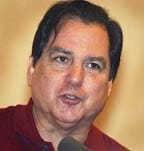
In 1995, historian D. Michael Quinn sat down in front of a Sunstone Symposium audience and answered questions he had never seen in advance: who shaped him, what he loved about teaching at BYU, and what he would change if he were prophet for a year. This episode is a rebroadcast from the 1995 Salt Lake Sunstone Symposium, a session titled “The Church Years: Michael Quinn, History, and the Mormon World View,” with Martha Bradley interviewing Quinn for about an hour before opening the floor to the audience.
Quinn describes planning from age ten to become a medical doctor, working as a nursing aide in a Seventh-day Adventist hospital, and then having that plan yanked out from under him. He explains how a hobby interest in Mormon history slowly took over during his army years in the Vietnam era, when he had been planning a PhD in the twentieth-century novel. Bradley, who inherited many of Quinn’s classes at BYU, asks about his most memorable experiences there, and he talks about the students who came to him with struggles they could not take anywhere else.
The conversation moves on to his mentors, including Davis Bitton, who brought him into the church archives and taught him to think as a historian. Quinn lays out what he sees as the big shift in Mormonism from the individuality and diversity of the nineteenth century toward the more hierarchical church of the 1960s onward, and argues that what history can teach church members is compassion, humility, and tolerance for other people’s errors. Asked about faith and history, he says he has preferences but does not consider them an ideal for anyone else. In the audience portion he answers a question about whether Mormonism should stop basing itself on the correctness of its history, and says his own faith rests on a relationship with God rather than on the historical record.
John Dehlin introduces the recording and explains why it is being shared now.
What’s covered
- 00:00 Introduction and welcome from John Dehlin
- 03:06 Michael Quinn’s background and early life
- 08:00 Undergraduate influences and academic formation
- 13:25 The path toward Mormon history in graduate school
- 16:52 Teaching at BYU and departure from the church
- 32:54 Role models and admirable figures in Mormon history
- 41:09 The relationship between history and faith
- 47:22 Key trends and new frontiers in Mormon history
- 1:01:49 Lessons from history for church members
- 1:08:30 Imagining change as a church leader
- 1:14:42 Audience questions and personal faith
- 1:25:48 Should Mormonism move beyond historical correctness?
Related episodes: D. Michael Quinn – 21st Century Mormon Enigma | Ep. 285-287 · 812-814: Wealth and Corporate Power – D. Michael Quinn · Secrets of a Mormon Historian: Michael Quinn's "Chosen Path" | MSP Book Club | Ep. 1866
Episode Transcript
Host: John Dehlin · Guests: D. Michael Quinn, Martha Bradley
This transcript is machine-generated and lightly edited for readability. The audio is authoritative. Please excuse occasional errors in names and spelling.
Introduction and Welcome
John Dehlin [00:00:00] Hello and welcome to a very special edition of Mormon Stories podcast. I'm your host, John Dehlin. Today we bring to you something very special. We are rebroadcasting a presentation from the 1995 Salt Lake Sunstone Symposium called the Church Michael Quinn History and the Mormon Worldview.
John Dehlin [00:00:19] We're bringing this to you for a few reasons. First of all, this weekend is the Sunstone Symposium in Salt Lake City. And and we want to make sure and encourage those of you who are interested to come by Sunstone. It's at Weber State University in Ogden, Utah. And check out what Sunstone does or to subscribe to sunstone magazine@sunstonemagazine.com Sunstone is an amazing organization with amazing rich history, and you all should know about it. Secondly, we're doing this presentation because my buddy Aaron Brown asked me to several months ago.
John Dehlin [00:00:56] Hi, Aaron, how's it going? That's a quick shout out. And finally, the real main reason we're doing this presentation is because next week in Salt Lake, we are hosting Michael Quinn for a very important, let's just say, Mormon Stories interview. I'm going to be interviewing Michael Quinn in front of a live audience again in Salt Lake City. And I've just found out that many of you don't know who he is. And so just briefly, you'll find out from this whole presentation who he is. But Michael Quinn was a very important LDS Church historian in the 70s and 80s and 90s. He was there during the Camelite years when Leonard Arrington was trying to open up church history to the world at the request of the church leaders.
John Dehlin [00:01:43] He wrote several important books on Mormonism, including Early Mormonism and the Magic Worldview, which was very, very important in helping to explore Joseph Smith's use of peep stones and folk magic. But he also wrote two volumes in the Mormon Hierarchy series, which talk all about power and church dynamics Both in the 1800s and more recently, he's worked on a book. He published a book called Same sex dynamics among 19th century Americans, a Mormon example. He's just done a ton of amazing work. He also was one of the September six who was excommunicated in September of 1993 of the path that he's chosen. He pretty much has not been able to get any gainful employment for, I don't know, 10, 15, 20 years after he was excommunicated and no longer could work at byu.
John Dehlin [00:02:41] And so Michael Quinn is a hero in many ways. He's very important. And this evening that we're doing next week at Sunstone is to celebrate him. So please listen to this presentation. Please come to understand how important Michael Quinn is. And then please go up to MormonStories.org, register for the conference, and we'll see you next week. Thanks so much. And here is Martha Sontag Bradley and D. Michael Quinn. Thank you.
Michael Quinn's Background and Early Life
Martha Bradley [00:03:06] I'd like to welcome you to another session of the 17th Sunstone Symposium. And during this session, we are featuring an interview with Dee Michael Quinn. My name is Martha Bradley, and during the course of the next hour, I'll be asking a number of questions of Michael. Questions that have been in my mind for a number of years, questions that other people have asked me to ask Michael. And then towards the end of this hour and a half, we'll open up for questions from the audience.
Martha Bradley [00:03:41] Before my daughter Caitlin turned 13, if you asked her what she wanted to be when she grew up, she would tell you that she wanted to be an anesthesiologist. But today, if you asked her, she would say, I want to be a talk show host. She wouldn't even hesitate. If you live in a household with a number of teenagers, you probably spend endless hours with talk shows on in the background. One thing I've noticed that is true of those shows is that the talk host seems to delight in embarrassing or in badgering the people that appear on their programs. This interview, of course, will be very different, not just because I'm not really like Oprah or Ricki Lake, but because Michael Quinn is my friend and I have enormous respect for him.
Martha Bradley [00:04:30] In fact, I feel very honored that I was asked to interview him here at the symposium today. The program that you all have has an exhaustive list, a bibliographical list of Michael's publications, puts those of us who do Mormon studies, who do Mormon history to shame. Makes me feel like I've been lazing my time away.
Martha Bradley [00:04:50] There are articles that span more than two decades and they cover every subject imagable dealing with the early history of the church down to contemporary issues. I remember when I read Michael's J. Reuben Clark biography in the early 1980s and being totally blown away by it. And I can remember it was when I was first trying to decide what type of history I would write and thinking Mormon history is where it's at. And it was because it was such an amazing standard, such a fine standard in front of me. I have through the years since then been truly inspired by his excellence. Although at times intimidated by his work, it's always inspired many of us to do better.
Martha Bradley [00:05:35] His accomplishments are legend. He has published numerous articles and books, including his most recent, the Mormon Hierarchy, published by Signature Press. He received his Ph.D. from Yale University. And top four, was it 12 years at BYU? Yeah, 12 years at BYU.
Martha Bradley [00:05:52] I've known Michael for longer than that. I think it's 13, 14 years. And partly because we had common friends, good friends to both of us, Jim and Judy McConkie. And so because of that, when I first met him, I already knew so much about him that I very early on considered him a good friend. And today I think I consider him a friend of my heart.
Martha Bradley [00:06:12] My name is Martha Bradley and I'm also a historian. I teach at the University of Utah in the architecture school, and I'm currently working on a number of county histories for the state centennial. I have six children, and in September I'll be a grandmother for the first time. And I teach 10 blazer bees in my ward, which in some people's minds means that I'm a saint.
Martha Bradley [00:06:35] I think I'm a sucker. Okay, now, the questions I have for Michael today fall into three general categories. And you might be thinking of questions of your own that you could either write down and I could read, or you could come up to one of the mics and ask Michael later on. But first category is the period of time of his training, the build up, the period of education, and his experience in teaching at Brigham Young University about how that prepared him for the work he would do later on.
Martha Bradley [00:07:10] The second major category of questions sort of falls into the general area of research and writing. And I imagine that most of you will have questions from that general area. Oh, I have four areas, not three. I always hate it when I say I have three points to make, and then I always remember the fourth one. The third area would be religious identity.
Martha Bradley [00:07:32] One of the things that is truly unique about Michael is that he has explored the underbelly, the dark underbelly of Mormon history. Yet he still maintains a very clear and articulate sense of faith. And I think that's something that a number of us will undoubtedly have questions about. And then finally, the future forward looking. I'd like to ask Michael some questions about what comes next and what we can expect out of him and what we might perhaps even expect out of ourselves.
Undergraduate Influences and Academic Formation
Martha Bradley [00:08:00] My first question, and this is because I've in many different forums heard Michael speak about this issue, but I'm very interested in the importance of his undergraduate education for. For the shape his career would eventually take on.
D. Michael Quinn [00:08:16] Well, I had. In terms of what you said your daughter had planned for and then changed. I planned for one thing and it was yanked out from under me. From the time I was 10 or so, I had planned to become a doctor, medical doctor.
D. Michael Quinn [00:08:35] And my senior year of high school, I became a nursing aide in a hospital in my hometown of Glendale Seventh Day Adventist Hospital. And in that responsibility I had a full load of patients that I provided all nursing care for that was not prohibited by law.
D. Michael Quinn [00:08:59] And so I did everything except give injections and hand medication to the patients. And I loved it. And I was convinced I was going to become the physician I'd always dreamed of because I knew I liked the practical side. I would go to every autopsy they held, I dealt. Half my patients were terminal cancer patients. And I knew I could deal with the rough side of medical care.
D. Michael Quinn [00:09:26] What I didn't realize is that I couldn't deal with the rough side of becoming a doctor. And I flunked out of my pre med program. And so I'd always done well in English and I'd even thought of doing an English major plus a pre med program.
D. Michael Quinn [00:09:41] So I fell back on that and took about 55 semester credit hours of English and then I minored in philosophy because I found it challenging. History had always been a hobby of mine and I didn't find it challenging. And so I only took one course beyond the required course in history, one elective course in history as an undergraduate.
D. Michael Quinn [00:10:10] And basically I backed into the career of history that I eventually developed. It wasn't something that I had planned on, and yet I think I had a great advantage in the training that I had in English literature because I learned to write and to think very quickly and to read quickly. I remember one, the term that I took a speed reading course at BYU out of desperation.
D. Michael Quinn [00:10:42] I had courses, one course alone, I had 15 hours of courses and one three hour course alone required me to read as textbooks, 18 books plus write a term paper. And because of this load of reading and writing requirements, I learned to do both very quickly. And that served me well when I switched over at the graduate level after I'd been in the army for three years to become a history trained person.
D. Michael Quinn [00:11:14] So that helped me, the philosophy major or undergraduate minority. It helped me in a way of being interested in ideas. In English literature you're interested in ideas, but you're also very interested, as I was in structure, I was fascinated by the novel stream of consciousness. Novel was what I thought I would emphasize. And I'd been accepted in a doctoral program at Duke to do this.
D. Michael Quinn [00:11:43] But the undergraduate minor in history exposed me to ideas, many of which were contrary to deeply held views of my own. But I found it fascinating to explore them. And I remember one of my philosophy papers which really took my professor back when I submitted it was looking at LSD visions as legitimate visions from a phenomenological point of view, not lds. That was not a mispronunciation. I'm talking about visions that people had on the hallucinogenic lsd and I did a phenomenological study of those and compared those to religious mystical visions and I could find no difference in the phenomena and concluded that they were as an experience for the individual they had equal validity.
D. Michael Quinn [00:12:44] But I find that both of those were beneficial to me. Although really until the Magic World Book which was about 15 years after I started publishing, I never really pursued ideas in the way that I did as an undergraduate in my philosophy training.
D. Michael Quinn [00:13:08] But it was good to be able to remember back on some of those skills and some of that preference for ideas when I confronted the very different worldview that I explored in the book on early Mormonism and the magic worldview.
Path Toward Mormon History in Graduate School
Martha Bradley [00:13:25] What factors in graduate school pulled you towards Mormon history?
D. Michael Quinn [00:13:29] Well, actually it was a slow development as I was in the military when I began my three year tour in the military during the Vietnam War. I started out having been accepted at Duke and totally planning on continuing in a program in English literature after I left the army. And while I was in basic training I was reading Virginia Woolf and Faulkner.
D. Michael Quinn [00:13:58] I read Ulysses again, tried to read Finnegan's Wake and decided that that was not the kind of book I wanted to write. But everything I read moved into the direction of my English literature goal of getting a PhD in the 20th century novel.
D. Michael Quinn [00:14:22] And then after I'd been in for about six months I began switching to reading more in Mormon history, which had always been a hobby for me and through Richard Anderson, who was a professor of history at BYU and who had been my bishop when I returned from my mission, I got locked into or connected into an interlibrary loan arrangement with BYU's library and I got all the books I needed and wanted that might not have been otherwise available to me on Mormon history. And so from about the six month to nine month period on, in that three year period I began a switch to reading Mormon things.
D. Michael Quinn [00:15:10] And during that period I read all 26 volumes of the Journal of Discourses and did my own index of what I found interesting in those discourses. And I read the seven volume History of the Church and six volume comprehensive by B.H. roberts I read all of the four volumes of testimony before the U.S. senate of Reed Smoot and did indexes for all of these as I was going through them. And by the time I was about a year from leaving the military and was beginning to think ahead, I realized I didn't want to go on for a PhD in English because I realized my consuming research interest was Mormon history and that it would be foolish for me to do a doctorate in English when I would be running off to the library and reading Mormon stuff and playing hooky on my English assignments, which I had done as an undergraduate.
D. Michael Quinn [00:16:10] And that's how I learned to write. I didn't go into this, but because I would be doing my own projects up in special collections, not for any class, because I never took a church history class, but just my own research projects. I would put off my term papers, and sometimes, well, frequently I wrote term papers in five days, sometimes only two days.
D. Michael Quinn [00:16:36] And I knew that as a graduate student, I couldn't do that, couldn't do that for the dissertation. And so I decided while I was in the military that I would apply for a graduate program in history.
Teaching at BYU and Departure from the Church
Martha Bradley [00:16:52] Let's talk a little bit about your time at byu. When I first started working at byu, I can remember that I picked up most of the classes that you had taught and what huge shoes those were to try and fill. So many of the students just had profound memories of Michael's influence on their thinking and on the type of research that they were interested in doing, and that he had always driven them to just do more than their best, always expecting them to just absolutely reach for the stars. I wondered what was your most memorable experience at byu?
D. Michael Quinn [00:17:30] For the most part, BYU was a great experience for me. And the most important part of that experience was the students. I loved my association with students. I never felt confident in the classroom. And every time I would come up before those students, I always was nervous.
D. Michael Quinn [00:17:52] I never had the confidence I did as a researcher and writer because I knew the students well enough. I encouraged them to come in and talk to me. I knew about their struggles. I knew those who were atheists and Relief Society presidents.
D. Michael Quinn [00:18:08] I knew of those who were devastated because they kept newlyweds devastated spiritually because they got pregnant within a few weeks of getting married. And they knew that God would never allow that to happen because God knew that they were penniless.
D. Michael Quinn [00:18:30] And when that happened, it was devastating. And the husband happened to be my student that term. His wife had been another time. And he came in and just was almost sobbing as he talked with me about how he couldn't understand how God could allow this to happen when they had had complete faith that if they followed the church's directions that God would allow them to have children when he knew that they could cope with children.
D. Michael Quinn [00:19:06] I knew students. One of my students, one of the most really stunning experiences when I had a student who came to me and admitted he couldn't read and he was a sophomore in BYU and that he had faked his way all the way through school and said, I can't fake my way through your classes. You're requiring too much to read and you're testing it in a way that I can't, I have to read it all. And I can't read it all and my girlfriend can't read it out loud to me fast enough.
D. Michael Quinn [00:19:46] So as I would come before these students, I knew that these students, I was overwhelmed when I would stand before them because they were such good hearted people. And there were times I had to hesitate before teaching a class because as I would look out at their faces and many of their stories, I knew, or I knew to the degree that they had come to talk to me about their stories.
D. Michael Quinn [00:20:14] I started getting to the stage of crying as I would look out at them. And they were the most important thing. And the thought of disappointing them, of not giving them my best, was a real burden for me. And so that was something. I really did my best to be a good teacher. And I was never really sure that I was. And one of the high points of my, of my teaching experience was when graduating seniors voted me outstanding teacher.
D. Michael Quinn [00:20:44] And it has been gratifying. And I say this only because of the personal impact it has been on me when I have had a student who's been able to reach me 10 years or so after he or she was a student in my class and they've gone on to graduate school and they've said to me, I don't think they were BSing.
D. Michael Quinn [00:21:07] They've said to me, you are the kind of teacher that I have judged all my other teachers against and you were my inspiration. You were the reason I've gone to graduate school and gotten a PhD. There's no way I can describe how important those kinds of words are that I've heard. So for me, the most important thing and the best experience I had at BYU was with the students. They're wonderful and they deserve better than BYU is giving them and the trustees are giving them. Unfortunately, in terms of the reputation that BYU and its trustees have created for BYU nationally, it hurts the students. And that's very painful to know.
D. Michael Quinn [00:21:55] But anyway, for me, that was the greatest. I had great experiences with my faculty compatriots. They were great to work with. We had many divisions of points of view, of priorities, of emphasis. But there was always a congeniality in our history department and a respect that I deeply appreciated. And my experiences with my colleagues in history were. Were great. And up until the last couple of years, my experience with the administration was good, too, until they were no longer in a free position, but instead were in a position of just following orders that had been mandated from Salt Lake City. Then things became grim, and when they got sufficiently grim, then I left.
D. Michael Quinn [00:22:47] That was hell. But up until that last two years, everything was really great. And even during that last two years, the students continue to be great as they are now.
Martha Bradley [00:23:00] Will you please tell us a little bit about those two years, about the circumstances that led to your resignation.
D. Michael Quinn [00:23:08] Well, it began with an intensity, a kind of a warning note occurred when the Mormon History association held its annual meeting at BYU, and this was in 1984, and I gave a paper there on the business activities of the general authorities, or as I subtitled it, a Tale of a Thousand Companies.
D. Michael Quinn [00:23:38] After I gave the paper, I got a telephone call at home from the dean, Martin Hickman. And he began by saying, mike, I do not want to be making this phone call, and I apologize right now to you for making it.
D. Michael Quinn [00:23:54] But he said, I want you to know that I have been instructed by higher authority and they have been instructed by higher authority for me to make it. And then he said, we're asking you, do not. Please do not publish the paper that you gave at the Mormon History association as an article. And I said, well, you know, I'm planning to do a book. And he said, if it appears in a book, that's all right. I wasn't told to tell you not to put it in a book.
D. Michael Quinn [00:24:24] And I said, well, I will agree not to publish it as an article. And he said, that's all I'm asking. And that's all they asked. And he said, and again, I apologize. That was the warning shot across the bow.
D. Michael Quinn [00:24:37] But things did not really become intense until 1985. In April, I published an article on the authorized continuation of plural marriage after the 1890 manifesto. And I focused primarily, pardon me, on the First Presidency authorizing these marriages as a result of that article.
D. Michael Quinn [00:25:05] The stake president later told me all this story, but I learned it from him. But what happened was that three apostles gave instructions to the area president who was James Paramore to meet with my stake president and tell the stake president to take away my temple recommend because I had spoken evil of the Lord's anointed and that was the phrase in the article, and that if I did not, or rather if I continued to do Mormon history, controversial Mormon history, that would, quote, offend the brethren, that he was to take church action against me.
D. Michael Quinn [00:25:48] Well, as a part of this, the area president, Brother Paramore, expected the meeting to end in 15 minutes. And instead the stake president and his counselors who were there argued for two and a half hours saying that this was not in their judgment a correct approach to take. That they had read the article. Two of them had read it before it went to press and the other counselor had read it after that, after it was published. None of them agreed that it was evil speaking or apostate.
D. Michael Quinn [00:26:21] And this was something he was not prepared to or expecting to hear. It really threw him off base or off balance from what the stake president and his counselors told me. But the stake president agreed to talk with me. And then as a concluding kind of statement, Elder Paramore said, and you of course president will tell Michael Quinn that this is a local decision and that it has come totally by this is your judgment and that you've had no communication with church headquarters on this matter. My stake president turned to him and another part of the dimension of this you need to know is that my stake president was a dear friend of Boyd K.
D. Michael Quinn [00:27:11] Packer and had served as Boyd K. Packer's counselor when mission older counselor, not missionary counselor. He was one of the member counselors. He was the member counselor to Boyd K. Packer when Boyd K. Packer was mission president in New England.
D. Michael Quinn [00:27:30] And this great stake president, in my view, great in other people's view, maybe they would take a different view. But he turned to Elder Paramora and he said, I'm not going to lie to Michael Quinn. If I am going to tell him this, I am going to tell him exactly how this came about.
D. Michael Quinn [00:27:51] And that is where he left it. And so he did. He told me the entire situation. He asked for my temple recommend and I gave it to him. But I said, I want you to tell them several things. One is that I think this is wrong. It's wrong headed. I am not an apostate. I do not regard what I was doing as speaking evil of the Lord's anointed. But two, I will not speak to anyone about this aside from my wife. I won't even tell my friends because I know I could not keep this as a secret. And it will end up in the media.
D. Michael Quinn [00:28:27] It will end up in the national media, at least by previous experience that was the case. And then they will think I have done this on purpose, which that's not my intent. So you can tell them that I will not talk with anyone about this except my wife. The result being that for the next two years, when people would ask me how things are going, I would just say, fine.
D. Michael Quinn [00:28:51] And I didn't talk to any of my friends about what had happened there. The Stake president warned me that he saw this as a backdoor effort to get me fired at byu. And he said that if you're asked by any official at BYU if you have a temple recommend, you tell them yes, and do not volunteer that it is in my desk drawer, and when it expires, I will renew it.
D. Michael Quinn [00:29:13] So you will always have a valid temple recommend. Well, I hope he's listening. He deserves the applause, in my view. He also said, I'm not going to hold a court on you. I had to do something, and I've taken your temple recommend, but I will not hold a court on you, and I will not try to instruct you how to be a historian. I'm an insurance executive. I don't know anything about history. You're the historian. But he said, I want you to know that they are on your trail and that this is not a good situation. And if there's any way that you can resolve this, I hope you can.
D. Michael Quinn [00:29:58] But he says, I don't know how to resolve it. So that was where that situation left. But I found out shortly later that there was a kind of a pincer movement. That instructions also came from several of the same members of the executive committee of the BYU's board of trustees. The BYU had a list, and BYU's administrators were given a list of projects that were not to be funded or supported in any way and of professors who were not to be funded or supported in any way. And when the dean called me in at his own discretion to tell me this, he said, mike, you made both lists.
D. Michael Quinn [00:30:43] And he said that he just was really unhappy in telling me this. And he said that I have hoped my whole career that one day BYU would become a real university. And he said, I'm afraid I will not live to see that day.
D. Michael Quinn [00:30:59] And he said, this kind of experience is very depressing for me in terms of what I wanted. And I'm quoting him for BYU as a university. Anyway, those pressures became more intense, and I thought I could maneuver around them.
D. Michael Quinn [00:31:16] I was given an invitation to speak at the University of Paris. And I chose to speak about a topic that did not discuss Joseph Smith or Mormonism specifically. And I thought that this would be acceptable within the parameters that I'd been told that the BYU administrators could not support me. My department and the college provided funding, and they were required by the upper university administration to withdraw those funds. So I ended up having to pay my own way to Paris to represent BYU at an invitational seminar at the Sorbonne.
D. Michael Quinn [00:31:59] So the situation had become so grim that by the time the students voted me to become. To acknowledge me as an outstanding teacher, I was seeing the handwriting on the wall that I was dead meat. And I kept wanting not to believe this, but by 1987, I did believe it was the case, and then decided I needed to apply wherever I could to have some way of leaving byu. And I got that way through fellowships that provided me support for about a year and a half. And I figured that was enough of a bridge and I would just continue to go from that point. And so when I got word of that, I resigned from BYU in January 1988 to be effective at the end of the spring term.
Role Models and Admirable Figures in Mormon History
Martha Bradley [00:32:54] Who have been some of your role models in both research and writing?
D. Michael Quinn [00:32:58] I've had a lot of heroes and a lot of mentors who've been very influential in my life. Some strictly in a church sense, but in research and writing. Davis Bitten was the one who brought me into the church archives and gave me the opportunity to do research there as his assistant. He's the one who got me and helped me to teach me how to think as a historian.
D. Michael Quinn [00:33:27] And I owe great to him in that regard of his approach to teaching and encouraging graduate students to see the diversity of approaches that they could use. And I quickly ran with one of those approaches, which was group biography. And that led me on a quest to look at the leadership of the church as if it were an individual and do everything for that group of men that I would do biographically if it were an individual. And then Leonard Arrington became my next mentor, and I became his assistant working with him. And he encouraged me to write. And he did something I'm not sure how long it would have taken me to do because I didn't have the confidence of doing it.
D. Michael Quinn [00:34:17] And that was. He basically pushed me into the position of being a publishing historian. And that was not something that I had expected to do because all along I'd been writing what I called position papers or statements of historical projects. And they would always been for my own research and I'd never circulated them. And I just had always thought of my communication with other people being on more of a one to one basis about issues on church history. And Leonard inspired me and guided me and directed me in becoming a publishing historian. When I went to Yale. Howard Lamar was a wonderful mentor for me.
D. Michael Quinn [00:35:06] The distinguished professor of Western American History at Yale. And he later became acting president of. Well, he became the dean of Yale College and then after serving several terms in that position, he became the acting president of Yale University.
D. Michael Quinn [00:35:26] But with Howard, I found a mentor who was totally cross disciplinary in his interests and his approach. While I was a graduate student, I took a History of the Family seminar team taught by him and by a psychiatrist.
D. Michael Quinn [00:35:44] And we had guest speakers and discussion group leaders from all different fields from genealogy to economics to anthropology to sociology. And I was introduced to this wonderful world of cross discipline cooperation and found it very important in my own work to read the work of people out of my discipline who might have comments about the things that I was interested in. Those influences were truly, I think those three individuals in particular were very, very important in my growth as a historian.
Martha Bradley [00:36:28] Good. In your view, who are the most admirable and then most problematic figures in Mormon history and why?
D. Michael Quinn [00:36:37] As historical actors or as writers?
Martha Bradley [00:36:40] Historical actors.
D. Michael Quinn [00:36:47] I think the most problematical is Joseph Smith. He is enormously complex. People at his time recognize that. He indicated it at his last major sermon, the King Follett discourse. I think it's a remarkable statement where he said that no man knows my history and I don't blame you for disbelieving it. And if I hadn't lived it, I wouldn't believe it myself.
D. Michael Quinn [00:37:22] Very complex person and not a person easily defined into boxes of any kind. In terms of categories, he's the most, I'd say the most complex. The next most complex person is his nephew in my view as a large historical issue. And that's Joseph F. Smith, who I think was almost as complex in his personality and his reactions to people and his private and public statements and actions. Extremely complex, individual, problematic, all kinds of problematic people in Mormon history as major actors.
D. Michael Quinn [00:38:12] And I think the major reason that they're problematic is that we have what historians call a presentist bias. And that means that when we look at the past, we expect the past to reflect basically are present. And when it doesn't, that creates a certain amount of tension. And that's I think essentially in a nutshell, the bottom line reason for the so called problem that general authorities today have with Mormon history is that they see Mormon history as legitimate only if it reinforces current definitions of doctrine and current policies.
D. Michael Quinn [00:38:52] And historians are interested in looking at the past in its own terms and try to understand how things developed and over a period of time, things change. And when you look at the past, you find that the past is very different from the present, contrary to our, I think, fairly natural assumptions that the past will be very similar to the present. Well, most prominent people in Mormon history are problematic because they weren't exactly like us.
D. Michael Quinn [00:39:24] They lived in different worlds, they had different world views, they responded in some ways more harshly than we would in similar circumstances, in other ways more in greater accommodation than we would in certain circumstances. And they're a puzzle because we want them to kind of react the way we do. And one of the real pitfalls of Mormon biography, although it's not just Mormon, it also applies to American biography generally, is that a biographer will try to shape the historical person to be pleasing to the contemporary audience and trying essentially to fulfill the presentist bias of the readers. That's a terrible thing to do because what it does is it robs historical characters of their humanity and basically shifts them and picks them apart and takes only that part of them that will fit the expectations of current readers.
D. Michael Quinn [00:40:28] Even though there may be a jolt, current readers or current listeners, or however we approach the past, whether it's audio, visually, through television, or reading, or one on one, however, we should be willing to absorb the jolt of recognizing that the past and people in the past just were not like us in our present.
D. Michael Quinn [00:40:49] And in some senses we may admire them for that. In other senses, we're probably going to be uncomfortable with that. So I'd say that probably most strong, influential people in the past are problematic to us in the present.
The Relationship Between History and Faith
Martha Bradley [00:41:09] Knowing what you do about the past and the present, relationship between history and faith, faith. How would you describe the ideal relationship for members between these two oft conflicting elements of our religious lives?
D. Michael Quinn [00:41:25] If I'm hesitating on some of these questions, it's because I've never heard them. I had no idea what was going to be asked on this.
Martha Bradley [00:41:32] You have the right to hesitate, right?
D. Michael Quinn [00:41:42] I think a problem that I have with that question is that I have druthers. I have preferences for how people. I would like people to respond, but I don't regard my druthers as an ideal because everyone's different. And my preferences and my druthers come from me and my experience, my experience personality. And I really can't feel that they're an ideal.
D. Michael Quinn [00:42:12] And so I can tell you how I would prefer people to respond to the past. But I don't know if that's an ideal. My preference would be that members of the church would maintain their faith and their own relationship with God as they begin the process of adventure and discovery. That is the experience of looking at religious past, because it is a discovery and it is an experience and it will change you because you are stepping out of your current views into earlier views and trying to understand them in their own terms.
D. Michael Quinn [00:43:00] And yet in the process of that stepping out of your current experience, you in a generic worldwide Mormon sense. I would hope that members of the church would maintain the intensity of their relationship with God and their love for the Fellowship of the Saints and their love for everything that they have always loved about the leadership or the membership or the doctrines or the experience of Mormonism.
D. Michael Quinn [00:43:28] And if there are things that a person has already been uncomfortable with, looking at the past may help you be more understanding. And I think one of the real fallacies is that one of the reasons, and it's not just liberals, one of the great secrets of Mormon culture is that the general authorities assume that it's liberals and the highly educated who are disenchanted with leadership.
D. Michael Quinn [00:43:55] Most of my experience in congregational life was in working class wards, blue collar wards. I grew up in a blue collar home and I was always very interested in their perspective. There's a deep alienation among blue collar Mormons toward the leadership of the church. They see them as white shirts, they see them as lawyers with elder titles, but they're rock bed loyal. But that doesn't alter the alienation.
D. Michael Quinn [00:44:26] But whether you're blue collar or white bred liberal in your alienation, if you have certain areas of alienation, one of the things that I would hope is that looking at the past will help to soften that and make you less brittle.
D. Michael Quinn [00:44:46] Because I think there is a real brittleness in the reaction of many people toward the contemporary church that is unfortunate. No institution is perfect. And one of the reasons I think that many people are disillusioned today is that they have bought in to the infallible ideal.
D. Michael Quinn [00:45:08] And when they find that the leadership is very fallible, that alienates them in a way that they begin to disbelieve. They throw out the baby with the bathwater. And I see the church as living, I see a testimony as living. And I see no reason to throw that out with the dirty water that you may find in past or present.
D. Michael Quinn [00:45:35] And even the dirty water you can use to irrigate with. So I would hope that people would see the past and exploring the past, even the uncomfortable past, even the embarrassing past, even the past that I have occasionally found blood hair curdling when I've come across.
D. Michael Quinn [00:45:56] This is the human experience. And we should come to recognize that the human experience, in all of its inspiration as well as all of its regrettable qualities, is a part of Mormonism, just as it is a part of Judaism, just as it is a part of Catholicism, just as it is a part of the American experience, the German experience, the Japanese experience, the Mexican experience. There are highs and lows and everything in between.
D. Michael Quinn [00:46:28] And I would hope that people coming to confront that would incorporate that into their sense of who they are and how they relate to God in faith, to their faith, to their community of faith here and now, but wouldn't use the past as a reason for rejecting faith.
D. Michael Quinn [00:46:51] That's my own druther, but I don't know if I could say that's an ideal. And some people think the ideal is to not look at the past or to only look at the past and present the past only if it reinforces the present. I see the head in the sand distortion that is ultimately self defeating because it creates unrealistic expectations not only about the present, but also the past.
Key Trends and New Frontiers in Mormon History
Martha Bradley [00:47:22] What are some of the important trends that you can identify in the course of Mormon history?
D. Michael Quinn [00:47:30] Mormon history over time became more and more organized, more than more hierarchical. But one of the extraordinary things I find about 19th century Mormon history is that is that despite the very strong emphasis on loyalty and the priesthood structure and things that find a lot of common similarities in the church today, there was an enormous emphasis on individuality, an enormous allowance for diversity in 19th century Mormon culture.
D. Michael Quinn [00:48:12] And in the 20th century that changed. And it changed for more than one reason. And it changed primarily from the 1960s to the present. And part of that was a conservative reaction against the what seemed to be the unraveling of American society during the radical 60s. Part of it was a reaction to the centrifugal tendencies of massive church growth in the United States, but particularly in the Third World. And part of it was also the rise of leaders who themselves at a personal level, were far more comfortable with unthinking devotion and obedience than they were with the kind of view expressed by, say, Hugh B.
D. Michael Quinn [00:49:02] Brown, who said that it is not so much our concern that your thoughts are orthodox, but that you have thoughts. He was a leader who was there during the 60s, but he became a lone voice during that period of time. And not everything that he believed and everything that he did I find desirable, but I find very admirable. What I see is his continuation of a 19th century encouragement for individual conscience and individual diversity. And that voice increasingly died out in the 70s and 80s. And it's not even a voice now, it's a memory.
D. Michael Quinn [00:49:47] And I find that regrettable. But I see that as a major change in Mormonism. The one thing I will say that I don't see has changed, and this because I'm a believer. I regard Mormonism as true today as it was in Joseph Smith's time.
D. Michael Quinn [00:50:04] I do not see Mormonism as a failed religion or as a false religion today. If I could, I could stand, if I were allowed to. I mean, I could stand and raise my hand in sustaining vote for the first presidency of the Church today, for the quorum of the 12. And if they were to vote individually rather than for the Quorum as a group, I could individually vote for Boyd K. Packer as a prophet serum revelator, even though I have severe disagreements with him on philosophical and administrative and personal issues. But I regard the power of God as we define as the priesthood as residing in the church and in those leaders who continue through apostolic succession the the offices of prophet, seer and revelator.
D. Michael Quinn [00:50:58] I don't see the church as changing in those fundamental ways, but I see the culture of Mormonism changing in very fundamental ways along the lines I previously described. And that has marginalized people. And I see that as a great tragedy because there is in my view, a malaise of Mormonism.
D. Michael Quinn [00:51:21] And that malaise is such now that young people who feel distanced from the church, and this had been mentioned in other forums here, they are not becoming liberal Mormons, they are not becoming Sunstone Dialogue Mormons. They are becoming ex Mormons.
D. Michael Quinn [00:51:41] I see that as a terrible tragedy. And I have had friends and family members who have told me that they have resigned their membership in the church. And I respect their reasons for doing so. And I understand the pain and the anger that can lead to that. But that is not something I encourage and I feel deeply saddened when that has happened.
D. Michael Quinn [00:52:09] What I see as a major change in Mormon culture, which in large measure comes from definitions, change definitions from church headquarters, change emphasis from church headquarters, that not only has caused disaffection that essentially sidelines millions of people from even being interested in investigating what I regard as the true church, I see that as a great tragedy. But in terms of the essential truths of Mormonism, I'm quite an orthodox believer
Martha Bradley [00:52:43] what was the single most important primary Mormon document that you ever examined?
D. Michael Quinn [00:52:57] I think if we have one of, you know, trying to describe one of these gee whiz experiences where you just kind of sit and think, I can't believe I'm looking at this document. I've had that experience several times. But it began in 1971 when I was employed as Davis Bitten's research assistant reading General Authority diaries in the church archives. And the first diary I opened, and at this point I can't remember it now, which of the many General Authorities diaries I read, which was the first, but my reaction I do remember, and that was just a sense of awe that here I am reading the handwriting of, and I don't know whether it was Joseph Smith's or Brigham Young's or Heber J.
D. Michael Quinn [00:53:47] Grant's or Joseph F. Smith's because I've read all of their diaries and I read them at that time. But I remember that sense of awe that these pages were touched by this person who was this enormous influence and was this early prophet, seer and revelator. And in reading their diaries, in all but one case, every General Authorities diary I read caused me to come to love that person and admire him and understand his strengths and his weaknesses and his worldview.
D. Michael Quinn [00:54:25] And I gained enormous compassion, enormous understanding and enormous admiration for these people. And as I read diaries of women who were crossing the plains and describing bearing their children in Utah, describing their devotion in living polygamy, as difficult as it was, the sense of awe returned.
D. Michael Quinn [00:54:55] A person didn't have to be high in authority for me to feel this sense of awe. It was that I was exploring one side of my heritage. My Mexican side I have not explored very much, but my Mormon side I've been exploring for decades. And it was this great sense of awe to read these people's experiences and to realize what good people these were, despite all their failings, despite their mistakes, despite their inadequacies, despite everything that's human about them.
D. Michael Quinn [00:55:34] And yet it's not as despite, because all of those human things about them were what helped me to understand and love them even more. But they were also strong and admirable in ways that I aspired to be. And I do remember that sense of awe. And it has been repeated in a number of ways when I've just looked at a document and felt I am so lucky to be seeing this, to be gaining this knowledge. And that was what I prayed for. When I was in Germany as a missionary, I fasted and prayed every week for a Year that God would let me into the archives of the Church, which I'd heard horror stories about.
D. Michael Quinn [00:56:14] But I wanted to read the diaries of the general authorities, and I wanted to read general authority minutes. And a month after I came back from my three years in the military, I was in the church archives reading these diaries and thanking God silently each day.
Martha Bradley [00:56:35] Are there any new frontiers in Mormon history?
D. Michael Quinn [00:56:39] There are many, and it's been my privilege to be a part of a great flowering of Mormon history and research. But those of you who are in your 20s at this point, I can assure you that there is a great deal of material there that, if not already available to you now, will be available to you.
D. Michael Quinn [00:57:02] And that material, from many perspectives, from many points of view, many time periods, many people involved, will provide enormous amount of opportunity for you to continue to explore and discover Mormon history. I hope, and I can only hope on your behalf, that the climate for that exploration will be better than it is now. It should not be a matter of looking over your shoulder or of fear of the consequences to attend a meeting like this to research Mormon history in any respect. And unfortunately, that's the climate the headquarters of the Church has created, and I regret that. But I see many opportunities and I see horizons in the future that will give opportunity for historians, in many respects, in many areas, to continue the pioneering journey of history.
D. Michael Quinn [00:58:07] History is always a process of discovery, because no one single person can comprehend everything that there is, can read everything that there is to read, to understand, everything that he or she may do their best to understand. And so those of you who are bitten by that history bug, if you're in your 20s or in your 30s, I encourage you to not give up on the prospects of being able to do what you want to do. Those of you who are free of that personality disorder, you're probably better off.
Martha Bradley [00:58:47] Will you have put all of your files into the notes and appendices of the hierarchy volumes, or will you still have material that none of the rest of us have?
D. Michael Quinn [00:58:57] Well, there are historians out there researching who were researching at the same time I have, who researched documents that I never saw. But I had this approach of trying to read everything that I thought might be of interest to me. I was like a kid in a candy store. Every day was Christmas.
D. Michael Quinn [00:59:19] It was a wonderful time. And for 15 years, I explored archives, not just the church archives, but archives all the way from the British Museum in London to the Huntington Library in Los Angeles. And it was a wonderful time. And yet I was depending on memory to pull together all of these sources whenever I needed to write something and I would quickly skim through all of my boxes of notes and I would do what I did with the scriptures and say when I remember this, it's on this page about the middle. And that's how I would remember things with the scriptures. And I would sometimes remember being in a particular book in Corinthians 1 Corinthians or whatever.
D. Michael Quinn [01:00:03] And I would also think, I think this is in the Wilford Woodruff diary on this page. And I would just flip. And every time I wrote a document, an article or a book, I would just skim through all my notes, looking through for these things that I needed to refer to in my book. Well, eventually I was forgetting things and had researched far more. And so when I when I left BYU for a year, I worked pretty steadily in trying to index in detail all my notes and worked a good hard year on it and figured that I indexed about 10%.
D. Michael Quinn [01:00:49] And I decided that I couldn't put off doing stuff until I index the rest. So that'll have to be somebody else's project, I'm afraid. But that material will not all be appearing in the hierarchy book. No, but I also want to assure you that that material is not exclusive to me. Many people looked at the same things I did Xeroxed, which I never did.
D. Michael Quinn [01:01:16] Most of, I can't say never. I have maybe 50 pages of Xeroxed material that I did during those years. The rest I just took notes on. I typed fast, more than 100 words a minute. Usually I would leave church archives or another archives where I was doing steady research. And I would leave at the end of a day with 20 to 25 pages of single space type notes. And I did that for 15 years. I didn't have the money to Xerox. I wish I had Xerox to learn. Lot I didn't.
Lessons from History for Church Members
Martha Bradley [01:01:49] From your perspective as a historian and as a longtime member of the church, what can we as present members of the church and future members learn from history?
D. Michael Quinn [01:02:02] Compassion, humility, diversity are the things I think you can learn from the past. It's more difficult to be arrogant and to be intolerant of diversity and to be intolerant of people's errors. When you look at the past and look at it and try to look at it in its own terms and see well intentioned people, whether they're presidents and congresses or whether they're a church leader or whether it's your grandmother who made decisions and did things with the best of intent and had consequences that are sometimes negative, sometimes even horrifying, that were unintended.
D. Michael Quinn [01:02:59] And I think that when you look at that in the past and see that it creates a sense of compassion where it's not as easy to be unforgiving of mistakes other people make. When you said, well, certainly they should have seen that or how could they do anything so stupid?
D. Michael Quinn [01:03:21] And when you realize that good intentioned people sometimes do stupid things, but very often with by their best lights, they make decisions that they hope will have good consequences. And sometimes it doesn't turn out that way. Diversity, it's so easy to see the world only through our own lenses, only through our own experience, whether that experience is male or female or Mormon or Utahn or American or whatever it may be.
D. Michael Quinn [01:03:53] And when we look at the past and the more broadly we look at the the past, it helps us to see that there are many experiences out there that are alien to our own people who have experienced a very different world than we have experienced. And then that will help us to understand that there are people in our own families who are experiencing the world very differently than we're experiencing it. And we may never really be able to understand how they experience the world.
D. Michael Quinn [01:04:26] But communication is a great way to begin. But I think the past is. It's not the only way, but it is one way to help get past that. Well, there's a philosophical term for you which is a $50 term that I won't use, but to get past that, I centered experience and expectation. Well, this wasn't a problem for me. Why should it be a problem for them?
D. Michael Quinn [01:04:56] Why can't they do what I did? This experience did not hurt me. I got over it. Why are they continuing to whine about it? And when we look at the past and other people in the past and we admire and realize that they're.
D. Michael Quinn [01:05:16] There were so many experiences that they had that were very different from ours. That helps us, I think, to gain a great deal of compassion as well as a great sense of, I think respect for diversity. Arrogance is a terrible thing. And very often it's most terrible when you don't realize you're arrogant.
D. Michael Quinn [01:05:37] And I think it's not the only way. But looking at the past is one way to indirectly start cutting at what I see as a prison of being limited by your own experience and therefore judging people in terms of your own experience.
D. Michael Quinn [01:05:59] And I see that as great value. But I must say in all of this that it is a historical fallacy to try to use the past as a way of making decisions in the present, nothing repeats itself exactly. We can learn from the past, we can gain insights from the past, but the past is so complex, it's essentially infinite that you can select out any lesson from the past you want to support any position you want in the present, depending on what examples you take, what time period.
D. Michael Quinn [01:06:41] And so we should not look at the past as some kind of infallible guide for policy making as a nation. That's one thing that led us into the Vietnam War. And yet we can learn from the past in terms of, well, there was the Vietnam War, let's not repeat that exactly, but also let's not be paralyzed by the experience of the Vietnam War because things do not repeat themselves exactly. And it would be another kind of misuse of history in the case of the Vietnam War, which was in large measure a policy decision based on a misuse of history to misuse the Vietnam War as an example of history, to avoid all intervention where intervention in certain cases may be a necessary and desirable thing.
D. Michael Quinn [01:07:35] And I say this in a non political sense. I saying it only in the sense that no matter how you come down on these issues, that whether it's policymaking for a national government or decision making for your own life, if we are ignorant of the past, we are going to stumble blindly along our path. But we should not look to the past as some kind of Ouija board.
D. Michael Quinn [01:08:07] It is not infallible. It is not thus saith the Lord. Even for you secular humanists out there, if you it is not the infallible guide, it is useful. And I think if you regard it as useful, then the study of the past can be helpful to you at a personal level.
Imagining Change as a Church Leader
Martha Bradley [01:08:30] If you could be prophet for a year, what would you change about the church and why?
D. Michael Quinn [01:08:44] I'm not sure what I would do first, but one of the things I would do if I were prophet for a year. And in saying this, I am not trying to change church policy. I am not trying to reform the church that will come in their relationship with God and their relationship with those they trust as leaders of the church. I.
D. Michael Quinn [01:09:09] I'm not on a platform here, but I'll answer your question. One of the first things I would do would be to tell missionaries formally at the MTC that unless they get in trouble in whatever country they're in, they are to forget they're Americans.
D. Michael Quinn [01:09:28] They are to dress like the local people. They are to submerge themselves in the local culture and do their best to neither think nor act like Americans. And the last thing they should think of is that somehow they are representing America or American values or Utah or Utah values as missionaries of the Lord Jesus Christ.
D. Michael Quinn [01:09:59] A second thing I would do would be to as a church policy, I'm deeply concerned about black Africa, Sub Saharan Africa. And we have committed cultural genocide. Cultural. And we've committed familicide in sub Saharan Africa. We have broken up stable polygamous families or we have denied polygamous families the opportunity of the government gospel. If they will not abandon polygamy. This is an outrage in my view.
D. Michael Quinn [01:10:36] And I would. First of all, at the level that would require the least kind of pain is to say there is nothing Christian or exclusively sacred about a pipe organ or a piano. And therefore sub Saharan Africans can use the drums in sacrament meeting as their instrument of choice because it reflects their sense of spirituality. But second, and certainly that is inconsequential in many ways, except that it alienates people who realize they're being forced into a Western American church.
D. Michael Quinn [01:11:16] The other thing would be to say sub Saharan Africans are abiding by the manifesto. They are living the laws of the land concerning marriage. Not Utah laws, not US Laws, but Nigerian, Ghanaian, Swaziland, Nigerian, all of the countries of south of Latin, of sub Saharan Africa.
D. Michael Quinn [01:11:42] Polygamy is authorized, it is legal, it is supported. And these people are abiding by the manifesto. And they should be allowed into the LDS Church as polygamists. They should not be told that this is somehow a sinful form of life. We are the only Christian fellowship who can offer these people a sense of honor in their stable family relationships. And it is an outrage that for 30 years we have required them to abandon stable family relationships as a condition of membership in the LDS Church.
D. Michael Quinn [01:12:22] So that would be another major difference and change that I would make if I were LDS president. And frankly, if we can accept diversity at that level, at the level people that has been so painful for the LDS Church leadership on the issue of polygamy and on the issue of wanting every congregation in the world to be the same so that general authorities will feel comfortable and at home wherever they go.
D. Michael Quinn [01:12:56] That's cultural imperialism, and they don't realize it. But they don't realize that it's the cost of making local people feel uncomfortable in their congregations. But if we can give those things up, then the diversity that I feel is necessary in many other relationships of human experience I think will be far easier to accept and for the church to accommodate. But until we are able to accommodate legal sanctified marriages of black Africans in a polygamous Marriage relationship.
D. Michael Quinn [01:13:34] Until we are able to accommodate the use in sub Saharan Africa of drums in worship services, then there is no hope, and you may as well give up hope for the church to accommodate any other kind of diversity.
D. Michael Quinn [01:13:49] And so if I could do nothing else as president of the church than make those two changes successful, those three missionary attitudes toward going native wherever they go, drums in African religious meetings, and accepting the polygamous marriages of South Africa, I would have felt that my presidency as a president of the church would have been of eternal consequence and of earthly consequence. That would be far more than I would want to aspire beyond that, that would be enough.
Audience Questions and Personal Faith
Martha Bradley [01:14:42] I will ask one more question and then we have 15 more minutes. And if any of you would like to ask a question of Michael, you can come up to this side of the room and line up and. And then you'll have to come one by one up to this microphone and ask the question. My question is tell us what the future holds for you, both the immediate future and long term.
D. Michael Quinn [01:15:04] Well, I have projects I'm bringing to conclusion and I have decided, it's very definite at this point that when I finish my writing projects and get the money that I can get from them, I'm going down to Mexico and I'm going to be living and I'm just going down there. I'm not going down there to be a writer. I'm not going down there to be a photographer, although I love doing photography. I'm just going down there for the adventure and I have no idea what that will bring, but that's something I'm going to be doing and beyond that I can't say. And my most distant plans are no more than six months old way anyway, so that takes care of both short term and long term.
Martha Bradley [01:15:50] Any questions? Anyone want to come on up?
D. Michael Quinn [01:15:58] This isn't actually a question, it's more of a request. I would like to see, and I'm sure many of us would like to see you republish works like your J. Reuben Clark book and your Magic Worldview so that when I tried to find it in a used bookstore, I wouldn't have to shell out $100 for it. So republish. Thank you. I appreciate that reminder and gentle kick. Actually, there are many people who have said the same thing and have expressed the same frustration and it's been that I had to set priorities and the priority was that I had to get these hierarchy books done. And I'm bringing those to conclusion. And a revised edition of Magic World is the next after I submit the second volume of the hierarchy study. That's one of the projects I'll be finishing before I go to Mexico. So thank you. Yeah.
Martha Bradley [01:16:57] No, no, you have to speak the question into the microphone for the radio audience and the tape.
D. Michael Quinn [01:17:06] Good to see you, Michael. One of the things that I was so interested in was your comment about how strongly you feel about the church. I guess one of the things that I would like to know is, with the understanding of the historicity of the church and all the other things that have gone on with your life, what would you say is the central pillar of your faith?
D. Michael Quinn [01:17:34] The central pillar of my faith is my relationship with God, which I'm happy to say continues strong. I continue to feel the spirit of God, the spirit that I have always felt, which I have always been more grateful than I can express for feeling.
D. Michael Quinn [01:17:56] I continue to feel deeply that my father in heaven is interested in me. I continue to get angry at him occasionally. I continue to get frustrated. But many times I will pray sometimes for half an hour to stretch and just thank him for all the good experiences I've had in life, and I'm grateful for those. I want more good experiences.
D. Michael Quinn [01:18:30] I want more human interaction. I want more relationships of significance in my life. But I'm very grateful for what I've had. I am a believing Mormon outside the church. I'm very grateful for what I saw as and do continue to see as a wonderful vehicle for service.
D. Michael Quinn [01:18:53] I'm a very selfish person, and there are many things that I did for other people and extending myself to other people, I would not have done had it not been for the leadership of the church, creating encouragement over the pulpit and creating programs that provided that vehicle for service.
D. Michael Quinn [01:19:14] I regret nothing in my church experience. Pretty intense and pretty extensive. And I'm very grateful for those associations I always associated with people I thought were better than me. I'm grateful that I had that association. But I don't have it anymore. And I miss that. And yet I see life as an adventure. And. And that adventure continues. And yet I'm grateful that as part of that adventure, I continue to have what I feel is a very real relationship with God.
D. Michael Quinn [01:19:52] Quick comment before this. I hope it's not out of line, but I'd like to thank Mike for getting me through BYU sane and inspiration for me to become a teacher at the high school level, but not at the college level. But my question for you is, would you better or define the difference between BYU as being advertised and byu the reality for BYU students, Byu. It's Advertised is that it could become the Harvard of the west under current circumstances. That's a terrible self parody.
D. Michael Quinn [01:20:43] Students in technical fields at BYU graduate and go on to interviews and applications in which they are regarded as coming from one of the top schools in the country. That's no question a student who comes out of BYU with a degree in engineering or a degree in computer sciences or a degree in economics or mathematics or any of the technical fields, the hard sciences.
D. Michael Quinn [01:21:16] No question that that student has a solid background that will benefit them in any interviews or any applications they make. However, in any discipline in which independent thought, in which dealing with controversies within the discipline, controversies may lead, in any discipline in which those things are valued, BYU has a terrible reputation among the people in that discipline nationally who are involved in hiring, who are involved in the interview process.
D. Michael Quinn [01:21:55] And it is an unfortunate reality that any student in the fine arts, in the liberal arts, in the humanities, and in many of the behavioral and social sciences has one strike against them because they are graduating from a school that people throughout the country regard as being a.
D. Michael Quinn [01:22:18] A limited experience of liberal education, a limited experience of exposure to varieties of ideas. And that is the reality and it is very painful. But I would say to parents whose children are going into any of those fields that I've mentioned and who are planning on a career, please do not do what I had many of my students tell me when I asked them why they came to BYU and they said, my parents said they would pay for me to go to BYU, but nowhere else.
D. Michael Quinn [01:22:58] Please send your students if they can go to schools. If they are in the liberal arts, the behavioral sciences, the social sciences, the fine arts, send them to a school where the reputation of the school will not be a strike against them.
D. Michael Quinn [01:23:13] Because unless they are in the top 1% of their class, they will not have the opportunity to defend themselves in a personal interview. They will not make the first cut. That is the reality and I see it as a terrible tragedy.
Martha Bradley [01:23:32] I was very sad to hear that you included fine arts because we have a daughter that may be a place
D. Michael Quinn [01:23:37] when your PhD is completed.
Martha Bradley [01:23:39] You mean she's going to be down one then?
D. Michael Quinn [01:23:42] In my view, yes.
Martha Bradley [01:23:43] But that's not my question. My question is, though you may have answered it by the description of all your adventures. Has it been worth it?
D. Michael Quinn [01:23:52] Yeah, it has. Along the way there were decisions that were life changing decisions. Going to BYU initially was a life changing decision. I could have gone in another direction. My counselors at BYU did their best to persuade me to apply to Stanford out of high School, I wanted to go to byu. I have no regret about that.
D. Michael Quinn [01:24:24] There are reasons I could have gone in many other directions, whether it's going on a mission, getting married, going to BYU as a professor. These were major decisions. And there were good and bad, there were painful and there were happy consequences in all of these decisions.
D. Michael Quinn [01:24:45] But on balance, I have no regrets because if I'd taken other alternatives, there would have been another set of good and bad and sad and happy, and it would have been a different set of adventure for me. And it's too bad I don't believe in reincarnation. I would go back and try some of those. But I don't believe in reincarnation. And if I'm pleasantly surprised, so much the better, because I love the idea of adventure, eternal adventure. But in terms of the life I've lived, there were things I have experienced that have been painful and I regret that I had to experience. But I know that there would have simply been another set had I chosen different paths.
D. Michael Quinn [01:25:24] So I am grateful for the life I've lived and the experiences and what I've learned, and I don't have any major regrets. And yes, it has been worth it, including my excommunication, which is the last thing I wanted. But that was part of the path.
Should Mormonism Move Beyond Historical Correctness
D. Michael Quinn [01:25:48] A couple of sessions ago, a couple of days ago, actually. Sterling McMurran said that the Church should abandon its desire to base Mormonism on its. The correctness of Mormonism, on its history. He mentioned, for instance, that B.H. roberts said, if I'm correct, quoting him correctly, that B.H. roberts Said that if the Book of Mormon was not a 20th century document, then the whole Mormon house of cards collapsed, so to speak. Do you feel we should, as Mormons, stop basing the Church on historical correctness and move on to the other bases of justifying Mormonism?
D. Michael Quinn [01:26:42] That's a very good question. I regard that issue differently than Sterling McMurran, though. I don't think that your faith should be in hock to your history in the sense that I think your faith should be in hock or should be dependent upon your relationship with God, your relationship with the otherworldly. And if you don't have what you define as a relationship with God, if you don't feel you have a testimony, and I know many earnest people who have spent many hours on their knees who never got what they regarded as a testimony, I don't have the answer to that. I don't know why that is.
D. Michael Quinn [01:27:23] But if that's the case, then even your loyalty to Your heritage, your loyalty to your system of behavior should not, I think, be dependent on your understanding of the past. I think it should, again, relate to how you relate, even if you don't relate as a person of faith.
D. Michael Quinn [01:27:48] I don't think history should be a determining factor. However, I don't see the example that he gave in the same way that he does. The meaning of Mormonism would change radically, drastically, were the Book of Mormon not to be what the leaders of the church, what Joseph Smith himself proclaimed it to be.
D. Michael Quinn [01:28:12] And then there are members of the church who have ceased to believe that the Book of Mormon is or was what they themselves at one time believed it to be. And yet they continue attending church. And so they have not allowed their views of the past to interrupt with their loyalty to current behavior and the community of Saints. I regard that as healthy, but I cannot regard it as insignificant if something like the historical claims about the Book of Mormon proved to be totally contrary to what they have been proclaimed as. So I do not see it as a flippant issue, as an issue that you can just shrug off, but I also would see it as something more complex than simply saying, well, I no longer believe in the Book of Mormon as an ancient record, therefore I'm no longer Mormon.
D. Michael Quinn [01:29:12] That is not my position. But I know people who are in that position, who, some of whom no longer regard themselves as Mormon, others of whom, like myself, regard themselves as DNA Mormons, that they are Mormon. Even if they no longer believe the Book of Mormon is a historical record, they themselves are Mormon. Just like there are atheists who are Jews and who are loyal to Judaism, yet they do not believe that there was any epiphany or any interaction between the divine and Moses on Sinai, but they are nonetheless Jewish.
D. Michael Quinn [01:29:50] That is not my position. My position is that I believe that God is a real person. I believe that he speaks by revelation, that he can speak to the current leadership by revelation. And I believe the Book of Mormon to be an ancient record.
D. Michael Quinn [01:30:08] And so I'm not faced with that change of worldview. But I cannot agree with Sterling McMurran that there is no change of worldview involved. If the Book of Mormon ceases in your belief to be an ancient record, a huge change of worldview occurs in that case. And so I agree in part with him. But what I see as a fundamental. I disagree with him,
Martha Bradley [01:30:40] despite the fact. We have more questions. We need to close this session. May I speak for all of us? I think, in saying that we will miss you, Michael, and we hope that you'll be back. Thank you.
D. Michael Quinn [01:30:54] Thank you. Thanks for joining us for this concluding session of the 1995 Sunstone Symposium broadcast. Just a reminder that tapes of the sessions you may have heard during this broadcast are available from the Sunstone Foundation. You can call our offices in Salt Lake City, or for the time being, you can call us at Solly Kilton and ask for the Sun Stone table. The Number there is 5323344.
D. Michael Quinn [01:31:37] We extend our thanks to KCPW and remind you that they like to have support from listeners of this broadcast and feedback as well. And you can call them at 764-9 4009 in Park City or 359 KCPW in Salt Lake. Also thanks to Blair Fullner, Don Gomes, Carol Phobos, Clay Anderson, and the engineer and caretaker of this broadcast, Danny Kinimaka.
D. Michael Quinn [01:32:17] And a special thanks as well to all the underwriters of this programming. And we hope that you will let all of those underwriters know of your thanks and support as well until we join you next year from the Sunstone Symposium. We bid you adieu and hope that you have enjoyed this broadcast. We're returning now to the studios of KCPW.
Transcript © 2026 John P. Dehlin. All rights reserved. Brief quotations are welcome with attribution and a link to mormonstories.org; all other use requires written permission.
33 Responses
Thank you for adding this rebroadcast. Michael Quinn has become one of my heroes and I appreciate his Christ-like attitude as well as his great intellect and work.
Even though I enjoyed this interview, I can’t resist making a comment about it. Michael Quinn suffers from what I call the liberal paradox. The liberal paradox is when a liberal professes great support for a diversity of cultures, people, and personalities; but then turns around and contradicts himself by criticizing certain cultures, people, and personalities. For example, at around 1:09 Quinn says that if he was president of the church, he would have missionaries “forget that they are Americans. They are to dress like the local people. They are to submerge themselves into the local culture and do their best to neither think nor act like Americans. And the last thing they should think of is that somehow they are representing America or American values or Utah or Utah values as missionaries of the lord Jesus Christ.” So these missionaries should suppress their culture, suppress their values, suppress even their personalities for 2 years during their mission! This is unreasonable and hypocritical.
The person who suffers from the liberal paradox loves to speak warmly of other cultures and value systems, but then criticizes harshly western culture and values. This type of liberal loves to speak expansively of all the varieties of human personalities and experiences, but then speaks ill of “close-minded people” or “authoritarian personalities” or people who are “prejudiced” and “biased”. The fact is, many liberals are just as critical and judgmental as conservatives–just in a different way.
I enjoyed this post. I love Michael Quinn’s work, but Evan nailed it. This post could not have come at a better time for me as I was beginning to think that I was the only conservative listener.
I agree that Quinn is being unrealistic when he expects missionaries to suppress themselves completely. But the exercise of doing one’s best to get outside the self and into the other is a good one (even if success is impossible). This is what I take Jesus to be recommending with the second great commandment (loving the neighbor as the self means doing all that one can to eliminate the gap between the two), and it occurs elsewhere in religions whose histories include a lot of cross-cultural experiences.
I think the fundamental problem here is a human one, not unique to liberals or conservatives. All of us need community. We need to reach out to others. And we all eventually (mis)use that need to bully others into being like us (whether intentionally or not). The best we can do is to recognize this tendency in humanity (ourselves and other people) and own it. We have to admit our tendency to misinterpret and manipulate others. We have to look for ways of being true to our innermost selves (as we must be) that are minimally harmful to others. In other words, we will always do one another harm: still, there is a significant difference between a respectful quarrel (which does real harm) and an all-out brawl (which likewise does harm); the difference between a successful marriage and a failed one is one of degree rather than kind, with the successful couple finding positive, useful, creative ways to channel the inevitable reality of conflict. Savvy people consciously use conflict to build themselves and others into better people. Fools pretend that conflict can be utterly avoided and/or engage in the most destructive kinds of conflict (often by ignoring small quarrels until they erupt into all-out war). The best people get on well with those who really know them in spite of significant differences. They know how to have empathy (feeling what someone else feels and validating those feelings) without rolling over (just because I see where you are coming from does not mean that we agree on all points, now or ever).
It actually takes a high degree of self-awareness and moral courage to admit that other people can have a valid human perspective on life that is not yours (and may never be). It is hard, yes. It is easy to blame others for lacking it. But that does not mean that we should not strive to develop it in ourselves. The best people I know are those who take everyone they meet (liberal, conservative, wise, foolish, old, young, male, female, foreign, native, whatever) seriously — making more than a token effort to “walk a mile in the moccasins of the other.” I say this as someone who used to be rather fiercely conservative. I really appreciate people (including many “liberal” friends over the years) reaching out to me, sharing themselves with me and accepting what I had to offer in return (even when they did not have any immediate use for it). Today I don’t like to call myself conservative or liberal, religious or secular. I am a human being. I strive to be open to all other human beings, to take them seriously. The best that we are capable of as a species inspires me to act, as the worst that is in us (all of us) tempers my action (helping me avoid getting too enthusiastic about my personal plans for saving the world). The world needs all of us, not just “the good guys” (whoever they are: most of the time, they seem to be the same as the bad guys). From where I sit, it seems that Quinn was just wishing more people could see this.
Hermes,
The root difference between you and me is clearly one of personality differences. Your personality leads you to focus on conciliation and harmony between people and my personality leads me to focus on accuracy and problem solving. That is why you overgeneralize and omit certain details in your post–you are trying to bring people together. If that means glossing over certain details (or even occasionally contradicting yourself), then you feel justified in doing so. In contrast, I don’t mind getting into an argument in order to hammer out the details of an issue because I’m focused on the truth–even if that means disturbing the peace. Your personality leads you to focus on one thing; my personality leads me to focus on something different. It’s really as simple as that. And by the way, not all liberals have your personality, and not all conservatives have my personality; but certainly many do.
Well, what do you think? Is my diagnosis correct?
I think you are right about there being a liberal paradox. I don’t think the answer to every problem in the world is pretending that it is all your own (or your culture’s) fault and that other people are magically better than you. I think people are more similar than different, generally speaking. I think I am a lot closer to being a terrorist than I would like to acknowledge. On the flip side, I think the terrorist is a lot closer to being the Dalai Lama than he (or even I) might think.
Finally, as to where Quinn fits in all of this: I don’t know. All he does is express (with liberal wistfulness) the desire that we might see the best in others (which can require us to dim our own brilliance a bit). What he doesn’t really notice is that we are human (and so more similar than different: all of us mistreat others, and justice is only ever relative). We need some kind of concrete methods for developing rapport between ourselves and others, methods which go beyond rhetoric (which is ultimately all he can offer here). I think the whole “us vs. them” paradigm (which Quinn is relying on here) is ultimately a mistake, but I don’t like to condemn people for using it (even when they use it to evade tough questions). So I guess you are right about me, too.
As for the whole conservative vs. liberal thing, I think I may agree with you. From my perspective, “conservative” and “liberal” are just words we use to describe generic groups of people who are concretely often very different. I would not call myself a liberal (a palaeo-liberal, perhaps, but “liberal” today often means something like “statist who believes in forcing other people support his favorite charity” — a definition which works for a lot of conservatives too, I think — and that is not what I am). I would not call myself a conservative either. I have referred to myself as a libertarian, an anarchist, a minarchist, and many other things, but the only consistent values informing my personal and political persona are (1) personal integrity and (2) a commitment to enabling non-authoritarian approaches to concrete problems (such as environmental degradation, poor schooling, warfare, economic recession, etc.). I don’t really care what people call themselves: when they speak to my values, I hear them. (Alas, almost no politicians of either party speak to me these days. I don’t vote that much.)
I must say, I really enjoyed this broadcast. I appreciate Quinn’s honesty and decorum. I am excited for Friday.
I don’t think professor Quinn is saying one should forget his/her identity. He is probably refering here to what some of us would consider/call cultural imperialism. In the case of the Church missionary program it means presenting WASP cultural values as part of the gospel. As a Brazilian serving in Japan with American missionaries and under an American mission president I saw things that made me feel ashamed as they sometimes behaved as if they were representing the American culture.
I guess I don’t understand why missionaries can’t retain their culture, values, and personalities with pride–but still be considerate of other people and cultures (assuming those cultures are not unethical (e.g., endemic abuse of women)). And if natives see the missionaries and decide to emulate them, then that’s their choice. The missionaries or the church should not be blamed for that.
There is no reason why adopting arbitrary aspects of the contemporary Utah/American culture should be a prerequisite to living the gospel. As Quinn eloquently pointed out, that’s cultural imperialism.
This interpretation of his comments seems off-base to me, “The person who suffers from the liberal paradox loves to speak warmly of other cultures and value systems, but then criticizes harshly western culture and values.” Please tell me when he harshly criticizes western culture and values (I may have missed it), unless you consider cultural imperialism (and regular-old imperialism) to be a core western value (which it certainly has been in the past). How is it a paradox to respect other cultures and recommend that when someone seeks to live within in a new culture, they should attempt to actually learn about and immerse themselves in that culture?
And when it comes to the missionaries themselves, I thought their core goal was to teach other people about the gospel (the gospel is not arbitrary contemporary Utah/American culture). And he uses the example of not letting drums be used in the place of the piano (which is an example of an arbitrary cultural dictate). He doesn’t say that the piano is an evil western contraption.
“The fact is, many liberals are just as critical and judgmental as conservatives–just in a different way.” That’s true, but I’m not seeing how it relates to any part of the podcast you are commenting on.
I was defining “liberal paradox” in a general way with that sentence that you quoted. However, if memory serves me, I recall Quinn…
1) Criticizing how the West has dealt with Africa
2) Criticizing how the LDS church has dealt with Africa
3) Criticizing how the LDS church deals with other cultures in general
3) Criticizing the current LDS culture–and how it was better in the past
4) Criticizing the LDS general authorities
5) Criticizing “intolerant people” who are “judgmental” about historical characters
6) Criticizing the BYU culture (particularly in the humanities)
7) And, as I mentioned earlier, wanting missionaries to “forget that they are Americans” and to “neither think nor act like Americans”
And to clarify, I’m not opposed to being critical or judgmental about other people and cultures (or cultural elements). What I oppose is when someone (usually a liberal) SAYS that he is all-inclusive and non-judgmental and then contradicts himself in the next sentence. I mean, one has to be judgmental to some degree if one wants progress in this world. If we were to be completely non-critical and non-judgmental, then we might as well have been born a neutrino.
Regarding missionaries, it’s one thing to have the missionaries learn another culture, it is a completely different thing to have them “forget that they are Americans” and to have them “neither think nor act like Americans”. The former is justified, the latter is not.
As an aside, I’m not convinced that African drum music is appropriate in African Sacrament meetings. I’m not an expert in this area but perhaps the rhythmic, energetic beat of African drum music is objectively not conducive to solemn reflection and prayer by Africans or anybody else. Imagine a talk in Sacrament meeting where the topic is Jesus’s great sacrifice and atonement, and the pain and suffering that he went through. And then the speaker sits down and the drummers start a rollicking beat with chants and dancing. That may not be a good idea.
I don’t remember Quinn claiming to be (entirely) non-judgmental. His position is fundamentally the same as Gordon B. Hinckley’s (“bring what good you have and let us add to it”), only he sees more of what others have as being good. (We let the Pacific Islanders do raunchy dances more than half nude at our Polynesian Cultural Center, and find these inspiring, so what the heck is wrong with a little drumbeat for meetings in Africa?)
Between 1:01:50 to about 1:06 Quinn extols the virtues of being tolerant of diversity, tolerant of errors, not limited in scope, and not judging others. I believe he says similar things elsewhere in the interview as well.
Do Pacific Islanders perform these dances regularly in Sacrament meetings? Or are they only done during special events?
I concede that (so far) Islanders don’t dance for sacrament meetings.
Regarding the withholding of judgment, I think Quinn is just channeling Jesus (and the Universalist strain in Mormonism).
Regarding the drums, I think Quinn is pointing up something that anyone with significant cross-cultural experience knows. People who grew up outside your culture (radically outside it, not just down the street or in a colony from the old country) have different ways of relating to the sacred. Their ways often strike you as “bad” not because they are (for them), but because they would not work for you (at your place, in your culture). From my point of view, there is nothing inherently wonderful or superior in any particular kind of music: what matters is not the instruments used but the experience had by the players (and their audience). Having been around a few Africans in my time, I can say that drumbeats can be very sacred for them (as organ music can be for us cultural Europeans). God looketh not on the outward appearance (the clothes we happen to wear, the musical instruments we happen to play), but on the heart (why we dress the way we do, what we feel when we play music). Now that I have listened to the podcast all the way through, I agree with Quinn: let the Africans express the sacred in a way that is meaningful to them. (If they can relate to God effectively in their non-European language, then why should they have to use European music?)
Well, that is the question: Can they relate to God (that is, the Mormon God) with their drum music? Can African drum music, in fact, help them be spiritual in a Sacrament meeting? Perhaps the general authorities have looked into this issue and think that it wouldn’t work. And perhaps the general authorities are right–I’m not an expert in music and in people’s emotional reactions to it.
Most of the Japanese Mormons I know have had to go through a kind of ‘breaking out in Westernization’ before they feel comfortable in the church. I’ve had people tell me they have a testimony, but they don’t feel Christian. The sad thing is when General Authorities tell members that they don’t want people to give up the good things of their culture, only to add on the goodness of the gospel. Many Japanese have no example of what a Japanese style Mormon could be, and therefore mimic the American missionaries… an effort fraught with the promise of frustration. Who in their right mind would sing ‘Firm as the Mountains Around Us’ after the disastrous earthquakes we’ve experienced. Cultures are very important… they color our relationships with God and our Brothers and Sisters, values, and faith. After 300 years of persecution, and a half million Christian martyrs, the hesitancy to be open about one’s faith here is understandable.
The conservative paradox is that no matter how few converts LDS missionaries are actually finding (esp. compared to other much faster-growing faiths in many regions of Africa) the current (losing) formula will be defended against any innovation.
And in this particular instance, the silliest aspect of this “liberal paradox” accusation is that Quinn happens to be someone who is thinking out loud of ways to better promote a highly specific set of beliefs and practices, i.e., Mormonism. As Quinn rightly notes (has it already been 15 years?), the current generation is mostly skipping right out of the Mormon faith and not even bothering to linger in places with names like Bloggernacle and Sunstone and Dialogue … Absent a little innovation, the conservative paradox is gonna keep producing more exmormons than converts. It’s that process that’s gonna finally result in the undifferentiated mass of wishy-washy secular liberal types that folks like Evan wake up in a cold sweat about (apparently).
First, there are some conservatives who are not religious and are not interested in converting people into a religion (think Alan Greenspan). So perhaps your “conservative paradox” should be renamed the “LDS orthodox paradox” (or something to that effect).
Second, I don’t disagree with most of what Quinn says. Just because I criticize him about one issue, does not mean I’m not in agreement with him about many other things. And I should mention that I’m not a TBM (I became disaffected from the church when I was 13 for intellectual reasons). So I’m not trying to defend the church or its missionary program. Furthermore, I’m not a conservative either (I’m closer to a libertarian).
My only objective in my original post was to point out an error that I see many liberals making in their rhetoric. They say one thing, and then they turn around and say something contradictory (thus it’s a paradox).
Wow…What an enjoyable hour and a half spent with Dr. Quinn. Thanks so much for posting this, John so that we are able to get to know this important man better. If there is anyway to live broadcast your interview with him I would surely pay!! I would love to know more about his belief in the Book of Mormon and how he makes that work. Maybe you could squeeze a question like that into your interview! Thanks again to all involved!
The conservative paradox is that no matter how few converts LDS
missionaries are actually finding (esp. compared to other much
faster-growing faiths in many regions of Africa) the current (losing)
formula will be defended against any innovation.
And in this particular instance, the silliest aspect of this “liberal
paradox” accusation is that Quinn happens to be someone who is thinking
out loud of ways to better promote a highly specific set of beliefs and
practices, i.e., Mormonism. As Quinn rightly notes (has it already been
15 years?), the current generation is mostly skipping right out of the
Mormon faith and not even bothering to linger in places with names like
Bloggernacle and Sunstone and Dialogue … Absent a little innovation,
the conservative paradox is gonna keep producing more exmormons than
converts. It’s that process that’s gonna finally result in the
undifferentiated mass of wishy-washy secular liberal types that folks
like Evan wake up in a cold sweat about (apparently).
P.S. Second posting. First wound up in the spam filter (apparently).
I rarely believe it when someone portrays themselves as a harmless victim and I didn’t believe it here either. As a true historian, Michael Quinn could have admitted some of his fault.
The problem is, people believe the side of history where their opinions lead them.
What are some of the things that you are referring to that he omitted?
John,
I know that Dr. Coe’s expertise is in Mayan culture but I wish you would have pursued his comments on the Hopewell Indians where a miriad of iron objects (including axes) have been found between 400 BC and 400 AD.
See link https://kb.osu.edu/dspace/bitstream/handle/1811/4817/V61N06_341.pdf?sequence=1
The argument between Evan and Hermes ultimately rests on a paradox of logic, not an inconsistency of character on the part of Michael Quinn, liberals in general, or conservatives, for that matter.
It’s sort of like the old atheist canard: If God is all-powerful, can he make a rock so big he cannot lift it?
Evan presupposes that someone who places a high value on “tolerance” and “diversity” –in order to be consistent– must therefore refrain from criticizing those who may be (at worst) self-avowedly ethnocentric (= imperialist?) , or (at best) naively ethnocentric (= someone who has never really learned to appreciate other cultures as equivalent in value to their own).
This may make a good talking point (“those who claim to be so tolerant are really intolerant”), but the logic is ultimately self-devouring.
An argument for “consistency” cannot be made to apply to premises that are themselves inconsistent.
Why can’t folks use qualifiers in their speech? For example, they could say something like this…
“We should not be intolerant of other cultures and peoples *just because they are different from us*.”
or
“We should not look down upon other cultures and peoples because of *arbitrary differences between us and them*.”
Perhaps qualifiers such as these are implied in the liberal’s speech, and I’m just being overly pedantic. But with the kind of sweeping general statements that I hear many liberals use, they are sort of inviting such criticism.
But putting that aside, I’ve heard many liberals who really do seem to have it out against the west and/or science–even when it doesn’t involve ethnocentrism. Also, many liberals love to criticize the millions of people out there who are not intellectuals, who are not interested in art or culture studies, who enjoy a routinized lifestyle, and who even prefer to live in homogeneous communities. These people are not intrinsically bad. And I think personality characteristics largely explain these people’s preferences. But as long as they are not hurting anyone else, I say let them be.
So I think there is more going on here than just semantics.
Evan, I think the reason the West comes under so much criticism is because it is imperialistic. The same people criticize China for taking over smaller less powerful natures and cultures.
If African cultures were imperialistic then they’d be criticized.
When one culture overtakes another the culture that is taken over is lost forever. It is akin to murder, it cannot be reversed or undone.
Your argument is basically saying, you can’t believe in freedom if you don’t allow people who have urges to murder to be themselves and murder other people.
It is a matter of respecting a different way of life as long as it doesn’t bring harm to others.
In cases where the West has been imperialistic, I fully agree that criticism is justified. Keep in mind though that many third world countries have voluntarily adopted elements of the Western culture without coercion. The West should not be blamed for this.
In my post I was referring to aspects of the West and/or science that liberals love to criticize that are NOT related to ethnocentrism or imperialism. Below is a short list of examples.
1) Western capitalism
2) Western materialism
3) Western technology
4) Western automation
5) Hollywood
6) scientific “exclusivity” (the claim that scientists purposefully exclude certain demographics from the scientific discourse)
7) scientific “hegemony” (the idea that scientists purposefully use their positions for broader “power”)
8) science as narrative (the post-modern idea that science is just one arbitrary “narrative” equal to any cultural narrative)
I really enjoyed this podcast, and then read his post-manifesto polygamy piece for the first time. It was fascinating and inspiring!
Loved the
interview. I was particularly struck by Quinn’s very brief discussion of class
antagonisms between blue collar members of the Church and general authorities
(perceived as “white collar” workers according to Quinn). I grew up
in Arizona in a blue collar home (and in a ward with lots of blue collar
workers–miners actually) and I did not get that sense at all. Granted my notions
of class were at a minimum growing up… Did Quinn mean that this sentiment was
felt only by blue collar members in Utah—in and around Salt Lake perhaps? Is
this due to the close proximity between hard-working paycheck-to-paycheck
members of the Church and well-off general authorities? (I have a relative who
is a general authority and was very uncomfortable to visit him at the luxurious
house provided to him by the Church…) Are these class antagonisms still felt
by blue collar members (in Utah or elsewhere)?
I will admit that I used to have a bad taste in my mouth when Michael Quinn has been mentioned, mostly due to those who have denigrated his name in regards to him being kicked out of the church. Based on this interview, I would be happy to say that I have been mistaken. He really comes across as a humble guy. I can’t imagine going through what he did and retaining such a positive view of the church. I can see why some think of him as a hero. The argument below about liberal vs conservative is a useless one in my book. What I found far more controversial and interesting was his view on African polygamous marriage.
I hope if you guys get to interview Dr. Quinn, you focus on his research and publications. I know you didn’t do this interview, but some of your interviews have been guilty of the same thing. Too much focus on personality, personal history, personal experience and not enough focus on the actual work these people have done. Hearing Dr. Quinn discuss his research in mystical foundations of LDS history–extremely interesting. Hearing Dr. Quinn discuss his personal journey, not so much.
This podcast does not play.