
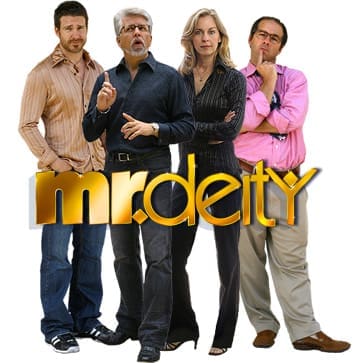
 In this episode we interview Brian Dalton, a former member of the LDS church, and founder of the Mr. Deity Internet TV series — which explores religious belief from a skeptical point of view, using satire. Mr. Deity focuses on the every-day life God, and everything He must endure as He attempts to manage His creation.
- In part 1, we discuss Brian’s early years, his experience with the LDS church, his disaffection from the church, his views on religion, and the making of Mr. Deity. Towards the end, we are very blessed to spend a few minutes with Mr. Deity Himself.
- In part 2, we captured Brian’s plenary address from the 2010 Salt Lake Sunstone Symposium, where Brian tells more of his story, and also acts out a few Mr. Deity scenes with his wife, Amy (Lucy/Lucifer).
Warning: Both the Mr. Deity show and this interview approach religion from a satirical perspective. Those who are sensitive to religious satire will likely be offended.
Part 1:
Episode Transcript
Host: John Dehlin · Guest: Brian Dalton
This transcript is machine-generated and lightly edited for readability. The audio is authoritative. Please excuse occasional errors in names and spelling.
Introduction and Welcome
Part 1 of 2 · Ep. 205
John Dehlin [00:00:00] Mormon Stories Podcast is made possible through the financial contributions of its listeners to keep it alive and available to future generations. Please consider a donation today@mormonstories.org these interviews are not only available in audio format, they're also available in high definition video@YouTube.com MormonStories Brian Dalton, welcome to Mormon Stories Podcast.
Brian Dalton [00:00:24] Thanks for having me. I appreciate it.
John Dehlin [00:00:27] Oh, yeah, it's a pleasure. We're Here at the 2010 August Sunstone Symposium in Salt Lake City, Utah. Brian's about to go on stage and perform in front of a live audience. Is this your first Mormon audience you've ever performed in front of?
Brian Dalton [00:00:41] Well, no, because back in the day, I did a Mormon album with my partner Paul Steenhoek, which we recorded for Embryo Records, if you remember that back. Lex d'. Azevada. Yeah, yeah. And so we toured the whole western United States with our music and our message, rock and roll. It was kind of. What would you call it? It was more Barry Manilow meets Lionel Richie meets Mike Post.
John Dehlin [00:01:13] All right, sing us your favorite song from the other.
Brian Dalton [00:01:14] Oh, you know, you're never going to get me to sing those again.
John Dehlin [00:01:19] Well, once again, thanks for. Thanks for coming on the show.
Brian Dalton [00:01:22] Sure.
Brian Dalton's Mormon Background and Story
John Dehlin [00:01:24] So, in typical Mormon Stories fashion, let's start with a little bit about your story.
Brian Dalton [00:01:30] All right. I grew up Mormon. My mom was a true believer. My dad was less so. He joined the church basically to keep peace in the family was in it pretty much, you know, did the whole primary and scouts. And where were you living? In Long Beach, California, or right near there. And about 12. My parents, they were very old when I was born. In their mid, late 40s. They kind of just said, yeah, go off, do whatever you want. Now you're 12, whatever. So I kind of stopped going to church. And then I came back because I had a really good teachers. Is it teachers, teacher, quorum advisor, deacons, teachers, priest, quorum advisor who called one day, I thought this was really cool. I was 16. And he said, hey, you know what? You're technically part of my charge now. Can you just come in once Sunday so I can meet you, see who you are? If you never want to come again, that's fine, but I want to know who you are and just say hi and all that. I was like, that, there's a deal. I never have to go again. This is great. The guy was so dynamic and just one of these great, unbelievable speakers and teachers and funny and smart and all that stuff. And I thought, this guy's kind of cool. So I started going again. And then I had my big conversion over when I was about 17. I was kind of. I was kind of wandering. You know, I was really into rock and roll when I was younger, and I was very good at the guitar. I played very well early, so I was in with, like, older players. I was playing with 18, 19, 20, 26 year olds. When I was 14, I was playing on the strip in Hollywood. Sex was not in the picture yet, but the drugs and rock and roll were very high on the priority list. And was doing a lot of that and just kind of found out that it wasn't. I didn't want to live like that. So at about 15, I kind of checked out of that scene and just started kind of figuring out who I was, what I wanted. Studied a lot of Eastern religion. And I had been dating this girl for a while, and we split up that summer. And during it all, even though I wasn't gung ho on Mormonism, I'd given her a Book of Mormon, because that's just what you do. It's in the genes. So I gave it to her, and over the summer she started kind of looking at it. And then she called me and said, hey, you know, I've been reading this Book of Mormon. I'm kind of interested in it. You know, what should I do from here? And basically, I thought she was trying to get back together with me. I didn't want to have anything to do with it. But then like a day later, she called me and she said, you know, the Mormon missionary stopped by my door yesterday. And I saw that as miraculous. That was a sign to me. So she started taking the lessons. I kind of took them with her and started learning more about my religion again from that and just had a big spiritual experience, testimony thing.
John Dehlin [00:04:48] So you got a confirmation?
Brian Dalton [00:04:50] Oh, yeah, yeah, yeah. I was in it about as deeply as you can get. And then like all things I do, I do everything, like 400%. So I studied like crazy. I would actually get up before seminary to study, then go to seminary and then come home and then just read, read, read, read, read. I devoured everything. That's just me. And I got very serious about it. And like I said, I did the album. We did an album of music together. And I ended up working with a Jewish theologian who does a nationally syndicated radio show. He didn't. He wasn't doing that at times. Dennis Prager and learned a lot more about Judaism. Met a much bigger, broad kind of cross section of religious people because he used to do this great show called Religion on the Line, where it was priest, rabbi and minister every Sunday night. Great show. And he taught me a lot about critical thinking. And he had encouraged me to write this book on God. And my. Some of it that started my way out was I realized I didn't really know both sides of that story. I knew the pro, but I didn't know the con. And I went and checked out a book and freaked out and tried to talk to him about it, but he didn't really know what he was talking about either. It was very depressing, and I kind of had to come to terms with all of that. I ended up just becoming a skeptic.
John Dehlin [00:06:29] No mission experience.
Brian Dalton [00:06:30] I started to go. I was going to go to Recife, Brazil, and I was in the missionary training center for about six weeks when we got the word that Lex d' Azevedo wanted to do an album with us. And I had to kind of choose what do I want to do? What do I want to do? What do I want to do? And I loved music. I'd been doing it my whole life. And I thought, you know what? I'm going to go do that. That was an interesting.
John Dehlin [00:06:52] How was that?
Brian Dalton [00:06:53] That was an interesting experience because you don't go. Come back. It's just not something anybody does. I got ostracized in a big way, hugely. From. Even some of my closest friends were like, your ward.
John Dehlin [00:07:08] Your ward community.
Brian Dalton [00:07:09] Yeah, my ward community. And pretty much the whole stake until the album came out. And then I was the hero of the day. And everyone started telling me, oh, this will touch far more people than if you'd gone to Recife, Brazil.
John Dehlin [00:07:22] I didn't go. Right.
Brian Dalton [00:07:23] Yeah, yeah, There you go.
John Dehlin [00:07:25] How many copies did it sell, do you know?
Brian Dalton [00:07:27] You know what? I don't really know, but it was just when Mormon radio was starting up. I don't know if it's still going in here, but we did well. We were selling well. We were touring all over. And the problem is you can't tour at a church and then sell the album. So you have to hope that people are going to go. And at that time, there was no Internet, so you were going to the. The bookstore, desert bookstore, or there was another little place. Times and Seasons is what it was called.
John Dehlin [00:07:55] Are they selling your album?
Brian Dalton [00:07:56] Yeah, yeah, yeah.
John Dehlin [00:07:57] Tell us the name of the album again.
Brian Dalton [00:07:59] It was called Speak to Me. Brian and Paul was the. Our group name. And. But we had a good time, you know, it was great. It's. It's, you know, like the height of Mormon rock. Stardom, it's hard to take. Aside from Donny Marie, we weren't in their league.
John Dehlin [00:08:13] But it's got to be hard to take advantage of the groupies when you're a Mormon rock star.
Brian Dalton [00:08:17] Yeah, you can't. You can't do it. I never got a chance to. Yeah, it was a bummer.
John Dehlin [00:08:23] No benefit. Dang.
Brian Dalton [00:08:24] Yeah, it started without benefits. That's exactly what it is. It sucked.
John Dehlin [00:08:30] Sorry, I didn't mean to sidetrack.
Brian Dalton [00:08:31] No, that's okay. It was kind of one of those gradual things where I just kind of moved out of it. I realized that I really didn't have the talent to be a Mormon. I think a lot of it had to do with my dad's skepticism. And he was. He's just. You know, he just didn't buy anything and needed kind of proof for everything. And I think I was, deep in my heart, an empiricist long before I realized that I was. And so the empirical case for Mormonism started to break down for me. But also, I didn't like what the church was doing back in the 90s. And in particular, when the September 6 thing hit, that was pretty much it for me. That was my Galileo experience where I said, okay, you know what? This is just crazy. So I tenured my letter of resignation, as I like to call it, and ran it over to my bishop. And I think he knew what it was because I had it in an envelope, and I fully expected that he would open it up there right in front of me. But he didn't. He was just kind of, you know, and honest to God, I thought when I sent it in, I thought there would be some swarm of people coming to try to bring me back into the fold. There was not one where they wanted to get rid of me as much as I wanted out of there, I think, because I had started to kind of question. I had to stop going to church at one point because I realized they're not here to ask questions. They're here to drink the. I don't want to say the Kool Aid.
John Dehlin [00:10:01] It's a ritual. I've heard it described as a ritual.
Brian Dalton [00:10:03] Yeah, it very much is a ritual just to build the faith. Build the faith. Build the faith question and get answers. That kind of stuff. Yeah.
Discovering Difficult Church History
John Dehlin [00:10:11] So now, had you dug into polyandry and peep stones and, you know.
Brian Dalton [00:10:17] Yeah, yeah, yeah. I mean, I was a big. Just before I left, I was a huge Michael Quinn fan. Loved Sunstone, loved Dialogue, read it religiously, no pun intended. And, you know, I Knew my Mormonism backwards and forwards. I knew it really well, and I knew that the archaeological case was faltering, and I knew that the DNA was becoming problematic and stuff like that. So that's why I said empirically, it was a slow kind of movement out of it. When I read B.H. roberts studies of the Book of Mormon, that kind of really makes you go, okay, we've known a lot of stuff for a really long time. And that kind of makes you feel like, boy, everyone's just. Just hiding something from you. It didn't feel right. So the excommunications were pretty much it for me. Because Michael Quinn, if you're a historian, you just show the guy where he's wrong. That's all you have to do. You don't have to excommunicate. So that was pretty nefarious in my book. And I just said, I'm out of here. One of my. The interesting things here is the first Sunstone symposium I went to was the year I left. And I was very worried about how I was going to be received by people if I told them what I'd done and everything like that. And it was the neatest thing where if you would tell somebody, they would say, are you Mormon? I would say, well, I used to be. I just left the church this year. I would get this every time. That is so courageous. I wish I could do that. Wow, okay. I'm here with my people. I can get into that. I can live with that. So I think it was a time where a lot of people were very unhappy. 93. Yeah, this is right in the heart of it. And a lot of people were, you know, and I get it. There's a lot of cultural baggage with it and, you know, just other things that keep people, you know, striving to do something with it. I didn't feel the need to do something with it. I just said, I'm done.
John Dehlin [00:12:30] How did you reconcile the spiritual experience that you had had?
Brian Dalton [00:12:37] I think when I was really, really honest with myself, my reconciliation was that I got what I wanted, that the human mind is plasticky enough to create your own experiences. Because I had some pretty big ones that at the time I thought, man, this is big stuff. But some of the stuff that I thought that I knew either didn't come true. Like in my own personal spiritual revelations that I was getting about. Well, one in particular about a girlfriend that I'd been with for a long time. I was dead wrong on that. And then when you do find out things like the empirical case that it's just not what you thought it was. And you've had such a great testimony about this thing that you. I'm 99.9 certain that the Book of Mormon events didn't happen. Okay? That, to me, is an empirically testable claim, which I think we have enough data on. When you know that you can do that to yourself, you start to. Okay, I can't trust my own instincts, my own feelings about these things. In essence, as I put it to a friend of mine, I don't trust my heart. Oops, sorry, I'm touching the mic. I don't trust my heart because my heart is a solitary thing. I can't bring my heart. I can't expose my heart to you in the most true way and have another heart speak out against. Maybe what it feels is not right in my heart. But I can do that with my brain. I can do that with my brain. My brain allows me to connect with other people in a way that I think ultimately is more reliable. That's basically what it came down to me. Do I trust my heart? Do I trust my head? And if I can't get those two in sync, I'm going with my head every time. And that's where it came in. Now, maybe that's just a very intellectual view, but it served me well. So far in the last 17 years, I've done well following that path because my heart is just full of blackness and horror and evil. So I don't trust my heart. I go with my head. My head's pretty good.
Leaving the Church and Family Reactions
John Dehlin [00:14:48] So did you catch grief by family or friends?
Brian Dalton [00:14:52] You know, what's ironic is that my dad was probably the most upset. He was more upset than my mother. And I think part of it was that he was like, hey, you can't do that if you can do that. I could have done that 25 years ago. I don't know. But he was very upset with it, and he was angry with me and really came at me. And my mom was pretty cool about it. She had kind of a peace about her with it. I think she was unhappy that she knew she was going to die because she died in. Oh, God, almost 10. Yeah, about 10 years ago.
John Dehlin [00:15:29] So 2,000.
Brian Dalton [00:15:30] Yeah. After a long bout with Parkinson's. And, you know, she'd always heard, you know, if you raise your kids in the church, you know, they might wander and whatnot, but they'll come back and that kind of thing. And she even said that to me one time. I said, I'm not coming back, Mom. Sorry, I don't want to break your heart, but you know it's not going to happen. I'm dead certain of that. But there was something probably disturbing in that about her. But I didn't want to leave any false illusions with her in terms of where I was at. And I wasn't anywhere near where I am today in terms of my views of everything that I was then. So it probably would have been worse for her had she lived on. But my dad, on the other hand, the. One of the worst things that happened to him is when my mom got sick. My dad was the guy in the ward who anytime, day or night, you could call on this guy. He was Johnny on the spot. And when my mom got sick, no one in the church was there for him. And it really took its toll on him because he was 82 years old, carrying around this 80 year old woman to the bathroom and, and making all the meals and really got no support. And it kind of set him to thinking. He's now on my team, on pretty much.
John Dehlin [00:16:54] He's still alive.
Brian Dalton [00:16:55] Yeah, he's 92. He's crazy as ever. But the missionaries still come over, the bishops still come over and he loves to give them a hard time. He just got done reading the God Delusion and the End of Faith and he can't take the Dennett book. But the other one that he had was. What's the other big one? Dennett, Harris Hitchens. Oh God, it's not great. And he likes to tweak the missionaries and the bishop when they come by. He's a little bit more of a sicko than I am because I'm not confrontational on a personal level like that. I don't need to get into it with people.
John Dehlin [00:17:38] But your dad does.
Brian Dalton [00:17:39] My dad loves stuff like that, yeah.
Brian's Professional Career Before Mr. Deity
John Dehlin [00:17:41] Tell us real briefly about your professional career. Just what are the main things you've done?
Brian Dalton [00:17:46] Well, it's kind of all over the place because like I said, I started in music and I did that for a while.
John Dehlin [00:17:52] Guitar. You were a guitar player?
Brian Dalton [00:17:54] Guitar and keyboards, Yeah, I kind of shifted early on. I played a lot of guitar and I studied classical guitar and I was very good, very young at that. And then I got turned on to keyboards. I was in a group with a guy who said, you know, can you maybe play some keyboard parts? The guy ended up being Roland, music's big thing, and now he has his own company where he creates some of the best sound stuff that you can buy. He turned me onto keyboards and I started seeing that I Could do a lot of stuff on my own. Particularly I didn't have to rely on a drummer. That was always the hardest thing in music to get a reliable drummer who wasn't just the biggest. I don't even want to talk about it. It was always hard to find a good drummer. So drum machines were starting to come in and hey, I can do a lot of this stuff on my own. And the synths sounded like strings or horns or you could pretty much program and do whatever you wanted. Now we look back and it sounds awful and the tools are so much better today. But it really did help me out. I did a lot of that. And then I got fed up with the music business because those people are just awful. I don't know how else to say it. I've been in quite a number of industries now. Nobody tops the music industry as just the most evil, awful people on the planet. So I got out and I thought, what am I going to do? I sold all my equipment and I ended up buying an Apple laser writer and a Mac. And doing. It started out as typesetting, laser typesetting at the time. And then I bought a guy's company and then I turned it into a graphic design company. And that's what I've done for 21 years until
John Dehlin [00:19:39] graphic design. Graphic design for websites and.
Brian Dalton [00:19:42] Well, it was pre website. I was there when desktop publishing really was desktop publishing. It was a pain in the tuchus and it kind of slowly transitioned over. I'm one of the Photoshop one users, you know what I mean? Or actually beta users. It goes back to that far. And I did a lot of work for the kbc. They were kbc, Disney Cap Cities, they kept changing hands. The radio stations in la, Radio Disney, kbc, klos, everything. Anything that needed to be done graphically, yeah, I would do that. And then a lot of the stuff on Clear Channel San Diego, those were my big clients. And in 2003 or no, 2001, a friend of mine and I had been talking about making movies for a long time because I used to make a lot of 8 millimeter movies with my friends and edit them the old fashioned way and stuff when we were younger. The Adventures of Dogman is one of my proudest.
John Dehlin [00:20:40] Are these on YouTube?
Brian Dalton [00:20:42] No. I don't know where you could find these. My friend has them from back in the day and I don't know where the heck they are or what, but
John Dehlin [00:20:50] they're time to give them a call.
Brian Dalton [00:20:51] I used to have this really long hair and if you put this nice dog Halloween mask over me. I turned into Dogman. It was our little spoof on superhero movies. But in 2001, my friend said, you know what? This digital stuff that they're starting to do now is getting kind of cool. We should make a movie. And he bought a camera. And so I bought a camera. And he said, now write something and let's make a movie. And I did this little film called Killing the Dream, which was about two idiots who wanted to make movies. So it wasn't too far from our life story. Just everybody was dumber than we were, which is saying a lot, by the way, because we're pretty down there. And it did well. It won a festival, and I got a director's award. And it kind of circled the country on the film festival circle, played in Europe. That's a text. I'm not going to get it. I'm paying attention to you. That's how much I love you. So we did well with that. And then we actually got a distribution deal. And everyone at ifp, the independent film project, was really behind the film. They helped take it to market and get it sold and everything. And when the distribution deal came in, they said, you know what? Don't take this deal. Remake this movie. Because if you do this, this and this. And Miramax liked it in Focus Features. And I talked with a guy from Focus Features and said, you know, if you did this, this and this, reshot it in high def and blah, blah, blah, blah, tweak the first act, you know, I think you'd really have something. So we actually started going out trying to get money to do that. And we couldn't find any money because we didn't have any names attached to it. And that's what it's basically come down to now. So I had written Mr. Deity and like, three episodes. Jimbo loved it. We tried to cast it with the people who were in my movie. I thought these guys would be good as Mr. Deity and Larry. Nobody wanted to have anything to do with it for the longest time. It sat there for probably over two years. And then Jimbo and I were on a video shoot. I had been doing video production since then. And he said one day, he said, you know what? Why don't we just shoot the darn thing? You play Mr. Dede, I'll play Larry. Let's see how it goes. You know, what can it harm? I said, okay. We had to shoot the first episode three times because I was so bad as an actor trying to. There really is an art to Directing and acting at the same time. It's so incredibly mentally consuming. You have to be paying attention to so much stuff in so many different areas all at one time, because we don't have a big crew when we're doing the show either. I'm doing sound, I'm doing lighting. I'm doing pretty much everything on the show, and then I'm standing in front of the camera, so it's difficult. And it took me a while just to get on top of that. One of my favorite stories is we shot the second episode with Sean where Sean plays Jesus. And I'm coming in and I'm telling him, you know, here's the deal. Here's the downside. And I would be in the middle of the take, and I would think, okay, I have a piece of direction for him here to make this better. But I didn't want to break the take because you don't want to mess with an actor's rhythm. And Sean's an old. He's been doing it for years. And then I'd say, okay, well, I'll tell him at the end of the thing. And, of course, what would I do? I'd forget what the direction was at the end of the thing until we're in the next. And then you remember, oh, yeah, that's what it was. So it took a little while, but we put the first three up on YouTube, and I guess it got a mention from somebody on Digg or Reddit or something like that, and the views started to skyrocket, and then YouTube put it on the front page, and then they went up even more, and the next thing we know, we had people, companies like Mosaic and Sony calling us to do it. And so it was just, you know, it's just this kind of meteoric rise to now our mediocre existence.
Creating and Producing Mr. Deity
John Dehlin [00:24:49] So what? It's an interesting artistic. Sort of. There's some interesting artistic choices in Mr. Deity. It's kind of campy.
Brian Dalton [00:24:58] Yeah.
John Dehlin [00:24:58] It's kind of fun.
Brian Dalton [00:24:59] Yeah.
John Dehlin [00:25:00] It doesn't feel mean. Talk about some of your artistic decisions.
Brian Dalton [00:25:04] Yeah, you know what? A lot of people have asked about that, and I think it's just the fact that I'm generally not a mean guy. I don't. I don't really have an axe to grind about this stuff. I do want people to think about certain things and certain aspects of these things that they believe that they've been brought up with, that they've been kind of indoctrinated since childhood that we don't really think about in A very concrete way. And so that's what the whole thing is about. It's about concretizing ideas that you believe, or at least you think you believe. But have you really thought this through to this next level? The favorite example of mine is Mr. Dede and the evil. The first episode where we understand that he's a good. He's an all good, all powerful, all knowing being. So you've got that classic trinity. So then the classic question of evil is, well, if he's all good and all those things, why do we have evil? Okay, well, at a certain point, what you realize in the creation of the universe, decisions had to be made about what evils were going to be allowed and what weren't because we're not capable of every evil that's imaginable. I can't wish you harm. And you know, like right now, you lose a leg. That's not possible. So there are certain freedoms in terms of free will that we're not allowed. The example we used in that episode is just that, that I can't. I can't wish you harm. But there's all kinds of things. We don't fall into an endless void just magically. And once again, I'm not answering that text. That's probably my wife going, where the heck are you? So it's all about that, what you realize. And really the idea of the Mormon God, who is a corporeal being and who exists in time, plays so perfectly to those things because you have a being who really did have to make a decision. Okay, well, let's leave in Holocaust. Let's leave in torture. Men, women, children, babies. Yeah, babies. And then you start to go, hmm, there's something a little janky about that. I'm not sure that I get that or, okay, I get that that's a problem now. But I'm going to have faith anyway. Okay, I respect that. But at least realize there are problems with those things and issues like free will. We have an episode coming up this season because it's the prequel season where they're doing a lot of the deciding about what's going to go down. And we have a whole issue about free will, which is one of my biggest pet peeves in religion, because everybody uses it to get him off the hook, and it doesn't get him off the hook. There's no getting God off the hook if he's ultimately responsible for everything, which is the idea.
John Dehlin [00:27:56] Unless it's a small G God.
Brian Dalton [00:27:57] Unless it's a small G God, which is very Mormon, which I kind of like in that regard. And we play with that. We do kind of play with that a lot. And clearly in this prequel season, you're going to see a lot more of the fact, like we've already mentioned, when he comes out of the void, you're not the God. There may not be a the God. You're just a God. And I don't want to give away what's going to happen in the season, but a lot of this is going to be. A lot of it's coming from my Mormon background and all of that stuff. We're not quite doing the war in heaven.
John Dehlin [00:28:28] Including his name.
Brian Dalton [00:28:28] Yeah, including his name, but we're not quite going to the war in heaven and the segregation of the 1/3, 1/3, 1/3 thing. But it's going to be fun.
Atheism, Deconversion, and Moral Frameworks
John Dehlin [00:28:41] So are you trying to deconvert people?
Brian Dalton [00:28:45] I don't know that I'm trying to deconvert people. I don't really care what people believe. But I do want people to understand that things that we believe actually have consequences. If you believe, for instance, that what you do doesn't count here, which I think is the most pernicious idea ever in the history of mankind, which is basically your Protestant, your generic Protestant Christianity, that our works and our actions have no bearing on what happens in this
John Dehlin [00:29:15] next world because we're saved.
Brian Dalton [00:29:17] Because you're saved. Yeah. You've said you're accepted Jesus as your personal lord and savior, and that's done. It's done. If you believe that, it's very easy to. Then people are logical. Whatever you want to say about them, they are logical and they are rational. The question is, are they starting from a premise that works or not? Because if you start from that premise, you very easily move into, well, you know what? If what I believe is the most important thing and this guy over here is saying something that is heresy and he's going to cause my son to end up in a world of eternal doom forever, then I might have good cause to maybe put him on the rack or put him in a strappado or put him on the stake and burn him alive because he's threatening something far greater than. There are really logical consequences to all of this stuff. The guys who flew the planes into the buildings were thinking logically based on the ideas that they were working from. So those things. What I want everyone to understand is that that kind of stuff has consequences in this world. And my biggest thing, my mission now is to get people to understand that these books that people think are holy, that contain the will of God. If people follow them seriously, the world will be a much worse place. And that we need to start using the tools that really have made the last 400 years the best 400 years on this planet for people in the West. And that is critical thinking, rational skills, freedom, democracy, all of the tools that we have laid out in both our Constitution, the Bill of Rights, and just post enlightenment thinking. I want people to really get that. It's not a comparison anymore. We know when people follow this stuff and take it seriously that it leads to hell on earth. So we've got to start rethinking this. You can still have the spiritual component. I would still consider myself a quote, unquote. I don't like using the term spiritual person, but to the extent that I find awe and wonder in this universe that is so beyond me. I still have that. I didn't lose any of that. In fact, in many ways, I think I gained more of that than I lost real quick.
John Dehlin [00:31:46] What about people who'd argue that science and reason unbridled by some type of religious moral framework can lead to atrocities like Hitler's regime?
Brian Dalton [00:31:56] Well, I think it can. I think the biggest problem is not. I wouldn't say it's religion per se. I think the biggest problem is ideology of any kind. Ideology and dogma. When people surrender themselves and their brains and their ability to think and fall in with. You know, Erich Fromm did a great book called Escape from Freedom, which was a study of Nazism and how people surrender their sense of identity to the greater group. When people do that every single time in history, you get trouble. To me, things like the scientific method which say we're never certain about anything. We've got to keep pressing forward. We might find another way to do this. Let's not rule anything out. This is our best guess right now. But let's not cement our best guess into being something that we have to hold onto. That, to me, is what religion is. Religion is. We had this great guess 4000 years ago. Someone took a really good guess. I think the world came about in six days. And I think that thing over there is a source of light, too. We have the big one over here. We have this small source of light. And I think there was no death before the 6,000 years. Okay? And we took a guess. They took a good stab at it. And it's very creative and it's beautiful and the mythology is great, great. But you cannot hold onto that and say, no, this is what it is. Despite the Evidence you have to keep moving forward and saying we have to be humble about what we think we know. And I find that more now, I know there are some very unhumble. Is that a word? Imhumble? They lack humility within the scientific community, I get that. But I think the basic tools in the self correcting kind of way. Because one of the great things I love about science is if you've got a theory X and it's come to be accepted and you can come along and knock down theory X, you're going to be a God, at least for the next 200 years or however long. That thing it really is based on the people who say, you know what, we were wrong about this. Get the applause. That doesn't happen anywhere else. It really doesn't. Where you topple another paradigm. I mean that's, it's an impressive little thing to see. There was a great story about the guy who first thought that he'd found the first extra solar planet, extra solar system planet. And he was going somewhere, I can't remember where it was, to present his data on this big paper. And in going through it, he rechecked it, this stuff, and he realized his data was wrong, wrong numbers. So he's there, it's a giant gathering, he's the main star because he's going to announce this thing and he goes up there and says, you know what, I messed up, I messed up, I got the wrong data. Everyone stood up and applauded the guy. I mean that's the beauty of kind of the self correction that I love.
John Dehlin [00:34:58] So science and reason should have humility.
Brian Dalton [00:35:01] Yeah.
John Dehlin [00:35:02] But that begs the question, what do we, you know, I hear often, what do we base our morality on if it's not a religious standard? It's just anything goes, it's all relativistic.
Brian Dalton [00:35:11] Yeah. You know, the problem with that is nobody lives by it. Nobody lives by these religious standards of morality. They all, when you ask a really religious person today, really. So how did you decide that murdering homosexuals was no longer something you found morally acceptable? Well, what it basically comes down to is they have the same methods for getting to their morality on that as I do. And there is no. The problem is that these questions of morality I think have been thought of completely wrong. The way we talk about right and wrong and all of that kind of stuff have this old world thing to it, but it's basically nothing more than what we prefer and what we want and what we think is good and not a chance for us to do the Best that we can do at the time, we have to keep. This is what we think is best now. But let's not hold onto it like it's God's word coming down to us because we might be wrong. Genocide, which was ordered by God in the Old Testament, not a good thing. We've come to that now. But we didn't come to it by God telling us. God told us just the opposite. If you believe the books, the same with homosexuality and adulterers and Sabbath breakers. They're all supposed to be dead. We're supposed to be killing them left and right. Nobody does that anymore. But they don't do it because God said, no, let's not do that anymore.
John Dehlin [00:36:42] You're saying that religious people base their God's morality on their own preferences, just like the same.
Brian Dalton [00:36:47] They do the same thing that we do. We all try our best to say what is good, what is right, and we have ideas and principles by which we follow that. I love the Golden Rule. One of the things I love about the Golden Rule is it's a pretty empirical standard. If you say, yes, I think this is right, and someone says to you, okay, then we can do that to you. Well, no, I probably wouldn't want to have that do. You can't fake that. You can't say, you know what? I think torture would be okay if I thought the guy was a heretic. Okay, well, we think you're a heretic. Can we torture you? Mmm. There's a very empirical element to the Golden Rule that I love, and it's powerful. But we have history now. You know, we can look back. You couldn't do that 3,500 years ago, and look back and say, you know what? When people do X, it does not lead to the good that we think it's going to do. When you wipe out an entire people who we think are bad at the time, it doesn't end up creating a better world. It just doesn't. So let's rule that one out. Okay? There's got to be a better way to do it. And it's another time where I think if we use the methods of science and critical thinking and the scientific method of theorizing. Jared diamond has this great idea in his latest book of doing natural experiments, which are pretty much. They've been done for us already in history. We can look back and look at the history and say what works, what doesn't happen. We have a much better base to judge that stuff on, particularly in terms of morality. We know that looking at Another people. And saying you're evil is going to lead to some terrible, terrible stuff. And you certainly can't do it for 2,000 years. You can't call a people the people of the devil and then be surprised when 6 million of them burn. It just doesn't happen.
Humility, New Atheists, and Public Discourse
John Dehlin [00:38:38] Back to this question of humility. I've heard some, even scientists or atheists say that Dawkins and Hitchens aren't great spokesmen because they're so, I don't know, some would say angry or they're so confrontational that they kind of give atheism a bad name.
Brian Dalton [00:38:52] Yeah, I think to a certain extent that's true. It's not my tact, and I don't know if it's my good Mormon upbringing or whatnot, but I have to be honest to you. First of all, I've met Richard Dawkins. I've spent a good amount of time with him. He's one of the sweetest men I have ever met in my life. I love him. He's just a really good guy. He's angry, I think, because to him and to me, to a large extent, the world is upside down and nobody sees it. And, you know, he gets. People are angry that he's saying these things about religion, organized religion, and he's coming very down on them and accusing them of great evils and, and whatnot. But the thing that I would hope that religious people would remember is all he's doing is talking. Okay? When we did the opposite 400 years ago and Christians had power, we burned at the stake. Giordano Bruno, Galileo got locked up for the rest of his life for saying, you know what? We might be going around that thing. There's a lack of perspective to me in how people like Hitchens and Dawkins are tolerated. That is historically ignorant. That's the only way that I can
John Dehlin [00:40:18] say it, because religion has no place to.
Brian Dalton [00:40:21] Religion has no place to say, oh, you know, you're offending me. Well, 400 years ago, offending me was you got you on a stake, it got you burned or put away. I mean, people don't. I think people just don't know. I've been doing a recent study just for deity background of the Inquisition. People have no idea what went on for 800 years. The fear that people lived in. They literally created the first terrorist state in the most honest way, where people were scared to death of whether their neighbor was going to say, you know what? I think Bob next door might be a witch because he's going up on the rack and he's going to have to give names. And if he doesn't, he's going to, you know, they're going to cut him at the gut. If they do, they might burn him, you know, give him a nicer death. That was the sweetness of that plan. But the other thing is, I have to admit, if I had the eloquence, particularly of a Christopher Hitchens, I wouldn't be able to control myself. He's so brilliantly and devastatingly witty in terms of his attacks. I couldn't do it either. Luckily, I don't have that kind of wit and I have to go with humor. That's the only difference between them and me. But I very much sympathize with them in my personal kind of view of things. I really like Sam Harris the way he has a very measured, reasoned. Not taking it. Not taking it. And I'm staying with you approach to the things. And I like Daniel Dennett a lot too. I thought his book Breaking the Spell is probably one of the most insightful books I think I've ever read in terms of religion. And he has a very different approach from Dawkins and Hitchens. But I get Dawkins point. And the other thing about all the Four Horsemen that I think people have to understand is I do think they see and they saw on 9 11. It's a whole new ballgame. It's a whole new world. You cannot tolerate this kind of level of rationality and then say, we're going to be okay because if people like that do get nuclear weapons and want to bring jihad to the world, it's going to be the end of this. And somebody has to start making that move in another direction because we don't have a leg to stand on. We really don't. We can't say to those people, well, you're silly for having these beliefs and whatnot. I mean, one of the things that cracks me up is everyone's so upset about this Draw Muhammad Day. You know, people are getting death threats for drawing Muhammad. The guys on south park and whatnot. And oh, that's crazy. That's just because of their stupid Koran and what it says and blah, blah, blah, blah, blah. And yet here we are denying equal protection to homosexuals because of a book. There's really no other reason. What it says in a book. That's it. There's no other rational reason to deny equal protection, the 14th Amendment to homosexuals and the right to marry, in my view, other than the fact that we have this book that says homosexuality is an abomination. So to me, it's the same thing on a different level. I mean, Christians aren't flying planes into buildings, but they've done some pretty awful stuff themselves. So I think whenever you think you know the will of God and you're pretty darn certain of it, you're going to get us into trouble.
John Dehlin [00:43:39] So let's take it personal for a second. I can see someone reading Hitchens or Dawkins or watching your show and thinking, oh, maybe. Maybe there's not a God. That can be terrifying.
Brian Dalton [00:43:49] It was for me.
John Dehlin [00:43:52] So let's say I'm a believer, but I'm flirting with atheism. Let me ask you some questions, and you make your best case to assuage my concern if I'm oriented in that direction.
Brian Dalton [00:44:01] Okay?
John Dehlin [00:44:02] So, number one, that's scary. Like, my world will fall apart. What about the afterlife?
Brian Dalton [00:44:08] It is horrifying. I spent probably two years doing what I learned later was called the ego death by a Buddhist friend of mine, where I literally had the hardest time sleeping when I left Mormonism and I left God and religion. In the afterlife, it's not just that I'm going to perish. I can endure that, that I'm going to be ended at some point. But the greater, more horrible thought that everything is going to end, there's not going to be any Shakespeare, there's not going to be any Louis Armstrong. All of the things that I love are going away forever. That is a tough, tough thing to overcome. And I don't. I don't have the world's best answer. One of my answers is I don't believe the other side has a really good answer. If you start thinking it through, like eternal, we're going to be on this new thing that we started. Way of the. Mr. We're going to start concretizing some of these things that aren't necessarily deity material. But we're going to show, okay, living eternally, what you do. Okay, the first 10,000 years, okay, we've knocked off that. We've done that. We've done that. What do you want to do now, Boy? These are ideas that people think about living forever, for instance, or living with God and issues of free will. When you think about an afterlife and free will, that's one of the things that we're going to address. When you get into this concept of free will, if you go to heaven, do you stop having free will? How does that work? Do I not get to choose if I want to Go do this if I want to, go do that. If I don't have my freedom in the afterlife, I don't want to be there. That's not someplace I want. I think all of these things are just things that people talk about and we want. I get that we all want to. No one wants to end, but I don't think that's. In a way, I think it's just a childish way to think. And I think at some point, you have to move beyond that and say, this is the life that I have. I have to do what I have to make the best of it. One of the things that I came about, there's the meaning question. What does life mean? What do I mean? My own personal philosophy is that there is no intrinsic value to my life. And what that motivates me to do is to make my life valuable. What that means to me is my life is valuable if it has value to another sentient being like myself, who is capable of assessing value. So all of a sudden, now I'm doing a lot more things for even just my wife, who, you know, I want to be a valuable person to her and to her life, and I want to be valuable to you, and I want to be valuable to this guy. My life needs. I need to have value. And the only way for me to do that is to become a person of value to other people. It's a little bit of a Robert Nosiak Nozick philosophy, but it really appeals to me that I have to. Because, quite frankly, I would rather have my life mean what I want it to mean than to be the guy. And we did an episode on this in the second season to be the guy who's a cautionary tale. You know, we had the idea in the second season that, God, they have. They play a card game for the meaning of people's lives. You flip over a card, oh, he's going to be a cautionary tale, you know, and we all know those people, their lives. Their lives have no value other than the fact that they serve to say, don't do that. Don't do what Bob did and move on. So, you know, what I would say is you do lose some of that stuff. But I think what you gain in terms of personal freedom and personal control over your life and what your meaning is and what your value is, it's a lot about taking responsibility and not letting people. You know, one of the things that I had to do is figure out what I think rather than. Because we grow up and we get all These things thrown on us and we take them on, but they're not our thoughts. And Robert Nozick, again, did say, Socrates said, the examined life is not worth living. That's too harsh. But it's certainly not our lives to live. If we haven't examined our thoughts and know who we are and what we really think, we're living somebody else's life. And so it's a quest for that kind of individuality and responsibility and saying, this is who I am, and this is what I really think. And all of this, for me, basically came down to one simple thing. What? Can I look myself in the mirror and say, I believe. I believe this, I believe that, I believe the other. And I simply couldn't. And maybe it's just part of my makeup and who I am and the way my neurons fire and the synapses are connected that make me a skeptic and all of these things. But at the end of the day, we all have to look ourselves in the mirror and say, yeah, I believe that, or, yeah, I don't. And the other thing about that is that at the end of the day, we all have the same thing controlling why and how we can say that. And that is reason. Everybody has reasons. No matter what you think you believe, there's a reason you believe it. And then the question you have to ask beyond that is, is that reason reasonable? Is it a valuable reason? And is it something I should pay heed to? In my case, what I found out that a lot of the things that I believe that just didn't have good reason, and I couldn't back them. And at the end of the day, I had to look myself in the mirror and say, okay, this is who I am.
John Dehlin [00:49:32] All right? So if I let go of God, I'm going to become an adulterer and a drug abuser. And that's what I did.
Brian Dalton [00:49:39] First thing, I went out and just had sex with so many women, it was frightening. You know, once again, if you can truly say that you think this is the most valuable way to live that for you and for other people, you know, I don't have a good argument against it, but again, it's one of those things where I think the Golden Rule works really well.
John Dehlin [00:50:03] But you're invoking a religious principle.
Brian Dalton [00:50:05] Well, but it does transcend religion. First of all, it came before organized religion. It goes back. I think the first enunciation of the Golden Rule is in the Hammurabi Codex. But again, it's another great empirical thing. Michael Shermer, in his Book, the Science of Good and Evil, he says, there's a very simple principle here. It's called the just ask first principle of anything you're going to do. Morality speaking. For instance, if you're in a marriage and you decide, you know what, I want to go have sex with the woman in my office, just go ask your wife if she's okay with it. Let's see how it goes. And if she approves, you're good to go. Never going to happen for most people unless you have some kind of open marriage. And then one can make empirical arguments even about that.
John Dehlin [00:50:59] But reason would say, if your wife doesn't know, then it can't hurt her as long as you don't transmit a disease to her.
Brian Dalton [00:51:05] Well, that's a foolish way to live, I think, because first of all, you know, and it affects your behavior in terms of how you. How you approach her. And if you've made oaths to people and covenants to people, you don't need God to be in back of enforcing that. You need some sense of integrity to say, I've said I'm not going to do this to this person and I'm not going to do that to that person. So either I'm going to do it or I'm going to not do it. And to the extent that you don't keep your word, you are no longer a person of value. You are no longer a person who can be trusted. And to the extent that I know that I can't trust you, you and I are never going to have a quality friendship or relationship. I remember driving out with a guy who I was working on a project with, and he started telling me that he'd been having this affair with this girl in his office for the last couple of years. And I knew his wife and kids, and we were all chums and everything, and he was finally opening up to me. There's one thing that I knew the second he told me that if this guy treats his wife and kids like this, I'm screwed. I don't have a chance with this guy because if he'll do this to people that he loves like that, the logical conclusion I can draw to him. He's not a person of value. I'm not going to be able to trust him until he gets this idea out of his head that he can just treat people like that. So water rises to its own level. We end up with the people that we're like. That's kind of a very Mormon idea where we end up in the three Heavens. Based on how we are and who we. We're going to be associating with the people who are just pretty much like us. And to the extent that you're going to just go out and break all the standards of decent society which make it possible for you, really, I think, to have the best life, I think you're in trouble. And I would just say, really, do you really think that's the best way to live? Again, use the golden rule.
Raising Children Without Religion and Life After Faith
John Dehlin [00:53:06] How about raising your kids without a God?
Brian Dalton [00:53:08] Well, I did it. I did it with my daughter because I left the church in 93. She was born in 90. And I don't think it's that much more of a struggle. I mean, if you're obsessed with. I always felt that my role as a parent was twofold to one, keep them from killing themselves or another, and to give them a real sense of being a good citizen and a good person in the society that you live in, that you will be a person of value in this community, that you will contribute and be that person. To say that you need some big being standing over you saying, you better do this, you better do that, and if not, you're going to burn in hell or whatever you want to do. That's not. You know, there's this idea of goodness for goodness sake. If you want your kids to be good for goodness sake, that's not it. That's being good to get the brownie points, to get you where you need to go in the next life. That's not creating a true person of value and integrity. That's a person living in fear. And a person living in fear is a person who can be easily manipulated to do great evil far more than a person who is living, learning to live a life of integrity and do what they really believe and what they feel is right. It's just too easy to use those things, to take those things that we've used to manipulate people to do what we think is good and twist them around. All of a sudden they're using them to do something that is terrible to others. And we've seen it throughout history. It's not debatable anymore. We have the data. We know how it works. That would be my argument to that.
John Dehlin [00:54:50] I need you to bring Mr. Deed. I need to talk to him for a little bit.
Brian Dalton [00:54:53] Okay, I can channel him. Let's see. Here we go. All right.
John Dehlin [00:54:56] Hey, Mr. Deity.
Brian Dalton [00:54:58] Yeah.
John Dehlin [00:54:59] I must say, it's an honor. Does this count as prayer?
Brian Dalton [00:55:03] Well, you know, I don't really answer prayers, so if you Want to count it as prayer? You can. I do. I have to flush my voicemail probably three times a day because they back up billions and billions and most of them are the same thing, you know. Thank you for this, thank you for that. Oh, and by the way, could you maybe do this and that and the other for me? I'm a busy guy, I don't have time.
Mr. Deity Episodes Screening and Discussion
John Dehlin [00:55:26] I just have a couple questions for you. Yeah. Why the glasses?
Brian Dalton [00:55:31] Well, you know, when I designed my look originally, when I came out of the void, I kind of played with it a little at first. Saw Larry, he had these glasses on before I did and I thought, you know what? I don't have the most interesting looking face. I think that would do a lot for my look. So it's a little bit of an affectation. If you notice, I don't have any lenses in. I do today because I just wanted to tweak you. But generally I just like the look, you know, it makes me look much smarter. And I'm very obsessed with looking smart because I've made some mistakes in the past that weren't too smart.
John Dehlin [00:56:10] So they're non corrective.
Brian Dalton [00:56:11] I'm sensitive. Yeah.
John Dehlin [00:56:13] Why did we lose a third right off the top in the previous? That always kind of. It seems like we could have done better.
Brian Dalton [00:56:19] I don't get that either. I mean, you got two plans, right? You got two plans. One from Jesse, No Jesus, thank you. One from Jesus says, let's give the people freedom of choice and everything. And then Lucifer, she's like trying to tell everybody, hey, why don't we just lock it down here and we're good to go. I thought it was clear we should have gone with Lucy's plan. But no, we gotta have this big war. Hundreds of. You cannot imagine the hospital bill for that thing. It was a nightmare. And that's why I said, you know what, we gotta do this on the ground because this is turning into a mess. And then you had those third in the middle who couldn't make up their minds. And you know, I hate people who can't make up their minds worse than anything. Either be hot or cold or I'll spew the out of my mouth. Which by the way, is disgusting because it's very slimy and wet and it darkens people. I don't know if you know that. Not my idea. By the way.
John Dehlin [00:57:22] Why the dinosaur bones?
Brian Dalton [00:57:25] Well, I mean, we had a choice. We could have gone with the six day model or the organic model. We decided in the end to go with the organic Model, which really messed up the whole script. And parts of the script got left in, left out. It's created a nightmare for me ever since. But we just let things roll and the dinosaurs came about and at a certain point, they just got too big for their own britches and they were hard to control, wouldn't listen to reason. So I had to take the old meteor and let them know who's boss. We took care of that pretty well, I think, but it's been a long time. It was a long time coming.
John Dehlin [00:58:07] Six day model.
Brian Dalton [00:58:09] Six day model. I think it could have worked, but it was so much more effort on my part. This thing. I light the match, let it roll and it goes, and it's pretty great. We had some pretty good science advisors on the thing and they said, this is what we're going to get. We've run these, the. What do you call them, when they run the. They figure it out on the computer beforehand how everything's pretty much going to roll out. I said, this is pretty much as good as the six day model. In the end, you get the same results. So let's go with that. I got to play a lot of golf in the meantime, me and Zeus.
John Dehlin [00:58:47] All right, who won?
Brian Dalton [00:58:50] Well, he cheats. You know, that's the thing. I have some integrity to me, and he cheats. You know what he does most of the time, that just annoys the hell out of me. No pun intended. He's constantly. When I'm trying to putt, he takes his putter and lifts up my kilt and, you know, then everyone can see the backside of me, which is how Moses got a peek in the beginning anyway. So it's annoying. And then it gets me angry, and then I miss, you know, I miss the putt. So he and I aren't talking right now because of that whole thing, in fact.
John Dehlin [00:59:21] All right, here's something I never understood. We're all making mistakes down here, yet somehow we're supposed to feel bad about it. Yet you created us. And then somehow someone else has to take the heat to make it so that we can go back. And I'm trying to figure out why we feel bad when we were made this way and then why someone else has to pay the price.
Brian Dalton [00:59:43] You know what? That's a good question. I don't have a good answer for you. It seems silly. I blamed the writers, you know, I said, give me a good script. We need a good story. They said, these people love blood. We got to throw some of that in there. So you got the Whole Jesus thing. I should never have put Mel in charge of that part of the script. That was a disaster. I learned now the guy's a tyrant. He's just a nut. So what did I know, though, at the time? Maybe if I'd been recording conversations of his earlier, we could have avoided this whole mess. It does seem crazy, I admit it. But, you know, what are you going to do? You got underlings. This is what they do. And I can't look over everything. I'm not an overseer. I just kind of. I'm the guy with the ideas. I know kind of what I want, but I'm not good at follow through. So not my fault. That's what I would say.
John Dehlin [01:00:35] All right, all right. Why are there so many dang churches? Why couldn't he just kept it simple? Which one's the right one?
Brian Dalton [01:00:40] Well, have you ever played telephone? You know the thing where I say something to you, you got to say it to them, they got to say it to them, they got to say it to them. That's basically the problem right there, is nobody can get it straight from what I said originally. Yeah. I mean, it just goes and goes and goes and goes. It would have helped if they'd had some kind of written language earlier. That would have been nice if they could have written these down. I put it on the tablets and then what does he do? Chucks them. And he had me write another pair. But I don't remember exactly what I said on the first one. That's why I did the first one originally. So we'd have it written down and he messed that up. So ever since then, it's a lot of. He said this, he said that? No, I think he said that. No, but does he mean this? And then, you know, all of a sudden you've got exegesis. You know, it's just crazy.
John Dehlin [01:01:30] So which church is the one?
Brian Dalton [01:01:36] You know, I like the Catholics a lot. I'm not sure that I'm at this point I'm ready to pick one. But based on the hats right now, I would go with the Catholics. They clearly have the best wardrobe. They're big, it's opulent. It's quite a show. I like show. If you saw the Big Bang, gorgeous. I had a lot of purples and blues put in. And then it turned into this whole red and green thing. Very Christmassy. Gorgeous. And the Catholics do that pretty much better than anybody else. So I like them. I like the Greek Orthodox too. They have nice hats.
John Dehlin [01:02:13] What's up with proxy work for the dead. That seems like a lot of work.
Brian Dalton [01:02:17] That wasn't my plan.
John Dehlin [01:02:18] Couldn't you have just, like, you know, if Jesse can make it right for us, why couldn't you have done some other little thingy? And now we're spending a thousand years doing stuff. I mean, I imagine people up in heaven, like, accepting. And then you're like, oh, wait a minute. You know, you're looking down.
Brian Dalton [01:02:35] Wait, yeah, okay.
John Dehlin [01:02:37] All right, you can go.
Brian Dalton [01:02:38] Well, you know, Peter's the worst at the pearly gates. He will not let you in if you don't have the right paperwork. In fact, we had a problem with him not letting in the FedEx guy because he didn't have. And I've told him I don't know how many times if it's a FedEx guy, any kind of delivery guy, you got to let him in, give him the two hour pass. He gets to find the office that's supposed to be delivered to. No, he won't do it. In fact, he chopped a guy's ear off several times. Jesus wasn't around either time to reattach. So the guy walked out with his ear in a bag of ice. But the whole proxy thing was not my idea. I don't know where that came from. I think people made that one up because it doesn't make any sense to me. Because for me, you know, you're in the afterlife. You would have accepted the boy. I just say, you know, let him in, give him a pass. Plus, you know, it's ridiculous having people take all this time out of their lives to go do these things. It's just time consuming. And I'm never for that. I want people to enjoy their life. You know, the first question I ask people when they come in is, why didn't you partake of every pleasure that I allowed? Not a lot of people answer that. Well, let me tell you that.
John Dehlin [01:03:43] Why Joseph? Why Joseph Smith?
Brian Dalton [01:03:45] Why Joseph?
John Dehlin [01:03:47] Well, 14 years old, farm boy.
Brian Dalton [01:03:50] I'll tell you why. Because we had a great meeting with him. He comes in, he has a lot of great ideas for the end times. He has this whole thing because we're very money conscious up there. Because this is not a proper universe. This is an indie universe. We don't have a lot of funding. He says, you know what I can get you a lot of guys going out, spreading the word. Good looking kids, white shirt, tie. We're not going to have to pay them a thing. In fact, they're going to pay you to do it. What do you think of that? I said, this is brilliant. I love this kid. Then he comes up with this great idea to do three heavens, only one of which really has to be the opulent thing. And not even a lot of people in that one. The rest, you know, it's kind of like Nordstrom's and then kind of J.C. penney's, then Walmart. And I'm thinking these two, we don't have to spend anything. We're good to go. I love it. So he got my ear on that one. And then he had some other great idea. I didn't find out later that the guy was a little nutty. He had this thing about not liking the blacks, not wanting them to have the priesthood. Didn't dig that at all. And then Lucy really got on me because he wanted to have multiple wives, which I know that he thinks. I thought that was a great idea. Originally, I did not say anything like that. I thought he said. When he said multiple wives, multiple lives. I thought he was talking about reincarnation or something. I thought it was a great idea. So we're in the meeting, he tells Lucy what a great idea I think it is. I'm in all kinds of trouble. I haven't talked to him since. I'll tell you.
John Dehlin [01:05:28] That was Brigham who did the blacks thing. I think Joseph was okay, that's right.
Brian Dalton [01:05:32] His Larry. That's right. That's what I call Brigham. He's Joseph Sly. Yeah.
John Dehlin [01:05:39] So why women always get the raw deal? Well, you know, blacks, we like. Blacks get it before the raw.
Brian Dalton [01:05:47] I'll tell you why. You know, when we were running the six day model, every single time it was the woman who would take from the tree. Every single time Adam didn't want to have anything to do with it. He would just say, no, not going to do it, not going to do it. No matter how many times Lucy would go down to talk to him, whatever she was dressed in, I don't care how seductive she looked. We could not get Adam to partake of the fruit. But the woman would go for it every time, often because Lucy would promise a shopping spree with shoes involved. So I just thought, you know what? Let's give them hell. I mean, they really do deserve it. Because if this is what we're going to get from them, if this is their best and it's a foolproof, you know, that's just the way they're going to be. We got to give them the short end because someone's got to get the short end. That's just the way it goes in Life, you either have the guys getting the short end or the gals getting the short end. Now it's kind of flipped. It started to flip a little, and I'm okay with that now. You know, I wouldn't have given them the right to vote, but, hey, that's you.
John Dehlin [01:06:49] All right. How about the blacks?
Brian Dalton [01:06:52] The blacks. I don't understand where that came from, because I love dark skin. Absolutely love the dark skin. Larry and I lay out all the time. He loves rubbing the cocoa butter on me. I think that's a little weird, quite frankly, but I enjoy a good tan job. Had a great tan. Don't know if you know that, because once we took everything out from him, he was pretty much out in the sun all day. So he was always. He was looking great all the time. And that's when I fell in love with that look. I said, this is pretty good stuff. We got to do that. Unfortunately, I forgot to tell my people that, you know, the dark skin is good. So the blacks have, like. The ladies have kind of gotten a raw deal. But that was my bad, so I'll accept that one.
John Dehlin [01:07:36] And the gays, too.
Brian Dalton [01:07:38] Gays. That was just a mistake. I had been talking to Larry. I don't even remember how we got onto the conversation. We were talking about homosexuals. And I thought, they're great because they have design sense and, you know, they always create great communities. Cleanest parts of town, best shopping, really. And then I said something about. We got into politics and I thought that America could become an abomination. That's what I said, abomination. And he thought that I said homosexuality was an abomination. Got into the script, got to the printers before we could cut it. And it got in there somehow. I don't know how, because they never. They have not paid me a dime, by the way, for my book. I have not seen one cent on the royalties. I don't think it's ever going to happen at this point. I think we're going to have to get the lawyers involved, who I hate, by the way. Hate lawyers. They muck up everything. But I think we're going to have to actually do that. And in that, we're going to get that. We're going to see if we can get the abomination thing taken out.
John Dehlin [01:08:41] All right?
Brian Dalton [01:08:42] And I was right about the obomination, was I not, John?
John Dehlin [01:08:45] You were.
Brian Dalton [01:08:47] We have a black president.
John Dehlin [01:08:48] All right, so let's say, you know, world ends, we all come up to live with you. What are we going to do?
Brian Dalton [01:08:55] I don't know. You know, we've been thinking about that because we were thinking for a long time, are we going to do an afterlife or not? Because it's expensive to do. First of all, people don't realize there's a lot of cost involved. And then are you going to segregate everybody? Are you going to keep the good guys from the bad guys? Do we really have to do the hell thing? Hell is really expensive. Got to have a lot of workers tormenting people all the time. And then it's bad for their psyches as well. You know, people never realize the human cost.
John Dehlin [01:09:22] Plus the heating, the heating bill.
Brian Dalton [01:09:23] Heating is unbelievable. And then Lucy has to have all of her sections air conditioned. That's another expense. So I'm not sure what we're going to do. I think if we could just maybe have a few live for a while at a time and then they go away and then we just keep cycling because I don't think anyone would really want to live forever. It's going to get boring at some point. You've pretty much done it all.
John Dehlin [01:09:47] Aren't you bored?
Brian Dalton [01:09:48] I'm kind of bored, yeah. That's why I shut off my all knowingness. All knowingness is awful. I mean, it ruins everything, Particularly the ending of M. Night Shyamalan movies, even the good one.
John Dehlin [01:10:00] I think it's Shyamalan. Oh, is it bad to correct me, Shyamalan?
Brian Dalton [01:10:03] It's probably bad to correct me. We'll see. You could end up down there with Lucy now. Correcting the deity. Who do you think you are, man? Jeez Louise. Let's see how long you live, huh? Watch out for the bus. That's all I'm gonna tell you. Okay. When you step off a curb every time, you're gonna be thinking of me.
John Dehlin [01:10:28] All right. Thank you, Mr. Deity.
Brian Dalton [01:10:31] You're welcome.
Closing Reflections and Farewell
John Dehlin [01:10:33] All right. Well, Brian, we really appreciate you coming on Mormon stories today.
Brian Dalton [01:10:39] Sure had a great time.
John Dehlin [01:10:40] Yeah, it's been fun. Let's just end real quick with, you know, if you have any final. I don't want to say your testimony, but if you have any closing thoughts or feelings or convictions or words of wisdom. I know my 12 year old, my 14 year old daughter is going to be watching this interview. They love your show.
Brian Dalton [01:11:00] I have something very important for everyone. Go to mrdeity.com and subscribe or donate to mrdd.com to keep it going and buy the DVD because it's great. We have a lot of extra stuff. Other than that. I just want to tell people, you know, everybody has to start thinking of this stuff in a little bit more rational a way because aside from just the danger that can come about by taking this stuff too seriously, which all I have to say is 9 11, 9 11, 911 to get that point across, I think it does create very divisive things because these ideas, if they're immune from reason, then there's really no way for us to discuss them rationally and calmly with each other. In the end, what it comes down to is we've got to fight to see whose God is better and whose God is on what's. Or whose side God is on. That's another thing that just empirically, throughout history just continues to plague us on and on and on. But mostly go to mrd.com and subscribe or donate. We gotta keep this show going. What we're trying to do with this show, what we really want to do is at some point be able to do this in a 30 minute kind of one camera sitcom thing. Right now there's no one in America who has the guts to do it. Apparently because my managers talk to all of them. They're all scared to death, mainly about the center of the country. So we might have to go elsewhere, to Canada or Great Britain or.
John Dehlin [01:12:27] But if Penn and Teller can do something.
Brian Dalton [01:12:29] I know that's what I thought. Why Penn and Teller? Why can they do their stuff or Californiacation you'd think that would be. But you know what? When it's about God particularly, it's dangerous. It's dangerous turf. Particularly when, you know, when the economy is like it is, they don't want to take chances. No one in Hollywood wants to take chances. And I get it, I get it. But that's why people need to support this effort that we're maintaining.
John Dehlin [01:12:57] Do you think humor and art is a much more effective delivery vehicle for the message?
Brian Dalton [01:13:02] I think for some, I think it takes everything. Anything where you're trying to make big change happen. You gotta have Martin and you gotta have Malcolm. One side is gonna do it for everybody. Some people need to have someone who's more militant, like a Dawkins or a Hitchens, pound them over the head. Other people can be just kind of gently persuaded and some can just laugh their tucuses off to it and then start really thinking about it. So there's no one approach, I think that works in general. And I'm going to do my thing. This is what I do well. And I'm just going to keep doing that and see what happens.
John Dehlin [01:13:42] So listeners, viewers. MrDady.com make a healthy, sizable donation.
Brian Dalton [01:13:48] There we go.
John Dehlin [01:13:49] Take the donation you might have given to this podcast for this month. Give it to the deity. Wow. I think you could generate your own money, be the deity.
Brian Dalton [01:13:58] You just bought yourself some safety from the bus, let me tell you. That right there.
John Dehlin [01:14:01] Did I fix it?
Brian Dalton [01:14:02] Yeah, you fixed it. There we go. That's it.
John Dehlin [01:14:04] You're set.
Brian Dalton [01:14:05] That's all it takes. That's why the collection plate goes around. That's what's important.
John Dehlin [01:14:12] Thank you. Brian Dalton, thank you. Thank you for joining us today on Mormon Stories. To comment on this episode or to discuss it with others, please check us out online@mormonstories.org if you want to find other friends, family members, former missionary companions, or ward members who approach Mormonism like you, consider adding me, John Dehlin, as your Facebook friend. This may seem like a strange idea, but many of my closest friends have discovered that they are not alone in their thoughts or feelings or family or even word situation through discovering mutual Facebook friends. Finally, to keep Mormon Stories alive, please consider a donation@mormonstories.org. It.
Part Two Introduction and Mr. Deity Clips
Part 2 of 2 · Ep. 206
John Dehlin [00:00:00] Mormon Stories Podcast is made possible through the financial contributions of its listeners to keep it alive and available to future generations. Please consider a donation today@mormonstories.org these interviews are not only available in audio format, they're also available in high definition video@YouTube.com MormonStories
Brian Dalton [00:00:23] thank you. Oh, I like this guy. You're coming with me. You just go wherever I go. Let my people go to Sunstone. That's wow. My people, my former people. I'm sorry I can't be totally amongst you. I don't know how I follow Sister Dottie. I don't know how I do that. I've been thinking through my best material and I don't think I have anything that can compete with Salamander Handler. And I'm not ashamed to say if I was ever going to turn, David Hasselhoff might do it for me too. But I'm generally more a Clint Eastwood guy. Now, I'm not going to assume everybody here knows what the show is or has seen everything. So let me give a little introductory before we play this first clip. I play God on the show. If you didn't catch that from the introduction there. Now I want to say in general, I am not for people playing God. However, like most people, if I'm the one doing the playing, I'll allow it. I don't mind it so much. I just don't want you doing it. Now, the God of Mr. Deity I think Mormons recognize probably far more than any other religious group because my Mormon background absolutely comes into it. The great phrase as man now is God once was, as God now is man may become is pretty much the essence of this, except for he's a Hollywood producer basically is what it comes down to. And he's running a low budget indie universe and things don't go right and he has to handle things in ways that maybe a big G, capital G, God wouldn't. So now here's some of the funny background of this show. I wrote this show. I wrote the first episode, I want to say, after the Asian tsunami. We're going to run that in just a minute. It's called Mr. Deity and the Evil. And when something like that happens, when we lose 250,000 people in the blink of an eye, basically, it's hard to imagine a good and loving and all powerful God. The classic problem of evil. So I wrote this episode and I was trying to find somebody to play the role of Mr. Dee Dee and Larry, who is Mr. DeeDee's long suffering assistant and to Answer your questions. No, he is not the Holy Spirit. I get a lot of that. I tried casting this for two years. Nobody wanted to do it. Everyone thought it was a little risky. They didn't want to be typecast. I knew I wanted to do. I knew I wanted to do a series of these, a long running series of this. So it would take quite a time commitment. And Jimbo, who plays Larry, is a working companion of mine. We did a lot of video production together. We're driving back from the shoot from hell, no pun intended. And Larry says, you know that thing that you've written, that deity stuff? That's pretty good stuff. Why don't we just do it? Why don't you play Mr. Deity, I'll play Larry. You've already got a bit of a God complex, so it should work. And we ended up shooting the first episode, which is this one. We shot this three times because I was so phenomenally bad in front of the camera. I had directed a feature film before this and one other short. You will never see any of those other episodes. This is the third take of this. It's a whole new thing, standing in front of the camera and doing this kind of stuff instead of just watching and looking on. Now we had. By the second episode, I knew we had the Jesus character, or Jesse, as Mr. Deity is wanting to call him because he can't remember his name. Who was an actor friend of mine, Sean Douglas, who. You got to hand it to the guy. I'm telling him, you know what? Why don't you come play Jesus? It's not the traditional Jesus. You might take a little heat. Come on, let's do it. Have some fun. And, you know, he's a good Texas boy. So he went for it. Our final cast of four that we had to figure out was I was working on an episode where we. Can someone get that? You want me to get it? Can I get it? I would love to answer it. Whoever's calling, they better not step off a curb, you know, without looking both ways. That's all I'm going to say. I had an episode where I was going to be introducing the character of Lucifer. I didn't have the episode fully written, but I knew I had this line where I wanted Mr. Deity to be messing around with him. And he says to him, you know, Lucy, you got some splaining to do from the I Love Lucy show. My good friend, who was just in the midst of starting to go through a divorce with his wife, suggested, you know, who would be great as Lucy? My ex wife, huh? Because she's giving me hell right now. And she's an old friend of mine. I've known her for 20 years. Amy Roren decided to come on and take the role of Lucy. And that led to a good turn for me because we ended up getting married about a year and a half ago. Big win for me. If you've seen this show, you know how gorgeous she is. So I'm a lucky guy. So let's run this first episode. This is Mr. Deity and the Evil. And then I'll come back up and say a few words about the second episode before we show that. And can we dim the lights a bit? Yeah. There we go. Wow. So what do you do you hear that? Is it supposed to sound like this?
▶ Video Clip 1Video Clip 1 [00:07:40] Mr. Deity. I think it sounds great, Larry.
Video Clip 1 [00:07:44] The whole thing is a train wreck. It's.
Video Clip 1 [00:07:46] Sir, you're being a perfectionist.
Video Clip 1 [00:07:47] Well, yeah.
Video Clip 1 [00:07:48] You had six days for this project.
Video Clip 1 [00:07:51] Actually, I had seven, but there's no way I'm coming in tomorrow now. I'm so depressed.
Video Clip 1 [00:07:54] Okay, well, then we really should wrap up the whole evil thing,
Video Clip 1 [00:08:00] sir.
Video Clip 1 [00:08:00] Mr. Deity. What you're allowing. What you're not allowing.
Video Clip 1 [00:08:05] Okay, where were we?
Mr. Deity on Suffering and Free Will
Video Clip 1 [00:08:06] Well, we last left off. We had decided. Well, actually, you had decided, sir, that you weren't going to allow people to harm each other with merely their thoughts.
Video Clip 1 [00:08:15] That's good. That's good.
Video Clip 1 [00:08:16] Right, next up, kind of a biggie Holocaust.
Video Clip 1 [00:08:19] Yeah, I'm gonna allow it.
Video Clip 1 [00:08:22] Okay, holocausts in. Next up, torture. Broad brush here you got men, women, children, animals, babies. Babies, yes.
Video Clip 1 [00:08:30] Yeah, we're gonna leave it in.
Video Clip 1 [00:08:33] Okay, torture's in. Sir, you are all powerful.
Video Clip 1 [00:08:37] Right?
Video Clip 1 [00:08:39] What is it?
Video Clip 1 [00:08:39] What is it? I mean, I was just thinking because the list.
Video Clip 1 [00:08:43] It was just
Video Clip 1 [00:08:47] because the list. Okay, moving down the list, sir. Down syndrome.
Video Clip 1 [00:08:52] Down. Why does that refresh?
Video Clip 1 [00:08:55] Birth defect. Causes a mental retardation, has the certain morphological consequence.
Video Clip 1 [00:09:01] Oh, yeah, it's awful. It's so sad.
Video Clip 1 [00:09:04] Yeah.
Video Clip 1 [00:09:05] Yeah, let's leave it in.
Video Clip 1 [00:09:07] Okay, down syndrome in. Well, the next one. I checked with the boys down in research on this. Said we're safe to leave it out.
Video Clip 1 [00:09:15] What is it?
Video Clip 1 [00:09:15] It's that natural disaster compliment. The earthquakes, fl. Tsunami.
Video Clip 1 [00:09:19] Yeah, I need to have that in.
Video Clip 1 [00:09:21] Well, sir, I actually spoke with the head of RD myself on this one, sir. Sir, I spoke with the head of R D. Okay. He said if we leave this out, it's not gonna affect anybody's free will.
Video Clip 1 [00:09:32] Or Pilot.
Video Clip 1 [00:09:34] Yeah. Natural law or anything like that. And since you're way over quota on the Gratuitous pain and suffering.
Video Clip 1 [00:09:39] Here's the thing. If we take it out, it's gonna be way too easy for people to believe in me.
Video Clip 1 [00:09:42] No, sir, let me go over the list. Holocaust, torture and down syndrome. Those three alone make it believe in you.
Video Clip 1 [00:09:52] I don't think so, sir.
Video Clip 1 [00:09:53] Really?
Video Clip 1 [00:09:53] If you had the natural disasters, you got earthquakes, floods, tsunamis. You throw in a hard winter or two, no one's gonna believe in you.
Video Clip 1 [00:10:00] Sure they will, sir.
Video Clip 1 [00:10:02] I really don't think they will.
Video Clip 1 [00:10:03] For how much? I'll bet you a C note and I'll make you archangel. Several.
Video Clip 1 [00:10:06] But, sir, I don't want to wager with you.
Video Clip 1 [00:10:08] Because you know you're wrong?
Video Clip 1 [00:10:09] No, because I know you're the God of the universe. The all knowing God. You can see the future. All is present with you.
Video Clip 1 [00:10:17] Okay. That's a future. That's a good point. That's fair. 10 to 1.
Video Clip 1 [00:10:21] Sir, please don't insult my intelligence.
Video Clip 1 [00:10:25] 100 to 1. 100 to 1.
Guest [00:10:28] You're on.
Brian Dalton [00:10:28] Okay, so is that it? Can we go or is.
Guest [00:10:30] No, not even close. Conjoined twins.
Brian Dalton [00:10:34] We're gonna be here all night. Yeah, yeah.
Guest [00:10:36] Yes.
Brian Dalton [00:10:36] Leave it.
Guest [00:10:37] Okay. Conjoined twins. Lou Gehrig's disease.
Brian Dalton [00:10:40] Yeah, leave it in. Oh, but wait for Luke. Wait for Lube.
Guest [00:10:44] Makes sense. I assume you have no problem with childhood canc. Celine Dion.
Brian Dalton [00:11:04] The last one is Celine Dion. The evil that woman is perpetrated on this planet. So what happened was we shot this, the second one, which we'll show in a minute, which is Mr. Dee Dee. And the really big favor, where Mr. Deity basically cons Jesus or tries to into being the savior for this planet. We had to shoot that one twice, too. That time it was just because I was a bad director. When you're actually acting in a scene and trying to direct, it's very hard because you'll have notes for the other actor which you really can't break immediately. Wow, that's bright. You can't break the scene, particularly with someone like Sean. Sean's a seasoned actor. He's been in a lot of stuff. He's been on TV quite a bit. Many of you may have seen him in the Dodge Charger super bowl ad. This last super bowl, big long push in on him. He doesn't have any lines, but he's staring directly into the camera very intensely, like only he can do. So you can't really break. And what would happen was I would get to the end and I would think, okay, I got to tell him that note that I had for him in the middle, and then I'd forget the note and we'd just go through. So we had to shoot it again. And he still wasn't. He had a really hard time getting the character as I saw him. And I finally. He told me later, he said, you gave me one piece of direction that instantly made me get this character. And that was. I said to him, you know, you weren't my first choice. The way I saw it was as a casting kind of casting audition in which Mr. Deity had been through his top maybe 15, and they'd all passed, you know, there was not enough on the back end, I guess. So he finally got the character and we ended up shooting this. The way this thing worked was we shot three. The next one was called Mr. Deity and the Light, where they realize Mr. Deity's messed everything up because he had the guy install the clapper for the light, which doesn't really work when everyone applauds. So on, off, on off, we shot three of these and we put these up. The reason we put them up, we were working on a website, and we were going to do this somewhat like the ninja has done his stuff. And Jimbo called me early, early, early. It must have been like January 3rd or something. He says, have you seen this show on YouTube? It was called God Incorporated, which was basically the Office with God's people, which I thought was a very clever idea. And he said, if we don't put this up now, everybody's going to think we're just copycats. We'd actually had these sitting around for probably four months, and we weren't ready to launch yet, and we had to launch them. We got a good word somewhere. I think it was on Digg. And the views started to shoot up on YouTube. And then YouTube noticed, and they said, well, this is getting a lot of attention. Let's put it on the front page. They put it on the front page, it got even more. And the next thing you know, we're getting calls from Sony and Mosaic and a lot of big media companies. And we ended up doing our second season with Sony, but we're back now on our own. We did a whole third season last year, 21 episodes, which we generally. They were up until that time, only 10. We've done 21 in the third season, which we have on DVD. I don't know. Do we have any of those? We might, yeah. Okay. Those might be for sale afterwards. I don't know. But let me show you this. This is called Mr. Deity. And the really really big favor, and I think you'll see why. Let's run that. So, yeah, that's. Obviously, that's the downside. But, you know, after three days, we bring you back to life, and from that point on, it's a slam dunk.
▶ Video Clip 2Video Clip 2 [00:15:34] Three days? I gotta be down, sir.
Mr. Deity on the Atonement and Jesus
Video Clip 2 [00:15:37] You know, I said three days in the prophecies, but, you know, this fudge room we could have. We could put you down late Friday, all Saturday, and then, you know, raise you up at the crack of dawn on Sunday. So 36 hours, tops. 35. If we did it on the week that they set the clocks for.
Video Clip 2 [00:15:55] I don't know.
Video Clip 2 [00:15:56] Well, you'd be doing everyone a really big favor.
Video Clip 2 [00:15:58] Yes, sir. And what's in it for me, again, sir?
Video Clip 2 [00:16:01] Well, like I said, you'd be a partner.
Video Clip 2 [00:16:02] Junior partner.
Video Clip 2 [00:16:03] No, no, no, no. This is full partner, completely equal, one third vote. Plus.
Video Clip 2 [00:16:07] Keep talking. Sir. Yeah.
Video Clip 2 [00:16:09] Plus, this could be a really good career move for you. You know, get you in on the ground floor.
Video Clip 2 [00:16:13] Yes, sir. You know, I must say, I really appreciate that offer. It's just. I just. I guess I don't know why you can't just do it yourself. Sir.
Video Clip 2 [00:16:25] Look, you know, I'd love to do it. Yeah. I'm not. I mean, I'm not chicken, if that's what you're. I mean, I don't know that that's what you're implying, but look, there's a lot of stuff to be done here still, Larry. Can't do it all. It's time, is what it is to take time. Trying to get the time off. Can't do it,
Video Clip 2 [00:16:43] sir.
Video Clip 2 [00:16:43] And why can't you just forgive people again?
Video Clip 2 [00:16:46] Because of this whole sin thing that's killing us. Sin equals death. So you go down and lead a completely sinless life and death has.
Video Clip 2 [00:16:53] No, sir. Did you say that I have to
Video Clip 2 [00:16:56] lead a sinless life? I said that before.
Video Clip 2 [00:16:58] I.
Video Clip 2 [00:16:58] No, I know you do. I'm pretty sure I did.
Video Clip 2 [00:17:01] I.
Video Clip 2 [00:17:01] No, I.
Video Clip 2 [00:17:02] No, sir, you didn't. No, I trust. I'm sorry. I would have remembered that.
Video Clip 2 [00:17:06] Well, I apologize then, because I.
Video Clip 2 [00:17:09] It's Larry.
Video Clip 2 [00:17:09] I gotta take this. Hey. Hey, Lare, you're on speaker with me and Jesse.
Video Clip 2 [00:17:13] Jesus.
Video Clip 2 [00:17:14] Jesus. Sorry. Hey, Larry. Hey, where are you?
Video Clip 2 [00:17:17] I'm about three feet behind you, but I am in the 13th dimension. I was talking with the Foreman earlier and we're trying to decide how dark you want to go with the dark matter.
Video Clip 2 [00:17:27] Yeah, take that all the way to Void and then back at office, Coach.
Video Clip 2 [00:17:30] Oh, okay. Great. Thanks.
Video Clip 2 [00:17:31] Hey, Wait, wait, wait, wait. Jesus was wondering.
Video Clip 2 [00:17:34] The health plan does not cover crucifixion.
Video Clip 2 [00:17:38] That's good. That's good. Did you just come up with that, or is that material? Yeah, yeah. Did you hear that? Yeah, no, he was just wondering how he does the whole sinless life thing.
Video Clip 2 [00:17:48] Oh, it's. It's fully God, fully human.
Video Clip 2 [00:17:51] Oh, I came up with that. Right?
Video Clip 2 [00:17:53] Yes, of course, sir.
Video Clip 2 [00:17:55] Okay. All right, I like that.
Video Clip 2 [00:17:56] Yes.
Video Clip 2 [00:17:56] Okay. So when are you coming back?
Video Clip 2 [00:17:57] Tuesday, sir.
Video Clip 2 [00:17:58] Tuesday. Okay. Well, how about this, you schmuck? Why don't you bring me back something this time, all right? Get me a T shirt or something.
Video Clip 2 [00:18:05] Will do, sir.
Video Clip 2 [00:18:06] Never gets me anything. So. You got that right. Fully God, fully human. That's how you do the whole sinless light thing.
Video Clip 2 [00:18:12] Well, that hardly sounds fair.
Video Clip 2 [00:18:15] Why?
Video Clip 2 [00:18:16] Well, are any of these people gonna be fully God, fully human?
Video Clip 2 [00:18:19] No, no, no, no.
Video Clip 2 [00:18:20] Well, then this whole thing, it seems a little bit out of whack. I mean, you create these people, but then you make them way beneath you.
Video Clip 2 [00:18:27] Well, I'm the deity, right, sir.
Video Clip 2 [00:18:29] Then you. You expect them to live up to your standards.
Video Clip 2 [00:18:31] Okay, yeah, sir.
Video Clip 2 [00:18:33] And then you want to threaten to punish them with no. Hellfire. Hellfire, damnation, damnation, eternal torment.
Video Clip 2 [00:18:39] Yeah, I'm just saying it's a good thing.
Video Clip 2 [00:18:41] It just doesn't really seem to make any.
Video Clip 2 [00:18:46] Oh, you're good.
Video Clip 2 [00:18:48] Oh. Oh, you're good. You're getting the whole picture now.
Video Clip 2 [00:18:51] Oh, I'm good.
Video Clip 2 [00:18:52] You're getting the whole picture? Yeah, I'm getting it.
Video Clip 2 [00:18:54] Yeah.
Video Clip 2 [00:18:54] I'm being punked. You go, what? You're punking me. What does that mean? Oh, who does that mean?
Video Clip 2 [00:18:59] You're good? Oh, yeah.
Video Clip 2 [00:19:00] What?
Video Clip 2 [00:19:00] Listen to me. Yeah.
John Dehlin [00:19:01] Where are they at?
Guest [00:19:02] Huh?
Brian Dalton [00:19:02] Where are they at? That's my term, by the way. If you use that, you have to pay me a royalty foreman. I came up with that in a Jacuzzi in san die in 1994, so it's definitely mine. I got to get that copyrighted. I grew up in the church. My mom was a true believer. My dad was a converted Catholic whose family converted to Jehovah's Witnesses and then wanted to have nothing to do with him. But my dad was always a little bit of a skeptic, so I didn't get the full press going on. I had my big conversion when I was about 17, and then I went hog wild into it. I love that phrase. That's a Woody Allen phrase. I got religion with a vengeance and studied like crazy and read everything. I was going to Go on a Mormon mission. When I was actually in the mtc. When we got the call, my partner and I, Lex Diazevedo, loved our stuff, wanted us to do an album. And so there we were. And I had to make that decision. I decided to come home, which you just don't do. You just don't do that. You want to talk about ostracized? That was pretty much it until the album came out, by the way. At which point everybody thought, you know what? You're going to touch far more people this way than if you'd gone to Recife, Brazil, and been in the Amazon and got eaten by a piranha. So I ended up working with a Jewish theologian where I learned a lot of critical thinking skills, and I started putting those to use, and it ended up with me. This is my. I just love this story. This is my third Sunstone symposium that I've been to. I went to one in 1993, the year that I left. I think it was in Burbank, California. And I was very sketchy about going because I'd been reading Sunstone and Dialogue for. For years as I kind of worked my way out. And the thing that did it for me, that absolutely pushed me out the door was the September 6th excommunications. And I tenured my letter of resignation, and I took it over to my bishop. And I thought he was. You know, there are two funny things here. One, I thought that he would actually open it. I think he knew what I was doing, what I was going to do, because I'd become a little bit of a pain in the tuck with my questions and whatnot that no one really wanted to answer. And I stood around, I handed him my letter of resignation, and I kind of thought that he'd open it and read it and maybe want to talk to me about it. He didn't want to have anything to do with it. He just wanted me to go away. And I really thought, growing up as a Mormon, I knew that when one of the. The lost sheep goes astray, the people come and they find the lost sheep and they bring them back, and nobody ever called. They wanted me gone as much as I wanted out of there. I had to stop going to church at a certain point because I realized people aren't there necessarily to ask questions. They're just there to renew their faith and all that kind of stuff. So I had kind of slipped out a little bit before that. I was devastated by the excommunication of D. Michael Quinn, because I think of all people if you're a historian and you write something and you're just wrong, well, just show them. That was a Galileo moment for me and the Mormon faith and I just couldn't support it in any way anymore. And I left. And I had two years of trying to figure out who the heck I am and, and what I think and all of that stuff. And ironically, of all people, the person who led me to most, to how I think now is Dr. Laura Schlesinger. How's that for irony? People don't know this, but before she got religion with a vengeance, and hers was much more vengeful than mine, she was a skeptic. She was on the board of Skeptic magazine, which was a publication produced out of Caltech by a man named Michael Shermer, who's one of the probably the most famous skeptics on the planet right now. She had written an essay about false memory syndrome and it was in a skeptic magazine. And I picked up the Skeptic magazine because she mentioned it, because I was still very, you know, I'd left Mormonism, but I hadn't left a lot of it. And I read this article and then I started thumbing through the magazine and I thought, oh my gosh, this is how I think. This is what's going on. And I ended up joining up with Caltech and the Skeptic Society and all that. And we've done a lot of stuff with them ever since. Now we're going to do something that we don't do that often, and that is we're going to do a live episode, which is very scary because we usually do this in front of cameras with 17 takes. And so it's not something we're used to doing, but we have rehearsed, you'll be happy to know. So this is not going to be awfully terrible. This is an episode from our third season where we got a little bit more aggressive on some things. But what we do with Mr. Deity is we take episodes and we concretize them. We take these abstract ideas like Mr. Deity and the evil. Well, you know, my Mormon background is great for thinking these things through because there is a being who exists in time and has to make decisions about how the world is going to be and all that kind of thing. And you realize that with our planet the way it is, an all powerful, all knowing, loving God did really have to at some point say, okay, I'm going to draw the line here. None of us, as in that episode has the ability the Free will, as it were, to harm another person with our thoughts. So there was certainly a demarcation there, and these lines had to be drawn. Okay, we'll leave this in. We'll leave that out. It's concretizing abstract ideas. And. And that's what we try to do. Just take ideas and make them more representational so people can really actually think about these things in a more concrete way. I'm going to use concrete again. I like that word. There was a study that found that people will change their opinions more frequently when their ideas are actually concretized. Pro choice, for instance, if you take pro choice and you say to a woman or to anyone believing in pro choice, okay, so we've got a mother with three kids and she can't for whatever reason do that. Fourth, what are you going to do with her? Let's concretize it. What are we going to do? Are you going to put her in jail? Are you going to put the doctor in jail? So now the kids are in foster care without a mother, or maybe with a father alone, no mother. Is that what you want to do? Well, okay, maybe not. And when things become concrete and we're looking at them for real for the first time, we go, oh, well, wow, maybe not. Maybe we won't do that. So we've tried to do that all throughout. Throughout the third season. We're doing that now with the fourth. Our fourth season is a prequel season where we're actually going back to where I have no reference material. It's before the big bang and we see how Mr. Dede comes about. Now, probably there more than anything else, I'm drawing a little bit more on my. On my Mormon background, because Mormonism doesn't have this kind of ex nihilo creation idea where we all just spring into existence. Everything springs into existence. There's a pre existence. Larry's certainly preexisting. I'm preexisting in a void of nothingness. You want a writing challenge? Try to figure out what a timeless being is doing in a timeless void and make that interesting. That was my first episode of season four, which nearly killed me. I almost went to a ward. But it was a different kind of award for that one. So I'm going to welcome up my beautiful wife, Amy Roran. Do you have. Okay, let's get to the front because we figured this out. Let's get to the front. Get to the front. Just because of the feedback we've rehearsed, but not here on stage. We did this really well, in the bedroom or in the hotel room. Okay. All right, let me start this out. Okay.
Mr. Deity on Religion, Distraction, and Human Nature
▶ Video Clip 3Video Clip 3 [00:28:10] Have you seen Beelzebub?
Video Clip 3 [00:28:12] No, but check this out.
Video Clip 3 [00:28:17] What is this?
Video Clip 3 [00:28:18] It's what I'm giving my people.
Video Clip 3 [00:28:22] This is what you're giving your people?
Video Clip 3 [00:28:24] Yeah. Pretty cool, huh?
Video Clip 3 [00:28:28] Your chosen people. This is what you're giving them.
Video Clip 3 [00:28:31] I know. Is it too generous? Is that what you're thinking? Because you look stunned. I was just thinking, you know, I can give them anything being me. But this, this is a really unique gift. Right.
Video Clip 3 [00:28:41] If you were shooting for unique, this is unique. I mean, you hit it out of the park.
Video Clip 3 [00:28:45] I know I slammed one grandly over the. Between the uprights or. I don't know the terminology, but I know I hit a homie.
Video Clip 3 [00:28:54] Wow. Has Larry or Jesse seen this?
Video Clip 3 [00:28:59] No, they're still at the Dark Matter showroom.
Video Clip 3 [00:29:01] Still? They haven't found them.
Video Clip 3 [00:29:03] I specifically told Larry, whatever you do, do not set your keys down in the Dark Matter showroom. You will never see them again.
Video Clip 3 [00:29:09] They're never gonna find them now.
Video Clip 3 [00:29:11] Well, I hope you're wrong, because the keys to the kingdom were on that chain and we don't have a spare.
Video Clip 3 [00:29:18] So no one else has seen this?
Video Clip 3 [00:29:21] Nope. Just you and me, babe. What do you think? Come on, you know, just.
Video Clip 3 [00:29:27] Have you seen what the Greek gods are giving their people?
Video Clip 3 [00:29:29] No. Zeus and I aren't talking. He's. We're on the back nine again, and he is. Every time I try to putt, he's taking and lifting up my kilt. All right, well, people don't know this, but that's how Moses originally saw my backside.
Video Clip 3 [00:29:44] Well, I'm just saying, you know, the Greek people, they're getting some really cool stuff.
Video Clip 3 [00:29:48] Better than this? Come on, give me a break. Like what?
Video Clip 3 [00:29:52] You know, they're getting. They're getting music, they're getting science, they're getting engineering, they're getting astronomy.
Video Clip 3 [00:29:58] Astronomy. Oh, I love astronomy.
Video Clip 3 [00:30:01] Yeah.
Video Clip 3 [00:30:02] In fact, did you see Larry's horoscope today? I don't even know why I sent him down there to look for the keys because the way his stars are aligned, it's never going to happen.
Video Clip 3 [00:30:11] It's astronomy, not astrology.
Video Clip 3 [00:30:13] What's the difference?
Video Clip 3 [00:30:14] About 50, 50 IQ points.
Video Clip 3 [00:30:19] Well, come on, sweetie, I'm at least a 50.
Video Clip 3 [00:30:21] Look, the Greek people, they're getting drama and art and architecture. You love beautiful buildings.
Video Clip 3 [00:30:28] They're okay.
Video Clip 3 [00:30:29] They're going to calculate the circumference of the Earth. They're going to come this close to the germ theory of disease.
Video Clip 3 [00:30:34] Okay. All right, well, tell me this, missy. In all of that great stuff that the Greeks are getting, are they getting anything anywhere in all of that that gives them the really good stuff, like how to kill a bull or a ram or a goat?
Video Clip 3 [00:30:49] No, Elle, they aren't.
Video Clip 3 [00:30:50] Okay, all right, I think I've made my point. Are they getting the heads up that it's okay to eat a grasshopper? And even. Even more than okay if it's honey roasted or chocolate covered?
Video Clip 3 [00:31:02] No.
Video Clip 3 [00:31:02] Okay, let me ask you this. Are they getting the fashion tip that it's not okay to wear wool and linen together or that it's not a good idea to put a donkey and an ox on the same plow? Huh?
Video Clip 3 [00:31:14] You can't wear wool and linen together.
Video Clip 3 [00:31:16] You know, I've been looking out for people. I'm just thinking, at least half of you should be comfy. So if you're wearing a nice wool slack, mix it up with a silk shirt and tuck in it the waist so you don't shake.
Video Clip 3 [00:31:26] So you're not going to give them science or medicine?
Video Clip 3 [00:31:28] Sweetie, they don't need a God for that kind of thing. They'll discover that on their own if they're left to think for themselves. Quite frankly, I think what Zeus and the rest of the Greek gods are doing to their people is a terrible disservice.
Video Clip 3 [00:31:39] Why?
Video Clip 3 [00:31:40] Because everything that you're talking about there just gives people hope. It makes them think they can make a better world. That's not what they need. What they need is all kinds of useless minutiae to keep themselves distracted.
Video Clip 3 [00:31:52] Distracted from what?
Video Clip 3 [00:31:54] From how crappy their lives are. And I'm giving them minutiae in droves. I mean, where else are they going to learn where to sprinkle the sacrificial blood? Or that they should even be obsessed with that kind of thing? Where are they going to learn not to drink hot drinks, huh?
Video Clip 3 [00:32:11] Okay, well then just give them television and tabloid journalism.
Video Clip 3 [00:32:15] Sweetie, they're not ready for Dancing with the Stars. And I can barely handle this whole Mel Gibson fiasco. Come on.
Video Clip 3 [00:32:23] Okay, but they're ready for burnt offerings.
Video Clip 3 [00:32:25] Burnt offerings? Sweetie, it's barbecue. I'm giving them barbecue. That is going to be one of the great contributions of mankind. Okay, great. Yeah.
Video Clip 3 [00:32:39] Super.
Video Clip 3 [00:32:39] Super. Huh?
Video Clip 3 [00:32:41] I think you're selling your people shorts.
Video Clip 3 [00:32:44] You do, huh? Well, I think you have not read far enough. Why don't you look on the top of page three? You'll see that there's a little something something there for you.
Video Clip 3 [00:32:55] This is for me?
Video Clip 3 [00:32:56] You're always saying, I never do anything for the ladies. And I know you hated the original design, so.
Video Clip 3 [00:33:02] So you're having them cut off the.
Brian Dalton [00:33:19] Well, it was either that it came down to that or giving them the right to vote. And then, Sweetie, it makes it look friendly. Thank you. Thank you. So we. That's one of my favorite end lines, by the way, of all the shows. That was an ad lib, was it not? If I remember correctly, that was not originally the last line of the. I can't remember what the last line now was. It wasn't as good, though, I'll tell you that. So we did a year with. With Sony. We ended up going for one year and doing 10 episodes with Sony, at which point they said, you know, we're moving Crackle, which is the company that we ended with. They were bought by Sony. We're moving Crackle in with Sony Pictures Entertainment. And because we're doing that, you know what we'd like to do with season three? We want to get big stars. And I said, okay, that sounds great. Let's do that. So they had me write 10 episodes with extra characters that we could put in there. And then they couldn't get the big stars. This is one of the big six, as I always do, big six media companies. And they couldn't get the big stars. So we kind of parted ways and we went on to do this third season, which I really like. And I'm not just saying that because it's here on dvd really, but we have pretty much tried to hit every religious issue there is. And the good news about writing the show is that I have this great source material in this big book. It's very thick. I don't know if you've seen it. And we can just kind of look for ideas there this season. What we're doing now is going back and trying to explain everything that came up. And I think you'll see a lot of maybe not direct Mormon dogma or not dogma. I don't want to say that philosophy. What would you. Theology. I'm sorry, I can't think today in the show, because you really do have to. There is, you know, anyone who's honest about the religion knows that there are problems to be worked out. The problem of evil. The problem of how do you have a God who, you know, 3,000 years ago is ordering genocide and today is peace and love. We dealt with that in another episode of where Mr. Deity hates the way he's portrayed. In the book, he looks like Sybil. Because in the first half he's shooting first and asking questions later, and then next thing he's all peace and love. So we've not begun to even mine this trove of great material. So we're going to be able to keep doing this for quite a while. I don't want to push too much, but we are. We are supported by our fans and they have been great to us and they've kept the show going. What you would not probably believe is the show. We tried very hard and I kept so much of my Mormon sensibility. I'm still a good Mormon boy at heart, basically. Is that not true? Okay. I didn't drop Mormonism and then go out and start smoking and drinking and. And committing adultery and all those fun things. I've stayed pretty boring. And we try not to. The point of the show is not to offend. We're not trying to offend anybody. We're not trying to tick anybody off. But what we do want to do is make people think about these ideas which really do have consequences in the world. I think we've seen decision yesterday that some of these consequences can be overturned sometimes, but there are serious consequences for our fellow human beings on this planet. Everyone who watched the planes go into the buildings realized that there is a grave danger of people thinking that these books, written in much more primitive times, actually represent the will of an all knowing, all good, all powerful being. And that there is a great danger when people do believe that they have the will of God. They know what it is, they're absolutely certain they can pretty much do anything. And it's a scary idea. We're not necessarily trying to take on any given religion. The show is very much about the Western religion here. To be honest. I don't frankly know that much about Islam. People ask me, why don't you do shows about Islam? Number one, our audience is in the US and generally wouldn't know anything about it. Number two, I don't know that much about it. And number three, I want to live and Amy wants me to live and we want our family to live and we love our dogs. So that's basically that. We're going to do one more episode here. We're going to do one more live one. And then we'll, I guess we'll open it up for a few minutes of Q and A. And Are you willing to do the Q and A too? We just do the Q and A. She doesn't want to do Q and A. Okay. So this is one of my favorites from season two. Season that we did with Sony. And I think probably more than anything else, when my Mormonism does come out in these shows, sometimes when I do some of the male, female stuff, because it was such a big part of my life growing up, and it's just a fun topic, I get in so much trouble when I do the male, female stuff. If you've watched the show, we did an episode this last season called Mr. Deity. We did two. We did Mr. Deity and the man, and we did Mr. Deity and the woman. Mr. Deity and the man is them talking Adam into. He basically has to sign a waiver before Mr. Deity will create the wife for him. Because one of the things I love about ancient ideas is that in virtually every society in the world, evil comes into our world somehow by a woman. And the Garden of Eden story is no different from that. So we had him at the. To sign a waiver which had side effects of a wife may include, but are not limited to the following. That kind of thing in the long list. And then he's basically conned into it by the fact that he gets to see a picture of her. And Larry says, and here's the rear view. So we did that. No one complained. But then we did Mr. Deity and the woman, and I got so much heat, I can't even begin to tell you. All of a sudden, I was a sexist, misogynist pig, which is basically true. But she loves me anyway. Okay, so this is Mr. Deity and the help meet. This is one of my favorite. And probably. I pulled so much of this from my Mormon background, Male female differences and all that stuff. So. Okay, here we go. Ready? And the action.
Mr. Deity on the Garden of Eden and Women
Guest 2 [00:40:46] I just got off the phone with Larry, and he tells me you're having the women do the birthing. Is this true?
Brian Dalton [00:40:50] Yeah.
Guest 2 [00:40:51] I thought we discussed it and you agreed to have the men do the birthing.
Brian Dalton [00:40:54] You know, anatomically, it's just easier this way.
Guest 2 [00:40:56] All right, great. This is dandy. Okay, what exactly are the men gonna do?
Brian Dalton [00:41:01] What are the men gonna do? Are you kidding me? There's all kinds of stuff for the men to do.
Guest 2 [00:41:04] Like what?
Brian Dalton [00:41:05] Like what? Please, There's.
Guest 2 [00:41:07] Are they gonna cook?
Brian Dalton [00:41:10] They're stuck.
Guest 2 [00:41:11] Are they gonna cook?
Brian Dalton [00:41:12] No.
Guest 2 [00:41:13] Are they gonna clean?
Brian Dalton [00:41:14] No.
Guest 2 [00:41:15] Are they gonna run the kids around?
Brian Dalton [00:41:16] No.
Guest 2 [00:41:17] Did you at least give them nipples so they can do the breastfeeding?
Brian Dalton [00:41:20] I did give them nipples, yes.
Guest 2 [00:41:21] Okay. All right. So they will do the breastfeeding?
Brian Dalton [00:41:24] No.
John Dehlin [00:41:26] Okay.
Guest 2 [00:41:27] Is this your idea of an help meet?
Brian Dalton [00:41:29] A what?
Guest 2 [00:41:30] Help meet? Did you even read the script?
Brian Dalton [00:41:33] You know it's long. There's all that beginning and all those. And it came to passes.
Guest 2 [00:41:38] Okay, the help meet is in the beginning, on page two, line 18. It is where you say, it is not good that the man shall be alone. I shall make for him and help meet for him.
Brian Dalton [00:41:47] I say an help meet. Yes, and I use him twice in the same sentence. Yeah, well, cheese and rice. Who approved that mess?
Guest 2 [00:41:57] You are missing the point.
Brian Dalton [00:41:58] I'm missing a proofreader who uses and with an H word. That's a horrendous idea. And I gotta tell you something else. I have no idea what a help meet is.
Guest 2 [00:42:07] It's a partner. It's like two halves of a tennis ball coming together to make a whole.
Brian Dalton [00:42:11] Really? Yes. Well, that's beautiful. I know.
Guest 2 [00:42:15] I was so proud of you when I read it.
Brian Dalton [00:42:17] I mean, it's not in any way realistic, but it's a beautiful.
Guest 2 [00:42:21] Okay, so that's it. So the women are going to do everything?
Brian Dalton [00:42:24] No, the men are going to do. They're going to be the thinkers. You know, they're going to invent things. Wheels, pulleys, levers.
Guest 2 [00:42:30] Labor saving devices.
Brian Dalton [00:42:32] No, not all labors, actually. Yeah, those are all labor saving devices. But, hey, you know what? They're going to invent the dishwasher, too. That's going to be a big boon for the ladies.
Guest 2 [00:42:43] So the women are going to have to do the dishes, too.
Brian Dalton [00:42:45] Well, sweetie, that's cleaning. That's part of the cleaning thing, okay? Unless they can find a really good man.
Guest 2 [00:42:50] Okay, let me get this straight. A woman is going to spend hours over a hot stove making a healthy, nutritious meal for her family, and she has to do the dishes afterwards because
Brian Dalton [00:43:02] of the cleaning thing? I said they clean.
Guest 2 [00:43:05] And the men don't have to clean anything?
Brian Dalton [00:43:07] No, they don't clean things. They'll clean cars and. Hold on. I know there's something else. I said car clothing. I'm sorry, what?
Guest 2 [00:43:23] Clothing.
Brian Dalton [00:43:24] Clothing. No.
Guest 2 [00:43:24] No bathrooms.
Brian Dalton [00:43:27] No, no.
Guest 2 [00:43:28] Themselves.
Brian Dalton [00:43:31] I think it's just cars.
Guest 2 [00:43:37] Okay. Are there any other changes I need to know about?
Brian Dalton [00:43:42] No, no, no, no.
Guest 2 [00:43:43] You're sure?
Brian Dalton [00:43:44] Yeah.
Guest 2 [00:43:45] Okay. Because you know that I need to understand human nature or everything we do down here gets thrown out of whack.
Guest [00:43:52] Right.
Brian Dalton [00:43:52] I know. I understand.
Guest 2 [00:43:53] Okay. All right. So they're still going to help out around the house. They're still going to take out the trash. They're still going to put up with her mother, and they're still going to be really good listeners, right?
Brian Dalton [00:44:04] Oh, this is unbelievable. Did you read this.
Guest 2 [00:44:07] They're not going to be really good listeners anymore.
Brian Dalton [00:44:11] I'm sorry, what was the question? Nancy, thank you very much. Thank you. If we have. Do we have a few minutes for Q and A? Is the hokey pokey what it's all about? Is Amy off Limited?
Final Mr. Deity Clips and Wrap-Up
John Dehlin [00:44:46] Where did she go?
Brian Dalton [00:44:47] I think she's running out. She's running out. I have a question for her, but I wanted to find out. There's a little bit of an irony. I understand Amy is still the leading or. Yes. I just thought you might want to talk about the irony of your non belief and being needy and her belief in being Lucifer. Yeah, I always say people got to hand it to her. She's the. She's the only believing Christian playing Satan on a. I don't know what you want to call the show, but it's certainly not a theistic promoting show. So I mean that's, it's. It's one of those things that we still struggle with, don't we sweetie? I'll write something every now and then. You know, her and Jimbo are really my, my sounding board for whether I'm going too far. It's kind of nice to have people on the show who will say, you know, I'm getting a little. If Amy gets a little nervous about something or if I can't explain it and defend it, generally we don't do it. I wrote an episode last season called Mr. Deity and the Plains which was about 911 and how people can find a miracle in just about anything. I had a. But I had a friend when 911 hit who told me, you know, he saw the hand of God in the fact that his niece was on a trip, she worked in the Twin Towers and his niece was on a trip to Paris when the planes hit. Which to me my mind immediately thinks, so God saved her but left the other 3,000 to die. I find that offensive quite frankly. And we did an episode on that. But when I first wrote it, I really try to be mindful of taking these subjects seriously. I watched about three hours of footage from 911 that day. I wanted to make sure that I was in the right mood. And when I sent it over to Jimbo, he said, boy, that is. That's some tough stuff. And I said, I will look it over again, but I want you to look it over too. Is there anything in there that you think is in defense that I'm taking a cheap shot or anything like that? And when it came down to it, he said no. He gets really devastated by these Things. The funny thing about Jimbo is he's got a theater background and he's a little method in all of this stuff. So when he came to shoot that, his character is just horribly depressed about everything that's going to be happening in the next day. We shoot it like the day before. And he's trying to get me to save everything, everybody. He ended up going home just really depressed that night. But I think it's good to have people in your life, you know, I don't need everyone to think the way I do. I need to be. What I do need in my life is for people to be open to discussion. Because one of the problems that I do find with religion is if you say something is outside the bounds of reason, you've just put it outside the bounds of discussion and conversation and communication. And when you do that, there's only one thing to do and that is let's see whose side God is really on. And that's one of my concerns about religion. But I don't need everyone. I don't need everyone to think the way I do. But I do need everyone to respect our civil laws and things like equal protection. I'm pretty big on everyone accepting those ideas. Thanks. And you know, I'd just like to see us take seriously the things, the ideals that have really created the wonderful society we live in in the west now. Freedom of religion, freedom of the press, the Bill of Rights, you know, you don't really find those in the good book. You don't. And they got fought against for a long time by people who followed the book. So I want that to be primary in how we proceed on as a civilization. Anything else? I know you probably addressed this question before seasons one and two, what's the hangout? Seasons one and two were purchased by Sony, so they are co owned by Sony and we would love to get them on dvd. I think we'll probably be able to do that now because season three is selling well. And they had some initial concerns because we did a. I had an idea to do along with Mr. Deity in season three. We did something called the Larry Deity interviews, which were based. Which were a parody of the Frost Nixon interviews. And I thought that would be fun because here you had Larry getting a chance to really interview Deity and ask him the hard questions. The line that just killed me in Frost Nixon, which I'd known for a long time, but it didn't come to mind until I saw the movie again is, you know, so what you're saying is when the President does it. It's not illegal. And he says, or when the President. I can't remember how the line goes in, but he said, but Nixon ends up saying, when the President does it, it's not illegal. Well, we made a trailer that was virtually scene for scene, like the Frost Nixon trailer. And at the end, he says, so what you're saying is, you know, deity can do anything immoral. And deity says, when the deity does it, it's not immoral. And he says, excuse me. And then Mr. Deity's reply is, did you really not hear me, or are you just shocked by what I said? Nixon didn't say that. I put that in. But in that little bit, we had a thing at the beginning about leaving a Big Six media company, and I'm the only deity. Mr. Deity's the only deity to ever leave a Big Six media company. And there's a line in there that says he left to get away from Sony. And they didn't like that. So we've kind of had a cool relationship about seasons one and two, but I'm pretty sure now with season three going, I'll be able to work something out. Hopefully we'll get that on DVD soon, and it'll have a bunch of extras like our Season 3 DVD dies. Yes. Many guest stars coming up for this season? Well, I have had promises from two very big people to do. We'll see if it actually works out. Because a lot of it's just about scheduling. I wanted to have Adam Savage of the mythbusters be the guy in charge of the big bang, because I don't know anybody. I don't know anybody who loves an explosion more than that guy. So we're working on that. We're working with him. And then Richard Dawkins has agreed to do an episode that I'm still thinking about how I want to use him. He's a really good guy. I've met him several times, and I had a chance to talk to him about it for an hour and a half at TAM a couple weeks ago. And he's such a good sport, such a nice man. I know he comes across sometimes as just the most as an angry atheist. And I feel his pain a lot of times. It's not my take. It's not the way I go at things. But he is very much concerned just about the world that we live in and can we endure going on with people thinking that other people who are infidels deserve to die. It's a big concern of him, and he lives closer to that whole ideology than we do. So he's very concerned. But that's going to be fun. I think I'm probably going to do a dream sequence with him, which I think would be fun, where he gets to chat with Mr. Deity. All right, anybody else? Last one. What's up with the bananas? What's up with the bananas? We've had a thing. What everyone has to do is go to YouTube and look up the Atheist Nightmare. There's a man named Ray Comfort who has this organization, Way of the Master, which we're now parodying. Our newsletter is called way of the Mr. And he has a very famous video where he shows you how the banana is the Atheist Nightmare because it's so perfectly designed. It has four ridges on one side, one on the other. It has a tab like a soda can that you can pull off. And it's shaped just so that it goes right into the mouth. It's the perfect size to fit into the mouth. Blah, blah, blah, blah, blah. It's obviously a sign of God's design. What he didn't know when he shot this thing was that the domesticated banana that we have is the result of not natural selection, but human breeding to get it to look that way and to taste that way. And naturally grown banana is a horrific thing for a human being. It doesn't look anything like you're used to seeing, and it's not really all that edible. So we parody him and we mock him every chance we can get. Thank you very much for coming and for staying. Thank you.
John Dehlin [00:54:16] Thank you for joining us today on momentstrap. To comment on this episode or to discuss it with others, please check us out online@mormonstories.org if you want to find other friends, family members, former missionary companions, or ward members who approach Mormonism like you, consider adding me, John Dehlin, as your Facebook friend. This may seem like a strange idea, but many of my closest friends have discovered that they are not alone in their thoughts or feelings or family or even word situation through discovering mutual Facebook friends. Finally, to keep Mormon stories alive, please consider a donation@mormonstories.org.
Brian Dalton [00:55:10] Sam.
Transcript © 2026 John P. Dehlin. All rights reserved. Brief quotations are welcome with attribution and a link to mormonstories.org; all other use requires written permission.
Part 2:



15 Responses
If I understand him correctly, I really like Brian’s definition of morality as “what we do” (the moral choices we make as individuals acting in real time) not “what we say we do” (the stories we tell to reinforce and/or illustrate our moral decisions).
I also really like his emphasis on taking personal responsibility for one’s moral decisions. And I cannot resist a thumbs up for the mention of Jared Diamond’s natural experiments. Kudos for another great podcast.
Very interesting having an atheist on your podcast talk about atheism. I think he was a good choice because he is not a militant atheist, but he also was on top of John’s questions (meaning, that Brain takes his atheistic views seriously). Brain’s shows do seem light-hearted and thought provoking. While I know of many who take offense to any type of parody of religious beliefs, I feel the MR. DEITY show (as Brain stated) does not come off of as a show where a guy has an ax to grind. I also agree with what he said about Richard Dawkins; while Dawkins seems very critical of religion, he isn’t as mean spirited as people make him out to be. Rather, he is frustrated that as a scientist, his field is the most attacked by religious people who haven’t developed a strong platform for rational thinking. I personally believe we all have rational minds that can develop the most irrational ideas imaginable. Now, while I will be the first to admit that I do believe there is a God, I am also the first to admit that my beliefs are built on a wager. Are all my beliefs correct? No. However, I like the big questions and like doubt. I think that is something I see in many atheists that I consider an admirable trait.
Fantastic post. I wish I knew you personally and I would like to know people who think like you do. It is refreshing.
As an atheist, I enjoy all people’s points of view. I just bristle when they become hostile that I don’t agree with them or
if they suggest that I couldn’t possibly be a good person b/c I am not a believer.
I stand all amazed. I’m three score and ten and am now making mental resolutions that I need to live till a hundred, that there may be other Mr. Deity podcasts I need to hear. Extra kuddos for being from Long Beach, as a survivor of the old LB Virginia City Ward, I stand proud!
Part 1 was great! Enjoyed it. Hope part 2 is as good, watching it now. Thanks again John.
Awesome! Just subscribed… totally laughing my butt off :) Good podcast John and excellent guest!
I was introduced to Mr.Diety by my old art professor about three years ago. Been a fan ever since. I was exctied to see you have him as an upcoming guest and surprised to learn he was a Mormon pop star in his former life. Great interview John.
Loved this interview. Brian Dalton was hilarious and raised some thought provoking ideas.
Excellent, excellent podcast/interview. As far as I can tell, this is the first podcast about atheism from someone who is an open atheist, right? I like Dalton’s approach in saying that the only way we can have real discussions is by approaching both sides of issues with reason. I also like how he says the issues need to be attacked from all different angles. Comedy has an effective way of pointing out absurdities that somehow get lost in debates and written word. Again, great guest, great interview, more like this would be perfect! Keep it up!
Part 1 was great! Enjoyed it. Hope part 2 is as good, watching it now. Thanks again John.
Excellent.
I only wish Brian Dalton articulated a little better. That is, moved his lips and jaws a little more, instead of being happy mumbling away in his beard, barely using his mouth, barely opening it.
Am I the only one to be sensitive to a need for a clearer, more wilful projection of his voice?
Both podcasts were equally enjoyable and I plan to look further into Mr. Deity. Brian Dalton poses thought-provoking concepts and challenges, but I would disagree with his description of “Mr. Deity” not being “theistic promoting.” The concepts presented address a caricature of Christianity, which is why they are humorous, and when one reflects and studies the challenges, the fact that they have already been addressed and/or refuted actually promotes theism.
So glad I know about Mr. Deity now!