
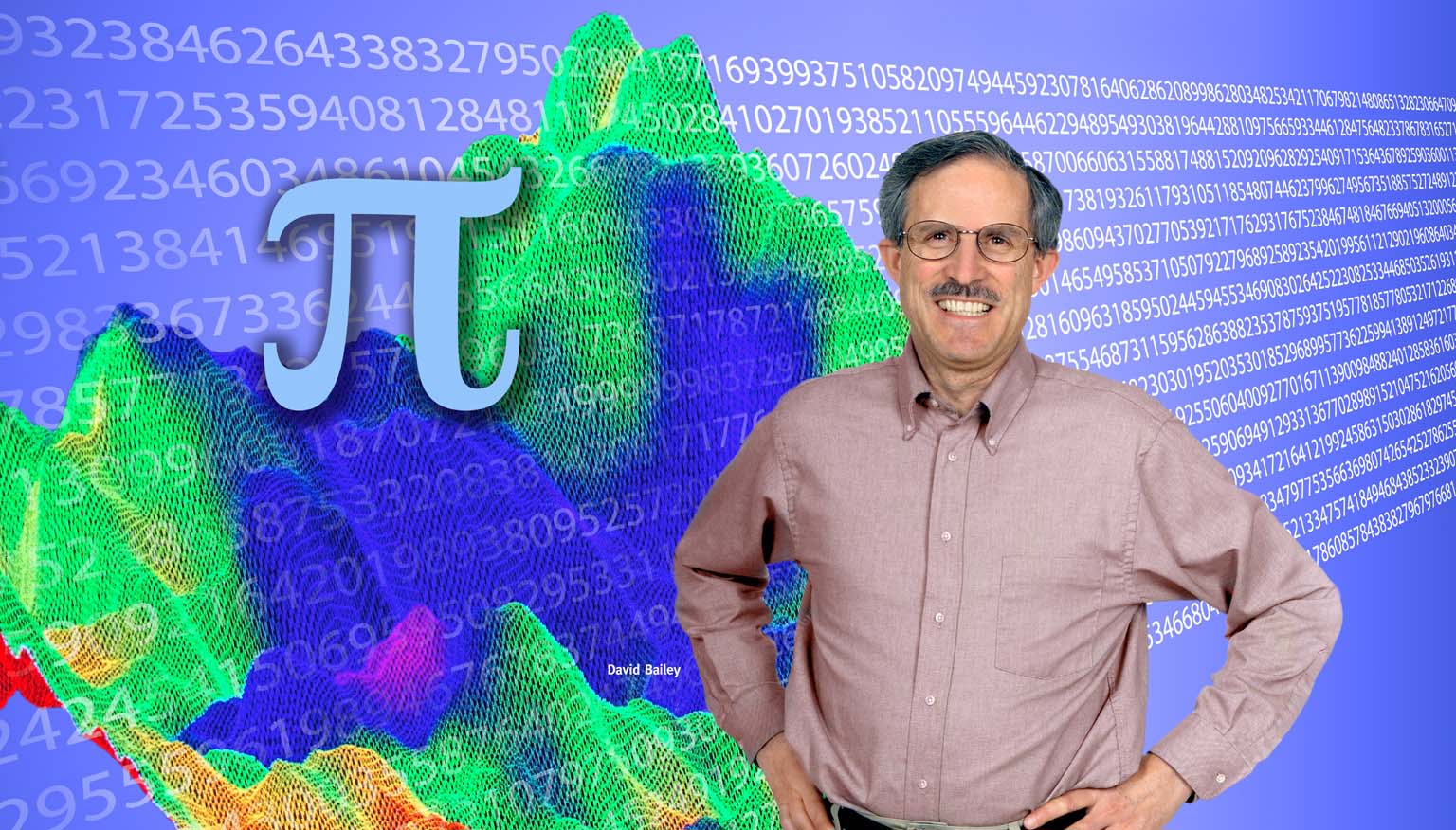
Some say that science and religion are at odds. Dr. David Bailey would disagree. Dr. Bailey is a graduate of Stanford University with a Ph.D. in mathematics. He currently works as the Chief Technologist for the Computational Research Department at the prestigious Lawrence Berkeley National Laboratory. He has published three books on computational and experimental mathematics, and has published 136 scientific, peer reviewed journal articles to date. He is a strong believer in the theory of Organic Evolution…
…and he is also an active, believing member of the LDS Church. Dr. Bailey is also the founder of the “Science Meets Religion” web site, which seeks to bridge the gap between science and religion.
In this three-part series, we discuss:
- Part 1: A Brief History of the LDS Church and Science, including the B.H. Roberts/Joseph Fielding Smith and Bruce R. McConkie controversies regarding evolution in the 20th century.
- Part 2: The state of science in the LDS Church today.
- Part 3: How science has actually strengthened his faith in the God and the LDS Church.
P.S. The Duane Jeffery/Dialogue article referenced in the podcast can be found here.
Part 1
Episode Transcript
Host: John Dehlin · Guests: David Bailey, John Dillon
This transcript is machine-generated and lightly edited for readability. The audio is authoritative. Please excuse occasional errors in names and spelling.
Announcements and Introduction to David Bailey
Part 1 of 3 · Ep. 160
John Dehlin [00:00:08] Hi, this is John with a few very quick announcements. First, an update on the Mormon Stories fundraising campaign. Since a few of you have asked about it, I'm a little over halfway where we need to be in monthly subscribers to be able to continue Mormon Stories at its current level past July 2010. So let me both thank all of you who have signed up as a monthly subscriber and encourage any of you who haven't yet to please consider doing so. All donations are tax deductible and will go directly to the time and materials used to produce the podcast. Second, registration for the two Sunstone workshops I'm holding on August 4th is now up. The morning session is entitled how to Navigate an LDS Faith Crisis in or out of the Church and the afternoon session is entitled how to Navigate a Marriage when one of you loses their testimony, hopefully some couples will be able to attend that. All the information you need to register can be found@mormonstories.org I hear that registration is filling up fast, so please register soon if that's something you want to attend. Third, I've decided to record the entire workshop and make the proceedings available to all Mormon Stories Monthly subscribers as a thank you for your support. So I'm hoping that might encourage a few more of you to support Mormon Stories if you are able. Again@mormonstories.org and finally, if any of you are interested in joining the Mormon Stories private Internet forum to converse with other like minded Mormons, please send me an email via Facebook and I'll make sure you get added Phew. That was a lot of announcements. Thanks for your patience. And now on with the show.
John Dillon [00:01:49] Hello and welcome to another edition of Mormon Stories Podcast. I'm John Dillon, your host, and I'm very excited to have with us today Dr. David Bailey, who is going to talk with us about a wide number of topics, but specifically today we are going to be talking about science and religion, science and Mormonism and science and faith within the LDS Church. So we're going to cover a lot of ground. It's going to be very exciting and informative, I predict. But before we jump in, I'd like to give David Bailey a bit of an introduction. He is a graduate of both Brigham Young University and Stanford university with a PhD in Mathematics from Stanford. He works as the Chief Technologist for the Computational Research Department at the Lawrence Berkeley National Laboratory in Berkeley, California. He is the He's a member of several professional societies, has received several major awards in the field of science and mathematics and computations and computers.
David Bailey [00:03:02] Is that right that's correct, yeah.
John Dillon [00:03:05] And he is the author of several books and articles within his field of computational and experimental mathematics. And even more interestingly, he is the founder of a very interesting and fascinating website called Science Meets Religion. You can find it atScience meets Religion.org and a lot of what we talk about today is going to come from that website and specifically the LDS section of that website. And I guess I could say, David, that you've been involved in sort of Mormon intellectual discussions for many, many years.
David Bailey [00:03:45] True. Yes, I hope so for a very long time because that's always been a great interest of mine.
John Dillon [00:03:54] So have you been involved in sunstone or dialogue in the past?
David Bailey [00:03:58] Sure.
John Dillon [00:03:59] Talk a little bit just about, just at a high level. What your involvement's been?
David Bailey [00:04:03] Well, I've written at least a couple of published articles that have been published in some LDS academic journals. And I've just been involved in some discussion forums on science and religion. And I think perhaps even more importantly, I've tried to field a lot of questions and discussions with individuals at a one on one basis, trying to help them understand a little bit better, at least the way I see these issues.
John Dillon [00:04:38] Okay, perfect. And are you comfortable talking about your status with the LDS Church? Just because I think for many of our listeners and specifically those who have requested you or someone like you, there are many people who are struggling with their faith or belief or commitment to the church because they feel like there's some inherent contradiction between the their affection or affinity for science and their belief. And I think your status with the church will be specifically especially relevant for people like that. So are you comfortable talking about that?
David Bailey [00:05:14] Sure, yeah. I'm a fifth generation LDS and I've always been an active member and I am now and not the slightest bit hesitant to say so. I'm actually descended from the second convert to be baptized in the British Isles. It was one Henry Clegg. Some listeners may be familiar with the famous race to the River Ribble, which was two early converts. Just a couple of weeks after the LDS apostles first landed in England, two converts decided they would have a foot race to see who would be baptized first. And one fellow won the foot race. He was 25 years old. The fellow that lost the foot race was 52. But I'm descended from the 52 year old that lost the race.
John Dillon [00:06:20] Ah, hopefully you're ancestors have recovered from that. From that loss.
David Bailey [00:06:27] Yes, indeed.
David Bailey's Background and Faith Journey
John Dillon [00:06:29] All right, well, I guess we've got a lot to cover tonight, but I think it makes sense to at least start with a bit of your background, especially as it relates to science and the church. So would you mind. I mean, we could probably talk for a long time about your upbringing, but maybe you could talk about your early love for science and for the church and how those things had an interaction leading up to your decision to study mathematics and get a PhD, and if there's any interesting stories or dynamic there, and if you can talk a little bit about the environment regarding science during those formative years for you within the church.
David Bailey [00:07:17] Well, I guess that was pretty easy because where I grew up, actually close to Brigham Young University, and I knew several LDS faculty. In fact, my father was bishop and both of his counselors were professors at the university. I think one was in math and the other was in math and chemistry. Chemistry. And there were several other professors nearby. Hugh Nibley actually lived in our ward. Oh, wow. And so I got to know them quite well, and particularly once I. After I was enrolled at byu, I had the opportunity to work as a research assistant with a professor in the physics department. And we had numerous discussions, including issues like about science, religion and evolution. And I quickly discovered that this was just no issue at all to him or to any of these other people that I talked to. And I just, you know, it was basically, I grew up assuming there was just no real issue and kind of surprised here and there when I discovered, say, like when I was on a mission and talking to some other missionaries that some thought there was an issue because to me it didn't really seem like there was any grounds for a particular conflict.
John Dillon [00:08:50] So in your church experience, Sunday school, priesthood, whatever, you never felt like growing up, you received the message that science was bad or scientists were to be feared, or intellectuals were scary, or evolution was of the devil or anything like that.
David Bailey [00:09:09] I heard some comments like that here and there, but they were more than drowned out by positive measure by positive comments from people that I respected.
John Dillon [00:09:22] In your ward?
David Bailey [00:09:24] Even in my ward, yes.
John Dillon [00:09:26] Okay, so you grew up in Provo in a very science affirming environment.
David Bailey [00:09:32] That's right.
John Dillon [00:09:32] And I know we want to be sensitive about identity and stuff. Can you describe it all? The decade or the time frame? Or would you rather not go there just because, I mean, historically, that's important in terms of context. But I only. What you're comfortable saying,
David Bailey [00:09:50] let's say I was, I was in by. I was at BYU several decades ago.
John Dillon [00:09:57] Okay, that's fine. And so, and so I imagine that the Mormon doctrine had been published before or during this whole upbringing. And so I'm trying to reconcile I grew up in Texas in the 80s and Mormon doctrine was almost like the Bible. Bruce Armaconka's Mormon doctrine was almost like the Bible for those of us who are trying to study church theology and doctrine and, and you know, we'll get into this more later, but that was something that weighed heavily on all our minds and informed our views of scientists and science. And it sounds like you're saying that somehow that book wasn't as influential in your circles.
David Bailey [00:10:45] Oh, I knew about it, but I also knew of people, including some of these professors that I knew at campus, that recognized that there were deficiencies there or the very least that there were many LDS scientists that saw things differently. I remember hearing and reading say, from Henry Eyring, who was this well known chemist at University of Utah, and he was saying that how that the church would never require you to believe something that isn't true. I remember him saying just exactly in those words in a talk once that I heard. And so I had enough messages like that that it really just wasn't a big issue, really.
John Dillon [00:11:37] So that's amazing. But I'm very glad to hear that and it's very refreshing to hear that perspective. So let's say up until your mission, you were never sort of involved or aware of like major scandals or controversy that were prominent. It was more just like occasionally, generally it was a science affirming environment both in the church and at byu. And then occasionally you'd hear small little scuttles or people's opinions, but they weren't prominent because they were drowned out by the broader culture for you, is that right?
David Bailey [00:12:16] I think that's a correct statement, yes. Okay. Okay.
John Dillon [00:12:18] Well that's fascinating because even when I went to BYU in the late 80s, it was a very different feeling for me at BYU in Provost. So we'll get to that, I guess, as we talk about it. So what did you love about science?
Science as a Source of Spiritual Awe
David Bailey [00:12:35] Oh, for me, it was just very much that. It was just such a beautiful and such an orderly and such a logical system that you just couldn't help but be awestruck and reverential towards the natural world in general and the scientific laws in particular. And I would say I feel that same way today. And to me, that is the number one and overriding source of my religious beliefs is just a tremendous reverence for the magnificence of the natural world. I think even like Albert Einstein, who I think compared to, certainly compared to LDS people, was not in any way a conventional religious believer. He didn't take seriously the notion say of a personal God, but nonetheless he frequently talked in his writings about the beauty and the magnificence of the natural laws and the universe that's around us. And I would say I very much feel akin to those same sorts of, same sentiment. Okay.
John Dillon [00:14:07] And I can totally relate to that. Just a general awe and respect for nature and science does a really great job of trying to understand and explain it. Did you ever, you know, as you sort of started learning the principles of science and geology and other types of things, did you ever struggle as a kid with your reading of the scripture, let's say the Bible and any discrepancies you found there? And we'll dig more into the general discrepancies later, but did you ever have this sort of frustration or struggle with scriptures or prophetic utterances as they conflicted with what you learned in science.
David Bailey [00:14:57] In one level? No. In fact, I remember even at the local schools where I grew up there we were taught about geology and evolution and that I had no trouble with the basic facts. And as far as the scriptures, we read in the book of Abraham that the six creative periods were described as days, which could be general periods of time. And this seemed to accord well with the general picture of we saw from science. And say again, the only real difficulties is when I would hear some other people say, quote some of our more conservative leaders of years past and insist that that was the way that we had to believe. And I would say when I was in graduate school one time I was having a little bit of trouble, you know, with this, with the, in other words, not with the basic principles but with what people were telling me was what various leaders in the past had taught. About that time an article came out in this dialogue publication written by BYU biologist Duane Jeffrey, where he went and very carefully recounted the history of the churches approach to evolution through the years and showed how that really it had been a generally open minded stance for most of the way and the one or two general authorities that taught a more fundamentalistic line, they were really more in the exception rather than the rule. And so you know, that really sort of affirmed my basic feeling that there just really wasn't an issue. And I've told Duane that right to his face that I really appreciated that article and that I'm probably in the church and faithful to this day in part because of his article.
John Dillon [00:17:32] We'll have to have to find a way to reference that article from the blog post. So I'll make a note of that. Is Duane Jeffrey still alive?
David Bailey [00:17:42] Do you know oh, sure.
John Dillon [00:17:44] Okay.
David Bailey [00:17:44] Yeah, he's still on the faculty. I think he's in semi retirement, but he's definitely on the zoology faculty at byu.
John Dillon [00:17:54] Okay. Okay. So you went to graduate school and became a scientist and a mathematician.
David Bailey [00:18:03] Yep.
John Dillon [00:18:04] And ever since, and ever since then, you've. You've had a strong positive relationship both with science and the church, is that right?
David Bailey [00:18:13] That's right.
John Dillon [00:18:14] Okay, well, maybe then, if it's okay, let's back up. Unless there's anything else you wanted to talk about, your upbringing as it relates to science and Mormonism that you think is relevant here?
David Bailey [00:18:30] No. Why don't we move on? Okay.
What the Bible Says About Creation and Science
John Dillon [00:18:32] So I guess it might not be a horrible place to start to just talk about what the Bible says about the earth and the science and death and Adam and Eve and the flood. And most of our listeners are going to generally know, but I think it just wouldn't hurt to quickly discuss sort of the main stumbling blocks that people have had with the Bible. I'm presuming is the biggest offender, but you can tell me if any of the other standard works are also stumbling blocks for people. But what are the major elements of the Bible that have caused people to feel like there's a conflict between science and religion or Christianity in particular?
David Bailey [00:19:21] Well, that's pretty easy that most people that have trouble in this area, it all derives around the scientific picture of the creation, formation and evolution of the Earth versus what is often a very literal reading of the Scriptures. That is what what people get hung up on and in particular what they think is what the church teaches them about the creation Scriptures. First of all, the time period. Of course, we know very firmly now from science that this has happened over a period of at least for the earth, it's about 4.5 billion years. We see a sequence of fossils going throughout geologic history right up to the present day. And all of these fossil layers are dated with these radiometric techniques that have been polished and honed through the years so that that general picture is very, very solid. And so people that have difficulty here basically are very firm, are hung up on looking at the six days of creation and thinking that that's either six literal days or perhaps even more common is that 6,000 years. And you know, if you, if you really are stuck on that, then there's going to be an issue.
John Dillon [00:21:10] But now the thousand, the thousand years per day thing, that that's not even Mormon, right, that that comes from some Middle Ages type of interpretation.
David Bailey [00:21:21] Well, there is actually one verse that I think it's in Peter in the New Testament that says one, one day with God is a thousand years. Okay, Something like that. And so traditionally that has been read as not just as a metaphor of how time with God is different than time with us, but instead is a very literal statement, in particular applying to the days of creation. So again, the real resolution of all of this is just to sit back and say, hey, just a minute. Is the primary purpose of the Bible to be a scientific textbook? And again, even the most dyed in the wool literalist, I think, has to acknowledge that, no, that's not really what the Bible is about at all. And it's not the primary purpose. It's not even a secondary purpose. And you know, as a statement of precise technical detail, the scriptures obviously leave something to be desired. On the other hand, as statements of what the purpose of creation is and what our role and what our position is in the cosmos, it's hard to think of, of any more poetically beautiful way of stating that than what we have in the Scriptures. And so I think once we just step back from a very literal, very fundamentalist reading, there really is no objection. And this is what I've tried to tell people through the years, that there's only an issue if we make an issue. There's only a war if we make war. Does that make sense?
John Dillon [00:23:31] Yeah, sure. And just for the benefit of some of our listeners that may not know some of the major issues, I'm just going to try and summarize them really quickly. So there's what you mentioned about the literalistic interpretations of the days or the years of the age of the earth. There's the quotes about Adam and Eve and there not being any death before the fall of Adam of animals of any kind. There's the notion that Adam and Eve were definitely the first humans on the earth, and so there couldn't have been any humans before Adam and Eve. And if you trace the genealogies in the scriptures and whatever years you can derive from the ages of people, that kind of puts Adam and eve living around 6,000 years ago. Is that right? By those who have tried desperately, you're
David Bailey [00:24:23] talking like Reverend Usher.
John Dillon [00:24:25] Right, Right, right, right, right. Who's that?
David Bailey [00:24:29] He was this. Reverend Usher was this fellow that, I think he was about 1600 or sometime in the 1600s that did this, worked out this chronology that's perhaps the most widely used chronology of the Bible today. And he worked out that the creation occurred in October, on a certain day in October in 4004 B.C.
John Dillon [00:24:59] right. But that was how I was raised, believe it or not, in the 1980s, to believe that's this it, you know, Anyway, so it was real to me for many, many, many years, until, frankly, until I was at BYU and studied under Bill Bradshaw and some other good scientists there. But so the other ones that come to mind real quickly, other than the death of Adam and pre Adamites, and no death before the fall, would be a global flood. The Bible talks about water covering the whole earth or something to that effect. Is that right?
David Bailey [00:25:41] Yes.
John Dillon [00:25:43] And then I guess there's a part in the Old Testament where it says, what is it? That the sun stood still?
David Bailey [00:25:52] Oh, yes, Joshua.
John Dillon [00:25:54] And that was the basis for the Catholic Church being angry at Hugh Galileo for advancing the idea that the earth goes around the sun because that conflicted with a literal reading of Joshua. Is that right?
David Bailey [00:26:09] Actually, it's even better. In fact, this is one thing I sometimes point out to people, that there are actually many scriptures. There are many different passages in the Bible that either explicitly state or at least presume the ancient cosmology. If you look through the scriptures, you'll find numerous places where it talks about the foundations of the earth. Well, in their view, that was literal foundations. The earth is based on a foundation, and there's a big dome above it. This is all very well known. But what's surprising is how many different verses affirm this cosmology. And so, in fact, you can ask the question, why do we insist on taking each of the creation scriptures so very literally, or even, for that matter, the flood scriptures so very literally? And yet with regard to all of these scriptures that talk about the. That talk about the four corners of the earth and the foundations and the firmament, which was really this dome, there's not anyone seriously that takes those scriptures literally. And yet there are really many more of them. So why should we take the flood or the creation scriptures so very literally when any reasonable person would say that we shouldn't take these other scriptures literally?
John Dillon [00:28:00] Yeah. And one thing that I like to try and do is avoid the trap of blaming the victim. And I want to be careful using the term victim, because I think we're all agents and we all are responsible at the end of the day for what we think and believe. But you would agree that over the history of time, both within Christianity and within the LDS Church, many people have arrived at a literal reading of the scriptures through the urgings of the scriptures themselves or through the leaders that we read to sort of assume that by the word of the leaders or by the scriptures, it is the same voice. And so you'd agree that religious people often come by this tendency to read things literally, sort of honestly, through the urging of some of their leaders, right?
David Bailey [00:28:54] Oh, I would say so. I mean, this has definitely been an issue. I mean, for that matter, you mentioned Mormon doctrine. Very definitely. This has been a major source. Many people have read what Elder McConkie wrote, say, about evolution in Mormon doctrine and presume that that was. That is the actual official church's view. And so, yeah, we don't need to go very far to find some. Some interpretations like this. For that matter, there's even, even to this day, there are some that to me is frankly, rather embarrassing material in the, the seminary manual on the Old Testament, say, like on the chapter on the creation and also on the flood. People have complained about it, and I have heard that the staff that puts together the manual does plan to revise that part. But nonetheless, there it is. And many people presume that that's what it would be. And so it's not that. You're certainly correct that the people who do have those views there certainly there are seemingly authoritative sources that they can turn to for support for those positions. Right.
John Dillon [00:30:27] Well, let's go ahead then and dive into how maybe to try and, you know, explore a little bit how the manuals ended up the way they did. And it's sort of the story for me starts back in the 1800s when the church was first founded. And I think that many people, many LDS people who have affinities for science would take heart at many of the early quotes from either attributed to Joseph Smith or directly from Brigham Young and John Taylor and others affirming, you know, the importance and the validity of science. Can you talk and just give a brief overview? I mean, your website, and I'll refer people to it again. Science meets religion.org under the LDS section. There's actually a section called LDS Science Quotes. And you can find, oh, you know, 50 really good quotes that are affirming science from Joseph Smith or Brigham Young and John Taylor all the way through David O. McCabe, Hugh B. Brown, even to the modern day. But just talk a bit about the types of quotes or the types of things we hear Brigham Young and others saying about the validity and the importance of science, if you will.
David Bailey [00:31:50] Yeah, I think actually perhaps the person who had the most of those is Brigham Young, and he was really quite specific that in several instances that he did not see the world of science as at war with the church. Perhaps my favorite is a discourse given by Brigham Young and 1871. And he's very explicit here. He says that like he says in these respects, we differ from the Christian world, for our religion will not clash with or contradict the facts of science in any particular. He even then goes and gives some. Some specific examples. He mentions geology, and he says that it's a true science. Not that he's going to endorse every precept, but that the basic facts are certainly true and are eternal. Then he goes on and he says that it's preposterous to assume that the Lord made the earth out of nothing. Nothing was ever made out of nothing. Then he goes on and he talks about the Scriptures. I'm sure that would give. Many people who take a fundamentalist, literalist view of the Scriptures would certainly squirm at this. But here's Brigham Young. He says, how long it has been organized is not for me to say, and I do not care anything about it. And as for the Bible account of the creation, we may say that the Lord gave it unto Moses, or rather Moses obtained the history and traditions of the fathers, and from these he picked out what he considered necessary. And that account has been handed down from age to age. And whether the Lord found the earth empty and void, whether he made it out of nothing or out of the root elements, or whether he made in six days or in as many millions of years, is and will remain a matter of speculation in the minds of men unless he gives revelation. So it's just really clear that Brigham Young was just completely open to modern science and did not see any point in having a battle with science.
John Dillon [00:34:26] What about Joseph? Any inklings from Joseph?
David Bailey [00:34:29] Well, really very little. That that is really and truly Joseph as opposed to things that were once subscribed to Joseph but have more recently been found? Probably not. So there's really not a lot to say there.
John Dillon [00:34:50] But definitely nothing anti science that you do.
David Bailey [00:34:52] Absolutely not. Absolutely not. In fact, I think that we need to really sit back and realize that Joseph Smith, right from the beginning, in the first vision, he saw Mormonism as a break with the traditional Christianity, particularly its fixation on the Bible. He very clearly stated that the Bible is not sufficient. That was certainly his experience in going around to all the. The different denominations and all the confusion that he heard, and that it was time to just set all of those different interpretations aside and really get back to basics.
John Dillon [00:35:39] But even that nothing can be created from nothing. That sounds like it comes from the lectures on faith, right? Or something to that effect.
David Bailey [00:35:48] I think that is actually in the King Follett discourse.
John Dillon [00:35:53] Okay. Yeah.
David Bailey [00:35:54] These lectures in faith actually sound more like they were written by Sidney Rigdon, frankly.
John Dillon [00:36:01] Okay, okay. And those, you know, those who have read a lot about Joseph, he just seems so expansive and inclusive in things that he experienced that it's just hard to imagine Joseph as being anti science. That's just my own editorial comment, but okay, so from Brigham Young to, let's say, the early 1900s, would you say that Brigham Young's support or affinity towards science carried on through his successors? Or at least we didn't see a swell of anti science sentiment in the late 1800s?
David Bailey [00:36:41] Not really, no. I mean, even like, for instance, I mean, another thing that's really characteristic of, of the early LDS leaders was this very. To me, that's, I think, perhaps the single most important principle that was taught in early Mormonism, namely that they saw God as acting within the realm of natural law, not utterly beyond the realm of natural law. And so, you know, with that, with that viewpoint, indeed there's any. That just completely obliterates any need for a war between science and religion. Brigham Young made comments like that and tried to emphasize that there really is no such thing as miracles as we normally think of. There are only principles and laws perhaps that we don't yet understand. He also mentioned how he was trying very hard to get the Saints to believe how that God is, he said, a scientific character that lives by science and strict law. And then clear into the 20th century, Tallmadge very clearly stated in the Articles of Faith, which is again, a very widely available book, many LDS people have it on their shelves. But there he says very clearly that miracles should not be regarded as opposition to the laws of nature. He says that that notion is plainly erroneous, for the laws of nature are inviolable. And so all of that continued well into the 20th century. And I don't really see that that changing much. Even as we go into the might say, the middle of the 20th century, then we have issues with evolution again. But until that time, it was really pretty solidly positive. Yeah.
John Dillon [00:39:00] And I seem to recall reading that the church seemed to openly encourage
David Bailey [00:39:08] its
John Dillon [00:39:09] brighter minds to go off and get advanced degrees in all the major academic fields, you know, well into the early to mid-1900s. And of course, we know that it brought into its senior ranks of leadership several scientists.
David Bailey [00:39:29] True, that's correct. Obviously Talmadge was a. He had received a PhD in geology, and there were several other scientists among the quorums of the 12 in the early part of the 20th century in particular. Yeah. And you mentioned about how LDS students going out to study science, in fact, someone did a study about 1960 or 1970 and found that among practicing professional scientists, there were the people who had gotten their, their bachelors in Utah were disproportionately represented more than any other state. And so, I mean, it was just very clear many had answered that call to go out and to study fields of science almost as a mission duty. Right, right. Yeah.
The Environment of Science in Mormon History
John Dillon [00:40:42] So given you describing the environment regarding science in your upbringing and my understanding of both 19th century Mormonism and a great deal of early 20th century Mormonism, I'm stunned at how I and many other people came to view science in, let's just say the 1980s. And so let's start with what can you tell us about the early beginnings of this anti science or anti evolution or anti geology sort of movement or movement towards literalistic readings of the Scriptures. What can you tell us about its origins? And I'd want to make sure you noted the firing of the professors by professors around 1910ish or so, if you happen to recall that. But what, what can you tell us about how this came to be? And then I'll guide you from there.
David Bailey [00:41:43] Well, again, I think it was sort of a difference between an overall positive approach to science, but this business about evolution was a source of some indigestion. And so when some of the professors at BYU were speaking positively of evolution, this kind of caused a problem with the leadership in Salt Lake. And I think this was 1911. And again, I think there was nothing unusual there. People at the time and much more widely in the US were very reluctant to endorse evolution, at least to the extent that it was being taught in the major universities. So this perhaps is not really a matter of surprise. And of course, in 1909, there was this statement that the First Presidency published. It was actually intended to kind of establish a more modern theology and get away from like the Adam God theory and some of this other speculation that had been rampant in the 19th century. But in there, there was this one comment that the notion of humans evolving from lower orders, that these were theories of men. And so later people started to go back and reference that passage, which was probably not really intended to be the central message of that statement. I think perhaps most clearly, though, this began with Joseph Fielding Smith, who personally very much had a problem with evolution and even had a problem with the old Earth geology. And he actually gave a talk where he specifically discussed these theories and rejected them. And Specifically rejected the notion that there were any pre Adamites or any life before, before Adam.
John Dillon [00:44:19] Any idea on the approximate date of when he started talking about this?
David Bailey [00:44:22] That was probably about 1930 is when that started to come up. But again, there had been discussions and. There have been indications that for quite a few years, Joseph Fielding Smith in particular was of that view.
The 1911 Evolution Controversy in the Church
John Dillon [00:44:42] Okay, and let me just, let me just really touch briefly on this 1911 evolution controversy. I found a reference to this on a website called mormonevolution.blogspot.com but it references a work, some writing by Gary Bergera in a book called Brigham Young University House of Faith and the Search for Essays on Science and Mormonism, where it talks about the 1911 evolution controversy. And basically three professors were teaching evolution and specifically theorizing, I believe, as to the idea that maybe evolution was God's way to create mankind or that somehow there's a connection between Adam and those that we call pre Adamites or men or cavemen or prehistoric men that lived before Adam and Eve. And basically as a result, there was a committee and a hearing that was held and these three professors were let go. And I love this quote that I got from, I guess the equivalent to the press release. It basically said, the wisdom of the committee and board of trustees in their actions, as well as the justice and consistency thereof will be conceded by every right thinking man. You know, the standard of faith and belief for all Latter Day Saints must be the word of the Lord as set forth in the Holy Scriptures. Undeviatingly, should this be the case in church institutions of learning, blah, blah, blah. And it goes on to talk about how college students have fragile faith and that we shouldn't be talking about things that can lead to the dissolution of faith. And it's very much, I think, the same type of logic that sort of led to a host of behaviors by the church to maybe not be as candid with its history as it might have been, or as up front or as sort of publishing about some of the less, I don't know, the more controversial aspects of its history that now maybe is starting to come back a little bit and bite the churches. People now learn the stuff through alternative methods. But I don't want to drill too deeply into it, but I guess that was Joseph F. Smith who was at the head of that 1911 incident. And of course he is the father of Joseph Fielding Smith. So I guess we have to tie Joseph Fielding Smith's actions to the actions of his father, which I used to always tie to Brigham Young. But but it's pretty clear that. Is it fair to say that Joseph F. Smith had a hostility towards science that Brigham Young didn't share, or is that just unfair characterization?
David Bailey [00:47:41] Overall, I don't. I think you may be reading it a bit too much in there. Again, I don't think we can read too much into any of that. That was simply a widely held view at the time that while they were in general very positive to science, evolution was problematic, because, again, I think in general, people still wanted to. They hadn't really adjusted to this idea that maybe creation could happen through evolution. And so when this was being taught somewhat openly at byu, that was just sort of going too far. Okay, so I have never heard anything in Joseph F. Smith or that would. I think it was really. Joseph Fielding Smith himself really didn't like evolution. And he. He just. He. Obviously from his writings, he made that clear. Yeah.
John Dillon [00:48:55] Okay. So that's an important thing to note. And as I'm looking through Joseph F. Smith's writings, he wrote as an explanation. Some of our teachers are anxious to explain how much of the theory of evolution, in their judgment, is true and what is false. But that only leaves their students in an unsettled frame of mind. They are not old enough and learned enough to discriminate or put proper limitations upon a theory, which we believe is more or less a fallacy. In reaching the conclusion that evolution would be best left out of discussions in our church schools, we are deciding a question of propriety and are not undertaking to say how much of evolution is true or how much is false. We think that while it is a hypothesis on both sides of which the most eminent scientific men of the world are arrayed, that it is folly to take up its discussion in our institutions of learning. And we cannot see wherein such discussions are likely to promote the faith of our young people. On the other hand, we have abundant evidence that many of those who have adopted in its fullness the theory of evolution have discarded the Bible or at least refused to accept it as the inspired word of God. So I think that just sort of affirms what you were saying, that there is a general respect for science, but when it starts to really encroach on general understandings of theology and the origins of man, that's when the brethren started getting restless.
David Bailey [00:50:17] Yeah, but it's very interesting. Even the passage you just wrote, notice how open minded he was very much, and how very much he wanted to emphasize that he didn't want to comment on this and get involved in the scientific aspects of the he just wanted to. He mainly just wanted to say, hey, let's go slow on this for the sake of our youth. Yeah. It was a very pragmatic and not a doctrinaire point of view, even though it was very clear that he thought it would eventually be seen to be fallacious.
John Dillon [00:51:00] Yeah. And I just have to say I find the writings of top church leadership in the late 19th and early 20th century as generally being very thoughtful, almost intellectual, if I dare use that term, but just extremely thoughtful, wise people generally. Is that what you found?
David Bailey [00:51:19] Yeah, I think in addition to some of the. We mentioned Talmadge, for instance, this actually, and BH Roberts, both of them were very, very clear and open minded, even on issues relating to evolution. And I think in general they were trying to at least keep an open mind. Like B.H. roberts, he wrote this one book that was published or his manuscript that was later published. He said. On the other hand, to limit and insist on the whole of life and death to this side of Adam's advent to the earth some six or eight thousand years ago as proposed by some, is to fly in the face of facts so indisputably brought to light by the researcher of science in modern times, and goes on just as eloquently and clearly as he could write to argue for an open minded approach here and to be realistic about the basic scientific facts. And so again, even Talmage, he gave a talk in the tabernacle that was later published by the church, where he was talking about very clearly acknowledging the antiquity of the earth and the fossil record and that they were many biological organisms that were on the earth generation after generation before humans came around. This is all, all stated, I think, quite clearly. Again, Joseph Fielding Smith was one who descended from this. And then of course, as you probably are aware that there was this one instance in about 1930 where they had a rather public disagreement on this topic. But again, even when that happened, when the church entertained the different viewpoints, or when the First Presidency entertained the different viewpoints between Joseph Hilly Smith and BH Roberts in particular, and also with Talmadge commenting on it, what their final instruction was is this very simple statement to say, hey, let's keep out of these scientific issues. It doesn't do any good for us to involve the church and involve the church leaders in scientific disputes. There's this one passage, it says, upon the fundamental doctrines of the Church, we are all agreed our mission is to bear the message of the restored gospel to the people of the world. Leave geology, biology, archaeology and anthropology. No one of which has to do with the salvation of souls of mankind to scientific research while we magnify our calling in the realm of the church. So again, I think they're trying very hard, even though they may not like evolution and some of these topics, or maybe even not even like old Earth geology, but they think very clearly saw that it was unwise for the church to involve itself either in the instruction of the church quorums or in its literature or official discourse to get mired into scientific debates.
B.H. Roberts, Joseph Fielding Smith, and Evolution
John Dillon [00:55:30] Yeah, and we've kind of, you kind of Talked about the B.H. roberts and Joseph Fielding Smith affair and how it resolved, but there's a lot of color and interest in that whole scenario that is really fascinating and worth listening to. And I'll just reference a book that maybe I'll provide a link to. But Signature Books came out with a book called the Search for Essays on Science and Religion edited by Gene Sessions and Craig Oberg. It's completely available online in full text form on the signature bookslibrary.org website. And there's an essay in there that's called the BH Roberts, Joseph Fielding Smith James E. Talmadge Affair by Richard Sherlock and Jeffrey E. Keller. And it's just a fascinating story to talk about. We've kind of briefly touched on it as you made your comments. But you know, let me set it up and see if you can just talk a little bit more in detail about it. Because in some ways it's tragic to me. In some ways I'm just so confused about it because leading up to, let's just say the 1940s and 50s, the decades before that, you have B.H. roberts, which was not an apostle, but I believe he was a high ranking general authority. You have James E. Talmadge, you have John Widstow, you have, you have Eyring and several major high level church leaders who were not only scientists, not only very supportive of science, but they were actually believers in evolution. Is that right?
David Bailey [00:57:15] Well, I think we have to define evolution. They were certainly coming to accept the, the old Earth view, in other words, that things are a little bit older than a lot older than 6,000 years. And not completely averse to the notion that plants and animals have been evolved as we see in the fossils, for many years. So they probably would not have, they would have probably rejected what we currently view as evolution, meaning that the forces of mutations and natural selection are sufficient to explain the history of life. They probably would reject that. And they would probably reject the notion that, that humans are related to The Tree of Life. They still wanted to see humans as being specially created in some way, even although they were discussion back and forth about whether or not they were pre Adamites. But again, I think we have to grant the point there that evolution in its modern environment, in the 21st century notion would probably not have been something that they have endorsed, even though they were open to the general notion of a evolutionary development of life.
John Dillon [00:58:56] Okay, but definitely not this wholesale dismissal of evolution as satanic and evil like we see with Bruce Armaconki in his seven Deadly Heresies talk, right?
David Bailey [00:59:09] Absolutely, yes. Okay.
John Dillon [00:59:11] And here's what I don't. Well, I mean, the recounting of this affair is fascinating because you have B.H. roberts, who's the super well informed, you know, person who respects science, who knows a lot about science, you know, writing this 700 plus page manuscript called the Way, the The Truth, the Way and the Life, trying to find a theological, doctrinal bridge or reconciliation with modern science at his time and just doing what seems to be an intellectually Herculean work to try and bridge all this stuff. And we also know that he knew about the archaeological and historical concerns about the Book of Mormon and he tried to do his best to be, be open about those and reconcile them. And you've got Talmadge and Woodstow and Eyring in his corner and then you've got Joseph Fielding Smith who is making these public and some would say mean spirited declarations and assertions and writings almost, is it fair to say, attacking or attacking the character of B.H. roberts and others and you know, sort of in a mean spirited way.
David Bailey [01:00:28] That's probably going too far.
John Dillon [01:00:29] Okay, okay, so paint it.
David Bailey [01:00:32] I would just say that Joseph Fieldy Smith just rather passionately believed that evolution was wrong. And that would eventually be refuted, I don't think. I mean, I read other areas where people saw him as actually a rather compassionate person. So I don't think we need to go further than that.
John Dillon [01:01:01] Okay. And you know the literature more than me, so I don't know where I got that impression. So you don't think that Joseph Fielding Smith sort of framed this discussion about evolution in terms of loyalty to the church or being right with God or as urgently and as critically as Brigham Young or Bruce R. McConkie seemed to do later? Is that your understanding?
David Bailey [01:01:28] Yes, indeed.
John Dillon [01:01:30] Okay, so Bruce R. McConkie took it even a step further than Joseph Ealing Smith.
David Bailey [01:01:35] It's very interesting that one of the reasons I say that we ought to be just a little bit Softer on Joseph Fielding Smith is when Elder McConkie's Mormon doctrine came out. One of the first to express some concern was Joseph Fielding Smith, who was his father in law.
John Dillon [01:02:04] Right.
David Bailey [01:02:05] And he was concerned, I mean, for starters, that he didn't know anything about it.
John Dillon [01:02:09] Right.
David Bailey [01:02:10] He. He specifically said that he was completely unaware that this project was in the works and was really uncomfortable that Elder McConkie had gone ahead with it without really getting clear endorsement from the church. And other, of course, as you know, other leaders of the church also had expressed concern. President McKay even convened this committee that included, as I recall, Markey Peterson and one other person I can't quite remember right now, to was it Elder Hunter to read the manuscript and look at it? And they identified numerous problems, including specifically mentioning that the book's treatment of said evolution and evolutionists. In other words, they were concerned not only with what he was saying about evolution, but with his expressions of disdain and judgment towards those who do. And so, again, I think that it's very clear that Elder McConkie was taking quite a step further than Joseph Fielding Smith would have been willing to go.
President McKay and Unofficial Anti-Evolution Teaching
John Dillon [01:03:44] Okay, so I totally will defer to your understanding of Joseph Fielding Smith. It probably would be remiss to not mention his publishing of the book man of Georgian and Destiny. Right. Can you just talk a little bit about that?
David Bailey [01:04:00] Yeah. This was in 1954. In fact, as I understand it, this manuscript man, his origin and destiny, had actually been in the works since 1930, when he was having this debate of sorts with B.H. roberts. But here he took in this book, he took a very literal view of the creation and a very strong rejection of the theory of evolution. It was interesting at the time that President McKay, of course, had a much more expansive view of things, and he certainly didn't endorse this. But in reading this, the Prince's biography of David O. McKay, it's quite clear that really his overriding thought was that he didn't want to be one that would be a president of censorship. He wanted to allow people to express themselves, even if he didn't agree with it. And so he allowed Elder Joseph Fielding Smith to go ahead with that book, just providing that it was clearly stated in the introduction that it represented his own views. And then when people would write letters to him Expressing concern, President McKay would respond with a very short statement saying that that book was not published by the church and was not approved by the church and contained expressions for which the author alone was responsible. There are numerous letters like this, but it's very clear that he didn't want to be in position to be censoring either with this or with Elder McConkie's book. And so even though like this committee had actually recommended that they stop publication of the of Mormon doctrine, nothing was really done on that. And then of course after later McConkie went ahead and did and did reprint the book. But anyway, getting back to man, his origin and destiny, I think that as much as anything expressed his view, it's very clear what he felt. And he was also he had thought that it was not just doctrinally wrong, but that it would be shown to be wrong scientifically as well. And obviously history has not gone on his side. But again, I just see it as simply just a very frank and very clear statement of his views.
John Dillon [01:07:14] Thank you for joining us today on Mormon Stories. To comment on this episode or to provide feedback, please check us out@mormonstories.org if you want to help keep Mormon Stories alive, please consider either making a financial contribution or spreading the word about this episode through your blog, Twitter account, Facebook page, family newsletter, or through your Ward Bulletin and Ward newsletter. Just kidding about those last two. Music on this episode was provided by Clayton and Sky Pixton. Check them out@claytonpixton.com or skypixon.com that's sky with an E S K Y E pixton.com thank you.
David Bailey [01:08:08] The sun gone down.
Responding to Atheist Critics of Religion
Part 2 of 3 · Ep. 161
John Dehlin [00:00:00] Mormon Stories podcast takes a ton of work and depends solely upon listener support to keep this program alive. Please consider a donation today@mormonstories.org.
John Dehlin [00:00:19] So how do we get from, I mean, how do we get from Talmadge, Woodstow, Roberts, Eyring and others, all supporting science and evolution? How do we go from there to the publishing of Man, Origin and Destiny, then the publishing of Mormon doctrine, then the sort of infiltration of these ideas into the CES system to the point where I received sort of the anti scientist teachings in the 1980s. Like, how did, how did so many scientists lose and Joseph Fielding Smith win? Do you have. I mean, in terms of.
David Bailey [00:01:10] I can answer that in two words, Mormon doctrine, because that sold so many copies and was viewed as. By so many LDS people as being the authoritative statement. And you know, I mean, even now you read his comments in there, if you didn't know better, you would think very clearly that this was a. That the church condemned the theory of evolution. So.
John Dehlin [00:01:41] But I'll add to that something that I think I picked up from the article I cited previously, and that's that Roberts, Widstow and Talmadge all died like in the, what, 30s, 40s or 50s, and Joseph Fielding Smith went on to live for two or three or four decades, more like. Is that also a fair explanation for how this happened?
David Bailey [00:02:08] Well, but again, remember that I don't think that Elder Smith's book, which nearly as influential as Elder McConkie's.
John Dehlin [00:02:20] As Elder McConkie's. Yeah.
David Bailey [00:02:22] I think if it had only been Elder Smith's book, it probably wouldn't have been nearly as much of an issue.
John Dehlin [00:02:31] And it sounds like you grew up in more of an era where McConkie's book hadn't really taken hold in the mass culture like it had by the time I was growing up. And, and Joseph Fielding Smith's book just hadn't made a dent in the consciousness writ large. Is that fair to say?
David Bailey [00:02:56] I think that maybe I would just say what was different about my growing up is that I grew up in an environment with LDS scientists all around me at byu and so they knew what the facts were and how all this worked out. And I never really saw this more widespread view and the more widespread acceptance of Mormon doctrine until actually until I was like on my mission.
John Dehlin [00:03:32] Right, right, right.
David Bailey [00:03:34] So I think it was. That was what was different is the environment I grew up was not the standard LDS environment.
John Dehlin [00:03:45] Okay, so here's sort of a pause in our historical recounting, and this is me just asking You a non scientific heart based emotional question. It's probably not fair to do to a scientist, but I'm going to do it anyway. I guess I'm trying to be a scientist now as I study clinical psychology and getting a PhD. So I can't say I'm not a scientist. But you know, historically I haven't affiliated as a scientist or sort of self described myself as a scientist. But even as someone who hasn't characterized themselves as a scientist up until now, when I read this history of how science sort of got the bad end of the deal at the hand of first Joseph Ealing Smith, but then larger Bruce R. McConkie and how it led to the environment that I experienced it. I feel not only sad for BH Roberts and Talmagen Woodstow and Eyring in this regard, but I feel a little bit angry and resentful at how prominent Joseph Ealing Smith and Bruce R. McConkie's personal views and biases became within the broader Mormon culture. Like I feel there's a part of me that feels like they did serious damage to our credibility worldwide and to, you know, the reputation of scientists for literally generations. So there's a part of me that's enraged about this and in all of the writings that I've seen from you and in our conversation so far, I don't feel any of that. So I'm wondering, like, do you just not see things the way I do or did you have that anger or frustration at one point and you've processed it? Or, you know, or am I just reading things wrong and there's really no room for frustration or outrage?
David Bailey [00:05:45] Yes, I think what we have to consider here, I mean, a lot of people talk about the influence of Joseph Fieldy Smith and Bruce R. McConkie. I can say, as I've already said, I certainly think Bruce R. McConkie had a lot more influence with his Mormon doctrine book. But I think we have to keep in mind though that they weren't writing in a vacuum. I think that in general, many LDS people really did still prefer a rather literalist, fundamentalist view of the scriptures. And I would say the majority of the church was quite receptive to what they had written and were very, very supportive of those views. And so I don't think we can. I don't really, I'm not really comfortable casting blame. I just think it's just sort of like a lot of these discussions about some of the earlier, say, racist views that were sort of somewhat more prominent in the church in earlier years. And which we even see in some comments by some of the general authorities. But again, this was just the. That was the milieu that they were in. Those types of comments and views were quite common at the time. And I think exactly the same is really true about evolution. Again, keep in mind, to this day, here we are in the 21st century. 44% of the American public believes that the Earth was created at one time in the last 10,000 years, according to a recent poll. So even now, and I think from what I can see, the views of the church members are not too much different than that. So. McConkie and Elder Smith were really just saying things that people wanted to believe anyway.
John Dehlin [00:08:01] Yeah, and that's cool. I mean, context is always super important. And I tend to fall into this trap that many of us do, you know, of judging historical figures harshly without considering the context. And it sounds like you understand that context better, and that context has led you to not feel as angry with those writings. And you're almost kind of saying that it's what the people wanted. They wanted a less nuanced, a less sophisticated, a less intellectual and scientific worldview, and they wanted a more simplistic, orthodox, fundamentalist view. Is that fair? In my recharacterization of what you said people wanted.
David Bailey [00:08:55] That's exactly right. And as I mentioned, I would further add, that's what they want to the present day.
John Dehlin [00:09:04] Yeah, but, you know, so, okay, so does that just mean that most people are kind of simpletons or ostriches with their head in the sand or just they've got a lot of problems, so they want to keep it simple? I mean, how do you. What does that mean for your sort of view of general human nature and the general membership of the church? It probably sounds mean to say, but there's a part of me that just. We have this milk and meat, and somehow meat is greater than milk, and the glory of God is intelligence. You can go back to the founding documents of Joseph Smith, and there is just this strong call for searching for truth and knowledge and understanding. That is sort of the bold, courageous Mormonism that many of us love and fell in love with. A lot of people today are maybe frustrated with the correlation and with the ways that church curriculum has been simplified and sort of watered down and how we're not as willing to jump into the fray. And so I guess I understand it. I don't want to sound arrogant that intellectualism is better, because I definitely don't believe that that's necessarily true. And I probably agree with the Brethren, that from a religious standpoint, none of this matters to one's eternal salvation. But. But is there a part of you that's a little bit sad that that's kind of the way people lean generally?
David Bailey [00:10:34] Oh, very much so. Very sad, I think, because I guess my sadness is the following, because I know that if that is the general tenor of what LDS youth in particular are led to believe, that that's really going to set up a crisis of faith among them. I mean, that's really the source of my sadness is that by not being a little bit more candid and open about what the real facts are of modern science and what is tenable and what is not, that many youth are being set up for a crisis of faith when they go off to college or even at places like BYU and suddenly discover that this rather simple world that they believed no longer can be defended. And particularly if they are taught to believe that one must choose, there is this war between science and religion and one must choose one side or the other, then that to me is a real problem because for many of them, they will make a choice and they will choose to disassociate with the church. And that's just not really necessary. As to how do you really assess the blame? I don't really know. In fact, quite frankly, I would place part of the blame on, on the scientific community, not only within the church, but in the general society. I think that scientists have done a rather poor job of communicating the facts and the excitement of modern science to the public. We also have the serious education problem wherein science in general and is just not sort of avoided, if you can, if you can when you're going through school. But again, I would definitely put part of the blame on scientists themselves.
John Dehlin [00:13:01] Right, right. And I imagine that you have strong feelings about Christopher Hitchens and Richard Dawkins and some of those, some of those scientists as well, who have sort of taken a full frontal shot at religion, in addition to the believing scientists who maybe haven't been effective communicators.
David Bailey [00:13:24] Oh, the Hitchens and Dawkins, they're public relations nightmares for those of us who would like to see serious, no nonsense science taught in public schools. Just most unfortunate that they chose to express their views the way they did, particularly since from a theological point of view, they're really rather naive and they put up for, as exemplary of modern religion only a rather fundamentalist core. And so many, even some scientists who are not particularly religious have come out and really expressed concern at the writings of some of these that are just sort of bending over backwards to express their atheism.
John Dehlin [00:14:29] Okay, so what you've been, what you've been saying so far really resonates with me on a level like, you know, I was set up for the type of disillusionment that you describe because I was, you know, my parents weren't scientifically minded necessarily. You know, neither of them had a bachelor's degree, you know, college degree. But they're smart people. But, you know, they certainly weren't teaching me a deep love of science when I was growing up. And so what I got was what I got from the church educational system, which was basically anti science sort of mentality. So I experienced the kind of disillusionment you're talking about trying to reconcile all this because I had read I did come from sort of a fundamentalist point of view. But what I'm hearing you say is that if you're taught a non fundamentalist view from the early years, and if you are taught to love and respect science, and if you are taught a more nuanced, sophisticated, or we'll just say a different religious perspective, then you can face science in your teen and adult years without really any serious crises of faith necessarily, and you can mature into adulthood with a very harmonious relationship between science and religion. Is that what you're saying?
David Bailey [00:16:09] I would even be stronger than that. I would say that someone that has a good foundation that respect and reverence for the natural world and for the scientific laws that we study can be a foundation for religious faith for the rest of your life. It certainly is for me, and it's the real core of my religious beliefs. Again, like I mentioned at the beginning, Albert Einstein and talking about how that this cosmic religious feeling was really the foundation of all great science and all great religion. And I think that is what it can be. And that is what I would like to see be more common for other people to feel that same passion that those of us in the scientific world feel and.
John Dehlin [00:17:14] Yeah, yeah. So you, you just said that for you, science becomes faith affirming and faith strengthening for you.
David Bailey [00:17:20] Oh, very much, yeah.
John Dehlin [00:17:22] And I have so many friends right now, and a lot of this comes from, from disillusionment with church history. But they first become disillusioned with church history, then they realize that science isn't the enemy. Then they start reading Hitchens and Dawkins, Then they sort of, for them, a love for science necessarily means a dropping of not only Mormonism, but of any belief in God or religion at all. And so let me ask you to spend some time on this question. Let's say that I'm raising several young kids right now. What are some of the critical steps? And I'm happy taking 15 minutes on this question, or 20. What are some of the steps that I need to take to raise a child to, number one, appreciate science. But I think that I can take care of that. You know, let them read scientific books, take them to museums, let them watch good, you know, science TV shows. But more importantly, how do I need to raise them from a religious and spiritual standpoint as children and teens
David Bailey [00:18:39] such
John Dehlin [00:18:39] that science becomes something that strengthens their faith versus weakens it? What are some of the fundamental things that I need to teach my children or ways to raise them in a Mormon in a religious environment?
David Bailey [00:18:56] Well, for starters, I just think that they need to understand at an early age that the different realms of science and religion. This well known biologist, Stephen Jay Gould, he wrote this book on science and religion and he pointed out his central concept was this idea of non overlapping magisteria, of how that science and the scientific method is the best tools that we have for understanding the natural world and how it evolves and changes and what are the laws that undergird it. And that whereas religion is a realm of how we understand, really get a grip on what is really the meaning of life and what are the moral principles that we should abide by and how we should form values for our life. And there really is no need for those two realms to conflict. And again, that's perhaps a little bit simplistic, but there are going to be a lot of times when we're going to wonder, well, which side of that divide are we on? But I think in general that's a good principle. Like I wrote in a comment that was actually published in the Salt Lake Tribune about four or five years ago when they were discussing this issue of intelligent design. And I just said, leave science to science. If we have questions that are of a scientific nature, then let's leave those to the field of scientific research, which actually is the same thing that was said by the first presidency back in 31 and which is also part of this, the current statement that's in the Encyclopedia of Mormonism on evolution. And so we first get that principle over and then we go out, as you say, go out to science museums and then just go out into nature. I mean, I remember about two or three years ago I went with my wife, I think in May we went to a trip to Yosemite Valley and we hiked partway up the trail that leads to the top of Half Dome. And along the way there are a couple just gorgeous waterfalls. In fact, as it turned out, the very day that we were there was the highest flow of water coming over the waterfalls, not only that entire year, but for several years since. And so it was really a pretty spectacular sight. I took several pictures, but I remember, I still remember just being so overwhelmed with the beauty of that spot and the beauty of the waterfalls and all of the varied nature around there that I was just bawling as I. As I headed back down the trail. And I think that some other times I've been out hiking or out camping in the woods, I've had those sorts of experiences. Those are the sort of experiences I think that can, that can really seal a long time love of science and love of nature. And that's what I would really suggest is that as parents that we try to convey those same types of experiences to the youth.
John Dehlin [00:23:10] Okay, so the couple things I've heard so far is try and frame for your children what religions place is and what science places within their lives respectively, that they don't have to be conflicting and then foster for them generally a basic love of science, including lots of time in nature. When it comes to religion and science in their respective roles, you would agree that it's fair to say that sometimes religion overreaches and makes pronouncements or statements that it probably is best not making. Would you say that's fair?
David Bailey [00:23:57] Oh, yes. And that's a source of a great deal of a conflict is just like when the Catholic Church felt that it would rule in the case of Galileo. You know, in retrospect, this was really pretty foolish. You know, why did the church feel that it wanted to be an authority on a purely scientific question? And more recently with the many who feel that the Scriptures should be read as a scientific textbook and should tell us very precise technical details, say about the timeline of the creation of. And you know, clearly that's overstepping the proper bounds. But again, I think we also have to say that people like Hitchens and Dawkins have overstepped their bounds.
John Dehlin [00:24:58] That's right.
David Bailey [00:24:59] There is this underlying presumption that they have is that religion is bunk and there's something of no content that is certainly not a, a belief that they can defend by the process of empirical science. That's a religious belief just every bit as much as those of the fundamentalists. And many. There are several books that have commented on this in great detail. There's no need for me to rehearse all of that, but say what struck me is that not only theologians have seen the flaw that Hitchens and Dawkins are making, but even some scientists who are basically at least agnostic on their own still clearly express concern that the Hitchens and Dawkins were stepping out of their bounds, not only just because it was unwise to do so in creating a public relations problem for science, but also because their arguments really didn't hold water. And in particular, there was a metaphysical assumptions underlying their comments that were every bit as, as much outside the realm of science as religious beliefs are.
John Dehlin [00:26:35] Right, Right. And so I'm not only hearing you say that Hitchens and Dawkins and others maybe have done science a disservice in terms of the traction that it might have in mainstream America, but I would ask you, would you say that they don't represent the, the dispositions of the average scientist that you encounter with regards to religion?
David Bailey [00:27:04] Absolutely, they do not. So would you say they are definitely a minority view among scientists? Yes.
John Dehlin [00:27:13] And what would you say? Could you give, could you give a estimate, pie chart of like, percentage of scientists? This is all anecdotal, but I mean, just as a general sense, you deal with scientists every day in your field. Would you say that there are lots of religious scientists, faithful scientists, believing scientists? Would you say that that's the anomaly, that that's normal? How would you frame the distribution of belief among scientists in your anecdotal experience?
David Bailey [00:27:46] I think we have to distinguish between traditional belief and denominational membership and a more fundamental belief that something along the line of what Einstein was discussing. In fact, Einstein is sort of a good example because he again, he was raised, he was in a Jewish family, of course, but that he himself and he struggled with some of these issues when he was young, but he basically beginning at some point, rejected what we would normally consider to be orthodox personal God religion. But nonetheless, he, as I mentioned, had this very strong reverence for, for the natural laws, the beauty of these laws of the universe. And he wrote more than once about this cosmic religious feeling. So as I look at the scientists around me, I would say in a lot of ways that's mirrored. Relatively few of them would be described as active, wearing publicly on their label that they are, are active participating members of some denomination. And this perhaps is what leads the general public perception that scientists aren't religious. But if we then go to this other category of someone who is not really allied with any particular denomination, but nonetheless deeply religious in a very fundamental way, Then I would say, yes, I would say probably 70, 80% are in that category who have some very fundamental reverence for that perhaps they can't quite define clearly what in classical, traditional religious terms, but nonetheless are very much fascinated by religion or very much have a very deep reverence for the natural world and that are very much concerned with ethics and morality. I mean, for instance, I would. From everything I have seen, professional scientists are a very moral group. This was driven home to me a while back when there was a case there at the Berkeley lab of scientific fraud. In fact, a couple cases. One case, there's. The scientists had published some. Some data that was suggesting that overhead power lines were leading to increases in cancer. And it was later found that her data was just, you know, really not just wishful thinking, but had really been fudged to forge her conclusions. And when this came out, the action of the. Of the lab management was very quick. She was terminated from her position, and. Letters of apology were sent to the various journals in which she had published. And so what I'm saying is, even though there was no question of whether or not it was a politically correct conclusion of her papers, simply the fact that she had been less than fully honest in the way she had dealt with her data was considered a very serious breach of ethics.
John Dehlin [00:32:03] Right. And I just, I have to. On the part of my listeners, I can hear some of them frustrated with the, you know, equating of morality and ethics with religious belief, because in my experience, and what I'm often reminded of is that there can be the examples of very moral and ethical atheists are legion. So I totally concede that science has very high standards of ethics generally, and that's well embedded within the culture. But am I also hearing you say that many of these scientists, though they may not affiliate with a specific religious denomination, in addition to being ethical and moral, might not self identify as an atheist and.
David Bailey [00:32:59] Or
John Dehlin [00:33:02] would espouse some significant spiritual component of belief to their worldview?
David Bailey [00:33:10] Oh, very much so. In fact, I would say that furthermore that that's true of even some that wear the label atheist, because I think what they say they really mean by atheist is that they really cannot accept the creeds of traditional religious denominations, but nonetheless, they have a very deeply spiritual life in a way that perhaps it's hard to define.
John Dehlin [00:33:38] Okay, okay. Okay, cool. So we were talking about ways to raise an LDS child such that they don't encounter this crisis of faith. So we've talked about segmenting the role of religion in science, and even though sometimes they attempt to bleed into the other realms. It's our job to help try and establish some clear lines between them. We've talked about how we can build a reverence for science. How do we teach our children to approach Scripture, their reading of Scripture, and their views on prophetic utterances and other utterances from church leadership and from ecclesiastical authority?
Teaching Children About Scripture and Science
David Bailey [00:34:35] Well, I think it helps to emphasize some of the positive parts of the Scriptures. I think it helps to. Like, even in the Creation Scriptures, why can't we emphasize ways in which the teachings of the Garden of Eden and the Creation can really be a positive force in our life? Like, I remember once that earlier in my career that it sort of became clear that the current path that I was on and the sort of the work that I was doing was just not something that I could sustain, that I could continue, that there were other parts of my life, including my family, that were sort of steering me in a different direction. And I remember I really struggled with this for a while. And that to me, that this work that I was doing was sort of like the Garden of Eden. It was really paradise. But then I remember actually I actually was reading in the scriptures once, reading the passage about the Garden of Eden and the Fall and the Expulsion. And it certainly occurred to me that this was something that really applied to me and that sometimes we have to leave the Garden of Eden and that in the long run, we'll probably be better off. And I would say, looking back on my career, that was the career decision I made at the time was the right one. And I have a much broader view of science, I think much more broadly successful in my career as a result of making that change as unpleasant as it was at the time. I think there are lessons like that that we can emphasize, and that's really looking at the Scriptures the right way. It's drawing the right lessons out of them and not dwelling on these conflicts that we often get so obsessed with. Even, like, I think there's some very profound thoughts, like, in some other parts of, say, of the Old Testament, in particular the Book of Job. I think that actually most LDS people don't really get the Book of Job. I mean, I think the Book of Job is just one of the most profound analyses that's ever been done on the problem of suffering and what's the meaning of God, and what the answer was that Job finally got out of that. Many LDS people just sort of breeze through Job and read a few missionary scriptures here and there, but otherwise don't really understand what it was all about the book of Ecclesiastes is another one of my favorites. It's a, I think, rather frank. It's very clear that the person who wrote Ecclesiastes was a very liberal minded person. And he goes and he talks about all a lot of these different areas that have led to problems. Then in the end, what does he conclude? He says there's one verse that just says do what's right, that this is the whole duty of man. And so I think that this is something that we can all learn from that. We can discuss theology and we can discuss science and religion for that matter, till we're blue on the face. But in the end is what kind of a life that we lead is really the most important. And I think if we can focus more on these positive messages, then I think it will be easier for the youth to see how some of these other passages that cause problems are really the exception and not the rule.
John Dehlin [00:39:08] So am I hearing you say that with our children we should teach them to bring a healthy dose of. Of looking at the Scriptures metaphorically, of looking at them symbolically, of looking at how they're almost mythical in how they can apply to our lives and sometimes not only discourage focusing on controversy, but make them feel fully liberated and empowered to view the Scriptures figuratively or is even incorrect when they feel like they conflict with reason or with science.
David Bailey [00:39:57] Yeah, I think there is some of that. I think what you're saying is exactly correct. But from what I can see, though that exact message is taught in some places in the, in the discourses of the Church, we can really see some support for doing it. One of the most interesting passages I like to quote for some people is actually a comment made by Joseph Fielding Smith of all people, where he just goes on very. It's in that quotation page of mine on my website where he just goes and very emphatically says that how important it is that in the Scriptures that we, that we read that we recognize a figure of speech and a metaphor and a parable in its proper setting and that we not try to read all of that literal. In fact, he even says that the notion that we should read all of these things literally is a stupid thought. And so
John Dehlin [00:41:18] who is this again that says this?
David Bailey [00:41:20] This is Joseph Fielding Smith.
John Dehlin [00:41:22] Okay.
David Bailey [00:41:24] Yeah, you look for it on that quotation page. It's a great. I don't have it right in front of me or I'd read it to you.
John Dehlin [00:41:33] That's fine.
David Bailey [00:41:34] But the point is it's not too hard to find support for that type of approach to the Scriptures and even within the writings of the general authorities. And I think once youth feel the freedom that they can view the Scriptures that way and that way view them in a positive light, then I think that that's very helpful.
John Dehlin [00:42:04] So what you probably get less of, and that's great to know. I think a lot of people will be refreshed to hear that even Joseph Ely Smith or Brigham Young would encourage people to bring a healthy dose of non literalism and metaphorical, you know, value and interpretation to the Scriptures. So that's all wonderful and I do hope that our listeners will check out some of those quotes. And I also think your point about how Joseph Smith clearly didn't have a lot of affection for the perfection of the Bible and clearly felt like the Bible had lots of room for, for improvement sort of shows that that sort of begins at the very earliest of our church experience. Right?
David Bailey [00:42:58] Oh, I would further argue, I would say that Mormonism was founded on the premise that the Bible is not perfect and is not complete. Or you might say Mormonism was founded on a rejection of biblical inerrancy.
John Dehlin [00:43:15] Okay, but, but what you probably find less of, and maybe I'm wrong, especially today, are modern day prophet seers and revelators telling us that we're free to discount or dismiss their urgencies or their utterances as, you know, metaphorical or symbolic or is, you know, not necessarily needed to be obeyed. And so, you know, does it get a little bit touchier or difficult when it, you know, because, you know, for example, Bruce Haven stands up in front of affirmation and affirmatively declares as a general authority that homosexuality is not in your DNA. He does this in 2009. You know, that was alarming to a lot of people and problematic, but a lot of other people just said, okay, well, if that's what a general authority says, that's what we need to believe. You know, I don't hear a lot of encouragement from general authority saying you can take our utterances as metaphorical or symbolic if you feel like they are not in conflict with reason or science. Although I know that in the past you could find statements from Hubie Brown or even Joseph Smith of Brigham Young saying I'm only a prophet when I'm speaking as a prophet. But that's a little bit harder to tease out, isn't it?
David Bailey [00:44:48] Yes, I think that this issue of when one of the leaders of the church teaches something that we disagree with, this is obviously a difficult matter. This has always been a problem within Mormondom. I think on one hand I think that liberal minded people do need to be more circumspect about correctly representing what is being taught and not trying to mislead those that we're talking to into what has been said. But in general, there's no easy answer here. What I think is important. What I would like to see eventually a little bit more freedom is to, in LDS scholarly discourse is to be able to say, yes, this leader taught this, this leader taught that. My personal opinion is this, which I recognize disagrees with that, and to other words, respectfully disagree and then not have this be something that you're liable to be punished for or something like that.
John Dehlin [00:46:03] And you're saying that in the past that's been the case, or that there's been fears that that's the case, or there's just been a cultural reticence or do you think that's come from the leadership? I mean, how do you parse that out? Or would you want to avoid that?
David Bailey [00:46:18] I would say everything you said is correct. But you see what I'm saying. I think it's just as wrong to selectively teach only from the general authorities that we like and not mention those by those who we disagree with. I would really like to see the time come when it's even in Sunday school say that it's, if it's handled respectfully and reasonably well to say, yes, this LDS leader is taught this. This other LDS leader is taught that. My personal view is this, which may not coincide with what has been taught, or at least to be honest, in expressing some disagreement without fear that your church membership is going to be on the line.
John Dehlin [00:47:23] Right, right.
John Dehlin [00:47:25] Okay.
David Bailey [00:47:27] But I do think it's important that we be respectful, that we not go over bounds and being very critical and nasty when we're discussing the leadership of the church any more than it would be appropriate if we were talking about some of the writings of our colleagues in scientific or scholarly research that we're doing. There's really no place in the scholarly world for intemperate or inconsiderate comments.
John Dehlin [00:48:05] It's so true. I'm working on a master's thesis where we're trying to advance a specific treatment for obsessive compulsive disorder that we think is far superior to the current gold standard treatment. And I've tried to write, you know, a couple paragraphs just basically saying why we think the current gold standard treatment is inadequate and why we think that our treatment's better. And my advisor is strongly discouraging me from using any of that type of language because there's just this courtesy in scientific discourse that just tries to avoid nastiness and, you know, negativity, which I might not have ever assumed about science before I actually joined the field. Has that been your experience as well?
David Bailey [00:48:52] That's very much the case, because science is all about collaboration. I mean, you know, you say something kind of nasty about some colleague, well, maybe you'll be on the same project with them two years from now, or maybe there will be an opportunity to write a joint proposal for some, some government funding or you might even want at some point writing a joint article or study. So people that make discourteous comments, that invariably comes around to hurt them. And again, I don't see any reason that we can't apply the same principle to our discussions of church leaders, even historical figures, as we have this evening. There's, you know, certainly there's no reason that we can't, we can't do this courteously.
John Dehlin [00:49:59] Thank you for joining us today on Mormon Stories. To comment on this episode or to provide feedback, please check us out@mormonstories.org if
John Dehlin [00:50:07] you want to help keep Mormon Stories
John Dehlin [00:50:09] alive, please consider either making a financial contribution or spreading the word about this episode through your blog, Twitter account, Facebook page, family newsletter, or through your Ward Bulletin and ward newsletter. Just kidding about those last two. Music on this episode was provided by Clayton and Sky Pixton. Check them out@claytonpixton.com or or skypixon.com that's sky with an E S K Y-E pixton.com thank you.
Mormon Theology and Views on God
Part 3 of 3 · Ep. 162
John Dehlin [00:00:00] Mormon Stories podcast takes a ton of work and depends solely upon listener support to keep this program alive. Please consider a donation today@mormonstories.org. Let's turn to what I wanted to be sort of the way that we end up, and I hope you're comfortable with this. I did warn you about it and you did say you're comfortable doing it. And I don't want to overstate the importance of the next section of this interview, but I really do believe it's quite important. Somehow we're lacking credible, visible role models who are able to successfully reconcile thought, the intellect, science, and faith in the 21st century. Like, maybe in your world these people are growing out of the trees, but in the online world, a lot of times there's this perception that you're either an apologist, a shill for the church, who makes inadequate arguments in defense of the church, and usually you're on the payroll of the church, and so you really have no option but to apologize for the church with bad argument. And then you've got confused people in the middle who are relatively uninformed, and then you've got informed people who basically have stopped believing. But the role models in the online Mormon community for credible, well informed believers, I'd say those voices are relatively silent or infrequent. That doesn't mean they don't exist. It just means that I don't see a lot of them. And so, you know, I've had people write me and say, please interview David Bailey or people like him and help him explain to us how he continues believing as a scientist and as someone who's probably as well as informed as anybody about many of the problems with church history and with science and with Mormonism. So do you mind if I sort of take you through some of the high points of Mormon doctrine or theology and maybe in some of the stickier, messier parts, and you share with people how you approach and reconcile some of these tougher issues. Is that okay?
David Bailey [00:02:48] Sure. I'm not sure I can. I'll have good answers for all of them, but sure, why not? Let's. Let's go ahead.
John Dehlin [00:02:54] Well, sometimes just being willing to say I don't have a good answer for that, but I still believe can be a very powerful, affirming example for people. So I don't think that would be a problem if you don't have a great answer. The only thing that's a problem usually is a bad answer from what I found. So let's just start at the beginning. I've heard Someone describe their notion of God in various ways. There's the big G God as I've heard it described, which is a God that's all powerful, omniscient, all knowing and intimately involved in even the smallest minute details of human life. The a sparrow doesn't fall without God knowing it. God sends the hurricane because in his supreme wisdom he knows the balance of justice and mercy. And maybe he wants to punish some people or maybe just he needs a certain amount of misery to be inflicted on earth for whatever reason. And that's all in his infinite wisdom. His ways are higher than our ways. So that's sort of the big G God. A small G God is this God who maybe is limited in its power and scope. And maybe he loves us and has lots of power, but some laws that he's obeying. He just can't interfere with nature or with adversity or whatever. And so he can't intervene in lots of things, but he still can give whisperings or promptings or occasionally intervene in people's lives in a limited fashion. And then there's this just really loose interpretation of a God which is just like God is some force or some power. And I don't know if it's anthropomorphic or not, but if all it is a hope that there's some power, influence out there or some meaning or purpose to this existence, then that's God for me. Where do you stand in your belief? Or are you open to any and all of those options or something else?
David Bailey [00:05:07] Well, I think there's something to be said for all of them. I'm really not sure that I can clearly define my beliefs in those terms. Like you mentioned about this, this omnipotent, omniscient God. It's very interesting to see that from what we read in the early Mormon discourse in particular, that the early leaders were quite willing to entertain a somewhat limited notion of God's power and God's knowledge, and in particular were very, very strong in affirming the notion of the right to choose and a free agency. And so I think again, I can get you, I can quote for you positions from the discourse of the church by prominent church leaders supporting almost every one of those positions that you mentioned. And I would say my own position is the following. I think that I'm more of a minimalist person in the sense of that I don't really put a lot of stock in theology. I don't see that there's any point in going off into speculation. I even wrote a paper about this that was published at one point. It was called Mormonism and the Omnis and the subtitle was the Dangers of Theological Speculation. So I'm willing to just leave a lot of those questions unanswered. I'm willing to have somewhat, I would say vague, but least not clearly defined concept. And I can see again a lot of value in many different points of view. And perhaps this is the one benefit of reading the scriptures in a more flexible point of view is that you can see all these different aspects of belief in God and through the Scriptures and and yet not have to feel that any one particular definition is the full answer.
John Dehlin [00:07:44] So for those who want to take Joseph Smith's King Follett discourse or whatever and talk about an anthropomorphic God who, you know, we can all become like someday and we're literal offspring and maybe Joseph had some type of relationship with Mary or God had some type of relationship with Mary and all that stuff, like you're saying that it's within your realm of possibility that all this literalistic anthropomorphic stuff that we can tie back to Joseph doesn't necessarily have to be a pillar for your belief as a Mormon.
David Bailey [00:08:24] Exactly. I don't see any need to hold to any particular definition. I just like mention, I think that perhaps that would frame a lot of this discussion is the following. I was really struck a while back. I had to get my temple recommend renewed a couple months ago. And so as we went through the various questions, I was really struck by the fact that how the church has, when you're talking about beliefs, it's just two or three very brief general questions. And all the rest was about actions and morality and says, do you believe in God, the Eternal Father and do you believe in Jesus Christ? And it's just about it. There is no question. Well, exactly how do you see the, the Book of Mormon is literal history. There was no question is do you believe that God has all power? Or there was, you know, a lot of these, these, these issues and questions that people a lot of times get caught up in are really not part of that discussion. They want to know, are you a spiritual minded person and do you, more importantly, do you practice what you preach? Do you really follow the teachings that have been taught? And so I just look at it in that way. I have no problem with those questions. And I think the reason the church doesn't go into more details is quite frankly that they don't feel that there's any point in trying to enforce very specific beliefs on a Lot of these issues.
Faith, Temple Worthiness, and Intellectual Belief
John Dehlin [00:10:28] Okay, so I obviously agree with you. People who know me know that that's how I see things. What would you say to a church member or even a bishopric member who might not be in tune with the spirit of what you just reflected and would say, well, if you can't sign up to an anthropomorphic God, you know, and all that Joseph said about man becoming gods, etc. Then you're an apostasy. Basically, you're not in line with our founding prophet.
David Bailey [00:11:02] I would just say the following. I would remind him that those comments aren't in the questions that he's been asked to read to me. Really, you know, and that's the truth. Someone who is, who thinks and who is trying to impose those types of very specific beliefs is out of order. From everything that I have heard and discussed and I've discussed these things even with some fairly high ranking leaders in the church and they agree, they, it's just the same thing like this issue with evolution. One leader very clearly told me all the instruction they are getting from the senior leadership of the church is to keep things simple and to not get caught up in controversies of this sort. I would say that, you know, if someone just being, getting static over things like that, well then there's a problem because that's not the overall instruction that I can see is coming from the church leadership.
John Dehlin [00:12:21] Okay, okay, that's fair. Very good. So, because I think that what you just said is going to have application to all the questions I'm going to ask, will just assume that that's always something you can fall back on for any of the questions that I ask you from now on, because I like it. So feel free to just refer to that or to give additional information as I ask you more questions. Okay. Because you may feel the inclination to just refer to that. So let's talk about Jesus Christ for just a second then. A lot of the people that I deal with, number one, struggle with the idea that Jesus was even a real historical figure. And then even if they see Jesus as a truly historical figure and even as divine. So there's some people who don't see him as historical at all. Some people who see him as historical but not divine. And then there's some people who see him as divine, but this whole notion of an atonement where God had to send us to this earth to be tested and we're fallen, so we make all these mistakes and we'd go to hell for our mistakes if it weren't for some Cosmic balancing act where Jesus had to suffer for every single one of our sins from the beginning to end. And not just our sins, but our sicknesses. Like they just, that just doesn't feel like the type of God they want to sign up for or, or a cosmic mathematically algorithm that it can even be made sense of. So that's this whole spectrum of non literalistic to very literalistic beliefs about Jesus. Are there any of those that you would sort of draw a line and say, well, you can't really be a Mormon of good standing with the earlier parts, but with the later parts you can be. Or would you basically say that a Mormon, in your view, a Mormon could feel good about being in good standing with any of those views, including one that doesn't have certainty about the mortal ministry of Jesus as a historical figure at all?
David Bailey [00:14:38] Well, I would say first of all, I think there's pretty strong evidence that Jesus was a historical figure from what I can see. I don't see there's much trouble there. The accounts that we have in the New Testament, there's clearly some issues there, beginning with when he was born, for instance, and what his genealogy was. These are areas where there's clear differences just between the Gospels. But this whole business of the atonement, I just approach it as follows. I think that there's a principle that we all have to have a way to expiate and cleanse the sins that we've committed and to move in a new direction and to, to gain redemption from what we have done in the past that wasn't right. And I'm willing to sign up for that general principle and how exactly all of that transpired and whether every one of those details like you were mentioning just a minute ago, is exactly right or not. I don't see that. For one thing, I don't see that we can settle in any of those issues just with armchair discussion. So you know, why, why worry about them? So I, again, I'm just willing to accept a very, very general approach to that and not get caught up in all the controversies.
John Dehlin [00:16:25] Okay, that's fair. This is going to be a tiny sidetrack. But what about the notion of theodicy or the problem of evil? I know that that's a classic irreconcilable dilemma. The fact that there's such horrible evil on the earth and that God's supposed to be all powerful and all loving. Do you just sit and dwell in that paradox or discomfort, or have you come up with some way to feel better about just all the pain and misery and evil and injustice that we see on Earth.
Theodicy, Suffering, and a Scientific Worldview
David Bailey [00:16:58] Well, I would start out by saying that evolution gives us part of the answer to that, and the notion of a scientific worldview gives us part of the answer. Why is there suffering? And why are some of our bodies not really designed perfectly well? Well, it's not because God was a bad plumber or a bad architect. It's instead that all of creation is unfolding through an evolutionary process. And this is all being done under a principle of free agency. And once that principle of free agency has been granted, well, part going along with that is that there's going to be some problems and some difficulties and suffering. And I would even go the other way is to say, rather than blaming God for all the problems, which is what I think some people boil down to do, I would say that we have a religious duty to do all we can to relieve suffering and even to advance science so that we can develop medicines and medical procedures that will relieve suffering in the future. And so, again, I would say in general, there's been very much written and there's some very good books that have been written on this topic, notably some by some Anglican and writers. Ian Barbour and John Polkinghorne, for instance, come to mind. And also this Catholic writer, John Haught. There are a lot of books in science and religion that specifically deal with these topics, I think quite ably.
John Dehlin [00:19:02] Okay, so for you, the theodicy is a call to action for better Christian impulses.
David Bailey [00:19:09] Exactly.
John Dehlin [00:19:10] Okay, that's great. I like that. Okay, what about, I assume you know all about the controversy surrounding Joseph Smith, you know, the polygamy, the polyandry, the, you know, the Kinderhook plates and the Kirtland bank scandal and, you know, just all the messiness. How do you. How do you. I know that, you know, each one of those could be several hours, but in general, how do you make. First of all, do you affirm that you're aware of all that? And then secondly, how do you work through that, make sense of it, and feel good about it?
Engaging Difficult History Around Joseph Smith
David Bailey [00:19:53] Oh, yes, I've read ad nauseam on all those topics. Of course, there's Bushman's book, but then I've read also Fawn Brody's books and Mike Quinn's books and dozens of others. So, I mean, none of that is in any way a surprise to me. But to me, again, the way I've approached this is I've never expected the church leaders in general or Joseph Smith in particular to be perfect. I've been aware that there have been some of these unsavory aspects of the church history from very young. I remember again, speaking back of when I was growing up in the neighborhood of Brigham Young University, there was a person, again, also right in. In my home ward who had done some research into history, and he had, you know, alerted me that, you know, there were some parts of the church history that were problematic. And I mean, even back in the, in the 50s and 60s, like, there was this book by Sidney Sperry that was outlining some of the historical difficulties that was faced by Book of Mormon scholars. And again, this person that I knew was in our ward, he mentioned, like, some of the issues and some of the things that were happening in Nauvoo. I mean, everything from drinking wine in the Nauvoo Temple to some of the issues with polygamy. And so I guess I was just inoculated from that from a very young age. And maybe that's the best approach to this is the. Again, parents and teachers are probably really skittish about this, but nonetheless, the younger that the LDS young people learned about some of these things in general terms and realized that it's not the end of the world and that many other people in the church are aware of some of these problems, that inoculation definitely helps when they get older.
John Dehlin [00:22:20] But what about those who would say Joseph Smith's mistakes weren't just sort of, oh, leaders aren't perfect. What about those who would characterize them as just egregious, horrible, grotesque, disgusting, unforgivable mistakes that are of huge orders of magnitude greater than just, you know, tripping or falling down or bumbling that we could expect from the average person? I mean, it's a loaded question, but there are plenty of people who view it that way.
David Bailey [00:22:52] You know, I don't see it that way at all. I've never seen any convincing comment that would say that he did not sincerely believe what he was teaching and that he really like. Even in the case of polygamy, let's mention one of the most problematic areas. From what I can read, he literally recalled this vision he had seen of an angel with a drawn sword. And he had been led to feel that if he didn't proceed with this practicing of taking plural wives, then he would be taken. And he really did see it as a religious imperative for him. And so I don't see a lot of these comments like you've mentioned. I just don't see it that way.
John Dehlin [00:23:47] And for those who would say, well, he was just making that up and lying. I guess that goes to your fundamental sort of philosophical paradigm. If you see him as a charlatan and a liar, then there's no way to reconcile that. But if you're willing to be within the framework of he was acting in good faith, then you feel like his mistakes are understandable and maybe even forgivable. Is that kind of what you're saying?
David Bailey [00:24:13] Exactly. In fact, I would even go further that these comments about trying to ascribe all of these motives, again, think of it from a scientific point of view. These are questions that can't really be answered through historical or scientific scholarship. So when you're saying something like that, you're out of the bounds of what we can really tie to history. We don't know what was going on. There's no way we can know what was going on inside his mind. So.
John Dehlin [00:24:51] So it's a leap of faith. It's a leap of faith to draw those drastic conclusions about Joseph.
David Bailey [00:24:55] You're saying either way. Other words, it's a leap of faith for those who see only the positive possibilities, and it's a leap of faith for those who see only the negative. It is not something that we can determine by, say, by science. For instance, where do you think that
John Dehlin [00:25:18] willingness to give Joseph Smith the benefit of the doubt comes from? Is it just because you were raised Mormon and you're in a Skinnerian way, you're classically conditioned to do that, or is it just what some would call a cliche, which is just that you felt the Spirit and the Holy Ghost, or you've interpreted your feelings as that, and so you're going to go with those feelings as the frame from which you're willing to give Joseph the benefit of the doubt? Because, I mean, it's simple to say these things you've said and they're powerful in their own right, but there are a lot of people who are going to say, well, how do I do that? Because the only way I can read Todd Compton's book, you know, or Fawn Brody's book is to conclude the less charitable interpretations about Joseph. So where do you think your willingness to. To give them the benefit of the doubt comes from?
David Bailey [00:26:16] I don't know. Perhaps that's another question that we can't determine by the means of science. I would just say that, yes, I just have a basic faith that people are good and reasonable and we don't need to ascribe hideous motives to people when we don't really know. And I would say that would be same approach would be to almost any historical figure. Very few people are purely black and white.
John Dehlin [00:26:47] Right, right. Okay, that's fair. What about. A lot of people struggle with just this general notion of either exclusive authority or sort of the one true church idea? You know, it's just the numbers. You're a mathematician. If you look at how many active believing Mormons there have been in the history of civilization, it just makes God either pretty biased or, you know, the weights stacked up in a really unfavorable light in the broader cosmos. And so what are your thoughts on just that exclusive one true church and exclusive authority notion that seems to be advanced so heavily in Mormon culture and even from the highest levels of church leadership?
David Bailey [00:27:43] Well, again, I would just say I just generally tend to take a very much higher level view of things. I don't see that. I mean, I don't have any good answers for that. But on the other hand, I don't see that it's productive to dwell on that when we. Again, what can you use to base such an analysis on? We don't really have that information. And that's again, speaking as a purely, as a secular viewpoint. So I would just say that my faith and my viewpoint has just been at a much higher level. I just don't lose sleep over that kind of thing.
John Dehlin [00:28:25] So you're not, you don't, do you, when you bear your testimony, do you say this is the one and only true church and do you consider your testimony to be heavily anchored in that one true church exclusive authority paradigm? Or do you just say that that's how some people view it and will know in the afterlife, but that's just not important to you?
David Bailey [00:28:48] I just don't dwell on it. I mean, it's just never something that I think or talk about. I mean, I just don't see that that's something that I need to worry about.
John Dehlin [00:29:01] But it's not a pillar of how you.
David Bailey [00:29:05] It's not a pillar of my faith. And it's not a burning issue one way or the other, really. I might just say that I think that you would not want to belong to a church who isn't true. But on the other hand, I mean, like say, what do we really mean by that? Again, we come back to these. How do we really define that we say that the church is true if everything that is ever taught is absolutely true. Well, no, it could meet that standard. So what does that mean? I'm not really sure.
John Dehlin [00:29:48] Well, right.
David Bailey [00:29:49] In other words, what I'm saying is that's murky enough for me, that it's just not something that I dwell on.
John Dehlin [00:29:55] But you acknowledge that just like lots of members don't want to really, you know, hold a scientific worldview, lots of members and top church leaders literally believe that all other churches are inferior to ours and that their authority, that they have no authority or any meaningful legitimacy. I mean, that is my perception of the predominant Mormon paradigm. And just as you acknowledge some disappointment with a lack of affinity for science and for higher criticism or thought within Mormonism, do you share a bit of that same disappointment for this sort of what many might view as a superiority paradigm within Mormonism, the general culture and leadership?
David Bailey [00:30:55] Well, I would just say, again, it's just not something that I lose much sleep about, quite frankly. Okay. I really don't have answers to your question. That's just not something I've ever, ever dwell on.
John Dehlin [00:31:12] Okay. Yeah. And that's fair. I mean, I don't know why that's so important to me and many other people, but for me, I just feel like it's really. I'm uncomfortable. It feels arrogant to. And it's what, it's what so many people that I talk to. It's what makes going to church on Sunday so hard. It's just, this church is true. This church is true. And that word true has very different meanings in science than it does in the religious realm. And it feels like that type of language really tries to mix religion and science in a way that really does make people feel like they're better than others and like other people are lesser. And I guess you've already answered this four different ways, but I guess I'll just have to ask one last time. How could that not bug you, given the implications of superiority that we project on ourselves and inferiority that we project onto others? Because those are the strong implications for me.
David Bailey [00:32:17] I fully acknowledge the issue that you're saying. Okay, but I, you know, and I certainly hear people do that, but it's just sort of like a lot of things, I think I clearly have a more expansive view of the church than most traditional church members. And when I go to church, I hear things taught and things said on many occasions. That may be not quite the way I would see things. But, you know, if that's someone's faith and if that's what drives them to lead a faithful, religious, spiritual life, and then that's fine, you know, I mean, I've never felt that I have to be into a position of critiquing someone else's beliefs in the day to day. Activities of the church, or that I am affronted if someone else doesn't believe the same way I do. I long since recognize that, say, my way of looking things is probably not the same as what many others do. But on the other hand, I am also similarly not bothered by other people's expressions of beliefs or statements that may not bother exactly what I hold.
John Dehlin [00:33:53] Yeah, and it occurs to me that you just look at the suffering in Africa and in the third world. That's something that I guess we could spend a lifetime justifiably being outraged and concerned about. But pretty much all of us have figured out a way to not really think about that much at all. And that's one of the most egregious, horrible, horrific things that we, we could probably think about if we chose to. So I guess if we can all tune out something like that, that might put in perspective the ability to just say, hey, yeah, it's kind of unfortunate that some of this discourse happens, but it's just I'm taking the good with the bad. And that's part of the, part of the less than ideal that I'm willing to accept for all the good that I find. Is that an okay way to frame it?
David Bailey [00:34:42] I would even be stronger than that to say that. Let me just give you another example. Like, I remember once a couple or a woman, I guess it was a young couple, and this was the woman that was giving a testimony and she was saying how that she had just given birth and a couple weeks before the birth, she and her husband had prayed that it would be a boy. And sure enough, it was a boy. Now maybe you and I, I don't really see, or my vision or my concept of God is not one that performs late term in utero sex change operations. But am I going to be one to stand up or to even in private to say anything, you know, against that type of belief? No, that's not the way I see things. But if that's something that, that's dear to someone's worldview and if that again leads them to live a spiritual, charitable life, then there's nothing in me that would want to upset or to counter that type of view. And I think the same thing is true for the other. What we were just discussing a minute ago.
John Dehlin [00:36:25] Gotcha, gotcha.
David Bailey [00:36:26] Okay.
John Dehlin [00:36:27] Very, very good. Very fair. I think that, I think I have two, let's say three more major questions. Let's just talk about the book of Abraham for a second. You know, it seems to be wide. You know, it seems to be pretty much widely held that there's a very low probability that the text that we have as the Book of Abraham can in any sense be interpreted as a translation in the traditional understanding of the word translation of the actual papyru that Joseph had in his possession. So do you have a reconciliation strategy for the Book of Abraham?
Book of Abraham, Book of Mormon, and Historical Challenges
David Bailey [00:37:17] Yes, the Book of Abraham. Again, this is something that people studied ad nauseam. This has not really been something that I have ever paid much attention to, and I don't really have any new and insightful comments on this. But I think that it's. I think even in the, in the writings of some, like BYU people, they're acknowledging that it was more or less better seen as an instance of Joseph receiving inspired revelation rather than translation. And so that's fine enough for me. I don't. Again, this is just not something that I've paid much attention to, frankly.
John Dehlin [00:38:04] Okay, so if you were to find out someday that it was just not really a translation and just something he channeled from above, but the papyra weren't even really involved in any meaningful way, that wouldn't be a deal breaker for you?
David Bailey [00:38:22] Not at all.
John Dehlin [00:38:24] Okay, well, that leads us to the Book of Mormon. And this again, could be 10 hours of discussion. But I'll just boil it down to a couple really simple things. One is that the fact that now that we know sort of how the translation process was described, which was with the stone in the hat, Joseph's face in the hat, and with the plates probably not even being materially used in the translation process, it sort of begs the question, A, was the Book of Mormon either a fraud or B, channeled just in the same way that you just described the Book of Abraham? But then you add to that many of the scientific findings, which are the DNA evidence that now seem to have redefined who we do and don't call Lamanites to the point where we don't even know who to call Lamanite anymore, to the lack of a geography that we can pinpoint, to the lack of archaeological evidence about steel swords and helmets and. And why are there horses in the Book of Mormon and all the anachronisms. Are you okay with finding out someday that the Book of Mormon really wasn't a translation, that the Book of Mormon was just something Joseph channeled and may have not even been historical? Is that something that is within your realms of what you consider to be possible or probable? And, you know, can you provide encouragement to someone who is trying to consider whether or not they want to Stay Mormon as to whether or not it's critical that they view the Book of Mormon as a historical document, or can you just dismiss it, like the Book of Abraham, as just being potentially not historical, but still somehow inspired, even if only metaphorically so? And if so, how do you. How do you not call into question Joseph and Gordon B. Hinckley's gauntlet that he threw down, that it's either exactly what it claims to be or the biggest fraud that's ever been perpetrated? I mean, that's a really big question, but talk us through that and specifically help us with the DNA stuff, because I think that's catching a lot of people.
David Bailey [00:40:48] Well, again, that was a pretty long question.
John Dehlin [00:40:52] Yeah, yeah, yeah. And it's okay to just give a very vague general answer, but go as deeply as you're comfortable and as you feel would be helpful to people, because this is something that's really hurting people right now.
David Bailey [00:41:05] Well, again, I would first say let's start and look at. I think many people kind of have it backwards. The reason this is an issue for so many people is they figure out they have led to think, okay, the Book of Mormon is obviously true, and therefore that proves that the church is true. In other words, we have something in the Book of Mormon that requires us no longer. It's no longer necessary to have faith. We have proof. And that immediately, in my mind, sort of spells that we're on the wrong track. It's just like these people used to think that all of the species, this was clear proof that God had created each of them. And so I think that's kind of backwards. The question we really should be asking is, is the Book of Mormon in some way inspiring to us? Let's look at the content of the Book of Mormon and not get all hung up on the historicity of questions. Because if the Book of Mormon doesn't have some content that we can really relate to in a spiritual sense, then it sort of doesn't much matter exactly what the historical details of how it came to be. And personally, I find the Book of Mormon rather remarkable every time I read it through. And I would say I have read the Book of Mormon cover to cover, I would say at least 15 or 20 times. I am just really stunned at what it is. I remember just one time trying to. To trace through that history of, say, that Mosiah, Alma Helaman section of the Book of Mormon, all these little intrigues and wars and migrations this way and migrations back and migrations lost, and it's just such an intricate tale. I really do not know how, how it can be explained as other than inspired. But nonetheless, I do fully acknowledge all of these historical and DNA problems. But even with DNA, I mean, yes, it's been clearly demonstrated, I think at this point that the present day Native Americans are not 100% Jewish blood. But then again, you know, from everything that we can read there, there was just a very small party that came and you may with the very reasonable assumption, which is even affirmed by elsewhere in the Book of Mormon that there were a lot of other people here at the time. Then is this professor, this, this biology Professor Whiting has pointed out a very small group of people would leave almost no genetic signature. So I don't really see that there's really any significant scientific issue here at all. We don't know. There's no way. We would not expect there to be much of a genetic signature. But anyway, I just think all of those questions are kind of misplaced. Personally, I find the Book of Mormon, I find very much very positive things in the Book of Mormon. There's lots of very good lessons, I might add, you mentioned with this problem of suffering and evil. And I think one of the most eloquent statements of that anywhere in religious history. And I've read quite a bit this passage in, I think it's in Second Nephi about why there must be opposition in all things. I think that's, you know, what a great way to lead into, say why evolution is something that can be seen in a positive light. So I personally see a lot of value in the Book of Mormon and I just don't see that it's useful to get caught up in all of these other questions. But I do acknowledge these questions, but I just don't see that it's helpful to get all caught up in them.
John Dehlin [00:46:07] I think that's totally valid and it's an important perspective. But there's some people who just say no, the scientific evidence doesn't prove that it's false, but it provides so much contrary evidence to both what the book actually claims to be and says, and even more importantly, what the church leaders have claimed it to be over time, that the probability of it being historical and an accurate history is just incredibly low. And some people would say, look, don't finesse me here. Don't get all metaphorical and symbolic. It either happened or it didn't. Nephi either existed or if he didn't, and you know, there's, you know, the geography, the language, the archaeology, the DNA you add all these things together and the probability is just too small for some people that this matters. 10% of your income. Obey what the church leaders say. Go March in Prop 8 and donate tens of thousands of dollars and take someone's civil rights away from them as they've been granted. I mean, this is not me. This is how people frame it. It's like the stakes are too high. It's either true or false. And the probability that it's accurate and true is. Is so low. And truth matters don't just sort of wiggle away by saying none of this truth matters. It's all about how you feel. Because Muslims feel good about what they read, and the guys who flew the planes into the Twin Towers felt good about what they were doing. And feelings aren't enough to justify what the assertions are. And the obedience to, to the church authority. Can you see that point of view at all?
David Bailey [00:48:08] Oh, sure. I mean, many people struggle with this. I don't see that that's. That's a question. I mean, absolutely. Again, I acknowledge these problems, but for me, it just boils down to, do I personally see value in the Book of Mormon? And the answer is yes, I do. And that's enough for me. I don't see that it's. That it's any point in trying to. You know, for one thing, I am not. This is not my particular cause, and I have not really studied this in full detail to be. Authoritatively answer any of these questions. But again, to me, that's. I'm just not. I don't think that that, for me, is the core of the issue. I like to focus more on what the content of the Book of Mormon is.
John Dehlin [00:49:06] Right, right. Well, that's fair. But you do acknowledge that someone who would arrive at those conclusions has science sort of on their side. Right. At least from a probability standpoint.
David Bailey [00:49:19] Well, I don't know about probability. I do acknowledge that there are those issues, and those have been known for decades there. You know, there's nothing really new there.
John Dehlin [00:49:29] Right, right, right.
David Bailey [00:49:30] I mean, I remember this fellow, Thomas Stewart Ferguson, that wrote some books on the Book of Mormon back in the 70s, and you know, he wrote very, very frank summaries of a lot of these issues. I mean, this was known even, even back in those days that there were some issues and some problems, and some of these questions have been answered, others haven't. So there's no shortage of issues along this line.
John Dehlin [00:50:05] Right. And if some credible, scientifically validated historical document came out that indicated to pretty much everyone's satisfaction that Joseph copied the Book of Mormon text from some other place, something that was credible, carbon dated, whatever you would consider legitimate. Could you continue as a faithful member of the LDS Church without a discredited historical or accurate Book of Mormon? Is it just. I'm in this, no matter what. This feels good to me. And no matter what the evidence puts forth scientifically, I'm in, like. Would there be any limits to your devotion or commitment to the church?
David Bailey [00:50:59] Well, I think. Again. Excuse me, I just bumped my mic.
John Dehlin [00:51:02] Oh, that's okay. That's okay.
David Bailey [00:51:04] Again. I just, for me, I acknowledge these issues, but I just don't. I mean, I think you're being. It's kind of a very conjectural thing there. I don't see that. That happening. I don't see that we can answer those questions clearly. And so for me, again, I like to focus on what the. What's in the Book of Mormon and not get caught up on these other things.
John Dehlin [00:51:33] Oh, that's fair. That's fair. I appreciate your patience as I really. But I mean, sometimes a second level answer can be important to people because, you know, lives are sort of being won and lost or staked on these issues and sometimes people need to dig a little deeper than just the quick responses. So I appreciate your patience. You've been really generous as I've come at you three and four times at the same question. Okay, so I could think of two more questions. One is all of this. All of this seems to really attack potentially for some, the authority of church leaders because it's church leaders who got blacks wrong. It's church leaders who, you know, who got the Kirtland bank thing wrong. It's church leaders who misled us on evolution and who took all these claims about the flood and birth control and whatever else. It's always the church leaders who
David Bailey [00:52:45] gave
John Dehlin [00:52:46] us their firm impressions and then ended up being wrong and changing to adapt to modern times. To the point where some would say that now all the church leaders really affirm are things that, you know, things like don't get into debt, which Suze Ormond would advocate. Or, you know, don't sleep around, which Dr. Laura would advocate. And, you know, the doctrinal and theological assertions seem to be narrowed and the commonsensical sort of affirmations given to us by our leaders seem to be the most prominent that aren't in any way really exclusive to our church. They're just sort of live good, clean, healthy, honest lives and don't be bad or immoral or Dishonest. And then what really comes down to is just we have authority and everyone else does it, and that's why you need to follow us. But some would say that because church leaders have gotten it so wrong on so many issues, and today many people are struggling with Prop 8 and, and gay rights, and they're saying, well, this is yet another example, just like with polygamy, just like with blacks of the priesthood, where the church is getting it wrong at a heavy social cost, where in a hundred years they're going to just turn around and have to admit that, oh, we got a revelation, or oh, well, we got it wrong. Sorry about that. You know, some people say that the credibility of church leaders has been so consistently undermined, even when it comes to the Book of Mormon and who we used to call Lamanites, and now we can't call them Lamanites anymore. That came from Joseph Smith down, who we were willing to call Lamanites. Why should we continue to put our faith and trust in church leaders?
David Bailey [00:54:38] Well, again, I don't know that I have the answer to that. But again, I think we're just looking at things very selectively here. I mean, there are many ways in which the church has been right and has been very helpful in people's lives. And so, yeah, there are problems, yes, there are issues here and there where we've had to change, but at least we have changed. I mean, you compare this with some of the other denominations that have stood by certain precepts for centuries and even now are just very reluctant to be flexible. So I guess in one sense, I see some of these changes as a good thing. I think it's good that the church is flexible and I'm more willing to just be forgiving and to not expect the church leaders to be perfect, I guess, than a lot of these people who are expressing these difficulties that you're mentioning. Yeah,
John Dehlin [00:55:57] that's totally good and fair and it's pretty simple, really. So is it fair to say that for you, religion, I mean, belief is just ultimately a choice, plus good feelings that sort of affirm the choice. Is that too simplistic of a way to sort of summarize your view? Because you're kind of saying, this feels right to me. I've experimented on it, it's worked well for me, and it just feels right. And so I. I'm not going to apply the same scientific scrutiny that I might apply to an algorithm to my church experience that these are separate realms. Religion is a metaphysical realm, and science and logic is a Different realm. It's almost like a pragmatic. This works for me, this feels right. I choose to go with it. And I have a high level of tolerance for imperfection and mistakes. But in the end, I feel it's a good and worthwhile thing, and so I'm in. Is that fair, or would you one up me and add some things to that?
David Bailey [00:57:07] Well, again, that's a good statement, but I think it's more than that. I think, for one thing, I think that we very much underestimate the effect of just simple morality, of just moral instruction on a weekly basis. I'm not at all convinced that if I did not have the church and did not have religious beliefs, that I would be nearly as circumspect in living the ethical principles and the prudent principles that we would espouse in the church. And I think it's very important that we meet together and socialize and receive instruction on this on a very regular basis. Some people say, oh, we don't really need the church to live ethical lives. But let's say most of the people I know who say that nonetheless had a very religious upbringing or at least a very spiritual value heavy upbringing. And so to me, that's a very important part of the church membership. And then beyond that, again, as a general principle, I just like to. I focus on things at a high level. I have no trouble at all in a. A belief in God and belief in God as somehow a governor of the universe, of the life on the planet and of my life in particular. I have no trouble with faith at this level. And I think my experience as a scientist and as a. And as a person who's lived for several decades, I'm very happy with my choice to be a member and to hold these values. And again, I fully acknowledge that my worldview is of a significantly higher level than the very specific types of beliefs that a lot of other people hold to and get hung up on. But that's part of the reason that I don't specify things so specifically. So I don't get hung up on a lot of these issues. And so again, that's by my approach. My approach has worked for me. I don't expect others to trod this path the same way. Right. Well, that's,
John Dehlin [01:00:03] that's. I mean, you've handled so many of these really hard questions really gracefully and resolutely. And I think you take a really pragmatic and a mature approach to religion. I think that a lot of my listeners are going to find a lot of value in your perspective and I think, I think it's going to help a lot of people. Do you have any final words of wisdom or advice for those who are struggling with science or belief in God, or you've had your experiences, but are there any final thoughts or feelings that you can impart as encouragement or recommendations for those who may be in the throes of disbelief or disaffection?
Why Science Need Not Destroy Faith
David Bailey [01:00:55] Well, I would say the following. For one thing, I don't think that science is ever worth, or any scientific point is ever worth losing faith over. I just think if we are, then we are probably, if someone is getting caught up on one of these things, then it's probably a misplaced concept concern or we're confusing scientific issues with the realm of religious issues. As I mentioned at the beginning, I think there's real merit in this concept that Gould introduced of these non overlapping magisteria, even though I do see some weaknesses in that point of view. But I just don't see that there are really any substantive issues on the scientific realm that really should be mattering. But in general, I realize there are a lot of other issues. There are just a lot of basic challenges to faith in the intellectual world for Christians in general and for Mormons in particular. I don't minimize these. I don't have answers for all of them. But again, for what has sustained me is a love of nature and I think of service. I really feel good when I'm in service to others. And I really feel good when in particular when it's service to those who are sick and unfortunate or having problems. And to the extent that I can help. And that really is very deeply satisfying to me. And to me I would just recommend if someone is really having problems, maybe it's time to take a trip to Yosemite or to some of the scenic wonders and natural wonders wherever one may live. And maybe it's time to start volunteering on a soup line or to help with someone in their own ward or stake that's really, really having trouble and not even doing it as part of a organized process, but just do it on your own. Really make a point to befriend someone and help someone. I mean, to me in the end that's what religion really should all be about. It's reverence for nature, reverence for life and service to others and all of these other things I think in the end really at least shouldn't be so important.
John Dehlin [01:03:55] Would it be stressing it to say that if you were to discover that There were many paths to. To God or to salvation, including the LDS Church, but also including other churches, that that's within your realm of possibility. And you could even feel good about the notion that there are many paths to salvation or happiness or eternal joy.
David Bailey [01:04:24] Well, I would say that that's almost certainly the case. I mean, I. I very much enjoy associations with many persons, many professional colleagues and others who are not lds. I've learned things from them. I hope they maybe learned a thing or two from me. I think in general, Mormons have much to gain by having interchanges and exchanges with others of other faiths. There's frankly some very good material written on the subject of science and religion that is written by a number of prominent theologians and scientists who are affiliated with other denominations. To me, that's been very useful. So I would say very much. We have a lot to learn with interactions with others.
John Dehlin [01:05:24] Well, David Bailey, Dr. David Bailey, I just want to thank you so much for coming on Mormon stories and taking on what are, I think, some of the hardest questions with a lot of wisdom and poise. Thank you so much.
David Bailey [01:05:43] Well, thank you. I hope that you've enjoyed it as much as I have, and I haven't answered all your questions, but I don't have answers to all of them. But I think we all gain by chatting with each other and learning what we can.
John Dehlin [01:06:02] I appreciate it. And let me just remind our listeners that you do have a wonderful website out there called science meets religion.org where you can find the, you know, the bulk of the site is just a general treatment of harmony between science and religion, and it deals with evolution and physics and theology. And I imagine, hopefully. Do you refer to a lot of these books that you talk about there? Is there a reading list of books that people can go to to find harmony with science and religion?
David Bailey [01:06:38] Well, my bibliography, which is on one of those sites, has 400 entries, as I recall. But I actually do have a list of books that I found particularly useful. That's about, I think, about 40 books that I found particularly good reading on a variety of topics, everything from evolution and religion to physics and cosmology. And also a couple books, say, like by Karen Armstrong's book on history of religion. And it's very useful and quite a selection. So, yes, I would steer people there if they would like to do some further reading.
John Dehlin [01:07:24] Okay. And just so people know where to go, there's a section, there's a link to a section called Resources. And under Resources, there's both bibliography books and Internet links and. And it's the book section that has the books that you just referred to, about 34 books in addition to the bibliography section, which, as you noted, is 288references long and counting. So I'll encourage everyone.
David Bailey [01:07:55] So you caught me. I exaggerated.
John Dehlin [01:07:59] No, that's consistent with your view. That man is not perfect. Well, David Bailey, thanks again so much for coming on Mormon Stories podcast.
David Bailey [01:08:09] Okay, talk to you later. All right, bye.
John Dehlin [01:08:13] Thank you for joining us today on Mormon Stories. To comment on this episode or to provide feedback, please check us out@mormonstories.org if you want to help keep Mormon Stories alive, please consider either making a financial contribution or spreading the word about this episode through your blog, Twitter account, Facebook page, family newsletter, or through your Ward Bulletin and ward newsletter. Just kidding about those last two. Music on this episode was provided by Clayton and Sky Pixton. Check them out@claytonpixton.com or skypixon.com that's sky with an e s k y e pixton.com thank you.
David Bailey [01:08:54] Sa.
Transcript © 2026 John P. Dehlin. All rights reserved. Brief quotations are welcome with attribution and a link to mormonstories.org; all other use requires written permission.
Part 2
Part 3

57 Responses
John, have you been able to find a link to that referenced Duane Jeffery article?
Good podcast, btw.
I have the same problem with David Bailey as I do with Francis Collins. They both firmly acknowledge that the science is valid and true (and they are both well qualified to do so), but then resort to apologetics to reconcile the religious inconsistencies. I listened to his interview and read the entire website, and found not one thing that said to me, “Wow, religion *does* fit perfectly into the natural world!” I just can’t make my mind wrap around things like that. I don’t know how these PhDs can do it.
David was kind enough to email me a link to the aforementioned article: https://eyring.hplx.net/Eyring/faq/evolution/Jeffery-SSE.html
Henri, when you say Bailey resorts to apologetics in reconcile inconsistencies, are you referring to his position of not using scripture as a science manual and avoiding fundamentalism?
Trevor–
No, I am finding no fault with him or his stance or how he explains himself. I have just lost the ability to accept explanations that stretch credibility in terms of nature vs the supernatural.
Dr. Bailey mentioned in part 3 that he was *inocculated* against these problem areas from a young age. I was never inocculated, though I was able for a long time to force myself to ignore them. I thought that John tried to root it out of him the best he could, but he just wasn’t able to give an answer that I felt comfortable with. Everytime John mentioned something that was a problem, he could only answer that, for him, that wasn’t a problem and that he didn’t pay much attention to it. I just can’t do that.
My point of view is that I would never trust the safety of my physical body to a bridge or an airplane built on the same foundation of *truth* that religion is, that is, unverifiable and unrepeatable. I don’t think anyone would. Yet, so many people can trust the fate of their eternal soul based on vague feelings and the words of people that they have never met, who just happen to claim that they received revelation from God.
John. Thank you! This was an excellent interview. After the second hour, I was worried that you were just going to throw soft balls at your guest the whole time – and I hadn’t heard Jesus mentioned once. But the third hour was all I could ask for and more. You really pressed him on some the critical issues. And, to his credit, he answered (or didn’t answer) the questions with honesty and dignity. I think that if you are going to treat religion and science as “non-overlapping magisteria,” then you end up with a very watered-down deist variety of religion – at best. And I would consider your guest a deist Mormon. I really admire how he makes that work: an ambiguous, higher-level view of the supernatural yet still actively enjoying the positive aspects of the church. He is right that the temple recommend interview questions are mostly about conduct, and non-specific about belief. But I was left wondering how he would answer this one: Do you have a testimony of the restoration of the gospel in these the latter days? I guess it comes down to your interpretation of the word ‘testimony’.
John,
Was that as hard for you to conduct as it was for me to sit through? I think your commitment to fair and empathetic interrogation exceeded it’s reach here. Towards the end, this felt like the delicate dance of disingenuous dismissive double-talk. Thumper’s mom always said if you can’t say something nice, don’t say anything at all. I say it is time for some tasty rabbit stew.
“I acknowledge those issues exist, they just aren’t helpful for me.”
“Some might say don’t wiggle away from the question, but not me.”
“Yes, I see that. That’s totally totally fair.”
[insert the sound of me pulling out my hair]
Man, this one really pushed my buttons, and the sleeping satirist is wide awake.
“It’s just not important to me.”
“I don’t lose much sleep over it.”
“I just don’t get hung up on those kinds of things.”
“Some people study this ad naseum, but I don’t really give much thought to it”
If I ever use these cop-out expressions to excuse myself from open critical investigation of topics that might lead me to a different conclusion than I want to be lead to, please give me a really bad paper cut or something.
And for those who might need some help following the discussion behind the discussion, I have provided for your convenience the following:
A Glossary of Terms
“I just don’t think that would be productive” means “That discussion would lead me to a place I am not comfortable going, so stuff it”
“Those questions are just misplaced” means “I am not willing to seriously entertain any questions that could lead me to a conclusion other than the one that I want to accept (so stuff it)”
“get hung up on” means “other people won’t advance their thoughts past a certain point — exactly the way that I am not advancing my own thoughts here”
“you answered my questions with a lot of wisdom and poise” means “you demonstrated some pretty good dance moves sidestepping the issues.”
And beginning a response with “well, again…” means “I have already expressed my scientific lack of scientific interest in these kinds of non-scientific questions and have nothing thoughtful or new to add to the debate, which is not even an important debate in the first place, so why don’t you just scientifically stuff it.”
Sorry — the devil made me post this. David, don’t take this personally — it’s very good of you to come on and share your thoughts like you did. Some of your statements just remind me too much of my dad, and that has struck a chord.
I think Glen has it right.
It is the same approach with all the highly qualified scientists who try to justify religious dogmas and beliefs. I recently read Francis Collins The Language of God, which was painful. It was painful because his standard of discovering religious truth was so much in conflict with the standards he must live by as a scientist. His out was that God is outside the system and therefore he can do anything he wants.
Since Mormon doctrine doesn’t put God outside the system, Dr Bailey has to take the approach that, either, all those things written in scripture and spoken from the pulpit are subject to interpretation, and the interpretations just keep changing, or it just doesn’t matter and is not worthy of thinking about.
It all comes down to audience. Most religious people who don’t think much about nature and the universe will love these types of approaches. They will have a satisfied feeling knowing that there are some really intelligent people out there who believe exactly the same way they do, and will give it no further thought.
Glenn,
A few quick points:
1) I think David did handle himself with wisdom and poise. These are hard issues to discuss for a believer, and you might be surprised to discover how hard it is to get credible, thoughtful believers to face the tough questions David faced. So given that virtually NO ONE at FAIR/FARMS is willing to take the heat (and they are supposed to be the professionals in apologetics), I think David deserves lots of credit….even if he didn’t have good answers for many of these toughest issues. For the record…good answers for the hard stuff DO NOT EXIST. Not even the brethren have them. So to face them with “I don’t know” or “I don’t worry about that” is (to me) a very courageous, honest thing to do publicly, as a believer.
2) I think David’s main position with religion is one of pragmatism. It’s functional. Religion works for David, and for many like him. And even if all the facts and data don’t line up — for David, it’s still worth engaging with it. I think this is an acknowledgment that science falls short of filling many of our existential holes….and so we turn to religion for that. If science or secular humanism ever learns to fill those existential holes — I think that religion will be in real trouble. Until then…they/we are just going to have to live with them both co-existing.
For the record…I challenge you, the other M.E. folks, and myself to keep trying to find credible, thoughtful apologists who will take the heat on the toughest questions. I think that the Kevin Barney and Jeff Lindsay interviews were on ok start…but fwiw….I think I was much tougher on David than the M.E. folks were on Kevin and Jeff. Not that it’s about being tough.
All I’m saying is….ALL of us need to keep trying to figure out how to find sharp, thoughtful believers who are willing to take the really hard questions. I don’t think any of us have it figured out yet. But I’ll keep trying.
John Dehlin: “For the record…good answers for the hard stuff DO NOT EXIST.”
That’s right. There is no way to get around it. When the correlated LDS materials absolutely and totally denounce evolution there is no amount of apologetics that can reconcile the church’s position with science. You can minimize the problem, squeak, squirm, hedge and re-define all day long, but that doesn’t address the core issue. Church, prophet, and “God” says X is totally false, the rest of the world and LDS scientists say X is totally true. Simply irreconcilable. It isn’t a problem of “what a handful of GAs said” or what Mormon Doctrine said. It is right there in the scriptures (all of them) and bible dictionary as well as in correlated materials. Downplaying the existence of the controversy was difficult to really believe.
Sometimes we hear apologists who play scientists, but this was a scientist playing an apologist. I would have liked a bit deeper of a view as to how, specifically, in Dr. Bailey’s opinion as a believer and a scientists, the process of evolution and creation as we know scientifically jives with the mainstream church doctrine.
The Dawkins comment was a bit of a cheapshot, IMHO, would have liked some more substance as to where Dr. Bailey sees flaws in Dawkin’s logic.
I applaud you John, as always, for taking the time to make this happen. I hope this helps people out there. Like Glenn at times I was frustrated, wanting to pull my hair out, and literally laughing out loud with incredulity at the things Dr. Bailey had to say. I’m glad that he has found a way to make it work. I think innoculation is the church’s only hope, but hardly anyone I know is innoculated against science, I certainly wasn’t.
Yes John, you had moments of being “tough” (not that its all about being tough…) in this podcast, but there were also some pretty big marshmallows being thrown Dr. Bailey’s way. It isn’t about holding people’s feet to the fire, but it is somewhat unfulfilling when you don’t get that magical answer that makes it all fit. I understand how hard it is to get people to talk about the tough issues, and I understand that your job as an interviewer isn’t to bust balls but to let the interviewee talk, and you have a fine line to walk with many listeners and with the subject.
Thanks for representing and making the best out of a tough situation, you’re doing a great job!
I haven’t even listened to this yet but I am so excited to hear it. I am a huge fan of David Bailey and I am so excited that you interviewed him.
John,
To your points:
1) Agreed. David does deserve credit and it was good of him to come on to share his perspective. Especially since so many of your listeners requested it. David was fine. It was me as this one individual pain-in-the-neck listener who had the problems with what I was hearing.
Good answers do not exist? “Good” is pretty subjective, but I disagree. Here’s a good answer in my world: “Yes, that doesn’t really make a lot of sense, does it?” You can still choose to believe it even if it doesn’t make sense. I do that in many areas from my own desire to maintain faith in spite of my doubts. And that may have been what David said, but that isn’t how he said it. My biggest issue is the subtle dismissal of other people and the unwillingness or inability to explore alternative possibilities — “they are just hung up” or “they are missing the point” or “that just isn’t important.” That is where I have my problems. So if by “good” you mean “satisfying (to Glenn)” then there are certainly good answers. And you say “not even the brethren” as if they are at the top of the good answer food chain. I think Henri’s point about audience helps unpack that phrase a bit.
2) Pragmatism… OK. No argument there. I am all about vernacular religion. I do wish that at the beginning of the interview you and David would have provided a working definition of “science,” especially regarding methods of inquiry, that could frame the discussion once it turned towards an analysis of religion. That would help me understand better what you are aiming at with your metaphor about science filling our existential holes. I could think of a few others to drag that one out, but I have done enough damage already, so I shall refrain (sort of).
As for your challenge about finding more apologists, I have two responses:
First, if we are keeping score, I can’t really speak to the Lindsay or Barney interviews on ME, but John Larsen’s recent interview with consiglieri on the bullseyes in the Book of Mormon was an excellent example of Skeptic vs. Believer dialogue — open and respectful on both sides. I was very impressed with both of them and pulled out not a single hair as I listened. I suppose there may be a few more of those in the future for both MS and ME.
But second…. why? If you think that there are no good answers to these hard questions, even from the brethren, what is the reason to seek out more apologetic voices? You know that I am a long time fan of the Mormon Stories exploration of Mormon people and their different experiences within Mormonism — there is so much out there to focus on, and you have introduced me to so many valuable issues and people and perspectives — I love MS — but why is it important to find believers who will answer really hard questions? I ask that sincerely, with no predetermined conclusion in mind. I really want to understand it better.
Thanks John.
Cheers!
And hang on a sec — what do you mean that we need to find sharp, thoughtful believers (a new acronym is born STBMs) — Mormon Expression has Mike!!!
(ok, maybe a little facetious on that one — but I really do love Mike. In heavenly father’s way)
I don’t know, Glenn. Asking tough questions to apologists is like yelling at your kids. They might deserve it, but no one comes out better and things seldom change.
Keep on truckin’, John.
Glenn,
I totally should have framed science before launching into the interview. I realized that right after the interview was done.
And Glenn/John — I shouldn’t have even mentioned M.E. I LOVE M.E. LOVE it. It almost makes me want to retire my own microphone.
I hope you know that.
If I can throw another $0.02 on the pile:
“Good answers” – ones that make sense within the framework that is provided by the person/group making the claim.
Glenn, your ‘Good answer’ -“Yes, that doesn’t really make a lot of sense, does it?” might make sense in your framework that you’ve constructed for your faith (which is uber friendly to doubt and uncertainty), but in the framework provided by the church it makes no sense. Bailey’s religion and your religion are two different constructs for interpreting Mormonism. I think you’re ok with that, but neither of them are satisfying to people who are looking for the “good answer” that makes sense within the LDS church’s provided framework. It is like in the temple ceremony, I’m looking for the further light and knowledge, not for just some philosophy of Glenn, mingled with scripture. (I couldn’t resist throwing that in)
This goes back to internet mormons vs. chapel mormons. You can re-create a new framework for beliefs that fits into your personalized religion, which is what Dr. Bailey, many apologists, and internet mormons have done.
I think that is great, if that works for you, go for it.
The problem that I see with this is that the church has its own integrated construct or framework of how it says you’re supposed to view it. John D made this point in the podcast, somewhat subtly, discussing bishops who might insist on people believing in an anthropomorphic god.
To me it is like buying a car that runs on regular and putting diesel in it. The car says to put regular only in it, and anything else will ruin the car. The church says God is an anthropomorphic all-loving, omniscient God, and that evolution is wrong (CES Manual and Ensign, etc). I don’t understand how to discount the church-provided method of viewing the church and the world, taking a different view of God, historicity of the BoM, etc., while at the same time having any kind of faith in the church itself as a source of truth. To me that is just creating a new religion, albeit one that allows you to continue affiliation with the same organization that you grew up with.
Scott, yep, I think you are right. I guess I’m pushing for some kind of hybrid prototype with lots of trunk space for all the baggage.
John, no worries. I know how you feel about John Larsen’s efforts. I count myself lucky to be invited to play in his sandbox from time to time. I mean no disrespect to you or your guests. I just couldn’t resist the urge to be a little playfully snarky this time.
Personally, I’ve always felt that the concept of biological evolution could fit in with LDS theology if looked at with eternal progression in mind.
Hey John,
Thanks for doing this interview as this was something I was hoping for. I actually ended up being disappointed. Personally, and some of the commentators would probably agree with me, this felt more like faulty apologetics then what I was really hoping for. I think non-traditional Mormons have no issues with science and religion as we view science as the exploration of understanding our natural world and religion as connecting to God through myth. I think this guy wanted both good science and a much more traditional Mormonism. I guess I have a problem with this approach because I take a more Deistic approach to understanding God and how his creation works (through science) and take scriptures on a more spiritual/mystical ground (where scriptures helps us to experience God and not tell a literal history of how the cosmos operates). Of course, there are many guests you had that opinions don’t square with my own and that is something that Mormon Stories has been really good about; getting Mormons of different colors to come together. I think the only reason I was disappointed was that I was expecting one thing and got something completely different.
Now, for a compliment. Part 3 was the best part because you did drill in the more tougher questions. I was fearing that you were going to let this guy get away with all kinds of logical fallacies, but I was proven wrong. You did ask the tough questions that I ask many believers when I get into intellectual discussions. I guess my personal view on the whole debate is this. Is science compatible with God? Absolutely! Is science compatible with religion? Not all the time, but a religion that finds a virtue in doubt and questions will have no issue reconciling the two.
I think the drive for group identification plays a bigger role in all of this then we may think. Dr. Bailey said, “I don’t put a lot of stock in theology,” and he claimed to have “no clearly defined concept of god.” That sounds suspiciously like weak atheism. Or deism, depending on how much credence he gives to the idea of an “organizing force” in the universe. But calling yourself a Mormon, and giving off all of the social clues that you are a Mormon, provide huge social advantages. Then the problem becomes maintaining group identity among scientists. The way to keep this second social door open is to call your beliefs “non-literal” and your interpretation of religious claims “figurative” and “metaphorical”.
I see this same drive in myself. I put on the tribal costume (white shirt and tie) and go to church. I make comments in Sunday school that indicate my understanding of our shared stories. I see myself naturally trying to give off the correct social clues to maintain group identity. Then I come to the various NOM blogs and forums and basically do the same goddamn thing!
Look at what you do in your daily life and tell me a good portion of your time isn’t spent maintaining group identity.
I listened to the first hour and was surprised that a believing LDS professed his belief in evolution, albeit as a tool for a god. I also believe that, (insofar as I believe there is a god) so I was exited to hear that such beliefs can exist within Mormonism, especially when Dr Bailey mentioned some high-profile Mormons who once openly believed in evolution.
I was intrigued as to how Dr Bailey could reconcile other scientific discoveries that may challenge LDS doctrine, but was very disappointed when this scientist retreated to the use of faith and good feelings as the only way to affirm his belief system. I say the ‘only way’ because Dr Bailey failed to answer any of the questions he acknowledged were “difficult” for the average TBM that reads anything other than contemporary lesson manuals.
Dr Bailey clearly advocates compartmentalization as a coping mechanism when scientific fact trumps faith. Indeed the term “non-overlapping magisteria” is simply a euphemistic phrase for the suspension of logical, scientific reasoning when your thoughts are in religious mode. Dr Bailey reiterated this way of thinking when he tacitly condemned those who are “confusing scientific issues with the realm of religious issues”.
I consider truth to be universal. Something that makes perfect logical sense and is proven empirically must stand in all realms. For a theist to accept less is to admit that god is either presiding over a disorganized illogical mess, or is deceiving the curious and intellectual in order to separate them from those that do not seek for truth.
I found Dr Bailey’s assertion that his rejection of inconvenient facts and his retreat into compartmentalization is a world view “of a significantly higher level” to be insulting and counterintuitive. How is turning off critical thought more noble than seeking for truth? His continual reiteration of this notion appeared to be part of his overall coping strategy – he claims that he has transcended pesky questions of whether the Book of Mormon is a revealed message from god and now determines its value by how it makes him feel. If that is how truth is determined, there are countless novels that should be moved to the non-fiction sections of libraries. A question that could have been asked of Dr Bailey was why, if he believes the BoM and BoA were revealed rather than translated, did Smith claim otherwise? Also, why does the church fail to abide by many of the teachings found in the BoM? How useful is this book really?
Overall I found this interview brilliant. John, you waited until the last hour to hit Dr Bailey with some difficult questions, which I feel was a good idea given the sense of unease I felt coming from Dr Bailey. I began admiring this man but then felt sorry for him. As a scientist he must be aware of the problems with church doctrine, and the only way he can cope is to cripple his god-given intellect and ignore the truth. He doesn’t make any attempt to rationalize, he just switches off.
I wonder what a god would think of that?
Hey John, another great interview.
I appreciated the discussion about how religion sometimes over-reaches into the scientific realm, and how science sometimes over-reaches into the religious realm.
Most of my personal “issues” with the church (the BOA, DNA, Prop 8) involve the interplay/conflict of the religous realm with the scientific, historic, or social realms. This interview was awesome in so many ways, but I was hoping there would be more insight or suggestions for how to approach the conflicts I see in the mormon doctrinal realm…..with the factual historical/scientific realm. For example, the doctrinal assertion that the BOA is a translation of papyrus, vs historical evidence that it’s not. What do we do with the conflict? “It’s not very useful to me”, frankly, well….you know.
In Elder Oaks April 2008 conference address, he laid out kind of a similar theme….there are at least two realms, and we learn and know things in those different realms in different ways. But again, he provided no insight relative to how one should handle conflicts between spiritual realm and the scientific/historical realm.
Again, great interview.
The interview questions were great. The answers were insightful in that they offered one person’s perspective for dealing with difficult issues in the church. I’m always interested to know how others reconcile faith and reason, and I’m hopeful that I will be able to adopt some of Dr. Bailey’s attitudes. However, because his strategy for dealing with tough issues is to simply ignore them, he failed to offer deeper insights on the actual issues. His only answer to difficult questions is “I don’t worry about those things.” Although this method is probably the surest path to spiritual enlightenment–to focus on the basics of righteous living and to avoid theological debates, it seems intellectually shallow when applied to the LDS context. To say that scientific reasoning has no place in the realm of faith is not really true in the LDS church, since all of its foundational claims are based on historical events that either happened or didn’t, and history can be analyzed scientifically. The “keystone of our religion” makes historical and scientific claims that can and should be proven or disproven by scientific inquiry. Because the Book of Mormon has a religious theme people categorize it as something that can only be authenticated by the spirit. This is true when referring to the moral principles, but the historical and scientific claims belong entirely to the realm of science. Using the spirit to make claims about the world has created, for many people, a dysfunctional belief system. Believing can be practical for someone like Dr. Bailey, who doesn’t attach himself to any of the superstitions or speculative claims, but for your average believer, the superstitions are one and the same with faith, which effects how they view and interact with the world. I think that dealing with the tough issues, the superstitions, false beliefs, and false histories of the Mormon Church does matter to the majority of us. If Dr. Bailey makes it work by sticking to the basics of Christian ethics, then why not discard all of the non-essentials and authoritative claims of the LDS and go to a church that ONLY teaches the basics? It seems that all of the informed people who choose to stay, like Dr. Bailey, are able to do so only because they invent their own belief system and don’t take fundamental Mormonism very seriously.
This is very difficult for most of us to do, especially those who care the most about what Mormonism is.
What the church teaches and what it claims to be DOES matter, because not all of the beliefs are healthy.
The following are some beliefs that I consider to be dysfunctional:
-Blacks were an inferior race
-We have a superior religion with exclusive authority
-The world is essentially evil and we need to be suspicious of social progress
-People of other faiths are less enlightened and we have the spirit
-Temple work, as a form of service, fulfills the most urgent needs
-Church service also fulfills the most pressing needs and should take precedence over careers
-Don’t rock the boat, or make critical suggestions to higher ups, maintain status quo. Authority trumps ingenuity.
-The devil causes depression
-The devil causes thoughts about sex
-The devil causes accidents at water parks and lakes (I’ve seen this taught at youth outings)
-Traditional marriage is the only way to reach your ultimate potential, even for those who don’t marry
-People change skin color depending on their righteousness (Pres. Kimball remarks)
-You won’t be with family members in the next life who believe differently. It’s not just being good that matters, they have to also be sealed in the temple. Be concerned for their spiritual welfare until they see things in the LDS light.
-Paying tithing will help my business succeed
-Men who go on missions make better husbands by virtue of the fact
-Men who skip their missions will be held accountable for souls they might have saved
-We are accountable for covenants we made in the pre-existence
-My patriarchal blessing has promised that Christ’s second coming will happen during my lifetime so I’m not going to attend college. Why prepare or invest if the world is only going to be destroyed shortly.
-The millenium is coming soon. Evil, commotion, and terror can be expected. Therefore, bad things that happen are ok. Global warming and pollution are fulfilling prophecies, and shouldn’t be feared in the grand scheme of things. This is God’s way of sifting the wheat from the tares, why do anything to change it?
-The Jews are supposed to invade Palestine, and blood is supposed to flow. It’s all good.
-Personal worthiness depends, to a large degree, on orthodox beliefs and whether you attend all your meetings
-The best thing to spend tithing on is building temples and churches, and this is considered a form of charity
-You can’t trust science, especially if it contradicts what the prophets have said (E.T. Benson)
John,
Great interview! Dr Baily’s comments regarding being inoculated early were interesting. I suppose I had a similar background i.e “inoculated” by the scientific community. I think though that this really just means that I accepted the premise that it was OK to disagree with church statements and stances. While this has worked for many issues, It still doesn’t help to answer your third-session-questions. I was disappointed in Baily’s responses. Like many of the previous comments I appreciated your efforts to tease out his beliefs but found his responses somewhat disingenuous. While he can remain vague in belief, as can many of us, he is either using a very open interpretation of the questions or being somewhat untruthful in his recommend interview that he states he just completed. In addition, many of us can freely participate in most LDS activities with our own interpretations but new converts are required to accept a pretty narrow orthodox set of beliefs prior to baptism.
I am sure you are right: “Good answers do not exist” for these questions. BUT thanks for your efforts to go on asking them.
Great Interview John and David!!!
At 14 years of age our Mum brought each of us a copy of Mormon Doctrine. It was the answer to everything. Being a kid and a big fan of dinosours, I struggled, nothing made sense.
On the mission I read, Man his Origin and Destiny. I remember very clearly reading MOD, and thinking “this is ridiculous”. My love of science was pulling one way, and my religous belief in another direction.
It even got to the point of questioning the very existence of God. The factual was looking a lot better than the spiritual.
Good to see there are other trains of thought within the LDS community. Even though no one has all the answers, at least there are other paradigms. Would have loved to have heard this when I was younger.
I finished reading “Evolution and Mormonism: A Quest for Understanding”, not long ago. A really good book. This I found really helped with my child hood science/doctrinal schism.
Thanks Guys.
I read that book too. I liked it but it still left me with more questions.
You know John. It is really refreshing to hear Brother Bailey say that we don’t have to regard everything literally but we can understand things in a more figurative sense than that. I get that bit and appreciate it. But when you are working on the cliff face of church attendance every Sunday. Life is made very difficult.
Joseph did say that an angel with a drawn sword commanded him to practice plural marriage. He also said that he only ever had one wife and he repeated that claim over and over. So we know that Joseph was capable of conveying untruths, for whatever reason.
My point is that Joseph was at least capable of being dishonest and was practiced at it. Still like him though!!
I really enjoyed this interview as I had expected. I really like David Bailey and appreciate his willingness to come on. I understand a lot of the criticism I have been reading here but I have a different take on it. I think David Bailey is totally sincere when he says he doesn’t worry too much about a particular issue. Having read much of his writing I think his faith is placed in different things than most LDS members. One thing believing Mormons have in common with many of the dissaffected is a deep concern with the literal and historical veracity of the church’s claims. I think Dr. Bailey places his faith in other things. I think science and nature is a pillar of his faith (something I share actually). I don’t want to speak for him incorrectly but that is my supposition.
I appreciate the comments I’ve read so far about this interview, especially from those who enjoyed it, because I had a seriously hard time getting through this.
In short I feel Bailey was a very poor interviewee. Several times he cautioned John about placing blame for the Church’s anathema towards science at the feet of Church leaders. He was adament about it. But then he blames the Church membership at large for WANTING what has been taught, and the scientific community for not giving religion a chance. Do you agree, John? Did you want during your formative seminary years to be taught McKonkie-ism? Did you know it’s your own fault for not being inoculated, because that is what you wanted deep down? I have a serious problem with this idea.
Bailey also derailed some very important questions. In Pt. 2 John asked sincerely if Bailey recognized that the Church overreaches into the scientific realm as an authority (e.g. Hafen’s thoughts on homosexuality not being part of a person’s DNA). And Bailey responds by saying, “Well yes, but Dawkins and Hitchins do the same thing…” I really wanted an answer to that question, not a diatribe about his opinions on how extreme those other guys are.
He also talked about emphasizing the positive aspects of Church teachings, which I agree with, but not if it means ignoring completely the tough issues. When he talked about the scriptures, he would get very philosophical, rather than scientific (people misread the book of Job… the author of Ecclesiastes was very liberal).
John, I thought you were very gracious, and respectful. But to me it felt like Bailey was being disingenuous, and when people can smell even a whiff of that, it ends up doing more damage than good.
Thanks again to all the positive commentators, because it helped change my perspective from being one of complete cynicism to one of open-minded chagrine.
Like many, I was highly disappointed in the first two hours, but found the last hour redemptive. Amen to most of what has been already said.
Bailey definitely takes a pragmatic approach to religion, and is willing to “cover a multitude of faults” because the church helps him feel good and offers some moral lessons. While it is clear what his reasons are for holding onto or retaining his faith, it is not clear why he believes it in the first place. What is the foundation of his faith? Why Mormonism and not some other tradition? I suspect the only real reason is that it is his culture, heritage, and social structure, not because he really finds any of it to be convincing. So he is forced to take a pragmatic approach by filtering for the good and ignoring the rest to allow for a heritage that doesn’t make sense on its own.
He also abstracts religion enough to say that the vast majority of scientists are spiritual/religious because they appreciate the beauty of the natural world, entirely redefining what religion means to allow him to include the majority in his own view. This is as intellectually dishonest as my Father-in-law’s attempt to tell me that all the atheists he’s ever met actually do believe in God, but just don’t use the word God.
The more one dilutes the idea of God and religion to allow for abstract views, the more one endangers the notion that any legitimate truth rests in the idea of God or religion in the first place. If scripture is basically myth and story, is there anything that should be taken literally? If not, they why not use another text (religious or otherwise)? Morality is not unique to religion, not by a long shot.
I guess my frustrations are that David Bailey is not an apologist for his own beliefs or faith. The interview was supposed to be about how Science and his Faith affect one another, but his approach is dismissive. He separates the two as much as possible, and tries not to think about it too much, and is critical toward those who do.
I’m glad he came on, and I’m interested in hearing other views, I just wish he would have spoken more about his actual faith, and the basis for his testimony.
“If science or secular humanism ever learns to fill those existential holes — I think that religion will be in real trouble.”
I think there’s a significant amount of macro evidence on the side of secularism to persuasively argue that this question is now moot. I just don’t think the conversation is being had outside of LDS circles since the distance between the two is so large and it’s so painful to get there. I could be wrong, but I just don’t think Sam Harris will be in a debate with any LDS apologist anytime soon. Please consider the following from just a statistical perspective…
https://www.scpr.org/programs/airtalk/2010/06/21/the-rational-optimist-is-that-an-oxymoron/
This man has a PHD in cognitive-dissonance.
I admire this skill but also dread it.
Tyson,
My question is….can secularism fill the existential and social holes that religion successfully fills for people — specifically those in the lower and middle class.
Does this link address that?
Thanks!
John
Great job, John (as usual).
But man that was frustrating to listen to! The guy could be a member of any religion in the world at that altitude. Who doesn’t appreciate nature and compassion? Sheesh. Not much help for those who think the details or even the stuff at 10,000 feet matters. Good to know about that perspective, I guess, as hard as it is for me to fathom from such an intellect.
John said: All I’m saying is….ALL of us need to keep trying to figure out how to find sharp, thoughtful believers who are willing to take the really hard questions. I don’t think any of us have it figured out yet.
Glenn said: but why is it important to find believers who will answer really hard questions? I ask that sincerely, with no predetermined conclusion in mind. I really want to understand it better.
Steve said: I think the drive for group identification plays a bigger role in all of this then we may think. Dr. Bailey said, “I don’t put a lot of stock in theology,” and he claimed to have “no clearly defined concept of god.” That sounds suspiciously like weak atheism. But calling yourself a Mormon, and giving off all of the social clues that you are a Mormon, provide huge social advantages.
Look at what you do in your daily life and tell me a good portion of your time isn’t spent maintaining group identity.
@ Steve: I think your comment hit the nail on the head. It seems that the underlying question for this interview and many other MS interviews is: “How can you be an intelligent, rational human being and still be an active member of the Mormon church?” Dr. Bailey answered this question when he repeated over and over again in different ways that he just doesn’t “get hung up on these kind of things” (things=Mormon theology and/or Mormon history). He’s just using good adaptive behavior skills. He’s morphed his Mormon upbringing into something constructive. I think this is what many of us do. Even though we don’t believe in the Mormon church, we continue to practice the religion to maintain a good relations with our family and our culture. The price for proclaiming our disbelief and leaving the church is just too high. So we become quiet unbelievers who continue to go to church, accept callings, and follow the Mormon lifestyle.
Honestly, if you hadn’t been born into the church, would you be a Mormon? Not me. and I doubt Dr. Bailey would either. But our task is to find a way to re-focus our religious programming into something productive. I think Dr. Bailey has done this.
This quote is about Fowler’s stage 5 and I think it applies to where Dr. Bailey is in his faith process: “One in stage 5 is willing to be converted by other ways of thinking. This does not mean that the person is wishy-washy or uncommited to one’s own truth tradition. Conjunctive faith’s “radical openness” to other traditions comes from the belief that “reality” cannot be held entirely in one tradition and spills over into many traditions.
The new strength of this stage comes in the rise of the ironic imagination a capacity to see and be in one’s or one’s group’s most powerful meanings, while simultaneously recognizing that they are relative, partial, and inevitably distorting apprehensions of trancendent reality.”
I think a main reason that so many of us assumed that the book “Mormon Doctrine” was official church-approved doctrine was that it was one of 3 books other than the scriptures that missionaries were allowed and encouraged to purchase, read and take with them into the mission field. It was on my packing list when I served in 1991 and I did refer to it several times when investigators had questions. I remember reading it and thinking, “really?” Still, because it was on that missionary list from church HQs, I never thought, “maybe these ideas belong to the author and not the church” — I assumed it was what the title stated it to be: “mormon doctrine.” I was (pleasantly) surprised to learn a while back that there was a time when church leaders wanted to put distance between the book and the church. It seemed unlikely since it was pretty much a requirement for the church’s missionaries in my day. Requiring hundreds of missionaries to purchase the book each year seems like a good way to guarantee additional printings.
Thanks for the interview John and David.
Apparently David could not be what many listeners wanted/needed, but I think his answers were honest and revealing, despite the nay saying comments. If one has experienced God in a deep way such as in ones study of physical phenomenon or other study, performance of ritual, in relationships, in prayer, meditation, or yoga etc., and if they also concede that the leaders of their faith tradition are not perfect, does that person have to be devoted to solving every inconsistency that stems from those leaders? Do he (or she) need to distance himself from the religious community that supports the practice of a spiritual way of life that is right for him? I should hope not.
I think David probably has been a great help to people on the issues he has taken an interest in. I considered it wisdom on his part to not give an open opinion on every question. David is not an orthodox believer, he made this clear. Some of the questions seem to push him into an orthodox corner which he wasn’t too excited to go to because it had little relevance to his experiential faith. I suspect those who have the most trouble understanding his paradigm have or had their faith tied primarily to the Church, perhaps seen as a surrogate to God.
Faith tradition? The LDS Church is no faith tradition. But I can see why calling it a mere faith tradition might make it easier to forgive the leaders for their little inconsistencies. Because after all, it’s not like they claim to have direct, exclusive revelation and authority from God.
Great job John (as always)
Thank you David for coming on. I really enjoyed your comments and admire you for being willing to receive some of those difficult questions.
Its obvious that David is not really a “believer”, at least not in the true orthodox sense which the church throws upon us. My question for him would be “How do you feel about, or how are you able to participate in missionary work”?
He seems to identify as a believer in full fellowship yet he is unable to express any degree of certainty or belief in the unique and exclusive doctrines of mormonism. In my experience, missionary work in mormonism is all about “one true church” and “exclusive authority” etc. David, how are you able to participate in missionary work that is focused on in this manner? Or are you like me in that you feel uncomfortable teaching in such a literal, dogmatic and authoritarian manner?
aap said: “My question for him would be “How do you feel about, or how are you able to participate in missionary work”?
I can’t speak for Dr. Bailey, but I have come to support the missionary effort because the church has the power to transform lives, whether or not it’s “the one true church”. The people in my ward (Spanish speaking) are almost all converts and I’ve seen the amazing effect their conversion has made on their lives. Some have gone from being heavy drinkers and/or smokers to complete abstinence. Some have made huge improvements in their family lives – they are closer to each other and much better parents to their children. And some have obtained hope where there was none before. Because of the positive changes the church has made on their lives, I can wholeheartedly support the missionary effort.
At which point in this three hours did science actually meet religion? Dr. Bailey’s answers to scientific questions were based on well thought out researched evidence. Bro. Bailey’s “answers” to the religious questions totally discounted any evidence John provided. I guess in his mind, Dr. Bailey has met Bro. Bailey but he sure didn’t provide any warm fuzzies that he has actually accomplished the name of his own website.
Listening to this left me wanting to stick a knitting needle in my ear. IMHO, Dr./Bro. Bailey is very authoritative with his scientific analysis and totally childlike in his religious beliefs.
campeche,
Thanks for your comments too. I agree with everything you said and believe the church can change lives. However, my discomfort with missionary work isn’t seeing people joining the church and change their lives, its the was in which we teach our history and beliefs.
For example, when I was a missionary, I taught the “official” version of the first vision, without the slightest idea that there were other versions. I then bore my testimony that I “knew” it was all true. I also taught about priesthood restoration with much vigor and bearing testimony of certainty that the mormon church was THE ONLY place one could find God’s authority. Do you get my point?
I served my mission in 94-96, and now realize I had a pretty naive understanding of church history. I just don’t see how I could go back into the mission field and teach “the gospel” in the same manner I was asked to teach it on my mission. I also would be very uncomfortable on splits with the missionary if I was asked to bear testimony of Joseph Smith right after hearing the missionaries teach the “official account”.
Again, I do think the church can change lives, I’m just not sure how I can, in good conscience, teach someone about the church in missionary discussion format.
Just finished listening to all three segements and, holy cow, that was painful. I admire you, John, for your balance of aggressiveness and religious “political correctness” toward your guest. A few times I found myself answering in the negative for you when you said, “That’s fair” as a response to Dr. Bailey’s non-committal responses. I know you must respect your guest’s views, but I’m still wondering how an intelligent, reasonable person can write off sooooo much critical stuff.
This is the second time I have been to your website – both times at the request of my children. All five of my children have felt betrayed to some extent by what you refer to as the “correlated” approach of the church to their theological education. I now wish that I had allowed myself to be as open and honest about “controversial” issues (such as evolution) as I felt within my personal approach to finding “truth.” To me, evolution can be likened to the creative equivalent of musical improvisation. The great musical improvisers know the “laws” of universal music inside and out. That is why they can reach a point in a solo that sends them in new, exciting, and natural directions that seem unique to them at the moment. That is how I envision God in His creative process. He sets the creative “solo” up and natural and wonderful surprises result (through evolution et.al.). That is when he can – in a rush of deep joy – declare the creative results “good.” I cannot, on the other hand, imagine God as a being who spends His eternity scripting worlds and lives, and handing out punishment to those who don’t follow His script. Such an eternal existence would be the equivalent of Hell not Heaven. It is not a “celestial” reward that I see myself seeking.
However, just as Dr. Bailey, I have read the Book of Mormon multiple times and every time I read it, I feel like I have been enlightened on many spiritual levels. As a past Bishop, I have witnessed many unhappy people find personal happiness through service and “adherence” to principles taught by this religion. The God I personally worship, and found through this religion, deems human dignity and growth as His tantamount creative success.
Anyway thanks for your wonderful interviews. Your work is truly a service to all of us.
aap said: “Again, I do think the church can change lives, I’m just not sure how I can, in good conscience, teach someone about the church in missionary discussion format.”
I see where you’re coming from. I didn’t serve a mission and I have a hard time even bearing my testimony because I feel so disingenuous. I could not bear my testimony about Joseph Smith except to say that he “brought to pass” the Book of Mormon. : )
I also really respect Dr. Bailey’s views but found them to be very unsatisfying for me in particular. But it was a very helpful interview and it gave me perspective.
It has been pointed out very well that Dr. Bailey compartmentalizes religion and science but religion is making actual claims about the true nature of the universe and is therefore trying to play the same role as science except that it is not open to criticism and peer review. If religion can’t provide an honest framework that is open to evolution of thought and doesn’t clash with new discoveries it is a negative force that slows us down. If it doesn’t have true revelation and authority as it claims then it is hurting us over-all even though it provides many helpful social benefits.
Dr. Bailey may be in a place where he makes good use of the pragmatic, self-improving aspects of religion but most members do not think that way, it’s literal in every way for them. Buddhism also provides a wonderful approach to improving the quality of your life without making such absolute claims. If Dr. Bailey was born in the East he would more than likely be a very devout Buddhist.
Science is wonderful in that it is, by nature, always open to criticism. It is not at all arrogant. It’s good in a way that the LDS church changes over time but it does so dishonestly and at its own detriment. It has set itself up to fall in this respect even though it gets so many things right. I wonder if it would be possible to have a religion that does not make such definitive, absolute claims? I guess what you would then have is not a religion but just science.
I have to admit that my head hurt a little from listening to certain parts of this, but I totally appreciate him coming on as it’s helped me as I think further about the relationship between science and religion.
I’ve only listened to the last interview so far and noted that John threw all the heavy punches. My reading of Dr. Bailey’s responses is that he deals in absolutes and doesn’t “waste” his time in things that are never going to be proven one way, or the other. His use of the metaphysical (channeling, John’s word) to explain the possible production method behind the book of Abraham, is a case in point. It cannot be disproved, so why be concerned! Our (the LDS) attempts to explain every apparently absurd statement made by Joseph Smith generates a tension between the literal and the metaphysical. Dr. Bailey is comfortable with that as long as he sees JS as a sincere personality. I personally would fit in this camp, although I would be stoked if a literal interpretation was demonstrated fact. This leaves Those who don’t have a spiritual witness of the gospel on shaky ground, so I would assume he can claim to have had a religious experience that underpins his beliefs.
I am deaf, so I was not able to listen to the podcasts. However, reading a few of the comments, let me suggest something to you:
God is the Pre-Eminent scientist. Imagine God as an ordinary person like you and me, except with a perfect knowledge of the laws of science. Indeed, he is God BECAUSE of His perfect knowledge and, more importantly, perfect obedience to these laws of Science.
With this in mind then, God cannot transcend these laws. He is NOT omnipotent. He CANNOT create a stone so heavy that He cannot lift it, to use a cheap trick. These laws serve to define him as He obeys them. Should He even attempt to break them, He would cease to be God.
With this, comes a radical shift in religious thought. Christ walking on the water ceases to be a miracle so much as it is a demonstration of His vastly superior knowledge of the laws of physics, mass, and displacement, and the application there-of. His healings, his miracles, all of them, become as much lessons in faith as lessons in our lack of knowledge of the laws that define the Universe and God. Add into these the religious laws of Faith, Obedience, Consecration, Tithing, etc., and we can see that we have but the barest knowledge of the framework. But we have a framework!
This forms my belief in the nature of God, and His ways of accomplishing His work and His glory.
I really enjoyed listening to this. It is refreshing to hear the advocacy of science and the desire to reduce fear or apathy about it. Science is nothing to be feared and it is also not meant to suggest that life is no longer a mystery. It is what it is. Growing up in Utah, I think out of fear, I was taught a version of science that was not inquisitive. No one ever said things to get my attention like–to make me realize how fascinating science really is. We memorized a few things–evolution was literally never discussed–and that was that. As an adult I have discovered science through netflix documentaries and found it to be absolutely fascinating and nothing to be afraid of. Go science!
Also, if you like the discussion of science and religion consider this series, I discovered it awhile ago and really enjoy it:
The Gifford Lecture Series https://www.giffordlectures.org/
I found Dr. Bailey’s responses to most questions as lacking in credibility, given his education level, and he seemed to be willfully ignorant of the current state of evidence with regard to JS, BoM, and BoA issues. He appears to have compartmentalized the Church into an area where he simply does not apply the same academic rigor as he does in his professional field. It sounds as if he is purposely avoiding having his own “dark night of the soul” experience.
John,
In this life, everything we do must be centered to some degree on absolute faith. For me, the more I strive to live like Christ, the more the “mysteries” are revealed. I find it tiresome to continue to pound, and pound, and pound away at questions which can never be resolved. I was left fatigued and empty after this discussion.
Go back and listen to Richard Bushman’s answers to these issues, and then go out and help someone in need.
of the sea,
If what you are doing works for you, then I fully support your staying the course — and even disengaging from things like Mormon Stories.
These interviews and this project is largely directed towards those for whom staying the course isn’t working out so well.
So I sincerely appreciate your admonition to “help someone in need” — and all I can answer is….that is exactly what I try to do every hour of every day. But thanks for the reminder.
This interview was the bomb. Bailey echoes my sentiments:
1. Stop fussing about the trivial stuff.
2. Mormonism is more about practice than theological details.
3. What “conflict” between science and religion?