
Episode Transcript
Host: John Dehlin
This transcript is machine-generated and lightly edited for readability. The audio is authoritative. Please excuse occasional errors in names and spelling.
John Dehlin
Introduction and Background on the Book
[00:00:01] Hi everyone, it's John Dehlin. Welcome to another edition of Mormon Stories podcast. It is January 19, 2021, and I am doing something that I rarely do. I am re recording an episode. Yesterday I recorded an episode on Mormon Stories podcast, kind of a monologue about a book called the Miracle of Forgiveness by Spence W. Kimball. And I didn't feel good about the recording after. As soon as I recorded it, I felt like it was ranty. I felt like it was angry. And in the. I was so angry that this book is still being sold at Deseret Book that I called on, on, on listeners to.
[00:00:44] To burn the book, to ban it and to burn it. And then almost immediately I got feedback from. You know, some people love the presentation because they were. They're angry at the book too, and it's caused so much harm. But I also received feedback from listeners who either felt like the presentation was just angry and ranty and not helpful. I even received feedback from a German listener, a heartfelt German listener, who said, you know, John, I just have to tell you, I'm from Germany. And when you start talking about book banning and book burning, you, you remind me of, of, of kind of a. Kind of Nazism and, and the Hitler regime in World War II.
[00:01:24] And that just really shook me. And I was already feeling bad about the episode, but that just made me realize, you know, yes, we can be angry, yes, we can be upset. Yes, there are people being harmed every day within a Mormon context, as well as people being helped every day in a Mormon context. But regardless, you know, John, what type of voice do you want to have? I asked myself. And I want to be a voice that's constructive and that, that holds the church to account, but also is trying to come from a healing place. So I, I decide, I, I thought, should I re edit this thing or should I just re record it?
[00:02:04] I decided to re record it. And so what you are seeing now is a re recording of this episode. And the, the episode is called the Miracle of why it should be Removed from Deseret Book and how you can help. And I'm going to do my best to be really concise in this presentation. But for those of you who don't know, for those of you who have never been Mormon, or for those of you who are young and don't remember, once upon a time, there was a Mormon prophet, Syrian revelator named Spencer W. Kimball.
[00:02:37] Spencer W. Kimball happened to be the prophet or president of the church during most of my childhood and teenage years. And he was very much Beloved as this kind of short man who was kind of cute looking and oftentimes seemed to speak from a place of love. But this book that he wrote and published became one of the four or five most important books in Mormonism in the 70s, 80s, 90s and beyond. Obviously, we've talked a lot about Mormon doctrine, which was almost like scripture to Mormons back then. Some of the other books were James Talmadge's Jesus the Christ and Articles of Faith and a marvelous work and a wonder.
[00:03:20] But, you know, this book, Miracle Forgiveness, was so important that it was one of the few books that Mormon missionaries were allowed to read while they were on their missions. And it was. It's the type of book that to this day, Mormon bishops or stake presidents or mission presidents, when they're dealing with a member of the church who has sinned, who has masturbated, or who has committed premarital sex or who is gay, this is the book that would be given to them by the bishop to help them set them on the path of repentance.
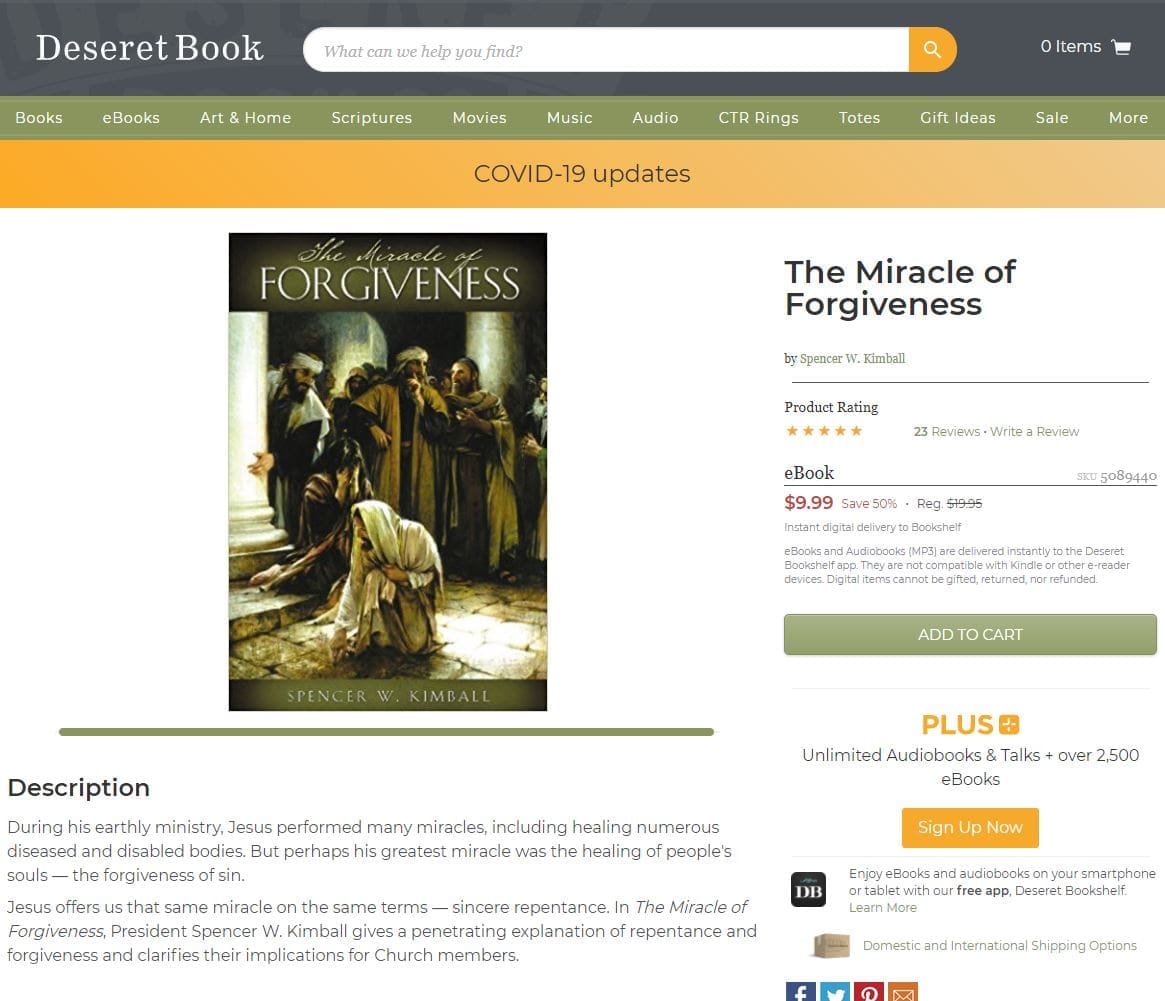
[00:03:53] And so this is a super important book. And to be honest, I had the impression that this book was no longer offered at Deseret Book. And so it kind of went off my radar a little bit. But then I had a listener reach out to me and, and call my attention to the fact that this book is still being sold at Deseret book today in 2021. And as of yesterday, January 18, 2021, I went up to, to Deseret Book, the website, and I found that sure enough, this book is, is being sold today at Deseret Book.
[00:04:31] And, and I just have to say this is not just unfortunate book. This is not just a sad book. This is not just an outdated book. This is, this is a really, really, really harmful book that I believe has contributed to anxiety, depression and even suicidal ideation and likely, you know, death by suicide for tens of thousands, if not hundreds of thousands of Mormons over the years. And that, that may seem like really exaggerated, extreme rhetoric.
[00:05:08] So just bear with me while I kind of share with you some of the main passages from this book and then I'll let you decide if you are as concerned as I am that this, that this book is still being sold today at Deseret Book. And, and if you'll stay to the end, I'm going to make a call to what the LDS Church, I feel like what they need to do to change and to make or to right this wrong. And I'm going to give you listeners a few things that you can do listeners and viewers, a few things that you can do to help fix this problem, because I think we're going to need your help to fix this problem.
[00:05:47] So, just a couple disclaimers. I just want to say that I have a warm place in my heart for Spence W. Kimball. He's passed away, but he's a beloved prophet, and I think we all believe that everyone's doing their best whenever they're doing it. I think he meant well when he wrote this book. I've actually interviewed his son, Ed Kimball. It's one of the most important interviews I've ever done on Mormon Stories podcast. I do want to refer you all to that. It's a great episode. And, and also I just want to say I'm not a big fan of, of banning books or, or burning books.
[00:06:24] And so I just want to. I just want to go on the record as saying that that's not the way to deal with things. The way to deal with things is to have thoughtful, constructive dialogue. And so the, the main reason why I. I view this book as particularly damaging is because of the Mormon teaching that is sort of core to Mormonism, and that's that, you know, obviously none of us are speaking directly with God these days or potentially ever.
[00:06:58] If you're like me, you've prayed, you've tried to talk to God, and at. At best, you've had these thoughts or feelings where you weren't sure if they came from God or not. But at worst, if you're like me, you're like, God doesn't talk to me. I wish he did. And then, and then oftentimes what the church does, the Mormon Church and other churches is they claim that they're prophets. They're the ones that get to speak to God. And this starts with Joseph Smith, and it goes to Brigham Young and all the different prophets and presidents of the church down to now. Mormons believe that Russell M.
[00:07:29] Nelson, the current president and prophet, talks directly to God and then tells us what God thinks. And that's what we were all taught growing up about Spence W. Kimball. And by the way, just because a prophet dies within Mormonism doesn't mean that their words are no longer relevant. So. So to this day, for the average orthodox, active believing Mormon, if Spencer W. Kimball said it and he was a prophet of God, then it must be God's word. And so what makes this book particularly damaging and dangerous is that these really awful teachings that I'm about to show you were uttered and written by a man that orthodox Mormons believe speaks directly to God and for God, and that's what makes it so problematic.
Harmful Teachings on Sexuality and Identity
[00:08:17] So I'm now going to share with you the deeply harmful teachings in this book. And you can be the judge for whether you're outraged or not by the fact that in 2021, this book is still being sold. And my basic premise, if my overall premise for this presentation, is harmful teachings are one thing. Harmful teachings taught as the words of God can be deadly. And I do believe that this book is deadly. And now I'm going to make that case. So let me just share with you some lowlights of teachings from this book. So here we go. Let me read to you what Spencer W.
[00:08:58] Kimball says about homosexuality. He says homosexuality is an ugly sin, repugnant to those who find no temptation in it, as well as to many past offenders who are seeking a way out of its clutches. So he's calling homosexual, homosexual behavior ugly. And he doesn't distinguish between homosexual thoughts and feelings necessarily, and behavior. He calls it homosexuality, which, which, you know, back in, in those times meant the thoughts, feelings and, or the behaviors. He's calling it ugly and repugnant.
[00:09:38] And he's saying that people are in its clutches. Okay, that's, that's pretty severe rhetoric, and I believe it kind of borders on, on hate speech. And I'll explain what I mean by that in just a second. He goes on to say about homosexuality, he says sin in sex practices tends to have a snowballing effect.
[00:10:01] Thus it is that through the ages, perhaps as an extension of homosexual practices, men and women have sunk even to seeking satisfaction with animals. So he's basically saying that homosexuality is low. He's using the term sunk and sin.
[00:10:23] And then he's saying that homosexuality leads to bestiality. And there is no evidence that, that homosexuality leads to bestiality. That's, that's dehumanizing it and animalizing it. And we do know that in the animal kingdom that there is homosexuality.
[00:10:45] But, but when you think about, you know, what's going on here is we know that in the 60s and 70s, some Idaho farm boys, basically some Mormon Idaho farm boys were caught having sex with sheeps and goats and, and animals.
[00:10:59] And that teaching about bestiality crept into some of the missionary worthiness questions as a screener. And as the church started asking that question about bestiality to prospective Mormon missionaries, they started implanting the idea of bestiality in more and more Mormons across the country, to the point where there was a real problem with bestiality, as I understand it with these Mormon boys, particularly in Idaho and Utah.
[00:11:30] But it's not homosexuality that leads to bestiality. I think you could argue that it's promoting the idea of bestiality in every interview that you give to prospective missionaries, Mormon missionaries or youth that promotes bestiality. But, but that's beside the point. The point is to be equating or or connecting homosexuality with bestiality is just, in my view, kind of a not helpful, harmful way to debase and degrade lgbt, our LGBT brothers, sisters and gender non binary and trans people. So anyway, not helpful. Spencer B. Kimball I think it's fair to say that this type of rhetoric counts as fear mongering and as dehumanizing of our LGBTQ brothers and sisters.
[00:12:24] Let me go on and read more about what he has to say about homosexuality. He writes on page 82 of Miracle Forgiveness after consideration of the evil aspects, the ugliness and prevalence of the evil of homosexuality, the glorious thing to remember is that it is curable and forgivable. Certainly it could be overcome, for there are numerous happy people who were once involved in its clutches and who have since completely transformed their lives. Therefore, to those who say that this practice or any other evil is incurable, I respond, how can you say the door cannot be opened until your knuckles are bloody, till your head is bruised, till your muscles are sore.
[00:13:08] It can be done. Now, again, as someone who got a PhD in clinical and counseling psychology, who has published possibly more than any other human on the planet on the LGBTQ Mormon experience, because I have something like 12 peer reviewed journal articles now in respectable peer reviewed scientific psychology journals, this is what my dissertation was about.
[00:13:34] As someone who probably knows as much as anyone about the science behind LGBTQ Mormons, well, first of all it's it's not helpful to use terms like evil and ugly and repugnant and clutches and bloody when you're talking about our LGBTQ Mormon brothers and sisters, but more importantly, to teach that that same sex sexuality or being gay or lesbian or bisexual or transgender or or gender non binary to teach that those things are curable and easily curable is extremely harmful or damaging. I studied surveyed over 1,600 LGBTQ Mormons. Two thirds attempted to change their sexual orientation. About a thousand of the 1600 attempted to change their sexual orientation.
[00:14:28] Literally zero percent of those who tried to change their sexual orientation reported that they were successful in eliminating their same sex attraction and the overwhelming majority were not successful in changing their behavior. To the contrary, something like 40% reported significant harm in their attempts to change their sexual orientation, you're four times as likely to report any benefit, 10 significantly more likely to report harm than any benefit whatsoever. And it's completely ineffective. So, you know, now reparative therapy, conversion therapy is illegal in several states across the country. The church is backing off. Even the church now is backing off this teaching, which makes it all the more egregious.
[00:15:15] That Desert book is still selling a book which promotes conversion therapy or reparative therapy. Incredibly damaging and completely unscientific. And so I just want to say that, that, that, you know, Spencer B. Kimball's rhetoric in the Miracle Forgiveness, you know, in my opinion, teaches LGBTQ Mormons to hate themselves, to think that they're dirty and dark and filthy and loathsome. And it teaches them fall. It gives them false expectations of hope. If a prophet says you can change. If a prophet says you should beat your, you should bruise your head and become bloody, try trying to change your sexual orientation and then you're not able to change it.
[00:15:59] I think that that sort of false hope, false expectation plus damaging unscientific advice leads to thoughts of suicidality. And we know that there's been an, an epidemic of death by suicide within Mormon youth and young adults over the past 30, 40 years, especially since Prop 8, since 2008, that's been well reported.
[00:16:23] And you know, there are a lot of factors to that. But, but one clear factor is hateful and damaging advice and rhetoric that, that honestly, the Mormon Church has gotten better about. Which is all the more reason why I'm confused that this book is still available and sold by Deseret Book when it's so incredibly damaging. One more quote about conversion therapy. Again, Spencer Kimball writes accordingly. Some totally conquer homosexuality in a few months.
[00:16:54] Other linger on with less power and require more time to make the total comeback. The cure is as permanent as the individual makes it. And like the cure for alcoholism, is subject to continued vigilance. Again, not helpful to be comparing homosexuality or LGBTQ identities to a disease like alcoholism. And super unhelpful to make unscientific claims about the efficacy of conversion therapy, reparative therapy, when the opposite is true. There's zero, literally zero effectiveness to it. It's so bad it's being made illegal. And it contributes to depression, anxiety, low self esteem and suicidal ideation, and sometimes even death by suicide. So incredibly harmful. Just for this reason alone, this book should be immediately taken down from Deseret Book and I call on all of you to please help me make that happen.
[00:17:49] Okay, let's move on from LGBTQ issues to the issue of masturbation, Let me read what Spencer B. Kimball says about masturbation. He writes, quote, thus prophets anciently in today condemn masturbation. It induces feelings of guilt and shame. It is detrimental to spirituality. It indicates slavery to the flesh, not that mastery of it and the growth towards Godhood which is the object of our mortal life. Our modern prophet has indicated that no young man should be called on a mission who is not free from this practice.
[00:18:26] There's so much wrong with this statement. Number one, it's not masturbation that causes feelings of guilt and shame. What causes feelings of guilt and shame are shaming teaches about masturbation by people like Spencer Kimball, Boyd K. Packer, Markey Peterson and the like.
[00:18:50] And you know, I have a PhD in clinical and counseling psychology. I have, I've interviewed, literally met with, provided psychotherapy to, as a trainee, provided coaching to now as a coach, thousands of students, of young adults, of adults.
[00:19:12] We now know that not only do, you know, 90 plus percent of all young men and adults masturbate, but more than 50 to, you know, 50, probably 60% of young women and women masturbate. It's a nearly ubiquitous practice.
[00:19:29] Bishops masturbate, stake presidents masturbate, mission presidents masturbate, general authorities and area authorities masturbate, Relief Society presidents masturbate, minority moms masturbate, men, you know, dads masturbate. It's a almost ubiquitous universal practice. And to say that it's dirty and dark and, and you should feel guilty and shameful is, is not helpful when it's so ubiquitous. It's as you, it's almost as ubiquitous as eating food and drinking water and sleeping. But also to, to have it in a book that no young man, and I would add women should be called on a mission who is not free from this practice. I, I have met almost no returned missionaries who didn't masturbate on their missions before, after and during.
[00:20:15] So this, this approach to masturbation is so unhelpful. And as someone again, who has a PhD in clinical and counseling psychology who has studied this, by almost all accounts, masturbation is viewed as not only a normal but a healthy practice that has all sorts of physical and psychological benefits, especially you know, before and sometimes even during, you know, the, the time when somebody's in a committed relationship. So anyway, it is just super helpful. And so much guilt and shame and anxiety and depression and even suicidal ideation has been caused by the Mormon church around these teachings about masturbation being evil. And sinful. So what you don't want to do, and what I think is particularly harmful about this book is when leaders in the church create the guilt and shame that they decry.
[00:21:16] What you never want to do as a human or as an organization is offer yourself up as the cure to the disease that you're causing. And I would argue in this case, by shaming everyone about masturbation, you promote it, you encourage it by talking about it all the time, and then by forbidding it, you make it even more likely because there's that forbidden effect.
[00:21:45] And then what you're doing is you're actually, you're creating and increasing the likelihoods of, likelihood of a behavior. And then you're teaching shame around it, and then you're offering yourself, yourself up as the cure. But you're not really curing people. So it just leads to people feeling sad and loathsome and unhappy and depressed and miserable and frankly, sometimes suicidal. So that's another reason why this book is harmful. And to tie masturbation to homosexuality, again, Spencer B. Kimball writes, what is more, it too often leads. It meaning masturbation too often leads to grievous sin, even to that sin against nature, homosexuality, for done in private, it evolves often into mutual masturbation practiced with another person of the same sex and thence into total homosexuality.
[00:22:39] So there's so much that's not helpful about this statement. First of all, masturbation is not a sin. It's not harmful. Secondly, it is not against nature. It's completely aligned with nature. It is ubiquitous. And by definition, if something is totally ubiquitous, if overwhelming percentages of the population engage in the behavior, by definition it's natural.
[00:23:07] But also to say that masturbation leads into mutual masturbation, I, I don't even know where he's getting this teaching. I can just tell you I know almost no one who has sort of this impulse of like, oh my gosh, now that I've masturbated, I want to masturbate with my buddies, my friends.
[00:23:29] No, that, that's not a natural progression. And, and we know that same sex attraction is something that you're, you're born with. It's something that, you know, tied to brain development in the womb, most likely. But, but masturbation doesn't lead to mutual masturbation or everyone will be doing that and they're not. But, but certainly masturbation does not lead to homosexuality or everyone would be gay, like 70, 80% of the population or more would be gay. And they're not um, and again, we've got science now in the modern age to tell us that homosexuality, same sex sexuality and even gender identity is tied to brain development, not to masturbation.
[00:24:19] So again, this is a super harmful teaching that again engages in fear mongering and is unscientific and is deeply problematic. A couple more problems with the miracle of forgiveness. He teaches about, you know, really unhealthy teachings around purity and virginity culture.
[00:24:41] He writes about, you know, sex before marriage, quote. Also far reaching is the effect of loss of chastity, meaning sex before marriage or outside of marriage. He writes, once given or taken or stolen, it can never be regained. Even in a forced contact such as rape or, or incest, the injured one is greatly outraged if she has not cooperated and contributed to the foul deed. She is of course, in a more favorable position.
[00:25:13] This is no condemnation where there is, there is no condemnation where there is no voluntary participation. It is better to die in defending one's virtue than to live having lost it without a struggle. Now, I don't even have time to get into all that's wrong with this statement, but, but just this idea that you are pure and white and delightsome if you have not had premarital sex, but then as soon as you have had premarital sex, you're like a licked cupcake. You're like chewed gum. You're like a handled Snickers bar or a nail, a board with a nail in it. You know, these are the types of teachings that caused Elizabeth Smart, when she was abducted by Brian David Mitchell, a Mormon, and raped and, and held against her will.
[00:26:07] These were the types of teachings that caused her to feel like she was so damaged that she didn't even need to bother running away and escaping from her captor because she had been taught that once she lost her virginity, even if she was raped, she was somehow damaged goods. And this is a teaching that has plagued Mormonism for decades, if not longer. This virginity culture, this purity culture, and it's so wrong and it's so harmful. You don't lose anything when you have premarital sex. Your, your worth is not affected at all. You are always pure and good and loved and, and, and admired and worthy.
[00:26:53] Again, his language around rape and whether or not the, you know, it's only women that get raped in this, you know, and, and there's sort of questions about did you participate in it, did you enjoy it, and if so, how guilty are you or not? This is just all the wrong messages around rape and then, and then just the Last thing, that it's better to die than to have. So, so he's basically saying that if you're getting raped and you fight it and it leads to your death, it's better to die fighting for your virginity than to have lost your virginity.
[00:27:33] This is so damaging. And it's the type of rhetoric that leads, not just rape victims, but just people who have had premarital sex that makes them feel, feel like their life isn't worth living anymore. It's the type of rhetoric that actually leads to thoughts of suicidal ideation and, or even death by suicide.
[00:27:54] Better dead than unchaste is a really, really harmful teaching. And again, this is a book that's today, January, you know, 18th 19th, 2021 is still being sold by Deseret Book. And you can go up to their website right now and see it continuing with Spencer W. Kimball. He writes, quote, teenage car accidents far exceed those for other ages. But these physical hazards are the lesser ones. The dead may live again, the crippled may be resurrected with whole bodies, but the blighted soul, the scarred life, the violated youth with virtue lost. These are the real tragedies. Again, he's saying that if you have premarital sex, you're crippled.
[00:28:41] Again, why are you picking on on people with disabilities? He's saying you're blighted, you're scarred, you're violated, your virtue has been lost and that you are the real tragedy. Death isn't a tragedy. The real tragedy is losing your virginity.
[00:29:01] Again, I can't emphasize enough how damaging this sort of extreme rhetoric around sexuality. It leads to self hatred, to stigmatizing. And I, I believe as, as someone who has a PhD in clinical and counseling psychology, I believe it leads to suicidal ideation and even death by suicide. And before we end, we have to talk about Spence W. Kimball's rhetoric around death by suicide. And I'm just going to warn people, this is a sensitive topic and some people are going to be disturbed by the language here.
Harmful Teachings on Suicide and Mental Health
[00:29:36] But here's what he says. He basically tells a story. Quote, this is Spencer W. Kimball in A Miracle of Forgiveness. A minister acquaintance of mine was found by his wife hanging. His thoughts had taken his life. Certainly he had not come to suicide in a moment, for he had been a happy, pleasant person as I had known him. It must have been a long decline. He even steeper controllable by him at first and perhaps out of hand as he neared the end of the trial trail. No one in his right mind, and especially if he has an understanding of the gospel, will permit himself to arrive at this point of no return.
[00:30:18] Again, so harmful and damaging. These messages are all harmful about death by suicide. To say that it's basically a choice, that it's. That. That suicidal ideation and death by suicide is a result of. Of weakness or faithlessness. To say that, you know, you can, you can't.
[00:30:45] To say there's something weird about once being happy and then being suicidal. Just think about people with, with bipolar diagnoses. They're both happy and they reach such dark, low periods of depression that they become suicidal. But also the chemical and the biological components of this certainly allow for the possibility of once being happy and then wanting to end your life. But also to claim that it can't be a sudden thing. It must have come after many years of sin and faithlessness. No, suicide can be something that, that occurs to somebody in dark and desperate times, in a flash, in a moment, without any premeditation and without any, quote, sin.
[00:31:32] It's just. It's a mental health issue. It's a disease. It's. It's certainly not something that we should be judging and condemning people for. And again, the Mormon church has gotten so much better about talking about this issue, which, which is all the more reason why this book needs to be removed not just from Deseret book, but from, you know, I believe, all the shelves of people who might access it, who would be vulnerable and certainly never recommended by parents or teachers or leaders in the church.
[00:32:07] And just to say that no one who has an understanding of the gospel would ever permit themselves to arrive at this point. It's not suicidal ideation. And death by suicide is so often not a choice. It can be, but it often is, is what people do when they feel desperate and they're trapped and they feel like they have no other alternative. He goes on to write, sometimes the temptation towards suicide comes when a person is bowed in grief at bereavement or feeling inadequate to meet and cope with the difficult situations he encounters to end it all. But this great crime didn't. Does not end it.
[00:32:46] In his right mind. Only a fool would ever consider taking his own life, whatever he meant by this. Please don't demonize or insult or degrade and call people names who end up dying by suicide. That's just mean and harmful and not constructive.
[00:33:09] The church has gotten so much better in its rhetoric, and this book just takes us back. And again, because it's taught by a prophet, seer and revelator, it's gonna still be believed as long as it's on the shelves and not condemned openly.
[00:33:26] So this is just all harmful. And again, I've already made the point that harmful teachings are one thing. Harmful teachings taught as the words of God by a prophet, seer and revelator of God can be dead. So I've already made the point that the Mormon Church has gotten better in its rhetoric around mental health and depression, death by suicide, and LGBTQ issues. I'm not trying to say that that the miracle of forgiveness represents the modern LDS Church view on these issues, even masturbation.
[00:34:03] But this book is prevalent. We were all raised and taught these principles. This book is still on almost every shelf in every Mormon household. It's still recommended by bishops and stake presidents and mission presidents and area authorities and Sunday school teachers and youth teachers, et cetera.
[00:34:23] And so that's the deal is that we can't just, like, stop selling this book or reducing the selling of this book and feel like we've solved the problem. There are generations of, of parents and leaders and teachers who have been taught these principles, who believe that they were taught by a prophet. These books are still on all the shelves all over the world. This book is still being recommended to youth and adults. And again, it's still in print at Deseret Book.
[00:34:54] Again, as of yesterday, January 18, 2021, this book is still being sold by Bi Deseret Book. And to me, that's just outrageous. So here's what I'm asking the Mormon Church to do. We know that the Mormon Church listens to Mormon Stories Podcast and takes what we say.
[00:35:14] You know, my listeners, my interviewees. I know that they listen. And we're asking that they consider the following. Please, Mormon Church, please do all you can to remove this book's availability from, from all bookstores, Seagull Book, Deseret Book, churches, homes. If you could even consider a buyback program where you go and find out wherever the book is sold and either negotiate with booksellers, use your money to buy the book back. Buy the books back at bulk. Everything we can do to keep this book from being put in the hands of those who might be vulnerable, who might take it too seriously. We plead the LDS Church to consider doing this.
[00:35:57] We asked the LDS Church to send out a memo. You know, we know that Spencer W. Kimball sent out a memo in the early 80s telling bishops and stake presidents that oral sex was forbidden. We know that that memo had to be retracted. But we do think that a memo in this case would actually be useful. Please send out a memo to bishops, stake presidents, mission presidents, temple presidents, leaders who at the church parents that that this book should not be ever referred to people having doubts or problems, to LGBTQ people, to youth, to young adults, to divorced people. This book is a health hazard.
[00:36:38] It's not just cringy, it's not just unfortunate. It is literally a health hazard, mental health and physical health hazard to anyone who might pick it up because it's written by by a prophet, Syrian Revelator and I would love if the Mormon Church would give a general conference talk apologizing for this book and for the rhetoric that this book has has created and to all of these teachings that are so harmful. If the Church could do something explicit to denounce and distance itself from these teachings like it's done with the blacks in the priesthood rhetoric and the racist rhetoric, it would be so so helpful.
[00:37:20] But there's also things you could do to help today Share this presentation with anyone who you think might benefit from it. Please email Deseret Book. I've given you three email addresses Service deseretbook.com Media inquiryeseretbook.com and HRDept HR Department hrdept deseretbook.com Please email all these departments. If thousands of you flood these emails with your requests to remove the book, I bet within the next few days, weeks or months we can have this book completely removed from Deseret Book. Please call Deseret Book and in your free time please just pick up the phone 1-800-453-4532 in US and Canada, 1-801-517-3369 internationally you can go to my website for those numbers again Mormon stories or YouTube or Facebook.
[00:38:20] Please call Deseret Book and request complain about this book. Explain to them why it's so harmful and please ask them to remove the book. Do your best to try and remove copies of this book from the access of vulnerable people. Talk to your parents, talk to your siblings, talk to your children, talk to bishops, stake presidents, talk to ward members, libraries, anywhere where this book might be available. I'm not recommending book banning or book burning, but it just seems like this book is a health hazard and anything you can do to educate people about the harm of this book and to limit the book's access to vulnerable people.
[00:39:03] Some 16 year old boy or girl that had premarital sex or masturbates or is gay or lesbian or bisexual or transgender, they they could stumble on the book, start reading it and immediately start wanting to having anxiety or depression or even suicidal ideation. Please help us, you know, prevent the access of this book to anyone who might be vulnerable. Speak to influencers you know, speak to if you know general authorities, if you know area authorities, if you know stake presidents or bishops, communicate with them and help educate them about the harm of this book.
How to Help Remove This Book from Deseret Book
[00:39:38] And you can even use current LDS Church teachings around same sex sexuality, LGBTQ stuff, around chastity, around depression, around suicidal ideation. Because there are modern statements in the past few years that correct all the a lot of that attempt to correct a lot of the damage that this book has caused. Please help educate our leaders and then please come up to YouTube, please come to Facebook, please come to MormonStories.org and share your experiences with this book. If you've had awful experiences around this book, if it's hurt you, if it's hurt family members of yours, or if you've done things to help make a positive difference, to change things.
[00:40:24] Please share all your experiences either on YouTube at the Mormon Stories Podcast channel, either on Facebook at the Mormon Stories Podcast channel, on the Mormon Stories Podcast Facebook page, or go to MormonStories.org into the post for this episode and share your experiences. Positive, negative, etc we'll have a living testament to not only the damage this book has caused, but also to the good that many of you have done to help fix this cancer. I believe this problem that is vexing Mormonism to this date. Remember the date January 18, 2021. Go to Deseret Book every day until this book is removed and and let's just monitor Deseret Book until they take it down and I promise you I will hold up host a party after Covid's over.
[00:41:14] We'll host a party in Salt Lake City and we will have a celebration to thank the LDS Church and to thank and celebrate all of you who did your part to rid the world of this book that's so damaging. And man, as soon as you find out that this book has been removed from deseretbook.com please let me know and we'll do we'll again promote it and thank we'll thank the LDS Church and Deseret Book for for listening to us. So again I'm going to thank you for listening today. And I'm going to close by saying harmful teachings are one thing. Harmful teachings taught as the word words of God can be deadly.
[00:41:53] Let's get rid of this book, the miracle of forgiveness. Let's incorporate new teachings about healthy sexuality, LGBTQ affirming teachings including trans and gender non binary affirming teachings, taking the shame out of sex teaching healthy sexuality, teaching consent, teaching healthy committed relationships, sex positive sex affirming messages, no longer condemning masturbation no longer stigmatizing suicidal ideation and teaching and encouraging positive mental health practices like seeking medication, like seeking psychotherapy, counseling support etc and will make Mormonism and post Mormonism a healthy happy place. I hope you've enjoyed today's presentation. So grateful. Please share this everywhere you can. If you could just share this presentation on Facebook, on YouTube, share it Instagram on Twitter it'll make it'll make a huge difference.
[00:42:54] Thanks everybody. Thanks so much. You're awesome. I love you and please tune in again soon for more Mormon Stories podcast episodes. Thanks to everyone who donates to Mormon Stories. If you valued this program, if you liked it please consider donating@mormonstories.org become a monthly donor and and we'll do more episodes like this to help more people. Thanks everybody. Take care. See you soon on another episode of Mormon Stories podcast.
Transcript © 2026 John P. Dehlin. All rights reserved. Brief quotations are welcome with attribution and a link to mormonstories.org; all other use requires written permission.
In my opinion, one of the most damaging books ever published by the Mormon Church is Spencer W. Kimball’s “The Miracle of Forgiveness.” Among other things, this book teaches that:
- No young Mormon man or woman is worthy to go on a mission if they masturbate.
- Masturbation alone leads to masturbation with others, which leads to “homosexuality.”
- Being gay or lesbian is “ugly,” “repugnant,” and comparable to a disease.
- “Homosexuality” leads to bestiality.
- “Homosexuality” can be easily “cured.”
- People who have pre-marital sex, and even rape victims, are “blighted” and “scarred.”
- It is far better to die than to lose one’s “virtue.”
- Death by suicide is a sign of foolishness, faithlessness and/or weakness and/or sin.
To be clear, this book is currently sold at Deseret Book, and remains on the book shelves of hundreds of thousands of Mormons across the world.
In this short presentation, I offer my brief argument for why I believe that “The Miracle of Forgiveness” should be removed from Deseret Book, and I let listeners and viewers know what they can do to help. I also share my thoughts on what the Mormon Church can do to help “atone” for selling this damaging book for several decades.
How You Can Help:
- Share this Presentation.
- Email Deseret Book:
- service@deseretbook.com
- mediainquiry@deseretbook.com
- hrdept@deseretbook.com
- Call Deseret Book
- 1-800-453-4532 (Toll-Free US and Canada)
- 1-801-517-3369 (International)
- Speak to any influencers you know.
- Do what you can to remove this book from the access of people who might be vulnerable (book shelves, etc.).
- Please share with me/us what you did, and the reactions.
- Remember the date: 1/18/2021.
- Monitor deseretbook.com for when they take the book down.
- I will throw a party when it’s gone (likely this summer post-COVID)
P.S. This is a re-recording to make the video less “ranty,” and to remove the discussion of book bans and book burnings, which is not useful. HUGE thanks to everyone who gave feedback on this. I always want to be a constructive voice.
Thumbnail Credits: Image of Spencer W. Kimball from Christie Williams and LeeAnn Roberts (public domain)
41 Responses
Don’t throw your copy of the book away. Not only will it be a valuable from a collectors point, but there will be young TBM’s that will insist that the Church never taught those things. Not only will It is more incriminating evidence of the hurtful and dangerous dogma of the past but evidence how the Church tries to hide and obfuscate their history. A Shameful, full of deceit organization.
Sorry, but I love that book. I only wish that the current church leaders would take a hard stand today, just like Spencer Kimball did when he wrote that book.
I absolutely love the miracle of forgiveness also.
People who love sin absolutely hate the book.
Precident Kimball was very straightforward man.
I read The Miracle of Forgiveness years ago and I learned how to forgive others. I love this book because it helped me to love others, even those who abused me. Forgiving others is a healing gift. This book was truly written by a prophet of God. And, yes, he was very straightforward.
I agree with you.
I need to clarify, I made the previous comment prior to listening to Johns episode. I agree with John completely that it is hate speech. I’ve already emailed Deseret Book and asked that they discontinue offering the book for sale or printing new copies. I began my exit out of the Church 40 years ago but like John said, the book was ubiquitous and I have a copy. I will not burn or destroy my copy and it goes without saying that it has not been used as a reference for 40 years.
John please help me! Dear God! This is too much! I’m gay. My dad gave me $200 and the Miracle of Forgiveness time and time again with all these parts underlined with $200 over and over again…up to about $5000….
Very good podcast, John, but I do not expect that it will change anything with the Brethren.
Damaging yes, hateful no ,in the context of the time ,the views expressed in the miracle of forgiveness reflect an unobtainable religious utopia where perfection is found ,in living by every word that comes forth from the mouth of god . To a straight male the thought of sex is always front and center. And the thought of homosexuality is repulsive and repugnant it’s natural. I think that 4 percent of human beings are born gay . At least that was the figure I last read . I’ve heard that it is much higher in Mormon youth . I would petition John to look deeply into the concept of opposition in all things and to be the teacher and doctor that he is as it pertains to the protection of a valuable soul in the site of a loving savior . Gay or straight , when used as a comparison in mans quest for balance and happiness. Books like this one should not be banned or burned, never never never , don’t go down that slippery slope . We must understand our roots we must come to grips with gods being as described as love and we must not whip gay people up to hate and lash out and judge 96 percent of the rest of the population because we were taught something counter to love I e gods being . Judgement is mans call to action . We must not get into the banning game it is far better to do as you have done so well in over 16 years of your podcast , defend the marginalized in Mormonism. Without separating them from their parents and loved ones who share a different view in life . Mormonism is not pretty when you pull back the layers . But in my lifetime of experience the religion has churned out a few very fine and understanding individuals . So where do we go from here we must go to freedom and enlightenment not to fires of burning books and damning those with differing views . True martial arts instruction teaches you to use your enemy s velocity to your advantage and let him over exert . This is rampant in the church today . The church is damaging itself . Gay or straight we as individuals must be loving and forgiving . We must understand how hard it is to change the course of a religious movement. Hate goes both ways. Let’s choose a better way and let this book die a natural death.
Hopefully this is some constructive criticism:
Something I have noticed lately John, is that you are sounding just like a bible thumping, fire and brimstone, tent revivalist preacher. Not in content, but in tone. The effect this has on me is to lessen my interest in hearing what you have to say, because I instinctual disbelieve the bible thumpers. The tone gives the impression that to make up for a lack of serious argument, the speaker appeals to the audience with heightened emotion. Even though I agree with your position, I am turned off by the similarity to the bible trumpeters. It make me question if there is some flaw in what otherwise seems perfectly logical. Like Pavlov’s dog, when I here the bible thumper tone, even though I agree with what is being said, my mental reaction is this guy is full of sh**. Maybe I pick up on this because I do the same thing when arguing something I am passionate about even though I know it does not help my argument, the emotion just takes over.
I actually agree. Thank you. Gonna regroup.
Banning a book that teaches the Lord’s standards? It’s always been a hard and harsh thing for the wicked to obey the Lord’s commandments but a blessing for those that do.
Just emailed Deseret Book:
To whom this may concern:
It is appalling to me (and many, many others) that The Miracle of Forgiveness is still being sold in 2021. Please remove this book from your physical and virtual shelves as it teaches hateful lies concerning homosexuality, rape, incest, and suicide. It has personally hurt me when I was told to read it by my Bishop so I could be “forgiven” for what someone else did to me. This book is so dangerous and wrong on so many levels. Please remove it from Deseret Book and pass along this email to The Brethren!
I am appalled made me chuckle.
https://www.worthpoint.com/worthopedia/signed-1979-am-appalled-byu-daily-1790062779
John, I went to Deseret and Seagull Book Stores today. They don’t have Miracle of Forgiveness. It hasn’t been in stock for six years. – Danny Larsen
You can order it on Amazon and audio.
Danny – It’s available on https://DeseretBook.com
eBook only.
According to to Wikipedia it was last published in 2015.
It is unbelievably sloppy that a .1 trillion dollar business would not periodically purge their record of nonsense, let alone barbaric nonsense.
John, I have just found your work and I’m taken by your demeanor. In other words I am very impressed by your command of your truths.
This is just another place where Church leaders will be very slow to act. They are terrified about doing anything that might undermine the concept that the prophet speaks for God. That is truly their sacred cow. They would rather let people die than compromise that fundamental narrative. This is why there are still members who believe that black people are cused with dark skin, and that gay people can be cured. To facilitate healing, the Church needs to clearly identify which doctrines that it used to teach are false. I’m not holding my breath waiting for that!
John thanks so much for your passion, it is I that passion that shows how much you care . Is it possible that Spencer was writing his legacy with that same passion not knowing the damage that it would cause in future generations ? The wonderful thing in Mormonism is that none of its prophets have been granted immortality they are all dead . And with that a new era is usually brought forward. Enlightenment should be our quest, I’ve often thought that the salt sermon was the catalyst that created the militant god is on our side Book of Mormon re do that brought on the messy unloving egotistical racist religion that all of us born into the faith were brain washed into giving so much of our lives to .Yep we are damaged . Yet we still have hope for a brighter day. Thanks John, your passion is forgiven, just like my former thought process is slowly moving away from this lifetime of brain damage. We are healing mentally and spiritually. Thanks for giving us a place to recognize this . My hope is that God is involved and he is allowing those of us who are so broken in this process to Hal and come together. Even in the midst of such passionate debate .
I completely agree that the specific issues John mentions here are huge and that we need to completely stop selling and using these teachings. However, in a broader sense, I find the specific issues raised in this episode as belonging to a broader mental health issue with the entire concept of Christianity as it is commonly taught in The Church Of Jesus Christ Of Latter Day Saints, as well as many other branches Christianity. In this video, John talks about problems with an organization offering itself up as the cure to a disease it is causing. Isn’t that a fitting summary of the entire concept of the fall of man and redemption through atonement? We are taught (as in the Book Of Mosiah) that by being our natural selves, we are an enemy to God and that we, as we are, are less than the dust of the earth. I’m reminding of the words of Thomas Paine, which he wrote in The Age Of Reason of the man who receives these teachings, “He calls himself a worm, and the fertile earth a dunghill; and all the blessing of life by the thankless name of vanities.” Then we are told that the cure for our innate wretchedness lies in a father having his son murdered to pay the price for each of our redemption from our natural state of awfulness. How can any woman or man who believes this ever really feel good about themselves? I became increasingly sensitive to this issue after my daughter attempted suicide. As I tried to heal and get her the help she needed to heal, I came to see how damaging the belief that I was innately flawed had been to me in my life and to my children, whom I had faithfully taught such a dangerous doctrine. Unfortunately, to truly stop causing extreme mental health damage and suicidal thoughts to people, I honestly feel that in addition to dropping the specific teachings of The Miracle Of Forgiveness, we would need to also abandon and replace many of the teachings of the Bible and The Book Of Mormon (upon which Spencer Kimball based much of his doctrine found in the book we are discussing here) as well, and I do not have hope that we as a church would ever even consider that.
I would’ve enjoyed it if you interviewed someone who had researched the book and could talk specifically about what the book has to say and possibly why it was written and why the church used it And some examples of how it affected individuals
an interview with someone more about specifically what the book says that is so disturbing would’ve been informative
I like when you interview experienced knowledgeable individuals or those who have interesting experiences to share
😎
I’ve been buying every copy I find at Deseret Industries for years, then tearing and tossing in the trash.
Seriously? 🤦🏽♀️🤣
I would love to confront President Kimball and contrast his chastity rules with those permissible for his grandfather, Heber C. Kimball, a notorious polygamist. As I recall, HCK was ready to give his wife to Joseph. He later told missionaries going to Europe not to marry young female converts in Europe, but rather bring them back to Salt Lake City so that he (and other Mormon royalty) could have a “fair shake” at them. During the 1970s, the history of HCK was not so well known, as now thanks to the internet.
Thank you for sharing. Is there a way to get access to the slides you used? I’m trying to spread the word in Facebook groups I’m in and I think having direct quotes would be very helpful to help those defending this book see the damage it can cause.
This book says if you survived a rape you consented, otherwise you would be dead.
“It is better to die in defending one’s virtue than to live having lost it without a struggle.”
If it really was rape, why are you still alive? You should have struggled until the rapist killed you during or after the assault.
Burning books in the Nazi style may be seen as wrong, because the Nazis circumvented freedom of conscience. But burning the Kimball’s book isn’t the same thing. This man was the prophet when I got baptized in South America. My generation fell like flies in the trap of Mormonism. Little did we know about the whole dirty history. Peruvian Mormons could not imagine the nasty history that was hiding behind the Utah Empire of Doom that was exported to the world as a true testimony of Jesus Christ. I feel that with all his sweetness, Spencer Kimball didn’t have the moral stature to teach morals, because of the history of immorality that his cronies conceal until today. A church that taught their followers to inbreed for the reproduction of a particular race should first go back to introspection before claiming to teach for God, chastising different sexual practices as bestiality while concealing the bestiality of the Founders.
Oh, so much anger and contempt here! Wow.
This “cancel culture” generation seems to think that the moment someone disagrees with something that was written or said in the past, present or future, it’s discriminatory and heresy. What I’m hearing from everyone here is that if President Kimball was alive, you’d tie him to a stake and throw burning sticks at him, because, effectively, that’s what you are doing. Prophet or man – it doesn’t matter who it is, we should not seek to destroy anyone for their teaching or their opinions – but you are.
Think about that. Don’t steam about it, – just pause for a second and think what your intentions are here.
Where are these intentions coming from?
Why is it so important that this book be banned from the Mormon church?
Why do you care?
Most of you don’t sound like you are card-carrying temple recommend holders.
So why the fight?
Move on.
Do something productive with all that steamed up energy in you.
You’ve cried the river, you’ve built the bridge, now just get over it.
Still here?
People …. are we still people? This is not the way decent people deal with something that angers them, or hurts them, or cuts them to the very center. Write your own books, spread your own message, fine. Don’t tear apart someone else’s opinions and ideas just because you don’t like them.
Sometimes, the truth hurts and when it hurts, well, that’s a message in a bottle, just for you.
(see 1 Nephi 16:2)
And YES … YES … YES … you ARE entitled to your opinion. The teachings of President Kimball’s book are raw and deep and they are blunt, very blunt … and this soft whiney cancel culture generation can’t handle anything you disagree with.
FYI – the title of the book is a spoiler … the “Miracle of Forgiveness”, obviously, you haven’t read it to the very end.
Should it be banned, outlawed? Let’s ask Abinadi – a bunch of people didn’t like what he said either and he wasn’t nearly as blunt or open about it as President Kimball.
We’d be wise to follow the admonition of Disney’s Elsa …. “Let it go!”
I’m guessing you haven’t been hurt by the teachings in this book.
My husband knew I had been raised by a pedophile, and that I had had a sexual partner as a teen.
He also knew that I joined the church and was celibate for three years before I met him. I ‘repented’.
But the words that Kimball printed convinced said husband that he had married below himself.
I became the servant. And sex was for him only – I was told to lie still and make no sound.
This man felt ‘entitled’ to a virgin, and his contempt for me grew until I could not stay where I was made to feel so unworthy.
If forgiveness applies only to some, but not to others, then it doesn’t truly exist.
Hear hear!
Rather than pitching The Miracle of Forgiveness into your trash can, I would suggest instead obtaining a copy of Gay Rights and the Mormon Church by Gregory A Prince (University of Utah Press, 2019). The latter volume addresses Kimball’s attitude on homosexuality in its fourth chapter, having examined alleged causes and ‘cures’ from a science-based perspective in the preceding two chapters. To say the teachings of Mormon church leaders on the subject are more fantasy than fact would be an understatement.
(One could also mention the pamphlet To the One, which is the text of an address by Boyd K Packer at a March 1978 Twelve Stake Fireside at BYU. This can still be found online.)
So, what was the cost of these disparaging attacks on Mormon youth who had come to realize they might be ‘one of them?’ The answer can be found in the first paragraph of Chapter 29: ‘Yet the incidence of teenage suicide in Utah, the most Mormon state in the country, is rising at the highest rate in the country.’ An early example of the gay Mormon suicide epidemic can also be found in Outside the Temple Gates—The Gay Mormon—an article written by Robert I McQueen and published in the August 13, 1975 issue of The Advocate. McQueen was a gay Mormon RM who related the story of five friends, three of whom were also RMs he had met at BYU in 1965: ‘four had been trapped in the on-going homosexual witch hunts at BYU and subjected to the Church’s disciplinary program. The fifth had sought help on his own by contacting Church authorities and admitting his problem to them. As an initial step in their counseling, each of them was interviewed by the counselor for homosexual problems at that time, Spencer W Kimball.’ All five were expelled from BYU, excommunicated from the Church, and learned their families had been informed of the ‘problem.’ All five took their own lives as they discovered ‘their student records contained this sorry piece of information.’
McQueen’s conclusion: ‘My friends from 1965 were good people. They wanted to be better people, but they believed in their church more than they believed in themselves. When their church rejected them because they were gay, it destroyed them. I doubt the Mormon Church will ever accept even a portion of the blame.’
McQueen himself survived for another decade by being true to his own nature: ‘I realized it seemed more natural for me to be gay than Mormon.’
I read this book before I went on my mission. I did not realize the harm that it caused to me. I read it as a young, believing mormon, and took it as the word of god. It was a major contributor to me falling into the shame cycle, and it negatively affected my outlook on many issues for years after. I even recommended it to a friend that confided in my that she had been sexually assaulted 🤦♂️ I just checked, and this book is still available for sale on Deseret books and also on Amazon. Shameful, to say the least.
According to Wikipedia it was last published in 2015.
Think about the story of Sodom and Gomorrah which is taught and believed by 3 large religions: Christianity, Islam, and Judaism. If this story is true then how does anyone know that Spencer Kimball’s words aren’t a message from God. I know the words are harsh. However, many words from God’s prophets are harsh. Many people don’t want to or don’t have the will power to know who God really is because we would have to change and give up personal pleasures.
I am sorry but I have to disagree on this, this book has helped me a lot get through some very tough times in my life and I am very thankful for President Kimball writing this book and wish that the church would push this book more for others to help them with weaknesses that they may have.
I will keep all 3 of my copies. I don’t think “deseret books has a right to do this. I’m looking to replace my book membership with them. They’re too far left for me. I’ll have to get out my book and see in what context this as being said. I know of youth that have gone on to fulfill successful missions even though they crossed the line. Like all lefts, they leave too much content out of the conversation. .. after all – this books is called “The Miracle of Forgiveness”
Spencer W. Kimball was not the President of the Church of Jesus Christ yet when he wrote the book. I also felt that some chapters in the book were very dark and I did not feel the Spirit when I read them. I wouldn’t recommend the book to anyone because of the deeply judgmental, depressing tone found in it. P.S. I am active in the Church.
Any missionary that committed any slight infraction on my mission (Arkansas Little Rock Mission early 90s) was forced to read this book by the mission president Robert T Ferguson. We also had to send him a summarization of every chapter, every single week, citing where we had done wrong. This book has been used (in the past) by bullies, such as this particular mission president to bludgeon others they perceive as weak and unworthy.
That insane man asked every single elder and sister during the monthly interviews if they masturbated! I wish I had never gone on an LDS mission. And yes, I still attend church to this day. That book the Miracle of Forgiveness creates guilty feelings for even having genitals and sexual urges. On the last day in the mission the elders are given this pamphlet “Single Brethren of the Church.” Now it’s your job to marry as quickly as possible and start procreating, after being told for the last 21 years of your life to feel guilty for even thinking about it!
Mormon culture is toxic, destructive and filled with hypocrisy, but the gospel of Jesus Christ teaches us to love all, to leave the 99 and focus on the lost one.