
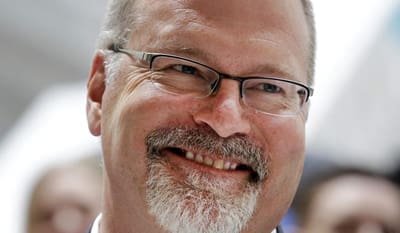
 Stephen Urquhart was raised in Houston, Texas, where he and his family converted to the LDS church after the suicide of his older brother. After serving an LDS mission in Brazil, Steve married Sara Stanley and graduated from BYU Law School — ultimately settling in St. George, Utah.
After developing a successful law career in St. George, Stephen served for 16 years in the Utah State Legislature, representing Washington County. In total, Stephen served 8 years in the Utah House of Representatives, and 8 years in the Utah Senate.
During this vast legislative career, Stephen championed legislation on several issues crucial to Utahns, including: public land use, water rights, death penalty, increasing citizen access to legal services, numerous initiatives to improve K-12 and higher education in Utah, and most recently — anti-discrimination and hate crimes legislation (LGBT), as well as the legalization of medical marijuana.
In this two-part episode, Stephen discusses:
- Part 1: His early years in the LDS Church, and his legal and legislative careers in Utah.
- Part 2: His experiences and reflections on the powerful influence of the Church of Jesus Christ of Latter-Day Saints on the Utah legislative process, and his loss of LDS faith after witnessing the negative impact of LDS LGBT policies on several people close to him.
Episode Transcript
Host: John Dehlin · Guest: Stephen Urquhart
This transcript is machine-generated and lightly edited for readability. The audio is authoritative. Please excuse occasional errors in names and spelling.
Introduction and Episode Overview
Part 1 of 2 · Ep. 680
Stephen Urquhart [00:00:00] 1, 2, 3.
John Dehlin [00:00:07] Mormon Stories Podcast is a production of the Open Stories Foundation. All donations to Mormon Stories are fully tax deductible and go directly towards keeping the podcast alive and towards building a community of support for Mormons like you. To support the podcast or to join the community, please become a monthly subscriber today@mormonstories.org. hello and welcome to another edition of Mormon Stories Podcast. I'm your host, John Dehlin. It's December 8, 2016. As you can see, we're in downtown Salt Lake City, Utah, with a very special guest. I am super excited to have with us today, Steve Urquhart. Steve has done a lot of really cool things, but just to give you a really quick preview, Steve not only worked as an attorney many years in St. George. Right. Southern Utah, but eventually he became a member of the Utah State Legislature, both as a member of the House and the Senate.
Stephen Urquhart [00:01:10] Yeah, eight years in the House, eight in the Senate.
John Dehlin [00:01:13] So 16 years experience working with the Utah State Legislature.
Stephen Urquhart [00:01:18] And then that building right behind us,
John Dehlin [00:01:19] in that building right there and right there. Yep, there it is. And what we're going to be talking about today, the theme, it's going to be about Steve's life, but it's also going to be about that other tall building right there poking up above the US bank and the Zion's bank building, which is the corporation of the president of the Church of Jesus Christ of Latter Day Saints, known as the Mormon Church. We're going to be talking about the influence of the LDS Church in Utah state politics. As many of you will know, over the past several years, there have been many bills that have come up in front of the Utah legislature. Specifically, some of the ones we've covered on Mormon Stories would be the cannabis medical marijuana bill. There's been the anti bullying legislation around LGBT people in Utah, and there was sort of what many refer to as the landmark legislation that was passed regarding religious freedom and anti discrimination against LGBT people. And Steve was sort of in the thick of all that. So we're going to be just talking about not only those bills specifically, but even just broadly, what it's like to
Guest [00:02:38] be
John Dehlin [00:02:40] a member of the Utah legislature and what it's like to interact with the LDS Church when all that's going on. So, Steve, welcome to Mormon Stories podcast.
Stephen Urquhart [00:02:51] Thank you. What an honor. Good to be with you.
John Dehlin [00:02:53] Yeah. So tell us. Let's just start where we always start. Let's establish your Mormon cred. Tell us a little bit about where you grew up and what role the church played in Your life in those early years.
Stephen Urquhart's Background and Upbringing
Stephen Urquhart [00:03:05] Okay. So I grew up in Houston, just down the road from you.
John Dehlin [00:03:09] Were we there at the same time?
Stephen Urquhart [00:03:10] Yeah, we were.
John Dehlin [00:03:11] Did we talk about this?
Stephen Urquhart [00:03:13] So I graduated Spring Branch high school in 1983.
John Dehlin [00:03:16] Okay. So you're my brother's age. All right, cool. Yeah, we have the same stake.
Stephen Urquhart [00:03:21] Yeah. We're in the same common stakes. Yeah.
John Dehlin [00:03:24] Roses.
Stephen Urquhart [00:03:24] Jespersons.
John Dehlin [00:03:25] You knew the roses.
Stephen Urquhart [00:03:26] Oh, yeah, same word.
John Dehlin [00:03:27] So the guy who's the BYU coach right now, right. He was. His younger brother Justin was kind of my age.
Stephen Urquhart [00:03:34] Your age. So his big brother Scott was my age. So. David Rose, BYU coach. His mom claims that I gave her her gray hair, and I know her boys, so that's. I know who gave her her gray hair, but so we joined. So, you know, I grew up in. I mean, my parents didn't get along too terribly well, let's put it that way. So I had a brother who. He killed himself when he was 19. I was 6, 7. And so, you know, that it was not a terribly stable background in Houston. In Houston. And so we had some friends just the next street over. A Wynn family is their name, and we spent a lot of time with them, and we went to church with them. And they had a blazer chart, you know, with the Articles of Faith. And so, you know, they would get cool little medallions for memorizing the Articles of fai. So, you know, I kind of have a freakish memory thing, so I'm like, cool, this is easy. I want those cool medallions. So we went to primary with them. And so.
John Dehlin [00:04:49] So you weren't Mormon growing up until that time?
Stephen Urquhart [00:04:51] Until that time. So we joined when I was like, 10, a brother who's just a year and a half older than I am, he is still, you know, very active. And my mother and the three of us joined, so my father didn't and, you know, oldest brother didn't.
John Dehlin [00:05:11] Okay. And I loved the Houston Texas State growing up. So I don't know if you had the same positive experiences that I did, but I remember temple trips and youth conferences and firesides and dance festivals and all that. Did you have. And the dances were epic. Did you have that sort of experience? Yeah, yeah.
Stephen Urquhart [00:05:30] The dances were great. You know,
John Dehlin [00:05:35] you may have been a senior. When I was a freshman, we did the Mesa Temple trip. Did you go?
Stephen Urquhart [00:05:39] I remember that I didn't go. So, you know, coming in as a family of converts, everyone tried, this is no one's fault, but we just kind of didn't get it in a lot of Ways. I mean, when we first joined, it was the split schedule. And so I remember Bishop coming, saying, hey, we'd really like, you know, we appreciate that you're coming to the morning. We'd really like you to come to sacrament meeting. And we're like, well, what's that? And so we're like, cool.
John Dehlin [00:06:05] Yeah.
Stephen Urquhart [00:06:05] We didn't know there was more. We'll come. So, you know, temple trips and all that, for whatever reason, a lot of that didn't happen for me, but scouting did. And, yeah, the Stake dances. Y' all had a super cute girl out at Katy, last name Watson or something. Did you know the Watson family?
John Dehlin [00:06:21] Julia Watson?
Stephen Urquhart [00:06:22] There you go. Wow. She's a honey.
John Dehlin [00:06:26] I think my brother and Julie Watson had a crush on each other, but. All right. So cool.
Stephen Urquhart [00:06:32] Yeah.
John Dehlin [00:06:33] So you weren't super active then, is that right?
Stephen Urquhart [00:06:35] No, I was. That's kind of the weird thing. Super active. We go every Sunday and, you know, go to Mutual and all that, but, you know, youth conferences and temple trips and all that. For whatever reason. Now, maybe it's just because I did tons of sports. Some Ida just had conflicts. Stratford High School, Spring Branch.
John Dehlin [00:06:53] Spring Branch High School.
Stephen Urquhart [00:06:54] So they shut it down. You know, probably right around when you were graduating, it would have been shut down.
John Dehlin [00:07:01] Okay, okay. I remember we played him in basketball. So you played sports?
Stephen Urquhart [00:07:06] Yep, yep. So did football and track, and I did that. And so went to Williams College in Massachusetts.
John Dehlin [00:07:13] Whoa.
Stephen Urquhart [00:07:14] Small liberal arts school. And why not byu, you know, again, it's kind of like, I don't know, wasn't completely with the program, but I went to Williams for a year, went on a mission, went to Williams for another year. Then my junior year, I did go to byu, just for that year. Graduated Williams, and I loved byu, man. I loved everything about it. That was just a phenomenal year. And then came back and went to BYU law school and again, just loved every minute of it.
John Dehlin [00:07:45] Okay.
Stephen Urquhart [00:07:47] And went to Brazil on my mission, by the way.
John Dehlin [00:07:49] Brazil. So do you feel like you had a testimony growing up? If so, what was it based on?
Stephen Urquhart [00:07:57] Yeah, I think absolutely I had a testimony. And, you know, I think so early on, I think it was based on, you know, the Cool Blazer medallions and, you know, the Roses and Warrens and great people that I got to hang out with. You know, I just have always thought. Still think Mormons are just quality people and really enjoyed associating with such wonderful people. It gave us a place. Thank heavens the Mormon Church found us. We found it. I think it would have been Very messy for my brother, just older than I and myself. It gave us a lot of stability, a lot of mooring. I would read the scriptures, pray, do all of that. I think it was based on the things that should be based on, you know, faith, prayer and all of that.
John Dehlin [00:08:58] So do you remember, like praying to know it was true or Moroni's promise or anything like that?
Stephen Urquhart [00:09:04] Yeah, no, absolutely.
John Dehlin [00:09:05] Okay.
Stephen Urquhart [00:09:06] Absolutely. You know, especially when I went away to Williams, just, you know, some redneck Texan kid going to. It was cold there. Oh my gosh, was it cold. And, you know, New Englanders are just different. I mean, I walk across campus. Howdy. Hi. Howdy. So my roommate from New York's like, just don't do that, man.
John Dehlin [00:09:27] Just don't talk to people.
Stephen Urquhart [00:09:29] So it was different. And I was kind of lonely. And so, you know, then really would read the scriptures and turn to religion. It was a source of comfort and prayed a lot because it was time that I should, you know, think about a mission. And I mean, I guess I'd kind of always. I knew that was the program and had thought about it and then, you know, just felt really good about it and decided to go and loved it. I mean, missions are tough. It's, you know, it's. It's really stressful because people are going to hell because, you know, you slept in late or whatever. And I felt that pressure. I mean, I worked to be a good missionary. I, you know, probably knocked on as many doors as any missionary ever has, which that's not the most fruitful way to do it, but, you know, worked very hard. And when I was in, I was in, you know, got married. So. Met Sarah Stanley when I was my first year in law school and she was a freshman at byu and young, and she didn't know any better and so cradle robbing, total cradle robbing.
John Dehlin [00:10:42] Five years.
Stephen Urquhart [00:10:42] And so she had just sent out a missionary and she did her best to be faithful to him, but I broke her down eventually.
John Dehlin [00:10:48] She Dear John did.
Stephen Urquhart [00:10:50] She did. She did. He's a classy dude. You know, he's doing good things. She made the wrong choice, but oh, well. So we got married in St. George Temple. Her grandpa was a sealer there and he performed the ceremony. And, you know, we would go to the temple faithfully, you know, spans there where we would go every week. So, yeah, we were in.
Path to the Utah State Legislature
John Dehlin [00:11:19] So tell us about what led to you working for the legislature.
Stephen Urquhart [00:11:26] So my law practice involved a lot of governmental entities at some point or other. I've represented every county in the state, all 29, typically on roads, wilderness, land use. You know, I loved the first. I loved President Clinton. As president, he made me a lot of money. You know, he was pretty antagonistic, he and his interior folks, pretty antagonistic to Utah and folks who use federal lands. And so I would defend them and just thought that the elected officials were great. They were, you know, Mormons are my tribe, they're my people and public officials also, just for whatever reason, I think like them. And it was just inevitable that I would become one. So J ince, who built most of the St. George, he was looking at running for an open seat. And I was helping Jay with his campaign and his wife, pretty late into the thing, decided Jay wasn't running. And I think that's the only argument Jay's ever lost in his life. And so there were four other folks looking at running. And so I figured, well, man, I can do it as well as them. So I just jumped in kind of late and it went well and spent 16 years in that building and loved it.
John Dehlin [00:12:54] So talk a little bit about, well, first of all, why would someone want to leave, let's just say a successful law practice and go work for the state legislature? I guess you don't. I guess that's a faulty question because I guess you don't leave your law practice. But why would you even. You don't get paid, as I understand it, very well to work for the state legislature. So what's the benefit?
Stephen Urquhart [00:13:16] Yeah, it really is public service. You do get. While you have official meetings, you get like 130 bucks a day. And you do get health insurance the same as school teachers or anyone. So you end up all year round. Well, 45 day session and then you know, a couple days every week. So you end up.
John Dehlin [00:13:37] But the health insurance is your.
Stephen Urquhart [00:13:38] Oh yeah, yeah, it's great insurance, but again, it's not Cadillac insurance. It's the same as any other state employee. But it's good insurance and you make probably cash wise on top of that, 15 to 20,000 bucks. So 15, 20,000 bucks in health insurance. It's the people's money. So that's why I always let them know exactly how much they pay public officials. But it really is a full time obligation. It's considered part time, but it takes all your time full time all year
John Dehlin [00:14:12] round or full time during the session?
Stephen Urquhart [00:14:15] It's full, I mean, because you don't have any staff. And so if you're gonna do it and meet with constituents, get. So I was chair of higher education, higher Education appropriations. So I was on the campuses a lot, and those aren't paid days. And so I would just go and visit and, you know, I'd travel with them to various places where they had concerns. To be the dignitary, the government official. Not paid for that, it takes an awful lot of time. But there are a lot of people who serve, and that's what this is. It's service.
John Dehlin [00:14:49] Are your expenses covered when you're making all those trips to the universities and stuff?
Stephen Urquhart [00:14:54] So, yes, but they're not by taxpayers. If it's not official business, then I would pay it out of campaign funds.
Motivations for Public Service
John Dehlin [00:15:03] Okay, so you say that you start out doing it for public service. Is that literally just like charity? Like, I just want to make the world a better place and so I'll go work for the legislature. I mean, is that really how you think about it?
Stephen Urquhart [00:15:18] Yeah, absolutely. You know, it's. You get a title and that's kind of cool.
John Dehlin [00:15:26] In the House, you're called what, just congressman.
Stephen Urquhart [00:15:28] Representative. Representative, yep. And so I was whip in the House for two years. I was rules chair. And, you know, those are positions of leadership, and that's kind of extra cool. And there's prestige. Yeah, there's prestige, absolutely. You know, I'm kind of missing out on some preferred parking spots. And now that you're retired. Yeah, exactly. Yes, I retired. I guess I should say that. So retired, I guess a month, two months ago.
John Dehlin [00:15:54] Okay.
Stephen Urquhart [00:15:56] I mean, it's nice. You get treated really well. You get more credit than you deserve on a lot of things. And people really are gracious. There are some folks who are pretty antagonistic, but, you know, Utahns are gracious people and they do appreciate the service. And it was. You get to learn about so much. It's current events every single day. But you help to shape some of the current events. So Utah, it deals with the same issues that California, New York, any and every state deals with. And that's basically everything. I mean, education, health care, roads, you name it. And state government deals with it. So it's really an opportunity to learn a lot. And that's why I say it's full time. If you want to be any good at it, then you're constantly reading and getting up to speed with the current events of the state and the nation.
John Dehlin [00:16:45] Did you start out with education being your passion? Was it public lands? What were the special interests that you sort of targeted for your early years?
Stephen Urquhart [00:16:55] Well, okay, so I'll go back to the practice of law. So I was making good money doing public lands. Work, but I didn't want to. So I just gave that practice up. I mean, I had built an expertise, a good practice, and the state I thought needed to fund that better, really needed to engage in the fight. It was fighting some very well heeled financed folks, including the federal government. So I wanted to work to push more money to that fight, but I didn't then want to be the recipient of it. So I just walked away from that practice entirely and didn't have to. And honestly that was probably stupid to do. Should have just declared the conflict. So I joined a big law firm and that wasn't a great fit. So a lot of it I was just trying to figure out what practice can I have. And I ended up for the last eight years or so just kind of being corporate counsel for businesses big enough to have ongoing issues, but too small to really have dedicated in house counsel. So I called myself outhouse counsel for corporations.
John Dehlin [00:18:06] If you sort of taint your law practice, how did you make ends meet during that whole time you're working in the legislature?
Stephen Urquhart [00:18:17] Didn't make them meet too well.
John Dehlin [00:18:19] So you were struggling financially?
Stephen Urquhart [00:18:21] Yeah, absolutely. A lot of the time while I was in, I mean, so I was in for 16 years and never during any of those years did I make as much as I would make every single year before I went in. So that's kind of an inverted career path. You're supposed to, you know, kind of make more and more. And so my big earning years, you. I gave service, but no one makes me, no one should feel sorry for me. So Sarah started, my wife started a business Altitude Summit. She's just extraordinarily talented. And it became kind of the premier conference for online thought leaders. So aesthetes think of like Martha Stewart. If she were starting today, she'd do it online. I mean, well, like you, you know, and so that was just a lot of fun being involved in that. And so she really was our primary breadwinner while I was in the legislature.
Committee Work and Legislative Responsibilities
John Dehlin [00:19:20] Wow. Okay, so talk a bit about, maybe talk about the, a little bit about the major committees you were on or the responsibilities you had. And maybe we'll talk about a little bit of the content there and then we'll move into the LDS Church's influence.
Stephen Urquhart [00:19:40] Sure.
John Dehlin [00:19:40] So you started out, what were you doing?
Stephen Urquhart [00:19:43] Yeah, so the main thing in the House was, you know, being in leadership, WIP and rules. So I was in leadership. I became WIP after I'd been there for four years. So it was a nice, nice start. So Marty Stevens was Speaker. When I came in, Marty took a shine to me, promoted me. Who's Governor Levitt. When I first started, you know, Levitt liked me. I'll tell you a cool story on that. So my kids, my oldest two, they were like, when I got in, they would have been 4 and 5. And so that's all any of my kids have known, is me being in politics. And so my first convention, my two girls, one was wearing a beautiful blue dress with a white star. The other was wearing a red dress with a white star. Total campaign props. So I said, anyone not wearing a Steve Urquhart sticker, ask them if they want a sticker. So how can you turn them down afterwards? It was awesome. So finally, five people were running in that convention. If you get 60%, you don't have to stand for a primary as Republican, right? As a Republican at the time. And So I got 62% on the first ballot. So it was awesome. We ran a good campaign. So Governor Levitt came up afterwards, and a Democrat wasn't running, so I was obviously going to be in the legislature. So he told me stories about he grew up in that building when he. His dad, Dixie, was in the state Senate, and how it was great for him and the family. And he said, and by the way, your campaign staff is amazing, and pulled seven Steve Urquhart stickers out of his jacket. But so, you know, that's what my family has known the whole time. And so Marty promoted me. You know, I wish life could be politics. I do have good political skills. And so quickly got into leadership.
John Dehlin [00:21:45] Now, the whip, are they vote counters? Just to make sure they're tracking how many votes are needed for something, who's voting which way, and then what needs to happen to negotiate to get votes moved. Is that what a WIP does?
Stephen Urquhart [00:22:00] That's it. That's it. So you have four members on the majority leadership team. You have the speaker, the majority leader, the whip, and the assistant whip. So they're elected. And then you also have Appropriations chair, vice chair, rules Chair. And so, yeah, you're. You help set the agenda with leadership, and then you're whipping up the votes. And so, you know, what do I have?
John Dehlin [00:22:24] Were you the hammer? Did you call yourself the hammer?
Stephen Urquhart [00:22:26] No, no. That's a thing.
John Dehlin [00:22:28] But Tom delay, you're from Texas.
Stephen Urquhart [00:22:30] No. So, yeah, I really like governing. I like policy. I never was very into politics and saw the delay and Dashiell stuff and all that, the strong arming tactics. That's just not my style. And so it was fun with WIP just going around to people and just say, you know, look, this is important to leadership. Where are you on it? And, you know, just kind of let them know the degree to which we needed their support. And it's one like, look, I think we have the votes, you're cool for now, if we need them, we're gonna have a different conversation. But, you know, I mean, everyone I Democrat, Republican, I respect everyone's ability to go up there and govern. So I've tried to, I hope I've accomplished this, tried to be very gracious with other members, like, these are adults, these are good people. And who would I be still wet behind the ears to leverage them? But I would try to find what did it take to get their support on this and maybe they could teach us something. And we had to amend. Politics is always especially, you know, a body like this, deliberative body, it's always trying to teach members something. And so I don't have much patience with people who just, you know, now I have walked around those Capitol grounds twice in tears, just contemplating whether I was going to walk back in over
John Dehlin [00:23:55] what,
Stephen Urquhart [00:23:57] you know, one was. It has to do with the practice of law. That's kind of my big thing. And we're making some huge strides on this thanks to our Supreme Court and Justice Dino Hamonis. But average people can't afford legal help. And if you can't afford legal help, then it means you're just a sitting duck for people who can afford legal help. They can use the machinery of state and the courts to grind you into powder and take whatever rights you supposedly have on paper. So I was very conscientious of that as I was drafting laws thinking, you know, a lot of these words, they have no meaning to 2/3 of the people in the state. Because push comes to shove, they're the ones getting pushed and shoved. And the reason that is is lawyers carved out a monopoly for themselves during the Great Deposit Depression that only lawyers can exercise free speech rights when it comes to legal services. And so lawyers more effectively than anyone, pushed out competition. So the only way you really can have these words on paper have meaning to people is if they can get representation. So Utah will now really lead out in allowing non lawyers to be licensed to provide some legal services. And that really will drive down cost. And you look at areas where non lawyers can compete with lawyers, and just about every time the non lawyers provide better services, more convenient services, more affordable
John Dehlin [00:25:32] services, I'm guessing you weren't a friend of attorneys then.
Access to Justice and Legal Reform Efforts
Stephen Urquhart [00:25:36] So, okay, we're going to talk about the Mormon Church. Things I love and think are important. Important. I always am working to improve. And so this past year I got the President's award from the Utah Bar association to work in this area, which to me that, I mean, it just blew me away. I was, you know, I might get emotional just thinking about talking about it because yes, I was a burr under the organized bar saddle just thinking, you want to talk about legal services, we're the problem. You know, you want to talk about access to justice, we're the problem. It's the unauthorized practice of law statute that's the devil and that's us. We're the ones making sure that people can't afford legal services. And you know, that's not a message people want to hear when they spend a lot of money to get a degree. But one person heard me, Justice Dino Hamonis. And so I had been up there 15 years, leadership positions. I thought, man, I know what I'm doing. I'm going to take another run at this. So I'd been up there one year and I revoked, found an opening and got rid of the unauthorized practice of law statute for a season and kind of had the bar on its heels for a few years. And we made this much progress. But to really provide legal services to people, we need to move from here to Paris, you know. And so I thought, I'm ready, I'm ready, I'm good, I'm strong, I know how to do this. I got in committee, I couldn't even substitute my bill. I was like, okay, I'd like to make a substitute. Then we'll discuss that. Crickets. Just basic courtesy. No one would substitute my freaking bill so we could even discuss, discuss it. And so, you know, then they just went on to the next. I mean, you know, such, so humiliating. I mean that's just such an ugly way to go out. And so I truly, I'm just walking around the Capitol Hill. Then, you know, a tear comes. Then a bunch of tears come. I was just furious because thinking I'm probably not going to run again. At that point I'm starting to think and I haven't done anything on this. A month later, Dino Hamonis was nominated for the Supreme Court.
John Dehlin [00:27:55] Utah Supreme Court.
Stephen Urquhart [00:27:56] Utah Supreme Court. He was confirmed and right away he convened an access to justice task force. And first me. So I was on that first meeting, he said it's not a question of whether we should allow non lawyer providers. It's how we're going to go about it. And he's wearing the black robes. And you know that he's a better convener for the conversation than I was. And now we're making great strides on that.
John Dehlin [00:28:24] And would this be paralegals? What are the positions? What are they called that would do some of the legal work?
Stephen Urquhart [00:28:32] Yeah, it's limited law practitioner. And so they would get some paralegal type training, but then they would be independently licensed. So a paralegal. Right now, anyone can be a paralegal. That just means you work under a lawyer. And so the lawyer has ultimate responsibility. And so, you know, lawyers are going to add costs on top of paralegal. So I helped found and was on the Southern Utah Community Legal Clinic, and I would volunteer there on Tuesday nights. People would come in and it was women who had been divorced, husband had the job, the education, the bank account and the kid and could hire an attorney. These women couldn't hire an attorney. And that's the disparity. So you have an attorney, someone else doesn't have an. The day I lose to an unrepresented party, I'll quit practicing law. It just shouldn't happen. You know, I don't care what the merits are on the case. You just have that kind of advantage. And so they would tell me their story. And, you know, I'm a pretty good attorney, so I'd take the facts and listen. But I don't practice domestic law. So I'd then say Monique, and she was our receptionist. Paralegal. Monique, here's the situation. What would you advise here? And Monique would then say, let's do this, this, and this. Than the lawyer, I'd say, okay, yeah, sounds good. Let's do that. So why should Monique make, you know, 14 bucks an hour, 15 bucks an hour doing that? Why shouldn't she just hang out a shingle and provide services for, you know, maybe triple how much she's making per hour? But that still would be so much less than attorneys charge. So that's where we're going to go on this.
John Dehlin [00:30:22] Nice.
Stephen Urquhart [00:30:23] Yeah, it's awesome.
John Dehlin [00:30:24] That's hard because I know a lot of lawyers who graduated from really good law schools that have no job. So this really seems like it would really impact negatively the profession.
Stephen Urquhart [00:30:35] No, no, absolutely not at all. I mean, so think about this. This is basic supply and demand. You have a lot of folks graduating law school, they can't find a job, Right? But then you have two thirds of the people out there who they can't find a lawyer, they can't get legal representation. So when your Supply and demand curves never cross. It means that there's some sort of regulatory problem. So folks graduating law school, they're trained for the corporate jobs, they're trained to rep who gets legal representation in this country, in this state, it's corporations and rich people. Corporations can expense it. And so again, they shred everyone else. So they're fully lawyered up. That's all it means. And they found ways to use non lawyers to cut their costs. And so you have folks graduating law school, well, they're over trained, you know, too expensive to train them. The profession just no matter how much it professes otherwise, you look at the walk, it doesn't care that much about the legal needs of folks who aren't rich and non corporations. And so allowing folks to come in non lawyers to provide services for that sector of the market, that won't hurt lawyers at all because lawyers aren't serving it. And if we do this right, it will open up a market to where entrepreneurially people can come in and say, well, wait, here's a way we could meet those needs. So when I first got into this, someone from the Southern Utah Bar association, the president called me up and said, hey, Steve, there's some legislator who's up there doing this stuff trying to hurt. I said, that's me. So he said, well, you can't cut it out, you can't do that. I just have a mortgage. And so it's got to be about something more than your mortgage done. He said, well, I don't think so.
John Dehlin [00:32:30] What else would that be?
Stephen Urquhart [00:32:31] But so he said, what's your goal to have law practice practiced out of McDonald's? I said, Walmart, you know, because that's where most Utahns, you know, you shop at Walmart, Target and eat at McDonald's. But the only places, you know, levels of service we have are Ruth's Chris. And then if you can't afford Ruth Chris, it's soup kitchen, you know, so it's either Cadillac law or just charitable law. And you got to have something in the middle there.
John Dehlin [00:32:58] Got it.
Stephen Urquhart [00:33:01] Bet you haven't gone over all that on Mormon stories yet.
John Dehlin [00:33:03] No, that's good. I like to talk about new and interesting stuff. Let's talk about public lands for a second. So I'm going to disclose that sort of LGBT issues kind of heavily influenced me becoming more liberal in my politics. And I think now that I'm thinking about the way kind of how surprised we all were by this 2016 election with Donald Trump. And I'm realizing that a Lot of my good friends are Republican and conservative and even voted for Trump. You know, there's part of me that thinks that's worried, but there's another part of me that thinks, well, maybe there's issues that are really legitimate on the conservative side that we should think about. One of the issues that I think I just have swallowed hook, line and sinker is around public lands, that. That public lands are sacred, that it's Yellowstone, it's Arches, Southern Utah, it's Zion national park, and we don't want to be fracking and destroying our national parks. That's kind of what comes through my mind when we think about public lands plus fracking specifically, and the reportedly very deleterious effects that that can have on the environment, on streams, on water supplies, etc. So my sense is maybe you might view the public lands issues differently than me. When I hear about Clinton or Obama, like, protecting public lands, I'm like, woohoo, tell me why there might be another side to it. Or have you changed on these things?
LGBT Rights, Death Penalty, and Public Lands
Stephen Urquhart [00:34:40] No, I haven't. I haven't changed. I mean, that's what, you know, shocks a lot of folks. They know me through LGBT work and trying to repeal the death penalty, and so they make assumptions about my politics. And I am Republican, I am conservative, and I mean, really, I'm fiscally conservative. The social stuff, I'm pretty agnostic. I think that's the problem with the Republican Party is God talks to Republicans, you know, and at least Republicans want to believe that. And I think it leads us to be pretty thuggish in how we handle social issues. But you take it basic productivity issues. I think Republicans are better on that. And I think public lands is a great place. The story just doesn't get out. Okay? So I too want to protect these lands. That's why I'm here. This is awesome. But what I would ask you and other folks to consider, okay, if the lands are truly being destroyed, then that should suggest we have less area that's eligible for wilderness. Right? So you take the parks, the forests, don't worry about those. They're fully protected. Nothing really. There aren't huge possibilities of adverse systems there in Utah, in the United States,
John Dehlin [00:36:02] because I've driven through, like I drove through Portland just a couple months ago and I saw this. Just what felt to me like horrendous deforestation, just huge mountainsides worth of trees that were just stumps. And it was really shocking to me.
Stephen Urquhart [00:36:20] Okay, yeah, let me take back what I just said. That was stupid. Let's Start with the national parks. The national parks, they're so locked down now. They should have a balance of use and preservation. We've totally gone toward preservation. We use small portions. But these parks are big and they're really pretty locked down and use is very limited. So let me say that with parks, forests, at least I'll say in Utah there's not a lot of logging and timbering that goes on because, you know, just the nature of our forests. But yeah, you take other areas and so, yes, you will see timbering going on still to some degree now. I think it's a shame. The west to me has always been a place for excess. And I think it's excess in how we have forested. We've ruined a lot of our forests. But what you're seeing timbered, you know, we're not timbering old growth. This is still that. It was planted by wirehouse. It was planted by the timbering companies. They're growing it like a crop, harvesting it like a crop. You know, let's not timber our old growth. Let's protect what we still have. Are you saying Utah or elsewhere in the west in general?
John Dehlin [00:37:35] Okay, okay, okay, okay. So it's possible that a lot of those forests that I saw in Oregon were actually planted by Weyerhaeuser.
Stephen Urquhart [00:37:44] I would say all of them.
John Dehlin [00:37:45] Really?
Stephen Urquhart [00:37:46] That would be my guess.
John Dehlin [00:37:46] Yeah, they were planted.
Stephen Urquhart [00:37:48] Yeah. I mean, most of the forests you see that you drive through, you know, especially when you're up in Oregon and Washington, you know, if you're not on the peninsula or. Yeah, they were harvested long ago. They were planted as crops.
John Dehlin [00:38:02] Interesting.
Stephen Urquhart [00:38:02] Okay. So I mean, I'm a biologist. They're not healthy forests. If I could go back and wave a wand a couple centuries ago, I would. I mean, you look at Utah in particular, the proliferation of pinyon juniper on our foothills, you look at cheatgrass down lower, they're not healthy. So we're not managing them. We're kind of locking them up and then abusing them by letting the non natives take over. So I think a lot of this, the excess of the west still goes on. We're trying to lock. Lock it up for wilderness, lock it up for something, but that doesn't necessarily mean it's protected. If you have tens of millions of acres, that's all just cheatgrass that just is. Cheatgrass is a non native. It just burns like gasoline. And so the only thing that can proliferate, that can survive in something like that is more cheatgrass, which means it will burn more frequently and it burns Hotter than the natives. And so it just turns it all to brick. So if we're going to lock up these lands, then let's at least manage them to where we restore some forest health. The lands around us aren't healthy, and I wish they were healthier. But. So let's talk about what is really going on. The things that I would like to see and that would be that we have ranching that. That continues here. We're talking about. I was having conversation, and I love having conversations with anyone. And the more we disagree, I think maybe the better the conversations are. I'll go ahead and name his name. Pat Shea. And so Pat was head of blm,
John Dehlin [00:39:46] Utah or federal? No, federal.
Stephen Urquhart [00:39:48] I mean, Pat's kind of a big player and has done a lot of great things. And so he was talking about the demise of the family farmer in the United States. And so, you know, hopefully with the twinkle in my. I said, pat, I'm just. I'm not going to buy that from you. You know, when you're BLM director, I'm suing you. I'm suing blm. Because my take is you were going after Utah's family farmers. They happened to be ranchers. They were generational ranchers, you know, four generations, five generations who ranched on public lands, ranched on public lands. And you're kicking them off because it's a trophy on the shelf. You know, that's. I think I was defending the Utah family farmer, the rancher. This is a culture that has built up and, you know, you kick them off the public lands. Now, I'm not saying graze wherever you want and ruin the streams and all that. Let's do it responsibly. You kick them off the public lands, well, then the base lands, the winter range, it doesn't have value. So let's just go ahead and toss up cheap hotels. Let's, you know, build the economy totally around tourism instead of, you know, more active uses. And all of a sudden, if you live in Panguish, you live in Tropic or something. If you don't own the hotels and the restaurants, then your only option is to move or you're changing sheets or flipping burgers. So it doesn't make for a healthy economy. But so wilderness. Wilderness should be pristine areas, right? So when we first started talking about wilderness in Utah, we have 20 million acres that aren't in parks, aren't in forest, aren't privately owned. So these are the Bureau of Land Management lands. We were talking about 3 million acres or so. Might be wilderness eligible. So of our 20 million, we had three that was pristine. That's a decent number. Then the number migrated up to, well, 5 million would be good. Then 7 million. And now people are talking about 10 million acres for wilderness. So every other acre you see is being considered as pristine, you know, by folks who really care and are championing this. So if they're sincere in that, then that means every other acre has been protected during all these years, that there has been grazing, that there has been some mining activity, that there has been some productive use off the public lands. So that's hardly a scenario. I mean, I love Jim debacus. He's just. I like people who are alive. I like people who are willing to stir. But I tease Jim a lot about Bears Ears. Bears Ears. And to me, Bears Ears National Monument is just a trophy on the wall. It won't really change that much of what goes on, except, you know, if you have a few people still grazing, a few cows out there, you know, you'll kick them off and, you know, if there's a possibility to do some mines in the future, uranium or something, if that comes back, you've ended that. But the way that these activities are conducted now, I don't think that they're really destructive of the lands. You look at the sage grouse situation, sage grouse, they do better. It's really been kind of an adaptation. They do better when there are cattle around. You know, the way that cattle disturb the surface, the way the cattle, you know, so you kick off the cattle and your sage grouse numbers plummet. So I think that we could be, let's strive for balance. But it isn't just balance to lock up areas and say, here's the trophy on the shelf. Now we're going to let them go to hell. We're going to let the cheatgrass proliferate. We're going to let the forest grow to the point where they burn hotter than they ever have and again bake the soil. So I hope that, you know, we all think we're in the middle, right? I would hope that I would be a voice saying, let's have some uses that aren't destructive of the land, but can keep up the activities, the families that really are tied to the lands.
John Dehlin [00:43:48] Have you seen spent time just with Bears Ears? Have you spent time speaking with maybe some of the native people about what the land means to them?
Stephen Urquhart [00:43:57] No, I haven't at all. It's something, you know, I mean, I'm talking about something that I'm now 16 years, divorced really from the beating heart of the topic. When I got in the legislature and got out, I got out. I pushed my attention toward education and I'm a very casual spectator now of what goes on on public lands.
John Dehlin [00:44:23] Okay, so what were there before we jump into the LDS Church's influence? Were there any other big issues that you were involved in that you want to mention before we kind of jump into kind of the LDS Church stuff?
Stephen Urquhart [00:44:36] Yeah, I mean, education stuff. So my dad, biggest accomplishment, Biggest accomplishments. You look at higher education, I think that the system is different because I got in the legislature and that makes me kind of proud. I think it's better just bringing more
John Dehlin [00:44:56] money to universities basically.
Stephen Urquhart [00:44:57] Well, you can't just throw money at things now. We need more money in public ed and we need more money in higher ed. And I did help bring in more money, but it's also how the institution institutions are managed and run, what their incentives are. And so hopefully I pushed us away from just growth as the thing we measure because, you know, cancer grows fast and it's not like that's great. And so if we're just sending more students to college, but we're not graduating them, that's not a good thing. I don't know how you could really be much more cruel to a 19, 20 year old than take a year or two of their time, take tens of thousands of dollars or thousands of dollars, dash their dreams, tell them they're not competent and send them out the door without a degree. And you know, our graduation rate in this state is not acceptable. Six year graduation rate at a couple of our institutions, it's in the low 20s. That's pretty brutal to those students. They get easy money through loans, but you can't ever discharge it in bankruptcy. And that's a pretty cruel start to someone who's 20 years old. So I really tried to work on metrics and things that would improve graduation rates. We accomplished that in a lot of our institutions. You know, one thing, for example, policymakers. There's a role for active policymakers. I just love that I get to work with people in higher education because they're brilliant. I mean, you take the things that they're into, they know so much. You look at nations in the world that are trying to emerge, the ones that successfully do it, they copy our model in higher ed. So there are inefficiencies, there's problems, I get all that. But there's a lot of greatness in higher ed. So as a policy maker, I'm never going to know as much as this professor of economics or this president. They just go so deep on those things because they're brilliant and it's what they do. But as a policymaker, I see things more broadly than they do. And so it really can make an effective partnership if we figure out a way to work together. So I'm going to mention a name. As policymakers, you always got to be willing to learn. And I hope that Trump is willing to learn, shows signs that he might know it all, might not be willing to learn, but I hope that he's willing to learn, because people are always wanting to teach. Even when they have a finger in your face and are telling you how you're screwing up, they're really trying to teach you something. So Neil Abercrombie up at Utah State, I'd been chairing higher education appropriations for maybe three meetings, and he said, can I tell you something? And I said, sure. He said, how do you think this is going? I said, great, man. We're talking about graduation rates. He said, I know you and I know how excited you are about higher education, the possibilities, but think about these folks who don't know you that way. Well, you're saying that our graduation rates suck, we cost way too much, and we're not preparing them in the right. Don't you think they might conclude that you hate us? I'm like, oh, yeah, I guess so. And so that helped me reconfigure my thinking and just say, okay, look, here are my concerns. I see these things. Teach me, what are the realities? How can we improve on them? And so the Mormon Church, when it changed the missionary age, instantly, I knew there goes a lot of their revenue instantly. You know, they plan for missionaries, but when you have two years of missionaries, two and a half years of missionaries, going all at once, you lose a lot of tuition dollars. So that's a lot of revenue for these institutions. And most of their money goes to salaries. You can't lay off these folks because this is like a snake swallowing a rat. You're going to lose these. It's a blip. So I knew exactly what they were going to do. They're going to scrape the bottom of the barrel even harder. We're going to bring in even less qualified students. So as a policymaker, I was able to see things a little differently. I said, you know what? This is an opportunity. We charge non resident students three times tuition. How about you have the flexibility in your institution legislature? We can't run your institution. You have the brilliance there. But you have flexibility now for students who are a cut above, they are above your average GPA and class rank, you have flexibility. If you want to waive any or all of that 3X, go ahead. And so Utah State really used that and that helped them shore up an 8 million dollar loss and it really improved the caliber of discussion in the classroom, the graduates. And so it ended up being a good thing. So we had a partnership like that where as a policymaker I could say I feel your pain. But here's how I think my constituents, the people of the Utah would want to see this addressed.
Higher Education Policy and Key Accomplishments
John Dehlin [00:50:22] Any other sort of accomplishments that, you know, our listeners would go, oh yeah, I know about that building or I know about that program. Kind of your biggest accomplishments that maybe our listeners would be connected to in some way.
Stephen Urquhart [00:50:38] Well, we'll get into the one I think I'm most proud of is the LGBT issue.
John Dehlin [00:50:43] Okay, so we'll get there, we'll get
Stephen Urquhart [00:50:44] there, we'll get into that. Buildings and roads in St. George, you know, I'm all about.
John Dehlin [00:50:49] So you brought home the bacon.
Stephen Urquhart [00:50:50] I'm all about good policy, but yeah, brought home the bacon. And I had very good teammates to do that. So one thing that I think most of your viewers would remember was the voucher debate. And so I have the distinction of being the only legislator ever in the history of Utah to pass a bill that the people of the state, state thought was so bad that they overturned by citizen referendum and which was that it was vouchers, universal vouchers. We struggle to fund public education because we have far more students per capita per taxpayer than any other state, you know, more public land that isn't on the tax roll than any other state except for Nevada.
The School Voucher Debate
John Dehlin [00:51:34] That's a burden to the state.
Stephen Urquhart [00:51:36] It's a financial burden because you can't generate revenue. Right. It's not on the property tax roll. You take away the property tax of New Jersey, you know, any other non public land state, they're going to struggle too. And so that's why I want to see productive use, you know, some revenue generation on these lands. So I was thinking, you know, if we have can provide incentives that is much below what we pay to send a school to public ed, some financial incentive that will allow folks to go to private school, relieve the burden on our system. To me it's about education, not necessarily about public education, private education, whatever it is, it's how are we educating our students, our kids. And to me that made financial sense. So we passed it. And that was me at My best or worst in terms of Tom delay arm twisting stuff. It was. We had exactly the number of votes and there was a lot of work to get there. And we muscled that baby through and high fived ourselves. They had become law. And then the citizens of Utah said, not so fast. We have an arrow in our quiver that we have never used. We want to put this on the ballot and. And see if we think it should remain a law. And rather overwhelmingly, the people of Utah said, nope, you went too far.
John Dehlin [00:53:03] What year was this?
Stephen Urquhart [00:53:05] Okay, this would have been around approximately. This would have been 2006. Seven.
John Dehlin [00:53:14] Okay. And why did the people of Utah get rid of it?
Stephen Urquhart [00:53:19] Okay, so my jaded story would be that you can't. So this is the sore loser story version. You can't overcome a lobby that can send kids home with a note pinned to the shirt saying, vote against Urquhart's voucher bill or I'm going to grow up an idiot. So you had the PTA and UEA working it hard. But I try to be. I really love our system and try to be very respectful of democratic institutions in the process. So I only say that jokingly. They thought that we went too far on it. They thought it was a bad idea. So I love being in fights. I'm the youngest of four boys. I think best with the fist coming toward my face. I love being in big battles, and that's one where the people spoke. And, you know, even as it was going down and the night of the election, the day after, you know, God bless America, God bless Utah. I respect the process, and they beat me. And I tend to think that the winning side in an open democratic process is the right side and the correct side. And I think the people were right on it. And, you know, I agreed at that point. Well, I won't run it again. I won't support it again because the people overwhelmingly have spoken. I was out of touch with the people, and shame on me. I need to learn a lesson and move forward.
John Dehlin [00:54:55] Cool. There's been. I don't know how much this question is going to kind of bleed into our discussion about the church, but I think whether it's the federal legislature or the states, there is this reputation that it's all about bringing home the bacon, that it's about pleasing the special interest groups, their ideas about corruption, about, you know, congressmen kind of lining their pockets, you know, all sorts of stuff. Malfeasance. Talk about whether there is or is a. Anything to that sort of discussion.
Stephen Urquhart [00:55:34] Well, I mean, let's Talk about bringing home the bacon. It always drove me crazy when representatives and senators who weren't from St. George would bring home pork to their district. That was just wrong. I mean, that stuff belonged in my district. You know, you do need to. Our areas, they need roads, our schools need buildings. And so I like the fight. I like how that works. Now we've done. I'm so proud of our state and how we're run. And so I think we're run very, very well.
John Dehlin [00:56:10] We run on a. We don't run a deficit, right?
Stephen Urquhart [00:56:12] Oh no, we. We balance every year and states have to because we don't print money, but we don't use a lot of smoke and mirrors in doing it. We pay for roads with cash, buildings with cash. And so that gives us room. The economy, it cycles. And so in down years we don't need to lay off a lot of people because we've been pretty frugal in how we've gone. But then the cash money for roads and buildings, in that situation, we do have some bonding capacity that we can fill it to kind of level things out. So if someone is really progressive, they're going to not like the decisions we make. But the process is above board. And so I'll give you a case on roads that, you know, the port stuff I'm joking about. Although, you know, St. George, while I was there, we, we did deserve those buildings because we're just a little cut above.
John Dehlin [00:57:06] But the bridge to nowhere stuff, just kind of boondoggles.
Stephen Urquhart [00:57:12] We don't have enough money to do stuff like that. We don't print it, we don't run at a huge deficit. But that can happen because if you're really just kind of grabbing, scramble competition, there's going to be waste. But you look at roads, the legislature is kind of out of that process. This is Becky Lockhart, Stuart Adams. They created a very strong transportation commission that is pretty apolitical. They look at the needs of the transportation needs of the state. They have a good scientific ranking process. We build roads where roads are most needed. So that's the kind of stuff we do now. Higher ed buildings and buildings in general. We have a building board, which I'm kind of frustrated with that because I think that that has become politicized over the past couple years and that's really wrong. When you have a strong board like that, then you have unelected people who really are kind of monkeying with the numbers and you know, picking favors. Then they tend to aggregate power and influence. You can't throw them out of office. I believe in elected officials making the decision. So a failing I had in the legislature, and this one, this just torques me, this is the one that got away. I want buildings in higher education to be tethered a bit to the graduation rate, the performance of the institution that you don't get buildings just because you're growing. Because if you're growing and not graduating your students, then that's just a greater number of students you're actually harming, in my opinion. So let's award buildings on college campuses where they're performing, and if you're not performing, performing, you want your building, then focus more on graduating your students. People aren't graduating because when you start college, time and money are working against you. Those are your two enemies. So if you have a system where they have to spin their wheels for a semester or two until courses become available, man, you've doomed that student. So let's focus them more on getting students through the process, helping them do that. Let's have increased counseling, maybe. Let's say you will take these courses in this order. If you come with numbers boards saying that you're probably going to struggle, we're going to hold your hand, and, you know, those are the kind of tough decisions we're not doing a great job of in higher ed. And I think that if we tethered performance to buildings in higher ed, we would see greater performance. I thought I had that ready to ago this year. I didn't get it done, and that one still pisses me off.
John Dehlin [00:59:58] Okay, all right.
Guest [01:00:02] So
John Dehlin [01:00:04] overall, if you had to just sort of, sort of characterize your experiences, minus the church, with the legislature, it sounds like you feel like it is indeed public service that means a lot to people and that it's not like this swampland of corruption and malfeasance. It's really a bunch of men and women trying to help the state with good intentions, doing a good job. Is that oversimplifying what your experience is?
Stephen Urquhart [01:00:35] No, I mean, that's it. I loved every minute of it. And I would go to a ball game, to the supermarket, and every single time some constituent would come up and want to talk with me about some issue. And I just loved it. And so it takes a lot of time. We really don't have personal staff, so we're doing it all. And it takes a lot of time, a lot of work. And, you know, I mean, 104 people up there. So, you know, I can't speak for all 104, but, you know, I think I tend to have my ear to the ground a what's going on. And I see people who typically are doing it at significant financial loss. And so in working to where every session, let's try to figure out, this is the genius of Madison. Our Constitution is not a great read. Other constitutions they are because they talk about the things that unite us, the things we all agree on. Whereas our Constitution talks about the things that threaten to divide us, that really torque us, that, you know, the things that will make us riot. We push those things toward our legislative bodies, we implode to the middle. And so, you know, I imagine we'll talk about the non discrimination bill. And I ran it three years, passed it the third, the second year, I couldn't even get a hearing on it. And to me that we're so much more better than that. It was a tough issue. We don't run from tough issues at the Capitol. We address them head on. And so I think that's what this body does, is we take on the tough ones. Now, the show ponies in D.C. i don't know what they think their job is. I mean, you take any tough issue, immigration, the budget itself, they don't even pass a budget because it's tough work. You know, you look at all the entitlement spending, which doesn't seem like it's sustainable, they just kick it down, kick the can down the road. Because I guess their job is to just get reelected. I mean, someone who's in the game has made policy day in, day out, enjoys it. I think most state legislators throughout the country really have heightened frustration to D.C. and what's not going on there.
Considering a Run for Federal Office
John Dehlin [01:02:58] Did you ever consider dream about running for federal office?
Stephen Urquhart [01:03:01] Oh, yeah, man, I was feeling frisky. So again, I rose quickly in our House. And so I was one of the early social media folks in politics. Started a blog very early and had a following on that. So I was feeling my oath and so I was going to run against Orrin Hatch. You know, I thought it was time and so made some motions in that direction. I didn't have much money and oh my gosh, he put me in a headlock that. It just still hurts to this day when I think about it.
John Dehlin [01:03:41] How would a federal congressman put state legislature member in headlock who's running against him?
Stephen Urquhart [01:03:49] So if I'm going to successfully run for United States Senate, I need voters, I need backers, I need financial supporters. And so, you know, feeling good about myself, I'm running some hats, I'm talking about it. And you know, all of a sudden, people who just love me, I know they do. They're calling up saying, Steve, this is. And you know, of course I know that Orin is muscling them over something. You know, they run a government thing that gets, gets some federal money, you know, whatever the touch point is. He's been.
John Dehlin [01:04:24] He would just call down. He would just call people down.
Stephen Urquhart [01:04:26] He'd just call and say, squeeze this guy. And so I don't, I don't. I've tried to forget about, you know, block it out, but I think at one point my mom called me and said, look, look, I'm with Orrin Hatch. She didn't. But it felt like that. I mean, everyone was just like, this is really a bad idea. And so. But I respect the guy for it. I think that politics, it should be rough and tumble. It should be, you know, there are bounds in which the game should be played. And I think we'll talk about this. I think the church has gone out of those bounds, but within those bounds, it should be an aggressive, hard fought thing. I have admired Hatch ever since because I really was. I was coming up, I was pretty strong. Bit off, a little more than I could chew, or at least went about it stupidly. And man, did he put a hurt on me.
John Dehlin [01:05:23] He mowed you down.
Stephen Urquhart [01:05:24] He mowed me down.
John Dehlin [01:05:27] You know, I. This is just like totally a random piece of trivia, but I actually dated Orrin Hatch's daughter Alyssa when I was at byu and I got to meet him and hang out with him, and I met Joe Biden and Alan Simpson and a bunch of senators from that time. But I remember him giving a talk once where he talked about the man he ran against. He ran against an incumbent and kicked him out. And the campaign that he ran on was that this guy had been in office too long. And then I saw recently.
Stephen Urquhart [01:06:03] What do you call someone who's been in the Senate 18 years? You call him home. That's what he used.
John Dehlin [01:06:08] But I think he's about to run for his eighth term. Is that right?
Stephen Urquhart [01:06:11] Yeah, he is.
John Dehlin [01:06:12] He's gonna be the new Strom thurmond of the U.S. senate. He is new Jesse Helms.
Stephen Urquhart [01:06:18] He is. You know what? I love Warren, I think. I mean, you know, of course, someone who's been there that long, you know, you aggregate backers and believers, you also kind of drive people crazy. I mean, I was feeling that way after 16 years in the legislature. I knew there were some people who, they were just tired of hearing from me and, you know, that happens. And so Warren, I think he can drive us crazy in some things. But, you know, and that will take care of itself. I'm trying to be fairly apolitical these days. I've given a lot of my life to it. I'm doing other things I love. I don't want to pay that much attention to it. Some people are eyeing it. He's probably going to have a fight on his hands that will take care of itself. But I do, I revere Orrin. I think that he's an institution in the United States Senate and with him, bygones are bygones. I was his best friend in that because I kind of scared away other would be legitimate challengers. So I helped him raise some money, made it easy for him. But, you know, so I, it's, I knew Senator Bennett very well and just think he's an awesome gentleman and senator. I love the United States of America. And Senator Hatch is an institution, United States Senate. And kind of a neat thing in my life that I know him and actually got in the ring with him a bit and got my ass kicked on probably the first punch. I like him.
John Dehlin [01:07:52] Yeah. Well, cool. All right. Well, Steve, thank you so much for joining us for this first part. We've talked about your early years. We've talked about your rise in the Utah state legislature. We've talked about some of the issues we cared about, you cared about and fought for. And now what we're going to do is we're going to end this episode, but we're going to come back in just a minute and we're going to start talking about the LDS Church's influence in the Utah state legislature. We'll talk about the anti discrimination bill, we'll talk about the anti bullying bill that was defeated, the medical marijuana bill that was defeated, and just how the church wields its influence. So thanks for joining us. Thanks. Thanks for joining us on Mormon Stories. Feel free to comment on the blog@mormonstories.org, maybe Steve will check it out and respond to some of your questions or thoughts there.
Stephen Urquhart [01:08:46] Absolutely.
John Dehlin [01:08:46] But thanks for joining us. Thanks for your support. And we'll see you in just a few minutes for part two of our interview with Steve Urquhart. Thanks, Steve.
Stephen Urquhart [01:08:54] Thanks.
John Dehlin [01:09:00] Thank you for joining us today on Mormon Stories. Music today was provided by the Saber Rattlers. Check them out@savor-rattlers.com the Mormon Stories logo was generously donated by StudioCase.com thanks for listening.
Guest [01:09:15] Come, come ye saints, no toil nor labor fear. But with joy Wend your way though hard to you this journey may appear Grace shall be as your day Tis better far for us to strive Our useless cares from us to drive to the San Joel your hearts will us well oh, all is well all is well. Why should we mourn? I think our lot is hard t not so. Why should we think to earn a great reward if we now shun the fight.
Part Two Begins: LDS Church Influence Under President Hinckley
Part 2 of 2 · Ep. 681
Stephen Urquhart [00:00:00] 1, 2, 3.
John Dehlin [00:00:07] Mormon Stories Podcast is a production of the Open Stories Foundation. All donations to Mormon Stories are fully tax deductible and go directly towards keeping the podcast alive and towards building a community of support for Mormons like you. To support the podcast or to join the community, please become a monthly subscriber today@mormonstories.org hello and welcome back to Mormon Stories Podcast. I'm your host, John Dehlin. We're now in part two of my interview with Steve Urquhart. Steve, in part one that we just finished, Steve talked about growing up in Houston, but eventually serving a mission, going to BYU Law School, becoming an attorney in St. George, and eventually serving 16 years in the Utah State Legislature, eight years in the House, eight years in the Senate, doing a lot of work with public lands, doing a lot of work for education in the state of Utah. For me, it was a really fascinating hour. It's certainly something we haven't ever covered on Mormon Stories before. And it's just interesting to see kind of how state politics work. We don't really think a lot about state and local government. We obsess about the federal government. And sometimes I think, and Steve, you may agree with this, sometimes I think it's the local government that matters most. But anyway, now we're going to jump to kind of what many of you will think is the meaty and the interesting stuff. Steve was involved in several high profile sort of pieces of legislation that were put before the Utah State Legislature, and we're going to talk about it. So, Steve, let's begin. So talk a little bit about maybe the background, maybe before some of these more high profile cases. What was your early experience with the church and how did the church work when you were faithful and believing in the church and everything was going great and maybe you weren't as sensitive to LGBT issues or bullying or medical marijuana or whatever. What were your early experiences with church lobbying? Church interaction in the legislature prior to when things kind of went south a little bit.
Stephen Urquhart [00:02:22] So my first seven years in the legislature, President Hinckley was the prophet. And things were a lot different then. So first off, let me state, I have no problem with the church being politically involved. Some people do. And that just strikes me as odd. So I'm friends with some. Scott Evans. Scott Evans, he owns a couple great restaurants, Pago Finca, a couple others. And so as an individual, he of course has the right to petition government. As a business owner, he owns a corporation. Well, that business is impacted by government. He has the right to petition government. It'd be odd if he didn't. He belongs to the Salt Lake Area Restaurant Association. So together they gather to talk to government and say, we think the laws should be thus and such to help tourism, help our industry. That's all appropriate, right? I would think no one would dispute that. Well, okay, if Scott is going to talk about alcohol laws and how he views the world, well, other people should be able to come together and talk about how they view alcohol laws, for example. It could be any topic. And they should be able to do that on an individual basis, an organizational basis. And so I have no problem with people of faith coming together and say we think society should be organized along the following lines. Now, there are IRS requirements and, you know, as a nonprofit, there are certain ways it should and shouldn't be done. But as long as people play within those boundaries, I think it's odd that, you know, I'm a political animal. I think it would be odd if people of faith didn't try to influence policy. I am a big proponent of free speech. I think we need a lot more of it instead of less of it. And so let's just have a big dialogue, bring everyone to the table, and let's hammer out policy. And so, you know, I defend it. I will always defend the Mormon Church's ability to participate process, but I do start to have great issues about how people participate. You know, earlier you and I joked about Tom delay and his approach to policy. I think there are ways where we can open up the process to have good debate and through that reach good results or there are ways to muscle things through. And we talked about, we muscled through vouchers and the people of Utah rose up and said, nope, you went too far and snapped us back. And I think that's cool. So the Mormon Church has always been active in Utah politics. And I say, as it should be great, more power to it. But when I first went in as just kind of a rank and file member, the church would interact with me, and that was cool. One of the first things was it had to do with water law. The church owns a lot of land in the state, a lot of water. You know, we've all done our time picking peaches or whatever it is. So there was a bill dealing with water loss. I don't think we need to get into the specifics. And the church and I were at different places on that of how water loss should work in the state of Utah. And so they met with me. We discussed, why do they care about water? Because they own a Lot of it.
John Dehlin [00:05:58] They own it.
Stephen Urquhart [00:05:59] They own it. I mean, they own big orchards and cattle ranches and you know, that's the welfare part of the church, that the church provides for its own. You have the bishop storehouses. And I just think that's a great aspect of the church. And so it needs to grow this stuff. It needs water to grow it. So the presiding bishopric managing the church's real estate and business affairs, just like anyone who owns water, it had opinions on how this law should work. And not surprisingly, it should work in a way that was beneficial to the water rights that they held down in Washington County. So they petitioned me on that and wanted to convince me that I was wrong in my position. And I just think that's great. There was. They didn't imply the muscles. Someone else did in the Senate saying, what are you doing? I said, well, I just think I'm right on this. So they said, look, you're going to learn the church is very powerful up here. And again, that's cool. I think that people should work to be more powerful in politics, you know, good on entities that they can amass that kind of political power. I think that was a conversation thoroughly on the up and up. I had a position on a bill just like any entity or individual can do. They came and talked with me about it, tried to persuade me to move my position. I didn't move. They were cool with that. That's the way the process works. Then flash forward and the church got involved in Prop 8, so 2008 and did it outside of Utah where it doesn't have the same power base. It has a strong base, but it's not as big. And that didn't turn out too terribly well for the church in terms of the backlash that came from that. And that was, you know, President Monson had taken over. So different folks in charge, different new sheriff in town. I don't think President Hinckley would have got the church involved in Prop 8, at least not as far out there taking the lead on it. So I think the church kind of stumbled into that one and it faced a big backlash and it was scared. Very powerful interest and entities coming at it.
John Dehlin [00:08:35] Like who?
Stephen Urquhart [00:08:38] Like the Human Rights Campaign. George Clooney personally ready to cut some ads talking about Utah and the Mormon Church. So it quickly found religion on LGBT issues, helping Salt Lake County, Salt Lake City pass their non discrimination ordinances.
John Dehlin [00:08:59] You think it did that as a response to the backlash of Prop 8?
Stephen Urquhart [00:09:03] I do, I do. Now making a political calculation. I think it made a faulty calculation on Prop 8. It responded to that with another political calculation. Now, I think both of those calculations, I'm not going to say they were callow. They were just politics. The church wouldn't do that if there weren't belief behind it. But that kind of laid out the schizophrenic nature of the church when it comes to lgbt. That's a harsh word. The conflicting place where the church is. You have elements who are just die hard. I would really use the term anti lgbt, but I think that that is an older generation and there are folks in the leadership of the church in absolutely the rank and file of the church, very sympathetic to LGBT issues. I mean, you know, Mormons are good at a lot of things. Good at service, good at crafts and good at parenting. Bringing up gay kids, we do it in big numbers. And so birthing them. Birthing, I'm saying, birthing them.
John Dehlin [00:10:20] And
Stephen Urquhart [00:10:23] so, you know, I just hear increasing, increasingly these stories of gay kids. They'll go back to the ward they grew up in. Everyone knows they're gay, they're nervous about it. And the reception they get is just so warm. I mean, this battle is over with the rank and file, the rank and file of the church. They're cool with gay folks, cool with gay rights. They just are. I mean, in increasing numbers. This is one where the leadership has lost the lead on this. And I think part of the reason for that is its approach to politics.
John Dehlin [00:10:57] Let me ask you really quickly, were you always pro LGBT when you were really orthodox down in Southern Utah fighting for government land use, were you sympathetic? And if you weren't always sympathetic, what led to your change now?
Stephen Urquhart [00:11:14] And that part makes me sad because whether it's fighting for legal rights for folks, whether it's now is fighting for LGBT issues or first generation college students, man, I grew up mutt. I like mutts. I like the underdog. I like people who are struggling. And so the LGBT movement, they're my peeps and always should have been. That's my nature of who I am. They weren't. I mean, I voted for Lavar's Prop 3 bullshit. What was that?
John Dehlin [00:11:52] What was that?
Stephen Urquhart [00:11:53] That was, you know, our, our version of Prop 8 where marriage is just a man and a woman. And so, you know, I, I followed the Republican fundamentalist hardcore line on lgbt.
John Dehlin [00:12:06] You're about to drop a swear word and I cut you off.
Stephen Urquhart [00:12:08] No, I dropped it. I said, you know, I voted for that bullshit. And I, I, yeah, I mean, I helped pass that. And that's kind of one area. Well, I mean definitely it's one area. I look back in my politics, I regret that. And that's maybe the one area of the church that I'm sad about, that I regret. That's not who I am. That's not my nature. But the Mormon, you know, the way you and I were raised in the Mormon Church, it can say whatever it wants now. It can try to revise that history. We were raised to be anti lgbt. We were. I don't think the church even officially, I don't think the church is there anymore. But it's tough to undo. Teaching and silence kind of means that those ghosts, those former teachings, they survive. And so that was a big battle in passing the non discrimination bill was.
When Church Influence Started Feeling Uncomfortable
John Dehlin [00:13:16] Well, take us through. So try and think back in terms of your 16 years. When did you start feeling uncomfortable with the Church's influence? Was it with the non discrimination or was it before then? Did you see anything before then that started to make your wheels turn about the church's influence? Or was it literally non discrimination, LGBT 2000, whatever?
Stephen Urquhart [00:13:42] No, no, it started losing its bearing, I would say its political bearings. With Prop 8, you know, just like I told you, for you, for you personally, I think the church started losing.
John Dehlin [00:13:56] But you were on the side of the. I mean, when did you start, when did this start bothering you?
Stephen Urquhart [00:14:03] Well, so let me take you through a narrative here. So Prop 8, the church, it had blowback on that. And if you're going to be in the political arena, you're going to lose battles and you're going to get mud on you. It's going to hurt at times if you're really fighting. That's the way the process works. These should be hard fought battles. It was shocked by the blowback it got on Prop 8. It wasn't ready for that. So it started acting differently politically. It still wanted to be involved in politics, it still wanted to control certain issues in Utah, but it didn't really want to be in the arena, didn't really want to be in the ring. So, you know, I told you the story on the water issue. As a rank and file member, little nobody in the House, the church would engage with me actively, openly. That's how the process should work. After Prop 8, it didn't really want its fingerprints on things. So the next big battle was immigration. Utah was working. Kurt Bramble was working on some neat stuff with immigration. Just saying, look, we got to be realistic about this. We got to have a pathway for citizenship, to citizenship for the folks who are here. Let's go ahead and tighten the border. I mean, stuff that a year later, President Obama was parroting in his State of the Union. I mean, very much copied from what Kurt Bramble in Utah did. But that's one that's not really a state responsibility. The state, I laud that he did it, he put that out there. But that's not a state function. And I'm really kind of a formalist when it comes to which levels of government do what. And so the church, it wasn't faring that well in that. It was a hard fought battle at, in this capital. So you had Carl Wimmer. He came, I don't know if you remember that name, but he came into the House with a lot of energy and had a group around him that they were very conservative and they were kind of all about conservative governance. Tea Party guys, that's kind of pre Tea Party, but yeah, it was the precursor of the Tea Party. I mean, I like those guys. They had a lot of energy and, you know, we disagreed on a few things, but they're fun. I mean, again, I love when people get in the arena and slug it out, whether they're far right, far left, let's just duke it out and see who prevails. And so the church was, Carl was giving the church fits on this one. The church, I mean, he was giving Bramble and the folks who were running it fit. But the church was very involved in this behind the scenes.
John Dehlin [00:16:43] And so he wanted controls on immigration. Right? Is that right?
Stephen Urquhart [00:16:47] Well, I think he just didn't want the state to try to figure out a solution because you can't have 50 different immigration solutions. And just thought that this wasn't what the state should be doing, you know, all the while saying that it's for the feds to do, which I think is proper. But people don't want to hear that. You know, they're saying, look, you're in government, just fix it. Who cares who should do it? You just fix it. And so, you know, Carl had kind of a constitutionally disciplined approach in doing this and, you know, others would care, give it different titles, but that's what was driving him. And so someone from the church came to me and where are you on this? And I said, you know, I'm, I'm over here, which wasn't with the church. And why? I said, well, you know, my constituents, I've met with them and my job is to represent them and they're 80% where I am. This is one, you know, I had already got the feedback on vouchers, that I was out of step with my constituents on that here, there was no doubt where my constituents were. They didn't want us doing this. And so it was just befuddlement. This lobbyist for the church asked me, he said, I don't get this. This is new. Why are good Mormons against the church on these? And it was such a weird question for me because it's not that you're in the policy arena. It's not that anyone is really against the church. They're just fighting for a certain policy. And his question was, why aren't people just lining up doing exactly what we tell them to do?
The Church's Stance on Immigration Legislation
John Dehlin [00:18:30] Tell us just for a second what the church, why the church cared about immigration and how that affected what their stance was. What was their stance and what was your stance?
Stephen Urquhart [00:18:40] You know, the church cares about immigration for the absolute loftiest reasons. It is an international church and, you know, there are tons of folks in this state and in the United States illegally. And the church, I really do believe it loves its members and wants them taken care of. So it's thinking about children of God and what would be good for them. I think that was the motivation.
John Dehlin [00:19:11] So the church is okay, maybe with illegals, it's not as interested in sort of shipping people back and picking them up.
Stephen Urquhart [00:19:19] Not at all.
John Dehlin [00:19:20] They want as many people here as possible.
Stephen Urquhart [00:19:21] Well, yeah. And I mean, especially, you know, I think in terms of rational immigration policy, who gets in and stuff. You know, I think there it would be a little more agnostic, just thinking, you know, okay, you set up your immigration laws, but the folks who are here, these are our saints, these are our members. We sure would like them to be able to go to college, get jobs and provide. It's kind of nice, right? It's nice. I mean, again, lofty motivations.
John Dehlin [00:19:48] But your, but your constituents wanted controls.
Stephen Urquhart [00:19:52] My constituents were thinking, this isn't a state deal. To the extent we pass something we might feel good about, just kind of releases some pressure off the federal government. They need ramped up pressure to where they actually deal with it in a comprehensive manner. Because the stuff that we passed, it never went into effect because it couldn't do, was clearly unconstitutional. But it was just shocked that members of the church weren't lining up to do exactly what the church wanted on this. And that to me, again, I'm a process oriented dude, get in the ring and let's slug it out. And that the church was offended, befuddled that it wasn't getting exactly what it Wanted just because it wanted it. That kind of rocked me. I mean, I believe in democratic process, and no one gets that. No one gets that. I mean, you take, you know, uea, PTA that defeated me, beat my bill on the voucher issue. They were in the arena throwing haymakers, kicking, scratching, biting, but all within the rules of engagement. Good for them. That's how it's done. For the church to say, well, we don't really want to visibly get in the arena, but it has to be this outcome. If you're a good member of the church, it has to be this outcome.
Guest [00:21:31] Come.
Stephen Urquhart [00:21:32] No one should get that. That just struck me as very weird.
John Dehlin [00:21:35] So in this case, did you feel intimidated? Did you feel. Did he cross the line? Was it inappropriate?
Stephen Urquhart [00:21:41] No, I didn't. You know, at that point I was. I was a full believing member, going every Sunday and think I was even on high council. And no, I just. I didn't feel intimidated. I didn't feel like I was unworthy because of it. I just really kind of felt sorry for the church, that obviously it had lost its bearings, that because of Prop 8, maybe the new leadership, maybe an ailing leadership, everyone was kind of scrambling for their own. I felt sorry for it that it now was taking this approach to politics, which I thought wasn't inappropriate and definitely is not healthy.
Liquor Laws and the Zion Curtain
John Dehlin [00:22:19] Okay, so what came next after immigration?
Stephen Urquhart [00:22:24] So then, I mean, you know, alcohol laws. You had the Zion Curtain, which that, you know, is 100% the church. So the Zion Curtain. Let me explain that for some of your viewers who don't know it. That's the belief that if people watch cocktails be made, get made, that they will want to drink. It will be enticing. And so we're promoting drinking by having people watch cocktails get mixed in restaurants.
John Dehlin [00:22:53] Just bartenders at the bar making drinks.
Stephen Urquhart [00:22:55] Yeah, I mean, you know, Tom Cruise and cocktails. So that's one that. That really just kind of got snuck in very late in the process. Late in a legislative session. Stuff happens fast. And that one was put in there. And that, you know, 100% is the church.
John Dehlin [00:23:17] They did it.
Stephen Urquhart [00:23:18] Yeah, of course. I mean, alcohol.
John Dehlin [00:23:20] Someone in church headquarters sat around and said, how do we decrease alcohol consumption? I know, we'll make it. So you can't mix drinks in front of people at a bar or restaurant.
Stephen Urquhart [00:23:29] Yeah, 100%. And I mean, nothing happens in alcohol in Utah without the church's blessing, without the church directing it. And again, that's fine that anyone can take a position on alcohol. You know, take a position to prohibit it all. I'm fine with that. That's a legitimate policy position. I don't think it should prevail, but go ahead and battle for that, but battle inside the arena. What are they doing at this point?
John Dehlin [00:23:57] They just send lobbyists because they don't
Stephen Urquhart [00:23:59] want to hurt their PR lobbyists to talk to one member in the Senate, one member in the House. So no longer, remember, on my water thing, I'm a rank and file nothing member of the House. They're talking with me about it. Hey, we understand you're going to vote this way on the bill. Can we have a conversation? Great. By this point, there no longer are those conversations with rank and file members because the Prop 8 blowback in California, they wanted to control alcohol policy but didn't want fingerprints on it. And so at this point, you're using, you know, powerful figures, leadership of House and Senate to do your bidding, to control it, to use, you know, delay, Tom delay type tactics to where we're not even going to advance discussions that the church hasn't okayed behind the scenes.
John Dehlin [00:24:52] So is that just. Is it unethical? Is it illegal or is it just kind of not public?
Stephen Urquhart [00:24:59] I think it's unseemly. It's not illegal, not even unethical. I just don't think it's healthy.
John Dehlin [00:25:07] Okay, why?
Stephen Urquhart [00:25:08] Because discussions you're going to have. I'm not Pollyannish about policy making. It really is sausage. You're going to have private conversations. You want private conversations? Because then people can really hash it out. But you got to take those conversations public itself. By the time it hits committees, by the time there's a bill, let's have the conversations in public, have a bunch of participation to where we can shape these bills. I can't tell you the number of times where I've run a bill. I've done my homework and I think I have the answer. I know this. But then it gets submitted to legislative process and it is so much better improved at the end of the process because it's been worked on. People who disagree with me, they're saying, no, I'm going to kill it or I'm going to reshape it. And I'm like, stop. I know what I'm doing. Leave me alone. This is great. But because they're in the arena banging on it like magic. Legislative process, I'm such a believer, at the end of the day, it's just better. I could have never. No individual could have thought reach this conclusion. It's just the process that shapes it. So now in alcohol policy in certain areas you don't have that kind of public dialogue. It's all done behind the scenes. It's pre baked the outcome. And so you end up with stupid things like Zion curtain and they wait
John Dehlin [00:26:33] till the last minute, jam it through. So it doesn't have the benefit of people improving it, working on it, et cetera. So you get bad bills. You're basically saying you get bad bills.
Stephen Urquhart [00:26:42] So I don't think I finished explaining the design curtains. So what we do at a restaurant, we now force the drinks, the cocktails to be made behind a curtain where people can't see, where kids can't see. But think about that. I mean, the motivations are laudable. The three goals of the state are you're trying to discourage underage consumption, you're trying to discourage over consumption. I mean, just basic responsibility things. And so, okay, you can think that's done better behind a screen, but really behind a screen, you can't watch. I mean, this is kind of drinking 101, especially for women. Watch them mix your drink, you know, I mean for consumers especially, watch to make sure you're getting what you said you wanted. But for women especially, make sure nothing's being put in your drink. We have no idea what's going on behind the curtain, so we can't really say that promoted safety. That's just kind of a bit of Utah idiocy that exists because that was thought up in a vacuum. It never saw the light of day until it was law.
John Dehlin [00:27:53] You're talking about rape, drugs and things like that.
Stephen Urquhart [00:27:55] Yeah, exactly. I mean, you know, you always want to watch as a woman, I mean, so drinking 101, make sure you're not being roofied, make sure that something is not being slipped in your drink. In Utah, you're in danger of that. You know, I think our restaurants are well run. People try hard, but you can't control every single bartender in the state. And we do not know what is going on. You can't see it behind the Zion curtains, so you lost the main protection, which is watch what's going on when your drink is being made.
John Dehlin [00:28:24] Okay, so did something else happen with that bill or just that one example?
Stephen Urquhart [00:28:30] That's an example where you start to see policy that is just made behind closed doors. It doesn't truly see the light of day for the give and take of democratic process.
John Dehlin [00:28:41] So what happened next in your narrative?
Stephen Urquhart's Work on LGBT Non-Discrimination
Stephen Urquhart [00:28:43] Okay, so that then brings us forward to my involvement with LGBT issues. So Brandi Balkan, who ran Talk personally
John Dehlin [00:28:53] Did something change you on that issue?
Stephen Urquhart [00:28:56] Yeah, if you're comfortable talking about it. No, it's fine. Ask me anything. Yeah, so again, that's what I'm saying. My one regret is as a member of the Church, the church has been great for me. You know, I'd be a mess if I didn't grow up with the stability, the mooring of the Church. My work is international. I go around the globe trying to save the world and make good things happen on behalf of the University of Utah, increase opportunities for our students, our faculty. Everywhere I go, the LDS Charities is there doing great things. I mean, Mormons are consumed with doing great things. So I absolutely love and adore the church and the good works it does. Period, full stop. I talked about wanting to reform the practice of law to make it better. I believe in the practice of law, in the good it should do our legal system liberty and justice for all. So I work at reforming it. I was antagonistic to the Utah Bar association, willing to take it on with very few allies to try to make it truly fulfill the promise of it extends to our state, to the people of this country. I was willing to take on higher education to say we're not helping anyone's life by taking their tuition, their time, their money, dashing their dreams and not getting them that degree. Things you love, you have to be willing to reform. Thank you. I mean, that's very much how I see what you're doing. You're shining light on things we shouldn't be afraid of light. And so the Mormon Church, man, I'm grateful for it. I believe in a lot of its teachings. And one of the main teachings I believe is family. And so my position on Prop 3, the anti LGBT, the anti gay marriage bill, you know, I was there because of the church and the church's influence. I regret that. I wish I weren't. So I didn't think that through. I wasn't as evolved as I should have been at that point.
John Dehlin [00:31:14] What evolved you?
Stephen Urquhart [00:31:16] My daughter, My family.
John Dehlin [00:31:18] What happened?
Stephen Urquhart [00:31:20] So again, I had kind of this mutt childhood and I just dreamed about, of course I wanted to be an astronaut, I wanted to be a race car driver. I wanted to do all these things, things. But the one constant was I wanted to be a dad. You know, I wanted to be a good husband, good dad. And that stuck with me. And so, man, just blessed to have four amazing kids. I just love that I get to be a dad. I enjoy them thoroughly. So my oldest daughter, she is different in every magnificent sense of that Word. And so Zella is her name. Going into her senior year of high school. I said, what are you going to do? She said, well, you know, I want to do this and debate and do some drama stuff. I'm going to be president of the Gay Straight Alliance. I'm going to.
John Dehlin [00:32:14] Whoa, whoa, whoa. Huh?
Stephen Urquhart [00:32:17] Let's talk about this. And so she said, well, I'm not gay, but my friends are, because, you know, anyone who is an outcast, anyone who's kind of different, anyone who's being bullied, those are my daughter's peeps, you know. And so she said, I see them getting bullied. I'm an ally. I want to help them out. I have some strength that I think I can lend. And I said. I said, that's awesome. That's awesome. I'm so proud. It's who you should be. I said, you know, I have an elected position. What you're doing is not going to be popular with my constituents. So if you're doing this just to do it, how about you don't do it? If someone else could do it, that's great. I said, but I love you so much more than this gig. If this is something that is important to you, then do it. And I'm in with you 100%. Don't do it lightly, but if you need to do it, then we're doing it together. So she thought about that, and she said, I'm doing it. It's important. I said, okay, cool. Then we're doing it.
John Dehlin [00:33:34] She didn't come out as LGBT to you or. You don't have to talk about that if it's inappropriate. But, I mean, it sounds like, from what you just told me, she reported to you, she was straight, and it was just a matter of wanting to be a good ally. It wasn't that you had a gay daughter as far as you were concerned, Right, Exactly. Okay.
Stephen Urquhart [00:33:52] Exactly. And so she was in and I was in. And so two main things from her experience, one is it humanized. It was no longer, you know, the LGBT brothers, those people. These were my daughter's friends, you know, and they were over at our house and hanging out, and they loved my daughter, so I loved them. And they were just kids who happened to be gay. And so, you know, unfortunately, when I knew someone was gay, I mean, like, I had the privilege of serving with Jackie Biskupski, now the mayor of Salt lake, and Scott McCoy, great senator. When I first went in the Senate, he was there. And, you know, I love and adore both of them. But I look back, and Jackie was gay and she happened to like Willie Nelson and, you know, had some cool interests. She was. Was fun to hang out with. And Scott was gay and happened to be really smart, a great lawyer. And, you know, I mean, that was the first thing I would see. And so that's prejudice. Right. I wouldn't see a person who, you know, now I see someone who, oh, my gosh, they, you know, have the coolest album collection, and they have this great family. They're into all the. Oh, and I think he's gay. You know, so it was really forefront for me. And I think that's very much a Mormon thing. You look at these conversations that leaked about the church. I mean, I was just, is he a confirmed homosexual? Is he homosexual? I mean, it's just comical, man. I was like. But I laughed. But that's the view I had, you know, because it's like, is he homosexual? Oh, okay. And does he. But that was the first thing, because that was the big identifier. And so, you know, I'm kind of embarrassed, but I relate to that. I know what the thinking is.
John Dehlin [00:35:56] We all do. Yeah.
Stephen Urquhart [00:35:58] And, you know, I'm glad that I'm beyond that. So, you know, that was one of the main things was seeing these are people.
John Dehlin [00:36:09] Duh.
Stephen Urquhart [00:36:09] I mean, these are people who, you know, they're my daughter's friends. They're awesome, and they have this certain set sexuality. Well, at that point, I don't care. Doesn't matter. They're good people. And just, you know, my daughter taught me this. Yeah, they're struggling. You know, it's not easy being gay, especially in Utah. Yeah, I should probably help them, too. So Brandi Balkan came down and talked to me. She was running Equality Utah at the time and had a talk. Good talk with me. And so this is the misconception. So she had her talking points, which, you know, you get Republicans with economic data. And so this is the contribution of LGBT people in Utah, you know, these kind of businesses, and we're discouraging this kind of economic growth. All that stuff's true. But the way you get any human being on this issue is the human Tuscan, the human level. And so watching my daughter and her friends, that started pushing me toward the edge. And then I had a constituent. Now, I loved every minute being in the legislature, all of my constituent interactions, because they're trying to teach me something, even if they get nasty. So I got an email from a constituent, Marta Har, who was. She wanted to teach me something about LGBT issues. And so, you know, she basically wrote that my daughter is a piece of shit because she's, you know, head of the Gay Straight alliance at Dixie State. Therefore, Sarah and I. Can we cuss on you?
John Dehlin [00:37:50] Yeah, sure.
Stephen Urquhart [00:37:51] So, you know, therefore we.
John Dehlin [00:37:53] Your daughter, not her daughter.
Stephen Urquhart [00:37:54] Your daughter. My daughter.
John Dehlin [00:37:55] Oh, she's saying this about your daughter.
Stephen Urquhart [00:37:57] My daughter, your constituent. And therefore, you know, we must be piece of shit parents because. So she's making Mormon. Yeah.
John Dehlin [00:38:04] Okay.
Stephen Urquhart [00:38:05] And so, I mean, hardcore. And so making an assumption that my daughter's doing this because she's gay, and so she's got to be an awful person trying to corrupt other folks in high school for not shutting her down. We must be horrible parents. So she wanted to move me, and she moved me not in the direction she intended. And so. So just reading that level of creepishness, that complete lack of Christianity, indecency, you know, my daughter's, you know, she's not gay. But what if she were? I mean, this is someone making the assumption, just calling my daughter a complete piece of shit. Maybe not in those words, but even harsher words with, you know, flowery language around them and, you know, quoting scripture. Just, you know, if she could move my daughter to an island or something, she would have. And that really helped personalize the thing for me. And, well, I really like my daughter. I think she's completely awesome and her friends are awesome. And so by that point, I was on board. And the Brandy came to me. They thought they had a Republican sponsor lined up to run the non discrimination legislation. It precludes discrimination in employment and housing based on sexual orientation, gender identity. It would add that to our current housing and employment protections based on race, gender, ethnicity. And so they lost their sponsor at the very end. And so they needed a bill filed that day as last day to file one. And she said, hey, I know we talked. Would you. Yep, I'm there. I'm in.
John Dehlin [00:40:06] Now, this is the first of three consecutive years where this was voted on, is that right?
Stephen Urquhart [00:40:10] Yeah. Now, it had been.
John Dehlin [00:40:11] You introduced the first one.
Stephen Urquhart [00:40:13] Well, I was the first Republican sponsor.
John Dehlin [00:40:15] Okay.
Stephen Urquhart [00:40:16] Prior to that, Ben McAdams, who's now the mayor of Salt Lake county, he ran it for a year or two. Christine Johnson ran it for a year or two. But it could never even get out of rules. I don't think it ever got a committee hearing.
John Dehlin [00:40:33] Okay, so you sponsored it, and then. So what happened? I guess it got killed the first time.
Stephen Urquhart [00:40:42] So year one, we wanted to get it out of committee. And so this is.
John Dehlin [00:40:46] That was Your goal?
Stephen Urquhart [00:40:47] Yeah, that was the goal. Get it out of committee. We wanted a hearing. That would be a first. And if we could get it out of committee, that would be awesome. Let's have the public discussion. I mean, obviously, you take LGBT rights. That's kind of a pressing issue. It's the civil rights issue of our day. That. That we couldn't even have the discussion. To me, that's. It's wrong, because, again, that's the genius of Madison. Our tough issues, we don't explode out in the streets. We implode to our legislative bodies. To the extent we don't allow that to happen, you're inviting insurrection. You're inviting people to handle it out on the streets, which is what we saw with the Capitol. 13. I'll cut to that in a second. So. So this is one thing I wish people could Understand is the 104 people up on the Hill, they're really trying their best. They are. They're sincere about it, even if they disagree on an issue. You know, I think that these are good people trying their best. Sometimes we put out our ugliest faces on issues. And, you know, there are a couple people who take kind of creepish approaches to some things and, you know, are thuggish and abusive. But that really is the rare exception, unfortunately. That's what gets all the movies.
John Dehlin [00:42:06] Who was the guy down in Sandy?
Stephen Urquhart [00:42:08] Levar Christiansen.
John Dehlin [00:42:09] No, there's another guy. Wasn't there a really outspoken guy?
Stephen Urquhart [00:42:11] Oh, oh, yeah, yeah. He was like. What was he, West Valley or something? Chris Butters. Butters, yeah.
John Dehlin [00:42:18] And then there's Gail Razeca. Right?
Guest [00:42:20] Yeah.
John Dehlin [00:42:20] Okay.
Stephen Urquhart [00:42:21] Yeah. So Gail, you know, has never held office, but she, you know, lobbies on these issues, you know, and again, the Gail Rosikas, I say more power to them. Everyone has the right to go up and petition government work and, you know, so Levar, I'm not horribly fond of. I don't see a lot of, you know, value he brings to the process. But Chris Butters, we had a major falling out. You know, when I first got in the Senate, he said some things, and I tried to get our caucus to censure him, and it didn't pass. And so obviously he has feelings about that. But I've always liked Chris. Chris is something. He's older. You know what? Chris is a good guy.
Guest [00:43:09] He really is.
Stephen Urquhart [00:43:10] He's a good person. He has a big, big heart. But he's just. On this issue, I don't think he quite was seeing straight. He's a good guy.
John Dehlin [00:43:19] I know a lot of seeing too straight.
Stephen Urquhart [00:43:23] That's funny, you know, I mean, I know a lot of people don't want to hear that Chris is a good guy, that I think he grew up in a certain way, teaching's a certain way anyway. But so that first year, the. There was no way it was going to pass. And I think a lot of that, Even though in 2000, so this is what year I am. I'm 2013. In 2009, the church had supported the non discrimination ordinances in Salt Lake City and county, but that it was just panicked at the time.
John Dehlin [00:43:59] And was that like, oh, probably. It was a disaster. 2009, let's do something nice for the gays. Is that kind of maybe what happened?
Stephen Urquhart [00:44:05] I think that's completely. And I think I didn't finish this thought earlier. I don't think the church would be that conniving in its politics. I think that there are folks who say, yes, we're going to lose an entire generation. We're going to lose the future if we continue to be so antagonistic. Let's show some love. And I think there is love there. So I think there were the motivations on it going to give him. I'm going to say it was pure. But there also was some panic that allowed that camp to prevail. Then the church went silent for several years.
John Dehlin [00:44:42] And I kind of wonder if that was Mitt Romney, just like the church, wanting to keep a low profile while Mitt Romney's running or running again. Is that possible?
Stephen Urquhart [00:44:51] I don't know. I don't know about that. I think the silence was that there clearly is division among the leadership on LGBT issues.
John Dehlin [00:45:00] No consensus.
Stephen Urquhart [00:45:01] We've already done something. That's enough. And I think it will only move in a positive direction when episodically, it is panicked, when it realizes it's losing members, it has bad pr, then it will allow the camp that is more simpatico on these issues to move forward. There clearly is division among the brethren on this. So that first year, the church was in its silent mode. And while it is silent, while it's not speaking, there are people who are plenty happy to speak for God and speak for the Mormon Church. That's Gail Razeca. She'll tell you what God is thinking on these issues. The Sutherland Institute, they are God's mouthpiece. So they will tell. They will re. Emphasize all the teachings you and I grew up with with that. We're not really down with LGBT stuff. You know, we gave a little something here. We had to. And they will ascribe to the church the most crass, motivated. We just had to do that. We just had to do that. You know, for PR stuff. We're not really down with LGBT issues. So help God out on this one. Steady the ark a little bit and kill this non discrimination bill.
The Sutherland Institute and Internal Church Divisions
John Dehlin [00:46:11] But if you say that the brethren are split on this issue, I would have to think the Southern Lynn Institute and Gail Ruzika have sort of advocates within church leadership, wouldn't you think?
Stephen Urquhart [00:46:22] Yeah, I think they clearly do. You know, there's an apostle or two that they know. And so this is, you know, our mutual friend Greg Prince, and some of the research he's doing. The leadership of the church, it keeps getting older and older and older. And so while bodies can be preserved longer, the mind still has the same shelf life. And so when you have an ailing prophet, then people scramble. And so I think that you have an apostle here and there that will say something to church media, put this out. I think that's what killed the hate crimes bill, is an apostle went off on a flyer on that. What are you going to do if you're in church? Meet or something.
John Dehlin [00:47:05] And.
Stephen Urquhart [00:47:05] And an apostle says, put this out, do this. So I think it's fractured. And so they're scrambling for position on this. And at that point, 2013, the church was silent. And in that silence, the silence was being construed as kill advances on LGBT rights. Now, this is.
John Dehlin [00:47:24] You don't think they sent their lobbyists out to tell congressmen to kill it?
Stephen Urquhart [00:47:30] The senators and representatives? Yeah, I think there were some conversations going on between leadership and the church. And again, by this point, they're no longer talking directly to bill sponsors. They're just talking to one or two members of leadership who's guiding things. But here's the decency of the people on the Hill. This is what I want people to know, is they're trying hard. So even though Senate leadership in no way, shape or form was okay with this bill passing in 2013, they let the discussion go forward.
John Dehlin [00:48:06] Was that the first time or the second time?
Stephen Urquhart [00:48:07] Well, first time I'm running it.
John Dehlin [00:48:08] Okay. Right.
Stephen Urquhart [00:48:09] And so I really appreciated that. And so, you know, being the good individuals they are, I think they wanted to signal to the LGBT community of Utah that you're part of. Of the fabric of our state. We hear you. We're kind of getting this. We're lending you kind of a sympathetic ear. So they helped push it to. They could have sent it to a committee that would have Killed it, you know, seven zero. But they pushed it to committee where it had a very fair shot. And so I'm a good vote counter. To be any good up there, you got to know where your votes are. And so I had three definitely for it and two definitely against that committee. Two who they said they were on the fence. And, you know, yeah, no, I'm sympathetic to this Republicans. And that just drives me crazy. I'm the kind of person, ask me yes or no, I'm going to tell you, give you yes or no or I can't, because you're going to know where I am. Leadership will act as people always know where I am. And so, you know, when they told me, you know, we're kind of on the fence, we want to hear a discussion, I thought they were truly in play, you know, stupid me. And so we got in committee and, man, they just poured gas, those two poured gas on it and lit it on fire. They were never in play. So I know how to count. I'm like, oh, man, we're going down three to four. I know how to count. I have. These two are with me. Sorry, These three are with me. These two, definitely. Okay, well, I now know where you two are. I'm sunk. And, you know, I was telling people, I think we can pass it out of committee. People were getting excited for that. That was the expectation. And so they took the voice vote and it failed to get out of committee. 4 to 3. It failed to get out. And so. So I'm just looking down, it's like, oh, this is bad. Bummed about it. So then they said, okay, let me see the folks who voted to pass. And so he said, so then he's counting. So voice vote. It failed 4 to 3. But you don't know who's saying what. So we need to get a record of this, who you know. And so he said, okay, it passes four to three. So I'm like, oh, he screwed that up. He screwed that up. So I look up and he said, it passes. Here are the four votes. And he named a Republican who he had told me point blank he was voting against it, but he was in Senate leadership. And so they called his name as voting in favor. So I was looking at him and he was looking at me. And he had voted for it to get it out of committee fully, planning on killing it beyond that, but he wanted the issue to have that victory on that day. That's pretty cool. So I went to him in the chamber. I mean, he's from rural Utah. I Said, what did you do? And he said, I don't know. I said, you are going to vote against. He said, I thought you had the votes. I was going to vote against it. I said, how's this going to be for you? He says, I have no idea. I haven't thought this through. You know, so at potentially, you know, political peril to him in terms of Senate leadership, but then also in his district being reelected, he voted to move it out that day to give it that victory. That's pretty cool. And so it's not like they're a bunch of creeps who are not sympathetic to the community. They're wanting to do the right thing. But then we get to the issue of how free they are to really explore and look at the right thing independent of the church.
The Non-Discrimination Bill and Legislative Battles
John Dehlin [00:52:06] So what's the next interesting part of the narrative? Is it the second time you're introduced, or did something happen that time?
Stephen Urquhart [00:52:14] So we didn't even write it on the floor because we knew we didn't have the votes. And, you know, why go out, you know, with a defeat? Let's go out on a high note. We passed it out of committee first time ever. Next year, we're going to pass it entirely, or at least move it through the Senate. Next year, we're going to get a bit more. So we were marching toward that, you know, bringing a few additional people online. You know, it's interesting. So I told Brandi when Equality Utah asked me if I was with them three years before that, I said, personally, I am. I'm ready, but I don't think my constituents are there. Then three years later, when she needed me as the sponsor, I said, yeah, I'm not sure my constituents are there, but I'm willing to do this. I kind of have a hunch if I lead out, they might follow. And the most conservative district in the state other than the Marta Hars of the world and, you know, people who are just going to hate forever. Personally, that is where people are, you know, facing my voters, seeing them in grocery market. Grocery stores and all this. The people of Utah are very sympathetic to the LGBT community, church leadership. The legislature hasn't quite got the memo on that yet. So people were seeing what was happening to me after championing this passing out of committee. They were seeing what was happening to the folks who voted for it. There just weren't consequences because the people of the state were ready. And so we were gaining momentum. This would have been the 2014 session. Bam. Derek Kitchen and Judd Shelby. And in that case, in December, which legalized. It overturned our Prop 3 and legalized gay marriage in Utah. I mean, that was a big deal. You know, that day was just amazing.
John Dehlin [00:54:12] Thanks, Judge. Thanks, Judge Shelby.
Stephen Urquhart [00:54:14] Yeah, yeah, he's an incredible guy, but, you know, this was after the DOMA case, the Supreme Court DOMA case. He had to vote that way. I mean, you know, Shelby, Judge Shelby, I think he hates when people talk about him as an activist judge. He's a brilliant guy and he read the Supreme Court law, case law, and that was the only way he could come down on it. And so he did that. But, you know, that takes courage to do it. You know, he knew that was going to be an unpopular decision decision, I'm sure. But his job is to follow Supreme Court case law and the Constitution as they uniquely interpret. So he ruled how he did in December. And then, man, that just put everything into flux coming into the legislative session. And the church. Sorry. The lawyer for the state on that appeal, appealing the Shelby decision, the Derek Kitchen case, he also worked for the Sutherland Institute.
John Dehlin [00:55:23] The DC lawyer. Right?
Stephen Urquhart [00:55:24] Yeah, yeah, yeah. And so he came into our caucus and said, look, we don't want the Supreme Court, the appellate court, I mean, first is 10th circuit, to think that there's any animus in this state legislatively toward the LGBT population. So anything you say in this session can or will be used against you. So you probably shouldn't consider any legislation that affects the LGBT community. Well, I mean, what does that mean? I mean, every piece of legislation does. Right? So the better advice, were he not working for the Sutherland Institute, might have been okay, everyone just needs to be bridled in what you say, you know, you have some work to do, take on the tough issues. Let's just not go out on flyers and say really stupid things. And so I was furious at that point, someone comes into our caucus, says he's representing the state. I think he's representing Southern Institute, who he has promised employment with afterwards, saying, just don't handle any LGBT legislation, which first and foremost would be the non discrimination law, where we're making progress. So, man, that's pretty convenient. That's pretty cool. You can just breeze into caucus and just say, nah, I'd like to kill it right now. Y' all cool with that? Would really help our case. So Senate leadership, I mean, my caucus people who I thoroughly respect, I respect the decisions they make. I think they made a wrong decision. They said, yeah, cool, we're not going to hear it this year. And so it's my job, I believe in the process. At that point, I got to fight. I got to fight for error. I got to push forward the cause. And so how do you do that as a member of the majority, knowing that your caucus at this point is against you, save maybe one or two people? You know, I got to live to fight many, many battles. And how do I do that? You know, again, it speaks to my respect for the people up there. I went to Senate President Wayne Niederhauser and I said, look, this is so offensive to our system of government. Here is a tough issue, and we're saying we're going to run away from this tough issue. So that's what they do in Washington, D.C. wayne, I've been up here 14 years now. We've never run from a tough issue. This will be the first time where we're saying it's too hot for us. You know, we're too weak kneed, we're too pansy to take this one on. We're going to take a pass this year. So that's just wrong. And so great adult conversation. He said, look, I'm not a dictator up here. I help guide decision. The caucus decides how our party, our majority is going to lead out on these issues. What do you want me to do? And I think Wayne's a gifted leader. He's a great leader. That's his style is. Steve, don't convince me. You got to convince a majority of this caucus. And I knew I couldn't do that. So I said, wayne, we got to provide a release valve, some sort of pressure valve. The. This isn't right. And so he said, well, you're smart. Figure it out. So what I came up with was on the door of the Senate, I held a press conference and I said, this is bunk that this body's running away from this issue. They need to hear SB100. That's what it was that year. So when people want to communicate with us, they send in blue notes on a blue slip of paper. We have a there, you know, dear Senator Urquhart, I want to talk with you about. So on one of those blue notes, I wrote here SB100 and taped it to the senators of the Senate. And I said, I invite Utahns who care about this to come send your message to the Senate that we need to hear this issue. And so that is something that I told President Niederhauser I was going to do. I said, please respect. I paid my dues up here. I'm a responsible senator. I've got to do this. Let me do it. And he did. So it stayed up for a few days. We just papered the entire door just solid with blue notes saying, Here SB100, I thought it was awesome. And then Senate security said, haven't you made your point? Can we take these down? And went to Neiderhauser, President Nederhauser, and he said, said, Steve, I said, yeah, cool, thanks. We made our point. And then also that session, Jim Debakis set up a faux hearing, a mock hearing. It didn't count that we couldn't pass anything out of this hearing that would then move forward. But we invited people up and let's have a discussion. Let's talk to individuals who are impacted in workplace and employment. We want to hear from them. President Nederhauser was there. I had a lot of members of Senate leadership who was up there. Our auditor John Dougal was there. Lieutenant Governor Cox was, Spencer Cox was there with us. You talk about spirituality. I think there was something magical about this moment. And so though we never got a bill to committee, we had that hearing and town hall, I guess we should call it, and that was super cool. And then that advances us to 2015.
John Dehlin [01:01:05] Did the LDS Church's fingerprints have anything to do with that second year or was it just the Sutherland Institute?
Stephen Urquhart [01:01:11] Don't know.
John Dehlin [01:01:12] Okay.
Stephen Urquhart [01:01:13] Don't know. I mean, you know, I could make guesses, but that's all they would be.
John Dehlin [01:01:17] Okay, so year three.
Stephen Urquhart [01:01:20] So year three, we have a 45 day session. And so anytime I knew to pass this, and by this point, I mean, this was, you know, full ninja, Steve, where, you know, I'm either going to pass this or the capitol might not remain standing. I mean, we're, I'm throwing everything at this. And so anytime a reporter would call me, are you going to pass your non discrimination bill? I would say you're asking the wrong person. I have no control over this. You need to call the Mormon Church. The Mormon church controls this 100%.
John Dehlin [01:02:05] What?
Stephen Urquhart [01:02:07] And this is, you know, reporters from the Washington Post, New York Times, like, that's odd. And you know, I was to the point where I had to, you know, red had to be called red. And you know, night had to be called night and day had to be called day. And so that was the absolute truth is people were voting against my bill because they thought they were doing the bidding of their God. They thought they were doing the bidding of the LDS Church on this while it was silent. All the teachings you and I grew up with, they thought, no, this will be the slippery slope to Gay marriage. Even though that had been passed, there still was the hope that the Supreme Court might reverse it or somehow. Elder Oaks has his theories of how all sorts of legal stuff that won't fly, of how it might go away someday. So we don't want to be that simpatico or gay people will be married in the temple. The slippery slope argument. So I needed to move the church off the dime. It had to either say you're against it, say you're neutral, say something because you're controlling the outcome with your silence. First day of our session, Idaho, a lot of Mormons up there, they had rejected legislation day one, just with an exclamation mark on it, rejected non discrimination legislation on LGBT issues with some very harsh things being said. Idaho is smaller, quieter than Utah. We, you know, we're a little more at the forefront on this and I think the church got very nervous what was going to be said. It did not want to be back in a Prop 8 position and it knew I was willing to bring hellfire at this point. I was going to call it like it was and things were going to be said and it wouldn't be able to hide in the shadows and control the issue. I was going to bring it into the arena.
Faith Crisis and the November 2015 Policy
John Dehlin [01:04:16] Had you lost your faith by this point?
Stephen Urquhart [01:04:19] I had stopped going. I don't know how to answer that one. I wasn't going. I still believe in the goodness of the Mormon Church to this day. I love it. I want it to be in a better place regarding women, regarding LGBT individuals. The future of the state needs it to be be in a better place. And I think the world needs it to be in a better place. It does so much good. It's got to get beyond this issue. So I might say I have more faith than people who go on Sundays. I believe in justice for all suffrage. I believe in higher ed, suffered for it. I believe in the promises, the possibilities of the Mormon Church. So I'm willing to fight for those. I'm willing to do what it takes to help it be more inclusive. It's just wrong on this issue. This is Blacks in the Priesthood, part two. Same damn thing just played out with a different group that's being discriminated against. Same thing. I mean, it's just astounding that the church, a mere 30 years later, can be so solidly on the wrong side of history. And so I'm willing to point out, and you know, who knows what my formal fate is in the church. I plan on calling myself a Mormon until the day I Die. It's my tribe. I'm willing to help move it to the right place on this one. So I think that knowing that I was rightly saying the fate of my bill. Go talk to the folks in the church administration building. They control it. I don't. In seeing Idaho on day one, some of the nastiness that was being said, they didn't want any part of that, I think. So they're like, we got to do something. We got to relieve some pressure. And so day two of our session, they had a hastily scheduled press press conference where they said, we're cool with non discrimination protections in employment and housing. We're down with that. We're awesome. And so I was watching that press conference with Jim Debacis in his office and then they said, you know what? We're cool with laws. In places of customer service that you can't discriminate against your clientele. Who comes in. And I'm like, no, trust me, you're not. I don't think you know what that means. I don't think you know. This is where you're talking cake bakers and florists in the like public accommodation laws they're called. And so tobacco's is fist pumping. And I'm like, oh no, you don't even know the nomenclature on this stuff. You know, it was that hast organized. And so I got something like 30 minutes before they went live with this saying, here are the bullet points on it. There were grammatical errors, there were typos. The church doesn't operate that way. It was doing this on the fly. So at that point it had to decide, well, what does it mean and what it meant what it wanted to do. It was now in the mode where it wasn't talking with representatives and senators, it was just talking with members of leadership. So the church was talking with Stuart Adams, dear friend. And so I needed to be chaperoned on my bill. So it's the only time I've seen this where you have two sponsors. Always it's one sponsor and they have co sponsors, but it's one sponsor. So it was Urquhart and Adams who were going to do this. And you know, Gog and Magog are something, I guess. So Stuart was talking with the church, I was not talking with the church and they weren't talking with me. I was pretty desperate to talk with them, saying, hey, sounds like you're in. We now got to put words on paper that match the wonderful sentiments you shared. Nothing, nothing, nothing, nothing. And so Senator Adams, head of Bill that we're not going to do it in our typical. Where we handle employment and housing discrimination issues of the code. We're going to do something separate but equal over here. And so I'm like, bullshit. We're not. We're going to do it exactly in this part of the code, or we're not going to do anything. You're not going to isolate out the, you know, LGBT community that doesn't have much political power. What you do in the area of employment, housing discrimination, you're going to do regarding race, religion. So I want the naacp, I want the Anti Defamation League. I want them at the table when we're talking about employment and housing discrimination. And so that kind of shut it down. The church just went AWOL for weeks. And because I was taking the position, Senator debakis was taking the position, you're not going to be able to just pass something that says non discrimination. And we're going to have a big press conference and you get credit for it unless it really advances the cause. That means you got to come to the table. We're going to have some give and take. We're going to slug it out in this process and come up with something that really works. And so we only had, like 14 days left in the session when, you know, I called the church on a Friday and I said, I guess we're done. I said, I don't think we have time to put together anything meaningful and give it the process it requires. So I think I'm. I'm going to move to strike the enacting clause. I'm going to move to shut down the process. Why would you do that? I said, because there's a process and you're going to control this still, but you haven't engaged in it. So they're like, maybe we need to talk. I'm like, yeah, maybe we do. So that Friday night I stayed up here rather than going to St. George, and we met back in the Senate lounge and had very difficult conversations with the church. And I say that in a laudatory way. You should have difficult conversations in passing meaningful legislation. We were all very frustrated when I went down to St. George that night. And so Sunday I got a call from debacchus saying, hey, I had a talk with someone and I didn't push. I don't know who that someone.
John Dehlin [01:11:18] You don't have to say, but I do know that I heard that debacchus met with Uchtdorf and maybe Christofferson.
Stephen Urquhart [01:11:27] No idea. Yeah, no idea. I mean, I'M trying to lay it out.
John Dehlin [01:11:31] He met with some of the apostles.
Stephen Urquhart [01:11:34] No idea. He met with someone who was able to give a solid nudge. And so they said, hey, can you come back Sunday and let's meet. I'm like, absolutely. And so we had a meeting at church office building and it was just an interesting conversation where the Boy Scouts, man, Boy Scouts had to be exempted from this. And it's such a weird thing, but, you know, Boy Scout scouting is important in the Mormon Church and obviously that is important to President Monson. He's a. Whatever.
John Dehlin [01:12:09] Silver Beaver.
Stephen Urquhart [01:12:09] Yeah, whatever it is. And so I'm like, it's kind of weird, man. We have in one organization and we're making policy. Why are the Boy Scouts so special and so representative of the church? You know, an outside lawyer said that no one has faced discrimination like Boy Scouts,
John Dehlin [01:12:40] Not people of color.
Stephen Urquhart [01:12:41] Well, so, you know, I went there, you know, what's the role? I went Hitler on him. I said, you know, I think there are 6 million Jews who might disagree. So then he's like, oh, great, you're bringing the Nazis in them. Well, I guess I did, but you threw out that nonsense. I think I kind of made the point that Boy Scouts aren't exactly the most persecuted group ever. And so, you know, it was a discussion that it again, was frustrating, kind of stupid in a lot of ways, but it was a discussion and discussions matter and we had kind of broken the ice and we, by this point they kind of remembered, you know, you can talk to rank and file members and you can have hard discussions and you can make some progress. In other words, they kind of were reminded they had to get in the arena on this if they wanted to pass anything, because we weren't going to let them just create something and ram it through. They could do that. They could have had the numbers to pass it. But what good have they done if they passed pro LGBT legislation and you have equality, Utah, hrc, me, tobaccos, you know, everyone just saying, no, you passed. Nonsense. This isn't helpful. You know, bad optic. So they had to get in the arena. They got in the arena. And when they're in the arena, they do good things. And so it was a hard fought battle. Now they tried. It was like day 35. We learned that there was this backup piece of legislation that had to accompany it. I mean, how disrespectful to us in the process that we didn't know. But we got wind of it and helped make that into a great piece of legislation.
John Dehlin [01:14:26] What Was it about.
Stephen Urquhart [01:14:27] So that is who has to perform the marriages? Can public officials object to that and say, yeah, no, I'm not going to perform your marriage? And so it ended up being, I think, a brilliant piece of legislation saying you as an individual in the office, you can say you don't want to perform marriage. You don't get to pick and choose if they're legal, you don't get pick. You're not going to perform marriages as long as someone in the office is there to perform marriages.
Guest [01:14:58] So that's cool.
Stephen Urquhart [01:14:59] That cuts across all stripes. So we pass that and I think real protections in employment and housing. Now, some people want to point to the exceptions, for example, BYU housing, and the church itself is exempt from this. But those exemptions, they existed already in our employment and housing, non discrimination laws for race and religion and all these other things. And I think it's a balanced piece of legislation. I think it was a tremendous step forward that we took in February, March of 2015.
John Dehlin [01:15:39] So a lot of people like when this legislation got passed, I think I was at Utah State University at the time, and all the active Mormons that I knew were like, oh, the church loves the gays now, so everything's good. But then a lot of other people just sort of saw it as a cynical move or as a way for the church to sort of cede a little bit of ground but protect their own skin most of all. It sounds like what you're saying is you feel like it was, was a quality piece of legislation that did good and the church overall acted in good faith.
Stephen Urquhart [01:16:11] Absolutely. I mean, again, being willing to call day day night night. Yeah, I'm going to say the church, they were in on that with both feet. I don't think there's anything cynical about it. Elder L. Tom Perry was there when we signed it. And who else did we have up there that session? I think Elder Christofferson was up there. They were excited to be part of something meaningful. And Elder Perry was so excited to be part of this because we together had done something that was good for the people of Utah and good for the LGBT community. They were excited about that.
John Dehlin [01:16:52] So what was it like for you when November 2015 happened? Because, I mean, I think we all thought, well, maybe we've turned the corner, maybe things are going to get good again. And then that was like a slap to the face for so many.
Stephen Urquhart [01:17:04] So it's, you know, like a lot of us, when we're moving in a direction, we're kind of back and forth on it. Until we decide to fully be in. So the church is in a phase where it's back and forth in the October conference. Elder Perry himself, you might remember, what did he talk about? Counterfeit marriages, Wasn't that the word that he used? And you know, for the person who was so excited to be part of the non discrimination legislation, to use that
John Dehlin [01:17:32] loaded term, didn't that feel like betrayal?
Stephen Urquhart [01:17:35] I'm not going to use that word. It was disappointing and it was a loaded term and it was sad. But that's where I realized, I think again they're facing blowback now from some of the members. I don't know if it's the funders, the big tithe, you know, I don't know who, but there was. They were being pushed back to say, okay, look, we did something, maybe we're not fully in. And I think it just speaks to a division among the brethren that still exist. Then we have the November policy. And by that point I was largely out. But with the. I'm just like, no faith, no belief at all. I mean, by that, if there were remaining, if there were vestigial beliefs at that point, they were instantly gone. That was my gosh, John, if I think you're a sinner, then you need more help, right? You need more love and attention. But to, you know, brand you as an apostate. Well, I guess. Which you are, right?
John Dehlin [01:18:48] A little. A tiny bit.
Stephen Urquhart [01:18:50] You know, as you know, that's hurtful, that's a bad thing.
John Dehlin [01:18:53] Awful.
Stephen Urquhart [01:18:54] But your kids weren't branded apostates. Your kids, you know, they actually are a little bit. But well, yeah, I mean, I guess if you cut off the priesthood and the home.
John Dehlin [01:19:03] But yeah, it's more pernicious to say
Stephen Urquhart [01:19:06] that because, you know, I came from a park member family and I kind of felt on the out. So that's why I said I didn't go to the temple church. I didn't go to the. We just weren't part of the program. You're not. If you're not a full member family. Well, man, if you got gay parents, then you're really not part of the cookie cutter program. You're going to feel on the outs. Well, I would think those kids especially would need priesthood blessings. Let's baptize them. Let's work to get them on a mission. Let's get them the blessings of them. Let's love them up. And to say that they are cut off because of the perceived sins of the parents, it's just wrong. As wrong as can be. There's nothing Christian about it. It's an indefensible policy.
John Dehlin [01:19:59] So if you had to describe. Well, if you had to describe what led to your loss of faith, like what were the main pillars or components? It was the LGBT stuff. Were there other things you are comfortable talking about?
Stephen Urquhart [01:20:15] You know, it's, I think just the, You know, mostly it was watching my daughter and she was on, you know,
John Dehlin [01:20:30] what does that do with the church? That's just some mean kids.
Guest [01:20:33] Yeah.
John Dehlin [01:20:34] So she bad parents, some bad apples.
Stephen Urquhart [01:20:38] So she smart kid and got a lot of scholarship offers, got a full ride, you know, I guess the Monson Scholarship to byu. And so she talking about where she wanted to go. She just wouldn't say byu. And so I said, z, BYU is a great school. You're not even talking about it. And so she just got red and kind of started crying and she said, you know, I think of every single kid who has bullied me and who is mean to me at different Dixie High. Every single one of them is going to byu. And so I was done. I mean, I believe in family. I believe in the teachings connected dogs. You're mean to my kid. I got issues with you.
John Dehlin [01:21:35] So you're blaming that on the church.
Stephen Urquhart [01:21:39] How could you not explain that by your fruits? You should know them. And so my daughter, who's different, if it's, you know, I understand. I feel, I don't talk about this a lot and I feel weird doing it. I love Mormons. They're my tribe.
John Dehlin [01:21:54] Sure.
Stephen Urquhart [01:21:55] They're the best people I know are Mormons. Whether they're active, completely inactive. There's so much good about the church. Of course, I've got to emphasize that I'm with you, but there also is a heavy negative, especially when it comes to sexual issues. So I don't know what my daughter's sexuality is. You know, I don't know if she fully knows. You know, I think she's, she's. She says she's asexual. So I'm. I gotta believe that. Right. And you know, but I don't think she's gay. She doesn't think she's gay. But yet, because those were her peeps, because those were, you know, that was hung on her and she was an outcast and she was a bullied outcast because of it. There's got to be something in the teachings where people are othered like that. And that's what I'm saying. My regret on Prop 3, regret that I spent time in my life othering LGBT folks. I think a Lot of that has to do with the church. And I don't think it's. I think this is something the church could so easily get around, because the church, I think it is about love. It's about people consumed with helping their fellow human being. It's just got to be something they put behind them and could so easily put behind. Just stay out of the arena. On everything other than temple marriage, there's zero percent. I don't care what Elder Oaks says. Legally, he's wrong. There's a 0% chance that gay folks are going to be married in the temple if the church doesn't want it. Now, I think gay couples will be married in the temple because the church will lose itself, it will lose its membership if it doesn't fully evolve on this issue. But freedom of religion in this country, that's a strong amendment. The Constitution absolutely means what it says. Government does not tell religions what to do. And so what it should say is just say we're defending the gates of the temple from same sex couples. I'll help defend those gates. I mean, lgbt, these are my peeps, you know, I'm fully in. I will defend the gates of the temple from folks that the church considers infidels from getting in. Because the First Amendment, freedom of religion means that much. They get to determine the rules. But short of that, just let it all go. I mean, my hate crime bill that the church, you know, without even talking to me, that it tanked last year. Really, I mean, what does it matter, the criminal code of the state of Utah if you can target people because they're gay, which is a different intent. Criminal intent. I'm not only going to beat you up, I'm going to beat you up because you're gay, because I don't like the group you belong to. When that is such a worthwhile thing, why does that matter to the church?
John Dehlin [01:25:03] Did they.
Stephen Urquhart [01:25:03] It shouldn't matter.
John Dehlin [01:25:04] Did they kill it?
Stephen Urquhart [01:25:05] Yeah, absolutely killed it without talking to me. So I'm making head. I think what they figured is there's no way Urquhart can pass this. This is my 16th year up there, and I'm a pretty effective legislator by this point. People like me, and it's hard to tell me no, and I can bring forward compelling arguments. And so they thought it was just naturally going to die, but they had sent the message and 2015 were simpatico with LGBT issues. Then they have the policy in November that, well, we're really not. I think members felt, okay, we're okay to decide for Ourselves. So it was going to die in committee. Well, I passed it out of committee. Five, two, I think it was. Yeah, I mean, overwhelming numbers. And then I'm working the same Senate and I have the numbers to pass it out of the Senate. And then, you know, it's time for the church. If it doesn't want that to pass, well, it's got to act. It can't just talk to a few members of leadership anymore, because I think members of leadership are just like, we're going to let it run its course. So then the church stepped in via press release and said, we don't want to upset the delicate balance that we created in 2015 by Advancing One, you know, one group over another. So it was using what was something beautiful, it was now using as a weapon to kill legislation that could further advance LGBT basic civil rights. And so that was very offensive. Didn't even have the decency to remember. I came in at a point where I had an issue on a little old water issue. So they sat down with me, heard what I had to say. We had good give and take. I voted against their position on that. Not against the church, against their position. We were cool to where, 2016. They tanked my bill by press release without even having the decency to talk with me. I mean, that's. To me, it's not playing within the proper boundaries of democratic process. That's something ultraviores. It's beyond the pale. It's beyond decency. It's a profound disrespect for democratic process. So look where we are. We're sitting in Salt Lake City, Vatican City for the Church. Right. How is it that an institution as awesome, as wonderful as the Mormon Church is so virulently hated in this city by so many people? It's kind of a new thing, you know, and I think it's because it's just controlling things it shouldn't pay attention to. You know, if you're really going to, I mean, call people who've left the church lazy and morally inferior. If you're going to hide, make restaurants do ridiculous things, spend a lot of money to hide. Mixing of cocktails.
Medical Marijuana and Church Control of Policy
John Dehlin [01:28:20] How about killing medical marijuana?
Stephen Urquhart [01:28:21] That could really killing marijuana. I mean, all these things. If you're going to.
John Dehlin [01:28:25] Did the church kill that?
Stephen Urquhart [01:28:26] Absolutely.
John Dehlin [01:28:27] How'd they kill it?
Stephen Urquhart [01:28:28] Well, same exact thing. I mean, Mark Madsen was a very strong sponsor on this, and they thought it was going to die.
John Dehlin [01:28:38] And.
Stephen Urquhart [01:28:38] And then he had the votes to get out of the Senate, passed it through on second reading, which Means it moves forward. That's a vote of the floor. He had the majority there. And then the church said, we don't think we should go in this direction. So at that point, it's dead. You only need to convince a couple people to change their minds on that. And again, people don't want to be antagonistic toward their God. If the church says we're against this, then there are folks who. They're going to weigh a lot of things when they vote. They're not puppets of the church. They understand that a majority of their constituents are members of the church. This is a very important, valued part of the fabric of this state. Saying they're against it, it's okay. It's okay that they go in a different direction, but the church can't push that, control the outcome and then say, we didn't control it. I mean, most entities, they want to pound their chest and say, we did it. Another scalp on the wall. And, you know, the church is. It racks up scalps on the wall on policy issues. It's saying, what? We didn't do anything. Just step up and own it. You did. And that's cool, that's part of the process. But play legitimately.
Allegations of Church Intimidation of Legislators
John Dehlin [01:29:50] I think last year, Ish, either a lobbyist or member of the house sort of came clean, and I think he made allegations that the church actually might have intimidated people, legislators, from sort of an ecclesiastical standpoint. I don't know if it was temple recommend or worthiness or whatever. Is that just kind of like rumor? Is that unsubstantiated? Does the church ever. It's one thing. The main criticism I hear you making is that the church doesn't operate in the sunlight, take responsibility for its positions, and work within the rules of the system. They're kind of working behind the scenes, darkly, and then they don't want their fingerprints on it. Are you aware of the church ever going outside the bounds and actually doing stuff that's like, significantly inappropriate?
Stephen Urquhart [01:30:42] You mean like coercing? Coercing and saying your membership is in jeopardy or you're standing or. No, I am not. I'm not aware of that. And I doubt that would happen because my gripe is that it's not talking to members anymore to threaten. It's not talking to members of the legislature anymore to threaten a member. You actually have to engage with them.
John Dehlin [01:31:09] Your concern is they're just.
Stephen Urquhart [01:31:10] And talk with them. They're talking. They know who loyalists are, are powerful loyalists. And, you know, this is the person who's going to control this Issue. So the person who made that allegation is Carl Wimmer. So Carl came in the House six years after I went in. So I talked about him earlier. He was the Patrick Henry Caucus, they called themselves. So Carl was just a glorious pain in my ass. I was in. No, he would have been four years after me because I was a whip at the time and, you know, just a lot of energy, a lot of firepower. And so we butted heads on a few things because he's a strong member and, you know, was just charging forward. Total bull in the china shop, but had a lot of charisma and so could pull people behind him. And so Carl, he ran for Congress, got out of the legislature, didn't win that, and ended up. He's in St. Pete county, and
Guest [01:32:16] he
Stephen Urquhart [01:32:16] left the church and he's now a fundamentalist Christian. Sorry, Carl, I don't recall the religion, but he's just. He's an awesome, beautiful human being. He's mellowed. So he's not mellowed at all because he's, you know, on Facebook, he's really, you know, evangelical in his approach. And ran into him last year up at the Senate cafeteria, and he. Or the Legislative Capital cafeteria. And he asked, how you doing? And I said, ah, I don't know. I'm kind of lost in the process. Kind of. Can I pray for you? And I'm like, that'd be awesome, Carl. So right there in the cabinet were like, you know, he's praying for him. Like, this is awesome, man, because he believes, and that's cool.
John Dehlin [01:33:03] And.
Stephen Urquhart [01:33:03] But so, you know, Carl's the one who made those allegations. And, you know, that's part of why he was a pain in my butt when I was in leadership. But why I love him is he knows how to walk through the front door, he'll tell you where he's coming, and he might knock the door down to get there. But my experience with Carl is he'll always. He'll call day, day, night, night. I mean, he's. He's a candid dude.
John Dehlin [01:33:29] So you think there was something to those allegations?
Stephen Urquhart [01:33:31] I wasn't involved in conversations, knowledge of Carl's integrity. Carl. Carl's a truth teller. That. That's my experience. And so.
John Dehlin [01:33:39] But you've never been coerced in that way?
Stephen Urquhart [01:33:41] No.
John Dehlin [01:33:42] Okay.
Guest [01:33:42] No.
John Dehlin [01:33:43] And you've never. You're not aware of someone else claiming that they had been. No, other than Carl.
Stephen Urquhart [01:33:49] But remember, Carl, that's the issue I was talking about. That was the immigration issue, which was post Prop. 8 where the church, politically, things had changed. It had lost political power. On definitely with Prop 8 lost power, people are thinking, man, it's involved in politics in kind of a weird way, plus not a smart way. And, and you know, you especially hate when people are involved in politics in a stupid way. And so that's where it still was, trying to talk with members but becoming, you know, more adamant, more strident in its approach. And so Carl, he was the main opposition on this immigration stuff. So he would have had conversations. And then after, after that, I think they just figured we're going to stop talking with rank and file members. So Carl would have been ground zero on the church moving from involved in the process in what I would think is an up and up out in the public way versus doing it silently with one or two members. So Carl, he would be ground zero on that.
Leaving the Legislature and Leaving the Faith
John Dehlin [01:35:01] Three more quick questions. One is, what made you leave the House or the Senate?
Stephen Urquhart [01:35:07] The Senate. Well, in large part, my son started. I knew he was going to go somewhere good and expensive to college and he started MIT and someone would have to pay for that. And so I knew I needed to get back to the labor force and earn some money. So that would be one of the big reasons. But then also, also, you know, I'm just stoked out of my mind that I got to do this. I would go in truly every day, look around, couldn't believe that I got to do it a lot.
John Dehlin [01:35:41] Smith goes to Washington.
Stephen Urquhart [01:35:42] It absolutely was. And I couldn't believe a Hammond Egger like me was able to do that. And some of the awe was wearing off. I mean, some of the meetings I was just like, I don't want to do this. And so I was losing some of the eagerness. And I'm like, time for someone else to do it. Someone who has all the eagerness and loves every bit of it. And then also kind of got to the point where I was just tired of hearing myself talk. You know, I'm really, you know, kind of Jekyll and Hyde. I'll be the loudest person at the party and still. But then there are other times when I just kind of want to be alone. I mean, you know, I'll play guitar for like six hours straight and just don't want to be bugged. And you know, I'm kind of. I knew I wanted, I had given up the private part of me and I wanted to return to that where I would have alone time and just time to think and write and do some of those things. And you know, now I love that I don't have to hear myself talk as much.
John Dehlin [01:36:52] Except today.
Stephen Urquhart [01:36:53] Except today. You know, this is.
John Dehlin [01:36:56] This is cool.
Stephen Urquhart [01:36:57] I'm enjoying it. But, yeah, it does kind of feel like a doctor probing at parts. I guess it's healthy for me, really quick.
John Dehlin [01:37:07] One of the stereotypes often launched against ex Mormons is that. And you still identify culture culturally as Mormon, but it sounds like not as believing LDs, but one of the stereotypes, in addition to wanted to sin or whatever, is that they were offended. And that's one of the most offensive stereotypes that people leave just because they were offended. And yet, when I hear your story and you really do narrow it down to how your daughter and the LGBT community were treated, you know, you could be accused of having left for having been offended. If somebody were to say, well, you know, that story's not credible because he was offended and that was it, what would you say?
Stephen Urquhart [01:37:50] So the stuff with my daughter, these were kids. Kids being kids, you know, so, you know, man, I just love youth, and I don't really believe there's a bad kid out there. There are kids who can do some extraordinarily bad things, but kids are all good. And these kids who bullied my daughter, they'll learn and they'll be better people. And I think they will find the better teachings, the better part of the church, and probably become great individuals. So there isn't any animosity toward a single human being on that. It's just that I stopped believing and did see that the church, it's not really so much about the doctrine. It's just it kind of can limit some perspective on some things. I'm especially looking at my evolution on LGBT issues, and I'm thinking I could have now, I would have been a much worse person were it not for the Mormon church. Overall, I want everyone to understand that's my belief. But in this area, I could have been a better person but for the teachings of the church. And so I think I'm glad I have the mooring of the church, those fundamental teachings. Hopefully I have the fundamental goodness it teaches. But I want to think a little more expansively on certain issues.
John Dehlin [01:39:22] But a lot of people would say, well, you know, that's in God's hands. Maybe you don't understand this one issue, but overall, the church is still true. Don't throw the baby out with the bathwater. LGBT issues is just one issue. Don't leave the church over just that.
Stephen Urquhart [01:39:37] It wouldn't surprise me. I mean, you know, I die and get to the Pearly Gates. And, you know, there's Joseph Smithenburg. I'm saying, you idiot, you say, yeah, well, okay, I'm wrong for the 10,000th time. I'm wrong on the big one. That wouldn't surprise me. I'm wrong enough. But I think it's just a situation where the doctrinal claims and all that, I just have a very difficult time believing. But that's cool if people want to believe. I'll tell you, a pet peeve I have is when people leave the church. And I catch myself doing this at times, thinking somehow I might be better, because I really do think my thinking on LGBT issues, a few other things have evolved and some like, ah, they just don't see it yet. That's crap. You know, I mean, there are, there are great people in the church, out of the church. I think that as we look across the fence, we're all just human beings. We're all just trying our best. And, you know, the church teaches a lot about agency. And I think folks who are in the church, I mean, saying that it angers the leadership when people leave or when people leave, it's because they're intellectually lazy or lack morals or something. Come on, that's nonsense. It's a tough decision to leave. And it's not that. It's. It's not like you and I can go on missions and, you know, you're not talking off camera. We believed, man, and we practiced. It's not like you go from that to leaving it because it's not easy to leave. It's not like you're doing it in an unthinking way. So cut us some slack. We have our agency. We're exercising it in a certain way. But same thing. Once we leave the church, we can cut people slack who are still in, because I know the benefits it brings for them. It's more positive than negative, and that's great. Godspeed. I would hope to support them in their faith. I want the church to succeed, and I hope to be. I think you are an extremely constructive part of the dialogue. It's tough leaving the Mormon Church. A lot of the Mormon Church, if you do these certain things, then you're cool, you're bona fide. You have your ethical, moral stance in life when you leave the church. Maybe like some other folks we haven't developed, what exactly does it mean independent of certain activities, do's and don'ts, what does it mean to be ethical? So I think people leaving the church sometimes struggle to find those things. It's too facile for people to say, oh, look, they wanted to leave the church to do these stuff. No, people lose the church, they kind of lose some of the grounding that it provided. So they're just kind of struggling, and it is a very real struggle. And so these are folks. You know the bit about the Lost Sheep Church, Please love these people and let us participate. Call us on a cannery assignment. I'd freaking love to do that. I would love to move someone on a Saturday. We just get off the rolls and, you know, it's just kind of like, oh, man, John left the church. John. I probably wouldn't even recognize him anymore. He's probably. You're still John, man. Same thing. You know, you'd still maybe grouse on your way to the canter. You'd be excited when you were there to do it.
John Dehlin [01:43:02] Absolutely.
Stephen Urquhart [01:43:02] You know, keep us involved. I mean, I'm still a Mormon. I love to do Mormon things. You know, I'm not going to be there on Sundays, but anyway, I probably hammered that one into the ground.
John Dehlin [01:43:15] Trump, are you excited? Are you not excited? Are you scared? Are you scared? Are you open really quick?
Stephen Urquhart [01:43:22] You know, I truly am a Republican. Maybe more again because of the aspirational things it claims to stand for than sometimes what it does. I voted for Hillary, not proudly, but I think, you know, a lot of the things that Trump said and all that, they're just not presidential. I'm a process dude. So sorry, this sounds, I guess this is disrespectful, but I voted for Felonious over batshit crazy. And, you know, I look at some of the things he's now doing, and I do have some optimism. I'm hoping that a lot of the stuff he'll just say, I mean, he's a developer. You know, developers, they don't always deliver what they promise. And so maybe he'll say, that was campaign rhetoric. I'm going to focus on just uncorking the American economy. And I think we've gone sideways for quite a while. I'm not big on the last two administrations. If you just uncork the American economy and then get out of the way on a lot of the stuff, you can't disrupt the labor force, let's not deport our labor force. Let's not cut off our materials and our markets through trade wars. So if he can focus. Insert laughter, I guess. Right? If he can focus, then there's a chance he could be great. And I tend to believe in people. I believe in institutions United States of America is great. He will have some institutional checks and balances in his way. We'll see if Congress can get more active looking for solutions. He will be transformative one way or another, and I give him a scientific 23% chance of being quite successful.
John Dehlin [01:45:22] So you're keeping an open mind?
Stephen Urquhart [01:45:24] Yeah, I mean, I'm an optimist. I. No, I think no one's glasses ever are rosier than mine because it just sucks to go through life thinking doom and gloom. I'm very Pollyannish on a lot of things. And I believe in America. I believe that we took a vote, we counted the votes. Trump won the process. He now has the mantle. I wish him success, and I think there are good people who are trying to push him in the right direction. Maybe he will lead. Maybe he will find his best and biggest self and really step up to the job.
Closing Reflections and Personal Testimony
John Dehlin [01:46:06] Okay. The way we always end is by having our listeners share with us their testimony. Not religious, but just things they believe in now. So whether it's in government or religiously, spiritually, secularly, why don't you end by just bearing whatever your most important truths are for the listeners, for your posterity. What do you want to stand for?
Stephen Urquhart [01:46:30] Okay, I believe in the goodness of humanity. So I'm now in a position where I get to go around the globe and try to make great things happen. Just putting together puzzle pieces, which, of course, that's a job for an optimist.
Guest [01:46:42] Right.
Stephen Urquhart [01:46:42] I'm like, you're awesome, you're awesome. You two get together and it will be awesomeness times, too. So I do believe that people want to do good and great things. And so I love that my life is, you know, there's so much you can do in a legislature, and I think it's good and important stuff. But now the world is my canvas and I want to do great things. And so if you want to do great things, contact me. Let's make good things happen, happen. But then kind of, what is my religion? What am I left with? I do believe in the Mormon part about we can about our godliness, but I don't believe that it's a future thing. I think that we are gods. I think that you are a God. I am a God. Everyone is a God. I woke up this morning and I defined my universe. What I going to do? You know, you and I shared this time and hopefully it's been an inspiring conversation for folks, you and I, it's one plus one. If we created a delta, if it's something more than 2. We created God in that moment. So someone who needs help with something, if I help that person with something, I created God. And so that's what I'm trying to do in the world is, is create something above just base humanity. And so rather than something deferred, if we rack up enough celestial bitcoin, we'll become gods. We are gods. Let's realize that and act like that right now. And so for me, it's a very liberating concept. Say I'm not racking up something for the future. I have this moment, and am I elevating the conversation? Am I building? Am I creating that delta, that differential? God very much exists. God did not create humans. Humans create God every single day in every single interaction. So I hope people can believe that. And let's create God and godliness and good things in our communities, our families, and our world.
John Dehlin [01:48:53] Beautiful. Steve Urquhart, everybody. Thank you so much for joining us today.
Stephen Urquhart [01:48:58] Thanks. It was awesome.
John Dehlin [01:48:59] Yeah, I loved your story. I'm looking forward to interviewing Sarah soon, if not today, his wife. And I'll just thank listeners for joining us for your support. Donations tend to sort of sometimes trickle down as people process Mormonism and move on. So if you are enjoying Mormon Stories, please go up to our website, MormonStories.org hit the donate button and become a subscriber. Because if we don't get that support, we have to go to something else. So thank you for all who you support us. Please go up to our website MormonStories.org and comment. Maybe Steve will respond. Good luck with everything. Thanks for all the support. Again, tune in for more exciting, exciting Mormon Stories episodes. And again, Steve, I can't tell you how much I enjoyed having you today. Good luck with everything.
Stephen Urquhart [01:49:50] Thanks. It was awesome.
John Dehlin [01:49:51] Join us again soon.
Stephen Urquhart [01:49:53] Will do.
John Dehlin [01:49:53] All right. Thank you for joining us today on Mormon Stories. Music today was provided by the Saber Rattlers. Check them out@sabre-rattlers.com the Mormon Stories logo was generously donated by StudioCase.com thanks for listening.
Guest [01:50:12] Come, come, ye saints. No toil nor labor fear but with joy Wend your way though hard to you this journey may appear Grace shall be as your day Tis better far for us to strive Our useless cares from us to dry to the San Jo your hearts will swell oh, all is well, all is well. Why should we mourn? I think our lot is high Tis not so all is right why should we think too earn a great reward if we now shun the fight Good up your.
Transcript © 2026 John P. Dehlin. All rights reserved. Brief quotations are welcome with attribution and a link to mormonstories.org; all other use requires written permission.
Part 1:
Part 2:

38 Responses
I am deaf. Is their a transcript somewhere of part 2 at least? Thanks!
I am deaf. Is their a transcript of at least part 2? Thank you so much.
Stephen is a very impressive guy! “Almost thou persuadest me to be an Republican”. Very impressed.
Oh how I wish Steve had remained in the legislature [or ran for higher office]. One of the few fellow Republicans in Utah with truly good sense! Comes across as a genuinely good man.
Orin Hatch…
This man is what’s wrong with our country, and like the United States federal government, Mormonism suffers from the same geriatric leadership challenge. Leaders seduced by power and perks. Stephen sounds like a good man, but I’m flabbergasted that his admiration of Orin Hatch stems from Hatch’s ability to obliterate any serious contention to his senate seat. Like Thomas Monson, Orin Hatch is making more money in his old age than the average 30-year-old American makes in four or five years. I don’t find that admirable. I find it disgusting.
I would liked to have shared this via anonymous email but that was not an option. ????
I have never been a fan of hate crimes legislation because to me it simply doesn’t make sense. Crime is crime no matter what the motivation. I think motivation should be understood, of course, but penalizing one motivation over another one is nonsensical. It becomes “flavor of the month” favoring one type of motivation over another. Why should the prejudice, stupidity, or passion of one variety be punished more severely than another? Can anyone explain that to me?
As far as I’ve heard, the reason for hate crime legislation is that larger crimes deserve larger punishments. Why makes it a larger crime? Take these two scenarios:
Scenario 1:
Person A assaults Person B over some dispute at a bar. That’s against the law & the attacker will be charged.
Scenario 2:
Person A assaults Person B because of Person B’s inclusion in a group. Like, say Person B is gay and Person A yelled anti-gay things before and during the assault. It might make sense to say “Well, violence is against the law so leave it at that”. However, it could be argued that Person A’s actions did not only affect Person B but really affect all LGBT people who hear about it. Every person in that group would be justified in feeling terrorized and unsafe to walk down the street.
Not sure if this is exactly right, but this is how I understand the argument.
That’s like saying if you call someone a name it affects all who hear about it… that makes absolutely no sense in a world where “sticks and stones can break my bones but names and faces don’t hurt me” But in a world where people get suicidal when someone slurs them verbally; I guess then it makes sense. I grew up in a “sticks and stones” world. I don’t understand how people can get worked up over words…. and I grew up as a minority race where we frequently raced home from the school bus to avoid confrontation due to race. I was taught to believe in my own self-worth, that my own self-worth could not be defined by someone else. People are giving away far too much power to others to “control” how they view themselves. It’s way too much power.
May I ask if you are a white woman? If so, then this concept may be difficult to comprehend, but hate crimes are duel targets. They target a specific individual as well as a population. I think it is acceptable and desirable to correct biases in our justice system and when something is classed as a hate crime it carries a stiffer penalty because it is both a crime like all crime as well as a blanket crime against a particular group for the purpose of marginalizing those who are already marginalized by the privileged in a society…. the most privileged in Utah would be white, wealthy, Mormon males.
Derek, privilege is as privilege does. I refuse to give power to other people to determine how I view myself. It’s one thing to understand how things came to be the way they are. But to use that as an excuse for my own self is not acceptable for me. An explanation is not an excuse. I think that by penalizing crimes differently according to motivation causes society to elevate some crimes “above” others. What if I hate my step-mother enough to kill her? Is that hate going to carry less of a penalty? Of course it will. What if I hate someone because I am jealous of him/her? Enough to kill? Will that killing be treated differently? Of course it will under the common “hate crimes” legislation. It shouldn’t. Hate is hate. Especially when enough to kill or otherwise commit crime.
Laura, thanks heavens that you understanding the law is not required. Sure you probably dont understand most tax or libel legislation either – so why dont you challenge them? Or maybe you dont get what generational, hundreds of years positive biased legislation has engendered? The law has to balance out hatred it perpetuated for hundreds of years and they way it does it is establishing balance and distinguishing between a simple criminal act and a criminal act motivated by hate.
My advice would be to start your own religion where you can elevate whomever you want to to whatever rank you want. Will you then feel “unmarginalized”? Stop giving them power over you. Define yourself however you want to and associate with those people whom share your definition of things. You can create your own network, your own society within a society. It isn’t rational to expect everyone to share your view of things. Utah is only one of many places in the US. Maybe someplace else would be much less “marginalizing”. It is a free country after all, isn’t it?
Steve,
The need to establish a motive goes to proving that the actual deed occurred. Eg: George had a motive to kill because he wanted the life insurance policy. I understand what you are saying about the “mens rea” The problem with “hate crime” legislation is that it punishes a specific variety of hate more than other varieties. Hate is hate and you punish it all the same or not. Why should the hate I feel for a step parent, should it go so far as murder, be any less punished than the hate felt for a homosexual, should it go so far as murder. That’s the only fair way to do it. Otherwise we create “hate flavors” that are elevated above other kinds of hate.
Great interview. I’m not Republican but it’s people like Stephen Urquhart that make me believe I could vote Republican from time to time. I love his philosophy of being OK with disagreement and the willingness to bring all stakeholders to the table in order to hash out a compromise. That’s exactly what politics is supposed to do. It’s a great model for getting things done instead of demonizing everyone on the other side.
I agree completely with your assessment. Donald Trump supporters who supposedly like hearing someone “tell it like it is” would do well to listen to Stephen Urquhart to hear what that actually looks like. It’s so much more than insulting the people you don’t like, but rather being honest about where you stand, and being able to see the good and bad in those you work with.
Steve,
I stumbled across this and am really excited to listen. I am only 20 minutes or so in so far, so I haven’t heard if you are in Salt Lake or St. George these days. I am in SLC and would love to reconnect. Thanks for all your service and I hope you are doing well. Shoot me an email – mattharmer@gmail.com.
This episode has been very informative. For years as a parent I felt like the LDS church’s actions made me have to choose between my LGBT child and them. It became increasingly difficult to justify their anti gay actions. Finally like you Steve I chose my child. It’s sad the LDS church put people like you and I (and countless others) in that position. But it was a matter of integrity for me as it was for you. I wish you the best of luck in your future plans. Whatever they are, with your attitude, I’m sure they will be successful.
Nancy,
I would just say that along with integrity, it is love that makes it an easy choice to choose our loved ones over the church. The love of Heavenly Father is best discovered by parents who love their children without conditions. By doing so, it becomes possible for us to just begin to understand how much God loves us. (This is what I believe.) Mormonism goes contrary to Christ-like love more often than not.
How many horrid missteps do the brethren get to take before everyone must admit two things? #1 – God is not leading the way and #2 – The “one and only” claim is laughable braggadocio.
Sorry I’m so slow to respond. After the interview, John raced me to the airport to catch a plane to Tanzania, where I am currently.
Thanks for the kind words and thoughts. Matt, I would love to reconnect. Will email you. (And would love to meet anyone else who wants to be a friend. Can’t have too many of those!).
Doubting Thomas, sure, I have my issues w Senator Hatch. (Of course, after 40 years in the Senate, right?). But, other issues aside, I believe he is a tremendous balance of a classy statesman, a fundamentally good person, and a tough bastard. I think all 3 are important qualities for a member of the most important deliberative institution on the planet.
Lana, though people of good will might not agree with the reasoning, hate crimes legislation is intended to more accurately punish the actual crime committed. Criminal law 101: we punish a criminal intent when it is coupled with a criminal act (and mostly
vice versa). Therefore, many crimes are “thought crimes.” If, for example, you didn’t form a criminal intend to rob, you didn’t rob, even though you unthinkingly walked out of the store with the bread.
The criminal intent (to use a little Latin to make this seem smarter–the “mens rea”) in a hate crime is different than the lesser crime: the intent is to hurt an individual AND hurt a broader community. Both intents should be punished when coupled with a criminal act (“actus rea”).
If someone paints a smiley face on an underpass, that act of mere graffiti is a lesser intent than painting a swastika on a synagogue. In the latter case, the intent is to (1) graffiti a building and (2) assault Jews who know what the symbol is intended to represent.
Lastly, isn’t John Dehlin amazing?!
Tanzania, sounds fun, hope you have family with you.
Thanks for sharing more of your story, I loved the interview. Also thanks for helping me dip my toes into the political arena, I would not have been motivated to do so without your influence and passion for such matters.
Finally, thank you for representing me and my family so well for 16 years. We have both come a very long way in our journey in life, and I am honored to call you a friend.
Lastly…Dehlin is amazing, however as my father the old pioneer dutchman likes to say; no matter how thin you pour the pancake, it will never be finished untill you flip it over and check the other side! He couldn’t be him without willing guests such as you!
Steve,
The need to establish a motive goes to proving that the actual deed occurred. Eg: George had a motive to kill because he wanted the life insurance policy. I understand what you are saying about the “mens rea” The problem with “hate crime” legislation is that it punishes a specific variety of hate more than other varieties. Hate is hate and you punish it all the same or not. Why should the hate I feel for a step parent, should it go so far as murder, be any less punished than the hate felt for a homosexual, should it go so far as murder. That’s the only fair way to do it. Otherwise we create “hate flavors” that are elevated above other kinds of hate.
Lana,
To give some perspective on your question: “Why should the hate I feel for a step parent, should it go so far as murder, be any less punished than the hate felt for a homosexual”
The “hate” you feel for your “step parent” that leads you to murder, could only be directed to one person, your “step parent”. While “hate” directed to a class of protected individuals, e.g. “homosexuals”, could lead you to murder anyone in that class of protected individuals, e.g. any homosexual. In my humble opinion, it is in the interest of a civil society to specifically punish “hate” against entire groups of people, regardless of their individual merit, characteristics, faults, contributions, etc. At some point, we as a society, can say this action, or that ideology is more harm than good, i.e. it is causing too much pain and suffering.
Very interesting and enjoyable interview. Thanks so much to John and Steve.
I’m so glad that you talked about the church’s support of the Anti-discrimination legislation. It angered me to watch Tom Perry in photo ops shaking hands with leaders of the LGBT community, then give a stridently anti-gay Conference speech a few weeks later. Conference speeches go through the Correlation Committee, so Mr. Perry must have drafted that speech before those photo ops occurred. It just reeks of duplicity to me. Steve, during the interview, you mentioned several times that the Church wanted to exert influence quietly. Do you really believe that this was a simple change of heart, rather than a calculated measure by the Church leadership to diffuse criticism about their anti-gay policies?
Thanks again for being willing to share your accounts and your insights!
The leadership of the Mormon Church is seriously divided on LGBT issues. Thus, it is of two minds on LGBT issues, pro and con, both of them very sincere. With the Prophet ailing, the individual apostles fight to prevail on the issue. Thus, we see the one-step-forward, one-step-backward approach. (Neither hot nor cold).
Hate crime legislation was killed in 2016 by a press release from the Media Department, without the Government Relations Department knowing in advance that it was going to happen. That, of course, is not how the Church has tended to operate in the past. It suggests that a senior apostle told someone in the Media Department to send out the missive immediately, and who was the Church employee to say no?
Since Elder Nelson later canonized the November policy to make it the November Prophecy, and since Elder Oaks’s jeremiad is that Mormon’s religious liberties are under unprecedented assault in the USA, it seems the 2 most-senior apostles likely are leading the pullback.
I loved every moment of this interview. . .except one. Steve said …. paraphrasing. . .. .that some day the church will allow same sex sealings in the temple. OK with all due respect, Steve, if you went on a mission . .. I’m surprised you said that. I went on a mission in 1987-1989 so I’m close to your age. I know you appreciate conceptual grappling so I’ll throw it out right here. . . the LDS church teaches that God is a man with body parts and passions. The church teaches (perhaps tacitly) that we are conceived in the pre-existence in the same manner humans on earth conceive. First we are born as spirit bodies in the pre-existence. Then we come to earth to take on a physical body. To get to the point, it would be impossible for humans to be conceived and born in the pre-existence from gay parents.
Mormonism is broken at its foundation if you allow same sex sealings. It’s the primary distinguishing doctrine from most (if not all) other forms of Christianity. As God is, man once was. As God is man may become. . .
I heard Steve say that the church could be forced to perform same sex sealings in the temple IF they absolutely refuse to give up any ground on same sex policies and/or legislation (as they could lose their exempt status?). He then went on to say that the First Amendment is so strong in the U.S. that the church will never be forced to perform same sex marriages (and that Steve would be a defender of the church’s right to NOT perform same sex marriages in the temple).
I could certainly be wrong, but this is what I recall hearing.
“There’s a zero percent chance that gay folks are going to be married in the temple if the church doesn’t want it. Now I think gay couples will be married in the temple because the church will lose itself, it will lose its membership, if it doesn’t fully evolve on this issue.”
Part 2, 1:23:30
To take it a step further, if the church allows same sex sealings, it would follow that Heavenly Father, the God that the twelve pray to and you (if you pray) pray to and I pray to was potentially sealed to a man in His mortal existence. Of course He would have a wife, or, more likely, wives for child creation. But God our Father could have a sealed relationship with another dude. So Heavenly Father, if gay dealings are allowed, could be married to many wives and one or more men.
If the church changes the doctrine, every faithful member will have that in the back of their minds. “The God I’m praying to may have a gay lover.”
Can someone help me down off this crazy circus ride??
The problem with church meddling in state is that the foundational beliefs…and many of the ancillary beliefs held by religions…are often based on non-rational prejudices and ideas. If a particular religion wants to impose certain parts of its belief system onto non-believers, I have no problem with that as long as what is being imposed is rational. But often, what is being imposed is not rational and should not have force of law.
For example… The whole gay marriage issue was mostly about religious people–motivated by their non-rational religious dogma–trying to discriminate against people whom they deemed “unacceptable.” In case after case that went before federal courts, the anti-gay marriage folks lost because the courts found their arguments to lack rationality. Here are a few examples:
Judge Robert J. Shelby, Utah
“The state’s current laws deny its gay and lesbian citizens their fundamental right to marry and, in so doing, demean the dignity of these same-sex couples for no rational reason. Accordingly, the court finds that these laws are unconstitutional.”
Judge Richard Posner, Indiana.
“Do you have a single rational basis for your state’s anti-gay-marriage law? I don’t see one. Who is being helped by gay marriage bans”?
When Samuelson claims that “society” is helped by gay marriage bans, Posner pushes back: How is it being helped? You’re not trying to force homosexuals into heterosexual marriage. So what is the harm of allowing these people to marry? Does it hurt heterosexual marriage? Does it hurt children?
Judge John G. Heyburn, Kentucky
“Assigning a religious or traditional rationale for a law does not make it constitutional when that law discriminates against a class of people without other reasons. The Court cannot conceive of any reasons for enacting the laws challenged here. Even if one were to conclude that Kentucky’s laws do not show animus, they cannot withstand traditional rational basis review… Indeed, to date, all federal courts that have considered same-sex marriage rights post-Windsor have ruled in favor of same-sex marriage rights. This Court joins in general agreement with their analyses.”
Absolutely fascinating interview. Thank you, Steve.
Amazing man and I’m not a big fan of Mormons or Republicans. I’d vote for him any day. Great interview. The church is losing some very worthy people.
The audio suggests that there is a video of these episodes. Is that coming?
Loved the interview Steve and John. Good stuff.
I was intrigued with idea that Steve didn’t have any problem with the church throwing into the political arena. I am torn with this idea, because the church wields so much control over the way so many people will vote. I just can’t get past the idea that I think it is wrong for a church to press any politician to vote a certain way, or make statements to its member to vote a certain way. Of course church’s will take stances on issues. But they do so indirectly through setting doctrine that will certainly influence a member’s view on law and policy. But the church seems to go much further than that. The church wields over its members a certain power that no corporation has. No corporation I have worked for ever had much influence over my voting decisions. A church that claims to have a man that talks to God, whose members believe such, will often vote according to what that church tells them, regardless of how they may feel personally. Obviously there are also many who won’t, but certainly they have a heavy influence over a majority of active members. That is a very different dynamic and relationship than just any old corporation defending its interests. I have changed jobs several times over the years, for happiness, for stress, for money, etc. Most people’s loyalty to their company is not even in the same stratosphere as their religion. I think it’s dangerous ground that can have dangerous consequences.
Do you agree with this argument Steve? Or perhaps am I overstating the church’s efforts or control?
Love the idea of getting rid of licensing of lawyers (not sure if that is what the guest was advocating for exactly, but less regulation). Lysander Spooner got rid of the licensing of lawyers in Massachusetts back in the mid 1800s. Unfortunately it didn’t take long for it to reappear. Now, if we could do the same with doctors, etc. If we had a free market in medicine we would see a severe drop in the cost of medical care. Without the regulations we would see far more advancements in medicine. It’s unfortunate people have made government their god as if it can fix all problems – a rather authoritarian approach – the same thing people dislike about the church they embrace with government. You know who can fix problems, people, if you let them.
Steve, Thank you for sharing your knowledge, experience, and opinions. This was extremely informative, thought provoking, enjoyable, and enlightening. I learned a great deal and you changed my outlook on a few things. You are a stand up guy with a positive attitude and a generous heart.
I completely understand your choice to leave the church. I used to have two gay relatives. One committed suicide at age 15. This issue is up close and personal, it is real people, it is loved ones I admire and respect, it is a matter of quality of life, and life and death for many. A lot of things can be ignored, rationalized away, or accepted for the sake of solidarity, but this issue supersedes any loyalty to the church and any inclination to follow the brethren, be they right or wrong, as taught by the church. I have been inactive for about twelve years, but I was never ashamed to have ever been a Mormon until Nov 2015. That “revelation” was totally lacking in inspiration and devoid of Christlike love. The cynical, hypocritical follow-up explanation that it was done out of love and concern for the children was enraging. I called my one remaining gay relative to apologize for the church, to make it known that I was no longer associated with the church, and that the Mormon church did not represent my views.
I remember a time when the Mormon church expressed pride that it never told its members how to vote or whom to vote for, but stayed out of politics and let its members decide on their own and exercise their free agency. I thought that was the right thing to do. The founding fathers of our country wisely called for a separation of church and state to prohibit the government from establishing one approved religion and banning others. They should have made it a two-way street including the prohibition of any religions from establishing control of the government. It worries me how the lines are becoming so blurred between religion and politics.
Fascinating interview and a really good get, John! Would it be possible for you to interview Mark Madsen also? I’d love to get his thoughts in depth on medical marijuana and how the church impacted his proposed legislation.