
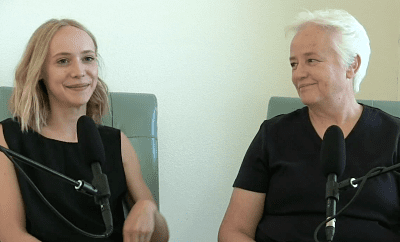
 Join us now on Mormon Stories Podcast for an incredibly powerful story on dealing with tragedy with resilience and grace. Jill and Katie Searle are a mother/daughter pair.
Jill Searle’s story (Part 1) includes:
- Being raised LDS and serving a mission.
- Entering into a mixed-orientation marriage as a lesbian woman.
- Having several children.
- Leaving the church, and finding a committed, long term partner (they were married 5 different times…incredible story).
- Allowing and even supporting her children to remain active/faithful LDS as a lesbian, ex-Mormon woman, all while the church was waging war on committed LGBT relationships.
Katie Searle’s story (Part 2) includes:
- Being raised Mormon by an orthodox Mormon father and step-mother, and two lesbian ex-Mormon mothers.
- Marrying her husband, Nathan Williams.
- Co-founding with Nathan a globally successful magazine, Kinfolk.
- Facing the excruciating decision to terminate a pregnancy at 6 months.
- Dealing with the discovery that her husband, Nathan, is gay, while pregnant with their second child.
- Deciding with Nathan to end the marriage.
- Coping with a religious faith crisis through all this.
- Rebuilding a life and raising her daughter, Vi, as an ex-Mormon single mother.
This is an amazing story of responding to tragedy with grace and resilience.
Episode Transcript
Host: John Dehlin · Guests: Jill Searle, Katie Searle
This transcript is machine-generated and lightly edited for readability. The audio is authoritative. Please excuse occasional errors in names and spelling.
Introduction and Episode Overview
Part 1 of 2 · Ep. 974
Katie Searle [00:00:00] Sa.
John Dehlin [00:00:32] Hello everyone and welcome to another edition of Mormon Stories podcast. I'm your host, John Dehlin. I'm recording this introduction August 30, 2018, but it's an introduction to a podcast that I recorded in Portland, Oregon on August 17, 2018. I cannot be more excited to introduce this interview. It is an interview of two very, very special people, Jill Searle and Katie Searle. And the title of this episode is Responding to Tragedy with Grace and Resilience. I don't want to give away too much about this interview, but what I will say is that Jill Searle was an amazing, beautiful Mormon woman, raised in the Mormon church in the 60s, and she also identified internally as lesbian. She had many close female friends who
John Dehlin [00:01:30] she was very attracted to, but because
John Dehlin [00:01:32] she was a good Mormon girl, she married a Mormon boy, served a mission and married a Mormon boy. So entered into a mixed orientation marriage in the 70s and early 80s as a devout Mormon woman. She had several children with this husband and at some point realized that she was lesbian and needed to end the marriage. She ended her marriage amicably and then found the love of her life, which was another lesbian Mormon, returned missionary. Because of laws that did not support marriage equality, she actually had to marry or enter into civil services five different times with her wife. But eventually she was married and ironically, for the good of her children, she supported her children being raised LDS even though she was a, you know, a lesbian woman who had left the church.
John Dehlin [00:02:33] That's going to be part one of this amazing, epic story. And Jill just deserves her own admiration and support for this amazing story of her journey. But part two of the story is just as fascinating and epic, if not more. One of Jill's children is Katie Searle Williams, who was raised LDS by an orthodox LDS father and then two lesbian ex Mormon mothers in Oregon, she ended up marrying Nathan Williams and together they started a world famous magazine called Kinfolk. And many of you will have heard of Kinfolk magazine.
John Dehlin [00:03:14] And so Katie and Nathan build this amazing magazine, get married, and then get pregnant. And this story, the second part of the story, is how Katie Searle dealt with this epic tragedy. She gets pregnant and six months into that pregnancy is forced to make the tough decision with her husband Nathan to terminate the pregnancy of their first child.
John Dehlin [00:03:40] In the subsequent events following that termination, Nathan opens up to Katie about both being an alcoholic and about being gay. And so it talks about how Katie dealt with not only losing a child, but also having her husband come out to her as gay. After being raised by a mother who had to come out to her husband as being lesbian. And also how they dealt with Nathan's struggle with alcoholism.
John Dehlin [00:04:07] This resulted. And all this information came out while Katie was pregnant with her and Nathan's second child. And then it follows on with how Katie made the very difficult decision to divorce her husband, Nathan, or they made that decision together. And then how Katie moved back to the United States and has been rebuilding her life outside the LDS church as a single mom now that their beautiful child V, I believe is the child's name has been born.
John Dehlin [00:04:39] It's an epic story of tragedy, but also of grace and resilience. The reason why I'm recording an introduction to this separately is that in the very beginning, the audio wasn't quite great. And you're going to hear my audio be a little bit echoey. We figured out audio when we're in studio here in Salt Lake City. But this was. We were traveling, we were on location in a wonderful supporter's house.
John Dehlin [00:05:06] And as a result, we didn't have the best audio at first, but the audio corrects and gets better. And so please hold on. And you're gonna love this interview, so please check it out. And here now is my interview with Jill and Katie Searle that was recorded in August of 2018. Thanks, everybody and enjoy the interview.
Jill Searle's Childhood and Early Life
John Dehlin [00:05:33] Jill and Katie Searle, welcome to Mormon Stories podcast.
Jill Searle [00:05:36] Thank you, John. Excited to be here.
John Dehlin [00:05:39] Yeah.
John Dehlin [00:05:40] So, yeah, I've been wanting to do this for a while. Is there anything I got wrong, Jill, in the introduction?
Jill Searle [00:05:46] No, I think you summed it up pretty good.
John Dehlin [00:05:48] Yeah. Okay, well, thanks for joining us. And Katie, anything you want to correct or you want to share what it's
John Dehlin [00:05:54] like to be on Mormon Stories?
Jill Searle [00:05:56] It's pretty surreal.
Katie Searle [00:05:57] Yeah.
Jill Searle [00:05:59] I may not listen to it this episode. I'll keep listening.
John Dehlin [00:06:04] Did I get everything right in the intro? I did.
Jill Searle [00:06:06] Thank you.
John Dehlin [00:06:06] All right.
John Dehlin [00:06:08] All right, well, let's just dive in because this really is an epic and an important story. So, Jill, let's start with you.
John Dehlin [00:06:15] Raised lds. Talk about that.
Jill Searle [00:06:17] Yeah. I was born and raised in Ogden, Utah, into a family six generations, Mormon on both sides. A lot of Mormon heritage. Grew up with a lot of pioneer stories. Listening to them, reading them, talking to my grandparents about our ancestors. I remember a room in my grandmother's house that had all the pictures, big portrait sized pictures of our ancestors. And as a child, that was pretty scary to be sleeping in that room. And it was always cold because she always had it shut down. But it always kind of, that was kind of my introduction to our Ancestors and early in life and they continued to be very important.
Jill Searle [00:06:59] One of my ancestors, John Linford, who's my great great great grandfather, Katie's great great great great grandfather came across. He came from England and then traveled with the Willie Handcart Company. He died at the Sweetwater crossing and his wife and children continued on. His wife wasn't a member of the church coming from England, but she came because of her family. And this was very hard for her. It wasn't her faith. She had a lot of her own trials through that. But she continued and landed in Utah with her other children, one of which was my great great grandfather.
Jill Searle [00:07:43] Brigham Young then baptized her and then she married. What was his name? Rich. His last name was Rich. Anyway, one of the big rich people, Joseph Rich. And into a polygamist marriage. So I didn't come from those polygamous lines, but there is that element there.
Jill Searle [00:08:09] And then there's just many, many, many more pioneer stories. I think growing up in Ogden was a very safe place if you don't consider the sexual predators in the neighborhood. But we used to just be outside playing constantly. We were outdoors with our friends playing kick the can, hide and seek till all hours. I everybody just kind of watched out for us, took care of us. I was raised by a community. My family of origin was not particularly traditional Mormon. My father was alcoholic and amongst many other shortfalls of his, my mother worked full time.
Jill Searle [00:08:53] So I had a lot of time on my own with both parents being gone during the day. And I used to just spend a lot of time with my friends and their families. Kind of adopted a lot of the other Mormon parents as kind of my surrogate parents. I remember one of the points in my life, I think, where things kind of shifted a little bit for me was I was eight years old.
Jill Searle [00:09:23] I remember being in Sunday school class and the Sunday school teacher was teaching a lesson on the priesthood, priesthood in the home. And I remember her saying, if there's not a strong priesthood leader in your home, you do not have a godly home, you do not have a worthy home, and your home will always be in chaos.
Jill Searle [00:09:45] And I remember as an 8 year old thinking, wait a minute, I knew my father didn't fit that picture. So I immediately in that moment discounted him, basically. I think that's where in my 8 year old mind I decided my father wasn't really worthy of my respect, but that I still needed to save him somehow. I needed to help him see that he needed to do better so that he could be a worthy Priesthood leader in our home. And I kind of reversal, role reversal there where I became his savior, so to speak. And then not long after that also,
John Dehlin [00:10:21] when I was a kid shouldn't have to kind of be a parent, right?
Jill Searle [00:10:25] Right. An 8 year old shouldn't be worried about saving their family. But I was very indoctrinated even at that early age. I was also at 8 with my mom. I remember sitting in the car under the carport and her telling me while she was crying about my dad cheating on her again, I was eight. So why she decided to have a conversation with her eight year old daughter, I'm not sure, but she was going through a lot herself. I remember her showing me notes that she had found in his pockets and just being just not knowing what to do and just sobbing. And it was also in that moment that there was a role reversal there where I had to save my father, but I had to take care of my mother kind of from that point forward.
Jill Searle [00:11:14] I never really felt the same sort of respect or regard for my parents that I think outside of. If I wasn't in the church with the indoctrination that I had, I think I could have had a much richer, fuller relationship with both my parents rather than a judgmental one or thinking I had some duty towards them and our forever family.
Jill Searle [00:11:38] I really think that the forever family, families are forever doctrine is probably the most harmful teaching that the church has. And I think it's because instead of
John Dehlin [00:11:49] just enjoying your family, making the most of it, you were always viewing them as dysfunctional and as problematic and as some, some project to fix. Is that what you're saying?
Jill Searle [00:11:59] For me, that's what it was. And also later in my story, story as an adult, feeling that pressure on myself as I made choices for myself, just. I don't think there's too many families that meet that criteria. The strict criteria of being a forever family. There's always somebody outside that box that doesn't fit, that that family's going to lose, that that family has to pray for, hope for, you know, and they think they do lose now they lose the current relationship that they could have. I think I lost an opportunity to enjoy my parents and respect my parents more than I did.
John Dehlin [00:12:41] Okay, so how does your story continue?
Jill Experiences Abuse and Navigates Sexuality
Jill Searle [00:12:44] So I think the next big point was when I was 12 again, being running around the neighborhood. I was a tomboy. I was always a tomboy.
John Dehlin [00:12:56] Is that what you referred to as?
Jill Searle [00:12:58] Yeah, yeah. It's kind of being gay and young in Ogden, Utah in the 60s, there wasn't a lot of information. I didn't know I was different. I didn't know what was normal. I was just being me. Climbing trees, chasing the girls with grasshoppers, and, you know, playing Mission Impossible and cowboys with the boys. It's what I enjoyed doing. So that's what I did. And out running the neighborhood at 12, I ran into the first sexual predator who violated me.
Jill Searle [00:13:32] And I remember that horrible feeling of being a victim, of being in somebody else's power or control. And I remember just crying and crying, crying until he let me go. And then I ran. I ran home. He just lived a couple of doors up. He was a grandfatherly type, Lived a couple of doors up from us. We used to always play in his backyard and climb the tree, go in his house, watch cartoons. He was the candy man of the neighborhood.
Jill Searle [00:14:03] I remember running home and locking myself in the house. And by the time my parents got home, I was calm and settled. And I never spoke a word about that to anyone for. Till I was 26.
John Dehlin [00:14:19] Oh, gosh.
Katie Searle [00:14:19] Yeah.
Jill Searle [00:14:20] So I kept that under wraps and kind of kept that to myself for a long time.
John Dehlin [00:14:25] What does that do to a kid?
Jill Searle [00:14:27] I kind of just. I don't know. I got over it, I guess. I just. I had this will about me that was like, I'll prove to this man that he didn't harm me, you know? So every time I walk by his house, I held my head up and walked past. And every time I saw him, I waved at him, like, yeah, you didn't do a thing to me. You know, I don't know. That was in my mind how I was going to deal best with it. And then at 15, I had another run in with another sexual predator who was member of the church. He was in the neighboring ward when we shared the building with.
Jill Searle [00:15:07] And so he lived close in the neighborhood as well. And that experience was more extreme and probably a little more terrifying for me. And at 15, I felt guilty. I felt like I'd done something horrible because I didn't run away, because I didn't get away.
Jill Searle [00:15:27] I carried a lot of guilt around with me for a few weeks. Didn't take the sacrament. I felt so. I felt so guilty. It was like, well, I. I can't take the sacrament. I'm not worthy. My bishop noticed that I wasn't taking the sacrament, and he said, anything you want to talk to me about? You know, we can have a. Have a moment together and talk. So he lived just a few doors up. He was a forest service ranger.
Jill Searle [00:15:55] No professional training. Of course, our bishops are just people doing their best. And he called me in and I told him, and through tears, what I had done, you know, what I had done wrong, and that I felt bad about it and that I didn't know what to do about it. The one thing he did right is he told me right away that it wasn't my fault. There was nothing about that experience that was my responsibility and I was not to blame for any of that. So that made me feel better, that made me feel good.
John Dehlin [00:16:31] Was there any accountability for the other person?
Jill Searle [00:16:34] And that was. In hindsight, I look back and I think, you know, he didn't even ask who it was. He knew it was a member of the church. Yeah, I told him that he was in the what ward he was in, so he knew he was a member of the church. And I told him that he was a young men's leader and that this is kind of how the whole thing came about. So he knew there was a church connection, but he never did ask who it was, and there was never anything further done.
John Dehlin [00:17:04] And you weren't out for justice, you were just trying to heal or what?
Jill Searle [00:17:09] Yeah, I was pretty stalwart, pretty much a straightforward Mormon, and I did everything by the book. And so I had done what I thought I needed to do do was
John Dehlin [00:17:20] go to my church or the police.
Jill Searle [00:17:22] I never went to my parents for anything. My parents, you know, I was helping them, I was saving them, I was protecting them. I never went to my parents for any of those types of things. And that too, I kept to myself till I was 26. So two things kind of buried inside that had a lot of influence on my life and who I was.
John Dehlin [00:17:49] How do you think not talking about those things here, 26, affected you? Do you have any sense or not? Some would say, well, it made you stronger, it made you more resilient, it made you tougher.
Jill Searle [00:18:00] In a way, I think that's true. I think it did because it. The personality I have is to fight back, but it was not in a fight back to get revenge sort of a way. It was like fight back and prove to them that they haven't beat me at this, that I'm still strong, that I'm still good to go. So I kind of was in a denial about him. I know hindsight wasn't probably the most healthy way to deal with it, but it was how I dealt with it was by just putting strong face forward.
Jill Searle [00:18:34] And when I saw that man at church every Sunday between the wards changing and such, and we'd always run into each other. I walked straight up to him and shook his hand. It was in a weird sort of 15 year old way to just prove to him that he didn't hurt me. So can't explain that. But that's just kind of how I reacted to it. I just put it away. I just put it away.
John Dehlin [00:18:59] Regarding your self, you know, your sexuality as a teen, did you ever become aware of sexual attractions for women? Did you ever start noticing you were really different and even quote, sinful? Or did you just not allow your brain or consciousness to even go there?
Jill Searle [00:19:19] Well, again, it was 60s, 70s, growing up without a lot of information. Utah was behind the times in that regard anyway. So I really didn't know much about being gay or what that even meant. In my mind. That was just something horrible that two men might do in dark alleys and dingy places and that it was a horrible sin and that God abhorred it. You might as well be a murderer rather than a gay person. That's all I knew about being gay. I never really thought about myself. I did start feeling attractions for girls during adolescence and it was easy enough to explain away, like, wow, you know, I really feel close to this person.
Jill Searle [00:20:12] I feel an attraction to this person. She must be my kindred spirit. And with women, I think it's the lines are blurry. We are allowed to feel more for each other and to be more emotionally connected and to hold hands and to, you know, snuggle up. And it's not necessarily frowned on or looked on as anything. So the lines were blurry.
Jill Searle [00:20:36] I knew what I was feeling, but didn't know that it was wrong or didn't know that it was different. So I didn't carry around guilt about it. I did have questions like, wow, I really, like I would find myself attracted to someone and I would just throw myself into that friendship and give them gifts and write them long notes and I never quite got enough back from them, but still wasn't quite sure what was going on. And that just intensified as I grew older and I just kept explaining it away. Wow, there's a lot of kindred spirits.
Jill Searle [00:21:12] Especially when I got to byu, I was like, whoa, all these kindred spirits. So I just kind of carried on and went on my way to when I graduated from high school.
John Dehlin [00:21:26] Real quick. Yeah, sometimes. And I'll just say as a researcher, there's no data to support this, but it's just very, very common for people who aren't informed to associate abuse, sexual abuse with same sex sexuality. If somebody were to say, oh, there we go. That's another validation of what I was taught, which is that you're sexually abused and you become. Become gay. Do you. Would you. How would you respond to someone who would draw that connection?
Jill Searle [00:21:54] I've got a lot of friends that were sexually abused that are not gay. I've got more friends who were sexually abused that are straight and in heterosexual relationships and have worked their way back to that place. And I've got friends who are sexually abused who are gay. I think there's a lot of women especially. I don't know if it's was more so when I was young, if it was more common. I don't know. It's still very common and prevalent, obviously, but people talk about it more and people recognize that it's a bad thing that it's not happened. And there's much more likely that a person, a man, would be held accountable for it.
Jill Searle [00:22:37] When I was growing up, I think it was happening, and we were quiet about it. It wasn't until I was an adult that I started talking to my friends. This happened to you too. You sort of a me too movement in a different way. So that's how I would answer that question.
John Dehlin [00:22:55] Okay. Yeah. It sounds like abuse was just going
John Dehlin [00:22:59] on all the time.
John Dehlin [00:22:59] And bishops aren't even asking who. Who is responsible, let alone punishing people, at least in your experience. And so abuse would have been very prevalent.
Jill Searle [00:23:10] Exactly.
John Dehlin [00:23:11] With no accountability.
Jill Searle [00:23:14] Right, Right.
John Dehlin [00:23:14] Yeah. So it's a faulty assumption.
Jill Searle [00:23:17] Yeah. It wasn't bad like I expected it to happen, or when it happened, I felt I deserved it, or it was just a normal thing. It wasn't that normalized, but it was so that the shame of it I kept hidden. And obviously a lot of my friends did, too, because it wasn't till we were adults that we actually shared those experiences and talked about it.
Anti-LGBT Church Culture and Jill's Mission
John Dehlin [00:23:36] Now, would you have heard the anti LGBT rhetoric of the sort of Spencer B. Kimball, Markey Peterson, Boyd K. Packer eras in your teen and early adult years, or did that come later?
Jill Searle [00:23:49] Yes.
John Dehlin [00:23:50] Miracle forgiveness, too.
Jill Searle [00:23:52] Right? I was the miracle forgiveness generation. Yeah. When I remember President Kimball being kind of our prophet, he was the one I had the most connection to or most relationship too, I think. But, yeah, so I do remember it being talked about, but I never related to it. I didn't even consider it was about me.
John Dehlin [00:24:17] Okay, so you didn't internalize that?
Jill Searle [00:24:19] No, I didn't internalize that because that was bad. It was horrible and an aberration and a sin and only a horrible person would be that way. And I was. I knew I wasn't a horrible person, so I couldn't be gay. Didn't go together.
John Dehlin [00:24:34] So how does your story advance?
Jill Searle [00:24:36] So I went, graduated from high school. My parents divorced at the same time that I graduated from high school. I went to BYU for a couple years as soon as I turned 21. I'd always wanted to go on a mission. So as soon as I turned 21, I was going on a mission. I served in Taiwan and Thailand.
Jill Searle [00:24:55] Taiwan was a proselytic mission. And in Thailand, I was working in the refugee camps with the Indochinese refugees. Back in Pol Pot times, that was when Pol Pot was causing his chaos. So that was an amazing experience. And that was when I got to know Marion D. Hanks. And he was kind of in charge of the whole. Getting the sister missionaries into the refugee camps. And the one rule was we couldn't proselyte.
Jill Searle [00:25:23] So that was purely. That was my style of mission, is get in there and help these people and teach them English and culture and prepare them for their, Their, their country that they're going to and that. I really enjoyed that.
John Dehlin [00:25:37] He was your mission president?
Jill Searle [00:25:38] He was not our mission president, no. But he was the apostle that got that whole program going and got the permissions for us to be in the camp. So it was his baby.
John Dehlin [00:25:48] Okay, so all of the sort of Mormon intellectual that I know who were around in the 60s and 70s mention him as being one of the good, good guys.
John Dehlin [00:25:58] Can you just.
John Dehlin [00:25:59] 30 seconds. Did you have any experiences with him where you could understand why Mormon intellectuals really liked Duff Hanks, as he was called?
Jill Searle [00:26:07] Yeah, yeah, I, I did have those experiences with him. I do consider him one of the good guys. And that was evidence in when they made him emeritus, proved he was one of the good guys because they pushed him out. He just always stood up for what he felt was right. I just think he was one of those who didn't tow the line just to toe the line.
John Dehlin [00:26:27] Was he an intellectual?
Jill Searle [00:26:28] Spoke his mind? I don't know. The. I don't know. Well, Maxine Hanks was certainly an intellectual. And she got it from someone, right? She, she related to him? I believe she is, yeah. So, yeah, I think he was probably considered an intellectual, certainly a do gooder. He was into community service and loving people and charity and compassion, that kind of thing.
John Dehlin [00:26:54] Okay, so you had a good mission?
Jill Searle [00:26:56] Had a good mission. I was there almost two years because I had an extension to go to Thailand.
John Dehlin [00:27:01] So did you have any bosom buddies on Your mission.
Jill Searle [00:27:03] Oh, I did have. You mean attractions. I was able to put that away because I was so stalwart, I was so gung ho. But when I got to Thailand, there was a sister missionary that there was. There was a kindred spirit there in Thailand.
Jill Searle [00:27:20] So none of these relationships ever evolved to anything because I tended to always be attracted to straight women who wouldn't have even considered it an option. And so. And I, being naive, didn't even really know what was going on anyway, as just kindred spirit stuff going on.
Jill Searle [00:27:40] I always felt like, you know, I'd always explain I'm not gay, but I can certainly understand and relate to how they feel because I feel so strongly towards some of my female friends. And that's how I kind of explained it to myself. I'm not gay, but I know how they feel because I feel that way.
Jill Searle [00:27:59] But so came home from my mission, went back to byu, fell in love with a roommate there. And then it just amped up. Everything was just intensified. And I think I just dealt with it the same way, just kind of trying to explain it away. I did finally go to a BYU counselor and say, I think I'm gay.
John Dehlin [00:28:22] He said, what year would this have been?
Jill Searle [00:28:24] This would have been 81, 82. And this BYU counselor says, no, no, no, no, you're not gay. You just don't like men because they've been so rotten to you all your life, you know? So I was like, I knew it. I knew I wasn't gay.
Jill Searle [00:28:44] So I kind of put it away for a while more. My relationship with my roommate was, for me, so intense. Every thought was about her, every song on the radio was about her. She would go out with boys. I would become envious and jealous, and I would do what I could do to destroy that relationship. You know, bad talk, the guy or, you know, whatever.
Jill Searle [00:29:10] It was just. It was intense on my part for her. She, you know, and we used to joke, you know, she'd say, too bad, you know, if you were a man, we could get married, you know, because we're so close. And we had this closeness.
Jill Searle [00:29:25] So it was still not gay, but gay. And she was. She had no desire to have a relationship either. But we were close. And I think that was about time I met my husband. Brent was when I was having this trial in my own mind with. With my roommate. And it was coincidental because his birthday was same day as hers. So this was a sign from heaven.
Jill Searle [00:29:53] Yeah, well, at least he's got the same birthday as her and she likes him so she thinks he's a good guy. And he was such a good guy. I think what I was attracted to Katie's father was he's all about service. He's all about doing the right thing. He's just a good human who smells. He wanted to fix the problems of the world. He was always on the right side of the social issues, fighting for the underdog.
Katie Searle [00:30:22] Left side.
Jill Searle [00:30:22] Yeah. He was always fighting for the underdog. And that appealed to me. That's what attracted me to him. That's what made it okay. Third date. He proposed in the Mormon way. And then he said. And how he proposed was we went up to Silver Falls or Bridal Falls or whatever that is there in Provo. And he said, I'm going to be graduating and moving to the East Coast. Do you want to come with me?
Marriage, Mental Health, and Coming Out
Jill Searle [00:30:53] Sure, sure. Why not? I don't have anything better to do. And you're a good person. You have the same birthday as my roommate, so let's do it. So we were engaged from that point. And then things got intense for me. That was when this. I was 26. That's when the sexual abuse all came back up. And that's when I. Because I was having so much struggle in my intimacy with Brent, I couldn't be intimate. I hated it. Not only, you know, it would repulse me. And it wasn't like he was trying to do anything wrong or inappropriate or anything like that. It was just. I was.
Jill Searle [00:31:30] Just couldn't deal with it. I'd always find myself running home, leaving my dates early, going home and snuggling up next to my roommate where everything was okay. And I knew this wasn't normal, that I should be more happy, that I should be more wanting to be with Brent. And we're getting married after all. You know, there wasn't the excitement and the flutter and the. I even went and talked to Mary and D. Hanks at that point and says, I just don't know that I love him and that this is going to work. And he. He gave me long stories and talked me back into my engagement.
Jill Searle [00:32:07] I became depressed, and I told him about the sexual abuse. And that was our answer to why we were having trouble. Kind of that same thing you talked about. Well, of course, if you've had sexual abuse, you're going to have trouble in intimacy. But I was able to be more comfortable with the intimacy with my roommate and my female friends. But I was not at all comfortable with that. So there was one night, I remember that I just want to touch on Try and get through my story without taking three hours.
Jill Searle [00:32:41] I became suicidal just in this moment. And I remember waiting for Brent to leave. He was over at our house. And I said, in my mind, I'm thinking, as soon as he leaves, I'm going to figure this out. I'm going to end my life. I said, I know this will hurt some people, but it will just be temporary. You know, they'll. They'll hurt for a few days, and then they'll move on and their lives will be better because I won't be burdening them because I was just so confused about what was going on, not being able to connect with Brent like I felt I should.
Jill Searle [00:33:16] And everything I was doing was. I felt like I was doing the right thing. Why isn't it working out? Brent and I. Brent just stayed. I don't know if he sensed something that night, but he stayed and he stayed and he stayed. And I kept thinking, when he leaves, when he leaves, he stayed and he stayed and he stayed and he stayed until I was just too tired to commit suicide. At that point, he left. And I was like, not going to happen tonight.
Katie Searle [00:33:44] So.
Jill Searle [00:33:44] And then by that time, too, it had passed. And I don't think I had that strong of a feeling after that again. After that, it became kind of like what I call the Mormon attempt, A Mormon suicidal. Where it's like, you're driving down the road and you wish that semi truck would hit you. Or, you know, you're still wanting your life to end, but you want it to end in a way that's nothing, not your fault at all.
Jill Searle [00:34:09] The martyr mentality of it's got to be over. Because we got married, we moved to Virginia. We had our first two children, Katie and her older brother. And I poured all my love and affection into them. And that was my way then of dealing and coping because I had a lot of love to give. And Brett and I had a good relationship.
Jill Searle [00:34:35] It wasn't that. Didn't have the strong sexual attractions and the things like that, but it was a good relationship. We were good friends, and we had. We were good parents. We had the two older ones, and we moved back to Washington state and then to Oregon. And once we settled in Oregon, that was when we had our third child.
Katie Searle [00:35:00] So.
Jill Searle [00:35:00] So we had three children. So 10 years of marriage, good years, rough years. I seeked counseling. We had a lot of discussions about our sexual intimacy and the problems there. I sought out counseling, trying to figure things out. And we had a good friend, mostly Brent's good friend. He was A missionary companion of Brent's and a roommate of Brent's. And he had come out to Brent a few years previous as. As gay. And he brought us a book. Came to visit once, and he brought us a book. I don't know if you've ever heard of it. It's a book called Peculiar People.
John Dehlin [00:35:40] Bob Reese, right?
Jill Searle [00:35:42] Yeah. Written for gay people like that. Tells the stories of people coming out. Remember Mormons who've come out? Then it tells it from the perspective of their parents or spouse. Then it tells it from the perspective of professionals. Anyway, he brought this book out in a way for us to help understand him and kind of know what he had been going through. Well, I read it first, and I was highlighting things and dog earring pages. I could relate to, like, almost everything in the book, especially the women's accounts. You know, I was just. That book was yellow and ragged by the time I got done with it.
Jill Searle [00:36:18] And I. By the time I gave it to Brent, he was like, why is everything highlighted? Help me understand. So that was. After reading that book, I was actually able to say to myself, jill, you're gay. And I wrote it down. I actually put pen to paper and wrote it down. And that was my coming out to myself. And in that very moment, it was kind of like a cleansing. It was. It's hard to explain what happened in my being, but I felt like all this icky, gucky, black stuff just cleared out of my self, and it was just filled with light and everything made sense.
Jill Searle [00:37:01] My whole life made sense. You know, all these kindred spirits made sense now. And I felt so happy and so good, but yet at the same time, so scared. Like, what am I going to do now? You know, Now I've got to face this.
Jill Searle [00:37:18] I have three kids. I have a husband supposed to be happily married forever. So now what? So Brent came home, and I escaped to the beach and did a lot of thinking, came back, and Brent was the first person I came out to. And he. He was just kind of.
Katie Searle [00:37:46] Sorry.
Jill Searle [00:37:48] I've told this story a lot of times and haven't cried, but. It was a difficult moment in my life where everything just made sense. I just didn't know what to do. And when I tobrit he didn't freak out. I don't know what he was going through. He was having his own experience, I'm sure, but he didn't freak out or anything. He just held me.
Jill Searle [00:38:17] I cried all night. He just held me. We didn't talk. And then in the morning, he said, what are we going to do? And I said, well, I can only see one option. Still very narrow, still very Mormon. It's like I can only see one option. And we're going to stay together for the kids. That's what we do is we're a forever family.
Jill Searle [00:38:46] Families are forever. And with this new knowledge and understanding, we decided we'd go forward and make it work. And that lasted a whole nine months. I had a lot of ups and downs and little anxiety and a lot of things going on, a lot of depression and a lot of problems there and trying to, you know, work with the kids and carry on with life with a two year old, a six year old and an eight year old, you know, just kind of keep things going. And I would go to church with this big dark stuff, secret, this big black spider inside of me, just eating me up and just with this feeling of if anybody knew this horrible thing about me, they would hate me.
Jill Searle [00:39:30] That's just what I felt. It wasn't true, of course, but that's just how I felt. I'd go to Relief Society and I'd hear. This is when there was a lot of talk about gays and the LGBT community. So this would have been 94ish.
Jill Searle [00:39:50] So I'd sit in Relief Society and I'd sit in Sacrament meeting and I'd sit in these meetings and I'd hear these people who were supposed to be kind and going on and on about and gays. I remember sitting in a really sudden meeting where one sister stood during one lesson and said that if she knew that something was gay, they would not be welcome in her home.
Jill Searle [00:40:13] And the ironic thing was is Brent and I were going to her home for dinner that very next week and I kept the appointment kind of in a secret spite, to spite her to be gay and be in her home.
Jill Searle [00:40:27] But I told a few people, they were very kind and it was good. But eventually I couldn't deal with it anymore. It seemed like everything had changed for me and Brent's life was just going on normal. He didn't have to make any big adjustments. So I'm sure there was a lot going on for him too. And then I decided there was another option and we would divorce.
Jill's Excommunication and Leaving the Church
John Dehlin [00:40:51] Do you want to tell the Packer story really quick?
Jill Searle [00:40:54] Oh, yes.
John Dehlin [00:40:55] Was that out of sequence or
Jill Searle [00:40:59] so with. During this nine month period of resolution and trying to stay strong and, and be Mormon And I'd had all these questions, there'd been 10 years of questioning going on up to this point. I'd pretty much tossed out a lot of the tenets of the gospel as being, you know, hogwash or folklore or this or that. And I had very little left in my box of what I could really believe in.
John Dehlin [00:41:26] But we were reading Sunstone magazine.
Jill Searle [00:41:28] Yeah, we were going to Sunstone symposiums, reading Sunstone magazines. We were in the feminist movement. We were trying to help different women in our ward who were in abusive situations. There was a lot, it seemed a lot of women that were struggling with. That had an abusive husband or to their children or to them, and we were reaching out to them. So we were feminists, we were intellectuals. We were all these things, and. But we decided to stay thinking, believing Mormons got sitting in the regional conference right next to my three kids, my three lovely kids, and my husband, and in my best church dress.
Jill Searle [00:42:14] And Boyd K. Packer was speaking. It was televised. Boyd Case Packer spoke his great three greatest enemies of the church talk. And I'm sitting there, and he says, you know, the three greatest enemies of the church are intellectuals, feminists, and homosexuals.
Jill Searle [00:42:34] And I thought, well, there you go. Strike three. I'm out. You know, I had no idea I was the greatest enemy of the church. Does the greatest enemy of the church, you know, give all of their time and their talents and their treasure to a church all their life?
Jill Searle [00:42:50] That wasn't how I felt the greatest enemy of the church was. But here I was being told by Boyd K. Packer that I was triple threat. A triple threat. Big triple threat. So I decided in that moment, there was no more. I was done.
Jill Searle [00:43:04] I was gone. And I went home from that meeting, took off my garments. Never went back to church after that. And then it was soon after that that Brent and I did decide to divorce. And that was difficult. And I went through a little bit of a. Had a nervous breakdown during all of that because there was a faith transition going on. I was leaving the church. I was leaving my marriage. I was going out and trying to find a job and trying to be ready to continue to parent the kids separate from Brent and make this work. And I just had a nervous breakdown.
John Dehlin [00:43:40] That's mid-90s.
Jill Searle [00:43:41] Right, right, right.
John Dehlin [00:43:42] Was it pre Ellen? Was it?
Jill Searle [00:43:44] This was exactly when around the time Ellen came out publicly.
John Dehlin [00:43:48] So, Ellen DeGeneres.
Jill Searle [00:43:50] Yeah, Ellen DeGeneres.
John Dehlin [00:43:51] What does she mean to you?
Jill Searle [00:43:53] She's my hero. She's my best friend. She doesn't know it. I always tell my kids, you know, if she met me, yeah, she would like me.
John Dehlin [00:44:00] What she. What she mean to you?
Jill Searle [00:44:02] At the time, I was watching that was when her first sitcom was out and she was. I always thought she was hilarious. I always liked her, but I always thought, you know, she's got to be gay. I'd watch that and I'd watch her. And this was when I had come out and so I was. Gaydar was sharp, and I was like, she's gotta be gay, gotta be gay, gotta be gay. And then she came out publicly, and it just meant a lot to me. I mean, she was. I think she was the poster child for a lot of us. Poster gay, poster lesbian for a lot of us who.
Jill Searle [00:44:33] Who were struggling at the time. And she was somebody people liked. You know, so many people liked her. She was gay. And so she went through a lot, though, you know, lost her contract. Yeah, yeah. She came back strong from that. Yeah. So I went into.
Jill Searle [00:44:52] After leaving the Mormon Church, flung myself into the metaphysical world, Went to a place called the Living Enrichment center and got all caught up in that. Got a job there at the Living Enrichment center and worked there for seven years and became very involved in the woo woo world. I call it New Age spiritual. New Age spiritual. Jean Houston, Marianne Williamson.
Jill Searle [00:45:19] Yeah, all those people would come and speak at the Living Enrichment Center. And so I got to meet them personally and talk with them and absorb their teachings and stuff. So I got really into that because as a Mormon, it's easy to get really into. And. And then I. And that kind of fell away. And then I kind of came back to center and decided I didn't want any sort of organized religion, that I really.
Jill Searle [00:45:45] I probably lean towards not believing in God now at this point in my life, But I don't know that there's not a God. I'm not
Katie Searle [00:45:54] going there.
Jill Searle [00:45:55] I just kind of decided to let the mystery be, you know, does it really matter? I'm going to be a good person no matter what, so it doesn't really matter. I do think about it, research it, listen to people.
Katie Searle [00:46:08] I find it very interesting to study
Jill Searle [00:46:11] and hear what other people think, what other people's spirituality is.
Katie Searle [00:46:15] That's kind of where I'm at.
Jill Searle [00:46:17] Just more interesting, interested than anything.
John Dehlin [00:46:20] So.
Katie Searle [00:46:21] Yeah.
Jill Searle [00:46:22] And then that's. That kind of brings me to quickly
Katie Searle [00:46:25] to where I met Susie, my wife. Now I was in Portland kind of on my own. I had met a group of women
Jill Searle [00:46:35] through the Living Enrichment center that were very supportive of me, and they were. That was helpful to have their experience
Katie Searle [00:46:42] and see them be successful. And then this thing called affirmation came up, and I thought, what is this thing, this affirmation thing. They were having a big Internet international or national conference in Seattle, and a couple of friends wanted me to go, but they weren't going. So it was going to be me going by myself, which didn't seem very appealing to me, but I talked myself into going and I went up on my own. And then, meantime, while that's happening, the Susie's in New York with her gay boyfriend. She had a lot of boys that she hung out with. That was their affirmation group there in New York.
Katie Searle [00:47:19] And they wanted her to go to Seattle. And she was like, no, no, no, I don't want to go. And then she finally. They pestered and pestered as any good gay man can. And she said finally, okay, I'll go if I can find a really cheap airfare, but it has to be under this amount. And they found her that airfare, so she went. So we both ended up in Seattle at this lesbian and gay, Mormon, lesbian gay conference.
Katie Searle [00:47:46] And I walked into the first meal, didn't know where to sit. Seemed intimidating to walk in not knowing anyone. And there was a table full of women, and there was a seat available there, but I wasn't quite ready to just dive in like that. There was this other table with all these gay men and Susie, and so that seems more comfortable for me right now. So he just walked over there. And those boys, they got up, they found me a chair, they ushered me in and they grilled me, and they. They made sure I. They vetted me, made sure I was available, that I was suitable, and then that Susie and I talk and they matched us up. And from there it just stuck. We just.
Jill Searle [00:48:27] We were inseparable during the conference. And then she went back to New York and I went back to Portland and we kept in touch and I flew to New York and she flew here back and forth a few times. She met the kids, and that was in August of 95. And she moved out by December. By Christmas of 95, she'd moved out and come back. Moved out meaning Moved from New York to Portland. After being in New York for 10 years, she had also joined the church. She wasn't raised Mormon, but went to BYU because friends talked her into it and was baptized there at byu, then went on a mission to New Zealand and came home. And so I got my return missionary. I did settle my second return missionary. And we've been together now for 23 years. And we've been married five times.
John Dehlin [00:49:20] What do you mean?
Jill Searle [00:49:21] Well, when the kids were still young again, about the same age like me. Maybe 4, 7 and 9. Susie and I had a commitment ceremony at the Living Enrichment center, which was this new thought church that I was going to. And a reverend named Sally Rudis married us and gave us a civil union.
Jill Searle [00:49:42] It was big. It was big. A lot of people came. It was a big celebration, and that was great. And that's what started our. That's what I consider our anniversary, our legitimate, real anniversary. And then, of course, that was just a civil union. And then along the light way, Multnomah county at one point in time made gay marriage legal, where they were giving marriage licenses to gay couples. During that whole Prop 8 and that whole prior to that, this was all happening in different states and counties. And so we went up to Port Portland and got married, got our. We got our license, and then we went to the Living Enrichment center and had Sally Ruda sign that and marry us again.
Jill Searle [00:50:27] So she got to do the second one as well. And then that got revoked. They sent us a letter with our $16 or whatever back and said, sorry, you're not married. I kept that, that certificate. We'll have to sell it on ebay or something. But then domestic partnership was legalized. So we went and did that first thing. That was a third marriage. And then Prop 8 happened, was horrible. And then this one man, one woman thing happened in Oregon was horrible. It was so personal.
John Dehlin [00:51:04] What is that?
Jill Searle [00:51:05] During George Bush's second run for president, there was also a proposition by measure put on the Oregon ballot, one man, one woman, to amend the constitution that marriage could only take place between one man and one woman. A very personal battle there. I mean, it just felt awful to have the people voting on my rights and our rights to be married or choose to be married. And it passed. And so that was. It passed. But they said, okay, you can have. Have domestic partnership. So that was the concession. So we went and got our domestic partnership.
Katie Searle [00:51:42] And then.
Jill Searle [00:51:43] And then Obama came along, you know, and Obama just decided to make it legal across the country. And he, he. He blew away everybody. He just made me so happy. I just love him. I miss him.
John Dehlin [00:51:59] Along with the Supreme Court.
Jill Searle [00:52:00] Yeah, along with the Supreme Court. And, and then so we were the first ones in our county to get our marriage license. And then we were afraid, still a little afraid that they might revoke that again, that they might do a Prop 8 thing where they say, okay, if you did get married, you're good to go, but no more. No more gay marriages. So we decided to have a friend of ours who had his Internet license to marry Marius. So we had our marriage license. He married us. He signed our marriage license. It was witnessed by two people. And we didn't really tell anybody about that. We kind of kept that under cover because we had our big wedding planned. And then so a few months later, in August or July, we had our marriage ceremony, our legal marriage, and that was the fifth we got married.
John Dehlin [00:52:56] So to kind of close your first segment of this interview, you talked early on about soulmates or bosom bodies. What was the term used?
Jill Searle [00:53:07] Yeah.
John Dehlin [00:53:07] Of the early friendships you had.
Jill Searle [00:53:10] Yeah. What did I call them? Spirit. Kindred spirits. Kindred spirits.
John Dehlin [00:53:15] What was it like to finally find a kindred spirit you could actually be with and to contrast that with what you were feeling with your husband, who you loved? But what was it like to finally be able to be partnered with someone you loved fully?
Jill Searle [00:53:30] It was amazing. You go through your life thinking you understand love and that you think you understand happiness and good feelings, and then you really find it and you realize you didn't have it. And it was amazing to be able to find Susie and, and not carry the guilt. By this time, I was way past the guilt of the Mormon Church and I could love her completely. And we had the same language because we were both ex Mormons and so we could share that and relate to that and work through those things together. And our relationship was full and complete. And she fit right in with the family.
Jill Searle [00:54:10] The kids loved her from the beginning and they were still little so they could accept her. They didn't have any big hang ups or anything like that. And she just immediately became part of our family and became another mother to the kids. And Brent was accepting of our relationship to an extent. There were periods of his growing through
John Dehlin [00:54:30] that too, because he remained a devout Mormon. So for him to say in the 90s or early 2000s, I'm okay with my ex wife and her lesbian partner
Jill Searle [00:54:43] having anything to do with, with my
John Dehlin [00:54:45] kids raising the children. That's probably wasn't normal back then and today is still not, not, not a possibility for so many in or out of Mormonism.
Jill Searle [00:54:55] Right. But he was a compassionate man and so in as a human, he could accept it. I think as a Mormon, he had his problems with it that he had to kind of overcome and learn. And I think he grew a lot too. He's come a long way. Yeah, he's come a long way. He's now an advocate for gays and lesbians and he's still active in the church, but he's very supportive of Susie and I and he's always expressing his. His gratitude and his love for us, so.
John Dehlin [00:55:27] And again, when you think about the. Your mental health, your happiness, your joy levels with. With your. With your husband, your ex husband, and then you think about what it's been like with your current partner. How is it different for you if you had to summarize the difference of what it's meant to you to be with someone that really fit?
Jill Searle [00:55:51] Well, with Brent, there was a good relationship, but when it came to the sexual intimacy was I not only. I not only was not attracted to him, but I was averse to the sexual. Sexual intimacy. It was repulsive to me. Brent wasn't repulsive to me, but the sexual part of our relationship was repulsive to me. It was difficult for me. It was. I hated it. With Susie, it's easy. Everything's easy with Susie from the get go. As a good person, as a human, I never felt a need to be anybody but who I am. I was just always comfortable being me around her. And she always made me laugh. And those were two things that I just knew she was gonna. We were gonna be together for.
John Dehlin [00:56:39] And that's actually not sexual. That's just.
Jill Searle [00:56:41] Yeah, that was compatibility. And that came first. That emotional connection came first.
John Dehlin [00:56:46] And was that maybe even more important than the sex or not or.
Jill Searle [00:56:50] Well, I had that with Brent. I had that emotional intimacy, but it was the complete completeness of what I had with Susie.
John Dehlin [00:56:56] It felt complete.
Jill Searle [00:56:57] Complete. And being able to give her everything and offer everything that comes with a marriage and everything that comes with love in a relationship and not feeling repulsed, not having to hold back, not feeling
John Dehlin [00:57:11] it obligatory, you know, and that's lasted for you, that. That importance remains. And if a church leader were to counsel a young man, woman, maybe, as you were, and just say, life isn't about sex. Sex is just one part of us. We're much more than our sexual identity. So marry a man, find joy. Yes, it'll be your cross to bear, but life is about more than sex, and you'll be blessed in the hereafter for your sacrifice. If you then had a chance to talk to that young woman, not to argue, but just to share your perspective to her, what would you say?
Jill Searle [00:57:47] I would say it doesn't work that way. It doesn't work that way because there are demands in a marriage. There's that other person's going to have needs, you're going to have needs, and he's not going to meet your needs, you're not going to meet his needs. And that is a Very important part of the relationship. And if you don't keep that part of the relationship nourished, other parts of your relationship suffer and fall apart. And you do start to argue, you do start to not want to be around each other. And problems do crop up. Other than that, it doesn't work. I have a half brother who is gay. He got married, had two children, gave it a good go. Didn't work. Just doesn't work that way. Nephew who's gay. I have a great niece who's gay. There's a lot of gay in my family.
John Dehlin [00:58:44] Mine too.
Jill Searle [00:58:46] Yeah. So there's just. When you have Mormon families that are huge, you're gonna have gay in those families.
John Dehlin [00:58:51] Lots of gay.
Jill Searle [00:58:52] Lots of gay. One other thing. When I was excommunicated.
John Dehlin [00:58:57] You were excommunicated?
Jill Searle [00:58:58] I was excommunicated. Not for years. Susie and I had been together at this point for a lot of years. We. It was probably 2001, 2002, we were in McMinnville. The kids were in high school by this time, junior high and high school. They were 50, 50. With me and Brent, things were very good.
Jill Searle [00:59:17] They enjoyed being at both homes. They enjoyed four parents, you know, raising them well. And I got a call from the bishop clerk saying, the bishop wants to talk to you. I'm like, by this time, I haven't been to church for, say, 15 years. I'm like, you know what, what about, Would you like to come to his office, or would you like him to come to your home?
Jill Searle [00:59:42] I said, I guess come to my house. I mean, that's what I said. I wish I had said, there's no need, you know, I don't want to talk to the bishop. But I didn't. Still trained to obey. So he came knocking at the door. This was during the. This was during the Multnomah county, you can get married now, period. And Suzy and I had just gotten married, and he came to the door and he said, could you come out on the porch? I mean, I just spent 45 minutes cleaning my living room for this man.
Jill Searle [01:00:10] Why don't you come in? Well, I'd be more comfortable if you came out on the porch. Then I remembered, oh, yeah, he's by himself. He can't come in to my home because I'm a single woman. And then so I went out on the porch just to make it easier for him. And he proceeded to excommunicate me. And he was very kind man. I could tell he was uncomfortable. I could tell he didn't want to do this, that he was doing it
John Dehlin [01:00:37] because he did it on the Porsche.
Jill Searle [01:00:39] It was obligation. He did it on the porch because it was recently passed that if you're a woman and didn't hold a priesthood, you didn't have to have a court. When Susie got excommunicated, she had to have a court. But times changed, and now if you're a woman, you don't have to have a court. You can just be excommunicated on your front porch.
Jill Searle [01:00:59] Very convenient. So he said, he. He said, I don't even know if that. I agree with this, but I'm going to excommunicate you because you're living in a way that's contrary to the teachings of the church, and if you're not willing to change that, then we'll carry on with the excommunication. So I said, go for that. Let's do that. And he left, and he apologized again. And then he said, you know, your kids are great. You've done a great job with your kids. You're welcome to church anytime. I'm like, bye.
Jill Searle [01:01:31] And he left. And then I waited and waited for a letter to come. Nothing came. And I found out that that bishop had been released. Well, what really bothered? Well, and then. So I don't know, a few weeks later, maybe a month or two later, a new bishop came in, new sheriff in town.
Jill Searle [01:01:50] This one was a father of a friend of my son's, and he just dropped in. I don't know what it is about Mormons just dropping in. Home teachers, they just drop in. Bishops, they just drop. So he came with one of his counselors and knocked on the door. This time they came into the house because there were two of them, so they could come in. I hadn't cleaned the front room because I didn't expect them, but we. We sat down in the living room, and Craig said. The bishop said, can we sit at the dining room table? I was like, sure. I think he was just getting control of the situation, you know.
Jill Searle [01:02:30] And so we're sitting, sitting, the three of us, at the dining room table, and he proceeded to tell me that I was living contrary to teachers of the church and would I like to
John Dehlin [01:02:38] repent doing it all over again.
Jill Searle [01:02:41] I said, you know, another bishop's been here. We've done this, and that's traumatic. He didn't finish the process. So we're.
John Dehlin [01:02:49] Oh, my gosh.
John Dehlin [01:02:50] Maybe he felt guilty.
John Dehlin [01:02:51] Maybe he didn't believe in it and didn't want to do it.
Jill Searle [01:02:54] Maybe that's why he was released. I Don't know. Or maybe it was just his time. Time.
Katie Searle [01:02:57] Who knows? It would be nice to think that maybe he took a stand and was released. I don't know.
John Dehlin [01:03:03] If you're. If you're that bishop and you're listening, reach out to us and give us a happy ending for that story. Okay?
Jill Searle [01:03:10] Exactly. So Craig came in.
Katie Searle [01:03:13] Little short guy, Napoleon complex.
Jill Searle [01:03:17] He loved his power.
Katie Searle [01:03:18] And he.
Jill Searle [01:03:19] He asked me if I wanted to repent, and I did. I looked at him and I said,
Katie Searle [01:03:24] you know, I was so far removed
Jill Searle [01:03:25] from the church at this point that
Katie Searle [01:03:26] it was just so odd for me
Jill Searle [01:03:28] to have him ask me if I wanted to repent. And I said, frankly, Craig.
Katie Searle [01:03:32] And I purposely was calling him Craig
Jill Searle [01:03:34] through this whole thing. I don't have a need to repent in a place in my life where I feel stronger and closer to any sort of spirituality.
Katie Searle [01:03:46] My children are happy. I'm with a person I love.
Jill Searle [01:03:50] We have this home together.
Katie Searle [01:03:52] If I were to repent, as you say, I would no longer have any of that. I would not have my relationship with Susie. That would have to end. I'd also have to move out of this home because I wouldn't be able to afford it. I'd have to give up my time
Jill Searle [01:04:07] with my kids because I wouldn't be able to have a situation where they
Katie Searle [01:04:10] were able to come comfortably. So, no, I don't have a need to repent. And.
Jill Searle [01:04:16] And I said, and frankly, if I did feel a need to repent, it wouldn't be through you.
Katie Searle [01:04:20] And he just looked at his notes and kept reading.
Jill Searle [01:04:22] It didn't seem to flap.
John Dehlin [01:04:24] He had a job to do.
Katie Searle [01:04:25] He had a job to do, and he finished it up. What really bothered me about that was the kids were there. The kids were in the house. They were in the room next to us. I don't know what they could hear, what they were overhearing, what they felt. They were still active members at this time. They were still going to church, believe leaving members. And here they are, moms in the next room being excommunicated. And it just. That kind of rubbed me the wrong way. Like, that was kind of insensitive. And he's the one that explained to me that because I don't hold the priesthood, there was no need for a court.
John Dehlin [01:04:55] Oh, okay.
Katie Searle [01:04:56] That they could just convene him and his counselors just could convene in their office and finish it up, and I'd be getting a letter. So then they left. The counselor was so uncomfortable through this whole thing, and I could tell he also, I could tell he felt bad. He didn't say a word. And then they left. The next day, there was a plate of Christmas cookies on my porch at my front door from this counselor and his wife. They must, he must have not felt good about the whole thing. But they brought me Christmas cookies. So it was, you know, excommunication was a small price to pay for the
John Dehlin [01:05:30] cookies, for the Christmas cookies.
John Dehlin [01:05:31] They were good.
John Dehlin [01:05:33] And how did it make you feel to have been excommunicated by that point?
Jill Searle [01:05:37] At that point, it was paperwork. I felt what my worries and concerns were for the kids because I was staying. I wasn't taking any action myself to leave the church until the kids were older. I just didn't feel like they needed that sort of disruption in their life. Why? Wasn't important to me anymore. It was just paperwork. It was the church business, not mine. I could care less if I was on their rolls or whatever. There was no stand for me to take at that point in time. But it did feel good to be done with it. I was just worried about the kids at that point.
John Dehlin [01:06:12] Well, that's a perfect segue to kind of close out part one of this interview with Jill Searle and to, and to transition to her interview with Katie. So, and I'll just say that we did, you know, for my PhD, we did research on outcomes for LGBT Mormons. And oddly enough, excommunicated LGBT Mormons had the lowest depression, highest quality of life, lowest sexual identity distress, lowest, you know, homo negativity, and just overall happiest. So according to the data, they actually did you a favor by doing that.
John Dehlin [01:06:51] But anyway, thanks for joining us for part one of this interview. We are now going to, we're going to, you know, don't, don't go away. Come right back, join us with, with Katie Searle. We're going to talk about her life, what it's like to grow up in this environment where your dad's an orthodox Mormon, you have two moms that are lesbian. This is in the 90s.
John Dehlin [01:07:13] And then to go on to meet her husband Nate, to, to start a globally world famous magazine called Kinfolk. And then we're gonna talk about some really tough stuff, but also some empowering messages and stories about Katie's life from then forward. So thanks for joining us and come right back for part two with Katie Searle.
John Dehlin [01:07:38] Thanks, everybody.
Katie Searle's Childhood and Her Parents' Divorce
Part 2 of 2 · Ep. 975
John Dehlin [00:00:00] Sa. Hello everyone and welcome back to Mormon Stories podcast. I'm your host John Dehlin. We are now doing part two of our interview with Jill and Katie Searle last episode. We began by talking to Jill Searle who had very much a non traditional Mormon upbringing in Ogden. Knowing that she was gay, experienced a lot of sexual abuse as a child that went untreated, marrying, going on a mission, marrying a man, being in a mixed orientation marriage, having that not work out, getting divorced, but finding the love of her life, her kindred spirit and the five marriages that she had to have because of the lack of marriage equality.
John Dehlin [00:01:18] But, but how she and her ex husband were able to find a way to still co parent their children. And in the end of the story it culminated with Jill's excommunication which happened twice. Five marriages, two excommunications. And it's a great story so if you didn't get a chance to listen, please do. Now we're going to switch to Katie Searle and she's lovely and delightful and she's got a really fascinating story of her own that's also epic. So Katie, welcome back to Mormon Stories podcast.
Katie Searle [00:01:53] Thank you.
John Dehlin [00:01:54] So not a normal Mormon upbringing.
Katie Searle [00:01:57] I didn't know it wasn't normal though. That's the beauty of it. It felt very familiar. And I was thinking like when my mom was talking, I didn't even, I don't even recall maybe like the sit down talk about them explaining like what it meant to be gay. It just was kind of a normal thing that transitioned into my life. So I think that's interesting.
John Dehlin [00:02:21] So as a kid, you know, of those early years, what did you experience? And you know, go ahead and like reflect on anything you want in the early years but then let's just pick up on your story.
Katie Searle [00:02:33] Yeah, well in the home it felt very normal and I didn't think anything of it.
John Dehlin [00:02:37] Do you remember life before the divorce?
Katie Searle [00:02:40] Vaguely I do, but I was quite young so. So it's mostly post and so having two happy homes.
John Dehlin [00:02:46] Do you remember the divorce being traumatic or.
Katie Searle [00:02:51] I remember like when my mom was up in Portland and I just remember there being a difference in how often we were seeing both parents and that being hard and mom had that period of kind of anxiety in that tough period and I remember her slipping down the stairs. Right. There was some, some stuff I remember but mostly I recall just having these two homes that worked really well together.
Katie Searle [00:03:25] My outside of the home though I didn't really talk about it and I think that's kind of looking back. I'm kind of bummed that that's. That's. I had some sort of fear, or as mom said, like, she thought at first if she came out to people, that people would hate her. And that's not true, but that was the feeling. I kind of felt that way if people found that out about my family. And I was watching growing up, you know, kids being hazed at school or what people would say in church. And so there was this kind of cognitive dissonance that I was experiencing consistently from what I was being taught and then what I was observing, which was just a very healthy, happy family.
John Dehlin [00:04:15] Okay. So the divorce wasn't particularly traumatic, and having extra pair of loving lesbian moms wasn't traumatic. It was the fear of people finding out.
Katie Searle [00:04:25] Right.
John Dehlin [00:04:26] And the worry about how they might treat you.
Katie Searle [00:04:28] Right. Yeah. And I was kind of a shy kid. I kind of was always in the background, so it was okay for me to kind of just be discreet, and that's just kind of how I operated. But I didn't even tell my friends, though. Of course they knew, because they were at my house every day for lunch or whatever. We just didn't really talk about it. I didn't really talk about it with my brothers either. We just kind of went on like everything was normal because it kind of
John Dehlin [00:04:53] was just to not talk about something.
Katie Searle [00:04:55] Right.
John Dehlin [00:04:55] Yeah.
Katie Searle [00:04:56] Until I was 18.
John Dehlin [00:04:58] Really?
Jill Searle [00:04:58] Yeah.
Katie Searle [00:04:59] Yep. I remember telling my best friends that I had since I was 8 when I went off to college, and they're like, duh.
John Dehlin [00:05:07] But you had never talked to your friends about it?
Katie Searle [00:05:09] I never talked about it. And, like, now it's so easy to talk about, but it was just something that was really hard for me to sit with.
John Dehlin [00:05:15] Was there joint custody? Would you switch homes?
Katie Searle [00:05:18] Yeah, we went back and forth. We were two weeks at each home
John Dehlin [00:05:21] throughout all those years for most of it. And so you'd have friends over at your lesbian mother's home.
Katie Searle [00:05:29] Right. And I'm sure they talked about it.
John Dehlin [00:05:31] And these were Mormon kids.
Katie Searle [00:05:32] No, no. Yeah, I was mostly. I had some Mormon friends, but it was most. Mostly a secular friend group. Yeah.
John Dehlin [00:05:41] Okay. And they just never brought it up.
Katie Searle [00:05:43] Never brought it up.
John Dehlin [00:05:44] What's up with the moms?
Katie Searle [00:05:45] Right. I don't know, but it's. So that's something I kind of forget. Of course, they call them their moms and. Yeah. So I think there was just something with. I would hear, you know, on Sundays, you know, there's the.
Katie Searle [00:06:04] The kind of quip of someone would ask a question. The instructor would Ask a question and someone would say like, you know, the answer is always read your scriptures or go to church or whatever. But there was this like little rhyme and it was like, read your scriptures fast and pray. Go to church and don't be gay. Like, little things like that, that seems so innocent to people to just like roll off the tongue were really hurtful for me to hear as a kid. And I, you know, was exposed to that over and over again in Sunday school, in high school classes and college. And I think it was, it was something that never felt right.
Katie Searle [00:06:40] I kind of put it on that shelf and I just went along with the church with my. When we, even when we were at my mom's on weekends, she would drive us to, to church. I did the normal. Baptized at 8, attended all the youth activities, EFY.
Katie Searle [00:06:59] And it just like kind of meshed in a strange way. But that ended up being kind of ultimately what I had trouble with as an adult. That kind of never sat well.
John Dehlin [00:07:12] Was there ever a talk like, honey, I'm gay, or would you have even known what gay was? Was that an explicit conversation where your mom said, sweetie, I'm gay and this is what it means to be gay? Or did you just pick it up on the streets and it was never discussed? Or do you even remember?
Katie Searle [00:07:28] Like, I'm sure you did. And I think that it kind of at an early age was just like, you love who you love type thing. And then what I'd be hearing at church or in society was kind of laced in there and it was, it was different, obviously, like what everyone else would hear. And I don't know though, I think, I mean, I always love Susie and my mom. We have this really great connection. Yeah, I think we're really good at compartmentalizing as Mormons. And that was just something I kind of tucked away. And it's like, I'll just focus on me and get to the celestial kingdom, have control over that.
John Dehlin [00:08:11] Right. And so for you, having two sets of parents and one of those sets of parents being a lesbian couple, were there benefits to that? Were there cool things about that? Did you love it? Was it awkward?
Katie Searle [00:08:22] Did you just.
John Dehlin [00:08:24] In terms of what you experienced?
Katie Searle [00:08:25] Yeah, I think, like less to do with their sexuality, but just like generally they're, they're quite progressive and open minded and I think that was a huge benefit to have. And my dad is also quite progressive, as in the standard of Mormonism. But I think. And that's progressed. But that allowed me to kind of see two different perspectives really early on. And I wasn't raised in a bubble. I think I met a lot of different people and I was exposed to a lot of different people that I otherwise probably wouldn't have been. And it just kind of always felt like a slumber party, just like a girl gaggle. And we've always been really close. And it's something that is a reoccurring theme in my life is just this, like, powerful group of women that have just kind of always surrounded me. So I feel really grateful for that orbit and that feminine energy. Yeah.
John Dehlin [00:09:24] And orthodox Mormon.
Katie Searle [00:09:26] Yeah, exactly. Yeah. And my dad. My dad is remarried. And, you know, they're pretty gung ho. Cookie cutter lds live in southeastern Idaho, so.
John Dehlin [00:09:37] So I'll ask your forgiveness. I'm ask Jill one question. Jill. There's so many people now who leave the church, and they're not gay. You know, they're just normal heterosexual couples. And they're like, I'm not raising my kids Mormon. You know, the church is racist, sexist, and homophobic. And they're not even a person of color. Maybe they're mildly feminist and they're certainly not lgbt. Right. You had every reason to just say, my children are not stepping a foot into that homophobic church that excommunicated me twice. But you didn't. That's not how you were. Can you explain how?
Jill Searle [00:10:13] That was my trial throughout the whole time, because people outside the church looking at what was going on in the church, couldn't believe that I would allow my children to be brainwashed, allow my children to endure this. They would say, how can you do this Again? It's, how can you do this to your kids? I was getting that from members of the church, like, how can you do this to your kids? And now I'm getting it from outside,
Katie Searle [00:10:36] like, how can you do this to your kids?
Jill Searle [00:10:38] So it would crop up all the time for me, like, is this. Am I doing this right? Like, they're going to church, they're learning these things. They're being indoctrinated with things that I don't believe in. They're being indoctrinated. I had become the prodigal parent now, just like my dad was.
Jill Searle [00:10:58] And my fear was they would see me in that same light. We have to save our mom. Our mom's not going to be with us in this eternal family unit. She's no longer a part of our eternal family, and not as good and not as good. And maybe we need to save her. And the tables had turned, come full circle for me. And when that came up.
Jill Searle [00:11:20] I knew how important it was for Brent to raise the children in the church, and I knew there were good things that could happen because of that, but I just had to let go of it. Each and every time that fear came up. And I talked to my kids a lot.
Jill Searle [00:11:37] We had a lot of conversations, and I don't think they were afraid to bring those topics to me. Like today in church, they said. And then that would give me an opportunity to say I always told them what I felt and believed. I tried to remain respectful of what their beliefs were, but at the same time demand that they were respectful of what I believed as well. And they gave me some time, too, to explain how I felt about things and why. So that's just how I handled it each time it came up.
John Dehlin [00:12:10] And ultimately you were okay with them being raised in the church? Why?
Jill Searle [00:12:18] That's a good question. Because it wasn't a battle that would have been worth fighting that would have benefited them in any way. My demanding that they not be raised Mormon would have caused a lot of issues for their dad. It would have caused a lot of issues for my family, for his family.
Katie's Teen Years and Relationship with Faith
Jill Searle [00:12:40] And it was a battle that probably would have done more harm to the kids. It was really all for me. It was all about what's best for the kids in this situation. I remember especially with my youngest, Jacob.
Jill Searle [00:12:52] He's very smart kid and very quirky and funny. But when he was going to church and I was after Katie was gone to college and Paul was grown and I was still taking Jacob, I guess maybe it was earlier, but anyway, I drop him off at church and my motto to him was, learn, listen, learn, discern, Listen, learn, discern. I said that to him every time I dropped him off at church. Love you. Listen, learn, discern. I always told my learn, discern, discern. Yeah, okay. Because I always taught my kids, you can turn the page. If there's something you don't like or that you don't feel is right, you don't have to believe it.
Jill Searle [00:13:29] Forget this all or nothing business. There are some good things that you can learn at church, but there's some things that you won't feel good about. And you don't have to believe those things. You don't have to take them into your heart. So that's kind of how I handle that.
John Dehlin [00:13:42] I do these little coaching moments. And I just want to say that's one of the best little lessons I've ever heard for mixed faith couples where the non believer is very concerned about the believer who wants to still take the kids to church. Go back and listen to that. If you're in that situation, it's perfect advice for what I would recommend.
John Dehlin [00:14:06] Not that always has to be the same outcome, but this idea of it's about the kids first and what's best for the kids. And if you have open communication with your kids and if you teach them to have their own thoughts and their own opinions and their own beliefs, I think more often than not you're going to have positive outcomes. And thank you for that. Okay, back to you. Back to you, Katie. So what was your spiritual life as a teen in Mormonism? Were you believing it? Was it about it being true? Was it just a cultural thing?
Katie Searle [00:14:41] I definitely had like a friend group and there was that community feeling that was fun as a teenager in that social aspect, but I was definitely believing. I do remember praying about the Book of Mormon, however, and not feeling quite the same experience that I had thought that I was supposed to feel. But I didn't really think much of it.
Katie Searle [00:15:09] I. I was very afraid of, like, authority though. And it was. It's funny because my parents are great and they like, let us kind of make our own choices and mistakes if we needed like, or. I mean, they knew that's just how parenting worked. However, I think it was kind of the patriarchy. Patriarchy or something because still to this day I'm like too afraid to cross the street when it's not telling you to cross the street. There's something that's like, in my head about that. So I was a pretty like straight and narrow teenager and I was going along the path. I knew I was going to go to a byu.
Katie Searle [00:15:47] However, I didn't feel like Provo was my scene. So I ended up going to BYU Hawaii, which I loved it and I kind of feel like is a little bit the land of misfits of Mormons. And although it still had the structure and the rules as a byu, I think it allowed for a little more space and experience with people from different places around the world. And it's one of the most diverse student bodies. And I had a big awakening there about, you can do Mormonism on your own terms. I would see some of the professors who were very forward thinking and intellectual and obviously members and be like, okay, they can do it and they can carve their own path and I can do that.
Katie Searle [00:16:43] So there was a moment of like, I'm not taking everything they're giving me and accepting it all, but I feel like that's what I need to do. But now these examples in my life are showing that I can kind of pick and choose, to an extent, what I want to hold on to. So I think that the questioning for me kind of started in college.
Katie Searle [00:17:07] That's where I met my ex husband. And I also went off to school not thinking I would be the Mormon girl who got married young and quickly, but that's exactly what happened. And I was 19 when we met and we had a.
Katie Searle [00:17:24] Yeah. And then we had a very quick courtship that was like a fairy tale. And what did you love about him? He was very spontaneous and had a magnetism and charisma about him that just drew people to him.
Katie Searle [00:17:43] He was very. And he is still very, a unique person. He's not like anyone I've ever met. And I think we were also really quite compatible and had a lot of interest in common. He was also, as I said, I didn't talk a lot about my mom being gay. For some reason, that was kind of still something that, like, I had to get to know people and trust them and kind of see where they sat in that regard. And I was able to open up to him about that really quickly on. And knowing him, and that felt like a sign that, you know, I trusted him.
John Dehlin [00:18:21] And how did he respond to that?
Katie Searle [00:18:24] He was really open. And I don't quite remember if he said anything specific, but it was encouraging and obviously it felt warm and accepted. Yeah.
John Dehlin [00:18:36] And, you know, romance. Did you guys feel. Did you have a sense that there was a strong attraction for each other?
Katie Searle [00:18:44] Yeah. And I had dated someone right prior, and I think there's. There's something about, you know, everyone carries something from their past relationship into their next relationships. And it was clear to me that this was love, that I felt love for him, and it was a different feeling. And, you know, I'd call home and talk about it and my mom would know what was coming. And it's quick. And it swept me off my feet for sure. Yeah.
Katie's Marriage, Coming Out, and the Kinfolk Magazine
John Dehlin [00:19:16] So you got married at 19.
Katie Searle [00:19:18] Did. Did the thing.
John Dehlin [00:19:20] And how do you go from there? And I'm just kind of struck that you're in college and you're not having this huge sort of like, religious dilemma of, I love my mom, I love my stepmom who's married to my mom.
Katie Searle [00:19:36] Yeah.
John Dehlin [00:19:37] And the church is saying all these things about. I mean, you would think you'd be just wracked with. By the time you're in college, wracked with this total torment and guilt or confusion or conflicting feelings.
Katie Searle [00:19:48] Yeah. And I think it was my sophomore Year I had a gender and identity class, and I remember writing an essay about gender, and I did my whole backstory, and I, you know, I basically had to come out to come out for my mom in this essay. And I remember turning it in and being like, what is going to happen? But of course, the teacher just grades it, and that was almost, like, helpful to me. It's just normal. This is your life. You know, I think it started to. I started to tease apart, and kind of once I started questioning one thing and it. And I take a step back, it would start dismantling other things. And that was definitely once I was married. Yeah. Okay. Yeah. So it was post college. Just right after, though, is the year we graduated.
John Dehlin [00:20:38] So, you know, I think a really big part of your story is probably the kinfolk story. Is that the next phase, just sort of how that happened? Or is there something else you want to share before we go there? Because it's not every Mormon couple that starts a global magazine. Right.
Katie Searle [00:20:56] I think it does kind of bounce back. But when we got married in the temple, because we had talked about this a little bit earlier, but, um, my mom and Susie obviously weren't able to be in there. And I think growing up lds, I felt that was the path. I knew that was going to happen. It didn't seem odd or out of the norm, but we did make special, like, arrangements to have kind of a ring ceremony and involvement with all of our family. But the. The temple. We got married in Cardston, Alberta, and they made a. A really sweet gesture. I don't know if you want to tell that briefly, because that was. I think that's really sweet. When you were.
Jill Searle [00:21:39] We went to the Alberta Temple knowing we wouldn't. Susie and I knowing we wouldn't be able to go into the ceremony. But I've attended many, many Mormon marriage ceremonies, so I didn't. Other than that it hurt. It was painful not to be able to go to my daughter's wedding. I also felt like this temple ceremony was something I'd seen over and over again and that I could do without it and that I knew Katie and Nate had made arrangements to include us in everything else. And we're sitting in the waiting room at the Alberta Temple, and they had all these children running around. You know, all the people who can't go in the temple or who are too young are running around.
Jill Searle [00:22:20] And they had assigned an elderly couple to kind of hang out with us and keep us company. And at the time, there was just. The woman was sitting there and she Looked at me, and now you're Katie's mom, right? And I said, yep, I'm Katie's mom. And she turned to Susie and was like, and you. And sue says, I'm Katie's mom.
Jill Searle [00:22:40] And she kind of sat back, and I explained that Susie's been. Susie was my partner, and that she had been in Katie's life since Katie was 6 years old. And she just. She had kind of a look, like. And I was sure I knew exactly what she was thinking. And I always loved to just, like, zing people, you know, I like to make them shy, like, the shock and awe. So I was reveling in this. And she finally came to herself, and she says, you know what? We need to get you into that temple. We need to get you into that waiting room in the foyer so that you are the first people that Katie and Nate see when they come out.
John Dehlin [00:23:17] And.
Jill Searle [00:23:18] And it was just such a sweet gesture, and that's what she was thinking. It had a lot less to do with, oh, this is a gay thing. And more like, wow, you've been in Katie's life since she was 6. You guys are special, and we need to get you in there. And she made arrangements from where to where? From this, you know, little atrium where everybody was running around and screaming and chasing toddlers into the foyer of the temple. That was just right outside the recommend check.
Katie Searle [00:23:48] Yeah. Yeah, that's sweet.
Jill Searle [00:23:50] Yeah. Right where you can go. And so she got us in there and made sure we were comfortable and made sure we were the first people. And then something I forgot. She had everybody else leave the temple, go out. And so it was just us and Nate and Katie, that is.
Katie Searle [00:24:07] And it was really special because I didn't know that they would be right there. And, you know, you're getting ready in the bridal room and stuff. And I was cognizant that my mom wasn't there. So it was really great to walk out and see them.
Jill Searle [00:24:19] Yeah.
John Dehlin [00:24:20] Thanks for sharing that.
Katie Searle [00:24:21] Yeah, I think, like, the. The pressure to, like, start a family and have kids, coming from many angles of, you know, Nate's family or various places, that was put on us pretty quickly after graduating.
John Dehlin [00:24:35] You come from a big family, Conservative Southern lds.
Katie Searle [00:24:38] Yeah. So pioneer offshoot up to southern Alberta, which is basically Utah up there. And so, you know, we. We always. We talked about kids we knew would have kids, but it. It wasn't something we wanted to do right away. And that, in that way, we did feel a little bit like outliers, because, you know, a year into Being married lds, you can have one kid and be pregnant, like, like, or something. A year and a half, you know, it's happened. So you have kids. So we'd be about the same stage as friends who were having kids and not have kids. We went through. Out of Our Kid was a company that we were able to start together with some of our best friends from BYU Hawaii that we had met there.
Katie Searle [00:25:23] So we kind of had this passion project that started as an online magazine. We had roped in people that were connected online, that were really excited to be involved, photographers and writers.
John Dehlin [00:25:39] And where did you get the idea to do an online magazine? Like, why would that occur to you? And what year was this about?
Katie Searle [00:25:45] We graduated in 2011, and we're kind of working about it, working on it and talking about it during that time. Early 2011 and then mid 2011 is when it launched online.
John Dehlin [00:25:55] Would a class have given you the idea?
Katie Searle [00:25:57] Yeah, Nathan and I had a entrepreneurship class together, actually, and we had to create a business plan as our final project. And we called the company Kinsfolk and Co. And we wanted to have an online shop for gathering items like, you know, like plates and cutlery and banners, things that weren't super tacky, more refined that we couldn't find all in one place. And like. So like Oriental Trading Company, but like high end. So that was your go to source. So that was kind of the premise that we launched from.
John Dehlin [00:26:34] Did that come out of the way you guys were living your life? Were there things you enjoyed as a couple or with friends?
Katie Searle [00:26:40] Yeah, so we lived in the married couple housing, just called TVA at BYU Hawaii Temple View Apartments. And it was so fun and it was like living in the dorm summer camp with all your friends. And we would just run as couples, like literally run. We were just having so much fun back and forth to each other's apartments, at meals and cooking with each other and having basically like this giant extended family that we had been building.
Katie Searle [00:27:04] And I think that's kind of where we knew we had this passion was to get together often around food, trying not to make it a huge fuss, but just knowing that, like, being together around this commonality was breaking down walls and inviting new people into that group. So it was something we did a lot and it extended into that class. And then we developed the idea to do the magazine online to kind of see what sort of traction it would receive, because you can get a pretty good read on visits and hits.
Katie Searle [00:27:39] And it really resonated with people. I think we were talking about topics that everyone loves and has in common and like what community and finding your place and if you're not necessarily like in the same location as family or have like a close knit group kind of strategies and ways to make your place in your way, that was a big thing.
Katie Searle [00:28:11] We talked a lot about slowing down and like appreciating the simple things and embracing kind of like no screen time and being intentional and deliberate within the various realms of your life. Be it food, slow food, or thinking conscientiously about your consumption. It kind of like leached into all the different areas and I think so the premise was definitely like lifestyle, kind of how to kind of be more thoughtful and deliberate about how you communicate and interact with people and things in your life.
John Dehlin [00:28:51] Okay, so the online magazine starts to take off.
Katie Searle [00:28:55] Yeah, it got some traction and we printed some copies for the people involved and a few extra and we sold them and they went quick enough that we, we reprinted and sold those and we're like, there's something going on here, there's momentum, so we're going to start working on a second one and do it all in print. And we went the print route because we felt like that was very similar to kind of the ethos that we were disseminating. We're going to, you know, walk the talk. This is something hard, this is something tangible that's in your hand and it's experience. And you're flipping through it and you're smelling the pages and you're fully immersed in that sensory experience.
John Dehlin [00:29:36] And they're reading articles that are written,
Katie Searle [00:29:38] they're looking often in that topic. And there were like online videos and tried to make a pretty comprehensive user experience. We were able to sign on with a publisher who helped kind of grow the amount we were able to print and sell. And we learned the ropes from them.
Katie Searle [00:29:58] Just kind of about how to look at paper stock and you know, just kind of the intricacies of that industry. Since none of us were trained in publishing and Nathan had a degree in business, my degree was in intercultural peace building, conflict resolution. So it wasn't necessarily transferable other than that I really like resonate towards kind of trying to break down the walls between groups and, and that's something that always stuck with me about the LDS Church is that it felt very much us and them and it kind of ostracized people and it put people in boxes and really defined people into these categories and it was clear who was good and who was bad.
Katie Searle [00:30:44] And that was something that was really hard for me. And when in college, I was learning that it's not black and white like that, and there's a lot of gray and. And the social kind of ostracism. No, I can't say that word. Can you say that word?
John Dehlin [00:31:01] Ostracizing.
Katie Searle [00:31:02] Thank you. Just became a huge, huge problem for me. So I think that translated over to Ken Folk and how we could kind of weave that in to the stories or the messages.
John Dehlin [00:31:15] Break down the walls.
Katie Searle [00:31:16] Yes. Yeah.
John Dehlin [00:31:17] Yeah. Divisions.
Katie Searle [00:31:18] Yeah.
John Dehlin [00:31:19] Really quickly did. Did you end up having a certain set of responsibilities? And Nate had others. Was there. Was there kind of a division of labor? Were you equal partners in this?
Katie Searle [00:31:30] So the other couple did a lot of the business side. So they worked on, like, our financing and the. Or finances and, like, projections and all the intricacies there on the business operations. And Nathan and I, at the beginning were very focused on the production of the magazine and the art direction and the.
Katie Searle [00:31:49] He definitely had the aesthetic eye and was the one guiding that. And I was kind of the manpower, like the go for girl. And just. I was so involved with the shoots and gathering props. And the early issues are definitely my favorites because we were. We were there often in the photos or our friends were in the photos, and we were just doing it, kind of bootstrapping it, and it was really enjoyable.
Katie Searle [00:32:14] And then as we were able to, like, bring team members on and people who are actually trained in art direction or graphic design or photography, I kind of stepped more into the operations side. So a couple years in, I was entirely doing systems operations, personnel management, kind of like the HR side of things, which I enjoy being behind the scenes, so it was fine. And then I could use some of my degree in mediation and conflict resolution with, you know, office dynamics, which always happen when you have a team.
John Dehlin [00:32:49] So since we. There's a lot to cover in the story. Let's just. If we were to summarize, kind of while you're still with Nate, the peak success of the magazine. You can do distribution, you can do revenue, you can do, like, employees. Give us a sense for kind of how it grew or exploded or whatever.
Katie Searle [00:33:07] Sure. Well, we were always a pretty tight, small team. I think that they may have more now. The office is now in Copenhagen, Denmark. When we were in Portland, we had about 12 employees. But something that I always really loved about Kinfolk was that we were able to syndicate the magazine in different countries. And so there was, like, a Korean, a Japanese, Russian, and a Chinese edition where they purchased the rights and republished it in their native language. And I really loved seeing Those issues where it was the same photos and, you know, just with the new characters and seeing that it was being disseminated globally was really neat.
Katie Searle [00:33:50] And the gatherings that we were able to do. We had a gathering series that we did all over the world and took on kind of more of like a guerrilla tactic where people from all over the world were hosting and putting these events on, sometimes at the same time, sometimes at different times. But it was really powerful to see kind of like the. The map where we'd, like, hotspot where things were happening or the photos coming in that just people were on board and kind of wanted to be involved.
John Dehlin [00:34:22] You were building community in the tribe.
Katie Searle [00:34:24] Yeah, there was a tribe, and it was interesting because people would be like, how can I be. Be part of this tribe? How can I be a member? And. And I'm just like. Just invite a friend over. Like there isn't something exclusive here. Like, we're trying to show you that this is attainable. Like, you can do this yourselves. And so that was, for me, something that I really loved and was able to kind of visit some of those places, meet those people, and was able to go to Tokyo and Sydney and Amsterdam and kind of feel that community in another place. Yeah.
John Dehlin [00:35:02] Did you guys become kind of celebrities together? Were you a celebrity couple?
Katie Searle [00:35:06] I think Nate was more of the face of the company. I was able to go and do those travels sometimes if he was overbooked or whatnot, and I think I was the consolation prize, but it was fine. I enjoyed interfacing with people and being involved. But he definitely is quite eloquent in speaking. And was the one invited to speak, as you can tell.
John Dehlin [00:35:34] And do you have a sense for how many copies you would do in one run? Like, 5,000, 10,000.
Katie Searle [00:35:42] Oh, gosh.
John Dehlin [00:35:43] Hundreds of thousands. Do you even know?
Katie Searle [00:35:44] I don't know. But
John Dehlin [00:35:50] was it a major magazine? Yeah, you can see it at Barnes and Noble.
Katie Searle [00:35:54] Yeah. So we were able to be placed in Anthropologies in Barnes and Nobles. And of course, it's on Amazon, as everything is. But I think that something really fun as well was it would pop up in these little boutiques around mostly the US and other places. But I'd get texts from friends from growing up that I hadn't seen in years who would send me a picture of a kinfolk that they would see in a shop window. And that was really sweet to kind of get those little pings coming in. And it was kind of surreal, really, to see it grow.
John Dehlin [00:36:24] Yeah, well, that's. That's super cool. What an achievement.
Katie Searle [00:36:28] Well, thank you.
John Dehlin [00:36:29] So talk about your relationship. What was that like? And let's talk about how things progress for you two together.
Katie Searle [00:36:37] Sure. So. So the work was definitely. Our life was pretty consuming. It was really a challenge to kind of navigate that, having a relationship outside of work. And since it was our baby and there were points in times where our office was our home and where our home was our office, and so those boundaries were really blurry. And I think that leeched in pretty early on in our marriage of just trying to establish that. And. And I could tell Nate was very, like, involved and very.
Katie Searle [00:37:16] It was. It was just something he was very passionate about. And he seemed to always. He couldn't be idle. And I think there's. That's, you know, just something that some people are just always busy and always doing things. So even in his pastime, he'd be reading a book about, I don't know, how to optimize something on your computer. I don't know. He was always learning. And I. I was much more like trying to set time apart. And I think.
Katie Searle [00:37:39] I think that kind of was something that I just kind of wrote off as this is the period of our life where we're busy. If Nate was in medical school, he'd be busy and kind of preoccupied. I didn't really see it as an issue. It just felt like how things were.
John Dehlin [00:37:55] Paying your dues.
Katie Searle [00:37:56] Yes. And I think from the outside there, you know, a lot of people observed that, that it was. It was a strain, and it was a lot that we were doing and not necessarily focusing on our relationship. But I. I felt like this is what's normal for us. And we're. We're good and we're gung ho.
Katie Searle [00:38:16] There was, after we left byu, Hawaii, we actually moved to Salt Lake for a period of time. And that's where we started the magazine. And when we were there, I was in the Young Women's presidency, and we were in an inner city ward, and it was. It was a place where I like. I like these people. Like. Like, we're all walking different walks and still coming together. And I.
Katie Searle [00:38:43] I enjoyed going because of the people, but it did feel like I had to get there and Nate couldn't get there. And that was kind of the first time in our relationship. We were on a little bit different pages with Church.
John Dehlin [00:38:54] He went inactive, basically.
Katie Searle [00:38:55] It was just a little harder for him to go. I had to go. I had this calling. We weren't there for more than six months and moved back to Oregon. And we went to that word a couple times. And I remember there was someone in the leadership who, who was talking about Nephi and you know, how he's commanded to kill Laban and that if transferable to dead today, if we were commanded to kill someone, like that's what we'd have to do. Something kind of like pretty outrageous. And I remember I was just sitting there listening and the, there was an older woman who kind of spoke up like if it was a Q A, but it kind of wasn't and was just like, but we're commanded to pray and ask that we're supposed to do what we're told, right?
Katie Searle [00:39:43] Like, even if it's the voice of God coming through a leader, we still need to ask for ourselves. And she got kind of this like murmur, a lot of pushback. And I remember feeling like that was kind of a moment where, where I observed, I think that there was the, the opportunity to ask questions and that it was kind of being shunned.
Katie Searle [00:40:07] And so Nathan and I started to talk a lot about it, but I think he led the way. We were pretty in sync when it came. It came to the point where it was kind of too much for us. We decided to take a sabbatical from church. And we weren't calling it leaving the church, but we were taking a sabbatical. And we talked kind of about what our family values are going to be and kind of decided to like go at it proactively.
John Dehlin [00:40:36] And was that, was there history questions involved? Was there doctrinal stuff? Or was it just like, didn't feel like a fit or just too busy or not interested?
Katie Searle [00:40:44] For Nathan, I think there was some history stuff. And then for myself it was a lot of kind of what I've already spoken to. I remember saying like, if I, if I don't believe, if I believe being gay is not a choice. And I sit in this position that is in opposition to the church. How does that negate that they're, you know, like speaking for God and like kind of getting back to the origin of, of that and asking those questions.
Katie Searle [00:41:16] And so we kind of took a, took a beat from church and worked really hard in the company. We ended up moving up to Portland and doing a little church, hopping up there to a non denominational church and then like a Presbyterian church. And the. I remember the pastor found out that we were Mormon and said because we had been baptized Mormon, we actually couldn't take their sacrament. Which was like the first time I'd felt like I was on the outside like, not being able to take the sacrament and thinking, applying that back to, you know, Mormonism and all the people who feel that that same way.
Katie Searle [00:41:58] And we ended up just kind of moving a lot, drifting away from that. Our company was growing, and there was momentum, and we felt this timing of making a decision of where we wanted it to be and grow. And so in 2015, we took a few of our team members and we moved to Denmark, to Copenhagen, Denmark, and set up shop there. So that was our headquarters.
Katie Searle [00:42:26] The reason we chose Copenhagen, it was kind of. It's Nate's soul city, so he's really connected to it. But we did a lot of work there with, like, photographers and traveled there often. And it felt very in line with both, like, the ethos of the magazine as well as the aesthetic. And the magazine was going in a direction that was very Scandinavian and clean. And I think it. It called to him, and he convinced us, as he does. And we all went over. And when we moved over to Copenhagen, we were actually expecting our first child.
Katie Searle [00:43:05] And when we got there, we were really busy setting up and doing well. We, you know, had to get our visas in line and get settled, and there was a lot to get into the medical system there. And by the time I kind of got around to getting myself into the system and getting an ultrasound, so I was six months pregnant.
Katie Searle [00:43:29] They found that the baby's heart was half formed and it hadn't formed completely, and that it was rotated, um, and it was. It's one of the most kind of serious congenital heart defects. And how it wasn't detected before we went, I don't know.
Katie Searle [00:43:48] But, you know, like, if it can't even be called a silver lining, the fact that it happened there was alleviated quite a bit of, like, at least the financial pressures of being kind of in their medical system and having to navigate it, through it there.
Pregnancy Loss, Grief, and Relationship Struggles
John Dehlin [00:44:05] But, Leo, because European health care is more generous.
Katie Searle [00:44:11] Yeah, it was free to us being there as on the visa. I can't even imagine what the. All the tests and the scans that I went through there would have cost. We had my mom fly over and. Because we didn't know anyone there. And it was. It was the most difficult time in my life to even. Anyway, so my mom was able to come and support me, and that was really great. But was this transformational period in my life because I was going through something with Nathan and felt very in line with him. Like, we were our support system, but outside of that, we hadn't really been as much in sync. So. Leo Leo was born and he wasn't breathing, and we. We grieved and had that loss.
John Dehlin [00:45:06] And he went to term.
Katie Searle [00:45:07] Yeah, no, six months.
John Dehlin [00:45:09] Six months, but stillborn.
Katie Searle [00:45:11] Or we actually made the decision to terminate. So it was right on the line where we weren't going to be able to make that call. And we did a lot of research and we called doctors and heart surgeons back in the US we asked what the process would have been back home, what it would have been like over there. And that was also a really traumatic experience to, like, come from a Mormon upbringing and kind of having to even consider that I'd be put in this position. And it was the hardest choice to ever have to make, ultimately.
John Dehlin [00:45:43] How do you make that choice?
Katie Searle [00:45:45] Like, you can't. I mean, it's. Yeah, it's. It's really, really just difficult. I think I ultimately thought that my body was kind of his life support, and he was being sustained through my body. The moment he had been born. If he went full term, he would have had to be rushed into open heart surgery and have two surgeries after that before he was three. And the life expectancy, they just gave us all these statistics, and it was really grim.
Katie Searle [00:46:15] And I think we always wondered if, you know, we were making the right choice. But on his autopsy, they found quite a bit more going on inside. His other organs were rotated. And another blessing of being in Copenhagen is they did, like, a full genetic screening. We didn't have to pay for it, and they didn't find a genetic anomaly that was connected.
Katie Searle [00:46:42] So it was reassuring to know that, like, if we were to have other kids, that they would most likely be okay. But it was something that kind of rocked my world. It was my first experience with death and grief. And I don't feel like society equips us very well to go through it or to support other people through it.
Katie Searle [00:47:06] There's just not the resources or openness where people aren't talking about it. I think, like, we should. You have to search for it. You have to search for the support, but you're often not in the position to do that in that kind of state.
Katie Searle [00:47:18] I think. I think there's a lot of things we can brush up on, on, like how to. How to talk to people about it and how to bring it up. And everyone's different, of course, everyone grieves differently. But it was really affirming to me to hear people acknowledge him, ask about his, like. Like his name, say his name, and ask me about him and how he was doing.
Katie Searle [00:47:41] I think the har harmful things or hard things to hear often actually came from family members who were involved with the church. Still, things like it was, you know, things are meant to happen the way they are or he was too good to be here or you'll hold him again or he's in a better place. Those sort of things were hard to hear.
John Dehlin [00:48:04] Him Heavenly Father needed him and maybe
Katie Searle [00:48:07] it was their processing, but for me I just thought it's not a better place for him. The best place would have been in my arms. And it just didn't sit well. And there was a lot of questioning and wondering. It was a very dark time and I couldn't quite make sense of, of something like that.
Katie Searle [00:48:27] We weren't involved in the church. Obviously there wasn't that group and gathering around us. But I do remember having this distinct feeling that I don't know where he, where Leo went, like where his spirit went. But I didn't, didn't feel, that didn't scare me. Like I felt kind of a piece just knowing that he wasn't in pain or suffering and, and that kind of ultimately helped me on my spiritual path because I was like I got through after many, many months of kind of being a hermit but like on my own with my community, with my people, with my family, not necessarily having the God answer or what happens to someone after they die.
Katie Searle [00:49:14] And that was a revelation to me to be like we're resilient humans, we're really strong. We can bounce back. So yeah, the way that like Nathan grieved was much different than me. And there was some red flags earlier on that I hadn't picked up on. But it definitely came to light after Leo and I thought it was directly connected to his grief as Nathan had a dependency on alcohol that was really prevalent around that period of time.
Katie Searle [00:49:52] Kind of self medicating for the. What I thought was the pain of the baby and probably some to that effect. And there was a preoccupation that I then shifted from my grief, which I was talking to therapists through and kind of working through to kind of how to navigate this alcoholism with Nathan. And it, it, that was quickly what kind of consumed my life after that point.
Katie Searle [00:50:27] Probably about three months post losing Leo. And that's a double whammy. It was a double whammy. It felt like a lot. I didn't feel like I necessarily had him in the grief. I had him through the process of losing Leo but, and it was very lonely in the, the grief. And, and, and just to say it, I, I can share my Story and, like, my perspective. And Nate has his story, and I don't want to put words in his mouth or speak for him, but kind of.
John Dehlin [00:50:58] And you're not dishing. You. You talk to him about talking about these things, and he.
Katie Searle [00:51:03] Yeah, and he was okay with it. And I think, like, life throws us these curveballs, and it's. I found that by talking about them, other people are able to connect and relate and hear and know that they're not going through things alone or the only ones going through things. So I err on the side of feeling good about opening up and being pretty transparent.
Katie Searle [00:51:26] So as we were working through that, I couldn't. I kind of wanted to give him space to kind of work through it and process it. We kind of tried different things, and it didn't seem like there was much changing and shifting.
Katie Searle [00:51:43] I wasn't really talking about it. I kind of talked to my parents a little bit, but without having grown up around alcohol, I knew very little about it. I didn't really know what was excessive or what was extreme.
Katie Searle [00:51:56] And the idea that there was something else kind of going on for him didn't occur to me that anything there was, like, connected to me and, like, actually changing the course of our relationship or our time together, you know, all this while still running the company and getting that. You know, keeping that going and that being bosses and having a team and kind of managing their lives and livelihood as well as kind of dealing with all of this.
Katie Searle [00:52:28] And it eventually came to a breaking point. Nate was, you know, just having a really hard time, and we were ships in the night, and I. I kept thinking things would get better. You know, we're supposed to be on this path and journey together.
Katie Searle [00:52:48] But I had gotten to the point where. Where I knew things had to shift and change or I had to take a break. And we had ended up conceiving our second child during that kind of crazy time. And she's kind of like the phoenix from the rubble. It feels like a little bit.
Katie Searle [00:53:11] Definitely a miracle. And so I kind of gave a date of when I was thinking about, like, I need to head home and take a break and see if we can get this under control and you can get this under control. And I learned a lot about alcoholism. I still have so much more to learn about alcoholism and addiction, but my role in things and the codependency and keeping things hidden or, you know, enabling, like, I became very good at that. And I'm a caregiver. And that was something, I think, also from growing up lds But I had to really focus on learning to set boundaries.
Katie Searle [00:53:49] And being pregnant really helped me know where, like, I could draw those lines pretty clearly. So kind of about the timing of when I was thinking about having to need to leave. I'd approached Nathan and we had. We had created this space where I think he was.
Katie Searle [00:54:14] He wasn't very forthright and open at this time, but I had checked in with him and given him enough space that I think there was. There was something there at least where he could. Could be open at this exact time when I came to him. And he ended up coming out to me as gay.
John Dehlin [00:54:32] Okay.
Jill Searle [00:54:33] Whoa.
John Dehlin [00:54:33] Right?
Katie Searle [00:54:34] So this is six years. Yeah.
John Dehlin [00:54:36] Triple whammy, right?
Katie Searle [00:54:37] Triple whammy. It's pretty like August, we lost Leo. This was all going on and. And then this happened in February and I was two months pregnant.
John Dehlin [00:54:48] And you were coping with the alcoholism stuff.
Katie Searle [00:54:50] Right?
John Dehlin [00:54:51] And you had been raised in a mixed orientation home, and that must. Have. Did that blindside you? How was that for you?
Katie Searle [00:55:01] It blindsided me and I. I knew
John Dehlin [00:55:06] what your parents had. Right. What was that like?
Katie Searle [00:55:09] Sorry?
John Dehlin [00:55:09] What was that to be repeating? Sort of.
Katie Searle [00:55:12] Right. Shadow life was. Is interesting, but I think I knew kind of from the context of. Of my upbringing how important it is if someone is coming out to you, how you're hearing them and allowing them to feel your love and acceptance and kind of just. Just creating that. That context for them. And aside from a therapist, I was the first person he came out to. So it. There was kind of an interesting thing where I felt the pressure of being the receiver of this really heavy information from him.
Katie Searle [00:55:52] And, you know, since doing therapy, I've learned that, you know, hiding an identity or compartmentalizing to that extreme that he was, for those that many years and never intending to come out, and him being raised LDS and feeling like this is what he was supposed to do and kind of committing to us and our family kind of put him in this breaking point state. And I felt compassion. And I don't know if I said very much, but I listened and hugged him. And it was a lot to process. Obviously. I think we needed plenty of time. I stayed a month there in Copenhagen and we talked about it and we kind of broke it down.
Katie Searle [00:56:42] And I had so many questions and we talked about, like, mixed orientation marriage. We weren't ready to call it quits. Like we were quite compatible. Things had been really rough, but it felt really heavy to think about losing him in that moment so abruptly for me.
Katie Searle [00:57:03] And we had a lot of conversations and ultimately decided it Was best for the three of us if I went or not necessarily if I went home, but if we separate, if we parted ways and I decided to go home, that was the landing place. I needed this kind of go home to my family and my support system back in the US So that was two years ago.
John Dehlin [00:57:27] And again, knowing that your childhood had been so defined by that situation with your parents, what was it like to find yourself in that situation, yourself having kind of a generational repeat of that scenario when you. Was that shocking? Was that heartbreaking? Was it just. Was it great because you love your mom and you love how it all turned out?
Katie Searle [00:57:59] Like, there was the familiarity to it. Enough to the fact that I. When we got to the point of deciding to part ways, I. I knew it was possible to kind of coexist and be connected with each other, involved in our daughter's life in an amicable, harmonious way because of the role models my parents had been. And so that kind of erased the fear of that. I also came off of this really devastating, dark loss where there were no answers, and it just felt, like, completely ambiguous to.
Katie Searle [00:58:34] There's a little bit more to work with here. There is kind of a light at the tunnel. And although it was, like, such a shock, such a heartbreak, I had to un. Fall. Fall out of love with somebody.
Katie Searle [00:58:50] There at least felt like there was a light or something to work towards in a different way. In fact, you know, the light being the. The baby coming. And so we worked towards that together. I came home at three months pregnant, and I. I don't know. I wasn't as emotional as I thought I'd be as I was pregnant. I think she was, like, holding me together. There was something really, like, beautiful about just kind of, like, the energy, the maternal energy that I felt during that. That pregnancy.
Katie Searle [00:59:24] I mean, she went through a lot inside of me, but she. She's super resilient. Like, she came into this world like a powerhouse, and it's just, like, as feisty a girl as all the other women in her life. And I think the experience of having her was so transformational as well.
Katie Searle [00:59:45] Nate was there, but my mom and Susie were there. My doula was there. The doctor was there, and it was just like this circle of women, and it just. Anyway, it was really incredible to have that experience and hold her.
Cancer, Further Hardships, and Resilience
John Dehlin [01:00:01] Do you want to share her name or not?
Katie Searle [01:00:02] Yeah, her name is V. It's spelled V. I. We landed on that as it's the Latin root for life, and coming off of a loss that felt poignant. But also just. She was bringing me back to life. It felt like. So that's our name.
John Dehlin [01:00:24] And not to reiterate, but we're talking about a loss of faith, death of a child, dealing with alcoholism, discovering that your spouse is gay, and then the end of a marriage. And what's that.
Katie Searle [01:00:45] And then being pregnant.
John Dehlin [01:00:45] Being pregnant, moving and leaving the business that you helped found, that's like an. You know, that's like an octupal whammy. Like, and I don't mean to be funny about it. Two or three of those things might be enough to sink someone. One of those things might be enough to sink someone. How do you survive? And then being a single mom.
Katie Searle [01:01:09] Right.
John Dehlin [01:01:10] Tell us how you pick up from
Jill Searle [01:01:12] there
John Dehlin [01:01:14] and keep breathing and keep moving.
Katie Searle [01:01:16] Right.
John Dehlin [01:01:18] Am I being overly dramatic, or did
Katie Searle [01:01:20] it feel that it was a lot. There was a lot. I think I learned a lot of tools through my grief process. I think therapy is so important, and I hate that there's this taboo about it. I just think everyone should be in therapy. I love it. So that really helped me, just having that outlet and that safe space, especially when I was over in Denmark.
Katie Searle [01:01:45] I. I feel like, almost to, like, when you're. When your life falls apart, when your heart is breaking, when you're rebuilding things to back together, it. It might not look the same, but I feel like the. The new configuration is often, like, stronger, more complex, and it. It leaves more space and room for growth and learning. And, you know, that resiliency is. That's a muscle. And. I don't know. I think going through things back to back, they were just hitting me, and it felt unreal at times, but there. There were people around me holding me up.
Katie Searle [01:02:31] Yeah. I don't know. I think. I mean, mom and Susie have been a great support system. There's. There's something really special about being close to them and having their help. My brothers are home, close by.
John Dehlin [01:02:46] You know, Dad's in Denmark. That must be hard.
Katie Searle [01:02:49] Yeah. So he comes and visits and. Yeah. And it's a different dynamic that we'll always be working through and adjusting, especially as she grows and she's older and trying to navigate that, you know, things with him are really amicable. And at this point, we're in the same headspace about, like, V having, like, the fullest life she can in safety and security. And so I think we're aligned and kind of how. In that. And though I'm the primary parent and that is a lot, and it's relentless, you know, I'm able To take breaks. My mom helps a lot.
Katie Searle [01:03:36] I've been able to like, balance things a little bit better with work. I thankfully can work at home and I have her in daycare a few days a week. And so there's just. There's ways to like, kind of time to different areas of my life and kind of focus on feeding myself and self care. And I think I learned self care and that's a huge one during the loss of Leo to keep doing those things that feed me so self.
John Dehlin [01:04:06] Your favorite forms of self care are?
Katie Searle [01:04:11] Well, I love massages, pedicures. No, I think like even small things throughout the day. Like, I really want to like, be there with V when she's awake and interact with her and being like as mom and involved in playing with her as I can. And so, you know, if I need a break during that, it's just like, you know, sometimes you have to sneak to the bathroom and take a breather or have a chocolate bar or like those little things that seem silly, but they kind of bring me joy or break up the day or when she's sleeping, you know, watching a funny show. It seems kind of silly, but it's like those kind of small things that just set. That are set apart and feel like that's just for me.
John Dehlin [01:04:53] So, Jill, what in the world was it like to see your daughter hit with so many. So many difficult things?
Jill Searle [01:05:01] It was hard. Yeah. I just wanted to jump in and take care of it all for her. But it's not what a parent does. We were there for her. We went back to Copenhagen in December. Before all a lot of this had happened was when Leo was due date was in December, and we had planned to travel there and we went there to be there and support Katie and had a good time then. And we just held her, you know, we just held her in our thoughts and we held her in her arms when she got here. She couldn't get here soon enough as far as I was concerned.
Jill Searle [01:05:37] I wanted her back home. I was very glad that she decided to come back home. I just want to do anything that I can to support her. But listen, she's wise. She's a wise old soul, this one. I've always taken advice from her, but just glad that I can be there for her. It was hard to. To see my baby go through those things and the birth of.
Jill Searle [01:06:04] When we went back. When I went back when Leo was born, it was difficult. One of the most difficult things I think I had ever been through to hold that little stillborn baby. But I was glad that I was able to be there for Nate and Katie and Leo and go through that, even though that was difficult. But I was glad I got picked to go back and help.
John Dehlin [01:06:33] And seeing her now, seeing her standing strong, being a working mom and raising V, how do you feel about that as a mom?
Jill Searle [01:06:43] I'm not surprised. Katie's always been strong and independent. She's always been very thoughtful and wise, and she's always come through things strong. So it's not a big surprise to me. It makes me very proud and proud of all my children and their accomplishments and have a think a special connection with Katie. The whole mother daughter thing, we kind of think the same and move in the world in the same ways. And so it does. It makes me very happy and proud of her.
Reflections, Closing Thoughts, and Gratitude
John Dehlin [01:07:20] Well, Katie, there's no way to do your story justice. And, you know, we committed to kind of a shorter timeframe for this one because of constraints, but we're so grateful you share this story with us, and it's been really cool. How do you want to kind of end it? What Would you want to share some closing thoughts or perspective for those of us who are kind of like breathing deeply about all you've been through and how you've come through with grace.
Katie Searle [01:07:48] Oh, man. Grace. Give yourself grace. I think what I learned through my grief was when hard times hit, you do have to sink really low. Like, you have to go sometimes as dark as you can and just feel it. I don't think it's healthy to kind of buoy yourself up and talk yourself out of crying or those big dark feelings. You need to face them. I think one of the best pieces of vice I ever received was, like, if something shitty, call it shitty. Like, this is shitty. This is really hard. Sink into that and not sugarcoat or, you know, try to talk yourself up before you're ready to be.
Katie Searle [01:08:33] You have to go low, and I think just being patient with the process, you know, life doesn't go as we expect it to go, but you get through these things. You do, and then you learn things and then you're on to the next thing and using those tools for the next thing. So life is cool in that way.
John Dehlin [01:08:56] Do you feel like maybe you get a little bit of your resiliency from your mom maybe?
Katie Searle [01:09:02] No, of course, yeah.
John Dehlin [01:09:03] What would you tell your mom as you've seen how she's navigated her life?
Katie Searle [01:09:12] Well, my mom's, like, pretty unapologetically herself, and I think even hearing us her tell her story again today and then Kind of like mirroring that with my experience later on with Nate. But I, you know, I'm just like incredible, incredibly happy that like there was this point where she can fully be herself and I don't know the relationship that I have with my mom. I know it's special, but it comes with a lot of like, work, getting there, not necessarily with each other, but like the experiences that, that she has and has shared with me and allowed me to navigate my life, make my own choices and fall when I need to fall, but be there when I ask for it. It's an incredible thing to have as a role model for mothering my daughter.
John Dehlin [01:10:12] And for those who would say a gay or lesbian couple shouldn't be raising kids, every child deserves a mother and a father. What would you say to that?
Katie Searle [01:10:25] Oh man, my life is so rich. I don't think that there's many people who have what I had. And I am so grateful for all the parents that raised me and the different people that were in my life. I think even for V, who has a gay father, like, even though he's not the one there with her all the time, she's not less. She's not missing out. She has these arms of people from all over the world who love her. And I think it's a matter of perspective. But there's studies that show a lot of the children raised by homosexual couples have a lot of success and excel and there's. There's just no disadvantage in my opinion.
John Dehlin [01:11:19] And I didn't intentionally leave this to the end, but I realized we didn't. I don't think we mentioned it, but I guess the November 2015 policy would have required you, if you were to remain a member, to denounce your parents lifestyle, right?
Katie Searle [01:11:37] Yeah. When that came out, it hit me pretty hard because it was very clearly who that I was that child growing up.
Jill Searle [01:11:46] And V was.
Katie Searle [01:11:47] And V will be that child. And so it came out in November. That was shortly before I even knew I was pregnant. And once, once I knew she was coming, I don't know if this is okay. I wanted, I wanted to have our names removed from the church so she wouldn't be born into the covenant. I felt like it was her choice to make how she navigated her life and that I didn't want to put that burden on her of having to choose between an institution and her grandmother's, or an institution and her father's. So we resigned.
Jill Searle [01:12:18] After that policy, all three of our children resign from the church. I think Jacob resigned earlier, but he was by our older son resigned around that same time as well. So they've all left the church.
John Dehlin [01:12:36] So there'll be no renouncing of your mother's lifestyle, I'm guessing.
Katie Searle [01:12:42] No.
Jill Searle [01:12:43] Only if I screw up in some other way, I guess.
John Dehlin [01:12:47] You guys are cute. Well, Jill and Katie, I just want to thank you guys so much for coming on Mormon Stories. Your story is a story of courage, of love, of resiliency and a family. And it's a beautiful one and it's so inspiring. So heartfelt thanks from all of us in Mormon Stories podcast for you being willing to share such a beautiful, epic, powerful, moving, and in the end of the day, kind of loving story.
Jill Searle [01:13:19] Thank you, thank you. And thanks for all you do to spread the word, whatever word that happens
Katie Searle [01:13:24] to be creating the space, the African people to hear and resonate with each other.
John Dehlin [01:13:30] Love is love.
Katie Searle [01:13:31] Love is love.
John Dehlin [01:13:33] All right, thanks to everyone for joining us today. Thanks to everyone who makes this podcast possible. And I guess a special thanks to Courtney and Danny Edwards here in Beaverton for helping us produce this episode along with everyone else who makes it possible. You guys are great. Stay in touch and we'll see you again soon on another episode of Mormon Stories podcast. Take care, everybody.
Transcript © 2026 John P. Dehlin. All rights reserved. Brief quotations are welcome with attribution and a link to mormonstories.org; all other use requires written permission.
Part 1:
Part 2:
Part 1
Part 2



7 Responses
Thank you for this episode! Thank you to Jill and Katie Searle for their willingness to be interviewed. I very much relate to Jill’s story. I will actively use her advice on how to raise young children co-parenting with their father who is an active Mormon, and me a former Mormon who is gay. I will have to re-listen to this one in the future I’m sure.
Jessica,
Thank you for listening and for your kind words. Sounds like we have something in common, life is good. Being true to who you are is making you a better person and a better parent. If you would like to connect please feel free to contact me. You can message me on Facebook and I will be happy to be in touch. xoxo Jill
Thanks for sharing your stories. I would encourage you, Katie, to give yourself and Paige Bischoff the recognition on Wikipedia as founders of Kinfolk along with Nathan and Doug. It only lists Nathan and Doug as the founders. Please let people know that women can develop and create meaningful, profitable businesses.
Man, I love you two. This was probably one of my favorite episodes. Katie, I am so inspired by you and your beautiful journey. Your story is so much like my own -my former husband came out to me as gay while I was preg too. I feel for you and all that you’ve gone through, and I can’t thank you enough for opening up and being so real. You’re such a force of love. AND Kinsfolk! Thanks for creating such an amazing brand of connection and tribe, and for walking the talk too. You are your mom are bad asses. Sending you the best vibes!
Was a fun surprise to learn Jill lives in the same small Oregon town I do. Unfortunately, I don’t know the family. Powerful and important inteview. Thanks for being vulnerable enough to give it.
Hi Alan,
Hope our paths cross someday. Maybe on 3rd street or at Winco. :)
Dear Jill & Katie,
Thank you for sharing your stories. You two are both strong, amazing women & fine examples of how you should handle situations with dignity & grace. I can’t wait to see if you ( Katie) have any business or projects in the works.