
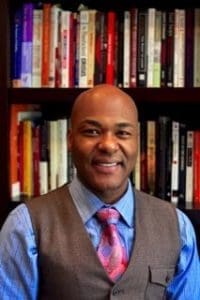
In this 3 part series, we interview Darron Smith–a black man who joined the LDS church as a teenager in Tennessee. After serving a mission for the LDS Church and graduating from the University of Utah, Darron began a 10 year teaching career at church-owned Brigham Young University.
Late last year, Darron’s employment was terminated in response to (according to Darron) his public outspokenness regarding the LDS Church and its treatment of blacks–past and present.
In this podcast, Darron:
- Discusses his positive upbringing in the LDS Church
- Provides a brief history of Blacks within the LDS Church
- Discusses his termination from BYU, and
- Relates his future hopes for the LDS Church with regard to these issues
Episode Transcript
Host: John Dehlin · Guest: Darron Smith
This transcript is machine-generated and lightly edited for readability. The audio is authoritative. Please excuse occasional errors in names and spelling.
Introduction and Welcome to Darron Smith
Part 1 of 3 · Ep. 22
John Dehlin [00:00:11] Hello and welcome to Mormon Stories podcast. I'm very excited to have you with us today. I'd like to thank all of you who were able to listen to the Buckley Jepsen interview. We've received a lot of very positive and negative feedback around that episode. I'm just grateful that people were able to hear Buckley's story and I hope you guys enjoyed it. As always, we encourage you to please send your comments either to MormonStoriesMail.com or even better, please feel free to join us up on our blog at www.mormonstories.org. today we have a very special guest with us. His name is Darren Smith. Darren, welcome and thank you for joining us on Mormon Stories. Are you there, Darren? Are you there?
Darron Smith [00:01:05] Yep.
John Dehlin [00:01:07] Darren, thank you for coming on Mormon Stories.
Darron Smith [00:01:10] Oh, you're welcome. Thank you. There's a little bit of a gap in here. I couldn't hear you. Yeah, thank you. Thanks for inviting me. I'm glad to be here.
John Dehlin [00:01:17] Yeah, my pleasure. And for those of you who don't know Darren Smith, well, there's a lot to say about Darren. I mean, if I went through his resume, there's a lot of cool things you'd see. Darren has been a, has been a teacher at BYU at uvsc University of Utah. He has a master's degree and he's working on his PhD in education. Great guy. And probably most notable, if you've been following the press at all, and I'll just go ahead and read from an article in the Salt Lake Tribune which basically says that Smith worked until recently as an adjunct professor at LDS Church owned Brigham Young University and as a diversity counselor. Last month his contract was not renewed, he says, and he was told it was because of his constant raising of this issue, meaning the blacks and the priesthood and the church issue with the media and in public forums. He's also the co editor of an anthology called Black and Mormon. And Darren, again, it's just great to have you on to talk a little bit about your story.
Darron Smith [00:02:26] Thank you. I'm glad to be, glad to be able to participate in this. I hope people, hope people are understanding and I hope I went over some allies in the process.
Growing Up Black in the LDS Church
John Dehlin [00:02:39] Great. Well, you know, there's probably three topics we can cover today. One is just your history as it relates to your life in the church. The second is the blacks and the priesthood and that whole history of the church itself. And then finally talk about your being let go from byu. But if it's okay, let's go ahead and start with your story. If you don't mind. Let's start. When we talk to people who are raised lds, many of them are sixth generation. We talk about their heritage. Don't even hesitate to start back and tell us what you know about your heritage as far back as you might know about it, kind of as an analog to what people do with their pioneer ancestry. But then go ahead and tell us about your early years and how you came to be a member of the church.
Darron Smith [00:03:33] Well, I'm actually a descendant of slaves, so I have no idea where my ancestors came from. Like most blacks in North America who. Who were born and raised here, most of their ancestors I would imagine came from Africa, Western coast of Africa and settled in the South, Most majority in the south, unless those were forced up to move into the North. So that's about as far as I know. And I know that most of my peoples came and settled around the Nashville, Tennessee area. And so that's where I spent most of my life growing up is in the Nashville area. And that's where I came in contact with the church. I mean, it came at a time, John, when I was actually looking for a different narrative, a different spiritual narrative. I had been a member of the Baptist faith for as long as I can remember, but I didn't really go very often. But I know that my family would often participate. And I remember my grandmother had no saying. She used to say, baptist born, Baptist bread. When I die, Baptist buried. She was a big advocate of the church, the Baptist faith, and. And she was true to her word. When she died, she was actually died in the faith and was buried with the whole Baptist spectacle. So that's all I knew. And I anticipated that would be all I would know. But I was always curious about other faiths and didn't really find that my faith community, the Baptist church, really gave me answers to religious questions that I needed to know at the time. I was 15 when I began to investigate and at least contemplate the idea of leaving the Baptist faith and looking at other faith communities. And just so happened that I was working during the Christmas season of 19, I think it was 1985, and I met a gentleman named John Mitchell who was actually African American. That's the most ironic thing. This guy was actually black who introduced me to the church in 1985. And he was telling me about things that sound extraordinarily intriguing. Ideas about prophets, living prophets and ancient scriptures, ancient texts that contain the writings of Jesus Christ in it that was pretty much preserved for the Western Hemisphere. And he asked me to take at least to consider looking at it. And if I knew these things, what would it do for me if I known that Christ visited his people here in the Western Hemisphere? That part of it was very interesting to me because I'd read, I come across some texts that had talked about the Native American community in North America and Northern Mexico and how they had encountered Jesus Christ, had called them different names, Quetzalcoatl, Cucukan, and so on. But they had this belief that call it a Great Spirit came and visited them and taught them the gospel. And so this gentleman told me about this, and not in that kind of detail, but enough again to pique my interest. And that Christmas season ended, and I went on back to my business of being a high school student. Now, he didn't tell me the name of the church. I never did know what the name of the church was. He didn't tell me even the name of the book that he was referring to, other than just he had a book. Because it was just such a very short encounter, maybe over the course of a week, maybe. And we only talked about it maybe a couple of times. But shortly thereafter, after the Christmas season had passed, I was taking a shower and I heard a knock on the door. And it was a faint knock because the shower was loud and the music in my room was blaring, and I was the only one home. My mother and my sister were out, and I hopped out of the shower and ran to the door and peeped out the peephole. And there were two men there, two white men with red ears and a scarf and gloves. And they said, we're from the Church of Jesus Christ of Latter Day Saints, and we have a message to share with you, the same spiel that most missionaries give when they go out and serve. And so I thought to myself, man, I do not want to open this door. I'm in the middle of a shower. And I don't know these people, they might be Jehovah's Witnesses. I'm not interested. Not that I have anything against Jehovah's Witnesses, but that's typically who proselytizes and knocks on doors is Jehovah's Witnesses. And so the way that. The way the one guy said, you know, we only have a short message. We only take a little bit of your time, you know. You know, can we come in? And it's cold, and it was cold in January, so I let them in, and then they begin to tell me the same story that John did about living prophets, ancient texts, you know, how Would I feel about God, you know, having, you know, having other sheep if you. Just a metaphor that we typically use in the church that he brought his word to. And I remember asking them, I said, did John Mitchell send you guys over here? And they said, we don't know John Mitchell. They said, he must be in the other ward. So I thought they were referring to a prison, prison ward or jailhouse or something. But. But I later found out that wards are what members of the LDS Church typically refer to as congregations. But they were very. They looked at each other and they smiled. So in later years, I realized that smile meant something like, well, this guy's golden, right?
John Dehlin [00:09:16] This guy golden contact sent by the Lord.
Darron Smith [00:09:19] And so, I mean, you know, and so that's typically when I started my mission. I had the same. The same kind of expressions when people were interested in hearing what we had to say, were honestly interested in it. So we had a real nice conversation about the church, and they began to tell me about living prophets. That's the second big topic that we talked about. And in my naivete, assumed that these men look like Moses, the kind of representation of Moses, long coat, cloaks on and long beards and so on. And all these men dress, dressed like modern folks dress. And so eventually the message was compelling enough and I found myself in the waters of baptism. January 22, 1981. And that began, interestingly enough, when I joined the church in 81. It was just three years after the priesthood ban was lifted. And they didn't tell me that. They didn't tell me about the priesthood band and the whole issue about black. And so after I had joined.
John Dehlin [00:10:21] Okay, so. Oh, sorry, real quick. So your conversion, would you describe it as intellectual, spiritual? Was there a strong social component to it?
Darron Smith [00:10:34] Yeah, I think so. I wouldn't say it was a spiritual conversion by any means. I mean, there were probably moments where I felt the Holy Ghost in the way in which we as Mormons described that experience as a burning in the bosom and so on. I mean, I'm sure I felt that way at times when we were. During the course of the discussions that we had. But I would say that as I analyze it and look back at the situation, it was probably more social than it was anything. I think the spiritual conversion came much later.
John Dehlin [00:11:04] So you started attending a ward?
Darron Smith [00:11:07] Well, yeah, they invited me to come to church.
John Dehlin [00:11:10] Was it a white ward? Was it a ethnically diverse one?
Darron Smith [00:11:14] I mean, the thing that struck me the most when I went, the first time I went to the LDS Church service was I saw a hell of a lot of kids in the hallways, a lot of kids that struck me like, wow, people love to have kids. What is it about these kids? That's the first thing. Secondly, a lot of white folks right everywhere. I didn't see any people of color, so I was automatically intimidated.
John Dehlin [00:11:33] So was your buddy John. Did you ever run into your buddy John?
Darron Smith [00:11:36] No, no, because he was in the other ward.
John Dehlin [00:11:37] Okay.
Darron Smith [00:11:37] And so. And I was actually in the third. I was, you know, I was. My boundaries. Our ward boundaries, was in the other ward, third ward, national, third ward boundaries. And so that's where went, actually. So John was nowhere to be found. But when I mentioned John, and I mentioned John Snamen began to speak about John, then they later contacted him, and then he got involved in this process, too, of bringing me the word.
John Dehlin [00:12:01] Do you remember when you were first starting to show up? Do you remember people being shocked? Do you remember him being turned off? Do you remember him being super excited to have you there? I mean, this is the South.
Darron Smith [00:12:13] Yeah, yeah. And the thing is, typically the south gets a bad rap, you know, for its nefarious history. But I can honestly say that when I went to the church, the LDS service in Nashville, I felt very, very welcomed and very, very accepted. People there were very, very open to me and made me feel like a part of the family. I mean, in all honesty, that's probably why I stayed. That's probably why, you know, for the first five or, you know, the first 10 years or so, I wouldn't say that long. Probably the first five years, you know, I had a lot of really good friends and, you know, and they were my anchor.
John Dehlin [00:12:51] Did you ever, you know, as you were contemplating joining, did it ever cross your mind, I'm not going to go to church with just all white people? I mean, there's no people of color here.
Darron Smith [00:13:00] Yeah, yeah, yeah. There was certainly some doubt, you know, and I did feel. And, you know, what's interesting is that, you know, there are times when I'm in the congregation, as I look back at this experience now, and I say, man, I feel uncomfortable here because all these white people, I feel uncomfortable. And then fast forward 26 years later, and there are times I still feel uncomfortable being around all white people.
John Dehlin [00:13:24] But was there a dynamic? I've been in a few situations in wards where people are excited to have something different and new and unique. And it's almost like people are extra interested in, you know, in someone who's black than they might be just, you know, an average, you know, White person. Did you ever get the sense that maybe there was potentially an extra level of interest?
Darron Smith [00:13:46] Well, you know, I would. If we're going to use, you know, talk about it in those terms, I would say that there was certainly a high degree of exoticism in the ward. I mean, the fact of the matter is I was African American. People saw me as African American and they took it upon themselves to probably be a little bit more hyper polite than they normally would be to somebody who was white. I would argue that would come into the services. Yeah, there was a whole lot of exceptionalism going on and exoticism. This black guy's here, he's exotic. The whole metaphor, myth over the exotic other. That certainly was part of the experience. But I was too immature at the time to understand that and to really be able to make sense of it. And, and again, looking back at it again, I think that the way in which the people fellowshipped me there was adequate enough to keep me there, to keep me active and keep me interested. Let me give you an example of what I mean by that, John. After I joined and hadn't gotten into the rhythm and flow of going to church and participating in priesthood and so on, I remember I started going inactive. I just didn't go. Probably a string of. Probably three or four weeks, three or four Sundays, I just didn't go at all. I just decided not to go anymore for some reason. I don't know why, but I remember that one. On that fourth Sunday, I never will forget this. I was upstairs getting my sleep on and my mother came upstairs and said, bubba. That's my nickname. All my homies in the south call me Bubba. Those that know me. I said, bubba, there's some people from your church at the door. I said, people from my church at the door? This is Sunday. They should be in church. So I throw my clothes on, go downstairs, and guess who it was. It was the bishop and the Aaronic priesthood. They all came to my. Came to the house.
John Dehlin [00:15:32] I mean, that's beautiful. It's. It sends chills down my spine.
Darron Smith [00:15:36] I mean, it's amazing. I mean, they all came to the house and the bishop said, darren, you know, we just. We haven't seen you in a while. We want to know, you know, make sure you're okay. And you know, we want you. So I put my clothes, hurry up, put my clothes on and went on with them.
John Dehlin [00:15:52] That's a cool story.
Darron Smith [00:15:53] And I never missed again after that. It was the embarrassment of it all, of having them come and call me out. But then it also, again, in retrospect, it was the sense that they cared. They really cared about me. Bishop Love was probably the most influential bishop I had. He was the longest guy. I mean, he was the bishop for almost 10 years. When I first converted, there was a gentleman before him, but I didn't know him as well as I knew Bishop Love. Bishop Loved really went the extra mile. He was actually from Louisiana, believe it or not, but just a wonderful, wonderful man. And I never will forget that, actually.
John Dehlin [00:16:29] So that's remarkable. I mean, let's give credit. Those members were maybe even a little bit ahead of their time in being very open and warming and gracious to you.
Darron Smith [00:16:39] Absolutely. I would say that my experience in Nashville, in the Nashville ward was exceptional. I really would say that. I mean, I think that the people there just had just a genuine. And it's so funny, too, because I mentioned to you before, John, right now I'm in Alabama. I'm here on a military assignment. And you can still see that here. Even in Alabama, you've got that Southern hospital. People just speak to you in the south, you know where you stand with most people because they're going to tell you. Whereas in Utah, if I contrast the two experiences, people in Utah exhibit and display a much more happy face kind of an experience. In other words, they're smile on your face, but when you turn your back, one of them was just here. So you get that kind of juxtaposition from the south to Utah. And hopefully we'll cover that tonight a little bit on this program.
Mission, College, and Early Faith Formation
John Dehlin [00:17:35] Okay, cool. So you have a really good formative experience in the church?
Darron Smith [00:17:41] Absolutely.
John Dehlin [00:17:43] You stayed active through high school. Did you serve a mission?
Darron Smith [00:17:47] I did.
John Dehlin [00:17:48] Where'd you go?
Darron Smith [00:17:49] I actually received a mission call to serve in the Lansing, Michigan mission.
John Dehlin [00:17:54] Now I was just in Lansing last
Darron Smith [00:17:55] week, if you can believe you were going there. Yeah, I loved it, John. It was often shame. I mean, the donuts and the cider. The people were often saying the church is very small there. At least when I was there, you know, it was growing still. But I had a good. I really, really had a wonderful time. In fact, I tried to extend, but the mission president told me to get out of Dodge. But I really enjoyed my experiences there. And I wanted to say that throughout my high school years in Nashville, the church really was an anchor for me. It really provided me with a lot of stability. And the people that I associated with were just phenomenal, and they gave me a lot of good. I met a lot of good, positive role models in the young People that I associated with, but also in the parents of the young people that I associated with. And so all of those experiences that I had when I was living in that community and growing up, I would say was very, very positive. And so it led me to go on a mission. I was reluctant to go on a mission. I want to add that this wasn't like I just said, yeah, I'm going to go on a mission. But I went to Ricks College after I graduated from high school, and there was a guy, a young man in my ward, his name was Tim Carter. And Tim had gone to Rick's. And you know, in each ward or each branch, or even in the steak centers, they have those little, you know, those little tear off brochures. Go to Rick's, go to byu, you know, those little things they have. I used to always walk by those things and see them, but I didn't know really what they were. And so Tim came back from Rick's and I said, tim, what is this Rick's College thing? He had told me that Rick's was a junior college and that it was. He had an excellent experience there and it was awesome and people were great. And I knew that my grades sucked. Did I say that on the podcast? My grades weren't that great. And so I figured that Rick's was as good a place as any. So I didn't think I'd even get in. But at that time, Gricks was taking anybody.
John Dehlin [00:19:56] Now, what year was this? What year was this?
Darron Smith [00:19:58] This is an 86. 80. No, homeless. This is 84. Excuse me. I went to Ricks from 84 to 86, and then we're on a mission from 86 to 88. Okay, so Rick's. So anyway, I sent my application in, got in to Rick's. Originally I was thinking I was going to play football because I played high school ball and was quite, you know, I don't want to toot my own horn, but I had skills. So anyway, so I had originally wanted to go to Rick's to play football, but I got up there and that high elevation was kicking my bo. And so I said, nah, I think I'm going to work on my brawn. So I went to Rick's the first year. The first semester didn't do very well. The first semester I was reverting back to my old inept high school days when I just basically got by with my athletic ability and so went in the military after that, did almost eight months in the military, went to photo school, came home this was in 80. Came home in 86, came home in 86 and started teaching Taekwondo for my instructor. My Taekwondo instructor's name is Bob Harding in Nashville. Another very influential guy in my life. Just really taught me a lot of important lessons about life and about the value of work and working hard and so on. And then after that, we had a guy, a gentleman in our ward who. His name was Jerry Calvert. See, this is so ironic. I remember these people. These people were significant in my life, and so I remember their names, even though I haven't seen Jerry Calvert in years, but I remember his name, and I remember the way in which he influenced my life. But Jerry, one day, after we had class, taekwondo class, Jerry said, darren, have you ever thought about going on a mission? Have you ever thought about a mission? I said, I don't think so, man. He says, well, why not? You'd be excellent. You teach taekwondo. You're so good at it. You teach well. You'd be really good. I said, well, I just don't want to cut my hair. I don't want to wear no white shirt. No. You know, basically that kind of thing. Then Jerry Calvert had to open his big mouth, and he had to say, well, why don't you pray about it? If you ever want somebody to go on a mission, never tell them to pray about it. So they want to answer. So I went home, and I took Jerry up on his challenge. I went home and I prayed about it, and I got an unbelievable witness that a mission is what I'm supposed to do. I should go on a mission. And so I did. And so in the spring of 86, I talked to my bishop, Bishop Love, and Bishop Love didn't think I was going on a mission. I told him he had asked me a couple times, you know, in his nice Southern accent, baron, you want to go on a mission? I said, I don't think so, Bishop. Well, you'd be really good. I said, nah, nah. So he was shocked when I said I was going to serve a mission. And so we rapidly got the paperwork together, and then I got him a call to Michigan and then. And guess who was my stake president at the time. Who was, and to this day is still absolutely wonderful. Elder Todd D. Kristofferson, who was in the first quorum of 70.
John Dehlin [00:22:57] He's in there now.
Darron Smith [00:22:58] Yeah, he's in the presidency right now.
John Dehlin [00:23:00] Oh, wow.
Darron Smith [00:23:01] Yeah. I mean, I absolutely have nothing but love, admiration, kudos for President Christopher. I mean, he was the stake president then when I was in Nashville. So I had My interview with him, then I went. And that was where the spiritual conversion for me came. A lot of missionaries, I noticed when I was out in Michigan doing my thing, a lot of them go there not really having a testimony. A lot of them go there borrowing testimonies from their parents and not really knowing for sure why they're there. I can say that when I went, I was honestly committed to it and I really threw myself into studying a lot. In fact, I developed excellent study habits on my mission. And that enabled me to come back home and go back to Rick's and finish up the first and redo the first semester that I did so horribly and do well. And so that led me on to different things. But here's sort of what happened during this process. I think I mentioned to you earlier that the first time I had heard about the priesthood issue was when the missionaries I went proselytizing with missionaries, the ones who baptized me. I was so taken by this whole missionary thing and by these two gentlemen, these two wonderful young men who had brought me into the church. I wanted to go out with them, go prophesize with them. So I did. I remember one of them telling me one night, he said, darren, I got something to tell you that we didn't tell you before, and I hope that you understand. So he begins to tell me that there was a time that blacks could hold the priesthood and that he didn't know why. He didn't understand why other than it was there. Then he said he had heard that this is one explanation. And he talked about the whole fence sitter analysis, that blacks were fence sitters and that. And I remember after he told me that story and after he said this, I felt so betrayed.
John Dehlin [00:24:54] Now, was this before you were baptized?
Darron Smith [00:24:56] This is after I was baptized.
John Dehlin [00:24:57] How long after you were baptized?
Darron Smith [00:24:58] This is probably two months after.
John Dehlin [00:25:00] Okay. And just so our list, most of our listeners will know, but you know, I think what you're referring to is the teaching that in the pre existing, you know, I have an original edition of Mormon doctrine, probably like a 1958 version. And in there, Bruce R. McConkie basically says, in the heavens before we came to this earth, you know, there were valiant people and there were less valiant people. And the exact quote, I think from the book, it says, these less valiant we call Negroes. So that's the teaching you're referring to.
Darron Smith [00:25:31] Right, right. In fact, that particular idea was invoked by the blacks were fence sitters. And the precisions that was actually invoked by Joseph Felding Smith. He was the Sort of author of that particular idea. So McConkie had some other dastardly comments that. I can quote some of those for you if you want me to, but I won't get into it at this point. But nevertheless, he told me about this, and I remember feeling very betrayed. Very betrayed. I was like, wow, I can't believe these people. Many people gonna bring me to bring me into their church. You know, they gonna woo me with their nice niceties and then. And then drop some racism on me.
John Dehlin [00:26:10] Right.
Darron Smith [00:26:10] You know, I mean, I just don't. I don't. I mean, I was. I felt very hurt by it. I remember that. But the flip side of the coin is that I really, really, really liked Elder. I mean, both of the elders. And I can't remember their names right, but I like them a lot. And so that was enough for me to stay in. And also, I was beginning to develop some good friends, some good friendships, and so I stayed active. In fact, one of the friendships that I developed was with a family, the Lifarth family. L I F F E R T H In fact, David Liforth, the oldest of the Lifarth clan, was actually, for a brief time, the mayor of Eagle Mountain. Those who live in Utah. No, Eagle Mountain is a new community. It just was sort of developed out west of Lehigh. And David was actually the mayor there. And so it's nice to see him, you know, him, you know, doing his thing. He's Republican. I have a problem with that. Other than that, you know, I'm pleased to see my fellow Nashvillians doing their thing.
John Dehlin [00:27:15] Sure.
Darron Smith [00:27:16] But any rate, so that was a turn off when I heard that. Yeah, but, but, but, you know, but I was so, again, socially taken by the experiences that I've had with members of church. I just. I just repressed it. And I didn't hear it again until after I served a mission. And I remember. I remember the exact time and the exact time.
John Dehlin [00:27:35] Okay, wait, wait. Let me. Let me. Let me just jump in and ask one question. During your mission, did you ever teach black people?
Darron Smith [00:27:43] Yes, I did. I'm getting to that.
John Dehlin [00:27:45] Oh, sorry, sorry. Oh, sorry.
Darron Smith [00:27:46] No, no, no problem. Yeah, I'm getting that. Because this is where this issue became more of a. More problematic for me. We were teaching in Kalamazoo. Anybody know about Michigan? Kalamazoo is where western Michigan is. And we came across two African American gentlemen, and they let us into their home after we had, you know, these were two students, and we gave them the spiel, the first lesson about the church. And then at the end of the lesson, one of the guys said, so do you know that your church, there was a time that your church didn't allow black people to hold, to participate in it? I don't know exactly how he phrased it, but he knew that there was a time that blacks couldn't fully participate in Mormonism. And I said yes. He says, well, your church believes that black people are less than or cursed or have some kind of a prohibition on them. You know, how do you feel about that? I mean, what do you say about that? And I said, well, they don't have that kind of prohibition or that kind of belief because here I am right now and I'm living proof that that is not the case. He says, well, he says, but I don't understand how you can belong to a church that would have up to very recently this kind of teaching, you know. Then he says, well, can you tell me what you know about this black issue? And so I began to tell him. I began to recant to him, you know, one of the numerous folklores, folkloric myths about the black experience. One, of course. And you cited one of them earlier, the Joseph Selding Smith one, the Way to perfection, chapter 16, actually. And the name of the book, I think it's called the Seed of Cain after the Flood where he talks about blacks being fence sitters. I begin to talk about that. I say that to these young men. I remember they looked at each other and they said, brother, you are very, very lost. If you believe that black people are cursed and descendants from Cain, you are very, very lost. And they asked us to leave.
John Dehlin [00:29:55] So did you kind of believe that?
Darron Smith [00:29:57] At the time I didn't know. I didn't know what to believe. You know, I was just, only, I was being Mr. Obedient. I was just trying to, I was just trying to give them an answer that was adequate. And at the time I thought that was an adequate answer to give. And so that, so at that moment, that's when I began to say there's something wrong with this. There's something really wrong with this. And I cannot tell you how many missionaries I've spoken to over the years who continue continually spew this kind of racist folklore. Not just missionaries, but well meaning and not so well meaning members of the church continue to talk about blacks as if we were cursed or less than or inferior and continually invoke these old racist assumptions by Joseph Felding Smith and Brigham Young and then get pissed off at someone like me when you, when I say, or someone like you. Even John, if you were to say, well, that's inappropriate. These men are racist, they have problems. They were products of their time. And they look at, well, no, they're not racist, they're men of God. As if they're somehow immune from the ills of society. And so that's been probably one of the most problematic experiences in this endeavor that I've been engaged in is being just absolutely flabbergasted at the blind obedience that many members of the church have, even if it's racist. Blind obedience and failing to think for themselves and say, wait a minute. Racism has always been a systemic and persistent structural anomaly in US Society. Why would the church be any different? Why would our church be. I know we have such a high regard for our church. I understand that. I've been a member long enough to know that, but also have been a member long enough to understand that it's not always that way, particularly when you're looking at social issues. And I think that's the case for a lot of churches. But our church unfortunately persisted in this longer than most churches did.
The History of Blacks and the Priesthood Ban
John Dehlin [00:32:08] So let's, after this, I'm sorry, I want to hear you continue the story, but this feels like a good segue to actually spend 10 minutes or so talking about starting with Joseph Smith. Let's just do a 10 minute survey on the history of Mormons and blacks or African Americans. And I lose track. Is it insensitive to say black now or is Africa. Some people are offended by African Americans.
Darron Smith [00:32:39] You know what? When in doubt. When in doubt, ask. When in doubt, ask for me. I don't care. Black, African American is fine.
John Dehlin [00:32:46] Okay, so why don't we just. There are a lot of things that are really interesting about Joseph Smith and how he viewed blacks. So why don't you just talk us through some high level history on blacks in the church.
Darron Smith [00:32:58] Well, a lot of this has to do with innuendo, folklore, rumor, myth. A lot of people like to say, well, it was church policy that blacks couldn't hold the priesthood. There's nowhere, anywhere where this has ever been inscribed that blacks couldn't hold the priesthood. A lot of it stems from Brigham Young in 1854.
John Dehlin [00:33:18] Oh, wait, wait, I'm sorry, let's back up. You know, the two things, the couple things that I know, and maybe you can talk about this. You know, one is that Joseph Smith did ordain black people to the priesthood.
Darron Smith [00:33:31] Is that right? Yeah, yeah, yeah. Well, he only. Joseph Smith ordained Elijah. Well, it wasn't him. It was. He was, it was his Father who ordained Elijah Abel to the priesthood in the 1800s. I can't remember the date 1840 or anything.
John Dehlin [00:33:46] And there may have been at least one or two other blacks that were.
Darron Smith [00:33:49] Well, there's one guy named Walker Lewis. We know that a gentleman named Walker Lewis received the priesthood, but he received it under the hands of William Smith, who was Joseph Smith's brother. And many people may not know this, but William Smith actually left the church and went over with Emma and started to reorganize church. And so they basically debunked that priesthood authority and priesthood line because of the schism that happened in the church after the Prophet was assassinated.
John Dehlin [00:34:17] And it's also worth mentioning that part of the reason why we suffered so much persecution in Missouri was because of Joseph Smith's position on blacks in slavery. Is that right?
Darron Smith [00:34:29] That's right. And that's a lot of. A lot of that history, John, unfortunately is not well understood by members of the church. And I want to say this because I think I may have a little bit of an audience for this right now, that African Americans, blacks have always been central to Mormonism since its earliest days, particularly when blacks were expelled from Jackson County, Missouri. The whole expulsion from Jackson County, Missouri had to do with a newspaper article written by W.W. phelps in the Times and Seasons in 1844, when Phelps was so excited about all these Mormons congregating in Jackson County, Missouri, that he wrote this article entitled Free People of Color, where he talked about how the church would grow and that the Laplander would join and that the Hottentot would join and that all these different nationalities and races and so on would all come into Jackson County, Missouri. Well, that newspaper article obviously got into the wrong hands. It got into the hands of the Missourians. And as you know, Missouri at that time was a slave holding state. So the last thing that Missourians wanted to hear was the Mormons trying to incite black folks to come into a slave state with the understanding that an insurrection might ensue. And so as a result of that, the Mormons were expelled from Jackson County, Missouri. And nobody knows that. A lot of people don't even know that story. Leonard Arrington in his book about Mormons has written extensively about that. My very, very good friend and colleague Noel Bringhurst has written about it, Armand Moss has written about it, and several other noted LDS scholars have written about this particular history.
John Dehlin [00:36:15] It might be fair to say, and I think I've read Errington, I believe it's Mormon experience that I read that. But basically there were other religious and economic and social issues as well. But definitely, definitely, the black issue and the slavery issue were central.
Darron Smith [00:36:32] Well, absolutely. I don't want to say it as if that's the only issue, but that was one of the main ones that drove. That's one of the main issues that drove the mob to be formed in Missouri, just because, in fact, it was so problematic that Phelps wrote an extra to retract what he said the next day, the following day, when he got word that the Missourians had formed a. Were conspiring to basically expel him. So the secret manifesto went around, which called on Missourians who were against Mormons to basically take action against Mormons for this particular article. So Phelps responded by this extra, which was too late by then. But a lot of people didn't understand, don't understand that that is central to the history of Mormonism is the experience of blacks. And also there's some schizophrenia with Mormons as well. If you look at the roots of Mormonism, Mormonism started in the Northeast, I mean, New York, Palmyra region. So you've got primarily an abolitionist spirit, even during Joseph Smith's time. So you've got a lot of Mormons who are from the Northeast and from the Midwest who have very strong abolitionist leanings. And so the church was always being constructed in the mid-1800s to late 1800s as an abolitionist movement. And of course, that's an adjective that Joseph Smith and others denied, vehemently denied. But yet again, you see some schizophrenia in the way in which the prophet even dealt with the issue. On the one hand, the prophet was known to be very, very, very, very sympathetic towards black folks. On the other hand, believed in the mythology that blacks were cursed not because
John Dehlin [00:38:22] of any revelation per se, but just because that was the prevailing Christian.
Darron Smith [00:38:26] It was a prevailing notion. And people need to understand this. These ideas are not just didn't spring up from Mormonism. Mormonism has its own particular way of looking at it. That is the curse of Cain metaphor, But the curse of Ham myth, wherein Ham saw his father Noah's nakedness, and that's the prevailing sort of Judeo Christian belief, was not only incorporated by Mormonism, but went one step further with the whole invocation of Cain as being cursed with dark skin for murdering his brother Abel and so on. And that that particular curse is. That particular idea is unique to Mormonism.
John Dehlin [00:39:11] Right, okay, so how did we get from being, you know, Joseph Smith? I mean, there's a wonderful story that I think is in the new Joseph Smith film at church headquarters Where Joseph even went as far as to, you know, give a man. I think a black man was caught stealing. Do you know the story?
Darron Smith [00:39:29] Right, yeah.
John Dehlin [00:39:31] Tell that story.
Darron Smith [00:39:32] Well, this was reported, I think, in the Woman's Journal or the Woman's Journal, and apparently there was a slave who had ran away into a free state, and he was trying to get money to buy his family's freedom and had a horse. And the prophet knew he was breaking the law, if you want to call that breaking the law. Nevertheless, for the story's sake, the prophet bought. Purchased his horse from him and told him to go back and claim his family. So that's the. And this is not hearsay, by the way, people. I want your listeners to understand it. This is all documented in church history. This is not like I'm making this up. This is all documented. I think that particular story can be found in an old journal called the Woman's Journal that was, I guess, Relief Society. The Relief Society back then actually had notes and kept notes and wrote and published things. And so you can find that reference
John Dehlin [00:40:34] or run down to Temple Square and watch the movie. For those of you who are close to Salt Lake. So how do we.
Darron Smith [00:40:41] Does that particular story play there?
John Dehlin [00:40:45] Yeah, that's what I've been told. That the new Joseph.
Darron Smith [00:40:47] Yeah, that's wonderful. Because John. Because what I think that it does is it actually complexifies Joseph Smith. Joseph Smith. And even out of the words of Jane Manning, James Elijah, Abel, they had high regard for Joseph Smith. I mean, high regard for him. I mean, Jane Manning, James was considered, you know, one of Joseph's family members. I mean, even in her own words,
John Dehlin [00:41:12] this is a black woman.
Darron Smith [00:41:13] So there was a lot of respect and admiration for the prophet Joseph Smith. Most of that changed during Brigham Young's administration. So.
John Dehlin [00:41:21] Yeah. So how do we get from sympathetic and abolitionist to even as I understand supporting slavery in Utah, I think if
Darron Smith [00:41:32] you want to say, well, who instigated this? You'd have to look at Brigham Young, because Brigham Young in 1852 or 1854, one of the two, I can't remember the dates. Declared this in Fillmore, Utah. It used to be the capital of Utah. Was Fillmore declared it in when he was speaking to a state legislature. And of course, back then, the separation of church and state was not even a question. But he said, and I'll paraphrase if no one spake it before me, I'll say it now. Blacks cannot hold the priesthood. And he goes on to say why. He explains that blacks were cursed and that they were less than, less and this, that and the other. So he made himself the author of that, which demonstrates beautifully to me the confusion over it. I mean, if brittamyor is going to say, if no one has spake it before me, I'll say it now. You know, that blacks can hold the precepts to me is a little bit compelling in that the church at that time really didn't have a policy or really didn't have any kind of written, expressed, you know, dictum on what to do with their black members, what to do with the black members of the church. So but Brigham Young made himself the instigator of that. So certainly Brigham Young also. When the Saints came west and settled in the Utah Basin, Brigham Young enacted what's called an act in relationship to service, which was basically a document that authorized African slavery and Native American slavery in the Utah territories. And one of the things that the federal government was trying to do is contain slavery to the South. And so the Saints came out west and they started slavery. The only territory west of Mississippi to have slavery, legalized slavery. So we have a really, we have a really, really checkered past and we act like we, you know, we always want to act like when I say we because we're all complicit in it. We want to, you know, excuse these experiences and erase them and Pollyanna our past and not really deal with the things that vex us even today as members of the church. And so rather than address the issues of race and really confront these issues honestly and forthrightly, we like to pretend that they don't exist or stonewall or create verbal gymnastics to get around the issue, which continually makes Mormons look suspect in the eyes of those who would otherwise may even consider the Church as an option, as a theological and religious option. So we really do shoot ourselves in the foot. One of the things I told one high ranking member of the church one time about this issue is that not coming clean with the priesthood issue, not talking about the issue, puts black people in a really bad situation because then blacks have to defend a racist policy. Blacks become, you know, have to bear the burdens of white racist sentiment. I mean, it's just that simple.
John Dehlin [00:44:42] Right?
Darron Smith [00:44:43] Right. Because whites get to walk away and say, well, you know, the Church is still true. This has nothing to do with the Church being true or, or anybody being false prophets. It has to do with integrity. It has to do with the very thing, John, that the Church teaches us as members of the Church is to what, Reconcile? Right. Ask for Forgiveness, atone for our past right to go do no more. We teach that on any given Sunday, on any given week during Family Home, we're teaching our families the importance of forgiveness, importance of atonement. Right. And then we refuse to atone. Well, that's a bad example. I think it's an awful example.
John Dehlin [00:45:29] So let's consider that a preview for how I'm hoping to sort of culminate. Which is your final thoughts. Let's jump. So I hope to do another podcast later, kind of going in depth on the, on the blacks and the priesthood issue. But let's just, let's do a quick summary and sort of skip over, oh, I don't know, 100, 150, 30 years, you know, so, you know, 130 years from Brigham Young on no priesthood for the blacks, these theories about pre existence and about less than valiant sprung up. Not a whole lot of black people were joining the church. And we won't even go into the Brazil issue in the temple and Spencer B. Kimball or the David O. McKay stuff, which I've talked about in previous podcasts. But you know, at some point, you know, the church did in 1978 allow blacks to have full membership and to hold the priesthood. I think it's also important to note that, that there were statements by, by apostles and prophets that blacks would never hold the priesthood in, in this mortal existence. Is that right?
Darron Smith [00:46:34] That's correct.
John Dehlin [00:46:34] Okay, so, so they definitely, you know, had made that claim. But then the revelation came and it's probably fair to mention the one Bruce Arm McConkie quote that was not given to the general body of the church, but that was given to some CES instructors. Do you have that or. You know, I can.
Darron Smith [00:46:55] Yeah, I do. I have McConkey statements.
John Dehlin [00:46:58] Yes, I could paraphrase. I could paraphrase it.
Darron Smith [00:47:01] Well, McConkie talks about. McConkie is invoked when he talks about, if you look at Mormon doctrine, he talks about the Negroes and he talks about Negroes were. I've got the quote here. But basically the fact that Negroes were of the lineage of ham and that ham and that lineage had no part, were not partakers of the priesthood, more or less, is what that says. And he goes on to list what that prohibition means. Basically that missionaries, we can proselytize amongst them but not act actively proselytize. We happen to come across somebody of color African American and it's okay to mention the gospel, but we don't actively seek them out, is one of the things that it says in his text.
John Dehlin [00:47:50] Yeah, that was interesting, actually.
Darron Smith [00:47:53] As a result of his rebellion, Cain was cursed with a dark skin. Now, I want to just tell your listeners, and this is the 1975 printing of Mormon doctrine, and of course, it's gone through many revisions, but this is one of the ones that, in fact, this literature, this lingo is still found in Mormon doctrine today. I mean, there is a disclaimer, and I'll read that for your listeners, if it's okay. But it says here, as a result of his rebellion, Cain was cursed with a dark skin. Now, we don't have any idea what kind of curse cursing Cain have. The Scriptures doesn't. The Scriptures aren't clear on that. They just aren't clear. We don't have any clue. But I can assure you that it wasn't black folks. It may have even been white folks. It could have been y'. All.
John Dehlin [00:48:40] Yeah.
Darron Smith [00:48:41] That had a curse on y'. All. Have you ever thought about that?
John Dehlin [00:48:44] Sure.
Darron Smith [00:48:45] But nevertheless, he says he became the father of Negroes, and those spirits who are not worthy to receive the priesthood are born through this lineage. He became the first mortal to be cursed as a son of perdition. That's what it says in that particular edition. The 1978 edition is almost verbatim with a couple of changes. Now here is the. Let me see, there is a. Here's a disclaimer that came out in 78. It says Mormon doctrine has for decades been a classic work on certain. I'm going to back up. This is how the church responded to these kinds of. You know, I don't know what else to call them, John, but racist. I mean, racist because they're invoking. Because race is the central controlling metaphor for common sense making. Right. So I'm using phenotype people's differences as a basis to understand and interpret reality. So it's racist. Right. And usually racism is about power. Who has power to control, who has power to deny. Right. Whites have always had that kind of power. Blacks have not had that kind of power in the U.S. now, you people, I know some of your listeners might say, well, look. And white folks are typical of this kind of thing. In fact, I would even encourage your listeners to listen to. To watch FX Black and White, that show that Ice Cube did on FX about the black family that's turned white and the white family's turn black and how they experience the world. It's absolutely fascinating, fascinating to see how the white family responds to being associated and being around because they've never had to. And all Of a sudden, they're put in a situation where they've got to understand black folks. Whereas the black family, who's white, are much more comfortable being around white people. Because you know, why they've had to be. They have been the recipients of the white power structure since they were knee high. But anyway, what this says is that Mormon doctrine has for decades been a classic work on certain beliefs and practices unique to the LDs, to the latter Day Saints period, a reflection of the times and culture in which it was written. Okay. This monumental work has added to the understanding of countless members of the Church of Jesus Christ, Latter Day Saints. So basically, you know, a reflection of time. So basically understand that when this was written, you know, Elder McConkie had some racism, he had some problems, that he was invoking these assumptions about black people. But it's okay. It was just a reflection of the times. Now, how is that supposed to make black people feel? Right? Where do white folks get off chiding black people for being pissed off when they read stuff like this? Or when this kind of literature is presented to prospective members of the church and they turn away or they hear these sorts of innuendos, these sorts of folklorist notions about themselves as black people and you're surprised they don't want to join the church. Or when this kind of stuff is raised in the media and the church refuses to respond to it, or they say, you know, the 1978 priesthood revelation speaks for itself. It doesn't speak for itself. All it says is that all worthy male members can now hold the priesthood. It says nothing about the folklore that underscored it. Nothing about the racism that's embodied within says nothing about that. And there's not even been an inkling of an apology.
John Dehlin [00:52:31] Okay.
Darron Smith [00:52:32] I mean, African American members. Let me finish up this comment. African American members of the Church, John, are then hurt by this. They're psychologically hurt by it because now they got to bear the burdens for white racist sentiment. And then white people are also affected by it because now they get to walk away feeling inferior, feeling superior. And it might be unconsciously inferior or superior. Excuse me, but these have these. This particular notion. These ideas have consequences on both sides.
John Dehlin [00:53:02] Right.
Darron Smith [00:53:03] Sorry.
John Dehlin [00:53:03] No, it's good. So this is very important. The depth of your dreams, the height of your wishes.
Bruce McConkie and Confronting Racist Teachings
Part 2 of 3 · Ep. 23
John Dehlin [00:00:11] Just to tie back to the history real quick, I will say that, you know, there is one quote that's often mentioned about Bruce Armour Conkie, after the revelation came out, where he was speaking, where he was speaking to some CES folk. Is that right?
Darron Smith [00:00:25] Right.
John Dehlin [00:00:25] Do you have that quote in front of you or should I paraphrase? I don't.
Darron Smith [00:00:27] But, you know, but basically what he says, that he spoke with limited light and knowledge at the. When he wrote that he spoke with limited light knowledge, he just didn't understand that the scriptures, that God's work is continuous and ever changing and the things he said essentially should reflect that whole paradigm. So I think, I mean, to Bruce Al McConkie's credit. Okay, I'll give him credit that at least he had the wherewithal to say, to say that.
John Dehlin [00:00:58] Yeah.
Darron Smith [00:00:58] Right.
John Dehlin [00:00:58] And. Yeah. And there was. And just to capstone that. And I don't want you to think that I'm saying that this excuses it or is anyway adequate. But I do, just for the record, I don't want, you know, I want people to make sure that's known, that I think even part of the quote said everything that anyone's ever said on this issue before 1978 is wrong.
Darron Smith [00:01:16] That's right.
John Dehlin [00:01:17] So he basically overturns what Brigham Young said.
Darron Smith [00:01:21] But there is a problem with that, John.
John Dehlin [00:01:22] Oh, no, I know. I just wanted to get that on the record. Yeah.
Darron Smith [00:01:25] Oh, yeah, yeah. And I'm sure that's important for your listeners to know, but there is a problem with that.
John Dehlin [00:01:31] Oh, yeah. So let's. Before you tell us what I want to do, let's loop back now to your story. Take us, take us through sort of how you went from a missionary who just started to think hard about these issues. Take us through, you know, your employment at BYU and when she started thinking about writing the book, etc. And then we'll culminate in your analysis on Mormonism and what you think needs to be done, etc.
Personal Experiences of Racism as a Black Member
Darron Smith [00:01:59] Okay. Well, make sure you keep me on task. Okay. But before I say that, let me just preface it by saying I want your listeners to understand something. Okay. That I have a testimony of the church. I want them to understand that emphatically that I believe the church is true. For me, the church has made all the difference in the world in my life. Okay. I absolutely am convinced the concept of a living prophet. I know that that is a correct principle. That's the way in which the Lord wants things to work. And there's no other place I'd Rather be. That doesn't mean, however.
John Dehlin [00:02:35] Sure.
Darron Smith [00:02:36] That the church isn't free from problems and that problems surface all the time and that we need to deal with the problems in a respectful manner and in a way that's consistent with the way in which the Savior would deal with it. I don't think that all the time we forget those dimensions of the Savior's life as we sojourn through this life. And so I'll say that because a lot of people say, well, this guy's not a. Members of the church love to demonize. I mean, if you don't agree with the brethren, you're automatically a heretic. Automatically. If you open your mouth and you're saying.
John Dehlin [00:03:15] You're saying there's.
Darron Smith [00:03:16] I know that I've been constructed that way.
John Dehlin [00:03:17] There's room for loyal dissent, you're saying.
Darron Smith [00:03:19] Oh, yeah, absolutely. I mean, you know. I mean, being. You know, what's the old saying? Being, you know, being a dissenter is patriotic.
John Dehlin [00:03:31] Right?
Darron Smith [00:03:31] It's patriotic. And disagreeing, you know, should be something that's. That's acceptable and that's completely valid within any organization.
John Dehlin [00:03:39] Right.
Darron Smith [00:03:40] And so I think that our church. We should hold our church to the same standards.
John Dehlin [00:03:45] Sure.
Darron Smith [00:03:46] And I think that, you know, I think that for me, I mean, for the most part, I have. I don't have a problem with anything other than this. This is the only issue I have a problem with because it affects me personally, affects my family, and also affects the future. The future of black members. That I would love to see more black members in the church.
John Dehlin [00:04:04] Yeah.
Darron Smith [00:04:04] Okay, so I'm off the subject now.
John Dehlin [00:04:05] No, it's good. No, you're totally on subject. So let's. What I do want to do is weave this back in your story because I want to see through your eyes, so to speak. So you had this experience where those two black gentlemen just basically said, you know, please leave my house. Take us. From that point, how that affected you through to you becoming a teacher at byu.
Darron Smith [00:04:25] Okay. I was embarrassed by it. Very embarrassed by it. But I didn't know exactly what to do, John. I didn't know what. What to do. So I started asking questions about it from people who I thought could give me a reasonable answer or give me something that I could go with that would help me. That would help to assuage my feelings about this whole issue about black people. Now, I want you to understand something. You may not understand this because you're a white guy. You may understand this, but I want you to try to envision what I'm saying here, John, imagine reading something that says that you were cursed, you have no worth, you are inferior. Before you even step on the earth. You already have this original sin kind of concept pasted upon your body, which is antithetical to the second article of faith, which most people would know that if they knew the articles of faith. We don't believe in original sin, but yet we continually invoke that idea when it comes to black people. So I was very embarrassed by it.
John Dehlin [00:05:27] And Lamanites. And Lamanites too, by the way.
Darron Smith [00:05:31] Yeah, absolutely. Absolutely by the way. That's a whole other show. But the whole idea about black people and about my feelings over it. I began to throw myself into literature as much as I can get my hands on to. Written by McConkey, Orson Hyde, Joseph Elling Smith. Some of the names Skip me. Sterling McMurran, a whole lot of people. Lester Bush and Armand Moss's piece, as much as I can get my hands on. Tried to help me to understand this because I had tried so much. I want you listeners to hear me when I say this. I tried to pray about this, to receive a witness that what I was doing was right, that what I was teaching people about my own blackness. I'm talking about blackness as a group, a group experience. I just didn't receive a witness. I just couldn't feel the spirit. I couldn't have that serenity and peacefulness that comes when you know things are right. I just didn't get that. I could find no solace in that. So I did what I did what I usually do sometimes in situations, at least back then, I just simply forgot about it. Didn't think any more about it until after I got home.
John Dehlin [00:06:59] Did you teach any other black people and did you ever baptize any black people?
Darron Smith [00:07:02] No, those are the only two black people that I really had a conversation with about this issue. I had a lot of conversations with white people about it, but not an actual proselytizing experience that I have with these two black men. Okay, so. But that was enough to turn. That was enough to get me to think about what I was doing and about what I was saying about black people. Because, you know, because, John, it's almost like. It's almost self hatred.
John Dehlin [00:07:29] Sure.
Darron Smith [00:07:30] I mean, you're teaching this stuff. It's almost self hatred. And so black people who are left to have to endure this stuff. Right. You have to have a high degree of self hatred. Now, I said this. I said this earlier in one of the papers that I wrote about this. I said that black people who join the LDS Church to some extent have to agree whether they like or not to take on this priesthood issue. I mean, that's. That. That is your. That is a burden that you take on when you join a church.
John Dehlin [00:07:56] Sure.
Darron Smith [00:07:57] Because from then on, you're going to have to explain to people why you're a member of the church. Right. And you're going to have to constantly have to correct white people. White members of the church. Yeah, right. Who continue to come. Who could continually come to you with. With these crazy ideas about black folks. Amazing ideas. But any rate, so that experience got me thinking about the foolishness in this and why no one has ever, particularly no one black has ever said anything about it. I have never heard any black person say anything about this.
John Dehlin [00:08:30] Sure.
Darron Smith [00:08:30] And I know there's black people out there in the church, but no one had ever said. At least at that time, no one had ever said anything about it. So I was relying on y' all to teach me about it. And that was my first mistake.
John Dehlin [00:08:43] Right. Sure.
Darron Smith [00:08:45] You know, because I know white people can't teach me about what it means to be black. And I wish they would quit trying to do that.
John Dehlin [00:08:51] Yeah.
Darron Smith [00:08:52] I mean, you know, whereas I can teach white people a whole lot about what it means to be white living in a white man's world. Now how can I do that? And when I say that. Right. What I'm really saying, John, is that I can teach white people a lot about what it means to live in a world. Right. Wherein white people are saturated with privilege that they don't see. I'm not talking about individual white people. I don't know individual white people in this example I'm giving, but I'm talking about the collective experience of what it means to be white, that white people don't really understand that about blacks. And if they do understand it, they understand it through stereotypes and. And notions of representation that are grossly inaccurate. Right. Because again, it has to do with power. And who has power. Even poor white people have power and power in that they have white skin privilege, which gives them access to the things that black people have to experience, like driving while black as an example. But nevertheless, that experience in Michigan, it began to get the juices flowing. I remember sending a letter up to Elder Benson, President Benson, about the whole priesthood issue, and his secretary sent me a letter back.
John Dehlin [00:10:18] This is Ezra Taft Benson.
Darron Smith [00:10:20] Yeah, Ezra TAF Benson.
John Dehlin [00:10:21] He's a cousin of mine, by the way.
Darron Smith [00:10:23] Oh, is he really? Yeah. Okay. I don't want to Say anything bad.
John Dehlin [00:10:26] No, no, no.
Darron Smith [00:10:27] I'm just kidding.
John Dehlin [00:10:27] We're all about honesty. Remember?
Darron Smith [00:10:29] That's a joke. Okay. But anyway, I sent a letter to him and his secretary responded back to me. Basically, the letter was like, why haven't we done more to talk about or undo, you know, the myths about black people, you know, about black people being cursed. And the secretary of the church. The church, you know, basically the guy basically saying that the declaration to, you know, took care of all of that.
John Dehlin [00:11:01] Now tell us, did you. Did you ever run into people who. This is going to sound strange to you, but I think our listener, you know, a lot of people tell me, oh, John, it's a debt issue. You know, we don't believe it anymore. People don't believe it anymore. Tell us an experience or two where it was confirmed to you that even, you know, even in the 90s and 2000s, that there are still members who believe the teachings about less valiancy and blacks being inferior. Just to drive home the notion that you're trying to make now, which is.
Darron Smith [00:11:35] My students. My students believe that the students that I teach believe. I mean, just last semester, for instance, I went and guest lectured at the University of Utah and a professor named Wilford Samuels, really good friend of mine. Wilford was. In fact, Wilford was a sort of a. If it wasn't because of Wilford Samuels, I don't think I would have been the person I am today in terms of my intellectual interest. Because Wilford, really, he's a professor at the U. Really helped me to push my intellectual acumen in ways that I'd never did before. So I really owe a lot to him. And also a guy named Scott Wright, who was another professor at the U. But at any rate, he said there's a student in his class that believe that the church. That blacks are cursed because of the teachings of the prophets and that he would be very interested to have you come and speak to the classroom about it. And I did. I showed up at the classes last semester. No, no, I'm sorry, John. Stand correctly. This is this semester, this very semester, which when I get home, I've got to go and finish up that lecture. But anyway, this guy at the end of my lecture, he comes up to me and says, wow, I have never heard that before. I've never heard all of these things that you're saying about black people in terms of the counter position you're giving. Because I've always been taught by my family that black people were cursed. This is a young man, he couldn't have been no more than 22, 23
John Dehlin [00:12:57] years old in 2006.
Darron Smith [00:12:59] In 2006. Right, right. Who has a. Who believes this stuff about black people being cursed?
John Dehlin [00:13:05] And throughout. And throughout your years in the church, were there ever, you know, are there a story or two you can tell us where. In a personal relationship or in acquaintance where this issue sort of really, you know, any. Any stories that stand out that you can tell us where you had to actually confront someone specifically about that belief?
Darron Smith [00:13:24] Oh, yeah, Let me give an example. And you really see it. Black people see it a lot during. When you're dating, internationally dating. I mean, when you're biracially dating. Oh, my goodness, y'. All. Y' all just don't have a. Y' all don't appreciate that. Y'. All. Y' all get lose yalls mind. When the brothers show up. When the brothers show up to the house, the racism just flows. I was I at Rick's and this, you know, Rick's had this thing called Morp. You get morped. It's a Utah thing. I never heard of it before this prom spellback was, it's a girl's choice, right? So I got a couple of Morps, but I got asked by this one particular girl from Wyoming to go to the Morp thing with her. She's all excited and stuff. And so we were. It's like a day before the Morp was to happen, she calls me and says that she can't go to the Morp with me. I said, why? She goes, because her mom and dad don't want her to go to the morgue with me. I said, why? She said, because you're black. What have I doing with anything? And see. Okay, before I finish the story, let me just say this, John. I always knew I was a man of color. I mean, I just always knew that. I mean, it's obvious, right? I look in the mirror myself. I see myself as black. Not to mention the fact that I've been constructed as a black man by white society and the way in which blacks respond to that construction by white society. So I always knew that. But I really became aware of that when I joined the church because I was always reminded of my blackness. Always how? Like people saying that you can dance. Oh, you can dance. Or can I touch your hair? Or you're cool, you know, exoticizing me always seeing white people don't do that to each other, but they love to do that to other people, right? I mean, love to do it. And they do it unconsciously, you know, and if they do do it to other white people, it's certainly not today. It certainly doesn't have racist overtones to it. Right, right. So anyway, so she says. And I said, well, man, I'm ready. I'm ready to go. And I'm dressed and, you know, I got my stuff squared away. And she's like, well, if I go with you, my mother and my dad will pull my tuition. They said they do not want me going out with a black guy. And I was like, man, you know, so that's. That's the first time I felt bad. Then the second time is I dated. I was dating a girl down at byu and I was at home one night, I called. I actually called Elder Kristoffson about this one. See, the thing is, too, John, is that when this stuff happens, it hurts so deeply that you don't know who to call. You know, if I call somebody who's not Mormon and that's black, the first thing I'll say is, leave that racist church alone. That racist church? Yeah, they have no sympathy because they say, well, you. You joined it. You join that. If I call away person, they love to excuse, you know, excuse the racist.
Racism in the Church and Excuses Members Make
John Dehlin [00:16:21] What are some excuses You've heard
Darron Smith [00:16:25] something like this, he's a product of his time. That's one. As if racism only existed during that time and that it's no longer around anymore. He's an old man. Or that was then. You know, they're just being silly or. Many, many, many white people do this. They love to twist it around and say, aren't you being too paranoid? So when I say to them, I really feel like I've been discriminated against, they say, well, aren't you being too paranoid? No. You know, that didn't happen. That didn't happen. Now, how would a white person know that that didn't happen when they never experienced discrimination, Certainly not racial discrimination. So how would they know?
John Dehlin [00:17:12] But you've got to be torn because it sounds like you've done really well within the society, so to speak. And so on the one hand, you could say that you've been given good treatment, even sometimes maybe special treatment. And at the same time, you've. You've seen hardcore, you know, evil racism, you know, staring you in the face.
Darron Smith [00:17:32] What I would say is this, John. I think that I've learned very well how to wear two hats. Du Bois talks about this. This idea of double consciousness, right? Being black and then being white. Black people have to do that. Y' all just have to meet you, Lucky John. You get up in the morning, you go out and you're white. You never have to change or flip flop or. I hate to use that term, that's the Republican thing. You never have to change who you are. Whether it's happening consciously or unconsciously, you're just John. Being John for you is just normal. Whereas when I'm around white people, I just can't be Darren. In other words, I can't be how I am when I'm with my black friends. Because when I'm with my black friends, my white friends wouldn't understand it. They would be turned off by. They would say, wow, he's acting too black. I put quotation marks around it. He's acting too black. So it's a very, very strategic rope that blacks have to navigate, negotiate when associated with white people. And that's something that white people don't have to do.
John Dehlin [00:18:42] Well, I don't want to draw a parallel too much, but I can say that those of us who are Sunstone or more liberal Mormons, but who are still active in the church, we actually very much do. And it's not based on race. And I don't want to say it's the same thing, but I can say I experience daily and weekly pain in the job here in Logan, Utah, or in my ward where I have to decide how much authentic I can be about what I know about church history, what I know about church doctrine, how I feel about certain practices and beliefs. I have to be very careful and always painfully conscious of how I vocalize that as it relates to the workforce and when I attend church on Sunday. But having said that, please don't think that I'm in any way saying that. That's totally clueless. But I also don't want you to think that discrimination is only unique to race. And I know you don't think that. But anyway, I just wanted.
Darron Smith [00:19:37] But you know, with all due respect, that's a very, very. I mean, you, you have the. I mean, you have a choice to, you know, to ignore those circumstances that present, that present that you're confronted with because of your quote, unquote liberal views. Right. You have a choice. I get to wear it pasted on my body.
John Dehlin [00:19:59] Yeah, yeah.
Darron Smith [00:20:00] Every time. I mean, I mean, just even, even doing this podcast, there's going to be. Somebody's going to email you and say, I didn't like that guy. He was too angry. So when people like me talk passionately about these issues, I'm always the angry black man. I can't win. Either I'm Uncle Tom or I'm an angry black man. So having to negotiate the racial line is something that I think that whites just don't appreciate and don't understand. And I say that not to minimize your own experiences, John, but rather to hopefully amplify the reality of what it means to be black, to live in a black body and to have all of these different challenges presented to you and to be aware of it. I guess that's one of the. I guess I was better off when I was unaware of it. And being educated has helped me be more aware of it. So now I'm much more likely to see it for what it is when. Before I was unconscious about most of it, you know. So any rate, so that. That experience with the young lady was. Was one another. Another time. This is much more recent. This is probably in the. In the late or middle 90s. I remember this one because it was. This was the most painful one. I was at home in Salt Lake and I got a phone call from some guy in Colville, Utah. He said that he's so and so. And that he is so and so's dad. And I said, okay. He said, well, we don't want you to. His mom was on the other line, and the mother's like, I don't want you dating my. Dating our daughter anymore. I said, well, can't your daughter tell me that personally? She goes, no, I'm her father and I'll tell. And I'm telling you I don't want you. I said, no, I'm not going to stop dating her unless she tells me. Well, you. Damn it. He said, damn it. You know, you're gonna, you're gonna do what I say do. If you don't like it, then take your ass back to Africa. That's what he told me, right? And I said, well, if you don't like it, take your ass back to England or Europe where the hell you came from. And, and. And he says, you know, and that's, that's why, that's why we didn't want your people to be. To belong to the church. Anyway, that was. That was sort of a play on in the priesthood thing, right? Now imagine. I don't know if you ever got a phone call like that before, John.
John Dehlin [00:22:09] Well, actually, you know, I. I got. I was discriminated against in high school for being Mormon. So I had. I had fathers who literally called me and said, you cannot date my daughter because you're a Mormon. Because I grew up In a Baptist tent. Yeah, but I'm not trying to equate. Let me just be clear to my listeners. I. In no way.
Darron Smith [00:22:26] Listen, you can pretend not to be Mormon, though, right? Oh, yeah. You don't wear your Mormon on your body.
John Dehlin [00:22:31] No, no. I'll just be clear. In no way am I thinking that my experience even comes close to yours. I am saying that I can start with a tiny sliver to relate somewhat to some of the things you might be experiencing. That's all. That's all. You asked me if I've experienced something like that. Yes, I've experienced something like that.
Darron Smith [00:22:51] Exactly. Exactly. So. So you had some experience with that. I mean, at least you can empathize to some extent about what I'm saying.
John Dehlin [00:22:58] But it's a sliver of what you must and others must experience. I totally acknowledge that.
Darron Smith [00:23:03] But, John, that was hurtful, man. Yeah, that was hurtful. This guy. I mean, I was stressed out. I hung the phone and I called Elder Christopherson, right? And said he wasn't. He wasn't the. He wasn't. He was still in the. He was an area authority then. And I just was talking to him. Hey, man, you know, he was mortified, actually. He was like, who is this guy's name? What's this guy's name? I said, no, don't worry about it. It's not, you know, it's okay. It's okay. I mean, you know, so I guess that experience, plus a whole lot more, and there's so many. I can't. I mean, remember. It happens so often, John, that the big stuff I remember, the little stuff that goes by, slips by consciousness, I don't remember those things.
John Dehlin [00:23:47] But it's death by a thousand cuts, right?
Darron Smith [00:23:49] Yeah. I mean, that hurt. That really hurt. And then, of course, my wife's grandmother used to sing little black sambo songs to them when they were growing up. A little black Sambo and pickaninny songs and those kind of things.
John Dehlin [00:24:06] And your wife is white.
Darron Smith [00:24:07] She's white, yeah. Yeah. And so she's had to confront her own. Her own issues. And I was. And I would say this. And this is where I get in a lot of trouble. But I'm gonna say anyway, because I don't. I just don't care anymore. I'm gonna say it. The problem with racism in America and in the church, it's not a black problem, it's a white problem, John. Y' all have got to start dealing with it, right? You got to recognize that it exists, first of all, and quit Denying it and recognizing that racism is something that benefits white people, that's probably why we still have it around. Because white people benefit tremendously from racism. I mean, in ways I won't talk about now, it's probably, maybe that's a podcast four or five months or four or five years down the road, but we can talk about that, certainly. But racism will end only when white people want it to end. Otherwise, it's not going to end. So when church leaders say, you know what, enough. If our black members of the church are concerned and upset about this, then we ought to act on it. We ought to do something about it, Right? But that's not how it's been. I mean, the way it's been is that, well, if some people said something about this, we're going to discipline them, we're going to silence them, we're going to cut them off, right? We're going to fire them or let them go, or we're going to decredit them or devalue them or just ignore them.
Career at BYU and Academic Work on Race
John Dehlin [00:25:34] So before we talk about your dismissal, let's talk about you had some of these bad experiences, but you also came back to Utah after your mission and pursued your bachelor's degree and then graduate school. Tell us about the parallel life you're living of, on the one hand, having some less than ideal and sometimes very painful experiences, but also, you know, you becoming educated at a higher institution and even becoming a teacher. Talk us through that and then we'll talk about how it culminates.
Darron Smith [00:26:08] Well, here's the deal. I was. Let me just take you back to East. East Lansing really quick, okay. Because I remember praying to the Lord like missionaries are supposed to do. Hope you're listening out there about being blessed with knowledge. I didn't want a baptism. I didn't want to baptize people. Right. I wanted knowledge. I figured that if the Lord blessed me with knowledge, I would have the tools to be able to bring people into the gospel. Right. I prayed earnestly for that, and I think that the Lord has blessed me with that. So when I got back to Rick's, as I indicated earlier, I did well. And then we had some recruiters up there from the University of Utah. I was tired of church schools. Then I decided to go to the University of Utah and I went there. And then around my senior year, I met a professor, I mentioned his name earlier, Scott Wright. And Scott. I was talking to Scott about this, working at East High School there in Salt lake, up on 13ft there in Salt Lake, and about how Many wannabe gang kids were up there and how crazy it was up there. And Scott was like, it is. So I basically went through the hallways. It's probably illegal, but I didn't get in trouble, luckily. And I was filming, you know, just the general events at east. And I took it and showed it to Scott. And Scott was absolutely mortified. He's like, wow, I can't. I'm sending my boy. Because his kids were getting ready to go to high school. I'm sending my boys over there. So he said to me, darren, why don't you teach a class on gangs? That would be a great class. Teach a class on gangs. And I was like, well, I'm not even finished my bachelor's degree yet. I was almost done. I was finishing in the spring, and Scott wanted to teach. This was in the fall, and Scott wanted me to teach the class in the spring. And I said, well, I can't teach it. I don't have a PhD. He says, well, you don't have to. I'll set everything up, and you and I can co. Teach the class. I said, really? He says, yeah. So I spent the rest of the semester preparing for the class. I read a ton of stuff on it, and I had no clue about how to teach college. I mean, this was an opportunity of a lifetime. And so, sure enough, spring semester came along, and Scott and I taught the class, and it was a smash hit. We had, like, 40 people in that class that semester. And then I knew a guy down at byu. He's an African American gentleman. He worked in student services. His name was Sean McAlderman. And Sean called me one day and said, darren, you know, there's a lady who's teaching a class called the African American Experience, you know, History of African Americans in the honors department. And they want to keep the class going. She's moving, you know, would you consider coming to teach the class? And I was like, I don't have a bachelor's degree. I don't even have a. You know, I'm not a master's or anything. He says, I don't think that matters. And that's a problem. To me, that. That didn't matter. That's a problem because it demonstrates that anybody can teach that class. Not anybody can teach that class. So anyway. But it all worked out good in the. Anyway, so I go down there to byu and I interview with these people down at the honors department.
John Dehlin [00:29:17] What year is this about?
Darron Smith [00:29:19] This is around 95. Okay, 95.
John Dehlin [00:29:25] Okay.
Darron Smith [00:29:26] I'm gonna teach at BYU for 10 years. So 10 years back. What years would that be? Yeah, 95, 96. Anyway, so I go down and meet with the dean of the honors department, the. Excuse me, the chair forgot his name. This guy was a well known botanist. Really well known botanist.
John Dehlin [00:29:44] Rushforth. Sam Rushforth.
Darron Smith [00:29:46] No, not Sam. This was another guy. I'm thinking of James Faulkner. He left. James Faulkner. Anyway, so I go down there and teach. I go down there and they hire me to teach the class. And this was in the spring of 95, I believe. So in the fall of 95, I started teaching this class at BYU on the African American experience. I taught it once a semester and I did that for like two years straight. And then the dean, James Faulkner, who was the chair then. And see, this is how awesome. See, and the thing is, as hurtful as this stuff is with the priesthood stuff, I love my church and I love the people in my church, despite how ignorant they can be at times. You know why? Because they have. They. Some of them have made it possible for me to have some extraordinary opportunities. Things that I never would have thought about and things I never would have thought I could do. And so I will forever be grateful for that. And I think that's the Lord working through these individuals. So I don't want to take anything away from that because I know which side my bread is buttered on. It's buttered straight up toward the heavens. And I know the Lord has touched people, people's lives to influence me in ways that are just profound. So James Faulkner sits me down and says, darren, have you ever thought about going to graduate school? You know, and at the same time that James said that, I had met Wilford Samuels. I've always taught aerobics. I've been aerobics instructor for years. And so I was teaching aerobics down in Salt Lake, and I met this black guy named Wilford Samuels. And Samuels knew I was lds, but he told me I was always stuck up so I would never talk to him. He was probably right. I was probably an uppity Negro and didn't say anything to him because I was better than him. And eventually we started talking and so. And I knew Wilford. I briefly knew Wilford. And I knew that he had taught a class on Black History or the Black Experience to you. And so I immediately called him or got a hold of him and said, wilfred, I've been asked through this class, I need help. I don't have any idea how to teach this. So Wilfred gave me a whole bunch of stuff to read. So I read it. And then Wilford came down several times and lectured for me down at BYU when I was teaching this class. So a lot of my early experiences of teaching I owe to Wilfred and Scott. That's what I said. They're key, influential people and they're both non Mormon. I want to add that too. So going back to James Faulkner, James said, have you ever thought about doing a master's degree? And at that time, I had applied to. I had gone to PA school. I went to graduate 96, went to PA school, physician assistant school. And then James said. I said, well, I don't think I could get in. You know, I don't think nobody would want me in. He said, well, let me make a couple phone calls. So he called over to the Education Department. I went and met with the chair in the leadership program there and ended up going to BYU. Got a master's degree out of BYU in 2000, finished in 2000 in educational leadership and loved it. Absolutely loved it. I mean, faculty members there were, you know, by name, Scott Farren, Cliff Mays, Cardell Jacobson and several others there in the. I mean, just loved it. And then they came. Then the dean, the dean in the College of Education Department. This is how it always works. The dean in the College of Education Department, not the current dean now, but his. His. The previous dean calls me into his office and says, darren, his dog, he ever thought about doing a PhD? I'm like, no, never thought about doing a PhD. He said, well, you should do it. You'd be great at it and, you know, and whatever I can do to help you. So his encouragement and, and he even gave me some money. I'm gonna put some money aside for you, you know, just special funds in case you decide to do a PhD. It'll be here for you. Can you believe that?
John Dehlin [00:33:52] And you chose the. You.
Darron Smith [00:33:53] Yeah. Because, because, because I had gotten. I'd gotten advice from Scott and Cliff that if I went to byu, I wouldn't be able to teach byu.
John Dehlin [00:34:01] Right.
Darron Smith [00:34:02] It's called institutional incest.
John Dehlin [00:34:03] I was wondering if that was why you went to the U. So you could go back to byu.
Darron Smith [00:34:08] Yeah, but, but, but, but to tell you truth, the program at BYU probably wasn't as good as the U's program. And so I probably could have went to a couple of other places, but I chose to stay here because I had a family, I had a house, and, you know, just everything. So I went to the U, and sure enough, the Dean was true to his word. So I Kept teaching at byu and then. And then in the honors program, and then. And then the honors program, got a new dean, a new chair, and then they quit. They quit having that class. They just said, we don't want to do the class anymore. By then, I don't know why they would want to do class anymore, but they just quit doing it. But by then I had already had a couple of other teaching jobs. I had one in the multicultural law student. I taught multiculturalism in the education department. And then I had started teaching in the sociology department and found my love in sociology. And so I've been doing it ever since and still making, occasionally making comments about the church and about blacks and the priesthood, but never having any problems until Black and Mormon came out. Once the book came out, tell us
Writing Black and Mormon and Its Aftermath
John Dehlin [00:35:06] about that book and how you came to write it.
Darron Smith [00:35:09] Well, Black and Mormon came out in 2004, and the conception of black and Mormon took place September 12, 2001. You know what day that is?
John Dehlin [00:35:20] The day after September 11, 2001.
Darron Smith [00:35:22] Exactly. And so, of course, September 11 was a sobering time for a lot of Americans, if you remember that day.
John Dehlin [00:35:28] Sure.
Darron Smith [00:35:28] And I just. I just. It really caused me to think a lot about my own existence, but really about the pain and suffering that we shift upon each other, you know, as men and women, the things that we do to each other, they're just awful. And so I started thinking about this precipitation. And so I decided to call this is true story John Newell Bringhurst and many people out there who may not know Newell, but Newell is very well published in Mormon studies. I mean, I owe a lot of my scholarship to Newell. His example to me has been tremendous. So I tracked Newell Bringhurst down on the Internet. And I called him this cold, called him and said, hi, I'm Darrin Smith. You don't know me, but I know you. I read your work. I want to do a book about the priesthood issue and about this experience and what it's meant to me and blah, blah, blah. And he was all over it. He said, yeah, I'll do it. So new. And I became really good friends. And that was five years ago. And then we collaborated on this project, which got in 2001. It got published in 2004. People would take a long. Your listeners would say, it takes a long time to publish a book. It's not an easy process.
John Dehlin [00:36:40] Who published it? Who published it?
Darron Smith [00:36:43] I'm sorry, John, I don't mean to cut you off.
John Dehlin [00:36:44] No, who published it?
Darron Smith [00:36:46] University of Illinois Press did it. So we got this Book together, put it together, compiled it, and then I put a piece in there about whiteness in the church, and that was the one that really got people's eyeballs popping, Those that read it. Some of the things I said about the church and the whiteness of the church, which I don't. I don't. It is. It's a white church. Come on, why is that so strange? It is a white church. Give me a break. It's not a black church. It's not a Latino church. It's not a Pacific Islander church. White people run it. The leadership is predominately white. I mean, come on. I'm not lying when I say that, but at any rate. But I never said anything about the priesthood issue at byu. I never taught that issue at BYU because most of my material was various content stories, content specific. And so that never came up. And when the book came out, some students asked me about it and I told them about it, but that was about it.
John Dehlin [00:37:42] Okay, wait, so in all those years of teaching at byu, those, what, five years or six years?
Darron Smith [00:37:49] Yeah.
John Dehlin [00:37:49] You didn't, you didn't address the blacks in the priesthood issue? Unbelievable. How in the world, how in the world is that possible, John?
Darron Smith [00:38:01] It just never came up. I mean, I never found. I mean, I may have had some side discussions about it with people here and there, but I never taught it. Openly taught about it on campus.
John Dehlin [00:38:12] Because your classes were more about racism in America, right?
Darron Smith [00:38:16] Race and ethnicity or multicultural education or African American experience or the history of slavery. I never really taught about that specific issue.
John Dehlin [00:38:26] But you never had a student.
Darron Smith [00:38:28] And I got fired for it.
John Dehlin [00:38:29] Wait, so you never, you never had a BYU student raise their hand in class and say, I know this is a bit off topic, but. But what are your perspectives on the priesthood band?
Darron Smith [00:38:40] Not that I can remember, John. Huh?
John Dehlin [00:38:42] Wow.
Darron Smith [00:38:43] Not that I can remember.
John Dehlin [00:38:44] Okay, interesting.
Darron Smith [00:38:45] If I did have. And if I did have those conversations, as I indicated before, it was probably after class or a sidebar here and there. Nothing ever, Nothing like it ever really came up.
John Dehlin [00:38:55] Okay. And that's how, that's. And that's how you. I mean, maybe looking back now, that's why you were sponsored so strongly and had so much support, is because you stayed away from the. To the troublesome topics, maybe.
Darron Smith [00:39:09] Right, Right. So Black and Mormon came out.
John Dehlin [00:39:11] Okay. And did you, did you worry at the time, did you feel, did you say, you know, I've been doing this 10 years, it's time for me to get real, so I'm going to do this book and I could get in trouble, but I'm going to do it anyway.
Darron Smith [00:39:22] That's right. That's right. Yes. All along in 2004. Well, in 2004, when black and Mormon came out, I just decided I wasn't going to be afraid anymore. This is my faith too. This is my church too. And I'm not going to be intimidated, I'm not going to be bullied. I'm going to say what I need to say.
John Dehlin [00:39:39] So the book was sort of a breakout moment for you to say, it's time to open this can of worms.
Darron Smith [00:39:45] That's right.
John Dehlin [00:39:46] Okay.
Darron Smith [00:39:46] I've been opening it up ever since and it cost me my affiliation, John. It saddens me too. And the reason that it saddens me is I actually quite like byu, to tell you the truth. But secondly, they need to have faculty of color on that campus. They need faculty of color who know their topic. They need staff of color. They need a presence. I mean, BYU is the whitest school in the nation. It's got to be. If not the one, it's certainly on the top 10. No faculty of color. They don't even deal with race hardly at all.
John Dehlin [00:40:21] So there weren't many black faculty that you knew of?
Darron Smith [00:40:23] No, no, I think right now there's. There was me. I was, I mean, again, I wasn't even a full timer. I was an adjunct guy.
John Dehlin [00:40:30] Right.
Darron Smith [00:40:31] So. And I was the guy who came in and did this, who did the special work. But it never, you know, without the PhD, I could never get hired there anyway.
John Dehlin [00:40:38] So you didn't know, you didn't know, you weren't aware of one full time black faculty member? Byu?
Darron Smith [00:40:43] Yes, I was getting ready to say Marguerite Driessen is a law professor at byu. She's a. But she's in the law school and she retired. I mean, she actually resigned. Okay, so she'll be finished in April.
John Dehlin [00:40:53] Okay.
Darron Smith [00:40:54] Because she didn't get tenure. There's a whole nasty story about Marguerite and how they treated her. But anyway, she couldn't stand anymore, so she, she resigned. Okay, so she done. So there's no more blacks there.
John Dehlin [00:41:05] Okay, so, so tell us, tell us what the, what the immediate aftermath was of the book. Was there rumbling, Was there nothing?
Darron Smith [00:41:13] Okay, Nothing. Absolutely nothing. So not one thing?
John Dehlin [00:41:18] No one called you in and said, hey, why did you do this?
Darron Smith [00:41:21] Word to me. It's only the first time I heard anything about this. Is in. Is in. The Christmas of 2005 is when I got that email from Richard Williams, who was the who's the academic vice president for faculty at byu. And he says that. He said that the, that he had heard me on a couple of interviews and that the brethren were upset. And I said, what brethren? He couldn't tell me what brethren.
John Dehlin [00:41:48] Okay, what, what interviews did you. I just wanted it real quickly. I want to sort of lay the record for what. I want to lay the record for what you did after the book was published that led up to that, just so that we can maybe try and guess what might have been in their minds. So what did you do press wise or Internet wise or public speaking wise to supplement the book?
Darron Smith [00:42:09] Everything. Everything that I've done, John. It's all on my website, www.darrensmith.com. that's D A R R O N. I kept a record, a running record of everything that I've done in terms of press interviews I've done. Obviously Tribune, Deseret News, KUTV did a big story on this. I did tons of stuff down in Arizona. I did a TV show in Arizona called Good Day Arizona, did that show several newspaper articles all over the country, in Philadelphia Inquirer.
John Dehlin [00:42:44] So you went on a press tour?
Darron Smith [00:42:46] Yeah.
John Dehlin [00:42:46] And was this promoting your book or what?
Darron Smith [00:42:49] I mean, people, once the book came out and once the church began to make a greater effort into inner city communities, I started getting calls like crazy interviews from reporters wanting to know my side of the story on this issue. And so I sort of became, you know, an expert on it. And I would, you know, you know, without being angry, you know, angry dizing. I do know this topic very well, and it's actually a dissertation topic for me. So this is my area of focus, this is my area of study.
John Dehlin [00:43:19] Sure.
Darron Smith [00:43:19] Is racial attitudes and the way in which they impact upon people's lives. And so, yeah, so out of nowhere, I started getting phone calls from virtually everybody.
John Dehlin [00:43:29] And what would. Did you have a few common messages or themes that you started. Tell us what those are. Tell us what those were.
Darron Smith [00:43:35] Well, those. The big one was what I indicated to you earlier, John, is that the priesthood, the continuation of the folklore in the LDS Church harms black people. It creates a feeling that blacks are inferior because blacks have to bear the burden of white supremacy. They have no choice. Okay. That's the first thing. Secondly is that the continuation of the folklore in Mormonism harms white people because it creates in them a sense of superiority that they're better than whether they admit that consciously or not. And I would say that most things that we understand happen subconsciously. Right. And so this is and so the church has a responsibility to assuage black people in that they don't have to bear the burdens, right. For the church's history. And it's unfair to put blacks in that situation. And also thirdly, it harms the missionary effort for the church. It flat out harms it.
John Dehlin [00:44:36] What harms it? What harms it?
Darron Smith [00:44:39] The folklore, the continuation of the priesthood folklore harms the church's efforts at proselytizing amongst blacks, particularly African Americans, and bringing them into the church.
John Dehlin [00:44:49] So does your average, let's say your average inner city black person in Philadelphia or New York, do they actually know the history or do they just know them? Mormons are racist.
Darron Smith [00:45:00] A lot of them do know. You can't help but know it when you join. You start hearing all about it when you join.
John Dehlin [00:45:06] But what about before you even join?
Darron Smith [00:45:08] Some people hear it before they join, some here don't hear it after. Some, some hear it after they join. And then the third thing that's problematic, I think, for a lot of blacks is that the worship services are so different. I mean, black people come out of a black church tradition, right? A Baptist, a much more oral tradition of worship where you worship with your mind, body and soul. It's not this sort of disciplining of the body folding, the arms, being quiet in church. That's not. Black folks who grew up in a black faith are not used to that. They're just not. And they have a tough time with that. So the whole way in which we worship, the way in which we sing our hymns, all that stuff is so different that a lot of blacks, even when they do join, I would say a lot of them leave. Don't, don't stick around. You can have a strong testimony, stay a member of the church. A really strong testimony. It's got to be bulletproof, right? So why would you want to stay a member? This is kind of rhetorical question I'm asking myself. When you got racism to contend with and you got a. And you worship with white folks who don't understand you, then you have a service that's so different from the services that you've experienced in the past. Those are three recipes for failure. I mean, that's why when blacks do join the church, John, they typically are upper middle class blacks who are used to being in highly integrated areas like white. With whites, right? These blacks are very comfortable around white people. These are blacks who live in the suburbs. They typically understand white people are used to being around white people. So that's why the church, when you see, blacks who join the church, they typically fit that profile.
John Dehlin [00:46:50] And isn't the church making inroads in the inner city, though, or not?
Darron Smith [00:46:54] Yeah, I would say in some communities, yeah. And I think not so much among African Americans, but maybe among Haitians, maybe amongst people who. From the Caribbean islands, those communities. Absolutely.
John Dehlin [00:47:04] But if you went to Detroit or Philadelphia or Harlem or whatever, you would.
Darron Smith [00:47:08] I think you would see a high influx of people from the Caribbean islands.
John Dehlin [00:47:12] Immigrants.
Darron Smith [00:47:13] Yeah.
John Dehlin [00:47:14] Not. Not African Americans.
Darron Smith [00:47:17] Not native born, African American, black folks, but I think people who are first generation, second generation.
John Dehlin [00:47:23] And so. And so you started conveying these three or four major points, you know, on tv, newspapers, magazines.
Darron Smith [00:47:31] Yes.
John Dehlin [00:47:32] Okay.
Darron Smith [00:47:33] That. Those. Those three. Those three statements that I've made to you earlier. Those are my best. That's my rallying cry.
John Dehlin [00:47:41] And did you have a call to action or request that you ever left with people?
Darron Smith [00:47:45] Oh, yeah.
John Dehlin [00:47:45] What was it?
Darron Smith [00:47:47] I really, really encouraged MESJ Mormons for equality and social justice to help me write a letter, generate a letter and send a letter to the brethren. And the letter basically saying that we need to undo this. We need to apologize or make a public statement about this issue because it's harming folks. People are harmed by this, and we have a responsibility.
John Dehlin [00:48:20] Let me give you a softball to knock out of the park. I've actually talked to members who have said, you know what? We're past it now. We made the 1978 revelation. You can quote several General Conference talks, even one last October that I talked from, where racism is openly and publicly denounced. We, you know, you know, the. The black guy in the Mormon Tabernacle Choir is probably the most. The most featured singer of all of them. When you. When you watch General Conference, you know, in, you know, those little TV shows they show in between the two sessions, that's all about Africa and the inroads we're making in Africa. We're building temples there. You know, what. What would you say to a Mormon who would say, hey, man, we've done it. We've. We've moved beyond it, we've moved past it, and now we're embracing black people and we're building a lot. We're orienting a lot of our future growth towards blacks? You know, why isn't that good enough? There's the softball. Now hit it out of the park.
Darron Smith [00:49:21] Well, I'm gonna hit it out of the park now. I think the issue is this, John. First of all, Africa is not African Americans, okay? Africa is a different continent with different people, a whole different social and cultural history. And I would even say that even Africans who convert to the church, I would go out, I'll say this. If the listeners get mad at me, I want to apologize to you. All right up front, I'll say that. But I'm not entirely convinced that all of the converts in Africa are necessarily because the church is true. But it could be the fact that Africa, that the church is a white church and it provides some Africans with a way out of Africa, a doorway out of hunger, a doorway out of poverty and maybe a better life. So it could be that some of the converts could be based. I'm speculating here with that because I don't know for a fact. But I would say that some of those conversions certainly are that way. The other thing is that the church has made some inroads without a question. But those people who are saying that. That it's in the past, I would argue, are not the recipients of the continual ideas that are spewed by members that blacks are cursed. In other words, these people are not hearing the kinds of discussions that I'm hearing about blacks and this place of blacks in the church. They don't hear that. They're not privy to that. So for them, things are better because they never hear it, certainly don't hear it to the degree they heard it perhaps 10 years ago or 23 years ago, whenever the priesthood ban was lifted in 78. So for them, because they don't hear it, it doesn't exist. But for me, who has to live it every day, I hear it all the time in some shape, form or fashion. That's. Secondly, just because I don't see racism doesn't mean it doesn't exist. It doesn't exist. And also, the way in which racism gets discussed in the lay public is completely misinterpreted and misappropriated. Let me clarify, first of all, the way in which people talk about racism, John. They're thinking that racism is a verb, right? I go out, I call you a nigger, or I put a cross in your yard, I call you a spit. I'm a racist, right? So that's typically the way that we talk about racism. Racism is an action verb. If I'm doing something to you, I'm racist. But I'm not talking about that kind of racism. I'm talking about, first of all, I wouldn't even say that's racism per se. I'm talking about systemic racism in which society as we know it is ran, governed, decided by whites to benefit whites. It's structural. It's systemic. White people get to decide, right, who is included and who's excluded. And you can put a racial tint to that. You can put a sexuality tint to that. Right. It's heterosexuals who's determining, right. What normal sexuality should look like. And it certainly ain't homosexuals, right? I mean, they don't get. They don't become a part of that discussion. They really don't. And you can say that, yeah, a couple of states have allowed, you know, same sex marriages now, but that doesn't mean the nation as a whole has accepted homosexuality. I mean, you know, prima faca. This didn't happen. So it's people who are in power who get to control the discourse and the access right to things that other people take for granted. And so when I'm talking about racism, I'm talking about privilege. Who has privilege? Who's able to benefit from that privilege? Because based on skin color or based on skin hue, and blacks have not had that. They've not had that kind of experience here in America. They haven't. And so in our church, we certainly. What would it hurt, John? What would it hurt for church leaders to say, I want to take this Bruce R. McConaughey statement one step further, brothers and sisters, and say that whatever was said about blacks, about our black brothers and sisters as being cursed or less than, is absolute foolishness. And if you're teaching it, you're out of step. And if members have ever taught it and are teaching it now, we want to urge you to stop. And whatever's been said in the past, I'll go one step further than what Elder McConkey said. We want to ask for forgiveness because that was wrong. It was wrong and it was inconsistent with the Savior. What would that hurt? What would that hurt? It may open the floodgates for so many converts. We wouldn't know what to do with them all. It would certainly help black people to feel a hell of a lot better about our situation than what I think a lot of blacks currently feel. Of course, a lot of blacks disagree with me. They say everything's fine and everything's fine. And I would say to those blacks, they have certainly internalized these discourses. And I think for strategic reasons. I mean, it's hard confronting this stuff. It's easier just to join y' all rather than fight against you.
John Dehlin [00:54:50] Right?
Darron Smith [00:54:51] Easiest. If had I kept my damn mouth shut at byu, I'd still be there right now.
John Dehlin [00:54:56] Right.
Darron Smith [00:54:58] I wouldn't have a problem. But also wouldn't feel good about myself because I think that the Lord has called me, personally called me. I'm saying this for Darren Smith, not for the church has called me to do this job, to do this work. And I feel that if I don't do it I'm going to be held accountable for it. So I'm going to do it as long as the Lord sustains me in this process and as long as I continue to meet people like you, John, who are allies along the way to help further this effort. Because I can't do it alone. I mean, I need white people to do it with me or to do it to get out there and teach other white people about how nonsensical this stuff is because to tell you the truth, white people tend to believe other white people before they believe a person of color because, you know, they see me as being too political.
John Dehlin [00:55:58] The depth of your dreams, the height of your wishes.
Calling the Church to Accountability and Repentance
Part 3 of 3 · Ep. 24
John Dehlin [00:00:10] So you see, you see this as, and I'll just use the word repentance in your mind. Just as people need to repent and ask forgiveness and the basic Sunday school, 10 step, you know, program for repentance. You think that maybe institutionally, spiritually, maybe a church needs to go through those steps as well?
Darron Smith [00:00:33] Absolutely, Absolutely.
John Dehlin [00:00:35] Talk about that for a sec.
Darron Smith [00:00:37] I don't think churches are held or should be exempt from that. Churches are reflections of people's interests, people's beliefs and people's values, people's mores, and they should be held to the same standard. If we're requiring individuals to repent for the sins that they commit, we should also hold our institutions accountable. That's called democracy. That's what we call that. Typically, it's kind of a Christianized, democratic way of looking at it. But certainly I think that we should hold our institutions accountable for the things they do wrong. And for instance, let me give you an example. What about polygamy, the whole Polygamy Democracy, 1890, polygamy was overturned, Manifesto. Right. And did polygamy harm women? Well, we don't know. I mean, maybe it did. I mean, I don't hear women complaining about it, but certainly there's some probably out there who are complaining about it, but their voices aren't being heard. But let's say, for instance, if women were just as outspoken about polygamy as people of color seem to be about the priesthood issue, the church should take responsibility for that and say, you know, that was the wrong thing to do. I'm using that as an example. It's probably not a very good example, but I'm using that as an example.
John Dehlin [00:01:51] Well, I have a theory. Let me float you my theory. I would love to hear, you know, if my theory has any validity in being plausible, why you would reject it. And here's my theory. I like to ask people if, you know, if Gordon B. Hinckley or, you know, Boyd K. Back or whoever knew that there was a decision that needed to be made or a step that needed to be taken that would in reality seriously harm to destroy the church, but it was the right thing to do, would they do it? And how does that relate to what we're talking about? It's simple. They live and breathe by authority. They are God's mantle on the earth. They are prophets, seers and revelators. They have a direct line, a privileged line of communication with God as special witnesses of Christ. This is what's been taught since the church's inception. It's the primary and bedrock of authority upon which the church has rested. And so to come out and say our predecessors were wrong, they were flawed, they were just men. What it immediately does is it undermines their present authority. Because immediately any human with half a brain, as soon as they hear a prophet, Syrian or revelator say, you know, you know, that guy back then, Brigham Young or Joseph Fielding Smith or Joseph F. Smith, well, they had it wrong, you know, but trust me, because I've got it right today, immediately anyone smart is going to say, you know what? If they can be wrong, you can be wrong. And all of a sudden, that entire claim to authority and power. And I don't mean this in a nefarious way, I believe that these men believe that the church is true. I believe that they believe the church is good. And I don't believe that they're like, you know, there's some sinister plot to hurt people by maintaining the institution. I believe they're sincere, good men. But I sincerely think that in their minds, yeah, it may make a few black people happy. You know, there aren't a ton of them around anyway. And yes, making an apology might make a few bad people, a few black people happy, but what's it going to do to the average member? It's going to make them no longer question all sorts of other statements that are made. And all of a sudden, you know, our mantle upon which we lie erodes and, you know, maybe even the church itself suffers dire consequences as a result. So do you think that's at all plausible? And if, you know, if you do, then how would you respond to that dilemma where they have to decide, do we harm the church or do we please Darren and a few others like him.
Darron Smith [00:04:56] Well, I think that I want, you know, the comment that you made before when you said that prophets, seers and revelators and they receive inspiration, blah, blah, blah. And I would say, I would add to that right when moved upon by the spirit to do so, I would add that to that last statement that you made. And the thing is, I have no doubt in my mind that President Hinckley is a prophet. I have no doubt in my mind about that. And I think that if President Hinckley really understood how problematic this issue is for blacks, I think he would be moved to do the right thing. I don't think that President Hinckley is getting the information. I don't think he's getting it. I think he's not. And that's one of the reasons why nothing's happening. But nevertheless, I See your point. But still two things. This is not a spiritual issue. This is a social issue. And the church has as much responsibility socially as it does spiritually for the well being of its members. And so by basically choosing to not address it, not addressing the issue, once again, the ultimate harm then falls on people of color to have to deal with it. Right? And that's a heavy price to pay for their memberships in the church. Does the church have a responsibility to do it? Does this undermine the credibility and the mantle of the priesthood? I don't think so because I don't see it as a spiritual issue. I see it very much as a social issue. I don't see this as an eternal truth in the way that we know what eternal truths mean in certain theological important questions about life before life, life after death, those kinds of things. Temple marriages. I don't see it in that same light as the gospel with quotation marks around it. But I see it very much as a social manifestation of what churches should do in order to increase, in order to make its members feel inclusive or included in the fold. And there's no misgivings between them. And we haven't done that in our church, we just haven't done it.
John Dehlin [00:07:17] So I can see, and you've made a good case that it's the right thing to do for from a moral perspective. But you're also making the case that you don't think it would harm their mantle or their authority because I don't think so. They could easily position it as a non doctrinal issue instead.
Darron Smith [00:07:33] Absolutely, absolutely. I mean, John, that's the way it's been positioned all along as a non doctrinal, remember, I mean the actual dictum says this was church policy, not that revelation. Right. And so let's stay with that same line of reasoning and just go one step further.
John Dehlin [00:07:54] So why, why do you think they don't apologize then?
Darron Smith [00:07:58] I think because the perceptions of the, I think the perceptions of what you indicated in your, in your excellent analysis there, John, is exactly the point. I mean in their minds, I don't, I don't want to think, you know, assume I know, know what the brethren are thinking. But I'm just surmising that from their perspective, perhaps it's exactly that. This is a very, very touchy issue. If we say something then it's going to undermine our credibility as prophet seers and revelators and then from then on the whole institution will crumble as a result of that. I think that's to me, when I Think through this issue, John. I'm led to that same conclusion. What other reason would they not do this? And so, and the thing is too is that, and people don't seem to understand, well, you know, Darren and a couple of other black people who upset. Isn't that enough? I mean, isn't my pain enough to move you and to end and to help you to become the kind of spiritual being that you want to be? Aren't you supposed to feel my pain and then feel my, through my pain, understand yourself better? Isn't that what the gospel is all about? Isn't that what we teach on any given Sunday? Isn't that what we teach our families? Isn't that what we're about as members of church? Isn't that what we're going to hear on Sunday and on Saturday in a priesthood session? This is conference weekend. People know that. I hope, isn't that what we're going to hear from the pulpit? So why should this be any different than any other issue that is of great importance to the well being of members? And that for me is where the frustration lies. I am not going to defend the church's policy or, or mystification about race. I'm not going to do it.
John Dehlin [00:10:05] But you're also, you're also not, you're also not going to let it go away or die. You're going to keep racing.
Darron Smith [00:10:09] No, I'm not. Yeah, I'm not going to do it. If someone says, what about your church? I'm going to say it was racist, it had a racist policy. But I also preface it by saying, no more racist than any other church. But we persisted longer than any other church in this issue and there's a problem with it. Well, why do you stay? How come I got. And people say, why do you stay? Like, look, I live in a racist nation, okay? America is racist. It always has been. You think racism went away in 1965? No, racism changed its configuration, Right? If I were going to, if I was so enamored, so pissed off about the racism that I experienced in this nation, you know what I would do? I would probably move to Sierra Leone, right? I'd probably say I'm just tired of it like so many blacks have done in past times. It just moved. You know what I can do is try to change my circumstances, John. Try to understand it better, right? In order to make a difference in a positive way and not be constrained by the things that I say and not allow myself to be used or pimped, but rather speak the truth. And I think that members of the church would want me to do that. They would want me to say, to be a Samuel, the Lamanite right on the wall. They would want me to say the things that are important, that need to be said that will help. If this makes the church better or if this issue helps move the church forward in terms of its ability to bring more blacks into the faith, then shouldn't we be about that? Isn't our mission to bring in more souls into the faith? Isn't that what our goal is?
John Dehlin [00:11:55] Let me ask you about that, then. You've retained your testimony of Gordon B. Hinckley of Prophets of the Church. How do you explain the fact that this is God's one true and only church on the earth and that God has a direct line of communication with our prophet? And yet we were 10 to 15 years late to the party in terms of accepting blacks into full fellowship. We oppose civil rights. And today the brethren still haven't apologized. So how do you reconcile your belief in the divine origins and that direct line of communication with the prophets, your belief that God isn't a racist, that this wasn't church doctrine, and the fact that it, you know, we're either really slow or refusing to do the right thing?
Darron Smith [00:12:48] Well, I think we're caught up in the. You know, we're caught up in our times. I think that there are certain forces that are at work that are moving that sort of took its place, if you will, and created these kinds of tensions within the church. For instance, you've got, you know, unfortunately, you have a kind of mentality that persists within Utah in particular and amongst a lot of the, you know, a lot of people. I mean, Utah is very Republican, and I'm not going to attack the Republicans, but there is a very. There's a very specific way of seeing the world. Through a Republican. Through Republican.
John Dehlin [00:13:25] Okay, wait, wait, wait. You're giving me sort of a socioeconomic analysis or cultural analysis.
Darron Smith [00:13:29] Let me finish.
John Dehlin [00:13:30] Okay, okay, okay.
Darron Smith [00:13:31] And the same thing is true when you look at Democrats. Same kind of a thing. So it's not just Republicans, but also Democrats.
John Dehlin [00:13:37] Right.
Darron Smith [00:13:38] But I think that for me, John, the way that I reconcile this in my own head is that the truths that have been taught by prophets of the church, preceding prophets, and up to the present day, up to President Hinckley, are eternal. I mean, the church answers questions about very important matters. Spiritual matters, temple marriages, the notion of family, life after life, life before life, the nature and disposition of God. These are the kind of questions that no other faith can answer for me, someone else that might be different. But for me, this church answers those questions in ways that are absolutely consistent with, I think, at least the way I interpret scripture. Not just the Bible, but our present day scriptures, first of all. So I see that as absolutely the case. Now, does that mean that these men can be flawed in other ways, in the ways in which they see the world? Absolutely, yes. And what that demonstrates to me is the complexity of. Right. It demonstrates beautifully the complexity of the human condition that you can be one thing and yet be another, but yet be very focused in one direction. I don't discount the Brethren's spiritual guidance because I see them as being somehow racist or whatever. And I guess I'll say this. Can I be controversial again, who I'm going to be? Anyway, I'll just say this. I believe all white people are racist, John. And I believe that they're racist not because they're out there burning crosses on people's lawns, but because white people have a whole lot of white privilege that they get to cash in every day. They can walk through a store and not have to worry about being followed. They don't have to worry about being pulled over because they're black or brown. Right. They can go to high school every day. Right. And have the curriculum pretty much testify to the existence of white people and have maybe one or two chapters that deal with black people or Native Americans. Right. You can go into a store and find food and hair products, right. That represent white people. Even band aids or flesh colored tone. Flesh tone colored. Right. I mean, white people have a lot of privileges. So they're racist because their race. Right. And I'm saying race. I'm using race as, for lack of a better word. There's a better word there. Because they receive benefits in a racist society, that's why. Not because they're out there burning crosses on people's yards and stuff like that. But there's something called systemic racism. And when white people own that, John, when they own that, that's when we can start to change things. But you said something very compelling earlier and I hope your listeners caught that you said so then the changes then that the Brethren need to make are moral changes. That's so profound and it's very important because I think you hit it right on the head, John. What incentive do white people have to change? What incentive do they have? Moral. That's the only incentive they have to change is a moral incentive. Well, have life changed morally? Well, some can argue yes, some can Argue, yes, they have, but they've also backtracked a lot, too. So change only occurs, civil change. Right. When that change directly benefits white people. If whites are benefited from the change, then change will happen. If there's no benefit to whites, there's no change. So what's the benefit to whites? To change, to come out and state, to make a statement about this issue about blacks? How does that benefit whites? Is there a benefit other than a moral benefit and a psychological benefit? Is there enough? In fact, a guy named David Roediger and a guy named Unknown guy named W.E.B. du Bois talks about a psychological wage that racism provides. A psychological wage, a one upmanship, if you will, even if it's subconsciously working at the subconscious level that whites can always endure or cash in. And it's true. But is there a material benefit from making this change? Well, the material benefit, if you look at it in terms of raw numbers, is bringing more blacks into the church. And bringing more blacks in the church is going to help increase the tithing pool, depending on what kind of blacks you bring in. Right.
John Dehlin [00:18:27] Or new areas of growth, membership growth, when other areas might be stagnating.
Darron Smith [00:18:31] That's right. Yeah. So if you look at it economically that way, and you have to look at. I'm not saying that just for the fact, just to say that, yeah, economically it's going to be more. No, I'm just using it as an example. There's got to be some kind of a benefit in order for change to happen. That's the way it's been historically.
John Dehlin [00:18:50] Right.
Darron Smith [00:18:51] You know, and that's beyond the scope of this discussion. But moral changes, Whites have been very slow to move on moral changes and to stick with them because it hasn't benefited them.
John Dehlin [00:19:03] Right. But do you ever spiritually shake your head or shake your fist at God and say, God, I'm in your church. I followed your word. Why are you allowing the church that I hold most dear to to be so slow or, you know, never. Why?
Darron Smith [00:19:23] I've never done that, John, Because I'm not going to use God as a scapegoat for white racism. I fully hold white people responsible for this. God has nothing to do with it. It's the way in which God gets interpreted by white people.
John Dehlin [00:19:40] What about through allowing it to happen?
Darron Smith [00:19:42] Well, I mean, I don't think God. I mean, I think that God allows us to work out our own. Our own salvation. He says that. Right? I mean, it's the nature and disposition of man to work out their own salvation. We work out Our own salvation.
John Dehlin [00:19:56] So free agency.
Darron Smith [00:19:58] Yeah. Agency is certainly a part of that working process. And so we have to work this out, John, and then God will smile on us once we finish the fight. He'll smile on the standard. I think there's been moments when God has intervened in certain circumstances, but I think in terms of this issue, I think he's waiting on us to get. I mean, does it surprise anybody? People are always surprised when they recant the story about President Kimball. He went to the temple, the upper room. He prayed. Right. And the Lord said, yeah. The Lord probably would have said, yeah, a hell of a lot longer sooner than that.
John Dehlin [00:20:42] Right.
Darron Smith [00:20:44] If the right people had done the right thing and asked the Lord. And asked the lord. Remember prayer 101. You ask the Lord to confirm the decision that you make. Right. You don't ask the Lord to give you. To give you a sign. You ask the Lord. You make a decision and you pray for confirmation.
John Dehlin [00:21:05] Right.
Darron Smith [00:21:05] That's what you do. President Hinckley made. He made it. He made a decision.
John Dehlin [00:21:10] Kimball.
Darron Smith [00:21:11] Excuse me. I'm sorry.
John Dehlin [00:21:12] No, no, no, that's good.
Darron Smith [00:21:13] President Kimball made a decision. Well, President Hinckley made a decision to several decisions. I don't know what they were, but I'm sure he received confirmation.
John Dehlin [00:21:20] Right.
Darron Smith [00:21:21] I'm covering my tracks when I did that job.
John Dehlin [00:21:22] No, that's good. Now, to be fair, David O. McKay is reported to have. Have stated on several occasions that he did ask the question and got a clear and distinct not yet. And I've heard some people theorize that if that is the case now, I could hear you saying that he maybe wasn't listening correctly, which is possible. Prophets aren't perfect. But I've also heard people theorize that if blacks. If the priesthood was withheld from blacks, it was because of the white man's unworthiness, not the black man.
Darron Smith [00:21:50] Yeah, I agree with that. I agree with that.
John Dehlin [00:21:53] But then is that reverse racism, then?
Darron Smith [00:21:56] No, because of course, reverse racism means what? It means. Reverse power. Right. That black people have power. We don't have any power. You can't have reverse racism because racism is about power. But who controls the economic means of production? Who controls access to xyz? Blacks have not had that kind of systemic power. So how can blacks be ra. Have reverse racism?
John Dehlin [00:22:20] Sure.
Darron Smith [00:22:21] No such thing. It doesn't exist. But that's the way that. But that's the discourse that a lot of whites have used in order to silence black people or in order to cry foul. Right. When the evidence doesn't Support that.
John Dehlin [00:22:35] Right. So tell us about the fateful day when you found out you weren't going to be employed at BYU anymore.
Dismissal from BYU and Its Consequences
Darron Smith [00:22:45] I was, I was. I mean, I anticipated it happening at some point in time, but I was a little bit disappointed. I was disappointed because I had. Because I hadn't heard anything. I had not heard anything for two years about it. And I said to myself, you know what? BYU is okay. They're okay. They're okay with this.
John Dehlin [00:23:03] You thought you were safe.
Darron Smith [00:23:04] Yeah, but I was. You know, I thought, yeah, you know, I'm okay. You know, no one's gonna call me on it. And sure enough, I got called.
John Dehlin [00:23:11] What happened? Tell us, tell us about the day. Tell us about the day. Or, you know.
Darron Smith [00:23:15] Well, the day I was. I was actually in la, Los Angeles, and they emailed me. Can you believe that? The employment office emailed me and said that I couldn't teach my class anymore. When I emailed them back to inquire as to why, they said, we can't tell you. We don't know why. So I dug a little bit deeper and found out that the email that the decision had came from this guy named Richard Williams. And Richard Williams is a henchman for the, for the administration. He's only doing his job, you know, he's doing, you know, they, they, you know, they itch, he scratches. Right. I mean, that's kind of how it, that's kind of how it works. I don't hold anybody. I don't hold anybody personally accountable for anything there. I mean, I just, I just, it just. To me, it's just, it's a sad commentary about the links that people will do to silence people, to keep people silent. Right. And to not allow the kind of discourse that needs to happen in order to make effective change. Right. Getting rid of me is not going to make this issue go away.
John Dehlin [00:24:15] Sure.
Darron Smith [00:24:15] It's going to still be there. It's never going to go away until they actually do something about it. I'm not the only one in this fight, John. You know, John, you're in this fight. It may be a different way. You know, Darius Gray and Margaret Young are in this fight. Right. You know, there are others out there, Richard Dutchman, who are engaged in this. Helmut is engaged in this fight. There's a ton of people who are out there doing this. It's not just Darren. So silencing Darren is not going to make things, you know, go away. And I might be more problematic is there. It happens to be black. And so that, that really indicts byu. Okay. They fired this black guy for that, and he's black, and he's calling on his church to apologize for the treatment of blacks, and they fire.
John Dehlin [00:25:01] Okay, wait. So tell us how you know that that was the cause of the firing? You got the email.
Darron Smith [00:25:07] He told Richard Williams, sent me in his office and told me.
John Dehlin [00:25:09] So you asked for an interview with him or whatever.
Darron Smith [00:25:11] Yes, I made an appointment to go be with the guy. And he says to me, the Brethren are upset at you or disappointed or upset or something. Don't remember exactly what his words were because of the things that you've been saying. And I said, well, if what I have said is incorrect, then tell me what I said. And first of all, who is the Brethren? What Brethren are you talking about? The Brethren with the big B or the Brethren with the little B? Like people like you and other people around here? Who are you talking about? He couldn't tell me that, so he literally told me that's the reason. Then he says, well, why do you do it? Why do you do it? I said, well, what? Why wouldn't I do it? Why wouldn't I want to talk about my own humanity, John?
John Dehlin [00:26:00] Sure.
Darron Smith [00:26:00] You know, I mean, why wouldn't I want to talk about my own humanity? And why wouldn't you want to be supportive of it? And he goes, well, the sociological theories of men will get us in trouble because as a psychologist, I've had to give up those things. Well, that's the choice you've made, Richard. That's not the choice I've made. This is much more personal to me than it ever would be to you. Then I asked him a very interesting question. I said, so what you're telling me is that black people then should just basically wait until the Brethren give us some more word on this and at the same time bear the brunt of. Bear the burden for racism? You know what he told me? He said, yes, that's what he told me. Yes. I was absolutely shocked when I heard. I'm used to hearing these kinds of things come out of people's mouths, but I have to admit, sometimes it does take my breath away.
John Dehlin [00:26:59] Right?
Darron Smith [00:27:02] So. And I thought to myself, well, you know, Sbyu's loss. It's their loss. And if they. If they ever ask me to come back here again, it'll be a cold day in hell, right? Because I won't work under that. I won't. I won't work under that kind of pressure that I'm going to be, you know, censored on things that I say I don't operate like that. You call me J. Golden Kimball.
John Dehlin [00:27:25] So did you appeal? I mean, you have Christensen as a friend. How'd you.
Darron Smith [00:27:29] Well, yeah. Elder Christopherson.
John Dehlin [00:27:31] Sorry, Christopherson.
Darron Smith [00:27:32] That's okay. I got you. I caught you in your words.
John Dehlin [00:27:35] Now, John, what do you say?
Darron Smith [00:27:39] Elder Christopherson actually went and spoke to John, excuse me, Richard Williams and Tanner. John Tanner, and I think President Samuelson. And he came to me and actually Elder Christopherson, to his credit, came to my house and visited with me. And this is a nice guy. I mean, this guy, I tell you, I love this guy. Okay? If anybody ever says anything bad about Elder Kristofferson, it's going to be me and them, right? He came to visit me and said to me that he had, he spoke to him and that he didn't see, he didn't see any problems as to whether he would never have me back there again, teaching there again, but that he encouraged me to go on and he said, the church needs me. They need you. We need you.
John Dehlin [00:28:24] So he encouraged people. So, so you're. Do you think this was a first presidency thing, a quorum of the 12 thing, first quorum of the 70 thing, or was this just a BYU administration?
Darron Smith [00:28:35] I think, I think it was the board of trustees, the BYU board of trustees in which Elder Packer sits on. I think it was that it was at that level that this came down. I mean, I don't know for sure.
John Dehlin [00:28:47] Right.
Darron Smith [00:28:47] I'm only surmising, but I think it was at that level that this whole thing happened.
John Dehlin [00:28:52] But are you. I mean, you did go to the U so that you could go back to the Y. Do you feel saddened or disappointed?
Darron Smith [00:28:59] Yeah, I do. Because I think that byu, they need me. And I don't mean that. I hope your listeners don't take this wrong. I don't mean that in a negative way. That I'm trying to say I'm off chain, I'm really great and all that. But I think they need people like me teaching on that campus because I think I bring something special to the, to the discussion about a number of things. And our students typically come out of BYU extraordinarily ignorant about race. Remember, BYU is a very upper middle class church, white upper middle class church. And so most of our students don't really hang around people of color. If they do, it's usually a token black person or token Asian or token here and there. And they're people who typically are like them, socioeconomically speaking and in terms of ideology. And so on so, so to have someone like me who's a devout believer, yet I have a very different way of seeing the world. We call it academic freedom. We call it having a diverse perspective. And those are the things that are important. I think in terms those things are the recipe for a good education, having a good education. And I think that these kids, they're being sold short because remember byu, we can only, first of all, we can only hire faculty, people who are lds. So we're going to limit the pool in terms of qualified applicants of color just by saying that you're going to be lds. How many LDS people of color want
John Dehlin [00:30:26] to teach byu but there are non LDS faculty, Right? This is rare.
Darron Smith [00:30:32] Yeah, but they won't hire them there. I mean there's a prohibition on hiring non LDS faculty.
John Dehlin [00:30:38] Really?
Darron Smith [00:30:39] Yeah. You can only hire LDS faculty at BYU unless you have an absolute critical position in an area where you can't find anybody. So then you can bring somebody, not an LDS in, but who would want to come.
John Dehlin [00:30:57] Right. So where are you today? Tell us how you're feeling today and what your future looks like.
Darron Smith [00:31:05] Well, I'm going to finish up my PhD and then I'm going to try to find some employment somewhere. Try to find someone who wants to hire me to teach in the field of. I'm looking for jobs. Anyone knows of any good things out there, let me know.
John Dehlin [00:31:18] What's your field? What's your interest in the field?
Darron Smith [00:31:21] Well, my area is cultural studies. I study race representation, gender, class, economic, school issues, issues in higher education. Those are the areas I'm looking at. I also do some stuff in film, film studies. So my degree is the department of Education, Culture and Society. So that covers quite a bit. So we. But I've chosen to focus my interest in representation, the way in which people get, you know, the way in which people are constructed by discourse.
John Dehlin [00:31:56] Right.
Darron Smith [00:31:57] So that's kind of what I do. And you know, but again, I don't have any bitterness toward BYU at all. I don't.
John Dehlin [00:32:04] That's unbelievable.
Darron Smith [00:32:06] Yeah, I really don't. I mean I don't because I have had a tremendous experience there. I really have. I mean, honestly I have had a very good experience there. I mean, I mean byu, the students I've taught at byu, to be honest, are probably more open minded than most kids that I've taught. You can believe that. And I'm serious when I say that the most close minded students I've ever had, that I've ever taught in Utah, state of Utah, has been at UVSC Utah Ballast State College. It shouldn't surprise anybody. Remember the big Michael Moore controversy, Sean Hannity controversy down at Utah Ballast?
John Dehlin [00:32:38] Sure.
Darron Smith [00:32:39] Yeah. That's by far the most conservative school. It's a public institution, but I've been able to get away with a lot of stuff at byu, to be very candid, very open. And students have been very responsive to it, to tell you the truth. And the kids here are much more prepar. Academically than. Than, you know, most schools that I've taught at as well. So I've had just a tremendous experience there. The students have been fabulous. It's. The administration is where the problems are.
John Dehlin [00:33:05] Right.
Darron Smith [00:33:06] The policeman.
John Dehlin [00:33:07] Right.
Darron Smith [00:33:08] And policewomen.
John Dehlin [00:33:10] And so you. You do see yourself staying active and strong in the church?
Darron Smith [00:33:15] Oh, yeah. Oh, yeah. Look, y' all ain't gonna drop. Y' all ain't gonna drive me out. I'm not going anywhere. And quit trying to drive me out. I'm not going anywhere.
Vision for the Future and Closing Reflections
John Dehlin [00:33:29] And if you had to end with sort of your dream or hope for the future of the church as it relates to blacks, paint us a vision for what you'd like to see happen in the church in the next 10 to 50 years.
Darron Smith [00:33:45] Let's say it's more people of color in those red seats twice a year, more bishops, stake presidents of color, more women of color who are Relief Society presidents, Sunday school presidents, and other important leadership at the local level. A relaxing of the way in which we conduct our services. So not so Protestant traditional, Protestant oriented, but allowing each local branch and local state to have flexibility over how they conduct their services. If they're in a predominantly black area and blacks want to have more spirituals, Negro spirituals and stuff, and the kind of, you know, in the kind of tradition that they're used to, then allow that. That's fine. President Hinckley finally listening to Gladys Knight and letting her redo the hymn book so that it incorporates a lot of that kind of stuff in it.
John Dehlin [00:34:41] She wants to do that.
Darron Smith [00:34:43] Yeah, she's a. She's a. Approached him about changing the hymns. And I would be in favor for that. Favor of that, maybe. You know, it certainly would. It certainly would put our white members and make them uncomfortable because they're not used to clapping in church and saying Amen and signifying.
John Dehlin [00:35:00] Right.
Darron Smith [00:35:01] Used to that. So that would be a good thing. Let me see. So I think we ought to. I think one of the things we ought to be thinking about doing, too, is having a sensitivity class in our church talking about race, openly talking about it. We're global church, John, we can't afford not to talk about race.
John Dehlin [00:35:19] Right.
Darron Smith [00:35:22] You know, we can't afford to. The majority of growth of the church, as you know, is outside the United States, and it's in primarily black and brown nations, you know, so we have to really start talking about this. Honestly, if we do that, I think we have a chance. But I want you to know I love the church. I went to church on Sunday here in Alabama and just loved it. I mean, I love it. I mean, I was so. I was feeling the spirit. I mean, I was feeling it. I was like, man, this is great. I mean, and it really helped me, again, had one of those, oh, moments where I was like, oh, I'm sorry. You know, I'm so glad that I joined. I did what I did in 1981. I'm grateful for it. And I know that the Lord expects a lot of me. I've been giving a lot of. A lot of blessings. And so one of the things he expects of me is not to be, you know, not to lay down and let y' all dictate, you know, and try to silence me. And so I'm not gonna do that. And, John, when I say y', all, don't take it personal. I'm talking about white folks as a group.
John Dehlin [00:36:32] I don't. I don't.
Darron Smith [00:36:33] Okay.
John Dehlin [00:36:34] Although I take it personally and that I want to help.
Darron Smith [00:36:37] Oh, I know.
John Dehlin [00:36:38] I want to help those changes.
Darron Smith [00:36:40] Well, I appreciate this podcast has been. This has been fabulous and long, too.
John Dehlin [00:36:45] Oh, yeah. We're up to, like, two and a half hours. So. So what about an apology? You know, what would you like that? How would you like, you know, do you expect. Paint us the picture of what type of apology to. Not only the words, but the setting, you know, how would you like that to go down?
Darron Smith [00:37:01] Well, I'm not exactly sure what it would look like, but I think that, you know, I would like to see it from the pulpit during general conference. President Hinckley or someone get up and say, this has been a long time coming. But, you know, we've. You know, we've had numerous reports from members across the country in the world about the continuation of folklore about our black brothers and sisters. And we want to say that such statements and ideas are inappropriate with the teachings of the gospel and that we, as a presidency, do not support or condone any teachings that denigrate our black brothers and sisters. And we know that if there's been past. A past pattern of that, and we want to apologize for it, so that's that's what I'd like to hear, an apology. Yep. Yep.
John Dehlin [00:38:01] Well, Darren Smith, I just want to thank you so much for taking the time and enduring all my interruptions for telling us your story.
Darron Smith [00:38:11] Hey, John, anytime. I mean, in fact, I think your quote unquote interruptions were very appropriate and very important because you were good at sort of taking me forward because I have a tendency to get off track. So you were very helpful at putting me back on track. And I hope that your listeners, John, will take what I'm saying in the spirit that it was intended and recognize that I don't hate white people. I mean, I don't. I'm married to a white person. I don't hate white people at all. But I think that whites as a group have got to do some work and they've not done that kind of serious work yet. And remember, the civil rights movement was not necessarily a white movement. It was a Jewish white movement. White Jews took responsibility for the civil rights movement. So now our European, Northern European brothers and sisters have to step up the plate a little bit and do some things. And I hope that they will. I hope that people will be moved to help. And how can you help? You're asking the question, what can I do to help? Start writing letters. Write letters to the first presidency explaining this issue cannot go on. Talk to your bishops and stake presidents. When you teach Sunday school. Teach a lesson about this issue.
John Dehlin [00:39:31] I've actually done something you can do. I actually did that. I've actually done that.
Darron Smith [00:39:36] Maybe you could do a podcast, John, on what. What are the essential ingredients of teaching a class about this? That might be a great podcast.
John Dehlin [00:39:44] That should be your podcast. We'll bring it back.
Darron Smith [00:39:49] We can do a joint one, you know, teaching about controversial issues and the importance of open dialogue, you know, but that's important in our church. We need to have those kinds of moments in our church, you know, and letting people know that you can have, you can be, you can have, you know, an opinion that's outside of mainstream, but that doesn't mean that you're not, you know, that you don't, you know, you're a non believer.
John Dehlin [00:40:15] Right.
Darron Smith [00:40:16] I mean, I know people have gotten ingrained in their mind shot that when you don't, when you disagree with the Brethren or disagree with church leaders, you're an anti Mormon. Well, I want to set the record straight. I'm not an anti Mormon. So anybody tries to tell me such, you know, you're wrong, you're flatly wrong. So. But I'm a Mormon who's very concerned about the future of the church and who wants so desperately to see more blacks participate. And I just know we're scaring a lot of folks away, and I know that we can be better. I know that we can do better. And I'm just trying to help in that process. So I want people to, if I offended you, then I'm sorry you've been offended. But I hope that you've learned something in the process. Sure. So I'll leave it at that. John.
John Dehlin [00:41:00] Well, Darren Smith, thank you again. Thank you so much for coming on Mormon Stories.
Darron Smith [00:41:05] Thank you.
John Dehlin [00:41:07] We'll make sure and put a blog posting up and we'll invite our listeners. If you want to, you know, send Darren an email or put a post up there about your reactions, your thoughts. If you have further questions for Darren, if you want to, you know, help out and see what you can do, we'll probably get some information up there on, you know, further steps. But please visit us@darren www.mormonstories.org to participate in this conversation. Feel free to send email if you want. But just more than anything, we just thank you all for listening, for tuning in. Again, thanks. Thanks to Darren for coming on and for Hellmuth for facilitating this podcast as well. Thanks again and we'll see you guys
Darron Smith [00:41:50] before you go off. I failed to mention this real quick, I'm sorry not to interrupt, but also, if anyone's interested, please watch PBS Sunday at 1:00 clock in Utah. Kued, there's a show called Religion and Ethics, and I'll be on that show talking about this stuff more. So if anyone gets any time, please tune into that. If not, go to my website, www.darrensmith.com and make comments or whatever. Do you be rude, though? Be nice and let's have some dialogue if you need to. But thank you again.
John Dehlin [00:42:26] All right. All right, Darren, thanks again. Thanks y' all for listening and we'll hope to talk to you again soon.
Darron Smith [00:42:32] Okay, bye.
John Dehlin [00:42:42] The depth of your dreams, the height of your wishes.
Transcript © 2026 John P. Dehlin. All rights reserved. Brief quotations are welcome with attribution and a link to mormonstories.org; all other use requires written permission.
Part 1
Part 2
Part 3

29 Responses
I’m honored to be the first one to reply after such a great podcast with such an honorable and great man as Darron Smith. I respect this man so much!! All I can say, is that Darron Smith sounded like me talking, as he basically said and reiterated almost everything that I’ve been saying over the last 10 months, regarding the Mormon Church and their hideous racist teachings and past.
This subject of racism, is what led me right out of the Church and it all started with the article and Darron Smith’s story from the Salt Lake City Weekly, that was written in December 2004. The contents of that article, including the statements from Brigham Young and the treatment of his wife(who is white) in Church, when she spoke up, were absolutely shocking to me and opened my eyes to the Mormon racism, that has never been repudiated or apologized for.
I fully credit Darron Smith, for planting that seed, that ultimately led me to further research and ultimately my freedom. He is a great man!! Unless, of course, you consider honesty, integrity and justice to be dirty words? I will always be grateful for his fight for justice and exposure of these embarrassing, racist teachings and statements.
https://www.slweekly.com/editorial/2004/feat_2004-12-16.cfm
Darron Smith reiterated over and over, very powerfully and eloquently, the fact that they(current or past Mormon Hierarchy), refuse to apologize for their racist Apostles and Prophets, along with all of the horrible racist statements and teachings, from the very beginning.
They just sweep these horrible things that were both said and done, under the proverbial rug, and treat them, as Hinckley says, like “little flecks of history.” In other words, “they are behind us now, we have temples in Africa, they are good people, they have their own leaders”, and so on and so on, never actually addressing the racist things that have actually been said and taught.
They still sell and praise “Mormon Doctrine” and just blame it on the time period and when it was written. So it was okay to be a racist Apostle or Prophet, because, hey, everybody was, it was just the way it was back then, right?What a disgrace!! Is it really that hard to say, “we are sorry, we were wrong, those aren’t inspired words, etc?”
It’s amazing that all Darron wants, and all many of us want, regarding the racist issues, is an APOLOGY, or as Darron Smith says, an atoning of their past sins, just like they preach and expect from us, but they refuse, these white men, as they sit on their thrones, as we’ll get to see once again, first hand, this weekend.
A bunch of white men, telling the world how it is, to forgive, repent, etc, while they are the biggest hypocrites of all, refusing to say three simple words; WE ARE SORRY!! What was it Benson said about PRIDE? How many current black Apostles does the Mormon Church have? How many black Seventies? How many black seventies has the Church had since 1978? ONE!! That’s it!!
The late Helvécio Martins was called in 1990 and then released in 1995 after completing his 5 years. I guess the Church was happy, with their TOKEN black man, weren’t they? I guess that proved they were no longer racists, or better yet, that God was no longer a racist, because it was never them, it was God all along, wasn’t it?
Helvécio Martins Son Marcus, was one of the first black missionaries called since Elijah Abel, and from what I understand, he had to cancel his wedding, to do the Church a big PR favor and go on a mission.
Hmmm….I guess we’ll have to watch conference on Sunday and then read the forthcoming Ensign, to see if we can find a black man anywhere up on the stand or in those center pages. Good luck!! But hey, that’s behind us now, get over it, right?
I’m not gonna say much more, because Darron Smith already said it all. John, I can’t wait to see how your fans and the TBMS, respond to this one. The fact that this interview was out for over a day and there were no comments, says a lot to me. You have over 500 people subscribed now John and I’m the first one to comment?
Where’s Bookslinger and the gang? Somebody please say something besides me. I’m not condemning this racism just because it is a “Mormon thing”, and highly embarrassing to all members and the Mormon hierarchy, rather racism and bigotry of any kind, is wrong, period!!
Silence speaks a thousand words. I challenge you TBMS that listened to this and are reading my words, to come clean, and be honest with yourselves and accept the reality and totality of what Darron Smith said. Exactly what are the implications of this racism?
What does it really mean, that supposedly inspired Apostles and Prophets, that aren’t allowed to lead the Saints astray,(according to Woodruff, Benson and Ballard) were racists and the current Apostles and Prophets refuse to apologize? Didn’t they lead the Saints astray then and still are now, by simply refusing to address the issue, make a wrong right or apologize?
Don’t respond to what I’m writing guys, rather respond to what Darron Smith said and expressed in this interview. I doubt very seriously, that I’m saying much that he would disagree with, knowing his candidness, honesty and desire to fight for justice. Are you guys actually going to attack this fine man, Darron Smith, as you have attacked me and would attack me, for saying the very same things.
Will you die-hard TBMERS and apologists, dare attack a well respected and educated black man, when he says that the Mormon Church is racist and has had a lot of RACISTS? Is he making it up or just too angry for you? Is it possible that what he is saying is truth and it needs to be addressed ASAP by the current Mormon Hierarchy?
From a recent thread over at FAIR, regarding “when they will call a black man to be an apostle”, I honestly fear what some of you may say. If it’s really all up to God, then there are only two real possibilities; God is still a racist, reverting back to pre-1978, which goes all the way back to Cain, or, there isn’t one worthy black man on the planet to be an Apostle or in the first 2 quorums of the Seventies?
You would think that they would be smart enough to call at least one or two “token” black men, just so that it wouldn’t be so obvious, wouldn’t you? Hell, how about calling a black woman to be the head of the Church’s Sunday school or Relief Society or something? Can you Imagine? Sadly, it will probably never happen.
Let’s just blame God once again, because after all, it’s all his call, in his ballpark and these men are just doing what God wants. Isn’t that the easy way out? That way, they never have to take responsibility for anything they do or say and it’s a clean deal.
I can’t wait to see how you die-hards deal with this truth, that fell from the lips of Darron Smith. It must be disturbing to many of you, how passionate, right and sincere Darron Smith is about this and maybe, just maybe, it’s because he’s black and has lived his life as a black man and experienced these racist teachings first hand? Maybe he understands the racist attitudes better then us white folk? Ya think?
I’m gonna watch that show on FX that he was talking about and you should all watch it too. I’m sure that we can all learn a lot from it. There is no way that a white man, can fully comprehend what it is like to live life as a black man and to know how they feel, when they first learn the racist teachings of the Mormon Church.
Why is it that I, as a white man, feel so passionately about the injustice of the racism in Mormonism, when so many of you, so called TBMS, can just easily dismiss or justify it? Is it possible that an Anti-Mormon has more love, compassion and understanding than a Mormon TBM or Mormon Apologist? Could that really happen?
I thought that I was pure evil now and had thrown away my first estate? Maybe some of you actually learned something from John’s presentation on why people REALLY leave the Church. Could it be that I’m still full of love and compassion, even more than many of you, as I fight for justice and truth, just like Darron?
The problem is, in order to believe in the truthfulness of the church, and the almost infallibility of the Mormon Prophets and Apostles, you have to either sweep this racism under the rug as Hinckley does or figure out a way to justify it and make it all okay.
That’s not a good position to be in and is basically a lose lose, for those of you members that are doing either of the two above options. Both options, leave you looking really really bad and well, like a racist!!
I do admire John for at least admitting to these issues and problems, like he did in that slide presentation, when he was first getting started. Kudos John, for being intellectually honest with yourself and not being in denial, regarding the very existence of these racist issues.
Those of you that don’t believe there is anything wrong with the Mormon Church’s racist teachings, would you be able to say that to Darron Smith’s face, after hearing his comments, passion and sincere desire and pleading for an apology?
Like I said, I can’t wait to read the responses, that is if there are any besides mine. I’m sure that somebody else will have something to say, at least I hope so. I’m sure some will just want to attack me, but hey, like I said, address the words and expressions of Darron Smith, not me.
I say praise God for honest, truth seeking men, like Darron Smith, who believes in justice and honesty and will even risk his church membership and his job at BYU, if that’s what it takes, to get it out there and express how he feels. The Mormon church and hierarchy, are all about suppression of “freedom of thought.”
I suspect that in the very near future, Darron Smith, will be called to a “court of love.” Then again, they may actually be afraid of him at this point, as that would be the biggest PR disaster since Mark Hofmann.
I’ve said it before and I’ll say it again, the Mormon Church and the world in general, needs more men like Darron Smith. If only the Mormon Hierarchy could love him and appreciate him and learn from him, instead of dismissing him/firing him through an Email, from BYU. I think that says it all doesn’t it!!
Those arrogant, prideful men, called Mormon General Authorities, one even called “the Prophet of God, with all the keys”, will never ever learn from past mistakes and they just keep making new ones. How sad!! Will they ever figure it out? Oh yeah, I keep forgetting, it’s not them, it’s God.
May God bless you Darron Smith in your quest for truth and justice!!
Samuel the Utahnite
I wonder if we can response sometimes with “I don’t know” or “I don’t understand” coupled with “I am sorry”.
John.. it would have been nice to have had Darron share his testimony with us. If fact I think, I would loved to hear all your guests share their testimonies about Christ.
Hey ebb…I believe that Darron did bear his testimony at the beginning of episode 2. Did you happen to catch it? Let me know if I’m mistaken…but I listend to it this morning, so I’m pretty sure.
John and Darron,
Thanks for the timely and thought-provoking podcast. I’m still in the midst of listening but I’ve included a trackback link from a related post over on Purim entitled: “To Kill a Mockingbird: The Church as False Accuser.”
Wow.
I don’t think I’ve ever heard the issue summed up as well as when Darron compared the need for the church to follow it’s OWN basic teachings regarding repentance.
here they are from the top of my head.
1. Feel sorrow.
2. Confess.
3. Ask Forgiveness.
4. Rectify problems created by this action.
5 Forsake past actions and recommit to God.
Sitting in conference my mind was wandering back to this simple thought. There is logic so powerful that all the explaining in the world stands naked against a simple truth.
When will this happen? When will the church right this error? 5 years? 20 years?
It just seems so ludicrous to me now, and it’s hard to ignore. I Confess, as a teen before i began to really think things through, the undercurrent that somehow i was spiritually superior to another by the color of my skin appealed to me. This is not something taught to me by my parents. EVER. It came from church. It’s wrong. It needs to be stomped out completely. The church will never really move ahead until this happens.
Bravo Darron and John.
To Samuel, I am sorry that you have allowed the mistakes of church leaders to destroy your faith. I am sorry that you had allowed yourself to believe that the leaders of our great church are above human mistakes or folly. It seems that your testimony was founded in the wrong place. I think Darron would probably be sorry as well that you have turned his words into a dagger on your own soul. From the sounds of this podcast, that seems to not have been his intent.
For me the black priesthood issue acutally strengthens my testimony in Joseph Smith as a divinely inspired prophet. He got it right. It seems to me that subsequent leaders got it wrong. Aparently without inspiration. But I do not fault God, only men. It’s unfortunate and I do not have any good explanations. Sometimes I wonder if God allowed it to happen to avoid a more serious racism problem in the church. Could you imagine how church sanctioned segregation could have had an equally devastating history to the church.
Regardless, I agree that an apology is due and I think it will come. Someday there will be black apostles. And the Church of Jesus Christ will roll forth as Joseph Smith and other prophets said it would and fill the earth.
Darron Smith and John Dehlin,
Thank you.
I hope it is okay with Brother Smith if I refer to him in the familiar and use his first name. I took some notes about what Darron said. There was a lot that I wanted to comment on. I have been thinking about it for a few days. I do not want to say anything that treats such a serious matter without respect. I finished listening at around 4a.m. and needed some time to sleep and to ponder. I am still not ready to make a complete comment, I may never be completely ready to address this matter, but I want to say something before I get interrupted with other things and forget to say something.
I find it difficult as a white man who grew up in a very white community to know how to deal with the issue of racism. I only knew 3 black people before I turned 30, 1 raised in the U.S. 2 raised in Africa. I am told that I am a racist merely because I am white. To me that seems to be a racist attitude to label me as a certain kind of person because of my race. The picture of all whites as racists has had me confused, wondering if I was a racist, and praying that I was not. I also feel that I am being asked to repent for the sins of my fathers. This causes confusion as well, men should be punished for their own sins… I should not be punished for being white any more than some else should be punished for being black, brown or other invented description of skin color. I do recognize that by being white I have many more opportunities to choose my path in life. My life is easier because I am white. My ancestors and this nation have become wealthy off of the lives of black men and other non whites who have not shared equally in that wealth. I recognize that much of my opportunity in life has come from that wealth handed down from whites to whites. I recognize the inequity, but I do not know what to do about it.
Because I had little experience with black people my ideas of black people originally came from T.V. much of which is a negative stereotype. I should have known that race does not determine everything about a person from my experience with the 3 black people I knew, they are very different from each other. I have moved to a more racially diverse city than my birth and have had experiences with people of different races. I have learned that whites are not the only racists. I have had people be surprised by my actions when I didn’t act like the way white people are supposed to act. I have met people black, white, brown etc who think ill of others simply because of their race. Does this excuse whites from their racism? NO! Not in the least bit. Any person with any kind of racism is dead wrong. Yes some people of all races are racists, but because whites are in the majority in this nation and this church we have all the advantages that racism steals and gives to the majority. We therefore have the majority of the responsibility to correct the problem. We also suffer from the disadvantages as well. And we deserve those disadvantages for any racism that we harbor. What a tragedy it is that we miss out on hearing the story of testimony from another perspective. We in the Church of Jesus Christ hold dear the Book of Mormon because it is a witness by an additional group of people that Jesus is the Christ. In the mouth of two or three witness shall every word be established. We love to have many witnesses of Christ, but when we have unkind beliefs about another race we deny another person the chance to bare their witness and us the blessing to hear it.
I was very moved by what Darron said. I wanted to cry. It makes me sick inside when I hear how evil and unkind people can be to each other. I am sure that God weeps when he sees racism or any other evil.
Darron and John, please collect your sources which correct the myths concerning race that are being taught as doctrine. Post it online, maybe we could make a pamphlet in pdf format that anyone could print out and keep in their scriptures for reference. Just last week a CES director told me the Cain and Ham myths, I am so glad this was a private conversation, a public discussion would have been so much worse. He presented it to me as doctrine, I felt sick and wanted desperately to correct him. I could not because I have no references to back me up. All I could do is refer to the second article of faith and the knowledge of a loving God and say that I did not believe him. Next time I want to be ready so that I may help someone be in harmony with Christs teachings.
I think that many in the Church have accepted the Cain and Ham myths because we read so much of the Covenant people in The Old Testament and how the Covenant was passed through lineage. Now that we have been adopted into the Covenant we don’t see the problem of how unloving it feels to deny a person blessings merely on the basis of genealogy. It is also pleasing to hear that you are better than someone else. True doctrine tells us that all of us have the same genealogy, God is the father of everyone, His blessings therefore belong to everyone, black and white, bond and free. President Hinckley said something like that in the Priesthood session. I have to read and study that talk a few more times. I think Elder Nielsen or Oaks had something to say about it is well. I won’t try to comment until after I read their talks and I am sure of what they said.
Darron you said that you know what it like to be both black and white. I am not sure if that is exactly true. I do think that you know what it is like to live in a white world and a black world. I think that you know how to act in a white world and a black world, how to flip the script. Most white people do not know how to act in a black world. I do think there are some similarities with both worlds. We both are told that we are to act a certain way because of our race. We are told to think a certain way because of our race. We also view the world in a certain way because of our race. We view, act and think a certain way because of our race. But we also view, act and think a certain way that is different than the stereotype of our race because of our religion. But we also view, act and think a certain way that is different than the stereotype of our race and our religion because of our family. But we also view, act and think a certain way that is different than the stereotype of our race, our religion, and our family because we are unique individuals. Diversity comes from many diverse sources, race is but one.
I think that many people have missed some incredibly important points that Darron made. He made the points very well.
1.He pointed out that he has a strong testimony of the church, that God leads it and that President Hinckley is a true prophet.
2.He pointed out the proper method of prayer and revelation. A question is asked and God answers. If the quesition is not asked, the answer is not given. The church was not restored until Joseph asked God a question. Sometimes the answer is not the one expected or wanted but the question has asked before an answer can be given. I see that God’s church has run this way since Adam first offered sacrifices. When a new problem comes up, a question is asked and God reveals. I think some of this has to do with the need for us to live by faith. That we need to struggle to live our lives. God cannot control our every move both in and out of the Church because we have to exercise our agency through faith.
3.Darron recognizes that the men who run the church are imperfect, but imperfect people are all God has to work with. If every time I made the wrong decision I was immediately struck by lighting I would learn quickly to not do wrong. But I would be acting like Pavlov’s dog. I would not be acting out of faith, out of agency, only out of behavior training. Likewise If every decisions made by the leaders in the Church worked out perfectly, if God did not allow them to make any mistakes, then we would not have the opportunity to choose to follow them with faith. I think that Darron recognizes this and is just pointing out a mistake and asking for a correction, a repentance to me made.
After saying that I have to add that there is a danger in trying to tell the leadership what to do. I think it is appropriate to inform them of problems. They are wise but not omniscient, we hold that attribute to be exclusive to God. If they are not aware of a problem they can not make a decision and seek guidance for a correct action. But we must be careful not to steady the ark.1 Chr. 13: 9-12 D&C 85: 8 There is an order in the kingdom. Those who are called to lead are those who have the authority to lead. We say they are not perfect when we think they made a mistake but then we condemn them for being imperfect. If you say someone is imperfect then you must allow them to make mistakes. I used to work at the church office building. I presented many proposals to the General Authorities that I thought were the exact direction the church should go. Almost all of them were adjusted and many were just flat denied. Later I learned that they had a better plan which addressed the problem in a better way. I say this not to say that they are perfect, but after pointing out their imperfections I feel it only fair to point out that they also do may things spot on. Their are those who would take Darron’s story and try to paint the church authorities as demons with it. That is not in keeping with Darron’s point of view. He said from the beginning that he has a strong testimony of The Church of Jesus Christ of Latter Day Saints and that President Hinckley is a true prophet of God. I will add Amen.
I recently read “Cry the Beloved Country.” it is about racism in South Africa. There is a quote in the book where one black clergy speaks to another and says, “My only fear is that when they have turned to loving, we will have turned to hating.” I hope that now as the black members of the church are loving, we will be loving as well.
When I listened to the podcast I was so surprised to hear names I knew personally. My wife grew up in the third. She is a Kane. Dan Kane was her dad. I even worked with one of the lifforths(?). You likely are the same age as several of my cousins in the Driskel family as they were one of the long term families in the ward .
Anyway. I called my FIL and he remembers you well. He said even back then that you were a strong willed person who was not afraid to speak your opinion even when others did not want to listen or hear it. For me that’s a positive. To many people say “just follow the breathren and all will be well” and somehow that view leaves me unsettled.
I think the main point many likely missed in what was said was that openly talking about the problem is a step to repentance. That has not started.
I identify with those who struggle with racism. Nobody in our society remains untouched and uncorrupted by racism. That does not mean that we are evil. It means that we were born in difficult times and have to deal with it.
If we engage our problems honestly then our children will have less of burden with respect to racism than we have. Most importantly, the burden shifts from people who happen to have African ancestors.
I don’t want my children to hear from their teachers or anyone else in Church that the fence sitter doctrine is from God. They don’t need to learn that God is a racist. How much worse would it be for the parent of a “black” child?
We need to take responsibility for our beliefs. If we do that without denial and without hiding behind authorities then our mindset is bound to become more loving, more caring, and more neighborly.
hear hear
I’m about halfway through the podcasts but I heard Darron say somthing that I just can’t get past. When he speculates that many of the converts in Africa are converting to be able to leave Africa, to become a part of white society…isn’t that just as hurtful to converts in Africa as the fence-sitter speculation? If I were an African convert I would be quite offended at such an outlandish, judgemental statement. And it’s something Darron didn’t even have to say, it did nothing to strengthen his argument, it did nothing to solidify any of his points, it was purely a dig at Africans.
Then there was the (uber-tolerant) SamueltheUtahnite’s comment about the brother in the Q70 who was black being the “token black man.” How would that brother feel if he heard you suggest him being called to the Q70 had nothing to do with his spirituality but rather because he was the “token black man”?
This kind of rhetoric is the exact kind of stuff Darron says is hurtful, yet both him and SamueltheUtahnite are doing it right in front of us.
Rusty,
It’s sad to see that my remarks, as well as Darron’s, appear to have gone right over your head. First of all, my “token” remark, is meant to show how absurd and ridiculous it is, that the late Helvécio Martins was the first and only black General authority in the LDS church’s history.
In other words, it is the opposite of how you’ve interpreted it, but you are using a Mormon mindset and not an open mind. You do not want to blame the Church or it’s Hierarchy for their past sins and would prefer to just pretend it isn’t happening, hasn’t happened, etc.
Even with the 1978 revelation, it took 12 years to call Helvécio Martins to be a Seventy. He served his five years and was released in 1995. Nobody has been called since, in the last 11 years. So, was he a token? It appears that way doesn’t it?
The fact is that there have to be plenty of worthy black men out there, but none have ever been called. For you to suggest otherwise Rusty is insulting. Of course, Rusty, I’m sure that you go by the belief that it’s all inspired of God, right?
So, it’s actually all on God, that there haven’t been anymore black men called, because God is the racist and the only reason that the ban even existed in the first place, right? It’s amazing Rusty, how you want to turn the focus away from the topic and the evilness of this uninspired doctrine of the Devil, to the fact that Darron and myself are spouting racist attitudes. Amazing!!
Here was a post that I wrote, with the help of Michael Quinn’s Extension of power, showing that it is anything but revelation, at least to be called as an Apostle. It’s all in who you know and who you or your wife are related to, who you name a building after(Bednar), etc.
Inspiration? What’s that? Oh, your a direct descendant of Joseph Smith, your Grandpa was an Apostle; step right up, you’ve been called of God, to keep the royal bloodlines going!!
https://mormondiscussions.com/phpbb/viewtopic.php?t=246
Don’t be shocked Rusty, if CECIL O. SAMUELSON, current BYU President, is the next Apostle, since he just named a building after Hinckley. But please come on over to Mormon Discussions and we can debate it if you want, or just Email me at SamueltheUtahnite@yahoo.com.
Helvécio Martins was a member of the Quorum of the Seventy–the first black Seventy since Elijah Abel. (In Brother Abel’s time the Seventy were ordained to do missionary work and were not considered general authorities of the Church.)
He was a great man and worthy, just as I’m sure that there are plenty of other black men, right now, that are worthy, but not called. To say that there hasn’t been even one other worthy black man, in the last 28 years, is insulting, isn’t it? Why is this? Just read my above post and you’ll understand perfectly.
If there are other worthy black men Rusty, that are out there and waiting, why wouldn’t God call them? Your comments Rusty, that it was solely based on his spirituality, is insulting, because that means that no other black man has measured up. Did you ever consider that?
So, in conclusion, up until now, Helvécio Martins has been the “token” black man, called to be a General Authority, because there hasn’t been one before or since. What would you call it? It has nothing to do with his worthiness, or spirituality, rather, that the Mormon Hierarchy had already waited 12 years and hadn’t called one black man to be a General Authority since “the Lord” lifted the ban. Now 11 years after his release and 16 years after he was called, we are tapping our fingers once again. I call that “token.”
Of course in the 11 years of President Hinckley, nada, zilch!! Again, I ask why? You tell me Rusty? Is it all God? I wrote a post yesterday on my blog, that goes over almost all of the main comments that Hinckley has ever made regarding the blacks, along with Brigham Young, McConkie, Orson Hyde and on and on.(Too many to name here)
https://mormontruth.blogspot.com/2006/04/gordon-b-hinckley-mormon-prophet-of.html
It may help you understand more fully, just how far back this racism goes and why it has lasted so long. Mr. Hinckley may not be able to figure out why it exists or where it came from, but it doesn’t take one very long to figure it out if they want to. I believe that he knows perfectly well and is just acting. How could he not know?
Then again, he pretended to not know if God was once a man too. The 1978 revelation, just as Darron says, did not wipe the slate clean, and the fact is, this crap, is still taught to this day.
As Aaron said above:
“Just last week a CES director told me the Cain and Ham myths, I am so glad this was a private conversation, a public discussion would have been so much worse. He presented it to me as doctrine, I felt sick and wanted desperately to correct him. I could not because I have no references to back me up. All I could do is refer to the second article of faith and the knowledge of a loving God and say that I did not believe him. Next time I want to be ready so that I may help someone be in harmony with Christs teachings.”
So, the very fact that a current CES director, still believes this garbage and teaches it or at least speaks about it, is unbelievable and disgraceful. Until the Mormon Church repudiates all of this, every bit of it, it will not die, it will not go away and black people will not be able to heal. How can they?
Also, as mentioned in the podcast by Darron and in the above comment, why doesn’t the Church have to follow their own repentance process, that they expect the members follow perfectly, to the T, including CONFESSION.
Black members, like Darron Smith, that know the truth, yet want to remain members, would finally, be able to put this behind them, if the Mormon Hierarchy, would just take care of business and repent. Will it happen? I seriously doubt it, but I sure the hell hope so and the sooner the better.
What the Hierarchy doesn’t understand, is that most of us would shut up and quit talking about it, if they would officially apologize, state that these teachings weren’t doctrinal, weren’t inspired, and that they were sorry. Why don’t they? Because they have too much to lose, as John Dehlin stated in the podcast.
The ramifications would be tremendous and if those men were wrong, maybe Hinckley’s wrong and uninspired. It would throw the entire power structure and “inspired of God” and “God won’t allow Prophets/Apostles to lead the church astray”, into complete chaos. The fact that Mr. Hinckley even brought it up at all, is astounding, but equally astounding, is how clueless he appears to be regarding the racism and it’s origins.
Also, it would be nice if they would stop selling books, spewing this trash, at Jesus’ official bookstore, Deseret book. How do you overcome this racism, when you still sell church books, in the Church’s bookstore, that teach it?
Not to mention that the racist beliefs of Mormonism are also derived from and contained in, the Book of Mormon, Book of Abraham, Book of Moses, and even the Doctrine and Covenants, Declaration 2, that once again, puts all the
blame at God’s feet. President Kimball, had to plead with “the Lord”, to lift HIS ban on blacks having the Priesthood. So, it wasn’t men, it was God, because they were punished for being the “seed of Cain.”
Rusty, if you have some clarity on this issue that I can’t understand, Darron and others can’t understand, please let us in on it, as it seems pretty clear cut. How was this allowed to be taught in the first place, by men that can’t lead us astray, and why does it continue on being taught and perpetuated to this day?
Declaration 2:
“Aware of the promises made by the prophets and presidents of the Church who have preceded us that at some time, in God’s eternal plan, all of our brethren who are worthy may receive the priesthood, and witnessing the faithfulness of those from whom the priesthood has been withheld, we have pleaded long and earnestly in behalf of these, our faithful brethren, spending many hours in the Upper Room of the Temple supplicating ‘THE LORD’ for divine guidance.”
https://scriptures.lds.org/od/2
Honestly Rusty, I will never again be a Mormon, as those days are long past and I can say that with 100% surety. However, for those that want to stay, despite all the problems, especially black members, who are basically lied to when taught by the missionaries, they deserve this apology and repudiation to happen and I won’t be quiet until it does. I’m sure that Darron won’t be quite either, as he is more passionate than anybody.
Now, in defense of the missionaries, 99% of the time, the missionaries are innocent victims, that are unknowingly lying to their black and white investigators, because they are only teaching what the Church has told them to share. They believe it and teach it, just like I did and even Darron did. It is wrong and needs to stop immediately!!
Best wishes Rusty and may you seek a better understanding of this matter and have compassion and love for those that have suffered because of it.
Samuel
Fantastic podcast, guys. Thank you.
Before this podcast came out, I had a discussion on racism with my Elders Quorum President. Both of us are white.
My position was that at a minimum, the church needed to set the record straight regarding the racists teachings given by past church leaders. An apology would also be nice. My non-authoritative opinion is that the ban was a racially motivated mistake. But I don’t expect church leaders to be beyond the biases of their generations.
My EQ president’s position was that people of all races are treated fairly in the church today. That’s all that matters. He expressed that apologizing or clarifying racist doctrine could just add salt to the wound. He went on to give quotes from Thurl Bailey and others on https://www.blacklds.org supporting his position that there are no problems today. He believes that most African Americans have moved beyond this issue and that it is not a serious deterrent to African American converts joining the church. He served a mission in a predominantly African American area and didn’t feel that racism factored into his investigator’s thinking significantly.
Needless to say, I agreed to disagree with my EQ president.
In the podcast, Darron explained that change can not occur until those in power decide to make the change. Based on my conversation with my EQ President, I wonder whether those in power are really able to see a need for change. I wonder whether we can expect to see a clarification on past racist teachings until there are more voices like Darron’s taking a stand. There are certainly a large number of African American LDS members that are taking the position that racism is behind us as a church.
Darron, what is your take on this?
John and Darron, thanks for a great podcast!
I do not agree with everything that was said, but that’s probably a good thing right. On the other hand, I thought the podcast was very informative and needful. I think it was great to hear President Hinckley address the issue on Saturday. Although, I don’t think what was said resolves the issue, but I think it is a good sign that Darron (and others) are being heard and a more open dialogue is starting.
The other day I was walking through the BYU Bookstore and I was looking at some books. I saw the Book Darron co-edited Black and Mormon and thought it somewhat ironic that they (BYU) would let the individual go while continued to sale what seems to be the reason for his dismissal (if it can be called that). I think it would have been more appropriate (although I still wouldn’t agree with it) to not sale the book and keep Darron teaching. Anyway, I thought it was interesting.
Further, today Darius Gray gave a lecture on the history of blacks and the priesthood. He did a great job, pointing out the inconsistencies involved in this history. I am glad this topic is being more freely addressed. Yet, I think we still have a ways to go.
Thanks guys!
I agree. I thought it was a great podcast. Honestly, I don’t know what I think would be better for the church, whether to come out and make a big apology, which would certainly get the press involved…but I guess it’s something they just can’t sit on forever, eh?
I’m white, and I don’t really know what I think though. My home teacher is black, and he’s one of the most spiritual guys I know, but I don’t even know his feelings about blacks and the preisthood, and don’t even know if I should bring it up…
I dunno..but great podcast! Love the eye-opener stories.
John,
as always, an excellent podcast. I have only finished part one, but I have really enjoyed hearing the story and I think you do a great job as an interviewer.
I am looking forward to hearing the “rest of the story.”
Keep up the great work!
Jiggs Casey
SamueltheUtahnite,
You clearly understand what I think much better than I do so there’s no reason for me to say any more (this last sentence should garner a five-paragraph explanation of what I just meant). Congratulations on extracting all of my thoughts and beliefs from my one paragraph addressing you.
If you want to engage in a rational, thoughtful discussion I’m more than happy to, but you must understand how difficult it is when your opposition already knows every single thing about you before you even begin.
Great podcast! Racism is a difficult topic. I view myself a non-racist, but occasionally I have a racial bias come into my head which I try to fight off.
I grew up mostly in the south and saw racism at it ugliest. I was in Biloxi, Mississippi when our all-white school was integrated for the first time, as federal marshals stood guard. Three brave black kids came to our Junior High. I watched in horror as white kids jeered them with racial slurs as they huddled together at lunchtime. The next day they did not return. The principle announced on the intercom, “See, they don’t really want to come to our schools.”
I served a mission in South America in the late 60s before the ban was lifted on ordaining blacks to the priesthood. It was a difficult thing to handle. Most of the people we taught in Venezuela had African ancestry. The policy at the time was to confer the priesthood or not depending only on their answer in the baptism interview about where their ancestors came from. If they said Africa, they didn’t get the priesthood. If they said they got their darker skin from native American ancestors, they were ordained. In all of the baptism interviews I conducted, I explained the exact consequences of their answer, before I asked the question. I never got a wrong answer and ordained dozens who looked very African. I never felt bad about doing this. It seemed like a good work-around for a serious issue.
I recently found a couple of audio tapes that I had sent home from my mission. I was shocked to hear me, thirty-seven years ago, making, not one, but two, racist comments on the tape. My attitudes and sensitivity to this issue have changed so much in the meantime that I could hardly believe it was me saying those things. It only demonstrates that we are all the product of our times.
As I listened to Darron’s podcast, I felt guilty that I do not have any close black friends. We have had a couple of black people in our ward. A elderly black woman joined the church in our ward a few years ago. Everyone was friendly to her, including me, but she moved out of our ward a short time after her baptism and we never became good friends. We also had a woman in our ward that was married to a black man who was not a member. He came to some ward activities, but rarely to church. I went out of my way to be friendly to him at these activities, but we never became good friends.
I found myself wishing that Darron was in our ward. I can tell we would become fast friends and would have great conversations in the foyer during Sunday school.
My former stake president once told me a joke that I considered racist in content. When he finished the joke, I told him I didn’t appreciate racist humor and asked him not to tell me racist jokes in the future. He replied that he was not a racist, and as proof he told me that he had had dear friends who were black. He described a black man that had worked for his father as a farm laborer. He told me he used to sit on the black man’s lap and play with his large calloused and black hands. There you go. How could he be a racist if his dad employed black men to do hard manual labor on the family farm?
My point is that many racists don’t even recognize their own racism. They don’t even recognize the harm in racist jokes.
Darron’s call for church leaders to make a strong statement against racism in the church was certainly met by President Hinkley in the April 2006 Priesthood session:
“Racial strife still lifts its ugly head. I am advised that even right here among us there is some of this. I cannot understand how it can be. It seemed to me that we all rejoiced in the 1978 revelation given President Kimball. I was there in the temple at the time that that happened. There was no doubt in my mind or in the minds of my associates that what was revealed was the mind and the will of the Lord.
“Now I am told that racial slurs and denigrating remarks are sometimes heard among us. I remind you that no man who makes disparaging remarks concerning those of another race can consider himself a true disciple of Christ. Nor can he consider himself to be in harmony with the teachings of the Church of Christ. How can any man holding the Melchizedek Priesthood arrogantly assume that he is eligible for the priesthood whereas another who lives a righteous life but whose skin is of a different color is ineligible?
“Throughout my service as a member of the First Presidency, I have recognized and spoken a number of times on the diversity we see in our society. It is all about us, and we must make an effort to accommodate that diversity.
“Let us all recognize that each of us is a son or daughter of our Father in Heaven, who loves all of His children.
“Brethren, there is no basis for racial hatred among the priesthood of this Church. If any within the sound of my voice is inclined to indulge in this, then let him go before the Lord and ask for forgiveness and be no more involved in such.”
Although President Hinkley did not formally apologize on behalf of the church, as Darron would like, his statement should go a long way to curb racism in our church.
I am not sure that a formal “apology” is necessary. As john pointed out in the podcast, it could undermine the authority of the leaders to issue a formal retraction. It seems the real issue is lingering racism in the church. President Hinkley’s talk has started us on the path of ending racism in our church.
I’m going to carry President Hinkley’s comments in my scriptures so I can read it to any Mormon that makes racist remarks in the future.
Great podcast. Good Luck Darron. Keep up the good work John.
“I am not sure that a formal “apology” is necessary. As john pointed out in the podcast, it could undermine the authority of the leaders to issue a formal retraction.”
I just love this statement of Wayne’s. (He really does seem like a good guy)
It just sums up for me everything the issue was about. Why apologize when it would undermine the leadership? It might even make them feel uncomfortable. Meanwhile, let the membership continue to sift through horrible racist past statements as if they would justify current attitudes such as the one with Wayne’s Stake pres. heck, I’ve heard comments in church as recently as TWO WEEKS AGO.
The guy who summed up the repentance process indeed did leave out one very important first step and that’s to RECOGNIZE that something needs to be righted. No problems here.
I have been giving some more thought to the issues raised by this podcast. Darron is asking that the church call more black general authorities, and suggested that it is time to call our first black apostle. He points out that there are many qualified and worthy black men. He is probably right that many could serve in these capacities and serve well.
However, the leadership of our church is not a representative form of democracy. It is a theocracy. The apostles and general authorities are called by God. Those who are called to serve are not a representative cross-section of the church. They do not represent us to the Lord. Rather, they represent the Lord to us. The Lord does not always call the most worthy, the best educated, or best qualified. He chooses based on his own criteria.
I am from Arizona. As far as I know we don’t have any apostles, currently, from Arizona. I don’t think we have had any since Spencer W. Kimball and Delbert Stapley. Does this mean that we Arizonans are un-represented in the council of the twelve? I suppose so, but it does not seem important. Those chosen to lead us seem to be good men, doing their human best to lead this church.
I, like Darron, hope we have more black general authorities. Black general authorities make it easier to stamp out the racist attitudes that still exist among us. But when a black apostle is called, he will be called because the Lord chooses him, and not because he is black. To call a black apostle to fill some quota, or place a token in the council has the potential of undermining his effectiveness as an apostle.
I think Ronald Reagan said something similar on the subject of having a woman president. I believe he said, “Yes, we will have a woman president someday. And when we do, it will not be because she is a woman, but because she is the best man for the job.” Only Ronald Reagan could get away with such a statement.
We don’t really get rid of racism until race really doesn’t matter, to anyone. At some future date, it won’t matter whether we have any black general authorities or white ones for that matter. When racism is finally removed from our society, race will become completely irrelevant. I look forward to that day.
I have another reason why the LDS church won’t repent and apologize for the priesthood ban and racial comments made by LDS prophets and apostles. I think if the church truly repented and changed it would call into question some of its core doctrines. In his post above, Aaron said that “Just last week a CES director told me the Cain and Ham myths…” When I went to institute just a few years ago the teacher taught the seed of Cain doctrine. You see polygamy is still a doctrine, for example some LDS males can marry more than one woman in the temple while remaining married to only one woman civilly; it is only the policy of practicing polygamy in the world that has changed; and the same thing applies in the issue of African Americans and the church. The church has changed the practice (a policy) of racism, but has kept the doctrine. The seed of Cain doctrine in the LDS church must still be repudiated. The LDS church shouldn’t just apologize but repudiate the seed of Cain doctrine and declare it false. This doctrine is both absurd and racist in the view of educated adults. And yes, despite the fact that many LDS members are not aware that such a doctrine exists in their church. The evidence is irrefutable. LDS scripture teaches that blacks are cursed with black skin (see Moses 7: 8, 12, & 22 and Abraham 1:21-27). LDS leaders have made official statements declaring that blacks are the seed of Cain. As you know John, the LDS prophet Brigham Young declared:
“You see some classes of the human family that are black, uncouth, uncomely, disagreeable and low in their habits, wild, and seemingly deprived of nearly all the blessings of the intelligence that is generally bestowed upon mankind….Cain slew his brother. Can might have been killed, and that would have put a termination to that line of human beings. This was not to be, and the Lord put a mark upon him, which is the flat nose and black skin.” (The Journal of Discourses vol. 7, page 290).
The LDS Church sanctioned the seed of Cain doctrine. In 1949 the First Presidency made an official statement declaring that:
“The attitude of the Church with reference to Negroes remains as it has always stood. It is not a matter of the declaration of a policy but of direct commandment from the Lord, on which is founded the doctrine of the Church from the days of its organization, to the effect that Negroes may become members of the Church but that they are not entitled to the priesthood at the present time. The prophets of the Lord have made several statements as to the operation of the principle. President Brigham Young said: ‘Why are so many of the inhabitants of the earth cursed with a skin of blackness? It comes in consequence of their fathers rejecting the power of the holy priesthood, and the law of God. They will go down to death. And when all the rest of the children have received their blessings in the holy priesthood, then that curse will be removed from the seed of Cain, and they will then come up and possess the priesthood, and receive all the blessings which we now are entitled to’…” (The First Presidency Statement on the Negro Question, August 17, 1949; also cited in Mormonism and the Negro, by John J. Stewart and William E. Berrett, 1960, Part 2, p. 16).
When President Hinckley was interviewed on 60 minutes we heard the following dialogue:
Mike Wallace: From 1830 to 1978, blacks could not become priests in the Mormon Church. Right?
Gordon B. Hinckley: [shifting in his chair] That’s correct.
Mike Wallace: Why?
Gordon B. Hinckley: Because the leaders of the church at that time interpreted that doctrine that way. [cut]
Mike Wallace: Church policy had it that blacks had the mark of Cain. Brigham Young said, “Cain slew his brother, and the Lord put a mark upon him, which is the flat nose and black skin.”
Gordon B. Hinckley: It’s behind us. Look, that’s behind us. Don’t worry about those little flecks [or bits?] of history.
Mike Wallace: Skeptics will suggest, “Well, look, if we’re going to expand, we can’t keep the blacks out.”
Gordon B. Hinckley: Pure speculation. [Laughs.]
Source: https://www.lds-mormon.com/60min.shtml
The truth is that the seed of Cain dogma is not “behind us” in the Mormon Church. We’ve already seen in the quote above that the Mormon Church issued a statement in 1949, citing Brigham Young’s teaching that blacks cannot receive the priesthood until after the resurrection. When Hinkley responded to the question of why blacks were denied the priesthood he implied that the leaders just “interpreted that doctrine that way.” But it wasn’t a mere interpretation but official doctrine. In the official statement of 1949 blacks are referred to as the “seed of Cain.” In the Personal Testimony of Revelation on Priesthood by Elder Bruce R. McConkie, blacks are referred to as the seed of Cain as well. So it’s not some obscure bit of history in the past that we can forget about as Hinkley wants his audience to think. Unfortunately it is Mormon doctrine and should be repudiated by the LDS church if they want to truly bury their racist history in the past. And besides, the seed of Cain teaching has been debunked a long time ago. My gosh, it was used by certain Christians in the South to justify slavery. It is a belief that is not held by most Christians today. This is because modern anthropology has dispelled this myth (see: https://www.aaanet.org/stmts/racepp.htm). It’s time that Mormons do the same.
In your wonderful short documentary titled “About the Blacks…” A Story about Race and Mormonism, you give an excellent call for reformation in the Mormon Church. That’s a great documentary and the only thing I would add is that we question the seed of Cain doctrine. I grew up in the church being told that blacks could not hold the priesthood in the past because they were the cursed seed of Cain, and that much is still clear doctrine in the church. But I also learned growing up that they were born with the curse because blacks were unvaliant in the Preexistence. I later was told by more compassionate egalitarian Mormons that that was never an LDS doctrine, so I thought it wasn’t either for a long time. Then I ran across the following facts:
• On Apr 27th in 1845 Orson Hyde referred to Negroes as the cursed lineage of Canaan and that the curse of servitude was for their actions in the preexistence .
• On August 17, 1949, The First Presidency made an official statement on the Negro Question declaring that: “The position of the Church regarding the Negro may be understood when another doctrine of the Church is kept in mind, namely, that the conduct of spirits in the premortal existence has some determining effect upon the conditions and circumstances under which these spirits take on mortality and that while the details of this principle have not been made known, the mortality is a privilege that is given to those who maintain their first estate; and that the worth of the privilege is so great that spirits are willing to come to earth and take on bodies no matter what the handicap may be as to the kind of bodies they are to secure; and that among the handicaps, failure of the right to enjoy in mortality the blessings of the priesthood is a handicap which spirits are willing to assume in order that they might come to earth. Under this principle there is no injustice whatsoever involved in this deprivation as to the holding of the priesthood by the Negroes…”
• In 1954 Joseph Fielding Smith affirmed this teaching by writing in Doctrines of Salvation, Vol. 1, pages 66-67: “There is a reason why one man is born black and with other disadvantages, while another is born white with great advantage. The reason is that we once had an estate before we came here, and were obedient, more or less, to the laws that were given us there. Those who were faithful in all things there received greater blessings here, and those who were not faithful received less…. There were no neutrals in the war in heaven. All took sides either with Christ or with Satan. Every man had his agency there, and men receive rewards here based upon their actions there, just as they will receive rewards hereafter for deeds done in the body. The Negro, evidently, is receiving the reward he merits.”
The church needs to repent and practice stage four of the repentance process: rectify problems created by the sinful doctrine of the seed of Cain and its immoral ramifications over the years that has led to inevitable racism.
These comments are adapted from my online essay at https://www.geocities.com/exmormon2000/seedcain.html.
“The church needs to repent and practice stage four of the repentance process: rectify problems created by the sinful doctrine of the seed of Cain and its immoral ramifications over the years that has led to inevitable racism.”
How?
How to repent and change its doctrine? Good question. I own an 1891 Doctrine and Covenants. It sates in the Fifth Lecture on Faith that the Holy Ghost is not a person and only Jesus has a physical body. My 1891 D&C opens with the Lectures as DOCTRINE. My relatives believed this DOCTRINE and had a testimony of it. Then the church changed its core doctrine of the Godhead and removed the Lectures from the cannon. The same thing needs to happen today. The first thing the church needs to do is remove Moses 7: 8, 12, & 22 and Abraham 1:21-27 from the cannon, or at least make an official statement at General Conference reinterpreting these scriptures while repudiated the seed of Cain doctrine. Then they should repudiate The First Presidency Statement on the Negro Question given on August 17, 1949, that I quote from above, and apologize pubicly for the priesthood ban. Declaration 2 does not repudiate any doctrine but merely changes a practice while the doctrine still stands. Once this happens I believe true repentance will be accomplished.
I hope this answers your question.
– Bill Kempton
[quote]Now I am told that racial slurs and denigrating remarks are sometimes heard among us. I remind you that no man who makes disparaging remarks concerning those of another race can consider himself a true disciple of Christ. Nor can he consider himself to be in harmony with the teachings of the Church of Christ. How can any man holding the Melchizedek Priesthood arrogantly assume that he is eligible for the priesthood whereas another who lives a righteous life but whose skin is of a different color is ineligible?[/quote]
I can’t help but see the irony in Pres. Hinkley’s statement. Aparently the above statement is not meant as an retroactive statement. Am I off base to think that he is saying past prophets and apostles that actively taught those doctrines to the “flock” had no right to the priesthood or to be called a true diciple of Christ?
[quote]Mike Wallace: Church policy had it that blacks had the mark of Cain. Brigham Young said, “Cain slew his brother, and the Lord put a mark upon him, which is the flat nose and black skin.”
Gordon B. Hinckley: It’s behind us. Look, that’s behind us. Don’t worry about those little flecks [or bits?] of history. [/quote]
Aren’t a majority of the churches teachings “history”? Why bother studying the Old Testament every forth year in Sunday School? I can’t think of anything less relevent to life today than the Old Testament. And let’s not forget that the whole so called “lineage” “explanation” for the existence of black folks in the first place comes from the Old Testament or some “dirivative” work (POGP). Yet that isn’t considered behind us or past history.
It pains me to have men supposedly called of god that had enough light and knowledge to proclaim the doctrines in the first place no longer have a clue as to the doctrines intial origins. Why not just continue to proclaim that God was the one responsible for the racist doctrines? After all that was good enough for the church for years. I guess it’s just not comfortable to potray “god” as the father of racism and arian supremacy. Of course Brother Brigham said slavery was a divine institution after all. Still though regardless of if the church ever chooses to apologize for the racist teachings of Brigham Young, Joseph Fielding Smith, McConkie and others it will really ring hollow as one of the basic things taught in the Book of Mormon (and the Bible for that matter) is that dark skin is considered evil , less worthy and is a punishment meted out to those that are less worthy. How can anyone believe or worse yet excuse such things in todays society?
The fact is: You do not have a testimony unless it was based on faith and what the Holy Ghost testified to you. If these details mattered, they’d be much more controversial in the church today. If these details mattered to you, you lost the spirit a long time ago.
Get your head out of the details and look at the church as a whole, and what it is doing for the world. Your family will suffer for your actions, John Dehlin.
A testimony built on false information can’t stand! Only a testimony built on truth! Having faith in things that are not true will leave us confused and disenchanted when confronted with the truth! John Dehlin is a good man, just searching for truth.
I just finished listening to the first and second parts of this podcast and just started into the 3rd part. I realize I am writing this way after this podcast was recorded, but I just found Mormonstories about a month ago and decided to start from the beginning and listen to as many as I could.
The first thing I want to say is, I completely agree that the racist theories of the church need to be called out for what they were and are, wrong and terrible doctrine! I believe it’s difficult to do this because we claim that our leaders are lead by God and won’t lead us astray, so to say they were wrong in the past means we are wrong now when we think they may not lead us astray. It all turns into one big mess! It is a sad thing, but I think we need to accept that our “prophets” have and can lead us astray. So, we need to be, individually, in tune with the spirit, which all humans are entitled to, so that we learn to love others as the Savior loves them and not think of ourselves as superior or inferior to one another.
Now, I realize this next comment isn’t the topic of this podcast, but it was brought up by Darron and I have to say something. Just like the black doctrines leave an awful taste in our mouths, I believe polygamy does the same for many woman, me being one of those. I am sickened by the thought that my reward in Heaven is to be a reward to my husband along with his many other wives! I am not a piece of property to be given as a trophy! I can’t accept Joseph’s revelation concerning Emma in D&C 132, which is The Lord telling Emma she would be “destroyed” unless she accepts the polygamy doctrine. I don’t believe this doctrine came from the Savior I know and love, and I believe it was and is hurtful to women. I recently watched “The Son’s of Perdition” and believe we should all watch this before we try to justify polygamy and say the woman back in the day were fine with it. This documentary opened my eyes to the reality of polygamy. Very painful! We need to think a little more about the statement, “by their fruits, ye shall know them.” Polygamy is one of Joseph’s doctrinal fruits. I am just glad I was lucky enough to be born to ancestors that left polygamy behind; otherwise, I might be one of the many wives of a man in the groups that continue this practice today. I say, yes, even Joseph, made a big mistake and woman are still paying the price today, because some still live this doctrine that was “never supposed to be taken from the earth” and will supposedly “return during the millennium”.
Saying this is very sad to me, because I am coming from the background of a very firm true believer. But I finally have taken everything off “my shelf” and am finding myself starring at a lot of painful information. I don’t know if anyone will read this, but it feels therapeutic to at least write it for myself.
Thank you John for finding a way to allow people to speak and for others to listen!