
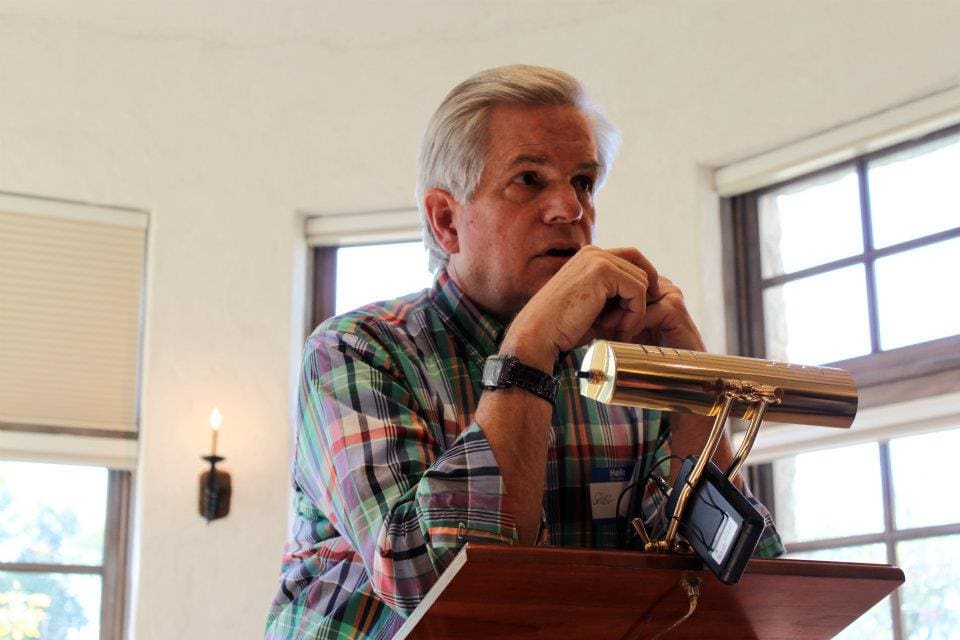
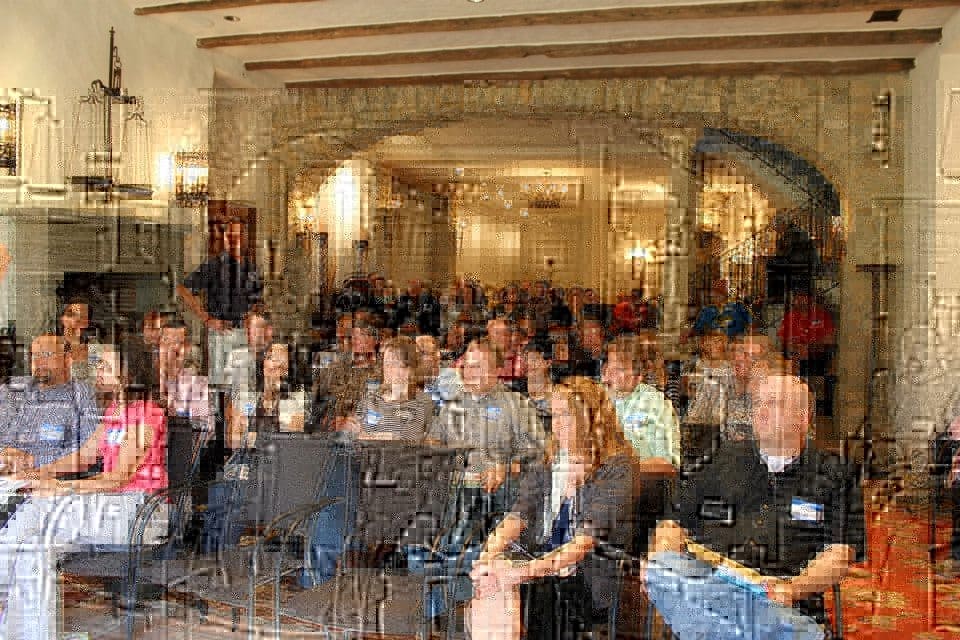
Greg Prince, author of the biography David O. McKay and the Rise of Modern Mormonism and John Dehlin’s very first interview subject back when the podcast was still called A Thoughtful Faith, hosted the 2011 Washington D.C. Mormon Stories Conference in his home with his wife JaLynn on October 15, 2011. Eighty community members came. This is the talk he gave them, followed by an audience Q&A, and it is part memoir, part manifesto for staying in the church while thinking for yourself.
After a warm-up (including a couple who flew in from the Netherlands), Greg tells his own story: two years at Dixie College where his next-door neighbor was Juanita Brooks, a mission in Brazil where a nest of questioning missionaries got him questioning too and where he left his copy of Mormon Doctrine behind, and UCLA dental school in 1969, where the ward argued theology as hard as the campus argued Vietnam. He then reads a numbered list of lessons from writing the McKay biography: church leaders are mortals; on a good day they do marvelous things, but not all days are good; “trickle-up revelation” has shaped the day-to-day church more than most members realize.
The heart of the talk is his advice to people who want to stay: own your religion rather than borrow it; pay your dues and stay in the pews; be political, because the church’s internal intrigue rivals the Vatican’s; pick one piece of the church’s unfinished doctrinal or historical business and research it so well it becomes part of Mormon thought; and be in the world, not just not of it. He argues the church will be incomplete until it truly reflects women, gay members, people of color, people with disabilities, and its foreign cultures.
In the Q&A, audience members ask about his relationship with his stake leadership, whether the church will ever plainly call the priesthood ban a mistake, how to bring hard topics like Mountain Meadows into Sunday School, and how members can square “the brethren are human” with “follow the brethren.”
What’s covered
- 00:00 Introduction and conference welcome
- 14:08 Introducing Greg Prince and his work
- 16:19 Big tent Mormonism: the core argument
- 31:48 Greg Prince’s personal journey and background
- 39:51 Lessons learned from David O. McKay’s life
- 46:29 Owning your religion and staying engaged
- 50:33 Q&A: the church hierarchy and revelation
- 53:51 Q&A: race, the priesthood, and church history
- 1:03:40 Q&A: difficult topics and the future of the church
- 1:11:55 Closing remarks and wrap-up
Related episodes: 255: Greg Prince on 21st Century Lessons from Three 20th Century Men · 439: Greg Prince on "Faith and Doubt as Partners in Mormon History" · Dr. Greg Prince – The Life of a Faithful Mormon Scientist and Historian | Ep. 658-660
Episode Transcript
Host: John Dehlin · Guest: Greg Prince
This transcript is machine-generated and lightly edited for readability. The audio is authoritative. Please excuse occasional errors in names and spelling.
Introduction and Conference Welcome
John Dehlin [00:00:00] The following presentation was given at the 2011 Washington D.C. mormon Stories Conference on October 15, 2011. To join or start a Mormon Stories support community in your area, click on the Support communities button@mormonstories.org to begin planning a Mormon Stories conference in your area, shoot us an email@mormonstoriesmail.com Enjoy the show.
Guest [00:00:27] Hello, everybody. What a beautiful day. Thank you for coming. Thanks for coming to our first annual Washington D.C. mormon Stories Conference. Come on, you just ate. Let's hear it. Come on.
Guest 2 [00:00:49] Fabulous.
Guest [00:00:50] Thank you. Thank you. You didn't know today that we actually have an extra special announcement today. John is here in Washington, D.C. as you know, but he is going to be announcing his bid for the GOP nomination. I mean, he doesn't have anything better to do, right? And, you know, just throw another Mormon in the race, no problem. No, probably not.
Guest 2 [00:01:14] All right.
Guest [00:01:15] Okay. Well, for a lot of us, for those friends and family and spouses and partners who are here today or who are tuning into the podcast a little bit later when it's posted, maybe you do not know what Mormon Stories is.
Guest [00:01:31] Well, Mormon Stories started back in 2005 by John Dehlin, and his first podcast interview was actually with Greg Prince. So it's kind of fitting that we are here today for our first conference when his first podcast was with Greg. So that's kind of special for us.
Guest [00:01:47] Since then, Mormon Stories has blossomed into regional communities worldwide, and many eclectic groups have gotten together where we've met in person or online to tell our own Mormon stories. We have such a variety of members from all walks of life, and each of us have our own different thoughts on politics, philosophy, and religion. And it's amazing that we can be here today with such a group in this big tent where we love you, we support you, and we claim you.
Guest [00:02:23] I want to give an extra special thanks to Greg and Gillen Prince for opening their house up to us rabble. And it's also such an honor to be listening today to. To Greg, be our keynote speaker. So thank you very much. That is not a bottle of wine. It's a bottle of sparkling sp. Sparkling cider.
Guest 2 [00:03:04] So.
Guest [00:03:06] And the man who. Oh, there you go. And the man who started it all, John De Lynn. Thank you for taking time from your hectic and busy schedule to come out and be with us. We appreciate that. And I also want to give an extra special shout out to John's wife, Margi. Did I say that right? Margi. I knew I'd do that.
Guest [00:03:37] Margi and his children, thank you so Much. Margi, if you are listening, thank you so much for sharing your husband and your father with us. He is an incredible example and person to all of us and we're each here because of him. So thank you. Thank you, the Lynn family.
Guest [00:04:00] Now, if you know John, you know he has a lot on his plate and it must be a pretty big plate for all that he's doing. Well, speaking of plates, we all know that every hero needs a side dish on a slightly smaller plate.
Guest [00:04:15] Ann Peffer, thank you for coming down from Boston. Through Ann's guidance and insight, she has been able to help us put this company conference together. She spent numerous hours guiding us through this process. So thank you so much, Ann. And also the team who put this conference together, Brian Johnston from Stay Mormon. Yay.
Guest [00:04:47] Carl Pannery, he's the one with the camera around his neck. Thank you. And the fifals, thank you. No, where are you, Pipeline? There you are. Joel and Karen, they put together, They put together the food and the music arrangements for today. So thank you so much for doing that.
Guest [00:05:14] Our team has its own diversity within it. And because we were able to create, because we had that diversity, we were able to create this vision which you are here today. My hope today, once we leave here, is that we will be a little bit happier and a little bit more fulfilled in our lives. And hopefully we can take that happiness and fulfillment back into the world and share it with the world.
Guest [00:05:41] If you look at your conference program, we will be next hearing from Joel Feifel. He will be doing a piano solo for us. Then we will have an opening prayer by James Brinton. As far as prayers go, you know, we all are bonded here somehow through Mormonism, through Mormon stories, and we want to kind of continue that tradition and that respect of giving a prayer. And if you need to take that moment to have your own little moment of silence, please go ahead.
Guest [00:06:13] And just for those who are giving prayers, pray in your own special way. We will accept you and support you and we claim you and we love you. So from there, I will then read a Schur's value statement. After that, Carl will be doing a brief introduction of our keynote speaker, Greg, and then Greg will take the floor.
Guest [00:06:35] About 3 o', clock, we will have a break and then we will go from there. Just kind of be cautious of the time. We have it planned down pretty precisely because at the end we will be doing share your own Mormon story. And we want to make sure we leave enough time to do that. From what we've realized from other conferences that was kind of a really special moment. So we definitely want to save some time for that. So thank you very much. And Joel, you ready? You're up
Guest 3 [00:07:10] It.
Guest 4 [00:09:52] Sa.
Guest [00:10:19] Sam.
Guest 5 [00:10:44] Sa.
Greg Prince [00:11:10] Sam.
Guest [00:11:40] Joel, I think that's actually a player piano. I'm just kidding. That was beautiful. Thank you very much. And before I continue on here, I just remembered if you are not staying for dinner tonight for Cafe Rio, will you please come see Ann so we can.
Guest [00:11:57] Right here, front row. Beautiful. So we can just make sure our numbers are correct. Right? Dinner tonight. Thank you. All right. I will now read the Shared Values Statement. We acknowledge the richness of Mormon heritage, teachings and community in all of its diversity. We believe that one can self identify as Mormon based on one's genealogy, upbringing, beliefs, relationships and other life experiences regardless of one's adherence or non adherence to the teachings or doctrines of any religious organization.
Guest [00:12:33] We seek spaces where we as Mormons can live lives of intellectual and spiritual integrity, individual conscience and personal dignity. We acknowledge and honor different spiritual paths and modes of religious or non religious truth seeking. We respect the convictions of those who subscribe to ideas and beliefs that differ from our own. We recognize the confusion, distress, emotional trauma and social ostracism that people on faith journeys often experience.
Guest [00:13:08] We seek constructive ways of helping and supporting people regardless of their ultimate decisions regarding church affiliation or activity. We affirm the inherent and equal worth of human beings. We seek spaces where Mormons and all people can interact as equals regardless of race, gender or sexual orientation.
Guest [00:13:32] In this spirit of egalitarianism, we prefer non authoritarian and non hierarchical means of organization and affiliation. Those are assured values which maybe some of us help helped add and post on Mormon stories. And I think that those are great values and you know, maybe it needs to be framed and put up on a wall somewhere.
Guest [00:13:56] So we are next going to hear from Carl where he will be giving the introduction of Greg and from there, Greg, you'll take the podium. Thank you.
Introducing Greg Prince and His Work
Guest 5 [00:14:08] Greg Prince, as most of you know, is the author of the the biography David O. McKay and the Rise of Modern Mormonism, which in 2005 was voted the best biography by the Mormon History Association. And he's also been a board member of Dialogue for a number of years as well as appearing in the PBS documentary and other things. He's a wonderful man who's had an interesting impact in church scholarship and church history things in the last couple of years.
Guest 5 [00:14:40] And as was pointed out already, John's first interview was with Greg Prince when it wasn't even called Mormon Stories. It was called a thoughtful faith and then there was like a follow up interview like a week later. And that's when it had switched to Mormon stories by that point. So Greg has been a supporter of John's work and what John's been doing for a very long time.
Guest 5 [00:15:04] The other thing I really enjoy about Greg is I'm actually a member of the DC Stake and Greg is a member of our High Council. And about once a month or so he opens his home to kind of a study group where he will bring someone in to talk about a church history issue or polygamy. There was a good one by a professor, Bill Bradshaw, who's been interviewed for Mormon Stories, came here and it's a really unique thing that Greg does to help foster dialogue among different kinds of Mormons and just within his own stake. So I appreciate that a lot. And I must say, on a personal note, every time Greg comes and gives a talk as a High Council member, I always come away very uplifted and enlightened and feel that he really represents the best of Mormonism and the kind of person that we could look up to as an example. So without further ado, here is Greg Prince, our keynote speaker.
Big Tent Mormonism: The Core Argument
Greg Prince [00:16:19] What Carl inferred but didn't say is people don't sleep through my High Council talks, not because necessarily they're interesting, but because they're never quite sure what they're going to hear. I went to my wife's something high school reunion quite a few years ago. If I have any advice, don't ever
Guest 3 [00:16:46] go to your spouse's reunion of anything.
Greg Prince [00:16:49] But it was at Wasatch High School in Heber City and they gave her
Guest 3 [00:16:54] an award which consisted of an empty one gallon gas can that had a
Greg Prince [00:17:00] handwritten piece of paper taped to it
Guest 3 [00:17:02] that said for the alumni that traveled the furthest.
Greg Prince [00:17:11] And the reason I bring that up
Guest 3 [00:17:13] is that we have a couple here
Greg Prince [00:17:16] that without doubt traveled the furthest and I would like them to stand up and introduce themselves because I'm wowed by the fact that they were able even to find this place from where they started. Tell them who you are and where you came from.
Guest 3 [00:17:41] Marco Prinster, my wife, we're from the Netherlands in Europe. Become a great fan of John de Lind's podcast. Sort of had an interesting journey in debate over the last year and we came here to enter new phase of our. A couple other housekeeping items. I'm going to send a list around. Carl referred to the salon that we
Greg Prince [00:18:23] have more or less on a monthly basis.
Guest 3 [00:18:26] If you live in this area or Even if you live in the Netherlands and want to come over for us
Greg Prince [00:18:31] and you're not already on the list, put your email address on there and we'll keep you appraised of what we do.
Guest 3 [00:18:38] Sometimes it's Mormon topics, sometimes it isn't. Two weeks from now we're going to have a former Special Forces soldier who now is a civilian contractor in Afghanistan
Greg Prince [00:18:50] come and talk to us about what
Guest 3 [00:18:51] he sees on the ground over there,
Greg Prince [00:18:52] and it should be pretty interesting. Another housekeeping item is you've seen a sign for a restroom there. There's another sign for restroom behind that wall. There's a third one that's at the end of that hall in an apartment and there's a row of trees. So you do that. And then the fourth and last housekeeping item is that there is a book
Guest 3 [00:19:15] that was issued this last week.
Greg Prince [00:19:17] It is called why I Stay, and it's a collection of essays from 19 Notupu people and one outlier. It would be an act of shameless
Guest 3 [00:19:30] self promotion if I were up here
Greg Prince [00:19:32] hawking this thing, but I don't get
Guest 3 [00:19:34] any royalties from it.
Greg Prince [00:19:36] So it's just shameless. But there it is. You can take a look at it. Bob Reese was the general editor of it, and it plays in, I think,
Guest 3 [00:19:46] with what the theme of this meeting is. Anyway, you have some very thoughtful people
Greg Prince [00:19:50] in there who have a lot of
Guest 3 [00:19:52] miles under their belts who are talking
Greg Prince [00:19:55] about why they still hang around this operation. To borrow from Willy Wonka, so little to say and so much time to say it. Wait, reverse that. The organizers ask that I address five subjects within the larger rubric of Big Tent Mormonism. First, evolution and diversity of Mormon thought.
Greg Prince [00:20:18] Second, my own journey. Third, what I have learned from my journey, especially from the books I have written. Fourth, what my generation of Mormon thinkers has accomplished or think they have accomplished. And fifth, what is left for you to do? And there are a few things.
Greg Prince [00:20:35] First, evolution and Diversity of Mormon Thought Joseph Smith was the most progressive thinker of any LDS president. However, he was not defined by any standard label such as liberal, conservative, or fundamentalist. Rather, he was a creature of continual change, picking up and sometimes putting down symbols along the way, as he constantly worked to translate his vision into something tangible enough that his flock could gain access to it.
Greg Prince [00:21:03] The primacy of his thought and his leadership position, though occasionally challenged, was never overruled. By the time of his death, all of the basic elements of today's LDS theology had at least been introduced. However, because his vision changed along the way and because he was concerned about making the vision accessible rather than creating a tidy systematic theology. He left behind an unruly, patchwork theological quilt with which we have tinkered ever since, sometimes refining, sometimes discarding, rarely acknowledging the process openly.
Greg Prince [00:21:40] Brigham Young, the longest serving president, was a bold leader, but not an intellectual. Much of his attention, and perhaps most of it, was devoted to practical exigencies rather than theological contemplation. For instance, the colonization and governance of the Great Basin and then the quest for statehood, which came only after a half century of intense struggle against the federal government and the American public, a struggle largely self inflicted by the public practice of polygamy, the solidification of a theocracy that presented a united front and an in your face attitude towards the larger country, and an occasional misstep such as the Mountain Meadows Massacre which dogged Young for the final two decades of his life.
Greg Prince [00:22:26] His most significant doctrinal forays led to two of the most controversial doctrines in our history, regarding both of which much of the church is still in denial. Adam, God and Blood Atonement. Meanwhile, the Pratt brothers staked out doctrinal turf that was intellectually based and often threatening to Young.
Greg Prince [00:22:45] Ultimately, the Pratt's theology largely prevailed over Young's, but along the way there was much doctrinal scuffling underneath the big tent. John Taylor's ten year term as president was spent mostly underground as he attempted with little success to avoid the steadily closing jaws of federal pincers determined to crush polygamy, the remaining relic of barbarism.
Greg Prince [00:23:10] While he published a book on the atonement and a pamphlet on priesthood, both works served to restate positions of Joseph Smith rather than break new doctrinal ground. Wilford Woodruff's term, while spent above ground, was like Taylor's, largely focused on preserving polygamy and then, in the face of overwhelming federal force, abandoning it in order to preserve the church and attain statehood for Utah.
Greg Prince [00:23:34] While Woodruff wrote no doctrinal works, he affected perhaps the most significant doctrinal development of the last half of the 19th century when, in response to a vision, he abolished the law of adoption, another doctrinal miscue by Brigham Young, and replaced it with the continuous sealing of child to parent for as many generations as genealogical research would allow.
Greg Prince [00:23:57] Ancestry.com owes its existence to Wilford Woodruff. Lorenzo Snow, who served for only three years, re emphasized tithing but added nothing of significance to Mormon thought. While president, his earlier couplet as man is God once was as God is man may become has been a mixed blessing for While it emboldens Mormons, it undergirds the frequent charge by non Mormons that we are a blasphemous religion. More on this later.
Greg Prince [00:24:25] Joseph F. Smith, who served for 17 years, had a greater effect on LDS doctrine than any president since Joseph Smith. His efforts were largely in response to two major challenges to the Church, the first derived from the acceding of Apostle Reed Smoot as United States Senator. Smoot's election in 1902 was a catalyst for pent up anti Mormon sentiment common caused by aversion to the continuing secret practice of performing new plural marriages, despite the 1890 manifesto that was thought to have abolished it, and a persisting monolithic theocracy seen to elicit greater allegiance than the country in which it resided.
Greg Prince [00:25:05] Hearings contesting the seating of Smoot lasted for three years, during which Smith was subpoenaed and had to testify before the Committee on Privileges and Elections. He was treated very harshly during the hearings, and shortly after returning to Salt Lake City, he issued a second manifesto that further disavowed the practice of polygamy while retaining it as a doctrine, and began to dissemble the theocracy and redefine some of the doctrines that had been the foundation of the Church since its beginning.
Greg Prince [00:25:34] Part of that process was the transformation of priesthood quorums into functional units and for the first time, formal courses of study for them. The first by B.H. roberts was the 70s course in Theology, a five year challenging curriculum that is challenging even today to the reader, and perhaps enough so to Joseph F. Smith that it helped to shape his own doctrinal response.
Greg Prince [00:25:58] The other challenge to Smith came in the form of the modernist heresy at the end of the century's first decade. Based on higher criticism, another term for the increasingly scientific study of the Bible, it challenged many religious traditions as it discarded a dogmatic interpretation of scripture.
Greg Prince [00:26:16] Although still somewhat isolated geographically, Utah did not escape the heresy. Two sets of brothers teaching at Brigham Young University, the Petersons and the Chamberlains, were fired because of their embrace of higher criticism and organic evolution, and their liberal interpretation of biblical and LDS canon challenged the status quo.
Greg Prince [00:26:36] With Mormon orthodoxy under assault, Smith responded by writing and publishing a Melchizedek priesthood manual, Gospel Doctrine, later republished as a book that remains in print to this day. It defined and embedded a new orthodoxy that, while generally resonant with the teachings of Joseph Smith, pushed it towards fundamentalism, which was the common knee jerk reaction to modernism.
Greg Prince [00:27:00] Smith's successor, Heber J. Grant, was concerned about the Church's position in the world rather than its doctrine, and neither he nor his successor, George Albert Smith, made any significant contributions to LDS doctrinal development. However, the selection by Joseph F. Smith of his son Joseph Fielding as an apostle in 1910, and the selection of Smith's son in law, Bruce McConkie as a general authority in the 1940s enabled fundamentalism to remain the predominant doctrine of philosophy within the church to this day.
Greg Prince [00:27:32] David O. McKay, while never directly engaging doctrinal issues during his 19 years as president, facilitated a counterculture of doctrinal moderation by broadening the tent, preaching a gospel of tolerance and inclusion, and privately condemning McConkie's book, thus fostering indirectly the theological output of such moderate and liberal thinkers as Sterling McMurran, Lope Anyon T. Edgar Lyon Obert Tanner, Heber Snell, and Hugh Brown.
Greg Prince [00:28:03] As church presidents, Joseph Fielding Smith, Harold Lee, Spencer Kimball, Ezra Taft Benson, and Howard Hunter focused almost exclusively on pragmatic issues. Even Kimball, whose 1978 revelation on priesthood transformed the church, changed the policy without addressing its doctrinal implications.
Greg Prince [00:28:22] At the same time, these presidents declined to break new doctrinal ground. Bruce McConkie, Boyd Packer, and a host of self appointed non general authority wannabes continued to push LDS doctrine in a fundamentalist direction. Alternative voices, most significant among them Dialogue, a journal of Mormon thought, were scorned or ignored by the orthodox and yet managed to exert occasional influence far outweighing they're continually shrinking subscription basis Dialogue, currently
Guest 3 [00:28:53] being subscribed by one in every 10,000 Latter Day Saints,
Greg Prince [00:28:59] a name I did not mention earlier, Gordon Hinckley may have had more significance in LDS doctrinal development
Guest 3 [00:29:06] than we yet appreciate.
Greg Prince [00:29:08] Several years ago, in a widely read interview with Richard Osling, first published in Time magazine and later in the book Mormon America, Hinckley's response to Osling's question about the LDS doctrine of humans becoming gods shocked many church members. I don't know that we believe that, he said.
Greg Prince [00:29:26] While Hinckley later told a group of concerned employees, I think I know what we believe, he never retracted his statement to Austeling and thus left open the question of whether he was distancing the church from yet another of Joseph Smith's Nauvoo doctrines, Mormons think polygamy, one that continues to be a wedge separating Mormonism from many other Christian churches. Stay tuned.
Greg Prince [00:29:52] That, in a very small nutshell, is how we got to where we are today theologically. And where is that? Mormonism currently is a church that has never systematized its theology and indeed now teaches very little of it or of its history, for that matter.
Greg Prince [00:30:08] Instead, our manuals and our sermons have increasingly focused on behavior rather than doctrine. While fundamentalism continues to be the predominant doctrinal philosophy of most Latter Day Saints, perhaps the most significant development of the past decade has been the gradual erasing of Bruce McConkie's influence on doctrine.
Greg Prince [00:30:28] New church manuals either eliminate bibliographic references to McConkie quotes or or eliminate the quotes entirely. Even more significant to the masses was the decision a year or so ago to take McConkie's landmark book Mormon Doctrine, out of print a half century after it was first published.
Greg Prince [00:30:46] Will we continue to move in a direction of distancing ourselves from many of the doctrines that defined us for nearly two centuries? Will we move towards a more moderate doctrinal position than that staked out by McConkie and similar men?
Greg Prince [00:31:00] Again, stay tuned. Chapter 2 My Journey I grew up in Los Angeles, a sixth generation Mormon. Ours was one of the foundational families of Westwood Ward, whose chapel resides on the temple block. There was not a time during my childhood or youth when my father was not either a high councilor or member of the bishopric and and yet our family religious experience was one of orthopraxy rather than orthodoxy. My parents rarely discussed doctrinal or historical issues, perhaps because my maternal grandfather, who resided in the same ward, was a religious bigot whose fundamentalism regularly offended the masses and served as a strong counterpoint to my later religious development.
Greg Prince's Personal Journey and Background
Greg Prince [00:31:48] After high school I spent two years at Dixie College in St. George, Utah, prior to going on a mission by packing the pre dentistry curriculum into two years averaging 19 credit hours per semester. I had little time for theology. Although I attended church every Sunday.
Greg Prince [00:32:04] I did not appreciate for many years thereafter the significance of the imprint that my next door neighbor made on me. Her name was Juanita Brooks. Her husband Will, then in his 90s, was our home teacher and he never missed a month. I was young and dumb as opposed
Guest 3 [00:32:24] to being old and dumb now,
Greg Prince [00:32:28] and even though I had some contact with Juanita, many years passed before I realized what a strong role model she was, combining a searing intellect, a steel backbone in the face of opposition from several apostles, and an immovable devotion to the church she loved in spite of the way its members dissed her. One other thing happened while I was at Dixie, but its significance, like Juanita's, would not become fully apparent for many years. Dialogue was born at Stanford University. More on that later. I was conservative and unquestioning as a starry eyed missionary in Brazil, but my understanding of Mormonism began to change there. Part of the change was a response to the realities of the world, realities from which I had been sheltered at
Guest 3 [00:33:13] home and at dignity.
Greg Prince [00:33:14] And part was the subtle influence of a nest of smart and somewhat dissident missionaries whose questioning caused me to begin to question for the first time myself. A metaphor for the gradual shift in my philosophy was the fact that I took a copy of McConkie's Mormon Doctrine to Brazil and left it there.
Greg Prince [00:33:36] Within days of returning from my mission, I enrolled in the UCLA School of Dentistry. The year was 1969. Yes, there are people who were there who are still alive. A time of intense and sometimes violent ferment on campuses across the country, driven largely by the Vietnam War.
Greg Prince [00:33:56] The turbulence on campus was matched by that in UCLA ward, where people sparred passionately, though never violently as they argued conservative, liberal, and even heretical doctrinal positions. Positions in the classroom and at the pulpit. While I never experienced either an epiphany or a crisis of faith, I moved to the left.
Greg Prince [00:34:17] While I was at ucla, Dialogue moved from Stanford to ucla. At one point I dated the dialogue secretary, but my lasting relationship was not with her to that woman on the stairs. Rather, it was at that point that I learned of and corresponded with Lester Bush, whose landmark monograph on blacks and priesthood was moving through the editorial process towards publication. More on that later.
Greg Prince [00:34:45] While I was embracing increasingly liberal religious thoughts, I was still in the mainstream of religious practice. I was called to be the regional president of the Latter Day Saint Student Association, a position that on one occasion gave me direct access to church president Harold B. Lee, and on another gave me an intense expression exposure to trickle up revelation. As I participated in the genesis of the Young Adult program as a local initiative and then watched its rapid adoption by the central church. A group meeting with a young apostle by the name of Monson was a memorable milestone in the process.
Greg Prince [00:35:20] After six years of graduate school at ucla, resulting in doctorate degrees in dentistry and pathology, I moved with Jelen across the country to the National Institutes of Health.
John Dehlin [00:35:29] Health.
Greg Prince [00:35:30] The initial appointment, as she will tell you to this day, was for two years. And the move was 36 years ago. I can't count. We purchased a home in Gaithersburg Ward, having no idea that Lester Bush and his family had moved into the same ward one year previously. Lester became a mentor and my closest friend.
Greg Prince [00:35:49] About a year after our move, the Equal Rights Amendment moved to the center of political discourse. We became acquainted with some of its highest profile LDS proponents, including Sonia Johnson. Because Virginia was one of the last battleground states.
Greg Prince [00:36:04] Indeed, the era's defeat in Virginia was its defeat nationally. Watching the all male hierarchy square off against the all female Mormons for ERA left a deep and permanent memory of the abuses that ecclesiastical power can spawn. Three years after our move to Maryland, the Mormon world changed with Spencer Kimball's revelation on priesthood. JoLynn called me from the radio station where she was working and broke the news.
Greg Prince [00:36:31] We spent the evening at Lester's home as dozens of phone calls poured in from across the country to congratulate him. We learned later that his monograph had been even more important in the process than we then realized. However, the whole episode turned out to be bittersweet because I saw him become blacklisted by the church he had served so well.
Greg Prince [00:36:52] And unlike Juanita Brooks, who received similar treatment several decades earlier for her work on the Mountain Meadows Massacre, Lester eventually withdrew entirely from church activity. Even in the one true Church, it seems that no good deed goes unpunished. My move to Maryland was followed by Dialogues Moved.
Guest 3 [00:37:11] There you see the theme.
Greg Prince [00:37:14] I couldn't seem to escape it even by moving across the country. Lester, who was the associate editor, pulled me firmly into the Dialogue orbit. My involvement has deepened since then, and I am currently in about my 15th year as a member of its board of directors.
Greg Prince [00:37:29] One of the workers who showed up at Dialogue work meetings was Tony Hutchinson, a BYU graduate who was in a doctorate program in biblical studies at Catholic University. For for one memorable year, Lester, Tony, and I spent an evening together every week discussing at a deep level the most important doctrinal and historical issues facing Mormonism. Lester and I received regular tutorials from Tony, who was perhaps the first Mormon to take the state of the art tools of biblical studies and apply them to Mormonism. His article, A Mormon Midrash, bumped around the Dialogue editorial office for five years before its editors, giving up on trying to edit something they didn't understand, published it as is.
Greg Prince [00:38:12] It is Tony's most important contribution to Mormon scholarship, but few readers have the tools to understand its profound insights into the process of Revelation. Maligned for his contributions, Tony eventually backed away from Mormonism and now is an ordained Episcopalian priest.
Greg Prince [00:38:30] Their gain is our loss. A year before the 1978 revelation, I was called as Elders Quorum president, a position I held for four years. Eager to do the job right, I began to study priesthood intensely. I had a good LDS library then, perhaps 3,000 volumes, and I read everything that had been published on the subject, only to learn that most of the issues of interest to me had not
Guest 3 [00:38:55] been treated adequately by anybody.
Greg Prince [00:38:58] My study continued after I was released. After several years of hoping that the real historians would give the topic the treatment it deserved, I had the audacity to decide to do it myself, using Lester Bush as my role model. He is a physician who had no training in historiography. I spent eight years researching LDS priesthood and writing my first book, Power from On the Development of Mormon Priesthood.
Greg Prince [00:39:23] Critically acclaimed, it nonetheless sent a shockwave through church headquarters and, among other things, resulted in the longest article ever published by the Ensign, which restated orthodoxy while totally avoiding mention of my book. Power from on High led directly to The David O. McKay biography, a project that occupied me for a full decade and opened my eyes widely to the innermost workings of the the church.
Lessons Learned from David O. McKay's Life
Greg Prince [00:39:51] Chapter 3 Lessons Learned I'll give summary statements here, for Time will not allow elaboration. 1. Church leaders are mortals with all the baggage that word carries. After reading the McKay biography, Senator Robert Bennett called me and told me of an encounter he had with President Harold B. Lee. Commenting on the withdrawal of a church member because he got close to the workings of power, Lee said, doesn't he realize that we are just human beings doing the best we can?
Greg Prince [00:40:23] 2. On a good day, church leaders do marvelous things, but not all days are good. My Catholic secretary entered several thousand papers of the McKay diaries into my computer in preparation for the biography. When she was finished, I asked her, what do you think?
Greg Prince [00:40:41] She replied, President McKay is my hero. What else? Power corrupts. 3. When a business deal went south, Brigham Young said to his partner, Edwin Woolley, grandfather of Spencer Kimball, I suppose you'll apostatize now. Woolley replied, if this were your church, I would.
Guest 3 [00:41:04] But it's mine as much as it is yours.
Greg Prince [00:41:07] You're paying for the pew, so use it. Four. We must own our religion, not borrow it. But to own it requires different approaches for different people, for we are wired differently. Celebrate your differences and keep them in mind as you determine how best to own your religion. The day after Paul Dunn became a general Authority, Apostle Richard L. Evans walked into his new office and closed the door. He said, I listened very carefully to your talk yesterday.
Guest 3 [00:41:40] You're different, but don't change.
Greg Prince [00:41:43] You're going to find around here that they'll try to get you to conform. But just remember, the lord got you here. 5. If you really magnify your callings, you will take risks. Be bold for trickle up.
Guest 3 [00:41:58] Revelation has been the primary force that
Greg Prince [00:42:00] shaped the day to day church in which we live. Tracy Cannon, who for many years chaired the church music committee was the subject of a most unusual article in the
Guest 3 [00:42:10] Instructor, which was the church's magazine at the time for the Sunday schools.
Greg Prince [00:42:15] It said, in moments of discouragement, when Tracy would think, oh, what's the use? The impression would repeatedly come to him that he had died and was standing before the Lord, answering for his lack
Guest 3 [00:42:26] of action to improve a situation.
Greg Prince [00:42:30] I was following the policy set by those in authority, he said to the Lord.
Guest 3 [00:42:34] The same answer always came back to him.
Greg Prince [00:42:37] But Tracy, you knew better. Next Correlation, while started benignly by David O. McKay, morphed into a beast that choked off trickle up revelation and imposed a monolith of belief and practice. The renaissance of Mormonism will follow the weakening of that beast, the loosening of its grip, and the subsequent encouragement of local flavor and individualized encounter.
Greg Prince [00:43:05] Next, if you wish to help shape the church, you must remain in the herd. Juanita Brooks father told her that a preferred position was to be near the periphery but still in the herd, for that would allow her to steer it in a subtle yet strong fashion. She took his advice and remained sadly, Lester, Tony, and countless others left, and the entire church is the poorer for their departure.
Greg Prince [00:43:31] And lastly, the more thoroughly you own your Mormonism, the more able you will be to join with other traditions to work for the common good. President Monson, in his only press conference, said, I think we should not be sequestered in a little cage. I think we have a responsibility to be active in the communities where we live, all Latter Day Saints, and to work cooperatively with other churches and other organizations.
Greg Prince [00:43:56] My objective there, he said, is that I think it is important that we eliminate the weakness of one standing alone and substitute for it the strength of people working together. Chapter four what have we done for you? Ephraim Erickson, a Mormon philosopher for whom an endowed chair is named at the University of Utah, wrote in his landmark doctoral dissertation in the 20s of three great challenges that Mormonism had faced or or wood face. The first was us versus Them, and although its most daunting times were in the 19th century, parts of that challenge continue to this day.
Greg Prince [00:44:33] The second was us versus nature, the colonization of the Great Basin. The third and most crucial for today's church, as he recognized, is us versus us as we struggle internally to make the church work for members of all stripes. It is in this third area that our generation, which I define to include people older than myself, whom I have known, has made its most important contributions,
Guest 3 [00:45:03] a few of which I name briefly.
Greg Prince [00:45:05] First, the establishment of a tradition of thoughtfulness not a loyal opposition, but instead an effort by those wired differently than the majority to make this religion work for themselves. Though there were many casualties, enough stayed the course to let us know that it is possible.
Greg Prince [00:45:25] Second, dissemination of that tradition through independent publications, some of which have endured while others have faded. Dialogue was the first, followed by Exponent two, Sunstone, Courage, the Carpenter, the Journal of Mormon History, the John Whitmer Historical Association Journal, Irrientum, Segula Element, amcap, Mormon Historical Studies, and other print publications, and more recently, the explosion of online journals and blogs and Third Movement on important issues because of smart and courageous work. In particular, Juanita Brooks book on the Mountain Meadows Massacre paved the way for the final exorcism of ghosts that had haunted the church for a century and a half, and Lester Bush's monograph on blacks and priesthood helped to change the church and allow it to become truly worldwide. Finally, Chapter 5 what Remains for you to do? In a word, plenty. Let me elaborate. One.
Owning Your Religion and Staying Engaged
Guest 3 [00:46:29] Own your religion.
Greg Prince [00:46:30] Don't borrow it. If you are to make it work for yourselves, and especially if you wish to make an impact on the larger church, you have to read, think, and write deeply for the rest of your lives. Google will not get you there, and neither will the blogs. Second, pay your dues and stay in those pews. The church is as much yours as it was Edwin Woolley's. Third Be political. The political intrigue for which the Vatican is famous meets its match in the Mormon Church. If you really wish to improve things for the church as well as for yourself, consider that how you appear and how you act can easily block out what you are trying to accomplish. Take seriously the saying of Jesus, be wise as serpents, as gentle as doves. Next Christ centered Boredom, which is not always Christ centered in this church, is killing the vitality of the church and
Guest 3 [00:47:30] driving untold thousands away, many of them
Greg Prince [00:47:33] youth, who represent our best hope for the future. Reform of curriculum and retooling of worship services should be in the forefront of your minds. Next, Many of the most important doctrinal and historical issues within the church are unfinished business.
Greg Prince [00:47:52] Choose one of the most important ones. Research it deeply, and then speak and write of it in such a smart and interesting way that it becomes integrated into Mormon thought and practice, and it is possible. Next, individualize your religion and then be an example to others who need an individualized approach outside the mainstream.
Greg Prince [00:48:17] Next, inject your own flavor into your church experience and show others how to do the same. Until the church truly reflects all of its constituencies and treats them fairly and wholly and these include women, gays, people of color, people with disabilities, and foreign cultures of all types. It will be incomplete.
Greg Prince [00:48:40] Next, extend the reach of Mormonism by integrating yourselves into the larger world. Far too many Mormons pay attention to part of Jesus directive, that of being not of the world. But they ignore totally his demand that they be in the world.
Greg Prince [00:48:59] Don't be afraid to join with others whose faiths are different, and even with other different religious traditions. You will find that you give up nothing by joining with others, and indeed you sharpen your own identity in the process.
Greg Prince [00:49:13] If we preach Mormonism by action instead of words, those who see those good works and want to be part of them are likely to join and stay, as opposed to the nine out of ten converts who currently join only to leave.
Greg Prince [00:49:28] And finally, be patient and try not to complain too loudly. Most of the worthwhile things that happen do not happen quickly. The fruit that grows from seeds that you sow now may not be picked until your grandchildren and grandchildren come along. Spencer Kimball kept a small plaque on his desk which simply read do it. One bit of Mormon humor that made
Guest 3 [00:49:55] the rounds during the 70s was what do you get when you cross Spencer Kimball and Golden Kimball? Do it. Dammit,
Guest [00:50:25] Greg, such language. All right,
Guest 3 [00:50:30] Kirk, I know where you live.
Guest 6 [00:50:31] Be careful.
Guest 7 [00:50:32] Exactly.
Q&A: The Church Hierarchy and Revelation
Guest 8 [00:50:33] Greg, as a high councilman, what is your relationship with the brethren in your
Guest 3 [00:50:38] stake, your stake president, and let's say,
Guest 8 [00:50:41] the hierarchy on the way up the ladder?
Guest 3 [00:50:44] I think it's pretty good. We all seem to get along just fine. One of the counselors of the stake presidency is my home teacher. He hasn't thumped me yet.
Greg Prince [00:50:55] No, it's an excellent stake leadership.
Guest 3 [00:50:58] Ron Harrison is the stake president I have worked with in one capacity or another, sometimes just as a layperson. With six stake presidents in the time we've lived back here, Ron gets my vote as the one that I have liked best because he runs the stake more as a pastor than a CEO. He's really good.
Guest 4 [00:51:27] You talked about Trickle up revelation and Lester Bush particularly. Did he ever learn about the annotated copy that Spencer Kimball had of his article? And how did he feel about that?
Greg Prince [00:51:39] Yeah,
Guest 3 [00:51:43] the setting for it was that Rich Turn early had come back here at our invitation and gave several talks. One at the visitor center, one at Wesley Seminary on the Mountain Meadows book. And we had Rick over for a dinner, I think about a dozen people around the dinner table. Lester came over and Brent Rushforth came over.
Guest 3 [00:52:07] Well, it was not too long after the Obama inauguration and one of the Spencer came, Kimball's grandsons had been a house guest at Brent Rushforth. And Brent told that story, which Lester had never heard of, having the copy. His father had owned his grandfather's copy, and he said it was almost completely underlined and annotated.
Guest 3 [00:52:32] Yeah, that was an interesting evening when Lester heard that. But that was more than 30 years after the fact. We knew that it had had an effect that went beyond what the initial indications were. And we got that over the years from several general authorities.
Greg Prince [00:52:49] But that was really kind of the
Guest 3 [00:52:51] cap on the whole thing. I presume that's what you're referring to.
Guest 4 [00:52:55] Exactly.
Guest 3 [00:52:56] Yeah.
Greg Prince [00:52:56] It just has to be so gratifying
Guest 4 [00:52:58] for him, after all he went through to learn that President Kimball not only got the article, but read it, underlined it, understood it, and it influenced him.
Guest 6 [00:53:07] Yeah.
Guest 3 [00:53:07] Well, again, it's bittersweet. There was a time when I wish we could have held on to Lester, and I think we could have, but there were people who apparently didn't want to do that. That, to me, is one of the great tragedies in this church during my lifetime.
Guest 6 [00:53:29] Hi, Greg. Well, first thing is a little. We have our friends from the Netherlands here, but we come from far away, too, from Brazil. So just going to clarify that. I mean, since you served your mission in Brazil, we felt like, you know what?
Q&A: Race, the Priesthood, and Church History
Guest 6 [00:53:51] One topic that really still touches me a lot is blacks in the priesthood. And I hear all the time, you know, general authorities saying, you know, you must atonement for your sins. They always, you know, preaching, talking about the atonement which is know. Obviously it's so important.
Guest 6 [00:54:06] But I don't see the church atoning for that mistake, which in my opinion, was a mistake. All right, we can come up with all kinds of historical reasons, but I still see many. I teach at Sunday school still, and I hear from people all the time, either the lack of knowledge about knowing and in other words, still a lot of miscommunication out there. A lot of misinformation out there because the brother doesn't come out and saying, listen, it was a mistake. How can we fix this, in your opinion?
Greg Prince [00:54:45] I had lunch recently with one of the 70s who basically said what you just said.
Guest 3 [00:54:50] He said, why can't we just say we blew it and go on. You've got a large institution that doesn't have a track record of knowing how to do that. That said, there are people working very feverishly, some of them in high places, to try to figure out how do we deconstruct the scaffolding of folklore that
Greg Prince [00:55:13] was constructed to Prop up a policy that now has been removed.
Guest 3 [00:55:18] That's what we're dealing with. It's the leftovers. Darius Gray is a key figure in that. Darius is a dear, dear friend. We flew him back here a year ago, and I sat him down and said, speak to the recorder. Because much of this he hadn't recorded. And I've got 12 hours in the other room of the oral history of what he has been trying to do. One thing that I can tell you is that it was not, for lack of sales, that Mormon doctrine is now out of print,
Greg Prince [00:55:54] And that is part
Guest 3 [00:55:54] of the dismantling of that scaffolding. I don't know how long it's going to take. It should have been resolved a long time ago. But I know exactly what you were talking about. And I spent two years in the deep south of Brazil, which, unlike the United States, is the reverse of it. The farther south you go, the more white the country becomes. But nonetheless, this was an issue through the entire country, and it still hasn't been resolved. And I hope that eventually we can do it, because it continues to be a cause of hemorrhage in this church. People who come in, in good faith will often scratch around a little bit as they read.
Guest 3 [00:56:33] And if they get down to this level and read some of these things that are still out there, they say, if this is what you really think, we're gone. So it's not just a theoretical problem. It is a practical problem that is still killing people's problems spiritually. And I hope we can get on top of it eventually.
Guest 2 [00:56:52] The number that nine out of ten people who get baptized leave the church, I heard a collective gasp, and I think it's something a lot of.
Guest 3 [00:57:00] That's my triangulation to it, but I'll stand behind it.
Guest 2 [00:57:03] Yeah, but I feel like. I think there's a general consensus amongst some people that certainly were not retaining the 1213 million membership that we claim. But my question is, in your grand scope of the history, do you see more people leaving now than in the past? And if so, what do you think is one of the root causes?
Greg Prince [00:57:30] We talked about this a little earlier
Guest 3 [00:57:31] in the back room. It is an accelerating process and the accelerator is pushed in the wrong direction. A stake, by definition, is approximately 2,500 warm bodies. They don't have to be active in the church. There have to be enough of them active that they can adequately staff the ward and stake apparatus. So every increase of 2,500, if you were at least hanging onto them so that you knew where they were and they acknowledged that they were lds, even if they. They weren't showing up, that should give you one stake. In the 1990s, you had to have twice that number to get one stake. In the most recent decade, you have had to have four times that number to get one stake. And those numbers you can pull directly out of the Church Almanac. But they don't know that. If they knew it, they probably wouldn't publish them.
Greg Prince [00:58:24] But those are hard numbers to hide
Guest 3 [00:58:25] from because all you need to do is take the total membership number and the delta of stakes since the previous year, and you got it.
John Dehlin [00:58:32] So we've gone from what per stake to what per stake?
Guest 3 [00:58:36] Well, if you were identifying all of your converts so that you knew where they were and they at least acknowledged that they were LDS, you would get one out of every 2,500. Now you're getting one out of every 10,000. So that tells you right off the bat that three fourths of what you call increase is gone. You can't even find. And then of the remaining 1/4, half
Greg Prince [00:58:59] of that will be inactive.
Guest 3 [00:59:02] Sorry, less active. And when you consider that that delta in total membership includes baptism of children of record who are more likely to stay, then it's an easy triangulation to say we're probably keeping one out of every 10 converts. As an active church member, that's not a very good track record.
Greg Prince [00:59:26] I don't know who would really be
Guest 3 [00:59:29] confronted with those numbers and claim victory.
John Dehlin [00:59:34] Every soul is precious.
Guest [00:59:36] I had a question about whether you received any sort of official or unofficial reaction to your book on the priesthood besides the Ensign article you talked about. And if you feel like you're. Your research has changed church culture at
Greg Prince [00:59:50] all about the priesthood, there was never
Guest 3 [00:59:54] any official response to either of the two books. I know that the priesthood book sent some shock waves there. And the first real indication I had was Larry Porter's article in the Ensign. And not long after that came out, I had dinner with one of the 70s who was pretty candid. And I said, yeah, it looks to me like that article was the church's attention to say my book doesn't exist. And he laughed and he said, you're a lot closer to the truth than you think.
Greg Prince [01:00:23] And I think the reason that it
Guest 3 [01:00:25] threatened them is that it retold the story in a different way than they
Greg Prince [01:00:29] were used to hearing it.
Guest 3 [01:00:30] If you read that book, and it's not an easy read, I apologize for that. But there was nothing I could put that book on top of.
Greg Prince [01:00:37] I had to start with a new
Guest 3 [01:00:39] foundation because everybody else had looked at the data in a. In the wrong way.
Greg Prince [01:00:44] They had missed.
Guest 3 [01:00:46] And what they had missed was a critical evaluation of when the accounts were written. That's crucial.
Greg Prince [01:00:52] It's not when they're writing about.
Guest 3 [01:00:53] It's when they were written. Because everything is in flux, and you can't make sense of it until you line them up chronologically that way. When you do that, then it's not a difficult story to tell. But because of that, it told it in a very different way. You didn't have the terms of Melchizedek decrees and priesthood for six years.
Guest 3 [01:01:12] So why are you talking about the restoration of the Melchizedek priesthood at all? It didn't exist then. It was an earlier version that was much more rudimentary, and that's what spooked them. What I would have hoped would be the reaction, I think maybe it was, for some of them who actually read it, was this thing has always been fluid.
Guest 3 [01:01:34] And if it was fluid then, maybe it's fluid now. So it was in no sense an attempt to weaken their authority base. Actually, it turned out, I think, to strengthen it, because it says to them in a loud voice that they want to listen to it. Look, you guys are at the controls.
Guest 3 [01:01:55] All you need to do is put your foot back on the accelerator and drive this thing, and we're here as passengers. You tell us where you want to go. We're not trying to tell you, but the car is there and there's gas in the tank. Just go for it. That's what that book should really say when it looks at the evolution of this whole thing, the McKay book.
Greg Prince [01:02:17] There have been interesting stories about that.
Guest 3 [01:02:19] There has not been one negative word from anybody that I heard from directly and almost nothing indirectly. I know that it came before the committee.
Greg Prince [01:02:32] What is the Committee to Strengthen the Members.
Guest 3 [01:02:35] On at least two occasions. And the chairman of that committee told one of the other 70s who told me, you know, I read that book. He said, it's a good book. The ones who have read it understand it and like it. We were in Provo last week. Jelen was honored by BYU as a distinguished alumna,
Greg Prince [01:03:02] An honor I will never
Guest 3 [01:03:03] get because I would be an alumnus instead of an alumna. And I didn't go to BYU anyway. But we were talking with one of the 70s who said, I love your book. So, yeah, it's doing much more than I had ever hoped that it would do. Are these changing things? I don't know. Stick around, you never really know because what's the linkage in cause and effect. But the fact that a lot of people have read the McKay book and they do read it, they read the whole thing and then comment about it, says it was worth the 10 years that I put into it.
Q&A: Difficult Topics and the Future of the Church
John Dehlin [01:03:40] Three more questions.
Guest 8 [01:03:43] I recently tried to get a Sunday school lesson, kind of a six kind of thinking, six week lesson on how to be a better Mormon, Christian and human from studying mistakes of the past and specifically the Mountain Meadows massacre. So that got shot down. My bishop didn't know anything about it
Greg Prince [01:04:08] and
Guest 8 [01:04:10] he referred to the Sunday school and he said, well, this doesn't, this isn't in the approved series of stuff. My question is, you seem to have an ability to introduce hard topics to believing people. Can you give any advice on how to ease more strained topics into the greater audience?
Greg Prince [01:04:36] There's no simple key to it and
Guest 3 [01:04:38] I probably walk on the edge of the precipice us a lot. But when I consider the stakes out there, what you're trying to do, it's probably worth the risk. It goes back to that saying of Jesus, be wise as serpents and gentle as doves. Pick your issue. You can't do all of them. It's like raising kids. You may win some battles, but you never win all of them. So don't try. And when you're up there in front of a congregation, you've got a far more heterogeneous audience than I've got here. Far more. And you've got to play to the sensitivities are there. Now. That said, I gave a talk in Chevy Chase Ward a couple of years ago. Were you there for that one? And the bishop asked me to address the topic, staying the course in hard times. And I thought, whoa, okay,
Greg Prince [01:05:35] okay, Brad, you asked for it.
Guest 3 [01:05:42] And one of the things that I said is a problem in this church is persistent racism. Afterwards, a lovely young lady who was black, I think African, either African or Caribbean, she wasn't a native of the United States, came up to me and says, thank you for saying that. And she says, by the way, if you ever think there isn't racism in this church, try dating a white guy.
Greg Prince [01:06:10] So you've got to be judicious in
Guest 3 [01:06:12] how you do it. But sometimes you strike a chord. That may be exactly the chord that
Greg Prince [01:06:17] needed to be struck, at least for
Guest 3 [01:06:19] that one person that day. And her comment told me all that I needed to know about why I gave that talk that day. She needed to hear it, probably others needed to as well.
Greg Prince [01:06:30] All right, we're down to two, huh?
Guest 3 [01:06:33] I'll hang around afterwards.
Guest 7 [01:06:35] So, yeah, I'm out of the cage. I left Mormon stories, Mormon 2.0, and pretty much Facebook six months ago. My wife told me about this. So I made the trek up from the End of the Universe at the southernmost tip of Maryland today. So
Greg Prince [01:06:52] it's the right end of the
Guest 3 [01:06:52] universe, though
Guest 7 [01:06:56] I can't even explain that. Have you seen, like, all right, I'm the guy who started fires. I did on Mormon 2.0, a lot of different forums. I'm a Harvard Div. School dropout, and I'm kind of just the wild mouthpiece who says whatever comes from my mind. And have you seen less of a crackdown from the Brethren as of late? This is just, you know, I'm going to ask John this a bit later, but I liken the situation to a friend of mine. He was an Israeli police detective and he was a sergeant. And he got into a joint ops opportunity with Palestinian cops, chasing down smugglers, drug dealers, that kind of thing.
Guest 7 [01:07:43] He ended up dating one of these other cop's sisters for three years. You know, an Israeli dating a Palestinian against the rules. And I said, how did you guys do that and still manage to be in your positions? You know, there you are, you're a sergeant and whatever. And he said, it was hard, but we had to love each other and we ignored our clerics.
Guest 7 [01:08:10] And I just start to see that kind of being the paradigm of everybody here. But how do you feel about. I mean, just like, where you're going, guys, we're going to have to draw the line somewhere. There is something inherently missing in how you're telling us to live our lives if it's bringing so much misery just to the individual level, a lot of
Guest 3 [01:08:31] it is the political part of it. You want to get from point A to point B, but there are a lot of landmines along the way, and you don't want to blow yourself up on them, even though you still need to get to be.
Guest 3 [01:08:43] And occasionally, maybe lobbing a hand grenade is what needs to be done to wake people up. Usually it tends to be a little more on the destructive side. It's a judgment you got to make, and then you deal with whatever the fallout is. I'll give you an example that's much more benign than that.
Guest 3 [01:08:58] Several years ago, Gillen got involved in Wesley Seminary because she found out they had a program at a master's level level on art and theology. And those were two really deep interests to her. And so she's got most of the coursework for a master's degree down there. But because of her involvement, I eventually got involved in it. And a year ago, the president of the seminary asked me if I would sit on one of their steering committees for a center of Urban Ministry downtown at Mount Vernon Square.
Guest 3 [01:09:29] And I said, you run this pasture. Your other committee members? And he said, oh, yeah. And I said, what was their reaction? And his eyes went wide like this. And he says, they're okay with it, though. But I think at our third meeting, he called me up the morning of the meeting and he said, would you give the invocation today? And I thought, ooh, it's going to be interesting.
Guest 3 [01:09:55] This is a test. And it went splendidly because I didn't give one of our can talks or prayers. I gave something that I thought would be appropriate for the setting, and every one of them came up to me afterwards and thanked me for it. So you can build some bridges that you might thought. I might have thought would be difficult or impossible to build.
Guest 3 [01:10:17] Along the way, I got an email from a friend out in Provo who had an email from a guy in Burundi saying, we got a problem over here because the premier, most prominent Latter Day Saint in the country who was a professor of psychology at the Free Methodist University there, was going to be fired because the university president found out he was a Mormon. Sole reason for firing President of Wesley Seminary calls Africa, says, back off. These are good folks.
Guest 3 [01:10:54] Solved the situation. So you never know where some of these things are going to lead. And you always want to make sure that you're building bridges instead of burning them as you go along. That's a long answer to your question. There's no easy way to deal with it.
Guest 3 [01:11:08] I'm not offended at all by flamethrowers. My gosh. I grew up in the pathology department. You talk about bare knuckles. Get around a group of those guys, especially at dinner. My mentor there said, I haven't seen a genuinely new dirty trick in 25 years. And I would have to agree with him.
Guest 3 [01:11:31] It's just all recycled stuff. So know what's out there and make sure that if you want to get to Objective B, you don't blow yourself or too many people up along the way. Does that help?
Guest 7 [01:11:42] Yeah.
Guest 3 [01:11:45] Oh, yeah. Yeah. It's a journey, it's not a destination. Am I done?
John Dehlin [01:11:52] Okay, one more.
Guest 3 [01:11:53] Kevin.
Closing Remarks and Wrap-Up
Greg Prince [01:11:55] This is the third half of car
Guest 4 [01:11:57] talk, Perhaps along similar lines, wrapping two thoughts into one. Correlation issues the mind numbingness of Sunday.
Guest 3 [01:12:08] Losing youth.
Guest 4 [01:12:09] You're right. We Are we watch it happen before our eyes all the time, and then also along the lines of understanding, yes, the general authorities, the president of the church, the apostles are human. But sometimes, for me, at least, it seems like they use that when it's convenient. I'm speaking as a man, when we're trying to defend, or the apologist is trying to defend, uncomfortable teachings, the forklore, Adam, God, blood, atonement, all these things we want to backpedal from, but then we hear in conference, follow the brethren. Keep your eyes on the brethren. So the old saying is, like Catholics, they think the Pope's infallible, but act like he's not. We think the prophet isn't, but we act like he is. How do we overcome that?
Greg Prince [01:12:55] I think what you always have to
Guest 3 [01:12:56] realize and sometimes you just have to pull yourself up to 30,000ft and take a look again, is that what you're into is far bigger and far longer lasting than any of the players in
Greg Prince [01:13:08] it, any of them.
Guest 3 [01:13:12] And we work within human limitations.
Greg Prince [01:13:18] But
Guest 3 [01:13:21] I remember Barack Obama talking about this at one point. My God supposed to powerful God, and he doesn't need us worrying about cleaning up after him. So it'll happen, but a lot of it is going to happen better and probably faster if we get off our butts and make it happen. Don't assume that everything is going to be trickled down because it has never worked that way in this church. You go back and read your history, doggone it. The best ideas and the things that formed the church that we grew up in all started out in the grassroots and they became successful and then they were appropriated by the central church. I told you about young adults that started in Long Beach Steak. A few weeks later, LA Steak, my stake, which was next door, picked up on it.
Greg Prince [01:14:10] We just did it because there was
Guest 3 [01:14:12] nothing for that age demographic. And within a few months, I got a call from the regional representative saying, could you be at the Inglewood Stakes center tomorrow? Sure. Because I was in the LDS Student Association. You had four guys down from Salt Lake who went around this room of 30 young adult LDSSA and older priesthood leaders saying, what are you doing? And it wasn't, you guys are doing something wrong. It's we've heard you're doing something really interesting. What is it? We just went around the room.
Guest 3 [01:14:43] A few weeks later, a second call from the same guy. Be at the Inglewood Stake center tomorrow. Tom Monson was there. Same thing went around the room. About three months later at June conference, the church rolls out the young adult program. Which not only was the same program, it used the same name.
Guest 3 [01:14:58] So yeah, I've been there as well as looking. Historically, if you do really good smart stuff, at the very least you're going to have a beneficial outcome at the local level and that's what you're really after. There's a possibility that it might go viral, but be careful in how you do it. We've had some ugly times in my lifetime and I've seen some of them up close and personal right here.
Guest 3 [01:15:25] Those are far enough behind us that the memory has largely faded. I don't think we'll see that again, but who knows? There was an earlier comment about that. I think that the climate in the church is very benign now about scholarship, about people who are willing to put a good faith effort into making this whole operation run better because they don't have all the answers up there. And the results are showing that.
Guest 3 [01:15:54] I think they would eventually welcome anything that works. And that's what's, that's the concern I have for my kids and all the kids who are that age. You can tell me if I'm out
Greg Prince [01:16:06] of school on this, but what I
Guest 3 [01:16:09] see in the younger generation now is they don't care about truth claims. It's not just lds, it's kids in general. In this country, if they are to engage in religion, it has to engage them. They're not going to do it because this is the true church, no matter how you want to frame that. And we're not the only ones who have ever said that about our own group. It's got to work for them. And that's what we, I think, have lost sight of because our generation and older were willing to do this as an obligation. That generation, you don't reach them, they're gone and they'll never come back because they got a thousand other voices out there that are a lot sexier.
Guest [01:17:00] Thank you. Thanks Greg. Thanks for your questions. We are just going to shift the schedule in a little bit. Please meet back here about 3:40ish. 3:40? Yeah, 3:45. I'll call it 3:45. So go eat, mingle and come on back.
Transcript © 2026 John P. Dehlin. All rights reserved. Brief quotations are welcome with attribution and a link to mormonstories.org; all other use requires written permission.

25 Responses
I read Prince’s “David O. McKay and the rise of Modern Mormonism” and loved it, but hearing him speak here really moved me. Thanks. Also, I like the term “big tent mormon” so much better than “uncorrelated mormon.” Maybe because it was coined by my favorite prophet. Didn’t listen to the rest, but thank you Brother Prince for staying in the herd. It means a lot to me.
So glad you enjoyed, Eliza.
Thanks John. Eliza is for my girl Eliza R. Snow. You just became my facebook friend under my real name. (I’m sure that narrows it down to about a thousand.;) Thanks for creating a safe place for a believer like me.
So glad you enjoyed, Eliza.
I loved the story of John in his socks chasing his mother as she drove away down the street. That was a heartbreaking story. It also explains John’s desire to chase after the 1 who left the 99. Still running in his socks, but the podcast seems to be giving John his running shoes.
What I’ve notice about this community of Mormon Stories followers is that they are a restless bunch (in a good way), always striving after something, striving after greater clarity, higher living, a more compassionate loving, a better version of themselves, etc. Is this restless force a uniquely Mormon quality that they bring with them or is it a meta-Mormon quality, something subversive to Mormonism that leads these people out and away from the church, or could it be both? Could Mormonism’s thirst for knowledge, its striving for perfection, its restless force to carve landscapes and transform realities be the very quality that leads its members out of the church? Up and away. Interesting…
At any rate, this community of Mormon Stories followers seems to represent a class of people defined by Jose Ortega y Gassett below as those who demand much of themselves:
“Doubtless the most radical division of humanity that can be made is that between two classes of creatures: those who demand much of themselves and assume a burden of tasks and difficulties, and those who require nothing special of themselves, but rather for whom to live is to be in every instant only what they already are.”
A constant striving. Keep it going.
Thanks, Jonah.
Greg Prince has a wonderful speaking method and a great delivery. I have a few problems with his message. He fails to acknowledge that when an individual leaves the church there is a powerful impact and statement that will resonate throughout the generations of that individual’s posterity. Greg takes the typical chapel approach to these folks, whom he dismisses with a wave of his hand and only speaks in glowing terms of the Juanita Brooks types who manage to stick around. Some of us just chose to stop “paying for our pew”, and our indulgence (temple recommend), and make a statement with our feet.
As for his advice for how to stay in the church and be effective, here is one more bullet to add at the bottom of his list.
Don’t hold your breath too long waiting for the church to change.
I was wondering who’s crib that was… nice.
This was absolutely wonderful. Brother Prince’s words were so heartening and encouraging for a misfit like me trying to make things work in the church. Thanks for sharing this will all of us.
I appreciated Greg Prince’s keynote address. I also found in his biography of David O. Mackay welcomed added depth to my view of the inner workings of the Church hierarchy during a period of Church history I knew next to nothing about.
Also, I heard in the remark of his transcriber of MacKay’s journals an apt moral to the story of the “Rise of Modern Mormonism,” though this felt a harsher verdict than his book delivered, as I remember. My guess that this reflected Greg broader perspective.On a separate subject…I do not understand what was behind Greg’s reference to the “tragedy” for Lester Bush’s separation from the LDS Church. He said:”There was a time when I wish we could have held on to Lester and I think we could have, but there are people who apparently didn’t want to do that… that for me is one of the great tragedies in this Church in my life time.”It seems to me the nature of this “tragedy” depends on the context. This is because it determines whose tragedy it was.Was Lester being excommunicated despite still believing in the Church? Or, did Lester voluntarily leave the Church due to a loss of faith or irreconcilable differences with local or general authorities?In other words, is this tragedy a matter of ……. Lester’s living with the belief that he will lose his place in the celestial kingdom?…. Greg personal grieving over Lester’s potential loss of exaltation?…. Greg’s personal disappointment with the actions of LDS leadership?…. Greg’s regret for how Lester might have served the Church?Though I do not know Lester Bush, my sympathies would be foremost for him and whether or not it is a tragedy for him. This does not mean I am without sympathy for how such separations affect others – which I understand from personal experience.
On a related subject…
I was thinking about the financial crisis and possible parallels between the bailed out banks and LDS Church. Not trying to stretch things, I stopped at the idea of an institution being “too big to fail.”
A central question might be, “What do individuals potentially lose when they attach themselves too strongly to an institution that is too big to fail?” By this I mean an institution that, if it were comprised of only a few people, would justifiably collapse under the weight of its failures, including the failure to acknowledge the harm it has done.
Greg mentioned looking at the Church from “30,000 feet.” I took this as a metaphor for seeing the LDS Church as a “superorganism” that will cast off cells (individuals) according to the dictates of a conscience centered in its collective survival. Individuals become secondary, if not invisible, from such a height, hardly noticed except in aggregate. For instance, grass roots “trickle-up” can only be shared when appropriated, processed and delivered through the central nervous system (the priesthood). And the only cells carried forward from one generation of cells to the next are those few who can be turned into symbols of the superorganism’s values.
To see the Church from 30,000 feet implies stepping outside of it. No faithful member does this without some length of tether. When I started looking at the Church from 30,000 feet I found the view alarming. I too saw something that was “far bigger and far longer lasting than any player” (or cell), but I was disturbed by this – I found it constrictive and oppressive. Every doctrine and practice that was ostensibly meant to benefit individuals began to appear more centered on the Church.
Stepping back further, from 60,000 feet (so to speak), the Church started looking smaller … and smaller. I am not sure quite when the tether broke. But when it did I did not feel adrift. I felt thankful for what life I still had in front of me – a journey free of any institution that seemed to me undeservedly”too big to fail.”
I appreciated Greg Prince’s keynote address. I also found in his biography of David O. Mackay welcomed added depth to my view of the inner workings of the Church hierarchy during a period of Church history I knew next to nothing about.
Also, I heard in the remark of his transcriber of MacKay’s journals an apt moral to the story of the “Rise of Modern Mormonism,” though this felt a harsher verdict than his book delivered, as I remember. My guess that this reflected Greg broader perspective.
On a separate subject…
I do not understand what was behind Greg’s reference to the “tragedy” for Lester Bush’s separation from the LDS Church. He said:
“There was a time when I wish we could have held on to Lester and I think we could have, but there are people who apparently didn’t want to do that… that for me is one of the great tragedies in this Church in my life time.”
It seems to me the nature of this “tragedy” depends on the context. This is because it determines whose tragedy it was.
Was Lester being excommunicated despite still believing in the Church? Or, did Lester voluntarily leave the Church due to a loss of faith or irreconcilable differences with local or general authorities?
In other words, is this tragedy a matter of ….
… Lester’s living with the belief that he will lose his place in the celestial kingdom?
…. Greg personal grieving over Lester’s potential loss of exaltation?
…. Greg’s personal disappointment with the actions of LDS leadership?
…. Greg’s regret for how Lester might have served the Church?
Though I do not know Lester Bush, my sympathies would be foremost for him and whether or not it is a tragedy for him.
This does not, however, mean I am without sympathy for how such separations affect others – which I understand from personal experience.
I love hearing Greg Prince speak on any subject.
At one point Greg mentioned the monthly/occasional meetings they hold in the DC area to discuss topics of interest and circulated an email sign-up sheet. For those of us who don’t live in the DC area but pass through occasionally, or who would like to recommend this to friends, is there a way to get on that email distribution list?
Mattharmer@gmail.com
It would be nice to see someone deal with the issue of the times we live in and how the scriptures tell us we should be prepared. The heart of the Book of Mormon message is found in the 32nd chapter of 2nd Nephi. After we are baptized we need to enter into a course of study wherein we “feast upon the words of Christ” until we have so developed the ability to listen to and speak only by the Holy Spirit. And that this coupled with a life of continuous prayer we are prepared to live in Christ’s presence every moment of our lives.
We have lost the vision of the restoration because of our failure to follow this “Doctrine of Christ.” Where there is no vision, the people parish.
What are we going to do? Continue our intellectual debating at the expense of our building a true Zionic City wherein none need counsel another, because all speak in the name of the Lord. A reality brought about by simply following the words of Christ given us by Nephi.
This is the day that was prophesied by Isaiah wherein “The wisdom of the wise will perish and the understanding of the prudent shall be hid. (The wise are they who suppose they can learn the truth without the Holy Spirit; the prudent are those who learn how to listen and speak by the Holy Spirit.)
One who is laboring in Zion as called forth by Nephi. My witness to you is that it does work.
Amen amen and amen
“Where there is no vision, the people parish.” Inadvertent hilarity through spelling mistake. From the perspective of this non-believer, that is exactly what happens!
I don’t quite understand what you are saying. Did you mean to say: “That is exactly what is happening now!” as we see all systems of the wise failing?
P.S. I had to check to make sure their was only one “l” in “failing.”
I wish you well my brother!
This is great….is there more than a part 1 to this talk John Dehlin?
Lots more. What were you looking for, Jeralee? Check out the podcast feed. It should all be there.
Looks like Greg was completely wrong in his guarantee that Romney wouldn’t get the nomination.