
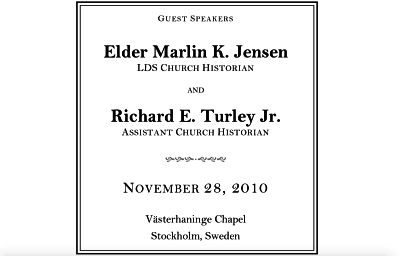
 Please note that the quality of this recording is due to the covert nature in how it was recorded, and has been edited now to eliminate the introductions in Swedish and to optimize volume.
On November 28, 2010, an emergency fireside was held in Stockholm, Sweden by Elder Marlin K. Jensen (Church historian at the time) and Elder Richard Turley (assistant Church historian) to address the faith crisis that ensued among an entire group of members and leaders in Stockholm including a stake president and Hans Mattsson, an Area Authority.
This episode features the actual recording from that meeting.
About 25 Swedes attended this fireside including all the local bishops and stake presidents. Those in attendance were those that were knowledgeable about the Church historical issues that were troubling many Swedes. The Swedes formed their own local Mormon Stories group and had over 600 Facebook members. They would openly discuss these issues amongst themselves.
On September 15, 2018, we visit with many of those who attended the “Swedish Rescue” and hold a 3-part panel discussion surrounding the events of that meeting. You may find those episodes here:
https://www.mormonstories.org/podcast/swedish-rescue/
The “AMindExpanded” Youtube Channel is hosting a video version of this recording that aligns with a typed transcript to help those who may have difficulty understanding the audio version:
Episode Transcript
Host: John Dehlin
This transcript is machine-generated and lightly edited for readability. The audio is authoritative. Please excuse occasional errors in names and spelling.
Introduction and Setting the Stage
Richard Turley [00:00:11] Your mom and me, we've seen this life with eyes that only see in black and white.
Richard Turley [00:00:21] Mormon Stories is a production of the Open Stories foundation and relies solely upon the support of people like you, its listeners to help keep the podcast alive or to become a member of the community. Please become a monthly subscriber by visiting MormonStories.org and clicking on the Donate button on the right side of the page under Support. All contributions to Mormon Stories are completely tax deductible in the United States and go towards producing the podcast and building communities and programs of support for Mormons like you. Thanks for your support.
Richard Turley [00:01:03] Tune me out if you must
Richard Turley [00:01:09] I
Richard Turley [00:01:09] know you've heard enough But I sing this song just because I hope you'll be wiser than your daddy was I hope you'll be wiser than your daddy
▶ Video Clip 1Marlin K. Jensen [00:01:27] thank you for introducing yourselves, brothers and sisters, and thank you for being such good English speakers. Brother Hayton told me that when he visited your conference President Maxing over in Yuktaburi the last time he did that, in 2005 or something, he decided to have no translation.
Marlin K. Jensen [00:01:52] And so when the conference was over, Elder Hapen said to President Matson, what percent of your people do you think understood me? And you said, 97, 98%. And elder hat said, that's better than I do in America. So I appreciate that you evolved in your life, learned English, and I want to say how grateful Brother Shirley and I are to be invited here, to be sent here, actually, as you know, 70s don't hold keys, so we do what people who hold keys tell us to do.
Marlin K. Jensen [00:02:31] And you may remember that Elder Nelson was here on a recent visit and with him was Elder Rasband. And as a result of that visit and some other things, they asked Brother Truly and me if we had a trip that would take us close to Europe, if we would stop by and hold a meeting like this.
Marlin K. Jensen [00:02:55] And so we are on a trip. We're going to New Zealand and somehow Stockholm is on the way. This takes an extra 36 hours. So we left home on Saturday morning and we'll fly back actually to Los Angeles tomorrow and then go on down to the Pacific for a couple of weeks.
Marlin K. Jensen [00:03:18] But I'm glad to be here. I want to thank President Kolpischka for being here tonight. He's your area president and I want to invite him to say anything he wants to say at any point during the meeting. But he's mentioned that he'll at least say something at the end, if not before.
Marlin K. Jensen [00:03:38] And I'm grateful for you however, Olson, can I do his local area 70 here. He's such a fine man. I feel like we're among friends, brothers and sisters. I don't feel like this is a meaning of adversaries, of us against you or you against us.
Marlin K. Jensen [00:04:01] We're all Latter Day Saints. We have so many things in common. We have all done certain things the same way in our lives, made certain decisions, made certain promises. And life is long as we're finding out, and in the course of life, often it turns out different than we might have imagined.
Marlin K. Jensen [00:04:28] I think of this often as I marry a young couple in the temple and think back 45 years ago, when my wife and I were married, about our view of life and our vision of life and how different, really, it's turned out. Some of it so much better than we could have hoped, some of it not as good as we could have hope.
Marlin K. Jensen [00:04:48] So I hope at least tonight you'll feel comfortable, feel loved. I want you to understand that we're not here because your local leaders need our help. One thing I learned in coming to Europe, in fact, I learned it from President Kapishka. I went on a long ride with him when I first got here, and I said, could you tell me something that would help you be a good leader, a good American leader in Europe? He said, yes, I can tell you something. Listen to the European leaders.
Marlin K. Jensen [00:05:23] Remember that conversation. It was the most important thing he could have told me, because what tremendous leaders you have. And one of them that I grew to love during my time here was this handsome Viking, Hans Matzon. So I just want to begin in a spirit of love and common understanding with you and say that we're here because Brother Turley and I right now have charge of the Church's history department.
Swedish Members Raise Concerns with Leadership
Marlin K. Jensen [00:05:56] And it seems like many of the questions that have been raised here, and I want to say to you, they're being raised in other places. This situation in Sweden might be a little bit unique because it seems to involve a group of you who are loosely networked. But everywhere across the world, because of the Internet and the explosion of information that's coming, there are people who have questions they've never thought of before, and there's information that's never been available before. And in many ways, it's a tremendous opportunity.
Marlin K. Jensen [00:06:32] In most ways, actually, it's a tremendous opportunity. One of our hopes that I think we're bringing to pass is that everything the Church has in the way of historical information will one day become available to the whole world.
Marlin K. Jensen [00:06:48] We're doing our very best to internationalize church history. And one of the ways we'll do that is by putting on the Internet our church history catalog that lists everything that we have. And then over time, we'll make digital copies of all of our documents and make those available to people all across the world.
Marlin K. Jensen [00:07:08] So it is a day of information. But with that comes the challenge of deciding what information is reliable, what information is true, what information is worthy of basing our life on it. And hopefully tonight we can at least offer some information in a reliable and loving way that will be responsive to some of the questions that you have.
Marlin K. Jensen [00:07:37] So that we don't start as big as the universe, I'd like to just create a little framework for our discussion. And then when I'm finished with that, we're going to invite you to share with us your most pressing questions.
Marlin K. Jensen [00:07:58] And we'll put those up on the board here, and then we'll try to prioritize them. And then we'll give our very best responses to your questions in hopefully a very productive discussion format. And we'll go until you get tired. Until we get tired.
Marlin K. Jensen [00:08:21] But not too long. For now, Let's just see if we can agree that this is the world that we live in. Maybe I could even call this, just to give it a little more framework. The conversion process. How is it that someone ever becomes converted to the Church of Jesus Christ and Latter Day Saints?
Conversion, Faith, and the Light of Christ
Marlin K. Jensen [00:08:58] Well, after years of experience with this brothers and sisters, it typically begins with a person who is a seeker. 300,000 people a year join our church through the missionary effort. And most of those people receive a letter from their mission president once they're baptized that asks them to talk about their conversion. I would wager that 90% of those people say that they would see they were looking for a different life.
Marlin K. Jensen [00:09:32] Often you've noticed in Sweden, we baptized people who have moved into the country or who had a divorce or a death or are down on their luck in some way. That led President Hinckley once to say, I don't know how the missionaries find some of the people they find. He said that FBI can't find them, police can't find that our missionaries find them. Why is that?
Marlin K. Jensen [00:10:03] They're lucky.
Marlin K. Jensen [00:10:05] They're lucky. And it is the poor. Often they are lucky. What is there in our universe, brothers and sisters, that drive towards hells for motivation, people to come toward truth? Can you think of something doctrinally? Maybe I'll just say it. We won't take time to make this a discussion, but we know that there is a life or a spirit of Christ that is at work in our universe. It's spoken of in section 84.
Marlin K. Jensen [00:10:46] It's spoken of in Moroni 7. It is a spirit that is born into the heart of every person who ever comes to earth. And it says in Moroni that it invites and entices and persuades people to do good and to come unto Christ.
Marlin K. Jensen [00:11:05] Some have called this a universal conscience. It's something that bringing the seeker toward truth. And I think we've all felt that in our lives. It's nothing unique to the Church. It's just out there for everybody. And it does create in the world, I think, a sort of universal morality. On the other hand, there is another spirit. It's the spirit of the devil.
Marlin K. Jensen [00:11:34] And.
Marlin K. Jensen [00:11:41] I would like to read a scripture on this one. It is spoken of as well in Moroni 7. If you've got your scriptures,
Marlin K. Jensen [00:11:52] you might
Marlin K. Jensen [00:11:53] want to turn to the seventh chapter of Moroni. It says in verse 16, for me, holy Spirit, Christ is given to every man that he may know good from evil. Wherefore I show unto you the way to judge everything which inviteth to do good and to persuade to believe in Christ is sent forth by the power and gift of Christ. Wherefore ye may know with a perfect knowledge it is of God.
Marlin K. Jensen [00:12:24] So that's the mind of Christ.
Marlin K. Jensen [00:12:26] The Spirit of Christ bringing us forth fruit, bringing it toward God, bringing it toward. Verse 17, however, says, but whatsoever thing persuadeth men to do evil and believe not in Christ, and deny him, and serve not God, then ye may know with a perfect knowledge it is of the devil. For after this manner doth the devil work, for he persuadeth no man to do good, no, not money. Neither do his angels, neither do they who subject themselves unto him. So you have a counter spirit, the spirit of the devil and his angels. These forces
Marlin K. Jensen [00:13:18] are working
Marlin K. Jensen [00:13:22] on every one of us brothers who comes into this life. This is really what creates agency. Look, just for a moment, if you have Your scriptures in 2nd Nephi 2, where Lehi is explaining this in 2nd Nephi 2 16, he said, says, wherefore the Lord God gave unto man that he should act for himself. So we have the capacity to act, which in the Church we call agency, ability to make choice. And it says, wherefore man could not act towards himself? Say it be that he could.
Marlin K. Jensen [00:14:18] That word
Marlin K. Jensen [00:14:21] don't know what. What is that word in Swedish? Okay, so Lehi is teaching his Son that man could not act for himself, save it should be that he was enticed by the wife or by the other. Now, this may look very simple to you, and you may be wondering why I began with this, but I begun with this because this is the common circumstance of all mankind.
Marlin K. Jensen [00:14:54] I think parents have to understand this to be able to deal well with their children. I think church members have to understand this to know what's going on in the world in. In their lives, that there will always be two forces working on them.
Marlin K. Jensen [00:15:11] The life or spirit of Christ and the spirit of the devil. And within that tension that's produced by those opposing forces, that enticement that occurs, we have a wonderful gift from God. We get to choose. We get to choose good or evil, right or wrong. I think I said enough, maybe not that. Back to this thought. When a seeker
Marlin K. Jensen [00:16:04] motivated by the word
Marlin K. Jensen [00:16:05] of Christ comes in contact with the truth, and that truth is often preached by two missionaries, there's another spirit that enters into this process. It's the Holy Ghost, Which is in addition to the life or something of Christ.
Marlin K. Jensen [00:16:27] And one of its chief functions, to remember the Godhead, is to testify of God and to testify of truth and to testify of Christ. So everyone here who at some point has encountered truth and said seeker has felt as true spiritual prompting that we would call a manifestation of the Holy Ghost. And that is going to manifest in different ways in our lives.
Marlin K. Jensen [00:16:58] Some describe that manifestation as a feeling of peace. Some describe it as a feeling of warmth. Some describe it as a feeling of certainty. Some describe it as a burning in the bosom. There are lots of scriptural stories and lots of historical, historical stories that deal with this.
Marlin K. Jensen [00:17:17] But really you won't know much about it unless you've experienced it yourself. And sometimes it can happen as it did for Paul or for Alma in an instant. But for most people this can be a dragon process of coming to know, coming to feel. We're taught in Doctrine and Covenants, section 88, verse 118. We are to seek learning
Richard Turley [00:17:49] by study
Marlin K. Jensen [00:17:51] and by faith, which indicates that in
Richard Turley [00:17:57] this process of coming to be a
Marlin K. Jensen [00:17:59] conqueror, we don't rely necessarily just on our faith. There is an element of study, of learning about things, thinking about them in our minds, talking about them, and doctrine. Section 8, verses I think 2 and 3 talk about the Holy Ghost speaking truth to our mind and to our heart,
Richard Turley [00:18:31] which again indicates that within each
Marlin K. Jensen [00:18:32] of us the there are two centers really of knowing. There's the more thoughtful or rational part, our mind and the more feeling part, which the Lord describes as our heart. So this process of becoming converted can involve both study and faith and the Holy Ghost can speak both to our mind and to our heart. Gospel truths can be very logical, can be very compelling, but it can also induce great thinking. Usually it's some combination of this, and actually when these work together, they're a wonderful check on each other.
Richard Turley [00:19:15] So again, I'm saying that in most
Marlin K. Jensen [00:19:17] of our experiences, brothers and sisters, we've had some experience like this where we've encountered through. I'll just take the circumstance of the day of Pentecost, which is a very good example of people being preached to, hearing the truth, saying to the apostles, what shall we do? And they were told to repent, to be baptized. At that point, they had felt the Holy Ghost and they had what might be called a testimony, which is conviction of a truth.
Marlin K. Jensen [00:19:54] But it's not a convergence at that point, it's just a testimony. Conversion is a longer process of coming across this continuum here and ending up being born again or having a change of heart. Or be healed, as the Scripture sometimes describes. There is a difference between having a testimony and being completely converted.
Marlin K. Jensen [00:20:27] That's why the Lord did say to Peter, when thou art converted, strengthen thy brethren. Peter had a testimony, but he hadn't yet experienced it with a change of heart. Now, this is important background in my view, before we turn to your concerns tonight, because all of us are somewhere on this continuum.
Marlin K. Jensen [00:20:51] We're hopefully seekers, we hope. We had some experience with the Holy Ghost. And in response to the question, what shall we do? The answer was repent and be baptized. And hopefully we're moving across the continuum, working to be born again, working to have our hearts changed, working to be completely converted. But while that's going on, we still have these two powers to deal with.
Marlin K. Jensen [00:21:22] And every day as we're in the midst of this, brothers and sisters, we have to make a decision. And the central decision we have to make is whether we're going to believe or whether we're going to doubt. That's a decision.
Marlin K. Jensen [00:21:39] Now, everyone who's decided to believe, not everyone, but most of us who have decided to believe, are as aware of the questions that you have as you are, and maybe even a lot more questions that you haven't thought about yet. So I just want you to understand that everyone is experiencing kind of a similar situation. Please.
Guest 2 [00:22:04] When you say. Sorry, when you say we are aware
Guest 3 [00:22:11] of the questions that you have, and
Richard Turley [00:22:15] it sounds like you.
Guest 3 [00:22:16] And then many more of you, I don't know, is it the apostles you're talking about?
Marlin K. Jensen [00:22:22] No, I'm just talking about Brother Turk, who have received questions from some of you in preparation for this meeting.
Guest [00:22:29] And you're aware of a lot more
Guest 3 [00:22:30] things that we might not be aware of yet, but still you stand and you think, I can. I can stand for this.
Marlin K. Jensen [00:22:37] Right?
Guest 3 [00:22:39] So you, Brother Turley, not anybody else.
Marlin K. Jensen [00:22:42] Well, I'm hoping there'll be others. I know about me, but I don't have any doubts about Brother Turley. That's a very good question. We have been given in advance some indication of what your questions have been. So I'm just saying they're very good questions. There are questions being asked by others, and there are a lot more questions that could be asked.
Guest 3 [00:23:06] Will you have very good answers?
Marlin K. Jensen [00:23:09] You'll see in a moment. We'll have what answers we have, but non stop on this point. We need to go to bio for a moment. The second. How many of you ever had a philosophy class? So you know what the word epistemology means?
Marlin K. Jensen [00:23:44] Epistemology of a branch of philosophy that has to do with how we come to know. It's the science of knowing. And obviously in science there's a scientific method as a way of knowing. You postulate a theory and you try to produce proof. And if that works out the way you hope it will, then you may have something that's truthful.
Marlin K. Jensen [00:24:13] This is what the Lord says about knowing in the spiritual realm. Because our trip here can only be truthful if we keep our answers in this realm of spiritual knowledge. We're not dealing with a science. And so when Paul wrote to the Corinthians, who were the intellectuals of this day, he said in Second Corinthians 2 and 9, but as it is written, eye hath not seen nor ear heard. Neither have entered into the heart of man the things which God hath prepared for them that love him.
Marlin K. Jensen [00:24:52] So there are some tremendous things reserved for those who love God. And then he talks about how we come to know what those things are. This is what he says about learning spiritual things. But God hath revealed them unto us by his Spirit.
Marlin K. Jensen [00:25:10] For the Spirit searcheth all things, yea, the deep things of God. And then this very important verse 11. For what man knoweth the things of a man, save the spirit of man, which is in him even sculptures, things of God knoweth no man but the spirit of God. Excuse me, let's close. Second Corinthians, first Corinthians 2, starting with verse 9. First Corinthians 2, verse 9, 10 and 11 and 9, and verse 12.
Marlin K. Jensen [00:25:52] Paul says, now we have received not the spirit of the world. But the Spirit which is of God, that we might know the things that are freely given to us of God. Which things also we speak not in the words which man's wisdom teaches, but which the Holy Ghost teacheth. Comparing spiritual things with spiritual, and then this is important.
Marlin K. Jensen [00:26:16] But the natural man, the man without God, Spirit receiveth not the things of the Spirit of God, for they are foolishness unto him. Neither can he know them, because they are spiritually discerned or evaluated. But he that is spiritual, judge of all things, yet he himself is judged of no man, for who hath known him unto the world, Lord, that he may instruct him.
Marlin K. Jensen [00:26:49] But we have the mind of Christ. So as we take your questions now and do our best to respond to issues that you see in our history or in our doctrine,
Guest 4 [00:27:05] I just want
Marlin K. Jensen [00:27:05] to have you bear in mind that no matter how smart Gutters might be and no matter how good his answers might be, the only way that these answers can help any of us is if they're spiritually discerned, if they're given by the Spirit and received by the Spirit, if they somehow get deep into our heart. There's nothing that I know about Mormonism that bothers me. Are there contradictions? Are there inconsistencies? Are there paradoxes? Yes. It's been a church full of people. Is there any of you that doesn't have an inconsistency, a paradox, or a contradiction in your life? Come see me after, please.
Guest 3 [00:27:56] The. And the first chapter says, it will be my mouth or my servant's mouth. It will be the same.
Guest [00:28:03] That's right.
Guest 3 [00:28:04] So none of us here, I think, are apostles or CEO or revelators, but I think we have a first presidency, have that title, and the 12 apostles have it.
Guest 2 [00:28:16] So if they talk with the spirit
Guest 3 [00:28:18] of the Lord, I think we should trust them.
Marlin K. Jensen [00:28:21] We can trust them.
Guest 3 [00:28:22] Yeah, as far as it's true, but sometimes it changes. That's a little.
Richard Turley [00:28:28] Don't you bother you alone? Not at all.
Guest 3 [00:28:31] Not at all. They have a chance to say something in the name of the Lord that disembodied.
Marlin K. Jensen [00:28:37] Well, you need to give me some for instances, some examples, then we will deal with those. Yeah, but let me just say this. I've worked at church headquarters for 22 years, and I've seen our leaders at very close range. Brother Turdy and I, twice or three times in the last two weeks, have been with the First Presidency on issues and decisions. And I. I know of no dishonesty, I know of no motive that isn't pure with the leadership of the church. On.
Guest 3 [00:29:10] So is it okay to ask a question?
Guest 4 [00:29:13] On.
Marlin K. Jensen [00:29:13] Yes.
Guest [00:29:14] Can I just finish this?
Richard Turley [00:29:15] Sure.
Marlin K. Jensen [00:29:19] I need to stress this point that we have to have the spirit of the Lord, because eventually, brothers and sisters, as a result of our meeting tonight, each of you is going to be left to make your own decision, and we're not going to have enough time, nor would we have the knowledge. If you're looking at it as a scale.
Marlin K. Jensen [00:29:39] Do you remember a parable about a donkey that stood between two equally attractive stacks of and couldn't decide which staff to eat from and starve to death eventually? It's called the acid. You could be like that. We could all be like that in our lives. What we have to do is evaluate what is there that tips the scale. Faith or the truth of Jesus Christ in Latter Day Saints away from the church.
Marlin K. Jensen [00:30:16] And tonight we're hoping to bring to your attention some things that we feel tip that scale toward beliefs. But nevertheless, you're going to have to decide. It's a choice. It's an act. It's your agency, and we're not here to force you in any way.
Marlin K. Jensen [00:30:34] I want you to know that I've made that choice, has been a fantastic choice for me. I have great happiness, great peace, great hopes and anticipation for the future because of this choice. I know that the church is true in my prioritize, that those of you who may be in college may have some of your doubt removed, may be inclined more toward belief.
Marlin K. Jensen [00:31:03] Alma taught that a man has to have a desire to believe. And I'm very prayerful tonight that all of us will leave here with a greater desire. I say this in the name of Jesus Christ.
Guest [00:31:14] Amen.
Members Submit Questions to Church Leaders
Marlin K. Jensen [00:31:16] Now let's take your questions. I'll ask Brother Turdi to write him on the board. Let's just get a representative group of your questions up here to sing what it is that concerns you. Brother Haas, since you had a question, you want to just give us one that we can work on? We'd like to have eight or 10 questions and then we can talk about.
Guest 3 [00:31:45] I think I'll give the word to the.
Marlin K. Jensen [00:31:47] Okay, your wife.
Guest 4 [00:31:50] I'll start them.
How the Book of Mormon Came About
Richard Turley [00:31:58] All right.
Guest [00:31:58] One of my questions is regarding the process of how the Book of Mormon came about and growing up in the church. I remember still that when I was taught about how the Book of Mormon came about and especially the pictures shown to me in Primary, which followed me on, where we have Joseph Smith sitting on one side of the curtain and his scribe on the other, and Joseph Smith Had a place in front of them, translating from them. And also as a missionary and as a Sunday school teacher, we've been taught and I've taught you know, the importance of the original place. And then coming about, I had to make the choice of killing Nathan in
Guest 4 [00:32:35] order to get the place.
Guest [00:32:36] And I would then pass them forward from father to son for a thousand years. And Morona almost died in just trying to preserve them and finding them, paired them with the Inkamora. And then finding out then by recognized historians, even members of the church, how the process isn't really corresponding with that picture, that in fact how the Book of Mormon came about was actually by Joseph Smith looking into the hat in his tearstone, the stone that he found in a well, and the stone that he used both before and after becoming a prophet in seeking for treasure.
Guest [00:33:10] And this then the question to me that I don't expect you to answer, but you know, there's a lot of efforts being made in order to make these claims come about. And they weren't even part of the process. They were hidden away most of the time, sometimes not even in the same room while the writing was being done. That's one question, obviously, but I don't really expect you to answer. But the second question wasn't answered.
Richard Turley [00:33:29] Okay, good.
Guest [00:33:30] But the second question is why, why don't we present this divorce? Why do we still keep to this version that the plate produced in an actual translation process, as I understand, is basically using a document and moving over to another document while it's in fact what, some sort of revelation more or less that may have come forward. But that's my question because I don't see that the portrait of the church does the correspondence. So that's a confusion.
Guest 4 [00:34:01] And I would like to thank you
Marlin K. Jensen [00:34:03] for them both great us.
Guest 4 [00:34:11] Others.
Guest 5 [00:34:14] I think it's a difficult question. Okay, I have a question about, you know, we're always taught in the church that, you know, when uncertain times like from the time of Abraham, you know, God reveals that we can that because it's not my language, but, you know, it's okay to have more than one wife. So that is not my question. But my question is how is it a teach? Do the ship believe that it was a teaching from God that you made women who had other men who were still alive and even his own apostles wives and when they were wearing Nishas and you know, know all the stories? Probably. And I have question, is that a teaching from the church or is that, you know, that he did wrong?
Guest 4 [00:35:05] Okay.
Richard Turley [00:35:05] Joseph's wife.
Guest 5 [00:35:08] Polyandry.
Guest 3 [00:35:09] Polyandry, yes.
Marlin K. Jensen [00:35:11] For the question of polyandry. Polygamy is when a man has multiple wives. Polyandry is when a man marries another man's wife. So your question is about polyandry?
Guest 5 [00:35:25] Yeah.
Marlin K. Jensen [00:35:25] Okay.
Guest [00:35:26] Especially I think in the fact where they actually married women who actually were married to righteous men.
Guest 5 [00:35:33] Righteous apostles.
Guest 4 [00:35:34] Yeah, apostles and missionaries and so forth.
Guest 5 [00:35:36] And another person is like I have, for example, one woman has said that the child that she bore, she didn't know if it were the child of Joseph or the child of, in this case, Orson highlighting the apostle. So that, you know, indicates that it was definitely not a spiritual marriage or
Guest 3 [00:35:55] it was all the way marriage.
Guest 5 [00:35:57] So I have a question. What do you feel about that?
Marlin K. Jensen [00:36:00] Okay, so once you put in parentheses spiritual versus actual marriage. I have six daughters. You won't even think of a question they haven't already asked.
Guest 2 [00:36:21] Thank you.
Guest 5 [00:36:22] Just like to add a question to.
Guest 2 [00:36:23] Let us. Actually, according to information I have read a number of times, which has been published in books etc, which I think seem to be very firm and correct, how the wives were forced into marriage. It wasn't so that they fell in love with Joseph and Z. I would like to be a wife. It was so that we put under tremendous pressure to accept a marriage where they were told that the church will
Guest 3 [00:36:47] go under your family grander and you
Guest 2 [00:36:49] have only until, let's say tomorrow to decide or to marry me. But it will have terrible consequences if you don't accept the marriage. And I think there are so many reports and books, etc. Where these women have written. So I think we don't have to doubt that it was actually a real marriage. I would like to say here, mistress rather than wives, actually.
Marlin K. Jensen [00:37:09] Are you speaking just of Joseph Smith bringing his credit there?
Guest 3 [00:37:12] Yes.
Book of Abraham and Difficult Historical Questions
Guest 2 [00:37:14] My other question was about the book of Abraham. If you please can tell us a little bit about your view of this. I mean, we, we all believed, or the church members believed that this was actually a translation of the information Joseph got before, as you know. Yes, exactly. And we also know that through the Rosetta Stone, actually it is possible today to translate hieroglyphs into English or any other language. And we know now that has actually nothing to do with translation. This was something written 1500 years after Abraham, about 500 before Christ, and has no connection to Abraham whatsoever. And this is such a fundamental thing in church. I mean, this is what we're told in the temple and this is what we have as a holy scripture.
Guest 5 [00:38:02] So.
Guest 2 [00:38:03] And I've seen a Number of explanations from the church how this could be. If I say so, I would like to hear what kind of version you have today.
Guest 5 [00:38:25] One. I have a question that's really related to polygamy. When I was on my mission in London in the 70s, we worked after a very important principle called lying for the Lord. And we were taught that. And it's supposed to have been coined this phrase by I think John Taylor. And I wonder, do you think that there are any circumstances when it's okay to withhold or manipulate truths just to defend or uphold reputation of the church? Is life for the Lord still alive? That's my question.
Guest 4 [00:39:05] I have a question for you.
Marlin K. Jensen [00:39:06] Who caught you there?
Richard Turley [00:39:07] I can tell you afterwards
Guest 5 [00:39:13] because nobody has ever asked this word.
Guest 3 [00:39:15] Maybe perhaps someone can help me. On my mission serving in Scotland, I
Guest 2 [00:39:20] came across
Richard Turley [00:39:23] something and it was the
Guest 3 [00:39:25] first time I really stopped and pondered somebody smart enough to write documents that were false, but church buying them from this man.
Richard Turley [00:39:40] Okay, that's just my question surrounding why the church acted the way they did.
Guest 3 [00:39:48] And the other one is
Guest [00:39:52] blood atonement.
Guest 3 [00:39:53] It's just a strange thing altogether, in my view.
Marlin K. Jensen [00:39:59] I would like to understand.
Guest 2 [00:40:16] You can just turn this around.
Richard Turley [00:40:22] Swedish engineers.
Guest [00:40:27] Could I just please add a thing to my first question? My first question was about the portrait of the. The translation. Not that I didn't feel that it was what will happen. I also have the same feeling when reading about the first vision and Joseph Smith. I see, as I've understood by Vishwan amongst others, that in fact after the first vision, he claims that he was
Guest 4 [00:40:50] persecuted because of the first vision and
Guest [00:40:53] there was a lot of happenings around. And he said, me an obscure boy. Why are they giving me so much attention? What else in history? I find it, I don't think it's disputed that nobody really, not many at least found out about the first edition until later when it was written in 1838. There was one account in 1832. No, sorry, that was about. Yeah, 132 also. But I mean it came about much later. And the question is why? Why doesn't really, you know, many members of the church early in 1830, often the academy heard. So why they joined the church was mainly because of the Book of Mormon and the vision about the New Israel and all that. So the first vision, as we teach today, is not the foundation of the church originally, but it became later on. So that's the question. Why doesn't these two pictures correspond in
Richard Turley [00:41:42] the way we perceive things in the. I have been a member of the church since since 1916 and I've been a master of science in engineering physics since 1917.
Guest [00:42:01] Despite my critical and truth seeking nature and education, the church succeeded in making me a happy and truly believing member for 43 years. 5 years ago I discovered that the church as an organization had systematically deceived
Richard Turley [00:42:17] me by all telling a carefully selected one sided version of church history. The discovery was extremely painful to me and my wife.
Guest [00:42:29] We kept it
Marlin K. Jensen [00:42:31] quiet.
Richard Turley [00:42:32] We didn't tell the children or grandchildren. Do the leaders of the church really believe that they are actually inspired by
Guest 3 [00:42:42] God to act in such a way
Richard Turley [00:42:45] just to tell a selected nice version of the church of the history of
Guest 4 [00:42:51] the church in order to get more converts?
Richard Turley [00:42:56] Do they believe they are inspired to do this?
Marlin K. Jensen [00:43:05] You're making the assumption that that's what they've done. So my future church sanitized.
Guest 3 [00:43:11] Can I just fill in a little bit in this PBS television on the mornings for five years ago something I actually was here in Florida so I had the time to see it and the package says there it's not good for the members to know all the truth. I have the DVD with me so you like is it? But he used to say things like lax conference as well they change it afterwards but he says. He says that it's not good for members to know all the truth and he said as a watchman on the tower he liked to stop things that could hurt even the drink in her yeah just a feeling that you say not the whole church but is very known about in the church and outside the church.
Marlin K. Jensen [00:44:15] The question is really is all church is all truth useful? So we'll try to deal with that
Guest 3 [00:44:21] one more I don't know I've already
Guest 2 [00:44:24] asked or if I like to ask official subject
Marlin K. Jensen [00:44:31] do you want to ask them about that?
First Vision Accounts and Contemporary Sources
Guest 5 [00:44:34] One thing that really bothers me is the lack of contemporary sources for the angelic dissertation as I understand it from both Michael Quinn and Bushman. They say as I understand that there are of course Sources from 1829, 1830 Antidote letters, minutes but none of them ever mentions any angelic recitations or priesthood
Guest 3 [00:45:01] restoration that way
Guest 5 [00:45:04] I set the mid-30s Queen says and Bushman refers to 1838 as a historian by the trolley you
Richard Turley [00:45:11] should be worried about the credibility of
Guest 5 [00:45:15] things when the written sources are not preoccupirated.
Richard Turley [00:45:18] So I want to why are there
Guest 5 [00:45:19] not any contemporary personalities for order
Guest 4 [00:45:26] I'm
Marlin K. Jensen [00:45:26] very to share with you an appearance we made before the first president last week I initiated your
Guest 3 [00:45:35] Can I have a question Not Just the question. The post is the little one. I read about the priesthood and the blacks and I read about David O. McKay and he was apostle and so on. And he really had it up on the board of decision of 12 and they had it fixed. I'm sorry, in this English. He had it made okay, that they should have the priesthood. But three of the apostles were not there. And when they come back they said no. So they have to cancel it and then have to wait some years to present. Kimball come in and then he talks a lot. I listened to his son, Kimball's youngest son, and he says, yeah, it takes
Richard Turley [00:46:25] a lot of years.
Guest 3 [00:46:25] He talked to a lot of the 12 and he never even discuss what would happen with the church if it launched this and how many we will lose or like a company business, you know. So if we do that and that. Is this true that there were some apostles that went against the question to give the priesthood to the flag and then to see that I was on my mission Saturday, you know, and we loved Marty Peters.
Guest [00:47:02] Not.
Guest 3 [00:47:02] No, he was in the European. He talks a lot about the blacks and their pre existence and they were damned and so on because they were blacks. And for me he was an apostle. For me he was Dr. McClellan, section one, my mouth or my servant's mouth. And I thought he was a servant. But then he fell out and he
Guest 2 [00:47:26] was
Guest 3 [00:47:28] teaching false doctrines. If they look at it now, at least if I start to create it, other things I recall false doctrines. But when he did it, it was okay. And many people felt a great spirit.
Guest [00:47:43] They were confirmed that they had the
Guest 3 [00:47:45] spirit testifying it was true and was not. To this I have a personal experience. I love the way you put up the devil there and Christ there. I'm glad I'm not a Muslim because I have problems. Christ there.
Guest 3 [00:48:02] Anyway, when I went to the temple the first time, I was 1970 in Switzerland and saw a coffin. And after being in there the first day, I was terrified. I couldn't sleep at night. I thought, what is this? You know, There was a black hole in my whole heart. And I had more dramatic nightmares, nightmares and the whole week. And I thought, what is this? Have I been deceived?
Guest 3 [00:48:38] But then I thought, okay, I see my father there. I see my branch president. And I said, maybe wrong on me. So if I look at the Holy Ghost, he said to be peaceful. He said, testify. I would have a burning feeling. I would be happy if I could follow that description. The devil talked to me and said, this is not right.
Guest 3 [00:49:02] But you know, it's hard to say but it really hurts me and I feel sad about it, you know and I feel. I know a lot of people have the same experience and look alone. I even had it with my brother. I don't care who it is, but. It's something I wonder what did I do wrong? You got the question.
Marlin K. Jensen [00:49:29] You've got a black and a preaching question. I don't know if you want us to address your chemical question. That's something we could Just wanted to
Guest 3 [00:49:39] see if this is another side of
Guest 2 [00:49:41] what you started to introduce.
Guest 3 [00:49:42] If you like to answer it. I don't know but it disturbs me.
Guest 4 [00:49:53] We've got 13 questions so I think
Marlin K. Jensen [00:49:57] we've got enough questions unless you've got one that's burning in your both of us.
Guest 3 [00:50:03] I want one.
Guest 4 [00:50:03] All right.
Guest 2 [00:50:07] We had some Vikings visited North America about 1,000 years ago and today we know exactly where they lived. Actually there are archaeological evidence that they lived there, etc. So what about all the millions of people who have been Lamanites and Nephites in the usa? What kind of evidence can you show that actually still exist? Every single small Indian tribe in the whole of America as we know about today because they all leave buildings, they leave tools, they leave anything which can prove that they are there have been that and as far as I know, there is absolutely nothing proved that there have been Nephites or Lamanites in America. If you have time, you can also maybe comment the American Indians and the DNA and the connection to to Lamanites, Nephites and then back to the Jewish people would be interesting to hear.
Guest [00:51:23] Could I please ask a short question because I'm just very happy that you're here so I'm just taking the chance. Now I might be egoistic, oh, I see this my friend. But I would just like to ask another thing and I've heard it's about the Adam God theory. And my question, not so much about. I've heard answers to how Brigham might have thought about it but my question is how come it divided the church at the time?
Guest 4 [00:51:54] You know, there was a lot of
Guest [00:51:55] apostles and leaders that didn't agree to what they heard say.
Richard Turley [00:51:59] So if I don't know what is
Guest [00:52:02] the Church of England as William and Toil and why didn't they clear it out if it is the way I think she thinks that he had actually thought that Adam is not going to be part of a schm that why couldn't make the other apostles understand that.
Marlin K. Jensen [00:52:27] These are questions. I think that Rick has dealt with before. As you're going to see. He has a very concise way of speaking. It would be good, Rick, if you just gave an answer to each one and then pause and we'll see if they have additional questions about it. Let's just move through them. I'll shift in where it might help.
Richard Turley [00:52:48] The big challenge here, of course, is time. If we wanted to give these questions in detail, not just four hours, but days, maybe weeks. So answer them and give you very concise answers. But there's a lot behind those concise answers. So let's take the first one. How do Pokemon? Why is it that our.
Guest 2 [00:53:08] If you don't give it.
Guest 3 [00:53:09] Can you give us a reference that
Guest [00:53:11] you can like later go in and check.
Guest 5 [00:53:15] Yeah.
Richard Turley [00:53:15] Exactly what you say.
Guest 5 [00:53:18] Listen,
Marlin K. Jensen [00:53:20] we brought a handout for you.
Guest 3 [00:53:22] Okay, you know the answer to this. Do you know the Christians?
Marlin K. Jensen [00:53:25] Well, these are the five very best websites for authentic answers. Let me say if you'll spend as much time in these five websites as you've spent in other websites. Because I have visited, as has Brother Trinity, some of these anti Mormon websites and they're very dark to me and Brother Turtle and I know many of the people who maintain these websites and I can say to you, they're not the people whose teachings I'm going to follow.
Guest 3 [00:54:03] But if I go to those websites,
Marlin K. Jensen [00:54:04] you'll get authentic, accurate information. Yes, by and large. And I'd like you to know that as a church history department, we have, at President Packer's direction, put together a committee to create answers to difficult gospel questions. We are working on these answers now. And we're also giving thought to how we will disseminate these answers to the world. We don't want a website where people come to Mormon problems, obviously. But you'll find if you go to these websites, answers that you can rely on to almost all of your questions, including Adam, God. But we'll give you our best answers. We wanted you to know tonight there are answers.
Richard Turley [00:54:50] Do the church stand behind these websites?
Marlin K. Jensen [00:54:52] Well, they're all church institutions, either BYU or private institutions that are handled by very reliable and good literary saints.
Richard Turley [00:55:00] So they're not official church websites. We do have some official church things that are being developed, for example, because, look, the other. Try to find the church own versions about these things.
Guest [00:55:15] That's my problem. I don't care.
Richard Turley [00:55:17] What is the church?
Guest 3 [00:55:18] What did the Church say about this?
Richard Turley [00:55:23] We hope you'll find more in the future to be helpful. One of the most helpful things I think you might find over Time is that we're taking our church history library catalog and we're putting it on the Internet next year. Never mind to make digital images of many of the records and connect those to the catalog so that you can do. So that you don't have to just listen to somebody's summary, but you can actually look at the original documents yourself
Marlin K. Jensen [00:55:47] and make your own conclusions.
Guest 3 [00:55:48] Excellent.
Richard Turley [00:55:50] I have a question. We have specific issues that's on the table right now, and I just wanted to make sure, because I think it's important that we gather together here, all together, that really bring up these. That's all on the top of our minds, that everybody here feels that if this needs answers, it helps because there might be people that stop speaking this evening that have other questions.
Guest [00:56:14] I think it's important that we bring
Richard Turley [00:56:15] up the questions now, so that's not the chance to get the answers. So is there a question you have is more important than these 13, at least 15.
Guest 2 [00:56:27] Okay.
Guest 4 [00:56:29] Well, it seems like these are not new issues to my limited my own experience.
Marlin K. Jensen [00:56:36] The only new one is for precision aids those around the world creating problems.
Richard Turley [00:56:43] Okay, so what you're saying is these are issues that have been around for
Marlin K. Jensen [00:56:46] a very long time.
Richard Turley [00:56:47] They're not. So recognizing the limitations of time, I'm just going to march through the gifts of very quick, concise answers, recognizing that a thorough answer is going to take more time than we have. At some point, we may go a little bit deeper just because it's hard to make a concise answer to some of them. So let's just start with the first one. As I understand this question you were asking about, why is there a difference between the way you first learned about the translation of Book of Mormon with church art showing you house here and then plates and a blanket and another scribe and so on?
Richard Turley [00:57:26] Basically, a challenge that we have is that over the course of generations, people develop in their minds an idea about something happens. It's particularly true in the second generation, third generation, fourth generation, and so on. If you look at Christian art, for example, a lot of Christian art dresses people from the Holy Land in clothing and in environments that are not the Holy Land. They're Europe, and that's because that's their conception. This must be how it was done. So what we have in church art very often is artists giving their idea of what it must have been like. But if you go back to the original documents and get back to original documents that were sometimes difficult for people to find originally, what you see is a different picture.
Richard Turley [00:58:20] So the bottom Line is, we're trying to make our art conform with the sources so that people, when they see images of the way things are done, they'll understand it based not just on an artist's conception, But I'll put the basic statements are. Let me just give you an example.
Guest [00:58:38] But it's not so much the picture, it's more the teaching. There's a picture which is evidence of it, but it's more the teaching. And even today, you know, the Urim and Tamil, for instance.
Guest 3 [00:58:47] Yes.
Guest 4 [00:58:47] So sorry, but that's that we don't
Guest [00:58:49] focus on the pictures because that's fine.
Richard Turley [00:58:52] Let me just restate what you're saying. You're basically saying that the. The way the story is told, the way you've heard it traditionally differs from what you see in the historical sources.
Guest 5 [00:59:03] Is that correct?
Richard Turley [00:59:04] And that is the kind of thing that does happen. And what we're trying to do as a department, the church history department, is to bring the curriculum in conformity with the sources. Let me just give you an example. One of the Jensen mentioned last, was it last week or week before?
Marlin K. Jensen [00:59:21] Last week.
Richard Turley [00:59:23] Last week we went to the church leaders and we said to them, our historians historical research about the restoration of the priesthood and where this restored is different from what our curriculum teaches. For example, the curriculum says that John the Baptist, if you look at the heads up to section 13 of the Doctrine of Notice, Section 13, the headnote the beginning says ordination of Joseph Smith and Oliver Calvary to the Aaronic priesthood along the bank of the Susquehanna river bank. Do you understand that meaning of the term bank?
Guest 3 [01:00:11] Okay.
Richard Turley [01:00:14] We went back to the original sources and Joseph Smith says that the restoration occurred in the woods. And Oliver Cowdery says it occurred in the bush, meaning we think a sugar maple grove. They used to call sugar maple groves the sugar bush. And if you look at the Susquehanna river here and Joseph Smith's home here, the grove is probably up here, not here on the banks. So our historical research shows that the restoration doesn't occur here, it occurs here. So we're going to change information to make it conform with the church history. So you've identified a genuine problem. Often the way stories have been told over time don't conform with the history. And so our goal is to try to make them conform more closely.
Joseph Smith's Translation Methods
Guest 5 [01:01:09] But how did it actually happen?
Richard Turley [01:01:11] How did it actually happen? Okay, again, very concisely here, Joseph Smith translated the Book of Mormon. But translation as a term is not the kind of translation you and I might think about. I worked as a professional Translator. In Japan, I translated electronics and engineering documents from Japanese characters into English. And I did that one character just like this, very, very slowly. Joseph Smith didn't translate that way. Joseph Smith didn't understand the language that he was reading. He needed the Lord's help in doing it. Now, some of you probably have computers or phones that have translator software on them, right? So we understand the idea that there are other ways to translate besides going word for word in translation to. Joseph Smith's translation was by Revelation. And so that's how he translated translate by Revelation. So why were the plates needed? That's your question, right? Why were the plates needed?
Guest [01:02:17] Why Urim and Thummim?
Richard Turley [01:02:18] And why Urim and Thummim?
Guest 3 [01:02:19] And why a hat?
Richard Turley [01:02:20] And why a hat? Okay, we take those three in order. First of all, why were the plates needed? The plates were needed because the plates were real and they were preserved. And they were passed down from generation to generation. Once Joseph Smith Smith got them, then the method of translation was up to the Lord. And the Lord chose to use a method of translation that was far more efficient, far better, and far more accurate than anything Joseph Smith could have done letter by letter, because it would have taken him.
Richard Turley [01:02:48] He didn't know the language. So how else was he going to translate it if God didn't help him? See one of the other questions, why the Urim of Thundham? Why the hat? The Urim and thunder? Maybe I should answer the hat question. The hat was apparently to block lighthouse so Joseph Smith could see what he was doing with the record. If you have a computer, sometimes the light, you know, affects your screen. We don't know exactly how it works. Joseph Smith said it wasn't meant in the world to know how to work. But he did say this in the early days of his translation. He was relying on revelatory tools of some sort or another.
Richard Turley [01:03:26] Urinal, thumb, seer, stone, whatever the case may be. And that's been the case throughout religious history. If you think about the Old Testament, remember the brass serpent on the rod? People could look at the brass serpent to be healed, right?
Richard Turley [01:03:42] You have the Ark of the Covenant, you have the consecrated oil. There are always these sort of tangible manifestations that are used to focus on. After the translation of the Book of Mormon. Orson Pratt, a new convert, walked into a room where Joseph Smith was working on his translation of the Bible.
Richard Turley [01:04:01] And he thought in his mind, but didn't speak. He thought, joseph's not using a seer stuff. Why is that? And Joseph, as though he read Orson's mind turned to him and said, orson, when I was young and inexperienced in spiritual things, I needed that. I don't need it anymore.
Guest [01:04:26] But can you.
Guest 5 [01:04:27] Can you see that? We feel that it can be seen to say that you translate. You know, you have the records and you translate on it, like with the papyrus, you know, he had them all over his kitchen floor. And he said he was translating them, but he wasn't much. Just said, I was sitting and praying and got the revelation. And melting is done. But it's kind of deceiving to say it in that way for himself, not saying.
Richard Turley [01:04:51] I think that's a difference in perception rather than in reality. When Joseph used the term translate, he meant revelation.
Guest 3 [01:04:59] Okay.
Richard Turley [01:05:01] And the revelation. Revelation comes in various forms. You yourselves who believe you receive revelation recognize that it comes to you in various ways. Sometimes it's a feeling, sometimes an impression. Sometimes it may be a thought. In Joseph Smith's case, when he translated the Book of Mormon, it wasn't just a matter of kneeling and praying and giving words. There was, as Section 9 of the Dr. Clemens points out, this effort associated with it. And we could go through that. We're running out of time. Exactly.
Guest 2 [01:05:33] And I would really appreciate not to
Guest 3 [01:05:34] be awkward in any way.
Richard Turley [01:05:36] I really want to know. Know what you have to say about all these things.
Guest 2 [01:05:39] Okay. Because we.
Guest 3 [01:05:40] If we're going to continue asking questions about this, we'll have maximum three questions, perhaps.
Richard Turley [01:05:47] Can we do that?
Guest 3 [01:05:48] That's why I wanted us, ourselves, then later to go and, you know, dig.
Richard Turley [01:05:52] Dig deeper. All right.
Guest 3 [01:05:54] Is that okay, please?
Guest 2 [01:05:57] Yes, it's certainly okay. But we also need to get answers.
Richard Turley [01:06:01] Yeah, but the thing is, we won't get answers.
Guest 3 [01:06:04] They already said that.
Richard Turley [01:06:05] Then we need to choose one question
Guest 3 [01:06:06] and get all that answers.
Richard Turley [01:06:13] Yeah. How much did the place weigh? There are different estimates. £40, £50, something like that.
Marlin K. Jensen [01:06:25] I love the fact that you're asking your questions.
Guest 2 [01:06:27] Thank you.
Marlin K. Jensen [01:06:27] Thanks for feeling. I feel our desire to give you as an answer. We have this. But when all the answers are given and all the questions are asked, Decision time. Well, that too. There is a book. There is a book. And when you read book,
Guest [01:06:49] when you
Marlin K. Jensen [01:06:49] read Mosiah's or Benjamin's discourses in the Book of Mosiah, or you read young Alma in Alma 36, talking about his sins and coming to believe in Christ, when you read Moroni, Satanic Leaders of the Flower of God, there's something there that I stake my life on based on a feeling.
Guest 4 [01:07:11] Sure.
Marlin K. Jensen [01:07:11] I know all of this. Yes, there are Some things that you can't explain exactly, but there is the book and there is the spirit of the Lord that we can anchor ourselves in.
Guest 4 [01:07:23] So I just.
Marlin K. Jensen [01:07:24] I want to add that. And I could do that probably at the end of every question Rick will answer, but I won't do it again. Thank you.
Richard Turley [01:07:38] And there is something historically very remarkable about this book. I write books. I've written several, and I'm in the process of writing several more. And I have a lot of help, and I have a lot of education, and it still takes me maybe 100 drafts sometimes to write a book. Joseph Smith sat down and in roughly 60 to 90 working days, he dictates
Guest 3 [01:08:06] this book
Richard Turley [01:08:09] got the opponents, which is amazing. It is amazing. But anyway, those are some of the questions. I think I answered one or two here precisely.
Guest 3 [01:08:24] Sorry, you didn't say why you present this view. Why does the church present the view? Why doesn't the church say about the Seer Stone more officially?
Richard Turley [01:08:33] In the early days of the church, they talked about it. Often they gave to a second generation. They present it the way that they tell the story. And over subsequent generations, each generation retells the story according to their own circumstances.
Guest 3 [01:08:49] But we are led by Revelations, the church. So, I mean, shouldn't then the leaders.
Guest 2 [01:08:54] Correct.
Guest 3 [01:08:55] So that not people, every generation, change the story?
Guest 2 [01:08:58] Or could you see this for every
Guest 3 [01:09:00] subject in the church?
Richard Turley [01:09:03] Much of what you get about the history comes from the historians, and you come from people like me who do the best they can under the circumstances of their time. And then somebody else comes along later with new discoveries, new documents, and they rewrite. Okay, so it's, you know, don't put the responsibility on the process. People like ordinary people like me for doing the best. You know, we don't know how to do it, but somebody will come along later and do it better. Those of you who do anything, science, you know, you do the very best you can in the next generation, we'll do it better. Isn't that true? I know there are a lot of questions, so let's continue forward with the discipline of, you know, getting through these. Joseph Smith wise polyandry. This is a very complex subject. This is one we could spend a lot, lot of time on.
Marlin K. Jensen [01:09:58] Okay, do that.
Guest 3 [01:10:00] Just. Just basics. How many wives did. Basics?
Richard Turley [01:10:10] So let me just answer some basic questions. Did Joseph Smith practice plural marriage?
Marlin K. Jensen [01:10:16] Yes.
Richard Turley [01:10:16] Many church members don't know it. The answer is yes. Did Joseph Smith practice polyam? The answer is yes. Joseph Smith did practice public. How many wives did Joseph Smith have? We're in the process, as you know, of preparing the papers of Joseph Smith for publication, we hope to include in the papers of Joseph Smith a list of Joseph Smith's lives based on the best available evidence. So we'll answer that question in the future. Why did Joseph Smith marry specific people? Which gets to your question about why did he marry the wives of people who were already married? That actually boils down to a marriage by marriage statement. And it's fairly complex. But it's an excellent question. We just don't have the time tonight to answer it. But there are answers.
Polygamy, Polyandry, and Difficult Doctrinal History
Guest [01:11:08] But to summarize, then, is there a principle we believe in that it could be practiced that way? Because we believe in polygamy? It's a principle. We believe in spirit. So it's this, the principle we believe in.
Guest 4 [01:11:19] In the church.
Richard Turley [01:11:20] I, again, I'm not a prophet, okay. I can't tell you about the future. I've said to people who have asked
Guest 2 [01:11:28] me this question, do you think this
Richard Turley [01:11:29] is going to come back? I say, I think I have a better chance of being hit by a meteorite from space than I think this come back.
Marlin K. Jensen [01:11:36] Okay?
Guest 3 [01:11:38] But this stuff going back, they are still there now, isn't it? The church says there is no polygony, but it is. So why do we talk different languages in the church? I mean, you go, I have a
Richard Turley [01:11:52] friend who, his wife died and I met another wife.
Guest 3 [01:11:57] At least have two wives the next life. So we believe in.
Richard Turley [01:12:04] We believe in the sealing of people for the afterlife. Of course, the question that arises in
Guest [01:12:09] the world generally is what do you
Richard Turley [01:12:10] do if you live during life with more than one person? What do you do if your spouse dies and you remarry? What happens in heaven? And the answer that section 132 gives is that you'll be together. Do we know a lot about how that works? We really don't. Do we believe in the 132nd section?
Marlin K. Jensen [01:12:31] Yeah.
Guest [01:12:31] Okay.
Guest 5 [01:12:32] So, yes.
Guest 2 [01:12:32] We don't fully believe in politics. We.
Guest [01:12:36] Thank you.
Richard Turley [01:12:37] We don't practice polygamy. Hunger.
Guest 3 [01:12:39] Yes, we do. We go to the pentals and seal them.
Richard Turley [01:12:42] But you know what I mean, One, one man, one wife at a time.
Marlin K. Jensen [01:12:46] Hunger today.
Guest 3 [01:12:48] Yeah, but if it was legal today, would we have two wives?
Richard Turley [01:12:54] Really?
Guest 3 [01:12:55] Could I take another one?
Richard Turley [01:12:56] It would not. It would not change the current position until the prophet said so. And as I said, I can't, I can't predict the future. But you must answer.
Guest 3 [01:13:04] So I think you can answer this. Do we believe in polygamy? We don't practice it on earth, but
Richard Turley [01:13:11] we believe in it because we are sealing more light to.
Guest 2 [01:13:15] To.
Richard Turley [01:13:15] We believe in the ceiling of people as.
Guest 3 [01:13:18] What do you call that?
Richard Turley [01:13:20] Well, I.
Marlin K. Jensen [01:13:20] What do you call that?
Richard Turley [01:13:23] 20 years that by some say that people will say, well, then you. You have more than one life, right? I don't. You don't. Right. So nobody else here does either.
Guest 3 [01:13:31] I believe I can show you all of them.
Richard Turley [01:13:33] But that's. That's why I say it the way I say it.
Guest 3 [01:13:35] Okay, but is that the technical way
Richard Turley [01:13:38] why you say that?
Guest 3 [01:13:39] Or is it really someone telling you you can't say a polygamy?
Richard Turley [01:13:44] No, nobody's telling me anything. Okay, just.
Guest [01:13:46] Do we believe in poly.
Richard Turley [01:13:48] We do believe in polygamy. That's what I'm trying to say. We don't practice.
Guest 2 [01:13:54] He just wanted it inconsistent. Okay, can you please try to convince us how this can be Christlike? Now if you look at Smith to take the rights or have sex with wives who already married other men or
Richard Turley [01:14:08] to force a 14 year old girl to marry him.
Guest 2 [01:14:11] Can you explain something? I really would like to understand that. I mean if you read the stories of these rights and I have a
Richard Turley [01:14:18] whole book, there are a lot of
Guest 2 [01:14:19] books published about this. If you read the stories about this book. Do we believe these women were happy?
Richard Turley [01:14:24] I would like to say they were
Guest 2 [01:14:25] extremely unhappy because they were forced into a situation in which they hated. And they were put in this situation
Richard Turley [01:14:32] by peer pressure, by notion, but pressure, pure pressure.
Guest 2 [01:14:36] And they didn't do that because of love. They didn't do it because many such reasons. Just because they were forced into situation. If we would have this situation in, let's say a Swedish king in the 1400s, they would understand it. But if we had the situation with a person who called himself, you know, the second next to Christ here on earth and the founder of this church. I just can't get into mindset. I actually can accept.
Richard Turley [01:15:06] I can accept that.
Guest 2 [01:15:07] I mean there's a lot of societies around the world today where it works fairly well. I mean a lot of people in Sweden go to Thailand on vacation. Thailand is such a country, for instance. But to take other women's rights in a secret way, force them into some
Guest [01:15:25] kind of marriage, I would like to
Guest 2 [01:15:26] call it mistresses or force the 14 year old girl to marry them now against horror, obvious will.
Richard Turley [01:15:33] I just not understand it.
Guest 2 [01:15:37] The hide behind his own.
Richard Turley [01:15:38] Why even the.
Guest 2 [01:15:41] Even the counselors in the relief society led by Emma Smith were his secret rights. The deeper you go on this, the worse it becomes.
Richard Turley [01:15:51] Let Me just say, if we have more time, we can dissect this wife by wife, which is pretty much what you have to do to get to the answers on this category. We don't have that same time. Is it true in general, was this not true though?
Guest 2 [01:16:07] It's.
Richard Turley [01:16:07] It is true that Joseph Smith practiced plural marriage and that he had wives who were not married to anybody else. And it's truly practiced polyandry that he did have wives who were married to someone else.
Guest 3 [01:16:19] 14 years old, 16 years old, he
Richard Turley [01:16:23] had Hawaii, who is 14 years old. But remember, on the frontier in America, women married young, often as young as 12 years of age, because the lifespan of people in those days wasn't what it is. So on the frontier, not in much of the rest of America, but on the frontier, if you look at population studies, if you look at censuses of peoples across the American frontier at the time, they often marry quite young. So marrying a 14 year old in
Guest 2 [01:16:53] those days was not the same.
Richard Turley [01:16:54] It was like marrying a 21 year old today.
Guest 5 [01:16:56] Basically, well, the marriage was a sexual abuse as well. So you can compare when you're married, that's your sex. I think you can compare that today. I think you cannot afford a new dance like a 10 year old then.
Richard Turley [01:17:15] Well, my point is, my point is there was a different societal norm on page and marriage in those days. So let's move on. This is a complicated one.
Guest [01:17:26] You think that's the most important question. Does the church recognize this practice as being. Okay, does the church officially endorse this or do they recognize that it might actually be or did things in error? Do you have an opinion on that from the church?
Richard Turley [01:17:43] I've never seen a formal statement,
Guest [01:17:47] but
Richard Turley [01:17:47] anyhow, I mean the basic question here
Guest 2 [01:17:49] is of course that was this a mistake done by Joseph Smith? And if it was, how could he continue to be a prophet? And if it was not a mistake, it must be endorsed by the church, I guess.
Richard Turley [01:18:01] Okay, what, what the church does say on this, on this question, that Joseph Smith in general is this. Either Joseph was a prophet of God or he wasn't correct. And the way in which you decide that, not just intellectually but spiritually
Marlin K. Jensen [01:18:24] is
Richard Turley [01:18:25] the way that Elder Jensen talked about at the beginning. That's the official church. I've never seen it, but, well, why
Guest 3 [01:18:36] does my spirit talks to me and screams wrong, wrong, wrong. Even if it's a prophet of God, make a decision. Do I have the devil in me who's talking to me and says I should understand this? 14, 16 year old girls Marrying and I can't. My spirit doesn't. I can't get into my mind
Guest 2 [01:18:58] is
Guest 3 [01:18:58] it the devil speaks to me that I should accept that because Joseph Smith is a prophet. So he did that right? It was God told him to do that. Go behind Amna and take these wives. Why were working for them in the house. Yeah, no, I know, I know.
Guest 5 [01:19:17] I am here tonight not speaking with all of these questions. My reason for being here tonight is to complete my sister. She has married a woman. She's chosen to show her love for one person she used to be married to. And her life. She's at the time education kick from
Richard Turley [01:19:50] the church to fight herself.
Guest 5 [01:19:51] And homie, she has got a lighter nail. She has been born to church. She's not allowed to be anymore.
Richard Turley [01:20:16] And what we are reading on question
Guest 5 [01:20:18] number three is considered God. Goddamnly. I think it's terrible and I cannot support it.
Scripture, Church History, and Transparency
Guest 4 [01:20:28] Brothers and sisters, when I read the scriptures and I find many things in the Scriptures, the Old Testament, New Testament that I do not understand. For example, I do not understand the law of Moses. And as they have handled certain things, they are not understandable to my mind today in the 21st century.
Guest [01:20:55] I don't know why when someone would
Guest 4 [01:20:57] touch the temple would be killed immediately. I just don't understand that. Today our prophet invites us to go little children attached to the temple to get a feeling for the temple we thousand years ago they would have been
Richard Turley [01:21:12] killed instantly for this.
Guest 4 [01:21:14] And I don't even try to. I don't understand because there were different times, there were different cultures, they understood things completely different. And I understand that there are some
Richard Turley [01:21:27] doctrines that never change, but there were
Guest 4 [01:21:29] some procedures, some policies. For whatever reason, one day I hopefully will get an answer if I need the answer.
Marlin K. Jensen [01:21:39] I don't know.
Guest 4 [01:21:40] But there is a lot of things.
Guest [01:21:42] I don't know why Jesus drank wine.
Guest 4 [01:21:43] I don't want to even go into the discussion and think that was only apple juice or grape juice.
Richard Turley [01:21:49] I don't know. You know, there are certain things even
Guest 4 [01:21:53] from these scriptures that we cannot explain. So I don't know why just Joseph did what Joseph did. On these things we have some more insights.
Richard Turley [01:22:02] And then even if you give them
Guest 4 [01:22:03] an answer, a good question, every little answer could go again and again.
Guest 2 [01:22:08] But you cannot.
Richard Turley [01:22:09] I know, I know.
Guest 4 [01:22:11] One thing that I know is Moses was the prophet.
Guest 5 [01:22:15] I know.
Guest 4 [01:22:17] I know that Jesus is the son of God. And I know that Joseph Smith was
Guest 5 [01:22:23] a prophet of God.
Guest 4 [01:22:24] I know that.
Richard Turley [01:22:26] And so even though I have not
Guest 4 [01:22:28] all the questions answered, I know that these things are true and so but this is consistent that we have gospel truth and truth that we believe in
Marlin K. Jensen [01:22:39] that we don't have all the.
Guest 4 [01:22:40] If you take the Bible and just
Richard Turley [01:22:41] want to do the same thing on
Guest 4 [01:22:42] the Bible, we're going to sit here for months and no one of us
Guest 3 [01:22:46] will ever believe in any of this
Guest 4 [01:22:48] truth of these books. That's what I personally read some of these stories.
Richard Turley [01:22:54] Book of Abraham. Can we run through them and then come back Book of Abraham very quickly. Let me just say a few things about very simply. Number one, again it's received by revelation.
Guest 2 [01:23:05] Okay.
Richard Turley [01:23:05] Number two, we don't have all of the pirates. We have some fragments but we don't have all of them.
Guest 2 [01:23:12] Okay.
Richard Turley [01:23:12] This is pretty good evidence. Number three, the so called. You've seen a lot of studies on the so called Alphabet and grammar book. There's some excellent research coming out of BYU in the next year that you need to read. All I have time to say about that. Okay, we're going to quickly parts.
Guest [01:23:30] Okay.
Richard Turley [01:23:33] Yeah. Again this concept of translation. If you look at the seventh section of Dicepanus it's a translation translation of a parchment by the apostle John in the New Testament. There's no evidence it was anywhere around Gilgamesh at the time he translated it.
Guest 2 [01:23:49] Okay.
Richard Turley [01:23:49] So again translation is not character for character kind of translation the way you and I think about it.
Marlin K. Jensen [01:23:54] Okay,
Guest 3 [01:23:57] but do the church still believe that the papyrus are the words of Abraham or do you think they are the same they are translated now there
Richard Turley [01:24:08] are lots of theories on that. The church does believe that the book of Abraham is the word of God. And if you read the book of Abraham I have many times there are doctrines and principles you will understand that are important to you. That's the church's position exactly how Joseph Smith did it. There are lots of solely debates going on about that. But there's some excellent work going on at BYU that should be hour ago next year.
Guest 3 [01:24:38] Do they believe that the translate Papilla is now are the death rows or do I believe still is Abraham writing? Is that person writing SSS in the
Richard Turley [01:24:50] first verse, the papyrus that we have. We know what books those are from Egyptian 1500 years.
Guest 3 [01:24:58] But you still believe that there are some fragments that we don't have that are 1500 years younger or older.
Richard Turley [01:25:06] We don't. There's a difference between the date of the copy and the date of the text. So the text yes, we believe is older. The actual copy could be later.
Marlin K. Jensen [01:25:16] Yes.
Guest 2 [01:25:17] Okay, well even.
Guest 3 [01:25:17] I mean there are even Records.
Guest 2 [01:25:19] So how this is being translated, what
Richard Turley [01:25:21] each shirt are milked.
Guest 2 [01:25:23] So it's very difficult to say that he saw these documents. So he was inspired. If you look into this in detail, I mean with any kind of scientific brain, it's very, very hard to say that this was even close to truth. These funeral documents were written 1500 years after Abraham. It's very difficult to come up with any theory to connect to that and
Richard Turley [01:25:46] Abraham in any way.
Guest 5 [01:25:47] And you.
Guest 2 [01:25:48] It wasn't just right, as I can see because he actually wrote down, you know, this character meant this, this character meant this, etc. And when an expert look at this, it's kind of a joke.
Guest 4 [01:25:57] Okay.
Richard Turley [01:25:58] The documents you're talking about has been misunderstood by many people.
Marlin K. Jensen [01:26:03] Okay.
Richard Turley [01:26:04] It's the outfit of Randall that I was talking about. It's actually people have concluded early that that was the document Joseph Hughes.
Guest 4 [01:26:13] Not true.
Richard Turley [01:26:14] That document was prepared after the book of Abraham. And that's what I said. You need to look at this, at this new research coming out next year. There's a radical shift in the scholarly thinking on that.
Guest 3 [01:26:27] But isn't it the same thing that Kinross plates that Joseph said? Yes, this is good thing, but it's a problem.
Richard Turley [01:26:33] Joseph Smith did not say that.
Guest 3 [01:26:36] Well, the historians say that he said that there goes around him.
Richard Turley [01:26:40] If you walk through all of the evidence, okay, from the time the Kinderhook plates were discovered down to the time they were taken to Nauvoo, the time that you had an editorial published in the Times and Seasons, the time you had a broadside published in the Nauvoo neighbor newspaper, to the time when Wilbur Hughgate, one of the proponents of that fraud made his statement. There's clear evidence that Joseph wanted to translate them and never did. Why didn't he? I think because they were a fraud. Wilbur Fugate, a man who helped to perpetrate this fraud, said explicitly that they wanted Joseph Smith to translate it. Joseph Smith said he would not translate it until they had sent it to the Antiquarian Society of Philadelphia, France and England. So he never did translate it.
Guest [01:27:29] So he made a need to say anything about them.
Guest 3 [01:27:31] Wait a minute, someone else said that he said.
Richard Turley [01:27:34] There are two people who said he said something but their statements are so contradictory.
Guest [01:27:42] Appropriate against the church view on that issue. That make you that he didn't translate. That's the church.
Richard Turley [01:27:49] Well again, there is an official church. These are scholarly debates. There's no official church view on that.
Marlin K. Jensen [01:27:57] So just, just for over discipline you go through all these questions and I see that Daniel is making some notes and you refer to text that will be quoted and will give website information. I think it's fair that we run through the questions and then there are some stuff as you all to. Because you don't get all the answer. Yes.
Richard Turley [01:28:20] So I'm just going to rest. Let's stop interrupting. I'll just keep going through here. Very, very quickly. Are there circumstances where lying is justified? Okay. The church teaches the Ten Commandments. Ten Commandments say, don't bear false witness. Right. The Book of Mormon says, woe be unto the liar.
Guest 5 [01:28:42] Was it practiced?
Richard Turley [01:28:43] Was it practiced? In all societies there are clashes of law. Imperative. Okay. But the second commandment say, thou shalt not kill. But countries go to war and people kill. If somebody attacks you in your home, you can defend yourself. There are these clashes where sometimes one moral imperative or ethical imperative becomes superior to another. If you're protecting your children and I'm a killer and I come to you and say, where are your children? Are you going to tell me? Probably not.
Guest 2 [01:29:15] Okay.
Guest 5 [01:29:16] It's not comparable, but it's a way
Richard Turley [01:29:18] of view when people bring up this topic, what they're usually talking about during plural marriage time periods, when people were asked about plural marriage.
Guest 5 [01:29:28] Okay.
Richard Turley [01:29:29] And again, it's a complicated subject, but basically people were trying to decide, do I say something or do I not? Do I tell the truth or do I not? Do we teach as a church that you should lie?
Richard Turley [01:29:43] I was brought up on a principle of strict honesty and that's what I try to follow next. Mark Hoffman. I'll just recommend a book, and not because I wrote it, but I did write a book on this called Victims.
Richard Turley [01:30:00] It was published by the University of illinois Press in 1992. Let's go to that book, put answers on that one. Ladies and gentlemen, very simply, this is my personal belief. And then I'll tell you what the first official church named fit. And my personal belief, my personal belief is that during Joseph Smith's time period, based on statements in the Bible, Joseph Smith said that when men shed blood, their blood should be shed. He's talking about scripture.
Richard Turley [01:30:33] And I think that when you got into the Brigham Young time period, that scripture was taken literally for a time that leaders taught that if people killed, then they deserve capital punishment. Yeah. Old Testament style event. And that sort of bounces around. And the 1850s in particular, when people were talking about, well, how do you do this? You know, is it literal? How do you, how do you shed a person's blood in the process of capital Punishment. And it gets to the late 1870s when they're basically saying to people, hey, look, our belief on this is the same belief that other people have who believe in capital punishment.
Richard Turley [01:31:19] Now, that's my very rapid historical summary of it from a trip standpoint. Blood moment, meaning that it's required for people to have their bloodshed when they commit capital crimes. The church has gone on record as saying that's not necessary. So that's the church position.
Richard Turley [01:31:53] There's debate among historians about whether it was ever practiced. There are statements about it from Freedom Young and others speaking in the tabernacle. But whether it was ever practiced as a matter is a question of debate amongst people. Some say, yes, it was according to journals. We're not sure. The journals aren't very clear. Was it alone to 5? 5 to 7 is more understanding.
Guest 2 [01:32:17] Right.
Guest [01:32:18] That's according to Ju said. Did anybody die with blood atonement?
Richard Turley [01:32:21] We don't know.
Guest 2 [01:32:22] Okay.
Richard Turley [01:32:23] I think it's possible.
Guest 5 [01:32:24] Absolutely.
Richard Turley [01:32:25] I think it's possible, but I don't. I don't have clear evidence where I can prove that it happened. Pers and persecution. Why did Joseph Smith say persecuted for not persecution? I believe he was. He immediately went and told his story to a religious leader in his community. That religious leader stopped at what he had to say, and the result of that was what, from his vantage point felt like persecution. From the vantage point of others, it may not seem like a big deal, but to a young boy, it seemed
Guest 3 [01:33:02] like a big deal.
Guest [01:33:05] The persecution was in fact the. The response he got from that Methodist preacher.
Richard Turley [01:33:11] That and the way his family was treated subsequently.
Guest [01:33:14] From the Methodist church then or from.
Richard Turley [01:33:15] No, from other people in the community who heard about it.
Guest [01:33:19] Okay.
Richard Turley [01:33:21] Selective church history and watchmen being a watchman on the couch. Let me take both of those. In terms of church history, when people tell any kind of a Catholic history, it's always selective. If I ask you a question, tell me about your years in high school, the story you tell me may be different from the story that I get from your high school boyfriend or another student in your class. They'll each tell a different story. And so church history, as I said before, is written and rewritten by each subsequent generation according to the things they think are most important at the top. Watch around power. This is something, as you mentioned, President B talked about a lot. I think his concern is that providing information to people in a way that's going to destroy their faith carries with it a responsibility.
Marlin K. Jensen [01:34:24] Rick and I now are in charge of this for the church Essentially since we were in the Church history department.
Richard Turley [01:34:31] And this.
Marlin K. Jensen [01:34:34] This has changed a little bit in the course of the Church's history. For a long time, we were a persecuted minority in America, and our hope was to present our best face for the world. And our history was often written in what is called apologetic style. We were defending the faith, and in doing that, we were being selective. We were saying the best things about the Church. It was a very natural thing, I think, for us to do in those years.
Marlin K. Jensen [01:35:08] But in many ways, we've come of age as a church in America today. There are Mormon studies programs being founded at some of our finest universities. And the study of Mormon history and the Mormon way of life is something that actually thousands of people now are very interested in.
Marlin K. Jensen [01:35:26] The first volume of the Joseph Smith papers has sold 65,000 copies. That's when the first volume of the Papers of Thomas Jefferson may have sold 2500 copies. So there's great emphasis. And we are at a time, I think, when our history could be told as completely and fully as technology and as I.
Marlin K. Jensen [01:35:52] What I want you to know is I think there is some hint of this, there's some feeling that somehow the leaders of the Church have manipulated the Church's history for some benefit. And I want you to know that is not true, nor is it true today.
Marlin K. Jensen [01:36:10] There. There's never been an attempt to suppress the history of the Church or to tell the Church's history in some untrue way, to put it into an untrue life, to gain some advantage, to gain conquers, to gain popularity or acceptance.
Marlin K. Jensen [01:36:28] I think every generation has done its best within the circumstances of its own time. And that's what we're trying to do now. We have apostolic advisors, Elder Nelson and Elder Hollander we meet with every month, and we go directly to the First Presidency for approvals.
Marlin K. Jensen [01:36:49] And there's no feeding at that level of the Church that we have anything to hide. Brothers and sisters, I know that some of you have some sense of being betrayed. So I said that about you. We haven't betrayed you. These things that you have learned about through the Internet mainly have always been known, have always been out there in quotes. The 19th wife wrote her story years ago.
Marlin K. Jensen [01:37:14] It's just been republished now. Everybody reading they found something new about the polygamy of President Young. But it's been there forever. So I want you to know that there is honesty and good faith and an attempt to let the world see us as we really are. I wouldn't want to be a part of it. If it wasn't that way.
Guest 4 [01:37:35] President, last year we visited here with my family, some of my family in
Richard Turley [01:37:43] the family history department.
Guest 4 [01:37:44] We had two or sons, my wife. And we were seeing some of the original, the terms of the church, all original handwriting. And what may not against me that you taught me caught my attention is that you said church history is really people's history. It is really the history of individual behavior.
Richard Turley [01:38:05] Now, most of what we have in
Marlin K. Jensen [01:38:07] church history and other things that comes
Guest 4 [01:38:08] out of individual journals of different people with different backgrounds, different perceptions. Just two days ago, I was in a meeting with physical facility people, and
Richard Turley [01:38:19] there was a man that's worked for
Guest 4 [01:38:20] the church for 40 years, bearing his
Richard Turley [01:38:22] last testimony came from Portugal.
Guest 4 [01:38:26] Kelly has a fantastic story that built his testimony about one day when he
Richard Turley [01:38:32] wasn't prepared at all, exhausted that there were two natives laying their hands on
Guest 4 [01:38:37] his head and blessing him so that he could carry on his work.
Richard Turley [01:38:42] And I was sitting there, that feeling,
Guest 4 [01:38:44] I just was all in awe. The presiding office said, well, I will
Guest [01:38:49] find that in some journal.
Marlin K. Jensen [01:38:51] And
Richard Turley [01:38:53] I thought for a moment, you
Guest 4 [01:38:54] know, should I in this very meeting of something that was very sacred to him, honestly, very sacred to him. The way he explained it. Now, if I would now have to make a record of what he has said there. I'm not sure if my record is really what you said or what he meant, whatever he had or not.
Richard Turley [01:39:17] And so the thing is that many
Guest 4 [01:39:19] of these things that we have, but I will decide so in that way,
Richard Turley [01:39:26] I will be selective.
Guest 4 [01:39:27] I will not decide to use this
Richard Turley [01:39:30] goal glory as any evidence or of anything.
Guest 4 [01:39:34] I'm using it here tonight to tell you how quickly church history, this is a history, the history of the church became greater. If you want, what is the difference of the history of church? It's not there. It's just another place. So we have to deal with these general entries with these personal perceptions. And they are there and they are real. What the people. And we have to either say okay or not.
Guest 3 [01:40:03] But what did Brigham Young and these people hide? Like mountain meadows? They did everything they could to hide evidence and things about the massacre that happens. If they now wanted to talk about all the truth, I mean, like. And why did the church excommunicate lots of people? Prophet at BYU and writing books like Brody, she writes the same Bushman writes. And she did get kicked out of heaven. She can't come there because she wrote a book about the history and Bushman writes about basically the same thing. I mean, if the church is to just all people should Know.
Guest [01:40:48] No.
Guest 3 [01:40:48] Why? Why do they even act in the way like that?
Richard Turley [01:40:53] On the mountain massacre. I'm writing a book now that will be published by entrepreneurs.
Guest 3 [01:40:57] Yeah, I know, I know, I know.
Richard Turley [01:40:58] On the period after the massacre.
Marlin K. Jensen [01:40:59] That should answer that question.
Richard Turley [01:41:02] On the question of people excommunicated.
Guest 3 [01:41:04] So they didn't hide it.
Guest 4 [01:41:05] Pardon?
Guest 3 [01:41:05] They didn't hide it. Did the church hide it?
Richard Turley [01:41:09] Did the church hide it? At the time? Short answer. Okay, you need to read the book for the long.
Guest 3 [01:41:13] Yeah, but the did hide it. They did.
Richard Turley [01:41:15] The short answer is that at the time of the mountain massacre, when Brigham Young got out about it, the US army was on the door of Salt Lake City getting ready to come in.
Guest 3 [01:41:24] Yeah, I know.
Richard Turley [01:41:25] The war massacre, his people. That was br. Okay, so that mountain mass was the last thing I want to talk about those circumstances. Okay, let's move on there more. There are two basic things I want to say about this. Number one, the church in its earliest days was essentially a church oral tradition.
Mountain Meadows and Temple Concerns
Richard Turley [01:41:48] Okay. People did not write things. It's probably like you in your childhood. Maybe not. Maybe you grew up when you were a child because you were educated. But for people who grew up in a society where they didn't get a lot of education, they generally didn't write. That's just Joseph Smith really starts writing around.
Richard Turley [01:42:08] Our first revelation, for which we have documentary evidence, is in the late 1820s. So the first thing he starts writing is scripture. And then early Revelations do have references to angelic dissertation. Section 20 of the Doctrine and Covenants, the articles and covenants of the Church is an example of that in CC, section 20 has references and justifications. And there are other. In 1832, history has references to it as well.
Richard Turley [01:42:41] If you don't kick blacks in the priesthood, the June 1978 revelation has a history to it. Like all Revelation, you have this period of time which things are studied out in the mind and they eventually flower as Revelation.
Guest 3 [01:42:58] But my question was, was it three of the apostles that didn't agree with David or McKay?
Richard Turley [01:43:06] I don't know. That's one thing I'm always.
Guest 3 [01:43:10] If you read Quinn's book about it, you can see it.
Richard Turley [01:43:13] Right? But I haven't looked at the sources myself.
Guest 3 [01:43:16] I don't know, but it could be.
Richard Turley [01:43:18] But I think it's possible. I think it would be entirely consistent with the way.
Guest 3 [01:43:24] That's okay.
Guest 2 [01:43:24] Thanks for Doctor.
Richard Turley [01:43:25] Does that make sense?
Guest 3 [01:43:26] Okay,
Guest 5 [01:43:29] Temple.
Richard Turley [01:43:32] What's the question now?
Guest [01:43:33] Why do we have such a bad
Guest 3 [01:43:35] feeling when it comes to the temple? If the Holy Ghost was there they should give a testimony that you feel good about it, that you like to go there again and you feel uplifted. But this is just our resource. Or said you feel sad, you wonder what I've been deceived or what you really have. A nightmare.
Guest 5 [01:43:56] Okay.
Richard Turley [01:43:57] At least for a week. Again, short answer. The way people react to temple experience depends on their culture. There are some people in some cultures who go to the temple and they react differently, positively. There are others who do not.
Guest 3 [01:44:08] Yeah, but if it is a spirit it should testify to. If you're an African or Indian, whatever. Behold, the Holy Ghost could change his mind. For an American or Swedish. He said, why I gave an American answer to the Swedish so he couldn't understand it. I mean, that's not the way I feel it works.
Marlin K. Jensen [01:44:32] I remember sitting with one of our first daughter actually who went on a mission to Germany after her first temple endowment which I attended with her
Guest 2 [01:44:43] prehi
Guest 3 [01:44:45] and
Marlin K. Jensen [01:44:48] I was her stake president. So I did my best to prepare her. Since then the church, as you know, has produced Endowed from on High which is a seven lesson course for temple preparation. That's when I hear you must have in Sweden. But the temple be because we have a very practical and utilitarian religion. We don't have the rich liturgy that the Catholics have or the Protestants. So the temple for most people initially is a very different experience as it was for you.
Guest 3 [01:45:21] But the Holy Ghost brings food out. I know.
Marlin K. Jensen [01:45:24] I think my little daughter was quite worthy. But she was so disturbed how say so surprised by the nature of what happened there that I'm not sure that Holy Ghost had a chance to really help her that day. I remember sitting with her in the celestial room while she cried and said dad, what is all about? And I wish I had done a better job. But she has persisted. And I said to her, if you'll keep coming and keep learning. And loves what she feels there. But it's taken some time. It is an attempt we can always turn on.
Guest 3 [01:46:12] I think what to say now is there answer to everything. If we keep doing it, we will feel good about it. I mean every Paul Andre could be nice.
Guest 4 [01:46:21] And if you will.
Guest 3 [01:46:25] My first kill I said Deer Hunter was terrible, but I learned to love it, you know. I mean, I know it's extreme, but in the summer, I mean the spirit should testify. I think about the truth whenever it is the truth. You know what I mean? I mean, I shouldn't need to go there 20 times to feel good and
Richard Turley [01:46:48] you know what I mean? ARCHAEOLOGY OF HUNG why is There specific evidence of all of these Lamanites and these bikes. I'm going to combine that with Indian DNA, because the answer is really quite similar. You may be able to find some evidence of Viking culture on the coast. But if Vikings went to the New World many, many times, you probably can't find evidence of all the people who went there.
Guest 2 [01:47:21] I'm sorry, I thought that was a good answer because maybe there were like a couple hundred of Vikings or maybe people. We don't know exactly how many they were, but we have traces of them now. And I mean, there were millions of people building cities, creating wagons with wheels and horses, have had so many things, weapons described, but no kind of Roman soldiers on the pictures we have, because there's really no, so far as I know, any evidence at all that have existed, if you look from a scientific point of view. So I guess there should be some traces somewhere in the whole of Americas
Guest 3 [01:47:59] if they actually existed.
Richard Turley [01:48:01] As you know, there are cultural ruins all over the map. So the question is, were these Book Mormon peoples or not? Some people have tried to answer that, using DNA to say maybe these were Book of Mormon people, maybe they were not. Are there any VNA experts here? I'm going to give you my best short answer on DNA.
Guest 3 [01:48:27] Is it the same as Fair informs? It may be.
Richard Turley [01:48:32] Okay, but let me just. If you have a family tree that goes back like this and so on,
Guest 3 [01:48:45] I mean, Joseph Smith.
Richard Turley [01:48:58] I was the president of the Genealogical Society of Utah, which oversees the world's largest collection of family history writers, the church's family history records. And we were very interested in DNA for genealogical purposes to find out what it could tell us. And what we learned is that DNA can tell you about this line here.
▶ Video Clip 2Video Clip 2 [01:49:22] Okay.
Video Clip 2 [01:49:23] The white chromosome. And DNA can think about this line here, which is mitochondrial DNA. So through DNA you can learn about the line that is all males down through here. If there's a female in this line, it's stuck and it can't go any further down here. You can tell about the line that's female all the way down. Okay, but what's in the middle here you can't discover through DNA with today's technology. Okay, now, if you take this out further like this, what basically happens is let's say you've got the one person here down to maybe, you know, 10 million or whatever. How many of those 10 million people have DNA that we can discover this way?
Video Clip 2 [01:50:24] One, two.
Video Clip 2 [01:50:26] Okay.
Video Clip 2 [01:50:27] If the lines don't intertwine, the answer is just these two. This one and this one. What actually happens is that as people intermarry and you shift from male to female here or from female to male there, you lose the opportunity to trace their strands. So what happens over time is that you lose.
Video Clip 2 [01:50:49] You lose DNA identity as you work your way down through time. So it's not always possible to be able to identify peoples who were there. But there's a bigger problem. The bigger problem is this. In order to capture DNA, in order to make a comparison, you need two types. One, you need to know what was the DNA.
Video Clip 2 [01:51:20] Of Lehigh's family? And I choose what is the DNA of ancient american peoples? We know some, but not all the answers here. We're continuing to learn over time. The body of types of DNA for these people is growing.
Video Clip 2 [01:51:57] With this one. We have no way of knowing the answer. We do not know what Lehigh's DNA was. The place where they were living at the time was a place that had immigration in and out. The kind of DNA they had is impossible to determine. So that's the. That's the basic answer. You can't tell because you don't know supposedly has family.
DNA Evidence and Latter-day Saint Scripture
Video Clip 2 [01:52:22] So there are people in the Americas now might have these DNA from the eye.
Video Clip 2 [01:52:26] Since we don't know the origin, they might be.
Video Clip 2 [01:52:29] They might.
Video Clip 2 [01:52:30] They could easily be descendants of Lehigh for the reason I explained first with that chart. They might have DNA of Lehi. We just don't know what DNA is, what DNA as a family have.
Video Clip 2 [01:52:40] But your thoughts, you don't think they came from the house of Israel?
Video Clip 2 [01:52:44] Yes, you did. Yeah, but so is most of the world theory.
Video Clip 2 [01:52:47] Well, you know, you had the Jewish rippers and everything. He was definitely believing in, you know
Video Clip 2 [01:52:55] what he was believing.
Video Clip 2 [01:52:56] They are very close family. So, you know, he was not Chinese
Video Clip 2 [01:53:02] and converted to Jewish. No, but if, but if this area is a crossroad, we have immigration coming in. It doesn't take very many generations before that DNA is. As I show you here earlier, it only takes one marriage for that to stop.
Video Clip 2 [01:53:21] If you are right with a prescription, that means that DNA can't be used to say any opinion about the ancestors. And I actually don't think that's. That's correct. According to scientific evidence today. I think you actually can trace back with your DNA and tell, for instance, where the Swedish people are coming from or where the Asian people said quite well, according to reports I have said, I've seen. And I'm very, very surprised at your claim that this has no evidence at all. Yeah, but if you say that's one person out of 10 million that. That's not very.
Video Clip 2 [01:53:57] If these people don't intermarry, it's one. But if they intermarry, what happens is this line. Let's suppose that this person has a child and that child marries here,
Video Clip 2 [01:54:11] okay?
Video Clip 2 [01:54:13] Then this DNA gets back to here and goes in along the male line all the way through. They have a daughter and that daughter marries, and you have a lot of daughters, and they come in like this, but the original DNA backs from here. They don't replicate down.
Video Clip 2 [01:54:32] I'm not an expert, but just your opinion that since you already know much
Video Clip 2 [01:54:34] more than this than. I appreciate it.
Video Clip 2 [01:54:36] But if you look at the tests
Video Clip 2 [01:54:37] they've done now with the DNA they found with your mind, you know, statistically, do you feel that it's very probable the outcome compared to what you know,
Video Clip 2 [01:54:47] would have been a bit easier if
Video Clip 2 [01:54:48] they would find maybe some indication that
Video Clip 2 [01:54:50] would be stronger than would be some days. But what's your opinion on it?
Video Clip 2 [01:54:55] You know, do you feel it's we
Video Clip 2 [01:54:57] are like here or it's statistically transformed
Video Clip 2 [01:54:59] the way we see it?
Video Clip 2 [01:55:01] I grew up with a PhD father who was a scientist.
Video Clip 2 [01:55:06] He was a nuclear engineer.
Video Clip 2 [01:55:09] And I was taught scientific method and statistics and the importance of recognizing the limitations of the science. What I'm saying about DNA is it's an extremely important tool or finding out where peoples come from. Its limitation is it can't tell us about all the people who used to exist. It can only tell us about some now. Maybe someday the technology will improve,
Video Clip 2 [01:55:40] but today it can't.
Video Clip 2 [01:55:42] So because of these limitations, for anybody to claim one position or another on Lehigh's families is inconsistent with the science. That's all I'm saying.
Video Clip 2 [01:55:55] But he can't do it.
Video Clip 2 [01:55:56] Okay. Those are the questions I just want to.
Video Clip 2 [01:56:02] There was one,
Video Clip 2 [01:56:07] Again, complicated question people have. Bottom line. The church's position today is that while the Michael was Adam, and as Adam, life was the father of the human race and through the process of exaltation can become celestialized. Adam is not God our Father.
Video Clip 2 [01:56:38] So in that way, the church opinion is that what Brigham Young taught is in accordance with what we believe today. I mean, if you translate it this way, and I guess that's the church opinion, that he actually did teach it this way.
Video Clip 2 [01:56:54] Well, it's complicated again, because we've got
Video Clip 2 [01:56:56] a lot of sources.
Video Clip 2 [01:56:57] Okay.
Video Clip 2 [01:56:58] I haven't seen an official church position that goes back and deconstructs all those sources. So as a historian, I would say I look at the evidence, sometimes it's a little squishy.
Video Clip 2 [01:57:07] But is it true that we taught it in the temple in Brigham Youngst quite a long time?
Video Clip 2 [01:57:14] References and speeches from Brigham Young
Video Clip 2 [01:57:18] or
Video Clip 2 [01:57:18] spoken about the General Conferences by vi.
Video Clip 2 [01:57:22] That's why I say the evidence is squishy. Okay. If you go back into the early time period, you can find evidence that goes both directions. That's what the United States goes. All right. I just want to conclude with two statements. The first statement is about the questions that you asked.
Closing Testimonies and Final Reflections
Video Clip 2 [01:57:46] Elder Jensen said you've asked questions that lots of other people have asked, and there are other questions you have asked that other people have asked. The process of asking questions is part of this concept of bicycle study. And by faith.
Video Clip 2 [01:58:02] If you approach the church from purely the standpoint of study, or what we would call secular knowledge, you'll come out with a purely secular answer. What we're asking you to do is combine study with faith, which is a choice. Okay. It's a choice that you have to make sometimes. What concludes with my own choice? Okay. That I have made. I came to the church history department not because I applied for the position, but because I was invited and I left a very enjoyable occupation that would have made me a considerable amount of money in order to do that.
Video Clip 2 [01:58:52] Working for the church?
Video Clip 2 [01:58:53] No, I was working for a Chicago based law firm at the Stalling office. And I left that early in my career, my invitation to the church to come and work church history. Why? Because church history was my passion. As an undergraduate, I studied under Jim Allen, who was the assistant church historian, chairman of the history department at byu. Did an honors thesis on church history. So it was my passion. But in those days, the wisdom was there are no jobs for historians. Or as I can say today, there's no future in history.
Video Clip 2 [01:59:24] So I went to law in order to make a living for my family and I pursued history on the side. Then I had this invitation to come in and study history of the church. During the 25 years I had been there studying the history of the church, I've had two things happen that I want to talk to you about. Number one is I felt a need to make church history information more broadly accessible to the members of the church.
Video Clip 2 [01:59:55] And number two, because I didn't have broad access to that material myself, I have a desire to tell you how it's impacted me. I could at any time quit my current position, make more money and go off on my own.
Video Clip 2 [02:00:15] Okay.
Video Clip 2 [02:00:16] I'm not being held into my church position because it's my livelihood. I have another profession. I have another livelihood. I can go to and increase my income beyond what I get paid by the church to be a church in poor.
Video Clip 2 [02:00:32] So why do I, why do I stay where I stay? Because if you look at the total picture, If you look at the total picture of the history of the church, like a million piece jigsaw puzzle, there may be little things here and here and here and here that sometimes catch people's attention that they want to focus on.
Video Clip 2 [02:01:05] What I do is I look at the totality of church history, not just a few pieces of the puzzle, but the whole puzzle. Now when I look at the whole puzzle, I see the hand of God bringing forth the restored gospel to the earth. And I see that hand of God operating in nations called around the world.
Video Clip 2 [02:01:27] I stay because I really believe this, okay? I really do. I believe that Joseph Smith was a prophet. I believe God appeared to him. I believe he translated the Book of Mormon by the gift and power of God.
Video Clip 2 [02:01:44] I believe that the priesthood was restored. I believe that the church of Jesus Christ of Latter Day Saints is the church of Jesus Christ on the earth today. And I want to leave you with that testimony in the name of Jesus Christ. Amen.
Video Clip 2 [02:02:14] Friendly, kind spirit that you call for that. I wondered how this would play out. And we prayed that it would play out in a way that it would be helpful to everyone here. And I hope and pray still that it has been. I want to thank for the church for a lifetime of study and thought and for being in a position probably as well as in a to answer these questions tonight. Has he been able to give an answer that has satisfied every one of you on every question? I doubt it. Could we, could anyone? Could the collective intelligence and womanism do that? I don't know.
Video Clip 2 [02:03:01] I doubt.
Video Clip 2 [02:03:04] I'm pretty sure I could not. Do I have lingering questions about some of this. Do I know, for instance, gay people who are among the most wonderful people on earth? I do. And I understand why they have put born with these feelings or why they have these feelings. I don't know that they're born with them. They may be, they may not be. They have them. And many of them probably like their sisters and tried to overcome them, haven't been able to and now are living a life that they think is honest, reflects their true identity.
Guest 5 [02:03:48] Yes, but that's simple.
Marlin K. Jensen [02:03:51] Well, it's sort of simple. Can I understand polyandry? No, not really.
Richard Turley [02:04:01] That's holy.
Marlin K. Jensen [02:04:03] I don't know. I can't say that Joseph Smith did anything that was unholy, that I can honestly say that everything I know about him and his goodness and his compassion helps me at least suspend my judgment about what I don't know.
Marlin K. Jensen [02:04:20] And polyandry is one of those things. At first, we couldn't live polygamy, and it's something my wife did. I'm so grateful we came at a time when that wasn't a commandment of God for us. But again, if I look at the totality of the Church, we haven't spoken tonight of eternal progression, of the glory of God being intelligence.
Marlin K. Jensen [02:04:46] We haven't talked of eternal families in the more normal sense, one husband, one wife and children. And when I look at those of you, Hans, you included, whom I know best here tonight, who are struggling with these things, my heart goes out to you. I feel love for you. I feel compassion. I wish deep down we might have helped you more than we have tonight.
Marlin K. Jensen [02:05:17] But I want to say to you as the Savior said to his disciples after he fed the 5,000. And if you remember, they were very happy to have the bread and the water. But then Christ did what he always does with us, and that is, he tried to take them to a higher level.
Marlin K. Jensen [02:05:37] And most of them left. Remember, they walked away. When he began to talk about himself as being the bread of life and the living water. And remember his exchange, he turned to his disciples and said, will you leave me also?
Marlin K. Jensen [02:05:54] And what did Peter answer? That's right. To whom should we go, Lord? For thou hast the words of eternal life. And that's what I want to say in my final testimony tonight. Wherever you go, those of you who have doubts, sure, we have some unexplicable things, inexplicable things that are difficult to answer, some of them. If Rick had a day to spend with you on each of these questions, you'd see greater insight. You'd get maybe greater comfort. But maybe you would, maybe with both of you, all the more.
Marlin K. Jensen [02:06:32] And I know in my own case, I've just looked at the totality in my life. I've savored the fruits of the church. I've lived the commandments. And I can say in honesty and in sincerity, I know this is God's way of life. I know this is the way he wants his children to live, that the plan of salvation is his plan, and that our privilege in this life is to make that plan our plan and to live our lives accordingly. And when we do that, though there are trials and tribulations and unanswered questions, it is the best way of life. It is the happiest, most fulfilling, most growth producing Way of life.
Marlin K. Jensen [02:07:18] President Eyring's dad, who was probably the finest scientist the church has ever produced, said once that in science there are contradictions and there are unexplained questions and paradoxes. But he said those things have never caused me to apostatize from my science.
Marlin K. Jensen [02:07:39] And in like manner he said there may be things about the church that I don't completely understand. He had what he called shelf issues, issues that he would put on a shelf that he would suspend judgment on. And sometimes that's the way we have to handle a very few little things about this church. But the vast majority of what I've experienced and what I know speaks to my soul and my heart and leads me to believe. Brothers and sisters, this is God's way for our life. I express that testimony in my love and appreciation and very that's where to all of you, in the name of Jesus Christ, Amen.
Guest 4 [02:08:32] Very thankful that I could be here this evening. I am not a scientist, I'm not a scholar. I'm a very system raised very simple circumstances in the aftermath for the second World War in Germany. I had not the privilege of great educational technology. I have a solid testimony of the gospel of Jewish. Now if you think saying that that doesn't mean that I didn't have the same questions.
Richard Turley [02:09:03] I was raised all my life with
Guest 4 [02:09:05] these type of questions lacking the precious priesthood, plural marriage and all kinds of things that we have discussed here. They came to me as they came to you.
Richard Turley [02:09:16] And since I did not, did not know English at that time and learned
Marlin K. Jensen [02:09:20] it later in my life.
Guest 4 [02:09:22] So I didn't have any, any way
Richard Turley [02:09:24] to go to the resources that we have right now.
Guest 4 [02:09:27] And the institute of Mongolism was not
Richard Turley [02:09:30] translated into German at that time. I only have one way, one way
Guest 4 [02:09:34] to go and get answers for myself. And that was searching the scriptures. Just give you one example of what I learned. You're talking about pure marriage. Women have to produce through a marriage. And I could understand everybody that would get invented in that position because if I would be a woman I tried to understand it but.
Richard Turley [02:10:04] But then I read that it was
Guest 4 [02:10:06] hard for sorrow, it was hard for Rebecca.
Richard Turley [02:10:11] I just come to the scriptures.
Guest [02:10:12] It wasn't hard for them.
Guest 4 [02:10:15] It was the Joseph Smith time.
Richard Turley [02:10:18] Now who am I when I find
Guest 4 [02:10:20] the exact same problems of families. It was even causing the splitting of the family of Abraham was a quarrel between two wives that couldn't get along with one another. Let the Paul split all of the sons and daughters of David. So is it then astonishing to Me
Marlin K. Jensen [02:10:43] that there were sons.
Guest 4 [02:10:44] When it was restored, this principle was brought for whatever reason that it was difficult for some this time.
Guest 3 [02:11:01] The priesthood was always the same.
Guest 4 [02:11:03] I can't see the the power was always the same. If the Lord determined and he changed
Richard Turley [02:11:09] the way he would allow his people to have the priesthood.
Guest 4 [02:11:17] Was all patriarchal. Then it was reduced to a tribe.
Richard Turley [02:11:22] So there were different ways how the
Guest [02:11:24] Lord has handled the priesthood.
Guest 4 [02:11:25] Now this is happened to all worthy men.
Richard Turley [02:11:29] Marvelous. But it's still the same priesthood.
Guest 2 [02:11:36] Now
Guest 4 [02:11:38] I would like to share it to the yet it has to do with his choice. Alma one day was faced with someone that has lost his faith. His name was Cory Ro and he did not know how to handle certain things. And Cory Ro, as I understand his.
Marlin K. Jensen [02:12:17] He said
Guest 4 [02:12:21] he was accused that he would receive money for his labors. And now if you.
Guest [02:12:27] If we do not receive anything for
Guest 4 [02:12:29] our labors in the church, I must say, what does it profit us to labor in the church?
Marlin K. Jensen [02:12:35] Save it.
Guest 4 [02:12:36] We're to declare the truth that we may have rejoicings in the joy of our Lord. And then why sayest thou that we preach unto this people to get gain when thou thyself knowest that we receive anger? And thou believeest thou that we receive those people and causes such joy in their hearts? And he said, yes. See, this is the choice. It is the choice of making that moment because we can think and do what we want. The people that Alma taught were rejoicing in his teaching. They had peace in their heart. It made them better people and they were more happy. And then when Alma put the question
Guest [02:13:30] on him now believe in God that
Guest 3 [02:13:32] we are deceiving them and that's why
Richard Turley [02:13:34] they have been going.
Guest 4 [02:13:35] And he said, yes, I believe you deceive them and I'm not concerned. Now will you deny again that there was a God? And you also deny the Christ for the hope that there is a cross and also that Christ shall come. And now what evidence have you that there is no God or that Christ I say unto you that he have none saved thee word. But he will have all testimony of these things of true and he also.
Guest 4 [02:14:29] Will you tempt your voice? Will he say, show me your Son. And when you have testimony of all these saints and also the holy prophets, the Scriptures are less or all things we know all things, even the earth. And all things are on the face of it. They have information.
Guest 4 [02:14:51] All the commandments which need a regular form to witness that there is a supreme Creator. I come back to this picture that is my Christ Walked before a wrong prophet. He said be aware of false prophets. I have decided to investigate the truths of Joseph and that's one that they're never going to go anywhere
Guest 5 [02:15:36] for the
Guest 4 [02:15:36] proofs that I see to make men and women happy and then make and they give me perspective and they give me their whole power. They give me all the things. And for my family. Now I may not have the answers for all of this but I surely know that when I follow this course that I am a happy and so is my life at the end it's a choice when I view all of the things, everything and I have read the book about the mountain Merrill's message I really can. I have read the book Mormon Polish and Media History. I have read the book Mormonism in Transition.
Marlin K. Jensen [02:16:28] I have had my discussion with Professor Alexander.
Guest [02:16:30] You know in my,
Marlin K. Jensen [02:16:33] you know I,
Guest [02:16:34] I was very very, very interested.
Richard Turley [02:16:35] I'm not naive.
Guest 4 [02:16:38] But I testify to you after looking at everything not having all the answers and also not being harsh I think the church has taken a change in being harsh to people. Just think about the last comment that President Gurdov gave on homosexuality. We don't understand all the things God loves history and there is a lot of things about unjustice in Christ and there is nothing in homosexuality. Why is someone born? Why do some have to die at an age of 2 or 1 week? Why have someone to die of cancer or 20s COVID 19 why does my daughter can get married even though she wants it more than anything else? Because she decided to live according to commandments and obey the covenants. What should I count for that if I just want to take the 80 years that is not not an answer
Guest [02:17:41] that I can give to any question.
Guest 4 [02:17:42] I can never say by this justice. It is not just. If I see those looking preach where
Marlin K. Jensen [02:17:49] we are from where we here where we didn't go.
Guest 4 [02:17:52] I have a different perspective and there will be answers. There will be answers I can supply to you that I know that Joseph I know this because of the book of Whenever I have a question that I cannot answer I go into the book of doesn't matter where I go. And it takes that the Spirit tells me that this book is true and then I make a decision based on
Guest 3 [02:18:26] my
Guest 4 [02:18:29] and I belong with them Alexander. And there are every year 300,000. So I'm in a good and I want to mention when I testify this to you and invite you to really make your choice.
Guest 3 [02:18:57] Don't live where you live right now
Guest 4 [02:19:01] because right now you live you're not there and not there. You are caught in the middle which is terrible. Honestly, I think you have to be the little there for yourself just to find.
Richard Turley [02:19:25] And if you're not sure,
Guest 4 [02:19:28] stay calm for a moment. Stay just calm and say I may not have all the answers now. One day I will go and preach it out to your neighbors and try to destroy the joy of your neighbors. Things are not getting better. If I doubt it a thousand people
Marlin K. Jensen [02:19:48] of God with me.
Guest 4 [02:19:50] So you leave. I invite you really to go for yourself. Comb yourself, make a decision. I think as soon as you do that you will become more peaceful. I give you this is my testimony.
Richard Turley [02:20:21] Thank you for joining us today on Mormon Stories. If you enjoyed this episode, please help us make more like it by becoming a monthly subscriber@mormonstories.org better sing this song
Richard Turley [02:20:33] just because I hope you be wiser than your daddy.
Richard Turley [02:20:40] Wiser is a song written and performed by Mormon Stories listener Russell Ash, a message intended for his children to have love and kindness be their guiding star.
Transcript © 2026 John P. Dehlin. All rights reserved. Brief quotations are welcome with attribution and a link to mormonstories.org; all other use requires written permission.
Audio
3 Responses
Wow!! What a sh*t show. I almost felt sorry for Jenson and Turley, but they are trying to defend the indefensible. No wonder hundreds of Swedes quit the Church after this. My guess is the Church will not be holding these “in camera” firesides due to the palpable “bs” in the air. I’m so glad I took the time to listen to this missed episode. Thanks John
This is such an embarrassment
There is no substance to their responses