
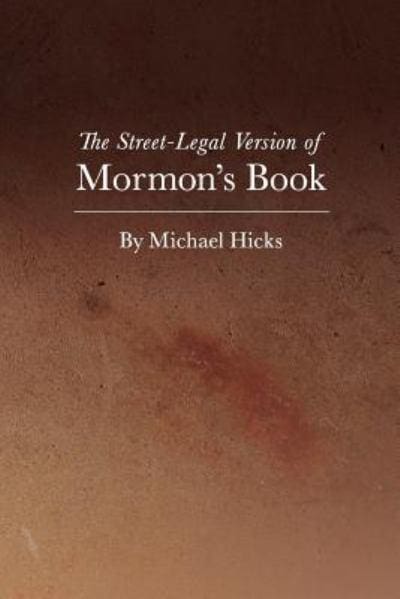
 As the 7th feature of our Mormon Stories Book Club series, we feature Michael Hicks and his book The Street-Legal Version of Mormon’s Book, accompanied by podcast host Heather Olson Beal and readers Mark Brown and Jonathan Yarrington. Please support Mormon Stories by purchasing The Street-Legal Version of Mormon’s Book through this link. A small amount of the proceeds go to help support Mormon Stories.
Michael Hicks, a composer, performer, scholar, and poet, has been teaching in the BYU School of Music since 1985. For more biographical information about Michael, see here and here.
==============
Title: The Street-Legal Version of Mormon’s Book
Author: Michael Hicks
Publisher: CreateSpace Independent Publishing Platform
Genre: Non-fiction
Year: 2012
Pages: 504
Binding: Paperback, Kindle
ISBN-13: 1477615830
Price: $17.25 (paperback), $6.99 (Kindle)
Book Description from www.amazon.com:
Not a “simplified” version of the Book of Mormon, but a completely rewritten paraphrase, with a contemporary voice hovering somewhere in the realm of J. D. Salinger, Hunter Thompson, and some generic humanist academic/poet, i.e., me. An affectionate, meditational dramatization and commentary. From the Introduction: “Why ‘street-legal’? That’s a term we use for souped-up cars—streamlined and powerfully efficient but also decorative, with decals, pinstriping, and tricked-out doodads—that still can be ridden in normal lanes of traffic. They’re not cars meant for everyday errands, to be sure. Offroad is their normal habitat. But the only thing they usually lack to be ‘normal’ is a better muffler. This paraphrase of the Book of Mormon is like that. I’ve streamlined a lot of passages, put them in terse, up-to-date vernacular, thinking that’s what one would have done if one were scratching the book out on metal plates. I’ve tried to muscle up the prose. But I’ve also added lots of linguistic decals: digressions, snippets of commentary, queries, and even humor, which the original editor, Mormon, apparently cut.”
In March 2013, the Association for Mormon Letters gave the book the “first ever award for adaption from a modern language into a more modern language.”
Book Club Resources:
- Reviews of The Street-Legal Version of Mormon’s Book
- https://www.dovesandserpents.org/wp/2013/04/a-street-legal-version-of-the-beatitudes/
- Video resources:
- Other Bloggernacle resources/writings by and about Hicks
Episode Transcript
Guests: Heather Olson Beal, Jonathan Yarrington, Mark Brown, Michael Hicks
This transcript is machine-generated and lightly edited for readability. The audio is authoritative. Please excuse occasional errors in names and spelling.
Welcome and Panelist Introductions
Michael Hicks [00:00:00] 1, 2, 3.
Mark Brown [00:00:07] Mormon Stories podcast is a production of the Open Stories Foundation. All donations to Mormon Stories are fully tax deductible and go directly towards keeping the podcast alive and towards building a community of support for Mormons like you. To support the podcast or to join the community, please become a monthly subscriber today@mormonstories.org.
Heather Olson Beal [00:00:28] hello, everybody, and welcome to what I think is the sixth or the seventh edition of the Mormon Stories Book Club. This is Heather Olson Beale, and I'm excited to be here tonight to talk about a really cool book and with some really cool readers and people just in general. So hopefully this is gonna be fun. I'm here tonight to talk about a book called the Street Legal Version of Mormon's Book, which is written by Michael Hicks. And I'm gonna have Michael introduce himself and our two readers. But I'll just tell you guys quickly that the other people that are. That are here with us tonight are Mark Brown and Jonathan Yarrington. So I guess we'll just start. Actually, we'll start with Mark and then Jonathan, and then we'll end up with Michael. If you guys could just tell us a little bit by way of background, maybe Michael could give us a little bit more information since it's his book. But Mark and Jonathan, if you guys could just tell us a little bit about yourself, where you're from, a little bit of background information, what you do, then you can start us off.
Mark Brown [00:01:34] Starting with me. Okay. I call Houston, Texas, home. I pursue Mormon studies as an avocation. And I think the thing that sets me apart in this panel tonight is I am pretty sure that I am the only person who has ever been invited by the ward choir director to not participate in the ward choir. He pulled me aside after practice one day and said, brother Brown, it'll probably be best if you sit this one out. So I did. So anyhow,
Michael Hicks [00:02:11] that's bad.
Heather Olson Beal [00:02:12] I've actually never heard of that happening.
Mark Brown [00:02:14] Mark, I am an enthusiastic but untutored singer.
Michael Hicks [00:02:19] That's more common than you would think. Sorry.
Mark Brown [00:02:23] And it didn't offend me at all. I could totally understand.
Heather Olson Beal [00:02:26] Oh, I had a year or two stint as a ward choir director, and I'm not trained to do that, but. So I was more sympathetic. But I did have some people where I sort of thought, wow, if those couple of people didn't come, we would sound a lot better. But they loved it so much that I would just sort of tell myself, Heather, that this is not what this is about. This is because they're Here, and they love it and they come every week and they're dedicated, and so it has a different purpose other than what you might think. Anyway. Okay. And I actually saw Mark somewhere online, and I think maybe you were like, hey, did you ever live in Baton Rouge? And then we figured out that we had been in the same wars. Kind of small Mormon world connection. So that's fun. All right, Jonathan, what about you?
Jonathan Yarrington [00:03:13] I am originally from Idaho Falls, Idaho. I currently am finishing a doctorate in music at the University of North Texas in Denton. And I'm a former student of Michael's during my time at byu. Became a sort of fan and have remained one since, so I'm happy to be here.
Heather Olson Beal [00:03:36] Very cool. And Jonathan is married to the sister of Erin Hill, who's one of my dearest friends in all the world. And Erin has been on a couple of these podcasts as well. So that's another one of those little Mormon connections for you. All right, well, Jonathan and Mark have read the book, and I. And so we're excited to talk to Michael about it. So, Michael, why don't you tell us a little bit about yourself so we can know more about you besides that you wrote this book and that you're a professor at byu.
Michael Hicks [00:04:04] Well, I was born in San Jose, California, long, long ago, I should say, and joined the church when I was 17 after pretty active stint in evangelical, really kind of Pentecostal circles. So I was a really avid religionist and knew my Bible pretty well. Came to the Book of Mormon at age 17, as I mentioned. I've been active in the church since, and I pursue music composition, poetry, literature of various kinds, essays and so on. I'm kind of involved, I guess, what they used to call a man of letters or something, although I actually don't write letters much. But should I say something about this particular project to sort of get right into that?
Heather Olson Beal [00:04:59] Well, tell us a little bit. Just tell us a little. Give us a little bit more background information. What do you do at byu?
Michael Hicks [00:05:04] Oh, I teach music composition and theory, Jonathan. I had in a theory class. And in aesthetics, I teach score analysis. And so the academic side of music, I don't teach any instruments, don't teach voice. And so that's pretty much been my career. I studied at the University of Illinois, got my doctorate there in 1984, and came to BYU in 1985. So that sort of puts me in the academic framework there, I guess.
Heather Olson Beal [00:05:40] So you've been at BYU for then, almost like 30 years?
Michael Hicks [00:05:44] Yeah, 20. I think this is the end of my 27th year.
Heather Olson Beal [00:05:48] Okay.
Michael Hicks [00:05:49] Right now? Yeah. Academic year.
Heather Olson Beal [00:05:52] Okay, cool. Okay, well, yeah, unless anybody has some other question they want to ask you kind of background wise, Mark or Jonathan, do you?
Mark Brown [00:06:06] Okay, yeah. Let's just get right to the book.
Why Michael Hicks Wrote This Book
Heather Olson Beal [00:06:08] Okay. Yeah. So I had kind of an intro question and so did Jonathan about this book. But before we start, I'm gonna read a little snippet, a little snippet from the introduction. So when I first heard about this, I think I saw it somewhere on Amazon. Like, you know, when you start searching for different books, then it tells you like someone who read this also looked at this and then you kind of get in that black hole thing. Yeah, I looked at it and I was like, wow, this is some sort of modernized translation. Like I was kind of thinking of like the NIV of the Book of Mormon, so. Or anyway, so I was intrigued. And I'm just going to read this little snippet from your intro. And this comes. And this actually is from the book description on Amazon because it says it's not a simplified version of the Book of Mormon and it's not a translation, which is what I originally thought it was. But Michael's got a little part here in the introduction that says, why street legal. That's a term we use for souped up cars. Streamlined and powerfully efficient, but also decorative with decals, pinstriping and tricked out doodads that can still be ridden in normal lanes of traffic. They're not cars meant for everyday errands, to be sure. Off road is their normal habitat, but the only thing they usually lack to be normal is a better muffler. This paraphrase of the Book of Mormon is like that. I've streamlined a lot of passages, put them in terse, up to date vernacular, thinking that's what one would have done if one were scratching the book out on metal plates. I've tried to muscle up the prose, but I've also added lots of linguistic decals, digressions, snippets of commentary, queries, and even humor, which the original editor Mormon apparently cut. And I just was going to say too that I guess it was last week the association for Mormon Letters met. Is that right, Michael?
Michael Hicks [00:07:57] Yeah, last Saturday.
Heather Olson Beal [00:07:58] And gave the book an award. It said for the first ever award for adaptation from a modern language into a more modern language. And then it says at the end of that award, which is really cool, we are told to acknowledge God in all our ways. Michael Hicks has given us yet another way to let God appear. Yeah, I thought that was really neat language.
Michael Hicks [00:08:23] Actually, my favorite thing was actually having a category created for the book because I sent the book in because they solicit books for potential awards. And I said, I said, I have no idea what category this would go in because it doesn't really fit anything. And so they invented this category, which is, like, I say the funnest thing about it, I suppose.
Heather Olson Beal [00:08:46] Yeah, well.
Mark Brown [00:08:47] And it deserves its own category.
Heather Olson Beal [00:08:50] Yeah, that's what I would say. I mean, I've seen. I've had some people see me with it and they're like, you know, whoa, what is that? And then I do sort of stumble a little bit to try to explain exactly what it is. I'm like, well, I've never read anything like it. Yeah, so we can get into that a little bit. I just wanted to give a little bit of an introduction so people would know something about what it is and that people would know. Like I told one person, I was like, yeah, it's hilarious. It's a hilarious version of the Book of Mormon. And then you kind of get this look because it's like, oh, is the Book of Mormon funny? And I'm like, it is. If you didn't know that it was funny, then you've been missing out anyway. So, yeah, I just was gonna ask you to start with where the idea for this book came from, kind of what the genesis of it was.
Michael Hicks [00:09:40] Well, that's a great question, and it's a fairly easy for me to answer, I suppose, because I, as mentioned, grew up a young Christian. I mean, back in those days referred to as Jesus freaks. And the scriptures that I knew at the time, as far as the New Testament and even Old Testament were modern translations and sometimes fairly freewheeling translations. The New Testament that first got me turned on was good news for modern man. I don't know if you know that translation. And at the same time you had the living Bible, which was a full blown paraphrase of the Bible. I knew the Phillips translation and so on. All these things were pretty up to date. And that was the kind of scriptural language that I knew and I was pretty much raised with. I never knew the King James Version at all growing up. So the Book of Mormon has always been kind of alien to me in that it affects a King James English, sort of pseudo King James English. And I often read the Bible in other translations. I think probably more commonly do that, although by now I know it pretty well in King James. But the specific genesis of this book was the fact that our bishop asked the Ward, as many bishops do, or challenged the ward, I should say, to read the Book of Mormon again within a certain period of time, three months or something like that. And I had never read the Book of Mormon since I joined the church. I joined it in 1973, and the book of Mormon was really the hardest thing. It was the biggest stumbling block for me joining the church. It's the opposite for many people, of course, for me, it was tough because I knew the Bible so well, and so passages in it were hitting me as anachronistic and sounding like things that were in the Bible that I knew so well. So it was tough for me. I just didn't have that same feeling. I started out in the church with teachings of the prophet Joseph Smith. That was my initial scripture, you might say. And then I went to Doctrine and Covenants and I read lots of other books, marvelous Work and Wonder and Articles of Faith and so on. But the Book of Mormon was actually the toughest one for me. I had not read it again, though I tried a number of times over the years. And I decided that I was going to finally do this thing that the bishop had asked everyone to do. But I could only do it if I could rewrite it as I read it and make it fit into my way of thinking and even my literary notions. I think often of a phrase from a stake president we had in 1985. I think we were pretty new here in Provo, and actually at the time we were living in Orem, and the Stake president was talking to members of the Stake in Conference about President Benson's Council to Women to basically not go to work, to stay at home. And he used this phrase. He said, I hope you will take President Benson's counsel and adjust it into your lives. Is me adjusting the Book of Mormon into my life. That's how it came about. And so I literally sat down, copied each book out into a word file and then verse by verse, just went through and rewrote it. And it is funny, we can talk about that a little bit more later on, but it is me sort of meditating on it and dramatizing it. It's full of commentary. It reduces a lot of redundancy and puts it in a language that, as I mentioned, I think even in the preface, that is sort of somewhere. It's kind of in a Hunter Thompson, J.D. salinger, and frankly, a lot of Woody Allen in there, too. That was the way that it worked for me, and it was a great experience. I spent every day for seven months just doing What I described.
Heather Olson Beal [00:14:32] Jonathan, did you want to ask kind of a follow up question to that?
Jonathan Yarrington [00:14:36] Well, I think he answered my question. I'm thrilled. That's mostly what I wanted to hear about. I was curious to hear what kept drawing you, what drew you back to the Book of Mormon. You mentioned it being opaque and other things, and I wondered what would keep you coming back to it. And it sounds like this was your first time trying to go cover to cover. So my question's been answered.
Michael Hicks [00:15:01] I was just trying to do what the Bishop said. You know how that goes.
Jonathan Yarrington [00:15:04] That's great.
Working on the Book and Its Organization
Heather Olson Beal [00:15:07] Okay, so as you were working on it then, were you, you know, were you telling people or. Because I know how that goes in a war and people will be talking about it or how much have you read or whatever? I mean, were you telling people that you were working on it or was it kind of like on the sly or did you. Did you plan to do the whole thing or was it just kind of like, I'm going to try this and see what happens?
Michael Hicks [00:15:25] I actually didn't plan to do the whole thing. I didn't know what I was doing, frankly. I started working out in November of 2011, and by Christmas had gone through the Book of Mosiah. And so I printed it out and gave that portion to a number of friends. And that in itself became a kind of commitment for me. I realized I've done this. Now I have to do the rest of it, either for next year's Christmas present or in some way it seemed necessary to do the whole thing. It seemed necessary to my soul in a way, and I really had enjoyed the process. You know, you mentioned the humor. I have to say, there were a lot of times in writing it, I just started laughing. I just. I mean, I couldn't because something came out of or through my own head and it just made me laugh. But the source was the Book of Mormon as we know it. But the humor somehow squeezed its way out through this toothpaste tube of revelation or inspiration or whatever. I don't want to say revelation, and there's a reason that I call it Mormon's Book rather than the Book of Mormon, because I feel like the church is pretty proprietary about the name the Book of Mormon, although maybe Parker and Stone are just as proprietary about it now. But I wanted to, you know, really trying to not have it be a surrogate Book of Mormon or even present it or market it, particularly as such as to whether I told anyone in our neighborhood I was doing it or our ward. No, not really? Because those aren't the people that would really respond to it. I don't think so. I don't think I. Well, I'm sure I didn't give copies to anyone in our ward. Maybe. Maybe one person.
Heather Olson Beal [00:17:24] Okay.
Michael Hicks [00:17:25] And. Yeah.
Heather Olson Beal [00:17:27] Yeah. I have to say that just in reading it, and I haven't read the whole thing, but just what I've read, I'm like, oh, it's. I mean, it humanized it in a way, because I would say that I share a lot of your feelings about it. I have not enjoyed reading the Book of Mormon ever. This feels like True Confessions. You're not supposed to say that, right. I'm a very avid reader, so I read a lot, and that has kind of frustrated me over my lifetime just to feel like, what is wrong with me? Like, why can't I read this book that I'm supposed to read, that I'm supposed to love, that I'm supposed to derive so much meaning from? But it just feels so stilted to me. And then I don't. Anyway, so that's kind of. I've tussled with that. But. But yeah, and just reading it, I'm like, oh, there's got to be so much more kind of humanity. And yeah, all this interesting dialogue with the siblings and all these know, in the beginning with Nephi and Laman and Lemuel and that we just don't get, you know. So for me, yeah, I found I definitely laughed out loud and I, you know, reading it in sacrament meeting and like, jabbing my husband, and I'm like, you got. You got to read this part. This is so funny, you know.
Michael Hicks [00:18:33] Well, with respect to the. I mean, I've always done this in our, you know, every four years discussions of the Book of Mormon, people will be talking about Nephi and the things that Nephi said and I would always comment on, but Nephi's telling the story. Of course he's going to slant it his way. What's the other side of the story? And people seem really bewildered by that. But if I'm reading a book well, I know this well enough. Any autobiography is always going to be puffing up the narrator. They're. There are always going to be other points of view that aren't considered. And so when Nephi is saying, I'm the most righteous guy around, that's understandable. That's human nature to say that. But that doesn't mean that he was the most righteous guy around or that we should be saying, well, clearly Nephi was the best Guy in this group, he had his own issues, one of which was a certain self absorption that comes out really, I think, in a fairly funny way, in a lot of the things that he says in those books, the other books, I mean, there's less and less autobiography, of course, as you go on in the Book of Mormon, but I kind of kept the tone, which has a certain amount of tongue in cheek or a yeah, right. Feel to it through a lot of the book, but without in any way meaning to be blasphemous or sacrilegious or even coy and not even demeaning. But I think really working from a tradition that's not only true to the way I was raised with respect to the Bible, but what I think is true about the Hebrew scriptures themselves. I mean, I think about Abraham and the Lord tells him, oh, you're going to have a son. And what does he do? He falls on his face laughing. And I'm thinking it was kind of a weird, funny thing. And you see this all the time in the scriptures, especially in the Old Testament. And a lot of that response to God and interaction with God on a humorous level plays out in the great history of Jewish comedy, frankly, in vaudeville and so on. So I mentioned Woody Allen before. You've got Seinfeld, you got Rodney Dangerfield, on and on and on. Those sort of humanizing, introspective and self deprecating, but also quizzical looks at life and God and nature and human relations. Those to me come out of the scriptures and, and what I was trying to do with this was to put them back in there where I think they belonged. At least for me, that's the way I had to deal with the Book of Mormon.
Mark Brown [00:21:36] And. Can I just jump in here just a second? I noticed that same thing too, Michael. And I think you strike this balance really well between good humor, but also not. What's the word I'm looking for?
Michael Hicks [00:21:56] Well, it's not mocking.
Mark Brown [00:21:58] Right. There's this affection that comes through for the book and I would, even though I do agree that it's, I mean, it is really funny, but there's also this sense of, I don't know, sacredness or holiness or something that also comes through and I think that's just a remarkable achievement on your part to be able to balance that so well and sustain it throughout the whole project.
Michael Hicks [00:22:24] Well, thank you, Mark, so much. I really, you know, I re. Emphasize the humor part. I think that's fine and great. I do think that I would want people to realize that this is a pretty tender approach to all.
Mark Brown [00:22:40] Yeah, that came through very clearly to me.
Michael Hicks [00:22:43] Yeah. So. And I read. I did a reading from. Which I'll be doing later in this podcast, but on the evening after the association for Mormon Letters, I read this, the last portion of the Book of Moroni, and someone there said, I had no idea this was so poetic from the name of the book. And I. I think that there is a lot of poetry. I mean, my own interest in poetry, I could feel kind of coming through a lot of times, really trying to savor and sort of chew on the original meaning. Sometimes, like an academic, you'll see that, where someone will sort of go into this academic sidebar. But I hope always coming back to
Jonathan Yarrington [00:23:37] a
Michael Hicks [00:23:39] simple and direct, affectionate presentation, sometimes with varying the metaphor or just framing it in a slightly different way, but trying to get at a deeper sense of meaning, at least for me.
Mark Brown [00:24:01] Right.
Heather Olson Beal [00:24:02] Yeah. I'm glad you guys both brought that up, because I didn't mean to imply that, you know, that it's silly or what. I didn't mean that at all. But for me, although that is sort of my mode of conversation, so I read it and felt like. I mean, it just humanized it and made it seem much more real to me. The characters came to life. So it wasn't only just that it was funny, is that it felt like it went, for me from being black and white. Not that. I mean, of course, there's some very, very beautiful passages in the Book of Mormon, so I don't want to downplay that either, but just that it felt very colorful and alive to me and that I was interested and anxious in picking it up and that that's not really a sentiment previously. It has felt sort of obligatory to me. So.
Mark Brown [00:24:45] Yeah, I think that's exactly right, Heather. That. Yeah, that's. Yeah.
Heather Olson Beal [00:24:50] Yeah. Okay. I wanted to talk just for a second with you guys about just the whole idea that we have, you know, the fact that we use the King James Version and that this. You guys can correct me if I'm wrong, that I feel like there's a taboo in Mormonism associated with reading other versions of the Bible, such that, you know, my husband came home a number of years ago with, I think there's a Phillips version. Now I'm gonna show my total. Is there. Is that right? Okay.
Michael Hicks [00:25:15] That's one of the ones I mentioned earlier. It's a very beautiful.
Heather Olson Beal [00:25:19] Yeah, he had that. I mean, he just went to a bookstore and bought several different versions, you know, and I felt this seems really silly to me now, but I remember seeing that and I was like, what are those? What are you doing? Almost as if he had come home with a playboy. I like suspicious, like, what are you up to? And I don't know if that's unique to me. If it is, we don't need to talk about my own pathologies, but I just don't. I wonder if, I guess, is that only me?
Jonathan Yarrington [00:25:45] I had that, Heather. I had that same experience my freshman year at byu. I was reading a lot of Paul, and Paul was so opaque to me that someone suggested I get some different translations of the. The New Testament especially, but the entire Bible. And I remember buying the first one and feeling like I was buying anti Mormon literature. I really. I thought, oh, no, now everything is just going to fall apart in my life because I have bought this translation. Of course it didn't happen, but it felt almost that. It almost felt immoral.
Mark Brown [00:26:19] Wow.
Heather Olson Beal [00:26:20] Yes. So where does that come from? Like, we're laughing at it now. Now we have a sample size of 4 to make these huge speculations.
Mark Brown [00:26:30] See, and actually, my take is that I don't think I've ever felt that. In other words, I don't ever remember feeling that like this was, you know, some other translation was off limits or anything. So I might be here again. That just might be me or my upbringing or whatever.
Jonathan Yarrington [00:26:48] But for me, Heather, it came from family members scoffing, mocking and ridiculing and holding up the King James as something, you know, very, very wonderful and special. I mean, it has its virtues, don't misunderstand me. But, man, I don't know why I had so much loaded up around that, around getting a different translation. But I think it had a lot to do with my own family environment and the way that we talked about those kind of things.
Heather Olson Beal [00:27:23] Well, I feel like also it must have something to do with the whole idea of correlation, because if I sort of think about going to church, I never heard anyone ever use another translation. And I think that's unique. I never saw anyone carrying around another translation. Occasionally you will hear one of the general authorities or I've seen it like in the Ensign, that a quote will come from a different one of the versions, but it's pretty rare. And just, you know, everything online is all King James Version, you know, I think that's unique because other people, if you go to another church, people will get out their Bibles and people have different. Not everyone has the same Bible, you know, or people have devotional Bibles or a Bible for Women or a Bible for teenagers. And some of the Bibles for teenagers look like, you know, a teen magazine, you know, so there is kind of this diversity in terms of that, that we don't, that we don't see in our church buildings, I don't think in our wards, not me, anyway.
Michael Hicks [00:28:21] Yeah, go ahead.
Jonathan Yarrington [00:28:22] Oh, I was just going to say I think we're the poorer for not having that.
Mark Brown [00:28:25] Yeah, agreed.
Michael Hicks [00:28:27] Let me give a little historical background on this because I do delve into Mormon history from time to time as well. In the 1940s and 50s, the first presidency was actually discussing whether we might go to the Revised Standard Version of the Bible, whether that might be a good idea. And J. Reuben Clark, who was a very important member of the first presidency, first counselor, and then later second counselor under David O. McKay, he wrote a book which you may have seen, why the King James Version. And he sets down at length, in a lawyerly brief kind of way, why we need to keep the King James Version. And this is really where it stuck, I would say. He came out with this book which was, I don't want to say endorsed by the First Presidency, but he was in the First Presidency and it was approved to be published. And he makes a number of arguments, and frankly, one of them is that you need to know the King James Version to understand lots of things, allusions and so on in English literature. And I think that's very true. And by the way, I love the King James Version, and I think you do need to know it. So if the phrase through a glass darkly is used, which it often is in many situations, if you don't know that from the King James English, by the way, it's in the Book of Mormon too. That's the secondary question. But if you don't know that phrase, and lots of phrases, you know, seek and ye shall find, just so many things that have become part of English language and lore and admonitions and so on for hundreds of years, then you're really the poorer for it. But one of the reasons that J. Reuben Clark gives is that if you change the King James or you substitute another translation, you're actually eroding the language of the other standard works, because suddenly they become the oddballs. And so with the King James English, which is found in, of course, all the others, all the other standard works, then they're sort of all the same. It helps make them seem like they're part of the same text in some way. But if you were to use, even in an ad hoc way, as you've mentioned, another translation that particularly if it's more vibrant and comprehensible, then you start to think, why are these others? Why do they have a different feel about them? Why are they so deliberately archaic? Because, of course, the language of Joseph Smith was not the King James English. And actually, the King James English wasn't necessarily the language of their time, at least in the vernacular. I think you understand how this affects people. People need to have. Mormons need to have a feeling of this slight remoteness in language to access their feelings about divinity. This is a problem in the prayer language that we have, as you know. Have any of you been learned another language and particularly been a missionary?
Heather Olson Beal [00:32:06] Yes. Spanish.
Michael Hicks [00:32:07] Yeah. Okay. Well, you know that you use the
Jonathan Yarrington [00:32:10] familiar form with God in German. Yeah.
Michael Hicks [00:32:12] You know, and it's exactly the opposite in English. It's always been a troubling future, and it changes your notion when you're talking to others and using this language in prayer. And it's this intimate, close, friendly thing. It's the opposite of what we teach people to do in English. And you probably felt that there's a different intimacy factor that comes into play with that kind of prayer line. Same thing with the language of scriptures, I would say.
Mark Brown [00:32:46] And let's just add a caveat here that applies, Michael. But again, as with prayer language, it only applies in English, which is, you know, so that's something to keep in mind.
Jonathan Yarrington [00:33:00] I've often wondered how they translate talks on that in General Conference.
Heather Olson Beal [00:33:06] Yeah. How does that work? Because it's. I mean, I remember learning how to say a prayer in Spanish and. And then being like, wait a minute, like, that's common language. That's informal. And then sort of reflecting on. Because I grew up in Texas and when you hear people pray, kind of Bible Belt conservative, fundamentalist Christian. I mean, I remember, unfortunately, not long enough ago, hearing people pray and judging them and feeling like that's not reverent. They sound way too chummy. Like that's not the way that we should be approaching Heavenly Father. And I mean, I'm ashamed of that now for thinking that, because it's a stylistic thing, and I shouldn't have made those judgments, obviously. But, yeah, it's wild to think about. For some reason, I feel like we need. That's what you're saying, I guess, Michael, we need for it to feel not common, like we don't want our language to sound familiar. Does that feel like we're sullying it or. I don't know where that comes from exactly.
Michael Hicks [00:34:13] Well, There's a place for formality, that's for sure, but there's a place for the other too. And I think we've got formality overkill in lots of dimensions, of course.
Mark Brown [00:34:24] Yeah. And I'd like to suggest that I think this has more to do with written language where we feel this. Okay. There's this intentional distancing almost. But for instance, when you know, if you're having family home evening or you know, reading the scriptures with a six year old, we do it all the time. Well, you know, well, sweetheart, this means this. And then we put it into other words that, you know, that we hope will be meaningful and nobody bats an eye at that. I think it's only when we go to do it in writing that people think, whoa, you can't do that. Which I, you know, I mean, we do it with living scriptures, you know, I don't, you know that. I just don't get why we are that way.
Heather Olson Beal [00:35:08] Interesting. Okay, Jonathan, you had a question, kind of that had to do with the intro. Do you want to ask that one?
Jonathan Yarrington [00:35:19] I think he's covered that pretty well. And what he's already said is his introduction answered actually both of my questions. So let's give someone else a chance.
Heather Olson Beal [00:35:26] Okay, Michael, you were channeling some of these questions. I just wanted to ask just about the organization of the book. So you mentioned that there are redundancies and that you took those out. Okay, so when I first started reading it, I had my Book of Mormon out and so I was kind of going back and forth and then pretty quickly I was like, oh, wait, where's verse seven? Or what happened to that? Or there were times like I have, everyone has, I assume, favorite scriptures, even though I just said I've not loved. I do have favorite scriptures in the Book of Mormon, even though I've not loved to sit down and just chew through it. So I was like, oh, I wonder how he translated that, because that's one of my favorites. And then I'm like, oh, I can't find it. I mean, and I could look harder, of course, and I did on some of them, but I just wondered if you could talk a little bit about why you set it up that way. If you did it that way intentionally, did you want or not want for people to do what I was kind of doing, like comparing and reading back
Michael Hicks [00:36:22] and forth, you know, I didn't want people to do that. And I have talked to people who have tried to do that, which is fine with me. It seems like the sort of extra labor that we often give ourselves as Mormons to be fastidious. But I really wanted to. I wanted to have it flow. And first of all, the division of Scriptures into chapters and verses, particularly verses, is really hard on the appreciation of any story or message and even the language itself. It just is. It's just a constant. It's an interruption, really. And I knew from the very beginning I was not going to be trying to do verse by verse because I was reading. And I do this with all the scriptures. Scriptures, you know, I'm reading for the whole thing. And, you know, I have a phrase that I learned way back as a teenager. Whenever you see a therefore, understand what the therefore is there for. Okay? Meaning you have to go back, say, okay, if it says therefore, then I need to reach back and see, okay, what are all the ideas that are taking you to therefore. So if you read a verse by itself, for example, as we often do, particularly in, say, Doctrine and Covenants Section 1, and it says therefore, such and such, I insist to myself and to people, if I'm teaching Scriptures in church, I insist we go back and say, okay, why is the what is the therefore there for? And I think the same approach as that enters into the way I dealt with all the scriptures in the Book of Mormon. I'm reading it and say, okay, what are they really trying to say here? What are they getting at? Or at least what am I getting from what they seem to be getting at? I will say that in a lot of places, I really extracted message and sermonized a bit myself, particularly when it comes to warfare. When you get into the war chapters in Alma and so on, there's nothing good to be said about war in the Book of Mormon. And this is something that I guess is a frustration to me, is that people seem to find in the Book of Mormon a certain celebration of war, and they champion war heroes. Moroni, for example. And yet, to me, the Book of Mormon has as one of its great themes, the utter futility and nonsense of war and stupidity of war, and the fact that it's just this sort of gory back and forth in which ultimately everybody dies. So, you know, as I read and felt that, it's like, okay, that's. I want that to be clear, as it seems to me, in the language in which war is described. So I'm very brutal and bloody and. And kind of sometimes even a little Quentin Tarantino description of gore, but I think that's a message. And so from time to time, there were messages I thought were coming through As I read it, and I thought, I want to make sure that at least the way I'm paraphrasing this is making that message clear and fluid in some way.
Mark Brown [00:40:03] That was something that I noticed, actually. I don't think I went consciously looking for verses, but I went looking for chapters. And as I said, okay, so I'm reading this chapter, and I get halfway through it, and I was thinking, wow, he is really allowing himself a lot of free reign here. And I wonder where he's going with this. But then by the end of the chapter, you always seem to tie it up in a way that would. Okay, I get this now. This is just another way of looking at the same thing. But I think you did that pretty
Jonathan Yarrington [00:40:32] well, where
Mark Brown [00:40:34] sometimes it looked like you were really going off into left field somewhere, but just staying with the chapter. Okay, I see how this ties together now.
Michael Hicks [00:40:43] Yeah. Well, thank you.
Jonathan Yarrington [00:40:46] That's one of my favorite things about reading it, too, is that, I mean, years ago, as soon as I knew there was an 1830 reprint, I sought it out and bought it so that I could read it in, like you said, sort of as a whole, in a totality, without the interruption of versification and so on. And it was a thrill to be able to read, you know, this street legal version and not be encumbered by any of that. So I did sort of immerse myself in it and get the feel and the run of the story, and I love that.
Michael Hicks [00:41:17] Oh, thank you.
Heather Olson Beal [00:41:19] Okay, well, I guess I just. Oh, sorry, go ahead.
Michael Hicks [00:41:22] Say, with some of the longer books, it is really tough because you want to have some sense of where you are, I think. And just. Because if a book like Alma is so long, you feel like maybe we need some chapters in here. As you know, the first edition of the Book of Mormon had some chapters, but they're pretty long chapters. So I felt a little bad about that, but I got over it.
Heather Olson Beal [00:41:46] Well, you guys have convinced me that I need to just sit in a chair and just read it, because I've been reading it so far, wanting to just compare it. Yeah. Michael, I think you said we have a fastidiousness about us. I guess I'll own that and say, yeah, I have, but it sounds like I need to just read it and try to enjoy the narrative. Yeah. Okay. Well, let's take a step back, and Mark in particular had a couple kind of big picture type questions, and I, as I'm revealing here, was more interested in some of the nitty gritty. But, Mark, why don't you ask some of your kind of more high level meta questions.
Mark Brown [00:42:26] Let's see, what were they? Give me a hint.
Heather Olson Beal [00:42:29] Okay, so you were talking about how it balances seriousness and humor. We already kind of talked about that.
Mark Brown [00:42:34] Yeah, we talked about that. Yeah.
Heather Olson Beal [00:42:36] Thinking about translation, you talked about interacting with text.
Mark Brown [00:42:40] Yeah, yeah. Okay. So what I was thinking was if, like say for instance, if, if Heather and I and Jonathan also, each of us undertook to do a project like this, we would wind up with three different versions that would be different from your version, which would also be different from the Book of Mormon. And so what really interests me about that is how this process of interpreting or, you know, let's stay away from word translation, but how we understand a text and how much of it is. How much of what we understand from it is determined by us. I mean that the meaning is refracted through my background, my experiences, and there's just simply no way to get away from it. And so I. Thinking about that in terms of the Book of Mormon itself, I, you know, for some people it really disturbing when they read the Book of Mormon and find, for instance, they see a lot of Joseph Smith or 19th century America in the Book of Mormon. Whereas for me the big red flag would be if I didn't see it there, I would wonder where it came from. So I guess part of what I enjoyed about the street legal version is what you brought to it and then how I was also able to interact with that. It was just so interesting to me. But I did. There was something here that I wanted to. This is a statement that Brigham Young made specifically about the translation of the Book of Mormon. Well, and the Bible too. He said this in July 1862. Should the Lord Almighty send an angel to rewrite the Bible, it would in many places be very different from what it is now. And I will even venture to say that if the Book of Mormon were now to be rewritten, in many instances, it would materially differ from the present. What do you. Well, two questions actually. What do you think this means in terms of capital T, truth in our canon that we all need to stand up and salute? And also just a follow up question, which maybe you want to answer this one first. Do you think the Church is ready to accept Brigham Young as a postmodern literary theorist?
Navigating Doubt and Sensitive Content
Michael Hicks [00:45:13] Well, I'll answer the latter question first. No,
Mark Brown [00:45:22] that was easy.
Michael Hicks [00:45:23] But you may recall in the preface I actually quite that statement of Brigham Young's, particularly for the notion of being rewritten. And that's what I intended to do was to rewrite it. And so I'm not saying this is a translation and this is not a truer version or anything like that. Let me mention that as I was writing it and I did the first portion, basically third of it, as I said before Christmas or by Christmas 2011, one of the people I gave it to, whose parents are very strong, orthodox, old fashioned, as I understand it, at least I don't know them, but from what my friend tells me, Latter Day Saints. And I was a little nervous, well, what would they think about it? And he showed it to his father and his father said, I think everyone should do that. Absolutely. I was quite taken aback. And probably more than one time, just as you change, the words don't change. But this is true of any book. Anytime you reread something, it's not a magical thing. It's not something that's special about the Book of Mormon or any scripture. Although some people talk about it that way. Like, oh, every time I read it, I get new things out of it. It's like, that's because there's new things in you, right?
Mark Brown [00:46:57] Yeah.
Michael Hicks [00:46:58] And that's the whole point of rereading is to have words unlock these chambers in you that have been built along the way. I have this dream. People have recurrent dreams and for years I had this dream that apparently is fairly common as I read dream literature and analysis. Well, I haven't done it recently, but that I'm living in a house and suddenly I discover there's a whole wing of the house that I didn't know about. Does that sound familiar?
Mark Brown [00:47:33] Yeah.
Michael Hicks [00:47:35] And that's what happens when we read and we reread things, that we're discovering more about ourselves.
Mark Brown [00:47:41] And so, and especially with this text, I mean, the Book of Mormon explicitly admonishes, you know, apply this to yourselves, of course.
Michael Hicks [00:47:49] Yeah. Oh, yeah, yeah. Oh, well, I had to follow that from the very beginning. I'm liking this to myself.
Mark Brown [00:48:00] Exactly.
Michael Hicks [00:48:02] And hopefully along the way I will liken myself to it, you know, that I will be. Oh, what's the language of Paul? You know, be not conformed to this world, but be ye transformed by the spirit. And so when we let ourselves be transformed by the act of reading really anything and find out more about ourselves by somebody else writing from their heart. I mean, I think that's what reading is all about. And I think it's a very sacred thing. Any kind of text can be. Maybe not any kind of text, but certainly almost all texts that we encounter. And absolutely. I love that Statement, you know, if an angel came and rewrote would be different and hallelujah for that.
Mark Brown [00:49:00] Agreed. Now, okay, another follow up question. If it's okay, were you worried at all that about being faithful to the text, that you were maybe putting too much of yourself into it or did you have to work to strike that balance or not?
Michael Hicks [00:49:22] I did. I was concerned about it to a point and I did. I think I was very, I think I would say careful in the sense of full of care in dealing with it. But at the same time, the Book of Mormon was made for man, not man for the Book of Mormon. To paraphrase.
Mark Brown [00:49:48] That's a really good attitude. I think
Michael Hicks [00:49:52] this book is for me. I have to deal with. I have to see what it can reveal to me and in me. And maybe I should add side like this. There's one. This is part of the reason why I've not tried to market this. I didn't want to. I didn't even send it to a publisher. I didn't want to go through the whole review process and have people recommending changes and so on, so forth. I've published academic books. I've published four books with the University of Illinois Press. I was the editor of their journal American Music for four years. I kind of know the scene. I did not want this to be that. And I didn't want it frankly to be on a lot of bookshelves and you know, if it made it to deseret book even or to, you know, I mean, I wanted it to be. I'm just poet. I did it. I didn't go back and revise it at all. I had a few people proof it, you know, but I, I just, I wanted to. It's like this is what I did it. And I kind of wanted to actually enjoy the feeling that Joseph Smith himself had. In a slightly different circumstance, of course, a greatly different circumstance. But just let, just doing it and just letting it flow and writing it out, typing it out and then say there it is, I did it, I like it. And if there's awkward parts, you know, that's my fault. If there's things that, that are misconstrued, that's my fault. But I didn't want it to be something I was marketing or that had the look of something that I would be doing to serve other people. I wanted it really to be something that was a personal response, testimony, meditation, dramatization, all of those kinds of things. And not, as I say, a surrogate translation and not something that had a commercial feel to it. So you have to hunt for it. If you want to get it, you got to go hunt for it. I mean, Google it. That's not a lot of hunting, but you know what I'm saying. I wanted to have it be a public, private thing in a way.
Mark Brown [00:52:07] Don't want it selling by the boxload at the Walmart.
Michael Hicks [00:52:10] Yeah. And I didn't want to have a bunch of backstock of my own. I didn't want to have to have it printed and then, you know, have boxes of it sitting in my house. It's like, you know, it's print on demand and. Or you can get a Kindle version of it, and that's that. But if. But it's not something I wanted to. I don't want to enter a big fray about it.
Jonathan Yarrington [00:52:32] Sure, sure.
Heather Olson Beal [00:52:35] Well, I certainly hope that some people read it after listening to our podcast.
Michael Hicks [00:52:40] Yeah, I hope so. I hope so.
Heather Olson Beal [00:52:44] Yeah. Hey, Mark, you wanted to ask, too, and maybe see if Jonathan had anything to contribute on this about the music training as a musician.
The Lyrical and Musical Quality of the Text
Mark Brown [00:52:53] Okay. Yeah, well, we already touched on a little bit. It's just this lyrical quality that comes through, and that's, you know, that's a world that I don't know much about, actually. And so I was wondering how much do you think your music training played into this at all, into the final way, either consciously or unconsciously? And if Jonathan has anything there to add, that would be enlightening to me as well.
Michael Hicks [00:53:25] Well, let me say this. And Jonathan can add his own dimension to it. I actually had this experience literally yesterday. I was. I don't have a computer in my office at school. I want my office at school to be a computer free zone. So I have books in there. I have a grand piano in my office. I have lots of papers spread out when I go in my office. I don't want the distractions. And I'm really an avid computer person. And if you know me on Facebook, you know, I'm very avid there. But I need my office to be kind of a sanctuary. So when I need to use the computer, I use the one that's in the mail room. And I was in there actually working on my next book, which is a book about the Tabernacle Choir, which is going to be a great book. I'll just say that.
Mark Brown [00:54:10] Yeah, I've seen those experts. I'm really looking forward to it. It's going to be great.
Michael Hicks [00:54:14] But I was typing some passages in the draft of that book at the computer in the mailroom, and Curt Saville who's our wind ensemble conductor, walked in and he said, you're conducting. I said, and he noticed that my left hand. I was thinking about it, was formulating the sentence in my mind, and my left hand was moving like a conductor's. He said, you're very good. I said, I hadn't noticed that. But actually I do do that when I'm thinking. And I'm absolutely certain because I was conscious of it at the time when I was writing Street Legal Version. A lot of times I would be sitting there and my left hand would be as though it were conducting something. Just those kinds of gestures and so on. So it's certainly.
Mark Brown [00:55:08] That is so cool. I envy you that.
Jonathan Yarrington [00:55:12] Anyway, I would like to chime in and say. My favorite class that I took for Michael at byu, maybe this will come as a surprise, was History of Rock. It was a seminar, and there were just a few of us in the class. But I grew up as a musician. I grew up singing. I grew up playing the violin. From the time I was five, I got in that class and I started to notice things about rock and roll that I had never paid attention to before. The way he had the class work where we had to listen and notice things that were going on in the music and write them down and then come and talk about them and so on. I woke up all of this stuff and sort of went, oh, my goodness. And I was amazed at his ability to sort of just absorb that and know it and converse about it. And I sort of. Wow. I'm amazed at people who can do that. And I think you can't separate that in a person from their ability to. Then, you know, it comes out in their writing, it comes out in their teaching.
Mark Brown [00:56:16] That's what I was. Yeah.
Jonathan Yarrington [00:56:17] And it absolutely is there. You know, you can't necessarily point to this is an analog to that or this equates with that. But I can absolutely say his ability to do that and to teach other people to start to learn to do that, which is a gift in itself. Also show up here in the text. Absolutely.
Michael Hicks [00:56:36] Wow.
Mark Brown [00:56:37] Thanks, guys.
Michael Hicks [00:56:39] Thank you.
Heather Olson Beal [00:56:40] That's very cool. That's funny. I spend almost my whole day in front of the computer. And then often at night when I come home. And I'm a really fast typist. It's one of the very. It's on my very short list of things that I'm good at. And I was at a steak dance when I was in high school. I learned to type when I was really young. And the boy that I was dancing with actually said, what are you doing? What are you doing on my shoulder? And I said, I don't know. What do you mean? And he said, what are you doing? And then I realized, and this is really freaky, maybe John will come this part out. I was typing our conversation, the left part of it on my hand. And I do that. So like, I'm doing it now as we're talking. I'm typing with my fingers because they're loose. I mean, if I'm holding something in my hand, I don't. Anyway, yeah, I remember. And when I said that to him, he looked at me and he said, that's really weird. And I was like, okay, I'm sorry. That is weird. I'm typing what you're saying on your. On your left shoulder. Yeah. So not as cool as conducting while thinking through.
Mark Brown [00:57:45] Not as cool as A History of Rock and Roll.
Heather Olson Beal [00:57:47] Yeah, definitely not.
Mark Brown [00:57:49] I hear what people say. Rock and roll is here to stay.
Michael Hicks [00:57:53] I'm going to point out that, you know, I write a fair amount. Like I said, I've written a number of books and I don't type. I'm like the guys you see on TV who are looking at the keyboard the whole time. And I've got my own way of typing, but I don't touch my type. I did very poorly in that class back in. I think, as a freshman in college. And I think it's been a benefit for me as a writer because I have to work a little more slowly or I have to think about beforehand and, you know, formulate in my mind the words before they go into the engraved form of the typewriter or the computer. I think of John Updike. I think it was John Updike who when we had the speed reading craze back with Evelyn Wood. Right. Who was a Mormon, you know, that fastidious, you know, let's can do. We can read faster feel to it. And he said, I don't get this. I've spent my whole life trying to learn how to read slower. So I think that my total lack of typing skills. I know it's quite a sidebar to our overall discussion, but I think have helped me in some ways be a better writer. But it's more tedious, of course, but it makes me work a little slower and sometimes revise on the spot in ways.
Mark Brown [00:59:21] Yeah, it probably enforces some kind of discipline on you that otherwise.
Michael Hicks [00:59:26] I think so. I think my son types really fast too, and I wish he would type slower. Well, I wish he'd think a little more slowly. That's all.
Heather Olson Beal [00:59:38] Interesting. Okay, well, a couple of us had some parts that we were going to share that were our favorites. I feel like I've said too much, so I'm going to bow to that. But I know Mark has a little part he was going to read. And Jonathan, did you have a favorite part you wanted to share?
Favorite Passages Read Aloud
Jonathan Yarrington [00:59:55] Just a couple of paragraphs. And they're not as reverent or as sacred perhaps as what Mark is going to read. So maybe I should go first and rather than, you know, sort of, I don't know, come off as silly for what I've chosen. But I love this part. It corresponds with first Nephi, chapter 16, Nephi and the broken Bow. And I just. I love this.
Heather Olson Beal [01:00:22] Just.
Jonathan Yarrington [01:00:22] Just a couple of paragraphs. One time I went out to hunt and broke my expensive high tech metal bow, which made my brothers mad because either A, mine was the best bow, B, I was the best shot, C, I was the least lazy, or D, all of the above. When I came back with no food, they were mad, although a little less vocal to me about it because they had wives to vent with. Now by general pity parties, it started to feel like. So I gave them all what for, made a wood bow and one arrow, then asked dad where he thought I should go. To kill something? He asked God. No surprise there. And God told him to buck up and stop complaining, which sent him into an emotional tailspin. So God told him to look at our magic ball and see what was written on it. I forgot to mention the writing part earlier. He looked and freaked out. It wasn't very kind to any of us, yours truly excepted. I noticed that the ball's pointers only moved when we had faith and would do what it said. And the writing on it kept changing, based apparently on God's mood with respect to us, given our vacillating behavior. This all goes to show that by small and usually weird things, God can make great things happen. I love that.
Mark Brown [01:01:39] So wonderful.
Heather Olson Beal [01:01:41] I love it. I muted my microphone so you couldn't hear all of my chuckling. I love it. Okay, Mark, what.
Mark Brown [01:01:48] What do you.
Heather Olson Beal [01:01:48] What were you gonna share?
Mark Brown [01:01:50] This corresponds to third Nephi, chapter 12. And it is. It's the Nephite version of the Beatitudes. And I like it number one, because it, you know, some of the humor does come through, but also because it takes something that is so familiar and. And makes it new again. Anyhow, so this. This is Jesus. These are the words of Jesus speaking. Now I want to recap one thing that I taught in Palestine before they killed me over there. And if you're offended, don't get any ideas because I'm unkillable now. Blessed are you whose faces droop with the weight of unfulfilled possibilities. You are citizens of heaven already. Blessed are the depressed. Yes, I said that because I will soothe you through the actions of someone in your life. Maybe someone you'd have never thought of. Blessed are those who haven't got an arrogant bone in their bodies because they already run everything worth running. And someday I will give them the rest of it. Blessed are you who salivate for goodness because someday you are going to gorge on God's spirit. Blessed are the merciful, because mercy always comes back to you when you need it and you will. Blessed are the few whose hearts throb with purity because God cannot remain invisible to you. Blessed are people who not only want peace, but make it come to Papa, my father will say to you, as he has always done to me. Anyhow, I like those parts.
Heather Olson Beal [01:03:43] Beautiful. Okay, so the last thing that we're going to do is be treated to Michael reading an excerpt that he chose. So, Michael, if you'll tell us, I guess if you want to tell us what part this kind of corresponds to, maybe you don't. And then we're just going to sit back and enjoy listening to you.
Michael Reads His Own Excerpt and Closing Thoughts
Michael Hicks [01:04:02] Well, first of all, thank both of you for those really beautiful readings. One of the nice things for me is that, as I say, I just wrote the book. I haven't really read it as much as you think. And so when I hear these things, it's like, oh, yeah, I remember writing that way back when. And you both brought such passion and just artistic instinct to it. I appreciate that. What I thought I would do and say, spoiler alert here. This is the ending of the book. This is about a five and a half minute reading, so I'm going to go on a bit. But this is the last part, last portion of Moroni's book and hope you like it. God is love. But to get to that love, you have to go through the gate of faith. It's a gate that when you go through it, the exhaustion you earned to find it starts to blow away like leaves in a strong wind. That wind is God's spirit. It started when the hot flag, fresh earth began to cool. And it just keeps blowing. You fight about diversity. That's half of what's grinding you down to extinction. We have a thousand different gifts, but only one giver. We travel A thousand roads with our gifts. But we crisscross the landscape of faith to beautify it, not distorted. God gives wisdom here, knowledge there, faith here, curative powers there. Unforeseen illogical happenstances here, visionary illuminations about character and hidden agendas there, sight of invisibility here, deft oratory there, exegesis of the spells and incantations we live by here. And do you follow me? God gives all this wondrous assortment of treasure and bafflement to whomever he wants. Genetics be damned, privilege be damned, even authority be damned. Don't dare fence it in. This is how the world works. Hallelujah. From the first seed of it till the last blossom dies. It's only doubt that puts any of it in check. But what makes it all grow is faith, hope and love. As my dad taught, each leads to the next. All are prerequisites to the advanced studies in which we enroll at death. Don't prioritize too much. Without hope, the mind collapses into itself. That's what we call the wages of sin. On the other hand, faith enables everything else you will ever want to do, especially the good deeds Jesus commands. I know I'm rambling, but think of my circumstance. How do you keep a clear head when people are on the hunt to cut it off? Still I keep going on this theme. If God's gifts ever dry up and wither, it will be because doubt sucked the life from them. Someone will be to blame for every molecule of that death. Blessed is the man who transcends that blame. Cursed is every blameworthy heart. Hell is gaping at it, and for it. Jesus is telling me these things. Don't dismiss them because I'll die soon. But in God's time, it's not long before you do too. And we'll both be sitting on the bench in the hall, waiting for our courtroom appearance. When we go into that room, the judge will ask you, didn't you hear what he said? Didn't you read it? That voice, once thought silenced, that keeps hissing from the ground. Someday they'll call it white noise, that hissing that floods your ears when you think you're in a silent place, that hissing, the electricity of your body's nerve endings is God whispering, gasping out his all generational thoughts. If you listen hard enough, it will say, believe, and I believe. Believe me. Come to Jesus and take your gift. Don't steal gifts that aren't yours or start to unwrap any that smell bad. Those are counterfeit, not for human consumption. Get up, Jerusalem. I speak in Metaphor. Get up, Zion. Prop yourself up like a tent. Stretch the fabric. Drive the tent stakes as far apart as you can. Shun confusion, but open your minds to new explanations of your lives. Make promises to God and keep them as if you were daring him to keep his. Come to Jesus and ripen at last. Push away anti divinity. If you do, attempting the grandest love you can conceive, the love of the hidden owner of the universe, then grace, the unearned favor of a son or daughter will suffice. You will ripen and with that transformation, exclude any further dispute about who and what is behind it. If you let God's grace bring you to full maturity, like the fat white fruit lehi plucked from the tree and devoured, then you understand the great reconciliation, the new deal God handed the planet when his son flushed from Mary's womb. The blood of his birth, the blood of his death. All of it is the ink God signs his name with to protect his children and declare them as holy as he is. I'm spent now. Over. I'm headed for that courtroom I told you about. And when I get there, the great reconciliation will turn into the great acquittal. Look up. I'll be the clouds parting over the courthouse. Amen.
Mark Brown [01:10:47] Wonderful.
Heather Olson Beal [01:10:49] Yeah, that was beautiful. I feel like we should end with a minimal amount of white noise, then to finish up and just part with that. Hopefully we'll get this podcast up relatively quickly. And I hope that lots of people go out and read it, even though that wasn't Michael's objective. Just because it's such a. It's such really a cool and beautiful, beautiful project. And I think we're all really privileged to be able to. I feel privileged to be able to have done this and to. And to have read it. So I'm thankful to you, Michael, for reading it and for Mark and for Jonathan for joining us and reading it as well.
Michael Hicks [01:11:26] Thank you.
Mark Brown [01:11:27] Thanks for putting it all together.
Jonathan Yarrington [01:11:29] Yeah, thanks. Thanks, Michael. I love being able to have a fresh approach and something that gives me the chance to wrestle and think and have it a new way. That's a wonderful thing. And thank you, Heather, for organizing this.
Heather Olson Beal [01:11:44] Yeah, it's great. So thanks all around you guys and good night.
Jonathan Yarrington [01:11:49] Good night. Bye bye.
Mark Brown [01:11:54] Thank you for joining us today on Mormon Stories. Music today was provided by the Saber Rattlers. Check them out@sabre-rattlers.com the Mormon Stories logo was generously donated by StudioCase.com thanks for listening.
Closing Hymn
Speaker E [01:12:09] Come, come, ye saints. No toil nor labor fear but with joy wend your way Though heart to you this journey may appear Grace shall be as your day Tis better far for us to strive Our useless cares from us to drive to the San Jo your hearts will swell oh, all is well all is well. Why should we mourn? I think our lot is hard T not so all is right why should we think to earn a great wheel reward if we now shun the fight Gird up your lo fresh courage take Our God will never us for sake soon we'll have tell it oh, all is well all is well oh, all is well all is well. Sam. And should we die before our journeys through happy day all is well we that are free from toil and sorrow too with the just we shall dwell My, what if our lives are spared again to see the saints the rest obtain Or I will make this glorious well oh, all is well all is well well all is well all is well oh, is well. All is well.
Transcript © 2026 John P. Dehlin. All rights reserved. Brief quotations are welcome with attribution and a link to mormonstories.org; all other use requires written permission.
4 Responses
I am curiosity where the quote is from that Brigham Young said about if the Bible and even the Book of Mormon were written today it would come out different
Thanks
Steve, here is the reference for that quote.
Brigham Young’s sermon entitled “The Kingdom of God”, given on 13 July 1862, recorded in Journal of Discourses 9:311.
Journal of Discourses 9:311 has the quote by President Young.