
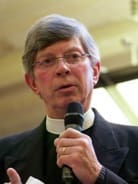
 In part 1 of a 4-part series, Pastor Don Mackenzie of the Three Interfaith Amigos shares his views on progressive Christianity.
Pastor Don Mackenzie, PhD, is devoting himself to interfaith work after retiring as Minister and Head of Staff of University Congregational United Church of Christ in Seattle. Previously, he served congregations in Hanover, New Hampshire, and Princeton, New Jersey. Ordained in 1970, he is a graduate of Macalester College, Princeton Theological Seminary and New York University. His interest in interfaith work began while a student at Macalester and continued while living and teaching in Sidon, Lebanon, in the year prior to the Six-Day War in 1967. His country music band, Life’s Other Side, recorded the sound track for the documentary film Family Name, and has sung at the Ernest Tubb Midnight Jamboree at the Grand Ole Opry in Nashville.
Episode Transcript
Host: John Dehlin · Guest: Don Mackenzie
This transcript is machine-generated and lightly edited for readability. The audio is authoritative. Please excuse occasional errors in names and spelling.
Introducing Pastor Don and the United Church of Christ
Don Mackenzie [00:00:00] 1, 2, 3. Come, come, ye saints. No toil nor labor fear.
John Dehlin [00:00:27] Hello, and welcome to another edition of Mormon Stories podcast. I'm your John Dehlin and today I'm very excited to bring to you a four part series. This is a special series and it is with a very interesting group that I discovered on the Internet. I think one of my listeners actually recommended it. The group is called the Three Interfaith Amigos. And what I'm going to do is interview each one of the three interfaith amigos, followed by an interview with all three of them. And the members of the three interfaith amigOS are, are Pastor Don McKenzie. He is a minister of the United Church of Christ and we're talking to him today from Minnesota. Is that right? Pastor?
Don Mackenzie [00:01:15] That's correct, yeah.
John Dehlin [00:01:17] Welcome to Mormon Stories. Thanks for joining us.
Don Mackenzie [00:01:19] Thank you, John. I'm excited to be here, too.
John Dehlin [00:01:22] The other two members of the Interfaith Amigos are Rabbi Ted Falcon, who is obviously a Jewish rabbi, and Imam Jamal Rahman, who obviously is Muslim. And we'll be talking more about what the Three Interfaith Amigos do. Their TED Talk is outstanding and there's actually two of them and we'll put them up on the, on our website so that you can link to them. But what I thought would be interesting to do first would be to interview each of these three gentlemen individually. And Pastor DON I guess I'll explain to you now a little bit of the rationale. You know, there aren't many religions around that are older than Judaism and Islam. It's kind of hard to beat those two. It's possible, but hard. And then Christianity, you know, follows, and even Protestant Christianity precedes Mormonism by at least several hundred years. And so we are a relatively nascent family faith tradition maybe in the first couple hundred years of its existence. And we're having to learn things now, I'm assuming that many other faith traditions have been able to learn decades and sometimes centuries previous. And so I wanted to briefly have a talk with you about your views of Christianity and the future of religion. How does that sound?
Don Mackenzie [00:02:55] That's fine.
John Dehlin [00:02:56] All right, so I guess I wanted to begin by just having you briefly tell us what is the United Church of Christ, how do they fit into mainstream or Protestant Christianity just so that we can understand a little bit about their beliefs and their position?
Don Mackenzie [00:03:16] Sure. John. The United Church of Christ is a Protestant denomination that was formed in 1957 as a, as a merger of the Congregational Church, the Congregational Christian Churches and a German merger called the Evangelical and Reformed churches, and it became called the United Church of Christ. Its Congregational part is a part of the free church movement that originated in England after Henry VIII took over the Church of England. And in some ways, the free church movement is a reaction to the intense hierarchy of the Church of England and does not wish to have forces above it telling it what to do, believe, and so forth. The Congregationalists included the Puritans and the Pilgrims who came to this country and so forth. So it's part of the mainline Protestant tradition and also part of the Reformed theological Protestant tradition, which includes the Reformed Church of America and the various aspects of Presbyterianism.
John Dehlin [00:04:33] Okay, and this is fascinating to me, and I'm just going to be really candid here. I don't know. How much do you know a lot about Mormonism? A little bit. How much do you know about Mormonism?
Don Mackenzie [00:04:42] I know a little bit.
John Dehlin [00:04:44] Okay. So the first thing that comes to mind is for me to tell you what traditional Mormon beliefs are about Christianity. And you may know this, you may not. And I'm not relating these to you because they're necessarily my beliefs. Right. But I want to relate to you what Mormon theology or doctrine is and just get your response to it more as an educational. For educational value for our listeners than for anything else. So here goes. This may be a little bit challenging to hear, but what we're taught as Mormons growing up basically is that when Christ came on the earth, he established his church, he called 12 apostles, and he, you know, set up baptism and the holy sacrament and set everything up. Right. But within a very short amount of time, the true church, Christ's church, fell into what we refer to as apostasy, meaning that the church fell away and fell away from God's direction. And so that sort of condemns the Catholic Church right off as being an institution that represents, you know, God, Christ's one true church falling astray. And then Protestantism sort of following that as more and more schisms that just represent sort of mankind's further deterioration and inability to follow Christ's sort of admonitions. So the narrative is that in 1830, a young boy named Joseph Smith was really confused about all these different faith traditions. He prayed to God. God told him that all the churches were corrupt and that he was to start as one true church. And that's how the Church of Jesus Christ of Latter Day Saints was formed. Now, were you. Now, I know that sounds offensive to non Mormons. It's offensive to me. And I'm a Mormon. I'm wondering if you've heard that narrative and whether all these denominations, how you understand all these schisms and denominations relative to what Christ may or may not have set up.
Don Mackenzie [00:06:56] Well, first of all, thanks, John, for that narrative thread. I think I knew most of that, and I did live for 12 years in Hanover, New Hampshire, which isn't too far from Sharon, Vermont, which I think has something to do with Joseph Smith. So, yeah, I think I understood that. Here's a person who was seeking a way to make sense of purpose and meaning of his life and so forth, and had an experience wherein he had a kind of a revelation and he set out to fulfill it. Now, that's not my way, but it is certainly a way. And I know that he, at least at the beginning of his ministry, understood himself to be a Christian, although some of his theology would obviously be different from especially mainline theology today. But I think that one of the places where I have always felt sympathy with Mormonism is the fact that the substance of Jesus ministry did get eclipsed by the deep need to safeguard or defend the faith from gnostics, pagans and Jews, for example, and the institutional nature of all that eventually did eclipse much of the substance of Jesus teachings, especially having to do with love and forgiveness and so forth, nonviolence. And so, you know, I think that there's some common ground there. But the main thing, I think, for me as a Christian, as I look at Mormonism, is to understand it as yet another way, another spiritual path, where a group of people is trying to make sense of life and find purpose and meaning and integrate that purpose and meaning into the story of its existence.
John Dehlin [00:09:00] And your sensibilities, I'll just confess, resonate very much with mine. It's sort of this idea that there are many paths up Mount Fuji, that no one church has a monopoly on, you know, authority or truth, that somehow, and I assume that this is a strain that runs through the three interfaith amigos, although it could be wrong, you can tell me, which is that it's not necessarily about one true path, but whatever path can get you to God. Is that your view? And is that the view of the three interfaith amigos, that there isn't one true path?
Don Mackenzie [00:09:36] Yeah, I mean, I think that what we're looking for is ways to help each other and not hurt each other. I mean, humanity. And that there is not one spiritual path that should either eclipse or otherwise take over all others, that we can actually learn from each other. And in fact, the differences between and among religious traditions can be a source of vitality as they sharpen our ability to understand our own and other traditions. That's historically, of course, not been a popular view, but that Ted and Jamal and I do feel very deeply about that.
Scripture, Salvation, and Progressive Christian Interpretation
John Dehlin [00:10:21] So when you read the Bible, there are two scriptures that I was taught in seminary growing up that seem salient here. One is where Christ says, I am the way, the truth and the life. No man cometh unto the Father except by me. And you do a beautiful job talking about this in your TED Talk, but I'm just gonna, I'm gonna raise that and then I'm gonna also raise the, the scripture that all Mormons are taught, which is that except a man be born of the water of the Spirit, which Mormons mean baptism. And what Mormons mean is a Christian baptism. And Mormons even mean a Mormon, you know, baptism, you cannot make it to heaven. How do you square those two scriptures by Christ with this belief that a Jew or a Muslim or even maybe an atheist might have, you know, as a potentially secure path to heaven? As a Christian?
Don Mackenzie [00:11:15] Well, of course that's an enormously important question. And as you know, what I say in our presentations is that I don't think Jesus, because of his other teachings, especially those pertaining to unconditional love, loving without conditions, I don't think he would have said something as self conscious as I am the way. One of the things I've said is that I am, of course is the name of God revealed to Moses in that Exodus episode. And in Hebrew and Aramaic both, the to be verb in the present tense is not spoken. It's understood. Makes sense. And makes sense, of course, is key. One of the ways I make sense of that verse, which has been used as a foundation for Christian exclusivity, is to say that I think it would have been understood if Jesus actually said that to be I am is the way, or in other words, God is the way. Because I don't think any spiritual teacher would point to his own ego level, you might say, as the total answer. I think he would be pointing to something much broader and much greater with regard to the question of baptism. There, you know, there are many levels of meaning with regard to the Christian understanding of baptism. And of course, the, the section of Scripture which talks about the baptism of Jesus is enormously important, especially where God is understood to be saying, this is my child with whom I'm well pleased. Which I think is at the heart of the meaning of baptism. God is the source of creation. God creates humanity and says to humanity, help Me complete the process of creation. And we've done a pretty marginal job of that, but we're still trying. And that's part of what religion and spirituality are all about. So I think baptism is best understood by me. And again, this is the way I make sense of it, as a way of understanding a kind of an initial pleasure and substance that God takes in each human being. Now, it has come to be understood, though, as a kind of a gatekeeping mechanism having to do with who's in and who's out regarding salvation. Salvation, as you know, was once upon a time a theological term that meant to be made whole. Salving means to be made whole. But it has come to be a kind of a gatekeeping mechanism where if someone says to me, are you saved? I would understand that normally to mean, are you one of us or not? And I can't square that question with the ministry of Jesus, because as I understand the ministry of Jesus, he was inclusive in his understanding of the relationship between God and humanity.
John Dehlin [00:14:50] Hmm. So just a couple words to describe what baptism is. Will you say those words again? Kind of. It's not a gatekeeping thing. It's more. Did you say, like a testament or what was. Describe again what baptism is then. So I decide I'm going to get baptized as a Christian. For you, it's not. Now I am part of the franchise now. I get the membership card now I get to go to heaven instead. It is what?
Don Mackenzie [00:15:30] Well, of course, it depends on whether you're a Baptist or whatever. I mean, in my tradition, we baptize infants with a sprinkling of water. But it's supposed to replicate the moment when Jesus is baptized by John the Baptist and the voice of God is heard in that metaphoric sense that it is a good thing to be a human being and be part of the oneness of creation. That is expressed in Deuteronomy 6. 4, where we read, the eternal is our God, the eternal is one. And so baptism is a moment when that is once again made real. So, I mean, I think that's, to me, at the heart of the theological meaning of the sacrament. Is that what you meant?
John Dehlin [00:16:19] And when you say sacraments in a Mormon, when they think sacrament, they think of bread and water that they take every Sunday. What do you mean by sacrament?
Don Mackenzie [00:16:27] Well, in my tradition, there are two sacraments, and they're the only two in the Bible, namely the sacrament of the Eucharist, or communion, and baptism.
John Dehlin [00:16:37] Okay, okay.
Don Mackenzie [00:16:38] So it's technically. Yeah.
John Dehlin [00:16:40] So it's viewed as a sacrament.
Don Mackenzie [00:16:41] Yeah, it is. And it points to something that is sacred, namely our relationship to God.
John Dehlin [00:16:47] Okay, okay. So I haven't read a lot about historical criticism, but the little that I understand about it is that at some point people started questioning the original source text of the Bible, trying to understand who really wrote the Bible, how it was pieced together and what came out of that. And you can read about this in books like Jesus Interrupted or Zealot. You know, Bart Ehrman's done a lot of work about this, is that instead of the Bible being sort of conceived as, you know, Matthew, Mark, Luke and John hanging around Christ going home and writing in their journals, and then those get compiled into what's the Bible instead. You know, the Bible has been handed down generation to generation through oral traditions. And sometimes it wasn't until two or three or four generations before people got around to actually writing down what was said. We don't know if Matthew, Mark, Luke and John actually wrote Matthew, Mark, Luke and John. And it sort of, if you take that, and then if you take what science has provided us with, which is sort of, this is 6,000 years old, maybe it's billions years old, which means that man's been around potentially for 20,000 plus years, which makes the chronology of Adam and Eve sort of a little bit questionable, at least the way that it's been given to us. You know, a global flood, scientists seem to indicate isn't probably very possible. Getting all the animals in the ark. There are a million things about the Bible that a modern person who cares about science and historical criticism are going to say, well, these can't be literally true. These have to be stories or myths. You know, this is something that a Mormon, many Mormons have never even started to contemplate. They don't know anything about the Bible historical criticism. They don't think about the Bible as metaphorical. And my question to you is, do you. When I say Jonah, Adam and Eve, Noah's Ark, do you think metaphor or do you think historical figures?
Don Mackenzie [00:18:58] Well, I think metaphor mainly. And I think that that doesn't mean that none of those stories ever literally happen. I have no way of knowing but the truth of the stories. I think the stories are conveyances or vehicles for biblical and spiritual truths that we might not realize if we're fixed or focused on the literalness of the stories. For example, the Christmas story, many scholars today feel that Jesus was born in Nazareth, makes sense, that the Bethlehem part was put together to put him in the line of David and so forth, that there were no shepherds or Magi or no stable and so forth, which is hard for a Christian person to hear because you know, when you hear Silent Night or a little town of Bethlehem, you can literally be in that place and feel the substance of that moment. But if you understand the beauty of that story to be a conveyance for truths such as light coming into darkness, the return home from exile, the tension between God and Caesar, and God coming into the world, I'm quoting Marcus Borg now, by the way. Then to me, the Christmas story becomes even richer. And I can see it within the context of those images and I can remember what those truths are. But it takes work. I mean, we. I don't think that those stories originally were told to be literally true. And I think there's considerable scholarship to support the idea that at one time in human experience, stories were told to be understood as metaphors that were conveyance for truth and that if the stories were understood literally, it could eclipse the substance that they were meant to bring forth.
John Dehlin [00:21:17] Right. And I think that's beautiful. Let me ask a follow up question if it's okay. Sure. Many, we found through a survey that maybe over half of those who end up, you know, losing faith in the Mormon church and leaving it often become atheist or agnostics. And, you know, we don't totally understand why. But you know, I have some clues, but it doesn't matter. What I'm curious about is that what these people would tell me is the following. They'd say, I don't need some story that was written as though it's true, and most people don't really know that it true, but we're going to go ahead and take a story that purports to be true, but that we know it isn't true, and then derive meaning from it instead. They would say, look, we'll just get John Steinbeck or you know, pick your favorite author in fine literature. We'll just derive our spirituality, our meaning from poets and writers and artists. We don't need these spiritual texts that really are claiming to be factual, but aren't. There's something about the integrity of the literalness of the story that's important for people, to some people. And I guess I'm asking you, how do you or how would you suggest someone get past that concern about truth and literalness, you know, in this scenario?
Metaphor, Meaning, and the Afterlife in Progressive Christianity
Don Mackenzie [00:22:46] Well, that's a terrific question, John. I think, I mean, I think what, what I've always tried to do as a pastor and then with my two interfaith colleagues is when we make a presentation we're not saying. We're saying things that we want you to believe or agree with. We're saying our presentation is an invitation to think about what you believe, who you are, and what that intersection is all about. How is it that the experience of your life informs what you believe? Do you believe things simply because someone else said them and you just take them that way? Or have you been thinking more critically and have come to some beliefs based on other things, other readings, and even from literature and poetry and so forth? There's a lot of things that can come together to inform the way we make sense and find purpose and meaning in life. But for me, where poetry and literature can fall short is that they don't focus enough on the spiritual practices, prayer, meditation and so forth that can help us to grow spiritually and even to understand some of these great pieces, these poems and so forth in a much deeper spiritual light. So I think that for me, without a sense of what Ted and Jamal and I generally refer to as the Holy One of Being, we do use the word God. But the word God, as you know, has such a patriarchal cast to it that I think it's hard for people to let go of the idea that God is not an old guy in the clouds.
John Dehlin [00:24:46] What is God for you?
Don Mackenzie [00:24:50] When I hear the word God, it's hard for me not to think about, you know, sun shining through clouds or something like that. And so I have to. I have to think also about that verse from Deuteronomy. The eternals are God, the Eternal is one. It doesn't say there's only one God. It says there's only one period. And I think that Kabbalistic Judaism, Sufism in Islam and the mystical tradition in Christianity would say we're all a part of the One in creation. The One becomes the many, and our vocation is to come back together. I don't know why that is, but it makes sense. So.
John Dehlin [00:25:38] So you're not defining God as some anthropomorphic being?
Don Mackenzie [00:25:43] No, I'm not.
John Dehlin [00:25:47] But yet the term God for you isn't excessively nebulous or fuzzy. It's still very meaningful. I'm assuming it is.
Don Mackenzie [00:25:55] I mean, after a vocation of 40 some years of ministry, the word God is very important to me. But I also think. I also feel that I have an understanding of how the word God has misled people in terms of, you know, having something out there gives us the freedom to walk away from it and to concentrate more on the substance of our own beings, our own egos. And so forth. Whereas I think that the purpose of being a human being is to learn to open our hearts to the lives of other people, especially those we don't know, or those whose lives are so different from ours that it's hard to do that. I think that's one of the challenges of what it means to be human.
John Dehlin [00:26:53] And believing in that oneness for you is an important. Is an important component of being able to be fully human.
Don Mackenzie [00:27:03] It is.
John Dehlin [00:27:04] Okay, so this is. I hope this question isn't received as insensitive. For some, it might be considered sacrilege. But does your openness to the metaphorical versus literal nature of Scripture extend to Christ? In other words, how certain are you that that a historical figure named Jesus Christ lived? How important is it to you to view Christ as a literal son of God? And for Mormonism, that means literally that God somehow made Mary pregnant with something and had a son that was somehow genetically or physically offspring of God. And then this belief that he was God but human and then died, and then after three days, resurrected and now anthropomorphic being in the sky. You know, can your Christianity contemplate that there actually either never was a Christ or that in reality, if there was a Christ, he was just a noble figure that taught us truths. But isn't necessarily resurrected and somewhere up
Don Mackenzie [00:28:20] there
John Dehlin [00:28:22] persisting alongside God or joining with God?
Don Mackenzie [00:28:26] Right. No, it's a terrific question. All questions are important here. I think there's some historical evidence that there was a person named Jesus from Nazareth. Josephus mentions him, I believe. But beyond that. Yes, I believe that he is historic. And I try every day to understand better and better what that person of Jesus is all about. I mean, you know, I grew up believing the things pretty much that you just described, that Jesus was born of a virgin, he was able to perform miracles, he was a wisdom teacher. We don't hear too much about his extraordinary challenge to the status quo in Jerusalem, which resulted in his death. And then, of course, the miraculous resurrection and the fact that he has been referred to as the Messiah. The people, the Jewish community, the person the Jewish community was hoping for. I think that Jesus. These are my beliefs now. I mean, this is, you know, again, this is what makes sense to me. He grew up in Nazareth, which was a suburb of the Roman metropolis of Sephora or Supori, which was a caravan center. And there are people coming from all over the world through there. I think somehow this person came into contact with other wisdom teachers and began to incorporate spiritual practices into his life in a way that most of us could never even dream of. And that story in the Gospel of Luke that says that Jesus spent 40 days in the wilderness prior to the beginning of his public ministry. I think 40 days is a metaphor for an adequate length of time, meaning most of the time between, let's say, the age of 12 when he was in the temple with the elders and his parents had to go back and find him. That part of the story, I think he had an extraordinary ability to grow spiritually and to experience more than most that extraordinary oneness with the divine, with the Holy One of being. And so Jesus is a Christ for me. He is not the person the Jewish community was expecting. But it turns out that much of early Christian literature referred to him as a Messiah, not the Messiah, which of course, as you know, has been the flashpoint between Christians and Jews.
John Dehlin [00:31:29] So, Pastor Don, this is fascinating and I just need quickly to explain what it means to be a Christ versus the Christ, because the average Mormon is going to have no idea what that means.
Don Mackenzie [00:31:40] Sure. First of all, the word Christ comes from the Greek Christos, which is a translation of the Hebrew that comes into English as Messiah. And the concept of Messiah had varied over the years prior to the coming of Jesus. It sometimes was thought of as a person, sometimes as a community, even sometimes as an idea. But the purpose of a Messiah was to bring healing and salvation to humanity and, you know, probably specifically to the Jewish community. And when Jesus was. This is a long thing. I'll try to make it short, as you know, because of the history of 2000 years of the Christian repudiation of Judaism, meaning Judaism stopped when Jesus ministry began and so forth. Part of the argument there was that Jesus was the person the Jewish community was looking for to bring it out of the oppressive hold of the Roman Empire. And at that time they were looking to return to the glory that had existed a thousand years before under the monarchies of David and Solomon, which wasn't so much a theological good time, but a political good time for sure. But Christians have understood Jesus to be the Messiah, and hence the phrase Jesus Christ, meaning Jesus the Messiah, and with an over meaning that Jesus, you know, that Christianity takes the place of Judaism, which I do not believe. But it's also interesting that Jesus is referred to in much of early Christian literature as not the Messiah, but a Messiah. In other words, as one anointed by God or given the vocation by God to help to bring healing to humanity. That's what the Messiah is all about. That's what Christos means. And so forth. Again, this is what makes sense to me. And it makes sense partly because I'm very aware and increasingly aware of the pain that Jewish people have suffered at the hands of the Christian church and Christian people over the years.
John Dehlin [00:34:32] So you see the belief that the person that we identify as Jesus Christ as being the Christ actually has negative ramifications or implications for others.
Don Mackenzie [00:34:46] Absolutely.
John Dehlin [00:34:46] Because of the exclusivity of it all.
Don Mackenzie [00:34:48] Exactly. Yeah. I mean, I think if you ask what a Jew sees when he sees or she sees the cross, it's a negative. It doesn't mean love one another as I have loved you, as Jesus is reported to say in the Gospel of John. I think it brings up memories of persecution and, of course, most recently, of the Holocaust.
John Dehlin [00:35:16] Right. What about the literal resurrection, then? Is that an important belief of yours, that someday you will be physically, literally resurrected?
Don Mackenzie [00:35:27] No, I don't think so. I mean, I think that, again, the story of the resurrection is an enormously important story. It could have. I mean, I don't know if it happened or not. I certainly believe in a God who could have made it happen, even though it goes against what we call the laws of nature. But I think that for me, what's important about that story is what it points to, namely, that God can always make everything new. And we lose that if we obsess about whether or not Jesus literally rose from the dead. I think he could have. I think that the importance of the story for me, though, is what it conveys, which is what I just said.
John Dehlin [00:36:16] But what about the. This is the last before the break? What about the great existential desire and need that we have that Pastor Don has to know that when he dies, he will continue and live on as Pastor Don? I mean, isn't that the essence of Christianity? Well, isn't that the essence of religion, to provide hope that you, Pastor Don, will continue living after you've died?
Don Mackenzie [00:36:46] Well, I would certainly say the Christian people believe that life does not end with death. But how you interpret that, of course, I mean, it can go a number of different ways. And I think for me, the words soul and spirit are enormously important. No one knows for sure what happens after the body dies. But I like the words of William Temple, who was the Archbishop of Canterbury in the first half of the 20th century, who said, tragedy is the experience of irreparable brokenness in God's eyes. He said, nothing is ever irreparably broken. In other words, everything. If I believe that, and I do, it makes sense. Everything that now appears to Be broken or lost, will be found, will come back together in some way at some time beyond this experience that we call a life between birth and death.
John Dehlin [00:37:54] But for you, that doesn't necessarily mean Pastor Don will exist in a future life. It may be something you're just part of a oneness without a conscious ego and identity.
Don Mackenzie [00:38:05] Well, I don't know. Yeah, I mean, I think this is something Ted and Jamal and I have talked about, and I think you would be interested to hear what they would have to say about it too. But it doesn't seem, it doesn't make sense to think that once we die, there's some kind of timeless or limitless experience of bliss and so forth. It feels to me, and I think to us, that our calling as people on the earth is to grow spiritually, to learn to empathize with the lives of other people, to learn to help each other rather than hurt each other, to, instead of wiping out conflict, to have the consequences of conflict be imaginative, positive and creative rather than violent and hateful. I mean, conflict is the consequence of the reality that we all have egos and they're not going away. But if we can learn to open our hearts and put the work of the ego in its proper place of management, who knows what could happen? And I think that's what religion is about. But it always gets eclipsed, always gets eclipsed by its institutional needs, which are often helped along by an association with some other political institution that helps to keep it alive.
John Dehlin [00:39:40] But for you, religious participation is still meaningful without necessarily the belief that Pastor Don will persist in a future life in some type of incorporated ego based entity. Is that right?
Don Mackenzie [00:39:55] That's right. Yeah. And I, of course I have no, I mean, I would like to think that there's some way that what I have learned in this life can be used beyond, you know, that it simply doesn't evaporate. I don't know what that means, but, you know, whether it means what you just described or something else, I don't know. And I confess I don't spend a lot of time thinking about that right now anyway.
John Dehlin [00:40:22] But for many, that's why they're religious. I'm sure you know that, right?
Don Mackenzie [00:40:25] Oh, absolutely, yeah. And in fact, many people are told by religious leaders that, you know, it's okay. I mean, it's too bad you're suffering right now, but the next life will be better, so don't worry about it. And you know, that's repressive.
John Dehlin [00:40:42] You don't like that?
Don Mackenzie [00:40:43] No, I don't like that at all. One, two, three. Come, come, you saints. No toil nor labor fear, but with joy.
Transcript © 2026 John P. Dehlin. All rights reserved. Brief quotations are welcome with attribution and a link to mormonstories.org; all other use requires written permission.
2 Responses
Hi-
Just wonder why this interview is not even half the length of the other two?
Thanks!
Chris – Pastor Don had to go that evening, but we will make up for it in part 4, I promise. Sorry!