
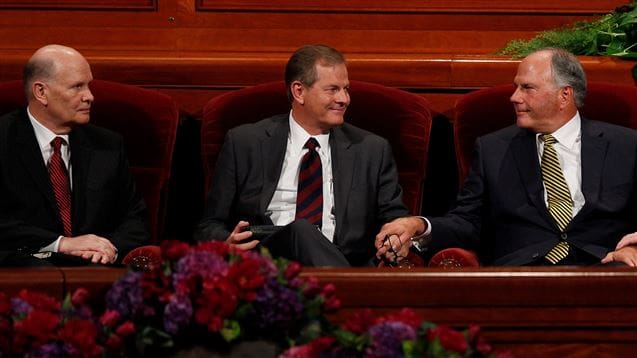
 In this episode an EPIC panel reviews the October 2015 General Conference wherein:
- The LDS Church misses an incredibly important opportunity to fill 3 vacancies in the quorum of the 12 with a person of color, and instead selects (again) three white males from Utah, and
- The LDS Church doubles down on its “the Internet is evil,” “doubting is bad,” “choose to believe,” and “stay in the boat” rhetoric.
- Elder Devin Durrant publicly apologizes after attempting to merchandize (along with his son) his usage of the word “ponderize” from his general conference talk
Panelists for this conference review include Dr. Gina Colvin, Sean Carter, Andrew Ainsworth, and Jamie Hanis Handy.
These panelists are incredibly passionate, insightful and witty. I hope you enjoy.
Episode Transcript
Host: John Dehlin · Guests: Andrew Ainsworth, Gina Colvin, Jamie Hanis Handy, Sean Carter
This transcript is machine-generated and lightly edited for readability. The audio is authoritative. Please excuse occasional errors in names and spelling.
Introducing the Panel and General Conference
Part 1 of 3 · Ep. 576
John Dehlin [00:00:00] Mormon Stories is a production of the Open Stories foundation and relies solely upon the support of people like you, its listeners to help keep the podcast alive or to become a member of the community. Please become a monthly subscriber by visiting MormonStories.org and clicking on the donate button on the right side of the page under support. All contributions to Mormon Stories are completely tax deductible and go towards producing the podcast and building communities and programs of support for Mormons like you. Thanks for your support. The kindly light amid encircling gloom Lead
Jamie Hanis Handy [00:00:43] thou me on the night is dark and I am far from home.
John Dehlin [00:00:53] Hello and welcome to another edition of Mormon Stories Podcast. John, I'm your Host, John Dehlin. Dr. John Dehlin to you. No, I'm just kidding. And Today, today is October 5, 2015 and we are very excited to bring an all star panel together to discuss the October 2015 LDS General Conference and to join us. We have. Yeah, everyone's been on Mormon Stories in one way or another. I'm going to have each person kind of introduce themselves. But let's see, let's see. I think, Andrew, maybe you deserve to go first because you actually conducted several Mormon Stories interviews and I think I've known you the longest. So, Andrew Ainsworth, why don't you introduce yourself really quick?
Andrew Ainsworth [00:01:46] Hi, I'm Andrew Ainsworth. I was born and raised in the LDS Church and I resigned in 2011. As John mentioned, I have conducted a couple interviews for Mormon Stories before and live in Southern California, Orange county. And I'm an attorney by profession.
John Dehlin [00:02:06] So if you're in California, you need a good attorney. Call Andrew. Andrew, two of the interviews you did were some of the best we've ever had. One was Damon Smith, right?
Andrew Ainsworth [00:02:16] Yeah.
John Dehlin [00:02:17] And the other was Phil McLemore, right?
Andrew Ainsworth [00:02:21] You got it.
John Dehlin [00:02:21] Yeah. Good stuff. So, Andrew, thanks for joining us today. Next, let's have Gina Colvin. Gina is returning to Mormon Stories. She recently interviewed me for Mormon Stories and for A Thoughtful Faith. She has served as the hostess for A Thoughtful Faith for quite some time and she's amazing. Gina, introduce yourself for just a bit, if you don't mind.
Gina Colvin [00:02:46] Oh, Kia ora. Hello, everybody. I'm a very cranky Mormon at the moment. Cradle Mormon. I blog at Kiwi Mormon and I'm part of the Femwok crowd, which is feminist Mormon, woman of colour, and generally sort of hang around the traps saying things that really piss people off. But I'm still, you know, I'm still in ish.
John Dehlin [00:03:11] And most importantly, you're in this episode. So thank you for joining us. Gina Cole.
Gina Colvin [00:03:15] Yes, the piece de resistance.
John Dehlin [00:03:18] All right, next, let's have Sean Carter. Now, Shawn, I think we included you my correct me if I'm wrong. I think your only appearance on Mormon Stories is in that Kate Kelly New York City short stories episode that we released a month or two ago. Is that right?
Sean Carter [00:03:35] Absolutely. And I was the very first and best one in that particular segment. I am a very strange bird because I converted to the church in my 40s and I have been a member of the church for about four years. Longtime listener, first time caller, so to speak, to Mormon Stories by trade. I am an attorney, but I'm currently a recovering attorney and I live in Mesa, Arizona with my wife and four sons.
John Dehlin [00:04:07] And you're a comedian, right?
Sean Carter [00:04:10] A humorist. Humorist. What's the difference?
John Dehlin [00:04:12] Okay, what's the difference?
Sean Carter [00:04:13] A few thousand dollars a day.
John Dehlin [00:04:16] Who does better
Sean Carter [00:04:19] in the short term, humorous in the long term, comed comedian. But I, you know, I tell my jokes, but I don't get to tell jokes to drunks. Well, that's not true. I tell jokes to attorneys. I don't get to tell jokes while the people are drunk. So when they go home. So I do conferences and that type of thing.
John Dehlin [00:04:35] Got it. So kind of a public speaker slash comedian.
Sean Carter [00:04:39] Exactly.
Gina Colvin [00:04:40] All right.
John Dehlin [00:04:40] Well, Shawn Carter, welcome to Mormon Stories. Welcome back.
Sean Carter [00:04:45] Thank you.
John Dehlin [00:04:46] Our final panelist today is Jamie Hanis Handy. Jamie, you'll, you'll recognize her voice hopefully from both the Seer Stone episode where we analyze the church's essay on the Seer Stone, and more recently, a really, really big popular episode on the church's essay on DNA in the Book of Mormon and that wonderful article by Michael Ash. So, Jamie, why don't you introduce yourself a little bit?
Jamie Hanis Handy [00:05:17] Sure. I'm mostly stay at home, mom of five kids. You know, I have an education background in science and genetics and education and I'm a hobbyist at lots of things. I actually work as a photographer when I'm not busy doing other stuff and still active and attend every week with my family. And that's about it.
John Dehlin [00:05:43] All right. Well, I'm, we're delighted to have you, Jamie, and everyone else. So thank you. Thank you all. Now this was a really lively conference, but before we jump into the conference itself, instead of putting women last, we're going to put women first and we're going to have Jamie just give us a quick overview of women's conference, which was the week before general conference. So Jamie, anything interesting happened during women's conference that's worth kind of mentioning.
Women's Session and Church Community
Jamie Hanis Handy [00:06:16] You know, it's a nice session. It is now for all of the women ages 8 and up. And I think that has a couple of things that make it nice and a couple of things that also kind of drive me crazy, which is the audience is now much lower.
Jamie Hanis Handy [00:06:32] I guess maybe because we can't have the priesthood. We can go to meetings when we're younger. I don't know what the strategy is, but the talks are. I don't want to say that they're dumbed down, but they definitely are mindful of the fact that they have a much younger audience and they speak much more geared to that, which is endearing and annoying. It's equally both for me.
Jamie Hanis Handy [00:06:56] We had the person from every one of the three auxiliaries, the primary and the Relief Society and the young women speak. And then Elder Uchtdorf was the concluding speaker. And the first one, Rosemary Wixom, the primary general president. She really is talking to the kids and just talking about how the gospel can really anchor them with self esteem. That comes from being a divine child of a heavenly Father. And it's a nice message. I think it's nice. The one thing that worried me is just this. You're not going to fulfill your divine role until you are a mother. And I think that's a hard setup because there's so many things in young girls and young women's lives that may or may not contribute to their ever arising to the measure of their full creation.
Jamie Hanis Handy [00:07:44] As she said it, the young. The Relief Society second counselor, Linda Reeves, she gave a talk which was really just a warning. In fact, it almost would have seemed like a talk for the priesthood session because it was kind of a. Not a hard line. Pornography is bad, but it was. The Internet is bad.
Jamie Hanis Handy [00:08:03] Meeting up with your ex boyfriends online is bad. You can't find truth on the Internet. Real truth comes from heavenly Father. It was a big warning speech about all of the evil that's out there in Internet land. And then the one I enjoyed the most was the Young Women's General presidency member, Carol McConkey. She's the first counselor. And I thought she was really going to go somewhere awesome, which is when she said, you know, here was this beautiful group of women and we need a cause and we need a purpose. And I was ready to, you know, take up arms not and go to battle for what?
Jamie Hanis Handy [00:08:39] What cause? You know, what is it that we are going to work for with all of this talent, all this potential, all of this energy in the Rooms all over the world. And really her only cause was just a lot of rhetoric. And you know, our cause is to just be more like Jesus without any actual action points. And sometimes it's the separations in the church that kind of drive me crazy. And I think, you know, our humanitarian services have, you know, seven very specific things that they go for. I think neonatal resuscitation, wheelchairs, vision immunizations, food and emergency preparedness. Anyway, some of those things.
Jamie Hanis Handy [00:09:19] And so it was like, you know, we need a cause. We do. There's a lot of potential to do good. If you could unite us in a cause, I think everybody would go back and work towards it. Instead it was just a very general, you know, the cause to do good and to share the gospel.
Jamie Hanis Handy [00:09:35] And then the last talk I thought was very nice. Elder Uchtdorf, he spoke in a parable and it was a, it kind of had all the trappings of how Jesus speaks. There is a message in it for anyone in their circumstances who's going through hard times to learn to find the joy in the moment and happiness in the time. And it's nice, you know, if you're 8 years old or 95 years old, everyone has time periods where they struggle and they could use this parable to find the moments of joy and focus on that. It was a general feel good. It was nice that it was a parable.
Jamie Hanis Handy [00:10:11] You know, there's no fact checking or getting anything wrong. It's simple, it's easy, it plays well to a crowd. It's feel good. Everybody leaves feeling like they can glean something from that, go home and focus on the positives in their life. Overall, it was a nice meeting.
John Dehlin [00:10:29] And what in the world made you want to attend?
Jamie Hanis Handy [00:10:32] I actually didn't attend, I just watched it later. All of the.
John Dehlin [00:10:36] Okay, that.
Jamie Hanis Handy [00:10:39] Well, I have three daughters, I have three sisters, I have six sister in laws. This is just the language of communicating with my family. You know, the text messages that get sent are, what do you think about this talk or what you do for this? It's, it's there. I also want to know, you know, the, the, the women who are teaching my children in seminary, the women who are teaching my children on Sunday. I want to know what they're being told, I want to know what they're saying. You know, I'm, I, I am in this organization and I need to know what's being said.
John Dehlin [00:11:15] Yeah. Okay. And I mean overall, do you feel like, let's just say you were the only Mormon that you knew. Right. Would you have. Would you feel like it would have been worth your time to listen just for your own benefit? Or was most of it more just sort of the cultural bystander being able to connect with believing family and friends?
Jamie Hanis Handy [00:11:38] Cultural bystander connect with family and friends. I think if I were the only Mormon, I would have to assume that my. My congregation would be my community. And my congregation, I know they got together afterwards. I'm not even sure where.
Jamie Hanis Handy [00:11:54] My kids just do so many sports on a Saturday that this is just not a possibility for me. So I didn't even pay any attention. But, you know, even if you were the only person, I think it's more that camaraderie.
Jamie Hanis Handy [00:12:06] We always want to sell the social side of the church short, as if it doesn't matter. But it matters. It matters so much. It is why people come back week after week. Everyone wants to say, oh, it doesn't matter what we do for our ward activities, because the church is true. And I say, no, it's the exact opposite. If you don't have a great ward activity and you don't have cohesiveness, it's not enough that the church is true. You have to have that social cohesiveness. And when you have that social cohesiveness, people will do all sorts of stuff.
John Dehlin [00:12:38] All right, Cool. All right. Well, that's. That's a great overview. Real quick, we'll ask Gina or Jamie. Any thoughts on the women's conference being, you know, part of conference, but the week before Gina, What? You know, does that bug you? Do you not care? What do you think?
Gina Colvin [00:12:57] Me? I don't care. And I'm only saying that because I've just really put my head under the radar when it comes to general conference, which, I mean, I think is a very good indication of where women fit at the periphery of the church. So in terms of it being a sign of femininity in the church, I think it's quite a powerful one, you know, but in general, I'm not. I'm trying not to be bothered by it.
Sean Carter [00:13:30] Okay.
Jamie Hanis Handy [00:13:31] I feel like I can spin it both ways. We get our own weekend. We matter so much. It's just great. What? We're not a part of the whole thing. You mean you couldn't even cut out a few of all the men talks to make room for us on the weekend? I can spin it both ways, and depending on the mood you catch me in, you'll hear one or the other sharply.
John Dehlin [00:13:53] Okay, got it. All right. Okay. Well, thanks again, Jamie, for that review. Now, let's dive right into the, you know, the. The Manly Main. October 2015 General Conference. And I think the biggest news, obviously, was us eagerly anticipating to hear who they. Who they placed, who the Lord called, who the Savior himself called into the three vacancies in the quorum of the 12 left by elders Perry, Packer and Scott. So I think, you know, I think most of the. Most of the chatter online was around people just really hoping that for once the church might sort of take that bold step of having someone from outside of, you know, Utah, Idaho, become an apostle, maybe even someone from outside of the United States, maybe even kind of a person of color. And let's have Sean and Gina talk about their reactions when they heard the news. So, Sean, what was your reaction?
Three New Apostles: All White Men from Utah
Sean Carter [00:15:13] At first I jumped up and down because I had bet on a parlay it would be three white guys from Utah. And I was not at all surprised. I thought, what else? And at first I really was ho hum about it. And it took me about five minutes before I felt my cheeks turning red like I had been slapped in the face. Because it occurred to me what got me was the church's press release that announced the 100th unnamed apostle. And I said, wow, it never occurred to you that you are 100 for 100 with white guys?
Sean Carter [00:15:46] And that in the 21st century, you would put that in a press release to go out on the Internet where other people could read it, and it would never even occur to you that this would look bad and that apparently the rest of the world wouldn't care, but that even people of color.
Sean Carter [00:16:01] This might not be obvious on the Internet, but I'm black and been black most of my life, at least until I joined the church. And I never. It never occurred to me, you know, that an organization could just be that tone deaf and that it would think that the what, the 35% of people of color in the church would not have any problem with it at all.
Sean Carter [00:16:28] And so as I started thinking more and more, it started becoming more and more frustrating to me that this wasn't even a thought, that, you know, this is going to look really bad. We wouldn't do this. Because the funny part is this. When they make the Meet the Mormon movie, then you don't make that with just all white guys because you know how bad that would look. So you can't find enough people of color. And I put on a Facebook post, you know, I don't know if I'm willing to continue to be a mascot around here. Someone you can trot out for the media when you need to. But there's no actual concern or thought ever that, you know, people of color would make a meaningful contribution in this church.
John Dehlin [00:17:09] Right. So you weren't super happy overall with the.
Sean Carter [00:17:13] Not super happy about it at all.
John Dehlin [00:17:17] All right. All right, Gina, as a femme walk, what was your response?
Gina Colvin [00:17:21] I think I'm like, Sean, I wasn't at all surprised. Just really, really disappointed for the same reasons that Sean wasn't. And I'm not suggesting that someone of colour is not going to preserve the status quo. And usually white organizations have this proclivity for choosing the right person.
Gina Colvin [00:17:43] So, I mean, the question is, like, would you rather a white person who's actually going to, you know, try and change things and be transformative and bring some difference of thought to an organization? Or you want to have the black dude who's just all down with the white guys? I think I'd rather the white guy. And so these guys. But, you know, having said that. But there is also the aesthetic. There is a problem. And I remember last year I was at General Conference and I was just gripped. I was absolutely gripped. It just kind of a knife in the heart looking at all of these red chairs filled with white men and their IBM suits, all clasping, you know, and shaking each other's hands and embracing each other as if they've sort of arrived, you know, And I was made to watch that.
Gina Colvin [00:18:28] I was made to watch the jubilance and their celebration of each other. And that bothers me. That bothers me that I can't look up at the stand and not just not see people of colour, but I cannot see women of colour and ever.
Gina Colvin [00:18:43] And that is a huge, huge deficit in the church. But I do have a question, though. I mean, we talk about. And I'm sort of coming back to the process of selecting these apostles. And I'm not suggesting that any one of them are going to be problematic. They'll probably be the same.
The Apostle Selection Process and Diversity
Gina Colvin [00:19:00] No one person, I think, can really change the quorum of the 12. But it comes back to the process of selection. Now, if we have President Monson making the final selection, and we know that President Monson has, you know, possibly. Well, no, he actually does have dementia.
Gina Colvin [00:19:20] I'm wondering, did he sign this off? Are these his selections? Whose selection is this? And if he isn't, you know, if he is mentally incapacitated in some way, I just struggle to understand how a. That's, you know, that process is inspired.
Sean Carter [00:19:42] I recently read an article. It's on lds.org so I know, it's true. And it was an article about the selection process. And I think, as you all know, the selection process normally works, that he actually takes names from the other members of the other brethren. He then goes into private to retreat and prayerfully considers and receives inspiration and revelation and comes out with his suggested name. Names. And then there's a vote. And if they all unanimously agree, and I don't suspect they ever don't, then. So I think the process works, which is sort of, you know, they give him some names, he has his own, and he goes and prays about it and comes back in this context, you know how that works. Exactly. Would be interesting.
Gina Colvin [00:20:30] Well, exactly. That's my question. Exactly. I mean, you know, and I have it on reasonably good authority that, you know, it's well known that he has dementia. And I'm not. I don't have a problem with that. I have a problem with obfuscating a process that's actually interfered with. Unless you understand, unless you come from the position of thinking that actually the mantle of the prophet exists, it's its own personality, and somehow that overwhelms or, you know, takes over in the process, which I just think is nonsense. Yeah, so that has been stumped.
Sean Carter [00:21:04] Well, true. Although in this case, you know, President Monson's health isn't, I guess, you know, so so much that question only in a sense that think about it, if he were, you know, 100% healthy, this would have likely been the same three people. Because, you know, these people didn't come out of a phone book. You know, this is. And I love this, people say, this is the Lord selection. And my answer is the Lord must have went to Wharton Business School.
John Dehlin [00:21:27] Well, you know, you know, because that's
Sean Carter [00:21:29] exactly how Wharton business, you know, you know, educated person would have made these decisions.
John Dehlin [00:21:33] No, I mean, so. So first of all, I've heard, and this is just. This is just hearsay, that, that the. The First Presidency sort of acts on behalf of President Monson when he's not well. And so that would mean that Eyring and Uchtdorf would. Would maybe have a bigger influence than normal in the selection process. So that's. That's one possible explanation. The only other thing I would add is, wow. And I think I heard in a talk or two and then in a press conference, really an emphasis that Jesus himself made this choice, that this was Jesus who made the choice. And if Jesus made this choice, I'm like, Jesus, like, look at the church. Like, we have millions of millions of members who Are people of color, like, come on, throw us a bone.
Gina Colvin [00:22:33] Right, I know, exactly. I mean, everybody wants to blame Jesus for these decisions. It's not his fault.
Jamie Hanis Handy [00:22:41] Well, there was a couple of things about the selection that they referenced in their talks that stuck out to me. And one is that they said that they themselves were evidence that the simple and the small, you know, we're called to do Jesus's work. And I, I don't know my world demographics perfectly. But these are cardiac surgeons. Sorry, I can't think of their other occupations off the top of my head.
Gina Colvin [00:23:12] Someone's emerges and acquisitions.
Jamie Hanis Handy [00:23:14] Yes, M and A. Anyway, investments, financial planners. And certainly in the top 1% of the wealth, power and stature in the world, which is kind of not the small and simple that they seem to be implying that they are.
John Dehlin [00:23:31] And why can't Jesus even pick someone from outside of Utah? Like if you're gonna go white male, like, why not go crazy and pick someone from like Texas or California, right?
Gina Colvin [00:23:42] I thought that too, John. I thought, you know, it's a sad day when I'm going, hey, just choose somebody from Oakland, California, please.
Jamie Hanis Handy [00:23:49] And if you haven't all listeners read Gina Colvin's parody satire article on this, I mean, you absolutely should, because don't conclude with. I mean, this just goes to show that Utah still is the place.
Sean Carter [00:24:01] Your point is so well made. And Rasband, Elder Rasband actually said, I remember when he said this, I was like, I gotta write this down. Jesus Christ looked past people's ethnicity, rank and circumstances. Well, maybe he did, but I'm not sure how, when we ever do.
Gina Colvin [00:24:19] Yeah, yeah, and that's spurious as well because Jesus was a Jew, you know, and he was only looking at Jews and only ministering among Jews. So maybe it's a thing, maybe it's a thing that Utah people only ministering among Utah people. No, no, hold on. No, that's wrong because he was, he was into Samaritans as well. So. No.
John Dehlin [00:24:37] All right, Andrew, before Jita, I want to, I want to come back to your, to your thoughts about sort of the, the splaining that they did about this process. But, but Andrew, any quick thoughts about this before we move on?
Andrew Ainsworth [00:24:52] Just really quickly. Actually was very surprised that they went with three American Utahns. You probably don't remember, John, but back in 2007 or 2008 when I was blogging on Mormon matters, I put out a pre conference prediction. I actually was really anticipating that back then they were going to be calling Latino into the 12 for the first time.
Andrew Ainsworth [00:25:22] And that didn't happen, of course, eight years later, and it still hasn't happened. So I actually was very surprised because I have been anticipating more diverse leadership. And the reason I've anticipated that is, you see in the messaging, there's a lot of emphasis on this concept or this idea that it's a global church, that it's not just for Americans or white people or Utahns.
Andrew Ainsworth [00:25:48] This is a gospel and a church for the entire world. And when you consider the fact that out of the 7 billion people on the planet, you know, white American guys are in the minority, you know, the overwhelming majority of the people in the world are not white, are not American, definitely, of course, aren't from Utah. So it is peculiar, to say the least, that all of the selections would be coming from this tiny little pocket even still in the 21st century. It really does surprise me.
John Dehlin [00:26:25] Yeah. Okay, now, Gina, you had some. Some more scholarly discourse on the matter that that could help us understand or frame or conceptualize sort of the explaining that they did on. On justifying this decision and helping us feel better about it. What do you have to offer there?
Gina Colvin [00:26:47] Oh, okay. So if you come at. My methodological approach in my academic studies is a Foucaultian discourse analysis. So basically from the work of Michel Foucault, who basically argues that communities are shaped by language. And that's not a surprise. It's sort of a social, you know, could be considered a social constructivist approach.
Gina Colvin [00:27:12] And if we have a look at language and we analyze language and we think about what the work that that language is doing, it will give us an indication of what the power relationships are in any community. So, I mean, you can just look at maybe a conference talk and say, okay, well, here are the themes that are coming out. So you look at it with that lens, that's fine. But to look at it and ask yourself what kind of power relationships are trying to be reproduced here? And what we usually find is that.
Gina Colvin [00:27:48] Actually what I found in my own research was that usually the discourses and the kind, I suppose the meanings, the intentions are either to express benevolence. So we're talking, and this usually happens when there is a hierarchy and you have a larger group, a small group who are controlling a larger population. And usually the way that they speak are either in forms of benevolence. And we. And, you know, we're all familiar with terms like benevolent sexism. You're really nice. We love you. We get. We're concerned for you. And you've got so Much potential. And then you've got questions of social control, which were actually, you're in a place of deficit.
Gina Colvin [00:28:33] You need to, you know, extract yourself from it. You're being very, very naughty and I'm going to help correct your behavior. And then you've got discourses of governance, which is a reaffirmation of who's in control. I think more generally, if you apply that lens over General Conference, you can see that most of them fit into one of those. It's doing that. There's a sort of interplay. And what's really interesting, if you look at those three discourses, benevolence, social control and governance, you see that usually governance and social control peg each other. Now, when there isn't much resistance to the dominant, dominant group or the dominant discourse, or the power structures, benevolence will pick up. So, you know, everything will be sort of unicorns and sparkles and everybody's nice. Yeah.
Jamie Hanis Handy [00:29:25] I just have to say, how well did the general Women's session play into that? Benevolence? Benevolence and the warning one? I mean, you know, social construct. I just thought, wow, they hit those two points in the general women's Session, which left a lot for the authoritative structure and the rest.
Gina Colvin [00:29:45] Yes, absolutely. And that's what Women's Conference does. It takes off the sting. So Women's Conference acts as benevolence, and the rest are acts as social control and governance. And that's the way women are being positioned in the Church as well. I mean, look at Nelson's talk, which was, you know, all about how kind of, you know, you know, beautiful and wonderful and transformative women can be if they're very nice.
Gina Colvin [00:30:09] So anyway, so if you apply that kind of lens, you can see these discourses sort of, you know, bobbing up and down here, sort of emerging in there, you know, and dropping down to give way to another kind of discourse. Now, what's really important about this is that there are very few discourses that turn the lens around.
Gina Colvin [00:30:27] And we would call these counter hegemonic discourses that puts an eye on the leadership structure. So you very, very rarely get in General Conference some self reflexivity, whether in the form of apologies or a sense of actually we might not be getting this right. I mean, you take Pope Francis and he really set the cat among the pigeons, where he said, like, those who are in authority in the church here need to reevaluate their Christianity and their discipleship. And that made him a hero of the people.
Gina Colvin [00:31:01] But General Conference isn't there to make, you know, any one person a hero of the people. It's there to make the people subservient and different to religious authority. And that's a really cynical way. But just don't blame me, but blame Michel Foucault, those French. Yeah, all right, all right.
John Dehlin [00:31:21] Well, that's, Anyone else have a response to Gina?
Sean Carter [00:31:25] Well, I have a question for Gina, because I understand what you're saying there, and you totally see how that plays out with regard to women. You're the greatest thing in the world. Greatest, greatest, greatest, greatest, greatest. It doesn't seem like with people of color and people from other countries, are they doing a lot of that? I don't hear, like, oh, my, you gotta go see those Brazilian saints. They're just the best. And every conference is a thing about the Latin American saints. Do we even get that half of the Kool Aid?
John Dehlin [00:31:54] No.
Gina Colvin [00:31:55] Do we? No.
John Dehlin [00:31:58] I, I, you know, I seem to recall, you know, several talks about, like, the Guatemalan saints and how they, how much they sacrifice to go to the temple. Does, does that, you know, does that ring a bell to any of you? I, I, I may only pay attention to that because I, I served a mission in, in Guatemala, but it, it, you know, I, I that, you know, at least during my time in Guatemala there was sort of special reverence for, you know, the, the indigenous saints in Guatemala. The, the, the K' Chi and the Kiche and the, and, and those in Polachik and, and the missionaries who sent there were viewed as the most stalwart because it was the, the most special people. So I've, I've been subjected a little bit to that, but I, I'm not in any place to speak.
Gina Colvin [00:32:48] I think, overall, I think you're right, John. And usually people of colour appear in the discourses as objects of compassion. They are exceptional in their humility and, you know, the audience is directed to look at them as sort of sacrificial sort of offerings. You know, I sold everything and I went to the temple, you know, traveled for 50 hours on a rickety bus and, you know, my family died on the, But I got to the temple and, you know, and I suppose as somebody of colour, you know, someone who's indigenous, looking at the constant repetition of that particular discourse, that's the only way that you can look at people of colour as the abject other, you know, it gets tiresome or people of colour are the recipients of the largesse of the church, and without the church, then there has been no social mobility.
Gina Colvin [00:33:49] And look Good it's done for them. You know, to actually be othered like that means that you deprive them of a voice and of their full humanity and of the actual conditions in which people put up with religious regimes. So it's there.
Jamie Hanis Handy [00:34:05] But yeah, I think though there were a handful of Latino speakers, there was a Chinese man who gave a prayer. And so I do think you get some of the benevolence in their talk. I think you get that story additionally, because we send our leadership all over the world to serve as mission presidents and area presidents, that those members of the church are hearing a lot of that benevolence when those leaders speak to them there. So I do think it exists for them. That benevolence part. It's just not necessarily coming at General Conference or in general Women's conference, but it's happening in their regional conferences.
Jamie Hanis Handy [00:34:42] I have a brother serving a mission right now and I know the rhetoric in his mission is that the Czech Republic is. The field is white, it's ready. These saints have been prepared for this day. I do think that all over the world they are hearing that same message.
Sean Carter [00:34:59] Excellent point. You're absolutely right. I'm sure it does happen there a
Gina Colvin [00:35:02] lot in the Czech Republic. I went to the church in a church in Prague. Didn't seem. It seemed really white, but not really ready for harvesting. But anyway. And can I say that there were only four men of colour out of 39 speakers. Here's the statistics, courtesy of Geralyn HasselPaul. There are 39 speakers at conference. I think that includes young. The General Women's Conference. 30 of them are white males, 40 are brown males and 5 are.
John Dehlin [00:35:35] How many are brown males?
Gina Colvin [00:35:37] 4.
John Dehlin [00:35:37] Okay.
Gina Colvin [00:35:39] Men of color.
John Dehlin [00:35:39] Okay. Right.
Gina Colvin [00:35:41] And then there are five women and no woman. No woman of color. And two of those women, only two of those women spoke at General conf. At the main sessions. So that included. That five included the General Woman's Conference.
John Dehlin [00:35:58] And just, just. Well, two things. Number one, do we have a speculation? Obviously, I mean, Peggy. I think Peggy Fletcher Stack wrote an article several months ago about how, wow, this is the time to. To maybe have a person of color or someone from outside the US Become an apostle other than Uchtdorf. It clearly they. They knew that this was something that they might consider that that might be prudent at a minimum from a PR point of view, but possibly actually because there would be real tangible benefits to. To making the. The quorum of the 12 more diverse. Any theories? Well, first of all, you know, how. How Would this decision, let's just say they picked someone from Brazil or. Or New Zealand or, you know, Africa or Mexico as an apostle, do we think that that would make a difference? And if so, what. What difference would it make? Even in theory? Anyone?
Gina Colvin [00:37:09] It depends on who you pick.
John Dehlin [00:37:10] Right.
Sean Carter [00:37:11] See, I agree with Gina here, and I think that. And by the way, I think to get picked, though, right, you would have to be, I think, by definition, someone who wasn't going to rock the boat, et cetera. Your diversity wouldn't matter that much. So it'd probably be more symbolic.
Race, Gender, and Institutional Change
Sean Carter [00:37:25] But here's my question, and I think, you know, maybe. Maybe we can get some. Some answers from longtime Mormons. I'm amazed. It seems to me, that you have to have a reason not to have someone of color simply because, you know, all of the good reasons from a secular standpoint, you know, how that person could have literally been gone on tour for the church. Right. As the first, you know, person of color, particularly had they been African, for instance. Right.
Sean Carter [00:37:51] You know, with a ban, it would have been like almost a complete redemption for the church. Right. From 78, it seems like there's a whole lot of social capital to gain from making that move. And the fact that they did. Seems to me that they were concerned that there was going to be more blowback internally, that there would be so many people who would either think it was a politically correct thing that, you know, maybe I'm wrong about this, but it almost seems to me that, you know, they made a calculation and said, you know what? We're going to get more blowback internally than it's worth externally.
John Dehlin [00:38:19] Okay, so Sean thinks too much blowback was the reason why. Gino, do you have a theory on the reason why they didn't do it?
Gina Colvin [00:38:28] I'm still stuck with the process. I think the process, if the process is going to President Monson, I'm struggling to figure out how that's gonna even be possible. But anyway, but I wanna. Can I address the question that you had about what difference would it make? And I wanna pick up two points. One is the LGBTQ question, and one is women. So let's take, you know, we've got a group of men who have been socialized within a particular culture, and within that culture, questions of same gender marriage become really important. They become theological policy, you know, and almost political concerns, you know, because pretty much the church runs Utah now.
Gina Colvin [00:39:09] Somebody who is from Europe, for instance, maybe Scandinavia or maybe from New Zealand, a place where same gender marriage is certainly not an issue. A Place where women's equality is not a question and where women who join the church from those places are giving up an awful lot in terms of their autonomy, in terms of their gender power, it's a backward step for them.
Gina Colvin [00:39:37] And in places where there's no. There's no. What do you call it, Benefit in being pushy about the church, that you're actually better off stepping back a little bit now, somebody who comes into the quorum of the 12, you know, being socialized in a place where women are not used to taking male authority, authority is given based on, you know, and having earned that authority, where same gender marriage is not an issue, where even, even those, just those two issues, they become very important to direct the quorum to say you're not thinking about the impact that things like your pursuit of, you know, running the question of same gender marriage out of town is having on people in other countries.
Gina Colvin [00:40:34] You're making them think about things that they otherwise don't need to think about that are not issues. And you're distracting them from questions of their commitment to Christ and even their commitment to the church. Because the church is not recognisable. It's just this foreign body that sits in this, in our community. And it would make them think about the significant and difficult local adaptations that people outside of Utah and outside of the United States have to make to accommodate the very loud voice that Mormonism as it attaches itself to its own Utah centric, American centric issues have. That has a huge impact on the church there.
Gina Colvin [00:41:20] It shouldn't elsewhere. So I think that's why cultural diversity and inability to speak and to see culture is important at the top levels of the church.
John Dehlin [00:41:33] Right. Okay.
Jamie Hanis Handy [00:41:34] I think another thing is US Politics is still in play. The church still feels like they can control or at least weigh heavily in on US Politics and decisions. And so they're bringing in people who will still be able to influence and want to play in the US Politics game that want to be involved versus you bring in somebody from another country and they're like, I don't care about marital law in that state. That is not an issue for me.
Jamie Hanis Handy [00:42:03] You know, and that would be dividing what. They are clearly still so heavily focused on US Politics. I think the other thing is, it's just. It's the same kind of glass ceiling that existed for women at the corporate levels. It's a glass ceiling. And unfortunately, we promote based on who is the most loyal and the most homogeneous. We tend to like people who are just like us, and we pick Them, I think that's just general human behavior.
Jamie Hanis Handy [00:42:32] And then the question is, I guess, what difference would it make? Well, it would make a huge difference. I think the first women CEOs in companies, even if they were the most masculine women there, because that was essentially who got picked, those that didn't have a family to balance, they were single, you know, that often were able to put in the time and the level and the loyalty, and they were put in those positions. It still, as a little girl or as a child of color, when you're not understanding the dynamics, to look at those red seats and see a different look, they may not say any of the things you want them to say, but it shows potential.
Gina Colvin [00:43:12] Yeah, I agree.
Sean Carter [00:43:14] Agreed.
John Dehlin [00:43:16] All right. I, I wonder, I wonder whether part of it has to do with something legal because isn't, isn't whoever ends up, I mean, anyone who ends up an apostle has the potential of becoming president of the church. And I wonder whether having all the assets, you know, the president of the corporation sort of thing, and maybe, Andrew, you can speak to this, having all those assets owned by a foreigner. I wonder if there are legal implications to that.
Jamie Hanis Handy [00:43:50] Good point.
Andrew Ainsworth [00:43:52] Yeah, I mean, I don't know. The structure of the church is that it's a corporation soul. And so all of the assets, all the property is owned by President Monson or whoever the president of the church is at the time.
Andrew Ainsworth [00:44:06] I don't know off the top of my head whether there's any sort of legal bar that would prevent a corporation soul in the United States from being or consisting of a foreign born individual or someone who, whose residence is overseas. I don't know about that. But you know, the fact that the church is organized as a corporation soul, that, you know, as Damon Smith said in his interview, you know, theoretically, what that means, legally speaking is that if tomorrow President Monson wanted to turn all of the meeting houses into bowling alleys, he has the legal authority and ability to do that. So it just, it does put a fine point on how much power, how much property is concentrated in the hands of one person, legally speaking, in the church.
John Dehlin [00:45:00] Yeah, I just. That's a lot of assets. Right? I think they want, I think they want to keep it in the family, so to speak.
Gina Colvin [00:45:09] And they're about to buy Florida too, aren't they? So, you know,
Jamie Hanis Handy [00:45:14] I do. Did no one else notice how easy each new apostle essentially gave his genealogy? It was very biblical. I'm a sixth generation. I hail from here. I'm from this family. This family, this family. You know, they Definitely laid out the fact that they are loyal to the group, loyal to the location. You know, they're not going to relocate the church to Brazil if they become prophets.
Sean Carter [00:45:43] And by the way, can someone explain that to me in this sense? Because I'm from pioneer stock. I come back from this.
Andrew Ainsworth [00:45:50] That.
Sean Carter [00:45:50] Et cetera. I went to school in the Northeast where there were people who were descendants from the Mayflower. And they would never say that out loud because it would be embarrassing to claim that out loud. Other people might say, hey, you know, so and so was, you know, Mary Pocahontas is a great granddaughter. And they'd be like, shh, don't tell any people that. You know, it seems weird to sort of, you know, stress your genealogy and say, oh, I go back six generations to so and so.
Jamie Hanis Handy [00:46:17] It's biblical speak. We have a great ability to start to sound like the King James version of the Bible or like the Book of Mormon or like the Doctrine and Covenants anytime we speak publicly as a church. And to me, they just. They're speaking in the language that they've been raised and learned. You know, that's just how you start. I, Jamie, having been born of goodly parents who had goodly parents who crossed the plains, it's just our language. I don't understand it, but it's our language. I can do it.
Sean Carter [00:46:48] It's true. But it's such a contradiction between that and the American. I raised myself by my own bootstraps. I was raised by wolves. No one ever helped me do anything, et cetera. Right.
Jamie Hanis Handy [00:47:00] Yeah.
Sean Carter [00:47:01] Versus. I am so and so of extreme
Jamie Hanis Handy [00:47:04] privilege, but I think it's embracing the American dream for themselves. We crossed these plains without help or aid from the government and set up beautiful Zion on our own. And we are the fruits of that labor. Today, they are claiming that birthright.
Gina Colvin [00:47:21] Yeah, there's spiritual legacy there. There's a capital there. There's actually something that, you know, people have been able to claim some social and cultural capital and that as well as watch everybody, you know, you go back a couple of generations, everybody's married. Everybody else, you know, with their polygamy. So.
What the Church Needs to Do Differently
John Dehlin [00:47:40] Yeah, well, I think. I think we've definitely covered this one somewhat. Somewhat deeply, somewhat comprehensively. There's probably. We could probably actually do hours on it, but. But I have to say I was really surprised. I just. Just. I didn't think they'd have the gall to do three white guys from Utah. And they totally did it. And I just thought, in 2015, there's no way they could get away with that. But they absolutely did.
Sean Carter [00:48:10] Well, that is one thing we can't talk about as far as getting away with it, because other than, you know, our little fringy Mormons sex. Do you think that most members have a problem with this at all? That they're sitting around thinking, three white guys?
Gina Colvin [00:48:23] I think it's a. I think. I mean, I've spoken to a former bishop of mine, texted my husband, and he said, what's with the lookalike? Three apostles, you know, and he's pretty in. So I think it was a surprise for a lot of people. Probably they don't register the same outrage, but. Yeah, yeah.
Sean Carter [00:48:45] Well, there certainly won't be the outrage registered. But I asked a few of my friends, you know, in the ward. I said, you know, did you even notice it? Right. And one of them said, yeah, I noticed. And another said, I didn't. You know, until you mentioned it, it didn't even occur to me.
Jamie Hanis Handy [00:49:00] Because Jesus called them. Yeah, duh.
Sean Carter [00:49:04] Good point.
Jamie Hanis Handy [00:49:05] I mean, all of. All of the language is already set up so that if you are not in a position to question and you accept everything as it's been handed to you. This call, despite social pressure, despite the desire or the need to look more diverse, you know, Jesus spoke. This call came from Jesus, period. End of story. Everyone's happy with it.
Sean Carter [00:49:29] Good one.
John Dehlin [00:49:32] Yeah. And that really is what it comes down to. It always comes down to authority. I mean, that's really the answer for almost every point or question that we're going to have today.
Jamie Hanis Handy [00:49:44] It's. Well, it's like playing cards. And that's the trump card. It always is. And once you play trump, it doesn't matter how high your other card is. Doesn't matter.
Gina Colvin [00:49:52] Yeah, yeah, yeah. Because you'll be. You'll be the deficit if you. If you push back, then, you know, are you not following Jesus?
John Dehlin [00:49:59] Right. And I wonder if God, Jesus are ever going to get sick of blame, sick of getting blamed for all this, you know?
Gina Colvin [00:50:05] I know, right? I really pissed.
John Dehlin [00:50:08] Like, Jesus can't. I mean, Jesus called, like, fishermen. He called, you know, poor people to be apostles. Like, you know, called all sorts of people. Right. But somehow Jesus can't go outside of Utah for an apostle. Like, I just don't know that that's Jesus. I don't know.
Gina Colvin [00:50:24] I don't believe. So can I share something that Tariq Khan shared? He said, one of my favorite parts of the Book of Mormon is when Jesus is visiting and he asks the church leaders to bring the scriptures and they fetch the Scriptures. And Jesus asked why Samuel the Lamanite's prophetic words aren't recorded. And the Nephite church leaders are taken back and question. And Jesus asks them, didn't I call Samuel the Lamanite to be my prophet and speak my words to you? And the church leaders are like, ah, yeah, I suppose so. Because it didn't occur to the church leaders, the Nephites, you know, the real church, the Utah church, but the darker skinned outsider, Samuel the Lamanite was on the same level as them and worthy of being recorded in the scripture.
Gina Colvin [00:51:01] So Jesus ordered them to include Samuel's words. Then he had to publicly chastise and embarrass the church leaders into taking an outsider of another ethnicity seriously. And he finishes the question, what does that say about what needs to happen with today's oblivious, nationalistic and unresponsive church leaders?
Gina Colvin [00:51:20] Yeah, I thought that was. Yeah, yeah. And we see that happen in the New Testament, don't we? With Peter thinking that the church just belonged to the local saints. You know, it was a Jerusalem, Jerusalem church. It was an Israel church. And Peter needed to be shown like this massive sign had to be kind of taken away in a vision to say, actually the church belongs to other people as well, not just you. So there's not a great legacy of social transformation in thought. It's very xenophobic. Churches tend to be xenophobic.
Sean Carter [00:51:50] Well, we all do. But the question, I think in most areas is that there's a mechanism that can work to correct that. And I guess we need the mechanism being direct revelation because the church seems to be immune to criticism from within.
Sean Carter [00:52:03] And in this context, without. Probably doesn't care. And, you know, how do you change if you don't have someone pushing you to change? One of the things that helped Peter a lot is that he had Paul saying, for instance, with circumcision, right, you don't need to do this anymore. I know this is the right of your fathers, et cetera, but you know, this is really kind of queasy for everybody else. Let's back off this. It might not have happened had we not had someone who had a different, you know, by the way, happened to be Jewish too, but had a different perspective about the whole thing.
Sean Carter [00:52:33] And who is to say who's gonna be Paul in that quorum? I was looking at the numbers to see, because I always, every time I get it, I try to see like, who has a chance to be the actual prophet. And so the three are called at the same Time.
Sean Carter [00:52:46] Elder Rasband is the oldest by like a year. He's older than Elder Runlund from Wikipedia. So I know it's true. It says that the way they do the order is that if they're all ordained the same day, then they choose the oldest one to go first. So you have, you'll be next in line for profit, but he's going to be next in line. Elder Rasband, but he has to somehow outlive Elder Bednar, who's a little younger and in great shape. So unless Elder Bednar starts eating a lot of cookies and cakes or something, you know, it doesn't look like, you know, there'll be one of these three is going to end up being the next prophet.
Sean Carter [00:53:24] How do you make changes, you know, in this, in this context, if you're sort of picking from the same people and never, you know, and there's no pressure to do so?
Jamie Hanis Handy [00:53:33] I think it will take social pressure and it will take pushing and pushing. It'll take calls for diversity. It'll take satirical articles like Gina wrote. It will take people leaving the church. It will take all of those things. And then when it just absolutely has to happen, they will make a change and everyone will accept it because they have the trump card. You know, this person was called of Jesus.
Gina Colvin [00:53:55] It's just.
Jamie Hanis Handy [00:53:56] Why didn't you use the trump card this weekend? Why wasn't it used eight years ago? You have an ultimate trump card. I disagree that there'll be blowback because the trump card is pretty powerful. Jesus called this person, so unless there's
Sean Carter [00:54:11] external calls for change, it won't matter. Right? Yep.
Gina Colvin [00:54:16] And most, most of people will not question this.
Sean Carter [00:54:20] Agreed.
John Dehlin [00:54:22] Yeah. I mean, you know, for me, there's two cliches. Two cliches. One is that it's all about, you know, authority and power in the modern church. But the other is that the most sacred thing in the Mormon Church is, is media, you know, public relations. And so, yeah, it won't be until the church gets bludgeoned, you know, with, with sort of New York Times level criticism that they'll feel the need to really respond.
Sean Carter [00:54:50] I think I agree.
Jamie Hanis Handy [00:54:52] Yeah, maybe. John, is this a good way? I, I had a, I was very surprised when the issue of feminism really came up in the calling of these apostles. Do you want to move there?
John Dehlin [00:55:02] Yeah, go ahead.
Jamie Hanis Handy [00:55:04] So I was listening intently as the new brethren were, were speaking. And during Gary Stevenson's remarks, his testimony, I was absolutely blown away as he described his calling to the 12. He says that he was in a meeting as the presiding bishop. And he was called in to meet with President Monson. And he alone met with President Monson and his counselors. He remarks that he was told he was a little nervous, he looked young. They put him at ease, they spoke kindly to him. And then in a quiet moment, they extended to him that Jesus had called him to be a member of the quorum of the 12.
Jamie Hanis Handy [00:55:43] He said he was. He made an audible gasp and he accepted the call. And they continued to put him at ease. He says, this was in the morning and he talks about it. And then he says, you know, I've just rehearsed to you exactly what I told my wife later that afternoon on a park bench on Temple Square. As we looked at the temple.
Jamie Hanis Handy [00:56:06] And I don't know, I had never had something just feel like it was a dagger to my heart more than that. And I thought, he got this call to the 12 without his wife being present in the room.
Gina Colvin [00:56:19] Yeah.
Jamie Hanis Handy [00:56:20] He accepted this lifelong position that will affect her life as much as his. It will affect every aspect of their daily living. Where they live, what they do, how they travel, their relationships with their children, grandchildren, friends, neighbors. It affects their. I don't know if his wife's employed or not employed. It will affect every aspect of her life. And he was called in, extended the call, accepted the call, and then told her all about it later.
Gina Colvin [00:56:50] Yeah, I agree.
Jamie Hanis Handy [00:56:52] In Temple Square. And as I was trying to process that, that's when the next two talks later is all about women and how much they're needed. And I just wanted to scream, empty rhetoric. Empty rhetoric. You can tell us that we matter, you can say we're important, but if you cannot include us in this kind of a decision, we have no voice. None. And it's from the top down. And the thing is, I looked it up. The handbook very clearly states that when issuing a call, leaders should invite the spouse of a married person to give their support when a calling is extended. Which means that our own prophets don't follow that handbook.
Jamie Hanis Handy [00:57:37] So how can we require anyone else to follow it? And that. You can say all you want, all those platitudes about women, how important we are, covenant keeping women are needed here in the last days. And I just say bullcrap, whatever. You didn't invite us. We have no voice. We don't participate. I just. I can't believe it's still. It's been too. It's all I can think about. I do not matter.
Gina Colvin [00:58:07] Amen, Jamie. Amen.
Jamie Hanis Handy [00:58:11] And it goes further than that for me. Which is just a much bigger. That the ultimate goal of a Mormon woman is to vanish. That my biggest job here on earth is to nurture my children and to care for them so that I can disappear.
Jamie Hanis Handy [00:58:29] Why am I working on all of these qualities? Because I am not needed in the afterlife. My heavenly mother does not answer my prayers or succor my needs. Amanda said, my heavenly mother is absent, vacant, lost, gone forever, never to be heard from again.
Jamie Hanis Handy [00:58:47] And so it's very shallow to tell me that this is my God given role. It's just to vanish. And as you see this, I think, you know, the higher up up men get in the church, the more their wives just disappear.
Jamie Hanis Handy [00:59:01] There are no state funerals for their wives. There are no accolades for them. They don't have a prominent position. They just vanish. The best wife is sitting in the back quietly just helping her husband shine. And that's so offensive to me. Yep,
Sean Carter [00:59:21] Jamie, I never even thought of that. But to give you an example, how right you are, my wife was asked to speak at Stake Conference. You know that the Stake president came
Jamie Hanis Handy [00:59:32] to me first to ask if she could speak?
Sean Carter [00:59:37] Yes. Not a calling an hour of her time. He came to me first.
Gina Colvin [00:59:42] Yeah, yeah.
Sean Carter [00:59:45] And a calling of that magnitude, that wouldn't even have been a consideration as to what she had to say. That's amazing.
Jamie Hanis Handy [00:59:52] I just. What do I aspire to as a woman? What? I can be a good mother here on earth. I get that and I enjoy that. Don't get me wrong, I love my children. I absolutely love nurturing them and loving them, but I'm just preparing them for the day when they can be loved and nurtured by men only because I will not exist for them ever again.
Gina Colvin [01:00:16] Yeah, true, Jamie, true. I mean, there's very little, very little offered us in terms of imagining our best spiritual selves as women. We have to look at men, we have to listen to men, we have to take instruction from men, we have to get permission from men. Men get to break the rules. We're silenced by men. I don't even have a deity that I can look at and say, that could be me. I have nobody to speak to. Yeah, and that's a failure.
Jamie Hanis Handy [01:00:43] It's so hard. And I wish there were answers. I think. How do I answer this? In fact, that's my biggest reservation. I don't know. Do you guys have answers?
Gina Colvin [01:00:55] You mean both, Jamie. And this is why we're losing women. We're losing woman.
Sean Carter [01:01:03] Well, true. And I totally understand that. I once asked someone, you know, what is in it for heavenly mother to be in the eternities. No one would mention you. And I mean, think about it in the earthly realm. You know, if I had met people and they said, and my wife recently, they say, oh wow, he never mentioned he had a wife. These children never mentioned they had a mother.
Sean Carter [01:01:25] She would be horrified. Right. And I'd be, you know, in witness protection, the idea that the women would just be, you know, not notice. Now the good thing I always sort of take heart from here is that, you know, we have no clue. And I think even we admit as a church, we have no clue as to what happens in the hereafter. We have this idea of celestial families. But does that mean that I'm living with my kids and their kids and their grandkids? What about my parents and their parents? Am I 35? Am I 135? You know, we really don't have any idea how that all works out.
Sean Carter [01:02:00] So I suspect that the hereafter is a lot better for women than is painted here. I try to think about it as a person of color because I think, especially as an African American, aren't I supposed to be serving Brigham Young or somebody? Isn't that like the last statement on it?
Gina Colvin [01:02:15] No, Sean, if you go to the celestial kingdom, you'll be white.
Sean Carter [01:02:18] I get to be white. That's right. That's right.
Gina Colvin [01:02:20] Woo hoo.
Sean Carter [01:02:21] You know, and that's the thing that drove me crazy when they, you know, they first said, you know, what would you like to get? You know, you should get seal with your wife. And I said, well, I don't have to worry about that because we'll be like the three black people in Mormon heaven. So I'll just simply ask, have you seen the other black woman? She's not Gladys Knight. Point me to her. So you know, I take, like I said, you know, Jamie, I take heart in the fact that we're not actually sure how any of this works. And I really, really suspect it's going to be a lot better than it looks.
Jamie Hanis Handy [01:02:51] Well, and it bleeds into so many of the other remarks that were given that day because we had Elder Nelson who just women, women, women, we're going to need you on and on and on. And then all the way to Elder Holland's Behold thy mother, which is.
Jamie Hanis Handy [01:03:10] First. You can never win when you talk about mothers. Mother's Day is the hardest day because it is a day so filled with emotion. The topic of mothers is so filled with emotion. But you know, we have this glorified perfected version of what a mother does, you know, that is really unattainable. Essentially, you cannot succeed as a mother, and you can't feel successful about your efforts unless your children are, you know, 100% in the church all the time. And you should give everything to make sure that they accomplish that. And, you know, for. And I think for every woman, that's impossible. So you've set everybody up for a problem that they'll never be able to surmount, a mountain they will never be able to climb.
Jamie Hanis Handy [01:03:52] And I find it laughable because we do believe that our heavenly parents lost a third of their children in the war in heaven, which means that our own heavenly mother is a failure, you know, 33% of the time.
Jamie Hanis Handy [01:04:05] So I don't know why we have this 100% kind of attitude about it and that anything less means you're a failure. But that's what we preach all the time. But, you know, you can tell me that this is my job, but I just no longer believe it. I just no longer believe that it extends beyond. And when you come and preach to me and tell me that you as a man understand, the fact that you don't call in the wife to the quorum of the 12 tells me you do not understand. And you are not listening. And you probably don't care.
Gina Colvin [01:04:40] He doesn't. They're not required to care, though, Jamie. That's the thing about Mormonism. Mormon men are not required to care about the about or to even notice their privilege. They're not required to think about what other, you know, about women. They're not required to hear them. You know, they're not even required to call them, appoint them, or take on their advice. Everything is optional when it comes to women. It's just an option. And I can't imagine calling, you know, stake president, calling somebody as a bishop without consulting the wife. Like, who would do that? That is a terrible thing to do.
Jamie Hanis Handy [01:05:20] And, you know, maybe it's trickling up. Maybe bishop. I just don't know. Maybe bishops are being called and their wives are at least being notified. But I suspect that it goes both ways. I suspect it happens either way. But when you have this example lauded out for the whole membership of the church to hear, you just lowered the standard for everyone.
John Dehlin [01:05:42] Yeah, Powerful. Jamie, you should be a preacher or a bishop or something. I was thinking amen when you were. When you were sharing your feelings with us. Thank you.
Jamie Hanis Handy [01:05:59] You're welcome.
John Dehlin [01:06:05] Thanks for joining us today on Mormon Stories. If you enjoyed this episode, please help us make more like it by becoming a monthly subscriber@mormonstories.org music for this episode was provided by the Lower Light.
Jamie Hanis Handy [01:06:21] Cease to make me whole when with
John Dehlin [01:06:29] a wounded heart, anger or malice
Jamie Hanis Handy [01:06:39] I draw myself apart, searching my soul.
Part Two Begins: President Monson's Talk
Part 2 of 3 · Ep. 577
John Dehlin [00:00:00] Mormon Stories is a production of the Open Stories foundation and relies solely upon the support of people like you, its listeners to help keep the podcast alive or to become a member of the community. Please become a monthly subscriber by visiting MormonStories.org and clicking on the donate button on the right side of the page under support. All contributions to Mormon Stories are completely tax deductible and go towards producing the podcast and building communities and programs of support for Mormons like you. Thanks for your support. The kindly light a myth encircling gloom
Jamie Hanis Handy [00:00:43] Lead thou me on the night is dark and I am far from home.
John Dehlin [00:00:54] All right, all right. So
Andrew Ainsworth [00:00:57] let's.
John Dehlin [00:00:58] Let's just talk. Okay, so President Monson, now normally he kicks off conference, is that right?
Jamie Hanis Handy [00:01:07] I think there's been a fair bit of variation over the last couple of
John Dehlin [00:01:11] years, but I mean, traditionally, I don't think we saw President Monson at all during the first two Saturday sessions right now. And that's not normal, I don't think.
Sean Carter [00:01:26] I think Jamie's right. It's normal for recently, but not normal. Traditionally. And I mean traditionally. Even when I came in the church in 2011, there'd always be the introduction. Hi, everybody, welcome to General Conference. Da da da da da. I think even we'll start mentioning some temples or the big announcement, whatever it would be. I think the big announcement one year was the missionary age being lowered and then we would move into the rest of the conference. So, yeah, I think you're right. And the church actually had a statement that he's suffering the effects of advanced aids. Right?
John Dehlin [00:01:55] Yeah, yeah. Who wants to describe the actual talk that's getting a lot of press? Did anybody kind of see that firsthand?
Jamie Hanis Handy [00:02:03] I did. I watched it live.
John Dehlin [00:02:04] All right, tell us, tell us what you saw, Jamie.
Jamie Hanis Handy [00:02:06] Do you know, he. He started out very strong, standing at the podium, you know, head held high, speaking clearly, slowly, articulately. You know, I know that there's, I believe, three or two of the read along thingies. That's a technical term, by the way, teleprompter. And, you know, so you kind of can watch as he tracks from one to the next. I think he started out very strongly about 2/3 of the way in.
Jamie Hanis Handy [00:02:38] I think he started to tell him. I think he could tell that his strength was fading and he picked up the pace. And for me to notice, because I am a fast talker, when somebody starts to talk fast, I perk up because I'm like, oh, somebody is finally speaking at the speed I want to hear.
Jamie Hanis Handy [00:02:57] And he started to talk fast, and he started to talk faster. And the more he started to talk fast, the more his breathing became much shallower because he was taking quick breaths. It was like, he has to get through this. So he became paler and he physically began to slump, so. So that before the microphone sat below his chin as far as the angle of the camera. But pretty soon he had. It was level with his mouth and then at his nose, and then he had his arms, his forearms on the podium, and he kept talking. And at that point, he began to actually repeat a couple of phrases.
Jamie Hanis Handy [00:03:35] He would reread a line from the teleprompter, and as he switched, he couldn't find his place. He would reread a second line. So he was repeating, he was slumping, he was getting pale, he was leaning over, but he made it to the end and he was helped back to his seat.
Jamie Hanis Handy [00:03:52] And like so many things, I can spin this both ways. I mean, part of me just thinks, why? Why was he up there at his age, at his health? But as anybody who's taking care of elderly or aging parents knows you, you don't control other adults very well. And if that's what he wanted to do, he was there because he wanted to do it. I don't for one minute. There's definitely precedent for, for members of the twelve and the prophet himself to not speak at general conference.
Jamie Hanis Handy [00:04:30] So I definitely think he was there because he wants to be there and he wanted to do this. And very well meaning children, friends, colleagues, siblings could have suggested that he not do it. But once somebody has that in mind that they can do it, then I don't think that you.
Jamie Hanis Handy [00:04:49] I don't think they're easily swayed. So I think it's hard. I think it really begs the question, does there just come a time when emeritus status, so that you don't have to answer these hard questions, really should play a part in our culture?
Jamie Hanis Handy [00:05:05] But I don't see anybody moving towards that at any time soon. But it was either hard to watch, but I definitely saw more people talk about how the prayers of the saints and the angels in heaven held him up as the prophet to finish his remarks.
Jamie Hanis Handy [00:05:24] And lots of people assuring us that they were sitting there in the audience watching everybody, ready to catch him if he fell, which isn't all that comforting because I don't want to fall. Yeah, I mean, that's like super nice, but like, I like, just, you know, help me sit down before I fall. Don't just catch me, you know, I
Sean Carter [00:05:46] have to Admit though, I was really, you know, coming from a point of being, you know, frustrated and disappointed on Saturday, I have to admit. And maybe it's just, you know, the silly macho part of me, but I was really impressed with President Monson, you know, the strength that he was gonna go out and do this. I think you're absolutely right, Jamie. I think this was his call to make. They didn't make him get up there. I think he wanted to do this and he was gonna make it through that talk, you know, come hell or high water. And I, you know, was sort of like at the end rooting for him and like, you know, almost wanted to stand up for him at the end, say, you know, congratulations. Cause it looked tough.
Jamie Hanis Handy [00:06:27] And I think it goes to show how much he believes in his mantle, his position. He would fight through, you know, what he knew was going to be difficult. I mean, he has given his life for this and this is his opportunity and his place.
Andrew Ainsworth [00:06:44] This is Andrew. I just wanted to share. I really liked his talk. Content wise, it was a very universal message about being an example, being a shining light, talking about the importance of being loving, kind, helpful to others.
Andrew Ainsworth [00:07:03] And I love, I always love conference talks like that. I long for the day when 100% of the talks are like that. I'm sure as this podcast goes on, we'll talk about a couple that I was particularly concerned with. But I was very happy to see President Monson able to speak to deliver that message. And it reminded me of Elder Werthland's talk several years ago, which ended up being his last talk. But that was an absolutely gorgeous message all about the love of Christ and was a beautiful way for the church to remember Elder Wirthlin. And, you know, we'll see if this ends up being President Monson's last message. But if it turns out to be, I think it was very worthy message for him to be his last.
John Dehlin [00:07:57] I'll just add that I had someone reach out to me and tell me that Elder Hales has had several heart attacks or heart stoppages in the past six months. And so I, I think it's likely, you know, that at some point we'll see at least one, two or three more over the next six months, which would be pretty, pretty significant because we'll have almost 50% turnover within a matter of a year.
Jamie Hanis Handy [00:08:30] It is amazing, but it goes to show how old we are living these days, that we can continue to survive through very difficult physical ailments.
John Dehlin [00:08:41] Yeah.
Sean Carter [00:08:42] Now, for the typical saint, do you think that sheds any doubt or any, you know, chink in the, in the armor with regard to, you know, the fact that the church is run by prophets. But at any one time we might have 30, 40% of them on the, you know, on the injured reserve list.
Sean Carter [00:09:05] It seems to me very clearly that the church is run by the people who run the church, you know, the professionals, the bureaucrats, etc. Which is by the way, probably the way it should be work run. But it seems to me like this sort of pierces the veil, right. That you couldn't possibly look at President Monson up there and think, wow, he's going to go back to the church office building on Monday and sign the next lease.
Sean Carter [00:09:28] Right. That he was going to be involved in the day to day. That the church in all levels is being run by the prophet.
Jamie Hanis Handy [00:09:36] Right. It begs the question who is really making the day to day decisions of the church? Because it's likely not these men making decisions on, on that. I'm sure some of them are. I'm not.
John Dehlin [00:09:50] But it's got to be, it's got to be for the first presidency, Iring and Uchdorf and then some of the junior, junior apostles for the quorum of the 12. Right.
Gina Colvin [00:10:03] I thought paid employees largely made the day to day decisions and then just got them signed off by the, you know, the apostles.
John Dehlin [00:10:10] That's right.
Sean Carter [00:10:11] But it almost seems like day to day people might even be directing everything and then just getting sign off from the church, I mean from the higher ups. Just for instance, by the way, it would work in any large corporation. You have day to day managers and then you have a board of directors. But the board of directors really just signs off on the initiatives created by the, you know, the day to day people who run the place.
Jamie Hanis Handy [00:10:37] Which means that depending on who has political savvy, political clout, who has the in with the brethren, who is close. Do you know, it just says that there is a lot of politics that's occurring behind the scenes that we're not seeing.
Sean Carter [00:10:52] Absolutely.
Gina Colvin [00:10:54] Oh absolutely. Look at the PR department for instance. They're their own beasts really. It's another story.
Jamie Hanis Handy [00:11:01] Yeah, but I think that as a membership we've come to love the figurehead, prophet, president role everybody. It's very easy to love a grandfatherly figure. I mean the emotion and the feeling that people have for President Monson. He's been a part of their lives, I mean longer than most people's grandparents.
Jamie Hanis Handy [00:11:26] We forget that living to be his age is a luxury. You know, so many things take people's lives that he's risen to the top age wise, which means he's been a presence in people's lives for more than 40 years.
Jamie Hanis Handy [00:11:40] And the love and the support and the affection and the warm feelings, it's very much a grandfatherly love that the membership has for him. So I think he has their support fully behind them. Everybody wants to see him, he knows they want to see him.
Jamie Hanis Handy [00:12:01] In some ways it's a beautiful relationship. It's just very hard to one to watch as the relationship kind of crosses that peak onto the other side.
Credentials, Salaries, and Church Leadership
Gina Colvin [00:12:12] But don't you think the busy work of the church is actually managing umbrella companies? It's a corporation, it behaves and acts on a day to day basis like I think from my observations, like a corporation. And so, you know, I was talking to someone from church offices and I said what on earth do you do all day? And he said basically we responsibly manage property and most of our tithing goes into that. You know, I know in the New Zealand situation, 60% of our tithing goes to helping to paying the salaries for people who are managing our property and the rest go into the operations budget.
Gina Colvin [00:12:48] So you look at the ecclesiastical side, which I think is right, they are a figurehead. But really the hard and the busy work and the day to day stuff is actually just property management and operations management. I mean otherwise we'd have like, you know, maybe sort of theological colleges or you know, conclaves where doctrine and theology is discussed. But it never is because that's not important. It's just about population management and property management. That's very cynical of me. I know, I'm sorry.
Sean Carter [00:13:21] How dare you?
John Dehlin [00:13:23] That was something that came out of Andrew's interview with Damon Smith is that once you've got billions of dollars of assets, not just billions of dollars of assets, but billions of dollars of annual income, it becomes a massive endeavor just to manage the assets. And it's just so easy for an organization to lose sight of the general membership as it desperately tries to track and, and to manage and to grow the assets. And I think that's, that's largely what we're experiencing. And that's why apostles aren't farmers and school teachers and you know, humble folk fishermen. It's lawyers and businessmen and you know, doctors. But you know, it's managers basically. Yes, it's, it's executives. They're high end corporate executives.
Sean Carter [00:14:15] Absolutely. And they get a lot of training, you know, being from the church because you have to, you know, be in those positions for you know, 10, 20 years until you get to the point of being an apostle, you know, and I have, by the way, I think that is, I think this church, by the way, is excellently run. I've been a member of just about every church and, you know, as far as, you know, the way the church is run, I think, you know, from a financial standpoint, it's fiscal, whatever. We might have problems with whether we should have bought a mall or whatever.
Sean Carter [00:14:43] But generally speaking, you don't, for instance, have situations where you have executives running out and buying Porsches with the money. Generally speaking, I think the church is well run, but I think there should be some distinction between sort of a prophetic and a management mantle. My dry cleaner, for instance, is excellent. They haven't lost a single shirt in, like, eight years.
Sean Carter [00:15:08] But I don't think that everything that my dry cleaner says is the word of God. I just think he does a really good job of getting my shirts back. And I think there could be some distinction between the two.
John Dehlin [00:15:19] Yeah. The last thing I just want to say is that, you know, in the Catholic Church, we just saw the precedent of Pope Benedict stepping down. And I just think it would be so amazing if President Monson led the way and showed that that was a possibility. A lot of people were just angry that he was up there. They're just like, let give him a rest. Give him his dignity, you know, and. And at some point with. With President Packer, he was slurring his words. You couldn't understand him. He kind of looked like death. And at some point, I guess there's an element of courage to it, but there's also an element of just let these men have their dignity. Let them, you know, let them have their final days sort of in peace, and not in a way that where they're stumbling and falling and slurring, you know.
Sean Carter [00:16:09] I think for them, though, Jamie's right. I think it would be, you know, on a personal level, probably more harmful for President Monson to step down than to stay where he is. I think he certainly. I think Elder Packet would have found it a serious affront. I think almost it's a courtesy to allow them to stay for life. And I'll give you a great example. My business partner's parents are elderly and he has to take away their car. He's willing to drive them everywhere they want to go, but they don't want to give that up. And they're like teenagers about it. They'll steal the car keys, wreck the car, and then try to Repaint the damage they've done on the car.
Sean Carter [00:16:46] But I think generally speaking, none of us want to give up. And so I agree with you, John. I think at some point you should have a merit of status. But I think a lot of these men would not want to give it up. I mean, I think we think we're pushing them up there, and they're like, I don't want to be up here again. I think for them, it's like, this is my thing. I get to do this. I've done this every six months for the last 40 years.
Jamie Hanis Handy [00:17:10] Oh, I think they stood up for it. Yes. I think they live for it. There is reward that comes from being in front of people and seeing the, you know, the leader worship. I think they eat it up.
Gina Colvin [00:17:28] You're right.
Jamie Hanis Handy [00:17:29] I mean, the very fact that every talk, every speaker had to start with their praise of the previous men, we leader worship. In fact, Elder Bednar's concluding remarks, which was to be that, you know, the 12 are special witnesses. We are called. We are, you know, supposed to be here. And the whole time, it's like he's talking about himself in third person. And by the way, I'm one of them. They have established their role, and they work hard to keep that role. And each one of them has some. I don't know if it's ambition, but, you know, you have a desire to outlive the next so that you can take your place and get your name added to the primary song. And if you die too soon, they will not have to write in the extra couple new measures. And everyone wants to be in the song.
Sean Carter [00:18:28] I agree. Although I think, quite frankly, Elder Bednar needs a hype man. And what I mean by that is, whether you're a boxer or a rapper, you have someone who stands before you and says, this guy's the greatest. And you kind of stand there and go, yes, I am. Elder Bednar can't keep saying these things. Like you said the talk that he gave. He said, may we hear and heed the eternal truths taught by me. He says, may we hear and heed the eternal truths taught by the Lord's authorized representatives. That is me. And I'm like, you know, usually, for instance, when I give you a great example, when Ezra Taft Benson wrote that talk that all of us Liberal Mormons Love, 14 Fundamentals of Following the Prophet, he was not the prophet because it would have been very creepy to write the 14 fundamentals of following Me.
Jamie Hanis Handy [00:19:17] But he was ready to be.
Sean Carter [00:19:19] He was ready. No, don't Be wrong. Yeah, I understand that, but I'm just like El Randor. I need someone to sort of, you know, get a 70 to say these things. Right. When you say, I'm scripture, for instance, or at least as allegedly was said, you know, get the, you know, the person introducing you to say your scripture. It's like, for instance, those of us who do public speaking.
Sean Carter [00:19:37] I don't have someone stand up and say. I don't stand up and say, I went to Harvard Law School. I was third in my class. I did this, that, and the other. Now, two reasons I don't do that. One, because it's not true.
Sean Carter [00:19:48] But even if it were true, I would have someone else say those things about me because the things you don't want people to say. You know what I mean, John? You wouldn't come up and say, I created the largest podcast, yada, yada, yada. You'd have someone else do that for you. And then you come up there and pretend to be humble. And I'm just like, Elder Brent, you gotta have someone else say these things. You can't stand there and say that I am scripture.
Andrew Ainsworth [00:20:11] Yeah.
Gina Colvin [00:20:11] Hey, I have a question maybe for Andrew. Andrew, what's this? Do you know the salary bump they take when they're made? Well, sorry, they're not paid a salary. They're paid a stipend. What's the stipend bump they get when they're made apostles? It's pretty significant, isn't it?
Andrew Ainsworth [00:20:27] I don't. I don't remember off the top of my head. I. I seem to recall Damon Smith bringing that up in his interview, but I can't remember off the top of my head.
Jamie Hanis Handy [00:20:40] And when does Michael Quinn's book come out? Right.
John Dehlin [00:20:42] Because Origins 2016 is what I've heard.
Jamie Hanis Handy [00:20:48] Because isn't it just a financial look at the church?
John Dehlin [00:20:51] Yep. It's all about the money and power and the corporate aspects of Mormonism.
Gina Colvin [00:20:58] Yeah. And I just want to say someone said Porsches. I thought that Dieter Uchtdorf had a Porsche,
Sean Carter [00:21:05] if he might remember. I come from a tradition where you'll have a pastor drive his Rolls Royce on the stage. Right. I mean, where, you know, in an inner city congregation where you might have, you know, a preacher, you know, with a Rolls Royce and, you know, everybody else had to take the bus. And generally speaking, you know, I think of it as, you know, I don't know what they get paid by stipend, but for most of them, it's a pay cut. Certainly Elder Rasband could have made a Lot more. I think he was, you know, executive for Huntsman, so whatever they pay him isn't going to be as much as he would have made.
Gina Colvin [00:21:42] I don't know about that. And look. Look at Boyd Packer. I mean, he was the CES director. He's got to be.
Sean Carter [00:21:51] It did help him.
Andrew Ainsworth [00:21:53] I don't think any of us really think these guys do it for the money, though.
Sean Carter [00:21:56] No,
Andrew Ainsworth [00:22:00] I mean, I've got my differences with the brethren, but I attribute a lot of sincerity to their motives. I think they do it because they believe in it. I mean, I'm just projecting, but, you know, I remember everything I did, every hour I gave, every dollar I gave, I was doing it because I believed it. And I imagine it's just got to be the same for them as well.
Gina Colvin [00:22:31] Why did they have to sit on all of those boards? Why were they paid stipends to sit on executive boards? They had to be told not to. They had to be told not to.
Andrew Ainsworth [00:22:42] Right. So I guess I should clarify now that they've made that change. I know that in the past, I think what you're referring to is when they sat on the boards of the wholly owned subsidiaries of the church that were. That were for profit businesses, and they would get, you know, they would get money from serving as. Is that what you're referring to? Yeah, but to my knowledge, that was done away with, what, in the 80s?
John Dehlin [00:23:07] Yeah, I think they've. I think they've backed off on that, Gina.
Gina Colvin [00:23:10] Oh, okay. So I've got the ages of everybody between 1927 and 1955, with the quorum of the 12 born. So the 1980s is. You know, they're at their peak. So I think all of them were alive and well.
John Dehlin [00:23:26] Right. Sure, sure.
Gina Colvin [00:23:28] But I'm being cynical. Sorry.
John Dehlin [00:23:29] No, it's all right. Okay, let's jump to. Let's jump to the Durant Elder Durant talk. Who can kind of summarize the. The hubbub about that talk
The Ponderize Talk and Marketing Fiasco
Andrew Ainsworth [00:23:44] is.
John Dehlin [00:23:44] Jamie. Jamie, are you still with us?
Jamie Hanis Handy [00:23:46] I'm still here. All right, can I summarize it using only words that end in Ize?
Andrew Ainsworth [00:23:52] That. That would be fun.
Jamie Hanis Handy [00:23:59] The talk is on pondering the Scriptures and memorizing them. And he put it together into a new, wonderful, magical word called ponderize, which he said, no fewer than 30 times, if you will, Ponderize the Scripture. Ponderize the Scripture. Ponderize the Scripture. Ponderize the Scripture.
Jamie Hanis Handy [00:24:21] And he's a likable person. I think he has nice stage presence. You know, it was a. It was an enjoyable Talk. But it did start to like, okay, Ponderize. Got it. I got several texts from friends with hashtag Ponderize during the talk. You know, because everyone's like, all right, this word is going to make its appearance. You knew that it had some staying power.
Jamie Hanis Handy [00:24:46] And pretty quickly it appeared on Reddit that his son and daughter in law had set up a webpage to sell T shirts that said Ponderize on it. And I think by midnight, the website had gone down because of attention drawn to it. And for me, it brings up just a whole host of very interesting questions, which is, at first glance, this just sounds so bad, it looks so bad that a week before his conference talk, his son would take out a domain in that with that word ponderize us.
Jamie Hanis Handy [00:25:24] And yet why do we not have problems when Deseret Book does the exact same thing? In fact, I wonder if Deseret Book didn't say, hey, we own the intellectual property rights. Well, not Deseret Book, but the church in general owns the intellectual property rights of all of the conference talks. And so his son doesn't have the right to sell Ponderized shirts. Only Deseret Book or the church has the right to sell Ponderized shirts. And so it. And no one's going to bat an eye when Elder Ballard publishes the book the Old Ship Zion, and they use it for profit for the church at least. The Sun's webpage said that the proceeds would go towards the church's missionary fund.
Jamie Hanis Handy [00:26:07] But it just brings up this whole, like, we all want to close our eyes to the money issue that goes behind this. But it's complicated. And he's getting held up high on a cross. Everybody wants to crucify him. I mean, he is. It's all over. It's all anyone can talk about. And this is including all my friends that are traditionally believing and active. You know, it feels bad to them, it looks bad to them. And yet, for the life of me, how is every other member of the quorum of the 12 talks that are put into books and sold not held to that same standard?
John Dehlin [00:26:44] I should.
Jamie Hanis Handy [00:26:45] In fact, in so many ways, he's taking the hipster young kid approach. Put it on a bracelet. Nobody's gonna go in and buy a hardbound leather book for their closet. You know, he's trying to reach. In many ways, I thought his talk appealed to the younger generation. You know, it was colloquial, it was fun. It was coming up with a new word. I'm just surprised he didn't say hashtag Ponderez because that seemed to be but that seemed to be the demographic that he was going for. And I think it could work. But suddenly you bring in the money thing and everybody is up in arms.
Jamie Hanis Handy [00:27:21] And I'm like, you guys, you're forgetting our church. It's a corporation, like it is legally a corporation. And they are going to. I mean, they said, the family says they took the website down on their own. But I promise you, if Deseret book, will it be in a week. I just don't have a Deseret book near me a week or two before they have your own Ponderizing kit. Make your own ponderized magnets for your fridge, ponderized screensavers for your computer. I mean, this will be marketed. It's just for some reason, it's taboo to have the marketing come from his son. I think it's a little unfair, really. Hypocritical of us that the church can do things for profit, but no one else can.
John Dehlin [00:28:05] I do think I do have to announce. Oh, go ahead, Sean.
Sean Carter [00:28:08] No, no, go ahead, John.
John Dehlin [00:28:10] There's some breaking news. As we were on this episode, actually, Ponderize Weekly published the following message from Brother Durant. Yesterday I had the wonderful privilege to speak in general conference about a topic that is near and dear to my
Jamie Hanis Handy [00:28:28] heart,
John Dehlin [00:28:30] the the pondering of God's Word. I'm. I'm. I'm going to skip ahead. I've been touched by the outpouring of support. Thanks for all the great responses. However, I've also received some negative feedback. A week before my address. My address, my son obtained the Ponderize US domain name and subsequently created a website to offer T shirts and wristbands to highlight and extend the Ponderai's message, which we have long talked about in our family. Although we didn't invent the term, as far as we know, our use of it is unique because of the backlash he received in associating a commercial venture with a general conference talk. He initially lowered his prices to cover his costs and then decided to keep prices as originally set and to donate the profits to the missionary fund of the church.
John Dehlin [00:29:22] Ultimately, he decided to take down the website last night. The site will remain down. I was aware that my son was creating a website related to the topic of my talk. I should have stopped the process. I did not. That was poor judgment on my part. Of course, none of the church leaders were aware of the site. I offer a sincere apology to any person who is offended in any way by the site. Isn't the Internet wonderful? This was up on, like, Reddit and imgur, like in 10 minutes. You know, I just love it.
Sean Carter [00:29:55] Oh, it's amazing. And all day yesterday, my wife was giving me these updates. You know, they take it down, they, you know, they lowered the prices. But here's the thing that was interesting about it. I thought the whole thing was, I think, Jamie, you're right in the sense that, you know, we definitely have this weird thing about money. Just generally we have a weird thing about money. But also, you know, Priestcraft people kept yelling out. But I found it amazing that I think that his promise is that he went outside the chain of command, so to speak, if it was. If Pondera is in Deseret booklet next week, right.
Sean Carter [00:30:25] Even if you got a cut, no big deal. But you can't leave. You can't leave the chain of command. And this whole thing was bold to me. He started out by saying, you know, I suggest you save money, take a small amount and then save your money and see how those results work for you. And I was like, well, thank you very much. That's kind of bold advice. And then he says, wait.
Jamie Hanis Handy [00:30:49] And he didn't even prophesy end of days. He just said it as a general life for you, by the way.
Sean Carter [00:30:55] And just a coincidence, you know what he does for a living, right? He's an investment guy. So if you happen to save enough money, I guess you would call him to invest it for you. It was almost like, by the way, you should buy real estate and I drive a milk cart and you should be drinking lots of milk. Then he gave us a 20 year assignment to ponderize scripture for 20 years. And I was like, wow, that's a bold initiative. That's like one. It's like, you know, the Sunday school president coming out and going, you know what, from now on, we're gonna have Tuesday Home Evening. I challenge you for the next 20 years to do Tuesday Home Evening. And I was like, wow, he's bold. But the thing I loved about it is I looked him up. You guys know who this guy is?
Gina Colvin [00:31:35] He's an ex NBA player, isn't he?
Sean Carter [00:31:37] Absolutely. He's BYU royalty. He was the 25th pick in the NBA draft in 1984. Now, 1984 had the picks that year were Akeem Olajuwon, Charles Barkley, a guy little known in Utah named John Stockton, and another guy some of you heard of, Michael Jordan.
Jamie Hanis Handy [00:31:56] Yeah,
Sean Carter [00:31:59] he's kind of an interesting guy. It was almost like Danny Ainge or Steve Young giving a conference talk. And I think he has a great career in, in viral marketing because he Created a viral sensation and knew he would set up a website a week before. If I could figure that out, you think I'd be on the phone call with you people?
Jamie Hanis Handy [00:32:21] Which brings to me just the biggest question is, it's all okay when the money flows through the church.
Sean Carter [00:32:27] The church went outside the chain of command.
Jamie Hanis Handy [00:32:29] Yeah.
Sean Carter [00:32:29] By the way, mormonize.mormonize.com. i set it up yesterday.
Andrew Ainsworth [00:32:37] Yeah. By the way, did you. Did anyone see someone posted on one of the boards that there's a reverend who did a book on Ponderizing? It was published at least the paperback version was published January of 2014. Book about ponderizing.
John Dehlin [00:32:54] Got it.
Andrew Ainsworth [00:32:55] I don't know how similar they are,
John Dehlin [00:32:56] but just so that claim that they're the only ones to use it in that context maybe isn't going to hold up.
Andrew Ainsworth [00:33:02] I don't know about that. I just wanted to point out that he wasn't the first to butcher that word.
Gina Colvin [00:33:10] This is a perfect marketing opportunity because now I want one of those T shirts.
Jamie Hanis Handy [00:33:15] You bought one of the bootlegged. Not appropriate, outside chain of command. I mean, it pretty much should say femwalk right on it.
Gina Colvin [00:33:26] Well, we already got one of those. But it feels so rebellious now. I'm like, dude, here's the thing about
Sean Carter [00:33:32] that is this to me is amazing in the sense. I can't believe every 70 doesn't try this one. You get an opportunity to be in front of 15 million or 15,000, whatever the real number is, people at one time to talk about something that is important to you. How does that not come up every other conference talk? I'm amazed that they have that much discipline, that he's the first guy. Well, first guy who left the chain.
Gina Colvin [00:34:00] It's not him, it's his son, to be fair.
Sean Carter [00:34:04] Well, but how did his son find out about the Ponder Rising? His dad was going to mission.
Gina Colvin [00:34:07] Well, apparently it's a kind of a family thing that they do, but I don't know. I think I'd give him the video.
John Dehlin [00:34:12] He did say he knew about the website before he gave the talk, but.
Sean Carter [00:34:16] And he didn't stop his son from, you know, doing. I'm sure. Anyway, his son might say, hey, that's a good idea.
John Dehlin [00:34:20] It's just funny. I don't think any of us are condemning anybody. I just think it's funny, you know, interesting.
Jamie Hanis Handy [00:34:25] It is.
Sean Carter [00:34:26] I'm sure a lot of people were very upset, though. I heard the term priestcraft come out and you don't get any worse terms than that.
John Dehlin [00:34:31] But then the apostles can sell books. I Mean, that just doesn't make sense, you know? Right. I mean.
Jamie Hanis Handy [00:34:36] Exactly.
John Dehlin [00:34:37] Yeah. They sell books all the time, you know, through Desiret.
Jamie Hanis Handy [00:34:43] I mean, how is the CTR ring any different? I mean, in 20 years, if the primary four class is the Ponderized class, do you know, I mean, it's. Or Scripture Mastery is going to be renamed. I mean, things like this have a way of trickling down, and we're filled with all sorts of silly sayings. What would Jesus do? Choose the right CTR in every language, and we put it on. Necklaces, earrings, shirts, T shirts, rings, bracelets, anklets. I mean, why are some okay and some aren't? That's what's funny.
John Dehlin [00:35:22] Yeah, yeah, yeah, for sure. All right, well, we wish Elder Durant and his son well.
Sean Carter [00:35:30] Absolutely.
John Dehlin [00:35:32] Okay.
Gina Colvin [00:35:33] Flick me a T shirt.
John Dehlin [00:35:34] Absolutely. It's gotta be Ponderized Femloc, right? That's gotta be the shirt.
Jamie Hanis Handy [00:35:41] Oh, yes, Right?
Gina Colvin [00:35:42] Oh, yes.
John Dehlin [00:35:43] Ponderize Ordained Women. Ponderized Femloc. Ponderized Mormon Stories.
Sean Carter [00:35:48] Or Dana Nice. We got it Now.
Jamie Hanis Handy [00:35:50] Ordain and Ice. Or Dana Nice Film Walker, but not womanized.
Andrew Ainsworth [00:36:01] It is exciting, though, because I think. I think the last. Correct me if I'm wrong, but the last General Conference talk that coined a new expression was tender mercies of the Lord. But that's been years.
Jamie Hanis Handy [00:36:15] Right.
John Dehlin [00:36:16] Well, I also think Monson's daughter did that. It wasn't Mormonism. I live it. I love it. Something like that.
Andrew Ainsworth [00:36:25] Yeah.
John Dehlin [00:36:25] Like, I know wristbands were made and T shirts were made from that. Do you guys remember that?
Sean Carter [00:36:32] That was a couple years ago, right?
John Dehlin [00:36:33] Yeah, it was a couple years ago, and it was sort of a bit of a. It was definitely a meme. What's her name? Dip. Dibs and dibs.
Gina Colvin [00:36:42] And dibs and dibs.
John Dehlin [00:36:43] Yeah, I live it. I love it. What was it? Do you guys remember what I'm talking about?
Sean Carter [00:36:47] I know exactly what you're talking about.
John Dehlin [00:36:49] I know it. I live it. I love it. And dib. I know it.
Sean Carter [00:36:52] I live it.
John Dehlin [00:36:52] I love it. I saw. I saw wristbands come out, like, within a week of that, and I just think for some reason that that popped into my mind as. As maybe the precursor to this.
Jamie Hanis Handy [00:37:04] So, anyway, I just can't wait to see what's next in six months. I mean, what should we be getting in on the ground floor now?
John Dehlin [00:37:14] Yeah, totally. Yeah. Start. Start by investing in URLs and. And Instagram handles. Okay, so. So I think I want to. I want to talk about Uchtdorf next. Now, for many of us, Uchtdorf was like the golden boy, the great hope for the progressive Mormon, you know, the. The silver fox, the. The. The new order Mormon in. In, you know, in the German accent with silver hair, like. And many people really felt disappointed by Uchtdorf. Anybody want to. Anybody want to talk about Uchtdorf's comments this conference?
Elder Uchtdorf's Warning About the Internet
Andrew Ainsworth [00:37:58] Sure, I'll talk about them. I guess the overview for those who weren't able to watch. What got stirred up a bit online was Elder Uchtdorf's warning to members of the church to avoid the Internet, to seek information about the church or spiritual matters. And he did it by telling a little anecdote that was humorous. And the anecdote was that he recently went to his doctor, his doctor's trying to figure out his medical issues. He got a diagnosis, but he said he learned something about himself in that process, which is that as a patient, he's not very patient.
Andrew Ainsworth [00:38:49] And how he learned that was he jumped online because he wanted to learn some more about his condition, wanted to learn about various treatment options, and did what everyone does in the 21st century. Jumped on the Internet and ran a search and started researching.
Andrew Ainsworth [00:39:08] And I love his line. He said, it took me a few moments before I realized the irony of what I was doing. And he said, I suppose that I thought that I would find online some information that my doctors were unaware of, or perhaps some information that my doctors were trying to keep hidden from me. And he and everyone have a good chuckle about that. And then from that, he pivots into essentially arguing for the silliness of going to the Internet or looking to the Internet for any sort of helpful information about the church or spiritual truth, and warned against the shadows and unreliable information that you can get duped by with the Internet.
Andrew Ainsworth [00:40:04] And my personal reaction to that was twofold. First, that that's not going to work. I just don't. Just as a practical matter, I just don't think it's going to work. Like it or not, the Internet and people's reliance on the Internet use of the Internet, including church members, is here, and it's here to stay.
Andrew Ainsworth [00:40:28] But second of all, my second reaction, honestly, was confusion. And here's why. We know that we've got these essays that were a huge step forward, these recent essays where the church finally acknowledged some of the very challenging, troublesome facts in church history and the evolution of church doctrine.
Andrew Ainsworth [00:40:54] And when these essays came out, it was this big breath of fresh air that, hey, they're graduating. They're progressing from the past, in the past. They've just deny, deny, deny, pretend this stuff doesn't exist. They're actually acknowledging this stuff exists.
Andrew Ainsworth [00:41:15] And this is the ushering in of a new age of transparency in the church and a lot of joy and celebration, especially among apologists and progressive Mormons. And so I'm therefore confused when I hear Elder Uchtdorf and some others mentioned as well, talking about the Internet, warning against the Internet, but always characterizing the Internet as.
Andrew Ainsworth [00:41:43] And warning them of what they're going to find as something unreliable, inaccurate, something that's a hoax, something that sinister or that's intellectually dishonest, etc. In other words, that the Internet is not a source for actual, true, reliable information, but that the Internet is only the source of hoax information and don't be duped by it.
Andrew Ainsworth [00:42:11] And so I don't know, I guess I was just confused by what I would characterize as a mixed message. On the one hand, taking these steps with the essay is, okay, we're gonna, we're gonna stop denying and pretending this stuff doesn't exist, it actually exists. On the other hand, but don't go on the Internet because you'll find unreliable stuff about the church that's gonna damage your testimony.
Sean Carter [00:42:35] I can answer your confusion there. You're confused because you think that lds.org is part of the Internet that's separate, that's the Lord's territory, the regular Internet. Because I, I just did a search for Joseph Smith, multiple wives. And the first two things, the first thing is from lds.org they have cornered the market on that. And so the idea is that we want you to stay off that other stuff. You know, stay off the second page of Google, but the first page was good.
Jamie Hanis Handy [00:43:05] I firmly disagree. They do not want you on lds.org either.
Sean Carter [00:43:12] Okay.
John Dehlin [00:43:15] I actually heard, heard some, some insider information that, that in reality, it was Uchtdorf that spearheaded the approval of the essays, but it was Packer who made sure that they weren't readily available or discussed openly. I don't know if that's true, but that's, that's what I heard.
Sean Carter [00:43:37] That would make sense.
John Dehlin [00:43:38] Yeah.
Jamie Hanis Handy [00:43:38] I mean, it would make sense until we heard this talk.
Sean Carter [00:43:42] Right?
John Dehlin [00:43:43] Exactly. Exactly.
Jamie Hanis Handy [00:43:45] With this talk in hand, the problem is it does not match the lived experience of every person on the planet, which is that whether it's that my son has a rash and I don't know what it is, or it's that my mother has cancer and her doctor has prescribed a certain drug, and when I Google it, I find out that it will have an interaction with another drug. And we call back and he's like, oh, I'm so glad you caught it. There are thousands upon thousands upon thousands of deaths every year because doctors do not know it all. And because there is such a huge, huge world of information out there that they can't possibly cross check everything.
Jamie Hanis Handy [00:44:24] And I plead with my family and other people who deal with big illnesses to fact check your doctors, cross check your information. And the lived experience of people is that doctors have a great depth and knowledge base, but theirs is a mile long and an inch deep. And when you have a specific diagnosis, you can pretty quickly read up on a topic. And you can help make better and informed decisions by becoming a knowledgeable consumer. And it doesn't matter if you're buying vacuums or getting chemotherapy or figuring out what rash your child has or what the best mortgage interest rates are. Every single person in the whole world will turn to the Internet as a reliable source of information. And you're standing up there telling me that it's not true.
Gina Colvin [00:45:12] Mm.
Sean Carter [00:45:14] You know, you said that it made me think that this is the one time that President Uchtdorf could have benefited from another pilot story. No, let me tell you why. Because you're right. We will fact check doctors, but none of us would fact check the pilot. When you get on the plane and he says, we're gonna go. We're gonna fly this way over. You don't go, oh, let me check this out. Make sure you. Now do we have to go over Cleveland? Cause I think it's closer to go over Cincinnati. Right? You just let that go. Cause you're like, hey, I' I'm in the back.
Sean Carter [00:45:39] I'm just gonna sit here and watch the movie. And it seems like that would have been a better example, because you're right, Jamie. It would be. A lot of us do fact check doctors, but I imagine that that might be more of a generational thing because you used to fact check doctor.
Epistemology and the Church's Brittle Truth Claims
Jamie Hanis Handy [00:45:53] But even this would be the perfect opportunity for a pilot story where there are two certifications of basic pilots. There's visual pilots, and then there's pilots that have learned to rely on their equipment on their plane when their visibility is impaired. So that a pilot who only has a visual license can't fly during bad weather. But a pilot who has learned to rely on the information his computers have provided can fly in bad weather because even though you look down and can't see the ground, your altimeter tells you it's there.
Jamie Hanis Handy [00:46:22] I mean, our equipment and our technology and our Internet and our world is accurate. Of course there are ridiculous sources out there. But he's forgetting that we are not mindless brains consuming just data dumps. We have the ability to source it. We have the ability to look at it. We have the ability to evaluate it. We are smart people. We have brains. We know the difference. Like you really think the lady gave birth to an eight tentacled baby? Let me share this on Facebook.
Jamie Hanis Handy [00:46:55] You know people, we aren't stupid. We're not mindless robots who can't tell a good source from a bad source. And our kids are learning. It's every day they have to prepare bibliographies. Every college student is preparing bibliographies. Very different from the bibliographies and the works cited that I did as a kid where you had to put like the printing press and the this and the this, you know, they're so they are using the Internet as a verifiable source of good information and they know how to cite it and they know how to evaluate it as a primary source or a secondary source. This is not going to go away.
Jamie Hanis Handy [00:47:28] And pretending that the Internet does not have truth is burying your head in the sand. And I just felt like this talk was like, well, let me get out a bunch of shovels. We will be distributing them in every ward building and just start burying your head in the sand. And I sure as heck hope that some poor parent is not struggling with some disease, you know, goes and looks up something and doesn't fact check their doctor because you know, the Internet's not true. I mean these kind of statements have broad implications to a very believing audience. Yeah, they do.
Andrew Ainsworth [00:48:04] And I guess what I just am puzzled by is he seemed it wasn't just Elder Uchtdorf, but also Elder Anderson and one other speaker. Off the top of my head, I'm not remembering also much in the Internet, but all three times the insinuation, they either said it explicitly or implicitly. They suggested that there's no true reliable information about the church on the Internet that is challenging to your testimony that it's only unreliable, untrue information.
Andrew Ainsworth [00:48:43] One would think that with the essays they would be beyond that. Because if you read those essays, they're aware by now, and we know that they're aware by now that there is true, reliable information about the LDS Church on the Internet that is very challenging to an LDS person's faith. It's not the hoaxes, it's not the make believe stories about Joseph Smith.
Andrew Ainsworth [00:49:11] It's the stories Joseph Smith told about himself. It's the things that people wrote down in their diaries and journals as Joseph having done or said. And so to pretend like that there's no true reliable information on the Internet that can harm one's testimony. We just know that isn't the case.
Jamie Hanis Handy [00:49:33] Well, and there was another aspect of his talk which is simplify. And I guess maybe again, I'm not trying to be preachy about my experience, but I think maybe people can relate to it, which is that, you know, as these things have troubled me over the years, I have had to really look back and simplify. And I decided to start all over with the base and foundation of my faith and my testimony. And I sat down and I read from the Joseph Smith papers projects the first four versions of the first vision, the four different versions of the first vision.
Jamie Hanis Handy [00:50:06] And I read them without. This was before the essays. I just. I read them. I tried my hardest to read them in his handwriting. It's very difficult. Apparently I'm not a very good cursive reader. You know, zooming in on my computer late at night while nursing a baby, you know, trying to make sense out of them, printing them, reading them, comparing them, and just trying to see who was Joseph, who was he, where did he go, what did he do? And I come away with that. He definitely had some kind of profound spiritual experience at some point in his life at a place that involved trees.
Jamie Hanis Handy [00:50:44] Beyond that, I am really unsure of what happened. And the thing is, as I express that to family members or to friends, that I have this huge question about what actually truly happened. I'm told now, oh, well, now you can read the essays because they've told you how to interpret it. I don't want to read how other people have told me how to interpret it.
Jamie Hanis Handy [00:51:11] I am person with a brain that can analyze and read just as well as the next person. And yet the problems are there. I mean, you can simplify. I mean, I just simplified down to the very beginning, you know, the first vision. Simplify, simplify, simplify the gospel. And it became more complicated than I ever thought it could become.
Jamie Hanis Handy [00:51:34] And the essays and all these, there are people on the Internet that will interpret it for you. But the facts that the church is having to grapple with are the hard parts. They don't want you to read the essays because then you might read the original sources. And if you read the original sources, you might realize they've interpreted them really broadly. It's a catch 22 like no other.
Andrew Ainsworth [00:52:02] Yeah, that's, I think, a nice concise way of saying what I was trying to say, but I think you said it better, Jamie, which is that the problem is the facts. That's the problem that the church is wrestling with. And it's what I would love, what I would hope for, and what I'm really rooting for is that one day the leaders will use General Conference as an opportunity to address the facts, the challenging facts, rather than to either pretend they don't exist or to acknowledge them, but only in these essays tucked away on the website that nobody knows about, or to just kind of slander the Internet as this three ring circus of unreliable information that you should stay away from.
Andrew Ainsworth [00:52:54] The facts need to be dealt with and the issues in people's families, you know, when you've got members of a family or a marriage that are, you know, losing their testimony over these facts, this stuff is really touching everyone nowadays. I mean, everybody's either got a family member or knows somebody who has a family member who has found facts and has been very troubled by them and has lost their testimony or left the church as a result. So I think it would be beneficial both to the church and would help bring healing to families to address the facts rather than just pretend they don't exist or say, oh, you've been duped by something bogus you read on the Internet.
John Dehlin [00:53:42] Two things that make me super mad are, you know, number one, it's because of the factual information on the Internet that they were forced to be open and honest themselves with their own history. So, I mean, who's got a, who's got a better record of being factual and honest and accurate with the historical information? You know, MormonThink.com, cES letter, you know, Mormon stories, Mormon expression, or the LDS Church. Like, is the church really in a position of moral superiority so that they can claim, you know, a better record with being accurate on the Internet? I think the Mormon Internet has been incredibly accurate, and that's the only reason that the church has started to come clean.
John Dehlin [00:54:37] So it is a bit maddening for them to throw the Internet under the bus when it's the Internet that's made them honest. And then the only second thing I would add is just that it really is, it's a sign of a cult when the organization is trying to discourage its members from learning, you know, from getting information.
John Dehlin [00:54:58] And even, you know, I know the cult words, a bad word to use, and it's, it's extreme and it's, you know, rhetorical. That's what all this feels like. It's Just like, stay away from knowledge. And honestly, it's not the incorrect knowledge, it's not the deceptive knowledge that they're worried about. The knowledge that they're worried about is the accurate, correct knowledge. And that's largely what's out there.
Andrew Ainsworth [00:55:25] Right. And I don't know if any of you saw the clip. Someone posted a clip on one of the boards. It was a clip from the. A recent Jehovah's Witness, their sort of equivalent of General Conference. And there was a striking parallel with Elder Juchtdorf's talk. The Jehovah's Witness elder was warning the Jehovah's Witnesses against the Internet, against, you know, warning them that there's a lot of apostates on the Internet and warning them that if you go onto the Internet to read about Jehovah's Witnesses, you do so at your own spiritual peril. So we see that the Internet is not just a problem for the LDS Church, it's a problem for the Jehovah's Witnesses. I imagine any other really conservative or fundamentalist church, like I said before, I don't think telling people not to go on the Internet is going to work, just as a practical matter.
John Dehlin [00:56:29] Yeah.
Jamie Hanis Handy [00:56:29] The irony is that every LDS member can see that it's problematic for the other churches. I mean, who. What Mormon isn't hoping that every Jehovah Witness is not out there finding out that blood transfusions are a good thing? Maybe they'll join our church. What Mormon isn't hoping that, you know, every other faith isn't on the Internet finding out the problems in their faith.
John Dehlin [00:56:55] Right,
Andrew Ainsworth [00:56:58] right. And I think. Sorry. Go ahead, Sean. No, please.
Sean Carter [00:57:02] I was gonna say, I think one of the things that's kind of unique, I think, about our faith in this regard is that we are particularly brittle. And here's what I mean by this. If you're a Catholic and you find out about, oh, I don't know, the Inquisition, do you hear about any Catholics having a faith crisis? Because they found out, by the way, that the Catholic Church ruined, I don't know, most of Europe for 1200 years. Seriously.
Gina Colvin [00:57:26] Right.
Sean Carter [00:57:27] We'll find out about Mountain Mary Massacre and lose our minds because we have some expectation of perfection that other people seem to have gotten over for quite a while. You know, I remember I met a Catholic friend a long time ago, and he was trying to explain me something great about the Pope. And I asked him about some of the other popes, and he knew about all of their corrupt popes, and he was not somehow shaken by it. He didn't think it was, you know, anti Catholic rhetoric. He simply said, yeah, we have some bad, we have some good. Da da, da, da. Now, I think part of it is, is that they don't teach it necessarily in the catechism either.
Sean Carter [00:57:58] I think it's the fact that if you went to school, you learned that the Catholic Church ruined most of Europe if you took European history, so you didn't have a choice to avoid it. And I think for somehow with us, I don't know why we have this situation where the church could be true and Mountain Meadows massacre could be true, the church could be true, and Joseph could have been, you know, less than
Jamie Hanis Handy [00:58:17] forthright about polygamy because they crafted a narrative and told it and spoon fed it to us for 40 years.
Sean Carter [00:58:27] And maybe that's part of the solution. Rather than trying to deny that the Internet has truth or that gravity is real. We saw how that worked with the Catholic Church. You know, you couldn't deny that the earth revolved around the sun much longer, right? You eventually had to come clean and say, okay, you know, and say, you know what? God still exists even if the earth rolls around the sun. And I think there has to be a way to sort of get to the point where you could acknowledge all these things, you know, that are hard and still, you know, craft a narrative, it's not even a narrative, I guess, and just simply acknowledge the hard things and say, okay, the two are not mutually exclusive. We could be true and wrong.
Jamie Hanis Handy [00:59:04] And I think they're trying. I think that's the whole inoculation strategy. That is the plan that we will tell you the hard things, we will tell you how to interpret it, and you'll be inoculated. And yet in the back of my mind, I think we are. Inoculations are against terrible, horrible things like viruses that will kill you. Our facts are so hard to inoculate against. And it's not that we're brittle, it's that the facts are so hard they will kill your faith.
Andrew Ainsworth [00:59:32] Right.
Sean Carter [00:59:33] And maybe though, but I mean, I remember going to a Protestant sermon once, it was just before Christmas, and. And the pastor got up and explained all the things that traditional Christianity had gotten wrong about Christmas, right? The birth, the fact that it wasn't two years, the three wise men, et cetera. And he wasn't trying to empty his church. He simply knew that his people were not going to hang their testimony on, you know, on the divinity of Christ based on whether Christ was born in April or December. And somehow We've gotten to the point where we will literally hang our testimony on things that are, you know, that are not core to the message of the gospel.
Andrew Ainsworth [01:00:14] Right. What disappoints me personally is although I've been out of the church for four years and I've resigned, I'm still connected to the LDS Church in a lot of ways. I mean, in addition to just my personal history in it, I've got four of my five children being raised within it still.
Andrew Ainsworth [01:00:34] I've got LDS parents, LDS siblings, LDS in laws. I obviously care and love about all these people. And I think the LDS Church has so much potential. I think everyone would agree that the LDS Church's number one asset is and always has been the people. Just the rank and file members, the people you rub shoulders with in the hallways at church. These are wonderful, good, sincere people, and it's a wonderful community with a wonderful volunteer spirit. And so I have a lot of hope and desire that the church can achieve what I just personally see as its fullest potential. And when I hear these messages from Elder Uchtdorf and others that are trying to keep people in an LDS information bubble by staying away from the Internet, just like any other conservative or fundamentalist religion tries to keep their people in an information bubble, whether they're Scientologists or Jehovah's Witnesses, Amish, every really conservative or fundamentalist religion tries to create an information bubble that insulates their members from outside information.
Andrew Ainsworth [01:01:46] We've seen the same thing with totalitarian governments for a long time as well. And the problem with an information bubble is simply that it's not a sign of strength, it's a sign of weakness. And that real leadership requires confronting challenges head on, acknowledging troublesome, difficult facts head on, and figuring out a way to reshape the narrative, to refine the doctrine, to refine our understanding.
Andrew Ainsworth [01:02:24] And that is what organizations need. Organizations have to adapt to survive. And the big thing the Church needs to adapt to nowadays is the facts that are widely available on the Internet. Not a hoax, but the facts. And so when the church or any other organization fails to confront these facts and step up to the challenge to adapt, it's not helping itself over the long term. It really isn't. And where I personally come in on this is it unfortunately creates a lot of family conflict. Because when you go, it's so hard, first of all, to quote, unquote, come out of the closet when you have found these facts and you've lost your testimony, it's so hard to come out in the open about it to your parents, to your siblings, to, to your spouse, to your friends.
Andrew Ainsworth [01:03:20] And when you finally do, if you get confronted with, oh, well, you're just duped, you're just deceived, you're just dumb, you just read some stupid, untrue, bogus, phony thing on the Internet. Wow, how stupid are you that you go on the Internet and you buy some garbage like that?
Andrew Ainsworth [01:03:40] It really doesn't facilitate a, a good heart to heart conversation where the parties can kind of share their points of view. So anyway, that's what personally disappoints me when I see these efforts to keep LDS members in an information bubble.
John Dehlin [01:04:04] Yeah.
Sean Carter [01:04:05] Has this talk by, and I think Elder's Priesthood talk had some of this theme in it as well. Has this finally got us, I think, us liberal, more Mormons on the thought that this isn't our neo. This isn't. He isn't the one.
John Dehlin [01:04:21] Yeah, he isn't Aquinu Reeves here. No, there's a, there's a, a prominent writer within progressive Mormonism who I'm not going to name, who once told me, there is no Savior. None of them are going to save us. You know, not Uchtdorf, not Holland, not any of them. They're all in the end, sort of, you know, carrying water for the, the Authority, you know, and, and I, I, I have to admit I was heartbroken. But when I read this quote that's attributed to, you know, this, attributed to Uchtdorf, I'll just pull it up really quick and you guys tell me if he really said this, because I didn't, I didn't actually hear his talks. But the meme, the meme actually says the following. Those who hold fast to faith. Faith are more impressive to those who give in to doubt. Is that what he said?
Jamie Hanis Handy [01:05:17] Amen.
John Dehlin [01:05:18] Yeah. I mean, what's up with that? Like, it depends on what you're doubting and what you're having faith in, right?
Sean Carter [01:05:26] It would seem so.
John Dehlin [01:05:34] Thanks for joining us today on the Mormon Stories. If you enjoyed this episode, please help us make more like it by becoming a monthly subscriber@mormonstories.org music for this episode was provided by the Lower Lights.
Jamie Hanis Handy [01:06:01] Anger or malice? I draw myself apart, searching my soul.
Part Three: Choose to Believe and Sources of Knowledge
Part 3 of 3 · Ep. 578
Andrew Ainsworth [00:00:00] Mormon Stories is a production of the Open Stories foundation and relies solely upon the support of people like you, its listeners to help keep the podcast alive or to become a member of the community. Please become a monthly subscriber by visiting MormonStories.org and clicking on the Donate button on the right side of the page under support. All contributions to Mormon Stories are completely tax deductible and go towards producing the podcast and building communities and programs of support for Mormons like you. Thanks for your support.
Jamie Hanis Handy [00:00:36] The kindly light a myth encircling gloom Lead thou me on the night is dark and I am far from home. It comes down to the newest idea in the church, which is choose. Choose to believe. You must choose this. You must say it. Even if you don't, you must choose it. And if you choose it and say it and say it enough and say it out loud and bear testimony of it, then you will know it. You don't need any other knowledge. That is the source of all knowledge. Choose it.
Sean Carter [00:01:17] You're right, Jamie, but who was the apostle in this conference? Or maybe it wasn't an apostle. I think it wasn't an apostle who reminded us and told us. Maybe it was Ballard. To not have your kids up there just reciting. He said to have them recited at home for practice, but keep them off of the stand.
Jamie Hanis Handy [00:01:33] Yep. That was Elder Ballard, I'm pretty sure.
Sean Carter [00:01:36] And I have to admit, as an investigator, I gotta tell you a secret people, that is the creepiest part of Mormon Church.
Jamie Hanis Handy [00:01:43] Yeah.
Sean Carter [00:01:44] Is you get a bunch of 6 year olds up there and you're an investigator and they come up and say, I know that President Thompson is a moffat of God. And you're like, what is this? This is Children of the Corn. What is this? You still believe in Santa Claus? I'm gonna take your word for
Jamie Hanis Handy [00:02:03] is. And what's funny is that it's not funny. I actually think it's sad is that members of the church do not see it as creepy. And so one time. I often don't choose to engage in debates on this on Facebook or with friends. And so one time I just made that comment that we had had a fast and testimony meeting in my ward. Particularly difficult for me. I just felt like it was. And then there was a parade of eight or nine kids and does it strikes me as, you know, this is not the time or the place to show off your memorization. And even worse than them doing it is the adulation they receive when they sit back with their parents.
Jamie Hanis Handy [00:02:44] You know, they'll have four or five kids. But the one who just bore their testimony gets the big arm around him and the mom wipes the tears from her eyes and gives him a kiss. And they're so proud of him and he's choosing the right and he's doing good. And then they post about it on Instagram because they secretly took a photo so proud of Johnny Jr. Who bore his testimony today. And they don't see it. They see it as endearing. They see it as a reward for the laborious family home evenings they have endured trying to teach them the glove. You know, they finally got it right.
Jamie Hanis Handy [00:03:23] And it's a big payback moment for parents. They do not see it. And so I had a very close friend say, I'm so sad that your heart is so hardened to the sweetness of the young kids. And I thought, no, I don't. You know, again, it's two perspectives of the same coin. But they don't see it.
Gina Colvin [00:03:45] But in fairness, every social group. And when we think about ourselves as a tribe, right, let's imagine Mormonism as a tribe, we produce our own language. And the price for belonging is being able to reproduce that language. So it doesn't really matter what you say, as long as you say the things that are familiar to others, because that will signal to others that you belong. That's the price that we pay. And I had an experience in Relief Society a couple of weeks ago and the teacher said, why do we get married? Or why do we have family? Oh, no, why do we get married? And all of these women were putting up their hands and saying, women I've known for, you know, most of my life know, knew what they were like when they were 20, you know, 22, 23.
Gina Colvin [00:04:29] They said, we get married to have children. And I'm like, I said, what are you talking about? We got married in our early 20s to have guilt free sex.
Jamie Hanis Handy [00:04:42] End of story.
Gina Colvin [00:04:44] Not one of you were fantasizing about babies. And you know, and, and you know, the price that I paid for saying things, I mean, I, you know, I feel that it's good evidence to suggest that these women were like, I did, I don't want to have babies, I just want to have sex. You know, but that, you know, there's social shunning. It's not. And I had a conversation with my bishop about this and he said, it's not what you say. It's not even the accuracy of what you say. What matters. What matters is that what you say is part of the tribal language. So don't say Anything else? If you want to be part of
Jamie Hanis Handy [00:05:21] the tribe, it's in group out, group code speak. I think it's like the official, everybody knows the in group way to talk. And suddenly when you find yourself at in group events but without group thoughts, it's so uncomfortable. Yes, yes.
Gina Colvin [00:05:40] And the trouble is we're not mature as a religion to deal with that. And so we circle around kind of language that's created out of myths of certainty and they are mythologies and willful ignorance. That's the way we contain. That's how social group control is contained. It's contained in language. I mean, there is more. There is more. There are more social boundaries that you cross with what you say than what you do. You know, I probably get more condemnation for speaking out about cultural things that I don't like than I would if I'd had an affair or, you know, I was, you know, took up smoking or whatever it was. It, you know, language is how we identify ourselves. And then I think behavior. But language is most important.
Jamie Hanis Handy [00:06:25] And you're morally superior if you choose to believe.
Gina Colvin [00:06:29] Yeah.
Jamie Hanis Handy [00:06:29] If you choose to continue to speak in group code speak, you're morally superior.
Gina Colvin [00:06:34] Yes.
Jamie Hanis Handy [00:06:36] The other big danger is. And it permeated several talks. Uchtdorf's was one is just that the source of all knowledge comes from the spirit, not from any kind of book learning, whether it's the Internet or a book you read or any place. And again, this is. Is not the lived experience of people. I can't go in and take the GMAT and just rely on the spirit. That is not how knowledge is obtained. And they always make this distinction that true knowledge comes from the spirit. As if any book knowledge is subpar.
John Dehlin [00:07:13] I noticed that as well, Jamie. In several of the talks I got it again just kind of confused me because it seemed that the message was at odds with LDS scripture. Because in Doctrine and Covenants, when it talks about how to go about searching for truth, it says study it out in your mind. It says pray about it too, but it says study it out in your mind. And then on the process of receiving revelation. I think this is in section 8. Answers don't just come in the form of a feeling, but in section 8 it tells you that there's a mental aspect to it that you will get answers in your mind. And I noticed that as well, that it seemed like the study it out part and the getting answers in your mind seems to be getting the backseat these days.
Jamie Hanis Handy [00:08:12] Highly lacking.
Sean Carter [00:08:13] I think even the spiritual witness at all is lacking. What you're supposed to do is find out what their spiritual witness is and confirm yourself. Ask Denver Snuffer how getting a spiritual witness worked for him.
Andrew Ainsworth [00:08:29] Right, right, right.
Sean Carter [00:08:30] It's find out what we tell you to do, and then you can get a witness that we're right and we can move forward from there. Which I have to say, that sounds harsh and whatever. I'm not saying it. I'm definitely not using the right. Mormons speak about it. It's not so unusual. I mean, I think that's sort of the way many, you know, what leader would tell you, hey, by the way, come, you know, I'm your leader and I'm likely wrong. Check for yourself.
Andrew Ainsworth [00:09:01] The other thing I'm noticing is this rhetoric about the difference between sincere doubts and questions. You know, it's okay to doubt, it's okay to question, but a sincere doubt and question, you know, is detectable because it concludes that the church is true. And if a question or a doubt leads to concluding the church is false, well, then it's. It's people who didn't have goodwill. Right?
Sean Carter [00:09:31] Absolutely.
Andrew Ainsworth [00:09:31] Yeah.
John Dehlin [00:09:32] Yeah. And that is, personally, I find grading, because that wasn't my. That wasn't the experience I lived. I started digging into church history because I had two LDS friends who in the same weekend came to me separately. They didn't even know each other, came to me separately and confided in me that they no longer believed in the LDS church because of all of these facts they had learned about church history.
John Dehlin [00:10:01] And I jumped to the conclusion. I don't know where I would have come up with this, but I jumped to the conclusion that they had been duped by some deceptive information online. And so I took it upon myself, having the confidence that these guys had been duped and that there were good answers to their questions or that there was reliable information that would resolve their concerns.
John Dehlin [00:10:28] And so I went about my research and all this trying to rescue a couple guys, trying to save a couple guys. You know, it wasn't because I was out to go lose my testimony. Although in retrospect, trying to rescue them, the process of gathering the information over time, I had to finally admit to myself that maybe the problem wasn't with my friends, maybe was the problem was the facts.
Andrew Ainsworth [00:10:57] Right. Well, let's. I want to try and wrap up in the next 10 minutes or so, but we actually have a lot of talks that we haven't even discussed yet. So what I want to do is kind of do a lightning round where I mention a talk and then Somebody kind of does their best to summarize it and we make some brief comments and then we'll conclude by, by just each, each of you sharing some final thoughts or comments. Is that okay? So we're gonna, we're gonna do a lightning round here. Okay.
Sean Carter [00:11:34] All right.
Andrew Ainsworth [00:11:35] All right. So. So Elder Anderson caused a lot of stir with his give Joseph a break comment. Does someone want to summarize Anderson's talk really quick?
Jamie Hanis Handy [00:11:48] Anybody for any of the men at priesthood session? I watched it after, but, you know, I was not.
Andrew Ainsworth [00:11:53] So, Jamie, you can usurp our, you can steal our man cards and talk about that one.
Jamie Hanis Handy [00:11:59] In short, he also talked a little bit about the Internet, but he concluded with, you know, all of you who are finding out difficult things about Joseph, look, I gotta tell you, he said, give Brother Joseph a break. Put it down, lay it to rest, focus on the gospel. You know, just sweep it under the rug. He might as well have said, I have special rose colored glasses in which you will no longer see anything wrong with him.
Andrew Ainsworth [00:12:28] These are not the droids you're looking for.
Jamie Hanis Handy [00:12:30] Yes, and it's very minimizing to someone who is struggling with, you know, can I sing praise to the man who married 39 women? Some of them were just as young as my own children do. You know, I mean, it is minimizing that my concerns aren't valid, that I'm not allowed to have those as a concern. Give him a break. And it has spawned the best memes out there. You know, give Brother Jeffs a break. Give Brother Hoffman a break. Give Brother Lafferty a break.
Andrew Ainsworth [00:13:09] Why didn't you give John Dehlin a break?
Jamie Hanis Handy [00:13:12] Well, exactly. It goes back to what Andrew was talking about with facts. The problem is not that I have a bad opinion of him. The problem is that I'm not sure how to interpret these facts. And the interpretation that I'm coming up with is not the one they want. It's not the one I'm supposed to get the warm fuzzy feelings about. And I don't know, it's. Again, it's just the denial. Don't go on the Internet. Give Brother Joseph a break.
Gina Colvin [00:13:49] Does it extend to actually just let's ignore him or just give these alternative rhetorics about Joseph a break?
Jamie Hanis Handy [00:13:57] Oh, I definitely got. Not. I definitely got. Give your research of him a break. Don't go there. That was definitely the sentiment I got. So the memes like give Brother Jeffs a break. Those are taking it to a greater elevation.
Gina Colvin [00:14:13] Okay, but could we interpret to say, actually, let's just have a break from Joseph.
Andrew Ainsworth [00:14:16] No.
Jamie Hanis Handy [00:14:17] Yes. Oh,
Andrew Ainsworth [00:14:20] I don't think so.
Jamie Hanis Handy [00:14:21] I thought it was. Oh, no, not a break from him as like the. The restorer of the gospel or as a big prominent place in the church. No, no, no, not a break from that, but a break from looking into any of his troublesome areas.
Gina Colvin [00:14:37] Definitely humanize. And we're going to tell him actually there's not a whole story of Joseph. He's just a part. Well, just concentrate. Concentrate on his partial, you know, parts of him, not the whole of him.
Andrew Ainsworth [00:14:48] Yeah, no, it's. It goes back to the code speak. Right. And anything, anything that, that fits the, the code narrative of Joseph is hero. You can still dwell in as much as you want.
Jamie Hanis Handy [00:14:59] Yeah, okay.
Andrew Ainsworth [00:15:00] The criticism. Yeah. Okay. Ballard's talk. Who wants to talk about Ballard's talk? Anybody remember it?
Elder Ballard's Ship Analogy and Loyalty
John Dehlin [00:15:08] I remember it, but I want to save my voice for Holland's talk.
Jamie Hanis Handy [00:15:13] You could do ballad Sail Away, Sail away, Sail away.
Gina Colvin [00:15:16] We'll give you a Ships. They need to give up the ships. He needs to give up on the ships.
Jamie Hanis Handy [00:15:21] Oh, there's a book coming out, you guys. He's just writing the next chapter.
Gina Colvin [00:15:25] Oh, okay.
Jamie Hanis Handy [00:15:27] I'm kidding. I don't know if there's a book coming out, but this has book coming out written all over it. He's just not going to have his son run the website.
Gina Colvin [00:15:35] He's not going to call it Zionize the ship.
Sean Carter [00:15:37] There you go. Zionize. I've already got the domain. Dionyse Us.
Andrew Ainsworth [00:15:42] What was funny to me about Ballard's talk is that when, you know, when L. Whitney Clayton came to my stake in 2013 to reorganize it and to call my new stake president, he came twice within, I want to say, a four or five month period. And he actually gave a talk that I released on the Internet about, you know, not jumping off the good ship, you know, Zion about staying on the boat and, you know, if you're on a boat and there's a rainy day or some, you know, some bad, you know, members on the boat would. Or you had a bad meal or the captain didn't invite you to sit next to him at his table with, would you jump off the boat and try and swim?
Andrew Ainsworth [00:16:32] And so I just thought it was interesting. I always felt like it was Ballard sending, you know, Clayton to come excommunicate me. We know that he was behind, you know, Clayton and Ballard were behind Kate Kelly. They were behind Denver Snuffer.
Andrew Ainsworth [00:16:49] I guess we all felt relief that Elwood E. Clayton wasn't called as an apostle. But it just was funny to me to have Ballard using the same type of metaphor of stay on the boat, Stay on the good ship Zion. You know, don't jump off the ship. Because it reminded me of Clayton.
Jamie Hanis Handy [00:17:09] But it's an important part in portraying how people who are having difficulties with the church, it is fitting into their narrative, which is they need to portray you as stupid. That you're on a big, beautiful ship that's manned by the Lord and you're choosing to jump out into open water.
Jamie Hanis Handy [00:17:27] The very metaphor minimizes the jumpers, right? It says they're stupid, they're ridiculous, they're probably offended. They're just offended. And that even though you've done a lot of research, John, and released it, that people don't leave the church because they are simply offended. That is still the primary story told on behalf of everyone who's not showing up at church on Sunday. I mean, just last week in Sunday school, somebody said, well, we all know they're just leaving because they're offended. And I quoted Elder Uchtdorf and said, you know, he said, it's more complicated than that. People aren't just leaving because they're offended. And the person countered back to me saying, well, the offense was just the straw that broke the camel's back.
Jamie Hanis Handy [00:18:09] And I'm like, no, you're portraying more than you know about a person or why they're not here. And then, then finally a person said, well, now, Jamie, you're offending me. That's how bad it went. I mean, that's the actual Sunday school.
Jamie Hanis Handy [00:18:25] But you keep telling this story where the people who jump ship look ridiculous and the members who are staying in the boat eat it up. It gives them a way to not look at what the other people are looking at. It gives them a way to not think about the hard things. It's a cop out.
John Dehlin [00:18:45] John, how does it feel to be one of the guys who was on the SS Zion but was told to walk the plank?
Andrew Ainsworth [00:18:54] Well, you know, sometimes people are dangerous and they need to be kicked off the boat, right?
John Dehlin [00:19:03] I don't know. I just had this image of Peter Pan in my head, Captain Hook.
Sean Carter [00:19:08] The funny part about that narrative, though it gets me is that it's so backwards to even my lived experience in this sense. I remember someone once said, oh, people leave because they sin. And I was like, you know, the day I really start doing good sinning, not like the normal stuff I do now, but the really good sinning, I will be in here every day as A camouflage, you know, the idea that you would, you know, that you would, for instance, say, you know what? I can't have coffee and go to church.
Sean Carter [00:19:36] Why not? It seems to me that if I were going to start sinning, you know, I wouldn't want to. Why would you want to draw suspicion? Right. Why wouldn't I just double down and do everything? I always did. But it just seemed to me a weird narrative that people would, you know, because tradition I come from, it is not the case that people, when they start sinning, leave the church. Because we would have an empty church.
Andrew Ainsworth [00:20:02] Right.
Jamie Hanis Handy [00:20:03] Well, this gets us into the whole way. We all think we have to be perfect.
John Dehlin [00:20:07] Yeah.
Sean Carter [00:20:07] Which talk was that?
Jamie Hanis Handy [00:20:09] No, it's just. It's just.
Andrew Ainsworth [00:20:11] Yeah. Yeah. Which one wasn't that. Yeah.
Jamie Hanis Handy [00:20:14] I mean, there were so many. On just how high your level of righteous compliance needs to be for you to be worthy of the temple and worthy of the blessings of the Lord and worthy of the covenants that you've made and worthy of love of your spouse and adoration of your children. Worthy, worthy. Worthy. Yes.
Andrew Ainsworth [00:20:33] And that's where I felt like I got a mixed message, too, because I heard Uchtdorf saying, the gospel is really simple. It's just about Jesus and love, your neighbor. And then you have these talks about how we're the only true church and you've got to do all these ordinances and we got to follow the brethren and we're the only way. And they really do try and play all sides.
Sean Carter [00:20:54] You know, I do believe them 100% when they say they do not coordinate their talks. President Uchrav started the whole thing out. I think his first talk could have been summarized as simplify. And then, like you said, every talk after that was someone adding one more thing to what you needed to do to be ponderise.
Andrew Ainsworth [00:21:16] Ponder.
Gina Colvin [00:21:18] It's funny that you say that, Sean, because that's one of the reasons I can't watch conference anymore. Just because it's too much. I can't deal with all of the, you know, it just feels like a mess.
Sean Carter [00:21:28] It is a mess.
Gina Colvin [00:21:29] You know, a mess of contradictions. A mess of, you know, me trying to figure out, you know, what does that actually mean? You know, so it's better just. It's too much. People are talking too much.
Sean Carter [00:21:38] You always.
Andrew Ainsworth [00:21:39] Including us. Including us.
Gina Colvin [00:21:41] We. We've got a right to.
Elder Holland on Mothers and Faith Transitions
Andrew Ainsworth [00:21:43] All right, Andrew. Andrew, tell us about Elder Holland's talk. What you feel strongly about this one?
John Dehlin [00:21:48] I do feel strongly about this one. For those of you who weren't able to see it. Elder Holland started the talk on a great note. The first bit of it was wonderful because it was about mothers and how wonderful mothers are and how valiant they are, how important they are, how needed they are.
John Dehlin [00:22:14] It was like an excellent Mother's Day talking about for the first part and from there he pivoted to say, I want to talk about three stories that illustrate the importance of mothers that have come up in my life just in the last few weeks.
John Dehlin [00:22:31] And before getting to the stories, I think it's worth noting that I think any speaker at General Conference, I think his selection of stories is going to be very deliberate. He's going to be very careful. He's going to pick the stories that give the messages that are along the lines thematically that he really wants to get across. Because I'm sure he had hundreds of experiences relating to mothers he could have picked. But these are the three he picked and let's take a look at what those were. And the first story was about. He said he recently visited a longtime friend who had formerly been in the church but had for a long time been out of the church.
John Dehlin [00:23:21] His friend was in the hospital, maybe on his deathbed. And he said that his friend. Oh. He added that his friend who had been out of the church that he's talking to still somehow knew that the church was true and that he was absolutely unconsolable about the prospect of dying and having to face his mother in the next life. He said, I can handle facing the Lord.
John Dehlin [00:23:56] I'm not so terrified of facing the Lord, but who I just dread having to come face to face with as my mother because I know that I've broken her heart by leaving the church. And then he went on to say to remind us all that our mothers feel a great sense of responsibility for us and that we should always remember that in our decisions in life we can break our mothers hearts. And don't break your mother's heart.
John Dehlin [00:24:28] And this talk was particularly difficult for me because I'm someone who experienced having a mother experience a lot of heartbreak when I left the LDS Church. Anybody who's ever been in that unenviable position knows that that factor weighs very heavily on your mind before you make that decision. Because the last thing anyone wants to do is break their mother's heart. You know, I have a wonderful mother. I love my mother.
John Dehlin [00:25:08] She was always a close, close friend to me and support and my ally in life. And the last thing you want to do is disappoint your mom or break her heart and, you know, my first reaction is, Elder Holland, I'm disappointed. I think you can do a lot better than, than that sort of very blatant emotional manipulation.
John Dehlin [00:25:35] He's not even attempting to mask or hide the fact that he's just straight up using guilt to try to keep people in the church or for those who have left, to make them feel guilty about it. And what I would just like to remind Elder Holland about in my fantasy where he's listening to Mormon stories, episodes like this one is I would ask Elder Holland to ponder why is it that a Mormon mother experiences such anguish of soul and such heartbreak when one of her children leaves the LDS Church? I don't know that we see that in other churches. I don't know that we see that in the Presbyterian Church.
John Dehlin [00:26:19] A mother just completely falling to pieces because her child's switch churches or the Lutheran Church or the Episcopalian Church, or you name it. I don't know that in other churches. A few exceptions come to mind. Probably the Amish, Jehovah's Witnesses, maybe Scientologists. I don't know enough about them, but they're not flattering comparisons. But I'd just like to ask Elder Holland, what is the source of the heartbreak? What is the source of the anguish that these mothers are experiencing? Where does it come from?
John Dehlin [00:26:53] Because it's very clear that where it comes from is the teachings of the LDS Church. It's the teachings that Elder Holland and the rest of the Brethren teach the mothers. They're the ones who teach the LDS mothers that they're going to be eternally separated from their children.
John Dehlin [00:27:13] I mean, eternity is a long time, but eternally separated from their children if they leave the Church. Elder Holland also equated leaving the Church to spiritual death. I would just like to say, as someone who's resigned from the Church four years ago, that I still consider myself a spiritual person. I have a new spiritual community. I read spiritual books and literature all the time. I go meditate between one and three times a week up at a monastery. Spirituality is very important in my life, part of my life still. I wish that they would stop equating leaving the church to dying spiritually and spiritually death. Because it's just not true.
John Dehlin [00:27:50] And it's a really ugly mischaracterization of those of us who leave. But I would hope that the Brethren, frankly, I would want to tell Elder Holland that if LDS mothers experience heartbreak when their children leave the Church, it's the Brethren themselves that are the cause and the fault and the source of the Heartbreak.
John Dehlin [00:28:13] They're the ones teaching this doctrine that God's default rule is that families aren't together forever, that God's default rule is that marriages only last till death do you part. And it's only if you have LDS ordinances and remain temple worthy, etc. That you can be with your spouse and family forever. And this is one issue that I really hope that the Church will tackle because this doctrine is really an anomaly in Christianity and in Scripture. This doctrine, you won't find it in the Old Testament, you won't find it in the New Testament, you won't even find it in the Book of Mormon. You won't even find it in the first 131 sections of the Doctrine and Covenants.
John Dehlin [00:28:57] You don't find this idea until section 132. And that's pretty problematic because that's the section all about polygamy. I'm sorry to be on a soapbox guys, but this one really struck a nerve with me. I really hope a day will come when the Church can return more to mainstream Christianity or even just to universal values. I don't think you're doing your members a service when the version of God you give them to worship is the kind of God who's so cruel that his default rule is eternal family separation and that you have to jump through these hoops, these ordinance hoops to get a forever family.
John Dehlin [00:29:53] And, and honestly, if they do that, they will stop breaking LDS mothers hearts. They will stop mothers crying in their beds all night because their child left the church. They're the source of the heartbreak. And last point, I just have to correct you, Andrew.
Andrew Ainsworth [00:30:14] It's Jesus fault. It's not them, it's Jesus.
John Dehlin [00:30:20] Well, I don't know because he said nothing about it in the New Testament
Andrew Ainsworth [00:30:24] because the plain and precious truths were removed.
John Dehlin [00:30:26] He didn't say anything about it in the Book of Mormon either when he came to the American continent. So you know this doctrine that God's default rule is eternal family separation. I remember being a missionary. I remember when I was in the mtc, I mean they really hype, you know, what are the differentiating points of the LDS brand of LDS doctrine? And one of them is the eternal family. And I remember coming out of the MTC with all this idealism and all this naivete and thinking, wow, I'm going to go out and tell people about how they can become forever families and it's going to blow their mind and they're probably going to cry tears of joy.
John Dehlin [00:31:02] And I remember the first several Times I taught that discussion about here's a way that you can be forever with your family, I didn't get this amazing wow kind of reaction. And talking to the investigators, I realized why very quickly. It had never occurred to them. The thought had never even crossed their minds.
Andrew Ainsworth [00:31:24] They're like, I'm going to be with my family. What are you talking about?
John Dehlin [00:31:26] That they wouldn't be with their spouse or family. They never imagined such a thing. And so then as a missionary. Yeah, then I as a missionary realized that in order to sell them on the value and benefit of the sealing ordinance, I first had to sell them on the idea that God's default rule is that you're not with your family forever.
John Dehlin [00:31:52] So with all due respect, I think we can ditch that doctrine and still have a fantastic church. You will eliminate a lot of the pain and heartache that LDS mothers experience and their children and everyone else who leaves or as family members who leave. And frankly, if you stop generating family conflict and breaking mothers hearts and everything, you're going to see 99% of anti Mormonism vanish overnight.
John Dehlin [00:32:26] Because what really motivates people emotionally to get online and attack the church and criticize the church and is when it hits really close to home, like messing with their relationship with their family members.
Sean Carter [00:32:39] Let me just say this as far as Elder Holland, because I know he's listening. The very simple thing to do is in the MTC show episodes of Sanford and Son. I don't feel any of you ever saw Sanford and Son. Remember he had a heart attack and what did he say? I'm coming to join you. Elizabeth. He didn't. He wasn't lds. He wasn't. He wasn't. Sealed his entire refrain in the entire time. And I remember someone explained that to me, you know, when I first entered the church. Aren't you happy? I want you to come talk to the young people going to be missionaries and tell them how happy you were to find out about eternal families.
Sean Carter [00:33:10] And I told him that. I was like, what are you talking about? It never occurred to me. I grew up watching Sanford and Son. He was going back to see Elizabeth as soon as he died. You think my grandparents didn't think that they were going to be reunited on death? You're the only people who don't think so.
John Dehlin [00:33:26] Right. And that is why LDS mothers are different of falling to pieces. I know I took too long on that first one. If someone else wants to take it, I think it's worth mentioning talking about the second talk, which was about the young man with Same sex attraction. Whose mother was able to shepherd him through not being gay or something like that.
Elder Holland on Same-Sex Attraction and Missions
Jamie Hanis Handy [00:33:53] Well, you're doing a great job.
Sean Carter [00:33:56] Exactly. That one. I think we all be, if I understand correctly, remember correctly. And he was kind of vague about it. Remember, he said, you know, but he said the person didn't get cured. It didn't seem like he got married to someone of the opposite gender. And he went back on his mission, I think. Right. To complete his mission.
Andrew Ainsworth [00:34:10] Didn't he go on, he went on a mission. He, he struggled with the same sex attraction. Those are his words, not mine.
Sean Carter [00:34:16] Right.
Andrew Ainsworth [00:34:16] He left, he left the mission without having sinned. And then was it five years, some
Jamie Hanis Handy [00:34:22] long period of time, deep depression, suicidal, not knowing if he would be with them the next. I mean it was terrible, terrible.
Andrew Ainsworth [00:34:33] And then, and then after five. Yeah.
Jamie Hanis Handy [00:34:35] And the mother, the mother had to devote even more effort than when she carried him while pregnant to his well being. And then thanks to the efforts of, and I thought the order was interesting. It was church leaders, you know, then parents and family and friends and professional help, he was able to go back on a mission which just. I just have a procedural question. I really thought that missionaries who were openly gay couldn't serve missions. Am I, am I incorrect? Does anyone know?
Andrew Ainsworth [00:35:17] No. I think recently it's, it's okay to, to, you know, to have gay, you know, same, have same sex attraction. You just, you can, you can feel gay, but you can't be gay. You can't do gay, you know, so as long as you're not actually acting out on it, you know, I think the church is, is starting to be a little bit more progressive in that way.
Sean Carter [00:35:39] And by the way, that is, that is the worst contradiction in the world.
Andrew Ainsworth [00:35:42] Of course I know.
Sean Carter [00:35:43] I was, I was trying to think about it. I feel like a philanthropist. I don't give any money, but I'm a good person because I feel philanthropy thoughts. I have same philanthropy attraction. I just don't do it. Here's this, you're not gay until you're doing gay.
Jamie Hanis Handy [00:35:59] Here's the struggle with it is that this was an extraordinary effort on the part of this mother and she was blessed with success because of her effort. And there are so many mothers and women whose children have taken their own lives, whether they are struggling with homosexuality or just simply struggling with depression or all sorts of other circumstances.
Jamie Hanis Handy [00:36:25] It's this idea that the efforts of the moment can be so overpowering and overbearing that they can pretty much get the results you want. If you are a Good enough, mom, you can help your child overcome anything. And as we know that that's a setup for failure.
Jamie Hanis Handy [00:36:43] I just can imagine. I mean, I can close my eyes and think of three or four women who I know who probably sobbed through that part, whose children have taken their lives and the constant guilt that they deal with, like, did I do enough? Should I have been with him at every moment? Should I have been doing this? Or should I have been helping her? Should I?
Jamie Hanis Handy [00:37:10] It's just problematic. There are no guarantees as a parent. Parenting is hard work. Everyone is giving it their best, and there are no guarantees. You can't pray away everything. You can't miraculously make being gay and being Mormon an okay situation for your child.
Sean Carter [00:37:31] And even if you could, I mean, I was wondering, what is the success here that we've had? We turned him into a eunuch, Right? Is that the success we've had here?
John Dehlin [00:37:40] Right. Well, and again, he had a lot of stories he could choose from. Why choose this? You know, this is the message he wants to get out. Moms, work with your kids. If you have a gay son, you work with them. You lead them by the hand. You be strong in the gospel, and you help him stay in the church and be gay at the same time, but not act on his gayness. And I guess he mentioned this young man sobbing and experiencing anguish of soul, his mother as well. And again, I think it's worth asking why. Who told that young man that he was defective? Who taught that young man he had a problem? Who taught that mother that her son. That there was something wrong with her son? Where are these teachings coming from that are causing so much pain? What's the source of it?
Andrew Ainsworth [00:38:32] It's just like your last point, Andrew. The church creates the problem, they create the scarcity, and then they present themselves as the solution to the problem.
John Dehlin [00:38:41] Right?
Jamie Hanis Handy [00:38:41] And I felt like it was a direct affront to the Mama Dragon group. I felt like this is a heads up. You have gotten the attention of the brethren because you are supporting your gay children in their gayness. And that is not what a righteous woman of the Lord does.
Sean Carter [00:39:00] Also, as far as women, it was an interesting. Elder Holland started out that talk was saying that the closest approximation to the eternal and magnificent perfect love of Christ is the love of mother has for her children. And I found it bizarre that the greatest exemplar, the people who put people in our church who have come closest to Christlike love can never be apostles or bishops.
Andrew Ainsworth [00:39:26] That goes back to the point Gina was making. We'll compliment the women and say they're more righteous than the men, but that's just a way to kind of keep them in their place, right?
Sean Carter [00:39:36] Absolutely. Because it's amazing to me, if you really believe, then why wouldn't you have the people who experience the most Christlike level on the biggest basis be the people who are in charge of administering the church versus the opposite is true. The people who get to be administered are people who have actually probably spent the least time nurturing children. Not because they're bad people, but because they've been busy. You've been on a mission, you've been out. Think about it. The way you establish your authority and your deservingness to be among leadership of church is probably in direct proportion to how little time you spend with children.
Jamie Hanis Handy [00:40:14] My problem is, is this is hateful rhetoric to men and this is my problem with patriarchy is it harms women and men. Because I don't think that's true. I think fathers love their children. I've seen fathers love their children with the same level of love of a mother. I just don't think that men are lesser in that way.
Sean Carter [00:40:38] Agreed. I mean, not me, but the other men. Yeah,
Andrew Ainsworth [00:40:47] right.
Gina Colvin [00:40:48] There's gonna be some out there, right?
Sean Carter [00:40:50] Exactly.
Andrew Ainsworth [00:40:53] Okay, so we've got. I think we need to start wrapping up. I guess there's the Nelson talk and the Oaks talk that were, you know, were interesting to some. But why don't we go ahead and. Why don't we go ahead and move to the point where we, where we kind of summarize and give some final thoughts. And if anybody wants to include, you know, Nelson or, or Oaks's or Cook's talk in their, in their wrap up, they're welcome to. Let's start with Gina. Gina, do you want to, do you want to give us your sort of summary of conference?
Final Reflections on the October 2015 Conference
Gina Colvin [00:41:36] That's going to be very difficult, I thought. My summary is this. This was possibly one of the most important periods of, in the church's history to respond to the church's diversity and, and to be inclusive and to consider a new era of cultural inclusion. They didn't do it. I think it was in that respect. I think it was a fail, full stop.
Andrew Ainsworth [00:42:14] Yeah, that's. That's good. That's important. I think that's probably the most important takeaway. All right, Sean, what do you want to add in your concluding thoughts?
Sean Carter [00:42:27] I would add to. Or just to sort of echo, I guess, or applaud and say amen to Gina's thought as well. But I think for Those of us who are in the church, you know, to ask ourselves, is this really the church we want and is there some constructive way to at least give the perspective?
Sean Carter [00:42:53] Because I'm trying to think if it was even considered at the time that this could have been done. Here's the challenge I have as an African American, okay? Whenever I tell someone I join this church, the first question, I'm sorry, a black person is how did you join that racist church? There's even a concern about my level of self respect. What kind of black person are you that you would join this church? And there are 30 million at least African Americans and I don't know how many Africans there are who have this impression that would never consider this church's gospel, regardless of what it said, because of that general perception.
Sean Carter [00:43:29] And here's the thing about it, is the church is responsible for bridging that gap because the church started it. If you, it's one thing to say God told us not to be with these people, it's another thing to say God told us to teach that these people were cowards, that these people were cursed. And if I were to do that, my neighbor and then after 30 years say, you know what neighbor, we're good. I'm just not going to tell people that you're coward and cursed anymore. That's not enough.
Sean Carter [00:43:58] The church needs to be looking for making, you know, outreach to not just African Americans, but I think all groups have been marginalized. And to the extent that it doesn't do so, you know, we're not moving, it's not going to move forward. And in an increasingly brown world, that's probably just not a good, you know, marketing decision. I'm done. So box.
Andrew Ainsworth [00:44:19] Yeah, yeah. And that's, that gets back to the, the age thing. It's just if you've got 80, 90 year old men, you know, Bednar says it's an asset to have 80 to 90 year old men, but there's no self respecting corporation on the planet that would have 80 to 90 year old men running it. It's just not good leadership. You just don't get your best leadership at that point. Point. And, and they're just not going to be making the smart decisions when they're 85, you know, and on life support, you know, they're just not.
Sean Carter [00:44:53] It's one thing to do the right thing, but when the right thing is also the smart thing, then it's, it's almost impossible. It's incomprehensible. Why we, why you wouldn't do Both.
Andrew Ainsworth [00:45:03] Right. Yeah, yeah, exactly. Yeah. Do. Do the. Do the smart thing and the right thing. Do the right thing because it's smart to do it right.
Sean Carter [00:45:13] It'd be nice if you did the right thing even if it were, you know, even if it were harmful. But when it's gonna work out better for you in the long run. But it's like, it's like everything else, you know, Prop 8, et cetera. It's like, you know, what kind of leadership are we getting here? And do we as members have anything to say about it? Or do we simply, you know, just raise our hand and say, hey, it's gonna go where it goes?
Andrew Ainsworth [00:45:31] Yeah. Yeah, that's crazy. All right, Andrew.
John Dehlin [00:45:36] Yeah, Just a couple quick thoughts. One is, I know this is nothing new in church talk messaging, but just as someone who's been out of the church for four years that doesn't attend and isn't used to, you know, hearing talks, it just really reminded me and struck me what a negative characterization LDS general authorities give the world. Elder Nelson, for example, referred to it as this sin sick one world and then later talked about this deteriorating world.
John Dehlin [00:46:09] And my two responses to that are number one, by so many objective measures, the world is becoming a much better place. The human lifespan has doubled, almost tripled in the last 150 years. You've got immunizations and vaccinations going up. War is actually in the decline in terms of body count, murder. So many crime statistics are down in so many ways. The world is improving. And I, it's just, you know, it's just a downer, honestly, to hear him talk about the world is such a horrible place. And I think there's a real downside to that in addition to being inaccurate. The real downside is I think we just saw it with Julie Rowe, right?
John Dehlin [00:46:52] And it's not just Julie Rowe, but there's another group on Facebook group called LDS Last Days Prophecy discussion. And it's really alarming and disturbing the stuff in there. And it's full of people whose mindset is that the world is just this horrible, terrible, rotten, no good, very bad place and that we're on the edge of some cataclysmic Armageddon any day now. That's not a real good thing for a community's mental health to have that mindset about the world.
John Dehlin [00:47:25] The second point, just real briefly, is it's interesting every time I hear this new choose to have faith. Faith is a choice. Belief is a choice. That's definitely a huge shift from my growing up experience and 35 years in the church, which was the gospel, is something you know is true. The church is something you know is true. Joseph Smith, you know, he's a prophet. Now we're pivoting to choose to have faith.
John Dehlin [00:47:52] I frankly like the pivot because it shows that there's. It acknowledges there's stuff we don't know. It acknowledges gray areas. It acknowledges gaps in knowledge and information. And my hope and prayer is that the brethren will really come full circle on that.
John Dehlin [00:48:15] Because where you come full circle on that, as you start reflecting that in your leadership and how you preach, you come at it with more humility about what you don't know, and you stick to what is safe and sure and what you do know. And those things are universal values like charity, love, compassion, patience, forgiveness, humility, gratitude. There are a lot of sure anchors that the church can, can anchor itself down with.
John Dehlin [00:48:49] I know it's too much to hope, but I hope one day they, they can let go of the one true church. You know, you got to get sealed or else you're going to be. Family's going to be split up. But yeah, let's keep, let's keep going with the. At least moving away from certainty and knowledge, and we're moving there.
Andrew Ainsworth [00:49:08] It's just, it's just taking, Taking a while. It's kind of slow. All right, Jamie, why don't you bring us home?
Jamie Hanis Handy [00:49:15] All right. Well, each one of the new members said in one way or the other that whom the Lord calls, he qualifies. And I'm, I'm disheartened because I see the opposite. I see that who the Lord qualifies through stature, money, influence, job, income, loyalty, over time, who the Lord vets through a vetting process and a tracking software system. Who the Lord selects, then he calls that the experience is actually the flip of that.
Jamie Hanis Handy [00:49:54] And that's a little disheartening. I looked at it a little bit as a running mate selection in US Politics, you know, that at least the president chooses a vice president who will carry a state that he doesn't have already in his Electoral college basket, so to speak.
Jamie Hanis Handy [00:50:13] And this was a real opportunity to put some people in the basket that represent a group that is lacking in representation. And I definitely think it was pie in the sky to think that we were going to get a, you know, multi ethnic, black, Latino lifetime member who lived outside. You know, that was, that. That was a pipe dream.
Jamie Hanis Handy [00:50:43] But not even outside of the state of Utah. Not one of them. What, what state are they carrying other than just the benefit of the corporation church, you know, what are they bringing to it? You know, they were qualified and the Lord called them. I just see it as the flip for me, this was the first conference session in my whole life that I didn't dedicate a portion of my time to sit and watch it with my family.
Jamie Hanis Handy [00:51:15] I decided to listen to it on delay. My husband also made the same decision and to not force our children to sit around and listen as the prophet spoke. I did have on the Sunday session while I fed them breakfast.
Jamie Hanis Handy [00:51:31] And that was a big change for me. And I think it's a change that's happening in families all over. And I just thought, oh, this isn't going to be harmful or hurtful. I'm just going to be able to listen. And yet it was.
Jamie Hanis Handy [00:51:45] I started with really hopeful eyes. So Saturday, and I made it through Elder Uchtdorf's talk where I was told the Internet is evil and that if the church wasn't working for me, I should simplify. And then I got to the old ship Zion, and then I turned it off. I just. I could not listen anymore. And so I feel like, you know, as far as me personally, this meeting of 8 hours is not meeting any of my particularly needs. In fact, it's finding all of the wounds that I feel like I have and pouring salt into them.
Jamie Hanis Handy [00:52:20] You know, each session would start and I start, and I was starting delayed. I wasn't listening to them live. You know, each time I would start the session and it was like at the end of each talk, I was having to pause it and take a deep breath. And that's a really hard place to arrive at when this has been a huge part of your life and family.
Jamie Hanis Handy [00:52:40] I mourn for those tender affections that I used to have for this event, for this thing. Knowing that my whole family is getting together, my extended family is getting together, and having this family experience that I am not a part of and do not feel a part of and have no desire to be with them in that way as it stands right now, you know, that was tough. Sorry. It makes me emotional, I think, and I don't think I'm alone. I think this is emotion that's raw and real for so many people in the church that just flies over the heads of many. They don't understand.
Jamie Hanis Handy [00:53:21] Thirdly, the pondering. And I've spent just constant thinking on the role of women and just how unvalued I feel, despite how much they tell me I have value. You know, it just doesn't work. That way, actions are louder than words, and actions will show that I have value. And as it stands, the actions are not very high.
Jamie Hanis Handy [00:53:53] And so, all in all, I think this was a pretty hard one. A pretty hard one for me personally, A pretty hard one for me as far as, again, helping me build a bridge to my traditionally believing family members, my traditionally believing friends.
Jamie Hanis Handy [00:54:09] I have only recently been a little more vocal about how difficult some of these things are. And while I have a whole group of people, it's just so funny, you know, people who have left the church are rooting for me to leave the church. People who have struggles are calling me, and people who are fully in are telling me, I really think this talk is for you, Jamie.
Jamie Hanis Handy [00:54:33] You need to get off the Internet. You need to not be listening to this. The church needs women like you. And I got plenty of feedback on all of those sources. And so I feel like I'm in this tug of war. You know, everybody wants to see war. Everybody wants me to validate their life choices, and that's a burden. I don't want that burden. I don't want to validate anyone's life choices. Everyone has to wake up every day and live the best life that they can. And that's what I'm trying to do. For me, for my husband, for our family, for our children, we are doing the very best that we can. And I just don't know that the church has my back.
Andrew Ainsworth [00:55:14] Amen again. I just have to say, Jamie, we used to have a family ritual just up until a year or two ago of, you know, we'd have a big breakfast. My. One of my daughters, Maya, would make cinnamon rolls. We would. We would, you know, all sit together and listen and watch. And it was just. I have really beautiful, fond memories of General Conference for decades. And it's, you know, even though I've been excommunicated, I still have a hard time staying away from it. Although I will say that with my own family, my wife and kids, they have zero tolerance. Whenever I had to, I had to secretly listen and pay attention.
Andrew Ainsworth [00:55:56] Anytime any family members saw me listening to conference, they had sort of a PTSD reaction. But for some reason, for some reason, I'm still. I'm still a sucker for it. But anyway, it's mostly because I. I deal with Mormons so much. I feel like I need to know what. What the church is doing and because it's really affecting people. So, you know, anyway, this has been an amazing panel. You guys are awesome. And so I just want to thank our listeners for tuning in. I want to thank Gina and Sean and. And Andrew and Jamie for. For being a part of this discussion. I didn't plan on it going three hours, but here we are. And you lie.
Jamie Hanis Handy [00:56:42] This is your.
Sean Carter [00:56:43] Your record. This is the shortest one you've ever done.
Andrew Ainsworth [00:56:46] I don't know. I thought this would be one hour in and out, man.
Gina Colvin [00:56:49] I. I want to say congratulations to anyone who's still listening.
Andrew Ainsworth [00:56:54] I promise an ice cream cone or a steak dinner, but I think I've already done that. I'm gonna have to start promising something else. What can we promise Gina? A trip to New Zealand. Yay. All expenses paid.
Gina Colvin [00:57:06] Mormon story Open Stories foundation conference here.
Andrew Ainsworth [00:57:09] All right. All right, we'll do it.
John Dehlin [00:57:11] I think maybe we can at least throw in a ponderized wristband.
Gina Colvin [00:57:17] So good. No. Apologize for ponder eyes.
John Dehlin [00:57:22] Oh.
Sean Carter [00:57:23] The last thing I heard someone refer to it yesterday as a ponder bleep.
Andrew Ainsworth [00:57:28] I heard it. Pondergate. Ponder gate is the term. I just saw
Jamie Hanis Handy [00:57:35] moments.
Andrew Ainsworth [00:57:37] Well, thanks to all of you for tuning in. Thanks to listeners for listening. Thanks to our wonderful panel. Please join us@mormonstories.org to discuss. Please leave your feedback. And thanks to all those who support Mormon Stories that make this possible. All right, panel, go to Go go have dinner. And in your case, Gina, go have breakfast.
Jamie Hanis Handy [00:57:56] Lunch or lunch.
Gina Colvin [00:57:59] Thanks, guys.
Andrew Ainsworth [00:58:00] All right, you guys take care of. Thanks for joining us today on Mormon Stories. If you enjoyed this episode, please help us make more like it by becoming a monthly subscriber@mormonstories.org music for this episode was provided by the Lower Lights. When with a wounded heart, anger or
Jamie Hanis Handy [00:58:37] malice I draw myself apart, searching my soul.
Transcript © 2026 John P. Dehlin. All rights reserved. Brief quotations are welcome with attribution and a link to mormonstories.org; all other use requires written permission.

113 Responses
Theme from this conference: Doubt is the new pornography.
Haha, I had the same thought exactly!
It’s so interesting that you say that. Hasn’t Elder Holland (among others) given numerous Conference talks over the past few years for the specific purpose of telling members it’s ok to have doubts?
Were there specific talks in this past Conference that you felt were an attempt to paint doubt as shameful?
The Chosen Chooses to Ponder
Go forth and Ponderize the Ponderizable, again and again, ad-naseum until you realize it’s all about the choices of the chosen. I guess those who choose to Ponderize would be named Mormonite Ponderroonies, another mormon off-shoot. A new movement is born. https://kutv.com/news/local/amid-criticism-ponderize-website-removed-after-lds-general-conference
The verb to ponderize is now in our All-American Mormon Lexicon. When one ponderizes one weighs the persistence of doubt over the fullness of the gospel as it was translated correctly. With the Liahona and testimony gloves all will become clear. Mormons say, “It’s all right to do it but don’t get caught.”
Now, to Ponderize is a new verb in the Mormon Lexicon given to us by one of the Pondering pharisees testimonials on what it is to be mormon.
Thanks to Devin Durrant for involving your children in this effort. We Pray it all turns out all right and it will be sorted out in the end in Ponderikystan a place where tone deaf dog whistles rule the brethren.
https://kutv.com/news/local/amid-criticism-ponderize-website-removed-after-lds-general-conference
“Go forth and Ponderize so you can Monitize”
It’s like grandpappy used to say “Ponderizin’ n monetizin’ lead to panderizin’ n apologizin’!”
“Do you sustain Elder So-and-So as Profiteer and Regulator?”
I hear that Webster’s Dictionary is adding “ponderize” to it’s next edition. The definition of ponderize is “to use one’s ecclesiastical position for monetary gain…also see Priestcraft.”
I’m only 20 minutes into the first episode but already….
Amen Sean! – 100 for 100 white guys, organization is tone deaf, trotting out people of color to be a mascot but aren’t seen as being able to contribute value & lead… AMEN!!
Amen Gina! – watching all the GA’s shaking hands congratulating each other, celebrating each other, they have arrived, testifying about each other… gross… AMEN!
Thanks John for having this podcast! I can’t wait to listen. So far, the best part is finding out about “Ponderizing” from reading the title of this podcast. I didn’t hear this talk and this is the first I heard of it. Classless. I was busy running the St George Marathon and “ponderizing” with my family and friends whether or not any diversity would finally make it into the Q12. I can say EVERYONE I spoke with was certainly hoping for more diversity, even all of my 100% white friends. But ALAS, as is probably no surprise…we still have Wonder Bread. No I must go ponderize some more by listening to this podcast!
Jamie. I appreciated your thoughts so much. I gained a lot of insight through what you had to say. How is it that you’re still in the church? In all sincerity, how are you making it work?
Jamie broke my heart at the end of the first podcast. So sad to be marginalized!!
Thank you, thank you all! Everything spot on!
I wonder what was wrong with just simple “ponder” in the first place? To “ize” it adds nothing other than $$$.
I was livid to hear that an Apostle was called without his spouse being present. All the condescending accolades, praises, and tributes to women, wives and mothers are nothing more than meaningless platitudes and placating intelligent women into submission by unrighteous priesthood authority. As a man, I am embarrassed by my gender!
Thanks! I wish there were more that were.
Liz, you are welcome. True, we do more male feminists. Is that even a term? 😄
I am incredibly frustrated that women are not given more authority (priesthood) in helping to lead the church. What an incredible untapped resource the church would have with the female perspective and the natural intuitive and loving nature that women possess, not to mention intelligence far beyond archaic male dogma.
The church needs a breath of fresh air. Women are the solution!
John – I was touched by the comments of your guest Jamie about where women fall in the church. As a former bishop (one who, by the way, has lost his faith in this church) realized very early in my calling as a bishop that the daughters of God are special and are, in fact, left behind in so many ways. This is why I spent my entire 4 years as a bishop putting the sisters of my ward on a pedestal. I learned early on that “As the Ward Relief Society Goes, So Goes the Ward”! The church GA leadership would probably argue that “As the Priesthood Goes, So Goes the Ward” but I proved that to be wrong. I could really feel Jamie’s hurt and it really touched me. Please let her know that she does not stand alone and that many brethren feel as I do. Women in the church should occupy greater roles and, if they did, the church would flourish in ways unimaginable.
As self proclaimed truth-seekers, you guys should at least acknowledge Elder Holland’s talk about Mothers and women in the church.
Jim – Before you comment, you should actually listen to the podcast. We did, indeed, mention Elder Holland’s talk quite extensively. Please actually listen, then return and report. Thank you.
John Dehlin
Oh, sorry John. I was replying to the comment above (Yellowstoneman) who didn’t acknowlege it in HIS comments. But you’re right. I will listen to it, as I have many of your podcasts (although they are all sooooo long it’s hard to withhold comments until I have listened to all 5 hours!).
Only 3 hours this time, Jim! :)
Yea Jim, 3 hours and it went by way too fast.
Male hierarchy wipes out the rights and influence of women, and treats women as subservient. This is obvious throughout Judeo-Christian history and also applies to Mormonism, which is run by a hierarchy of old men who are stuck in the past. As Heber C. Kimball said, buying a cow is no different than getting a wife. However, the attitude today, is, why buy the cow when you can get the milk free.
Don’t hate me ladies. I’m just teasing about getting the milk free. I love you.
I really believe that females are the center and purpose of life and that human life would be happier and better off if life did rotate around females.
Research shows that women are better communicators and can plan and run things better than men. Today, the church is run by old men stuck in the past. Don’t they ever get on the internet? Like John said at UVU, they don’t really want to know what other people think.
Research at BYU shows that when a there is a female in the family, whether the female is a few months old or a grandmother, it changes the entire nature of the family in a positive direction.
When will they ever let the Mother in Heaven come out of the closet.
Love you all.
If I see you in church . . . Don’t tell anyone where you saw me.
The idea that “Male hierarchy wipes out the rights and influence of women, and treats women as subservient. This is obvious throughout Judeo-Christian history” is not true.
The great Catholic saint Teresa of Avila helped reform the failings of the Catholic church in the 16th century by recruiting St. John of the Cross, another great Catholic saint-priest, and St. Anthony of Jesus to establish reform houses for men. There are many like her in the list of women Catholic saints. St. Catherine of Siena had a long correspondence with Pope Gregory XI telling him to return the seat of the Papacy from Avignon back to Rome. Then there’s St. Joan of Arc, the national hero of France, whose life story inspired Mark Twain to write his most important work. In our era, we had Mother Teresa of Calcutta who preached the Christian faith by her shining example, and who influenced many women to join her order. These women aren’t exactly the kind who don’t have influence in a male-dominated institution.
Many of the great Catholic cathedrals of Europe were built in honor of a woman. The Roman Catholic cathedral in downtown Salt Lake City is named after Mary Magdalene. America’s largest basilica in Washington DC was named after the Mother of God. Where Mormon leaders only mention in passing a “heavenly mother” whose name they don’t even know, Catholics honor her and other women saints lavishly with the best worship houses money can buy.
If you pray the Catholic Rosary, you will be asking the intercession of a woman to bring your petitions to God.
For many secularists looking at Judeo-Christian history, the Catholic Church is the elephant in the living room. Many secular claims appear to be true as long as you ignore the Catholic presence. It’s about time we put an end to this claim about women being downtrodden in a man’s world by looking at how the Catholic Church actually treated its women.
So beautifully said. I was also deeply touched.
Is there a way to highlight/share just a part of the podcast? I’m particularly moved by Jamie’s comments after the 55 min mark in Part 1 and think people might be inclined to listen to a small excerpt rather than the whole podcast.
Amen to that. What is it about men that gives them the need to crush women’s voices. It makes me embarrassed to be a man. I have taken Jamie’s comments and added to them to my 3 x 5 cards that I read at Church that help me try and keep a balanced perspective. Jamie, you are now in there with the likes of Dr Martin Luther King and Mother Theresa! Thank you for sharing that.
Check this out for a video clip comprised principally of Jamie’s closing comments: https://thoughtsonthingsandstuff.com/what-mormon-women-get/
Jamie Amen! So powerful. Thank you, thank you, thank you for what you said!
I haven’t listened to the podcast yet, just the beginning, but my MIL who has been a lifelong member mentioned that this is the first conference she can remember in her life where they didn’t talk about the numbers of the church. There was no accounting talk. Did we miss that? Do you think they just decided to not talk about it because it might be bad news…?
The accounting and membership report happens in the April conference.
The reasons that all 3 new apostles are “lifers” from Utah and that one of them was called without his wife present are one and the same: unquestioning loyalty. They have all been in church leadership for a long time, so the existing Q12 knew they would accept the call and that their wives would go along before they even asked. I honestly wonder whether there isn’t a significant concern now that not all lower level leaders will be willing/able to stick with it for life, so they had to pick people they trusted completely.
Have you considered that maybe these new apostles were the best guys for the job at this time? Maybe even inpired choices? Even if you do not believe in the divine nature of the church anymore, you should not discount that these white men might actually be decent fellows who are interested in serving their fellowmen (and women, and LGBT, and all races, etc). I was impressed with Renlund, and more impressed when I read his biography.
But of course, you would have to allow for the idea that our G.A.s are not all bigoted evil-doers to lean in that direction. ;)
If God/Jesus makes these picks, it’s just really, really hard for me to believe that they only have faith/confidence in white males from Utah.
Respectfully, I think that is where a lot of post-mormons are deficient in their thinking and what has led you all down the paths you have taken… You have your own perception about how things SHOULD be in your own mind, but have a hard time putting it on a shelf (as Michael Quinn said) and acknowledging that it is the mind of God and HIS program that we are talking about.
For me, it is easy to both acknowledge the “issues” and concerns that so many of you find problematic but still accept that these might just be men whom Monson and the other G.A.s had worked with in the past, were comfortable with, and their names came up when the call came, and it was confirmed by the spirit. Just because a bunch of old white guys know a bunch of other old white guys and that is what God was working with and through is fine. Not some evidence of untruth. God only worked through the Jews until after Christ. Is that evidence of God being bigoted?
Just my 2 cents and a needed opposing viewpoint among the growing throng. :)
FWIW, and respectfully, I think it is arrogant and often dangerous for any human to claim that they know God’s will, or speak for God. Obviously this is a key area where I differ from the LDS Church and its believing members.
Yes. That is why assuming that God would automatically choose ethnicly diverse apostles just because it is what progressives NOW think should be done in order for God to be more politically correct in this day and age is exactly at issue.
Wanting leadership that consists of more than rich, white Utahns is not only what progressives want: it also happens to align with the spirit of the Sermon on the Mount.
Here’s a quote from Eugene Debs that is, as Kurt Vonnegut called it, a moving echo of the Sermon on the Mount:
“While there is a lower class I am in it.
While there is a criminal element I am of it.
While there is a soul in prison I am not free.”
Jesus taught that it’s easier for a camel to go through an eye of a needle than for a rich man to enter heaven. He preached that we should give away our riches to the poor and to follow Him. He sought out the meek, the criminals, the destitue. He was a symbol of the poor and the suffering.
The appointment of these three men more closely follows earthly preferences, not those of Jesus.
It sounds like a group of movie executives who go with the tried and true formula and A list of stars to keep doing what they think works. On the other hand, given a rapidly changing world, it’s like in the book, “The Power of Impossible Thinking” which talks about when to maintain the old business model, or when to change horses. The Church is so well funded with revenue, they make decisions that aren’t practical at all and wouldn’t work were it not for the money that’s coming in. Bookstores are failing, even large national ones, but they keep buying up bookstore chains. Malls are on the decline, yet they build a massive billion dollar mall. The temples aren’t being used…they keep building more…the Book of Mormon isn’t being read…but they keep printing them so they can say prophecy is being fulfilled. I suspect there are those who are the back stage hands who know what’s really going on and with the right monetary incentives will come out to share what’s really going on behind the scenes. The outward image is “we’re the fastest growing Church” and “successive years of ever increasing growth” (a little like Starbucks”. But as John discovered, the stakes that we dissolved in South America…the truth will come out and the world is bigger than the church. I think the Church is making all of these major real estate investments to make up for the loss of tithing income as more and more people are leaving the Church. Money is the fuel for keeping up the image. They need “leaders” with a narrow perspective and lock step devotion.
Jim, if you ever break the spell you have over you, maybe you will realize how ignorant your unfounded assumptions are towards those that have left the church. Until then, I am not sure any amount of discussion will be of any use. I have several friends that once assumed they knew everything about those that left the church and how they thought. Now they find themselves on the same side of the fence. We all talk and are amazed at our thought processes then vs now.
until you consider the possibility you might be wrong, you won’t ever really understand anyone’s point of view here. You talk about how posters here haven’t considered it might actually be true. Trust me. I considered it. For about 30 years of life I considered it, served it, and fought for it. I think I gave it a fair shake buddy as has been very one here most likely.
Jim, have you considered it’s just a safe choice? These men know the drill and have low expectations. These are not men that actually believe they will see Christ or have any amazing experience. They have been in the “business” among the upper echelon for so long, they know how it all works. They won’t take a chance on a Tom Phillips again who was naive enough to think it is actually true and might have some amazing personal visitation as an apostle and then apostatize when he sees behind the curtain. This is safe.
When people in power start to see their ranks shrinking and some of their foreign leaders questioning and apostatizing, they do what any great tyrannical leaders in history have done. Shrink your inner circle of trust and call into power those that fit within that shrinking circle. They are done taking chances. It probably took too much brow beating to get Uchtdorf in line and they have seen too much insubordination from foreign stakes.
Another possibility… Maybe the G.A.s are actually thinking about all “mormon transitions” going on in North America at the moment. How would 3 more apostles from other countries speak to that issue?
You know, I had the same thought when I heard one of the new apostles talk about receiving and accepting the call, and that he told his wife later. I agree with an earlier commenter who suggested that that this apostle accepting the call was inevitable. My guess is that his wife would have been right on board one way or another. I guess it just begs the question, why would they leave her out of what would have probably been an incredible spiritual experience for her? I think back to my TBM self and can’t help but imagine that I would have been absolutely thrilled to be sitting by my husband holding his hand during such a life-altering moment.
I just read a post about the background searches on each of the men asked to be apostles. Clearly, it’s an executive search to administrate, not administer the affairs of the Church. The reason, they continue doing the same thing because there’s a lot of money at stake literally.
There’s nothing spiritual about this at all.
Great panel and discussion. Given the way media has abused the panel structure, I was a little nervous, but the series was one of my favorite. Thank you for taking the time and please don’t be sensitive about the duration. I know John gets a lot of grief for the length of the podcasts. I hope it never results in them being edited or shortened. I really enjoy their unscripted, organic nature and I always wish they would last longer than they do.
I actually like that John does long interviews. More meat there to digest. And I have in fact, “used his podcast to fall asleep”. Although, I always go back where I dosed off in the morning.
John, thank you and especially all of the people who joined in the panel. You were all able to articulate the feelings I had inside while listening to General conference, and put them so beautifully into words. I was touched by each of the panellists when they spoke about the subjects that moved them about conference, and I can’t thank you all enough for the candid, raw discussion about these things.
I want to see these panellists much more – especially Sean Carter, but just because he had me cracking up and I really needed a good laugh!
Thank you, Jamie, for your profound summary of the “status” of women in the church. I wept hearing the truth and power of your words. I continued weeping while hearing Sean and Gina’s validating responses to what you were saying.
I will add: for those of us women who have never had and never will have children, we won’t vanish because we never existed.
John, would love to hear more episodes with this panel. My mind was blown.
This podcast meant so much to me. I watched conference in a room full of pioneer stock, blue blood mormons. I felt so alone. So many of the talks just hurt. I went in to conference sure that I would hear something that would help bridge the gap between those who have concerns and those who are towing the party line. I carry a temple recommend, my husband is in the bishopric, I just finished being primary president and yet I feel so dismissed. I walked away thinking I was unwanted. That the meager faith I had left to give was unwanted.
When it was finished everyone talked about what an inspiring conference. My husband and I just frowned and sat silently, thinking that this conference was just full of quotes and tidbits that will be thrown at me if I ever vocalize my questions, concerns or doubt.
How young the church seemed this conference….
While I loved each panelist, jamie spoke comfort to my soul. I’m a little less alone today. Thank you for that.
The panel missed the point of Uctdorf’s talk. His message was NOT don’t look on the Internet because it doesn’t have useful information. His message was that looking on the Internet is pointless because the Church leaders, like the doctor, already have the relevant information and, like the doctor, isn’t trying to hide anything. He’s attempting to reassure them that anything they would find has already been considered by the Brethren and they have your best interest at heart. The essays are completely consistent with this message because the essays are the evidence they are not hiding anything and proof the Brethren have considered the information that’s out there.
While I don’t agree with this argument, it appears the panel missed this point, at least up to the point where I paused listening to write this.
Proof positive of the “Power of Myth” that Joseph Campbell referred to. The leadership of the Church has had a 185 years of working on and crafting the story so that people don’t question what they’ve been told (since discovering it is so troubling, that feelingT has been defined as “from the devil” so as to keep members from digging deeper and putting those questions “on the shelf” and not expecting even a reasonable answer.) It’s a typical sales technique to bring up an objection before it comes up. Given the history of the leaders of the Church to misrepresent their history and to only present partial bits of truth, I’m not sure why any of the panel is inspired by anything any of these men say. I’ve been waiting ever since I joined the Church for even one “revelation” that is meaningful in any way. Like the doomsday people expecting the world to end. When it doesn’t happen, the leaders blame the unrighteousness of the people. Just like the gold plates that were never used…like a rock that used in a hat…or paintings and art and music and film to create feelings that are suppose to be “the spirit” It’s all horsepucky!
J Reuben, I see your point and agree Uchtdorf was saying: you don’t need the Internet to form your understanding and opinion of the church because you have us, and you can trust us to do that for you.
I believe Uchdorf’s analogy on the wisdom of using the Internet to verify the doctor’s orders would have been more apt had the following details also been included:
This doctor had previously kept from you vital information about your health and about his own background (let’s say, for example, he’d been caught in flagrante delicto with teenage candy stripers and the wives of his colleagues, but he lied about it and deemed it a religious practice). When you later learned and then confronted him about it, he blamed you for not learning about those things previously because, after all, you’re probably lazy and he can’t be expected to spoon feed you everything there is to know about your medical condition or his past. Some of the medical procedures he’s performed now seem questionable so you ask him to explain the large bill he’s sent you, but he refuses to provide an accounting. When you tell him the Yelp reviews of him aren’t so flattering and that the criticisms appear to be accurate, he tells you to stop reading the anti literature and that you’ve allowed the devil to poison you (for which, of course, only he has the antidote to save you). And besides, can’t we all just give the doc a break?
Am I going to the Internet? Hell yes.
Delightful! Yes, that would be a better analogy.
Well said! Wish there was a like or share button.
Perfectly stated!
Agreed!
I am loving this panel, Jamie speaks directly to my heart and gives voice to all my concerns and feelings!
BTW, I missed the talk. Is the word Ponderize or is it Ponderize™? I have a mental image of Dr. Evil saying it while his fingers are making quotation marks.
It has the same feel to me as the word Synergy or any of a number of words used in business jargon which sound cutting edge but are really just fluff and pablum.
It’s regrettable that the incredible tackiness of using this venue for a personal infomercial has overshadowed the sound concept that he was trying to promote: Lectio Divina has been practiced for well over a thousand years. I would do well to Ponderize a good many things. However, right now the word itself feels kind of vulgar and dirty.
I owe it to Mormon Stories for contributing the word Gas-lighting to my lexicon. However from here on out the word Ponderize for me shall be anathema.
Good podcast Guys
The definition of ponderize is “to use one’s ecclesiastical position for monetary gain…also see Priestcraft.”
Also, we do not like how an Ensign articles starts out talking about the poverty and the economic status of the area before starting every article about an area.
Does an article of Utah start about talking about the Industrial refinery zone west of town? What reverence does putting the populace in a negative light ever have to do about the article? If the Mormon corridor population would travel elsewhere and realize there is a world out there…they would stop this.
Examples:
Ana Visbicut leans back against the wooden slats outside her home with a smile on her face.
What do wooden slats have to do about spirituality ?
Dear ensign: please stop writing culturally biased articles.
I love Jamie. She is awesome. So smart and insightful.
Jamie I sobbed as I listened to your comments about disappearing as a woman. Just two weeks ago my husband was called into the Bishop’s office without me to issue a call to ME! He asked him first before he even spoke with me. I love my husband and my children but I am so exhausted with this business of making me only his and theirs. Thank you so much for validating my feelings.
I’m so sorry. {Hugs}
What’s missing here is the opinion of….err… the persons that are “unrepresented” by the choice of the Brethren. Besides Gina and Sean [who are the usual suspects] I don’t see any other minorities rioting in the streets of Salt Lake. In the 1960’s The 3 American Automakers assembled cars outside the US for sale in different markets. Those cars were really not up to date VS. a Detroit assembled car and sometimes they’d be different in parts, BOM etc. But in the end you got a Ford or a Chevy and even a Dodge. Same thing here. You’ll get someone that is in line with the official policy and belief. The blowback might come from the most CONSERVATIVE side of the Church here in the US. There is pushback against this globalization “thing”, specially from conservatives of all sorts. If Jesus the Christ was the source of the decision, quite honestly he did the right one for the conservative majority. Only in parables the Shepherd leaves the flock open to wolves, bandits and marauders to go after the lost sheep. Either he hires someone to look for that sheep or cuts his losses and moves on.
Wow!! This is an amazing podcast. Great panelists, all of them. Very insightful, as well as entertaining. I was laughing out loud at times. And I wanted to cry at others.
John, it’s great to see that Mormon Stories has survived and is thriving. There seems to be a new “spring in your step.” Keep up the good work, and congratulations, Dr. Dehlin!
Jamie! Oh blessed words of my heart came off your lips! Thank you for giving voice to so much pain and invisible bludgeoning of women. Conference for me felt like my father telling me he loves me, bending me over his knee and spanking me and letting me know it would hurt him more than it would hurt me. Why must we beg for the morsels off the table of your most exquisite associations?! Why Elder Holland, must you pull the mother strings and attempt to exploit the doubters and homosexuals as those who cause the mother’s the most grief and then twist it again to make it sound like a tribute to mothers? What you fail to realize is that it is the mothers who are tired of picking up the marginalizing mess of the patriarchy.
Amen!
Amen sisters and brothers! As a woman, I especially appreciated Jamie and Gina’s insights. Jamie, I loved your comment about a woman’s eternal goal in the church is to disappear. This is so damaging to all of us. When I left the church mainly over feminist issues, no one understood me. The complete blindness the church has toward women’s existence is shocking! Please let me be more than a uterus, and please let men be more than a pay check. I think we would all benefit from talks about the intrinsic value of our souls: no matter what we produce or accomplish; we are worthwhile.
Just finished the entire podcast. I loved the discussion about Holland’s talk and that gods default rule is that you don’t get to be with your family. Definitely the most hurtful part of the church. Thank you for explaining that so well.
If you did not watch the live broadcast, you missed some important clues for the calling of the new apostles that have been edited out of the published version. I cannot confirm this because I was not recording it, but I was taking close note of the reactions and camera shots and here is what I remember (perhaps someone who recorded it can substantiate this):
1) When Rasband’s name was read there was an immediate zoom to his chair with someone sitting two seats away (probably Hallstrom) reaching across Clayton’s lap (who was sitting next to Rasband) to squeeze Rasband’s hand. Clayton’s reaction was interesting, facial expression seemingly pulling inward and very rapid eye blinking.
2) When Stevenson’s name was read there was an immediate zoom to his chair and one of his counselors reached out to him.
3) When Renlund’s name was read the camera shot a wide angle of the Seventy’s rostrum–perhaps the same shot that is used throughout the edited/published version of the proceedings.
INTERPRETATION: Here is what I speculate from these and other clues. First, any senior member of the presidency of the Seventy would be on anyone’s short list for being called to the Q12. So the videographers, even not knowing who would be called would be prepared for that. There was definitely something strong going through Clayton’s mind as judged by his body language. In the first video it almost seems that he is pushing Hallstrom’s arm out of his lap, although the edited version shows him reaching over to congratulate Rasband.
The presiding bishop would also fit on anyone’s short list and so he gets a zoom in as well. I found it hard to really believe that when he got an appointment with the first presidency, that his first though was he was going to lose a counselor to the calling, but it was a nice compliment to his counselors and a very typical Mormon thing to say (see his comments on lds.org).
Why couldn’t the camera find Renlund? I think that he is the true outsider. He would not be on any short list. Why pick him? There is a great piece about his international experience on the Deseret News that was completely overlooked by this panel and so although he is White, rich, and from Utah, he does have some experience that should have attracted greater merit from the panel (ok, I have not finished listening yet, but I do not think that the panel is going to get there).
Did anyone consider that Renlund might have been Nelson’s suggestion? They were both heart surgeons (the occupational tie might sound silly, but consider Oak’s recommending Turley for the position of Assistant Church Historian–they have very similar backgrounds). If Monson was not able to pick a third person in just a few short weeks and had help from his counselors, why wouldn’t they go with Nelson’s pick since he will be the next prophet. The counselors know better than anyone that Monson is fading fast (and now the Church knows it after his near collapse at the podium at conference). They will be looking towards the reality of possibly working with Nelson in a short period of time.
I think it will be very interesting to see if Clayton gets picked when Monson passes. He has been everywhere recently (priesthood restoration site, keeping the Sabbath day video, trainings, etc.) and is now the senior president of the Seventy. Also, wasn’t Clayton the one to give the training to Stake Presidents on excommunications for Dehlin and Kelly? I wonder if publicity of that hurt his chances.
Again, I would love it if someone has the live recording and could see if my memory is correct–it would make a great YouTube video!
While I really liked April’s conference, this one left me cold. I noticed little that was intended to “heal the wounded soul”–it was mostly the periodic retrenchment that comes along every few years, with a lot of “don’t question, don’t read non-church materials, don’t examine things too closely”. Am I the only one who sensed some barely-masked desperation at the number of members the church is losing? It really seems like they ramped up the rhetoric regarding the evils of “the world” and “the church has everything you need, so don’t go elsewhere”. (Or could that last one have also served as a means of increasing Deseret Book’s sales?)
One final question: where was Christ in all this, besides being used as the ultimate appeal to authority?
John mentioned how great the panel was for this conference review and I have to say I agree 100% This was a solid review. Funny. Insightful. Emotional. Thanks to all the panelist and I hope John does these for EVERY general conference in the future.
I’d like to second the motion of Doubting Thomas. Great discussion!
Like many others, I really loved these episodes and particularly the thoughts on women. I happened to listen to the Mormon Mental Health podcast #4 on female sexuality (https://itunes.apple.com/us/podcast/mormon-mental-health-podcast/id589874915?mt=2&i=129176600) on the same day and was blown away by the explanation of how men putting women on pedestals furthers the bonds of patriarchy. It is something many of us felt, but I, at least, was never able to understand my qualms in this area. How could something negative come from something so seemingly positive on its face? I think the Mormon Mental Health podcast goes a long way in clarifying this, and why all the praise of virtuous womanhood in conference is ultimately harmful. Thanks, panel, for some great insights.
I agree 100% with Andrew’s summation of Holland’s talk. So manipulative. It’s the church’s teachings on the afterlife that break mother’s hearts and cause so much pain not their children. What kind of God would want to separate families just because of different beliefs?? The church ends up being the cause of so many families being destroyed simply because of these harmful teachings. It’s incredibly ironic. And sad.
Well said. Keep saying it.
Mormon stories at its best..keeping me apprised of what silly nonsense the so called authorities are indoctrinating my elderly tbm parents with lately.
I haven’t heard a general conference in over 20 years, and thanks to mormon stories brilliant summary of the proceedings, I can continue the proud tradition of not listening conference.
Sean Carter, don’t go down the John Dehlin “ec” cetera track! All nitpicking aside, great episode coming very quickly after General Conference. Great job!
John I can’t express how grateful I am of you and the John Dehlin brand. Thank you so much for everything. I absolutely loved Jamie Hanis Handy and her sincere authentic openness on these episodes. There is a lot of pain that many of us can understand and I’m a fan. I’m also a fan of Gina once again or becoming such. When we see authentic people voicing concerns and disagreeing with the church it gives us courage. You all voiced so much of how I was feeling. I’m still not out of the church, trying to keep my marriage going, but I’m emboldened to stand against harmful beliefs and practices.
Dwayne – I’m right there with you re doubts and trying to keep the marriage intact. Always nice to know there are others experiencing it as well. Be strong, brother.
Great podcasts!
Where can I find the interview with Daymon Smith referred to in your podcast.
Thanks,
Sara
https://www.mormonstories.org/daymon-smith-on-correlation-the-corporate-lds-church-and-mammon/
I’m listening bit by bit: Jamie, wow! What a great speech–sermon?–at the end of the first section. Very, very powerful.
Hey John…..you’re saving my life here!
i looked up the words General and Authority in the dictionary and swapped out those words for same meaning words and I came up with “Undiversified Last Word”
Need I say more??
that’s great. So fitting.
Why stop there?
General Authority
Undiversified Last Word
Unchanging, Omega, Logos
Jesus Christ
Angie has created a new version of the game telephone!
Wow. It’s a little creepy for me to realize that even though I resigned from the LDS church over 10 years ago now, I’m still so desensitized to business as usual that I didn’t even notice that the new apostles were 3 more white guys from Utah, or even worse, how much wrong was done to Gary Stevenson’s wife when her husband accepted the call as an apostle before she had any say at all about it, at least not until I listened to this podcast.
I do remember one of the speakers in a previous general conference being a black man with an African accent, and being surprised at how strange that seemed to me — had I really never seen that before?
I’m debating whether or not to risk another religious argument by reminding my TBM husband about this talk, along with a pop quiz: “What is wrong with this picture”? I have often begged him not to accept church assignments without checking with me first; even home teaching is a problem because his time and my energy are so limited and because I need his help at home so much nowadays. Sometimes he promises to put his family first, but other times he promises to do his “duty to God” whether I like it or not.
Someone (Gina or Jamie?) mentioned that wives are supposed to be included when callings are extended to their husbands, so I looked it up in the watered down version of the church handbook that members have access to, and it says that they “may” be included but not that they have to. I tried to check Wikileaks for the one only bishops and stake presidents get — last time I looked, the previous edition but not the current one was there, but the website’s been down all day, at least at my end. I wonder if it got shut down? And meanwhile, does anyone know what the rulebook the leaders are using actually says about including married men’s wives when callings are extended to them? I’d been told by a previous bishop that I would not be included now that I’m not a member, so I was curious to see if the handbook explicitly stated this. Fortunately, my husband’s current bishop and elder’s quorum president seem to be willing to be a little more considerate of my needs than some of the previous ones, and my husband himself has also improved somewhat as far as this issue is concerned.
And BTW, I haven’t gotten around to saying congratulations, Dr. John Dehlin, and I’m so happy to learn that you’re launching another project (Mormon Transitions) and that you plan to keep doing this for the next 35 years, until you’re 80 if I did the math right? I hope you will have a long and successful life and career, and lots of listeners who can support you (I wish I could too, as much as I enjoy these podcasts, but I’ve lost my earning power and my sole breadwinner insists on paying a full tithe whether we can afford it or not). Then I hope that you will be able to enjoy a nice comfortable retirement, unlike poor President Monson…
EDiL13
(Elohim’s Daughter in Law)
I thoroughly enjoyed listening to all 3 hours of this podcast session and felt very in-tune with your panelists in their thoughts and interpretations concerning the conference talks. I told my daughter-in-law that I had lost all respect for and hope in Elder Uchtdorf. I was jumping for joy in April at his “Grace” talk and now I feel that he was manipulating us and merely using lip service to a concept the Brethren know has always been lacking in our doctrine. And I was very offended at being labeled “foolish” for seeking honest answers to my sincere concerns. He was very harsh and unloving; I felt threatened, if I didn’t shape up, fall in line, and stop asking questions. Also, I saw a meme on Facebook about Mormons falling out of the ship and I wanted to comment that some people haven’t actually fallen out of the ship, they’ve purposely stepped out of it in order to walk towards the Savior. (ref. Peter) But I’m not ready to out myself yet, so I didn’t.
Finally, I’m curious as to whether anyone else was as extremely concerned as I was about Elder Vinas’ talk on Saturday morning about The Pleasing Word of God and how “in Jesus Christ our joy is full.” I had to listen to it 2 times just to understand him to begin with. Then I had to listen to parts of it again to try and follow his thinking which turned out to be very convoluted, disjointed, and totally nonsensical. Then, I listened to one particular part of it several more times because I was horrified at what I thought (and confirmed) he was saying. He was talking about how sometimes suffering and affliction enter our lives if we fail to truly repent of our sins, emphasis (I guess) on truly. Because if we don’t accompany our intent with obedience to commandments then the LO-O-O-NG period of time it takes for the process of repentance and remission of sins to take effect can be interrupted when we become entangled in the vanities of the world. Whew! That’s not the bad part.
The part that sent me into a tizzy was when he began to tell us what some of these vanities might be that “can interfere in the process of receiving a remission of our sins and that are associated with keeping the Sabbath day holy.” What? All of a sudden it’s a talk about keeping the Sabbath holy? So… the very first example on his list was: ARRIVING LATE TO SACRAMENT MEETING WITHOUT A VALID REASON!!! Are you kidding me? Arriving late to church keeps Jesus Christ from remitting my sins!?! Oh, and don’t worry, the 4th and 5th unforgivable sins are being irreverent by exchanging messages on our electronic devices and leaving the meeting after partaking of the sacrament. Holy moly ~ this guy is a moron! How did they ever let him give that talk?
But I am curious about
Thank you so much Jamie for speaking so accurately, and in such a heartfelt way about the situation of women in the church. Your words spoke to my soul, because I was marginalized by church culture and policy on a personal level when I chose to divorce my abusive husband. I had “disappeared” in my efforts to be the best Mormon woman I could be, and in an effort to keep my family together. In my opinion, due to my ex husbands white, male, privilege he was believed by our priesthood leaders instead of me. This devastated me and sowed the seeds of my faith crisis. As a lifelong member of the church, and as a former YW president, I fully subscribed to the YW values and taught YW of their Divine Nature and Individual Worth, only to discover that those things don’t really matter when you are faced with a situation where your husband and priesthood leaders devalue you and your abilities. Choice and Accountability only apply when it suits them. I made the disappointing discovery that many men in the church have a completely different view of what a woman’s value and worth are. Thank you for so passionately expressing the reality of the position of women in the church. Your words helped me remember that I am not alone.
Just finished listening to all 3 podcasts. Excellent commentary. I liked all 4 perspectives. This panel was funny, interesting, thoughtful. So many things I wanted to comment/reply; I listened while walking the dog so couldn’t take notes and now I can’t remember specifics.
FYI…
The church is a Corporation Sole. Property is held by the “sole” office of the Presiding Bishop. Obviously, the person holding this office changes. Currently, Gary E. Stevenson is listed as the Presiding Bishop.
From lds.org – The Presiding Bishop and his two counselors also serve under the direction of the First Presidency to administer the temporal affairs of the Church.
https://www.lds.org/church/leaders/presiding-bishopric?lang=eng
John
Thank you for these wonderful panel discussions. Love the flow allowing people to express their perspectives without watching the clock. Great blance of personalities mixing humor with the heartfelt and soul wretching.
I no longer attend meetings and I did not listen to the conference so my comments are a response to the podcast.
1. The conference talks seem like simple damage control. Like any political group when they have a captive audience.
2. By putting so many negative labels on members attempts to make some sense of their spiritual life investment it is an obvious move to continue grooming through calculated deception. Just more of the same.
3. The power of the internet to offer information can only be controlled by demonizing it.
4. Any member called to the 12 must be seen as a possible future President and Prophet of the Church.
5. Realizing gross deception on a spititual level is so deeply painful. It is difficult to hear blatant deception once you have seen “behind the curtain”.
6. Jamie’s comments about women in the Church is an echo of my heart experience over 40 yrs ago and those of women since the time of Joseph Smith. Emma’s soul was crushed. Can you imagine the man you love putting such nonsense on you in the name of God? How much abuse should she have accepted because of Joseph’s indescressions? Jamie your pain is understood far more deeply than you may know by women all over the Church. It has not changed and will not change as the very foundation of the Church structure and message depends on the cancelled expression of feminine power. Her submission, labor, love and SILENCE are intrinsic to keeping the machine running. She lives with mens voices directing her in how to worship. what she needs, what will satisfy her, what to eat, wear, how to use her time, express her sexuality, how she can exercise, what questions she can ask, what inspiration she can validate, etc… Oh and the very small detail of eternal silence amonst throngs of women sealed to her husband. Really? How did we ever buy into this mind game? Only careful grooming allows such abuse. I think it is called gaslighting.
What terrific conversation. What a privilege to listen in. Thank you all.
Andrew, your discussion of the dark side of “forever families” is very important. The LDS Church’s doctrinal exploitation of family attachments to serve its institutional fitness is one of the more grotesque innovations of Mormonism.
This doctrine is but one example of the manufactured moral obligations and life-scripts that, while overtly presented as wellsprings of individual flourishing, serve the institution’s first and foremost. Think of how the LDS Church wraps tithing, temple rites, missions, sexual morality, and restricted gender roles in such saccharine coatings of promised personal blessings – with rarely a mention of how they corporation benefits.
And yet the reality is that any causal connection between an individual’s honoring of these strictures and receiving blessings is at best tenuous (inflated as it is by the fundamental attribution error). On the other hand, the benefits to the institution are measurable, notwithstanding the Church’s nondisclosure of its finances.
Perhaps the most telling indicator of this “bait-and-switch” doctrinal transaction is that when push comes to shove it’s always the individual who sacrifices, suffers, and shoulders the responsibility and blame – not the institution. The institution is immune from such things by its very constitution – and passes on this immunity on to those who find themselves leading it.
I don’t think these doctrinal “bait-and-switches” are consciously perceived and perpetuated by church leaders, or by most members. But there they are in all their intuitively evolved self-perpetuating glory – robbing otherwise good people of critical aspects of their individual humanity and substituting the amoral impulses of an institution. Ergo, all the gross insensitivity and blind spots that you, Jamie, Sean, and Gina so eloquently called out.
Thank you all again.
The global [sic] LDS church picks its leaders from the imminent surroundings of its headquarter in Utah. Then those heterogeneous old rich white male neighbors spend the rest of their lives in a vacuum, complaining about the diversity in the real world… How everyone else must conform to them, in order to get to Heaven, and the evils of those are who cannot conform.
100 whites out of a 100…
Maybe Dr. John Dehlin – who wrote the code for the apostle-tracking-program – can use a “backdoor” to get in and change the parameter COLOR from “white” to “random”.
However, when they notice that change they are likely to switch back to the previous(!) apostle-tracker; Brigham Young’s peep-stone with “keep it vanilla” in permanent marker.
Ponderize … panderize, plunderize, polygarize, patririze, priesterize,…
… profitize and prophetize
I think the problem is in the eye of the beholder, USA is a very race concern society, it shocks me when I go up there. For us in South America (I’m from Chile) is not an issue! You are hoisting a flag that looks good in front of your own history guys, but we down here do not feel it, dont have the same background, is not an issue.
Just finished all three sections. Fantastic. Thanks for all of your wonderful insights. And hey, I live in Auckland so I fully support the trip to New Zealand!
John, I’d love to have episodes featuring Jamie and Sean and their stories. They are both insightful and Sean had me laughing out loud in this episode and in the previous episode in which he participated.
Jamie– I really appreciated when you talked about a fathers and their ability (and the amazing power it is) to love and nurture. I mean, isn’t it human nature to want to nurture those you love? And I feel like that is something we can all develop to some degree or another. I have felt so much pain from the fact that my husband’s role as a father is not supported in a family focused church. Luckily my husband never bought it–but men are not encouraged to develop their ability to nurture–cuz that’s the woman’s job. Its the mother’s job to emotionally nourish her children alone. And then disappear when they no longer need much of that nurturing whether it is for a few days, months, or years. Crappy stuff.
As usual, I highly enjoyed the insight and ideas in this episode. One thing I’m torn on is the use of humor/sarcasm. On one hand, it was really enjoyable. On the other, I think it discredits the true things that are being said. I know when I was a TBM, if I had heard the snide comments about the new apostles being “Jesus’ choice” I would have dismissed the whole discussion as slanderous and worthless (and I would have missed the good and sometimes stunningly insightful points that were made throughout the podcast). I think I come down on the side of those of us who see problems with the church need to have the highest respect and dignity when discussing it so others can’t easily dismiss our views.
I have mixed feelings too. But, I have a tough time listening to conference and taking any of it seriously. Church leaders clearly have an agenda and it certainly isn’t about the welfare of the members or spirituality. It’s a corporation masquerading to be a religion. As I see it, they were simply making comments on a very elaborate work of fiction which deserves to be brought under scrutiny and the criticism people are finally starting to give.
Topic, beyond goji juice or noni juice and fraud:
John, a followup to the conference might include the weaving of Psycology into the fray. As one who can appreciate the moral hazard of the Mitchell / Jessen law suit you might host some comment on compromised ethics promoted by Mormon Thinking. To compare and contrast might serve to clarify some of the ethical conundrums of the devout.
https://en.wikipedia.org/wiki/Mitchell_Jessen_and_Associates
I hope a discussion might follow. Beyond Pearls to Swine, $81,000, 000, not crumbs destine for bishops storehouse or to build a better world.
https://www.latimes.com/world/afghanistan-pakistan/la-fg-torture-psychologists-20141214-story.html
You don’t have to post this but do consider the topic please,
thank you, Ephima
The church has often perpetuated the concept of the characterized version of the noble savage, which in my opion, is a patronizing euphonism for a naive person of color who against all odds has managed to reach a level of aptitude beyond his/her ordained place in the world, and has miraculously not been corrupted by the complex nature of modern society.
I attended a a Spanish ward for a number of years and I couldn’t begin to tell you all the explicit and implicit racist comments I heard both from lay members as well as leadership.
This is the biggest irony of all of the Book of Mormon. I guess the Lamanites may never flower but there will always be a noble savage here or there.
Thank you, John, for putting together this thoroughly delightful group. The podcast was not too long! All the panelists are intelligent, articulate, insightful, honest, sincere, witty, down to earth, lovable, and worthy of respect. They have the same great personal integrity and courage you have shown throughout your ordeal. I enjoyed all the comments, and I found myself wishing I could hear more from them. It is a shame for the church to lose people of this caliber, yet I am not sure the leaders think of it that way. The leaders will be better able to “protect” the testimonies of the membership if those with questions and doubts are thinned out, because the answers to the questions are devastating. I think the leaders see the church as stronger If they retain only those who can ignore or reject any inconvenient truths. As Mark Twain said, “Faith is believing what you know ain’t so.” The church wants people who can do the mental gymnastics. Those who find the cognitive dissonance intolerable will find no solace here.
I don’t think church leaders, in general, are at all pleased or even indifferent about losing members who have doubts and questions. Are there individual leaders who think that? I assume so, but I don’t believe that’s a common view. Maybe you’ve had a different experience. If so, I’m grieved to hear it.
The only views that count are the ones at the top where the policies are made and passed down. Of course they are concerned with dwindling numbers, because the survival, success, and growth of the institution is top priority. Surely John Dehlin’s experience alone shows that it is fine to have questions and doubts, but only as long as you keep them to yourself, and only if you are ultimately satisfied with the incomplete, evasive, convoluted answers crafted by the lawyer who was appointed to write the apologetic essays. If the top brass told the unvarnished whole truth and nothing but the truth, it would scare away prospective converts, and cause the loss of TBMs along with the doubters. Isn’t it obvious that honesty and the individual become expendable commodities once the image of the church in the eyes of TBMs or the public is at risk? As long as the church sticks to its story and succeeds in discrediting anyone who openly questions, becomes disillusioned, leaves, or is excommunicated, they can always replace the numbers by increasing the missionary force.
Jamie my heart goes out to you. I’m a Mama Dragon and I appreciate your kind remarks. I have no advice for you other than “to thine own self be true” The one thing I have learned from my experience is that we don’t all have the same path. Only you can discover what that is. Search your heart.
<3 thanks
Am I the only one who feels it’s off base to focus on the predominance of white males in Church leadership?
John I am so glad you are really in tune with those of us questioning the church these podcasts that on the disturbing things about the current or past church are extremely helpful
Even those of us who have come to the conclusion that it is based on lies we still have an internal struggle especially with loved family members who still believe
Please keep them coming
Three hours well spent! Thank you all. For the first time in my life I felt actively uninspired to watch or listen to Conference. Increasingly it strikes me as less meaningful than it should be.