
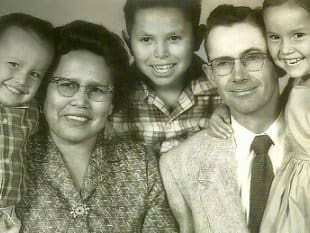
 As stated Wikipedia, the Indian Placement Program was a program of The Church of Jesus Christ of Latter-day Saints from 1947 to 2000, in which LDS Native American students were placed in LDS foster homes during the school year, with the hopes that they would assimilate into American/LDS culture. Beginning in the 1970s, however, the Indian Placement Program came heavy under criticism. Supporters believed that exposure to white culture was beneficial to Native American children, and that it improved educational and economic opportunities, while critics believed the program undermined the children’s Native American identity. In 2000 the last student graduated from the program, though the program never was officially discontinued.
Matthew Garrett is currently an associate professor of history at Bakersfield College in California, teaching United States, California, and Native American Indian history courses. His dissertation and forthcoming book manuscript explore the LDS Indian Placement Program. He is also a devoted husband and the father of three adorable little girls.
Episode Transcript
Host: John Dehlin · Guest: Matthew Garrett
This transcript is machine-generated and lightly edited for readability. The audio is authoritative. Please excuse occasional errors in names and spelling.
Introduction and Guest Welcome
Part 1 of 2 · Ep. 456
John Dehlin [00:00:00] 1, 2, 3. Mormon Stories Podcast is a production of the Open Stories Foundation. All donations to Mormon Stories are fully tax deductible and go directly towards keeping the podcast alive and towards building a community of support for Mormons like you. To support the podcast or to join the community, please become a monthly subscriber today@mormonstories.org hello and welcome to another edition of Mormon Stories Podcast. I'm your host, John Dehlin, and I'll have to admit it's been a while since I've done one of these interviews.
John Dehlin [00:00:40] For those of you who are Facebook friends with me, you'll know that the past few months I have been immersed in two main things. One is applying for internship, which is the final stage in getting your PhD as a psychologist.
John Dehlin [00:00:57] And I'm happy to report that I just matched and I'll be attending the Utah State University Counseling and psychological services counseling USU students starting in August from August to July 2014 to 2015. And I'm super excited to be able to stay home and not have to leave Cache Valley for now and to be able to continue trying to help the types of people I went to get my PhD for. So that's super good news. But I apologize to my listeners for how long I've been away. In addition, I also defended my dissertation and that's a huge step. It was successfully defended.
John Dehlin [00:01:41] All three of the papers from my dissertation are either published or soon to be published. I should say accepted for publication and will soon be published. And I'm just thrilled. So I got time to do interviews again. And so I want to thank all of you for your patience in waiting me out. And I hope that I'm a lot more productive in the future.
John Dehlin [00:02:06] So with that, I want to welcome my guest to Mormon Stories. His name is Matthew Garrett. Hi Matthew. Hello, Matthew. I'll do a little introduction real quick. Today's topic is, is on what I'll call the LDS Indian Placement Program.
John Dehlin [00:02:27] So basically we're going to get into depth on it. Some of you may know a little bit about it, but basically early in the let's just say somewhere in the 1900s, we'll explore it, the church decided that they wanted to help. As I understand it, the Lamanites blossom like a rose. And so they and Matthew, you can correct me later, but they, they went to reservations and found children who were willing and able to relocate. And they had kind of a foster care program where the children were relocated into sort of, I'll just say Caucasian or white LDS family homes and raised in those homes with the idea of helping them flourish.
John Dehlin [00:03:11] And we'll talk a lot more about it, but I'll introduce Matthew. That's just kind of the teaser, I should say. It was a very controversial program and we'll talk about that too. But Matthew is currently an associate professor of history at Bakersfield College in California.
John Dehlin [00:03:31] He teaches California Native American Indian history courses along with United States history. He got his bachelor's in history from byu. He got his master's in history from University of Nebraska and his doctorate in history as well, American history at Arizona State University.
John Dehlin [00:03:53] His field of interest is Native American history. So this is his area of expertise. And his dissertation was specifically on the Indian placement program. So this is certainly, if not one of the guys or gals on this topic, maybe the guy on the Indian placement program.
John Dehlin [00:04:14] Just as a side note, he lists that he is a devoted husband and a father of three adorable little girls. And for those who care, he mentioned that he is currently an active Mormon. So, Matthew Garrett, welcome to Mormon Stories.
Matthew Garrett [00:04:32] Thanks. Thank you for having me. It's a pleasure to get to talk with you.
John Dehlin [00:04:36] My pleasure as well. And I should note, you reached out to me years ago. Is that right?
Matthew Garrett [00:04:42] Yeah, probably 10 years ago, I somehow got in touch with you. I don't remember the details of how, but I was studying some of the different topics of Mormon history and ran into some of the work you were doing somehow. I don't remember the details, though.
John Dehlin [00:04:56] Yeah, well, I'm so glad you did and I'm sorry that it took us this long to actually record the interview. I also should probably thank Paula Goodfellow for helping helping make this happen. But just so glad to have you on Matthew.
Matthew Garrett [00:05:13] Thanks.
Overview of the Indian Placement Program
John Dehlin [00:05:14] All right, well, so if you were, I kind of did a hacked up job of describing the Indian placement program. If you had to give it sort of a paragraph's worth of explanation or description for our listening audience, how would you describe what it was?
Matthew Garrett [00:05:34] The placement program was an institution, a program operated by the church intended to help, as you said, redeem, help blossom as the rose. The Native Americans that Mormons had anticipated would eventually be redeemed. You can see earlier examples of that policy going way back to the first Lamanite mission and mission sent out of Nauvoo in Utah.
Matthew Garrett [00:05:58] But it really kind of the fulfillment of that prophecy sort of just sat quiet for probably half of a century. In the late 1800s until early 1900s maybe, you know, 1940s, it starts to really kind of there's a movement to reach out to Native Americans, again led by Spencer Kimball. And from that point on, you see the birth of this program that's designed to provide education and spiritual training to Native Americans. And Native Americans, at the same time, are pretty interested in the 1940s and looking for new ways to get educated. There's a drive on the reservations completely independent of Mormons. There's a drive to build schools and to start modeling on Western education.
Matthew Garrett [00:06:41] So there's, you know, weird confluence where both. Both groups had an interest in this program in the 1940s and 50s and 60s. And as children were put in these foster homes, they would often go for education. But gradually, religion and spirituality became one of the driving forces for. For signing up. And as you said, it was pretty controversial. By the 1960s and 70s, there's an awareness in American history that Indian children are being taken out of Indian homes.
Matthew Garrett [00:07:08] Not just Mormons, but generally social services removing Indians. And there's, of course, the Indian Child Welfare act of 1978 to try to slow that down. And the church's program specifically was targeted by different Native American groups that thought that it was ethnocentric and whitewashing children. And within the church, there's some shifts.
Matthew Garrett [00:07:30] The correlation movement really starts to erode the program, and there's some shuffling of bureaucracies until the 1980s when it starts to really start to decline heavily. And then finally it ended in about 2000. That's the program in a nutshell.
John Dehlin [00:07:46] We can't forget to talk about George P. Lee and all this.
Matthew Garrett [00:07:50] Yeah, George Pele, of course, is the poster child for the program. In his earlier years, he was a Navajo boy who was picked up by traders who had reached out to him. I think they were assigned his home teachers or something. Well, it was before home teaching, but they were missionaries who reached out, and they were constantly trying to connect to his family, and they'd leave food and treats on the door until eventually they had a bond with his family, and they signed him up for placement after a couple years. And I think he went to Tuba City boarding school for a couple years, and then he went on placement and lived with the Harker family and became this example of success.
Matthew Garrett [00:08:23] He got educated. He played football. He went on to get a bachelor's, a master's. I think he even had a doctorate. Maybe he was president of a college. He was considered running for chairman of the Navajo tribe, was eventually tabbed to be the Holbrook mission president, which is the old Southwest Indian Mission, became the Holbrook Mission, and then eventually becomes a one of the 70. And despite encouragement, discouragement from speaking on Indian affairs, he continued to do so. And his interpretation of Indian issues was a little bit more controversial. He saw Lamanites as sort of a people who were destined to take leadership in the church and that Ephraim and white folks were kind of in the way.
Matthew Garrett [00:09:02] And as he spoke more and more about that position, he alienated himself more and more from the Brethren until eventually he wrote a couple of letters that he popped published that were pretty aggressive. And they excommunicated him.
John Dehlin [00:09:16] Yeah, along with Paul Dunn. Learning about sort of the excommunication of George P. Lee at General Authority was something that really awokened my mind. So we'll talk about all that during this interview. I don't want to. Well, I guess I want to start just by jumping back a little bit.
John Dehlin [00:09:37] And so I think we've given a good overview. I hope the listeners are now. I hope their interest is piqued, but let's begin. You know, I don't think we think a lot about the Book of Mormon today, potentially in terms of what it basically says about what its goal or intent is. So talk a little bit about your understanding about when Joseph Smith creates the Book of Mormon, what it has to do with Native Americans. And then you talked a little bit about the Native American mission back in, I'm going to guess, 1831. But just talk a little bit about how Native Americans tie into early Mormonism.
Native Americans in the Book of Mormon and Early Church
Matthew Garrett [00:10:18] Well, you know, there's a lot of. In America generally, there was a lot of questions about Native Americans and where do they come from. And there's all sorts of curiosities, the things that were created by mound builders and other civilizations, artwork that's no longer being created but was still lingering around. They wanted to explain where it came from. And there's all sorts of explanations published by different groups, different stories about lost Roman colonies and lost Welsh colonies. And of course, there's the Book of Mormon and the lost Israelites that are there, Lehi's family.
Matthew Garrett [00:10:50] And in the Book of Mormon, as you read, there's a lot of prophecies about this seed of Manasseh Lehi's family, how someday they're going to be restored. It's the story of these people falling into disarray and apostasy and their civilization collapsing, but always with the promise that someday they'll come back and there'll be a restoration and they'll build a city of Zion and Ephraim will play a role in assisting.
Matthew Garrett [00:11:16] And I think if you look at the early Mormon publications, there's references here and there that really indicate that a lot of early Mormons in the 1830s fully expected Native Americans to join the church, to take a leadership role, that they were expecting droves and droves of converts. And when they sent the Lamanite mission out in 1830-31, they expected that they were going to come back with tons of converts and this was going to be the fulfillment of the prophecy. But they didn't really find the converts. They visited the Delaware and a few other tribes, Parley P. Pratt's group, but they never really had the success.
Matthew Garrett [00:11:52] The only success they had was with the white folks in Kirtland, really. So when they came back and that didn't really work out, that forced people to reassess what those prophecies meant, and was there going to be a restoration? And I think they held onto it for a little while longer. There are still other missions in Nauvoo. They sent missions out to the Sioux. They sent. Well, I think by the time you get to Nauvoo, the Indian missions become more practical.
Matthew Garrett [00:12:16] Sending missionaries to the Sioux so you have access to the Missouri River. Sending missionaries to the Chippewa and the Menominees so that you have access to the lumber so we can build the temple in Nauvoo. There's an effort to still convert Indians, but less expectation that they're going to take the leadership. And then by the time you get to Utah and it's clear that there's violence and there's conflict and it's not the pretty dream that everyone imagined, Indians sort of become more of an enemy or a nuisance or viewed in the typical European American attitude of Indians at the time, and less about a group of people who are going to take leadership.
Matthew Garrett [00:12:50] And I think that's what eventually Lee takes issue with, is he goes back to those old sort of attitudes and wants that to come back again.
John Dehlin [00:12:58] Right. You mean George P. Lee?
Matthew Garrett [00:13:00] Yeah.
John Dehlin [00:13:01] So just real quick, what were the prophecies that we're talking about here? Were they made by Joseph Smith? Were they in the original Book of Commandments?
Matthew Garrett [00:13:09] No. Second Nephi. Somewhere it talks about the building of Zion. There's some references in there. What's his name? The apostle? Oh, like Orson Pratt. He says some things about it in some of his work. So there's. And there's a few newspaper clippings from the Times and Seasons or whatever, some of the early publications that make reference to the building of Zion that Phelps is publishing. So I mean, it's here and there a little. It's not the dominant theme at all, but it's definitely there.
John Dehlin [00:13:45] And, you know, I've heard that the Book of Mormon wasn't very emphasized by Joseph Smith in those early years of the church. And that's the truth with the general membership as well. So do you have a pulse at all for how serious members even took the Book of Mormon? Would they have been looking to it and saying, wow, here's a prophecy. We need to take this thing really seriously? Were they even reading the Book of Mormon? Do you have any sense of that?
Matthew Garrett [00:14:12] I couldn't really speak to that, except that after reading all the newspapers that I don't see a lot of Book of Mormon passages used to argue their points, but I. I couldn't really speak to their use of it.
John Dehlin [00:14:21] Okay, so it wasn't like all the members in Kirtland were dying to convert Native Americans as a fulfillment. And so if those missions didn't work out, they're questioning Joseph's mantle as a prophet. What I hear you saying is it didn't reach that level.
Matthew Garrett [00:14:38] I don't think so. I mean, there is definitely behavior. Like, there's one great story, I forget where I dug it up of. Oh, it's one of the antagonistic works that's published by a non Mormon. But he's talking about how the Mormons would get up on tree stumps and they would preach to their other Mormons as if they were Lamanites and they would practice these ritualistic baptisms there in the open space with no water. You know, sort of this, you know, this is what's going to happen when we get out to see the Indians. We're going to preach to them and convert them and baptize them. And so, I mean, they definitely were these noticeable themes of going out and converting Indians, but it didn't really work out that way.
John Dehlin [00:15:14] Okay, so maybe Joseph and the LDS Church just kind of moved on. They kind of tried it. They hoped it would work, but then kind of lost interest as they realized there wasn't much interest there.
Matthew Garrett [00:15:27] Sure, absolutely. And then it fuels up again in the 1840s when they're in Utah and they start the missions there and the child adoptions there. They actually launched a program. I think they'd given up by that point. But as they get to Utah, Utes show up having raided Indians from other villages, from Go Chutes and Paiutes, and they try to sell them to the Mormons, and Mormons have no interest in buying Indian slaves, because that's not. Mormons are generally abolitionists. If anything, they're not particularly supportive of slavery. And then before their very eyes, these men just start killing Indian slaves, saying, well, if you won't buy them, they're of no value to us.
Matthew Garrett [00:16:06] And so the Mormons say, well, hold on, what do you need? And they'll start trading rifles and food. And before you know it, Mormons are actively involved in this pre existing Spanish ute slave trade that was going on and drawn back into trying to assimilate and save Indians from their darkness.
Matthew Garrett [00:16:22] So, you know, you begin more Indian outreach, you have Brigham Young ordering Indian or, you know, issuing a command that we should all buy Indian children. And the legislature passed a law in, I think, 1852 or 50 saying what exactly needs to happen when Indians are brought in? How do you treat these adoptees and what kind of minimum requirements? Are they indentured servants? Are they slaves? Are they family members? And that's a point of debate that's still not really settled in the historiography. There's some people who think these Indians who get adopted in the 1840s, 50s, 60s were slaves, were indentured servants, because on the census they're listed as servants sometimes, but on other censuses they're listed as family members.
Matthew Garrett [00:17:05] And we even know some of them were sealed in the temple to the family that they were living with. So the status of them is sort of debated. But there is an outreach effort there and there's also some demonstration farms, but most of those failed in the 18.
John Dehlin [00:17:19] What's a demonstration farm?
Matthew Garrett [00:17:21] The Mormons would go out and they'd start a farm and they'd bring over local Indians and say, look, this is how you farm beets or how you farm wheat or whatever and try to get them to become agricultural sedentary people without, you know, try to move them away from their nomadic migratory patterns and civilize them as good Europeans that farm.
Matthew Garrett [00:17:42] But that didn't really take root. They generally failed one after another. But we sent out missions that did that kind of work in Las Vegas and Carson Valley and a bunch of other places on the Green River, I think.
Matthew Garrett [00:17:56] But most of them pretty much failed. The Washakie colony is probably the most. The best known and successful one. They kind of were off and on. And then in the 1870s or so, they relocated to Brigham City and the church laid out a 7,000 acre farm and dug canals and built sawmills and schoolhouse and a mission home. And they built houses for all the Native American. The Eastern Shoshone band that was following this community, and they tried to set it up, and it kind of worked off and on. Indians would come and go. Sometimes they'd farm, sometimes they wouldn't. Sometimes they'd stay in the community, other times they'd leave. And it worked off and on up through the 1960s, I think, is when it finally was dissolved and just didn't work anymore.
John Dehlin [00:18:40] And what was the name of that community again?
Matthew Garrett [00:18:42] The Washakie Colony.
John Dehlin [00:18:44] So this would have been. Boyd K. Packer would have grown up familiar with this colony?
Matthew Garrett [00:18:48] Yeah, yeah, absolutely.
John Dehlin [00:18:51] Okay. And do you have a sense for why the church was even bothering in the 1900s to set up a colony like this?
Matthew Garrett [00:19:00] I think it's still that lingering desire to provide outreach and support these people who they knew were supposed to be there, they're supposed to redeem. It's supposed to happen, but it's become a secondary motive of the church. And then by the 1940s, 50s, 60s, with Packer and others that are still continuing it, and there's the internationalization of the church in an effort to reach out to all sorts of people. And so it's part of that, too, I suppose, by the 1960s and 70s. It's fading by then, but.
John Dehlin [00:19:28] Okay. The title page of the Book of Mormon says, this is like, to bring the Indians back to Christ or to bring the Jews or the Gentiles back. There's something about that.
Matthew Garrett [00:19:40] Right. And part of that is to teach them proper white cross culture, you know, to civilize them to farming and clothing and sedentary lifestyles.
John Dehlin [00:19:49] And they didn't. They didn't take to that so well.
Matthew Garrett [00:19:51] No, it didn't really work out too well.
John Dehlin [00:19:53] Okay. Okay. All right. So. So it sounds like there were spotty efforts here and there in the early pioneering times. I mean, just to. Just a touch on Mountain Meadows, it sounds. I mean, in that instance, we almost kind of blamed the Indians. I shouldn't say we, but some of those. Okay, so as I understand it, some of those in southern Utah who participated in the Mountain Meadows Massacre tried to pin it on the Indians. Is that right?
Mormon-Indian Relations and Historical Context
Matthew Garrett [00:20:21] Yeah, sure, absolutely.
John Dehlin [00:20:24] But they weren't. Were they heavily involved in that?
Matthew Garrett [00:20:27] They were involved. They were present, but it wasn't organized by them. That was. The Mountain Meadows Massacre had to do with the Arkansas pioneers moving down through Utah and having conflict with the Saints. And of course, the Saints on the verge of war with the United States government, and Brigham Young declares martial law.
Matthew Garrett [00:20:43] And that didn't help that the Arkansas group was. I Think Arkansas is where Parley P. Pratt had just been killed by a man, or a man from Arkansas had killed Parley P. Pratt. So there was some concerns about that. And they fought back and forth. Mormons, because of martial law, wouldn't trade with them. And lots of pioneers expected to be able to trade with the Mormons when they passed through Utah to help resupply. And because of martial law, they wouldn't. And so there was conflict, and there's all sorts of spotty arguments over what, who did what, but ultimately it led to the Mormons down there by Panguidge just, you know, committing this massacre with Indians.
Matthew Garrett [00:21:18] With them. They told the Indians they could have some of the clothes and supplies that were seized from the dead. And so there were Indians that participated, but it wasn't an Indian planned.
John Dehlin [00:21:28] And did they. Were they punished at all? Did it hurt them for having been blamed for what happened?
Matthew Garrett [00:21:35] I'm not too familiar with it, but I don't think so.
John Dehlin [00:21:37] Okay. Okay. And then anything to talk about the, you know, our relationship as Mormons with Native Americans through, let's just say, the 1960s where things start picking up.
Matthew Garrett [00:21:52] Yeah, it's really very quiet. From early 1900s up until 1940s, there's not a whole lot going on. I think, indeed, it's because there's not much going on that in the 1940s and 50s, when Kim Bull starts to play a role, he feels like it's a chance to fix this overlooked segment of the population. We need to reach out to them.
John Dehlin [00:22:14] Okay, so Kimball really is the impetus.
Matthew Garrett [00:22:17] Yeah, he's one of them. Not for this particular program. Well, he plays a definite role, but he ends up being the driving force behind the larger Indian program of the 1950s and 60s and 70s. He's definitely the driving force.
Founding of the Placement Program
John Dehlin [00:22:31] Okay, so let's talk about that. Let's talk about the foundings of this program, how it picks up, what the points of inertia are.
Matthew Garrett [00:22:41] Okay. Well, it goes back to the 1940s, when Navajos and other Indians would work on a migratory seasonal agricultural circuit, and many of them would come up into southern Utah and work on the beet farms. And one particular family, the John family, Navajos, they worked regularly with some of the families there, and they had children that they brought with them who worked in the fields with them. And one of these girls, Helen John, at some point decided she wanted to stay behind and not go home during the school year, not go back to the Navajo reservation, but instead to stay there in southern Utah and attend school. And there's some debate over whose idea that was.
John Dehlin [00:23:23] She was a Native American, right?
Matthew Garrett [00:23:24] Yeah. She was Navajo. Yeah.
John Dehlin [00:23:26] Okay.
Matthew Garrett [00:23:27] In Mormon folklore, she's the one that said, I want to do this. Please let me stay. I want to go to school. And there's different interviews from early people, Mormons that were involved in the program, who say, yeah, that's what happened. She's the one that wanted to do it.
John Dehlin [00:23:40] My feminist friends are going to love that. That it was a woman demanding to be educated. It's like, I am a lala.
Matthew Garrett [00:23:47] But if you look at her interview, you find a different answer. Her interview says that she was encouraged by these white fol, that there's a woman named Amy Avery who took her in and would play games with her and teach her songs. And Amy every told her that she needed to do this, this would be a good idea for her, and kind of encouraged and promoted it. And Helen John thought, okay, well, sure, if you think so, I'll do it. But whatever the case, in 1947, Helen John decided to stay with a white family. And Amory Avery put her in contact with Golden Buchanan, who was in the stake presidency in Richfield.
Matthew Garrett [00:24:22] And he was in charge of Native Americans for a variety of issues, mostly looking over migrant workers and their fair treatment. And so he took the lead in trying to find her a home. He wrote to President Kimball, who was on the Indian committee in Salt Lake, which had sort of been almost non functional, just barely getting rolling, it really done very little. And he said, I have this girl and I want to put her in a home. And, you know, this could be a really great program. We could. We could expand to other Indians. And before you know it, we could have hundreds or thousands of Indians and converting them and converting their families, and we could really reach out to the reservation and transform their lives.
Matthew Garrett [00:24:59] And so President Kimball showed up on his doorstep soon after and said, yeah, let's do this program. And from that point on, President Kimball's really the promoter.
John Dehlin [00:25:09] Was he a prophet at the time?
Matthew Garrett [00:25:12] No, he was one of the seven. He was one of the 12. He had. He had been ordained, I want to say, in the 1940s, maybe. Was it when is he got ordained?
John Dehlin [00:25:25] Yeah, I'm not totally sure.
Matthew Garrett [00:25:27] 1946. He's ordained.
John Dehlin [00:25:29] Okay.
Matthew Garrett [00:25:30] Or 1943. 1943. He was ordained by Heber G. Grant. And he himself had an interest in Native Americans because it was in his patriarchal blessing that he was going to reach out to the native, to the Lamanites, it said, in his blessing. And he Always anticipated that would happen, but then it never really did.
Matthew Garrett [00:25:48] I think he had an interest also because of his father. His father served a mission to Indian territory in the 1880s and was I think, there for like five or 10 years and came home and surely told stories. And also the Apache, they were in Arizona, where Kimball grew up. And the San Carlos Apaches would ride on the trains there, on the tops of the trains, so they were very visible. They had made some sort of deal with the railroad company that they could ride for free on the tops of trains in exchange for rites of passage.
Matthew Garrett [00:26:18] So they would ride and he would see them and it was in his blessing. And he thought that was going to be his life calling. But then he got his mission call to Swiss Australian mission, Swiss Austrian Mission. And that wasn't what he expected and he was kind of frustrated and he came back home from his mission. So he ended up serving in the Central States because of World War II, World War I, but. But he came home from his mission and he just went about his life there in Arizona and opened up banking and real estate and insurance companies and moved up in the church ranking until he was called an apostle in 1943 by Hubert G.
Matthew Garrett [00:26:52] Grant. And then a couple years later is when Albert Smith pulls him aside and says, hey, I need a favor. I need you to start. President Smith said, I need you to look after the Indians. And that's when it clicks for Kimball that there it is. I finally am going to fulfill this patriarchal blessing now. I'm going to be able to reach out to Indians. And so he becomes the heart of this whole Indian program from the 40s, 50s, 60s until his death. Really driving. We need to reach out to Indians in any way possible. And the placement program is just one of the programs.
Matthew Garrett [00:27:19] We can talk about the others a little bit later. But he's definitely eager and anxious when he gets that letter from Buchanan saying, hey, I've got this girl, what should I do? Kimball is eager and ready and says, I want you to take her in.
Matthew Garrett [00:27:31] Let's do it now. Let's move forward. And so the program begins unofficially, with the support of an apostle. The church doesn't actually approve the program for another five years or so, but every meeting, every chance Kimball gets, he shows up with the Brethren, the twelve Apostles, and says, look at these Indians, we need to help them. And look at this article I found in the paper about Indians being hungry and about Indians who need education. And he collected all these self interest, these personal interest stories. He actually had a whole team of people that would look up any interest story they could find. And then he would lobby the apostles to get on board.
Matthew Garrett [00:28:05] And then at the same time he's doing that, he's going out to all the stake presidents in southern Utah and rallying them and saying, hey, I want you to take in Indian kids. I want you to put them in your own family. I want you to put them on the front row of state conference. I want them highly visible. I want them given prayers. I want people to see these kids and to get involved. And he's doing it all unofficially because it's not an official program.
Matthew Garrett [00:28:29] But there you have the support of an apostle. What do you say when an apostle tells you to do something? So the program really got its push from him. And then he also, as an apostle has other powers. He ends up calling Buchanan to be the Southwest Indian Mission president so that he can find Indian children and then have them pulled out of the reservation and put in white foster homes for the placement program.
John Dehlin [00:28:54] So a couple things. So it sounds like if the patriarchs giving President Kimball this patriarchal blessing during the World War I time era or a little before, it sounds like we never quite got rid of our awareness about the Native Americans and a feeling of almost. Is it paternalistic? Is that the right word? Kind of, you know, it's still our duty to take care of these people. It sounds like that never really left our cultural milieu. Is that true?
Matthew Garrett [00:29:27] No, I think you're right. I think it's something that just lingered in the background and it just was always there, but it wasn't the focus.
John Dehlin [00:29:36] Not because we didn't try, but just because it never worked out when we did try. Is that right?
Matthew Garrett [00:29:40] Right. Sure. And so there's a feeling, but it's in the background. And I think also the fact that his father served there. Oftentimes you see that in a patriarchal blessing or at a mission call, there's often a historical people often get called where their father served or in a similar language or there seems to be a connection. That often happens. I could see the patriarch knowing full well that his father served in an Indian territory mission and telling the boy, well, you're going to reach out to Indians too.
John Dehlin [00:30:11] So is there any way to look at this? I mean, clearly I have some Native American friends who look back on this whole program with a lot of anger and resentment. Is there any other way to look at it from Spencer B. Kibble's standpoint as just well intended affection and a sense of purpose and mission that he grabs to.
Matthew Garrett [00:30:33] I mean, yeah, there's a couple of articles in the Ensign published back in this period when he's trying to persuade people of the program. And those articles talk about their program. They just talk about the Navajos. I think there's a two part or three part series called the Plight of the Navajo or something. And it talks about the poverty and how they have no education and they have no electricity and they have dirt floors and there's all these financial and as well as social problems, alcoholism.
Matthew Garrett [00:30:58] And so there's this need and the cold winter that comes and causes problems. And there's no running water and there's need and there's need and there's need. And it's not just the Mormons saying that, it's the Navajos as well. In the 1940s, Navajos have this Great awakening where they just want education. Prior to the 1940s, they didn't want anything to do with the white man's education. They were annoyed and frustrated. They felt like boarding schools of the 1880s to 1920s were all just a white man scheme to assimilate them. And they resisted it. Definitely. There's great stories about Navajos seeing an Indian agent come around the canyon and they go run and hide because they don't want their kids to get snatched up.
Matthew Garrett [00:31:36] There's definite opposition up until the 1940s. And in the 1940s, things changed because of the World War II. With the many Navajos serving in the war industries and finding good jobs, the cash starts to flow onto the reservation and you start to see a cash economy emerge. And you see people feeling like, man, if only I spoke more English, I could do better. And there's a driving interest in education during the war and after. And the Navajo Council, the tribal council, is passing bill after bill after bill calling for more schools, calling for the federal government to give money for education, welcoming and inviting groups to do anything to help get them to school.
Matthew Garrett [00:32:15] Opening up dorms off the reservation that are just on the edge of the reservation that are where students can cross the border and go into a local public school. So there's this huge drive within the tribe in the 1940s that matches up neatly with the Mormons feeling like they need to provide education.
Matthew Garrett [00:32:33] And so it's not just those devious Mormons. It's both groups are really seeing something they both want at the same time. And what, of course, the Navajos don't know is that when they sign up for this, it's not just education. It's going to be spiritual, cultural assimilation as well.
Matthew Garrett [00:32:50] But they're both excited about the program. During the 1950s and 60s, early 60s, there's a lot of positive attitudes about it. There's certainly people opposed to it. There's one woman who works for the Bureau of Indian affairs who complains and it goes all the way up the channels and there's a big argument over it and there's others who complain as well. But overall, the attitude was generally positive in the Bureau of Indian affairs and within the tribe. And the church really went out of its way too, to reach out to the tribes and specifically the Navajos to encourage a positive attitude. They would invite the tribal chairman to come to different conferences and they would go visit them.
Matthew Garrett [00:33:29] And they were there. We sent our releases. General Relief Society president attended the inauguration of President Jones, I want to say, one of the Navajo chairmen. So we can really see the church reaching out and trying to build a positive, functional relationship. And most of the Navajos who are in leadership, the tribal council or whoever else, and various bureaucrats, they would have all been boarding school educated kids who didn't like the boarding schools and how assimilative they were and how forceful and how whitewashing they were. But they really liked the idea of education and they like that these Mormons are taking their kids in and they're not whitewashing them in the same old ways.
Matthew Garrett [00:34:05] They're not cutting their hair and telling them, don't speak Navajo. Instead the Mormons are saying, well, come on, you're special because you're Indian, you're a Lamanite. We value your culture to an extent. We don't want your spirituality, but we want your identity as an Indian because that's valuable and that's what we want to redeem. So it's not one sided. It's both groups are really moving in that direction in the 1940s and 50s.
Assimilation Policy and Lamanite Identity
John Dehlin [00:34:30] So are you saying that at least early on, the LDS approach, the Indian placement program was more progressive in encouraging natives to embrace and be proud of their culture and heritage?
Matthew Garrett [00:34:45] No, no, no, not that they were. Well, they would encourage, for example, a young man serving in the placement program, participating in the program might go to a foster home and they would tell him, you know, you're of course a Lamanite and you're going to be redeemed and you need to get rid of old ways and no more spirituality of the no medicine man. But they would say, hey, at school we need someone to talk about Indians and what's it like to be an Indian. And so he'd go to school and do a presentation about being an Indian, and he maybe even sample some of the language and show it off. And it was sort of a superficial, this is really cool novelty act kind of things that were encouraged. Not traditional things necessarily, but there was. Oh, go ahead. But there was, you know, go ahead. Yeah, there's.
John Dehlin [00:35:29] Yeah, no, no, keep going. This is important, though.
Matthew Garrett [00:35:33] They, you know, they. The church members, they saw it as inevitable that Native Americans would become white. They were going to become civilized. They're going to become just like everyone else in Utah.
John Dehlin [00:35:44] And you mean literally white skinned?
Matthew Garrett [00:35:47] Literally white skinned, yeah.
John Dehlin [00:35:48] Okay.
Matthew Garrett [00:35:49] There's great stuff about that. Actually. President Kimball made some comments at General Conference where he showed pictures and said, look, these. These kids are getting whiter every day, literally.
John Dehlin [00:36:02] Is that a Book of Mormon prophecy? That the Lamanites will blossom like a rose and their skin will become fair? Is that right?
Matthew Garrett [00:36:08] Right. Yeah, well, yeah, that's the assumption. I don't know if it's prophesied that their skin will become where it's prophesied, that the mark will be removed. And then the mark, people often interpret that as the dark skin. And so doesn't the Book of Mormon
John Dehlin [00:36:19] say the mark is dark skin?
Matthew Garrett [00:36:21] I think that it's. I don't know.
John Dehlin [00:36:24] Okay, that's all right. I seem to remember it saying, they're the same.
Matthew Garrett [00:36:29] At some point, they'll become fair. It says. Yeah, so there's an anticipation of that, and people would expect that. And so President Kimball and others taught it. There's another interview from a BYU professor of biology, I think, who was talking about how it was a problem that he has to constantly face, that these Mormons come to school and they expect Indians to become white, and he's trying to teach them otherwise. So it was definitely part of popular thought. But that there would be an eventual assimilation.
Guest [00:36:55] Absolutely.
Matthew Garrett [00:36:55] But at that same time, there was a respect for some Native things. You know, you should know how to do the arts and the crafts and the dances, and then things that didn't threaten. That didn't threaten Mormon theology. Those things should be encouraged. And that's different than, say, the boarding schools where everything was discouraged.
John Dehlin [00:37:13] Okay.
Matthew Garrett [00:37:14] So a lot of folks were okay with the Mormon placement program early on. It had a lot of popular support. Even later on, there's different surveys that assess, like, what is your attitude about the program? And they would interview parents and tribal leaders and people who were in the program, people who quit the program. And overall, most of the surveys show that There was generally a positive attitude, but there were a few very loud who were opposed, and with good reason that we think of. But overall, I don't think it was nearly as negatively perceived, especially not in the 1940s and 50s and 60s. It was not negatively perceived.
John Dehlin [00:37:49] So there was doctrinal or religious motivation on the part of the LDS people. There was just altruistic. You know, there's a lot of poverty and sadness. We want to help them. There was. There was. You know, they were complicit. Many of the Native Americans were complicit in wanting to be educated. And then there was Spencer W. Kimball kind of really trying to grow this program.
Matthew Garrett [00:38:12] And also at the same time, the 1950s in America is a time of Indian termination. It's when tribes are being dissolved. It's the. The general policy of the federal government to dissolve tribes, to take away sovereignty and shift it over to the states. You know, remove the power of tribes to manage highways and public lands and things that are in the reservation. So there's a general attitude in America generally that this is.
Guest [00:38:34] What's.
Matthew Garrett [00:38:34] This. Assimilation's inevitable. So Mormons aren't unique in this approach. A lot of Native Americans bought into that approach as well in the 1940s and 50s.
John Dehlin [00:38:43] Okay. And so we were a little bit more progressive than the boarding schools of old that basically said, erase any Indian culture or artifacts. We said, keep them. Bring them to the extent that they're entertaining and interesting. But there are certain limits to how much someone should embrace their Indian heritage and culture.
Matthew Garrett [00:39:09] Yeah, that's exactly right.
John Dehlin [00:39:10] Okay. Okay. So how does President Kimball take this from this sort of side project that Heber J. Grant gave him to becoming like a major. Is it fair to say it became a major thrust and initiative within the LDS Church in the mid 20th century?
Matthew Garrett [00:39:29] I think it's fair to say it's a major thrust. It's not just in the church. It's in Indian policy. If one of my goals is that people who teach Indian history and read about Indian history would understand that this is a huge, huge program. The federal government ran a very similar program, the voluntary relocation program.
Matthew Garrett [00:39:45] And it was going on. It probably maxed out at 100,000 people. And the placement program at 50,000 is only half that. But that's still gigantic. That's by far the second largest relocation program of the era. It's huge, and everybody should be aware of that. And certainly within the church, it's gigantic. You can read in General Conference, there's lots of talks about the Indian programs One of your Facebook questions someone had posted was to the effect of. I noticed in the recent years, they don't use the word Lamanite as much. And I think that that's right. In the 60s and 70s, you saw that word used.
Matthew Garrett [00:40:18] There was a lot of talk about the program. It was anticipated that this is. We're finally going to do it. This is going to happen. We're going to redeem the Indians. And there's a qualitative difference in how they use the word Lamanite. When you see the word Lamanite in General Conference today, it's someone's talking about a Lamanite army in the Book of Mormon attacking a city of some sort. Whereas when they talked about lamanites in the 1950s and 60s and 70s, they talked about human beings that were transforming and becoming good, redeemed, civilized American Mormons.
Matthew Garrett [00:40:50] So how does Kimball make this change, you asked? Yeah, he pushes and pushes by visiting all these different stake presidents. There's a great story from a guy named Miles Jensen that was an early administrator when Buchanan became the mission president in the Southwest Indian mission in 1951.
John Dehlin [00:41:08] Okay. I was gonna say around what year? That's perfect.
Matthew Garrett [00:41:11] 1951. Buchanan's a Southwest Indian mission. And then he would extract children. He sent the missionaries out, and they would tell people about this great program that was available. Missionaries would go to the boarding schools, and they would recruit people through. Through any means that they could. Some people learned about it through their friends were doing it. And there's fun activities. This is also the same time, or just slightly before, what Michael Quinn calls the baseball baptisms in England, where the church is using fun social activities to recruit people, like, hey, there's a baseball game. We should all go play. You just got to get baptized first.
Matthew Garrett [00:41:46] And there's actually great stories of a couple I've read that where people said, oh, we went on this bus to go to this activity, and they stopped by this building, we put on these white gowns, and we got baptized, and then we could go and we go do the activity. So that sort of stuff's going on, and people are getting increasingly. The numbers are rising of kids that are coming off the reservation and joining this program.
John Dehlin [00:42:09] So they were doing those baseball baptism types of things on the Indian reservations. Yes, in the 50s.
Matthew Garrett [00:42:16] In the 50s.
John Dehlin [00:42:17] So it's like huge numbers of baptisms.
Matthew Garrett [00:42:21] Yeah, it really. 1954 is when that really starts happening, the baseball baptisms. Because in 1954, the program became official, and the one real requirement the church laid out for the program was we want to make sure these kids are all Mormon, want to be accused of assimilating non Mormon kids or taking kids that aren't Mormon. So we need them all to be Mormon. And that, of course was required. They get baptized. And I think, personally, I really think that policy was there to be fair and to protect Indians from exactly what it caused. Because I don't think that the apostles and the brethren thought that it was going to be an excuse to baptize people.
Matthew Garrett [00:43:00] I thought the opposite. They thought this will stop them from being overly zealous and getting people who aren't even Mormon. But it did the opposite. It encouraged people to baptize anyone they could find so they could participate in this program.
John Dehlin [00:43:13] Was baseball part of that or not?
Matthew Garrett [00:43:15] Sure, they played sports. Basketball was more popular on the Navajo reservation, but yeah, they played sports. They did activities. They take drives and go to campouts. They did all sorts of activities. And of course, the best activity being go on placement. There were rumors that if you went on placements, you get really good Christmas gifts and you get a vacation with this white middle class family for nine months and it's all easy and everything's nice. It's way better than living in the dirt here on the reservation. So people would sign up for all sorts of reasons. Early on they signed up for education, for fun, for whatever. But there was a lot of pressure and the missionaries are out there actively recruiting for the program.
John Dehlin [00:43:52] Okay. So literally the Indian placement program, you know, reservation stuff of the 50s, becomes the proving ground for the baseball baptism stuff that happened in England in the late 50s and early 60s. It's almost like we learned it with the Native Americans and then applied it in the British Isles. Is that fair? Yeah.
Matthew Garrett [00:44:16] I don't know if the folks in the British Isles looked at the Native American practices and copied it. I don't know if there's a connection, but it's certainly a similar phenomenon happening 10 years earlier.
John Dehlin [00:44:26] Was Henry Moyle involved in any of the Indian placement program stuff that you know of?
Matthew Garrett [00:44:30] Not. Not that I know of.
John Dehlin [00:44:32] Okay, all right.
Matthew Garrett [00:44:33] Just curious, but yeah, it's definitely going on. And it continued through the 1960s. Maybe feeling off of the baseball baptism, maybe in Europe. It continues on. But at any rate, just before the program was official in 1954, you had all these people participating in an unofficial program. And one of my favorite stories is from Miles Jensen, who was the caseworker, the only real caseworker, the guy working with Kimball and with Buchanan to place the kids. So Buchanan would find the kids, and then Jensen would place them in homes. And he was out looking for people. And he would use the apostolic mantle of Kimball to say, well, I've got this apostle.
Church Leadership and Program Expansion
Matthew Garrett [00:45:08] He says, you should participate, and you should have to find me some people to participate in. So lots of stake presidents and bishops and people would participate. And on one occasion, he's speaking at a. Or he attended a stake conference in North Sanpete with some of these Indian kids that he was trying to get homes, or they were already placed in homes and they're sitting on the front row and some of them are giving speeches or giving talks or giving prayers during a state conference. And.
Matthew Garrett [00:45:33] And they had a guest representative. They had a member of the 12. They had. Elder Peterson was there. Mark E. Peterson was speaking at the conference. And Peterson takes to the pulpit at the end, and he says, it's a great quote. He says, I've been hearing about the Indian program of the church. People have been asking me, what should we do? Where will we get this help? Presumably help to, like, take an extra child in the home.
Matthew Garrett [00:45:54] How should we do this? And he answered publicly now, and he slapped the pulpit. I want you to know there is no Indian program. The people involved better clean their doorsteps. And I think that's a hilarious example of Kimball working informally, unofficially promoting with his apostolic mantle. And then this other apostle coming in and saying, no, that's not what we're doing. It's not the program. This is unofficial. You don't have to do this. It shows you there's not unity. They're not all on board yet.
John Dehlin [00:46:21] What did he mean by clean your doorsteps?
Matthew Garrett [00:46:24] I think that probably is a reference to dusting your shoes off. Sort of the old. This is something you need to. Either. I don't know, it's some old saying about ceasing, no longer participating in this.
John Dehlin [00:46:35] So he was down. He was down on the idea.
Matthew Garrett [00:46:37] Oh, right. He was totally opposed to placement. He didn't think it was appropriate at all, that it's just not an official program. You shouldn't be pressuring people in. I don't think he supported it at all. He isn't known as one of our
John Dehlin [00:46:48] more racially progressive apostles. Did it have a racial component? Maybe. Do we know? We don't know.
Matthew Garrett [00:46:56] Okay. I know that a year or two later, when the program becomes official, it becomes official. Just as Kimball leaves town, he goes to Europe for some work and he says, well, don't worry, Jensen. I've got a guy who will be in charge and the guy that's in charge to help Jensen get the program launched in its first official year is Marky Peterson. And so Jensen's feeling, oh, my goodness, this guy hates me and he hates our program. And now he's going to be the guy that gets us started. And it's Markey Peterson who says to Jensen, well, we've got approval, but they've all got to be baptized.
Matthew Garrett [00:47:23] And Jensen says, well, they're not. I've got school starts in a month, and I've got like three or four dozen kids, and none of them are baptized, and just a couple of them are. And Peterson says, well, then get them baptized now. And so they all. They dunk all these kids to get them baptized so they can participate. And that's where the program continues that practice for the next few decades.
John Dehlin [00:47:43] How did Peterson go from opposing it to being a leader in it?
Matthew Garrett [00:47:48] He wasn't a leader. I think he just got assigned. I think that someone had to take care of it. And Kimball was gone. And the Brethren, the Apostles, the First Presidency, said, this is our program now. So, okay, I'll follow the program. But they've all got to be baptized according to the program.
John Dehlin [00:48:03] So Kimball worked probably tireless. I'm just guessing here. He worked tirelessly with other apostles to build support and consensus over a long period of time.
Matthew Garrett [00:48:14] Yes. We've got a couple interviews where he talks about. People say that he would recruit from the. He had his Indian committee, any committee that he's chairman of, from the 1940s on, had a few different people that came and went. Miles Jensen was on it, Buchanan was on it. Some of the study presidency would come and go and other 70 later. But in that committee, they would recruit these human interest stories to bring to the. And then every week when he met
Guest [00:48:40] with the Apostles, he would bring these stories and say, look, these poor people
Matthew Garrett [00:48:43] are in need, or, look, this child is doing so wonderful, or, look, this kid is in scouting now and his life has changed. And they were all sorts of promoting
Guest [00:48:50] these ideas and helping to. So, yeah, he definitely played a role. And then he left right when it
Matthew Garrett [00:48:56] started, but he came right back and
Guest [00:48:57] he continued to lead the program as a sort of ad hoc special program that was run by his Indian committee for the next, I don't know, five to ten years or so.
John Dehlin [00:49:08] Did you say he left for Europe to live?
Matthew Garrett [00:49:11] No, no, no.
Guest [00:49:11] He just went on assignment to Europe for a week or two when the program started. And then when he comes back, he resumes leadership of the program and totally ran the program in its entirety, even as there was lots of different reorganizations that occurred with the program. At some point, they became obvious that they're moving all these kids and putting them in foster homes. They probably need a social services license of some sort. And so they involve the Relief Society presidency, and that's the General Relief Society presidency because they have, of course, a licensure. But even though the Relief Society is technically in charge, on paper, the Society is in charge, which means the answers to the Presiding Bishopric, who answers to the bits of the Prophet. The reality was that Kimball's in charge. He's the one running the show, not the early Society, not the Presiding Bishopric, not the Prophet.
John Dehlin [00:50:03] Okay.
Guest [00:50:04] And that continues up until 1969.
John Dehlin [00:50:07] Okay, so Kimball. Okay, so Kimball is the apostle heading this thing up. And the program becomes official in 52. 54. 54. Okay. So that's kind of Eisenhower administration years. That's like Ezra Tap Benson's, you know. You know, at some point becoming Secretary of Agriculture. It's Cold war. We're talking 50s here, right?
Matthew Garrett [00:50:33] Yes.
John Dehlin [00:50:33] Okay. So I'm. I'm just curious if. If you have anything on this. I. I'm thinking about B.H. roberts, you know, back in, let's say, the 20s or 30s. I'm not exactly sure the decade, but I know that he's at some point coming up with his concerns about the historicity of the Book of Mormon. And, you know, ultimately, my understanding is that even though he presents these concerns about the historicity of the Book of Mormon, that that isn't received very well by the brethren. And eventually BH Roberts dies. And I don't know if that whole issue sort of becomes shelved, but I'm thinking about the contrast between sort of, you know, the New York Times and B H Roberts started to question the historicity of the Book of Mormon, and now when the Book of Mormon historicity is really under attack.
John Dehlin [00:51:26] But then I'm thinking about the contrast of that between how material, psychologically, this is going to be for the average Mormon, because for the average Mormon, the Book of Mormon starts to rise in prominence in terms of its usage. And here we have all these people, all these Native Americans, being told they're Lamanites. And then we have all these members who are feeling, wow, this Book of Mormon's real, because we've got Lamanites that are living among us, and we're helping to fulfill prophecy of the Book of Mormon and the desert.
John Dehlin [00:52:02] The Native Americans are going to blossom like a rose and become white and delights Them like this. This had to have been a real emotional, spiritual, cultural, scriptural, powerful element for not only Kimball, but all the members who participated. This is something very tangible. Right.
John Dehlin [00:52:26] And for the Lamanites who are assuming this new identity, I should say the Native Americans who are assuming this identity that's handed to them, is that something you can talk about at all?
Matthew Garrett [00:52:37] Yeah. No, you're totally right.
Guest [00:52:39] This is a period of excitement.
Matthew Garrett [00:52:42] Every year there's a conference held for the Lamanites.
Guest [00:52:45] It started as a conference for these kids in the placement program, but it gradually expanded to be all Native Americans and then all larger Lamanites, Latin American Islanders. And that whole evolution of redefining the concept of Lamanite from Native Americans to Latin Americans and Pacific Islanders. And all these converts are coming in the 1940s and 50s from all these different places led these conferences to grow larger and larger. And they had the different themes every year.
Matthew Garrett [00:53:12] One of the themes that jumps out
Guest [00:53:13] to me was around 1970, 72, the theme of the conference was the day of the Lamanite is now that there is this. It's happening.
Matthew Garrett [00:53:21] We are living.
Guest [00:53:21] We are seeing the prophecies come true. And in truth, Native American converts weren't that impressive. There wasn't that many of them occurring. But when you start tossing in all of the Polynesians and all the Latin Americans, you really see there's just this huge influx of new, fresh blood to the church. And if we call them all Lamanites, then this really is quite an impressive accomplishment. So people are very much excited.
Matthew Garrett [00:53:46] And that includes some of the kids
Guest [00:53:48] who are serving in the placement program, who are being raised essentially in a Mormon, white Mormon home. From a young child age, they're raised being told, yes, it's you.
Matthew Garrett [00:53:56] You are the chosen one.
Guest [00:53:57] You're the chosen choice generation. And. And a lot of them buy into it, and they're totally excited. And they call themselves Lamanites, and it's special to them. Certainly there are those who say, this is ridiculous. These white people are trying to colonize us. But there's quite a few that think that it's a wonderful experience and totally buy in. And they grow. They go through the program, they go on to byu, they become adults. Many of them get careers that they're
Matthew Garrett [00:54:22] able to move on in their lives.
Guest [00:54:23] And they look back on it fondly. There's others who look back on it as a misguided assimilation effort that, you know, at least they got him really good schooling. And then there's others who think it was just Terrible all over and has no value. But at the time, I think lots of folks were on board and thought it was exciting.
Matthew Garrett [00:54:39] Even in the church.
Guest [00:54:40] You've got both kind of a conservative. You've mentioned several times now that there was a progressive.
Matthew Garrett [00:54:45] In some ways, the church was being
Guest [00:54:46] more progressive than boarding schools. But there's some conservative people like Peterson that maybe wouldn't. You referenced Benson, some of the more conservative folks. The special thing about this program was that it appealed to both the conservative and the progressive elements of the church because conservatives would like to see assimilation occur. And this program provides it. And the more progressives want to see these outreach programs. And they're seeing that happen. And so for a brief while in the 70s, both sides, the more conservative, the more progressive attitudes in the church, both were having their needs met with this program up until the 1980s when the two kind of schism and they don't get along so well.
Guest [00:55:21] And there's an effort to reorganize things and the program starts to decline. But for a while there in the 1970s, everybody's very excited about the program. It's in general conference talks. There's all these conferences every year. And in order to make the conferences, the annual conferences, they get so large, eventually they can't house all the kids. And so to participate in the conference, you had to win at a smaller regional conference, which is then get so big that they have to make even smaller district conferences. And so there's this hierarchy of conferences that Lamanite children participate in. Giving speeches and doing talent shows and reading poems and kind of a mixture of traditional cultural values.
Guest [00:55:57] Like, they might do a traditional Indian dance, and they might show their good report card. And they got good grades in English and math and science. And if you met certain requirements, whether it was GPA or winning a particular talent show or a speech contest, then you progressed on to the next conference until eventually getting to the national conference.
Guest [00:56:14] And that was all part of the 1970s program that was very exciting for a lot of these kids. And they would go and they would give these speeches about becoming a Lamanite and about what it meant to them. And they'd have their testimony meetings and they'd have a dance and they would have a basketball tournament or some other parts of the conference. They'd have workshops and little firesides. But it was a huge experience for these Indian kids.
John Dehlin [00:56:34] Who are they giving these speeches to? Other Indians?
Guest [00:56:37] Themselves?
Matthew Garrett [00:56:38] Yeah, themselves. Other Indians. They'd bring over.
Guest [00:56:40] They'd bring guest people to come and watch. Like they'd have different members of the church hierarchy that would come. Seventy might show up. Kimball would often be there. They'd also reach out to different tribal leaders. We know that Rimin Nakai of the Navajo tribe, he's a chairman. He goes. So does a couple other. Another chairman or two, I think Jones went. I can't remember his first name. Chairman Jones.
Matthew Garrett [00:57:02] But they would reach out, and they'd often give them awards at these.
Guest [00:57:04] Like, they'd give awards to these Navajo leaders or community leaders that would come. But for the most part, they're speaking to themselves, to their own Lamanite kids that are all sort of preaching about how they love this gospel and how this program is saving them and how it's changed their lives.
John Dehlin [00:57:18] And we're talking tens of thousands or even hundreds of thousands over time to
Matthew Garrett [00:57:23] participate in the program. Yeah, in total, there's.
Guest [00:57:27] There's no number anywhere of how many actually participated. The best guess. There's two places for best guess. One of them is Claire Bishop, who was a caseworker that worked his way up to become director of the program in the 1950s or 60s and then became an advocate, kind of speaking and supporting the program for the next couple decades. And he's still alive. He gave a comment somewhere. He said about 50,000 he thinks is what would have participated. And he's a pretty good guest because he's. He's in the best position to guess. The other best guess I have is I took. I went through all the Indian Committee meeting notes, and they have sporadic.
Guest [00:58:02] This year we have this many kids. This year, we have this many kids. This is the retention rate for this year. This is the retention rate for that year. But it's incomplete, and there's gaps all over the place. And I combined that with random little tidbits I could find that are published accounts in the Ensign. When someone got interviewed or something and kind of put together this wild sketch of what I think the enrollment was each year and then filled it up with retention rates and totaled it up. And I came to about 45,000. So I think Claire Bishop's probably right when he says 50,000. He's in a pretty good place to guess. So 50,000 kids participated in this program from 1943 till 2000.
John Dehlin [00:58:35] And how did Pacific Islanders and Central and South Americans get kind of grafted in?
Matthew Garrett [00:58:43] Well, they'd never participated in this placement program.
Guest [00:58:45] They're not part of the placement program, but they are grafted into the Lamanite identity. And that starts in the 1940s. A little earlier, there wasn't much work going on down there. I think we sent Parley Pratt to Chile in 1851. But other than that, there was very little work in Latin America or the Pacific islands until the 1930s or so. There were some German immigrants in Buenos Aires that asked for missionaries in 1920, I think 1920 something. And it started a little bit there.
Matthew Garrett [00:59:12] And by the 1930s we start to
Guest [00:59:13] send missionaries out to Latin America. 1940s, we start sending missionaries to the Cook Islands or Polynesian Islands, our first branch presidencies organized in the Pacific Islands in 1946 and the chapel the next year. And by 1950s and 60s, you're starting to see lots of converts both in the Pacific islands and in Latin America. And there's a need to place them someplace. What do we do with these people? How do we classify them? How do we recognize them? Are they, what are they? And it seemed very convenient at a time when the church was watching the Lamanite program blossom. There was a placement program, there was an Indian seminary program, there was these missions all over the Southwest Indian Mission and then these other missions going to these people who are brown skinned.
Guest [00:59:59] And I need to sort of clump them together and make sense of it by calling them all Lamanites. Of course, also there's the archaeological stuff going on the 1940s, I think Armand Moss, one of his books, talks about how in the 1940s, there's an archaeological thrust in the 1940s that the Department of Archaeology at BYU founded and the New World Archaeology foundation is organized in the 50s and farms comes a couple decades later. But there's this thrust to make sense and order out of the ancient peoples of the Book of Mormon.
Matthew Garrett [01:00:27] And well, maybe they're the people of
Guest [01:00:28] Latin America, maybe they're the people of Guatemala or Mexico or someplace. And so the layman identity is a convenient place to put everybody together in one category. The non white people who are these special chosen people of God who at some point are going to be restored. And look, they're all joining the church in droves now. So this must be the fulfillment of the prophecy. Now we can feel good about ourselves that we've, you know, accomplished this, this prophecy and it's, it's happening.
John Dehlin [01:00:54] And, and I'm just curious. All this, I kind of am trying to figure this out. How, what makes the Pacific Islanders grouped in as Lamanites? Is there some archaeological find? Is there some. Is this John Sorensen? Like, how did they get. I could see Latin Americans because they're all, you know, we don't know. We think that Nephi and Laman, maybe they lived in Central America for those who believe the Book of Mormon is historical. So I, I can see the Americas, but I'm just curious if there's any history on how native, native sort of Pacific Islanders got lumped in anything.
Matthew Garrett [01:01:28] I can't tell you for sure where
Guest [01:01:30] it comes from that the Polynesians are lamanites. But in 1967, the church, the Ensign magazine has an article clearly identifying Latin Americans and Polynesians as Lamanites. And then a year later, in 1967, the church produced a Lamanite handbook, which continued to explain that Lamanites are inclusive of Indians and Latin Americans and Polynesians. And then in 1968 also the church launched its religious education program out in the Polynesian Islands, where we started building high schools and colleges. And there was a definite commitment to the Polynesian island people that, that the Church was involved in their redemption, their education. And that continued for a long time. That the church operated dozens and dozens of schools in the Polynesian Islands, and it expanded into Mexico and Chile and all over the place, but always in places that we could call Lamanites. I'm not aware of it. So there's a huge presence there.
John Dehlin [01:02:32] And I'm surprised to learn that, you know, when I think about places like Tonga and Samoa, you know, it just seems like we Mormons populate a huge percentage of those populations now. And I'm just, I'm just kind of a stun to hear that. We didn't start working there until the mid, you know, 1900s, and you fast forward 50 or 60 years and we're might even be the most predominant religion on some of those islands. Is that right?
Guest [01:03:00] Yeah, I think you're totally right. Which people need to make sense of that.
Matthew Garrett [01:03:03] Why is that so?
Guest [01:03:04] And the easiest answer is, well, because they're Lamanites. And it was predicted, it was prophesied that they would all come around. So now it's happening. They must be Lamanites.
John Dehlin [01:03:13] And I can tell you, when I served In Guatemala from 88 to 90, it was still absolutely part of what we did to teach these people that they were Lamanites. We would connect their identities literally to the Book of Mormon and, and they would call themselves Lamanites. And that was just part of their identity and part of their narrative all the way through.
Guest [01:03:38] Yeah, it's amazing how that that's changed that we don't. I don't hardly hear that term anymore as part of people's identity.
John Dehlin [01:03:44] Ye.
Matthew Garrett [01:04:06] Come, ye saints, no toil nor labor
Guest [01:04:10] fear
Matthew Garrett [01:04:13] but with joy
John Dehlin [01:04:16] when you're with.
Part Two Introduction and Program Scope
Part 2 of 2 · Ep. 457
Matthew Garrett [00:00:00] 1, 2, 3.
John Dehlin [00:00:07] Mormon Stories Podcast is a production of the Open Stories Foundation. All donations to Mormon Stories are fully tax deductible and go directly towards keeping the podcast alive and towards building a community of support for Mormons like you. To support the podcast or to join the community, please become a monthly subscriber today@mormonstories.org all right, well, so thank you. For those of us who were able to listen to the first hour, we're talking with Matthew Garrett. He is an associate professor of history at Bakersfield College in California. He is a PhD expert in, you know, Native American history, but also did his dissertation on the LDS Indian placement program.
John Dehlin [00:00:50] If you didn't get a chance to listen to the first hour, we encourage you to do so. Now we're going to kind of, you know, we talked about the history of the program. Now we're going to talk. What I'd like to do is kind of shift a little bit and talk about how this program affected lives. And I guess the two groups that I want to focus on, at least at first, are how it affected the Native Americans, how it affected their individual identities. What are the positive and the negative aspects of how this affected their culture. But I also want to dig into how it affected the families that hosted many of these Native Americans.
John Dehlin [00:01:38] There are lots of things said positively and negatively about those experiences. And then maybe will talk about the program's ultimate undoing, how it. How it evaporated and kind of where the church stands today with Lamanites and with Native Americans. How does that sound?
Matthew Garrett [00:01:59] Great. And we want to talk about the decline, how the program was actually dismantled.
John Dehlin [00:02:05] Yeah, yeah, yeah, for sure. Okay, so I'll start with this, Matthew. You know, I try and tell people it's a really serious thing to go to an impoverished area. You know, I guess I'll back up. One of my heroes is Malcolm X.
Native Civil Rights and George P. Lee
John Dehlin [00:02:27] He is a civil rights leader in the 50s and 60s who kind of was doing the same work that Martin Luther King was doing. But many people don't know about Malcolm X. And I strongly recommend, you know, the book by, Is It Haley?
John Dehlin [00:02:46] But also the movie that Spike Lee produced that tells the story of Malcolm X. But he was raised not as Malcolm X, but as Malcolm Little. That was his. What he called his slave name. And what was really important to him was that African Americans get in touch with their history, with their culture, with their heritage, because all these Africans were brought over on slave boats, sold, stripped of their identities, stripped of their language, stripped of their names, and had to assimilate into American culture.
John Dehlin [00:03:25] And as the civil rights movement was happening in the 50s and 60s in the United States, one of the things that the kind of the black power movements said was, you know, you know, yes, there's a lot of poverty and a lack of education among blacks. Of course, we were held as slaves for, you know, over a century or two, and we've been stripped of our culture and identity. So what Malcolm. The reason why Malcolm X has the name Malcolm X is because he didn't know what his original name was when his ancestors were brought over. So the X sort of X'd out his slave name, which was little, or his.
John Dehlin [00:04:06] You a white name that was given to him by some master, you know, years before, you know, generations before him. But it also represented a holding spot for whatever his actual original name was, which he didn't have anymore. But during this time, there was this whole movement of blacks going back to Africa, of figuring out about their ancestry, of learning tribal dances, and because there was this feeling like, you can't. You can't be strong and move forward as a people, as a culture, unless you know where you came from. And identity is really woven into that. And so, you know, that's what informed a lot of my empathy for Native Americans and a lot of my strong feelings about the Indian placement program.
John Dehlin [00:04:52] Because I'm wondering, you know, when I try and explain people, it's a really serious thing to go to an impoverished group of people and say, hey, we, we're white privileged people who are educated and have a lot of money. You're super poor. We're going to tell you what your identity is. We're going to tell you who your forefathers were, and we're going to give you that identity and sense of meaning. Now, whether or not that identity has any rooting in reality is a totally different question. But I guess what I'm saying is it's a really serious thing to mess with somebody's identity, their culture, their heritage. Can you talk about that?
Matthew Garrett [00:05:32] Sure. I think one of my favorite examples is going all the way back in time to the early Mormon Indian adoptions that were happening in the 1840s and 50s. And I found this fun little side study. I was looking at some of the names they gave these kids. They adopt these Indian kids that they would pick up from a Ute trader or somebody that had captured them in a battle, and they'd make them part of their family, either as an indentured servant or as a sibling or child, whatever the case is, but they had to give them names. And I thought it'd be really interesting to look at the names they gave them.
Matthew Garrett [00:06:01] And the names they gave them mostly were the same names they gave their white kids. But there was some part of the population who they would rename things that tied into the Book of Mormon. Like Samuel was a really popular one. And I thought, this is interesting. These Mormons are naming these Indian kids Samuel. Now, maybe it's just because Samuel's a fairly popular name in American history in 1840s, but.
Matthew Garrett [00:06:22] But maybe there's some sort of hope that this is Samuel the Lamanite who's going to take the gospel back. And I think they named them Nephi and Laman and Lemuel and all sorts of things which have all sorts of messages. Why are they choosing those names? But there's definitely an effort to imprint an identity on these Indian children. And that continues all the way through the placement program in the 1940s, 50s, 60s. They're not renaming these children. They keep their traditional whatever name they have. Oftentimes their name's already been changed by some white bureaucrat in a boarding school and they have a white Anglicized name or their parents perhaps chose one.
Matthew Garrett [00:06:56] But by the time they come to the Mormons, their names aren't being changed and their hair's not being cut. And it's not nearly as aggressive as the boarding school's effort to assimilate. But there's definitely an effort to connect their identity to the Book of Mormon and to a Lamanite as someone who's going to be redeemed and saved. And one of the most interesting things I came across in my readings was at byu, in the archives there, there was a pamphlet that was given to students, presumably that taught them how to be a good Lamanite. And it said, are you a chicken or an eagle? A good Lamanite is an eagle.
Matthew Garrett [00:07:32] And it had checklists that you could go down and you could literally assess, am I following these specific things or am I following this specific list? And for the list of an eagle was things like, do you play sports in school? Do you have good grades? Do you encourage students, other students to pursue their education? Do you have self confidence and all these sort of values that the church was trying to promote for Native Americans in the Indian student placement program. We're all there. And I really like in the magazine, the pamphlet, there's two pictures along with the chicken and the eagle. And the chicken is a downward looking Indian who's scruffy hair and he looks like he might have some problems social, emotional.
Matthew Garrett [00:08:12] And then there's this upward looking Indian for the eagle. And he's got a shirt and tie on and his hair is perfect. And there's this image of what a real good Lamanite's supposed to be. When you're fully redeemed, this is what you'll look like. You're not going to be whatever else. You're not going to be this traditional whatever. You're not going to be Red Power activist. That's not an acceptable type of lamanite in the 1970s, when. Early 1970s, when Red Power is coming alive.
John Dehlin [00:08:38] I've never even heard of Red Power. So that was analogous to the Black Power movement of the 60s.
Matthew Garrett [00:08:44] Yeah, a little bit later, more closely to like Brown power. But, yeah, Brown power and Red power kind of build off of Black power a little bit later. But 1970s, late 1960s, early 70s, there's a lot of Indian activism going on. They're occupying different sites. The occupation of Alcatraz is one of the most well known in 1969 through 71.
Matthew Garrett [00:09:08] And they occupy Native Americans organized into groups that occupy Mount Rushmore and they occupy the Bureau of Indian affairs building in D.C. and so there's this activism movement going on. And at byu, there's fear that our Native Americans, who we've raised in the placement program are otherwise recruited to attend byu that are mostly all baptized Native Americans who are learning to be good Lamanites, that they might be drawn away by this message. That's not the true Lamanite message. There's a great speech. I think it's given by Elder Packer when he's visiting. And he articulates that there are voices of revolt and voices of contention. And these are not the voices of the spirit.
Matthew Garrett [00:09:50] These hostile, militant voices, he calls them, are not the voices of the spirit. That's not the path you should follow. They're being told to not participate in the Indian activism movement. And at byu, there's some debate over that. They on occasion bring out a few American Indian Movement leaders to speak.
Matthew Garrett [00:10:07] There's on at least one occasion they do. And of course, the American Indian movement protested General Conference a couple of times. And the larger American Indian movement, not just aim, but the larger activism movement, even did a. It's called the Trail of Tears, where they marched across the country in this huge spectacle and to draw attention to the broken treaties of Native American history. And they stop in Salt Lake. And when they're in Salt Lake, they tell the church that they need to, you know, they said, we've had our own vision. You guys have a vision. Mormons. That's fine. We've had a vision, too. And our vision is that you're going to give us a million dollars or something to help pay for the damages and help us get back on the right path and help our people.
Matthew Garrett [00:10:47] And the church refuses them. And there's actually a little meeting that's held. A few different church leaders are gathered in. George P. Lee is brought in to speak to meet with them as an advocate for the church who connects to his Indian roots. Also, another guy whose name escapes me. Brown, I think his last name was. He later serves an impressive career in the Bureau of Indian Affairs. But he's lds, and he was not a placement program graduate, but he was LDS Indian. He's Pima tribe. But he also is brought in to negotiate. And they. So you have these Mormon Indians negotiating with these activist Red Power Indians and trying to settle what, you know, is the church's program just a whitewashing terrible thing, or is this program actually helping Indians and this is a good thing and whose plan for how to help Indians is the best plan?
Matthew Garrett [00:11:34] And so there is a definite struggle going on in the 1970s over what's a good Lamanite. And the church has its clear model of a Lamanite is one who follows the rules and is a good, you know, participates in school and is more of a conservative model versus their more activist Red power kind of correlated Indians. Right, right. Correlated Indians, Yeah.
John Dehlin [00:11:55] Like a correlated Indian identity, basically.
Matthew Garrett [00:11:58] Sure. There's an effort to synchronize that you're a good Indian, an Indian and a Lamanite are one of the same, and you have to do this proper way in order to be a redeemed Indian.
Intergenerational Trauma and Cultural Loss
John Dehlin [00:12:08] Okay, so just a little bit more about this. So I have a dear friend who's a Native American, and she talked to me about kind of multi generational ptsd, I think that's what she called it, which is basically that if you're. If your people have been, you know, enslaved, marginalized, abused for multiple generations, stolen from, whatever the case may be, killed, that. That, that gives trauma, that, that. That sort of gives to a group of people this almost feeling or experience of post traumatic stress disorder, where even if you might be living in the 40s or 50s and have, you know, a reasonable chance at a decent life, the demons of what happened to your ancestors can really live on.
John Dehlin [00:13:05] And so we have these stereotypes on the reservation of, of Native Americans being, let's just say, lazy or addicted to alcohol or whatever. And so I'm thinking about how, you know, certainly the way that the Native Americans are treated by the US Government for centuries could account for a lot of the cultural, you know, things that we might criticize Native American culture for.
John Dehlin [00:13:36] And I'm sure that there's a lot of really well intended people who saw the poverty, saw the alcoholism, saw the family problems and really wanted to help. And so my question is, what is the positive and the negative side of coming into this group of people and saying, hey, we have an answer for you.
John Dehlin [00:14:00] You are children of Nephi, and you are descendants of the honorable and sacred Nephi. And yes, there's a Laman and Lemuel element to it, but there's also Samuel the Lamanite in this Moroni and Mormon and this redemptive story. And here is an identity that can make you proud. Here's an identity that connects you with Christ and with God. You know, what are the positive and negative aspects of. Of sort of trying to sell that identity to this group of people that had experienced, you know, multi generational ptsd?
Matthew Garrett [00:14:40] No, I think you hit really well on the positive. It's that message of hope that that's what they're looking for. They. They want to believe, everyone wants to believe that they're special, at least that they're good and that they can accomplish things that they're not, you know, failures. And so this message of hope, whether they really were failures or not, it's irrelevant that they were being told, you can be better than you are and you just need to join this program that's very much appealing to people who felt like it gave them confidence and courage and education and things. But on the downside, of course, there's negative consequences as well.
Matthew Garrett [00:15:11] The people that participate are not on the reservation for nine months out of the year. They go back every summer, and they might be able to retain some language and some culture, but they lose a lot of it by being mostly immersed in white culture. They lose traditional dances that are only danced at certain times of year. They never see spirituality. They're not converted as much to that spirituality because they've seen a different spirituality. That's a message that hits them nine months out of the year.
Matthew Garrett [00:15:36] Language sometimes is lost, sometimes they retain it, sometimes they lose it. It depends on the person. But there's a lot of cultural loss. And there's a definite feeling among graduates, people who participated in the program, there's a feeling that something was taken from them, that they lost part of their identity. And yes, they were given this prefabricated Lamanite identity that promised hope, but they would rather have what they think might be their real identity. That's their indigenous Native identity. And so there's definitely some animosity and some hurt feelings, at least people that are frustrated. And then there are those who think, no, this was wonderful for me. It just depends who you talk to.
John Dehlin [00:16:13] So let's just say I was going to be kind of a racist, insensitive kind of person and say, what's the big deal about losing these dances? Like, I'm sure 200 years ago there was a hoedown and a bunch of white people dancing in a barn, and we don't do those dances anymore. And, you know, we're doing okay. And yeah, you know, I'm sure that we spoke differently four or five hundred years ago than we speak now. But, you know, let's just all converge on a language. And English is a powerful language that's spoken all over the world, you know, so. And yeah, you know, maybe there were medicine men and these spiritual sort of Native American practices.
John Dehlin [00:16:55] But, you know, we've got the restored gospel and we've got a superior form of spirituality. So, like, what's the big deal about losing your language? What's the big deal about losing your culture, your dances, your, you know, your authentic identity, your outdated, backwards form of spirituality when you've inherited, you sort of upgraded in all those areas. Now, again, that's extremely offensive, but I think there's probably a lot of listeners who haven't given this much thought and might be entertaining some of those thoughts.
Matthew Garrett [00:17:30] No, you're right. There's an interview with. There was, you know, NPR did a special in the placement program maybe three or five years ago or something, and in that, they included an interview with Claire Bishop, the administrator I mentioned to earlier, and he made a comment very similar to that. He said, you know, what's wrong with losing that old culture of alcoholism and poverty? This is something much better that we're providing. And on some level, okay, yeah, there is better social, financial possibility to move up financially. But culture and identity is something that's very intimate and personal. And I don't know that anyone has the authority to come into someone else's life and tell them, your identity is invalid and you must have this one.
Matthew Garrett [00:18:10] And a lot of these people, they participate and they adopt this new identity, and they look back on it because it was something that was positive, because they believe in it. But those who did not adopt it, those who rejected it especially or later in their lives, rejected it. They have hurt feelings.
Matthew Garrett [00:18:29] I don't have an answer for why they should have hurt feelings. I think everyone has the right to their own practices and culture and identity. And I don't think anyone should be imposing their identity on someone else. But then what do you do with the people who adopt it and say, yeah, this is my identity. I like it. Are they sellouts? Are the Mormon Indians who had adopted the Lamanite identity and said, yeah, this is part of me. This is who I am.
Matthew Garrett [00:18:56] What do you do with them? That's the more difficult question, I think. I think it's very easy to say, look, there's people who are upset. They're definitely upset. They lost their culture, identity. They lost parts of their culture. And that's frustrating. But the more difficult group to me is what do you do with those who adopted this. This artificial, created thing? And do you call them sellouts? Are they coconuts and apples? Is the derogatory term sometimes given to Indians who are more progressive. I mean, that's the complicated part, is how do you justify whose identity is authentic? I think the best route is to just let everybody decide for themselves what their identity is, because I don't really have any authority to tell you what you have to be.
John Dehlin [00:19:35] And the only thing I'll just add, answering kind of my own question is, you know, you could argue that American US Culture has a history of doing some good things, but also maybe has a history of violence and of oppression and of elitism and imperialism that, you know, has brought a pretty high standard of living for those who have the privilege of benefiting from it. But there's a lot of pain and sadness and destruction and negative residue that's come about by the people who sort of were on the wrong side of privilege and affluence from where we've taken our resources, we've built our affluence on the backs of people and resources that were used to our advantage and not necessarily to the advantage of.
John Dehlin [00:20:28] Of those from whom we've appropriated these goods. And so you could argue not only have we done a lot of harm, but also that there are other cultures and ways of life that really could teach us something. Love of the land, for example, a different form of spirituality that's more inclusive, maybe communal values that are very special in their own right, that aren't. Aren't reflecting the individuality, sort of the rugged individuality of American capitalism. And, you know, maybe there's just a lot we could learn from Native American Culture and language and religious and spiritual practice, and even psychology and community. Is that fair to say?
Matthew Garrett [00:21:14] Sure, I think, you know, hegemonic control allows you to extract efficiently and you can, you can extract resources, but it's not the most inclusive approach and there's a lot to be lost. If we just bulldoze down everything and impose this particular Europe, this Utah centered culture on everybody, then that's not particularly likely to protect and encourage alternative thought and different ideas.
John Dehlin [00:21:46] Yeah. And just like if you mow down all the forests in Brazil, you lose a lot of biodiversity and species that are helpful not only just because they're beautiful, but also because they provide all sorts of benefits to our society, from pharmaceuticals to other types of things. You know, there's just some. Clearly we've evolved biologically where diversity is a huge and important element of our success. And as a planet, as a species, whatever you want to call it. So culture, cultural diversity, probably logic would dictate, can serve the same benefit. And whenever we mow down an entire culture, there's a huge loss to the, to the cultural diversity that we all could benefit from. Is that fair to say?
Matthew Garrett [00:22:33] Sure, yeah, absolutely.
John Dehlin [00:22:35] Okay. Okay, so let's, let's talk a bit about what. And we're kind of jumping around a bit, but that's, you know, that's why I'm doing this. And I think it's okay. Let's talk about what the program was specifically like. So just real quick from you're at the reservation and you're a 12 year old boy all the way through, you getting placed with the family to then what the family experience was like.
Matthew Garrett [00:22:57] Right. So as a child, you know, 12 year old boy or whatever, you're on the reservation attending boarding school and you might have some missionaries drop by and maybe they're teaching a class at the boarding school or maybe they, a friend of a friend referred them to come buy your home. And so they introduced the program. They would recruit you, you'd get interested and excited about all the promises that were made about going to. It's like going off to camp, but really nice camp real quick.
John Dehlin [00:23:21] And these boarding schools were run by who?
Matthew Garrett [00:23:24] The Bureau of Indian Affairs.
John Dehlin [00:23:26] Okay. So there's this federal Bureau in the mid-1900s, starting with the late 1800s, that are running these boarding schools on the reservation. Yes, because the Native Americans didn't want to run their own schools.
Matthew Garrett [00:23:38] Sometimes they're run by churches or other groups as the BIA was the most dominant.
John Dehlin [00:23:42] And why weren't the natives running their own schools? Just like we do here in Logan, Utah.
Matthew Garrett [00:23:47] Well, there was a general distrust and resistance to schools altogether in the 1800s, and white people trying to constantly encroach on their lands. And, you know, just another. There's always some who were the ones who went to school and did that, but there's general resistance. And so there's just a history, momentum of different religious groups in the federal government trying to assimilate, would build schools and try to.
John Dehlin [00:24:11] Okay, okay, so they're in these boarding schools, and then they somehow get in contact with the missionaries.
Matthew Garrett [00:24:17] The missionaries would encounter the Indian youth in some fashion and would teach them some lessons about the gospel and pitch the program to him or her. And then they'd tell the parents about it, and then they would sign them up. And earlier in the program, it was all done by missionaries. Later, by the 1970s, it was done by caseworkers. And the missionaries would just refer the person to the caseworkers. But the missionaries often played a role in trying to prep them and get them all hyped up and excited for it and tell them about the program. And then maybe it was more of a formality to have the caseworker come.
Matthew Garrett [00:24:50] But at any rate, they would get recruited. They would go at the beginning of the fall school year. They would go meet at a local spot, usually a grocery store or a retail place or a chapel or some sort of strip mall. They would gather there, and there'd be some buses that would gather and come by and pick up all the kids.
Matthew Garrett [00:25:07] In the early, early years of the program, before it was official, it was all done individually, people just found their own rides. But by 1950s and later, there was a bus that would pick them up, and they'd have a bus or two that would pick up the kids, and the kids would say goodbye to mom and dad. They'd roll down their windows as the bus drove away, waving off. And some of the other younger kids who didn't go on placement would chase behind screaming, and it was adios, have fun. And it was an exciting thing. And then they'd ride the bus for hours through the afternoon and evening, and they'd play card games and talk and tell stories.
Matthew Garrett [00:25:37] I'm sure some of the more experienced kids would tell what it was like, and some of the newer kids were probably fairly afraid and scared and worried, and bus drove and drove and drove
John Dehlin [00:25:47] until morning time, basically from Arizona to Utah. Is that the most common route?
Matthew Garrett [00:25:53] Yeah. Yes. Early in the program, they were all going through Richfield. Richfield. Because that's where it started just continued to be the hub. And so they would bus them there. But later in the years, by the 1970s and 80s, they're busing them to different hubs all over the place. And not just from the Navajo reservation, but from all sorts of Indian reservations.
Matthew Garrett [00:26:12] Eventually the program expands into Canada and they're all over the place. But early on, and the most common would have been going out of the Navajo reservation and you take by the bus to Richfield, Utah. You arrive at six in the morning, the bus unloads, all the kids step off and a bunch of volunteer Mormons are there unloading the bottom side of the bus, the carriage, pulling out the suitcase or two for each kid. And the kids would be marched into, lined up and walked into the chapel or into the building. And there'd be someone there passing out name tags that put a tag on their.
Matthew Garrett [00:26:43] And they'd go into a large intercultural hall where they'd play games and kind of run around while they're getting everything set up. Oh, I'm sorry. Before the cultural hall games, they'd go into the cultural hall and there'd be breakfast set up. Breakfast would be provided by the local relief society. They'd have cereals and pancake or whatever else, but they'd do that. In the early years of the program, there was a lot of kids who were dirty and malnourished and all sorts of disease and other things. And so early on, Miles Jensen's wife felt the need to bathe them and clean them and provide this whole medical experience, which faded out by the end of the program because kids were coming from homes that had a little more wealth.
Matthew Garrett [00:27:21] But in the early, in the 1950s and 60s, the kids would go and do a medical exam. They'd have volunteer doctors from the local wards and nurses and whoever else, and they'd set up sheets to block off rooms and they'd go in and get a physical. They'd get their hair washed and they'd get sort of cleaned up a little bit to look like nice, ready to go, middle class family kids.
Matthew Garrett [00:27:42] And then they would be sent back to the cultural hall for games and activities. Meanwhile, the foster parents would go through some sort of orientation meeting in the chapel or someplace where they told them, okay, you're going to see these Indian kids. They're different than your kids. They have different cultures. Do your best. This is the Lord's program, stick with it.
Matthew Garrett [00:28:02] And so they then would pair them up into small rooms around the building. They'd pair up the child and the foster parents, and they would meet each other with the caseworker introducing them, and then they'd be sent on their way to go live with that family for the next nine months.
John Dehlin [00:28:17] Now, was this part of the foster program of the state or the federal government? Was it like integrated with government support? No.
Matthew Garrett [00:28:26] Totally independent? Nope. Totally an independent program, which gets them into some trouble in the 1970s because some of the folks that were opposed to the program growing with the red power and activism movement in the 70s, growing opposition got them into trouble over that. And they had to go to court and actually, well, not go to court, but go to Congress.
Matthew Garrett [00:28:43] There's some testimony given at Congress that the placement program was being examined as being this assimilative program that's stealing children. In 1978, when Congress passed the Indian Child Welfare act, it was designed to protect Indian children from being extracted illegally for adoption or whatever else. There's lots of county caseworkers who are taking Indian kids because they live in squalor. And they'd say, well, that's not a good home for you. And they'd put them in a white middle class family. And so that sort of policy was. Was just ripping all these Indian kids out of the reservations at the same time as the placement programs running independently.
Matthew Garrett [00:29:18] One estimate was that something like 30% of children raised in the 1970s, Indian children were being raised in white homes, which is outrageous. So because of that, you have this law passed. And along with that law, there was investigation into the placement program.
Matthew Garrett [00:29:32] And there was some debate over whether or not the placement program was following federal regulations. But ultimately it came down to the placement program operating under the licensure of the Relief Society, which had a license for the social services. Had a license. So it was legally okay. But a lot of folks felt very uncomfortable about the legal status of the program.
Foster Families, Caseworkers, and Daily Life
John Dehlin [00:29:52] Okay. So in terms of placement of Native Americans, I think you mentioned this at the very beginning. The Indian placement program was only a small, you know, let's say 30% of the total placements. The federal or state governments were doing this at even a larger scale.
Matthew Garrett [00:30:10] Yes, but the federal government placement was for adults, so it's significantly different. They would go out and they had these flyers they'd give out to adults and they'd say, why don't you come move to the city and we'll help get you set up with a job and we'll put you in an apartment that we can find for you and we'll get you all set up and we'll help you out For a couple months, then you'll be on your own and you can do this. And they'd show them these white picket fence homes and things that they were never going to live in. And then they'd eventually get them on buses, on Greyhound, give them a one way ticket and, and move them out to Chicago or someplace across the country.
Matthew Garrett [00:30:38] And that was a totally separate federal program for adults. Gradually it included family units, but it was an adults program. The Mormon placement program is totally just on children. So it's very different, but it's kind of the same theme. Relocation and urbanization of Indians.
John Dehlin [00:30:54] But there's still the foster programs that the states are operating, Right? Right.
Matthew Garrett [00:31:00] Every state's running its own foster program and there's increasingly they're taking kids off of reservations. And so that's what's growing, gaining. There's opposition to that in the 1970s and that's where you get the shovel for ACT.
John Dehlin [00:31:11] And so those things are happening parallel to each other. The state foster programs with the Indian placement program.
Matthew Garrett [00:31:17] Yeah. The 1970s activism created this awareness of how bad it's getting for Indian kids being pulled off reservations. And then there's this huge outcry against white people removing Indian kids. Which of course spills over to the placement program, which wasn't its intended target initially, but it's one of these groups that's taking kids off the reservation.
John Dehlin [00:31:33] Right, right.
Matthew Garrett [00:31:34] But the significant difference is the county takes a kid because they say you're an improper parent and we're taking that child. Placement says, hey, you want your kid to join? It's totally voluntary. But then again, some people join because they were financially strapped and they thought, I can't take care of my kid and send them to boarding school or send them to placement or send them someplace. And so, you know, and oftentimes the kids would hear about how fun this is and so they'd come on, mom, let me go. But it's a little bit different because it's not social services taking kids away without voluntary. It's totally voluntary to participate in placement.
John Dehlin [00:32:07] And the biological families never received in the Indian placement program any financial compensation.
Matthew Garrett [00:32:14] Right. There's no money trend, there's no. Biological parents don't get paid, foster parents don't get paid. Which is a point of concern for some foster parents. They felt like, we're taking this kid and there's not any help. What if he needs medical something he has to get had his teeth done or something? That's going to be expensive. And the church did its best to Try to insulate parents by the placement, by taking care of them at the reception center at Richfield or wherever else they'd take care of them. And if they needed more in depth help, they would send them off to in Salt Lake City, the children's hospital that the church had, they would take care of them there. So there was all sorts of efforts to try to resolve any significant financial strain, but for the most part, entirely there was no financial. It was all voluntary participation on both ends.
John Dehlin [00:32:58] Okay, so how did they match up family to child? Was it like a lottery? How did it happen?
Matthew Garrett [00:33:05] The caseworkers would do their best to try to figure out what they thought was appropriate. There's a couple interviews where they'd say, they'd ask, do you like horses? Well, okay, this family has a ranch, so we'll put you with this cowboy Mormon over here that's got horses. Or you're the oldest child in the family. Well, we'll put you in a family where you're the oldest child or the youngest child. They'll put you in a family where you're the youngest child. You can sort of maintain some of those. If you're in a family of very young women, they'll put you in a family with girls, obviously not with boys, or maybe if it's boys and girls, but not just a boy.
Matthew Garrett [00:33:36] So they try to pair them up as best they could based on interest, based on place in family, based on whatever else they thought was appropriate. But it was up to the discretion of the caseworkers. Caseworkers were arbitrarily assigned. You have all the kids in this area and you might have a huge caseload of 70, 80, 100 kids sometimes, which is gigantic. Modern day caseworkers have, I don't know, what, 20 kids or something.
Matthew Garrett [00:33:58] So it's a massive caseload. But they would do their best to pitch them, put them in places and families they thought would be a good fit. And it often didn't work. Oftentimes kids didn't fit in. They didn't like it. The foster families didn't work with them. There was problems, and so they'd get moved to a different family. Sometimes mid year, sometimes the next year. A lot of foster families got burned out after just one year and quit. And so they'd have to find new foster families frequently.
John Dehlin [00:34:21] And was this a calling for the caseworkers?
Matthew Garrett [00:34:24] No, it was a job.
John Dehlin [00:34:26] The church did pay the caseworkers.
Matthew Garrett [00:34:28] Yes. There's a great quote from Kimball where they're talking about expanding the program in the early, early years. They've got Miles Jensen, they've got Buchanan. And they're thinking, well, now we need some more caseworkers. This is really rolling. Who do we hire and how much do we pay them? And in the Indie committee, they're discussing this. And so we have the notes. And Kimball says, well, well, this is kind of a calling sort of thing. This is. I mean, it's a job. We got to pay them enough to survive, but they should be doing this out of service to God. And so we don't need to pay them the going rate.
Matthew Garrett [00:34:56] And so there's a conscious decision to pay church employees in the social system, at least in this particular program, less than the going rate, because they should be doing it not out of financial motivation, but out of love for the program and the kids and whatever else, which is something I think is still lingering in the church, tends to pay a little bit lower than the going rate in most areas.
John Dehlin [00:35:15] Interesting. And was there ever this dynamic of like a parent saying, I want that one. He's really cute, or she's really darling, where almost the kids felt like they were slaves being sold to the highest bidder kind of thing?
Matthew Garrett [00:35:32] I've not seen anything like that. I haven't asked that question. So it's possible, but I've not seen anything that would suggest to me that that's the case. It seems to me that they would just. They go into a room and there's. The foster parents are sitting there, and then they go get the K. They'd bring the kid into the room and here's your child. And they'd, hi, my name's so and so. Let's try to work it out. And they'd drive home. They might stop for ice cream on the way or something to try to ease the transition.
Matthew Garrett [00:35:56] But they'd go back to their respective foster homes and be utterly surprised. It was their first time in placement. They'd be totally surprised by this weird place they're in. You know, there's electricity and running water and all these strange appliances.
Matthew Garrett [00:36:08] And George P. Lee's interview, his. His biography, he writes about how wondrous it was that there was electrical everything. There was television. It was like Disneyland. He says the kitchen was just fantastic. And there's other interviews as well, from people talking about how the kids would play with the light switches because they were just amazed that lights going on and off or the phone would ring and they'd answer it and they didn't know how to answer. They'd just pick it up and Stare at it. There was a fascination with technology.
Matthew Garrett [00:36:34] They'd have to get used to white Mormon Utah cultures, expectations of cleanliness, that they're going to take baths and showers all the time. That wasn't something they would have done on the reservation very often. Most places on the reservation didn't have running water. So water was something to be valued and scarce. You're not going to waste it on a bath every day.
Matthew Garrett [00:36:52] So there's some different cultural things. They were amazed by the food. Student interviews. Interviews of former students often talk about how much food these white people had. These white people had so much food and salads and whatever else. And over time, they got used to it, and that became normal to them.
Matthew Garrett [00:37:07] There's a great comment from one foster, one biological mother. She said when her child came back from placement, she didn't want her child to go back. And when asked why, she said, well, because now she wants salad all the time, and I can't provide that. And I can't keep up with these expectations that she's getting from living with these white people because they have so much affluence.
Matthew Garrett [00:37:27] So there was a definite change. And I think that probably impacts the student's view of. I can only assume that a lot of the students started to view their own reservation home in deficiencies. You know, that this place doesn't have this and this place doesn't have that. But at the same time, they also saw problems with their foster homes. They thought, oh, my gosh, I have my own room, but it's so small, and I'm trapped in this suburban city and everybody's watching, and wherever I go, people know who I am. And it's crowded on the Navajo reservation. You're spread out. You have like one home for every few miles.
Matthew Garrett [00:37:56] You have lots of space to run around, do what you want, and you have autonomy. Not here in this culture. There's clocks and times, and you have to be at places all the time. And people always want to know where you're going and who you're going with. And they felt like they were under watch all the time. So different attitudes about living with white folks.
Matthew Garrett [00:38:16] So then as they're living there for the school year, they went to school, they participated in activities. They were encouraged to participate in clubs and sports and anything else they get involved in. Scouting. Scouting was really popular on the Navajo reservation starting in the 40s and 50s, totally independent of Mormons. And it started to get really popular among the placement students. And they were excited to have their first eagle Scout. I think in 1967.
Matthew Garrett [00:38:40] But they participated in all sorts of extracurricular. Lots of the interviews I've read. I've read tons of interviews, and they almost all talk about how well they were received by their schoolmates. They didn't feel like they were being treated as bad or viewed negatively. Some of them did comment about how they were a novelty, how they felt like the kids thought it was so special to have a real cowboy Indian. We got an Indian now. And so that was definitely a little bit weird.
John Dehlin [00:39:03] Kind of like a circus sideshow or something.
Matthew Garrett [00:39:07] Right? They're the show. It's pretty cool. But at the same time, it wasn't a negative thing, like, oh, you dirty Indians. There wasn't that negative racism. That was really hostile. They didn't. I don't think I've read that anywhere. Hardly that anyone was feeling that. So they did school. They participated there. Some of them did quite well. Some of them did quite poorly.
Matthew Garrett [00:39:29] Foster families often experience strain. There's a few different studies. The church organized to survey foster parents and foster kids and church leaders and tribal leaders. And in those surveys, it shows that the Wasatch opinion report of 1979 says that a lot of the foster parents expressed a little bit of difficulty, that it was tough, but it was worth it kind of an attitude. But the foster siblings, the white Mormon kids that were siblings, most of them were very dissatisfied with the program. They did not like it. They weren't happy with it. They thought that their parents were being taken from them, that they didn't like sharing their parents.
Matthew Garrett [00:40:04] They didn't get along with the kids. There was a generally a fairly negative response from the foster siblings, but not so much from the parents. The parents and the tribal leaders. Everybody else had a pretty positive attitude about the program.
John Dehlin [00:40:15] Okay, so tribal leaders liked it, Tribal leaders liked it. White parents liked it.
Matthew Garrett [00:40:20] Yeah, well, mostly. Some of them difficult, but worth it because they felt like they were fulfilling some spiritual. They were doing their duty.
John Dehlin [00:40:29] And the students generally liked it.
Matthew Garrett [00:40:32] Divided. There's no comprehensive. I figure if there's 50,000 students, I'm going to have to talk to 50,000 to have a very good opinion. Because I've just read such widely varying. And it depends who you talk to. You talk to someone who's raised in Phoenix and they've kind of adopted in a lot of ways, white culture. They have a regular professional job, and they're more inclined to say, it was worth it. It was tough, but it was worth it. Then you talk to someone on the reservation and they're like, these guys tried to whitewash me. So it's hard to really get a guess for what the average attitude was. But it's clear to me that there's different opinions about it. Some people hated it, some people loved it. Lots of people are in the middle kind of feeling like. Well, I'm not sure.
John Dehlin [00:41:12] Was mixed. Mixed for the students. Overall favorable for the tribal leaders and the parents, but overall negative for the siblings. If you had to generalize. Is that right?
Matthew Garrett [00:41:30] Yeah, if I had. Yep, that's right.
John Dehlin [00:41:33] Okay.
Matthew Garrett [00:41:34] So. And then during the school year, they participated in regular activities. There was every month or two, there'd be some sort of activity managed by their caseworker. So the caseworkers got a few different districts, and all those districts in total make up his caseload or her caseload. And so each district would have its own activities that might be something like a roller skate party or a fireside or an ice cream party or a dance or a basketball tournament. And they would do something every month or two. And then eventually those sort of evolved into having a culminating conference at the end, which then became the district conferences. That led to the regional conferences, to the churchwide conferences, and it became this massive program. By the 70s, I participated in that too.
Interracial Dynamics and Program Experiences
John Dehlin [00:42:14] What about dating? Like, you know, the white girl and the dark, you know, Native American or vice versa.
Matthew Garrett [00:42:21] Scary.
John Dehlin [00:42:22] Yeah. Like, how did the Mormon culture handle interracial dating?
Matthew Garrett [00:42:27] Well, you're familiar, of course, with. There's some quotes from the 50s era. I think Kimball's one of them, that said things to the effect of interracial dating and marriage isn't a good idea that there's a cultural gap that is a problem, and you can look at it as racist or culturalist or whatever, but there was generally discouragement. And in the case of the placement program, that was very much the case. In fact, the socials started. Those socials they participated in didn't exist at the very beginning, but they emerged because Kimball said, we need some place for these Indian kids to meet other Indian kids because some of the white people are getting a little uncomfortable, and we don't want them dating white girls.
Matthew Garrett [00:43:04] Let's provide a forum where they can meet other Indians who are experiencing the same thing. But it's very much also fueled by this worry that they're going to date white girls. And so we need to provide this alternative activity, which eventually that's what these guys.
John Dehlin [00:43:18] Was there also a fear about dating white boys? About.
Matthew Garrett [00:43:22] I've only seen a few passages where they actually speak directly about It. I just sort of infer it from things I've read. And in the couple passages I've read, I don't think they delineate gender at all. But I think there is a general worry about, I don't know, throughout history whether we're talking about this or Americans or Spaniard colonization of America or something. It tends to be that our patriarchal European background makes it a little bit more okay for a European guy to redeem or save or marry or whatever. Someone who's not white, but vice versa is a problem.
John Dehlin [00:43:54] The concern was for the girls, the white girls marrying Native people.
Matthew Garrett [00:43:59] Yeah, I don't know. I can't possibly. I don't see. You know, that's what I see generally outside this experience, particular example. But, you know, it was quite possible that was the case here, too. I don't know.
John Dehlin [00:44:10] Okay. Okay. And so they tried to create. Was there a point where that shifted, where, like, let's say in the 70s and 80s, it became totally fine for whites to white Mormons.
Matthew Garrett [00:44:21] To date, Native Americans, I'm not aware of any. I don't see much talk about it later. I don't know if the lack of discussion means that it changed or because they're no longer discouraging it or if that means that just not being discussed or.
John Dehlin [00:44:34] Certainly it did happen some, right?
Matthew Garrett [00:44:36] Oh, yeah, definitely. There's some of the people I've interviewed for this. You know, I've interviewed guys that were a missionary on the Southwest Indian Mission who married a Native American girl that they fell in love with. And, you know, there's definitely interracial marriage. But initially, early on, it was kind of discouraged, but it was less super.
John Dehlin [00:44:54] Was it super rare or just kind
Matthew Garrett [00:44:56] of, you know, I don't have any numbers on.
John Dehlin [00:44:58] That's fine.
Matthew Garrett [00:44:59] Yeah, that's fine.
John Dehlin [00:45:00] Okay. So what were some of the family dynamics that were good and bad for the students and for the families that were typical? So was it like, oh, he became my best older brother and I had a new older brother, and it was amazing, and he taught me all these cool things, or was it like, oh, he was drinking and smoking and sleeping around or abusing our children? Like, what. What were the positive and negative experiences that were most typical?
Matthew Garrett [00:45:30] I think that as I've spoken to former foster parents, they've often said the positive things, but I don't know what that's. Because they're telling a story they know is going to be published and they don't want to talk about the bad things, I suspect.
John Dehlin [00:45:45] So what were the positive things.
Matthew Garrett [00:45:48] So and so little Tommy was such a good kid. He went to school and he played in sports and he was a good member of the family and he served in his ward and whatever calling and he's a teachers quorum president or something.
Matthew Garrett [00:46:01] It surely happened. And then there's also incidents that get reported to the Indian Committee. And so we have minutes of problems where there's people not following the rules. So. Well, not particularly about inter family relationships, but just generally about not following the rules. One of my favorite letters is from a missionary serving in the Southwest Indian Mission. And he's just shocked and horrified by what's going on with these placement students on the summer that during the school year they seem like they're good Mormon kids. And then on the summer they're out here drinking and having sex and doing whatever, and he's just horrified and writing letters back.
Matthew Garrett [00:46:32] And there's another letter that somebody wrote to a foster parent, wrote to President Lee complaining about how these kids weren't following the rules and they think they're Catholic and there's definitely problems. But overall, what was the general trend? I don't know. It seems like they followed the rules or they quit. They knew if they didn't follow the rules, they would get kicked out of the program. And so if you wanted to stay there, you follow the rules during those nine months. During the summertime, it's vacation.
Matthew Garrett [00:47:02] There was an expectation that during the summer you'd go to church and follow the rules, but there was no one really watching. And so you could relapse or whatever, go back to your. Whatever you wanted to do. But during the school year, it seemed like they generally followed the expectations that were laid out in the handbook they had to follow.
John Dehlin [00:47:19] Okay, so overall, there was a feeling of general compliance and with some exceptions, of bad experiences and then a lot of just normal good experiences. It sounds like.
Matthew Garrett [00:47:33] Yeah, yeah.
John Dehlin [00:47:34] Now there sort of is stereotype that I've often heard recounted of sexual abuse happening where maybe even there was sexual abuse in the native cultures. And then, you know, daughters or young boys being abused by the Native student. Is that overblown? Is that fiction? Is that just occasionally it's happened, but super rare.
Matthew Garrett [00:48:01] I've asked about it a couple times to some of the administrators and caseworkers I've interviewed, and nobody has any recollection of this happening. I'm sure it must have happened because we're human beings and there's people who take advantage of situations. And I'm sure it happens somewhere here and there as it happens at any home in America. Could happen in any home. But white culture in general practice, I don't think that's right.
Matthew Garrett [00:48:24] It happened in Native American boarding schools. It happens in white foster families that have foster kids. It happens in black families. It happens everywhere. So I'm sure it probably happened, but not in a noteworthy. Nothing significant. The only place I found any sort of documentation was there was an article written in the 70s where the guy wrote the article made that accusation, but he had no evidence and all of his other accusations I know were wrong. So I'm inclined to think he fabricated it. But there's really no. I'm sure it happened just like it does in any other family in America. But not particularly noteworthy. No.
John Dehlin [00:48:59] So this is significant to me because this is something I've heard a lot. And, and if you're one of the most well read people on this whole program and you're saying it wasn't a prevailing narrative, that means there's kind of a disparity between what some people think about the program and what the average experience was.
Matthew Garrett [00:49:19] Sure, there's a lot of interesting wrong. I mean, there's some people I've read that one article I read talked about how the kids were basically slave servants put to work on the farms. That's not true at all. I'm sure that there were some kids placed in a rural farm area and that they had chores just like any other kid would have. So there's. I think there's some misunderstandings. Sure. And also child abuse tends to be a pretty common theme in any sort of child placement story. If we talk about foster kids anywhere, you're going to see that, or you talk about boarding schools, you're going to see that. So I'm sure people are sort of looking for it also.
John Dehlin [00:49:54] Got it. Okay, well, that's good. That's actually an important sort of of stereotype to dispel then. Not that it didn't happen, but that it, it wasn't rife and prevalent everywhere based on your experience. Right. Okay. So maybe, maybe just talk briefly about kind of what the average success story was for the student and what the average failure story was for the student. So that we can just get a sense for kind of the best product, quote unquote, that this program released and then let's say the worst quote product.
Internal Assessments and Program Decline
Matthew Garrett [00:50:29] In 1982, the Presiding Bishopric had a draft report created and then published it or circulated it in 84 in the church. But it assessed whether these kids were successful or not. And it was trying to Evaluate whether this program was working. And so it gives us a few different categories that they were looking for in the presiding bishopric for what means successful. They broke it into LDS activity, into social functionality, and into economic success. And so for LDS activity, they looked at whether or not they took surveys and said, do you believe in Jesus Christ? Do you pray before a meal? Do you drink coffee? Do you use the Bible, or do you use tobacco? And so they'd ask these sorts of questions.
John Dehlin [00:51:12] And this was after they're done with the program, like a longitudinal study kind of thing?
Matthew Garrett [00:51:17] Yeah, they'd ask to see how did it work, you know, and they cross referenced that with all sorts of things like how many years were you in and where did you. Where were you at and where are you from? But generally speaking, that gives you an idea what they're looking for in spirituality. They want to know that you. Do you have a temple marriage? That was one of the questions. So those who served in the program were more likely to be in Jesus, more likely to pray before a meal, less likely to drink coffee, more likely to attend Relief Society meetings. No difference in whether or not they believed in the Bible or used tobacco. So I don't know. Those are some sort of key things they're looking for in social adaptability.
John Dehlin [00:51:54] What about just likelihood to remain a member of the church?
Matthew Garrett [00:51:59] I think they're all members because they're baptized, so they stay members. They're not likely to go through the effort. I mean, very few people go through the effort to get excommunicated or to remove the record. So, you know, the church tends to view everyone as a member, whether they want to be a member.
John Dehlin [00:52:12] Did you ever see, like, a swelling of wards on the reservation where the church starts thriving in the reservations?
Matthew Garrett [00:52:20] Sure, yeah, absolutely. The reservations are building more and more wards. They're going to be managed by white people who are called as bishop from neighboring towns. But eventually they'll transfer most of the leadership callings, except for bishop, over to those wards and more and more wards and eventually a stake. I think in 1994, they create the first Native American stake, the Chinle stake on the Nava reservation. So, yeah, there's definite growth of membership, but they have horrible problems with inactivity and the high rates of inactivity.
John Dehlin [00:52:50] Okay, social. You're getting to social.
Matthew Garrett [00:52:51] Next, social. The kids who participated in the program were less likely to vote in tribal elections, which might suggest that they're thinking outside the reservation more. Here's an interesting one. If they've been in the program for Eight years or more, they're more likely to be arrested.
John Dehlin [00:53:11] Wow. What's that about?
Matthew Garrett [00:53:12] I don't know. But the study ultimately concluded that if you were in the program for zero to four years, you had minimal success. And if you were in the program for more than eight years, it started to become bad, like you were overly exposed or something. And so the magic window was four to eight years, is how long you should be in the program. And starting with this report, in 84, the church starts to reduce enrollment so that you can only join in high school, so junior high and high school, and then just high school, so we can reduce that window so we don't have people in that category anymore.
Matthew Garrett [00:53:43] They noticed that they were increasingly happy for the first 72 months of their experience, and then after that, they started to become less happy. So for the first few years, they were more happy, but then after that, happiness declined. They had more marital quarrels if they participated in the program.
John Dehlin [00:54:03] Interesting.
Matthew Garrett [00:54:04] The more years they had on placement. Interesting. I know. So you wonder, there's elements of the traditional culture that were perhaps inclined to be less marital corals that we've removed in European culture. Now they're more inclined to fight with their spouse. The more they're on placement, the less likely they were to support Indian assimilation. That they thought, indians, the longer you're in placement, the less you liked. Assimilation is interesting because you would think the longer they're in place placement, the more they would like assimilation. But that's not the case. They thought, well, now I value my culture even more because I've been in placement. Which actually goes back to some of the surveys they took where kids said, by serving, being in placement, I value my culture more. I think, like 65% of them said that.
John Dehlin [00:54:41] Wow, that's fascinating.
Matthew Garrett [00:54:42] Some of them, that's great idea. But slightly more than half said, I value my culture more. But there's still a huge chunk that said, no, I don't. I value it less thanks to these guys whitewashing me. So, you know, there's just some. And then economic. They're more likely to have a bank account.
Matthew Garrett [00:54:58] They're not more likely to hold a job any longer. They're less likely to be dependent on their parents. They have a higher annual income if they served in the program, especially for more than four years, and they're more likely to go to college.
Matthew Garrett [00:55:13] Though there was another report at BYU where they were assessing some of these kids and whether or not the program was a success. And at byu, they said, it's mixed. You really can't tell the kids who go on placement, the ones who didn't, because some went to boarding schools and then went to byu. Can't really tell. Tell. Some of the best students are from both groups. Some of the worst students are from both groups. So they might have gone to college, more likely, but their success at college wasn't any better. It was pretty much the same as kids who didn't go on placement.
John Dehlin [00:55:35] Wow. So mixed results, then.
Matthew Garrett [00:55:38] Yeah. So what A successful student is ideally someone who doesn't smoke tobacco or drink coffee and goes to church and has a good job and a bank account, and someone who doesn't do those things is the example, the real example. People that are, aren't they reject the program. They said, I don't buy into this. This is assimilation or something.
John Dehlin [00:56:00] And of course, the things we're measuring in those studies are things rooted in Western values. Right?
Matthew Garrett [00:56:05] Right. Absolutely. Sure. But it gives you an idea of the people asking the questions. These white Mormon sociologists, whoever they're sending, are what Mormons think is success and whether or not the Indians are achieving it. Right.
John Dehlin [00:56:19] All right, so. So let's talk now about the decline. How did this all unravel?
Matthew Garrett [00:56:23] Well, that presiding Bishopric report was one of the elements that had to do with declining of the church or declining of the program. By the 1970s, with the Indian activism really changing opinions and people kind of concerned about these kids getting whitewashed. And that sort of spilled over to the church. The church does a really good job of holding a stoic face and saying, we will not be impacted by these activists. And we don't accept this and we don't acknowledge this. But privately, the Brethren start to debate this, and you don't hear much about it because the Church doesn't like to show a divided front. But you can see little excerpts here and there in different interviews that suggest that there was some division that people were starting to gain. There's some opposition to the program within the Brethren.
John Dehlin [00:57:05] Which interviews show this?
Matthew Garrett [00:57:07] Well, there's. For example, if you go to Victor Brown's interview that's located in the church archives, he was the presiding bishop. He talks about how the presiding bishopric and the apostles were constantly fighting and all the committee meetings, they don't get along, and how they're really dysfunctional. Of course, Victor Brown was an airline corporate guy, big company that he was in charge of. He was vice president or something. And so he understands how corporate America runs. And he says, this is not effective. You can't run an organization like this. And there's infighting. And it really goes back to the transfer of power from Kimball to all of these committees that are going to start running the program. Which someone. One of your Facebook comments was to ask someone that said, I heard that the program was taken away from Kimball or something to that effect.
John Dehlin [00:57:50] That.
Matthew Garrett [00:57:51] And that's true. In 1956, I want to say, when we created social services or unified social Services. At that point, Kimball was on trip. He was in Europe on a mission in Britain, I think, for two weeks. And while he was gone, the apostles or someone, someone decided up in church hierarchy that they were going to reorganize the placement program as part of this new social services program, which basically took it out from Kimball's oversight and the Indian Committee's oversight and put it in this social. This social services, which answers to the Relief Society, which answers to the Presiding Bishopric, which answers to the Prophet. And so Kimball got sidestepped while he was out of this country.
John Dehlin [00:58:29] So I heard very similar things happening with the blacks in the priesthood that when Harold B. Lee was out of town, David O. McKay or whoever, Hugh B. Brown, got the Brethren to vote to give blacks the priesthood in like the late 60s. So that's a second instance where people are doing things while others are out of town. That feels very passive aggressive.
Matthew Garrett [00:58:50] Well, if you can't get something done, I suppose that's one way. So they moved it over to this, the bureaucratization of the placement program. From that point on, it gets shuffled around within social services and different people are in charge. And Kimball has to watch. He can still throw his apostolic power around and tell people, you should participate and speak about it at conference. But he no longer has direct control.
Matthew Garrett [00:59:13] And it answers to these committees and particularly to the. What's the committee? The welfare committee. There's an executive and a non executive welfare committee. I get them confused. But the welfare committee in Salt Lake is going to have oversight. And the members of that committee include an apostle or two, a 70 or two, the presiding bishop or bishopric member, and a few other folks here and there members, the directors of the different programs and social services. But over time, the program is. Becomes one of several different social programs. The church ran a different foster care program for troubled kids or whatever, and the church ran an adoption program.
Matthew Garrett [00:59:50] And the church has all these different social services that it's running and placement just becomes one of those programs. And so at the local level, there's some caseworker who may not know anything about Indians or care about Indians, who's assigned to the placement program in that local town.
Matthew Garrett [01:00:05] And that's not nearly as committed as in the early years where you had some returned missionary that Kimball had hand picked who was going to be an advocate. And all the way up the chain of command. There's really nobody there. As you have different 70 members of the 70 that get put in is in charge of watching the program and Presiding Bishopric. And so different people have different opinions. And we don't really know all that happens in these committee meetings because people don't generally talk about it. But we do know from President Kimball's the biography that his son wrote. There's the passage about them making this decision while Kimball's out of the country that he took out of Kimball's notes.
Matthew Garrett [01:00:44] And then we also have another passage from someone else about how President or how Elder Packer was on this committee. And Elder Packer was a little bit opposed. He felt like Indians were spending a lot of energy. We're investing a lot of energy on Native Americans, and what are we getting out of it? Look at Latin America. Look at the Polynesian islands. Look at Africa and the rest of the world. There's all these people. One of Elder Packer's favorite stories that he's told in his biography, he's told it in General Conference several times, is the story of how he was down in, I think, Chile or somewhere in Latin America, and there's a child that comes and he has a big raggedy shirt on, and this child is so poor, and his heart just melts for this child.
Matthew Garrett [01:01:23] And he thinks, what are we doing? We need to be helping this kid. And so I think that Elder Packer had an increasingly international view, and he's seeing all these people that the church should be helping. And he's thinking, why are we spending so much energy on these Indians who. Who.
Matthew Garrett [01:01:38] I mean, it's not working that great. Look at the Presiding Bishopric reward. It's kind of working, kind of not. And it's mixed results. And we should help these people who really, you know, can really benefit. And so Packer, who was once the advocate for the Native Americans, people thought he was. He's the guy that wrote the Indian Seminary program. A lot of people thought he would follow Kimball as the new Indian apostle. He actually doesn't want to. There's a great quote from, well, George P. Lee said that Elder Packer said. So you take it as it is. But it's also been cited to Elder Packer in other places.
Matthew Garrett [01:02:09] Elder Packer said something to the effect of, I do not want or wish to be known as an apostle to the Lamanites, as President Kimball was. I am not an apostle to the Indians, but to the whole church. And I don't think that there's anything malicious about that comment. But it does show that his mindset is broader. And he's thinking, why are we spending so much energy on these guys?
Matthew Garrett [01:02:28] And so we know that Packer chaired this welfare committee during the time of the program getting smaller and smaller and smaller. And we know that the administrators who oversaw the program talk about how they're confused. They're getting mixed directives. One time it's grow the program. One time it's reduced the program. We know that Victor Brown says that it's craziness, that it just depends who's there and who's in charge. It fluctuates. But ultimately the motion comes that we need to reduce the program and we need to shrink it down, using the presiding bishopric as a justification, that we need to get it down to just four years or so. Four to five, six years, not more than that.
John Dehlin [01:03:00] Around what year is this shrinkage starting to happen?
Matthew Garrett [01:03:03] Late 70s, early 80s.
John Dehlin [01:03:05] And Kimball died. When?
Matthew Garrett [01:03:07] When did he die? Right around then.
John Dehlin [01:03:10] Okay, so Kimball dies, and then the Brethren feel free to start dismantling, basically.
Matthew Garrett [01:03:15] Exactly. Yeah.
John Dehlin [01:03:16] Okay.
Matthew Garrett [01:03:17] And even in his last few years while he's alive, you know, he's missing General Conference. His health is not good. And that's when it starts to happen. It's just in his last couple years. But he. Even as the prophet at that point, he has very little sway because the committees are running everything, according to Victor Brown.
Matthew Garrett [01:03:33] So even though he's a prophet, he can't protect his baby program. He's got broader issues he's supposed to be looking after and let the committees run that. So at the same time that the program's being cut, all the other Indian programs are being cut as well. The Indian program at BYU being cut up. The Indian Seminary dissolved. The Southwest Indian Mission is taken away and renamed the Holbrook Mission, which is supposed to include white people and Indians, whoever happens to live in that area, like any other mission would. And so there's this pressure. You see this shifting away from special programs for special groups.
Matthew Garrett [01:04:08] And even at byu, they had all these Indian programs that were being absorbed into a larger multicultural program. Instead of having the Indian program, it's the multicultural. The Indian magazine was Eagle Eye, and it was all about Indians. But by the 1980s, it's about Indians and Mexican Americans and African Americans and anyone who's Got a hyphenated name, belongs in the Eagle Eye. So there's dissolving of the special Indian focus into a larger multicultural whatever. And of course the Indian Department gets dissolved. There's a lot of talk about that. So there's these pressures happening and we don't really know all the details, but Packer oversaw it.
Matthew Garrett [01:04:43] And so he ends up getting a lot of negative response from Native Americans who felt like he targeted their programs. Did he? I don't have any evidence to say. Well, I just know that he presided and, you know, he probably had a significant influence, but I don't have any evidence that speaks to exactly what he did.
John Dehlin [01:05:01] And so maybe we should have a program was declined. Maybe you should have a program on George Pealey specifically. But let's just say that there was a prominent general authority named George P. Lee as we talked about the beginning, that really was a poster child. Then we have him kind of spiraling out of control and eventually excommunicated. Talk briefly about that. And did he bump heads with Packer?
Matthew Garrett [01:05:22] Oh, yeah. He grew frustrated. He was told not to talk about Indian affairs at conference and he kept doing it anyway. He was told he's not a specific Indian apostle or Indian 70 Indian authority, he's just a general authority generally. But he kept talking about Indians and moving, going to Indian conferences and focusing on that. And then he said George Lee said that he was censured repeatedly and told he wasn't allowed to talk on this or that or not allowed to speak at all. A different place.
Matthew Garrett [01:05:48] And then eventually, of course, Lee published his letters that were outright challenging the authority of the apostles and telling them that they had taken away the role of the Lamanites and that they were supposed to take over and there was a bunch of power hungry white men running the church. And that didn't go over well at all. So they brought him in and they took his temple recommend and excommunicated him and released a statement that he was excommunicated, but they would not discuss what. Why.
John Dehlin [01:06:15] Now there are rumors that it. It was for child molestation. Have you heard that?
Matthew Garrett [01:06:20] Sure. He was. Yeah, he was. He was involved in child molestation case. He was found guilty, I think of two cases. His. He was. The same time this is happening, he was involved in child molestation. Absolutely.
John Dehlin [01:06:34] And so you think that that's.
Matthew Garrett [01:06:36] Those are proposals inspired.
John Dehlin [01:06:39] Do you think those are credible allegations?
Matthew Garrett [01:06:40] I think he was actually. I think he was. I think there's. There. I think he was. Was he convicted? There's. There's definitely court cases over. I think he was convicted, wasn't he? Okay, maybe not.
John Dehlin [01:06:50] Okay.
Matthew Garrett [01:06:50] There was litigation. There was definitely litigation. So, yeah, he was definitely involved in child molestation. I just don't remember all the details of whether or not what happened there.
John Dehlin [01:06:58] But then at some point, it seems
Matthew Garrett [01:06:59] there was definitely at least taxations.
John Dehlin [01:07:01] At some point, it seems like he went quiet. And I remember reading some report that there was kind of this deal where he could keep his pension as a general authority if he stopped talking about. Have you heard anything about that?
Matthew Garrett [01:07:12] I haven't heard anything about that. There's a great set of interviews. He did, like 23 hours worth of interviews that were lost until about a year ago when they magically showed up in Salt Lake in the archives with a restriction on them that I'm not allowed to access them. But there's a wonderful piece of research there if anybody can ever get in and get to it. Maybe down the road when the church is a little less sensitive about it. There's. There's a lot there that could be done.
John Dehlin [01:07:39] Wow. Who did the interviews? Do you know?
Matthew Garrett [01:07:42] I can't remember. It was a church archivist, but I don't remember.
John Dehlin [01:07:46] Okay, so the program gets dismantled. Is there anything else about the dismantling? That's.
Matthew Garrett [01:07:51] Yeah, yeah. One last thing is. So by 1992, the program is getting smaller and smaller and smaller. And then there's a lawsuit. There's a foster care program that's run totally independent of the church that takes kids, troubled teens, out of the Navajo reservation and puts them in southern Utah homes. And those kids to help get them over there, whatever problems they're facing and that they were finding that they were getting.
Matthew Garrett [01:08:16] One of the local schools wanted to charge them money to enroll their kids. They said, well, your kids aren't citizens of the state, so they don't get free education. And the program said, well, we can't afford to pay for that. That should be free. And they said, well, you don't make the placement kids pay. And so it went to court, and the guy, the son the. Of Sundance company was trying to get equal treatment for his kids. And it turned out that that was exactly the excuse that the church needed to say, well, fine, we'll just cut the program altogether. And so they cut the program
John Dehlin [01:08:46] because there was some litigation.
Matthew Garrett [01:08:50] Right? Because of litigation. It was a convenient time to say, well, then you don't have to provide equal access to this private organization because it's not going to have it either. We're going to cancel the program. And so the placement program essentially terminated at that point.
John Dehlin [01:09:03] That was 92. Ish.
Matthew Garrett [01:09:05] Yeah, it was 92. They made a deal that you could, like, grandfather in a few more students, but they were all supposed to graduate out of high school by 1996. The fact is, a few caseworkers still picked up a few more kids here and there, labeling them under the regular foster care program. So they kind of continued up until about 2000 when I think the last student that was Native American participating in this finished the program.
John Dehlin [01:09:26] Okay. So, you know, I was born in 69, and Kimball is definitely the first prophet that I remember. And I remember having very tender feelings for him. You know, I remember when he got throat cancer. I remember these filmstrips or videos he would put out where he would speak to the membership. And I just remember having very tender feelings for him. Him, but also very much remember. And you can tell me if I just created this memory, him actually creating filmstrips about how important the church's role in developing the Native Americans was and how central this was to the overall mission of the church. First of all, am I remembering that right? Did he release such videos?
Matthew Garrett [01:10:12] Yes, there was at least one I found in the Indian Committee meeting ministry that the BYU produced that was on his instruction that was designed to promote the program. Yeah, so I'm sure he made others.
John Dehlin [01:10:24] And so I'm contrasting that with the program just completely disappearing. And it, you know, I think about like, you know, whether it's the dynastic ceilings that happened in the, in the 19th century Mormonism, whether it's polygamy, whether it's the fact that women used to be allowed to ordain with the laying on of hands and then they couldn't. Like, you know, there are certain, or blacks, you know, receiving the priesthood after for 150 years, being told that it was in many cases even doctrine that they weren't to have the priesthood. Like, I'm always amazed at how Mormonism has these significant seismic shifts in emphasis. And then you fast forward five or 10 years and it's like, huh, what was that? I don't even remember. What are you talking about? Talk about that for a second if that's something you've thought about.
Matthew Garrett [01:11:16] Yeah, you're totally right. It seems so, so strange that this program that was a major part, it was the heart of it is huge. There's conference talks and there's programs all over. There's kids participating. Everywhere you look there's an Indian kid and then it just gone. And how do you I thought that was central to our mission. Right.
Matthew Garrett [01:11:32] But that seems to be the Native American policy for the church generally. And also that's looking beyond Mormonism. It's part of the federal government's Native American policy as well, that there seems to be this strange shift back and forth between assimilate and encourage sovereignty and cultural authority.
Matthew Garrett [01:11:52] And so it kind of goes back and forth, and it does so in the church as well. One of the debates in the history is whether the church's Indian policy is just the same as the federal policy or there's something uniquely different about it. And I'm inclined to see that it's pretty similar, that we have the same shifts in our church towards Indians as the federal government had, that there's this period of trying to assimilate them and then trying to, like, leave them on their own and trying to assimilate them. And I see those two pressures in the placement program that there's those who wanted to assimilate and those who wanted to help.
Matthew Garrett [01:12:21] And for a while, they were on the same page there with the placement program, but eventually they weren't. The placement program just didn't seem to meet the needs of people who wanted more rapid assimilation. They said, this isn't happening fast enough or it's not happening at all, and we're going to just move on to some other program. And they used the guise of the correlation movement to do it, to say, well, we need to correlate programs and they need to be under priesthood authority so we can go ahead and start removing things. But, yeah. Why does it happen? I don't know. It is strange, though, isn't it?
John Dehlin [01:12:50] Yeah, it's really strange. Real quick, I'm going to follow up on this, but is George Peale still alive or is he not alive? In.
End of the Program and Lasting Church Membership
Matthew Garrett [01:12:57] He just passed away about a year ago, maybe less.
John Dehlin [01:13:01] And do we know if he left his records with anybody or.
Matthew Garrett [01:13:04] You know, I don't know anything about them except that those interviews. I knew that he had the interviews. I knew that he. When he did the interviews, he demanded that he have possession of them. And so that's why I was following closely where they went and then they showed up at the church. So he must have somehow had a duplicate copy or something. I don't know. But I don't know where his other records are. Are.
John Dehlin [01:13:24] Do you know any family members to get ahold of to find out?
Matthew Garrett [01:13:27] No, I haven't. No. I thought about pursuing something with him because I think he'd be fascinating to write a new biography of him. But without those interviews, it just seems kind of silly. I'll wait until I can get the interviews before I invest the energy in chasing him down.
John Dehlin [01:13:40] And you think that someday they will share them?
Matthew Garrett [01:13:43] Oh, sure, someday they'll open up. It takes time. You know, when he was first excommunicated, the church was really sensitive and really afraid. They sent representatives down to the Navajo reservation to hold town hall meetings and to ask people, hey, how important is it to you that George Peeley was excommunicated? How much has that changed your testimony? Has that changed your attitudes? And they tried to convince people that it wasn't a big deal, but they generally found that most people thought it was annoying, thought it was frustrating, but it didn't change their testimony.
Matthew Garrett [01:14:12] But the church was really sensitive about it right when it happened, and it stayed sensitive well, to this day. But I think that as the Indian program passes away, I think as Elder Packer passes away, I think as we move down the road and this isn't part of our program anymore, and it becomes less sensitive, I think that they'll open those records up, but it could take time. There's lots of things in there that are restricted access, that they talk to you and they say, well, what are you doing with it? And they kind of evaluate whether or not they want to let you see something. And so I think that there'll be time when it opens up, but it's not right now.
John Dehlin [01:14:44] Okay. Not there yet. I think I asked this before, but do you know if. Is it reasonable to believe that Lee was still on the church's pension until he died?
Matthew Garrett [01:14:59] I don't know anything about that.
John Dehlin [01:15:01] Okay. And was he the first general authority excommunicated since, like, Richard Lyman of, I think, the 30s? Are you aware of any others?
Matthew Garrett [01:15:11] I don't know of others. There could have been, but I don't know of any others. Yeah, it's pretty significant. It's pretty unusual.
John Dehlin [01:15:18] Okay. Yeah. Yeah. And that happened right around the time Paul Dunn was kind of put on emeritus status.
Matthew Garrett [01:15:24] I think it probably speaks to the fear that, you know, there's this pressure to. To get Indians on board and get them to do the program. And then, you know, those who are opposed the program can use him as an excuse. Say, look, that's not working. Even the best one is, you know, this is unusual that we have to excommunicate. And, you know, that Kimball maybe was pushing a little too fast, a little too quickly, and they just aren't ready, and maybe now is not the time.
John Dehlin [01:15:48] Do you Have a sense for how many Native Americans remain members of the church to this day. Is it declining? Is it flat? Is it increasing? Any idea?
Matthew Garrett [01:15:56] I have no idea.
John Dehlin [01:15:58] Okay, so real quick, there was a group at byu, a performance group, along with the young ambassadors, called Lamanite Generation, right?
Matthew Garrett [01:16:12] Yes.
John Dehlin [01:16:13] And you know, the Book of Mormon title page, as I understand it, used to say something about, you know. Well, you could talk about it, but talk about how. What's. What's happened to the term Lamanite in modern Mormonism, what you know about it being expunged from our vernacular, and then anything, you know about DNA or archaeological stuff that that sort of is forcing us to redraw the lines in terms of who we consider to be Lamanites and not.
Matthew Garrett [01:16:46] Yeah, well, of course, the Book of Mormon's introduction does make a comment about this is for the Lamanites. And the Lamanites have historically been these Native people. And more recently there's been changes. Right. I'd say 10 years ago now or so, that the church changed the passage in the introduction to Bookhorn that said that the Lamanites are the principal descendants of Native Americans to say that they're among the descendants of the Native Americans. So there's kind of a backing away from this commitment that these are the Indians. Though most recently was it a month ago now, the church produced its two months ago, something like
Matthew Garrett [01:17:20] that, that press statement about DNA and how it's still possible that there's Native Americans, that the Lamanites, that the lehi's descendants are indeed Lamanites, are indeed Native Americans. So they're not totally backing away from the possibility, but it's become a possibility instead of a certainty. A certainty, a fact.
John Dehlin [01:17:41] Right.
Matthew Garrett [01:17:42] Certainly. So that's a little odd. And the attitude, the loss of that word in our vernacular, it used to always be used in the 70s about these Indians, these Lamanites that are being redeemed, and this Lamanite woman who married this man, and they used it as a living, alive identity, whereas now it's only used to refer to dead people in the Book of Mormon, that the Lamanites who encamped here and the Lamanites who marched there, it's no longer used to refer to living people. Is that a conscious decision? I don't know. I'm sure on the part of some people it is, but I think it's just a consequence of the programs all dissolving and they're not the focus anymore. Now down the road, in 100 years, maybe they'll be the focus again and it'll come back. Seems to be what's gone on.
John Dehlin [01:18:29] Right.
Matthew Garrett [01:18:29] It was the focus in the 30s and the 1830s and then it disappeared. And 1850s, 1830s and 50s, it was the focus and it disappeared. And then it came back in the mid 20th century and it disappeared. And maybe it'll come back again, I don't know. But it definitely changes. It's not set in stone. It's not a. People like to have things be true for always and forever. But the reality is it seems like that word evolves and includes more people.
John Dehlin [01:18:53] You know, it seems like. Like the failed experiment that the church sort of might consider to be the Indian placement program, at least from their perspective, combined with the DNA evidence and the historicity problems with the Book of Mormon. I wonder whether the church is done with the Native American as it relates to any special mission going forward.
Matthew Garrett [01:19:20] Well, two things. I'm not sure I'd call it failed, because some people thought it was failed. Definitely.
John Dehlin [01:19:25] I meant in the church's eyes. I'm not saying I called it a failure.
Matthew Garrett [01:19:28] No, no. Yeah. But even there, you see in those reports that were coming out, there's mixed results. And the presiding leadership thought it was a failure, but if you talk to the caseworkers, they mostly thought it was a success.
Matthew Garrett [01:19:39] So, you know, mixed failure. And then whether they're done with this thing altogether, I think they're done for a while. But unless you abolish the Book of Mormon, there it is haunting you. And you can come back to it anytime down the road. If we get somebody who's really motivated. I think that the correlation movement, trying to standardize everything, that we have to have a pipeline of authority, of leadership, and everybody's on the same page. The correlation movement is very much an assimilation movement. It's to make everybody follow the same Utah culture and the same directives from Salt Lake and put us all on the same page.
Matthew Garrett [01:20:11] And there's good and bad about that. It standardizes the manuals and this and that, but it gets rid of that diversity that we were talking about at the very beginning. And I think that that's a shift in human culture, that we shift back and forth between assimilation and encouraging and promoting diversity. And right now we're assimilation Mode. But in 20, 30, 40 years, I could see us going back the other direction. It just takes a few people in key positions, and the one thing that is sure is change.
John Dehlin [01:20:37] Right, right, right. Interesting. So I remember very distinctly on my mission, whenever I had a Guatemalan companion, they would pridefully call themselves Lamanites, as if, like, they had the royal blood of Israel coursing through their veins. People would get up and bear their testimony and say, I know I am a Lamanite and that we're chosen. You know, do you have any indication that, like, people have been discouraged now in Latin America from using that term? Do you? Or is it alive and well? They're just kind of isolated, you know, And I'm particularly just dying to know if anybody's ever gone back to them and said, look at all this DNA evidence that's coming out.
John Dehlin [01:21:18] And look at all these challenges with the Book of Mormon. You know, hey, members of the church in Mexico or, hey, members of the church in Peru or Chile, we've been sold a bill of goods for generations. We've been taught that this is who we are and the scientific evidence. And has this ever caused any crisis of fear faith among Latin American or Polynesian saints? Are you aware of any of that?
Matthew Garrett [01:21:44] No, that's beyond my scope. I'm sure that for some folks it may have, but I don't know. I know that they don't use the term very often. I don't hear very much. I have lots of friends that are Mexican American Mormons that don't use that term at all. At the last Mormon History association conference, there was a gentleman that was Mexican American that spoke about the term Lamanite, and they had a whole panel on it. And he spoke about how this worked. Is not him and it's not my people, and we're Mexican American.
Matthew Garrett [01:22:11] It is definitely phasing out and people aren't claiming it as much. But is it an overt effort by the church? I don't think so. I think the church just stopped using it and stopped focusing on it. And so that combined with multicultural awareness and people wanting to be proud of their own ethnic background, I think it's sort of just dying out. The church definitely was aggressive and killing it off. I mean, you had the Indian programs at BYU that promoted Indianists that no longer do that. So they've lost the support. And so they are sort of turning back to other identities, keeping in mind that their other identities are just as fabricated as this one.
Matthew Garrett [01:22:49] I think if you look at identities, they're all fabricated. Whether you're Navajo or Indian or Lamanite, those are all made up identities that were created in order to teach, to interact with you and someone.
John Dehlin [01:23:01] What about American? Is that fabricated too?
Matthew Garrett [01:23:03] Sure. I mean, everything's just a construction, right? I mean, nothing's there's. Nowhere set that you're. The Native Americans. They're mostly living in villages. When white folks show up, Europeans show up and start interacting with them. And for the need to make treaties, they clump them together by language groups and start calling them names. And some tribes existed as tribes, but quite a few didn't. The Navajo were decentralized villages and. And independent households that become a tribe when they're thrust into Bosque. Redondo, imprisoned in 1864. 61. So some folks might say, well, I want to be. I'm Navajo. I'm not this or that. Well, Navajo's pretty much a modern construction too.
Matthew Garrett [01:23:44] Well, I'm Indian. Well, Indian, that's a term Columbus, of course, being lost and confused. So they're all constructs in some way or another. And it's not so important who created it, I don't think as it is whether or not you really associate with. With it. And if you think yourself a Navajo or a Lamanite or whatever you want to be, you know, that's what matters more than whether or not it's legitimate and who created it to begin with. Because by virtue of you adopting it, does it become authentic? I don't know.
John Dehlin [01:24:13] It's still a tiny bit Orwellian to me that something can be so prominent and pervasive in Mormon culture, and then two decades later, it's a distant, faint memory. And in the meantime, it's something that everyone's kind of somehow not worried about anymore.
Matthew Garrett [01:24:36] No, you're totally right. Yeah.
John Dehlin [01:24:38] How does that happen?
Matthew Garrett [01:24:40] I don't know. It's just. I don't know. We live in the hearing now. I don't know why it can be so easily forgotten, but it was. That's what I'm trying to resolve is trying to get this thing published. We'll see how we get it done here soon. But trying to get people to be aware that there was this huge program and it meant so much to so many people. Now, some people definitely opposed it, but others, it was the light of their lives. It just guided their way, and they were so appreciative of it. So what sense do you make out of this clearly assimilationist program that some people loved and some people hated?
Final Reflections and Closing Thoughts
John Dehlin [01:25:12] So if you had to summarize, you know, let's just say this is the close of the podcast now, and you're being asked to provide some final commentary. What would you say about the whole thing?
Matthew Garrett [01:25:25] I think that the placement program was a complicated program that met some needs, and people signed up and were eager about it in the early years. Oftentimes they got a lot more than they bargained for. They thought they were just getting a good schooling and they ended up getting a whole assimilative experience. And some of them rejected that and were frustrated and angry, and they remained to this day angry. Others totally adopted it and they loved it. And it's part of their identity. And they might even still call themselves Lamanites. And there's others who have mixed feelings. And that's probably the largest group who feel like, well, you know, there were some benefits.
Matthew Garrett [01:25:58] I got this good education, I got this new foster family that I still care about and love and I have good relationships with. And I had problems. I lost my culture, I lost my language, I lost my time dance. I lost part of my identity and I'm torn on it. And just as this is a complicated program that different people have different feelings about, but I think there's got to be room for all of those attitudes that it's not simply an assimilationist program, nor is it simply an example of good people saving other people in need. It's not just an outreach program. There's definitely some other motives there.
Matthew Garrett [01:26:31] So it's complicated. But ultimately people should be up to their own, left to themselves to sort of figure out what sort of sense they want to make out of it, whether it was for good or for bad. I think that there's plenty of evidence for both.
John Dehlin [01:26:45] Wow. And so you're just kind of like reflective on it and find it fascinating and want to affirm anyone's characterization if it's firsthand and meaningful. You want to support that perspective?
Matthew Garrett [01:27:01] Yeah, I'm not interested in judging it as good or bad. It had good and bad in it. So I'm not interested in trying to decry. Is this another assimilationist effort by white people or this is the greatest thing ever, it save these poor Indians? It's both. And people need to decide how it affects them, if they participated in it. But clearly it was intended by well meaning people and it had some consequences that were both positive and negative. And that's. We've moved away from that program now, but it was definitely part of our culture and church and part of what we operated and how we interacted with native peoples.
John Dehlin [01:27:42] And does this relate to faith or belief or testimony at all? Is this something that stands with other sort of common concerns that people bring up as something that might challenge faith in the 21st century? Or is this. Or do you see this as more faith neutral or faith irrelevant? It's just A bureaucratic thing that really doesn't speak to prophetic authority or inspiration or, you know, the inspiration of the church or the truthfulness of the Book of Mormon. Do you see this as is faith neutral or not?
Matthew Garrett [01:28:19] Well, I approach it from that direction that it's just a bureaucratic oddity that's interesting to discuss and historically address in my work. But as an individual who is Mormon and who has faith and has to deal with it, and that way, I don't know what to make of this thing. It was this odd program that we ran.
Matthew Garrett [01:28:37] And should it challenge someone's faith that the policy changed? I don't think so. I think that policies can change and that's normal and that happens. And. And while we like to believe in the consistency and the things don't change and the doctrine doesn't change, the reality is, for anyone who's done any research is clearly things change over time. So you can either accept that and have faith in that, or you can be concerned by it and have a crisis of faith and say, oh my gosh, this means that, and connect the dots to wherever you want to go with it. I think that ultimately it's a personal choice, just like what your identity is and something you have to decide for yourself.
John Dehlin [01:29:13] But for you, it's not a smoking gun or a deal killer.
Matthew Garrett [01:29:16] No, not at all. I can see lots of programs change in the history of the church. And, you know, I tend to try to, you know, I often, I'm raised in the McConkie sort of background, and so I tend to see like, there's truth and there's doctrine, it's unchanging. And then how do I rationalize clearly changing policies? Well, there's policies and administrators to do their own thing. And does the truth change? I don't know. I don't know.
John Dehlin [01:29:46] But for you, it doesn't call into question that our leaders are inspired or anything like that.
Matthew Garrett [01:29:53] To me, this is just a case of administrators bickering over policies. And how's the best way to accomplish the end goal, which is convert everyone. Right. This is just a different policy. And policies come and go, and I'm fine with that. I don't bother.
John Dehlin [01:30:06] What about the Book of Mormon prophecy?
Matthew Garrett [01:30:09] Well, depends how you want to interpret it, I guess. Some folks felt like George P. Lee felt like that meant that Lamanites were going to take that leadership right now and it's ready to happen. But you could see it differently. You could see it as Lamanites are going to play a role and they're still available to play that role. I'm not too worried about it. I try not to make a faith position out of this. I look at this more academically and not as a spiritual sort of, you know, experience.
John Dehlin [01:30:38] Sure. Well, Matthew Garrett, this has been for me a fascinating two or three hours, so I really hope you are successful with the book contract.
Matthew Garrett [01:30:51] Thanks.
John Dehlin [01:30:51] And I'm super grateful that you would take the time to share this history with us. I know there's so much more, but I think this gives us a good two to three hours to help us at least get a feel for what happened. So I guess just to close, I want to thank my listeners for listening. Matthew, if there are any links of PDFs or of histories or pictures or anything you want to share, I guess I'd invite you to send me an email with some of those attachments or links and I can put them up on this post.
Matthew Garrett [01:31:25] Post.
John Dehlin [01:31:26] Usually listeners like to go up and ask questions or make Comments up on Mormonstories.org Is there a chance you might be able to go there occasionally and just kind of see what people are ready?
Matthew Garrett [01:31:36] Yeah, I'd love to. That'd be great.
John Dehlin [01:31:37] Okay. Okay. So I'll definitely. I'll definitely do that. And then I guess I'll just thank you again for coming on and also thank my listeners for listening and tuning in. I hope to start releasing a weekly episode of Mormon Stories again, but my biggest problem really is just knowing what to ask about.
John Dehlin [01:31:57] Sometimes I feel like we've really covered the truth claim stuff, and I don't want to keep beating a dead horse there. Sometimes there are new, interesting things that come out sometimes. I really want to focus Mormon Stories more on personal people's experiences in their lived lives of how to deal with faith crises, how to deal with family, how to raise children in an age where progressivism seems to be rearing its head, but also the church in some ways seems to be retrenching. I guess what I want to just end with today is just asking my listeners who are supporters of this podcast to please send me feedback on what types of interviews you'd like me to do next.
John Dehlin [01:32:36] Because if I can find cool things to interview about that aren't tired and boring and repetitive, I'd love to do it. So that's my call to the listener listeners. Matthew Garrett, thank you again for joining us on Mormon Stories.
Matthew Garrett [01:32:49] Thank you. Come, come, come, ye saints. No toil nor labor fear, but with joy.
Transcript © 2026 John P. Dehlin. All rights reserved. Brief quotations are welcome with attribution and a link to mormonstories.org; all other use requires written permission.


52 Responses
Wow, perhaps my favorite podcast of them all. First, John Dehlin, CONGRATS! You are the man.
I must talk with Matthew Garrett at some point. Here is a list of the reasons why:
I am a card carrying Muscogee Creek Indian. My grandparents came to Taft, Ca. in 1937, my aunt and uncle came two years later and lived in the infamous Weed Patch encampment.
I was raised as an urban Indian, I joined the LDS church in 1958 and served a Navajo Mission 1960-1962.
I remember Spencer Kimball and Boyd Packer visited the Rez. I later married a relative of Spencer Kimball.
A decade later, working as a librarian in the Aerospace Industry, I became the stake coordinator of the Placement program. I oversaw approximately thirty-five students in a large Southern California stake.
We had our own placement student in our home, who is very successful and lives in Salt Lake today. There were many failures as well. I visit Native American churches in Southern California today.
I no longer attend the LDS church.
George,
Yes, we should chat. I’d love to hear about your experiences. Maybe John can exchange our contact info?
active member.1/2 thlinget indian
I grew up in the era; I even had a Lamanite brother, for a short time, before he got so homesick that he ran away and went back to the reservation.
Back then, we didn’t call it the “Indian placement program,” either. We called it the “Lamanite placement program” because the church’s prophets, seers, and revelators were still teaching that the Native Americans were the principle ancestors of the Lamanites. This was also “back in the day” when church leaders were still teaching the Book of Mormon doctrine that the Lamanites, upon repentance and acceptance of Mormonism, would become a “white and delightsome” people.
Although I knew Native Americans who benefited from the program, overall, I think the Lamanite placement program was wrong. It takes a heavy dose of arrogance, I think, to presume that Native Americans need to be “assimilated” into American culture. Today, thankfully, more “inspired” minds understand the value in preserving Native American culture — something that’s easier to do, once you stop thinking of Native Americans and their culture as “dark and filthy” (which is how the Book of Mormon described them).
I noticed the name too. It was always known as the Lamanite Placement Program.
We had a ‘Lamanite’ son. The program was an abysmal failure in all the cases I knew of. It reminds me now of the residential schools; trying to breed the Indian out of the Lamanite to make them white.
I didn’t know at the time why his mother was so worried about him going into the program; now I know. He didn’t fit in, eventually after a year and a half he went home, married and had a son. The marriage broke up, he was drinking, didn’t know who or what he was and ended up hanging himself in his friend’s garage. It’s a sad memory and not until I attended his funeral did I fully understand how hard it was to try to settle into the white culture. We are so uptight and reserved compared to the Bloods of Southern Alberta.
You may be right.
However, all I know is that every day for a few months I went to a strange neighbor’s house to play with “Charlie”. I can’t remember when he showed up and I was too young and naive to realize when he left that I’d never not see him ever again. The white mother sent me what would have back then been a big package of “sugar babies” (If she wanted to say thanks it would have been Reese’s) saying “thanks for being a good friend to “Charlie”. It came as a shock to me because back then it was all about childhood which meant being a child and finding somebody to play with. Charlie was fun, and my little seven year old heart loved playing with him.
I get it today. But I miss Charlie.
I still miss my IPP ‘sister’ Rena—54 years. We kept in touch for awhile.
If Spencer Kimball really thought the Indian kids would turn white as they participate in the program what was he thinking when white people sinned and stayed white?
Stop making sense. Rable rouser.
As for why Pacific islanders were being considered “Lamanites”, there were some leaders, like Joseph F. Smith, at least, who claimed that they were descendants of Hagoth’s people, who set out in ships in Alma chapter 63 and were never heard from again.
True…mormon tradition assigns Alma 63:5-8 as the parents of the polynesians; also because many polynesians were told they were Manasseh, not Ephraim, in their patriarchal blessings.
Whenever a primitive culture is confronted with a more advanced culture, the primitive culture usually loses out. I’m not saying it’s right, but it’s the sad reality of history.
I still have my doubts about which is which!
To call it the Indian Placement Program seems very disingenuous. I never heard it called that until the past 10 years or so. It was the Lamanite Placement Program. I have an “Uncle Tommy” via the Program who was Navajo-Dineh from Flagstaff AZ. A wonderful man whom I loved dearly. Brilliant artist who was making it big. But never fit in anywhere. Called himself an apple – red on the outside but white on the inside. Drank himself to death. I miss him so much.
Connell – I had no idea. Certainly didn’t mean to be disingenuous. I’m just trying to learn about this stuff.
Ego te absolvo! :)
Also, my “disingenuous” comment was also directed to the Wikipedia article and its sources. And of course, it could have been officially titled the IPP, but our family/ward/stake only called it the LPP, and I never heard it called anything else until recently.
I grew up in the California Bay Area and I only heard it called the Indian Placement Program. I’ve no idea why the difference, I was 10 and didn’t care what it was called because for a year I had a sister!
Biologically I’m part Samoan, native American, and Caucasian. I was adopted (few weeks old) and raised by 2 samoan parents. I was always taught that we were descendants of Hagoth who settled in the Pacific Islands.
Cecelia – Do you believe that you are a descendant of Hagoth?
I was convinced and even taught my own children that they were Hagoth’s descendants. Since I left the church, I haven’t had the conversation with them yet to tell them otherwise. My TBM Polynesian family members still believe we are. Anytime a general authority came to Samoa we were reminded of our lamanite heritage. No one has come to tell us different.
In my experience, most of the Native Leaders (men) who succeed in the corporate and tribal government levels served in the military. I know that the military had very little concern about the dangers of exposing them to a different culture. The most damaging culture that has most been introduced by the whites is actually dependency. As one Alaskan Native gentlemen told me, “we were happy, until a social service worker convinced us that we weren’t.”
Welcome back, John. Yet again you’ve expanded our insights into the Mormon world intersecting with the world at large. Matthew Garret did a marvelous job telling the story in a nutshell. Your questions as always brought out the nuances. Your conversation at the end of the second episode made the story itself more relevant and thought-provoking to me. We’ll say we heard here first, “Correlation is Assimilation!” Priceless.
Connell, and others, Re the name Lamanite Placement Program, I’m curious about where you grew up. I grew up in northern Cache Valley, and I always heard the program referred to as the Indian Placement Program. But it was an uncorrelated church, and I wonder if there were geographical differences and time differences in the way the program was referred to. I think we tended to be less pious than some other parts of Utah, so maybe we weren’t as inclined to include Lamanite in the name. I’m not trying to downplay the religious motivations of the program, just saying that we were a bit less “churchy” in our approach to life. I’m also wondering if people in some places were uncomfortable with the term Indian and substituted Lamanite. But those are just guesses.
I’m from Syracuse (North Davis County) – VERY orthodox in that folk mythology kind of way. “If Aunt Thelma dreamed it, it’s true.” Uncle Tommy lived there in the 1950s. I grew up in the 60s and 70s calling it the LPP.
I would second Paula’s comments that an uncorrelated church probably led to variations, and I would imagine that over time the name shifted as well. In the earliest records I found it was called “the outing program,” and elsewhere it was simply called “placement” or “the placement program.” While “Lamanite” was certainly the buzz word of the 1960s and 1970s it was falling out of use by the 1980s and 1990s.
I will have to take a closer look at the meeting minutes, manuals, and circular letters to see if there was a general preference and if/how it changed over time. Thanks!
Matthew, I assume the Brown you mentioned in the interview who served as the Director of the Bureau of Indian Affairs was Eddie Frank Brown, right?
Did I understand you correctly as saying he was LDS? A graduate of the placement program?
Kent,
Yes, thank you for identifying the name that escaped me.
Yes, I was referring to Eddie Brown as one of the individuals who the church brought in on at least one occasion to negotiate with activist groups, and I think perhaps AIM in particular. I believe Brown was (at that time) serving as the Director of the Indian Studies Program at the University of Utah. He went on to serve in the BIA later.
Yes, he was LDS (and I think he still is). He has served in various callings (bishopric, etc.) but I do not know about his current activity in the church.
No, he was not a graduate of the Placement Program (I hope I did not imply that; if so let me correct it now). He was just one of the many Native American (I believe he is Pima) Mormons who participated in the Lamanite youth programs (various conferences, Indian Week at BYU, etc.) that expanded beyond the Placement Program.
Thanks! I’ve googled him, and found his resumé (https://aipi.clas.asu.edu/files/brown_resume.pdf), which says he is now at ASU as Director of Indian Studies.
It also says he is an “enrolled member of Pascua Yaqui Tribe and
affiliated with Tohono O’odham Nation.”
He sounds like an interesting guy. I’ll add him to my list of LDS politicians/government appointees.
Thanks for the information and the fascinating interview on Mormon Stories.
It was interesting to be reminded of Eddie Frank (Ed) Brown, especially given the matters being discussed here. It’s correct that Ed was not a participant in the Lamanite Placement Program. I vividly remember him relating the story of how he became attracted to Mormonism and ultimately converted: As I recall, it was in early adolescence that Ed was befriended by the son of Evan Mecham, a Mormon auto dealer in southern Arizona who was later elected governor of the state (https://en.wikipedia.org/wiki/Evan_Mecham). Mecham’s tumultuous term in office ended prematurely, but not before the bizarre goings on in Arizona state government were lampooned in a series of Doonesbury comic strips.
As a result of his relationship with the Mecham family, Ed became very active in the Boy Scout troop sponsored be the local Mormon church, an activity that soon led to his conversion. He served his 2-year mission stint in the far northern region of Alaska. Upon his return, Ed was informed by the future governor that his mission in Alaska very obviously had been a resounding success. Why? Because his coloring had LIGHTENED dramatically! The punch line, as Ed told the story, was that he dreaded encounters with Mecham during the weeks following his arctic sojourn because working outdoors under the Arizona sun darkened him considerably, and in short order.
Skin tone not withstanding, something of a mentor/protégé relationship between the two men apparently developed and was maintained. During his abbreviated term as governor, Evan Mecham appointed Ed Brown to be his Director of the Arizona Department of Economic Security, a position Ed continued to hold for several months after Mecham was forced from office.
I share your interest in George P. Lee, John. Ironically, he may have just been ahead of his time in his deeply-held belief that some day someone besides the white gentiles could be running the show. 3 Nephi 16:10 comes quickly to mind. Any idea if any of his old conference talks that so troubled the Magisterium still exist?
Matthew, I’d be interested to hear any thoughts you have about Larry Echo Hawk, who’s now of course a Native American General Authority. I remember his October 2012 General Conference address, which seemed to me to swing a bit back towards proudly claiming a distinctly “Lamanite” identity, particularly in this quote:
“In the introduction to the Book of Mormon: Another Testament of Jesus Christ, it says that the Lamanites ‘are among the ancestors of the American Indians.’ As I read the Book of Mormon, it seemed to me that it was about my American Indian ancestors.”
He goes on to cite his great-grandfather’s experience as a Pawnee Indian in the mid-1800s as a fulfillment of Book of Mormon prophecy.
Do you think Echo Hawk is an outlier in a general trend away from Lamanite identity, or is he representative of its return, or am I reading too much into one conference talk? :)
Thanks for a great and extremely informative and fair look at a controversial piece of our history!
(Oh sorry, the link for anyone interested to Elder Echo Hawk’s talk is here.)
Austin,
I must admit I do not know too much about Larry Echo Hawk. It appears that his life has been at least in part influenced by his older brother John Echo Hawk who was monumental in the efforts to empower tribes. John was an attorney who founded the Native American Rights Fund in 1970, which backed tribal sovereignty cases. Larry also pursued a career in Indian advocacy, before becoming a legislator, director of the BIA, and then recently a general authority. My assumption is that Larry Echo Hawk feels a strong commitment to Native people, as well as the Church.
That said, I’m doubtful that Echo Hawk’s appointment to the seventy represent a renewed focus on Lamanites. By the 1980s, the church followed a policy of dissolving Indian uniqueness (we might call it “ethnic correlation”); BYU Indian programs gave way to broader multi-cultural programs and Elder George Lee received instruction not to speak out to Native Americans in particular. Larry Echo Hawk’s appointment and assignment to the Philippines may demonstrate a continued effort to employ Native leaders while distancing them from Lamanite specific issues. While I agree that Echo Hawk’s Oct 2012 Conference remarks do revisit the use of Lamanites as a living people today, I am doubtful that it indicates any sort of significant cultural or policy change towards promoting a Lamanite identity as particularly special. I suppose time will tell.
Thanks Matthew, that makes sense. I didn’t know that about Larry Echo Hawk’s older brother, very interesting!
I didn’t know about Echo Hawk’s older brother either. Is the older brother LDS also?
Whether or not you see the LPP/IPP as a smoking gun, the program should probably makes all of us stop and think a bit. I fall on the side of those who feel that despite the few advantages of education and acculturation the program at its core was degrading.
This was an extremely interesting episode. Thank you, Matthew, for sharing your knowledge on the subject.
https://doubtyourdoubts.blogspot.com/2014/02/tough-love.html
The Church has been in the Polynesian Islands of Hawai’i since the mid 1800’s. During the California Gold Rush, the first ten Mormon missionaries to Hawaii departed San Francisco on the ship Imaum of Muscat. After 20 days at sea, the ship arrived on December 12, 1850, in Honolulu Harbor at what was then known as the “Sandwich Islands” (Hawaiian Islands).[7] A week later, nine missionaries received their assignments; two headed to the island of Kaua’i, three to Lahaina on the island of Maui, two to the Big Island of Hawaii, and two stayed behind in Honolulu. These nine missionaries formed the basis of the Sandwich Islands Mission.[8] The first LDS Church congregation in Hawaii was established on the island of Maui in 1851.[7] Missionaries settled on the island of Lānaʻi in 1854, and in Lāʻie on the island of Oʻahu in 1865.[7]
The Laie Hawaii Temple was the first temple built by the LDS Church outside of the continental United States. The temple is also the oldest to operate outside of Utah, and the fifth-oldest LDS temple still in operation. In addition to initial building and construction, the temple has been dedicated for use by several presidents of the LDS Church. This includes the site of the temple being dedicated by Joseph F. Smith on June 1, 1915, the completed structure being dedicated by Heber J. Grant on November 27, 1919, being rededicated after significant expansion on June 13, 1978 by Spencer W. Kimball and then rededicated on November 21, 2010 by Thomas S. Monson following seismic upgrades and remodeling.LDS Church President Heber J. Grant presided over the Hawaiian Temple’s dedication on November 27, 1919. Grant called the Hawaiian people “descendants of Lehi” (a prophet in the Book of Mormon), and saw the future of the new temple in Lāʻie as a magnet for Polynesian converts.[10] After the temple was completed, more Polynesians moved to Lāʻie, hoping to participate in temple ordinances. These facts are in response to the portion of the podcast stating that the church started their conversion efforts in Polynesia in the mid-1900s. Mahalo for all your time and dedication involved in bringing Mormon Stories “to the masses.”
I’m half-Tongan and growing up I was taught to view the Book of Mormon not only as scripture, but as family history. Up until very recently, I completely believed that I was a literal descendant of Hagoth’s people, after all, it was what I had been taught by my parents and CES. My patriarchal blessing says I’m from the tribe of Menassah, and I thought that through Lehi I was a literal descendant of Joseph in Egypt. I have fair skin (lighter than some of my white friends) and I thought that I was part of the fulfillment of the BoM prophecy about the Lamanites one day becoming a fair people. I knew the DNA evidence didn’t support my beliefs but I was always taught to distrust scientific evidence and figured it would be something God would reveal in his own due time. I’ve been going through a faith crisis/transition over the past year and a half and once my belief in the historicity of the BoM went out the window, so did my magical identity as a Lamanite descendant who was rising to the call of ancestors who were speaking to her through scripture as “a voice from the dust”. I feel at peace with it now, but you can imagine how upset I was.
Mimi, I totally relate to what you said. I’m half Samoan (1/4 native American, 1/4 white) and was always taught the BoM is the story of my people too. I even taught my kids that they were the very fulfillment of the Lord’ s promise to Enos that the lamanites would eventually accept the gospel. *face palm* I went through my own crisis of faith after educating myself on the BoM DNA and other early church history. It literally hurt my heart to realize my identity wasn’t what I thought. I feel bamboozled. I feel sad for my TBM family. What will they experience when they find out?
Thanks to all for helping me reclaim my sanity. I was sure that growing up in the 50s-60s it was referred to as the Lamanite Placement Program. Hearing all the talk about the “Indian” program, I was starting to think I mis-remembered. I think an interesting topic for a future poscast might include such things as the “Lamanite Generation,” a BYU traveling troupe that celebrated “Lamanite” cultures in song and dance.
Just a thought, the 1940s mission of the church to Native Americans was called the Southwest Indian Mission, and was still by that name in 1960. Also, here in California (where less than one percent of the people are LDS), the placement program was called Indian Placement Program. No one would have known what Lamanite meant… Utah was a different situation.
I would like to clarify something I said during the interview.
While the program tried to match children with homes that seemed a good fit based on location, rural/urban, age, gender, etc., I have also repeatedly heard stories about last minute efforts to place children in whatever home could be found. I’m sure that on any given year a small but noteworthy percent of students were place in a home simply because it was available and not because it was a particularly good fit.
My mom had an “Indian sister” live with her family in high school. She was placed through the LPP. Do you have any info Matthew Garrett, on locating someone who was in the program? All I know her name was Ruth and my mom was in Denver, CO at the time. Grandma and grandpa have both passed away, so I can’t consult with them.
This is a great podcast, it is wonderful to see John at his best doing such an important subject as the Indian Placement Program. It is also a pleasure to hear Matthew with his expertise and broad knowledge of the subject. Thank you both for the great work.
It is unfortunate that the Indians received the brunt of the blame for MMM. Most historians today agree that they either played a minimum role, or none at all in the killing. It is sad that even Juanita Brooks fell for the lies and blamed the Indians in her monumental work.
At the 21:30 mark in part one, John asks Matthew is the Indian’s that participated in the MMM were “punished” or did it “hurt them?” So little has been written from the Indians perspective. There is a reason that the Indian’s side has not been told, and it has to do with their punishment. Will Bagley writes the reason.
On page 343 of Bagley’s “Blood of the Prophets” has written: “Mormon descendants of participants number in the hundreds of thousands, if not millions, and even the children who survived the massacre often left large families, but the Paiute bands that were lured into the killings have vanished.”
Who’s to say they’re not descendants of Hagoth and the BOM people. Why does ones logic trump another’s spiritual prompting?
My mother-in-law spent five or six years in the IPP. Her first year was a disaster, as she did not have an understanding host family. Although she was reluctant, she went back the following school year and lived with a new host family in a different town. She loved them and they treated her as one of their own. She continued to return each year until she graduated from high school. They were awesome folks who showed her the love of Christ. Her IPP experience gave her educational and social opportunities that have blessed her throughout her life. She eventually earned a Master’s Degree and has led a life free of alcohol and the curse of a low socioeconomic status. She is an active member who retains her tribal identity and promotes her native heritage.
I believe that five of her younger siblings were placed in the program but each only stayed between one and three years. Their experiences were a mixed bag as some gained much from the IPP, while others detested it.
Her daughter (my wife) attended BYU on a ‘Lamanite’ scholarship and felt solely out of place as she journeyed from the reservation setting to Provo. While at BYU, she attended a Lamanite Ward (this was in the mid 90’s and it was socially called a Lamanite Ward as it was filled with Native Americans and Polynesians) and shared strong bonds with other Native students who were transported from ‘The Rez’ to the epicenter of the LDS educational universe. It was a challenge to be around traditional LDS folks who existed in a ‘bubble’ and had no clue about the challenges present outside of Mormondom. One of the great supports that helped her get through her years at BYU, were her mother’s placement family. They visited her on occasion and made sure that she did not go without. She spent holidays with them and was always welcome to visit when she needed a weekend break from her studies. After staying for two years and never quite fitting in, she transferred to a secular state university and graduated thereafter.
I greatly appreciate the content of this interview. Kudos to John, who has been instrumental in helping me journey through a faith crisis and back to church after a fifteen-year absence.
Matthew, you filled in a lot of gaps about my knowledge of the program. It is interesting to note that whenever the topic of Lamanites comes up, nearly all the church members that I talk with believe that ALL Native American Peoples are descended from Lehi and clump indigenous peoples into a similar cultural and linguistic tradition.
One last thought Matthew, have you read the book, “Navajo Tradition, Mormon Life: The autobiography and teachings of Jim Dandy?“ It is a fascinating take on honoring and blending Mormon Theology and Native Traditions. I hope to inspire a similar love for the truths found in both worlds in my infant daughter. Thanks again for the podcast. Mormon Stories has blessed my life and countless others.
Great podcast, got me wondering about connections between the Foreign Mission School in Cornwall,CT aka “Heathen School” which operated 1817-1826 contemporaneous to Joseph Smith’s coming of age years. Heathen School was an expression of the Zeitgeist that indigenous people should be educated, evangelized to white Christianity, then sent back to their original communities as evangelizing educators themselves.
It’s possible to draw connections to Joseph’s missions to the Lamanites…just wondering if any study has been done on it?
What an interesting and informative podcast. Kudos to both John and Matthew for providing such insight into a program with which I have long been fascinated.
This article caught my eye yesterday. It’s about the recent development of indigenous children being targeted for adoption by U.S. adoption agencies (since the supply of children from international and domestic sources has dried up.) As I read through the article, John’s words from the podcast continued to echo through my heart and mind: “It’s a really serious thing to mess with with somebody’s identity, their culture, their heritage.”
https://www.politicalresearch.org/2014/02/23/the-adoption-crunch-the-christian-right-and-the-challenge-to-indian-sovereignty/
I’m of Moose Cree Ancestry from Northern Ontario and the Grandson of a St.Anne’s Residential School Survivor.
Although I was not a ‘subject’ to be researched by the Mormon Church as part of their NDN Student Placement Program, I was subject to horrific abuse at the hands of my white Mormon mother and the Ward leadership did nothing to stop the abuse even after the Bishop knew what was happening to me, and rather than comply with mandatory reporting laws in Canada, he chose instead to do nothing.
I do have a friend who was trafficked from Residential School into the NDN Student Placement Program where he was literally treated like a farm animal.
He was forced to sleep in a horse stall in their barn. He was never allowed inside the family’s home even to shower or use the washroom. He was fed the ‘scraps’ off their dinner plates. He was horrifically beat on a regular basis for not working the farm hard enough and to the family’s standards.
What the Mormon Church has done to Indigenous the children through their NDN Boarding Schools as their Student Placement Program was GENOCIDE!
This is horrifying. Teach us proper white culture and how to grow beets–you are kidding, right? If you want to understand the roots of organized Christianity and why policies of genocide were perpetrated all over the world upon nonChrisitan peoples, deeming us “enemies of Christ,” perhaps you should do some more historical research on your own religion. Institutionalized Christianity IS the origin of white supremacy through its patriarchal hierarchy of world domination. Christianity is a death cult.
Y’all are so proud of yourselves. “…shouldn’t be discouraging Natives from their nonthreatening practices, like artwork, etc.???” It was our preColonial practices that actually inspired Western Democracy through our tenets of peacemaking, the Woman’s Rights Movement, regenerative agricultural practices, pragmatic thought, medicinal herbal knowledge that transformed medical practices around the world. Our medicine game of lacrosse. You people are dangerously lost, yet you’re hell bent to missionize the entire world.
doctrineofdiscovery.org