
In this episode, an all-star panel reviews a recently leaked presentation created by the quorum of the twelve apostles of the Church of Jesus Christ of Latter-day Saints. The presentation is entitled “Area Business Weekends,” is dated December 8, 2015, and lays out the process for local LDS stakes and areas to request special training meetings from the LDS quorum of the 12 (e.g., Boise Rescue, Elder Ballard’s Young Single Adult stake in Utah County).
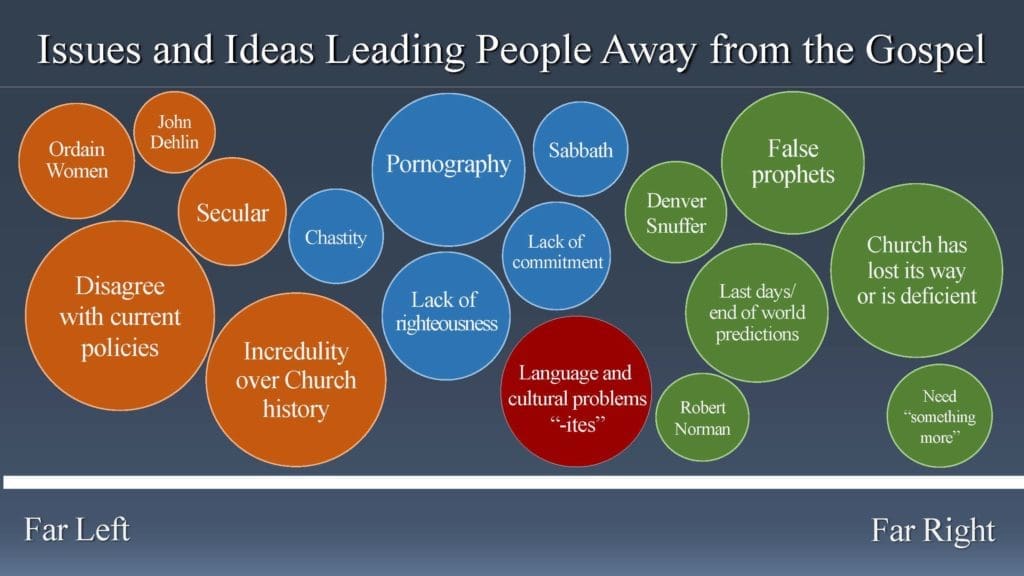
Within the presentation the LDS Q12 reveals its view on the external causes for people leaving the LDS church, which explicitly name individuals such as John Dehlin, Denver Snuffer, and Robert Norman, along with other broader trends, movements, and ideas such as secularism, Ordain Women, support for same-sex marriage (entitled “Disagree with current policies”), chastity, pornography, lack of commitment, failure to observe the sabbath, those fascinated with the “last days/end of world” (i.e., Preppers/Julie Rowe), “false prophets,” and anyone who feels they need “something more” from the church.
In no instance does the Quorum of the 12 demonstrate introspection as to what they or the church might be doing to contribute to disaffection from the Mormon church.
Today’s panel includes Dr. Gina Colvin (A Thoughtful Faith Podcast and KiwiMormon), Lindsay Hansen Park (Sunstone), Pastor John Hamer (Toronto Community of Christ), Jesse Stay, and Ryan McKnight (MormonLeaks).
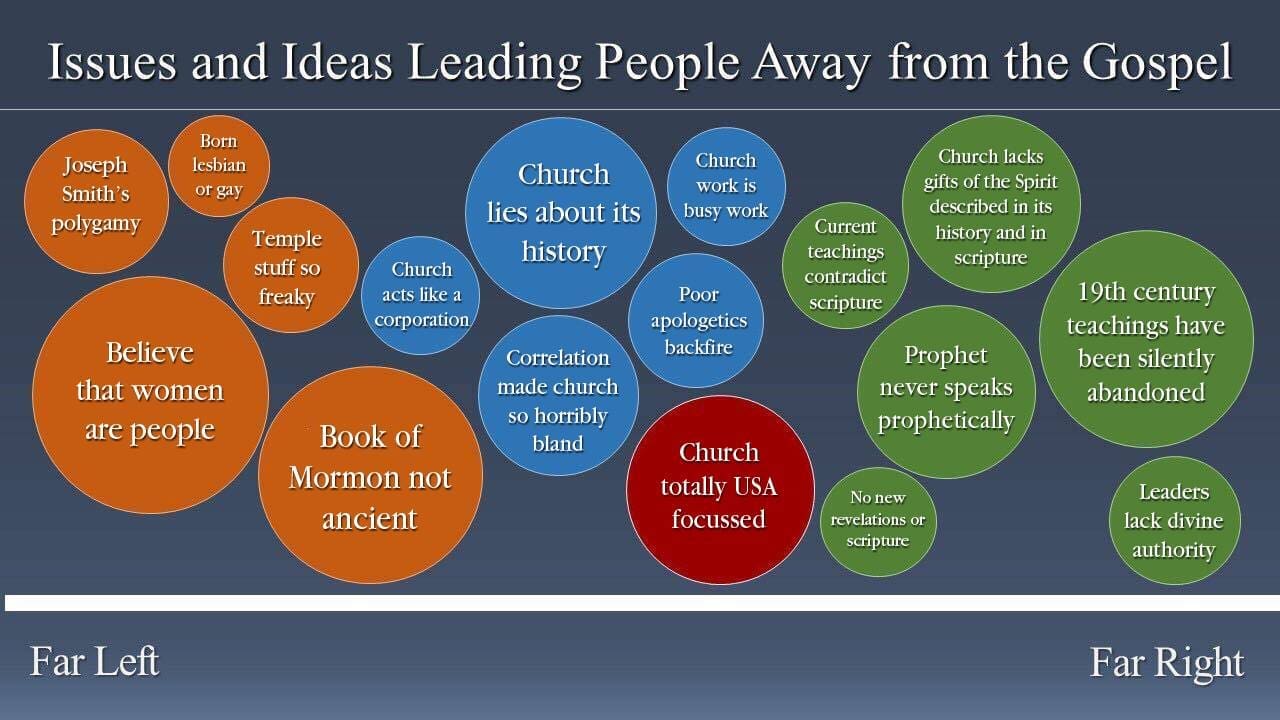
John Hamer’s slide referenced in the podcast:
Video:
Episode Transcript
Host: John Dehlin · Guests: Gina Colvin, Jesse Stay, John Hamer, Lindsay, Ryan McKnight
This transcript is machine-generated and lightly edited for readability. The audio is authoritative. Please excuse occasional errors in names and spelling.
Introductions and MormonLeaks Document Overview
John Dehlin [00:00:00] Mormon Stories is a production of the Open Stories foundation and relies solely upon the support of people like you, its listeners to help keep the podcast alive or to become a member of the community. Please become a monthly subscriber by visiting MormonStories.org and clicking on the Donate button on the right side of the page under support. All contributions to Mormon Stories are completely tax deductible and go towards producing the podcast and building communities and programs of support for Mormons like you. Thanks for your support. The kindly light amid encircling gloom
John Hamer [00:00:43] Lead
Lindsay [00:00:43] thou me on the night is dark and I am far from home.
John Dehlin [00:00:53] Hello everyone and welcome to another edition of Mormon Stories Podcast. I'm your host, John De Lin. We're recording on February 27, 2017, but we won't be releasing this until 10am February 28, 2017. And the reason why we're recording before we release is because we're doing a special episode and the special episode is in sort of semi partnership with the Mormon Leagues people. And the reason why we're doing this interview is because we have learned about a new document that is going to be released tomorrow by MormonLeaks. Did I say WikiLeaks? I mean Mormon Leaks. But it's a super cool document. It's basically a presentation that has the title Area Business Weekends. It's a document that appears to come from the quorum of the Twelve Apostles of the Mormon Church. The date is December 8, 2015. And the document talks it seems like the document is talking about these special meetings that the Church wants to be able to hold where apostles visit areas and sometimes stakes and they can discuss special issues. And so we're going to be looking at that presentation and we're also going to be spending a lot of time on a particular slide. And the slide is this bubble chart that shows sort of the enemies of the church. The title of the slide is Issues and Ideas Leading People Away from the Gospel. And it actually names names. So it has Denver Snuffer there. It has some character named Robert Norman who we'll be talking about. It names ordained women specifically. And interestingly enough, yours truly has his own bubble. John Dehlin is mentioned by name on the slide as an issue or an idea leading people away from the Gospel. So we're going to be talking about that presentation and that slide today. And with us we have an all star illustrious panel of amazing humans and the humans that we have going to go ahead and introduce them first. I'll just do a quick roll call. So we have Ryan McKnight who is definitely associated with MormonLeaks, and I'll let him introduce himself. Ryan, why don't you go ahead and unmute and just tell us, you know, introduce yourself really briefly.
Ryan McKnight [00:03:33] Yeah, thanks, John, for putting this together. I am the founder of MormonLeaks, and like you said, this is a document that we received over the weekend. And so it's something that is definitely interesting enough to have a chat about. But, you know, we've been around since officially since early December, although I was involved with leaking things prior to that, which kind of led to the website, but that's how I ended up here today.
John Dehlin [00:04:03] All right, thank you. Thanks, Ryan. Welcome. John Hamer. Why don't you introduce yourself?
John Hamer [00:04:10] I am a podcaster. I'm on Infants on Thrones regularly. I'm a past president of the John Whitmer Historical Association. I do a lot of work in Mormon history research, maps and things like that. And I serve as pastor of the Toronto Congregation of Community of Christ.
John Dehlin [00:04:28] Super happy to have you on John Hamer. Thanks for joining us. All right, Lindsay, you're next. Unmute. Yeah, perfect.
Lindsay [00:04:36] I'm Lindsay. I'm the assistant director for Sunstone. I podcast, hang out with this character sometimes, which apparently is a bad thing, according to. And I have a bunch of kids at my house playing with my kids. So if you hear kids in the background or if I have to mute my camera, it's because I'm on mom duty.
John Dehlin [00:04:57] All right, Lindsay, we're super happy to have you here. Thanks for joining us. All right, all the way from New Zealand, we have Dr. Gina Colvin. Gina, do you want to introduce yourself really quick?
Gina Colvin [00:05:09] Hello, everybody. I'm Gina Colvin. As my friend John suggested. Bubble John, we'll call him from now on. And I'm a podcaster with John. Alongside John and the podcast family run by the Open Stories Foundation, I host a thoughtful faith. I have a blog called Kiwi Mormon, and I'm just generally noisy from out here at the program. Free.
John Dehlin [00:05:30] Thanks for joining us, Gina. We're super happy to have you with us. And because five panelists is not enough, we have Jesse stay. Jesse, why don't you introduce yourself for those who don't know you?
Jesse Stay [00:05:42] Absolutely. I'm Jesse. As you said, I spent almost three years working for the church and church entities from 2010 to 2013. I've never officially leaked anything, and I don't really have any real desire to, per se, that anyone will know about. No, no, I actually wouldn't, and I haven't, but I do have A lot of knowledge on the way that things work at the church and I've worked with managing directors at the church, members of the 70 and understand how a lot of these documents get created and such. And was involved in a lot of different studies when I was there, not this one in particular, but I'm somewhat familiar and thought I'd join in to see what you guys are up to.
John Dehlin [00:06:35] All right, Jesse, thanks for joining us. And everybody here. I've released a full interview with or multiple interviews with, except for Ryan. I have interviewed Ryan, but I haven't released his interview yet. But I will and we'll probably have follow up. Oh, actually, Ryan, we haven't done our full interview yet, have we?
Ryan McKnight [00:06:53] No, no, I. The only. We have done podcasts together but they haven't been about me, they've been about other subjects.
John Dehlin [00:06:59] So that's coming, that's coming. That's in the works. Alright, so with that we're gonna go ahead and I'm for those of you who are able to join us through video. This is available on YouTube and on Facebook in the Mormon Stories group. But we actually have visuals for today's presentation. And so what I'm going to do is actually share my screen and I am going to make available this little document that we're talking about here because I think it'd be fun to actually talk about it. So I'm going to go up to my little zoom. I'm going to say share my screen and I'm going to share this document right now and we're going to look at it and we're going to jump between the actual document and the panelists. So panelists, can you guys all see the document?
Gina Colvin [00:07:49] Yes, sir.
Inside the Area Business Weekends Presentation
John Dehlin [00:07:50] All right, so I'm going to just describe the document for those who can't see it. The first slide says area Business Weekends meeting of the 12, December 8, 2015. So apparently this presentation was given at some point to the quorum of the 12, I'm assuming. And I'm going to invite any of the panelists to just jump in and interrupt me whenever they have something they want to say right at the top.
John Hamer [00:08:21] Well, so like this idea, this is area business weekends. It seems like this is maybe the internal lingo or vernacular for what people outside in the Mormon borderlands community have been calling these rescues or something. Right, so like the Sweden rescue or the Boise rescue, is that kind of what we're talking about?
John Dehlin [00:08:39] I think. Okay, so we're gonna get into that, but I think, I think that those are examples of Area business weekends. But from what I've seen from this deck, it can be more than that. Right? Okay, but those are examples of business weekends that we've seen in the past.
Ryan McKnight [00:08:56] And one thing I want to add is while it does appear that this slide show was prepared for the Quorum of the twelve Apostles, I know that it was also shared with the general authorities. Whether or not they received it in a, in a presentation or they were just emailed the slideshow, I don't know, but it was shared with general authorities.
John Dehlin [00:09:19] Okay, that's great to know. And Ryan, we should probably start by saying that this will be released tomorrow at 10am There are a couple, there are a couple other documents that are going to be released. Why don't you just talk about what's going to be released tomorrow?
Ryan McKnight [00:09:33] Okay. Tomorrow we have three documents that we're releasing. This being one of them. The other two. One of them is related to pay. It's a memo that is in the similar vein of the memo that we released showing the $120,000 living allowance in terms of dollar amounts. This memo does not shed really any new light. The significance of this particular memo is that it tells us at what age do. Does the church stop giving the general authorities money for their children? And that age is 24. So basically this is a memo written to the general authority telling him that his monthly allowance is going to be reduced because his child just turned 24.
John Dehlin [00:10:26] Okay. All right. So we know that that's part of their allowance, includes children up to the age of 24.
Ryan McKnight [00:10:32] And it's not a lot. I don't remember what the exact, like $100 per every two weeks.
John Dehlin [00:10:36] Okay.
Ryan McKnight [00:10:37] And then the other document is an internal Memo. It's dated 2012. It's stamped do not distribute, do not duplicate. And it's, it is guidance on how to treat illegal undocumented immigrants, I believe is the term that is used in the document in regards to church assistance. And in summary, it's like a three page policy document. The short version of it would be Bishops are instructed to not take into any consideration the legal status of immigrants when making the decision to give them aid. And the other thing that it talks about, it says that it references to how sometimes members are asked to clean the chapel or, or do other kind of service projects when they're getting aid. I don't know how accurate that is, but it kind of hints at that. And then it says, do not ask that of undocumented immigrants if you're going to give them aid, because they want to avoid any appearance that it's being a job being given in exchange for monetary value. And then it also says something like if they happen to volunteer in any other charitable activities that maybe have nothing to do with the fact that they received aid, but they, you know, they went to a ward service project to not have their names, like, associated with having been there. Because, again, it's not really for nefarious reasons. It's because they don't want any confusion whatsoever that they were being sort of coerced to be there in exchange for aid. So sort of a kind of protect the church legally type of a thing. So.
John Dehlin [00:12:24] All right, Gina, you get first dibs at a quick reaction to what Ryan just described. And then, Lindsay, you're next.
Gina Colvin [00:12:29] I have tons of questions. John, can you somebody please go over what it means, an aerial weekend area business weekend? What is that?
John Dehlin [00:12:37] Okay, we're going to, we're going to go into that in a second. But, but I mean, just in reference to what Ryan just talked about, Lindsay, do you have any. Any quick response to the refugee or immigrant?
Lindsay [00:12:48] My just immediate reaction is I think it's great that they decided to not turn down giving aid to people. I mean, when I was most faithful and contributing to tithing and fast offerings, that was my understanding that we gave to people who needed it, no questions asked. So to me, that makes sense. I feel like that's a really complicated situation that the church would be in depending on the countries that they're working on and the laws that they're working with, especially since the majority of Mormons that I know of really do not support undocumented workers being here without their status. So I think it's a. I think it's actually something that makes people leave the church, at least in the circles that I follow.
Ryan McKnight [00:13:33] Yeah, I don't think. I don't know, you know, if anybody's going to receive this document poorly, but if anybody does, it probably would be sort of conservative active members. I think ex Mormons in the outside world and liberal Mormons are going to actually see this document as a positive for the church.
John Dehlin [00:13:53] And I think, ryan, that's important. WikiLeaks isn't about hurting the church or destroying it.
John Hamer [00:13:57] It's just about bringing Mormon leaks.
John Dehlin [00:13:58] Mormon leaks. I keep saying WikiLeaks. Mormon leaks is about bringing transparency.
Ryan McKnight [00:14:02] And this is something that we at Mormon Leaks have been harping on since the day one. And as much as we say it, it doesn't seem like our detractors believe us. We haven't been able to prove it
John Dehlin [00:14:13] very often it doesn't matter as long as we say it.
Ryan McKnight [00:14:16] Yeah, but this is good because it's helped us prove that our point of wanting to just leak. Whatever.
John Dehlin [00:14:21] That's awesome.
Lindsay [00:14:22] I spend a lot of time in very conservative circles within the church. And this topic particularly is the thing that probably makes conservative members apostatize the most or question the most. In fact, they. If you were to go to a Facebook group and talk about this policy, it mirrors the liberal conversations over, like, gay marriage or something almost identically. Just a different topic. Same conversation.
John Dehlin [00:14:49] Yep. Now, Gina, one of the things that maybe we didn't make really clear is that Mormon Leaks is releasing three documents. Ryan just described two of them that we're not really going to be going into depth on today. And then the third document we're going to go into in depth, which is, as you. As you mentioned, this area, business weekends. I want to. Did you have a quick comment about his comment about the immigrants and the refugees?
Panel Reacts to the Leaked Church Document
Gina Colvin [00:15:15] I'm just curious to know. I mean, this is a year or so after the fact, isn't it?
John Dehlin [00:15:20] Yeah. For at least this. For this third document. Yes.
Gina Colvin [00:15:25] Okay, so what's the reach of a policy like this? Is this just the quorum spitballing about ideas, or does it have. Does it turn into policy?
Ryan McKnight [00:15:36] You're talking about this slideshow we're about to go over.
Gina Colvin [00:15:38] Well, no, the immigration policy, et cetera.
Ryan McKnight [00:15:42] Well, I think I read the document, the immigration policy one, as official guidance from the top, and I believe it was distributed to bishops because it specifically says bishops are not to take into consideration the illegal status.
John Dehlin [00:15:56] Got it. Does it have a date? Does it have a date on it?
Ryan McKnight [00:15:59] It says, like, 2012 in the bottom corner, but it doesn't give an exact date of when it was released.
John Dehlin [00:16:03] Okay.
Gina Colvin [00:16:04] Okay.
Ryan McKnight [00:16:04] I can actually tell you. I can tell you when it was disseminated, if you want to know. I do.
John Dehlin [00:16:08] No, it's okay. It's okay. It's around 2012. I want to leave a lot of time to talk about this desk. So anything else? Anybody else was going to jump in really quick. Okay. All right, so let's dive in to this presentation. I'm going to go back to share my screen again. It says, area business weekends, meeting of the 12, December 8, 2015. The next slide says, regulating the church. The 12 are a traveling presiding high council to officiate in the name of the Lord under the direction of the presidency of the Church, agreeable to the institution of heaven to build up the church and regulate all the affairs of the same in all nations. And then it quotes D and C1,073. And then finally it says, area business weekends provide members of the 12 with opportunities to fulfill this duty. So it seems like that's just sort of a rooting this initiative in doctrine, providing a bit of a theme or guidance. If anybody wants to jump in on that slide, please do.
Ryan McKnight [00:17:14] The only thing that popped to my head when I read this, because this is a presentation presumably being given to the 12, I just wonder if they all turned and patted each other on the back after reading that first paragraph. This is what you guys are here to do. That was my thought on that.
John Dehlin [00:17:29] I don't know. Yeah. Okay. Anybody else? Okay, so that's just kind of. I see that as just kind of setting the tone. Let's go on to the next slide. Area business. What is area business? So it's basically saying there are unassigned weekends, 50 in the first half of 2016. I'm going to guess that that means if you take all the Quorum of the twelve in the First Presidency and all the weekends that are available, there are a bunch of weekends that the apostles or First Presidency haven't been assigned yet. So there are options that can be taken advantage of. These are left open to address needs of the church. And then it talks about dialogue with seven presidents to develop recommendations. So it sounds like the seven presidents of the quorums of the 70 are going to contact church headquarters and say, hey, we've got some needs that we would like to see some quorum of the 12 members come and support. And so it actually gives examples. And this is, to your question, your original point, John Hamer. One example it gives is Elder Oaks trip to Idaho to address apostasy. So it doesn't talk about the Swedish rescue, but it does talk about that Idaho rescue that we shared a couple years ago or a while back on Mormon stories where Elder Oaks went. And as I understand it, that Oaks intervention in Idaho was around Denver Snuffer and how Denver Snuffer's influence was growing in Idaho. Other examples that it gives is Elder Ballard's meeting with young single adults and ward leaders in Utah county in that instance. I remember Ballard talking about podcasts and about social media and trying to, you know, warn people about that. And then it gives the example of Elder Holland's trip to the east to increase effectiveness of ward councils. And now I haven't heard about that at all. So having said that, any panelists want to jump in and talk about that slide.
Lindsay [00:19:31] Can I just ask a question?
John Dehlin [00:19:33] Yeah.
Lindsay [00:19:33] And this is for John Hamer with Community of Christ. So as I'm sitting here, when I first saw these, I thought, this is kind of dumb. I mean, just like the fact that it has to be explained like this. And it's such a secret to all of us who've been LDS our entire lives that we don't even know how these things function. I don't know if I'm articulating that, but John Hamer, in the Community of Christ, is it a big mystery who does what on weekends and whose calling is what? Do you see this as irregular? I think the thing that's irregular for me is that we would see this, and I'm sure many are seeing this as some big mystery that we have to. Like this nut we have to crack to figure out what they're doing on their weekends. And that just in any other faith tradition, that seems absurd to me.
Jesse Stay [00:20:20] Yeah.
John Hamer [00:20:20] Well, I think that the. I mean, this is part of the whole point. Ryan's point with Mormon leagues, right. Which is that the operations of the LDS hierarchy are shrouded in all kinds of secrecy where they don't explain what their motives are, what they're doing, they don't talk about their budget. All of these kind of things aren't open to scrutiny. And I think, like you say, that's certainly not how it works in our church. Right. So in our church, apostle for Canada, for example, is kind of a crazy Facebook social media poster. And so he's just constantly posting everywhere we see his, every lunch and everything like that. So what they're doing is entirely very open and transparent in terms of this. This is the kind of thing where we've been. People who are observing have been in the aware of this kind of thing, like this Boise rescue. So that was very kind of. It was a secret mission, and yet it can only be so secret. Right. So anyway, so what's interesting is to see here that these kind of secret missions have a secret plan behind them. And this is a slide about it.
John Dehlin [00:21:24] Yeah. And I mean, would Mormon leaks be necessary if the church was more transparent? Would people need to record and secretly share audio recordings of the Swedish or the Idaho rescue? The church was just transparent? Is that kind of what you're asking, Lindsey?
Lindsay [00:21:39] Well, I. I deal with a lot of prophets these days. Prophets, to me, are now dime a dozen in the work that I do. I hang out with prophets. I know people that follow all kinds of different prophets. So it's just it's interesting for me to see sort of this deference given now to the LDS prophets where I can have context for it through a different lens. And it's just funny to me to. It reminds me like, you know, the Council 50 was a bunch of dudes getting together and talking angry and writing it down to feel important. And then, like, most of the time they didn't do anything. And I feel like that's what this feels like to me. It's just people like, we're making it official. We're getting together to really not talk about anything. And if we write it down and make a slide, then it makes it official. I don't. I don't mean to belittle it. It's just. It just seems silly.
Jesse Stay [00:22:26] Sure.
John Dehlin [00:22:28] Gina, do you have a quick reaction to what we're talking about? Go ahead and unmute yourself. Unmute yourself.
Gina Colvin [00:22:37] I agree with Lindsay. I think it's sort of men doing men things. As soon as they start documenting their thoughts and, you know, they've got all this power and influence, it becomes something other than what it really is, is a bunch of spitballing.
John Dehlin [00:22:53] Right.
Ryan McKnight [00:22:55] I'd like to just throw in, I think, what a document like this does in regards to what you're talking about. And also the recording of the Elder Oaks Fireside or whatever it was that is referenced in this slideshow is if we don't have that recording and we don't have that slide. These visits from the quorum of the 12 are often presented as sort of, hey, he, you know, felt the spirit to come and visit us, and this is his inspired message. Whereas what we can see now is that it's really more of an organized, targeted campaign to sort of deal with identified issues. And it's not really. Hey, I was inspired to talk about this topic before you today.
Lindsay [00:23:42] Well, I mean, sorry, John, I understand your point, but here's what I picture. I picture, you know, my husband or my father being called to this meeting, getting ready, putting on his white, you know, shirt and suit and tie, and feeling important going to this important meeting and for this important church business. And this is what I'm pointing out. This is important church business. Like. Like the world around us is burning and, you know, dealing with undocumented workers, that's a real issue. But like, this stuff of, like, who does what on their weekends and whose kids get paid at 24, to me, that it's just busy, busy, busy work. And so that's just what I was struck by.
John Dehlin [00:24:25] And that all seems true. And I'LL just in the church's defense, like if tithing is in decline, if membership is, if growth is in decline, if they're starting to face becoming a declining institution. If I were an apostle, I would want to have these sorts of interventions to figure out what the heck is going on and how do we fix it.
Lindsay [00:24:48] Oh, it's good business. I would never say exactly.
The Apostasy Bubble Chart Explained
John Dehlin [00:24:53] All right, cool. Okay, so I'll share the screen again and we'll go back to the next little portion. So area business is what these are about. And this is the money slide, as I like to call says issues and ideas leading people away from the gospel. And imagine a slide with a PowerPoint slide with like 17 bubbles. Does someone account up how many bubbles there are? I'm just counting quickly. I think it's about 17. And, and there's, there's a spectrum. So it's far left on the left hand side and then far right on the far right hand side. And then there's orange bubbles, blue bubbles, a red bubble, and a bunch of green bubbles. And I'm just going to read, maybe we'll go through each section. So let's start on the far. We'll start on the far right. So on the far right there's a bunch of green bubbles. And I'm just gonna read the green bubbles and then open up to the panel to discuss the bubbles. So the first green bubble on the far right is Denver Snuffer. There's another bub, and we all know Denver Snuffer. He's been on Mormon stories. He basically claims to have seen Jesus and he's trying to encourage other Mormons to see Jesus themselves. And he's basically claiming that the LDS Church, modern corporate LDS church, is apostasy and they're not living according to the Book of Mormon. That's how I would summarize Denver Stupper. And by the way, he's now receiving revelations for his people. They're saving money to build the temple. So Denver's influence since his excommunication has grown and is growing. In my experience, there are thousands and thousands of people who see him as a prophet who are paying him or at least supporting him to do his work. So that's Denver Snoffer. Then there's another bubble that says false prophets. There's another bubble that says last days end of world predictions. Lindsay, you want to tell us who you think they've got in their minds when they talk about that one?
Lindsay [00:26:58] Actually, I think it's probably more than just Julie Rowe, the one that we're thinking of. There's so many. And we have Cleon Skousen to thank for this kind of nonsense and well, and Ezra Hap Benson. And this is a huge, huge problem. And I'll just say this about Denver Snuffer and the false prophets. I don't think people realize how compelling and seductive fundamentalism is. And this is what I say all the time, you know, and some people will disagree with me. But when you read Mormon doctrine, this is where it inevitably leads you to is personal revelation and these promises of these special spiritual witnesses. And I mean, to me those bubbles should be the biggest of all because those movements are growing and growing and growing. In fact, they're becoming shiny PR campaigns better organized than I would say any, you know, I'm an ex Mormon campaign video or ordain women videos like the I've seen Jesus crowd is growing. And that's because there's no outlet for that in Mormonism anymore.
John Dehlin [00:27:58] Yeah, I posted on Facebook, a website that actually has testimonies of people who have seen Jesus who are, you know, liberal, kind of like Fundy Mormons or like conservative Mormons or post Mormons who have been excommunicated. But I would guess there's been dozens of people like Denver Snuffer excommunicated, many of whom were excommunicated for claiming they, they saw Jesus, which is really ironic.
Jesse Stay [00:28:21] When I was Mormon. I'll tell my story sometime.
Lindsay [00:28:24] Did you really?
Jesse Stay [00:28:24] Wow, I thought I did. I'll tell my story and kind of why I don't think anymore. But it's interesting movement. I know I be rich now.
Lindsay [00:28:34] Here's the thing that I want to say. Mormon fundamentalism is. It's very compelling. And because the church has tried to move away from polygamy with the entire history of that, they put themselves in a really difficult position that sort of fuels these movements because you can show evidence that maybe the church has hidden something or they've tried to change the doctrine or the scriptures or whatever. And so these people have, I would say, legitimate interpretations and claims to this, this doctrine. And once you couple that with a spiritual experience. If you go to Missouri right now and maybe John Hamer can talk about this. There are so many movements breaking off of even fundamentalists. And it like I can't even keep up anymore. But it's, it's. The gospels become so democratized because of the Internet that anyone can, can really claim the power and sealing authority used to be exclusive. And if I were the brethren, I mean that's a crappy job. How do you claim control over that?
John Hamer [00:29:34] Yeah, I mean, one of the core things that fundamentalists tried to do all through the 20th century was keep the Journal of Discourses in print. Right. Because the LDS Church was just constantly trying to say, oh, we're not printing that anymore. We can't have that anymore in Deseret Book. And so then the fundamentalists would reprint that. Really, for somebody who is a hard right wing Mormon who kind of has all these kind of Mormonism itself. The LDS Church is a fundamentalist church. It's not fundamentalist Mormonism. It's a different thing. But anyway, when fundamentalists within people who are regular Christian fundamentalists within the Mormon Church read these kind of anything from the pulpit, I mean, after a certain amount of time, if you spend any time reading what Brigham Young or Wilford Woodruff or John Taylor had to say, it's very hard for you to square that with, you know, whoever, the present day prophet who's right, whoever does Monson. Yeah, I should pay attention like John,
Lindsay [00:30:32] maybe this is your experience too. But the people that I come into contact with now that give me the most pushback on the history or say that I've gotten a fact wrong or something are usually followers of Denver Stuffer or preppers or things like that. They're the ones that deny that Joseph Smith had polygamy, which is surprisingly makes my head explode. A growing movement, I encounter it more and more often. And the facts and the history that they use, it's like, it's like the history, but just enough to fit their agenda. And it's really frustrating because you cannot have a conversation with people about history because you can't do the aha, gotcha ex Mormon thing where it's like, well, the church didn't tell you about this because they already know that.
John Hamer [00:31:18] Yeah, right.
Jesse Stay [00:31:18] So that.
Fundamentalist and Fringe Movements on the Chart
John Hamer [00:31:19] So that's another weird synergy that's happened which is between fundamentalist members of the community of Community of Christ of the former Reorganized Church of Jesus Christ of Latter Day Saints. So there have been a substantial amount of breakoffs from the right in Community of Christ, people who opposed women's ordination, marriage equality, that kind of thing. But for a lot of these groups then they have a long standing RLDS apologetic that is it's like essentially under the banner Joseph fought polygamy. And so their idea of it is that they take all of Joseph Smith's overt statements where in code language he overtly criticized or condemned polygamy, which we'd say in quotes, because of course in the back of his mind, you know, he's lying for the Lord. In the back of his mind he's saying, because the true celestial principle is the principle plural marriage, of which polygamy is Satan's counterfeit. And that's why we, you know. But he doesn't say that part out loud. Right. And so if you only, you know, in that apologetic. If you only listen to what he. His published statements are, which is what the old RLDS apologetic that now has cross pollinated, like you say, with the Denver Snuffer group of people.
John Dehlin [00:32:29] Right, right, right.
John Hamer [00:32:30] So they have all kind of gone down that path, even though that cannot be justified.
John Dehlin [00:32:35] Isn't there some book. Did Joseph really practice polygamy or something like that?
John Hamer [00:32:38] It's the prices. So the prices are the. Richard and Pamela Price were like the kind of. Anyway, intellectual leaders of the conservative breakoff rlds and they wrote Joseph fought polygamy.
John Dehlin [00:32:51] Okay, Lindsay, really quick, for those who don't know about Julie Rowe, give us a 30 second description of Julie Rowe and what she's doing.
Lindsay [00:32:59] Julie Rowe is a woman who had a near death experience and she wrote about it in sort of like these, you know, Mormon novels that people do to tell their spiritual experience. It took off, it became. She. She claims that she had this vision when she almost died and she saw this basically the second coming. It's this complicated parts of visions and she could only reveal parts of it. And she published it. She's published several books, but when she first published it, it was considered so sacred. It was kind of that thing that if you went to your stake president about a, you know, spiritual question that no one else could answer, he might like slip you her book and be like, I don't give this to everybody, but I give you this because this, this tells you some, some stuff. And in it there's some pretty terrifying stuff. I mean, she's talking about tent cities and, you know, you know, the world burning and taking in, you know, apostates and all of this, you know, second coming stuff. And it, it really sort of fueled, or maybe it was a symptom of what we call the Mormon prepper movement. Our preppers are like the people. Like, you know, I grew up canning and getting food storage, but preppers, like have dugouts in their basement and bomb shelters and ammunition.
John Dehlin [00:34:11] Rifles, Guns.
Lindsay [00:34:12] Yeah, they're trailers, tents that moved into a strip mall just by my house. And they had an aluminum hand cart that you could buy.
John Dehlin [00:34:21] Yeah, yeah.
Lindsay [00:34:22] But like, not ironically. It was quite serious. And so the movement was very, very big until, what was it last year when the spurious materials. You can talk about how that sort of shut it down. Julie Rowe got shut down in an official way. She kind of disappeared. I think in my opinion, she's joined some fundamentalist mainstream Christianity, joined this sort Missouri crowd. They talk about where everyone just kind of believes what they want, but they all know that Jesus is coming sometime soon.
Ryan McKnight [00:34:51] Yeah, I'd like to jump in real quick on that. You know, I follow very closely the prepper movement. John, you might remember we did a podcast about it a while back.
John Dehlin [00:35:01] Absolutely.
Ryan McKnight [00:35:03] Julie Rowe, while she in many ways is sort of the godmother of the prepper movement, she has lost a huge portion, almost all of her LDS support from members right now. I would say that the foremost leader of the prepper movement online is a woman by the name of Shel McDermott. I don't know if you've ever heard of her, Lindsay.
Lindsay [00:35:30] I have, and I've interacted with her. I would say I would agree with you, but I push back a little bit. I think she's being rivaled with Hector.
Ryan McKnight [00:35:39] Yes, Hector.
John Dehlin [00:35:40] So let's not dig too deeply. Let's just give it the one thing
Ryan McKnight [00:35:44] I just wanted to mention in regards to this slide, because to me, that one bubble is, even though it's using some creative terminology there in the title of the bubble, they are, I believe, directly addressing the Julie Rowe, the Shell McDermott, the Hector Sosas of the world. Now, I what I want to see is their reaction to this because I they're going to spin this in a way that says that they don't fall under that bubble in some way. Now, Shel McDermott has a secret forum that's like password protected on her website that I have access to that I often read the post. About two months ago, there was a post that got more comments and a longer thread than I've ever seen on her website. And it was about a guy who was saying, I have a friend of a friend of a friend type of a thing who was told by one of the twelve apostles that doomsday preppers are a threat to the church. And he was posting this on the, on this forum to sort of say, you know, how do we respond to something like this? Surely there's a disconnect. And of course, the apologetics, the doomsday prepper apologetics went forward and they were able to sort of rationalize this way. Now, at the time, I didn't know about this slide, but obviously this friend of A friend of a friend of a friend was somewhat accurate if they were telling the truth, that the doomsday preppers had been identified as a. As a threat. Now, this just bolsters that person's post. I'm curious to see how the Hector Sosas and the show McDermotts of the world respond to this. Just like, you know, you're responding to your being on this, John.
John Dehlin [00:37:23] Right, right.
Ryan McKnight [00:37:24] I'm curious to see how they respond.
Lindsay [00:37:26] Respond to that really quick.
John Dehlin [00:37:28] Sure.
Lindsay [00:37:28] So I think we would know because Denver Snuffer does that already, and Denver's a great guy. He comes to Sunstone. So that's my plug for coming to Sunstone Summer. He'll be there presenting. I think how I've seen Denver do this when they call him out, I mean, his name is on a bubble, is it only helps his cause. It doesn't hurt it. I think, I think at first, if you're. I mean, Julie Rowe did shut her down, but I honestly think that there's a gender dynamic there. Women just can't claim power and authority in this movement, in this, you know, this restoration movement, the same way that men can. Denver, I think it's really helped him. And so what he does is he just says, oh, yeah, I mean, that's just further proof that I'm telling the truth. That, you know, and people will say he's the one mighty and strong. Look at, look at who he's made angry.
John Dehlin [00:38:16] Yeah. And his recent revelation that he's been sharing, there's some place in the Doctrine and Covenants where it talks about additional writings that need to come forth. And he sort of has found any instance where there's a potential to sort of showcase him as a prophet and he's stepping forward to provide that revelation that the Doctrine and Covenants talks about needing to come forth. And that's kind of his shtick. But for all of these areas, I just think it's important to note that they're kind of using the church against itself. Because whether it's Denver Snuffer saying the church isn't living up to the Book of Mormons, you know, sort of emphasis on non materialism or commercialism or on gifts of the Spirit, whether it's the fact that we're named the Church of Jesus Christ of Latter Day Saints and we're supposed to be about the end times, these are instances where it's ironic that they're kind of out Mormoning the Mormons. Does that make sense? And I think that's worth noting. I'm Going to speak briefly about Robert Norman because I actually have information on who Robert Norman is. So Robert Norman, really quickly, apparently he was a CES employee, a church education system employee, taught institute, seminary for something like 30 or 40 years, a long time expert in the Old Testament. And as I understand it, Dallin Oaks wife used to love to attend his evening seminars about the Old Testament. Anyway, at some point Robert Norman himself started teaching or discussing having seen Christ. So in that sense, he's sort of in the green because he's talking about seeing Christ, which is ironic that that's a bad thing. Now seeing Christ is a bad thing. But anyway, well, Robert Norman basically, apparently how he views himself. There's a saying called end time servant. I don't know if any of you guys have ever heard of that, but apparently it's a phrase that comes out of scripture that refers to someone who believes that they are going to be the person that ushers in the second Coming. So I don't know if it's the same thing as the one mighty and strong or if it's different. But Robert Norman views himself as the end time servant. He believes that he's seen Christ and apparently he has developed a relationship with someone that at the time wasn't his wife. And during that relationship received a revelation that God sealed this new person to him such that he could be married to her while his wife, other wife, was still alive.
Lindsay [00:41:13] That always happens.
John Dehlin [00:41:16] And this woman, by the way, was married to another man. And so Robert Norman became sealed by God to this other woman while his wife was alive. And the local leadership found out about it and wanted to excommunicate him. So apparently he's resigned from the church. Now his former wife is no longer living. So he is apparently married legitimately to this new wife, or at least he's no longer in adultery. And apparently people who follow him don't know a lot of this. And so they have the impression that he was nudged out of the church because of his doctrines, his teachings. But in reality he resigned to avoid being excommunicated. So again, Robert Norman is an example of somebody who is again claiming to see Christ, claiming to be related to the Second Coming in some way. And that's who Robert Norman is. And he made the slide.
Lindsay [00:42:22] He also, though I would say most people still think that he's in the church. In fact, they've been publishing, I think Meridian magazine published an article just last year on his stuff. So what Robert was really good at, he was so good at theology, he was starting to develop What I see as sort of like a radicalized view of Mormon Jesus, it's a very good interpretation, but he comes up with like this graph of how to understand Christ and our relationship with Christ. And that is used and still published. And the problem is, it goes with this little bubble on the screen about not people not getting enough. The problem is, is Robert Norman's interpretations aren't incorrect. So they're very appealing to people. But once you give a man like that, who knows his stuff, that kind of platform, you can look him up. He's. He's all over lds.org they quote for from him.
John Dehlin [00:43:11] He's been Ensign talks.
Lindsay [00:43:14] Yeah. And so as far as most people are concerned that don't know anything about him, they can look him up and he's on LDS.org and what that means for a Latter Day Saint is he's legit because he's on the site. And his, his theology is really interesting in it and it's really compelling. And so again, this whole, like, not getting enough at church, it's a major problem for the LDS Church. And I've been saying this on my podcast, Year of Polygamy, but ever since we abandoned polygamy, there's nothing interesting about Mormonism anymore. The church had to get rid of everything that made Mormonism apart from mainstream Christianity. No offense, John Hamer, maybe you can push back on that.
Jesse Stay [00:43:53] So I want to know where the difference is between this and the givens. I mean, I love the givens. I was in the Reward. I know him well. But I mean, the type of theology that he's teaching, probably minus talking about seeing Christ and such, really isn't diverging very far from what Terrell and Fiona Givings are offering for members too.
John Dehlin [00:44:20] I can give you my opinion on that. My opinion is if I just kind of think about the difference, the givens is it's true that they're asserting interpretations or encouraging a more progressive, liberal approach to Mormonism in a way that's kind of stepping ahead of the Brethren. But in my view, they're claiming no special power or authority or divine sort of blessing for what they're doing. They're just calling it this nonprofit. They're trying to serve people who are losing their faith. And in no way is that threatening. I think the Brethren would view the Gibbons as like trying to plug holes in the sinking ship. Where I think Robert Norman is different is that he's claiming to have seen Jesus. And John Hamer, what happens when there's a competing claim to sort of divine Authority. We know that. Was it Orson Hyde in the book, in the Doctrine and Covenants, what happened when someone else claimed to have a Seer Stone?
John Hamer [00:45:19] It wasn't Orson Hyde.
Gina Colvin [00:45:20] Right.
John Hamer [00:45:20] It was.
John Dehlin [00:45:21] Who was it who claimed to have the Seer Stone?
John Hamer [00:45:24] Page. Right?
John Dehlin [00:45:24] Yeah.
John Hamer [00:45:25] Hiram Page. Anyway, so, yeah. So I mean, obviously then that's a competing source of authority. And so that they're. Very quickly. You have to. I mean, Joseph Smith realized he had to assert that there's only one person who can receive authority for the church. You can maybe get revelations for yourself, for your family, this sort of thing. Otherwise you do. You do. It does end up creating dynamically. It creates, you know, fission that continuously happens. And so that's why, in fact, there actually are whatever 200 or 300 different separate latter Day Saint denominations, some of which only have a handful of people in them. But it's because at a certain level, if you take that tension between there being one prophet who has all authority and that to the tension on the other side of every person is called to receive personal revelation, the closer you get onto that side, you know, the more likely it is then that you'll have vision and you'll have all these different little groups as opposed to the one big group that has to continuously assert its sole authority in the. In the person soul of the corporation of the. You know.
Jesse Stay [00:46:31] Anyway.
John Dehlin [00:46:32] Excellent. Okay.
Lindsay [00:46:34] John.
John Dehlin [00:46:34] Yes.
Lindsay [00:46:36] I'm not talking about the given specifically, but I do run in these circles and I also think that, you know, these special firesides sometimes that liberal Mormons do that I've been part of, they're not always sanctioned. Sometimes there have been stories of people that I know, and I won't name them who have been asked not to do them anymore. People with big names that are loyal to the church.
Gina Colvin [00:46:58] So it's.
Lindsay [00:46:58] The church has their eye on it. I would just say it's not, I don't think, as threatening as someone claiming authority.
John Dehlin [00:47:05] Right. But we know that there are Givens. This Temple Observatory group is funding these events, and we know that there are events happening in February, March and April of 2017. So the events are still happening. And Richard Bushman and Terrell and Fiona Givens are part of them, and Patrick Mason and Spencer Fluman, they're all parts of that. Okay. I'm kind of rushing because we've got so much to cover and so little time. I want to make sure everybody feels comfortable to jump in. I'm just going to close out the green section and then Gene, I'm going to ask you to Come in and give a quick commentary on the green section. The other two bubbles are church has lost its way or is deficient. And I think they're recommending that as an idea that leads people away from the gospel. And then they have an idea that says need something more. So they're basically saying, if anybody is wanting more than what they're getting at church, that's an idea that leads people away from the gospel. So, Gina, why don't you give a quick commentary to the green section, if you don't mind.
Gina Colvin [00:48:11] Oh, well, I'm glad you asked because I'm actually. I'm sort of left a bit cold by the whole thing. And I know that you don't want me to ask questions. Well, I figure you don't want me to ask questions. But I like my first question is, who puts this stuff together? Like, what's the data that they're using? And what was the population that they're canvassing to get this stuff? And so. And what's the intention? I have absolutely no idea. And what relevance does this have to anybody outside of the United States? If they're worried about Julie Rowe and Robert Norman and Denver Snuffer? It is a very contained and small population when you consider the rest of the population of the church outside of the United States, most of whom have got no interest whatsoever in these characters. So that has me stumped.
John Hamer [00:48:59] And I had the impression that your entire, you know, like, your major frustration with the church is entirely contained and cordoned off in one little bubble. So you have the red bubble. You know, I think the whole church, as far as the church headquarters is concerned, is this whole bunch of different issues that are orange and green and blue. And then there's all the people that live outside of the United States. And so that's a red bubble.
Gina Colvin [00:49:26] So, Gina, honestly, I give a fat freaking rat. Honestly.
John Dehlin [00:49:30] No, Gina has it for feel to have all international multicultural issues lumped into a red bubble.
Gina Colvin [00:49:37] It makes me feel like a prophetess.
John Dehlin [00:49:39] Why? What do you mean?
Lindsay [00:49:42] Talk about the I part. Because you're either. Does that mean that you're a Lamanite or a Nephite? Like, we have to. You can't be like, you know, from New Zealand.
Gina Colvin [00:49:50] Yes, I'm a Lamanite, apparently. But hey, the thing that I want to say is that, you know, this is symptomatic. It seems to me it's really symptomatic of a very centrally controlled organization. You've pig penned people. You've condensed them in a very tight theological spot. And you've, you've pressed them down with this deep hierarchy, this multi tiered deep hierarchy and bureaucracy. And you wonder why people are wrestling out of it, you know, claiming Jesus here and claiming polygamy there. Like it's just inevitable. Like it's just. All of this is symptomatic of what happens when you don't give people room to breathe, when you don't give them the liberality to work into their own kind of spiritual affections. You don't give them the opportunity to wrestle around with theology when you've got it all locked down. So, you know, I want to put, I'd put right in the center of there. We've got this, this ridiculously heavy, masculine, patriarchal organizing committee of human beings who don't want anything to change. And that'll have to change before, before we start seeing the change that's necessary. You know, I don't know.
John Dehlin [00:51:02] And so that'd be your. If you were to offer a bubble, that would be your bubble. And I just wanna, I just wanna say that they're actually list. You know, we, we all know that in the Western world religion's in decline. We all know that secularism is on the rise. They've actually listed it as a bubble on the other side. Why is religion in decline? It's gotta be, at least in part, because it's not meeting the needs of 21st century humans. And so how ironic is it that we know religion is in decline, not just Mormonism, but religion in general. We know that that's a problem, that it's not meeting people's needs, and yet they're listing as a problem the fact that people are needy or wanting more.
Gina Colvin [00:51:45] Yes.
John Dehlin [00:51:45] Isn't that kind of crazy?
Gina Colvin [00:51:47] It's crazy. And let me also say that most, you know, one of the big conversations in Christianity, and it's wide and it's broad and it's filled with debate and it's filled with extraordinary examples of kind of a burgeoning, you know, an emergence and an opening to other possibilities. And, you know, I think there's a response, like there's a really spirited response to what's happening in terms of this sort of declining relevance of the church in people's lives. So I think there's a response, but we don't have a response. It's just to sort of like point the finger at frickin John Dehlin and Robert Norman.
Jesse Stay [00:52:21] Like, what Gina's saying is the exact same issue I have with this whole thing. I mean, even when I work There. I don't recall a single study done on ex Mormons. I might be wrong, maybe I wasn't privy to it, but I'm concerned that they're not studying those that leave the church. I'm concerned that they're not out there talking. I don't know of any ex Mormons that have talked to. Well, maybe a couple one on one interviews here and there with maybe bishops and stake presidents and such, but I don't know of any official study of any more people who have left the church or who have stopped going to church who have actually been interviewed by the church records department and research department to find out this information. So to me, this whole slide is a bit offensive to me and that they're just taking a stab in the dark at what they think are the big issues. And I'm not sure that they have the data to support that.
Gina Colvin [00:53:17] Yeah. So Jesse, you know, you've worked in the cob, so is it quite possible that some men in suits got the job of saying how, you know your brethren, you got an opportunity to talk to the brethren while people are leaving the church and all sort of getting around in a conference room? Like, what do you think, brother? What do you think, brother? That feels really good to me. Should we make that pink or yellow or green? You know, like, it's just. It's a nonsense. It's an absolute nonsense. And tithe payers are paying for that garbage.
Jesse Stay [00:53:44] Yeah, it was paying for it. Yeah. It was probably assigned to a member of the 70 who likely tasked a few managing directors or other assistants, potentially people working for the 12 or for the 70 or within 1 of the departments in priesthood who went out and actually perhaps talk to bishops and stake presidents or ask a few bishops and stake presidents for what they know about it. But I don't think it's anything scientific. I don't know of any people who have left the church who have been interviewed by people at the church.
Gina Colvin [00:54:27] And shame on them. Just shame on them.
John Dehlin [00:54:29] Well, my guess, Sheena, is that they will. That they're just slow. Right? That in five or ten years they'll do that study. Ryan, I'm just gonna. My understanding from the sources that I've talked to involved with MormonLeaks is that there's a name associated with this presentation and the name is Clinton Melander. M E L A N D E R and again, my sources at MormonLeaks tell me that he's sort of an assistant to the assistant to the quorum of the 12. So it's this Sort of mid level manager guy who is sort of a consultant, multimedia video expert for the church who also helps with sort of creating presentations and discussing issues. So there is a name attached to this slide. How much Clinton Milander created the content versus just dictated from a member of the 70 or from a member of the quorum of the 12. We don't know for sure, but Clinton's
Lindsay [00:55:32] defense, it was a very nice slide and I feel like from a design perspective, it won't.
John Dehlin [00:55:38] Thanks, Lindsey. Ryan, go real quickly. And then I want to jump to a different topic because we're running out of time.
Ryan McKnight [00:55:43] He definitely created the slideshow and it's unclear as to who he received his input from. I will say to what Gino was talking about. I have several sources that I'm working with who have been lucky enough to have members of the twelve apostles contact them directly as a result of some of their inquiries. And these are all independent of each other. And there's probably four or five that I've been talking to. They may or may not release that communication. But what is very common in all of these cases is that initially the member of the 12 apostles is very seemingly excited to discuss the issues with this person. But when the email finally comes with the actual specific questions, it is brushed off.
John Hamer [00:56:32] Right?
Ryan McKnight [00:56:33] Yeah, they are brushed off to local leadership. So you. They are. They're never actually engaging with these members on the specific questions?
John Dehlin [00:56:42] No, no, because they don't have answers. And I've. I've met twice with Elder Holland. I've talked to tons of people who met with apostles. They don't have answers. And so they're not going to be anxious to give up. Okay, really quick, I want to jump to. Just because we only have 17 minutes left. Let's talk about the orange section really quick. That's far left. Now we've got a bubble that says secular. We've got a bubble that says ordain women. We've got the smallest bubble on the whole slide, which makes me really angry. And that's the bubble that says John de Lin. I'm just really upset if you're gonna put me on there. Don't make me the smallest. Don't make me the smallest bubble.
Gina Colvin [00:57:24] You're as small as Robert Norman.
John Dehlin [00:57:28] Yeah, that's just
Lindsay [00:57:31] Jesus. Just so we're clear.
John Dehlin [00:57:33] And what they're doing is they're making me want to be a bigger bubble. They're motivating me to grow the size of my bubble. I don't know that that's what they want.
Ryan McKnight [00:57:43] To do.
John Dehlin [00:57:43] But I don't want to be the smallest bubble, I can tell you that. And in addition to the secular bubble, the John de Lind bubble, the ordained women bubble, we have a disagree with current policies bubble. And I'm taking that to mean the support same sex marriage bubble, the opposed the November 2015 policy bubble. And then there's incredulity over church history, as if church history is something to believe in. We now have incredulity over church history. Is that whether church history exists or whether it's a problem? I don't know. But let's just do a quick I just want each of you to comment on the orange bubbles. So I'm going to start with Lindsay. What comments do you want to make about the orange bubbles?
Lindsay [00:58:25] Do we know the year this slide was made?
John Dehlin [00:58:28] The date is 2015.
Lindsay [00:58:29] 2015. Okay, so I was thinking about that in the blogger now, but it could
John Dehlin [00:58:34] have, it could have been a revision. So I heard a date as early as 2014, which makes a lot of sense. Why did they come after me? Why did they come after. If this slide was shown in 2014, which was when Kate Kelly and I were both contacted, it would make a lot of sense that, you know, L. Whitney Clayton or Ballard goes around to Kate's stake, goes to my stake. They both we know that Clayton L. Whitney Clayton visited my stake twice in 2013. We know that he visited Kate stake. If they're visiting these stakes and my name is on the slide and ordained women's on the slide and they're listed as enemies to the church, then of course local leaders are going to be excommunicating people like me and Kate. Anyway. Lindsay, keep going. Sorry about that.
Lindsay [00:59:19] You guys are criticizing the data, which I agree. I'm sure it's not scientifically gathered, but I feel like this is a pretty accurate chart. I mean, I feel like in the issues that I deal with, these are there's not really any that I see that I'm like, oh no, that's not true. Whether we place a moral value on it is a different story. But I think that this, this is true, especially for that time period. These are issues that were and still are affecting people. And I think a lot of us, it's easy for us to forget the momentum. You know, in 2014 there was a lot of momentum. 2013, there's a lot of momentum around these, these specific orange issues. So I think it looks accurate.
John Dehlin [01:00:00] So you're saying ordained women. John Dehlin, Denver Snuffer Church history issues LGBT issues. They're. You're saying those are the main issues?
Lindsay [01:00:09] I mean, I think they're super reductive, and they're dismissive of people's pain. But for a slide, when you're trying to explain the issues, I think.
John Dehlin [01:00:16] Yeah, I think.
Jesse Stay [01:00:18] I think they're all symptoms, not issues.
John Dehlin [01:00:20] Okay.
Jesse Stay [01:00:21] To me, they're. They're symptoms of the underlying problems.
John Dehlin [01:00:23] Okay, so, Jesse, we're gonna get to. We're gonna hit that at the end in about seven, eight minutes. But, John Hamer, what's your reaction to the orange. To the orange bubbles?
Being Named on the Church's Enemies List
John Hamer [01:00:35] Well, I'm glad that your interpretation, you know, that the disagree with current policies is LGBT stuff, because I'm like, gay doesn't get a bubble.
John Dehlin [01:00:46] Well, Gina got one bubble that was just like, ites. Right, right.
John Hamer [01:00:50] I know. So Gina got a bubble.
Gina Colvin [01:00:54] So we're clear. Gay ites. There's one for gay ites and name beats.
John Hamer [01:00:59] But yeah, you know, in terms of all of these things, like. Like you say, are these. I didn't think that, you know, when you first showed us the slide, you know, we went through and you said, hey, will you make a bunch of slides about how you think it would really be? And so I put in, you know, slides that I thought that were more causal as opposed to, you know, like, these things like that are symptoms or something like that. But, I mean, in some ways, a lot of these things are the issues that. That obviously they're dealing with on all these different sides. But I think that, you know, some of these things, especially in the middle, we're not doing the blue ones, but the things in the blue are supposedly, I guess, overlap. And everybody has these problems, you know, with pornography, with going to. Going to stores on Sunday, you know, not committing, not being righteous, that kind of thing. So I think that those are them just telling themselves their own. You know, that's what they want to hear, right? That the people who aren't staying loyal, it's because they just have trouble with porn or they just can't commit, or they just want to buy stuff on Sunday or something like that, you know? And so in those kind of ways, I think that those are kind of the old answers. And then. And then there's just this focus that I think is kind of, you know, it's called issues and ideas leading people away. And yet there are three of these that are actually four, if you count false prophets. You know, there's four of these that are people focused, individuals focused, as if they can identify just one enemy and go after that enemy that. That's somehow going to make everything right, you know, Whereas what really is the only one of these things almost that that they could actually address is the one over in the far corner that we said needs something more. You know, that's actually. That's actually. You could think of that instead of it being something to go squelch people about, you know, and step on them, you could actually say, hey, maybe we aren't offering anything other than Wonder Bread without the crust every week. You know, maybe we could actually be doing something that would be interesting, that would actually address that kind of need that people have.
John Dehlin [01:02:58] Does it bug. Okay, so none of you were mentioned on the slide, but I was. Does it bug any of you that they're naming names that people's like, imagine thousands of stakes all over the world. They're actually naming people's names as enemies of the Church for potential targets? Let's just say. Does that bug anybody?
Lindsay [01:03:23] You're gonna save it. Like, people are like sneaking under their sheets at night to listen to John Dehlin, and when their mom opens the door, they're like, what?
Gina Colvin [01:03:32] What?
Lindsay [01:03:32] I'm not. I'm not listening to anything. Pornography. Does that bother you?
John Dehlin [01:03:38] I mean, it's. You know, we. We have a kind of sometimes a scary history. And really, sometimes when religion is involved, people can do scary things. So do I Like the fact that apostles in 70s are running around naming me as an enemy? Especially when what I feel like I'm trying to do is save marriages, prevent divorce, prevent LGBT suicides, help people with depression and anxiety. Like, yeah, it's true that the stuff we talk about on Mormon stories can sometimes be correlated with people leaving the church. But I'm not the one that slept with 14 year olds. I'm not the one that forged the Kinderhook plates or that pretended that I could translate the Abraham Papyru when I couldn't. So it's like, it's the stuff that I'm getting blamed for, I don't think is really me. It's just that we're talking about it. And the stuff that I'm trying to do, to do good, I don't think makes it so that I should be on everyone's mouth and lips as an enemy of the church. And who knows what safety or practical implications it has for people like me or Denver to be named as enemies of the Church all around the world.
Jesse Stay [01:04:48] You're not an enemy of the church. You're an enemy of public affairs. And I'd be willing to vouch that's the case, that public affairs is worried about you. And they've made it. They've. They've made the point to the, to the 70 and 12 that, that, that they need to be concerned.
Gina Colvin [01:05:07] It's just a pissing competition, the whole thing.
Ryan McKnight [01:05:12] I would just say, you know, I think Lindsey and Jesse and everybody's really onto something. John, I think we're, I think you're making the mistake of not looking at it from the believing Mormon perspective. I mean, you're right that at the end of the day, they're, they're like blaming the messenger here. But from the faithful Mormon perspective, that's not the way they see you.
Gina Colvin [01:05:35] They.
John Dehlin [01:05:35] They.
Ryan McKnight [01:05:35] No matter what you say of what your motivations are, that you're trying to save marriages or, you know, whatever the fill in the blank is, and it doesn't, no matter how sincere your statement about that is, your podcasts are seen as tearing down the church. And just like anecdotally, you know, in 2013, your podcast had a huge role in me leaving the church. You know, whether that was your intention or not. And so I think from the believing Mormon standpoint, I think that, you know, when Lindsay says, you know, they kind of have a point with some of these things, that is, the point is that people are listening to your podcast, and even if it's not your intention to lead them astray, it is opening the door to information that they never knew about, and it becomes a springboard. And so that's the way the church is looking at. That's the way I see it.
Lindsay [01:06:26] John, can I talk about them naming you, though? And I know this slide was not made for public consumption, so this, I guess this doesn't count the same context, but in the way that they have talked to you, it's no secret that you. That you are a problem or a thorn in their side. And I back up what you say about it being dangerous to. Some of the worst, ugliest, most violent things that were ever said to me online was when I was involved with ordained women. Certainly the Ordained women board can attest to that. Death threats and those kind of things. I know I saw some terrible, terrible things said to Julie Rowe about it. People take this stuff seriously. I just recorded a podcast on the history of violence and Mormonism. So I take this very seriously. I think that that's a legitimate concern, to be named something like that. I really wish the church would be more introspective and thoughtful about this because there are plenty of people and I Know them. I have met some of these people that take this stuff very, very literally and very seriously. So that is a concern.
John Dehlin [01:07:31] Any other people want to jump in on that really quick before we kind of give some summarizing thoughts? Okay. All right, so go. And thank you. Thank you, Lindsay. Thanks, everyone. So far, there's a blue bubble in the middle, which is pornography, chastity, blue bubbles in the middle, pornography, chastity, lack of righteousness, lack of commitment, and Sabbath. So if it's not these evil boogeymen on the left or the right that are ruining the church or boogey women, as ordained women might be, then it's that the members themselves can't stop having sex, can't stop masturbating, basically can't keep their pants on, aren't righteous, aren't, you know, respecting the Sabbath and just aren't committed. So this is just the typical, you know, they left the church because they. They weren't committed and they didn't believe and they wanted to sin. Is it anything more than that?
John Hamer [01:08:33] I'm just surprised I don't have word of wisdom issues. I guess that's just lack of righteousness, whatever. Yeah, no, I think that those are just their excuses. In fact, the fact that all of the different things, there's a bunch of gatekeeping issues, and that there are things that are tough to be LDs or active LDs, the fact that you have to pay all this money in tithing, the fact that you are avoiding alcohol and coffee and this kind of thing, these kind of border issues are actually, you know, Sabbath. And all these kind of things are actually strengthening. They strengthen the border. Right. So that actually keeps people in. So even though people like. Like to list that as, oh, they were just so weak they had to do those things. It's in fact, those border issues, for an organization, it is actually strengthening.
Lindsay [01:09:17] I agree with John Hamer completely. And this one actually makes me sad because I think in my experience, the biggest supporters of the church that strengthen and are the most loyal to the church are the people that have these issues. We call them Jack Mormons or whatever. They're people that struggle or they drink, they've word of wisdom problems or pornography problems. And yet. And maybe they stop attending church or fall away from participation, but they never stop believing. And they carry this, like, calcified shame over their shoulders of, like, the church is true. I know it's right. I just know I don't fit. Someday I will. Like, I'm gonna make it work someday.
John Hamer [01:09:58] But they have to put them In. I was just gonna say they have to put them in the bubbles on the slide in order to make that shame effect work.
John Dehlin [01:10:08] I just also want to add that it's not just Jack Mormons. I mean, I think most Mormon men and probably a huge chunk of Mormon women are struggling with pornography, in part because the church, as Jesse helped us understand, the church actually exacerbates the pornography problem.
Gina Colvin [01:10:24] Sure.
John Dehlin [01:10:25] There's a good chunk. You know, 2/3 of Mormons are inactive, so there's a ton of inactive Mormons who aren't super committed or enjoying football or boating on the Sabbath. Chastity. I'm sure there's a.
Lindsay [01:10:36] They're putting pornography up with John Dehlin. Ordain women up with, like, breaking the Sabbath. These. The rhetorical uses that they are doing here are very effective, and they're used for a reason. And it's a. It's coded to all of us, and we get the message and that all of these things are dangerous. Right? All of these things are dangerous. And that's the part that makes me upset about it. And again, the slide wasn't made for public consumption, but it was given to leaders who are supposed to be the spiritual guides to help members. And this is how we're framing issues as dangerous.
Jesse Stay [01:11:14] Yeah, that goes back to my root issue. We can talk about more in a second. But in that these are all symptoms I mentioned and I've written about that my obsession, my personal obsession with pornography ended when I stopped, when I. When I left the church. And these are all symptoms of underlying problems that I wish they'd focus on. Something to keep in mind with this is it's called issues and ideas and wording matters in these types of presentations. My guess is this presentation wasn't even made by a member of the 70 or the 12. It was probably made by a church employee, as we've discussed, and. And likely was passed on to a member of the 70, who then passed it on to the 12. And I doubt much got changed other than a little bit of feedback here and there, back and forth. So I do think we have to take some of these with a grain of salt. Sure, they do sound like. I mean, to me, it just tells me that the church is focusing too much on symptoms and not looking for the underlying problem.
Closing Reflections and Final Thoughts
John Dehlin [01:12:18] Okay, really quick, because we're almost out of time, I'm going to ask each of you to prepare a closing statement. But before I do, John Hamer, if it's okay, I'm going to go ahead and bring up the One slide that you put together and I'm going to have you just sort of read off what you put in your bubbles. So here it is. It's on the screen. Can you read us your bubbles? You're muted, John, so you need to unmute yourself.
John Hamer [01:12:49] Sorry. Yeah, so I took the same thing to understand, like this is either the far left, far right issues that people are having on the different sides and then things that people share and then in a little red bubble, all the people who don't live in the United States. So for the red bubble, I wrote church totally USA focused.
John Dehlin [01:13:10] Gina loves that. Okay. That's the jita bubble.
John Hamer [01:13:15] And then I wrote for people, you know, that kind of. That affects people on the left and the right. In the blue bubbles, I wrote church lies about its history. That's I think, inarguable. Church acts like a corporation church. I'm sorry, correlation made church so horribly bland, you know, So I think that that affects people on the right and the left. Church work is busy work. So everything that the church calls you to do just feels so hollow and meaningless and pointless. Poor apologetics backfire. And I think that affects both left and right. So people are trying to toe the church line with apologetics in the right and the left, and they. And they both don't do it very well. And so then on the left, I wrote, you know, things that as big issues that people have problems with being born lesbian or gay, because I thought, why didn't that make a circle? But I guess it did. Temple stuff. So freaky. Joseph Smith's polygamy, which does seem like a central issue that always affects people. Book of Mormon, not ancient and really the big one, believing that women are actually people. And I think that obviously is affecting people on the left an awful lot on the right. What I wrote was, and I can't see it entirely in terms of these covering up. Anyway, I wrote current teachings contradict scripture. And so I think that's one of the things that. What's his face, the institute teacher that is doing that? In other words, he's going through the Old Testament and he's showing all these things where the current teachings don't go with scripture. There's no new revelation in scripture. The church lacks gifts. The Spirit described in its history and scripture. So Denver Snuffer is constantly saying, you know everybody, why aren't we feeling all of these gifts of the spirit? You can do that. You can see Christ, you know, those kind of things. And then church teaching, I mean, lacking of divine authority, the Leaders do. The prophet never speaks prophetically. And then finally 19th century teachings have just been silently eliminated. And so if you, like I was saying, if you read the Journal of Discourses and you're on the right and kind of a right wing thinker, you will immediately notice that every single thing about the current teachings of the church is contradicted by the things that Brigham Young said over the pulpit. And in fact, Brigham Young or John Taylor frequently would say, if the church ever did this or that, it will be an apostasy. And so that's why if you start doing that, if you start having a Wednesday night scripture reading group with your right wing friends in Mormonism, you're about a year away from being in your own little church and you're about a year and a half away from having your wife be married to your friend and everybody being. And you're just one of the followers in this new fundamentalist church.
John Dehlin [01:15:56] All right, John, I want to count that as your goodbye statement. Do you have any just quick closing thought to add to that?
John Hamer [01:16:01] The only other thing, thing I was thinking is that for the whole rest of this slide show, these are all the issues and we focused in on this money shot slide that you were talking about. But one of the ideas of it is that our answer to this, the whole point of the slideshow is, yeah, we have all these problems, but the answer is that we're going to have these rescues, you know, rescue weekends, we're going to go have the Boise rescue or the Sweden rescue. And I think that again, that this is just showing that when you're doing this internal preaching to the choir, if you think that these rescues are actually going to do anything to arrest any of these problems, it's a problem with being surrounded by yes men. It just isn't. I don't think that it's a solution that has any legs.
John Dehlin [01:16:40] Beautiful.
Gina Colvin [01:16:41] Thank you.
John Dehlin [01:16:42] Thank you, John Hamer. Gina, why don't you go?
Gina Colvin [01:16:45] Well, I think if you look at this graphic, you can just about swap out just about every one of those bubbles with a major problem the church is having. This is what bothers me is that instead of problematizing the organization and the church itself, it's problematizing everything outside of it. So you can turn ordain women into patriarchy, John De Lin into social media secularism, into this lack of social spiritual depth. You can talk about disagree with current policies. You can say, well, actually we've got dumb policies, incredulity over church history, where they tried to turn church history into Mythology and it didn't work. So they need to now work that back. Chastity and pornography, excessive purity discourse, this sort of lack of commitment and this lack of righteousness. Well, there's this emphasis on this very pressurized, muscular perfection and it's exhausting. And we miss one thing in there, boredom. It's boring to get the same stuff year in, year out.
John Dehlin [01:17:38] That's something more, right? Need something more is saying, oh, you want actually enjoy church. That's ridiculous.
Gina Colvin [01:17:43] Yeah, ridiculous. You're supposed to just endure church and then count that, count your many blessings. You know, you've got enmeshed family systems, you've got lack of diversity. You've lost Jesus somewhere in the cob. I don't know where Jesus got to, you know, maybe he's on the sixth floor, who knows? They put down their false prophets. Well, yeah, how about that? How about that? That we do have some false prophets, you know, too many of them. What about a lack of robust theology? What about the fact that the church has actually lost its way? And those two bubbles on the right hand side which says church has lost its way or is deficient and needs something more. I like that it says in quotes. How about that? And I'm not sure if that's a rhetorical thing or maybe they're taking it seriously. I would hope that they are. So I'm, you know, flip it all around church people, flip it all around. Start pointing some fingers in the right direction. How about the crazy notion that maybe you have got these things wrong and you as an organization failing the people.
John Dehlin [01:18:40] Beautiful. Amen, Gina. Alright, Jesse, you close and tell us if Jesus is on the sixth floor.
Jesse Stay [01:18:47] I can confirm that Jesus is not on the sixth floor. Maybe a couple pictures and a lot of prayers, but that's about it. And that's one thing I was going to point out and I mentioned the title. This says issues and ideas leading people away from the gospel. I don't see Jesus anywhere on this slide. And that's an issue in and of itself that there is no focus even in the slide on Jesus I've mentioned and I don't know if you want to show my alternative slide, but I'll share it somewhere if you don't. Here, John, that I did my own alternative where I put symptom on just about every bubble except for there were the two on the right of the church's loss, its credulity and false prophets. And I don't mean that in a way that the right might be viewing it. I mean it, as Gina said, that that could genuinely be an issue. And I hope we're questioning that and trying to decide, have we lost our way? And has the needle moved away from that, from Christ and from Jesus? And I argue even beyond that to God and where's the church at the moment? I had one other alternative bubble that I listed that summarized what I think the underlying single problem of people leaving the church at the moment is, and that is that eventually, I think for every single person that leaves the church and actually stops going, leaves the church, removes the records, or even just stops going, is that eventually, at some point, it becomes easier for them to leave than it does to stay. And the alternate name I gave that was don't let the door hit you on the way out philosophy. And almost every person that I know who has personally left, and I'm not going off of any statistics either, has eventually hit that in their life. They may have been willing to accept the faults of the process. They may have been willing to accept issues here and there, but when it became easier for them to leave than to stay, that's when they left. Either they were excommunicated or they chose to leave at some point. And I think that's what it's going to come down to. I want to see stats, though. I want to see the church study this and come down to what the conclusions are.
John Dehlin [01:21:13] They will just matter when. All right, Ryan.
John Hamer [01:21:15] And then Ryan must leak the study.
John Dehlin [01:21:18] Yeah, that's right. Ryan will leak the study. Brian, give us a quick summary. We're out of time.
John Hamer [01:21:23] Yeah. Okay.
Ryan McKnight [01:21:24] I think everybody here has done a great job putting their flavor onto the slides. I've probably done a little bit more of my personal opinion that I like to when I'm representing Mormon Leaks. I just want to say that I am extremely proud of our team at Mormon Leaks and the hard work we've put in for the last two months to be able to have discussions like this. And I'm grateful for people, the many sources that we have, like the person who was willing to share this with us so that we could have these discussions because they are important to have, no matter what side you land on it. I'm sure that there are going to be active Mormons that are going to have no problem with this slideshow. They're going to agree with all of the bubbles, and that is fine at Mormon Leagues. We just want the conversation to be had. And thank you for having us on this podcast, John.
John Dehlin [01:22:11] Thanks, Ryan. All right, Lindsay, you get the last word.
Gina Colvin [01:22:14] Lindsay's Gone.
John Dehlin [01:22:15] No, she's not. Unmute yourself, Lindsay.
Lindsay [01:22:19] Last week, I sat across the dinner table from a man and his daughter, and the daughter showed me on her inner thigh. She had carved the word wrong into her skin when she was worried about her worth in the church and feeling guilt. John and Gina and I and people like us hear these stories every single week. Every single week, people come to us. And I'm sitting here hearing this conversation, and I think I'm just sad now thinking about that, because I think, wow, the problems that the people in the church are dealing with are not church history. Church history is painful when you find out about it. But those aren't the issues that we needed help with. We came to the church. We came to God needing help. And to me, it's not that hard. It's like, brethren, if you want to help, like, just infuse more love and more grace and more empathy into this bureaucracy that you've created. To me, I feel bad for them. I feel bad for us. And I feel it's just so misguided. It's so hollow and empty. They have such a good position to help people that need them, and people need them and they trust them. And to me, I feel like they're not being good stewards of that trust. And so it just makes me sad.
Gina Colvin [01:23:40] Hear, hear.
John Dehlin [01:23:41] All right, well, I love each and every one of you. I think it's been a fantastic conversation. I'll thank each of you. Ryan McKnight, keep going with Mormon leaks. Thank you. Gina Colvin, you're brilliant. Please keep up a thoughtful faith and Kiwi Mormon and all the great things you're doing. Lindsay Hanson Park. Sunstone is a treasure. You've brought it back from a not so healthy place, and it's thriving, and it's because you're amazing and all the people that help you. So keep it up. Support Sunstone. John Hamer, community of Christ is my hero, as are you. So please keep up the great work you're doing. Come to Sunstone Toronto in May. I think it is
Lindsay [01:24:20] April.
John Dehlin [01:24:20] April, April, April. Sunstone Toronto in April.
John Hamer [01:24:23] Please come.
John Dehlin [01:24:24] And Jesse stay. Thanks so much. It's always great to have you. You guys are awesome. Please comment on mormonstories.org email us@mormonstoriesmail.com thanks everyone who supports the Open Stories foundation to make this all possible. We love you guys more soon, so take care. And again, panelists, thanks for joining us. You guys are amazing.
Gina Colvin [01:24:45] Thanks, John.
Jesse Stay [01:24:46] Thanks, John.
John Dehlin [01:24:47] Take care, guys.
Ryan McKnight [01:24:48] See you later.
John Dehlin [01:24:49] All right, Thanks for joining us today on Mormon Stories. If you enjoyed this episode, please help us make more like it by becoming a monthly subscriber@mormonstories.org music for this episode was provided by the Lower Lights and other sources. Cease to make me whole when with the wounded heart and anger or malice I draw myself apart, searching my soul.
Transcript © 2026 John P. Dehlin. All rights reserved. Brief quotations are welcome with attribution and a link to mormonstories.org; all other use requires written permission.
Audio:
Timecodes (for YouTube video):
00:00 Introduction
16:05 Slide 1 – Opening
16:17 Slide 2 – Regulating the church
17:24 Slide 3 – Area business
24:48 Slide 4 – Issues and ideas leading people away from the gospel
25:30 Green bubbles on slide 4: Denver Snuffer, Robert Norman, False prophets, End of days predictions
48:47 Red bubble on slide 4: Language and cultural problems. Discussing general setup slide 4.
56:40 Orange bubbles on slide 4: Church history, ordained women, secularism, John Dehlin, Disagreement with current policies
1:07:28 Blue bubbles on slide 4: Chastity, pornography, etc.
1:10:23 Rhetorical uses: all of these things are dangerous
1:12:05 John Hamers bubbles
1:15:43 Closing thoughts by the panel
1:23:28 Closing words by John
36 Responses
The document on giving aid to immigrants who may be in a country illegally is in no way surprising because it is in line with policies that have been in place for a long time. I was aware at least as long ago as 2005 that undocumented immigrants’ legal status did not prevent them from holding temple recommends or serving missions, and I’ve heard of this being discussed publicly over the pulpit at stake conferences.
On the right, generally, it’s a notion of “the Church has lost it’s roots.” On the left, generally, it’s a notion that “the Church has not lost it’s roots fast enough.” In the middle is sin, pick your favorite (and any other could be listed there). And then there’s that thing of members outside the U.S. The discussion was great; the slide is clearly symptomatic of an autocratic, inward-focused, missing-the-mark view that wholly sidesteps the greater laws: love/charity, compassion, forgiveness/apologizing for past mistakes, serving the poor, sick, & needy/good works. Yup, where is Christ in the corporation? Several of you hit it on the head. Thanks to you all. Keep up the good work you do.
Here is Robert Norman old blog https://rjnorman.blogspot.com/.
Hey John, is it still paranoia if they really are out to get you?
Wow. One of the best MS episodes in a long time. The so-called Church needs to be careful that it doesn’t become one of those institutions like Richard Nixon or the House Un-American Affairs Committee of the fifties that people wind up feeling honored to be named an enemy of.
Enemy of the press is the enemy of the people
So many bubbles to defend and so little time in the Latter DAZE..
The bigger bubble is the better bubbles but please John stay out of trouble.
Boy, ain’t that the truth? We ARE IN the latter DAZE! Without a doubt. And all of you prophecy buffs out there who never get anything right? Write this down: “After four billion or six thousand years, depending on where you count from, the later DAZE finally began on November 9th, 2016.” Now, how long was it supposed to last? (Not that anyone’s gonna get that right, either, but hey . . .)
Lindsay, I was following the prepper movement for a while. What was the stuff you said about Julie Rowe being outed or something like that?
I’m still really interested in the prepper movement, how did they explain away the last few big things that were supposed to happen around the election and stuff?
John Hamer – yes
Church – not so much
John,
You said quite a bit about Robert Norman but you didn’t say where you got your information from? I’d be very curious to know. Also, if he views himself as the end time servant, how is he going about trying to fulfill that? Do other people know he believes that about himself?
Surprised that Jeremy Renells didn’t get a bubble or a discussion by the panel as deserving one. He should have had a big one in my opinion.
One of my first thoughts on seeing John Dehlin named in his own bubble was that this might possibly put him danger from TBM zealots, possibly people on the fringe but also overlapping the margins of FAIR, for instance. Probably more so if this had been something circulated generally within the church from the top levels, but probably less so coming out like this. On the other hand, mormonleaks being the source, and also an obvious “enemy” of the church as they are, may up the ante for zealots feeling increasingly threatened by all their enemies.
Fantastic video.
Enjoyed this very much. Thanks again for all your efforts.
After watching this and learning everything else about the LDS church in the last 3 yrs, I personally think the church has morphed into just a Bus. Corporation for profit and thats it.
It would make sense why the FEELINGS of christlike love are gone at the top levels of church leadership. You only get it within local wards with individuals trying to do thier best within the church.
The churchs decisions are based only on growing its 1% millionaries, just look at thier dealing with the Boyer real estate group, romneys, they are in business with the RICH mormons only, thats all they care about.
Damon smiths book , book of mammom also reveales this. Waiting to see the book that Quinn is working on about church businesses etc.
If this ever comes out we will find out its not a church anymore but a business making business decisions.
I thought we understood this for a long time now with frequent references to profit etc. as it was/ is known as The Corporation of The President of the Church of Jesus Christ of Latter-day Saints. The saddest aspect is that there is a compulsion to engage with anything Mormon/ Lds /whatever in order to free TBMs , who are held captive by all the wishy washy soppy stuff. It is truly deplorable that we now commit to memory reasons why what we previously considered true, is now a bunch of lies. The burning question is : Do the possessors of the Mormon Hierarchy REALLY conclude that they are to be gods after death, in possession of their own worlds? Perhaps they have envisioned hell as they burn “brightly before us” to light up the universe.
John your bubble may be the smallest but it’s only slightly smaller than the problem of chastity, which I think everyone would agree is a universal problem. So cheer up!?
This slide portrays one of my biggest pet-peeves in ForeMonism, only this time it’s coming from the Church instead of the former Mormon community. I’ve been listening to and mostly agreeing with (more so over time) Mormon Stories since about 2006. What bothers me is that everyone on all these podcasts (mormon stories, feminist mormon housewives, infants on thrones, a thoughtful faith, etc.) talks about the problems of Mormonism being liberal problems and automatically associates them with politically left-wing thinkers. And the reason it bothers me is that I’m a politically conservative (although mostly libertarian) person who was born and raised in a multi-generational Mormon family, a returned missionary, married in the temple to a multi-generational, politically conservative woman AND I have a problem with all the things on the left side of this slide except maybe secularism (although that’s more of an issue since leaving the church). The issues on the right (except for Robert Norman and maybe the end times stuff) were all big parts of my disaffection as well. But just because I’m conservative, doesn’t mean I don’t care about women or gays or history. Blacks and the priesthood should also be on there. To be honest, the only reason I was ever more discriminatory toward women or gays in the past was because of Mormonism, not because of my political leanings. I though women had a divine role that blah, blah, blah. And I thought gays were just wrong because God said so. I have flopped on both of those issues. But it was because of Mormonism, not politics. I’m still conservative. And my wife feels very similar about all of it. I have at least one very conservative friend who still goes to church but has problems with all these issues too and it hasn’t changed his politics either. I guess I have changed to being more socially liberal, but I still mostly disagree with the Democratic platform. Is it because we’re libertarians and not true conservatives? Are there any other conservatives out there who have experienced a similar thing? Anyway, if anyone is still reading this, please stop talking like all these issues are owned by left-wing Mormons. And that goes for you too, Mormon Church (I know the Strengthening the Members Committee or whatever you’re called reads all this). John, maybe you could find a conservative to interview to help balance it out.
You’re not alone. Also, John has already had a great interview along the lines you mention: check out Carrie Sheffield’s episode (she is on a couple of episodes, but one long interview).
Interesting but not totally surprising… https://www.docdroid.net/Go946j5/2017-03-01-dmca-notice-mormonleaks-final.pdf.html
Somehow I’d not be surprised to see the bubble chart both back up on mormonleaks.io and in general circulation.
A great podcast! One would hope that the brethren might have the honesty, humility and, yes courage to thoughtfully discern it’s message. If you truly care about heavenly father’s children, listen to the story Lindsay shared of the young girl whose angst and sorrow led her to self-multilation. She is not alone. There are many young men and women all across this county and throughout the world who are driven to a final tragic end because of the Church’s bureaucratic self-preserving administrative policies. Any right-thinking openminded person can see the people like John Dehlin are saving lives and giving comfort where needed to our brothers and sisters who suffer. If this podcast ever makes it’s way into the hands of any of those at the head of this church; ask yourself honestly, would Jesus condemn them, would Jesus cast them out. Perhaps the real bubble is the one you share with your fellow General Authorities.
I agree with the statement that the church is a loveless hollow shell, and all the bubbles are only symptoms of seeking God/Christ in a loveless hollow shell and finding nothing there.
The “ites” is so flipping offensive to me – I can barely breathe through that one….
not to mention calling out a dear friend by name… so flipping inappropriate…
Plus, it’s not the porn people…. it’s the flipping chronic, toxic sexual shaming…..
Loved this broadcast and panel discussion!
I consider myself smart enough to know the meaning of words, but I looked up Incredulity just to be sure I had the definition correct in my head….. Incredulity: The quality or state of being incredulous; inability or unwillingness to believe. I can envision the top 15 men sitting in a grand board room with lower level assistants writing this stuff on white boards. They are all scratching their heads because the inspirations/revelations they receive are just like any man. I don’t believe God is sending this stuff to their brains!
Perhaps the Incredulous ones are the top 15 men. They can’t/won’t understand why the Mormon masses are “unable” or “unwilling” to believe in the gospel messages, now that the real historical message is so much broader and darker than the correlated manuals and missionary discussions. I think we will be seeing and hearing a lot more of these types of messages from the church in the months and years ahead.
Is it really Christ that leads this church ????
If the leaders truly cared about the people and were showing love it would be a different chart
This is not something Christ would create
And yet they are supposed to be representatives of Jesus
This chart is simply labeling and judging
No one on the chart is good enough — there is absolutely no effort of compassionate understanding or even discussing issues–this is what those who have left the church face every day– people rejecting and judging us instead of discussing issues
This chart should have been a simple list about people’s concerns about the church:
“Reasons for leaving”
( there’s no need for naming individuals as the Cause of losing members-!!!!)
that kind of reasoning sees us as blind sheep following whoever and whatever comes our way
It should be A list of issues and facts that cause people to leave the church — these things should be on their list ……. these are among the reasons for people leaving
* Historical facts and the origin of beliefs (most have been hidden-)-
including …….
—what Joseph Smith really said and did –
( The founder of the religion and the source of the doctrine Authority and scriptures)
—church scriptures Origin and content
—-temple ceremonies Origin and content
*The Church current policies that are hurtful — including the ‘reasons’ for rejecting people and the process of excommunication
*The doctrine that is disturbing– including historical and present beliefs
But it’s true
Some people leave the church because they want to reestablish the original purpose and designs of the LDS church
It’s true there seems to be some basic areas of concern
1—-There are those who reject The church because of the true history (including the origin of all aspects of the church )
2—those who feel the present church–policies and doctrine are hurtful and not of Christ
3—those Believe the church is not living up to its original potential and purpose — they want certain aspects of the original church which have been discarded– so they create a church they feel is more true to its origin
To conclude …..
This chart is an example of how this church functions
This is why we who have left the church feel it must not be truly of Christ — for Christ would talk about truth and not hide it !!! And be honest…….
And Christ would be loving and forgiving and Accepting of all people
And Christ would not do nor say the things that Joseph Smith did and many other leaders of the church in the past and present
This chart is confusing and misleading just like the church is…
Why can’t it be simple and truthful
Not blaming certain people for leading others astray but looking at the facts and the reasons that cause people to leave
Respect us that we can know truth and make good decision’s–that we are not blind sheep easily led away
Love us and try to forgive and accept us for being different or disagreeing
As I said I don’t see Christ in any of this
!!!!!!And the bottom line for all us–The basic question we have to ask ourselves–!????????
is what kind of god do we believe in ?????
do we believe that he would do and say what has been done and said in this church??
The Answer is no no !!! we do not believe that Christ would do and say these things
I’d just like to comment not all of us who consider ourselves gay or lesbian find ourselves on the far-left like the graph :)
If the Church were true and the Brethren were really prophets, seers, and revelators, no graphics, charts, or studies would be necessary to help them determine why the Church is bleeding members.
Would John Hamer be willing to give some specific examples of statements from the early brethren that completely contradict current teachings? And what specifically BY was referring to when he said, if the church does this or that it will be in apostasy? This information would be very helpful to me.
I may have missed the hole after listening to about 3/4 of the podcast, but something specifically in the slide is rather offensive. The title says: “Leading People away from the Gospel”. This is typical cult type of mentality where the distinction between the “Church” and the “Gospel” is completely closed.
The concern is “Leading People awayfrom the LDS CHURCH”. The church has again made itself synonymous with the gospel, and the implication, which is offensive to me, is you can’t follow the Gospel of Christ without being fully LDS.
How arrogant!
Perhaps this is mentioned later in the pod-cast, but not at the point where I am.
I really enjoyed this episode, for all the different voices, and I feel like this one slide is incredibly revealing. It shows just how far-off the mark current leadership is in addressing the real issues faced by members today. As always, I found both Gina and Lindsay’s insights refreshing, and I can’t help but wonder how this bubble chart would be labelled if it had been produced by the General Relief Society Presidency. The “problems” portrayed are problems perceived by men as threats to their power, whereas I imagine the women of the church (at every level) would have a very different perspective on the biggest challenges faced by membership today.
A GREAT presentation – the commentary was most insightful. Most significant was the idea that real data is needed on why members leave… the routine excuses are lame. Most BIC are thoughtful individuals who ponder deeply before taking action.K eep up the good work – John…. you are not the enemy of the LDS church, but you are a light in the darkeness to those struggling with the faith.
I wonder why packer
Didn’t get his own bubble?
Just curious, are transcripts ever posted for these?
The heading on the slide is instructive on how they think, “Issues and Ideas Leading People Away from the Gospel”. While the bubbles identify issues, ideas, and people that could lead people away from the LDS Church I don’t believe any of these issues or ideas are leading people away from the Gospel. Hence the need for the rewrite of Elder Poleman’s conference talk where he made distinctions between the Church and the Gospel. They equate the two.
Loved this episode, although I wish it were longer (never thought I’d say that about a MoSto podcast!). I really enjoyed the commentary from the panelists. I believe it was Jesse who said that he didn’t see anything Jesus-like in the slide. I agree. I think that if Christ showed up at church HQ they would not recognize him and forcefully usher him out of the building. While I’m not a traditional believer in Jesus, I do value him as a philosopher and reformer, and I think the world would be a better place if people tried to emulate his example more.
Unfortunately the church has become much more concerned about its own strength than the example Jesus set. All of these bubbles seem to talk about what’s hurting them, and say nothing about what’s really hurting the members. I think they have been told how beautiful their new clothes are far too long to consider for a few moments how they hurt others.
One interesting topic–if you’re looking for one–would be to discuss whether the church’s concerns about how others hurt them is normal, or if they’re too focused on it. For example, they have become quite good at trying to quash dissent by excommunicating offenders. Do other churches do this to the same extent as LDS INC does? More? Less? I think we have a history of extreme reaction to apostates. From the beginning Joseph Smith fought against dissention, and did a good of slandering those who got in his way. However, I know he could also fairly quickly forgive certain people–didn’t he excommunicate some only to reinstate them a short time later? The church seems to have a real stick up their ass about apostates. I would like to know how they compare to other fundamentalist religions.
Hey, thanks again! Really enjoyed it.
thank you John Dehlin, for having the one true bubble!
All those guests are wonderful, individually & collectively.
Please have them all back – especially John Hamer!